CN111217841A - Nitrogen phosphine ligand coordination type trifluoromethoxylation reagent and preparation method and application thereof - Google Patents
Nitrogen phosphine ligand coordination type trifluoromethoxylation reagent and preparation method and application thereof Download PDFInfo
- Publication number
- CN111217841A CN111217841A CN201811418320.3A CN201811418320A CN111217841A CN 111217841 A CN111217841 A CN 111217841A CN 201811418320 A CN201811418320 A CN 201811418320A CN 111217841 A CN111217841 A CN 111217841A
- Authority
- CN
- China
- Prior art keywords
- aryl
- alkyl
- independently
- substituted
- group
- Prior art date
- Legal status (The legal status is an assumption and is not a legal conclusion. Google has not performed a legal analysis and makes no representation as to the accuracy of the status listed.)
- Granted
Links
Images


Classifications
-
- C—CHEMISTRY; METALLURGY
- C07—ORGANIC CHEMISTRY
- C07F—ACYCLIC, CARBOCYCLIC OR HETEROCYCLIC COMPOUNDS CONTAINING ELEMENTS OTHER THAN CARBON, HYDROGEN, HALOGEN, OXYGEN, NITROGEN, SULFUR, SELENIUM OR TELLURIUM
- C07F1/00—Compounds containing elements of Groups 1 or 11 of the Periodic Table
- C07F1/005—Compounds containing elements of Groups 1 or 11 of the Periodic Table without C-Metal linkages
-
- C—CHEMISTRY; METALLURGY
- C07—ORGANIC CHEMISTRY
- C07B—GENERAL METHODS OF ORGANIC CHEMISTRY; APPARATUS THEREFOR
- C07B47/00—Formation or introduction of functional groups not provided for in groups C07B39/00 - C07B45/00
-
- C—CHEMISTRY; METALLURGY
- C07—ORGANIC CHEMISTRY
- C07C—ACYCLIC OR CARBOCYCLIC COMPOUNDS
- C07C255/00—Carboxylic acid nitriles
- C07C255/49—Carboxylic acid nitriles having cyano groups bound to carbon atoms of six-membered aromatic rings of a carbon skeleton
- C07C255/54—Carboxylic acid nitriles having cyano groups bound to carbon atoms of six-membered aromatic rings of a carbon skeleton containing cyano groups and etherified hydroxy groups bound to the carbon skeleton
-
- C—CHEMISTRY; METALLURGY
- C07—ORGANIC CHEMISTRY
- C07C—ACYCLIC OR CARBOCYCLIC COMPOUNDS
- C07C43/00—Ethers; Compounds having groups, groups or groups
- C07C43/02—Ethers
- C07C43/03—Ethers having all ether-oxygen atoms bound to acyclic carbon atoms
- C07C43/04—Saturated ethers
- C07C43/12—Saturated ethers containing halogen
- C07C43/126—Saturated ethers containing halogen having more than one ether bond
-
- C—CHEMISTRY; METALLURGY
- C07—ORGANIC CHEMISTRY
- C07C—ACYCLIC OR CARBOCYCLIC COMPOUNDS
- C07C43/00—Ethers; Compounds having groups, groups or groups
- C07C43/02—Ethers
- C07C43/03—Ethers having all ether-oxygen atoms bound to acyclic carbon atoms
- C07C43/14—Unsaturated ethers
- C07C43/15—Unsaturated ethers containing only non-aromatic carbon-to-carbon double bonds
-
- C—CHEMISTRY; METALLURGY
- C07—ORGANIC CHEMISTRY
- C07C—ACYCLIC OR CARBOCYCLIC COMPOUNDS
- C07C43/00—Ethers; Compounds having groups, groups or groups
- C07C43/02—Ethers
- C07C43/20—Ethers having an ether-oxygen atom bound to a carbon atom of a six-membered aromatic ring
- C07C43/205—Ethers having an ether-oxygen atom bound to a carbon atom of a six-membered aromatic ring the aromatic ring being a non-condensed ring
- C07C43/2055—Ethers having an ether-oxygen atom bound to a carbon atom of a six-membered aromatic ring the aromatic ring being a non-condensed ring containing more than one ether bond
-
- C—CHEMISTRY; METALLURGY
- C07—ORGANIC CHEMISTRY
- C07C—ACYCLIC OR CARBOCYCLIC COMPOUNDS
- C07C50/00—Quinones
- C07C50/26—Quinones containing groups having oxygen atoms singly bound to carbon atoms
- C07C50/28—Quinones containing groups having oxygen atoms singly bound to carbon atoms with monocyclic quinoid structure
-
- C—CHEMISTRY; METALLURGY
- C07—ORGANIC CHEMISTRY
- C07C—ACYCLIC OR CARBOCYCLIC COMPOUNDS
- C07C69/00—Esters of carboxylic acids; Esters of carbonic or haloformic acids
- C07C69/76—Esters of carboxylic acids having a carboxyl group bound to a carbon atom of a six-membered aromatic ring
- C07C69/78—Benzoic acid esters
-
- C—CHEMISTRY; METALLURGY
- C07—ORGANIC CHEMISTRY
- C07C—ACYCLIC OR CARBOCYCLIC COMPOUNDS
- C07C69/00—Esters of carboxylic acids; Esters of carbonic or haloformic acids
- C07C69/76—Esters of carboxylic acids having a carboxyl group bound to a carbon atom of a six-membered aromatic ring
- C07C69/84—Esters of carboxylic acids having a carboxyl group bound to a carbon atom of a six-membered aromatic ring of monocyclic hydroxy carboxylic acids, the hydroxy groups and the carboxyl groups of which are bound to carbon atoms of a six-membered aromatic ring
- C07C69/92—Esters of carboxylic acids having a carboxyl group bound to a carbon atom of a six-membered aromatic ring of monocyclic hydroxy carboxylic acids, the hydroxy groups and the carboxyl groups of which are bound to carbon atoms of a six-membered aromatic ring with etherified hydroxyl groups
-
- C—CHEMISTRY; METALLURGY
- C07—ORGANIC CHEMISTRY
- C07D—HETEROCYCLIC COMPOUNDS
- C07D207/00—Heterocyclic compounds containing five-membered rings not condensed with other rings, with one nitrogen atom as the only ring hetero atom
- C07D207/02—Heterocyclic compounds containing five-membered rings not condensed with other rings, with one nitrogen atom as the only ring hetero atom with only hydrogen or carbon atoms directly attached to the ring nitrogen atom
- C07D207/04—Heterocyclic compounds containing five-membered rings not condensed with other rings, with one nitrogen atom as the only ring hetero atom with only hydrogen or carbon atoms directly attached to the ring nitrogen atom having no double bonds between ring members or between ring members and non-ring members
- C07D207/10—Heterocyclic compounds containing five-membered rings not condensed with other rings, with one nitrogen atom as the only ring hetero atom with only hydrogen or carbon atoms directly attached to the ring nitrogen atom having no double bonds between ring members or between ring members and non-ring members with hetero atoms or with carbon atoms having three bonds to hetero atoms with at the most one bond to halogen, e.g. ester or nitrile radicals, directly attached to ring carbon atoms
- C07D207/12—Oxygen or sulfur atoms
-
- C—CHEMISTRY; METALLURGY
- C07—ORGANIC CHEMISTRY
- C07D—HETEROCYCLIC COMPOUNDS
- C07D215/00—Heterocyclic compounds containing quinoline or hydrogenated quinoline ring systems
- C07D215/02—Heterocyclic compounds containing quinoline or hydrogenated quinoline ring systems having no bond between the ring nitrogen atom and a non-ring member or having only hydrogen atoms or carbon atoms directly attached to the ring nitrogen atom
- C07D215/12—Heterocyclic compounds containing quinoline or hydrogenated quinoline ring systems having no bond between the ring nitrogen atom and a non-ring member or having only hydrogen atoms or carbon atoms directly attached to the ring nitrogen atom with substituted hydrocarbon radicals attached to ring carbon atoms
- C07D215/14—Radicals substituted by oxygen atoms
-
- C—CHEMISTRY; METALLURGY
- C07—ORGANIC CHEMISTRY
- C07D—HETEROCYCLIC COMPOUNDS
- C07D271/00—Heterocyclic compounds containing five-membered rings having two nitrogen atoms and one oxygen atom as the only ring hetero atoms
- C07D271/12—Heterocyclic compounds containing five-membered rings having two nitrogen atoms and one oxygen atom as the only ring hetero atoms condensed with carbocyclic rings or ring systems
Landscapes
- Chemical & Material Sciences (AREA)
- Organic Chemistry (AREA)
- Organic Low-Molecular-Weight Compounds And Preparation Thereof (AREA)
Abstract
The invention discloses a nitrogen-phosphine ligand coordination type trifluoromethoxy reagent and a preparation method and application thereof. The nitrogen phosphine ligand coordination type trifluoromethoxy reagent disclosed by the invention realizes the preparation of a trifluoromethoxyl compound by directly using first-order or second-order p-nitrobenzenesulfonate as a substrate. The nitrogen-phosphine ligand coordination type trifluoromethoxy reagent shown as I is in SN2, the formation of monofluoro substituted by-products can be suppressed in nucleophilic substitution reaction, and the optically active trifluoromethoxys compound with high stereospecificity can be obtained with good yield.
Description
Technical Field
The invention relates to a nitrogen-phosphine ligand coordination type trifluoromethoxy reagent and a preparation method and application thereof.
Background
The fluorine functional group can effectively increase the metabolic stability of the drug molecules, improve the lipid solubility of the drug molecules, and enable the drug molecules to better penetrate through cell membranes, thereby improving the drug effect. Fluorine-containing functional groups are a very important class of building blocks in medicine and pesticides (chem. rev.2005,105, 827). -OCF since 1935 synthesis of trifluoromethyl ether compounds3Functional groups are favored by chemists in the fields of medicine, pesticides, and materials science, as shown in the following table. Particularly Sonidedigi (Sonidegib Phosphate) developed by Nowa pharmacy in 2015, approved by FDA (food and drug administration in U.S.A.), EMA (European drug administration), for the treatment of patients with locally advanced basal cell carcinoma who were inoperable and refractory to radiotherapy.

In recent years, reports of various novel fluorine-containing building block agents have increased as in the case of bamboo shoots in the spring after rain, although a great deal of improvement has been achieved with respect to the introduction of other fluorine-containing functional groups, such as trifluoromethyl, difluoromethyl or monofluoromethoxy, into aromatic, heterocyclic aromatic and common aliphatic chains(nat. chem.2017,9,918; angelw. chem.int.ed.2017,56,9930; angelw.chem.int.ed.2016, 55,9050), but the methodology studies for introducing trifluoromethoxy groups into molecules have progressed slowly. The existing trifluoromethoxylation reagent is lack of variety, can not avoid the decomposition of trifluoromethyl into fluorophosphone and fluorine anions, has poor stability, and has other defects, such as CF3OF is a highly toxic gas; is volatile;
 release of CF2O/HF gas;
 the activity is low;
 the cost is high;
 high input amount;
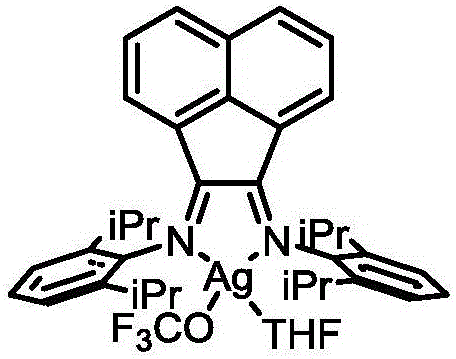 low activity (Dalton trans, 2015,44,19682);
 the selectivity is poor. This virtually increases the difficulty of the trifluoromethoxylation reaction (angelw. chem. int. ed.2016,55,11726). The existing preparation method is subject to the compatibility of trifluoromethoxy reagent and harsh reaction conditions (such as using virulent HF or SF)4) To the next step.
Few reports are reported for the direct reaction of trifluoromethoxy modification at present, because the nucleophilic trifluoromethoxy reagent MOCF which can be operated in laboratory at present3Thermodynamically unstable, e.g. AgOCF3The acetonitrile solution is unstable at room temperature and needs to be placed at low temperature; TASOCF3Still do not satisfy thermodynamic stability, and such salts are easily decomposed. This is also due to F3CO-+Q is determined by its own properties. At present, trifluoromethoxylation reagents can only complete nucleophilic substitution reaction of common alkyl, and most substrates are simple benzyl bromide with high primary activity, primary iodide or substitution reaction of alkyl compounds with OTf as a leaving group (common secondary trifluoromethane sulfonate is thermodynamically unstable and easily generates olefin compounds). Even so, there is a concomitant production of monofluoro by-products. Nucleophilic substitution reactions of secondary alkyl compounds are rarely reported (Tetrahedron lett.,2008,49,449; j. fluorine chem.,2010,131,200.adv. synth. cat., 2010,352,2831; Dalton trains., 2015,44,19682). The literature reports direct secondary nucleophilic substitution using common alkyl alcohols as substrates and trifluoromethyl p-toluenesulfonate as trifluoromethylating agent, but with a stereospecificity of only 20% ee (Angew. chem. int. Ed.2018,57,292). There is also only one report of reactions that directly introduce trifluoromethoxy groups on asymmetric substrates (nat. chem.2017,9,546), whereas indirect construction of asymmetric trifluoromethoxy compounds requires the prior introduction of trifluoromethoxy functional groups (Angew. chem.int. Ed.2017,56,11986; chem. Commun.,2018,54, 5522-5525).
Therefore, in view of the above-mentioned current reaction situation, it is necessary to develop a trifluoromethoxy reaction reagent which can directly perform a secondary aliphatic trifluoromethoxy reaction with high stereospecificity.
Disclosure of Invention
The invention aims to overcome the defects of poor stability, volatility, low activity, high input, side reaction and poor stereoselectivity of a trifluoromethoxy reagent in the prior art, and provides a nitrogen phosphine ligand coordination type trifluoromethoxy reagent and a preparation method and application thereof. The nitrogen-phosphine ligand coordination type trifluoromethoxy reagent realizes S directly taking primary or secondary p-nitrobenzenesulfonate as a substrateN2 nucleophilic substitution reaction, and inhibiting the generation of monofluoro substituted by-products, and obtaining the optically active trifluoromethoxyl compound with high stereospecificity with good yield.
The invention solves the technical problems through the following technical scheme.
The invention provides a nitrogen-phosphine ligand coordination type trifluoromethoxy reagent as shown in formula I,
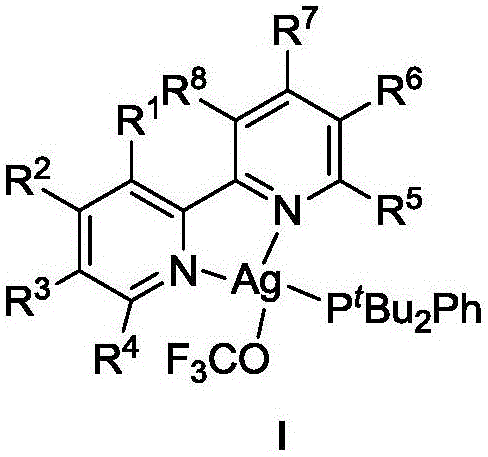
wherein R is1、R2、R3、R4、R5、R6、R7And R8Each independently is H, C1-10Alkyl, halogen substituted C1-10Alkyl radical, C1-10Alkoxy radical, C6-30Aryl, substituted C6-30Aryl, halogen, Nitro or cyano;
said substituted C6-30Substituents in aryl groups being selected from C1-10Alkyl, halogen substituted C1-10Alkyl radical, C1-10Alkoxy radical, C6-30Aryl, halogen, One or more of nitro and cyano (said substituted C)6-30The number of substituents in the aryl group is, for example, 1,2, 3, 4 or 5); the R is1bIs C1-C10An alkyl group; when the number of the substituents is plural, the substituents may be the same or different.
R1、R2、R3、R4、R5、R6、R7And R8In (A), the C1-10Alkyl is each independently preferably C1-6Alkyl, more preferably C1-4An alkyl group. Said C is1-4The alkyl group is preferably a methyl group, an ethyl group, an n-propyl group, an isopropyl group, an n-butyl group, an isobutyl group or a tert-butyl group, and more preferably a methyl group or a tert-butyl group.
R1、R2、R3、R4、R5、R6、R7And R8In (1), the halogen substituted C1-10In alkyl radical C1-10Alkyl is each independently preferably C1-6Alkyl, more preferably C1-3An alkyl group. Said C is1-3The alkyl group is preferably a methyl group, an ethyl group, a propyl group or an isopropyl group, and more preferably a methyl group.
R1、R2、R3、R4、R5、R6、R7And R8In (1), the halogen substituted C1-10The halogen in the alkyl group is each independently preferably F, Cl or Br, more preferably F.
R1、R2、R3、R4、R5、R6、R7And R8In (1), the halogen substituted C1-10The kind of halogen substitution in the alkyl group may be the same or different, and preferably the same.
R1、R2、R3、R4、R5、R6、R7And R8In (1), the halogen substituted C1-10The number of halogen substitutions in the alkyl group may be 1,2 or 3, preferably 3.
R1、R2、R3、R4、R5、R6、R7And R8In (A), the C6-30Aryl and substituted C6-30C in aryl6-30Aryl is preferably phenyl, naphthyl, anthryl or phenanthryl, more preferably phenyl.
In a preferred embodiment of the invention, R1、R3、R6And R8Each independently is H, C1-10Alkyl, halogen substituted C1-10Alkyl radical, C1-10Alkoxy radical, C6-30Aryl, substituted C6-30Aryl or halogen, preferably H, C1-10Alkyl or halogen substituted C1-10The alkyl group is more preferably H, methyl, tert-butyl or trifluoromethyl, and still more preferably H.
In a preferred embodiment of the invention, R2、R4、R5And R7Each independently is H, C1-10Alkyl, halogen substituted C1-10Alkyl radical, C1-10Alkoxy radical, C6-30Aryl, substituted C6-30Aryl or halogen, preferably H, C1-10Alkyl or halogen substituted C1-10Alkyl, more preferably H or C1-10The alkyl group is more preferably H, methyl, tert-butyl or trifluoromethyl, and still more preferably H, methyl or tert-butyl.
In a preferred embodiment of the invention, R1、R3、R6And R8Each of which is independently H, or a pharmaceutically acceptable salt thereof,
and, R2、R4、R5And R7Each independently is H, C1-10Alkyl or halogen substituted C1-10An alkyl group.
In a preferred embodiment of the invention, R1、R3、R6And R8Each of which is independently H, or a pharmaceutically acceptable salt thereof,
and, R2、R4、R5And R7Each independently is H or C1-10An alkyl group.
In a preferred embodiment of the invention, R1、R3、R6And R8Each of which is independently H, or a pharmaceutically acceptable salt thereof,
and, R2、R4、R5And R7Each independently is H, methyl, t-butyl or trifluoromethyl.
In a preferred embodiment of the invention, R1、R3、R6And R8Each of which is independently H, or a pharmaceutically acceptable salt thereof,
and, R2、R4、R5And R7Each independently is H, methyl or t-butyl.
In a preferred embodiment of the present invention, in the nitrogen phosphine ligand coordination type trifluoromethoxy reagent shown in formula I, any one of the following compounds is preferred:

the invention also provides a preparation method of the nitrogen phosphine ligand coordination type trifluoromethoxy reagent shown in the formula I, which comprises the following steps: under the protection of gas, carrying out the following reaction of a compound 1 and a compound 2 in an organic solvent to obtain a nitrogen phosphine ligand coordination type trifluoromethoxy reagent shown in a formula I,

wherein R is1、R2、R3、R4、R5、R6、R7And R8The definitions of (A) and (B) are as described above.
Wherein the gas may be a conventional protective gas, preferably nitrogen or argon.
Wherein, the organic solvent may be a conventional solvent for such reactions in the art, preferably one or more of nitrile solvents, amide solvents and ether solvents, more preferably nitrile solvents. The nitrile solvent may be a nitrile solvent conventional in the art, preferably acetonitrile (MeCN). The ethereal solvent may be one conventional in the art, and is preferably Tetrahydrofuran (THF) and/or dioxane. The amide-based solvent may be an amide-based solvent conventional in the art, preferably N, N-Dimethylformamide (DMF) and/or N, N-Dimethylacetamide (DMA), more preferably N, N-dimethylformamide.
The amount of the solvent used is not particularly limited, as long as the reaction is not affected.
Wherein, the molar ratio of the compound 1 to the compound 2 can be 1-4, preferably 2-3.
Among them, the compound 2 is preferably

Wherein, the temperature of the reaction can be the temperature of the conventional reaction of the reaction in the field, and is preferably 30-50 ℃, for example 40 ℃.
Wherein the progress of the reaction can be monitored by means of monitoring methods conventional in the art (e.g., TLC or HPLC), and the end point of the reaction is generally determined when the compound 2 is no longer reacted or when the disappearance of the compound 2 is detected. The reaction time is preferably 1 to 5 hours.
In the present invention, a post-treatment step may be further included after the reaction is completed. The post-treatment step may be a step conventional in the art for post-treatment, and the present invention preferably comprises the following steps: the reaction solution after the completion of the reaction was filtered and concentrated.
Among them, it is preferable to subject the reaction solution to a decoloring treatment before the filtration operation. The adsorbent for the decolorization treatment may be an adsorbent conventional in the art, preferably diatomaceous earth. The filtration may be conventional filtration such as suction filtration under reduced pressure, as is practiced in the art. The concentration may be conventional concentration, preferably under reduced pressure, of such operations as are conventional in the art.
The preparation method of the nitrogen phosphine ligand coordination type trifluoromethoxy reagent shown in the formula I can also comprise the following steps: under the protection of gas and in the dark condition, di-tert-butyl phenyl phosphine and AgOCF3The following reaction is carried out in a solvent to obtain the compound 1,

wherein the gas may be a gas conventional in such reactions in the art, preferably nitrogen or argon.
Wherein the di-tert-butylphenyl phosphine and the AgOCF3The molar ratio of (A) to (B) may be 1 to 1.5.
Among them, the solvent may be a solvent conventional in such reactions in the art, and is preferably an aromatic hydrocarbon solvent. The aromatic hydrocarbon solvent is preferably toluene.
The amount of the solvent used is not particularly limited as long as the reaction is not affected.
Wherein the reaction temperature can be the reaction temperature conventional in the field, preferably 10-40 ℃, for example 25 ℃.
Wherein the progress of the reaction can be monitored by monitoring methods conventional in the art (e.g., TLC or HPLC), and the reaction is generally terminated when the di-tert-butylphenyl phosphine is not reacted any more. The reaction time is preferably 0.5 to 1.5 hours.
In the present invention, a post-treatment step may be further included after the reaction is completed. The post-treatment step may be a step conventional in the art for post-treatment, and the present invention preferably comprises the following steps: and (3) filtering and crystallizing the reaction solution after the reaction is finished.
Wherein the filtration may be conventional in such operations in the art, such as reduced pressure filtration.
The operations and conditions of the crystallization may be those conventional in the art for such reactions, among others. The crystallization method can adopt a cooling method. The solvent for the crystallization can be an alkane solvent and an aromatic solvent. The alkane solvent is preferably n-pentane. The aromatic hydrocarbon solvent is preferably toluene. The crystallization temperature is preferably-20 to 5 ℃.
The invention also provides an application of the nitrogen phosphine ligand coordination type trifluoromethoxy reagent shown in the formula I in preparation of a trifluoromethoxyl compound.
The application preferably comprises the following steps: in an organic solvent, a nitrogen phosphine ligand coordination type trifluoromethoxy reagent shown as a formula I, a compound shown as a formula II and an alkali metal halide are subjected to S shown as the followingN2, nucleophilic substitution reaction to obtain a compound III;

wherein R is1、R2、R3、R4、R5、R6、R7And R8The definitions of (A) and (B) are as described above;
R9is H, C1~10Alkyl radical, R9-1Substituted C1~10Alkyl or C2-10An alkenyl group;
R9-1is composed of
R9-1-1Is C6~30Aryl radical, R9-1-1-1Substituted C6~30Aryl, C with 1-4 hetero atoms and one or more of O, S hetero atoms and N3~30Heteroaryl "or R9-1-1-2Substituted C with 1-4 heteroatoms, wherein the heteroatoms are one or more of O, S and N3~30Heteroaryl ";
R9-1-1-1and R9-1-1-2Each independently selected from halogen, C1~10Alkyl, halogen substituted C1~10Alkyl radical, C1~10Alkoxy and C6~30One or more of aryl groups;
m is 0,1, 2, 3 or 4;
R9-1-2is C6~30Aryl radical, R9-1-2-1Substituted C6~30Aryl, C with 1-4 hetero atoms and one or more of O, S hetero atoms and N3~30Heteroaryl "or R9-1-2-2Substituted C with 1-4 heteroatoms, wherein the heteroatoms are one or more of O, S and N3~30Heteroaryl ";
R9-1-2-1and R9-1-2-2Each independently selected from halogen, C1~10Alkyl, halogen substituted C1~10Alkyl radical, C1~10Alkoxy group of (C)6~30Aryl and R9-1-2-1-1Substituted C6~30One or more of aryl groups;
R9-1-2-1-1selected from halogen, cyano and C1~10One or more of alkyl;
R10is C1-10Alkyl or H;
or, R9、R10Together with the carbon atom to which they are attached form "C with 1 to 4 heteroatoms, one or more of O, S and N2~6The heterocyclic group or the substituted heterocyclic group has 1-4 heteroatoms, and the heteroatom is C of one or more of O, S and N2~6Heterocyclyl ";
said substituted "C with 1-4 heteroatoms and one or more of O, S heteroatoms and N2~6Substituents in heterocyclyl are selected from C1~10Alkyl, and/or, C6~30Aryl substituted C1~10An alkyl group;
when R is9-1-1-1、R9-1-1-2、R9-1-2-1、R9-1-2-2And R9-1-2-1-1When the number of (A) is plural, R is9-1-1-1、R9-1-1-2、R9-1-2-1、R9-1-2-2And R9-1-2-1-1Each independently the same or different.
R9-1-1In (A), the C6~30Aryl and said R9-1-1-1Substituted C6~30C in aryl6~30Aryl is each independently preferably C6~18Aryl, more preferably C6~10Aryl, further preferably phenyl.
R9-1-1In (1), the R9-1-1-1The number of (A) is preferably 1 or 2.
R9-1-1-1And R9-1-1-2Wherein each halogen is independently preferably F, Cl, Br or I, preferably Cl or Br.
R9-1-1-1And R9-1-1-2In (1), the halogen substituted C1~10The halogen in the alkyl group is preferably each independently F, Cl, Br or I, preferably F.
R9-1-1-1And R9-1-1-2In (1), the halogen substituted C1~10The number of substitutions in the alkyl group may each independently be 1,2 or 3, preferably 3. When the number of the substitution is plural, the halogen species may be the same or different, and preferably the same.
R9-1-1-1And R9-1-1-2In (1), the halogen substituted C1~10C in alkyl1~10Alkyl is each independently preferably C1~6Alkyl, more preferably C1~3Alkyl, and trifluoromethyl is more preferred.
R9-1-1-1And R9-1-1-2In (A), the C6~30Aryl is each independently preferably C6~18Aryl, more preferably C6~10Aryl, further preferably phenyl.
R9-1-1-1And R9-1-1-2In (A), the C1~10Alkoxy of (A) is each independently preferably C1~6More preferably C1~3The alkoxy group of (2) is more preferably a methoxy group.
R9-1-2In (A), the C6~30Aryl and said R9-1-2-1Substituted C6~30C in aryl6~30Aryl is each independently preferably C6~18Aryl, more preferably C6~10Aryl, further preferably phenyl.
R9-1-2Wherein the' C with 1-4 heteroatoms and one or more of O, S heteroatoms and N3~30The heteroaryl group is preferably C with 1-3 heteroatoms, and the heteroatoms are one or more of O and N3~18Heteroaryl group ", more preferably" C having 1 to 3 hetero atoms and one or more hetero atoms of O and N3~10Heteroaryl ", more preferably
R9-1-2In (1), the R9-1-2-1The number of (A) is preferably 1 or 2.
R9-1-2-1And R9-1-2-2Wherein each halogen is independently preferably F, Cl, Br or I, preferably Cl or Br.
R9-1-2-1And R9-1-2-2In (A), the C1~10Alkoxy is preferably C1~6Alkoxy, more preferably C1~3Alkoxy, and methoxy is more preferable.
R9-1-2-1And R9-1-2-2In (A), the C6~30Aryl and said R9-1-2-1-1Substituted C6~30C in aryl6~30Aryl is each independently preferably C6~18Aryl, more preferably C6~10Aryl, further preferably phenyl.
R9、R10Together with the carbon atoms to which they are attached form a substituted "heteroatom number of 1 to 4,c with one or more of O, S and N as hetero atoms2~6Heterocyclyl and substituted C having 1 to 4 heteroatoms, the heteroatom being one or more of O, S and N2~6The heterocyclic group has 1-4 heteroatoms, and the heteroatom is O, S and one or more of N2~6Heterocyclyl "independently of one another preferably" C having 1 heteroatom, the heteroatom being N2~6Heterocyclic group ", more preferably
R9-1-1Preferably C6~30Aryl or R9-1-1-1Substituted C6~30And (4) an aryl group.
R9-1-1-1Each independently preferably halogen, halogen-substituted C1~10Alkyl radical, C1~10Alkoxy or C6~30And (4) an aryl group.
m is preferably 1.
R9-1-2Is C6~30Aryl radical, R9-1-2-1Substituted C6~30Aryl or C with 1-4 heteroatoms and one or more of O, S heteroatoms and N3~30Heteroaryl group ".
R9-1-2-1Preferably halogen, C1~10Alkoxy group of (C)6~30Aryl or R9-1-2-1-1Substituted C6~30And (4) an aryl group.
R9-1-2-1-1Cyano groups are preferred.
The substituted C with 1-4 heteroatoms and one or more of O, S heteroatoms and N2~6The substituent in the "heterocyclic group" is preferably C6~30Aryl substituted C1~10An alkyl group.
Wherein, the SNThe conditions for the nucleophilic substitution reaction may be those conventional in the art for such reactions.
Wherein, the organic solvent may be a conventional organic solvent used in such reactions in the art, preferably one or more of nitrile solvents, amide solvents and ether solvents, more preferably nitrile solvents. The nitrile solvent is preferably acetonitrile. The ethereal solvent is preferably Tetrahydrofuran (THF) and/or dioxane. The amide solvent is preferably N, N-Dimethylformamide (DMF) and/or N, N-Dimethylacetamide (DMA), and more preferably N, N-dimethylformamide.
The amount of the solvent used is not particularly limited as long as the reaction is not affected.
Wherein the molar ratio of the nitrogen-phosphine ligand coordination type trifluoromethoxy reagent shown in the formula I to the compound shown in the formula II can be 1.2-2.0.
Among them, the alkali metal halide may be an alkali metal halide, preferably an alkali metal iodide, which is conventional in such reactions in the art. The alkali iodide may be NaI and/or KI, preferably KI.
The molar ratio of the alkali metal halide to the compound represented by the formula II can be a molar ratio conventionally used in the reaction in the field, and is preferably 0.1-2.0.
Wherein, the SNThe temperature of the nucleophilic substitution reaction may be a temperature conventional in the art for such reactions, preferably 10 to 80 ℃, more preferably 40 to 80 ℃.
Wherein, the SNThe progress of the nucleophilic substitution reaction can be monitored by methods known in the art (e.g., TLC or HPLC), and is generally determined as the end point of the reaction when the compound of formula II is no longer reacted or is detected to be eliminated. Said SNThe time for the nucleophilic substitution reaction is preferably 2 to 48 hours, more preferably 8 to 48 hours.
Among them, the compound represented by the formula II is preferably

Wherein, the nitrogen phosphine ligand coordination type trifluoromethoxy reagent shown in the formula I is preferable

In the present invention, said SN2 a post-treatment step may also be included after the nucleophilic substitution reaction is complete. The post-treatment step may be a step conventional in the art for post-treatment, and the present invention preferably comprises the following steps: and (4) concentrating the reaction solution after the reaction is finished and carrying out column chromatography separation.
Therefore, the nitrogen-phosphine ligand coordination type trifluoromethoxy reagent realizes S directly taking primary or secondary p-nitrobenzenesulfonate as a substrateN2 nucleophilic substitution reaction, the yield is more than 40 percent and can reach 91 percent at most, the ee value is more than 78.2 percent and can reach 91.6 percent at most, the generation of monofluoro substitution byproducts is inhibited, and the trifluoromethoxyl compound with high stereospecificity and optical activity is obtained.
The above preferred conditions can be arbitrarily combined to obtain preferred embodiments of the present invention without departing from the common general knowledge in the art.
In the invention, the "light-shielding condition" means that certain measures are taken to realize the isolation from light in the chemical reaction process, for example, a brown reaction bottle or an aluminum foil paper is used for wrapping the reaction bottle.
In the present invention, "the substituents are the same or different" includes the same or different kinds of the substituents, for example The substituent at the 1-position on the phenyl is methyl, the substituent at the 2-position on the phenyl is ethyl, and the methyl and the ethyl belong to the group C1~10In the present invention, the substituents of the alkyl group, i.e., the methyl group at the 1-position and the ethyl group at the 2-position on the phenyl group, are the same.
In the present invention, "C1~10Alkyl "includes straight and branched C1~10An alkyl group.
In the present invention, "C2~10Alkenyl "includes straight and branched C2~10An alkenyl group.
As used herein, "heterocyclyl" means a compound containing 1 to 4 heteroatoms (e.g., nitrogen, oxygen and sulfur)One or more of) a 4-to 12-membered monocyclic ring, wherein each ring may contain one or more double bonds, but none of the rings has a completely conjugated pi-electron system,
in the invention, the term "room temperature" means 10 to 30 ℃.
In the present invention, the term "overnight" means 12 to 16 hours.
The reagents and starting materials used in the present invention are commercially available.
The positive progress effects of the invention are as follows: the nitrogen-phosphine ligand coordination type trifluoromethoxy reagent realizes S directly taking primary or secondary p-nitrobenzenesulfonate as a substrateN2 nucleophilic substitution reaction, and inhibiting the generation of monofluoro substitution by-products, the yield is more than 40 percent and can reach 91 percent at most, the ee value is 78.2 percent and can reach 91.6 percent at most, and the trifluoromethoxyl compound with high stereospecificity and optical activity is obtained.
Drawings
FIG. 1 is an X-ray single crystal electron diffraction pattern of the trifluoromethoxy reagent I-1 obtained in example 1.
FIG. 2 is an X-ray single crystal electron diffraction pattern of the trifluoromethoxy reagent I-2 obtained in example 2.
Detailed Description
The invention is further illustrated by the following examples, which are not intended to limit the scope of the invention. The experimental methods without specifying specific conditions in the following examples were selected according to the conventional methods and conditions, or according to the commercial instructions.
EXAMPLE 1 Synthesis of Nitrogen phosphine ligand coordinated trifluoromethoxy reagent I-1

In a glove box, di-tert-butylphenyl phosphine (3.56g,16mmol) was added to an aluminum foil-wrapped 100mL egg-shaped bottle, and 40mL of formazan was added in orderBenzene, 16 mmoleAgOCF3After stirring the solution (1M,16mL) in a glove box at room temperature for 30 minutes, after filtration, n-pentane (10mL solution for 200mL n-pentane) was spread along the walls and then placed in a refrigerator for overnight crystallization and filtration, 4.6g of 1 as a white solid was isolated in 69% yield.
1H NMR(400MHz,D6-benzene)δ7.74(br,4H),7.08-7.07(m,6H),1.06(d,J=4.0Hz,2H),19F NMR(400MHz,D6-benzene)δ-30.37,31P NMR(161MHz,MeCN)δ67.5(dd,J=703.6,51.5Hz);Anal.Calcd for C30H49Ag2F6O2P2:C,43.39;H,5.58;Found:C,43.51;H,5.87.

In a glove box, 3.666g [ (PPh)tBu2)Ag(μ-OCF3)]2(4.4mmol), bipyridine (8.8mmol,1.373mg) and acetonitrile (40mL) were sequentially added to a dried pressure-resistant reaction tube, reacted in an oil bath at 40 ℃ for 1 hour to obtain a colorless solution, allowed to stand to cool, taken into a glove box, filtered with celite into a 100mL egg-shaped bottle to obtain a colorless solution, and after being pumped out with an oil pump (one hour), 5g of white solid I-1 was obtained, and the yield was quantified.
1H NMR(400MHz,CDCl3)δ8.71(br,2H),8.51(d,J=4.0Hz,2H),8.08(t,J=8.0Hz,2H),7.87-7.84(m,2H),7.57-7.54(m,3H),7.50(t,J=8.0Hz,2H),1.40-1.38(d,J=12.0Hz,18H);19F NMR(376MHz,CDCl3)δ-26.18(br,s);13C NMR(101MHz,CDCl3)δ153.23,150.29,139.52,136.34(br),131.73(d,J=2.0Hz),129.36(d,J=2.0Hz),129.08(d,J=2.0Hz),129.00,128.90,125.75,123.04,34.66(dd,J=12.1,4.0Hz),30.64,30.54;31P NMR(161MHz,CDCl3)δ72.5(dd,J=687.5,49.9Hz);Anal.Calcd for C25H31AgF3N2OP:C,52.22;H,5.47;N,4.90;Found:C,52.56;H,5.46;N,5.03。
It belongs to Monoclinic crystal system by X-ray single crystal diffraction detection,p21/c space group, a is b is
b is c is
c is α ═ β ═ γ ═ 90 °, the structural schematic diagram is shown in fig. 1, and the main parameters of the unit cell are shown in table 1.
TABLE 1

EXAMPLE 2 Synthesis of Nitrogen phosphine ligand coordinated trifluoromethoxy reagent I-2

In a glove box, [ (PPh)tBu2)Ag(μ-OCF3)]2(1mmol) and substituted bipyridine (2mmol), acetonitrile (10mL) were added in sequence to a dried pressure-resistant reaction tube, reacted in an oil bath at 40 ℃ for 1 hour to give a colorless solution, allowed to stand and cool, taken into a glove box, filtered into a 100mL egg-shaped bottle using celite to give a colorless solution, and pumped off using an oil pump (one hour) to give 1.1g of white solid I-2, and the yield was quantified.
1H NMR(400MHz,CDCl3)δ8.48(d,J=8.0Hz,2H),8.28(s,2H),7.82–7.77(m,2H),7.54-7.45(m,3H),7.39(d,J=4.0Hz,2H),2.54(s,6H),1.36(d,J=16.0Hz,18H);19F NMR(376MHz,CDCl3)δ-24.88(br,s);13C NMR(101MHz,CDCl3)δ152.41,152.04,149.97,131.79(d,J=1.7Hz),128.99(d,J=10.2Hz),126.96,124.00,77.52,77.20,76.88,34.61(dd,J=12.1,3.0Hz),30.57(d,J=9.0Hz),21.61;31P NMR(161MHz,CDCl3)δ72.61(dd,J=678,49.2Hz);Anal.Calcd for C27H35AgF3N2OP:C,54.10;H,5.89;N,4.67;Found:C,53.95;H,6.05;N,4.64。
The structure diagram of the single crystal X-ray diffraction detection is shown in figure 2.
EXAMPLE 3 Synthesis of Nitrogen phosphine ligand coordinated trifluoromethoxy reagent I-3

In a glove box, [ (PPh)tBu2)Ag(μ-OCF3)]2(1mmol) and substituted bipyridine (2mmol), acetonitrile (10mL) were added sequentially to a dried pressure-resistant reaction tube, reacted in an oil bath at 40 ℃ for 1 hour to give a colorless solution, allowed to stand to cool, taken into a glove box, filtered into a 100mL egg-shaped bottle using celite to give a colorless solution, and pumped dry (one hour) using an oil pump to give 886mg of off-white solid I-3 in 74% yield.
1H NMR(400MHz,CDCl3)δ8.16(d,J=8.0Hz,2H),7.86-7.82(m,4H),7.51(t,J=8.0Hz,1H),7.43(t,J=8.0Hz,2H),7.30(d,J=8.0Hz,2H),2.65(s,6H),1.35(d,J=16.0Hz,18H);19F NMR(376MHz,CDCl3)δ-26.43(br,s);31P NMR(161MHz,CDCl3)δ68.15(d,J=555.5Hz);Anal.Calcd for C27H35AgF3N2OP:C,54.10;H,5.89;N,4.67;Found:C,53.63;H,6.09;N,4.62。
EXAMPLE 4 Synthesis of Nitrogen phosphine ligand coordinated trifluoromethoxy reagent I-4

In a glove box, [ (PPh)tBu2)Ag(μ-OCF3)]2(1mmol) and substituted bipyridine (2mmol), acetonitrile (10mL) were added in sequence to a dried pressure-resistant reaction tube, reacted in an oil bath at 40 ℃ for 1 hour to give a colorless solution, allowed to stand and cool, taken into a glove box, filtered with diatomaceous earth to a 100mL egg-shaped bottle to give a colorless solution, and pumped to dryness with an oil pump (one hour) to give 960mg of a white solidI-4, yield 70%.
1H NMR(400MHz,CDCl3)δ8.64(s,2H),8.26(s,2H),7.86(t,J=8.0Hz,2H),7.59-7.51(m,5H),1.45-1.39(m,36H);19F NMR(376MHz,CDCl3)δ-25.15(br,s);31P NMR(161MHz,CDCl3)δ72.16(dd,J=677.8,45.1Hz);Anal.Calcd for C33H47AgF3N2OP:C,57.98;H,6.93;N,4.10;Found:C,57.59;H,7.23;N,4.31。
EXAMPLE 5 Synthesis of Nitrogen phosphine ligand coordinated trifluoromethoxy reagent I-5

In a glove box, [ (PPh)tBu2)Ag(μ-OCF3)]2(1mmol) and substituted bipyridine (2mmol), acetonitrile (10mL) were added sequentially to a dried pressure-resistant reaction tube, reacted in an oil bath at 40 ℃ for 1 hour to give a colorless solution, left to stand for cooling, taken into a glove box, filtered into a 100mL egg-shaped bottle using celite to give a colorless solution, and pumped dry (one hour) using an oil pump to give 960mg of I-5 as a white solid in 64% yield.
1H NMR(400MHz,MeCN-D3)δ8.96(d,J=8.0Hz 2H),8.69(s,2H),7.91-7.81(m,4H),7.58-7.47(m,3H),1.32(d,J=16.0Hz,18H);19F NMR(376MHz,MeCN-D3)δ-24.26(br,s);31PNMR(161MHz,MeCN-D3)δ69.38(dd,J=698.7,46.7Hz);Anal.Calcd for C27H29AgF9N2OP:C,45.85;H,4.13;N,3.96;Found:C,45.90;H,4.53;N,3.62。
Application example 1

The method comprises the following operation steps: in a glove box, 0.4mmol (S) -p-nitrobenzenesulfonic acid aliphatic ester substrate, 0.8mmol reagent I-1, 0.4mmol potassium iodide and 4mL MeCN are weighed in a 25mL sealed tube and reacted for 12h in an oil bath at 40 ℃. After the reaction is finished, concentrating and carrying out column chromatography to obtain the required product. 63.2mg of a colorless oily liquid were obtained in a yield of 72% (90% ee; 92% e.s.).
1H NMR(400MHz,CDCl3)δ7.29(t,J=8.0Hz,1H),7.18-7.22(m,2H),4.35(tt,J=12.4,6.2Hz,1H),2.76–2.66(m,2H),2.03–1.80(m,2H),1.36(d,J=6.2Hz,1H);19F NMR(376MHz,CDCl3)δ-57.58(s,1H);13C NMR(101MHz,CDCl3)δ141.23,128.7,128.5,126.28123.3,122(q,J=254Hz)75.88,38.38,31.48,21.05;HRMS(EI)m/z:Calcd forC11H13OF3(M)+:218.0918,found 218.0910;HPLC(ODH,0.46×25cm,5μm,hexane/isopropanol=99/1(v/v%),flow 0.7mL/min,detection at 221nm),retention time=7.800min(minor)and 8.600min(major,90%ee,92%e.s.);[α]D 25=-5.0(c=0.1,CHCl3)。
Application example 2

The method comprises the following operation steps: in a glove box, 0.4mmol of (R) -p-nitrobenzenesulfonic acid aliphatic ester substrate, 0.8mmol of reagent I-1, 0.4mmol of potassium iodide and 4mL of MeCN are weighed in a 25mL sealed tube and reacted for 48h in an oil bath at 40 ℃. After the reaction is finished, concentrating and carrying out column chromatography to obtain the required product. 71.3mg of a colorless oily liquid were obtained in 68% yield (78% ee; 85% e.s.).
1H NMR(400MHz,CDCl3)δ8.02(d,J=8.2Hz,2H),7.55(t,J=7.6Hz,1H),7.43(t,J=7.6Hz,2H),4.54-4.58(m,1H),4.49-4.34(m,2H),2.12-2.00(m,2H),1.41(d,J=4Hz,3H);19F NMR(376MHz,CDCl3)δ-58.18(s);13C NMR(101MHz,CDCl3)δ166.53,133.24,130.21,129.72,128.59,121.89(q,J=254.2Hz),77.29(q,J=2.0Hz),60.90,35.73,21.18;IR(neat)2986,1723,1603,1453,1385,1271,1212,1139,1071,1027,712;HRMS(EI)m/z:Calcdfor C12H13O3F3(M)+:262.0817,found 262.0824;HPLC(IG,0.46×25cm,5μm,hexane/isopropanol=99/1(v/v%),flow 0.7mL/min,detection at 214nm),retention time=10.283min(minor)and 11.027min(major,78%ee;85%e.s.);[α]D 25=+25.4(c=0.195,CHCl3)。
Application example 3

The method comprises the following operation steps: in a glove box, 0.4mmol of (R) -p-nitrobenzenesulfonic acid aliphatic ester substrate, 0.8mmol of reagent I-1, 0.4mmol of potassium iodide and 4mL of MeCN are weighed in a 25mL sealed tube and subjected to oil bath reaction at 40 ℃ for 12 hours. After the reaction is finished, concentrating and carrying out column chromatography to obtain the required product. 86.9mg of a colorless oily liquid was obtained in 88% yield (91% ee; 100% e.s.).
1H NMR(400MHz,CDCl3)δ7.37-7.27(m,5H),4.61-4.55(m,1H),4.49(q,J=11.7Hz,2H),3.57-3.54(m,2H),1.93-1.83(m,2H),1.35(d,J=8Hz,3H);19F NMR(376MHz,CDCl3)δ-57.95(s);13C NMR(101MHz,CDCl3)δ138.38,128.61,127.93,127.88,121.97(q,J=253.7Hz),73.76(q,J=2.2Hz),73.44,66.12,36.92,21.22;IR(neat)2927,2862,1457,1375,1285,1208,1134,1027,841,801,737,698;HRMS(EI)m/z:Calcd for C12H15O2F3(M)+:248.1024,found 248.1021;HPLC(OJH 0.46×25cm,5μm,hexane/isopropanol=98/2(v/v%),flow 0.7mL/min,detection at 214nm),retention time=7.153min(minor)and7.787min(major,91%ee;100%e.s.);[α]D 25=+14.2(c=0.110,CHCl3)。
Application example 4

The method comprises the following operation steps: in a glove box, 0.4mmol of (R) -p-nitrobenzenesulfonic acid aliphatic ester substrate, 0.8mmol of reagent I-1, 0.4mmol of potassium iodide and 4mL of MeCN are weighed in a 25mL sealed tube and reacted for 48h in an oil bath at 40 ℃. After the reaction is finished, concentrating and carrying out column chromatography to obtain the required product. 52.9mg of a colorless oily liquid was obtained in 88% yield (85.7% ee; 93% e.s.).
1H NMR(500MHz,CDCl3)δ7.98(d,J=8.9Hz,2H),6.93(d,J=8.9Hz,2H),4.58-4.53(m,1H),4.42-4.46(m,1H),4.35(ddd,J=11.4,8.0,5.5Hz,1H),3.86(s,3H),2.12-2.00(m,2H),1.42(d,J=6.3Hz,3H);19F NMR(376MHz,CDCl3)δ57.53(s,1H);13C NMR(101MHz,CDCl3)δ166.29,163.67,131.76,122.63,121.9(q,J=255.5Hz),113.86,73.38(d,J=2.2Hz),60.61,55.60,35.81,21.17;IR(neat)2966,2843,1716,1608,1582,1513,1458,1385,1258,1212,1169,1135,1032,848,770,697,614;HRMS(EI)m/z:Calcd for C13H15O4F3(M)+:292.0922,found 292.0918;HPLC(IG 0.46×25cm,5μm,hexane/isopropanol=99/1(v/v%),flow 0.7mL/min,detection at 214nm),retention time=18.473min(major)and21.737min(minor,85.7%ee;93%e.s.);[α]D 25=+11.6(c=0.260,CHCl3)。
Application example 5

The method comprises the following operation steps: in a glove box, 0.4mmol of (R) -p-nitrobenzenesulfonic acid aliphatic ester substrate, 0.8mmol of reagent 2, 0.4mmol of potassium iodide and 4mL of MeCN are weighed in a 25mL sealed tube and reacted for 48 hours in an oil bath at 40 ℃. After the reaction is finished, concentrating and carrying out column chromatography to obtain the required product. 92mg of a colorless oily liquid was obtained in a yield of 75%, (85.3% ee; 93% e.s.)
1H NMR(400MHz,CDCl3)δ6.49(d,J=4.0Hz,2H),6.39(s,1H),4.58(m,1H),4.43(q,J=12.0Hz,2H),3.79(s,6H),3.55(t,J=8.0Hz,2H),1.95-1.79(m,2H),1.35(d,J=4.0Hz,3H);19F NMR(376MHz,CDCl3)δ-57.92(s);13C NMR(101MHz,CDCl3)δ161.06,140.76,121.94(q,J=253.7Hz),105.58,99.87,73.73(q,J=2.0Hz),73.35,66.11,55.45,36.87,21.20;IR(neat)2942,1599,1464,1431,1360,1289,1206,1155,1068,834,669;HRMS(EI)m/z:Calcd for C14H19O4F3(M)+:308.1035,found 308.1238;HPLC(ODH 0.46×25cm,5μm,hexane/isopropanol=99/1(v/v%),flow 0.7mL/min,detection at 214nm),retentiontime=13.933min(major)and 15.047min(minor,85.3%ee;93%e.s.);[α]D 25=+4.92(c=0.300,CHCl3)。
Application example 6

The method comprises the following operation steps: in a glove box, 0.4mmol of (R) -p-nitrobenzenesulfonic acid aliphatic ester substrate, 0.8mmol of reagent I-1, 0.4mmol of potassium iodide and 4mL of MeCN are weighed in a 25mL sealed tube and reacted for 48h in an oil bath at 40 ℃. After the reaction is finished, concentrating and carrying out column chromatography to obtain the required product. 60.4mg of a colorless oily liquid was obtained in 59% yield (85% ee; 86% e.s.).
1H NMR(400MHz,CDCl3)δ7.88(d,J=8.0Hz,2H),7.59(d,J=8.0Hz,2H),4.59-4.53(m,1H),4.51-4.35(m,2H),2.12-2.01(m,2H),1.43(d,J=6.2Hz,3H);19F NMR(376MHz,CDCl3)δ-58.20(s);13C NMR(101MHz,CDCl3)δ165.82,131.97,131.24,129.09,128.41,121.87(q,J=254.3Hz),73.22(q,J=2.0Hz),61.20,35.65,21.20;IR(neat)2985,1724,1592,1398,1268,1212,1142,1070,1013,847,756,683,471;HRMS(EI)m/z:Calcd forC12H12O3F3Br(M)+:339.9922,found 339.9920;HPLC(IG 0.46×25cm,5μm,hexane/isopropanol=99/1(v/v%),flow 0.7mL/min,detection at 214nm),retention time=12.707min(major)and 13.467min(minor,85%ee,86%e.s.);[α]D 25=+17.9(c=0.265,CHCl3)。
Application example 7

The method comprises the following operation steps: in a glove box, 0.4mmol of (R) -p-nitrobenzenesulfonic acid aliphatic ester substrate, 0.8mmol of reagent I-1, 0.4mmol of potassium iodide and 4mL of MeCN are weighed in a 25mL sealed tube and reacted for 48h in an oil bath at 40 ℃. After the reaction is finished, concentrating and carrying out column chromatography to obtain the required product. 100.3mg of a colorless oily liquid was obtained in 74% yield (86.5% ee; 94% e.s.).
1H NMR(400MHz,CDCl3)δ8.16(s,1H),7.96(d,J=8Hz,1H),7.69(d,J=7.3Hz,1H),7.33(t,J=8Hz,1H),4.55(dq,J=12.6,6.3Hz,1H),4.51-4.35(m,2H),2.12–2.01(m,2H),1.43(d,J=6.3Hz,3H);19F NMR(376MHz,CDCl3)δ57.63(s);13C NMR(101MHz,CDCl3)δ165.20,136.19,132.72,132.10,130.18,128.29,122.68,121.9(q,J=255.5HZ),73.19(d,J=2.3Hz),61.37,35.62,21.18;IR(neat)2958,1728,1570,1457,1385,1290,1212,1130,1068,1000,747,718;HRMS(EI)m/z:Calcd for C12H12O3F3Br(M)+:339.9922,found339.9925;HPLC(IG 0.46×25cm,5μm,hexane/isopropanol=99/1(v/v%),flow 0.7mL/min,detection at 214nm),retention time=9.780min(minor)and 10.333min(major,86.5%ee;94%e.s.);[α]D 25=+22.08(c=0.290,CHCl3).
Application example 8

The method comprises the following operation steps: in a glove box, 0.4mmol of (R) -p-nitrobenzenesulfonic acid aliphatic ester substrate, 0.8mmol of reagent I-1, 0.4mmol of potassium iodide and 4mL of MeCN are weighed in a 25mL sealed tube and reacted for 48h in an oil bath at 40 ℃. After the reaction is finished, concentrating and carrying out column chromatography to obtain the required product. 99.3mg of a colorless oily liquid was obtained in a yield of 76% (91.6% ee; 98.3% e.s.).
1H NMR(400MHz,CDCl3)δ7.47(d,J=8Hz,2H),7.20(d,J=8Hz,2H),4.60-4.52(m,1H),4.47-4.40(m,2H),3.56-3.53(m,2H),1.94-1.81(m,2H),1.36(d,J=8Hz,3H);19F NMR(376MHz,CDCl3)δ-57.96(s);13C NMR(101MHz,CDCl3)δ137.41,131.70,129.48,121.95(q,J=254.5Hz),121.71,73.64(q,J=2.0Hz),72.62,66.24,36.87,21.24;IR(neat)2928,2868,1594,1488,1377,1286,1209,1135,1071,1012,804,650,478;HRMS(EI)m/z:Calcdfor C12H14O2F3Br(M)+:326.0129,found 326.0133;HPGC(cp-chiraDex-CB 30m×0.25mm×0.25μm,100℃),retention time=211.497min(minor)and 213.685min(major,91.6%ee,98.3%e.s.);[α]D 25=-19.1(c=0.345,CHCl3)。
Application example 9

The method comprises the following operation steps: in a glove box, 0.4mmol of (R) -p-nitrobenzenesulfonic acid aliphatic ester substrate, 0.8mmol of reagent I-1, 0.4mmol of potassium iodide and 4mL of Mercn are weighed in a 25mL sealed tube and reacted for 48h in an oil bath at 40 ℃. After the reaction is finished, concentrating and carrying out column chromatography to obtain the required product. 99.9mg of a colorless oily liquid was obtained in 79% yield (84.3% ee; 90.8% e.s.)
1H NMR(400MHz,CDCl3)δ7.41-7.39(m,2H),7.15(d,J=8.2Hz,1H),4.60-4.52(m,1H),4.46-4.39(m,2H),3.56(dd,J=8.6,3.8Hz,2H),1.96-1.80(m,2H),1.36(d,J=4Hz,3H);19F NMR(376MHz,CDCl3)δ-57.98(s);13C NMR(101MHz,CDCl3)δ138.75,132.68,131.71,130.55,129.58,126.91,121.95(q,J=254.5Hz),73.57(q,J=2Hz),71.92,66.42,36.81,21.22;IR(neat)2986,1564,1473,1390,1353,1286,1209,1132,1032,877,817,669,585;HRMS(EI)m/z:Calcd for C12H13O2F3Cl2(M)+:316.0245,found 316.0243;HPGC(cp-chiraDex-CB 30m×0.25mm×0.25μm,100℃),retention time=63.463min(minor)and64.545min(major,84.3%ee,90.8%e.s.);[α]D 25=+15.4(c=0.355,CHCl3)。
Application example 10

The method comprises the following operation steps: in a glove box, 0.4mmol of (R) -p-nitrobenzenesulfonic acid aliphatic ester substrate, 0.8mmol of reagent I-1, 0.4mmol of potassium iodide and 4mL of MeCN are weighed in a 25mL sealed tube and reacted for 48h in an oil bath at 40 ℃. After the reaction is finished, concentrating and carrying out column chromatography to obtain the required product. 86.1mg of a white solid was obtained in 64% yield (78.2% ee; 83.5% e.s.)
1H NMR(400MHz,CDCl3)δ8.09(d,J=8Hz,2H),7.68-7.62(m,4H),7.47(t,J=8.0Hz,2H),7.40(t,J=8.0Hz,1H),4.59(dq,J=12.6,6.3Hz,1H),4.44(tdd,J=11.4,9.6,5.8Hz,2H),2.16-2.06(m,2H),1.44(d,J=8.0Hz,3H);19F NMR(376MHz,CDCl3)δ-58.10(s);13C NMR(101MHz,CDCl3)δ166.45,146.03,140.17,130.26,129.14,128.38,127.47,127.31,131.71,121.93(q,J=255.53Hz),73.32,60.95,35.79,21.23;IR(neat)2988,1712,1610,1488,1450,1406,1631,1289,1265,1207,1124,1053,1124,1053,863,826,749,697,467;HRMS(EI)m/z:Calcd for C18H17O3F3(M)+:338.1130,found 338.1133;HPLC(IG0.46×25cm,5μm,hexane/isopropanol=99/1(v/v%),flow 0.7mL/min,detection at214nm),retention time=35.200min(minor)and 37.243min(major,78.2%ee,83.5%e.s.);[α]D 25=+15.8(c=0.300,CHCl3)。
Application example 11

The method comprises the following operation steps: in a glove box, 0.4mmol of (R) -p-nitrobenzenesulfonic acid aliphatic ester substrate, 0.8mmol of reagent I-1, 0.4mmol of potassium iodide and 4mL of MeCN are weighed in a 25mL sealed tube and reacted for 48h in an oil bath at 40 ℃. After the reaction is finished, concentrating and carrying out column chromatography to obtain the required product. 103.9mg of a colorless oily liquid was obtained in 80% yield (81% ee; 94% e.s)
1H NMR(400MHz,CDCl3)δ7.57(dd,J=7.7,2.8Hz,4H),7.44-7.31(m,5H),4.61–4.48(m,3H),3.62-3.56(m,2H),1.96–1.83(m,2H),1.35(d,J=8.0Hz,3H);19F NMR(376MHz,CDCl3)δ-57.89(s);13C NMR(101MHz,CDCl3)δ141.08,140.85,137.38,128.93,128.37,127.45,127.36,127.27,121.98(q,J=253.8Hz),73.74(q,J=2.1Hz),73.13,66.16,36.91,21.22;IR(neat)2985,1600,1488,1450,1378,1360,1286,1208;1133,,1029,844,761,698;HRMS(EI)m/z:Calcd for C18H19O2F3(M)+:324.1337,found 324.1333;HPLC(IG0.46×25cm,5μm,hexane/isopropanol=9/1(v/v%),flow 0.7mL/min,detection at214nm),retention time=5.947min(major)and 6.453min(minor,81%ee,94%e.s.);[α]D 25=+19.4(c=0.295,CHCl3)。
Application example 12

The method comprises the following operation steps: in a glove box, 0.4mmol of (R) -p-nitrobenzenesulfonic acid aliphatic ester substrate, 0.8mmol of reagent I-1, 0.4mmol of potassium iodide and 4mL of MeCN are weighed in a 25mL sealed tube and reacted for 48h in an oil bath at 40 ℃. After the reaction is finished, concentrating and carrying out column chromatography to obtain the required product. 97.1mg of a colorless oily liquid was obtained in 74% yield (90% ee; 93% e.s.).
1H NMR(400MHz,CDCl3)δ8.14(d,J=8.1Hz,2H),7.72(d,J=8.0Hz,2H),4.56-4.40(m,3H),2.12-2.04(m,2H),1.44(d,J=8.0Hz,3H);19F NMR(376MHz,CDCl3)δ-58.30(s),-63.26(s);13C NMR(101MHz,CDCl3)δ165.34,134.78(q,J=32.6Hz),133.42,130.14,125.66(q,J=3.7Hz),123.8(q,J=274.7Hz),121.9(q,J=255.5Hz),73.18(d,J=2.3Hz),61.50,35.61,21.19;IR(neat)2989,1732,1587,1514,1459,1413,1385,1328,1285,1215,1131,1067,1019,864,776,705,592;HRMS(EI)m/z:Calcd for C13H12O3F6(M)+:330.0691,found330.0695;HPLC(IG 0.46×25cm,5μm,hexane/isopropanol=99/1(v/v%),flow 0.7mL/min,detection at 214nm),retention time=8.100min(major)and 9.037min(minor,90%ee,93%e.s.);[α]D 25=+20.486(c=0.275,CHCl3)。
Application example 13

The method comprises the following operation steps: in a glove box, 0.4mmol of (R) -p-nitrobenzenesulfonic acid aliphatic ester substrate, 0.8mmol of reagent I-1, 0.4mmol of potassium iodide and 4mL of MeCN are weighed in a 25mL sealed tube and reacted for 48h in an oil bath at 40 ℃. After the reaction is finished, concentrating and carrying out column chromatography to obtain the required product. 111.4mg of a colorless oily liquid was obtained in 80% yield (83.2% ee; 93% e.s.).
1H NMR(400MHz,CDCl3)δ7.76(dd,J=7.7,0.9Hz,1H),7.64(td,J=7.7,1.3Hz,1H),7.55(d,J=8.0Hz,2H),7.50(d,J=8.0Hz,1H),7.46-7.39(m,3H),4.65-4.52(m,3H),3.64-3.58(m,2H),1.95-1.87(m,2H),1.37(d,J=8Hz,3H);19F NMR(376MHz,CDCl3)δ-57.87(s);13C NMR(101MHz,CDCl3)δ145.35,139.03,137.64,133.90,132.97,130.20,128.98,128.10,127.70,121.94(q,J=254.5Hz),118.85,111.39,73.70(d,J=2.2Hz),72.92,66.31,36.87,21.20;IR(neat)2986,2938,2868,2224,1480,1445,1377,1286,1208,1124,1024,824,764,617;HRMS(EI)m/z:Calcd for C18H19O2F3(M)+:324.1337,found 324.1333;HPLC(OJH0.46×25cm,5μm,CO2/MeOH=98/2(v/v%),flow 1mL/min,detection at 214nm,Bg Press 2000psi,T:40℃),retention time=9.574min(major)and 6.453min(minor,83.2%ee,93%e.s.);[α]D 25=+17.9(c=0.225,CHCl3)。
Application example 14

The method comprises the following operation steps: in a glove box, 0.4mmol of (R) -p-nitrobenzenesulfonic acid aliphatic ester substrate, 0.8mmol of reagent I-1, 0.4mmol of potassium iodide and 4mL of MeCN are weighed in a 25mL sealed tube and reacted for 48h in an oil bath at 40 ℃. After the reaction is finished, concentrating and carrying out column chromatography to obtain the required product. 90mg of a colorless oily liquid was obtained in a yield of 72%, (85.7% ee; 90% e.s.)
1H NMR(400MHz,CDCl3)δ8.91(d,J=8.0Hz,1H),8.16(d,J=8.0Hz,1H),8.02(d,J=8.0Hz,1H),7.88(d,J=8.0Hz,1H),7.64-7.60(m,1H),7.55–7.48(m,2H),4.62–4.44(m,3H),2.16-2.02(m,2H),1.43(d,J=8.0Hz,3H);19F NMR(376MHz,CDCl3)δ-58.07(s);13C NMR(101MHz,CDCl3)δ167.42,134.03,133.68,131.55,130.29,128.75,128.01,127.06,126.44,125.88,124.65,121.93(q,J=255.5Hz),73.37(d,J=2.0Hz,2H),60.99,35.77,21.20;IR(neat)2985,1717,1594,1510,1458,1384,1288,1243,1212,1134,1075,1007,783,656,509;HRMS(EI)m/z:Calcd for C16H15O3F3(M)+:312.0973,found 312.0980;HPLC(IG 0.46×25cm,5μm,hexane/isopropanol=99/1(v/v%),flow 0.7mL/min,detectionat 214nm),retention time=11.527min(minor)and 12.160min(major,87.5%ee,90%e.s.);[α]D 25=+18.8(c=0.265,CHCl3)。
Application example 15

The method comprises the following operation steps: in a glove box, 0.4mmol of (R) -p-nitrobenzenesulfonic acid aliphatic ester substrate, 0.8mmol of reagent I-1, 0.4mmol of potassium iodide and 4mL of MeCN are weighed in a 25mL sealed tube and reacted for 48h in an oil bath at 40 ℃. After the reaction is finished, concentrating and carrying out column chromatography to obtain the required product. 67.3mg of a colorless oily liquid were obtained in 56% yield (85.8% ee; 91% e.s.).
1H NMR(400MHz,CDCl3)δ8.92(dd,J=4.2,1.7Hz,1H),8.17(dd,J=8.3,1.7Hz,1H),7.82(d,J=4.0Hz,1H),7.76(d,J=8.0Hz,1H),7.56(t,J=8.0Hz,1H),7.44-7.42(m,1H),5.24(q,J=12.0Hz,2H),4.68-4.60(m,1H),3.81–3.72(m,2H),2.06–1.89(m,2H),1.39(d,J=8.0Hz,3H);19F NMR(376MHz,CDCl3)δ-57.87(s);13C NMR(101MHz,CDCl3)δ149.66,145.99,136.73,136.41,128.19,127.52,127.28,126.52,121.20,121.95(q,J=255.5Hz)73.91(q,J=2.0Hz),69.16,66.72,36.92,21.20;IR(neat)2880,1596,1500,1375,1343,1286,1208,1132,1013,823,790;HRMS(EI)m/z:Calcd for C15H16NO2F3(M)+:299.1133,found 299.1142;HPLC(ADH 0.46×25cm,5μm,hexane/isopropanol=98/2(v/v%),flow0.7mL/min,detection at 214nm),retention time=7.333min(major)and 7.793min(minor,85.8%ee,91%e.s.);[α]D 25=+16.9(c=0.185,CHCl3)。
Application example 16

The method comprises the following operation steps: in a glove box, 0.4mmol of (R) -p-nitrobenzenesulfonic acid aliphatic ester substrate, 0.8mmol of reagent I-1, 0.4mmol of potassium iodide and 4mL of MeCN are weighed in a 25mL sealed tube and reacted for 48h in an oil bath at 40 ℃. After the reaction is finished, concentrating and carrying out column chromatography to obtain the required product. 106mg of a colorless oily liquid was obtained in a yield of 91% (85.2% ee; 93% e.s.).
1H NMR(400MHz,CDCl3)δ7.81(d,J=8.0Hz,1H),7.76-7.75(m,1H),7.35(d,J=8.0Hz,1H),4.62-4.57(m,3H),3.67-3.64(m,2H),1.95-1.87(m,2H),1.40(d,J=8.0Hz,3H);19F NMR(376MHz,CDCl3)δ-58.01(s);13C NMR(101MHz,CDCl3)δ149.39,149.07,142.60,131.71,121.93(q,J=254.5Hz),116.67,113.12,73.47(q,J=2.0Hz),72.33,66.80,36.80,21.28;IR(neat)2987,2930,2875,1636,1541,1507,1457,1382,1288,1209,1135,1039,1008,949,882,798,750,673,585,442;HRMS(EI)m/z:Calcd for C12H13N2O3F3(M)+:290.0878,found 290.0886;HPLC(IG 0.46×25cm,5μm,hexane/isopropanol=99/1(v/v%),flow 0.7mL/min,detection at 214nm),retention time=13.420min(major)and14.297min(minor,85.2%ee,93%e.s.);[α]D 25=+18.8(c=0.230,CHCl3)。
Application example 17

The method comprises the following operation steps: in a glove box, 0.4mmol of (R) -p-nitrobenzenesulfonic acid aliphatic ester substrate, 0.68mmol of reagent I-1, 0.4mmol of potassium iodide and 4mL of MeCN are weighed in a 25mL sealed tube and reacted for 8 hours in an oil bath at 60 ℃. After the reaction is finished, concentrating and carrying out column chromatography to obtain the required product. 122mg of a colorless oily liquid was obtained in a yield of 75%.
1H NMR(400MHz,CDCl3)δ3.99–3.93(m,8H),2.47–2.43(m,2H),2.01(s,3H),1.70-1.65(m,2H),1.38-1.29(m,14H);19F NMR(376MHz,CDCl3)δ-60.72(s);13C NMR(101MHz,CDCl3)δ184.81,184.27,144.46,143.18,138.79,121.84(q,J=253.5Hz),67.65(q,J=3.0Hz),61.23,29.91,29.49,29.46,29.42,29.13,28.82,26.50,25.53,11.98;HRMS(EI)m/z:Calcd for C20H29O5F3(M)+:406.1967,found 406.1964。
Application example 18

The method comprises the following operation steps: in a glove box, 0.4mmol of (R) -p-nitrobenzenesulfonic acid aliphatic ester substrate, 0.68mmol of reagent I-1, 0.4mmol of potassium iodide and 4mL of MeCN are weighed in a 25mL sealed tube and reacted for 8 hours in an oil bath at 60 ℃. After the reaction is finished, concentrating and carrying out column chromatography to obtain the required product. 81mg of a colorless oily liquid was obtained in a yield of 90%.
1H NMR(400MHz,CDCl3)δ4.83(q,J=4.0Hz,1H),3.62-3.48(m,4H),2.14(d,J=28.0Hz,2H),1.47(s,9H);19F NMR(376MHz,CDCl3)δ-58.77;13C NMR(126MHz,CDCl3)δ154.34,121.69(q,J=255.8Hz),79.97(d,J=5.04Hz),77.59,51.70(d,J=34.0Hz),43.51(d,J=47.9Hz),31.81(d,J=94.5Hz),28.59;IR(neat)2976,2931,1701,1409,1282,1226,1142,1090,1002,877,825,772,621;HRMS(EI)m/z:Calcd for C10H16NO3F3(M)+:225.1082,found 225.1087。
Application example 19

The method comprises the following operation steps: in a glove box, 0.4mmol of p-nitrobenzenesulfonic acid aliphatic ester substrate, 0.8mmol of reagent I-1, 0.4mmol of potassium iodide and 4mL of MeCN are weighed in a 25mL sealed tube and subjected to oil bath reaction at 40 ℃ for 48 hours. After the reaction is finished, concentrating and carrying out column chromatography to obtain the required product. 40mg of a colorless oily liquid was obtained in a yield of 41%.
1H NMR(500MHz,CDCl3)δ7.32-7.25(m,5H),4.79-4.76(m,1H),3.64(q,J=10.0Hz,2H),2.88(dd,J=10.0,5.0Hz,1H),2.75-2.69(m,2H),2.56-2.52(m,1H),2.25(dd,J=15.0,5.0Hz,1H),2.03-2.00(m,1H).19F NMR(376MHz,CDCl3)δ-58.84(s);13C NMR(126MHz,CDCl3)δ138.42,128.94,128.53,127.38,121.73(q,J=254.5Hz),77.68(q,J=2.6Hz),60.13,9.79,52.36,32.11;IR(neat)2925,2799,1496,1455,1376,1281,1224,1188,1138,1076,1029,909,742,699;HRMS(EI)m/z:Calcd for C12H14NOF3(M)+:245.1027,found245.1022。
Application example 20

The method comprises the following operation steps: in a glove box, 0.4mmol of (R) -p-nitrobenzenesulfonic acid aliphatic ester substrate, 0.8mmol of reagent I-2, 0.4mmol of potassium iodide and 4mL of MeCN are weighed in a 25mL sealed tube and reacted for 48h in an oil bath at 40 ℃. After the reaction is finished, concentrating and carrying out column chromatography to obtain the required product. 100.3mg of a colorless oily liquid was obtained in 74% yield (87% ee, 94.4% e.s.).
1H NMR(400MHz,CDCl3)δ8.16(s,1H),7.96(d,J=8Hz,1H),7.69(d,J=7.3Hz,1H),7.33(t,J=8Hz,1H),4.55(dq,J=12.6,6.3Hz,1H),4.51-4.35(m,2H),2.12–2.01(m,2H),1.43(d,J=6.3Hz,3H);19F NMR(376MHz,CDCl3)δ57.63(s);13C NMR(101MHz,CDCl3)δ165.20,136.19,132.72,132.10,130.18,128.29,122.68,121.9(q,J=255.5HZ),73.19(d,J=2.3Hz),61.37,35.62,21.18;IR(neat)2958,1728,1570,1457,1385,1290,1212,1130,1068,1000,747,718;HRMS(EI)m/z:Calcd for C12H12O3F3Br(M)+:339.9922,found339.9925;HPLC(IG 0.46×25cm,5μm,hexane/isopropanol=99/1(v/v%),flow 0.7mL/min,detection at 214nm),retention time=9.413min(minor)and 9.757min(major,87%ee,94.4%e.s.).
Application example 21

The method comprises the following operation steps: in a glove box, 0.4mmol of (R) -p-nitrobenzenesulfonic acid aliphatic ester substrate, 0.8mmol of reagent I-3, 0.4mmol of potassium iodide and 4mL of MeCN are weighed in a 25mL sealed tube and reacted for 48h in an oil bath at 40 ℃. After the reaction is finished, concentrating and carrying out column chromatography to obtain the required product. 117mg of colorless oily liquid was obtained in 86% yield (86.4% ee, 93.7% e.s.).
1H NMR(400MHz,CDCl3)δ8.16(s,1H),7.96(d,J=8Hz,1H),7.69(d,J=7.3Hz,1H),7.33(t,J=8Hz,1H),4.55(dq,J=12.6,6.3Hz,1H),4.51-4.35(m,2H),2.12–2.01(m,2H),1.43(d,J=6.3Hz,3H);19F NMR(376MHz,CDCl3)δ57.63(s);13C NMR(101MHz,CDCl3)δ165.20,136.19,132.72,132.10,130.18,128.29,122.68,121.9(q,J=255.5HZ),73.19(d,J=2.3Hz),61.37,35.62,21.18;IR(neat)2958,1728,1570,1457,1385,1290,1212,1130,1068,1000,747,718;HRMS(EI)m/z:Calcd for C12H12O3F3Br(M)+:339.9922,found339.9925;HPLC(IG 0.46×25cm,5μm,hexane/isopropanol=99/1(v/v%),flow 0.7mL/min,detection at 214nm),retention time=10.233min(minor)and 10.760min(major,96.4%ee,93.7%e.s.)。
Application example 22

The method comprises the following operation steps: in a glove box, 0.4mmol of (R) -p-nitrobenzenesulfonic acid aliphatic ester substrate, 0.8mmol of reagent I-4, 0.4mmol of potassium iodide and 4mL of MeCN are weighed in a 25mL sealed tube and reacted for 48h in an oil bath at 40 ℃. After the reaction is finished, concentrating and carrying out column chromatography to obtain the required product. 105mg of a colorless oily liquid was obtained in 74% yield (87.9% ee, 95.4% e.s.).
1H NMR(400MHz,CDCl3)δ8.16(s,1H),7.96(d,J=8Hz,1H),7.69(d,J=7.3Hz,1H),7.33(t,J=8Hz,1H),4.55(dq,J=12.6,6.3Hz,1H),4.51-4.35(m,2H),2.12–2.01(m,2H),1.43(d,J=6.3Hz,3H);19F NMR(376MHz,CDCl3)δ57.63(s);13C NMR(101MHz,CDCl3)δ165.20,136.19,132.72,132.10,130.18,128.29,122.68,121.9(q,J=255.5HZ),73.19(d,J=2.3Hz),61.37,35.62,21.18;IR(neat)2958,1728,1570,1457,1385,1290,1212,1130,1068,1000,747,718;HRMS(EI)m/z:Calcd for C12H12O3F3Br(M)+:339.9922,found339.9925;HPLC(IG 0.46×25cm,5μm,hexane/isopropanol=99/1(v/v%),flow 0.7mL/min,detection at 214nm),retention time=8.897min(minor)and 9.190min(major,87.9%ee,95.4%e.s.)。
Application example 23

The method comprises the following operation steps: in a glove box, 0.4mmol of (R) -p-nitrobenzenesulfonic acid aliphatic ester substrate, 0.8mmol of reagent I-5, 0.4mmol of potassium iodide and 4mL of MeCN are weighed in a 25mL sealed tube and reacted for 48h in an oil bath at 40 ℃. After the reaction is finished, concentrating and carrying out column chromatography to obtain the required product. 95.5mg of a colorless oily liquid was obtained in a yield of 70% (88.8% ee, 96% e.s.).
1H NMR(400MHz,CDCl3)δ8.16(s,1H),7.96(d,J=8Hz,1H),7.69(d,J=7.3Hz,1H),7.33(t,J=8Hz,1H),4.55(dq,J=12.6,6.3Hz,1H),4.51-4.35(m,2H),2.12–2.01(m,2H),1.43(d,J=6.3Hz,3H);19F NMR(376MHz,CDCl3)δ57.63(s);13C NMR(101MHz,CDCl3)δ165.20,136.19,132.72,132.10,130.18,128.29,122.68,121.9(q,J=255.5HZ),73.19(d,J=2.3Hz),61.37,35.62,21.18;IR(neat)2958,1728,1570,1457,1385,1290,1212,1130,1068,1000,747,718;HRMS(EI)m/z:Calcd for C12H12O3F3Br(M)+:339.9922,found339.9925;HPLC(IG 0.46×25cm,5μm,hexane/isopropanol=99/1(v/v%),flow 0.7mL/min,detection at 214nm),retention time=9.230min(minor)and 9.537min(major,88.8%ee,96%e.s.);
Application example 24 study on reaction performance of nitrogen phosphine ligand coordination type trifluoromethoxy reagent and p-nitrobenzenesulfonate substrate shown in formula I
The general operation steps are as follows: in a glove box, 0.4mmol of p-nitrobenzenesulfonic acid aliphatic ester, 0.8mmol of reagent I-1, 0.4mmol of potassium iodide and 4mL of MeCN are weighed in a 25mL sealed tube and subjected to oil bath reaction at 40 ℃ for 48 hours. After the reaction is finished, concentrating and carrying out column chromatography to obtain the required product.
The conditions were explored as follows:


the exploration of the conditions proves that the nitrogen-phosphine ligand coordination type trifluoromethoxy reagent realizes S directly taking secondary p-nitrobenzenesulfonate as a substrateN2 nucleophilic substitution reaction, high stereoselectivity, good yield and inhibition of the generation of monofluoro substitution by-products.
And (S) -3 with optical activity is selected as a substrate to be further optimized, so that higher stereospecificity is obtained.

From the above reaction, it was found that the ee value can be increased by lowering the reaction temperature while ensuring the yield.
Comparative example 1

In a glove box, different ligands L1-L4(1mmol) were added to a 10mL reaction flask wrapped in aluminum foil paper, followed by 5mL toluene, 1mmol AgOCF3The solution (1M,1mL) was stirred in a glove box at room temperature for 30 minutes, filtered, drained and filtered19F NMR detection shows that no target compound fluorine signal peak exists.
Comparative example 2

In a glove box, [ (PPh)tBu2)Ag(μ-OCF3)]2(1mmol), substituted bipyridine (2mmol) and acetonitrile (10mL) are sequentially added into a dried pressure-resistant reaction tube, reacted for 1 hour in an oil bath at 40 ℃ to obtain a colorless solution, the colorless solution is kept stand and cooled, and is taken into a glove box, filtered into a 100mL egg-shaped bottle by using kieselguhr to obtain a colorless solution, and the colorless solution is pumped out by using an oil pump (one hour) and subjected to vacuum drying19F NMR detection shows that no fluorine signal peak exists in the compound I-6.
Comparative example 3

In a glove box, [ (PPh)tBu2)Ag(μ-OCF3)]2(1mmol), 1, 10-phenanthroline (2mmol) and acetonitrile (10mL) are sequentially added into a dried pressure-resistant reaction tube, reacted for 1 hour in an oil bath at 40 ℃ to obtain a colorless solution, the colorless solution is kept stand and cooled, is taken into a glove box, filtered into a 100mL egg-shaped bottle by using kieselguhr to obtain a colorless solution, and is pumped to dry by using an oil pump (one hour) after being pumped to dry by using an oil pump19F NMR detection shows that no fluorine signal peak exists in the compound I-7.
Comparative example 4

In a glove box, [ (PPh)tBu2)Ag(μ-OCF3)]2(1mmol), 4, 7-dimethoxy-1, 10-phenanthroline (2mmol) and acetonitrile (10mL) are sequentially added into a dried pressure-resistant reaction tube, reacted in an oil bath at 40 ℃ for 1 hour to obtain a colorless solution, the colorless solution is kept stand and cooled, the colorless solution is taken into a glove box, the solution is filtered into a 100mL egg-shaped bottle by using kieselguhr to obtain a colorless solution, and after the colorless solution is pumped by using an oil pump (one hour), an orange solid is obtained, and the orange solid is obtained by the steps of19F NMR detection shows that no fluorine signal peak exists in the compound I-8.
Claims (12)
1. A nitrogen phosphine ligand coordination type trifluoromethoxy reagent shown as formula I,

wherein R is1、R2、R3、R4、R5、R6、R7And R8Each independently is H, C1-10Alkyl, halogen substituted C1-10Alkyl radical, C1-10Alkoxy radical, C6-30Aryl, substituted C6-30Aryl, halogen, Nitro or cyano;
said substituted C6-30Substituents in aryl groups being selected from C1-10Alkyl, halogen substituted C1-10Alkyl radical, C1-10Alkoxy radical, C6-30Aryl, halogen, One or more of nitro and cyano; the R is1bIs C1-C10An alkyl group; when the number of the substituents is plural, the substituents may be the same or different.
2. The nitrogen phosphine ligand coordinated trifluoromethoxy reagent of formula I of claim 1, wherein R is1、R2、R3、R4、R5、R6、R7And R8In (A), the C1-10Each alkyl group is independently C1-6Alkyl, preferably C1-4An alkyl group, more preferably a methyl group, an ethyl group, an n-propyl group, an isopropyl group, an n-butyl group, an isobutyl group or a tert-butyl group, still more preferably a methyl group or a tert-butyl group;
and/or, R1、R2、R3、R4、R5、R6、R7And R8In (1), the halogen substituted C1-10In alkyl radical C1-10Each alkyl group is independently C1-6Alkyl, preferably C1-3An alkyl group, more preferably a methyl group, an ethyl group, a propyl group or an isopropyl group, still more preferably a methyl group;
and/or, R1、R2、R3、R4、R5、R6、R7And R8In (1), the halogen substituted C1-10The halogens in the alkyl groups are each independently F, Cl or Br, preferably F;
and/or, R1、R2、R3、R4、R5、R6、R7And R8In (1), the halogen substituted C1-10The halogen substituents in the alkyl groups may be the same or different, preferably the same;
and/or, R1、R2、R3、R4、R5、R6、R7And R8In (1), the halogen substituted C1-10The number of halogen substitutions in the alkyl group is 1,2 or 3, preferably 3;
and/or, R1、R2、R3、R4、R5、R6、R7And R8In (A), the C6-30Aryl and substituted C6-30C in aryl6-30Aryl is each independently phenyl, naphthyl, anthryl or phenanthryl, preferably phenyl.
3. The nitrogen phosphine ligand coordinated trifluoromethoxy reagent of formula I of claim 1, wherein R is1、R3、R6And R8Each independently is H, C1-10Alkyl, halogen substituted C1-10Alkyl radical, C1-10Alkoxy radical, C6-30Aryl, substituted C6-30Aryl or halogen, preferably H, C1-10Alkyl or halogen substituted C1-10Alkyl, more preferably H, methyl, tert-butyl or trifluoromethyl, still more preferably H;
and/or, R2、R4、R5And R7Each independently is H, C1-10Alkyl, halogen substituted C1-10Alkyl radical, C1-10Alkoxy radical, C6-30Aryl, substituted C6-30Aryl or halogen, preferably H, C1-10Alkyl or halogen substituted C1-10Alkyl, more preferably H or C1-10The alkyl group is more preferably H, methyl, tert-butyl or trifluoromethyl, and still more preferably H, methyl or tert-butyl.
4. The nitrogen phosphine ligand coordinated trifluoromethoxy reagent of formula I of claim 1, wherein R is1、R3、R6And R8Each independently is H, and, R2、R4、R5And R7Each independently is H, C1-10Alkyl or halogen substituted C1-10An alkyl group;
or, R1、R3、R6And R8Each independently is H, and, R2、R4、R5And R7Each independently is H or C1-10An alkyl group;
or, R1、R3、R6And R8Each independently is H, and, R2、R4、R5And R7Each independently is H, methyl, t-butyl or trifluoromethyl;
or, R1、R3、R6And R8Each independently is H, and, R2、R4、R5And R7Each independently is H, methyl or tert-butyl;
or, the nitrogen-phosphine ligand coordination type trifluoromethoxy reagent shown in the formula I is any one of the following compounds:

5. a preparation method of the nitrogen phosphine ligand coordination type trifluoromethoxy reagent as shown in the formula I, which is characterized by comprising the following steps: under the protection of gas, carrying out the following reaction of a compound 1 and a compound 2 in an organic solvent to obtain a nitrogen phosphine ligand coordination type trifluoromethoxy reagent shown in a formula I,

wherein R is1、R2、R3、R4、R5、R6、R7And R8Are as defined in claim 1.
6. The method of claim 5, wherein the gas is nitrogen or argon;
and/or the molar ratio of the compound 1 to the compound 2 is 1-4, preferably 2-3;
and/or the organic solvent is one or more of a nitrile solvent, an amide solvent and an ether solvent, preferably the nitrile solvent, and further preferably acetonitrile;
and/or, the compound 2 is

And/or the reaction temperature is 30-50 ℃, such as 40 ℃;
and/or the reaction time is 1-5 hours.
7. The method of claim 5, further comprising the steps of: under the protection of gas and in the dark condition, di-tert-butyl phenyl phosphine and AgOCF3The following reaction is carried out in a solvent to obtain the compound 1,

8. the method of claim 7, wherein the gas is nitrogen or argon;
and/or the di-tert-butylphenyl phosphine and the AgOCF3The molar ratio of (A) to (B) is 1-1.5;
and/or the solvent is an aromatic hydrocarbon solvent, and toluene is further preferable;
and/or the reaction temperature is 10-40 ℃;
and/or the reaction time is 0.5-1.5 hours;
and/or, after the reaction is finished, the method also comprises a post-treatment step, namely filtering and crystallizing the reaction liquid after the reaction is finished; the solvent of the crystallization is alkane solvent and aromatic solvent.
9. The application of the nitrogen phosphine ligand coordination type trifluoromethoxy reagent as shown in the formula I in any one of claims 1 to 4 in preparation of trifluoromethoxy compounds.
10. Use according to claim 9, characterized in that it comprises the following steps: in an organic solvent, a nitrogen phosphine ligand coordination type trifluoromethoxy reagent shown as a formula I, a compound shown as a formula II andalkali iodide is subjected to S as shown belowN2, nucleophilic substitution reaction to obtain a compound III;

wherein R is1、R2、R3、R4、R5、R6、R7And R8As defined in claim 1;
R9is H, C1~10Alkyl radical, R9-1Substituted C1~10Alkyl or C2-10An alkenyl group;
R9-1is composed of
R9-1-1Is C6~30Aryl radical, R9-1-1-1Substituted C6~30Aryl, C with 1-4 hetero atoms and one or more of O, S hetero atoms and N3~30Heteroaryl "or R9-1-1-2Substituted C with 1-4 heteroatoms, wherein the heteroatoms are one or more of O, S and N3~30Heteroaryl ";
R9-1-1-1and R9-1-1-2Each independently selected from halogen, C1~10Alkyl, halogen substituted C1~10Alkyl radical, C1~10Alkoxy and C6~30One or more of aryl groups;
m is 0,1, 2, 3 or 4;
R9-1-2is C6~30Aryl radical, R9-1-2-1Substituted C6~30Aryl, C with 1-4 hetero atoms and one or more of O, S hetero atoms and N3~30Heteroaryl "or R9-1-2-2Substituted C with 1-4 heteroatoms, wherein the heteroatoms are one or more of O, S and N3~30Heteroaryl ";
R9-1-2-1and R9-1-2-2Each independently selected from halogen, C1~10Alkyl, halogen radicalsSubstituted C1~10Alkyl radical, C1~10Alkoxy group of (C)6~30Aryl and R9-1-2-1-1Substituted C6~30One or more of aryl groups;
R9-1-2-1-1selected from halogen, cyano and C1~10One or more of alkyl;
R10is C1-10Alkyl or H;
or, R9、R10Together with the carbon atom to which they are attached form "C with 1 to 4 heteroatoms, one or more of O, S and N2~6The heterocyclic group or the substituted heterocyclic group has 1-4 heteroatoms, and the heteroatom is C of one or more of O, S and N2~6Heterocyclyl ";
the substituted C with 1-4 heteroatoms and one or more of O, S heteroatoms and N2~6Substituents in heterocyclyl are selected from C1~10Alkyl, and/or, C6~30Aryl substituted C1~10An alkyl group;
when R is9-1-1-1、R9-1-1-2、R9-1-2-1、R9-1-2-2And R9-1-2-1-1When the number of (A) is plural, R is9-1-1-1、R9 -1-1-2、R9-1-2-1、R9-1-2-2And R9-1-2-1-1Each independently the same or different.
11. The use of claim 10, wherein R is9-1-1In (A), the C6~30Aryl and said R9-1-1-1Substituted C6~30C in aryl6~30Each aryl group is independently C6~18Aryl, preferably C6~10Aryl, further preferably phenyl;
and/or, R9-1-1In (1), the R9-1-1-1The number of (A) is 1 or 2;
and/or, R9-1-1-1And R9-1-1-2Wherein each halogen is independently F, Cl, Br or I, preferably Cl or Br;
and/or, R9-1-1-1And R9-1-1-2In (1), the halogen substituted C1~10The halogens in the alkyl groups are each independently F, Cl, Br or I, preferably F;
and/or, R9-1-1-1And R9-1-1-2In (1), the halogen substituted C1~10The number of substitutions in alkyl is each independently 1,2 or 3, preferably 3; when the number of the substitution is plural, the kinds of the halogen may be the same or different, preferably the same;
and/or, R9-1-1-1And R9-1-1-2In (1), the halogen substituted C1~10C in alkyl1~10Each alkyl group is independently C1~6Alkyl, preferably C1~3Alkyl, further preferably trifluoromethyl;
and/or, R9-1-1-1And R9-1-1-2In (A), the C6~30Each aryl group is independently C6~18Aryl, preferably C6~10Aryl, further preferably phenyl;
and/or, R9-1-1-1And R9-1-1-2In (A), the C1~10Each alkoxy of (A) is independently C1~6Alkoxy of (3), preferably C1~3Further preferably methoxy;
and/or, R9-1-2In (A), the C6~30Aryl and said R9-1-2-1Substituted C6~30C in aryl6~30Each aryl group is independently C6~18Aryl, preferably C6~10Aryl, further preferably phenyl;
and/or, R9-1-2Wherein the' C with 1-4 heteroatoms and one or more of O, S heteroatoms and N3~30The heteroaryl is C with 1-3 heteroatoms, and the heteroatoms are one or more of O and N3~18Heteroaryl group ", preferably" C having 1 to 3 hetero atoms and one or more hetero atoms of O and N3~10Heteroaryl ", more preferably
And/or, R9-1-2In (1), the R9-1-2-1The number of (A) is 1 or 2;
and/or, R9-1-2-1And R9-1-2-2Wherein each halogen is independently F, Cl, Br or I, preferably Cl or Br;
and/or, R9-1-1-1And R9-1-1-2In (1), the halogen substituted C1~10The halogens in the alkyl groups are each independently F, Cl, Br or I, preferably F;
and/or, R9-1-1-1And R9-1-1-2In (1), the halogen substituted C1~10The number of substitutions in alkyl is each independently 1,2 or 3, preferably 3; when the number of the substitution is plural, the kinds of the halogen may be the same or different, preferably the same;
and/or, R9-1-1-1And R9-1-1-2In (1), the halogen substituted C1~10C in alkyl1~10Each alkyl group is independently C1~6Alkyl, preferably C1~3Alkyl, further preferably trifluoromethyl;
and/or, R9-1-1-1And R9-1-1-2In (A), the C6~30Each aryl group is independently C6~18Aryl, preferably C6~10Aryl, further preferably phenyl;
and/or, R9-1-1-1And R9-1-1-2In (A), the C1~10Each alkoxy of (A) is independently C1~6Alkoxy of (3), preferably C1~3Further preferably methoxy;
and/or, R9-1-2In (A), the C6~30Aryl and said R9-1-2-1Substituted C6~30C in aryl6~30Each aryl group is independently C6~18Aryl, preferably C6~10Aryl, further preferably phenyl;
and/or, R9-1-2Wherein the' C with 1-4 heteroatoms and one or more of O, S heteroatoms and N3~30The heteroaryl is C with 1-3 heteroatoms, and the heteroatoms are one or more of O and N3~18Heteroaryl ", preferably" heteroC with 1-3 atomic numbers and one or more of O and N as hetero atoms3~10Heteroaryl ", more preferably
And/or, R9-1-2In (1), the R9-1-2-1The number of (A) is 1 or 2;
and/or, R9-1-2-1And R9-1-2-2Wherein each halogen is independently F, Cl, Br or I, preferably Cl or Br;
and/or, R9-1-2-1And R9-1-2-2In (A), the C1~10Each alkoxy of (A) is independently C1~6Alkoxy, more preferably C1~3Further preferably methoxy;
and/or, R9-1-2-1And R9-1-2-2In (A), the C6~30Aryl and said R9-1-2-1-1Substituted C6~30C in aryl6~30Each aryl group is independently C6~18Aryl, preferably C6~10Aryl, further preferably phenyl;
and/or, R9、R10Together with the carbon atoms to which they are attached form a substituted C having 1-4 heteroatoms, one or more of O, S and N2~6Heterocyclyl and substituted C having 1 to 4 heteroatoms, the heteroatom being one or more of O, S and N2~6The heterocyclic group has 1-4 heteroatoms, and the heteroatom is O, S and one or more of N2~6Heterocyclyl "independently of one another preferably" C having 1 heteroatom, the heteroatom being N2~6Heterocyclic group ", more preferably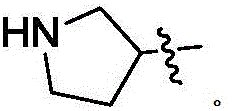
12. The use according to claim 10, wherein the organic solvent is one or more of a nitrile solvent, an amide solvent and an ether solvent, preferably a nitrile solvent, more preferably acetonitrile;
and/or the molar ratio of the nitrogen-phosphine ligand coordination type trifluoromethoxy reagent shown in the formula I to the compound shown in the formula II is 1.2-2.0;
and/or the alkali metal halide is alkali metal iodide, further preferably NaI and/or KI, further preferably KI;
and/or the molar ratio of the alkali metal halide to the compound shown in the formula II is 0.1-2.0;
and/or, said SN2, the temperature of nucleophilic substitution reaction is 10-80 ℃, and preferably 40-80 ℃;
and/or, the compound shown in the formula II is preferably


And/or the nitrogen phosphine ligand coordination type trifluoromethoxy reagent shown in the formula I is preferable

Priority Applications (1)
| Application Number | Priority Date | Filing Date | Title |
|---|---|---|---|
| CN201811418320.3A CN111217841B (en) | 2018-11-26 | 2018-11-26 | Nitrogen phosphine ligand coordination type trifluoromethoxylation reagent and preparation method and application thereof |
Applications Claiming Priority (1)
| Application Number | Priority Date | Filing Date | Title |
|---|---|---|---|
| CN201811418320.3A CN111217841B (en) | 2018-11-26 | 2018-11-26 | Nitrogen phosphine ligand coordination type trifluoromethoxylation reagent and preparation method and application thereof |
Publications (2)
| Publication Number | Publication Date |
|---|---|
| CN111217841A true CN111217841A (en) | 2020-06-02 |
| CN111217841B CN111217841B (en) | 2021-06-08 |
Family
ID=70810665
Family Applications (1)
| Application Number | Title | Priority Date | Filing Date |
|---|---|---|---|
| CN201811418320.3A Active CN111217841B (en) | 2018-11-26 | 2018-11-26 | Nitrogen phosphine ligand coordination type trifluoromethoxylation reagent and preparation method and application thereof |
Country Status (1)
| Country | Link |
|---|---|
| CN (1) | CN111217841B (en) |
Cited By (1)
| Publication number | Priority date | Publication date | Assignee | Title |
|---|---|---|---|---|
| CN117417373A (en) * | 2022-07-11 | 2024-01-19 | 中国科学院上海有机化学研究所 | Ionic difluoromethylcopper(I) complex, its synthesis method and application |
Citations (4)
| Publication number | Priority date | Publication date | Assignee | Title |
|---|---|---|---|---|
| CN102532202A (en) * | 2011-12-20 | 2012-07-04 | 中国科学院上海有机化学研究所 | Palladium complex containing trichlorethylene, synthesizing method and application of palladium complex to trifluorovinylation |
| CN104650120A (en) * | 2013-11-19 | 2015-05-27 | 中国科学院上海有机化学研究所 | Difluoromethyl silver compound, single crystal, synthetic method and application |
| CN105017143A (en) * | 2015-07-21 | 2015-11-04 | 中国科学院上海有机化学研究所 | N- trifluoromethoxy pyridine salt compound and preparation method and use thereof |
| CN105985361A (en) * | 2015-02-16 | 2016-10-05 | 中国科学院上海有机化学研究所 | Difluoro methylthio reagent, preparing method and application thereof |
-
2018
- 2018-11-26 CN CN201811418320.3A patent/CN111217841B/en active Active
Patent Citations (4)
| Publication number | Priority date | Publication date | Assignee | Title |
|---|---|---|---|---|
| CN102532202A (en) * | 2011-12-20 | 2012-07-04 | 中国科学院上海有机化学研究所 | Palladium complex containing trichlorethylene, synthesizing method and application of palladium complex to trifluorovinylation |
| CN104650120A (en) * | 2013-11-19 | 2015-05-27 | 中国科学院上海有机化学研究所 | Difluoromethyl silver compound, single crystal, synthetic method and application |
| CN105985361A (en) * | 2015-02-16 | 2016-10-05 | 中国科学院上海有机化学研究所 | Difluoro methylthio reagent, preparing method and application thereof |
| CN105017143A (en) * | 2015-07-21 | 2015-11-04 | 中国科学院上海有机化学研究所 | N- trifluoromethoxy pyridine salt compound and preparation method and use thereof |
Non-Patent Citations (2)
| Title |
|---|
| SHOUXIONG CHEN等: "Aryl-BIAN-ligated silver(I) trifluoromethoxide complex", 《DALTON TRANS.》 * |
| 张盼盼 等: "直接三氟甲硫基化试剂及方法的研究进展", 《化学学报》 * |
Cited By (1)
| Publication number | Priority date | Publication date | Assignee | Title |
|---|---|---|---|---|
| CN117417373A (en) * | 2022-07-11 | 2024-01-19 | 中国科学院上海有机化学研究所 | Ionic difluoromethylcopper(I) complex, its synthesis method and application |
Also Published As
| Publication number | Publication date |
|---|---|
| CN111217841B (en) | 2021-06-08 |
Similar Documents
| Publication | Publication Date | Title |
|---|---|---|
| Wang et al. | Synthesis of novel N, P chiral ligands for palladium-catalyzed asymmetric allylations: the effect of binaphthyl backbone on the enantioselectivity | |
| CN105294667B (en) | NNN ligand, metal complex thereof, preparation method and application | |
| CN113185404A (en) | 1, 2-biaxial chiral biaryl compound and preparation method and application thereof | |
| Bisht et al. | Pd (II)-Catalyzed, picolinamide-aided γ-(sp2)-C–H functionalization of racemic and enantiopure α-methylbenzylamine and phenylglycinol scaffolds | |
| CN111925356B (en) | Synthesis method and application of chiral quinoline-imidazoline ligand | |
| CN111217841B (en) | Nitrogen phosphine ligand coordination type trifluoromethoxylation reagent and preparation method and application thereof | |
| CN110551115B (en) | Oxazoline ligand, preparation method and application thereof | |
| CN112300214A (en) | Palladium compound, preparation method thereof and preparation method of axial chiral biaryl compound | |
| CN103755554A (en) | Novel method for asymmetric catalytic synthesis of (S)-fenoprofen | |
| CN107011218B (en) | A kind of fluorine nitrogen type amination reagent, preparation method and application | |
| JP2003183187A (en) | N-heterocyclic carbene complex and its use | |
| CN113754544B (en) | Preparation method of polysubstituted (E) -trifluoromethyl olefin | |
| CN114031615B (en) | Hydroxy-substituted pyridine-oxazoline ligands and their application in hydrohalogenation of alkenes | |
| JP4167848B2 (en) | Process for producing biaryl compounds | |
| CN104650120B (en) | Difluoromethyl silver compound, monocrystalline, synthetic method and application | |
| JP2017014109A (en) | Manufacturing method of optically active 2,6-dimethyl tylosin derivative | |
| CN110143910B (en) | A kind of preparation method of polysubstituted pyrrolidone derivatives | |
| CN115057885B (en) | Styrene axis chiral phosphine ligand and synthetic method and application thereof | |
| CN106866443A (en) | Chiral beta-diaryl-alpha-amino acid derivatives and application thereof | |
| JP7863662B2 (en) | Method for synthesizing 2-bromoglutaric acid diester | |
| CN113135914B (en) | A kind of preparation method of racemic 3,6-diazabicyclo[3.2.1]octane derivative and application thereof | |
| CN113511984B (en) | Preparation method and application of beta-azido acid and beta-amino acid compound | |
| CN108373431A (en) | Fluorine-containing chirality allyl compound and its synthetic method | |
| CN116554223A (en) | A chiral bisphosphine skeleton compound, its preparation method and its application | |
| CN104056659B (en) | A kind of chiral amino alcohol catalyst and synthesis thereof and application |
Legal Events
| Date | Code | Title | Description |
|---|---|---|---|
| PB01 | Publication | ||
| PB01 | Publication | ||
| SE01 | Entry into force of request for substantive examination | ||
| SE01 | Entry into force of request for substantive examination | ||
| GR01 | Patent grant | ||
| GR01 | Patent grant |