CN110414595B - An Orientation Field Estimation Method for Texture Images with Orientation Consistency - Google Patents
An Orientation Field Estimation Method for Texture Images with Orientation Consistency Download PDFInfo
- Publication number
- CN110414595B CN110414595B CN201910674845.1A CN201910674845A CN110414595B CN 110414595 B CN110414595 B CN 110414595B CN 201910674845 A CN201910674845 A CN 201910674845A CN 110414595 B CN110414595 B CN 110414595B
- Authority
- CN
- China
- Prior art keywords
- texture
- sample
- image
- orientation
- size
- Prior art date
- Legal status (The legal status is an assumption and is not a legal conclusion. Google has not performed a legal analysis and makes no representation as to the accuracy of the status listed.)
- Expired - Fee Related
Links
Images


Classifications
-
- G—PHYSICS
- G06—COMPUTING OR CALCULATING; COUNTING
- G06F—ELECTRIC DIGITAL DATA PROCESSING
- G06F18/00—Pattern recognition
- G06F18/20—Analysing
- G06F18/21—Design or setup of recognition systems or techniques; Extraction of features in feature space; Blind source separation
- G06F18/214—Generating training patterns; Bootstrap methods, e.g. bagging or boosting
-
- G—PHYSICS
- G06—COMPUTING OR CALCULATING; COUNTING
- G06F—ELECTRIC DIGITAL DATA PROCESSING
- G06F18/00—Pattern recognition
- G06F18/20—Analysing
- G06F18/24—Classification techniques
- G06F18/241—Classification techniques relating to the classification model, e.g. parametric or non-parametric approaches
-
- G—PHYSICS
- G06—COMPUTING OR CALCULATING; COUNTING
- G06V—IMAGE OR VIDEO RECOGNITION OR UNDERSTANDING
- G06V10/00—Arrangements for image or video recognition or understanding
- G06V10/40—Extraction of image or video features
- G06V10/44—Local feature extraction by analysis of parts of the pattern, e.g. by detecting edges, contours, loops, corners, strokes or intersections; Connectivity analysis, e.g. of connected components
Landscapes
- Engineering & Computer Science (AREA)
- Theoretical Computer Science (AREA)
- Data Mining & Analysis (AREA)
- Physics & Mathematics (AREA)
- Computer Vision & Pattern Recognition (AREA)
- General Physics & Mathematics (AREA)
- Bioinformatics & Cheminformatics (AREA)
- Bioinformatics & Computational Biology (AREA)
- Evolutionary Biology (AREA)
- Evolutionary Computation (AREA)
- Artificial Intelligence (AREA)
- General Engineering & Computer Science (AREA)
- Life Sciences & Earth Sciences (AREA)
- Multimedia (AREA)
- Image Analysis (AREA)
Abstract
Description
技术领域technical field
本发明涉及纹理图像方向场估计领域,特别涉及一种具有方向一致性的纹理图像的方向场估计方法。The invention relates to the field of texture image direction field estimation, in particular to a direction field estimation method for texture images with direction consistency.
背景技术Background technique
方向是纹理图像的重要特点和属性,特别对于具有方向一致性的纹理图像,其方向场表征了纹理的走向,是纹理图像增强的重要依据,也是图像识别的重要参数。目前纹理图像方向场估计的主要方法包括:(1)基于纹理图像的局部梯度信息进行方向场估计,该方法通过计算局部图像的水平差分强度矢量和垂直差分强度矢量,然后以两个矢量的和方向作为该局部的方向,此方法在清晰纹理区域能够得到准确的方向估计,但对于模糊区域和存在干扰纹理干扰的区域容易得到错误的结果;(2)通过比较局部图像在各个方向上的灰度投影信号,得到方向场估计,该方法的优点是在纹理一致性区域对纹理干扰和断裂情况有一定适应性,缺点是在纹理方向变化的区域得不到好的投影信号,使得方向的确定容易出错;(3)通过分析方向滤波器对图像增强的效果得到方向场的估计。该方法使用预设的若干个等方向间隔分布的Gabor滤波器或其他方向滤波器对纹理图像进行方向滤波和增强,然后对于各个局部比较其不同方向滤波器的滤波效果,具有最佳滤波效果的方向滤波器的方向指向即为该局部的纹理方向。该方法对干扰纹理和模糊局部都具有较好的鲁棒性,缺点是计算量较大;(4)提取与方向相关的特征结合神经网络进行预测的方法,该方法首先通过提取诸如梯度、方向一致性等参数作为特征,然后使用神经网络或其他机器学习方法预测得到方向场估计,该方法的特征提取是基于传统的有关方向的参数计算,通过组合多种特征达到有效分类的目的,缺点是特征参数的计算量较大,特征的可分性难以保证。Orientation is an important feature and attribute of texture images, especially for texture images with directional consistency, the orientation field represents the direction of the texture, which is an important basis for texture image enhancement and an important parameter for image recognition. At present, the main methods for estimating the direction field of texture images include: (1) Estimate the direction field based on the local gradient information of the texture image. This method calculates the horizontal difference intensity vector and vertical difference intensity vector of the local image, and then uses the sum of the two vectors As the local direction, this method can obtain accurate direction estimation in the clear texture area, but it is easy to obtain wrong results for the blurred area and the area with disturbing texture interference; (2) By comparing the gray value of the local image in each direction The advantage of this method is that it has a certain adaptability to texture interference and fracture in the texture consistency area, but the disadvantage is that a good projection signal cannot be obtained in the area where the texture direction changes, which makes the direction determination. Error-prone; (3) The direction field is estimated by analyzing the effect of the direction filter on image enhancement. The method uses several preset Gabor filters or other directional filters distributed at equal directional intervals to filter and enhance the texture image in the direction, and then compare the filtering effects of different directional filters for each part, and the one with the best filtering effect is obtained. The direction of the direction filter is the local texture direction. This method has good robustness to interference textures and fuzzy parts, but the disadvantage is that the amount of calculation is large; (4) The method of extracting direction-related features combined with neural network for prediction. Consistency and other parameters are used as features, and then the neural network or other machine learning methods are used to predict the direction field estimation. The feature extraction of this method is based on the traditional parameter calculation related to the direction, and the purpose of effective classification is achieved by combining various features. The disadvantage is that The amount of calculation of feature parameters is large, and the separability of features is difficult to guarantee.
Haar特征具有对纹理的多尺度表达,能够有效提取纹理的边缘和方向等信息,且可以利用积分图像实现快速计算。AdaBoost算法可对数量庞大的特征进行有效性筛选,提取出分辨度高的特征,组合得到高效率的分类器,最后再将分类器进行级联,可以进一步得到级联分类器以提高分类性能。Haar feature has multi-scale representation of texture, which can effectively extract information such as the edge and direction of texture, and can use integral image to achieve fast calculation. The AdaBoost algorithm can effectively screen a large number of features, extract features with high resolution, combine them to obtain efficient classifiers, and finally cascade the classifiers to further obtain cascaded classifiers to improve the classification performance.
发明内容SUMMARY OF THE INVENTION
本发明的目的是针对上述现有技术存在的问题,提供一种具有方向一致性的纹理图像的方向场估计方法,该方法将传统的纹理图像方向场估计问题转换为对局部图像的识别问题,采用的Haar特征和AdaBoost算法具有较好的实时性,为此类问题给出了全新的视角和详细的方法说明。The purpose of the present invention is to provide a method for estimating the direction field of a texture image with direction consistency in view of the problems existing in the above-mentioned prior art. The adopted Haar feature and AdaBoost algorithm have good real-time performance, which gives a new perspective and detailed method description for such problems.
本发明为实现上述目的采用的技术方案是:具有方向一致性的纹理图像的方向场估计方法,包括以下步骤:The technical solution adopted by the present invention to achieve the above object is: a method for estimating a direction field of a texture image with direction consistency, comprising the following steps:
步骤1:样本采集:采集样本的尺寸设为m×m,样本包括具有方向一致性的纹理图像子区域以及不包括纹理或具有其他类型纹理的子图像组成,其中m是取样图像块的尺寸;Step 1: Sample collection: The size of the collected sample is set to m×m, and the sample consists of a texture image sub-region with consistent orientation and a sub-image that does not include texture or has other types of texture, where m is the size of the sampled image block;
步骤2:样本的方向标注:具体方法包括下面步骤2.1-2.5:Step 2: Orientation annotation of the sample: The specific method includes the following steps 2.1-2.5:
步骤2.1:将具有360°的方向变换到180°,设定纹理取向的有效范围为[-90°~90°),若纹理取向θ∈[90°,270°)时,通过θ=θ-180°将其变换至区间[-90°~90°);Step 2.1: Transform the direction with 360° to 180°, set the effective range of texture orientation to [-90°~90°), if the texture orientation θ∈[90°, 270°), pass θ=θ- 180° transform it to the interval [-90°~90°);
步骤2.2:将方向取值范围离散化:均匀分割[-90°~90°)为K个区间,并为每个区间的定义标注值,其中K为方向区间数;Step 2.2: Discretize the direction value range: evenly divide [-90°~90°) into K intervals, and label the values for the definition of each interval, where K is the number of direction intervals;
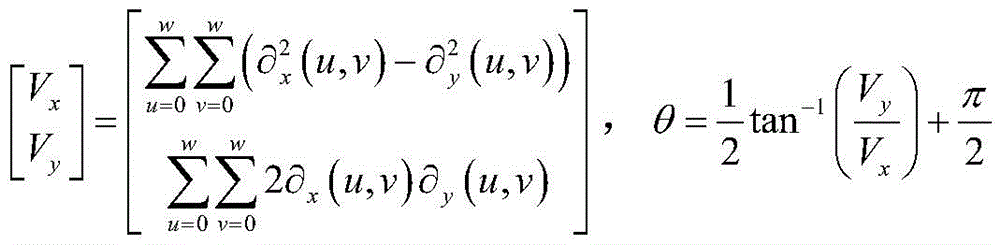
步骤2.3:基于样本梯度信息计算样本的方向,其计算公式如下:Step 2.3: Calculate the direction of the sample based on the sample gradient information. The calculation formula is as follows:

其中,Vx、Vy分别是(u,v)处纹理方向向量的水平分量和垂直分量,


其中f(x,y)为(x,y)处像素;θ为该样本方向;Where f(x,y) is the pixel at (x,y); θ is the sample direction;
步骤2.4:根据步骤2.3计算的样本方向及步骤2.2划分的方向区间,为每个样本赋予标注值,作为其样本标签;Step 2.4: According to the sample direction calculated in step 2.3 and the direction interval divided in step 2.2, assign a label value to each sample as its sample label;
步骤2.5:人工检查方向标注,剔除或改正标注明显错误的样本;Step 2.5: Manually check the direction labeling, and remove or correct the samples with obvious errors;
步骤3:使用Adaboost算法训练K+1类M层级联分类器,其中K为方向区间数,M为设定的Adaboost分类器级联的层数:具体方法包括下面步骤3.1-3.3:Step 3: Use the Adaboost algorithm to train K+1 class M-level cascaded classifiers, where K is the number of direction intervals, and M is the set number of cascaded layers of the Adaboost classifier: the specific method includes the following steps 3.1-3.3:
步骤3.1:选取边缘(Edge features)、线性(Line features)、中心(Center-surround features)Haar特征;Step 3.1: Select edge (Edge features), linear (Line features), center (Center-surround features) Haar features;
步骤3.2:使用AdaBoost算法训练得到每层分类器,设定其识别率和误识率分别为r,f;Step 3.2: Use the AdaBoost algorithm to train the classifier for each layer, and set its recognition rate and false recognition rate as r and f respectively;
步骤3.3:级联分类器:上一层未被正确识别的样本,继续输入下一层训练,最终得到M层级联分类器,则最终的识别率为rM,误识率为fM,其中r、f分别为每一层AdaBoost强分类器的识别率和误识别率;Step 3.3: Cascade classifier: the samples that are not correctly recognized in the previous layer, continue to input the training of the next layer, and finally obtain the M-level cascade classifier, then the final recognition rate is r M , and the misrecognition rate is f M , where r and f are the recognition rate and false recognition rate of each layer of AdaBoost strong classifiers, respectively;
步骤4:利用训练好的分类模型对待处理纹理图像进行预测,给出方向估计:具体方法包括下面步骤4.1-4.3:Step 4: Use the trained classification model to predict the texture image to be processed, and give the direction estimation: the specific method includes the following steps 4.1-4.3:
步骤4.1:初始化方向图为无效方向;Step 4.1: Initialize the orientation map as an invalid orientation;
步骤4.2:从纹理图像左上角开始,依次取(m+d)×(m+d)的图像块作为分类器输入,取样窗口每次移动[m/a]([]为取整符号,下同),其中m是取样图像块的尺寸、d为额外增加的尺寸、a为控制平移的大小;Step 4.2: Starting from the upper left corner of the texture image, take the image blocks of (m+d)×(m+d) as the input of the classifier, and each time the sampling window moves [m/a]([] is the rounding symbol, and the following Same as), where m is the size of the sampled image block, d is the additional size, and a is the size of the control translation;
步骤4.3:处理识别结果:选择具有最大概率的类别作为识别的类别结果,设定图像块中心([m/a])×([m/a])区域为预测的方向。Step 4.3: Process the recognition result: select the category with the largest probability as the recognized category result, and set the center ([m/a])×([m/a]) area of the image block as the direction of prediction.
本发明具有方向一致性的纹理图像的方向场估计方法具有如下有益效果:The direction field estimation method of the texture image with direction consistency of the present invention has the following beneficial effects:
1)本发明将传统的纹理图像方向场估计问题转换为对局部图像的识别问题,采用的Haar特征和AdaBoost算法具有较好的实时性,为此类问题给出了全新的视角和详细的方法说明;1) The present invention converts the traditional texture image orientation field estimation problem into a local image recognition problem, the adopted Haar feature and AdaBoost algorithm have better real-time performance, and provides a new perspective and detailed method for such problems. illustrate;
2)本发明将待识别图像划分为相互交叠的图像子块,首先对m×m尺寸较大的局部进行识别,并将分类结果赋给局部(m/a)×(m/a)小区域,这样可以使得在识别时利用更多的图像信息。2) The present invention divides the image to be recognized into overlapping image sub-blocks, firstly recognizes the part with a larger m×m size, and assigns the classification result to the part with a (m/a)×(m/a) small size. area, so that more image information can be used in recognition.
下面结合附图和实施例对本发明具有方向一致性的纹理图像的方向场估计方法作进一步的说明。The method for estimating the orientation field of a texture image with orientation consistency of the present invention will be further described below with reference to the accompanying drawings and embodiments.
附图说明Description of drawings
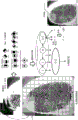
图1是本发明具有方向一致性的纹理图像的方向场估计方法的图像块取样示意图;1 is a schematic diagram of image block sampling of the method for estimating the direction field of a texture image with direction consistency according to the present invention;
图2是本发明具有方向一致性的纹理图像的方向场估计方法中基于Haar特征和AdaBoost算法的方向分类器学习示意图;Fig. 2 is the direction classifier learning schematic diagram based on Haar feature and AdaBoost algorithm in the direction field estimation method of the texture image with direction consistency of the present invention;
图3是本发明具有方向一致性的纹理图像的方向场估计方法中基于Haar特征和AdaBoost算法的方向场估计示意图。3 is a schematic diagram of the direction field estimation based on the Haar feature and the AdaBoost algorithm in the direction field estimation method of the texture image with direction consistency of the present invention.
具体实施方式Detailed ways
本发明具有方向一致性的纹理图像的方向场估计方法,如图1至3所示,本实施例以指纹图像为例,说明本发明,具体实施方式如下:包括以下步骤:The method for estimating the direction field of a texture image with direction consistency of the present invention is shown in Figures 1 to 3. The present embodiment takes a fingerprint image as an example to illustrate the present invention. The specific implementation is as follows: the following steps are included:
步骤1:样本采集:采集样本的尺寸设为m×m,样本包括具有方向一致性的纹理图像子区域以及不包括纹理或具有其他类型纹理的子图像组成,其中m是取样图像块的尺寸,单位为像素。本实施例利用NIST SD4/27和FVC指纹数据库,分别采集64×64的指纹前景和背景样本,其中前景样本由纹理取向较为明显的样本组成;背景样本,要求不包括明显指纹区域。Step 1: Sample collection: The size of the collected sample is set to m×m, and the sample consists of texture image sub-regions with orientation consistency and sub-images that do not include texture or have other types of texture, where m is the size of the sampled image block, The unit is pixel. In this embodiment, NIST SD4/27 and FVC fingerprint databases are used to collect 64×64 fingerprint foreground and background samples respectively, wherein the foreground samples are composed of samples with obvious texture orientation; the background samples are required not to include obvious fingerprint areas.
步骤2:样本的方向标注:具体方法包括下面步骤2.1-2.5:Step 2: Orientation annotation of the sample: The specific method includes the following steps 2.1-2.5:
步骤2.1:由于一般更关注纹理的角度,所以将具有360°的方向变换到180°,如,设定纹理取向的有效范围为[-90°~90°),若纹理取向θ∈[90°,270°)时,通过θ=θ-180°将其变换至区间[-90°~90°);Step 2.1: Since the angle of the texture is generally more concerned, the direction with 360° is transformed to 180°, for example, the effective range of the texture orientation is set to [-90°~90°), if the texture orientation θ∈[90° , 270°), transform it to the interval [-90°~90°) by θ=θ-180°;
步骤2.2:将方向取值范围离散化:均匀分割[-90°~90°)为K个区间,并为每个区间的定义标注值,其中K为方向区间数,可根据方向的离散量化精度要求自行确定,如将[-90°~90°)划分为均匀的8个区间,则这里K为8,K+1中的“1”代表背景区域,其方向一般没有一致性,可单独标示为一类;设定标注值,作为样本的可选标签,这里的K与方向区间的划分精度有关,可根据具体的精度需要进行调节。在本实施例,均匀分割[-90°~90°)为8个区间,并定义每个区间的取值依次为θk=-90,-67.5,-45,-22.5,0,22.5,45,67.5,k=1,2,...,8,对8个方向值依次标注为其下标k。Step 2.2: Discretize the range of direction values: evenly divide [-90°~90°) into K intervals, and label the value of each interval, where K is the number of direction intervals, which can be quantified according to the discrete quantification accuracy of the direction It is required to be determined by yourself. For example, if [-90°~90°) is divided into 8 uniform intervals, here K is 8, and "1" in K+1 represents the background area, and its direction is generally inconsistent and can be marked separately. is a class; set the label value as an optional label for the sample, where K is related to the division accuracy of the direction interval, and can be adjusted according to the specific accuracy needs. In this embodiment, the uniform division [-90°~90°) is divided into 8 intervals, and the values of each interval are defined as θ k =-90, -67.5, -45, -22.5, 0, 22.5, 45 ,67.5, k=1,2,...,8, the 8 direction values are marked as their subscript k in turn.
步骤2.3:基于样本梯度信息计算样本的方向,其计算公式如下:Step 2.3: Calculate the direction of the sample based on the sample gradient information. The calculation formula is as follows:

其中,Vx、Vy分别是(u,v)处纹理方向向量的水平分量和垂直分量,


其中f(x,y)为(x,y)处像素;w取值为64,与样本尺寸一致,θ为样本方向。Where f(x,y) is the pixel at (x,y); w is 64, which is consistent with the sample size, and θ is the sample direction.
步骤2.4:根据步骤2.3计算的样本方向及步骤2.2划分的方向区间,为每个样本赋予标注值,作为其样本标签;本实施例,按照邻近原则,将样本标注为其纹理方向θ最接近的方向标注,如θ=23°,则该样本标注为6。Step 2.4: According to the sample direction calculated in step 2.3 and the direction interval divided in step 2.2, a label value is assigned to each sample as its sample label; in this embodiment, according to the proximity principle, the sample is labeled with the closest texture direction θ. Direction is marked, such as θ=23°, the sample is marked as 6.
步骤2.5:人工检查方向标注,剔除或改正标注明显错误的样本;Step 2.5: Manually check the direction labeling, and remove or correct the samples with obvious errors;
步骤3:使用Adaboost算法训练K+1类M层级联分类器,其中K为方向区间数,M为设定的Adaboost分类器级联的层数(一般地M越大,级联层数越多,分类精度越高,但过大的M也容易引起过拟合,建议M可在8-14取值):本实施例,如图2所示使用Adaboost算法训练得到10层(M=10)级联的9类(K=8)分类器,具体方法包括下面步骤3.1-3.3:Step 3: Use the Adaboost algorithm to train the K+1 class M-level cascade classifier, where K is the number of direction intervals, and M is the set number of cascaded layers of the Adaboost classifier (generally, the larger the M, the more the cascaded layers. , the classification accuracy is higher, but too large M can easily lead to over-fitting. It is recommended that M can take a value of 8-14): In this example, as shown in Figure 2, the Adaboost algorithm is used to train to obtain 10 layers (M=10) Cascaded 9-class (K=8) classifiers, the specific method includes the following steps 3.1-3.3:
步骤3.1:选取边缘(Edge features)、线性(Line features)、中心(Center-surround features)Haar特征;Step 3.1: Select edge (Edge features), linear (Line features), center (Center-surround features) Haar features;
步骤3.2:使用AdaBoost算法训练得到每层分类器,设定其识别率和误识率分别为r=0.998,f=0.5;Step 3.2: Use the AdaBoost algorithm to train the classifier for each layer, and set its recognition rate and false recognition rate as r=0.998, f=0.5;
步骤3.3:级联分类器:上一层未被正确识别的样本,继续输入下一层训练,最终得到M=10层级联分类器,则最终的识别率为rM=0.99810=0.980,误识率为fM=0.510=0.001。Step 3.3: Cascade classifier: the samples that are not correctly recognized in the previous layer, continue to input the next layer of training, and finally get M=10 layers of cascade classifiers, then the final recognition rate is r M = 0.998 10 = 0.980, false The recognition rate is f M =0.5 10 =0.001.
步骤4:如图3所示,利用训练好的分类模型对待处理指纹图像进行预测,给出方向估计:具体方法包括下面步骤4.1-4.3:Step 4: As shown in Figure 3, use the trained classification model to predict the fingerprint image to be processed, and give the direction estimation: the specific method includes the following steps 4.1-4.3:
步骤4.1:初始化方向图为无效方向,即初始化方向标注图为0;Step 4.1: The initialization direction map is an invalid direction, that is, the initialization direction label map is 0;
步骤4.2:从纹理图像左上角开始,依次取(m+d)×(m+d)的图像块作为分类器输入,取样窗口每次移动[m/a],([]为取整符号,下同)其中m是取样图像块的尺寸,d为额外增加的尺寸,a为控制平移的大小,d取正值,表明在测试阶段每次输入到分类器中的样本尺寸大于训练样本尺寸m,这样可以使得adaboost算法在输入样本中可进行多尺度搜索;本实施例,从指纹图像左上角开始,依次取(64+4)×(64+4)像素的图像块,相邻图像块每次的偏移为64/4=16像素。Step 4.2: Starting from the upper left corner of the texture image, take (m+d)×(m+d) image blocks as the input of the classifier, and the sampling window moves by [m/a] each time, ([] is the rounding symbol, The same below) where m is the size of the sampled image block, d is the additional size, a is the size of the control translation, and d takes a positive value, indicating that the size of the sample input to the classifier each time in the testing phase is larger than the training sample size m , so that the adaboost algorithm can perform multi-scale search in the input sample; in this embodiment, starting from the upper left corner of the fingerprint image, image blocks of (64+4)×(64+4) pixels are taken in sequence, and each adjacent image block is The second offset is 64/4=16 pixels.
步骤4.3:处理识别结果:选择具有最大概率的类别作为识别的类别结果,设定图像块中心([m/a])×([m/a])区域为预测的方向,[m/a]构成重叠区域尺寸,如取m=64,d=6,a=4,则每次输入到分类器的样本图片大小为70像素,多尺度搜索系数可以为0.9-1.1,取样窗口每次移动16像素。本实施例,分类每一图像块,方法是:将68×68图像块输入分类器,若预测最大概率的类别结果为类别k,则幅值方向标注图相应区域的中心16×16区域为k。其中k与离散的方向区间是一一对应的。Step 4.3: Process the recognition result: select the category with the highest probability as the recognized category result, set the center of the image block ([m/a])×([m/a]) area as the direction of prediction, [m/a] The size of the overlapping area is formed. For example, if m=64, d=6, and a=4, the size of the sample image input to the classifier is 70 pixels each time, the multi-scale search coefficient can be 0.9-1.1, and the sampling window moves 16 pixels each time. pixel. In this embodiment, the method of classifying each image block is as follows: input the 68×68 image block into the classifier, and if the category result with the maximum probability is predicted as category k, then the central 16×16 area of the corresponding area of the magnitude direction annotation map is k . Among them, k has a one-to-one correspondence with discrete direction intervals.
以上实施例仅为本发明的较佳实施例,本发明并不限于上述实施例列举的形式,凡在本发明的精神和原则之内所作的任何修改、等同替换等,均应包含在本发明的保护范围之内。The above embodiments are only preferred embodiments of the present invention, and the present invention is not limited to the forms listed in the above embodiments. Any modifications, equivalent replacements, etc. made within the spirit and principles of the present invention shall be included in the present invention. within the scope of protection.
Claims (1)



Priority Applications (1)
| Application Number | Priority Date | Filing Date | Title |
|---|---|---|---|
| CN201910674845.1A CN110414595B (en) | 2019-07-25 | 2019-07-25 | An Orientation Field Estimation Method for Texture Images with Orientation Consistency |
Applications Claiming Priority (1)
| Application Number | Priority Date | Filing Date | Title |
|---|---|---|---|
| CN201910674845.1A CN110414595B (en) | 2019-07-25 | 2019-07-25 | An Orientation Field Estimation Method for Texture Images with Orientation Consistency |
Publications (2)
| Publication Number | Publication Date |
|---|---|
| CN110414595A CN110414595A (en) | 2019-11-05 |
| CN110414595B true CN110414595B (en) | 2022-04-08 |
Family
ID=68363029
Family Applications (1)
| Application Number | Title | Priority Date | Filing Date |
|---|---|---|---|
| CN201910674845.1A Expired - Fee Related CN110414595B (en) | 2019-07-25 | 2019-07-25 | An Orientation Field Estimation Method for Texture Images with Orientation Consistency |
Country Status (1)
| Country | Link |
|---|---|
| CN (1) | CN110414595B (en) |
Families Citing this family (1)
| Publication number | Priority date | Publication date | Assignee | Title |
|---|---|---|---|---|
| CN116091857B (en) * | 2022-10-17 | 2023-10-20 | 北京百度网讯科技有限公司 | Training method of image processing model, image processing method and device |
Citations (6)
| Publication number | Priority date | Publication date | Assignee | Title |
|---|---|---|---|---|
| CN101833750A (en) * | 2010-04-15 | 2010-09-15 | 清华大学 | Active contour method based on shape constraint and direction field, and system thereof |
| CN103646238A (en) * | 2013-12-19 | 2014-03-19 | 清华大学 | Method and device for estimating direction field of fingerprint |
| CN104732217A (en) * | 2015-03-27 | 2015-06-24 | 电子科技大学 | Self-adaptive template size fingerprint direction field calculating method |
| CN109460722A (en) * | 2018-10-26 | 2019-03-12 | 华南理工大学 | A kind of license plate intelligent identification Method |
| CN109829906A (en) * | 2019-01-31 | 2019-05-31 | 桂林电子科技大学 | It is a kind of based on the workpiece, defect of the field of direction and textural characteristics detection and classification method |
| CN110378307A (en) * | 2019-07-25 | 2019-10-25 | 广西科技大学 | Texture image orientation estimate method based on deep learning |
Family Cites Families (1)
| Publication number | Priority date | Publication date | Assignee | Title |
|---|---|---|---|---|
| US9536327B2 (en) * | 2015-05-28 | 2017-01-03 | Adobe Systems Incorporated | Example-based edge-aware directional texture painting |
-
2019
- 2019-07-25 CN CN201910674845.1A patent/CN110414595B/en not_active Expired - Fee Related
Patent Citations (6)
| Publication number | Priority date | Publication date | Assignee | Title |
|---|---|---|---|---|
| CN101833750A (en) * | 2010-04-15 | 2010-09-15 | 清华大学 | Active contour method based on shape constraint and direction field, and system thereof |
| CN103646238A (en) * | 2013-12-19 | 2014-03-19 | 清华大学 | Method and device for estimating direction field of fingerprint |
| CN104732217A (en) * | 2015-03-27 | 2015-06-24 | 电子科技大学 | Self-adaptive template size fingerprint direction field calculating method |
| CN109460722A (en) * | 2018-10-26 | 2019-03-12 | 华南理工大学 | A kind of license plate intelligent identification Method |
| CN109829906A (en) * | 2019-01-31 | 2019-05-31 | 桂林电子科技大学 | It is a kind of based on the workpiece, defect of the field of direction and textural characteristics detection and classification method |
| CN110378307A (en) * | 2019-07-25 | 2019-10-25 | 广西科技大学 | Texture image orientation estimate method based on deep learning |
Non-Patent Citations (5)
| Title |
|---|
| An Efficient Direction Field-Based Method for the Detection of Fasteners on High-Speed Railways;Jinfeng Yang等;《sensors》;20110725;7364-7381 * |
| Palmprint recognition using Palm-line direction field texture feature;YAN-XIA WANG等;《2012 International Conference on Machine Learning and Cybernetics》;20120715;1130-1134 * |
| 基于回归的指纹方向场估计;戴晓薇等;《计算机技术与发展》;20170104;第27卷(第01期);第1-5页 * |
| 基于局部字典的残缺指纹方向场重建算法的研究;何亚兵;《中国优秀硕士学位论文全文数据库_信息科技辑》;20170315;I138-5018 * |
| 基于彩色视网膜图像的眼底病相关目标检测方法研究;戴百生;《中国博士学位论文全文数据库_医药卫生科技辑》;20180115;E073-8 * |
Also Published As
| Publication number | Publication date |
|---|---|
| CN110414595A (en) | 2019-11-05 |
Similar Documents
| Publication | Publication Date | Title |
|---|---|---|
| CN114565675B (en) | A method for removing dynamic feature points in visual SLAM front end | |
| CN110929593B (en) | Real-time significance pedestrian detection method based on detail discrimination | |
| CN111340824B (en) | An Image Feature Segmentation Method Based on Data Mining | |
| CN103530600B (en) | Licence plate recognition method under complex illumination and system | |
| CN105374033B (en) | SAR image segmentation method based on ridge ripple deconvolution network and sparse classification | |
| CN105574527B (en) | A Fast Object Detection Method Based on Local Feature Learning | |
| CN107423760A (en) | Based on pre-segmentation and the deep learning object detection method returned | |
| CN105844228A (en) | Remote sensing image cloud detection method based on convolution nerve network | |
| CN106529499A (en) | Fourier descriptor and gait energy image fusion feature-based gait identification method | |
| CN104751187A (en) | Automatic meter-reading image recognition method | |
| CN101551863A (en) | Method for extracting roads from remote sensing image based on non-sub-sampled contourlet transform | |
| CN108765465A (en) | A kind of unsupervised SAR image change detection | |
| CN107590427B (en) | Anomaly detection method for surveillance video based on spatiotemporal interest point noise reduction | |
| CN109615604A (en) | Parts Appearance Defect Detection Method Based on Image Reconstruction Convolutional Neural Network | |
| CN107230202A (en) | The automatic identifying method and system of pavement disease image | |
| CN114119586A (en) | Intelligent detection method for aircraft skin defects based on machine vision | |
| CN116030396B (en) | Accurate segmentation method for video structured extraction | |
| CN110706235A (en) | Far infrared pedestrian detection method based on two-stage cascade segmentation | |
| CN104616321B (en) | A kind of luggage image motion behavior description method based on Scale invariant features transform | |
| CN108875645A (en) | A kind of face identification method under the conditions of underground coal mine complex illumination | |
| CN106557740A (en) | The recognition methods of oil depot target in a kind of remote sensing images | |
| CN106407959A (en) | Low-illumination complicated background license plate positioning method based on wavelet transform and SVM | |
| CN114677552A (en) | Fingerprint detail database labeling method and system for deep learning | |
| CN108734200B (en) | Human target visual detection method and device based on BING feature | |
| CN115359350A (en) | Group target formation change identification method based on graph model |
Legal Events
| Date | Code | Title | Description |
|---|---|---|---|
| PB01 | Publication | ||
| PB01 | Publication | ||
| SE01 | Entry into force of request for substantive examination | ||
| SE01 | Entry into force of request for substantive examination | ||
| GR01 | Patent grant | ||
| GR01 | Patent grant | ||
| CF01 | Termination of patent right due to non-payment of annual fee | ||
| CF01 | Termination of patent right due to non-payment of annual fee |
Granted publication date: 20220408 |