Background
Aging (senescence) is a progressive process in which the function of cells, organs and tissues of an organism is gradually lost over time. Modern ageing theories suggest that the ageing process of the body is associated with damage to cells and the body by free radicals and induced lipid peroxidation. The free radical and its derivative are atomic groups with high activity and unpaired electrons, have strong oxidizing property, and are important reaction components of human body redox reaction. A proper amount of free radicals can promote cell proliferation and stimulate phagocytes to kill bacteria. However, excessive free radicals have harmful effects on lipid, DNA and other substances, which can damage biological membranes and make organisms in abnormal states, thereby accelerating aging.
Superoxide Dismutase (EC 1.15.1.1) is called SOD for short, is an acid metalloenzyme and is widely present in animals, plants and microorganisms. According to the difference of metal prosthetic groups contained in enzyme molecules, superoxide dismutase can be mainly divided into Cu/Zn-SOD, Mn-SOD, Fe-SOD and other types, wherein Cu/Zn-SOD is the most studied. SOD can catalyze superoxide anion free radical O2-SOD has the functions of eliminating and reducing excessive free radicals in human body, relieving peroxidation damage of cell tissues, improving immunity of organism and delaying senility during the process of preventing oxidative damage of organism. In addition, SOD in human body can effectively remove superoxide anion free radical to finally achieve the effect of inhibiting cancer cells, and the expression effect of Mn-SOD is more prominent. SOD also has strong anti-inflammatory effect, has the functions of disproportionating active oxygen, eliminating inflammation and protecting joints, and has the SOD level in blood serum obviously lower than that of healthy people in rheumatoid arthritis patients. However, the disadvantages of immunogenicity, instability and short half-life in vivo of SOD limit its application in clinical and health care fields.
Exosomes (exomes, EXO) are nanoscale vesicles of 30-150 nm secreted by various living cells, are derived from late endosomes, are formed by budding of intracellular multivesicular bodies (MVBs), are fused with cell membranes and then released into extracellular matrices, almost all types of cells can be secreted and widely exist in various body fluids, and have the functions of mainly transferring related substances among cells so as to realize substance and information exchange among receptor cells. The exosome has unique advantages as a natural endogenous carrier of the drug, such as good biocompatibility, high efficiency of cell drug delivery, stronger target site recognition capability and the like, and the exosome is expected to become a good protein drug delivery carrier, provides a good nano-drug platform for the treatment of related diseases and has wide application prospect.
Disclosure of Invention
The invention loads SOD enzyme molecules into exosomes by combining an extrusion method and a saponin auxiliary strategy to construct an exosome-superoxide dismutase nano preparation (SOD @ EXO nano preparation), and systematically evaluates the action effect and mechanism of the nano preparation in the aspect of anti-aging by taking the prepared SOD @ EXO nano preparation as a nano medicament and N2 wild type caenorhabditis elegans as a model organism. The SOD is loaded into exosome, so that the catalytic activity of natural enzyme is kept, and the SOD has more remarkable advantages compared with the natural SOD, such as half-life period extension, immunogenicity reduction, membrane permeability increase and the like. The nanometer preparation has high drug loading rate, can realize stable drug release, can remarkably resist oxidative stress state of nematode, reduce active oxygen level in nematode body, improve nematode health condition, and prolong nematode life. Finally, the exosome-superoxide dismutase nano preparation with low immunogenicity and high catalytic activity is constructed, and the half-life period and the anti-aging treatment effect of SOD molecules are greatly improved. Therefore, the nano preparation has good application prospects in the aspects of scavenging free radicals and delaying senescence, and becomes a nano preparation with good anti-aging effect.
The SOD related in the invention is derived from bovine blood, belongs to Cu/Zn-SOD, and can remove excessive superoxide anion free radicals generated in the metabolic process of an organism and delay the aging phenomenon caused by the invasion of the free radicals.
The invention relates to a preparation method of an exosome-superoxide dismutase nano preparation, which comprises the following steps:
(1) obtaining 400-600 mL of supernatant of exosome donor cells, centrifuging for 10-20 min under the condition of 200-400 g to remove suspended cells, centrifuging for 10-20 min under the condition of 2000-4000 g to remove cell debris, and centrifuging for 20-40 min under the condition of 8000-12000 g to remove larger granular substances;
(2) filtering the supernatant obtained in the step (1) by a filter membrane of 0.22 mu m to remove particles larger than 220nm, concentrating the supernatant by an ultrafiltration centrifugal tube with 100kDa cut-off molecular weight, and collecting the upper concentrated solution of the ultrafiltration centrifugal tube;
(3) centrifuging the concentrated solution obtained in the step (2) for 1-2 hours under the condition of 90000-110000 g, removing supernatant, and reserving precipitation exosomes; then resuspending the precipitated exosomes with PBS buffer solution, centrifuging again under the same condition, removing supernatant, and reserving the precipitated exosomes; finally, resuspending the precipitation exosomes by 1-2 mL of PBS buffer solution, wherein the concentration of the exosomes is 1-3 mg/mL;
(4) adding superoxide dismutase (SOD) and saponin into the PBS buffer solution dissolved with the exosomes obtained in the step (3), then loading into a liposome extruder (Avanti Polar Lipids) based on an injector, and extruding for 20-30 times through a 100nm polycarbonate membrane; during the extrusion process, the exosome membrane is destroyed and is mixed with superoxide dismutase (SOD) intensely; after loading the exosome with drugs, centrifuging by 90000-110000 g to remove free SOD and saponin, and re-suspending the centrifugal product by using PBS buffer solution to obtain the exosome-superoxide dismutase nano preparation (SOD @ EXO);
in the method, the exosome donor cell is a human embryonic kidney epithelial cell (HEK293), and the mass ratio of the exosome protein to the superoxide dismutase (SOD) is 1: 0.2-0.8, and the concentration of the saponin in the PBS buffer solution is 1-2 mg/mL.
Compared with free SOD, the extrusion method adopted by the invention combines the saponin auxiliary strategy to load the SOD into the exosome, and has the following advantages: the synthetic conditions are mild, the biocompatibility is good, the influence on the enzyme activity is small, the loading amount is high, and the characteristics of good membrane permeability and long release time are achieved.
The SOD @ EXO nano preparation constructed by the invention is administered based on the activity of superoxide dismutase against free radicals by taking N2 wild type caenorhabditis elegans as an aging model, and the SOD @ EXO can obviously improve the capability of the nematode against external adverse environment and prolong the service life of the nematode.
In conclusion, the SOD @ EXO nano preparation is synthesized by combining an extrusion method with saponin to assist the loading of SOD molecules into exosomes. The N2 wild type caenorhabditis elegans is taken as a model organism, and the SOD @ EXO nanometer preparation is proved to be capable of obviously resisting the oxidative stress state of the nematodes, reducing the active oxygen level in the nematodes, improving the health condition of the nematodes and prolonging the service life of the nematodes. Therefore, the nano preparation has good application prospects in the aspects of scavenging free radicals and delaying senescence, can be applied to the aspect of preparing anti-senescence medicaments, and becomes a nano preparation with good anti-senescence effect.
Detailed Description
The following examples are presented to further illustrate the present invention and to provide those skilled in the art with a more complete understanding of the invention. The examples given are not to be construed as limiting the scope of the invention and thus insubstantial modifications and adaptations of the invention by those skilled in the art based on the teachings set forth herein are intended to be covered thereby.
Example 1
Firstly, human embryonic kidney epithelial cells (HEK293) are cultured in a DMEM medium, wherein the DMEM medium contains 10% (volume percentage) of Fetal Bovine Serum (FBS) without exosomes, the culture condition is 37 ℃, the carbon dioxide environment is 5% (volume percentage), and 500mL of HEK293 cell supernatant is obtained after the cell fusion degree reaches 90%.
Centrifuging the supernatant of HEK293 cells for 10min at 300g to remove suspended cells, centrifuging for 10min at 2000g to remove cell debris, and centrifuging for 30min at 10000g to remove larger granular substances; filtering the obtained supernatant with a 0.22 μm filter membrane to remove particles larger than 220nm, concentrating the supernatant with an ultrafiltration centrifugal tube with a molecular weight cut-off of 100kDa, centrifuging the concentrated supernatant in the ultrafiltration centrifugal tube for 1.5h at 100000g in an ultracentrifuge tube, removing the supernatant, and retaining the precipitate exosome; resuspending the precipitated exosomes with PBS buffer solution, centrifuging again under the same centrifugation condition, removing supernatant, and retaining the precipitated exosomes; finally, 1mL of PBS buffer solution is used for resuspending to obtain an Exosome solution (Exosome), namely an unloaded Exosome (Exosome) solution, wherein the concentration of Exosome is 2 mg/mL;
adding SOD (from bovine blood) and saponin into the 1mL of PBS buffer solution dissolved with the exosome, wherein the concentration of the saponin is 1mg/mL, and the mass ratio of the exosome protein to the SOD is 1: 0.5, the above mixture was loaded into a syringe-based liposome extruder and passed through a 100nm polycarbonate membrane 21 times. During the extrusion process, the exosome membrane is destroyed and mixed vigorously with the drug. After drug loading, removing free SOD and saponin through 100000g of centrifugation, and finally re-suspending with 1mL of PBS buffer solution to obtain the exosome-superoxide dismutase nano preparation (SOD @ EXO) solution.
In addition, in the method, saponin is added without adopting an extrusion drug loading mode, so that an exosome-superoxide dismutase nano preparation can be prepared and recorded as SOD @ EXO, saponin; adopting an extrusion drug loading mode without adding saponin to prepare an exosome-superoxide dismutase nano preparation which is recorded as SOD @ EXO and extruded; the exosome-superoxide dismutase nano preparation is prepared by adding saponin and adopting an extrusion drug loading mode and is recorded as SOD @ EXO saponin & extruded.
Example 2
The unloaded exosome solution synthesized in example 1 and the PBS resuspension solution of 3 exosome-superoxide dismutase nano preparations (SOD @ EXO) were diluted to 1mg/mL with PBS buffer solution, respectively, coated on a 300 mesh carbon film-covered copper mesh, and naturally air-dried at room temperature. And detecting the copper mesh coated with the nano preparation by using a transmission electron microscope, wherein the accelerating voltage is 200 kV. As shown in fig. 1, it can be clearly observed that the exosomes carrying the SOD molecules are spherical in shape.
Example 3
The exosome-loaded solution obtained in example 1 and the PBS resuspended solution of 3 exosome-superoxide dismutase nanoformulations (SOD @ EXO) were diluted to 1mg/mL with PBS buffer, and dissolved in PBS buffer filtered through 0.22 μm filter membranes, respectively, to finally prepare 10 μ g/mL solutions, and the particle sizes of the samples were measured with Zetasizer Nano ZS90 particle size potentiometers, respectively. As shown in Table 1, the particle size of exosome before and after loading SOD was between 100nm and 200 nm.
Table 1: example 1 particle size characterization data for synthetic empty exosomes and 3 nano-formulations
Example 4
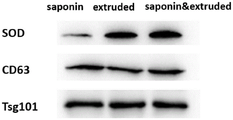
The PBS suspension of the 3 SOD @ EXO nano preparations synthesized in example 1 was diluted to 5mg/mL with PBS buffer, 5 XSDS loading buffer was added directly, the samples were boiled at 100 ℃ for 15min, cooled to room temperature after boiling, and then stored in a-20 ℃ refrigerator. SDS-PAGE gels with 12% (volume percent) gel concentration were prepared and pre-electrophoresed at 80V for 5min, with a loading of 100. mu.g protein amount of Exosomes or SOD @ EXO per well, a voltage of 80V for 20min compressing the protein sample to the gel/gel interface, changing the voltage to 120V, and after about 1h electrophoresis to the lower edge of the gel. The cell holoprotein was transferred to polyvinylidene fluoride (PVDF) membrane with 300mA constant current ice bath for 2 h. Taking out the membrane, airing, cutting the PVDF membrane into proper sizes according to different molecular weights (marker bands show the molecular weights when loading the sample), putting the PVDF membrane into 5% (mass-volume ratio) skimmed milk powder/0.1% (volume-volume percentage) Tween20/PBS solution, sealing the PVDF membrane for 2h at normal temperature, and removing the non-specific protein combination of the membrane. Taking out, sucking to dry by using filter paper, putting the SOD protein and antibodies of exosome protein markers CD63 and Tsg101 into a hybridization bag, diluting the antibodies to a proper ratio (CD 631: 500; SOD 1: 5000; Tsg 1011: 1000) by using a BSA/PBS solution with the mass to volume ratio of 3 percent, adding the diluted antibodies into the hybridization bag, and incubating overnight at 4 ℃ by shaking. 0.1% (volume percent) Tween20/PBS was washed three times, 10min each time, to remove non-specific binding of the antibody, and 3% (mass to volume ratio) BSA/PBS solution was added to dilute the corresponding secondary antibody (primary antibody is a protein capable of specifically binding to a non-antibody antigen (specific antigen.) secondary antibody is an antibody capable of binding to the antibody, i.e., the antibody, whose main function is to detect the presence of the antibody, amplifying the signal of the primary antibody.1: 5000). 0.1% (volume to volume) Tween20/PBS was washed three times for 10min each to remove non-specific binding of secondary antibodies, and finally developed by exposure to ECL color development kit. As shown in fig. 2, the highest loading amount of exosome for loading SOD molecules with the aid of the extrusion method combined with saponin also indicates the successful loading of SOD by exosome.
Example 5
SOD @ EXO was labeled with FITC (in a mass ratio of SOD to FITC 2: 1, in 10mL of PBS overnight at room temperature, free FITC in the reaction solution was removed by a 10kDa ultrafiltration tube, and the reaction solution was centrifuged at 4000g for 30min and about 10 times until the filtrate at the lower layer of the ultrafiltration tube was colorless). And detecting the drug loading rate and the encapsulation rate in the SOD-FITC @ EXO by an external standard method. The standard curve is established as follows: in a 1mL PBS system, 0, 5, 10, 20, 40, 80ng of SOD-FITC was dissolved, and fluorescence intensity was measured at an excitation wavelength of 495nm and an emission wavelength of 519 nm. The fluorescence intensity of the supernatant of the three parallel samples is detected for measuring the drug loading and encapsulation efficiency of SOD (the fluorescence intensity of the supernatant is measured to obtain the content of free SOD not encapsulated in the supernatant, the encapsulation efficiency is the ratio of the SOD encapsulated in the exosome to the total input SOD, the drug loading is the ratio of the amount of SOD encapsulated in the exosome to the total amount of SOD (the sum of the amount of SOD encapsulated in the exosome and the protein mass of the exosome), and the concentration of the free SOD not encapsulated in the supernatant is obtained by the fluorescence intensity contrast standard curve, so as to obtain the content). As shown in Table 2 (EE is encapsulation efficiency, DLC is drug loading rate), the encapsulation efficiency of the SOD @ EXO assisted by the extrusion method and the saponin is 38.67 +/-1.11%, and the drug loading rate is 16.20 +/-0.40%, so that the basic requirements of subsequent experiments are met.
Table 2: example 1 entrapment Rate and drug Loading data for 3 Nanodisclosed synthesized
Example 6
The antioxidant activity of free SOD and SOD @ EXO saponin & extruded is detected by adopting a pyrogallol autoxidation method and a WST-8 method. Pyrogallol autoxidation: 990 mu L of Tris-HCl buffer solution is incubated for 20min at the temperature of 25 ℃, 10 mu L of pyrogallol solution is added to start reaction, and the change of the absorbance at 325nm within 1min is continuously measured.
The sample and control groups were determined as follows: 750. mu.L and 760. mu.L of Tris-HCl buffer solutions were added to the cuvette, followed by 240. mu.L of the corresponding SOD or SOD @ EXO saponin & extruded sample solution, and 10. mu.L of pyrogallol solution was added to the sample group, after which the change in absorbance within 1min was continuously monitored at a wavelength of 325 nm. The pyrogallol autoxidation inhibition rate (& autoxidation- & sample)/& autoxidation x 100%, wherein & autoxidation, & sample is the absorbance monitored after 1 min. The SOD enzyme activity was calculated from the pyrogallol autoxidation inhibition ratio, and was defined as the amount of enzyme that inhibited the pyrogallol autoxidation rate by 50% as one activity unit. WST-8 method: the SOD enzyme activity detection in the patent uses a total SOD activity detection kit (WST-8 method) (Biyunyan day), and the kit contains SOD sample preparation liquid, SOD detection buffer solution, WST-8, enzyme solution and reaction starting liquid (40 x). WST-8 can react with superoxide anion (O2. cndot. -) generated by Xanthine Oxidase (XO) catalysis to generate water-soluble formazan dye, and the SOD can catalyze the superoxide anion to generate disproportionation effect, so that the reaction step can be inhibited by the SOD, the activity of the SOD is inversely related to the generation amount of the formazan dye, and the enzyme activity of the SOD can be calculated through colorimetric analysis of the WST-8 product. As shown in FIG. 3, the SOD molecules still have strong enzymatic activity after being entrapped by exosomes, and the activity is about 78% of that of free SOD molecules.
Example 7
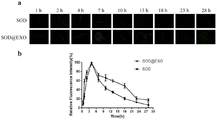
N2 wild type nematodes which just entered the adult stage (stage L4) were selected for experiments, and the nematodes were divided into 2 groups, namely SOD group and SOD @ EXO saponin & extruded group. Adults were transferred to dosing plates, 100 per group, 4h after dosing time, and transferred to new plates after 4 h. From the start of the administration, nematodes were anesthetized with levamisole at regular intervals, placed on 3% (mass to volume) agar-covered slides, photographed using an IX73P1F fluorescence microscope from Olympus, and the fluorescence intensity was measured by Image J Software. As shown in FIG. 4(b), after nematode administration, the fluorescence intensity increased, after 4h, the in vivo fluorescence was attenuated, the half-life of free SOD was 7.42h, and the half-life of SOD @ EXO was 19.32h, which indicates that the release time of the free drug was longer after loading in exosomes.
Example 8
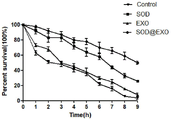
The experiment is carried out by selecting N2 wild type nematodes which just enter the adult stage (stage L4), and selecting juglone to stimulate the nematodes to excessively generate active oxygen in the nematodes, thereby causing oxidative damage to the nematodes. The nematodes were divided into 4 groups, i.e., Control group, SOD @ EXO saponin & extruded group, and EXO group. Culturing nematodes in OP50 nematode culture medium containing corresponding drugs (SOD, SOD @ EXO with enzyme equivalent of 1 μ M, and no administration in Control group), culturing for 48h, changing to OP50 containing juglone (500 μ M), and culturing at 20 deg.C, and counting number of dead nematodes (the number of nematodes has no response to platinum wire stimulation, and the number of dead nematodes) per hour by microscope, wherein the survival rate is the ratio of the number of remaining live nematodes to the number of busworms. As can be seen from FIG. 5, the survival rate of the SOD @ EXO group nematodes was significantly higher than that of the SOD group with time. Although the free SOD group also had a higher survival rate, it was still lower than the SOD @ EXO group. The research shows that the SOD @ EXO nano preparation can obviously enhance the resistance of the nematode to oxidative damage.
Example 9
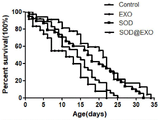
The experiment was carried out using N2 wild type C.elegans which has just entered the adult stage (stage L4). The nematode life test needs synchronized nematodes, and the nematode synchronization method comprises the following steps: selecting nematodes about to lay eggs in the L4 stage, inoculating the nematodes on NGM culture medium coated with OP50, allowing the nematodes to lay eggs in the environment of 20 ℃, and performing synchronization treatment. The synchronized nematodes were divided into 4 groups, i.e., Control group, SOD @ EXO saponin & extruded group, and EXO group. The contemporaneous nematodes were transferred to a plate containing the oviposition inhibitor FUDR (80. mu.M) and the corresponding therapeutic drug (1. mu.M enzyme equivalent of SOD, SOD @ EXO) before they grew to lay eggs at L4, and this day was taken as the first day of administration. Next, the nematodes were transferred every other day to fresh plates containing the corresponding drugs for 5 consecutive transfers, during which the nematode death was observed and recorded every day, as shown in FIG. 6. The mean life and the maximum life of the nematodes in the SOD @ EXO group are obviously superior to those in the Control group and the EXO group, which shows that the SOD @ EXO nano preparation can effectively delay the aging of the nematodes and prolong the life of the nematodes.