Disclosure of Invention
The purpose of the invention is as follows: aiming at the problems of low accuracy, high missing report rate and high false report rate of the existing phishing websites and the existing phishing website detection method based on the URL characteristics, the invention provides a phishing website URL detection method based on deep learning, firstly, input URL character strings are normalized into fixed length, then converting the character into One-hot coding sequence number through a character mapping table, then converting the character into a dense matrix by an Embedding Layer (Embedding Layer) as a feature representation of the URL character sequence, then inputting the feature into a CNN network to extract a local depth feature, and solves the long-range dependence problem through the LSTM, and finally inputs the output of the last moment of the LSTM into the softmax unit, compared with the traditional phishing website detection method based on the URL characteristics, the method can detect the phishing websites of the Internet in real time, does not need to manually extract the characteristics, can comprehensively reflect URL characteristic points, and can obviously improve the phishing website detection accuracy.
The technical scheme is as follows: a phishing website URL detection method based on deep learning covers the whole phishing website detection process. The method mainly comprises the processes of URL character embedding representation, CNN-LSTM classification model and model training and the like, can effectively capture correlation and semantic information before and after characters in a URL character sequence, effectively solves the problem that the URL characteristics of the phishing website cannot be comprehensively reflected by the traditional phishing website detection method based on the URL characteristics, applies the convolutional neural network and the long-short term memory network model to the phishing website detection, improves the detection accuracy rate and reduces the detection missing rate. The method mainly comprises three steps as follows:
step 1, URL character embedding representation. Firstly, the URL is regarded as a character string sequence, the URL is quantized from a character layer, the URL is normalized, then the URL character is converted into a one-hot encoding (one-hot encoding), and finally a two-dimensional dense matrix, namely an Embedding matrix, is generated through an Embedding layer.
Step 2, extracting local relevance characteristics through the CNN convolutional layer of the CNN-LSTM classification layer Embedding matrix, and reducing the complexity of a convolutional neural network model through a pooling layer of the extracted local relevance characteristics; detecting the semantic and long-range dependency relationship in the pooling sequence through a long-short term memory network LSTM; finally, the output of the last unit of the LSTM is sent to the Softmax unit.
And step 3, training a model. The invention adopts a Cross Entropy (Cross Entropy) loss function, and utilizes Adam (adaptive motion estimation), namely an adaptive Moment estimation algorithm to iterate a training model, thereby optimizing the loss function.
Has the advantages that:
URL character embedding shows that characteristics do not need to be extracted manually, URL information is represented without any information loss, and characteristics of the URL can be reflected comprehensively.
The CNN-LSTM classification model can effectively capture the correlation and semantic information before and after the characters in the URL character sequence, and has higher accuracy, lower missing report rate and false report rate.
Detailed Description
The present invention is further illustrated by the following examples, which are intended to be purely exemplary and are not intended to limit the scope of the invention, as various equivalent modifications of the invention will occur to those skilled in the art upon reading the present disclosure and fall within the scope of the appended claims.
The method comprises the following specific implementation steps:
step 1, URL character embedding representation. URL character embedding means that a sequence of URL character strings is quantized encoded as input to the convolutional neural network CNN. To this end, all alphabetic, numeric, and special characters that may appear in the URL are first determined and a character mapping rule is constructed. According to the ASCCI code table and the practical situation of URL characters, a character mapping table with 97 numbers is constructed, wherein the character mapping table comprises 52 upper and lower case letters, 10 numbers, 33 characteristic characters, a zero padding character and unknown character numbers. The character mapping table is shown in table 1.
TABLE 1 character mapping table
Assuming that the length of each URL character sequence is fixed to be L, if the length of the URL exceeds L, intercepting redundant characters at the tail end of the URL, and if the length of the URL is less than L, filling zero in the head of the URL until the length reaches L, as shown in formula (1). Wherein the URLsFor the original URL string, len (URL)s) PAD is a header zero-padding character string indicating the total length thereof, and the length thereof is len (PAD) ═ L-len (URL)s),URLs[0:L-1]Is a URLsFirst L characters, URLfIs a normalized input string.
According to the character mapping table, wherein the head zero padding character corresponds to the number 0, the character "0" in the URL corresponds to the number 53, and finally each character is converted into a one-hot vector x with a length m (97), wherein the corresponding number position of the character in the vector is 1, and the rest positions are all 0, for example, the character "a" is represented as (0,1,0, … 0). The URL is thus converted into the matrix X shown in equation (2).
X=(x1,x2,...,xL) (2)
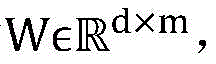
Since the matrix X of one-hot coding contains many 0, sparse coding and too high dimensionality are brought, and the representation has no spatial and semantic relevance between different characters, and the information amount is too small. It can be converted into a low-dimensional dense feature space in which characters are embedded, herein projecting each one-hot vector in matrix X into a d-dimensional continuous vector space
Corresponding to the embedded layer in the neural network, it can be understood as a fully connected neural network with m neurons as one input and d neurons as an output.
Parameter values of the Embedding layer are initialized randomly and are updated in an iteration mode in the model training process. Let the parameter matrix of the Embedding fully-connected layer with d neurons as input and m neurons as output be
Then for one-hot vector x
t,x
tOne column vector representing matrix X, which is finally embedded in vector e
tAs shown in equation (3).
Finally, the URL string sequence is converted into a dense matrix sequence E as shown in equation (4) as the character embedding matrix for the URL.
E=WX=(w1,w2,…,wd)T×(x1,x2,…,xL)=(e1,e2,…,eL) (4)
And step 2, carrying out a CNN-LSTM classification model. Embedding the URL character generated in the step 1 into a matrix E, inputting the matrix E into a CNN-LSTM classification model, and predicting the probability that the URL is a phishing website, wherein the implementation process of the step is divided into 3 sub-steps:
substep 2-1, convolutional neural network CNN layer. And (4) carrying out convolution operation on the URL character embedding matrix E by the convolution layer in the CNN, and extracting local depth correlation characteristics. Specifically, the convolutional layer sets a plurality of convolution kernels S, each convolution kernel convolving a character embedding vector of window size k to generate a new feature. For the f convolution kernel, its character vector matrix E at the i sliding windowiAs shown in equation (5).
Ei={ei,ei+1,…,ei+k-1} (5)
The new generated by the convolution kernel f at the ith sliding windowFeature(s)
As shown in equation (6), where σ is the nonlinear activation function of the convolutional layer, the relu activation function is used herein,
and b
fThe convolution kernel weights and bias terms, respectively.
In the invention, the sliding step length of the convolution kernel is set to be 1, and the convolution kernel f traverses the sliding window E0To EL-k+1Post-generated feature map vector hfAs shown in equation (7).
Stacking the characteristic graphs generated by S convolution kernels to obtain a sequence matrix H of the convolution layers
SAs shown in formula (8), wherein H
SColumn i of
HS={h1,h2,…,hL-k+1} (8)
Pooling layer versus new sequence matrix H
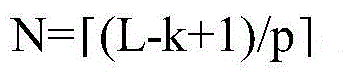
SA Max Pooling (Max Pooling) operation is performed to obtain the maximum eigenvalue within the Pooling window p, thereby maximizing the character characterization. Setting the step length of the pooling layer to be the same as that of the pooling window, and then setting a characteristic map vector h
fThe characteristics after maximum pooling are shown in formulas (9) and (10), wherein
For the largest pooled feature value of the jth block, p
fThe vector after pooling is represented by the vector,
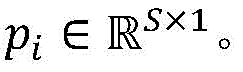
finally, stacking the S pooling vectors to obtain a sequence matrix H of the pooling layers
PAs shown in formula (11), wherein H
PColumn i of
HP={p1,p2,…,pN} (11)
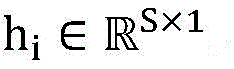
Substep 2-2, long short term memory network LSTM layer. Pooling the sequence matrix HPInput into LSTM neural network, where piAnd (3) finally outputting a hidden state sequence H of the LSTM corresponding to the input of the LSTM network at the ith moment, as shown in a formula (12).
H=(h1,h2,…,hN) (12)
Then the last hidden state h of the sequenceNAs the input of the final classification layer, as shown in formula (13), where n is the number of LSTM network hidden units, hNiIs the ith hidden unit.
hN=(hN1,hN2,…,hNn) (13)
Substep 2-3, softmax classification level. The classification layer is a softmax regression unit with an activation function sigmoid, the prediction probability is shown as formula (14), x is an input vector, w iskAs a weight vector, bkFor the bias, K is 2, and when K is 0, it indicates a probability of predicting a normal website, and when K is 1, it indicates a probability of predicting a phishing website.
In order to suppress the overfitting phenomenon, in the hidden state hNAnd a dropout policy is applied in the full connectivity layer between the softmax classification layer. dropout is an efficient method for preventing overfitting in a deep neural network, and each neural network unit is discarded from the network according to a certain probability in the training process.
And step 3, training a model. The key of model training is to determine a target loss function, and the invention adopts a Cross Entropy (Cross Entropy) loss function as shown in formula (15). Where N is the total number of training samples, y is the true category of the sample (0 for normal websites, 1 for phishing websites),
the probability of being a phishing website is predicted for the model.
The invention adopts adam (adaptive motion estimation), namely an adaptive Moment estimation algorithm training model to optimize a cross entropy loss function, which is an improvement on a gradient descent algorithm, and designs independent adaptive learning rates for different parameters by calculating first Moment estimation and second Moment estimation of a gradient, thereby avoiding the problems of disappearance of the learning rate, slow convergence or large fluctuation of the loss function and having high-efficiency learning effect.
In summary, the main parameters involved in the present invention are shown in table 2.
TABLE 2 Main parameters