Disclosure of Invention
Problems to be solved by the invention
In the case of introducing the intercom system to the house having the plurality of buildings, a centralized control machine for centrally controlling the plurality of buildings is installed in the centrally controlled building to perform centralized management. In addition, in order to record occupant information and setting information (for example, an unlock code of an entrance machine) in each management room host or each entrance machine installed in the management room of each residential building, an external device such as a computer is used, and data is designated from a memory of the external device and transferred. Since the occupant information and the like are recorded in the external device, there is a problem of security and the like for preventing data leakage.
Therefore, an object of the present invention is to provide an intercom system capable of ensuring security when transferring data to each device, and a data transfer method according to the system.
Means for solving the problems
In order to achieve the above object, the intercom system of the present invention is used in a collective housing made up of a plurality of housing buildings,
each of the plurality of residential buildings includes:
a living room host machine arranged in each living room;
a terminal device capable of performing a calling operation for calling the living room host; and
a building control part for connecting the living room host of each living room in the building and the terminal device through an intercommunication line,
the terminal device has a storage section that stores terminal information of the terminal device,
the terminal device or the building control section can communicate with an external device connected to an external network,
the external device serves as a communication medium to forward data on the external network to the terminal device or the building control part.
According to this configuration, when data is transferred from the external network to the terminal device or the building control unit, the external device does not store occupant information, setting information, or the like, and therefore, data leakage from the external device can be prevented and security can be ensured.
In the intercom system of the present invention, furthermore, it is also possible,
generating, by starting a predetermined application in the external device:
a communication establishing unit that establishes communication between the terminal device or the building control unit and the external network;
a presence/absence of update information determination unit configured to determine whether or not there is update information of the data in the external network; and
and an information transfer unit that transfers the update information from the external network to the terminal device or the building control unit when the update information is present.
According to this configuration, by a simple configuration in which only the application stored in the external device is started, the update information on the external network can be transferred to the terminal device and the building control unit in the intercom system.
In the intercom system of the present invention, the external device may transfer the data to the terminal device or the building control unit via a short-range wireless communication unit.
According to this configuration, the data on the setting server can be transmitted into the intercom system by a simple operation of bringing the external device close to the terminal device or the building control unit.
In the intercom system of the present invention, the building control units of the plurality of residential buildings may be connected to each other via a network that performs communication according to a common protocol.
According to this configuration, data transferred to the building control units of one residential building is transmitted to the building control units of other residential buildings via the communication network connecting the residential buildings.
In order to achieve the above object, a data transfer method according to an intercom system of the present invention is a data transfer method for a collective housing including a plurality of housing buildings, each of the plurality of housing buildings including: a living room host machine arranged in each living room; a terminal device capable of calling the living room host; and a building control unit that communicably connects the living room host and the terminal device, the data transfer method including the steps of:
starting a predetermined application program stored in an external device capable of communicating with the terminal device or the building control section;
establishing, by the application, communication of the external device with an external network;
judging whether the external network has updating information of preset data;
establishing, by a short-range wireless communication unit, communication between the terminal device or the building control unit and the external network via the external device when the update information is present; and
the external device serves as a communication medium for forwarding the update information from the external network to the terminal device or the building control unit.
In order to achieve the above object, a data transfer method according to an intercom system of the present invention is a data transfer method for a collective housing including a plurality of housing buildings, each of the plurality of housing buildings including: a living room host machine arranged in each living room; a terminal device capable of calling the living room host; and a building control unit that communicably connects the living room host and the terminal device, the data transfer method including the steps of:
starting a predetermined application program stored in an external device capable of communicating with the terminal device or the building control section;
establishing communication between the terminal device or the building control unit and the external device through the application;
establishing communication with an external network via the terminal device or the building control unit via the external device;
judging whether the external network has updating information of preset data; and
when the update information is present, the external device transfers the update information from the external network to the terminal device or the building control unit as a communication medium by the short-range wireless communication unit.
According to these configurations, when data is transferred from the external network to the terminal device or the building control unit, the external device itself does not store occupant information, setting information, and the like, and therefore data leakage from the external device can be prevented, and safety can be ensured.
Effects of the invention
According to the intercom system and the data transfer method related to the system of the present invention, the security when transferring data to each device can be ensured.
Detailed Description
An example of the present embodiment will be described below with reference to the drawings.
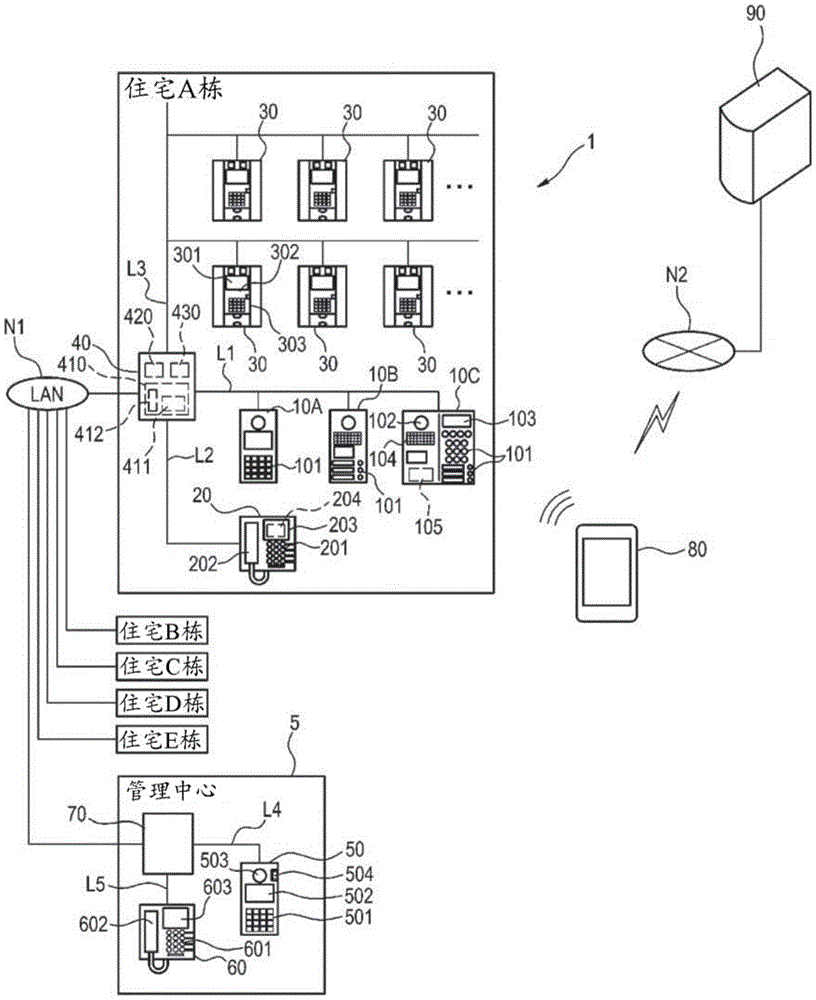
As shown in fig. 1, the intercom system 1 is used in a collective housing such as an apartment constituted by a plurality of housing buildings (housing a-housing E in this example). The intercom system 1 includes a collective entrance machine 10A to 10C (an example of a terminal device), a management room host 20 (an example of a terminal device), a living room host 30, and a building control unit 40 in each of the buildings a to E. In fig. 1 of this example, the above-described structures are shown only in the residence a. The residential buildings are interconnected by a Network N1 (in this case, a LAN: Local Area Network) communicating according to a common protocol. The intercom system 1 is provided with a management center 5, and is connected to each of the residential buildings via a network N1.
The collective entrance machines 10A to 10C (hereinafter, collectively referred to as collective entrance machine 10) are installed in a collective entrance or a public space of a collective housing. The collective entry machine 10 includes a calling unit 101, a camera 102, a display unit 103, a communication unit 104, a storage unit 105, and the like.
The storage unit 105 of the collective entrance machine 10 stores therein the resident information, the terminal information such as the setting information, and the like. Specifically, the call table includes a call table in which a room number, a name of a resident, a name of a room (e.g., a tenant name), a home host ID (ID: identification) for identifying the home host 30, and a dedicated button for calling are associated with each other, and an unlock code of an entry (encryption key of a non-contact key), for example.
The collective entrance machine 10 can call the living room host 30 in the home building and the management room host 20 in the home building by operating, for example, the call unit 101. The collective entrance device 10 can communicate with the resident in the living room host 30 and the administrator in the management room host 20, for example, through the communication unit 104. The collective agent 10 performs control of call processing, and the like based on the call table. As the collective entry device, for example, there are a system of operating numeric keys like the collective entry device 10A, a system of pressing dedicated buttons like the collective entry device 10B, and two systems of providing numeric keys and dedicated buttons like the collective entry device 10C.
The collective entrance device 10 is communicably connected to the building control unit 40 via an intercom line (intercom dedicated line) L1. The collective entry device 10 is communicably connected to an external device 80 (for example, a smartphone, a PC, a Personal Computer, or the like) by wireless Communication, for example, Near Field Communication (registered trademark) or the like. The collective entry device 10 is mounted with a chip (e.g., an NFC chip) having a wireless communication function.
The management room host 20 is installed in a management room of the collective housing. The management room host 20 includes an operation unit 201, a communication unit 202, a display unit 203, a storage unit 204, and the like.
The storage unit 204 stores terminal information such as a call list, as in the storage unit 105 of the collective entry device 10.
The management room host 20 can call the living room host 30 in the home by operating, for example, the operation unit 201. The management room host 20 can communicate with the visitor at the entrance 10 or the resident at the living room host 30 via the communication unit 202. The management room host 20 performs control of call processing, and the like based on the call table.
The management room host 20 can be communicably connected to the building control section 40 through the intercom line L2. The management-room host 20 can be communicably connected to the external device 80 by NFC, similarly to the above-described collective entry device 10. The management room host 20 is provided with a chip having a wireless communication function, similarly to the collective entry unit 10.
The living room master 30 is installed in each living room of the collective housing. The living room master 30 includes a display unit 301, an operation unit 302, a communication unit 303, and the like. The living room master 30 can respond to a call from the collective entrance 10 or the management room master 20, for example, by the communication unit 303. The living room master 30 can call the management room master 20 by operating the operation unit 302. Each living room master 30 stores a living room master ID for specifying the living room. The living room host 30 can be communicably connected to the building control section 40 via the intercom line L3.
The building control section 40 is provided in each residential building. The building control unit 40 includes a building controller 410, an image controller 420, and an audio controller 430. The building controller 410 includes a storage unit 411 and a signal conversion unit 412.
The storage unit 411 stores terminal information such as a call list, as in the storage unit 105 of the collective entry device 10.
The signal conversion unit 412 includes: an analog-digital conversion unit that converts analog signals communicable over the intercom lines L1 to L3 into digital signals communicable over the network N1; and a digital-analog conversion section that converts the digital signal into an analog signal inversely to the conversion.
The building controller 410 controls, for example, the collective entrance 10, the management room host 20, and the communication process between the living room hosts 30 connected via the intercom line based on the call table. When a signal for calling the living room host 30 in the building is transmitted from the management center 5, the building controller 410 performs control of call processing, and the like based on the call list.
The video controller 420 performs signal processing on the video signal captured by the collective entrance unit 10 or the management center 5, and transmits the processed video signal to the living room host 30 or the management room host 20 in the home. The audio controller 430 performs signal processing on audio signals transmitted from the entryway device 10, the management room host 20, the living room host 30, the management center 5, and the like, and transmits the processed audio signals to each transmission destination.
The building control unit 40 is communicably connected to the building control units 40 of other buildings (in this example, the buildings B to E) and a centralized control unit 70 (described later) of the management center 5 via a network N1. Similarly to the collective entrance 10, the building control unit 40 is communicably connected to the external device 80 via NFC. The building control unit 40 is provided with a chip having a wireless communication function, similarly to the above-described collective entrance device 10.
The management center 5 can manage the entire apartment aggregate from the apartment a to the apartment E, and includes a centralized aggregation gateway 50, a centralized management room host 60, and a centralized control unit 70.
The centralized aggregation gateway 50 is provided in the gateway of the management center 5. The collective agent unit 50 includes a calling unit 501, a display unit 502, a camera 503, a calling unit 504, and the like. The centralized collective entrance machine 50 can call, for example, the living room host 30 of each residential building and the centralized management room host 60 of the management center 5. The centralized aggregation gateway 50 is communicably connected to the centralized control unit 70 via an intercom line L4.
The central management room host 60 is installed in a management room of the management center 5. The central management office host 60 includes an operation unit 601, a communication unit 602, a display unit 603, and the like. The central management room host 60 can call the living room host 30 of each residential building, for example. The central management room host 60 can communicate with the visitor at the central entrance 50 and the resident at the living room host 30. The central control room host 60 is communicably connected to the central control unit 70 via an intercom line L5.
The central control unit 70 controls communication with the central collective gateway 50 and the central management room host 60 connected via, for example, an intercom line. The centralized control unit 70 is communicably connected to the respective building control units 40 of the buildings a to E via the network N1. The central control unit 70 has a signal conversion unit that converts an analog signal communicable through the intercom lines L4, L5 into a digital signal communicable through the network N1, similarly to the building control unit 40 described above.
The external device 80 can be connected to the setting server 90 via the external network N2 (internet in this example). As shown in fig. 2, the external device 80 includes a storage unit 81, a display unit 82, a control unit 83, and a communication interface (hereinafter referred to as a communication I/F) 84.
The storage unit 81 is installed with an application program, and can call predetermined data with the accessed setting server 90 and transfer the called data to other target devices (for example, the entrance/exit system 10, the management room host 20, the living room host 30, the building control unit 40, and the like) by wireless communication. The display unit 82 can display the application installed in the storage unit 81, and can accept a user operation for starting the application. The communication I/F84 forms a signal transmission path between the external device 80 and the setting server 90 via the internet N2, and forms a signal transmission path between the external device 80 and the entryway device 10, the management room host 20, and the building control unit 40 close to the external device 80 via NFC.
The control unit 83 generates a communication establishing unit 83A, a presence/absence update information determining unit 83B, and an information transfer unit 83C when an application installed in the storage unit 81 is activated. Based on a command issued by the application started by the user's operation on the display unit 82 as the operation reception unit, the control unit 83 generates a communication establishment unit 83A, and the communication establishment unit 83A establishes communication between the collective entry/exit device 10, the management room host 20, and the building control unit 40, and the setting server 90. The control unit 83 generates a presence/absence update information determination unit 83B based on a command from the application, and the presence/absence update information determination unit 83B determines whether or not the setting server 90 communicatively connected by the communication establishment unit 83A has terminal information (for example, update information on the terminal information) to be transferred to the entryway unit 10, the management room host 20, and the building control unit 40. The control unit 83 generates an information transfer unit 83C based on a command from an application, and when the presence/absence of update information determination unit 83B determines that the setting server 90 has update information, the information transfer unit 83C receives the update information from the setting server 90 via the internet N2, and transfers the update information to the entrance/exit unit 10, the management room host 20, and the building control unit 40 via NFC. The information transfer unit 83C has the following functions: for example, data can be automatically switched and transferred from a communication line of LTE (Long Term Evolution) used between the external device 80 and the setting server 90 to a communication line of NFC used between the external device 80 and the collective gateway 10, the management room host 20, and the building control unit 40.
Thus, in the case of the present embodiment, the data called from the setting server 90 is not stored in the external device 80, but is transferred to the target device via (passing through) the external device 80. That is, the external device 80 serves as a communication medium for relaying the forwarding data.
The external device 80 is provided with a chip having a wireless communication function, similarly to the collective entry device 10.
The setting server 90 stores main data of terminal information (call list, release code, and the like) stored in the storage units of the entrance machine 10, the management room host 20, and the building control unit 40. The terminal information of the setting server 90 is managed by, for example, a construction worker of the intercom system 1, and the setting is changed every time the terminal information is updated.
Next, the operation of the intercom system 1, and particularly the data transfer method according to the present embodiment, will be described with reference to fig. 3.
For example, when the collective entrance 10, the management room host 20, and the building control unit 40 of each residential building are caused to store the terminal information of the intercom system 1 at the time of construction, the following operations are performed.
An operator (construction worker or the like) carrying the external device 80 starts an application program displayed on the display unit (operation receiving unit) 82 of the external device 80 (step S1). The activated application establishes communication between the external device 80 and the setting server 90 via, for example, the internet N2 in the communication establishing unit 83A in order to call and forward the terminal information stored in the setting server 90 (step S2). After the communication between the external device 80 and the setting server 90 is established, the external device 80 determines whether or not the setting server 90 has the terminal information update information in the update information presence/absence determination unit 83B (step S3). When determining that the setting server 90 does not have the update information (no in step S3), the external device 80 displays a notification of the absence of the update information on the display unit 82 in response to the command of the application program, and then ends the application program (step S4). On the other hand, when determining that there is update information in the setting server 90 (yes in step S3), the external device 80 displays a notification of the presence of update information on the display 82 in response to an application command (step S5). Upon receiving the display, the operator brings the external device 80 close to, for example, the entrance 10C to establish NFC-based communication between the external device 80 and the entrance 10C (step S6). Next, the operator uses the external device 80 as a communication medium, and directly (without storing in the external device 80) transfers the terminal information (update information) called from the setting server 90 to the collective gateway 10C (step S7). The transferred terminal information is stored in the storage unit 105 of the collective gateway 10C. After the transfer of the terminal information is completed, the external device 80 displays the end of the transfer job on the display unit 82 in response to the command of the application, and then ends the application (step S8).
The operator also performs the same operation for the other collective entry devices 10A and 10B, the management room host 20, and the building control unit 40, and transfers the terminal information. Alternatively, the operator may transfer the terminal information to the collective entrance 10C and then transmit the terminal information from the collective entrance 10C to the other collective entrants 10A and 10B, the management room host 20, and the building control unit 40 via the intercom line. Further, the operator may transfer the terminal information to the building control unit 40 of the building a, for example, and then transfer the terminal information from the building control unit 40 of the building a to the building control units 40 of the other buildings via the network N1.
In the intercom system 1 according to the present embodiment, the operator can manually update or change the terminal information in each of the plurality of entrance units 10. When the operation of updating the terminal information is performed in the aggregation gateway 10, the updated terminal information is transferred from the aggregation gateway 10 to the setting server 90 via the external device 80, and is stored in the setting server 90. This makes it possible to obtain consistency between the terminal information stored in the collective gateway 10 and the terminal information stored in the setting server 90 d.
According to the intercom system 1, the external device 80 serving as a communication medium transfers the terminal information called from the setting server 90 to the collective entrance 10, the management room host 20, and the building control unit 40 via the internet N2 without being stored in the external device 80. Therefore, even when the external device 80 used for the terminal information transfer job is lost, for example, since the terminal information is not stored in the external device 80, leakage of the terminal information of the external device 80 can be prevented and security can be ensured.
In the present embodiment, the external device 80, the collective entrance machine 10, the management room host 20, and the building control unit 40 are provided with a short-range wireless communication function. Therefore, by a simple operation of bringing the external device 80 close to the collective entry device 10, the management room host 20, and the building control unit 40, the data on the setting server 90 can be transferred into the intercom system 1, and therefore, the work efficiency can be greatly improved.
The building control units 40 of the houses a to E are connected to each other via a network N1. Therefore, the terminal information transferred to the building control section 40 of one residential building can be transmitted to the building control sections 40 of other residential buildings through the network N1 connecting the residential buildings, and thus the work efficiency can be greatly improved.
The present invention is not limited to the above-described embodiments, and can be freely modified and improved as appropriate. The material, shape, size, numerical value, form, number, arrangement place, and the like of each component in the above embodiments are arbitrary as long as the present invention can be realized, and are not limited.
In the above embodiment, the external device 80 and the setting server 90 are connected, and after determining whether or not there is update information in the setting server 90, the external device 80 is brought close to the aggregation gateway 10 or the like to establish communication between the external device 80 and the aggregation gateway 10, and the update information is transferred from the setting server 90 to the aggregation gateway 10. For example, after an application installed in the external device 80 is started, the external device 80 may approach the aggregation gateway 10 or the like to establish communication between the external device 80 and the aggregation gateway 10, connect the external device 80 to the setting server 90, and transfer update information from the setting server 90 to the aggregation gateway 10.
The present application is based on Japanese patent application No. 2016-.