Detailed Description
In order to make the objects, technical solutions and advantages of the present invention more apparent, embodiments of the present invention will be described in detail with reference to the accompanying drawings.
Referring to fig. 1, a schematic diagram of an implementation environment related to a web page access method according to various embodiments of the present invention is shown, and as shown in fig. 1, the implementation environment may include a web page access client 110 and a server 120.
The web page access client 110 may be a client that can access web pages, such as a browser, a shopping client, or a video playing client. In practical implementation, the web access client 110 runs in a terminal, which may be a terminal such as a smart phone, a tablet computer, an e-reader or a desktop computer. Also, in the embodiments described below, the terminal may be a terminal such as a smartphone that is networked through a mobile network in general. The terminal may be connected to the server through a wired or wireless network.
Server 120 may be a backend server that provides backend services for web accessing client 110. The server 120 may be a single server or a server cluster including a plurality of servers.
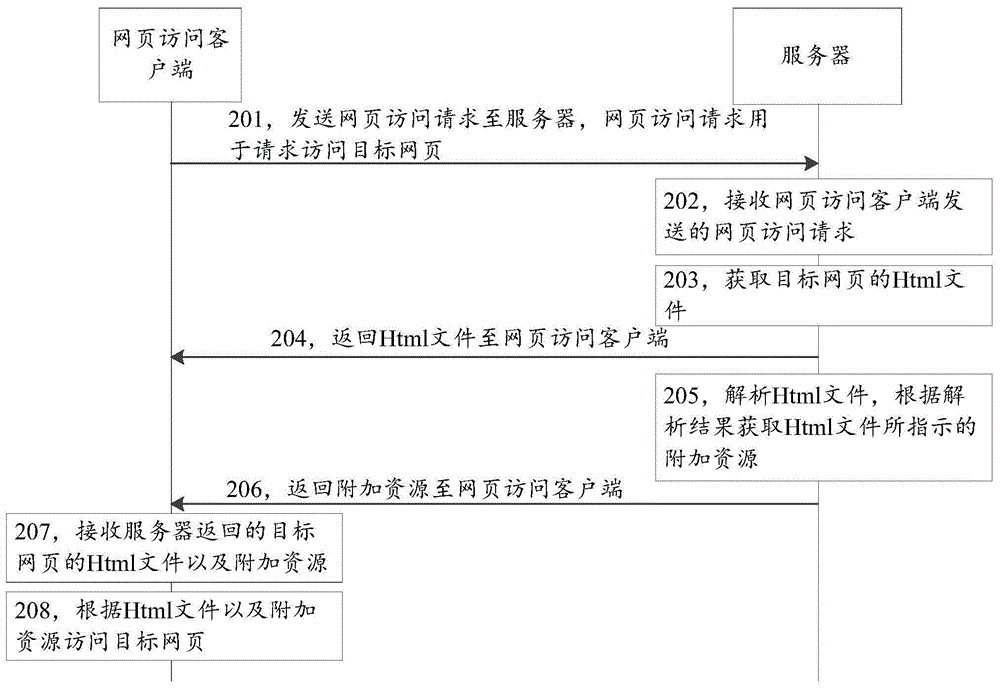
Referring to fig. 2, a flowchart of a method for accessing a web page according to an embodiment of the present invention is shown, where the method is used in the application scenario shown in fig. 1 for illustration, and as shown in fig. 2, the method for accessing a web page may include:
step 201, a web page access client sends a web page access request to a server, where the web page access request is used to request access to a target web page.
When a user accesses a target webpage by using the webpage access client, the user can apply a trigger signal in the webpage access client, and the webpage access client sends a webpage access request to the server after receiving the trigger signal. The web page access request may carry a web page address of the target web page.
For example, taking a web page access client as a browser as an example, when a user wants to access "example.com" by using the browser, the user may input the website in an address bar of the browser and click to turn in, and after receiving a click signal, the browser sends a web page access request for accessing "example.com" to the server.
For another example, taking the web page access client as the shopping client, after the user selects a certain commodity in the shopping client, the shopping client may send an access request for accessing the commodity information page of the commodity to the server.
In step 202, the server receives a web page access request sent by the web page access client.
In step 203, the server obtains the Html file of the target webpage.
And after receiving the webpage access request, the server acquires the Html file of the target webpage according to the webpage address carried in the webpage access request.
And step 204, the server returns the Html file to the webpage access client.
In step 205, the server parses the Html file, and obtains the additional resource indicated by the Html file according to the parsing result.
Optionally, this step may include: analyzing the link of the additional resource contained in the Html file, and acquiring the corresponding additional resource according to the link of the additional resource.
After the server acquires the Html file, the Html file can be analyzed, and when additional resources appearing in the Html file in a Link mode are analyzed, the additional resources are acquired according to the Link. Wherein the additional resource comprises at least one of a JS resource, a CSS resource, a picture resource and a video resource.
For example, the Html file acquired by the server includes "https:// mjss.sinaimg.cn/wap/public/suda/201608161015/suda _ log.min.j" > ", and then the server may acquire the JS resource corresponding to the suda _ log.min.
For another example, the Html file obtained by the server includes the following contents "href ═ https:// mjss. sinamung.cn/wap/online/public/images/adddecohome/sina _114x114_ v1.png", and then the server can obtain the picture resource corresponding to sina _114x114_ v1.
It should be noted that, this embodiment is only illustrated by performing step 204 first and then performing step 205, and optionally, in actual implementation, the server may also perform the above two steps at the same time, or perform step 205 first and then perform step 204, which is not limited herein.
In step 206, the server returns additional resources to the web page access client.
After the server acquires the additional resource, the server may return the acquired additional resource to the web page access client.
Optionally, when the number of the additional resources is at least two, after the server acquires each additional resource, the server may return the acquired additional resource to the web page access client, which is not limited in this embodiment.
In step 207, the web page access client receives the Html file of the target web page and the additional resources returned by the server.
And step 208, the webpage access client accesses the target webpage according to the Html file and the additional resources.
After the web page access client receives the Html file and the additional resources, the web page access client can analyze the Html file and access the target web page according to the received additional resources.
In summary, in the web page access method provided by this embodiment, after the server acquires the Html file of the target web page, the server returns the Html file to the web page access client, and automatically parses the Html file, acquires the additional resource indicated by the Html file according to the parsing result, and returns the additional resource to the web page access client, so that the web page access client does not need to parse the Html file after receiving the Html file returned by the server, and then acquires the additional resource from the server, thereby saving the time for the web page access client to acquire the additional resource, that is, the above-mentioned scheme solves the problem that the access efficiency of the web page access client to the target web page is low in the prior art, and achieves the effect of improving the efficiency of accessing the target web page.
It should be added that, when the web page access client accesses the target web page, the content in the target web page may not be all displayed, but all displayed after the user slides up and down, so that, in order to further increase the access speed of the web page access client accessing the home screen page, step 205 may be replaced by: the server can analyze the file corresponding to the home screen page of the target webpage in the Html file, and acquire the additional resource according to the analysis result. The home screen page is a page which needs to be displayed before sliding up and down in the target webpage.
That is to say, when the server parses the Html file, the server may only parse the portion corresponding to the home screen page in the Html file, and then obtain the required additional resource according to the parsing result, which is not limited in this embodiment.
The server analyzes the file corresponding to the main screen page in the Html file, then acquires the additional resource according to the analysis result, and returns the additional resource to the web access client, so that the web access client can directly access the main screen page according to the received additional resource of the main screen page when receiving the Html file returned by the server, and the display efficiency of the main screen page is improved.
A second point to be supplemented is that, in the above embodiment, the Html file is returned to the web page access client, then the Html file is analyzed, and the additional resource indicated by the Html file is obtained according to the analysis result, optionally, the server may also analyze the Html file in the process of returning the Html file to the web page access client, which is not limited in this embodiment.
The third point to be added is that the above is only an example of a server, and in practical implementation, the server may also be a server cluster, for example, the server may include a spdy (application layer protocol) access server, an additional resource server, and a web server. At this time, please refer to fig. 3, which shows a flowchart of the web page accessing method. As shown in fig. 3, the web page access method includes:
1. the webpage access client sends a webpage access request to the spdy access server.
2. The spdy access server sends a web page access request to the web server.
3. The web server returns the Html file to the spdy access server.
4. The spdy access server receives the Html file returned by the web server.
5. And the spdy access server returns the Html file to the webpage access client.
6. And the spdy access server analyzes the Html file and sends an additional resource acquisition request to the additional resource server.
7. The additional resource server returns the additional resource to the spdy access server.
8. The spdy access server receives the additional resources returned by the additional resource server.
9. And the spdy access server returns the additional resources to the webpage access client.
10. And the webpage access client accesses the target webpage according to the received Html file and the additional resource.
The spdy access server generally needs 300-400ms when returning the Html file to the web access client by using the mobile network, and the spdy access server can parse the Html file during the 300-400ms period, acquire the additional resource and return the additional resource to the web access client. That is to say, when the web page access client receives the Html file, the web page client usually already acquires the additional resource, so that the web page access client can directly access the target web page at this time, and the efficiency of web page access is improved.
A fourth point to be additionally described is that, in the above embodiments, the step related to the web page access client side may be implemented separately as a web page access method of the web page access client side, and the step related to the server side may be implemented separately as a web page access method of the server side.
Referring to fig. 4, which shows a schematic structural diagram of a web page access apparatus according to an embodiment of the present invention, as shown in fig. 4, the web page access apparatus may include: a receiving module 410, an obtaining module 420, a returning module 430, and a processing module 440.
A receiving module 410, configured to receive a web page access request sent by a web page access client, where the web page access request is used to request to access a target web page;
an obtaining module 420, configured to obtain a Html file of the target web page;
a returning module 430, configured to return the Html file to the web page access client;
the processing module 440 is configured to parse the Html file, and obtain an additional resource indicated by the Html file according to the parsing result; and returning the additional resources to the webpage access client, wherein the webpage access client accesses the target webpage according to the Html file and the additional resources.
In summary, in the web page access device provided in this embodiment, after the server acquires the Html file of the target web page, the server returns the Html file to the web page access client, and automatically parses the Html file, acquires the additional resource indicated by the Html file according to the parsing result, and returns the additional resource to the web page access client, so that the web page access client does not need to parse the Html file after receiving the Html file returned by the server, and then acquires the additional resource from the server, thereby saving the time for the web page access client to acquire the additional resource, that is, the above-mentioned scheme solves the problem of low access efficiency of the web page access client to the target web page in the prior art, and achieves the effect of improving the efficiency of accessing the target web page.
Based on the web page access apparatus provided in the foregoing embodiment, optionally, the processing module 440 is further configured to:
analyzing a file corresponding to a main screen page of the target webpage in the Html file, and acquiring corresponding additional resources according to an analysis result, wherein the main screen page is a page needing to be displayed before sliding up and down in the target webpage.
The processing module 440 is further configured to:
analyzing the link of the additional resource contained in the Html file, and acquiring the corresponding additional resource according to the link of the additional resource.
Optionally, the processing module 440 is further configured to, in the process of returning the Html file to the web page access client, execute the step of analyzing the Html file, obtaining the additional resource indicated by the Html file according to the analysis result, and returning the additional resource to the web page access client.
Referring to fig. 5, which shows a schematic structural diagram of a web page access apparatus according to an embodiment of the present invention, as shown in fig. 5, the web page access apparatus may include: a sending module 510, a receiving module 520, and an accessing module 530.
A sending module 510, configured to send a web page access request to a server, where the web page access request is used to request to access a target web page;
a receiving module 520, configured to receive the Html file of the target webpage and the additional resource returned by the server, where the additional resource is a resource indicated by the Html file acquired by the server according to an analysis result after the server analyzes the Html file;
an accessing module 530, configured to access the target webpage according to the Html file and the additional resource.
In summary, the web page access device provided in this embodiment directly receives the Html file and the corresponding additional resource returned by the server after sending the web page access request to the server, and does not need to analyze the Html file after receiving the Html file and obtain the additional resource from the server according to the analysis result, so that the time for the web page access client to obtain the additional resource is saved.
An embodiment of the present invention also provides a web page access system, which may include the web page access apparatus shown in fig. 4 and the web page access apparatus shown in fig. 5.
In summary, in the web page access system provided in this embodiment, after the server acquires the Html file of the target web page, the server returns the Html file to the web page access client, and automatically parses the Html file, acquires the additional resource indicated by the Html file according to the parsing result, and returns the additional resource to the web page access client, so that the web page access client does not need to parse the Html file after receiving the Html file returned by the server, and then acquires the additional resource from the server, thereby saving the time for the web page access client to acquire the additional resource, that is, the above-mentioned scheme solves the problem that the access efficiency of the web page access client to the target web page is low in the prior art, and achieves the effect of improving the efficiency of accessing the target web page.
It should be noted that: the web page access device provided in the foregoing embodiment is only illustrated by dividing the functional modules, and in practical applications, the functions may be distributed by different functional modules according to needs, that is, the internal structure of the server is divided into different functional modules, so as to complete all or part of the functions described above. In addition, the embodiments of the web page access device and the web page access method provided by the above embodiments belong to the same concept, and specific implementation processes thereof are described in the embodiments of the methods for details, and are not described herein again.
An embodiment of the present invention further provides a computer-readable storage medium, where the computer-readable storage medium may be a computer-readable storage medium contained in the memory in the foregoing embodiment; or it may be a separate computer-readable storage medium not incorporated in the terminal. The computer-readable storage medium stores one or more programs, which are used by one or more processors to execute the web page access method of the web page access client or to execute the web page access method of the server side.
Referring to fig. 6, a schematic structural diagram of a server according to an embodiment of the present invention is shown. The server is used for implementing the method for accessing the webpage on the server side provided in the embodiment. Specifically, the method comprises the following steps:
the server 600 includes a Central Processing Unit (CPU)601, a system memory 604 including a Random Access Memory (RAM)602 and a Read Only Memory (ROM)603, and a system bus 605 connecting the system memory 604 and the central processing unit 601. The server 600 also includes a basic input/output system (I/O system) 606, which facilitates the transfer of information between devices within the computer, and a mass storage device 607, which stores an operating system 613, application programs 614, and other program modules 615.
The basic input/output system 606 includes a display 608 for displaying information and an input device 609 such as a mouse, keyboard, etc. for a user to input information. Wherein the display 608 and the input device 609 are connected to the central processing unit 601 through an input output controller 610 connected to the system bus 605. The basic input/output system 606 may also include an input/output controller 610 for receiving and processing input from a number of other devices, such as a keyboard, mouse, or electronic stylus. Similarly, input/output controller 610 may also provide output to a display screen, a printer, or other type of output device.
The mass storage device 607 is connected to the central processing unit 601 through a mass storage controller (not shown) connected to the system bus 605. The mass storage device 607 and its associated computer-readable media provide non-volatile storage for the server 600. That is, the mass storage device 607 may include a computer-readable medium (not shown) such as a hard disk or CD-ROM drive.
Without loss of generality, the computer-readable media may comprise computer storage media and communication media. Computer storage media includes volatile and nonvolatile, removable and non-removable media implemented in any method or technology for storage of information such as computer readable instructions, data structures, program modules or other data. Computer storage media includes RAM, ROM, EPROM, EEPROM, flash memory or other solid state memory technology, CD-ROM, DVD, or other optical storage, magnetic cassettes, magnetic tape, magnetic disk storage or other magnetic storage devices. Of course, those skilled in the art will appreciate that the computer storage media is not limited to the foregoing. The system memory 604 and mass storage device 607 described above may be collectively referred to as memory.
The server 600 may also operate as a remote computer connected to a network via a network, such as the internet, in accordance with various embodiments of the present invention. That is, the server 600 may be connected to the network 612 through the network interface unit 611 connected to the system bus 605, or may be connected to other types of networks or remote computer systems (not shown) using the network interface unit 611.
The memory also includes one or more programs stored in the memory and configured to be executed by one or more processors. The one or more programs include instructions for performing the server-side web page access method.
Fig. 7 is a block diagram of a terminal 700 according to an embodiment of the present invention, which may include Radio Frequency (RF) circuits 701, a memory 702 including one or more computer-readable storage media, an input unit 703, a display unit 704, a sensor 705, an audio circuit 706, a Wireless Fidelity (WiFi) module 707, a processor 708 including one or more processing cores, and a power supply 709. Those skilled in the art will appreciate that the terminal structure shown in fig. 7 is not intended to be limiting and may include more or fewer components than those shown, or some components may be combined, or a different arrangement of components. Wherein:
the RF circuit 701 may be used for receiving and transmitting signals during a message transmission or communication process, and in particular, for receiving downlink information of a base station and then sending the received downlink information to the one or more processors 708 for processing; in addition, data relating to uplink is transmitted to the base station. In general, the RF circuitry 701 includes, but is not limited to, an antenna, at least one Amplifier, a tuner, one or more oscillators, a Subscriber Identity Module (SIM) card, a transceiver, a coupler, a Low Noise Amplifier (LNA), a duplexer, and the like. In addition, RF circuit 701 may also communicate with networks and other devices via wireless communications. The wireless communication may use any communication standard or protocol, including but not limited to Global System for Mobile communications (GSM), General Packet Radio Service (GPRS), Code Division Multiple Access (CDMA), Wideband Code Division Multiple Access (WCDMA), Long Term Evolution (LTE), email, Short Message Service (SMS), and the like.
The memory 702 may be used to store software programs and modules, and the processor 708 executes various functional applications and data processing by operating the software programs and modules stored in the memory 702. The memory 702 may mainly include a program storage area and a data storage area, wherein the program storage area may store an operating system, an application program required by at least one function (such as a sound playing function, an image playing function, etc.), and the like; the storage data area may store data (such as audio data, a phonebook, etc.) created according to the use of the terminal, etc. Further, the memory 702 may include high speed random access memory, and may also include non-volatile memory, such as at least one magnetic disk storage device, flash memory device, or other volatile solid state storage device. Accordingly, the memory 702 may also include a memory controller to provide the processor 708 and the input unit 703 access to the memory 702.
The input unit 703 may be used to receive input numeric or character information and generate keyboard, mouse, joystick, optical or trackball signal inputs related to user settings and function control. In particular, in a particular embodiment, the input unit 703 may include a touch-sensitive surface as well as other input devices. The touch-sensitive surface, also referred to as a touch display screen or a touch pad, may collect touch operations by a user (e.g., operations by a user on or near the touch-sensitive surface using a finger, a stylus, or any other suitable object or attachment) thereon or nearby, and drive the corresponding connection device according to a predetermined program. Alternatively, the touch sensitive surface may comprise two parts, a touch detection means and a touch controller. The touch detection device detects the touch direction of a user, detects a signal brought by touch operation and transmits the signal to the touch controller; the touch controller receives touch information from the touch sensing device, converts the touch information into touch point coordinates, sends the touch point coordinates to the processor 708, and can receive and execute commands sent by the processor 708. In addition, touch sensitive surfaces may be implemented using various types of resistive, capacitive, infrared, and surface acoustic waves. The input unit 703 may include other input devices in addition to the touch-sensitive surface. In particular, other input devices may include, but are not limited to, one or more of a physical keyboard, function keys (such as volume control keys, switch keys, etc.), a trackball, a mouse, a joystick, and the like.
The display unit 704 may be used to display information input by or provided to the user and various graphical user interfaces of the terminal, which may be made up of graphics, text, icons, video, and any combination thereof. The Display unit 704 may include a Display panel, and optionally, the Display panel may be configured in the form of a Liquid Crystal Display (LCD), an Organic Light-Emitting Diode (OLED), or the like. Further, the touch-sensitive surface may overlay the display panel, and when a touch operation is detected on or near the touch-sensitive surface, the touch operation is communicated to the processor 708 to determine the type of touch event, and the processor 708 provides a corresponding visual output on the display panel according to the type of touch event. Although in FIG. 7 the touch-sensitive surface and the display panel are two separate components to implement input and output functions, in some embodiments the touch-sensitive surface may be integrated with the display panel to implement input and output functions.
The terminal may also include at least one sensor 705, such as a light sensor, motion sensor, and other sensors. Specifically, the light sensor may include an ambient light sensor that may adjust the brightness of the display panel according to the brightness of ambient light, and a proximity sensor that may turn off the display panel and/or the backlight when the terminal is moved to the ear. As one of the motion sensors, the gravity acceleration sensor can detect the magnitude of acceleration in each direction (generally, three axes), can detect the magnitude and direction of gravity when the mobile phone is stationary, and can be used for applications of recognizing the posture of the mobile phone (such as horizontal and vertical screen switching, related games, magnetometer posture calibration), vibration recognition related functions (such as pedometer and tapping), and the like; as for other sensors such as a gyroscope, a barometer, a hygrometer, a thermometer, and an infrared sensor, which can be configured in the terminal, detailed description is omitted here.
Audio circuitry 706, a speaker, and a microphone may provide an audio interface between the user and the terminal. The audio circuit 706 can transmit the electrical signal converted from the received audio data to a loudspeaker, and the electrical signal is converted into a sound signal by the loudspeaker and output; on the other hand, the microphone converts the collected sound signal into an electric signal, which is received by the audio circuit 706 and converted into audio data, which is then processed by the audio data output processor 708, and then transmitted to, for example, another terminal via the RF circuit 701, or the audio data is output to the memory 702 for further processing. The audio circuitry 706 may also include an earbud jack to provide communication of peripheral headphones with the terminal.
WiFi belongs to short-distance wireless transmission technology, and the terminal can help a user to send and receive e-mails, browse webpages, access streaming media and the like through the WiFi module 707, and provides wireless broadband internet access for the user. Although fig. 7 shows the WiFi module 707, it is understood that it does not belong to the essential constitution of the terminal, and may be omitted entirely as needed within the scope not changing the essence of the invention.
The processor 708 is a control center of the terminal, connects various parts of the entire handset using various interfaces and lines, and performs various functions of the terminal and processes data by operating or executing software programs and/or modules stored in the memory 702 and calling data stored in the memory 702, thereby performing overall monitoring of the handset. Optionally, processor 709 may include one or more processing cores; preferably, the processor 708 may integrate an application processor, which primarily handles operating systems, user interfaces, applications, etc., and a modem processor, which primarily handles wireless communications. It will be appreciated that the modem processor described above may not be integrated into processor 708.
The terminal further includes a power source 709 (e.g., a battery) for supplying power to various components, and preferably, the power source may be logically connected to the processor 709 through a power management system, so as to manage charging, discharging, and power consumption management functions through the power management system. The power supply 709 may also include any component of one or more dc or ac power sources, recharging systems, power failure detection circuitry, power converters or inverters, power status indicators, and the like.
Although not shown, the terminal may further include a camera, a bluetooth module, and the like, which will not be described herein. Specifically, in this embodiment, the processor 708 in the terminal executes one or more program instructions stored in the memory 702, so as to implement the web page access method on the side of the web page access client provided in the foregoing method embodiments.
It should be understood that, as used herein, the singular forms "a," "an," "the" are intended to include the plural forms as well, unless the context clearly supports the exception. It should also be understood that "and/or" as used herein is meant to include any and all possible combinations of one or more of the associated listed items.
The above-mentioned serial numbers of the embodiments of the present invention are merely for description and do not represent the merits of the embodiments.
It will be understood by those skilled in the art that all or part of the steps for implementing the above embodiments may be implemented by hardware, or may be implemented by a program instructing relevant hardware, where the program may be stored in a computer-readable storage medium, and the above-mentioned storage medium may be a read-only memory, a magnetic disk or an optical disk, etc.
The above description is only for the purpose of illustrating the preferred embodiments of the present invention and is not to be construed as limiting the invention, and any modifications, equivalents, improvements and the like that fall within the spirit and principle of the present invention are intended to be included therein.