CN108009847B - Method for extracting store embedding features in takeaway scenarios - Google Patents

Method for extracting store embedding features in takeaway scenarios Download PDF

Info

Publication number
CN108009847B
CN108009847B CN201711230471.1A CN201711230471A CN108009847B CN 108009847 B CN108009847 B CN 108009847B CN 201711230471 A CN201711230471 A CN 201711230471A CN 108009847 B CN108009847 B CN 108009847B
Authority
CN
China
Prior art keywords
store
shop
user
embedding
data
Prior art date
Legal status (The legal status is an assumption and is not a legal conclusion. Google has not performed a legal analysis and makes no representation as to the accuracy of the status listed.)
Active
Application number
CN201711230471.1A
Other languages
Chinese (zh)
Other versions
CN108009847A (en
Inventor
赵纪伟
杨清海
鲁焕
秦猛
Current Assignee (The listed assignees may be inaccurate. Google has not performed a legal analysis and makes no representation or warranty as to the accuracy of the list.)
Xidian University
Original Assignee
Xidian University
Priority date (The priority date is an assumption and is not a legal conclusion. Google has not performed a legal analysis and makes no representation as to the accuracy of the date listed.)
Filing date
Publication date
Application filed by Xidian University filed Critical Xidian University
Priority to CN201711230471.1A priority Critical patent/CN108009847B/en
Publication of CN108009847A publication Critical patent/CN108009847A/en
Application granted granted Critical
Publication of CN108009847B publication Critical patent/CN108009847B/en
Active legal-status Critical Current
Anticipated expiration legal-status Critical

Links

Images

Classifications

    • GPHYSICS
    • G06COMPUTING OR CALCULATING; COUNTING
    • G06QINFORMATION AND COMMUNICATION TECHNOLOGY [ICT] SPECIALLY ADAPTED FOR ADMINISTRATIVE, COMMERCIAL, FINANCIAL, MANAGERIAL OR SUPERVISORY PURPOSES; SYSTEMS OR METHODS SPECIALLY ADAPTED FOR ADMINISTRATIVE, COMMERCIAL, FINANCIAL, MANAGERIAL OR SUPERVISORY PURPOSES, NOT OTHERWISE PROVIDED FOR
    • G06Q30/00Commerce
    • G06Q30/02Marketing; Price estimation or determination; Fundraising
    • G06Q30/0201Market modelling; Market analysis; Collecting market data
    • GPHYSICS
    • G06COMPUTING OR CALCULATING; COUNTING
    • G06FELECTRIC DIGITAL DATA PROCESSING
    • G06F18/00Pattern recognition
    • G06F18/20Analysing
    • G06F18/21Design or setup of recognition systems or techniques; Extraction of features in feature space; Blind source separation
    • GPHYSICS
    • G06COMPUTING OR CALCULATING; COUNTING
    • G06FELECTRIC DIGITAL DATA PROCESSING
    • G06F18/00Pattern recognition
    • G06F18/20Analysing
    • G06F18/21Design or setup of recognition systems or techniques; Extraction of features in feature space; Blind source separation
    • G06F18/214Generating training patterns; Bootstrap methods, e.g. bagging or boosting

Landscapes

  • Engineering & Computer Science (AREA)
  • Theoretical Computer Science (AREA)
  • Data Mining & Analysis (AREA)
  • Business, Economics & Management (AREA)
  • Strategic Management (AREA)
  • General Physics & Mathematics (AREA)
  • Finance (AREA)
  • Development Economics (AREA)
  • Accounting & Taxation (AREA)
  • Physics & Mathematics (AREA)
  • General Engineering & Computer Science (AREA)
  • Computer Vision & Pattern Recognition (AREA)
  • Bioinformatics & Cheminformatics (AREA)
  • Artificial Intelligence (AREA)
  • Evolutionary Computation (AREA)
  • Evolutionary Biology (AREA)
  • Entrepreneurship & Innovation (AREA)
  • Bioinformatics & Computational Biology (AREA)
  • Life Sciences & Earth Sciences (AREA)
  • Game Theory and Decision Science (AREA)
  • Economics (AREA)
  • Marketing (AREA)
  • General Business, Economics & Management (AREA)
  • Information Retrieval, Db Structures And Fs Structures Therefor (AREA)
  • Management, Administration, Business Operations System, And Electronic Commerce (AREA)

Abstract

本发明属于计算机应用技术领域,公开了一种外卖场景下店铺embedding特征提取的方法、计算机、计算机程序。提取每个用户消费的行为序列;用户消费行为序列按店铺平均消费价格、店铺类别划分;对于划分后的消费序列,提取出训练样本;构建基于负抽样的skip‑gram模型,并利用tensorflow框架训练;提取店铺的embedding特征向量。本发明对店铺进行embedding特征提取,获取了店铺某些方面的特征信息,将数据从高维的one‑hot特征空间转换为指定维度的embedding特征空间;结合商户的embedding特征与线上模型,带来线上下单模型的整体性能提升。

Figure 201711230471

The invention belongs to the technical field of computer applications, and discloses a method, a computer and a computer program for extracting store embedding features in a takeaway scenario. Extract the behavior sequence of each user's consumption; the user's consumption behavior sequence is divided by the average consumption price of the store and the category of the store; for the divided consumption sequence, the training samples are extracted; the skip-gram model based on negative sampling is constructed and trained using the tensorflow framework ; Extract the embedding feature vector of the store. The invention extracts the embedding feature of the store, obtains the feature information of some aspects of the store, and converts the data from the high-dimensional one-hot feature space to the embedding feature space of the specified dimension; The overall performance of the online ordering model has been improved.

Figure 201711230471

Description

Method for extracting imbedding characteristics of shop under takeaway scene
Technical Field
The invention belongs to the technical field of computer application, and particularly relates to a method for extracting imbedding characteristics of shop shops in a take-out scene.
Background
Google opened the source of a word vector computation tool, word2vec, in 2013, and has attracted attention from the industry and academia. word2vec can be trained efficiently on millions of orders of magnitude dictionaries and billions of datasets; the resulting training result, word vector (word embedding), measures word-to-word similarity well. In the field of take-out, aiming at the real-time requirement of online business, the original dense feature and one-hot feature cannot meet the requirement of predicting time delay of milliseconds in time, and the features of stores need to be abstracted integrally; from the aspect of feature engineering, the existing feature engineering work is mainly performed from a single dimension, and the features of shops are difficult to reflect from the aspect of a whole; the conventional FM algorithm hardly guarantees efficiency when the sample space is large.
In summary, the problems of the prior art are as follows: because the existing feature engineering work reflects the shop features mainly from a single dimension, not from an overall perspective, this results in a feature space that tends to be flat; the existing characteristic quantity is about 1000 thousands of dimensions under the line, and about 300 dimensions on the line, and the large characteristic quantity causes higher algorithm complexity, so that the requirement of on-line real-time calculation is difficult to meet. If the core problems can be solved, the time delay of the online business can be effectively reduced, the recommendation process is controlled within 40ms, the requirements of the recommendation business are better met, and a user can conveniently find out a store which is interested in the user from a large number of stores.
Disclosure of Invention
Aiming at the problems in the prior art, the invention provides a method, a computer and a computer program for extracting imbedding characteristics of shop shops in a take-out scene.
The invention is realized in such a way that the method for extracting the imbedding features of the shop under the takeaway scene comprises the following steps: extracting a behavior sequence consumed by each user; the user consumption behavior sequence is divided according to the average consumption price of the shop and the shop category; extracting training samples from the divided consumption sequences; constructing a skip-gram model based on negative sampling, and training by utilizing a tenserflow frame; extracting the embedding feature vector of the shop.
Further, the extracting the behavior sequence consumed by each user specifically includes: and extracting all ordering stores and IDs thereof of the user within a certain time from the database, grouping the data according to the user IDs, constructing an ordering store set of each user ID, and storing the ordering store set in the database.
Further, the step of dividing the user consumption behavior sequence according to the average consumption price of the stores and the store categories specifically comprises the following steps: and dividing the extracted user order-placing shop sequence into a plurality of grades according to the average consumption price of the shops, and dividing the shops with different price intervals into subsets.
Further, the extracting the imbedding feature vector of the shop specifically includes: and saving the vectors trained by tensierflow to the local, and extracting the required shop embedding characteristics in the actual operation.
The invention is a characteristic extraction method for extracting embedding of a shop, acquiring characteristic information of certain aspects of the shop and converting data from one-hot with high dimension into a specified dimension vector; the embedding of the merchant and the online ordering model are combined, so that the performance of the whole model is improved. And the traditional CF algorithm of the recommendation system calculates the similarity between commodities by utilizing item2item relation. In practical application, however, the number of users and articles is very large, and in this case, the scoring matrix is extremely sparse, which negatively affects the efficiency of the algorithm; meanwhile, due to the problem, the similarity between two users is probably zero, and the phenomenon of neighbor transmission loss is generated; different item names may correspond to similar items, and a recommendation system based on similarity calculations cannot discover such potential relationships, but treats them as different items. The invention overcomes the defects to a certain extent, applies a shallow neural network, solves the problem of over-high one-hot dimensionality, obtains context information, and reduces the time complexity and the space complexity of calculation compared with a skip-gram probability model or an embedding model based on the neural network. The successful application of the method in the NLP field also proves that the method is an effective method for acquiring the lines of the low-dimensional embedded representation of the high-dimensional one-hot data.
Drawings
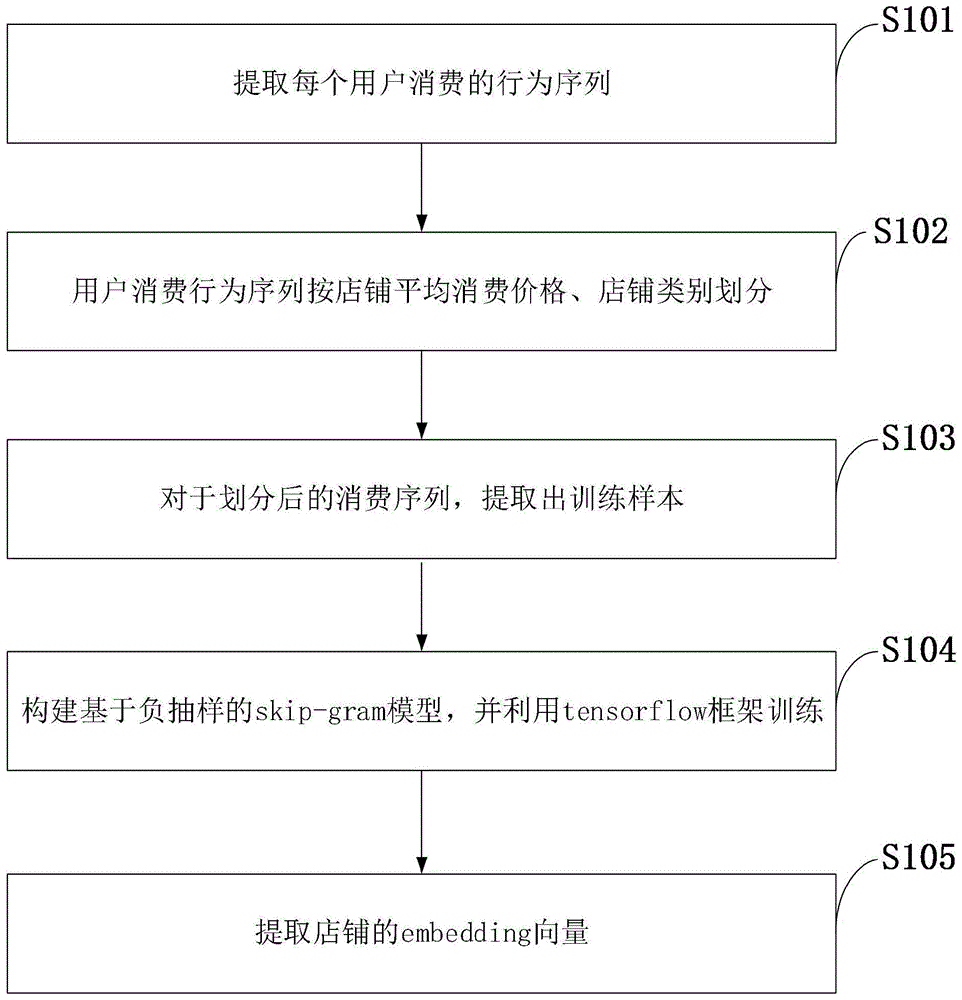
Fig. 1 is a flowchart of a method for extracting an embeading feature of a shop in a take-out scene according to an embodiment of the present invention.
FIG. 2 is a schematic diagram of a skip-gram model according to an embodiment of the present invention.
FIG. 3 is a first result display diagram provided by an embodiment of the present invention.
FIG. 4 is a second result display diagram provided by an embodiment of the present invention.
Fig. 5 is a schematic diagram illustrating comparison between an embedding characteristic delay and an original characteristic delay according to an embodiment of the present invention.
Detailed Description
In order to make the objects, technical solutions and advantages of the present invention more apparent, the present invention is further described in detail with reference to the following embodiments. It should be understood that the specific embodiments described herein are merely illustrative of the invention and are not intended to limit the invention.
The method solves the problem of over-high one-hot dimensionality, simultaneously the embedding also represents context information, and compared with a skip-gram probability model or an embedding model based on a neural network, the computation time complexity and the space complexity are both improved to a great extent. The computer configuration comprises Spark and hadoop computing clusters, wherein Spark must configure a HIVE database; python development environment; and the display card GeForce GTX TITAN X. Stored configuration information of the invention: 128G running the memory; hard disk 500G or above.
The following detailed description of the principles of the invention is provided in connection with the accompanying drawings.
As shown in fig. 1, the method for mapping embedding vectors of a store in a takeaway scenario according to an embodiment of the present invention includes the following steps:
s101: extracting a behavior sequence consumed by each user;
s102: the user consumption behavior sequence is divided according to the average consumption price of the shop and the shop category;
s103: extracting training samples from the divided consumption sequences;
s104: constructing a skip-gram model based on negative sampling, and training by utilizing a tenserflow frame;
s105: extracting the embedding feature vector of the shop.
The application of the principles of the present invention will now be described in further detail with reference to the accompanying drawings.
The method for mapping the embedding vector of the shop in the takeaway scene, provided by the embodiment of the invention, specifically comprises the following steps:
step one, using hive to extract user _ id-shop _ id data and writing the data into a table user _ shop. And (4) constructing a shop dictionary shop _ cut by using hive, wherein the organization form of the shop dictionary shop _ id: index is { shop _ id: index }, and the index is the sequence of the shop in the dictionary. Then replacing the shop _ id in the original user _ shop table with the shop _ idx index in the dictionary;
and step two, replacing the shop _ id in the original user _ shop table with the shop _ id index in the dictionary. The user can perform grouping duplication elimination on a consuming shop sequence for six months according to the average guest unit price and the class-one class of the shop to obtain doc required by constructing a training sample, wherein the data organization form is as follows: { user _ id, array < shop _ id _1, shop _ id _2,.., shop _ id _ m }. And filtering the data of only one shop in the context. The finally obtained data is organized as follows: the array < shop _ id _1, shop _ id _2,. and shop _ id _ m > is stored in the HIVE table, so that the construction of subsequent training samples is facilitated.
Constructing a training sample, performing data conversion by using python, and processing by using HIVE in a third version of model, thereby greatly improving the efficiency; for each context, a get _ train _ samples function is respectively applied to construct a training sample, and the RDD of trains is returned; the finally obtained RDD is written into the HIVE table for the derivation of the next training sample.
And step four, constructing a tensorflow diagram for training, wherein the tensorflow diagram is an integral training function and comprises the acquisition of training data and the generation of batch. Since the total training sample is about 30 hundred million, each batch has 1024, so the setting here is to calculate the loss value every 10000 steps; the loss value is displayed every 100000 steps, namely, the loss value is displayed about once in about seven minutes; evaluate every 1000000 steps and store embedding locally.
(a) Constructing skip-gram model based on negative sampling
The Skip-gram model uses intermediate stores to predict other stores (context). As shown in fig. 2, the input vector is a one-hot vector x (one-hot, a classification method, generally needs to convert each attribute of data into a vector representation, so that the feature of each piece of data is a vector, and each dimension on the vector represents a feature attribute). At the output, the output becomes a multi-path output:
Figure BDA0001488091180000051
wherein, wc,jIs the c-th store predicted to appear at context, with the index at the j-th store, and wo,jIs the c-th shop in the actual context. However, since the output layer shares the weight matrix W', there are:
uc,j=uj=Vw'j Th, for C ═ 1, 2.., C;
the loss function becomes:
Figure BDA0001488091180000052
partial derivation of the jth neuron score of the output level of the c-th store of context:
Figure BDA0001488091180000053
for the sake of simplicity in expression, a set of V-dimensional vectors El ═ { El _1, El _2,. and El _ V } is defined as the sum of the prediction errors of the output layer in all context units:
Figure BDA0001488091180000054
next, we calculate the partial derivatives for W':
Figure BDA0001488091180000055
updating W':
Figure BDA0001488091180000058
for j ═ 1, 2.., V
Figure BDA0001488091180000057
Wherein
Figure BDA0001488091180000056
(b) Training with tensoflow framework
The Tensorflow data processing section controls the learning rate by processing with the tf. Dynamic adjustment of the hyper-parameters is facilitated by using momentum (moving average of parameters) to improve conventional gradient descent.
And fifthly, visualizing the data by using t-sne, acquiring the intuitive perception of the embedding vector, mapping the embedding vector to 2 dimensions, and graphically displaying the distance of each shop. As shown in FIG. 4, it can be seen that in the 1000 stores selected, some stores are clustered together and some stores are spread out on a flat surface.
FIG. 3 is a first result display diagram provided by an embodiment of the present invention. One shop is randomly selected from the shop set, and then 10 shops closest to the shop in the embedding feature space are obtained, and the display result is shown in fig. 3. We can see that the ten stores closest to the selected store are roughly the same category; the prices are close and all belong to the same price interval; the distance is short, most of the distance is within 2 kilometers, and the distance belongs to the same business circle.
FIG. 4 is a second result display diagram provided by an embodiment of the present invention. The embedding vector of the shop is mapped into a two-dimensional plane through a t-sne algorithm and then displayed. As can be seen from FIG. 4, the shop has a significant clustering effect in the embedding feature space, and many independent clusters are clustered together; meanwhile, by comparing shops in the same cluster, the shops can be found to belong to the same business circle.
Fig. 5 is a schematic diagram illustrating comparison between an embedding characteristic delay and an original characteristic delay according to an embodiment of the present invention. It can be found that after the embedding feature is applied, under the condition of ensuring similar AUC values, the time delay of the online model after the embedding feature is fused is obviously lower than that of the original feature model.
The above description is only for the purpose of illustrating the preferred embodiments of the present invention and is not to be construed as limiting the invention, and any modifications, equivalents and improvements made within the spirit and principle of the present invention are intended to be included within the scope of the present invention.

Claims (4)

1.一种外卖场景下店铺embedding特征提取的方法,其特征在于,所述方法包括以下步骤:1. a method for store embedding feature extraction under a takeaway scene, is characterized in that, described method comprises the following steps: 步骤一:提取每个用户消费的行为序列;Step 1: Extract the behavior sequence consumed by each user; 步骤二:用户消费行为序列按店铺平均消费价格、店铺类别划分;Step 2: The user consumption behavior sequence is divided according to the average consumption price of the store and the type of the store; 步骤三:对于划分后的消费行为序列,提取出训练样本;Step 3: For the divided consumption behavior sequence, extract training samples; 步骤四:构建基于负抽样的skip-gram模型,并利用tensorflow框架训练;Step 4: Build a skip-gram model based on negative sampling and train it using the tensorflow framework; 步骤五:提取店铺的embedding特征向量;Step 5: Extract the embedding feature vector of the store; 其中,所述步骤一包括:应用hive提取用户一段时间内的用户所有下单店铺及其ID ,并将user_id—shop_id数据写入表格user_shop,利用 hive构建店铺字典shop_dict,其组织形式为{shop_id:index},其中index为店铺在字典中的顺序;Wherein, the step 1 includes: using hive to extract all the shops that the user places orders and their IDs within a period of time, and writing the user_id-shop_id data into the table user_shop, and using hive to build a shop dictionary shop_dict, whose organizational form is {shop_id: index}, where index is the order of the store in the dictionary; 所述步骤二包括:将原始的user_shop表中的shop_id用字典中shop_idx索引代替;按照店铺的平均客单价、店铺一级类别进行分组去重,获得构建训练样本所需要的doc,其数据组织形式为:{user_id,array <shop_id_1,shop_id_2,...,shop_id_m>};对context内只有一家店铺的数据进行过滤,最终获得的数据组织形式为:array<shop_id_1,shop_id_2,...,shop_id_m>, 并将其存入HIVE表,用于后续训练样本的构建;The second step includes: replacing the shop_id in the original user_shop table with the shop_idx index in the dictionary; grouping and removing duplicates according to the average customer unit price of the store and the first-level category of the store, and obtaining the doc required for constructing the training sample, and its data organization form. It is: {user_id,array<shop_id_1,shop_id_2,...,shop_id_m>}; filter the data of only one shop in the context, and the final data organization form is: array<shop_id_1,shop_id_2,...,shop_id_m> , and store it in the HIVE table for the construction of subsequent training samples; 所述步骤三包括:训练样本的构建,利用python进行数据转换,并利用HIVE进行处理;对于每一个context,分别应用 get_train_samples函数构建训练样本,返回trains的RDD;最终获取的RDD写入到HIVE表中,用于接下来训练样本的导出;The third step includes: constructing training samples, using python for data conversion, and using HIVE for processing; for each context, applying the get_train_samples function to construct training samples respectively, and returning the RDD of trains; and finally writing the obtained RDD to the HIVE table , for the export of the next training samples; 所述步骤四包括:构建用于训练的tensorflow图,是整体的训练函数,包括训练数据的获取以及batch的生成;所述构建基于负抽样的skip-gram模型用于使用context的中间店铺来预测其他店铺;The step 4 includes: constructing a tensorflow graph for training, which is an overall training function, including the acquisition of training data and the generation of batches; the construction of a skip-gram model based on negative sampling is used to predict using the middle store of the context. other stores; 所述步骤五包括:将数据利用t-sne进行可视化,获取店铺的embedding向量的直观感知,将embedding向量映射到2维,对各店铺的距离进行图形化展示。The fifth step includes: using t-sne to visualize the data, obtaining an intuitive perception of the embedding vector of the store, mapping the embedding vector to 2 dimensions, and graphically displaying the distance of each store. 2.如权利要求1所述的外卖场景下店铺embedding特征提取的方法,其特征在于,所述提取每个用户消费的行为序列具体包括:从数据库中,提取用户一定时间内的用户所有下单店铺及其ID,按照用户ID将数据分组,构建每个用户ID的下单店铺集合,存储到数据库中。2. The method for extracting store embedding features in a takeaway scenario as claimed in claim 1, wherein the extracting the behavior sequence consumed by each user specifically comprises: from the database, extracting all orders placed by the user within a certain period of time by the user Stores and their IDs, group data according to user IDs, build a collection of stores for each user ID, and store them in the database. 3.如权利要求1所述的外卖场景下店铺embedding特征提取的方法,其特征在于,所述用户消费行为序列按店铺平均消费价格、店铺类别划分具体包括:将提取出的用户下单店铺序列按店铺的平均消费价格划分为多个等级,同时将不同价格区间的店铺划分为子集合。3. the method for store embedding feature extraction under the takeaway scenario as claimed in claim 1, it is characterized in that, described user consumption behavior sequence according to store average consumption price, store category division specifically comprises: the user order store sequence that will be extracted According to the average consumer price of the store, it is divided into multiple levels, and the stores in different price ranges are divided into sub-sets. 4.如权利要求1所述的外卖场景下店铺embedding特征提取的方法,其特征在于,所述提取店铺的embedding特征向量具体包括:用tensorflow训练好的向量保存到本地,并在实际操作中提取需要的店铺embedding特征。4. the method for store embedding feature extraction under the takeaway scene as claimed in claim 1, it is characterized in that, described extracting the embedding feature vector of store specifically comprises: save the vector trained locally with tensorflow, and extract in actual operation Required store embedding features.
CN201711230471.1A 2017-11-30 2017-11-30 Method for extracting store embedding features in takeaway scenarios Active CN108009847B (en)

Priority Applications (1)

Application Number Priority Date Filing Date Title
CN201711230471.1A CN108009847B (en) 2017-11-30 2017-11-30 Method for extracting store embedding features in takeaway scenarios

Applications Claiming Priority (1)

Application Number Priority Date Filing Date Title
CN201711230471.1A CN108009847B (en) 2017-11-30 2017-11-30 Method for extracting store embedding features in takeaway scenarios

Publications (2)

Publication Number Publication Date
CN108009847A CN108009847A (en) 2018-05-08
CN108009847B true CN108009847B (en) 2021-06-15

Family

ID=62054825

Family Applications (1)

Application Number Title Priority Date Filing Date
CN201711230471.1A Active CN108009847B (en) 2017-11-30 2017-11-30 Method for extracting store embedding features in takeaway scenarios

Country Status (1)

Country Link
CN (1) CN108009847B (en)

Families Citing this family (3)

* Cited by examiner, † Cited by third party
Publication number Priority date Publication date Assignee Title
CN109741105A (en) * 2018-12-29 2019-05-10 星潮闪耀移动网络科技(中国)有限公司 A vector generation method and device
US11669558B2 (en) * 2019-03-28 2023-06-06 Microsoft Technology Licensing, Llc Encoder using machine-trained term frequency weighting factors that produces a dense embedding vector
CN110245348B (en) * 2019-05-17 2023-11-24 北京百度网讯科技有限公司 Intention recognition method and system

Citations (7)

* Cited by examiner, † Cited by third party
Publication number Priority date Publication date Assignee Title
CN102004979A (en) * 2009-09-03 2011-04-06 叶克 System and method for providing commodity matching and promoting services
CN103886090A (en) * 2014-03-31 2014-06-25 北京搜狗科技发展有限公司 Content recommendation method and device based on user favorites
CN104834686A (en) * 2015-04-17 2015-08-12 中国科学院信息工程研究所 Video recommendation method based on hybrid semantic matrix
WO2017057921A1 (en) * 2015-10-02 2017-04-06 네이버 주식회사 Method and system for automatically classifying data expressed by a plurality of factors with values of text word and symbol sequence by using deep learning
CN106920147A (en) * 2017-02-28 2017-07-04 华中科技大学 A kind of commodity intelligent recommendation method that word-based vector data drives
CN106959966A (en) * 2016-01-12 2017-07-18 腾讯科技(深圳)有限公司 A kind of information recommendation method and system
CN107169801A (en) * 2017-05-22 2017-09-15 上海汇纳信息科技股份有限公司 Shop incidence relation acquisition methods, system, storage medium and mobile terminal

Patent Citations (7)

* Cited by examiner, † Cited by third party
Publication number Priority date Publication date Assignee Title
CN102004979A (en) * 2009-09-03 2011-04-06 叶克 System and method for providing commodity matching and promoting services
CN103886090A (en) * 2014-03-31 2014-06-25 北京搜狗科技发展有限公司 Content recommendation method and device based on user favorites
CN104834686A (en) * 2015-04-17 2015-08-12 中国科学院信息工程研究所 Video recommendation method based on hybrid semantic matrix
WO2017057921A1 (en) * 2015-10-02 2017-04-06 네이버 주식회사 Method and system for automatically classifying data expressed by a plurality of factors with values of text word and symbol sequence by using deep learning
CN106959966A (en) * 2016-01-12 2017-07-18 腾讯科技(深圳)有限公司 A kind of information recommendation method and system
CN106920147A (en) * 2017-02-28 2017-07-04 华中科技大学 A kind of commodity intelligent recommendation method that word-based vector data drives
CN107169801A (en) * 2017-05-22 2017-09-15 上海汇纳信息科技股份有限公司 Shop incidence relation acquisition methods, system, storage medium and mobile terminal

Non-Patent Citations (5)

* Cited by examiner, † Cited by third party
Title
Improvement of Sentiment Analysis Based on Clustering of Word2Vec Features;Eissa M.Alshari et al;《2017 28th International Workshop on Database and Expert Systems Applications》;20170928;第123-126页 *
word2vec Explained: deriving Mikolov et al."s negative-sampling word-embedding method;Goldberg,Yoav et al;《arXiv e-prints》;20140228;第1-5页 *
基于LDA和Word2Vec的推荐算法研究;董文;《中国优秀硕士学位论文全文数据库信息科技辑》;20150815(第08期);摘要,第6-60页 *
基于Word2vec的一种文档向量表示;唐明 等;《计算机科学》;20160630;第43卷(第6期);第214-217页 *
外卖用户差评影响因素研究——基于文本评论和Word2vec;曹军 等;《现代商贸工业》;20170131(第2期);第55-56页 *

Also Published As

Publication number Publication date
CN108009847A (en) 2018-05-08

Similar Documents

Publication Publication Date Title
Li et al. Hierarchical bipartite graph neural networks: Towards large-scale e-commerce applications
CN110263265B (en) User tag generation method, device, storage medium and computer equipment
CN107590218B (en) Efficient clustering method of Chinese text based on multi-feature combined with Spark
TW201822098A (en) Computer device and method for predicting market demand of commodities
CN116468460B (en) Consumer finance customer image recognition system and method based on artificial intelligence
KR20210033294A (en) Automatic manufacturing apparatus for reports, and control method thereof
CN116304299A (en) A Personalized Recommendation Method Combining User Interest Evolution and Gradient Boosting Algorithm
CN108921602A (en) A kind of user&#39;s buying behavior prediction technique based on integrated neural network
CN108009847B (en) Method for extracting store embedding features in takeaway scenarios
CN114004513B (en) Demand forecasting method, system and storage medium
CN118861303A (en) A method and device for risk assessment of public opinion large model
CN109992676B (en) Cross-media resource retrieval method and retrieval system
CN110020918B (en) Recommendation information generation method and system
She et al. Research on advertising click-through rate prediction based on CNN-FM hybrid model
CN111626331A (en) A kind of automatic industry classification device and its working method
Abdullhadi et al. Time-aware forecasting of search volume categories and actual purchase
Hasudungan et al. The Impact of k-means on Association Rules Mining Algorithms Performance
Sharma et al. Deep learning in big data and data mining
Vollset et al. Making use of external company data to improve the classification of bank transactions
Malviya et al. Customer Segmentation and Business Sales Forecasting using Machine Learning for Business Development
Yang Design mechanism of precision marketing planning platform based on user data mining
Liu et al. A machine learning approach to predict customer churn of a delivery platform
Yang et al. A CUSTOMER DEMAND MINING ALGORITHM BASED ON ONLINE COMMENTS AND MACHINE LEARNING.
Niu Study on mining repeated purchase behaviour intention of online consumers based on big data clustering
CN114638451B (en) Intelligent retail decision support system

Legal Events

Date Code Title Description
PB01 Publication
PB01 Publication
SE01 Entry into force of request for substantive examination
GR01 Patent grant
GR01 Patent grant