CN107040407B - A high-performance computing cluster dynamic node job method - Google Patents
A high-performance computing cluster dynamic node job method Download PDFInfo
- Publication number
- CN107040407B CN107040407B CN201710154402.0A CN201710154402A CN107040407B CN 107040407 B CN107040407 B CN 107040407B CN 201710154402 A CN201710154402 A CN 201710154402A CN 107040407 B CN107040407 B CN 107040407B
- Authority
- CN
- China
- Prior art keywords
- node
- network
- nodes
- computing
- job
- Prior art date
- Legal status (The legal status is an assumption and is not a legal conclusion. Google has not performed a legal analysis and makes no representation as to the accuracy of the status listed.)
- Active
Links
Images


Classifications
-
- H—ELECTRICITY
- H04—ELECTRIC COMMUNICATION TECHNIQUE
- H04L—TRANSMISSION OF DIGITAL INFORMATION, e.g. TELEGRAPHIC COMMUNICATION
- H04L41/00—Arrangements for maintenance, administration or management of data switching networks, e.g. of packet switching networks
- H04L41/08—Configuration management of networks or network elements
- H04L41/0889—Techniques to speed-up the configuration process
-
- H—ELECTRICITY
- H04—ELECTRIC COMMUNICATION TECHNIQUE
- H04L—TRANSMISSION OF DIGITAL INFORMATION, e.g. TELEGRAPHIC COMMUNICATION
- H04L41/00—Arrangements for maintenance, administration or management of data switching networks, e.g. of packet switching networks
- H04L41/08—Configuration management of networks or network elements
- H04L41/0803—Configuration setting
- H04L41/0823—Configuration setting characterised by the purposes of a change of settings, e.g. optimising configuration for enhancing reliability
- H04L41/0826—Configuration setting characterised by the purposes of a change of settings, e.g. optimising configuration for enhancing reliability for reduction of network costs
-
- H—ELECTRICITY
- H04—ELECTRIC COMMUNICATION TECHNIQUE
- H04L—TRANSMISSION OF DIGITAL INFORMATION, e.g. TELEGRAPHIC COMMUNICATION
- H04L41/00—Arrangements for maintenance, administration or management of data switching networks, e.g. of packet switching networks
- H04L41/08—Configuration management of networks or network elements
- H04L41/0803—Configuration setting
- H04L41/0823—Configuration setting characterised by the purposes of a change of settings, e.g. optimising configuration for enhancing reliability
- H04L41/0833—Configuration setting characterised by the purposes of a change of settings, e.g. optimising configuration for enhancing reliability for reduction of network energy consumption
-
- H—ELECTRICITY
- H04—ELECTRIC COMMUNICATION TECHNIQUE
- H04L—TRANSMISSION OF DIGITAL INFORMATION, e.g. TELEGRAPHIC COMMUNICATION
- H04L41/00—Arrangements for maintenance, administration or management of data switching networks, e.g. of packet switching networks
- H04L41/08—Configuration management of networks or network elements
- H04L41/0803—Configuration setting
- H04L41/0823—Configuration setting characterised by the purposes of a change of settings, e.g. optimising configuration for enhancing reliability
- H04L41/0836—Configuration setting characterised by the purposes of a change of settings, e.g. optimising configuration for enhancing reliability to enhance reliability, e.g. reduce downtime
-
- H—ELECTRICITY
- H04—ELECTRIC COMMUNICATION TECHNIQUE
- H04L—TRANSMISSION OF DIGITAL INFORMATION, e.g. TELEGRAPHIC COMMUNICATION
- H04L41/00—Arrangements for maintenance, administration or management of data switching networks, e.g. of packet switching networks
- H04L41/08—Configuration management of networks or network elements
- H04L41/0893—Assignment of logical groups to network elements
Landscapes
- Engineering & Computer Science (AREA)
- Computer Networks & Wireless Communication (AREA)
- Signal Processing (AREA)
- Stored Programmes (AREA)
- Computer And Data Communications (AREA)
Abstract
本发明提供了一种高性能计算集群动态节点作业方法,其基于Infiniband网络提供统一的文件系统空间和无盘启动,基于以太网提供集群作业调度、开关机控制、系统监控等功能。通过上述方式,本发明能够提高高性能计算集群部署效率,降低故障率,简化作业提交,提高能源和资金利用率,提升使用效率和性能。
The invention provides a high-performance computing cluster dynamic node operation method, which provides unified file system space and diskless startup based on Infiniband network, and provides functions such as cluster job scheduling, power-on-off control, system monitoring and the like based on Ethernet. Through the above method, the present invention can improve the deployment efficiency of high-performance computing clusters, reduce the failure rate, simplify job submission, improve the utilization rate of energy and funds, and improve the use efficiency and performance.
Description
技术领域technical field
本发明涉及高性能计算技术领域,特别是涉及一种高性能计算集群动态节点作业方法。The invention relates to the technical field of high-performance computing, in particular to a dynamic node operation method of a high-performance computing cluster.
背景技术Background technique
高性能计算(High performance computing,缩写HPC) 指通常使用很多处理器(作为单个机器的一部分)或者某一集群中组织的几台计算机(作为单个计算资源操作)的计算系统和环境。高性能计算在航空航天、材料、数学、生物、物理、化学、气象、环境、金融、媒体、电磁等多个行业具有较为广泛和重要的作用。当前高性能计算75%以上的系统都是通过X86服务器以Clustre架构进行构建,随着服务器节点的增多和对集群效率、实测计算峰值、能耗等各方面要求的提升,传统的高性能计算集群存在诸多瓶颈,需要广大科研人员和集群维护人员进行研究和探索。High performance computing (HPC) refers to computing systems and environments that typically use many processors (as part of a single machine) or several computers organized in a cluster (operating as a single computing resource). High-performance computing plays a broad and important role in aerospace, materials, mathematics, biology, physics, chemistry, meteorology, environment, finance, media, electromagnetics and other industries. At present, more than 75% of the high-performance computing systems are built on the Clustre architecture through X86 servers. There are many bottlenecks, which require research and exploration by researchers and cluster maintainers.
通过基于Infiniband网络的无盘部署、标准化的作业提交流程和步骤、自动控制和调整计算节点开机数量可以实现:Through diskless deployment based on Infiniband network, standardized job submission process and steps, automatic control and adjustment of the number of computing nodes to be powered on, the following can be achieved:
A、节能,基于无盘部署,计算节点不需要配置硬盘,降低了集群的功率开销和故障点,通过动态调整计算节点开关机数量,避免了大量计算节点开机空转的情况,提高了能源的使用率;A. Energy saving. Based on diskless deployment, computing nodes do not need to be configured with hard disks, which reduces the power overhead and failure points of the cluster. By dynamically adjusting the number of computing nodes on and off, a large number of computing nodes are prevented from running idly, and energy usage is improved. Rate;
B、性能,基于Infiniband网络的无盘部署,将系统镜像通过低延时的高速网络加载到各计算节点内存中,提升了计算节点开机速度,并且充分利用了RAM DISK的IOPS性能优势,极大提升计算任务在计算节点单机内部的收敛速率。B. Performance, based on the diskless deployment of Infiniband network, the system image is loaded into the memory of each computing node through a low-latency high-speed network, which improves the startup speed of the computing node, and makes full use of the IOPS performance advantage of RAM DISK, greatly Improve the convergence rate of computing tasks within a single computing node.
C、标准化,由于高性能计算涉及行业较多、范围较广、海量的专业软件,导致了传统用户在使用高性能计算集群时需要去针对具体的计算软件进行了解学习后才能上机使用。通过对作业流程的重构和标准化,将海量的专业软件的作业提交流程通过中间件固定为同样的步骤和流程,极大简化了上机操作步骤,让传统用户能快速的入手并将集群充分使用起来。C. Standardization. Because high-performance computing involves many industries, a wide range, and a large amount of professional software, traditional users need to learn about specific computing software when using high-performance computing clusters before they can use it on the computer. Through the reconstruction and standardization of the job process, the job submission process of massive professional software is fixed to the same steps and processes through the middleware, which greatly simplifies the operation steps of the computer, allowing traditional users to quickly start and fully cluster the cluster. use it.
D、节约,最大程度减少不必要的软硬件投入(如计算节点硬盘、计算节点操作系统),提升资金使用率;D. Saving, minimizing unnecessary software and hardware investment (such as computing node hard disk, computing node operating system), and improving capital utilization;
E、低故障率,传统高性能计算集群在每个计算节点上需要安装1块硬盘用于存放操作系统。机械硬盘价格便宜,使用年限久,但性能较差;固态硬盘性能较好,但成本太高,寿命太短。并且当集群意外断电时极易导致操作系统损坏。通过无盘部署,有效避免了由硬盘导致的故障,极大降低集群故障率。E. Low failure rate. In traditional high-performance computing clusters, one hard disk needs to be installed on each computing node to store the operating system. Mechanical hard disks are cheap and have a long service life, but their performance is poor; solid-state hard disks have better performance, but their cost is too high and their lifespan is too short. And when the cluster is accidentally powered off, it is very easy to cause damage to the operating system. Through the diskless deployment, the failure caused by the hard disk is effectively avoided, and the cluster failure rate is greatly reduced.
F、高效率,传统高性能计算集群需要对所有的节点安装操作系统和配置环境变量才能工作,本申请所描述方式无需该环节,极大减少了集群部署时间,提升了集群部署的效率。F. High efficiency, traditional high-performance computing clusters need to install an operating system and configure environment variables for all nodes to work. The method described in this application does not require this link, which greatly reduces cluster deployment time and improves cluster deployment efficiency.
发明内容SUMMARY OF THE INVENTION
本发明主要解决的技术问题是提供一种高性能计算集群动态节点作业方法,能够提高高性能计算集群部署效率,降低故障率,简化作业提交,提高能源和资金利用率,提升使用效率和性能。The main technical problem solved by the present invention is to provide a high-performance computing cluster dynamic node operation method, which can improve the high-performance computing cluster deployment efficiency, reduce the failure rate, simplify job submission, improve energy and capital utilization, and improve use efficiency and performance.
为解决上述技术问题,本发明采用的一个技术方案是:提供一种高性能计算集群动态节点作业方法,其特征在于,包括如下步骤:In order to solve the above technical problem, a technical solution adopted by the present invention is to provide a method for dynamic node operation of a high-performance computing cluster, which is characterized by comprising the following steps:
步骤1:配置服务器,包括管理网络N1、计算网络N2和用户网络N3,以及用户网络N3和管理网络N1之间的安全防护网络F1、登陆节点L1、管理节点M1、若干计算节点CN;所述登陆节点、管理节点、计算节点分别与管理网络和计算网络建立通信连接;所述登陆节点和管理节点通过计算网络挂载共享存储S1;Step 1: The configuration server includes a management network N1, a computing network N2, and a user network N3, as well as a security protection network F1 between the user network N3 and the management network N1, a login node L1, a management node M1, and several computing nodes CN; the The login node, the management node, and the computing node establish communication connections with the management network and the computing network respectively; the login node and the management node mount the shared storage S1 through the computing network;
步骤2:在管理节点M1上安装并配置启动管理服务(Flexboot)、动态主机配置协议服务(DHCP)、文件传输协议服务(TFTP)、域名系统服务(DNS)、共享服务、认证服务以及作业调度,配置完成后启动计算节点;Step 2: Install and configure the Startup Management Service (Flexboot), Dynamic Host Configuration Protocol Service (DHCP), File Transfer Protocol Service (TFTP), Domain Name System Service (DNS), Shared Service, Authentication Service, and Job Scheduling on the management node M1 , start the computing node after the configuration is complete;
步骤3:用户网络N3中的用户,经过安全防护网络F1以安全外壳协议SSH登录到登陆节点L1上,通过SSH将需要计算的算例上传至登陆节点L1上的共享存储S1;Step 3: The user in the user network N3 logs in to the login node L1 via the secure shell protocol SSH through the security protection network F1, and uploads the calculation example that needs to be calculated to the shared storage S1 on the login node L1 through SSH;
步骤4:用户在登陆节点L1上通过作业调度中间件,指定作业参数完成作业脚本的生成并启动提交给M1的作业调度进行资源分配和计算;Step 4: The user specifies the job parameters through the job scheduling middleware on the login node L1 to complete the generation of the job script and starts the job scheduling submitted to M1 for resource allocation and calculation;
步骤5:管理节点M1收到登陆节点L1上用户提交的作业脚本后,首先将作业脚本中的函数调用请求交给管理节点中的Maui.d进行资源配额检查,如果配额不足则报错提示,如果配额足够,则将作业脚本转交给M1上作业调度pbs_server进行调度;Step 5: After the management node M1 receives the job script submitted by the user on the login node L1, it first sends the function call request in the job script to Maui.d in the management node for resource quota checking. If the quota is insufficient, an error message will be reported. If the quota is sufficient, the job script is transferred to the job scheduling pbs_server on M1 for scheduling;
步骤6:管理节点M1的作业调度pbs_server收到作业脚本后,根据作业脚本要求的节点数、每节点核心数为作业分配进行计算的节点C1到Cn,如果节点数量不足,则将作业进行排队等待;如果节点数量足够,则根据作业脚本具体执行内容开始计算;Step 6: After the job scheduling pbs_server of the management node M1 receives the job script, it allocates the nodes C1 to Cn for calculation according to the number of nodes required by the job script and the number of cores per node. If the number of nodes is insufficient, the job is queued for waiting ; If the number of nodes is sufficient, start the calculation according to the specific execution content of the job script;
步骤7:当C1到Cn完成计算后,释放物理内存、处理器等资源,并向M1的pbs_server反馈“所有核心均未占用,状态Free”的信号;M1的pbs_server对该信号进行记录,并允许后续作业在该节点上进行分配和计算;Step 7: After C1 to Cn complete the calculation, release resources such as physical memory and processor, and feed back the signal of "all cores are not occupied, status Free" to the pbs_server of M1; the pbs_server of M1 records the signal and allows Subsequent jobs are allocated and computed on this node;
步骤8:用户可以通过安全文件传输协议SFTP从L1上将S1中存储的计算结果等信息取回到N3中,在本地电脑上打开进行处理和分析。Step 8: The user can retrieve the calculation results and other information stored in S1 from L1 back to N3 through the secure file transfer protocol SFTP, and open it on the local computer for processing and analysis.
优选地,管理网络N1为以太网络,主要负责计算节点开关机控制、作业调度数据传输、系统监控等功能,计算网络N1为Infiniband网络,提高设备的扩展性、数据的传输速率及通信延迟,主要负责数据及存储的IO、操作系统镜像分发、计算软件工作时各进程相互通信与数据同步等功能,用户网络N3是高性能计算机用户所在的网络,安全防护F1为防火墙、UTM或路由器设备,提供用户网络到管理网络的端口映射、访问权限管理、异常流量监测、攻击防护等功能,登录节点L1、管理节点M1、若干计算节点CN统一为同一处理器架构(如X86架构、MIPS架构、ARM架构、Power架构、Spark架构等),处理器具有完全相同的指令集,根据用户实际使用需求和高性能计算机总体计算性能要求,登录节点L1、管理节点M1、若干计算节点CN可以通过集群(Cluster)方式进行横向扩展,共享存储S1一般为基于Infiniband的NFS服务器其包含底层的硬盘柜或磁盘阵列,或基于Infiniband的分布式存储系统,对外提供一个统一的文件系统空间,并且支持用户权限控制和容量配额。Preferably, the management network N1 is an Ethernet network, which is mainly responsible for functions such as on-off control of computing nodes, job scheduling data transmission, and system monitoring. Responsible for data and storage IO, operating system image distribution, mutual communication between processes and data synchronization when computing software is working, user network N3 is the network where high-performance computer users are located, and security protection F1 is firewall, UTM or router equipment, providing Port mapping from user network to management network, access rights management, abnormal traffic monitoring, attack protection and other functions , Power architecture, Spark architecture, etc.), the processor has exactly the same instruction set, according to the actual use requirements of users and the overall computing performance requirements of high-performance computers, the login node L1, management node M1, and several computing nodes CN can pass through the cluster (Cluster) The shared storage S1 is generally an Infiniband-based NFS server, which includes the underlying hard disk cabinet or disk array, or an Infiniband-based distributed storage system, which provides a unified file system space and supports user permission control and capacity. quota.
优选地,系统第一次部署时将登陆节点L1的操作系统复制为镜像文件J1,并修改J1中包含的相关个性化参数配置文件为通用配置文件,其中包括修改网卡配置文件,去掉MAC地址、UUID等唯一信息,修改为DHCP引导;将主机名修改为DHCP自动获取、将硬盘的挂载方式修改为设备名方式进行挂载、将系统环境变量存放目录修改为共享存储S1上特定目录等。Preferably, when the system is deployed for the first time, the operating system of the login node L1 is copied to the image file J1, and the relevant personalized parameter configuration file contained in J1 is modified into a general configuration file, including modifying the network card configuration file, removing the MAC address, Change the unique information such as UUID to DHCP boot; change the host name to DHCP automatic acquisition, change the mounting method of the hard disk to the device name method for mounting, change the storage directory of the system environment variable to a specific directory on the shared storage S1, etc.
所述计算节点的启动采用无盘启动方式,具体步骤包括:The startup of the computing node adopts a diskless startup mode, and the specific steps include:
步骤1:将C1(或Cn)开机,设置为默认PXE引导,PXE默认设备为主机通道适配器(HCA),采用FlexBoot模式;FlexBoot初始化HCA卡,检测端口协议及状态,以Infiniband方式启动端口,并以广播的方式发送DHCP客户端(Client)请求报文;Step 1: Power on C1 (or Cn) and set it as the default PXE boot. The default device for PXE is Host Channel Adapter (HCA), using FlexBoot mode; FlexBoot initializes the HCA card, detects the port protocol and status, starts the port in Infiniband mode, and Send a DHCP client (Client) request message by broadcast;
步骤2:管理节点M1的DHCP 服务器从Infiniband网络收到请求报文后,将C1的IP地址、TFTP服务器、网络引导启动镜像目录发送给C1;C1接收到M1发出的报文后,根据收到的报文启动Infiniband网络,并从M1的TFTP服务器中下载启动镜像目录并加载到内存中,所请求的镜像目录内包含默认的启动镜像名称J1、默认启动镜像镜像时间等信息,通过C1上选择启动J1或者超过默认时间后自动选择启动J1,并向M1发送请求J1的报文;Step 2: After the DHCP server of the management node M1 receives the request message from the Infiniband network, it sends the IP address of C1, the TFTP server, and the network boot image directory to C1; The message starts the Infiniband network, and downloads the boot image directory from the TFTP server of M1 and loads it into the memory. The requested image directory contains the default boot image name J1, the default boot image mirror time and other information, through the selection on C1 Start J1 or automatically choose to start J1 after the default time is exceeded, and send a message requesting J1 to M1;
步骤3:M1收到C1请求J1的报文后,将J1通过TFTP服务器发送给C1;C1的FlexBoot接收完J1后,将J1放入内存进行加载;Step 3: After M1 receives the message that C1 requests J1, it sends J1 to C1 through the TFTP server; after the FlexBoot of C1 receives J1, it puts J1 into memory for loading;
步骤4:C1依次加载J1的内核、根文件系统、网络、配置文件等;C1在加载网络时广播DHCP Client的请求报文,M1的DHCP Server收到请求报文后再次将C1的IP地址发送给C1,C1收到IP地址报文后启动网络,并向M1请求主机名;M1的DNS Server收到C1请求主机名的报文后将C1的主机名发送给C1;C1网络启动完成后,首先加载挂载共享目录的配置文件,根据配置文件内容将S1通过Infiniband方式进行挂载;C1挂载完共享目录后,启动计算节点作业调度(pbs_mom),并将作业调度状态反馈给管理节点M1的作业调度(pbs_server),启动完成。Step 4: C1 loads J1's kernel, root file system, network, configuration files, etc. in turn; C1 broadcasts the request message of the DHCP Client when loading the network, and the DHCP Server of M1 sends the IP address of C1 again after receiving the request message To C1, C1 starts the network after receiving the IP address message, and requests the host name from M1; the DNS Server of M1 sends the host name of C1 to C1 after receiving the message for the host name of C1; after the network startup of C1 is completed, First, load the configuration file for mounting the shared directory, and mount S1 through Infiniband according to the content of the configuration file; after C1 mounts the shared directory, start the computing node job scheduling (pbs_mom), and feed back the job scheduling status to the management node M1 The job scheduling (pbs_server) is completed.
进一步的,所述作业中间件中提前录入已知的调用函数,针对已知的计算软件进行作业提交流程的重构和标准化,用户在提交作业时通过调用函数输入作业类型、参与计算节点数量、每个计算节点参与计算核心数量、输入文件(如果有)共计4个参数即可完成作业提交,避免了编写作业脚本的工作,极大简化上级操作步骤;Further, a known calling function is entered in the job middleware in advance, and the job submission process is reconstructed and standardized for known computing software. When submitting a job, the user enters the job type, the number of participating computing nodes, the number of participating computing nodes, and the Each computing node participates in the number of computing cores and input files (if any) with a total of 4 parameters to complete the job submission, which avoids the work of writing job scripts and greatly simplifies the upper-level operation steps;
进一步的,计算机开机节点自动控制包括如下步骤:Further, the automatic control of the computer startup node includes the following steps:
步骤1:系统启动完成正常运行时,M1每60秒启动后台监控进程一次并检测启动时间,若未达到启动时间,则暂停60秒并重复步骤1;Step 1: When the system starts and completes normal operation, M1 starts the background monitoring process every 60 seconds and detects the startup time. If the startup time is not reached, pause for 60 seconds and repeat step 1;
步骤2:后台监控进程正常启动后,检查pbs_server是否有排队作业,若无排队作业并且处于工作状态的计算节点小于等于1时,则直接退出;若无排队作业并处于工作状态的节点大于1个,则通过管理网络N1和IPMI接口关闭开机但位处于空闲状态的空闲节点数量-1个节点,只保留空闲节点中节点名排名最前的1个空闲计算节点处于开机状态以备用;Step 2: After the background monitoring process starts normally, check whether the pbs_server has queued jobs. If there are no queued jobs and the computing node in the working state is less than or equal to 1, it will exit directly; if there are no queued jobs and there are more than one node in the working state , then through the management network N1 and the IPMI interface, the number of idle nodes that are turned on but in an idle state - 1 node, and only the idle computing node with the highest node name among the idle nodes is kept in the power-on state for standby;
步骤3:若检查到有排队作业情况时,则分析处于排队作业的原因:若为用户超额,则直接退出系统;若用户未超额,则排队原因为资源不足,执行下一步骤;Step 3: If it is detected that there is a queued job, then analyze the reason for the queued job: if the user is over-subscribed, exit the system directly; if the user is not over-subscribed, the reason for the queue is insufficient resources, and the next step is performed;
步骤4:在步骤3之后,检查关机节点数量。若关机节点为0,则提示节点用尽并退出系统;若关机节点大于等于1,则根据处于等待状态各中作业各节点需求量的大小从小到大进行排序,设定N为等待状态作业最小作业节点需求数量,F为当前空闲状态节点数量,G为关机节点数量。比较当前需要开机节点数量(N-F)和G-1。若N-F≤G-1,表示关机节点数量比需求节点数量大,则在管理网络N1中通过IPMI接口开启N-F+1个节点,并重新进行步骤2;若N-F≥G-1,表示关机节点数量不足,则在管理网络N1中通过IPMI接口开启所有关机节点并提示节点数用尽,然后退出系统。Step 4: After step 3, check the number of shutdown nodes. If the shutdown node is 0, it will prompt the node to be exhausted and exit the system; if the shutdown node is greater than or equal to 1, it will be sorted according to the demand of each node in the waiting state from small to large, and N is set to be the smallest waiting state job. The number of job nodes required, F is the current number of idle nodes, and G is the number of shutdown nodes. Compare the current number of nodes that need to be powered on (N-F) and G-1. If N-F≤G-1, it means that the number of shutdown nodes is larger than the number of required nodes, then in the management network N1, open N-F+1 nodes through the IPMI interface, and repeat step 2; if N-F≥G-1, it means shutdown If the number of nodes is insufficient, turn on all the shutdown nodes through the IPMI interface in the management network N1 and prompt that the number of nodes is exhausted, and then exit the system.
区别于现有技术的情况,本发明的有益效果是:Different from the situation in the prior art, the beneficial effects of the present invention are:
1、节能:基于无盘部署,计算节点不在需要硬盘,降低了集群的功率开销和故障点。通过动态 调整计算节点开关机数量,避免了大量计算节点开机空转的情况,提高了能源的使用率。1. Energy saving: Based on diskless deployment, computing nodes no longer need hard disks, reducing the power overhead and failure points of the cluster. By dynamically adjusting the number of computing nodes on and off, a large number of computing nodes are prevented from running idly, and the energy utilization rate is improved.
2、性能:基于Infiniband网络的无盘部署,将系统镜像加载到各计算节点内存中,提升了计算节点开机速度,并且充分利用了RAM DISK的IOPS性能优势,极大提升计算任务在计算节点单机内部的收敛速率。2. Performance: Based on the diskless deployment of Infiniband network, the system image is loaded into the memory of each computing node, which improves the startup speed of the computing node, and makes full use of the IOPS performance advantage of RAM DISK, which greatly improves the computing tasks on a single computing node. Internal convergence rate.
3、标准化:由于高性能计算涉及行业较多、范围较广、海量的专业软件,导致了传统用户在使用高性能计算集群时需要去针对具体的计算软件进行了解学习后才能上机使用。通过对作业流程的重构和标准化,将海量的专业软件的作业提交流程通过中间件固定为同样的步骤和流程,极大简化了上机操作步骤,让传统用户能快速的入手并将集群充分使用起来。3. Standardization: Because high-performance computing involves many industries, a wide range, and a large amount of professional software, traditional users need to learn about specific computing software when using high-performance computing clusters before they can use it on the computer. Through the reconstruction and standardization of the job process, the job submission process of massive professional software is fixed to the same steps and processes through the middleware, which greatly simplifies the operation steps of the computer, allowing traditional users to quickly start and fully cluster the cluster. use it.
4、节约:最大程度减少不必要的硬件投入(如计算节点硬盘),提升资金使用率。4. Saving: Minimize unnecessary hardware investment (such as computing node hard drives) and improve capital utilization.
5、低故障率:传统高性能计算集群在每个计算节点上需要安装1块硬盘用于存放操作系统。机械硬盘价格便宜,使用年限久,但性能较差;固态硬盘性能较好,但成本太高,寿命太短。并且当集群意外断电时极易导致操作系统损坏。通过无盘部署,有效避免了由硬盘导致的故障,极大降低集群故障率。5. Low failure rate: In traditional high-performance computing clusters, one hard disk needs to be installed on each computing node to store the operating system. Mechanical hard disks are cheap and have a long service life, but their performance is poor; solid-state hard disks have better performance, but their cost is too high and their lifespan is too short. And when the cluster is accidentally powered off, it is very easy to cause damage to the operating system. Through the diskless deployment, the failure caused by the hard disk is effectively avoided, and the cluster failure rate is greatly reduced.
6、高效率:传统高性能计算集群需要对所有的节点安装操作系统和配置环境变量才能工作,本申请所描述方式无需该环节,极大减少了集群部署时间,提升了集群部署的效率。6. High efficiency: Traditional high-performance computing clusters need to install an operating system and configure environment variables for all nodes to work. The method described in this application does not require this link, which greatly reduces cluster deployment time and improves cluster deployment efficiency.
附图说明Description of drawings
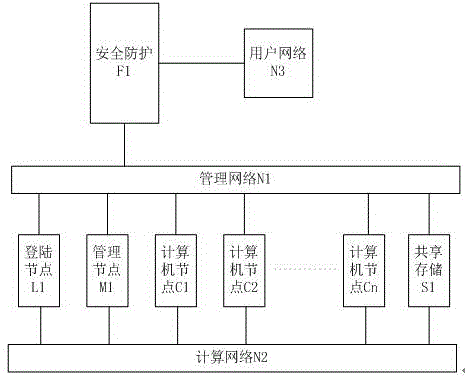
图1是本发明实施例高性能计算集群系统拓扑图。FIG. 1 is a topology diagram of a high-performance computing cluster system according to an embodiment of the present invention.
图2是本发明实施例动态节点控制流程图。FIG. 2 is a flow chart of dynamic node control according to an embodiment of the present invention.
具体实施方式Detailed ways
下面将结合本发明实施例中的附图,对本发明实施例中的技术方案进行清楚、完整地描述,显然,所描述的实施例仅是本发明的一部分实施例,而不是全部的实施例。基于本发明中的实施例,本领域普通技术人员在没有做出创造性劳动前提下所获得的所有其他实施例,都属于本发明保护的范围。The technical solutions in the embodiments of the present invention will be clearly and completely described below with reference to the drawings in the embodiments of the present invention. Obviously, the described embodiments are only a part of the embodiments of the present invention, but not all of the embodiments. Based on the embodiments of the present invention, all other embodiments obtained by those of ordinary skill in the art without creative efforts shall fall within the protection scope of the present invention.
参见图1提供的一种高性能计算集群动态节点作业方法,其特征在于,包括如下步骤:Referring to a high-performance computing cluster dynamic node job method provided in FIG. 1, it is characterized in that it includes the following steps:
步骤1:配置服务器,包括管理网络N1、计算网络N2和用户网络N3,以及用户网络N3和管理网络N1之间的安全防护网络F1、登陆节点L1、管理节点M1、若干计算节点CN;所述登陆节点、管理节点、计算节点分别与管理网络和计算网络建立通信连接;所述登陆节点和管理节点通过计算网络挂载共享存储S1;Step 1: The configuration server includes a management network N1, a computing network N2, and a user network N3, as well as a security protection network F1 between the user network N3 and the management network N1, a login node L1, a management node M1, and several computing nodes CN; the The login node, the management node, and the computing node establish communication connections with the management network and the computing network respectively; the login node and the management node mount the shared storage S1 through the computing network;
步骤2:在管理节点M1上安装并配置启动管理服务(Flexboot)、动态主机配置协议服务(DHCP)、文件传输协议服务(TFTP)、域名系统服务(DNS)、共享服务、认证服务以及作业调度,配置完成后启动计算节点;Step 2: Install and configure the Startup Management Service (Flexboot), Dynamic Host Configuration Protocol Service (DHCP), File Transfer Protocol Service (TFTP), Domain Name System Service (DNS), Shared Service, Authentication Service, and Job Scheduling on the management node M1 , start the computing node after the configuration is complete;
步骤3:用户网络N3中的用户,经过安全防护网络F1以安全外壳协议SSH登录到登陆节点L1上,通过SSH将需要计算的算例上传至登陆节点L1上的共享存储S1;Step 3: The user in the user network N3 logs in to the login node L1 via the secure shell protocol SSH through the security protection network F1, and uploads the calculation example that needs to be calculated to the shared storage S1 on the login node L1 through SSH;
步骤4:用户在登陆节点L1上通过作业调度中间件,指定作业参数完成作业脚本的生成并启动提交给M1的作业调度进行资源分配和计算;Step 4: The user specifies the job parameters through the job scheduling middleware on the login node L1 to complete the generation of the job script and starts the job scheduling submitted to M1 for resource allocation and calculation;
步骤5:管理节点M1收到登陆节点L1上用户提交的作业脚本后,首先将作业脚本中的函数调用请求交给管理节点中的Maui.d进行资源配额检查,如果配额不足则报错提示,如果配额足够,则将作业脚本转交给M1上作业调度pbs_server进行调度;Step 5: After the management node M1 receives the job script submitted by the user on the login node L1, it first sends the function call request in the job script to Maui.d in the management node for resource quota checking. If the quota is insufficient, an error message will be reported. If the quota is sufficient, the job script is transferred to the job scheduling pbs_server on M1 for scheduling;
步骤6:管理节点M1的作业调度pbs_server收到作业脚本后,根据作业脚本要求的节点数、每节点核心数为作业分配进行计算的节点C1到Cn,如果节点数量不足,则将作业进行排队等待;如果节点数量足够,则根据作业脚本具体执行内容开始计算;Step 6: After the job scheduling pbs_server of the management node M1 receives the job script, it allocates the nodes C1 to Cn for calculation according to the number of nodes required by the job script and the number of cores per node. If the number of nodes is insufficient, the job is queued for waiting ; If the number of nodes is sufficient, start the calculation according to the specific execution content of the job script;
步骤7:当C1到Cn完成计算后,释放物理内存、处理器等资源,并向M1的pbs_server反馈“所有核心均未占用,状态Free”的信号;M1的pbs_server对该信号进行记录,并允许后续作业在该节点上进行分配和计算;Step 7: After C1 to Cn complete the calculation, release resources such as physical memory and processor, and feed back the signal of "all cores are not occupied, status Free" to the pbs_server of M1; the pbs_server of M1 records the signal and allows Subsequent jobs are allocated and computed on this node;
步骤8:用户可以通过安全文件传输协议SFTP从L1上将S1中存储的计算结果等信息取回到N3中,在本地电脑上打开进行处理和分析。Step 8: The user can retrieve the calculation results and other information stored in S1 from L1 back to N3 through the secure file transfer protocol SFTP, and open it on the local computer for processing and analysis.
优选地,管理网络N1为千兆以太网络,主要负责计算节点开关机控制、作业调度数据传输、系统监控等功能,计算网络N1为Infiniband网络,提高设备的扩展性、数据的传输速率及通信延迟,主要负责数据及存储的IO、操作系统镜像分发、计算软件工作时各进程相互通信与数据同步等功能,用户网络N3是高性能计算机用户所在的网络,安全防护F1为防火墙、UTM或路由器设备,提供用户网络到管理网络的端口映射、访问权限管理、异常流量监测、攻击防护等功能,登录节点L1、管理节点M1、若干计算节点CN统一为同一处理器架构(如X86架构、MIPS架构、ARM架构、Power架构、Spark架构等),处理器具有完全相同的指令集,根据用户实际使用需求和高性能计算机总体计算性能要求,登录节点L1、管理节点M1、若干计算节点CN可以通过集群(Cluster)方式进行横向扩展,共享存储S1一般为基于Infiniband的NFS服务器其包含底层的硬盘柜或磁盘阵列,或基于Infiniband的分布式存储系统,对外提供一个统一的文件系统空间,并且支持用户权限控制和容量配额。Preferably, the management network N1 is a Gigabit Ethernet network, which is mainly responsible for functions such as on-off control of computing nodes, job scheduling data transmission, and system monitoring. The computing network N1 is an Infiniband network, which improves the scalability of equipment, data transmission rate and communication delay , mainly responsible for data and storage IO, operating system image distribution, mutual communication and data synchronization of each process when computing software is working, user network N3 is the network where high-performance computer users are located, and security protection F1 is firewall, UTM or router equipment , provides functions such as port mapping from user network to management network, access rights management, abnormal traffic monitoring, and attack protection. The login node L1, management node M1, and several computing nodes CN are unified into the same processor architecture (such as X86 architecture, MIPS architecture, ARM architecture, Power architecture, Spark architecture, etc.), the processor has exactly the same instruction set, according to the actual use requirements of users and the overall computing performance requirements of high-performance computers, the login node L1, management node M1, and several computing nodes CN can pass through the cluster ( The shared storage S1 is generally an Infiniband-based NFS server, which includes the underlying hard disk cabinet or disk array, or an Infiniband-based distributed storage system, which provides a unified file system space and supports user permission control. and capacity quotas.
其中、系统第一次部署时将登陆节点L1的操作系统复制为镜像文件J1,并修改J1中包含的相关个性化参数配置文件为通用配置文件,其中包括修改网卡配置文件,去掉MAC地址、UUID等唯一信息,修改为DHCP引导;将主机名修改为DHCP自动获取、将硬盘的挂载方式修改为设备名方式进行挂载、将系统环境变量存放目录修改为共享存储S1上特定目录等。Among them, when the system is deployed for the first time, the operating system of the login node L1 is copied to the image file J1, and the relevant personalized parameter configuration file contained in J1 is modified into a general configuration file, including modifying the network card configuration file, removing the MAC address, UUID and other unique information, change it to DHCP boot; change the host name to DHCP automatic acquisition, change the mounting method of the hard disk to the device name method for mounting, change the storage directory of the system environment variable to a specific directory on the shared storage S1, etc.
具体的,所述计算节点的启动采用无盘启动方式,具体步骤包括:Specifically, the startup of the computing node adopts a diskless startup mode, and the specific steps include:
步骤1:将C1(或Cn)开机,设置为默认PXE引导,PXE默认设备为主机通道适配器(HCA),采用FlexBoot模式;FlexBoot初始化HCA卡,检测端口协议及状态,以Infiniband方式启动端口,并以广播的方式发送DHCP客户端(Client)请求报文;Step 1: Power on C1 (or Cn) and set it as the default PXE boot. The default device for PXE is Host Channel Adapter (HCA), using FlexBoot mode; FlexBoot initializes the HCA card, detects the port protocol and status, starts the port in Infiniband mode, and Send a DHCP client (Client) request message by broadcast;
步骤2:管理节点M1的DHCP 服务器从Infiniband网络收到请求报文后,将C1的IP地址、TFTP服务器、网络引导启动镜像目录发送给C1;C1接收到M1发出的报文后,根据收到的报文启动Infiniband网络,并从M1的TFTP服务器中下载启动镜像目录并加载到内存中,所请求的镜像目录内包含默认的启动镜像名称J1、默认启动镜像镜像时间等信息,通过C1上选择启动J1或者超过默认时间后自动选择启动J1,并向M1发送请求J1的报文;Step 2: After the DHCP server of the management node M1 receives the request message from the Infiniband network, it sends the IP address of C1, the TFTP server, and the network boot image directory to C1; The message starts the Infiniband network, and downloads the boot image directory from the TFTP server of M1 and loads it into the memory. The requested image directory contains the default boot image name J1, the default boot image mirror time and other information, through the selection on C1 Start J1 or automatically choose to start J1 after the default time is exceeded, and send a message requesting J1 to M1;
步骤3:M1收到C1请求J1的报文后,将J1通过TFTP服务器发送给C1;C1的FlexBoot接收完J1后,将J1放入内存进行加载;Step 3: After M1 receives the message that C1 requests J1, it sends J1 to C1 through the TFTP server; after the FlexBoot of C1 receives J1, it puts J1 into memory for loading;
步骤4:C1依次加载J1的内核、根文件系统、网络、配置文件等;C1在加载网络时广播DHCP Client的请求报文,M1的DHCP Server收到请求报文后再次将C1的IP地址发送给C1,C1收到IP地址报文后启动网络,并向M1请求主机名;M1的DNS Server收到C1请求主机名的报文后将C1的主机名发送给C1;C1网络启动完成后,首先加载挂载共享目录的配置文件,根据配置文件内容将S1通过Infiniband方式进行挂载;C1挂载完共享目录后,启动计算节点作业调度(pbs_mom),并将作业调度状态反馈给管理节点M1的作业调度(pbs_server),启动完成。Step 4: C1 loads J1's kernel, root file system, network, configuration files, etc. in turn; C1 broadcasts the request message of the DHCP Client when loading the network, and the DHCP Server of M1 sends the IP address of C1 again after receiving the request message To C1, C1 starts the network after receiving the IP address message, and requests the host name from M1; the DNS Server of M1 sends the host name of C1 to C1 after receiving the message for the host name of C1; after the network startup of C1 is completed, First, load the configuration file for mounting the shared directory, and mount S1 through Infiniband according to the content of the configuration file; after C1 mounts the shared directory, start the computing node job scheduling (pbs_mom), and feed back the job scheduling status to the management node M1 The job scheduling (pbs_server) is completed.
进一步的,所述作业中间件中提前录入已知的调用函数,针对已知的计算软件进行作业提交流程的重构和标准化,用户在提交作业时通过调用函数输入作业类型、参与计算节点数量、每个计算节点参与计算核心数量、输入文件(如果有)共计4个参数即可完成作业提交,避免了编写作业脚本的工作,极大简化上级操作步骤;Further, a known calling function is entered in the job middleware in advance, and the job submission process is reconstructed and standardized for known computing software. When submitting a job, the user enters the job type, the number of participating computing nodes, the number of participating computing nodes, and the Each computing node participates in the number of computing cores and input files (if any) with a total of 4 parameters to complete the job submission, which avoids the work of writing job scripts and greatly simplifies the upper-level operation steps;
如图2所示,计算机开机节点自动控制包括如下步骤:As shown in Figure 2, the automatic control of the computer power-on node includes the following steps:
步骤1:系统启动完成正常运行时,M1每60秒启动后台监控进程一次并检测启动时间,若未达到启动时间,则暂停60秒并重复步骤1;Step 1: When the system starts and completes normal operation, M1 starts the background monitoring process every 60 seconds and detects the startup time. If the startup time is not reached, pause for 60 seconds and repeat step 1;
步骤2:后台监控进程正常启动后,检查pbs_server是否有排队作业,若无排队作业并且处于工作状态的计算节点小于等于1时,则直接退出;若无排队作业并处于工作状态的节点大于1个,则通过管理网络N1和IPMI接口关闭开机但处于空闲状态的空闲节点数量-1个节点,只保留空闲节点中节点名排名最前的1个空闲计算节点处于开机状态以备用;Step 2: After the background monitoring process starts normally, check whether the pbs_server has queued jobs. If there are no queued jobs and the computing node in the working state is less than or equal to 1, it will exit directly; if there are no queued jobs and there are more than one node in the working state , then through the management network N1 and the IPMI interface, the number of idle nodes that are turned on but in an idle state is -1 node, and only the idle computing node with the top node name among the idle nodes is kept in the power-on state for standby;
步骤3:若检查到有排队作业情况时,则分析处于排队作业的原因:若为用户超额,则直接退出系统;若用户未超额,则排队原因为资源不足,执行下一步骤;Step 3: If it is detected that there is a queued job, then analyze the reason for the queued job: if the user is over-subscribed, exit the system directly; if the user is not over-subscribed, the reason for the queue is insufficient resources, and the next step is performed;
步骤4:在步骤3之后,检查关机节点数量。若关机节点为0,则提示节点用尽并退出系统;若关机节点大于等于1,则根据处于等待状态各中作业各节点需求量的大小从小到大进行排序,设定N为等待状态作业最小作业节点需求数量,F为当前空闲状态节点数量,G为关机节点数量。比较当前需要开机节点数量(N-F)和G-1。若N-F≤G-1,表示关机节点数量比需求节点数量大,则在管理网络N1中通过IPMI接口开启N-F+1个节点,并重新进行步骤2;若N-F≥G-1,表示关机节点数量不足,则在管理网络N1中通过IPMI接口开启所有关机节点并提示节点数用尽,然后退出系统。Step 4: After step 3, check the number of shutdown nodes. If the shutdown node is 0, it will prompt the node to be exhausted and exit the system; if the shutdown node is greater than or equal to 1, it will be sorted according to the demand of each node in the waiting state from small to large, and N is set to be the smallest waiting state job. The number of job nodes required, F is the current number of idle nodes, and G is the number of shutdown nodes. Compare the current number of nodes that need to be powered on (N-F) and G-1. If N-F≤G-1, it means that the number of shutdown nodes is larger than the number of required nodes, then in the management network N1, open N-F+1 nodes through the IPMI interface, and repeat step 2; if N-F≥G-1, it means shutdown If the number of nodes is insufficient, turn on all the shutdown nodes through the IPMI interface in the management network N1 and prompt that the number of nodes is exhausted, and then exit the system.
通过上述方式,本发明实施例的高性能计算集群动态节点作业方法,提高高性能计算集群部署效率,降低故障率,简化作业提交,提高能源和资金利用率,提升使用效率和性能。In the above manner, the high-performance computing cluster dynamic node operation method of the embodiment of the present invention improves the high-performance computing cluster deployment efficiency, reduces the failure rate, simplifies job submission, improves energy and capital utilization, and improves usage efficiency and performance.
以上所述仅为本发明的实施例,并非因此限制本发明的专利范围,凡是利用本发明说明书及附图内容所作的等效结构或等效流程变换,或直接或间接运用在其他相关的技术领域,均同理包括在本发明的专利保护范围内。The above descriptions are only the embodiments of the present invention, and are not intended to limit the scope of the present invention. Any equivalent structure or equivalent process transformation made by using the contents of the description and drawings of the present invention, or directly or indirectly applied to other related technologies Fields are similarly included in the scope of patent protection of the present invention.
Claims (5)
Priority Applications (1)
| Application Number | Priority Date | Filing Date | Title |
|---|---|---|---|
| CN201710154402.0A CN107040407B (en) | 2017-03-15 | 2017-03-15 | A high-performance computing cluster dynamic node job method |
Applications Claiming Priority (1)
| Application Number | Priority Date | Filing Date | Title |
|---|---|---|---|
| CN201710154402.0A CN107040407B (en) | 2017-03-15 | 2017-03-15 | A high-performance computing cluster dynamic node job method |
Publications (2)
| Publication Number | Publication Date |
|---|---|
| CN107040407A CN107040407A (en) | 2017-08-11 |
| CN107040407B true CN107040407B (en) | 2020-02-18 |
Family
ID=59534083
Family Applications (1)
| Application Number | Title | Priority Date | Filing Date |
|---|---|---|---|
| CN201710154402.0A Active CN107040407B (en) | 2017-03-15 | 2017-03-15 | A high-performance computing cluster dynamic node job method |
Country Status (1)
| Country | Link |
|---|---|
| CN (1) | CN107040407B (en) |
Families Citing this family (26)
| Publication number | Priority date | Publication date | Assignee | Title |
|---|---|---|---|---|
| CN107483645A (en) * | 2017-09-27 | 2017-12-15 | 郑州云海信息技术有限公司 | A network communication system and method based on a distributed storage system |
| CN108196787B (en) * | 2017-12-21 | 2021-04-13 | 北京鲸鲨软件科技有限公司 | Quota management method of cluster storage system and cluster storage system |
| CN108322532A (en) * | 2018-01-31 | 2018-07-24 | 郑州云海信息技术有限公司 | Control method, device and the computer readable storage medium of server switching on and shutting down |
| CN109167687B (en) * | 2018-09-05 | 2021-06-15 | 浪潮云信息技术股份公司 | A method and system for batch initialization of physical server cluster network configuration |
| CN109495601B (en) * | 2018-11-21 | 2019-06-28 | 北京谷数科技有限公司 | IP address drift processing method, device, system, storage medium and equipment in Infiniband network |
| CN110737489A (en) * | 2019-10-08 | 2020-01-31 | 成都中讯创新科技股份有限公司 | intelligent high-performance computing centers |
| CN111597038B (en) * | 2020-01-08 | 2023-07-14 | 中国空气动力研究与发展中心计算空气动力研究所 | A Supercomputer I/O Forwarding Node Polling Mapping Method |
| CN111343047A (en) * | 2020-02-23 | 2020-06-26 | 苏州浪潮智能科技有限公司 | Method and system for monitoring IB network flow |
| CN111414200B (en) * | 2020-02-24 | 2024-04-30 | 北京百度云途腾科技有限责任公司 | Method, device, electronic device and computer-readable medium for installing an operating system |
| CN111679884A (en) * | 2020-05-18 | 2020-09-18 | 广东海光云科技股份有限公司 | Data deployment method and device |
| CN114265672A (en) * | 2020-09-16 | 2022-04-01 | 广州天维信息技术股份有限公司 | Parallel scheduling scheme and system based on multi-tenant distributed performance system |
| US11474873B2 (en) * | 2020-09-22 | 2022-10-18 | Rockwell Automation Technologies, Inc. | Implementing serverless functions using container orchestration systems and operational technology devices |
| US12066804B2 (en) | 2020-09-22 | 2024-08-20 | Rockwell Automation Technologies, Inc. | Integrating container orchestration systems with operational technology devices |
| CN112231052B (en) * | 2020-09-29 | 2024-06-18 | 中山大学 | High-performance distributed container mirror image distribution system and method |
| CN112261105B (en) * | 2020-10-16 | 2023-02-03 | 天津津航计算技术研究所 | Hierarchical cluster operation management system and method |
| CN112905349B (en) * | 2021-03-18 | 2023-04-07 | 上海零数众合信息科技有限公司 | Instruction set-oriented high-availability computing control method |
| CN113434093B (en) * | 2021-07-08 | 2023-12-01 | 山东中科好靓基础软件技术有限公司 | An IPFS data storage method that can effectively improve storage capacity |
| CN113254946A (en) * | 2021-07-12 | 2021-08-13 | 深圳市永达电子信息股份有限公司 | Brain-like computing platform and manageable control vulnerability scanning system |
| CN113254936A (en) * | 2021-07-12 | 2021-08-13 | 深圳市永达电子信息股份有限公司 | Terminal safety management and control platform based on brain-like calculation |
| CN113934540A (en) * | 2021-10-15 | 2022-01-14 | 上海承蓝数据科技有限公司 | Networking and managing device of high-performance computing cluster and using method thereof |
| CN114915545B (en) * | 2022-05-20 | 2024-01-26 | 深圳市证通电子股份有限公司 | Application scheduling deployment management method based on DHCP network cluster |
| CN115061790B (en) * | 2022-06-10 | 2024-05-14 | 苏州浪潮智能科技有限公司 | SPARK KMEANS core allocation method and system for ARM two-way server |
| CN115442369B (en) * | 2022-09-02 | 2023-06-16 | 北京星汉未来网络科技有限公司 | Service resource scheduling method and device, storage medium and electronic equipment |
| CN116910066B (en) * | 2023-07-25 | 2026-01-13 | 瀚高基础软件股份有限公司 | Database-based data warehousing method and system |
| CN121125486B (en) * | 2025-11-12 | 2026-03-24 | 广东电网有限责任公司计量中心 | Relay node self-adaptive optimal configuration method and system based on power line carrier communication |
| CN121397089A (en) * | 2025-12-23 | 2026-01-23 | 天津市天河计算机技术有限公司 | Job computing method, device, supercomputer and medium |
Citations (4)
| Publication number | Priority date | Publication date | Assignee | Title |
|---|---|---|---|---|
| CN102495759A (en) * | 2011-12-08 | 2012-06-13 | 曙光信息产业(北京)有限公司 | Method for scheduling job in cloud computing environment |
| CN102629941A (en) * | 2012-03-20 | 2012-08-08 | 武汉邮电科学研究院 | Caching method of a virtual machine mirror image in cloud computing system |
| CN102929720A (en) * | 2012-09-24 | 2013-02-13 | 曙光信息产业(北京)有限公司 | Energy-saving job scheduling system |
| CN104125165A (en) * | 2014-08-18 | 2014-10-29 | 浪潮电子信息产业股份有限公司 | Job scheduling system and method based on heterogeneous cluster |
Family Cites Families (1)
| Publication number | Priority date | Publication date | Assignee | Title |
|---|---|---|---|---|
| CN104679907A (en) * | 2015-03-24 | 2015-06-03 | 新余兴邦信息产业有限公司 | Realization method and system for high-availability and high-performance database cluster |
-
2017
- 2017-03-15 CN CN201710154402.0A patent/CN107040407B/en active Active
Patent Citations (4)
| Publication number | Priority date | Publication date | Assignee | Title |
|---|---|---|---|---|
| CN102495759A (en) * | 2011-12-08 | 2012-06-13 | 曙光信息产业(北京)有限公司 | Method for scheduling job in cloud computing environment |
| CN102629941A (en) * | 2012-03-20 | 2012-08-08 | 武汉邮电科学研究院 | Caching method of a virtual machine mirror image in cloud computing system |
| CN102929720A (en) * | 2012-09-24 | 2013-02-13 | 曙光信息产业(北京)有限公司 | Energy-saving job scheduling system |
| CN104125165A (en) * | 2014-08-18 | 2014-10-29 | 浪潮电子信息产业股份有限公司 | Job scheduling system and method based on heterogeneous cluster |
Also Published As
| Publication number | Publication date |
|---|---|
| CN107040407A (en) | 2017-08-11 |
Similar Documents
| Publication | Publication Date | Title |
|---|---|---|
| CN107040407A (en) | A kind of HPCC dynamic node operational method | |
| US11997143B2 (en) | Managing communications among virtual machine nodes of a network service provider | |
| US12063148B2 (en) | Orchestrating configuration of a programmable accelerator | |
| US11334372B2 (en) | Distributed job manager for stateful microservices | |
| US20170031622A1 (en) | Methods for allocating storage cluster hardware resources and devices thereof | |
| CN112714018B (en) | Gateway-based ElasticSearch search service method, system, medium and terminal | |
| CN108900626B (en) | Data storage method, device and system in cloud environment | |
| WO2021120633A1 (en) | Load balancing method and related device | |
| JP2014534492A (en) | System and method for providing load balancing and data compression flexibility in a traffic director environment | |
| US10908940B1 (en) | Dynamically managed virtual server system | |
| CN112905305A (en) | VPP-based cluster type virtualized data forwarding method, device and system | |
| Li et al. | Research and application of server cluster load balancing technology | |
| CN103491131A (en) | Network operating system fast batch installing method based on P2P | |
| CN114780207B (en) | Automated testing method, device and system for multi-virtual machine load of solid state drive | |
| CN113900791B (en) | A job processing method and related equipment | |
| WO2024087663A1 (en) | Job scheduling method and apparatus, and chip | |
| CN116257333A (en) | Distributed task scheduling method, device and distributed task scheduling system | |
| Byun et al. | DynaGrid: A dynamic service deployment and resource migration framework for WSRF-compliant applications | |
| CN114519033A (en) | Data writing method and related equipment thereof | |
| KR102957071B1 (en) | Management of network function accelerators for radio-based applications from the virtualized computing service control plane | |
| US11838149B2 (en) | Time division control of virtual local area network (vlan) to accommodate multiple virtual applications | |
| US20260133847A1 (en) | Autoscaling orchestration for microservices | |
| US20260133857A1 (en) | Dynamic worker reconfiguration across work queues | |
| EP4224810A1 (en) | Methods for profile based management of infrastructure of a cloud used for ran applications | |
| CN118784577A (en) | Login machine load balancing method, system, device, medium and product |
Legal Events
| Date | Code | Title | Description |
|---|---|---|---|
| PB01 | Publication | ||
| PB01 | Publication | ||
| SE01 | Entry into force of request for substantive examination | ||
| SE01 | Entry into force of request for substantive examination | ||
| GR01 | Patent grant | ||
| GR01 | Patent grant | ||
| PE01 | Entry into force of the registration of the contract for pledge of patent right | ||
| PE01 | Entry into force of the registration of the contract for pledge of patent right |
Denomination of invention: A high performance computing cluster dynamic node job method Effective date of registration: 20201029 Granted publication date: 20200218 Pledgee: Chengdu SME financing Company Limited by Guarantee Pledgor: CHENGDU ZONSURE TECHNOLOGY Co.,Ltd. Registration number: Y2020980007334 |
|
| PC01 | Cancellation of the registration of the contract for pledge of patent right | ||
| PC01 | Cancellation of the registration of the contract for pledge of patent right |
Date of cancellation: 20221025 Granted publication date: 20200218 Pledgee: Chengdu SME financing Company Limited by Guarantee Pledgor: CHENGDU ZONSURE TECHNOLOGY CO.,LTD. Registration number: Y2020980007334 |
|
| PE01 | Entry into force of the registration of the contract for pledge of patent right | ||
| PE01 | Entry into force of the registration of the contract for pledge of patent right |
Denomination of invention: A Dynamic Node Job Method for High Performance Computing Cluster Effective date of registration: 20221212 Granted publication date: 20200218 Pledgee: Chengdu SME financing Company Limited by Guarantee Pledgor: CHENGDU ZONSURE TECHNOLOGY CO.,LTD. Registration number: Y2022980025627 |
|
| PC01 | Cancellation of the registration of the contract for pledge of patent right | ||
| PC01 | Cancellation of the registration of the contract for pledge of patent right |
Date of cancellation: 20231027 Granted publication date: 20200218 Pledgee: Chengdu SME financing Company Limited by Guarantee Pledgor: CHENGDU ZONSURE TECHNOLOGY CO.,LTD. Registration number: Y2022980025627 |
|
| PE01 | Entry into force of the registration of the contract for pledge of patent right |
Denomination of invention: A Dynamic Node Job Method for High Performance Computing Clusters Granted publication date: 20200218 Pledgee: Chengdu SME financing Company Limited by Guarantee Pledgor: CHENGDU ZONSURE TECHNOLOGY CO.,LTD. Registration number: Y2024980012728 |
|
| PE01 | Entry into force of the registration of the contract for pledge of patent right | ||
| PC01 | Cancellation of the registration of the contract for pledge of patent right | ||
| PC01 | Cancellation of the registration of the contract for pledge of patent right |
Granted publication date: 20200218 Pledgee: Chengdu SME financing Company Limited by Guarantee Pledgor: CHENGDU ZONSURE TECHNOLOGY CO.,LTD. Registration number: Y2024980012728 |
|
| PE01 | Entry into force of the registration of the contract for pledge of patent right | ||
| PE01 | Entry into force of the registration of the contract for pledge of patent right |
Denomination of invention: A high-performance computing cluster dynamic node job method Granted publication date: 20200218 Pledgee: Chengdu SME financing Company Limited by Guarantee Pledgor: CHENGDU ZONSURE TECHNOLOGY CO.,LTD. Registration number: Y2024980051581 |
|
| PC01 | Cancellation of the registration of the contract for pledge of patent right | ||
| PC01 | Cancellation of the registration of the contract for pledge of patent right |
Granted publication date: 20200218 Pledgee: Chengdu SME financing Company Limited by Guarantee Pledgor: CHENGDU ZONSURE TECHNOLOGY CO.,LTD. Registration number: Y2024980051581 |
|
| PE01 | Entry into force of the registration of the contract for pledge of patent right |
Denomination of invention: A Dynamic Node Job Method for High Performance Computing Cluster Granted publication date: 20200218 Pledgee: Chengdu SME financing Company Limited by Guarantee Pledgor: CHENGDU ZONSURE TECHNOLOGY CO.,LTD. Registration number: Y2025980048238 |
|
| PE01 | Entry into force of the registration of the contract for pledge of patent right |