Detailed Description
The basic idea of the invention is: after the designated DRB as the S1/X2 radio bearer is created and configured, starting an S1/X2 signaling connection establishment process on the designated DRB as the S1/X2 radio bearer, wherein the designated DRB as the S1/X2 radio bearer can be designated by protocol agreement before the designated DRB as the S1/X2 radio bearer is created or when the designated DRB as the S1/X2 radio bearer is created.
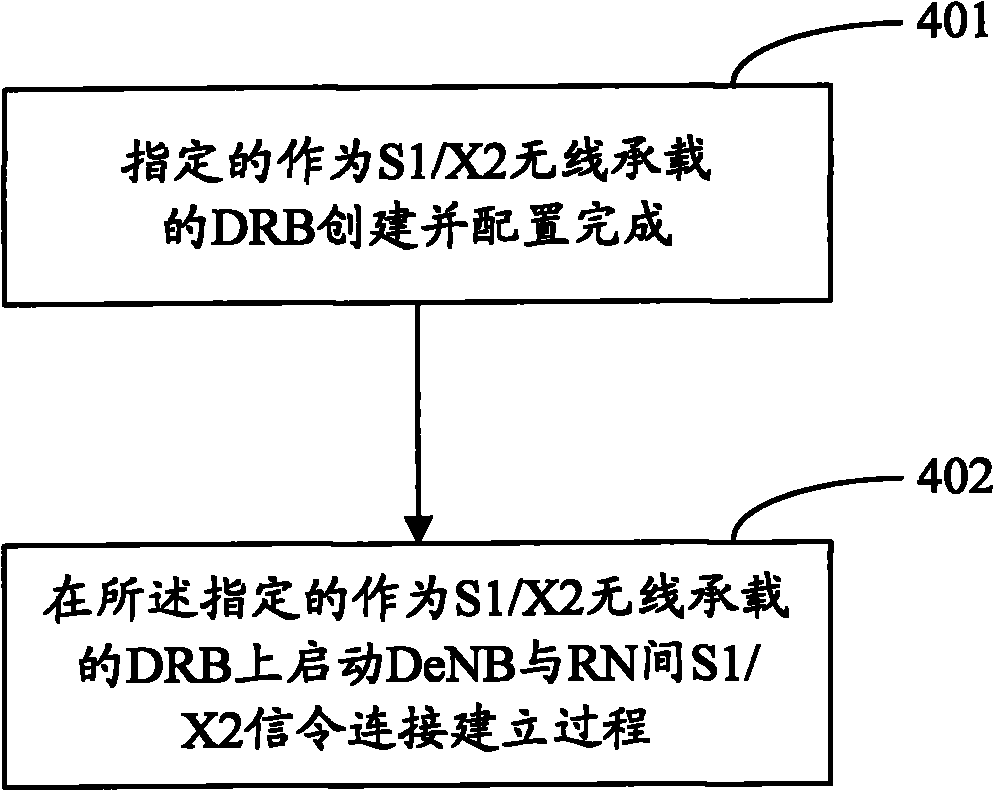
Fig. 4 is a flowchart illustrating a method for establishing an S1/X2 interface using a data radio bearer according to the present invention, as shown in fig. 4, the method includes:
step 401: the designated DRB as the S1/X2 radio bearer is created and configured.
Here, the designated DRB as the S1/X2 radio bearer may be configured as default on the DeNB and RN by means of protocol agreement; before creating the designated DRB as the S1/X2 radio bearer, the DeNB designates the DRB as the S1/X2 connection bearer (as part of the Un port configuration) through RRC signaling sent to the RN; an indication may also be carried by the DeNB in RRC signaling for creating a designated DRB as an S1/X2 radio bearer, which is designated as an S1/X2 connection bearer, i.e., a DRB for establishing an S1/X2 interface.
It should be noted that, by the protocol convention, the DRB designated by the DRB may be determined by OAM configuration or program operation before or when the DRB is created by the standard protocol convention.
Step 402: and starting an S1/X2 signaling connection establishment process between the DeNB and the RN on the designated DRB serving as the S1/X2 radio bearer.
The S1 signaling connection establishment procedure is generally initiated by the RN, and the X2 signaling connection establishment procedure may be initiated by the RN or the DeNB. There is no time-sequential requirement for the establishment of the X2 connection and the S1 connection, and the X2 connection may be established before the S1 connection.
In practical applications, when a radio link failure occurs in a connected state of the RN, as part of the RLF processing procedure, the S1/X2 Connection may be released, and later, the RN successfully recovers the Connection with the DeNB through an RRC Connection reestablishment procedure (RRC Connection Re-establishment), all the established DRBs may recover data transmission, and at this time, the S1/X2 signaling Connection establishment procedure is restarted on the designated DRB serving as the S1/X2 radio bearer, so that the S1/X2 interface between the DeNB and the RN may be recovered.
It should be noted that, in the present invention, the DRB may be identified by a Radio bearer identity (RB-ID for short), or by a time sequence established by the DRB in all DRBs.
The invention also provides a system for establishing an S1/X2 interface by using the data radio bearer, which comprises the following steps: DeNB and RN; wherein,
the DeNB is used for establishing S1/X2 signaling connection with the RN after the designated data radio bearer DRB serving as the S1/X2 radio bearer is established and configured; or,
and the RN is used for establishing S1/X2 signaling connection with the DeNB after the designated data radio bearer DRB serving as the S1/X2 radio bearer is created and configured.
The S1/X2 signaling connection established between the DeNB and the RN is as follows: and establishing S1/X2 signaling connection on the DRB as S1/X2 radio bearer specified by the protocol.
The DeNB is further configured to designate the DRB as an S1/X2 connection bearer through RRC signaling sent to the RN before the designated DRB as the S1/X2 radio bearer is created.
The DeNB is further configured to carry an indication in an RRC signaling for creating a DRB designated as an S1/X2 radio bearer, and designate the DRB as an S1/X2 connection bearer.
The RN is also used for initiating an S1 signaling connection establishment procedure and/or an X2 signaling connection establishment procedure, or,
the DeNB is further configured to initiate an X2 signaling connection establishment procedure.
The following describes the implementation of the technical solution of the present invention in detail with reference to specific examples.
Example 1
In this embodiment, it is assumed that a DRB with RB-ID of 3 has been specified in the standard protocol to be used as an S1/X2 radio bearer in the Un port, or that the 1 st DRB is specified to be used as an S1/X2 radio bearer in the Un port. After the Attach (Attach) process is completed, the RN only establishes a default EPS bearer (default EPS bearer), and the DeNB correspondingly establishes a DRB corresponding to the default EPS bearer at the Un port, where RB-ID is 3.
Considering the performance requirement of the RN for S1/X2 signaling transmission, the QoS parameter of the default EPS bearer has been configured to a corresponding value (although S1/X2 signaling is not transmitted on the network-side EPS bearer, the QoS parameter of the EPS bearer will affect the parameter configuration of the DRB over the air interface), and accordingly the parameter configuration of the DRB also meets the requirement of S1/X2 transmission. Or, the RN may disregard the QoS parameter of the default EPS bearer, and directly set the corresponding DRB to the parameter conforming to S1/X2 transmission, for example, set the uplink Priority Bit Rate (PBR) to infinity, and the like. Since the RB-ID of the DRB is 3, the RN will initiate S1 and X2 connection establishment on the DRB after completing the DRB configuration, in compliance with the protocol specification. It should be noted that the X2 connection may also be established by the DeNB on the DRB.
Fig. 5 is a flowchart illustrating a method for establishing an S1/X2 interface by using a data radio bearer according to embodiment 1 of the present invention, as shown in fig. 5, the method includes:
step 501: and after the RN accesses the DeNB, initiating an Attach process.
Step 502: and the MME authenticates the RN identity and identifies that the accessed equipment is the RN instead of the common UE.
Step 503: and the MME initiates the establishment of default EPS bearer.
Step 504: after the default EPS bearer is successfully established, the MME sends an Initial context setup message to the DeNB, where the message may indicate that the node is an RN. And the DeNB establishes the context of the RN after receiving the message.
Step 505: and the DeNB establishes a DRB corresponding to the default EPS bearer at the Un port through an RRC Connection Reconfiguration signaling, and the RB-ID of the DRB is set to be 3.
Step 506: since the RN knows that the S1/X2 interface should be established on the DRB with RB-ID of 3 (or knows that the S1/X2 interface should be established on the 1 st DRB) by protocol agreement, the S1 signaling connection establishment procedure can be started on the DRB after the DRB configuration is completed.
Step 507: after completing the S1 signaling connection establishment, the RN continues to initiate the X2 interface establishment with the DeNB on the same DRB.
It should be noted that the X2 interface may also be established by the DeNB. The X2 interface and the S1 connection establishment in step 506 have no time precedence requirement, and the X2 interface may be established before the S1 connection establishment.
Example 2
Unlike embodiment 1, in this embodiment, instead of agreeing on which DRB the S1/X2 Connection should be established in the protocol, the DeNB adds an indication cell to the RRC message (RRC Connection Reconfiguration) used for DRB establishment when creating the designated DRB as the S1/X2 radio bearer, and the indication cell can be used to indicate whether the DRB is available for bearer S1/X2 Connection. If the DeNB indicates that the DRB is available for bearer S1/X2 connection, the RN initiates S1/X2 connection establishment after DRB configuration is completed.
Fig. 6 is a flowchart illustrating a method for establishing an S1/X2 interface by using a data radio bearer according to embodiment 2 of the present invention, as shown in fig. 6, the method includes:
step 601 to step 604: the same steps 501 to 504.
Step 605: the DeNB establishes a DRB corresponding to the default EPS bearer at a Un port through an RRC Connection Reconfiguration signaling, and the RB-ID of the DRB is set to be 3; and an indication information element is carried in the message to indicate that the DRB can be used for bearing the S1/X2 connection.
Step 606: the RN detects that the DRB can be used for carrying the S1/X2 connection through the indication cell in the RRC message, and starts the S1 signaling connection establishment procedure on the DRB after the DRB configuration is completed.
Step 607: the same as step 507.
Example 3
In this embodiment, it is assumed that a DRB with RB-ID 4 has been specified in the protocol to be used as an S1/X2 radio bearer in the Un port, or a 2 nd DRB is specified to be used as an S1/X2 radio bearer in the Un port. And the RN completes the Attach process and establishes the default EPS bearer, and the DeNB correspondingly establishes a DRB corresponding to the default EPS bearer at the Un port, wherein the RB-ID is 3. After that, the S-GW/P-GW of the RN initiates establishment of a Dedicated EPS Bearer (Dedicated EPS Bearer), and the eNB accordingly establishes a DRB corresponding to the Dedicated EPS Bearer at the Un port, where RB-ID is 4. Since the RB-ID of the DRB is 4, the RN will initiate S1 and X2 connection establishment on the DRB after completing the DRB configuration, in compliance with the protocol specification. It should be noted that the X2 connection may also be established by the DeNB on the DRB.
Fig. 7 is a flowchart illustrating a method for establishing an S1/X2 interface by using a data radio bearer according to embodiment 3 of the present invention, as shown in fig. 7, the method includes:
step 701: and after the RN accesses the DeNB, initiating an Attach process.
Step 702: and the MME authenticates the RN identity and identifies that the accessed equipment is the RN instead of the common UE.
Step 703: and the MME initiates the establishment of default EPS bearer.
Step 704: after the default EPS bearer is successfully established, the MME sends an Initial context setup message to the DeNB, where the message may indicate that the node is an RN. And the DeNB establishes the context of the RN after receiving the message.
Step 705: and the DeNB establishes a DRB corresponding to the default EPS bearer at the Un port through an RRC Connection Reconfiguration signaling, and the RB-ID of the DRB is set to be 3.
Step 706: and the S-GW/P-GW of the RN continuously initiates the establishment of the dedicated EPS bearer.
Step 707: the MME initiates a Bearer Setup Request (Bearer Setup Request) to the DeNB.
Step 708: and the DeNB establishes a DRB corresponding to the deleted EPS bearer at the Un port through an RRC Connection Reconfiguration signaling, and the RB-ID of the DRB is set to be 4.
Step 709: since the RN knows that the S1/X2 interface should be established on the DRB with RB-ID of 4 (or knows that the S1/X2 interface should be established on the 2 nd DRB) by protocol agreement, the S1 signaling connection establishment procedure can be started on the DRB after the DRB configuration is completed.
Step 710: after completing the S1 signaling connection establishment, the RN continues to initiate the X2 interface establishment with the DeNB on the same DRB.
It should be noted that the X2 interface may also be established by the DeNB. The X2 interface and the S1 connection establishment in step 706 have no time requirement, and the X2 interface may be established before the S1 connection.
In addition, it should be noted that the set EPS bearer establishment may be completed in the attach procedure at the same time as the default EPS bearer, and therefore, two DRBs with RB-ID of 3 and RB-ID of 4 may be established through the same RRC Connection Reconfiguration message. In any case, the RN may perform S1/X2 connection establishment after the DRB establishment configuration with DRB ID of 4 is completed.
Example 4
Unlike embodiment 3, in this embodiment, instead of agreeing on which DRB the S1/X2 Connection should be established in the protocol, the DeNB adds an indication cell to the RRC message (RRC Connection Reconfiguration) used for DRB establishment when creating the designated DRB as the S1/X2 radio bearer, and the indication cell can be used to indicate whether the DRB is available for bearer S1/X2 Connection. If the DeNB indicates that the DRB is available for bearer S1/X2 connection, the RN initiates S1/X2 connection after DRB configuration is completed.
Fig. 8 is a flowchart illustrating a method for establishing an S1/X2 interface by using a data radio bearer according to embodiment 4 of the present invention, as shown in fig. 8, the method includes:
step 801 to step 807: the same as steps 701 to 707.
Step 808: the DeNB establishes a DRB corresponding to the deleted EPS bearer at a Un port through an RRC Connection Reconfiguration signaling, and the RB-ID of the DRB is set to be 4; and an indication information element is carried in the message to indicate that the DRB can be used for bearing the S1/X2 connection.
Step 809: the RN detects that the DRB can be used for carrying the S1/X2 connection through the indication cell in the RRC message, and starts the S1 signaling connection establishment procedure on the DRB after the DRB configuration is completed.
Step 810: as in step 710.
Example 5
After the RN completes the initial access and Attach procedures, the DeNB sends the Un port subframe configuration and other Un port resource configurations to the RN through RRC signaling (RRCConnection Reconfiguration), and the DeNB may issue the RB-ID designated for S1/X2 connection bearer to the RN as part of the Un port configuration information.
Fig. 9 is a flowchart illustrating a method for establishing an S1/X2 interface by using a data radio bearer according to embodiment 5 of the present invention, as shown in fig. 9, the method includes:
step 901: and after the RN accesses the DeNB, initiating an Attach process.
Step 902: and the MME authenticates the RN identity and identifies that the accessed equipment is the RN instead of the common UE.
Step 903: and the MME initiates the establishment of default EPS bearer.
Step 904: after the default EPS bearer is successfully established, the MME sends an Initial context setup message to the DeNB, where the message may indicate that the node is an RN. And the DeNB establishes the context of the RN after receiving the message.
Step 905: and the DeNB performs Un port resource configuration through RRC Connection Reconfiguration signaling, wherein RB-ID (bearing block-ID) designated for S1/X2 Connection bearing is 4.
Step 906: and the S-GW/P-GW of the RN continuously initiates the establishment of the dedicated EPS bearer.
Step 907: the MME initiates a bearer establishment request to the DeNB.
Step 908: and the DeNB establishes a DRB corresponding to the deleted EPS bearer at the Un port through an RRC Connection Reconfiguration signaling, and the DRB Identity of the DRB is set to be 4.
Step 909: since the RN knows that the S1/X2 interface should be established on the DRB with RB-ID of 4 through the 905 step configuration, the S1 signaling connection establishment procedure can be started on the DRB after the DRB configuration is completed.
Step 910: after completing the S1 signaling connection establishment, the RN continues to initiate the X2 interface establishment with the DeNB on the same DRB.
It should be noted that the X2 interface may also be established by the DeNB. The X2 interface and the S1 connection are not required to be established in time sequence, and the X2 interface can be established before the S1 connection.
Example 6
Assuming that the RN has a Radio Link Failure (RLF) in the connected state, as part of the RLF process, its S1/X2 connection may be released. Later, the RN successfully restores Connection with the DeNB through an RRC Connection Re-establishment procedure (RRC Connection Re-establishment), and all the established DRBs (assuming 5, whose IDs are 3, 4, 5, 6, and 7, respectively) can restore data transmission. At this time, the RN and the DeNB need to establish the S1/X2 connection on the DRB again.
It is assumed that a DRB with RB-ID of 4 has been specified in the protocol to be used as an S1/X2 radio bearer in the Un port, or a 2 nd DRB is agreed to be used as an S1/X2 radio bearer in the Un port. The RN will choose to re-establish the S1 and X2 connection on the DRB with RB-ID 4.
Fig. 10 is a flowchart illustrating a method for establishing an S1/X2 interface after a radio link between an RN and a DeNB is restored in embodiment 6 of the present invention, as shown in fig. 10, the method includes:
step 1001: the RN detects radio link failure in a connected state, and the S1/X2 connection is actively deleted by the RN as a part of the RLF processing flow, or the S1/X2 connection is deleted due to an abnormal report of a transport layer.
Step 1002: and the RN initiates an RRC connection reestablishment program to successfully recover the connection with the DeNB, and each DRB also recovers data transmission.
Step 1003: and the RN reinitiates the S1 connection establishment process on the DRB with RB-ID being 4 according to protocol agreement.
Step 1004: and the RN reinitiates the X2 connection establishment flow on the DRB with RB-ID being 4 according to protocol agreement.
The above description is only a preferred embodiment of the present invention, and is not intended to limit the scope of the present invention.