Background technology
(Porcineparvo viurs PPV) can cause the breeding difficulty of pig to pig parvoviral, mainly show as fetus and embryo's infection and death, and parent does not show clinical symptoms usually.The negative sow of serology mainly infects virus in the first half of gestation through mouth and nose, and the immunoincompetent fetus of result is infected through Placenta Hominis, thereby causes morbidity.Learn that on inspection in swinery all over the world, this virus is ubiquitous, it is popular to be endemicity on most of pig farms.This is sick popular very wide, and all there is report in a lot of countries in Europe, the United States, Asia and Oceania.The each province and city of China are separated to pig parvoviral in succession, and seroprevalence is very high.Primary disease is very harmful to pig industry.Because PPV does not still have effective drug treatment at present, therefore, this sick epidemic prevention just seems even more important.
The zooblast of In vitro culture has two types, and the adherent sexual cell of a kind of right and wrong is not attached on the holder during cultivation, and is the suspended state growth, and cell space is circular.Derive from blood, adenoid cell, most tumors cell and part transformant belong to this type, the similar microorganism culturing mode of its training method; Another kind is anchorage-dependent cell, can be attached to the support surface growth during cultivation.After cell is attached on the holder, can sprawl rapidly, begin mitosis then, enter exponential phase, can grow up to fine and close cell monolayer after a couple of days.Most of zooblasts such as fibroblast, epithelial cell and Vero cell, bhk cell, ST cell all belong to this type.Cultivate traditional rolling bottle such as many employings such as anchorage-dependent cell such as Vero, ST cell etc. at present on the Chinese biological production of articles and cultivate or leave standstill cultivation, this technology is widely used because of the little characteristics of ripe amount of investment that possess skills, but the zone that cell can be bred during it was produced only limits to the limited area of culture bottle, the environmental condition of cultivating is difficult to monitoring and control, therefore cell density is low, and labor intensity is big, and operating process is wayward, pollute, vaccine output and quality are subjected to very big restriction.
1967, Van Wezal developed micro-carrier system first, had created bioreactor microcarrier cultured cell technology, made animal cell culture enter the High Density Cultivation stage.Microcarrier is that diameter is the microballon of 60-50 μ m.Because the shared volume of microcarrier itself and quality are little, but have very big effective area can supply cell attachment, have improved production efficiency greatly.The material that microcarrier uses the earliest is ion-exchange gel (DEAE-SephadexA-50), and mild agitation can be suspended in the culture medium.This carrier has certain toxicity to cell, and medium pH value is also had certain influence.According to the cell growth characteristic, microcarrier was improved afterwards, and made it have electric charge or other medium, be more conducive to adhering to and growing of cell.Oneself has multiple different manufactured materials types such as dextran microcarrier, polystyrene microcarrier, double glazing microcarrier, cross-linked gelatin microcarrier, cellulose microcarrier, polyphenyl alkene phthalein amine microcarrier present microcarrier.Wherein, using more is that (Cytodex3), they all are to have the crosslinked macromole that forms of not isoplastic glucosan to Cyotdex type series microcarrier for Cytodex1, Cytodex2.The whole carrier of Cytodex1 has positive charge, is used for the cultivation of passage cell such as Vero, Chinese hamster ovary celI; Cytodex2 only surface has positive charge; The Cytodex3 neutral, its appearance is wrapped up by collagen layer, and collagen is the extract of guinea pig skin, is suitable for the apposition growth of cell equally.First industrial applications microcarrier be the manufacturing that Meignier in 1980 etc. are used for foot and mouth disease virus vaccine, and the manufacturing of poliomyelitis vaccine afterwards.
Adopt bioreactor/micro-carrier system to cultivate zooblast, cell is attached on the microcarrier, is suspended in the culture medium, and merisis becomes cell monolayer gradually.This training mode merges monolayer culture and suspension culture, has the following advantages:
(1) surface area/volume ratio is big, the productive rate height of unit volume cultured cell.Can reach 5-6cm as 1mg Cytodex1 microcarrier surface area
2, more traditional cell monolayer culture area increases greatly.
(2) the microcarrier avirulence after the improvement, the cell growth preferably of its size and surface nature, and have certain transparency, be convenient to the microscope observing cell growing state.
(3) microcarrier suspension is in culture medium, and cell growing environment homogeneous has been simplified monitoring and the control of condition of culture, simultaneously culture medium utilization rate height.
(4) the sampling repeatability is good, and the results process is uncomplicated, and labor intensity is little, and it is little to take up room, easy and simple to handle, and required personnel are few, and technology is amplified production easily.
By the viral liquid of ST cell static culture propagation pig parvoviral (PPV), be widely used at present, however the technology of the present used rolling bottle cultivation ST of system cells produce vaccine, though technology is simple, but labor intensity is big, all need pay huge work even simply change liquid, and microbiological contamination has a big risk.Applying biological reactor assembly and microcarrier are cultivated attached cell and are had high-specific surface area, cell yield height, monitoring, control and sampling are convenient in the suspension culture system, production scale is amplified easily, be difficult for advantages such as microbiological contamination, industrial being widely used in produced as vaccines such as rabies poison, polioviruses.
But, utilize bioreactor system and microcarrier cultivate ST cells produce PPV vaccine exist pig parvoviral liquid cultivate output on the low side, be difficult for that scale is amplified, defectives such as cost is too high, vaccine quality instability, these defectives have had a strong impact on or have restricted the application of this method in actual production, have much room for improvement.
Summary of the invention
Technical problem to be solved by this invention is to overcome in the preparation method of existing pig parvoviral inactivated vaccine existing pig parvoviral liquid to cultivate output on the low side; being difficult for scale amplifies; cost is too high; defectives such as vaccine quality instability; a kind of preparation method of new pig parvoviral inactivated vaccine is provided; this preparation method utilizes bioreactor microcarrier suspension culture ST cell high-efficient to produce pig parvoviral liquid; processing parameter is optimized; this method has the pig parvoviral liquid virus titer height of producing, can large-scale industrial production; cost is low; advantages such as vaccine quality is stable.
Technical problem to be solved by this invention is achieved through the following technical solutions:
A kind of preparation method of pig parvoviral inactivated vaccine comprises: cultivate pig parvoviral low virulent strain inoculation ST cell to obtain producing kind of a poison (1); (2) microcarrier after will handling joins in the cell growth medium of bioreactor, stirs; (3) the ST cell is linked in the microcarrier of bioreactor and stirs, carry out the breeding of cell and cultivate; (4) pig parvoviral production is planted the ST cell of suspension culture in the malicious infection biological reactor, carry out the breeding of virus and cultivate; (5) the viral liquid of results breeding, Seedling is joined in deactivation, namely.
In the preparation method of the present invention, described pig parvoviral low virulent strain can be the weak malicious L strain of pig parvoviral, and its microbial preservation number is: CGMCC No.3352;
Wherein, the microcarrier described in the step (2) can be Cyotdex type series microcarrier, Cytodex-1 type microcarrier more preferably, and described pretreatment mode comprises: silication, aquation and balance;
Preferably, in the step (2) the proportioning ratio of pretreated microcarrier according to the microcarrier that contains 5-7g in every liter of cell growth medium joined in the cell growth medium; Mixing speed described in the step (2) is preferably 40rpm; Described mixing time is 20-40min, is preferably 30min.
The present invention has investigated the different training methods of ST cell to the influence of cell density, experimental result is found, adopt the cell density of perfusion cultures apparently higher than batch formula cultured cells density, the present invention preferably adopts the cell culture mode of perfusion cultures when carrying out the ST cell culture.In addition, in perfusion cultures, the present invention finds that cell inoculation concentration has appreciable impact, the present invention finally to find by a large amount of experiments for the speed of growth of cell and stability etc., when the ST cell with 1 * 10
5When/mL concentration was inoculated on the microcarrier in the bioreactor, cell density just can reach 1 * 10 in the 7th day
7/ mL, cell state is stable, and the length of holding time is beneficial to virus breeding.
The inventor finds that by a large amount of experiments mixing speed is very big for the adherent influence of cell.The present invention finds by a large amount of experiment, and the stirring described in the step (3) is conducive to the adherent of cell most when adopting following mixing speed: at first stirred 1-3 minute under rotating speed is the speed of 80rpm, again rotating speed is adjusted into 50-60rpm; More preferably: be to stir 1-3 minute under the speed of 80rpm at rotating speed at first, again rotating speed be adjusted into 50rpm.
Wherein, the cultivation temperature described in the step (3) is preferably 37 ℃, and the pH value of culture fluid is preferably 7.0.
The present invention also finds, the dosage that malicious infection cell is planted in pig parvoviral production in the step (4) has certain influence for the virus titer of viral liquid, the present invention screens discovery by experiment, be 0.001MOI with the infection multiplicity with pig parvoviral production kind poison, 0.01MOI, 0.05MOI the ST cell of suspension culture is conducive to improve the virus titer of viral liquid in the infection biological reactor, especially is that the ST cell of suspension culture in the 0.01MOI infection biological reactor carries out the virus titer that the cultivation of perfusion cultures method can effectively improve viral liquid with the infection multiplicity with pig parvoviral poison production kind of poison.Wherein, the perfusion cultures temperature described in the described step (4) is preferably 35 ℃, and the pH value of culture fluid is preferably 7.4, and described mixing speed is 50-60rpm.
The present invention is according to the characteristics of ST cell growth metabolism and virus multiplication, stirring type bioreactor perfusion cultures technology is applied to the pig parvoviral production of vaccine to be studied, each technical parameter is optimized and screens, culture environment is stable when making cell proliferation, and cell still can obtain enough nutrition and the environment of balance behind virus inoculation; Simultaneously toxic metabolite products such as lactic acid and ammonia are able to continuous eliminating, the cell of the inventive method length of holding time, cell viability height (〉=90%), viable cell density big (〉=1 * 10
7Cells/mL), be conducive to the lasting breeding of virus, prepared pig parvoviral TCID50 〉=10
8.0It is tight, smooth and easy that production process is connected, and scale is amplified easily, and is with short production cycle, occupied ground is little, low in the pollution of the environment and be easy to handle, the results of pig parvoviral make things convenient for quality to be easy to realize equalization stable, can significantly reduce production costs, improve vaccine output and quality.
The specific embodiment
Further describe the present invention below in conjunction with specific embodiment, advantage of the present invention and characteristics will be more clear along with description.But these embodiment only are exemplary, scope of the present invention are not constituted any restriction.It will be understood by those skilled in the art that and down can make amendment or replace the details of technical solution of the present invention and form without departing from the spirit and scope of the present invention, but these modifications and replacing all fall within the scope of protection of the present invention.
Experiment material:
1. cell: ST cell (available from China Veterinery Drug Inspection Office).
2. seed culture of viruses: porcine parvovirus L strain is stored in China Committee for Culture Collection of Microorganisms common micro-organisms center, microbial preservation number: CGMCC No.3352.
3. microcarrier: Cytodex-1, Pharmacia company product.
4. reagent: viable count test kit (CCK-8), Japanese colleague's chemistry institute product.
Embodiment 1: the processing of microcarrier
1. silication: peek ml silicone oil, the blender jar inwall is soaked, reclaim unnecessary silicone oil, behind the oven dry blender jar, with washing from the beginning nine times, distilled water is given a baby a bath on the third day after its birth inferior, dry for standby.
2. aquation: it is an amount of to take by weighing microcarrier by the final volume of cultivating, and making the final concentration of microcarrier Cytodexl is 3mg/ml, puts into blender jar, with no Ca
2+, Mg
+ 2-PBS 100ml/g, soaking at room temperature is spent the night or 37 ℃ of immersion 3hr, discards PBS, and reuse does not have Ca
2+, Mg
2+-PBS 50ml/g washes once, discards, and adds no Ca at last
2+, Mg
2+-PBS 50ml/g, autoclaving, 115 ℃, 10psi, 15min.
3. balance: discard the PBS in the blender jar, add high sugared cell growth medium 100ml/g, ambient temperature overnight is faced with the above-mentioned culture fluid of preceding reuse and is washed once.
Embodiment 2: the bioreactor microcarrier is cultivated the ST cell
1, cell recovery: from liquid nitrogen container, take out ST cell cryopreservation pipe, put into rapidly and fill 36 ℃ of-37 ℃ of water, shake frozen pipe, thaw as early as possible; With suction pipe sucking-off cell suspension, in the aseptic centrifuge tube of packing into, add 10mL cell growth medium (the MEM culture fluid that contains 5% calf serum), piping and druming makes cell suspension; Cell suspension is centrifugal, and centrifugal 10 minutes of 1000rpm abandons supernatant; After adding the suitable dilution of cell growth medium, move in the Tissue Culture Flask, put 37 ℃ of incubators and cultivate, change cell growth medium once after 6 hours, continuation is cultivated again.
2, the going down to posterity and cultivating of cell: get well-grown fine and close monolayer ST cell, the sucking-off cell growth medium is with PBS washing 1-2 time; Add concentration again and be 0.25% trypsinization liquid, 37 ℃ digested 5 minutes, treat that cellular layer is loose, during the contracting of cell circle, the sucking-off cell dissociation buffer adds the small amounts of cells growth-promoting media and blows and beats cell, make even cell suspension, an amount of cell suspension is moved into sterilization cell bottle, add an amount of growth-promoting media for every bottle, put 37 ℃ of constant temperature culture, when forming good cell monolayer, being used for continues to go down to posterity or be inoculated in bioreactor carries out microcarrier suspension culture.
3, the breeding of cell seed culture of viruses: with keeping liquid (the MEM culture fluid of 1% calf serum) the porcine parvovirus L strain seed culture of viruses is inoculated into the cell monolayer cultivation that step 2 forms in the 1-5% ratio, gathers in the crops viral liquid during cell 70-100% pathological changes; Again with this viral liquid as kind of a poison, proceed the rejuvenation of going down to posterity at cell, as seeding.
4, the microcarrier suspension culture of ST cell in bioreactor: bioreactor (B.Braun company, the BiostatUD50 bioreactor) 50-70% by cumulative volume adds aseptic cell growth medium (the MEM culture fluid of 5% calf serum), and press 5-7g/L concentration in every liter of aseptic cell growth medium and add microcarrier, start bioreactor, after 40rpm stirs 30min, get cultured ST cell monolayer in the step 2, prepare cell suspension with EDTA-pancreatin cell dissociation buffer, press 1 * 10 behind the cell counting
5The density of individual/ml is inoculated in the bioreactor, and adjusting rotating speed is that 80rpm stirred 1-3 minute, again rotating speed is remained 50rpm, and temperature of reactor progressively is adjusted to 37 ℃, and the pH value of reactant liquor is controlled to be 7.0, keeps this condition to carry out cell culture always.
Use viable count test kit (CCK-8) and measure cell viability, viable cell density 〉=1 * 10 after measured
7Cells/mL, cell viability 〉=90%.
5, the breeding of seedling venom: postvaccinal the 7th day, the cell on the microcarrier covered with 80-90%, and empty ball rate is lower than 5%, and full ball rate is greater than 85%, and cultured cell is in exponential phase, and cell counting reaches 1 * 10
7More than the cells/mL; At this moment, the tank body temperature is adjusted into 35 ℃, with liquid in the malleation drain tank, adds 2L PBS washed cell, stir after 10 minutes and discharge, repeated washing 2 times.The reuse peristaltic pump adds an amount of seed culture of viruses, and supplies and keep liquid to working volume.
Be 0.01MOI direct infection ST cell with the infection multiplicity with the porcine parvovirus venom that obtains in the step 3, the control mixing speed is 50-60rpm.Connect the microcarrier of getting at regular intervals behind the poison in the bioreactor, with microscope observing cell pathological changes situation, and test sample TCID50; When for the cell on the carrier all comes off, and OD value is obvious ascendant trend, the stirring of stopped reaction device, treat that microcarrier all sinks to reactor bottom after, cleer and peaceful microcarrier on the results.After testing, pig parvoviral TCID50 〉=10 of this enforcement results
8.0In contrast, the application cell rolling bottle is produced pig parvoviral TCID50≤10
7.0
6, the processing of the viral liquid of results: viral liquid and microcarrier after 3 freeze thawing, centrifugal removal cell debris, it is standby to put-20 ℃ of preservations.
In the such scheme, the bioreactor parameter is regulated:
1) temperature: the control temperature was set at 37 ℃ when the ST cell proliferation was cultivated, and the control temperature is set at 35 ℃ behind the inoculation PPV.
2) pH value: control pH was set at 7.0 when the ST cell proliferation was cultivated, and control pH is set at 7.4 behind the virus inoculation liquid.The pH fluctuation is for ± 0.1.
3) dissolved oxygen: the cultivation initial stage uses compressed air to regulate oxygen dissolving value, and the control dissolved oxygen is set at 60%.The dissolved oxygen fluctuation is for ± 10%; Cultivate middle and late stage, when cell density greater than 10
6During cells/mL, use oxygen and nitrogen to regulate oxygen dissolving value, the control dissolved oxygen is set at 50%.The dissolved oxygen fluctuation range is 30%-80%.
4) perfusion flow: every day, the sampling and measuring tank body was collected the concentration of glucose of liquid, served as with reference to the perfusion flow of adjusting liquid with the glucose residual concentration.
Embodiment 3: the preparation of porcine parvovirus inactivated vaccine
1, the viral liquid poison of results valency is measured: the cytopathy venom of results among the embodiment 2 is mixed the back sampling, measure malicious valency, pig parvoviral TCID50 〉=10 of results
8.0And the application cell rolling bottle is produced (contrast) pig parvoviral TCID50≤10
7.0
2, deactivation: add the divinyl imide liquor in the viral liquid by 0.02% of viral liquid total amount, fully after the vibration, deactivation 72h on 30 ℃, 100r/min shaking table adds 1% hypo solution then, stops deactivation.And do steriling test and deactivation check.
3, the preparation of oil adjuvant killed vaccine: according to the ratio preparation oil phase of 1.5 parts of 94 parts of injection white oils, Si Ben-80 6 part and aluminium stearate; Add the ratio preparation water that 4ml tween 80 and 0.01% adds thimerosal according to 96ml antigen; Water and oil phase carry out emulsifying according to 1: 1.5 ratio, make the single-phase Seedling of Water-In-Oil.
Test example 1 bioreactor microcarrier is cultivated each parameters Optimization test of ST cells produce porcine parvovirus venom
(1) mixing speed is to the influence of cell attachment
Be provided with 6 groups of tests:
Test 1 group: the ST cell is pressed density 1 * 10
5Individual/ml is linked in the microcarrier of bioreactor and cultivates, and at first stirs 3 minutes under rotating speed is the speed of 80rpm, again rotating speed is adjusted into 40rpm;
Test 2 groups: the ST cell is pressed density 1 * 10
5Individual/ml is linked in the microcarrier of bioreactor and cultivates, and at first stirs 3 minutes under rotating speed is the speed of 80rpm, again rotating speed is adjusted into 50rpm;
Test 3 groups: the ST cell is pressed density 1 * 10
5Individual/ml is linked in the microcarrier of bioreactor and cultivates, and at first stirs 3 minutes under rotating speed is the speed of 80rpm, again rotating speed is adjusted into 60rpm;
Test 4 groups: the ST cell is pressed density 1 * 10
5Individual/ml is linked in the microcarrier of bioreactor and cultivates, and at first stirs 3 minutes under rotating speed is the speed of 80rpm, again rotating speed is adjusted into 80rpm;
Test 5 groups: the ST cell is pressed density 1 * 10
5Individual/ml is linked in the microcarrier of bioreactor and cultivates, and at first stirs 3 minutes under rotating speed is the speed of 80rpm, again rotating speed is adjusted into 100rpm;
Test 6 groups: the ST cell is pressed density 1 * 10
5Individual/ml is linked in the microcarrier of bioreactor and cultivates, and at first stirs 3 minutes under rotating speed is the speed of 80rpm, again rotating speed is adjusted into 150rpm;
Cell attachment situation to 6 groups is monitored, and cell counting is carried out in sampling, and the result shows that mixing speed is very big to the cell attachment influence, tests 2 groups (50rpm) and is conducive to cell attachment most, and when mixing speed reached the 150rpm left and right sides, cell was adherent hardly.
The free cell number of table 1 different rotating speeds relatively
(2) the ST cell is criticized formula cultivation and perfusion cultures comparison
Be 1 * 10 with cell concentration
5/ mL inoculates bioreactor, cultivates with batch formula culture method and perfusion cultures method respectively, and cell number on the micrometer carrier of taking a sample every day, result show that the cell density of perfusion cultures is apparently higher than batch formula cultivation.
(3) influence of different cell inoculation concentration on cell proliferation situations
Use 1 * 10 respectively
4/ mL, 1 * 10
5/ mL and 1 * 10
6The cell concentration inoculation bioreactor of/mL is observed and is found cell after inoculation 6 hours, and 90% cell attaches goes up microcarrier, and begins to stretch; Poor growth in 24 hours; The cell speed of growth speeds after second day.Along with cell proliferation rate increases, groundwater increment is also regulated thereupon to be increased, and tests at us under the condition of perfusion cultures, and it is better that the form of cell keeps always.1 * 10
5The 7th day cell density of/mL inoculum density reaches 1 * 10
7/ mL, cell state is stable, and the length of holding time is beneficial to virus breeding; And inoculum density is 1 * 10
412 days cell densities of the cultivation of/mL just can peak; Inoculation 1 * 10
63 days cell densities of the cultivation of/mL concentration namely reach the peak, but cell senescence is fast, and part comes off in advance, is unfavorable for virus production.
The cell proliferation situation of the different cell inoculation amounts of table 2
(4) the viral infection plural number is to the influence of virus titer
With 1 * 10
5/ mL cell density reaction of inoculation device reaches 1 * 10 in the 7th day cell density
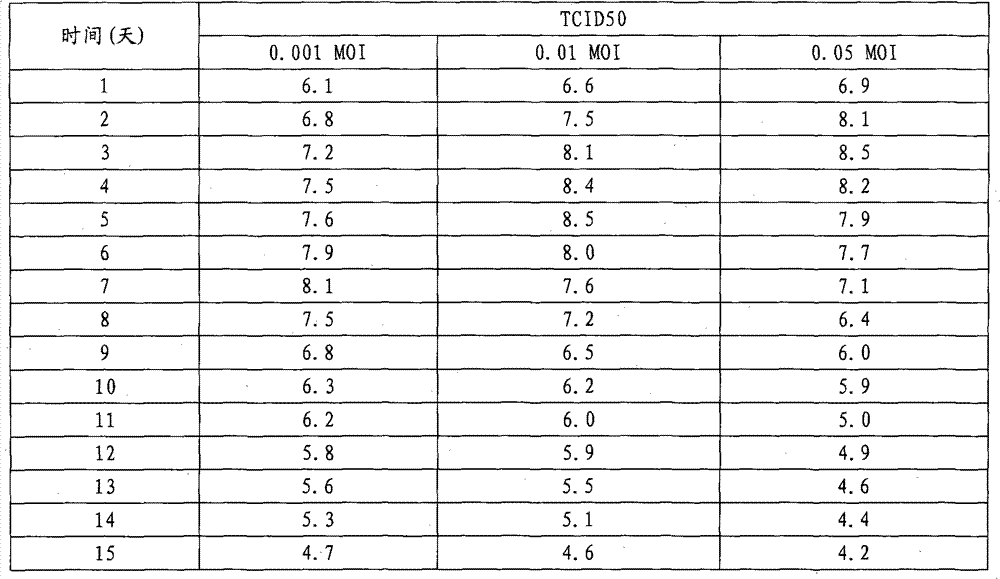
7Virus inoculation during the/mL left and right sides, washing is used instead after 2-3 time and is kept liquid before the inoculation.The viral infection plural number is respectively 0.001MOI, 0.01MOI and 0.05MOI, and sampling and measuring TCID50 finds that the TCID50 peak appears at 3-7 days, descends gradually later on.0.001MOI, the TCID50 difference with insignificance of 0.01MOI and 0.05MOI infection multiplicity, wherein the TCID50 integral level of 0.01MOI is a little more than 0.001MOI and 0.05MOI.
Table 3 different virus infection multiplicity is to the influence of virus titer
(5) perfusion cultures glucose consumption
In incubation every day monitoring glucose content, find preceding 3 days behind the inoculating cell, the glucose consumption amount is lower, along with the growth of incubation time, cell proliferation rate is accelerated, and cell quantity increases, the glucose day's expenditure also increases, and works as cell density by the 6th, 7 day and reaches 1 * 10
7During/mL the left and right sides, the glucose consumption amount peaks.Behind the virus infected cell, the glucose consumption amount progressively reduced in metainfective 2 days, kept balance later on substantially, and after infecting tens days, consumption just reduces with fast speed.
(6) generation of perfusion cultures lactic acid
In incubation, find that by the monitoring to the lactic acid generation lactic acid generation increases with the increase of cell quantity.1-3 behind the inoculating cell days, the lactic acid growing amount was less, and pH value is relatively stable.After cell entered the growth logarithmic (log) phase, the lactic acid generation strengthened, and pH value descends very fast, and the retort system replenishes more alkali, peaked to the 7th day left and right sides generation.After infecting virus, the lactic acid generation reduces in the certain level scope, but still maintains about 30mmoL/ days.
(7) generation of perfusion cultures ammonia
In incubation, along with the growth metabolism of cell, ammonia can constantly produce.During cell proliferation, amonia yield progressively slowly increases, and the generation that infects virus back ammonia still keeps relative stability, and fluctuates about 2.2mmoL/ days.