CN101813552B - Seismic simulation shaking table control method used for compensating interaction between test piece and table top - Google Patents
Seismic simulation shaking table control method used for compensating interaction between test piece and table top Download PDFInfo
- Publication number
- CN101813552B CN101813552B CN201010145743XA CN201010145743A CN101813552B CN 101813552 B CN101813552 B CN 101813552B CN 201010145743X A CN201010145743X A CN 201010145743XA CN 201010145743 A CN201010145743 A CN 201010145743A CN 101813552 B CN101813552 B CN 101813552B
- Authority
- CN
- China
- Prior art keywords
- shaking table
- test
- formula
- reacting force
- test specimen
- Prior art date
- Legal status (The legal status is an assumption and is not a legal conclusion. Google has not performed a legal analysis and makes no representation as to the accuracy of the status listed.)
- Expired - Fee Related
Links
Images

Landscapes
- Buildings Adapted To Withstand Abnormal External Influences (AREA)
Abstract
本发明涉及一种用于补偿试验试件与台面相互作用、提高地震记录再现精度的地震模拟振动台控制方法。该方法在将试件按刚性负载进行振动台控制参数设计的基础上提出了所有负载形式均按零负载进行振动台控制参数设计,此外利用试件产生反力实时补偿试件-台面相互作用的控制方法。与传统控制方法相比:该方法提高了系统控制的稳定性,使得地震模拟振动台更具可控性;扩宽了系统可控频带,使得振动台可进行的试验范围更宽;提高了地震记录再现精度,使得地震模拟振动台试验更具科学性。
The invention relates to a method for controlling an earthquake simulation vibration table for compensating the interaction between a test piece and a table surface and improving the reproduction accuracy of seismic records. In this method, on the basis of designing the control parameters of the shaking table according to the rigid load of the specimen, it is proposed that all load forms are designed according to the zero load of the shaking table control parameters. In addition, the reaction force generated by the specimen is used to compensate the interaction between the specimen and the table in real time Control Method. Compared with the traditional control method: this method improves the stability of the system control, making the earthquake simulation shaking table more controllable; widens the controllable frequency band of the system, making the testing range of the shaking table wider; The record reproduction accuracy makes the earthquake simulation shaking table test more scientific.
Description
技术领域technical field
本发明涉及一种用于补偿试件台面相互作用的地震模拟振动台控制方法,属于建筑结构抗震试验技术领域。The invention relates to an earthquake simulation vibration table control method for compensating the interaction between test pieces and table surfaces, and belongs to the technical field of anti-seismic tests of building structures.
背景技术Background technique
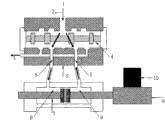
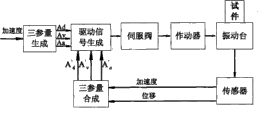
地震模拟振动台控制系统算法设计时通常将台面与试件看作整体以单自由度系统方式处理:图1为地震模拟振动台组要组成架构,以图中伺服阀为研究对象,可建立伺服阀在零工作点附近的线性压力-流量方程,以作动缸为研究对象,可建立作动缸需求流量关系,;以活塞头为研究对象可建立作动器出力平衡方程。以上三个关系式统称为液压系统三连续方程,其表达式如下:When designing the algorithm of the earthquake simulation shaking table control system, the table and the specimen are usually treated as a single degree of freedom system: Figure 1 shows the structure of the earthquake simulation shaking table group. Taking the servo valve in the figure as the research object, a servo The linear pressure-flow equation of the valve near the zero working point can establish the demand flow relationship of the actuator by taking the actuator as the research object; the actuator output balance equation can be established by taking the piston head as the research object. The above three relations are collectively referred to as the three continuous equations of the hydraulic system, and their expressions are as follows:
式中kq为流量增益,Kc为流量-压力系数,E为阀驱动信号,Ap为活塞有效面积,xt为活塞、台面位移,V为油缸等效容积,β为油体积弹性模量,pL为油缸内PA与PB间压力差,Cc为活塞总泄系数,Mt为振动台台面总质量,Mp为试验试件总质量。而后利用三参量前馈和三参量反馈作为振动台控制的主要控制算法,主要控制流程如图2。现有控制算法将试件看作台面质量的一部分,按刚性处理,以此求取图2中位移、速度加速度前馈增益(Ad、Av、Aa),位移、速度加速度反馈增益(A′d、A′v、A′a),以此进行地震模拟振动台系统控制,模拟试验试件在实际地震作用中的性能。In the formula, k q is the flow gain, K c is the flow-pressure coefficient, E is the valve driving signal, A p is the effective area of the piston, x t is the displacement of the piston and the table, V is the equivalent volume of the oil cylinder, β is the oil volume elastic modulus p L is the pressure difference between PA and P B in the oil cylinder, C c is the total leakage coefficient of the piston, M t is the total mass of the shaking table, and M p is the total mass of the test specimen. Then use three-parameter feed-forward and three-parameter feedback as the main control algorithm of shaking table control, the main control process is shown in Figure 2. The existing control algorithm regards the specimen as a part of the table quality and treats it as rigid, so as to obtain the displacement and velocity acceleration feedforward gains (A d , A v , A a ) and the displacement and velocity acceleration feedback gains ( A′ d , A′ v , A′ a ), in order to control the seismic simulation shaking table system and simulate the performance of the test specimen in the actual earthquake action.
这种设计方法使得负载与空台的唯一区别只在于台面质量的增加,可试件与振动台相比二者特性差别较大,常规中小型振动台共振频率在20Hz左右,试验试件一阶频率大都在2~8Hz。因此,将试件与台面统一为一体存在较大偏差,从1988年开始国内外学者相继从理论及试验两方面对试件与台面相互作用进行了研究,结果表明负载在振动台系统中的参与质量比例与频率相关,只有输入波频率小于负载频率时,负载质量才完全作为刚性质量与台面成为一体,因此,负载频率越高参与质量比例也就越高,在大于负载频率3Hz以后的频带范围,负载参与质量不到负载质量的10%。换言之,当输入波频率处在大于负载频率3Hz以后的频带范围时,振动台系统中将不再有负载质量参与,相当于控制空载系统。而且其参与比例随其自振频率的减小而降低,中高频段负载质量很少参与到振动台物理系统中,此时其特性与空载更接近,而常规中小型振动台要求的频率都在50Hz以上,采用刚性负载参数时相当于用一大质量空台参数控制小质量空台,因而当试件质量较大、频率较低时还有可能使得振动台系统不稳定,即不可控状态;此外,试件产生的反力反过来会影响振动台的控制性能,由于共振的影响,试件频率附件的波形产生更大的反力,使得试件频率成为整个振动台系统的第二共振频率,对结构自振频率周围的时程跟踪性能有很大影响,该频率附近的输入波分量再现精度相比其它频率分量低很多;因此研究考虑试件-台面相互作用的振动台控制算法对提高振动台再现地震记录精度具有重要意义。This design method makes the only difference between the load and the empty table is the increase in the mass of the table surface. Compared with the vibration table, the characteristics of the test piece and the vibration table are quite different. The resonance frequency of the conventional small and medium-sized vibration table is about 20Hz. The frequency is mostly between 2 and 8Hz. Therefore, there is a large deviation in the unification of the test piece and the table top. Since 1988, domestic and foreign scholars have successively studied the interaction between the test piece and the table top from both theoretical and experimental aspects. The results show that the participation of load in the shaking table system The mass ratio is related to the frequency. Only when the frequency of the input wave is lower than the load frequency, the load mass can be completely integrated with the table as a rigid mass. Therefore, the higher the load frequency is, the higher the mass ratio will be. In the frequency range after 3Hz greater than the load frequency , the load participation mass is less than 10% of the load mass. In other words, when the frequency of the input wave is in a frequency range greater than 3 Hz of the load frequency, there will be no load mass involved in the shaking table system, which is equivalent to controlling the no-load system. Moreover, its participation ratio decreases with the decrease of its natural frequency. The load mass in the middle and high frequency bands rarely participates in the physical system of the shaking table. At this time, its characteristics are closer to no-load, while the frequencies required by conventional small and medium-sized shaking tables are all Above 50Hz, when using rigid load parameters, it is equivalent to using a large mass empty table parameter to control a small mass empty table. Therefore, when the mass of the specimen is large and the frequency is low, the shaking table system may be unstable, that is, the uncontrollable state ; In addition, the reaction force generated by the test piece will in turn affect the control performance of the shaking table. Due to the influence of resonance, the waveform of the frequency attachment of the test piece produces a greater reaction force, making the frequency of the test piece become the second resonance of the whole shaking table system Frequency has a great influence on the time-history tracking performance around the natural frequency of the structure, and the reproduction accuracy of the input wave component near this frequency is much lower than that of other frequency components; It is of great significance to improve the accuracy of seismic records reproduced by the shaking table.
发明内容Contents of the invention
本发明提出了一种能考虑试验试件与台面间相互作用的控制方法,特别是一种用于补偿试件台面相互作用的地震模拟振动台控制方法。该方法利用空载条件下振动台三参量控制参数控制所有试验试件工况;利用实测试验值获取试件对台面的反力,实时补偿试件与台面间相互作用,运用该算法对振动台进行控制具有系统稳定性好、控制精度高、适于试验工况范围广等特点,对基频较高的试验试件同样可以取得较好控制效果,特别是对缩尺比较大的试件在压缩比较大的地震激励作用下的控制效果能有很大幅度提高。The invention proposes a control method capable of considering the interaction between the test piece and the platform, in particular a control method for an earthquake simulation vibration table used to compensate for the interaction between the test piece and the platform. This method uses the three-parameter control parameters of the shaking table under no-load conditions to control all the test specimens; the measured test value is used to obtain the reaction force of the specimen against the table, and the interaction between the specimen and the table is compensated in real time. The control has the characteristics of good system stability, high control precision, and is suitable for a wide range of test conditions. It can also achieve better control effects on test specimens with high fundamental frequencies, especially for test specimens with relatively large scales. The control effect under the action of earthquake excitation with large compression ratio can be greatly improved.
为了实现上述目的,本发明采取了如下技术方案:In order to achieve the above object, the present invention has taken the following technical solutions:
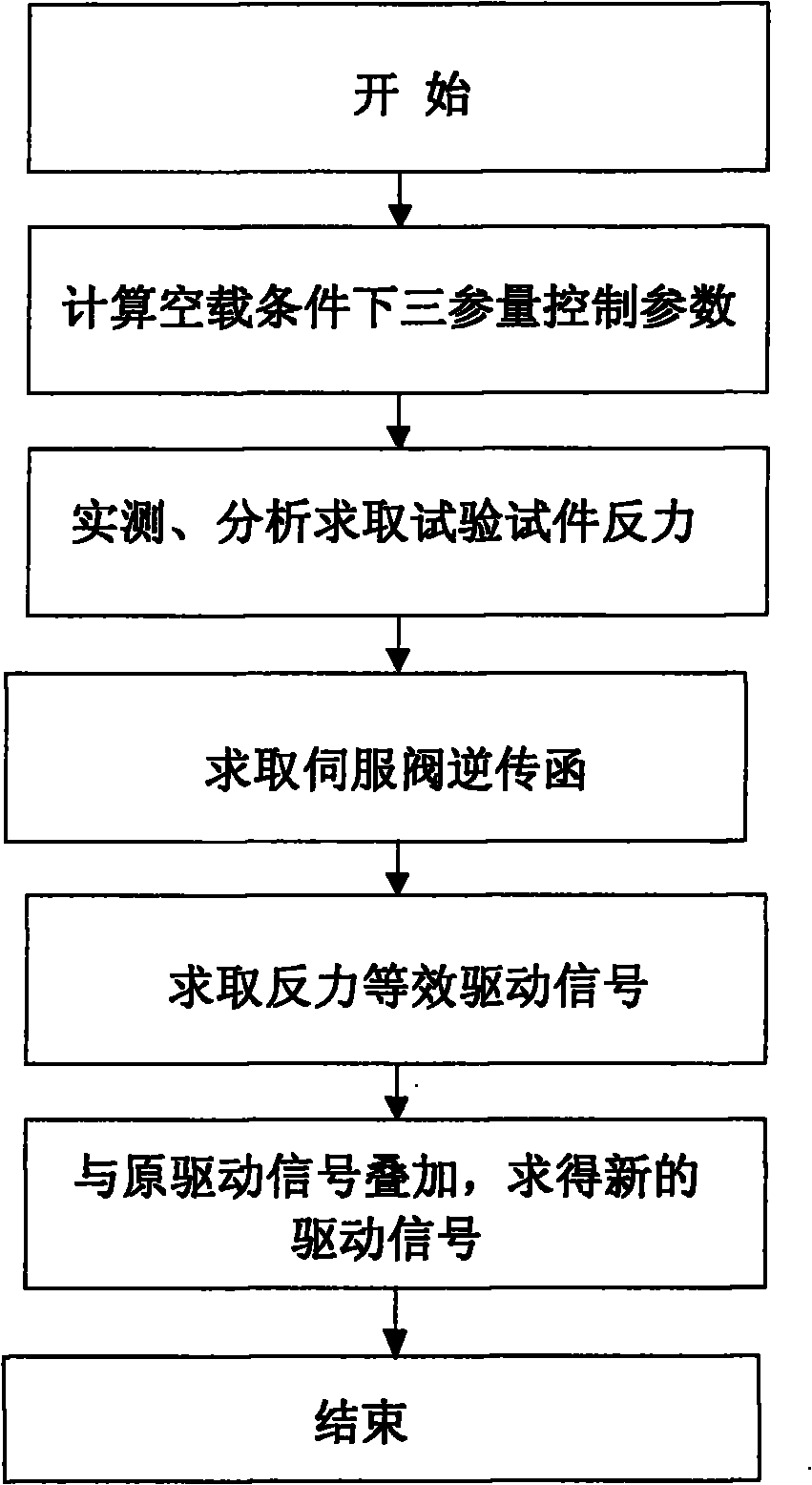
一种用于补偿试件台面相互作用的地震模拟振动台控制方法,其为了保证系统稳定性,采用空载系统设计参数控制所有试验试件工况;为了消除试件与台面之间相互作用,通过实测分析得到试件对振动台台面反力,而后经伺服阀逆传函求解得到试件反力等效驱动信号,与原驱动信号叠加,消除二者相互作用,达到提高振动台控制精度的目的。A vibration table control method for seismic simulation to compensate for the interaction between the test piece and the table. In order to ensure the stability of the system, the design parameters of the no-load system are used to control the working conditions of all test pieces; in order to eliminate the interaction between the test piece and the table, Through actual measurement and analysis, the reaction force of the test piece against the table surface of the shaking table is obtained, and then the equivalent driving signal of the test piece reaction force is obtained through the inverse transfer function of the servo valve, which is superimposed on the original driving signal to eliminate the interaction between the two, so as to improve the control accuracy of the shaking table Purpose.
主要包括以下步骤:It mainly includes the following steps:
步骤1、根据地震模拟振动台基本设计参数,设计其在没有试验试件条件下的系统控制参数;
步骤2、在空载设计参数控制条件下,通过试验实测、分析得到试验试件对振动台系统的反作用力;
步骤3、求取振动台电液伺服系统逆传递函数;
步骤4、结合实测反力及电液伺服系统逆传函计算试件产生反力的等效驱动信号;
步骤5、将试件反力产生的等效驱动信号与原有驱动信号叠加,得到新的驱动信号,对振动台系统进行控制。
所述步骤1中,在进行地震模拟振动台控制参数设计时,试验试件与振动台台体组成的被控系统同作动器的出力之间的关系由下面的力平衡公式表示:In said
式中Mt为振动台台面总质量,Mp为试验试件总质量,xt为台面位移,Ap为作动器活塞有效面积,pL为伺服阀产生压差;In the formula, M t is the total mass of the shaking table, M p is the total mass of the test specimen, x t is the displacement of the table, A p is the effective area of the actuator piston, and p L is the pressure difference generated by the servo valve;
令Mp≡0,根据振动台已有或设计硬件参数,运用三参量控制参数常规求取方法,求出位移、速度、加速度输入增益(Ad、Av、Aa),位移、速度、加速度反馈增益(A′d、A′v、A′a)作为任何负载条件振动台的控制参数。Let M p ≡0, according to the existing or designed hardware parameters of the shaking table, use the conventional calculation method of three-parameter control parameters to obtain the displacement, velocity, acceleration input gain (A d , A v , A a ), displacement, velocity, Acceleration feedback gains (A' d , A' v , A' a ) are used as control parameters of the shaking table for any load condition.
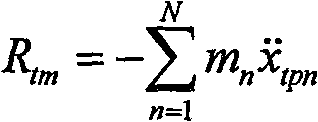
所述步骤2具体为:当振动台作动器反力不可测时,测量试验试件各自由度对应加速度,运用公式



所述步骤3具体为:计算振动台伺服阀系统逆传函的公式如下:The
式中Mt为振动台台面总质量,V为油缸等效容积,β为油体积弹性模量,Kc为流量-压力系数,Cc为活塞总泄系数,Ap为活塞有效面积。In the formula, M t is the total mass of the vibrating table, V is the equivalent volume of the oil cylinder, β is the bulk modulus of oil, K c is the flow-pressure coefficient, C c is the total leakage coefficient of the piston, and A p is the effective area of the piston.
所述步骤4具体为:结合步骤2中的反力值和步骤3中的传递函数综合计算出反力等效驱动信号,其计算公式为:
所述步骤5具体为:新驱动信号计算公式为:The
u0=Aded+Avev+Aaea-A′de′d-A′ve′v-A′ae′a-Δuu 0 =A d e d +A v e v +A a e a -A′ d e′ d -A′ v e′ v -A′ a e′ a -Δu
式中Ad、Av、Aa分别为位移、速度、加速度前馈增益,A′d、A′v、A′a分别为位移、速度、加速度反馈增益,ed、ev、ea分别为三参量算法产生的前馈位移、速度、加速度信号,e′d、e′v、e′a分别为三参量算法中位移、速度、加速度反馈信号。In the formula, A d , A v , A a are feed-forward gains of displacement, velocity and acceleration respectively; A′ d , A′ v , A′ a are feedback gains of displacement, velocity and acceleration respectively; ed , ev , e a are the feedforward displacement, velocity, and acceleration signals generated by the three-parameter algorithm, respectively, and e′ d , e′ v , and e′ a are the feedback signals of displacement, velocity, and acceleration in the three-parameter algorithm, respectively.
与现有控制算法相比,本发明的优点如下:Compared with the existing control algorithm, the advantages of the present invention are as follows:
(1)所有负载形式均按零负载进行振动台控制参数设计提高了振动台系统控制稳定性,避免了按刚性负载条件设计的三参量控制参数可能造成的系统失控,甚至使得试验试件在短时间内被毁坏的现象发生,同时提高了控制精度;(1) All load forms are designed according to the zero load control parameters of the shaking table, which improves the control stability of the shaking table system, avoids the system out of control that may be caused by the three-parameter control parameters designed according to the rigid load condition, and even makes the test specimen in a short period of time. The phenomenon of being destroyed within a short time occurs, and the control accuracy is improved at the same time;
(2)利用试件反力实时补偿大大减小了试件与台面相互作用,大大减小了在试件各阶频率附件出现的波峰和波谷,扩宽了系统可控频带,使得振动台可进行的试件缩尺范围、波形压缩范围更宽;提高了地震记录再现精度,使得地震模拟振动台试验更具科学性。(2) The real-time compensation of the reaction force of the test piece greatly reduces the interaction between the test piece and the table, greatly reduces the peaks and troughs that appear near the frequency of each order of the test piece, and widens the controllable frequency band of the system, so that the vibration table can The range of sample reduction and waveform compression is wider; the accuracy of seismic record reproduction is improved, and the shaking table test of earthquake simulation is more scientific.
附图说明Description of drawings
图1地震模拟振动台基本硬件组成;Figure 1 Basic hardware composition of earthquake simulation shaking table;
图2地震模拟振动台控制系统组成;Fig. 2 The composition of the control system of the shaking table for earthquake simulation;
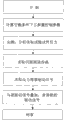
图3本发明方法实现流程图;Fig. 3 realization flowchart of the method of the present invention;
图4实时反力补偿控制算法实现架构;Figure 4 Real-time reaction force compensation control algorithm implementation architecture;
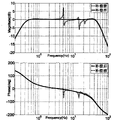
图5使用本发明前后振动台控制性能Bode图。Fig. 5 is a Bode diagram of the control performance of the vibration table before and after using the present invention.
附图标记:1-进油口;2-阀芯位移;3-出油口;4-阀芯;5-阀孔;6-伺服阀体;7-作动器;8-作动缸腔;9-振动台台体;10-试验试件Reference signs: 1-oil inlet; 2-spool displacement; 3-oil outlet; 4-spool; 5-valve hole; 6-servo valve body; 7-actuator; 8-actuating cylinder cavity ;9-shaking table body; 10-test specimen
具体实施方式Detailed ways
本发明的技术方案参见图3所示,结合相关附图,下面详细介绍本发明的实施步骤:The technical scheme of the present invention is referring to shown in Figure 3, in conjunction with relevant accompanying drawing, introduce the implementation steps of the present invention in detail below:
(1)根据地震模拟振动台基本设计参数,设计其在没有试验试件条件下的系统控制参数:在进行地震模拟振动台控制参数设计时,试验试件与振动台台体组成的被控系统同作动器的出力之间的关系由下面的力平衡公式表示:(1) According to the basic design parameters of the earthquake simulation shaking table, design its system control parameters without the test specimen: when designing the control parameters of the earthquake simulation shaking table, the controlled system composed of the test specimen and the shaking table body The relationship between the output force of the actuator and the actuator is expressed by the following force balance formula:
式中Mt为振动台台面总质量,Mp为试验试件总质量,xt为台面位移,Ap为作动器活塞有效面积,pL为伺服阀产生压差。In the formula, M t is the total mass of the shaking table, M p is the total mass of the test specimen, x t is the displacement of the table, A p is the effective area of the actuator piston, and p L is the pressure difference generated by the servo valve.
令Mp≡0,根据振动台已有或设计硬件参数,运用三参量控制参数常规求取方法,求出位移、速度加速度输入增益(Ad、Av、Aa),位移、速度加速度反馈增益(A′d、A′v、A′a)作为任何负载条件振动台的控制参数;Let M p ≡0, according to the existing or designed hardware parameters of the vibration table, use the conventional calculation method of three-parameter control parameters to obtain the displacement, velocity acceleration input gain (A d , A v , A a ), displacement, velocity acceleration feedback Gain (A′ d , A′ v , A′ a ) as the control parameter of the shaking table under any load condition;
(2)在空载设计参数控制条件下,通过试验实测、分析得到试验试件对振动台系统的反作用力:当振动台作动器反力不可测时,测量试验试件各自由度对应加速度,运用公式



(3)求取振动台电液伺服系统逆传递函数:计算振动台伺服阀系统逆传函的公式如下:(3) Obtain the inverse transfer function of the electro-hydraulic servo system of the shaking table: the formula for calculating the inverse transfer function of the servo valve system of the shaking table is as follows:
式中Mt为振动台台面总质量,V为油缸等效容积,β为油体积弹性模量,Kc为流量-压力系数,Cc为活塞总泄系数,Ap为活塞有效面积;In the formula, M t is the total mass of the vibrating table, V is the equivalent volume of the oil cylinder, β is the oil volume elastic modulus, K c is the flow-pressure coefficient, C c is the total leakage coefficient of the piston, and A p is the effective area of the piston;
(4)利用试验实测反力及电液伺服系统逆传函,计算试件产生反力的等效驱动信号:结合步骤2中的反力值和步骤3中的传递函数综合计算出反力等效驱动信号,其计算公式为:
(5)将试件反力产生的等效驱动信号与原有驱动信号叠加,得到新的驱动信号,对振动台系统进行控制,振动台控制架构中的实现如图4所示,新驱动信号计算公式为:(5) Superimpose the equivalent driving signal generated by the reaction force of the test piece with the original driving signal to obtain a new driving signal to control the shaking table system. The realization of the shaking table control framework is shown in Figure 4. The new driving signal The calculation formula is:
u0=Aded+Avev+Aaea-A′de′d-A′ve′v-A′ae′a-Δuu 0 =A d e d +A v e v +A a e a -A′ d e′ d -A′ v e′ v -A′ a e′ a -Δu
式中Ad、Av、Aa分别为位移、速度、加速度前馈增益,A′d、A′v、A′a分别为位移、速度、加速度反馈增益,ed、ev、ea分别为三参量算法产生的前馈位移、速度、加速度信号,e′d、e′v、e′a分别为三参量算法中位移、速度、加速度反馈信号In the formula, A d , A v , A a are feed-forward gains of displacement, velocity and acceleration respectively; A′ d , A′ v , A′ a are feedback gains of displacement, velocity and acceleration respectively; ed , ev , e a are the feed-forward displacement, velocity, and acceleration signals generated by the three-parameter algorithm, e′ d , e′ v , and e′ a are the feedback signals of displacement, velocity, and acceleration in the three-parameter algorithm, respectively
本发明的效果图如图5,可以看出采用该方法后在保证振动台稳定前提下,控制频带得到了明显改善,在保证振动台安全运行的同时提高了控制精度。The effect diagram of the present invention is shown in Figure 5. It can be seen that the control frequency band is significantly improved under the premise of ensuring the stability of the vibrating table after adopting the method, and the control accuracy is improved while ensuring the safe operation of the vibrating table.
最后应说明的是:以上发明内容仅用以说明本发明,而并非限制本发明所描述的技术方案;本发明并非只适用于地震模拟振动台的控制,其他领域振动台涉及的相关相互作用问题的解决均应涵盖在本发明的权利要求范围当中。Finally, it should be noted that: the above content of the invention is only used to illustrate the present invention, rather than limit the technical solution described in the present invention; the present invention is not only applicable to the control of seismic simulation shaking tables, and the related interaction problems involved in shaking tables in other fields All solutions should fall within the scope of the claims of the present invention.
Claims (1)


Priority Applications (1)
| Application Number | Priority Date | Filing Date | Title |
|---|---|---|---|
| CN201010145743XA CN101813552B (en) | 2010-04-09 | 2010-04-09 | Seismic simulation shaking table control method used for compensating interaction between test piece and table top |
Applications Claiming Priority (1)
| Application Number | Priority Date | Filing Date | Title |
|---|---|---|---|
| CN201010145743XA CN101813552B (en) | 2010-04-09 | 2010-04-09 | Seismic simulation shaking table control method used for compensating interaction between test piece and table top |
Publications (2)
| Publication Number | Publication Date |
|---|---|
| CN101813552A CN101813552A (en) | 2010-08-25 |
| CN101813552B true CN101813552B (en) | 2011-06-08 |
Family
ID=42620867
Family Applications (1)
| Application Number | Title | Priority Date | Filing Date |
|---|---|---|---|
| CN201010145743XA Expired - Fee Related CN101813552B (en) | 2010-04-09 | 2010-04-09 | Seismic simulation shaking table control method used for compensating interaction between test piece and table top |
Country Status (1)
| Country | Link |
|---|---|
| CN (1) | CN101813552B (en) |
Families Citing this family (15)
| Publication number | Priority date | Publication date | Assignee | Title |
|---|---|---|---|---|
| CN103278303B (en) * | 2013-05-22 | 2015-11-04 | 株洲南车时代电气股份有限公司 | A kind of waveform compensation method for shock test of railway traffic equipment |
| CN106289693B (en) * | 2016-08-17 | 2018-08-14 | 西安交通大学 | A kind of low frequency expansion control method of hydraulic vibrating system |
| CN107577142A (en) * | 2017-07-31 | 2018-01-12 | 中国建筑股份有限公司 | A kind of large stiffness structure tests loading method |
| CN107687925B (en) * | 2017-08-28 | 2020-04-14 | 北京工业大学 | A shaking table control method for earthquake simulation |
| CN107907283B (en) * | 2017-12-02 | 2019-07-26 | 北京工业大学 | A kind of shake table sub-structural test method based on tri-consult volume control AMD |
| CN109186910A (en) * | 2018-10-10 | 2019-01-11 | 东南大学 | A kind of shaking-table test control method for Cross-fault leveling seismic wave |
| WO2021046985A1 (en) * | 2019-09-12 | 2021-03-18 | 清华大学 | Electro-hydraulic servo actuator for implementing long-path and high-frequency loading, and control method |
| CN110594213B (en) * | 2019-09-12 | 2024-09-10 | 清华大学 | Electro-hydraulic servo actuator capable of realizing long-stroke and high-frequency loading and control method |
| CN113820085B (en) * | 2021-08-12 | 2023-07-07 | 广州大学 | Acceleration layered control method for earthquake simulation vibrating table |
| CN115329527B (en) * | 2022-05-24 | 2025-08-19 | 中国地震局地球物理研究所 | Evaluation method for interaction of vibrating table and model structure |
| CN115638942B (en) * | 2022-10-18 | 2025-09-23 | 中国地震局地球物理研究所 | Compensation method for vibration table-eccentric load interaction considering exciter coupling |
| CN115618467B (en) * | 2022-10-18 | 2024-12-13 | 中铁大桥局集团有限公司 | Vibration table iterative learning control method, storage medium and electronic device thereof |
| CN115655614B (en) * | 2022-10-18 | 2025-10-24 | 中国地震局地球物理研究所 | A method for analyzing the interaction between a dual-vibration table array and a test structure |
| CN115962906A (en) * | 2022-11-22 | 2023-04-14 | 中国地震局地球物理研究所 | Time domain waveform reproduction strategy test verification method for vibration table and test structure system |
| CN117990324B (en) * | 2024-04-03 | 2024-06-07 | 实链检测(浙江)有限公司 | Test method of earthquake simulation platform |
Family Cites Families (4)
| Publication number | Priority date | Publication date | Assignee | Title |
|---|---|---|---|---|
| JP3425365B2 (en) * | 1998-06-25 | 2003-07-14 | 株式会社 日立インダストリイズ | Apparatus and method for testing structure |
| CN1300599C (en) * | 2004-11-29 | 2007-02-14 | 四川大学 | Seismic vibrating analog method and spring seismic analog vibrating stand |
| CN100428091C (en) * | 2006-10-20 | 2008-10-22 | 北京工业大学 | DSP-based variable resonance frequency hydraulic vibration control system and method |
| JP2008281511A (en) * | 2007-05-14 | 2008-11-20 | Ihi Corp | Shaking table test device |
-
2010
- 2010-04-09 CN CN201010145743XA patent/CN101813552B/en not_active Expired - Fee Related
Also Published As
| Publication number | Publication date |
|---|---|
| CN101813552A (en) | 2010-08-25 |
Similar Documents
| Publication | Publication Date | Title |
|---|---|---|
| CN101813552A (en) | Seismic simulation shaking table control method used for compensating interaction between test piece and table top | |
| Carrion et al. | Real-time hybrid simulation for structural control performance assessment | |
| Banerjee | Free vibration of sandwich beams using the dynamic stiffness method | |
| Yu et al. | Guided waves in functionally graded viscoelastic plates | |
| Liu et al. | Present status and prospect of high-frequency electro-hydraulic vibration control technology | |
| Kumar et al. | Accurate dynamic response of laminated composites and sandwich shells using higher order zigzag theory | |
| CN106371311A (en) | Active disturbance rejection control method for rodless cylinder position servo system | |
| CN115143165A (en) | Electro-hydraulic proportional servo valve position shaft control method considering unknown dynamic compensation of system | |
| CN107907283A (en) | A kind of shake table sub-structural test method based on tri-consult volume control AMD | |
| CN107687925A (en) | A kind of earthquake simulation shaking table control method | |
| Ying-chun et al. | Nonlinear analysis of consolidation with variable compressibility and permeability | |
| CN102147322A (en) | Multidimensional and multipoint anti-seismic experimental method for considering soil-structure interaction | |
| Lu et al. | Variable-parameter feedforward control for centrifuge shaking table based on nonlinear frequency characteristic model | |
| Mondal et al. | Dynamic instability of damped composite plates with embedded delaminations | |
| CN110361150A (en) | Active-disturbance-rejection control method for six-degree-of-freedom electro-hydraulic vibration table | |
| Zhang et al. | Finite element dynamic modeling and vibration reduction analysis of the double-lap bolted thin plate with partially attached constrained layer damping | |
| Cheng et al. | System response modeling of HMCVT for tractors and the comparative research on system identification methods | |
| CN104535423A (en) | Saturated and unsaturated volume change measurement device for dynamic and static triaxial testing machine and control device | |
| Huang et al. | A novel actuation dynamics adaptive compensation strategy for real-time hybrid simulation based on unscented Kalman filter | |
| Yu et al. | Propagating and non-propagating waves in infinite plates and rectangular cross section plates: orthogonal polynomial approach | |
| Peng et al. | Development of a double-layer shaking table for large-displacement high-frequency excitation | |
| CN115327895B (en) | Control method for compensating for vibrating table-eccentric load interaction | |
| Yang et al. | Acceleration waveform reproduction control of hypergravity centrifugal shaking table based on data driven iterative learning control and two-degree-of-freedom control | |
| CN115655614B (en) | A method for analyzing the interaction between a dual-vibration table array and a test structure | |
| CN117536956A (en) | Multi-hydraulic cylinder synchronous control method and system for coal bed gas drainage and production simulation test |
Legal Events
| Date | Code | Title | Description |
|---|---|---|---|
| C06 | Publication | ||
| PB01 | Publication | ||
| SE01 | Entry into force of request for substantive examination | ||
| C14 | Grant of patent or utility model | ||
| GR01 | Patent grant | ||
| C17 | Cessation of patent right | ||
| CF01 | Termination of patent right due to non-payment of annual fee |
Granted publication date: 20110608 Termination date: 20130409 |