CN101750552B - Benchmark testing system and method for consistency of RFID label antenna - Google Patents
Benchmark testing system and method for consistency of RFID label antenna Download PDFInfo
- Publication number
- CN101750552B CN101750552B CN2008102393298A CN200810239329A CN101750552B CN 101750552 B CN101750552 B CN 101750552B CN 2008102393298 A CN2008102393298 A CN 2008102393298A CN 200810239329 A CN200810239329 A CN 200810239329A CN 101750552 B CN101750552 B CN 101750552B
- Authority
- CN
- China
- Prior art keywords
- guide rail
- tested
- antenna
- test
- rfid
- Prior art date
- Legal status (The legal status is an assumption and is not a legal conclusion. Google has not performed a legal analysis and makes no representation as to the accuracy of the status listed.)
- Expired - Fee Related
Links
Images


Landscapes
- Monitoring And Testing Of Transmission In General (AREA)
Abstract
本发明公开一种RFID标签天线一致性的基准测试系统及方法,由水平导轨、导轨滑块、滑块控制器、待测标签支架、天线支架、测试天线、RFID信号仿真器、控制台组成,通过测量同一款RFID标签的若干样本在不同参考距离点下的接收信号强度值而得到一组关于距离——接收信号强度的曲线,并通过统计多个样本的标准差之和来评估RFID标签在加工过程中产生的一致性及稳定性问题,从而为使用者提供一种简单、明确、有效的RFID自动化测试工具和基准测试方法。
The invention discloses a benchmark test system and method for the consistency of an RFID tag antenna, which is composed of a horizontal guide rail, a guide rail slider, a slider controller, a tag bracket to be tested, an antenna bracket, a test antenna, an RFID signal emulator, and a console. By measuring the received signal strength values of several samples of the same RFID tag at different reference distance points, a set of distance-received signal strength curves can be obtained, and the RFID tag can be evaluated by counting the sum of the standard deviations of multiple samples. Consistency and stability problems in the processing process, so as to provide users with a simple, clear and effective RFID automatic test tool and benchmark test method.
Description
技术领域 technical field
本发明涉及射频识别技术的测试领域技术领域,尤其涉及一种对RFID标签天线的一致性进行测试的系统及方法。The invention relates to the technical field of testing of radio frequency identification technology, in particular to a system and method for testing the consistency of RFID tag antennas.
背景技术 Background technique
RFID全称为射频识别(Radio Frequency Identification),是一种利用射频技术实现的非接触式自动识别技术。RFID标签具有体积小、读写速度快、形状多样、使用寿命长、可重复使用、存储容量大、能穿透非导电性材料等特点,结合RFID读写器可以实现多目标识别和移动目标识别,进一步通过与互联网技术的结合还可以实现全球范围内物品的跟踪与信息的共享。RFID技术应用于物流、制造、公共信息服务等行业,可大幅提高管理与运作效率,降低成本。The full name of RFID is radio frequency identification (Radio Frequency Identification), which is a non-contact automatic identification technology realized by radio frequency technology. RFID tags have the characteristics of small size, fast read and write speed, various shapes, long service life, reusable, large storage capacity, and can penetrate non-conductive materials. Combining RFID readers can realize multi-target identification and mobile target identification , Further, through the combination with Internet technology, it can also realize the tracking of items and the sharing of information on a global scale. RFID technology is used in logistics, manufacturing, public information services and other industries, which can greatly improve management and operation efficiency and reduce costs.
RFID技术目前已经成为IT领域的热点,众多机构和企业都在大力推广这种技术。随着RFID技术飞速发展,相关产品的生产厂家逐渐增多,RFID标签的品种也已经上升到数百种,并且还在不断推出新的产品。为了在繁多的RFID标签中选择最能够满足使用者需求的产品,就需要对RFID产品的性能指标进行专门的测试,RFID标签天线的一致性即是RFID标签产品的重要性能指标之一。RFID标签天线一致性是指对于同一款电子标签,由于制造工艺、加工精度等因素造成的不同样本之间的电磁性能差异性,差异性越小,则一致性越强。RFID technology has become a hot spot in the IT field, and many institutions and enterprises are vigorously promoting this technology. With the rapid development of RFID technology, the number of manufacturers of related products has gradually increased, and the variety of RFID tags has also risen to hundreds, and new products are still being launched. In order to choose the product that can best meet the needs of users among the various RFID tags, it is necessary to conduct special tests on the performance indicators of RFID products. The consistency of RFID tag antennas is one of the important performance indicators of RFID tag products. RFID tag antenna consistency refers to the difference in electromagnetic performance between different samples due to factors such as manufacturing process and processing accuracy for the same type of electronic tag. The smaller the difference, the stronger the consistency.
众所周知,RFID标签由标签芯片和标签天线两个主要部分构成,通过导电胶工艺粘接形成一个整体。为了提高RFID标签的整体性能表现,特别是RFID标签的读取距离,就必须有效降低标签芯片的功耗和提高标签天线的阻抗匹配性。其中,标签芯片通常是由超大规模集成电路设计而成,定型后的产品功耗和阻抗都具有比较好的一致性。标签天线的阻抗匹配性虽然是在设计时主要考虑的内容之一,但是在加工过程中,由于天线的基材配比、腐蚀、喷涂等工艺的限制,还是可能出现同款标签天线设计加工出的标签天线产品在基材介电常数、尺寸、厚度等参数出现细微的差异,使得加工出的标签天线与设计阻抗不符;此外,在封装过程中,由于封装工艺和封装设备的精度所限,导电胶的用量不一也会影响RFID标签的整体阻抗。以上因素汇总在一起就会影响RFID标签的整体性能表现。由于标签天线是造成该影响的主导因素,因此,对RFID标签在加工过程中产生的一致性及稳定性问题的基准测试可以通称为RFID标签天线一致性基准测试。As we all know, RFID tags are composed of two main parts, the tag chip and the tag antenna, which are bonded by conductive adhesive to form a whole. In order to improve the overall performance of the RFID tag, especially the reading distance of the RFID tag, it is necessary to effectively reduce the power consumption of the tag chip and improve the impedance matching of the tag antenna. Among them, the tag chip is usually designed by a very large scale integrated circuit, and the power consumption and impedance of the finalized product have relatively good consistency. Although the impedance matching of the tag antenna is one of the main considerations in the design process, due to the limitations of the base material ratio, corrosion, spraying and other processes of the antenna, it is still possible that the design and processing of the same tag antenna There are slight differences in the substrate dielectric constant, size, thickness and other parameters of the tag antenna products, which makes the processed tag antenna inconsistent with the design impedance; in addition, in the packaging process, due to the limitation of the accuracy of the packaging process and packaging equipment, The different amount of conductive adhesive will also affect the overall impedance of the RFID tag. The above factors together will affect the overall performance of RFID tags. Since the tag antenna is the dominant factor causing this effect, the benchmark test on the consistency and stability of the RFID tag during processing can be generally referred to as the RFID tag antenna consistency benchmark test.
基准测试的目的是通过设计合理的测试方法、测试流程和测试工具对一类测试对象的某项性能指标进行测试,并且保证测试取得的结果是可比较的、可重复的。使用基准测试方法对RFID标签天线的一致性进行测试,不仅可以直接得到一款RFID标签产品的一致性偏差,还可以通过和其它RFID标签产品的一致性偏差相比较,挑选出最符合使用者需求的产品。The purpose of the benchmark test is to test a certain performance index of a class of test objects by designing a reasonable test method, test process and test tool, and to ensure that the test results are comparable and repeatable. Using the benchmark test method to test the consistency of the RFID tag antenna can not only directly obtain the consistency deviation of an RFID tag product, but also compare it with the consistency deviation of other RFID tag products to select the one that best meets the needs of users The product.
目前已有的RFID产品性能测试案例中,包括对RFID标签在物品上的粘贴位置的测试,以及测试成卷RFID标签的工作状态等,但是对RFID标签天线的一致性进行基准测试,仍属于尚未被关注的领域之一。The existing RFID product performance test cases include testing the sticking position of the RFID tag on the item, and testing the working status of the rolled RFID tag, but the benchmark test for the consistency of the RFID tag antenna is still not yet one of the areas of focus.
发明内容 Contents of the invention
为了解决对RFID标签天线的一致性进行高效测试的技术急需的问题,本发明的目的是为使用者提供一种简单、明确、有效的自动化测试工具和基准测试方法,用以在标准测试环境下快速评价一款RFID标签所表现出的天线一致性及RFID标签整体的电磁性能稳定性,从而为使用者设备选型提供决策参考,为此,本发明提供一种RFID标签天线一致性的基准测试系统及方法。In order to solve the technically urgent problem of efficiently testing the consistency of RFID tag antennas, the purpose of the present invention is to provide users with a simple, clear, and effective automated testing tool and benchmark testing method for use in standard testing environments. Quickly evaluate the consistency of the antenna shown by an RFID tag and the stability of the overall electromagnetic performance of the RFID tag, thereby providing decision-making reference for user equipment selection. Therefore, the present invention provides a benchmark test for the consistency of the antenna of an RFID tag systems and methods.
为达成所述目的,本发明提供的RFID标签天线一致性的基准测试系统,包括水平导轨、导轨滑块、滑块控制器、待测标签支架、天线支架、测试天线、RFID信号仿真器、控制台,其中水平导轨置于标准测试环境的水平地面上,导轨滑块与水平导轨机械相连,由滑块控制器通过预先设定的程序驱动导轨滑块沿着导轨方向运动,滑块控制器与控制台通过数据线连接,待测标签支架置于导轨滑块上方,测试天线通过天线支架固定于水平导轨的一端,与RFID信号仿真器通过射频馈线相连,用于发送和接收RFID射频信号,RFID信号仿真器与控制台通过数据线相连,发送测试数据并在控制台上汇总计算及图形化显示测试结果。In order to achieve the stated purpose, the benchmark test system of the RFID tag antenna consistency provided by the present invention includes a horizontal guide rail, a guide rail slider, a slider controller, a tag bracket to be tested, an antenna bracket, a test antenna, an RFID signal emulator, a control The horizontal guide rail is placed on the level ground of the standard test environment, the guide rail slider is mechanically connected with the horizontal guide rail, and the slider controller drives the guide rail slider to move along the direction of the guide rail through a preset program, and the slider controller and The console is connected by a data cable, the label bracket to be tested is placed above the slider of the guide rail, the test antenna is fixed on one end of the horizontal guide rail through the antenna bracket, and connected with the RFID signal emulator through a radio frequency feeder for sending and receiving RFID radio frequency signals, RFID The signal emulator is connected to the console through a data cable, sends test data, and summarizes calculations and graphically displays the test results on the console.
为达成所述目的,本发明提供的RFID标签天线一致性的基准测试方法,包括以下步骤:In order to achieve said purpose, the benchmark test method of the RFID tag antenna consistency provided by the present invention comprises the following steps:
步骤(1):在一组使用同一集成电路芯片及相同天线设计加工的RFID标签中随机抽取N个(N≥10)作为测试样本,称为待测标签{T0,T1,…,TN},首先将待测标签T0放置于待测标签支架的顶部;Step (1): Randomly select N (N≥10) from a group of RFID tags designed and processed using the same integrated circuit chip and the same antenna as test samples, which are called tags to be tested {T 0 , T 1 ,..., T N }, first place the label T to be tested on the top of the label holder to be tested;
步骤(2):通过滑块控制器驱动导轨滑块移动到初始位置,使待测标签支架和天线支架之间的距离为初始距离d0;Step (2): Drive the slider of the guide rail to move to the initial position through the slider controller, so that the distance between the tag bracket to be tested and the antenna bracket is the initial distance d 0 ;
步骤(3):打开RFID信号仿真器,以固定频率、固定功率发射RFID读写器询问指令(QUERY),并记录待测标签返回信号的接收信号强度;Step (3): Open the RFID signal emulator, transmit the RFID reader query command (QUERY) with a fixed frequency and fixed power, and record the received signal strength of the returned signal of the tag to be tested;
步骤(4):RFID信号仿真器将该接收信号强度数据发送至控制台存储;Step (4): The RFID signal emulator sends the received signal strength data to the console for storage;
步骤(5):控制台向滑块控制器发出指令,驱动导轨滑块向水平导轨远端移动Δd的距离,并重复第步骤(3)~步骤(5),直到导轨滑块已经运动到水平导轨最远端的位置,此时待测标签支架和天线支架之间的距离为最终距离df;Step (5): The console sends instructions to the slider controller to drive the guide rail slider to move a distance of Δd to the far end of the horizontal guide rail, and repeat steps (3) to (5) until the guide rail slider has moved to the horizontal The position at the farthest end of the guide rail, at this time the distance between the tag bracket to be tested and the antenna bracket is the final distance d f ;
步骤(6):控制台将接收到的一组距离——接收信号强度数据绘制为曲线,其中横坐标为距离,范围从d0至df,以Δd为刻度单位,纵坐标为接收信号强度值,曲线显示在控制台的显示界面上;Step (6): The console draws a set of received distance-received signal strength data as a curve, where the abscissa is the distance, ranging from d 0 to d f , with Δd as the scale unit, and the ordinate is the received signal strength value, the curve is displayed on the display interface of the console;
步骤(7):将待测标签替换为下一个测试样本,重复进行步骤(2)至步骤(6),直至所有待测标签测试完毕;Step (7): Replace the label to be tested with the next test sample, and repeat steps (2) to (6) until all the labels to be tested are tested;
步骤(8):在控制台上计算每个测试距离下N个待测标签接收信号强度值的平均值和样本标准差;Step (8): Calculate the average value and sample standard deviation of the received signal strength values of N tags to be tested under each test distance on the console;
步骤(9):在控制台上计算样本标准差之和,表示该组RFID标签天线一致性的基准测试结果,样本标准差之和越小,表示RFID标签天线的一致性程度越好,RFID标签的性能越稳定。Step (9): Calculate the sum of sample standard deviations on the console, indicating the benchmark test results of the consistency of the RFID tag antennas in this group. The smaller the sum of sample standard deviations, the better the consistency of the RFID tag antennas. The performance is more stable.
本发明所述的RFID标签天线一致性的基准测试系统及方法,其原理是通过测量同一款RFID标签的若干样本在不同参考距离点下的接收信号强度值而得到一组关于距离——接收信号强度的曲线,并通过统计多个样本的标准差之和来评估RFID标签在加工过程中产生的一致性及稳定性问题。在相同的环境条件和参数条件下,对不同款RFID标签进行多组测试并将各组测试样本标准差之和进行排序,还可以对多款RFID标签的天线一致性进行对比,样本标准差之和越大,则该款RFID标签的天线一致性越差。The benchmark testing system and method for RFID tag antenna consistency according to the present invention, its principle is to obtain a set of distance-receiving signal strength values by measuring the received signal strength values of several samples of the same RFID tag at different reference distance points. Intensity curve, and evaluate the consistency and stability of RFID tags during processing by counting the sum of the standard deviations of multiple samples. Under the same environmental conditions and parameter conditions, conduct multiple tests on different types of RFID tags and sort the sum of the standard deviations of each group of test samples. You can also compare the antenna consistency of multiple RFID tags. The larger the sum, the worse the antenna consistency of the RFID tag.
本发明的有益效果是:The beneficial effects of the present invention are:
1)使用本发明所述的RFID标签天线一致性的基准测试方法,可以将RFID标签在加工过程中产生的一致性及稳定性问题转化为可测量的接收信号强度样本标准差从而进行科学评估,为使用者提供了一种简单、明确、有效的基准测试方法;1) Using the benchmark test method for the consistency of the RFID tag antenna described in the present invention, the consistency and stability problems generated during the processing of the RFID tag can be converted into measurable sample standard deviations of received signal strength for scientific evaluation, Provide users with a simple, clear and effective benchmarking method;
2)本发明所述的RFID标签天线一致性的基准测试系统,为实现基准测试方法的流程提供了一套自动化的测试工具,从而保证测试在任何时间、任何地点、任何人的操作下,只要满足标准测试环境要求和测试参数要求,结果都是可重复的、可比较的。2) The benchmark test system of the RFID tag antenna consistency of the present invention provides a set of automated test tools for realizing the flow process of the benchmark test method, thereby ensuring that the test is performed at any time, any place, under anyone's operation, as long as Meet the standard test environment requirements and test parameter requirements, the results are repeatable and comparable.
附图说明 Description of drawings
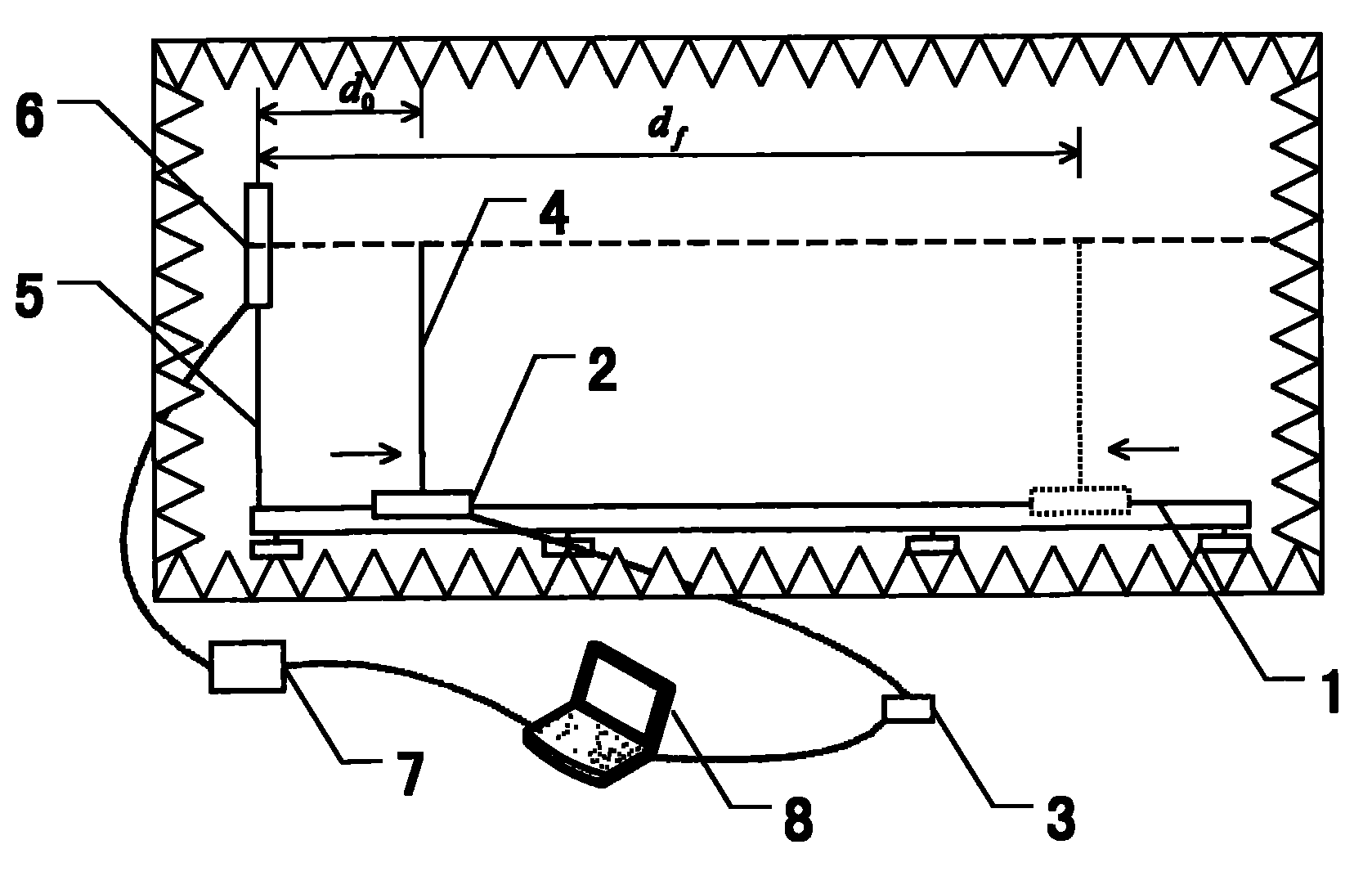
图1为本发明提供的RFID标签天线一致性的基准测试系统示意图,其中1为水平导轨、2为导轨滑块、3为滑块控制器、4为待测标签支架、5为天线支架、6为测试天线、7为RFID信号仿真器、8为控制台。Fig. 1 is the schematic diagram of the benchmark test system of the consistency of the RFID tag antenna provided by the present invention, wherein 1 is a horizontal guide rail, 2 is a guide rail slider, 3 is a slider controller, 4 is a tag bracket to be tested, 5 is an antenna bracket, 6 is the test antenna, 7 is the RFID signal emulator, and 8 is the console.
图2为本发明提供的RFID标签天线一致性的基准测试方法流程图。Fig. 2 is a flow chart of the benchmark method for testing the consistency of the RFID tag antenna provided by the present invention.
具体实施方式 Detailed ways
为使本发明的目的、技术方案和优点更加清楚明白,以下结合具体实施例,并参照附图,对本发明进一步详细说明。In order to make the object, technical solution and advantages of the present invention clearer, the present invention will be described in further detail below in conjunction with specific embodiments and with reference to the accompanying drawings.
如图1所示,图1为本发明提供的RFID标签天线一致性的基准测试系统示意图,其中包括水平导轨1、导轨滑块2、滑块控制器3、待测标签支架4、天线支架5、测试天线6、RFID信号仿真器7、控制台8,其中水平导轨1置于标准测试环境的水平地面上,导轨滑块2与水平导轨1机械相连,由滑块控制器3通过预先设定的程序驱动导轨滑块2沿着导轨方向运动,滑块控制器3与控制台8通过数据线连接,待测标签支架4置于导轨滑块2上方,测试天线6通过天线支架5固定于水平导轨1的一端,与RFID信号仿真器7通过射频馈线相连,用于发送和接收RFID射频信号,RFID信号仿真器7与控制台8通过数据线相连,发送测试数据并在控制台8上汇总计算及图形化显示测试结果。所述标准测试环境,是所在环境的温度、湿度、光照度和电磁干扰度在一组测试中均能够保持稳定,并且测试中除导轨滑块2和待测标签支架4外的其它设备以及操作者的所在位置都保持固定。所述导轨滑块2与水平导轨1机械相连,是导轨滑块2在静止时与水平导轨1直接接触,运动时通过电力、磁力、摩擦力作用而使导轨滑块2与水平导轨1之间发生相对位移的机械结构。所述待测标签支架4置于导轨滑块2上方,其待测标签支架4顶部用于放置待测标签,并且待测标签支架4顶部与测试天线6的几何中心连线与水平导轨1平行,保持在同一高度位置。As shown in Figure 1, Figure 1 is a schematic diagram of a benchmark test system for the RFID tag antenna consistency provided by the present invention, which includes a
在本发明的一个实施例中,水平导轨1的总长为4.6米,其中导轨滑块2可以移动的区间长度为4米,放置于长6米,宽3米,高3米的半电波暗室的水平地面上,导轨滑块2通过齿轮齿条方式与水平导轨1相连,滑块控制器3由单片机实现,用以驱动导轨滑块2上的步进电机正向或反向工作,进而使导轨滑块2在水平导轨1上水平移动所需要的行程。构成滑块控制器3的单片机与构成控制台8的便携式电脑通过RS-232接口相连,由便携式电脑控制导轨滑块2移动的时间和方向。待测标签支架4和天线支架5均是由聚苯乙烯材料制成高度为1.4米的管材,外裹吸波材料,分别插入水平导轨1一端和导轨滑块2上的固定孔中,待测标签支架4的顶端水平高度距离地面为1.5米。测试天线6通过夹具固定在天线支架5的顶端,其几何中心的水平高度距离地面也为1.5米。RFID信号仿真器7由Indy R1000开发板实现,与测试天线6通过同轴射频电缆连接,与控制台8通过USB数据传输线连接。In one embodiment of the present invention, the total length of the
为了使测试结果具有可重复性,就需要保证测试过程中的环境参数保持稳定,即需要一个标准测试环境。所谓标准测试环境的地点,可以是全电波暗室、半电波暗室,也可以是开放空间。在本发明的实施例中,选择半电波暗室进行测试,能够有效屏蔽外界的电磁干扰,并且在一组完整的测试中,所在环境的温度均保持在23±3℃,湿度在30~50%,光照度在低亮度条件。由于测试中半电波暗室内只有导轨滑块2和待测标签支架4的位置发生改变,但是待测标签支架4的材料选择可以有效降低其对电磁信号的反射、散射和吸收作用,待测标签支架4的高度也使导轨滑块2上的步进电机带来的工频电磁白噪声干扰对1.5米高度的待测标签影响可以忽略。并且,在本实施例中,滑块控制器3、RFID信号仿真器7、控制台8和操作者的所在位置都在半电波暗室之外,其对测试结果的影响也可以忽略不记。因此可以认为,本实施例中的环境参数均能够保持稳定,可以作为标准测试环境进行测试。In order to make the test results repeatable, it is necessary to ensure that the environmental parameters during the test remain stable, that is, a standard test environment is required. The location of the so-called standard test environment can be a full anechoic chamber, a semi-anechoic chamber, or an open space. In the embodiment of the present invention, a semi-anechoic chamber is selected for testing, which can effectively shield external electromagnetic interference, and in a complete set of tests, the temperature of the environment is kept at 23±3°C and the humidity is at 30-50%. , illuminance in low light conditions. Since only the positions of the
如图2所示,图2为本发明提供的RFID标签天线一致性的基准测试方法流程图。作为本发明的一个实施例,该方法包括以下步骤:As shown in FIG. 2 , FIG. 2 is a flow chart of the benchmark method for testing the consistency of the RFID tag antenna provided by the present invention. As an embodiment of the present invention, the method includes the following steps:
步骤201:在一组使用同一集成电路芯片及相同天线设计加工的RFID标签中随机抽取N个(N≥10)作为测试样本,在本实施例中取N=10,称为待测标签{T0,T1,…,T10},首先将待测标签T0放置于待测标签支架4的顶部,所述待测标签放置于待测标签支架的顶部,是指待测标签的几何中心与测试天线的几何中心连线和待测标签垂直相交于待测标签的几何中心位置;Step 201: Randomly select N (N ≥ 10) as test samples from a group of RFID tags designed and processed using the same integrated circuit chip and the same antenna. In this embodiment, N=10 is called the tag to be tested {T 0 , T 1 ,..., T 10 }, first place the label to be tested T 0 on the top of the
步骤202:通过滑块控制器3驱动导轨滑块2移动到初始位置,使待测标签支架和天线支架之间的距离为初始距离d0,此时d0=0.4米;Step 202: Drive the
步骤203:打开RFID信号仿真器7,以固定频率f=922MHz、固定功率PTX=20dBm发射RFID读写器询问指令(QUERY),并记录待测标签返回信号的接收信号强度;Step 203: Open the
步骤204:RFID信号仿真器7将该接收信号强度数据发送至控制台8存储;Step 204: the
步骤205:控制台8向滑块控制器3发出指令,驱动导轨滑块2向水平导轨1远端移动Δd=0.1米的距离,并重复步骤203~205,直到导轨滑块2已经运动到水平导轨1最远端的位置,此时待测标签支架4和天线支架5之间的距离为最终距离df=4米,共有37个测试点;Step 205: The
步骤206:控制台8将接收到的一组37个距离——接收信号强度数据绘制为曲线,其中横坐标为距离,范围从0.4米至4米,以0.1米为刻度单位,纵坐标为接收信号强度值,曲线显示在控制台8的显示界面上;Step 206: The
步骤207:将待测标签替换为下一个测试样本T1,重复进行步骤202~206,直至将全部待测标签{T0,T1,…,T10}测试完毕;Step 207: Replace the label to be tested with the next test sample T 1 , repeat steps 202 to 206 until all the labels to be tested {T 0 , T 1 , ..., T 10 } are tested;
步骤208:在控制台8上计算37个测试点下10个待测标签接收信号强度值的平均值
步骤209:在控制台8上计算全部样本标准差之和
上面描述是用于实现本发明及其实施例,本发明的范围不应由该描述来限定,本领域的技术人员应该理解,在不脱离本发明的范围的任何修改或局部替换,均属于本发明权利要求来限定的范围。The above description is used to realize the present invention and its embodiments, and the scope of the present invention should not be limited by the description. Those skilled in the art should understand that any modification or partial replacement without departing from the scope of the present invention belongs to the present invention. The scope of the invention is defined by the claims.
Claims (5)
Priority Applications (1)
| Application Number | Priority Date | Filing Date | Title |
|---|---|---|---|
| CN2008102393298A CN101750552B (en) | 2008-12-10 | 2008-12-10 | Benchmark testing system and method for consistency of RFID label antenna |
Applications Claiming Priority (1)
| Application Number | Priority Date | Filing Date | Title |
|---|---|---|---|
| CN2008102393298A CN101750552B (en) | 2008-12-10 | 2008-12-10 | Benchmark testing system and method for consistency of RFID label antenna |
Publications (2)
| Publication Number | Publication Date |
|---|---|
| CN101750552A CN101750552A (en) | 2010-06-23 |
| CN101750552B true CN101750552B (en) | 2011-12-07 |
Family
ID=42477832
Family Applications (1)
| Application Number | Title | Priority Date | Filing Date |
|---|---|---|---|
| CN2008102393298A Expired - Fee Related CN101750552B (en) | 2008-12-10 | 2008-12-10 | Benchmark testing system and method for consistency of RFID label antenna |
Country Status (1)
| Country | Link |
|---|---|
| CN (1) | CN101750552B (en) |
Families Citing this family (15)
| Publication number | Priority date | Publication date | Assignee | Title |
|---|---|---|---|---|
| CN102184432B (en) * | 2011-04-29 | 2012-12-26 | 永道无线射频标签(扬州)有限公司 | System for testing reflecting sensitivity of electronic label |
| CN103438925B (en) * | 2013-09-06 | 2016-08-10 | 北京邮电大学 | Radio frequency identification devices detection device |
| CN103616577A (en) * | 2013-11-01 | 2014-03-05 | 国家电网公司 | Radio frequency electronic tag consistency detection method |
| CN104091184B (en) * | 2014-06-16 | 2017-09-15 | 上海实甲智能系统有限公司 | Electronic label detecting method and system |
| CN105738732B (en) * | 2015-10-30 | 2018-06-19 | 无锡职业技术学院 | RFID label tag Performance Test System |
| CN107290599A (en) * | 2017-06-05 | 2017-10-24 | 上海力声特医学科技有限公司 | Evaluation method/system of antenna quality, readable storage medium storing program for executing, and electronic equipment |
| CN108304743B (en) * | 2018-01-26 | 2021-03-19 | 山东大学 | A test system and method for quantitative evaluation of RFID tag protocol consistency |
| CN109061443B (en) * | 2018-08-27 | 2023-06-20 | 国网江苏省电力有限公司电力科学研究院 | Electronic tag sensitivity test method for eliminating clamp influence |
| CN110632678A (en) * | 2019-09-23 | 2019-12-31 | 深圳市深创谷技术服务有限公司 | Full-electric wave darkroom testing device, sensing probe testing method and readable storage medium |
| CN110788029B (en) * | 2019-11-21 | 2021-09-14 | 南京派格测控科技有限公司 | Method and device for testing chip |
| WO2021120053A1 (en) * | 2019-12-18 | 2021-06-24 | 瑞声声学科技(深圳)有限公司 | Test tool for testing performance consistency of antenna element |
| CN111505393A (en) * | 2019-12-18 | 2020-08-07 | 瑞声科技(新加坡)有限公司 | Detection tool for detecting performance consistency of antenna oscillator |
| CN115422954A (en) * | 2022-08-19 | 2022-12-02 | 重庆广妙科技有限公司 | Radio frequency tag installation and debugging auxiliary device, installation and debugging system and method |
| WO2026031046A1 (en) * | 2024-08-08 | 2026-02-12 | 舍弗勒技术股份两合公司 | Rfid antenna mounting device and rfid sensing system |
| CN120214474B (en) * | 2025-05-28 | 2025-08-08 | 江苏科睿坦电子科技有限公司 | RFID antenna thermal stability testing arrangement |
Citations (2)
| Publication number | Priority date | Publication date | Assignee | Title |
|---|---|---|---|---|
| CN1866036A (en) * | 2005-05-17 | 2006-11-22 | 韩国电子通信研究院 | Apparatus for measuring read range between RFID tag and reader |
| CN101042722A (en) * | 2006-03-22 | 2007-09-26 | 中国科学院自动化研究所 | Testing method for object exterior pasting electronic label and packaging materials selection |
-
2008
- 2008-12-10 CN CN2008102393298A patent/CN101750552B/en not_active Expired - Fee Related
Patent Citations (2)
| Publication number | Priority date | Publication date | Assignee | Title |
|---|---|---|---|---|
| CN1866036A (en) * | 2005-05-17 | 2006-11-22 | 韩国电子通信研究院 | Apparatus for measuring read range between RFID tag and reader |
| CN101042722A (en) * | 2006-03-22 | 2007-09-26 | 中国科学院自动化研究所 | Testing method for object exterior pasting electronic label and packaging materials selection |
Also Published As
| Publication number | Publication date |
|---|---|
| CN101750552A (en) | 2010-06-23 |
Similar Documents
| Publication | Publication Date | Title |
|---|---|---|
| CN101750552A (en) | Benchmark testing system and method for consistency of RFID label antenna | |
| CN101782959B (en) | Test system and method for radio-frequency application system performance of high-speed motion electronic tag | |
| CN101980252B (en) | Response frequency benchmark test system and method for electronic tag in high-speed motion state | |
| EP1861727B1 (en) | Rfid application test systems and methods | |
| CN101750553B (en) | Benchmark testing system and method for RFID label operating level | |
| CN101782608B (en) | Radio frequency identification device (RFID) label response frequency standard test system and method | |
| TWI541727B (en) | Application of Radio Frequency Identification Technology in superscript Operation | |
| CN101373508B (en) | Test device and method suitable for electronic label | |
| CN103267911A (en) | Non-contact test system and method of RFID label antenna | |
| CN203325014U (en) | Device measuring read-write distance of RFID (Radio Frequency Identification) electronic label | |
| US20090219157A1 (en) | Apparatus and methods for placing radio frequency identification (rfid) antennas, tags, and/or interrogators | |
| CN101770587B (en) | System and method for negative testing of anti-collision capacity of RFID reader | |
| CN102213752A (en) | Automatic three-dimensional radio frequency identification (RFID) test device | |
| CN101833034A (en) | Benchmark test system and method influenced by RFID (Radio Frequency Identification Device) label medium | |
| CN110289921B (en) | RFID module radio frequency power automatic calibration and automatic testing device | |
| CN108306944A (en) | A kind of laboratory's sample distribution formula positioning system based on RFID | |
| CN100476855C (en) | Testing method for object exterior pasting electronic label and packaging materials selection | |
| CN106295958A (en) | A kind of measuring asset management method | |
| CN203216989U (en) | Non-contact test system of RFID tag antenna | |
| CN103927564B (en) | Communication method between reader-writer and electronic tag, reader-writer and electronic tag | |
| CN103235963B (en) | A kind of distribution of the RFID label tag based on matrix analysis preferred disposition method | |
| CN203083482U (en) | Apparatus for controlling testing distance of terminal | |
| CN107863992B (en) | A method and device for measuring coupling performance parameters of RFID tags | |
| CN202837428U (en) | RFID identifying range automatic measuring system applied in logistic conveyor lines | |
| CN104281861A (en) | RFID movement testing system |
Legal Events
| Date | Code | Title | Description |
|---|---|---|---|
| C06 | Publication | ||
| PB01 | Publication | ||
| C10 | Entry into substantive examination | ||
| SE01 | Entry into force of request for substantive examination | ||
| C14 | Grant of patent or utility model | ||
| GR01 | Patent grant | ||
| CF01 | Termination of patent right due to non-payment of annual fee |
Granted publication date: 20111207 Termination date: 20171210 |
|
| CF01 | Termination of patent right due to non-payment of annual fee |