CN100494373C - Method for preserving nucleic acid samples - Google Patents
Method for preserving nucleic acid samples Download PDFInfo
- Publication number
- CN100494373C CN100494373C CNB2004101049007A CN200410104900A CN100494373C CN 100494373 C CN100494373 C CN 100494373C CN B2004101049007 A CNB2004101049007 A CN B2004101049007A CN 200410104900 A CN200410104900 A CN 200410104900A CN 100494373 C CN100494373 C CN 100494373C
- Authority
- CN
- China
- Prior art keywords
- reagent
- carbon
- alkyl
- rna
- contain
- Prior art date
- Legal status (The legal status is an assumption and is not a legal conclusion. Google has not performed a legal analysis and makes no representation as to the accuracy of the status listed.)
- Expired - Fee Related
Links
Images


Landscapes
- Measuring Or Testing Involving Enzymes Or Micro-Organisms (AREA)
Abstract
Description
技术领域 technical field
本发明是关于一种保存核酸样本的试剂与方法,尤指一种适用于稳定或保存RNA样本的试剂与方法。The present invention relates to a reagent and method for preserving nucleic acid samples, especially a reagent and method suitable for stabilizing or preserving RNA samples.
背景技术 Background technique
目前已知,以细胞内核酸为分析标的的医学检验方式,可以预测疾病产生的可能性,并达到早期发现的目的,故核酸检验技术已成为临床生化检验发展的重要趋势。然而,进行核酸分子检测所需的核酸分子的样本准备极为不易,尤其是极具活性的RNA核酸分子。一般公知萃取纯化RNA核酸分子的方式,主要是将抽出的全血加入抗凝血剂(如EDTA)后,放在4℃环境中保存,并必须在24小时内分离出白血球完成RNA萃取;由于RNA表现量会因抗凝血剂的加入、环境温度的改变、保存时间的长短,以及白血球分离的流程,而造成改变,使得预测疾病产生可能性的困难度增加;使用目前常用的方法,最佳状况是必须在24小时内完成RNA萃取,因此临床上,医检人员将无法负荷临时大增的检体量。At present, it is known that the medical testing method with intracellular nucleic acid as the target of analysis can predict the possibility of disease occurrence and achieve the purpose of early detection. Therefore, nucleic acid testing technology has become an important trend in the development of clinical biochemical testing. However, it is extremely difficult to prepare samples of nucleic acid molecules required for the detection of nucleic acid molecules, especially highly active RNA nucleic acid molecules. The generally known method of extracting and purifying RNA nucleic acid molecules is mainly to add anticoagulants (such as EDTA) to the extracted whole blood and store it in a 4°C environment, and the white blood cells must be separated within 24 hours to complete the RNA extraction; RNA expression will be changed due to the addition of anticoagulants, changes in ambient temperature, length of storage time, and the process of leukocyte separation, making it more difficult to predict the possibility of disease; using the currently commonly used methods, the most The best situation is that the RNA extraction must be completed within 24 hours, so clinically, the medical examiners will not be able to afford the temporarily increased sample volume.
目前市面上虽有Qiagen公司提出解决方案,以其发展的PAXgene RNAstabilization buffer搭配PAXgene Blood RNA Isolation Kit来稳定及萃取全血液中的核酸分子。然而从整体核酸分子检验技术的发展上,Qiagen公司提供的套组由于售价过于昂贵,使得其技术的推广有所限制。At present, Qiagen has proposed a solution on the market, using its PAXgene RNAstabilization buffer and PAXgene Blood RNA Isolation Kit to stabilize and extract nucleic acid molecules in whole blood. However, in terms of the development of overall nucleic acid molecular testing technology, the kits provided by Qiagen are too expensive, which limits the promotion of its technology.
WO2004013155一案中公开了一种稳定核酸的方法,其主要是以化学物质,于核酸分子上第2’、3’或5’的羟基形成一保护基,来修饰、保护核酸分子,使得核酸酶无法分解核酸,由此使核酸分子稳定存在于细胞中,最后再以一级胺试剂移除保护基,以利后续萃取的进行;此时所提供的一级胺试剂,主要作用在移除保护基。WO2004013155 discloses a method for stabilizing nucleic acid, which mainly uses chemical substances to form a protective group on the 2', 3' or 5' hydroxyl on the nucleic acid molecule to modify and protect the nucleic acid molecule, so that nuclease Unable to decompose nucleic acid, so that the nucleic acid molecule exists stably in the cell, and finally remove the protective group with a primary amine reagent to facilitate the subsequent extraction; the primary amine reagent provided at this time is mainly used to remove the protection base.
在US2004048384一案中所公开的方法与装置,主要对象为一生物性样本,所公开的收集装置中含有基因诱导阻断剂(gene induction blockingagent),可使收集入该收集装置中的生物性样本与该阻断剂接触,而达成稳定检体内核酸的效果;其中所公开的阻断剂主要以四级胺类为主。The method and device disclosed in the case of US2004048384, the main object is a biological sample, and the disclosed collection device contains a gene induction blocking agent (gene induction blocking agent), which can make the biological sample collected in the collection device Contacting with the blocking agent achieves the effect of stabilizing the nucleic acid in the specimen; the blocking agent disclosed therein is mainly quaternary amines.
而在CA2299119一案中,是公开一种稳定或萃取核酸的方法,其使用含至少两个四级胺或含磷结构的阳离子聚合物来沉淀并保护核酸;US2004014703一案中同样使用含有四级胺或含磷结构的阳离子界面活性剂来沉淀并保护核酸;上述方法所使用的试剂多以四级胺或含磷结构的阳离子聚合物来进行。In the case of CA2299119, a method for stabilizing or extracting nucleic acids is disclosed, which uses cationic polymers containing at least two quaternary amines or phosphorus-containing structures to precipitate and protect nucleic acids; Amines or phosphorus-containing cationic surfactants are used to precipitate and protect nucleic acids; the reagents used in the above methods are mostly carried out with quaternary amines or phosphorus-containing cationic polymers.
发明内容 Contents of the invention
本发明的目的在于提供一种保存核酸样本的方法。The object of the present invention is to provide a method for preserving nucleic acid samples.
本发明稳定核酸的方法有别于以抗凝血剂或4℃冰存的保存方法,是利用一级、二级、三级胺界面活性剂、或不同比例的三种胺类界面活性剂混合液,与核酸分子以离子键方式结合,并包裹住DNA及RNA形成疏水性沉淀物,同时可使RNA不受溶液中所含丰富RNase的破坏,并使DNA无法复制出RNA,以稳定进而保存全血液中核酸分子;相对于传统保存方式,本发明方法的稳定保存时间可大幅拉长,且易于操作,更容易与自动化仪器搭配以达成自动化操作的目的,增进核酸分子检测的技术发展与应用推广。The method for stabilizing nucleic acid of the present invention is different from the preservation method of anticoagulant or 4°C ice storage. Liquid, combined with nucleic acid molecules in the form of ionic bonds, and wraps DNA and RNA to form a hydrophobic precipitate, and at the same time prevents RNA from being damaged by the rich RNase contained in the solution, and prevents DNA from replicating RNA to stabilize and preserve Nucleic acid molecules in whole blood; compared with traditional storage methods, the stable storage time of the method of the present invention can be greatly extended, and it is easy to operate, and it is easier to match with automatic instruments to achieve the purpose of automatic operation, and to promote the technical development and application of nucleic acid molecular detection promote.
本发明稳定或保存生物检体中RNA方法,是将生物检体与一含有胺类界面活性剂的试剂进行接触,使生物检体中RNA与胺类界面活性剂形成一络合物,其中胺类界面活性剂具备如式(I)的通式:R1R2R3N(O)x,式(I);其中,R1与R2分别为氢,含1-6个碳的烷基,含6-12个碳的芳香烃基或是含6-12个碳的烃基芳香烃基;R3为含1-20个碳的烷基、含6-26个碳的芳香烃基或是含6-26个碳的烃基芳香烃基;且x为0或1。The method for stabilizing or preserving RNA in a biological specimen of the present invention is to contact the biological specimen with a reagent containing an amine surfactant, so that the RNA in the biological specimen and the amine surfactant form a complex, wherein the amine Class surfactant has the general formula such as formula (I): R 1 R 2 R 3 N(O) x , formula (I); wherein, R 1 and R 2 are respectively hydrogen, containing 1-6 carbon alkane A group, an aromatic hydrocarbon group containing 6-12 carbons or an aromatic hydrocarbon group containing 6-12 carbons; R3 is an alkyl group containing 1-20 carbons, an aromatic hydrocarbon group containing 6-26 carbons or an aromatic hydrocarbon group containing 6 - a hydrocarbyl aromatic hydrocarbon group of 26 carbons; and x is 0 or 1.
本发明亦提供了一种稳定生物检体中核酸的试剂,包括一具备如式(I)的胺类界面活性剂:The present invention also provides a reagent for stabilizing nucleic acid in a biological specimen, including an amine surfactant having the formula (I):
R1R2R3N(O)x,式(I);R 1 R 2 R 3 N(O) x , formula (I);
其中,R1与R2分别为氢,含1-6个碳的烷基,含6-12个碳的芳香烃基或是含6-12个碳的烃基芳香烃基;R3为含1-20个碳的烷基、含6-26个碳的芳香烃基或是含6-26个碳的烃基芳香烃基;且x为0或1。Among them, R 1 and R 2 are respectively hydrogen, an alkyl group containing 1-6 carbons, an aromatic hydrocarbon group containing 6-12 carbons or a hydrocarbon aromatic hydrocarbon group containing 6-12 carbons; R 3 is an alkyl group containing 1-20 carbons 6-26 carbon alkyl group, 6-26 carbon-containing aromatic hydrocarbon group or 6-26 carbon-containing hydrocarbon aromatic hydrocarbon group; and x is 0 or 1.
当生物检体与本发明试剂进行接触后,将使生物检体中核酸与胺类界面活性剂形成一络合物,使核酸因为被包覆住形成疏水性沉淀物,而使RNA不受RNase的破坏,且使DNA无法复制出RNA,同时达到保存RNA及稳定RNA表现量的双重效果。When the biological sample is in contact with the reagent of the present invention, a complex will be formed between the nucleic acid in the biological sample and the amine surfactant, so that the nucleic acid is coated to form a hydrophobic precipitate, and the RNA is not affected by RNase damage, and make it impossible for DNA to replicate RNA, and at the same time achieve the dual effects of preserving RNA and stabilizing the expression of RNA.
于本发明中,胺类界面活性剂结构的较佳情况是,x为0时,R1与R2分别为含氢,或含1-6个碳的烷基,且R3为含1-20个碳的烷基。同时,本发明方法与试剂中所适用的成分不限制,较佳为含有十二烷胺(dodecylamine),N-甲基十二烷胺(N-methyldodecylamine),N,N-二甲基十二烷胺(N,N-dimethyldodecylamine),氧化氮N,N-二甲基十二烷胺(N,N-dimethyldodecylamine N oxide)以及4-十四烷胺(4-tetradecylaniline)的胺类界面活性剂者;且本发明中所使用的试剂其型态不限,可以是以一液状型态使用,也可以以一固态方式与生物检体相接触,而为使检体中核酸与试剂的成分充分混合,本发明最佳实施方式是以液态方式呈现。In the present invention, the preferred situation of the amine surfactant structure is that when x is 0, R1 and R2 are respectively hydrogen-containing or alkyl groups containing 1-6 carbons, and R3 is an alkyl group containing 1-6 carbons. Alkyl group of 20 carbons. Simultaneously, the applicable composition in the method and reagent of the present invention is not limited, preferably contains dodecylamine (dodecylamine), N-methyldodecylamine (N-methyldodecylamine), N,N-dimethyldodecylamine N, N-dimethyldodecylamine, nitrogen oxide N, N-dimethyldodecylamine (N, N-dimethyldodecylamine N oxide) and 4-tetradecylamine (4-tetradecylaniline) amine surfactant and the reagent used in the present invention is not limited in its form, it can be used in a liquid form, or it can be in contact with the biological specimen in a solid state, and in order to make the components of the nucleic acid and the reagent in the specimen fully Mixed, the best embodiment of the present invention is presented in liquid form.
本发明中,胺类界面活性剂存在于试剂中的含量不限,在液态介质中的含量较佳为0.001%至20%的浓度百分比,或是在固态基质中含量为10%至90%的重量百分比。In the present invention, the content of the amine surfactant in the reagent is not limited, and the content in the liquid medium is preferably 0.001% to 20% concentration percentage, or the content in the solid matrix is 10% to 90%. % by weight.
于本发明中,含有至少一种上述的胺类界面活性剂以及至少一种酸性盐类的试剂即可适用于核酸的稳定与保存,而为使试剂发挥保存核酸的最佳状况,本发明中所使用的试剂更包括至少一种非离子界面活性剂;而其中,非离子界面活性剂的种类不限制,较佳为聚氧化乙烯类(polyoxyethylene)的非离子性界面活性剂,如Tween 20或Triton X-100;最佳为Triton X-100;非离子界面活性剂的使用量或浓度不限制,在液态介质中的含量较佳为0.01%至20%的浓度百分比或在固态基质中含量为0.01%至40%的重量百分比。In the present invention, the reagent containing at least one of the above-mentioned amine surfactants and at least one acidic salt can be applied to the stability and preservation of nucleic acid, and in order to make the reagent play the best condition of preserving nucleic acid, in the present invention The reagent used further includes at least one nonionic surfactant; and wherein, the type of nonionic surfactant is not limited, preferably the nonionic surfactant of polyoxyethylene (polyoxyethylene), such as Tween 20 or Triton X-100; the best is Triton X-100; the use amount or concentration of non-ionic surfactant is not limited, and the content in liquid medium is preferably 0.01% to 20% concentration percentage or the content in solid matrix is 0.01% to 40% by weight.
试剂中所使用的酸性盐类可以是本领域具通常知识者常用的任何一种,较佳是选自由下列物质所组成的群组:顺丁烯二酸(maleic acid),酒石酸(tartaric acid),柠檬酸(citric acid),草酸(oxalic acid),羧酸(carboxylic acids)以及无机酸(mineral acid);且所使用的浓度不限,较佳的浓度是低于1M;最佳为0.01至0.5M;同时,本发明方法中使用的稳定核酸试剂于水溶液中的酸碱值不限制,较佳为pH7以下,最佳为pH5以下。The acidic salts used in the reagent can be any one commonly used by those with ordinary knowledge in the art, preferably selected from the group consisting of the following substances: maleic acid (maleic acid), tartaric acid (tartaric acid) , citric acid (citric acid), oxalic acid (oxalic acid), carboxylic acid (carboxylic acids) and mineral acid (mineral acid); 0.5M; at the same time, the pH value of the stable nucleic acid reagent used in the method of the present invention in the aqueous solution is not limited, preferably below
适用于本发明的含核酸生物检体可为不含细胞的检体、血浆、体液如全血、血清、细胞、白血球细胞、血液黄层、痰液、尿液、精液、粪便、样本抹片、抽吸物、或任何一种组织样本,如部分组织或器官的活检组织、或食物样本中所含的游离态或结合态的核酸或含核酸的细胞,如单细胞或多细胞有机物(如昆虫等)、或是植物或植物的一部分组织、细菌、病毒、酵母菌与其它种类真菌,或真核细胞,原核细胞等等。The nucleic acid-containing biological samples suitable for the present invention can be cell-free samples, plasma, body fluids such as whole blood, serum, cells, leukocytes, buffy coat, sputum, urine, semen, feces, sample smears , aspirates, or any tissue sample, such as a biopsy of a part of a tissue or an organ, or a food sample containing free or bound nucleic acid or nucleic acid-containing cells, such as unicellular or multicellular organisms (such as insects etc.), or plants or parts of plants, bacteria, viruses, yeasts and other types of fungi, or eukaryotic cells, prokaryotic cells, etc.
本发明中提到的「核酸」,所代表的意义为广义的核酸,包括了各种长度或构型的核糖核酸(ribonucleic acids,RNA)、脱氧核糖核酸(deoxyribonucleic acids,DNA),如双股,单股,环状,直链状,支链状,或是结合上述型态的任何一种可能的次单元,如寡核酸单体,质体,病毒或细菌的DNA或RNA,来自动物、植物或其它真核细胞的基因体或非基因体的DNA或RNA,修饰前后的mRNA、tRNA、异核RNA(heterogeneousnuclear RNA,hnRNA)、rRNA、cDNA或任何一种常见的核酸;较佳的是,本发明方法中适用的核酸为DNA或RNA。The "nucleic acid" mentioned in the present invention means nucleic acid in a broad sense, including ribonucleic acids (RNA) and deoxyribonucleic acids (DNA) of various lengths or configurations, such as double-stranded , single-stranded, circular, linear, branched, or a combination of any possible subunits of the above types, such as oligonucleotide monomers, plastids, DNA or RNA of viruses or bacteria, from animals, Genomic or non-genic DNA or RNA of plants or other eukaryotic cells, mRNA, tRNA, heterogeneous nuclear RNA (heterogeneousnuclear RNA, hnRNA), rRNA, cDNA or any common nucleic acid before and after modification; preferably , the nucleic acid suitable for use in the method of the present invention is DNA or RNA.
附图说明 Description of drawings
图1为本发明实施例1-3的RNA电泳图。Fig. 1 is the RNA electrophoresis graph of Example 1-3 of the present invention.
图2为本发明较佳实施例5-6的RNA电泳图。Fig. 2 is the RNA electrophoresis diagram of the preferred embodiment 5-6 of the present invention.
图3为本发明较佳实施例7-9的不同保存时间所萃取出的RNA其中基因表现量变化结果。Fig. 3 shows the results of gene expression changes in RNA extracted at different storage times in preferred embodiments 7-9 of the present invention.
具体实施方式 Detailed ways
本发明实施例是以RNA萃取的量与浓度,来比较经过数天以三种不同方式保存的全血中RNA质量差异。In the embodiment of the present invention, the amount and concentration of RNA extraction are used to compare the differences in the quality of RNA in whole blood stored in three different ways for several days.
实施例1Example 1
首先全血的收集是利用10ml的Vacutainer血液收集管(EDTA K3,Becton Dickinson)收集后,直接冰存于4℃0-4天。经过不同时间的保存后,接着进行RNA的萃取。First, the whole blood was collected using a 10ml Vacutainer blood collection tube (EDTA K3, Becton Dickinson), and stored directly at 4°C for 0-4 days. After storage for different periods of time, the RNA was extracted.
依照使用者手册,于500μl全血中加入1ml的红血球溶解液(RocheDiagnostics GmbH),以纯化出白血球细胞;接着再将白血球细胞以150μl的RLT液(QIAGEN GmbH)进行溶解;接着加入90μl的乙醇,再将处理后反应液加到含有硅质过滤膜的离心管(QIAGEN GmbH)内,进行离心;接着以350μl的RW1液(QIAGEN GmbH)冲洗硅质过滤膜,再利用不含RNA分解酶的DNA分解套组(RNase-free DNase Set,QIAGEN GmbH)去掉DNA分子;再以350μl的RW1液(QIAGEN GmbH)冲洗硅质过滤膜一次,500μl的RPE液(QIAGEN GmbH)冲洗2次,最后以2次40μl的去离子水将硅质过滤膜上的RNA冲提出来。According to the user manual, add 1ml of red blood cell lysis solution (Roche Diagnostics GmbH) to 500 μl of whole blood to purify the white blood cells; then dissolve the white blood cells with 150 μl of RLT solution (QIAGEN GmbH); then add 90 μl of ethanol, Add the treated reaction solution to a centrifuge tube (QIAGEN GmbH) containing a siliceous filter membrane, and centrifuge; then wash the siliceous filter membrane with 350 μl of RW1 solution (QIAGEN GmbH), and then use DNA that does not contain RNA decomposing enzymes The decomposition kit (RNase-free DNase Set, QIAGEN GmbH) was used to remove DNA molecules; the silica filter membrane was washed once with 350 μl of RW1 solution (QIAGEN GmbH), washed twice with 500 μl of RPE solution (QIAGEN GmbH), and finally washed with 2 Wash out the RNA on the silica filter membrane with 40 μl of deionized water.
实施例2Example 2
本实施例中全血的收集与RNA萃取,是利用PAXgene Blood RNAValidation Kit(QIAGEN GmbH)进行,血液收集后,直接冰存于4℃,0-4天。经过不同时间的保存后,接着进行RNA的萃取,所有血液收集与RNA萃取步骤均依照使用者手册进行。The collection and RNA extraction of whole blood in this example were carried out using PAXgene Blood RNAValidation Kit (QIAGEN GmbH). After blood collection, it was directly stored on ice at 4°C for 0-4 days. After storage for different periods of time, RNA extraction was performed, and all blood collection and RNA extraction steps were performed in accordance with the user manual.
实施例3Example 3
于本实施例中,在欲进行萃取RNA的血液中,加入N-甲基十二烷胺(N-methyldodecylamine)一起进行保存,以稳定全血中RNA的活性。首先取333μl的新鲜血液,加入1ml含有3%(w/v)N-甲基十二烷胺、5%(v/v)TritonX-100以及100mM酒石酸(tartaric acid)的溶液,再将混合液直接冰存于4℃0-4天。经过不同时间的保存后,接着进行RNA的萃取。In this embodiment, N-methyldodecylamine (N-methyldodecylamine) is added to the blood from which RNA is to be extracted to stabilize the activity of RNA in whole blood. First take 333 μl of fresh blood, add 1ml solution containing 3% (w/v) N-methyl dodecylamine, 5% (v/v) TritonX-100 and 100mM tartaric acid (tartaric acid), and then mix the solution Store directly on ice at 4°C for 0-4 days. After storage for different periods of time, the RNA was extracted.
由于RNA会与N-甲基十二烷胺形成一络合物,因此可由5000xg离心10分钟的方式将RNA沉淀下来,接着以50μl的去离子水将沉淀物回溶;加入100μl的RLT液(QIAGEN GmbH)与10μl的K蛋白酶(Proteinase K,QIAGENGmbH),置于55℃中10分钟;接着于反应液中加入200μl的1,3-溴氯丙烷(1-bromo-3-chloropropane),并以剧烈震荡方式使药剂与反应液充分混合,再以10000xg离心5分钟;接着将离心后上清液移至另一新的1.5ml离心管中,加入90μl的乙醇,再将处理后反应液加到含有硅质过滤膜的离心管内,进行离心;接着以350μl的RW1液(QIAGEN GmbH)冲洗硅质过滤膜,再利用不含RNA分解酶的DNA分解套组(RNase-free DNase Set,QIAGENGmbH)去掉DNA分子;再以350μl的RW1液(QIAGEN GmbH)冲洗硅质过滤膜一次,500μl的RPE液(QIAGEN GmbH)冲洗2次,最后以2次40μl的去离子水将硅质过滤膜上的RNA冲提出来。Since RNA will form a complex with N-methyldodecylamine, the RNA can be precipitated by centrifugation at 5000×g for 10 minutes, and then the precipitate is redissolved with 50 μl of deionized water; 100 μl of RLT solution ( QIAGEN GmbH) and 10 μl of K proteinase (Proteinase K, QIAGEN mbH), placed in 55 ° C for 10 minutes; then 200 μl of 1,3-bromochloropropane (1-bromo-3-chloropropane) was added to the reaction solution, and Shake vigorously to fully mix the reagent and the reaction solution, then centrifuge at 10,000xg for 5 minutes; then transfer the supernatant after centrifugation to another new 1.5ml centrifuge tube, add 90μl of ethanol, and then add the treated reaction solution to Centrifuge in a centrifuge tube containing a siliceous filter membrane; then wash the siliceous filter membrane with 350 μl of RW1 solution (QIAGEN GmbH), and then use the DNA decomposition kit (RNase-free DNase Set, QIAGEN GmbH) without RNase Remove DNA molecules; wash the silica filter membrane once with 350 μl of RW1 solution (QIAGEN GmbH), wash twice with 500 μl of RPE solution (QIAGEN GmbH), and finally wash the RNA on the silica filter membrane with 2 times of 40 μl deionized water Rush out.
实施例4Example 4
于本实施例中,在欲进行萃取RNA的血液中,加入十二烷胺(dodecylamine)一起进行保存,以稳定全血中RNA的活性。首先取1ml的新鲜血液,加入3ml含有0.3%(w/v)十二烷胺、1%(v/v)Triton X-100以及250mM酒石酸的溶液,以NaOH调整至pH3,再将混合液直接冰存于4℃0-2天。经过不同时间的保存后,接着进行RNA的萃取。In this embodiment, dodecylamine (dodecylamine) is added to the blood from which RNA is to be extracted to stabilize the activity of RNA in whole blood. First take 1ml of fresh blood, add 3ml of a solution containing 0.3% (w/v) dodecylamine, 1% (v/v) Triton X-100 and 250mM tartaric acid, adjust the pH to 3 with NaOH, and then mix the solution directly Store on ice at 4°C for 0-2 days. After storage for different periods of time, the RNA was extracted.
将形成一络合物的RNA以及十二烷胺一起藉由离心方式进行沉淀,接着以150μl的去离子水将沉淀物回溶;加入300μl的RLT液(QIAGEN GmbH)与30μl的K蛋白酶(Proteinase K,QIAGEN GmbH),置于55℃中10分钟;接着于反应液中加入200μl的1,3-溴氯丙烷(1-bromo-3-chloropropane),并以剧烈震荡方式使药剂与反应液充分混合,再以10000xg离心5分钟;接着将离心后上清液移至另一新的1.5ml离心管中,加入270μl的乙醇,接下来的RNA萃取方式请参考实施例3。Precipitate the RNA and dodecylamine forming a complex together by centrifugation, and then redissolve the precipitate with 150 μl of deionized water; add 300 μl of RLT solution (QIAGEN GmbH) and 30 μl of K proteinase (Proteinase K, QIAGEN GmbH), placed at 55°C for 10 minutes; then, 200 μl of 1,3-bromochloropropane (1-bromo-3-chloropropane) was added to the reaction solution, and the reagent and the reaction solution were fully Mix and then centrifuge at 10000xg for 5 minutes; then transfer the centrifuged supernatant to another new 1.5ml centrifuge tube, add 270μl of ethanol, and refer to Example 3 for the subsequent RNA extraction method.
实施例5Example 5
于本实施例中,在欲进行萃取RNA的血液中,加入N,N-二甲基十二烷胺(N,N-dimethyldodecylamine)一起进行保存,以稳定全血中RNA的活性。首先取333μl的新鲜血液,加入1ml含有5%(w/v)N,N-二甲基十二烷胺、2%(v/v)Triton X-100以及140mM酒石酸的溶液,再将混合液直接冰存于-20℃中0-14天。经过不同时间的保存后,接着参考实施例3进行RNA的萃取。In this embodiment, N,N-dimethyldodecylamine (N,N-dimethyldodecylamine) is added to the blood to be extracted for RNA, so as to stabilize the activity of RNA in whole blood. First take 333 μl of fresh blood, add 1ml containing 5% (w/v) N, N-dimethyl dodecylamine, 2% (v/v) Triton X-100 and 140mM tartaric acid solution, and then mix the solution Store directly on ice at -20°C for 0-14 days. After storage for different periods of time, RNA was extracted with reference to Example 3.
实施例6Example 6
于本实施例中,在欲进行萃取RNA的血液中,加入氧化氮N,N-二甲基十二烷胺(N,N-dimethyldodecylamine N oxide)一起进行保存,以稳定全血中RNA的活性。首先取333μl的新鲜血液,加入1ml含有3%(w/v)氧化氮N,N-二甲基十二烷胺、1%(v/v)Triton X-100以及125mM酒石酸的溶液,再将混合液直接冰存于-20℃0-14天。经过不同时间的保存后,接着依实施例3所述步骤进行RNA的萃取。In this embodiment, nitrogen oxide N, N-dimethyldodecylamine (N, N-dimethyldodecylamine N oxide) is added to the blood to be extracted from RNA to stabilize the activity of RNA in whole blood . First take 333 μl of fresh blood, add 1ml containing 3% (w/v) nitric oxide N, N-dimethyl dodecylamine, 1% (v/v) Triton X-100 and 125mM tartaric acid solution, and then The mixture was directly stored on ice at -20°C for 0-14 days. After storage for different periods of time, RNA was extracted according to the steps described in Example 3.
实施例7Example 7
利用Agilent 2100 Bioanalyzer(Agilent Technologies)分析依照实施例1-3所萃取出RNA中28S/18S rRNA的比值,进行比较。依照本领域具通常知识者可认同的标准,当28S/18S rRNA的比值高于1.5,表示RNA分子尚未被降解;而当比值在2附近,则表示所萃取出的RNA分子质量良好;此外,利用分光光度计测定RNA的OD260/OD280的比值,质量好的RNA样品260/280比值应介于1.9~2.1。利用上述分析方法,分别将不同保存时间萃取后的RNA质量结果整理如下表1。Agilent 2100 Bioanalyzer (Agilent Technologies) was used to analyze the ratio of 28S/18S rRNA in the RNA extracted according to Examples 1-3 for comparison. According to the standard recognized by those skilled in the art, when the ratio of 28S/18S rRNA is higher than 1.5, it means that the RNA molecule has not been degraded; and when the ratio is around 2, it means that the quality of the extracted RNA molecule is good; in addition, Use a spectrophotometer to measure the ratio of OD260/OD280 of RNA. The ratio of 260/280 of good quality RNA samples should be between 1.9 and 2.1. Using the above analysis methods, the RNA quality results after extraction at different storage times were sorted out in Table 1 below.
表1、不同实施方式萃取得的RNA质量比较Table 1. Comparison of the quality of RNA extracted by different embodiments
由表1结果可看出本发明稳定RNA的试剂(实施例3),不仅可萃取出比其它2种常用方法更高量的RNA,每1ml血液可收集到7.20±0.48μg;且代表RNA质量的OD 260/280比值1.98±0.14也接近高标准的2;此外,28S/18SrRNA比值也是三种实施方法中最接近2的标准。It can be seen from the results in Table 1 that the reagent for stabilizing RNA of the present invention (Example 3) can not only extract a higher amount of RNA than the other two commonly used methods, but can collect 7.20 ± 0.48 μg per 1 ml of blood; and represent the quality of RNA The OD 260/280 ratio of 1.98±0.14 is also close to the high standard of 2; in addition, the 28S/18SrRNA ratio is also the standard closest to 2 among the three implementation methods.
同时,请参考图1,是实施例1-3的电泳结果图,其中(a)为实施例1方法萃取出的RNA,(b)为实施例2,(c)为实施例3;而电泳图上方的0-4数字代表保存天数;于电泳结果图中,每一行的第一条条带代表为28S rRNA,第二条条带代表为18S rRNA;由结果图可以清楚看到,由本发明最佳实施例的方法所萃取出的RNA(实施例3所述),可以得到质与量均佳的RNA。且一直到保存第4天的结果,仍与新鲜取得血液(保存0天)的萃取结果相近。Meanwhile, please refer to Fig. 1, it is the electrophoresis result figure of embodiment 1-3, wherein (a) is the RNA extracted by the method of
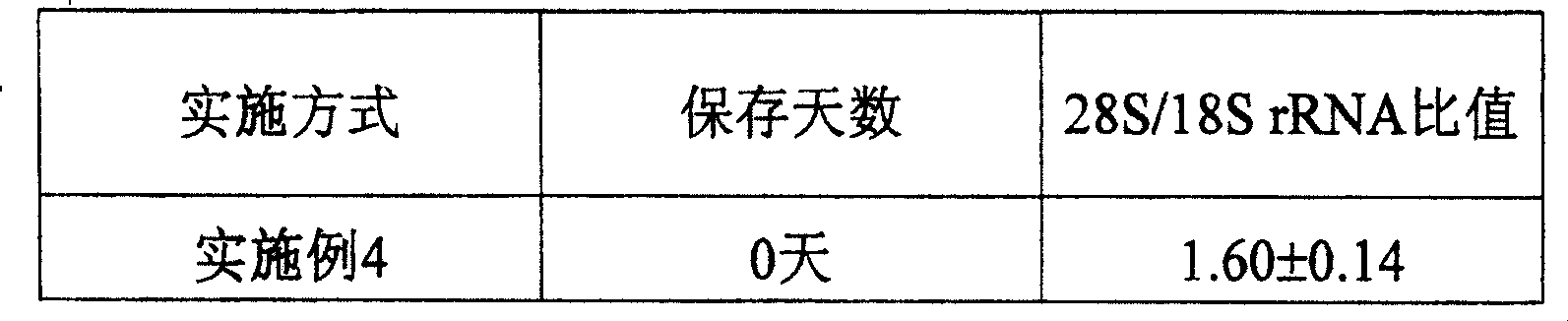
图2为实施例4-6的RNA电泳图,其中图2(a)为实施例4保存0-2天的结果,图2(b)为实施例5保存0-14天的结果,图2(c)为实施例6保存0-14天的结果;而利用Agilent 2100 Bioanalyzer(Agilent Technologies)分析的结果则整理于表2;观察图2与表2所呈现的结果,可发现在全血保存到第14天,所萃取出的RNA质量仍然在可接受的范围内。Fig. 2 is the RNA electrophoresis figure of embodiment 4-6, and wherein Fig. 2 (a) is the result that
表2、不同实施方式萃取得的RNA质量比较Table 2. Comparison of the quality of RNA extracted by different embodiments

实施例7Example 7
操作过程同实施例1,但血液的保存为在4℃冰藏0-2天。The operation process is the same as in Example 1, but the blood is stored on ice at 4° C. for 0-2 days.
实施例8Example 8
操作过程同实施例2,但血液的保存为在4℃冰藏0-2天。The operation process is the same as in Example 2, but the blood is stored on ice at 4° C. for 0-2 days.
实施例9Example 9
于本实施例中,在欲进行萃取RNA的血液中,加入N,N-二甲基十二烷胺(N,N-dimethyldodecylamine)一起进行保存,以稳定全血中RNA的活性。首先取1ml的新鲜血液,加入3ml含有5%(w/v)氧化氮N,N-二甲基十二烷胺以及225mM酒石酸的溶液(以NaOH调整pH值到3.0),再将混合液直接冰存于4℃0-2天。经过不同时间的保存后,接着依实施例4所述步骤进行RNA的萃取。In this embodiment, N,N-dimethyldodecylamine (N,N-dimethyldodecylamine) is added to the blood to be extracted for RNA, so as to stabilize the activity of RNA in whole blood. First take 1ml of fresh blood, add 3ml of a solution containing 5% (w/v) nitric oxide N, N-dimethyldodecylamine and 225mM tartaric acid (adjust the pH value to 3.0 with NaOH), and then directly mix the solution Store on ice at 4°C for 0-2 days. After storage for different periods of time, RNA was extracted according to the steps described in Example 4.
实施例10Example 10
将实施例7-9所萃取出的RNA以SuperScript II RNase H-ReverseTranscriptase(Invitrogen)进行单股cDNA合成,所有合成步骤均依照使用者手册进行。完成的单股cDNA接续以TaqMan Universal PCR master mix(Applied Biosystems)以及Assays-on-Demand Gene Expression Produts(Applied Biosystems)在ABI Prism 7000 Sequence Detection System基因定量仪(Applied Biosystems)进行实时基因表现量定量(real-time PCR)测定。利用上述分析方法,分别测量不同保存时间萃取后RNA中的ADORA2A、CREB5、NFKB1以及IFNGR1等四种基因变化结果,如图3所示。The RNA extracted in Examples 7-9 was subjected to single-strand cDNA synthesis with SuperScript II RNase H-Reverse Transcriptase (Invitrogen), and all synthesis steps were performed according to the user manual. The completed single-strand cDNA was followed by TaqMan Universal PCR master mix (Applied Biosystems) and Assays-on-Demand Gene Expression Products (Applied Biosystems) for real-time gene expression quantification ( real-time PCR) assay. Using the above analysis method, the results of four gene changes, including ADORA2A, CREB5, NFKB1 and IFNGR1, were measured in RNA extracted at different storage times, as shown in Figure 3.
图3中相对表现量(Relative expression fold)的意义为将在4℃保存24hr与48hr后的基因表现量,与保存0hr的表现量相比较,数值等于1时表示基因表现量与0hr的一样;图3中,A1-A4为依照实施例7步骤进行后所得的结果,其中A1为ADORA2A基因、A2为CREB5基因、A3为IFNGR1基因以及A4为NFKB1基因;B1-B4为实施例8的结果,B1为ADORA2A基因、B2为CREB5基因、B3为IFNGR1基因以及B4为NFKB1基因;C为实施例9的结果,C1为ADORA2A基因、C2为CREB5基因、C3为IFNGR1基因以及C4为NFKB1基因;由图3可知在三种保存方式当中,以实施例9的保存试剂所测得的基因表现量数值较接近1,且所测试四种基因的变化程度最小,因此保存效果最好。The meaning of relative expression fold in Figure 3 is the gene expression after storage at 4°C for 24hr and 48hr, compared with the expression of 0hr, when the value is equal to 1, it means that the gene expression is the same as that of 0hr; In Fig. 3, A1-A4 is the result obtained after carrying out the steps according to Example 7, wherein A1 is ADORA2A gene, A2 is CREB5 gene, A3 is IFNGR1 gene and A4 is NFKB1 gene; B1-B4 is the result of Example 8, B1 is ADORA2A gene, B2 is CREB5 gene, B3 is IFNGR1 gene and B4 is NFKB1 gene; C is the result of embodiment 9, C1 is ADORA2A gene, C2 is CREB5 gene, C3 is IFNGR1 gene and C4 is NFKB1 gene; 3 It can be seen that among the three preservation methods, the value of gene expression measured by the preservation reagent of Example 9 is closer to 1, and the degree of change of the four tested genes is the smallest, so the preservation effect is the best.
由本发明较佳实施例的说明,可达到本发明欲稳定生物检体中核酸的目的,且经由实施例结果可知,利用本发明试剂与方法来保存生物检体,其保存时间可大幅拉长达2周,在临床使用上非常具有实用价值,且易于操作,更容易与自动化仪器搭配以达成自动化操作的目的,增进核酸分子检测的技术发展与应用推广。According to the description of the preferred embodiment of the present invention, the purpose of stabilizing the nucleic acid in the biological specimen of the present invention can be achieved, and it can be seen from the results of the embodiment that the storage time of the biological specimen can be greatly extended by using the reagent and method of the present invention. 2 weeks, it is very practical in clinical use, and it is easy to operate, and it is easier to match with automatic instruments to achieve the purpose of automatic operation, and to promote the technical development and application promotion of nucleic acid molecular detection.
上述实施例仅为了方便说明而举例而已,本发明所主张的权利范围自应以申请专利范围所述为准,而非仅限于上述实施例。The above-mentioned embodiments are only examples for convenience of description, and the scope of rights claimed by the present invention should be based on the scope of the patent application, rather than limited to the above-mentioned embodiments.
Claims (28)
- One kind stable or preserve the method for biological corpse or other object for laboratory examination and chemical testing amplifying nucleic acid, the reagent that this biology corpse or other object for laboratory examination and chemical testing and one is contained activator with amine interface contacts, make this biology corpse or other object for laboratory examination and chemical testing amplifying nucleic acid and this activator with amine interface form a complex compound, wherein comprise carboxylic acid, mineral acid or its mixture in this reagent, its concentration range is 0.01M to 1M, and this activator with amine interface possesses the general formula suc as formula (I):R 1R 2R 3N (O) x, formula (I);Wherein, R 1With R 2Be respectively hydrogen, contain the alkyl of 1-6 carbon, contain the aryl radical of 6-12 carbon or contain the alkyl aryl radical of 6-12 carbon; R 3For the alkyl that contains 1-20 carbon, contain the aryl radical of 6-26 carbon or contain the alkyl aryl radical of 6-26 carbon; And x is 0 or 1.
- 2. the method for claim 1 is characterized in that, wherein this x is 1, R 1With R 2Be respectively the alkyl that contains 1-6 carbon, and R 3For containing the alkyl of 1-20 carbon.
- 3. the method for claim 1 is characterized in that, wherein this x is 0.
- 4. the method for claim 1 is characterized in that, wherein this activator with amine interface is selected from the group that is made up of following material: n-Laurylamine, N-methyl n-Laurylamine, N, N-dimethyl n-Laurylamine, nitrogen oxide N, N-dimethyl n-Laurylamine and 4-tetradecylamine.
- 5. the method for claim 1 is characterized in that, wherein this contained activator with amine interface is 0.001% to 20% percentage in this reagent.
- 6. the method for claim 1 is characterized in that, wherein also comprises at least a other non-ionic surfactant in this reagent.
- 7. method as claimed in claim 6 is characterized in that, wherein this non-ionic surfactant is a polyoxyethylene class interfacial agent.
- 8. method as claimed in claim 6 is characterized in that, wherein this non-ionic surfactant is 0.01% to 20% percentage.
- 9. method as claimed in claim 6 is characterized in that, wherein this non-ionic surfactant is Tween 20 or Triton X-100.
- 10. the method for claim 1 is characterized in that, wherein this carboxylic acid is selected from the group that is made up of following material: maleic acid, tartrate, citric acid and oxalic acid.
- 11. the method for claim 1 is characterized in that, wherein this reagent is a liquid solution.
- 12. method as claimed in claim 11 is characterized in that, wherein the pH value of this liquid solution is below 7.
- 13. method as claimed in claim 11 is characterized in that, wherein the pH value of this liquid solution is below 5.
- 14. the method for claim 1 is characterized in that, wherein this reagent is a solid state substrate.
- 15. the method for claim 1 is characterized in that, wherein should be selected from the group that is made up of following material by a biology corpse or other object for laboratory examination and chemical testing: whole blood, blood plasma, serum, urine, tissue and cell.
- 16. one kind is stable or preserve the reagent of biological corpse or other object for laboratory examination and chemical testing amplifying nucleic acid, comprises that one possesses carboxylic acid, mineral acid or its mixture that activator with amine interface and concentration range suc as formula (I) are 0.01M to 1M,R 1R 2R 3N (O) x, formula (I);Wherein, R 1With R 2Be respectively hydrogen, contain the alkyl of 1-6 carbon, contain the aryl radical of 6-12 carbon or contain the alkyl aryl radical of 6-12 carbon; R 3For the alkyl that contains 1-20 carbon, contain the aryl radical of 6-26 carbon or contain the alkyl aryl radical of 6-26 carbon; And x is 0 or 1.
- 17. reagent as claimed in claim 16 is characterized in that, wherein this x is 1, R 1With R 2Be respectively the alkyl that contains 1-6 carbon, and R 3For containing the alkyl of 1-20 carbon.
- 18. reagent as claimed in claim 16 is characterized in that, wherein this x is 0.
- 19. reagent as claimed in claim 16 is characterized in that, wherein this activator with amine interface is selected from the group that is made up of following material: n-Laurylamine, N-methyl n-Laurylamine, N, N-dimethyl n-Laurylamine, nitrogen oxide N, N-dimethyl n-Laurylamine and 4-tetradecylamine.
- 20. reagent as claimed in claim 16 is characterized in that, wherein this activator with amine interface is 0.001% to 20% percentage.
- 21. reagent as claimed in claim 16 is characterized in that, wherein also comprises at least a other non-ionic surfactant.
- 22. reagent as claimed in claim 21 is characterized in that, wherein this non-ionic surfactant is a polyoxyethylene class interfacial agent.
- 23. reagent as claimed in claim 21 is characterized in that, wherein this non-ionic surfactant is 0.01% to 20% percentage.
- 24. reagent as claimed in claim 21 is characterized in that, wherein this non-ionic surfactant is Tween 20 or Triton X-100.
- 25. reagent as claimed in claim 16 is characterized in that, wherein this carboxylic acid is selected from the group that is made up of following material: maleic acid, tartrate, citric acid and oxalic acid.
- 26. reagent as claimed in claim 16 is characterized in that, wherein this reagent is a liquid solution.
- 27. reagent as claimed in claim 26 is characterized in that, wherein the pH value of this reagent is below 7.
- 28. reagent as claimed in claim 26 is characterized in that, wherein the pH value of this reagent is below 5.
Priority Applications (1)
| Application Number | Priority Date | Filing Date | Title |
|---|---|---|---|
| CNB2004101049007A CN100494373C (en) | 2004-12-27 | 2004-12-27 | Method for preserving nucleic acid samples |
Applications Claiming Priority (1)
| Application Number | Priority Date | Filing Date | Title |
|---|---|---|---|
| CNB2004101049007A CN100494373C (en) | 2004-12-27 | 2004-12-27 | Method for preserving nucleic acid samples |
Publications (2)
| Publication Number | Publication Date |
|---|---|
| CN1796399A CN1796399A (en) | 2006-07-05 |
| CN100494373C true CN100494373C (en) | 2009-06-03 |
Family
ID=36817729
Family Applications (1)
| Application Number | Title | Priority Date | Filing Date |
|---|---|---|---|
| CNB2004101049007A Expired - Fee Related CN100494373C (en) | 2004-12-27 | 2004-12-27 | Method for preserving nucleic acid samples |
Country Status (1)
| Country | Link |
|---|---|
| CN (1) | CN100494373C (en) |
Citations (3)
| Publication number | Priority date | Publication date | Assignee | Title |
|---|---|---|---|---|
| US6265168B1 (en) * | 1998-10-06 | 2001-07-24 | Transgenomic, Inc. | Apparatus and method for separating and purifying polynucleotides |
| WO2002090539A2 (en) * | 2000-11-28 | 2002-11-14 | Applera Corporation | Compositions, methods, and kits for isolating nucleic acids using surfactants and proteases |
| WO2003072830A1 (en) * | 2002-02-22 | 2003-09-04 | Purdue Research Foundation | Magnetic nanomaterials and methods for detection of biological materials |
-
2004
- 2004-12-27 CN CNB2004101049007A patent/CN100494373C/en not_active Expired - Fee Related
Patent Citations (3)
| Publication number | Priority date | Publication date | Assignee | Title |
|---|---|---|---|---|
| US6265168B1 (en) * | 1998-10-06 | 2001-07-24 | Transgenomic, Inc. | Apparatus and method for separating and purifying polynucleotides |
| WO2002090539A2 (en) * | 2000-11-28 | 2002-11-14 | Applera Corporation | Compositions, methods, and kits for isolating nucleic acids using surfactants and proteases |
| WO2003072830A1 (en) * | 2002-02-22 | 2003-09-04 | Purdue Research Foundation | Magnetic nanomaterials and methods for detection of biological materials |
Non-Patent Citations (2)
| Title |
|---|
| Preparation and purification of…… A.V.Heydenreich, ET AL.International Journal of Pharmaceutics,Vol.254 No.1. 2003 * |
| The Relationship of…… LAWRENCE LEVINE, ET AL.Biochemistry (Moscow, Russian Federation),Vol.2 . 1963 * |
Also Published As
| Publication number | Publication date |
|---|---|
| CN1796399A (en) | 2006-07-05 |
Similar Documents
| Publication | Publication Date | Title |
|---|---|---|
| JP6324962B2 (en) | Methods and kits for preparing target RNA depleted compositions | |
| CN102625838B (en) | For generating sample that rRNA eliminates or for from the method for sample separation rRNA, composition and test kit | |
| KR20200138183A (en) | Method for nucleic acid amplification | |
| JP5906740B2 (en) | RNA extraction solution | |
| EP1085098B1 (en) | A composition for providing long term stability to cells for diagnostic testing | |
| CN101709298B (en) | A Soil DNA Extraction Method for Assessing the Diversity of Plant Root Microbial Communities | |
| CN102834519A (en) | Nucleic acid extraction from complex matrices | |
| CN116287115A (en) | A method for obtaining single-cell or single-nucleus samples, samples obtained by using the same, and applications | |
| KR20240068058A (en) | How to Determine Target Polymers in a Sample Using Guide Polymers | |
| CN102753705A (en) | Method and materials for separating nucleic acid materials | |
| CN102796827B (en) | Method and kit for detecting multiple encephalitis related viruses | |
| CN101481742A (en) | Detection kit for Mycoplasma hyopneumoniae and use thereof | |
| CN115058490B (en) | Primer combination for constructing microorganism targeted sequencing library and application thereof | |
| CN109988823A (en) | A primer-probe combination for detection of Phytophthora acornis by recombinase-mediated isothermal amplification-lateral flow chromatography and its application | |
| EP1106683A2 (en) | A method for providing long term stability to cells for diagnostic testing | |
| TWI294460B (en) | Method for stabilizing nucleic acids | |
| CN113462742A (en) | Biological sample nucleic acid release preservative | |
| WO2014118249A1 (en) | Solid medium for the storage of biological material | |
| CN1796399A (en) | Methods of Preserving Nucleic Acid Samples | |
| KR102505618B1 (en) | Urinary exosome-derived miRNA gene biomarkers for diagnosis of antibody-mediated rejection in kidney allografts and use thereof | |
| KR102505617B1 (en) | Urinary exosome-derived miRNA gene biomarkers for diagnosis of T cell-mediated rejection in kidney allografts and use thereof | |
| CN114686564B (en) | DNA sample preparation method suitable for micro sample | |
| CN112831554B (en) | SLE-related circular RNA hsa _ circ _0025843 and application thereof | |
| CN1425676A (en) | Double-effect buffer solution for preserving/extracting ribonucleic acid and method for preserving ribonucleic acid in sample | |
| CN118272933A (en) | Construction method of medium-low flux genome mixed sample library |
Legal Events
| Date | Code | Title | Description |
|---|---|---|---|
| C06 | Publication | ||
| PB01 | Publication | ||
| C10 | Entry into substantive examination | ||
| SE01 | Entry into force of request for substantive examination | ||
| C14 | Grant of patent or utility model | ||
| GR01 | Patent grant | ||
| CF01 | Termination of patent right due to non-payment of annual fee | ||
| CF01 | Termination of patent right due to non-payment of annual fee |
Granted publication date: 20090603 Termination date: 20211227 |