BR112015024552B1 - COMPOUND, USES OF A COMPOUND, PHARMACEUTICAL COMPOSITION, METHOD FOR PREPARING THE COMPOUND, AND USE OF AN EFFECTIVE AMOUNT OF A COMPOUND - Google Patents
COMPOUND, USES OF A COMPOUND, PHARMACEUTICAL COMPOSITION, METHOD FOR PREPARING THE COMPOUND, AND USE OF AN EFFECTIVE AMOUNT OF A COMPOUND Download PDFInfo
- Publication number
- BR112015024552B1 BR112015024552B1 BR112015024552-8A BR112015024552A BR112015024552B1 BR 112015024552 B1 BR112015024552 B1 BR 112015024552B1 BR 112015024552 A BR112015024552 A BR 112015024552A BR 112015024552 B1 BR112015024552 B1 BR 112015024552B1
- Authority
- BR
- Brazil
- Prior art keywords
- alkyl
- heterocycle
- aryl
- heteroalkyl
- hydroxyl
- Prior art date
Links
- 150000001875 compounds Chemical class 0.000 title claims abstract description 176
- 239000008194 pharmaceutical composition Substances 0.000 title claims abstract description 34
- 238000000034 method Methods 0.000 title claims abstract description 30
- 239000003814 drug Substances 0.000 claims abstract description 39
- 238000011282 treatment Methods 0.000 claims abstract description 23
- 208000015181 infectious disease Diseases 0.000 claims abstract description 19
- 241001465754 Metazoa Species 0.000 claims abstract description 18
- 230000002265 prevention Effects 0.000 claims abstract description 16
- 125000000217 alkyl group Chemical group 0.000 claims description 537
- 125000004169 (C1-C6) alkyl group Chemical group 0.000 claims description 524
- 125000000623 heterocyclic group Chemical group 0.000 claims description 440
- 125000003118 aryl group Chemical group 0.000 claims description 423
- 125000002887 hydroxy group Chemical group [H]O* 0.000 claims description 352
- -1 -O-alkyl Chemical group 0.000 claims description 327
- 229910052736 halogen Inorganic materials 0.000 claims description 321
- 150000002367 halogens Chemical class 0.000 claims description 314
- 125000002023 trifluoromethyl group Chemical group FC(F)(F)* 0.000 claims description 308
- 125000000876 trifluoromethoxy group Chemical group FC(F)(F)O* 0.000 claims description 259
- 125000001424 substituent group Chemical group 0.000 claims description 242
- 125000004404 heteroalkyl group Chemical group 0.000 claims description 237
- 125000004093 cyano group Chemical group *C#N 0.000 claims description 235
- 125000000449 nitro group Chemical group [O-][N+](*)=O 0.000 claims description 228
- 239000001257 hydrogen Substances 0.000 claims description 215
- 229910052739 hydrogen Inorganic materials 0.000 claims description 215
- 125000006716 (C1-C6) heteroalkyl group Chemical group 0.000 claims description 197
- 125000000753 cycloalkyl group Chemical group 0.000 claims description 196
- 125000004435 hydrogen atom Chemical group [H]* 0.000 claims description 172
- 125000006272 (C3-C7) cycloalkyl group Chemical group 0.000 claims description 127
- 125000003396 thiol group Chemical group [H]S* 0.000 claims description 84
- 125000004432 carbon atom Chemical group C* 0.000 claims description 74
- UFHFLCQGNIYNRP-UHFFFAOYSA-N Hydrogen Chemical compound [H][H] UFHFLCQGNIYNRP-UHFFFAOYSA-N 0.000 claims description 65
- 125000004429 atom Chemical group 0.000 claims description 58
- 229910052799 carbon Inorganic materials 0.000 claims description 54
- 125000000592 heterocycloalkyl group Chemical group 0.000 claims description 52
- 150000003839 salts Chemical class 0.000 claims description 44
- IJGRMHOSHXDMSA-UHFFFAOYSA-N Atomic nitrogen Chemical compound N#N IJGRMHOSHXDMSA-UHFFFAOYSA-N 0.000 claims description 25
- 241000725619 Dengue virus Species 0.000 claims description 25
- 125000003386 piperidinyl group Chemical group 0.000 claims description 25
- 239000000651 prodrug Substances 0.000 claims description 25
- 229940002612 prodrug Drugs 0.000 claims description 25
- 125000004193 piperazinyl group Chemical group 0.000 claims description 24
- 125000000719 pyrrolidinyl group Chemical group 0.000 claims description 24
- 125000004434 sulfur atom Chemical group 0.000 claims description 24
- 125000001028 difluoromethyl group Chemical group [H]C(F)(F)* 0.000 claims description 23
- 206010054261 Flavivirus infection Diseases 0.000 claims description 22
- 125000002915 carbonyl group Chemical group [*:2]C([*:1])=O 0.000 claims description 21
- 239000012453 solvate Substances 0.000 claims description 19
- 229930195733 hydrocarbon Natural products 0.000 claims description 18
- 229910052760 oxygen Inorganic materials 0.000 claims description 17
- 229910052717 sulfur Inorganic materials 0.000 claims description 17
- 150000002430 hydrocarbons Chemical class 0.000 claims description 16
- 229910052757 nitrogen Inorganic materials 0.000 claims description 14
- 241000282412 Homo Species 0.000 claims description 13
- 241000124008 Mammalia Species 0.000 claims description 13
- OKTJSMMVPCPJKN-UHFFFAOYSA-N Carbon Chemical compound [C] OKTJSMMVPCPJKN-UHFFFAOYSA-N 0.000 claims description 11
- 241000282414 Homo sapiens Species 0.000 claims description 11
- 239000001301 oxygen Substances 0.000 claims description 11
- 125000002924 primary amino group Chemical group [H]N([H])* 0.000 claims description 11
- 150000001412 amines Chemical class 0.000 claims description 10
- 239000004215 Carbon black (E152) Substances 0.000 claims description 9
- 241000710772 Yellow fever virus Species 0.000 claims description 9
- 229940051021 yellow-fever virus Drugs 0.000 claims description 9
- MYMOFIZGZYHOMD-UHFFFAOYSA-N Dioxygen Chemical compound O=O MYMOFIZGZYHOMD-UHFFFAOYSA-N 0.000 claims description 8
- 125000001183 hydrocarbyl group Chemical group 0.000 claims description 8
- 229920006395 saturated elastomer Polymers 0.000 claims description 7
- 238000006243 chemical reaction Methods 0.000 claims description 6
- 150000002576 ketones Chemical class 0.000 claims description 6
- 150000002466 imines Chemical class 0.000 claims description 5
- 238000004519 manufacturing process Methods 0.000 claims description 5
- 229930195734 saturated hydrocarbon Natural products 0.000 claims description 5
- 239000002253 acid Substances 0.000 claims description 4
- 150000001299 aldehydes Chemical class 0.000 claims description 4
- 239000003054 catalyst Substances 0.000 claims description 4
- 150000004820 halides Chemical class 0.000 claims description 4
- 230000026030 halogenation Effects 0.000 claims description 4
- 238000005658 halogenation reaction Methods 0.000 claims description 4
- 125000001570 methylene group Chemical group [H]C([H])([*:1])[*:2] 0.000 claims description 4
- 229910052698 phosphorus Inorganic materials 0.000 claims description 4
- 238000006891 umpolung reaction Methods 0.000 claims description 4
- BPUYNABLDRBCTQ-UHFFFAOYSA-N 2-anilino-1-(2-phenylpiperidin-1-yl)-2-[4-(trifluoromethyl)phenyl]ethanone Chemical compound C1=CC(C(F)(F)F)=CC=C1C(C(=O)N1C(CCCC1)C=1C=CC=CC=1)NC1=CC=CC=C1 BPUYNABLDRBCTQ-UHFFFAOYSA-N 0.000 claims description 3
- ITCHPTBCVOHEJI-UHFFFAOYSA-N 2-anilino-2-(4-tert-butylphenyl)-1-(2-phenylazepan-1-yl)ethanone Chemical compound C1=CC(C(C)(C)C)=CC=C1C(C(=O)N1C(CCCCC1)C=1C=CC=CC=1)NC1=CC=CC=C1 ITCHPTBCVOHEJI-UHFFFAOYSA-N 0.000 claims description 3
- MPZVGBLBUFENCC-UHFFFAOYSA-N 2-anilino-2-(4-tert-butylphenyl)-1-(2-phenylpiperidin-1-yl)ethanone Chemical compound C1=CC(C(C)(C)C)=CC=C1C(C(=O)N1C(CCCC1)C=1C=CC=CC=1)NC1=CC=CC=C1 MPZVGBLBUFENCC-UHFFFAOYSA-N 0.000 claims description 3
- 239000004480 active ingredient Substances 0.000 claims description 3
- 150000002431 hydrogen Chemical group 0.000 claims 8
- 125000002950 monocyclic group Chemical group 0.000 claims 2
- 125000003367 polycyclic group Chemical group 0.000 claims 2
- 206010012310 Dengue fever Diseases 0.000 abstract description 43
- 208000025729 dengue disease Diseases 0.000 abstract description 33
- 208000036142 Viral infection Diseases 0.000 abstract description 26
- 230000009385 viral infection Effects 0.000 abstract description 26
- 238000002360 preparation method Methods 0.000 abstract description 13
- 241000700605 Viruses Species 0.000 abstract description 9
- 239000000203 mixture Substances 0.000 abstract description 7
- 241000710781 Flaviviridae Species 0.000 abstract description 3
- 230000008569 process Effects 0.000 abstract description 3
- 208000009341 RNA Virus Infections Diseases 0.000 abstract description 2
- 125000000304 alkynyl group Chemical group 0.000 description 254
- 125000003342 alkenyl group Chemical group 0.000 description 232
- 125000000392 cycloalkenyl group Chemical group 0.000 description 144
- 125000000882 C2-C6 alkenyl group Chemical group 0.000 description 131
- 125000003601 C2-C6 alkynyl group Chemical group 0.000 description 130
- 125000005018 aryl alkenyl group Chemical group 0.000 description 106
- 125000005015 aryl alkynyl group Chemical group 0.000 description 89
- 125000003710 aryl alkyl group Chemical group 0.000 description 79
- 125000004366 heterocycloalkenyl group Chemical group 0.000 description 65
- 150000001721 carbon Chemical group 0.000 description 38
- 208000001490 Dengue Diseases 0.000 description 24
- 125000002757 morpholinyl group Chemical group 0.000 description 24
- 125000004178 (C1-C4) alkyl group Chemical group 0.000 description 23
- 150000003254 radicals Chemical class 0.000 description 23
- 125000001072 heteroaryl group Chemical group 0.000 description 19
- 208000009714 Severe Dengue Diseases 0.000 description 18
- 208000037265 diseases, disorders, signs and symptoms Diseases 0.000 description 18
- 229940079593 drug Drugs 0.000 description 18
- 125000002496 methyl group Chemical group [H]C([H])([H])* 0.000 description 18
- 125000006273 (C1-C3) alkyl group Chemical group 0.000 description 14
- 125000004430 oxygen atom Chemical group O* 0.000 description 14
- 241000710831 Flavivirus Species 0.000 description 13
- 125000005842 heteroatom Chemical group 0.000 description 13
- 125000001997 phenyl group Chemical group [H]C1=C([H])C([H])=C(*)C([H])=C1[H] 0.000 description 11
- 125000006527 (C1-C5) alkyl group Chemical group 0.000 description 10
- 101000869592 Daucus carota Major allergen Dau c 1 Proteins 0.000 description 10
- 101000650136 Homo sapiens WAS/WASL-interacting protein family member 3 Proteins 0.000 description 10
- 101150020251 NR13 gene Proteins 0.000 description 10
- 101000585507 Solanum tuberosum Cytochrome b-c1 complex subunit 7 Proteins 0.000 description 10
- 102100027539 WAS/WASL-interacting protein family member 3 Human genes 0.000 description 10
- 201000002950 dengue hemorrhagic fever Diseases 0.000 description 10
- 230000002195 synergetic effect Effects 0.000 description 10
- 239000000460 chlorine Substances 0.000 description 9
- 125000006239 protecting group Chemical group 0.000 description 9
- 241000255925 Diptera Species 0.000 description 8
- 230000000840 anti-viral effect Effects 0.000 description 8
- 201000010099 disease Diseases 0.000 description 8
- 230000001965 increasing effect Effects 0.000 description 8
- 125000003373 pyrazinyl group Chemical group 0.000 description 8
- 125000004076 pyridyl group Chemical group 0.000 description 8
- 125000003545 alkoxy group Chemical group 0.000 description 7
- 125000002541 furyl group Chemical group 0.000 description 7
- 125000000842 isoxazolyl group Chemical group 0.000 description 7
- 125000003226 pyrazolyl group Chemical group 0.000 description 7
- 125000000714 pyrimidinyl group Chemical group 0.000 description 7
- 239000000126 substance Substances 0.000 description 7
- 150000003457 sulfones Chemical class 0.000 description 7
- 150000003462 sulfoxides Chemical class 0.000 description 7
- 125000001544 thienyl group Chemical group 0.000 description 7
- UHOVQNZJYSORNB-UHFFFAOYSA-N Benzene Chemical compound C1=CC=CC=C1 UHOVQNZJYSORNB-UHFFFAOYSA-N 0.000 description 6
- 125000004419 alkynylene group Chemical group 0.000 description 6
- 150000005840 aryl radicals Chemical class 0.000 description 6
- 239000011203 carbon fibre reinforced carbon Substances 0.000 description 6
- 125000002883 imidazolyl group Chemical group 0.000 description 6
- 230000002401 inhibitory effect Effects 0.000 description 6
- 125000004043 oxo group Chemical group O=* 0.000 description 6
- 125000004149 thio group Chemical group *S* 0.000 description 6
- 208000003152 Yellow Fever Diseases 0.000 description 5
- 125000004450 alkenylene group Chemical group 0.000 description 5
- 239000003443 antiviral agent Substances 0.000 description 5
- 230000000694 effects Effects 0.000 description 5
- 125000001041 indolyl group Chemical group 0.000 description 5
- 125000002183 isoquinolinyl group Chemical group C1(=NC=CC2=CC=CC=C12)* 0.000 description 5
- 125000002098 pyridazinyl group Chemical group 0.000 description 5
- 125000001567 quinoxalinyl group Chemical group N1=C(C=NC2=CC=CC=C12)* 0.000 description 5
- 125000000335 thiazolyl group Chemical group 0.000 description 5
- 125000004306 triazinyl group Chemical group 0.000 description 5
- 125000000229 (C1-C4)alkoxy group Chemical group 0.000 description 4
- UFWIBTONFRDIAS-UHFFFAOYSA-N Naphthalene Chemical compound C1=CC=CC2=CC=CC=C21 UFWIBTONFRDIAS-UHFFFAOYSA-N 0.000 description 4
- KAESVJOAVNADME-UHFFFAOYSA-N Pyrrole Chemical compound C=1C=CNC=1 KAESVJOAVNADME-UHFFFAOYSA-N 0.000 description 4
- 125000002947 alkylene group Chemical group 0.000 description 4
- MWPLVEDNUUSJAV-UHFFFAOYSA-N anthracene Chemical compound C1=CC=CC2=CC3=CC=CC=C3C=C21 MWPLVEDNUUSJAV-UHFFFAOYSA-N 0.000 description 4
- 125000003785 benzimidazolyl group Chemical group N1=C(NC2=C1C=CC=C2)* 0.000 description 4
- 230000034994 death Effects 0.000 description 4
- 231100000517 death Toxicity 0.000 description 4
- ZUOUZKKEUPVFJK-UHFFFAOYSA-N diphenyl Chemical compound C1=CC=CC=C1C1=CC=CC=C1 ZUOUZKKEUPVFJK-UHFFFAOYSA-N 0.000 description 4
- 125000000524 functional group Chemical group 0.000 description 4
- RAXXELZNTBOGNW-UHFFFAOYSA-N imidazole Substances C1=CNC=N1 RAXXELZNTBOGNW-UHFFFAOYSA-N 0.000 description 4
- 238000001727 in vivo Methods 0.000 description 4
- 239000000543 intermediate Substances 0.000 description 4
- 125000001786 isothiazolyl group Chemical group 0.000 description 4
- 125000000168 pyrrolyl group Chemical group 0.000 description 4
- 230000035939 shock Effects 0.000 description 4
- 208000011580 syndromic disease Diseases 0.000 description 4
- 230000001225 therapeutic effect Effects 0.000 description 4
- 229960005486 vaccine Drugs 0.000 description 4
- 230000003612 virological effect Effects 0.000 description 4
- YLQBMQCUIZJEEH-UHFFFAOYSA-N Furan Chemical compound C=1C=COC=1 YLQBMQCUIZJEEH-UHFFFAOYSA-N 0.000 description 3
- RWRDLPDLKQPQOW-UHFFFAOYSA-N Pyrrolidine Chemical compound C1CCNC1 RWRDLPDLKQPQOW-UHFFFAOYSA-N 0.000 description 3
- 150000001298 alcohols Chemical class 0.000 description 3
- QVGXLLKOCUKJST-UHFFFAOYSA-N atomic oxygen Chemical compound [O] QVGXLLKOCUKJST-UHFFFAOYSA-N 0.000 description 3
- 125000000499 benzofuranyl group Chemical group O1C(=CC2=C1C=CC=C2)* 0.000 description 3
- 229910052794 bromium Inorganic materials 0.000 description 3
- CREMABGTGYGIQB-UHFFFAOYSA-N carbon carbon Chemical compound C.C CREMABGTGYGIQB-UHFFFAOYSA-N 0.000 description 3
- 210000004027 cell Anatomy 0.000 description 3
- 239000003795 chemical substances by application Substances 0.000 description 3
- 229910052801 chlorine Inorganic materials 0.000 description 3
- 125000001511 cyclopentyl group Chemical group [H]C1([H])C([H])([H])C([H])([H])C([H])(*)C1([H])[H] 0.000 description 3
- 125000001559 cyclopropyl group Chemical group [H]C1([H])C([H])([H])C1([H])* 0.000 description 3
- 239000003937 drug carrier Substances 0.000 description 3
- 125000004447 heteroarylalkenyl group Chemical group 0.000 description 3
- 125000004446 heteroarylalkyl group Chemical group 0.000 description 3
- 125000005312 heteroarylalkynyl group Chemical group 0.000 description 3
- 238000000338 in vitro Methods 0.000 description 3
- 125000000325 methylidene group Chemical group [H]C([H])=* 0.000 description 3
- 125000002971 oxazolyl group Chemical group 0.000 description 3
- 125000001042 pteridinyl group Chemical group N1=C(N=CC2=NC=CN=C12)* 0.000 description 3
- 125000000561 purinyl group Chemical group N1=C(N=C2N=CNC2=C1)* 0.000 description 3
- 125000002294 quinazolinyl group Chemical group N1=C(N=CC2=CC=CC=C12)* 0.000 description 3
- 125000002943 quinolinyl group Chemical group N1=C(C=CC2=CC=CC=C12)* 0.000 description 3
- 125000001412 tetrahydropyranyl group Chemical group 0.000 description 3
- 230000029812 viral genome replication Effects 0.000 description 3
- 125000000355 1,3-benzoxazolyl group Chemical group O1C(=NC2=C1C=CC=C2)* 0.000 description 2
- UJOBWOGCFQCDNV-UHFFFAOYSA-N 9H-carbazole Chemical compound C1=CC=C2C3=CC=CC=C3NC2=C1 UJOBWOGCFQCDNV-UHFFFAOYSA-N 0.000 description 2
- NOWKCMXCCJGMRR-UHFFFAOYSA-N Aziridine Chemical compound C1CN1 NOWKCMXCCJGMRR-UHFFFAOYSA-N 0.000 description 2
- 208000003322 Coinfection Diseases 0.000 description 2
- YNAVUWVOSKDBBP-UHFFFAOYSA-N Morpholine Chemical compound C1COCCN1 YNAVUWVOSKDBBP-UHFFFAOYSA-N 0.000 description 2
- GLUUGHFHXGJENI-UHFFFAOYSA-N Piperazine Chemical compound C1CNCCN1 GLUUGHFHXGJENI-UHFFFAOYSA-N 0.000 description 2
- NQRYJNQNLNOLGT-UHFFFAOYSA-N Piperidine Chemical compound C1CCNCC1 NQRYJNQNLNOLGT-UHFFFAOYSA-N 0.000 description 2
- KYQCOXFCLRTKLS-UHFFFAOYSA-N Pyrazine Chemical compound C1=CN=CC=N1 KYQCOXFCLRTKLS-UHFFFAOYSA-N 0.000 description 2
- WTKZEGDFNFYCGP-UHFFFAOYSA-N Pyrazole Chemical compound C=1C=NNC=1 WTKZEGDFNFYCGP-UHFFFAOYSA-N 0.000 description 2
- JUJWROOIHBZHMG-UHFFFAOYSA-N Pyridine Chemical compound C1=CC=NC=C1 JUJWROOIHBZHMG-UHFFFAOYSA-N 0.000 description 2
- SMWDFEZZVXVKRB-UHFFFAOYSA-N Quinoline Chemical compound N1=CC=CC2=CC=CC=C21 SMWDFEZZVXVKRB-UHFFFAOYSA-N 0.000 description 2
- NINIDFKCEFEMDL-UHFFFAOYSA-N Sulfur Chemical compound [S] NINIDFKCEFEMDL-UHFFFAOYSA-N 0.000 description 2
- WYURNTSHIVDZCO-UHFFFAOYSA-N Tetrahydrofuran Chemical compound C1CCOC1 WYURNTSHIVDZCO-UHFFFAOYSA-N 0.000 description 2
- FZWLAAWBMGSTSO-UHFFFAOYSA-N Thiazole Chemical compound C1=CSC=N1 FZWLAAWBMGSTSO-UHFFFAOYSA-N 0.000 description 2
- YTPLMLYBLZKORZ-UHFFFAOYSA-N Thiophene Chemical compound C=1C=CSC=1 YTPLMLYBLZKORZ-UHFFFAOYSA-N 0.000 description 2
- 239000000654 additive Substances 0.000 description 2
- 230000000996 additive effect Effects 0.000 description 2
- 125000003302 alkenyloxy group Chemical group 0.000 description 2
- 230000003321 amplification Effects 0.000 description 2
- 239000002269 analeptic agent Substances 0.000 description 2
- 230000003042 antagnostic effect Effects 0.000 description 2
- 150000004945 aromatic hydrocarbons Chemical class 0.000 description 2
- HONIICLYMWZJFZ-UHFFFAOYSA-N azetidine Chemical compound C1CNC1 HONIICLYMWZJFZ-UHFFFAOYSA-N 0.000 description 2
- 125000001164 benzothiazolyl group Chemical group S1C(=NC2=C1C=CC=C2)* 0.000 description 2
- 230000004071 biological effect Effects 0.000 description 2
- 239000004305 biphenyl Substances 0.000 description 2
- 235000010290 biphenyl Nutrition 0.000 description 2
- 125000003917 carbamoyl group Chemical group [H]N([H])C(*)=O 0.000 description 2
- 125000004122 cyclic group Chemical group 0.000 description 2
- 125000000113 cyclohexyl group Chemical group [H]C1([H])C([H])([H])C([H])([H])C([H])(*)C([H])([H])C1([H])[H] 0.000 description 2
- 230000001419 dependent effect Effects 0.000 description 2
- 238000010511 deprotection reaction Methods 0.000 description 2
- 238000011161 development Methods 0.000 description 2
- 229940039227 diagnostic agent Drugs 0.000 description 2
- 239000000032 diagnostic agent Substances 0.000 description 2
- 208000035475 disorder Diseases 0.000 description 2
- 206010014599 encephalitis Diseases 0.000 description 2
- 230000008029 eradication Effects 0.000 description 2
- 150000002148 esters Chemical group 0.000 description 2
- 125000001495 ethyl group Chemical group [H]C([H])([H])C([H])([H])* 0.000 description 2
- 229910052731 fluorine Inorganic materials 0.000 description 2
- 230000036541 health Effects 0.000 description 2
- 125000004474 heteroalkylene group Chemical group 0.000 description 2
- 210000000987 immune system Anatomy 0.000 description 2
- 230000036039 immunity Effects 0.000 description 2
- 230000003993 interaction Effects 0.000 description 2
- 229910052740 iodine Inorganic materials 0.000 description 2
- 125000000959 isobutyl group Chemical group [H]C([H])([H])C([H])(C([H])([H])[H])C([H])([H])* 0.000 description 2
- 125000001449 isopropyl group Chemical group [H]C([H])([H])C([H])(*)C([H])([H])[H] 0.000 description 2
- AWJUIBRHMBBTKR-UHFFFAOYSA-N isoquinoline Chemical compound C1=NC=CC2=CC=CC=C21 AWJUIBRHMBBTKR-UHFFFAOYSA-N 0.000 description 2
- 230000008774 maternal effect Effects 0.000 description 2
- 238000002483 medication Methods 0.000 description 2
- 238000003199 nucleic acid amplification method Methods 0.000 description 2
- 230000008520 organization Effects 0.000 description 2
- 230000036961 partial effect Effects 0.000 description 2
- 244000052769 pathogen Species 0.000 description 2
- 230000001717 pathogenic effect Effects 0.000 description 2
- 239000000546 pharmaceutical excipient Substances 0.000 description 2
- 229940124531 pharmaceutical excipient Drugs 0.000 description 2
- 239000000047 product Substances 0.000 description 2
- 238000011321 prophylaxis Methods 0.000 description 2
- 230000009257 reactivity Effects 0.000 description 2
- 238000011084 recovery Methods 0.000 description 2
- 230000010076 replication Effects 0.000 description 2
- 125000002914 sec-butyl group Chemical group [H]C([H])([H])C([H])([H])C([H])(*)C([H])([H])[H] 0.000 description 2
- 230000007480 spreading Effects 0.000 description 2
- 238000003892 spreading Methods 0.000 description 2
- 239000011593 sulfur Substances 0.000 description 2
- 125000003718 tetrahydrofuranyl group Chemical group 0.000 description 2
- 125000003507 tetrahydrothiofenyl group Chemical group 0.000 description 2
- 229940124597 therapeutic agent Drugs 0.000 description 2
- 238000002560 therapeutic procedure Methods 0.000 description 2
- 230000001052 transient effect Effects 0.000 description 2
- 125000000391 vinyl group Chemical group [H]C([*])=C([H])[H] 0.000 description 2
- AIFRHYZBTHREPW-UHFFFAOYSA-N β-carboline Chemical compound N1=CC=C2C3=CC=CC=C3NC2=C1 AIFRHYZBTHREPW-UHFFFAOYSA-N 0.000 description 2
- 125000004769 (C1-C4) alkylsulfonyl group Chemical group 0.000 description 1
- 125000004191 (C1-C6) alkoxy group Chemical group 0.000 description 1
- UNVIKEGMBXZASW-UHFFFAOYSA-N 1-prop-1-enylcyclopentene Chemical group C1(=CCCC1)C=CC UNVIKEGMBXZASW-UHFFFAOYSA-N 0.000 description 1
- 125000000530 1-propynyl group Chemical group [H]C([H])([H])C#C* 0.000 description 1
- 125000001462 1-pyrrolyl group Chemical group [*]N1C([H])=C([H])C([H])=C1[H] 0.000 description 1
- BAXOFTOLAUCFNW-UHFFFAOYSA-N 1H-indazole Chemical compound C1=CC=C2C=NNC2=C1 BAXOFTOLAUCFNW-UHFFFAOYSA-N 0.000 description 1
- 125000005955 1H-indazolyl group Chemical group 0.000 description 1
- KEQTWHPMSVAFDA-UHFFFAOYSA-N 2,3-dihydro-1h-pyrazole Chemical compound C1NNC=C1 KEQTWHPMSVAFDA-UHFFFAOYSA-N 0.000 description 1
- FFMBYMANYCDCMK-UHFFFAOYSA-N 2,5-dihydro-1h-imidazole Chemical compound C1NCN=C1 FFMBYMANYCDCMK-UHFFFAOYSA-N 0.000 description 1
- 125000004398 2-methyl-2-butyl group Chemical group CC(C)(CC)* 0.000 description 1
- 125000004918 2-methyl-2-pentyl group Chemical group CC(C)(CCC)* 0.000 description 1
- 125000004922 2-methyl-3-pentyl group Chemical group CC(C)C(CC)* 0.000 description 1
- 125000004493 2-methylbut-1-yl group Chemical group CC(C*)CC 0.000 description 1
- 125000004924 2-naphthylethyl group Chemical group C1=C(C=CC2=CC=CC=C12)CC* 0.000 description 1
- KRTGJZMJJVEKRX-UHFFFAOYSA-N 2-phenylethan-1-yl Chemical group [CH2]CC1=CC=CC=C1 KRTGJZMJJVEKRX-UHFFFAOYSA-N 0.000 description 1
- 125000003903 2-propenyl group Chemical group [H]C([*])([H])C([H])=C([H])[H] 0.000 description 1
- 125000001494 2-propynyl group Chemical group [H]C#CC([H])([H])* 0.000 description 1
- 125000004105 2-pyridyl group Chemical group N1=C([*])C([H])=C([H])C([H])=C1[H] 0.000 description 1
- RSEBUVRVKCANEP-UHFFFAOYSA-N 2-pyrroline Chemical compound C1CC=CN1 RSEBUVRVKCANEP-UHFFFAOYSA-N 0.000 description 1
- VHMICKWLTGFITH-UHFFFAOYSA-N 2H-isoindole Chemical compound C1=CC=CC2=CNC=C21 VHMICKWLTGFITH-UHFFFAOYSA-N 0.000 description 1
- 125000004917 3-methyl-2-butyl group Chemical group CC(C(C)*)C 0.000 description 1
- 125000004919 3-methyl-2-pentyl group Chemical group CC(C(C)*)CC 0.000 description 1
- 125000004921 3-methyl-3-pentyl group Chemical group CC(CC)(CC)* 0.000 description 1
- 125000003349 3-pyridyl group Chemical group N1=C([H])C([*])=C([H])C([H])=C1[H] 0.000 description 1
- JVQIKJMSUIMUDI-UHFFFAOYSA-N 3-pyrroline Chemical compound C1NCC=C1 JVQIKJMSUIMUDI-UHFFFAOYSA-N 0.000 description 1
- MCGBIXXDQFWVDW-UHFFFAOYSA-N 4,5-dihydro-1h-pyrazole Chemical compound C1CC=NN1 MCGBIXXDQFWVDW-UHFFFAOYSA-N 0.000 description 1
- 125000004920 4-methyl-2-pentyl group Chemical group CC(CC(C)*)C 0.000 description 1
- 125000005986 4-piperidonyl group Chemical group 0.000 description 1
- 125000000339 4-pyridyl group Chemical group N1=C([H])C([H])=C([*])C([H])=C1[H] 0.000 description 1
- KDDQRKBRJSGMQE-UHFFFAOYSA-N 4-thiazolyl Chemical group [C]1=CSC=N1 KDDQRKBRJSGMQE-UHFFFAOYSA-N 0.000 description 1
- 125000002471 4H-quinolizinyl group Chemical group C=1(C=CCN2C=CC=CC12)* 0.000 description 1
- 125000006043 5-hexenyl group Chemical group 0.000 description 1
- 125000004938 5-pyridyl group Chemical group N1=CC=CC(=C1)* 0.000 description 1
- CWDWFSXUQODZGW-UHFFFAOYSA-N 5-thiazolyl Chemical group [C]1=CN=CS1 CWDWFSXUQODZGW-UHFFFAOYSA-N 0.000 description 1
- 125000004939 6-pyridyl group Chemical group N1=CC=CC=C1* 0.000 description 1
- ZCYVEMRRCGMTRW-UHFFFAOYSA-N 7553-56-2 Chemical compound [I] ZCYVEMRRCGMTRW-UHFFFAOYSA-N 0.000 description 1
- 241000238876 Acari Species 0.000 description 1
- 241000256118 Aedes aegypti Species 0.000 description 1
- 241000256173 Aedes albopictus Species 0.000 description 1
- 241000238421 Arthropoda Species 0.000 description 1
- WKBOTKDWSSQWDR-UHFFFAOYSA-N Bromine atom Chemical compound [Br] WKBOTKDWSSQWDR-UHFFFAOYSA-N 0.000 description 1
- SKJWUGYJVQTAEI-UHFFFAOYSA-N C1(CCCC1)C=C=CC1CC1 Chemical group C1(CCCC1)C=C=CC1CC1 SKJWUGYJVQTAEI-UHFFFAOYSA-N 0.000 description 1
- ZAMOUSCENKQFHK-UHFFFAOYSA-N Chlorine atom Chemical compound [Cl] ZAMOUSCENKQFHK-UHFFFAOYSA-N 0.000 description 1
- 102000004190 Enzymes Human genes 0.000 description 1
- 108090000790 Enzymes Proteins 0.000 description 1
- VGGSQFUCUMXWEO-UHFFFAOYSA-N Ethene Chemical compound C=C VGGSQFUCUMXWEO-UHFFFAOYSA-N 0.000 description 1
- 239000005977 Ethylene Substances 0.000 description 1
- 206010057199 Flaviviral infections Diseases 0.000 description 1
- PXGOKWXKJXAPGV-UHFFFAOYSA-N Fluorine Chemical compound FF PXGOKWXKJXAPGV-UHFFFAOYSA-N 0.000 description 1
- 206010061192 Haemorrhagic fever Diseases 0.000 description 1
- WRYCSMQKUKOKBP-UHFFFAOYSA-N Imidazolidine Chemical compound C1CNCN1 WRYCSMQKUKOKBP-UHFFFAOYSA-N 0.000 description 1
- SIKJAQJRHWYJAI-UHFFFAOYSA-N Indole Chemical compound C1=CC=C2NC=CC2=C1 SIKJAQJRHWYJAI-UHFFFAOYSA-N 0.000 description 1
- 102000014150 Interferons Human genes 0.000 description 1
- 108010050904 Interferons Proteins 0.000 description 1
- AFVFQIVMOAPDHO-UHFFFAOYSA-N Methanesulfonic acid Chemical compound CS(O)(=O)=O AFVFQIVMOAPDHO-UHFFFAOYSA-N 0.000 description 1
- ZCQWOFVYLHDMMC-UHFFFAOYSA-N Oxazole Chemical compound C1=COC=N1 ZCQWOFVYLHDMMC-UHFFFAOYSA-N 0.000 description 1
- 241000282376 Panthera tigris Species 0.000 description 1
- PCNDJXKNXGMECE-UHFFFAOYSA-N Phenazine Natural products C1=CC=CC2=NC3=CC=CC=C3N=C21 PCNDJXKNXGMECE-UHFFFAOYSA-N 0.000 description 1
- 241001144416 Picornavirales Species 0.000 description 1
- CZPWVGJYEJSRLH-UHFFFAOYSA-N Pyrimidine Chemical compound C1=CN=CN=C1 CZPWVGJYEJSRLH-UHFFFAOYSA-N 0.000 description 1
- IWUCXVSUMQZMFG-AFCXAGJDSA-N Ribavirin Chemical compound N1=C(C(=O)N)N=CN1[C@H]1[C@H](O)[C@H](O)[C@@H](CO)O1 IWUCXVSUMQZMFG-AFCXAGJDSA-N 0.000 description 1
- 125000000066 S-methyl group Chemical group [H]C([H])([H])S* 0.000 description 1
- 208000004006 Tick-borne encephalitis Diseases 0.000 description 1
- 241000710886 West Nile virus Species 0.000 description 1
- 230000002378 acidificating effect Effects 0.000 description 1
- 125000000641 acridinyl group Chemical group C1(=CC=CC2=NC3=CC=CC=C3C=C12)* 0.000 description 1
- 239000008186 active pharmaceutical agent Substances 0.000 description 1
- 239000013543 active substance Substances 0.000 description 1
- 125000005073 adamantyl group Chemical group C12(CC3CC(CC(C1)C3)C2)* 0.000 description 1
- 150000001335 aliphatic alkanes Chemical class 0.000 description 1
- 150000001336 alkenes Chemical class 0.000 description 1
- 150000003973 alkyl amines Chemical group 0.000 description 1
- 125000004457 alkyl amino carbonyl group Chemical group 0.000 description 1
- 150000005215 alkyl ethers Chemical class 0.000 description 1
- 125000004414 alkyl thio group Chemical group 0.000 description 1
- 125000005133 alkynyloxy group Chemical group 0.000 description 1
- HSFWRNGVRCDJHI-UHFFFAOYSA-N alpha-acetylene Natural products C#C HSFWRNGVRCDJHI-UHFFFAOYSA-N 0.000 description 1
- 150000001408 amides Chemical group 0.000 description 1
- 125000003277 amino group Chemical group 0.000 description 1
- 230000008485 antagonism Effects 0.000 description 1
- 125000004659 aryl alkyl thio group Chemical group 0.000 description 1
- 125000002102 aryl alkyloxo group Chemical group 0.000 description 1
- 125000005110 aryl thio group Chemical group 0.000 description 1
- 125000004104 aryloxy group Chemical group 0.000 description 1
- 239000002585 base Substances 0.000 description 1
- 230000008901 benefit Effects 0.000 description 1
- 125000004603 benzisoxazolyl group Chemical group O1N=C(C2=C1C=CC=C2)* 0.000 description 1
- 125000004196 benzothienyl group Chemical group S1C(=CC2=C1C=CC=C2)* 0.000 description 1
- 125000003354 benzotriazolyl group Chemical group N1N=NC2=C1C=CC=C2* 0.000 description 1
- 125000004935 benzoxazolinyl group Chemical group O1C(=NC2=C1C=CC=C2)* 0.000 description 1
- 125000001797 benzyl group Chemical group [H]C1=C([H])C([H])=C(C([H])=C1[H])C([H])([H])* 0.000 description 1
- 230000015572 biosynthetic process Effects 0.000 description 1
- 230000037396 body weight Effects 0.000 description 1
- GDTBXPJZTBHREO-UHFFFAOYSA-N bromine Substances BrBr GDTBXPJZTBHREO-UHFFFAOYSA-N 0.000 description 1
- 125000000609 carbazolyl group Chemical group C1(=CC=CC=2C3=CC=CC=C3NC12)* 0.000 description 1
- 125000005708 carbonyloxy group Chemical group [*:2]OC([*:1])=O 0.000 description 1
- 125000003178 carboxy group Chemical group [H]OC(*)=O 0.000 description 1
- 210000000170 cell membrane Anatomy 0.000 description 1
- 125000003636 chemical group Chemical group 0.000 description 1
- 125000003016 chromanyl group Chemical group O1C(CCC2=CC=CC=C12)* 0.000 description 1
- 125000004230 chromenyl group Chemical group O1C(C=CC2=CC=CC=C12)* 0.000 description 1
- 125000000259 cinnolinyl group Chemical group N1=NC(=CC2=CC=CC=C12)* 0.000 description 1
- 125000000000 cycloalkoxy group Chemical group 0.000 description 1
- 125000005366 cycloalkylthio group Chemical group 0.000 description 1
- 125000000582 cycloheptyl group Chemical group [H]C1([H])C([H])([H])C([H])([H])C([H])([H])C([H])(*)C([H])([H])C1([H])[H] 0.000 description 1
- 125000000596 cyclohexenyl group Chemical group C1(=CCCCC1)* 0.000 description 1
- 125000000640 cyclooctyl group Chemical group [H]C1([H])C([H])([H])C([H])([H])C([H])([H])C([H])(*)C([H])([H])C([H])([H])C1([H])[H] 0.000 description 1
- 125000002433 cyclopentenyl group Chemical group C1(=CCCC1)* 0.000 description 1
- 125000004856 decahydroquinolinyl group Chemical group N1(CCCC2CCCCC12)* 0.000 description 1
- 125000004855 decalinyl group Chemical group C1(CCCC2CCCCC12)* 0.000 description 1
- 230000003247 decreasing effect Effects 0.000 description 1
- 229940088679 drug related substance Drugs 0.000 description 1
- 238000001493 electron microscopy Methods 0.000 description 1
- 230000007515 enzymatic degradation Effects 0.000 description 1
- 239000002532 enzyme inhibitor Substances 0.000 description 1
- 150000002170 ethers Chemical class 0.000 description 1
- 125000002534 ethynyl group Chemical group [H]C#C* 0.000 description 1
- 230000003631 expected effect Effects 0.000 description 1
- 239000011737 fluorine Substances 0.000 description 1
- 125000005843 halogen group Chemical group 0.000 description 1
- 150000002391 heterocyclic compounds Chemical class 0.000 description 1
- 150000004677 hydrates Chemical class 0.000 description 1
- 125000004029 hydroxymethyl group Chemical group [H]OC([H])([H])* 0.000 description 1
- 150000002460 imidazoles Chemical class 0.000 description 1
- 125000002632 imidazolidinyl group Chemical group 0.000 description 1
- MTNDZQHUAFNZQY-UHFFFAOYSA-N imidazoline Chemical compound C1CN=CN1 MTNDZQHUAFNZQY-UHFFFAOYSA-N 0.000 description 1
- 125000002636 imidazolinyl group Chemical group 0.000 description 1
- 230000028993 immune response Effects 0.000 description 1
- 125000004926 indolenyl group Chemical group 0.000 description 1
- 150000002475 indoles Chemical class 0.000 description 1
- 125000003387 indolinyl group Chemical group N1(CCC2=CC=CC=C12)* 0.000 description 1
- 125000003406 indolizinyl group Chemical group C=1(C=CN2C=CC=CC12)* 0.000 description 1
- 229910001867 inorganic solvent Inorganic materials 0.000 description 1
- 239000003049 inorganic solvent Substances 0.000 description 1
- 229940079322 interferon Drugs 0.000 description 1
- 239000011630 iodine Substances 0.000 description 1
- 125000004936 isatinoyl group Chemical group N1(C(=O)C(=O)C2=CC=CC=C12)C(=O)* 0.000 description 1
- 125000001977 isobenzofuranyl group Chemical group C=1(OC=C2C=CC=CC12)* 0.000 description 1
- 125000003384 isochromanyl group Chemical group C1(OCCC2=CC=CC=C12)* 0.000 description 1
- GWVMLCQWXVFZCN-UHFFFAOYSA-N isoindoline Chemical compound C1=CC=C2CNCC2=C1 GWVMLCQWXVFZCN-UHFFFAOYSA-N 0.000 description 1
- 125000004594 isoindolinyl group Chemical group C1(NCC2=CC=CC=C12)* 0.000 description 1
- 125000000904 isoindolyl group Chemical group C=1(NC=C2C=CC=CC12)* 0.000 description 1
- 125000001972 isopentyl group Chemical group [H]C([H])([H])C([H])(C([H])([H])[H])C([H])([H])C([H])([H])* 0.000 description 1
- ZLTPDFXIESTBQG-UHFFFAOYSA-N isothiazole Chemical compound C=1C=NSC=1 ZLTPDFXIESTBQG-UHFFFAOYSA-N 0.000 description 1
- CTAPFRYPJLPFDF-UHFFFAOYSA-N isoxazole Chemical compound C=1C=NOC=1 CTAPFRYPJLPFDF-UHFFFAOYSA-N 0.000 description 1
- 239000003446 ligand Substances 0.000 description 1
- 230000000670 limiting effect Effects 0.000 description 1
- 125000005647 linker group Chemical group 0.000 description 1
- 231100000053 low toxicity Toxicity 0.000 description 1
- 230000001404 mediated effect Effects 0.000 description 1
- 125000006431 methyl cyclopropyl group Chemical group 0.000 description 1
- 125000004108 n-butyl group Chemical group [H]C([H])([H])C([H])([H])C([H])([H])C([H])([H])* 0.000 description 1
- 125000003136 n-heptyl group Chemical group [H]C([H])([H])C([H])([H])C([H])([H])C([H])([H])C([H])([H])C([H])([H])C([H])([H])* 0.000 description 1
- 125000001280 n-hexyl group Chemical group C(CCCCC)* 0.000 description 1
- 125000001624 naphthyl group Chemical group 0.000 description 1
- 125000004923 naphthylmethyl group Chemical group C1(=CC=CC2=CC=CC=C12)C* 0.000 description 1
- 125000004593 naphthyridinyl group Chemical group N1=C(C=CC2=CC=CN=C12)* 0.000 description 1
- 150000002825 nitriles Chemical class 0.000 description 1
- 125000004433 nitrogen atom Chemical group N* 0.000 description 1
- QJGQUHMNIGDVPM-UHFFFAOYSA-N nitrogen group Chemical group [N] QJGQUHMNIGDVPM-UHFFFAOYSA-N 0.000 description 1
- 125000006574 non-aromatic ring group Chemical group 0.000 description 1
- 108020004707 nucleic acids Proteins 0.000 description 1
- 150000007523 nucleic acids Chemical class 0.000 description 1
- 102000039446 nucleic acids Human genes 0.000 description 1
- 239000012038 nucleophile Substances 0.000 description 1
- 125000004930 octahydroisoquinolinyl group Chemical group C1(NCCC2CCCC=C12)* 0.000 description 1
- 239000003960 organic solvent Substances 0.000 description 1
- 125000004095 oxindolyl group Chemical group N1(C(CC2=CC=CC=C12)=O)* 0.000 description 1
- 230000001575 pathological effect Effects 0.000 description 1
- 125000003538 pentan-3-yl group Chemical group [H]C([H])([H])C([H])([H])C([H])(*)C([H])([H])C([H])([H])[H] 0.000 description 1
- 230000003285 pharmacodynamic effect Effects 0.000 description 1
- 125000004934 phenanthridinyl group Chemical group C1(=CC=CC2=NC=C3C=CC=CC3=C12)* 0.000 description 1
- 125000004625 phenanthrolinyl group Chemical group N1=C(C=CC2=CC=C3C=CC=NC3=C12)* 0.000 description 1
- 125000001791 phenazinyl group Chemical group C1(=CC=CC2=NC3=CC=CC=C3N=C12)* 0.000 description 1
- 125000001484 phenothiazinyl group Chemical group C1(=CC=CC=2SC3=CC=CC=C3NC12)* 0.000 description 1
- 125000001644 phenoxazinyl group Chemical group C1(=CC=CC=2OC3=CC=CC=C3NC12)* 0.000 description 1
- 125000004592 phthalazinyl group Chemical group C1(=NN=CC2=CC=CC=C12)* 0.000 description 1
- 230000000704 physical effect Effects 0.000 description 1
- 125000000587 piperidin-1-yl group Chemical group [H]C1([H])N(*)C([H])([H])C([H])([H])C([H])([H])C1([H])[H] 0.000 description 1
- 125000005936 piperidyl group Chemical group 0.000 description 1
- 230000003389 potentiating effect Effects 0.000 description 1
- 230000000069 prophylactic effect Effects 0.000 description 1
- 125000001436 propyl group Chemical group [H]C([*])([H])C([H])([H])C([H])([H])[H] 0.000 description 1
- 125000004309 pyranyl group Chemical group O1C(C=CC=C1)* 0.000 description 1
- 125000004307 pyrazin-2-yl group Chemical group [H]C1=C([H])N=C(*)C([H])=N1 0.000 description 1
- 125000004944 pyrazin-3-yl group Chemical group [H]C1=C([H])N=C(*)C([H])=N1 0.000 description 1
- 125000003072 pyrazolidinyl group Chemical group 0.000 description 1
- DNXIASIHZYFFRO-UHFFFAOYSA-N pyrazoline Chemical compound C1CN=NC1 DNXIASIHZYFFRO-UHFFFAOYSA-N 0.000 description 1
- 125000002755 pyrazolinyl group Chemical group 0.000 description 1
- 125000002206 pyridazin-3-yl group Chemical group [H]C1=C([H])C([H])=C(*)N=N1 0.000 description 1
- 125000004940 pyridazin-4-yl group Chemical group N1=NC=C(C=C1)* 0.000 description 1
- 125000004941 pyridazin-5-yl group Chemical group N1=NC=CC(=C1)* 0.000 description 1
- 125000004942 pyridazin-6-yl group Chemical group N1=NC=CC=C1* 0.000 description 1
- PBMFSQRYOILNGV-UHFFFAOYSA-N pyridazine Chemical compound C1=CC=NN=C1 PBMFSQRYOILNGV-UHFFFAOYSA-N 0.000 description 1
- UMJSCPRVCHMLSP-UHFFFAOYSA-N pyridine Natural products COC1=CC=CN=C1 UMJSCPRVCHMLSP-UHFFFAOYSA-N 0.000 description 1
- 125000000246 pyrimidin-2-yl group Chemical group [H]C1=NC(*)=NC([H])=C1[H] 0.000 description 1
- 125000004527 pyrimidin-4-yl group Chemical group N1=CN=C(C=C1)* 0.000 description 1
- 125000004528 pyrimidin-5-yl group Chemical group N1=CN=CC(=C1)* 0.000 description 1
- 125000004943 pyrimidin-6-yl group Chemical group N1=CN=CC=C1* 0.000 description 1
- 125000001422 pyrrolinyl group Chemical group 0.000 description 1
- 238000011002 quantification Methods 0.000 description 1
- 125000004621 quinuclidinyl group Chemical group N12C(CC(CC1)CC2)* 0.000 description 1
- 229960000329 ribavirin Drugs 0.000 description 1
- HZCAHMRRMINHDJ-DBRKOABJSA-N ribavirin Natural products O[C@@H]1[C@H](O)[C@@H](CO)O[C@H]1N1N=CN=C1 HZCAHMRRMINHDJ-DBRKOABJSA-N 0.000 description 1
- 230000009919 sequestration Effects 0.000 description 1
- 125000005017 substituted alkenyl group Chemical group 0.000 description 1
- 125000000547 substituted alkyl group Chemical group 0.000 description 1
- 125000004426 substituted alkynyl group Chemical group 0.000 description 1
- 125000003107 substituted aryl group Chemical group 0.000 description 1
- BDHFUVZGWQCTTF-UHFFFAOYSA-M sulfonate Chemical compound [O-]S(=O)=O BDHFUVZGWQCTTF-UHFFFAOYSA-M 0.000 description 1
- 208000024891 symptom Diseases 0.000 description 1
- 238000003786 synthesis reaction Methods 0.000 description 1
- 125000000999 tert-butyl group Chemical group [H]C([H])([H])C(*)(C([H])([H])[H])C([H])([H])[H] 0.000 description 1
- 238000012360 testing method Methods 0.000 description 1
- 125000003039 tetrahydroisoquinolinyl group Chemical group C1(NCCC2=CC=CC=C12)* 0.000 description 1
- 125000005942 tetrahydropyridyl group Chemical group 0.000 description 1
- 125000000147 tetrahydroquinolinyl group Chemical group N1(CCCC2=CC=CC=C12)* 0.000 description 1
- RAOIDOHSFRTOEL-UHFFFAOYSA-N tetrahydrothiophene Chemical compound C1CCSC1 RAOIDOHSFRTOEL-UHFFFAOYSA-N 0.000 description 1
- 229940031351 tetravalent vaccine Drugs 0.000 description 1
- 125000003831 tetrazolyl group Chemical group 0.000 description 1
- 125000004525 thiadiazinyl group Chemical group S1NN=C(C=C1)* 0.000 description 1
- 125000004627 thianthrenyl group Chemical group C1(=CC=CC=2SC3=CC=CC=C3SC12)* 0.000 description 1
- 229930192474 thiophene Natural products 0.000 description 1
- JOXIMZWYDAKGHI-UHFFFAOYSA-M toluene-4-sulfonate Chemical compound CC1=CC=C(S([O-])(=O)=O)C=C1 JOXIMZWYDAKGHI-UHFFFAOYSA-M 0.000 description 1
- ITMCEJHCFYSIIV-UHFFFAOYSA-M triflate Chemical compound [O-]S(=O)(=O)C(F)(F)F ITMCEJHCFYSIIV-UHFFFAOYSA-M 0.000 description 1
- 125000001889 triflyl group Chemical group FC(F)(F)S(*)(=O)=O 0.000 description 1
- 229920002554 vinyl polymer Polymers 0.000 description 1
- 230000005727 virus proliferation Effects 0.000 description 1
- 125000001834 xanthenyl group Chemical group C1=CC=CC=2OC3=CC=CC=C3C(C12)* 0.000 description 1
- 125000004933 β-carbolinyl group Chemical group C1(=NC=CC=2C3=CC=CC=C3NC12)* 0.000 description 1
Classifications
-
- C—CHEMISTRY; METALLURGY
- C07—ORGANIC CHEMISTRY
- C07D—HETEROCYCLIC COMPOUNDS
- C07D471/00—Heterocyclic compounds containing nitrogen atoms as the only ring hetero atoms in the condensed system, at least one ring being a six-membered ring with one nitrogen atom, not provided for by groups C07D451/00 - C07D463/00
- C07D471/02—Heterocyclic compounds containing nitrogen atoms as the only ring hetero atoms in the condensed system, at least one ring being a six-membered ring with one nitrogen atom, not provided for by groups C07D451/00 - C07D463/00 in which the condensed system contains two hetero rings
- C07D471/04—Ortho-condensed systems
-
- A—HUMAN NECESSITIES
- A61—MEDICAL OR VETERINARY SCIENCE; HYGIENE
- A61K—PREPARATIONS FOR MEDICAL, DENTAL OR TOILETRY PURPOSES
- A61K31/00—Medicinal preparations containing organic active ingredients
- A61K31/33—Heterocyclic compounds
- A61K31/335—Heterocyclic compounds having oxygen as the only ring hetero atom, e.g. fungichromin
- A61K31/34—Heterocyclic compounds having oxygen as the only ring hetero atom, e.g. fungichromin having five-membered rings with one oxygen as the only ring hetero atom, e.g. isosorbide
-
- A—HUMAN NECESSITIES
- A61—MEDICAL OR VETERINARY SCIENCE; HYGIENE
- A61K—PREPARATIONS FOR MEDICAL, DENTAL OR TOILETRY PURPOSES
- A61K31/00—Medicinal preparations containing organic active ingredients
- A61K31/33—Heterocyclic compounds
- A61K31/38—Heterocyclic compounds having sulfur as a ring hetero atom
- A61K31/381—Heterocyclic compounds having sulfur as a ring hetero atom having five-membered rings
-
- A—HUMAN NECESSITIES
- A61—MEDICAL OR VETERINARY SCIENCE; HYGIENE
- A61K—PREPARATIONS FOR MEDICAL, DENTAL OR TOILETRY PURPOSES
- A61K31/00—Medicinal preparations containing organic active ingredients
- A61K31/33—Heterocyclic compounds
- A61K31/395—Heterocyclic compounds having nitrogen as a ring hetero atom, e.g. guanethidine or rifamycins
- A61K31/40—Heterocyclic compounds having nitrogen as a ring hetero atom, e.g. guanethidine or rifamycins having five-membered rings with one nitrogen as the only ring hetero atom, e.g. sulpiride, succinimide, tolmetin, buflomedil
-
- A—HUMAN NECESSITIES
- A61—MEDICAL OR VETERINARY SCIENCE; HYGIENE
- A61K—PREPARATIONS FOR MEDICAL, DENTAL OR TOILETRY PURPOSES
- A61K31/00—Medicinal preparations containing organic active ingredients
- A61K31/33—Heterocyclic compounds
- A61K31/395—Heterocyclic compounds having nitrogen as a ring hetero atom, e.g. guanethidine or rifamycins
- A61K31/41—Heterocyclic compounds having nitrogen as a ring hetero atom, e.g. guanethidine or rifamycins having five-membered rings with two or more ring hetero atoms, at least one of which being nitrogen, e.g. tetrazole
- A61K31/415—1,2-Diazoles
-
- A—HUMAN NECESSITIES
- A61—MEDICAL OR VETERINARY SCIENCE; HYGIENE
- A61K—PREPARATIONS FOR MEDICAL, DENTAL OR TOILETRY PURPOSES
- A61K31/00—Medicinal preparations containing organic active ingredients
- A61K31/33—Heterocyclic compounds
- A61K31/395—Heterocyclic compounds having nitrogen as a ring hetero atom, e.g. guanethidine or rifamycins
- A61K31/435—Heterocyclic compounds having nitrogen as a ring hetero atom, e.g. guanethidine or rifamycins having six-membered rings with one nitrogen as the only ring hetero atom
- A61K31/4353—Heterocyclic compounds having nitrogen as a ring hetero atom, e.g. guanethidine or rifamycins having six-membered rings with one nitrogen as the only ring hetero atom ortho- or peri-condensed with heterocyclic ring systems
- A61K31/437—Heterocyclic compounds having nitrogen as a ring hetero atom, e.g. guanethidine or rifamycins having six-membered rings with one nitrogen as the only ring hetero atom ortho- or peri-condensed with heterocyclic ring systems the heterocyclic ring system containing a five-membered ring having nitrogen as a ring hetero atom, e.g. indolizine, beta-carboline
-
- A—HUMAN NECESSITIES
- A61—MEDICAL OR VETERINARY SCIENCE; HYGIENE
- A61K—PREPARATIONS FOR MEDICAL, DENTAL OR TOILETRY PURPOSES
- A61K31/00—Medicinal preparations containing organic active ingredients
- A61K31/33—Heterocyclic compounds
- A61K31/395—Heterocyclic compounds having nitrogen as a ring hetero atom, e.g. guanethidine or rifamycins
- A61K31/435—Heterocyclic compounds having nitrogen as a ring hetero atom, e.g. guanethidine or rifamycins having six-membered rings with one nitrogen as the only ring hetero atom
- A61K31/44—Non condensed pyridines; Hydrogenated derivatives thereof
- A61K31/4427—Non condensed pyridines; Hydrogenated derivatives thereof containing further heterocyclic ring systems
- A61K31/4439—Non condensed pyridines; Hydrogenated derivatives thereof containing further heterocyclic ring systems containing a five-membered ring with nitrogen as a ring hetero atom, e.g. omeprazole
-
- A—HUMAN NECESSITIES
- A61—MEDICAL OR VETERINARY SCIENCE; HYGIENE
- A61K—PREPARATIONS FOR MEDICAL, DENTAL OR TOILETRY PURPOSES
- A61K45/00—Medicinal preparations containing active ingredients not provided for in groups A61K31/00 - A61K41/00
- A61K45/06—Mixtures of active ingredients without chemical characterisation, e.g. antiphlogistics and cardiaca
-
- A—HUMAN NECESSITIES
- A61—MEDICAL OR VETERINARY SCIENCE; HYGIENE
- A61P—SPECIFIC THERAPEUTIC ACTIVITY OF CHEMICAL COMPOUNDS OR MEDICINAL PREPARATIONS
- A61P31/00—Antiinfectives, i.e. antibiotics, antiseptics, chemotherapeutics
- A61P31/12—Antivirals
- A61P31/14—Antivirals for RNA viruses
-
- C—CHEMISTRY; METALLURGY
- C07—ORGANIC CHEMISTRY
- C07D—HETEROCYCLIC COMPOUNDS
- C07D207/00—Heterocyclic compounds containing five-membered rings not condensed with other rings, with one nitrogen atom as the only ring hetero atom
- C07D207/02—Heterocyclic compounds containing five-membered rings not condensed with other rings, with one nitrogen atom as the only ring hetero atom with only hydrogen or carbon atoms directly attached to the ring nitrogen atom
- C07D207/04—Heterocyclic compounds containing five-membered rings not condensed with other rings, with one nitrogen atom as the only ring hetero atom with only hydrogen or carbon atoms directly attached to the ring nitrogen atom having no double bonds between ring members or between ring members and non-ring members
- C07D207/06—Heterocyclic compounds containing five-membered rings not condensed with other rings, with one nitrogen atom as the only ring hetero atom with only hydrogen or carbon atoms directly attached to the ring nitrogen atom having no double bonds between ring members or between ring members and non-ring members with radicals, containing only hydrogen and carbon atoms, attached to ring carbon atoms
-
- C—CHEMISTRY; METALLURGY
- C07—ORGANIC CHEMISTRY
- C07D—HETEROCYCLIC COMPOUNDS
- C07D207/00—Heterocyclic compounds containing five-membered rings not condensed with other rings, with one nitrogen atom as the only ring hetero atom
- C07D207/02—Heterocyclic compounds containing five-membered rings not condensed with other rings, with one nitrogen atom as the only ring hetero atom with only hydrogen or carbon atoms directly attached to the ring nitrogen atom
- C07D207/30—Heterocyclic compounds containing five-membered rings not condensed with other rings, with one nitrogen atom as the only ring hetero atom with only hydrogen or carbon atoms directly attached to the ring nitrogen atom having two double bonds between ring members or between ring members and non-ring members
- C07D207/32—Heterocyclic compounds containing five-membered rings not condensed with other rings, with one nitrogen atom as the only ring hetero atom with only hydrogen or carbon atoms directly attached to the ring nitrogen atom having two double bonds between ring members or between ring members and non-ring members with only hydrogen atoms, hydrocarbon or substituted hydrocarbon radicals, directly attached to ring carbon atoms
- C07D207/323—Heterocyclic compounds containing five-membered rings not condensed with other rings, with one nitrogen atom as the only ring hetero atom with only hydrogen or carbon atoms directly attached to the ring nitrogen atom having two double bonds between ring members or between ring members and non-ring members with only hydrogen atoms, hydrocarbon or substituted hydrocarbon radicals, directly attached to ring carbon atoms with only hydrogen atoms or radicals containing only hydrogen and carbon atoms directly attached to the ring nitrogen atoms
-
- C—CHEMISTRY; METALLURGY
- C07—ORGANIC CHEMISTRY
- C07D—HETEROCYCLIC COMPOUNDS
- C07D207/00—Heterocyclic compounds containing five-membered rings not condensed with other rings, with one nitrogen atom as the only ring hetero atom
- C07D207/02—Heterocyclic compounds containing five-membered rings not condensed with other rings, with one nitrogen atom as the only ring hetero atom with only hydrogen or carbon atoms directly attached to the ring nitrogen atom
- C07D207/30—Heterocyclic compounds containing five-membered rings not condensed with other rings, with one nitrogen atom as the only ring hetero atom with only hydrogen or carbon atoms directly attached to the ring nitrogen atom having two double bonds between ring members or between ring members and non-ring members
- C07D207/32—Heterocyclic compounds containing five-membered rings not condensed with other rings, with one nitrogen atom as the only ring hetero atom with only hydrogen or carbon atoms directly attached to the ring nitrogen atom having two double bonds between ring members or between ring members and non-ring members with only hydrogen atoms, hydrocarbon or substituted hydrocarbon radicals, directly attached to ring carbon atoms
- C07D207/33—Heterocyclic compounds containing five-membered rings not condensed with other rings, with one nitrogen atom as the only ring hetero atom with only hydrogen or carbon atoms directly attached to the ring nitrogen atom having two double bonds between ring members or between ring members and non-ring members with only hydrogen atoms, hydrocarbon or substituted hydrocarbon radicals, directly attached to ring carbon atoms with substituted hydrocarbon radicals, directly attached to ring carbon atoms
- C07D207/335—Radicals substituted by nitrogen atoms not forming part of a nitro radical
-
- C—CHEMISTRY; METALLURGY
- C07—ORGANIC CHEMISTRY
- C07D—HETEROCYCLIC COMPOUNDS
- C07D211/00—Heterocyclic compounds containing hydrogenated pyridine rings, not condensed with other rings
- C07D211/04—Heterocyclic compounds containing hydrogenated pyridine rings, not condensed with other rings with only hydrogen or carbon atoms directly attached to the ring nitrogen atom
- C07D211/06—Heterocyclic compounds containing hydrogenated pyridine rings, not condensed with other rings with only hydrogen or carbon atoms directly attached to the ring nitrogen atom having no double bonds between ring members or between ring members and non-ring members
-
- C—CHEMISTRY; METALLURGY
- C07—ORGANIC CHEMISTRY
- C07D—HETEROCYCLIC COMPOUNDS
- C07D211/00—Heterocyclic compounds containing hydrogenated pyridine rings, not condensed with other rings
- C07D211/04—Heterocyclic compounds containing hydrogenated pyridine rings, not condensed with other rings with only hydrogen or carbon atoms directly attached to the ring nitrogen atom
- C07D211/06—Heterocyclic compounds containing hydrogenated pyridine rings, not condensed with other rings with only hydrogen or carbon atoms directly attached to the ring nitrogen atom having no double bonds between ring members or between ring members and non-ring members
- C07D211/08—Heterocyclic compounds containing hydrogenated pyridine rings, not condensed with other rings with only hydrogen or carbon atoms directly attached to the ring nitrogen atom having no double bonds between ring members or between ring members and non-ring members with hydrocarbon or substituted hydrocarbon radicals directly attached to ring carbon atoms
- C07D211/10—Heterocyclic compounds containing hydrogenated pyridine rings, not condensed with other rings with only hydrogen or carbon atoms directly attached to the ring nitrogen atom having no double bonds between ring members or between ring members and non-ring members with hydrocarbon or substituted hydrocarbon radicals directly attached to ring carbon atoms with radicals containing only carbon and hydrogen atoms attached to ring carbon atoms
- C07D211/16—Heterocyclic compounds containing hydrogenated pyridine rings, not condensed with other rings with only hydrogen or carbon atoms directly attached to the ring nitrogen atom having no double bonds between ring members or between ring members and non-ring members with hydrocarbon or substituted hydrocarbon radicals directly attached to ring carbon atoms with radicals containing only carbon and hydrogen atoms attached to ring carbon atoms with acylated ring nitrogen atom
-
- C—CHEMISTRY; METALLURGY
- C07—ORGANIC CHEMISTRY
- C07D—HETEROCYCLIC COMPOUNDS
- C07D223/00—Heterocyclic compounds containing seven-membered rings having one nitrogen atom as the only ring hetero atom
- C07D223/02—Heterocyclic compounds containing seven-membered rings having one nitrogen atom as the only ring hetero atom not condensed with other rings
- C07D223/04—Heterocyclic compounds containing seven-membered rings having one nitrogen atom as the only ring hetero atom not condensed with other rings with only hydrogen atoms, halogen atoms, hydrocarbon or substituted hydrocarbon radicals, directly attached to ring carbon atoms
-
- C—CHEMISTRY; METALLURGY
- C07—ORGANIC CHEMISTRY
- C07D—HETEROCYCLIC COMPOUNDS
- C07D231/00—Heterocyclic compounds containing 1,2-diazole or hydrogenated 1,2-diazole rings
- C07D231/02—Heterocyclic compounds containing 1,2-diazole or hydrogenated 1,2-diazole rings not condensed with other rings
- C07D231/10—Heterocyclic compounds containing 1,2-diazole or hydrogenated 1,2-diazole rings not condensed with other rings having two or three double bonds between ring members or between ring members and non-ring members
- C07D231/12—Heterocyclic compounds containing 1,2-diazole or hydrogenated 1,2-diazole rings not condensed with other rings having two or three double bonds between ring members or between ring members and non-ring members with only hydrogen atoms, hydrocarbon or substituted hydrocarbon radicals, directly attached to ring carbon atoms
-
- C—CHEMISTRY; METALLURGY
- C07—ORGANIC CHEMISTRY
- C07D—HETEROCYCLIC COMPOUNDS
- C07D241/00—Heterocyclic compounds containing 1,4-diazine or hydrogenated 1,4-diazine rings
- C07D241/02—Heterocyclic compounds containing 1,4-diazine or hydrogenated 1,4-diazine rings not condensed with other rings
- C07D241/04—Heterocyclic compounds containing 1,4-diazine or hydrogenated 1,4-diazine rings not condensed with other rings having no double bonds between ring members or between ring members and non-ring members
-
- C—CHEMISTRY; METALLURGY
- C07—ORGANIC CHEMISTRY
- C07D—HETEROCYCLIC COMPOUNDS
- C07D243/00—Heterocyclic compounds containing seven-membered rings having two nitrogen atoms as the only ring hetero atoms
- C07D243/06—Heterocyclic compounds containing seven-membered rings having two nitrogen atoms as the only ring hetero atoms having the nitrogen atoms in positions 1 and 4
-
- C—CHEMISTRY; METALLURGY
- C07—ORGANIC CHEMISTRY
- C07D—HETEROCYCLIC COMPOUNDS
- C07D243/00—Heterocyclic compounds containing seven-membered rings having two nitrogen atoms as the only ring hetero atoms
- C07D243/06—Heterocyclic compounds containing seven-membered rings having two nitrogen atoms as the only ring hetero atoms having the nitrogen atoms in positions 1 and 4
- C07D243/08—Heterocyclic compounds containing seven-membered rings having two nitrogen atoms as the only ring hetero atoms having the nitrogen atoms in positions 1 and 4 not condensed with other rings
-
- C—CHEMISTRY; METALLURGY
- C07—ORGANIC CHEMISTRY
- C07D—HETEROCYCLIC COMPOUNDS
- C07D261/00—Heterocyclic compounds containing 1,2-oxazole or hydrogenated 1,2-oxazole rings
- C07D261/02—Heterocyclic compounds containing 1,2-oxazole or hydrogenated 1,2-oxazole rings not condensed with other rings
- C07D261/06—Heterocyclic compounds containing 1,2-oxazole or hydrogenated 1,2-oxazole rings not condensed with other rings having two or more double bonds between ring members or between ring members and non-ring members
- C07D261/08—Heterocyclic compounds containing 1,2-oxazole or hydrogenated 1,2-oxazole rings not condensed with other rings having two or more double bonds between ring members or between ring members and non-ring members with only hydrogen atoms, hydrocarbon or substituted hydrocarbon radicals, directly attached to ring carbon atoms
-
- C—CHEMISTRY; METALLURGY
- C07—ORGANIC CHEMISTRY
- C07D—HETEROCYCLIC COMPOUNDS
- C07D263/00—Heterocyclic compounds containing 1,3-oxazole or hydrogenated 1,3-oxazole rings
- C07D263/02—Heterocyclic compounds containing 1,3-oxazole or hydrogenated 1,3-oxazole rings not condensed with other rings
- C07D263/30—Heterocyclic compounds containing 1,3-oxazole or hydrogenated 1,3-oxazole rings not condensed with other rings having two or three double bonds between ring members or between ring members and non-ring members
- C07D263/32—Heterocyclic compounds containing 1,3-oxazole or hydrogenated 1,3-oxazole rings not condensed with other rings having two or three double bonds between ring members or between ring members and non-ring members with only hydrogen atoms, hydrocarbon or substituted hydrocarbon radicals, directly attached to ring carbon atoms
-
- C—CHEMISTRY; METALLURGY
- C07—ORGANIC CHEMISTRY
- C07D—HETEROCYCLIC COMPOUNDS
- C07D265/00—Heterocyclic compounds containing six-membered rings having one nitrogen atom and one oxygen atom as the only ring hetero atoms
- C07D265/28—1,4-Oxazines; Hydrogenated 1,4-oxazines
- C07D265/30—1,4-Oxazines; Hydrogenated 1,4-oxazines not condensed with other rings
-
- C—CHEMISTRY; METALLURGY
- C07—ORGANIC CHEMISTRY
- C07D—HETEROCYCLIC COMPOUNDS
- C07D267/00—Heterocyclic compounds containing rings of more than six members having one nitrogen atom and one oxygen atom as the only ring hetero atoms
- C07D267/02—Seven-membered rings
- C07D267/08—Seven-membered rings having the hetero atoms in positions 1 and 4
- C07D267/10—Seven-membered rings having the hetero atoms in positions 1 and 4 not condensed with other rings
-
- C—CHEMISTRY; METALLURGY
- C07—ORGANIC CHEMISTRY
- C07D—HETEROCYCLIC COMPOUNDS
- C07D271/00—Heterocyclic compounds containing five-membered rings having two nitrogen atoms and one oxygen atom as the only ring hetero atoms
- C07D271/02—Heterocyclic compounds containing five-membered rings having two nitrogen atoms and one oxygen atom as the only ring hetero atoms not condensed with other rings
- C07D271/04—1,2,3-Oxadiazoles; Hydrogenated 1,2,3-oxadiazoles
-
- C—CHEMISTRY; METALLURGY
- C07—ORGANIC CHEMISTRY
- C07D—HETEROCYCLIC COMPOUNDS
- C07D271/00—Heterocyclic compounds containing five-membered rings having two nitrogen atoms and one oxygen atom as the only ring hetero atoms
- C07D271/02—Heterocyclic compounds containing five-membered rings having two nitrogen atoms and one oxygen atom as the only ring hetero atoms not condensed with other rings
- C07D271/08—1,2,5-Oxadiazoles; Hydrogenated 1,2,5-oxadiazoles
-
- C—CHEMISTRY; METALLURGY
- C07—ORGANIC CHEMISTRY
- C07D—HETEROCYCLIC COMPOUNDS
- C07D275/00—Heterocyclic compounds containing 1,2-thiazole or hydrogenated 1,2-thiazole rings
- C07D275/02—Heterocyclic compounds containing 1,2-thiazole or hydrogenated 1,2-thiazole rings not condensed with other rings
-
- C—CHEMISTRY; METALLURGY
- C07—ORGANIC CHEMISTRY
- C07D—HETEROCYCLIC COMPOUNDS
- C07D277/00—Heterocyclic compounds containing 1,3-thiazole or hydrogenated 1,3-thiazole rings
- C07D277/02—Heterocyclic compounds containing 1,3-thiazole or hydrogenated 1,3-thiazole rings not condensed with other rings
- C07D277/20—Heterocyclic compounds containing 1,3-thiazole or hydrogenated 1,3-thiazole rings not condensed with other rings having two or three double bonds between ring members or between ring members and non-ring members
- C07D277/22—Heterocyclic compounds containing 1,3-thiazole or hydrogenated 1,3-thiazole rings not condensed with other rings having two or three double bonds between ring members or between ring members and non-ring members with only hydrogen atoms, hydrocarbon or substituted hydrocarbon radicals, directly attached to ring carbon atoms
- C07D277/28—Radicals substituted by nitrogen atoms
-
- C—CHEMISTRY; METALLURGY
- C07—ORGANIC CHEMISTRY
- C07D—HETEROCYCLIC COMPOUNDS
- C07D279/00—Heterocyclic compounds containing six-membered rings having one nitrogen atom and one sulfur atom as the only ring hetero atoms
- C07D279/10—1,4-Thiazines; Hydrogenated 1,4-thiazines
- C07D279/12—1,4-Thiazines; Hydrogenated 1,4-thiazines not condensed with other rings
-
- C—CHEMISTRY; METALLURGY
- C07—ORGANIC CHEMISTRY
- C07D—HETEROCYCLIC COMPOUNDS
- C07D285/00—Heterocyclic compounds containing rings having nitrogen and sulfur atoms as the only ring hetero atoms, not provided for by groups C07D275/00 - C07D283/00
- C07D285/01—Five-membered rings
- C07D285/02—Thiadiazoles; Hydrogenated thiadiazoles
- C07D285/04—Thiadiazoles; Hydrogenated thiadiazoles not condensed with other rings
- C07D285/06—1,2,3-Thiadiazoles; Hydrogenated 1,2,3-thiadiazoles
-
- C—CHEMISTRY; METALLURGY
- C07—ORGANIC CHEMISTRY
- C07D—HETEROCYCLIC COMPOUNDS
- C07D285/00—Heterocyclic compounds containing rings having nitrogen and sulfur atoms as the only ring hetero atoms, not provided for by groups C07D275/00 - C07D283/00
- C07D285/01—Five-membered rings
- C07D285/02—Thiadiazoles; Hydrogenated thiadiazoles
- C07D285/04—Thiadiazoles; Hydrogenated thiadiazoles not condensed with other rings
- C07D285/10—1,2,5-Thiadiazoles; Hydrogenated 1,2,5-thiadiazoles
-
- C—CHEMISTRY; METALLURGY
- C07—ORGANIC CHEMISTRY
- C07D—HETEROCYCLIC COMPOUNDS
- C07D307/00—Heterocyclic compounds containing five-membered rings having one oxygen atom as the only ring hetero atom
- C07D307/02—Heterocyclic compounds containing five-membered rings having one oxygen atom as the only ring hetero atom not condensed with other rings
- C07D307/34—Heterocyclic compounds containing five-membered rings having one oxygen atom as the only ring hetero atom not condensed with other rings having two or three double bonds between ring members or between ring members and non-ring members
- C07D307/38—Heterocyclic compounds containing five-membered rings having one oxygen atom as the only ring hetero atom not condensed with other rings having two or three double bonds between ring members or between ring members and non-ring members with substituted hydrocarbon radicals attached to ring carbon atoms
- C07D307/40—Radicals substituted by oxygen atoms
- C07D307/46—Doubly bound oxygen atoms, or two oxygen atoms singly bound to the same carbon atom
-
- C—CHEMISTRY; METALLURGY
- C07—ORGANIC CHEMISTRY
- C07D—HETEROCYCLIC COMPOUNDS
- C07D307/00—Heterocyclic compounds containing five-membered rings having one oxygen atom as the only ring hetero atom
- C07D307/02—Heterocyclic compounds containing five-membered rings having one oxygen atom as the only ring hetero atom not condensed with other rings
- C07D307/34—Heterocyclic compounds containing five-membered rings having one oxygen atom as the only ring hetero atom not condensed with other rings having two or three double bonds between ring members or between ring members and non-ring members
- C07D307/38—Heterocyclic compounds containing five-membered rings having one oxygen atom as the only ring hetero atom not condensed with other rings having two or three double bonds between ring members or between ring members and non-ring members with substituted hydrocarbon radicals attached to ring carbon atoms
- C07D307/52—Radicals substituted by nitrogen atoms not forming part of a nitro radical
-
- C—CHEMISTRY; METALLURGY
- C07—ORGANIC CHEMISTRY
- C07D—HETEROCYCLIC COMPOUNDS
- C07D333/00—Heterocyclic compounds containing five-membered rings having one sulfur atom as the only ring hetero atom
- C07D333/02—Heterocyclic compounds containing five-membered rings having one sulfur atom as the only ring hetero atom not condensed with other rings
- C07D333/04—Heterocyclic compounds containing five-membered rings having one sulfur atom as the only ring hetero atom not condensed with other rings not substituted on the ring sulphur atom
- C07D333/06—Heterocyclic compounds containing five-membered rings having one sulfur atom as the only ring hetero atom not condensed with other rings not substituted on the ring sulphur atom with only hydrogen atoms, hydrocarbon or substituted hydrocarbon radicals, directly attached to the ring carbon atoms
- C07D333/22—Radicals substituted by doubly bound hetero atoms, or by two hetero atoms other than halogen singly bound to the same carbon atom
-
- C—CHEMISTRY; METALLURGY
- C07—ORGANIC CHEMISTRY
- C07D—HETEROCYCLIC COMPOUNDS
- C07D401/00—Heterocyclic compounds containing two or more hetero rings, having nitrogen atoms as the only ring hetero atoms, at least one ring being a six-membered ring with only one nitrogen atom
- C07D401/02—Heterocyclic compounds containing two or more hetero rings, having nitrogen atoms as the only ring hetero atoms, at least one ring being a six-membered ring with only one nitrogen atom containing two hetero rings
- C07D401/04—Heterocyclic compounds containing two or more hetero rings, having nitrogen atoms as the only ring hetero atoms, at least one ring being a six-membered ring with only one nitrogen atom containing two hetero rings directly linked by a ring-member-to-ring-member bond
-
- C—CHEMISTRY; METALLURGY
- C07—ORGANIC CHEMISTRY
- C07D—HETEROCYCLIC COMPOUNDS
- C07D401/00—Heterocyclic compounds containing two or more hetero rings, having nitrogen atoms as the only ring hetero atoms, at least one ring being a six-membered ring with only one nitrogen atom
- C07D401/02—Heterocyclic compounds containing two or more hetero rings, having nitrogen atoms as the only ring hetero atoms, at least one ring being a six-membered ring with only one nitrogen atom containing two hetero rings
- C07D401/06—Heterocyclic compounds containing two or more hetero rings, having nitrogen atoms as the only ring hetero atoms, at least one ring being a six-membered ring with only one nitrogen atom containing two hetero rings linked by a carbon chain containing only aliphatic carbon atoms
-
- C—CHEMISTRY; METALLURGY
- C07—ORGANIC CHEMISTRY
- C07D—HETEROCYCLIC COMPOUNDS
- C07D401/00—Heterocyclic compounds containing two or more hetero rings, having nitrogen atoms as the only ring hetero atoms, at least one ring being a six-membered ring with only one nitrogen atom
- C07D401/14—Heterocyclic compounds containing two or more hetero rings, having nitrogen atoms as the only ring hetero atoms, at least one ring being a six-membered ring with only one nitrogen atom containing three or more hetero rings
-
- C—CHEMISTRY; METALLURGY
- C07—ORGANIC CHEMISTRY
- C07D—HETEROCYCLIC COMPOUNDS
- C07D403/00—Heterocyclic compounds containing two or more hetero rings, having nitrogen atoms as the only ring hetero atoms, not provided for by group C07D401/00
- C07D403/02—Heterocyclic compounds containing two or more hetero rings, having nitrogen atoms as the only ring hetero atoms, not provided for by group C07D401/00 containing two hetero rings
- C07D403/04—Heterocyclic compounds containing two or more hetero rings, having nitrogen atoms as the only ring hetero atoms, not provided for by group C07D401/00 containing two hetero rings directly linked by a ring-member-to-ring-member bond
-
- C—CHEMISTRY; METALLURGY
- C07—ORGANIC CHEMISTRY
- C07D—HETEROCYCLIC COMPOUNDS
- C07D403/00—Heterocyclic compounds containing two or more hetero rings, having nitrogen atoms as the only ring hetero atoms, not provided for by group C07D401/00
- C07D403/02—Heterocyclic compounds containing two or more hetero rings, having nitrogen atoms as the only ring hetero atoms, not provided for by group C07D401/00 containing two hetero rings
- C07D403/06—Heterocyclic compounds containing two or more hetero rings, having nitrogen atoms as the only ring hetero atoms, not provided for by group C07D401/00 containing two hetero rings linked by a carbon chain containing only aliphatic carbon atoms
-
- C—CHEMISTRY; METALLURGY
- C07—ORGANIC CHEMISTRY
- C07D—HETEROCYCLIC COMPOUNDS
- C07D403/00—Heterocyclic compounds containing two or more hetero rings, having nitrogen atoms as the only ring hetero atoms, not provided for by group C07D401/00
- C07D403/02—Heterocyclic compounds containing two or more hetero rings, having nitrogen atoms as the only ring hetero atoms, not provided for by group C07D401/00 containing two hetero rings
- C07D403/12—Heterocyclic compounds containing two or more hetero rings, having nitrogen atoms as the only ring hetero atoms, not provided for by group C07D401/00 containing two hetero rings linked by a chain containing hetero atoms as chain links
-
- C—CHEMISTRY; METALLURGY
- C07—ORGANIC CHEMISTRY
- C07D—HETEROCYCLIC COMPOUNDS
- C07D405/00—Heterocyclic compounds containing both one or more hetero rings having oxygen atoms as the only ring hetero atoms, and one or more rings having nitrogen as the only ring hetero atom
- C07D405/02—Heterocyclic compounds containing both one or more hetero rings having oxygen atoms as the only ring hetero atoms, and one or more rings having nitrogen as the only ring hetero atom containing two hetero rings
- C07D405/04—Heterocyclic compounds containing both one or more hetero rings having oxygen atoms as the only ring hetero atoms, and one or more rings having nitrogen as the only ring hetero atom containing two hetero rings directly linked by a ring-member-to-ring-member bond
-
- C—CHEMISTRY; METALLURGY
- C07—ORGANIC CHEMISTRY
- C07D—HETEROCYCLIC COMPOUNDS
- C07D405/00—Heterocyclic compounds containing both one or more hetero rings having oxygen atoms as the only ring hetero atoms, and one or more rings having nitrogen as the only ring hetero atom
- C07D405/02—Heterocyclic compounds containing both one or more hetero rings having oxygen atoms as the only ring hetero atoms, and one or more rings having nitrogen as the only ring hetero atom containing two hetero rings
- C07D405/06—Heterocyclic compounds containing both one or more hetero rings having oxygen atoms as the only ring hetero atoms, and one or more rings having nitrogen as the only ring hetero atom containing two hetero rings linked by a carbon chain containing only aliphatic carbon atoms
-
- C—CHEMISTRY; METALLURGY
- C07—ORGANIC CHEMISTRY
- C07D—HETEROCYCLIC COMPOUNDS
- C07D405/00—Heterocyclic compounds containing both one or more hetero rings having oxygen atoms as the only ring hetero atoms, and one or more rings having nitrogen as the only ring hetero atom
- C07D405/02—Heterocyclic compounds containing both one or more hetero rings having oxygen atoms as the only ring hetero atoms, and one or more rings having nitrogen as the only ring hetero atom containing two hetero rings
- C07D405/12—Heterocyclic compounds containing both one or more hetero rings having oxygen atoms as the only ring hetero atoms, and one or more rings having nitrogen as the only ring hetero atom containing two hetero rings linked by a chain containing hetero atoms as chain links
-
- C—CHEMISTRY; METALLURGY
- C07—ORGANIC CHEMISTRY
- C07D—HETEROCYCLIC COMPOUNDS
- C07D405/00—Heterocyclic compounds containing both one or more hetero rings having oxygen atoms as the only ring hetero atoms, and one or more rings having nitrogen as the only ring hetero atom
- C07D405/14—Heterocyclic compounds containing both one or more hetero rings having oxygen atoms as the only ring hetero atoms, and one or more rings having nitrogen as the only ring hetero atom containing three or more hetero rings
-
- C—CHEMISTRY; METALLURGY
- C07—ORGANIC CHEMISTRY
- C07D—HETEROCYCLIC COMPOUNDS
- C07D407/00—Heterocyclic compounds containing two or more hetero rings, at least one ring having oxygen atoms as the only ring hetero atoms, not provided for by group C07D405/00
- C07D407/02—Heterocyclic compounds containing two or more hetero rings, at least one ring having oxygen atoms as the only ring hetero atoms, not provided for by group C07D405/00 containing two hetero rings
- C07D407/04—Heterocyclic compounds containing two or more hetero rings, at least one ring having oxygen atoms as the only ring hetero atoms, not provided for by group C07D405/00 containing two hetero rings directly linked by a ring-member-to-ring-member bond
-
- C—CHEMISTRY; METALLURGY
- C07—ORGANIC CHEMISTRY
- C07D—HETEROCYCLIC COMPOUNDS
- C07D407/00—Heterocyclic compounds containing two or more hetero rings, at least one ring having oxygen atoms as the only ring hetero atoms, not provided for by group C07D405/00
- C07D407/02—Heterocyclic compounds containing two or more hetero rings, at least one ring having oxygen atoms as the only ring hetero atoms, not provided for by group C07D405/00 containing two hetero rings
- C07D407/06—Heterocyclic compounds containing two or more hetero rings, at least one ring having oxygen atoms as the only ring hetero atoms, not provided for by group C07D405/00 containing two hetero rings linked by a carbon chain containing only aliphatic carbon atoms
-
- C—CHEMISTRY; METALLURGY
- C07—ORGANIC CHEMISTRY
- C07D—HETEROCYCLIC COMPOUNDS
- C07D409/00—Heterocyclic compounds containing two or more hetero rings, at least one ring having sulfur atoms as the only ring hetero atoms
- C07D409/02—Heterocyclic compounds containing two or more hetero rings, at least one ring having sulfur atoms as the only ring hetero atoms containing two hetero rings
- C07D409/04—Heterocyclic compounds containing two or more hetero rings, at least one ring having sulfur atoms as the only ring hetero atoms containing two hetero rings directly linked by a ring-member-to-ring-member bond
-
- C—CHEMISTRY; METALLURGY
- C07—ORGANIC CHEMISTRY
- C07D—HETEROCYCLIC COMPOUNDS
- C07D409/00—Heterocyclic compounds containing two or more hetero rings, at least one ring having sulfur atoms as the only ring hetero atoms
- C07D409/02—Heterocyclic compounds containing two or more hetero rings, at least one ring having sulfur atoms as the only ring hetero atoms containing two hetero rings
- C07D409/06—Heterocyclic compounds containing two or more hetero rings, at least one ring having sulfur atoms as the only ring hetero atoms containing two hetero rings linked by a carbon chain containing only aliphatic carbon atoms
-
- C—CHEMISTRY; METALLURGY
- C07—ORGANIC CHEMISTRY
- C07D—HETEROCYCLIC COMPOUNDS
- C07D409/00—Heterocyclic compounds containing two or more hetero rings, at least one ring having sulfur atoms as the only ring hetero atoms
- C07D409/02—Heterocyclic compounds containing two or more hetero rings, at least one ring having sulfur atoms as the only ring hetero atoms containing two hetero rings
- C07D409/12—Heterocyclic compounds containing two or more hetero rings, at least one ring having sulfur atoms as the only ring hetero atoms containing two hetero rings linked by a chain containing hetero atoms as chain links
-
- C—CHEMISTRY; METALLURGY
- C07—ORGANIC CHEMISTRY
- C07D—HETEROCYCLIC COMPOUNDS
- C07D409/00—Heterocyclic compounds containing two or more hetero rings, at least one ring having sulfur atoms as the only ring hetero atoms
- C07D409/14—Heterocyclic compounds containing two or more hetero rings, at least one ring having sulfur atoms as the only ring hetero atoms containing three or more hetero rings
-
- C—CHEMISTRY; METALLURGY
- C07—ORGANIC CHEMISTRY
- C07D—HETEROCYCLIC COMPOUNDS
- C07D413/00—Heterocyclic compounds containing two or more hetero rings, at least one ring having nitrogen and oxygen atoms as the only ring hetero atoms
- C07D413/02—Heterocyclic compounds containing two or more hetero rings, at least one ring having nitrogen and oxygen atoms as the only ring hetero atoms containing two hetero rings
- C07D413/04—Heterocyclic compounds containing two or more hetero rings, at least one ring having nitrogen and oxygen atoms as the only ring hetero atoms containing two hetero rings directly linked by a ring-member-to-ring-member bond
-
- C—CHEMISTRY; METALLURGY
- C07—ORGANIC CHEMISTRY
- C07D—HETEROCYCLIC COMPOUNDS
- C07D413/00—Heterocyclic compounds containing two or more hetero rings, at least one ring having nitrogen and oxygen atoms as the only ring hetero atoms
- C07D413/02—Heterocyclic compounds containing two or more hetero rings, at least one ring having nitrogen and oxygen atoms as the only ring hetero atoms containing two hetero rings
- C07D413/06—Heterocyclic compounds containing two or more hetero rings, at least one ring having nitrogen and oxygen atoms as the only ring hetero atoms containing two hetero rings linked by a carbon chain containing only aliphatic carbon atoms
-
- C—CHEMISTRY; METALLURGY
- C07—ORGANIC CHEMISTRY
- C07D—HETEROCYCLIC COMPOUNDS
- C07D413/00—Heterocyclic compounds containing two or more hetero rings, at least one ring having nitrogen and oxygen atoms as the only ring hetero atoms
- C07D413/02—Heterocyclic compounds containing two or more hetero rings, at least one ring having nitrogen and oxygen atoms as the only ring hetero atoms containing two hetero rings
- C07D413/12—Heterocyclic compounds containing two or more hetero rings, at least one ring having nitrogen and oxygen atoms as the only ring hetero atoms containing two hetero rings linked by a chain containing hetero atoms as chain links
-
- C—CHEMISTRY; METALLURGY
- C07—ORGANIC CHEMISTRY
- C07D—HETEROCYCLIC COMPOUNDS
- C07D413/00—Heterocyclic compounds containing two or more hetero rings, at least one ring having nitrogen and oxygen atoms as the only ring hetero atoms
- C07D413/14—Heterocyclic compounds containing two or more hetero rings, at least one ring having nitrogen and oxygen atoms as the only ring hetero atoms containing three or more hetero rings
-
- C—CHEMISTRY; METALLURGY
- C07—ORGANIC CHEMISTRY
- C07D—HETEROCYCLIC COMPOUNDS
- C07D417/00—Heterocyclic compounds containing two or more hetero rings, at least one ring having nitrogen and sulfur atoms as the only ring hetero atoms, not provided for by group C07D415/00
- C07D417/02—Heterocyclic compounds containing two or more hetero rings, at least one ring having nitrogen and sulfur atoms as the only ring hetero atoms, not provided for by group C07D415/00 containing two hetero rings
- C07D417/04—Heterocyclic compounds containing two or more hetero rings, at least one ring having nitrogen and sulfur atoms as the only ring hetero atoms, not provided for by group C07D415/00 containing two hetero rings directly linked by a ring-member-to-ring-member bond
-
- C—CHEMISTRY; METALLURGY
- C07—ORGANIC CHEMISTRY
- C07D—HETEROCYCLIC COMPOUNDS
- C07D417/00—Heterocyclic compounds containing two or more hetero rings, at least one ring having nitrogen and sulfur atoms as the only ring hetero atoms, not provided for by group C07D415/00
- C07D417/02—Heterocyclic compounds containing two or more hetero rings, at least one ring having nitrogen and sulfur atoms as the only ring hetero atoms, not provided for by group C07D415/00 containing two hetero rings
- C07D417/06—Heterocyclic compounds containing two or more hetero rings, at least one ring having nitrogen and sulfur atoms as the only ring hetero atoms, not provided for by group C07D415/00 containing two hetero rings linked by a carbon chain containing only aliphatic carbon atoms
-
- C—CHEMISTRY; METALLURGY
- C07—ORGANIC CHEMISTRY
- C07D—HETEROCYCLIC COMPOUNDS
- C07D417/00—Heterocyclic compounds containing two or more hetero rings, at least one ring having nitrogen and sulfur atoms as the only ring hetero atoms, not provided for by group C07D415/00
- C07D417/02—Heterocyclic compounds containing two or more hetero rings, at least one ring having nitrogen and sulfur atoms as the only ring hetero atoms, not provided for by group C07D415/00 containing two hetero rings
- C07D417/12—Heterocyclic compounds containing two or more hetero rings, at least one ring having nitrogen and sulfur atoms as the only ring hetero atoms, not provided for by group C07D415/00 containing two hetero rings linked by a chain containing hetero atoms as chain links
-
- C—CHEMISTRY; METALLURGY
- C07—ORGANIC CHEMISTRY
- C07D—HETEROCYCLIC COMPOUNDS
- C07D417/00—Heterocyclic compounds containing two or more hetero rings, at least one ring having nitrogen and sulfur atoms as the only ring hetero atoms, not provided for by group C07D415/00
- C07D417/14—Heterocyclic compounds containing two or more hetero rings, at least one ring having nitrogen and sulfur atoms as the only ring hetero atoms, not provided for by group C07D415/00 containing three or more hetero rings
-
- C—CHEMISTRY; METALLURGY
- C07—ORGANIC CHEMISTRY
- C07D—HETEROCYCLIC COMPOUNDS
- C07D487/00—Heterocyclic compounds containing nitrogen atoms as the only ring hetero atoms in the condensed system, not provided for by groups C07D451/00 - C07D477/00
- C07D487/02—Heterocyclic compounds containing nitrogen atoms as the only ring hetero atoms in the condensed system, not provided for by groups C07D451/00 - C07D477/00 in which the condensed system contains two hetero rings
- C07D487/04—Ortho-condensed systems
-
- C—CHEMISTRY; METALLURGY
- C07—ORGANIC CHEMISTRY
- C07D—HETEROCYCLIC COMPOUNDS
- C07D498/00—Heterocyclic compounds containing in the condensed system at least one hetero ring having nitrogen and oxygen atoms as the only ring hetero atoms
- C07D498/02—Heterocyclic compounds containing in the condensed system at least one hetero ring having nitrogen and oxygen atoms as the only ring hetero atoms in which the condensed system contains two hetero rings
- C07D498/04—Ortho-condensed systems
-
- C—CHEMISTRY; METALLURGY
- C07—ORGANIC CHEMISTRY
- C07D—HETEROCYCLIC COMPOUNDS
- C07D513/00—Heterocyclic compounds containing in the condensed system at least one hetero ring having nitrogen and sulfur atoms as the only ring hetero atoms, not provided for in groups C07D463/00, C07D477/00 or C07D499/00 - C07D507/00
- C07D513/02—Heterocyclic compounds containing in the condensed system at least one hetero ring having nitrogen and sulfur atoms as the only ring hetero atoms, not provided for in groups C07D463/00, C07D477/00 or C07D499/00 - C07D507/00 in which the condensed system contains two hetero rings
- C07D513/04—Ortho-condensed systems
-
- Y—GENERAL TAGGING OF NEW TECHNOLOGICAL DEVELOPMENTS; GENERAL TAGGING OF CROSS-SECTIONAL TECHNOLOGIES SPANNING OVER SEVERAL SECTIONS OF THE IPC; TECHNICAL SUBJECTS COVERED BY FORMER USPC CROSS-REFERENCE ART COLLECTIONS [XRACs] AND DIGESTS
- Y02—TECHNOLOGIES OR APPLICATIONS FOR MITIGATION OR ADAPTATION AGAINST CLIMATE CHANGE
- Y02A—TECHNOLOGIES FOR ADAPTATION TO CLIMATE CHANGE
- Y02A50/00—TECHNOLOGIES FOR ADAPTATION TO CLIMATE CHANGE in human health protection, e.g. against extreme weather
- Y02A50/30—Against vector-borne diseases, e.g. mosquito-borne, fly-borne, tick-borne or waterborne diseases whose impact is exacerbated by climate change
Landscapes
- Chemical & Material Sciences (AREA)
- Organic Chemistry (AREA)
- Health & Medical Sciences (AREA)
- Life Sciences & Earth Sciences (AREA)
- Veterinary Medicine (AREA)
- Public Health (AREA)
- General Health & Medical Sciences (AREA)
- Animal Behavior & Ethology (AREA)
- Pharmacology & Pharmacy (AREA)
- Medicinal Chemistry (AREA)
- Epidemiology (AREA)
- Virology (AREA)
- Oncology (AREA)
- Chemical Kinetics & Catalysis (AREA)
- Communicable Diseases (AREA)
- General Chemical & Material Sciences (AREA)
- Molecular Biology (AREA)
- Nuclear Medicine, Radiotherapy & Molecular Imaging (AREA)
- Pharmaceuticals Containing Other Organic And Inorganic Compounds (AREA)
- Plural Heterocyclic Compounds (AREA)
- Hydrogenated Pyridines (AREA)
- Nitrogen Condensed Heterocyclic Rings (AREA)
- Pyrrole Compounds (AREA)
- Heterocyclic Compounds Containing Sulfur Atoms (AREA)
- Thiazole And Isothizaole Compounds (AREA)
Abstract
COMPOSTO, USOS DE UM COMPOSTO, COMPOSIÇÃO FARMACÊUTICA, MÉTODO PARA A PREPARAÇÃO DO COMPOSTO E USO DE UMA QUANTIDADE EFICAZ DE UM COMPOSTO. A presente invenção refere-se a uma série de novos compostos, métodos para prevenir ou tratar infecções virais em animais utilizando os novos compostos e o uso dos referidos novos compostos com o um medicamento, mais preferencialmente, para o uso como medicamento no tratamento ou prevenção de infecções virais, particularmente as infecções por RNA vírus, mais particularmente infecções por vírus pertencentes à família Flaviviridae, e ainda mais particularmente infecções pelo vírus da dengue. A presente invenção refere-se ainda às composições farmacêuticas ou preparações combinadas dos novos compostos, composições ou preparações para uso como um medicamento, mais preferencialmente para a prevenção ou tratamento de infecções virais. A invenção também se refere aos processos para a preparação dos compostos.COMPOUND, USES OF A COMPOUND, PHARMACEUTICAL COMPOSITION, METHOD FOR PREPARING THE COMPOUND, AND USE OF AN EFFECTIVE AMOUNT OF A COMPOUND. The present invention relates to a series of new compounds, methods for preventing or treating viral infections in animals using the new compounds and the use of said new compounds as a medicine, more preferably, for use as a medicine in the treatment or prevention of viral infections, particularly RNA virus infections, more particularly infections with viruses belonging to the Flaviviridae family, and even more particularly dengue virus infections. The present invention further relates to pharmaceutical compositions or combined preparations of the novel compounds, compositions or preparations for use as a medicament, more preferably for the prevention or treatment of viral infections. The invention also relates to processes for preparing the compounds.
Description
[0001] A presente invenção refere-se a uma série de novos compostos, métodos para prevenir ou tratar infecções virais em animais utilizando os novos compostos e o uso dos referidos novos compostos como um medicamento, mais preferencialmente, para o uso como medicamento no tratamento ou prevenção de infecções virais, particularmente as infecções por RNA vírus, mais particularmente infecções por vírus pertencentes à família Flaviviridae, e ainda mais particularmente infecções pelo vírus da dengue. A presente invenção refere-se ainda às composições farmacêuticas ou preparações combinadas dos novos compostos, composições ou preparações para uso como um medicamento, mais preferencialmente para a prevenção ou tratamento de infecções virais. A invenção também se refere aos processos para a preparação dos compostos.[0001] The present invention relates to a series of new compounds, methods for preventing or treating viral infections in animals using the new compounds and the use of said new compounds as a medicine, more preferably, for use as a medicine in the treatment or prevention of viral infections, particularly RNA virus infections, more particularly infections with viruses belonging to the Flaviviridae family, and even more particularly dengue virus infections. The present invention further relates to pharmaceutical compositions or combined preparations of the novel compounds, compositions or preparations for use as a medicament, more preferably for the prevention or treatment of viral infections. The invention also relates to processes for preparing the compounds.
[0002] Os Flavivírus, que são transmitidos por mosquitos ou carrapatos, causam infecções fatais no homem, tais como a encefalite e febre hemorrágica. Quatro sorotipos distintos, mas estreitamente ligados, do Flavivírus da dengue são conhecidos (DENV-1, -2, -3 e -4). A dengue é endêmica na maioria das regiões tropicais e subtropicais de todo o mundo, predominantemente em áreas urbanas e semiurbanas. Segundo a Organização Mundial da Saúde (OMS), 2,5 bilhões de pessoas, das quais 1 bilhão de crianças estão em risco de infecção pelo DENV (WHO, 2002). Estima-se que 50 a 100 milhões de casos de febre da dengue [DF], meio milhão de casos da doença grave da dengue (ou seja, a febre da dengue hemorrágica [FHD] e síndrome do choque associado à dengue [DSS]), e mais de 20.000 mortes ocorrem anualmente no mundo. A FHD se tornou uma das principais causas de hospitalização e morte entre as crianças nas regiões endêmicas. Ao todo, a dengue representa a causa mais comum de doença arboviral. Devido a recentes grandes surtos em países situados na América Latina, Sudeste da Ásia e Pacífico Ocidental (incluindo o Brasil, Porto Rico, Venezuela, Camboja, Indonésia, Vietnã, Tailândia), o número de casos de dengue tem aumentado drasticamente nos últimos anos. Não é apenas o número de casos de dengue crescente devido à doença estar se espalhando para novas áreas, mas os surtos tendem a ser mais graves.[0002] Flaviviruses, which are transmitted by mosquitoes or ticks, cause fatal infections in man, such as encephalitis and hemorrhagic fever. Four distinct but closely related serotypes of dengue flavivirus are known (DENV-1, -2, -3 and -4). Dengue is endemic in most tropical and subtropical regions around the world, predominantly in urban and semi-urban areas. According to the World Health Organization (WHO), 2.5 billion people, including 1 billion children, are at risk of DENV infection (WHO, 2002). An estimated 50 to 100 million cases of dengue fever [DF], half a million cases of severe dengue disease (i.e., dengue hemorrhagic fever [DHF] and dengue-associated shock syndrome [DSS]) , and more than 20,000 deaths occur annually in the world. DHF has become a leading cause of hospitalization and death among children in endemic regions. Altogether, dengue represents the most common cause of arboviral disease. Due to recent large outbreaks in countries located in Latin America, Southeast Asia and the Western Pacific (including Brazil, Puerto Rico, Venezuela, Cambodia, Indonesia, Vietnam, Thailand), the number of dengue cases has increased dramatically in recent years. Not only are the number of dengue cases increasing due to the disease spreading to new areas, but outbreaks tend to be more severe.
[0003] Para prevenir e/ou controlar a dengue, os únicos métodos disponíveis atualmente são estratégias de erradicação do mosquito para controlar o vetor. Embora haja progressos no desenvolvimento de vacinas para a dengue, muitas dificuldades são encontradas. Dentre estas incluem a existência de um fenômeno conhecido como amplificação dependente de anticorpo (ADE). A recuperação de uma infecção por um sorotipo fornece imunidade vitalícia contra esse sorotipo, mas confere apenas uma proteção parcial e transitória contra uma infecção subsequente por um dos outros três sorotipos. Após a infecção por outro sorotipo, anticorpos heterólogos pré- existentes formam complexos com o sorotipo do vírus da dengue que infectou recentemente, mas não neutralizam o patógeno. Em vez disso, acredita-se que a entrada do vírus nas células seja facilitada, resultando na replicação do vírus descontrolada e em altos títulos de pico viral. Tanto nas infecções primárias quanto secundárias, os títulos virais mais elevados estão associados à doença da dengue mais grave. Uma vez que os anticorpos maternos podem facilmente passar para as crianças através do aleitamento materno, essa pode ser uma das razões pelas quais as crianças são mais afetadas do que os adultos pela doença grave da dengue.[0003] To prevent and/or control dengue, the only methods currently available are mosquito eradication strategies to control the vector. Although there is progress in the development of dengue vaccines, many difficulties are encountered. Among these include the existence of a phenomenon known as antibody-dependent amplification (ADE). Recovery from infection with one serotype provides lifelong immunity against that serotype but confers only partial and transient protection against subsequent infection with one of the other three serotypes. Upon infection with another serotype, pre-existing heterologous antibodies form complexes with the newly infected dengue virus serotype, but do not neutralize the pathogen. Rather, it is believed that virus entry into cells is facilitated, resulting in uncontrolled virus replication and high viral peak titers. In both primary and secondary infections, higher viral titers are associated with more severe dengue disease. Since maternal antibodies can easily pass to children through breastfeeding, this may be one of the reasons why children are more affected than adults by severe dengue disease.
[0004] Em locais com dois ou mais sorotipos que circulam simultaneamente, também referidas como regiões hiperendêmicas, o risco de doença grave da dengue é significativamente mais elevada devido a um risco aumentado de sofrer uma infecção secundária, mais severa. Além disso, em uma situação de hiperendemicidade, a probabilidade do aparecimento de cepas mais virulentas é aumentada, que por sua vez aumenta a probabilidade de ocorrência da dengue hemorrágica (DHF) ou síndrome do choque associado à dengue.[0004] In locations with two or more serotypes circulating simultaneously, also referred to as hyperendemic regions, the risk of severe dengue disease is significantly higher due to an increased risk of suffering a secondary, more severe infection. Furthermore, in a situation of hyperendemicity, the probability of the appearance of more virulent strains is increased, which in turn increases the probability of occurrence of dengue hemorrhagic fever (DHF) or dengue-associated shock syndrome.
[0005] Os mosquitos transmissores da dengue, incluindo Aedes aegypti e Aedes albopictus (mosquito tigre), estão se movendo para o norte. De acordo com os Centros de Controle e Prevenção de Doenças dos Estados Unidos (Centers for Disease Control and Prevention (CDC)) ambos os mosquitos estão atualmente onipresentes no sul do Texas. A propagação dos mosquitos transmissores da dengue para o norte não está confinada aos EUA, mas também tem sido observada na Europa.[0005] Dengue-carrying mosquitoes, including Aedes aegypti and Aedes albopictus (tiger mosquito), are moving north. According to the US Centers for Disease Control and Prevention (CDC) both mosquitoes are currently ubiquitous in South Texas. The northward spread of dengue-carrying mosquitoes is not confined to the US but has also been observed in Europe.
[0006] Apesar de grandes esforços nas últimas 3 décadas, não há atualmente nenhuma vacina disponível para proteger contra a doença do vírus da dengue. O principal problema é o de desenvolver uma vacina que ofereça proteção contra os quatro sorotipos (uma vacina tetravalente) na mesma medida. Além disso, hoje em dia, os medicamentos antivirais específicos para o tratamento ou prevenção de infecção pelo vírus da dengue não estão disponíveis. Claramente, existe ainda uma grande necessidade de terapias para a prevenção ou tratamento de infecções virais em animais, mais particularmente em seres humanos e, especialmente para infecções virais causadas pelos Flavivírus, mais especificamente o vírus da dengue. Agentes terapêuticos com boa potência, ou baixos níveis de efeitos colaterais, com atividade de amplo espectro contra vários sorotipos do vírus da dengue, com baixa toxicidade e/ou boa farmacocinética ou propriedades farmacodinâmicas são muito bem-vindos. A presente invenção provê novos compostos que exibem atividade contra os Flavivírus, incluindo o vírus do dengue. A técnica anterior não leva um perito na arte aos compostos da presente invenção, nem à utilização destes como compostos antivirais.[0006] Despite great efforts over the past 3 decades, there is currently no vaccine available to protect against dengue virus disease. The main problem is that of developing a vaccine that offers protection against all four serotypes (a tetravalent vaccine) to the same extent. Furthermore, at present, specific antiviral drugs for the treatment or prevention of dengue virus infection are not available. Clearly, there is still a great need for therapies for the prevention or treatment of viral infections in animals, more particularly in humans, and especially for viral infections caused by Flaviviruses, more specifically the dengue virus. Therapeutic agents with good potency, or low levels of side effects, with broad-spectrum activity against several dengue virus serotypes, with low toxicity and/or good pharmacokinetic or pharmacodynamic properties are most welcome. The present invention provides new compounds that exhibit activity against flaviviruses, including dengue virus. The prior art does not lead one skilled in the art to the compounds of the present invention, nor to their use as antiviral compounds.
[0007] A presente invenção baseia-se na descoberta inesperada de que pelo menos um dos problemas mencionados acima pode ser resolvido por uma nova classe de compostos.[0007] The present invention is based on the unexpected discovery that at least one of the problems mentioned above can be solved by a new class of compounds.
[0008] A presente invenção proporciona novos compostos que têm demonstrado possuir atividade antiviral. A presente invenção demonstra, além disso, que estes compostos inibem eficientemente a proliferação viral, especialmente a do Flavivírus, mais especificamente do vírus da dengue (DENV) e do vírus da febre amarela (YFV). Portanto, estes compostos constituem uma classe útil de novos compostos potentes que podem ser utilizados no tratamento e/ou prevenção de infecções virais em animais, mamíferos e seres humanos, mais especificamente para o tratamento e/ou prevenção de infecções causadas por vírus pertencentes à família dos Flavivírus, e ainda mais particularmente infecções pelo vírus da dengue ou vírus da febre amarela.[0008] The present invention provides new compounds that have been shown to possess antiviral activity. The present invention further demonstrates that these compounds efficiently inhibit viral proliferation, especially that of flaviviruses, more specifically dengue virus (DENV) and yellow fever virus (YFV). Therefore, these compounds constitute a useful class of new potent compounds that can be used in the treatment and/or prevention of viral infections in animals, mammals and humans, more specifically for the treatment and/or prevention of infections caused by viruses belonging to the family of flaviviruses, and even more particularly infections by dengue virus or yellow fever virus.
[0009] A presente invenção refere-se ainda ao uso de tais compostos como medicamentos e o uso dos mesmos para a fabricação de medicamentos para o tratamento e/ou prevenção de infecções virais, em particular pelo vírus pertencente à família dos Flavivírus, e ainda mais particularmente infecções pelo vírus da dengue ou vírus da febre amarela, em animais ou mamíferos, mais particularmente em seres humanos. A presente invenção, portanto, está relacionada aos compostos para uso como medicamentos e aos compostos para uso como medicamentos para tratar e/ou prevenir infecções virais, em particular pelo vírus pertencente à família dos Flavivírus, e ainda mais particularmente infecções pelo vírus da dengue ou vírus da febre amarela, em animais ou mamíferos, mais particularmente em seres humanos. A invenção também se refere aos métodos para a preparação de todos os compostos e as composições farmacêuticas contendo tais compostos em uma quantidade eficaz.[0009] The present invention also relates to the use of such compounds as medicines and their use for the manufacture of medicines for the treatment and/or prevention of viral infections, in particular by the virus belonging to the Flavivirus family, and even more particularly dengue virus or yellow fever virus infections, in animals or mammals, more particularly in humans. The present invention, therefore, relates to compounds for use as medicaments and to compounds for use as medicaments for treating and/or preventing viral infections, in particular by viruses belonging to the Flavivirus family, and even more particularly infections by dengue virus or yellow fever virus, in animals or mammals, more particularly in humans. The invention also relates to methods for preparing all of the compounds and pharmaceutical compositions containing such compounds in an effective amount.
[0010] A presente invenção também se refere a um método de tratamento ou prevenção de infecções virais em seres humanos através da administração de um ou mais destes compostos, opcionalmente em combinação com um ou mais medicamentos diferentes, a um paciente com tal necessidade. Particularmente, a presente invenção também se refere a um método de tratamento ou prevenção de infecções virais, especialmente infecções flavivirais, em seres humanos pela administração de uma quantidade eficaz de um ou mais desses compostos ou um sal farmaceuticamente aceitável, opcionalmente em combinação com um ou mais medicamentos diferentes, a um paciente com necessidade de tal tratamento. Mais particularmente, a presente invenção também se refere a um método de tratamento ou prevenção de infecções pelo vírus da dengue ou vírus da febre amarela em humanos pela administração de uma quantidade eficaz de um ou mais desses compostos ou dos sais farmaceuticamente aceitáveis dos mesmos, opcionalmente em combinação com um ou mais medicamentos diferentes, a um paciente com tal necessidade[0010] The present invention also relates to a method of treating or preventing viral infections in humans by administering one or more of these compounds, optionally in combination with one or more other drugs, to a patient in such need. Particularly, the present invention also relates to a method of treating or preventing viral infections, especially flaviviral infections, in humans by administering an effective amount of one or more of these compounds or a pharmaceutically acceptable salt, optionally in combination with one or more more different drugs, to a patient in need of such treatment. More particularly, the present invention also relates to a method of treating or preventing dengue virus or yellow fever virus infections in humans by administering an effective amount of one or more of these compounds or pharmaceutically acceptable salts thereof, optionally in combination with one or more different drugs, to a patient with such a need
[0011] Um aspecto da invenção é o fornecimento de novos compostos de fórmula (A),

[0012] Preferencialmente, a invenção provê um composto de fórmula (A), em que, - o ciclo A é selecionado a partir do grupo consistindo de cicloalquila; cicloalquenila; cicloalquinila; arila; e heterociclo; em que a referida cicloalquila, cicloalquenila, cicloalquinila, arila e heterociclo, podem ser não substituídos ou substituídos com um ou mais substituintes selecionados a partir de alquila, cicloalquila, alquenila, cicloalquenila, alquinila, cicloalquinila, heteroalquila, heteroalquenila, heteroalquinila, hidroxila, =O, halogênio, -SH, =S, trifluorometila, -OCF3, ciano, nitro, -C(O)OH, -NH2, NH(alquil), ou N(alquil)2; - o ciclo C é um monociclo selecionado a partir de
[0013] A presente invenção será descrita em relação aos exemplos de realização específicos, mas a invenção não está limitada a eles.[0013] The present invention will be described with reference to specific embodiments, but the invention is not limited thereto.
[0014] Declarações (características) e exemplos de realização preferidos dos compostos e processos da presente invenção estão definidos na presente invenção. Cada declaração e exemplo de realização da invenção assim definido pode ser combinado com qualquer outra declaração e/ou exemplo de realização, a menos que expressamente indicado de outra forma. Em particular, qualquer característica indicada como sendo preferida ou vantajosa pode ser combinada com qualquer outra característica ou características indicadas como sendo preferidas ou vantajosas.[0014] Statements (characteristics) and preferred embodiments of the compounds and processes of the present invention are defined in the present invention. Each statement and example of embodiment of the invention thus defined may be combined with any other statement and/or example of embodiment, unless otherwise expressly indicated. In particular, any feature indicated as being preferred or advantageous may be combined with any other feature or features indicated as being preferred or advantageous.
[0015] As declarações numeradas desta invenção são: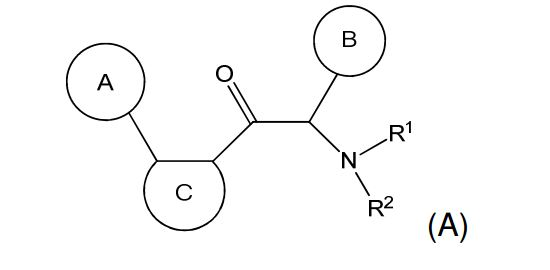
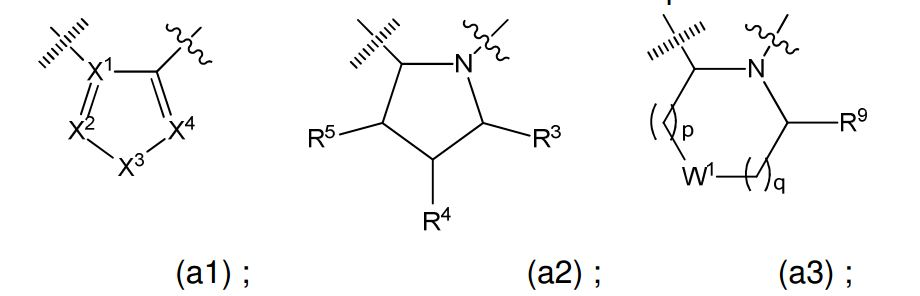
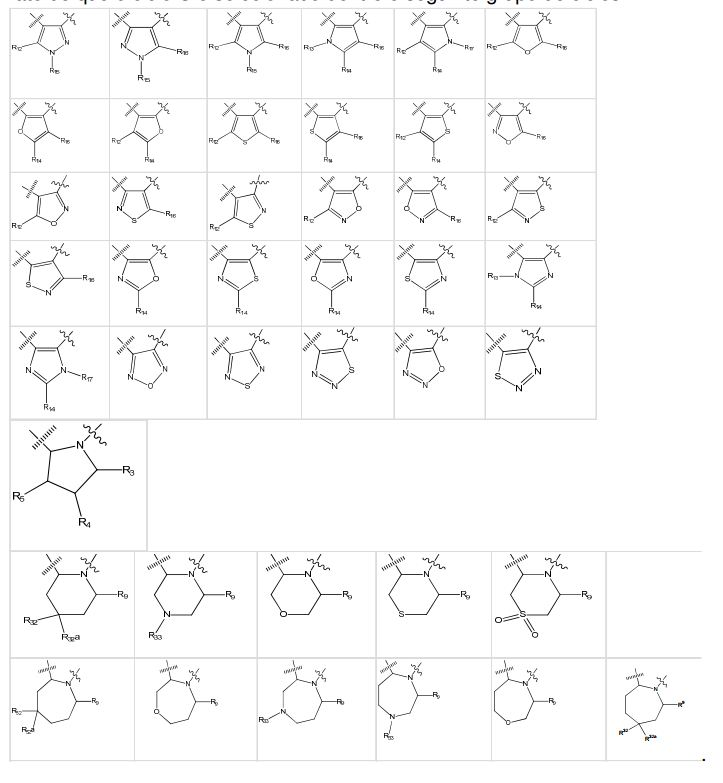


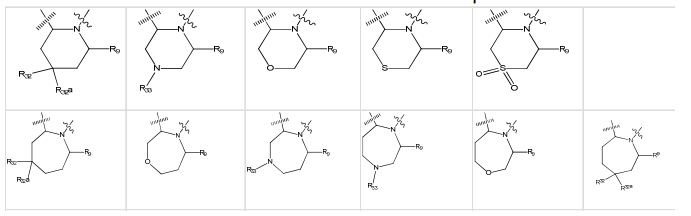




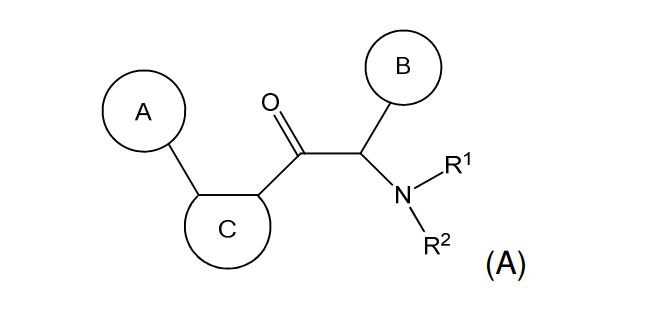
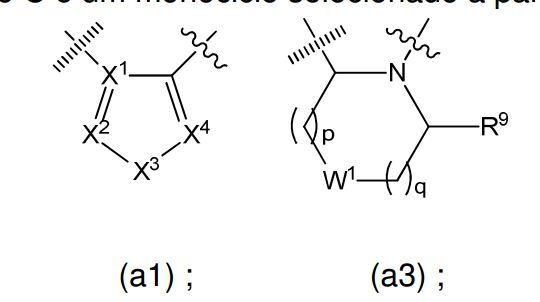
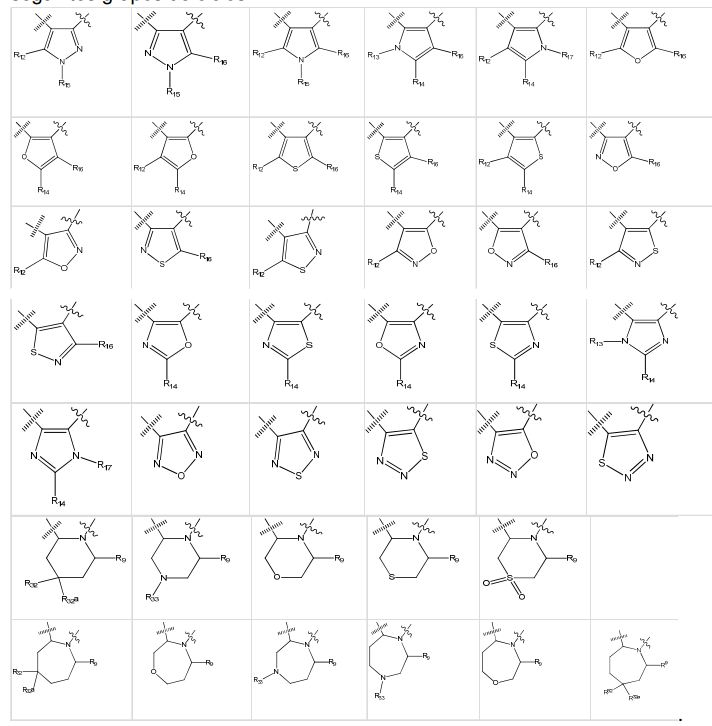


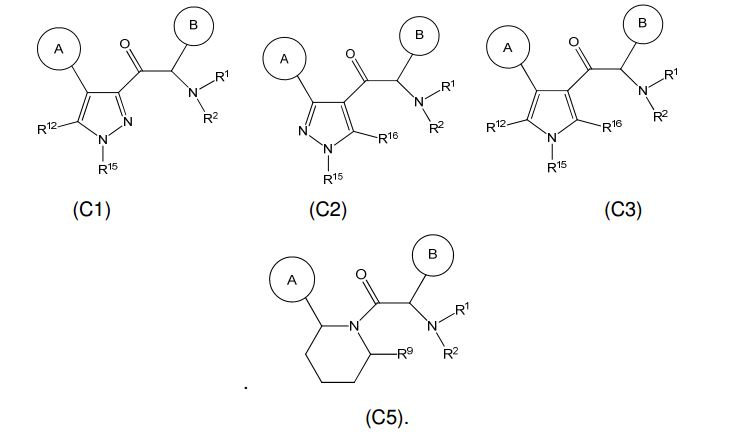
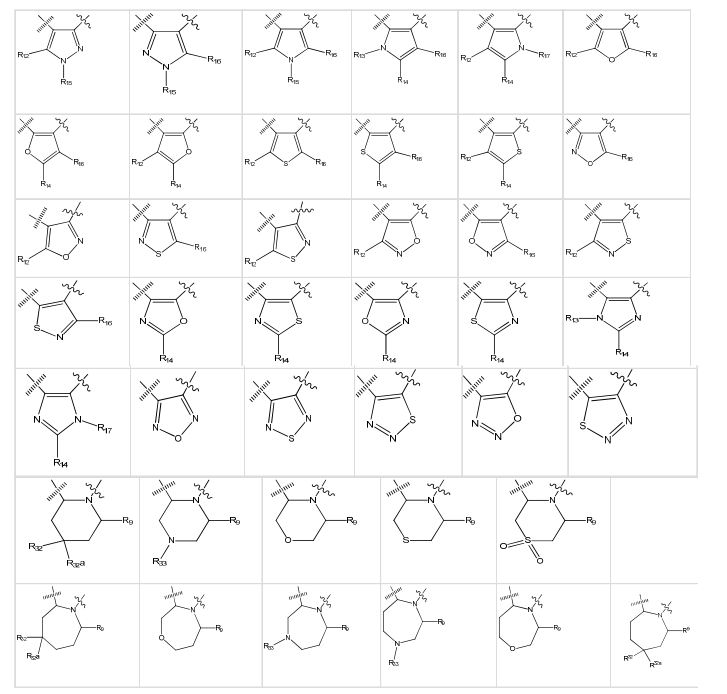

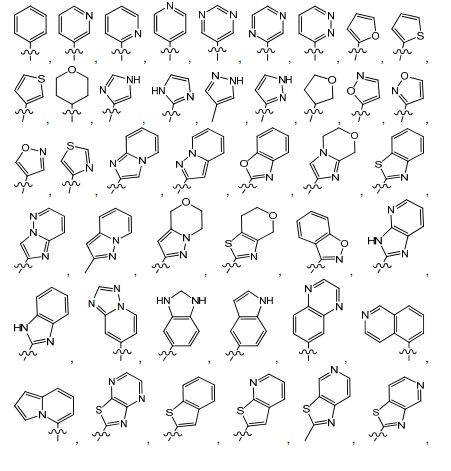
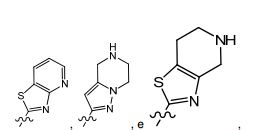
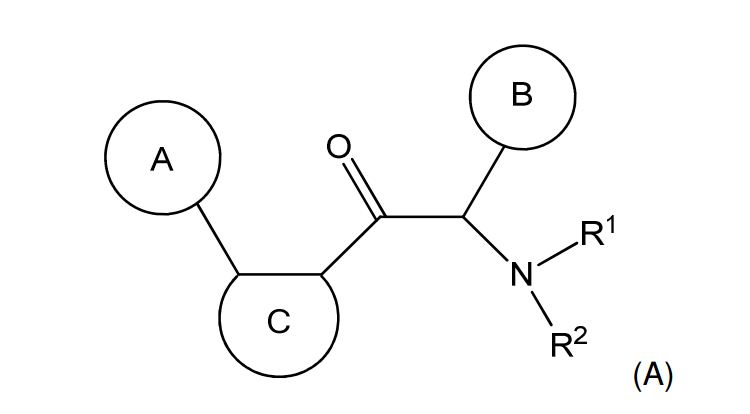


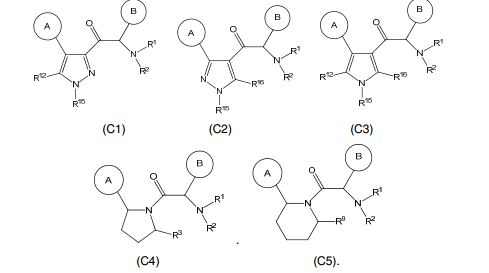

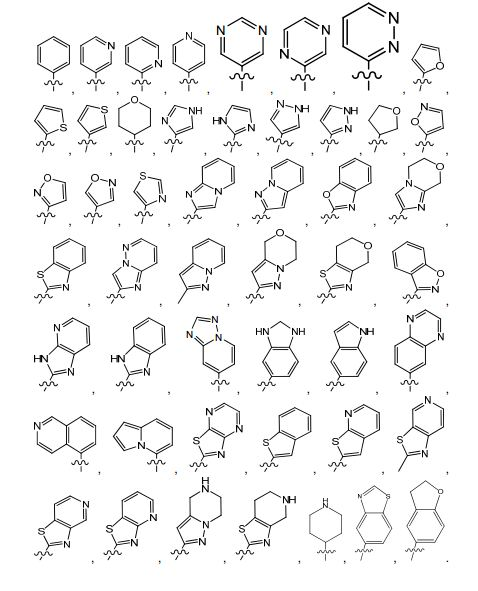
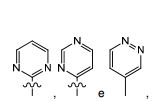
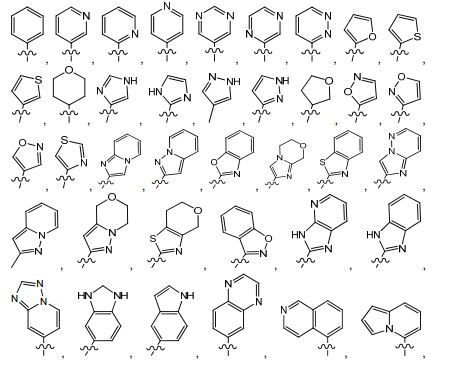
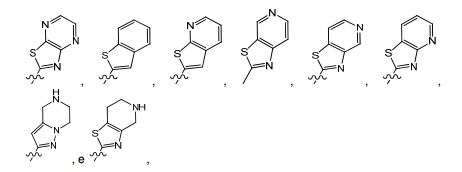


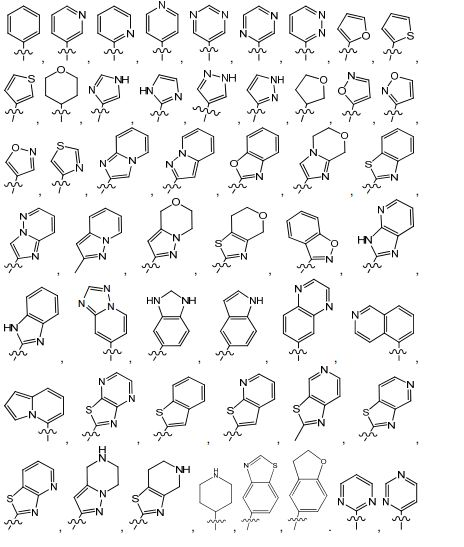

[0016] Um exemplo de realização específico da invenção é o fornecimento de novos compostos de fórmula geral (Bi), (B2) e (B3),
[0017] Em outro exemplo de realização específico, os compostos possuem uma estrutura de acordo com a fórmula (A), em que o ciclo C é selecionado a partir dos seguintes grupos de ciclos
[0018] Ainda em outro exemplo de realização específico, os compostos possuem uma estrutura de acordo com a fórmula (A), em que o
[0019] Em outro exemplo de realização, X1 é C.[0019] In another example embodiment, X1 is C.
[0020] Em outro exemplo de realização específico, X2 é selecionado a partir de CR12; NR13; e N.[0020] In another specific embodiment example, X2 is selected from CR12; NR13; and N.
[0021] Em um exemplo de realização específico, R12 é selecionado a partir de hidrogênio; halogênio; trifluorometila; ciano; alquila e cicloalquila. Em um exemplo de realização mais específico, R12 é selecionado a partir de hidrogênio; halogênio; trifluorometila; ciano; alquila C1-6 e cicloalquila C3-7. Em um exemplo de realização mais específico, R12 é selecionado a partir de hidrogênio; F; Cl; trifluorometila; ciano; e alquila C1-3.[0021] In a specific exemplary embodiment, R12 is selected from hydrogen; halogen; trifluoromethyl; cyan; alkyl and cycloalkyl. In a more specific embodiment example, R12 is selected from hydrogen; halogen; trifluoromethyl; cyan; C1-6 alkyl and C3-7 cycloalkyl. In a more specific embodiment example, R12 is selected from hydrogen; F; Cl; trifluoromethyl; cyan; and C1-3 alkyl.
[0022] Em um exemplo de realização específico, R13 é selecionado a partir de hidrogênio; alquila; e cicloalquila. Em um exemplo de realização mais específico, R13 é selecionado a partir de hidrogênio; alquila C1-6 e cicloalquila C3-7. Em um exemplo de realização mais específico, R13 é selecionado a partir de hidrogênio; e alquila C1-3; mais particularmente hidrogênio e metila.[0022] In a specific exemplary embodiment, R13 is selected from hydrogen; alkyl; and cycloalkyl. In a more specific embodiment, R13 is selected from hydrogen; C1-6 alkyl and C3-7 cycloalkyl. In a more specific embodiment, R13 is selected from hydrogen; and C1-3 alkyl; more particularly hydrogen and methyl.
[0023] Em outro exemplo de realização específico, X3 é selecionado a partir de CR14, NR15; e N.[0023] In another specific embodiment example, X3 is selected from CR14, NR15; and N.
[0024] Em um exemplo de realização específico, R14 é selecionado a partir de hidrogênio; halogênio; trifluorometila; ciano; alquila e cicloalquila. Em um exemplo de realização mais específico, R14 é selecionado a partir de hidrogênio; halogênio; trifluorometila; ciano; alquila C1-6 e cicloalquila C3-7. Em um exemplo de realização mais específico, R14 é selecionado a partir de hidrogênio; F; Cl; trifluorometila; ciano; e alquila C1-3.[0024] In a specific exemplary embodiment, R14 is selected from hydrogen; halogen; trifluoromethyl; cyan; alkyl and cycloalkyl. In a more specific embodiment example, R14 is selected from hydrogen; halogen; trifluoromethyl; cyan; C1-6 alkyl and C3-7 cycloalkyl. In a more specific embodiment example, R14 is selected from hydrogen; F; Cl; trifluoromethyl; cyan; and C1-3 alkyl.
[0025] Em um exemplo de realização específico, R15 é selecionado a partir de hidrogênio; alquila; e cicloalquila. Em um exemplo de realização mais específico, R15 é selecionado a partir de hidrogênio; alquila C1-6 e cicloalquila C3-7. Em um exemplo de realização mais específico, R15 é selecionado a partir de hidrogênio; e alquila C1-3; mais particularmente selecionados a partir de hidrogênio e metila.[0025] In a specific exemplary embodiment, R15 is selected from hydrogen; alkyl; and cycloalkyl. In a more specific embodiment, R15 is selected from hydrogen; C1-6 alkyl and C3-7 cycloalkyl. In a more specific embodiment, R15 is selected from hydrogen; and C1-3 alkyl; more particularly selected from hydrogen and methyl.
[0026] Em outro exemplo de realização específico, X4 é selecionado a partir de CR16, NR17; e N.[0026] In another specific embodiment example, X4 is selected from CR16, NR17; and N.
[0027] Em um exemplo de realização específico, R16 é selecionado a partir de hidrogênio; halogênio; trifluorometila; ciano; alquila e cicloalquila. Em um exemplo de realização mais específico, R16 é selecionado a partir de hidrogênio; halogênio; trifluorometila; ciano; alquila C1-6 e cicloalquila C3-7. Em um exemplo de realização mais específico, R16 é selecionado a partir de hidrogênio; F; Cl; trifluorometila; ciano; e alquila C1-3.[0027] In a specific exemplary embodiment, R16 is selected from hydrogen; halogen; trifluoromethyl; cyan; alkyl and cycloalkyl. In a more specific embodiment, R16 is selected from hydrogen; halogen; trifluoromethyl; cyan; C1-6 alkyl and C3-7 cycloalkyl. In a more specific embodiment, R16 is selected from hydrogen; F; Cl; trifluoromethyl; cyan; and C1-3 alkyl.
[0028] Em um exemplo de realização específico, R17 é selecionado a partir de hidrogênio; alquila; e cicloalquila. Em um exemplo de realização mais específico, R17 é selecionado a partir de hidrogênio; alquila C1-6 e cicloalquila C3-7. Em um exemplo de realização mais específico, R17 é selecionado a partir de hidrogênio; e alquila C1-3; mais particularmente selecionados a partir de hidrogênio e metila.[0028] In a specific embodiment, R17 is selected from hydrogen; alkyl; and cycloalkyl. In a more specific embodiment example, R17 is selected from hydrogen; C1-6 alkyl and C3-7 cycloalkyl. In a more specific embodiment example, R17 is selected from hydrogen; and C1-3 alkyl; more particularly selected from hydrogen and methyl.
[0029] Em um exemplo de realização específico, R3 é selecionado a partir de hidrogênio; alquila; heteroalquila; e =O. Em um exemplo de realização mais específico, R3 é selecionado a partir de hidrogênio e alquila; mais particularmente a partir de hidrogênio e alquila C1-6; ainda mais particularmente a partir de hidrogênio e alquila C1-3; ainda mais particularmente a partir de hidrogênio e metila. Em um exemplo de realização específico, R3 é selecionado a partir de hidrogênio; alquilaC1-4; alcóxi C1-4 carbonila; aminocarbonila; alquilaminocarbonila C1-4; di(C1-4alquil)aminocarbonila; ou hidroximetila.[0029] In a specific exemplary embodiment, R3 is selected from hydrogen; alkyl; heteroalkyl; and =O. In a more specific embodiment, R3 is selected from hydrogen and alkyl; more particularly from hydrogen and C1-6 alkyl; even more particularly from hydrogen and C1-3 alkyl; even more particularly from hydrogen and methyl. In a specific exemplary embodiment, R3 is selected from hydrogen; C1-4alkyl; C1-4alkoxycarbonyl; aminocarbonyl; C1-4 alkylaminocarbonyl; di(C1-4alkyl)aminocarbonyl; or hydroxymethyl.
[0030] Em um exemplo de realização específico, cada R4 e R5 é selecionado independentemente a partir de hidrogênio; halogênio; hidroxila; sulfidrila; trifluorometila; trifluorometóxi; ciano; alquila; alquenila; alquinila; heteroalquila; heteroalquenila; e heteroalquinila. Em um exemplo de realização mais específico, cada R4 e R5 é selecionado independentemente a partir de hidrogênio; halogênio; e alquila. Em um exemplo de realização mais específico, cada R4 e R5 são selecionados independentemente a partir de hidrogênio; F; Cl; e alquila C1-6 (mais particularmente alquila C1-3, mais particularmente metila). Em um exemplo de realização mais específico, pelo menos um dentre R4 e R5 é hidrogênio. Em um exemplo de realização específico, cada R4 e R5 são selecionados independentemente a partir de hidrogênio; halogênio; alquilaC1-4; alcóxi C1-4 ; ciano; hidroxi; C1-4alquiltio; trifluorometila; amina; alquilaC1-4mino; di(C1-4alquil)amina; carboxi; alcóxi C1-4 carbonila; C1-4alquilsulfonila; alcóxi C1-4 carbonilamina; trifluorometanosulfonila; trifluorometóxi; e hidroxialquilaC1-4; desde que um dentre R4 e R5 seja hidrogênio.[0030] In a specific exemplary embodiment, each R4 and R5 is independently selected from hydrogen; halogen; hydroxyl; sulfhydryl; trifluoromethyl; trifluoromethoxy; cyan; alkyl; alkenyl; alkynyl; heteroalkyl; heteroalkenyl; and heteroalkynyl. In a more specific embodiment, each R4 and R5 is independently selected from hydrogen; halogen; and rent. In a more specific embodiment, each R4 and R5 are independently selected from hydrogen; F; Cl; and C1-6 alkyl (more particularly C1-3 alkyl, more particularly methyl). In a more specific embodiment, at least one of R4 and R5 is hydrogen. In a specific exemplary embodiment, each R4 and R5 are independently selected from hydrogen; halogen; C1-4alkyl; C1-4alkoxy; cyan; hydroxy; C1-4alkylthio; trifluoromethyl; the mine; C1-4alkylamino; di(C1-4alkyl)amine; carboxy; C1-4alkoxycarbonyl; C1-4alkylsulfonyl; C1-4alkoxycarbonylamine; trifluoromethanesulfonyl; trifluoromethoxy; and hydroxyC1-4alkyl; provided that one of R4 and R5 is hydrogen.
[0031] Em um exemplo de realização específico, R9 é selecionado a partir de hidrogênio; alquila; heteroalquila; e =O. Em um exemplo de realização mais específico, R9 é selecionado a partir de hidrogênio e alquila; mais particularmente a partir de hidrogênio e alquila C1-6; ainda mais particularmente a partir de hidrogênio e alquila C1-3; ainda mais particularmente a partir de hidrogênio e metila.[0031] In a specific exemplary embodiment, R9 is selected from hydrogen; alkyl; heteroalkyl; and =O. In a more specific embodiment, R9 is selected from hydrogen and alkyl; more particularly from hydrogen and C1-6 alkyl; even more particularly from hydrogen and C1-3 alkyl; even more particularly from hydrogen and methyl.
[0032] Em um exemplo de realização específico, W1 é selcionado a partir de CR32R32a e NR33. Em outro exemplo de realização específico, W1 é selecionado a partir de CHR32a e NR33. Em outro exemplo de realização específico, W1 é selecionado a partir de CH2 e NH.[0032] In a specific exemplary embodiment, W1 is selected from CR32R32a and NR33. In another specific embodiment, W1 is selected from CHR32a and NR33. In another specific embodiment, W1 is selected from CH2 and NH.
[0033] Em um exemplo de realização específico, cada R32 e R32a são selecionados independentemente a partir de hidrogênio; halogênio; hidroxila; sulfidrila; trifluorometila; trifluorometóxi; ciano; alquila; alquenila; alquinila; heteroalquila; heteroalquenila; e heteroalquinila.[0033] In a specific exemplary embodiment, each R32 and R32a are independently selected from hydrogen; halogen; hydroxyl; sulfhydryl; trifluoromethyl; trifluoromethoxy; cyan; alkyl; alkenyl; alkynyl; heteroalkyl; heteroalkenyl; and heteroalkynyl.
[0034] Em um exemplo de realização específico, está previsto que um dentre R32 ou R32a é hidrogênio, exceto pelo fato de que R32 ou R32a podem ser alquila ao mesmo tempo.[0034] In a specific embodiment, it is provided that one of R32 or R32a is hydrogen, except that R32 or R32a can be alkyl at the same time.
[0035] Em um exemplo de realização mais específico, cada R32 e R32a são selecionados independentemente a partir de hidrogênio; halogênio; e alquila. Em um exemplo de realização mais específico, cada R32 e R32a são selecionados independentemente a partir de hidrogênio; F; Cl; e alquila C1-6 (mais particularmente alquila C1-3, mais particularmente metila). Em um exemplo de realização mais específico, pelo menos um dentre R32 e R32a é hidrogênio.[0035] In a more specific embodiment, each R32 and R32a are independently selected from hydrogen; halogen; and rent. In a more specific exemplary embodiment, R32 and R32a are each independently selected from hydrogen; F; Cl; and C1-6 alkyl (more particularly C1-3 alkyl, more particularly methyl). In a more specific embodiment, at least one of R32 and R32a is hydrogen.
[0036] Em um exemplo de realização específico, R33 é selecionado independentemente a partir de hidrogênio e alquila. Em um exemplo de realização específico, R33 é selecionado independentemente a partir de hidrogênio e alquila C1-6 (mais particularmente alquila C1-3, mais particularmente metila).[0036] In a specific exemplary embodiment, R33 is independently selected from hydrogen and alkyl. In a specific exemplary embodiment, R33 is independently selected from hydrogen and C1-6 alkyl (more particularly C1-3 alkyl, more particularly methyl).
[0037] Em um exemplo de realização específico, p e q são 1.[0037] In a specific embodiment example, p and q are 1.
[0038] Ainda em outro exemplo de realização específico, os compostos possuem uma estrutura de acordo com a fórmula (C1), (C2), (C3),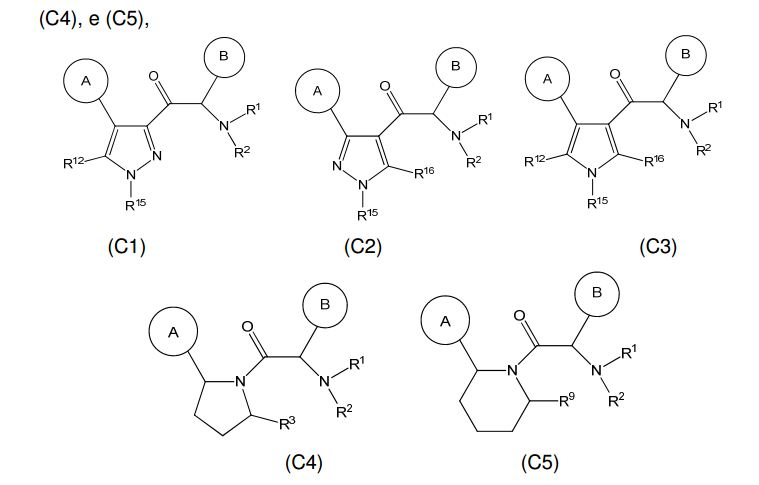
[0039] Ainda em outro exemplo de realização específico, os estrutura de acordo com a fórmula (D1), (D2), (D3),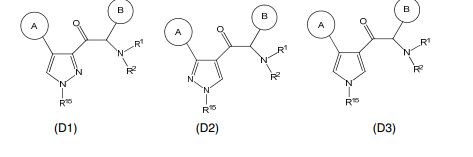

[0040] Em um exemplo de realização específico, o ciclo A é selecionado a partir do grupo consistindo de cicloalquila; cicloalquenila; cicloalquinila; arila; e heterociclo; em que a referida cicloalquila, cicloalquenila, cicloalquinila, arila e heterociclo, podem ser não substituídas ou substituídas com um, dois ou três substituintes (mais particularmente um ou dois substituintes) selecionados a partir de alquila, cicloalquila, alquenila, cicloalquenila, alquinila, cicloalquinila, heteroalquila, heteroalquenila, heteroalquinila, hidroxila, =O, halogênio, -SH, =S, trifluorometila, -OCF3, ciano, nitro, -C(O)OH , NH2, NH(alquil), ou N(alquil)2. Em outro exemplo de realização específico, o ciclo A é selecionado a partir do grupo consistindo de arila; e heterociclo (mais particularmente heteroaril); em que a referida arila e heterociclo (mais particularmente heteroaril), podem ser não substituídas ou substituídas com um, dois ou três substituintes (mais particularmente um ou dois substituintes) selecionados a partir de alquila, cicloalquila, alquenila, cicloalquenila, alquinila, cicloalquinila, heteroalquila, heteroalquenila, heteroalquinila, hidroxila, =O, halogênio, -SH, =S, trifluorometila, - OCF3, ciano, nitro, -C(O)OH , NH2, NH(alquil), ou N(alquil)2.
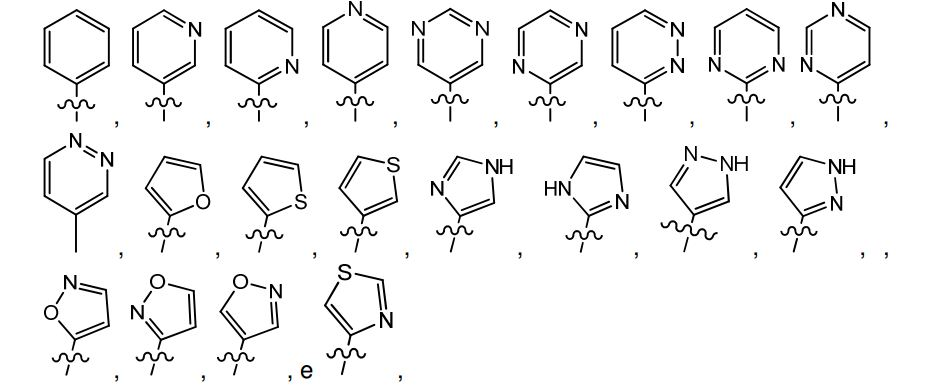
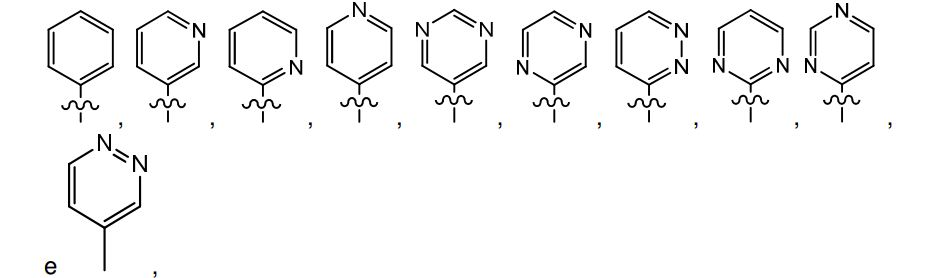
[0041] Em outro exemplo de realização específico, ciclo B é selecionado a partir de substituído ou não substituído com um ou mais Z1a (particularmente um, dois ou três Z1a) fenila; piridil, piridazinila, pirimidinila, pirazinila, triazinila, oxazolila, imidazolila, tiazolila, isoxazolila, pirazolila, isotiazolila, furila, tienila, pirrolila, benzofuranila, indolila, quinolinila, isoquinolinila, benzimidazolila, piridinimidazolila, piridinpirolila, pirazolpiridinila, benzpirolila, triazinila, purinila, quinoxalinila, quinazolinila, dihidroimidazo- oxazinila e pteridinila. Ainda em outro exemplo de realização específico, ciclo B é selecionado a partir de substituído ou não substituído com um ou mais Z1a (particularmente um, dois ou três Z1a) fenila; e piridila. Em outro exemplo de realização específico, ciclo B é um heterociclo que pode ser não substituído ou substituído com um ou mais Z1a (particularmente um, dois ou três Z1a). Em outro exemplo de realização específico, ciclo B é selecionado a partir de substituído ou não substituído com um ou mais Z1a (particularmente um, dois ou três Z1a) arila e heteroarila. Em um exemplo de realização mais específico ciclo B é uma heteroarila que pode ser substituída ou não substituída com um ou mais Z1a (particularmente um, dois ou três Z1a). Em um exemplo de realização ainda mais específico, ciclo B é selecionado a partir de substituído ou não substituído com um ou mais Z1a (particularmente um, dois ou três Z1a) piridil, piridazinila, pirimidinila, pirazinila, triazinila, oxazolila, imidazolila, tiazolila, isoxazolila, pirazolila, isotiazolila, furila, tienila, pirrolila, benzofuranila, indolila, quinolinila, isoquinolinila, benzimidazolila, piridinimidazolila, piridinpirolila, pirazolpiridinila, benzpirolila, triazinila, purinila, quinoxalinila, quinazolinila, e pteridinila. Em um exemplo de realização ainda mais específico, ciclo B é selecionado a partir de substituído ou não substituído com um ou mais Z1a (particularmente um, dois ou três Z1a) piridil, pirazinila, pirimidil, imidazolila, isoxazolila, pirazolila, furila, tienila, isoquinolinila, benzimidazolila, piridinimidazolila, benzopirolila, pirazolpiridinila e quinoxalinila. Em um exemplo de realização específico, ciclo B não é uma fenila não substituída.[0041] In another specific embodiment example, cycle B is selected from substituted or unsubstituted with one or more Z1a (particularly one, two or three Z1a) phenyl; pyridyl, pyridazinyl, pyrimidinyl, pyrazinyl, triazinyl, oxazolyl, imidazolyl, thiazolyl, isoxazolyl, pyrazolyl, isothiazolyl, furyl, thienyl, pyrrolyl, benzofuranyl, indolyl, quinolinyl, isoquinolinyl, benzimidazolyl, pyridinimidazolyl, pyridinpyrolyl, pyrazolpyridinyl, benzpyrolyl, purinyl, triazinyl, quinoxalinyl, quinazolinyl, dihydroimidazooxazinyl and pteridinyl. In yet another specific embodiment, cycle B is selected from substituted or unsubstituted with one or more Z1a (particularly one, two or three Z1a) phenyl; and pyridyl. In another specific embodiment, cycle B is a heterocycle which may be unsubstituted or substituted with one or more Z1a (particularly one, two or three Z1a). In another specific embodiment, cycle B is selected from substituted or unsubstituted with one or more Z1a (particularly one, two or three Z1a) aryl and heteroaryl. In a more specific embodiment, cycle B is a heteroaryl which may be substituted or unsubstituted with one or more Z1a (particularly one, two or three Z1a). In an even more specific exemplary embodiment, cycle B is selected from substituted or unsubstituted with one or more Z1a (particularly one, two or three Z1a) pyridyl, pyridazinyl, pyrimidinyl, pyrazinyl, triazinyl, oxazolyl, imidazolyl, thiazolyl, isoxazolyl, pyrazolyl, isothiazolyl, furyl, thienyl, pyrrolyl, benzofuranyl, indolyl, quinolinyl, isoquinolinyl, benzimidazolyl, pyridinimidazolyl, pyridinpyrolyl, pyrazolpyridinyl, benzpyrolyl, triazinyl, purinyl, quinoxalinyl, quinazolinyl, and pteridinyl. In an even more specific exemplary embodiment, cycle B is selected from substituted or unsubstituted with one or more Z1a (particularly one, two or three Z1a) pyridyl, pyrazinyl, pyrimidyl, imidazolyl, isoxazolyl, pyrazolyl, furyl, thienyl, isoquinolinyl, benzimidazolyl, pyridinimidazolyl, benzopyrolyl, pyrazolpyridinyl and quinoxalinyl. In a specific exemplary embodiment, Cycle B is not an unsubstituted phenyl.
[0042] Em um exemplo de realização específico, ciclo B é selecionado a partir de arila e heterociclo, em que a referida arila e heterociclo são opcionalmente substituídos com um, dois, ou três Z1a; preferencialmente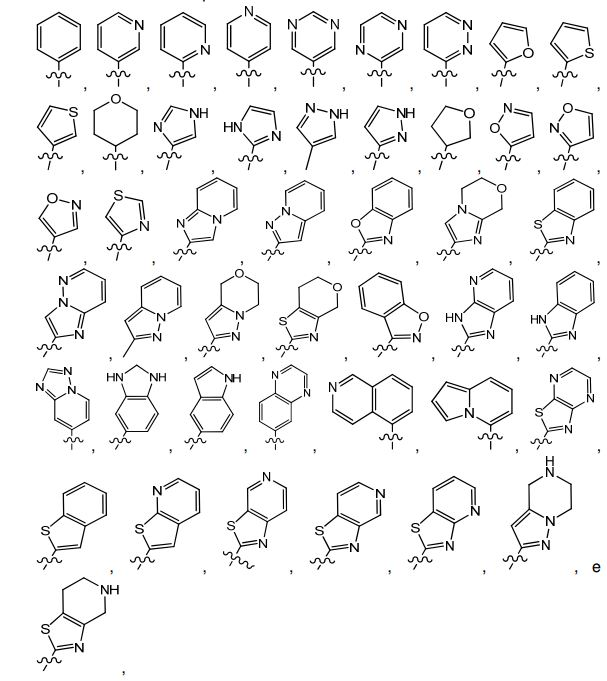
[0043] Em outro exemplo de realização, R2 é selecionado a partir de hidrogênio e não substituído ou substituído com um ou mais Z1c (particularmente um ou dois Z1c) alquila. Em outro exemplo de realização específico, R2 é selecionado a partir de hidrogênio e alquila (mais particularmente C1-3alquil). Ainda em outro exemplo de realização específico, R2 é selecionado a partir de hidrogênio, metila, etila, e propila.[0043] In another exemplary embodiment, R2 is selected from hydrogen and unsubstituted or substituted with one or more Z1c (particularly one or two Z1c) alkyl. In another specific embodiment, R2 is selected from hydrogen and alkyl (more particularly C1-3alkyl). In yet another specific embodiment, R2 is selected from hydrogen, methyl, ethyl, and propyl.
[0044] Em outro exemplo de realização, R1 é selecionado a partir de arila; heterociclo; arilalquila; arilalquenila; arilalquinila; heterociclo-alquila; heterociclo-alquenila; heterociclo-alquinila; arilheteroalquila; arilheteroalquenila; arilheteroalquinila; heterociclo-heteroalquila; heterociclo-heteroalquenila; heterociclo-heteroalquinila; e em que a referida arila, heterociclo, arilalquila, arilalquenila, arilalquinila, heterociclo-alquila, heterociclo-alquenila, heterociclo- alquinila, arilheteroalquila, arilheteroalquenila, arilheteroalquinila, heterociclo- heteroalquila, heterociclo-heteroalquenila e heterociclo-heteroalquinila podem ser não substituídos ou substituídos com um ou mais Z1b (particularmente um, dois ou três Z1b). Em outro exemplo de realização, R1 é selecionado a partir de arila; heterociclo; W-arila; e W-heterociclo; em que a referida arila, heterociclo, W-arila, e W-heterociclo podem ser não substituídos ou substituídos com um ou mais Z1b (particularmente um, dois ou três Z1b); e em que W é selecionado a partir de alquila C1-3, C1-3alquenila, C1-3alquinila, C1-3 heteroalquila, C1-3 heteroalquenila e C1-3 heteroalquinila. Em outro exemplo de realização específico, R1 é selecionado a partir de arila; heterociclo; W-arila; e W- heterociclo; em que a referida arila, heterociclo, W-arila, e W-heterociclo podem ser não substituídos ou substituídos com um ou mais Z1b (particularmente um, dois ou três Z1b); e em que W é selecionado a partir de alquila C1-3. Ainda em outro exemplo de realização específico, R1 é selecionado a partir de arila; heterociclo; -CH2-arila; e -CH2-heterociclo; em que a referida arila, heterociclo, -CH2-arila e -CH2-heterociclo podem ser não substituídos ou substituídos com um ou mais Z1b (particularmente um, dois ou três Z1b). Em outro exemplo de realização, R1 é selecionado a partir de arila; e heterociclo; em que a referida arila e heterociclo podem ser não substituídos ou substituídos com um ou mais Z1b (particularmente um, dois ou três Z1b). Em um exemplo de realização mais específico, R1 é selecionado a partir de fenila e piridil, não substituído ou substituído com um ou mais Z1b (particularmente um, dois ou três Z1b). Em um exemplo de realização ainda mais específico, R1 é selecionado a partir de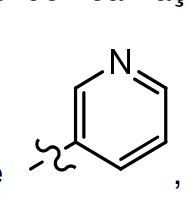
[0045] Em um exemplo de realização específico, cada Z1a, Z1b, e Z1c são selecionados independentemente a partir do grupo consistindo de halogênio, hidroxila, sulfidrila, -OZ2, -O-C(=O)Z3, =O, -SZ2, =S, -S(=O)Z2, - S(=O)2Z3, -S(=O)2NZ4Z5, trifluorometila, trifluorometóxi, nitro, -NZ4Z5, - NZ4S(=O)2Z2, -NZ4C(=O)Z2, -NZ4C(=O)-OZ2, -NZ4C(=O)NZ4Z5, ciano, -C(=O)Z3, -C(=O)OZ2, -C(=O)NZ4Z5, -C(=O)H, alquila C1-6, cicloalquila C3-7, alquenila C2-6, C3-7cicloalquenila, alquinila C2-6, C3-7cicloalquinila, heteroalquila C1-6, heteroalquenila C2-6, heteroalquinila C2-6, arila, heterociclo, arilalquila C1-6, arilalquenila C2-6, arilalquinila C2-6, arilheteroalquila C1-6, arilheteroalquenila C2-6, arilheteroalquinila C2-6, heterociclo-alquila C1-6, heterociclo-alquenila C2-6, heterociclo-alquinila C2-6, heterociclo-heteroalquila C1-6, heterociclo- heteroalquenila C2-6, e heterociclo-heteroalquinila C2-6; preferencialmente cada Z1a, Z1b, e Z1c são selecionados independentemente a partir do grupo consistindo de halogênio, hidroxila, sulfidrila, -OZ2, -O-C(=O)Z3, =O, -SZ2, =S, - S(=O)Z2, -S(=O)2Z3, -S(=O)2NZ4Z5, trifluorometila, trifluorometóxi, nitro, -NZ4Z5, -NZ4S(=O)2Z2, -NZ4C(=O)Z2, -NZ4C(=O)2Z2, -NZ4C(=O)NZ4Z5, ciano, -C(=O)Z3, -C(=O)OZ2, -C(=O)NZ4Z5, -C(=O)H, alquila C1-6, heteroalquila C1-6, arila, heterociclo, e heterociclo-alquila C1-6; mais preferencialmente cada Z1, Z1a, Z1b, e Z1c são selecionados independentemente a partir do grupo consistindo de halogênio, hidroxila, -OZ2, -O-C(=O)Z3, =O, -S(=O)2Z3, -S(=O)2NZ4Z5, trifluorometila, trifluorometóxi, -NZ4Z5, -NZ4C(=O)Z2, -NZ4C(=O)-OZ2, ciano, - C(=O)Z3, -C(=O)OZ2, -C(=O)NZ4Z5, alquila C1-6, heteroalquila C1-6, arila, heterociclo, e heterociclo-alquila C1-6; e em que a referida alquila C1-6, cicloalquila C3-7, alquenila C2-6, C3-7cicloalquenila, alquinila C2-6, C3-7cicloalquinila, heteroalquila C1-6, heteroalquenila C2-6, heteroalquinila C2-6, arila, heterociclo, arilalquila C1-6, arilalquenila C2-6, arilalquinila C2-6, arilheteroalquila C1-6, arilheteroalquenila C2-6, arilheteroalquinila C2-6, heterociclo-alquila C1-6, heterociclo-alquenila C2-6, heterociclo-alquinila C2-6, heterociclo-heteroalquila C1-6, heterociclo- heteroalquenila C2-6, e heterociclo-heteroalquinila C2-6, são opcionalmente substituídos com um, dois, ou três substituintes selecionados a partir de alquila C1-6, cicloalquila C3-7, alquenila C2-6, C3-7cicloalquenila, alquinila C2-6, C3- 7cicloalquinila, heteroalquila C1-6, heteroalquenila C2-6, heteroalquinila C2-6, hidroxila, =O, halogênio, -SH, =S, trifluorometila, -OCF3, -O-C(O)Me, ciano, nitro, -C(O)OH, -C(O)Oalquila C1-6, -NH2, -NHCH3; -N(CH3)2, -NH-C(=O)O- alquilaCi-4, morfolinila, -S(O)2alquilaCi-4, e -O-alquila Ci-β; preferencialmente a referida alquila C1-6, heteroalquila C1-6, arila, heterociclo, e heterociclo-alquila Ci-6, são opcionalmente substituídos com um, dois, ou três substituintes selecionados a partir de hidroxila, =O, halogênio, -SH, =S, trifluorometila, - OCF3, -O-C(O)Me, ciano, nitro, -C(O)OH, -C(O)Oalquila Ci-6, -NH2, -NHCH3; - N(CH3)2, -NH-C(=O)O-alquilaCi-4, morfolinila, -S(O)2alquilaCi-4, e -O-alquila Ci- 6; mais preferencialmente a referida alquila Ci-6, arila, e heterociclo são opcionalmente substituídos com um, dois, ou três substituintes selecionados a partir de hidroxila, =O, -O-C(O)Me, ciano, -C(O)OH, -C(O)Oalquila Ci-6, -NH2, - NHCH3; -N(CH3)2, -NH-C(=O)O-alquilaCi-4, morfolinila, -S(O)2alquilaCi-4, e -O- C1-6alquila.[0045] In a specific exemplary embodiment, each Z1a, Z1b, and Z1c are independently selected from the group consisting of halogen, hydroxyl, sulfhydryl, -OZ2, -O-C(=O)Z3, =O, -SZ2, = S, -S(=O)Z2, -S(=O)2Z3, -S(=O)2NZ4Z5, trifluoromethyl, trifluoromethoxy, nitro, -NZ4Z5, -NZ4S(=O)2Z2, -NZ4C(=O)Z2 , -NZ4C(=O)-OZ2, -NZ4C(=O)NZ4Z5, cyan, -C(=O)Z3, -C(=O)OZ2, -C(=O)NZ4Z5, -C(=O) H, C1-6 alkyl, C3-7 cycloalkyl, C2-6 alkenyl, C3-7cycloalkenyl, C2-6 alkylkynyl, C3-7cycloalkynyl, C1-6 heteroalkyl, C2-6 heteroalkenyl, C2-6 heteroalkynyl, aryl, heterocycle, arylalkyl C1-6, arylC2-6alkenyl, arylC2-6alkynyl, arylheteroC1-6alkyl, arylheteroalkenyl C2-6, arylheteroalkynyl C2-6, heterocyclo-C1-6alkyl, heterocyclo-C2-6alkenyl, heterocyclo-C2-6alkynyl, C1-6 heterocycloheteroalkyl, C2-6 heterocycleheteroalkenyl, and C2-6 heterocycleheteroalkynyl; preferably each Z1a, Z1b, and Z1c are independently selected from the group consisting of halogen, hydroxyl, sulfhydryl, -OZ2, -O-C(=O)Z3, =O, -SZ2, =S, -S(=O)Z2 , -S(=O)2Z3, -S(=O)2NZ4Z5, trifluoromethyl, trifluoromethoxy, nitro, -NZ4Z5, -NZ4S(=O)2Z2, -NZ4C(=O)Z2, -NZ4C(=O)2Z2, -NZ4C(=O)NZ4Z5, cyano, -C(=O)Z3, -C(=O)OZ2, -C(=O)NZ4Z5, -C(=O)H, C1-6 alkyl, C1 heteroalkyl- 6, aryl, heterocycle, and heterocycle-C1-6 alkyl; more preferably each Z1, Z1a, Z1b, and Z1c are independently selected from the group consisting of halogen, hydroxyl, -OZ2, -O-C(=O)Z3, =O, -S(=O)2Z3, -S(= O)2NZ4Z5, trifluoromethyl, trifluoromethoxy, -NZ4Z5, -NZ4C(=O)Z2, -NZ4C(=O)-OZ2, cyano, -C(=O)Z3, -C(=O)OZ2, -C(= O)NZ4Z5, C1-6alkyl, C1-6heteroalkyl, aryl, heterocycle, and heterocycleC1-6alkyl; and wherein said C1-6 alkyl, C3-7 cycloalkyl, C2-6 alkenyl, C3-7cycloalkenyl, C2-6 alkylkynyl, C3-7cycloalkynyl, C1-6 heteroalkyl, C2-6 heteroalkenyl, C2-6 heteroalkynyl, aryl, heterocycle, arylC1-6alkyl, arylC2-6alkenyl, arylC2-6alkynyl, arylheteroC1-6alkyl, arylheteroC2-6alkenyl, arylheteroalkynyl C2-6, heterocycle C1-6 alkyl, heterocycle C2-6 alkenyl, heterocycle C2 alkynyl -6, C1-6 heterocycloheteroalkyl, C2-6 heterocycloheteroalkenyl, and C2-6 heterocycloheteroalkylkynyl, are optionally substituted with one, two, or three substituents selected from C1-6 alkyl, C3-7 cycloalkyl, C2-6 alkenyl, C3-7cycloalkenyl, C2-6 alkynyl, C3-7cycloalkynyl, C1-6 heteroalkyl, C2-6 heteroalkenyl, C2-6 heteroalkynyl, hydroxyl, =O, halogen, -SH, =S, trifluoromethyl, -OCF3 , -O-C(O)Me, cyano, nitro, -C(O)OH, -C(O)OC 1-6 alkyl, -NH2, -NHCH3; -N(CH3)2, -NH-C(=O)O-C1-4 alkyl, morpholinyl, -S(O)2C1-4 alkyl, and -O-C1-β alkyl; preferably said C1-6 alkyl, C1-6 heteroalkyl, aryl, heterocycle, and C1-6 heterocycle alkyl, are optionally substituted with one, two, or three substituents selected from hydroxyl, =O, halogen, -SH, =S, trifluoromethyl, -OCF3, -O-C(O)Me, cyano, nitro, -C(O)OH, -C(O)OC1-6 alkyl, -NH2, -NHCH3; - N(CH3)2, -NH-C(=O)O-C1-4 alkyl, morpholinyl, -S(O)2C1-4 alkyl, and -O-C1-6 alkyl; more preferably said C1-6 alkyl, aryl, and heterocycle are optionally substituted with one, two, or three substituents selected from hydroxyl, =O, -O-C(O)Me, cyano, -C(O)OH, - C(O)OC1-6 alkyl, -NH2, -NHCH3; -N(CH3)2, -NH-C(=O)O-C1-4alkyl, morpholinyl, -S(O)2C1-4alkyl, and -O-C1-6alkyl.
[0046] Em um exemplo de realização específico, cada Z2 é selecionado independentemente a partir de alquila Ci-6, cicloalquila C3-7, alquenila C2-6, C3-7cicloalquenila, alquinila C2-6, C3-7cicloalquinila, heteroalquila Ci-6, heteroalquenila C2-6, heteroalquinila C2-6, arila, heterociclo, arilalquila Ci-6, arilalquenila C2-6, arilalquinila C2-6, arilheteroalquila Ci-6 , arilheteroalquenila Ci- 6, arilheteroalquinila Ci-6, heterociclo-alquila Ci-6, heterociclo-alquenila C2-6, heterociclo-alquinila C2-6, heterociclo-heteroalquila Ci-6, heterociclo- heteroalquenila C2-6, e heterociclo-heteroalquinila C2-6; preferencialmente Z2 é selecionado independentemente a partir de alquila Ci-6, arila, heterociclo, e heterociclo-alquila Ci-6; mais preferencialmente Z2 é selecionado independentemente a partir de alquila Ci-6, arila, e heterociclo-alquila Ci-6; em que a referida alquila Ci-6, cicloalquila C3-7, alquenila C2-6, C3- 7cicloalquenila, alquinila C2-6, C3-7cicloalquinila, heteroalquila Ci-6, heteroalquenila C2-6, heteroalquinila C2-6, arila, heterociclo, arilalquila Ci-6, arilalquenila C2-6, arilalquinila C2-6, arilheteroalquila Ci-6, arilheteroalquenila C2-6, arilheteroalquinila C2-6, heterociclo-alquila Ci-6, heterociclo-alquenila C2-6, heterociclo-alquinila C2-6, heterociclo-heteroalquila Ci-6, heterociclo- heteroalquenila C2-6, e heterociclo-heteroalquinila C2-6, são opcionalmente substituídos com um, dois, ou três substituintes selecionados a partir de alquila Ci-6, alquenila C2-6, alquinila C2-6, hidroxila, =O, halogênio, -SH, =S, trifluorometila, difluorometila, -O-alquila Ci-6, -OCF3, -S(=O)2alquilaCi-4, ciano, nitro, -C(=O)OH, -C(=O)O-alquilaCi-4, -NH2, -N(CH3)2, pirrolidinila, piperidinila, e piperazinila; preferencialmente a referida alquila Ci-6, arila, heterociclo, e heterociclo-alquila Ci-6, são opcionalmente substituídos com um, dois, ou três substituintes selecionados a partir de hidroxila, =O, halogênio, -SH, =S, trifluorometila, difluorometila, -O-alquila Ci-6, -OCF3, -S(=O)2alquilaCi-4, ciano, nitro, -C(=O)OH, -C(=O)O-alquilaC1-4, -NH2, -N(CH3)2, pirrolidinila, piperidinila, e piperazinila; mais preferencialmente a referida alquila C1-6, e arila, são opcionalmente substituídas com um, dois, ou três substituintes selecionados a partir de hidroxila, halogênio, difluorometila, -O-alquila C1-6, -S(=O)2alquilaC1-4, - C(=O)OH, -C(=O)O-alquilaC1-4, -NH2, -N(CH3)2, pirrolidinila, piperidinila, e piperazinila.[0046] In a specific exemplary embodiment, each Z2 is independently selected from C1-6 alkyl, C3-7 cycloalkyl, C2-6 alkenyl, C3-7cycloalkenyl, C2-6 alkynyl, C3-7cycloalkynyl, C1-6 heteroalkyl , C2-6 heteroalkenyl, C2-6 heteroalkynyl, aryl, heterocycle, arylC1-6 alkyl, arylC2-6alkenyl, arylC2-6alkynyl, arylheteroC1-6 alkyl, arylheteroC1-6 alkyl, arylheteroC1-6 alkyl, heterocycleC1-6 alkyl 6, C2-6 heterocycloalkenyl, C2-6 heterocycloalkynyl, C2-6 heterocycloheteroalkyl, C2-6 heterocycloheteroalkenyl, and C2-6 heterocycloheteroalkynyl; preferably Z2 is independently selected from C1-6 alkyl, aryl, heterocycle, and heterocycle C1-6 alkyl; more preferably Z2 is independently selected from C1-6 alkyl, aryl, and heterocyclo-C1-6 alkyl; wherein said C1-6 alkyl, C3-7 cycloalkyl, C2-6 alkenyl, C3-7cycloalkenyl, C2-6 alkylkynyl, C3-7cycloalkynyl, C1-6 heteroalkyl, C2-6 heteroalkenyl, C2-6 heteroalkynyl, aryl, heterocycle , arylC1-6 alkyl, arylC2-6 arylalkenyl, arylC2-6 alkynyl, arylheteroC1-6 alkyl, arylheteroC2-6alkenyl, arylheteroalkynyl C2-6, heterocycloC1-6 alkyl, heterocycleC2-6alkenyl, heterocycleC2-alkynyl C1-6 heterocycloheteroalkyl, C2-6 heterocycloheteroalkenyl, and C2-6 heterocycloheteroalkynyl, are optionally substituted with one, two, or three substituents selected from C1-6 alkyl, C2-6 alkenyl, alkynyl C2-6, hydroxy, =O, halogen, -SH, =S, trifluoromethyl, difluoromethyl, -O-C1-6 alkyl, -OCF3, -S(=O)2C1-4 alkyl, cyano, nitro, -C(= O)OH, -C(=O)O-C1-4 alkyl, -NH2, -N(CH3)2, pyrrolidinyl, piperidinyl, and piperazinyl; preferably said C1-6 alkyl, aryl, heterocycle, and heterocycle C1-6 alkyl, are optionally substituted with one, two, or three substituents selected from hydroxyl, =O, halogen, -SH, =S, trifluoromethyl, difluoromethyl, -O-C1-6 alkyl, -OCF3, -S(=O)2C1-4 alkyl, cyano, nitro, -C(=O)OH, -C(=O)O-C1-4 alkyl, -NH2, -N(CH3)2, pyrrolidinyl, piperidinyl, and piperazinyl; more preferably said C1-6 alkyl, and aryl, are optionally substituted with one, two, or three substituents selected from hydroxyl, halogen, difluoromethyl, -O-C1-6 alkyl, -S(=O)2C1-4 alkyl , -C(=O)OH, -C(=O)O-C1-4alkyl, -NH2, -N(CH3)2, pyrrolidinyl, piperidinyl, and piperazinyl.
[0047] Em um exemplo de realização específico, cada Z3 é selecionado independentemente a partir de hidroxila, alquila C1-6, cicloalquila C3-7, alquenila C2-6, C3-7cicloalquenila, alquinila C2-6, C3-7cicloalquinila, heteroalquila C1-6, heteroalquenila C2-6, heteroalquinila C2-6, arila, heterociclo, arilalquila C1-6, arilalquenila C2-6, arilalquinila C2-6, arilheteroalquila C1-6, arilheteroalquenila C2-6, arilheteroalquinila C2-6, heterociclo-alquila C1-6, heterociclo-alquenila C2-6, heterociclo-alquinila C2-6, heterociclo-heteroalquila C1-6, heterociclo-heteroalquenila C2-6, e heterociclo-heteroalquinila C2-6; preferencialmente Z3 é selecionado independentemente a partir de hidroxila, alquila C1-6, arila, e heterociclo; mais preferencialmente Z3 é selecionado independentemente a partir de hidroxila, alquila C1-6, e heterociclo; em que a referida alquila C1-6, cicloalquila C3-7, alquenila C2-6, C3- 7cicloalquenila, alquinila C2-6, C3-7cicloalquinila, heteroalquila C1-6, heteroalquenila C2-6, heteroalquinila C2-6, arila, heterociclo, arilalquila C1-6, arilalquenila C2-6, arilalquinila C2-6, arilheteroalquila C1-6, arilheteroalquenila C2-6, arilheteroalquinila C2-6, heterociclo-alquila C1-6, heterociclo-alquenila C2-6, heterociclo-alquinila C2-6, heterociclo-heteroalquila C1-6, heterociclo- heteroalquenila C2-6, e heterociclo-heteroalquinila C2-6, são opcionalmente substituídos com um, dois, ou três substituintes selecionados a partir de alquila C1-6, alquenila C2-6, alquinila C2-6, hidroxila, =O, halogênio, -SH, =S, trifluorometila, -O-alquila C1-6, -OCF3, ciano, nitro, -C(=O)OH, -NH2, e -N(CH3)2; preferencialmente a referida alquila C1-6, arila, e heterociclo são opcionalmente substituídos com um, dois, ou três substituintes selecionados a partir de alquila C1-6 e -N(CH3)2; mais preferencialmente a referida alquila C1-6 e heterociclo são opcionalmente substituídos com um, dois, ou três substituintes selecionados a partir de alquila C1-6 e -N(CH3)2.[0047] In a specific exemplary embodiment, each Z3 is independently selected from hydroxyl, C1-6 alkyl, C3-7 cycloalkyl, C2-6 alkenyl, C3-7cycloalkenyl, C2-6 alkynyl, C3-7cycloalkynyl, C1 heteroalkyl -6, C2-6 heteroalkenyl, C2-6 heteroalkynyl, aryl, heterocycle, C1-6 arylalkyl, C2-6 arylalkenyl, C2-6 arylalkynyl, C1-6 arylheteroalkyl, C2-6 arylheteroalkenyl, C2-6 arylheteroalkynyl, heterocyclealkyl C1-6, C2-6 heterocycloalkenyl, C2-6 heterocycloalkynyl, C1-6 heterocycloheteroalkyl, C2-6 heterocycloheteroalkenyl, and C2-6 heterocycloheteroalkynyl; preferably Z3 is independently selected from hydroxyl, C1-6 alkyl, aryl, and heterocycle; more preferably Z3 is independently selected from hydroxyl, C1-6 alkyl, and heterocycle; wherein said C1-6 alkyl, C3-7 cycloalkyl, C2-6 alkenyl, C3-7cycloalkenyl, C2-6 alkynyl, C3-7cycloalkynyl, C1-6 heteroalkyl, C2-6 heteroalkenyl, C2-6 heteroalkynyl, aryl, heterocycle , arylC1-6alkyl, arylC2-6alkenyl, arylC2-6alkynyl, arylheteroC1-6alkyl, arylheteroalkenyl C2-6, arylheteroalkynyl C2-6, heterocycle C1-6 alkyl, heterocycle C2-6 alkenyl, heterocycle C2-alkynyl 6, C1-6 heterocycloheteroalkyl, C2-6 heterocycloheteroalkenyl, and C2-6 heterocycloheteroalkynyl, are optionally substituted with one, two, or three substituents selected from C1-6 alkyl, C2-6 alkenyl, alkynyl C2-6, hydroxyl, =O, halogen, -SH, =S, trifluoromethyl, -O-C1-6 alkyl, -OCF3, cyano, nitro, -C(=O)OH, -NH2, and -N(CH3) )two; preferably said C1-6 alkyl, aryl, and heterocycle are optionally substituted with one, two, or three substituents selected from C1-6 alkyl and -N(CH3)2; more preferably said C1-6 alkyl and heterocycle are optionally substituted with one, two, or three substituents selected from C1-6 alkyl and -N(CH3)2.
[0048] Em um exemplo de realização específico, cada Z4 e Z5 são selecionados independentemente a partir de hidrogênio, alquila C1-6, cicloalquila C3-7, alquenila C2-6, C3-7cicloalquenila, alquinila C2-6, C3- 7cicloalquinila, heteroalquila C1-6, heteroalquenila C2-6, heteroalquinila C2-6, arila, heterociclo, arilalquila C1-6, arilalquenila C2-6, arilalquinila C2-6, arilheteroalquila C1-6, arilheteroalquenila C2-6, arilheteroalquinila C2-6, heterociclo-alquila C1-6, heterociclo-alquenila C2-6, heterociclo-alquinila C2-6, heterociclo-heteroalquila C1-6, heterociclo-heteroalquenila C2-6, e heterociclo-heteroalquinila C2-6; preferencialmente cada Z4 e Z5 são selecionados independentemente a partir de hidrogênio, alquila C1-6, arila, cicloalquila C3-7, e heterociclo; mais preferencialmente cada Z4 e Z5 são selecionados independentemente a partir de hidrogênio, alquila C1-6, e cicloalquila C3-7; em que a referida alquila C1-6, alquila C1-6, cicloalquila C3-7, alquenila C2-6, C3-7cicloalquenila, alquinila C2-6, C3-7cicloalquinila, heteroalquila C1-6, heteroalquenila C2-6, heteroalquinila C2-6, arila, heterociclo, arilalquila C1-6, arilalquenila C2-6, arilalquinila C2-6, arilheteroalquila C1-6, arilheteroalquenila C2-6, arilheteroalquinila C2-6, heterociclo-alquila C1-6, heterociclo-alquenila C2-6, heterociclo-alquinila C2-6, heterociclo-heteroalquila C1-6, heterociclo- heteroalquenila C2-6, e heterociclo-heteroalquinila C2-6, são opcionalmente substituídos com um, dois, ou três substituintes selecionados a partir de alquila C1-6, alquenila C2-6, alquinila C2-6, hidroxila, =O, halogênio, -SH, =S, trifluorometila, -O-alquila C1-6, -OCF3, ciano, nitro, -C(=O)OH ou -NH2; e em que Z4 e Z5 podem ser tomados em conjunto para formar um heterociclo (com 5, 6 ou 7 membros) que é opcionalmente substituído com alquila C1-6, alquenila C2-6, alquinila C2-6, hidroxila, halogênio, -SH, trifluorometila, -O-alquila C1-6, -OCF3, ciano, nitro, -C(=O)OH, ou -NH2.[0048] In a specific exemplary embodiment, each Z4 and Z5 are independently selected from hydrogen, C1-6 alkyl, C3-7 cycloalkyl, C2-6 alkenyl, C3-7cycloalkenyl, C2-6 alkynyl, C3-7cycloalkynyl, C1-6 heteroalkyl, C2-6 heteroalkenyl, C2-6 heteroalkynyl, aryl, heterocycle, C1-6 arylalkyl, C2-6 arylalkenyl, C2-6 arylalkynyl, C1-6 arylheteroalkyl, C2-6 arylheteroalkenyl, C2-6 arylheteroalkynyl, heterocycle -C1-6 alkyl, C2-6 heterocycloalkenyl, C2-6 heterocycloalkynyl, C1-6 heterocycloheteroalkyl, C2-6 heterocycloheteroalkenyl, and C2-6 heterocycloheteroalkynyl; preferably each Z4 and Z5 are independently selected from hydrogen, C1-6 alkyl, aryl, C3-7 cycloalkyl, and heterocycle; more preferably each Z4 and Z5 are independently selected from hydrogen, C1-6 alkyl, and C3-7 cycloalkyl; wherein said C1-6 alkyl, C1-6 alkyl, C3-7 cycloalkyl, C2-6 alkenyl, C3-7cycloalkenyl, C2-6 alkylkynyl, C3-7cycloalkynyl, C1-6 heteroalkyl, C2-6 heteroalkenyl, C2-heteroalkynyl 6, aryl, heterocycle, arylC1-6alkyl, arylC2-6alkenyl, arylC2-6alkynyl, arylheteroC1-6alkyl, arylheteroalkenyl C2-6, arylheteroalkynyl C2-6, heterocyclo-C1-6 alkyl, heterocycle-C2-6alkenyl, C2-6 heterocycloalkynyl, C1-6 heterocycloheteroalkyl, C2-6 heterocycloheteroalkenyl, and C2-6 heterocycloheteroalkynyl, are optionally substituted with one, two, or three substituents selected from C1-6 alkyl, alkenyl C2-6, C2-6 alkyl, hydroxyl, =O, halogen, -SH, =S, trifluoromethyl, -O-C1-6 alkyl, -OCF3, cyano, nitro, -C(=O)OH, or -NH2; and wherein Z4 and Z5 can be taken together to form a heterocycle (with 5, 6 or 7 members) which is optionally substituted with C1-6 alkyl, C2-6 alkenyl, C2-6 alkynyl, hydroxyl, halogen, -SH , trifluoromethyl, -O-C1-6 alkyl, -OCF3, cyano, nitro, -C(=O)OH, or -NH2.
[0049] Um segundo aspecto da invenção refere-se aos compostos de fórmula (A) para uso como um medicamento,
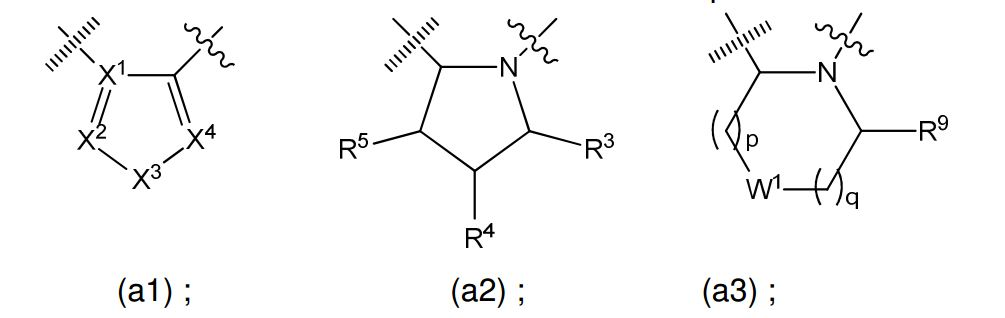
[0050] Um exemplo de realização específico desse aspecto da invenção refere-se aos compostos de fórmula (A), (B1), (B2), (B3), (C1), (C2), (C3), (C4), (C5), (D1), (D2), (D3), (D4), e (D5), e aos compostos de acordo com qualquer um dos exemplos de realização específicos destes descritos na presente invenção para uso como um medicamento.[0050] A specific embodiment of this aspect of the invention refers to the compounds of formula (A), (B1), (B2), (B3), (C1), (C2), (C3), (C4) , (C5), (D1), (D2), (D3), (D4), and (D5), and to compounds according to any of the specific embodiments thereof described in the present invention for use as a medicament.
[0051] Um terceiro aspecto da invenção refere-se aos compostos de fórmula (A), (B1), (B2), (B3), (C1), (C2), (C3), (C4), (C5), (D1), (D2), (D3), (D4), e (D5), e aos compostos de acordo com qualquer um dos exemplos de realização específicos destes descritos na presente invenção para uso como um medicamento para a prevenção ou tratamento de uma infecção viral em um animal (incluindo um humano).[0051] A third aspect of the invention relates to the compounds of formula (A), (B1), (B2), (B3), (C1), (C2), (C3), (C4), (C5) , (D1), (D2), (D3), (D4), and (D5), and to compounds according to any of the specific embodiments thereof described in the present invention for use as a medicament for the prevention or treatment of a viral infection in an animal (including a human).
[0052] Em um exemplo de realização, a infecção viral é uma infecção com Flavivírus. Em um exemplo de realização adicional, o Flavivírus é o vírus da dengue.[0052] In an exemplary embodiment, the viral infection is a Flavivirus infection. In an exemplary further embodiment, the Flavivirus is the dengue virus.
[0053] A presente invenção diz respeito ainda a uma composição farmacêutica compreendendo os compostos de fórmula (A), (B1), (B2), (B3), C1), (C2), (C3), (C4), (C5), (D1), (D2), (D3), (D4) ou (D5) ou compostos de acordo com qualquer um dos exemplos de realização específicos, tal como descrito na presente invenção, em combinação com um veículo farmaceuticamente aceitável.[0053] The present invention also relates to a pharmaceutical composition comprising the compounds of formula (A), (B1), (B2), (B3), C1), (C2), (C3), (C4), ( C5), (D1), (D2), (D3), (D4) or (D5) or compounds according to any of the specific embodiments as described in the present invention, in combination with a pharmaceutically acceptable carrier.
[0054] A presente invenção diz respeito ainda a um método para a prevenção ou tratamento de uma infecção viral em um animal, compreendendo administrar ao referido animal (incluindo um ser humano) com necessidade de tal prevenção ou tratamento de uma dose eficaz de um composto de fórmula (A), (B1), (B2), (B3), (C1), (C2), (C3), (C4), (C5), (D1), (D2), (D3), (D4) ou (D5) ou um composto de acordo com qualquer um dos exemplos de realização específicos, tal como os descritos na presente invenção.[0054] The present invention further relates to a method for preventing or treating a viral infection in an animal, comprising administering to said animal (including a human being) in need of such prevention or treatment an effective dose of a compound of formula (A), (B1), (B2), (B3), (C1), (C2), (C3), (C4), (C5), (D1), (D2), (D3), (D4) or (D5) or a compound according to any of the specific embodiments as described in the present invention.
[0055] A presente invenção está relaciona da a um método para a preparação dos compostos de fórmula (A), (B1), (B2), (B3), (C1), (C2), (C3), (C4), (C5) , (D1), (D2), (D3), (D4) e (D5), e dos compostos de acordo com qualquer um dos exemplos de realização específicos descritos na presente invenção, compreendendo as etapas de: - reação de uma imina com um aldeído sob condições de umpolung na presença de um catalisador tiazólio para obter os compostos desejados da invenção.[0055] The present invention relates to a method for preparing the compounds of formula (A), (B1), (B2), (B3), (C1), (C2), (C3), (C4) , (C5), (D1), (D2), (D3), (D4) and (D5), and the compounds according to any of the specific embodiments described in the present invention, comprising the steps of: - reaction of an imine with an aldehyde under umpolung conditions in the presence of a thiazolium catalyst to obtain the desired compounds of the invention.
[0056] Em outro exemplo de realização, a invenção refere-se a um método para a preparação dos compostos da invenção, compreendendo as etapas de - reação de um derivado de cetona possuindo um grupo metileno adjacente à carbonila sob condições de halogenação para se obter uma alfa- halogenocetona, - substituir a alfa-halogenocetona anteriormente obtida com aminas para se obter os compostos desejados da invenção.[0056] In another exemplary embodiment, the invention relates to a method for preparing the compounds of the invention, comprising the steps of - reacting a ketone derivative having a methylene group adjacent to the carbonyl under halogenation conditions to obtain an alpha-halogen ketone, - replacing the previously obtained alpha-halogen ketone with amines to obtain the desired compounds of the invention.
[0057] Em outro exemplo de realização, a invenção refere-se a um método para a preparação dos compostos da invenção, compreendendo as etapas de - reação de uma heterociclicamina com haleto de ácido 2- halogenoacético para se obter um derivado de alfa-halogenoamida, - substituir a alfa-halogenoamida anteriormente obtida com aminas para se obter os compostos desejados da invenção.[0057] In another embodiment, the invention relates to a method for preparing the compounds of the invention, comprising the steps of - reaction of a heterocyclamine with 2-halogenoacetic acid halide to obtain an alpha-halogenoamide derivative , - replacing the previously obtained alpha-halogenoamide with amines to obtain the desired compounds of the invention.
[0058] Mais particularmente, um aspecto da invenção é o fornecimento de compostos de fórmula (A),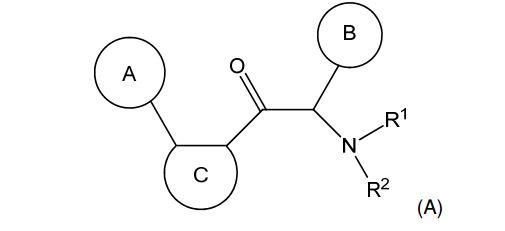

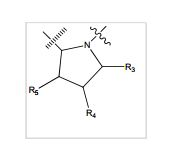
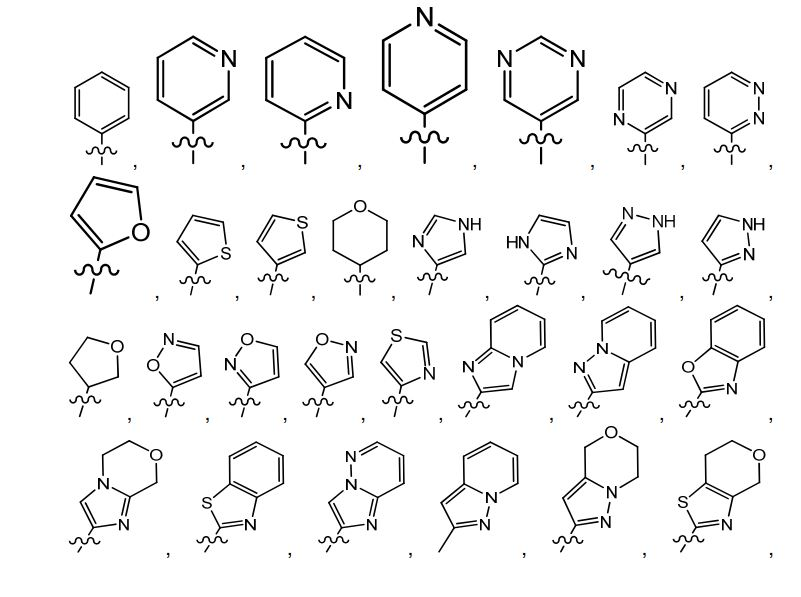



[0059] Um aspecto da invenção refere-se aos compostos de fórmula (A) para uso como um medicamento, mais particularmente para uso na prevenção ou tratamento de uma infecção por Flavivírus em um animal, mamífero ou humano, preferencialmente uma infecção pelo vírus da dengue ou vírus da febre amarela.[0059] One aspect of the invention relates to compounds of formula (A) for use as a medicament, more particularly for use in preventing or treating a flavivirus infection in an animal, mammal or human, preferably a flavivirus infection dengue or yellow fever virus.
[0060] Em um exemplo de realização específico dos diferentes aspectos da invenção, os compostos possuem uma estrutura de acordo com a fórmula (C1), (C2), (C3), (C4) ou (C5),
[0061] Em outro exemplo de realização específico, os compostos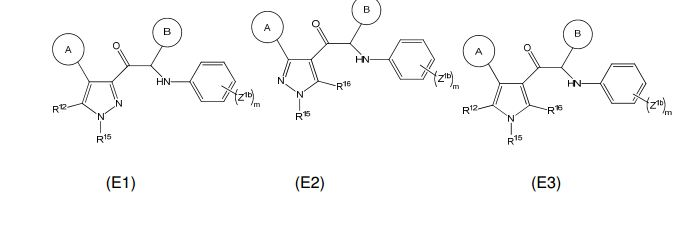

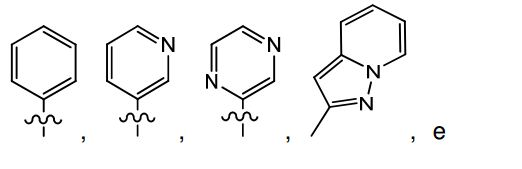
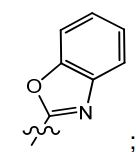
[0062] Em outro exemplo de realização específico, R1 tem uma estrutura de acordo com a fórmula (F),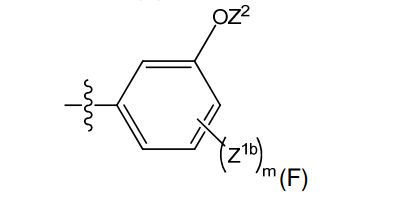
[0063] Os compostos da presente invenção apresentam pelo menos um centro assimétrico no átomo de carbono substituído com ciclo B, conforme mostrado abaixo com um asterisco na fórmula (A). Este centro assimétrico podem ocorrer na sua configuração R ou S. Em um exemplo de realização preferido, o referido centro assimétrico está na configuração R. Em outro exemplo de realização preferido, o referido centro assimétrico está a configuração S.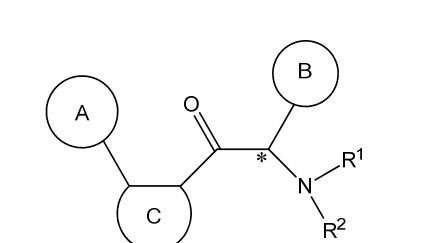
[0064] Um exemplo de realização específico da invenção diz respeito aos compostos individuais selecionados a partir dos compostos na Tabela 1. A presente invenção, por esse motivo, também abrange qualquer composto individual listados na Tabela 1.[0064] A specific embodiment of the invention concerns the individual compounds selected from the compounds in Table 1. The present invention, therefore, also encompasses any individual compound listed in Table 1.
[0065] O termo “tratar” ou “tratamento” conforme utilizado na presente invenção, pretende referir-se a administração de um composto ou composição da invenção a um sujeito com a finalidade de efetuar um benefício terapêutico ou profilático pela inibição de uma infecção viral. O tratamento inclui a reversão, melhora, alívio, inibição do progresso diminuição da gravidade, ou prevenção de uma doença, distúrbio ou condição, ou um ou mais sintomas de tal doença, distúrbio ou condição mediada através da inibição da infecção viral. O termo “sujeito” refere-se a um animal ou paciente mamífero que necessita de tal tratamento, tal como um humano.[0065] The term "treat" or "treatment" as used in the present invention is intended to refer to the administration of a compound or composition of the invention to a subject for the purpose of effecting a therapeutic or prophylactic benefit by inhibiting a viral infection . Treatment includes reversing, ameliorating, alleviating, inhibiting progress, decreasing severity, or preventing a disease, disorder or condition, or one or more symptoms of such disease, disorder or condition mediated by inhibiting the viral infection. The term "subject" refers to a mammalian animal or patient in need of such treatment, such as a human.
[0066] Deve ser notado que o termo “compreendendo”, utilizado nas reivindicações, não deve ser interpretado como sendo restrito aos meios enumerados em seguida; isto não exclui outros elementos ou etapas.[0066] It should be noted that the term "comprising" used in the claims is not to be construed as being restricted to the means enumerated below; this does not exclude other elements or steps.
[0067] A referência ao longo deste relatório descritivo a “um exemplo de realização” ou “realização” significa que uma determinada particularidade, estrutura ou característica descrita em ligação com o exemplo de realização está incluída em pelo menos um exemplo de realização da presente invenção. Assim, o aparecimento das frases “em um exemplo de realização” ou “em uma realização” em vários lugares ao longo deste relatório descritivo não está necessariamente se referindo ao mesmo exemplo de realização, mas podem. Além disso, as particularidades, estruturas ou características podem ser combinadas de qualquer forma adequada, tal como seria evidente para um técnico hábil na arte a partir desta descrição, em uma ou mais exemplos de realização. Também exemplos de realização descritos para um aspecto da invenção podem ser utilizados para outro aspecto da invenção e também podem ser combinados. Sempre que um artigo indefinido ou definido é usado quando se refere a um substantivo no singular, por exemplo, “um/uma” ou “o/a”, inclui-se um plural desse substantivo, a menos que esteja expressamente indicado.[0067] Reference throughout this specification to "an exemplary embodiment" or "embodiment" means that a particular feature, structure or feature described in connection with the exemplary embodiment is included in at least one exemplary embodiment of the present invention . Thus, the appearance of the phrases "in an embodiment" or "in an embodiment" in various places throughout this specification are not necessarily referring to the same embodiment, but they can. Furthermore, the features, structures or features can be combined in any suitable way, as would be apparent to a person skilled in the art from this description, in one or more exemplary embodiments. Also examples of embodiment described for one aspect of the invention can be used for another aspect of the invention and can also be combined. Whenever an indefinite or definite article is used when referring to a singular noun, for example, “a” or “the”, a plural of that noun is included, unless expressly noted.
[0068] Do mesmo modo, deve ser entendido que na descrição de exemplos de realização exemplificativos da invenção, várias características da invenção são, por vezes, agrupadas em conjunto em um único exemplo de realização, figura, ou descrição dos mesmos com o objetivo de simplificar a descrição e ajudar na compreensão de um ou mais dos vários aspectos da invenção.[0068] Likewise, it should be understood that in the description of exemplary embodiments of the invention, various features of the invention are sometimes grouped together in a single embodiment, figure, or description thereof with the aim of simplify the description and aid in understanding one or more of the various aspects of the invention.
[0069] Em cada uma das seguintes definições, o número de átomos de carbono representa o número máximo de átomos de carbono em geral, de forma otimamente presente no substituinte ou ligante; entende-se que quando indicado de outra forma, no presente pedido, o número de átomos de carbono representa o número máximo de átomos de carbono ótimo para esse substituinte ou ligante específico.[0069] In each of the following definitions, the number of carbon atoms represents the maximum number of carbon atoms generally optimally present in the substituent or linker; it is understood that where otherwise indicated in the present application, the number of carbon atoms represents the maximum number of optimal carbon atoms for that particular substituent or ligand.
[0070] O termo “grupo de saída” ou “LG”, tal como utilizado na presente invenção, significa um grupo químico que é susceptível de ser deslocado por um nucleófilo ou clivado ou hidrolisado em condições básicas ou ácidas. Em um exemplo de realização particular, um grupo de saída é selecionado dentre um átomo de halogênio (por exemplo, Cl, Br, I) ou um sulfonato (por exemplo, mesilato, tosilato, triflato).[0070] The term "leaving group" or "LG", as used in the present invention, means a chemical group that is capable of being displaced by a nucleophile or cleaved or hydrolyzed under basic or acidic conditions. In a particular embodiment example, a leaving group is selected from a halogen atom (eg Cl, Br, I) or a sulfonate (eg mesylate, tosylate, triflate).
[0071] O termo “grupo protetor” refere-se a um radical de um composto que mascara ou altera as propriedades de um grupo funcional ou as propriedades do composto como um todo. A subestrutura química de um grupo protetor varia amplamente. Uma função de um grupo protetor é a de servir como intermediário na síntese da substância do fármaco parental. Grupos protetores químicos e as estratégias de proteção/desproteção são bem conhecidas no estado da técnica. Vide: “Protective Groups in Organic Chemistry”, Theodora W. Greene (John Wiley & Sons, Inc., Nova Iorque, 1991. Os grupos de proteção são frequentemente utilizados para mascarar a reatividade de certos grupos funcionais, para auxiliar na eficiência de reações químicas desejadas, por exemplo, fazer e quebrar ligações químicas de uma forma ordenada e planejada. A proteção de grupos funcionais de um composto altera outras propriedades físicas além da reatividade do grupo funcional protegido, tais como a polaridade, lipofilicidade (hidrofobicidade) e outras propriedades que podem ser mensuradas por ferramentas analíticas comuns. Intermediários quimicamente protegidos podem ser biologicamente ativos ou inativos.[0071] The term “protecting group” refers to a radical of a compound that masks or alters the properties of a functional group or the properties of the compound as a whole. The chemical substructure of a protecting group varies widely. One function of a protecting group is to serve as an intermediate in the synthesis of the parent drug substance. Chemical protecting groups and protection/deprotection strategies are well known in the prior art. See: “Protective Groups in Organic Chemistry”, Theodora W. Greene (John Wiley & Sons, Inc., New York, 1991. Protecting groups are often used to mask the reactivity of certain functional groups, to aid in the efficiency of reactions desired chemical properties, for example, making and breaking chemical bonds in an orderly and planned manner. Protecting functional groups of a compound alters physical properties other than the reactivity of the protected functional group, such as polarity, lipophilicity (hydrophobicity) and other properties that can be measured by common analytical tools Chemically protected intermediates can be biologically active or inactive.
[0072] Compostos protegidos podem também exibir propriedades in vitro e in vivo alteradas e, em alguns casos, otimizadas, tais como a passagem através de membranas celulares e resistência à degradação ou sequestro enzimático. Neste papel, compostos protegidos com efeitos terapêuticos desejados podem ser referidos como pró-drogas. Outra função de um grupo protetor consiste em converter o fármaco parental, em um pró- fármaco, em que o fármaco parental é libertado após a conversão in vivo do pró-fármaco. Como pró-fármacos ativos podem ser absorvidos de forma mais eficaz do que o fármaco parental, os pró-fármacos podem possuir uma maior potência in vivo do que o fármaco parental. Os grupos protetores são removidos in vitro, no caso dos intermediários químicos, ou in vivo no caso dos pró-fármacos. Com intermediários químicos, não é particularmente importante que os produtos resultantes após a desproteção, por exemplo, alcoóis, sejam fisiologicamente aceitáveis, embora de um modo geral é mais desejável que os produtos sejam farmacologicamente inócuos.[0072] Protected compounds may also exhibit altered and, in some cases, enhanced in vitro and in vivo properties, such as passage through cell membranes and resistance to enzymatic degradation or sequestration. In this role, protected compounds with desired therapeutic effects can be referred to as prodrugs. Another function of a protecting group is to convert the parent drug into a prodrug, where the parent drug is released after in vivo conversion of the prodrug. As active prodrugs can be absorbed more efficiently than the parent drug, the prodrugs can have greater potency in vivo than the parent drug. Protecting groups are removed in vitro, in the case of chemical intermediates, or in vivo, in the case of prodrugs. With chemical intermediates, it is not particularly important that the products resulting after deprotection, for example alcohols, be physiologically acceptable, although in general it is more desirable that the products be pharmacologically innocuous.
[0073] O termo “hidrocarbila”, “hidrocarbila C1-18”, “grupo hidrocarbila” ou “grupo hidrocarbila C1-18” conforme utilizado na presente invenção refere-se ao hidrocarbonos C1-C18 ciclos ou aciclos, normais, secundários, terciários, insaturados ou saturados, não aromáticos, e suas combinações. Assim, este termo compreende alquila, alquenila, alquinila, cicloalquila, cicloalquenila e cicloalquinila.[0073] The term "hydrocarbyl", "C1-18 hydrocarbyl", "hydrocarbyl group" or "C1-18 hydrocarbyl group" as used in the present invention refers to hydrocarbons C1-C18 cycles or acycles, normal, secondary, tertiary , unsaturated or saturated, non-aromatic, and combinations thereof. Thus, this term comprises alkyl, alkenyl, alkynyl, cycloalkyl, cycloalkenyl and cycloalkynyl.
[0074] A terminologia “heterohidrocarbila”, “hetero hidrocarbila C1-18”, “heterohidrocarbila C1-18” “grupo heterohidrocarbila”, “grupo heterohidrocarbila C1-18” ou “grupo hidrocarbila” que opcionalmente inclui um ou mais heteroátomos, cujos referidos heteroátomos são selecionados dentre os átomos consistindo de O, S, e N’’ conforme utilizado na presente invenção, refere-se a um grupo hidrocarbila em que um ou mais átomos de carbono são substituídos com um ou mais átomos de oxigênio, nitrogênio ou enxofre e inclui, portanto, heteroalquila, heteroalquenila, heteroalquinila e heterociclos não aromáticos. Consequentemente, este termo compreende como exemplos alcóxi, alqueniloxi, alquilCw-O-alquilaC18-w, alquenilCw-O-alquila, alquilCw-NH- alquenilaC18-w, entre outros, em que w é selecionado a partir de qualquer número entre 1 e 18.[0074] The terminology "heterohydrocarbyl", "C1-18 heterohydrocarbyl", "C1-18 heterohydrocarbyl" "heterohydrocarbyl group", "C1-18 heterohydrocarbyl group" or "hydrocarbyl group" which optionally includes one or more heteroatoms, the said heteroatoms are selected from atoms consisting of O, S, and N'' as used in the present invention, refers to a hydrocarbyl group in which one or more carbon atoms are replaced with one or more oxygen, nitrogen or sulfur atoms and therefore includes heteroalkyl, heteroalkenyl, heteroalkynyl and non-aromatic heterocycles. Consequently, this term includes as examples alkoxy, alkenyloxy, alkylCw-O-alkylC18-w, alkenylCw-O-alkyl, alkylCw-NH-alkenylC18-w, among others, where w is selected from any number between 1 and 18 .
[0075] O termo “alquila” ou “alquila C1-18” conforme utilizado no presente significa hidrocarbonetos C1-C18 normais, secundários ou terciários, lineares, ramificados, sem sítio de insaturação. Exemplo são metila, etila, 1- propila (n-propil), 2-propila (iPr), 1-butila, 2-metil-1-propil(i-Bu), 2-butila (s-Bu), 2-dimetil-2-propila (t-Bu), 1-pentil(n-pentil), 2-pentila, 3-pentila, 2-metil-2-butil, 3- metil-2-butil, 3-metil-1-butila, 2-metil-1-butila, 1-hexila, 2-hexila, 3-hexila, 2- metil-2-pentila, 3-metil-2-pentila, 4-metil-2-pentila, 3-metil-3-pentila, 2-metil-3- pentila, 2,3-dimetil-2-butila, 3,3-dimetil-2-butila, n-heptila, n-octila, n-nonila, n- decila, n-undecila, n-dodecila, n-tridecila, n-tetradecila, n-pentadecila, n- hexadecila, n-heptadecila, n-octadecila, n-nonadecila, e n-icosila. Em um exemplo de realização específico, o termo alquila refere-se a hidrocarbonetos C1-12, em um exemplo de realização ainda mais específico aos hidrocarbonetos C1-6, em um exemplo de realização mais específico ainda aos hidrocarbonetos C1-3 conforme definido adicionalmente acima. Uma alquila preferida é a alquila C1-6. Outra alquila preferida é a alquila C1-4.[0075] The term "alkyl" or "C1-18 alkyl" as used herein means normal, secondary or tertiary, linear, branched, C1-C18 hydrocarbons without a site of unsaturation. Examples are methyl, ethyl, 1-propyl (n-propyl), 2-propyl (iPr), 1-butyl, 2-methyl-1-propyl(i-Bu), 2-butyl (s-Bu), 2- dimethyl-2-propyl (t-Bu), 1-pentyl(n-pentyl), 2-pentyl, 3-pentyl, 2-methyl-2-butyl, 3-methyl-2-butyl, 3-methyl-1- butyl, 2-methyl-1-butyl, 1-hexyl, 2-hexyl, 3-hexyl, 2-methyl-2-pentyl, 3-methyl-2-pentyl, 4-methyl-2-pentyl, 3-methyl- 3-pentyl, 2-methyl-3-pentyl, 2,3-dimethyl-2-butyl, 3,3-dimethyl-2-butyl, n-heptyl, n-octyl, n-nonyl, n-decyl, n- undecyl, n-dodecyl, n-tridecyl, n-tetradecyl, n-pentadecyl, n-hexadecyl, n-heptadecyl, n-octadecyl, n-nonadecyl, and n-icosyl. In a specific embodiment, the term alkyl refers to C1-12 hydrocarbons, in a still more specific embodiment to C1-6 hydrocarbons, in a still more specific embodiment to C1-3 hydrocarbons as further defined above . A preferred alkyl is C1-6 alkyl. Another preferred alkyl is C1-4 alkyl.
[0076] O termo “cicloalquila” ou “cicloalquila C3-18” conforme utilizado no presente e a menos que indicado de outra forma significa um radical de hidrocarboneto monovalente saturado possuindo de 3 a 18 átomos de carbono que consiste, ou compreende um grupo monociclo C3-10 ou policiclo C7-18, saturado, tais como por exemplo ciclopropila, ciclopropilmetileno, ciclobutila, ciclopentila, ciclopentilmetileno, ciclopropiletileno, metilciclopropileno, ciclohexila, cicloheptila, ciclooctila, isopropoilciclooctila, ciclooctilmetileno, norbornila, fenquila, trimetiltricicloheptila, decalinila, adamantila e similares. Para evitar dúvidas e como um exemplo, ciclopentilmetileno refere-se a
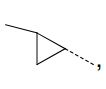
[0077] O termo “alquenila” ou “alquenila C2-18” conforme utilizado no presente é um hidrocarboneto C2-C18 normal, secundário ou terciário, linear ou ramificado com pelo menos um sítio (geralmente 1 a 3, de um modo preferido 1) de insaturação, ou seja, uma ligação dupla carbono-carbono, sp2. Exemplos incluem, mas não estão limitados a: etileno ou vinila (-CH=CH2), allila (-CH2CH=CH2), e 5-hexenila (-CH2CH2CH2CH2CH=CH2). A ligação dupla pode estar na configuração cis ou trans. Em um exemplo de realização particular, o termo alquenila refere-se a hidrocarbonetos C2-12, ainda mais particularmente aos hidrocarbonetos C2-6 conforme adicionalmente definido acima. Uma alquenila preferida é a alquenila C2-6.[0077] The term "alkenyl" or "C2-18 alkenyl" as used herein is a straight or branched normal, secondary or tertiary C2-C18 hydrocarbon having at least one site (generally 1 to 3, preferably 1 ) of unsaturation, that is, a carbon-carbon double bond, sp2. Examples include, but are not limited to: ethylene or vinyl (-CH=CH2), allyl (-CH2CH=CH2), and 5-hexenyl (-CH2CH2CH2CH2CH=CH2). The double bond can be in the cis or trans configuration. In a particular embodiment, the term alkenyl refers to C2-12 hydrocarbons, even more particularly to C2-6 hydrocarbons as further defined above. A preferred alkenyl is C2-6 alkenyl.
[0078] O termo “cicloalquenila”, conforme utilizado na presente invenção refere-se a um hidrocarboneto não aromático possuindo de 3 a 18 átomos de carbono com pelo menos um sítio (geralmente 1 a 3, de um modo preferido 1) de insaturação, ou seja, uma ligação dupla carbono-carbono sp2 e consistindo, ou compreendendo, um hidrocarboneto monociclo C3-10 ou policiclo C7-18. Exemplos incluem, mas não estão limitados a: ciclopentenila (-C5H7), ciclopentenilpropileno, metilciclohexenileno e ciclohexenila (-C6H9). A ligação dupla pode estar na configuração cis ou trans.[0078] The term "cycloalkenyl" as used in the present invention refers to a non-aromatic hydrocarbon having from 3 to 18 carbon atoms with at least one site (generally 1 to 3, preferably 1) of unsaturation, that is, a carbon-carbon sp2 double bond and consisting of or comprising a C3-10 monocycle or C7-18 polycycle hydrocarbon. Examples include, but are not limited to: cyclopentenyl (-C5H7), cyclopentenylpropylene, methylcyclohexenylene, and cyclohexenyl (-C6H9). The double bond can be in the cis or trans configuration.
[0079] O termo “alquinila” ou “alquinila C2-18”, conforme utilizado na presente invenção refere-se a um hidrocarboneto C2-C18, ramificado ou linear, normal, secundário, terciário, com pelo menos um sítio (geralmente 1 a 3, de um modo preferido 1) de insaturação, ou seja, uma ligação tripla sp, carbono-carbono. Exemplos incluem, mas não estão limitados a: etinila (- C=CH), e 1-propinila (propargila, -CH2C=CH). Em um exemplo de realização particular, o termo alquinila refere-se a hidrocarbonetos C2-12, ainda mais particularmente aos hidrocarbonetos C2-6 conforme adicionalmente definido acima. Uma alquinila preferida é a alquinila C2-6.[0079] The term "alkynyl" or "C2-18 alkynyl", as used in the present invention refers to a C2-C18 hydrocarbon, branched or linear, normal, secondary, tertiary, with at least one site (generally 1 to 3, preferably 1) of unsaturation, i.e. an sp, carbon-carbon triple bond. Examples include, but are not limited to: ethynyl (-C=CH), and 1-propynyl (propargyl, -CH2C=CH). In a particular embodiment, the term alkynyl refers to C2-12 hydrocarbons, even more particularly to C2-6 hydrocarbons as further defined above. A preferred alkynyl is C2-6 alkynyl.
[0080] O termo “cicloalquinila”, conforme utilizado na presente invenção refere-se a um hidrocarboneto não aromático possuindo de 3 a 18 átomos de carbono com pelo menos um sítio (geralmente 1 a 3, de um modo preferido 1) de insaturação, ou seja, uma ligação tripla sp, carbono-carbono e consistindo, ou compreendendo, um hidrocarboneto monociclo C3-10 ou policiclo C7-18. Exemplos incluem, mas não estão limitados a: ciclohept-1-ina, 3-etil- ciclohept-1-inileno, 4-ciclohept-1-in-metileno e etileno-ciclohept-1-ina.[0080] The term "cycloalkynyl" as used in the present invention refers to a non-aromatic hydrocarbon having from 3 to 18 carbon atoms with at least one site (generally 1 to 3, preferably 1) of unsaturation, that is, a triple bond sp, carbon-carbon and consisting of, or comprising, a C3-10 monocycle or C7-18 polycycle hydrocarbon. Examples include, but are not limited to: cyclohept-1-ine, 3-ethyl-cyclohept-1-ynylene, 4-cyclohept-1-yn-methylene and ethylene-cyclohept-1-ine.
[0081] O termo “alquileno” refere-se na presente invenção a um radical de hidrocarboneto saturado, de cadeia linear ou ramificada de 1-18 átomos de carbono, (mais particularmente C1-12 ou C1-16 átomos de carbono) e possuindo dois centros de radicais monovalentes derivados da remoção de dois átomos de hidrogênio a partir dos mesmos ou de dois átomos de carbono diferentes de um alcano progenitor. Os radicais alquileno típicos incluem, mas não estão limitados a: metileno (-CH2-), 1,2-etila (-CH2CH2-), 1,3-propila (- CH2CH2CH2-), 1,4-butila (-CH2CH2CH2CH2-), e similares.[0081] The term "alkylene" refers in the present invention to a straight or branched chain saturated hydrocarbon radical of 1-18 carbon atoms, (more particularly C1-12 or C1-16 carbon atoms) and having two centers of monovalent radicals derived from the removal of two hydrogen atoms from the same or two different carbon atoms from an alkane parent. Typical alkylene radicals include, but are not limited to: methylene (-CH2-), 1,2-ethyl (-CH2CH2-), 1,3-propyl (-CH2CH2CH2-), 1,4-butyl (-CH2CH2CH2CH2- ), and the like.
[0082] O termo “alquenileno” conforme utilizado no presente refere-se a um hidrocarboneto de cadeia linear ou ramificada de 2-18 átomos de carbono (mais em particularmente C2-12 ou C2-6 átomos de carbono) com pelo menos um sítio (geralmente 1 a 3, e preferencialmente 1) de insaturação, ou seja, uma ligação dupla sp2, carbono-carbono, e possuindo dois centros radicais monovalentes derivados da remoção de dois átomos de hidrogênio a partir do mesmo ou de dois átomos de carbono diferentes de um alqueno progenitor.[0082] The term "alkenylene" as used herein refers to a straight or branched chain hydrocarbon of 2-18 carbon atoms (more in particular C2-12 or C2-6 carbon atoms) with at least one site (usually 1 to 3, and preferably 1) of unsaturation, i.e., an sp2 double bond, carbon-carbon, and having two monovalent radical centers derived from the removal of two hydrogen atoms from the same or two different carbon atoms of an alkene parent.
[0083] O termo “alquinileno” conforme utilizado no presente refere- se a um hidrocarboneto de cadeia linear ou ramificada de 2-18 átomos de carbono (mais em particularmente C2-12 ou C2-6 átomos de carbono) com pelo menos um sítio (geralmente 1 a 3, e preferencialmente 1) de insaturação, ou seja, uma ligação tripla sp, carbono-carbono, e possuindo dois centros radicais monovalentes derivados da remoção de dois átomos de hidrogênio a partir do mesmo ou de dois átomos de carbono diferentes de um alquina progenitora.[0083] The term "alkynylene" as used herein refers to a straight or branched chain hydrocarbon of 2-18 carbon atoms (more in particular C2-12 or C2-6 carbon atoms) with at least one site (usually 1 to 3, and preferably 1) of unsaturation, i.e., an sp, carbon-carbon triple bond, and having two monovalent radical centers derived from the removal of two hydrogen atoms from the same or two different carbon atoms of a parent alquina.
[0084] O termo “heteroalquila”, conforme utilizado no presente refere-se a uma alquila em que um ou mais átomos de carbono (geralmente 1, 2 ou 3) são substituídos com um átomo de oxigênio, nitrogênio ou enxofre, com a condição de que a referida cadeia pode não conter dois átomos de O adjacentes ou dois átomos de S adjacentes. Isto significa que um ou mais -CH3 da referida alquila pode ser substituído com -NH2 e/ou que um ou mais -CH2 da referida alquila acíclica pode ser substituído com -NH-, -O- ou -S-. Os átomos de S nas referidas cadeias podem opcionalmente ser oxidados com um ou dois átomos de oxigênio, para se obter sulfóxidos e sulfonas, respectivamente. Além disso, os grupos heteroalquila, nos compostos da presente invenção podem conter um grupo oxo ou tio em qualquer carbono ou heteroátomo que resulte em um composto estável. Os átomos de C na referida cadeia podem opcionalmente ser oxidados com um átomo de oxigênio, para proporcionar, por exemplo, grupos carbonila e carbonilóxi, respectivamente. Exemplos de grupos heteroalquila incluem, mas não estão limitados a, alcoóis, éteres alquílicos, alquilaminas primárias, secundárias, e terciárias, amidas, cetonas, ésteres, sulfuretos de alquila e sulfonas de alquila. -CO-O-alquila, -O-alquila, - NH-alquila, -N(alquil)2, -S(=O)2alquila, e -S-alquila. Em alguns exemplos de realização, a referida heteroalquila C1-6 como um grupo ou parte de um grupo é selecionada a partir de -CO-O-alquilaC1-5, -O-alquila C1-6, -NH-alquila C1-6, - N(alquila C1-6)2, -S(=O)2alquila C1-6, e -S-alquila C1-6.[0084] The term “heteroalkyl” as used herein refers to an alkyl in which one or more carbon atoms (generally 1, 2 or 3) are replaced with an oxygen, nitrogen or sulfur atom, with the proviso that said chain may not contain two adjacent O atoms or two adjacent S atoms. This means that one or more -CH3 of said alkyl can be replaced with -NH2 and/or that one or more -CH2 of said acyclic alkyl can be replaced with -NH-, -O- or -S-. The S atoms in said chains can optionally be oxidized with one or two oxygen atoms, to obtain sulfoxides and sulfones, respectively. In addition, heteroalkyl groups in the compounds of the present invention may contain an oxo or thio group on any carbon or heteroatom that results in a stable compound. The C atoms in said chain can optionally be oxidized with an oxygen atom, to provide, for example, carbonyl and carbonyloxy groups, respectively. Examples of heteroalkyl groups include, but are not limited to, alcohols, alkyl ethers, primary, secondary, and tertiary alkylamines, amides, ketones, esters, alkyl sulfides, and alkyl sulfones. -CO-O-alkyl, -O-alkyl, -NH-alkyl, -N(alkyl)2, -S(=O)2alkyl, and -S-alkyl. In some embodiment examples, said C1-6 heteroalkyl as a group or part of a group is selected from -CO-O-C1-5 alkyl, -O-C1-6 alkyl, -NH-C1-6 alkyl, - N(C1-6 alkyl)2, -S(=O)2C1-6 alkyl, and -S-C1-6 alkyl.
[0085] O termo “heteroalquenila”, conforme utilizado no presente refere-se a uma alquenila em que um ou mais átomos de carbono (geralmente 1, 2 ou 3) são substituídos com um átomo de oxigênio, nitrogênio ou enxofre, com a condição de que a referida cadeia pode não conter dois átomos de O adjacentes ou dois átomos de S adjacentes. Isto significa que um ou mais -CH3 da referida alquenila pode ser substituído com -NH2 e/ou que um ou mais -CH2 da referida alquenila acíclica pode ser substituído com -NH-, -O- ou -S- e/ou que um ou mais -CH= da referida alquinila acíclica pode ser substituído com - N=.. Os átomos de S nas referidas cadeias podem opcionalmente ser oxidados com um ou dois átomos de oxigênio, para se obter sulfóxidos e sulfonas, respectivamente. Além disso, os grupos heteroalquila, nos compostos da presente invenção podem conter um grupo oxo ou tio em qualquer carbono ou heteroátomo que resulte em um composto estável. O termo heteroalquenila compreende, assim, iminas, -O-alquenila, -NH-alquenila, -N(alquenila)2, - N(alquil)(alquenila), e -S-alquenila.[0085] The term “heteroalkenyl” as used herein refers to an alkenyl in which one or more carbon atoms (generally 1, 2 or 3) are replaced with an oxygen, nitrogen or sulfur atom, with the proviso that said chain may not contain two adjacent O atoms or two adjacent S atoms. This means that one or more -CH3 of said alkenyl can be replaced with -NH2 and/or that one or more -CH2 of said acyclic alkenyl can be replaced with -NH-, -O- or -S- and/or that one or more -CH= of said acyclic alkynyl may be replaced with -N=.. The S atoms in said chains may optionally be oxidized with one or two oxygen atoms to obtain sulfoxides and sulfones, respectively. In addition, heteroalkyl groups in the compounds of the present invention may contain an oxo or thio group on any carbon or heteroatom that results in a stable compound. The term heteroalkenyl thus comprises imines, -O-alkenyl, -NH-alkenyl, -N(alkenyl) 2 , -N(alkyl)(alkenyl), and -S-alkenyl.
[0086] O termo “heteroalquinila”, conforme utilizado no presente refere-se a uma alquinila em que um ou mais átomos de carbono (geralmente 1, 2 ou 3) são substituídos com um átomo de oxigênio, nitrogênio ou enxofre, com a condição de que a referida cadeia pode não conter dois átomos de O adjacentes ou dois átomos de S adjacentes. Isto significa que um ou mais -CH3 da referida alquinila pode ser substituído com -NH2 e/ou que um ou mais -CH2 da referida alquinila acíclica pode ser substituído com -NH-, -O- ou -S- e/ou que um ou mais -CH= da referida alquinila acíclica pode ser substituído com - N=e/ou que um ou mais ^=CHda referida alquinila acíclica pode ser substituído com N. Os átomos de S nas referidas cadeias podem opcionalmente ser oxidados com um ou dois átomos de oxigênio, para se obter sulfóxidos e sulfonas, respectivamente. Além disso, os grupos heteroalquinila, nos compostos da presente invenção podem conter um grupo oxo ou tio em qualquer carbono ou heteroátomo que resulte em um composto estável. O termo heteroalquinila compreende, assim, -O-alquinila, -NH-alquinila, - N(alquinil)2, -N(alquil)(alquinila), -N(alquenil)(alquinila), e -S-alquinila.[0086] The term “heteroalkynyl” as used herein refers to an alkynyl in which one or more carbon atoms (generally 1, 2 or 3) are replaced with an oxygen, nitrogen or sulfur atom, with the proviso that said chain may not contain two adjacent O atoms or two adjacent S atoms. This means that one or more -CH3 of said alkynyl can be replaced with -NH2 and/or that one or more -CH2 of said acyclic alkynyl can be replaced with -NH-, -O- or -S- and/or that one or more -CH= of said acyclic alkynyl may be replaced with -N=and/or that one or more ^=CH of said acyclic alkynyl may be replaced with N. The S atoms in said chains may optionally be oxidized with one or two oxygen atoms, to obtain sulfoxides and sulfones, respectively. Furthermore, heteroalkynyl groups in the compounds of the present invention may contain an oxo or thio group on any carbon or heteroatom that results in a stable compound. The term heteroalkynyl thus comprises -O-alkynyl, -NH-alkynyl, -N(alkynyl) 2 , -N(alkyl)(alkynyl), -N(alkenyl)(alkynyl), and -S-alkynyl.
[0087] O termo “heteroalquileno”, conforme utilizado no presente refere-se a um alquileno em que um ou mais átomos de carbono (geralmente 1, 2 ou 3) são substituídos com um átomo de oxigênio, nitrogênio ou enxofre, com a condição de que a referida cadeia pode não conter dois átomos de O adjacentes ou dois átomos de S adjacentes. Isto significa que um ou mais -CH3 do referido alquileno pode ser substituído com -NH2 e/ou que um ou mais -CH2 do referido alquileno pode ser substituído com -NH-, -O- ou -S-. Os átomos de S nas referidas cadeias podem opcionalmente ser oxidados com um ou dois átomos de oxigênio, para se obter sulfóxidos e sulfonas, respectivamente. Além disso, os grupos heteroalquileno, nos compostos da presente invenção podem conter um grupo oxo ou tio em qualquer carbono ou heteroátomo que resulte em um composto estável.[0087] The term “heteroalkylene” as used herein refers to an alkylene in which one or more carbon atoms (generally 1, 2 or 3) are replaced with an oxygen, nitrogen or sulfur atom, with the proviso that said chain may not contain two adjacent O atoms or two adjacent S atoms. This means that one or more -CH3 of said alkylene can be replaced with -NH2 and/or that one or more -CH2 of said alkylene can be replaced with -NH-, -O- or -S-. The S atoms in said chains can optionally be oxidized with one or two oxygen atoms, to obtain sulfoxides and sulfones, respectively. Furthermore, heteroalkylene groups in the compounds of the present invention may contain an oxo or thio group on any carbon or heteroatom that results in a stable compound.
[0088] O termo “heteroalquenileno”, conforme utilizado no presente refere-se a um alquenileno em que um ou mais átomos de carbono (geralmente 1, 2 ou 3) são substituídos com um átomo de oxigênio, nitrogênio ou enxofre, com a condição de que a referida cadeia pode não conter dois átomos de O adjacentes ou dois átomos de S adjacentes. Isto significa que um ou mais -CH3 do referido alquenileno pode ser substituído com -NH2 e/ou que um ou mais -CH2 do referido alquenileno pode ser substituído com -NH-, -O- ou -S- e/ou que um ou mais -CH= do referido alquenileno pode ser substituído com -N=. Os átomos de S nas referidas cadeias podem opcionalmente ser oxidados com um ou dois átomos de oxigênio, para se obter sulfóxidos e sulfonas, respectivamente. Além disso, os grupos heteroalquenileno, nos compostos da presente invenção podem conter um grupo oxo ou tio em qualquer carbono ou heteroátomo que resulte em um composto estável.[0088] The term “heteroalkenylene” as used herein refers to an alkenylene in which one or more carbon atoms (generally 1, 2 or 3) are replaced with an oxygen, nitrogen or sulfur atom, with the proviso that said chain may not contain two adjacent O atoms or two adjacent S atoms. This means that one or more -CH3 of said alkenylene can be replaced with -NH2 and/or that one or more -CH2 of said alkenylene can be replaced with -NH-, -O- or -S- and/or that one or more further -CH= of said alkenylene may be substituted with -N=. The S atoms in said chains can optionally be oxidized with one or two oxygen atoms, to obtain sulfoxides and sulfones, respectively. Furthermore, the heteroalkenylene groups in the compounds of the present invention may contain an oxo or thio group on any carbon or heteroatom that results in a stable compound.
[0089] O termo “heteroalquinileno”, conforme utilizado no presente refere-se a um alquinileno em que um ou mais átomos de carbono (geralmente 1, 2 ou 3) são substituídos com um átomo de oxigênio, nitrogênio ou enxofre, com a condição de que a referida cadeia pode não conter dois átomos de O adjacentes ou dois átomos de S adjacentes. Isto significa que um ou mais -CH3 do referido alquinileno pode ser substituído com -NH2 e/ou que um ou mais - CH2 do referido alquinileno pode ser substituído com -NH-, -O- ou -S- e/ou que um ou mais -CH= do referido alquinileno pode ser substituído com -N= e/ou que um ou mais ^=CHdo referido alquinileno pode ser substituído com N. Os átomos de S nas referidas cadeias podem opcionalmente ser oxidados com um ou dois átomos de oxigênio, para se obter sulfóxidos e sulfonas, respectivamente. Além disso, os grupos heteroalquinileno, nos compostos da presente invenção podem conter um grupo oxo ou tio em qualquer carbono ou heteroátomo que resulte em um composto estável. .[0089] The term “heteroalkynylene” as used herein refers to an alkynylene in which one or more carbon atoms (generally 1, 2 or 3) are replaced with an oxygen, nitrogen or sulfur atom, with the proviso that said chain may not contain two adjacent O atoms or two adjacent S atoms. This means that one or more -CH3 of said alkynylene can be replaced with -NH2 and/or that one or more -CH2 of said alkynylene can be replaced with -NH-, -O- or -S- and/or that one or more more -CH= of said alkynylene may be replaced with -N= and/or that one or more ^=CH of said alkynylene may be replaced with N. The S atoms in said chains may optionally be oxidized with one or two oxygen atoms , to obtain sulfoxides and sulfones, respectively. Furthermore, heteroalkynylene groups in the compounds of the present invention may contain an oxo or thio group on any carbon or heteroatom that results in a stable compound. .
[0090] O termo “arila” conforme utilizado no presente significa um radical de hidrocarboneto aromático com 6-20 átomos de carbono derivados pela remoção de hidrogênio de um átomo de carbono a partir de um sistema de anel aromático parental. Grupos arila típicos incluem, mas não estão limitados a um anel, ou 2 ou 3 anéis fundidos em conjunto, radicais derivados de benzeno, naftaleno, antraceno, bifenila, e similares. O termo “sistema de anel aromático parental” significa um sistema de anel monociclo aromático ou um sistema de anel bi- ou triciclo, dos quais pelo menos um anel é aromático. Portanto, neste exemplo de realização, os grupos arila típicos incluem, mas não estão limitados a um anel, ou 2 ou 3 anéis fundidos juntos, radicais derivados de benzeno, naftaleno, antraceno, bifenila, 2,3-dihidro-1H-indenila, 5,6,7,8-tetrahidronaftalenila, 1,2,6,7,8,8a-hexahidroacenaftilenila, 1,2- dihidroacenaftilenila, e similares. Grupos arila específicos são fenila e naftila, especialmente fenila.[0090] The term "aryl" as used herein means an aromatic hydrocarbon radical having 6-20 carbon atoms derived by removing hydrogen from a carbon atom from a parent aromatic ring system. Typical aryl groups include, but are not limited to one ring, or 2 or 3 rings fused together, radicals derived from benzene, naphthalene, anthracene, biphenyl, and the like. The term "parent aromatic ring system" means an aromatic monocycle ring system or a bi- or tricycle ring system, of which at least one ring is aromatic. Therefore, in this embodiment, typical aryl groups include, but are not limited to one ring, or 2 or 3 rings fused together, radicals derived from benzene, naphthalene, anthracene, biphenyl, 2,3-dihydro-1H-indenyl, 5,6,7,8-tetrahydronaphthalenyl, 1,2,6,7,8,8a-hexahydroacenaphthylenyl, 1,2-dihydroacenaphthylenyl, and the like. Specific aryl groups are phenyl and naphthyl, especially phenyl.
[0091] O termo “arilalquila” ou “arilalquil-” refere-se a um radical alquila, no qual um dos átomos de hidrogênio ligados a um átomo de carbono é substituído com um radical arila. Grupos arilalquila típicos incluem, mas não estão limitados a, benzila, 2-feniletan-1-il, 2-fenileten-1-ila, naftilmetila, 2- naftiletila, e similares. O grupo arilalquila compreende 6 a 20 átomos de carbono, por exemplo, a porção alquila do grupo arilalquila tem 1 a 6 átomos de carbono e a porção arila é de 5 a 14 átomos de carbono.[0091] The term "arylalkyl" or "arylalkyl-" refers to an alkyl radical, in which one of the hydrogen atoms bonded to a carbon atom is replaced with an aryl radical. Typical arylalkyl groups include, but are not limited to, benzyl, 2-phenylethan-1-yl, 2-phenylethen-1-yl, naphthylmethyl, 2-naphthylethyl, and the like. The arylalkyl group comprises 6 to 20 carbon atoms, for example, the alkyl portion of the arylalkyl group has 1 to 6 carbon atoms and the aryl portion is 5 to 14 carbon atoms.
[0092] O termo “arilalquenila” ou “arilalquenil-” refere-se a um radical alquenila, no qual um dos átomos de hidrogênio ligados a um átomo de carbono é substituído com um radical arila. O grupo arilalquenila compreende 6 a 20 átomos de carbono, por exemplo, a porção alquenila do grupo arilalquenila tem 1 a 6 átomos de carbono e a porção arila é de 5 a 14 átomos de carbono.[0092] The term "arylalkenyl" or "arylalkenyl-" refers to an alkenyl radical, in which one of the hydrogen atoms bonded to a carbon atom is replaced with an aryl radical. The arylalkenyl group comprises 6 to 20 carbon atoms, for example, the alkenyl portion of the arylalkenyl group has 1 to 6 carbon atoms and the aryl portion is 5 to 14 carbon atoms.
[0093] O termo “arilalquinila” ou “arilalquinil-” refere-se a um radical alquinila no qual um dos átomos de hidrogênio ligados a um átomo de carbono é substituído com um radical arila. O grupo arilalquinila compreende 6 a 20 átomos de carbono, por exemplo, a porção alquinila do grupo arilalquinila tem 1 a 6 átomos de carbono e a porção arila é de 5 a 14 átomos de carbono.[0093] The term "arylalkynyl" or "arylalkynyl-" refers to an alkynyl radical in which one of the hydrogen atoms bonded to a carbon atom is replaced with an aryl radical. The arylalkynyl group comprises 6 to 20 carbon atoms, for example, the alkynyl portion of the arylalkynyl group has 1 to 6 carbon atoms and the aryl portion is 5 to 14 carbon atoms.
[0094] O termo “arilheteroalquila” ou “heteroarilalquil-” refere-se a um radical heteroalquila, no qual um dos átomos de hidrogênio ligados a um átomo de carbono tipicamente um átomo de carbono terminal ou sp3, é substituído com um radical arila. O grupo arilheteroalquila compreende 6 a 20 átomos de carbono, por exemplo, a porção heteroalquila do grupo arilheteroalquila tem 1 a 6 átomos de carbono e a porção arila é de 5 a 14 átomos de carbono.[0094] The term "arylheteroalkyl" or "heteroarylalkyl-" refers to a heteroalkyl radical, in which one of the hydrogen atoms bonded to a carbon atom, typically a terminal or sp3 carbon atom, is replaced with an aryl radical. The arylheteroalkyl group comprises 6 to 20 carbon atoms, for example, the heteroalkyl portion of the arylheteroalkyl group has 1 to 6 carbon atoms and the aryl portion is 5 to 14 carbon atoms.
[0095] O termo “arilheteroalquenila” ou “heteroarilalquenil-” refere- se a um radical heteroalquenila, no qual um dos átomos de hidrogênio ligados a um átomo de carbono é substituído com um radical arila. O grupo arilheteroalquenila compreende 6 a 20 átomos de carbono, por exemplo, a porção heteroalquenila do grupo arilheteroalquenila tem 1 a 6 átomos de carbono e a porção arila é de 5 a 14 átomos de carbono.[0095] The term "arylheteroalkenyl" or "heteroarylalkenyl-" refers to a heteroalkenyl radical, in which one of the hydrogen atoms bonded to a carbon atom is replaced with an aryl radical. The arylheteroalkenyl group comprises 6 to 20 carbon atoms, for example, the heteroalkenyl portion of the arylheteroalkenyl group has 1 to 6 carbon atoms and the aryl portion is 5 to 14 carbon atoms.
[0096] O termo “arilheteroalquinila” ou “heteroarilalquinil-” refere- se a um radical heteroalquinila, no qual um dos átomos de hidrogênio ligados a um átomo de carbono é substituído com um radical arila. O grupo arilheteroalquinila compreende 6 a 20 átomos de carbono, por exemplo, a porção heteroalquinila do grupo arilheteroalquinila tem 1 a 6 átomos de carbono e a porção arila é de 5 a 14 átomos de carbono.[0096] The term "arylheteroalkynyl" or "heteroarylalkynyl-" refers to a heteroalkynyl radical, in which one of the hydrogen atoms bonded to a carbon atom is replaced with an aryl radical. The arylheteroalkynyl group comprises 6 to 20 carbon atoms, for example, the heteroalkynyl portion of the arylheteroalkynyl group has 1 to 6 carbon atoms and the aryl portion is 5 to 14 carbon atoms.
[0097] O termo “heterociclo”, conforme utilizado no presente, significa um sistema de anel aromático saturado ou insaturado, de 3 a 18 átomos, incluindo pelo menos um heteroátomo N, O, S ou P. Heterociclos incluem, portanto, grupos heteroarila. Heterociclos conforme utilizado no presente incluem a título de exemplos não limitantes do escopo da invenção, os heterociclos descritos em Paquette, Leo A. “Principles of Modern Heterocyclic Chemistry” (W.A. Benjamin, Nova Iorque, 1968), especialmente nos capítulos 1, 3, 4, 6, 7 e 9; “The Chemistry of Heterocyclic Compounds, A series of Monographs” (John Wiley & Sons, Nova Iorque, 1950 até o presente), especialmente os volumes 13, 14, 16, 19 e 28; Katritzky, Alan R., Rees, C.W. e Scriven, E. “Comprehensive Heterocyclic Chemistry” (Pergamon Press, 1996); e J. Am. Chem. Soc. (1960) 82:5566. Em um exemplo de realização específico, o termo significa piridila, dihidroipiridila, tetrahidropiridil (piperidila), tiazolila, tetrahidrotiofenila, tetrahidrotiofenila com enxofre oxidado, furanila, tienila, pirrolila, pirazolila, imidazolila, tetrazolila, benzofuranila, tianaftalenila, indolila, indolenila, quinolinila, isoquinolinila, benzimidazolila, piperidinila, 4-piperidonila, pirrolidinila, 2-pirrolidonila, pirrolinila, tetrahidrofuranila, bis-tetrahidrofuranila, tetrahidropiranila, bis-tetrahidropiranila, tetrahidroquinolinila, tetrahidroisoquinolinila, decahidroquinolinila, octahidroisoquinolinila, azocinila, triazinila, 6H-1,2,5-tiadiazinila, 2H,6H-1,5,2-ditiazinila, tiantrenila, piranila, isobenzofuranila, chromenila, xantenila, fenoxatinila, 2H-pirrolila, isotiazolila, isoxazolila, pirazinila, piridazinila, indolizinila, isoindolila, 3H-indolila, 1H- indazoli, purinila, 4H-quinolizinila, ftalazinila, naftiridinila, quinoxalinila, quinazolinila, cinnolinila, pteridinila, 4aH-carbazolila, carbazolila, β-carbolinila, fenantridinila, acridinila, pirimidinila, fenantrolinila, fenazinila, fenotiazinila, furazanila, fenoxazinila, isocromanila, cromanila, imidazolidinila, imidazolinila, pirazolidinila, pirazolinila, piperazinila, indolinila, isoindolinila, quinuclidinila, morfolinila, oxazolidinila, benzotriazolila, benzisoxazolila, oxindolila, benzoxazolinila, benzotienila, benzotiazolila e isatinoila.[0097] The term "heterocycle" as used herein means a saturated or unsaturated aromatic ring system of 3 to 18 atoms including at least one N, O, S or P heteroatom. Heterocycles therefore include heteroaryl groups . Heterocycles as used herein include, by way of non-limiting examples of the scope of the invention, the heterocycles described in Paquette, Leo A. "Principles of Modern Heterocyclic Chemistry" (W.A. Benjamin, New York, 1968), especially in chapters 1, 3, 4, 6, 7 and 9; “The Chemistry of Heterocyclic Compounds, A series of Monographs” (John Wiley & Sons, New York, 1950 to the present), especially volumes 13, 14, 16, 19 and 28; Katritzky, Alan R., Rees, C.W. and Scriven, E. "Comprehensive Heterocyclic Chemistry" (Pergamon Press, 1996); and J. Am. chem. Soc. (1960) 82:5566. In a specific embodiment, the term means pyridyl, dihydroipyridyl, tetrahydropyridyl (piperidyl), thiazolyl, tetrahydrothiophenyl, tetrahydrothiophenyl with oxidized sulfur, furanyl, thienyl, pyrrolyl, pyrazolyl, imidazolyl, tetrazolyl, benzofuranyl, tianaftalenyl, indolyl, indolenyl, quinolinyl, isoquinolinyl, benzimidazolyl, piperidinyl, 4-piperidonyl, pyrrolidinyl, 2-pyrrolidonyl, pyrrolinyl, tetrahydrofuranyl, bis-tetrahydrofuranyl, tetrahydropyranyl, bis-tetrahydropyranyl, tetrahydroquinolinyl, tetrahydroisoquinolinyl, decahydroquinolinyl, octahydroisoquinolinyl, azocynyl, triazinyl, 6-1,5-1 thiadiazinyl, 2H,6H-1,5,2-dithiazinyl, thianthrenyl, pyranyl, isobenzofuranyl, chromenyl, xanthenyl, phenoxatinyl, 2H-pyrrolyl, isothiazolyl, isoxazolyl, pyrazinyl, pyridazinyl, indolizinyl, isoindolyl, 3H-indolyl, 1H-indazolyl, purinyl, 4H-quinolizinyl, phthalazinyl, naphthyridinyl, quinoxalinyl, quinazolinyl, cinnolinyl, pteridinyl, 4 aH-carbazolyl, carbazolyl, β-carbolinyl, phenanthridinyl, acridinyl, pyrimidinyl, phenanthrolinyl, phenazinyl, phenothiazinyl, furazanil, phenoxazinyl, isochromanyl, chromanyl, imidazolidinyl, imidazolinyl, pyrazolidinyl, pyrazolinyl, piperazinyl, indolinyl, isoindolinyl, quinuclidinyl, morphozolidinyl, benzotriazolyl, benzisoxazolyl, oxindolyl, benzoxazolinyl, benzothienyl, benzothiazolyl and isatinoyl.
[0098] O termo “heteroarila” significa um sistema de anel aromático de 5 a 18 átomos, incluindo pelo menos um heteroátomo N, O, S, ou P e, portanto, refere-se a heterociclos aromáticos. Exemplos de heteroarila incluem, mas não estão limitados a piridila, piridazinila, pirimidinila, pirazinila, s- triazinila, oxazolila, imidazolila, tiazolila, isoxazolila, pirazolila, isotiazolila, furila, tienila, e pirrolila.[0098] The term "heteroaryl" means an aromatic ring system of 5 to 18 atoms, including at least one N, O, S, or P heteroatom, and therefore refers to aromatic heterocycles. Examples of heteroaryl include, but are not limited to, pyridyl, pyridazinyl, pyrimidinyl, pyrazinyl, s-triazinyl, oxazolyl, imidazolyl, thiazolyl, isoxazolyl, pyrazolyl, isothiazolyl, furyl, thienyl, and pyrrolyl.
[0099] O termo “heterociclo não aromático”, conforme utilizado no presente, significa um sistema de anel não aromático saturado ou insaturado com 3 a 18 átomos, incluindo pelo menos um heteroátomo N, O, S ou P.[0099] The term "non-aromatic heterocycle", as used herein, means a saturated or unsaturated non-aromatic ring system having 3 to 18 atoms, including at least one N, O, S or P heteroatom.
[00100] O termo “heterociclo-alquila” ou “heterociclo-alquil-” conforme utilizado no presente refere-se a um radical alquila no qual um dos átomos de hidrogênio ligados a um átomo de carbono, tipicamente um atomo de carbono terminal ou sp3, é substituído com um radical heterociclo. Um exemplo de um grupo heterociclo-alquila é 2-piridil-metileno. O grupo heterociclo-alquila compreende 6 a 20 átomos, por exemplo, o radical alquila do grupo heterociclo-alquila é de 1 a 6 átomos de carbono e a porção heterociclo é de 3 a 14 átomos.[00100] The term “heterocycle-alkyl” or “heterocycle-alkyl-” as used herein refers to an alkyl radical in which one of the hydrogen atoms bonded to a carbon atom, typically a terminal or sp3 carbon atom , is substituted with a heterocycle radical. An example of a heterocycloalkyl group is 2-pyridylmethylene. The heterocycle-alkyl group comprises 6 to 20 atoms, for example, the alkyl radical of the heterocycle-alkyl group is 1 to 6 carbon atoms and the heterocycle portion is 3 to 14 atoms.
[00101] O termo “heterociclo-alquenila” ou “heterociclo- alquenil-”, conforme utilizado no presente refere-se a um radical alquenila em que um dos átomos de hidrogênio ligados a um átomo de carbono é substituído com um radical heterociclo. O grupo heterociclo-alquenila compreende 6 a 20 átomos, por exemplo, o radical alquenila do grupo heterociclo-alquenila tem 1 a 6 átomos de carbono e a porção heterociclo é de 3 a 14 átomos.[00101] The term "heterocycle-alkenyl" or "heterocycle-alkenyl-" as used herein refers to an alkenyl radical in which one of the hydrogen atoms bonded to a carbon atom is replaced with a heterocycle radical. The heterocyclealkenyl group comprises 6 to 20 atoms, for example, the alkenyl radical of the heterocyclealkenyl group has 1 to 6 carbon atoms, and the heterocycle portion is 3 to 14 atoms.
[00102] O termo “heterociclo-alquinila” ou “heterociclo- alquinil-” conforme utilizado na presente invençao refere-se a um radical alquinila em que um dos átomos de hidrogênio ligados a um átomo de carbono é substituído com um radical heterociclo. O grupo heterociclo-alquinila compreende 6 a 20 átomos, por exemplo, o radical alquinila do grupo heterociclo-alquinila é de 1 a 6 átomos de carbono e a porção heterociclo é de 3 a 14 átomos.[00102] The term "heterocycle-alkynyl" or "heterocycle-alkynyl-" as used in the present invention refers to an alkynyl radical in which one of the hydrogen atoms attached to a carbon atom is replaced with a heterocycle radical. The heterocyclealkynyl group comprises 6 to 20 atoms, for example, the alkynyl radical of the heterocyclealkynyl group is 1 to 6 carbon atoms and the heterocycle portion is 3 to 14 atoms.
[00103] O termo “heterociclo-heteroalquila” ou “heterociclo- heteroalquil-”, conforme utilizado no presente refere-se a um radical heteroalquila em que um dos átomos de hidrogênio ligados a um átomo de carbono, tipicamente um átomo de carbono terminal ou sp3, é substituído com um radical heterociclo. O grupo heterociclo-heteroalquila compreende 6 a 20 átomos, por exemplo, o radical heteroalquila do grupo heterociclo-heteroalquila é de 1 a 6 átomos de carbono e a porção heterociclo é de 3 a 14 átomos.[00103] The term “heterocycleheteroalkyl” or “heterocycleheteroalkyl-”, as used herein refers to a heteroalkyl radical in which one of the hydrogen atoms bonded to a carbon atom, typically a terminal carbon atom or sp3, is substituted with a heterocycle radical. The heterocycloheteroalkyl group comprises 6 to 20 atoms, for example, the heteroalkyl radical of the heterocycloheteroalkyl group is 1 to 6 carbon atoms and the heterocycle moiety is 3 to 14 atoms.
[00104] O termo “heterociclo-heteroalquenila” ou “heterociclo-heteroalquenil-”, conforme utilizado no presente refere-se a um radical heteroalquenila em que um dos átomos de hidrogênio ligados a um átomo de carbono é substituído com um radical heterociclo. O grupo heterociclo-heteroalquenila compreende 6 a 20 átomos, por exemplo, o radical heteroalquenila do grupo heterociclo-heteroalquenila é de 1 a 6 átomos de carbono e a porção heterociclo é de 3 a 14 átomos.[00104] The term "heterocycleheteroalkenyl" or "heterocycleheteroalkenyl-" as used herein refers to a heterocycle radical in which one of the hydrogen atoms bonded to a carbon atom is replaced with a heterocycle radical. The heterocycleheteroalkenyl group comprises 6 to 20 atoms, for example, the heteroalkenyl radical of the heterocycleheteroalkenyl group is 1 to 6 carbon atoms and the heterocycle moiety is 3 to 14 atoms.
[00105] O termo “heterociclo-heteroalquinila” ou “heterociclo- heteroalquinil-”, conforme utilizado no presente refere-se a um radical heteroalquinila em que um dos átomos de hidrogênio ligados a um átomo de carbono é substituído com um radical heterociclo. O grupo heterociclo- heteroalquinila compreende 6 a 20 átomos, por exemplo, o radical heteroalquinila do grupo heterociclo-heteroalquinila é de 1 a 6 átomos de carbono e a porção heterociclo é de 3 a 14 átomos.[00105] The term “heterocycleheteroalkynyl” or “heterocycleheteroalkynyl-” as used herein refers to a heteroalkynyl radical in which one of the hydrogen atoms bonded to a carbon atom is replaced with a heterocycle radical. The heterocycloheteroalkynyl group comprises 6 to 20 atoms, for example, the heteroalkynyl radical of the heterocycloheteroalkynyl group is 1 to 6 carbon atoms, and the heterocycle moiety is 3 to 14 atoms.
[00106] O termo “arilheteroalquila” ou “heteroaril-alquil-” conforme utilizado no presente refere-se a um radical alquila em que um dos átomos de hidrogênio ligados a um átomo de carbono, tipicamente um átomo de carbono terminal ou sp3, é substituído com um radical heteroarila. Um exemplo de um grupo heteroaril-alquila é 2-piridil-metileno. O grupo heteroaril- alquila compreende 6 a 20 átomos, por exemplo, o radical alquila do grupo heteroaril-alquila é de 1 a 6 átomos de carbono e a porção heteroarila é de 5 a 14 átomos.[00106] The term “arylheteroalkyl” or “heteroaryl-alkyl-” as used herein refers to an alkyl radical in which one of the hydrogen atoms bonded to a carbon atom, typically a terminal or sp3 carbon atom, is substituted with a heteroaryl radical. An example of a heteroaryl-alkyl group is 2-pyridyl-methylene. The heteroaryl-alkyl group comprises 6 to 20 atoms, for example, the alkyl radical of the heteroaryl-alkyl group is 1 to 6 carbon atoms and the heteroaryl moiety is 5 to 14 atoms.
[00107] O termo “heteroaril-alquenila” ou “heteroaril-alquenil-”, conforme utilizado no presente refere-se a um radical alquenila em que um dos átomos de hidrogênio ligados a um átomo de carbono é substituído com um radical heteroarila. O grupo heteroaril-alquenila compreende 6 a 20 átomos, por exemplo, o radical alquenila do grupo heteroaril-alquenila tem 1 a 6 átomos de carbono e a porção heteroarila é de 5 a 14 átomos.[00107] The term “heteroaryl-alkenyl” or “heteroaryl-alkenyl-” as used herein refers to an alkenyl radical in which one of the hydrogen atoms bonded to a carbon atom is replaced with a heteroaryl radical. The heteroaryl-alkenyl group comprises 6 to 20 atoms, for example, the alkenyl radical of the heteroaryl-alkenyl group has 1 to 6 carbon atoms and the heteroaryl moiety is 5 to 14 atoms.
[00108] O termo “heteroaril-alquinila” ou “heteroaril-alquinil-” conforme utilizado no presente refere-se a um radical alquinila em que um dos átomos de hidrogênio ligados a um átomo de carbono é substituído com um radical heteroarila. O grupo heteroaril-alquinila compreende 6 a 20 átomos, por exemplo, o radical alquinila do grupo heteroaril-alquinila é de 1 a 6 átomos de carbono e a porção heteroarila é de 5 a 14 átomos.[00108] The term "heteroaryl-alkynyl" or "heteroaryl-alkynyl-" as used herein refers to an alkynyl radical in which one of the hydrogen atoms bonded to a carbon atom is replaced with a heteroaryl radical. The heteroaryl-alkynyl group comprises 6 to 20 atoms, for example, the alkynyl radical of the heteroaryl-alkynyl group is 1 to 6 carbon atoms and the heteroaryl moiety is 5 to 14 atoms.
[00109] O termo “heteroaril-heteroalquila” ou “heteroaril- heteroalquil-”, conforme utilizado no presente refere-se a um radical heteroalquila em que um dos átomos de hidrogênio ligados a um átomo de carbono, tipicamente um átomo de carbono terminal ou sp3, é substituído com um radical heterociclo. O grupo heteroaril-heteroalquila compreende 6 a 20 átomos, por exemplo, o radical heteroalquila do grupo heteroaril-heteroalquila é de 1 a 6 átomos de carbono e a porção heteroarila é de 5 a 14 átomos.[00109] The term “heteroarylheteroalkyl” or “heteroarylheteroalkyl-”, as used herein refers to a heteroalkyl radical in which one of the hydrogen atoms bonded to a carbon atom, typically a terminal carbon atom or sp3, is substituted with a heterocycle radical. The heteroarylheteroalkyl group comprises 6 to 20 atoms, for example, the heteroalkyl radical of the heteroarylheteroalkyl group is 1 to 6 carbon atoms and the heteroaryl moiety is 5 to 14 atoms.
[00110] O termo “heteroaril-heteroalquenila” ou “heteroaril- heteroalquenil-”, conforme utilizado no presente refere-se a um radical heteroalquenila em que um dos átomos de hidrogênio ligados a um átomo de carbono é substituído com um radical heteroarila. O grupo heteroaril- heteroalquenila compreende 6 a 20 átomos, por exemplo, o radical heteroalquenila do grupo heteroaril-heteroalquenila é de 1 a 6 átomos de carbono e a porção heteroarila é de 5 a 14 átomos.[00110] The term “heteroarylheteroalkenyl” or “heteroarylheteroalkenyl-” as used herein refers to a heteroalkenyl radical in which one of the hydrogen atoms bonded to a carbon atom is replaced with a heteroaryl radical. The heteroarylheteroalkenyl group comprises 6 to 20 atoms, for example, the heteroalkenyl radical of the heteroarylheteroalkenyl group is 1 to 6 carbon atoms, and the heteroaryl moiety is 5 to 14 atoms.
[00111] O termo “heteroaril-heteroalquinila” ou “heteroaril- heteroalquinil-”, conforme utilizado no presente refere-se a um radical heteroalquinila em que um dos átomos de hidrogênio ligados a um átomo de carbono é substituído com um radical heteroarila. O grupo heteroaril- heteroalquinila compreende 6 a 20 átomos, por exemplo, o radical heteroalquinila do grupo heteroaril-heteroalquinila é de 1 a 6 átomos de carbono e a porção heteroarila é de 5 a 14 átomos.[00111] The term “heteroarylheteroalkynyl” or “heteroarylheteroalkynyl-” as used herein refers to a heteroalkynyl radical in which one of the hydrogen atoms bonded to a carbon atom is replaced with a heteroaryl radical. The heteroarylheteroalkynyl group comprises 6 to 20 atoms, for example, the heteroalkynyl radical of the heteroarylheteroalkynyl group is 1 to 6 carbon atoms, and the heteroaryl moiety is 5 to 14 atoms.
[00112] O termo “heterociclo-alquila não aromático” ou “heterociclo-alquil- não aromático” conforme utilizado no presente refere-se a um radical alquila aciclo em que um dos átomos de hidrogênio ligados a um átomo de carbono, tipicamente um átomo de carbono terminal ou sp3, é substituído com um heterociclo não aromático. O grupo heterociclo-alquila não aromático compreende 6 a 20 átomos, por exemplo, o radical alquila do grupo heterociclo-alquila não aromático é de 1 a 6 átomos de carbono e a porção do heterociclo não aromático é de 3 a 14 átomos.[00112] The term “non-aromatic heterocycle-alkyl” or “non-aromatic heterocycle-alkyl” as used herein refers to an alkyl acyclo radical in which one of the hydrogen atoms bonded to a carbon atom, typically an atom terminal carbon or sp3, is substituted with a non-aromatic heterocycle. The non-aromatic heterocycle-alkyl group comprises 6 to 20 atoms, for example, the alkyl radical of the non-aromatic heterocycle-alkyl group is from 1 to 6 carbon atoms, and the non-aromatic heterocycle moiety is from 3 to 14 atoms.
[00113] O termo “heterociclo-alquenila não aromático” ou “heterociclo não aromático-alquenil-”, conforme utilizado no presente refere-se a um radical alquenila aciclo em que um dos átomos de hidrogênio ligados a um átomo de carbono é substituído com um radical heterociclo não aromático. O grupo heterociclo-alquenila não aromático compreende 6 a 20 átomos, por exemplo, o radical alquenila do grupo heterociclo-alquenila não aromático é de 1 a 6 átomos de carbono e a porção heterociclo não aromático é de 3 a 14 átomos.[00113] The term “non-aromatic alkenyl-heterocycle” or “non-aromatic-alkenyl-heterocycle” as used herein refers to an alkenyl acyclo radical in which one of the hydrogen atoms bonded to a carbon atom is replaced with a non-aromatic heterocycle radical. The non-aromatic heterocycle-alkenyl group comprises 6 to 20 atoms, for example, the alkenyl radical of the non-aromatic heterocycle-alkenyl group is 1 to 6 carbon atoms and the non-aromatic heterocycle moiety is 3 to 14 atoms.
[00114] O termo “heterociclo-alquinila não aromático” ou “heterociclo não aromático-alquinil-”, conforme utilizado no presente refere-se a um radical alquinila aciclo em que um dos átomos de hidrogênio ligados a um átomo de carbono é substituído com um radical heterociclo não aromático. O grupo heterociclo não aromático-alquinila compreende 6 a 20 átomos, por exemplo, o radical alquinila do grupo heterociclo não aromático-alquinila é de 1 a 6 átomos de carbono e a porção do heterociclo não aromático é de 3 a 14 átomos.[00114] The term “non-aromatic-alkynyl-heterocycle” or “non-aromatic-alkynyl-heterocycle” as used herein refers to an alkynyl acyclo radical in which one of the hydrogen atoms bonded to a carbon atom is replaced with a non-aromatic heterocycle radical. The non-aromatic alkynyl heterocycle group comprises 6 to 20 atoms, for example, the alkynyl radical of the non-aromatic alkynyl heterocycle group is 1 to 6 carbon atoms, and the non-aromatic heterocycle moiety is 3 to 14 atoms.
[00115] O termo “heterociclo não aromático-heteroalquila” ou “heterociclo não aromático-heteroalquil-”, conforme utilizado no presente refere- se a um radical heteroalquila em que um dos átomos de hidrogênio ligados a um átomo de carbono, tipicamente um átomo de carbono terminal ou sp3, é substituído com um radical heterociclo. O grupo heterociclo não aromático- heteroalquila compreende 6 a 20 átomos, por exemplo, o radical heteroalquila do grupo heterociclonão aromático-heteroalquila é de 1 a 6 átomos de carbono e a porção do heterociclo não aromático é de 3 a 14 átomos.[00115] The term “non-aromatic-heteroalkyl-heterocycle” or “non-aromatic-heteroalkyl-heterocycle”, as used herein refers to a heteroalkyl radical in which one of the hydrogen atoms bonded to a carbon atom, typically an atom terminal carbon or sp3, is substituted with a heterocycle radical. The non-aromatic heterocycle-heteroalkyl group comprises 6 to 20 atoms, for example, the heteroalkyl radical of the non-aromatic heterocycle-heteroalkyl group is 1 to 6 carbon atoms, and the non-aromatic heterocycle portion is 3 to 14 atoms.
[00116] O termo “heterociclo não aromático-heteroalquenila” ou “heterociclo não aromático--heteroalquenil-”, conforme utilizado no presente refere-se a um radical heteroalquenila em que um dos átomos de hidrogênio ligados a um átomo de carbono é substituído com um radical heterociclo não aromático. O grupo heterociclo não aromático-heteroalquenila compreende 6 a 20 átomos, por exemplo, o radical heteroalquenila do grupo heterociclo não aromático-heteroalquenila é de 1 a 6 átomos de carbono e a porção do heterociclo não aromático é de 3 a 14 átomos.[00116] The term “non-aromatic-heteroalkenyl heterocycle” or “non-aromatic heterocycle--heteroalkenyl-”, as used herein refers to a heteroalkenyl radical in which one of the hydrogen atoms attached to a carbon atom is replaced with a non-aromatic heterocycle radical. The non-aromatic heterocycle-heteroalkenyl group comprises 6 to 20 atoms, for example, the heteroalkenyl radical of the non-aromatic heterocycle-heteroalkenyl group is 1 to 6 carbon atoms, and the non-aromatic heterocycle moiety is 3 to 14 atoms.
[00117] O termo “heterociclo não aromático-heteroalquinila” ou “heterociclo não aromático-heteroalquinil-”, conforme utilizado no presente refere-se a um radical heteroalquinila em que um dos átomos de hidrogênio ligados a um átomo de carbono é substituído com um radical heterociclo não aromático. O grupo heterociclo não aromático-heteroalquinila compreende 6 a 20 átomos, por exemplo, o radical heteroalquinila do grupo heterociclo não aromático-heteroalquinila é de 1 a 6 átomos de carbono e a porção do heterociclo não aromático é de 3 a 14 átomos.[00117] The term “non-aromatic-heteroalkynyl-heterocycle” or “non-aromatic-heteroalkynyl-heterocycle” as used herein refers to a heteroalkynyl radical in which one of the hydrogen atoms bonded to a carbon atom is replaced with a non-aromatic heterocycle radical. The non-aromatic heterocycle-heteroalkynyl group comprises 6 to 20 atoms, for example, the heteroalkynyl radical of the non-aromatic heterocycle-heteroalkynyl group is 1 to 6 carbon atoms, and the non-aromatic heterocycle moiety is 3 to 14 atoms.
[00118] A título de exemplo, anéis heterociclos ligados a carbono estão ligados nas posições 2, 3, 4, 5 ou 6 de uma piridina, posição 3, 4, 5 ou 6 de uma piridazina, posição 2, 4, 5, ou 6 de uma pirimidina, posição 2, 3, 5 ou 6 de uma pirazina, posição 2, 3, 4 ou 5 de um furano, tetrahidrofurano, tiofeno, pirrol ou tetrahidrotiofeno, posição 2, 4 ou 5 de um oxazol, imidazol ou tiazol, posição 3, 4 ou 5 de uma isoxazol, pirazole, ou isotiazole, posição 2 ou 3 de uma aziridina, posição 2, 3 ou 4 de uma azetidina, posição 2, 3, 4, 5, 6, 7 ou 8 de uma quinolína ou posição 1, 3, 4, 5, 6, 7 ou 8 de um isoquinolina. Ainda mais tipicamente, heterociclos ligados por carbono incluem 2-piridila, 3-piridila, 4-piridila, 5-piridila, 6-piridila, 3-piridazinila, 4-piridazinila, 5-piridazinila, 6- piridazinila, 2-pirimidinila, 4 - pirimidinila, 5-pirimidinila, 6-pirimidinila, 2- pirazinila, 3-pirazinila, 5-pirazinila, 6-pirazinila, 2-tiazolila, 4-tiazolila ou 5- tiazolila. A título de exemplo, anéis heterociclos estão ligados por nitrogênio estão ligados na posição, 1 de um aziridina, azetidina, pirrol, pirrolidina, 2- pirrolina, 3-pirrolina, imidazólicos, imidazolidina, 2-imidazolina, 3-imidazolina, pirazol, pirazolina, 2-pirazolina, 3-pirazolina, piperidina, piperazina, indólicos, indolina, 1H-indazol, posição 2 de uma isoindol, ou isoindolina, posição 4 de uma morfolina, e posição 9 de uma carbazol, ou β-carbolina. Ainda mais tipicamente, os heterociclos ligados por nitrogênio incluem 1-aziridila, 1- azetedila, 1-pirrolila, 1-imidazolila, 1-pirazolila e 1-piperidinila.[00118] By way of example, carbon-linked heterocycle rings are attached at the 2, 3, 4, 5 or 6 position of a pyridine, 3, 4, 5 or 6 position of a pyridazine, 2, 4, 5, or 6 position of a pyrimidine, 2, 3, 5 or 6 position of a pyrazine, 2, 3, 4 or 5 position of a furan, tetrahydrofuran, thiophene, pyrrole or tetrahydrothiophene, 2, 4 or 5 position of an oxazole, imidazole or thiazole , 3, 4, or 5 position of an isoxazole, pyrazole, or isothiazole, 2 or 3 position of an aziridine, 2, 3, or 4 position of an azetidine, 2, 3, 4, 5, 6, 7, or 8 position of a quinoline or position 1, 3, 4, 5, 6, 7 or 8 of an isoquinoline. Even more typically, carbon-linked heterocycles include 2-pyridyl, 3-pyridyl, 4-pyridyl, 5-pyridyl, 6-pyridyl, 3-pyridazinyl, 4-pyridazinyl, 5-pyridazinyl, 6-pyridazinyl, 2-pyrimidinyl, 4 - pyrimidinyl, 5-pyrimidinyl, 6-pyrimidinyl, 2-pyrazinyl, 3-pyrazinyl, 5-pyrazinyl, 6-pyrazinyl, 2-thiazolyl, 4-thiazolyl or 5-thiazolyl. By way of example, heterocycle rings are linked by nitrogen are attached at the 1 position of an aziridine, azetidine, pyrrole, pyrrolidine, 2-pyrroline, 3-pyrroline, imidazoles, imidazolidine, 2-imidazoline, 3-imidazoline, pyrazole, pyrazoline , 2-pyrazoline, 3-pyrazoline, piperidine, piperazine, indoles, indoline, 1H-indazole, 2 position of an isoindole, or isoindoline, 4 position of a morpholine, and 9 position of a carbazole, or β-carboline. Even more typically, nitrogen-linked heterocycles include 1-aziridyl, 1-azededyl, 1-pyrrolyl, 1-imidazolyl, 1-pyrazolyl, and 1-piperidinyl.
[00119] Conforme utilizado no presente e a menos que indicado de outra forma, os termos “alcóxi”, “ciclo-alcóxi”, “ariloxi”, “arilalquiloxi”, “heterociclo-oxi”, “alquiltio”, “cicloalquiltio”, “ariltio”, “arilalquiltio” e “heterociclotio” referem-se aos substituintes em que um grupo alquila, respectivamente, um grupo cicloalquila, arila, arilalquila ou heterociclo (cada um deles conforme definido no presente), estão ligados a um átomo de oxigênio ou um átomo de enxofre através de uma ligação simples, tais como, mas não se limitando a; metoxi , etoxi, propoxi, butoxi, tioetilo, tiometila, feniloxila, benziloxila, mercaptobenzila e similares. As mesmas definições serão aplicadas para alquenila e alquinila em vez de alquila. Um alcóxi preferido é o alcóxi C1-6; outro alcóxi preferido é alcóxi C1-4.[00119] As used herein and unless otherwise indicated, the terms "alkoxy", "cycloalkoxy", "aryloxy", "arylalkyloxy", "heterocycleoxy", "alkylthio", "cycloalkylthio", "arylthio", "arylalkylthio" and "heterocyclothio" refer to the substituents in which an alkyl group, respectively, a cycloalkyl, aryl, arylalkyl or heterocycle group (each as defined herein), is attached to an oxygen atom or a sulfur atom through a single bond, such as, but not limited to; methoxy, ethoxy, propoxy, butoxy, thioethyl, thiomethyl, phenyloxy, benzyloxy, mercaptobenzyl and the like. The same definitions will apply for alkenyl and alkynyl instead of alkyl. A preferred alkoxy is C1-6 alkoxy; another preferred alkoxy is C1-4 alkoxy.
[00120] Conforme utilizado no presente e a menos que indicado de outra forma, o termo halogêneo significa qualquer átomo selecionado a partir do grupo que consiste de flúor (F), cloro (Cl), bromo (Br) e iodo (I).[00120] As used herein and unless otherwise indicated, the term halogen means any atom selected from the group consisting of fluorine (F), chlorine (Cl), bromine (Br) and iodine (I).
[00121] Conforme utilizado no presente em relação a um grupo substituinte, e a menos que indicado de outra forma, os termos “substituído” tal como em “alquila substituída”, “alquenila substituída”, “alquinila substituída”, “arila substituída”, “heterociclo substituído”, “arilalquila substituída”, “heterociclo-alquila substituído” e similares referem-se às estruturas químicas aqui definidas, e em que a referida hidrocarbila, grupo hetero e/ou a referida arila ou heterociclo podem ser opcionalmente substituídos com um ou mais substituintes (preferivelmente 1, 2, 3, 4, 5 ou 6), o que significa que um ou mais átomos de hidrogênio são cada um independentemente substituídos com um substituinte. Os substituintes típicos incluem, mas não estão limitados, em um exemplo de realização particular os referidos substituintes são independentemente selecionados a partir do grupo que consiste de halogênio, amina, hidroxila, sulfidrila, alquila, alcóxi, alquenila, alqueniloxi, alquinila, alquiniloxi, cicloalquila, cicloalquenila, cicloalquinila, heteroalquila, heteroalquenila, heteroalquinila, arila, heterociclo, arilalquila, arilalquenila, arilalquinila, heterociclo-alquila, heterociclo-alquenila e heterociclo-alquinila, -X, -Z, -O-, -OZ, =O, -SZ, -S-, =S, -NZ2, -N+Z3, =NZ, =N-OZ, -CX3 (pode exemplo, trifluorometila), -CN, -OCN, -SCN, -N=C=O, -N=C=S, -NO, -NO2, =N2, -N3, - NZC(O)Z, -NZC(S)Z, -NZC(O)O-, -NZC(O)OZ, -NZC(S)OZ, -NZC(O)NZZ, NZC(NZ)Z, NZC(NZ)NZZ, -C(O)NZZ, -C(NZ)Z, -S(O)2O-, -S(O)2OZ, -S(O)2Z, - OS(O)2OZ, -OS(O)2Z, -OS(O)2O-, -S(O)2NZ, -S(O)Z, -OP(O)(OZ)2, -P(O)(OZ)2, - P(O)(O-)2, -P(O)(OZ)(O-), -P(O)(OH)2, -C(O)Z, -C(O)X, -C(S)Z, -C(O)OZ, - C(O)O-, -C(S)OZ, -C(O)SZ, -C(S)SZ, -C(O)NZZ, -C(S)NZZ, -C(NZ)NZZ, - OC(O)Z, -OC(S)Z, -OC(O)O-, -OC(O)OZ, -OC(S)OZ, em que cada X é independentemente um halogênio selecionado a partir de F, Cl, Br, ou I; e cada Z é independentemente -H, alquila, alquenila, alquinila, heteroalquila, heteroalquenila, heteroalquinila, arila, heterociclo, grupo protetor ou porção pró- fármaco, enquanto dois Z ligados a um átomo de nitrogênio podem ser considerados em conjunto com o átomo de nitrogênio ao qual eles estão ligados para formar um heterociclo. Grupos alquil(eno), alquenil(eno), e alquinil(eno) também podem ser similarmente substituídos.[00121] As used herein in relation to a substituent group, and unless otherwise indicated, the terms "substituted" as in "substituted alkyl", "substituted alkenyl", "substituted alkynyl", "substituted aryl" , "substituted heterocycle", "substituted arylalkyl", "substituted heterocycle-alkyl" and the like refer to the chemical structures defined herein, and wherein said hydrocarbyl, hetero group and/or said aryl or heterocycle may be optionally substituted with one or more substituents (preferably 1, 2, 3, 4, 5 or 6), which means that one or more hydrogen atoms are each independently replaced with a substituent. Typical substituents include, but are not limited to, in a particular embodiment example said substituents are independently selected from the group consisting of halogen, amine, hydroxyl, sulfhydryl, alkyl, alkoxy, alkenyl, alkenyloxy, alkynyl, alkynyloxy, cycloalkyl , cycloalkenyl, cycloalkynyl, heteroalkyl, heteroalkenyl, heteroalkynyl, aryl, heterocycle, arylalkyl, arylalkenyl, arylalkynyl, heterocyclealkyl, heterocyclealkenyl and heterocyclealkynyl, -X, -Z, -O-, -OZ, =O, - SZ, -S-, =S, -NZ2, -N+Z3, =NZ, =N-OZ, -CX3 (for example, trifluoromethyl), -CN, -OCN, -SCN, -N=C=O, -N=C=S, -NO, -NO2, =N2, -N3, -NZC(O)Z, -NZC(S)Z, -NZC(O)O-, -NZC(O)OZ, -NZC (S)OZ, -NZC(O)NZZ, NZC(NZ)Z, NZC(NZ)NZZ, -C(O)NZZ, -C(NZ)Z, -S(O)2O-, -S(O) )2OZ, -S(O)2Z, -OS(O)2OZ, -OS(O)2Z, -OS(O)2O-, -S(O)2NZ, -S(O)Z, -OP(O) )(OZ)2, -P(O)(OZ)2, -P(O)(O-)2, -P(O)(OZ)(O-), -P(O)(OH)2, -C(O)Z, -C(O)X, -C(S)Z, -C(O)OZ, -C(O)O-, -C(S)OZ, -C(O)SZ, -C(S)SZ, -C(O)NZZ, -C(S)NZZ, -C(NZ)NZZ, -OC(O)Z, -OC(S)Z, -OC(O)O-, -OC(O)OZ, -OC(S)OZ, wherein each X is independently a halogen selected from F, Cl, Br, or I; and each Z is independently -H, alkyl, alkenyl, alkynyl, heteroalkyl, heteroalkenyl, heteroalkynyl, aryl, heterocycle, protecting group or prodrug moiety, while two Z attached to a nitrogen atom can be considered together with the atom of nitrogen to which they are attached to form a heterocycle. Alkyl(ene), alkenyl(ene), and alkynyl(ene) groups may also be similarly substituted.
[00122] Qualquer designação de substituinte que se encontra em mais de um local, em um composto da presente invenção deve ser selecionado de forma independente.[00122] Any substituent designation found at more than one location in a compound of the present invention must be selected independently.
[00123] Substituintes são opcionalmente designados com ou sem ligações. Independentemente das indicações de ligações, se um substituinte é polivalente (com base na sua posição na estrutura a que se refere), então qualquer e todas as possíveis orientações do substituinte são abrangidas.[00123] Substituents are optionally designated with or without bonds. Regardless of bonding indications, if a substituent is polyvalent (based on its position in the structure to which it refers), then any and all possible orientations of the substituent are covered.
[00124] Conforme utilizado no presente e a menos que indicado de outra forma, o termo “solvato” inclui qualquer combinação que pode ser formada por um derivado desta invenção com um solvente inorgânico adequado (por exemplo, hidratos) ou solventes orgânicos, tais como, mas não limitado a alcoóis, cetonas, ésteres , éteres, nitrilas e semelhantes.[00124] As used herein and unless otherwise indicated, the term "solvate" includes any combination that can be formed by a derivative of this invention with a suitable inorganic solvent (e.g., hydrates) or organic solvents, such as but not limited to alcohols, ketones, esters, ethers, nitriles and the like.
[00125] O termo “heteroátomo(s)”, conforme utilizado no presente, significa um átomo selecionado a partir de nitrogênio, que pode ser quaternizado; oxigênio; e enxofre, incluindo sulfóxido e sulfona.[00125] The term “heteroatom(s)”, as used herein, means an atom selected from nitrogen, which can be quaternized; oxygen; and sulfur, including sulfoxide and sulfone.
[00126] O termo “hidroxi”, conforme utilizado na presente invenção, significa -OH.[00126] The term "hydroxy", as used in the present invention, means -OH.
[00127] O termo “carbonila” conforme utilizado na presente invenção significa um átomo de carbono ligado ao oxigênio com uma ligação dupla, ou seja, C=O.[00127] The term “carbonyl” as used in the present invention means a carbon atom bonded to oxygen with a double bond, that is, C=O.
[00128] O termo “amino”, conforme utilizado na presente invenção significa o grupo -NH2.[00128] The term "amino" as used in the present invention means the -NH2 group.
[00129] Os compostos da invenção são utilizados para o tratamento ou profilaxia de infecções virais, mais particularmente infecções por Flavivírus.[00129] The compounds of the invention are used for the treatment or prophylaxis of viral infections, more particularly Flavivirus infections.
[00130] Flavivírus é um gênero da família (vide http://en.wikipedia.org/wiki/Flaviviridae). Este gênero inclui o vírus do Oeste do Nilo, vírus da dengue, encefalite transmitida por carrapatos, vírus da febre amarela, e diversos outros vírus que podem causar encefalite. Os Flavivírus compartilham um tamanho comum (40-65 nm), simetria (envelopado, nucleocapsídeo icosaédrico), ácido nucleico (sentido positivo, RNA de cadeia simples de aproximadamente 10,000-11,000 bases) e é evidenciado por microscopia eletrônica. Estes vírus são transmitidos pela picada de um artrópode infectado (mosquito ou carrapato).[00130] Flavivirus is a genus of the family (see http://en.wikipedia.org/wiki/Flaviviridae). This genus includes West Nile virus, dengue virus, tick-borne encephalitis, yellow fever virus, and several other viruses that can cause encephalitis. Flaviviruses share a common size (40-65 nm), symmetry (enveloped, icosahedral nucleocapsid), nucleic acid (positive sense, single-stranded RNA of approximately 10,000-11,000 bases) and is evidenced by electron microscopy. These viruses are transmitted by the bite of an infected arthropod (mosquito or tick).
[00131] Os compostos da invenção são particularmente ativos contra a replicação do vírus da dengue. Para o vírus da dengue são conhecidos quatro sorotipos distintos, mas estreitamente relacionados, (DENV- 1, -2, -3 e -4). A dengue é endêmica na maioria das regiões tropicais e subtropicais de todo o mundo, predominantemente em áreas urbanas e semiurbanas. Segundo a Organização Mundial da Saúde (OMS), 2,5 bilhões de pessoas, das quais 1 bilhão de crianças estão em risco de infecção pelo DENV (WHO, 2002). Estima-se que 50 a 100 milhões de casos de febre da dengue [DF], meio milhão de casos da doença grave da dengue (ou seja, a febre da dengue hemorrágica [FHD] e síndrome do choque associado à dengue [DSS]), e mais de 20.000 mortes ocorrem anualmente no mundo. A FHD se tornou uma das principais causas de hospitalização e morte entre as crianças nas regiões endêmicas. Ao todo, a dengue representa a causa mais comum de doença arboviral. Devido a recentes grandes surtos em países situados na América Latina, Sudeste da Ásia e Pacífico Ocidental (incluindo o Brasil, Porto Rico, Venezuela, Camboja, Indonésia, Vietnã, Tailândia), o número de casos de dengue tem aumentado drasticamente nos últimos anos. Não é apenas o número de casos de dengue crescente devido à doença estar se espalhando para novas áreas, mas os surtos tendem a ser mais graves.[00131] The compounds of the invention are particularly active against dengue virus replication. For the dengue virus, four distinct but closely related serotypes are known (DENV-1, -2, -3 and -4). Dengue is endemic in most tropical and subtropical regions around the world, predominantly in urban and semi-urban areas. According to the World Health Organization (WHO), 2.5 billion people, including 1 billion children, are at risk of DENV infection (WHO, 2002). An estimated 50 to 100 million cases of dengue fever [DF], half a million cases of severe dengue disease (i.e., dengue hemorrhagic fever [DHF] and dengue-associated shock syndrome [DSS]) , and more than 20,000 deaths occur annually in the world. DHF has become a leading cause of hospitalization and death among children in endemic regions. Altogether, dengue represents the most common cause of arboviral disease. Due to recent large outbreaks in countries located in Latin America, Southeast Asia and the Western Pacific (including Brazil, Puerto Rico, Venezuela, Cambodia, Indonesia, Vietnam, Thailand), the number of dengue cases has increased dramatically in recent years. Not only are the number of dengue cases increasing due to the disease spreading to new areas, but outbreaks tend to be more severe.
[00132] Para prevenir e/ou controlar a dengue, os únicos métodos disponíveis atualmente são estratégias de erradicação do mosquito para controlar o vetor. Embora haja progressos no desenvolvimento de vacinas para a dengue, muitas dificuldades são encontradas. Dentre estas incluem a existência de um fenômeno conhecido como amplificação dependente de anticorpo (ADE). A recuperação de uma infecção por um sorotipo fornece imunidade vitalícia contra esse sorotipo, mas confere apenas uma proteção parcial e transitória contra uma infecção subsequente por um dos outros três sorotipos. Após a infecção por outro sorotipo, anticorpos heterólogos pré- existentes formam complexos com o sorotipo do vírus da dengue que infectou recentemente, mas não neutralizam o patógeno. Em vez disso, acredita-se que a entrada do vírus nas células seja facilitada, resultando na replicação do vírus descontrolada e em altos títulos de pico viral. Tanto nas infecções primárias quanto secundárias, os títulos virais mais elevados estão associados à doença da dengue mais grave. Uma vez que os anticorpos maternos podem facilmente passar para as crianças através do aleitamento materno, essa pode ser uma das razões pelas quais as crianças são mais afetadas do que os adultos pela doença grave da dengue.[00132] To prevent and/or control dengue, the only methods currently available are mosquito eradication strategies to control the vector. Although there is progress in the development of dengue vaccines, many difficulties are encountered. Among these include the existence of a phenomenon known as antibody-dependent amplification (ADE). Recovery from infection with one serotype provides lifelong immunity against that serotype but confers only partial and transient protection against subsequent infection with one of the other three serotypes. Upon infection with another serotype, pre-existing heterologous antibodies form complexes with the newly infected dengue virus serotype, but do not neutralize the pathogen. Rather, it is believed that virus entry into cells is facilitated, resulting in uncontrolled virus replication and high viral peak titers. In both primary and secondary infections, higher viral titers are associated with more severe dengue disease. Since maternal antibodies can easily pass to children through breastfeeding, this may be one of the reasons why children are more affected than adults by severe dengue disease.
[00133] Em locais com dois ou mais sorotipos que circulam simultaneamente, também referidas como regiões hiperendêmicas, o risco de doença grave da dengue é significativamente mais elevada devido a um risco aumentado de sofrer uma infecção secundária, mais severa. Além disso, em uma situação de hiperendemicidade, a probabilidade do aparecimento de cepas mais virulentas é aumentada, que por sua vez aumenta a probabilidade de ocorrência da dengue hemorrágica (DHF) ou síndrome do choque associado à dengue.[00133] In locations with two or more serotypes circulating simultaneously, also referred to as hyperendemic regions, the risk of severe dengue disease is significantly higher due to an increased risk of suffering a secondary, more severe infection. Furthermore, in a situation of hyperendemicity, the probability of the appearance of more virulent strains is increased, which in turn increases the probability of occurrence of dengue hemorrhagic fever (DHF) or dengue-associated shock syndrome.
[00134] Quando se utiliza um ou mais compostos da invenção e das fórmulas aqui definidas:[00134] When using one or more compounds of the invention and the formulas defined herein:
[00135] - O(s) composto(s) pode(m) ser administrado(s) ao animal ou mamífero (incluindo um ser humano) a ser tratado por quaisquer meios bem conhecidos na arte, ou seja, oralmente, intranasalmente, subcutaneamente, intramuscularmente, intradermicamente, intravenosamente, intra-arterialmente, parentericamente ou por cateterismo.[00135] - The compound(s) may be administered to the animal or mammal (including a human being) to be treated by any means well known in the art, i.e., orally, intranasally, subcutaneously , intramuscularly, intradermally, intravenously, intra-arterially, parenterally or by catheterization.
[00136] - A quantidade terapeuticamente eficaz da preparação do(s) composto(s), especialmente para o tratamento de infecções virais em seres humanos e outros mamíferos, é preferencialmente uma quantidade das fórmulas inibidora da replicação do Flavivírus tal como definido na presente invenção e corresponde a uma quantidade que assegura um nível plasmático entre 1 μg/ml e 100 mg/ml, opcionalmente, 10 mg/ml.[00136] - The therapeutically effective amount of the preparation of the compound(s), especially for the treatment of viral infections in humans and other mammals, is preferably an amount of the Flavivirus replication-inhibiting formulas as defined in the present invention and corresponds to an amount that ensures a plasmatic level between 1 μg/ml and 100 mg/ml, optionally 10 mg/ml.
[00137] A presente invenção diz respeito ainda a um método para a prevenção ou tratamento de infecções virais em um sujeito ou paciente, pela administração ao paciente com necessidade do mesmo de uma quantidade terapeuticamente eficaz dos compostos da presente invenção. A quantidade terapeuticamente eficaz do(s) composto(s), especialmente para o tratamento de infecções virais em seres humanos e outros mamíferos, é de preferência uma quantidade inibidora de replicação do Flavivírus. A dosagem adequada está normalmente na faixa de 0,001 mg a 60 mg, opcionalmente, de 0,01 mg a 10 mg, opcionalmente, 0,1 mg a 1 mg por dia por kg de peso corporal para seres humanos. Dependendo da condição patológica a ser tratada e do estado do paciente, a referida quantidade eficaz pode ser dividida em várias subunidades por dia ou pode ser administrada em intervalos de mais de um dia.[00137] The present invention further relates to a method for preventing or treating viral infections in a subject or patient by administering to the patient in need thereof a therapeutically effective amount of the compounds of the present invention. The therapeutically effective amount of the compound(s), especially for the treatment of viral infections in humans and other mammals, is preferably a Flavivirus replication-inhibiting amount. Suitable dosage is normally in the range of 0.001 mg to 60 mg, optionally 0.01 mg to 10 mg, optionally 0.1 mg to 1 mg per day per kg of body weight for humans. Depending on the pathological condition to be treated and the condition of the patient, said effective amount can be divided into several subunits per day or can be administered at intervals of more than one day.
[00138] Como é convencional na arte, a avaliação de um efeito sinérgico na combinação de drogas pode ser feita analisando a quantificação das interações entre as drogas individuais, usando o princípio do efeito mediano descrito por Chou et al. em Adv. Enzyme Reg. (1984) 22:27. Resumidamente, este princípio afirma que as interações (sinergismo, aditividade, antagonismo) entre duas drogas podem ser quantificadas usando o índice de combinação (designado adiante como CI) definido pela seguinte equação:[00138] As is conventional in the art, the assessment of a synergistic effect in the combination of drugs can be done by analyzing the quantification of interactions between the individual drugs, using the median effect principle described by Chou et al. in Adv. Enzyme Reg. (1984) 22:27. Briefly, this principle states that interactions (synergism, additivity, antagonism) between two drugs can be quantified using the combination index (hereinafter referred to as CI) defined by the following equation:
[00139]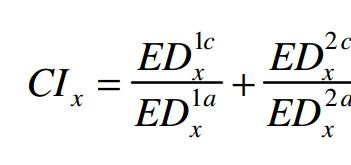
[00140] em que EDX é a dose da primeira ou respectivamente segunda droga usada sozinha (1a, 2a), ou em combinação com a segunda ou respectivamente primeira droga (1c, 2c), que é necessária para produzir um determinado efeito. A primeira e segunda droga mencionada tem efeitos aditivos ou sinérgicos ou antagonistas, dependendo de CI <1, IC = 1, ou CI> 1, respectivamente.[00140] where EDX is the dose of the first or respectively second drug used alone (1a, 2a), or in combination with the second or respectively first drug (1c, 2c), which is required to produce a given effect. The first and second mentioned drugs have additive or synergistic or antagonistic effects, depending on CI < 1, CI = 1, or CI > 1, respectively.
[00141] A atividade sinergística das composições farmacêuticas ou preparações combinadas da presente invenção contra a infecção viral também pode ser facilmente determinada por meio de um ou mais testes como, mas não se limitando, o método de isobolograma, conforme descrito anteriormente por Elion et al. em J. Biol. Chem. (1954) 208: 477-488 e por Baba et al. em Antimicrob. Agents Chemother. (1984) 25: 515-517, utilizando a EC50 para calcular a concentração inibidora fracional (a seguir designada como FIC). Quando o índice FIC mínimo correspondente ao FIC de compostos combinados (por exemplo, FICx + FICy) é igual a 1,0, a combinação é referida com sendo aditiva; quando se encontra entre 1,0 e 0,5, a combinação é definida como subsinergística, e quando é inferior a 0,5, a combinação é definida como sinérgica. Quando o índice FIC mínimo está entre 1,0 e 2,0 a combinação é definida como subantagonística e, quando é superior a 2,0, a combinação é definida como antagonista.[00141] The synergistic activity of the pharmaceutical compositions or combined preparations of the present invention against viral infection can also be easily determined by means of one or more tests such as, but not limited to, the isobologram method, as previously described by Elion et al . in J. Biol. chem. (1954) 208: 477-488 and by Baba et al. in Antimicrob. Agents Chemother. (1984) 25: 515-517, using the EC50 to calculate the fractional inhibitory concentration (hereinafter referred to as FIC). When the minimum FIC index corresponding to the FIC of combined compounds (eg, FICx + FICy) equals 1.0, the combination is said to be additive; when it is between 1.0 and 0.5, the combination is defined as subsynergistic, and when it is less than 0.5, the combination is defined as synergistic. When the minimum FIC index is between 1.0 and 2.0, the combination is defined as subantagonistic, and when it is greater than 2.0, the combination is defined as antagonistic.
[00142] Este princípio pode ser aplicado a uma combinação de diferentes drogas antivirais da invenção ou a uma combinação das drogas antivirais da invenção com outros fármacos que apresentam atividade antiviral ou que estimulam a resposta imune.[00142] This principle can be applied to a combination of different antiviral drugs of the invention or to a combination of the antiviral drugs of the invention with other drugs that have antiviral activity or that stimulate the immune response.
[00143] A invenção refere-se assim a uma composição farmacêutica ou preparação combinada possuindo efeitos sinérgicos contra uma infecção viral e contendo: Tanto: A) (a) uma combinação de dois ou mais dos compostos da presente invenção, e (b) opcionalmente um ou mais excipientes farmacêuticos ou veículos farmaceuticamente aceitáveis, para a utilização simultânea, separada ou sequencial no tratamento ou prevenção de uma infecção por Flavivírus ou B) (c) um ou mais agentes antivirais e/ou agentes estimulantes do sistema imune, e (d) pelo menos um dos compostos da presente invenção, e (e) opcionalmente um ou mais excipientes farmacêuticos ou veículos farmaceuticamente aceitáveis, para a utilização simultânea, separada ou sequencial no tratamento ou prevenção de uma infecção por Flavivírus.[00143] The invention thus relates to a pharmaceutical composition or combined preparation having synergistic effects against a viral infection and containing: Either: A) (a) a combination of two or more of the compounds of the present invention, and (b) optionally one or more pharmaceutical excipients or pharmaceutically acceptable carriers, for simultaneous, separate or sequential use in the treatment or prevention of a Flavivirus infection or B) (c) one or more antiviral agents and/or immune system stimulating agents, and (d ) at least one of the compounds of the present invention, and (e) optionally one or more pharmaceutical excipients or pharmaceutically acceptable carriers, for simultaneous, separate or sequential use in the treatment or prevention of a Flavivirus infection.
[00144] Agentes antivirais adequados para inclusão nas composições antivirais sinérgicas ou preparações combinadas da presente invenção incluem a ribavirina.[00144] Suitable antiviral agents for inclusion in the synergistic antiviral compositions or combination preparations of the present invention include ribavirin.
[00145] Agentes estimulantes do sistema imune para a inclusão nas composições antivirais sinérgicas ou preparações combinadas da presente invenção incluem o interferon.[00145] Immune system stimulating agents for inclusion in the synergistic antiviral compositions or combination preparations of the present invention include interferon.
[00146] A composição farmacêutica ou preparação combinada com atividade sinergística contra a infecção viral de acordo com a presente invenção pode conter os compostos da presente invenção ao longo de uma ampla gama de conteúdo de acordo com o uso previsto e do efeito esperado da preparação. Geralmente, o teor do composto da invenção para a inclusão nas composições antivirais sinérgicas da presente invenção da preparação combinada está no intervalo de 0,1 a 99,9%, em peso, de preferência de 1 a 99% em peso, mais preferencialmente de 5 a 95% em peso.[00146] The pharmaceutical composition or combined preparation with synergistic activity against viral infection according to the present invention may contain the compounds of the present invention over a wide range of content according to the intended use and the expected effect of the preparation. Generally, the content of the compound of the invention for inclusion in the synergistic antiviral compositions of the present invention of the combined preparation is in the range from 0.1 to 99.9% by weight, preferably from 1 to 99% by weight, more preferably from 5 to 95% by weight.
[00147] De acordo com um exemplo de realização particular da invenção, os compostos da invenção podem ser utilizados em combinação com outros agentes terapêuticos para o tratamento ou profilaxia de infecções por Flavivírus, mais preferivelmente infecções pelo vírus da dengue. Consequentemente, a invenção está relacionada ao uso de uma composição compreendendo: (f) um ou mais compostos com as fórmulas descritas na presente invenção, e (g) um ou mais inibidores de enzima picornaviral como agentes biologicamente ativos nas respectivas proporções, tais como para proporcionar um efeito sinérgico contra uma infecção pelo Flavivírus, particularmente uma infecção pelo vírus da Dengue em um mamífero, por exemplo, sob a forma de uma preparação combinada para utilização simultânea, separada ou sequencial na terapia para a infecção viral.[00147] According to a particular exemplary embodiment of the invention, the compounds of the invention can be used in combination with other therapeutic agents for the treatment or prophylaxis of Flavivirus infections, more preferably dengue virus infections. Accordingly, the invention relates to the use of a composition comprising: (f) one or more compounds of the formulas described in the present invention, and (g) one or more picornaviral enzyme inhibitors as biologically active agents in respective proportions, such as for to provide a synergistic effect against a Flavivirus infection, particularly a Dengue virus infection in a mammal, for example, in the form of a combined preparation for simultaneous, separate or sequential use in therapy for the viral infection.
[00148] De modo geral, a invenção está relacionada aos compostos de fórmula (A), (B), (C), (D-1), (D-2), (E), (F), e (L) e todos os exemplos de realização destes são úteis como agentes com atividade biológica (em particular atividade antiviral) ou como agentes de diagnóstico. Qualquer um dos usos mencionados em relação a presente invenção pode ser restrito a um uso não médico, não terapêutico, não diagnóstico, ou exclusivamente um uso in vitro, ou uso relacionado com células remotas a partir de um animal.[00148] In general, the invention is related to the compounds of formula (A), (B), (C), (D-1), (D-2), (E), (F), and (L ) and all embodiments thereof are useful as agents with biological activity (in particular antiviral activity) or as diagnostic agents. Any of the uses mentioned in connection with the present invention may be restricted to a non-medical, non-therapeutic, non-diagnostic use, or exclusively an in vitro use, or use related to cells remote from an animal.
[00149] De modo geral, a invenção está relacionada aos compostos de fórmula (A), (B), (C), (D-1), (D-2), (E), (F), (G), (H), (I), (J), e todos os exemplos de realização destes são úteis como agentes com atividade biológica (em particular atividade antiviral) ou como agentes de diagnóstico. Qualquer um dos usos mencionados em relação a presente invenção pode ser restrito a um uso não médico, não terapêutico, não diagnóstico, ou exclusivamente um uso in vitro, ou uso relacionado com células remotas a partir de um animal.[00149] In general, the invention is related to the compounds of formula (A), (B), (C), (D-1), (D-2), (E), (F), (G) , (H), (I), (J), and all embodiments thereof are useful as agents with biological activity (in particular antiviral activity) or as diagnostic agents. Any of the uses mentioned in connection with the present invention may be restricted to a non-medical, non-therapeutic, non-diagnostic use, or exclusively an in vitro use, or use related to cells remote from an animal.
[00150] Os técnicos hábeis no assunto reconhecerão também que os compostos da invenção podem existir em diversos estados de protonação diferentes, dependendo, entre outras coisas, do pH de seu ambiente. Embora as fórmulas estruturais aqui fornecidas ilustrem os compostos em apenas um dentre os vários estados de protonação possíveis, faz-se observar que estas estruturas são apenas ilustrativas, e que a invenção não está limitada a um determinado estado de protonação - quaisquer e todas as formas protonadas dos compostos destinam-se a cair dentro do escopo da invenção.[00150] Those skilled in the art will also recognize that the compounds of the invention can exist in several different protonation states, depending, among other things, on the pH of their environment. Although the structural formulas provided herein illustrate compounds in only one of several possible protonation states, it is understood that these structures are illustrative only, and that the invention is not limited to a particular protonation state - any and all forms protonated compounds are intended to fall within the scope of the invention.
[00151] O termo “sais farmaceuticamente aceitáveis”, conforme utilizado no presente, significa as formas de sal atóxicas terapeuticamente ativas que os compostos das fórmulas da presente invenção são capazes de formar. Portanto, os compostos da presente invenção compreendem opcionalmente sais dos compostos da presente invenção, os sais atóxicos farmaceuticamente aceitáveis, especialmente contendo, por exemplo, Na+, Li+, K+, NH4+, Ca2+ e Mg2+. Tais sais podem incluir os derivados por combinação de cátions apropriados, tais como íons de metais alcalinos e metal alcalino- terrosos ou íons de amônia e amino quaternário, com um radical ânion de ácido, tipicamente um ácido carboxílico. Os compostos da invenção podem conter múltiplas diversas positivas ou negativas. A carga líquida dos compostos da invenção pode ser positiva ou negativa. Quaisquer contraíons associados são geralmente ditados pelos métodos de síntese e/ou isolamento, através da qual os compostos são obtidos. Contraíons típicos incluem, mas não estão limitados a, amônio, sódio, potássio, lítio, halogenetos, acetato, trifluoroacetato, etc, e suas misturas. Deve ser compreendido que a identidade de qualquer contraíon não está associada a uma característica crítica da invenção, e que a invenção abrange os compostos em associação com qualquer tipo de contraíon. Além disso, como os compostos podem existir em uma variedade de formas diferentes, a presente invenção destina-se a abranger não só as formas dos compostos que estão em associação com os contraíons (por exemplo, sais secos), mas também as formas que não estão em associação com um contraíon (por exemplo, soluções aquosas ou orgânicas). Os sais de metais são preparados tipicamente pela reação de hidróxido do metal com um composto da presente invenção. Exemplos de sais de metais que são preparados deste modo são sais que contêm Li+, Na+, e K+. Um sal de metal menos solúvel pode ser precipitado a partir da solução de um sal mais solúvel pela adição do composto metálico adequado. Além disso, os sais podem ser formados a partir da adição ácida de determinados ácidos orgânicos e inorgânicos para os centros básicos, tipicamente aminas, ou grupos acídicos. Exemplos de tais ácidos apropriados incluem, por exemplo, ácidos inorgânicos, tais como ácidos halogenídrico, por exemplo, ácido clorídrico ou bromídrico, ácido sulfúrico, ácido nítrico, ácido fosfórico e semelhantes; ou ácidos orgânicos, tais como, por exemplo, acético, propanóico, hidroxiacético, 2- hidroxipropanóico, 2-oxopropanóico, lático, pirúvico, oxálico (isto é, etanodióico), malônico, succínico (isto é, ácido butanodioico), maleico, fumárico, málico, tartárico, cítrico, metanossulfônico, etanossulfônico, benzenossulfônico, p-toluenossulfônico, ciclo-hexanossulfâmico, salicílico (ou seja, 2-hidroxibenzóico), p-amino-salicílico e semelhantes. Além disso, este termo inclui também os solvatos em que os compostos das fórmulas da presente invenção, bem como os seus sais, são capazes de formar, tais como, por exemplo, hidratos, alcoolatos e similares. Finalmente, deve ser entendido que as composições descritas na presente invenção compreendem compostos da invenção na sua forma não ionizada, bem como a forma zwiteriônica, e combinações com quantidades estequiométricas de água como em hidratos.[00151] The term "pharmaceutically acceptable salts", as used herein, means the therapeutically active non-toxic salt forms that the compounds of the formulas of the present invention are able to form. Therefore, the compounds of the present invention optionally comprise salts of the compounds of the present invention, the non-toxic pharmaceutically acceptable salts, especially containing, for example, Na+, Li+, K+, NH4+, Ca2+ and Mg2+. Such salts may include those derived by combining appropriate cations, such as alkali metal and alkaline earth metal ions or ammonium and quaternary amino ions, with an acid anion radical, typically a carboxylic acid. Compounds of the invention may contain multiple positive or negative diverses. The net charge of the compounds of the invention can be positive or negative. Any associated counterions are generally dictated by the synthesis and/or isolation methods by which the compounds are obtained. Typical counterions include, but are not limited to, ammonium, sodium, potassium, lithium, halides, acetate, trifluoroacetate, etc., and mixtures thereof. It should be understood that the identity of any counterion is not associated with a critical feature of the invention, and that the invention encompasses compounds in association with any type of counterion. Furthermore, as compounds can exist in a variety of different forms, the present invention is intended to encompass not only those forms of the compounds that are in association with counterions (e.g., dry salts), but also those forms that do not. are in association with a counterion (eg, aqueous or organic solutions). Metal salts are typically prepared by reacting metal hydroxide with a compound of the present invention. Examples of metal salts that are prepared in this way are salts that contain Li+, Na+, and K+. A less soluble metal salt can be precipitated from the solution of a more soluble salt by adding the appropriate metal compound. Furthermore, salts can be formed from the acid addition of certain organic and inorganic acids to basic centers, typically amines, or acidic groups. Examples of such suitable acids include, for example, inorganic acids such as hydrohalic acids, for example hydrochloric or hydrobromic acid, sulfuric acid, nitric acid, phosphoric acid and the like; or organic acids, such as, for example, acetic, propanoic, hydroxyacetic, 2-hydroxypropanoic, 2-oxopropanoic, lactic, pyruvic, oxalic (i.e. ethanedioic), malonic, succinic (i.e. butanedioic acid), maleic, fumaric , malic, tartaric, citric, methanesulfonic, ethanesulfonic, benzenesulfonic, p-toluenesulfonic, cyclohexanesulfamic, salicylic (i.e., 2-hydroxybenzoic), p-aminosalicylic and the like. Furthermore, this term also includes the solvates which the compounds of the formulas of the present invention, as well as their salts, are able to form, such as, for example, hydrates, alcoholates and the like. Finally, it should be understood that the compositions described in the present invention comprise compounds of the invention in their non-ionized form, as well as the zwitterionic form, and combinations with stoichiometric amounts of water as in hydrates.
[00152] Também estão incluídos dentro do escopo da presente invenção os sais dos compostos parentais com um ou mais aminoácidos, especialmente os aminoácidos de ocorrência natural encontrados como componentes proteicos. O aminoácido é tipicamente aquele que contém uma cadeia lateral com um grupo básico ou acídico, por exemplo, lisina, arginina ou ácido glutâmico, ou um grupo neutro, tal como glicina, serina, treonina, alanina, isoleucina, ou leucina.[00152] Also included within the scope of the present invention are salts of the parent compounds with one or more amino acids, especially the naturally occurring amino acids found as protein components. The amino acid is typically one that contains a side chain with a basic or acidic group, for example, lysine, arginine, or glutamic acid, or a neutral group, such as glycine, serine, threonine, alanine, isoleucine, or leucine.
[00153] Os compostos da invenção também incluem sais fisiologicamente aceitáveis. Exemplos de sais fisiologicamente aceitáveis dos compostos da invenção incluem sais derivados de uma base apropriada, tal como um metal alcalino (por exemplo, sódio), um alcalino-terroso (por exemplo, magnésio), amônio e NX4+ (em que X é alquila C1- C4). Os sais fisiologicamente aceitáveis de um átomo de hidrogênio ou um grupo amino incluem sais de ácidos carboxílicos orgânicos tais como ácido acético, benzóico, lático, fumárico, tartárico, maleico, malônico, málico, isetiônico, lactobiônico e succínico; ácidos orgânicos sulfônicos, tais como metanossulfônico, etanossulfônico, benzenossulfônico e p-toluenossulfônico; e ácidos inorgânicos, como ácido clorídrico, sulfúrico, fosfórico e sulfâmico. Os sais fisiologicamente aceitáveis de um composto contendo um grupo hidroxi incluem o ânion do referido composto em combinação com um cátion adequado tal como Na+ e NX4+ (em que X é tipicamente selecionado independentemente de H ou um grupo alquila C1-C4). Entretanto, sais de ácidos ou bases que não são fisiologicamente aceitáveis podem também encontrar uso, por exemplo, na preparação ou purificação de um composto fisiologicamente aceitável. Todos os sais, sejam ou não derivados de um ácido ou base fisiologicamente aceitável, estão dentro do escopo da presente invenção.[00153] The compounds of the invention also include physiologically acceptable salts. Examples of physiologically acceptable salts of the compounds of the invention include salts derived from an appropriate base, such as an alkali metal (e.g. sodium), an alkaline earth metal (e.g. magnesium), ammonium and NX4+ (where X is C1 alkyl - C4). Physiologically acceptable salts of a hydrogen atom or an amino group include salts of organic carboxylic acids such as acetic, benzoic, lactic, fumaric, tartaric, maleic, malonic, malic, isethionic, lactobionic and succinic acid; organic sulfonic acids, such as methanesulfonic, ethanesulfonic, benzenesulfonic and p-toluenesulfonic; and inorganic acids such as hydrochloric, sulfuric, phosphoric and sulfamic acid. Physiologically acceptable salts of a compound containing a hydroxy group include the anion of said compound in combination with a suitable cation such as Na+ and NX4+ (where X is typically selected independently of H or a C1-C4 alkyl group). However, salts of acids or bases which are not physiologically acceptable may also find use, for example, in the preparation or purification of a physiologically acceptable compound. All salts, whether or not derived from a physiologically acceptable acid or base, are within the scope of the present invention.
[00154] Ânions preferidos para formar o sais de adição de ácido farmaceuticamente aceitável são o acetato, benzenossulfonato, benzoato, bicarbonato, bitartarato, brometo, edetato de cálcio, camsiato, carbonato, cloreto, citrato, dicloridrato, edetato, edisilato, estolato, esilato, fumarato, gluceptato, gluconato, glutamato, glicolilarsanilato, hexilresorcinato, hidrabamina, bromidrato, cloridrato, hidroxinaftoato, iodeto, isetionato, lactato, lactobionato, malato, maleato, mandelato, mesilato, metilbrometo, metilnitrato, metilsulfato, mucato, napsilato, nitrato, pamoato (embonato), pantotenato, fosfato/difosfato, poligalacturonato, salicilato, estearato, subacetato, succinato, sulfato, tanato, tartarato, teoclato, trietiodeto, e similares.[00154] Preferred anions to form pharmaceutically acceptable acid addition salts are acetate, benzenesulfonate, benzoate, bicarbonate, bitartrate, bromide, calcium edetate, camsiate, carbonate, chloride, citrate, dihydrochloride, edetate, edisylate, estolate, esylate , fumarate, gluceptate, gluconate, glutamate, glycolylarsanilate, hexylresorcinate, hydrabamine, hydrobromide, hydrochloride, hydroxynaphthoate, iodide, isethionate, lactate, lactobionate, malate, maleate, mandelate, mesylate, methylbromide, methylnitrate, methylsulfate, mucate, napsylate, nitrate, pamoate (embonate), pantothenate, phosphate/diphosphate, polygalacturonate, salicylate, stearate, subacetate, succinate, sulfate, tannate, tartrate, theoclate, triethiodide, and the like.
[00155] Cátions preferidos para formar sais de base farmaceuticamente aceitável são benzatina, cloroprocaína, colina, dietanolamina, etilenodiamina, meglumina, procaína, e similares; e os formados com cátions metálicos tais como o alumínio, cálcio, lítio, magnésio, potássio, sódio, zinco, e outros similares.[00155] Preferred cations to form pharmaceutically acceptable base salts are benzathine, chloroprocaine, choline, diethanolamine, ethylenediamine, meglumine, procaine, and the like; and those formed with metallic cations such as aluminum, calcium, lithium, magnesium, potassium, sodium, zinc, and the like.
[00156] Conforme utilizado no presente e a menos que indicado de outra forma, o termo “enantiômero” significa cada forma oticamente ativa individual de um composto da invenção, tendo uma pureza ótica ou excesso enantiomérico (determinado por métodos padrão na arte) de pelo menos 80% (ou seja, pelo menos 90% de um enantiômero e no máximo 10% de outro enantiômero), de preferência pelo menos 90% e mais preferencialmente pelo menos 98%.[00156] As used herein and unless otherwise indicated, the term "enantiomer" means each individual optically active form of a compound of the invention, having an optical purity or enantiomeric excess (determined by standard methods in the art) of at least at least 80% (i.e. at least 90% of one enantiomer and at most 10% of another enantiomer), preferably at least 90% and most preferably at least 98%.
[00157] O termo “isômeros” conforme utilizado na presente invenção significa que os compostos de fórmulas da presente invenção podem possuir todas as possíveis formas isoméricas, incluindo as formas tautoméricas e estereoquímicas, mas não incluindo isômeros de posição. Tipicamente, as estruturas apresentadas na presente invenção exemplificam apenas uma forma tautomérica ou de ressonância dos compostos, mas as configurações alternativas correspondentes também são contempladas. Salvo quando indicado de outra forma, a designação química dos compostos denota a mistura de todas as possíveis formas estereoquimicamente isoméricas, contendo essas misturas todos os diastereômeros e enantiômeros (uma vez que os compostos de fórmulas da presente invenção podem ter pelo menos um centro quiral) da estrutura molecular básica, bem como os compostos estereoquimicamente puros ou enriquecidos. Mais particularmente, os centros estereogênicos podem ter ou a configuração R ou S, e ligações múltiplas podem ter a configuração cis ou trans.[00157] The term "isomers" as used in the present invention means that the compounds of formulas of the present invention can have all possible isomeric forms, including tautomeric and stereochemical forms, but not including positional isomers. Typically, the structures shown in the present invention exemplify only one tautomeric or resonance form of the compounds, but corresponding alternative configurations are also contemplated. Unless otherwise indicated, the chemical designation of compounds denotes the mixture of all possible stereochemically isomeric forms, such mixtures containing all diastereomers and enantiomers (since compounds of formulas of the present invention may have at least one chiral center) of the basic molecular structure, as well as stereochemically pure or enriched compounds. More particularly, stereogenic centers can have either the R or S configuration, and multiple bonds can have the cis or trans configuration.
[00158] Formas isoméricas puras dos referidos compostos são definidas como isômeros substancialmente livres de outras formas enantioméricas ou diastereoméricas da mesma estrutura molecular básica. Em particular, o termo “estereoisomericamente puro” ou “quiralmente puro” refere-se a compostos tendo um excesso estereoisomérico de, pelo menos, cerca de 80% (ou seja, pelo menos 90% de um isômero e máximo de 10% dos outros isômeros possíveis), de preferência pelo menos 90%, mais preferencialmente pelo menos 94% e mais preferencialmente pelo menos 97%. Os termos “enantiomericamente puro” e “diastereomericamente puro” devem ser entendidos de uma maneira semelhante, levando em conta o excesso enantiomérico, e respectivamente o excesso diastereomérico, da mistura em questão.[00158] Pure isomeric forms of said compounds are defined as substantially free isomers of other enantiomeric or diastereomeric forms of the same basic molecular structure. In particular, the term "stereomerically pure" or "chirally pure" refers to compounds having a stereoisomeric excess of at least about 80% (i.e., at least 90% of one isomer and maximum of 10% of the other possible isomers), preferably at least 90%, more preferably at least 94% and most preferably at least 97%. The terms "enantiomerically pure" and "diastereomerically pure" are to be understood in a similar way, taking into account the enantiomeric excess, and respectively the diastereomeric excess, of the mixture in question.
[00159] A separação de estereoisômeros é realizada por métodos convencionais conhecidos pelos especialistas no assunto. Um enantiômero de um composto da invenção pode ser separado de maneira substancialmente livre de seu enantiômero oposto por um método como a formação de diastereômeros usando agentes de resolução opticamente ativos (“Stereochemistry of Carbon Compounds”, (1962) por E. L. Eliel, McGraw Hill; Lochmuller, C. H., (1975) J. Chromatogr., 113:(3) 283-302). A separação dos isômeros em uma mistura pode ser conseguida por qualquer método adequado, incluindo: (1) a formação de sais diastereoméricos, iônicos com compostos quirais e separação por cristalização fracionada ou outros métodos, (2) formação de compostos diastereoméricos com reagentes de derivatização quirais, separação dos diastereoisômeros e conversão nos enantiômeros puros, e (3) os enantiômeros podem ser separados diretamente sob condições quirais. De acordo com o método (1), os sais diastereoméricos podem ser formados pela reação de bases quirais enantiomericamente puras, tais como brucina, quinina, efedrina, estricnina, α-metil-β-feniletilamina (anfetaminas), e similares, compostos assimétricos carregando funcionalidade acídica, tal como ácido carboxílico e ácido sulfônico. Os sais diastereoméricos podem ser induzidos a separação pela cristalização fracionada ou cromatografia iônica. Para a separação de isômeros ópticos dos compostos amino, a adição de ácidos carboxílicos quirais ou ácidos sulfônicos, como o ácido canforsulfônico, ácido tartárico, ácido mandélico e ácido láctico pode resultar na formação de sais diastereoméricos. Alternativamente, pelo método (2), o substrato para ser resolvido é reagido com um enantiômero de um composto quiral para formar um par diastereomérico (Eliel, E. e Wilen, S., Stereochemistry of Organic Compounds, John Wiley & Sons, Inc., 1994, pág. 322). Compostos diastereoméricos podem ser formados pela reação de compostos assimétricos com reagentes derivatizante quirais enantiomericamente puros, tais como os derivados de mentila, seguido pela separação dos diastereoisômeros e hidrólise para produzir o xanteno enantioméricamente enriquecido, livre. Um método de determinação da pureza ótica envolve a produção de ésteres quirais, tal como um éster mentila ou éster de Mosher, a-metoxi-a- (trifluorometil)-fenila (Jacob III. (1982) J. Org. Chem. 47: 4165), da mistura racêmica, e analisando o espectro por RMN para verificar a presença dos dois diasterômeros atropisoméricos. Diastereoisômeros estáveis podem ser separados e isolados por cromatografia normal de em fase reversa e em seguida pelos métodos de separação de naftil-isoquinolinas atropisoméricas (Hoye, T., WO 96/15111). De acordo com o método (3), uma mistura racêmica de dois enantiômeros assimétricos é separada por cromatografia utilizando uma fase estacionária quiral. Fases estacionárias quirais adequadas são, por exemplo, polissacarídeos, em particular os derivados da celulose ou amilose. Fases estacionárias quirais comercialmente disponíveis baseadas em polissacarídeo são ChiralCeITM CA, OA, OB5, OC5, OD, OF, OG, OJ e OK, e ChiralpakTM AD, AS, OP(+) e OT(+). Os eluentes ou fases móveis apropriados para utilização em combinação com as referidas fases estacionárias quirais de polissacarídeos são hexano e similares, modificados com um álcool tal como etanol, isopropanol e similares. (“Chiral Liquid Chromatography” (1989) W. J. Lough, Ed. Chapman e Hall, Nova Iorque; Okamoto, (1990) “Optical resolution of dihydropyridine enantiomers by High-performance liquid chromatography using phenylcarbamates of polysaccharides as a chiral stationary phase”, J. of Chromatogr. 513:375-378).[00159] The separation of stereoisomers is carried out by conventional methods known to those skilled in the art. One enantiomer of a compound of the invention can be separated substantially free from its opposite enantiomer by a method such as formation of diastereomers using optically active resolving agents ("Stereochemistry of Carbon Compounds", (1962) by E. L. Eliel, McGraw Hill; Lochmuller, C.H., (1975) J. Chromatogr., 113:(3) 283-302). Separation of isomers in a mixture can be accomplished by any suitable method, including: (1) formation of diastereomeric, ionic salts with chiral compounds and separation by fractional crystallization or other methods, (2) formation of diastereomeric compounds with derivatization reagents chirals, separation of the diastereoisomers and conversion to the pure enantiomers, and (3) the enantiomers can be separated directly under chiral conditions. According to method (1), diastereomeric salts can be formed by the reaction of enantiomerically pure chiral bases, such as brucine, quinine, ephedrine, strychnine, α-methyl-β-phenylethylamine (amphetamines), and similar, asymmetric compounds carrying acidic functionality, such as carboxylic acid and sulfonic acid. Diastereomeric salts can be induced to separate by fractional crystallization or ion chromatography. For the separation of optical isomers of amino compounds, the addition of chiral carboxylic acids or sulfonic acids such as camphorsulfonic acid, tartaric acid, mandelic acid and lactic acid can result in the formation of diastereomeric salts. Alternatively, by method (2), the substrate to be resolved is reacted with one enantiomer of a chiral compound to form a diastereomeric pair (Eliel, E. and Wilen, S., Stereochemistry of Organic Compounds, John Wiley & Sons, Inc. , 1994, p. 322). Diastereomeric compounds can be formed by reacting asymmetric compounds with enantiomerically pure chiral derivatizing reagents, such as menthyl derivatives, followed by separation of the diastereoisomers and hydrolysis to produce the free, enantiomerically enriched xanthene. One method of determining optical purity involves the production of chiral esters, such as a menthyl ester or Mosher's ester, α-methoxy-α-(trifluoromethyl)-phenyl (Jacob III. (1982) J. Org. Chem. 47: 4165), of the racemic mixture, and analyzing the spectrum by NMR to verify the presence of the two atropisomeric diastereomers. Stable diastereoisomers can be separated and isolated by normal reverse phase chromatography and then atropisomeric naphthylisoquinoline separation methods (Hoye, T., WO 96/15111). According to method (3), a racemic mixture of two asymmetric enantiomers is separated by chromatography using a chiral stationary phase. Suitable chiral stationary phases are, for example, polysaccharides, in particular those derived from cellulose or amylose. Commercially available chiral stationary phases based on polysaccharide are ChiralCeITM CA, OA, OB5, OC5, OD, OF, OG, OJ and OK, and ChiralpakTM AD, AS, OP(+) and OT(+). Suitable eluents or mobile phases for use in combination with said polysaccharide chiral stationary phases are hexane and the like, modified with an alcohol such as ethanol, isopropanol and the like. (“Chiral Liquid Chromatography” (1989) W. J. Lough, Ed. Chapman and Hall, New York; Okamoto, (1990) “Optical resolution of dihydropyridine enantiomers by High-performance liquid chromatography using phenylcarbamates of polysaccharides as a chiral stationary phase”, J of Chromatogr. 513:375-378).
[00160] Os termos cis e trans são usados na presente invenção de acordo com a nomenclatura de Chemical Abstracts e incluem referência à posição dos substituintes em agrupamento de anel. A configuração estereoquímica absoluta dos compostos de fórmula (1) pode facilmente ser determinada pelos peritos na arte, enquanto utilizando métodos bem conhecidos, como, por exemplo, difração de raios-X.[00160] The terms cis and trans are used in the present invention in accordance with Chemical Abstracts nomenclature and include reference to the position of substituents in ring grouping. The absolute stereochemical configuration of the compounds of formula (1) can easily be determined by those skilled in the art, while using well-known methods, such as, for example, X-ray diffraction.
[00161] Os compostos da invenção podem ser formulados com veículos e excipientes convencionais, que serão selecionados em conformidade com a prática padrão. Os comprimidos irão conter excipientes, deslizantes, cargas, aglutinantes e similares. As formulações aquosas são preparadas em uma forma estéril, e quando pretendidas para a entrega por administração oral geralmente serão isotônicas. As formulações contêm opcionalmente excipientes, tais como os apresentados em “Handbook of Pharmaceutical Excipients” (1986) e incluem o ácido ascórbico e outros antioxidantes, agentes quelantes como EDTA, carboidratos tais como dextrina, hidroxialquilcelulose, hidroxialquilmetilcelulose, ácido esteárico e similares.[00161] The compounds of the invention can be formulated with conventional vehicles and excipients, which will be selected in accordance with standard practice. Tablets will contain excipients, glidants, fillers, binders and the like. Aqueous formulations are prepared in a sterile form, and when intended for delivery by oral administration will generally be isotonic. The formulations optionally contain excipients such as those set forth in the "Handbook of Pharmaceutical Excipients" (1986) and include ascorbic acid and other antioxidants, chelating agents such as EDTA, carbohydrates such as dextrin, hydroxyalkylcellulose, hydroxyalkylmethylcellulose, stearic acid and the like.
[00162] Subsequentemente, o termo “veículo farmaceuticamente aceitável” conforme utilizado no presente, significa qualquer material ou substância com o qual o ingrediente ativo é formulado a fim de facilitar a sua aplicação ou disseminação no local a ser tratado, por exemplo, dissolvendo, dispersando ou difundindo a referida composição, e/ou para facilitar seu armazenamento, transporte ou manuseio sem prejudicar a sua eficácia. O veículo farmaceuticamente aceitável pode ser um sólido ou um líquido ou um gás que foi comprimido para formar um líquido, ou seja, as composições da presente invenção podem ser adequadamente utilizadas como concentrados, emulsões, soluções, granulados, pós, sprays, aerossóis, suspensões, pomadas, cremes, comprimidos, pastilhas ou pó.[00162] Subsequently, the term "pharmaceutically acceptable vehicle" as used herein means any material or substance with which the active ingredient is formulated in order to facilitate its application or dissemination at the site to be treated, for example by dissolving, dispersing or diffusing said composition, and/or to facilitate its storage, transportation or handling without impairing its effectiveness. The pharmaceutically acceptable carrier can be a solid or a liquid or a gas that has been compressed to form a liquid, i.e. the compositions of the present invention can suitably be used as concentrates, emulsions, solutions, granules, powders, sprays, aerosols, suspensions , ointments, creams, pills, lozenges or powder.
[00163] Os veículos farmacêuticos adequados para uso nas referidas composições farmacêuticas e suas formulações são bem conhecidos pelos técnicos hábeis, e não há nenhuma restrição em particular quanto a sua seleção no âmbito da presente invenção.[00163] Suitable pharmaceutical carriers for use in said pharmaceutical compositions and their formulations are well known to those skilled in the art, and there is no particular restriction on their selection within the scope of the present invention.
[00164] Eles também podem incluir aditivos, tais como agentes de umidificação, agentes de dispersão, autocolantes, adesivos, agentes emulsionantes, solventes, revestimentos, agentes antibacterianos e antifúngicos (por exemplo, fenol, ácido sórbico, clorobutanol), agentes isotônicos (tais como açúcares ou cloreto de sódio) e similares, desde que os mesmos sejam consistentes com a prática farmacêutica, ou seja, veículos e aditivos que não criam danos permanentes aos mamíferos.[00164] They may also include additives such as wetting agents, dispersing agents, stickers, adhesives, emulsifying agents, solvents, coatings, antibacterial and antifungal agents (for example, phenol, sorbic acid, chlorobutanol), isotonic agents (such such as sugars or sodium chloride) and the like, provided they are consistent with pharmaceutical practice, i.e., vehicles and additives that do not create permanent harm to mammals.
[00165] As composições farmacêuticas da presente invenção podem ser preparadas de qualquer maneira conhecida, por exemplo misturando homogeneamente, revestindo e/ou moendo os ingredientes ativos, em um procedimento de uma etapa ou multi-etapas, com o material transportador selecionado, e, se for caso, outros aditivos como agentes tensoativos, também podem ser preparados por micronização, por exemplo, com o objetivo de obter-los na forma de microsferas usualmente possuindo um diâmetro de cerca de 1 a 10 gm, ou seja, para a fabricação de microcápsulas de liberação controlada ou prolongada dos ingredientes ativos.[00165] The pharmaceutical compositions of the present invention can be prepared in any known manner, for example by homogeneously mixing, coating and/or grinding the active ingredients, in a one-step or multi-step procedure, with the selected carrier material, and, if applicable, other additives such as surfactants, can also be prepared by micronization, for example, with the aim of obtaining them in the form of microspheres usually having a diameter of about 1 to 10 gm, that is, for the manufacture of controlled or prolonged release microcapsules of active ingredients.
[00166] Os agentes tensoativos adequados, também conhecidos como emulgentes ou emulsionantes, para serem utilizados nas composições farmacêuticas da presente invenção são materiais não iônicos, catiônicos e/ou aniônicos possuindo boas propriedades emulsionantes, dispersantes e/ou molhantes. Tensoativos aniônicos adequados incluem sabões solúveis em água e agentes tensoativos sintéticos solúveis em água. Os sabões adequados são os sais alcalinos ou alcalino-terrosos, sais de amônia não substituídos ou substituídos de ácidos graxos superiores (C10-C22), por exemplo, os sais de sódio ou potássio de ácido oleico ou esteárico, ou de misturas de ácidos graxos naturais que podem ser obtidas a partir de óleo de coco ou óleo de sebo. Tensoativos sintéticos incluem os sais de sódio ou cálcio de ácidos poliacrílicos; sulfonatos e sulfatos graxos; derivados de benzimidazol sulfonado e alquilarilsulfonatos. Sulfonatos ou sulfatos graxos estão geralmente na forma de sais de metais alcalinos ou alcalino-terrosos, sais de amônia não substituídos ou sais de amônia substituídos com um radical alquila ou acila possuindo de 8 a 22 átomos de carbono, por exemplo, o sal de sódio ou de cálcio de ácido lignosulfônico ou ácido dodecilsulfônico ou uma mistura de sulfatos de alcoóis graxos obtidos a partir de ácidos graxos naturais, sais de metais alcalinos ou alcalino-terrosos de ésteres de ácido sulfúrico ou ácido sulfônico (tal como laurilsulfato de sódio) e ácidos sulfônicos de álcool graxo/aduto de óxido de etileno. Derivados de benzimidazol sulfonados adequados contêm preferencialmente 8 a 22 átomos de carbono. Exemplos de alquilarilsulfonatos são os sais de sódio, cálcio ou de ácido alcoolamina de ácido dodecilbenzenossulfônico ou ácido dibutil-naftalenossulfônico ou um ácido naftaleno-sulfônico /produto da condensação de formaldeído. Também são adequados os fosfatos correspondentes, por exemplo, sais de éster de ácido fosfórico e um aduto de p-nonilfenol com etileno e/ou óxido de propileno, ou fosfolípidos. Fosfolípidos adequados para este fim são os naturais (originados a partir de células animais ou vegetais) ou fosfolípidos sintéticos do tipo cefalina ou lecitina tais como por exemplo fosfatidiletanolamina, fosfatidilserina, fosfatidilglicerina, lisolecitina, cardiolipina, dioctanilfosfatidil- colina, dipalmitoilfosfatidil -colina e misturas dos mesmos.[00166] Suitable surfactants, also known as emulsifiers or emulsifiers, to be used in the pharmaceutical compositions of the present invention are non-ionic, cationic and/or anionic materials having good emulsifying, dispersing and/or wetting properties. Suitable anionic surfactants include water-soluble soaps and water-soluble synthetic surfactants. Suitable soaps are the alkaline or alkaline earth salts, unsubstituted or substituted ammonium salts of higher fatty acids (C10-C22), for example, the sodium or potassium salts of oleic or stearic acid, or of mixed fatty acids natural ingredients that can be obtained from coconut oil or tallow oil. Synthetic surfactants include the sodium or calcium salts of polyacrylic acids; fatty sulfonates and sulfates; sulfonated benzimidazole derivatives and alkylarylsulfonates. Sulfonates or fatty sulfates are generally in the form of alkali or alkaline earth metal salts, unsubstituted ammonium salts or ammonium salts substituted with an alkyl or acyl radical having from 8 to 22 carbon atoms, for example the sodium salt or calcium from lignosulfonic acid or dodecylsulfonic acid or a mixture of fatty alcohol sulfates obtained from natural fatty acids, alkali or alkaline earth metal salts of sulfuric acid or sulfonic acid esters (such as sodium lauryl sulfate) and acids Fatty alcohol/ethylene oxide adduct sulfonics. Suitable sulfonated benzimidazole derivatives preferably contain 8 to 22 carbon atoms. Examples of alkylarylsulfonates are the sodium, calcium or alcoholamine salts of dodecylbenzenesulfonic acid or dibutylnaphthalenesulfonic acid or a naphthalenesulfonic acid/formaldehyde condensation product. Also suitable are the corresponding phosphates, for example ester salts of phosphoric acid and an adduct of p-nonylphenol with ethylene and/or propylene oxide, or phospholipids. Phospholipids suitable for this purpose are natural (originating from animal or plant cells) or synthetic phospholipids of the cephalin or lecithin type such as for example phosphatidylethanolamine, phosphatidylserine, phosphatidylglycerin, lysolecithin, cardiolipin, dioctanylphosphatidylcholine, dipalmitoylphosphatidylcholine and mixtures of these same.
[00167] Tensioativos não iônicos adequados incluem derivados polietoxilados e polipropoxilados de alquilfenóis, alcoóis graxos, ácidos graxos, aminas ou amidas alifáticas contendo pelo menos 12 átomos de carbono na molécula, alquilarenossulfonatos e dialquilsulfosucinatos, tais como derivados de éter poliglicol de alcoóis alifáticos e cicloalifáticos, ácidos graxos saturados e insaturados e alquilfenóis, os referidos derivados contendo preferencialmente de 3 a 10 grupos éter de glicol e 8 a 20 átomos de carbono no radical hidrocarboneto (alifático) e 6 a 18 átomos de carbono no radical alquila do alquilfenol. Outros tensoativos não iônicos adequados são os adutos solúveis em água de óxido de polietileno com polipropilenoglicol, etilenodiaminopolipropilenoglicol contendo 1 a 10 átomos de carbono na cadeia alquila, cujos adutos contêm 20 a 250 grupos éter de etilenoglicol e/ou 10 a 100 grupos éter de propilenoglicol. Tais compostos contêm normalmente entre 1 a 5 unidades de etilenoglicol por unidade de propilenoglicol. Exemplos representativos de tensoativos não iônicos são nonilfenol -polietoxietanol, éteres poliglicólicos de óleo de rícino, adutos de óxido de polipropileno/polietileno, tributilfenoxipolietoxietanol, polietilenoglicol e octilfenoxipolietoxietanol. Ésteres de ácidos graxos de polietileno-sorbitano (tais como trioleato de polioxietileno sorbitano), glicerol, sorbitano, sacarose e pentaeritritol são também tensoativos não iônicos adequados.[00167] Suitable nonionic surfactants include polyethoxylated and polypropoxylated derivatives of alkylphenols, fatty alcohols, fatty acids, aliphatic amines or amides containing at least 12 carbon atoms in the molecule, alkylarenesulfonates and dialkylsulfosuccinates, such as polyglycol ether derivatives of aliphatic and cycloaliphatic alcohols , saturated and unsaturated fatty acids and alkylphenols, said derivatives preferably containing from 3 to 10 glycol ether groups and 8 to 20 carbon atoms in the hydrocarbon radical (aliphatic) and 6 to 18 carbon atoms in the alkyl radical of the alkylphenol. Other suitable nonionic surfactants are water-soluble adducts of polyethylene oxide with polypropylene glycol, ethylenediaminepolypropylene glycol containing 1 to 10 carbon atoms in the alkyl chain, which adducts contain 20 to 250 ethylene glycol ether groups and/or 10 to 100 propylene glycol ether groups . Such compounds normally contain from 1 to 5 ethylene glycol units per propylene glycol unit. Representative examples of nonionic surfactants are nonylphenol-polyethoxyethanol, castor oil polyglycol ethers, polypropylene/polyethylene oxide adducts, tributylphenoxypolyethoxyethanol, polyethyleneglycol, and octylphenoxypolyethoxyethanol. Polyethylene sorbitan fatty acid esters (such as polyoxyethylene sorbitan trioleate), glycerol, sorbitan, sucrose and pentaerythritol are also suitable nonionic surfactants.
[00168] Os agentes tensoativos catiônicos adequados incluem sais de amônia quaternários, particularmente haletos, com 4 radicais hidrocarboneto opcionalmente substituídos com halogêneo, fenila, hidroxi ou fenila substituída; por exemplo sais de amônio quaternários contendo como N- substituinte pelo menos um radical alquila C8-C22 (por exemplo, cetila, laurila, palmitila, miristila, oleila e similares) e, como substituintes adicionais, alquila inferior não substituída ou halogenato, benzila e/ou radicais hidroxi-alquila inferiores.[00168] Suitable cationic surfactants include quaternary ammonium salts, particularly halides, with 4 hydrocarbon radicals optionally substituted with halogen, phenyl, hydroxy or substituted phenyl; for example quaternary ammonium salts containing as N-substituent at least one C8-C22 alkyl radical (for example cetyl, lauryl, palmityl, myristyl, oleyl and the like) and, as additional substituents, unsubstituted lower alkyl or halogenate, benzyl and and/or hydroxy-lower alkyl radicals.
[00169] Uma descrição mais detalhada de agentes tensoativos adequados para este fim pode ser encontrada, por exemplo, em “Detergents and Emulsifiers Annual de McCutcheon” (MC Publishing Crop., Ridgewood, Nova Jersey, 1981), “Tensid-Taschenbucw ', 2 d ed. (Hanser Verlag, Viena, 1981) e “Encyclopaedia of Surfactants” (Chemical Publishing Co., Nova Iorque, 1981).[00169] A more detailed description of surfactants suitable for this purpose can be found, for example, in “McCutcheon's Detergents and Emulsifiers Annual” (MC Publishing Crop., Ridgewood, New Jersey, 1981), “Tensid-Taschenbucw', 2 d ed. (Hanser Verlag, Vienna, 1981) and "Encyclopaedia of Surfactants" (Chemical Publishing Co., New York, 1981).
[00170] Os compostos da invenção e os seus sais fisiologicamente aceitáveis (daqui em diante referidos coletivamente como ingredientes ativos) podem ser administrados por qualquer via adequada para a condição a ser tratada, vias apropriadas incluindo oral, retal, nasal, tópica (incluindo ocular, bucal e sublingual), vaginal e parenteral (incluindo subcutânea, intramuscular, intravenosa, intradérmica, intratecal e epidural). A via de administração preferida pode variar, por exemplo, de acordo com a condição de que recebe.[00170] The compounds of the invention and their physiologically acceptable salts (hereinafter collectively referred to as active ingredients) may be administered by any suitable route for the condition being treated, appropriate routes including oral, rectal, nasal, topical (including ocular , buccal and sublingual), vaginal and parenteral (including subcutaneous, intramuscular, intravenous, intradermal, intrathecal and epidural). The preferred route of administration may vary, for example according to the condition you receive.
[00171] Embora é possível que os ingredientes ativos sejam administrados isoladamente, é preferível apresentá-los como formulações farmacêuticas. As formulações, tanto para uso veterinário quanto para uso humano, da presente invenção compreendem pelo menos um ingrediente ativo, conforme descrito acima, juntamente com um ou mais veículos farmaceuticamente aceitáveis e opcionalmente outros ingredientes terapêuticos. O(s) veículo(s) otimamente são “aceitáveis” no sentido de serem compatíveis com os outros ingredientes da formulação e não deletérios para o seu receptor. As formulações incluem aquelas adequadas para administração oral, retal, nasal, tópica (incluindo bucal e sublingual), (incluindo subcutânea, intramuscular, intravenosa, intradérmica, intratecal e epidural) vaginal ou parenteral. As formulações podem ser convenientemente apresentadas na forma de dosagem unitária e podem ser preparadas por qualquer um dos métodos conhecidos no estado da técnica farmacêutica. Tais métodos incluem a etapa de fornecer em associação o ingrediente ativo com o veículo que contém um ou mais ingredientes acessórios. Em geral, as formulações são preparadas sob condições estéreis por indução uniforme e discreta na associação do ingrediente ativo com o veículo líquido ou finamente separado no veículo sólido, ou ambos, e depois, se necessário, moldando o produto.[00171] Although it is possible for the active ingredients to be administered alone, it is preferable to present them as pharmaceutical formulations. Formulations, both for veterinary use and for human use, of the present invention comprise at least one active ingredient, as described above, together with one or more pharmaceutically acceptable carriers and optionally other therapeutic ingredients. The carrier(s) are optimally "acceptable" in the sense of being compatible with the other ingredients of the formulation and not deleterious to its recipient. Formulations include those suitable for oral, rectal, nasal, topical (including buccal and sublingual), vaginal (including subcutaneous, intramuscular, intravenous, intradermal, intrathecal and epidural) or parenteral administration. The formulations may conveniently be presented in unit dosage form and may be prepared by any of the methods known in the pharmaceutical art. Such methods include the step of providing in combination the active ingredient with a vehicle containing one or more accessory ingredients. In general, the formulations are prepared under sterile conditions by uniformly and discreetly inducing the active ingredient into association with the liquid or finely separated carrier in the solid carrier, or both, and then, if necessary, shaping the product.
[00172] As formulações da presente invenção adequadas para administração oral podem ser apresentadas como unidades individuais tais como cápsulas, pílulas ou comprimidos contendo cada um uma quantidade predeterminada do ingrediente ativo; como um pó ou grânulos; como uma solução ou uma suspensão em um líquido aquoso ou líquido não aquoso; ou como uma emulsão líquida óleo-em-água ou uma emulsão líquida água-em-óleo. O ingrediente ativo também pode ser apresentado como um bolus, electuário ou pasta.[00172] The formulations of the present invention suitable for oral administration may be presented as individual units such as capsules, pills or tablets each containing a predetermined amount of the active ingredient; as a powder or granules; as a solution or a suspension in an aqueous liquid or non-aqueous liquid; or as an oil-in-water liquid emulsion or a water-in-oil liquid emulsion. The active ingredient may also be presented as a bolus, electuary or paste.
[00173] Um comprimido pode ser feito por compressão ou moldagem, opcionalmente com um ou mais ingredientes acessórios. Comprimidos prensados podem ser preparados pela compressão do ingrediente ativo em uma máquina apropriada em uma forma fluída livre, como um pó ou granulado, opcionalmente misturado com um aglutinante, lubrificante, diluente inerte, conservante, de superfície ativa ou agente dispersante. Comprimidos moldados podem ser feitos pela moldagem de uma mistura do composto em pó umidificado com um diluente líquido inerte. Os comprimidos podem ser opcionalmente revestidos ou marcados e podem ser opcionalmente formulados de modo a proporcionar a liberação lenta ou controlada do ingrediente ativo deste. Para infecções do olho ou outros tecidos externos, por exemplo, boca e pele, as formulações são opcionalmente aplicadas como uma pomada ou creme tópico contendo o(s) ingrediente(s) ativo(s) em uma quantidade de, por exemplo, 0,075 a 20% p/p (incluindo ingrediente(s) ativo(s) em um intervalo entre 0,1% e 20% em incrementos de 0,1% p/p, tal como 0,6% p/p, 0,7% p/p, etc), de preferência 0,2 a 15% p/p e mais preferivelmente 0,5 a 10% p/p. Quando formulada em uma pomada, os princípios ativos podem ser empregados com qualquer base parafínica ou pomada miscível em água. Alternativamente, os ingredientes ativos podem ser formulados em uma base de creme óleo em água. Se desejado, a fase aquosa da base cremosa pode incluir, por exemplo, pelo menos 30% de um álcool polihídrico, ou seja, um álcool que contém dois ou mais grupos hidroxila, tais como propilenoglicol, 1,3- diol butano, manitol, sorbitol, glicerol e polietileno glicol (incluindo PEG400) e misturas destes. Pode ser desejável que as formulações tópicas incluam um composto que melhore a absorção ou penetração da substância ativa através da pele ou de outras áreas afetadas. Exemplos deste tipo de potenciadores da penetração cutânea incluem dimetilsulfóxido e análogos relacionados.[00173] A tablet can be made by compression or molding, optionally with one or more accessory ingredients. Compressed tablets may be prepared by compressing the active ingredient in a suitable machine into a free-flowing form, as a powder or granules, optionally mixed with a binder, lubricant, inert diluent, preservative, surface-active or dispersing agent. Molded tablets can be made by molding a mixture of the powdered compound moistened with an inert liquid diluent. Tablets may optionally be coated or scored and may optionally be formulated to provide slow or controlled release of the active ingredient therefrom. For infections of the eye or other external tissues, e.g. mouth and skin, the formulations are optionally applied as a topical ointment or cream containing the active ingredient(s) in an amount of, e.g., 0.075 to 20% w/w (including active ingredient(s) in a range between 0.1% and 20% in 0.1% w/w increments, such as 0.6% w/w, 0.7 % w/w, etc), preferably 0.2 to 15% w/w and most preferably 0.5 to 10% w/w. When formulated in an ointment, the active ingredients can be used with any paraffin base or water-miscible ointment. Alternatively, the active ingredients can be formulated in an oil-in-water cream base. If desired, the aqueous phase of the cream base may include, for example, at least 30% of a polyhydric alcohol, i.e. an alcohol containing two or more hydroxyl groups, such as propylene glycol, butane 1,3-diol, mannitol, sorbitol, glycerol and polyethylene glycol (including PEG400) and mixtures thereof. It may be desirable for topical formulations to include a compound that enhances absorption or penetration of the active substance through the skin or other affected areas. Examples of this type of skin penetration enhancers include dimethylsulfoxide and related analogues.
[00174] A fase oleosa das emulsões da presente invenção pode ser constituída a partir de ingredientes conhecidos em uma maneira conhecida. Embora a fase possa compreender apenas um emulsificante (também conhecido como um emulgente), é desejável que a mistura contenha de pelo menos um emulsificante com uma gordura ou um óleo, ou ambas, gordura e óleo. Opcionalmente, um emulsificante hidrofílico é incluído juntamente com um emulsificante lipofílico, que age como um estabilizante. É também preferido que inclua tanto um óleo quanto uma gordura. Juntos, o(s) emulsificante(s) com ou sem estabilizante(s), perfazem a então chamada cera emulsificante, e a cera, juntamente com o óleo e a gordura formam a então chamada base de pomada emulsificante que constitui a fase dispersa oleosa nas formulações cremosas.[00174] The oil phase of the emulsions of the present invention can be constituted from known ingredients in a known manner. Although the phase may comprise only one emulsifier (also known as an emulsifier), it is desirable that the mixture contain at least one emulsifier with a fat or an oil, or both a fat and an oil. Optionally, a hydrophilic emulsifier is included along with a lipophilic emulsifier, which acts as a stabilizer. It is also preferred that it includes both an oil and a fat. Together, the emulsifier(s), with or without stabilizer(s), make up the so-called emulsifying wax, and the wax, together with the oil and fat, form the so-called emulsifying ointment base, which constitutes the oily dispersed phase. in creamy formulations.
[00175] A escolha de óleos ou gorduras adequados para a formulação é baseada na obtenção das propriedades cosméticas desejadas, uma vez que a solubilidade do composto ativo na maioria dos óleos susceptíveis de serem utilizados em formulações de emulsões farmacêuticas é muito baixa. Assim, o creme deve ser opcionalmente um produto não gorduroso, que não manche e seja lavável com consistência adequada para evitar fugas dos tubos ou outros recipientes. Ésteres alquílicos mono- ou dibásicos de cadeia linear ou ramificada, tais como di-isoadipato, estearato de isocetila, diéster de propilenoglicol de ácidos graxos de coco, miristato de isopropila, oleato de decila, palmitato de isopropila, estearato de butila, palmitato de 2-etil-hexila ou uma mistura de ésteres de cadeia ramificada conhecidos como Crodamol CAP podem ser utilizados, sendo os três últimos ésteres os preferidos. Estes podem ser utilizados isoladamente ou em combinação dependendo das propriedades requeridas. Alternativamente, lipídeos de elevado ponto de fusão tais como parafina branca macia e/ou parafina líquida ou outros óleos minerais podem ser utilizados.[00175] The choice of suitable oils or fats for the formulation is based on obtaining the desired cosmetic properties, since the solubility of the active compound in most oils likely to be used in pharmaceutical emulsion formulations is very low. Thus, the cream should optionally be a non-greasy, non-staining and washable product with adequate consistency to prevent leakage from tubes or other containers. Straight or branched chain mono- or dibasic alkyl esters, such as diisoadipate, isocetyl stearate, propylene glycol diester of coconut fatty acids, isopropyl myristate, decyl oleate, isopropyl palmitate, butyl stearate, 2 -ethylhexyl or a mixture of branched chain esters known as Crodamol CAP can be used, with the last three esters being preferred. These can be used singly or in combination depending on the required properties. Alternatively, high melting point lipids such as white soft paraffin and/or liquid paraffin or other mineral oils can be used.
[00176] As formulações adequadas para a administração tópica ao olho também incluem colírios onde o ingrediente ativo é dissolvido ou suspenso em um veículo adequado, especialmente um solvente aquoso para o ingrediente ativo. O ingrediente ativo está opcionalmente presente em tais formulações em uma concentração de cerca de 0,5 a 20%, vantajosamente cerca de 0,5 a 10%, especificamente cerca de 1,5% p/p. Formulações adequadas para a administração tópica na boca incluem pastilhas contendo o ingrediente ativo em uma base aromatizada, geralmente sacarose e acácia ou goma tragacanto; Pastilhas contendo o ingrediente ativo em uma base inerte, tal como a gelatina e glicerina, ou sacarose e acácia; e colutórios contendo o ingrediente ativo em um veículo líquido adequado.[00176] Formulations suitable for topical administration to the eye also include eye drops where the active ingredient is dissolved or suspended in a suitable vehicle, especially an aqueous solvent for the active ingredient. The active ingredient is optionally present in such formulations at a concentration of about 0.5 to 20%, advantageously about 0.5 to 10%, specifically about 1.5% w/w. Formulations suitable for topical administration in the mouth include lozenges containing the active ingredient in a flavored base, usually sucrose and acacia or gum tragacanth; Lozenges containing the active ingredient in an inert base, such as gelatin and glycerin, or sucrose and acacia; and mouthwashes containing the active ingredient in a suitable liquid vehicle.
[00177] Formulações para a administração retal pode ser apresentado como um supositório com uma base adequada composta, por exemplo, de manteiga de cacau ou um salicilato. As formulações adequadas para administração nasal em que o veículo é um sólido incluem um pó grosso possuindo um tamanho de partícula, por exemplo, na faixa de 20 a 500 microns (incluindo tamanhos de partículas em uma faixa entre 20 e 500 microns em incrementos de 5 microns, tais como 30 microns, 35 microns, etc.), que é administrado de maneira em que o pó é tomado, ou seja, por inalação rápida através da passagem nasal a partir de um contentor do pó mantido próximo do nariz. As formulações adequadas em que o veículo é um líquido, para administração como, por exemplo, um spray nasal ou como gotas nasais, incluem soluções aquosas ou oleosas do ingrediente ativo. As formulações adequadas para administração em aerossol podem ser preparadas de acordo com métodos convencionais e podem ser administradas com outros agentes terapêuticos.[00177] Formulations for rectal administration may be presented as a suppository with a suitable base composed, for example, of cocoa butter or a salicylate. Formulations suitable for nasal administration in which the carrier is a solid include a coarse powder having a particle size, for example, in the range of 20 to 500 microns (including particle sizes in the range of 20 to 500 microns in 5 microns, such as 30 microns, 35 microns, etc.), which is administered in the manner in which the powder is taken, i.e. by rapid inhalation through the nasal passage from a powder container held close to the nose. Suitable formulations in which the carrier is a liquid, for administration as, for example, a nasal spray or as nasal drops, include aqueous or oily solutions of the active ingredient. Formulations suitable for aerosol administration can be prepared according to conventional methods and can be administered with other therapeutic agents.
[00178] As formulações adequadas para administração vaginal podem ser apresentadas como pessários, tampões, cremes, géis, pastas, espuma ou formulações em spray contendo além do ingrediente ativo, veículos como os conhecidos no estado da técnica como sendo adequados.[00178] Formulations suitable for vaginal administration may be presented as pessaries, tampons, creams, gels, pastes, foam or spray formulations containing, in addition to the active ingredient, vehicles such as those known in the prior art to be suitable.
[00179] As formulações adequadas para administração parenteral incluem soluções injetáveis estéreis aquosas e não aquosas, que podem conter antioxidantes, tampões, bacteriostáticos e solutos que tornam a formulação isotônica com o sangue do paciente, e suspensões estéreis aquosas e não aquosas, que podem incluir agentes de suspensão e espessantes. As formulações podem ser apresentadas em doses unitárias ou recipientes para doses múltiplas, por exemplo, ampolas e frascos fechados, e podem ser armazenadas em condição liofilizada necessitando apenas a adição do veículo líquido estéril, por exemplo, água para injeção, imediatamente antes do uso. Soluções e suspensões de injeção extemporânea podem ser preparadas a partir de pós, grânulos e comprimidos estéreis do tipo descrito anteriormente.[00179] Formulations suitable for parenteral administration include aqueous and non-aqueous sterile injectable solutions, which may contain antioxidants, buffers, bacteriostatics and solutes that make the formulation isotonic with the patient's blood, and aqueous and non-aqueous sterile suspensions, which may include suspending agents and thickeners. The formulations may be presented in single-dose or multi-dose containers, eg closed ampoules and vials, and may be stored in a lyophilized condition requiring only the addition of a sterile liquid vehicle, eg water for injection, immediately before use. Extemporaneous injection solutions and suspensions can be prepared from sterile powders, granules and tablets of the type described above.
[00180] Unidades de dosagem preferidas das formulações são aquelas que contêm uma dose diária ou unidade de subdose diária, tal como recitado acima, ou uma fração apropriada desta, de um ingrediente ativo.[00180] Preferred dosage units of formulations are those which contain a daily dose or daily sub-dose unit, as recited above, or an appropriate fraction thereof, of an active ingredient.
[00181] Deve ser entendido que em adição aos ingredientes particularmente mencionados acima, as formulações desta invenção podem incluir outros agentes convencionais na arte levando em consideração o tipo de formulação em questão, por exemplo, aquelas adequadas para administração oral podem incluir agentes aromatizantes.[00181] It should be understood that in addition to the ingredients particularly mentioned above, the formulations of this invention may include other agents conventional in the art taking into account the type of formulation in question, for example those suitable for oral administration may include flavoring agents.
[00182] Os compostos da invenção podem ser usados para proporcionar formulações farmacêuticas de liberação controlada contendo como ingrediente ativo um ou mais compostos da invenção (“formulações de liberação controlada”) em que a liberação do ingrediente ativo pode ser controlada e regulada para permitir menor frequência de dosagem ou para melhorar o perfil farmacocinético ou de toxicidade de um determinado composto da invenção. As formulações de liberação controlada adaptadas para administração oral nas quais unidades individuais que compreendem um ou mais compostos da invenção podem ser preparadas de acordo com métodos convencionais.[00182] The compounds of the invention can be used to provide controlled release pharmaceutical formulations containing as active ingredient one or more compounds of the invention ("controlled release formulations") in which the release of the active ingredient can be controlled and regulated to allow less dosing frequency or to improve the pharmacokinetic or toxicity profile of a particular compound of the invention. Controlled release formulations adapted for oral administration in which individual units comprising one or more compounds of the invention can be prepared according to conventional methods.
[00183] Os ingredientes adicionais podem ser incluídos, a fim de controlar a duração da ação do ingrediente ativo na composição. Composições de liberação controlada podem ser, portanto, conseguidas pela seleção de suportes poliméricos adequados, tais como, por exemplo, poliésteres, poliaminoácidos, polivinilpirrolidona, copolímeros de etileno-acetato de vinila, metilcelulose, carboximetilcelulose, sulfatosulfato protamina e similares. A taxa de liberação do fármaco e a duração da ação poderão igualmente ser controladas pela incorporação do ingrediente ativo em partículas, por exemplo, microcápsulas de uma substância polimérica tais como hidrogéis, ácido polilático, hidroximetilcelulose, metacrilato de polimetila e os outros polímeros descritos acima. Tais métodos incluem sistemas de administração de fármacos coloidais, como lipossomas, microesferas, microemulsões, nanopartículas, nanocápsulas e similares. Dependendo da via de administração, a composição farmacêutica pode exigir revestimentos de proteção. As formas farmacêuticas adequadas para o uso injetável incluem soluções aquosas estéreis ou dispersões e pó estéril para a preparação extemporânea das mesmas. Os veículos típicos para este fim incluem tampões biocompatíveis aquosos, etanol, glicerol, propilenoglicol, polietilenoglicol e similares e misturas dos mesmos.[00183] Additional ingredients may be included in order to control the duration of action of the active ingredient in the composition. Controlled release compositions can therefore be achieved by selecting suitable polymeric supports, such as, for example, polyesters, polyamino acids, polyvinylpyrrolidone, ethylene-vinyl acetate copolymers, methylcellulose, carboxymethylcellulose, protamine sulfate sulfate and the like. The drug release rate and duration of action can also be controlled by incorporating the active ingredient into particles, for example, microcapsules of a polymeric substance such as hydrogels, polylactic acid, hydroxymethylcellulose, polymethyl methacrylate and the other polymers described above. Such methods include colloidal drug delivery systems such as liposomes, microspheres, microemulsions, nanoparticles, nanocapsules and the like. Depending on the route of administration, the pharmaceutical composition may require protective coatings. Pharmaceutical forms suitable for injectable use include sterile aqueous solutions or dispersions and sterile powder for their extemporaneous preparation. Typical carriers for this purpose include aqueous biocompatible buffers, ethanol, glycerol, propylene glycol, polyethylene glycol and the like, and mixtures thereof.
[00184] Em vista do fato de que, quando vários ingredientes ativos são usados em combinação, não necessariamente trazer seus efeitos terapêuticos conjuntos diretamente ao mesmo tempo no mamífero a ser tratado, a composição correspondente pode também estar na forma de um kit medicamentoso ou pacote contendo os dois ingredientes em repositórios ou compartimentos separados, mas adjacentes. Neste último contexto, cada ingrediente ativo pode, portanto, ser formulado em uma forma adequada para uma via de administração diferente do outro ingrediente, por exemplo, um deles pode estar na forma de uma formulação oral ou parenteral, enquanto que o outro está na forma de uma ampola para injeção intravenosa ou na forma de um aerossol.[00184] In view of the fact that, when several active ingredients are used in combination, it does not necessarily bring their joint therapeutic effects directly at the same time in the mammal to be treated, the corresponding composition can also be in the form of a drug kit or pack containing the two ingredients in separate but adjacent repositories or compartments. In the latter context, each active ingredient can therefore be formulated in a form suitable for a different route of administration than the other ingredient, for example one of them can be in the form of an oral or parenteral formulation, while the other is in the form from an ampoule for intravenous injection or in the form of an aerosol.
[00185] Outro exemplo de realização da invenção está relacionado com vários precursores ou formas de “pró-fármacos” dos compostos da presente invenção. Pode ser desejável formular os compostos da presente invenção sob a forma de uma espécie química que por si só não é significativamente biologicamente ativa, mas que quando entregue ao animal irá sofrer uma reação química catalisada pela função normal do corpo do animal, inter alia, as enzimas presentes no estômago ou no sangue, e a referida reação química tem o efeito de liberar um composto conforme definido na presente invenção. O termo “pró-fármaco” ou “pró-droga” refere- se assim a estas espécies que são convertidas in vivo no ingrediente farmacêutico ativo.[00185] Another exemplary embodiment of the invention relates to various precursors or "prodrug" forms of the compounds of the present invention. It may be desirable to formulate the compounds of the present invention in the form of a chemical species which itself is not significantly biologically active, but which when delivered to the animal will undergo a chemical reaction catalyzed by the normal function of the animal's body, inter alia, the enzymes present in the stomach or blood, and said chemical reaction has the effect of releasing a compound as defined in the present invention. The term "prodrug" or "prodrug" thus refers to those species that are converted in vivo to the active pharmaceutical ingredient.
[00186] Os pró-fármacos da presente invenção podem ter qualquer forma adequada para o formulador, por exemplo, ésteres são formas de pró-fármacos comuns não limitantes. No presente caso, no entanto, o pró-fármaco pode necessariamente existir em uma forma em que uma ligação covalente é clivada pela ação de uma enzima presente no locus alvo. Por exemplo, uma ligação C-C covalente pode ser seletivamente clivada por uma ou mais enzimas no referido locus alvo e, por conseguinte, um pró-fármaco em uma forma diferente de um precursor facilmente hidrolisável, inter alia, um éster, amida, e similares podem ser usados. A contraparte do ingrediente farmacêutico ativo no pró-fármaco pode ter estruturas diferentes, tal como um aminoácido ou estrutura peptídica, cadeias de alquila, porções de açúcar e outras conhecidas no estado da técnica.[00186] The prodrugs of the present invention may have any form suitable for the formulator, for example, esters are common non-limiting prodrug forms. In the present case, however, the prodrug may necessarily exist in a form in which a covalent bond is cleaved by the action of an enzyme present at the target locus. For example, a covalent C-C bond can be selectively cleaved by one or more enzymes at said target locus, and therefore a prodrug in a form other than an easily hydrolyzable precursor, inter alia, an ester, amide, and the like can be used. The counterpart of the active pharmaceutical ingredient in the prodrug can have different structures, such as an amino acid or peptide structure, alkyl chains, sugar moieties and others known in the prior art.
[00187] Para a finalidade da presente invenção, o termo “pró- fármaco terapeuticamente adequado” é definido no presente como “um composto modificado de tal maneira para ser transformado in vivo na forma terapeuticamente ativa, seja por meio de uma única transformação ou por várias transformações biológicas, quando em contato com os tecidos do animal, mamífero ou humano ao qual o pró-fármaco foi administrado, e sem a indevida toxicidade, irritação, ou resposta alérgica, e alcançando o resultado terapêutico pretendido”.[00187] For the purpose of the present invention, the term “therapeutically suitable prodrug” is defined herein as “a compound modified in such a way to be transformed in vivo into the therapeutically active form, either by means of a single transformation or by various biological transformations, when in contact with the tissues of the animal, mammal or human to which the prodrug was administered, and without undue toxicity, irritation, or allergic response, and achieving the intended therapeutic result”.
[00188] Mais especificamente, o termo “pró-fármaco”, conforme utilizado no presente, refere-se a um derivado inativo ou significativamente menos ativo de um composto da invenção, que passa por uma transformação espontânea ou enzimática dentro do corpo, a fim de libertar a forma farmacologicamente ativa do composto. Para uma revisão abrangente, é feita referência a Rautio J. et al. (“Prodrugs: design and clinical applications” Nature Reviews Drug Discovery, 2008, doi: 10.1038/nrd2468).[00188] More specifically, the term “prodrug”, as used herein, refers to an inactive or significantly less active derivative of a compound of the invention, which undergoes spontaneous or enzymatic transformation within the body in order to to release the pharmacologically active form of the compound. For a comprehensive review, reference is made to Rautio J. et al. (“Prodrugs: design and clinical applications” Nature Reviews Drug Discovery, 2008, doi: 10.1038/nrd2468).
[00189] Os compostos da invenção são opcionalmente ligados de forma covalente a uma matriz insolúvel e utilizada para cromatografia de afinidade (separações, dependendo da natureza dos grupos dos compostos, por exemplo, compostos com arila pendente são úteis em separações por afinidade hidrofóbica).[00189] The compounds of the invention are optionally covalently bound to an insoluble matrix and used for affinity chromatography (separations, depending on the nature of the groups of the compounds, for example, compounds with pendant aryl are useful in hydrophobic affinity separations).
[00190] Os compostos da invenção podem ser preparados ao mesmo tempo usando uma série de reações químicas bem conhecidas pelos especialistas na técnica, em conjunto fazendo o processo para preparar os referidos compostos e adicionalmente exemplificando. Os processos descritos adicionalmente servem apenas como exemplos e de modo algum se destinam a limitar o escopo da presente invenção.[00190] The compounds of the invention can be prepared while using a series of chemical reactions well known to those skilled in the art, together making the process for preparing said compounds and further exemplifying. The processes described further serve as examples only and are in no way intended to limit the scope of the present invention.
[00191] Os compostos da presente invenção podem ser preparados de acordo com o procedimento geral descrito nos esquemas a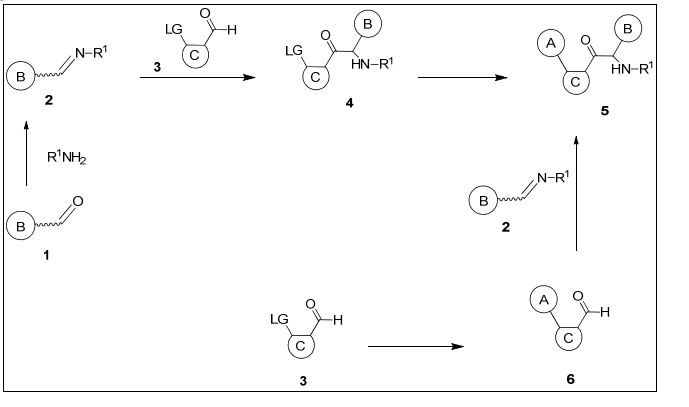
[00192] Esquema 1: Todos os A, B, C, R1 e LG são conforme descrito para os compostos da presente invenção de acordo com a fórmula (A) em que o ciclo C tem um estrutura como a de fórmula (A1) e seus exemplos de realização e fórmulas.[00192] Scheme 1: All A, B, C, R1 and LG are as described for the compounds of the present invention according to formula (A) wherein the cycle C has a structure like that of formula (A1) and their implementation examples and formulas.
[00193] Os aldeídos de fórmula 1 (comercialmente disponíveis ou sintetizados) podem reagir com aminas de fórmula R1NH2 para fornecer iminas de fórmula 2, que podem então ser reagir com intermediários de fórmula 3 (comercialmente disponíveis ou sintetizados por procedimentos conhecidos pelo especialista na técnica ou conforme estabelecido nos exemplos abaixo), na presença de um catalisador, tal como cloreto de 3- benzil-5-(2-hidroxietil)-4-metiltiazol-3-ío para proporcionar intermediários de fórmula 4. Informações mais detalhadas podem ser encontradas em Chem. Commun., 2007, 852-854. Os compostos de fórmula 4 podem então ser convertidos nos compostos desejados de fórmula 5 por meio de reações de acoplamento catalisadas por paládio (por exemplo, de Suzuki, Stille, Negishi e similares). Alternativamente, os intermediários de fórmula 3 podem ser convertidos em intermediários de fórmula 6 por meio de reações de acoplamento catalisadas por paládio (por exemplo, Suzuki, Stille, Negishi e similares) que podem ainda reagir com iminas de fórmula geral 2 sob catálise com N-heterociclos carbenos de modo a proporcionar os compostos desejados de fórmula 5 seguindo os procedimentos conhecidos pelo especialista na técnica ou conforme estabelecido nos exemplos abaixo.[00193] Aldehydes of formula 1 (commercially available or synthesized) can react with amines of formula R1NH2 to provide imines of formula 2, which can then be reacted with intermediates of formula 3 (commercially available or synthesized by procedures known to the person skilled in the art or as set forth in the examples below), in the presence of a catalyst such as 3-benzyl-5-(2-hydroxyethyl)-4-methylthiazol-3-yl chloride to provide intermediates of formula 4. More detailed information can be found here in Chem. Commun., 2007, 852-854. Compounds of formula 4 can then be converted to the desired compounds of formula 5 via palladium-catalyzed coupling reactions (e.g., Suzuki, Stille, Negishi, and the like). Alternatively, intermediates of formula 3 can be converted to intermediates of formula 6 via palladium catalyzed coupling reactions (e.g. Suzuki, Stille, Negishi and the like) which can further react with imines of general formula 2 under N catalysis -carbene heterocycles to provide the desired compounds of formula 5 following procedures known to one skilled in the art or as set out in the examples below.
[00194] Em outro exemplo de realização, os compostos da presente invenção também podem ser sintetizados de acordo com o procedimento geral delineado no seguinte esquema.
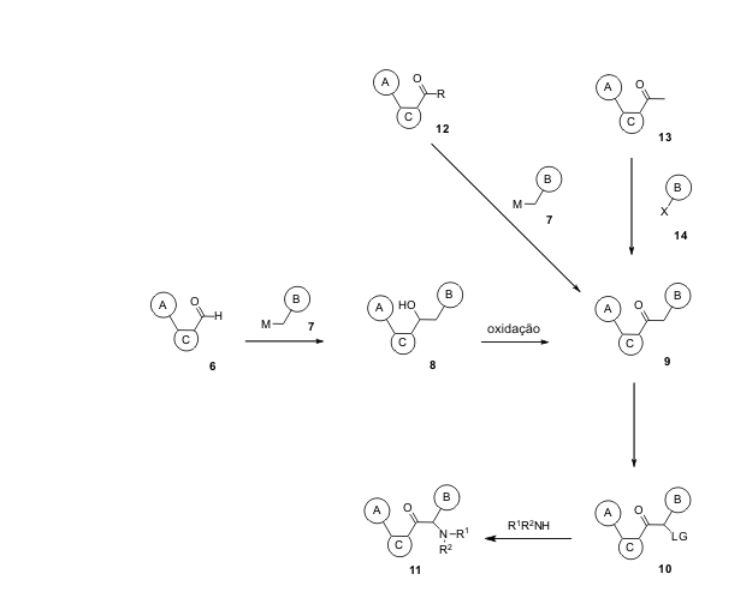
[00195] Esquema 2: Todos os A, B, C, R1, R2 e LG são conforme descrito para os compostos da presente invenção de acordo com a fórmula (A) em que o ciclo C tem um estrutura como a de fórmula (a1) e seus exemplos de realização e fórmulas.[00195] Scheme 2: All A, B, C, R1, R2 and LG are as described for the compounds of the present invention according to formula (A) wherein the cycle C has a structure like that of formula (a1 ) and their implementation examples and formulas.
[00196]Os derivados de fórmula 6 (comercialmente disponíveis ou sintetizados por procedimentos conhecidos pelo especialista na técnica) podem reagir com Grignard ou derivados de organolítio de fórmula 7, em que M representa MgX (sendo X halogênio selecionado a partir de cloro, bromo e iodo) ou lítio para proporcionar intermediários de fórmula 8, que podem ser oxidados em compostos intermédios de fórmula 9 após reações conhecidas pelos especialistas na técnica. Os intermediários de fórmula 9 podem ser convertidos em intermediários de fórmula 10, em que LG é um halogênio selecionado dentre cloro, bromo ou iodo após reações conhecidas pelos especialistas na técnica ou conforme estabelecido nos exemplos abaixo. Os compostos de interesse possuindo uma fórmula geral 11 podem, finalmente, ser obtidos a partir de intermediários de fórmula 10, pelo deslocamento do grupo de saída com aminas de fórmula R1R2NH (comercialmente disponíveis ou sintetizadas). Alternativamente, os intermediários de fórmula 9 podem ser preparados por condensação dos derivados organometálicos de fórmula 7 com os intermediários de fórmula 12, em que R representa um átomo de cloro ou -N (CH3)OCH3 (amida Weinreb), conforme conhecido pelo especialista na técnica. Os intermediários de fórmula 9, também podem ser preparados por α -arilação de cetonas de fórmula 13, com os intermediários de fórmula 14, em que X é um halogêneo selecionado entre cloro, bromo ou iodo, na presença de um catalisador (por exemplo, Pd2dba3, Pd(OAc)2, Pd(dba)2 e similares), um ligante (por exemplo BINAP, Xantphos, PtBu3 e similares) e uma base (por exemplo NaOtBu, K3PO4 e similares). Mais informações podem ser encontradas nas seguintes referências: J. Am. Chem. Soc. 1997, 1110811109 e J. Am. Chem. Soc. 1999, 1473-1478.[00196] Derivatives of formula 6 (commercially available or synthesized by procedures known to the person skilled in the art) can react with Grignard or organolithium derivatives of formula 7, where M represents MgX (X being halogen selected from chlorine, bromine and iodine) or lithium to provide intermediates of formula 8, which can be oxidized to intermediate compounds of formula 9 following reactions known to those skilled in the art. Intermediates of formula 9 can be converted to intermediates of formula 10, where LG is a halogen selected from chlorine, bromine or iodine following reactions known to those skilled in the art or as set forth in the examples below. Compounds of interest having a general formula 11 can finally be obtained from intermediates of formula 10, by displacement of the leaving group with amines of formula R1R2NH (commercially available or synthesized). Alternatively, the intermediates of formula 9 can be prepared by condensing the organometallic derivatives of formula 7 with the intermediates of formula 12, in which R represents a chlorine atom or -N(CH3)OCH3 (Weinreb amide), as known to the person skilled in the art. technique. Intermediates of formula 9 can also be prepared by α-arylation of ketones of formula 13, with intermediates of formula 14, where X is a halogen selected from chlorine, bromine or iodine, in the presence of a catalyst (e.g. Pd2dba3, Pd(OAc)2, Pd(dba)2 and the like), a linker (e.g. BINAP, Xantphos, PtBu3 and the like) and a base (e.g. NaOtBu, K3PO4 and the like). More information can be found in the following references: J. Am. chem. Soc. 1997, 1110811109 and J. Am. chem. Soc. 1999, 1473-1478.
[00197] Em outro exemplo de realização, os compostos da presente invenção também podem ser sintetizados de acordo com o procedimento geral delineado no seguinte esquema.

[00198] Esquema 3: Todos os A, B, C, R1 e R2 e LG são conforme descrito para os compostos da presente invenção de acordo com a fórmula (A) em que o ciclo C tem um estrutura como a de fórmula (a2) ou (a3) e seus exemplos de realização e fórmulas.[00198] Scheme 3: All A, B, C, R1 and R2 and LG are as described for the compounds of the present invention according to formula (A) wherein the cycle C has a structure like that of formula (a2 ) or (a3) and their implementation examples and formulas.
[00199] Os intermediários de fórmula 15 podem ser convertidos em intermediários de fórmula 18 após a formação da ligação amida padrão com intermediários de fórmula 16 ou com intermediários de fórmula 17, em que LG é um átomo de cloro ou bromo (preferencialmente um átomo de cloro). O grupo de saída LG de intermediários de fórmula 18 pode então ser deslocado por aminas de fórmula R1R2NH para fornecer os compostos desejados de fórmula 19. Alternativamente, derivados do ácido acético 2-substituído de fórmula 20, em que R é um grupo protetor éster (por exemplo, metila, etila, t-butila e similares), podem ser convertidos em intermediários de fórmula 21 por reações de halogenação conhecidas pelo especialista na técnica ou conforme estabelecido nos exemplos abaixo. Os intermediários de fórmula 21 podem então reagir com aminas de fórmula R1R2NH para proporcionar intermediários de fórmula 22, o qual pode ser convertido nos compostos desejados de fórmula 19, após a hidrólise padrão e formação da ligação peptídica.[00199] Intermediates of formula 15 can be converted into intermediates of formula 18 after standard amide bond formation with intermediates of formula 16 or with intermediates of formula 17, where LG is a chlorine or bromine atom (preferably an atom of chlorine). The leaving group LG of intermediates of formula 18 can then be displaced by amines of formula R1R2NH to provide the desired compounds of formula 19. Alternatively, 2-substituted acetic acid derivatives of formula 20, where R is an ester protecting group ( for example, methyl, ethyl, t-butyl and the like), can be converted to intermediates of formula 21 by halogenation reactions known to one skilled in the art or as set forth in the examples below. Intermediates of formula 21 can then be reacted with amines of formula R1R2NH to provide intermediates of formula 22, which can be converted to the desired compounds of formula 19, following standard hydrolysis and peptide bond formation.
[00200] As abreviaturas utilizadas na descrição, particularmente nos Esquemas e Exemplos, são as seguintes: DIBALH hidreto de di-isobutilalumínio DMAP 4-dimetilaminopiridina DME Dimetoxietano DMF N,N-dimetilformamida DMSO dimetilsulfóxido h Hora HATU Hexafluorofosfato de O-(7-azabenzotriazol-1- il) -N,N,N',N'-tetrametilurônio HPLC Cromatografia líquida de alto desempenho min Minuto NBS N-bromosuccinimida THF tetrahidrofurano TLC cromatografia em camada fina tr tempo de retenção[00200] The abbreviations used in the description, particularly in the Schemes and Examples, are as follows: DIBALH diisobutylaluminum hydride DMAP 4-dimethylaminopyridine DME Dimethoxyethane DMF N,N-dimethylformamide DMSO dimethylsulfoxide h Time HATU O-(7-azabenzotriazole) hexafluorophosphate -1- yl) -N,N,N',N'-tetramethyluronium HPLC HPLC min Minute NBS N-bromosuccinimide THF tetrahydrofuran TLC thin layer chromatography tr retention time
[00201] Os seguintes exemplos são fornecidos com a finalidade de ilustrar a presente invenção e de modo algum devem ser interpretados como limitantes do escopo da presente invenção.[00201] The following examples are provided for the purpose of illustrating the present invention and should in no way be construed as limiting the scope of the present invention.
[00202] A parte A representa a preparação dos compostos (compostos intermediários e finais) ao passo que a parte B representa os exemplos farmacológicos. TABELA 1 ESTRUTURAS DE COMPOSTOS EXEMPLOS DA INVENÇÃO E SEUS RESPECTIVOS CÓDIGOS.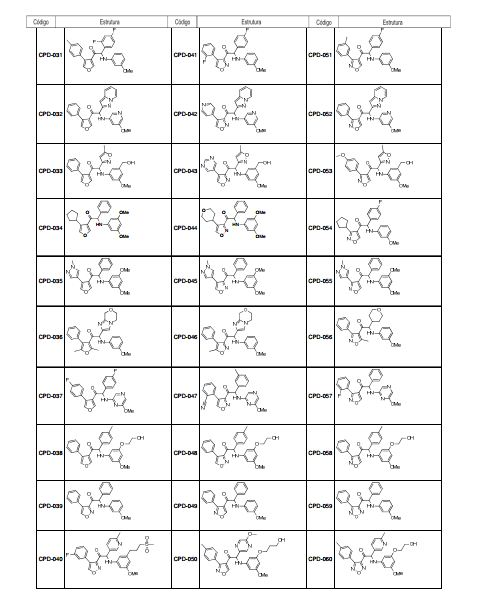
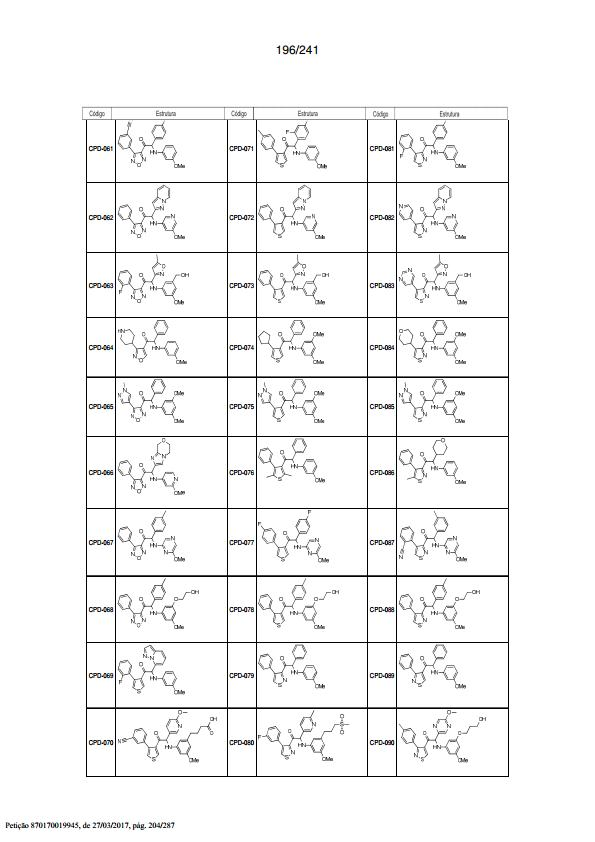
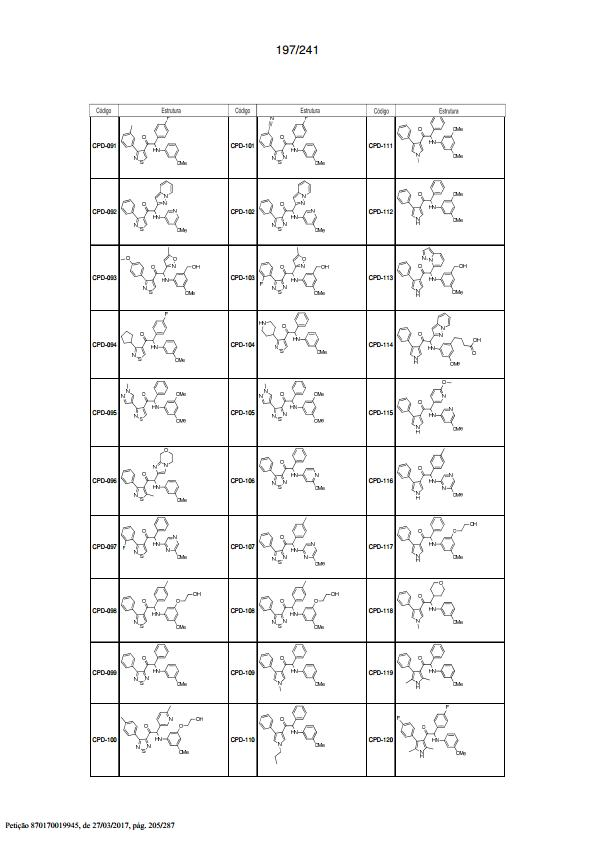
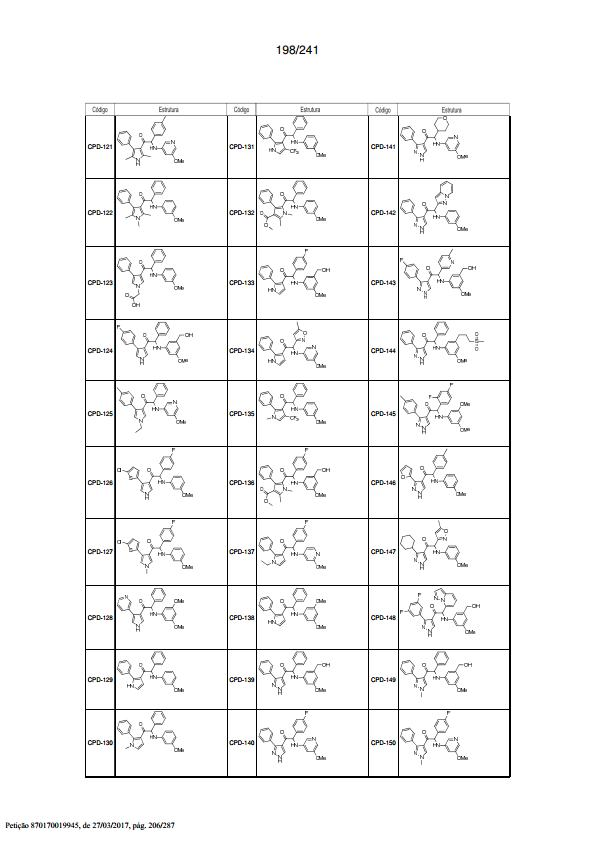

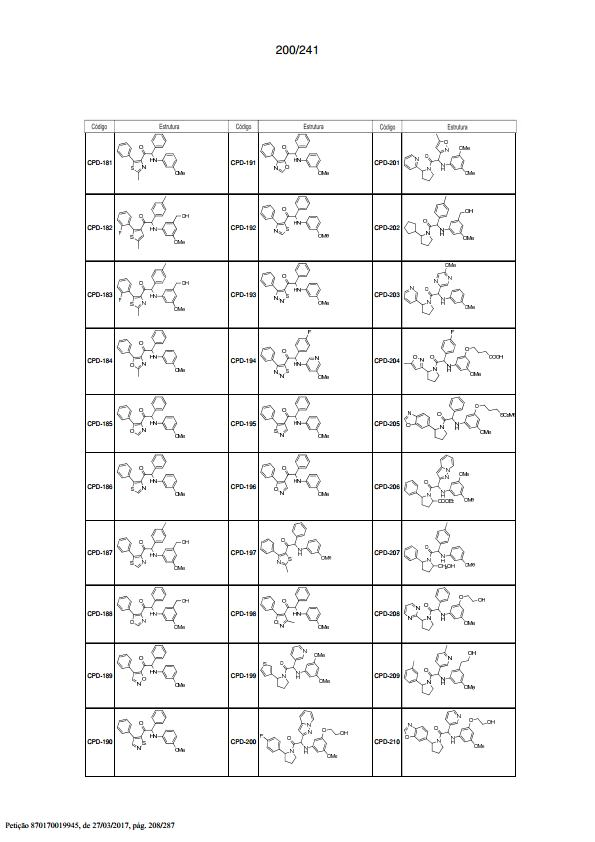
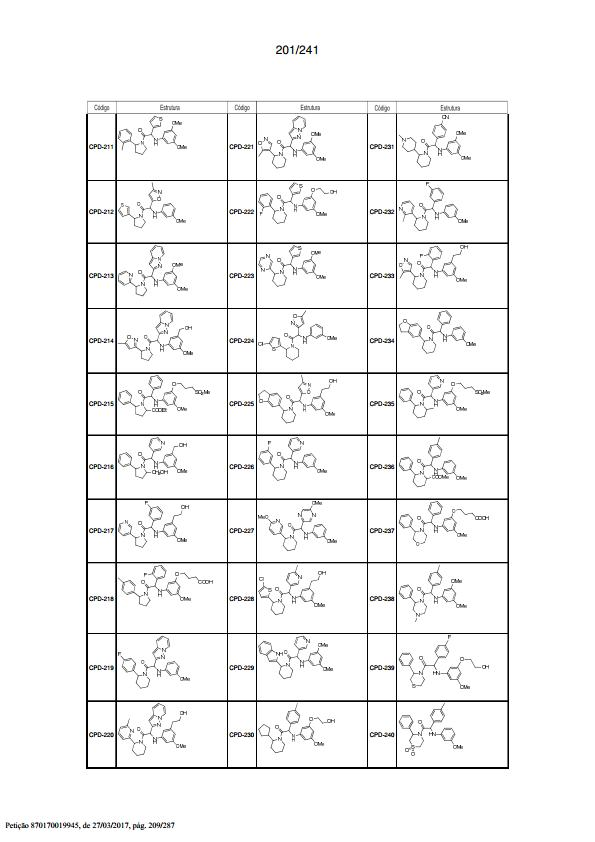

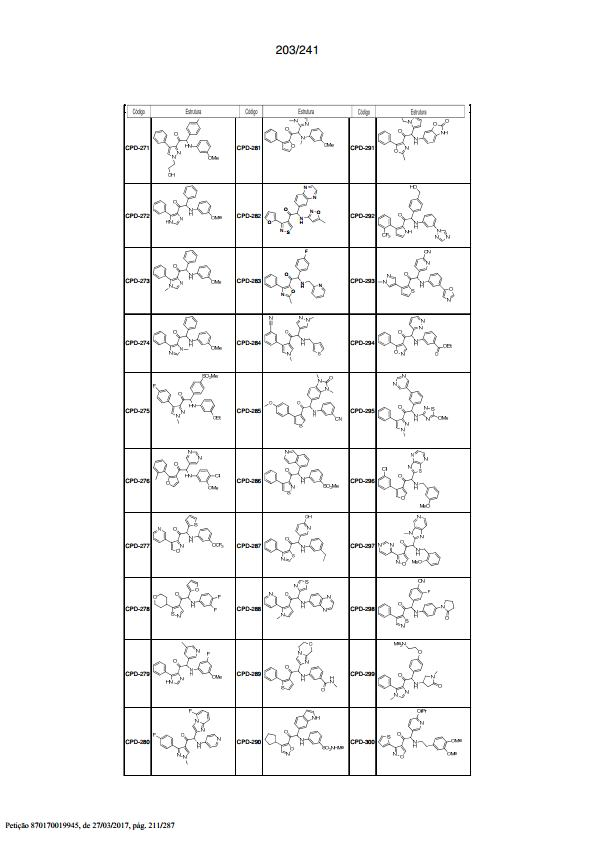
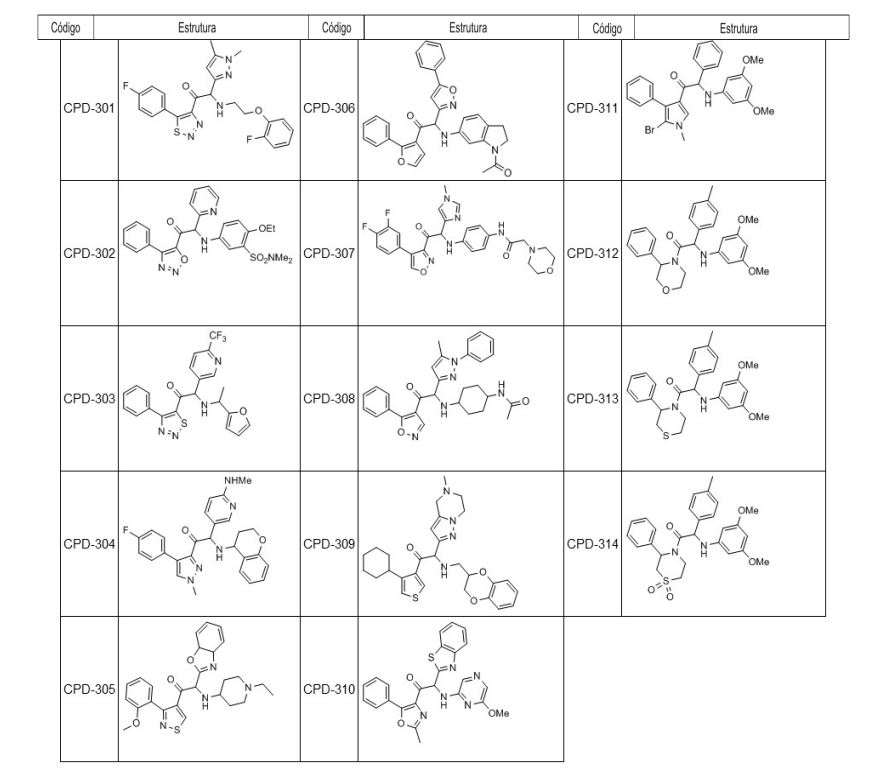
[00203] Todas as purificações por HPLC preparativa mencionadas nesta parte experimental foram realizadas com o seguinte sistema: um detector UV/Visível Waters 2489, um módulo Waters 2545 Binary Gradient Module, um Coletor Waters Fraction Collector III e um injector Waters Dual Flex Injector.[00203] All preparative HPLC purifications mentioned in this experimental part were performed with the following system: a Waters 2489 UV/Visible detector, a Waters 2545 Binary Gradient Module module, a Waters Fraction Collector III and a Waters Dual Flex Injector.
[00204] As separações foram realizadas com uma coluna XBridge Prep C18 (19x100 mm, 5 μm) equipada com uma pré-coluna XBridge C18 (19x10 mm; 5 μm) ou com uma coluna SunFire Prep C18 ODB (19x100 mm, 5 μm) equipada com uma coluna de guarda SunFire C18(19x10 mm; 5 μm).[00204] The separations were performed with an XBridge Prep C18 column (19x100 mm, 5 μm) equipped with an XBridge C18 pre-column (19x10 mm; 5 μm) or with a SunFire Prep C18 ODB column (19x100 mm, 5 μm) equipped with a SunFire C18 guard column (19x10 mm; 5 μm).
[00205] Eluições foram realizadas com os métodos descritos nas seguintes tabelas, e comprimentos de onda de detecção foram fixados em 210 e 254 nm. MÉTODO 1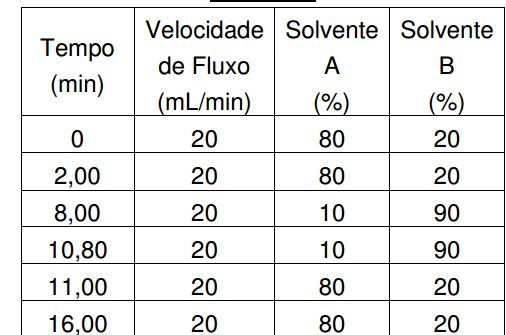
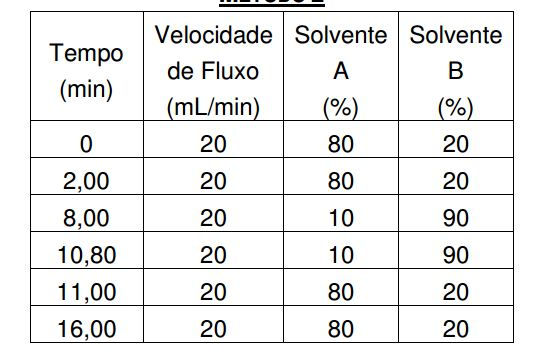
[00206] Todas as separações de enatiômeros mencionadas nesta parte experimental foram realizadas com o seguinte sistema: um detector UV/Visível Waters 2489, um módulo Waters 2545 Binary Gradient Module, um Coletor Waters Fraction Collector III e um injector Waters Dual Flex Injector. As separações foram realizadas com uma coluna ChiralPak IC (20x250 mm, 5 μm) equipada com uma coluna de guarda ChiralPak IC (10x20 mm; 5 μm). Eluições foram realizadas com o método isocrático descrito abaixo e os comprimentos de onda de detecção foram fixados em 210 e 254 nm.[00206] All the enantiomer separations mentioned in this experimental part were performed with the following system: a Waters 2489 UV/Visible detector, a Waters 2545 Binary Gradient Module module, a Waters Fraction Collector III and a Waters Dual Flex Injector. Separations were performed with a ChiralPak IC column (20x250 mm, 5 µm) equipped with a ChiralPak IC guard column (10x20 mm; 5 µm). Elutions were performed with the isocratic method described below and the detection wavelengths were set at 210 and 254 nm.
[00207] Eluente: n-heptano/diclorometano/etanol/dietilamina: 90/10/1/0,1[00207] Eluent: n-heptane/dichloromethane/ethanol/diethylamine: 90/10/1/0.1
[00208] Velocidade de Fluxo: 20 mL/min[00208] Flow Rate: 20 mL/min
[00209] Os procedimentos gerais utilizados na síntese de compostos da invenção:[00209] The general procedures used in the synthesis of compounds of the invention:
[00210] Em uma solução de um ácido carboxílico em diclorometano foi adicionada uma amina, trietilamina e HATU. A mistura de reação foi agitada em temperatura ambiente durante a noite. A mistura de reação foi diluída com diclorometano e lavada com uma solução 1N de ácido clorídrico. As fases foram separadas. A fase orgânica foi lavada com uma solução de bicarbonato de sódio saturado, água e salina, seca sobre sulfato de sódio, filtrada e concentrada sob pressão reduzida. O resíduo foi purificado por cromatografia flash em gel de sílica.[00210] In a solution of a carboxylic acid in dichloromethane was added an amine, triethylamine and HATU. The reaction mixture was stirred at room temperature overnight. The reaction mixture was diluted with dichloromethane and washed with 1N hydrochloric acid solution. The phases were separated. The organic phase was washed with saturated sodium bicarbonate solution, water and brine, dried over sodium sulfate, filtered and concentrated under reduced pressure. The residue was purified by silica gel flash chromatography.
[00211] Uma mistura de um aldeído e uma amina foi aquecida em um tubo selado a 60 °C durante 6 h. A formação de imina foi quantitativa e a imina foi usada na etapa seguinte sem purificação adicional.[00211] A mixture of an aldehyde and an amine was heated in a sealed tube at 60 °C for 6 h. The imine formation was quantitative and the imine was used in the next step without further purification.
[00212] Uma mistura de um aldeído e uma amina em etanol foi aquecida a 60 - 70 °C durante 5 - 20 horas. A formação de imina foi quantitativa e a solução da imina em etanol foi utilizada na etapa seguinte sem purificação adicional.[00212] A mixture of an aldehyde and an amine in ethanol was heated at 60 - 70 °C for 5 - 20 hours. The imine formation was quantitative and the imine solution in ethanol was used in the next step without further purification.
[00213] Em uma solução de cloreto de 3-benzil-5-(2-hidroxietil)- 4-metiltiazol-3-ío em etanol foi adicionada trietilamina e a mistura foi agitada a 60 - 70 °C durante 10 min. Na solução amarela resultante adicionou-se um aldeído e uma solução de uma imina em etanol. A mistura de reação foi agitada em um tubo selado a 60 - 70 °C, durante 18 - 120 h. A mistura de reação foi concentrada sob pressão reduzida e o resíduo foi purificado por cromatografia flash em gel de sílica.[00213] In a solution of 3-benzyl-5-(2-hydroxyethyl)-4-methylthiazol-3-yl chloride in ethanol was added triethylamine and the mixture was stirred at 60 - 70 °C for 10 min. Into the resulting yellow solution were added an aldehyde and a solution of an imine in ethanol. The reaction mixture was stirred in a sealed tube at 60 - 70 °C for 18 - 120 h. The reaction mixture was concentrated under reduced pressure, and the residue was purified by silica gel flash chromatography.
[00214] Em uma solução de cloreto de 3-benzil-5-(2-hidroxietil)- 4-metiltiazol-3-ío em etanol foi adicionada trietilamina e a mistura da reação foi agitada a 60 - 70 °C durante 10 min. Na solução amarela resultante adicionou- se um aldeído e uma solução de uma imina em etanol. A mistura de reação foi agitada em um tubo selado a 60 - 70 °C durante 18 - 120 h, após o qual a mistura de reação foi irradiada em um forno de micro-ondas a 160 °C durante 4 min. A mistura de reação foi concentrada sob pressão reduzida e o resíduo foi purificado por cromatografia flash em gel de sílica.[00214] In a solution of 3-benzyl-5-(2-hydroxyethyl)-4-methylthiazol-3-yl chloride in ethanol was added triethylamine and the reaction mixture was stirred at 60 - 70 °C for 10 min. Into the resulting yellow solution were added an aldehyde and a solution of an imine in ethanol. The reaction mixture was stirred in a sealed tube at 60 - 70 °C for 18 - 120 h, after which the reaction mixture was irradiated in a microwave oven at 160 °C for 4 min. The reaction mixture was concentrated under reduced pressure, and the residue was purified by silica gel flash chromatography.
[00215] Uma mistura desgaseificada de uma arila ou halogeneto heteroarila, um ácido borônico ou um éster borônico e uma base (por exemplo, fluoreto de potássio ou carbonato de sódio) em uma mistura de um solvente orgânico (por exemplo, DME ou dioxano) e água foi adicionado tetraquis(trifenilfosfina)paládio(0). A mistura de reação foi submetida a refluxo durante a noite. Após o arrefecimento até a temperatura ambiente, a mistura de reação foi filtrada através de celite. O filtrado foi diluído com acetato de etila e lavado com água. As fases foram separadas. A fase orgânica foi lavada com salina, seca sobre sulfato de sódio, filtrada e concentrada sob pressão reduzida. O resíduo foi purificado por cromatografia flash em gel de sílica.[00215] A degassed mixture of an aryl or heteroaryl halide, a boronic acid or a boronic ester and a base (eg, potassium fluoride or sodium carbonate) in a mixture of an organic solvent (eg, DME or dioxane) and water was added tetrakis(triphenylphosphine)palladium(0). The reaction mixture was refluxed overnight. After cooling to room temperature, the reaction mixture was filtered through celite. The filtrate was diluted with ethyl acetate and washed with water. The phases were separated. The organic phase was washed with brine, dried over sodium sulfate, filtered and concentrated under reduced pressure. The residue was purified by silica gel flash chromatography.
[00216] Uma mistura desgaseificada de uma arila ou halogeneto heteroarila, um ácido borônico ou um éster borônico e uma base (por exemplo, fluoreto de potássio ou carbonato de sódio) em uma mistura de um solvente orgânico (por exemplo, DME ou dioxano) e água foi adicionado tetraquis(trifenilfosfina)paládio(0). A mistura de reação foi irradiada em um forno micro-ondas a 130 °C durante 20 min. Após o arrefecimento até a temperatura ambiente, a mistura de reação foi filtrada através de celite. O filtrado foi diluído com acetato de etila e lavado com água. As fases foram separadas. A fase orgânica foi lavada com salina, seca sobre sulfato de sódio, filtrada e concentrada sob pressão reduzida. O resíduo foi purificado por cromatografia flash em gel de sílica.[00216] A degassed mixture of an aryl or heteroaryl halide, a boronic acid or a boronic ester and a base (eg, potassium fluoride or sodium carbonate) in a mixture of an organic solvent (eg, DME or dioxane) and water was added tetrakis(triphenylphosphine)palladium(0). The reaction mixture was irradiated in a microwave oven at 130 °C for 20 min. After cooling to room temperature, the reaction mixture was filtered through celite. The filtrate was diluted with ethyl acetate and washed with water. The phases were separated. The organic phase was washed with brine, dried over sodium sulfate, filtered and concentrated under reduced pressure. The residue was purified by silica gel flash chromatography.
[00217] Etapa 1: 1-Metil-4-fenil-1 H-pirazol-3-carbaldeído foi preparado de acordo com o precedimento geral F a partir de 4-bromo-1-metil- 1H-pirazol-3-carbaldeído (0,100 g; 0,529 mmol), ácido benzenoborônico (0,077 g; 0,635 mmol), carbonato de sódio (0,135 g; 1,274 mmol) e tetraquis(trifenilfosfina)paládio(0) (0,031 g; 0,026 mmol) em uma mistura de DME (4 mL) e água (1,6 mL). A purificação por cromatografia flash em gel de sílica utilizando um gradiente de acetato de etíla (10% a 100%) em heptano forneceu 0,093 g (94%) do composto desejado como um sólido amarelo. ESI/APCI(+): 187 (M+H).[00217] Step 1: 1-Methyl-4-phenyl-1H-pyrazole-3-carbaldehyde was prepared according to general procedure F from 4-bromo-1-methyl-1H-pyrazole-3-carbaldehyde ( 0.100 g; 0.529 mmol), benzeneboronic acid (0.077 g; 0.635 mmol), sodium carbonate (0.135 g; 1.274 mmol) and tetrakis(triphenylphosphine)palladium(0) (0.031 g; 0.026 mmol) in a mixture of DME (4 mL) and water (1.6 mL). Purification by silica gel flash chromatography using a gradient of ethyl acetate (10% to 100%) in heptane provided 0.093 g (94%) of the desired compound as a yellow solid. ESI/APCI(+): 187 (M+H).
[00218] Etapa 2: N-Benzilideno-3-metoxianilina foi preparada de acordo com o precedimento geral B a partir de uma mistura de benzaldeído (0,101 mL; 0,996 mmol) e m-anidisina (0,112 mL; 1,073 mmol).[00218] Step 2: N-Benzylidene-3-methoxyaniline was prepared according to general procedure B from a mixture of benzaldehyde (0.101 mL; 0.996 mmol) and m-anidisine (0.112 mL; 1.073 mmol).
[00219] Etapa 3: 2-((3-Metoxifenil)amino)-1-(1-metil-4-fenil-1 H- pirazol-3-il)-2-feniletanona foi preparada de acordo com o precedimento geral D a partir de uma mistura de cloreto de 3-benzil-5-(2-hidroxietil)-4-metiltiazol-3-ío (0,067 g; 0,248 mmol) e trietilamina (0,035 mL; 0,252 mmol) em etanol (1 mL), 1-metil-4-fenil-1H-pirazol-3-carbaldeído (0,093 g; 0,499 mmol) e uma solução de N-benzilideno-3-metoxianilina (0,499 mmol) em etanol (1 mL), aquecida a 70 °C por 24 h. A purificação por cromatografia flash em gel de sílica utilizando um gradiente de acetato de etíla (5% a 80%) em heptano seguida por uma segunda purificação por cromatografia flash em gel de sílica utilizando um gradiente de acetato de etíla (10% a 60%) em heptano forneceu 0,030 g (14%) do composto desejado como um sólido branco. ESI/APCI(+): 398 (M+H). ESI/APCI(-): 396 (M-H).[00219] Step 3: 2-((3-Methoxyphenyl)amino)-1-(1-methyl-4-phenyl-1H-pyrazol-3-yl)-2-phenylethanone was prepared according to general procedure D from a mixture of 3-benzyl-5-(2-hydroxyethyl)-4-methylthiazol-3-yl chloride (0.067 g; 0.248 mmol) and triethylamine (0.035 mL; 0.252 mmol) in ethanol (1 mL), 1-methyl-4-phenyl-1H-pyrazole-3-carbaldehyde (0.093 g; 0.499 mmol) and a solution of N-benzylidene-3-methoxyaniline (0.499 mmol) in ethanol (1 mL), heated to 70 °C for 24h. Purification by silica gel flash chromatography using a gradient of ethyl acetate (5% to 80%) in heptane followed by a second purification by silica gel flash chromatography using a gradient of ethyl acetate (10% to 60% ) in heptane provided 0.030 g (14%) of the desired compound as a white solid. ESI/APCI(+): 398 (M+H). ESI/APCI(-): 396 (M-H).
[00220] Etapa 1: 1-(4-Bromo-1-metil-1 H-pirazol-3-il)-2-((3- metoxifenil)amino)-2-feniletanona foi preparada de acordo com o precedimento geral D a partir de uma mistura de cloreto de 3-benzil-5-(2-hidroxietil)-4- metiltiazol-3-ío (0,135 g; 0,500 mmol) e trietilamina (0,069 mL; 0,498 mmol) em etanol (0,735 mL), 4-bromo-1-metil-1H-pirazol-3-carboxaldeído (0,205 g, 1,085 mmol) e uma solução de N-benzilideno-3-metoxianilina (0,996 mmol) em etanol (0,735 mL), aquecidas a 70 °C por 18 h. A purificação por cromatografia flash em gel de sílica utilizando um gradiente de acetato de etíla (0% a 70%) em heptano forneceu 0,266 g (67%) do composto desejado como um sólido amarelo. ESI/APCI(+): 400, 402 (M+H). RMN H1 (DMSO-d6) δ 8,13 (1H, s); 7,49 (2H, d); 7,33 (2H, m); 7,25 (1H, m); 6,93 (1H, t); 6,44 (1H, d); 6,25 (3H, m); 6,14 (1H, d); 4,00 (3H, s); 3,64 (3H, s).[00220] Step 1: 1-(4-Bromo-1-methyl-1 H-pyrazol-3-yl)-2-((3-methoxyphenyl)amino)-2-phenylethanone was prepared according to general procedure D from a mixture of 3-benzyl-5-(2-hydroxyethyl)-4-methylthiazol-3-yl chloride (0.135 g; 0.500 mmol) and triethylamine (0.069 mL; 0.498 mmol) in ethanol (0.735 mL), 4-bromo-1-methyl-1H-pyrazole-3-carboxaldehyde (0.205 g, 1.085 mmol) and a solution of N-benzylidene-3-methoxyaniline (0.996 mmol) in ethanol (0.735 mL), heated to 70 °C for 6 p.m. Purification by silica gel flash chromatography using a gradient of ethyl acetate (0% to 70%) in heptane provided 0.266 g (67%) of the desired compound as a yellow solid. ESI/APCI(+): 400, 402 (M+H). H1 NMR (DMSO-d6) δ 8.13 (1H, s); 7.49 (2H, d); 7.33 (2H, m); 7.25 (1H, m); 6.93 (1H, t); 6.44 (1H, d); 6.25 (3H, m); 6.14 (1H, d); 4.00 (3H, s); 3.64 (3H, s).
[00221] Etapa 2: 1 -(4-(4-Fluorofenil)-1 -metil-1 H-pirazol-3-il)-2-((3- metoxifenil)amino)-2-feniletanona foi preparada de acordo com o precedimento geral F a partir de 1-(4-bromo-1-metil-1H-pirazol-3-il)-2-((3-metoxifenil)amino)- 2-feniletanona (0,100 g; 0,250 mmol), ácido 4-fluorofenilborônico (0,052 g; 0,372 mmol), fluoreto de potássio (0,058 g; 0,998 mmol) e tetraquis(trifenilfosfina)paládio(0) (0,029 g; 0,025 mmol) em uma mistura de dioxano (4 mL) e água (1 mL). A purificação por cromatografia flash em gel de sílica utilizando um gradiente de acetato de etíla (20% a 50%) em heptano forneceu 0,073 g (70%) do composto desejado como uma espuma branca. ESI/APCI(+): 416 (M+H). ESI/APCI(-): 414 (M-H). RMN H1 (DMSO-d6) δ 8,06 (1H, s); 7,52 (2H, d); 7,1-7,4 (7H, m); 6,92 (1H, t); 6,35 (2H, m); 6,28 (2H, m); 6,12 (1H, d); 4,03 (3H, s); 3,61 (3H, s).[00221] Step 2: 1 -(4-(4-Fluorophenyl)-1 -methyl-1 H-pyrazol-3-yl)-2-((3-methoxyphenyl)amino)-2-phenylethanone was prepared according to General procedure F from 1-(4-bromo-1-methyl-1H-pyrazol-3-yl)-2-((3-methoxyphenyl)amino)-2-phenylethanone (0.100 g; 0.250 mmol), acid 4-fluorophenylboronic acid (0.052 g; 0.372 mmol), potassium fluoride (0.058 g; 0.998 mmol) and tetrakis(triphenylphosphine)palladium(0) (0.029 g; 0.025 mmol) in a mixture of dioxane (4 mL) and water (1 mL). Purification by silica gel flash chromatography using a gradient of ethyl acetate (20% to 50%) in heptane provided 0.073 g (70%) of the desired compound as a white foam. ESI/APCI(+): 416 (M+H). ESI/APCI(-): 414 (M-H). H1 NMR (DMSO-d6) δ 8.06 (1H, s); 7.52 (2H, d); 7.1-7.4 (7H, m); 6.92 (1H, t); 6.35 (2H, m); 6.28 (2H, m); 6.12 (1H, d); 4.03 (3H, s); 3.61 (3H, s).
[00222] Etapa 1: Uma solução de 3-metoxi-N-(piridin-3- ilmetileno)anilina em etanol foi preparada de acordo com o precedimento geral C a partir de uma mistura de nicotinaldeído (0,047 mL; 0,500 mmol) e m- anidisina (0,056 mL; 0,500 mmol) em etanol (0,5 mL), aquecida a 60 °C por 6 h.[00222] Step 1: A solution of 3-methoxy-N-(pyridin-3-ylmethylene)aniline in ethanol was prepared according to general procedure C from a mixture of nicotinaldehyde (0.047 mL; 0.500 mmol) and m - anidisine (0.056 mL; 0.500 mmol) in ethanol (0.5 mL), heated at 60 °C for 6 h.
[00223] Etapa 2: 2-((3-Metoxifenil)amino)-1-(1-metil-4-fenil-1 H- pirazol-3-il)-2-(piridin-3-il)etanona foi preparada de acordo com o precedimento geral D a partir de uma mistura de cloreto de 3-benzil-5-(2-hidroxietil)-4- metiltiazol-3-ío (0,067 g; 0,248 mmol) e trietilamina (0,035 mL; 0,252 mmol) em etanol (1 mL), 1-metil-4-fenil-1H-pirazol-3-carbaldeído (0,093 g; 0,499 mmol) e uma solução de 3-metoxi-N-(piridin-3-ilmetileno)anilina (0,500 mmol) em etanol (0,5 mL), aquecida a 70 °C por 18 h. A purificação por cromatografia flash em gel de sílica utilizando um gradiente de acetato de etíla (2% a 20%) em diclorometano seguida pela precipitação a partir de éter dietílico forneceu 0,060 g (30%) do composto desejado como um sólido branco. ESI/APCI(+): 399 (M+H). ESI/APCI(-): 397 (M-H). RMN H1 (DMSO-d6) δ 8,75 (1H, s); 8,45 (1H, d); 8,08 (1H, s); 7,88 (1H, d); 7,21-7,43 (6H, m); 6,95 (1H, t); 6,55 (1H, d); 6,40 (1H, d); 6,30 (2H, m); 6,15 (1H, d); 4,04 (3H, s); 3,62 (3H, s).[00223] Step 2: 2-((3-Methoxyphenyl)amino)-1-(1-methyl-4-phenyl-1H-pyrazol-3-yl)-2-(pyridin-3-yl)ethanone was prepared according to general procedure D from a mixture of 3-benzyl-5-(2-hydroxyethyl)-4-methylthiazol-3-yl chloride (0.067 g; 0.248 mmol) and triethylamine (0.035 mL; 0.252 mmol) in ethanol (1 mL), 1-methyl-4-phenyl-1H-pyrazol-3-carbaldehyde (0.093 g; 0.499 mmol) and a solution of 3-methoxy-N-(pyridin-3-ylmethylene)aniline (0.500 mmol ) in ethanol (0.5 mL), heated at 70 °C for 18 h. Purification by silica gel flash chromatography using a gradient of ethyl acetate (2% to 20%) in dichloromethane followed by precipitation from diethyl ether provided 0.060 g (30%) of the desired compound as a white solid. ESI/APCI(+): 399 (M+H). ESI/APCI(-): 397 (M-H). H1 NMR (DMSO-d6) δ 8.75 (1H, s); 8.45 (1H, d); 8.08 (1H, s); 7.88 (1H, d); 7.21-7.43 (6H, m); 6.95 (1H, t); 6.55 (1H, d); 6.40 (1H, d); 6.30 (2H, m); 6.15 (1H, d); 4.04 (3H, s); 3.62 (3H, s).
[00224] Etapa 1: Uma solução de N-((5-fluoropiridin-3- il)metileno)-3-metoxianilina em etanol foi preparada de acordo com o precedimento geral C a partir de uma mistura de 5-fluoronicotinaldeído (0,062 g; 0,504 mmol) e m-anidisina (0,056 mL; 0,500 mmol) em etanol (0,5 mL), aquecida a 60 °C por 6 h.[00224] Step 1: A solution of N-((5-fluoropyridin-3-yl)methylene)-3-methoxyaniline in ethanol was prepared according to general procedure C from a mixture of 5-fluoronicotinaldehyde (0.062 g ; 0.504 mmol) and m-anidysine (0.056 mL; 0.500 mmol) in ethanol (0.5 mL), heated at 60 °C for 6 h.
[00225] Etapa 2: 2-(5-Fluoropiridin-3-il)-2-((3-metoxifenil)amino)- 1-(1-metil-4-fenil-1H-pirazol-3-il)etanona foi preparada de acordo com o precedimento geral D a partir de uma mistura de cloreto de 3-benzil-5-(2- hidroxietil)-4-metiltiazol-3-ío (0,067 g; 0,248 mmol) e trietilamina (0,035 mL; 0,252 mmol) em etanol (1 mL), 1-metil-4-fenil-1H-pirazol-3-carbaldeído (0,093 g; 0,499 mmol) e uma solução de N-((5-fluoropiridin-3-il)metileno)-3- metoxianilina (0,500 mmol) em etanol (0,5 mL), aquecida a 70 °C por 18 h. A purificação por cromatografia flash em gel de sílica utilizando um gradiente de acetato de etíla (2% a 20%) em diclorometano seguido pela precipitação a partir de etanol forneceu 0,055 g (26%) do composto desejado como um sólido bege. ESI/APCI(+): 417 (M+H). ESI/APCI(-): 415 (M-H). RMN H1 (DMSO-d6) δ 8,65 (1H, s); 8,47 (1H, d); 8,10 (1H, s); 7,83 (1H, d); 7,23-7,47 (5H, m); 6,96 (1H, t); 6,56-6,67 (1H, m); 6,44-6,53 (1H, m); 6,32 (2H, m); 6,18 (1H, d); 4,05 (3H, s); 3,63 (3H, s).[00225] Step 2: 2-(5-Fluoropyridin-3-yl)-2-((3-methoxyphenyl)amino)-1-(1-methyl-4-phenyl-1H-pyrazol-3-yl)ethanone was prepared according to general procedure D from a mixture of 3-benzyl-5-(2-hydroxyethyl)-4-methylthiazol-3-yl chloride (0.067 g; 0.248 mmol) and triethylamine (0.035 mL; 0.252 mmol ) in ethanol (1 mL), 1-methyl-4-phenyl-1H-pyrazol-3-carbaldehyde (0.093 g; 0.499 mmol) and a solution of N-((5-fluoropyridin-3-yl)methylene)-3 - methoxyaniline (0.500 mmol) in ethanol (0.5 mL), heated at 70 °C for 18 h. Purification by silica gel flash chromatography using a gradient of ethyl acetate (2% to 20%) in dichloromethane followed by precipitation from ethanol provided 0.055 g (26%) of the desired compound as a beige solid. ESI/APCI(+): 417 (M+H). ESI/APCI(-): 415 (M-H). H1 NMR (DMSO-d6) δ 8.65 (1H, s); 8.47 (1H, d); 8.10 (1H, s); 7.83 (1H, d); 7.23-7.47 (5H, m); 6.96 (1H, t); 6.56-6.67 (1H, m); 6.44-6.53 (1H, m); 6.32 (2H, m); 6.18 (1H, d); 4.05 (3H, s); 3.63 (3H, s).
[00226] 1-(4-(2-Fluorofenil)-1-metil-1H-pirazol-3-il)-2-((3- metoxifenil)amino)-2-feniletanona foi preparada de acordo com o precedimento geral F a partir de 1-(4-bromo-1-metil-1H-pirazol-3-il)-2-((3-metoxifenil)amino)- 2-feniletanona (0,100 g; 0,250 mmol), ácido (2-fluorofenil)borônico (0,052 g; 0,372 mmol), fluoreto de potássio (0,058 g; 0,998 mmol) e tetraquis(trifenilfosfina)paládio(0) (0,029 g; 0,025 mmol) em uma mistura de DME (3 mL) e água (0,75 mL). A purificação por cromatografia flash em gel de sílica utilizando um gradiente de acetato de etíla (2% a 40%) em heptano forneceu 0,095 g (91%) do composto desejado como um sólido bege. ESI/APCI(+): 416 (M+H). ESI/APCI(-): 414 (M-H). RMN H1 (DMSO-d6) δ 8,03 (1H, s); 7,51 (2H, d); 7,20-7,41 (5H, m); 7,17 (2H, d); 6,92 (1H, t); 6,34-6,44 (1H, m); 6,21-6,33 (3H, m); 6,12 (1H, d); 4,04 (3H, s); 3,61 (3H, s).[00226] 1-(4-(2-Fluorophenyl)-1-methyl-1H-pyrazol-3-yl)-2-((3-methoxyphenyl)amino)-2-phenylethanone was prepared according to general procedure F from 1-(4-bromo-1-methyl-1H-pyrazol-3-yl)-2-((3-methoxyphenyl)amino)-2-phenylethanone (0.100 g; 0.250 mmol), (2-fluorophenyl) acid )boronic acid (0.052 g; 0.372 mmol), potassium fluoride (0.058 g; 0.998 mmol) and tetrakis(triphenylphosphine)palladium(0) (0.029 g; 0.025 mmol) in a mixture of DME (3 mL) and water (0.025 mmol). 75 mL). Purification by silica gel flash chromatography using a gradient of ethyl acetate (2% to 40%) in heptane provided 0.095 g (91%) of the desired compound as a beige solid. ESI/APCI(+): 416 (M+H). ESI/APCI(-): 414 (M-H). H1 NMR (DMSO-d6) δ 8.03 (1H, s); 7.51 (2H, d); 7.20-7.41 (5H, m); 7.17 (2H, d); 6.92 (1H, t); 6.34-6.44 (1H, m); 6.21-6.33 (3H, m); 6.12 (1H, d); 4.04 (3H, s); 3.61 (3H, s).
[00227] 1-(4-(3-Fluorofenil)-1-metil-1H-pirazol-3-il)-2-((3- metoxifenil)amino)-2-feniletanona foi preparada de acordo com o precedimento geral F a partir de 1-(4-bromo-1-metil-1H-pirazol-3-il)-2-((3-metoxifenil)amino)- 2-feniletanona (0,100 g; 0,250 mmol), ácido (3-fluorofenil)borônico (0,052 g; 0,372 mmol), fluoreto de potássio (0,058 g; 0,998 mmol) e tetraquis(trifenilfosfina)paládio(0) (0,029 g; 0,025 mmol) em uma mistura de DME (3 mL) e água (0,75 mL). A purificação por cromatografia flash em gel de sílica utilizando um gradiente de acetato de etíla (2% a 40%) em heptano forneceu 0,092 g (89%) do composto desejado como um sólido bege. ESI/APCI(+): 416 (M+H). ESI/APCI(-): 414 (M-H). RMN H1 (DMSO-d6) δ 8,15 (1H, s); 7,51 (2H, d); 7,34 (3H, m); 7,22 (3H, m); 7,06 (1H, t); 6,93 (1H, t); 6,46 (1H, d); 6,24-6,39 (3H, m); 6,13 (1H, d); 4,04 (3H, s); 3,62 (3H, s).[00227] 1-(4-(3-Fluorophenyl)-1-methyl-1H-pyrazol-3-yl)-2-((3-methoxyphenyl)amino)-2-phenylethanone was prepared according to general procedure F from 1-(4-bromo-1-methyl-1H-pyrazol-3-yl)-2-((3-methoxyphenyl)amino)-2-phenylethanone (0.100 g; 0.250 mmol), (3-fluorophenyl) acid )boronic acid (0.052 g; 0.372 mmol), potassium fluoride (0.058 g; 0.998 mmol) and tetrakis(triphenylphosphine)palladium(0) (0.029 g; 0.025 mmol) in a mixture of DME (3 mL) and water (0.025 mmol). 75 mL). Purification by silica gel flash chromatography using a gradient of ethyl acetate (2% to 40%) in heptane provided 0.092 g (89%) of the desired compound as a beige solid. ESI/APCI(+): 416 (M+H). ESI/APCI(-): 414 (M-H). H1 NMR (DMSO-d6) δ 8.15 (1H, s); 7.51 (2H, d); 7.34 (3H, m); 7.22 (3H, m); 7.06 (1H, t); 6.93 (1H, t); 6.46 (1H, d); 6.24-6.39 (3H, m); 6.13 (1H, d); 4.04 (3H, s); 3.62 (3H, s).
[00228] 1-(1,1'-Dimetil-1H,1'H-[4,4'-bipirazol]-3-il)-2-((3- metoxifenil)amino)-2-feniletanona foi preparada de acordo com o precedimento geral F a partir de 1-(4-bromo-1-metil-1H-pirazol-3-il)-2-((3-metoxifenil)amino)- 2-feniletanona (0,100 g; 0,250 mmol), éster pinacol do ácido 1-metil-1H-pirazol- 4-borônico (0,078 g; 0,375 mmol), fluoreto de potássio (0,058 g; 0,998 mmol) e tetraquis(trifenilfosfina)paládio(0) (0,029 g; 0,025 mmol) em uma mistura de DME (3 mL) e água (0,75 mL). A purificação por cromatografia flash em gel de sílica utilizando um gradiente de acetato de etíla (2% a 20%) em diclorometano forneceu 0,074 g (74%) do composto desejado como um sólido bege. ESI/APCI(+): 402 (M+H). ESI/APCI(-): 400 (M-H). RMN H1 (DMSO-d6) δ 8,14 (2H, s); 7,75 (1H, s); 7,51 (2H, m); 7,17-7,36 (3H, m); 6,93 (1H, t); 6,40 (2H, m); 6,30 (2H, s); 6,13 (1H, d); 4,01 (3H, s); 3,82 (3H, s); 3,62 (3H, s).[00228] 1-(1,1'-Dimethyl-1H,1'H-[4,4'-bipyrazol]-3-yl)-2-((3-methoxyphenyl)amino)-2-phenylethanone was prepared from according to general procedure F starting from 1-(4-bromo-1-methyl-1H-pyrazol-3-yl)-2-((3-methoxyphenyl)amino)-2-phenylethanone (0.100 g; 0.250 mmol) , 1-methyl-1H-pyrazole-4-boronic acid pinacol ester (0.078 g; 0.375 mmol), potassium fluoride (0.058 g; 0.998 mmol) and tetrakis(triphenylphosphine)palladium(0) (0.029 g; 0.025 mmol) in a mixture of DME (3 mL) and water (0.75 mL). Purification by silica gel flash chromatography using a gradient of ethyl acetate (2% to 20%) in dichloromethane provided 0.074 g (74%) of the desired compound as a beige solid. ESI/APCI(+): 402 (M+H). ESI/APCI(-): 400 (M-H). H1 NMR (DMSO-d6) δ 8.14 (2H, s); 7.75 (1H, s); 7.51 (2H, m); 7.17-7.36 (3H, m); 6.93 (1H, t); 6.40 (2H, m); 6.30 (2H, s); 6.13 (1H, d); 4.01 (3H, s); 3.82 (3H, s); 3.62 (3H, s).
[00229] Etapa 1: Uma solução de N-(4-fluorobenzilideno)-3- metoxianilina em etanol foi preparada de acordo com o precedimento geral C a partir de uma mistura de 4-fluorobenzaldeído (0,126 g; 1,015 mmol) e m- anidisina (0,109 mL; 0,974 mmol) em etanol (0,5 mL), aquecida a 60 °C por 18 h.[00229] Step 1: A solution of N-(4-fluorobenzylidene)-3-methoxyaniline in ethanol was prepared according to general procedure C from a mixture of 4-fluorobenzaldehyde (0.126 g; 1.015 mmol) and m- anidisine (0.109 mL; 0.974 mmol) in ethanol (0.5 mL), heated at 60 °C for 18 h.
[00230] Etapa 2: 2-(4-Fluorofenil)-2-((3-metoxifenil)amino)-1-(1- metil-4-fenil-1H-pirazol-3-il)etanona foi preparada de acordo com o precedimento geral D a partir de uma mistura de cloreto de 3-benzil-5-(2- hidroxietil)-4-metiltiazol-3-ío (0,116 g; 0,430 mmol) e trietilamina (0,080 mL; 0,574 mmol) em etanol (0,5 mL), 1-metil-4-fenil-1H-pirazol-3-carbaldeído (0,160 g; 0,859 mmol) e uma solução de N-(4-fluorobenzilideno)-3-metoxianilina (0,974 mmol) em etanol (1,5 mL), aquecida a 60 °C por 18 h. A purificação por cromatografia flash em gel de sílica utilizando um gradiente de acetato de etíla (0% a 40%) em heptano forneceu 0,174 g (48%) do composto desejado como um óleo amarelo. ESI/APCI(+): 416 (M+H).[00230] Step 2: 2-(4-Fluorophenyl)-2-((3-methoxyphenyl)amino)-1-(1-methyl-4-phenyl-1H-pyrazol-3-yl)ethanone was prepared according to General procedure D starting from a mixture of 3-benzyl-5-(2-hydroxyethyl)-4-methylthiazol-3-yl chloride (0.116 g; 0.430 mmol) and triethylamine (0.080 mL; 0.574 mmol) in ethanol ( 0.5 mL), 1-methyl-4-phenyl-1H-pyrazole-3-carbaldehyde (0.160 g; 0.859 mmol) and a solution of N-(4-fluorobenzylidene)-3-methoxyaniline (0.974 mmol) in ethanol ( 1.5 mL), heated at 60 °C for 18 h. Purification by silica gel flash chromatography using a gradient of ethyl acetate (0% to 40%) in heptane provided 0.174 g (48%) of the desired compound as a yellow oil. ESI/APCI(+): 416 (M+H).
[00231] Etapa 1: Uma solução de 3-metoxi-N-(4- metilbenzilideno)anilina em etanol foi preparada de acordo com o precedimento geral C a partir de uma mistura de p-tolualdeído (0,279 mL; 2,57 mmol) e m- anidisina (0,277 mL; 2,48 mmol) em etanol (1,5 mL), aquecida a 60 °C por 6 h.[00231] Step 1: A solution of 3-methoxy-N-(4-methylbenzylidene)aniline in ethanol was prepared according to general procedure C from a mixture of p-tolualdehyde (0.279 mL; 2.57 mmol) and m-anidysine (0.277 mL; 2.48 mmol) in ethanol (1.5 mL), heated at 60 °C for 6 h.
[00232] Etapa 2: 1-(4-Bromo-1-metil-1 H-pirazol-3-il)-2-((3- metoxifenil)amino)-2-(p-tolil)etanona foi preparada de acordo com o precedimento geral D a partir de uma mistura de cloreto de 3-benzil-5-(2- hidroxietil)-4-metiltiazol-3-ío (0,330 g; 1,22 mmol) e trietilamina (0,250 mL; 1,79 mmol) em etanol (1,5 mL), 4-bromo-1-metil-1H-pirazol-3-carboxaldeído (0,455 g, 2,41 mmol) e uma solução de 3-metoxi-N-(4-metilbenzilideno)anilina (2,48 mmol) em etanol (3 mL), aquecida a 60 °C por 18 h. A purificação por cromatografia flash em gel de sílica utilizando um gradiente de acetato de etíla (0% a 50%) em heptano forneceu 0,612 g (61%) do composto desejado como uma cera amarela que solidificaou lentamente. ESI/APCI(+): 414, 416 (M+H).[00232] Step 2: 1-(4-Bromo-1-methyl-1 H-pyrazol-3-yl)-2-((3-methoxyphenyl)amino)-2-(p-tolyl)ethanone was prepared according with general procedure D starting from a mixture of 3-benzyl-5-(2-hydroxyethyl)-4-methylthiazol-3-yl chloride (0.330 g; 1.22 mmol) and triethylamine (0.250 mL; 1.79 mmol) in ethanol (1.5 mL), 4-bromo-1-methyl-1H-pyrazole-3-carboxaldehyde (0.455 g, 2.41 mmol) and a solution of 3-methoxy-N-(4-methylbenzylidene) aniline (2.48 mmol) in ethanol (3 mL), heated at 60 °C for 18 h. Purification by silica gel flash chromatography using a gradient of ethyl acetate (0% to 50%) in heptane provided 0.612 g (61%) of the desired compound as a yellow wax which slowly solidified. ESI/APCI(+): 414, 416 (M+H).
[00233] Etapa 3: 2-((3-Metoxifenil)amino)-1-(1-metil-4-(pirimidin- 5-il)-1H-pirazol-3-il)-2-(p-tolil)etanona foi preparada de acordo com o precedimento geral F a partir de 1-(4-bromo-1-metil-1H-pirazol-3-il)-2-((3- metoxifenil)amino)-2-(p-tolil)etanona (0,120 g; 0,290 mmol), ácido pirimidin-5- ilborônico (0,056 g; 0,452 mmol), fluoreto de potássio (0,072 g; 1,239 mmol) e tetraquis(trifenilfosfina)paládio(0) (0,035 g; 0,030 mmol) em uma mistura de dioxano (4 mL) e água (1 mL). A purificação por cromatografia flash em gel de sílica utilizando um gradiente de acetato de etíla (50% a 100%) em heptano seguida pela purificação por extração em fase sólida em coluna de fase reversa C18 utilizando um gradiente de acetonitrila (10% a 60%) em água forneceu 0,090 g (75%) do composto desejado como uma espuma amarela. ESI/APCI(+): 414 (M+H).[00233] Step 3: 2-((3-Methoxyphenyl)amino)-1-(1-methyl-4-(pyrimidin-5-yl)-1H-pyrazol-3-yl)-2-(p-tolyl) Ethanone was prepared according to general procedure F starting from 1-(4-bromo-1-methyl-1H-pyrazol-3-yl)-2-((3-methoxyphenyl)amino)-2-(p-tolyl )ethanone (0.120 g; 0.290 mmol), pyrimidin-5-ylboronic acid (0.056 g; 0.452 mmol), potassium fluoride (0.072 g; 1.239 mmol) and tetrakis(triphenylphosphine)palladium(0) (0.035 g; 0.030 mmol) in a mixture of dioxane (4 mL) and water (1 mL). Purification by silica gel flash chromatography using a gradient of ethyl acetate (50% to 100%) in heptane followed by purification by solid phase extraction on a C18 reverse phase column using an acetonitrile gradient (10% to 60% ) in water provided 0.090 g (75%) of the desired compound as a yellow foam. ESI/APCI(+): 414 (M+H).
[00234] 2-((3-Metoxifenil)amino)-1-(1-metil-4-(piridin-4-il)-1H- pirazol-3-il)-2-(p-tolil)etanona foi preparada de acordo com o precedimento geral F a partir de 1-(4-bromo-1-metil-1H-pirazol-3-il)-2-((3-metoxifenil)amino)- 2-(p-tolil)etanona (0,123 g; 0,297 mmol), ácido piridina-4-ilborônico (0,057 g; 0,464 mmol), fluoreto de potássio (0,076 g; 1,308 mmol) e tetraquis(trifenilfosfina)paládio(0) (0,032 g; 0,028 mmol) em uma mistura de dioxano (4 mL) e água (1 mL). O resíduo foi purificado por cromatografia flash em gel de sílica utilizando um gradiente de acetato de etíla (50% a 100%) em heptano. A purificação adicional por extração em fase sólida em coluna de fase reversa C18 utilizando um gradiente de acetonitrila (10% a 60%) em água seguida pela purificação por HPLC preparativa (coluna XBrigde; método 1) forneceu 0,045 g (37%) do composto desejado como um sólido amarelo. ESI/APCI(+): 413 (M+H).[00234] 2-((3-Methoxyphenyl)amino)-1-(1-methyl-4-(pyridin-4-yl)-1H-pyrazol-3-yl)-2-(p-tolyl)ethanone was prepared according to general procedure F starting from 1-(4-bromo-1-methyl-1H-pyrazol-3-yl)-2-((3-methoxyphenyl)amino)-2-(p-tolyl)ethanone ( 0.123 g; 0.297 mmol), pyridin-4-ylboronic acid (0.057 g; 0.464 mmol), potassium fluoride (0.076 g; 1.308 mmol) and tetrakis(triphenylphosphine)palladium(0) (0.032 g; 0.028 mmol) in a mixture of dioxane (4 mL) and water (1 mL). The residue was purified by flash chromatography on silica gel using a gradient of ethyl acetate (50% to 100%) in heptane. Further purification by solid phase extraction on a C18 reverse phase column using a gradient of acetonitrile (10% to 60%) in water followed by preparative HPLC purification (XBrigde column; method 1) provided 0.045 g (37%) of the compound desired as a yellow solid. ESI/APCI(+): 413 (M+H).
[00235] Etapa 1: Uma solução de 3-metoxi-N-((5-metoxipirazin- 2-il)metileno)anilina em etanol foi preparada de acordo com o precedimento geral C a partir de uma mistura de 5-metoxipirazina-2-carbaldeído (0,139 g; 1,006 mmol) e m-anidisina (0,110 mL; 0,983 mmol) em etanol (0,5 mL), aquecida a 60 °C por 18 h.[00235] Step 1: A solution of 3-methoxy-N-((5-methoxypyrazin-2-yl)methylene)aniline in ethanol was prepared according to general procedure C from a mixture of 5-methoxypyrazine-2 -carbaldehyde (0.139 g; 1.006 mmol) and m-anidysine (0.110 mL; 0.983 mmol) in ethanol (0.5 mL), heated at 60 °C for 18 h.
[00236] Etapa 2: 2-((3-Metoxifenil)amino)-2-(5-metoxipirazin-2-il)- 1-(1-metil-4-fenil-1H-pirazol-3-il)etanona foi preparada de acordo com o precedimento geral D a partir de uma mistura de cloreto de 3-benzil-5-(2- hidroxietil)-4-metiltiazol-3-ío (0,116 g; 0,430 mmol) e trietilamina (0,080 mL; 0,574 mmol) em etanol (0,5 mL), 1-metil-4-fenil-1H-pirazol-3-carbaldeído (0,162 g; 0,870 mmol) e uma solução de 3-metoxi-N-((5-metoxipirazin-2- il)metileno)anilina (0,983 mmol) em etanol (1,5 mL), aquecida a 60 °C por 18 h. O resíduo foi purificado por cromatografia flash em gel de sílica utilizando um gradiente de acetato de etíla (0% a 60%) em heptano. A purificação adicional por extração em fase sólida em coluna de fase reversa C18 utilizando um gradiente de acetonitrila (10% a 55%) em água seguida pela purificação por HPLC preparativa (coluna XBridge; método 1) forneceu 0,118 g (32%) do composto desejado como um sólido amarelo. ESI/APCI(+): 430 (M+H).[00236] Step 2: 2-((3-Methoxyphenyl)amino)-2-(5-methoxypyrazin-2-yl)-1-(1-methyl-4-phenyl-1H-pyrazol-3-yl)ethanone was prepared according to general procedure D from a mixture of 3-benzyl-5-(2-hydroxyethyl)-4-methylthiazol-3-yl chloride (0.116 g; 0.430 mmol) and triethylamine (0.080 mL; 0.574 mmol ) in ethanol (0.5 mL), 1-methyl-4-phenyl-1H-pyrazole-3-carbaldehyde (0.162 g; 0.870 mmol) and a solution of 3-methoxy-N-((5-methoxypyrazin-2- yl)methylene)aniline (0.983 mmol) in ethanol (1.5 mL), heated at 60 °C for 18 h. The residue was purified by flash silica gel chromatography using a gradient of ethyl acetate (0% to 60%) in heptane. Further purification by solid phase extraction on a C18 reverse phase column using a gradient of acetonitrile (10% to 55%) in water followed by preparative HPLC purification (XBridge column; method 1) provided 0.118 g (32%) of the compound desired as a yellow solid. ESI/APCI(+): 430 (M+H).
[00237] Etapa 1: Uma solução de 5-metoxi-N-((6-metoxipiridin-3- il)metileno)piridin-3-amina em etanol foi preparada de acordo com o precedimento geral C a partir de uma mistura de 6-metóxinicotinaldeído (0,126 g; 0,919 mmol) e 5-metoxipiridin-3-amina (0,114 g; 0,918 mmol) em etanol (1 mL), aquecida a 60 °C por 6 h.[00237] Step 1: A solution of 5-methoxy-N-((6-methoxypyridin-3-yl)methylene)pyridin-3-amine in ethanol was prepared according to general procedure C from a mixture of 6 -methoxynicotinaldehyde (0.126 g; 0.919 mmol) and 5-methoxypyridin-3-amine (0.114 g; 0.918 mmol) in ethanol (1 mL), heated at 60 °C for 6 h.
[00238] Etapa 2: 2-(6-Metóxipiridin-3-il)-2-((5-metoxipiridin-3- il)amino)-1-(1-metil-4-fenil-1H-pirazol-3-il)etanona foi preparada de acordo com o precedimento geral D a partir de uma mistura de cloreto de 3-benzil-5-(2- hidroxietil)-4-metiltiazol-3-ío (0,126 g; 0,460 mmol) e trietilamina (0,064 mL; 0,462 mmol) em etanol (1,5 mL), 1-metil-4-fenil-1H-pirazol-3-carbaldeído (0,171 g; 0,918 mmol) e uma solução de 5-metoxi-N-((6-metoxipiridin-3- il)metileno)piridin-3-amina (0,918 mmol) em etanol (1 mL), aquecida a 70 °C por 18 h. O resíduo foi purificado por cromatografia flash em gel de sílica utilizando um gradiente de acetato de etíla (30% a 100%) em diclorometano. A purificação adicional por cromatografia flash em gel de sílica utilizando um gradiente de metanol (0% a 7%) em diclorometano forneceu 0,030 g (8%) do composto desejado como um sólido bege. ESI/APCI(+): 430 (M+H). ESI/APCI(- ): 428 (M-H).[00238] Step 2: 2-(6-Methoxypyridin-3-yl)-2-((5-methoxypyridin-3-yl)amino)-1-(1-methyl-4-phenyl-1H-pyrazol-3- yl)ethanone was prepared according to general procedure D from a mixture of 3-benzyl-5-(2-hydroxyethyl)-4-methylthiazol-3-yl chloride (0.126 g; 0.460 mmol) and triethylamine (0.064 mL; 0.462 mmol) in ethanol (1.5 mL), 1-methyl-4-phenyl-1H-pyrazole-3-carbaldehyde (0.171 g; 0.918 mmol) and a solution of 5-methoxy-N-((6- methoxypyridin-3-yl)methylene)pyridin-3-amine (0.918 mmol) in ethanol (1 mL), heated at 70 °C for 18 h. The residue was purified by flash chromatography on silica gel using a gradient of ethyl acetate (30% to 100%) in dichloromethane. Further purification by silica gel flash chromatography using a gradient of methanol (0% to 7%) in dichloromethane provided 0.030 g (8%) of the desired compound as a beige solid. ESI/APCI(+): 430 (M+H). ESI/APCI(-): 428 (M-H).
[00239] Etapa 1: Uma solução de 3-metoxi-N-(pirazol[1,5- a]piridin-2-ilmetileno)anilina em etanol foi preparada de acordo com o precedimento geral C a partir de uma mistura de pirazol[1,5-a]piridina-2- carbaldeído (0,073 g; 0,499 mmol) e m-anidisina (0,056 mL; 0,501 mmol) em etanol (0,5 mL), aquecida a 60 °C por 6 h.[00239] Step 1: A solution of 3-methoxy-N-(pyrazolo[1,5-a]pyridin-2-ylmethylene)aniline in ethanol was prepared according to general procedure C from a mixture of pyrazolo[ 1,5-a]pyridine-2-carbaldehyde (0.073 g; 0.499 mmol) and m-anidisine (0.056 mL; 0.501 mmol) in ethanol (0.5 mL), heated at 60 °C for 6 h.
[00240] Etapa 2: 1-(4-Bromo-1-metil-1 H-pirazol-3-il)-2-((3- metoxifenil)amino)-2-(pirazol[1,5-a]piridin-2-il)etanona foi preparada de acordo com o precedimento geral D a partir de uma mistura de cloreto de 3-benzil-5-(2- hidroxietil)-4-metiltiazol-3-ío (0,135 g; 0,500 mmol) e trietilamina (0,070 mL; 0,505 mmol) em etanol (1,5 mL), 4-bromo-1-metil-1H-pirazol-3-carboxaldeído (0,189 g, 1,000 mmol) e uma solução de 3-metoxi-N-(pirazol[1,5-a]piridin-2- ilmetileno)anilina (0,999 mmol) em etanol (1 mL), aquecida a 70 °C por 18 h. A purificação por cromatografia flash em gel de sílica utilizando um gradiente de acetato de etíla (15% a 70%) em heptano forneceu 0,277 g (63%) do composto desejado como um sólido bege. ESI/APCI(+): 440, 442 (M+H).[00240] Step 2: 1-(4-Bromo-1-methyl-1 H-pyrazol-3-yl)-2-((3-methoxyphenyl)amino)-2-(pyrazolo[1,5-a]pyridin -2-yl)ethanone was prepared according to general procedure D from a mixture of 3-benzyl-5-(2-hydroxyethyl)-4-methylthiazol-3-yl chloride (0.135 g; 0.500 mmol) and triethylamine (0.070 mL; 0.505 mmol) in ethanol (1.5 mL), 4-bromo-1-methyl-1H-pyrazole-3-carboxaldehyde (0.189 g, 1.000 mmol) and a solution of 3-methoxy-N-( pyrazolo[1,5-a]pyridin-2-ylmethylene)aniline (0.999 mmol) in ethanol (1 mL), heated at 70 °C for 18 h. Purification by silica gel flash chromatography using a gradient of ethyl acetate (15% to 70%) in heptane provided 0.277 g (63%) of the desired compound as a beige solid. ESI/APCI(+): 440, 442 (M+H).
[00241] Etapa 3: 2-((3-Metoxifenil)amino)-1-(1-metil-4-fenil-1 H- pirazol-3-il)-2-(pirazol[1,5-a]piridin-2-il)etanona foi preparada de acordo com o precedimento geral F a partir de 1-(4-bromo-1-metil-1H-pirazol-3-il)-2-((3- metoxifenil)amino)-2-(pirazol[1,5-a]piridin-2-il)etanona (0,100 g; 0,227 mmol), ácido benzenoborônico (0,041 g; 0,341 mmol), fluoreto de potássio (0,053 g; 0,908 mmol) e tetraquis(trifenilfosfina)paládio(0) (0,026 g; 0,023 mmol) em uma mistura de DME (3 mL) e água (0,75 mL). A purificação por cromatografia flash em gel de sílica utilizando um gradiente de acetato de etíla (15% a 70%) em heptano forneceu 0,074 g (76%) do composto desejado como um sólido bege. ESI/APCI(+): 438 (M+H). RMN H1 (DMSO-d6) δ 8,61 (1H, d); 8,06 (1H, s); 7,64 (1H, d); 7,46 (2H, m); 7,23-7,40 (3H, m); 7,18 (1H, t); 6,96 (1H, t); 6,78 (1H, t); 6,62 (2H, m); 6,38 (2H, m); 6,30 (1H, d); 6,15 (1H, d); 4,01 (3H, s); 3,63 (3H, s).[00241] Step 3: 2-((3-Methoxyphenyl)amino)-1-(1-methyl-4-phenyl-1H-pyrazol-3-yl)-2-(pyrazolo[1,5-a]pyridin -2-yl)ethanone was prepared according to general procedure F starting from 1-(4-bromo-1-methyl-1H-pyrazol-3-yl)-2-((3-methoxyphenyl)amino)-2 -(pyrazolo[1,5-a]pyridin-2-yl)ethanone (0.100 g; 0.227 mmol), benzeneboronic acid (0.041 g; 0.341 mmol), potassium fluoride (0.053 g; 0.908 mmol) and tetrakis(triphenylphosphine) palladium(0) (0.026 g; 0.023 mmol) in a mixture of DME (3 mL) and water (0.75 mL). Purification by silica gel flash chromatography using a gradient of ethyl acetate (15% to 70%) in heptane provided 0.074 g (76%) of the desired compound as a beige solid. ESI/APCI(+): 438 (M+H). H1 NMR (DMSO-d6) δ 8.61 (1H, d); 8.06 (1H, s); 7.64 (1H, d); 7.46 (2H, m); 7.23-7.40 (3H, m); 7.18 (1H, t); 6.96 (1H, t); 6.78 (1H, t); 6.62 (2H, m); 6.38 (2H, m); 6.30 (1H, d); 6.15 (1H, d); 4.01 (3H, s); 3.63 (3H, s).
[00242] 4-(3-(2-((3-Metoxifenil)amino)-2-(pirazol[1,5-a]piridin-2- il)acetil)-1-metil-1H-pirazol-4-il)benzonitrila foi preparada de acordo com o precedimento geral G a partir de 1-(4-bromo-1-metil-1H-pirazol-3-il)-2-((3- metoxifenil)amino)-2-(pirazol[1,5-a]piridin-2-il)etanona (0,080 g; 0,182 mmol), ácido 4-cianofenilborônico (0,040 g; 0,273 mmol), fluoreto de potássio (0,042 g; 0,727 mmol) e tetraquis(trifenilfosfina)paládio(0) (0,021 g; 0,018 mmol) em uma mistura de DME (3 mL) e água (0,75 mL). A purificação por cromatografia flash em gel de sílica utilizando um gradiente de acetato de etíla (15% a 70%) em heptano forneceu 0,057 g (68%) do composto desejado como um sólido bege. ESI/APCI(+): 463 (M+H). ESI/APCI(-): 461 (M-H). RMN H1 (DMSO-d6) δ 8,61 (1H, d); 8,22 (1H, s); 7,83 (2H, m); 7,57-7,74 (3H, m); 7,12-7,25 (1H, m); 6,96 (1H, t); 6,85 (1H, t); 6,55-6,70 (2H, m); 6,37 (3H, m); 6,16 (1H, d); 4,01 (3H, s); 3,63 (3H, s).[00242] 4-(3-(2-((3-Methoxyphenyl)amino)-2-(pyrazolo[1,5-a]pyridin-2-yl)acetyl)-1-methyl-1H-pyrazol-4- yl)benzonitrile was prepared according to general procedure G starting from 1-(4-bromo-1-methyl-1H-pyrazol-3-yl)-2-((3-methoxyphenyl)amino)-2-(pyrazole [1,5-a]pyridin-2-yl)ethanone (0.080 g; 0.182 mmol), 4-cyanophenylboronic acid (0.040 g; 0.273 mmol), potassium fluoride (0.042 g; 0.727 mmol) and tetrakis(triphenylphosphine)palladium (0) (0.021 g; 0.018 mmol) in a mixture of DME (3 mL) and water (0.75 mL). Purification by silica gel flash chromatography using a gradient of ethyl acetate (15% to 70%) in heptane provided 0.057 g (68%) of the desired compound as a beige solid. ESI/APCI(+): 463 (M+H). ESI/APCI(-): 461 (M-H). H1 NMR (DMSO-d6) δ 8.61 (1H, d); 8.22 (1H, s); 7.83 (2H, m); 7.57-7.74 (3H, m); 7.12-7.25 (1H, m); 6.96 (1H, t); 6.85 (1H, t); 6.55-6.70 (2H, m); 6.37 (3H, m); 6.16 (1H, d); 4.01 (3H, s); 3.63 (3H, s).
[00243] Etapa 1: Uma solução de 3,5-dimetoxi-N-(4- metilbenzilideno)anilina em etanol foi preparada de acordo com o precedimento geral C a partir de uma mistura de p-tolualdeído (0,118 mL; 1,000 mmol) e 3,5- dimetoxianilina (0,153 g; 0,999 mmol) em etanol (2 mL), aquecida a 60 °C por 6,5 h.[00243] Step 1: A solution of 3,5-dimethoxy-N-(4-methylbenzylidene)aniline in ethanol was prepared according to general procedure C from a mixture of p-tolualdehyde (0.118 mL; 1.000 mmol) and 3,5-dimethoxyaniline (0.153 g; 0.999 mmol) in ethanol (2 mL), heated at 60 °C for 6.5 h.
[00244] Etapa 2: 1-(4-Bromo-1-metil-1 H-pirazol-3-il)-2-((3,5- dimetoxifenil)amino)-2-(p-tolil)etanona foi preparada de acordo com o precedimento geral D a partir de uma mistura de cloreto de 3-benzil-5-(2- hidroxietil)-4-metiltiazol-3-ío (0,135 g; 0,500 mmol) e trietilamina (0,069 mL; 0,498 mmol) em etanol (0,735 mL), 4-bromo-1-metil-1H-pirazol-3-carboxaldeído (0,205 g, 1,085 mmol) e uma solução de 3,5-dimetoxi-N-(4- metilbenzilideno)anilina (0,999 mmol) em etanol (2 mL) e diclorometano (1 mL), aquecida a 70 °C por 25 h. A purificação por cromatografia flash em gel de sílica utilizando um gradiente de acetato de etíla (0% a 100%) em heptano forneceu 0,063 g (15%) do composto desejado como uma espuma amarela. ESI/APCI(+): 444, 446 (M+H).[00244] Step 2: 1-(4-Bromo-1-methyl-1 H-pyrazol-3-yl)-2-((3,5-dimethoxyphenyl)amino)-2-(p-tolyl)ethanone was prepared according to general procedure D from a mixture of 3-benzyl-5-(2-hydroxyethyl)-4-methylthiazol-3-yl chloride (0.135 g; 0.500 mmol) and triethylamine (0.069 mL; 0.498 mmol) in ethanol (0.735 mL), 4-bromo-1-methyl-1H-pyrazole-3-carboxaldehyde (0.205 g, 1.085 mmol) and a solution of 3,5-dimethoxy-N-(4-methylbenzylidene)aniline (0.999 mmol) ) in ethanol (2 mL) and dichloromethane (1 mL), heated at 70 °C for 25 h. Purification by silica gel flash chromatography using a gradient of ethyl acetate (0% to 100%) in heptane provided 0.063 g (15%) of the desired compound as a yellow foam. ESI/APCI(+): 444, 446 (M+H).
[00245] Etapa 3: 2-((3,5-Dimetoxifenil)amino)-1-(1-metil-4-fenil- 1H-pirazol-3-il)-2-(p-tolil)etanona foi preparada de acordo com o precedimento geral F a partir de 1-(4-bromo-1-metil-1H-pirazol-3-il)-2-((3,5- dimetoxifenil)amino)-2-(p-tolil)etanona (0,063 g; 0,142 mmol), ácido benzenoborônico (0,066 g; 0,213 mmol), fluoreto de potássio (0,030 g; 0,516 mmol) e tetraquis(trifenilfosfina)paládio(0) (0,016 g; 0,014 mmol) em uma mistura de dioxano (2,3 mL) e água (0,6 mL). A purificação por cromatografia flash em gel de sílica utilizando um gradiente de acetato de etíla (20% a 60%) em heptano forneceu 0,028 g (45%) do composto desejado como um sólido bege. ESI/APCI(+): 442 (M+H); 464 (M+Na). ESI/APCI(-): 440 (M-H). RMN H1 (DMSO-d6) δ 8,04 (1H, s); 7,2-7,4 (7H, m); 7,12 (2H, m); 6,30 (2H, m); 5,91 (2H, s); 5,72 (1H, s); 4,02 (3H, s); 3,60 (3H, s); 1,99 (3H, s).[00245] Step 3: 2-((3,5-Dimethoxyphenyl)amino)-1-(1-methyl-4-phenyl-1H-pyrazol-3-yl)-2-(p-tolyl)ethanone was prepared from according to general procedure F starting from 1-(4-bromo-1-methyl-1H-pyrazol-3-yl)-2-((3,5-dimethoxyphenyl)amino)-2-(p-tolyl)ethanone (0.063 g; 0.142 mmol), benzeneboronic acid (0.066 g; 0.213 mmol), potassium fluoride (0.030 g; 0.516 mmol) and tetrakis(triphenylphosphine)palladium(0) (0.016 g; 0.014 mmol) in a mixture of dioxane ( 2.3 mL) and water (0.6 mL). Purification by silica gel flash chromatography using a gradient of ethyl acetate (20% to 60%) in heptane provided 0.028 g (45%) of the desired compound as a beige solid. ESI/APCI(+): 442 (M+H); 464 (M+Na). ESI/APCI(-): 440 (M-H). H1 NMR (DMSO-d6) δ 8.04 (1H, s); 7.2-7.4 (7H, m); 7.12 (2H, m); 6.30 (2H, m); 5.91 (2H, s); 5.72 (1H, s); 4.02 (3H, s); 3.60 (3H, s); 1.99 (3H, s).
[00246] Etapa 1: Uma solução de 3-metoxi-N-((6-metoxipiridin-3- il)metileno)anilina em etanol foi preparada de acordo com o precedimento geral C a partir de uma mistura de 6-metoxipiridina-3-carboxaldeído (0,411 g; 2,98 mmol) e m-anisidina (0,336 mL; 3,00 mmol) em etanol (6 mL), aquecida a 60 °C por 6,5 h.[00246] Step 1: A solution of 3-methoxy-N-((6-methoxypyridin-3-yl)methylene)aniline in ethanol was prepared according to general procedure C from a mixture of 6-methoxypyridine-3 -carboxaldehyde (0.411 g; 2.98 mmol) and m-anisidine (0.336 mL; 3.00 mmol) in ethanol (6 mL), heated at 60 °C for 6.5 h.
[00247] Etapa 2: 1-(4-Bromo-1-metil-1 H-pirazol-3-il)-2-((3- metoxifenil)amino)-2-(6-metoxipiridin-3-il)etanona foi preparada de acordo com o precedimento geral D a partir de uma mistura de cloreto de 3-benzil-5-(2- hidroxietil)-4-metiltiazol-3-ío (0,405 g; 1,50 mmol) e trietilamina (0,207 mL; 1,49 mmol) em etanol (2,2 mL), 4-bromo-1-metil-1H-pirazol-3-carboxaldeído (0,615 g, 3,25 mmol) e uma solução de 3-metoxi-N-((6-metoxipiridin-3- il)metileno)anilina (2,98 mmol) em etanol (6 mL), aquecida a 70 °C por 22 h. A purificação por cromatografia flash em gel de sílica utilizando um gradiente de acetato de etíla (40% a 100%) em heptano forneceu 0,776 g (60%) do composto desejado como um sólido amarelo. ESI/APCI(+): 431, 433 (M+H). RMN H1 (DMSO-d6) δ 8,28 (1H, s); 8,14 (1H, s); 7,75 (1H, d); 6,94 (1H, t); 6,80 (1H, d); 6,47 (1H, d); 6,27 (2H, s); 6,1-6,25 (2H, m); 3,99 (3H, s); 3,80 (3H, s); 3,62 (3H, s).[00247] Step 2: 1-(4-Bromo-1-methyl-1 H-pyrazol-3-yl)-2-((3-methoxyphenyl)amino)-2-(6-methoxypyridin-3-yl)ethanone was prepared according to general procedure D from a mixture of 3-benzyl-5-(2-hydroxyethyl)-4-methylthiazol-3-yl chloride (0.405 g; 1.50 mmol) and triethylamine (0.207 mL ; 1.49 mmol) in ethanol (2.2 mL), 4-bromo-1-methyl-1H-pyrazole-3-carboxaldehyde (0.615 g, 3.25 mmol) and a solution of 3-methoxy-N-( (6-methoxypyridin-3-yl)methylene)aniline (2.98 mmol) in ethanol (6 mL), heated at 70 °C for 22 h. Purification by silica gel flash chromatography using a gradient of ethyl acetate (40% to 100%) in heptane provided 0.776 g (60%) of the desired compound as a yellow solid. ESI/APCI(+): 431, 433 (M+H). H1 NMR (DMSO-d6) δ 8.28 (1H, s); 8.14 (1H, s); 7.75 (1H, d); 6.94 (1H, t); 6.80 (1H, d); 6.47 (1H, d); 6.27 (2H, s); 6.1-6.25 (2H, m); 3.99 (3H, s); 3.80 (3H, s); 3.62 (3H, s).
[00248] Etapa 3: 1-(4-(Benzo[d]tiazol-5-il)-1-metil-1 H-pirazol-3-il)- 2-((3-metoxifenil)amino)-2-(6-metoxipiridin-3-il)etanona foi preparada de acordo com o precedimento geral F a partir de 1-(4-bromo-1-metil-1H-pirazol-3-il)-2- ((3-metoxifenil)amino)-2-(6-metoxipiridin-3-il)etanona (0,120 g; 0,278 mmol), éster pinacol do ácido benzotiazol-5-borônico (0,109 g; 0,417 mmol), fluoreto de potássio (0,058 g; 0,998 mmol) e tetraquis(trifenilfosfina)paládio(0) (0,032 g; 0,028 mmol) em uma mistura de dioxano (4,5 mL) e água (1,1 mL). A purificação por cromatografia flash em gel de sílica utilizando um gradiente de acetato de etíla (20% a 80%) em heptano seguida pela purificação por TLC preparativa utilizando acetato de etíla (70%) em heptano como eluente forneceu 0,042 g (31%) do composto desejado como uma espuma amarela. ESI/APCI(+): 486 (M+H); 508 (M+Na). ESI/APCI(-): 484 (M-H). RMN H1 (DMSO-d6) δ 9,40 (1H, s); 8,33 (1H, s); 8,21 (1H, s); 8,14 (2H, m); 7,79 (1H, d); 7,50 (1H, d); 6,95 (1H, t); 6,80 (1H, d); 6,33 (2H, m); 6,30 (2H, s); 6,17 (1H, d); 4,06 (3H, s); 3,80 (3H, s); 3,63 (3H, s).[00248] Step 3: 1-(4-(Benzo[d]thiazol-5-yl)-1-methyl-1 H-pyrazol-3-yl)-2-((3-methoxyphenyl)amino)-2- (6-methoxypyridin-3-yl)ethanone was prepared according to general procedure F starting from 1-(4-bromo-1-methyl-1H-pyrazol-3-yl)-2-((3-methoxyphenyl) amino)-2-(6-methoxypyridin-3-yl)ethanone (0.120 g; 0.278 mmol), benzothiazole-5-boronic acid pinacol ester (0.109 g; 0.417 mmol), potassium fluoride (0.058 g; 0.998 mmol) and tetrakis(triphenylphosphine)palladium(0) (0.032 g, 0.028 mmol) in a mixture of dioxane (4.5 mL) and water (1.1 mL). Purification by flash chromatography on silica gel using a gradient of ethyl acetate (20% to 80%) in heptane followed by preparative TLC purification using ethyl acetate (70%) in heptane as eluant provided 0.042 g (31%) of the desired compound as a yellow foam. ESI/APCI(+): 486 (M+H); 508 (M+Na). ESI/APCI(-): 484 (M-H). H1 NMR (DMSO-d6) δ 9.40 (1H, s); 8.33 (1H, s); 8.21 (1H, s); 8.14 (2H, m); 7.79 (1H, d); 7.50 (1H, d); 6.95 (1H, t); 6.80 (1H, d); 6.33 (2H, m); 6.30 (2H, s); 6.17 (1H, d); 4.06 (3H, s); 3.80 (3H, s); 3.63 (3H, s).
[00249] 1-(4-(2,3-Dihidrobenzofuran-5-il)-1-metil-1H-pirazol-3-il)- 2-((3-metoxifenil)amino)-2-(6-metoxipiridin-3-il)etanona foi preparada de acordo com o precedimento geral F a partir de 1-(4-bromo-1-metil-1H-pirazol-3-il)-2- ((3-metoxifenil)amino)-2-(6-metoxipiridin-3-il)etanona (0,120 g; 0,278 mmol), ácido 2,3-dihidro-1-benzofuran-5-ilborônico (0,068 g; 0,415 mmol), fluoreto de potássio (0,058 g; 0,998 mmol) e tetraquis(trifenilfosfina)paládio(0) (0,032 g; 0,028 mmol) em uma mistura de dioxano (4,5 mL) e água (1,1 mL). A purificação por cromatografia flash em gel de sílica utilizando um gradiente de acetato de etíla (30% a 70%) em heptano seguida por uma segunda purificação por cromatografia flash utilizando um gradiente de acetato de etíla (30% a 70%) em heptano forneceu 0,034 g (26%) do composto desejado como um sólido branco. ESI/APCI(+): 471 (M+H); 493 (M+Na). ESI/APCI(-): 469 (M-H). RMN H1 (DMSO-d6) δ 8,29 (1H, s); 7,97 (1H, s); 7,76 (1H, d); 7,29 (1H, s); 7,12 (1H, d); 6,94 (1H, t); 6,75 (2H, m); 6,43 (1H, m); 6,29 (3H, m); 6,14 (1H, d); 4,52 (2H, t); 4,01 (3H, s); 3,79 (3H, s); 3,62 (3H, s); 3,15 (2H, t).[00249] 1-(4-(2,3-Dihydrobenzofuran-5-yl)-1-methyl-1H-pyrazol-3-yl)-2-((3-methoxyphenyl)amino)-2-(6-methoxypyridin -3-yl)ethanone was prepared according to general procedure F starting from 1-(4-bromo-1-methyl-1H-pyrazol-3-yl)-2-((3-methoxyphenyl)amino)-2 -(6-methoxypyridin-3-yl)ethanone (0.120 g; 0.278 mmol), 2,3-dihydro-1-benzofuran-5-ylboronic acid (0.068 g; 0.415 mmol), potassium fluoride (0.058 g; 0.998 mmol) ) and tetrakis(triphenylphosphine)palladium(0) (0.032 g; 0.028 mmol) in a mixture of dioxane (4.5 mL) and water (1.1 mL). Purification by flash chromatography on silica gel using a gradient of ethyl acetate (30% to 70%) in heptane followed by a second purification by flash chromatography using a gradient of ethyl acetate (30% to 70%) in heptane provided 0.034 g (26%) of the desired compound as a white solid. ESI/APCI(+): 471 (M+H); 493 (M+Na). ESI/APCI(-): 469 (M-H). H1 NMR (DMSO-d6) δ 8.29 (1H, s); 7.97 (1H, s); 7.76 (1H, d); 7.29 (1H, s); 7.12 (1H, d); 6.94 (1H, t); 6.75 (2H, m); 6.43 (1H, m); 6.29 (3H, m); 6.14 (1H, d); 4.52 (2H, t); 4.01 (3H, s); 3.79 (3H, s); 3.62 (3H, s); 3.15 (2H, t).
[00250] 2-((3-Metoxifenil)amino)-2-(6-metoxipiridin-3-il)-1-(1- metil-4-(tiofen-2-il)-1H-pirazol-3-il)etanona foi preparada de acordo com o precedimento geral F a partir de 1-(4-bromo-1-metil-1H-pirazol-3-il)-2-((3- metoxifenil)amino)-2-(6-metoxipiridin-3-il)etanona (0,120 g; 0,278 mmol), ácido tiofeno-2-borônico (0,053 g; 0,414 mmol), fluoreto de potássio (0,058 g; 0,998 mmol) e tetraquis(trifenilfosfina)paládio(0) (0,032 g; 0,028 mmol) em uma mistura de dioxano (4,5 mL) e água (1,1 mL). A purificação por cromatografia flash em gel de sílica utilizando um gradiente de acetato de etíla (20% a 60%) em heptano seguido pela cristalização a partir de acetato de etíla e heptano forneceu 0,015 g (12%) do composto desejado como um sólido amarelo. ESI/APCI(+): 435 (M+H). RMN H1 (DMSO-d6) δ 8,29 (1H, s); 8,25 (1H, s); 7,78 (1H, d); 7,49 (2H, m); 7,05 (1H, t); 6,95 (1H, t); 6,76 (2H, d); 6,50 (1H, d); 6,30 (3H, m); 6,15 (1H, d); 4,02 (3H, s); 3,79 (3H, s); 3,62 (3H, s).[00250] 2-((3-Methoxyphenyl)amino)-2-(6-methoxypyridin-3-yl)-1-(1-methyl-4-(thiophen-2-yl)-1H-pyrazol-3-yl )ethanone was prepared according to general procedure F starting from 1-(4-bromo-1-methyl-1H-pyrazol-3-yl)-2-((3-methoxyphenyl)amino)-2-(6- methoxypyridin-3-yl)ethanone (0.120 g; 0.278 mmol), thiophene-2-boronic acid (0.053 g; 0.414 mmol), potassium fluoride (0.058 g; 0.998 mmol) and tetrakis(triphenylphosphine)palladium(0) (0.032 g; 0.028 mmol) in a mixture of dioxane (4.5 mL) and water (1.1 mL). Purification by silica gel flash chromatography using a gradient of ethyl acetate (20% to 60%) in heptane followed by crystallization from ethyl acetate and heptane provided 0.015 g (12%) of the desired compound as a yellow solid . ESI/APCI(+): 435 (M+H). H1 NMR (DMSO-d6) δ 8.29 (1H, s); 8.25 (1H, s); 7.78 (1H, d); 7.49 (2H, m); 7.05 (1H, t); 6.95 (1H, t); 6.76 (2H, d); 6.50 (1H, d); 6.30 (3H, m); 6.15 (1H, d); 4.02 (3H, s); 3.79 (3H, s); 3.62 (3H, s).
[00251] 2-((3-Metoxifenil)amino)-1-(1-metil-4-(6-metilpiridin-3-il)- 1H-pirazol-3-il)-2-feniletanona foi preparada de acordo com o precedimento geral G a partir de 1-(4-bromo-1-metil-1H-pirazol-3-il)-2-((3-metoxifenil)amino)- 2-feniletanona (0,120 g; 0,300 mmol), 2-metil-5-(4,4,5,5-tetrametil-1,3,2- dioxaborolan-2-il)piridina (0,104 g; 0,475 mmol), fluoreto de potássio (0,070 g; 1,205 mmol) e tetraquis(trifenilfosfina)paládio(0) (0,044 g; 0,038 mmol) em uma mistura de dioxano (4 mL) e água (1 mL). A purificação por cromatografia flash em gel de sílica utilizando um gradiente de acetato de etíla (50% a 100%) em heptano seguida pela purificação por HPLC preparativa (coluna XBridge; método 1) forneceu 0,071 g (57%) do composto desejado como um sólido amarelo. ESI/APCI(+): 413 (M+H).[00251] 2-((3-Methoxyphenyl)amino)-1-(1-methyl-4-(6-methylpyridin-3-yl)-1H-pyrazol-3-yl)-2-phenylethanone was prepared according to general procedure G from 1-(4-bromo-1-methyl-1H-pyrazol-3-yl)-2-((3-methoxyphenyl)amino)-2-phenylethanone (0.120 g; 0.300 mmol), 2 -methyl-5-(4,4,5,5-tetramethyl-1,3,2-dioxaborolan-2-yl)pyridine (0.104 g; 0.475 mmol), potassium fluoride (0.070 g; 1.205 mmol) and tetrakis( triphenylphosphine)palladium(0) (0.044 g; 0.038 mmol) in a mixture of dioxane (4 mL) and water (1 mL). Purification by silica gel flash chromatography using a gradient of ethyl acetate (50% to 100%) in heptane followed by purification by preparative HPLC (XBridge column; method 1) provided 0.071 g (57%) of the desired compound as a yellow solid. ESI/APCI(+): 413 (M+H).
[00252] 1-(4-(3,5-Dimetilisoxazol-4-il)-1-metil-1H-pirazol-3-il)-2- ((3-metoxifenil)amino)-2-(p-tolil)etanona foi preparada de acordo com o precedimento geral F a partir de 1-(4-bromo-1-metil-1H-pirazol-3-il)-2-((3- metoxifenil)amino)-2-(p-tolil)etanona (0,120 g; 0,290 mmol), ácido (3,5- dimetilisoxazol-4-il)borônico (0,062 g; 0,440 mmol), fluoreto de potássio (0,070 g; 1,205 mmol) e tetraquis(trifenilfosfina)paládio(0) (0,035 g; 0,030 mmol) em uma mistura de dioxano (4 mL) e água (1 mL). O resíduo foi purificado por cromatografia flash em gel de sílica utilizando um gradiente de acetato de etíla (50% a 100%) em heptano. A purificação adicional por cromatografia flash em gel de sílica utilizando um gradiente de acetato de etíla (0% a 50%) em heptano seguida pela purificação por HPLC preparativa (coluna XBridge; método 1) forneceu 0,045 g (36%) do composto desejado como um sólido amarelo. ESI/APCI(+): 431 (M+H).[00252] 1-(4-(3,5-Dimethylisoxazol-4-yl)-1-methyl-1H-pyrazol-3-yl)-2-((3-methoxyphenyl)amino)-2-(p-tolyl) )ethanone was prepared according to general procedure F starting from 1-(4-bromo-1-methyl-1H-pyrazol-3-yl)-2-((3-methoxyphenyl)amino)-2-(p- tolyl)ethanone (0.120 g; 0.290 mmol), (3,5-dimethylisoxazol-4-yl)boronic acid (0.062 g; 0.440 mmol), potassium fluoride (0.070 g; 1.205 mmol) and tetrakis(triphenylphosphine)palladium(0 ) (0.035 g; 0.030 mmol) in a mixture of dioxane (4 mL) and water (1 mL). The residue was purified by flash chromatography on silica gel using a gradient of ethyl acetate (50% to 100%) in heptane. Further purification by silica gel flash chromatography using a gradient of ethyl acetate (0% to 50%) in heptane followed by preparative HPLC purification (XBridge column; method 1) provided 0.045 g (36%) of the desired compound as a yellow solid. ESI/APCI(+): 431 (M+H).
[00253] 2-((3-Metoxifenil)amino)-1-(1-metil-4-fenil-1H-pirazol-3- il)-2-feniletanona foi separada em seus enatiômeros e purificada por HPLC preparativa (coluna ChiralPak; método 3). Sob essas condições, os dois enatiômeros foram obtidos: - enatiômero de eluição rápida: tr = 8,6 min; ee > 95% - enatiômero de eluição lenta tr = 14,2 min; ee > 95%.[00253] 2-((3-Methoxyphenyl)amino)-1-(1-methyl-4-phenyl-1H-pyrazol-3-yl)-2-phenylethanone was separated into its enantiomers and purified by preparative HPLC (ChiralPak column ; method 3). Under these conditions, the two enantiomers were obtained: - fast eluting enantiomer: tr = 8.6 min; ee > 95% - slow eluting enantiomer tr = 14.2 min; ee > 95%.
[00254] Etapa 1: 4-Fenil-1 H-pirazol-3-carbaldeído foi preparado de acordo com o precedimento geral F a partir de 4-bromo-1H-pirazol-3- carbaldeído (0,200 g; 1,14 mmol), ácido benzenoborônico (0,209 g; 1,71 mmol), fluoreto de potássio (0,266 g; 4,57 mmol) e tetraquis(trifenilfosfina)paládio(0) (0,132 g; 0,114 mmol) em uma mistura de DME (16 mL) e água (4 mL). A purificação por cromatografia flash em gel de sílica utilizando um gradiente de acetato de etíla (5% a 50%) em heptano forneceu 0,078 g (40%) do composto desejado como um sólido branco. ESI/APCI(-): 171 (M-H).[00254] Step 1: 4-Phenyl-1H-pyrazole-3-carbaldehyde was prepared according to general procedure F starting from 4-bromo-1H-pyrazole-3-carbaldehyde (0.200 g; 1.14 mmol) , benzeneboronic acid (0.209 g; 1.71 mmol), potassium fluoride (0.266 g; 4.57 mmol) and tetrakis(triphenylphosphine)palladium(0) (0.132 g; 0.114 mmol) in a mixture of DME (16 mL) and water (4 mL). Purification by silica gel flash chromatography using a gradient of ethyl acetate (5% to 50%) in heptane provided 0.078 g (40%) of the desired compound as a white solid. ESI/APCI(-): 171 (M-H).
[00255] Etapa 2: 2-((3-Metoxifenil)amino)-2-fenil-1 -(4-fenil-1 H- pirazol-3-il)etanona foi preparada de acordo com o precedimento geral D a partir de uma mistura de cloreto de 3-benzil-5-(2-hidroxietil)-4-metiltiazol-3-ío (0,110 g; 0,407 mmol) e trietilamina (0,057 mL; 0,407 mmol) em etanol (1 mL), 4-fenil-1H-pirazol-3-carbaldeído (0,140 g, 0,813 mmol) e uma solução de N- benzilideno-3-metoxianilina (0,813 mmol) em etanol (1 mL), aquecida a 70 °C por 18 h. O resíduo foi purificado por cromatografia flash em gel de sílica utilizando um gradiente de acetato de etíla (5% a 50%) em heptano. A purificação adicional por cromatografia flash em gel de sílica utilizando um gradiente de acetato de etíla (2% a 40%) em heptano seguida pela purificação por HPLC preparativa (coluna XBridge; método 2) forneceu 0,012 g (4%) do composto desejado como um sólido bege. ESI/APCI(-): 171 (M-H).[00255] Step 2: 2-((3-Methoxyphenyl)amino)-2-phenyl-1-(4-phenyl-1H-pyrazol-3-yl)ethanone was prepared according to general procedure D from a mixture of 3-benzyl-5-(2-hydroxyethyl)-4-methylthiazol-3-yl chloride (0.110 g; 0.407 mmol) and triethylamine (0.057 mL; 0.407 mmol) in ethanol (1 mL), 4-phenyl -1H-pyrazole-3-carbaldehyde (0.140 g, 0.813 mmol) and a solution of N-benzylidene-3-methoxyaniline (0.813 mmol) in ethanol (1 mL), heated at 70 °C for 18 h. The residue was purified by flash silica gel chromatography using a gradient of ethyl acetate (5% to 50%) in heptane. Further purification by silica gel flash chromatography using a gradient of ethyl acetate (2% to 40%) in heptane followed by preparative HPLC purification (XBridge column; method 2) provided 0.012 g (4%) of the desired compound as a beige solid. ESI/APCI(-): 171 (M-H).
[00256] Etapa 1: Em uma solução de carboxilato de 4-fenil-1H- pirrol-3-etila (0,500 g; 2,32 mmol) em acetonitrila (15 mL) foram adicionados dicarbonato de di-terc-butila (0,610 g; 2,79 mmol) e DMAP (0,026 g; 0,213 mmol). A mistura de reação foi agitada durante a noite em temperatura ambiente e foi concentrada sob pressão reduzida. O resíduo foi dividido entre diclorometano e uma solução saturada cloreto de amônio. As fases foram separadas. A fase orgânica foi lavada com uma solução 1M de bicarbonato de sódio e salina, seca sob sulfato de magnésio, filtrada e concentrada sob pressão reduzida. O resíduo foi purificado por cromatografia flash em gel de sílica usando acetato de etíla (30%) em heptano como eluente para render 0,643 g (88%) de 4-fenil-1H-pirrol-1,3-dicarboxilato de 1-terc-butila 3-etila como um sólido branco. RMN H1 (DMSO-d6) δ 7,82 (1H, s); 7,45-7,33 (6H, m); 4,16 (2H, q); 1,59 (9H, s); 1,19 (3H, t).[00256] Step 1: In a solution of 4-phenyl-1H-pyrrole-3-ethyl carboxylate (0.500 g; 2.32 mmol) in acetonitrile (15 mL) were added di-tert-butyl dicarbonate (0.610 g ; 2.79 mmol) and DMAP (0.026 g; 0.213 mmol). The reaction mixture was stirred overnight at room temperature and concentrated under reduced pressure. The residue was partitioned between dichloromethane and a saturated ammonium chloride solution. The phases were separated. The organic phase was washed with a 1M solution of sodium bicarbonate and brine, dried over magnesium sulfate, filtered and concentrated under reduced pressure. The residue was purified by flash chromatography on silica gel using ethyl acetate (30%) in heptane as eluant to yield 0.643 g (88%) of 1-tert-4-phenyl-1H-pyrrole-1,3-dicarboxylate. 3-ethyl butyl as a white solid. H1 NMR (DMSO-d6) δ 7.82 (1H, s); 7.45-7.33 (6H, m); 4.16 (2H, q); 1.59 (9H, s); 1.19 (3H, t).
[00257] Etapa 2: Em uma solução de 4-fenil-1 H-pirrol-1,3- dicarboxilato de 1-terc-butila 3-etila (0,643 g; 2,04 mmol) em diclorometano (20 mL) resfriado a -78 °C foi adicionada uma solição DIBALH 1M em hexano (4,50 mL; 4,50 mmol). A mistura de reação foi deixada aquecer até 0 °C e agitada continuamente por 1 h. A mistura de reação foi diluída com acetato de etíla e uma solução de sal Rochelle 1N foi adicionada. Após 30 minutos de agitação em temperatura ambiente, as fases foram separadas. A fase orgânica foi lavada com salina, seca sob sulfato de magnésio, filtrada e concentrada sob pressão reduzida para render 0,505 g (91%) de 3-(hidroximetil)-4-fenil-1H- pirrol-1-carboxilato de terc-butila como um óleo rosa claro. O produto bruto foi utilizado na etapa seguinte sem purificação adicional.[00257] Step 2: In a solution of 1-tert-butyl 3-ethyl 4-phenyl-1 H-pyrrole-1,3-dicarboxylate (0.643 g; 2.04 mmol) in dichloromethane (20 mL) cooled to -78°C 1M DIBALH solution in hexane (4.50 mL; 4.50 mmol) was added. The reaction mixture was allowed to warm to 0 °C and stirred continuously for 1 h. The reaction mixture was diluted with ethyl acetate and 1N Rochelle salt solution was added. After 30 minutes of stirring at room temperature, the phases were separated. The organic phase was washed with brine, dried over magnesium sulfate, filtered and concentrated under reduced pressure to yield 0.505 g (91%) of tert-butyl 3-(hydroxymethyl)-4-phenyl-1H-pyrrole-1-carboxylate like a light pink oil. The crude product was used in the next step without further purification.
[00258] Etapa 3: Uma mistrura de 3-(hidroximetil)-4-fenil-1 H- pirrol-1-carboxilato de terc-butila (0,505 g; 1,85 mmol) e dióxido de manganês (1,650 g; 19,0 mmol) em DMSO (8 mL) foi agitada a 50 °C por 6 h. A mistura de reação foi deixada resfriar até a temperatua ambiente e agitada continuamente por 60 h. A solução foi filtrada através de celite. O filtrado foi diluído com acetato de etíla e foi lavado com água. A fase orgânica foi lavada com salina, seca sob sulfato de magnésio, filtrada e concentrada sob pressão reduzida. A purificação por cromatografia flash em gel de sílica utilizando um gradiente de acetato de etíla (0% a 20%) em heptano forneceu 0,149 g (30%) de 3-formil-4- fenil-1H-pirrol-1-carboxilato de terc-butila como um sólido branco. RMN H1 (DMSO-d6) : 9,88 (1H, s); 8,20 (1H, d); 7,58 (2H, d); 7,53 (1H, d); 7,41-7,32 (3H, m); 1,61 (9H, s).[00258] Step 3: A mixture of tert-butyl 3-(hydroxymethyl)-4-phenyl-1H-pyrrole-1-carboxylate (0.505 g; 1.85 mmol) and manganese dioxide (1.650 g; 19, 0 mmol) in DMSO (8 mL) was stirred at 50 °C for 6 h. The reaction mixture was allowed to cool to room temperature and stirred continuously for 60 h. The solution was filtered through celite. The filtrate was diluted with ethyl acetate and washed with water. The organic phase was washed with brine, dried over magnesium sulfate, filtered and concentrated under reduced pressure. Purification by silica gel flash chromatography using a gradient of ethyl acetate (0% to 20%) in heptane provided 0.149 g (30%) of tert. -butyl as a white solid. H1 NMR (DMSO-d6): 9.88 (1H, s); 8.20 (1H, d); 7.58 (2H, d); 7.53 (1H, d); 7.41-7.32 (3H, m); 1.61 (9H, s).
[00259] Etapa 4: 2-((3-Metoxifenil)amino)-2-fenil-1-(4-fenil-1 H- pirrolo-3-il)etanona foi preparada de acordo com o precedimento geral E a partir de uma mistura de cloreto de 3-benzil-5-(2-hidroxietil)-4-metiltiazolium (0,070 g; 0,259 mmol) e trietilamina (0,060 mL; 0,430 mmol) em etanol (1 mL), 3-formil-4-fenil-1H-pirrol-4-carboxilato de terc-butila (0,149 g; 0,549 mmol) e N- benzilideno-3-metoxianilina (0,601 mmol) em etanol (1,5 mL). A purificação por cromatografia flash em gel de sílica utilizando um gradiente de acetato de etíla (0% a 50%) em heptano seguida pela purificação por HPLC preparativa (coluna XBridge, método 1) forneceu 0,010 g (5%) do composto desejado. ESI/APCI(+): 383 (M+H). ESI/APCI(-): 381 (M-H).[00259] Step 4: 2-((3-Methoxyphenyl)amino)-2-phenyl-1-(4-phenyl-1H-pyrrol-3-yl)ethanone was prepared according to general procedure E from a mixture of 3-benzyl-5-(2-hydroxyethyl)-4-methylthiazolium chloride (0.070 g; 0.259 mmol) and triethylamine (0.060 mL; 0.430 mmol) in ethanol (1 mL), 3-formyl-4-phenyl tert-Butyl -1H-pyrrole-4-carboxylate (0.149 g; 0.549 mmol) and N-benzylidene-3-methoxyaniline (0.601 mmol) in ethanol (1.5 mL). Purification by silica gel flash chromatography using a gradient of ethyl acetate (0% to 50%) in heptane followed by preparative HPLC purification (XBridge column, method 1) provided 0.010 g (5%) of the desired compound. ESI/APCI(+): 383 (M+H). ESI/APCI(-): 381 (M-H).
[00260] Etapa 1: 1-(4-Bromotiofen-3-il)-2-((3-metoxifenil)amino)- 2-feniletanona foi preparada de acordo com o precedimento geral D a partir de uma mistura de cloreto de 3-benzil-5-(2-hidroxietil)-4-metiltiazol-3-ío (0,135 g; 0,500 mmol) e trietilamina (0,069 mL; 0,498 mmol) em etanol (0,735 mL), 4- bromotiofeno-3-carboxaldeído (0,229 g, 1,199 mmol) e uma solução de N- benzilideno-3-metoxianilina (0,996 mmol) em etanol (0,735 mL), aquecida a 70 °C por 64 h. O resíduo foi purificado por cromatografia flash em gel de sílica utilizando um gradiente de acetato de etíla (0% a 100%) em heptano. A purificação adicional por cromatografia flash em gel de sílica utilizando um gradiente de acetato de etíla (10% a 50%) em heptano seguido pela cristalização a partir de acetato de etíla e heptano forneceu 0,014 g (15%) do composto desejado como um sólido amarelo. ESI/APCI(+): 402, 404 (M+H).[00260] Step 1: 1-(4-Bromothiophen-3-yl)-2-((3-methoxyphenyl)amino)-2-phenylethanone was prepared according to general procedure D from a mixture of 3 -benzyl-5-(2-hydroxyethyl)-4-methylthiazol-3-yl (0.135 g; 0.500 mmol) and triethylamine (0.069 mL; 0.498 mmol) in ethanol (0.735 mL), 4-bromothiophene-3-carboxaldehyde (0.229 g, 1.199 mmol) and a solution of N-benzylidene-3-methoxyaniline (0.996 mmol) in ethanol (0.735 mL), heated at 70 °C for 64 h. The residue was purified by flash chromatography on silica gel using a gradient of ethyl acetate (0% to 100%) in heptane. Further purification by silica gel flash chromatography using a gradient of ethyl acetate (10% to 50%) in heptane followed by crystallization from ethyl acetate and heptane provided 0.014 g (15%) of the desired compound as a solid. yellow. ESI/APCI(+): 402, 404 (M+H).
[00261] Etapa 2: 2-((3-Metoxifenil)amino)-2-fenil-1 -(4-feniltiofen- 3-il)etanona foi preparada de acordo com o precedimento geral F a partir de 1- (4-bromotiofen-3-il)-2-((3-metoxifenil)amino)-2-feniletanona (0,058 g; 0,144 mmol), ácido benzenoborônico (0,026 g; 0,213 mmol), fluoreto de potássio (0,033 g; 0,568 mmol) e tetraquis(trifenilfosfina)paládio(0) (0,017 g; 0,015 mmol) em uma mistura de dioxano (2,3 mL) e água (0,6 mL). A purificação por cromatografia flash em gel de sílica utilizando um gradiente de acetato de etíla (10% a 30%) em heptano seguida pela purificação por HPLC preparativa (coluna XBridge; método 1) forneceu 0,028 g (49%) do composto desejado como uma espuma branca. ESI/APCI(+): 400 (M+H); 422 (M+Na). ESI/APCI(-): 398 (M-H). RMN H1 (DMSO-d6) δ 8,98 (1H, d); 7,49 (3H, m); 7,35 (2H, m); 7,26 (4H, m); 6,91 (3H, m); 6,33 (3H, m); 6,18 (1H, d); 6,11 (1H, d); 3,62 (3H, s).[00261] Step 2: 2-((3-Methoxyphenyl)amino)-2-phenyl-1-(4-phenylthiophen-3-yl)ethanone was prepared according to general procedure F from 1-(4- bromothiophen-3-yl)-2-((3-methoxyphenyl)amino)-2-phenylethanone (0.058 g; 0.144 mmol), benzeneboronic acid (0.026 g; 0.213 mmol), potassium fluoride (0.033 g; 0.568 mmol) and tetrakis(triphenylphosphine)palladium(0) (0.017 g; 0.015 mmol) in a mixture of dioxane (2.3 mL) and water (0.6 mL). Purification by silica gel flash chromatography using a gradient of ethyl acetate (10% to 30%) in heptane followed by purification by preparative HPLC (XBridge column; method 1) provided 0.028 g (49%) of the desired compound as a white foam. ESI/APCI(+): 400 (M+H); 422 (M+Na). ESI/APCI(-): 398 (M-H). H1 NMR (DMSO-d6) δ 8.98 (1H, d); 7.49 (3H, m); 7.35 (2H, m); 7.26 (4H, m); 6.91 (3H, m); 6.33 (3H, m); 6.18 (1H, d); 6.11 (1H, d); 3.62 (3H, s).
[00262] 2-((3-Metoxifenil)amino)-1-(1-metil-3-fenil-1H-pirazol-4- il)-2-feniletanona foi preparada de acordo com o precedimento geral D a partir de uma mistura de cloreto de 3-benzil-5-(2-hidroxietil)-4-metiltiazol-3-ío (0,091 g; 0,337 mmol) e trietilamina (0,070 mL; 0,502 mmol) em etanol (0,5 mL), 1- metil-3-fenil-1H-pirazol-4-carbaldeído (0,122 g; 0,655 mmol) e uma solução de N-benzilideno-3-metoxianilina (0,757 mmol) em etanol (1,5 mL), aquecida a 60 °C por 16 h. A purificação por cromatografia flash em gel de sílica utilizando um gradiente de acetato de etíla (0% a 50%) em heptano seguida pela purificação por HPLC preparativa (coluna XBridge; método 20% acid) forneceu 0,053 g (20%) do composto desejado como um sólido branco. . ESI/APCI(+): 398 (M+H). ESI/APCI(-): 396 (M-H).[00262] 2-((3-Methoxyphenyl)amino)-1-(1-methyl-3-phenyl-1H-pyrazol-4-yl)-2-phenylethanone was prepared according to general procedure D from a mixture of 3-benzyl-5-(2-hydroxyethyl)-4-methylthiazol-3-yl chloride (0.091 g; 0.337 mmol) and triethylamine (0.070 mL; 0.502 mmol) in ethanol (0.5 mL), 1- methyl-3-phenyl-1H-pyrazole-4-carbaldehyde (0.122 g; 0.655 mmol) and a solution of N-benzylidene-3-methoxyaniline (0.757 mmol) in ethanol (1.5 mL), heated to 60 °C for 4 p.m. Purification by silica gel flash chromatography using a gradient of ethyl acetate (0% to 50%) in heptane followed by preparative HPLC purification (XBridge column; 20% acid method) provided 0.053 g (20%) of the desired compound as a white solid. . ESI/APCI(+): 398 (M+H). ESI/APCI(-): 396 (M-H).
[00263] Etapa 1: Em uma solução de etila p-tolilacetato (2,97 mL; 16,8 mmol) em tetracloreto de carbono (17 mL) foi adicionada em porçõesNBS (3,30 g; 18,5 mmol). Após a adição de algumas gotas de uma solução de 48% ácido hidrobrômico, a mistura de reação foi submetida ao refluxo por 4 h. A mistura de reação foi arrefecida até a temperatua ambiente e filtrada. Os sólidos foram lavados com tetracloreto de carbono e o filtrado foi concentrado sob pressão reduzida. O resíduo foi dissolvido em acetonitrila (42 mL). Após a adição de 3,5-dimetoxianilina (6,50 g; 42,4 mmol), a mistura de reação foi submetida ao refluxo durante a noite e foi concentrada sob pressão reduzida. O resíduo foi dividido entre acetato de etíla e uma solução de ácido clorídrico 1N . A fase orgânica foi lavada com um bicarbonato de sódio saturado, água e salina, seca sob sulfato de sódio, filtrada e concentrada sob pressão reduzida. O resíduo foi purificado por cromatografia flash em gel de sílica utilizando um gradiente de acetato de etíla (20% a 90%) em heptano para render 0,737 g (13%) de acetato de 2-((3,5-dimetoxifenil)amino)-2-(p-tolil)etila como um sólido branco. ESI/APCI(+): 330 (M+H). RMN H1 (DMSO-d6) δ 7,38 (2H, m); 7,18 (2H, m); 6,27 (1H, d); 5,89 (2H, s); 5,77 (1H, s); 5,12 (1H, d); 4,10 (2H, m); 3,63 (6H, s); 2,29 (3H, s); 1,13 (3H, t).[00263] Step 1: To a solution of ethyl p-tolylacetate (2.97 mL; 16.8 mmol) in carbon tetrachloride (17 mL) was added portionwise NBS (3.30 g; 18.5 mmol). After adding a few drops of a 48% hydrobromic acid solution, the reaction mixture was refluxed for 4 h. The reaction mixture was cooled to room temperature and filtered. The solids were washed with carbon tetrachloride and the filtrate was concentrated under reduced pressure. The residue was dissolved in acetonitrile (42 mL). After addition of 3,5-dimethoxyaniline (6.50 g; 42.4 mmol), the reaction mixture was refluxed overnight and concentrated under reduced pressure. The residue was partitioned between ethyl acetate and 1N hydrochloric acid solution. The organic phase was washed with saturated sodium bicarbonate, water and brine, dried over sodium sulfate, filtered and concentrated under reduced pressure. The residue was purified by flash chromatography on silica gel using a gradient of ethyl acetate (20% to 90%) in heptane to yield 0.737 g (13%) of 2-((3,5-dimethoxyphenyl)amino) acetate -2-(p-tolyl)ethyl as a white solid. ESI/APCI(+): 330 (M+H). H1 NMR (DMSO-d6) δ 7.38 (2H, m); 7.18 (2H, m); 6.27 (1H, d); 5.89 (2H, s); 5.77 (1H, s); 5.12 (1H, d); 4.10 (2H, m); 3.63 (6H, s); 2.29 (3H, s); 1.13 (3H, t).
[00264] Etapa 2: Em uma mistura de acetato de 2-((3,5- dimetoxifenil)amino)-2-(p-tolil)etila (0,721 g; 2,19 mmol) in metanol (9 mL), THF (9 mL) e água (9 mL) foi adicionado hidróxido de lítio (0,280 g; 11,7 mmol). A mistura de reação foi agitada em temperatura ambiente por 2,5 h. Os solventes orgânicos foram removidos sob pressão reduzida. O resíduo foi acidificado com uma solução de ácido clorídrico 3M e extraído com acetato de etíla. A fase orgânica foi seca sob sulfato de sódio, filtrada e concentrada sob pressão reduzida para render quantitativamente 0,663 g de ácido 2-((3,5- dimetoxifenil)amino)-2-(p-tolil)acético como um sólido bege. ESI/APCI(+): 302 (M+H). ESI/APCI(-): 300 (M-H). RMN H1 (DMSO-d6) δ 12,8 (1H, brs); 7,36 (2H, m); 7,15 (2H, m); 6,20 (1H, brs); 5,86 (2H, s); 5,73 (1H, s); 4,99 (1H, s); 3,60 (6H, s); 2,28 (3H, s).[00264] Step 2: In a mixture of 2-((3,5-dimethoxyphenyl)amino)-2-(p-tolyl)ethyl acetate (0.721 g; 2.19 mmol) in methanol (9 mL), THF (9 mL) and water (9 mL) was added lithium hydroxide (0.280 g, 11.7 mmol). The reaction mixture was stirred at room temperature for 2.5 h. Organic solvents were removed under reduced pressure. The residue was acidified with 3M hydrochloric acid solution and extracted with ethyl acetate. The organic phase was dried over sodium sulfate, filtered and concentrated under reduced pressure to quantitatively yield 0.663 g of 2-((3,5-dimethoxyphenyl)amino)-2-(p-tolyl)acetic acid as a beige solid. ESI/APCI(+): 302 (M+H). ESI/APCI(-): 300 (M-H). H1 NMR (DMSO-d6) δ 12.8 (1H, brs); 7.36 (2H, m); 7.15 (2H, m); 6.20 (1H, brs); 5.86 (2H, s); 5.73 (1H, s); 4.99 (1H, s); 3.60 (6H, s); 2.28 (3H, s).
[00265] Etapa 3: 2-((3,5-Dimetoxifenil)amino)-1-(2-fenilpiperidin- 1-il)-2-(p-tolil)etanona foi preparada de acordo com o precedimento geral A a partir de ácido 2-((3,5-dimetoxifenil)amino)-2-(p-tolil)acético (0,070 g; 0,232 mmol), 2-fenilpiperidina (0,040 g; 0,248 mmol), trietilamina (0,150 mL; 1,082 mmol) e HATU (0,090 g; 0,237 mmol) em diclorometano (3 mL). A purificação por cromatografia flash em gel de sílica utilizando um gradiente de acetato de etíla (0% a 20%) em heptano forneceu 0,040 g (39%) do composto desejado como um sólido branco. ESI/APCI(+): 445 (M+H).[00265] Step 3: 2-((3,5-Dimethoxyphenyl)amino)-1-(2-phenylpiperidin-1-yl)-2-(p-tolyl)ethanone was prepared according to general procedure A from of 2-((3,5-dimethoxyphenyl)amino)-2-(p-tolyl)acetic acid (0.070 g; 0.232 mmol), 2-phenylpiperidine (0.040 g; 0.248 mmol), triethylamine (0.150 mL; 1.082 mmol) and HATU (0.090 g, 0.237 mmol) in dichloromethane (3 mL). Purification by silica gel flash chromatography using a gradient of ethyl acetate (0% to 20%) in heptane provided 0.040 g (39%) of the desired compound as a white solid. ESI/APCI(+): 445 (M+H).
[00266] 2-((3,5-Dimetoxifenil)amino)-1-(2-fenilpirrolidin-1-il)-2-(p- tolil)etanona foi preparada de acordo com o precedimento geral A a partir de ácido 2-((3,5-dimetoxifenil)amino)-2-(p-tolil)acético (0,080 g; 0,265 mmol), 2- fenilpirrolidina (0,041 g; 0,278 mmol), trietilamina (0,220 mL; 1,587 mmol) e HATU (0,101 g; 0,265 mmol) em diclorometano (2,9 mL). A purificação por cromatografia flash em gel de sílica utilizando um gradiente de acetato de etíla (20% a 60%) em heptano forneceu 0,070 g (61%) do composto desejado como uma espuma branca. ESI/APCI(+): 431 (M+H); 453 (M+Na).
[00267] 2-((3-Metoxifenil)amino)-1-(2-metil-4-feniltiazol-5-il)-2- feniletanona foi preparada de acordo com o precedimento geral D a partir de uma mistura de cloreto de 3-benzil-5-(2-hidroxietil)-4-metiltiazol-3-ío (0,135 g; 0,500 mmol) e trietilamina (0,069 mL; 0,498 mmol) em etanol (0,735 mL), 2- metil-4-fenil-1,3-tiazol-5-carboxaldeído (0,244 g; 1,200 mmol) e uma solução de N-benzilideno-3-metoxianilina (0,996 mmol) em etanol (2 mL), aquecida a 70 °C por 16 h. A purificação por cromatografia flash em gel de sílica utilizando um gradiente de acetato de etíla (20% a 50%) em heptano seguida pela purificação por cristalização a partir de acetato de etíla e heptano forneceu 0,013 g (3%) do composto desejado como um pó branco. ESI/APCI(+): 415 (M+H). ESI/APCI(- ): 413 (M-H). RMN H1 (DMSO-d6) δ 7,48 (2H, m); 7,43 (3H, m); 7,31 (5H, m); 6,92 (1H, t); 6,60 (1H, d); 6,16 (3H, m); 5,58 (1H, d); 3,61 (3H, s); 2,70 (3H, s).[00267] 2-((3-Methoxyphenyl)amino)-1-(2-methyl-4-phenylthiazol-5-yl)-2-phenylethanone was prepared according to general procedure D from a mixture of 3-benzyl-5-(2-hydroxyethyl)-4-methylthiazol-3-yl (0.135 g; 0.500 mmol) and triethylamine (0.069 mL; 0.498 mmol) in ethanol (0.735 mL), 2-methyl-4-phenyl- 1,3-thiazole-5-carboxaldehyde (0.244 g; 1.200 mmol) and a solution of N-benzylidene-3-methoxyaniline (0.996 mmol) in ethanol (2 mL), heated at 70 °C for 16 h. Purification by silica gel flash chromatography using a gradient of ethyl acetate (20% to 50%) in heptane followed by purification by crystallization from ethyl acetate and heptane provided 0.013 g (3%) of the desired compound as a White powder. ESI/APCI(+): 415 (M+H). ESI/APCI(-): 413 (M-H). H1 NMR (DMSO-d6) δ 7.48 (2H, m); 7.43 (3H, m); 7.31 (5H, m); 6.92 (1H, t); 6.60 (1H, d); 6.16 (3H, m); 5.58 (1H, d); 3.61 (3H, s); 2.70 (3H, s).
[00268] 2-((3,5-Dimetoxifenil)amino)-1-(4-metil-2-fenilpiperazin-1- il)-2-(p-tolil)etanona foi preparada de acordo com o precedimento geral A a partir de ácido 2-((3,5-dimetoxifenil)amino)-2-(p-tolil)acético (0,080 g; 0,265 mmol), 1-metil-3-fenilpiperazina (0,040 g; 0,227 mmol), trietilamina (0,150 mL; 1,082 mmol) e HATU (0,101 g; 0,265 mmol) em diclorometano (2 mL). A purificação por cromatografia flash em gel de sílica utilizando um gradiente de acetato de etíla (0% a 20%) em heptano seguida pela purificação por HPLC preparativa (coluna XBridge, método 1) forneceu 0,019 g (18%) do composto desejado sob sua forma de sal de ácido fórmico. ESI/APCI(+): 460 (M+H).[00268] 2-((3,5-Dimethoxyphenyl)amino)-1-(4-methyl-2-phenylpiperazin-1-yl)-2-(p-tolyl)ethanone was prepared according to general procedure A to from 2-((3,5-dimethoxyphenyl)amino)-2-(p-tolyl)acetic acid (0.080 g; 0.265 mmol), 1-methyl-3-phenylpiperazine (0.040 g; 0.227 mmol), triethylamine (0.150 mL; 1.082 mmol) and HATU (0.101 g; 0.265 mmol) in dichloromethane (2 mL). Purification by silica gel flash chromatography using a gradient of ethyl acetate (0% to 20%) in heptane followed by preparative HPLC purification (XBridge column, method 1) provided 0.019 g (18%) of the desired compound under its salt form of formic acid. ESI/APCI(+): 460 (M+H).
[00269] 2-((3,5-Dimetoxifenil)amino)-1-(2-fenilazepan-1-il)-2-(p- tolil)etanona foi preparada de acordo com o precedimento geral A a partir de ácido 2-((3,5-dimetoxifenil)amino)-2-(p-tolil)acético (0,080 g; 0,265 mmol), 2- fenilazepano (0,049 g; 0,280 mmol), trietilamina (0,220 mL; 1,587 mmol) e HATU (0,101 g; 0,265 mmol) em diclorometano (2,9 mL). A purificação por cromatografia flash em gel de sílica utilizando um gradiente de acetato de etíla (10% a 30%) em heptano forneceu 0,060 g (49%) do composto desejado como uma espuma branca. ESI/APCI(+): 459 (M+H).[00269] 2-((3,5-Dimethoxyphenyl)amino)-1-(2-phenylazepan-1-yl)-2-(p-tolyl)ethanone was prepared according to general procedure A from acid 2 -((3,5-dimethoxyphenyl)amino)-2-(p-tolyl)acetic acid (0.080 g; 0.265 mmol), 2-phenylazepane (0.049 g; 0.280 mmol), triethylamine (0.220 mL; 1.587 mmol) and HATU ( 0.101g; 0.265mmol) in dichloromethane (2.9ml). Purification by silica gel flash chromatography using a gradient of ethyl acetate (10% to 30%) in heptane provided 0.060 g (49%) of the desired compound as a white foam. ESI/APCI(+): 459 (M+H).
[00270] Etapa 1: Em uma suspensão de hidreto de sódio (0,049 g; 1,225 mmol) em DMF (1,1 mL) resfriado a 0 °C foi adicionada gota a gota uma solução carboxilato de 4-fenilpirrol-3-etila (0,210 g; 0,976 mmol) em DMF (2 mL). Após 1 h em temperatura ambiente, uma solução de iodeto de metila (0,072 mL; 1,157 mmol) em DMF (1,9 mL) foi adicionada. A mistura de reação foi agitada em temperatura ambiente durante a noite. A mistura de reação foi vertida em água gelada e foi extraída com acetato de etíla. A fase orgânica foi lavada com uma solução de icarbonato de sódio saturada, água e salina, seca sob sulfato de sódio, filtrada e concentrada sob pressão reduzida. O resíduo foi purificado por cromatografia flash em gel de sílica utilizando um gradiente de acetato de etíla (10% a 40%) em heptano para render 0,175 g (78%) de carboxilato de 1-metil-4-fenil-1H-pirrol-3-etila como um óleo amarelo. ESI/APCI(+): 230 (M+H). RMN H1 (DMSO-d6) δ 7,47 (1H, s); 7,41 (2H, m); 7,30 (2H, m); 7,21 (1H, t); 6,91 (1H, s); 4,09 (2H, q); 3,67 (3H, s); 1,19 (3H, t).[00270] Step 1: In a suspension of sodium hydride (0.049 g; 1.225 mmol) in DMF (1.1 mL) cooled to 0 °C was added dropwise a solution of 4-phenylpyrrole-3-ethyl carboxylate ( 0.210g; 0.976mmol) in DMF (2ml). After 1 h at room temperature, a solution of methyl iodide (0.072 mL; 1.157 mmol) in DMF (1.9 mL) was added. The reaction mixture was stirred at room temperature overnight. The reaction mixture was poured into ice water and extracted with ethyl acetate. The organic phase was washed with saturated sodium bicarbonate solution, water and brine, dried over sodium sulfate, filtered and concentrated under reduced pressure. The residue was purified by flash chromatography on silica gel using a gradient of ethyl acetate (10% to 40%) in heptane to yield 0.175 g (78%) of 1-methyl-4-phenyl-1H-pyrrole- 3-ethyl as a yellow oil. ESI/APCI(+): 230 (M+H). H1 NMR (DMSO-d6) δ 7.47 (1H, s); 7.41 (2H, m); 7.30 (2H, m); 7.21 (1H, t); 6.91 (1H, s); 4.09 (2H, q); 3.67 (3H, s); 1.19 (3H, t).
[00271] Etapa 2: Em uma solução de carboxilato de 1-metil-4- fenil-1H-pirrol-3-etila (0,170 g; 0,741 mmol) em THF (2,5 mL) resfriado a -40 °C foram adicionados cloridrato de N,O-dimetilhidroxilamina (0,187 g; 1,917 mmol) e uma solução 2M de cloreto de isopropilmagnésio em THF (2 mL; 4,0 mmol). A mistura de reação foi deixada aquecer até 0 °C durante 5 h. A reação foi interrompida pela adição de uma solução saturada cloreto de amônio. A mistura de reação foi diluída com acetato de etíla. As fases foram separadas. A fase orgânica foi lavada com água e salina, seca sob sulfato de sódio, filtrada e concentrada sob pressão reduzida. O resíduo foi purificado por cromatografia flash em gel de sílica utilizando um gradiente de acetato de etíla (30% a 85%) em heptano para render 0,148 g (82%) de N-metoxi-N,1-dimetil-4-fenil-1H- pirrol-3-carboxamida como um óleo branco. ESI/APCI(+): 245 (M+H). RMN H1 (DMSO-d6) δ 7,28 (4H, m); 7,15 (2H, m); 6,95 (1H, s); 3,66 (3H, s); 3,53 (3H, s); 3,09 (3H, s).[00271] Step 2: In a solution of 1-methyl-4-phenyl-1H-pyrrole-3-ethyl carboxylate (0.170 g; 0.741 mmol) in THF (2.5 mL) cooled to -40 °C were added N,O-dimethylhydroxylamine hydrochloride (0.187 g; 1.917 mmol) and a 2M solution of isopropylmagnesium chloride in THF (2 mL; 4.0 mmol). The reaction mixture was allowed to warm to 0 °C over 5 h. The reaction was stopped by the addition of a saturated ammonium chloride solution. The reaction mixture was diluted with ethyl acetate. The phases were separated. The organic phase was washed with water and brine, dried over sodium sulfate, filtered and concentrated under reduced pressure. The residue was purified by flash chromatography on silica gel using a gradient of ethyl acetate (30% to 85%) in heptane to yield 0.148 g (82%) of N-methoxy-N,1-dimethyl-4-phenyl- 1H-pyrrole-3-carboxamide as a white oil. ESI/APCI(+): 245 (M+H). H1 NMR (DMSO-d6) δ 7.28 (4H, m); 7.15 (2H, m); 6.95 (1H, s); 3.66 (3H, s); 3.53 (3H, s); 3.09 (3H, s).
[00272] Etapa 3: Em uma solução de_N-metoxi-N,1-dimetil-4- fenil-1H-pirrol-3-carboxamida (0,138 g; 0,565 mmol) em THF (4 mL) resfriado a -70 °C foi adicionada uma solução 1M de cloreto de benzilmagnésio em THF (1,7 mL; 1,7 mmol). A mistura de reação foi agitada a -70 °C por 3 h. Uma solução 1M de cloreto de benzilmagnésio em THF (1,7 mL; 1,7 mmol) foi adicionada novamente. Após 3 h a -70 °C, uma solução 1M de cloreto de benzilmagnésio em THF (1,7 mL; 1,7 mmol) e a mistura de reação foi deixcada aquecer lentamente até a temperatua ambiente e agitada em temperatura ambiente durante a noite. A reação foi interrompida pela adição de uma solução saturada cloreto de amônio. A mistura de reação foi diluída com acetato de etíla. As fases foram separadas. A fase orgânica foi lavada com uma bicarbonato de sódio saturado, água e salina, seca sob sulfato de sódio, filtrada e concentrada sob pressão reduzida. O resíduo foi purificado por cromatografia flash em gel de sílica utilizando um gradiente de acetato de etíla (20% a 60%) em heptano para render 0,095 g (61%) de 1-(1-metil-4-fenil-1H- pirrol-3-il)-2-feniletan-1-ona como um óleo branco. ESI/APCI(+): 276 (M+H). RMN H1 (DMSO-d6) δ 7,89 (1H, d); 7,1-7,3 (10H, m); 6,92 (1H, d); 3,99 (2H, s); 3,70 (3H, s).[00272] Step 3: In a solution of_N-methoxy-N,1-dimethyl-4-phenyl-1H-pyrrole-3-carboxamide (0.138 g; 0.565 mmol) in THF (4 mL) cooled to -70 °C was A 1M solution of benzylmagnesium chloride in THF (1.7 mL, 1.7 mmol) is added. The reaction mixture was stirred at -70 °C for 3 h. A 1M solution of benzylmagnesium chloride in THF (1.7 mL, 1.7 mmol) was added again. After 3 h at -70 °C, a 1M solution of benzylmagnesium chloride in THF (1.7 mL, 1.7 mmol) and the reaction mixture were allowed to slowly warm to room temperature and stirred at room temperature overnight. The reaction was stopped by the addition of a saturated ammonium chloride solution. The reaction mixture was diluted with ethyl acetate. The phases were separated. The organic phase was washed with saturated sodium bicarbonate, water and brine, dried over sodium sulfate, filtered and concentrated under reduced pressure. The residue was purified by flash chromatography on silica gel using a gradient of ethyl acetate (20% to 60%) in heptane to yield 0.095 g (61%) of 1-(1-methyl-4-phenyl-1H-pyrrole -3-yl)-2-phenylethan-1-one as a white oil. ESI/APCI(+): 276 (M+H). H1 NMR (DMSO-d6) δ 7.89 (1H, d); 7.1-7.3 (10H, m); 6.92 (1H, d); 3.99 (2H, s); 3.70 (3H, s).
[00273] Etapa 4: Em uma solução de_1-(1-metil-4-fenil-1 H-pirrol- 3-il)-2-feniletan-1-ona (0,090 g; 0,327 mmol) em THF (4 mL) resfriado a 0 °C foi adicionada uma solução de tribrometo de feniltrimetilamônio (0,176 g; 0,468 mmol) em THF (4,9 mL). A mistura de reação foi agitada a 0 °C por 1 h e em temperatura ambiente por 3 h. Uma solução de tribrometo de feniltrimetilamônio (0,050 g; 0,133 mmol) em THF (1,4 mL) foi adicionada e agitada continuamente por 3,5 h. 3,5-Dimetoxianilina (0,507 g; 3,310 mmol) foi adicionada e a mistura de reação foi agitada em temperatura ambiente por 64 h e foi submetida ao refluxo por 6,5 h. A mistura de reação foi concentrada sob pressão reduzida. O resíduo foi dividido entre acetato de etíla e uma solução de ácido clorídrico 1N . A fase orgânica foi lavada com água e salina, seca sob sulfato de sódio, filtrada e concentrada sob pressão reduzida. A purificação por cromatografia flash em gel de sílica utilizando um gradiente de acetato de etíla (20% a 60%) em heptano seguido pela cristalização a partir de acetato de etíla e heptano forneceu 0,021 g (13%) de 1-(5-bromo-1-metil-4-fenil-1H-pirrol-3-il)- 2-((3,5-dimetoxifenil)amino)-2-feniletan-1-ona como um pó bege. ESI/APCI(+): 505, 507 (M+H). ESI/APCI(-): 503, 505 (M-H). RMN H1 (DMSO-d6) δ 8,53 (1H, s); 7,51 (2H, m); 7,2-7,4 (6H, m); 7,11 (2H, m); 6,22 (1H, m); 5,94 (2H, s); 5,83 (1H, m); 5,72 (1H, s); 3,72 (3H, s); 3,62 (6H, s).[00273] Step 4: In a solution of_1-(1-methyl-4-phenyl-1H-pyrrol-3-yl)-2-phenylethan-1-one (0.090 g; 0.327 mmol) in THF (4 mL) cooled to 0 °C a solution of phenyltrimethylammonium tribromide (0.176 g; 0.468 mmol) in THF (4.9 mL) was added. The reaction mixture was stirred at 0 °C for 1 h and at room temperature for 3 h. A solution of phenyltrimethylammonium tribromide (0.050 g; 0.133 mmol) in THF (1.4 mL) was added and stirred continuously for 3.5 h. 3,5-Dimethoxyaniline (0.507 g, 3.310 mmol) was added and the reaction mixture was stirred at room temperature for 64 h and refluxed for 6.5 h. The reaction mixture was concentrated under reduced pressure. The residue was partitioned between ethyl acetate and 1N hydrochloric acid solution. The organic phase was washed with water and brine, dried over sodium sulfate, filtered and concentrated under reduced pressure. Purification by silica gel flash chromatography using a gradient of ethyl acetate (20% to 60%) in heptane followed by crystallization from ethyl acetate and heptane provided 0.021 g (13%) of 1-(5-bromo -1-Methyl-4-phenyl-1H-pyrrol-3-yl)-2-((3,5-dimethoxyphenyl)amino)-2-phenylethan-1-one as a beige powder. ESI/APCI(+): 505, 507 (M+H). ESI/APCI(-): 503, 505 (M-H). H1 NMR (DMSO-d6) δ 8.53 (1H, s); 7.51 (2H, m); 7.2-7.4 (6H, m); 7.11 (2H, m); 6.22 (1H, m); 5.94 (2H, s); 5.83 (1H, m); 5.72 (1H, s); 3.72 (3H, s); 3.62 (6H, s).
[00274] 2-((3,5-Dimetoxifenil)amino)-1-(3-fenilmorfolino)-2-(p- tolil)etanona foi preparada de acordo com o precedimento geral A a partir de ácido 2-((3,5-dimetoxifenil)amino)-2-(p-tolil)acético (0,061 g; 0,202 mmol), 3- fenilmorfolina (0,040 g; 0,245 mmol), trietilamina (0,115 mL; 0,825 mmol) e HATU (0,087 g; 0,229 mmol) em diclorometano (2 mL). A purificação por cromatografia flash em gel de sílica utilizando um gradiente de acetato de etíla (0% a 30%) em heptano forneceu 0,029 g (24%) do composto desejado como um sólido branco. ESI/APCI(+): 447 (M+H).[00274] 2-((3,5-Dimethoxyphenyl)amino)-1-(3-phenylmorpholino)-2-(p-tolyl)ethanone was prepared according to general procedure A from 2-((3 ,5-dimethoxyphenyl)amino)-2-(p-tolyl)acetic acid (0.061 g; 0.202 mmol), 3-phenylmorpholine (0.040 g; 0.245 mmol), triethylamine (0.115 mL; 0.825 mmol) and HATU (0.087 g; 0.229 mmol) in dichloromethane (2 mL). Purification by silica gel flash chromatography using a gradient of ethyl acetate (0% to 30%) in heptane provided 0.029 g (24%) of the desired compound as a white solid. ESI/APCI(+): 447 (M+H).
[00275] 2-((3,5-Dimetoxifenil)amino)-1-(3-feniltiomorfolino)-2-(p- tolil)etan-1-ona foi preparada de acordo com o precedimento geral A a partir de ácido 2-((3,5-dimetoxifenil)amino)-2-(p-tolil)acético (0,080 g; 0,265 mmol), 3- feniltiomorfolina (0,050 g; 0,279 mmol), trietilamina (0,220 mL; 1,587 mmol) e HATU (0,101 g; 0,265 mmol) em diclorometano (2,9 mL). A purificação por cromatografia flash em gel de sílica utilizando um gradiente de acetato de etíla (10% a 40%) em heptano forneceu 0,011 g (9%) de estereoisômero menos polar como um sólido branco e 0,047 g (39%) de do estereoisômero mais polar como uma espuma branca. ESI/APCI(+): 463 (M+H).[00275] 2-((3,5-Dimethoxyphenyl)amino)-1-(3-phenylthiomorpholino)-2-(p-tolyl)ethan-1-one was prepared according to general procedure A from acid 2 -((3,5-dimethoxyphenyl)amino)-2-(p-tolyl)acetic acid (0.080 g; 0.265 mmol), 3-phenylthiomorpholine (0.050 g; 0.279 mmol), triethylamine (0.220 mL; 1.587 mmol) and HATU ( 0.101g; 0.265mmol) in dichloromethane (2.9ml). Purification by silica gel flash chromatography using a gradient of ethyl acetate (10% to 40%) in heptane provided 0.011 g (9%) of the less polar stereoisomer as a white solid and 0.047 g (39%) of the stereoisomer more polar like a white foam. ESI/APCI(+): 463 (M+H).
[00276] 2-((3,5-Dimetoxifenil)amino)-1-(1,1-dioxido-3- feniltiomorfolino)-2-(p-tolil)etan-1-ona foi preparada de acordo com o precedimento geral A a partir de ácido 2-((3,5-dimetoxifenil)amino)-2-(p- tolil)acético (0,080 g; 0,265 mmol), 3-fenil-1À6,4-tiomorfolina-1,1-diona (0,058 g; 0,275 mmol), trietilamina (0,220 mL; 1,587 mmol) e HATU (0,101 g; 0,265 mmol) em diclorometano (2,9 mL). A purificação por cromatografia flash em gel de sílica utilizando um gradiente de acetato de etíla (30% a 70%) em heptano forneceu 0,067 g (51%) de 2-((3,5-dimetoxifenil)amino)-1-(1,1-dioxido-3- feniltiomorfolino)-2-(p-tolil)etan-1-ona como uma espuma branca. ESI/APCI(+): 495 (M+H). ESI/APCI(-): 493 (M-H).[00276] 2-((3,5-Dimethoxyphenyl)amino)-1-(1,1-dioxido-3-phenylthiomorpholino)-2-(p-tolyl)ethan-1-one was prepared according to the general procedure A from 2-((3,5-dimethoxyphenyl)amino)-2-(p-tolyl)acetic acid (0.080 g; 0.265 mmol), 3-phenyl-1À6,4-thiomorpholine-1,1-dione ( 0.058 g; 0.275 mmol), triethylamine (0.220 mL; 1.587 mmol) and HATU (0.101 g; 0.265 mmol) in dichloromethane (2.9 mL). Purification by silica gel flash chromatography using a gradient of ethyl acetate (30% to 70%) in heptane provided 0.067 g (51%) of 2-((3,5-dimethoxyphenyl)amino)-1-(1 ,1-dioxido-3-phenylthiomorpholino)-2-(p-tolyl)ethan-1-one as a white foam. ESI/APCI(+): 495 (M+H). ESI/APCI(-): 493 (M-H).
[00277] Sem serem limitantes, mais alguns exemplos de compostos da presente invenção que podem ser preparados pela utilização de protocolos similares, tal como descritos na presente invenção, estão apresentados na Tabela 1. PARTE B[00277] Without being limiting, some more examples of compounds of the present invention that can be prepared by using similar protocols as described in the present invention are shown in Table 1. PART B
[00278] Para o vírus da dengue: Células Vero-B ou Vero-M (5 x 10⁴) foram semeadas em placas de 96 poços. Um dia mais tarde, o meio de cultura foi substituído com 100 μL de meio de ensaio contendo uma diluição em série de 2x do composto (intervalo de concentração: 50 μg/mL - 0,004 μg/mL) e 100 μL de inoculo de vírus da dengue (DENV). Após um período de incubação de 2 horas, a monocamada celular foi lavada 3 vezes com meio de ensaio para remover o vírus residual, não adsorvido e as culturas foram incubadas durante mais quer 4 dias (DENV-2 NGC), 5 dias (DENV-4 cepa H241) ou 7 dias (DENV-1 Djibuti cepa D1/H/IMTSSA/98/606 e DENV-3 cepa H87 protótipo) na presença do inibidor. O sobrenadante foi coletado e carga de RNA viral foi determinada por RT-PCR em tempo real quantitativa. A concentração eficaz 50% (EC50), que é definida como a concentração de composto que é necessária para inibir a replicação do RNA viral em 50%, foi determinada utilizando a interpolação logarítmica.[00278] For dengue virus: Vero-B or Vero-M cells (5 x 10⁴) were seeded in 96-well plates. One day later, the culture medium was replaced with 100 μL of assay medium containing a 2-fold serial dilution of the compound (concentration range: 50 μg/mL - 0.004 μg/mL) and 100 μL of dengue fever (DENV). After a 2 hour incubation period, the cell monolayer was washed 3 times with assay medium to remove residual, unadsorbed virus and the cultures were incubated for an additional 4 days (DENV-2 NGC), 5 days (DENV- 4 H241 strain) or 7 days (DENV-1 Djibouti strain D1/H/IMTSSA/98/606 and DENV-3 prototype H87 strain) in the presence of the inhibitor. The supernatant was collected and viral RNA load was determined by quantitative real-time RT-PCR. The 50% effective concentration (EC50), which is defined as the concentration of compound that is required to inhibit viral RNA replication by 50%, was determined using log interpolation.
[00279] A atividade antiviral dos compostos contra DENV-2 NGC também é testada em células de adenocarcinoma de células epiteliais basais alveolares humanas (células A549), utilizando o protocolo descrito acima, com a diferença de que menos células/poço foram semeadas (2 x 10⁴ células/poço).[00279] The antiviral activity of the compounds against DENV-2 NGC is also tested in human alveolar basal epithelial cell adenocarcinoma cells (A549 cells), using the protocol described above, with the difference that fewer cells/well were seeded (2 x 10⁴ cells/well).
[00280] Para o vírus da febre amarela: Células Vero-B (5 x 10⁴) foram semeadas em placas de 96 poços. Um dia mais tarde, o meio de cultura é substituído com 100 μL de meio de ensaio contendo uma diluição em série de 2x do composto (intervalo de concentração: 50 μg/mL - 0,004 μg/mL) e 100 μL de inoculo de vírus da febre amarela (YFD-17D). Após um período de incubação de 2 horas, a monocamada de células é lavada 3 vezes com meio de ensaio para remover o residual, o vírus não adsorvido e as culturas são incubadas durante 4 dias na presença do composto (inibidor). O sobrenadante é coletado e carga de RNA viral determinada por RT-PCR em tempo real quantitativa. A concentração eficaz 50% (EC50), que é definida como a concentração de composto que é necessária para inibir a replicação do RNA viral em 50%, é determinada utilizando a interpolação logarítmica.[00280] For Yellow Fever Virus: Vero-B cells (5 x 10⁴) were seeded in 96-well plates. One day later, the culture medium is replaced with 100 µL of assay medium containing a 2x serial dilution of the compound (concentration range: 50 µg/mL - 0.004 µg/mL) and 100 µL of yellow fever (YFD-17D). After an incubation period of 2 hours, the cell monolayer is washed 3 times with assay medium to remove residual, unadsorbed virus and the cultures are incubated for 4 days in the presence of compound (inhibitor). The supernatant is collected and viral RNA load determined by quantitative real-time RT-PCR. The 50% effective concentration (EC50), which is defined as the concentration of compound that is required to inhibit viral RNA replication by 50%, is determined using log interpolation.
[00281] O RNA foi isolado a partir de 100 μL (ou em alguns casos 150 μL) de sobrenadante com o kit NucleoSpin 96 Virus kit (Macherey-Nagel, Düren, Alemanha), conforme descrito pelo fabricante. As sequências dos primers TaqMan (DENV-For, DENV-Rev, YFV-For, YFV-Rev; Tabela 2) e as sondas TaqMan (DENV-Probe e YFV-Probe; Tabela 2) foram selecionadas a partir de gene não estrutural 3 (NS3) ou NS5, dos respectivos Flavivírus usando o software Primer Express (versão 2.0; Applied Biosystems, Lennik, Bélgica). A sonda TaqMan foi marcada por fluorescência com 6- carboxifluoresceína (FAM) na extremidade 5' como o corante repórter e com ligante do sulco menor (MGB) na extremidade 3' como o elemento que bloqueia a emissão da fluorescência (quencher) (Tabela 2). Uma RT-PCR quantitativa de uma etapa de foi realizada em um volume total de 25 μL, contendo 13,9375 μL de H2O, 6,25 μL master mix (Eurogentec, Seraing, Bélgica), 0,375 μL de primer direto, 0,375 μL de primer reverso, 1 μL de sonda, 0,0625 μL de transcriptase reversa (Eurogentec) e 3 μL de amostra. A RT-PCR foi realizada utilizando o sistema ABI 7500 Fast Real-Time PCR System(Applied Biosystems, Branchburg, New Jersey, EUA) utilizando as seguintes condições: 30 min a 48 °C e 10 min a 95 °C, seguido de 40 ciclos de 15 s a 95 °C e 1 minuto a 60 °C. Os dados foram analisados utilizando o software ABI PRISM 7500 SDS (versão 1.3.1; Applied Biosystems). Por quantificação absoluta, curvas padrão foram geradas utilizando diluições de 10 vezes de preparações de molde com concentrações conhecidas. TABELA 2 PRIMERS E SONDAS UTILIZADOS PARA A RT-PCR EM TEMPO REAL QUANTITATIVA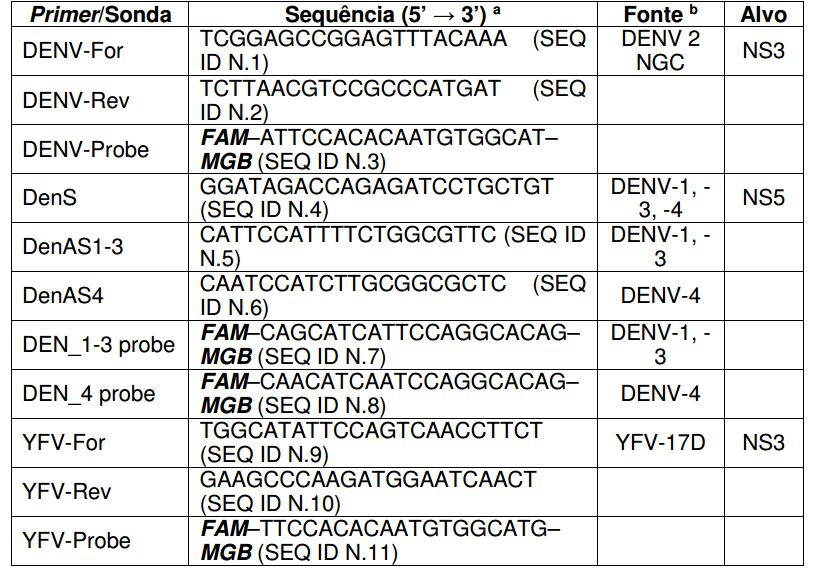
[00282] Os potenciais efeitos citotóxicos dos compostos foram avaliados em células Vero-B ou Vero-M quiescentes infectadas. As células foram semeadas a 5 x 10⁴ células/poço em uma placa de 96 poços na presença de diluições seriadas de duas vezes (variando de 50 μg/mL - 0,004 μg/mL) do composto e foram incubadas durante 4 a 7 dias. O meio de cultura foi descartado e 100 μL 3-(4,5-dimetiltiazol-2-il)-5-(3-carboximetoxifenil)-2-(4- sulfofenil)-2H-tetrazólio/fenazinametosulfato (MTS/PMS; Promega, Leiden, Holanda) em PBS foi adicionado a cada poço. Após um período de incubação de 2 horas a 37 °C, a densidade óptica foi determinada a 498 nm. A atividade citotóxica foi calculada usando a seguinte fórmula: % da viabilidade de células = 100 x (ODcomposto/ODcc), onde ODcomposto e ODcc correspondem à densidade ótica a 498 nm das culturas de células não infectadas tratadas com o composto e culturas de células não tratadas não infectadas, respectivamente. A concentração citotóxica 50% (ou seja, a concentração que reduz o número total de células em 50%; CC50) foi calculada utilizando a interpolação linear.[00282] The potential cytotoxic effects of the compounds were evaluated in infected quiescent Vero-B or Vero-M cells. Cells were seeded at 5 x 10 4 cells/well in a 96-well plate in the presence of two-fold serial dilutions (ranging from 50 μg/mL - 0.004 μg/mL) of compound and incubated for 4 to 7 days. The culture medium was discarded and 100 μL 3-(4,5-dimethylthiazol-2-yl)-5-(3-carboxymethoxyphenyl)-2-(4-sulfophenyl)-2H-tetrazolium/phenazine methosulfate (MTS/PMS; Promega , Leiden, Netherlands) in PBS was added to each well. After an incubation period of 2 hours at 37°C, the optical density was determined at 498 nm. Cytotoxic activity was calculated using the following formula: % cell viability = 100 x (ODcompound/ODcc), where ODcompound and ODcc correspond to the optical density at 498 nm of compound-treated uninfected cell cultures and uninfected cell cultures. treated uninfected, respectively. The 50% cytotoxic concentration (ie, the concentration that reduces the total number of cells by 50%; CC50) was calculated using linear interpolation.
[00283] Um protocolo semelhante foi utilizado para avaliar a citotoxicidade em células A549 com a diferença de que as células foram semeadas a 2x10⁴ células/poço.[00283] A similar protocol was used to assess cytotoxicity in A549 cells with the difference that cells were seeded at 2x10 4 cells/well.
[00284] A Tabela 3 exibe a atividade contra DENV-2 em células Vero-B e a citotoxicidade de alguns exemplos de compostos da invenção.
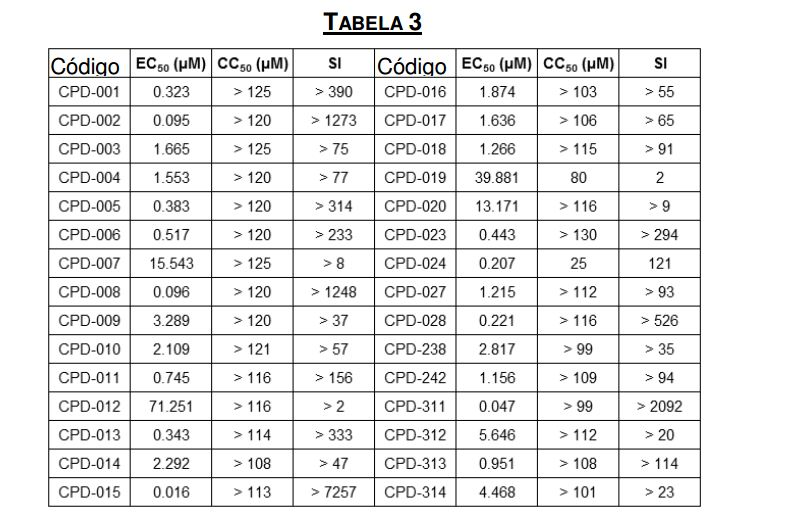
[00285] A Tabela 4 exibe a atividade contra DENV-1 em células Vero-B e a citotoxicidade de alguns exemplos de compostos da invenção. TABELA 4
[00286] A Tabela 5 exibe a atividade contra DENV-3 em células Vero-B e a citotoxicidade de alguns exemplos de compostos da invenção. TABELA 5
[00287] A Tabela 6 exibe a atividade contra DENV-4 em células Vero-M e a citotoxicidade de alguns exemplos de compostos da invenção. TABELA 6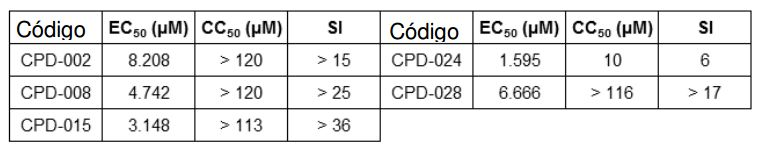
[00288] Um modelo de viremia da dengue em camundongos conforme descrito em Schul W, Liu W, Xu HY, Flamand M, Vasudevan SG. J. Infect Dis. 2007; 95(5):665-74) (incluído ao presente pela referência) pode ser utilizado para examinar a eficácia in vivo dos compostos. Neste modelo, camundongos AG129 (carecendo de receptores interferon alfa/beta e interferon gama) são inoculados intraperitonealmente com 2x10⁶ unidades formadoras de placas (UFP) de DENV-2 (cepa TSV01) no dia 0. Os camundongos infectados (6 ou 8 animais por grupo) são tratados imediatamente com o composto a ser testado em uma ou mais doses selecionadas por via IP, IV ou SC ou por administração oral e o veículo como controle durante três dias consecutivos. No dia 4, as amostras de sangue são coletadas, e os títulos virais são determinados usando um ensaio de placas.[00288] A model of dengue viremia in mice as described in Schul W, Liu W, Xu HY, Flamand M, Vasudevan SG. J. Infect Dis. 2007; 95(5):665-74) (included herein by reference) can be used to examine the in vivo efficacy of compounds. In this model, AG129 mice (lacking alpha/beta interferon and gamma interferon receptors) are inoculated intraperitoneally with 2x10 6 plaque forming units (PFU) of DENV-2 (TSV01 strain) on day 0. The infected mice (6 or 8 animals per group) are treated immediately with the compound to be tested in one or more selected doses IP, IV or SC or by oral administration and the vehicle as a control for three consecutive days. On day 4, blood samples are collected, and viral titers are determined using a plaque assay.
[00289] Um modelo de mortalidade da dengue em camundongos AG129 (carecendo de receptores de interferon alfa/beta e interferon gama) tal como descrito em Tan et al (PLoS Negl Trop Dis 2010; 4(4) e Ann Acad Med Singapore 2011;40:523-32) (incluído ao presente pela referência) foi estabelecido para examinar a eficácia in vivo de um composto da invenção. Camundongos AG129 fêmeas (B & K Universal, Reino Unido), com 7-9 semanas de idade, são divididos aleatoriamente em 3 grupos teste (n = 4 ou 5 por grupo): 1 grupo infectado, que só recebe veículo e 2 grupos infectados que são tratados com o composto teste da invenção (60 mg/kg/dia, S.C., duas vezes ao dia dissolvido em um 10% de DMSO, 5% de Solutol em solução salina (0,9%)) ou com um composto de referência (por exemplo, celgosivir (100 mg/kg/dia ; i.p., duas vezes por dia, dissolvido em NaCl a 0,9%)). Os camundongos são inoculados por via subcutânea no dia 0 com 1 x10⁷ unidades formadoras de placas (UFP) do DENV-2 cepa D2Y98P não adaptada para camundongo, uma cepa altamente infecciosa em camundongos AG129, o que resulta em grave doença e, eventualmente, morte dentro de 2 semanas. Os camundongos infectados são subsequentemente tratados duas vezes ao dia durante vários dias consecutivos (por exemplo, 17 dias consecutivos) com veículo, composto de referência (por exemplo, celgosivir) ou com o composto da invenção. Os camundongos são sacrificados, logo que eles têm sinais de paralisia induzida pelo vírus e/ou terem perdido > = 30% de peso corporal.[00289] A dengue mortality model in AG129 mice (lacking interferon alpha/beta and interferon gamma receptors) as described in Tan et al (PLoS Negl Trop Dis 2010;4(4) and Ann Acad Med Singapore 2011; 40:523-32) (included herein by reference) was set out to examine the in vivo efficacy of a compound of the invention. Female AG129 mice (B&K Universal, UK), 7-9 weeks old, are randomly divided into 3 test groups (n = 4 or 5 per group): 1 infected group, which only receives vehicle and 2 infected groups that are treated with the test compound of the invention (60 mg/kg/day, S.C., twice daily dissolved in a 10% DMSO, 5% Solutol in saline solution (0.9%)) or with a compound of reference (e.g., celgosivir (100 mg/kg/day; i.p., twice daily, dissolved in 0.9% NaCl)). Mice are inoculated subcutaneously on day 0 with 1x10 7 plaque forming units (PFU) of DENV-2 non-mouse-adapted strain D2Y98P, a highly infectious strain in AG129 mice, which results in severe illness and eventually death within 2 weeks. Infected mice are subsequently treated twice daily for several consecutive days (e.g., 17 consecutive days) with vehicle, reference compound (e.g., celgosivir) or the compound of the invention. Mice are sacrificed as soon as they have signs of virus-induced paralysis and/or have lost >=30% body weight.
Claims (17)

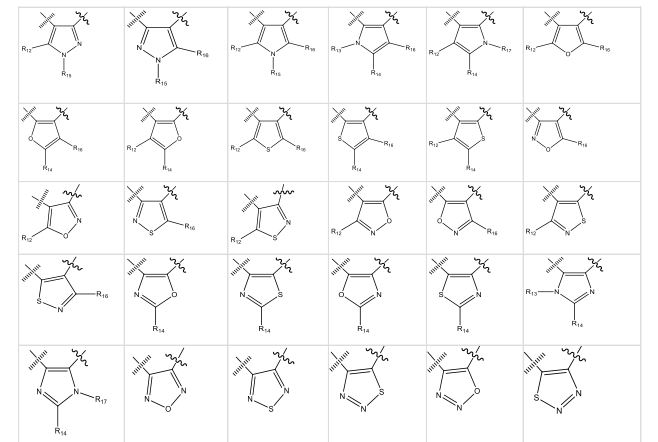
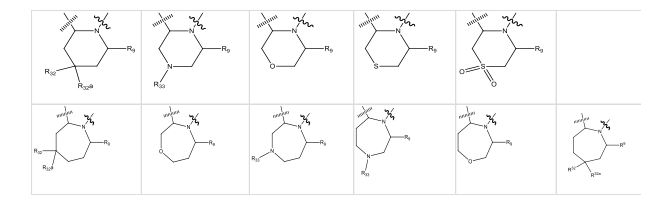


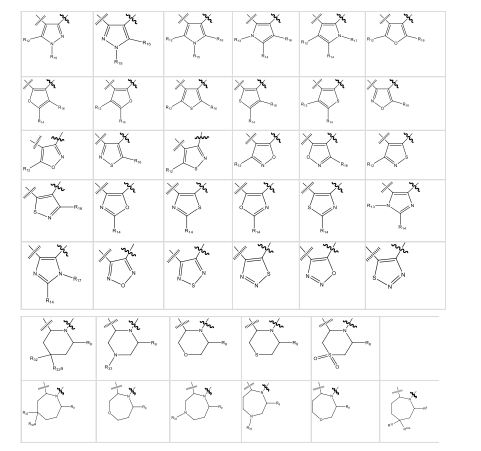
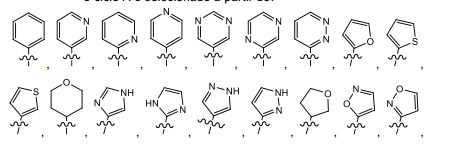
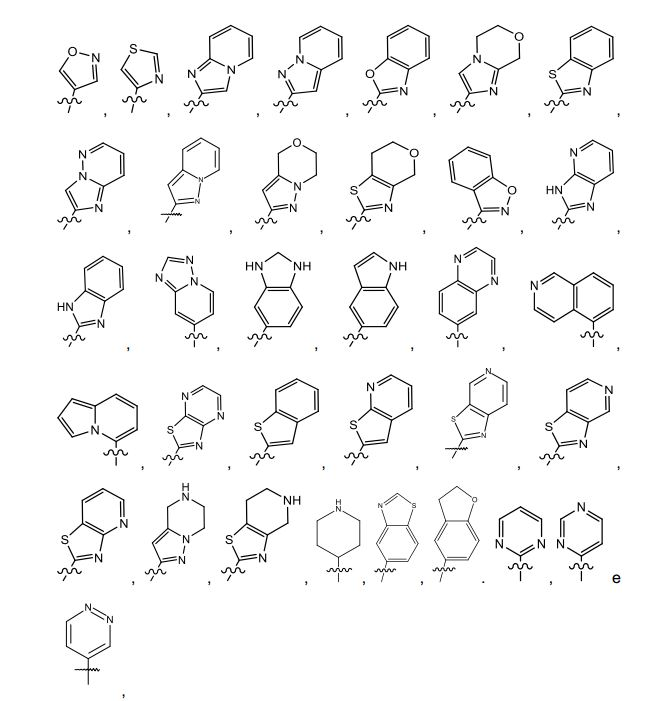
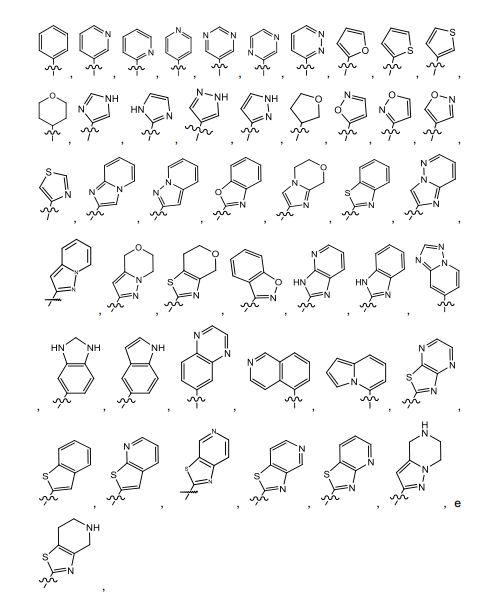

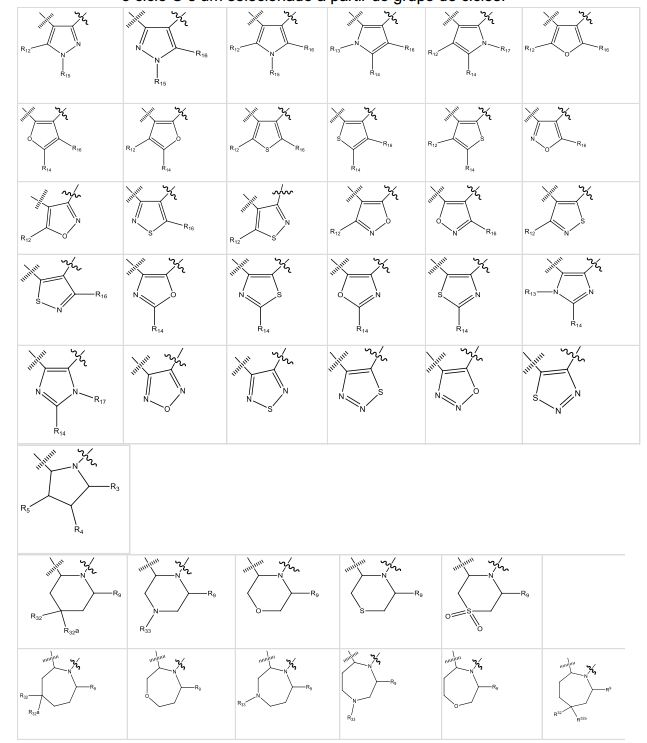
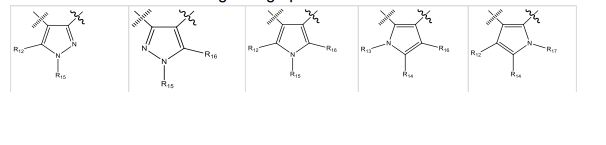


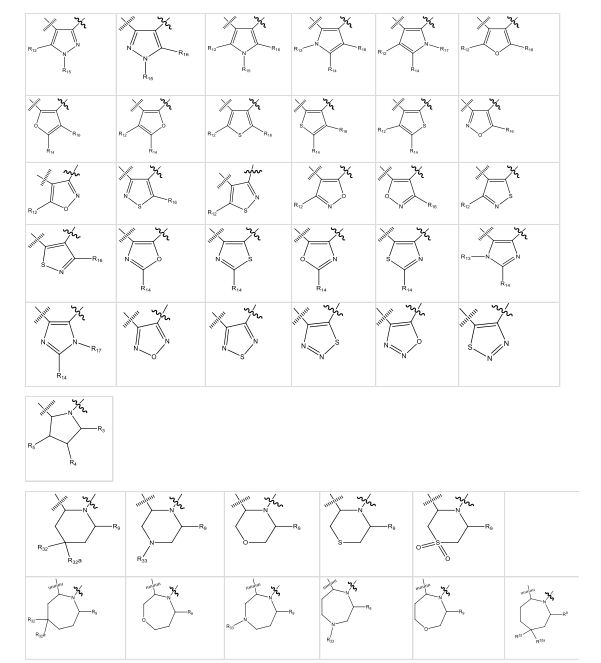



Applications Claiming Priority (5)
| Application Number | Priority Date | Filing Date | Title |
|---|---|---|---|
| US201361805054P | 2013-03-25 | 2013-03-25 | |
| GB1305376.4 | 2013-03-25 | ||
| GB201305376A GB201305376D0 (en) | 2013-03-25 | 2013-03-25 | Novel viral replication inhibitors |
| US61/805,054 | 2013-03-25 | ||
| PCT/EP2014/055946 WO2014154682A1 (en) | 2013-03-25 | 2014-03-25 | Novel viral replication inhibitors |
Publications (2)
| Publication Number | Publication Date |
|---|---|
| BR112015024552A2 BR112015024552A2 (en) | 2017-10-24 |
| BR112015024552B1 true BR112015024552B1 (en) | 2022-11-16 |
Family
ID=48326577
Family Applications (1)
| Application Number | Title | Priority Date | Filing Date |
|---|---|---|---|
| BR112015024552-8A BR112015024552B1 (en) | 2013-03-25 | 2014-03-25 | COMPOUND, USES OF A COMPOUND, PHARMACEUTICAL COMPOSITION, METHOD FOR PREPARING THE COMPOUND, AND USE OF AN EFFECTIVE AMOUNT OF A COMPOUND |
Country Status (15)
| Country | Link |
|---|---|
| US (2) | US10633378B2 (en) |
| EP (1) | EP2978753B1 (en) |
| JP (1) | JP6382299B2 (en) |
| CN (1) | CN105283451B (en) |
| AU (2) | AU2014243101B2 (en) |
| BR (1) | BR112015024552B1 (en) |
| CA (1) | CA2907603C (en) |
| ES (1) | ES2829907T3 (en) |
| GB (1) | GB201305376D0 (en) |
| MX (1) | MX365624B (en) |
| MY (1) | MY194294A (en) |
| PH (1) | PH12015502230B1 (en) |
| SG (2) | SG10201707033PA (en) |
| TW (1) | TWI639583B (en) |
| WO (1) | WO2014154682A1 (en) |
Families Citing this family (15)
| Publication number | Priority date | Publication date | Assignee | Title |
|---|---|---|---|---|
| GB201116559D0 (en) | 2011-09-26 | 2011-11-09 | Univ Leuven Kath | Novel viral replication inhibitors |
| GB201305376D0 (en) | 2013-03-25 | 2013-05-08 | Univ Leuven Kath | Novel viral replication inhibitors |
| JOP20160086B1 (en) | 2015-05-08 | 2021-08-17 | 2 Katholieke Univ Leuven Ku Leuven Research And Development | Mono- or di-substituted indole derivatives as dengue viral replication inhibitors |
| JO3633B1 (en) | 2015-09-16 | 2020-08-27 | Katholieke Univ Leuven Ku Leuven Research & Development | Single or binary substituted indole derivatives as inhibitors of viral replication of fennel fever |
| JOP20160198B1 (en) * | 2015-09-16 | 2022-03-14 | Janssen Pharmaceuticals Inc | Single or di-substituted indole derivatives as inhibitors of viral replication of fennel fever |
| SG11201808138YA (en) | 2016-03-31 | 2018-10-30 | Janssen Pharmaceuticals Inc | Substituted indole derivatives as dengue viral replication inhibitors |
| MA44498A (en) | 2016-03-31 | 2019-02-06 | Janssen Pharmaceuticals Inc | SUBSTITUTED INDOLINE DERIVATIVES USED AS DENGUE VIRUS REPLICATION INHIBITORS |
| JOP20170069B1 (en) * | 2016-04-01 | 2021-08-17 | 1 Janssen Pharmaceuticals Inc | Substituted indoline derivatives as dengue viral replication inhibitors |
| EP3436004B1 (en) | 2016-04-01 | 2024-12-11 | Janssen Pharmaceuticals, Inc. | Substituted indole compound derivatives as dengue viral replication inhibitors |
| JOP20180025B1 (en) * | 2017-03-31 | 2021-08-17 | Janssen Pharmaceuticals Inc | Substituted indoline derivatives as dengue viral replication inhibitors |
| JOP20180026A1 (en) * | 2017-03-31 | 2019-01-30 | Univ Leuven Kath | Indolein derivatives substituted as viral reproductive inhibitors of Fennec fever |
| SI3630724T1 (en) | 2017-05-22 | 2021-08-31 | Janssen Pharmaceuticals, Inc. | Substituted indoline derivatives as dengue viral replication inhibitors |
| CA3060583C (en) | 2017-05-22 | 2024-06-04 | Janssen Pharmaceuticals, Inc. | Substituted indoline derivatives as dengue viral replication inhibitors |
| CA3224494A1 (en) | 2021-07-09 | 2023-01-12 | Koen Vandyck | Anti-viral compounds |
| WO2023043816A1 (en) * | 2021-09-17 | 2023-03-23 | Aligos Therapeutics, Inc. | Anti-viral compounds for treating coronavirus, picornavirus, and norovirus infections |
Family Cites Families (22)
| Publication number | Priority date | Publication date | Assignee | Title |
|---|---|---|---|---|
| US5543523A (en) | 1994-11-15 | 1996-08-06 | Regents Of The University Of Minnesota | Method and intermediates for the synthesis of korupensamines |
| US20070167499A1 (en) | 2003-10-27 | 2007-07-19 | A*Bio Pte Ltd. | Biaryl linked hydroxamates: preparation and pharmaceutical applications |
| RU2009118487A (en) * | 2006-10-19 | 2010-11-27 | Новартис АГ (CH) | ORGANIC COMPOUNDS |
| US8143259B2 (en) * | 2008-08-19 | 2012-03-27 | Janssen Pharmaceutica, Nv | Cold menthol receptor antagonists |
| TWI453207B (en) | 2008-09-08 | 2014-09-21 | Signal Pharm Llc | Aminotriazolopyridines, compositions thereof, and methods of treatment therewith |
| US8729077B2 (en) | 2008-11-28 | 2014-05-20 | Glaxosmithkline Llc | Anti-viral compounds, compositions, and methods of use |
| WO2010096777A1 (en) * | 2009-02-23 | 2010-08-26 | Presidio Pharmaceuticals, Inc. | Inhibitors of hcv ns5a |
| WO2010094977A1 (en) * | 2009-02-23 | 2010-08-26 | Arrow Therapeutics Limited | Novel biphenyl compounds useful for the treatment of hepatitis c |
| WO2011035083A1 (en) * | 2009-09-18 | 2011-03-24 | Novartis Ag | Biomarkers for iap inhibitor compounds |
| JP2013512247A (en) * | 2009-11-25 | 2013-04-11 | バーテックス ファーマシューティカルズ インコーポレイテッド | 5-Alkynyl-thiophene-2-carboxylic acid derivatives and their use for the treatment or prevention of flavivirus infections |
| CN102552271B (en) * | 2010-12-09 | 2014-08-06 | 中国科学院上海药物研究所 | Use of quinazoline compounds in preparation of drug for resisting flaviviridae viruses |
| GB201116559D0 (en) | 2011-09-26 | 2011-11-09 | Univ Leuven Kath | Novel viral replication inhibitors |
| GB201305376D0 (en) | 2013-03-25 | 2013-05-08 | Univ Leuven Kath | Novel viral replication inhibitors |
| PT3201176T (en) | 2014-10-01 | 2019-03-04 | Janssen Pharmaceuticals Inc | Mono- or di-substituted indole derivatives as dengue viral replication inhibitors |
| PH12017501272B1 (en) | 2015-01-16 | 2023-01-11 | Janssen Pharmaceuticals Inc | Indole derivatives as dengue viral replication inhibitors |
| JOP20160086B1 (en) | 2015-05-08 | 2021-08-17 | 2 Katholieke Univ Leuven Ku Leuven Research And Development | Mono- or di-substituted indole derivatives as dengue viral replication inhibitors |
| JOP20160198B1 (en) | 2015-09-16 | 2022-03-14 | Janssen Pharmaceuticals Inc | Single or di-substituted indole derivatives as inhibitors of viral replication of fennel fever |
| JO3633B1 (en) | 2015-09-16 | 2020-08-27 | Katholieke Univ Leuven Ku Leuven Research & Development | Single or binary substituted indole derivatives as inhibitors of viral replication of fennel fever |
| MA44498A (en) | 2016-03-31 | 2019-02-06 | Janssen Pharmaceuticals Inc | SUBSTITUTED INDOLINE DERIVATIVES USED AS DENGUE VIRUS REPLICATION INHIBITORS |
| SG11201808138YA (en) | 2016-03-31 | 2018-10-30 | Janssen Pharmaceuticals Inc | Substituted indole derivatives as dengue viral replication inhibitors |
| JOP20170069B1 (en) | 2016-04-01 | 2021-08-17 | 1 Janssen Pharmaceuticals Inc | Substituted indoline derivatives as dengue viral replication inhibitors |
| EP3436004B1 (en) | 2016-04-01 | 2024-12-11 | Janssen Pharmaceuticals, Inc. | Substituted indole compound derivatives as dengue viral replication inhibitors |
-
2013
- 2013-03-25 GB GB201305376A patent/GB201305376D0/en not_active Ceased
-
2014
- 2014-03-25 ES ES14718338T patent/ES2829907T3/en active Active
- 2014-03-25 AU AU2014243101A patent/AU2014243101B2/en active Active
- 2014-03-25 EP EP14718338.8A patent/EP2978753B1/en active Active
- 2014-03-25 CN CN201480023957.6A patent/CN105283451B/en active Active
- 2014-03-25 MY MYPI2015002431A patent/MY194294A/en unknown
- 2014-03-25 TW TW103111110A patent/TWI639583B/en not_active IP Right Cessation
- 2014-03-25 SG SG10201707033PA patent/SG10201707033PA/en unknown
- 2014-03-25 US US14/777,765 patent/US10633378B2/en active Active
- 2014-03-25 BR BR112015024552-8A patent/BR112015024552B1/en active IP Right Grant
- 2014-03-25 CA CA2907603A patent/CA2907603C/en active Active
- 2014-03-25 JP JP2016504633A patent/JP6382299B2/en active Active
- 2014-03-25 SG SG11201507958TA patent/SG11201507958TA/en unknown
- 2014-03-25 MX MX2015013649A patent/MX365624B/en active IP Right Grant
- 2014-03-25 WO PCT/EP2014/055946 patent/WO2014154682A1/en not_active Ceased
-
2015
- 2015-09-24 PH PH12015502230A patent/PH12015502230B1/en unknown
-
2018
- 2018-06-06 AU AU2018203998A patent/AU2018203998A1/en not_active Abandoned
-
2020
- 2020-02-24 US US16/798,859 patent/US11566025B2/en active Active
Also Published As
| Publication number | Publication date |
|---|---|
| JP2016520537A (en) | 2016-07-14 |
| AU2018203998A1 (en) | 2018-06-28 |
| JP6382299B2 (en) | 2018-08-29 |
| US10633378B2 (en) | 2020-04-28 |
| AU2014243101A1 (en) | 2015-11-12 |
| US11566025B2 (en) | 2023-01-31 |
| MX365624B (en) | 2019-06-10 |
| SG10201707033PA (en) | 2017-10-30 |
| CN105283451B (en) | 2021-01-26 |
| CA2907603C (en) | 2023-01-03 |
| TWI639583B (en) | 2018-11-01 |
| ES2829907T3 (en) | 2021-06-02 |
| WO2014154682A1 (en) | 2014-10-02 |
| US20160297810A1 (en) | 2016-10-13 |
| EP2978753B1 (en) | 2020-08-12 |
| TW201522304A (en) | 2015-06-16 |
| GB201305376D0 (en) | 2013-05-08 |
| CN105283451A (en) | 2016-01-27 |
| AU2014243101B2 (en) | 2018-05-17 |
| HK1213260A1 (en) | 2016-06-30 |
| US20200223845A1 (en) | 2020-07-16 |
| SG11201507958TA (en) | 2015-11-27 |
| MY194294A (en) | 2022-11-27 |
| PH12015502230B1 (en) | 2022-03-09 |
| MX2015013649A (en) | 2016-06-21 |
| CA2907603A1 (en) | 2014-10-02 |
| EP2978753A1 (en) | 2016-02-03 |
| BR112015024552A2 (en) | 2017-10-24 |
| PH12015502230A1 (en) | 2016-02-01 |
Similar Documents
| Publication | Publication Date | Title |
|---|---|---|
| ES2829907T3 (en) | Novel inhibitors of viral replication | |
| US12012411B2 (en) | Viral replication inhibitors | |
| JP2016520537A5 (en) | ||
| PT1706403E (en) | Imidazo[4,5-c]pyridine compounds and methods of antiviral treatment | |
| PT1521754E (en) | Viral inhibitors | |
| CN103429582A (en) | MST1 kinase inhibitors and method of use thereof | |
| ES2287278T3 (en) | USEFUL BENCIMIDAZOLS IN THE TREATMENT OF SEXUAL DYSFUNCTION. | |
| WO2024008044A1 (en) | Macrocyclic peptidomimetic protease inhibitor and use thereof | |
| CN118541359A (en) | Inhibitors of molluscum contagiosum infection and methods of use thereof | |
| HK1213260B (en) | Novel viral replication inhibitors | |
| NZ622588B2 (en) | Viral replication inhibitors | |
| NZ739958B2 (en) | Viral replication inhibitors | |
| NZ739958A (en) | Viral replication inhibitors | |
| NZ755313B2 (en) | Viral replication inhibitors | |
| HK1195069B (en) | Viral replication inhibitors | |
| HK1195069A (en) | Viral replication inhibitors |
Legal Events
| Date | Code | Title | Description |
|---|---|---|---|
| B07D | Technical examination (opinion) related to article 229 of industrial property law [chapter 7.4 patent gazette] |
Free format text: DE ACORDO COM O ARTIGO 229-C DA LEI NO 10196/2001, QUE MODIFICOU A LEI NO 9279/96, A CONCESSAO DA PATENTE ESTA CONDICIONADA A ANUENCIA PREVIA DA ANVISA. CONSIDERANDO A APROVACAO DOS TERMOS DO PARECER NO 337/PGF/EA/2010, BEM COMO A PORTARIA INTERMINISTERIAL NO 1065 DE 24/05/2012, ENCAMINHA-SE O PRESENTE PEDIDO PARA AS PROVIDENCIAS CABIVEIS. |
|
| B07E | Notification of approval relating to section 229 industrial property law [chapter 7.5 patent gazette] | ||
| B15K | Others concerning applications: alteration of classification |
Free format text: AS CLASSIFICACOES ANTERIORES ERAM: C07D 403/12 , C07D 401/14 , C07D 405/14 , C07D 413/14 , C07D 223/04 , C07D 231/12 , C07D 333/22 , C07D 401/04 , C07D 401/06 , C07D 403/04 , C07D 403/06 , C07D 405/04 , C07D 405/06 , C07D 405/12 , C07D 407/04 , C07D 407/06 Ipc: C07D 403/12 (2006.01), C07D 401/14 (2006.01), ... |
|
| B06U | Preliminary requirement: requests with searches performed by other patent offices: procedure suspended [chapter 6.21 patent gazette] | ||
| B06A | Patent application procedure suspended [chapter 6.1 patent gazette] | ||
| B09A | Decision: intention to grant [chapter 9.1 patent gazette] | ||
| B16A | Patent or certificate of addition of invention granted [chapter 16.1 patent gazette] |
Free format text: PRAZO DE VALIDADE: 20 (VINTE) ANOS CONTADOS A PARTIR DE 25/03/2014, OBSERVADAS AS CONDICOES LEGAIS |