WO2025106932A1 - Methods for increasing erythropoiesis - Google Patents
Methods for increasing erythropoiesis Download PDFInfo
- Publication number
- WO2025106932A1 WO2025106932A1 PCT/US2024/056296 US2024056296W WO2025106932A1 WO 2025106932 A1 WO2025106932 A1 WO 2025106932A1 US 2024056296 W US2024056296 W US 2024056296W WO 2025106932 A1 WO2025106932 A1 WO 2025106932A1
- Authority
- WO
- WIPO (PCT)
- Prior art keywords
- protein
- seq
- nucleotide sequence
- amino acid
- sequence
- Prior art date
- Legal status (The legal status is an assumption and is not a legal conclusion. Google has not performed a legal analysis and makes no representation as to the accuracy of the status listed.)
- Pending
Links
Classifications
-
- C—CHEMISTRY; METALLURGY
- C12—BIOCHEMISTRY; BEER; SPIRITS; WINE; VINEGAR; MICROBIOLOGY; ENZYMOLOGY; MUTATION OR GENETIC ENGINEERING
- C12N—MICROORGANISMS OR ENZYMES; COMPOSITIONS THEREOF; PROPAGATING, PRESERVING, OR MAINTAINING MICROORGANISMS; MUTATION OR GENETIC ENGINEERING; CULTURE MEDIA
- C12N15/00—Mutation or genetic engineering; DNA or RNA concerning genetic engineering, vectors, e.g. plasmids, or their isolation, preparation or purification; Use of hosts therefor
- C12N15/09—Recombinant DNA-technology
- C12N15/87—Introduction of foreign genetic material using processes not otherwise provided for, e.g. co-transformation
- C12N15/90—Stable introduction of foreign DNA into chromosome
- C12N15/902—Stable introduction of foreign DNA into chromosome using homologous recombination
- C12N15/907—Stable introduction of foreign DNA into chromosome using homologous recombination in mammalian cells
-
- A—HUMAN NECESSITIES
- A61—MEDICAL OR VETERINARY SCIENCE; HYGIENE
- A61K—PREPARATIONS FOR MEDICAL, DENTAL OR TOILETRY PURPOSES
- A61K35/00—Medicinal preparations containing materials or reaction products thereof with undetermined constitution
- A61K35/12—Materials from mammals; Compositions comprising non-specified tissues or cells; Compositions comprising non-embryonic stem cells; Genetically modified cells
- A61K35/14—Blood; Artificial blood
- A61K35/18—Erythrocytes
-
- A—HUMAN NECESSITIES
- A61—MEDICAL OR VETERINARY SCIENCE; HYGIENE
- A61K—PREPARATIONS FOR MEDICAL, DENTAL OR TOILETRY PURPOSES
- A61K48/00—Medicinal preparations containing genetic material which is inserted into cells of the living body to treat genetic diseases; Gene therapy
- A61K48/005—Medicinal preparations containing genetic material which is inserted into cells of the living body to treat genetic diseases; Gene therapy characterised by an aspect of the 'active' part of the composition delivered, i.e. the nucleic acid delivered
-
- A—HUMAN NECESSITIES
- A61—MEDICAL OR VETERINARY SCIENCE; HYGIENE
- A61P—SPECIFIC THERAPEUTIC ACTIVITY OF CHEMICAL COMPOUNDS OR MEDICINAL PREPARATIONS
- A61P7/00—Drugs for disorders of the blood or the extracellular fluid
-
- C—CHEMISTRY; METALLURGY
- C07—ORGANIC CHEMISTRY
- C07K—PEPTIDES
- C07K14/00—Peptides having more than 20 amino acids; Gastrins; Somatostatins; Melanotropins; Derivatives thereof
- C07K14/435—Peptides having more than 20 amino acids; Gastrins; Somatostatins; Melanotropins; Derivatives thereof from animals; from humans
- C07K14/705—Receptors; Cell surface antigens; Cell surface determinants
- C07K14/71—Receptors; Cell surface antigens; Cell surface determinants for growth factors; for growth regulators
-
- C—CHEMISTRY; METALLURGY
- C12—BIOCHEMISTRY; BEER; SPIRITS; WINE; VINEGAR; MICROBIOLOGY; ENZYMOLOGY; MUTATION OR GENETIC ENGINEERING
- C12N—MICROORGANISMS OR ENZYMES; COMPOSITIONS THEREOF; PROPAGATING, PRESERVING, OR MAINTAINING MICROORGANISMS; MUTATION OR GENETIC ENGINEERING; CULTURE MEDIA
- C12N15/00—Mutation or genetic engineering; DNA or RNA concerning genetic engineering, vectors, e.g. plasmids, or their isolation, preparation or purification; Use of hosts therefor
- C12N15/09—Recombinant DNA-technology
- C12N15/11—DNA or RNA fragments; Modified forms thereof; Non-coding nucleic acids having a biological activity
- C12N15/113—Non-coding nucleic acids modulating the expression of genes, e.g. antisense oligonucleotides; Antisense DNA or RNA; Triplex- forming oligonucleotides; Catalytic nucleic acids, e.g. ribozymes; Nucleic acids used in co-suppression or gene silencing
- C12N15/1138—Non-coding nucleic acids modulating the expression of genes, e.g. antisense oligonucleotides; Antisense DNA or RNA; Triplex- forming oligonucleotides; Catalytic nucleic acids, e.g. ribozymes; Nucleic acids used in co-suppression or gene silencing against receptors or cell surface proteins
-
- C—CHEMISTRY; METALLURGY
- C12—BIOCHEMISTRY; BEER; SPIRITS; WINE; VINEGAR; MICROBIOLOGY; ENZYMOLOGY; MUTATION OR GENETIC ENGINEERING
- C12N—MICROORGANISMS OR ENZYMES; COMPOSITIONS THEREOF; PROPAGATING, PRESERVING, OR MAINTAINING MICROORGANISMS; MUTATION OR GENETIC ENGINEERING; CULTURE MEDIA
- C12N15/00—Mutation or genetic engineering; DNA or RNA concerning genetic engineering, vectors, e.g. plasmids, or their isolation, preparation or purification; Use of hosts therefor
- C12N15/09—Recombinant DNA-technology
- C12N15/87—Introduction of foreign genetic material using processes not otherwise provided for, e.g. co-transformation
- C12N15/90—Stable introduction of foreign DNA into chromosome
-
- C—CHEMISTRY; METALLURGY
- C12—BIOCHEMISTRY; BEER; SPIRITS; WINE; VINEGAR; MICROBIOLOGY; ENZYMOLOGY; MUTATION OR GENETIC ENGINEERING
- C12N—MICROORGANISMS OR ENZYMES; COMPOSITIONS THEREOF; PROPAGATING, PRESERVING, OR MAINTAINING MICROORGANISMS; MUTATION OR GENETIC ENGINEERING; CULTURE MEDIA
- C12N9/00—Enzymes; Proenzymes; Compositions thereof; Processes for preparing, activating, inhibiting, separating or purifying enzymes
- C12N9/14—Hydrolases (3)
- C12N9/16—Hydrolases (3) acting on ester bonds (3.1)
- C12N9/22—Ribonucleases [RNase]; Deoxyribonucleases [DNase]
- C12N9/222—Clustered regularly interspaced short palindromic repeats [CRISPR]-associated [CAS] enzymes
-
- C—CHEMISTRY; METALLURGY
- C07—ORGANIC CHEMISTRY
- C07K—PEPTIDES
- C07K14/00—Peptides having more than 20 amino acids; Gastrins; Somatostatins; Melanotropins; Derivatives thereof
- C07K14/435—Peptides having more than 20 amino acids; Gastrins; Somatostatins; Melanotropins; Derivatives thereof from animals; from humans
- C07K14/475—Growth factors; Growth regulators
- C07K14/505—Erythropoietin [EPO]
-
- C—CHEMISTRY; METALLURGY
- C12—BIOCHEMISTRY; BEER; SPIRITS; WINE; VINEGAR; MICROBIOLOGY; ENZYMOLOGY; MUTATION OR GENETIC ENGINEERING
- C12N—MICROORGANISMS OR ENZYMES; COMPOSITIONS THEREOF; PROPAGATING, PRESERVING, OR MAINTAINING MICROORGANISMS; MUTATION OR GENETIC ENGINEERING; CULTURE MEDIA
- C12N2310/00—Structure or type of the nucleic acid
- C12N2310/10—Type of nucleic acid
- C12N2310/20—Type of nucleic acid involving clustered regularly interspaced short palindromic repeats [CRISPR]
-
- C—CHEMISTRY; METALLURGY
- C12—BIOCHEMISTRY; BEER; SPIRITS; WINE; VINEGAR; MICROBIOLOGY; ENZYMOLOGY; MUTATION OR GENETIC ENGINEERING
- C12N—MICROORGANISMS OR ENZYMES; COMPOSITIONS THEREOF; PROPAGATING, PRESERVING, OR MAINTAINING MICROORGANISMS; MUTATION OR GENETIC ENGINEERING; CULTURE MEDIA
- C12N2310/00—Structure or type of the nucleic acid
- C12N2310/30—Chemical structure
- C12N2310/31—Chemical structure of the backbone
- C12N2310/315—Phosphorothioates
-
- C—CHEMISTRY; METALLURGY
- C12—BIOCHEMISTRY; BEER; SPIRITS; WINE; VINEGAR; MICROBIOLOGY; ENZYMOLOGY; MUTATION OR GENETIC ENGINEERING
- C12N—MICROORGANISMS OR ENZYMES; COMPOSITIONS THEREOF; PROPAGATING, PRESERVING, OR MAINTAINING MICROORGANISMS; MUTATION OR GENETIC ENGINEERING; CULTURE MEDIA
- C12N2310/00—Structure or type of the nucleic acid
- C12N2310/30—Chemical structure
- C12N2310/32—Chemical structure of the sugar
- C12N2310/321—2'-O-R Modification
-
- C—CHEMISTRY; METALLURGY
- C12—BIOCHEMISTRY; BEER; SPIRITS; WINE; VINEGAR; MICROBIOLOGY; ENZYMOLOGY; MUTATION OR GENETIC ENGINEERING
- C12N—MICROORGANISMS OR ENZYMES; COMPOSITIONS THEREOF; PROPAGATING, PRESERVING, OR MAINTAINING MICROORGANISMS; MUTATION OR GENETIC ENGINEERING; CULTURE MEDIA
- C12N2320/00—Applications; Uses
- C12N2320/30—Special therapeutic applications
- C12N2320/33—Alteration of splicing
-
- C—CHEMISTRY; METALLURGY
- C12—BIOCHEMISTRY; BEER; SPIRITS; WINE; VINEGAR; MICROBIOLOGY; ENZYMOLOGY; MUTATION OR GENETIC ENGINEERING
- C12N—MICROORGANISMS OR ENZYMES; COMPOSITIONS THEREOF; PROPAGATING, PRESERVING, OR MAINTAINING MICROORGANISMS; MUTATION OR GENETIC ENGINEERING; CULTURE MEDIA
- C12N9/00—Enzymes; Proenzymes; Compositions thereof; Processes for preparing, activating, inhibiting, separating or purifying enzymes
- C12N9/14—Hydrolases (3)
- C12N9/78—Hydrolases (3) acting on carbon to nitrogen bonds other than peptide bonds (3.5)
-
- C—CHEMISTRY; METALLURGY
- C12—BIOCHEMISTRY; BEER; SPIRITS; WINE; VINEGAR; MICROBIOLOGY; ENZYMOLOGY; MUTATION OR GENETIC ENGINEERING
- C12Y—ENZYMES
- C12Y305/00—Hydrolases acting on carbon-nitrogen bonds, other than peptide bonds (3.5)
- C12Y305/04—Hydrolases acting on carbon-nitrogen bonds, other than peptide bonds (3.5) in cyclic amidines (3.5.4)
Definitions
- a method of treating a hemoglobinopathy in a subject in need thereof including: (a) transfecting a plurality of human stem cells (HSCs) with a first nucleic acid encoding a guide RNA and a second nucleic acid encoding a non-double strand breakdependent gene editor protein thereby forming transfected HSCs, wherein the guide RNA is capable of binding to the non-double strand break-dependent gene editor protein thereby forming a nondouble strand break-dependent gene editor complex, wherein the non-double strand break-dependent gene editor complex is capable of editing at least one base within a genomic nucleic acid sequence resulting in an edited genomic nucleic acid encoding a modified erythropoietin receptor (EPOR) protein; (b) culturing the transfected HSCs thereby forming transfected erythrocytes; and (c) administering the transfected erythrocytes to the subject, thereby treating
- HSCs human stem cells
- a method of generating a population of transfected erythrocytes including: (a) transfecting a plurality of human stem cells (HSCs) with a first nucleic acid encoding a guide RNA and a second nucleic acid encoding a non-double strand break-dependent gene editor protein thereby forming transfected HSCs, wherein the guide RNA is capable of binding to the non-double strand break-dependent gene editor protein thereby forming a non-double strand break-dependent gene editor complex, where the non-double strand breakdependent gene editor complex is capable of editing at least one base within a genomic nucleic acid sequence resulting in an edited genomic nucleic acid encoding a modified erythropoietin receptor (EPOR) protein; and (b) culturing the transfected HSCs thereby forming transfected erythrocytes.
- HSCs human stem cells
- a cell including a first nucleic acid encoding a guide RNA and a second nucleic acid encoding a non-double strand break-dependent gene editor protein, wherein the guide RNA is capable of binding to the non-double strand break-dependent gene editor protein thereby forming a non-double strand break-dependent gene editor complex, where the non- double strand break-dependent gene editor complex is capable of editing at least one base within a genomic nucleic acid sequence resulting in an edited genomic nucleic acid encoding a modified erythropoietin receptor (EPOR) protein.
- EPOR modified erythropoietin receptor
- a ribonucleic acid including the nucleotide sequence of SEQ ID NO:4, SEQ ID NO:5, SEQ ID NO:6, SEQ ID NO:7, SEQ ID NO:8, SEQ ID NO:9, SEQ ID NO: 10, SEQ ID NO: 11, SEQ ID NO: 12, SEQ ID NO: 45, SEQ ID NO:46, or SEQ ID NO:47.
- FIGS. 1A-1C show efficient C-to-T substitution at EPOR loci in Hela cells by CBE- mediated base editing.
- FIG. 1A The targeted sequences at the EPOR loci. The triangles indicate the predicted substitution sites for the sgRNAs. The PAM sequences are italicized and indicated with a box. The nucleotide substitutions are in bold font. The expected edited codons are underlined. The SHP-1 binding sites are italicized in bold font (e.g. amino acid residues 426, 454, and 456).
- FIG. IB Flow chart of the experimental procedures. The stars indicate the substituted nucleotides.
- FIG. 1C The fractions of thymine and cytosine.
- FIG. 1 A includes SEQ ID NOs:55-61.
- FIG. IB includes SEQ ID NOs:71-72.
- FIGS. 2A-2D show truncating EPOR with induced premature stop codon (i-stop) lends selective advantage to edited RBCs.
- FIG. 2A Flow chart of the experimental procedures. The frequency of CBE-mediated i-stop with EPOR-sgl and EPOR-sg2 in HSPCs during the course of RBC differentiation was determined using next-generation sequence (NGS).
- FIG. 2B The i-stop rates targeted with of EPOR-sgl and EPOR-sg2 over the course of RBC differentiation.
- FIG. 2C shows cell count fold change in mock and edited cells maintained in RBC media.
- FIG. 2D Erythroid differentiation of edited CD34 + HSPCs.
- FIGS. 3A-3C show truncating EPOR with premature stop codon lend selective advantage to edited RBCs.
- FIG. 3A The i-stop rates targeted with EPOR-sg2 at Day 14 exhibited significantly improved editing efficiency compared to Day 4 of RBC differentiation
- FIG. 3B The fold change in i-stop rates with EPOR-sgl and EPOR-sg2 demonstrated significantly enhanced editing efficiency in comparison to the mock at day 14 of the RBC differentiation process.
- FIG. 3C The cell counts fold change in EPOR-sgl and EPOR-sg2 displayed a substantial increase compared to the mock during the 14th day of the RBC differentiation phase.
- FIGS. 4A-4C show summaries of a next-generation sequence (NGS) analysis to quantify stop codon introduction.
- FIG. 4A Schematic of editing strategy with spike-in of unedited cells at start of RBC differentiation.
- FIG. 4B Both guides lead to an increase in edited cells over the course of RBC differentiation.
- FIG. 4C Analyses of edited tEPOR alleles at Day 0 and Day 14 confirm that cells expressing tEPOR maintain a significant selective advantage over unedited cells throughout the process of RBC differentiation.
- FIG. 5 shows tEPOR increases fetal hemoglobin (HbF) production.
- WT primary HSPCs were edited at EPOR locus or BCL11A locus with CBE, or at HBG locus with an ABE. Edited cells were differentiated into RBCs and hemoglobin tetramer HPLC was used to quantify the ratio of fetal hemoglobin (HbF) to adult hemoglobin (HbA).
- FIG. 6 shows representative immune-flow cytometry for erythroid maturation stage at day 14. The data demonstrates high viability and effective red blood cell (RBC) differentiation in edited cells compared to unedited cells.
- RBC red blood cell
- FIGS. 7A-7D show results from a base editor screen for hypermorphic EPOR variants.
- CBEs may introduce the best-characterized EPOR mutation, ABEs are reportedly more efficient and specific. ABEs also mediate more potent fetal hemoglobin reactivation than CBEs or Cas9. For these reasons, we sought to instead introduce hypermorphic EPOR mutations using an ABE. To do so, we deployed a BE screening platform (FIG. 7A) to screen a library of all possible NG-ABE-compatible guide RNAs (gRNAs) across the EPOR locus in primary human HSPCs (FIG. 7B).
- gRNAs NG-ABE-compatible guide RNAs
- FIG. 8 shows gRNA sequences in relation to SHP-1 inhibitor domains as well as the Olympic skier mutation and CBE-compatible gRNAs (tEPOR-s l(SEQ ID NO:4) and tEPOR-sg2 (SEQ ID NO:5). Interestingly, all of the gRNAs imparting gain-of-function were located immediately upstream or downstream of the Olympic skier mutation. The gRNA sequences that imparted gain-of-function were sg 1108 (SEQ ID NO:45), sg 1110 (SEQ ID NO:46), and sg 1157 (SEQ ID NO:47). FIG. 8 includes SEQ ID NOs:62-64. [0016] FIGS.
- FIG. 9A-9B show ABE and sgRNA 1157 demonstrate a similar selective advantage to the CBE tEPOR edit.
- FIG. 9A Editing frequencies before and after RBC differentiation.
- FIG. 9B Fold change in cell count by end of RBC differentiation.
- FIG. 9A Editing frequencies before and after RBC differentiation.
- FIG. 9B Fold change in cell count by end of RBC differentiation.
- sgRNA 1157 recapitulated the selective advantage imparted by CBE-mediated introduction of tEPOR.
- the selective advantage was also observed by cell count for sgRNA 1157 to an equivalent degree as CBE-mediated introduction of tEPOR (FIG. 9B).
- FIGS. 10A-10C show Efficient C-to-T substitution a EPOR loci in Hela by A3A-Y130F and BE4max mediated base editing.
- FIG. 10A The targeted sequences at the EPOR loci. The triangles indicate the predicted substitution sites for the sgRNAs. The PAM sequences are italicized and indicated with a box. The nucleotide substitutions are in bold font. The expected edited codons are underlined.
- FIG. 10B Sanger sequencing chromatograms of A3A-Y130F and BE4max mediated editing in Hela cells. The stars indicate the substituted nucleotides.
- FIG. 10A The targeted sequences at the EPOR loci. The triangles indicate the predicted substitution sites for the sgRNAs. The PAM sequences are italicized and indicated with a box. The nucleotide substitutions are in bold font. The expected edited codons are underlined.
- FIG. 10B Sanger sequencing chromatograms of A3A-
- FIG. 10C The analysis of the base editing efficiency of A3A-Y130F and BE4max in Hela co-transfected with different sgRNAs. The efficiencies were detected by sanger sequencing of EditR in Hela for EPOR. Black columns indicate editing efficiency of A3A-Y130F ; Grey columns indicate editing efficiency of BE4max; Number, percentage value.
- FIG. 10A includes SEQ ID NOs:65-70.
- FIG. 10B includes SEQ ID NOs:71-73.
- Nucleic acid refers to nucleotides (e.g., deoxyribonucleotides or ribonucleotides) and polymers thereof in either single-, double- or multiple-stranded form, or complements thereof; or nucleosides (e.g., deoxyribonucleosides or ribonucleosides). In embodiments, “nucleic acid” does not include nucleosides.
- polynucleotide oligonucleotide,” “oligo” or the like refer, in the usual and customary sense, to a linear sequence of nucleotides.
- polynucleotides contemplated herein include single and double stranded DNA, single and double stranded RNA, and hybrid molecules having mixtures of single and double stranded DNA and RNA.
- nucleic acid e.g. polynucleotides contemplated herein include any types of RNA, e.g. mRNA, siRNA, miRNA, and guide RNA and any types of DNA, genomic DNA, plasmid DNA, and mini circle DNA, and any fragments thereof.
- duplex in the context of polynucleotides refers, in the usual and customary sense, to double strandedness. Nucleic acids can be linear or branched.
- nucleic acids can be a linear chain of nucleotides or the nucleic acids can be branched, e.g., such that the nucleic acids comprise one or more arms or branches of nucleotides.
- the branched nucleic acids are repetitively branched to form higher ordered structures such as dendrimers and the like.
- Nucleic acids can include one or more reactive moieties.
- the term reactive moiety includes any group capable of reacting with another molecule, e.g., a nucleic acid or polypeptide through covalent, non-covalent or other interactions.
- the nucleic acid can include an amino acid reactive moiety that reacts with an amino acid on a protein or polypeptide through a covalent, non-covalent or other interaction.
- the terms also encompass nucleic acids containing known nucleotide analogs or modified backbone residues or linkages, which are synthetic, naturally occurring, and non-naturally occurring, which have similar binding properties as the reference nucleic acid, and which are metabolized in a manner similar to the reference nucleotides.
- Examples of such analogs include, without limitation, phosphodiester derivatives including, e.g., phosphoramidate, phosphorodiamidate, phosphorothioate (also known as phosphothioate having double bonded sulfur replacing oxygen in the phosphate), phosphorodithioate, phosphonocarboxylic acids, phosphonocarboxylates, phosphonoacetic acid, phosphonoformic acid, methyl phosphonate, boron phosphonate, or O-methylphosphoroamidite linkages (see Eckstein, OLIGONUCLEOTIDES AND ANALOGUES: A PRACTICAL APPROACH, Oxford University Press) as well as modifications to the nucleotide bases such as in 5-methyl cytidine or pseudouridine.; and peptide nucleic acid backbones and linkages.
- phosphodiester derivatives including, e.g., phosphoramidate, phosphorodiamidate, phosphorothioate (also known as phosphothio
- nucleic acids include those with positive backbones; non-ionic backbones, modified sugars, and non-ribose backbones (e.g. phosphorodiamidate morpholino oligos or locked nucleic acids (LNA) as known in the art), including those described in U.S. Patent Nos. 5,235,033 and 5,034,506, and Chapters 6 and 7, ASC Symposium Series 580, CARBOHYDRATE MODIFICATIONS IN ANTISENSE RESEARCH, Sanghui & Cook, eds. Nucleic acids containing one or more carbocyclic sugars are also included within one definition of nucleic acids.
- LNA locked nucleic acids
- Modifications of the ribosephosphate backbone may be done for a variety of reasons, e.g., to increase the stability and half-life of such molecules in physiological environments or as probes on a biochip.
- Mixtures of naturally occurring nucleic acids and analogs can be made; alternatively, mixtures of different nucleic acid analogs, and mixtures of naturally occurring nucleic acids and analogs may be made.
- the internucleotide linkages in DNA are phosphodiester, phosphodiester derivatives, or a combination of both.
- Nucleic acids can include nonspecific sequences.
- nonspecific sequence refers to a nucleic acid sequence that contains a series of residues that are not designed to be complementary to or are only partially complementary to any other nucleic acid sequence.
- a nonspecific nucleic acid sequence is a sequence of nucleic acid residues that does not function as an inhibitory nucleic acid when contacted with a cell or organism.
- a polynucleotide is typically composed of a specific sequence of four nucleotide bases: adenine (A); cytosine (C); guanine (G); and thymine (T) (uracil (U) for thymine (T) when the polynucleotide is RNA).
- A adenine
- C cytosine
- G guanine
- T thymine
- U uracil
- T thymine
- polynucleotide sequence is the alphabetical representation of a polynucleotide molecule; alternatively, the term may be applied to the polynucleotide molecule itself. This alphabetical representation can be input into databases in a computer having a central processing unit and used for bioinformatics applications such as functional genomics and homology searching.
- Polynucleotides may optionally include one or more non-standard nucleotide(s), nucleotide analog(s) and/or modified nucleo
- complement refers to a nucleotide (e.g., RNA or DNA) or a sequence of nucleotides capable of base pairing with a complementary nucleotide or sequence of nucleotides.
- a complement may include a sequence of nucleotides that base pair with corresponding complementary nucleotides of a second nucleic acid sequence.
- the nucleotides of a complement may partially or completely match the nucleotides of the second nucleic acid sequence. Where the nucleotides of the complement completely match each nucleotide of the second nucleic acid sequence, the complement forms base pairs with each nucleotide of the second nucleic acid sequence. Where the nucleotides of the complement partially match the nucleotides of the second nucleic acid sequence only some of the nucleotides of the complement form base pairs with nucleotides of the second nucleic acid sequence.
- Examples of complementary sequences include coding and a non-coding sequences, wherein the non-coding sequence contains complementary nucleotides to the coding sequence and thus forms the complement of the coding sequence.
- a further example of complementary sequences are sense and antisense sequences, wherein the sense sequence contains complementary nucleotides to the antisense sequence and thus forms the complement of the antisense sequence.
- guide RNA or “gRNA” is used herein according to its plain ordinary meaning and refers to an RNA molecule that functions as a guide for an RNA- or a DNA-targeting protein (e.g. enzyme).
- the terms guide RNA (gRNA) and single guide RNA (sgRNA) are used interchangeably herein.
- the gRNA non-covalently binds the RNA- or DNA-target enzyme.
- the guide RNA is capable of binding to a non-double strand breakdependent gene editor protein thereby forming a non-double strand break-dependent gene editor complex.
- the non-double strand break-dependent gene editor complex is capable of editing at least one base within a genomic nucleic acid sequence.
- the guide RNA is an NG protospacer adjacent motif (PAM)-compatible guide RNA or an NGG protospacer adjacent motif (PAM)-compatible guide RNA.
- the guide RNA is an NG PAM-compatible guide RNA.
- the guide RNA is an NGG PAM-compatible guide RNA.
- amino acid refers to naturally occurring and synthetic amino acids, as well as amino acid analogs and amino acid mimetics that function in a manner similar to the naturally occurring amino acids.
- Naturally occurring amino acids are those encoded by the genetic code, as well as those amino acids that are later modified, e.g., hydroxyproline, y-carboxyglutamate, and O- phosphoserine.
- Amino acid analogs refers to compounds that have the same basic chemical structure as a naturally occurring amino acid, i.e., an a carbon that is bound to a hydrogen, a carboxyl group, an amino group, and an R group, e.g., homoserine, norleucine, methionine sulfoxide, methionine methyl sulfonium. Such analogs have modified R groups (e.g., norleucine) or modified peptide backbones, but retain the same basic chemical structure as a naturally occurring amino acid.
- Amino acid mimetics refers to chemical compounds that have a structure that is different from the general chemical structure of an amino acid, but that functions in a manner similar to a naturally occurring amino acid.
- the terms “non-naturally occurring amino acid” and “unnatural amino acid” refer to amino acid analogs, synthetic amino acids, and amino acid mimetics which are not found in nature.
- Amino acids may be referred to herein by either their commonly known three letter symbols or by the one-letter symbols recommended by the IUPAC-IUB Biochemical Nomenclature Commission. Nucleotides, likewise, may be referred to by their commonly accepted single-letter codes.
- polypeptide refers to a polymer of amino acid residues, wherein the polymer may In embodiments be conjugated to a moiety that does not consist of amino acids.
- the terms apply to amino acid polymers in which one or more amino acid residue is an artificial chemical mimetic of a corresponding naturally occurring amino acid, as well as to naturally occurring amino acid polymers and non-naturally occurring amino acid polymers.
- a “fusion protein” refers to a chimeric protein encoding two or more separate protein sequences that are recombinantly expressed as a single moiety.
- amino acid or nucleotide base "position" is denoted by a number that sequentially identifies each amino acid (or nucleotide base) in the reference sequence based on its position relative to the N-terminus (or 5'-end). Due to deletions, insertions, truncations, fusions, and the like that must be taken into account when determining an optimal alignment, in general the amino acid residue number in a test sequence determined by simply counting from the N-terminus will not necessarily be the same as the number of its corresponding position in the reference sequence. For example, in a case where a variant has a deletion relative to an aligned reference sequence, there will be no amino acid in the variant that corresponds to a position in the reference sequence at the site of deletion.
- a simple sequence alignment with a protein e.g., EPOR
- the identity and location of residues corresponding to specific positions of the protein are identified in other protein sequences aligning to the protein.
- a selected residue in a selected protein corresponds to glutamic acid at position 138 when the selected residue occupies the same essential spatial or other structural relationship as a glutamic acid at position 138.
- the position in the aligned selected protein aligning with glutamic acid 138 is the to correspond to glutamic acid 138.
- a three dimensional structural alignment can also be used, e.g., where the structure of the selected protein is aligned for maximum correspondence with the glutamic acid at position 138, and the overall structures compared.
- an amino acid that occupies the same essential position as glutamic acid 138 in the structural model is the to correspond to the glutamic acid 138 residue.
- Constantly modified variants applies to both amino acid and nucleic acid sequences. With respect to particular nucleic acid sequences, “conservatively modified variants" refers to those nucleic acids that encode identical or essentially identical amino acid sequences. Because of the degeneracy of the genetic code, a number of nucleic acid sequences will encode any given protein.
- the codons GCA, GCC, GCG and GCU all encode the amino acid alanine.
- the codon can be altered to any of the corresponding codons described without altering the encoded polypeptide.
- Such nucleic acid variations are "silent variations," which are one species of conservatively modified variations. Every nucleic acid sequence herein which encodes a polypeptide also describes every possible silent variation of the nucleic acid.
- each codon in a nucleic acid can be modified to yield a functionally identical molecule. Accordingly, each silent variation of a nucleic acid which encodes a polypeptide is implicit in each described sequence.
- amino acid sequences one of skill will recognize that individual substitutions, deletions or additions to a nucleic acid, peptide, polypeptide, or protein sequence which alters, adds or deletes a single amino acid or a small percentage of amino acids in the encoded sequence is a "conservatively modified variant" where the alteration results in the substitution of an amino acid with a chemically similar amino acid. Conservative substitution tables providing functionally similar amino acids are well known in the art. Such conservatively modified variants are in addition to and do not exclude polymorphic variants, interspecies homologs, and alleles of the disclosure.
- nucleic acids or polypeptide sequences refer to two or more sequences or subsequences that are the same or have a specified percentage of amino acid residues or nucleotides that are the same (i.e., about 60% identity, preferably 65%, 70%, 75%, 80%, 85%, 90%, 91%, 92%, 93%, 94%, 95%, 96%, 97%, 98%, 99%, or higher identity over a specified region, when compared and aligned for maximum correspondence over a comparison window or designated region) as measured using a BLAST or BLAST 2.0 sequence comparison algorithms with default parameters described below, or by manual alignment and visual inspection (see, e.g., NCBI web site http://www.ncbi.nlm.nih.gov/BLAST/ or the like).
- sequences are then said to be “substantially identical.”
- This definition also refers to, or may be applied to, the compliment of a test sequence.
- the definition also includes sequences that have deletions and/or additions, as well as those that have substitutions.
- the preferred algorithms can account for gaps and the like.
- identity exists over a region that is at least about 25 amino acids or nucleotides in length, or more preferably over a region that is 50- 100 amino acids or nucleotides in length.
- Percentage of sequence identity is determined by comparing two optimally aligned sequences over a comparison window, wherein the portion of the polynucleotide or polypeptide sequence in the comparison window may comprise additions or deletions (i.e., gaps) as compared to the reference sequence (which does not comprise additions or deletions) for optimal alignment of the two sequences. The percentage is calculated by determining the number of positions at which the identical nucleic acid base or amino acid residue occurs in both sequences to yield the number of matched positions, dividing the number of matched positions by the total number of positions in the window of comparison and multiplying the result by 100 to yield the percentage of sequence identity.
- a “comparison window”, as used herein, includes reference to a segment of any one of the number of contiguous positions selected from the group consisting of, e.g., a full length sequence or from 20 to 600, about 50 to about 200, or about 100 to about 150 amino acids or nucleotides in which a sequence may be compared to a reference sequence of the same number of contiguous positions after the two sequences are optimally aligned.
- Methods of alignment of sequences for comparison are well-known in the art. Optimal alignment of sequences for comparison can be conducted, e.g., by the local homology algorithm of Smith and Waterman (1970) Adv. Appl. Math.
- T is referred to as the neighborhood word score threshold (Altschul et al., supra).
- These initial neighborhood word hits act as seeds for initiating searches to find longer HSPs containing them.
- the word hits are extended in both directions along each sequence for as far as the cumulative alignment score can be increased.
- Cumulative scores are calculated using, for nucleotide sequences, the parameters M (reward score for a pair of matching residues; always > 0) and N (penalty score for mismatching residues; always ⁇ 0). For amino acid sequences, a scoring matrix is used to calculate the cumulative score.
- Extension of the word hits in each direction are halted when: the cumulative alignment score falls off by the quantity X from its maximum achieved value; the cumulative score goes to zero or below, due to the accumulation of one or more negative-scoring residue alignments; or the end of either sequence is reached.
- the BLAST algorithm parameters W, T, and X determine the sensitivity and speed of the alignment.
- the BLAST algorithm also performs a statistical analysis of the similarity between two sequences (see, e.g., Karlin and Altschul (1993) Proc. Natl. Acad. Sci. USA 90:5873-5787).
- One measure of similarity provided by the BLAST algorithm is the smallest sum probability (P(N)), which provides an indication of the probability by which a match between two nucleotide or amino acid sequences would occur by chance.
- P(N) the smallest sum probability
- a nucleic acid is considered similar to a reference sequence if the smallest sum probability in a comparison of the test nucleic acid to the reference nucleic acid is less than about 0.2, more preferably less than about 0.01, and most preferably less than about 0.001.
- nucleic acid sequences or polypeptides are substantially identical is that the polypeptide encoded by the first nucleic acid is immunologically cross reactive with the antibodies raised against the polypeptide encoded by the second nucleic acid, as described below.
- a polypeptide is typically substantially identical to a second polypeptide, for example, where the two peptides differ only by conservative substitutions.
- Another indication that two nucleic acid sequences are substantially identical is that the two molecules or their complements hybridize to each other under stringent conditions, as described below.
- Yet another indication that two nucleic acid sequences are substantially identical is that the same primers can be used to amplify the sequence.
- the named protein includes any of the protein’s naturally occurring forms, variants or homologs that maintain the protein transcription factor activity (e.g., within at least 50%, 80%, 90%, 95%, 96%, 97%, 98%, 99% or 100% activity compared to the native protein).
- variants or homologs have at least 90%, 95%, 96%, 97%, 98%, 99% or 100% amino acid sequence identity across the whole sequence or a portion of the sequence (e.g. a 50, 100, 150 or 200 continuous amino acid portion) compared to a naturally occurring form.
- the protein is the protein as identified by its NCBI sequence reference.
- the protein is the protein as identified by its NCBI sequence reference, homolog or functional fragment thereof.
- non-double strand break-dependent gene editor complex is used herein according to its plain ordinary meaning and refers to a complex that includes a non-double strand break-dependent gene editor protein non-covalently bound to a guide RNA.
- the non-double strand break-dependent gene editor complex binds a target genomic nucleic acid sequence.
- the non-double strand break-dependent gene editor complex is capable of editing at least one nucleotide within the target genomic nucleic acid sequence.
- base editor protein is used herein according to its plain ordinary meaning and refers to a non-double strand break-dependent gene editor protein which modifies at least one nucleobase in a gene.
- the base editor protein modification of the nucleobases is directed by a nucleic acid guide sequence.
- the nuclei acid guide sequence is a guide RNA.
- the base editor protein includes a catalytically impaired Cas nuclease.
- the base editor protein includes a base-modification enzyme.
- the base-modification enzyme modifies single-stranded DNA.
- the base-modification enzyme does not modify double-stranded DNA.
- the base-modification enzyme includes a nucleobase deaminase enzyme.
- the base editor protein includes a cytidine base editor protein (CBE).
- the base editor protein includes an adenine base editor protein (ABE).
- the base editor protein includes a dual base editor protein.
- cytidine base editor protein or “CBE” is used herein according to its plain ordinary meaning and refers to a base editor protein which mediates a cytosine to thymine modification in a gene.
- the terms cytidine base editor protein and cytosine base editor protein are used interchangeably herein.
- the CBE deaminates the exocyclic amine of the target cytosine to generate uracil.
- the CBE includes a BE1 protein, a BE2 protein, a BE3 protein, an HF2-BE2 protein, an HF-BE3 protein, an SaBE4 protein, an SaBE4-Gam protein, a BE4 protein, a BE4-Gam protein, a BE4max protein, an AncBE4max protein, a CBE6 protein, an eBE- S1 protein, an eBE-S3 protein, a YE1-BE3 protein, a YE2-BE3 protein, an EE-BE3 protein, a YEE- BE3 protein, a VQR-BE3 protein, a VRER-BE3 protein, an SaBE3 protein, an SaKKH-BE3 protein, a dCpfl-BE protein, a dCpfl-BE-YE protein, a dCpfl-eBE protein, a dCpfl-eBE-YE protein, an xBE3, a BE-PLUS protein, an hA3A-BE3
- ABE adenine base editor protein
- ABE deaminates the exocyclic amine of the target adenosine to generate inosine.
- the inosine is read as guanosine by a polymerase.
- the inosine exhibits the base-pairing preference of guanosine in the context of a polymerase active site.
- the ABE includes an ABE7.9 protein, an ABE7.10 protein, an ABEmax protein, an xABE protein, a VQR-ABE protein, a VRER-ABE protein, an SaKKH- ABE protein, an ABEsa protein, or an ABE8e protein.
- the term “dual base editor protein” is used herein according to its plain ordinary meaning and refers to a base editor protein which mediates either a cytosine to thymine modification and/or an adenosine to guanosine modification in a gene.
- the dual base editor protein deaminates the exocyclic amine of the target cytosine to generate uracil.
- the dual base editor protein deaminates the exocyclic amine of the target adenosine to generate inosine.
- the inosine is read as guanosine by a polymerase.
- the inosine exhibits the base-pairing preference of guanosine in the context of a polymerase active site.
- the dual base editor protein includes an A&C-BEmax protein, an SpCas9 TadDE protein, an SaCas9 TadDE protein, or a CABE protein.
- PE primary editor protein
- the PE is capable all 12 possible base-to base conversions.
- the PE is capable of converting a cytosine to a thymine, an adenosine, or a guanosine.
- the PE is capable of converting an adenosine to a thymine, a cytosine, or a guanosine.
- the PE is capable of converting a thymine to an adenosine, a cytosine, or a guanosine. In embodiments, the PE is capable of converting a guanosine to a thymine, an adenosine, or a cytosine. In embodiments, the PE is capable of inserting a nucleotide into a gene. In embodiments, the PE is capable of deleting a nucleotide form a gene. In embodiments, the PE includes a nickase. In further embodiments, the nickase includes a Cas 9 H840A nickase. In embodiments, the PE includes a reverse transcriptase.
- the PE includes a Moloney Murine Leukemia Virus (M-MLV) reverse transcriptase.
- M-MLV Moloney Murine Leukemia Virus
- the PE includes a PEI protein, a PE2 protein, a PE3 protein, a PE4 protein, a PE5 protein, a PE6 protein, a PE7 protein, a PE2max protein, a PE3max protein, a PE4max protein, or a PE5max protein.
- erythropoietin receptor or “EPOR” is used herein according to its plain ordinary meaning and includes any of the recombinant or naturally-occurring forms of the erythropoietin receptor, or variants or homologs thereof that maintains EPOR activity (e.g. within at least 50%, 60%, 70%, 80%, 90%, 95%, 96%, 97%, 98%, 99%, or 100% activity compared to EPOR).
- the variants or homologs have at least 70%, at least 75%, at least 80%, at least 85%, at least 90%, at least 95%, at least 96%, at least 97%, at least 98%, at least 99%, or at least 100% amino acid sequence identity across the whole sequence or a portion of the sequence (e.g. a 25, 50, 100, 150, 200, 250, 300, 350, 400, 450, or 500 continuous amino acid portion) compared to a naturally-occurring EPOR protein.
- the EPOR protein is substantially identical to the protein identified by the UniProt reference number Pl 9235 or a variant or homolog having substantial identity thereto.
- the EPOR protein includes the amino acid sequence of SEQ ID NO:3.
- modified erythropoietin receptor protein or “modified EPOR protein” is used herein according to its plain ordinary meaning and refers to an EPOR protein that includes a modification to at least one amino acid residue in a naturally occurring EPOR amino acid sequence.
- the modified EPOR protein is encoded by an edited genomic nucleic acid.
- the modification includes a deletion or an addition of at least one amino acid.
- the modification includes the incorporation of at least one non-naturally occurring amino acid residue.
- the modification includes a missense mutation of at least one amino acid in a naturally occurring EPOR amino acid sequence.
- the missense mutation disrupts an SHP-1 binding site in a naturally occurring EPOR amino acid sequence.
- the missense mutation prevents the binding of a SHP-1 protein to the modified EPOR protein. In embodiments, the missense mutation prevents the binding of an inhibitory SHP-1 protein to the modified EPOR protein. In embodiments, the missense mutation disrupts the binding of an inhibitory SHP-1 protein to the modified EPOR protein.
- the modification increases EPOR activity compared to a naturally occurring EPOR protein. In embodiments, the modification results in a hyperactive EPOR protein compared to a naturally occurring EPOR protein without the modification. In embodiments, the modification increases erythropoiesis compared to a naturally occurring EPOR protein. In embodiments, the missense mutation increases the modified EPOR protein activity compared to a naturally occurring EPOR protein without the missense mutation.
- the missense mutation results in a hyperactive modified EPOR protein compared to a naturally occurring EPOR protein without the missense mutation.
- the missense mutation increases erythropoiesis compared to a naturally occurring EPOR protein without the missense mutation.
- the naturally occurring EPOR amino acid sequence is substantially identical to the amino acid sequence identified by the UniProt reference number P19235 or a variant or homolog having substantial identity thereto.
- the naturally occurring EPOR amino acid sequence includes the sequence of SEQ ID NO:3.
- the modified EPOR protein includes the amino acid sequence of SEQ ID NO: 17, SEQ ID NO:20, SEQ ID NO:52, SEQ ID NO:53, or SEQ ID NO:54.
- the modified EPOR protein has the amino acid sequence of SEQ ID NO: 17, SEQ ID NO:20, SEQ ID NO:52, SEQ ID NO:53, or SEQ ID NO:54.
- the mutations or modifications in the EPOR protein may be any one of the mutations or modifications in an EPOR protein described in Bento et al., HumMutat, 2014;35(1): 15-26 or Uchida et al., Sci Trails! Med, 2021;13(591):eabb0411, each of which is incorporated herein by reference in its entirety and for all purposes.
- missense mutation is used herein according to its plain ordinary meaning and refers to a substitution of an amino acid residue in a protein which is caused by a nucleotide change in a nucleotide sequence.
- the nucleotide change results in a codon that codes for a different (e.g. nonsynonymous) amino acid residue compared to the naturally occurring protein.
- the missense mutation changes the functional activity of a modified protein (e.g. EPOR protein).
- the missense mutation disrupts the function of a SHP-1 binding site.
- SHP-1 binding site is used herein according to its plain ordinary meaning and refers to an amino acid residue or a sequence of amino acids at which a Src homology region 2 domain-containing phosphatase-1 (SHP-1) protein, also known as tyrosine-protein phosphatase nonreceptor type 6 (PTPN6) binds.
- SHP-1 binding site includes at least one SHP-1 binding site.
- the SHP-1 binding site is amino acid residue 426, amino acid residue 454, or amino acid residue 456 of a naturally occurring EPOR protein.
- the SHP-1 binding site is amino acid residue 426 of a naturally occurring EPOR protein. .
- the SHP-1 binding site is amino acid residue 454 of a naturally occurring EPOR protein. .
- the SHP-1 binding site is amino acid residue 456 of a naturally occurring EPOR protein.
- the SHP-1 binding site is amino acid residue 426, amino acid residue 454, or amino acid residue 456 of the amino acid sequence of SEQ ID NO:3.
- the SHP-1 binding site is amino acid residue 426 of the amino acid sequence of SEQ ID NO:3.
- the SHP-1 binding site is amino acid residue 454 of the amino acid sequence of SEQ ID NO:3.
- the SHP-1 binding site is amino acid residue 456 of the amino acid sequence of SEQ ID NO:3.
- the SHP-1 binding site may be any one of the SHP-1 binding sites described in Klingmtiller et al., Cell, 1995;80(5):729-38 or Yi et al., Blood, 1995;85(l):87-95, each of which is incorporated herein by reference in its entirety and for all purposes.
- the SHP-1 binding site is in a SHP-1 binding domain.
- the SHP-1 binding domain is a sequence of amino acids in a protein that is an epitope for an SHP-1 protein.
- an SHP-1 protein binds the SHP-1 binding domain.
- truncated erythropoietin receptor protein or “tEPOR” is used herein according to its plain ordinary meaning and refers to an EPOR protein that is truncated or shortened compared to the full-length EPOR protein.
- the tEPOR is encoded by an edited genomic nucleic acid.
- the edited genomic nucleic acid includes a stop codon.
- the tEPOR has the 70 amino acid residues on the C-terminus truncated.
- the tEPOR does not include the 70 amino acid residues on the C-terminus of a full- length EPOR protein.
- the tEPOR has the 75 amino acid residues on the C-terminus truncated. In embodiments, the tEPOR does not include the 75 amino acid residues on the C- terminus of a full-length EPOR protein. In embodiments, the tEPOR has between about 20 amino acid residues to about 149 amino acid residues on the C-terminus of a full-length EPOR protein truncated (e.g., removed). In embodiments, the tEPOR does not include between about 20 amino acid residues to about 149 amino acid residues on the C-terminus of a full-length EPOR protein. In embodiments, the tEPOR includes the amino acid sequence of SEQ ID NO: 17.
- the tEPOR is the amino acid sequence of SEQ ID NO: 17. In embodiments, the tEPOR does not include the amino acid sequence of SEQ ID NO:48. In embodiments, the tEPOR includes the amino acid sequence of SEQ ID NO:20. In embodiments, the tEPOR is the amino acid sequence of SEQ ID NO:20. In embodiments, the tEPOR does not include the amino acid sequence of SEQ ID NO:49. In embodiments, the tEPOR does not include the amino acid sequence of SEQ ID NO:50. In embodiments, the tEPOR does not include the amino acid sequence of SEQ ID NO:51.
- stop codon is used herein according to its plain ordinary meaning and refers to a nucleotide triplet within a nucleic acid sequence that signals the termination of translation of a protein. In embodiments, the stop codon terminates protein translation thereby producing a truncated protein. In embodiments, the stop codon includes a TGA codon, a TAG codon, or a TAA codon. In embodiments, the stop codon includes a TGA codon. In embodiments, the stop codon includes a TAG codon. In embodiments, the stop codon includes a TAA codon. In embodiments, the stop codon is a TGA codon, a TAG codon, or a TAA codon. In embodiments, the stop codon is a TGA codon. In embodiments, the stop codon is a TAG codon. In embodiments, the stop codon is a TAA codon.
- the term "gene” means the segment of DNA involved in producing a protein; it includes regions preceding and following the coding region (leader and trailer) as well as intervening sequences (introns) between individual coding segments (exons).
- the leader, the trailer as well as the introns include regulatory elements that are necessary during the transcription and the translation of a gene.
- a “protein gene product” is a protein expressed from a particular gene.
- a “label” or a “detectable moiety” is a composition detectable by spectroscopic, photochemical, biochemical, immunochemical, chemical, or other physical means.
- useful labels include 32P, fluorescent dyes, electron-dense reagents, enzymes (e.g., as commonly used in an ELISA), biotin, digoxigenin, or haptens and proteins or other entities which can be made detectable, e.g., by incorporating a radiolabel into a peptide specifically reactive with a target peptide. Any appropriate method known in the art for conjugating a peptide to the label may be employed, e.g., using methods described in Hermanson, Bioconjugate Techniques 1996, Academic Press, Inc., San Diego.
- the agent may be reacted with another long-tailed reagent having a long tail with one or more chelating groups attached to the long tail for binding to these ions.
- the long tail may be a polymer such as a polylysine, polysaccharide, or other derivatized or derivatizable chain having pendant groups to which the metals or ions may be added for binding.
- chelating groups examples include, but are not limited to, ethylenediaminetetraacetic acid (EDTA), diethylenetriaminepentaacetic acid (DTP A), DOTA, NOTA, NETA, TETA, porphyrins, polyamines, crown ethers, bis-thiosemicarbazones, polyoximes, and like groups.
- EDTA ethylenediaminetetraacetic acid
- DTP A diethylenetriaminepentaacetic acid
- DOTA diethylenetriaminepentaacetic acid
- NOTA NOTA
- NETA NETA
- TETA porphyrins
- polyamines crown ethers
- bis-thiosemicarbazones polyoximes, and like groups.
- chelates when complexed with non-radioactive metals, such as manganese, iron and gadolinium are useful for MRI, when used along with the antibodies and carriers described herein.
- Macrocyclic chelates such as NOTA, DOTA, and TETA are of use with a variety of metals and radiometals including, but not limited to, radionuclides of gallium, yttrium and copper, respectively.
- Other ring-type chelates such as macrocyclic polyethers, which are of interest for stably binding nuclides, such as 223 Ra for RAIT may be used.
- chelating moieties may be used to attach a PET imaging agent, such as an A1- 18 F complex, to a targeting molecule for use in PET analysis.
- a "cell” as used herein, refers to a cell carrying out metabolic or other function sufficient to preserve or replicate its genomic DNA.
- a cell can be identified by well-known methods in the art including, for example, presence of an intact membrane, staining by a particular dye, ability to produce progeny or, in the case of a gamete, ability to combine with a second gamete to produce a viable offspring.
- Cells may include prokaryotic and eukaryotic cells.
- Prokaryotic cells include but are not limited to bacteria.
- Eukaryotic cells include, but are not limited to, yeast cells and cells derived from plants and animals, for example mammalian, insect e.g., spodoptera) and human cells.
- erythrocyte is used according to its plain ordinary meaning and refers to a red blood cell (RBC) which transports oxygen and carbon dioxide to and from a tissue.
- RBC red blood cell
- the erythrocyte includes hemoglobin.
- the erythrocyte includes an EPOR protein.
- erythrocyte and RBC are used herein interchangeably.
- stem cells or “SCs” is used herein according to its plain ordinary meaning and refers to cells which are capable of remaining in an undifferentiated state (e.g. pluripotent stem cells or multipotent stem cells) for extended periods of time in culture.
- the stem cells are capable of being induced to differentiate into other cell types having specialized function (e g. fully differentiated cells).
- stem cells include embryonic stem cells (ESCs).
- stem cells include induced pluripotent stem cells (iPSCs).
- stem cells include human stem cells (HSCs).
- stem cells include adult stem cells.
- stem cells include mesenchymal stem cells.
- stem cells include hematopoietic stem cells.
- recombinant when used with reference, e.g., to a cell, nucleic acid, protein, or vector, indicates that the cell, nucleic acid, protein or vector, has been modified by the introduction of a heterologous nucleic acid or protein or the alteration of a native nucleic acid or protein, or that the cell is derived from a cell so modified.
- recombinant cells express genes that are not found within the native (non-recombinant) form of the cell or express native genes that are otherwise abnormally expressed, under expressed or not expressed at all.
- Transgenic cells and plants are those that express a heterologous gene or coding sequence, typically as a result of recombinant methods.
- nucleic acid or protein when applied to a nucleic acid or protein, denotes that the nucleic acid or protein is essentially free of other cellular components with which it is associated in the natural state. It can be, for example, in a homogeneous state and may be in either a dry or aqueous solution. Purity and homogeneity are typically determined using analytical chemistry techniques such as polyacrylamide gel electrophoresis or high performance liquid chromatography. A protein that is the predominant species present in a preparation is substantially purified. [0067] The term “heterologous” when used with reference to portions of a nucleic acid indicates that the nucleic acid comprises two or more subsequences that are not found in the same relationship to each other in nature.
- the nucleic acid is typically recombinantly produced, having two or more sequences from unrelated genes arranged to make a new functional nucleic acid, e.g., a promoter from one source and a coding region from another source.
- a heterologous protein indicates that the protein comprises two or more subsequences that are not found in the same relationship to each other in nature (e.g., a fusion protein).
- exogenous refers to a molecule or substance (e.g., a compound, nucleic acid or protein) that originates from outside a given cell or organism.
- an "exogenous promoter” as referred to herein is a promoter that does not originate from the cell or organism it is expressed by.
- endogenous or endogenous promoter refers to a molecule or substance that is native to, or originates within, a given cell or organism.
- expression includes any step involved in the production of the polypeptide including, but not limited to, transcription, post-transcriptional modification, translation, post- translational modification, and secretion. Expression can be detected using conventional techniques for detecting protein (e.g., ELISA, Western blotting, flow cytometry, immunofluorescence, immunohistochemistry, etc.).
- Bio sample refers to materials obtained from or derived from a subject or patient.
- a biological sample includes sections of tissues such as biopsy and autopsy samples, and frozen sections taken for histological purposes.
- Such samples include bodily fluids such as blood and blood fractions or products (e.g., serum, plasma, platelets, red blood cells, and the like), sputum, tissue, cultured cells (e.g., primary cultures, explants, and transformed cells) stool, urine, synovial fluidjoint tissue, synovial tissue, synoviocytes, fibroblast-like synoviocytes, macrophage-like synoviocytes, immune cells, hematopoietic cells, fibroblasts, macrophages, T cells, etc.
- bodily fluids such as blood and blood fractions or products (e.g., serum, plasma, platelets, red blood cells, and the like), sputum, tissue, cultured cells (e.g., primary cultures, explants, and transformed cells) stool, urine, synovial fluidjoin
- a biological sample is typically obtained from a eukaryotic organism, such as a mammal such as a primate e.g., chimpanzee or human; cow; dog; cat; a rodent, e.g., guinea pig, rat, mouse; rabbit; or a bird; reptile; or fish.
- a “control” or “standard control” refers to a sample, measurement, or value that serves as a reference, usually a known reference, for comparison to a test sample, measurement, or value.
- a test sample can be taken from a patient suspected of having a given disease (e.g. cancer) and compared to a known normal (non-diseased) individual (e.g. a standard control subject).
- a standard control can also represent an average measurement or value gathered from a population of similar individuals (e.g. standard control subjects) that do not have a given disease (i.e. standard control population), e.g., healthy individuals with a similar medical background, same age, weight, etc.
- a standard control value can also be obtained from the same individual, e.g. from an earlier- obtained sample from the patient prior to disease onset.
- a control can be devised to compare therapeutic benefit based on pharmacological data (e.g., half-life) or therapeutic measures (e.g., comparison of side effects). Controls are also valuable for determining the significance of data. For example, if values for a given parameter are widely variant in controls, variation in test samples will not be considered as significant.
- standard controls can be designed for assessment of any number of parameters (e.g. RNA levels, protein levels, specific cell types, specific bodily fluids, specific tissues, etc).
- Standard controls are also valuable for determining the significance (e.g. statistical significance) of data. For example, if values for a given parameter are widely variant in standard controls, variation in test samples will not be considered as significant.
- the term “hemoglobinopathy” is used herein according to its plain ordinary meaning and refers to an inhereited blood disorder or disease.
- the hemoglobinopathy affects red blood cells.
- the hemoglobinopathy is a single-gene disorder.
- the hemoglobinopathy includes an abnormal structural hemoglobin variant.
- the abnormal structural hemoglobin variant is caused by a mutation in a hemoglobin gene.
- the abnormal hemoglobin variant includes a change in the physical properties of a hemoglobin protein, reduces stability of a hemoglobin protein, alters the oxygen affinity of a hemoglobin protein, or oxidizes the heme iron of a hemoglobin protein.
- the abnormal hemoglobin variant includes a change in the physical properties of a hemoglobin protein. In embodiments, the abnormal hemoglobin variant reduces stability of a hemoglobin protein. In embodiments, the abnormal hemoglobin variant alters the oxygen affinity of a hemoglobin protein. In embodiments, the abnormal hemoglobin variant oxidizes the heme iron of a hemoglobin protein. In embodiments, the abnormal structural hemoglobin variant includes hemoglobin S (HbS), hemoglobin E (HbE), hemoglobin C (HbC), hemoglobin Barts (Hb Barts), hemoglobin D (HbD), hemoglobin O (HbO), or hemoglobin J (HbJ).
- HbS hemoglobin S
- HbE hemoglobin E
- HbC hemoglobin C
- Hb Barts Hb Barts
- HbD hemoglobin D
- HbO hemoglobin O
- HbJ hemoglobin J
- the abnormal structural hemoglobin variant is hemoglobin S (HbS). In embodiments, the abnormal structural hemoglobin variant is hemoglobin E (HbE). In embodiments, the abnormal structural hemoglobin variant is hemoglobin C (HbC). In embodiments, the abnormal structural hemoglobin variant is hemoglobin Barts (Hb Barts). In embodiments, the abnormal structural hemoglobin variant is hemoglobin D (HbD). In embodiments, the abnormal structural hemoglobin variant is hemoglobin O (HbO). In embodiments, the abnormal structural hemoglobin variant is hemoglobin J (HbJ). In embodiments, the hemoglobinopathy includes a thalassemia.
- the thalassemia is caused by an underproduction of a normal hemoglobin molecule.
- the thalassemia includes alphathalassemia, beta-thalassemia minor, or beta-thalassemia major.
- the thalassemia is alpha-thalassemia.
- the thalassemia is beta-thalassemia minor.
- the thalassemia is beta-thalassemia major.
- myeloablation is used herein according to its plain ordinary meaning and refers to the process of destroying or killing immune cells in a subject. In embodiments, the myeloablation occurs before transplantation of hematopoietic stem cells. In embodiments, the myeloablation includes raddiation. In embodiments, the myeloablation inlcudes chemotherapy.
- myeloabalation and myeloablative conditioning are used herein interchangeably.
- erythropoiesis i.e. the production of red blood cells.
- the methods for increasing erythropoiesis provided herein include, for example, editing genomic DNA to create modified erythropoietin receptor (EPOR) proteins and are, inter alia, useful for treating hemoglobinopathies.
- EPOR modified erythropoietin receptor
- a method of treating a hemoglobinopathy in a subject in need thereof including: (a) transfecting a plurality of human stem cells (HSCs) with a first nucleic acid encoding a guide RNA and a second nucleic acid encoding a non-double strand break-dependent gene editor protein thereby forming transfected HSCs, wherein the guide RNA is capable of binding to the non-double strand break-dependent gene editor protein thereby forming a non-double strand break-dependent gene editor complex, wherein the non-double strand breakdependent gene editor complex is capable of editing at least one base within a genomic nucleic acid sequence resulting in an edited genomic nucleic acid encoding a modified erythropoietin receptor (EPOR) protein; (b) culturing the transfected HSCs thereby forming transfected erythrocytes; and (c) administering the transfected erythrocytes to the subject,
- HSCs human stem cells
- the missense mutation includes a L436P mutation in a naturally occurring EPOR amino acid sequence. In embodiments, the missense mutation includes a S462P mutation in a naturally occurring EPOR amino acid sequence. In embodiments, the missense mutation includes a substitution of a serine for the leucine residue at position 436 of the amino acid sequence of SEQ ID NO:3. In embodiments, the missense mutation includes a substitution of a proline for the leucine residue at position 436 of the amino acid sequence of SEQ ID NO:3. In embodiments, the missense mutation includes a substitution of a proline for the serine residue at position 462 of the amino acid sequence of SEQ ID NO:3.
- the modified EPOR protein includes the amino acid sequence of SEQ ID NO:52, SEQ ID NO:53, or SEQ ID NO:54. In embodiments, the modified EPOR protein includes the amino acid sequence of SEQ ID NO:52. In embodiments, the modified EPOR protein includes the amino acid sequence of SEQ ID NO:53. In embodiments, the modified EPOR protein includes the amino acid sequence of SEQ ID NO:54. In embodiments, the modified EPOR protein has the amino acid sequence of SEQ ID NO:52, SEQ ID NO:53, or SEQ ID NO:54. In embodiments, the modified EPOR protein has the amino acid sequence of SEQ ID NO:52. In embodiments, the modified EPOR protein has the amino acid sequence of SEQ ID NO:53. In embodiments, the modified EPOR protein has the amino acid sequence of SEQ ID NO:54.
- the modified EPOR protein includes at least 70% sequence identity to the amino acid sequence of SEQ ID NO:52. In embodiments, the modified EPOR protein includes at least 75% sequence identity to the amino acid sequence of SEQ ID NO:52. In embodiments, the modified EPOR protein includes at least 80% sequence identity to the amino acid sequence of SEQ ID NO:52. In embodiments, the modified EPOR protein includes at least 85% sequence identity to the amino acid sequence of SEQ ID NO:52. In embodiments, the modified EPOR protein includes at least 90% sequence identity to the amino acid sequence of SEQ ID NO:52. In embodiments, the modified EPOR protein includes at least 95% sequence identity to the amino acid sequence of SEQ ID NO:52.
- the modified EPOR protein includes at least 96% sequence identity to the amino acid sequence of SEQ ID NO:52. In embodiments, the modified EPOR protein includes at least 97% sequence identity to the amino acid sequence of SEQ ID NO:52. In embodiments, the modified EPOR protein includes at least 98% sequence identity to the amino acid sequence of SEQ ID NO:52. In embodiments, the modified EPOR protein includes at least 99% sequence identity to the amino acid sequence of SEQ ID NO:52. In embodiments, the modified EPOR protein includes at least 100% sequence identity to the amino acid sequence of SEQ ID NO: 52. [0081] In embodiments, the modified EPOR protein includes at least 70% sequence identity to the amino acid sequence of SEQ ID NO:53.
- the modified EPOR protein includes at least 75% sequence identity to the amino acid sequence of SEQ ID NO:53. In embodiments, the modified EPOR protein includes at least 80% sequence identity to the amino acid sequence of SEQ ID NO:53. In embodiments, the modified EPOR protein includes at least 85% sequence identity to the amino acid sequence of SEQ ID NO:53. In embodiments, the modified EPOR protein includes at least 90% sequence identity to the amino acid sequence of SEQ ID NO:53. In embodiments, the modified EPOR protein includes at least 95% sequence identity to the amino acid sequence of SEQ ID NO:53. In embodiments, the modified EPOR protein includes at least 96% sequence identity to the amino acid sequence of SEQ ID NO:53.
- the modified EPOR protein includes at least 97% sequence identity to the amino acid sequence of SEQ ID NO:53. In embodiments, the modified EPOR protein includes at least 98% sequence identity to the amino acid sequence of SEQ ID NO:53. In embodiments, the modified EPOR protein includes at least 99% sequence identity to the amino acid sequence of SEQ ID NO:53. In embodiments, the modified EPOR protein includes at least 100% sequence identity to the amino acid sequence of SEQ ID NO:53.
- the modified EPOR protein includes at least 70% sequence identity to the amino acid sequence of SEQ ID NO:54. In embodiments, the modified EPOR protein includes at least 75% sequence identity to the amino acid sequence of SEQ ID NO:54. In embodiments, the modified EPOR protein includes at least 80% sequence identity to the amino acid sequence of SEQ ID NO:54. In embodiments, the modified EPOR protein includes at least 85% sequence identity to the amino acid sequence of SEQ ID NO:54. In embodiments, the modified EPOR protein includes at least 90% sequence identity to the amino acid sequence of SEQ ID NO:54. In embodiments, the modified EPOR protein includes at least 95% sequence identity to the amino acid sequence of SEQ ID NO:54.
- the modified EPOR protein includes at least 96% sequence identity to the amino acid sequence of SEQ ID NO:54. In embodiments, the modified EPOR protein includes at least 97% sequence identity to the amino acid sequence of SEQ ID NO:54. In embodiments, the modified EPOR protein includes at least 98% sequence identity to the amino acid sequence of SEQ ID NO:54. In embodiments, the modified EPOR protein includes at least 99% sequence identity to the amino acid sequence of SEQ ID NO:54. In embodiments, the modified EPOR protein includes at least 100% sequence identity to the amino acid sequence of SEQ ID NO: 54.
- the modified EPOR protein is a truncated erythropoietin receptor protein (tEPOR).
- tEPOR truncated erythropoietin receptor protein
- the tEPOR has between about 20 amino acid residues to about 149 amino acid residues on the C-terminus of a full-length EPOR protein truncated.
- the tEPOR does not include between about 20 amino acid residues to about 149 amino acid residues on the C-terminus of a full length EPOR protein.
- the tEPOR does not include the 70 amino acid residues on the C-terminus of a full-length EPOR protein.
- the tEPOR does not include the 75 amino acid residues on the C-terminus of a full-length EPOR protein.
- the tEPOR does not include the amino acid residues between amino acid position 360 to amino acid position 508 of SEQ ID NO:3. In embodiments, the tEPOR does not include the amino acid residues between amino acid position 361 to amino acid position 508 of SEQ ID NO:3. In embodiments, the tEPOR does not include the amino acid residues between amino acid position 362 to amino acid position 508 of SEQ ID NO:3. In embodiments, the tEPOR does not include the amino acid residues between amino acid position 363 to amino acid position 508 of SEQ ID NO:3. In embodiments, the tEPOR does not include the amino acid residues between amino acid position 364 to amino acid position 508 of SEQ ID NO:3.
- the tEPOR does not include the amino acid residues between amino acid position 365 to amino acid position 508 of SEQ ID NO:3. In embodiments, the tEPOR does not include the amino acid residues between amino acid position 366 to amino acid position 508 of SEQ ID NO:3. In embodiments, the tEPOR does not include the amino acid residues between amino acid position 367 to amino acid position 508 of SEQ ID NO:3. In embodiments, the tEPOR does not include the amino acid residues between amino acid position 368 to amino acid position 508 of SEQ ID NO:3. In embodiments, the tEPOR does not include the amino acid residues between amino acid position 369 to amino acid position 508 of SEQ ID N0:3.
- the tEPOR does not include the amino acid residues between amino acid position 370 to amino acid position 508 of SEQ ID NO:3. In embodiments, the tEPOR does not include the amino acid residues between amino acid position 371 to amino acid position 508 of SEQ ID N0:3. In embodiments, the tEPOR does not include the amino acid residues between amino acid position 372 to amino acid position 508 of SEQ ID NO:3. In embodiments, the tEPOR does not include the amino acid residues between amino acid position 373 to amino acid position 508 of SEQ ID NO:3. In embodiments, the tEPOR does not include the amino acid residues between amino acid position 374 to amino acid position 508 of SEQ ID NO:3.
- the tEPOR does not include the amino acid residues between amino acid position 375 to amino acid position 508 of SEQ ID NO:3. In embodiments, the tEPOR does not include the amino acid residues between amino acid position 376 to amino acid position 508 of SEQ ID NO:3. In embodiments, the tEPOR does not include the amino acid residues between amino acid position 377 to amino acid position 508 of SEQ ID NO:3. In embodiments, the tEPOR does not include the amino acid residues between amino acid position 378 to amino acid position 508 of SEQ ID NO:3. In embodiments, the tEPOR does not include the amino acid residues between amino acid position 379 to amino acid position 508 of SEQ ID N0:3.
- the tEPOR does not include the amino acid residues between amino acid position 380 to amino acid position 508 of SEQ ID NO:3. In embodiments, the tEPOR does not include the amino acid residues between amino acid position 381 to amino acid position 508 of SEQ ID NO:3. In embodiments, the tEPOR does not include the amino acid residues between amino acid position 382 to amino acid position 508 of SEQ ID NO:3. In embodiments, the tEPOR does not include the amino acid residues between amino acid position 383 to amino acid position 508 of SEQ ID NO:3. In embodiments, the tEPOR does not include the amino acid residues between amino acid position 384 to amino acid position 508 of SEQ ID NO:3.
- the tEPOR does not include the amino acid residues between amino acid position 385 to amino acid position 508 of SEQ ID NO:3. In embodiments, the tEPOR does not include the amino acid residues between amino acid position 386 to amino acid position 508 of SEQ ID NO:3. In embodiments, the tEPOR does not include the amino acid residues between amino acid position 387 to amino acid position 508 of SEQ ID NO:3. In embodiments, the tEPOR does not include the amino acid residues between amino acid position 388 to amino acid position 508 of SEQ ID NO:3. In embodiments, the tEPOR does not include the amino acid residues between amino acid position 389 to amino acid position 508 of SEQ ID N0:3.
- the tEPOR does not include the amino acid residues between amino acid position 390 to amino acid position 508 of SEQ ID NO:3. In embodiments, the tEPOR does not include the amino acid residues between amino acid position 391 to amino acid position 508 of SEQ ID NO:3. In embodiments, the tEPOR does not include the amino acid residues between amino acid position 392 to amino acid position 508 of SEQ ID NO:3. In embodiments, the tEPOR does not include the amino acid residues between amino acid position 393 to amino acid position 508 of SEQ ID NO:3. In embodiments, the tEPOR does not include the amino acid residues between amino acid position 394 to amino acid position 508 of SEQ ID NO:3.
- the tEPOR does not include the amino acid residues between amino acid position 395 to amino acid position 508 of SEQ ID NO:3. In embodiments, the tEPOR does not include the amino acid residues between amino acid position 396 to amino acid position 508 of SEQ ID NO:3. In embodiments, the tEPOR does not include the amino acid residues between amino acid position 397 to amino acid position 508 of SEQ ID NO:3. In embodiments, the tEPOR does not include the amino acid residues between amino acid position 398 to amino acid position 508 of SEQ ID NO:3. In embodiments, the tEPOR does not include the amino acid residues between amino acid position 399 to amino acid position 508 of SEQ ID N0:3.
- the tEPOR does not include the amino acid residues between amino acid position 400 to amino acid position 508 of SEQ ID NO:3. In embodiments, the tEPOR does not include the amino acid residues between amino acid position 401 to amino acid position 508 of SEQ ID NO:3. In embodiments, the tEPOR does not include the amino acid residues between amino acid position 402 to amino acid position 508 of SEQ ID NO:3. In embodiments, the tEPOR does not include the amino acid residues between amino acid position 403 to amino acid position 508 of SEQ ID NO:3. In embodiments, the tEPOR does not include the amino acid residues between amino acid position 404 to amino acid position 508 of SEQ ID NO:3.
- the tEPOR does not include the amino acid residues between amino acid position 405 to amino acid position 508 of SEQ ID NO:3. In embodiments, the tEPOR does not include the amino acid residues between amino acid position 406 to amino acid position 508 of SEQ ID NO:3. In embodiments, the tEPOR does not include the amino acid residues between amino acid position 407 to amino acid position 508 of SEQ ID NO:3. In embodiments, the tEPOR does not include the amino acid residues between amino acid position 408 to amino acid position 508 of SEQ ID NO:3. In embodiments, the tEPOR does not include the amino acid residues between amino acid position 409 to amino acid position 508 of SEQ ID N0:3.
- the tEPOR does not include the amino acid residues between amino acid position 410 to amino acid position 508 of SEQ ID NO:3. In embodiments, the tEPOR does not include the amino acid residues between amino acid position 411 to amino acid position 508 of SEQ ID NO:3. In embodiments, the tEPOR does not include the amino acid residues between amino acid position 412 to amino acid position 508 of SEQ ID NO:3. In embodiments, the tEPOR does not include the amino acid residues between amino acid position 413 to amino acid position 508 of SEQ ID NO:3. In embodiments, the tEPOR does not include the amino acid residues between amino acid position 414 to amino acid position 508 of SEQ ID NO:3.
- the tEPOR does not include the amino acid residues between amino acid position 415 to amino acid position 508 of SEQ ID NO:3. In embodiments, the tEPOR does not include the amino acid residues between amino acid position 416 to amino acid position 508 of SEQ ID NO:3. In embodiments, the tEPOR does not include the amino acid residues between amino acid position 417 to amino acid position 508 of SEQ ID NO:3. In embodiments, the tEPOR does not include the amino acid residues between amino acid position 418 to amino acid position 508 of SEQ ID NO:3. In embodiments, the tEPOR does not include the amino acid residues between amino acid position 419 to amino acid position 508 of SEQ ID N0:3.
- the tEPOR does not include the amino acid residues between amino acid position 420 to amino acid position 508 of SEQ ID NO:3. In embodiments, the tEPOR does not include the amino acid residues between amino acid position 421 to amino acid position 508 of SEQ ID NO:3. In embodiments, the tEPOR does not include the amino acid residues between amino acid position 422 to amino acid position 508 of SEQ ID NO:3. In embodiments, the tEPOR does not include the amino acid residues between amino acid position 423 to amino acid position 508 of SEQ ID NO:3. In embodiments, the tEPOR does not include the amino acid residues between amino acid position 424 to amino acid position 508 of SEQ ID NO:3.
- the tEPOR does not include the amino acid residues between amino acid position 425 to amino acid position 508 of SEQ ID N0:3. In embodiments, the tEPOR does not include the amino acid residues between amino acid position 426 to amino acid position 508 of SEQ ID NO:3. In embodiments, the tEPOR does not include the amino acid residues between amino acid position 427 to amino acid position 508 of SEQ ID NO:3. In embodiments, the tEPOR does not include the amino acid residues between amino acid position 428 to amino acid position 508 of SEQ ID NO:3. In embodiments, the tEPOR does not include the amino acid residues between amino acid position 429 to amino acid position 508 of SEQ ID N0:3.
- the tEPOR does not include the amino acid residues between amino acid position 430 to amino acid position 508 of SEQ ID NO:3. In embodiments, the tEPOR does not include the amino acid residues between amino acid position 431 to amino acid position 508 of SEQ ID NO:3. In embodiments, the tEPOR does not include the amino acid residues between amino acid position 432 to amino acid position 508 of SEQ ID NO:3. In embodiments, the tEPOR does not include the amino acid residues between amino acid position 433 to amino acid position 508 of SEQ ID NO:3. In embodiments, the tEPOR does not include the amino acid residues between amino acid position 434 to amino acid position 508 of SEQ ID NO:3.
- the tEPOR does not include the amino acid residues between amino acid position 435 to amino acid position 508 of SEQ ID NO:3. In embodiments, the tEPOR does not include the amino acid residues between amino acid position 436 to amino acid position 508 of SEQ ID NO:3. In embodiments, the tEPOR does not include the amino acid residues between amino acid position 437 to amino acid position 508 of SEQ ID NO:3. In embodiments, the tEPOR does not include the amino acid residues between amino acid position 438 to amino acid position 508 of SEQ ID NO:3. In embodiments, the tEPOR does not include the amino acid residues between amino acid position 439 to amino acid position 508 of SEQ ID N0 3.
- the tEPOR does not include the amino acid residues between amino acid position 440 to amino acid position 508 of SEQ ID NO:3. In embodiments, the tEPOR does not include the amino acid residues between amino acid position 441 to amino acid position 508 of SEQ ID NO:3. In embodiments, the tEPOR does not include the amino acid residues between amino acid position 442 to amino acid position 508 of SEQ ID NO:3. In embodiments, the tEPOR does not include the amino acid residues between amino acid position 443 to amino acid position 508 of SEQ ID NO:3. In embodiments, the tEPOR does not include the amino acid residues between amino acid position 444 to amino acid position 508 of SEQ ID NO:3.
- the tEPOR does not include the amino acid residues between amino acid position 445 to amino acid position 508 of SEQ ID NO:3. In embodiments, the tEPOR does not include the amino acid residues between amino acid position 446 to amino acid position 508 of SEQ ID NO:3. In embodiments, the tEPOR does not include the amino acid residues between amino acid position 447 to amino acid position 508 of SEQ ID NO:3. In embodiments, the tEPOR does not include the amino acid residues between amino acid position 448 to amino acid position 508 of SEQ ID NO:3. In embodiments, the tEPOR does not include the amino acid residues between amino acid position 449 to amino acid position 508 of SEQ ID N0:3.
- the tEPOR does not include the amino acid residues between amino acid position 450 to amino acid position 508 of SEQ ID NO:3. In embodiments, the tEPOR does not include the amino acid residues between amino acid position 451 to amino acid position 508 of SEQ ID NO:3 In embodiments, the tEPOR does not include the amino acid residues between amino acid position 452 to amino acid position 508 of SEQ ID NO:3. In embodiments, the tEPOR does not include the amino acid residues between amino acid position 453 to amino acid position 508 of SEQ ID NO:3. In embodiments, the tEPOR does not include the amino acid residues between amino acid position 454 to amino acid position 508 of SEQ ID NO:3.
- the tEPOR does not include the amino acid residues between amino acid position 455 to amino acid position 508 of SEQ ID NO:3. In embodiments, the tEPOR does not include the amino acid residues between amino acid position 456 to amino acid position 508 of SEQ ID NO:3. In embodiments, the tEPOR does not include the amino acid residues between amino acid position 457 to amino acid position 508 of SEQ ID NO:3. In embodiments, the tEPOR does not include the amino acid residues between amino acid position 458 to amino acid position 508 of SEQ ID NO:3. In embodiments, the tEPOR does not include the amino acid residues between amino acid position 459 to amino acid position 508 of SEQ ID N0:3.
- the tEPOR does not include the amino acid residues between amino acid position 460 to amino acid position 508 of SEQ ID NO:3. In embodiments, the tEPOR does not include the amino acid residues between amino acid position 461 to amino acid position 508 of SEQ ID NO:3. In embodiments, the tEPOR does not include the amino acid residues between amino acid position 462 to amino acid position 508 of SEQ ID NO:3. In embodiments, the tEPOR does not include the amino acid residues between amino acid position 463 to amino acid position 508 of SEQ ID NO:3. In embodiments, the tEPOR does not include the amino acid residues between amino acid position 464 to amino acid position 508 of SEQ ID NO:3.
- the tEPOR does not include the amino acid residues between amino acid position 465 to amino acid position 508 of SEQ ID NO:3. In embodiments, the tEPOR does not include the amino acid residues between amino acid position 466 to amino acid position 508 of SEQ ID NO:3. In embodiments, the tEPOR does not include the amino acid residues between amino acid position 467 to amino acid position 508 of SEQ ID NO:3. In embodiments, the tEPOR does not include the amino acid residues between amino acid position 468 to amino acid position 508 of SEQ ID NO:3. In embodiments, the tEPOR does not include the amino acid residues between amino acid position 469 to amino acid position 508 of SEQ ID N0:3.
- the tEPOR does not include the amino acid residues between amino acid position 470 to amino acid position 508 of SEQ ID NO:3. In embodiments, the tEPOR does not include the amino acid residues between amino acid position 471 to amino acid position 508 of SEQ ID NO:3. In embodiments, the tEPOR does not include the amino acid residues between amino acid position 472 to amino acid position 508 of SEQ ID NO:3. In embodiments, the tEPOR does not include the amino acid residues between amino acid position 473 to amino acid position 508 of SEQ ID NO:3. In embodiments, the tEPOR does not include the amino acid residues between amino acid position 474 to amino acid position 508 of SEQ ID NO:3.
- the tEPOR does not include the amino acid residues between amino acid position 475 to amino acid position 508 of SEQ ID NO:3. In embodiments, the tEPOR does not include the amino acid residues between amino acid position 476 to amino acid position 508 of SEQ ID NO:3. In embodiments, the tEPOR does not include the amino acid residues between amino acid position 477 to amino acid position 508 of SEQ ID NO:3. In embodiments, the tEPOR does not include the amino acid residues between amino acid position 478 to amino acid position 508 of SEQ ID NO:3. In embodiments, the tEPOR does not include the amino acid residues between amino acid position 479 to amino acid position 508 of SEQ ID N0:3.
- the tEPOR does not include the amino acid residues between amino acid position 480 to amino acid position 508 of SEQ ID NO:3. In embodiments, the tEPOR does not include the amino acid residues between amino acid position 481 to amino acid position 508 of SEQ ID NO:3. In embodiments, the tEPOR does not include the amino acid residues between amino acid position 482 to amino acid position 508 of SEQ ID NO:3. In embodiments, the tEPOR does not include the amino acid residues between amino acid position 483 to amino acid position 508 of SEQ ID NO:3. In embodiments, the tEPOR does not include the amino acid residues between amino acid position 484 to amino acid position 508 of SEQ ID NO:3.
- the tEPOR does not include the amino acid residues between amino acid position 485 to amino acid position 508 of SEQ ID NO:3. In embodiments, the tEPOR does not include the amino acid residues between amino acid position 486 to amino acid position 508 of SEQ ID NO:3. In embodiments, the tEPOR does not include the amino acid residues between amino acid position 487 to amino acid position 508 of SEQ ID NO:3. In embodiments, the tEPOR does not include the amino acid residues between amino acid position 488 to amino acid position 508 of SEQ ID NO:3. In embodiments, the tEPOR does not include the amino acid residues between amino acid position 489 to amino acid position 508 of SEQ ID N0:3.
- the plurality of HSCs are derived from a second subject, wherein the second subject does not have a hemoglobinopathy.
- the term “derived” is used herein according to tis plain ordinary meaning and refers to the act of obtaining something (e.g. HSCs) from a specific source (e.g. subject or biological sample).
- a biological sample is obtained from a subject.
- the biological sample includes HSCs.
- the HSCs are isolated from the biological sample from the subject, thereby deriving the HSCs from the subject.
- the non-double strand break-dependent gene editor protein includes a base editor protein (BE) or a prime editor protein (PE). In embodiments, the non-double strand break-dependent gene editor protein includes a base editor protein (BE). In embodiments, the non- double strand break-dependent gene editor protein includes a prime editor protein (PE). In embodiments, the non-double strand break-dependent gene editor protein is a base editor protein (BE) or a prime editor protein (PE). In embodiments, the non-double strand break-dependent gene editor protein is a base editor protein (BE). In embodiments, the non-double strand break-dependent gene editor protein is a prime editor protein (PE).
- PE prime editor protein
- the base editor protein includes a cytidine base editor protein (CBE), an adenine base editor protein (ABE), or a dual base editor protein.
- the base editor protein includes a cytidine base editor protein (CBE).
- the base editor protein includes an adenine base editor protein (ABE).
- the base editor protein includes a dual base editor protein.
- the base editor protein is a cytidine base editor protein (CBE), an adenine base editor protein (ABE), or a dual base editor protein.
- the base editor protein is a cytidine base editor protein (CBE).
- the base editor protein is an adenine base editor protein (ABE).
- the base editor protein is a dual base editor protein.
- the base editor protein includes a BE1 protein, a BE2 protein, a BE3 protein, an HF2-BE2 protein, an HF-BE3 protein, an SaBE4 protein, an SaBE4-Gam protein, a BE4 protein, a BE4-Gam protein, a BE4max protein, an AncBE4max protein, a CBE6 protein, an eBE- S1 protein, an eBE-S3 protein, a YE1-BE3 protein, a YE2-BE3 protein, an EE-BE3 protein, a YEE- BE3 protein, a VQR-BE3 protein, a VRER-BE3 protein, an SaBE3 protein, an SaKKH-BE3 protein, a dCpfl-BE protein, a dCpfl-BE-YE protein, a dCpfl-eBE protein, a dCpfl-eBE-YE protein, an xBE3, a BE-PLUS protein, an hA
- the base editor protein includes a BE1 protein. In embodiments, the base editor protein includes a BE2 protein. In embodiments, the base editor protein includes a BE3 protein. In embodiments, the base editor protein includes an HF2-BE2 protein. In embodiments, the base editor protein includes an HF-BE3 protein. In embodiments, the base editor protein includes an SaBE4 protein. In embodiments, the base editor protein includes an SaBE4-Gam protein. In embodiments, the base editor protein includes a BE4 protein. In embodiments, the base editor protein includes a BE4-Gam protein. In embodiments, the base editor protein includes a BE4max protein. In embodiments, the base editor protein includes an AncBE4max protein.
- the base editor protein includes a CBE6 protein. In embodiments, the base editor protein includes an eBE-Sl protein. In embodiments, the base editor protein includes an eBE-S3 protein. In embodiments, the base editor protein includes a YE1-BE3 protein. In embodiments, the base editor protein includes a YE2-BE3 protein. In embodiments, the base editor protein includes an EE-BE3 protein. In embodiments, the base editor protein includes a YEE-BE3 protein. In embodiments, the base editor protein includes a VQR-BE3 protein. In embodiments, the base editor protein includes a VRER-BE3 protein. In embodiments, the base editor protein includes an SaBE3 protein.
- the base editor protein includes an SaKKH-BE3 protein. In embodiments, the base editor protein includes a dCpfl-BE protein. In embodiments, the base editor protein includes a dCpfl-BE-YE protein. In embodiments, the base editor protein includes a dCpfl-eBE protein. In embodiments, the base editor protein includes a dCpfl-eBE-YE protein. In embodiments, the base editor protein includes an xBE3. In embodiments, the base editor protein includes a BE-PLUS protein. In embodiments, the base editor protein includes an hA3A-BE3 protein. In embodiments, the base editor protein includes an hA3A-BE3-Y130F protein.
- the base editor protein includes an hA3A-BE3-Y132D protein. In embodiments, the base editor protein includes an hA3A-eBE-Y130F protein. In embodiments, the base editor protein includes an hA3A-eBE-Y132D protein. In embodiments, the base editor protein includes an eA3A-BE3 protein. In embodiments, the base editor protein includes an eA3A-HFl-BE3-2xUGI protein. In embodiments, the base editor protein includes an eA3 A-Hypa-BE3-2xUGI protein. In embodiments, the base editor protein includes a DBE-A3A protein. In embodiments, the base editor protein includes a Target-AID protein.
- the base editor protein includes a Target- AID-NG protein. In embodiments, the base editor protein includes a TAM protein. In embodiments, the base editor protein includes a CRISPR-X protein. In embodiments, the base editor protein includes a DBE- AIDmono protein. In embodiments, the base editor protein includes an ABE7.9 protein. In embodiments, the base editor protein includes an ABE7.10 protein. In embodiments, the base editor protein includes an ABEmax protein. In embodiments, the base editor protein includes an xABE protein. In embodiments, the base editor protein includes a VQR-ABE protein. In embodiments, the base editor protein includes a VRER-ABE protein. In embodiments, the base editor protein includes an SaKKH-ABE protein.
- the base editor protein includes an ABEsa protein. In embodiments, the base editor protein includes an ABE8e protein. In embodiments, the base editor protein includes an A&C-BEmax protein. In embodiments, the base editor protein includes an SpCas9 TadDE protein. In embodiments, the base editor protein includes an SaCas9 TadDE protein. In embodiments, the base editor protein includes a CABE protein.
- the base editor protein i a BE1 protein, a BE2 protein, a BE3 protein, an HF2-BE2 protein, an HF-BE3 protein, an SaBE4 protein, an SaBE4-Gam protein, a BE4 protein, a BE4-Gam protein, a BE4max protein, an AncBE4max protein, a CBE6 protein, an eBE-S 1 protein, an eBE-S3 protein, a YE1-BE3 protein, a YE2-BE3 protein, an EE-BE3 protein, a YEE-BE3 protein, a VQR-BE3 protein, a VRER-BE3 protein, an SaBE3 protein, an SaKKH-BE3 protein, a dCpfl-BE protein, a dCpfl-BE-YE protein, a dCpfl-eBE protein, a dCpfl-eBE-YE protein, an xBE3, a BE-PLUS protein, an h
- the base editor protein is a BE1 protein. In embodiments, the base editor protein is a BE2 protein. In embodiments, the base editor protein is a BE3 protein. In embodiments, the base editor protein is an HF2-BE2 protein. In embodiments, the base editor protein is an HF- BE3 protein. In embodiments, the base editor protein is an SaBE4 protein. In embodiments, the base editor protein is an SaBE4-Gam protein. In embodiments, the base editor protein is a BE4 protein. In embodiments, the base editor protein is a BE4-Gam protein. In embodiments, the base editor protein is a BE4max protein. In embodiments, the base editor protein is an AncBE4max protein.
- the base editor protein is a CBE6 protein. In embodiments, the base editor protein is an eBE-Sl protein. In embodiments, the base editor protein is an eBE-S3 protein. In embodiments, the base editor protein is a YE1-BE3 protein. In embodiments, the base editor protein is a YE2-BE3 protein. In embodiments, the base editor protein is an EE-BE3 protein. In embodiments, the base editor protein is a YEE-BE3 protein. In embodiments, the base editor protein is a VQR-BE3 protein. In embodiments, the base editor protein is a VRER-BE3 protein. In embodiments, the base editor protein is an SaBE3 protein.
- the base editor protein is an SaKKH-BE3 protein. In embodiments, the base editor protein is a dCpfl-BE protein. In embodiments, the base editor protein is a dCpfl-BE-YE protein. In embodiments, the base editor protein is a dCpfl-eBE protein. In embodiments, the base editor protein is a dCpfl-eBE-YE protein. In embodiments, the base editor protein is an xBE3. In embodiments, the base editor protein is a BE-PLUS protein. In embodiments, the base editor protein is an hA3A-BE3 protein. In embodiments, the base editor protein is an hA3A-BE3-Y130F protein.
- the base editor protein is an hA3A-BE3-Y132D protein. In embodiments, the base editor protein is an hA3A-eBE-Y13OF protein. In embodiments, the base editor protein is an hA3A-eBE-Y132D protein. In embodiments, the base editor protein is an eA3A-BE3 protein. In embodiments, the base editor protein is an eA3A-HFl-BE3-2xUGI protein. In embodiments, the base editor protein is an eA3A-Hypa-BE3-2xUGI protein. In embodiments, the base editor protein is a DBE-A3A protein. In embodiments, the base editor protein is a Target-AID protein.
- the base editor protein is a Target-AID-NG protein. In embodiments, the base editor protein is a TAM protein. In embodiments, the base editor protein is a CRISPR-X protein. In embodiments, the base editor protein is a DBE-AIDmono protein. In embodiments, the base editor protein is an ABE7.9 protein. In embodiments, the base editor protein is an ABE7.10 protein. In embodiments, the base editor protein is an ABEmax protein. In embodiments, the base editor protein is an xABE protein. In embodiments, the base editor protein is a VQR-ABE protein. In embodiments, the base editor protein is a VRER-ABE protein. In embodiments, the base editor protein is an SaKKH-ABE protein.
- the base editor protein is an ABEsa protein. In embodiments, the base editor protein is an ABE8e protein. In embodiments, the base editor protein is an A&C-BEmax protein. In embodiments, the base editor protein is an SpCas9 TadDE protein. In embodiments, the base editor protein is an SaCas9 TadDE protein. In embodiments, the base editor protein is a CABE protein.
- the prime editor protein includes a PEI protein, a PE2 protein, a PE3 protein, a PE4 protein, a PE5 protein, a PE6 protein, a PE7 protein, a PE2max protein, a PE3max protein, a PE4max protein, or a PE5max protein.
- the prime editor protein includes a PEI protein.
- the prime editor protein includes a PE2 protein.
- the prime editor protein includes a PE3 protein.
- the prime editor protein includes a PE4 protein.
- the prime editor protein includes a PE5 protein.
- the prime editor protein includes a PE6 protein.
- the prime editor protein includes a PE7 protein.
- the prime editor protein includes a PE2max protein. In embodiments, the prime editor protein includes a PE3max protein. In embodiments, the prime editor protein includes a PE4max protein. In embodiments, the prime editor protein includes a PE5max protein.
- the prime editor protein is a PEI protein, a PE2 protein, a PE3 protein, a PE4 protein, a PE5 protein, a PE6 protein, a PE7 protein, a PE2max protein, a PE3max protein, a PE4max protein, or a PE5max protein.
- the prime editor protein is a PEI protein.
- the prime editor protein is a PE2 protein.
- the prime editor protein is a PE3 protein.
- the prime editor protein is a PE4 protein.
- the prime editor protein is a PE5 protein.
- the prime editor protein is a PE6 protein.
- the prime editor protein is a PE7 protein.
- the prime editor protein is a PE2max protein. In embodiments, the prime editor protein is a PE3max protein. In embodiments, the prime editor protein is a PE4max protein. In embodiments, the prime editor protein is a PE5max protein. [0107] In embodiments, the edited genomic nucleic acid does not include double-stranded DNA breaks caused by the non-double strand break-dependent gene editor complex.
- the genomic nucleic acid sequence includes the nucleotide sequence of SEQ ID NO: 1 or SEQ ID NO:2. In embodiments, the genomic nucleic acid sequence includes the nucleotide sequence of SEQ ID NO: 1. In embodiments, the genomic nucleic acid sequence includes the nucleotide sequence of SEQ ID NO:2. In embodiments, the genomic nucleic acid sequence is the nucleotide sequence of SEQ ID NO: 1 or SEQ ID NO:2. In embodiments, the genomic nucleic acid sequence is the nucleotide sequence of SEQ ID NO: 1. In embodiments, the genomic nucleic acid sequence is the nucleotide sequence of SEQ ID NO:2.
- the genomic nucleic acid sequence includes a nucleotide sequence at least 70%, at least 75%, at least 80%, at least 85%, at least 90%, at least 95%, at least 96%, at least 97%, at least 98%, at least 99%, or at least 100% identical to the nucleotide sequence of SEQ ID NO: 1.
- the genomic nucleic acid sequence includes a nucleotide sequence at least 70% identical to the nucleotide sequence of SEQ ID NO:1.
- the genomic nucleic acid sequence includes a nucleotide sequence at least 75% identical to the nucleotide sequence of SEQ ID NO: 1.
- the genomic nucleic acid sequence includes a nucleotide sequence at least 80% identical to the nucleotide sequence of SEQ ID NO: 1. In embodiments, the genomic nucleic acid sequence includes a nucleotide sequence at least 85% identical to the nucleotide sequence of SEQ ID NO: 1. In embodiments, the genomic nucleic acid sequence includes a nucleotide sequence at least 90% identical to the nucleotide sequence of SEQ ID NO: 1. In embodiments, the genomic nucleic acid sequence includes a nucleotide sequence at least 95% identical to the nucleotide sequence of SEQ ID NO:1.
- the genomic nucleic acid sequence includes a nucleotide sequence at least 96% identical to the nucleotide sequence of SEQ ID NO: 1. In embodiments, the genomic nucleic acid sequence includes a nucleotide sequence at least 97% identical to the nucleotide sequence of SEQ ID NO: 1. In embodiments, the genomic nucleic acid sequence includes a nucleotide sequence at least 98% identical to the nucleotide sequence of SEQ ID NO: 1. In embodiments, the genomic nucleic acid sequence includes a nucleotide sequence at least 99% identical to the nucleotide sequence of SEQ ID NO: 1. In embodiments, the genomic nucleic acid sequence includes a nucleotide sequence at least 100% identical to the nucleotide sequence of SEQ ID NO:1.
- the genomic nucleic acid sequence includes a nucleotide sequence at least 70%, at least 75%, at least 80%, at least 85%, at least 90%, at least 95%, at least 96%, at least 97%, at least 98%, at least 99%, or at least 100% identical to the nucleotide sequence of SEQ ID NO:2.
- the genomic nucleic acid sequence includes a nucleotide sequence at least 70% identical to the nucleotide sequence of SEQ ID NO:2.
- the genomic nucleic acid sequence includes a nucleotide sequence at least 75% identical to the nucleotide sequence of SEQ ID NO:2.
- the genomic nucleic acid sequence includes a nucleotide sequence at least 80% identical to the nucleotide sequence of SEQ ID NO:2. In embodiments, the genomic nucleic acid sequence includes a nucleotide sequence at least 85% identical to the nucleotide sequence of SEQ ID NO:2. In embodiments, the genomic nucleic acid sequence includes a nucleotide sequence at least 90% identical to the nucleotide sequence of SEQ ID NO:2. In embodiments, the genomic nucleic acid sequence includes a nucleotide sequence at least 95% identical to the nucleotide sequence of SEQ ID NO:2.
- the genomic nucleic acid sequence includes a nucleotide sequence at least 96% identical to the nucleotide sequence of SEQ ID NO:2. In embodiments, the genomic nucleic acid sequence includes a nucleotide sequence at least 97% identical to the nucleotide sequence of SEQ ID NO:2. In embodiments, the genomic nucleic acid sequence includes a nucleotide sequence at least 98% identical to the nucleotide sequence of SEQ ID NO:2. In embodiments, the genomic nucleic acid sequence includes a nucleotide sequence at least 99% identical to the nucleotide sequence of SEQ ID NO:2. In embodiments, the genomic nucleic acid sequence includes a nucleotide sequence at least 100% identical to the nucleotide sequence of SEQ ID NO:2.
- the guide RNA includes the nucleotide sequence of SEQ ID NO:4, SEQ ID N0:5, SEQ ID NO 6, SEQ ID NO:7, SEQ ID NO:8, SEQ ID NON, SEQ ID NO: 10, SEQ ID NO: 11, SEQ ID NO: 12, SEQ ID NO 45, SEQ ID NO:46, or SEQ ID NO:47.
- the guide RNA includes the nucleotide sequence of SEQ ID NO:4.
- the guide RNA includes the nucleotide sequence of SEQ ID NO: 5.
- the guide RNA includes the nucleotide sequence of SEQ ID NO:6.
- the guide RNA includes the nucleotide sequence of SEQ ID NO:7.
- the guide RNA includes the nucleotide sequence of SEQ ID NO:8. In embodiments, the guide RNA includes the nucleotide sequence of SEQ ID NO:9. In embodiments, the guide RNA includes the nucleotide sequence of SEQ ID NO: 10. In embodiments, the guide RNA includes the nucleotide sequence of SEQ ID NO: 11. In embodiments, the guide RNA includes the nucleotide sequence of SEQ ID NO: 12. In embodiments, the guide RNA includes the nucleotide sequence of SEQ ID NO:45. In embodiments, the guide RNA includes the nucleotide sequence of SEQ ID NO:46. In embodiments, the guide RNA includes the nucleotide sequence of SEQ ID NO: 47.
- the guide RNA has the nucleotide sequence of SEQ ID NO:4, SEQ ID NO:5, SEQ ID NO:6, SEQ ID NO:7, SEQ ID NO:8, SEQ ID NO:9, SEQ ID NO: 10, SEQ ID NO: 11, SEQ ID NO: 12, SEQ ID NO:45, SEQ ID NO:46, or SEQ ID NO:47.
- the guide RNA has the nucleotide sequence of SEQ ID NO:4.
- the guide RNA has the nucleotide sequence of SEQ ID NO: 5.
- the guide RNA has the nucleotide sequence of SEQ ID NO:6.
- the guide RNA has the nucleotide sequence of SEQ ID NO:7. In embodiments, the guide RNA has the nucleotide sequence of SEQ ID NO: 8. In embodiments, the guide RNA has the nucleotide sequence of SEQ ID NO:9. In embodiments, the guide RNA has the nucleotide sequence of SEQ ID NO: 10. In embodiments, the guide RNA has the nucleotide sequence of SEQ ID NO: 11. In embodiments, the guide RNA has the nucleotide sequence of SEQ ID NO: 12. In embodiments, the guide RNA has the nucleotide sequence of SEQ ID NO:45. In embodiments, the guide RNA has the nucleotide sequence of SEQ ID NO:46. In embodiments, the guide RNA has the nucleotide sequence of SEQ ID NO:47.
- the guide RNA includes a nucleotide sequence at least 70%, at least 75%, at least 80%, at least 85%, at least 90%, at least 95%, at least 96%, at least 97%, at least 98%, at least 99%, or at least 100% identical to the nucleotide sequence of SEQ ID NO:4, SEQ ID NO:5, SEQ ID NO 6, SEQ ID NO:7, SEQ ID NO:8, SEQ ID NO:9, SEQ ID NO: 10, SEQ ID NO: 11, SEQ ID NO: 12, SEQ ID NO:45, SEQ ID NO:46, or SEQ ID NO:47.
- the guide RNA includes a nucleotide sequence at least 70%, at least 75%, at least 80%, at least 85%, at least 90%, at least 95%, at least 96%, at least 97%, at least 98%, at least 99%, or at least 100% identical to the nucleotide sequence of SEQ ID NO:4.
- the guide RNA includes a nucleotide sequence at least 70% identical to the nucleotide sequence of SEQ ID NO:4.
- the guide RNA includes a nucleotide sequence at least 75% identical to the nucleotide sequence of SEQ ID NO:4.
- the guide RNA includes a nucleotide sequence at least 80% identical to the nucleotide sequence of SEQ ID NO:4. In embodiments, the guide RNA includes a nucleotide sequence at least 85% identical to the nucleotide sequence of SEQ ID NO:4. In embodiments, the guide RNA includes a nucleotide sequence at least 90% identical to the nucleotide sequence of SEQ ID NO:4. In embodiments, the guide RNA includes a nucleotide sequence at least 95% identical to the nucleotide sequence of SEQ ID NO:4. In embodiments, the guide RNA includes a nucleotide sequence at least 96% identical to the nucleotide sequence of SEQ ID NO:4.
- the guide RNA includes a nucleotide sequence at least 97% identical to the nucleotide sequence of SEQ ID NO:4. In embodiments, the guide RNA includes a nucleotide sequence at least 98% identical to the nucleotide sequence of SEQ ID NO:4. In embodiments, the guide RNA includes a nucleotide sequence at least 99% identical to the nucleotide sequence of SEQ ID NO:4. In embodiments, the guide RNA includes a nucleotide sequence at least 100% identical to the nucleotide sequence of SEQ ID NO:4.
- the guide RNA includes a nucleotide sequence at least 70%, at least 75%, at least 80%, at least 85%, at least 90%, at least 95%, at least 96%, at least 97%, at least 98%, at least 99%, or at least 100% identical to the nucleotide sequence of SEQ ID NO:4.
- the guide RNA includes a nucleotide sequence at least 70% identical to the nucleotide sequence of SEQ ID NO:4.
- the guide RNA includes a nucleotide sequence at least 75% identical to the nucleotide sequence of SEQ ID NO:4.
- the guide RNA includes a nucleotide sequence at least 80% identical to the nucleotide sequence of SEQ ID NO:4. In embodiments, the guide RNA includes a nucleotide sequence at least 85% identical to the nucleotide sequence of SEQ ID NO:4. In embodiments, the guide RNA includes a nucleotide sequence at least 90% identical to the nucleotide sequence of SEQ ID NO:4. In embodiments, the guide RNA includes a nucleotide sequence at least 95% identical to the nucleotide sequence of SEQ ID NO:4. In embodiments, the guide RNA includes a nucleotide sequence at least 96% identical to the nucleotide sequence of SEQ ID NO:4.
- the guide RNA includes a nucleotide sequence at least 97% identical to the nucleotide sequence of SEQ ID NO:4. In embodiments, the guide RNA includes a nucleotide sequence at least 98% identical to the nucleotide sequence of SEQ ID NO:4. In embodiments, the guide RNA includes a nucleotide sequence at least 99% identical to the nucleotide sequence of SEQ ID NO:4. In embodiments, the guide RNA includes a nucleotide sequence at least 100% identical to the nucleotide sequence of SEQ ID NO:4.
- the guide RNA includes a nucleotide sequence at least 70%, at least 75%, at least 80%, at least 85%, at least 90%, at least 95%, at least 96%, at least 97%, at least 98%, at least 99%, or at least 100% identical to the nucleotide sequence of SEQ ID NO:5.
- the guide RNA includes a nucleotide sequence at least 70% identical to the nucleotide sequence of SEQ ID NO: 5.
- the guide RNA includes a nucleotide sequence at least 75% identical to the nucleotide sequence of SEQ ID NO:5.
- the guide RNA includes a nucleotide sequence at least 80% identical to the nucleotide sequence of SEQ ID NO: 5. In embodiments, the guide RNA includes a nucleotide sequence at least 85% identical to the nucleotide sequence of SEQ ID NO:5. In embodiments, the guide RNA includes a nucleotide sequence at least 90% identical to the nucleotide sequence of SEQ ID NO:5. In embodiments, the guide RNA includes a nucleotide sequence at least 95% identical to the nucleotide sequence of SEQ ID NO:5. In embodiments, the guide RNA includes a nucleotide sequence at least 96% identical to the nucleotide sequence of SEQ ID NO:5.
- the guide RNA includes a nucleotide sequence at least 97% identical to the nucleotide sequence of SEQ ID NO:5. In embodiments, the guide RNA includes a nucleotide sequence at least 98% identical to the nucleotide sequence of SEQ ID NO:5. In embodiments, the guide RNA includes a nucleotide sequence at least 99% identical to the nucleotide sequence of SEQ ID NO:5. In embodiments, the guide RNA includes a nucleotide sequence at least 100% identical to the nucleotide sequence of SEQ ID NO: 5.
- the guide RNA includes a nucleotide sequence at least 70%, at least 75%, at least 80%, at least 85%, at least 90%, at least 95%, at least 96%, at least 97%, at least 98%, at least 99%, or at least 100% identical to the nucleotide sequence of SEQ ID NO:6.
- the guide RNA includes a nucleotide sequence at least 70% identical to the nucleotide sequence of SEQ ID NO:6.
- the guide RNA includes a nucleotide sequence at least 75% identical to the nucleotide sequence of SEQ ID NO:6.
- the guide RNA includes a nucleotide sequence at least 80% identical to the nucleotide sequence of SEQ ID NO:6. In embodiments, the guide RNA includes a nucleotide sequence at least 85% identical to the nucleotide sequence of SEQ ID NO:6. In embodiments, the guide RNA includes a nucleotide sequence at least 90% identical to the nucleotide sequence of SEQ ID NO:6. In embodiments, the guide RNA includes a nucleotide sequence at least 95% identical to the nucleotide sequence of SEQ ID NO:6. In embodiments, the guide RNA includes a nucleotide sequence at least 96% identical to the nucleotide sequence of SEQ ID NO:6.
- the guide RNA includes a nucleotide sequence at least 97% identical to the nucleotide sequence of SEQ ID NO:6. In embodiments, the guide RNA includes a nucleotide sequence at least 98% identical to the nucleotide sequence of SEQ ID NO:6. In embodiments, the guide RNA includes a nucleotide sequence at least 99% identical to the nucleotide sequence of SEQ ID NO:6. In embodiments, the guide RNA includes a nucleotide sequence at least 100% identical to the nucleotide sequence of SEQ ID NO:6.
- the guide RNA includes a nucleotide sequence at least 70%, at least 75%, at least 80%, at least 85%, at least 90%, at least 95%, at least 96%, at least 97%, at least 98%, at least 99%, or at least 100% identical to the nucleotide sequence of SEQ ID NO:7.
- the guide RNA includes a nucleotide sequence at least 70% identical to the nucleotide sequence of SEQ ID NO:7.
- the guide RNA includes a nucleotide sequence at least 75% identical to the nucleotide sequence of SEQ ID NO:7.
- the guide RNA includes a nucleotide sequence at least 80% identical to the nucleotide sequence of SEQ ID NO:7. In embodiments, the guide RNA includes a nucleotide sequence at least 85% identical to the nucleotide sequence of SEQ ID NO:7. In embodiments, the guide RNA includes a nucleotide sequence at least 90% identical to the nucleotide sequence of SEQ ID NO:7. In embodiments, the guide RNA includes a nucleotide sequence at least 95% identical to the nucleotide sequence of SEQ ID NO:7. In embodiments, the guide RNA includes a nucleotide sequence at least 96% identical to the nucleotide sequence of SEQ ID NO:7.
- the guide RNA includes a nucleotide sequence at least 97% identical to the nucleotide sequence of SEQ ID NO:7. In embodiments, the guide RNA includes a nucleotide sequence at least 98% identical to the nucleotide sequence of SEQ ID NO:7. In embodiments, the guide RNA includes a nucleotide sequence at least 99% identical to the nucleotide sequence of SEQ ID NO:7. In embodiments, the guide RNA includes a nucleotide sequence at least 100% identical to the nucleotide sequence of SEQ ID NO:7.
- the guide RNA includes a nucleotide sequence at least 70%, at least 75%, at least 80%, at least 85%, at least 90%, at least 95%, at least 96%, at least 97%, at least 98%, at least 99%, or at least 100% identical to the nucleotide sequence of SEQ ID NO: 8.
- the guide RNA includes a nucleotide sequence at least 70% identical to the nucleotide sequence of SEQ ID NO: 8.
- the guide RNA includes a nucleotide sequence at least 75% identical to the nucleotide sequence of SEQ ID NO:8.
- the guide RNA includes a nucleotide sequence at least 80% identical to the nucleotide sequence of SEQ ID NO: 8. In embodiments, the guide RNA includes a nucleotide sequence at least 85% identical to the nucleotide sequence of SEQ ID NO:8. In embodiments, the guide RNA includes a nucleotide sequence at least 90% identical to the nucleotide sequence of SEQ ID NO:8. In embodiments, the guide RNA includes a nucleotide sequence at least 95% identical to the nucleotide sequence of SEQ ID NO:8. In embodiments, the guide RNA includes a nucleotide sequence at least 96% identical to the nucleotide sequence of SEQ ID NO:8.
- the guide RNA includes a nucleotide sequence at least 97% identical to the nucleotide sequence of SEQ ID NO:8. In embodiments, the guide RNA includes a nucleotide sequence at least 98% identical to the nucleotide sequence of SEQ ID NO:8. In embodiments, the guide RNA includes a nucleotide sequence at least 99% identical to the nucleotide sequence of SEQ ID NO:8. In embodiments, the guide RNA includes a nucleotide sequence at least 100% identical to the nucleotide sequence of SEQ ID NO: 8.
- the guide RNA includes a nucleotide sequence at least 70%, at least 75%, at least 80%, at least 85%, at least 90%, at least 95%, at least 96%, at least 97%, at least 98%, at least 99%, or at least 100% identical to the nucleotide sequence of SEQ ID NO:9.
- the guide RNA includes a nucleotide sequence at least 70% identical to the nucleotide sequence of SEQ ID NO:9.
- the guide RNA includes a nucleotide sequence at least 75% identical to the nucleotide sequence of SEQ ID NO:9.
- the guide RNA includes a nucleotide sequence at least 80% identical to the nucleotide sequence of SEQ ID NO:9. In embodiments, the guide RNA includes a nucleotide sequence at least 85% identical to the nucleotide sequence of SEQ ID NO:9. In embodiments, the guide RNA includes a nucleotide sequence at least 90% identical to the nucleotide sequence of SEQ ID NO:9. In embodiments, the guide RNA includes a nucleotide sequence at least 95% identical to the nucleotide sequence of SEQ ID NO:9. In embodiments, the guide RNA includes a nucleotide sequence at least 96% identical to the nucleotide sequence of SEQ ID NO:9.
- the guide RNA includes a nucleotide sequence at least 97% identical to the nucleotide sequence of SEQ ID NO:9. In embodiments, the guide RNA includes a nucleotide sequence at least 98% identical to the nucleotide sequence of SEQ ID NO:9. In embodiments, the guide RNA includes a nucleotide sequence at least 99% identical to the nucleotide sequence of SEQ ID NO:9. In embodiments, the guide RNA includes a nucleotide sequence at least 100% identical to the nucleotide sequence of SEQ ID NO:9
- the guide RNA includes a nucleotide sequence at least 70%, at least 75%, at least 80%, at least 85%, at least 90%, at least 95%, at least 96%, at least 97%, at least 98%, at least 99%, or at least 100% identical to the nucleotide sequence of SEQ ID NO: 10.
- the guide RNA includes a nucleotide sequence at least 70% identical to the nucleotide sequence of SEQ ID NO: 10.
- the guide RNA includes a nucleotide sequence at least 75% identical to the nucleotide sequence of SEQ ID NO: 10.
- the guide RNA includes a nucleotide sequence at least 80% identical to the nucleotide sequence of SEQ ID NO: 10. In embodiments, the guide RNA includes a nucleotide sequence at least 85% identical to the nucleotide sequence of SEQ ID NO: 10. In embodiments, the guide RNA includes a nucleotide sequence at least 90% identical to the nucleotide sequence of SEQ ID NO: 10. In embodiments, the guide RNA includes a nucleotide sequence at least 95% identical to the nucleotide sequence of SEQ ID NO: 10. In embodiments, the guide RNA includes a nucleotide sequence at least 96% identical to the nucleotide sequence of SEQ ID NO: 10.
- the guide RNA includes a nucleotide sequence at least 97% identical to the nucleotide sequence of SEQ ID NO: 10. In embodiments, the guide RNA includes a nucleotide sequence at least 98% identical to the nucleotide sequence of SEQ ID NO: 10. In embodiments, the guide RNA includes a nucleotide sequence at least 99% identical to the nucleotide sequence of SEQ ID NO: 10. In embodiments, the guide RNA includes a nucleotide sequence at least 100% identical to the nucleotide sequence of SEQ ID NO: 10.
- the guide RNA includes a nucleotide sequence at least 70%, at least 75%, at least 80%, at least 85%, at least 90%, at least 95%, at least 96%, at least 97%, at least 98%, at least 99%, or at least 100% identical to the nucleotide sequence of SEQ ID NO: 11.
- the guide RNA includes a nucleotide sequence at least 70% identical to the nucleotide sequence of SEQ ID NO: 11.
- the guide RNA includes a nucleotide sequence at least 75% identical to the nucleotide sequence of SEQ ID NO:11.
- the guide RNA includes a nucleotide sequence at least 80% identical to the nucleotide sequence of SEQ ID NO: 11. In embodiments, the guide RNA includes a nucleotide sequence at least 85% identical to the nucleotide sequence of SEQ ID NO: 11. In embodiments, the guide RNA includes a nucleotide sequence at least 90% identical to the nucleotide sequence of SEQ ID NO: 11. In embodiments, the guide RNA includes a nucleotide sequence at least 95% identical to the nucleotide sequence of SEQ ID NO: 11. In embodiments, the guide RNA includes a nucleotide sequence at least 96% identical to the nucleotide sequence of SEQ ID NO: 11.
- the guide RNA includes a nucleotide sequence at least 97% identical to the nucleotide sequence of SEQ ID NO: 11. In embodiments, the guide RNA includes a nucleotide sequence at least 98% identical to the nucleotide sequence of SEQ ID NO: 11. In embodiments, the guide RNA includes a nucleotide sequence at least 99% identical to the nucleotide sequence of SEQ ID NO: 11. In embodiments, the guide RNA includes a nucleotide sequence at least 100% identical to the nucleotide sequence of SEQ ID NO: 11.
- the guide RNA includes a nucleotide sequence at least 70%, at least 75%, at least 80%, at least 85%, at least 90%, at least 95%, at least 96%, at least 97%, at least 98%, at least 99%, or at least 100% identical to the nucleotide sequence of SEQ ID NO: 12.
- the guide RNA includes a nucleotide sequence at least 70% identical to the nucleotide sequence of SEQ ID NO: 12.
- the guide RNA includes a nucleotide sequence at least 75% identical to the nucleotide sequence of SEQ ID NO: 12.
- the guide RNA includes a nucleotide sequence at least 80% identical to the nucleotide sequence of SEQ ID NO: 12. In embodiments, the guide RNA includes a nucleotide sequence at least 85% identical to the nucleotide sequence of SEQ ID NO: 12. In embodiments, the guide RNA includes a nucleotide sequence at least 90% identical to the nucleotide sequence of SEQ ID NO: 12. In embodiments, the guide RNA includes a nucleotide sequence at least 95% identical to the nucleotide sequence of SEQ ID NO: 12. In embodiments, the guide RNA includes a nucleotide sequence at least 96% identical to the nucleotide sequence of SEQ ID NO: 12.
- the guide RNA includes a nucleotide sequence at least 97% identical to the nucleotide sequence of SEQ ID NO: 12. In embodiments, the guide RNA includes a nucleotide sequence at least 98% identical to the nucleotide sequence of SEQ ID NO: 12. In embodiments, the guide RNA includes a nucleotide sequence at least 99% identical to the nucleotide sequence of SEQ ID NO: 12. In embodiments, the guide RNA includes a nucleotide sequence at least 100% identical to the nucleotide sequence of SEQ ID NO: 12.
- the guide RNA includes a nucleotide sequence at least 70%, at least 75%, at least 80%, at least 85%, at least 90%, at least 95%, at least 96%, at least 97%, at least 98%, at least 99%, or at least 100% identical to the nucleotide sequence of SEQ ID NO:45.
- the guide RNA includes a nucleotide sequence at least 70% identical to the nucleotide sequence of SEQ ID NO:45.
- the guide RNA includes a nucleotide sequence at least 75% identical to the nucleotide sequence of SEQ ID NO:45.
- the guide RNA includes a nucleotide sequence at least 80% identical to the nucleotide sequence of SEQ ID NO:45. In embodiments, the guide RNA includes a nucleotide sequence at least 85% identical to the nucleotide sequence of SEQ ID NO:45. In embodiments, the guide RNA includes a nucleotide sequence at least 90% identical to the nucleotide sequence of SEQ ID NO:45. In embodiments, the guide RNA includes a nucleotide sequence at least 95% identical to the nucleotide sequence of SEQ ID NO:45. In embodiments, the guide RNA includes a nucleotide sequence at least 96% identical to the nucleotide sequence of SEQ ID NO:45.
- the guide RNA includes a nucleotide sequence at least 97% identical to the nucleotide sequence of SEQ ID NO:45. In embodiments, the guide RNA includes a nucleotide sequence at least 98% identical to the nucleotide sequence of SEQ ID NO:45. In embodiments, the guide RNA includes a nucleotide sequence at least 99% identical to the nucleotide sequence of SEQ ID NO:45. In embodiments, the guide RNA includes a nucleotide sequence at least 100% identical to the nucleotide sequence of SEQ ID NO:45.
- the guide RNA includes a nucleotide sequence at least 70%, at least 75%, at least 80%, at least 85%, at least 90%, at least 95%, at least 96%, at least 97%, at least 98%, at least 99%, or at least 100% identical to the nucleotide sequence of SEQ ID NO:46.
- the guide RNA includes a nucleotide sequence at least 70% identical to the nucleotide sequence of SEQ ID NO:46.
- the guide RNA includes a nucleotide sequence at least 75% identical to the nucleotide sequence of SEQ ID NO:46.
- the guide RNA includes a nucleotide sequence at least 80% identical to the nucleotide sequence of SEQ ID NO:46. In embodiments, the guide RNA includes a nucleotide sequence at least 85% identical to the nucleotide sequence of SEQ ID NO:46. In embodiments, the guide RNA includes a nucleotide sequence at least 90% identical to the nucleotide sequence of SEQ ID NO:46. In embodiments, the guide RNA includes a nucleotide sequence at least 95% identical to the nucleotide sequence of SEQ ID NO:46. In embodiments, the guide RNA includes a nucleotide sequence at least 96% identical to the nucleotide sequence of SEQ ID NO:46.
- the guide RNA includes a nucleotide sequence at least 97% identical to the nucleotide sequence of SEQ ID NO:46. In embodiments, the guide RNA includes a nucleotide sequence at least 98% identical to the nucleotide sequence of SEQ ID NO:46. In embodiments, the guide RNA includes a nucleotide sequence at least 99% identical to the nucleotide sequence of SEQ ID NO:46. In embodiments, the guide RNA includes a nucleotide sequence at least 100% identical to the nucleotide sequence of SEQ ID NO:46.
- the guide RNA includes a nucleotide sequence at least 70%, at least 75%, at least 80%, at least 85%, at least 90%, at least 95%, at least 96%, at least 97%, at least 98%, at least 99%, or at least 100% identical to the nucleotide sequence of SEQ ID NO:47.
- the guide RNA includes a nucleotide sequence at least 70% identical to the nucleotide sequence of SEQ ID NO:47.
- the guide RNA includes a nucleotide sequence at least 75% identical to the nucleotide sequence of SEQ ID NO:47.
- the guide RNA includes a nucleotide sequence at least 80% identical to the nucleotide sequence of SEQ ID NO:47. In embodiments, the guide RNA includes a nucleotide sequence at least 85% identical to the nucleotide sequence of SEQ ID NO:47. In embodiments, the guide RNA includes a nucleotide sequence at least 90% identical to the nucleotide sequence of SEQ ID NO:47. In embodiments, the guide RNA includes a nucleotide sequence at least 95% identical to the nucleotide sequence of SEQ ID NO:47. In embodiments, the guide RNA includes a nucleotide sequence at least 96% identical to the nucleotide sequence of SEQ ID NO:47.
- the guide RNA includes a nucleotide sequence at least 97% identical to the nucleotide sequence of SEQ ID NO:47. In embodiments, the guide RNA includes a nucleotide sequence at least 98% identical to the nucleotide sequence of SEQ ID NO:47. In embodiments, the guide RNA includes a nucleotide sequence at least 99% identical to the nucleotide sequence of SEQ ID NO:47. In embodiments, the guide RNA includes a nucleotide sequence at least 100% identical to the nucleotide sequence of SEQ ID NO:47.
- the edited genomic nucleic acid includes the nucleotide sequence of SEQ ID NO: 13, SEQ ID NO: 14, SEQ ID NO: 15, SEQ ID NO: 16, SEQ ID NO: 18, or SEQ ID NO: 19. In embodiments, the edited genomic nucleic acid includes the nucleotide sequence of SEQ ID NO: 13. In embodiments, the edited genomic nucleic acid includes the nucleotide sequence of SEQ ID NO: 14. In embodiments, the edited genomic nucleic acid includes the nucleotide sequence of SEQ ID NO: 15. In embodiments, the edited genomic nucleic acid includes the nucleotide sequence of SEQ ID NO: 16. In embodiments, the edited genomic nucleic acid includes the nucleotide sequence of SEQ ID NO: 18. In embodiments, the edited genomic nucleic acid includes the nucleotide sequence of SEQ ID NO: 19.
- the edited genomic nucleic acid has the nucleotide sequence of SEQ ID NO: 13, SEQ ID NO:14, SEQ ID NO 15, SEQ ID NO: 16, SEQ ID NO: 18, or SEQ ID NO:19.
- the edited genomic nucleic acid has the nucleotide sequence of SEQ ID NO: 13.
- the edited genomic nucleic acid has the nucleotide sequence of SEQ ID NO: 14.
- the edited genomic nucleic acid has the nucleotide sequence of SEQ ID NO: 15.
- the edited genomic nucleic acid has the nucleotide sequence of SEQ ID NO: 16.
- the edited genomic nucleic acid has the nucleotide sequence of SEQ ID NO: 18.
- the edited genomic nucleic acid has the nucleotide sequence of SEQ ID NO: 19.
- the edited genomic nucleic acid includes a nucleotide sequence at least 70%, at least 75%, at least 80%, at least 85%, at least 90%, at least 95%, at least 96%, at least 97%, at least 98%, at least 99%, or at least 100% identical to the nucleotide sequence of SEQ ID NO: 13, SEQ ID NO: 14, SEQ ID NO: 15, SEQ ID NO: 16, SEQ ID NO: 18, or SEQ ID NO: 19.
- the edited genomic nucleic acid includes a nucleotide sequence at least 70%, at least 75%, at least 80%, at least 85%, at least 90%, at least 95%, at least 96%, at least 97%, at least 98%, at least 99%, or at least 100% identical to the nucleotide sequence of SEQ ID NO: 13.
- the edited genomic nucleic acid includes a nucleotide sequence at least 70% identical to the nucleotide sequence of SEQ ID NO: 13.
- the edited genomic nucleic acid includes a nucleotide sequence at least 75% identical to the nucleotide sequence of SEQ ID NO: 13.
- the edited genomic nucleic acid includes a nucleotide sequence at least 80% identical to the nucleotide sequence of SEQ ID NO: 13. In embodiments, the edited genomic nucleic acid includes a nucleotide sequence at least 85% identical to the nucleotide sequence of SEQ ID NO: 13. In embodiments, the edited genomic nucleic acid includes a nucleotide sequence at least 90% identical to the nucleotide sequence of SEQ ID NO: 13. In embodiments, the edited genomic nucleic acid includes a nucleotide sequence at least 95% identical to the nucleotide sequence of SEQ ID NO: 13.
- the edited genomic nucleic acid includes a nucleotide sequence at least 96% identical to the nucleotide sequence of SEQ ID NO: 13. In embodiments, the edited genomic nucleic acid includes a nucleotide sequence at least 97% identical to the nucleotide sequence of SEQ ID NO: 13. In embodiments, the edited genomic nucleic acid includes a nucleotide sequence at least 98% identical to the nucleotide sequence of SEQ ID NO: 13. In embodiments, the edited genomic nucleic acid includes a nucleotide sequence at least 99% identical to the nucleotide sequence of SEQ ID NO: 13. In embodiments, the edited genomic nucleic acid includes a nucleotide sequence at least 100% identical to the nucleotide sequence of SEQ ID NO: 13.
- the edited genomic nucleic acid includes a nucleotide sequence at least 70%, at least 75%, at least 80%, at least 85%, at least 90%, at least 95%, at least 96%, at least 97%, at least 98%, at least 99%, or at least 100% identical to the nucleotide sequence of SEQ ID NO: 14.
- the edited genomic nucleic acid includes a nucleotide sequence at least 70% identical to the nucleotide sequence of SEQ ID NO: 14.
- the edited genomic nucleic acid includes a nucleotide sequence at least 75% identical to the nucleotide sequence of SEQ ID NO: 14.
- the edited genomic nucleic acid includes a nucleotide sequence at least 80% identical to the nucleotide sequence of SEQ ID NO: 14. In embodiments, the edited genomic nucleic acid includes a nucleotide sequence at least 85% identical to the nucleotide sequence of SEQ ID NO: 14. In embodiments, the edited genomic nucleic acid includes a nucleotide sequence at least 90% identical to the nucleotide sequence of SEQ ID NO: 14. In embodiments, the edited genomic nucleic acid includes a nucleotide sequence at least 95% identical to the nucleotide sequence of SEQ ID NO: 14.
- the edited genomic nucleic acid includes a nucleotide sequence at least 96% identical to the nucleotide sequence of SEQ ID NO: 14. In embodiments, the edited genomic nucleic acid includes a nucleotide sequence at least 97% identical to the nucleotide sequence of SEQ ID NO: 14. In embodiments, the edited genomic nucleic acid includes a nucleotide sequence at least 98% identical to the nucleotide sequence of SEQ ID NO: 14. In embodiments, the edited genomic nucleic acid includes a nucleotide sequence at least 99% identical to the nucleotide sequence of SEQ ID NO: 14. In embodiments, the edited genomic nucleic acid includes a nucleotide sequence at least 100% identical to the nucleotide sequence of SEQ ID NO: 14.
- the edited genomic nucleic acid includes a nucleotide sequence at least 70%, at least 75%, at least 80%, at least 85%, at least 90%, at least 95%, at least 96%, at least 97%, at least 98%, at least 99%, or at least 100% identical to the nucleotide sequence of SEQ ID NO: 15.
- the edited genomic nucleic acid includes a nucleotide sequence at least 70% identical to the nucleotide sequence of SEQ ID NO: 15.
- the edited genomic nucleic acid includes a nucleotide sequence at least 75% identical to the nucleotide sequence of SEQ ID NO: 15.
- the edited genomic nucleic acid includes a nucleotide sequence at least 80% identical to the nucleotide sequence of SEQ ID NO: 15. In embodiments, the edited genomic nucleic acid includes a nucleotide sequence at least 85% identical to the nucleotide sequence of SEQ ID NO: 15. In embodiments, the edited genomic nucleic acid includes a nucleotide sequence at least 90% identical to the nucleotide sequence of SEQ ID NO: 15. In embodiments, the edited genomic nucleic acid includes a nucleotide sequence at least 95% identical to the nucleotide sequence of SEQ ID NO: 15.
- the edited genomic nucleic acid includes a nucleotide sequence at least 96% identical to the nucleotide sequence of SEQ ID NO: 15. In embodiments, the edited genomic nucleic acid includes a nucleotide sequence at least 97% identical to the nucleotide sequence of SEQ ID NO: 15. In embodiments, the edited genomic nucleic acid includes a nucleotide sequence at least 98% identical to the nucleotide sequence of SEQ ID NO: 15. In embodiments, the edited genomic nucleic acid includes a nucleotide sequence at least 99% identical to the nucleotide sequence of SEQ ID NO: 15. In embodiments, the edited genomic nucleic acid includes a nucleotide sequence at least 100% identical to the nucleotide sequence of SEQ ID NO: 15.
- the edited genomic nucleic acid includes a nucleotide sequence at least 70%, at least 75%, at least 80%, at least 85%, at least 90%, at least 95%, at least 96%, at least 97%, at least 98%, at least 99%, or at least 100% identical to the nucleotide sequence of SEQ ID NO: 16.
- the edited genomic nucleic acid includes a nucleotide sequence at least 70% identical to the nucleotide sequence of SEQ ID NO: 16.
- the edited genomic nucleic acid includes a nucleotide sequence at least 75% identical to the nucleotide sequence of SEQ ID NO: 16.
- the edited genomic nucleic acid includes a nucleotide sequence at least 80% identical to the nucleotide sequence of SEQ ID NO: 16. In embodiments, the edited genomic nucleic acid includes a nucleotide sequence at least 85% identical to the nucleotide sequence of SEQ ID NO: 16. In embodiments, the edited genomic nucleic acid includes a nucleotide sequence at least 90% identical to the nucleotide sequence of SEQ ID NO: 16. In embodiments, the edited genomic nucleic acid includes a nucleotide sequence at least 95% identical to the nucleotide sequence of SEQ ID NO: 16.
- the edited genomic nucleic acid includes a nucleotide sequence at least 96% identical to the nucleotide sequence of SEQ ID NO: 16. In embodiments, the edited genomic nucleic acid includes a nucleotide sequence at least 97% identical to the nucleotide sequence of SEQ ID NO: 16. In embodiments, the edited genomic nucleic acid includes a nucleotide sequence at least 98% identical to the nucleotide sequence of SEQ ID NO: 16. In embodiments, the edited genomic nucleic acid includes a nucleotide sequence at least 99% identical to the nucleotide sequence of SEQ ID NO: 16. In embodiments, the edited genomic nucleic acid includes a nucleotide sequence at least 100% identical to the nucleotide sequence of SEQ ID NO: 16.
- the edited genomic nucleic acid includes a nucleotide sequence at least 70%, at least 75%, at least 80%, at least 85%, at least 90%, at least 95%, at least 96%, at least 97%, at least 98%, at least 99%, or at least 100% identical to the nucleotide sequence of SEQ ID NO:4.
- the edited genomic nucleic acid includes a nucleotide sequence at least 70% identical to the nucleotide sequence of SEQ ID NO: 18.
- the edited genomic nucleic acid includes a nucleotide sequence at least 75% identical to the nucleotide sequence of SEQ ID NO: 18.
- the edited genomic nucleic acid includes a nucleotide sequence at least 80% identical to the nucleotide sequence of SEQ ID NO: 18. In embodiments, the edited genomic nucleic acid includes a nucleotide sequence at least 85% identical to the nucleotide sequence of SEQ ID NO: 18. In embodiments, the edited genomic nucleic acid includes a nucleotide sequence at least 90% identical to the nucleotide sequence of SEQ ID NO: 18. In embodiments, the edited genomic nucleic acid includes a nucleotide sequence at least 95% identical to the nucleotide sequence of SEQ ID NO: 18.
- the edited genomic nucleic acid includes a nucleotide sequence at least 96% identical to the nucleotide sequence of SEQ ID NO: 18. In embodiments, the edited genomic nucleic acid includes a nucleotide sequence at least 97% identical to the nucleotide sequence of SEQ ID NO: 18. In embodiments, the edited genomic nucleic acid includes a nucleotide sequence at least 98% identical to the nucleotide sequence of SEQ ID NO: 18. In embodiments, the edited genomic nucleic acid includes a nucleotide sequence at least 99% identical to the nucleotide sequence of SEQ ID NO: 18. In embodiments, the edited genomic nucleic acid includes a nucleotide sequence at least 100% identical to the nucleotide sequence of SEQ ID NO: 18.
- the edited genomic nucleic acid includes a nucleotide sequence at least 70%, at least 75%, at least 80%, at least 85%, at least 90%, at least 95%, at least 96%, at least 97%, at least 98%, at least 99%, or at least 100% identical to the nucleotide sequence of SEQ ID NO: 19.
- the edited genomic nucleic acid includes a nucleotide sequence at least 70% identical to the nucleotide sequence of SEQ ID NO: 19.
- the edited genomic nucleic acid includes a nucleotide sequence at least 75% identical to the nucleotide sequence of SEQ ID NO: 19.
- the edited genomic nucleic acid includes a nucleotide sequence at least 80% identical to the nucleotide sequence of SEQ ID NO: 19. In embodiments, the edited genomic nucleic acid includes a nucleotide sequence at least 85% identical to the nucleotide sequence of SEQ ID NO: 19. In embodiments, the edited genomic nucleic acid includes a nucleotide sequence at least 90% identical to the nucleotide sequence of SEQ ID NO: 19. In embodiments, the edited genomic nucleic acid includes a nucleotide sequence at least 95% identical to the nucleotide sequence of SEQ ID NO: 19.
- the tEPOR protein includes the amino acid sequence of SEQ ID NO: 17 or SEQ ID NO:20. In embodiments, the tEPOR protein includes the amino acid sequence of SEQ ID NO: 17. In embodiments, the tEPOR protein includes the amino acid sequence of SEQ ID NO:20. In embodiments, the tEPOR protein has the amino acid sequence of SEQ ID NO: 17 or SEQ ID NO:20. In embodiments, the tEPOR protein has the amino acid sequence of SEQ ID NO: 17. In embodiments, the tEPOR protein has the amino acid sequence of SEQ ID NO:20.
- the tEPOR protein includes an amino acid sequence at least 70%, at least 75%, at least 80%, at least 85%, at least 90%, at least 95%, at least 96%, at least 97%, at least 98%, at least 99%, or at least 100% identical to the amino acid sequence of SEQ ID NO: 17 or SEQ ID NO:20.
- the tEPOR protein includes an amino acid sequence at least 70%, at least 75%, at least 80%, at least 85%, at least 90%, at least 95%, at least 96%, at least 97%, at least 98%, at least 99%, or at least 100% identical to the amino acid sequence of SEQ ID NO: 17.
- the tEPOR protein includes an amino acid sequence at least 70% identical to the amino acid sequence of SEQ ID NO: 17.
- the tEPOR protein includes an amino acid sequence at least 75% identical to the amino acid sequence of SEQ ID NO: 17.
- the tEPOR protein includes an amino acid sequence at least 80% identical to the amino acid sequence of SEQ ID NO: 17.
- the tEPOR protein includes an amino acid sequence at least 85% identical to the amino acid sequence of SEQ ID NO: 17. In embodiments, the tEPOR protein includes an amino acid sequence at least 90% identical to the amino acid sequence of SEQ ID NO: 17. In embodiments, the tEPOR protein includes an amino acid sequence at least 95% identical to the amino acid sequence of SEQ ID NO: 17. In embodiments, the tEPOR protein includes an amino acid sequence at least 96% identical to the amino acid sequence of SEQ ID NO: 17. In embodiments, the tEPOR protein includes an amino acid sequence at least 97% identical to the amino acid sequence of SEQ ID NO: 17. In embodiments, the tEPOR protein includes an amino acid sequence at least 98% identical to the amino acid sequence of SEQ ID NO: 17. In embodiments, the tEPOR protein includes an amino acid sequence at least 99% identical to the amino acid sequence of SEQ ID NO: 17. In embodiments, the tEPOR protein includes an amino acid sequence at least 100% identical to the amino acid sequence of SEQ ID NO: 17.
- the tEPOR protein includes an amino acid sequence at least 70%, at least 75%, at least 80%, at least 85%, at least 90%, at least 95%, at least 96%, at least 97%, at least 98%, at least 99%, or at least 100% identical to the amino acid sequence of SEQ ID NO:20.
- the tEPOR protein includes an amino acid sequence at least 70% identical to the amino acid sequence of SEQ ID NO:20.
- the tEPOR protein includes an amino acid sequence at least 75% identical to the amino acid sequence of SEQ ID NO:20.
- the tEPOR protein includes an amino acid sequence at least 80% identical to the amino acid sequence of SEQ ID NO:20.
- the tEPOR protein includes an amino acid sequence at least 85% identical to the amino acid sequence of SEQ ID NO:20. In embodiments, the tEPOR protein includes an amino acid sequence at least 90% identical to the amino acid sequence of SEQ ID NO:20. In embodiments, the tEPOR protein includes an amino acid sequence at least 95% identical to the amino acid sequence of SEQ ID NO:20. In embodiments, the tEPOR protein includes an amino acid sequence at least 96% identical to the amino acid sequence of SEQ ID NO:20. In embodiments, the tEPOR protein includes an amino acid sequence at least 97% identical to the amino acid sequence of SEQ ID NO:20.
- the tEPOR protein includes an amino acid sequence at least 98% identical to the amino acid sequence of SEQ ID NO:20. In embodiments, the tEPOR protein includes an amino acid sequence at least 99% identical to the amino acid sequence of SEQ ID NO:20. In embodiments, the tEPOR protein includes an amino acid sequence at least 100% identical to the amino acid sequence of SEQ ID NO:20.
- the tEPOR does not include the amino acid sequence of SEQ ID NO:48, SEQ ID NO:49, SEQ ID NO:50, or SEQ ID NO:51. In embodiments, the tEPOR does not include the amino acid sequence of SEQ ID NO:48. In embodiments, the tEPOR does not include the amino acid sequence of SEQ ID NO:49. In embodiments, the tEPOR does not include the amino acid sequence of SEQ ID NO:50. In embodiments, the tEPOR does not include the amino acid sequence of SEQ ID NO:51.
- the tEPOR does not include an amino acid sequence with 70% sequence identity as the amino acid sequence of SEQ ID NO:48. In embodiments, the tEPOR does not include an amino acid sequence with 75% sequence identity as the amino acid sequence of SEQ ID NO:48. In embodiments, the tEPOR does not include an amino acid sequence with 80% sequence identity as the amino acid sequence of SEQ ID NO:48. In embodiments, the tEPOR does not include an amino acid sequence with 85% sequence identity as the amino acid sequence of SEQ ID NO:48. In embodiments, the tEPOR does not include an amino acid sequence with 90% sequence identity as the amino acid sequence of SEQ ID NO:48.
- the tEPOR does not include an amino acid sequence with 95% sequence identity as the amino acid sequence of SEQ ID NO:48. In embodiments, the tEPOR does not include an amino acid sequence with 96% sequence identity as the amino acid sequence of SEQ ID NO:48. In embodiments, the tEPOR does not include an amino acid sequence with 97% sequence identity as the amino acid sequence of SEQ ID NO:48. In embodiments, the tEPOR does not include an amino acid sequence with 98% sequence identity as the amino acid sequence of SEQ ID NO:48. In embodiments, the tEPOR does not include an amino acid sequence with 99% sequence identity as the amino acid sequence of SEQ ID NO:48. In embodiments, the tEPOR does not include an amino acid sequence with 100% sequence identity as the amino acid sequence of SEQ ID NO: 48.
- the tEPOR does not include an amino acid sequence with 70% sequence identity as the amino acid sequence of SEQ ID NO:49. In embodiments, the tEPOR does not include an amino acid sequence with 75% sequence identity as the amino acid sequence of SEQ ID NO:49. In embodiments, the tEPOR does not include an amino acid sequence with 80% sequence identity as the amino acid sequence of SEQ ID NO:49. In embodiments, the tEPOR does not include an amino acid sequence with 85% sequence identity as the amino acid sequence of SEQ ID NO:49. In embodiments, the tEPOR does not include an amino acid sequence with 90% sequence identity as the amino acid sequence of SEQ ID NO:49.
- the tEPOR does not include an amino acid sequence with 95% sequence identity as the amino acid sequence of SEQ ID NO:49. In embodiments, the tEPOR does not include an amino acid sequence with 96% sequence identity as the amino acid sequence of SEQ ID NO:49. In embodiments, the tEPOR does not include an amino acid sequence with 97% sequence identity as the amino acid sequence of SEQ ID NO:49. In embodiments, the tEPOR does not include an amino acid sequence with 98% sequence identity as the amino acid sequence of SEQ ID NO:49. In embodiments, the tEPOR does not include an amino acid sequence with 99% sequence identity as the amino acid sequence of SEQ ID NO:49. In embodiments, the tEPOR does not include an amino acid sequence with 100% sequence identity as the amino acid sequence of SEQ ID NO:49.
- the tEPOR does not include an amino acid sequence with 70% sequence identity as the amino acid sequence of SEQ ID NO:50. In embodiments, the tEPOR does not include an amino acid sequence with 75% sequence identity as the amino acid sequence of SEQ ID NO:50. In embodiments, the tEPOR does not include an amino acid sequence with 80% sequence identity as the amino acid sequence of SEQ ID NO:50. In embodiments, the tEPOR does not include an amino acid sequence with 85% sequence identity as the amino acid sequence of SEQ ID NO:50. In embodiments, the tEPOR does not include an amino acid sequence with 90% sequence identity as the amino acid sequence of SEQ ID NO:50.
- the tEPOR does not include an amino acid sequence with 95% sequence identity as the amino acid sequence of SEQ ID NO:50. In embodiments, the tEPOR does not include an amino acid sequence with 96% sequence identity as the amino acid sequence of SEQ ID NO:50. In embodiments, the tEPOR does not include an amino acid sequence with 97% sequence identity as the amino acid sequence of SEQ ID NO:50. In embodiments, the tEPOR does not include an amino acid sequence with 98% sequence identity as the amino acid sequence of SEQ ID NO:50. In embodiments, the tEPOR does not include an amino acid sequence with 99% sequence identity as the amino acid sequence of SEQ ID NO:50. In embodiments, the tEPOR does not include an amino acid sequence with 100% sequence identity as the amino acid sequence of SEQ ID NO:50.
- the tEPOR does not include an amino acid sequence with 70% sequence identity as the amino acid sequence of SEQ ID NO:51. In embodiments, the tEPOR does not include an amino acid sequence with 75% sequence identity as the amino acid sequence of SEQ ID NO:51. In embodiments, the tEPOR does not include an amino acid sequence with 80% sequence identity as the amino acid sequence of SEQ ID NO:51. In embodiments, the tEPOR does not include an amino acid sequence with 85% sequence identity as the amino acid sequence of SEQ ID NO:51. In embodiments, the tEPOR does not include an amino acid sequence with 90% sequence identity as the amino acid sequence of SEQ ID NO:51.
- the tEPOR does not include an amino acid sequence with 95% sequence identity as the amino acid sequence of SEQ ID NO:51. In embodiments, the tEPOR does not include an amino acid sequence with 96% sequence identity as the amino acid sequence of SEQ ID NO:51. In embodiments, the tEPOR does not include an amino acid sequence with 97% sequence identity as the amino acid sequence of SEQ ID NO:51. In embodiments, the tEPOR does not include an amino acid sequence with 98% sequence identity as the amino acid sequence of SEQ ID NO:51 In embodiments, the tEPOR does not include an amino acid sequence with 99% sequence identity as the amino acid sequence of SEQ ID NO:51. In embodiments, the tEPOR does not include an amino acid sequence with 100% sequence identity as the amino acid sequence of SEQ ID NO:51.
- the guide RNA includes the nucleotide sequence of SEQ ID NO:4, the non-double strand break-dependent gene editor protein is a CBE protein, and the modified EPOR protein is a tEPOR including the amino acid sequence of SEQ ID NO: 17.
- the guide RNA has the nucleotide sequence of SEQ ID NO:4, the non-double strand break-dependent gene editor protein is a CBE protein, and the modified EPOR protein is a tEPOR having the amino acid sequence of SEQ ID NO: 17.
- the guide RNA includes the nucleotide sequence of SEQ ID NO:5, the non-double strand break-dependent gene editor protein is a CBE protein, and the modified EPOR protein is a tEPOR including the amino acid sequence of SEQ ID NO:20.
- the guide RNA has the nucleotide sequence of SEQ ID NO:5, the non-double strand break-dependent gene editor protein is a CBE protein, and the modified EPOR protein is a tEPOR having the amino acid sequence of SEQ ID NO:20.
- the guide RNA includes the nucleotide sequence of SEQ ID NO:6, the non-double strand break-dependent gene editor protein is a CBE protein, and the modified EPOR protein is a tEPOR.
- the guide RNA has the nucleotide sequence of SEQ ID NO:6, the non-double strand break-dependent gene editor protein is a CBE protein, and the modified EPOR protein is a tEPOR.
- the guide RNA includes the nucleotide sequence of SEQ ID NO:7, the non-double strand break-dependent gene editor protein is a CBE protein or an ABE protein, and the modified EPOR protein includes a missense mutation that disrupts a SHP-1 binding site.
- the guide RNA has the nucleotide sequence of SEQ ID NO:7, the non-double strand break-dependent gene editor protein is a CBE protein or an ABE protein, and the modified EPOR protein includes a missense mutation that disrupts a SHP-1 binding site.
- the guide RNA includes the nucleotide sequence of SEQ ID NO:7, the non-double strand break-dependent gene editor protein is a CBE protein, and the modified EPOR protein includes a missense mutation that disrupts a SHP-1 binding site.
- the guide RNA has the nucleotide sequence of SEQ ID NO: 7, the non-double strand break-dependent gene editor protein is a CBE protein, and the modified EPOR protein includes a missense mutation that disrupts a SHP-1 binding site.
- the guide RNA includes the nucleotide sequence of SEQ ID NO:7, the non-double strand break-dependent gene editor protein is an ABE protein, and the modified EPOR protein includes a missense mutation that disrupts a SHP-1 binding site.
- the guide RNA has the nucleotide sequence of SEQ ID NO: 7, the non-double strand break-dependent gene editor protein is an ABE protein, and the modified EPOR protein includes a missense mutation that disrupts a SHP-1 binding site.
- the guide RNA includes the nucleotide sequence of SEQ ID NO:8, the non-double strand break-dependent gene editor protein is a CBE protein or an ABE protein, and the modified EPOR protein includes a missense mutation that disrupts a SHP-1 binding site.
- the guide RNA has the nucleotide sequence of SEQ ID NO: 8, the non-double strand break-dependent gene editor protein is a CBE protein or an ABE protein, and the modified EPOR protein includes a missense mutation that disrupts a SHP-1 binding site.
- the guide RNA includes the nucleotide sequence of SEQ ID NO:8, the non-double strand break-dependent gene editor protein is a CBE protein, and the modified EPOR protein includes a missense mutation that disrupts a SHP-1 binding site.
- the guide RNA has the nucleotide sequence of SEQ ID NO: 8, the non-double strand break-dependent gene editor protein is a CBE protein, and the modified EPOR protein includes a missense mutation that disrupts a SHP-1 binding site.
- the guide RNA includes the nucleotide sequence of SEQ ID NO:8, the non-double strand break-dependent gene editor protein is an ABE protein, and the modified EPOR protein includes a missense mutation that disrupts a SHP-1 binding site.
- the guide RNA has the nucleotide sequence of SEQ ID NO: 8, the non-double strand break-dependent gene editor protein is an ABE protein, and the modified EPOR protein includes a missense mutation that disrupts a SHP-1 binding site.
- the guide RNA includes the nucleotide sequence of SEQ ID NO:9, the non-double strand break-dependent gene editor protein is an ABE protein, and the modified EPOR protein includes a missense mutation that disrupts a SHP-1 binding site.
- the guide RNA has the nucleotide sequence of SEQ ID NO: 9, the non-double strand break-dependent gene editor protein is an ABE protein, and the modified EPOR protein includes a missense mutation that disrupts a SHP-1 binding site.
- the guide RNA includes the nucleotide sequence of SEQ ID NO: 10, the non-double strand break-dependent gene editor protein is an ABE protein, and the modified EPOR protein includes a missense mutation that disrupts a SHP-1 binding site.
- the guide RNA has the nucleotide sequence of SEQ ID NO: 10, the non-double strand break-dependent gene editor protein is an ABE protein, and the modified EPOR protein includes a missense mutation that disrupts a SHP-1 binding site.
- the guide RNA includes the nucleotide sequence of SEQ ID NO: 11, the non-double strand break-dependent gene editor protein is a CBE protein or an ABE protein, and the modified EPOR protein includes a missense mutation that disrupts a SHP-1 binding site.
- the guide RNA has the nucleotide sequence of SEQ ID NO: 11, the non-double strand break-dependent gene editor protein is a CBE protein or an ABE protein, and the modified EPOR protein includes a missense mutation that disrupts a SHP-1 binding site.
- the guide RNA includes the nucleotide sequence of SEQ ID NO: 11, the non-double strand break-dependent gene editor protein is a CBE protein, and the modified EPOR protein includes a missense mutation that disrupts a SHP-1 binding site.
- the guide RNA has the nucleotide sequence of SEQ ID NO: 11, the non-double strand break-dependent gene editor protein is a CBE protein, and the modified EPOR protein includes a missense mutation that disrupts a SHP-1 binding site.
- the guide RNA includes the nucleotide sequence of SEQ ID NO: 11, the non-double strand break-dependent gene editor protein is an ABE protein, and the modified EPOR protein includes a missense mutation that disrupts a SHP-1 binding site.
- the guide RNA has the nucleotide sequence of SEQ ID NO: 11, the non-double strand break-dependent gene editor protein is an ABE protein, and the modified EPOR protein includes a missense mutation that disrupts a SHP-1 binding site.
- the guide RNA includes the nucleotide sequence of SEQ ID NO: 12, the non-double strand break-dependent gene editor protein is an ABE protein, and the modified EPOR protein includes a missense mutation that disrupts a SHP-1 binding site.
- the guide RNA has the nucleotide sequence of SEQ ID NO: 12, the non-double strand break-dependent gene editor protein is an ABE protein, and the modified EPOR protein includes a missense mutation that disrupts a SHP-1 binding site.
- the guide RNA includes the nucleotide sequence of SEQ ID NO:45, the non-double strand break-dependent gene editor protein is a CBE protein or an ABE protein, and the modified EPOR protein includes a missense mutation that disrupts a SHP-1 binding site.
- the guide RNA has the nucleotide sequence of SEQ ID NO:45, the non-double strand break-dependent gene editor protein is a CBE protein or an ABE protein, and the modified EPOR protein includes a missense mutation that disrupts a SHP-1 binding site.
- the guide RNA includes the nucleotide sequence of SEQ ID NO:45, the non-double strand break-dependent gene editor protein is a CBE protein, and the modified EPOR protein includes a missense mutation that disrupts a SHP-1 binding site.
- the guide RNA has the nucleotide sequence of SEQ ID NO:45, the non-double strand break-dependent gene editor protein is a CBE protein, and the modified EPOR protein includes a missense mutation that disrupts a SHP-1 binding site.
- the guide RNA includes the nucleotide sequence of SEQ ID NO:45, the non-double strand break-dependent gene editor protein is an ABE protein, and the modified EPOR protein includes a missense mutation that disrupts a SHP-1 binding site.
- the guide RNA has the nucleotide sequence of SEQ ID NO:45, the non-double strand break-dependent gene editor protein is an ABE protein, and the modified EPOR protein includes a missense mutation that disrupts a SHP-1 binding site.
- the guide RNA includes the nucleotide sequence of SEQ ID NO:45, the non-double strand break-dependent gene editor protein is an ABE protein, and the modified EPOR protein includes an L436S mutation or an L436P mutation that disrupts a SHP-1 binding site.
- the guide RNA has the nucleotide sequence of SEQ ID NO:45, the non-double strand break-dependent gene editor protein is an ABE protein, and the modified EPOR protein includes an L436S mutation or an L436P mutation that disrupts a SHP-1 binding site.
- the guide RNA includes the nucleotide sequence of SEQ ID NO:45, the non-double strand break-dependent gene editor protein is an ABE protein, and the modified EPOR protein includes an L436S mutation that disrupts a SHP-1 binding site.
- the guide RNA has the nucleotide sequence of SEQ ID NO:45, the non-double strand break-dependent gene editor protein is an ABE protein, and the modified EPOR protein includes an L436S mutation that disrupts a SHP-1 binding site.
- the guide RNA includes the nucleotide sequence of SEQ ID NO:45, the non-double strand break-dependent gene editor protein is an ABE protein, and the modified EPOR protein includes an L436P mutation that disrupts a SHP-1 binding site.
- the guide RNA has the nucleotide sequence of SEQ ID NO:45, the non-double strand break-dependent gene editor protein is an ABE protein, and the modified EPOR protein includes an L436P mutation that disrupts a SHP-1 binding site.
- the guide RNA includes the nucleotide sequence of SEQ ID NO:46, the non-double strand break-dependent gene editor protein is a CBE protein or an ABE protein, and the modified EPOR protein includes a missense mutation that disrupts a SHP-1 binding site.
- the guide RNA has the nucleotide sequence of SEQ ID NO:46, the non-double strand break-dependent gene editor protein is a CBE protein or an ABE protein, and the modified EPOR protein includes a missense mutation that disrupts a SHP-1 binding site.
- the guide RNA includes the nucleotide sequence of SEQ ID NO:46, the non-double strand break-dependent gene editor protein is a CBE protein, and the modified EPOR protein includes a missense mutation that disrupts a SHP-1 binding site.
- the guide RNA has the nucleotide sequence of SEQ ID NO:46, the non-double strand break-dependent gene editor protein is a CBE protein, and the modified EPOR protein includes a missense mutation that disrupts a SHP-1 binding site.
- the guide RNA includes the nucleotide sequence of SEQ ID NO:46, the non-double strand break-dependent gene editor protein is an ABE protein, and the modified EPOR protein includes a missense mutation that disrupts a SHP-1 binding site.
- the guide RNA has the nucleotide sequence of SEQ ID NO:46, the non-double strand break-dependent gene editor protein is an ABE protein, and the modified EPOR protein includes a missense mutation that disrupts a SHP-1 binding site.
- the guide RNA includes the nucleotide sequence of SEQ ID NO:46, the non-double strand break-dependent gene editor protein is an ABE protein, and the modified EPOR protein includes an L436S mutation or an L436P mutation.
- the guide RNA has the nucleotide sequence of SEQ ID NO:46, the non-double strand break-dependent gene editor protein is an ABE protein, and the modified EPOR protein includes an L436S mutation or an L436P mutation.
- the guide RNA includes the nucleotide sequence of SEQ ID NO:46, the non-double strand break-dependent gene editor protein is an ABE protein, and the modified EPOR protein includes an L436S mutation.
- the guide RNA has the nucleotide sequence of SEQ ID NO:46, the non-double strand break-dependent gene editor protein is an ABE protein, and the modified EPOR protein includes an L436S mutation.
- the guide RNA includes the nucleotide sequence of SEQ ID NO:46, the non-double strand break-dependent gene editor protein is an ABE protein, and the modified EPOR protein includes an L436P mutation.
- the guide RNA has the nucleotide sequence of SEQ ID NO:46, the non-double strand break-dependent gene editor protein is an ABE protein, and the modified EPOR protein includes an L436P mutation.
- the guide RNA includes the nucleotide sequence of SEQ ID NO:47, the non-double strand break-dependent gene editor protein is a CBE protein or an ABE protein, and the modified EPOR protein includes a missense mutation that disrupts a SHP-1 binding site.
- the guide RNA has the nucleotide sequence of SEQ ID NO: 47, the non-double strand break-dependent gene editor protein is a CBE protein or an ABE protein, and the modified EPOR protein includes a missense mutation that disrupts a SHP-1 binding site.
- the guide RNA includes the nucleotide sequence of SEQ ID NO:47, the non-double strand break-dependent gene editor protein is a CBE protein, and the modified EPOR protein includes a missense mutation that disrupts a SHP-1 binding site.
- the guide RNA has the nucleotide sequence of SEQ ID NO:47, the non-double strand break-dependent gene editor protein is a CBE protein, and the modified EPOR protein includes a missense mutation that disrupts a SHP-1 binding site.
- the guide RNA includes the nucleotide sequence of SEQ ID NO:47, the non-double strand break-dependent gene editor protein is an ABE protein, and the modified EPOR protein includes a missense mutation that disrupts a SHP-1 binding site.
- the guide RNA has the nucleotide sequence of SEQ ID NO:47, the non-double strand break-dependent gene editor protein is an ABE protein, and the modified EPOR protein includes a missense mutation that disrupts a SHP-1 binding site.
- the guide RNA includes the nucleotide sequence of SEQ ID NO:47, the non-double strand break-dependent gene editor protein is an ABE protein, and the modified EPOR protein includes an S462P mutation.
- the guide RNA has the nucleotide sequence of SEQ ID NO:47, the non-double strand break-dependent gene editor protein is an ABE protein, and the modified EPOR protein includes an S462P mutation.
- At least 50% of the transfected erythrocytes express the tEPOR protein. In embodiments, at least 55% of the transfected erythrocytes express the tEPOR protein. In embodiments, at least 60% of the transfected erythrocytes express the tEPOR protein. In embodiments, at least 65% of the transfected erythrocytes express the tEPOR protein. In embodiments, at least 70% of the transfected erythrocytes express the tEPOR protein. In embodiments, at least 75% of the transfected erythrocytes express the tEPOR protein. In embodiments, at least 80% of the transfected erythrocytes express the tEPOR protein.
- At least 85% of the transfected erythrocytes express the tEPOR protein. In embodiments, at least 90% of the transfected erythrocytes express the tEPOR protein. In embodiments, at least 95% of the transfected erythrocytes express the tEPOR protein. In embodiments, at least 96% of the transfected erythrocytes express the tEPOR protein. In embodiments, at least 97% of the transfected erythrocytes express the tEPOR protein. In embodiments, at least 98% of the transfected erythrocytes express the tEPOR protein. In embodiments, at least 99% of the transfected erythrocytes express the tEPOR protein.
- the method does not include myeloablation.
- a method of generating a population of transfected erythrocytes including: (a) transfecting a plurality of human stem cells (HSCs) with a first nucleic acid encoding a guide RNA and a second nucleic acid encoding a non-double strand break-dependent gene editor protein thereby forming transfected HSCs, wherein the guide RNA is capable of binding to the non-double strand break-dependent gene editor protein thereby forming a non-double strand break-dependent gene editor complex, where the non-double strand break-dependent gene editor complex is capable of editing at least one base within a genomic nucleic acid sequence resulting in an edited genomic nucleic acid encoding a modified erythropoietin receptor (EPOR) protein; and (b) culturing the
- the modified EPOR protein includes a missense mutation.
- the modified EPOR protein includes a missense mutation in a naturally occurring EPOR amino acid sequence.
- the modified EPOR protein includes a missense mutation in an SHP-1 binding site of a naturally occurring EPOR amino acid sequence.
- the missense mutation in an SHP-1 binding site disrupts the ability of an SHP-1 protein to bind the modified EPOR protein.
- the missense mutation includes a L436S mutation, a L436P mutation, or a S462P mutation in a naturally occurring EPOR amino acid sequence.
- the missense mutation includes a L436S mutation in a naturally occurring EPOR amino acid sequence.
- the missense mutation includes a L436P mutation in a naturally occurring EPOR amino acid sequence. In embodiments, the missense mutation includes a S462P mutation in a naturally occurring EPOR amino acid sequence. In embodiments, the missense mutation includes a substitution of a serine for the leucine residue at position 436 of the amino acid sequence of SEQ ID NO:3. In embodiments, the missense mutation includes a substitution of a proline for the leucine residue at position 436 of the amino acid sequence of SEQ ID NO:3. In embodiments, the missense mutation includes a substitution of a proline for the serine residue at position 462 of the amino acid sequence of SEQ ID NO:3.
- the modified EPOR protein includes the amino acid sequence of SEQ ID NO:52, SEQ ID NO:53, or SEQ ID NO:54. In embodiments, the modified EPOR protein includes the amino acid sequence of SEQ ID NO:52. In embodiments, the modified EPOR protein includes the amino acid sequence of SEQ ID NO:53. In embodiments, the modified EPOR protein includes the amino acid sequence of SEQ ID NO:54. In embodiments, the modified EPOR protein has the amino acid sequence of SEQ ID NO:52, SEQ ID NO:53, or SEQ ID NO:54. In embodiments, the modified EPOR protein has the amino acid sequence of SEQ ID NO:52. In embodiments, the modified EPOR protein has the amino acid sequence of SEQ ID NO:53. In embodiments, the modified EPOR protein has the amino acid sequence of SEQ ID NO:54.
- the modified EPOR protein includes at least 70% sequence identity to the amino acid sequence of SEQ ID NO:52. In embodiments, the modified EPOR protein includes at least 75% sequence identity to the amino acid sequence of SEQ ID NO:52. In embodiments, the modified EPOR protein includes at least 80% sequence identity to the amino acid sequence of SEQ ID NO:52. In embodiments, the modified EPOR protein includes at least 85% sequence identity to the amino acid sequence of SEQ ID NO:52. In embodiments, the modified EPOR protein includes at least 90% sequence identity to the amino acid sequence of SEQ ID NO:52. In embodiments, the modified EPOR protein includes at least 95% sequence identity to the amino acid sequence of SEQ ID NO:52.
- the modified EPOR protein includes at least 96% sequence identity to the amino acid sequence of SEQ ID NO:52. In embodiments, the modified EPOR protein includes at least 97% sequence identity to the amino acid sequence of SEQ ID NO:52. In embodiments, the modified EPOR protein includes at least 98% sequence identity to the amino acid sequence of SEQ ID NO:52. In embodiments, the modified EPOR protein includes at least 99% sequence identity to the amino acid sequence of SEQ ID NO:52. In embodiments, the modified EPOR protein includes at least 100% sequence identity to the amino acid sequence of SEQ ID NO: 52.
- the modified EPOR protein includes at least 70% sequence identity to the amino acid sequence of SEQ ID NO:53. In embodiments, the modified EPOR protein includes at least 75% sequence identity to the amino acid sequence of SEQ ID NO:53. In embodiments, the modified EPOR protein includes at least 80% sequence identity to the amino acid sequence of SEQ ID NO:53. In embodiments, the modified EPOR protein includes at least 85% sequence identity to the amino acid sequence of SEQ ID NO:53. In embodiments, the modified EPOR protein includes at least 90% sequence identity to the amino acid sequence of SEQ ID NO:53. In embodiments, the modified EPOR protein includes at least 95% sequence identity to the amino acid sequence of SEQ ID NO:53.
- the modified EPOR protein includes at least 96% sequence identity to the amino acid sequence of SEQ ID NO:53. In embodiments, the modified EPOR protein includes at least 97% sequence identity to the amino acid sequence of SEQ ID NO:53. In embodiments, the modified EPOR protein includes at least 98% sequence identity to the amino acid sequence of SEQ ID NO:53. In embodiments, the modified EPOR protein includes at least 99% sequence identity to the amino acid sequence of SEQ ID NO:53. In embodiments, the modified EPOR protein includes at least 100% sequence identity to the amino acid sequence of SEQ ID NO:53.
- the modified EPOR protein includes at least 70% sequence identity to the amino acid sequence of SEQ ID NO:54. In embodiments, the modified EPOR protein includes at least 75% sequence identity to the amino acid sequence of SEQ ID NO:54. In embodiments, the modified EPOR protein includes at least 80% sequence identity to the amino acid sequence of SEQ ID NO:54. In embodiments, the modified EPOR protein includes at least 85% sequence identity to the amino acid sequence of SEQ ID NO:54. In embodiments, the modified EPOR protein includes at least 90% sequence identity to the amino acid sequence of SEQ ID NO:54. In embodiments, the modified EPOR protein includes at least 95% sequence identity to the amino acid sequence of SEQ ID NO:54.
- the modified EPOR protein includes at least 96% sequence identity to the amino acid sequence of SEQ ID NO:54. In embodiments, the modified EPOR protein includes at least 97% sequence identity to the amino acid sequence of SEQ ID NO:54. In embodiments, the modified EPOR protein includes at least 98% sequence identity to the amino acid sequence of SEQ ID NO:54. In embodiments, the modified EPOR protein includes at least 99% sequence identity to the amino acid sequence of SEQ ID NO:54. In embodiments, the modified EPOR protein includes at least 100% sequence identity to the amino acid sequence of SEQ ID NO:54.
- the modified EPOR protein is a truncated erythropoietin receptor protein (tEPOR).
- tEPOR truncated erythropoietin receptor protein
- the tEPOR has between about 20 amino acid residues to about 149 amino acid residues on the C-terminus of a full-length EPOR protein truncated.
- the tEPOR does not include between about 20 amino acid residues to about 149 amino acid residues on the C-terminus of a full length EPOR protein.
- the tEPOR does not include the 70 amino acid residues on the C-terminus of a full-length EPOR protein.
- the tEPOR does not include the 75 amino acid residues on the C-terminus of a full-length EPOR protein.
- the non-double strand break-dependent gene editor protein includes a base editor protein (BE) or a prime editor protein (PE). In embodiments, the non-double strand break-dependent gene editor protein includes a base editor protein (BE). In embodiments, the non- double strand break-dependent gene editor protein includes a prime editor protein (PE). In embodiments, the non-double strand break-dependent gene editor protein is a base editor protein (BE) or a prime editor protein (PE). In embodiments, the non-double strand break-dependent gene editor protein is a base editor protein (BE). In embodiments, the non-double strand break-dependent gene editor protein is a prime editor protein (PE).
- PE prime editor protein
- the base editor protein includes a cytidine base editor protein (CBE), an adenine base editor protein (ABE), or a dual base editor protein.
- the base editor protein includes a cytidine base editor protein (CBE).
- the base editor protein includes an adenine base editor protein (ABE).
- the base editor protein includes a dual base editor protein.
- the base editor protein is a cytidine base editor protein (CBE), an adenine base editor protein (ABE), or a dual base editor protein.
- the base editor protein is a cytidine base editor protein (CBE).
- the base editor protein is an adenine base editor protein (ABE).
- the base editor protein is a dual base editor protein.
- the base editor protein includes a BE1 protein, a BE2 protein, a BE3 protein, an HF2-BE2 protein, an HF-BE3 protein, an SaBE4 protein, an SaBE4-Gam protein, a BE4 protein, a BE4-Gam protein, a BE4max protein, an AncBE4max protein, a CBE6 protein, an eBE- S1 protein, an eBE-S3 protein, a YE1-BE3 protein, a YE2-BE3 protein, an EE-BE3 protein, a YEE- BE3 protein, a VQR-BE3 protein, a VRER-BE3 protein, an SaBE3 protein, an SaKKH-BE3 protein, a dCpfl-BE protein, a dCpfl-BE-YE protein, a dCpfl-eBE protein, a dCpfl-eBE-YE protein, an xBE3, a BE-PLUS protein, an hA
- the base editor protein includes a BE1 protein. In embodiments, the base editor protein includes a BE2 protein. In embodiments, the base editor protein includes a BE3 protein. In embodiments, the base editor protein includes an HF2-BE2 protein. In embodiments, the base editor protein includes an HF-BE3 protein. In embodiments, the base editor protein includes an SaBE4 protein. In embodiments, the base editor protein includes an SaBE4-Gam protein. In embodiments, the base editor protein includes a BE4 protein. In embodiments, the base editor protein includes a BE4-Gam protein. In embodiments, the base editor protein includes a BE4max protein. In embodiments, the base editor protein includes an AncBE4max protein.
- the base editor protein includes a CBE6 protein. In embodiments, the base editor protein includes an eBE-Sl protein. In embodiments, the base editor protein includes an eBE-S3 protein. In embodiments, the base editor protein includes a YE1-BE3 protein. In embodiments, the base editor protein includes a YE2-BE3 protein. In embodiments, the base editor protein includes an EE-BE3 protein. In embodiments, the base editor protein includes a YEE-BE3 protein. In embodiments, the base editor protein includes a VQR-BE3 protein. In embodiments, the base editor protein includes a VRER-BE3 protein. In embodiments, the base editor protein includes an SaBE3 protein.
- the base editor protein includes an SaKKH-BE3 protein. In embodiments, the base editor protein includes a dCpfl-BE protein. In embodiments, the base editor protein includes a dCpfl-BE-YE protein. In embodiments, the base editor protein includes a dCpfl-eBE protein. In embodiments, the base editor protein includes a dCpfl-eBE-YE protein. In embodiments, the base editor protein includes an xBE3. In embodiments, the base editor protein includes a BE-PLUS protein. In embodiments, the base editor protein includes an hA3 A-BE3 protein. In embodiments, the base editor protein includes an hA3A-BE3-Y130F protein.
- the base editor protein includes an hA3A-BE3-Y132D protein. In embodiments, the base editor protein includes an hA3A-eBE-Y130F protein. In embodiments, the base editor protein includes an hA3A-eBE-YI32D protein. In embodiments, the base editor protein includes an eA3A-BE3 protein. In embodiments, the base editor protein includes an eA3A-HFl-BE3-2xUGI protein. In embodiments, the base editor protein includes an eA3A-Hypa-BE3-2xUGI protein. In embodiments, the base editor protein includes a DBE-A3 A protein. In embodiments, the base editor protein includes a Target-AID protein.
- the base editor protein includes a Target- AID-NG protein. In embodiments, the base editor protein includes a TAM protein. In embodiments, the base editor protein includes a CRISPR-X protein. In embodiments, the base editor protein includes a DBE- AIDmono protein. In embodiments, the base editor protein includes an ABE7.9 protein. In embodiments, the base editor protein includes an ABE7.10 protein. In embodiments, the base editor protein includes an ABEmax protein. In embodiments, the base editor protein includes an xABE protein. In embodiments, the base editor protein includes a VQR-ABE protein. In embodiments, the base editor protein includes a VRER-ABE protein. In embodiments, the base editor protein includes an SaKKH-ABE protein.
- the base editor protein includes an ABEsa protein. In embodiments, the base editor protein includes an ABE8e protein. In embodiments, the base editor protein includes an A&C-BEmax protein. In embodiments, the base editor protein includes an SpCas9 TadDE protein. In embodiments, the base editor protein includes an SaCas9 TadDE protein. In embodiments, the base editor protein includes a CABE protein.
- the base editor protein i a BE1 protein, a BE2 protein, a BE3 protein, an HF2-BE2 protein, an HF-BE3 protein, an SaBE4 protein, an SaBE4-Gam protein, a BE4 protein, a BE4-Gam protein, a BE4max protein, an AncBE4max protein, a CBE6 protein, an eBE-S 1 protein, an eBE-S3 protein, a YE1-BE3 protein, a YE2-BE3 protein, an EE-BE3 protein, a YEE-BE3 protein, a VQR-BE3 protein, a VRER-BE3 protein, an SaBE3 protein, an SaKKH-BE3 protein, a dCpfl-BE protein, a dCpfl-BE-YE protein, a dCpfl-eBE protein, a dCpfl-eBE-YE protein, an xBE3, a BE-PLUS protein, an h
- the base editor protein is a BE1 protein. In embodiments, the base editor protein is a BE2 protein. In embodiments, the base editor protein is a BE3 protein. In embodiments, the base editor protein is an HF2-BE2 protein. In embodiments, the base editor protein is an HF- BE3 protein. In embodiments, the base editor protein is an SaBE4 protein. In embodiments, the base editor protein is an SaBE4-Gam protein. In embodiments, the base editor protein is a BE4 protein. In embodiments, the base editor protein is a BE4-Gam protein. In embodiments, the base editor protein is a BE4max protein. In embodiments, the base editor protein is an AncBE4max protein.
- the base editor protein is a CBE6 protein. In embodiments, the base editor protein is an eBE-Sl protein. In embodiments, the base editor protein is an eBE-S3 protein. In embodiments, the base editor protein is a YE1-BE3 protein. In embodiments, the base editor protein is a YE2-BE3 protein. In embodiments, the base editor protein is an EE-BE3 protein. In embodiments, the base editor protein is a YEE-BE3 protein. In embodiments, the base editor protein is a VQR-BE3 protein. In embodiments, the base editor protein is a VRER-BE3 protein. In embodiments, the base editor protein is an SaBE3 protein.
- the base editor protein is an SaKKH-BE3 protein. In embodiments, the base editor protein is a dCpfl-BE protein. In embodiments, the base editor protein is a dCpfl-BE-YE protein. In embodiments, the base editor protein is a dCpfl-eBE protein. In embodiments, the base editor protein is a dCpfl-eBE-YE protein. In embodiments, the base editor protein is an xBE3. In embodiments, the base editor protein is a BE-PLUS protein. In embodiments, the base editor protein is an hA3A-BE3 protein. In embodiments, the base editor protein is an hA3A-BE3-Y130F protein.
- the base editor protein is an hA3A-BE3-Y132D protein. In embodiments, the base editor protein is an hA3A-eBE-Y13OF protein. In embodiments, the base editor protein is an hA3A-eBE-Y132D protein. In embodiments, the base editor protein is an eA3A-BE3 protein. In embodiments, the base editor protein is an eA3A-HFl-BE3-2xUGI protein. In embodiments, the base editor protein is an eA3A-Hypa-BE3-2xUGI protein. In embodiments, the base editor protein is a DBE-A3A protein. In embodiments, the base editor protein is a Target-AID protein.
- the base editor protein is a Target-AID-NG protein. In embodiments, the base editor protein is a TAM protein. In embodiments, the base editor protein is a CRISPR-X protein. In embodiments, the base editor protein is a DBE-AIDmono protein. In embodiments, the base editor protein is an ABE7.9 protein. In embodiments, the base editor protein is an ABE7.10 protein. In embodiments, the base editor protein is an ABEmax protein. In embodiments, the base editor protein is an xABE protein. In embodiments, the base editor protein is a VQR-ABE protein. In embodiments, the base editor protein is a VRER-ABE protein. In embodiments, the base editor protein is an SaKKH-ABE protein.
- the base editor protein is an ABEsa protein. In embodiments, the base editor protein is an ABE8e protein. In embodiments, the base editor protein is an A&C-BEmax protein. In embodiments, the base editor protein is an SpCas9 TadDE protein. In embodiments, the base editor protein is an SaCas9 TadDE protein. In embodiments, the base editor protein is a CABE protein.
- the prime editor protein includes a PEI protein, a PE2 protein, a PE3 protein, a PE4 protein, a PE5 protein, a PE6 protein, a PE7 protein, a PE2max protein, a PE3max protein, a PE4max protein, or a PE5max protein.
- the prime editor protein includes a PEI protein.
- the prime editor protein includes a PE2 protein.
- the prime editor protein includes a PE3 protein.
- the prime editor protein includes a PE4 protein.
- the prime editor protein includes a PE5 protein.
- the prime editor protein includes a PE6 protein.
- the prime editor protein includes a PE7 protein.
- the prime editor protein includes a PE2max protein. In embodiments, the prime editor protein includes a PE3max protein. In embodiments, the prime editor protein includes a PE4max protein. In embodiments, the prime editor protein includes a PE5max protein.
- the prime editor protein is a PEI protein, a PE2 protein, a PE3 protein, a PE4 protein, a PE5 protein, a PE6 protein, a PE7 protein, a PE2max protein, a PE3max protein, a PE4max protein, or a PE5max protein.
- the prime editor protein is a PEI protein.
- the prime editor protein is a PE2 protein.
- the prime editor protein is a PE3 protein.
- the prime editor protein is a PE4 protein.
- the prime editor protein is a PE5 protein.
- the prime editor protein is a PE6 protein.
- the prime editor protein is a PE7 protein.
- the prime editor protein is a PE2max protein. In embodiments, the prime editor protein is a PE3max protein. In embodiments, the prime editor protein is a PE4max protein. In embodiments, the prime editor protein is a PE5max protein.
- the edited genomic nucleic acid does not include double- stranded DNA breaks caused by the non-double strand break-dependent gene editor complex.
- the genomic nucleic acid sequence includes the nucleotide sequence of SEQ ID NO: 1 or SEQ ID NO:2. In embodiments, the genomic nucleic acid sequence includes the nucleotide sequence of SEQ ID NO: 1. In embodiments, the genomic nucleic acid sequence includes the nucleotide sequence of SEQ ID NO:2. In embodiments, the genomic nucleic acid sequence is the nucleotide sequence of SEQ ID NO: 1 or SEQ ID NO:2. In embodiments, the genomic nucleic acid sequence is the nucleotide sequence of SEQ ID NO: 1. In embodiments, the genomic nucleic acid sequence is the nucleotide sequence of SEQ ID NO:2.
- the genomic nucleic acid sequence includes a nucleotide sequence at least 70%, at least 75%, at least 80%, at least 85%, at least 90%, at least 95%, at least 96%, at least 97%, at least 98%, at least 99%, or at least 100% identical to the nucleotide sequence of SEQ ID NO:1.
- the genomic nucleic acid sequence includes a nucleotide sequence at least 70% identical to the nucleotide sequence of SEQ ID NO:1.
- the genomic nucleic acid sequence includes a nucleotide sequence at least 75% identical to the nucleotide sequence of SEQ ID NO: 1.
- the genomic nucleic acid sequence includes a nucleotide sequence at least 80% identical to the nucleotide sequence of SEQ ID NO: 1. In embodiments, the genomic nucleic acid sequence includes a nucleotide sequence at least 85% identical to the nucleotide sequence of SEQ ID NO: 1. In embodiments, the genomic nucleic acid sequence includes a nucleotide sequence at least 90% identical to the nucleotide sequence of SEQ ID NO: 1. In embodiments, the genomic nucleic acid sequence includes a nucleotide sequence at least 95% identical to the nucleotide sequence of SEQ ID NO:1.
- the genomic nucleic acid sequence includes a nucleotide sequence at least 96% identical to the nucleotide sequence of SEQ ID NO: 1. In embodiments, the genomic nucleic acid sequence includes a nucleotide sequence at least 97% identical to the nucleotide sequence of SEQ ID NO: 1. In embodiments, the genomic nucleic acid sequence includes a nucleotide sequence at least 98% identical to the nucleotide sequence of SEQ ID NO: 1. In embodiments, the genomic nucleic acid sequence includes a nucleotide sequence at least 99% identical to the nucleotide sequence of SEQ ID NO: 1. In embodiments, the genomic nucleic acid sequence includes a nucleotide sequence at least 100% identical to the nucleotide sequence of SEQ ID NO:1.
- the genomic nucleic acid sequence includes a nucleotide sequence at least 70%, at least 75%, at least 80%, at least 85%, at least 90%, at least 95%, at least 96%, at least 97%, at least 98%, at least 99%, or at least 100% identical to the nucleotide sequence of SEQ ID NO:2.
- the genomic nucleic acid sequence includes a nucleotide sequence at least 70% identical to the nucleotide sequence of SEQ ID NO:2.
- the genomic nucleic acid sequence includes a nucleotide sequence at least 75% identical to the nucleotide sequence of SEQ ID NO:2.
- the genomic nucleic acid sequence includes a nucleotide sequence at least 80% identical to the nucleotide sequence of SEQ ID NO:2. In embodiments, the genomic nucleic acid sequence includes a nucleotide sequence at least 85% identical to the nucleotide sequence of SEQ ID NO:2. In embodiments, the genomic nucleic acid sequence includes a nucleotide sequence at least 90% identical to the nucleotide sequence of SEQ ID NO:2. In embodiments, the genomic nucleic acid sequence includes a nucleotide sequence at least 95% identical to the nucleotide sequence of SEQ ID NO:2.
- the genomic nucleic acid sequence includes a nucleotide sequence at least 96% identical to the nucleotide sequence of SEQ ID NO:2. In embodiments, the genomic nucleic acid sequence includes a nucleotide sequence at least 97% identical to the nucleotide sequence of SEQ ID NO:2. In embodiments, the genomic nucleic acid sequence includes a nucleotide sequence at least 98% identical to the nucleotide sequence of SEQ ID NO:2. In embodiments, the genomic nucleic acid sequence includes a nucleotide sequence at least 99% identical to the nucleotide sequence of SEQ ID NO:2. In embodiments, the genomic nucleic acid sequence includes a nucleotide sequence at least 100% identical to the nucleotide sequence of SEQ ID NO:2.
- the guide RNA includes the nucleotide sequence of SEQ ID NO:4, SEQ ID N0:5, SEQ ID NO:6, SEQ ID NO:7, SEQ ID NO:8, SEQ ID NO:9, SEQ ID NO: 10, SEQ ID NO: 11, SEQ ID NO: 12, SEQ ID NO:45, SEQ ID NO:46, or SEQ ID NO:47.
- the guide RNA includes the nucleotide sequence of SEQ ID NO:4.
- the guide RNA includes the nucleotide sequence of SEQ ID NO: 5.
- the guide RNA includes the nucleotide sequence of SEQ ID NO:6.
- the guide RNA includes the nucleotide sequence of SEQ ID NO:7. In embodiments, the guide RNA includes the nucleotide sequence of SEQ ID NO:8. In embodiments, the guide RNA includes the nucleotide sequence of SEQ ID NO:9. In embodiments, the guide RNA includes the nucleotide sequence of SEQ ID NO: 10. In embodiments, the guide RNA includes the nucleotide sequence of SEQ ID NO: 11. In embodiments, the guide RNA includes the nucleotide sequence of SEQ ID NO: 12. In embodiments, the guide RNA includes the nucleotide sequence of SEQ ID NO:45. In embodiments, the guide RNA includes the nucleotide sequence of SEQ ID NO:46. In embodiments, the guide RNA includes the nucleotide sequence of SEQ ID NO:47.
- the guide RNA has the nucleotide sequence of SEQ ID NO:4, SEQ ID NO:5, SEQ ID NO 6, SEQ ID NO:7, SEQ ID NO:8, SEQ ID NO:9, SEQ ID NO: 10, SEQ ID NO: 11, SEQ ID NO: 12, SEQ ID NO:45, SEQ ID NO:46, or SEQ ID NO:47.
- the guide RNA has the nucleotide sequence of SEQ ID NO:4.
- the guide RNA has the nucleotide sequence of SEQ ID NO: 5.
- the guide RNA has the nucleotide sequence of SEQ ID NO:6.
- the guide RNA has the nucleotide sequence of SEQ ID NO:7.
- the guide RNA has the nucleotide sequence of SEQ ID NO: 8. In embodiments, the guide RNA has the nucleotide sequence of SEQ ID NO:9. In embodiments, the guide RNA has the nucleotide sequence of SEQ ID NO: 10. In embodiments, the guide RNA has the nucleotide sequence of SEQ ID NO: 11. In embodiments, the guide RNA has the nucleotide sequence of SEQ ID NO: 12. In embodiments, the guide RNA has the nucleotide sequence of SEQ ID NO:45. In embodiments, the guide RNA has the nucleotide sequence of SEQ ID NO:46. In embodiments, the guide RNA has the nucleotide sequence of SEQ ID NO:47.
- the guide RNA includes a nucleotide sequence at least 70%, at least 75%, at least 80%, at least 85%, at least 90%, at least 95%, at least 96%, at least 97%, at least 98%, at least 99%, or at least 100% identical to the nucleotide sequence of SEQ ID NO:4, SEQ ID NO:5, SEQ ID N0:6, SEQ ID N0:7, SEQ ID N0:8, SEQ ID N0:9, SEQ ID NO: 10, SEQ ID NO: 11, SEQ ID NO: 12, SEQ ID NO:45, SEQ ID NO:46, or SEQ ID NO:47.
- the guide RNA includes a nucleotide sequence at least 70%, at least 75%, at least 80%, at least 85%, at least 90%, at least 95%, at least 96%, at least 97%, at least 98%, at least 99%, or at least 100% identical to the nucleotide sequence of SEQ ID NO:4.
- the guide RNA includes a nucleotide sequence at least 70% identical to the nucleotide sequence of SEQ ID NO:4.
- the guide RNA includes a nucleotide sequence at least 75% identical to the nucleotide sequence of SEQ ID NO:4.
- the guide RNA includes a nucleotide sequence at least 80% identical to the nucleotide sequence of SEQ ID NO:4. In embodiments, the guide RNA includes a nucleotide sequence at least 85% identical to the nucleotide sequence of SEQ ID NO:4. In embodiments, the guide RNA includes a nucleotide sequence at least 90% identical to the nucleotide sequence of SEQ ID NO:4. In embodiments, the guide RNA includes a nucleotide sequence at least 95% identical to the nucleotide sequence of SEQ ID NO:4. In embodiments, the guide RNA includes a nucleotide sequence at least 96% identical to the nucleotide sequence of SEQ ID NO:4.
- the guide RNA includes a nucleotide sequence at least 97% identical to the nucleotide sequence of SEQ ID NO:4. In embodiments, the guide RNA includes a nucleotide sequence at least 98% identical to the nucleotide sequence of SEQ ID NO:4. In embodiments, the guide RNA includes a nucleotide sequence at least 99% identical to the nucleotide sequence of SEQ ID NO:4. In embodiments, the guide RNA includes a nucleotide sequence at least 100% identical to the nucleotide sequence of SEQ ID NO:4.
- the guide RNA includes a nucleotide sequence at least 70%, at least 75%, at least 80%, at least 85%, at least 90%, at least 95%, at least 96%, at least 97%, at least 98%, at least 99%, or at least 100% identical to the nucleotide sequence of SEQ ID NO:5.
- the guide RNA includes a nucleotide sequence at least 70% identical to the nucleotide sequence of SEQ ID NO: 5.
- the guide RNA includes a nucleotide sequence at least 75% identical to the nucleotide sequence of SEQ ID NO:5.
- the guide RNA includes a nucleotide sequence at least 80% identical to the nucleotide sequence of SEQ ID NO: 5. In embodiments, the guide RNA includes a nucleotide sequence at least 85% identical to the nucleotide sequence of SEQ ID NO:5. In embodiments, the guide RNA includes a nucleotide sequence at least 90% identical to the nucleotide sequence of SEQ ID NO:5. In embodiments, the guide RNA includes a nucleotide sequence at least 95% identical to the nucleotide sequence of SEQ ID NO:5. In embodiments, the guide RNA includes a nucleotide sequence at least 96% identical to the nucleotide sequence of SEQ ID NO:5.
- the guide RNA includes a nucleotide sequence at least 97% identical to the nucleotide sequence of SEQ ID NO:5. In embodiments, the guide RNA includes a nucleotide sequence at least 98% identical to the nucleotide sequence of SEQ ID NO:5. In embodiments, the guide RNA includes a nucleotide sequence at least 99% identical to the nucleotide sequence of SEQ ID NO:5. In embodiments, the guide RNA includes a nucleotide sequence at least 100% identical to the nucleotide sequence of SEQ ID NO: 5.
- the guide RNA includes a nucleotide sequence at least 70%, at least 75%, at least 80%, at least 85%, at least 90%, at least 95%, at least 96%, at least 97%, at least 98%, at least 99%, or at least 100% identical to the nucleotide sequence of SEQ ID NO:6.
- the guide RNA includes a nucleotide sequence at least 70% identical to the nucleotide sequence of SEQ ID NO:6.
- the guide RNA includes a nucleotide sequence at least 75% identical to the nucleotide sequence of SEQ ID NO:6.
- the guide RNA includes a nucleotide sequence at least 80% identical to the nucleotide sequence of SEQ ID NO:6. In embodiments, the guide RNA includes a nucleotide sequence at least 85% identical to the nucleotide sequence of SEQ ID NO:6. In embodiments, the guide RNA includes a nucleotide sequence at least 90% identical to the nucleotide sequence of SEQ ID NO:6. In embodiments, the guide RNA includes a nucleotide sequence at least 95% identical to the nucleotide sequence of SEQ ID NO:6. In embodiments, the guide RNA includes a nucleotide sequence at least 96% identical to the nucleotide sequence of SEQ ID NO:6.
- the guide RNA includes a nucleotide sequence at least 97% identical to the nucleotide sequence of SEQ ID NO:6. In embodiments, the guide RNA includes a nucleotide sequence at least 98% identical to the nucleotide sequence of SEQ ID NO:6. In embodiments, the guide RNA includes a nucleotide sequence at least 99% identical to the nucleotide sequence of SEQ ID NO:6. In embodiments, the guide RNA includes a nucleotide sequence at least 100% identical to the nucleotide sequence of SEQ ID NO:6.
- the guide RNA includes a nucleotide sequence at least 70%, at least 75%, at least 80%, at least 85%, at least 90%, at least 95%, at least 96%, at least 97%, at least 98%, at least 99%, or at least 100% identical to the nucleotide sequence of SEQ ID NO:7.
- the guide RNA includes a nucleotide sequence at least 70% identical to the nucleotide sequence of SEQ ID NO:7.
- the guide RNA includes a nucleotide sequence at least 75% identical to the nucleotide sequence of SEQ ID NO:7.
- the guide RNA includes a nucleotide sequence at least 80% identical to the nucleotide sequence of SEQ ID NO:7. In embodiments, the guide RNA includes a nucleotide sequence at least 85% identical to the nucleotide sequence of SEQ ID NO:7. In embodiments, the guide RNA includes a nucleotide sequence at least 90% identical to the nucleotide sequence of SEQ ID NO:7. In embodiments, the guide RNA includes a nucleotide sequence at least 95% identical to the nucleotide sequence of SEQ ID NO:7. In embodiments, the guide RNA includes a nucleotide sequence at least 96% identical to the nucleotide sequence of SEQ ID NO:7.
- the guide RNA includes a nucleotide sequence at least 97% identical to the nucleotide sequence of SEQ ID NO:7. In embodiments, the guide RNA includes a nucleotide sequence at least 98% identical to the nucleotide sequence of SEQ ID NO:7. In embodiments, the guide RNA includes a nucleotide sequence at least 99% identical to the nucleotide sequence of SEQ ID NO:7. In embodiments, the guide RNA includes a nucleotide sequence at least 100% identical to the nucleotide sequence of SEQ ID NO:7.
- the guide RNA includes a nucleotide sequence at least 70%, at least 75%, at least 80%, at least 85%, at least 90%, at least 95%, at least 96%, at least 97%, at least 98%, at least 99%, or at least 100% identical to the nucleotide sequence of SEQ ID NO: 8.
- the guide RNA includes a nucleotide sequence at least 70% identical to the nucleotide sequence of SEQ ID NO: 8.
- the guide RNA includes a nucleotide sequence at least 75% identical to the nucleotide sequence of SEQ ID NO:8.
- the guide RNA includes a nucleotide sequence at least 80% identical to the nucleotide sequence of SEQ ID NO: 8. In embodiments, the guide RNA includes a nucleotide sequence at least 85% identical to the nucleotide sequence of SEQ ID NO:8. In embodiments, the guide RNA includes a nucleotide sequence at least 90% identical to the nucleotide sequence of SEQ ID NO:8. In embodiments, the guide RNA includes a nucleotide sequence at least 95% identical to the nucleotide sequence of SEQ ID NO:8. In embodiments, the guide RNA includes a nucleotide sequence at least 96% identical to the nucleotide sequence of SEQ ID NO:8.
- the guide RNA includes a nucleotide sequence at least 97% identical to the nucleotide sequence of SEQ ID NO:8. In embodiments, the guide RNA includes a nucleotide sequence at least 98% identical to the nucleotide sequence of SEQ ID NO:8. In embodiments, the guide RNA includes a nucleotide sequence at least 99% identical to the nucleotide sequence of SEQ ID NO:8. In embodiments, the guide RNA includes a nucleotide sequence at least 100% identical to the nucleotide sequence of SEQ ID NO: 8.
- the guide RNA includes a nucleotide sequence at least 70%, at least 75%, at least 80%, at least 85%, at least 90%, at least 95%, at least 96%, at least 97%, at least 98%, at least 99%, or at least 100% identical to the nucleotide sequence of SEQ ID NO:9.
- the guide RNA includes a nucleotide sequence at least 70% identical to the nucleotide sequence of SEQ ID NO:9.
- the guide RNA includes a nucleotide sequence at least 75% identical to the nucleotide sequence of SEQ ID NO:9.
- the guide RNA includes a nucleotide sequence at least 80% identical to the nucleotide sequence of SEQ ID NO:9. In embodiments, the guide RNA includes a nucleotide sequence at least 85% identical to the nucleotide sequence of SEQ ID NO:9. In embodiments, the guide RNA includes a nucleotide sequence at least 90% identical to the nucleotide sequence of SEQ ID NO:9. In embodiments, the guide RNA includes a nucleotide sequence at least 95% identical to the nucleotide sequence of SEQ ID NO:9. In embodiments, the guide RNA includes a nucleotide sequence at least 96% identical to the nucleotide sequence of SEQ ID NO:9.
- the guide RNA includes a nucleotide sequence at least 97% identical to the nucleotide sequence of SEQ ID NO:9. In embodiments, the guide RNA includes a nucleotide sequence at least 98% identical to the nucleotide sequence of SEQ ID NO:9. In embodiments, the guide RNA includes a nucleotide sequence at least 99% identical to the nucleotide sequence of SEQ ID NO:9. In embodiments, the guide RNA includes a nucleotide sequence at least 100% identical to the nucleotide sequence of SEQ ID NO:9.
- the guide RNA includes a nucleotide sequence at least 70%, at least 75%, at least 80%, at least 85%, at least 90%, at least 95%, at least 96%, at least 97%, at least 98%, at least 99%, or at least 100% identical to the nucleotide sequence of SEQ ID NO: 10.
- the guide RNA includes a nucleotide sequence at least 70% identical to the nucleotide sequence of SEQ ID NO: 10.
- the guide RNA includes a nucleotide sequence at least 75% identical to the nucleotide sequence of SEQ ID NO: 10.
- the guide RNA includes a nucleotide sequence at least 80% identical to the nucleotide sequence of SEQ ID NO: 10. In embodiments, the guide RNA includes a nucleotide sequence at least 85% identical to the nucleotide sequence of SEQ ID NO: 10. In embodiments, the guide RNA includes a nucleotide sequence at least 90% identical to the nucleotide sequence of SEQ ID NO: 10. In embodiments, the guide RNA includes a nucleotide sequence at least 95% identical to the nucleotide sequence of SEQ ID NO: 10. In embodiments, the guide RNA includes a nucleotide sequence at least 96% identical to the nucleotide sequence of SEQ ID NO: 10.
- the guide RNA includes a nucleotide sequence at least 97% identical to the nucleotide sequence of SEQ ID NO: 10. In embodiments, the guide RNA includes a nucleotide sequence at least 98% identical to the nucleotide sequence of SEQ ID NO: 10. In embodiments, the guide RNA includes a nucleotide sequence at least 99% identical to the nucleotide sequence of SEQ ID NO: 10. In embodiments, the guide RNA includes a nucleotide sequence at least 100% identical to the nucleotide sequence of SEQ ID NO: 10.
- the guide RNA includes a nucleotide sequence at least 70%, at least 75%, at least 80%, at least 85%, at least 90%, at least 95%, at least 96%, at least 97%, at least 98%, at least 99%, or at least 100% identical to the nucleotide sequence of SEQ ID NO: 11.
- the guide RNA includes a nucleotide sequence at least 70% identical to the nucleotide sequence of SEQ ID NO: 11.
- the guide RNA includes a nucleotide sequence at least 75% identical to the nucleotide sequence of SEQ ID NO:11.
- the guide RNA includes a nucleotide sequence at least 80% identical to the nucleotide sequence of SEQ ID NO: 11. In embodiments, the guide RNA includes a nucleotide sequence at least 85% identical to the nucleotide sequence of SEQ ID NO: 11. In embodiments, the guide RNA includes a nucleotide sequence at least 90% identical to the nucleotide sequence of SEQ ID NO: 11. In embodiments, the guide RNA includes a nucleotide sequence at least 95% identical to the nucleotide sequence of SEQ ID NO: 11. In embodiments, the guide RNA includes a nucleotide sequence at least 96% identical to the nucleotide sequence of SEQ ID NO: 11.
- the guide RNA includes a nucleotide sequence at least 97% identical to the nucleotide sequence of SEQ ID NO: 11. In embodiments, the guide RNA includes a nucleotide sequence at least 98% identical to the nucleotide sequence of SEQ ID NO: 11. In embodiments, the guide RNA includes a nucleotide sequence at least 99% identical to the nucleotide sequence of SEQ ID NO: 11. In embodiments, the guide RNA includes a nucleotide sequence at least 100% identical to the nucleotide sequence of SEQ ID NO: 11.
- the guide RNA includes a nucleotide sequence at least 70%, at least 75%, at least 80%, at least 85%, at least 90%, at least 95%, at least 96%, at least 97%, at least 98%, at least 99%, or at least 100% identical to the nucleotide sequence of SEQ ID NO: 12.
- the guide RNA includes a nucleotide sequence at least 70% identical to the nucleotide sequence of SEQ ID NO: 12.
- the guide RNA includes a nucleotide sequence at least 75% identical to the nucleotide sequence of SEQ ID NO: 12.
- the guide RNA includes a nucleotide sequence at least 80% identical to the nucleotide sequence of SEQ ID NO: 12. In embodiments, the guide RNA includes a nucleotide sequence at least 85% identical to the nucleotide sequence of SEQ ID NO: 12. In embodiments, the guide RNA includes a nucleotide sequence at least 90% identical to the nucleotide sequence of SEQ ID NO: 12. In embodiments, the guide RNA includes a nucleotide sequence at least 95% identical to the nucleotide sequence of SEQ ID NO: 12. In embodiments, the guide RNA includes a nucleotide sequence at least 96% identical to the nucleotide sequence of SEQ ID NO: 12.
- the guide RNA includes a nucleotide sequence at least 97% identical to the nucleotide sequence of SEQ ID NO: 12. In embodiments, the guide RNA includes a nucleotide sequence at least 98% identical to the nucleotide sequence of SEQ ID NO: 12. In embodiments, the guide RNA includes a nucleotide sequence at least 99% identical to the nucleotide sequence of SEQ ID NO: 12. In embodiments, the guide RNA includes a nucleotide sequence at least 100% identical to the nucleotide sequence of SEQ ID NO: 12.
- the guide RNA includes a nucleotide sequence at least 70%, at least 75%, at least 80%, at least 85%, at least 90%, at least 95%, at least 96%, at least 97%, at least 98%, at least 99%, or at least 100% identical to the nucleotide sequence of SEQ ID NO:45.
- the guide RNA includes a nucleotide sequence at least 70% identical to the nucleotide sequence of SEQ ID NO:45.
- the guide RNA includes a nucleotide sequence at least 75% identical to the nucleotide sequence of SEQ ID NO:45.
- the guide RNA includes a nucleotide sequence at least 80% identical to the nucleotide sequence of SEQ ID NO:45. In embodiments, the guide RNA includes a nucleotide sequence at least 85% identical to the nucleotide sequence of SEQ ID NO:45. In embodiments, the guide RNA includes a nucleotide sequence at least 90% identical to the nucleotide sequence of SEQ ID NO:45. In embodiments, the guide RNA includes a nucleotide sequence at least 95% identical to the nucleotide sequence of SEQ ID NO:45. In embodiments, the guide RNA includes a nucleotide sequence at least 96% identical to the nucleotide sequence of SEQ ID NO:45.
- the guide RNA includes a nucleotide sequence at least 97% identical to the nucleotide sequence of SEQ ID NO:45. In embodiments, the guide RNA includes a nucleotide sequence at least 98% identical to the nucleotide sequence of SEQ ID NO:45. In embodiments, the guide RNA includes a nucleotide sequence at least 99% identical to the nucleotide sequence of SEQ ID NO:45. In embodiments, the guide RNA includes a nucleotide sequence at least 100% identical to the nucleotide sequence of SEQ ID NO:45.
- the guide RNA includes a nucleotide sequence at least 70%, at least 75%, at least 80%, at least 85%, at least 90%, at least 95%, at least 96%, at least 97%, at least 98%, at least 99%, or at least 100% identical to the nucleotide sequence of SEQ ID NO:46.
- the guide RNA includes a nucleotide sequence at least 70% identical to the nucleotide sequence of SEQ ID NO:46.
- the guide RNA includes a nucleotide sequence at least 75% identical to the nucleotide sequence of SEQ ID NO:46.
- the guide RNA includes a nucleotide sequence at least 80% identical to the nucleotide sequence of SEQ ID NO:46. In embodiments, the guide RNA includes a nucleotide sequence at least 85% identical to the nucleotide sequence of SEQ ID NO:46. In embodiments, the guide RNA includes a nucleotide sequence at least 90% identical to the nucleotide sequence of SEQ ID NO:46. In embodiments, the guide RNA includes a nucleotide sequence at least 95% identical to the nucleotide sequence of SEQ ID NO:46. In embodiments, the guide RNA includes a nucleotide sequence at least 96% identical to the nucleotide sequence of SEQ ID NO:46.
- the guide RNA includes a nucleotide sequence at least 97% identical to the nucleotide sequence of SEQ ID NO:46. In embodiments, the guide RNA includes a nucleotide sequence at least 98% identical to the nucleotide sequence of SEQ ID NO:46. In embodiments, the guide RNA includes a nucleotide sequence at least 99% identical to the nucleotide sequence of SEQ ID NO:46. In embodiments, the guide RNA includes a nucleotide sequence at least 100% identical to the nucleotide sequence of SEQ ID NO:46.
- the guide RNA includes a nucleotide sequence at least 70%, at least 75%, at least 80%, at least 85%, at least 90%, at least 95%, at least 96%, at least 97%, at least 98%, at least 99%, or at least 100% identical to the nucleotide sequence of SEQ ID NO:47.
- the guide RNA includes a nucleotide sequence at least 70% identical to the nucleotide sequence of SEQ ID NO:47.
- the guide RNA includes a nucleotide sequence at least 75% identical to the nucleotide sequence of SEQ ID NO:47.
- the guide RNA includes a nucleotide sequence at least 80% identical to the nucleotide sequence of SEQ ID NO:47. In embodiments, the guide RNA includes a nucleotide sequence at least 85% identical to the nucleotide sequence of SEQ ID NO:47. In embodiments, the guide RNA includes a nucleotide sequence at least 90% identical to the nucleotide sequence of SEQ ID NO:47. In embodiments, the guide RNA includes a nucleotide sequence at least 95% identical to the nucleotide sequence of SEQ ID NO:47. In embodiments, the guide RNA includes a nucleotide sequence at least 96% identical to the nucleotide sequence of SEQ ID NO:47.
- the guide RNA includes a nucleotide sequence at least 97% identical to the nucleotide sequence of SEQ ID NO:47. In embodiments, the guide RNA includes a nucleotide sequence at least 98% identical to the nucleotide sequence of SEQ ID NO:47. In embodiments, the guide RNA includes a nucleotide sequence at least 99% identical to the nucleotide sequence of SEQ ID NO:47. In embodiments, the guide RNA includes a nucleotide sequence at least 100% identical to the nucleotide sequence of SEQ ID NO:47.
- the edited genomic nucleic acid includes the nucleotide sequence of SEQ ID N0: 13, SEQ ID NO: 14, SEQ ID NO:15, SEQ ID NO 16, SEQ ID NO: 18, or SEQ ID NO: 19.
- the edited genomic nucleic acid includes the nucleotide sequence of SEQ ID NO: 13.
- the edited genomic nucleic acid includes the nucleotide sequence of SEQ ID NO: 14.
- the edited genomic nucleic acid includes the nucleotide sequence of SEQ ID NO: 15.
- the edited genomic nucleic acid includes the nucleotide sequence of SEQ ID NO: 16.
- the edited genomic nucleic acid includes the nucleotide sequence of SEQ ID NO: 18.
- the edited genomic nucleic acid includes the nucleotide sequence of SEQ ID NO: 19.
- the edited genomic nucleic acid has the nucleotide sequence of SEQ ID NO: 13, SEQ ID NO: 14, SEQ ID NO 15, SEQ ID NO: 16, SEQ ID NO: 18, or SEQ ID NO:19.
- the edited genomic nucleic acid has the nucleotide sequence of SEQ ID NO: 13.
- the edited genomic nucleic acid has the nucleotide sequence of SEQ ID NO: 14.
- the edited genomic nucleic acid has the nucleotide sequence of SEQ ID NO: 15.
- the edited genomic nucleic acid has the nucleotide sequence of SEQ ID NO: 16.
- the edited genomic nucleic acid has the nucleotide sequence of SEQ ID NO: 18.
- the edited genomic nucleic acid has the nucleotide sequence of SEQ ID NO: 19.
- the edited genomic nucleic acid includes a nucleotide sequence at least 70%, at least 75%, at least 80%, at least 85%, at least 90%, at least 95%, at least 96%, at least 97%, at least 98%, at least 99%, or at least 100% identical to the nucleotide sequence of SEQ ID NO: 13, SEQ ID NO: 14, SEQ ID NO: 15, SEQ ID NO: 16, SEQ ID NO:18, or SEQ ID NO: 19.
- the edited genomic nucleic acid includes a nucleotide sequence at least 70%, at least 75%, at least 80%, at least 85%, at least 90%, at least 95%, at least 96%, at least 97%, at least 98%, at least 99%, or at least 100% identical to the nucleotide sequence of SEQ ID NO: 13.
- the edited genomic nucleic acid includes a nucleotide sequence at least 70% identical to the nucleotide sequence of SEQ ID NO: 13.
- the edited genomic nucleic acid includes a nucleotide sequence at least 75% identical to the nucleotide sequence of SEQ ID NO: 13.
- the edited genomic nucleic acid includes a nucleotide sequence at least 80% identical to the nucleotide sequence of SEQ ID NO:13. In embodiments, the edited genomic nucleic acid includes a nucleotide sequence at least 85% identical to the nucleotide sequence of SEQ ID NO: 13. In embodiments, the edited genomic nucleic acid includes a nucleotide sequence at least 90% identical to the nucleotide sequence of SEQ ID NO: 13. In embodiments, the edited genomic nucleic acid includes a nucleotide sequence at least 95% identical to the nucleotide sequence of SEQ ID NO: 13.
- the edited genomic nucleic acid includes a nucleotide sequence at least 96% identical to the nucleotide sequence of SEQ ID NO: 13. In embodiments, the edited genomic nucleic acid includes a nucleotide sequence at least 97% identical to the nucleotide sequence of SEQ ID NO: 13. In embodiments, the edited genomic nucleic acid includes a nucleotide sequence at least 98% identical to the nucleotide sequence of SEQ ID NO: 13. In embodiments, the edited genomic nucleic acid includes a nucleotide sequence at least 99% identical to the nucleotide sequence of SEQ ID NO: 13. In embodiments, the edited genomic nucleic acid includes a nucleotide sequence at least 100% identical to the nucleotide sequence of SEQ ID NO: 13.
- the edited genomic nucleic acid includes a nucleotide sequence at least 70%, at least 75%, at least 80%, at least 85%, at least 90%, at least 95%, at least 96%, at least 97%, at least 98%, at least 99%, or at least 100% identical to the nucleotide sequence of SEQ ID NO: 14.
- the edited genomic nucleic acid includes a nucleotide sequence at least 70% identical to the nucleotide sequence of SEQ ID NO: 14.
- the edited genomic nucleic acid includes a nucleotide sequence at least 75% identical to the nucleotide sequence of SEQ ID NO: 14.
- the edited genomic nucleic acid includes a nucleotide sequence at least 80% identical to the nucleotide sequence of SEQ ID NO: 14. In embodiments, the edited genomic nucleic acid includes a nucleotide sequence at least 85% identical to the nucleotide sequence of SEQ ID NO: 14. In embodiments, the edited genomic nucleic acid includes a nucleotide sequence at least 90% identical to the nucleotide sequence of SEQ ID NO: 14. In embodiments, the edited genomic nucleic acid includes a nucleotide sequence at least 95% identical to the nucleotide sequence of SEQ ID NO: 14.
- the edited genomic nucleic acid includes a nucleotide sequence at least 96% identical to the nucleotide sequence of SEQ ID NO: 14. In embodiments, the edited genomic nucleic acid includes a nucleotide sequence at least 97% identical to the nucleotide sequence of SEQ ID NO: 14. In embodiments, the edited genomic nucleic acid includes a nucleotide sequence at least 98% identical to the nucleotide sequence of SEQ ID NO: 14. In embodiments, the edited genomic nucleic acid includes a nucleotide sequence at least 99% identical to the nucleotide sequence of SEQ ID NO: 14. In embodiments, the edited genomic nucleic acid includes a nucleotide sequence at least 100% identical to the nucleotide sequence of SEQ ID NO: 14.
- the edited genomic nucleic acid includes a nucleotide sequence at least 70%, at least 75%, at least 80%, at least 85%, at least 90%, at least 95%, at least 96%, at least 97%, at least 98%, at least 99%, or at least 100% identical to the nucleotide sequence of SEQ ID NO: 15.
- the edited genomic nucleic acid includes a nucleotide sequence at least 70% identical to the nucleotide sequence of SEQ ID NO: 15.
- the edited genomic nucleic acid includes a nucleotide sequence at least 75% identical to the nucleotide sequence of SEQ ID NO: 15.
- the edited genomic nucleic acid includes a nucleotide sequence at least 80% identical to the nucleotide sequence of SEQ ID NO: 15. In embodiments, the edited genomic nucleic acid includes a nucleotide sequence at least 85% identical to the nucleotide sequence of SEQ ID NO: 15. In embodiments, the edited genomic nucleic acid includes a nucleotide sequence at least 90% identical to the nucleotide sequence of SEQ ID NO: 15. In embodiments, the edited genomic nucleic acid includes a nucleotide sequence at least 95% identical to the nucleotide sequence of SEQ ID NO: 15.
- the edited genomic nucleic acid includes a nucleotide sequence at least 96% identical to the nucleotide sequence of SEQ ID NO: 15. In embodiments, the edited genomic nucleic acid includes a nucleotide sequence at least 97% identical to the nucleotide sequence of SEQ ID NO: 15. In embodiments, the edited genomic nucleic acid includes a nucleotide sequence at least 98% identical to the nucleotide sequence of SEQ ID NO: 15. In embodiments, the edited genomic nucleic acid includes a nucleotide sequence at least 99% identical to the nucleotide sequence of SEQ ID NO: 15. In embodiments, the edited genomic nucleic acid includes a nucleotide sequence at least 100% identical to the nucleotide sequence of SEQ ID NO: 15.
- the edited genomic nucleic acid includes a nucleotide sequence at least 70%, at least 75%, at least 80%, at least 85%, at least 90%, at least 95%, at least 96%, at least 97%, at least 98%, at least 99%, or at least 100% identical to the nucleotide sequence of SEQ ID NO: 16.
- the edited genomic nucleic acid includes a nucleotide sequence at least 70% identical to the nucleotide sequence of SEQ ID NO: 16.
- the edited genomic nucleic acid includes a nucleotide sequence at least 75% identical to the nucleotide sequence of SEQ ID NO: 16.
- the edited genomic nucleic acid includes a nucleotide sequence at least 80% identical to the nucleotide sequence of SEQ ID NO: 16. In embodiments, the edited genomic nucleic acid includes a nucleotide sequence at least 85% identical to the nucleotide sequence of SEQ ID NO: 16. In embodiments, the edited genomic nucleic acid includes a nucleotide sequence at least 90% identical to the nucleotide sequence of SEQ ID NO: 16. In embodiments, the edited genomic nucleic acid includes a nucleotide sequence at least 95% identical to the nucleotide sequence of SEQ ID NO: 16.
- the edited genomic nucleic acid includes a nucleotide sequence at least 96% identical to the nucleotide sequence of SEQ ID NO: 16. In embodiments, the edited genomic nucleic acid includes a nucleotide sequence at least 97% identical to the nucleotide sequence of SEQ ID NO: 16. In embodiments, the edited genomic nucleic acid includes a nucleotide sequence at least 98% identical to the nucleotide sequence of SEQ ID NO: 16. In embodiments, the edited genomic nucleic acid includes a nucleotide sequence at least 99% identical to the nucleotide sequence of SEQ ID NO: 16. In embodiments, the edited genomic nucleic acid includes a nucleotide sequence at least 100% identical to the nucleotide sequence of SEQ ID NO: 16.
- the edited genomic nucleic acid includes a nucleotide sequence at least 70%, at least 75%, at least 80%, at least 85%, at least 90%, at least 95%, at least 96%, at least 97%, at least 98%, at least 99%, or at least 100% identical to the nucleotide sequence of SEQ ID NO:4.
- the edited genomic nucleic acid includes a nucleotide sequence at least 70% identical to the nucleotide sequence of SEQ ID NO: 18.
- the edited genomic nucleic acid includes a nucleotide sequence at least 75% identical to the nucleotide sequence of SEQ ID NO: 18.
- the edited genomic nucleic acid includes a nucleotide sequence at least 80% identical to the nucleotide sequence of SEQ ID NO: 18. In embodiments, the edited genomic nucleic acid includes a nucleotide sequence at least 85% identical to the nucleotide sequence of SEQ ID NO: 18. In embodiments, the edited genomic nucleic acid includes a nucleotide sequence at least 90% identical to the nucleotide sequence of SEQ ID NO: 18. In embodiments, the edited genomic nucleic acid includes a nucleotide sequence at least 95% identical to the nucleotide sequence of SEQ ID NO: 18.
- the edited genomic nucleic acid includes a nucleotide sequence at least 96% identical to the nucleotide sequence of SEQ ID NO: 18. In embodiments, the edited genomic nucleic acid includes a nucleotide sequence at least 97% identical to the nucleotide sequence of SEQ ID NO: 18. In embodiments, the edited genomic nucleic acid includes a nucleotide sequence at least 98% identical to the nucleotide sequence of SEQ ID NO: 18. In embodiments, the edited genomic nucleic acid includes a nucleotide sequence at least 99% identical to the nucleotide sequence of SEQ ID NO: 18.
- the edited genomic nucleic acid includes a nucleotide sequence at least 100% identical to the nucleotide sequence of SEQ ID NO: 18. [0220] In embodiments, the edited genomic nucleic acid includes a nucleotide sequence at least 70%, at least 75%, at least 80%, at least 85%, at least 90%, at least 95%, at least 96%, at least 97%, at least 98%, at least 99%, or at least 100% identical to the nucleotide sequence of SEQ ID NO: 19. In embodiments, the edited genomic nucleic acid includes a nucleotide sequence at least 70% identical to the nucleotide sequence of SEQ ID NO: 19.
- the edited genomic nucleic acid includes a nucleotide sequence at least 75% identical to the nucleotide sequence of SEQ ID NO: 19. In embodiments, the edited genomic nucleic acid includes a nucleotide sequence at least 80% identical to the nucleotide sequence of SEQ ID NO: 19. In embodiments, the edited genomic nucleic acid includes a nucleotide sequence at least 85% identical to the nucleotide sequence of SEQ ID NO: 19. In embodiments, the edited genomic nucleic acid includes a nucleotide sequence at least 90% identical to the nucleotide sequence of SEQ ID NO: 19.
- the edited genomic nucleic acid includes a nucleotide sequence at least 95% identical to the nucleotide sequence of SEQ ID NO: 19. In embodiments, the edited genomic nucleic acid includes a nucleotide sequence at least 96% identical to the nucleotide sequence of SEQ ID NO: 19. In embodiments, the edited genomic nucleic acid includes a nucleotide sequence at least 97% identical to the nucleotide sequence of SEQ ID NO: 19. In embodiments, the edited genomic nucleic acid includes a nucleotide sequence at least 98% identical to the nucleotide sequence of SEQ ID NO: 19.
- the edited genomic nucleic acid includes a nucleotide sequence at least 99% identical to the nucleotide sequence of SEQ ID NO: 19. In embodiments, the edited genomic nucleic acid includes a nucleotide sequence at least 100% identical to the nucleotide sequence of SEQ ID NO: 19.
- the tEPOR protein includes the amino acid sequence of SEQ ID NO: 17 or SEQ ID NO:20. In embodiments, the tEPOR protein includes the amino acid sequence of SEQ ID NO: 17. In embodiments, the tEPOR protein includes the amino acid sequence of SEQ ID NO:20. In embodiments, the tEPOR protein has the amino acid sequence of SEQ ID NO: 17 or SEQ ID NO:20. In embodiments, the tEPOR protein has the amino acid sequence of SEQ ID NO: 17. In embodiments, the tEPOR protein has the amino acid sequence of SEQ ID NO:20.
- the tEPOR protein includes an amino acid sequence at least 70%, at least 75%, at least 80%, at least 85%, at least 90%, at least 95%, at least 96%, at least 97%, at least 98%, at least 99%, or at least 100% identical to the amino acid sequence of SEQ ID NO: 17 or SEQ ID NO:20.
- the tEPOR protein includes an amino acid sequence at least 70%, at least 75%, at least 80%, at least 85%, at least 90%, at least 95%, at least 96%, at least 97%, at least 98%, at least 99%, or at least 100% identical to the amino acid sequence of SEQ ID NO:17.
- the tEPOR protein includes an amino acid sequence at least 70% identical to the amino acid sequence of SEQ ID NO: 17.
- the tEPOR protein includes an amino acid sequence at least 75% identical to the amino acid sequence of SEQ ID NO: 17.
- the tEPOR protein includes an amino acid sequence at least 80% identical to the amino acid sequence of SEQ ID NO: 17.
- the tEPOR protein includes an amino acid sequence at least 85% identical to the amino acid sequence of SEQ ID NO: 17. In embodiments, the tEPOR protein includes an amino acid sequence at least 90% identical to the amino acid sequence of SEQ ID NO: 17. In embodiments, the tEPOR protein includes an amino acid sequence at least 95% identical to the amino acid sequence of SEQ ID NO: 17. In embodiments, the tEPOR protein includes an amino acid sequence at least 96% identical to the amino acid sequence of SEQ ID NO: 17. In embodiments, the tEPOR protein includes an amino acid sequence at least 97% identical to the amino acid sequence of SEQ ID NO: 17. In embodiments, the tEPOR protein includes an amino acid sequence at least 98% identical to the amino acid sequence of SEQ ID NO: 17. In embodiments, the tEPOR protein includes an amino acid sequence at least 99% identical to the amino acid sequence of SEQ ID NO: 17. In embodiments, the tEPOR protein includes an amino acid sequence at least 100% identical to the amino acid sequence of SEQ ID NO: 17.
- the tEPOR protein includes an amino acid sequence at least 70%, at least 75%, at least 80%, at least 85%, at least 90%, at least 95%, at least 96%, at least 97%, at least 98%, at least 99%, or at least 100% identical to the amino acid sequence of SEQ ID NO:20.
- the tEPOR protein includes an amino acid sequence at least 70% identical to the amino acid sequence of SEQ ID NO:20.
- the tEPOR protein includes an amino acid sequence at least 75% identical to the amino acid sequence of SEQ ID NO:20.
- the tEPOR protein includes an amino acid sequence at least 80% identical to the amino acid sequence of SEQ ID NO:20.
- the tEPOR protein includes an amino acid sequence at least 85% identical to the amino acid sequence of SEQ ID NO:20. In embodiments, the tEPOR protein includes an amino acid sequence at least 90% identical to the amino acid sequence of SEQ ID NO:20. In embodiments, the tEPOR protein includes an amino acid sequence at least 95% identical to the amino acid sequence of SEQ ID NO:20. In embodiments, the tEPOR protein includes an amino acid sequence at least 96% identical to the amino acid sequence of SEQ ID NO:20. In embodiments, the tEPOR protein includes an amino acid sequence at least 97% identical to the amino acid sequence of SEQ ID NO:20.
- the tEPOR protein includes an amino acid sequence at least 98% identical to the amino acid sequence of SEQ ID NO:20. In embodiments, the tEPOR protein includes an amino acid sequence at least 99% identical to the amino acid sequence of SEQ ID NO:20. In embodiments, the tEPOR protein includes an amino acid sequence at least 100% identical to the amino acid sequence of SEQ ID NO:20.
- the tEPOR does not include the amino acid sequence of SEQ ID NO:48, SEQ ID NO:49, SEQ ID NO:50, or SEQ ID NO:51. In embodiments, the tEPOR does not include the amino acid sequence of SEQ ID NO:48. In embodiments, the tEPOR does not include the amino acid sequence of SEQ ID NO:49. In embodiments, the tEPOR does not include the amino acid sequence of SEQ ID NO:50. In embodiments, the tEPOR does not include the amino acid sequence of SEQ ID NO:51.
- the tEPOR does not include an amino acid sequence with 70% sequence identity as the amino acid sequence of SEQ ID NO:48. In embodiments, the tEPOR does not include an amino acid sequence with 75% sequence identity as the amino acid sequence of SEQ ID NO:48. In embodiments, the tEPOR does not include an amino acid sequence with 80% sequence identity as the amino acid sequence of SEQ ID NO:48. In embodiments, the tEPOR does not include an amino acid sequence with 85% sequence identity as the amino acid sequence of SEQ ID NO:48. In embodiments, the tEPOR does not include an amino acid sequence with 90% sequence identity as the amino acid sequence of SEQ ID NO:48.
- the tEPOR does not include an amino acid sequence with 95% sequence identity as the amino acid sequence of SEQ ID NO:48. In embodiments, the tEPOR does not include an amino acid sequence with 96% sequence identity as the amino acid sequence of SEQ ID NO:48. In embodiments, the tEPOR does not include an amino acid sequence with 97% sequence identity as the amino acid sequence of SEQ ID NO:48. In embodiments, the tEPOR does not include an amino acid sequence with 98% sequence identity as the amino acid sequence of SEQ ID NO:48. In embodiments, the tEPOR does not include an amino acid sequence with 99% sequence identity as the amino acid sequence of SEQ ID NO:48. In embodiments, the tEPOR does not include an amino acid sequence with 100% sequence identity as the amino acid sequence of SEQ ID NO: 48.
- the tEPOR does not include an amino acid sequence with 70% sequence identity as the amino acid sequence of SEQ ID NO:49. In embodiments, the tEPOR does not include an amino acid sequence with 75% sequence identity as the amino acid sequence of SEQ ID NO:49. In embodiments, the tEPOR does not include an amino acid sequence with 80% sequence identity as the amino acid sequence of SEQ ID NO:49. In embodiments, the tEPOR does not include an amino acid sequence with 85% sequence identity as the amino acid sequence of SEQ ID NO:49. In embodiments, the tEPOR does not include an amino acid sequence with 90% sequence identity as the amino acid sequence of SEQ ID NO:49.
- the tEPOR does not include an amino acid sequence with 95% sequence identity as the amino acid sequence of SEQ ID NO:49. In embodiments, the tEPOR does not include an amino acid sequence with 96% sequence identity as the amino acid sequence of SEQ ID NO:49. In embodiments, the tEPOR does not include an amino acid sequence with 97% sequence identity as the amino acid sequence of SEQ ID NO:49. In embodiments, the tEPOR does not include an amino acid sequence with 98% sequence identity as the amino acid sequence of SEQ ID NO:49. In embodiments, the tEPOR does not include an amino acid sequence with 99% sequence identity as the amino acid sequence of SEQ ID NO:49. In embodiments, the tEPOR does not include an amino acid sequence with 100% sequence identity as the amino acid sequence of SEQ ID NO:49.
- the tEPOR does not include an amino acid sequence with 70% sequence identity as the amino acid sequence of SEQ ID NO:50. In embodiments, the tEPOR does not include an amino acid sequence with 75% sequence identity as the amino acid sequence of SEQ ID NO:50. In embodiments, the tEPOR does not include an amino acid sequence with 80% sequence identity as the amino acid sequence of SEQ ID NO:50. In embodiments, the tEPOR does not include an amino acid sequence with 85% sequence identity as the amino acid sequence of SEQ ID NO:50. In embodiments, the tEPOR does not include an amino acid sequence with 90% sequence identity as the amino acid sequence of SEQ ID NO:50.
- the tEPOR does not include an amino acid sequence with 95% sequence identity as the amino acid sequence of SEQ ID NO:50. In embodiments, the tEPOR does not include an amino acid sequence with 96% sequence identity as the amino acid sequence of SEQ ID NO:50. In embodiments, the tEPOR does not include an amino acid sequence with 97% sequence identity as the amino acid sequence of SEQ ID NO:50. In embodiments, the tEPOR does not include an amino acid sequence with 98% sequence identity as the amino acid sequence of SEQ ID NO:50. In embodiments, the tEPOR does not include an amino acid sequence with 99% sequence identity as the amino acid sequence of SEQ ID NO:50. In embodiments, the tEPOR does not include an amino acid sequence with 100% sequence identity as the amino acid sequence of SEQ ID NO:50.
- the tEPOR does not include an amino acid sequence with 70% sequence identity as the amino acid sequence of SEQ ID NO:51 In embodiments, the tEPOR does not include an amino acid sequence with 75% sequence identity as the amino acid sequence of SEQ ID NO:51. In embodiments, the tEPOR does not include an amino acid sequence with 80% sequence identity as the amino acid sequence of SEQ ID NO:51. In embodiments, the tEPOR does not include an amino acid sequence with 85% sequence identity as the amino acid sequence of SEQ ID NO:51. In embodiments, the tEPOR does not include an amino acid sequence with 90% sequence identity as the amino acid sequence of SEQ ID NO:51.
- the tEPOR does not include an amino acid sequence with 95% sequence identity as the amino acid sequence of SEQ ID NO:51. In embodiments, the tEPOR does not include an amino acid sequence with 96% sequence identity as the amino acid sequence of SEQ ID NO:51. In embodiments, the tEPOR does not include an amino acid sequence with 97% sequence identity as the amino acid sequence of SEQ ID NO:51. In embodiments, the tEPOR does not include an amino acid sequence with 98% sequence identity as the amino acid sequence of SEQ ID NO:51. In embodiments, the tEPOR does not include an amino acid sequence with 99% sequence identity as the amino acid sequence of SEQ ID NO:51. In embodiments, the tEPOR does not include an amino acid sequence with 100% sequence identity as the amino acid sequence of SEQ ID NO:51.
- the guide RNA includes the nucleotide sequence of SEQ ID NO:4, the non-double strand break-dependent gene editor protein is a CBE protein, and the modified EPOR protein is a tEPOR including the amino acid sequence of SEQ ID NO: 17.
- the guide RNA has the nucleotide sequence of SEQ ID NO:4, the non-double strand break-dependent gene editor protein is a CBE protein, and the modified EPOR protein is a tEPOR having the amino acid sequence of SEQ ID NO: 17.
- the guide RNA includes the nucleotide sequence of SEQ ID NO:5, the non-double strand break-dependent gene editor protein is a CBE protein, and the modified EPOR protein is a tEPOR including the amino acid sequence of SEQ ID NO:20.
- the guide RNA has the nucleotide sequence of SEQ ID NO:5, the non-double strand break-dependent gene editor protein is a CBE protein, and the modified EPOR protein is a tEPOR having the amino acid sequence of SEQ ID NO:20.
- the guide RNA includes the nucleotide sequence of SEQ ID NO:6, the non-double strand break-dependent gene editor protein is a CBE protein, and the modified EPOR protein is a tEPOR.
- the guide RNA has the nucleotide sequence of SEQ ID NO:6, the non-double strand break-dependent gene editor protein is a CBE protein, and the modified EPOR protein is a tEPOR.
- the guide RNA includes the nucleotide sequence of SEQ ID NO:7, the non-double strand break-dependent gene editor protein is a CBE protein or an ABE protein, and the modified EPOR protein includes a missense mutation that disrupts a SHP-1 binding site.
- the guide RNA has the nucleotide sequence of SEQ ID NO: 7, the non-double strand break-dependent gene editor protein is a CBE protein or an ABE protein, and the modified EPOR protein includes a missense mutation that disrupts a SHP-1 binding site.
- the guide RNA includes the nucleotide sequence of SEQ ID NO:7, the non-double strand break-dependent gene editor protein is a CBE protein, and the modified EPOR protein includes a missense mutation that disrupts a SHP-1 binding site.
- the guide RNA has the nucleotide sequence of SEQ ID NO: 7, the non-double strand break-dependent gene editor protein is a CBE protein, and the modified EPOR protein includes a missense mutation that disrupts a SHP-1 binding site.
- the guide RNA includes the nucleotide sequence of SEQ ID NO:7, the non-double strand break-dependent gene editor protein is an ABE protein, and the modified EPOR protein includes a missense mutation that disrupts a SHP-1 binding site.
- the guide RNA has the nucleotide sequence of SEQ ID NO: 7, the non-double strand break-dependent gene editor protein is an ABE protein, and the modified EPOR protein includes a missense mutation that disrupts a SHP-1 binding site.
- the guide RNA includes the nucleotide sequence of SEQ ID NO:8, the non-double strand break-dependent gene editor protein is a CBE protein or an ABE protein, and the modified EPOR protein includes a missense mutation that disrupts a SHP-1 binding site.
- the guide RNA has the nucleotide sequence of SEQ ID NO: 8, the non-double strand break-dependent gene editor protein is a CBE protein or an ABE protein, and the modified EPOR protein includes a missense mutation that disrupts a SHP-1 binding site.
- the guide RNA includes the nucleotide sequence of SEQ ID NO:8, the non-double strand break-dependent gene editor protein is a CBE protein, and the modified EPOR protein includes a missense mutation that disrupts a SHP-1 binding site.
- the guide RNA has the nucleotide sequence of SEQ ID NO: 8, the non-double strand break-dependent gene editor protein is a CBE protein, and the modified EPOR protein includes a missense mutation that disrupts a SHP-1 binding site.
- the guide RNA includes the nucleotide sequence of SEQ ID NO:8, the non-double strand break-dependent gene editor protein is an ABE protein, and the modified EPOR protein includes a missense mutation that disrupts a SHP-1 binding site.
- the guide RNA has the nucleotide sequence of SEQ ID NO: 8, the non-double strand break-dependent gene editor protein is an ABE protein, and the modified EPOR protein includes a missense mutation that disrupts a SHP-1 binding site.
- the guide RNA includes the nucleotide sequence of SEQ ID NO:9, the non-double strand break-dependent gene editor protein is an ABE protein, and the modified EPOR protein includes a missense mutation that disrupts a SHP-1 binding site.
- the guide RNA has the nucleotide sequence of SEQ ID NO: 9, the non-double strand break-dependent gene editor protein is an ABE protein, and the modified EPOR protein includes a missense mutation that disrupts a SHP-1 binding site.
- the guide RNA includes the nucleotide sequence of SEQ ID NO: 10, the non-double strand break-dependent gene editor protein is an ABE protein, and the modified EPOR protein includes a missense mutation that disrupts a SHP-1 binding site.
- the guide RNA has the nucleotide sequence of SEQ ID NO: 10, the non-double strand break-dependent gene editor protein is an ABE protein, and the modified EPOR protein includes a missense mutation that disrupts a SHP-1 binding site.
- the guide RNA includes the nucleotide sequence of SEQ ID NO: 11, the non-double strand break-dependent gene editor protein is a CBE protein or an ABE protein, and the modified EPOR protein includes a missense mutation that disrupts a SHP-1 binding site.
- the guide RNA has the nucleotide sequence of SEQ ID NO: 11, the non-double strand break-dependent gene editor protein is a CBE protein or an ABE protein, and the modified EPOR protein includes a missense mutation that disrupts a SHP-1 binding site.
- the guide RNA includes the nucleotide sequence of SEQ ID NO: 11, the non-double strand break-dependent gene editor protein is a CBE protein, and the modified EPOR protein includes a missense mutation that disrupts a SHP-1 binding site.
- the guide RNA has the nucleotide sequence of SEQ ID NO: 11, the non-double strand break-dependent gene editor protein is a CBE protein, and the modified EPOR protein includes a missense mutation that disrupts a SHP-1 binding site.
- the guide RNA includes the nucleotide sequence of SEQ ID NO: 11, the non-double strand break-dependent gene editor protein is an ABE protein, and the modified EPOR protein includes a missense mutation that disrupts a SHP-1 binding site.
- the guide RNA has the nucleotide sequence of SEQ ID NO: 11, the non-double strand break-dependent gene editor protein is an ABE protein, and the modified EPOR protein includes a missense mutation that disrupts a SHP-1 binding site.
- the guide RNA includes the nucleotide sequence of SEQ ID NO: 12, the non-double strand break-dependent gene editor protein is an ABE protein, and the modified EPOR protein includes a missense mutation that disrupts a SHP-1 binding site.
- the guide RNA has the nucleotide sequence of SEQ ID NO: 12, the non-double strand break-dependent gene editor protein is an ABE protein, and the modified EPOR protein includes a missense mutation that disrupts a SHP-1 binding site.
- the guide RNA includes the nucleotide sequence of SEQ ID NO:45, the non-double strand break-dependent gene editor protein is a CBE protein or an ABE protein, and the modified EPOR protein includes a missense mutation that disrupts a SHP-1 binding site.
- the guide RNA has the nucleotide sequence of SEQ ID NO:45, the non-double strand break-dependent gene editor protein is a CBE protein or an ABE protein, and the modified EPOR protein includes a missense mutation that disrupts a SHP-1 binding site.
- the guide RNA includes the nucleotide sequence of SEQ ID NO:45, the non-double strand break-dependent gene editor protein is a CBE protein, and the modified EPOR protein includes a missense mutation that disrupts a SHP-1 binding site.
- the guide RNA has the nucleotide sequence of SEQ ID NO:45, the non-double strand break-dependent gene editor protein is a CBE protein, and the modified EPOR protein includes a missense mutation that disrupts a SHP-1 binding site.
- the guide RNA includes the nucleotide sequence of SEQ ID NO:45, the non-double strand break-dependent gene editor protein is an ABE protein, and the modified EPOR protein includes a missense mutation that disrupts a SHP-1 binding site.
- the guide RNA has the nucleotide sequence of SEQ ID NO:45, the non-double strand break-dependent gene editor protein is an ABE protein, and the modified EPOR protein includes a missense mutation that disrupts a SHP-1 binding site.
- the guide RNA includes the nucleotide sequence of SEQ ID NO:45, the non-double strand break-dependent gene editor protein is an ABE protein, and the modified EPOR protein includes an L436S mutation or an L436P mutation that disrupts a SHP-1 binding site.
- the guide RNA has the nucleotide sequence of SEQ ID NO:45, the non-double strand break-dependent gene editor protein is an ABE protein, and the modified EPOR protein includes an L436S mutation or an L436P mutation that disrupts a SHP-1 binding site.
- the guide RNA includes the nucleotide sequence of SEQ ID NO:45, the non-double strand break-dependent gene editor protein is an ABE protein, and the modified EPOR protein includes an L436S mutation that disrupts a SHP-1 binding site.
- the guide RNA has the nucleotide sequence of SEQ ID NO:45, the non-double strand break-dependent gene editor protein is an ABE protein, and the modified EPOR protein includes an L436S mutation that disrupts a SHP-1 binding site.
- the guide RNA includes the nucleotide sequence of SEQ ID NO:45, the non-double strand break-dependent gene editor protein is an ABE protein, and the modified EPOR protein includes an L436P mutation that disrupts a SHP-1 binding site.
- the guide RNA has the nucleotide sequence of SEQ ID NO:45, the non-double strand break-dependent gene editor protein is an ABE protein, and the modified EPOR protein includes an L436P mutation that disrupts a SHP-1 binding site.
- the guide RNA includes the nucleotide sequence of SEQ ID NO:46, the non-double strand break-dependent gene editor protein is a CBE protein or an ABE protein, and the modified EPOR protein includes a missense mutation that disrupts a SHP-1 binding site.
- the guide RNA has the nucleotide sequence of SEQ ID NO: 46, the non-double strand break-dependent gene editor protein is a CBE protein or an ABE protein, and the modified EPOR protein includes a missense mutation that disrupts a SHP-1 binding site.
- the guide RNA includes the nucleotide sequence of SEQ ID NO:46, the non-double strand break-dependent gene editor protein is a CBE protein, and the modified EPOR protein includes a missense mutation that disrupts a SHP-1 binding site.
- the guide RNA has the nucleotide sequence of SEQ ID NO:46, the non-double strand break-dependent gene editor protein is a CBE protein, and the modified EPOR protein includes a missense mutation that disrupts a SHP-1 binding site.
- the guide RNA includes the nucleotide sequence of SEQ ID NO:46, the non-double strand break-dependent gene editor protein is an ABE protein, and the modified EPOR protein includes a missense mutation that disrupts a SHP-1 binding site.
- the guide RNA has the nucleotide sequence of SEQ ID NO:46, the non-double strand break-dependent gene editor protein is an ABE protein, and the modified EPOR protein includes a missense mutation that disrupts a SHP-1 binding site.
- the guide RNA includes the nucleotide sequence of SEQ ID NO:46, the non-double strand break-dependent gene editor protein is an ABE protein, and the modified EPOR protein includes an L436S mutation or an L436P mutation.
- the guide RNA has the nucleotide sequence of SEQ ID NO:46, the non-double strand break-dependent gene editor protein is an ABE protein, and the modified EPOR protein includes an L436S mutation or an L436P mutation.
- the guide RNA includes the nucleotide sequence of SEQ ID NO:46, the non-double strand break-dependent gene editor protein is an ABE protein, and the modified EPOR protein includes an L436S mutation.
- the guide RNA has the nucleotide sequence of SEQ ID NO:46, the non-double strand break-dependent gene editor protein is an ABE protein, and the modified EPOR protein includes an L436S mutation.
- the guide RNA includes the nucleotide sequence of SEQ ID NO:46, the non-double strand break-dependent gene editor protein is an ABE protein, and the modified EPOR protein includes an L436P mutation.
- the guide RNA has the nucleotide sequence of SEQ ID NO:46, the non-double strand break-dependent gene editor protein is an ABE protein, and the modified EPOR protein includes an L436P mutation.
- the guide RNA includes the nucleotide sequence of SEQ ID NO:47, the non-double strand break-dependent gene editor protein is a CBE protein or an ABE protein, and the modified EPOR protein includes a missense mutation that disrupts a SHP-1 binding site.
- the guide RNA has the nucleotide sequence of SEQ ID NO: 47, the non-double strand break-dependent gene editor protein is a CBE protein or an ABE protein, and the modified EPOR protein includes a missense mutation that disrupts a SHP-1 binding site.
- the guide RNA includes the nucleotide sequence of SEQ ID NO:47, the non-double strand break-dependent gene editor protein is a CBE protein, and the modified EPOR protein includes a missense mutation that disrupts a SHP-1 binding site.
- the guide RNA has the nucleotide sequence of SEQ ID NO:47, the non-double strand break-dependent gene editor protein is a CBE protein, and the modified EPOR protein includes a missense mutation that disrupts a SHP-1 binding site.
- the guide RNA includes the nucleotide sequence of SEQ ID NO:47, the non-double strand break-dependent gene editor protein is an ABE protein, and the modified EPOR protein includes a missense mutation that disrupts a SHP-1 binding site.
- the guide RNA has the nucleotide sequence of SEQ ID NO:47, the non-double strand break-dependent gene editor protein is an ABE protein, and the modified EPOR protein includes a missense mutation that disrupts a SHP-1 binding site.
- the guide RNA includes the nucleotide sequence of SEQ ID NO:47, the non-double strand break-dependent gene editor protein is an ABE protein, and the modified EPOR protein includes an S462P mutation.
- the guide RNA has the nucleotide sequence of SEQ ID NO:47, the non-double strand break-dependent gene editor protein is an ABE protein, and the modified EPOR protein includes an S462P mutation.
- At least 50% of the transfected erythrocytes express the tEPOR protein. In embodiments, at least 55% of the transfected erythrocytes express the tEPOR protein. In embodiments, at least 60% of the transfected erythrocytes express the tEPOR protein. In embodiments, at least 65% of the transfected erythrocytes express the tEPOR protein. In embodiments, at least 70% of the transfected erythrocytes express the tEPOR protein. In embodiments, at least 75% of the transfected erythrocytes express the tEPOR protein. In embodiments, at least 80% of the transfected erythrocytes express the tEPOR protein.
- At least 85% of the transfected erythrocytes express the tEPOR protein. In embodiments, at least 90% of the transfected erythrocytes express the tEPOR protein. In embodiments, at least 95% of the transfected erythrocytes express the tEPOR protein. In embodiments, at least 96% of the transfected erythrocytes express the tEPOR protein. In embodiments, at least 97% of the transfected erythrocytes express the tEPOR protein. In embodiments, at least 98% of the transfected erythrocytes express the tEPOR protein. In embodiments, at least 99% of the transfected erythrocytes express the tEPOR protein.
- compositions provided herein including embodiments thereof include cellular compositions.
- the cells include nucleic acids provided herein including embodiments thereof as described in detail throughout this application (including the description above and in the examples section).
- a cell including a first nucleic acid encoding a guide RNA and a second nucleic acid encoding a non-double strand break-dependent gene editor protein, wherein the guide RNA is capable of binding to the non-double strand break-dependent gene editor protein thereby forming a non-double strand break-dependent gene editor complex, where the non- double strand break-dependent gene editor complex is capable of editing at least one base within a genomic nucleic acid sequence resulting in an edited genomic nucleic acid encoding a modified erythropoietin receptor (EPOR) protein.
- EOR modified erythropoietin receptor
- the modified EPOR protein includes a missense mutation.
- the modified EPOR protein includes a missense mutation in a naturally occurring EPOR amino acid sequence.
- the modified EPOR protein includes a missense mutation in an SHP-1 binding site of a naturally occurring EPOR amino acid sequence.
- the missense mutation in an SHP-1 binding site disrupts the ability of an SHP-1 protein to bind the modified EPOR protein.
- the missense mutation includes a L436S mutation, a L436P mutation, or a S462P mutation in a naturally occurring EPOR amino acid sequence.
- the missense mutation includes a L436S mutation in a naturally occurring EPOR amino acid sequence.
- the missense mutation includes a L436P mutation in a naturally occurring EPOR amino acid sequence. In embodiments, the missense mutation includes a S462P mutation in a naturally occurring EPOR amino acid sequence. In embodiments, the missense mutation includes a substitution of a serine for the leucine residue at position 436 of the amino acid sequence of SEQ ID NO:3. In embodiments, the missense mutation includes a substitution of a proline for the leucine residue at position 436 of the amino acid sequence of SEQ ID NO:3. In embodiments, the missense mutation includes a substitution of a proline for the serine residue at position 462 of the amino acid sequence of SEQ ID NO:3.
- the modified EPOR protein includes the amino acid sequence of SEQ ID NO:52, SEQ ID NO:53, or SEQ ID NO:54. In embodiments, the modified EPOR protein includes the amino acid sequence of SEQ ID NO:52. In embodiments, the modified EPOR protein includes the amino acid sequence of SEQ ID NO:53. In embodiments, the modified EPOR protein includes the amino acid sequence of SEQ ID NO:54. In embodiments, the modified EPOR protein has the amino acid sequence of SEQ ID NO:52, SEQ ID NO:53, or SEQ ID NO:54. In embodiments, the modified EPOR protein has the amino acid sequence of SEQ ID NO:52. In embodiments, the modified EPOR protein has the amino acid sequence of SEQ ID NO:53. In embodiments, the modified EPOR protein has the amino acid sequence of SEQ ID NO:54.
- the modified EPOR protein includes at least 70% sequence identity to the amino acid sequence of SEQ ID NO:52. In embodiments, the modified EPOR protein includes at least 75% sequence identity to the amino acid sequence of SEQ ID NO:52. In embodiments, the modified EPOR protein includes at least 80% sequence identity to the amino acid sequence of SEQ ID NO:52. In embodiments, the modified EPOR protein includes at least 85% sequence identity to the amino acid sequence of SEQ ID NO:52. In embodiments, the modified EPOR protein includes at least 90% sequence identity to the amino acid sequence of SEQ ID NO:52. In embodiments, the modified EPOR protein includes at least 95% sequence identity to the amino acid sequence of SEQ ID NO:52.
- the modified EPOR protein includes at least 96% sequence identity to the amino acid sequence of SEQ ID NO:52. In embodiments, the modified EPOR protein includes at least 97% sequence identity to the amino acid sequence of SEQ ID NO:52. In embodiments, the modified EPOR protein includes at least 98% sequence identity to the amino acid sequence of SEQ ID NO:52. In embodiments, the modified EPOR protein includes at least 99% sequence identity to the amino acid sequence of SEQ ID NO:52. In embodiments, the modified EPOR protein includes at least 100% sequence identity to the amino acid sequence of SEQ ID NO: 52.
- the modified EPOR protein includes at least 70% sequence identity to the amino acid sequence of SEQ ID NO:53. In embodiments, the modified EPOR protein includes at least 75% sequence identity to the amino acid sequence of SEQ ID NO:53. In embodiments, the modified EPOR protein includes at least 80% sequence identity to the amino acid sequence of SEQ ID NO:53. In embodiments, the modified EPOR protein includes at least 85% sequence identity to the amino acid sequence of SEQ ID NO:53. In embodiments, the modified EPOR protein includes at least 90% sequence identity to the amino acid sequence of SEQ ID NO:53. In embodiments, the modified EPOR protein includes at least 95% sequence identity to the amino acid sequence of SEQ ID NO:53.
- the modified EPOR protein includes at least 96% sequence identity to the amino acid sequence of SEQ ID NO:53. In embodiments, the modified EPOR protein includes at least 97% sequence identity to the amino acid sequence of SEQ ID NO:53. In embodiments, the modified EPOR protein includes at least 98% sequence identity to the amino acid sequence of SEQ ID NO:53. In embodiments, the modified EPOR protein includes at least 99% sequence identity to the amino acid sequence of SEQ ID NO:53. In embodiments, the modified EPOR protein includes at least 100% sequence identity to the amino acid sequence of SEQ ID NO:53.
- the modified EPOR protein includes at least 70% sequence identity to the amino acid sequence of SEQ ID NO:54. In embodiments, the modified EPOR protein includes at least 75% sequence identity to the amino acid sequence of SEQ ID NO:54. In embodiments, the modified EPOR protein includes at least 80% sequence identity to the amino acid sequence of SEQ ID NO:54. In embodiments, the modified EPOR protein includes at least 85% sequence identity to the amino acid sequence of SEQ ID NO:54. In embodiments, the modified EPOR protein includes at least 90% sequence identity to the amino acid sequence of SEQ ID NO:54. In embodiments, the modified EPOR protein includes at least 95% sequence identity to the amino acid sequence of SEQ ID NO:54.
- the modified EPOR protein includes at least 96% sequence identity to the amino acid sequence of SEQ ID NO:54. In embodiments, the modified EPOR protein includes at least 97% sequence identity to the amino acid sequence of SEQ ID NO:54. In embodiments, the modified EPOR protein includes at least 98% sequence identity to the amino acid sequence of SEQ ID NO:54. In embodiments, the modified EPOR protein includes at least 99% sequence identity to the amino acid sequence of SEQ ID NO:54. In embodiments, the modified EPOR protein includes at least 100% sequence identity to the amino acid sequence of SEQ ID NO:54.
- the modified EPOR protein is a truncated erythropoietin receptor protein (tEPOR).
- tEPOR truncated erythropoietin receptor protein
- the tEPOR has between about 20 amino acid residues to about 149 amino acid residues on the C-terminus of a full-length EPOR protein truncated.
- the tEPOR does not include between about 20 amino acid residues to about 149 amino acid residues on the C-terminus of a full length EPOR protein.
- the tEPOR does not include the 70 amino acid residues on the C-terminus of a full-length EPOR protein.
- the tEPOR does not include the 75 amino acid residues on the C-terminus of a full-length EPOR protein.
- the non-double strand break-dependent gene editor protein includes a base editor protein (BE) or a prime editor protein (PE). In embodiments, the non-double strand break-dependent gene editor protein includes a base editor protein (BE). In embodiments, the non- double strand break-dependent gene editor protein includes a prime editor protein (PE). In embodiments, the non-double strand break-dependent gene editor protein is a base editor protein (BE) or a prime editor protein (PE). In embodiments, the non-double strand break-dependent gene editor protein is a base editor protein (BE). In embodiments, the non-double strand break-dependent gene editor protein is a prime editor protein (PE).
- PE prime editor protein
- the base editor protein includes a cytidine base editor protein (CBE), an adenine base editor protein (ABE), or a dual base editor protein.
- the base editor protein includes a cytidine base editor protein (CBE).
- the base editor protein includes an adenine base editor protein (ABE).
- the base editor protein includes a dual base editor protein.
- the base editor protein is a cytidine base editor protein (CBE), an adenine base editor protein (ABE), or a dual base editor protein.
- the base editor protein is a cytidine base editor protein (CBE).
- the base editor protein is an adenine base editor protein (ABE).
- the base editor protein is a dual base editor protein.
- the base editor protein includes a BE1 protein, a BE2 protein, a BE3 protein, an HF2-BE2 protein, an HF-BE3 protein, an SaBE4 protein, an SaBE4-Gam protein, a BE4 protein, a BE4-Gam protein, a BE4max protein, an AncBE4max protein, a CBE6 protein, an eBE- S1 protein, an eBE-S3 protein, a YE1-BE3 protein, a YE2-BE3 protein, an EE-BE3 protein, a YEE- BE3 protein, a VQR-BE3 protein, a VRER-BE3 protein, an SaBE3 protein, an SaKKH-BE3 protein, a dCpfl-BE protein, a dCpfl-BE-YE protein, a dCpfl-eBE protein, a dCpfl-eBE-YE protein, an xBE3, a BE-PLUS protein, an hA
- the base editor protein includes a BE1 protein. In embodiments, the base editor protein includes a BE2 protein. In embodiments, the base editor protein includes a BE3 protein. In embodiments, the base editor protein includes an HF2-BE2 protein. In embodiments, the base editor protein includes an HF-BE3 protein. In embodiments, the base editor protein includes an SaBE4 protein. In embodiments, the base editor protein includes an SaBE4-Gam protein. In embodiments, the base editor protein includes a BE4 protein. In embodiments, the base editor protein includes a BE4-Gam protein. In embodiments, the base editor protein includes a BE4max protein. In embodiments, the base editor protein includes an AncBE4max protein.
- the base editor protein includes a CBE6 protein. In embodiments, the base editor protein includes an eBE-Sl protein. In embodiments, the base editor protein includes an eBE-S3 protein. In embodiments, the base editor protein includes a YE1-BE3 protein. In embodiments, the base editor protein includes a YE2-BE3 protein. In embodiments, the base editor protein includes an EE-BE3 protein. In embodiments, the base editor protein includes a YEE-BE3 protein. In embodiments, the base editor protein includes a VQR-BE3 protein. In embodiments, the base editor protein includes a VRER-BE3 protein. In embodiments, the base editor protein includes an SaBE3 protein.
- the base editor protein includes an SaKKH-BE3 protein. In embodiments, the base editor protein includes a dCpfl-BE protein. In embodiments, the base editor protein includes a dCpfl-BE-YE protein. In embodiments, the base editor protein includes a dCpfl-eBE protein. In embodiments, the base editor protein includes a dCpfl-eBE-YE protein. In embodiments, the base editor protein includes an xBE3. In embodiments, the base editor protein includes a BE-PLUS protein. In embodiments, the base editor protein includes an hA3A-BE3 protein. In embodiments, the base editor protein includes an hA3A-BE3-Y130F protein.
- the base editor protein includes an hA3A-BE3-Y132D protein. In embodiments, the base editor protein includes an hA3A-eBE-Y130F protein. In embodiments, the base editor protein includes an hA3A-eBE-Y132D protein. In embodiments, the base editor protein includes an eA3A-BE3 protein. In embodiments, the base editor protein includes an eA3A-HFl-BE3-2xUGI protein. In embodiments, the base editor protein includes an eA3 A-Hypa-BE3-2xUGI protein. In embodiments, the base editor protein includes a DBE-A3A protein. In embodiments, the base editor protein includes a Target-AID protein.
- the base editor protein includes a Target- AID-NG protein. In embodiments, the base editor protein includes a TAM protein. In embodiments, the base editor protein includes a CRISPR-X protein. In embodiments, the base editor protein includes a DBE- AIDmono protein. In embodiments, the base editor protein includes an ABE7.9 protein. In embodiments, the base editor protein includes an ABE7.10 protein. In embodiments, the base editor protein includes an ABEmax protein. In embodiments, the base editor protein includes an xABE protein. In embodiments, the base editor protein includes a VQR-ABE protein. In embodiments, the base editor protein includes a VRER-ABE protein. In embodiments, the base editor protein includes an SaKKH-ABE protein.
- the base editor protein includes an ABEsa protein. In embodiments, the base editor protein includes an ABE8e protein. In embodiments, the base editor protein includes an A&C-BEmax protein. In embodiments, the base editor protein includes an SpCas9 TadDE protein. In embodiments, the base editor protein includes an SaCas9 TadDE protein. In embodiments, the base editor protein includes a CABE protein.
- the base editor protein i a BE1 protein, a BE2 protein, a BE3 protein, an HF2-BE2 protein, an HF-BE3 protein, an SaBE4 protein, an SaBE4-Gam protein, a BE4 protein, a BE4-Gam protein, a BE4max protein, an AncBE4max protein, a CBE6 protein, an eBE-S 1 protein, an eBE-S3 protein, a YE1-BE3 protein, a YE2-BE3 protein, an EE-BE3 protein, a YEE-BE3 protein, a VQR-BE3 protein, a VRER-BE3 protein, an SaBE3 protein, an SaKKH-BE3 protein, a dCpfl-BE protein, a dCpfl-BE-YE protein, a dCpfl-eBE protein, a dCpfl-eBE-YE protein, an xBE3, a BE-PLUS protein, an h
- the base editor protein is a BE1 protein. In embodiments, the base editor protein is a BE2 protein. In embodiments, the base editor protein is a BE3 protein. In embodiments, the base editor protein is an HF2-BE2 protein. In embodiments, the base editor protein is an HF- BE3 protein. In embodiments, the base editor protein is an SaBE4 protein. In embodiments, the base editor protein is an SaBE4-Gam protein. In embodiments, the base editor protein is a BE4 protein. In embodiments, the base editor protein is a BE4-Gam protein. In embodiments, the base editor protein is a BE4max protein. In embodiments, the base editor protein is an AncBE4max protein.
- the base editor protein is a CBE6 protein. In embodiments, the base editor protein is an eBE-S 1 protein. In embodiments, the base editor protein is an eBE-S3 protein. In embodiments, the base editor protein is a YE1-BE3 protein. In embodiments, the base editor protein is a YE2-BE3 protein. In embodiments, the base editor protein is an EE-BE3 protein. In embodiments, the base editor protein is a YEE-BE3 protein. In embodiments, the base editor protein is a VQR-BE3 protein. In embodiments, the base editor protein is a VRER-BE3 protein. In embodiments, the base editor protein is an SaBE3 protein.
- the base editor protein is an SaKKH-BE3 protein. In embodiments, the base editor protein is a dCpfl-BE protein. In embodiments, the base editor protein is a dCpfl-BE-YE protein. In embodiments, the base editor protein is a dCpfl-eBE protein. In embodiments, the base editor protein is a dCpfl-eBE-YE protein. In embodiments, the base editor protein is an xBE3. In embodiments, the base editor protein is a BE-PLUS protein. In embodiments, the base editor protein is an hA3A-BE3 protein. In embodiments, the base editor protein is an hA3A-BE3-Y130F protein.
- the base editor protein is an hA3A-BE3-Y132D protein. In embodiments, the base editor protein is an hA3A-eBE-Y13OF protein. In embodiments, the base editor protein is an hA3A-eBE-Y132D protein. In embodiments, the base editor protein is an eA3A-BE3 protein. In embodiments, the base editor protein is an eA3A-HFl-BE3-2xUGI protein. In embodiments, the base editor protein is an eA3A-Hypa-BE3-2xUGI protein. In embodiments, the base editor protein is a DBE-A3A protein. In embodiments, the base editor protein is a Target-AID protein.
- the base editor protein is a Target-AID-NG protein. In embodiments, the base editor protein is a TAM protein. In embodiments, the base editor protein is a CRISPR-X protein. In embodiments, the base editor protein is a DBE-AIDmono protein. In embodiments, the base editor protein is an ABE7.9 protein. In embodiments, the base editor protein is an ABE7.10 protein. In embodiments, the base editor protein is an ABEmax protein. In embodiments, the base editor protein is an xABE protein. In embodiments, the base editor protein is a VQR-ABE protein. In embodiments, the base editor protein is a VRER-ABE protein. In embodiments, the base editor protein is an SaKKH-ABE protein.
- the base editor protein is an ABEsa protein. In embodiments, the base editor protein is an ABE8e protein. In embodiments, the base editor protein is an A&C-BEmax protein. In embodiments, the base editor protein is an SpCas9 TadDE protein. In embodiments, the base editor protein is an SaCas9 TadDE protein. In embodiments, the base editor protein is a CABE protein.
- the prime editor protein includes a PEI protein, a PE2 protein, a PE3 protein, a PE4 protein, a PE5 protein, a PE6 protein, a PE7 protein, a PE2max protein, a PE3max protein, a PE4max protein, or a PE5max protein.
- the prime editor protein includes a PEI protein.
- the prime editor protein includes a PE2 protein.
- the prime editor protein includes a PE3 protein.
- the prime editor protein includes a PE4 protein.
- the prime editor protein includes a PE5 protein.
- the prime editor protein includes a PE6 protein.
- the prime editor protein includes a PE7 protein.
- the prime editor protein includes a PE2max protein. In embodiments, the prime editor protein includes a PE3max protein. In embodiments, the prime editor protein includes a PE4max protein. In embodiments, the prime editor protein includes a PE5max protein.
- the prime editor protein is a PEI protein, a PE2 protein, a PE3 protein, a PE4 protein, a PE5 protein, a PE6 protein, a PE7 protein, a PE2max protein, a PE3max protein, a PE4max protein, or a PE5max protein.
- the prime editor protein is a PEI protein.
- the prime editor protein is a PE2 protein.
- the prime editor protein is a PE3 protein.
- the prime editor protein is a PE4 protein.
- the prime editor protein is a PE5 protein.
- the prime editor protein is a PE6 protein.
- the prime editor protein is a PE7 protein.
- the prime editor protein is a PE2max protein. In embodiments, the prime editor protein is a PE3max protein. In embodiments, the prime editor protein is a PE4max protein. In embodiments, the prime editor protein is a PE5max protein.
- the edited genomic nucleic acid does not include double-stranded DNA breaks caused by the non-double strand break-dependent gene editor complex.
- the genomic nucleic acid sequence includes the nucleotide sequence of SEQ ID NO: 1 or SEQ ID NO:2. In embodiments, the genomic nucleic acid sequence includes the nucleotide sequence of SEQ ID NO: 1. In embodiments, the genomic nucleic acid sequence includes the nucleotide sequence of SEQ ID NO:2. In embodiments, the genomic nucleic acid sequence is the nucleotide sequence of SEQ ID NO: 1 or SEQ ID NO:2. In embodiments, the genomic nucleic acid sequence is the nucleotide sequence of SEQ ID NO: 1. In embodiments, the genomic nucleic acid sequence is the nucleotide sequence of SEQ ID NO:2.
- the genomic nucleic acid sequence includes a nucleotide sequence at least 70%, at least 75%, at least 80%, at least 85%, at least 90%, at least 95%, at least 96%, at least 97%, at least 98%, at least 99%, or at least 100% identical to the nucleotide sequence of SEQ ID NO: 1.
- the genomic nucleic acid sequence includes a nucleotide sequence at least 70% identical to the nucleotide sequence of SEQ ID NO:1.
- the genomic nucleic acid sequence includes a nucleotide sequence at least 75% identical to the nucleotide sequence of SEQ ID NO: 1.
- the genomic nucleic acid sequence includes a nucleotide sequence at least 80% identical to the nucleotide sequence of SEQ ID NO: 1. In embodiments, the genomic nucleic acid sequence includes a nucleotide sequence at least 85% identical to the nucleotide sequence of SEQ ID NO: 1. In embodiments, the genomic nucleic acid sequence includes a nucleotide sequence at least 90% identical to the nucleotide sequence of SEQ ID NO: 1. In embodiments, the genomic nucleic acid sequence includes a nucleotide sequence at least 95% identical to the nucleotide sequence of SEQ ID NO:1.
- the genomic nucleic acid sequence includes a nucleotide sequence at least 96% identical to the nucleotide sequence of SEQ ID NO: 1. In embodiments, the genomic nucleic acid sequence includes a nucleotide sequence at least 97% identical to the nucleotide sequence of SEQ ID NO: 1. In embodiments, the genomic nucleic acid sequence includes a nucleotide sequence at least 98% identical to the nucleotide sequence of SEQ ID NO: 1. In embodiments, the genomic nucleic acid sequence includes a nucleotide sequence at least 99% identical to the nucleotide sequence of SEQ ID NO: 1. In embodiments, the genomic nucleic acid sequence includes a nucleotide sequence at least 100% identical to the nucleotide sequence of SEQ ID NO:1.
- the genomic nucleic acid sequence includes a nucleotide sequence at least 70%, at least 75%, at least 80%, at least 85%, at least 90%, at least 95%, at least 96%, at least 97%, at least 98%, at least 99%, or at least 100% identical to the nucleotide sequence of SEQ ID NO:2.
- the genomic nucleic acid sequence includes a nucleotide sequence at least 70% identical to the nucleotide sequence of SEQ ID NO:2.
- the genomic nucleic acid sequence includes a nucleotide sequence at least 75% identical to the nucleotide sequence of SEQ ID NO:2.
- the genomic nucleic acid sequence includes a nucleotide sequence at least 80% identical to the nucleotide sequence of SEQ ID NO:2. In embodiments, the genomic nucleic acid sequence includes a nucleotide sequence at least 85% identical to the nucleotide sequence of SEQ ID NO:2. In embodiments, the genomic nucleic acid sequence includes a nucleotide sequence at least 90% identical to the nucleotide sequence of SEQ ID NO:2. In embodiments, the genomic nucleic acid sequence includes a nucleotide sequence at least 95% identical to the nucleotide sequence of SEQ ID NO:2.
- the genomic nucleic acid sequence includes a nucleotide sequence at least 96% identical to the nucleotide sequence of SEQ ID NO:2. In embodiments, the genomic nucleic acid sequence includes a nucleotide sequence at least 97% identical to the nucleotide sequence of SEQ ID NO:2. In embodiments, the genomic nucleic acid sequence includes a nucleotide sequence at least 98% identical to the nucleotide sequence of SEQ ID NO:2. In embodiments, the genomic nucleic acid sequence includes a nucleotide sequence at least 99% identical to the nucleotide sequence of SEQ ID NO:2. In embodiments, the genomic nucleic acid sequence includes a nucleotide sequence at least 100% identical to the nucleotide sequence of SEQ ID NO:2.
- the guide RNA includes the nucleotide sequence of SEQ ID NO:4, SEQ ID N0 5, SEQ ID NO 6, SEQ ID NO 7, SEQ ID NO:8, SEQ ID NO:9, SEQ ID NO: 10, SEQ ID NO: 11, SEQ ID NO: 12, SEQ ID NO:45, SEQ ID NO:46, or SEQ ID NO:47.
- the guide RNA includes the nucleotide sequence of SEQ ID NO:4.
- the guide RNA includes the nucleotide sequence of SEQ ID NO:5.
- the guide RNA includes the nucleotide sequence of SEQ ID NO:6.
- the guide RNA includes the nucleotide sequence of SEQ ID NO:7.
- the guide RNA includes the nucleotide sequence of SEQ ID NO:8. In embodiments, the guide RNA includes the nucleotide sequence of SEQ ID NO:9. In embodiments, the guide RNA includes the nucleotide sequence of SEQ ID NO: 10. In embodiments, the guide RNA includes the nucleotide sequence of SEQ ID NO: 11. In embodiments, the guide RNA includes the nucleotide sequence of SEQ ID NO: 12. In embodiments, the guide RNA includes the nucleotide sequence of SEQ ID NO:45. In embodiments, the guide RNA includes the nucleotide sequence of SEQ ID NO:46. In embodiments, the guide RNA includes the nucleotide sequence of SEQ ID NO:47.
- the guide RNA has the nucleotide sequence of SEQ ID NO:4, SEQ ID NO:5, SEQ ID NO:6, SEQ ID NO:7, SEQ ID NO:8, SEQ ID NO:9, SEQ ID NO: 10, SEQ ID NO: 11, SEQ ID NO: 12, SEQ ID NO:45, SEQ ID NO:46, or SEQ ID NO:47.
- the guide RNA has the nucleotide sequence of SEQ ID NO:4.
- the guide RNA has the nucleotide sequence of SEQ ID NO: 5.
- the guide RNA has the nucleotide sequence of SEQ ID NO:6.
- the guide RNA has the nucleotide sequence of SEQ ID NO:7. In embodiments, the guide RNA has the nucleotide sequence of SEQ ID NO: 8. In embodiments, the guide RNA has the nucleotide sequence of SEQ ID NON. In embodiments, the guide RNA has the nucleotide sequence of SEQ ID NO: 10. In embodiments, the guide RNA has the nucleotide sequence of SEQ ID NO: 11. In embodiments, the guide RNA has the nucleotide sequence of SEQ ID NO: 12. In embodiments, the guide RNA has the nucleotide sequence of SEQ ID NO:45. In embodiments, the guide RNA has the nucleotide sequence of SEQ ID NO:46. In embodiments, the guide RNA has the nucleotide sequence of SEQ ID NO:47.
- the guide RNA includes a nucleotide sequence at least 70%, at least 75%, at least 80%, at least 85%, at least 90%, at least 95%, at least 96%, at least 97%, at least 98%, at least 99%, or at least 100% identical to the nucleotide sequence of SEQ ID NO:4, SEQ ID NO:5, SEQ ID NO:6, SEQ ID NO:7, SEQ ID NO:8, SEQ ID NON, SEQ ID NO: 10, SEQ ID NO: 11, SEQ ID NO: 12, SEQ ID NO:45, SEQ ID NO:46, or SEQ ID NO:47.
- the guide RNA includes a nucleotide sequence at least 70%, at least 75%, at least 80%, at least 85%, at least 90%, at least 95%, at least 96%, at least 97%, at least 98%, at least 99%, or at least 100% identical to the nucleotide sequence of SEQ ID NO:4.
- the guide RNA includes a nucleotide sequence at least 70% identical to the nucleotide sequence of SEQ ID NO:4.
- the guide RNA includes a nucleotide sequence at least 75% identical to the nucleotide sequence of SEQ ID NO:4.
- the guide RNA includes a nucleotide sequence at least 80% identical to the nucleotide sequence of SEQ ID NO:4. In embodiments, the guide RNA includes a nucleotide sequence at least 85% identical to the nucleotide sequence of SEQ ID NO:4. In embodiments, the guide RNA includes a nucleotide sequence at least 90% identical to the nucleotide sequence of SEQ ID NO:4. In embodiments, the guide RNA includes a nucleotide sequence at least 95% identical to the nucleotide sequence of SEQ ID NO:4. In embodiments, the guide RNA includes a nucleotide sequence at least 96% identical to the nucleotide sequence of SEQ ID NO:4.
- the guide RNA includes a nucleotide sequence at least 97% identical to the nucleotide sequence of SEQ ID NO:4. In embodiments, the guide RNA includes a nucleotide sequence at least 98% identical to the nucleotide sequence of SEQ ID NO:4. In embodiments, the guide RNA includes a nucleotide sequence at least 99% identical to the nucleotide sequence of SEQ ID NO:4. In embodiments, the guide RNA includes a nucleotide sequence at least 100% identical to the nucleotide sequence of SEQ ID NO:4.
- the guide RNA includes a nucleotide sequence at least 70%, at least 75%, at least 80%, at least 85%, at least 90%, at least 95%, at least 96%, at least 97%, at least 98%, at least 99%, or at least 100% identical to the nucleotide sequence of SEQ ID NO:5.
- the guide RNA includes a nucleotide sequence at least 70% identical to the nucleotide sequence of SEQ ID NO: 5.
- the guide RNA includes a nucleotide sequence at least 75% identical to the nucleotide sequence of SEQ ID NO:5.
- the guide RNA includes a nucleotide sequence at least 80% identical to the nucleotide sequence of SEQ ID NO:5. In embodiments, the guide RNA includes a nucleotide sequence at least 85% identical to the nucleotide sequence of SEQ ID NO:5. In embodiments, the guide RNA includes a nucleotide sequence at least 90% identical to the nucleotide sequence of SEQ ID NO:5. In embodiments, the guide RNA includes a nucleotide sequence at least 95% identical to the nucleotide sequence of SEQ ID NO:5. In embodiments, the guide RNA includes a nucleotide sequence at least 96% identical to the nucleotide sequence of SEQ ID NO:5.
- the guide RNA includes a nucleotide sequence at least 97% identical to the nucleotide sequence of SEQ ID NO:5. In embodiments, the guide RNA includes a nucleotide sequence at least 98% identical to the nucleotide sequence of SEQ ID NO:5. In embodiments, the guide RNA includes a nucleotide sequence at least 99% identical to the nucleotide sequence of SEQ ID NO:5. In embodiments, the guide RNA includes a nucleotide sequence at least 100% identical to the nucleotide sequence of SEQ ID NO: 5.
- the guide RNA includes a nucleotide sequence at least 70%, at least 75%, at least 80%, at least 85%, at least 90%, at least 95%, at least 96%, at least 97%, at least 98%, at least 99%, or at least 100% identical to the nucleotide sequence of SEQ ID NO:6.
- the guide RNA includes a nucleotide sequence at least 70% identical to the nucleotide sequence of SEQ ID NO:6.
- the guide RNA includes a nucleotide sequence at least 75% identical to the nucleotide sequence of SEQ ID NO:6.
- the guide RNA includes a nucleotide sequence at least 80% identical to the nucleotide sequence of SEQ ID NO:6. In embodiments, the guide RNA includes a nucleotide sequence at least 85% identical to the nucleotide sequence of SEQ ID NO:6. In embodiments, the guide RNA includes a nucleotide sequence at least 90% identical to the nucleotide sequence of SEQ ID NO:6. In embodiments, the guide RNA includes a nucleotide sequence at least 95% identical to the nucleotide sequence of SEQ ID NO:6. In embodiments, the guide RNA includes a nucleotide sequence at least 96% identical to the nucleotide sequence of SEQ ID NO:6.
- the guide RNA includes a nucleotide sequence at least 97% identical to the nucleotide sequence of SEQ ID NO:6. In embodiments, the guide RNA includes a nucleotide sequence at least 98% identical to the nucleotide sequence of SEQ ID NO:6. In embodiments, the guide RNA includes a nucleotide sequence at least 99% identical to the nucleotide sequence of SEQ ID NO:6. In embodiments, the guide RNA includes a nucleotide sequence at least 100% identical to the nucleotide sequence of SEQ ID NO:6.
- the guide RNA includes a nucleotide sequence at least 70%, at least 75%, at least 80%, at least 85%, at least 90%, at least 95%, at least 96%, at least 97%, at least 98%, at least 99%, or at least 100% identical to the nucleotide sequence of SEQ ID NO:7.
- the guide RNA includes a nucleotide sequence at least 70% identical to the nucleotide sequence of SEQ ID NO:7.
- the guide RNA includes a nucleotide sequence at least 75% identical to the nucleotide sequence of SEQ ID NO:7.
- the guide RNA includes a nucleotide sequence at least 80% identical to the nucleotide sequence of SEQ ID NO:7. In embodiments, the guide RNA includes a nucleotide sequence at least 85% identical to the nucleotide sequence of SEQ ID NO:7. In embodiments, the guide RNA includes a nucleotide sequence at least 90% identical to the nucleotide sequence of SEQ ID NO:7. In embodiments, the guide RNA includes a nucleotide sequence at least 95% identical to the nucleotide sequence of SEQ ID NO:7. In embodiments, the guide RNA includes a nucleotide sequence at least 96% identical to the nucleotide sequence of SEQ ID NO:7.
- the guide RNA includes a nucleotide sequence at least 97% identical to the nucleotide sequence of SEQ ID NO:7. In embodiments, the guide RNA includes a nucleotide sequence at least 98% identical to the nucleotide sequence of SEQ ID NO:7. In embodiments, the guide RNA includes a nucleotide sequence at least 99% identical to the nucleotide sequence of SEQ ID NO:7. In embodiments, the guide RNA includes a nucleotide sequence at least 100% identical to the nucleotide sequence of SEQ ID NO:7.
- the guide RNA includes a nucleotide sequence at least 70%, at least 75%, at least 80%, at least 85%, at least 90%, at least 95%, at least 96%, at least 97%, at least 98%, at least 99%, or at least 100% identical to the nucleotide sequence of SEQ ID NO:8.
- the guide RNA includes a nucleotide sequence at least 70% identical to the nucleotide sequence of SEQ ID NO: 8.
- the guide RNA includes a nucleotide sequence at least 75% identical to the nucleotide sequence of SEQ ID NO:8.
- the guide RNA includes a nucleotide sequence at least 80% identical to the nucleotide sequence of SEQ ID NO:8. In embodiments, the guide RNA includes a nucleotide sequence at least 85% identical to the nucleotide sequence of SEQ ID NO:8. In embodiments, the guide RNA includes a nucleotide sequence at least 90% identical to the nucleotide sequence of SEQ ID NO:8. In embodiments, the guide RNA includes a nucleotide sequence at least 95% identical to the nucleotide sequence of SEQ ID NO:8. In embodiments, the guide RNA includes a nucleotide sequence at least 96% identical to the nucleotide sequence of SEQ ID NO:8.
- the guide RNA includes a nucleotide sequence at least 97% identical to the nucleotide sequence of SEQ ID NO:8. In embodiments, the guide RNA includes a nucleotide sequence at least 98% identical to the nucleotide sequence of SEQ ID NO:8. In embodiments, the guide RNA includes a nucleotide sequence at least 99% identical to the nucleotide sequence of SEQ ID NO:8. In embodiments, the guide RNA includes a nucleotide sequence at least 100% identical to the nucleotide sequence of SEQ ID NO: 8.
- the guide RNA includes a nucleotide sequence at least 70%, at least 75%, at least 80%, at least 85%, at least 90%, at least 95%, at least 96%, at least 97%, at least 98%, at least 99%, or at least 100% identical to the nucleotide sequence of SEQ ID NO:9.
- the guide RNA includes a nucleotide sequence at least 70% identical to the nucleotide sequence of SEQ ID NO:9.
- the guide RNA includes a nucleotide sequence at least 75% identical to the nucleotide sequence of SEQ ID NO:9.
- the guide RNA includes a nucleotide sequence at least 80% identical to the nucleotide sequence of SEQ ID NO:9. In embodiments, the guide RNA includes a nucleotide sequence at least 85% identical to the nucleotide sequence of SEQ ID NO:9. In embodiments, the guide RNA includes a nucleotide sequence at least 90% identical to the nucleotide sequence of SEQ ID NO:9. In embodiments, the guide RNA includes a nucleotide sequence at least 95% identical to the nucleotide sequence of SEQ ID NO:9. In embodiments, the guide RNA includes a nucleotide sequence at least 96% identical to the nucleotide sequence of SEQ ID NO:9.
- the guide RNA includes a nucleotide sequence at least 97% identical to the nucleotide sequence of SEQ ID NO:9. In embodiments, the guide RNA includes a nucleotide sequence at least 98% identical to the nucleotide sequence of SEQ ID NO:9. In embodiments, the guide RNA includes a nucleotide sequence at least 99% identical to the nucleotide sequence of SEQ ID NO:9. In embodiments, the guide RNA includes a nucleotide sequence at least 100% identical to the nucleotide sequence of SEQ ID NO:9.
- the guide RNA includes a nucleotide sequence at least 70%, at least 75%, at least 80%, at least 85%, at least 90%, at least 95%, at least 96%, at least 97%, at least 98%, at least 99%, or at least 100% identical to the nucleotide sequence of SEQ ID NO: 10.
- the guide RNA includes a nucleotide sequence at least 70% identical to the nucleotide sequence of SEQ ID NO: 10.
- the guide RNA includes a nucleotide sequence at least 75% identical to the nucleotide sequence of SEQ ID NO: 10.
- the guide RNA includes a nucleotide sequence at least 80% identical to the nucleotide sequence of SEQ ID NO: 10. In embodiments, the guide RNA includes a nucleotide sequence at least 85% identical to the nucleotide sequence of SEQ ID NO: 10. In embodiments, the guide RNA includes a nucleotide sequence at least 90% identical to the nucleotide sequence of SEQ ID NO: 10. In embodiments, the guide RNA includes a nucleotide sequence at least 95% identical to the nucleotide sequence of SEQ ID NO: 10. In embodiments, the guide RNA includes a nucleotide sequence at least 96% identical to the nucleotide sequence of SEQ ID NO: 10.
- the guide RNA includes a nucleotide sequence at least 97% identical to the nucleotide sequence of SEQ ID NO: 10. In embodiments, the guide RNA includes a nucleotide sequence at least 98% identical to the nucleotide sequence of SEQ ID NO: 10. In embodiments, the guide RNA includes a nucleotide sequence at least 99% identical to the nucleotide sequence of SEQ ID NO: 10. In embodiments, the guide RNA includes a nucleotide sequence at least 100% identical to the nucleotide sequence of SEQ ID NO: 10.
- the guide RNA includes a nucleotide sequence at least 70%, at least 75%, at least 80%, at least 85%, at least 90%, at least 95%, at least 96%, at least 97%, at least 98%, at least 99%, or at least 100% identical to the nucleotide sequence of SEQ ID NO: 11.
- the guide RNA includes a nucleotide sequence at least 70% identical to the nucleotide sequence of SEQ ID NO: 11.
- the guide RNA includes a nucleotide sequence at least 75% identical to the nucleotide sequence of SEQ ID NO:11.
- the guide RNA includes a nucleotide sequence at least 80% identical to the nucleotide sequence of SEQ ID NO: 11. In embodiments, the guide RNA includes a nucleotide sequence at least 85% identical to the nucleotide sequence of SEQ ID NO: 11. In embodiments, the guide RNA includes a nucleotide sequence at least 90% identical to the nucleotide sequence of SEQ ID NO: 11. In embodiments, the guide RNA includes a nucleotide sequence at least 95% identical to the nucleotide sequence of SEQ ID NO: 11. In embodiments, the guide RNA includes a nucleotide sequence at least 96% identical to the nucleotide sequence of SEQ ID NO: 11.
- the guide RNA includes a nucleotide sequence at least 97% identical to the nucleotide sequence of SEQ ID NO: 11. In embodiments, the guide RNA includes a nucleotide sequence at least 98% identical to the nucleotide sequence of SEQ ID NO: 11. In embodiments, the guide RNA includes a nucleotide sequence at least 99% identical to the nucleotide sequence of SEQ ID NO: 11. In embodiments, the guide RNA includes a nucleotide sequence at least 100% identical to the nucleotide sequence of SEQ ID NO: 11.
- the guide RNA includes a nucleotide sequence at least 70%, at least 75%, at least 80%, at least 85%, at least 90%, at least 95%, at least 96%, at least 97%, at least 98%, at least 99%, or at least 100% identical to the nucleotide sequence of SEQ ID NO: 12.
- the guide RNA includes a nucleotide sequence at least 70% identical to the nucleotide sequence of SEQ ID NO: 12.
- the guide RNA includes a nucleotide sequence at least 75% identical to the nucleotide sequence of SEQ ID NO: 12.
- the guide RNA includes a nucleotide sequence at least 80% identical to the nucleotide sequence of SEQ ID NO: 12. In embodiments, the guide RNA includes a nucleotide sequence at least 85% identical to the nucleotide sequence of SEQ ID NO: 12. In embodiments, the guide RNA includes a nucleotide sequence at least 90% identical to the nucleotide sequence of SEQ ID NO: 12. In embodiments, the guide RNA includes a nucleotide sequence at least 95% identical to the nucleotide sequence of SEQ ID NO: 12. In embodiments, the guide RNA includes a nucleotide sequence at least 96% identical to the nucleotide sequence of SEQ ID NO: 12.
- the guide RNA includes a nucleotide sequence at least 97% identical to the nucleotide sequence of SEQ ID NO: 12. In embodiments, the guide RNA includes a nucleotide sequence at least 98% identical to the nucleotide sequence of SEQ ID NO: 12. In embodiments, the guide RNA includes a nucleotide sequence at least 99% identical to the nucleotide sequence of SEQ ID NO: 12. In embodiments, the guide RNA includes a nucleotide sequence at least 100% identical to the nucleotide sequence of SEQ ID NO: 12.
- the guide RNA includes a nucleotide sequence at least 70%, at least 75%, at least 80%, at least 85%, at least 90%, at least 95%, at least 96%, at least 97%, at least 98%, at least 99%, or at least 100% identical to the nucleotide sequence of SEQ ID NO:45.
- the guide RNA includes a nucleotide sequence at least 70% identical to the nucleotide sequence of SEQ ID NO:45.
- the guide RNA includes a nucleotide sequence at least 75% identical to the nucleotide sequence of SEQ ID NO:45.
- the guide RNA includes a nucleotide sequence at least 80% identical to the nucleotide sequence of SEQ ID NO:45. In embodiments, the guide RNA includes a nucleotide sequence at least 85% identical to the nucleotide sequence of SEQ ID NO:45. In embodiments, the guide RNA includes a nucleotide sequence at least 90% identical to the nucleotide sequence of SEQ ID NO:45. In embodiments, the guide RNA includes a nucleotide sequence at least 95% identical to the nucleotide sequence of SEQ ID NO:45. In embodiments, the guide RNA includes a nucleotide sequence at least 96% identical to the nucleotide sequence of SEQ ID NO:45.
- the guide RNA includes a nucleotide sequence at least 97% identical to the nucleotide sequence of SEQ ID NO:45. In embodiments, the guide RNA includes a nucleotide sequence at least 98% identical to the nucleotide sequence of SEQ ID NO:45. In embodiments, the guide RNA includes a nucleotide sequence at least 99% identical to the nucleotide sequence of SEQ ID NO:45. In embodiments, the guide RNA includes a nucleotide sequence at least 100% identical to the nucleotide sequence of SEQ ID NO:45.
- the guide RNA includes a nucleotide sequence at least 70%, at least 75%, at least 80%, at least 85%, at least 90%, at least 95%, at least 96%, at least 97%, at least 98%, at least 99%, or at least 100% identical to the nucleotide sequence of SEQ ID NO:46.
- the guide RNA includes a nucleotide sequence at least 70% identical to the nucleotide sequence of SEQ ID NO:46.
- the guide RNA includes a nucleotide sequence at least 75% identical to the nucleotide sequence of SEQ ID NO:46.
- the guide RNA includes a nucleotide sequence at least 80% identical to the nucleotide sequence of SEQ ID NO:46. In embodiments, the guide RNA includes a nucleotide sequence at least 85% identical to the nucleotide sequence of SEQ ID NO:46. In embodiments, the guide RNA includes a nucleotide sequence at least 90% identical to the nucleotide sequence of SEQ ID NO:46. In embodiments, the guide RNA includes a nucleotide sequence at least 95% identical to the nucleotide sequence of SEQ ID NO:46. In embodiments, the guide RNA includes a nucleotide sequence at least 96% identical to the nucleotide sequence of SEQ ID NO:46.
- the guide RNA includes a nucleotide sequence at least 97% identical to the nucleotide sequence of SEQ ID NO:46. In embodiments, the guide RNA includes a nucleotide sequence at least 98% identical to the nucleotide sequence of SEQ ID NO:46. In embodiments, the guide RNA includes a nucleotide sequence at least 99% identical to the nucleotide sequence of SEQ ID NO:46. In embodiments, the guide RNA includes a nucleotide sequence at least 100% identical to the nucleotide sequence of SEQ ID NO:46.
- the guide RNA includes a nucleotide sequence at least 70%, at least 75%, at least 80%, at least 85%, at least 90%, at least 95%, at least 96%, at least 97%, at least 98%, at least 99%, or at least 100% identical to the nucleotide sequence of SEQ ID NO:47.
- the guide RNA includes a nucleotide sequence at least 70% identical to the nucleotide sequence of SEQ ID NO:47.
- the guide RNA includes a nucleotide sequence at least 75% identical to the nucleotide sequence of SEQ ID NO:47.
- the guide RNA includes a nucleotide sequence at least 80% identical to the nucleotide sequence of SEQ ID NO:47. In embodiments, the guide RNA includes a nucleotide sequence at least 85% identical to the nucleotide sequence of SEQ ID NO:47. In embodiments, the guide RNA includes a nucleotide sequence at least 90% identical to the nucleotide sequence of SEQ ID NO:47. In embodiments, the guide RNA includes a nucleotide sequence at least 95% identical to the nucleotide sequence of SEQ ID NO:47. In embodiments, the guide RNA includes a nucleotide sequence at least 96% identical to the nucleotide sequence of SEQ ID NO:47.
- the guide RNA includes a nucleotide sequence at least 97% identical to the nucleotide sequence of SEQ ID NO:47. In embodiments, the guide RNA includes a nucleotide sequence at least 98% identical to the nucleotide sequence of SEQ ID NO:47. In embodiments, the guide RNA includes a nucleotide sequence at least 99% identical to the nucleotide sequence of SEQ ID NO:47. In embodiments, the guide RNA includes a nucleotide sequence at least 100% identical to the nucleotide sequence of SEQ ID NO:47.
- the edited genomic nucleic acid includes the nucleotide sequence of SEQ ID NO: 13, SEQ ID NO: 14, SEQ ID NO: 15, SEQ ID NO: 16, SEQ ID NO: 18, or SEQ ID NO: 19. In embodiments, the edited genomic nucleic acid includes the nucleotide sequence of SEQ ID NO: 13. In embodiments, the edited genomic nucleic acid includes the nucleotide sequence of SEQ ID NO: 14. In embodiments, the edited genomic nucleic acid includes the nucleotide sequence of SEQ ID NO: 15. In embodiments, the edited genomic nucleic acid includes the nucleotide sequence of SEQ ID NO: 16. In embodiments, the edited genomic nucleic acid includes the nucleotide sequence of SEQ ID NO: 18. In embodiments, the edited genomic nucleic acid includes the nucleotide sequence of SEQ ID NO: 19.
- the edited genomic nucleic acid has the nucleotide sequence of SEQ ID NO: 13, SEQ ID NO:14, SEQ ID NO 15, SEQ ID NO: 16, SEQ ID NO: 18, or SEQ ID NO:19.
- the edited genomic nucleic acid has the nucleotide sequence of SEQ ID NO: 13.
- the edited genomic nucleic acid has the nucleotide sequence of SEQ ID NO: 14.
- the edited genomic nucleic acid has the nucleotide sequence of SEQ ID NO: 15.
- the edited genomic nucleic acid has the nucleotide sequence of SEQ ID NO: 16.
- the edited genomic nucleic acid has the nucleotide sequence of SEQ ID NO: 18.
- the edited genomic nucleic acid has the nucleotide sequence of SEQ ID NO: 19.
- the edited genomic nucleic acid includes a nucleotide sequence at least 70%, at least 75%, at least 80%, at least 85%, at least 90%, at least 95%, at least 96%, at least 97%, at least 98%, at least 99%, or at least 100% identical to the nucleotide sequence of SEQ ID NO: 13, SEQ ID NO: 14, SEQ ID NO: 15, SEQ ID NO: 16, SEQ ID NO: 18, or SEQ ID NO: 19.
- the edited genomic nucleic acid includes a nucleotide sequence at least 70%, at least 75%, at least 80%, at least 85%, at least 90%, at least 95%, at least 96%, at least 97%, at least 98%, at least 99%, or at least 100% identical to the nucleotide sequence of SEQ ID NO: 13.
- the edited genomic nucleic acid includes a nucleotide sequence at least 70% identical to the nucleotide sequence of SEQ ID NO: 13.
- the edited genomic nucleic acid includes a nucleotide sequence at least 75% identical to the nucleotide sequence of SEQ ID NO: 13.
- the edited genomic nucleic acid includes a nucleotide sequence at least 80% identical to the nucleotide sequence of SEQ ID NO: 13. In embodiments, the edited genomic nucleic acid includes a nucleotide sequence at least 85% identical to the nucleotide sequence of SEQ ID NO: 13. In embodiments, the edited genomic nucleic acid includes a nucleotide sequence at least 90% identical to the nucleotide sequence of SEQ ID NO: 13. In embodiments, the edited genomic nucleic acid includes a nucleotide sequence at least 95% identical to the nucleotide sequence of SEQ ID NO: 13.
- the edited genomic nucleic acid includes a nucleotide sequence at least 96% identical to the nucleotide sequence of SEQ ID NO: 13. In embodiments, the edited genomic nucleic acid includes a nucleotide sequence at least 97% identical to the nucleotide sequence of SEQ ID NO: 13. In embodiments, the edited genomic nucleic acid includes a nucleotide sequence at least 98% identical to the nucleotide sequence of SEQ ID NO: 13. In embodiments, the edited genomic nucleic acid includes a nucleotide sequence at least 99% identical to the nucleotide sequence of SEQ ID NO: 13. In embodiments, the edited genomic nucleic acid includes a nucleotide sequence at least 100% identical to the nucleotide sequence of SEQ ID NO: 13.
- the edited genomic nucleic acid includes a nucleotide sequence at least 70%, at least 75%, at least 80%, at least 85%, at least 90%, at least 95%, at least 96%, at least 97%, at least 98%, at least 99%, or at least 100% identical to the nucleotide sequence of SEQ ID NO: 14.
- the edited genomic nucleic acid includes a nucleotide sequence at least 70% identical to the nucleotide sequence of SEQ ID NO: 14.
- the edited genomic nucleic acid includes a nucleotide sequence at least 75% identical to the nucleotide sequence of SEQ ID NO: 14.
- the edited genomic nucleic acid includes a nucleotide sequence at least 80% identical to the nucleotide sequence of SEQ ID NO: 14. In embodiments, the edited genomic nucleic acid includes a nucleotide sequence at least 85% identical to the nucleotide sequence of SEQ ID NO: 14. In embodiments, the edited genomic nucleic acid includes a nucleotide sequence at least 90% identical to the nucleotide sequence of SEQ ID NO: 14. In embodiments, the edited genomic nucleic acid includes a nucleotide sequence at least 95% identical to the nucleotide sequence of SEQ ID NO: 14.
- the edited genomic nucleic acid includes a nucleotide sequence at least 96% identical to the nucleotide sequence of SEQ ID NO: 14. In embodiments, the edited genomic nucleic acid includes a nucleotide sequence at least 97% identical to the nucleotide sequence of SEQ ID NO: 14. In embodiments, the edited genomic nucleic acid includes a nucleotide sequence at least 98% identical to the nucleotide sequence of SEQ ID NO: 14. In embodiments, the edited genomic nucleic acid includes a nucleotide sequence at least 99% identical to the nucleotide sequence of SEQ ID NO: 14. In embodiments, the edited genomic nucleic acid includes a nucleotide sequence at least 100% identical to the nucleotide sequence of SEQ ID NO: 14.
- the edited genomic nucleic acid includes a nucleotide sequence at least 70%, at least 75%, at least 80%, at least 85%, at least 90%, at least 95%, at least 96%, at least 97%, at least 98%, at least 99%, or at least 100% identical to the nucleotide sequence of SEQ ID NO: 15.
- the edited genomic nucleic acid includes a nucleotide sequence at least 70% identical to the nucleotide sequence of SEQ ID NO: 15.
- the edited genomic nucleic acid includes a nucleotide sequence at least 75% identical to the nucleotide sequence of SEQ ID NO: 15.
- the edited genomic nucleic acid includes a nucleotide sequence at least 80% identical to the nucleotide sequence of SEQ ID NO: 15. In embodiments, the edited genomic nucleic acid includes a nucleotide sequence at least 85% identical to the nucleotide sequence of SEQ ID NO: 15. In embodiments, the edited genomic nucleic acid includes a nucleotide sequence at least 90% identical to the nucleotide sequence of SEQ ID NO: 15. In embodiments, the edited genomic nucleic acid includes a nucleotide sequence at least 95% identical to the nucleotide sequence of SEQ ID NO: 15.
- the edited genomic nucleic acid includes a nucleotide sequence at least 96% identical to the nucleotide sequence of SEQ ID NO: 15. In embodiments, the edited genomic nucleic acid includes a nucleotide sequence at least 97% identical to the nucleotide sequence of SEQ ID NO: 15. In embodiments, the edited genomic nucleic acid includes a nucleotide sequence at least 98% identical to the nucleotide sequence of SEQ ID NO: 15. In embodiments, the edited genomic nucleic acid includes a nucleotide sequence at least 99% identical to the nucleotide sequence of SEQ ID NO: 15. In embodiments, the edited genomic nucleic acid includes a nucleotide sequence at least 100% identical to the nucleotide sequence of SEQ ID NO: 15.
- the edited genomic nucleic acid includes a nucleotide sequence at least 70%, at least 75%, at least 80%, at least 85%, at least 90%, at least 95%, at least 96%, at least 97%, at least 98%, at least 99%, or at least 100% identical to the nucleotide sequence of SEQ ID NO: 16.
- the edited genomic nucleic acid includes a nucleotide sequence at least 70% identical to the nucleotide sequence of SEQ ID NO: 16.
- the edited genomic nucleic acid includes a nucleotide sequence at least 75% identical to the nucleotide sequence of SEQ ID NO: 16.
- the edited genomic nucleic acid includes a nucleotide sequence at least 80% identical to the nucleotide sequence of SEQ ID NO: 16. In embodiments, the edited genomic nucleic acid includes a nucleotide sequence at least 85% identical to the nucleotide sequence of SEQ ID NO: 16. In embodiments, the edited genomic nucleic acid includes a nucleotide sequence at least 90% identical to the nucleotide sequence of SEQ ID NO: 16. In embodiments, the edited genomic nucleic acid includes a nucleotide sequence at least 95% identical to the nucleotide sequence of SEQ ID NO: 16.
- the edited genomic nucleic acid includes a nucleotide sequence at least 96% identical to the nucleotide sequence of SEQ ID NO: 16. In embodiments, the edited genomic nucleic acid includes a nucleotide sequence at least 97% identical to the nucleotide sequence of SEQ ID NO: 16. In embodiments, the edited genomic nucleic acid includes a nucleotide sequence at least 98% identical to the nucleotide sequence of SEQ ID NO: 16. In embodiments, the edited genomic nucleic acid includes a nucleotide sequence at least 99% identical to the nucleotide sequence of SEQ ID NO: 16. In embodiments, the edited genomic nucleic acid includes a nucleotide sequence at least 100% identical to the nucleotide sequence of SEQ ID NO: 16.
- the edited genomic nucleic acid includes a nucleotide sequence at least 70%, at least 75%, at least 80%, at least 85%, at least 90%, at least 95%, at least 96%, at least 97%, at least 98%, at least 99%, or at least 100% identical to the nucleotide sequence of SEQ ID NO:4.
- the edited genomic nucleic acid includes a nucleotide sequence at least 70% identical to the nucleotide sequence of SEQ ID NO: 18.
- the edited genomic nucleic acid includes a nucleotide sequence at least 75% identical to the nucleotide sequence of SEQ ID NO: 18.
- the edited genomic nucleic acid includes a nucleotide sequence at least 80% identical to the nucleotide sequence of SEQ ID NO: 18. In embodiments, the edited genomic nucleic acid includes a nucleotide sequence at least 85% identical to the nucleotide sequence of SEQ ID NO: 18. In embodiments, the edited genomic nucleic acid includes a nucleotide sequence at least 90% identical to the nucleotide sequence of SEQ ID NO: 18. In embodiments, the edited genomic nucleic acid includes a nucleotide sequence at least 95% identical to the nucleotide sequence of SEQ ID NO: 18.
- the edited genomic nucleic acid includes a nucleotide sequence at least 96% identical to the nucleotide sequence of SEQ ID NO: 18. In embodiments, the edited genomic nucleic acid includes a nucleotide sequence at least 97% identical to the nucleotide sequence of SEQ ID NO: 18. In embodiments, the edited genomic nucleic acid includes a nucleotide sequence at least 98% identical to the nucleotide sequence of SEQ ID NO: 18. In embodiments, the edited genomic nucleic acid includes a nucleotide sequence at least 99% identical to the nucleotide sequence of SEQ ID NO: 18. In embodiments, the edited genomic nucleic acid includes a nucleotide sequence at least 100% identical to the nucleotide sequence of SEQ ID NO: 18.
- the edited genomic nucleic acid includes a nucleotide sequence at least 70%, at least 75%, at least 80%, at least 85%, at least 90%, at least 95%, at least 96%, at least 97%, at least 98%, at least 99%, or at least 100% identical to the nucleotide sequence of SEQ ID NO: 19.
- the edited genomic nucleic acid includes a nucleotide sequence at least 70% identical to the nucleotide sequence of SEQ ID NO: 19.
- the edited genomic nucleic acid includes a nucleotide sequence at least 75% identical to the nucleotide sequence of SEQ ID NO: 19.
- the edited genomic nucleic acid includes a nucleotide sequence at least 80% identical to the nucleotide sequence of SEQ ID NO: 19. In embodiments, the edited genomic nucleic acid includes a nucleotide sequence at least 85% identical to the nucleotide sequence of SEQ ID NO: 19. In embodiments, the edited genomic nucleic acid includes a nucleotide sequence at least 90% identical to the nucleotide sequence of SEQ ID NO: 19. In embodiments, the edited genomic nucleic acid includes a nucleotide sequence at least 95% identical to the nucleotide sequence of SEQ ID NO: 19.
- the edited genomic nucleic acid includes a nucleotide sequence at least 96% identical to the nucleotide sequence of SEQ ID NO: 19. In embodiments, the edited genomic nucleic acid includes a nucleotide sequence at least 97% identical to the nucleotide sequence of SEQ ID NO: 19. In embodiments, the edited genomic nucleic acid includes a nucleotide sequence at least 98% identical to the nucleotide sequence of SEQ ID NO: 19. In embodiments, the edited genomic nucleic acid includes a nucleotide sequence at least 99% identical to the nucleotide sequence of SEQ ID NO: 19. In embodiments, the edited genomic nucleic acid includes a nucleotide sequence at least 100% identical to the nucleotide sequence of SEQ ID NO: 19.
- the tEPOR protein includes the amino acid sequence of SEQ ID NO: 17 or SEQ ID NO:20. In embodiments, the tEPOR protein includes the amino acid sequence of SEQ ID NO: 17. In embodiments, the tEPOR protein includes the amino acid sequence of SEQ ID NO:20. In embodiments, the tEPOR protein has the amino acid sequence of SEQ ID NO: 17 or SEQ ID NO:20. In embodiments, the tEPOR protein has the amino acid sequence of SEQ ID NO: 17. In embodiments, the tEPOR protein has the amino acid sequence of SEQ ID NO:20.
- the tEPOR protein includes an amino acid sequence at least 70%, at least 75%, at least 80%, at least 85%, at least 90%, at least 95%, at least 96%, at least 97%, at least 98%, at least 99%, or at least 100% identical to the amino acid sequence of SEQ ID NO: 17 or SEQ ID NO:20.
- the tEPOR protein includes an amino acid sequence at least 70%, at least 75%, at least 80%, at least 85%, at least 90%, at least 95%, at least 96%, at least 97%, at least 98%, at least 99%, or at least 100% identical to the amino acid sequence of SEQ ID NO: 17.
- the tEPOR protein includes an amino acid sequence at least 70% identical to the amino acid sequence of SEQ ID NO: 17.
- the tEPOR protein includes an amino acid sequence at least 75% identical to the amino acid sequence of SEQ ID NO: 17.
- the tEPOR protein includes an amino acid sequence at least 80% identical to the amino acid sequence of SEQ ID NO: 17.
- the tEPOR protein includes an amino acid sequence at least 85% identical to the amino acid sequence of SEQ ID NO: 17. In embodiments, the tEPOR protein includes an amino acid sequence at least 90% identical to the amino acid sequence of SEQ ID NO: 17. In embodiments, the tEPOR protein includes an amino acid sequence at least 95% identical to the amino acid sequence of SEQ ID NO: 17. In embodiments, the tEPOR protein includes an amino acid sequence at least 96% identical to the amino acid sequence of SEQ ID NO: 17. In embodiments, the tEPOR protein includes an amino acid sequence at least 97% identical to the amino acid sequence of SEQ ID NO: 17. In embodiments, the tEPOR protein includes an amino acid sequence at least 98% identical to the amino acid sequence of SEQ ID NO: 17. In embodiments, the tEPOR protein includes an amino acid sequence at least 99% identical to the amino acid sequence of SEQ ID NO: 17. In embodiments, the tEPOR protein includes an amino acid sequence at least 100% identical to the amino acid sequence of SEQ ID NO: 17.
- the tEPOR protein includes an amino acid sequence at least 70%, at least 75%, at least 80%, at least 85%, at least 90%, at least 95%, at least 96%, at least 97%, at least 98%, at least 99%, or at least 100% identical to the amino acid sequence of SEQ ID NO:20.
- the tEPOR protein includes an amino acid sequence at least 70% identical to the amino acid sequence of SEQ ID NO:20.
- the tEPOR protein includes an amino acid sequence at least 75% identical to the amino acid sequence of SEQ ID NO:20.
- the tEPOR protein includes an amino acid sequence at least 80% identical to the amino acid sequence of SEQ ID NO:20.
- the tEPOR protein includes an amino acid sequence at least 85% identical to the amino acid sequence of SEQ ID NO:20. In embodiments, the tEPOR protein includes an amino acid sequence at least 90% identical to the amino acid sequence of SEQ ID NO:20. In embodiments, the tEPOR protein includes an amino acid sequence at least 95% identical to the amino acid sequence of SEQ ID NO:20. In embodiments, the tEPOR protein includes an amino acid sequence at least 96% identical to the amino acid sequence of SEQ ID NO:20. In embodiments, the tEPOR protein includes an amino acid sequence at least 97% identical to the amino acid sequence of SEQ ID NO:20.
- the tEPOR protein includes an amino acid sequence at least 98% identical to the amino acid sequence of SEQ ID NO:20. In embodiments, the tEPOR protein includes an amino acid sequence at least 99% identical to the amino acid sequence of SEQ ID NO:20. In embodiments, the tEPOR protein includes an amino acid sequence at least 100% identical to the amino acid sequence of SEQ ID NO:20.
- the tEPOR does not include the amino acid sequence of SEQ ID NO:48, SEQ ID NO:49, SEQ ID NO:50, or SEQ ID NO:51. In embodiments, the tEPOR does not include the amino acid sequence of SEQ ID NO:48. In embodiments, the tEPOR does not include the amino acid sequence of SEQ ID NO:49. In embodiments, the tEPOR does not include the amino acid sequence of SEQ ID NO:50. In embodiments, the tEPOR does not include the amino acid sequence of SEQ ID NO:51.
- the tEPOR does not include an amino acid sequence with 70% sequence identity as the amino acid sequence of SEQ ID NO:48. In embodiments, the tEPOR does not include an amino acid sequence with 75% sequence identity as the amino acid sequence of SEQ ID NO:48. In embodiments, the tEPOR does not include an amino acid sequence with 80% sequence identity as the amino acid sequence of SEQ ID NO:48. In embodiments, the tEPOR does not include an amino acid sequence with 85% sequence identity as the amino acid sequence of SEQ ID NO:48. In embodiments, the tEPOR does not include an amino acid sequence with 90% sequence identity as the amino acid sequence of SEQ ID NO:48.
- the tEPOR does not include an amino acid sequence with 95% sequence identity as the amino acid sequence of SEQ ID NO:48. In embodiments, the tEPOR does not include an amino acid sequence with 96% sequence identity as the amino acid sequence of SEQ ID NO:48. In embodiments, the tEPOR does not include an amino acid sequence with 97% sequence identity as the amino acid sequence of SEQ ID NO:48. In embodiments, the tEPOR does not include an amino acid sequence with 98% sequence identity as the amino acid sequence of SEQ ID NO:48. In embodiments, the tEPOR does not include an amino acid sequence with 99% sequence identity as the amino acid sequence of SEQ ID NO:48. In embodiments, the tEPOR does not include an amino acid sequence with 100% sequence identity as the amino acid sequence of SEQ ID NO: 48.
- the tEPOR does not include an amino acid sequence with 70% sequence identity as the amino acid sequence of SEQ ID NO:49. In embodiments, the tEPOR does not include an amino acid sequence with 75% sequence identity as the amino acid sequence of SEQ ID NO:49. In embodiments, the tEPOR does not include an amino acid sequence with 80% sequence identity as the amino acid sequence of SEQ ID NO:49. In embodiments, the tEPOR does not include an amino acid sequence with 85% sequence identity as the amino acid sequence of SEQ ID NO:49. In embodiments, the tEPOR does not include an amino acid sequence with 90% sequence identity as the amino acid sequence of SEQ ID NO:49.
- the tEPOR does not include an amino acid sequence with 95% sequence identity as the amino acid sequence of SEQ ID NO:49. In embodiments, the tEPOR does not include an amino acid sequence with 96% sequence identity as the amino acid sequence of SEQ ID NO:49. In embodiments, the tEPOR does not include an amino acid sequence with 97% sequence identity as the amino acid sequence of SEQ ID NO:49. In embodiments, the tEPOR does not include an amino acid sequence with 98% sequence identity as the amino acid sequence of SEQ ID NO:49. In embodiments, the tEPOR does not include an amino acid sequence with 99% sequence identity as the amino acid sequence of SEQ ID NO:49. In embodiments, the tEPOR does not include an amino acid sequence with 100% sequence identity as the amino acid sequence of SEQ ID NO:49.
- the tEPOR does not include an amino acid sequence with 70% sequence identity as the amino acid sequence of SEQ ID NO:50. In embodiments, the tEPOR does not include an amino acid sequence with 75% sequence identity as the amino acid sequence of SEQ ID NO:50. In embodiments, the tEPOR does not include an amino acid sequence with 80% sequence identity as the amino acid sequence of SEQ ID NO:50. In embodiments, the tEPOR does not include an amino acid sequence with 85% sequence identity as the amino acid sequence of SEQ ID NO:50. In embodiments, the tEPOR does not include an amino acid sequence with 90% sequence identity as the amino acid sequence of SEQ ID NO:50.
- the tEPOR does not include an amino acid sequence with 95% sequence identity as the amino acid sequence of SEQ ID NO:50. In embodiments, the tEPOR does not include an amino acid sequence with 96% sequence identity as the amino acid sequence of SEQ ID NO:50. In embodiments, the tEPOR does not include an amino acid sequence with 97% sequence identity as the amino acid sequence of SEQ ID NO:50. In embodiments, the tEPOR does not include an amino acid sequence with 98% sequence identity as the amino acid sequence of SEQ ID NO:50. In embodiments, the tEPOR does not include an amino acid sequence with 99% sequence identity as the amino acid sequence of SEQ ID NO:50. In embodiments, the tEPOR does not include an amino acid sequence with 100% sequence identity as the amino acid sequence of SEQ ID NO:50.
- the tEPOR does not include an amino acid sequence with 70% sequence identity as the amino acid sequence of SEQ ID NO:51. In embodiments, the tEPOR does not include an amino acid sequence with 75% sequence identity as the amino acid sequence of SEQ ID NO:51. In embodiments, the tEPOR does not include an amino acid sequence with 80% sequence identity as the amino acid sequence of SEQ ID NO:51. In embodiments, the tEPOR does not include an amino acid sequence with 85% sequence identity as the amino acid sequence of SEQ ID NO:51. In embodiments, the tEPOR does not include an amino acid sequence with 90% sequence identity as the amino acid sequence of SEQ ID NO:51.
- the tEPOR does not include an amino acid sequence with 95% sequence identity as the amino acid sequence of SEQ ID NO:51. In embodiments, the tEPOR does not include an amino acid sequence with 96% sequence identity as the amino acid sequence of SEQ ID NO:51. In embodiments, the tEPOR does not include an amino acid sequence with 97% sequence identity as the amino acid sequence of SEQ ID NO:51. In embodiments, the tEPOR does not include an amino acid sequence with 98% sequence identity as the amino acid sequence of SEQ ID NO:51 In embodiments, the tEPOR does not include an amino acid sequence with 99% sequence identity as the amino acid sequence of SEQ ID NO:51. In embodiments, the tEPOR does not include an amino acid sequence with 100% sequence identity as the amino acid sequence of SEQ ID NO:51.
- the guide RNA includes the nucleotide sequence of SEQ ID NO:4, the non-double strand break-dependent gene editor protein is a CBE protein, and the modified EPOR protein is a tEPOR including the amino acid sequence of SEQ ID NO: 17.
- the guide RNA has the nucleotide sequence of SEQ ID NO:4, the non-double strand break-dependent gene editor protein is a CBE protein, and the modified EPOR protein is a tEPOR having the amino acid sequence of SEQ ID NO: 17.
- the guide RNA includes the nucleotide sequence of SEQ ID NO:5, the non-double strand break-dependent gene editor protein is a CBE protein, and the modified EPOR protein is a tEPOR including the amino acid sequence of SEQ ID NO:20.
- the guide RNA has the nucleotide sequence of SEQ ID NO:5, the non-double strand break-dependent gene editor protein is a CBE protein, and the modified EPOR protein is a tEPOR having the amino acid sequence of SEQ ID NO:20.
- the guide RNA includes the nucleotide sequence of SEQ ID NO:6, the non-double strand break-dependent gene editor protein is a CBE protein, and the modified EPOR protein is a tEPOR.
- the guide RNA has the nucleotide sequence of SEQ ID NO:6, the non-double strand break-dependent gene editor protein is a CBE protein, and the modified EPOR protein is a tEPOR.
- the guide RNA includes the nucleotide sequence of SEQ ID NO:7, the non-double strand break-dependent gene editor protein is a CBE protein or an ABE protein, and the modified EPOR protein includes a missense mutation that disrupts a SHP-1 binding site.
- the guide RNA has the nucleotide sequence of SEQ ID NO:7, the non-double strand break-dependent gene editor protein is a CBE protein or an ABE protein, and the modified EPOR protein includes a missense mutation that disrupts a SHP-1 binding site.
- the guide RNA includes the nucleotide sequence of SEQ ID NO:7, the non-double strand break-dependent gene editor protein is a CBE protein, and the modified EPOR protein includes a missense mutation that disrupts a SHP-1 binding site.
- the guide RNA has the nucleotide sequence of SEQ ID NO: 7, the non-double strand break-dependent gene editor protein is a CBE protein, and the modified EPOR protein includes a missense mutation that disrupts a SHP-1 binding site.
- the guide RNA includes the nucleotide sequence of SEQ ID NO:7, the non-double strand break-dependent gene editor protein is an ABE protein, and the modified EPOR protein includes a missense mutation that disrupts a SHP-1 binding site.
- the guide RNA has the nucleotide sequence of SEQ ID NO: 7, the non-double strand break-dependent gene editor protein is an ABE protein, and the modified EPOR protein includes a missense mutation that disrupts a SHP-1 binding site.
- the guide RNA includes the nucleotide sequence of SEQ ID NO:8, the non-double strand break-dependent gene editor protein is a CBE protein or an ABE protein, and the modified EPOR protein includes a missense mutation that disrupts a SHP-1 binding site.
- the guide RNA has the nucleotide sequence of SEQ ID NO: 8, the non-double strand break-dependent gene editor protein is a CBE protein or an ABE protein, and the modified EPOR protein includes a missense mutation that disrupts a SHP-1 binding site.
- the guide RNA includes the nucleotide sequence of SEQ ID NO:8, the non-double strand break-dependent gene editor protein is a CBE protein, and the modified EPOR protein includes a missense mutation that disrupts a SHP-1 binding site.
- the guide RNA has the nucleotide sequence of SEQ ID NO: 8, the non-double strand break-dependent gene editor protein is a CBE protein, and the modified EPOR protein includes a missense mutation that disrupts a SHP-1 binding site.
- the guide RNA includes the nucleotide sequence of SEQ ID NO:8, the non-double strand break-dependent gene editor protein is an ABE protein, and the modified EPOR protein includes a missense mutation that disrupts a SHP-1 binding site.
- the guide RNA has the nucleotide sequence of SEQ ID NO: 8, the non-double strand break-dependent gene editor protein is an ABE protein, and the modified EPOR protein includes a missense mutation that disrupts a SHP-1 binding site.
- the guide RNA includes the nucleotide sequence of SEQ ID NO:9, the non-double strand break-dependent gene editor protein is an ABE protein, and the modified EPOR protein includes a missense mutation that disrupts a SHP-1 binding site.
- the guide RNA has the nucleotide sequence of SEQ ID NO: 9, the non-double strand break-dependent gene editor protein is an ABE protein, and the modified EPOR protein includes a missense mutation that disrupts a SHP-1 binding site.
- the guide RNA includes the nucleotide sequence of SEQ ID NO: 10, the non-double strand break-dependent gene editor protein is an ABE protein, and the modified EPOR protein includes a missense mutation that disrupts a SHP-1 binding site.
- the guide RNA has the nucleotide sequence of SEQ ID NO: 10, the non-double strand break-dependent gene editor protein is an ABE protein, and the modified EPOR protein includes a missense mutation that disrupts a SHP-1 binding site.
- the guide RNA includes the nucleotide sequence of SEQ ID NO: 11, the non-double strand break-dependent gene editor protein is a CBE protein or an ABE protein, and the modified EPOR protein includes a missense mutation that disrupts a SHP-1 binding site.
- the guide RNA has the nucleotide sequence of SEQ ID NO: 11, the non-double strand break-dependent gene editor protein is a CBE protein or an ABE protein, and the modified EPOR protein includes a missense mutation that disrupts a SHP-1 binding site.
- the guide RNA includes the nucleotide sequence of SEQ ID NO: 11, the non-double strand break-dependent gene editor protein is a CBE protein, and the modified EPOR protein includes a missense mutation that disrupts a SHP-1 binding site.
- the guide RNA has the nucleotide sequence of SEQ ID NO: 11, the non-double strand break-dependent gene editor protein is a CBE protein, and the modified EPOR protein includes a missense mutation that disrupts a SHP-1 binding site.
- the guide RNA includes the nucleotide sequence of SEQ ID NO: 11, the non-double strand break-dependent gene editor protein is an ABE protein, and the modified EPOR protein includes a missense mutation that disrupts a SHP-1 binding site.
- the guide RNA has the nucleotide sequence of SEQ ID NO: 11, the non-double strand break-dependent gene editor protein is an ABE protein, and the modified EPOR protein includes a missense mutation that disrupts a SHP-1 binding site.
- the guide RNA includes the nucleotide sequence of SEQ ID NO: 12, the non-double strand break-dependent gene editor protein is an ABE protein, and the modified EPOR protein includes a missense mutation that disrupts a SHP-1 binding site.
- the guide RNA has the nucleotide sequence of SEQ ID NO: 12, the non-double strand break-dependent gene editor protein is an ABE protein, and the modified EPOR protein includes a missense mutation that disrupts a SHP-1 binding site.
- the guide RNA includes the nucleotide sequence of SEQ ID NO:45, the non-double strand break-dependent gene editor protein is a CBE protein or an ABE protein, and the modified EPOR protein includes a missense mutation that disrupts a SHP-1 binding site.
- the guide RNA has the nucleotide sequence of SEQ ID NO:45, the non-double strand break-dependent gene editor protein is a CBE protein or an ABE protein, and the modified EPOR protein includes a missense mutation that disrupts a SHP-1 binding site.
- the guide RNA includes the nucleotide sequence of SEQ ID NO:45, the non-double strand break-dependent gene editor protein is a CBE protein, and the modified EPOR protein includes a missense mutation that disrupts a SHP-1 binding site.
- the guide RNA has the nucleotide sequence of SEQ ID NO:45, the non-double strand break-dependent gene editor protein is a CBE protein, and the modified EPOR protein includes a missense mutation that disrupts a SHP-1 binding site.
- the guide RNA includes the nucleotide sequence of SEQ ID NO:45, the non-double strand break-dependent gene editor protein is an ABE protein, and the modified EPOR protein includes a missense mutation that disrupts a SHP-1 binding site.
- the guide RNA has the nucleotide sequence of SEQ ID NO:45, the non-double strand break-dependent gene editor protein is an ABE protein, and the modified EPOR protein includes a missense mutation that disrupts a SHP-1 binding site.
- the guide RNA includes the nucleotide sequence of SEQ ID NO:45, the non-double strand break-dependent gene editor protein is an ABE protein, and the modified EPOR protein includes an L436S mutation or an L436P mutation that disrupts a SHP-1 binding site.
- the guide RNA has the nucleotide sequence of SEQ ID NO:45, the non-double strand break-dependent gene editor protein is an ABE protein, and the modified EPOR protein includes an L436S mutation or an L436P mutation that disrupts a SHP-1 binding site.
- the guide RNA includes the nucleotide sequence of SEQ ID NO:45, the non-double strand break-dependent gene editor protein is an ABE protein, and the modified EPOR protein includes an L436S mutation that disrupts a SHP-1 binding site.
- the guide RNA has the nucleotide sequence of SEQ ID NO:45, the non-double strand break-dependent gene editor protein is an ABE protein, and the modified EPOR protein includes an L436S mutation that disrupts a SHP-1 binding site.
- the guide RNA includes the nucleotide sequence of SEQ ID NO:45, the non-double strand break-dependent gene editor protein is an ABE protein, and the modified EPOR protein includes an L436P mutation that disrupts a SHP-1 binding site.
- the guide RNA has the nucleotide sequence of SEQ ID NO:45, the non-double strand break-dependent gene editor protein is an ABE protein, and the modified EPOR protein includes an L436P mutation that disrupts a SHP-1 binding site.
- the guide RNA includes the nucleotide sequence of SEQ ID NO:46, the non-double strand break-dependent gene editor protein is a CBE protein or an ABE protein, and the modified EPOR protein includes a missense mutation that disrupts a SHP-1 binding site.
- the guide RNA has the nucleotide sequence of SEQ ID NO:46, the non-double strand break-dependent gene editor protein is a CBE protein or an ABE protein, and the modified EPOR protein includes a missense mutation that disrupts a SHP-1 binding site.
- the guide RNA includes the nucleotide sequence of SEQ ID NO:46, the non-double strand break-dependent gene editor protein is a CBE protein, and the modified EPOR protein includes a missense mutation that disrupts a SHP-1 binding site.
- the guide RNA has the nucleotide sequence of SEQ ID NO:46, the non-double strand break-dependent gene editor protein is a CBE protein, and the modified EPOR protein includes a missense mutation that disrupts a SHP-1 binding site.
- the guide RNA includes the nucleotide sequence of SEQ ID NO:46, the non-double strand break-dependent gene editor protein is an ABE protein, and the modified EPOR protein includes a missense mutation that disrupts a SHP-1 binding site.
- the guide RNA has the nucleotide sequence of SEQ ID NO:46, the non-double strand break-dependent gene editor protein is an ABE protein, and the modified EPOR protein includes a missense mutation that disrupts a SHP-1 binding site.
- the guide RNA includes the nucleotide sequence of SEQ ID NO:46, the non-double strand break-dependent gene editor protein is an ABE protein, and the modified EPOR protein includes an L436S mutation or an L436P mutation.
- the guide RNA has the nucleotide sequence of SEQ ID NO:46, the non-double strand break-dependent gene editor protein is an ABE protein, and the modified EPOR protein includes an L436S mutation or an L436P mutation.
- the guide RNA includes the nucleotide sequence of SEQ ID NO:46, the non-double strand break-dependent gene editor protein is an ABE protein, and the modified EPOR protein includes an L436S mutation.
- the guide RNA has the nucleotide sequence of SEQ ID NO:46, the non-double strand break-dependent gene editor protein is an ABE protein, and the modified EPOR protein includes an L436S mutation.
- the guide RNA includes the nucleotide sequence of SEQ ID NO:46, the non-double strand break-dependent gene editor protein is an ABE protein, and the modified EPOR protein includes an L436P mutation.
- the guide RNA has the nucleotide sequence of SEQ ID NO:46, the non-double strand break-dependent gene editor protein is an ABE protein, and the modified EPOR protein includes an L436P mutation.
- the guide RNA includes the nucleotide sequence of SEQ ID NO:47, the non-double strand break-dependent gene editor protein is a CBE protein or an ABE protein, and the modified EPOR protein includes a missense mutation that disrupts a SHP-1 binding site.
- the guide RNA has the nucleotide sequence of SEQ ID NO: 47, the non-double strand break-dependent gene editor protein is a CBE protein or an ABE protein, and the modified EPOR protein includes a missense mutation that disrupts a SHP-1 binding site.
- the guide RNA includes the nucleotide sequence of SEQ ID NO:47, the non-double strand break-dependent gene editor protein is a CBE protein, and the modified EPOR protein includes a missense mutation that disrupts a SHP-1 binding site.
- the guide RNA has the nucleotide sequence of SEQ ID NO:47, the non-double strand break-dependent gene editor protein is a CBE protein, and the modified EPOR protein includes a missense mutation that disrupts a SHP-1 binding site.
- the guide RNA includes the nucleotide sequence of SEQ ID NO:47, the non-double strand break-dependent gene editor protein is an ABE protein, and the modified EPOR protein includes a missense mutation that disrupts a SHP-1 binding site.
- the guide RNA has the nucleotide sequence of SEQ ID NO:47, the non-double strand break-dependent gene editor protein is an ABE protein, and the modified EPOR protein includes a missense mutation that disrupts a SHP-1 binding site.
- the guide RNA includes the nucleotide sequence of SEQ ID NO:47, the non-double strand break-dependent gene editor protein is an ABE protein, and the modified EPOR protein includes an S462P mutation.
- the guide RNA has the nucleotide sequence of SEQ ID NO:47, the non-double strand break-dependent gene editor protein is an ABE protein, and the modified EPOR protein includes an S462P mutation.
- compositions provided herein include nucleic acid molecules encoding non-double strand break-dependent gene editor proteins (i.e. base editor proteins or prime editor proteins) and guide RNA molecules provided herein including embodiments thereof.
- non-double strand break-dependent gene editor proteins and guide RNA molecules encoded by the isolated nucleic acids provided herein are described in detail throughout this application (including the description above and in the examples section).
- a ribonucleic acid including the nucleotide sequence of SEQ ID NO:4 , SEQ ID NO:5, SEQ ID NO:6, SEQ ID NO:7, SEQ ID NO:8, SEQ TD NO 9, SEQ ID NO40, SEQ ID NO: 11, SEQ ID NO: 12, SEQ ID NO:45, SEQ ID NO 46, or SEQ ID NO:47.
- the nucleic acid sequence is selected from the group consisting of SEQ ID NO:4, SEQ ID NO:5, SEQ ID NO:6, SEQ ID NO:7, SEQ ID NO:8, SEQ ID NO 9, SEQ ID NO: 10, SEQ ID NO: 11, SEQ ID NO: 12, SEQ ID NO:45, SEQ ID NO:46, and SEQ ID NO:47.
- the ribonucleic acid includes the nucleotide sequence of SEQ ID NO:4. In embodiments, the ribonucleic acid includes the nucleotide sequence of SEQ ID NO:5. In embodiments, the ribonucleic acid includes the nucleotide sequence of SEQ ID NO:6. In embodiments, the ribonucleic acid includes the nucleotide sequence of SEQ ID NO:7. In embodiments, the ribonucleic acid includes the nucleotide sequence of SEQ ID NO: 8. In embodiments, the ribonucleic acid includes the nucleotide sequence of SEQ ID NO:9.
- the ribonucleic acid includes the nucleotide sequence of SEQ ID NO: 10. In embodiments, the ribonucleic acid includes the nucleotide sequence of SEQ ID NO: 11. In embodiments, the ribonucleic acid includes the nucleotide sequence of SEQ ID NO: 12. In embodiments, the ribonucleic acid includes the nucleotide sequence of SEQ ID NO:45. In embodiments, the ribonucleic acid includes the nucleotide sequence of SEQ ID NO:46. In embodiments, the ribonucleic acid includes the nucleotide sequence of SEQ ID NO:47.
- the ribonucleic acid has the nucleotide sequence of SEQ ID NON. In embodiments, the ribonucleic acid has the nucleotide sequence of SEQ ID NO:5. In embodiments, the ribonucleic acid has the nucleotide sequence of SEQ ID NO:6. In embodiments, the ribonucleic acid has the nucleotide sequence of SEQ ID NO:7. In embodiments, the ribonucleic acid has the nucleotide sequence of SEQ ID NO:8. In embodiments, the ribonucleic acid has the nucleotide sequence of SEQ ID NO:9.
- the ribonucleic acid has the nucleotide sequence of SEQ ID NO: 10. In embodiments, the ribonucleic acid has the nucleotide sequence of SEQ ID NO: 11. In embodiments, the ribonucleic acid has the nucleotide sequence of SEQ ID NO: 12. In embodiments, the ribonucleic acid has the nucleotide sequence of SEQ ID NO:45. In embodiments, the ribonucleic acid has the nucleotide sequence of SEQ ID NO:46. In embodiments, the ribonucleic acid has the nucleotide sequence of SEQ ID NO:47.
- the guide RNA includes a nucleotide sequence at least 70%, at least 75%, at least 80%, at least 85%, at least 90%, at least 95%, at least 96%, at least 97%, at least 98%, at least 99%, or at least 100% identical to the nucleotide sequence of SEQ ID NON, SEQ ID NO:5, SEQ ID NO:6, SEQ ID NO:7, SEQ ID NO:8, SEQ ID NO:9, SEQ ID NO: 10, SEQ ID NO: 11, SEQ ID NO: 12, SEQ ID NO:45, SEQ ID NO:46, or SEQ ID NO:47.
- the ribonucleic acid includes a nucleotide sequence at least 70%, at least 75%, at least 80%, at least 85%, at least 90%, at least 95%, at least 96%, at least 97%, at least 98%, at least 99%, or at least 100% identical to the nucleotide sequence of SEQ ID NON.
- the ribonucleic acid includes a nucleotide sequence at least 70% identical to the nucleotide sequence of SEQ ID NON.
- the ribonucleic acid includes a nucleotide sequence at least 75% identical to the nucleotide sequence of SEQ ID NO:4.
- the ribonucleic acid includes a nucleotide sequence at least 80% identical to the nucleotide sequence of SEQ ID NO:4. In embodiments, the ribonucleic acid includes a nucleotide sequence at least 85% identical to the nucleotide sequence of SEQ ID NO:4. In embodiments, the ribonucleic acid includes a nucleotide sequence at least 90% identical to the nucleotide sequence of SEQ ID NO:4. In embodiments, the ribonucleic acid includes a nucleotide sequence at least 95% identical to the nucleotide sequence of SEQ ID NO:4.
- the ribonucleic acid includes a nucleotide sequence at least 96% identical to the nucleotide sequence of SEQ ID NO:4. In embodiments, the ribonucleic acid includes a nucleotide sequence at least 97% identical to the nucleotide sequence of SEQ ID NO:4. In embodiments, the ribonucleic acid includes a nucleotide sequence at least 98% identical to the nucleotide sequence of SEQ ID NO:4. In embodiments, the ribonucleic acid includes a nucleotide sequence at least 99% identical to the nucleotide sequence of SEQ ID NO:4. In embodiments, the ribonucleic acid includes a nucleotide sequence at least 100% identical to the nucleotide sequence of SEQ ID NO:4.
- the ribonucleic acid includes a nucleotide sequence at least 70%, at least 75%, at least 80%, at least 85%, at least 90%, at least 95%, at least 96%, at least 97%, at least 98%, at least 99%, or at least 100% identical to the nucleotide sequence of SEQ ID NO:5.
- the ribonucleic acid includes a nucleotide sequence at least 70% identical to the nucleotide sequence of SEQ ID NO: 5.
- the ribonucleic acid includes a nucleotide sequence at least 75% identical to the nucleotide sequence of SEQ ID NO:5.
- the ribonucleic acid includes a nucleotide sequence at least 80% identical to the nucleotide sequence of SEQ ID NO:5. In embodiments, the ribonucleic acid includes a nucleotide sequence at least 85% identical to the nucleotide sequence of SEQ ID NO:5. In embodiments, the ribonucleic acid includes a nucleotide sequence at least 90% identical to the nucleotide sequence of SEQ ID NO: 5. In embodiments, the ribonucleic acid includes a nucleotide sequence at least 95% identical to the nucleotide sequence of SEQ ID NO:5.
- the ribonucleic acid includes a nucleotide sequence at least 96% identical to the nucleotide sequence of SEQ ID NO: 5. In embodiments, the ribonucleic acid includes a nucleotide sequence at least 97% identical to the nucleotide sequence of SEQ ID NO: 5. In embodiments, the ribonucleic acid includes a nucleotide sequence at least 98% identical to the nucleotide sequence of SEQ ID NO:5. In embodiments, the ribonucleic acid includes a nucleotide sequence at least 99% identical to the nucleotide sequence of SEQ ID NO: 5. In embodiments, the ribonucleic acid includes a nucleotide sequence at least 100% identical to the nucleotide sequence of SEQ ID NO:5.
- the ribonucleic acid includes a nucleotide sequence at least 70%, at least 75%, at least 80%, at least 85%, at least 90%, at least 95%, at least 96%, at least 97%, at least 98%, at least 99%, or at least 100% identical to the nucleotide sequence of SEQ ID NO:6.
- the ribonucleic acid includes a nucleotide sequence at least 70% identical to the nucleotide sequence of SEQ ID NO:6.
- the ribonucleic acid includes a nucleotide sequence at least 75% identical to the nucleotide sequence of SEQ ID NO:6.
- the ribonucleic acid includes a nucleotide sequence at least 80% identical to the nucleotide sequence of SEQ ID NO:6. In embodiments, the ribonucleic acid includes a nucleotide sequence at least 85% identical to the nucleotide sequence of SEQ ID NO:6. In embodiments, the ribonucleic acid includes a nucleotide sequence at least 90% identical to the nucleotide sequence of SEQ ID NO:6. In embodiments, the ribonucleic acid includes a nucleotide sequence at least 95% identical to the nucleotide sequence of SEQ ID NO:6.
- the ribonucleic acid includes a nucleotide sequence at least 96% identical to the nucleotide sequence of SEQ ID NO:6. In embodiments, the ribonucleic acid includes a nucleotide sequence at least 97% identical to the nucleotide sequence of SEQ ID NO:6. In embodiments, the ribonucleic acid includes a nucleotide sequence at least 98% identical to the nucleotide sequence of SEQ ID NO:6. In embodiments, the ribonucleic acid includes a nucleotide sequence at least 99% identical to the nucleotide sequence of SEQ ID NO:6. In embodiments, the ribonucleic acid includes a nucleotide sequence at least 100% identical to the nucleotide sequence of SEQ ID NO:6.
- the ribonucleic acid includes a nucleotide sequence at least 70%, at least 75%, at least 80%, at least 85%, at least 90%, at least 95%, at least 96%, at least 97%, at least 98%, at least 99%, or at least 100% identical to the nucleotide sequence of SEQ ID NO:7.
- the ribonucleic acid includes a nucleotide sequence at least 70% identical to the nucleotide sequence of SEQ ID NO:7.
- the ribonucleic acid includes a nucleotide sequence at least 75% identical to the nucleotide sequence of SEQ ID NO:7.
- the ribonucleic acid includes a nucleotide sequence at least 80% identical to the nucleotide sequence of SEQ ID NO:7. In embodiments, the ribonucleic acid includes a nucleotide sequence at least 85% identical to the nucleotide sequence of SEQ ID NO:7. In embodiments, the ribonucleic acid includes a nucleotide sequence at least 90% identical to the nucleotide sequence of SEQ ID NO:7. In embodiments, the ribonucleic acid includes a nucleotide sequence at least 95% identical to the nucleotide sequence of SEQ ID NO:7.
- the ribonucleic acid includes a nucleotide sequence at least 96% identical to the nucleotide sequence of SEQ ID NO:7. In embodiments, the ribonucleic acid includes a nucleotide sequence at least 97% identical to the nucleotide sequence of SEQ ID NO:7. In embodiments, the ribonucleic acid includes a nucleotide sequence at least 98% identical to the nucleotide sequence of SEQ ID NO:7. In embodiments, the ribonucleic acid includes a nucleotide sequence at least 99% identical to the nucleotide sequence of SEQ ID NO:7. In embodiments, the ribonucleic acid includes a nucleotide sequence at least 100% identical to the nucleotide sequence of SEQ ID NO:7.
- the ribonucleic acid includes a nucleotide sequence at least 70%, at least 75%, at least 80%, at least 85%, at least 90%, at least 95%, at least 96%, at least 97%, at least 98%, at least 99%, or at least 100% identical to the nucleotide sequence of SEQ ID NO:8.
- the ribonucleic acid includes a nucleotide sequence at least 70% identical to the nucleotide sequence of SEQ ID NO: 8.
- the ribonucleic acid includes a nucleotide sequence at least 75% identical to the nucleotide sequence of SEQ ID NO:8.
- the ribonucleic acid includes a nucleotide sequence at least 80% identical to the nucleotide sequence of SEQ ID NO:8. In embodiments, the ribonucleic acid includes a nucleotide sequence at least 85% identical to the nucleotide sequence of SEQ ID NO:8. In embodiments, the ribonucleic acid includes a nucleotide sequence at least 90% identical to the nucleotide sequence of SEQ ID NO: 8. In embodiments, the ribonucleic acid includes a nucleotide sequence at least 95% identical to the nucleotide sequence of SEQ ID NO:8.
- the ribonucleic acid includes a nucleotide sequence at least 96% identical to the nucleotide sequence of SEQ ID NO: 8. In embodiments, the ribonucleic acid includes a nucleotide sequence at least 97% identical to the nucleotide sequence of SEQ ID NO: 8. In embodiments, the ribonucleic acid includes a nucleotide sequence at least 98% identical to the nucleotide sequence of SEQ ID NO:8. In embodiments, the ribonucleic acid includes a nucleotide sequence at least 99% identical to the nucleotide sequence of SEQ ID NO: 8. In embodiments, the ribonucleic acid includes a nucleotide sequence at least 100% identical to the nucleotide sequence of SEQ ID NO:8.
- the ribonucleic acid includes a nucleotide sequence at least 70%, at least 75%, at least 80%, at least 85%, at least 90%, at least 95%, at least 96%, at least 97%, at least 98%, at least 99%, or at least 100% identical to the nucleotide sequence of SEQ ID NO:9.
- the ribonucleic acid includes a nucleotide sequence at least 70% identical to the nucleotide sequence of SEQ ID NO:9.
- the ribonucleic acid includes a nucleotide sequence at least 75% identical to the nucleotide sequence of SEQ ID NO:9.
- the ribonucleic acid includes a nucleotide sequence at least 80% identical to the nucleotide sequence of SEQ ID NO:9. In embodiments, the ribonucleic acid includes a nucleotide sequence at least 85% identical to the nucleotide sequence of SEQ ID NO:9. In embodiments, the ribonucleic acid includes a nucleotide sequence at least 90% identical to the nucleotide sequence of SEQ ID NON. In embodiments, the ribonucleic acid includes a nucleotide sequence at least 95% identical to the nucleotide sequence of SEQ ID NON.
- the ribonucleic acid includes a nucleotide sequence at least 96% identical to the nucleotide sequence of SEQ ID NON. In embodiments, the ribonucleic acid includes a nucleotide sequence at least 97% identical to the nucleotide sequence of SEQ ID NON. In embodiments, the ribonucleic acid includes a nucleotide sequence at least 98% identical to the nucleotide sequence of SEQ ID NON. In embodiments, the ribonucleic acid includes a nucleotide sequence at least 99% identical to the nucleotide sequence of SEQ ID NON. In embodiments, the ribonucleic acid includes a nucleotide sequence at least 100% identical to the nucleotide sequence of SEQ ID NON.
- the ribonucleic acid includes a nucleotide sequence at least 70%, at least 75%, at least 80%, at least 85%, at least 90%, at least 95%, at least 96%, at least 97%, at least 98%, at least 99%, or at least 100% identical to the nucleotide sequence of SEQ ID NO: 10.
- the ribonucleic acid includes a nucleotide sequence at least 70% identical to the nucleotide sequence of SEQ ID NO: 10.
- the ribonucleic acid includes a nucleotide sequence at least 75% identical to the nucleotide sequence of SEQ ID NO: 10.
- the ribonucleic acid includes a nucleotide sequence at least 80% identical to the nucleotide sequence of SEQ ID NO: 10. In embodiments, the ribonucleic acid includes a nucleotide sequence at least 85% identical to the nucleotide sequence of SEQ ID NO: 10. In embodiments, the ribonucleic acid includes a nucleotide sequence at least 90% identical to the nucleotide sequence of SEQ ID NO: 10. In embodiments, the ribonucleic acid includes a nucleotide sequence at least 95% identical to the nucleotide sequence of SEQ ID NO: 10.
- the ribonucleic acid includes a nucleotide sequence at least 96% identical to the nucleotide sequence of SEQ ID NO: 10. In embodiments, the ribonucleic acid includes a nucleotide sequence at least 97% identical to the nucleotide sequence of SEQ ID NO: 10. In embodiments, the ribonucleic acid includes a nucleotide sequence at least 98% identical to the nucleotide sequence of SEQ ID NO: 10. In embodiments, the ribonucleic acid includes a nucleotide sequence at least 99% identical to the nucleotide sequence of SEQ ID NO: 10. In embodiments, the ribonucleic acid includes a nucleotide sequence at least 100% identical to the nucleotide sequence of SEQ ID NO: 10.
- the ribonucleic acid includes a nucleotide sequence at least 70%, at least 75%, at least 80%, at least 85%, at least 90%, at least 95%, at least 96%, at least 97%, at least 98%, at least 99%, or at least 100% identical to the nucleotide sequence of SEQ ID NO: 11.
- the ribonucleic acid includes a nucleotide sequence at least 70% identical to the nucleotide sequence of SEQ ID NO: 11.
- the ribonucleic acid includes a nucleotide sequence at least 75% identical to the nucleotide sequence of SEQ ID NO: 11.
- the ribonucleic acid includes a nucleotide sequence at least 80% identical to the nucleotide sequence of SEQ ID NO: 11. In embodiments, the ribonucleic acid includes a nucleotide sequence at least 85% identical to the nucleotide sequence of SEQ ID NO: 11. In embodiments, the ribonucleic acid includes a nucleotide sequence at least 90% identical to the nucleotide sequence of SEQ ID NO: 11. In embodiments, the ribonucleic acid includes a nucleotide sequence at least 95% identical to the nucleotide sequence of SEQ ID NO: 11.
- the ribonucleic acid includes a nucleotide sequence at least 96% identical to the nucleotide sequence of SEQ ID NO: 11. In embodiments, the ribonucleic acid includes a nucleotide sequence at least 97% identical to the nucleotide sequence of SEQ ID NO: 11. In embodiments, the ribonucleic acid includes a nucleotide sequence at least 98% identical to the nucleotide sequence of SEQ ID NO: 11. In embodiments, the ribonucleic acid includes a nucleotide sequence at least 99% identical to the nucleotide sequence of SEQ ID NO: 11. In embodiments, the ribonucleic acid includes a nucleotide sequence at least 100% identical to the nucleotide sequence of SEQ ID NO: 11.
- the ribonucleic acid includes a nucleotide sequence at least 70%, at least 75%, at least 80%, at least 85%, at least 90%, at least 95%, at least 96%, at least 97%, at least 98%, at least 99%, or at least 100% identical to the nucleotide sequence of SEQ ID NO: 12.
- the ribonucleic acid includes a nucleotide sequence at least 70% identical to the nucleotide sequence of SEQ ID NO: 12.
- the ribonucleic acid includes a nucleotide sequence at least 75% identical to the nucleotide sequence of SEQ ID NO: 12.
- the ribonucleic acid includes a nucleotide sequence at least 80% identical to the nucleotide sequence of SEQ ID NO: 12. In embodiments, the ribonucleic acid includes a nucleotide sequence at least 85% identical to the nucleotide sequence of SEQ ID NO: 12. In embodiments, the ribonucleic acid includes a nucleotide sequence at least 90% identical to the nucleotide sequence of SEQ ID NO: 12. In embodiments, the ribonucleic acid includes a nucleotide sequence at least 95% identical to the nucleotide sequence of SEQ ID NO: 12.
- the ribonucleic acid includes a nucleotide sequence at least 96% identical to the nucleotide sequence of SEQ ID NO: 12. In embodiments, the ribonucleic acid includes a nucleotide sequence at least 97% identical to the nucleotide sequence of SEQ ID NO: 12. In embodiments, the ribonucleic acid includes a nucleotide sequence at least 98% identical to the nucleotide sequence of SEQ ID NO: 12. In embodiments, the ribonucleic acid includes a nucleotide sequence at least 99% identical to the nucleotide sequence of SEQ ID NO: 12. In embodiments, the ribonucleic acid includes a nucleotide sequence at least 100% identical to the nucleotide sequence of SEQ ID NO: 12.
- the ribonucleic acid includes a nucleotide sequence at least 70%, at least 75%, at least 80%, at least 85%, at least 90%, at least 95%, at least 96%, at least 97%, at least 98%, at least 99%, or at least 100% identical to the nucleotide sequence of SEQ ID NO:45.
- the ribonucleic acid includes a nucleotide sequence at least 70% identical to the nucleotide sequence of SEQ ID NO:45.
- the ribonucleic acid includes a nucleotide sequence at least 75% identical to the nucleotide sequence of SEQ ID NO:45.
- the ribonucleic acid includes a nucleotide sequence at least 80% identical to the nucleotide sequence of SEQ ID NO:45. In embodiments, the ribonucleic acid includes a nucleotide sequence at least 85% identical to the nucleotide sequence of SEQ ID NO:45. In embodiments, the ribonucleic acid includes a nucleotide sequence at least 90% identical to the nucleotide sequence of SEQ ID NO:45. In embodiments, the ribonucleic acid includes a nucleotide sequence at least 95% identical to the nucleotide sequence of SEQ ID NO:45.
- the ribonucleic acid includes a nucleotide sequence at least 96% identical to the nucleotide sequence of SEQ ID NO:45. In embodiments, the ribonucleic acid includes a nucleotide sequence at least 97% identical to the nucleotide sequence of SEQ ID NO:45. In embodiments, the ribonucleic acid includes a nucleotide sequence at least 98% identical to the nucleotide sequence of SEQ ID NO:45. In embodiments, the ribonucleic acid includes a nucleotide sequence at least 99% identical to the nucleotide sequence of SEQ ID NO:45. In embodiments, the ribonucleic acid includes a nucleotide sequence at least 100% identical to the nucleotide sequence of SEQ ID NO:45.
- the ribonucleic acid includes a nucleotide sequence at least 70%, at least 75%, at least 80%, at least 85%, at least 90%, at least 95%, at least 96%, at least 97%, at least 98%, at least 99%, or at least 100% identical to the nucleotide sequence of SEQ ID NO:46.
- the ribonucleic acid includes a nucleotide sequence at least 70% identical to the nucleotide sequence of SEQ ID NO:46.
- the ribonucleic acid includes a nucleotide sequence at least 75% identical to the nucleotide sequence of SEQ ID NO:46.
- the ribonucleic acid includes a nucleotide sequence at least 80% identical to the nucleotide sequence of SEQ ID NO:46. In embodiments, the ribonucleic acid includes a nucleotide sequence at least 85% identical to the nucleotide sequence of SEQ ID NO:46. In embodiments, the ribonucleic acid includes a nucleotide sequence at least 90% identical to the nucleotide sequence of SEQ ID NO:46. In embodiments, the ribonucleic acid includes a nucleotide sequence at least 95% identical to the nucleotide sequence of SEQ ID NO:46.
- the ribonucleic acid includes a nucleotide sequence at least 96% identical to the nucleotide sequence of SEQ ID NO:46. In embodiments, the ribonucleic acid includes a nucleotide sequence at least 97% identical to the nucleotide sequence of SEQ ID NO:46. In embodiments, the ribonucleic acid includes a nucleotide sequence at least 98% identical to the nucleotide sequence of SEQ ID NO:46. In embodiments, the ribonucleic acid includes a nucleotide sequence at least 99% identical to the nucleotide sequence of SEQ ID NO:46. In embodiments, the ribonucleic acid includes a nucleotide sequence at least 100% identical to the nucleotide sequence of SEQ ID NO:46.
- the ribonucleic acid includes a nucleotide sequence at least 70%, at least 75%, at least 80%, at least 85%, at least 90%, at least 95%, at least 96%, at least 97%, at least 98%, at least 99%, or at least 100% identical to the nucleotide sequence of SEQ ID NO:47.
- the ribonucleic acid includes a nucleotide sequence at least 70% identical to the nucleotide sequence of SEQ ID NO:47.
- the ribonucleic acid includes a nucleotide sequence at least 75% identical to the nucleotide sequence of SEQ ID NO:47.
- the ribonucleic acid includes a nucleotide sequence at least 80% identical to the nucleotide sequence of SEQ ID NO:47. In embodiments, the ribonucleic acid includes a nucleotide sequence at least 85% identical to the nucleotide sequence of SEQ ID NO:47. In embodiments, the ribonucleic acid includes a nucleotide sequence at least 90% identical to the nucleotide sequence of SEQ ID NO:47. In embodiments, the ribonucleic acid includes a nucleotide sequence at least 95% identical to the nucleotide sequence of SEQ ID NO:47.
- the ribonucleic acid includes a nucleotide sequence at least 96% identical to the nucleotide sequence of SEQ ID NO:47. In embodiments, the ribonucleic acid includes a nucleotide sequence at least 97% identical to the nucleotide sequence of SEQ ID NO:47. In embodiments, the ribonucleic acid includes a nucleotide sequence at least 98% identical to the nucleotide sequence of SEQ ID NO:47. In embodiments, the ribonucleic acid includes a nucleotide sequence at least 99% identical to the nucleotide sequence of SEQ ID NO:47. In embodiments, the ribonucleic acid includes a nucleotide sequence at least 100% identical to the nucleotide sequence of SEQ ID NO:47.
- the guide RNA is bound to a non-double strand break-dependent gene editor protein.
- the non-double strand break-dependent gene editor protein includes a base editor protein (BE) or a prime editor protein (PE). In embodiments, the non-double strand break-dependent gene editor protein includes a base editor protein (BE). In embodiments, the non- double strand break-dependent gene editor protein includes a prime editor protein (PE). In embodiments, the non-double strand break-dependent gene editor protein is a base editor protein (BE) or a prime editor protein (PE). In embodiments, the non-double strand break-dependent gene editor protein is a base editor protein (BE). In embodiments, the non-double strand break-dependent gene editor protein is a prime editor protein (PE).
- PE prime editor protein
- the base editor protein includes a cytidine base editor protein (CBE), an adenine base editor protein (ABE), or a dual base editor protein.
- the base editor protein includes a cytidine base editor protein (CBE).
- the base editor protein includes an adenine base editor protein (ABE).
- the base editor protein includes a dual base editor protein.
- the base editor protein is a cytidine base editor protein (CBE), an adenine base editor protein (ABE), or a dual base editor protein.
- the base editor protein is a cytidine base editor protein (CBE).
- the base editor protein is an adenine base editor protein (ABE).
- the base editor protein is a dual base editor protein.
- the base editor protein includes a BE1 protein, a BE2 protein, a BE3 protein, an HF2-BE2 protein, an HF-BE3 protein, an SaBE4 protein, an SaBE4-Gam protein, a BE4 protein, a BE4-Gam protein, a BE4max protein, an AncBE4max protein, a CBE6 protein, an eBE- S1 protein, an eBE-S3 protein, a YE1-BE3 protein, a YE2-BE3 protein, an EE-BE3 protein, a YEE- BE3 protein, a VQR-BE3 protein, a VRER-BE3 protein, an SaBE3 protein, an SaKKH-BE3 protein, a dCpfl-BE protein, a dCpfl-BE-YE protein, a dCpfl-eBE protein, a dCpfl-eBE-YE protein, an xBE3, a BE-PLUS protein, an hA
- the base editor protein includes a BE1 protein. In embodiments, the base editor protein includes a BE2 protein. In embodiments, the base editor protein includes a BE3 protein. In embodiments, the base editor protein includes an HF2-BE2 protein. In embodiments, the base editor protein includes an HF-BE3 protein. In embodiments, the base editor protein includes an SaBE4 protein. In embodiments, the base editor protein includes an SaBE4-Gam protein. In embodiments, the base editor protein includes a BE4 protein. In embodiments, the base editor protein includes a BE4-Gam protein. In embodiments, the base editor protein includes a BE4max protein. In embodiments, the base editor protein includes an AncBE4max protein.
- the base editor protein includes a CBE6 protein. In embodiments, the base editor protein includes an eBE-Sl protein. In embodiments, the base editor protein includes an eBE-S3 protein. In embodiments, the base editor protein includes a YE1-BE3 protein. In embodiments, the base editor protein includes a YE2-BE3 protein. In embodiments, the base editor protein includes an EE-BE3 protein. In embodiments, the base editor protein includes a YEE-BE3 protein. In embodiments, the base editor protein includes a VQR-BE3 protein. In embodiments, the base editor protein includes a VRER-BE3 protein. In embodiments, the base editor protein includes an SaBE3 protein.
- the base editor protein includes an SaKKH-BE3 protein. In embodiments, the base editor protein includes a dCpfl-BE protein. In embodiments, the base editor protein includes a dCpfl-BE-YE protein. In embodiments, the base editor protein includes a dCpfl-eBE protein. In embodiments, the base editor protein includes a dCpfl-eBE-YE protein. In embodiments, the base editor protein includes an xBE3. In embodiments, the base editor protein includes a BE-PLUS protein. In embodiments, the base editor protein includes an hA3A-BE3 protein. In embodiments, the base editor protein includes an hA3A-BE3-Y130F protein.
- the base editor protein includes an hA3A-BE3-Y132D protein. In embodiments, the base editor protein includes an hA3A-eBE-Y130F protein. In embodiments, the base editor protein includes an hA3A-eBE-Y132D protein. In embodiments, the base editor protein includes an eA3A-BE3 protein. In embodiments, the base editor protein includes an eA3A-HFl-BE3-2xUGI protein. In embodiments, the base editor protein includes an eA3A-Hypa-BE3-2xUGI protein. In embodiments, the base editor protein includes a DBE-A3A protein. In embodiments, the base editor protein includes a Target-AID protein.
- the base editor protein includes a Target- AID-NG protein. In embodiments, the base editor protein includes a TAM protein. In embodiments, the base editor protein includes a CRISPR-X protein. In embodiments, the base editor protein includes a DBE- AIDmono protein. In embodiments, the base editor protein includes an ABE7.9 protein. In embodiments, the base editor protein includes an ABE7.10 protein. In embodiments, the base editor protein includes an ABEmax protein. In embodiments, the base editor protein includes an xABE protein. In embodiments, the base editor protein includes a VQR-ABE protein. In embodiments, the base editor protein includes a VRER-ABE protein. In embodiments, the base editor protein includes an SaKKH-ABE protein.
- the base editor protein includes an ABEsa protein. In embodiments, the base editor protein includes an ABE8e protein. In embodiments, the base editor protein includes an A&C-BEmax protein. In embodiments, the base editor protein includes an SpCas9 TadDE protein. In embodiments, the base editor protein includes an SaCas9 TadDE protein. In embodiments, the base editor protein includes a CABE protein.
- the base editor protein i a BE1 protein, a BE2 protein, a BE3 protein, an HF2-BE2 protein, an HF-BE3 protein, an SaBE4 protein, an SaBE4-Gam protein, a BE4 protein, a BE4-Gam protein, a BE4max protein, an AncBE4max protein, a CBE6 protein, an eBE-S 1 protein, an eBE-S3 protein, a YE1-BE3 protein, a YE2-BE3 protein, an EE-BE3 protein, a YEE-BE3 protein, a VQR-BE3 protein, a VRER-BE3 protein, an SaBE3 protein, an SaKKH-BE3 protein, a dCpfl-BE protein, a dCpfl-BE-YE protein, a dCpfl-eBE protein, a dCpfl-eBE-YE protein, an xBE3, a BE-PLUS protein, an h
- the base editor protein is a BE1 protein. In embodiments, the base editor protein is a BE2 protein. In embodiments, the base editor protein is a BE3 protein. In embodiments, the base editor protein is an HF2-BE2 protein. In embodiments, the base editor protein is an HF- BE3 protein. In embodiments, the base editor protein is an SaBE4 protein. In embodiments, the base editor protein is an SaBE4-Gam protein. In embodiments, the base editor protein is a BE4 protein. In embodiments, the base editor protein is a BE4-Gam protein. In embodiments, the base editor protein is a BE4max protein. In embodiments, the base editor protein is an AncBE4max protein.
- the base editor protein is a CBE6 protein. In embodiments, the base editor protein is an eBE-Sl protein. In embodiments, the base editor protein is an eBE-S3 protein. In embodiments, the base editor protein is a YE1-BE3 protein. In embodiments, the base editor protein is a YE2-BE3 protein. In embodiments, the base editor protein is an EE-BE3 protein. In embodiments, the base editor protein is a YEE-BE3 protein. In embodiments, the base editor protein is a VQR-BE3 protein. In embodiments, the base editor protein is a VRER-BE3 protein. In embodiments, the base editor protein is an SaBE3 protein.
- the base editor protein is an SaKKH-BE3 protein. In embodiments, the base editor protein is a dCpfl-BE protein. In embodiments, the base editor protein is a dCpfl-BE-YE protein. In embodiments, the base editor protein is a dCpfl-eBE protein. In embodiments, the base editor protein is a dCpfl-eBE-YE protein. In embodiments, the base editor protein is an xBE3. In embodiments, the base editor protein is a BE-PLUS protein. In embodiments, the base editor protein is an hA3A-BE3 protein. In embodiments, the base editor protein is an hA3A-BE3-Y130F protein.
- the base editor protein is an hA3A-BE3-Y132D protein. In embodiments, the base editor protein is an hA3A-eBE-Y13OF protein. In embodiments, the base editor protein is an hA3A-eBE-Y132D protein. In embodiments, the base editor protein is an eA3A-BE3 protein. In embodiments, the base editor protein is an eA3A-HFl-BE3-2xUGI protein. In embodiments, the base editor protein is an eA3A-Hypa-BE3-2xUGI protein. In embodiments, the base editor protein is a DBE-A3 A protein. In embodiments, the base editor protein is a Target-AID protein.
- the base editor protein is a Target-AID-NG protein. In embodiments, the base editor protein is a TAM protein. In embodiments, the base editor protein is a CRISPR-X protein. In embodiments, the base editor protein is a DBE-AIDmono protein. In embodiments, the base editor protein is an ABE7.9 protein. In embodiments, the base editor protein is an ABE7.10 protein. In embodiments, the base editor protein is an ABEmax protein. In embodiments, the base editor protein is an xABE protein. In embodiments, the base editor protein is a VQR-ABE protein. In embodiments, the base editor protein is a VRER-ABE protein. In embodiments, the base editor protein is an SaKKH-ABE protein.
- the base editor protein is an ABEsa protein. In embodiments, the base editor protein is an ABE8e protein. In embodiments, the base editor protein is an A&C-BEmax protein. In embodiments, the base editor protein is an SpCas9 TadDE protein. In embodiments, the base editor protein is an SaCas9 TadDE protein. In embodiments, the base editor protein is a CABE protein.
- the prime editor protein includes a PEI protein, a PE2 protein, a PE3 protein, a PE4 protein, a PE5 protein, a PE6 protein, a PE7 protein, a PE2max protein, a PE3max protein, a PE4max protein, or a PE5max protein.
- the prime editor protein includes a PEI protein.
- the prime editor protein includes a PE2 protein.
- the prime editor protein includes a PE3 protein.
- the prime editor protein includes a PE4 protein.
- the prime editor protein includes a PE5 protein.
- the prime editor protein includes a PE6 protein.
- the prime editor protein includes a PE7 protein.
- the prime editor protein includes a PE2max protein. In embodiments, the prime editor protein includes a PE3max protein. In embodiments, the prime editor protein includes a PE4max protein. In embodiments, the prime editor protein includes a PE5max protein.
- the prime editor protein is a PEI protein, a PE2 protein, a PE3 protein, a PE4 protein, a PE5 protein, a PE6 protein, a PE7 protein, a PE2max protein, a PE3max protein, a PE4max protein, or a PE5max protein.
- the prime editor protein is a PEI protein.
- the prime editor protein is a PE2 protein.
- the prime editor protein is a PE3 protein.
- the prime editor protein is a PE4 protein.
- the prime editor protein is a PE5 protein.
- the prime editor protein is a PE6 protein.
- the prime editor protein is a PE7 protein.
- the prime editor protein is a PE2max protein. In embodiments, the prime editor protein is a PE3max protein. In embodiments, the prime editor protein is a PE4max protein. In embodiments, the prime editor protein is a PE5max protein.
- sgRNAs were cloned into pGL3 -sgRNA expression vector carrying a U6 promoter and a Puromycin gene (Addgene, #51133). CBE-targeted genomic sites are indicated in Table 1. Table 1. The sequence of sgRNA (PAM sequences uppercased) sgRNA Sequence (5’ to 3’) SEQ ID NO:
- HBG-sgl75 agatatttgcattgagatagTG SEQ ID NO:26
- Hela cells were seeded on Poly-D-lysine (Sigma, P4707) coated 12-well plates (JETBIOFIL, TCP010012), and transfection were performed at approximately 70% density about 12 hours after seeding, 0.5 pg sgRNA plasmids and 1 pg CBE plasmids were transfected with 3 pl Lipofectamine 2000. The medium was replaced with fresh medium with puro (2 pg/mL) at 12 h after transfection, cells were harvested at 3 days after transection. Cells were incubated at 37 °C with 5% CO2.
- Genomic DNA was extracted using QuickExtractTM DNA Extraction Solution. Genomic PCR was performed using 100 ng genomic DNA, corresponding primers (Tables 3-4), Phusion Green Hot Start II High-Fidelity PCR Master Mix (Cat. No. F566L, Thermo Scientific) with a touchdown cycling protocol that contains 30 cycles of 98 °C for 10 s, X °C for 15 s where X decreases from 68 °C to 58 °C with a -1 °C/cycle rate and 68 °C for 60 s.
- HBG (SEQ ID NO:39) (SEQ ID NO:40) tgactgaatcggaacaaggcaag attcttcatccctagccagccgc
- PCR was performed using the NGS primers (Table 4). PCR products were purified using Gel Extraction Kit (Cat. No. 28606, QIAGEN) before construction of NGS libraries. Non-specific sequences in the PCR products were eliminated by gel electrophoresis. PCR products with different barcodes were pooled together for deep sequencing using the Illumina MiSeqTM (2 x 250) platform at Azenta.
- the adapter pair of the pair-end reads were removed using Cutadapt version 4.4, and pair end read alignments of 11 bp or more bases were combined into a single consensus read. All processed reads were then mapped to the target sequences using the BWA-MEM algorithm (BWA vO.7.16). For each site, the mutation rate was calculated using bam- readcount with parameters -q 20 -b 30. Indels were calculated based on reads containing at least 1 inserted or deleted nucleotide in protospacer. Indel frequency was calculated as the number of indel- containing reads/total mapped reads.
- CD34 + HSPCs were isolated from umbilical cord blood (provided by Stanford Binns Program for Cord Blood Research) or sourced from Plerixafor- and/or G-CSF-mobilized peripheral blood (AllCells, Alameda, CA, USA and STEMCELL Technologies). CD34 + HSPCs were isolated using an EasySep Human CD34 Positive Selection Kit II according to the manufacturer’s protocol (STEMCELL Technologies).
- CD34 + HSPCs were cultured at IxlCP cells/mL in StemSpan Serum-Free Expansion Medium II (STEMCELL Technologies) supplemented with a four human cytokine cocktail (PeproTech) that included 100 ng/mL stem cell factor, 100 ng/mL thrombopoietin, 100 ng/mL Fms-like tyrosine kinase 3 ligand, 100 ng/mL interleukin-6, 20 mg/mL streptomycin, and 20 U/mL penicillin.
- the cell incubator conditions were 37 °C, 5% CO2, and 5% O2.
- mRNA electroporation in human HSPCs The modified synthetic sgRNA contained 2'-O- methyl modifications in the first three and last three nucleotides, and phosphorothioate bonds between the first three and last three nucleotides, and was purchased from Synthego.
- CD34 + HSPCs were thawed 72 h before electroporation.
- mRNA and sgRNA were mixed at a 1 : 1 weight ratio before electroporation.
- HSPCs were resuspended in P3 buffer (Lonza, Basel, Switzerland) with complexed RNAs and subsequently electroporated using a Lonza 4D Nucleofector (program DZ-100). Electroporated cells were then plated at 10 5 cells/mL in the previously described cytokine- supplemented media.
- SFEM II base medium was supplemented with lOOU/mL penicillinstreptomycin, 10 ng/mL stem cell factor, 1 ng/mL interleukin-3 (PeproTech), 3 U/mL erythropoietin (eBiosciences, San Diego, CA, USA), 200 pg/mL transferrin (Sigma-Aldrich), 3% antibody serum (heat-inactivated; Atlanta Biologicals, Flowery Branch, GA, USA), 2% human plasma (from umbilical cord blood), 10 pg/mL insulin (Sigma-Aldrich), and 3 U/mL heparin (Sigma- Aldrich).
- cells were transitioned into the first phase of differentiation media for a total of 7 d and maintained at 1 C cells/mL.
- d7 cells were transitioned to the above media without interleukin-3 and maintained at 10 5 cells/mL.
- dl l cells were transitioned to the above media without interleukin-3 and with transferrin increased to 1 mg/mL and were maintained at 10 6 cells/mL.
- HPLC analysis of hemoglobins in their native form was performed on a cation-exchange PolyCAT A column (35 x 4.6mm 2 , 3 pm, 1,500 A; PolyLC Inc., Columbia, MD, USA) using a PerkinElmer Flexar HPLC system (PerkinElmer, Waltham, MA, USA) at room temperature with detection at 415 nm.
- Mobile phase A consisted of 20 mM Bis-tris and 2 mM KCN at pH 6.94, adjusted with HC1.
- Mobile phase B consisted of 20 mM Bis-tris, 2 mM KCN, and 200 mM NaCl at pH 6.55.
- Hemolysate was diluted in buffer A prior to injection of 20 pL onto the column with 8% buffer B and eluted at a flow rate of 2 mL/min with a gradient made to 40% B in 6 mins, increased to 100% B in 1.5 mins, and returned to 8% B in 1 min, and re-equilibrated for 3.5 mins. Quantification of the area under the curve of the peaks were performed with TotalChrom software (PerkinElmer) and raw values were exported to GraphPad Prism (version 9, GraphPad Software, Boston, MA, USA) for plotting and further analysis.
- Example 2 CBEs efficiently introduce tEPOR into HeLa cells
- the tEPOR mutation can be introduced by base editing using a spCas9-based CBE that recognizing a NGG protospacer-adjacent motif (PAM; FIG. 1A). Hela cells served as a testing system, and we designed and screened two CBEs along with two sgRNAs targeting EPOR. Notably, EPOR-sg2 is capable of precisely introducing a premature stop codon at the same site as the nonsense mutation observed in the Olympic skier X (FIG. 1A).
- EPOR-sgl and EPOR-sg2 resulted in stop codon generation (Q434stop and W439stop) at frequencies of 15% and 39%, respectively.
- stop codon generation Q434stop and W439stop
- AncBE4max EPOR-sgl and EPOR- sg2 achieved stop codon frequencies of 55% and 57%, respectively (FIG. 1C). Consequently, AncBE4max was selected for further investigations.
- tEPOR-edited cells significantly outcompeted their unedited counterparts during RBC differentiation, and this effect is likely magnified before bone marrow transplantation (BMT) when erythropoietin (EPO) levels are elevated due to anemia.
- BMT bone marrow transplantation
- EPO erythropoietin
- Example 5 tEPOR increased fetal hemoglobin (HbF) production
- P Embodiment 1 A method of treating a hemoglobinopathy in a subject in need thereof, the method comprising: (a) transfecting a plurality of human stem cells (HSCs) with a first nucleic acid encoding a guide RNA and a second nucleic acid encoding a non-double strand breakdependent gene editor protein thereby forming transfected HSCs, wherein said guide RNA is capable of binding to said non-double strand break-dependent gene editor protein thereby forming a non-double strand break-dependent gene editor complex, wherein said non-double strand breakdependent gene editor complex is capable of editing at least one base within a genomic nucleic acid sequence resulting in an edited genomic nucleic acid encoding a modified erythropoietin receptor (EPOR) protein; (b) culturing the transfected HSCs thereby forming transfected erythrocytes; and (c) administering the transfected erythrocytes to the subject, thereby
- P Embodiment 2 The method of P embodiment 1, wherein the modified EPOR protein is a truncated erythropoietin receptor protein (tEPOR).
- tEPOR truncated erythropoietin receptor protein
- P Embodiment 3 The method of P embodiment 1 or 2, wherein the plurality of HSCs are derived from a second subject, wherein the second subject does not have a hemoglobinopathy.
- P Embodiment 4 The method of any one of P embodiments 1-3, wherein the plurality of HSCs are derived from the subject.
- P Embodiment 5. The method of any one of P embodiments 1-4, wherein the nondouble strand break-dependent gene editor protein comprises a base editor protein (BE) or a prime editor protein (PE).
- BE base editor protein
- PE prime editor protein
- P Embodiment 6 The method of P embodiment 5, wherein the base editor protein comprises a cytidine base editor protein (CBE), an adenine base editor protein (ABE), or a dual base editor.
- CBE cytidine base editor protein
- ABE adenine base editor protein
- P Embodiment 7 The method of P embodiment 5 or 6, wherein the base editor protein comprises a BE1 protein, a BE2 protein, a BE3 protein, an HF2-BE2 protein, an HF-BE3 protein, an SaBE4 protein, an SaBE4-Gam protein, a BE4 protein, a BE4-Gam protein, a BE4max protein, an AncBE4max protein, an eBE-Sl protein, an eBE-S3 protein, a YE1-BE3 protein, a YE2-BE3 protein, an EE-BE3 protein, a YEE-BE3 protein, a VQR-BE3 protein, a VRER-BE3 protein, an SaBE3 protein, an SaKKH-BE3 protein, a dCpfl-BE protein, a dCpfl-BE-YE protein, a dCpfl-eBE protein, a dCpfl-eBE-YE protein, an xBE3, a BE-PLUS protein
- P Embodiment 8 The method of P embodiment 5, wherein the prime editor protein comprises a PEI protein, a PE2 protein, a PE3 protein, a PE2max protein, a PE3max protein, a PE4max protein, or a PE5max protein.
- P Embodiment 9 The method of any one of P embodiments 1-8, wherein the edited genomic nucleic acid does not comprise double-stranded DNA breaks caused by the non-double strand break-dependent gene editor complex.
- P Embodiment 10 The method of any one of P embodiments 1-9, wherein the genomic nucleic acid sequence comprises the nucleotide sequence of SEQ ID NO: 1 or SEQ ID NO:2.
- P Embodiment 11 The method of any one of P embodiments 1-10, wherein the guide RNA comprises the nucleotide sequence of SEQ ID NO:4, SEQ ID NO:5, SEQ ID NO:6, SEQ ID NO:7, SEQ ID NO:8, SEQ ID NO:9, SEQ ID NO: 10, SEQ ID NO: 11, or SEQ ID NO: 12.
- P Embodiment 12 The method of any one of P embodiments 3-11, wherein the edited genomic nucleic acid comprises the nucleotide sequence of SEQ ID NO: 13, SEQ ID NO: 14, SEQ ID NO: 15, SEQ ID NO: 16, SEQ ID NO:18, or SEQ ID NO: 19.
- P Embodiment 13 The method of any one of P embodiments 3-12, wherein the tEPOR protein comprises the amino acid sequence of SEQ ID NO: 17 or SEQ ID NO:20.
- P Embodiment 14 The method of any one of P embodiments 1-13, wherein at least 50% of the transfected erythrocytes express the tEPOR protein.
- P Embodiment 15 The method of any one of P embodiments 1-14, wherein the method does not comprise myeloablation.
- P Embodiment 16 A method of generating a population of transfected erythrocytes, the method comprising: (a) transfecting a plurality of human stem cells (HSCs) with a first nucleic acid encoding a guide RNA and a second nucleic acid encoding a non-double strand break-dependent gene editor protein thereby forming transfected HSCs, wherein said guide RNA is capable of binding to said non-double strand break-dependent gene editor protein thereby forming a non-double strand break-dependent gene editor complex, where said non-double strand break-dependent gene editor complex is capable of editing at least one base within a genomic nucleic acid sequence resulting in an edited genomic nucleic acid encoding a modified erythropoietin receptor (EPOR) protein; and (b) culturing the transfected HSCs thereby forming transfected erythrocytes.
- HSCs human stem cells
- P Embodiment 17 The method of P embodiment 16, wherein the modified EPOR protein is a truncated erythropoietin receptor protein (tEPOR).
- P Embodiment 18 The method of P embodiment 16 or 17, wherein the non-double strand break-dependent gene editor protein comprises a base editor protein (BE) or a prime editor protein (PE).
- BE base editor protein
- PE prime editor protein
- P Embodiment 19 The method of P embodiment 18, wherein the base editor protein comprises a cytidine base editor protein (CBE), an adenine base editor protein (ABE), or a dual base editor.
- CBE cytidine base editor protein
- ABE adenine base editor protein
- P Embodiment 20 The method of P embodiment 18 or 19, wherein the base editor protein comprises a BE1 protein, a BE2 protein, a BE3 protein, an HF2-BE2 protein, an HF-BE3 protein, an SaBE4 protein, an SaBE4-Gam protein, a BE4 protein, a BE4-Gam protein, a BE4max protein, an AncBE4max protein, an eBE-Sl protein, an eBE-S3 protein, a YE1-BE3 protein, a YE2- BE3 protein, an EE-BE3 protein, a YEE-BE3 protein, a VQR-BE3 protein, a VRER-BE3 protein, an SaBE3 protein, an SaKKH-BE3 protein, a dCpfl-BE protein, a dCpfl-BE-YE protein, a dCpfl-eBE protein, a dCpfl-eBE-YE protein, an xBE3, a BE-PLUS
- P Embodiment 21 The method of P embodiment 18, wherein the prime editor protein comprises a PEI protein, a PE2 protein, a PE3 protein, a PE2max protein, a PE3max protein, a PE4max protein, or a PE5max protein.
- P Embodiment 22 The method of any one of P embodiments 16-21, wherein the edited genomic nucleic acid does not comprise double-stranded DNA breaks caused by the non-double strand break-dependent gene editor complex.
- P Embodiment 23 The method of any one of P embodiments 16-22, wherein the genomic nucleic acid sequence comprises the nucleotide sequence of SEQ ID NO: 1 or SEQ ID NO:2.
- P Embodiment 24 The method of any one of P embodiments 16-23, wherein the guide RNA comprises the nucleotide sequence of SEQ ID NO:4, SEQ ID NO:5, SEQ ID NO:6, SEQ ID NO:7, SEQ ID NO:8, SEQ ID NO:9, SEQ ID NO: 10, SEQ ID NO: 11, or SEQ ID NO: 12.
- P Embodiment 25 The method of any one of P embodiments 18-24, wherein the edited genomic nucleic acid comprises the nucleotide sequence of SEQ ID NO: 13, SEQ ID NO: 14, SEQ ID NO: 15, SEQ ID NO: 16, SEQ ID NO:18, or SEQ ID NO: 19.
- P Embodiment 26 The method of any one of P embodiments 18-25, wherein the tEPOR protein comprises the amino acid sequence of SEQ ID NO: 17 or SEQ ID NO:20.
- P Embodiment 27 The method of any one of P embodiments 18-26, wherein at least 50% of the population of transfected erythrocytes express the tEPOR protein.
- P Embodiment 28 A cell comprising a first nucleic acid encoding a guide RNA and a second nucleic acid encoding a non-double strand break-dependent gene editor protein, wherein said guide RNA is capable of binding to said non-double strand break-dependent gene editor protein thereby forming a non-double strand break-dependent gene editor complex, where said non-double strand break-dependent gene editor complex is capable of editing at least one base within a genomic nucleic acid sequence resulting in an edited genomic nucleic acid encoding a modified erythropoietin receptor (EPOR) protein.
- EPOR modified erythropoietin receptor
- P Embodiment 29 The cell of P embodiment 28, wherein the modified EPOR protein is a truncated erythropoietin receptor protein (tEPOR).
- tEPOR truncated erythropoietin receptor protein
- P Embodiment 30 The cell of P embodiment 28 or 29, wherein the non-double strand break-dependent gene editor protein comprises a base editor protein (BE) or a prime editor protein (PE).
- the base editor protein comprises a cytidine base editor protein (CBE), an adenine base editor protein (ABE), or a dual base editor.
- P Embodiment 32 The cell of P embodiment 30 or 31, wherein the cytidine base editor protein comprises a BE1 protein, a BE2 protein, a BE3 protein, an HF2-BE2 protein, an HF-BE3 protein, an SaBE4 protein, an SaBE4-Gam protein, a BE4 protein, a BE4-Gam protein, a BE4max protein, an AncBE4max protein, an eBE-Sl protein, an eBE-S3 protein, a YE1-BE3 protein, a YE2- BE3 protein, an EE-BE3 protein, a YEE-BE3 protein, a VQR-BE3 protein, a VRER-BE3 protein, an SaBE3 protein, an SaKKH-BE3 protein, a dCpfl-BE protein, a dCpfl-BE-YE protein, a dCpfl-eBE protein, a dCpfl-eBE-YE protein, an xBE3,
- P Embodiment 33 The cell of P embodiment 30, wherein the prime editor protein comprises a PEI protein, a PE2 protein, a PE3 protein, a PE2max protein, a PE3max protein, a PE4max protein, or a PE5max protein.
- P Embodiment 34 The cell of any one of P embodiments 28-33, wherein the edited genomic nucleic acid does not comprise double-stranded DNA breaks caused by the non-double strand break-dependent gene editor complex.
- P Embodiment 35 The cell of any one of P embodiments 28-34, wherein the genomic nucleic acid sequence comprises the nucleotide sequence of SEQ ID NO: 1 or SEQ ID NO:2.
- P Embodiment 36 The cell of any one of P embodiments 28-35, wherein the guide RNA comprises the nucleotide sequence of SEQ ID NO:4, SEQ ID NO:5, SEQ ID NO:6, SEQ ID NO:7, SEQ ID NO:8, SEQ ID NO:9, SEQ ID NO: 10, SEQ ID NO: 11, or SEQ ID NO: 12.
- P Embodiment 37 The cell of any one of P embodiments 30-36, wherein the edited genomic nucleic acid comprises the nucleotide sequence of SEQ ID NO: 13, SEQ ID NO: 14, SEQ ID NO: 15, SEQ ID NO: 16, SEQ ID NO: 18, or SEQ ID NO: 19.
- P Embodiment 38 The cell of any one of P embodiments 30-37, wherein the tEPOR protein comprises the amino acid sequence of SEQ ID NO: 17 or SEQ ID NO:20.
- a ribonucleic acid comprising the nucleotide sequence of SEQ ID NO:4 , SEQ ID NO 5, SEQ ID NO 6, SEQ ID NO 7, SEQ ID NO:8, SEQ ID NO:9, SEQ ID NO: 10, SEQ ID NO: 11, or SEQ ID NO: 12.
- P Embodiment 40 The ribonucleic acid of P embodiment 39, wherein the nucleic acid sequence is selected from the group consisting of SEQ ID NO:4, SEQ ID NO:5, SEQ ID NO:6, SEQ ID NO:7, SEQ ID NO 8, SEQ ID NO:9, SEQ ID NO: 10, SEQ ID NO: 11, and SEQ ID NO: 12.
- P Embodiment 41 The ribonucleic acid of P embodiment 39 or 40, wherein the guide RNA is bound to a non-double strand break-dependent gene editor protein.
- P Embodiment 42 The ribonucleic acid of P embodiment 41, wherein the non-double strand break-dependent gene editor protein comprises a base editor protein (BE) or a prime editor protein (PE).
- BE base editor protein
- PE prime editor protein
- P Embodiment 43 The ribonucleic acid of P embodiment 42, wherein the base editor protein comprises a cytidine base editor protein (CBE), an adenine base editor protein (ABE), or a dual base editor.
- CBE cytidine base editor protein
- ABE adenine base editor protein
- P Embodiment 44 The ribonucleic acid of P embodiment 42 or 43, wherein the base editor protein comprises a BE1 protein, a BE2 protein, a BE3 protein, an HF2-BE2 protein, an HF- BE3 protein, an SaBE4 protein, an SaBE4-Gam protein, a BE4 protein, a BE4-Gam protein, a BE4max protein, an AncBE4max protein, an eBE-Sl protein, an eBE-S3 protein, a YE1-BE3 protein, a YE2-BE3 protein, an EE-BE3 protein, a YEE-BE3 protein, a VQR-BE3 protein, a VRER- BE3 protein, an SaBE3 protein, an SaKKH-BE3 protein, a dCpfl-BE protein, a dCpfl-BE-YE protein, a dCpfl-eBE protein, a dCpfl-eBE-YE protein, an xBE
- P Embodiment 45 The ribonucleic acid of P embodiment 42, wherein the prime editor protein comprises a PEI protein, a PE2 protein, a PE3 protein, a PE2max protein, a PE3max protein, a PE4max protein, or a PE5max protein.
- Embodiment 1 A method of treating a hemoglobinopathy in a subject in need thereof, the method comprising: (a) transfecting a plurality of human stem cells (HSCs) with a first nucleic acid encoding a guide RNA and a second nucleic acid encoding a non-double strand breakdependent gene editor protein thereby forming transfected HSCs, wherein said guide RNA is capable of binding to said non-double strand break-dependent gene editor protein thereby forming a non-double strand break-dependent gene editor complex, wherein said non-double strand breakdependent gene editor complex is capable of editing at least one base within a genomic nucleic acid sequence resulting in an edited genomic nucleic acid encoding a modified erythropoietin receptor (EPOR) protein; (b) culturing the transfected HSCs thereby forming transfected erythrocytes; and (c) administering the transfected erythrocytes to the subject, thereby treating
- Embodiment 2 The method of embodiment 1, wherein the modified EPOR protein comprises a missense mutation.
- Embodiment 3. The method of embodiment 2, wherein the missense mutation is a L436S mutation, a L436P mutation, or a S462P mutation in a naturally occurring EPOR amino acid sequence.
- Embodiment 4 The method of any one of embodiments 1-3, wherein the modified EPOR protein comprises the amino acid sequence of SEQ ID NO:52, SEQ ID NO:53, or SEQ ID NO:54.
- Embodiment 5 The method of embodiment 1, wherein the modified EPOR protein is a truncated erythropoietin receptor protein (tEPOR).
- tEPOR truncated erythropoietin receptor protein
- Embodiment 6 The method of any one of embodiments 1-5, wherein the plurality of HSCs are derived from a second subject, wherein the second subject does not have a hemoglobinopathy.
- Embodiment 7 The method of any one of embodiments 1-6, wherein the plurality of HSCs are derived from the subject.
- Embodiment 8 The method of any one of embodiments 1-7, wherein the non-double strand break-dependent gene editor protein comprises a base editor protein (BE) or a prime editor protein (PE).
- BE base editor protein
- PE prime editor protein
- Embodiment 9 The method of embodiment 8, wherein the base editor protein comprises a cytidine base editor protein (CBE), an adenine base editor protein (ABE), or a dual base editor protein.
- CBE cytidine base editor protein
- ABE adenine base editor protein
- Embodiment 10 The method of embodiment 8 or 9, wherein the base editor protein comprises a BE1 protein, a BE2 protein, a BE3 protein, an HF2-BE2 protein, an HF-BE3 protein, an SaBE4 protein, an SaBE4-Gam protein, a BE4 protein, a BE4-Gam protein, a BE4max protein, an AncBE4max protein, a CBE6 protein, an eBE-Sl protein, an eBE-S3 protein, a YE1-BE3 protein, a YE2-BE3 protein, an EE-BE3 protein, a YEE-BE3 protein, a VQR-BE3 protein, a VRER-BE3 protein, an SaBE3 protein, an SaKKH-BE3 protein, a dCpfl-BE protein, a dCpfl-BE-YE protein, a dCpfl-eBE protein, a dCpfl-eBE-YE protein, an xBE3, a
- Embodiment 11 The method of embodiment 8, wherein the prime editor protein comprises a PEI protein, a PE2 protein, a PE3 protein, a PE4 protein, a PE5 protein, a PE6 protein, a PE7 protein, a PE2max protein, a PE3max protein, a PE4max protein, or a PE5max protein.
- the prime editor protein comprises a PEI protein, a PE2 protein, a PE3 protein, a PE4 protein, a PE5 protein, a PE6 protein, a PE7 protein, a PE2max protein, a PE3max protein, a PE4max protein, or a PE5max protein.
- Embodiment 12 The method of any one of embodiments 1-11, wherein the edited genomic nucleic acid does not comprise double-stranded DNA breaks caused by the non-double strand break-dependent gene editor complex.
- Embodiment 13 The method of any one of embodiments 1-12, wherein the genomic nucleic acid sequence comprises the nucleotide sequence of SEQ ID NO: 1 or SEQ ID NO:2.
- Embodiment 14 The method of any one of embodiments 1-13, wherein the guide RNA comprises the nucleotide sequence of SEQ ID NO:4, SEQ ID NO:5, SEQ ID NO:6, SEQ ID NO:7, SEQ ID NO:8, SEQ ID NO:9, SEQ ID NO: 10, SEQ ID NO: 11, SEQ ID NO: 12, SEQ ID NO:45, SEQ ID NO: 46, or SEQ ID NO: 47.
- Embodiment 15 The method of any one of embodiments 5-14, wherein the edited genomic nucleic acid comprises the nucleotide sequence of SEQ ID NO: 13, SEQ ID NO: 14, SEQ ID N0: 15, SEQ ID NO: 16, SEQ ID NO:18, or SEQ ID NO: 19.
- Embodiment 16 The method of any one of embodiments 5-15, wherein the tEPOR protein comprises the amino acid sequence of SEQ ID NO: 17 or SEQ ID NO:20.
- Embodiment 17 The method of any one of embodiments 5-16, wherein the tEPOR protein does not comprise an amino acid sequence with at least 70% sequence identity to the amino acid sequence of SEQ ID NO:48, SEQ ID NO:49, SEQ ID NO:50, or SEQ ID NO:51.
- Embodiment 18 The method of any one of embodiments 1-16, wherein at least 50% of the transfected erythrocytes express the tEPOR protein.
- Embodiment 19 The method of any one of embodiments 1-18, wherein the method does not comprise myeloablation.
- Embodiment 20 A method of generating a population of transfected erythrocytes, the method comprising: (a) transfecting a plurality of human stem cells (HSCs) with a first nucleic acid encoding a guide RNA and a second nucleic acid encoding a non-double strand break-dependent gene editor protein thereby forming transfected HSCs, wherein said guide RNA is capable of binding to said non-double strand break-dependent gene editor protein thereby forming a non-double strand break-dependent gene editor complex, where said non-double strand break-dependent gene editor complex is capable of editing at least one base within a genomic nucleic acid sequence resulting in an edited genomic nucleic acid encoding a modified erythropoietin receptor (EPOR) protein; and (b) culturing the transfected HSCs thereby forming transfected erythrocytes.
- HSCs human stem cells
- Embodiment 21 The method of embodiment 20, wherein the modified EPOR protein comprises a missense mutation.
- Embodiment 22 The method of embodiment 21, wherein the missense mutation is a L436S mutation, a L436P mutation, or a S462P mutation in a naturally occurring EPOR amino acid sequence.
- Embodiment 23 The method of any one of embodiments 20-22, wherein the modified EPOR protein comprises the amino acid sequence of SEQ ID NO:52, SEQ ID NO:53, or SEQ ID NO:54.
- Embodiment 24 The method of embodiment 20, wherein the modified EPOR protein is a truncated erythropoietin receptor protein (tEPOR).
- Embodiment 25 The method of any one of embodiments 20-24, wherein the nondouble strand break-dependent gene editor protein comprises a base editor protein (BE) or a prime editor protein (PE).
- BE base editor protein
- PE prime editor protein
- Embodiment 26 The method of embodiment 25, wherein the base editor protein comprises a cytidine base editor protein (CBE), an adenine base editor protein (ABE), or a dual base editor protein.
- CBE cytidine base editor protein
- ABE adenine base editor protein
- Embodiment 27 The method of embodiment 25 or 26, wherein the base editor protein comprises a BE1 protein, a BE2 protein, a BE3 protein, an HF2-BE2 protein, an HF-BE3 protein, an SaBE4 protein, an SaBE4-Gam protein, a BE4 protein, a BE4-Gam protein, a BE4max protein, an AncBE4max protein, a CBE6 protein, an eBE-Sl protein, an eBE-S3 protein, a YE1-BE3 protein, a YE2-BE3 protein, an EE-BE3 protein, a YEE-BE3 protein, a VQR-BE3 protein, a VRER-BE3 protein, an SaBE3 protein, an SaKKH-BE3 protein, a dCpfl-BE protein, a dCpfl-BE-YE protein, a dCpfl-eBE protein, a dCpfl-eBE-YE protein, an xBE3,
- Embodiment 28 The method of embodiment 25, wherein the prime editor protein comprises a PEI protein, a PE2 protein, a PE3 protein, a PE4 protein, a PE5 protein, a PE6 protein, a PE7 protein, a PE2max protein, a PE3max protein, a PE4max protein, or a PE5max protein.
- the prime editor protein comprises a PEI protein, a PE2 protein, a PE3 protein, a PE4 protein, a PE5 protein, a PE6 protein, a PE7 protein, a PE2max protein, a PE3max protein, a PE4max protein, or a PE5max protein.
- Embodiment 29 The method of any one of embodiments 20-28, wherein the edited genomic nucleic acid does not comprise double-stranded DNA breaks caused by the non-double strand break-dependent gene editor complex.
- Embodiment 30 The method of any one of embodiments 20-29, wherein the genomic nucleic acid sequence comprises the nucleotide sequence of SEQ ID NO: 1 or SEQ ID NO:2.
- Embodiment 31 The method of any one of embodiments 20-23, wherein the guide
- RNA comprises the nucleotide sequence of SEQ ID NO:4, SEQ ID NO:5, SEQ ID NO:6, SEQ ID NO:7, SEQ ID NO:8, SEQ ID NO:9, SEQ ID NO: 10, SEQ ID NO: 11, SEQ ID NO: 12, SEQ ID NO:45, SEQ ID NO:46, or SEQ ID NO:47.
- Embodiment 32 The method of any one of embodiments 25-31, wherein the edited genomic nucleic acid comprises the nucleotide sequence of SEQ ID NO: 13, SEQ ID NO: 14, SEQ ID NO: 15, SEQ ID NO: 16, SEQ ID NO: 18, or SEQ ID NO: 19.
- Embodiment 33 The method of any one of embodiments 25-32, wherein the tEPOR protein comprises the amino acid sequence of SEQ ID NO: 17 or SEQ ID NO:20.
- Embodiment 34 The method of any one of embodiments 25-33, wherein the tEPOR protein does not comprise an amino acid sequence with at least 70% sequence identity to the amino acid sequence of SEQ ID NO 48, SEQ ID NO:49, SEQ ID NO:50, or SEQ ID NO:51.
- Embodiment 35 The method of any one of embodiments 25-34, wherein at least 50% of the population of transfected erythrocytes express the tEPOR protein.
- Embodiment 36 A cell comprising a first nucleic acid encoding a guide RNA and a second nucleic acid encoding a non-double strand break-dependent gene editor protein, wherein said guide RNA is capable of binding to said non-double strand break-dependent gene editor protein thereby forming a non-double strand break-dependent gene editor complex, where said non-double strand break-dependent gene editor complex is capable of editing at least one base within a genomic nucleic acid sequence resulting in an edited genomic nucleic acid encoding a modified erythropoietin receptor (EPOR) protein.
- EPOR modified erythropoietin receptor
- Embodiment 37 The cell of embodiment 36, wherein the modified EPOR protein comprises a missense mutation.
- Embodiment 38 The cell of embodiment 37, wherein the missense mutation is a L436S mutation, a L436P mutation, or a S462P mutation in a naturally occurring EPOR amino acid sequence.
- Embodiment 39 The cell of any one of embodiments 36-38, wherein the modified EPOR protein comprises the amino acid sequence of SEQ ID NO:52, SEQ ID NO:53, or SEQ ID NO:54.
- Embodiment 40 The cell of embodiment 36, wherein the modified EPOR protein is a truncated erythropoietin receptor protein (tEPOR).
- tEPOR truncated erythropoietin receptor protein
- Embodiment 41 The cell of any one of embodiments 36-40, wherein the non-double strand break-dependent gene editor protein comprises a base editor protein (BE) or a prime editor protein (PE).
- BE base editor protein
- PE prime editor protein
- Embodiment 42 The cell of embodiment 41, wherein the base editor protein comprises a cytidine base editor protein (CBE), an adenine base editor protein (ABE), or a dual base editor protein.
- CBE cytidine base editor protein
- ABE adenine base editor protein
- Embodiment 43 The cell of embodiment 41 or 42, wherein the cytidine base editor protein comprises a BE1 protein, a BE2 protein, a BE3 protein, an HF2-BE2 protein, an HF-BE3 protein, an SaBE4 protein, an SaBE4-Gam protein, a BE4 protein, a BE4-Gam protein, a BE4max protein, an AncBE4max protein, a CBE6 protein, an eBE-Sl protein, an eBE-S3 protein, a YE1- BE3 protein, a YE2-BE3 protein, an EE-BE3 protein, a YEE-BE3 protein, a VQR-BE3 protein, a VRER-BE3 protein, an SaBE3 protein, an SaKKH-BE3 protein, a dCpfl-BE protein, a dCpfl-BE- YE protein, a dCpfl-eBE protein, a dCpfl-eBE-YE protein
- Embodiment 44 The cell of embodiment 41, wherein the prime editor protein comprises a PEI protein, a PE2 protein, a PE3 protein, a PE4 protein, a PE5 protein, a PE6 protein, a PE7 protein, a PE2max protein, a PE3max protein, a PE4max protein, or a PE5max protein.
- the prime editor protein comprises a PEI protein, a PE2 protein, a PE3 protein, a PE4 protein, a PE5 protein, a PE6 protein, a PE7 protein, a PE2max protein, a PE3max protein, a PE4max protein, or a PE5max protein.
- Embodiment 45 The cell of any one of embodiments 36-44, wherein the edited genomic nucleic acid does not comprise double-stranded DNA breaks caused by the non-double strand break-dependent gene editor complex.
- Embodiment 46 The cell of any one of embodiments 36-45, wherein the genomic nucleic acid sequence comprises the nucleotide sequence of SEQ ID NO: 1 or SEQ ID NO:2.
- Embodiment 47 The cell of any one of embodiments 36-46, wherein the guide RNA comprises the nucleotide sequence of SEQ ID NO:4, SEQ ID NO:5, SEQ ID NO:6, SEQ ID NO:7, SEQ ID NO 8, SEQ ID NON, SEQ ID NO: 10, SEQ ID NO l l, SEQ ID NO: 12, SEQ ID NO:45, SEQ ID NO: 46, or SEQ ID NO: 47.
- Embodiment 48 The cell of any one of embodiments 41-47, wherein the edited genomic nucleic acid comprises the nucleotide sequence of SEQ ID NO: 13, SEQ ID NO: 14, SEQ ID N0: 15, SEQ ID NO: 16, SEQ ID NO:18, or SEQ ID NO: 19.
- Embodiment 49 The cell of any one of embodiments 41-48, wherein the tEPOR protein comprises the amino acid sequence of SEQ ID NO: 17 or SEQ ID NO:20.
- Embodiment 50 The cell of any one of embodiments 41-49, wherein the tEPOR protein does not comprise an amino acid sequence with at least 70% sequence identity to the amino acid sequence of SEQ ID NO:48, SEQ ID NO:49, SEQ ID NO:50, or SEQ ID NO:51.
- Embodiment 51 A ribonucleic acid comprising the nucleotide sequence of SEQ ID NO:4 , SEQ ID N0:5, SEQ ID NO:6, SEQ ID N0:7, SEQ ID NO:8, SEQ ID NON, SEQ ID NO: 10, SEQ ID NO: 11, SEQ ID NO: 12, SEQ ID NO:45, SEQ ID NO:46, or SEQ ID NO:47.
- Embodiment 52 A ribonucleic acid comprising the nucleotide sequence of SEQ ID NO:4 , SEQ ID N0:5, SEQ ID NO:6, SEQ ID N0:7, SEQ ID NO:8, SEQ ID NON, SEQ ID NO: 10, SEQ ID NO: 11, SEQ ID NO: 12, SEQ ID NO:45, SEQ ID NO:46, or SEQ ID NO:47.
- nucleic acid sequence is selected from the group consisting of SEQ ID NO:4, SEQ ID NO:5, SEQ ID NO:6, SEQ ID N0:7, SEQ ID NO:8, SEQ ID NO:9, SEQ ID NO: 10, SEQ ID NO: 11, SEQ ID NO: 12, SEQ ID NO:45, SEQ ID NO:46, and SEQ ID NO:47.
- Embodiment 53 The ribonucleic acid of embodiment 51 or 52, wherein the guide RNA is bound to a non-double strand break-dependent gene editor protein.
- Embodiment 54 The ribonucleic acid of embodiment 53, wherein the non-double strand break-dependent gene editor protein comprises a base editor protein (BE) or a prime editor protein (PE).
- BE base editor protein
- PE prime editor protein
- Embodiment 55 The ribonucleic acid of embodiment 54, wherein the base editor protein comprises a cytidine base editor protein (CBE), an adenine base editor protein (ABE), or a dual base editor protein.
- CBE cytidine base editor protein
- ABE adenine base editor protein
- Embodiment 56 The ribonucleic acid of embodiment 54 or 55, wherein the base editor protein comprises a BE1 protein, a BE2 protein, a BE3 protein, an HF2-BE2 protein, an HF-BE3 protein, an SaBE4 protein, an SaBE4-Gam protein, a BE4 protein, a BE4-Gam protein, a BE4max protein, an AncBE4max protein, a CBE6 protein, an eBE-Sl protein, an eBE-S3 protein, a YE1- BE3 protein, a YE2-BE3 protein, an EE-BE3 protein, a YEE-BE3 protein, a VQR-BE3 protein, a VRER-BE3 protein, an SaBE3 protein, an SaKKH-BE3 protein, a dCpfl-BE protein, a dCpfl-BE- YE protein, a dCpfl-eBE protein, a dCpfl-eBE-YE
- Embodiment 57 The ribonucleic acid of embodiment 54, wherein the prime editor protein comprises a PEI protein, a PE2 protein, a PE3 protein, a PE4 protein, a PE5 protein, a PE6 protein, a PE7 protein, a PE2max protein, a PE3max protein, a PE4max protein, or a PE5max protein.
- the prime editor protein comprises a PEI protein, a PE2 protein, a PE3 protein, a PE4 protein, a PE5 protein, a PE6 protein, a PE7 protein, a PE2max protein, a PE3max protein, a PE4max protein, or a PE5max protein.
Landscapes
- Health & Medical Sciences (AREA)
- Life Sciences & Earth Sciences (AREA)
- Genetics & Genomics (AREA)
- Engineering & Computer Science (AREA)
- Chemical & Material Sciences (AREA)
- Organic Chemistry (AREA)
- Molecular Biology (AREA)
- Zoology (AREA)
- Biotechnology (AREA)
- Biomedical Technology (AREA)
- Bioinformatics & Cheminformatics (AREA)
- Wood Science & Technology (AREA)
- General Health & Medical Sciences (AREA)
- General Engineering & Computer Science (AREA)
- Biochemistry (AREA)
- Medicinal Chemistry (AREA)
- Biophysics (AREA)
- Microbiology (AREA)
- Pharmacology & Pharmacy (AREA)
- Plant Pathology (AREA)
- Physics & Mathematics (AREA)
- Veterinary Medicine (AREA)
- Cell Biology (AREA)
- Public Health (AREA)
- Animal Behavior & Ethology (AREA)
- Epidemiology (AREA)
- Hematology (AREA)
- Immunology (AREA)
- Mycology (AREA)
- Proteomics, Peptides & Aminoacids (AREA)
- Toxicology (AREA)
- Gastroenterology & Hepatology (AREA)
- Virology (AREA)
- Developmental Biology & Embryology (AREA)
- Diabetes (AREA)
- Chemical Kinetics & Catalysis (AREA)
- General Chemical & Material Sciences (AREA)
- Nuclear Medicine, Radiotherapy & Molecular Imaging (AREA)
- Micro-Organisms Or Cultivation Processes Thereof (AREA)
Abstract
Provided herein are, inter alia, methods and compositions for increasing erythropoiesis (i.e., the production of red blood cells) in a subject. The methods for increasing erythropoiesis provided herein include, for example, editing genomic DNA to create modified erythropoietin receptor (EPOR) proteins and are, inter alia, useful for treating hemoglobinopathies.
Description
METHODS FOR INCREASING ERYTHROPOIESIS
RELATED APPLICATION DATA
[0001] This application claims the benefit of priority under 35 U.S.C. § 119(e) of U.S. Provisional Patent Application No. 63/599,939, filed on November 16, 2023, which is hereby incorporated by reference in its entirety and for all purposes.
SEQUENCE LISTING
[0002] The material in the accompanying Sequence Listing is hereby incorporated by reference in its entirety. The accompanying file, named “048536-773001WO_SL_ST26.xml” was created on November 15, 2024 and is 90,864 bytes.
BACKGROUND
[0003] Due to disease prevalence and amenability of human stem cells (HSCs) to ex vivo culture and transplantation, multiple genome editing trials have been initiated to treat the hemoglobinopathies. While these therapies have been quite effective in the clinic, the greatest barrier to a functional cure (i.e. transfusion-independence) is achieving approximately 25% corrected red blood cell (RBC) chimerism in the bloodstream. Because the assumption is that RBC chimerism in the bloodstream is a result of HSC chimerism in the bone marrow (BM), high- morbidity myeloablation regimens are currently required to achieve approximately 25% corrected HSC chimerism following transplantation. Due to the risks associated with this procedure, the majority of patients suffering from hemoglobinopathies are not advised to undergo a potentially curative HSC transplant. While edited HSCs yield genome-corrected cells of all lineages (T cells, B cells, macrophages, etc.), the only cell type of clinical relevance in the treatment of hemoglobinopathies is the RBC. The methods and compositions provided herein, inter alia, address these and other problems in the art.
BRIEF SUMMARY
[0004] In an aspect is provided a method of treating a hemoglobinopathy in a subject in need thereof, the method including: (a) transfecting a plurality of human stem cells (HSCs) with a first
nucleic acid encoding a guide RNA and a second nucleic acid encoding a non-double strand breakdependent gene editor protein thereby forming transfected HSCs, wherein the guide RNA is capable of binding to the non-double strand break-dependent gene editor protein thereby forming a nondouble strand break-dependent gene editor complex, wherein the non-double strand break-dependent gene editor complex is capable of editing at least one base within a genomic nucleic acid sequence resulting in an edited genomic nucleic acid encoding a modified erythropoietin receptor (EPOR) protein; (b) culturing the transfected HSCs thereby forming transfected erythrocytes; and (c) administering the transfected erythrocytes to the subject, thereby treating the hemoglobinopathy.
[0005] In another aspect is provided a method of generating a population of transfected erythrocytes, the method including: (a) transfecting a plurality of human stem cells (HSCs) with a first nucleic acid encoding a guide RNA and a second nucleic acid encoding a non-double strand break-dependent gene editor protein thereby forming transfected HSCs, wherein the guide RNA is capable of binding to the non-double strand break-dependent gene editor protein thereby forming a non-double strand break-dependent gene editor complex, where the non-double strand breakdependent gene editor complex is capable of editing at least one base within a genomic nucleic acid sequence resulting in an edited genomic nucleic acid encoding a modified erythropoietin receptor (EPOR) protein; and (b) culturing the transfected HSCs thereby forming transfected erythrocytes.
[0006] In another aspect is provided a cell including a first nucleic acid encoding a guide RNA and a second nucleic acid encoding a non-double strand break-dependent gene editor protein, wherein the guide RNA is capable of binding to the non-double strand break-dependent gene editor protein thereby forming a non-double strand break-dependent gene editor complex, where the non- double strand break-dependent gene editor complex is capable of editing at least one base within a genomic nucleic acid sequence resulting in an edited genomic nucleic acid encoding a modified erythropoietin receptor (EPOR) protein.
[0007] In another aspect is provided a ribonucleic acid including the nucleotide sequence of SEQ ID NO:4, SEQ ID NO:5, SEQ ID NO:6, SEQ ID NO:7, SEQ ID NO:8, SEQ ID NO:9, SEQ ID NO: 10, SEQ ID NO: 11, SEQ ID NO: 12, SEQ ID NO: 45, SEQ ID NO:46, or SEQ ID NO:47.
BRIEF DESCRIPTION OF THE DRAWINGS
[0008] FIGS. 1A-1C show efficient C-to-T substitution at EPOR loci in Hela cells by CBE- mediated base editing. FIG. 1A: The targeted sequences at the EPOR loci. The triangles indicate the predicted substitution sites for the sgRNAs. The PAM sequences are italicized and indicated with a box. The nucleotide substitutions are in bold font. The expected edited codons are underlined. The SHP-1 binding sites are italicized in bold font (e.g. amino acid residues 426, 454, and 456). FIG. IB: Flow chart of the experimental procedures. The stars indicate the substituted nucleotides. FIG. 1C: The fractions of thymine and cytosine. The positions of edited Cs in the EPOR-sgl and EPOR- sg2 target regions were indicated with the base distal from the PAM. FIG. 1 A includes SEQ ID NOs:55-61. FIG. IB includes SEQ ID NOs:71-72.
[0009] FIGS. 2A-2D show truncating EPOR with induced premature stop codon (i-stop) lends selective advantage to edited RBCs. FIG. 2A: Flow chart of the experimental procedures. The frequency of CBE-mediated i-stop with EPOR-sgl and EPOR-sg2 in HSPCs during the course of RBC differentiation was determined using next-generation sequence (NGS). FIG. 2B: The i-stop rates targeted with of EPOR-sgl and EPOR-sg2 over the course of RBC differentiation. FIG. 2C shows cell count fold change in mock and edited cells maintained in RBC media. FIG. 2D Erythroid differentiation of edited CD34+ HSPCs.
[0010] FIGS. 3A-3C show truncating EPOR with premature stop codon lend selective advantage to edited RBCs. FIG. 3A: The i-stop rates targeted with EPOR-sg2 at Day 14 exhibited significantly improved editing efficiency compared to Day 4 of RBC differentiation FIG. 3B: The fold change in i-stop rates with EPOR-sgl and EPOR-sg2 demonstrated significantly enhanced editing efficiency in comparison to the mock at day 14 of the RBC differentiation process. FIG. 3C: The cell counts fold change in EPOR-sgl and EPOR-sg2 displayed a substantial increase compared to the mock during the 14th day of the RBC differentiation phase.
[0011] FIGS. 4A-4C show summaries of a next-generation sequence (NGS) analysis to quantify stop codon introduction. FIG. 4A: Schematic of editing strategy with spike-in of unedited cells at start of RBC differentiation. FIG. 4B: Both guides lead to an increase in edited cells over the course of RBC differentiation. FIG. 4C: Analyses of edited tEPOR alleles at Day 0 and Day 14 confirm
that cells expressing tEPOR maintain a significant selective advantage over unedited cells throughout the process of RBC differentiation.
[0012] FIG. 5 shows tEPOR increases fetal hemoglobin (HbF) production. WT primary HSPCs were edited at EPOR locus or BCL11A locus with CBE, or at HBG locus with an ABE. Edited cells were differentiated into RBCs and hemoglobin tetramer HPLC was used to quantify the ratio of fetal hemoglobin (HbF) to adult hemoglobin (HbA).
[0013] FIG. 6 shows representative immune-flow cytometry for erythroid maturation stage at day 14. The data demonstrates high viability and effective red blood cell (RBC) differentiation in edited cells compared to unedited cells.
[0014] FIGS. 7A-7D show results from a base editor screen for hypermorphic EPOR variants. Although CBEs may introduce the best-characterized EPOR mutation, ABEs are reportedly more efficient and specific. ABEs also mediate more potent fetal hemoglobin reactivation than CBEs or Cas9. For these reasons, we sought to instead introduce hypermorphic EPOR mutations using an ABE. To do so, we deployed a BE screening platform (FIG. 7A) to screen a library of all possible NG-ABE-compatible guide RNAs (gRNAs) across the EPOR locus in primary human HSPCs (FIG. 7B). Following creation of our library and cloning into our lentiviral vector, we performed NGS to ensure that gRNAs were well-represented. Indeed, we found this to be the case, with a dropout of only 5 gRNAs from our library (FIG. 7C). Among a library of over 1,100 gRNAs, we identified several novel gain-of-function variants surrounding the naturally occurring tEPOR variant which may be introduced using an ABE (FIG. 7D).
[0015] FIG. 8 shows gRNA sequences in relation to SHP-1 inhibitor domains as well as the Olympic skier mutation and CBE-compatible gRNAs (tEPOR-s l(SEQ ID NO:4) and tEPOR-sg2 (SEQ ID NO:5). Interestingly, all of the gRNAs imparting gain-of-function were located immediately upstream or downstream of the Olympic skier mutation. The gRNA sequences that imparted gain-of-function were sg 1108 (SEQ ID NO:45), sg 1110 (SEQ ID NO:46), and sg 1157 (SEQ ID NO:47). FIG. 8 includes SEQ ID NOs:62-64.
[0016] FIGS. 9A-9B show ABE and sgRNA 1157 demonstrate a similar selective advantage to the CBE tEPOR edit. FIG. 9A: Editing frequencies before and after RBC differentiation. FIG. 9B: Fold change in cell count by end of RBC differentiation. Follow up validation confirmed found that all 3 ’’hits” from the screen resulted in an increase in genome editing frequencies over the course of in vitro erythroid differentiation (comparing dO vs. dl4 editing frequencies)(FIG. 9A). However, only sgRNA 1157 recapitulated the selective advantage imparted by CBE-mediated introduction of tEPOR. In addition, the selective advantage was also observed by cell count for sgRNA 1157 to an equivalent degree as CBE-mediated introduction of tEPOR (FIG. 9B).
[0017] FIGS. 10A-10C show Efficient C-to-T substitution a EPOR loci in Hela by A3A-Y130F and BE4max mediated base editing. FIG. 10A: The targeted sequences at the EPOR loci. The triangles indicate the predicted substitution sites for the sgRNAs. The PAM sequences are italicized and indicated with a box. The nucleotide substitutions are in bold font. The expected edited codons are underlined. FIG. 10B: Sanger sequencing chromatograms of A3A-Y130F and BE4max mediated editing in Hela cells. The stars indicate the substituted nucleotides. FIG. 10C: The analysis of the base editing efficiency of A3A-Y130F and BE4max in Hela co-transfected with different sgRNAs. The efficiencies were detected by sanger sequencing of EditR in Hela for EPOR. Black columns indicate editing efficiency of A3A-Y130F ; Grey columns indicate editing efficiency of BE4max; Number, percentage value. FIG. 10A includes SEQ ID NOs:65-70. FIG. 10B includes SEQ ID NOs:71-73.
DETAILED DESCRIPTION
DEFINITIONS
[0018] While various embodiments and aspects of the present invention are shown and described herein, it will be obvious to those skilled in the art that such embodiments and aspects are provided by way of example only. Numerous variations, changes, and substitutions will now occur to those skilled in the art without departing from the invention. It should be understood that various alternatives to the embodiments of the invention described herein may be employed in practicing the invention.
[0019] The section headings used herein are for organizational purposes only and are not to be construed as limiting the subject matter described. All documents, or portions of documents, cited in the application including, without limitation, patents, patent applications, articles, books, manuals, and treatises are hereby expressly incorporated by reference in their entirety for any purpose.
[0020] The abbreviations used herein have their conventional meaning within the chemical and biological arts. The chemical structures and formulae set forth herein are constructed according to the standard rules of chemical valency known in the chemical arts.
[0021] Unless defined otherwise, technical and scientific terms used herein have the same meaning as commonly understood by a person of ordinary skill in the art. See, e.g., Singleton et al., DICTIONARY OF MICROBIOLOGY AND MOLECULAR BIOLOGY 2nd ed., J. Wiley & Sons (New York, NY 1994); Sambrook et al., MOLECULAR CLONING, A LABORATORY MANUAL, Cold Springs Harbor Press (Cold Springs Harbor, NY 1989). Any methods, devices and materials similar or equivalent to those described herein can be used in the practice of this invention. The following definitions are provided to facilitate understanding of certain terms used frequently herein and are not meant to limit the scope of the present disclosure.
[0022] "Nucleic acid" refers to nucleotides (e.g., deoxyribonucleotides or ribonucleotides) and polymers thereof in either single-, double- or multiple-stranded form, or complements thereof; or nucleosides (e.g., deoxyribonucleosides or ribonucleosides). In embodiments, “nucleic acid” does not include nucleosides. The terms “polynucleotide,” “oligonucleotide,” “oligo” or the like refer, in the usual and customary sense, to a linear sequence of nucleotides. The term “nucleoside” refers, in the usual and customary sense, to a glycosylamine including a nucleobase and a five-carbon sugar (ribose or deoxyribose). Non limiting examples, of nucleosides include, cytidine, uridine, adenosine, guanosine, thymidine and inosine. The term “nucleotide” refers, in the usual and customary sense, to a single unit of a polynucleotide, i.e., a monomer. Nucleotides can be ribonucleotides, deoxyribonucleotides, or modified versions thereof. Examples of polynucleotides contemplated herein include single and double stranded DNA, single and double stranded RNA, and hybrid molecules having mixtures of single and double stranded DNA and RNA. Examples of nucleic acid, e.g. polynucleotides contemplated herein include any types of RNA, e.g. mRNA, siRNA, miRNA,
and guide RNA and any types of DNA, genomic DNA, plasmid DNA, and mini circle DNA, and any fragments thereof. The term “duplex” in the context of polynucleotides refers, in the usual and customary sense, to double strandedness. Nucleic acids can be linear or branched. For example, nucleic acids can be a linear chain of nucleotides or the nucleic acids can be branched, e.g., such that the nucleic acids comprise one or more arms or branches of nucleotides. Optionally, the branched nucleic acids are repetitively branched to form higher ordered structures such as dendrimers and the like.
[0023] Nucleic acids, including e.g., nucleic acids with a phosphothioate backbone, can include one or more reactive moieties. As used herein, the term reactive moiety includes any group capable of reacting with another molecule, e.g., a nucleic acid or polypeptide through covalent, non-covalent or other interactions. By way of example, the nucleic acid can include an amino acid reactive moiety that reacts with an amino acid on a protein or polypeptide through a covalent, non-covalent or other interaction.
[0024] The terms also encompass nucleic acids containing known nucleotide analogs or modified backbone residues or linkages, which are synthetic, naturally occurring, and non-naturally occurring, which have similar binding properties as the reference nucleic acid, and which are metabolized in a manner similar to the reference nucleotides. Examples of such analogs include, without limitation, phosphodiester derivatives including, e.g., phosphoramidate, phosphorodiamidate, phosphorothioate (also known as phosphothioate having double bonded sulfur replacing oxygen in the phosphate), phosphorodithioate, phosphonocarboxylic acids, phosphonocarboxylates, phosphonoacetic acid, phosphonoformic acid, methyl phosphonate, boron phosphonate, or O-methylphosphoroamidite linkages (see Eckstein, OLIGONUCLEOTIDES AND ANALOGUES: A PRACTICAL APPROACH, Oxford University Press) as well as modifications to the nucleotide bases such as in 5-methyl cytidine or pseudouridine.; and peptide nucleic acid backbones and linkages. Other analog nucleic acids include those with positive backbones; non-ionic backbones, modified sugars, and non-ribose backbones (e.g. phosphorodiamidate morpholino oligos or locked nucleic acids (LNA) as known in the art), including those described in U.S. Patent Nos. 5,235,033 and 5,034,506, and Chapters 6 and 7, ASC Symposium Series 580, CARBOHYDRATE MODIFICATIONS IN
ANTISENSE RESEARCH, Sanghui & Cook, eds. Nucleic acids containing one or more carbocyclic sugars are also included within one definition of nucleic acids. Modifications of the ribosephosphate backbone may be done for a variety of reasons, e.g., to increase the stability and half-life of such molecules in physiological environments or as probes on a biochip. Mixtures of naturally occurring nucleic acids and analogs can be made; alternatively, mixtures of different nucleic acid analogs, and mixtures of naturally occurring nucleic acids and analogs may be made. In embodiments, the internucleotide linkages in DNA are phosphodiester, phosphodiester derivatives, or a combination of both.
[0025] Nucleic acids can include nonspecific sequences. As used herein, the term "nonspecific sequence" refers to a nucleic acid sequence that contains a series of residues that are not designed to be complementary to or are only partially complementary to any other nucleic acid sequence. By way of example, a nonspecific nucleic acid sequence is a sequence of nucleic acid residues that does not function as an inhibitory nucleic acid when contacted with a cell or organism.
[0026] A polynucleotide is typically composed of a specific sequence of four nucleotide bases: adenine (A); cytosine (C); guanine (G); and thymine (T) (uracil (U) for thymine (T) when the polynucleotide is RNA). Thus, the term “polynucleotide sequence” is the alphabetical representation of a polynucleotide molecule; alternatively, the term may be applied to the polynucleotide molecule itself. This alphabetical representation can be input into databases in a computer having a central processing unit and used for bioinformatics applications such as functional genomics and homology searching. Polynucleotides may optionally include one or more non-standard nucleotide(s), nucleotide analog(s) and/or modified nucleotides.
[0027] The term “complement,” as used herein, refers to a nucleotide (e.g., RNA or DNA) or a sequence of nucleotides capable of base pairing with a complementary nucleotide or sequence of nucleotides. As described herein and commonly known in the art the complementary (matching) nucleotide of adenosine is thymidine and the complementary (matching) nucleotide of guanosine is cytosine. Thus, a complement may include a sequence of nucleotides that base pair with corresponding complementary nucleotides of a second nucleic acid sequence. The nucleotides of a complement may partially or completely match the nucleotides of the second nucleic acid sequence.
Where the nucleotides of the complement completely match each nucleotide of the second nucleic acid sequence, the complement forms base pairs with each nucleotide of the second nucleic acid sequence. Where the nucleotides of the complement partially match the nucleotides of the second nucleic acid sequence only some of the nucleotides of the complement form base pairs with nucleotides of the second nucleic acid sequence. Examples of complementary sequences include coding and a non-coding sequences, wherein the non-coding sequence contains complementary nucleotides to the coding sequence and thus forms the complement of the coding sequence. A further example of complementary sequences are sense and antisense sequences, wherein the sense sequence contains complementary nucleotides to the antisense sequence and thus forms the complement of the antisense sequence.
[0028] As described herein the complementarity of sequences may be partial, in which only some of the nucleic acids match according to base pairing, or complete, where all the nucleic acids match according to base pairing. Thus, two sequences that are complementary to each other, may have a specified percentage of nucleotides that are the same (i.e., about 60% identity, preferably 65%, 70%, 75%, 80%, 85%, 90%, 91%, 92%, 93%, 94%, 95%, 96%, 97%, 98%, 99%, or higher identity over a specified region).
[0029] The term “guide RNA” or “gRNA” is used herein according to its plain ordinary meaning and refers to an RNA molecule that functions as a guide for an RNA- or a DNA-targeting protein (e.g. enzyme). The terms guide RNA (gRNA) and single guide RNA (sgRNA) are used interchangeably herein. In embodiments, the gRNA non-covalently binds the RNA- or DNA-target enzyme. In embodiments, the guide RNA is capable of binding to a non-double strand breakdependent gene editor protein thereby forming a non-double strand break-dependent gene editor complex. In embodiments, the non-double strand break-dependent gene editor complex is capable of editing at least one base within a genomic nucleic acid sequence. In embodiments, the guide RNA is an NG protospacer adjacent motif (PAM)-compatible guide RNA or an NGG protospacer adjacent motif (PAM)-compatible guide RNA. In embodiment, the guide RNA is an NG PAM-compatible guide RNA. In embodiments, the guide RNA is an NGG PAM-compatible guide RNA.
[0030] The term "amino acid" refers to naturally occurring and synthetic amino acids, as well as amino acid analogs and amino acid mimetics that function in a manner similar to the naturally occurring amino acids. Naturally occurring amino acids are those encoded by the genetic code, as well as those amino acids that are later modified, e.g., hydroxyproline, y-carboxyglutamate, and O- phosphoserine. Amino acid analogs refers to compounds that have the same basic chemical structure as a naturally occurring amino acid, i.e., an a carbon that is bound to a hydrogen, a carboxyl group, an amino group, and an R group, e.g., homoserine, norleucine, methionine sulfoxide, methionine methyl sulfonium. Such analogs have modified R groups (e.g., norleucine) or modified peptide backbones, but retain the same basic chemical structure as a naturally occurring amino acid. Amino acid mimetics refers to chemical compounds that have a structure that is different from the general chemical structure of an amino acid, but that functions in a manner similar to a naturally occurring amino acid. The terms “non-naturally occurring amino acid” and “unnatural amino acid” refer to amino acid analogs, synthetic amino acids, and amino acid mimetics which are not found in nature.
[0031] Amino acids may be referred to herein by either their commonly known three letter symbols or by the one-letter symbols recommended by the IUPAC-IUB Biochemical Nomenclature Commission. Nucleotides, likewise, may be referred to by their commonly accepted single-letter codes.
[0032] The terms "polypeptide," "peptide" and "protein" are used interchangeably herein to refer to a polymer of amino acid residues, wherein the polymer may In embodiments be conjugated to a moiety that does not consist of amino acids. The terms apply to amino acid polymers in which one or more amino acid residue is an artificial chemical mimetic of a corresponding naturally occurring amino acid, as well as to naturally occurring amino acid polymers and non-naturally occurring amino acid polymers. A "fusion protein" refers to a chimeric protein encoding two or more separate protein sequences that are recombinantly expressed as a single moiety.
[0033] An amino acid or nucleotide base "position" is denoted by a number that sequentially identifies each amino acid (or nucleotide base) in the reference sequence based on its position relative to the N-terminus (or 5'-end). Due to deletions, insertions, truncations, fusions, and the like that must be taken into account when determining an optimal alignment, in general the amino acid
residue number in a test sequence determined by simply counting from the N-terminus will not necessarily be the same as the number of its corresponding position in the reference sequence. For example, in a case where a variant has a deletion relative to an aligned reference sequence, there will be no amino acid in the variant that corresponds to a position in the reference sequence at the site of deletion. Where there is an insertion in an aligned reference sequence, that insertion will not correspond to a numbered amino acid position in the reference sequence. In the case of truncations or fusions there can be stretches of amino acids in either the reference or aligned sequence that do not correspond to any amino acid in the corresponding sequence.
[0034] The terms "numbered with reference to" or "corresponding to," when used in the context of the numbering of a given amino acid or polynucleotide sequence, refers to the numbering of the residues of a specified reference sequence when the given amino acid or polynucleotide sequence is compared to the reference sequence. An amino acid residue in a protein "corresponds" to a given residue when it occupies the same essential structural position within the protein as the given residue. One skilled in the art will immediately recognize the identity and location of residues corresponding to a specific position in a protein (e.g., EPOR) in other proteins with different numbering systems. For example, by performing a simple sequence alignment with a protein (e.g., EPOR) the identity and location of residues corresponding to specific positions of the protein are identified in other protein sequences aligning to the protein. For example, a selected residue in a selected protein corresponds to glutamic acid at position 138 when the selected residue occupies the same essential spatial or other structural relationship as a glutamic acid at position 138. In some embodiments, where a selected protein is aligned for maximum homology with a protein, the position in the aligned selected protein aligning with glutamic acid 138 is the to correspond to glutamic acid 138. Instead of a primary sequence alignment, a three dimensional structural alignment can also be used, e.g., where the structure of the selected protein is aligned for maximum correspondence with the glutamic acid at position 138, and the overall structures compared. In this case, an amino acid that occupies the same essential position as glutamic acid 138 in the structural model is the to correspond to the glutamic acid 138 residue.
[0035] "Conservatively modified variants" applies to both amino acid and nucleic acid sequences. With respect to particular nucleic acid sequences, "conservatively modified variants" refers to those nucleic acids that encode identical or essentially identical amino acid sequences. Because of the degeneracy of the genetic code, a number of nucleic acid sequences will encode any given protein. For instance, the codons GCA, GCC, GCG and GCU all encode the amino acid alanine. Thus, at every position where an alanine is specified by a codon, the codon can be altered to any of the corresponding codons described without altering the encoded polypeptide. Such nucleic acid variations are "silent variations," which are one species of conservatively modified variations. Every nucleic acid sequence herein which encodes a polypeptide also describes every possible silent variation of the nucleic acid. One of skill will recognize that each codon in a nucleic acid (except AUG, which is ordinarily the only codon for methionine, and TGG, which is ordinarily the only codon for tryptophan) can be modified to yield a functionally identical molecule. Accordingly, each silent variation of a nucleic acid which encodes a polypeptide is implicit in each described sequence.
[0036] As to amino acid sequences, one of skill will recognize that individual substitutions, deletions or additions to a nucleic acid, peptide, polypeptide, or protein sequence which alters, adds or deletes a single amino acid or a small percentage of amino acids in the encoded sequence is a "conservatively modified variant" where the alteration results in the substitution of an amino acid with a chemically similar amino acid. Conservative substitution tables providing functionally similar amino acids are well known in the art. Such conservatively modified variants are in addition to and do not exclude polymorphic variants, interspecies homologs, and alleles of the disclosure.
[0037] The following eight groups each contain amino acids that are conservative substitutions for one another:
1) Alanine (A), Glycine (G);
2) Aspartic acid (D), Glutamic acid (E);
3) Asparagine (N), Glutamine (Q);
4) Arginine (R), Lysine (K);
5) Isoleucine (I), Leucine (L), Methionine (M), Valine (V);
6) Phenylalanine (F), Tyrosine (Y), Tryptophan (W);
7) Serine (S), Threonine (T); and
8) Cysteine (C), Methionine (M)
(see, e.g., Creighton, Proteins (1984)).
[0038] The terms "identical" or percent "identity," in the context of two or more nucleic acids or polypeptide sequences, refer to two or more sequences or subsequences that are the same or have a specified percentage of amino acid residues or nucleotides that are the same (i.e., about 60% identity, preferably 65%, 70%, 75%, 80%, 85%, 90%, 91%, 92%, 93%, 94%, 95%, 96%, 97%, 98%, 99%, or higher identity over a specified region, when compared and aligned for maximum correspondence over a comparison window or designated region) as measured using a BLAST or BLAST 2.0 sequence comparison algorithms with default parameters described below, or by manual alignment and visual inspection (see, e.g., NCBI web site http://www.ncbi.nlm.nih.gov/BLAST/ or the like). Such sequences are then said to be "substantially identical." This definition also refers to, or may be applied to, the compliment of a test sequence. The definition also includes sequences that have deletions and/or additions, as well as those that have substitutions. As described below, the preferred algorithms can account for gaps and the like. Preferably, identity exists over a region that is at least about 25 amino acids or nucleotides in length, or more preferably over a region that is 50- 100 amino acids or nucleotides in length.
[0039] "Percentage of sequence identity" is determined by comparing two optimally aligned sequences over a comparison window, wherein the portion of the polynucleotide or polypeptide sequence in the comparison window may comprise additions or deletions (i.e., gaps) as compared to the reference sequence (which does not comprise additions or deletions) for optimal alignment of the two sequences. The percentage is calculated by determining the number of positions at which the identical nucleic acid base or amino acid residue occurs in both sequences to yield the number of matched positions, dividing the number of matched positions by the total number of positions in the
window of comparison and multiplying the result by 100 to yield the percentage of sequence identity.
[0040] A "comparison window", as used herein, includes reference to a segment of any one of the number of contiguous positions selected from the group consisting of, e.g., a full length sequence or from 20 to 600, about 50 to about 200, or about 100 to about 150 amino acids or nucleotides in which a sequence may be compared to a reference sequence of the same number of contiguous positions after the two sequences are optimally aligned. Methods of alignment of sequences for comparison are well-known in the art. Optimal alignment of sequences for comparison can be conducted, e.g., by the local homology algorithm of Smith and Waterman (1970) Adv. Appl. Math. 2:482c, by the homology alignment algorithm of Needleman and Wunsch (1970) J. Mol. Biol. 48:443, by the search for similarity method of Pearson and Lipman (1988) Proc. Nat’l. Acad. Sci. USA 85:2444, by computerized implementations of these algorithms (GAP, BESTFIT, FASTA, and TFASTA in the Wisconsin Genetics Software Package, Genetics Computer Group, 575 Science Dr., Madison, WI), or by manual alignment and visual inspection (see, e.g., Ausubel et al., Current Protocols in Molecular Biology (1995 supplement)).
[0041] An example of an algorithm that is suitable for determining percent sequence identity and sequence similarity are the BLAST and BLAST 2.0 algorithms, which are described in Altschul et al. (1977) Nuc. Acids Res. 25:3389-3402, and Altschul et al. (1990) J. Mol. Biol. 215:403-410, respectively. Software for performing BLAST analyses is publicly available through the National Center for Biotechnology Information (http://www.ncbi.nlm.nih.gov/). This algorithm involves first identifying high scoring sequence pairs (HSPs) by identifying short words of length W in the query sequence, which either match or satisfy some positive-valued threshold score T when aligned with a word of the same length in a database sequence. T is referred to as the neighborhood word score threshold (Altschul et al., supra). These initial neighborhood word hits act as seeds for initiating searches to find longer HSPs containing them. The word hits are extended in both directions along each sequence for as far as the cumulative alignment score can be increased. Cumulative scores are calculated using, for nucleotide sequences, the parameters M (reward score for a pair of matching residues; always > 0) and N (penalty score for mismatching residues; always < 0). For amino acid
sequences, a scoring matrix is used to calculate the cumulative score. Extension of the word hits in each direction are halted when: the cumulative alignment score falls off by the quantity X from its maximum achieved value; the cumulative score goes to zero or below, due to the accumulation of one or more negative-scoring residue alignments; or the end of either sequence is reached. The BLAST algorithm parameters W, T, and X determine the sensitivity and speed of the alignment. The BLASTN program (for nucleotide sequences) uses as defaults a word length (W) of 11, an expectation (E) or 10, M=5, N=-4 and a comparison of both strands. For amino acid sequences, the BLASTP program uses as defaults a word length of 3, and expectation (E) of 10, and the BLOSUM62 scoring matrix (see Henikoff and Henikoff (1989) Proc. Natl. Acad. Sci. USA 89: 10915) alignments (B) of 50, expectation (E) of 10, M=5, N=-4, and a comparison of both strands.
[0042] The BLAST algorithm also performs a statistical analysis of the similarity between two sequences (see, e.g., Karlin and Altschul (1993) Proc. Natl. Acad. Sci. USA 90:5873-5787). One measure of similarity provided by the BLAST algorithm is the smallest sum probability (P(N)), which provides an indication of the probability by which a match between two nucleotide or amino acid sequences would occur by chance. For example, a nucleic acid is considered similar to a reference sequence if the smallest sum probability in a comparison of the test nucleic acid to the reference nucleic acid is less than about 0.2, more preferably less than about 0.01, and most preferably less than about 0.001.
[0043] An indication that two nucleic acid sequences or polypeptides are substantially identical is that the polypeptide encoded by the first nucleic acid is immunologically cross reactive with the antibodies raised against the polypeptide encoded by the second nucleic acid, as described below. Thus, a polypeptide is typically substantially identical to a second polypeptide, for example, where the two peptides differ only by conservative substitutions. Another indication that two nucleic acid sequences are substantially identical is that the two molecules or their complements hybridize to each other under stringent conditions, as described below. Yet another indication that two nucleic acid sequences are substantially identical is that the same primers can be used to amplify the sequence.
[0044] The phrase "specifically (or selectively) binds to" when referring to a protein or peptide, refers to a binding reaction that is determinative of the presence of the protein, often in a heterogeneous population of proteins and other biologies. Thus, under designated immunoassay conditions, the specified proteins bind to a particular protein at least two times the background and more typically more than 10 to 100 times background.
[0045] For specific proteins described herein, the named protein includes any of the protein’s naturally occurring forms, variants or homologs that maintain the protein transcription factor activity (e.g., within at least 50%, 80%, 90%, 95%, 96%, 97%, 98%, 99% or 100% activity compared to the native protein). In some embodiments, variants or homologs have at least 90%, 95%, 96%, 97%, 98%, 99% or 100% amino acid sequence identity across the whole sequence or a portion of the sequence (e.g. a 50, 100, 150 or 200 continuous amino acid portion) compared to a naturally occurring form. In other embodiments, the protein is the protein as identified by its NCBI sequence reference. In other embodiments, the protein is the protein as identified by its NCBI sequence reference, homolog or functional fragment thereof.
[0046] The term “non-double strand break-dependent gene editor protein” is used herein according to its plain ordinary meaning and refers to a protein used to edit and/or modify a genome which does not cause double-stranded breaks in the genome’s DNA. In embodiments, the nondouble strand break-dependent gene editor protein does not require a DNA donor template. In embodiments, the non-double strand break-dependent gene editor protein does not include cellular homology-directed repair (HDR). In embodiments, the non-double strand break-dependent gene editor protein is a base editor protein. In embodiments, the non-double strand break-dependent gene editor protein is a prime editor protein.
[0047] The term “non-double strand break-dependent gene editor complex” is used herein according to its plain ordinary meaning and refers to a complex that includes a non-double strand break-dependent gene editor protein non-covalently bound to a guide RNA. In embodiments, the non-double strand break-dependent gene editor complex binds a target genomic nucleic acid sequence. In embodiments, the non-double strand break-dependent gene editor complex is capable of editing at least one nucleotide within the target genomic nucleic acid sequence.
[0048] The term “base editor protein” is used herein according to its plain ordinary meaning and refers to a non-double strand break-dependent gene editor protein which modifies at least one nucleobase in a gene. In embodiments, the base editor protein modification of the nucleobases is directed by a nucleic acid guide sequence. In embodiments, the nuclei acid guide sequence is a guide RNA. In embodiments, the base editor protein includes a catalytically impaired Cas nuclease. In embodiments, the base editor protein includes a base-modification enzyme. In embodiments, the base-modification enzyme modifies single-stranded DNA. In embodiments, the base-modification enzyme does not modify double-stranded DNA. In embodiments, the base-modification enzyme includes a nucleobase deaminase enzyme. In embodiments, the base editor protein includes a cytidine base editor protein (CBE). In embodiments, the base editor protein includes an adenine base editor protein (ABE). In embodiments, the base editor protein includes a dual base editor protein.
[0049] The term “cytidine base editor protein” or “CBE” is used herein according to its plain ordinary meaning and refers to a base editor protein which mediates a cytosine to thymine modification in a gene. The terms cytidine base editor protein and cytosine base editor protein are used interchangeably herein. In embodiments, the CBE deaminates the exocyclic amine of the target cytosine to generate uracil. In embodiments, the CBE includes a BE1 protein, a BE2 protein, a BE3 protein, an HF2-BE2 protein, an HF-BE3 protein, an SaBE4 protein, an SaBE4-Gam protein, a BE4 protein, a BE4-Gam protein, a BE4max protein, an AncBE4max protein, a CBE6 protein, an eBE- S1 protein, an eBE-S3 protein, a YE1-BE3 protein, a YE2-BE3 protein, an EE-BE3 protein, a YEE- BE3 protein, a VQR-BE3 protein, a VRER-BE3 protein, an SaBE3 protein, an SaKKH-BE3 protein, a dCpfl-BE protein, a dCpfl-BE-YE protein, a dCpfl-eBE protein, a dCpfl-eBE-YE protein, an xBE3, a BE-PLUS protein, an hA3A-BE3 protein, an hA3A-BE3-Y13OF protein, an hA3A-BE3- Y132D protein, an hA3A-eBE-Y130F protein, an hA3A-eBE-Y132D protein, an eA3A-BE3 protein, an eA3A-HFl-BE3-2xUGI protein, an eA3A-Hypa-BE3-2xUGI protein, a DBE-A3A protein, a Target- AID protein, a Target- AID-NG protein, a TAM protein, a CRISPR-X protein, or a DBE-AIDmono protein.
[0050] The term “adenine base editor protein” or “ABE” is used herein according to its plain ordinary meaning and refers to a base editor protein which mediates an adenosine to guanosine
modification in a gene. In embodiments, the ABE deaminates the exocyclic amine of the target adenosine to generate inosine. In embodiments, the inosine is read as guanosine by a polymerase. In embodiments, the inosine exhibits the base-pairing preference of guanosine in the context of a polymerase active site. In embodiments, the ABE includes an ABE7.9 protein, an ABE7.10 protein, an ABEmax protein, an xABE protein, a VQR-ABE protein, a VRER-ABE protein, an SaKKH- ABE protein, an ABEsa protein, or an ABE8e protein.
[0051] The term “dual base editor protein” is used herein according to its plain ordinary meaning and refers to a base editor protein which mediates either a cytosine to thymine modification and/or an adenosine to guanosine modification in a gene. In embodiments, the dual base editor protein deaminates the exocyclic amine of the target cytosine to generate uracil. In embodiments, the dual base editor protein deaminates the exocyclic amine of the target adenosine to generate inosine. In embodiments, the inosine is read as guanosine by a polymerase. In embodiments, the inosine exhibits the base-pairing preference of guanosine in the context of a polymerase active site. In embodiments, the dual base editor protein includes an A&C-BEmax protein, an SpCas9 TadDE protein, an SaCas9 TadDE protein, or a CABE protein.
[0052] The term “prime editor protein” or “PE” is used herein according to its plain ordinary meaning and refers to a non-double strand break-dependent gene editor protein which modifies at least one nucleobase in a gene. In embodiments, the PE is capable all 12 possible base-to base conversions. In embodiments, the PE is capable of converting a cytosine to a thymine, an adenosine, or a guanosine. In embodiments, the PE is capable of converting an adenosine to a thymine, a cytosine, or a guanosine. In embodiments, the PE is capable of converting a thymine to an adenosine, a cytosine, or a guanosine. In embodiments, the PE is capable of converting a guanosine to a thymine, an adenosine, or a cytosine. In embodiments, the PE is capable of inserting a nucleotide into a gene. In embodiments, the PE is capable of deleting a nucleotide form a gene. In embodiments, the PE includes a nickase. In further embodiments, the nickase includes a Cas 9 H840A nickase. In embodiments, the PE includes a reverse transcriptase. In further embodiments, the PE includes a Moloney Murine Leukemia Virus (M-MLV) reverse transcriptase. In embodiments, the PE includes a PEI protein, a PE2 protein, a PE3 protein, a PE4 protein, a PE5
protein, a PE6 protein, a PE7 protein, a PE2max protein, a PE3max protein, a PE4max protein, or a PE5max protein.
[0053] The term “erythropoietin receptor” or “EPOR” is used herein according to its plain ordinary meaning and includes any of the recombinant or naturally-occurring forms of the erythropoietin receptor, or variants or homologs thereof that maintains EPOR activity (e.g. within at least 50%, 60%, 70%, 80%, 90%, 95%, 96%, 97%, 98%, 99%, or 100% activity compared to EPOR). In some aspects, the variants or homologs have at least 70%, at least 75%, at least 80%, at least 85%, at least 90%, at least 95%, at least 96%, at least 97%, at least 98%, at least 99%, or at least 100% amino acid sequence identity across the whole sequence or a portion of the sequence (e.g. a 25, 50, 100, 150, 200, 250, 300, 350, 400, 450, or 500 continuous amino acid portion) compared to a naturally-occurring EPOR protein. In embodiments, the EPOR protein is substantially identical to the protein identified by the UniProt reference number Pl 9235 or a variant or homolog having substantial identity thereto. In embodiments, the EPOR protein includes the amino acid sequence of SEQ ID NO:3.
[0054] The term “modified erythropoietin receptor protein” or “modified EPOR protein” is used herein according to its plain ordinary meaning and refers to an EPOR protein that includes a modification to at least one amino acid residue in a naturally occurring EPOR amino acid sequence. In embodiments, the modified EPOR protein is encoded by an edited genomic nucleic acid. In embodiments, the modification includes a deletion or an addition of at least one amino acid. In embodiments, the modification includes the incorporation of at least one non-naturally occurring amino acid residue. In embodiments, the modification includes a missense mutation of at least one amino acid in a naturally occurring EPOR amino acid sequence. In embodiments, the missense mutation disrupts an SHP-1 binding site in a naturally occurring EPOR amino acid sequence. In embodiments, the missense mutation prevents the binding of a SHP-1 protein to the modified EPOR protein. In embodiments, the missense mutation prevents the binding of an inhibitory SHP-1 protein to the modified EPOR protein. In embodiments, the missense mutation disrupts the binding of an inhibitory SHP-1 protein to the modified EPOR protein. In embodiments, the modification increases EPOR activity compared to a naturally occurring EPOR protein. In embodiments, the modification
results in a hyperactive EPOR protein compared to a naturally occurring EPOR protein without the modification. In embodiments, the modification increases erythropoiesis compared to a naturally occurring EPOR protein. In embodiments, the missense mutation increases the modified EPOR protein activity compared to a naturally occurring EPOR protein without the missense mutation. In embodiments, the missense mutation results in a hyperactive modified EPOR protein compared to a naturally occurring EPOR protein without the missense mutation. In embodiments, the missense mutation increases erythropoiesis compared to a naturally occurring EPOR protein without the missense mutation. In embodiments, the naturally occurring EPOR amino acid sequence is substantially identical to the amino acid sequence identified by the UniProt reference number P19235 or a variant or homolog having substantial identity thereto. In embodiments, the naturally occurring EPOR amino acid sequence includes the sequence of SEQ ID NO:3. In embodiments, the modified EPOR protein includes the amino acid sequence of SEQ ID NO: 17, SEQ ID NO:20, SEQ ID NO:52, SEQ ID NO:53, or SEQ ID NO:54. In embodiments, the modified EPOR protein has the amino acid sequence of SEQ ID NO: 17, SEQ ID NO:20, SEQ ID NO:52, SEQ ID NO:53, or SEQ ID NO:54. For the methods and compositions provided herein including embodiments thereof the mutations or modifications in the EPOR protein may be any one of the mutations or modifications in an EPOR protein described in Bento et al., HumMutat, 2014;35(1): 15-26 or Uchida et al., Sci Trails! Med, 2021;13(591):eabb0411, each of which is incorporated herein by reference in its entirety and for all purposes.
[0055] The term “missense mutation” is used herein according to its plain ordinary meaning and refers to a substitution of an amino acid residue in a protein which is caused by a nucleotide change in a nucleotide sequence. In embodiments, the nucleotide change results in a codon that codes for a different (e.g. nonsynonymous) amino acid residue compared to the naturally occurring protein. In embodiments, the missense mutation changes the functional activity of a modified protein (e.g. EPOR protein). In embodiments, the missense mutation disrupts the function of a SHP-1 binding site.
[0056] The term “SHP-1 binding site” is used herein according to its plain ordinary meaning and refers to an amino acid residue or a sequence of amino acids at which a Src homology region 2
domain-containing phosphatase-1 (SHP-1) protein, also known as tyrosine-protein phosphatase nonreceptor type 6 (PTPN6) binds. In embodiments, a naturally occurring EPOR protein includes at least one SHP-1 binding site. In embodiments, the SHP-1 binding site is amino acid residue 426, amino acid residue 454, or amino acid residue 456 of a naturally occurring EPOR protein. . In embodiments, the SHP-1 binding site is amino acid residue 426 of a naturally occurring EPOR protein. . In embodiments, the SHP-1 binding site is amino acid residue 454 of a naturally occurring EPOR protein. . In embodiments, the SHP-1 binding site is amino acid residue 456 of a naturally occurring EPOR protein. In embodiments, the SHP-1 binding site is amino acid residue 426, amino acid residue 454, or amino acid residue 456 of the amino acid sequence of SEQ ID NO:3. In embodiments, the SHP-1 binding site is amino acid residue 426 of the amino acid sequence of SEQ ID NO:3. In embodiments, the SHP-1 binding site is amino acid residue 454 of the amino acid sequence of SEQ ID NO:3. In embodiments, the SHP-1 binding site is amino acid residue 456 of the amino acid sequence of SEQ ID NO:3. For the methods and compositions provided herein including embodiments thereof the SHP-1 binding site may be any one of the SHP-1 binding sites described in Klingmtiller et al., Cell, 1995;80(5):729-38 or Yi et al., Blood, 1995;85(l):87-95, each of which is incorporated herein by reference in its entirety and for all purposes. In embodiments, the SHP-1 binding site is in a SHP-1 binding domain. In embodiments, the SHP-1 binding domain is a sequence of amino acids in a protein that is an epitope for an SHP-1 protein. In embodiments, an SHP-1 protein binds the SHP-1 binding domain.
[0057] The term “truncated erythropoietin receptor protein” or “tEPOR” is used herein according to its plain ordinary meaning and refers to an EPOR protein that is truncated or shortened compared to the full-length EPOR protein. In embodiments, the tEPOR is encoded by an edited genomic nucleic acid. In embodiments, the edited genomic nucleic acid includes a stop codon. In embodiments, the tEPOR has the 70 amino acid residues on the C-terminus truncated. In embodiments, the tEPOR does not include the 70 amino acid residues on the C-terminus of a full- length EPOR protein. In embodiments, the tEPOR has the 75 amino acid residues on the C-terminus truncated. In embodiments, the tEPOR does not include the 75 amino acid residues on the C- terminus of a full-length EPOR protein. In embodiments, the tEPOR has between about 20 amino acid residues to about 149 amino acid residues on the C-terminus of a full-length EPOR protein
truncated (e.g., removed). In embodiments, the tEPOR does not include between about 20 amino acid residues to about 149 amino acid residues on the C-terminus of a full-length EPOR protein. In embodiments, the tEPOR includes the amino acid sequence of SEQ ID NO: 17. In embodiments, the tEPOR is the amino acid sequence of SEQ ID NO: 17. In embodiments, the tEPOR does not include the amino acid sequence of SEQ ID NO:48. In embodiments, the tEPOR includes the amino acid sequence of SEQ ID NO:20. In embodiments, the tEPOR is the amino acid sequence of SEQ ID NO:20. In embodiments, the tEPOR does not include the amino acid sequence of SEQ ID NO:49. In embodiments, the tEPOR does not include the amino acid sequence of SEQ ID NO:50. In embodiments, the tEPOR does not include the amino acid sequence of SEQ ID NO:51.
[0058] The term “stop codon” is used herein according to its plain ordinary meaning and refers to a nucleotide triplet within a nucleic acid sequence that signals the termination of translation of a protein. In embodiments, the stop codon terminates protein translation thereby producing a truncated protein. In embodiments, the stop codon includes a TGA codon, a TAG codon, or a TAA codon. In embodiments, the stop codon includes a TGA codon. In embodiments, the stop codon includes a TAG codon. In embodiments, the stop codon includes a TAA codon. In embodiments, the stop codon is a TGA codon, a TAG codon, or a TAA codon. In embodiments, the stop codon is a TGA codon. In embodiments, the stop codon is a TAG codon. In embodiments, the stop codon is a TAA codon.
[0059] The term "gene" means the segment of DNA involved in producing a protein; it includes regions preceding and following the coding region (leader and trailer) as well as intervening sequences (introns) between individual coding segments (exons). The leader, the trailer as well as the introns include regulatory elements that are necessary during the transcription and the translation of a gene. Further, a "protein gene product" is a protein expressed from a particular gene.
[0060] A "label" or a "detectable moiety" is a composition detectable by spectroscopic, photochemical, biochemical, immunochemical, chemical, or other physical means. For example, useful labels include 32P, fluorescent dyes, electron-dense reagents, enzymes (e.g., as commonly used in an ELISA), biotin, digoxigenin, or haptens and proteins or other entities which can be made detectable, e.g., by incorporating a radiolabel into a peptide specifically reactive with a target
peptide. Any appropriate method known in the art for conjugating a peptide to the label may be employed, e.g., using methods described in Hermanson, Bioconjugate Techniques 1996, Academic Press, Inc., San Diego.
[0061] When the label or detectable moiety is a radioactive metal or paramagnetic ion, the agent may be reacted with another long-tailed reagent having a long tail with one or more chelating groups attached to the long tail for binding to these ions. The long tail may be a polymer such as a polylysine, polysaccharide, or other derivatized or derivatizable chain having pendant groups to which the metals or ions may be added for binding. Examples of chelating groups that may be used according to the disclosure include, but are not limited to, ethylenediaminetetraacetic acid (EDTA), diethylenetriaminepentaacetic acid (DTP A), DOTA, NOTA, NETA, TETA, porphyrins, polyamines, crown ethers, bis-thiosemicarbazones, polyoximes, and like groups. The chelate is normally linked to the PSMA antibody or functional antibody fragment by a group, which enables the formation of a bond to the molecule with minimal loss of immunoreactivity and minimal aggregation and/or internal cross-linking. The same chelates, when complexed with non-radioactive metals, such as manganese, iron and gadolinium are useful for MRI, when used along with the antibodies and carriers described herein. Macrocyclic chelates such as NOTA, DOTA, and TETA are of use with a variety of metals and radiometals including, but not limited to, radionuclides of gallium, yttrium and copper, respectively. Other ring-type chelates such as macrocyclic polyethers, which are of interest for stably binding nuclides, such as 223Ra for RAIT may be used. In certain embodiments, chelating moieties may be used to attach a PET imaging agent, such as an A1-18F complex, to a targeting molecule for use in PET analysis.
[0062] A "cell" as used herein, refers to a cell carrying out metabolic or other function sufficient to preserve or replicate its genomic DNA. A cell can be identified by well-known methods in the art including, for example, presence of an intact membrane, staining by a particular dye, ability to produce progeny or, in the case of a gamete, ability to combine with a second gamete to produce a viable offspring. Cells may include prokaryotic and eukaryotic cells. Prokaryotic cells include but are not limited to bacteria. Eukaryotic cells include, but are not limited to, yeast cells and cells derived from plants and animals, for example mammalian, insect e.g., spodoptera) and human cells.
[0063] The term “erythrocyte” is used according to its plain ordinary meaning and refers to a red blood cell (RBC) which transports oxygen and carbon dioxide to and from a tissue. In embodiments, the erythrocyte includes hemoglobin. In embodiments, the erythrocyte includes an EPOR protein. The terms erythrocyte and RBC are used herein interchangeably.
[0064] The term “stem cells” or “SCs” is used herein according to its plain ordinary meaning and refers to cells which are capable of remaining in an undifferentiated state (e.g. pluripotent stem cells or multipotent stem cells) for extended periods of time in culture. In embodiments, the stem cells are capable of being induced to differentiate into other cell types having specialized function (e g. fully differentiated cells). In embodiments, stem cells include embryonic stem cells (ESCs). In embodiments, stem cells include induced pluripotent stem cells (iPSCs). In embodiments, stem cells include human stem cells (HSCs). In embodiments, stem cells include adult stem cells. In embodiments, stem cells include mesenchymal stem cells. In embodiments, stem cells include hematopoietic stem cells.
[0065] The term "recombinant" when used with reference, e.g., to a cell, nucleic acid, protein, or vector, indicates that the cell, nucleic acid, protein or vector, has been modified by the introduction of a heterologous nucleic acid or protein or the alteration of a native nucleic acid or protein, or that the cell is derived from a cell so modified. Thus, for example, recombinant cells express genes that are not found within the native (non-recombinant) form of the cell or express native genes that are otherwise abnormally expressed, under expressed or not expressed at all. Transgenic cells and plants are those that express a heterologous gene or coding sequence, typically as a result of recombinant methods.
[0066] The term "isolated", when applied to a nucleic acid or protein, denotes that the nucleic acid or protein is essentially free of other cellular components with which it is associated in the natural state. It can be, for example, in a homogeneous state and may be in either a dry or aqueous solution. Purity and homogeneity are typically determined using analytical chemistry techniques such as polyacrylamide gel electrophoresis or high performance liquid chromatography. A protein that is the predominant species present in a preparation is substantially purified.
[0067] The term "heterologous" when used with reference to portions of a nucleic acid indicates that the nucleic acid comprises two or more subsequences that are not found in the same relationship to each other in nature. For instance, the nucleic acid is typically recombinantly produced, having two or more sequences from unrelated genes arranged to make a new functional nucleic acid, e.g., a promoter from one source and a coding region from another source. Similarly, a heterologous protein indicates that the protein comprises two or more subsequences that are not found in the same relationship to each other in nature (e.g., a fusion protein).
[0068] The term "exogenous" refers to a molecule or substance (e.g., a compound, nucleic acid or protein) that originates from outside a given cell or organism. For example, an "exogenous promoter" as referred to herein is a promoter that does not originate from the cell or organism it is expressed by. Conversely, the term "endogenous" or "endogenous promoter" refers to a molecule or substance that is native to, or originates within, a given cell or organism.
[0069] The term "expression" includes any step involved in the production of the polypeptide including, but not limited to, transcription, post-transcriptional modification, translation, post- translational modification, and secretion. Expression can be detected using conventional techniques for detecting protein (e.g., ELISA, Western blotting, flow cytometry, immunofluorescence, immunohistochemistry, etc.).
[0070] “Biological sample” or “sample” refer to materials obtained from or derived from a subject or patient. A biological sample includes sections of tissues such as biopsy and autopsy samples, and frozen sections taken for histological purposes. Such samples include bodily fluids such as blood and blood fractions or products (e.g., serum, plasma, platelets, red blood cells, and the like), sputum, tissue, cultured cells (e.g., primary cultures, explants, and transformed cells) stool, urine, synovial fluidjoint tissue, synovial tissue, synoviocytes, fibroblast-like synoviocytes, macrophage-like synoviocytes, immune cells, hematopoietic cells, fibroblasts, macrophages, T cells, etc. A biological sample is typically obtained from a eukaryotic organism, such as a mammal such as a primate e.g., chimpanzee or human; cow; dog; cat; a rodent, e.g., guinea pig, rat, mouse; rabbit; or a bird; reptile; or fish.
[0071] A “control” or “standard control” refers to a sample, measurement, or value that serves as a reference, usually a known reference, for comparison to a test sample, measurement, or value. For example, a test sample can be taken from a patient suspected of having a given disease (e.g. cancer) and compared to a known normal (non-diseased) individual (e.g. a standard control subject). A standard control can also represent an average measurement or value gathered from a population of similar individuals (e.g. standard control subjects) that do not have a given disease (i.e. standard control population), e.g., healthy individuals with a similar medical background, same age, weight, etc. A standard control value can also be obtained from the same individual, e.g. from an earlier- obtained sample from the patient prior to disease onset. For example, a control can be devised to compare therapeutic benefit based on pharmacological data (e.g., half-life) or therapeutic measures (e.g., comparison of side effects). Controls are also valuable for determining the significance of data. For example, if values for a given parameter are widely variant in controls, variation in test samples will not be considered as significant. One of skill will recognize that standard controls can be designed for assessment of any number of parameters (e.g. RNA levels, protein levels, specific cell types, specific bodily fluids, specific tissues, etc).
[0072] One of skill in the art will understand which standard controls are most appropriate in a given situation and be able to analyze data based on comparisons to standard control values. Standard controls are also valuable for determining the significance (e.g. statistical significance) of data. For example, if values for a given parameter are widely variant in standard controls, variation in test samples will not be considered as significant.
[0073] The term “hemoglobinopathy” is used herein according to its plain ordinary meaning and refers to an inhereited blood disorder or disease. In embodiments, the hemoglobinopathy affects red blood cells. In embodiments, the hemoglobinopathy is a single-gene disorder. In embodiments, the hemoglobinopathy includes an abnormal structural hemoglobin variant. In further embodiments, the abnormal structural hemoglobin variant is caused by a mutation in a hemoglobin gene. In embodiments, the abnormal hemoglobin variant includes a change in the physical properties of a hemoglobin protein, reduces stability of a hemoglobin protein, alters the oxygen affinity of a hemoglobin protein, or oxidizes the heme iron of a hemoglobin protein. In embodiments, the
abnormal hemoglobin variant includes a change in the physical properties of a hemoglobin protein. In embodiments, the abnormal hemoglobin variant reduces stability of a hemoglobin protein. In embodiments, the abnormal hemoglobin variant alters the oxygen affinity of a hemoglobin protein. In embodiments, the abnormal hemoglobin variant oxidizes the heme iron of a hemoglobin protein. In embodiments, the abnormal structural hemoglobin variant includes hemoglobin S (HbS), hemoglobin E (HbE), hemoglobin C (HbC), hemoglobin Barts (Hb Barts), hemoglobin D (HbD), hemoglobin O (HbO), or hemoglobin J (HbJ). In embodiments, the abnormal structural hemoglobin variant is hemoglobin S (HbS). In embodiments, the abnormal structural hemoglobin variant is hemoglobin E (HbE). In embodiments, the abnormal structural hemoglobin variant is hemoglobin C (HbC). In embodiments, the abnormal structural hemoglobin variant is hemoglobin Barts (Hb Barts). In embodiments, the abnormal structural hemoglobin variant is hemoglobin D (HbD). In embodiments, the abnormal structural hemoglobin variant is hemoglobin O (HbO). In embodiments, the abnormal structural hemoglobin variant is hemoglobin J (HbJ). In embodiments, the hemoglobinopathy includes a thalassemia. In further embodiments, the thalassemia is caused by an underproduction of a normal hemoglobin molecule. In embodiments, the thalassemia includes alphathalassemia, beta-thalassemia minor, or beta-thalassemia major. In embodiments, the thalassemia is alpha-thalassemia. In embodiments, the thalassemia is beta-thalassemia minor. In embodiments, the thalassemia is beta-thalassemia major.
[0074] The term “myeloablation” is used herein according to its plain ordinary meaning and refers to the process of destroying or killing immune cells in a subject. In embodiments, the myeloablation occurs before transplantation of hematopoietic stem cells. In embodiments, the myeloablation includes raddiation. In embodiments, the myeloablation inlcudes chemotherapy. The terms myeloabalation and myeloablative conditioning are used herein interchangeably.
[0075] It is understood that the examples and embodiments described herein are for illustrative purposes only and that various modifications or changes in light thereof will be suggested to persons skilled in the art and are to be included within the spirit and purview of this application and scope of the appended claims. All publications, patents, and patent applications cited herein are hereby incorporated by reference in their entirety for all purposes.
METHODS OF TREATMENT
[0076] Provided herein are, inter alia, methods for increasing erythropoiesis (i.e. the production of red blood cells). The methods for increasing erythropoiesis provided herein include, for example, editing genomic DNA to create modified erythropoietin receptor (EPOR) proteins and are, inter alia, useful for treating hemoglobinopathies.
[0077] Thus, in an aspect is provided a method of treating a hemoglobinopathy in a subject in need thereof, the method including: (a) transfecting a plurality of human stem cells (HSCs) with a first nucleic acid encoding a guide RNA and a second nucleic acid encoding a non-double strand break-dependent gene editor protein thereby forming transfected HSCs, wherein the guide RNA is capable of binding to the non-double strand break-dependent gene editor protein thereby forming a non-double strand break-dependent gene editor complex, wherein the non-double strand breakdependent gene editor complex is capable of editing at least one base within a genomic nucleic acid sequence resulting in an edited genomic nucleic acid encoding a modified erythropoietin receptor (EPOR) protein; (b) culturing the transfected HSCs thereby forming transfected erythrocytes; and (c) administering the transfected erythrocytes to the subject, thereby treating the hemoglobinopathy.
[0078] In embodiments, the modified EPOR protein includes a missense mutation. In embodiments, the modified EPOR protein includes a missense mutation in a naturally occurring EPOR amino acid sequence. In embodiments the modified EPOR protein includes a missense mutation in an SHP-1 binding site of a naturally occurring EPOR amino acid sequence. In embodiments, the missense mutation in an SHP-1 binding site disrupts the ability of an SHP-1 protein to bind the modified EPOR protein. In embodiments, the missense mutation includes a L436S mutation, a L436P mutation, or a S462P mutation in a naturally occurring EPOR amino acid sequence. In embodiments, the missense mutation includes a L436S mutation in a naturally occurring EPOR amino acid sequence. In embodiments, the missense mutation includes a L436P mutation in a naturally occurring EPOR amino acid sequence. In embodiments, the missense mutation includes a S462P mutation in a naturally occurring EPOR amino acid sequence. In embodiments, the missense mutation includes a substitution of a serine for the leucine residue at position 436 of the amino acid sequence of SEQ ID NO:3. In embodiments, the missense mutation
includes a substitution of a proline for the leucine residue at position 436 of the amino acid sequence of SEQ ID NO:3. In embodiments, the missense mutation includes a substitution of a proline for the serine residue at position 462 of the amino acid sequence of SEQ ID NO:3.
[0079] In embodiments, the modified EPOR protein includes the amino acid sequence of SEQ ID NO:52, SEQ ID NO:53, or SEQ ID NO:54. In embodiments, the modified EPOR protein includes the amino acid sequence of SEQ ID NO:52. In embodiments, the modified EPOR protein includes the amino acid sequence of SEQ ID NO:53. In embodiments, the modified EPOR protein includes the amino acid sequence of SEQ ID NO:54. In embodiments, the modified EPOR protein has the amino acid sequence of SEQ ID NO:52, SEQ ID NO:53, or SEQ ID NO:54. In embodiments, the modified EPOR protein has the amino acid sequence of SEQ ID NO:52. In embodiments, the modified EPOR protein has the amino acid sequence of SEQ ID NO:53. In embodiments, the modified EPOR protein has the amino acid sequence of SEQ ID NO:54.
[0080] In embodiments, the modified EPOR protein includes at least 70% sequence identity to the amino acid sequence of SEQ ID NO:52. In embodiments, the modified EPOR protein includes at least 75% sequence identity to the amino acid sequence of SEQ ID NO:52. In embodiments, the modified EPOR protein includes at least 80% sequence identity to the amino acid sequence of SEQ ID NO:52. In embodiments, the modified EPOR protein includes at least 85% sequence identity to the amino acid sequence of SEQ ID NO:52. In embodiments, the modified EPOR protein includes at least 90% sequence identity to the amino acid sequence of SEQ ID NO:52. In embodiments, the modified EPOR protein includes at least 95% sequence identity to the amino acid sequence of SEQ ID NO:52. In embodiments, the modified EPOR protein includes at least 96% sequence identity to the amino acid sequence of SEQ ID NO:52. In embodiments, the modified EPOR protein includes at least 97% sequence identity to the amino acid sequence of SEQ ID NO:52. In embodiments, the modified EPOR protein includes at least 98% sequence identity to the amino acid sequence of SEQ ID NO:52. In embodiments, the modified EPOR protein includes at least 99% sequence identity to the amino acid sequence of SEQ ID NO:52. In embodiments, the modified EPOR protein includes at least 100% sequence identity to the amino acid sequence of SEQ ID NO: 52.
[0081] In embodiments, the modified EPOR protein includes at least 70% sequence identity to the amino acid sequence of SEQ ID NO:53. In embodiments, the modified EPOR protein includes at least 75% sequence identity to the amino acid sequence of SEQ ID NO:53. In embodiments, the modified EPOR protein includes at least 80% sequence identity to the amino acid sequence of SEQ ID NO:53. In embodiments, the modified EPOR protein includes at least 85% sequence identity to the amino acid sequence of SEQ ID NO:53. In embodiments, the modified EPOR protein includes at least 90% sequence identity to the amino acid sequence of SEQ ID NO:53. In embodiments, the modified EPOR protein includes at least 95% sequence identity to the amino acid sequence of SEQ ID NO:53. In embodiments, the modified EPOR protein includes at least 96% sequence identity to the amino acid sequence of SEQ ID NO:53. In embodiments, the modified EPOR protein includes at least 97% sequence identity to the amino acid sequence of SEQ ID NO:53. In embodiments, the modified EPOR protein includes at least 98% sequence identity to the amino acid sequence of SEQ ID NO:53. In embodiments, the modified EPOR protein includes at least 99% sequence identity to the amino acid sequence of SEQ ID NO:53. In embodiments, the modified EPOR protein includes at least 100% sequence identity to the amino acid sequence of SEQ ID NO:53.
[0082] In embodiments, the modified EPOR protein includes at least 70% sequence identity to the amino acid sequence of SEQ ID NO:54. In embodiments, the modified EPOR protein includes at least 75% sequence identity to the amino acid sequence of SEQ ID NO:54. In embodiments, the modified EPOR protein includes at least 80% sequence identity to the amino acid sequence of SEQ ID NO:54. In embodiments, the modified EPOR protein includes at least 85% sequence identity to the amino acid sequence of SEQ ID NO:54. In embodiments, the modified EPOR protein includes at least 90% sequence identity to the amino acid sequence of SEQ ID NO:54. In embodiments, the modified EPOR protein includes at least 95% sequence identity to the amino acid sequence of SEQ ID NO:54. In embodiments, the modified EPOR protein includes at least 96% sequence identity to the amino acid sequence of SEQ ID NO:54. In embodiments, the modified EPOR protein includes at least 97% sequence identity to the amino acid sequence of SEQ ID NO:54. In embodiments, the modified EPOR protein includes at least 98% sequence identity to the amino acid sequence of SEQ ID NO:54. In embodiments, the modified EPOR protein includes at least 99% sequence identity to
the amino acid sequence of SEQ ID NO:54. In embodiments, the modified EPOR protein includes at least 100% sequence identity to the amino acid sequence of SEQ ID NO: 54.
[0083] In embodiments, the modified EPOR protein is a truncated erythropoietin receptor protein (tEPOR). In embodiments, the tEPOR has between about 20 amino acid residues to about 149 amino acid residues on the C-terminus of a full-length EPOR protein truncated. In embodiments, the tEPOR does not include between about 20 amino acid residues to about 149 amino acid residues on the C-terminus of a full length EPOR protein. In embodiments, the tEPOR does not include the 70 amino acid residues on the C-terminus of a full-length EPOR protein. In embodiments, the tEPOR does not include the 75 amino acid residues on the C-terminus of a full-length EPOR protein.
[0084] In embodiments, the tEPOR does not include the amino acid residues between amino acid position 360 to amino acid position 508 of SEQ ID NO:3. In embodiments, the tEPOR does not include the amino acid residues between amino acid position 361 to amino acid position 508 of SEQ ID NO:3. In embodiments, the tEPOR does not include the amino acid residues between amino acid position 362 to amino acid position 508 of SEQ ID NO:3. In embodiments, the tEPOR does not include the amino acid residues between amino acid position 363 to amino acid position 508 of SEQ ID NO:3. In embodiments, the tEPOR does not include the amino acid residues between amino acid position 364 to amino acid position 508 of SEQ ID NO:3. In embodiments, the tEPOR does not include the amino acid residues between amino acid position 365 to amino acid position 508 of SEQ ID NO:3. In embodiments, the tEPOR does not include the amino acid residues between amino acid position 366 to amino acid position 508 of SEQ ID NO:3. In embodiments, the tEPOR does not include the amino acid residues between amino acid position 367 to amino acid position 508 of SEQ ID NO:3. In embodiments, the tEPOR does not include the amino acid residues between amino acid position 368 to amino acid position 508 of SEQ ID NO:3. In embodiments, the tEPOR does not include the amino acid residues between amino acid position 369 to amino acid position 508 of SEQ ID N0:3.
[0085] In embodiments, the tEPOR does not include the amino acid residues between amino acid position 370 to amino acid position 508 of SEQ ID NO:3. In embodiments, the tEPOR does not include the amino acid residues between amino acid position 371 to amino acid position 508 of SEQ
ID N0:3. In embodiments, the tEPOR does not include the amino acid residues between amino acid position 372 to amino acid position 508 of SEQ ID NO:3. In embodiments, the tEPOR does not include the amino acid residues between amino acid position 373 to amino acid position 508 of SEQ ID NO:3. In embodiments, the tEPOR does not include the amino acid residues between amino acid position 374 to amino acid position 508 of SEQ ID NO:3. In embodiments, the tEPOR does not include the amino acid residues between amino acid position 375 to amino acid position 508 of SEQ ID NO:3. In embodiments, the tEPOR does not include the amino acid residues between amino acid position 376 to amino acid position 508 of SEQ ID NO:3. In embodiments, the tEPOR does not include the amino acid residues between amino acid position 377 to amino acid position 508 of SEQ ID NO:3. In embodiments, the tEPOR does not include the amino acid residues between amino acid position 378 to amino acid position 508 of SEQ ID NO:3. In embodiments, the tEPOR does not include the amino acid residues between amino acid position 379 to amino acid position 508 of SEQ ID N0:3.
[0086] In embodiments, the tEPOR does not include the amino acid residues between amino acid position 380 to amino acid position 508 of SEQ ID NO:3. In embodiments, the tEPOR does not include the amino acid residues between amino acid position 381 to amino acid position 508 of SEQ ID NO:3. In embodiments, the tEPOR does not include the amino acid residues between amino acid position 382 to amino acid position 508 of SEQ ID NO:3. In embodiments, the tEPOR does not include the amino acid residues between amino acid position 383 to amino acid position 508 of SEQ ID NO:3. In embodiments, the tEPOR does not include the amino acid residues between amino acid position 384 to amino acid position 508 of SEQ ID NO:3. In embodiments, the tEPOR does not include the amino acid residues between amino acid position 385 to amino acid position 508 of SEQ ID NO:3. In embodiments, the tEPOR does not include the amino acid residues between amino acid position 386 to amino acid position 508 of SEQ ID NO:3. In embodiments, the tEPOR does not include the amino acid residues between amino acid position 387 to amino acid position 508 of SEQ ID NO:3. In embodiments, the tEPOR does not include the amino acid residues between amino acid position 388 to amino acid position 508 of SEQ ID NO:3. In embodiments, the tEPOR does not include the amino acid residues between amino acid position 389 to amino acid position 508 of SEQ ID N0:3.
[0087] In embodiments, the tEPOR does not include the amino acid residues between amino acid position 390 to amino acid position 508 of SEQ ID NO:3. In embodiments, the tEPOR does not include the amino acid residues between amino acid position 391 to amino acid position 508 of SEQ ID NO:3. In embodiments, the tEPOR does not include the amino acid residues between amino acid position 392 to amino acid position 508 of SEQ ID NO:3. In embodiments, the tEPOR does not include the amino acid residues between amino acid position 393 to amino acid position 508 of SEQ ID NO:3. In embodiments, the tEPOR does not include the amino acid residues between amino acid position 394 to amino acid position 508 of SEQ ID NO:3. In embodiments, the tEPOR does not include the amino acid residues between amino acid position 395 to amino acid position 508 of SEQ ID NO:3. In embodiments, the tEPOR does not include the amino acid residues between amino acid position 396 to amino acid position 508 of SEQ ID NO:3. In embodiments, the tEPOR does not include the amino acid residues between amino acid position 397 to amino acid position 508 of SEQ ID NO:3. In embodiments, the tEPOR does not include the amino acid residues between amino acid position 398 to amino acid position 508 of SEQ ID NO:3. In embodiments, the tEPOR does not include the amino acid residues between amino acid position 399 to amino acid position 508 of SEQ ID N0:3.
[0088] In embodiments, the tEPOR does not include the amino acid residues between amino acid position 400 to amino acid position 508 of SEQ ID NO:3. In embodiments, the tEPOR does not include the amino acid residues between amino acid position 401 to amino acid position 508 of SEQ ID NO:3. In embodiments, the tEPOR does not include the amino acid residues between amino acid position 402 to amino acid position 508 of SEQ ID NO:3. In embodiments, the tEPOR does not include the amino acid residues between amino acid position 403 to amino acid position 508 of SEQ ID NO:3. In embodiments, the tEPOR does not include the amino acid residues between amino acid position 404 to amino acid position 508 of SEQ ID NO:3. In embodiments, the tEPOR does not include the amino acid residues between amino acid position 405 to amino acid position 508 of SEQ ID NO:3. In embodiments, the tEPOR does not include the amino acid residues between amino acid position 406 to amino acid position 508 of SEQ ID NO:3. In embodiments, the tEPOR does not include the amino acid residues between amino acid position 407 to amino acid position 508 of SEQ ID NO:3. In embodiments, the tEPOR does not include the amino acid residues between amino acid
position 408 to amino acid position 508 of SEQ ID NO:3. In embodiments, the tEPOR does not include the amino acid residues between amino acid position 409 to amino acid position 508 of SEQ ID N0:3.
[0089] In embodiments, the tEPOR does not include the amino acid residues between amino acid position 410 to amino acid position 508 of SEQ ID NO:3. In embodiments, the tEPOR does not include the amino acid residues between amino acid position 411 to amino acid position 508 of SEQ ID NO:3. In embodiments, the tEPOR does not include the amino acid residues between amino acid position 412 to amino acid position 508 of SEQ ID NO:3. In embodiments, the tEPOR does not include the amino acid residues between amino acid position 413 to amino acid position 508 of SEQ ID NO:3. In embodiments, the tEPOR does not include the amino acid residues between amino acid position 414 to amino acid position 508 of SEQ ID NO:3. In embodiments, the tEPOR does not include the amino acid residues between amino acid position 415 to amino acid position 508 of SEQ ID NO:3. In embodiments, the tEPOR does not include the amino acid residues between amino acid position 416 to amino acid position 508 of SEQ ID NO:3. In embodiments, the tEPOR does not include the amino acid residues between amino acid position 417 to amino acid position 508 of SEQ ID NO:3. In embodiments, the tEPOR does not include the amino acid residues between amino acid position 418 to amino acid position 508 of SEQ ID NO:3. In embodiments, the tEPOR does not include the amino acid residues between amino acid position 419 to amino acid position 508 of SEQ ID N0:3.
[0090] In embodiments, the tEPOR does not include the amino acid residues between amino acid position 420 to amino acid position 508 of SEQ ID NO:3. In embodiments, the tEPOR does not include the amino acid residues between amino acid position 421 to amino acid position 508 of SEQ ID NO:3. In embodiments, the tEPOR does not include the amino acid residues between amino acid position 422 to amino acid position 508 of SEQ ID NO:3. In embodiments, the tEPOR does not include the amino acid residues between amino acid position 423 to amino acid position 508 of SEQ ID NO:3. In embodiments, the tEPOR does not include the amino acid residues between amino acid position 424 to amino acid position 508 of SEQ ID NO:3. In embodiments, the tEPOR does not include the amino acid residues between amino acid position 425 to amino acid position 508 of SEQ
ID N0:3. In embodiments, the tEPOR does not include the amino acid residues between amino acid position 426 to amino acid position 508 of SEQ ID NO:3. In embodiments, the tEPOR does not include the amino acid residues between amino acid position 427 to amino acid position 508 of SEQ ID NO:3. In embodiments, the tEPOR does not include the amino acid residues between amino acid position 428 to amino acid position 508 of SEQ ID NO:3. In embodiments, the tEPOR does not include the amino acid residues between amino acid position 429 to amino acid position 508 of SEQ ID N0:3.
[0091] In embodiments, the tEPOR does not include the amino acid residues between amino acid position 430 to amino acid position 508 of SEQ ID NO:3. In embodiments, the tEPOR does not include the amino acid residues between amino acid position 431 to amino acid position 508 of SEQ ID NO:3. In embodiments, the tEPOR does not include the amino acid residues between amino acid position 432 to amino acid position 508 of SEQ ID NO:3. In embodiments, the tEPOR does not include the amino acid residues between amino acid position 433 to amino acid position 508 of SEQ ID NO:3. In embodiments, the tEPOR does not include the amino acid residues between amino acid position 434 to amino acid position 508 of SEQ ID NO:3. In embodiments, the tEPOR does not include the amino acid residues between amino acid position 435 to amino acid position 508 of SEQ ID NO:3. In embodiments, the tEPOR does not include the amino acid residues between amino acid position 436 to amino acid position 508 of SEQ ID NO:3. In embodiments, the tEPOR does not include the amino acid residues between amino acid position 437 to amino acid position 508 of SEQ ID NO:3. In embodiments, the tEPOR does not include the amino acid residues between amino acid position 438 to amino acid position 508 of SEQ ID NO:3. In embodiments, the tEPOR does not include the amino acid residues between amino acid position 439 to amino acid position 508 of SEQ ID N0 3.
[0092] In embodiments, the tEPOR does not include the amino acid residues between amino acid position 440 to amino acid position 508 of SEQ ID NO:3. In embodiments, the tEPOR does not include the amino acid residues between amino acid position 441 to amino acid position 508 of SEQ ID NO:3. In embodiments, the tEPOR does not include the amino acid residues between amino acid position 442 to amino acid position 508 of SEQ ID NO:3. In embodiments, the tEPOR does not
include the amino acid residues between amino acid position 443 to amino acid position 508 of SEQ ID NO:3. In embodiments, the tEPOR does not include the amino acid residues between amino acid position 444 to amino acid position 508 of SEQ ID NO:3. In embodiments, the tEPOR does not include the amino acid residues between amino acid position 445 to amino acid position 508 of SEQ ID NO:3. In embodiments, the tEPOR does not include the amino acid residues between amino acid position 446 to amino acid position 508 of SEQ ID NO:3. In embodiments, the tEPOR does not include the amino acid residues between amino acid position 447 to amino acid position 508 of SEQ ID NO:3. In embodiments, the tEPOR does not include the amino acid residues between amino acid position 448 to amino acid position 508 of SEQ ID NO:3. In embodiments, the tEPOR does not include the amino acid residues between amino acid position 449 to amino acid position 508 of SEQ ID N0:3.
[0093] In embodiments, the tEPOR does not include the amino acid residues between amino acid position 450 to amino acid position 508 of SEQ ID NO:3. In embodiments, the tEPOR does not include the amino acid residues between amino acid position 451 to amino acid position 508 of SEQ ID NO:3 In embodiments, the tEPOR does not include the amino acid residues between amino acid position 452 to amino acid position 508 of SEQ ID NO:3. In embodiments, the tEPOR does not include the amino acid residues between amino acid position 453 to amino acid position 508 of SEQ ID NO:3. In embodiments, the tEPOR does not include the amino acid residues between amino acid position 454 to amino acid position 508 of SEQ ID NO:3. In embodiments, the tEPOR does not include the amino acid residues between amino acid position 455 to amino acid position 508 of SEQ ID NO:3. In embodiments, the tEPOR does not include the amino acid residues between amino acid position 456 to amino acid position 508 of SEQ ID NO:3. In embodiments, the tEPOR does not include the amino acid residues between amino acid position 457 to amino acid position 508 of SEQ ID NO:3. In embodiments, the tEPOR does not include the amino acid residues between amino acid position 458 to amino acid position 508 of SEQ ID NO:3. In embodiments, the tEPOR does not include the amino acid residues between amino acid position 459 to amino acid position 508 of SEQ ID N0:3.
[0094] In embodiments, the tEPOR does not include the amino acid residues between amino acid position 460 to amino acid position 508 of SEQ ID NO:3. In embodiments, the tEPOR does not include the amino acid residues between amino acid position 461 to amino acid position 508 of SEQ ID NO:3. In embodiments, the tEPOR does not include the amino acid residues between amino acid position 462 to amino acid position 508 of SEQ ID NO:3. In embodiments, the tEPOR does not include the amino acid residues between amino acid position 463 to amino acid position 508 of SEQ ID NO:3. In embodiments, the tEPOR does not include the amino acid residues between amino acid position 464 to amino acid position 508 of SEQ ID NO:3. In embodiments, the tEPOR does not include the amino acid residues between amino acid position 465 to amino acid position 508 of SEQ ID NO:3. In embodiments, the tEPOR does not include the amino acid residues between amino acid position 466 to amino acid position 508 of SEQ ID NO:3. In embodiments, the tEPOR does not include the amino acid residues between amino acid position 467 to amino acid position 508 of SEQ ID NO:3. In embodiments, the tEPOR does not include the amino acid residues between amino acid position 468 to amino acid position 508 of SEQ ID NO:3. In embodiments, the tEPOR does not include the amino acid residues between amino acid position 469 to amino acid position 508 of SEQ ID N0:3.
[0095] In embodiments, the tEPOR does not include the amino acid residues between amino acid position 470 to amino acid position 508 of SEQ ID NO:3. In embodiments, the tEPOR does not include the amino acid residues between amino acid position 471 to amino acid position 508 of SEQ ID NO:3. In embodiments, the tEPOR does not include the amino acid residues between amino acid position 472 to amino acid position 508 of SEQ ID NO:3. In embodiments, the tEPOR does not include the amino acid residues between amino acid position 473 to amino acid position 508 of SEQ ID NO:3. In embodiments, the tEPOR does not include the amino acid residues between amino acid position 474 to amino acid position 508 of SEQ ID NO:3. In embodiments, the tEPOR does not include the amino acid residues between amino acid position 475 to amino acid position 508 of SEQ ID NO:3. In embodiments, the tEPOR does not include the amino acid residues between amino acid position 476 to amino acid position 508 of SEQ ID NO:3. In embodiments, the tEPOR does not include the amino acid residues between amino acid position 477 to amino acid position 508 of SEQ ID NO:3. In embodiments, the tEPOR does not include the amino acid residues between amino acid
position 478 to amino acid position 508 of SEQ ID NO:3. In embodiments, the tEPOR does not include the amino acid residues between amino acid position 479 to amino acid position 508 of SEQ ID N0:3.
[0096] In embodiments, the tEPOR does not include the amino acid residues between amino acid position 480 to amino acid position 508 of SEQ ID NO:3. In embodiments, the tEPOR does not include the amino acid residues between amino acid position 481 to amino acid position 508 of SEQ ID NO:3. In embodiments, the tEPOR does not include the amino acid residues between amino acid position 482 to amino acid position 508 of SEQ ID NO:3. In embodiments, the tEPOR does not include the amino acid residues between amino acid position 483 to amino acid position 508 of SEQ ID NO:3. In embodiments, the tEPOR does not include the amino acid residues between amino acid position 484 to amino acid position 508 of SEQ ID NO:3. In embodiments, the tEPOR does not include the amino acid residues between amino acid position 485 to amino acid position 508 of SEQ ID NO:3. In embodiments, the tEPOR does not include the amino acid residues between amino acid position 486 to amino acid position 508 of SEQ ID NO:3. In embodiments, the tEPOR does not include the amino acid residues between amino acid position 487 to amino acid position 508 of SEQ ID NO:3. In embodiments, the tEPOR does not include the amino acid residues between amino acid position 488 to amino acid position 508 of SEQ ID NO:3. In embodiments, the tEPOR does not include the amino acid residues between amino acid position 489 to amino acid position 508 of SEQ ID N0:3.
[0097] In embodiments, the plurality of HSCs are derived from a second subject, wherein the second subject does not have a hemoglobinopathy. The term “derived” is used herein according to tis plain ordinary meaning and refers to the act of obtaining something (e.g. HSCs) from a specific source (e.g. subject or biological sample). In embodiments, a biological sample is obtained from a subject. In embodiments, the biological sample includes HSCs. In embodiments, the HSCs are isolated from the biological sample from the subject, thereby deriving the HSCs from the subject.
[0098] In embodiments, the plurality of HSCs are derived from the subject.
[0099] In embodiments, the non-double strand break-dependent gene editor protein includes a base editor protein (BE) or a prime editor protein (PE). In embodiments, the non-double strand break-dependent gene editor protein includes a base editor protein (BE). In embodiments, the non- double strand break-dependent gene editor protein includes a prime editor protein (PE). In embodiments, the non-double strand break-dependent gene editor protein is a base editor protein (BE) or a prime editor protein (PE). In embodiments, the non-double strand break-dependent gene editor protein is a base editor protein (BE). In embodiments, the non-double strand break-dependent gene editor protein is a prime editor protein (PE).
[0100] In embodiments, the base editor protein includes a cytidine base editor protein (CBE), an adenine base editor protein (ABE), or a dual base editor protein. In embodiments, the base editor protein includes a cytidine base editor protein (CBE). In embodiments, the base editor protein includes an adenine base editor protein (ABE). In embodiments, the base editor protein includes a dual base editor protein. In embodiments, the base editor protein is a cytidine base editor protein (CBE), an adenine base editor protein (ABE), or a dual base editor protein. In embodiments, the base editor protein is a cytidine base editor protein (CBE). In embodiments, the base editor protein is an adenine base editor protein (ABE). In embodiments, the base editor protein is a dual base editor protein.
[0101] In embodiments, the base editor protein includes a BE1 protein, a BE2 protein, a BE3 protein, an HF2-BE2 protein, an HF-BE3 protein, an SaBE4 protein, an SaBE4-Gam protein, a BE4 protein, a BE4-Gam protein, a BE4max protein, an AncBE4max protein, a CBE6 protein, an eBE- S1 protein, an eBE-S3 protein, a YE1-BE3 protein, a YE2-BE3 protein, an EE-BE3 protein, a YEE- BE3 protein, a VQR-BE3 protein, a VRER-BE3 protein, an SaBE3 protein, an SaKKH-BE3 protein, a dCpfl-BE protein, a dCpfl-BE-YE protein, a dCpfl-eBE protein, a dCpfl-eBE-YE protein, an xBE3, a BE-PLUS protein, an hA3A-BE3 protein, an hA3A-BE3-Y13OF protein, an hA3A-BE3- Y132D protein, an hA3A-eBE-Y130F protein, an hA3A-eBE-Y132D protein, an eA3A-BE3 protein, an eA3A-HFl-BE3-2xUGI protein, an eA3A-Hypa-BE3-2xUGI protein, a DBE-A3A protein, a Target- AID protein, a Target- AID-NG protein, a TAM protein, a CRISPR-X protein, a DBE-AIDmono protein, an ABE7.9 protein, an ABE7.10 protein, an ABEmax protein, an xABE
protein, a VQR-ABE protein, a VRER-ABE protein, an SaKKH-ABE protein, an ABEsa protein, an ABE8e protein, an A&C-BEmax protein, an SpCas9 TadDE protein, an SaCas9 TadDE protein, or a CABE protein.
[0102] In embodiments, the base editor protein includes a BE1 protein. In embodiments, the base editor protein includes a BE2 protein. In embodiments, the base editor protein includes a BE3 protein. In embodiments, the base editor protein includes an HF2-BE2 protein. In embodiments, the base editor protein includes an HF-BE3 protein. In embodiments, the base editor protein includes an SaBE4 protein. In embodiments, the base editor protein includes an SaBE4-Gam protein. In embodiments, the base editor protein includes a BE4 protein. In embodiments, the base editor protein includes a BE4-Gam protein. In embodiments, the base editor protein includes a BE4max protein. In embodiments, the base editor protein includes an AncBE4max protein. In embodiments, the base editor protein includes a CBE6 protein. In embodiments, the base editor protein includes an eBE-Sl protein. In embodiments, the base editor protein includes an eBE-S3 protein. In embodiments, the base editor protein includes a YE1-BE3 protein. In embodiments, the base editor protein includes a YE2-BE3 protein. In embodiments, the base editor protein includes an EE-BE3 protein. In embodiments, the base editor protein includes a YEE-BE3 protein. In embodiments, the base editor protein includes a VQR-BE3 protein. In embodiments, the base editor protein includes a VRER-BE3 protein. In embodiments, the base editor protein includes an SaBE3 protein. In embodiments, the base editor protein includes an SaKKH-BE3 protein. In embodiments, the base editor protein includes a dCpfl-BE protein. In embodiments, the base editor protein includes a dCpfl-BE-YE protein. In embodiments, the base editor protein includes a dCpfl-eBE protein. In embodiments, the base editor protein includes a dCpfl-eBE-YE protein. In embodiments, the base editor protein includes an xBE3. In embodiments, the base editor protein includes a BE-PLUS protein. In embodiments, the base editor protein includes an hA3A-BE3 protein. In embodiments, the base editor protein includes an hA3A-BE3-Y130F protein. In embodiments, the base editor protein includes an hA3A-BE3-Y132D protein. In embodiments, the base editor protein includes an hA3A-eBE-Y130F protein. In embodiments, the base editor protein includes an hA3A-eBE-Y132D protein. In embodiments, the base editor protein includes an eA3A-BE3 protein. In embodiments, the base editor protein includes an eA3A-HFl-BE3-2xUGI protein. In embodiments, the base editor
protein includes an eA3 A-Hypa-BE3-2xUGI protein. In embodiments, the base editor protein includes a DBE-A3A protein. In embodiments, the base editor protein includes a Target-AID protein. In embodiments, the base editor protein includes a Target- AID-NG protein. In embodiments, the base editor protein includes a TAM protein. In embodiments, the base editor protein includes a CRISPR-X protein. In embodiments, the base editor protein includes a DBE- AIDmono protein. In embodiments, the base editor protein includes an ABE7.9 protein. In embodiments, the base editor protein includes an ABE7.10 protein. In embodiments, the base editor protein includes an ABEmax protein. In embodiments, the base editor protein includes an xABE protein. In embodiments, the base editor protein includes a VQR-ABE protein. In embodiments, the base editor protein includes a VRER-ABE protein. In embodiments, the base editor protein includes an SaKKH-ABE protein. In embodiments, the base editor protein includes an ABEsa protein. In embodiments, the base editor protein includes an ABE8e protein. In embodiments, the base editor protein includes an A&C-BEmax protein. In embodiments, the base editor protein includes an SpCas9 TadDE protein. In embodiments, the base editor protein includes an SaCas9 TadDE protein. In embodiments, the base editor protein includes a CABE protein.
[0103] In embodiments, the base editor protein i a BE1 protein, a BE2 protein, a BE3 protein, an HF2-BE2 protein, an HF-BE3 protein, an SaBE4 protein, an SaBE4-Gam protein, a BE4 protein, a BE4-Gam protein, a BE4max protein, an AncBE4max protein, a CBE6 protein, an eBE-S 1 protein, an eBE-S3 protein, a YE1-BE3 protein, a YE2-BE3 protein, an EE-BE3 protein, a YEE-BE3 protein, a VQR-BE3 protein, a VRER-BE3 protein, an SaBE3 protein, an SaKKH-BE3 protein, a dCpfl-BE protein, a dCpfl-BE-YE protein, a dCpfl-eBE protein, a dCpfl-eBE-YE protein, an xBE3, a BE-PLUS protein, an hA3A-BE3 protein, an hA3A-BE3-Y13OF protein, an hA3A-BE3- Y132D protein, an hA3A-eBE-Y130F protein, an hA3A-eBE-Y132D protein, an eA3A-BE3 protein, an eA3A-HFl-BE3-2xUGI protein, an eA3A-Hypa-BE3-2xUGI protein, a DBE-A3A protein, a Target-AID protein, a Target- AID-NG protein, a TAM protein, a CRISPR-X protein, a DBE-AIDmono protein, an ABE7.9 protein, an ABE7.10 protein, an ABEmax protein, an xABE protein, a VQR-ABE protein, a VRER-ABE protein, an SaKKH-ABE protein, an ABEsa protein, an ABE8e protein, an A&C-BEmax protein, an SpCas9 TadDE protein, an SaCas9 TadDE protein, or a CABE protein.
[0104] In embodiments, the base editor protein is a BE1 protein. In embodiments, the base editor protein is a BE2 protein. In embodiments, the base editor protein is a BE3 protein. In embodiments, the base editor protein is an HF2-BE2 protein. In embodiments, the base editor protein is an HF- BE3 protein. In embodiments, the base editor protein is an SaBE4 protein. In embodiments, the base editor protein is an SaBE4-Gam protein. In embodiments, the base editor protein is a BE4 protein. In embodiments, the base editor protein is a BE4-Gam protein. In embodiments, the base editor protein is a BE4max protein. In embodiments, the base editor protein is an AncBE4max protein. In embodiments, the base editor protein is a CBE6 protein. In embodiments, the base editor protein is an eBE-Sl protein. In embodiments, the base editor protein is an eBE-S3 protein. In embodiments, the base editor protein is a YE1-BE3 protein. In embodiments, the base editor protein is a YE2-BE3 protein. In embodiments, the base editor protein is an EE-BE3 protein. In embodiments, the base editor protein is a YEE-BE3 protein. In embodiments, the base editor protein is a VQR-BE3 protein. In embodiments, the base editor protein is a VRER-BE3 protein. In embodiments, the base editor protein is an SaBE3 protein. In embodiments, the base editor protein is an SaKKH-BE3 protein. In embodiments, the base editor protein is a dCpfl-BE protein. In embodiments, the base editor protein is a dCpfl-BE-YE protein. In embodiments, the base editor protein is a dCpfl-eBE protein. In embodiments, the base editor protein is a dCpfl-eBE-YE protein. In embodiments, the base editor protein is an xBE3. In embodiments, the base editor protein is a BE-PLUS protein. In embodiments, the base editor protein is an hA3A-BE3 protein. In embodiments, the base editor protein is an hA3A-BE3-Y130F protein. In embodiments, the base editor protein is an hA3A-BE3-Y132D protein. In embodiments, the base editor protein is an hA3A-eBE-Y13OF protein. In embodiments, the base editor protein is an hA3A-eBE-Y132D protein. In embodiments, the base editor protein is an eA3A-BE3 protein. In embodiments, the base editor protein is an eA3A-HFl-BE3-2xUGI protein. In embodiments, the base editor protein is an eA3A-Hypa-BE3-2xUGI protein. In embodiments, the base editor protein is a DBE-A3A protein. In embodiments, the base editor protein is a Target-AID protein. In embodiments, the base editor protein is a Target-AID-NG protein. In embodiments, the base editor protein is a TAM protein. In embodiments, the base editor protein is a CRISPR-X protein. In embodiments, the base editor protein is a DBE-AIDmono protein. In embodiments, the base editor protein is an ABE7.9 protein. In embodiments, the base editor
protein is an ABE7.10 protein. In embodiments, the base editor protein is an ABEmax protein. In embodiments, the base editor protein is an xABE protein. In embodiments, the base editor protein is a VQR-ABE protein. In embodiments, the base editor protein is a VRER-ABE protein. In embodiments, the base editor protein is an SaKKH-ABE protein. In embodiments, the base editor protein is an ABEsa protein. In embodiments, the base editor protein is an ABE8e protein. In embodiments, the base editor protein is an A&C-BEmax protein. In embodiments, the base editor protein is an SpCas9 TadDE protein. In embodiments, the base editor protein is an SaCas9 TadDE protein. In embodiments, the base editor protein is a CABE protein.
[0105] In embodiments, the prime editor protein includes a PEI protein, a PE2 protein, a PE3 protein, a PE4 protein, a PE5 protein, a PE6 protein, a PE7 protein, a PE2max protein, a PE3max protein, a PE4max protein, or a PE5max protein. In embodiments, the prime editor protein includes a PEI protein. In embodiments, the prime editor protein includes a PE2 protein. In embodiments, the prime editor protein includes a PE3 protein. In embodiments, the prime editor protein includes a PE4 protein. In embodiments, the prime editor protein includes a PE5 protein. In embodiments, the prime editor protein includes a PE6 protein. In embodiments, the prime editor protein includes a PE7 protein. In embodiments, the prime editor protein includes a PE2max protein. In embodiments, the prime editor protein includes a PE3max protein. In embodiments, the prime editor protein includes a PE4max protein. In embodiments, the prime editor protein includes a PE5max protein.
[0106] In embodiments, the prime editor protein is a PEI protein, a PE2 protein, a PE3 protein, a PE4 protein, a PE5 protein, a PE6 protein, a PE7 protein, a PE2max protein, a PE3max protein, a PE4max protein, or a PE5max protein. In embodiments, the prime editor protein is a PEI protein. In embodiments, the prime editor protein is a PE2 protein. In embodiments, the prime editor protein is a PE3 protein. In embodiments, the prime editor protein is a PE4 protein. In embodiments, the prime editor protein is a PE5 protein. In embodiments, the prime editor protein is a PE6 protein. In embodiments, the prime editor protein is a PE7 protein. In embodiments, the prime editor protein is a PE2max protein. In embodiments, the prime editor protein is a PE3max protein. In embodiments, the prime editor protein is a PE4max protein. In embodiments, the prime editor protein is a PE5max protein.
[0107] In embodiments, the edited genomic nucleic acid does not include double-stranded DNA breaks caused by the non-double strand break-dependent gene editor complex.
[0108] In embodiments, the genomic nucleic acid sequence includes the nucleotide sequence of SEQ ID NO: 1 or SEQ ID NO:2. In embodiments, the genomic nucleic acid sequence includes the nucleotide sequence of SEQ ID NO: 1. In embodiments, the genomic nucleic acid sequence includes the nucleotide sequence of SEQ ID NO:2. In embodiments, the genomic nucleic acid sequence is the nucleotide sequence of SEQ ID NO: 1 or SEQ ID NO:2. In embodiments, the genomic nucleic acid sequence is the nucleotide sequence of SEQ ID NO: 1. In embodiments, the genomic nucleic acid sequence is the nucleotide sequence of SEQ ID NO:2.
[0109] In embodiments, the genomic nucleic acid sequence includes a nucleotide sequence at least 70%, at least 75%, at least 80%, at least 85%, at least 90%, at least 95%, at least 96%, at least 97%, at least 98%, at least 99%, or at least 100% identical to the nucleotide sequence of SEQ ID NO: 1. In embodiments, the genomic nucleic acid sequence includes a nucleotide sequence at least 70% identical to the nucleotide sequence of SEQ ID NO:1. In embodiments, the genomic nucleic acid sequence includes a nucleotide sequence at least 75% identical to the nucleotide sequence of SEQ ID NO: 1. In embodiments, the genomic nucleic acid sequence includes a nucleotide sequence at least 80% identical to the nucleotide sequence of SEQ ID NO: 1. In embodiments, the genomic nucleic acid sequence includes a nucleotide sequence at least 85% identical to the nucleotide sequence of SEQ ID NO: 1. In embodiments, the genomic nucleic acid sequence includes a nucleotide sequence at least 90% identical to the nucleotide sequence of SEQ ID NO: 1. In embodiments, the genomic nucleic acid sequence includes a nucleotide sequence at least 95% identical to the nucleotide sequence of SEQ ID NO:1. In embodiments, the genomic nucleic acid sequence includes a nucleotide sequence at least 96% identical to the nucleotide sequence of SEQ ID NO: 1. In embodiments, the genomic nucleic acid sequence includes a nucleotide sequence at least 97% identical to the nucleotide sequence of SEQ ID NO: 1. In embodiments, the genomic nucleic acid sequence includes a nucleotide sequence at least 98% identical to the nucleotide sequence of SEQ ID NO: 1. In embodiments, the genomic nucleic acid sequence includes a nucleotide sequence at least 99% identical to the nucleotide sequence of SEQ ID NO: 1. In
embodiments, the genomic nucleic acid sequence includes a nucleotide sequence at least 100% identical to the nucleotide sequence of SEQ ID NO:1.
[0110] In embodiments, the genomic nucleic acid sequence includes a nucleotide sequence at least 70%, at least 75%, at least 80%, at least 85%, at least 90%, at least 95%, at least 96%, at least 97%, at least 98%, at least 99%, or at least 100% identical to the nucleotide sequence of SEQ ID NO:2. In embodiments, the genomic nucleic acid sequence includes a nucleotide sequence at least 70% identical to the nucleotide sequence of SEQ ID NO:2. In embodiments, the genomic nucleic acid sequence includes a nucleotide sequence at least 75% identical to the nucleotide sequence of SEQ ID NO:2. In embodiments, the genomic nucleic acid sequence includes a nucleotide sequence at least 80% identical to the nucleotide sequence of SEQ ID NO:2. In embodiments, the genomic nucleic acid sequence includes a nucleotide sequence at least 85% identical to the nucleotide sequence of SEQ ID NO:2. In embodiments, the genomic nucleic acid sequence includes a nucleotide sequence at least 90% identical to the nucleotide sequence of SEQ ID NO:2. In embodiments, the genomic nucleic acid sequence includes a nucleotide sequence at least 95% identical to the nucleotide sequence of SEQ ID NO:2. In embodiments, the genomic nucleic acid sequence includes a nucleotide sequence at least 96% identical to the nucleotide sequence of SEQ ID NO:2. In embodiments, the genomic nucleic acid sequence includes a nucleotide sequence at least 97% identical to the nucleotide sequence of SEQ ID NO:2. In embodiments, the genomic nucleic acid sequence includes a nucleotide sequence at least 98% identical to the nucleotide sequence of SEQ ID NO:2. In embodiments, the genomic nucleic acid sequence includes a nucleotide sequence at least 99% identical to the nucleotide sequence of SEQ ID NO:2. In embodiments, the genomic nucleic acid sequence includes a nucleotide sequence at least 100% identical to the nucleotide sequence of SEQ ID NO:2.
[oni] In embodiments, the guide RNA includes the nucleotide sequence of SEQ ID NO:4, SEQ ID N0:5, SEQ ID NO 6, SEQ ID NO:7, SEQ ID NO:8, SEQ ID NON, SEQ ID NO: 10, SEQ ID NO: 11, SEQ ID NO: 12, SEQ ID NO 45, SEQ ID NO:46, or SEQ ID NO:47. In embodiments, the guide RNA includes the nucleotide sequence of SEQ ID NO:4. In embodiments, the guide RNA includes the nucleotide sequence of SEQ ID NO: 5. In embodiments, the guide RNA includes the
nucleotide sequence of SEQ ID NO:6. In embodiments, the guide RNA includes the nucleotide sequence of SEQ ID NO:7. In embodiments, the guide RNA includes the nucleotide sequence of SEQ ID NO:8. In embodiments, the guide RNA includes the nucleotide sequence of SEQ ID NO:9. In embodiments, the guide RNA includes the nucleotide sequence of SEQ ID NO: 10. In embodiments, the guide RNA includes the nucleotide sequence of SEQ ID NO: 11. In embodiments, the guide RNA includes the nucleotide sequence of SEQ ID NO: 12. In embodiments, the guide RNA includes the nucleotide sequence of SEQ ID NO:45. In embodiments, the guide RNA includes the nucleotide sequence of SEQ ID NO:46. In embodiments, the guide RNA includes the nucleotide sequence of SEQ ID NO: 47.
[0112] In embodiments, the guide RNA has the nucleotide sequence of SEQ ID NO:4, SEQ ID NO:5, SEQ ID NO:6, SEQ ID NO:7, SEQ ID NO:8, SEQ ID NO:9, SEQ ID NO: 10, SEQ ID NO: 11, SEQ ID NO: 12, SEQ ID NO:45, SEQ ID NO:46, or SEQ ID NO:47. In embodiments, the guide RNA has the nucleotide sequence of SEQ ID NO:4. In embodiments, the guide RNA has the nucleotide sequence of SEQ ID NO: 5. In embodiments, the guide RNA has the nucleotide sequence of SEQ ID NO:6. In embodiments, the guide RNA has the nucleotide sequence of SEQ ID NO:7. In embodiments, the guide RNA has the nucleotide sequence of SEQ ID NO: 8. In embodiments, the guide RNA has the nucleotide sequence of SEQ ID NO:9. In embodiments, the guide RNA has the nucleotide sequence of SEQ ID NO: 10. In embodiments, the guide RNA has the nucleotide sequence of SEQ ID NO: 11. In embodiments, the guide RNA has the nucleotide sequence of SEQ ID NO: 12. In embodiments, the guide RNA has the nucleotide sequence of SEQ ID NO:45. In embodiments, the guide RNA has the nucleotide sequence of SEQ ID NO:46. In embodiments, the guide RNA has the nucleotide sequence of SEQ ID NO:47.
[0113] In embodiments, the guide RNA includes a nucleotide sequence at least 70%, at least 75%, at least 80%, at least 85%, at least 90%, at least 95%, at least 96%, at least 97%, at least 98%, at least 99%, or at least 100% identical to the nucleotide sequence of SEQ ID NO:4, SEQ ID NO:5, SEQ ID NO 6, SEQ ID NO:7, SEQ ID NO:8, SEQ ID NO:9, SEQ ID NO: 10, SEQ ID NO: 11, SEQ ID NO: 12, SEQ ID NO:45, SEQ ID NO:46, or SEQ ID NO:47.
[0114] In embodiments, the guide RNA includes a nucleotide sequence at least 70%, at least 75%, at least 80%, at least 85%, at least 90%, at least 95%, at least 96%, at least 97%, at least 98%, at least 99%, or at least 100% identical to the nucleotide sequence of SEQ ID NO:4. In embodiments, the guide RNA includes a nucleotide sequence at least 70% identical to the nucleotide sequence of SEQ ID NO:4. In embodiments, the guide RNA includes a nucleotide sequence at least 75% identical to the nucleotide sequence of SEQ ID NO:4. In embodiments, the guide RNA includes a nucleotide sequence at least 80% identical to the nucleotide sequence of SEQ ID NO:4. In embodiments, the guide RNA includes a nucleotide sequence at least 85% identical to the nucleotide sequence of SEQ ID NO:4. In embodiments, the guide RNA includes a nucleotide sequence at least 90% identical to the nucleotide sequence of SEQ ID NO:4. In embodiments, the guide RNA includes a nucleotide sequence at least 95% identical to the nucleotide sequence of SEQ ID NO:4. In embodiments, the guide RNA includes a nucleotide sequence at least 96% identical to the nucleotide sequence of SEQ ID NO:4. In embodiments, the guide RNA includes a nucleotide sequence at least 97% identical to the nucleotide sequence of SEQ ID NO:4. In embodiments, the guide RNA includes a nucleotide sequence at least 98% identical to the nucleotide sequence of SEQ ID NO:4. In embodiments, the guide RNA includes a nucleotide sequence at least 99% identical to the nucleotide sequence of SEQ ID NO:4. In embodiments, the guide RNA includes a nucleotide sequence at least 100% identical to the nucleotide sequence of SEQ ID NO:4.
[0115] In embodiments, the guide RNA includes a nucleotide sequence at least 70%, at least 75%, at least 80%, at least 85%, at least 90%, at least 95%, at least 96%, at least 97%, at least 98%, at least 99%, or at least 100% identical to the nucleotide sequence of SEQ ID NO:4. In embodiments, the guide RNA includes a nucleotide sequence at least 70% identical to the nucleotide sequence of SEQ ID NO:4. In embodiments, the guide RNA includes a nucleotide sequence at least 75% identical to the nucleotide sequence of SEQ ID NO:4. In embodiments, the guide RNA includes a nucleotide sequence at least 80% identical to the nucleotide sequence of SEQ ID NO:4. In embodiments, the guide RNA includes a nucleotide sequence at least 85% identical to the nucleotide sequence of SEQ ID NO:4. In embodiments, the guide RNA includes a nucleotide sequence at least 90% identical to the nucleotide sequence of SEQ ID NO:4. In embodiments, the guide RNA includes a nucleotide sequence at least 95% identical to the nucleotide sequence of SEQ ID NO:4. In
embodiments, the guide RNA includes a nucleotide sequence at least 96% identical to the nucleotide sequence of SEQ ID NO:4. In embodiments, the guide RNA includes a nucleotide sequence at least 97% identical to the nucleotide sequence of SEQ ID NO:4. In embodiments, the guide RNA includes a nucleotide sequence at least 98% identical to the nucleotide sequence of SEQ ID NO:4. In embodiments, the guide RNA includes a nucleotide sequence at least 99% identical to the nucleotide sequence of SEQ ID NO:4. In embodiments, the guide RNA includes a nucleotide sequence at least 100% identical to the nucleotide sequence of SEQ ID NO:4.
[0116] In embodiments, the guide RNA includes a nucleotide sequence at least 70%, at least 75%, at least 80%, at least 85%, at least 90%, at least 95%, at least 96%, at least 97%, at least 98%, at least 99%, or at least 100% identical to the nucleotide sequence of SEQ ID NO:5. In embodiments, the guide RNA includes a nucleotide sequence at least 70% identical to the nucleotide sequence of SEQ ID NO: 5. In embodiments, the guide RNA includes a nucleotide sequence at least 75% identical to the nucleotide sequence of SEQ ID NO:5. In embodiments, the guide RNA includes a nucleotide sequence at least 80% identical to the nucleotide sequence of SEQ ID NO: 5. In embodiments, the guide RNA includes a nucleotide sequence at least 85% identical to the nucleotide sequence of SEQ ID NO:5. In embodiments, the guide RNA includes a nucleotide sequence at least 90% identical to the nucleotide sequence of SEQ ID NO:5. In embodiments, the guide RNA includes a nucleotide sequence at least 95% identical to the nucleotide sequence of SEQ ID NO:5. In embodiments, the guide RNA includes a nucleotide sequence at least 96% identical to the nucleotide sequence of SEQ ID NO:5. In embodiments, the guide RNA includes a nucleotide sequence at least 97% identical to the nucleotide sequence of SEQ ID NO:5. In embodiments, the guide RNA includes a nucleotide sequence at least 98% identical to the nucleotide sequence of SEQ ID NO:5. In embodiments, the guide RNA includes a nucleotide sequence at least 99% identical to the nucleotide sequence of SEQ ID NO:5. In embodiments, the guide RNA includes a nucleotide sequence at least 100% identical to the nucleotide sequence of SEQ ID NO: 5.
[0117] In embodiments, the guide RNA includes a nucleotide sequence at least 70%, at least 75%, at least 80%, at least 85%, at least 90%, at least 95%, at least 96%, at least 97%, at least 98%, at least 99%, or at least 100% identical to the nucleotide sequence of SEQ ID NO:6. In embodiments,
the guide RNA includes a nucleotide sequence at least 70% identical to the nucleotide sequence of SEQ ID NO:6. In embodiments, the guide RNA includes a nucleotide sequence at least 75% identical to the nucleotide sequence of SEQ ID NO:6. In embodiments, the guide RNA includes a nucleotide sequence at least 80% identical to the nucleotide sequence of SEQ ID NO:6. In embodiments, the guide RNA includes a nucleotide sequence at least 85% identical to the nucleotide sequence of SEQ ID NO:6. In embodiments, the guide RNA includes a nucleotide sequence at least 90% identical to the nucleotide sequence of SEQ ID NO:6. In embodiments, the guide RNA includes a nucleotide sequence at least 95% identical to the nucleotide sequence of SEQ ID NO:6. In embodiments, the guide RNA includes a nucleotide sequence at least 96% identical to the nucleotide sequence of SEQ ID NO:6. In embodiments, the guide RNA includes a nucleotide sequence at least 97% identical to the nucleotide sequence of SEQ ID NO:6. In embodiments, the guide RNA includes a nucleotide sequence at least 98% identical to the nucleotide sequence of SEQ ID NO:6. In embodiments, the guide RNA includes a nucleotide sequence at least 99% identical to the nucleotide sequence of SEQ ID NO:6. In embodiments, the guide RNA includes a nucleotide sequence at least 100% identical to the nucleotide sequence of SEQ ID NO:6.
[0118] In embodiments, the guide RNA includes a nucleotide sequence at least 70%, at least 75%, at least 80%, at least 85%, at least 90%, at least 95%, at least 96%, at least 97%, at least 98%, at least 99%, or at least 100% identical to the nucleotide sequence of SEQ ID NO:7. In embodiments, the guide RNA includes a nucleotide sequence at least 70% identical to the nucleotide sequence of SEQ ID NO:7. In embodiments, the guide RNA includes a nucleotide sequence at least 75% identical to the nucleotide sequence of SEQ ID NO:7. In embodiments, the guide RNA includes a nucleotide sequence at least 80% identical to the nucleotide sequence of SEQ ID NO:7. In embodiments, the guide RNA includes a nucleotide sequence at least 85% identical to the nucleotide sequence of SEQ ID NO:7. In embodiments, the guide RNA includes a nucleotide sequence at least 90% identical to the nucleotide sequence of SEQ ID NO:7. In embodiments, the guide RNA includes a nucleotide sequence at least 95% identical to the nucleotide sequence of SEQ ID NO:7. In embodiments, the guide RNA includes a nucleotide sequence at least 96% identical to the nucleotide sequence of SEQ ID NO:7. In embodiments, the guide RNA includes a nucleotide sequence at least 97% identical to the nucleotide sequence of SEQ ID NO:7. In embodiments, the guide RNA
includes a nucleotide sequence at least 98% identical to the nucleotide sequence of SEQ ID NO:7. In embodiments, the guide RNA includes a nucleotide sequence at least 99% identical to the nucleotide sequence of SEQ ID NO:7. In embodiments, the guide RNA includes a nucleotide sequence at least 100% identical to the nucleotide sequence of SEQ ID NO:7.
[0119] In embodiments, the guide RNA includes a nucleotide sequence at least 70%, at least 75%, at least 80%, at least 85%, at least 90%, at least 95%, at least 96%, at least 97%, at least 98%, at least 99%, or at least 100% identical to the nucleotide sequence of SEQ ID NO: 8. In embodiments, the guide RNA includes a nucleotide sequence at least 70% identical to the nucleotide sequence of SEQ ID NO: 8. In embodiments, the guide RNA includes a nucleotide sequence at least 75% identical to the nucleotide sequence of SEQ ID NO:8. In embodiments, the guide RNA includes a nucleotide sequence at least 80% identical to the nucleotide sequence of SEQ ID NO: 8. In embodiments, the guide RNA includes a nucleotide sequence at least 85% identical to the nucleotide sequence of SEQ ID NO:8. In embodiments, the guide RNA includes a nucleotide sequence at least 90% identical to the nucleotide sequence of SEQ ID NO:8. In embodiments, the guide RNA includes a nucleotide sequence at least 95% identical to the nucleotide sequence of SEQ ID NO:8. In embodiments, the guide RNA includes a nucleotide sequence at least 96% identical to the nucleotide sequence of SEQ ID NO:8. In embodiments, the guide RNA includes a nucleotide sequence at least 97% identical to the nucleotide sequence of SEQ ID NO:8. In embodiments, the guide RNA includes a nucleotide sequence at least 98% identical to the nucleotide sequence of SEQ ID NO:8. In embodiments, the guide RNA includes a nucleotide sequence at least 99% identical to the nucleotide sequence of SEQ ID NO:8. In embodiments, the guide RNA includes a nucleotide sequence at least 100% identical to the nucleotide sequence of SEQ ID NO: 8.
[0120] In embodiments, the guide RNA includes a nucleotide sequence at least 70%, at least 75%, at least 80%, at least 85%, at least 90%, at least 95%, at least 96%, at least 97%, at least 98%, at least 99%, or at least 100% identical to the nucleotide sequence of SEQ ID NO:9. In embodiments, the guide RNA includes a nucleotide sequence at least 70% identical to the nucleotide sequence of SEQ ID NO:9. In embodiments, the guide RNA includes a nucleotide sequence at least 75% identical to the nucleotide sequence of SEQ ID NO:9. In embodiments, the guide RNA includes a
nucleotide sequence at least 80% identical to the nucleotide sequence of SEQ ID NO:9. In embodiments, the guide RNA includes a nucleotide sequence at least 85% identical to the nucleotide sequence of SEQ ID NO:9. In embodiments, the guide RNA includes a nucleotide sequence at least 90% identical to the nucleotide sequence of SEQ ID NO:9. In embodiments, the guide RNA includes a nucleotide sequence at least 95% identical to the nucleotide sequence of SEQ ID NO:9. In embodiments, the guide RNA includes a nucleotide sequence at least 96% identical to the nucleotide sequence of SEQ ID NO:9. In embodiments, the guide RNA includes a nucleotide sequence at least 97% identical to the nucleotide sequence of SEQ ID NO:9. In embodiments, the guide RNA includes a nucleotide sequence at least 98% identical to the nucleotide sequence of SEQ ID NO:9. In embodiments, the guide RNA includes a nucleotide sequence at least 99% identical to the nucleotide sequence of SEQ ID NO:9. In embodiments, the guide RNA includes a nucleotide sequence at least 100% identical to the nucleotide sequence of SEQ ID NO:9
[0121] In embodiments, the guide RNA includes a nucleotide sequence at least 70%, at least 75%, at least 80%, at least 85%, at least 90%, at least 95%, at least 96%, at least 97%, at least 98%, at least 99%, or at least 100% identical to the nucleotide sequence of SEQ ID NO: 10. In embodiments, the guide RNA includes a nucleotide sequence at least 70% identical to the nucleotide sequence of SEQ ID NO: 10. In embodiments, the guide RNA includes a nucleotide sequence at least 75% identical to the nucleotide sequence of SEQ ID NO: 10. In embodiments, the guide RNA includes a nucleotide sequence at least 80% identical to the nucleotide sequence of SEQ ID NO: 10. In embodiments, the guide RNA includes a nucleotide sequence at least 85% identical to the nucleotide sequence of SEQ ID NO: 10. In embodiments, the guide RNA includes a nucleotide sequence at least 90% identical to the nucleotide sequence of SEQ ID NO: 10. In embodiments, the guide RNA includes a nucleotide sequence at least 95% identical to the nucleotide sequence of SEQ ID NO: 10. In embodiments, the guide RNA includes a nucleotide sequence at least 96% identical to the nucleotide sequence of SEQ ID NO: 10. In embodiments, the guide RNA includes a nucleotide sequence at least 97% identical to the nucleotide sequence of SEQ ID NO: 10. In embodiments, the guide RNA includes a nucleotide sequence at least 98% identical to the nucleotide sequence of SEQ ID NO: 10. In embodiments, the guide RNA includes a nucleotide sequence at least 99% identical to
the nucleotide sequence of SEQ ID NO: 10. In embodiments, the guide RNA includes a nucleotide sequence at least 100% identical to the nucleotide sequence of SEQ ID NO: 10.
[0122] In embodiments, the guide RNA includes a nucleotide sequence at least 70%, at least 75%, at least 80%, at least 85%, at least 90%, at least 95%, at least 96%, at least 97%, at least 98%, at least 99%, or at least 100% identical to the nucleotide sequence of SEQ ID NO: 11. In embodiments, the guide RNA includes a nucleotide sequence at least 70% identical to the nucleotide sequence of SEQ ID NO: 11. In embodiments, the guide RNA includes a nucleotide sequence at least 75% identical to the nucleotide sequence of SEQ ID NO:11. In embodiments, the guide RNA includes a nucleotide sequence at least 80% identical to the nucleotide sequence of SEQ ID NO: 11. In embodiments, the guide RNA includes a nucleotide sequence at least 85% identical to the nucleotide sequence of SEQ ID NO: 11. In embodiments, the guide RNA includes a nucleotide sequence at least 90% identical to the nucleotide sequence of SEQ ID NO: 11. In embodiments, the guide RNA includes a nucleotide sequence at least 95% identical to the nucleotide sequence of SEQ ID NO: 11. In embodiments, the guide RNA includes a nucleotide sequence at least 96% identical to the nucleotide sequence of SEQ ID NO: 11. In embodiments, the guide RNA includes a nucleotide sequence at least 97% identical to the nucleotide sequence of SEQ ID NO: 11. In embodiments, the guide RNA includes a nucleotide sequence at least 98% identical to the nucleotide sequence of SEQ ID NO: 11. In embodiments, the guide RNA includes a nucleotide sequence at least 99% identical to the nucleotide sequence of SEQ ID NO: 11. In embodiments, the guide RNA includes a nucleotide sequence at least 100% identical to the nucleotide sequence of SEQ ID NO: 11.
[0123] In embodiments, the guide RNA includes a nucleotide sequence at least 70%, at least 75%, at least 80%, at least 85%, at least 90%, at least 95%, at least 96%, at least 97%, at least 98%, at least 99%, or at least 100% identical to the nucleotide sequence of SEQ ID NO: 12. In embodiments, the guide RNA includes a nucleotide sequence at least 70% identical to the nucleotide sequence of SEQ ID NO: 12. In embodiments, the guide RNA includes a nucleotide sequence at least 75% identical to the nucleotide sequence of SEQ ID NO: 12. In embodiments, the guide RNA includes a nucleotide sequence at least 80% identical to the nucleotide sequence of SEQ ID NO: 12. In embodiments, the guide RNA includes a nucleotide sequence at least 85% identical to the nucleotide
sequence of SEQ ID NO: 12. In embodiments, the guide RNA includes a nucleotide sequence at least 90% identical to the nucleotide sequence of SEQ ID NO: 12. In embodiments, the guide RNA includes a nucleotide sequence at least 95% identical to the nucleotide sequence of SEQ ID NO: 12. In embodiments, the guide RNA includes a nucleotide sequence at least 96% identical to the nucleotide sequence of SEQ ID NO: 12. In embodiments, the guide RNA includes a nucleotide sequence at least 97% identical to the nucleotide sequence of SEQ ID NO: 12. In embodiments, the guide RNA includes a nucleotide sequence at least 98% identical to the nucleotide sequence of SEQ ID NO: 12. In embodiments, the guide RNA includes a nucleotide sequence at least 99% identical to the nucleotide sequence of SEQ ID NO: 12. In embodiments, the guide RNA includes a nucleotide sequence at least 100% identical to the nucleotide sequence of SEQ ID NO: 12.
[0124] In embodiments, the guide RNA includes a nucleotide sequence at least 70%, at least 75%, at least 80%, at least 85%, at least 90%, at least 95%, at least 96%, at least 97%, at least 98%, at least 99%, or at least 100% identical to the nucleotide sequence of SEQ ID NO:45. In embodiments, the guide RNA includes a nucleotide sequence at least 70% identical to the nucleotide sequence of SEQ ID NO:45. In embodiments, the guide RNA includes a nucleotide sequence at least 75% identical to the nucleotide sequence of SEQ ID NO:45. In embodiments, the guide RNA includes a nucleotide sequence at least 80% identical to the nucleotide sequence of SEQ ID NO:45. In embodiments, the guide RNA includes a nucleotide sequence at least 85% identical to the nucleotide sequence of SEQ ID NO:45. In embodiments, the guide RNA includes a nucleotide sequence at least 90% identical to the nucleotide sequence of SEQ ID NO:45. In embodiments, the guide RNA includes a nucleotide sequence at least 95% identical to the nucleotide sequence of SEQ ID NO:45. In embodiments, the guide RNA includes a nucleotide sequence at least 96% identical to the nucleotide sequence of SEQ ID NO:45. In embodiments, the guide RNA includes a nucleotide sequence at least 97% identical to the nucleotide sequence of SEQ ID NO:45. In embodiments, the guide RNA includes a nucleotide sequence at least 98% identical to the nucleotide sequence of SEQ ID NO:45. In embodiments, the guide RNA includes a nucleotide sequence at least 99% identical to the nucleotide sequence of SEQ ID NO:45. In embodiments, the guide RNA includes a nucleotide sequence at least 100% identical to the nucleotide sequence of SEQ ID NO:45.
[0125] In embodiments, the guide RNA includes a nucleotide sequence at least 70%, at least 75%, at least 80%, at least 85%, at least 90%, at least 95%, at least 96%, at least 97%, at least 98%, at least 99%, or at least 100% identical to the nucleotide sequence of SEQ ID NO:46. In embodiments, the guide RNA includes a nucleotide sequence at least 70% identical to the nucleotide sequence of SEQ ID NO:46. In embodiments, the guide RNA includes a nucleotide sequence at least 75% identical to the nucleotide sequence of SEQ ID NO:46. In embodiments, the guide RNA includes a nucleotide sequence at least 80% identical to the nucleotide sequence of SEQ ID NO:46. In embodiments, the guide RNA includes a nucleotide sequence at least 85% identical to the nucleotide sequence of SEQ ID NO:46. In embodiments, the guide RNA includes a nucleotide sequence at least 90% identical to the nucleotide sequence of SEQ ID NO:46. In embodiments, the guide RNA includes a nucleotide sequence at least 95% identical to the nucleotide sequence of SEQ ID NO:46. In embodiments, the guide RNA includes a nucleotide sequence at least 96% identical to the nucleotide sequence of SEQ ID NO:46. In embodiments, the guide RNA includes a nucleotide sequence at least 97% identical to the nucleotide sequence of SEQ ID NO:46. In embodiments, the guide RNA includes a nucleotide sequence at least 98% identical to the nucleotide sequence of SEQ ID NO:46. In embodiments, the guide RNA includes a nucleotide sequence at least 99% identical to the nucleotide sequence of SEQ ID NO:46. In embodiments, the guide RNA includes a nucleotide sequence at least 100% identical to the nucleotide sequence of SEQ ID NO:46.
[0126] In embodiments, the guide RNA includes a nucleotide sequence at least 70%, at least 75%, at least 80%, at least 85%, at least 90%, at least 95%, at least 96%, at least 97%, at least 98%, at least 99%, or at least 100% identical to the nucleotide sequence of SEQ ID NO:47. In embodiments, the guide RNA includes a nucleotide sequence at least 70% identical to the nucleotide sequence of SEQ ID NO:47. In embodiments, the guide RNA includes a nucleotide sequence at least 75% identical to the nucleotide sequence of SEQ ID NO:47. In embodiments, the guide RNA includes a nucleotide sequence at least 80% identical to the nucleotide sequence of SEQ ID NO:47. In embodiments, the guide RNA includes a nucleotide sequence at least 85% identical to the nucleotide sequence of SEQ ID NO:47. In embodiments, the guide RNA includes a nucleotide sequence at least 90% identical to the nucleotide sequence of SEQ ID NO:47. In embodiments, the guide RNA includes a nucleotide sequence at least 95% identical to the nucleotide sequence of SEQ ID NO:47.
In embodiments, the guide RNA includes a nucleotide sequence at least 96% identical to the nucleotide sequence of SEQ ID NO:47. In embodiments, the guide RNA includes a nucleotide sequence at least 97% identical to the nucleotide sequence of SEQ ID NO:47. In embodiments, the guide RNA includes a nucleotide sequence at least 98% identical to the nucleotide sequence of SEQ ID NO:47. In embodiments, the guide RNA includes a nucleotide sequence at least 99% identical to the nucleotide sequence of SEQ ID NO:47. In embodiments, the guide RNA includes a nucleotide sequence at least 100% identical to the nucleotide sequence of SEQ ID NO:47.
[0127] In embodiments, the edited genomic nucleic acid includes the nucleotide sequence of SEQ ID NO: 13, SEQ ID NO: 14, SEQ ID NO: 15, SEQ ID NO: 16, SEQ ID NO: 18, or SEQ ID NO: 19. In embodiments, the edited genomic nucleic acid includes the nucleotide sequence of SEQ ID NO: 13. In embodiments, the edited genomic nucleic acid includes the nucleotide sequence of SEQ ID NO: 14. In embodiments, the edited genomic nucleic acid includes the nucleotide sequence of SEQ ID NO: 15. In embodiments, the edited genomic nucleic acid includes the nucleotide sequence of SEQ ID NO: 16. In embodiments, the edited genomic nucleic acid includes the nucleotide sequence of SEQ ID NO: 18. In embodiments, the edited genomic nucleic acid includes the nucleotide sequence of SEQ ID NO: 19.
[0128] In embodiments, the edited genomic nucleic acid has the nucleotide sequence of SEQ ID NO: 13, SEQ ID NO:14, SEQ ID NO 15, SEQ ID NO: 16, SEQ ID NO: 18, or SEQ ID NO:19. In embodiments, the edited genomic nucleic acid has the nucleotide sequence of SEQ ID NO: 13. In embodiments, the edited genomic nucleic acid has the nucleotide sequence of SEQ ID NO: 14. In embodiments, the edited genomic nucleic acid has the nucleotide sequence of SEQ ID NO: 15. In embodiments, the edited genomic nucleic acid has the nucleotide sequence of SEQ ID NO: 16. In embodiments, the edited genomic nucleic acid has the nucleotide sequence of SEQ ID NO: 18. In embodiments, the edited genomic nucleic acid has the nucleotide sequence of SEQ ID NO: 19.
[0129] In embodiments, the edited genomic nucleic acid includes a nucleotide sequence at least 70%, at least 75%, at least 80%, at least 85%, at least 90%, at least 95%, at least 96%, at least 97%, at least 98%, at least 99%, or at least 100% identical to the nucleotide sequence of SEQ ID NO: 13, SEQ ID NO: 14, SEQ ID NO: 15, SEQ ID NO: 16, SEQ ID NO: 18, or SEQ ID NO: 19.
[0130] In embodiments, the edited genomic nucleic acid includes a nucleotide sequence at least 70%, at least 75%, at least 80%, at least 85%, at least 90%, at least 95%, at least 96%, at least 97%, at least 98%, at least 99%, or at least 100% identical to the nucleotide sequence of SEQ ID NO: 13. In embodiments, the edited genomic nucleic acid includes a nucleotide sequence at least 70% identical to the nucleotide sequence of SEQ ID NO: 13. In embodiments, the edited genomic nucleic acid includes a nucleotide sequence at least 75% identical to the nucleotide sequence of SEQ ID NO: 13. In embodiments, the edited genomic nucleic acid includes a nucleotide sequence at least 80% identical to the nucleotide sequence of SEQ ID NO: 13. In embodiments, the edited genomic nucleic acid includes a nucleotide sequence at least 85% identical to the nucleotide sequence of SEQ ID NO: 13. In embodiments, the edited genomic nucleic acid includes a nucleotide sequence at least 90% identical to the nucleotide sequence of SEQ ID NO: 13. In embodiments, the edited genomic nucleic acid includes a nucleotide sequence at least 95% identical to the nucleotide sequence of SEQ ID NO: 13. In embodiments, the edited genomic nucleic acid includes a nucleotide sequence at least 96% identical to the nucleotide sequence of SEQ ID NO: 13. In embodiments, the edited genomic nucleic acid includes a nucleotide sequence at least 97% identical to the nucleotide sequence of SEQ ID NO: 13. In embodiments, the edited genomic nucleic acid includes a nucleotide sequence at least 98% identical to the nucleotide sequence of SEQ ID NO: 13. In embodiments, the edited genomic nucleic acid includes a nucleotide sequence at least 99% identical to the nucleotide sequence of SEQ ID NO: 13. In embodiments, the edited genomic nucleic acid includes a nucleotide sequence at least 100% identical to the nucleotide sequence of SEQ ID NO: 13.
[0131] In embodiments, the edited genomic nucleic acid includes a nucleotide sequence at least 70%, at least 75%, at least 80%, at least 85%, at least 90%, at least 95%, at least 96%, at least 97%, at least 98%, at least 99%, or at least 100% identical to the nucleotide sequence of SEQ ID NO: 14. In embodiments, the edited genomic nucleic acid includes a nucleotide sequence at least 70% identical to the nucleotide sequence of SEQ ID NO: 14. In embodiments, the edited genomic nucleic acid includes a nucleotide sequence at least 75% identical to the nucleotide sequence of SEQ ID NO: 14. In embodiments, the edited genomic nucleic acid includes a nucleotide sequence at least 80% identical to the nucleotide sequence of SEQ ID NO: 14. In embodiments, the edited genomic nucleic acid includes a nucleotide sequence at least 85% identical to the nucleotide sequence of SEQ
ID NO: 14. In embodiments, the edited genomic nucleic acid includes a nucleotide sequence at least 90% identical to the nucleotide sequence of SEQ ID NO: 14. In embodiments, the edited genomic nucleic acid includes a nucleotide sequence at least 95% identical to the nucleotide sequence of SEQ ID NO: 14. In embodiments, the edited genomic nucleic acid includes a nucleotide sequence at least 96% identical to the nucleotide sequence of SEQ ID NO: 14. In embodiments, the edited genomic nucleic acid includes a nucleotide sequence at least 97% identical to the nucleotide sequence of SEQ ID NO: 14. In embodiments, the edited genomic nucleic acid includes a nucleotide sequence at least 98% identical to the nucleotide sequence of SEQ ID NO: 14. In embodiments, the edited genomic nucleic acid includes a nucleotide sequence at least 99% identical to the nucleotide sequence of SEQ ID NO: 14. In embodiments, the edited genomic nucleic acid includes a nucleotide sequence at least 100% identical to the nucleotide sequence of SEQ ID NO: 14.
[0132] In embodiments, the edited genomic nucleic acid includes a nucleotide sequence at least 70%, at least 75%, at least 80%, at least 85%, at least 90%, at least 95%, at least 96%, at least 97%, at least 98%, at least 99%, or at least 100% identical to the nucleotide sequence of SEQ ID NO: 15. In embodiments, the edited genomic nucleic acid includes a nucleotide sequence at least 70% identical to the nucleotide sequence of SEQ ID NO: 15. In embodiments, the edited genomic nucleic acid includes a nucleotide sequence at least 75% identical to the nucleotide sequence of SEQ ID NO: 15. In embodiments, the edited genomic nucleic acid includes a nucleotide sequence at least 80% identical to the nucleotide sequence of SEQ ID NO: 15. In embodiments, the edited genomic nucleic acid includes a nucleotide sequence at least 85% identical to the nucleotide sequence of SEQ ID NO: 15. In embodiments, the edited genomic nucleic acid includes a nucleotide sequence at least 90% identical to the nucleotide sequence of SEQ ID NO: 15. In embodiments, the edited genomic nucleic acid includes a nucleotide sequence at least 95% identical to the nucleotide sequence of SEQ ID NO: 15. In embodiments, the edited genomic nucleic acid includes a nucleotide sequence at least 96% identical to the nucleotide sequence of SEQ ID NO: 15. In embodiments, the edited genomic nucleic acid includes a nucleotide sequence at least 97% identical to the nucleotide sequence of SEQ ID NO: 15. In embodiments, the edited genomic nucleic acid includes a nucleotide sequence at least 98% identical to the nucleotide sequence of SEQ ID NO: 15. In embodiments, the edited genomic nucleic acid includes a nucleotide sequence at least 99% identical to the nucleotide sequence of SEQ
ID NO: 15. In embodiments, the edited genomic nucleic acid includes a nucleotide sequence at least 100% identical to the nucleotide sequence of SEQ ID NO: 15.
[0133] In embodiments, the edited genomic nucleic acid includes a nucleotide sequence at least 70%, at least 75%, at least 80%, at least 85%, at least 90%, at least 95%, at least 96%, at least 97%, at least 98%, at least 99%, or at least 100% identical to the nucleotide sequence of SEQ ID NO: 16. In embodiments, the edited genomic nucleic acid includes a nucleotide sequence at least 70% identical to the nucleotide sequence of SEQ ID NO: 16. In embodiments, the edited genomic nucleic acid includes a nucleotide sequence at least 75% identical to the nucleotide sequence of SEQ ID NO: 16. In embodiments, the edited genomic nucleic acid includes a nucleotide sequence at least 80% identical to the nucleotide sequence of SEQ ID NO: 16. In embodiments, the edited genomic nucleic acid includes a nucleotide sequence at least 85% identical to the nucleotide sequence of SEQ ID NO: 16. In embodiments, the edited genomic nucleic acid includes a nucleotide sequence at least 90% identical to the nucleotide sequence of SEQ ID NO: 16. In embodiments, the edited genomic nucleic acid includes a nucleotide sequence at least 95% identical to the nucleotide sequence of SEQ ID NO: 16. In embodiments, the edited genomic nucleic acid includes a nucleotide sequence at least 96% identical to the nucleotide sequence of SEQ ID NO: 16. In embodiments, the edited genomic nucleic acid includes a nucleotide sequence at least 97% identical to the nucleotide sequence of SEQ ID NO: 16. In embodiments, the edited genomic nucleic acid includes a nucleotide sequence at least 98% identical to the nucleotide sequence of SEQ ID NO: 16. In embodiments, the edited genomic nucleic acid includes a nucleotide sequence at least 99% identical to the nucleotide sequence of SEQ ID NO: 16. In embodiments, the edited genomic nucleic acid includes a nucleotide sequence at least 100% identical to the nucleotide sequence of SEQ ID NO: 16.
[0134] In embodiments, the edited genomic nucleic acid includes a nucleotide sequence at least 70%, at least 75%, at least 80%, at least 85%, at least 90%, at least 95%, at least 96%, at least 97%, at least 98%, at least 99%, or at least 100% identical to the nucleotide sequence of SEQ ID NO:4. In embodiments, the edited genomic nucleic acid includes a nucleotide sequence at least 70% identical to the nucleotide sequence of SEQ ID NO: 18. In embodiments, the edited genomic nucleic acid includes a nucleotide sequence at least 75% identical to the nucleotide sequence of SEQ ID NO: 18.
In embodiments, the edited genomic nucleic acid includes a nucleotide sequence at least 80% identical to the nucleotide sequence of SEQ ID NO: 18. In embodiments, the edited genomic nucleic acid includes a nucleotide sequence at least 85% identical to the nucleotide sequence of SEQ ID NO: 18. In embodiments, the edited genomic nucleic acid includes a nucleotide sequence at least 90% identical to the nucleotide sequence of SEQ ID NO: 18. In embodiments, the edited genomic nucleic acid includes a nucleotide sequence at least 95% identical to the nucleotide sequence of SEQ ID NO: 18. In embodiments, the edited genomic nucleic acid includes a nucleotide sequence at least 96% identical to the nucleotide sequence of SEQ ID NO: 18. In embodiments, the edited genomic nucleic acid includes a nucleotide sequence at least 97% identical to the nucleotide sequence of SEQ ID NO: 18. In embodiments, the edited genomic nucleic acid includes a nucleotide sequence at least 98% identical to the nucleotide sequence of SEQ ID NO: 18. In embodiments, the edited genomic nucleic acid includes a nucleotide sequence at least 99% identical to the nucleotide sequence of SEQ ID NO: 18. In embodiments, the edited genomic nucleic acid includes a nucleotide sequence at least 100% identical to the nucleotide sequence of SEQ ID NO: 18.
[0135] In embodiments, the edited genomic nucleic acid includes a nucleotide sequence at least 70%, at least 75%, at least 80%, at least 85%, at least 90%, at least 95%, at least 96%, at least 97%, at least 98%, at least 99%, or at least 100% identical to the nucleotide sequence of SEQ ID NO: 19. In embodiments, the edited genomic nucleic acid includes a nucleotide sequence at least 70% identical to the nucleotide sequence of SEQ ID NO: 19. In embodiments, the edited genomic nucleic acid includes a nucleotide sequence at least 75% identical to the nucleotide sequence of SEQ ID NO: 19. In embodiments, the edited genomic nucleic acid includes a nucleotide sequence at least 80% identical to the nucleotide sequence of SEQ ID NO: 19. In embodiments, the edited genomic nucleic acid includes a nucleotide sequence at least 85% identical to the nucleotide sequence of SEQ ID NO: 19. In embodiments, the edited genomic nucleic acid includes a nucleotide sequence at least 90% identical to the nucleotide sequence of SEQ ID NO: 19. In embodiments, the edited genomic nucleic acid includes a nucleotide sequence at least 95% identical to the nucleotide sequence of SEQ ID NO: 19. In embodiments, the edited genomic nucleic acid includes a nucleotide sequence at least 96% identical to the nucleotide sequence of SEQ ID NO: 19. In embodiments, the edited genomic nucleic acid includes a nucleotide sequence at least 97% identical to the nucleotide sequence of SEQ
ID NO: 19. In embodiments, the edited genomic nucleic acid includes a nucleotide sequence at least 98% identical to the nucleotide sequence of SEQ ID NO: 19. In embodiments, the edited genomic nucleic acid includes a nucleotide sequence at least 99% identical to the nucleotide sequence of SEQ ID NO: 19. In embodiments, the edited genomic nucleic acid includes a nucleotide sequence at least 100% identical to the nucleotide sequence of SEQ ID NO: 19.
[0136] In embodiments, the tEPOR protein includes the amino acid sequence of SEQ ID NO: 17 or SEQ ID NO:20. In embodiments, the tEPOR protein includes the amino acid sequence of SEQ ID NO: 17. In embodiments, the tEPOR protein includes the amino acid sequence of SEQ ID NO:20. In embodiments, the tEPOR protein has the amino acid sequence of SEQ ID NO: 17 or SEQ ID NO:20. In embodiments, the tEPOR protein has the amino acid sequence of SEQ ID NO: 17. In embodiments, the tEPOR protein has the amino acid sequence of SEQ ID NO:20.
[0137] In embodiments, the tEPOR protein includes an amino acid sequence at least 70%, at least 75%, at least 80%, at least 85%, at least 90%, at least 95%, at least 96%, at least 97%, at least 98%, at least 99%, or at least 100% identical to the amino acid sequence of SEQ ID NO: 17 or SEQ ID NO:20.
[0138] In embodiments, the tEPOR protein includes an amino acid sequence at least 70%, at least 75%, at least 80%, at least 85%, at least 90%, at least 95%, at least 96%, at least 97%, at least 98%, at least 99%, or at least 100% identical to the amino acid sequence of SEQ ID NO: 17. In embodiments, the tEPOR protein includes an amino acid sequence at least 70% identical to the amino acid sequence of SEQ ID NO: 17. In embodiments, the tEPOR protein includes an amino acid sequence at least 75% identical to the amino acid sequence of SEQ ID NO: 17. In embodiments, the tEPOR protein includes an amino acid sequence at least 80% identical to the amino acid sequence of SEQ ID NO: 17. In embodiments, the tEPOR protein includes an amino acid sequence at least 85% identical to the amino acid sequence of SEQ ID NO: 17. In embodiments, the tEPOR protein includes an amino acid sequence at least 90% identical to the amino acid sequence of SEQ ID NO: 17. In embodiments, the tEPOR protein includes an amino acid sequence at least 95% identical to the amino acid sequence of SEQ ID NO: 17. In embodiments, the tEPOR protein includes an amino acid sequence at least 96% identical to the amino acid sequence of SEQ ID NO: 17. In
embodiments, the tEPOR protein includes an amino acid sequence at least 97% identical to the amino acid sequence of SEQ ID NO: 17. In embodiments, the tEPOR protein includes an amino acid sequence at least 98% identical to the amino acid sequence of SEQ ID NO: 17. In embodiments, the tEPOR protein includes an amino acid sequence at least 99% identical to the amino acid sequence of SEQ ID NO: 17. In embodiments, the tEPOR protein includes an amino acid sequence at least 100% identical to the amino acid sequence of SEQ ID NO: 17.
[0139] In embodiments, the tEPOR protein includes an amino acid sequence at least 70%, at least 75%, at least 80%, at least 85%, at least 90%, at least 95%, at least 96%, at least 97%, at least 98%, at least 99%, or at least 100% identical to the amino acid sequence of SEQ ID NO:20. In embodiments, the tEPOR protein includes an amino acid sequence at least 70% identical to the amino acid sequence of SEQ ID NO:20. In embodiments, the tEPOR protein includes an amino acid sequence at least 75% identical to the amino acid sequence of SEQ ID NO:20. In embodiments, the tEPOR protein includes an amino acid sequence at least 80% identical to the amino acid sequence of SEQ ID NO:20. In embodiments, the tEPOR protein includes an amino acid sequence at least 85% identical to the amino acid sequence of SEQ ID NO:20. In embodiments, the tEPOR protein includes an amino acid sequence at least 90% identical to the amino acid sequence of SEQ ID NO:20. In embodiments, the tEPOR protein includes an amino acid sequence at least 95% identical to the amino acid sequence of SEQ ID NO:20. In embodiments, the tEPOR protein includes an amino acid sequence at least 96% identical to the amino acid sequence of SEQ ID NO:20. In embodiments, the tEPOR protein includes an amino acid sequence at least 97% identical to the amino acid sequence of SEQ ID NO:20. In embodiments, the tEPOR protein includes an amino acid sequence at least 98% identical to the amino acid sequence of SEQ ID NO:20. In embodiments, the tEPOR protein includes an amino acid sequence at least 99% identical to the amino acid sequence of SEQ ID NO:20. In embodiments, the tEPOR protein includes an amino acid sequence at least 100% identical to the amino acid sequence of SEQ ID NO:20.
[0140] In embodiments, the tEPOR does not include the amino acid sequence of SEQ ID NO:48, SEQ ID NO:49, SEQ ID NO:50, or SEQ ID NO:51. In embodiments, the tEPOR does not include the amino acid sequence of SEQ ID NO:48. In embodiments, the tEPOR does not include the amino
acid sequence of SEQ ID NO:49. In embodiments, the tEPOR does not include the amino acid sequence of SEQ ID NO:50. In embodiments, the tEPOR does not include the amino acid sequence of SEQ ID NO:51.
[0141] In embodiments, the tEPOR does not include an amino acid sequence with 70% sequence identity as the amino acid sequence of SEQ ID NO:48. In embodiments, the tEPOR does not include an amino acid sequence with 75% sequence identity as the amino acid sequence of SEQ ID NO:48. In embodiments, the tEPOR does not include an amino acid sequence with 80% sequence identity as the amino acid sequence of SEQ ID NO:48. In embodiments, the tEPOR does not include an amino acid sequence with 85% sequence identity as the amino acid sequence of SEQ ID NO:48. In embodiments, the tEPOR does not include an amino acid sequence with 90% sequence identity as the amino acid sequence of SEQ ID NO:48. In embodiments, the tEPOR does not include an amino acid sequence with 95% sequence identity as the amino acid sequence of SEQ ID NO:48. In embodiments, the tEPOR does not include an amino acid sequence with 96% sequence identity as the amino acid sequence of SEQ ID NO:48. In embodiments, the tEPOR does not include an amino acid sequence with 97% sequence identity as the amino acid sequence of SEQ ID NO:48. In embodiments, the tEPOR does not include an amino acid sequence with 98% sequence identity as the amino acid sequence of SEQ ID NO:48. In embodiments, the tEPOR does not include an amino acid sequence with 99% sequence identity as the amino acid sequence of SEQ ID NO:48. In embodiments, the tEPOR does not include an amino acid sequence with 100% sequence identity as the amino acid sequence of SEQ ID NO: 48.
[0142] In embodiments, the tEPOR does not include an amino acid sequence with 70% sequence identity as the amino acid sequence of SEQ ID NO:49. In embodiments, the tEPOR does not include an amino acid sequence with 75% sequence identity as the amino acid sequence of SEQ ID NO:49. In embodiments, the tEPOR does not include an amino acid sequence with 80% sequence identity as the amino acid sequence of SEQ ID NO:49. In embodiments, the tEPOR does not include an amino acid sequence with 85% sequence identity as the amino acid sequence of SEQ ID NO:49. In embodiments, the tEPOR does not include an amino acid sequence with 90% sequence identity as the amino acid sequence of SEQ ID NO:49. In embodiments, the tEPOR does not include an amino
acid sequence with 95% sequence identity as the amino acid sequence of SEQ ID NO:49. In embodiments, the tEPOR does not include an amino acid sequence with 96% sequence identity as the amino acid sequence of SEQ ID NO:49. In embodiments, the tEPOR does not include an amino acid sequence with 97% sequence identity as the amino acid sequence of SEQ ID NO:49. In embodiments, the tEPOR does not include an amino acid sequence with 98% sequence identity as the amino acid sequence of SEQ ID NO:49. In embodiments, the tEPOR does not include an amino acid sequence with 99% sequence identity as the amino acid sequence of SEQ ID NO:49. In embodiments, the tEPOR does not include an amino acid sequence with 100% sequence identity as the amino acid sequence of SEQ ID NO:49.
[0143] In embodiments, the tEPOR does not include an amino acid sequence with 70% sequence identity as the amino acid sequence of SEQ ID NO:50. In embodiments, the tEPOR does not include an amino acid sequence with 75% sequence identity as the amino acid sequence of SEQ ID NO:50. In embodiments, the tEPOR does not include an amino acid sequence with 80% sequence identity as the amino acid sequence of SEQ ID NO:50. In embodiments, the tEPOR does not include an amino acid sequence with 85% sequence identity as the amino acid sequence of SEQ ID NO:50. In embodiments, the tEPOR does not include an amino acid sequence with 90% sequence identity as the amino acid sequence of SEQ ID NO:50. In embodiments, the tEPOR does not include an amino acid sequence with 95% sequence identity as the amino acid sequence of SEQ ID NO:50. In embodiments, the tEPOR does not include an amino acid sequence with 96% sequence identity as the amino acid sequence of SEQ ID NO:50. In embodiments, the tEPOR does not include an amino acid sequence with 97% sequence identity as the amino acid sequence of SEQ ID NO:50. In embodiments, the tEPOR does not include an amino acid sequence with 98% sequence identity as the amino acid sequence of SEQ ID NO:50. In embodiments, the tEPOR does not include an amino acid sequence with 99% sequence identity as the amino acid sequence of SEQ ID NO:50. In embodiments, the tEPOR does not include an amino acid sequence with 100% sequence identity as the amino acid sequence of SEQ ID NO:50.
[0144] In embodiments, the tEPOR does not include an amino acid sequence with 70% sequence identity as the amino acid sequence of SEQ ID NO:51. In embodiments, the tEPOR does not include
an amino acid sequence with 75% sequence identity as the amino acid sequence of SEQ ID NO:51. In embodiments, the tEPOR does not include an amino acid sequence with 80% sequence identity as the amino acid sequence of SEQ ID NO:51. In embodiments, the tEPOR does not include an amino acid sequence with 85% sequence identity as the amino acid sequence of SEQ ID NO:51. In embodiments, the tEPOR does not include an amino acid sequence with 90% sequence identity as the amino acid sequence of SEQ ID NO:51. In embodiments, the tEPOR does not include an amino acid sequence with 95% sequence identity as the amino acid sequence of SEQ ID NO:51. In embodiments, the tEPOR does not include an amino acid sequence with 96% sequence identity as the amino acid sequence of SEQ ID NO:51. In embodiments, the tEPOR does not include an amino acid sequence with 97% sequence identity as the amino acid sequence of SEQ ID NO:51. In embodiments, the tEPOR does not include an amino acid sequence with 98% sequence identity as the amino acid sequence of SEQ ID NO:51 In embodiments, the tEPOR does not include an amino acid sequence with 99% sequence identity as the amino acid sequence of SEQ ID NO:51. In embodiments, the tEPOR does not include an amino acid sequence with 100% sequence identity as the amino acid sequence of SEQ ID NO:51.
[0145] In embodiments, the guide RNA includes the nucleotide sequence of SEQ ID NO:4, the non-double strand break-dependent gene editor protein is a CBE protein, and the modified EPOR protein is a tEPOR including the amino acid sequence of SEQ ID NO: 17. In embodiments, the guide RNA has the nucleotide sequence of SEQ ID NO:4, the non-double strand break-dependent gene editor protein is a CBE protein, and the modified EPOR protein is a tEPOR having the amino acid sequence of SEQ ID NO: 17.
[0146] In embodiments, the guide RNA includes the nucleotide sequence of SEQ ID NO:5, the non-double strand break-dependent gene editor protein is a CBE protein, and the modified EPOR protein is a tEPOR including the amino acid sequence of SEQ ID NO:20. In embodiments, the guide RNA has the nucleotide sequence of SEQ ID NO:5, the non-double strand break-dependent gene editor protein is a CBE protein, and the modified EPOR protein is a tEPOR having the amino acid sequence of SEQ ID NO:20.
[0147] In embodiments, the guide RNA includes the nucleotide sequence of SEQ ID NO:6, the non-double strand break-dependent gene editor protein is a CBE protein, and the modified EPOR protein is a tEPOR. In embodiments, the guide RNA has the nucleotide sequence of SEQ ID NO:6, the non-double strand break-dependent gene editor protein is a CBE protein, and the modified EPOR protein is a tEPOR.
[0148] In embodiments, the guide RNA includes the nucleotide sequence of SEQ ID NO:7, the non-double strand break-dependent gene editor protein is a CBE protein or an ABE protein, and the modified EPOR protein includes a missense mutation that disrupts a SHP-1 binding site. In embodiments, the guide RNA has the nucleotide sequence of SEQ ID NO:7, the non-double strand break-dependent gene editor protein is a CBE protein or an ABE protein, and the modified EPOR protein includes a missense mutation that disrupts a SHP-1 binding site.
[0149] In embodiments, the guide RNA includes the nucleotide sequence of SEQ ID NO:7, the non-double strand break-dependent gene editor protein is a CBE protein, and the modified EPOR protein includes a missense mutation that disrupts a SHP-1 binding site. In embodiments, the guide RNA has the nucleotide sequence of SEQ ID NO: 7, the non-double strand break-dependent gene editor protein is a CBE protein, and the modified EPOR protein includes a missense mutation that disrupts a SHP-1 binding site.
[0150] In embodiments, the guide RNA includes the nucleotide sequence of SEQ ID NO:7, the non-double strand break-dependent gene editor protein is an ABE protein, and the modified EPOR protein includes a missense mutation that disrupts a SHP-1 binding site. In embodiments, the guide RNA has the nucleotide sequence of SEQ ID NO: 7, the non-double strand break-dependent gene editor protein is an ABE protein, and the modified EPOR protein includes a missense mutation that disrupts a SHP-1 binding site.
[0151] In embodiments, the guide RNA includes the nucleotide sequence of SEQ ID NO:8, the non-double strand break-dependent gene editor protein is a CBE protein or an ABE protein, and the modified EPOR protein includes a missense mutation that disrupts a SHP-1 binding site. In embodiments, the guide RNA has the nucleotide sequence of SEQ ID NO: 8, the non-double strand
break-dependent gene editor protein is a CBE protein or an ABE protein, and the modified EPOR protein includes a missense mutation that disrupts a SHP-1 binding site.
[0152] In embodiments, the guide RNA includes the nucleotide sequence of SEQ ID NO:8, the non-double strand break-dependent gene editor protein is a CBE protein, and the modified EPOR protein includes a missense mutation that disrupts a SHP-1 binding site. In embodiments, the guide RNA has the nucleotide sequence of SEQ ID NO: 8, the non-double strand break-dependent gene editor protein is a CBE protein, and the modified EPOR protein includes a missense mutation that disrupts a SHP-1 binding site.
[0153] In embodiments, the guide RNA includes the nucleotide sequence of SEQ ID NO:8, the non-double strand break-dependent gene editor protein is an ABE protein, and the modified EPOR protein includes a missense mutation that disrupts a SHP-1 binding site. In embodiments, the guide RNA has the nucleotide sequence of SEQ ID NO: 8, the non-double strand break-dependent gene editor protein is an ABE protein, and the modified EPOR protein includes a missense mutation that disrupts a SHP-1 binding site.
[0154] In embodiments, the guide RNA includes the nucleotide sequence of SEQ ID NO:9, the non-double strand break-dependent gene editor protein is an ABE protein, and the modified EPOR protein includes a missense mutation that disrupts a SHP-1 binding site. In embodiments, the guide RNA has the nucleotide sequence of SEQ ID NO: 9, the non-double strand break-dependent gene editor protein is an ABE protein, and the modified EPOR protein includes a missense mutation that disrupts a SHP-1 binding site.
[0155] In embodiments, the guide RNA includes the nucleotide sequence of SEQ ID NO: 10, the non-double strand break-dependent gene editor protein is an ABE protein, and the modified EPOR protein includes a missense mutation that disrupts a SHP-1 binding site. In embodiments, the guide RNA has the nucleotide sequence of SEQ ID NO: 10, the non-double strand break-dependent gene editor protein is an ABE protein, and the modified EPOR protein includes a missense mutation that disrupts a SHP-1 binding site.
[0156] In embodiments, the guide RNA includes the nucleotide sequence of SEQ ID NO: 11, the non-double strand break-dependent gene editor protein is a CBE protein or an ABE protein, and the modified EPOR protein includes a missense mutation that disrupts a SHP-1 binding site. In embodiments, the guide RNA has the nucleotide sequence of SEQ ID NO: 11, the non-double strand break-dependent gene editor protein is a CBE protein or an ABE protein, and the modified EPOR protein includes a missense mutation that disrupts a SHP-1 binding site.
[0157] In embodiments, the guide RNA includes the nucleotide sequence of SEQ ID NO: 11, the non-double strand break-dependent gene editor protein is a CBE protein, and the modified EPOR protein includes a missense mutation that disrupts a SHP-1 binding site. In embodiments, the guide RNA has the nucleotide sequence of SEQ ID NO: 11, the non-double strand break-dependent gene editor protein is a CBE protein, and the modified EPOR protein includes a missense mutation that disrupts a SHP-1 binding site.
[0158] In embodiments, the guide RNA includes the nucleotide sequence of SEQ ID NO: 11, the non-double strand break-dependent gene editor protein is an ABE protein, and the modified EPOR protein includes a missense mutation that disrupts a SHP-1 binding site. In embodiments, the guide RNA has the nucleotide sequence of SEQ ID NO: 11, the non-double strand break-dependent gene editor protein is an ABE protein, and the modified EPOR protein includes a missense mutation that disrupts a SHP-1 binding site.
[0159] In embodiments, the guide RNA includes the nucleotide sequence of SEQ ID NO: 12, the non-double strand break-dependent gene editor protein is an ABE protein, and the modified EPOR protein includes a missense mutation that disrupts a SHP-1 binding site. In embodiments, the guide RNA has the nucleotide sequence of SEQ ID NO: 12, the non-double strand break-dependent gene editor protein is an ABE protein, and the modified EPOR protein includes a missense mutation that disrupts a SHP-1 binding site.
[0160] In embodiments, the guide RNA includes the nucleotide sequence of SEQ ID NO:45, the non-double strand break-dependent gene editor protein is a CBE protein or an ABE protein, and the modified EPOR protein includes a missense mutation that disrupts a SHP-1 binding site. In
embodiments, the guide RNA has the nucleotide sequence of SEQ ID NO:45, the non-double strand break-dependent gene editor protein is a CBE protein or an ABE protein, and the modified EPOR protein includes a missense mutation that disrupts a SHP-1 binding site.
[0161] In embodiments, the guide RNA includes the nucleotide sequence of SEQ ID NO:45, the non-double strand break-dependent gene editor protein is a CBE protein, and the modified EPOR protein includes a missense mutation that disrupts a SHP-1 binding site. In embodiments, the guide RNA has the nucleotide sequence of SEQ ID NO:45, the non-double strand break-dependent gene editor protein is a CBE protein, and the modified EPOR protein includes a missense mutation that disrupts a SHP-1 binding site.
[0162] In embodiments, the guide RNA includes the nucleotide sequence of SEQ ID NO:45, the non-double strand break-dependent gene editor protein is an ABE protein, and the modified EPOR protein includes a missense mutation that disrupts a SHP-1 binding site. In embodiments, the guide RNA has the nucleotide sequence of SEQ ID NO:45, the non-double strand break-dependent gene editor protein is an ABE protein, and the modified EPOR protein includes a missense mutation that disrupts a SHP-1 binding site.
[0163] In embodiments, the guide RNA includes the nucleotide sequence of SEQ ID NO:45, the non-double strand break-dependent gene editor protein is an ABE protein, and the modified EPOR protein includes an L436S mutation or an L436P mutation that disrupts a SHP-1 binding site. In embodiments, the guide RNA has the nucleotide sequence of SEQ ID NO:45, the non-double strand break-dependent gene editor protein is an ABE protein, and the modified EPOR protein includes an L436S mutation or an L436P mutation that disrupts a SHP-1 binding site.
[0164] In embodiments, the guide RNA includes the nucleotide sequence of SEQ ID NO:45, the non-double strand break-dependent gene editor protein is an ABE protein, and the modified EPOR protein includes an L436S mutation that disrupts a SHP-1 binding site. In embodiments, the guide RNA has the nucleotide sequence of SEQ ID NO:45, the non-double strand break-dependent gene editor protein is an ABE protein, and the modified EPOR protein includes an L436S mutation that disrupts a SHP-1 binding site.
[0165] In embodiments, the guide RNA includes the nucleotide sequence of SEQ ID NO:45, the non-double strand break-dependent gene editor protein is an ABE protein, and the modified EPOR protein includes an L436P mutation that disrupts a SHP-1 binding site. In embodiments, the guide RNA has the nucleotide sequence of SEQ ID NO:45, the non-double strand break-dependent gene editor protein is an ABE protein, and the modified EPOR protein includes an L436P mutation that disrupts a SHP-1 binding site.
[0166] In embodiments, the guide RNA includes the nucleotide sequence of SEQ ID NO:46, the non-double strand break-dependent gene editor protein is a CBE protein or an ABE protein, and the modified EPOR protein includes a missense mutation that disrupts a SHP-1 binding site. In embodiments, the guide RNA has the nucleotide sequence of SEQ ID NO:46, the non-double strand break-dependent gene editor protein is a CBE protein or an ABE protein, and the modified EPOR protein includes a missense mutation that disrupts a SHP-1 binding site.
[0167] In embodiments, the guide RNA includes the nucleotide sequence of SEQ ID NO:46, the non-double strand break-dependent gene editor protein is a CBE protein, and the modified EPOR protein includes a missense mutation that disrupts a SHP-1 binding site. In embodiments, the guide RNA has the nucleotide sequence of SEQ ID NO:46, the non-double strand break-dependent gene editor protein is a CBE protein, and the modified EPOR protein includes a missense mutation that disrupts a SHP-1 binding site.
[0168] In embodiments, the guide RNA includes the nucleotide sequence of SEQ ID NO:46, the non-double strand break-dependent gene editor protein is an ABE protein, and the modified EPOR protein includes a missense mutation that disrupts a SHP-1 binding site. In embodiments, the guide RNA has the nucleotide sequence of SEQ ID NO:46, the non-double strand break-dependent gene editor protein is an ABE protein, and the modified EPOR protein includes a missense mutation that disrupts a SHP-1 binding site.
[0169] In embodiments, the guide RNA includes the nucleotide sequence of SEQ ID NO:46, the non-double strand break-dependent gene editor protein is an ABE protein, and the modified EPOR protein includes an L436S mutation or an L436P mutation. In embodiments, the guide RNA has the
nucleotide sequence of SEQ ID NO:46, the non-double strand break-dependent gene editor protein is an ABE protein, and the modified EPOR protein includes an L436S mutation or an L436P mutation.
[0170] In embodiments, the guide RNA includes the nucleotide sequence of SEQ ID NO:46, the non-double strand break-dependent gene editor protein is an ABE protein, and the modified EPOR protein includes an L436S mutation. In embodiments, the guide RNA has the nucleotide sequence of SEQ ID NO:46, the non-double strand break-dependent gene editor protein is an ABE protein, and the modified EPOR protein includes an L436S mutation.
[0171] In embodiments, the guide RNA includes the nucleotide sequence of SEQ ID NO:46, the non-double strand break-dependent gene editor protein is an ABE protein, and the modified EPOR protein includes an L436P mutation. In embodiments, the guide RNA has the nucleotide sequence of SEQ ID NO:46, the non-double strand break-dependent gene editor protein is an ABE protein, and the modified EPOR protein includes an L436P mutation.
[0172] In embodiments, the guide RNA includes the nucleotide sequence of SEQ ID NO:47, the non-double strand break-dependent gene editor protein is a CBE protein or an ABE protein, and the modified EPOR protein includes a missense mutation that disrupts a SHP-1 binding site. In embodiments, the guide RNA has the nucleotide sequence of SEQ ID NO: 47, the non-double strand break-dependent gene editor protein is a CBE protein or an ABE protein, and the modified EPOR protein includes a missense mutation that disrupts a SHP-1 binding site.
[0173] In embodiments, the guide RNA includes the nucleotide sequence of SEQ ID NO:47, the non-double strand break-dependent gene editor protein is a CBE protein, and the modified EPOR protein includes a missense mutation that disrupts a SHP-1 binding site. In embodiments, the guide RNA has the nucleotide sequence of SEQ ID NO:47, the non-double strand break-dependent gene editor protein is a CBE protein, and the modified EPOR protein includes a missense mutation that disrupts a SHP-1 binding site.
[0174] In embodiments, the guide RNA includes the nucleotide sequence of SEQ ID NO:47, the non-double strand break-dependent gene editor protein is an ABE protein, and the modified EPOR
protein includes a missense mutation that disrupts a SHP-1 binding site. In embodiments, the guide RNA has the nucleotide sequence of SEQ ID NO:47, the non-double strand break-dependent gene editor protein is an ABE protein, and the modified EPOR protein includes a missense mutation that disrupts a SHP-1 binding site.
[0175] In embodiments, the guide RNA includes the nucleotide sequence of SEQ ID NO:47, the non-double strand break-dependent gene editor protein is an ABE protein, and the modified EPOR protein includes an S462P mutation. In embodiments, the guide RNA has the nucleotide sequence of SEQ ID NO:47, the non-double strand break-dependent gene editor protein is an ABE protein, and the modified EPOR protein includes an S462P mutation.
[0176] In embodiments, at least 50% of the transfected erythrocytes express the tEPOR protein. In embodiments, at least 55% of the transfected erythrocytes express the tEPOR protein. In embodiments, at least 60% of the transfected erythrocytes express the tEPOR protein. In embodiments, at least 65% of the transfected erythrocytes express the tEPOR protein. In embodiments, at least 70% of the transfected erythrocytes express the tEPOR protein. In embodiments, at least 75% of the transfected erythrocytes express the tEPOR protein. In embodiments, at least 80% of the transfected erythrocytes express the tEPOR protein. In embodiments, at least 85% of the transfected erythrocytes express the tEPOR protein. In embodiments, at least 90% of the transfected erythrocytes express the tEPOR protein. In embodiments, at least 95% of the transfected erythrocytes express the tEPOR protein. In embodiments, at least 96% of the transfected erythrocytes express the tEPOR protein. In embodiments, at least 97% of the transfected erythrocytes express the tEPOR protein. In embodiments, at least 98% of the transfected erythrocytes express the tEPOR protein. In embodiments, at least 99% of the transfected erythrocytes express the tEPOR protein.
[0177] In embodiments, the method does not include myeloablation.
METHODS OF GENERATING ERYTHROCYTES
[0178] The methods for increasing erythropoiesis provided herein including embodiments thereof, are contemplated, inter alia, for generating erythrocytes. Thus, in an aspect is provided a method of
generating a population of transfected erythrocytes, the method including: (a) transfecting a plurality of human stem cells (HSCs) with a first nucleic acid encoding a guide RNA and a second nucleic acid encoding a non-double strand break-dependent gene editor protein thereby forming transfected HSCs, wherein the guide RNA is capable of binding to the non-double strand break-dependent gene editor protein thereby forming a non-double strand break-dependent gene editor complex, where the non-double strand break-dependent gene editor complex is capable of editing at least one base within a genomic nucleic acid sequence resulting in an edited genomic nucleic acid encoding a modified erythropoietin receptor (EPOR) protein; and (b) culturing the transfected HSCs thereby forming transfected erythrocytes.
[0179] In embodiments, the modified EPOR protein includes a missense mutation. In embodiments, the modified EPOR protein includes a missense mutation in a naturally occurring EPOR amino acid sequence. In embodiments the modified EPOR protein includes a missense mutation in an SHP-1 binding site of a naturally occurring EPOR amino acid sequence. In embodiments, the missense mutation in an SHP-1 binding site disrupts the ability of an SHP-1 protein to bind the modified EPOR protein. In embodiments, the missense mutation includes a L436S mutation, a L436P mutation, or a S462P mutation in a naturally occurring EPOR amino acid sequence. In embodiments, the missense mutation includes a L436S mutation in a naturally occurring EPOR amino acid sequence. In embodiments, the missense mutation includes a L436P mutation in a naturally occurring EPOR amino acid sequence. In embodiments, the missense mutation includes a S462P mutation in a naturally occurring EPOR amino acid sequence. In embodiments, the missense mutation includes a substitution of a serine for the leucine residue at position 436 of the amino acid sequence of SEQ ID NO:3. In embodiments, the missense mutation includes a substitution of a proline for the leucine residue at position 436 of the amino acid sequence of SEQ ID NO:3. In embodiments, the missense mutation includes a substitution of a proline for the serine residue at position 462 of the amino acid sequence of SEQ ID NO:3.
[0180] In embodiments, the modified EPOR protein includes the amino acid sequence of SEQ ID NO:52, SEQ ID NO:53, or SEQ ID NO:54. In embodiments, the modified EPOR protein includes the amino acid sequence of SEQ ID NO:52. In embodiments, the modified EPOR protein includes
the amino acid sequence of SEQ ID NO:53. In embodiments, the modified EPOR protein includes the amino acid sequence of SEQ ID NO:54. In embodiments, the modified EPOR protein has the amino acid sequence of SEQ ID NO:52, SEQ ID NO:53, or SEQ ID NO:54. In embodiments, the modified EPOR protein has the amino acid sequence of SEQ ID NO:52. In embodiments, the modified EPOR protein has the amino acid sequence of SEQ ID NO:53. In embodiments, the modified EPOR protein has the amino acid sequence of SEQ ID NO:54.
[0181] In embodiments, the modified EPOR protein includes at least 70% sequence identity to the amino acid sequence of SEQ ID NO:52. In embodiments, the modified EPOR protein includes at least 75% sequence identity to the amino acid sequence of SEQ ID NO:52. In embodiments, the modified EPOR protein includes at least 80% sequence identity to the amino acid sequence of SEQ ID NO:52. In embodiments, the modified EPOR protein includes at least 85% sequence identity to the amino acid sequence of SEQ ID NO:52. In embodiments, the modified EPOR protein includes at least 90% sequence identity to the amino acid sequence of SEQ ID NO:52. In embodiments, the modified EPOR protein includes at least 95% sequence identity to the amino acid sequence of SEQ ID NO:52. In embodiments, the modified EPOR protein includes at least 96% sequence identity to the amino acid sequence of SEQ ID NO:52. In embodiments, the modified EPOR protein includes at least 97% sequence identity to the amino acid sequence of SEQ ID NO:52. In embodiments, the modified EPOR protein includes at least 98% sequence identity to the amino acid sequence of SEQ ID NO:52. In embodiments, the modified EPOR protein includes at least 99% sequence identity to the amino acid sequence of SEQ ID NO:52. In embodiments, the modified EPOR protein includes at least 100% sequence identity to the amino acid sequence of SEQ ID NO: 52.
[0182] In embodiments, the modified EPOR protein includes at least 70% sequence identity to the amino acid sequence of SEQ ID NO:53. In embodiments, the modified EPOR protein includes at least 75% sequence identity to the amino acid sequence of SEQ ID NO:53. In embodiments, the modified EPOR protein includes at least 80% sequence identity to the amino acid sequence of SEQ ID NO:53. In embodiments, the modified EPOR protein includes at least 85% sequence identity to the amino acid sequence of SEQ ID NO:53. In embodiments, the modified EPOR protein includes at least 90% sequence identity to the amino acid sequence of SEQ ID NO:53. In embodiments, the
modified EPOR protein includes at least 95% sequence identity to the amino acid sequence of SEQ ID NO:53. In embodiments, the modified EPOR protein includes at least 96% sequence identity to the amino acid sequence of SEQ ID NO:53. In embodiments, the modified EPOR protein includes at least 97% sequence identity to the amino acid sequence of SEQ ID NO:53. In embodiments, the modified EPOR protein includes at least 98% sequence identity to the amino acid sequence of SEQ ID NO:53. In embodiments, the modified EPOR protein includes at least 99% sequence identity to the amino acid sequence of SEQ ID NO:53. In embodiments, the modified EPOR protein includes at least 100% sequence identity to the amino acid sequence of SEQ ID NO:53.
[0183] In embodiments, the modified EPOR protein includes at least 70% sequence identity to the amino acid sequence of SEQ ID NO:54. In embodiments, the modified EPOR protein includes at least 75% sequence identity to the amino acid sequence of SEQ ID NO:54. In embodiments, the modified EPOR protein includes at least 80% sequence identity to the amino acid sequence of SEQ ID NO:54. In embodiments, the modified EPOR protein includes at least 85% sequence identity to the amino acid sequence of SEQ ID NO:54. In embodiments, the modified EPOR protein includes at least 90% sequence identity to the amino acid sequence of SEQ ID NO:54. In embodiments, the modified EPOR protein includes at least 95% sequence identity to the amino acid sequence of SEQ ID NO:54. In embodiments, the modified EPOR protein includes at least 96% sequence identity to the amino acid sequence of SEQ ID NO:54. In embodiments, the modified EPOR protein includes at least 97% sequence identity to the amino acid sequence of SEQ ID NO:54. In embodiments, the modified EPOR protein includes at least 98% sequence identity to the amino acid sequence of SEQ ID NO:54. In embodiments, the modified EPOR protein includes at least 99% sequence identity to the amino acid sequence of SEQ ID NO:54. In embodiments, the modified EPOR protein includes at least 100% sequence identity to the amino acid sequence of SEQ ID NO:54.
[0184] In embodiments, the modified EPOR protein is a truncated erythropoietin receptor protein (tEPOR). In embodiments, the tEPOR has between about 20 amino acid residues to about 149 amino acid residues on the C-terminus of a full-length EPOR protein truncated. In embodiments, the tEPOR does not include between about 20 amino acid residues to about 149 amino acid residues on the C-terminus of a full length EPOR protein. In embodiments, the tEPOR does not include the 70
amino acid residues on the C-terminus of a full-length EPOR protein. In embodiments, the tEPOR does not include the 75 amino acid residues on the C-terminus of a full-length EPOR protein.
[0185] In embodiments, the non-double strand break-dependent gene editor protein includes a base editor protein (BE) or a prime editor protein (PE). In embodiments, the non-double strand break-dependent gene editor protein includes a base editor protein (BE). In embodiments, the non- double strand break-dependent gene editor protein includes a prime editor protein (PE). In embodiments, the non-double strand break-dependent gene editor protein is a base editor protein (BE) or a prime editor protein (PE). In embodiments, the non-double strand break-dependent gene editor protein is a base editor protein (BE). In embodiments, the non-double strand break-dependent gene editor protein is a prime editor protein (PE).
[0186] In embodiments, the base editor protein includes a cytidine base editor protein (CBE), an adenine base editor protein (ABE), or a dual base editor protein. In embodiments, the base editor protein includes a cytidine base editor protein (CBE). In embodiments, the base editor protein includes an adenine base editor protein (ABE). In embodiments, the base editor protein includes a dual base editor protein. In embodiments, the base editor protein is a cytidine base editor protein (CBE), an adenine base editor protein (ABE), or a dual base editor protein. In embodiments, the base editor protein is a cytidine base editor protein (CBE). In embodiments, the base editor protein is an adenine base editor protein (ABE). In embodiments, the base editor protein is a dual base editor protein.
[0187] In embodiments, the base editor protein includes a BE1 protein, a BE2 protein, a BE3 protein, an HF2-BE2 protein, an HF-BE3 protein, an SaBE4 protein, an SaBE4-Gam protein, a BE4 protein, a BE4-Gam protein, a BE4max protein, an AncBE4max protein, a CBE6 protein, an eBE- S1 protein, an eBE-S3 protein, a YE1-BE3 protein, a YE2-BE3 protein, an EE-BE3 protein, a YEE- BE3 protein, a VQR-BE3 protein, a VRER-BE3 protein, an SaBE3 protein, an SaKKH-BE3 protein, a dCpfl-BE protein, a dCpfl-BE-YE protein, a dCpfl-eBE protein, a dCpfl-eBE-YE protein, an xBE3, a BE-PLUS protein, an hA3A-BE3 protein, an hA3A-BE3-Y13OF protein, an hA3A-BE3- Y132D protein, an hA3A-eBE-Y130F protein, an hA3A-eBE-Y132D protein, an eA3A-BE3 protein, an eA3A-HFl-BE3-2xUGI protein, an eA3A-Hypa-BE3-2xUGI protein, a DBE-A3A
protein, a Target-AID protein, a Target-AID-NG protein, a TAM protein, a CRISPR-X protein, a DBE-AIDmono protein, an ABE7.9 protein, an ABE7.10 protein, an ABEmax protein, an xABE protein, a VQR-ABE protein, a VRER-ABE protein, an SaKKH-ABE protein, an ABEsa protein, an ABE8e protein, an A&C-BEmax protein, an SpCas9 TadDE protein, an SaCas9 TadDE protein, or a CABE protein.
[0188] In embodiments, the base editor protein includes a BE1 protein. In embodiments, the base editor protein includes a BE2 protein. In embodiments, the base editor protein includes a BE3 protein. In embodiments, the base editor protein includes an HF2-BE2 protein. In embodiments, the base editor protein includes an HF-BE3 protein. In embodiments, the base editor protein includes an SaBE4 protein. In embodiments, the base editor protein includes an SaBE4-Gam protein. In embodiments, the base editor protein includes a BE4 protein. In embodiments, the base editor protein includes a BE4-Gam protein. In embodiments, the base editor protein includes a BE4max protein. In embodiments, the base editor protein includes an AncBE4max protein. In embodiments, the base editor protein includes a CBE6 protein. In embodiments, the base editor protein includes an eBE-Sl protein. In embodiments, the base editor protein includes an eBE-S3 protein. In embodiments, the base editor protein includes a YE1-BE3 protein. In embodiments, the base editor protein includes a YE2-BE3 protein. In embodiments, the base editor protein includes an EE-BE3 protein. In embodiments, the base editor protein includes a YEE-BE3 protein. In embodiments, the base editor protein includes a VQR-BE3 protein. In embodiments, the base editor protein includes a VRER-BE3 protein. In embodiments, the base editor protein includes an SaBE3 protein. In embodiments, the base editor protein includes an SaKKH-BE3 protein. In embodiments, the base editor protein includes a dCpfl-BE protein. In embodiments, the base editor protein includes a dCpfl-BE-YE protein. In embodiments, the base editor protein includes a dCpfl-eBE protein. In embodiments, the base editor protein includes a dCpfl-eBE-YE protein. In embodiments, the base editor protein includes an xBE3. In embodiments, the base editor protein includes a BE-PLUS protein. In embodiments, the base editor protein includes an hA3 A-BE3 protein. In embodiments, the base editor protein includes an hA3A-BE3-Y130F protein. In embodiments, the base editor protein includes an hA3A-BE3-Y132D protein. In embodiments, the base editor protein includes an hA3A-eBE-Y130F protein. In embodiments, the base editor protein includes an hA3A-eBE-YI32D
protein. In embodiments, the base editor protein includes an eA3A-BE3 protein. In embodiments, the base editor protein includes an eA3A-HFl-BE3-2xUGI protein. In embodiments, the base editor protein includes an eA3A-Hypa-BE3-2xUGI protein. In embodiments, the base editor protein includes a DBE-A3 A protein. In embodiments, the base editor protein includes a Target-AID protein. In embodiments, the base editor protein includes a Target- AID-NG protein. In embodiments, the base editor protein includes a TAM protein. In embodiments, the base editor protein includes a CRISPR-X protein. In embodiments, the base editor protein includes a DBE- AIDmono protein. In embodiments, the base editor protein includes an ABE7.9 protein. In embodiments, the base editor protein includes an ABE7.10 protein. In embodiments, the base editor protein includes an ABEmax protein. In embodiments, the base editor protein includes an xABE protein. In embodiments, the base editor protein includes a VQR-ABE protein. In embodiments, the base editor protein includes a VRER-ABE protein. In embodiments, the base editor protein includes an SaKKH-ABE protein. In embodiments, the base editor protein includes an ABEsa protein. In embodiments, the base editor protein includes an ABE8e protein. In embodiments, the base editor protein includes an A&C-BEmax protein. In embodiments, the base editor protein includes an SpCas9 TadDE protein. In embodiments, the base editor protein includes an SaCas9 TadDE protein. In embodiments, the base editor protein includes a CABE protein.
[0189] In embodiments, the base editor protein i a BE1 protein, a BE2 protein, a BE3 protein, an HF2-BE2 protein, an HF-BE3 protein, an SaBE4 protein, an SaBE4-Gam protein, a BE4 protein, a BE4-Gam protein, a BE4max protein, an AncBE4max protein, a CBE6 protein, an eBE-S 1 protein, an eBE-S3 protein, a YE1-BE3 protein, a YE2-BE3 protein, an EE-BE3 protein, a YEE-BE3 protein, a VQR-BE3 protein, a VRER-BE3 protein, an SaBE3 protein, an SaKKH-BE3 protein, a dCpfl-BE protein, a dCpfl-BE-YE protein, a dCpfl-eBE protein, a dCpfl-eBE-YE protein, an xBE3, a BE-PLUS protein, an hA3A-BE3 protein, an hA3A-BE3-Y13OF protein, an hA3A-BE3- Y132D protein, an hA3A-eBE-Y130F protein, an hA3A-eBE-Y132D protein, an eA3A-BE3 protein, an eA3A-HFl-BE3-2xUGI protein, an eA3A-Hypa-BE3-2xUGI protein, a DBE-A3A protein, a Target-AID protein, a Target- AID-NG protein, a TAM protein, a CRISPR-X protein, a DBE-AIDmono protein, an ABE7.9 protein, an ABE7.10 protein, an ABEmax protein, an xABE protein, a VQR-ABE protein, a VRER-ABE protein, an SaKKH-ABE protein, an ABEsa protein, an
ABE8e protein, an A&C-BEmax protein, an SpCas9 TadDE protein, an SaCas9 TadDE protein, or a CABE protein.
[0190] In embodiments, the base editor protein is a BE1 protein. In embodiments, the base editor protein is a BE2 protein. In embodiments, the base editor protein is a BE3 protein. In embodiments, the base editor protein is an HF2-BE2 protein. In embodiments, the base editor protein is an HF- BE3 protein. In embodiments, the base editor protein is an SaBE4 protein. In embodiments, the base editor protein is an SaBE4-Gam protein. In embodiments, the base editor protein is a BE4 protein. In embodiments, the base editor protein is a BE4-Gam protein. In embodiments, the base editor protein is a BE4max protein. In embodiments, the base editor protein is an AncBE4max protein. In embodiments, the base editor protein is a CBE6 protein. In embodiments, the base editor protein is an eBE-Sl protein. In embodiments, the base editor protein is an eBE-S3 protein. In embodiments, the base editor protein is a YE1-BE3 protein. In embodiments, the base editor protein is a YE2-BE3 protein. In embodiments, the base editor protein is an EE-BE3 protein. In embodiments, the base editor protein is a YEE-BE3 protein. In embodiments, the base editor protein is a VQR-BE3 protein. In embodiments, the base editor protein is a VRER-BE3 protein. In embodiments, the base editor protein is an SaBE3 protein. In embodiments, the base editor protein is an SaKKH-BE3 protein. In embodiments, the base editor protein is a dCpfl-BE protein. In embodiments, the base editor protein is a dCpfl-BE-YE protein. In embodiments, the base editor protein is a dCpfl-eBE protein. In embodiments, the base editor protein is a dCpfl-eBE-YE protein. In embodiments, the base editor protein is an xBE3. In embodiments, the base editor protein is a BE-PLUS protein. In embodiments, the base editor protein is an hA3A-BE3 protein. In embodiments, the base editor protein is an hA3A-BE3-Y130F protein. In embodiments, the base editor protein is an hA3A-BE3-Y132D protein. In embodiments, the base editor protein is an hA3A-eBE-Y13OF protein. In embodiments, the base editor protein is an hA3A-eBE-Y132D protein. In embodiments, the base editor protein is an eA3A-BE3 protein. In embodiments, the base editor protein is an eA3A-HFl-BE3-2xUGI protein. In embodiments, the base editor protein is an eA3A-Hypa-BE3-2xUGI protein. In embodiments, the base editor protein is a DBE-A3A protein. In embodiments, the base editor protein is a Target-AID protein. In embodiments, the base editor protein is a Target-AID-NG protein. In embodiments, the base editor protein is a TAM protein. In embodiments, the base editor
protein is a CRISPR-X protein. In embodiments, the base editor protein is a DBE-AIDmono protein. In embodiments, the base editor protein is an ABE7.9 protein. In embodiments, the base editor protein is an ABE7.10 protein. In embodiments, the base editor protein is an ABEmax protein. In embodiments, the base editor protein is an xABE protein. In embodiments, the base editor protein is a VQR-ABE protein. In embodiments, the base editor protein is a VRER-ABE protein. In embodiments, the base editor protein is an SaKKH-ABE protein. In embodiments, the base editor protein is an ABEsa protein. In embodiments, the base editor protein is an ABE8e protein. In embodiments, the base editor protein is an A&C-BEmax protein. In embodiments, the base editor protein is an SpCas9 TadDE protein. In embodiments, the base editor protein is an SaCas9 TadDE protein. In embodiments, the base editor protein is a CABE protein.
[0191] In embodiments, the prime editor protein includes a PEI protein, a PE2 protein, a PE3 protein, a PE4 protein, a PE5 protein, a PE6 protein, a PE7 protein, a PE2max protein, a PE3max protein, a PE4max protein, or a PE5max protein. In embodiments, the prime editor protein includes a PEI protein. In embodiments, the prime editor protein includes a PE2 protein. In embodiments, the prime editor protein includes a PE3 protein. In embodiments, the prime editor protein includes a PE4 protein. In embodiments, the prime editor protein includes a PE5 protein. In embodiments, the prime editor protein includes a PE6 protein. In embodiments, the prime editor protein includes a PE7 protein. In embodiments, the prime editor protein includes a PE2max protein. In embodiments, the prime editor protein includes a PE3max protein. In embodiments, the prime editor protein includes a PE4max protein. In embodiments, the prime editor protein includes a PE5max protein.
[0192] In embodiments, the prime editor protein is a PEI protein, a PE2 protein, a PE3 protein, a PE4 protein, a PE5 protein, a PE6 protein, a PE7 protein, a PE2max protein, a PE3max protein, a PE4max protein, or a PE5max protein. In embodiments, the prime editor protein is a PEI protein. In embodiments, the prime editor protein is a PE2 protein. In embodiments, the prime editor protein is a PE3 protein. In embodiments, the prime editor protein is a PE4 protein. In embodiments, the prime editor protein is a PE5 protein. In embodiments, the prime editor protein is a PE6 protein. In embodiments, the prime editor protein is a PE7 protein. In embodiments, the prime editor protein is a PE2max protein. In embodiments, the prime editor protein is a PE3max protein. In embodiments,
the prime editor protein is a PE4max protein. In embodiments, the prime editor protein is a PE5max protein.
[0193] In embodiments, the edited genomic nucleic acid does not include double- stranded DNA breaks caused by the non-double strand break-dependent gene editor complex.
[0194] In embodiments, the genomic nucleic acid sequence includes the nucleotide sequence of SEQ ID NO: 1 or SEQ ID NO:2. In embodiments, the genomic nucleic acid sequence includes the nucleotide sequence of SEQ ID NO: 1. In embodiments, the genomic nucleic acid sequence includes the nucleotide sequence of SEQ ID NO:2. In embodiments, the genomic nucleic acid sequence is the nucleotide sequence of SEQ ID NO: 1 or SEQ ID NO:2. In embodiments, the genomic nucleic acid sequence is the nucleotide sequence of SEQ ID NO: 1. In embodiments, the genomic nucleic acid sequence is the nucleotide sequence of SEQ ID NO:2.
[0195] In embodiments, the genomic nucleic acid sequence includes a nucleotide sequence at least 70%, at least 75%, at least 80%, at least 85%, at least 90%, at least 95%, at least 96%, at least 97%, at least 98%, at least 99%, or at least 100% identical to the nucleotide sequence of SEQ ID NO:1. In embodiments, the genomic nucleic acid sequence includes a nucleotide sequence at least 70% identical to the nucleotide sequence of SEQ ID NO:1. In embodiments, the genomic nucleic acid sequence includes a nucleotide sequence at least 75% identical to the nucleotide sequence of SEQ ID NO: 1. In embodiments, the genomic nucleic acid sequence includes a nucleotide sequence at least 80% identical to the nucleotide sequence of SEQ ID NO: 1. In embodiments, the genomic nucleic acid sequence includes a nucleotide sequence at least 85% identical to the nucleotide sequence of SEQ ID NO: 1. In embodiments, the genomic nucleic acid sequence includes a nucleotide sequence at least 90% identical to the nucleotide sequence of SEQ ID NO: 1. In embodiments, the genomic nucleic acid sequence includes a nucleotide sequence at least 95% identical to the nucleotide sequence of SEQ ID NO:1. In embodiments, the genomic nucleic acid sequence includes a nucleotide sequence at least 96% identical to the nucleotide sequence of SEQ ID NO: 1. In embodiments, the genomic nucleic acid sequence includes a nucleotide sequence at least 97% identical to the nucleotide sequence of SEQ ID NO: 1. In embodiments, the genomic nucleic acid sequence includes a nucleotide sequence at least 98% identical to the nucleotide
sequence of SEQ ID NO: 1. In embodiments, the genomic nucleic acid sequence includes a nucleotide sequence at least 99% identical to the nucleotide sequence of SEQ ID NO: 1. In embodiments, the genomic nucleic acid sequence includes a nucleotide sequence at least 100% identical to the nucleotide sequence of SEQ ID NO:1.
[0196] In embodiments, the genomic nucleic acid sequence includes a nucleotide sequence at least 70%, at least 75%, at least 80%, at least 85%, at least 90%, at least 95%, at least 96%, at least 97%, at least 98%, at least 99%, or at least 100% identical to the nucleotide sequence of SEQ ID NO:2. In embodiments, the genomic nucleic acid sequence includes a nucleotide sequence at least 70% identical to the nucleotide sequence of SEQ ID NO:2. In embodiments, the genomic nucleic acid sequence includes a nucleotide sequence at least 75% identical to the nucleotide sequence of SEQ ID NO:2. In embodiments, the genomic nucleic acid sequence includes a nucleotide sequence at least 80% identical to the nucleotide sequence of SEQ ID NO:2. In embodiments, the genomic nucleic acid sequence includes a nucleotide sequence at least 85% identical to the nucleotide sequence of SEQ ID NO:2. In embodiments, the genomic nucleic acid sequence includes a nucleotide sequence at least 90% identical to the nucleotide sequence of SEQ ID NO:2. In embodiments, the genomic nucleic acid sequence includes a nucleotide sequence at least 95% identical to the nucleotide sequence of SEQ ID NO:2. In embodiments, the genomic nucleic acid sequence includes a nucleotide sequence at least 96% identical to the nucleotide sequence of SEQ ID NO:2. In embodiments, the genomic nucleic acid sequence includes a nucleotide sequence at least 97% identical to the nucleotide sequence of SEQ ID NO:2. In embodiments, the genomic nucleic acid sequence includes a nucleotide sequence at least 98% identical to the nucleotide sequence of SEQ ID NO:2. In embodiments, the genomic nucleic acid sequence includes a nucleotide sequence at least 99% identical to the nucleotide sequence of SEQ ID NO:2. In embodiments, the genomic nucleic acid sequence includes a nucleotide sequence at least 100% identical to the nucleotide sequence of SEQ ID NO:2.
[0197] In embodiments, the guide RNA includes the nucleotide sequence of SEQ ID NO:4, SEQ ID N0:5, SEQ ID NO:6, SEQ ID NO:7, SEQ ID NO:8, SEQ ID NO:9, SEQ ID NO: 10, SEQ ID NO: 11, SEQ ID NO: 12, SEQ ID NO:45, SEQ ID NO:46, or SEQ ID NO:47. In embodiments, the
guide RNA includes the nucleotide sequence of SEQ ID NO:4. In embodiments, the guide RNA includes the nucleotide sequence of SEQ ID NO: 5. In embodiments, the guide RNA includes the nucleotide sequence of SEQ ID NO:6. In embodiments, the guide RNA includes the nucleotide sequence of SEQ ID NO:7. In embodiments, the guide RNA includes the nucleotide sequence of SEQ ID NO:8. In embodiments, the guide RNA includes the nucleotide sequence of SEQ ID NO:9. In embodiments, the guide RNA includes the nucleotide sequence of SEQ ID NO: 10. In embodiments, the guide RNA includes the nucleotide sequence of SEQ ID NO: 11. In embodiments, the guide RNA includes the nucleotide sequence of SEQ ID NO: 12. In embodiments, the guide RNA includes the nucleotide sequence of SEQ ID NO:45. In embodiments, the guide RNA includes the nucleotide sequence of SEQ ID NO:46. In embodiments, the guide RNA includes the nucleotide sequence of SEQ ID NO:47.
[0198] In embodiments, the guide RNA has the nucleotide sequence of SEQ ID NO:4, SEQ ID NO:5, SEQ ID NO 6, SEQ ID NO:7, SEQ ID NO:8, SEQ ID NO:9, SEQ ID NO: 10, SEQ ID NO: 11, SEQ ID NO: 12, SEQ ID NO:45, SEQ ID NO:46, or SEQ ID NO:47. In embodiments, the guide RNA has the nucleotide sequence of SEQ ID NO:4. In embodiments, the guide RNA has the nucleotide sequence of SEQ ID NO: 5. In embodiments, the guide RNA has the nucleotide sequence of SEQ ID NO:6. In embodiments, the guide RNA has the nucleotide sequence of SEQ ID NO:7. In embodiments, the guide RNA has the nucleotide sequence of SEQ ID NO: 8. In embodiments, the guide RNA has the nucleotide sequence of SEQ ID NO:9. In embodiments, the guide RNA has the nucleotide sequence of SEQ ID NO: 10. In embodiments, the guide RNA has the nucleotide sequence of SEQ ID NO: 11. In embodiments, the guide RNA has the nucleotide sequence of SEQ ID NO: 12. In embodiments, the guide RNA has the nucleotide sequence of SEQ ID NO:45. In embodiments, the guide RNA has the nucleotide sequence of SEQ ID NO:46. In embodiments, the guide RNA has the nucleotide sequence of SEQ ID NO:47.
[0199] In embodiments, the guide RNA includes a nucleotide sequence at least 70%, at least 75%, at least 80%, at least 85%, at least 90%, at least 95%, at least 96%, at least 97%, at least 98%, at least 99%, or at least 100% identical to the nucleotide sequence of SEQ ID NO:4, SEQ ID NO:5,
SEQ ID N0:6, SEQ ID N0:7, SEQ ID N0:8, SEQ ID N0:9, SEQ ID NO: 10, SEQ ID NO: 11, SEQ ID NO: 12, SEQ ID NO:45, SEQ ID NO:46, or SEQ ID NO:47.
[0200] In embodiments, the guide RNA includes a nucleotide sequence at least 70%, at least 75%, at least 80%, at least 85%, at least 90%, at least 95%, at least 96%, at least 97%, at least 98%, at least 99%, or at least 100% identical to the nucleotide sequence of SEQ ID NO:4. In embodiments, the guide RNA includes a nucleotide sequence at least 70% identical to the nucleotide sequence of SEQ ID NO:4. In embodiments, the guide RNA includes a nucleotide sequence at least 75% identical to the nucleotide sequence of SEQ ID NO:4. In embodiments, the guide RNA includes a nucleotide sequence at least 80% identical to the nucleotide sequence of SEQ ID NO:4. In embodiments, the guide RNA includes a nucleotide sequence at least 85% identical to the nucleotide sequence of SEQ ID NO:4. In embodiments, the guide RNA includes a nucleotide sequence at least 90% identical to the nucleotide sequence of SEQ ID NO:4. In embodiments, the guide RNA includes a nucleotide sequence at least 95% identical to the nucleotide sequence of SEQ ID NO:4. In embodiments, the guide RNA includes a nucleotide sequence at least 96% identical to the nucleotide sequence of SEQ ID NO:4. In embodiments, the guide RNA includes a nucleotide sequence at least 97% identical to the nucleotide sequence of SEQ ID NO:4. In embodiments, the guide RNA includes a nucleotide sequence at least 98% identical to the nucleotide sequence of SEQ ID NO:4. In embodiments, the guide RNA includes a nucleotide sequence at least 99% identical to the nucleotide sequence of SEQ ID NO:4. In embodiments, the guide RNA includes a nucleotide sequence at least 100% identical to the nucleotide sequence of SEQ ID NO:4.
[0201] In embodiments, the guide RNA includes a nucleotide sequence at least 70%, at least 75%, at least 80%, at least 85%, at least 90%, at least 95%, at least 96%, at least 97%, at least 98%, at least 99%, or at least 100% identical to the nucleotide sequence of SEQ ID NO:5. In embodiments, the guide RNA includes a nucleotide sequence at least 70% identical to the nucleotide sequence of SEQ ID NO: 5. In embodiments, the guide RNA includes a nucleotide sequence at least 75% identical to the nucleotide sequence of SEQ ID NO:5. In embodiments, the guide RNA includes a nucleotide sequence at least 80% identical to the nucleotide sequence of SEQ ID NO: 5. In embodiments, the guide RNA includes a nucleotide sequence at least 85% identical to the nucleotide
sequence of SEQ ID NO:5. In embodiments, the guide RNA includes a nucleotide sequence at least 90% identical to the nucleotide sequence of SEQ ID NO:5. In embodiments, the guide RNA includes a nucleotide sequence at least 95% identical to the nucleotide sequence of SEQ ID NO:5. In embodiments, the guide RNA includes a nucleotide sequence at least 96% identical to the nucleotide sequence of SEQ ID NO:5. In embodiments, the guide RNA includes a nucleotide sequence at least 97% identical to the nucleotide sequence of SEQ ID NO:5. In embodiments, the guide RNA includes a nucleotide sequence at least 98% identical to the nucleotide sequence of SEQ ID NO:5. In embodiments, the guide RNA includes a nucleotide sequence at least 99% identical to the nucleotide sequence of SEQ ID NO:5. In embodiments, the guide RNA includes a nucleotide sequence at least 100% identical to the nucleotide sequence of SEQ ID NO: 5.
[0202] In embodiments, the guide RNA includes a nucleotide sequence at least 70%, at least 75%, at least 80%, at least 85%, at least 90%, at least 95%, at least 96%, at least 97%, at least 98%, at least 99%, or at least 100% identical to the nucleotide sequence of SEQ ID NO:6. In embodiments, the guide RNA includes a nucleotide sequence at least 70% identical to the nucleotide sequence of SEQ ID NO:6. In embodiments, the guide RNA includes a nucleotide sequence at least 75% identical to the nucleotide sequence of SEQ ID NO:6. In embodiments, the guide RNA includes a nucleotide sequence at least 80% identical to the nucleotide sequence of SEQ ID NO:6. In embodiments, the guide RNA includes a nucleotide sequence at least 85% identical to the nucleotide sequence of SEQ ID NO:6. In embodiments, the guide RNA includes a nucleotide sequence at least 90% identical to the nucleotide sequence of SEQ ID NO:6. In embodiments, the guide RNA includes a nucleotide sequence at least 95% identical to the nucleotide sequence of SEQ ID NO:6. In embodiments, the guide RNA includes a nucleotide sequence at least 96% identical to the nucleotide sequence of SEQ ID NO:6. In embodiments, the guide RNA includes a nucleotide sequence at least 97% identical to the nucleotide sequence of SEQ ID NO:6. In embodiments, the guide RNA includes a nucleotide sequence at least 98% identical to the nucleotide sequence of SEQ ID NO:6. In embodiments, the guide RNA includes a nucleotide sequence at least 99% identical to the nucleotide sequence of SEQ ID NO:6. In embodiments, the guide RNA includes a nucleotide sequence at least 100% identical to the nucleotide sequence of SEQ ID NO:6.
[0203] In embodiments, the guide RNA includes a nucleotide sequence at least 70%, at least 75%, at least 80%, at least 85%, at least 90%, at least 95%, at least 96%, at least 97%, at least 98%, at least 99%, or at least 100% identical to the nucleotide sequence of SEQ ID NO:7. In embodiments, the guide RNA includes a nucleotide sequence at least 70% identical to the nucleotide sequence of SEQ ID NO:7. In embodiments, the guide RNA includes a nucleotide sequence at least 75% identical to the nucleotide sequence of SEQ ID NO:7. In embodiments, the guide RNA includes a nucleotide sequence at least 80% identical to the nucleotide sequence of SEQ ID NO:7. In embodiments, the guide RNA includes a nucleotide sequence at least 85% identical to the nucleotide sequence of SEQ ID NO:7. In embodiments, the guide RNA includes a nucleotide sequence at least 90% identical to the nucleotide sequence of SEQ ID NO:7. In embodiments, the guide RNA includes a nucleotide sequence at least 95% identical to the nucleotide sequence of SEQ ID NO:7. In embodiments, the guide RNA includes a nucleotide sequence at least 96% identical to the nucleotide sequence of SEQ ID NO:7. In embodiments, the guide RNA includes a nucleotide sequence at least 97% identical to the nucleotide sequence of SEQ ID NO:7. In embodiments, the guide RNA includes a nucleotide sequence at least 98% identical to the nucleotide sequence of SEQ ID NO:7. In embodiments, the guide RNA includes a nucleotide sequence at least 99% identical to the nucleotide sequence of SEQ ID NO:7. In embodiments, the guide RNA includes a nucleotide sequence at least 100% identical to the nucleotide sequence of SEQ ID NO:7.
[0204] In embodiments, the guide RNA includes a nucleotide sequence at least 70%, at least 75%, at least 80%, at least 85%, at least 90%, at least 95%, at least 96%, at least 97%, at least 98%, at least 99%, or at least 100% identical to the nucleotide sequence of SEQ ID NO: 8. In embodiments, the guide RNA includes a nucleotide sequence at least 70% identical to the nucleotide sequence of SEQ ID NO: 8. In embodiments, the guide RNA includes a nucleotide sequence at least 75% identical to the nucleotide sequence of SEQ ID NO:8. In embodiments, the guide RNA includes a nucleotide sequence at least 80% identical to the nucleotide sequence of SEQ ID NO: 8. In embodiments, the guide RNA includes a nucleotide sequence at least 85% identical to the nucleotide sequence of SEQ ID NO:8. In embodiments, the guide RNA includes a nucleotide sequence at least 90% identical to the nucleotide sequence of SEQ ID NO:8. In embodiments, the guide RNA includes a nucleotide sequence at least 95% identical to the nucleotide sequence of SEQ ID NO:8. In
embodiments, the guide RNA includes a nucleotide sequence at least 96% identical to the nucleotide sequence of SEQ ID NO:8. In embodiments, the guide RNA includes a nucleotide sequence at least 97% identical to the nucleotide sequence of SEQ ID NO:8. In embodiments, the guide RNA includes a nucleotide sequence at least 98% identical to the nucleotide sequence of SEQ ID NO:8. In embodiments, the guide RNA includes a nucleotide sequence at least 99% identical to the nucleotide sequence of SEQ ID NO:8. In embodiments, the guide RNA includes a nucleotide sequence at least 100% identical to the nucleotide sequence of SEQ ID NO: 8.
[0205] In embodiments, the guide RNA includes a nucleotide sequence at least 70%, at least 75%, at least 80%, at least 85%, at least 90%, at least 95%, at least 96%, at least 97%, at least 98%, at least 99%, or at least 100% identical to the nucleotide sequence of SEQ ID NO:9. In embodiments, the guide RNA includes a nucleotide sequence at least 70% identical to the nucleotide sequence of SEQ ID NO:9. In embodiments, the guide RNA includes a nucleotide sequence at least 75% identical to the nucleotide sequence of SEQ ID NO:9. In embodiments, the guide RNA includes a nucleotide sequence at least 80% identical to the nucleotide sequence of SEQ ID NO:9. In embodiments, the guide RNA includes a nucleotide sequence at least 85% identical to the nucleotide sequence of SEQ ID NO:9. In embodiments, the guide RNA includes a nucleotide sequence at least 90% identical to the nucleotide sequence of SEQ ID NO:9. In embodiments, the guide RNA includes a nucleotide sequence at least 95% identical to the nucleotide sequence of SEQ ID NO:9. In embodiments, the guide RNA includes a nucleotide sequence at least 96% identical to the nucleotide sequence of SEQ ID NO:9. In embodiments, the guide RNA includes a nucleotide sequence at least 97% identical to the nucleotide sequence of SEQ ID NO:9. In embodiments, the guide RNA includes a nucleotide sequence at least 98% identical to the nucleotide sequence of SEQ ID NO:9. In embodiments, the guide RNA includes a nucleotide sequence at least 99% identical to the nucleotide sequence of SEQ ID NO:9. In embodiments, the guide RNA includes a nucleotide sequence at least 100% identical to the nucleotide sequence of SEQ ID NO:9.
[0206] In embodiments, the guide RNA includes a nucleotide sequence at least 70%, at least 75%, at least 80%, at least 85%, at least 90%, at least 95%, at least 96%, at least 97%, at least 98%, at least 99%, or at least 100% identical to the nucleotide sequence of SEQ ID NO: 10. In embodiments,
the guide RNA includes a nucleotide sequence at least 70% identical to the nucleotide sequence of SEQ ID NO: 10. In embodiments, the guide RNA includes a nucleotide sequence at least 75% identical to the nucleotide sequence of SEQ ID NO: 10. In embodiments, the guide RNA includes a nucleotide sequence at least 80% identical to the nucleotide sequence of SEQ ID NO: 10. In embodiments, the guide RNA includes a nucleotide sequence at least 85% identical to the nucleotide sequence of SEQ ID NO: 10. In embodiments, the guide RNA includes a nucleotide sequence at least 90% identical to the nucleotide sequence of SEQ ID NO: 10. In embodiments, the guide RNA includes a nucleotide sequence at least 95% identical to the nucleotide sequence of SEQ ID NO: 10. In embodiments, the guide RNA includes a nucleotide sequence at least 96% identical to the nucleotide sequence of SEQ ID NO: 10. In embodiments, the guide RNA includes a nucleotide sequence at least 97% identical to the nucleotide sequence of SEQ ID NO: 10. In embodiments, the guide RNA includes a nucleotide sequence at least 98% identical to the nucleotide sequence of SEQ ID NO: 10. In embodiments, the guide RNA includes a nucleotide sequence at least 99% identical to the nucleotide sequence of SEQ ID NO: 10. In embodiments, the guide RNA includes a nucleotide sequence at least 100% identical to the nucleotide sequence of SEQ ID NO: 10.
[0207] In embodiments, the guide RNA includes a nucleotide sequence at least 70%, at least 75%, at least 80%, at least 85%, at least 90%, at least 95%, at least 96%, at least 97%, at least 98%, at least 99%, or at least 100% identical to the nucleotide sequence of SEQ ID NO: 11. In embodiments, the guide RNA includes a nucleotide sequence at least 70% identical to the nucleotide sequence of SEQ ID NO: 11. In embodiments, the guide RNA includes a nucleotide sequence at least 75% identical to the nucleotide sequence of SEQ ID NO:11. In embodiments, the guide RNA includes a nucleotide sequence at least 80% identical to the nucleotide sequence of SEQ ID NO: 11. In embodiments, the guide RNA includes a nucleotide sequence at least 85% identical to the nucleotide sequence of SEQ ID NO: 11. In embodiments, the guide RNA includes a nucleotide sequence at least 90% identical to the nucleotide sequence of SEQ ID NO: 11. In embodiments, the guide RNA includes a nucleotide sequence at least 95% identical to the nucleotide sequence of SEQ ID NO: 11. In embodiments, the guide RNA includes a nucleotide sequence at least 96% identical to the nucleotide sequence of SEQ ID NO: 11. In embodiments, the guide RNA includes a nucleotide sequence at least 97% identical to the nucleotide sequence of SEQ ID NO: 11. In embodiments, the
guide RNA includes a nucleotide sequence at least 98% identical to the nucleotide sequence of SEQ ID NO: 11. In embodiments, the guide RNA includes a nucleotide sequence at least 99% identical to the nucleotide sequence of SEQ ID NO: 11. In embodiments, the guide RNA includes a nucleotide sequence at least 100% identical to the nucleotide sequence of SEQ ID NO: 11.
[0208] In embodiments, the guide RNA includes a nucleotide sequence at least 70%, at least 75%, at least 80%, at least 85%, at least 90%, at least 95%, at least 96%, at least 97%, at least 98%, at least 99%, or at least 100% identical to the nucleotide sequence of SEQ ID NO: 12. In embodiments, the guide RNA includes a nucleotide sequence at least 70% identical to the nucleotide sequence of SEQ ID NO: 12. In embodiments, the guide RNA includes a nucleotide sequence at least 75% identical to the nucleotide sequence of SEQ ID NO: 12. In embodiments, the guide RNA includes a nucleotide sequence at least 80% identical to the nucleotide sequence of SEQ ID NO: 12. In embodiments, the guide RNA includes a nucleotide sequence at least 85% identical to the nucleotide sequence of SEQ ID NO: 12. In embodiments, the guide RNA includes a nucleotide sequence at least 90% identical to the nucleotide sequence of SEQ ID NO: 12. In embodiments, the guide RNA includes a nucleotide sequence at least 95% identical to the nucleotide sequence of SEQ ID NO: 12. In embodiments, the guide RNA includes a nucleotide sequence at least 96% identical to the nucleotide sequence of SEQ ID NO: 12. In embodiments, the guide RNA includes a nucleotide sequence at least 97% identical to the nucleotide sequence of SEQ ID NO: 12. In embodiments, the guide RNA includes a nucleotide sequence at least 98% identical to the nucleotide sequence of SEQ ID NO: 12. In embodiments, the guide RNA includes a nucleotide sequence at least 99% identical to the nucleotide sequence of SEQ ID NO: 12. In embodiments, the guide RNA includes a nucleotide sequence at least 100% identical to the nucleotide sequence of SEQ ID NO: 12.
[0209] In embodiments, the guide RNA includes a nucleotide sequence at least 70%, at least 75%, at least 80%, at least 85%, at least 90%, at least 95%, at least 96%, at least 97%, at least 98%, at least 99%, or at least 100% identical to the nucleotide sequence of SEQ ID NO:45. In embodiments, the guide RNA includes a nucleotide sequence at least 70% identical to the nucleotide sequence of SEQ ID NO:45. In embodiments, the guide RNA includes a nucleotide sequence at least 75% identical to the nucleotide sequence of SEQ ID NO:45. In embodiments, the guide RNA includes a
nucleotide sequence at least 80% identical to the nucleotide sequence of SEQ ID NO:45. In embodiments, the guide RNA includes a nucleotide sequence at least 85% identical to the nucleotide sequence of SEQ ID NO:45. In embodiments, the guide RNA includes a nucleotide sequence at least 90% identical to the nucleotide sequence of SEQ ID NO:45. In embodiments, the guide RNA includes a nucleotide sequence at least 95% identical to the nucleotide sequence of SEQ ID NO:45. In embodiments, the guide RNA includes a nucleotide sequence at least 96% identical to the nucleotide sequence of SEQ ID NO:45. In embodiments, the guide RNA includes a nucleotide sequence at least 97% identical to the nucleotide sequence of SEQ ID NO:45. In embodiments, the guide RNA includes a nucleotide sequence at least 98% identical to the nucleotide sequence of SEQ ID NO:45. In embodiments, the guide RNA includes a nucleotide sequence at least 99% identical to the nucleotide sequence of SEQ ID NO:45. In embodiments, the guide RNA includes a nucleotide sequence at least 100% identical to the nucleotide sequence of SEQ ID NO:45.
[0210] In embodiments, the guide RNA includes a nucleotide sequence at least 70%, at least 75%, at least 80%, at least 85%, at least 90%, at least 95%, at least 96%, at least 97%, at least 98%, at least 99%, or at least 100% identical to the nucleotide sequence of SEQ ID NO:46. In embodiments, the guide RNA includes a nucleotide sequence at least 70% identical to the nucleotide sequence of SEQ ID NO:46. In embodiments, the guide RNA includes a nucleotide sequence at least 75% identical to the nucleotide sequence of SEQ ID NO:46. In embodiments, the guide RNA includes a nucleotide sequence at least 80% identical to the nucleotide sequence of SEQ ID NO:46. In embodiments, the guide RNA includes a nucleotide sequence at least 85% identical to the nucleotide sequence of SEQ ID NO:46. In embodiments, the guide RNA includes a nucleotide sequence at least 90% identical to the nucleotide sequence of SEQ ID NO:46. In embodiments, the guide RNA includes a nucleotide sequence at least 95% identical to the nucleotide sequence of SEQ ID NO:46. In embodiments, the guide RNA includes a nucleotide sequence at least 96% identical to the nucleotide sequence of SEQ ID NO:46. In embodiments, the guide RNA includes a nucleotide sequence at least 97% identical to the nucleotide sequence of SEQ ID NO:46. In embodiments, the guide RNA includes a nucleotide sequence at least 98% identical to the nucleotide sequence of SEQ ID NO:46. In embodiments, the guide RNA includes a nucleotide sequence at least 99% identical to
the nucleotide sequence of SEQ ID NO:46. In embodiments, the guide RNA includes a nucleotide sequence at least 100% identical to the nucleotide sequence of SEQ ID NO:46.
[0211] In embodiments, the guide RNA includes a nucleotide sequence at least 70%, at least 75%, at least 80%, at least 85%, at least 90%, at least 95%, at least 96%, at least 97%, at least 98%, at least 99%, or at least 100% identical to the nucleotide sequence of SEQ ID NO:47. In embodiments, the guide RNA includes a nucleotide sequence at least 70% identical to the nucleotide sequence of SEQ ID NO:47. In embodiments, the guide RNA includes a nucleotide sequence at least 75% identical to the nucleotide sequence of SEQ ID NO:47. In embodiments, the guide RNA includes a nucleotide sequence at least 80% identical to the nucleotide sequence of SEQ ID NO:47. In embodiments, the guide RNA includes a nucleotide sequence at least 85% identical to the nucleotide sequence of SEQ ID NO:47. In embodiments, the guide RNA includes a nucleotide sequence at least 90% identical to the nucleotide sequence of SEQ ID NO:47. In embodiments, the guide RNA includes a nucleotide sequence at least 95% identical to the nucleotide sequence of SEQ ID NO:47. In embodiments, the guide RNA includes a nucleotide sequence at least 96% identical to the nucleotide sequence of SEQ ID NO:47. In embodiments, the guide RNA includes a nucleotide sequence at least 97% identical to the nucleotide sequence of SEQ ID NO:47. In embodiments, the guide RNA includes a nucleotide sequence at least 98% identical to the nucleotide sequence of SEQ ID NO:47. In embodiments, the guide RNA includes a nucleotide sequence at least 99% identical to the nucleotide sequence of SEQ ID NO:47. In embodiments, the guide RNA includes a nucleotide sequence at least 100% identical to the nucleotide sequence of SEQ ID NO:47.
[0212] In embodiments, the edited genomic nucleic acid includes the nucleotide sequence of SEQ ID N0: 13, SEQ ID NO: 14, SEQ ID NO:15, SEQ ID NO 16, SEQ ID NO: 18, or SEQ ID NO: 19. In embodiments, the edited genomic nucleic acid includes the nucleotide sequence of SEQ ID NO: 13. In embodiments, the edited genomic nucleic acid includes the nucleotide sequence of SEQ ID NO: 14. In embodiments, the edited genomic nucleic acid includes the nucleotide sequence of SEQ ID NO: 15. In embodiments, the edited genomic nucleic acid includes the nucleotide sequence of SEQ ID NO: 16. In embodiments, the edited genomic nucleic acid includes the nucleotide sequence
of SEQ ID NO: 18. In embodiments, the edited genomic nucleic acid includes the nucleotide sequence of SEQ ID NO: 19.
[0213] In embodiments, the edited genomic nucleic acid has the nucleotide sequence of SEQ ID NO: 13, SEQ ID NO: 14, SEQ ID NO 15, SEQ ID NO: 16, SEQ ID NO: 18, or SEQ ID NO:19. In embodiments, the edited genomic nucleic acid has the nucleotide sequence of SEQ ID NO: 13. In embodiments, the edited genomic nucleic acid has the nucleotide sequence of SEQ ID NO: 14. In embodiments, the edited genomic nucleic acid has the nucleotide sequence of SEQ ID NO: 15. In embodiments, the edited genomic nucleic acid has the nucleotide sequence of SEQ ID NO: 16. In embodiments, the edited genomic nucleic acid has the nucleotide sequence of SEQ ID NO: 18. In embodiments, the edited genomic nucleic acid has the nucleotide sequence of SEQ ID NO: 19.
[0214] In embodiments, the edited genomic nucleic acid includes a nucleotide sequence at least 70%, at least 75%, at least 80%, at least 85%, at least 90%, at least 95%, at least 96%, at least 97%, at least 98%, at least 99%, or at least 100% identical to the nucleotide sequence of SEQ ID NO: 13, SEQ ID NO: 14, SEQ ID NO: 15, SEQ ID NO: 16, SEQ ID NO:18, or SEQ ID NO: 19.
[0215] In embodiments, the edited genomic nucleic acid includes a nucleotide sequence at least 70%, at least 75%, at least 80%, at least 85%, at least 90%, at least 95%, at least 96%, at least 97%, at least 98%, at least 99%, or at least 100% identical to the nucleotide sequence of SEQ ID NO: 13. In embodiments, the edited genomic nucleic acid includes a nucleotide sequence at least 70% identical to the nucleotide sequence of SEQ ID NO: 13. In embodiments, the edited genomic nucleic acid includes a nucleotide sequence at least 75% identical to the nucleotide sequence of SEQ ID NO: 13. In embodiments, the edited genomic nucleic acid includes a nucleotide sequence at least 80% identical to the nucleotide sequence of SEQ ID NO:13. In embodiments, the edited genomic nucleic acid includes a nucleotide sequence at least 85% identical to the nucleotide sequence of SEQ ID NO: 13. In embodiments, the edited genomic nucleic acid includes a nucleotide sequence at least 90% identical to the nucleotide sequence of SEQ ID NO: 13. In embodiments, the edited genomic nucleic acid includes a nucleotide sequence at least 95% identical to the nucleotide sequence of SEQ ID NO: 13. In embodiments, the edited genomic nucleic acid includes a nucleotide sequence at least 96% identical to the nucleotide sequence of SEQ ID NO: 13. In embodiments, the edited genomic
nucleic acid includes a nucleotide sequence at least 97% identical to the nucleotide sequence of SEQ ID NO: 13. In embodiments, the edited genomic nucleic acid includes a nucleotide sequence at least 98% identical to the nucleotide sequence of SEQ ID NO: 13. In embodiments, the edited genomic nucleic acid includes a nucleotide sequence at least 99% identical to the nucleotide sequence of SEQ ID NO: 13. In embodiments, the edited genomic nucleic acid includes a nucleotide sequence at least 100% identical to the nucleotide sequence of SEQ ID NO: 13.
[0216] In embodiments, the edited genomic nucleic acid includes a nucleotide sequence at least 70%, at least 75%, at least 80%, at least 85%, at least 90%, at least 95%, at least 96%, at least 97%, at least 98%, at least 99%, or at least 100% identical to the nucleotide sequence of SEQ ID NO: 14. In embodiments, the edited genomic nucleic acid includes a nucleotide sequence at least 70% identical to the nucleotide sequence of SEQ ID NO: 14. In embodiments, the edited genomic nucleic acid includes a nucleotide sequence at least 75% identical to the nucleotide sequence of SEQ ID NO: 14. In embodiments, the edited genomic nucleic acid includes a nucleotide sequence at least 80% identical to the nucleotide sequence of SEQ ID NO: 14. In embodiments, the edited genomic nucleic acid includes a nucleotide sequence at least 85% identical to the nucleotide sequence of SEQ ID NO: 14. In embodiments, the edited genomic nucleic acid includes a nucleotide sequence at least 90% identical to the nucleotide sequence of SEQ ID NO: 14. In embodiments, the edited genomic nucleic acid includes a nucleotide sequence at least 95% identical to the nucleotide sequence of SEQ ID NO: 14. In embodiments, the edited genomic nucleic acid includes a nucleotide sequence at least 96% identical to the nucleotide sequence of SEQ ID NO: 14. In embodiments, the edited genomic nucleic acid includes a nucleotide sequence at least 97% identical to the nucleotide sequence of SEQ ID NO: 14. In embodiments, the edited genomic nucleic acid includes a nucleotide sequence at least 98% identical to the nucleotide sequence of SEQ ID NO: 14. In embodiments, the edited genomic nucleic acid includes a nucleotide sequence at least 99% identical to the nucleotide sequence of SEQ ID NO: 14. In embodiments, the edited genomic nucleic acid includes a nucleotide sequence at least 100% identical to the nucleotide sequence of SEQ ID NO: 14.
[0217] In embodiments, the edited genomic nucleic acid includes a nucleotide sequence at least 70%, at least 75%, at least 80%, at least 85%, at least 90%, at least 95%, at least 96%, at least 97%,
at least 98%, at least 99%, or at least 100% identical to the nucleotide sequence of SEQ ID NO: 15. In embodiments, the edited genomic nucleic acid includes a nucleotide sequence at least 70% identical to the nucleotide sequence of SEQ ID NO: 15. In embodiments, the edited genomic nucleic acid includes a nucleotide sequence at least 75% identical to the nucleotide sequence of SEQ ID NO: 15. In embodiments, the edited genomic nucleic acid includes a nucleotide sequence at least 80% identical to the nucleotide sequence of SEQ ID NO: 15. In embodiments, the edited genomic nucleic acid includes a nucleotide sequence at least 85% identical to the nucleotide sequence of SEQ ID NO: 15. In embodiments, the edited genomic nucleic acid includes a nucleotide sequence at least 90% identical to the nucleotide sequence of SEQ ID NO: 15. In embodiments, the edited genomic nucleic acid includes a nucleotide sequence at least 95% identical to the nucleotide sequence of SEQ ID NO: 15. In embodiments, the edited genomic nucleic acid includes a nucleotide sequence at least 96% identical to the nucleotide sequence of SEQ ID NO: 15. In embodiments, the edited genomic nucleic acid includes a nucleotide sequence at least 97% identical to the nucleotide sequence of SEQ ID NO: 15. In embodiments, the edited genomic nucleic acid includes a nucleotide sequence at least 98% identical to the nucleotide sequence of SEQ ID NO: 15. In embodiments, the edited genomic nucleic acid includes a nucleotide sequence at least 99% identical to the nucleotide sequence of SEQ ID NO: 15. In embodiments, the edited genomic nucleic acid includes a nucleotide sequence at least 100% identical to the nucleotide sequence of SEQ ID NO: 15.
[0218] In embodiments, the edited genomic nucleic acid includes a nucleotide sequence at least 70%, at least 75%, at least 80%, at least 85%, at least 90%, at least 95%, at least 96%, at least 97%, at least 98%, at least 99%, or at least 100% identical to the nucleotide sequence of SEQ ID NO: 16. In embodiments, the edited genomic nucleic acid includes a nucleotide sequence at least 70% identical to the nucleotide sequence of SEQ ID NO: 16. In embodiments, the edited genomic nucleic acid includes a nucleotide sequence at least 75% identical to the nucleotide sequence of SEQ ID NO: 16. In embodiments, the edited genomic nucleic acid includes a nucleotide sequence at least 80% identical to the nucleotide sequence of SEQ ID NO: 16. In embodiments, the edited genomic nucleic acid includes a nucleotide sequence at least 85% identical to the nucleotide sequence of SEQ ID NO: 16. In embodiments, the edited genomic nucleic acid includes a nucleotide sequence at least 90% identical to the nucleotide sequence of SEQ ID NO: 16. In embodiments, the edited genomic
nucleic acid includes a nucleotide sequence at least 95% identical to the nucleotide sequence of SEQ ID NO: 16. In embodiments, the edited genomic nucleic acid includes a nucleotide sequence at least 96% identical to the nucleotide sequence of SEQ ID NO: 16. In embodiments, the edited genomic nucleic acid includes a nucleotide sequence at least 97% identical to the nucleotide sequence of SEQ ID NO: 16. In embodiments, the edited genomic nucleic acid includes a nucleotide sequence at least 98% identical to the nucleotide sequence of SEQ ID NO: 16. In embodiments, the edited genomic nucleic acid includes a nucleotide sequence at least 99% identical to the nucleotide sequence of SEQ ID NO: 16. In embodiments, the edited genomic nucleic acid includes a nucleotide sequence at least 100% identical to the nucleotide sequence of SEQ ID NO: 16.
[0219] In embodiments, the edited genomic nucleic acid includes a nucleotide sequence at least 70%, at least 75%, at least 80%, at least 85%, at least 90%, at least 95%, at least 96%, at least 97%, at least 98%, at least 99%, or at least 100% identical to the nucleotide sequence of SEQ ID NO:4. In embodiments, the edited genomic nucleic acid includes a nucleotide sequence at least 70% identical to the nucleotide sequence of SEQ ID NO: 18. In embodiments, the edited genomic nucleic acid includes a nucleotide sequence at least 75% identical to the nucleotide sequence of SEQ ID NO: 18. In embodiments, the edited genomic nucleic acid includes a nucleotide sequence at least 80% identical to the nucleotide sequence of SEQ ID NO: 18. In embodiments, the edited genomic nucleic acid includes a nucleotide sequence at least 85% identical to the nucleotide sequence of SEQ ID NO: 18. In embodiments, the edited genomic nucleic acid includes a nucleotide sequence at least 90% identical to the nucleotide sequence of SEQ ID NO: 18. In embodiments, the edited genomic nucleic acid includes a nucleotide sequence at least 95% identical to the nucleotide sequence of SEQ ID NO: 18. In embodiments, the edited genomic nucleic acid includes a nucleotide sequence at least 96% identical to the nucleotide sequence of SEQ ID NO: 18. In embodiments, the edited genomic nucleic acid includes a nucleotide sequence at least 97% identical to the nucleotide sequence of SEQ ID NO: 18. In embodiments, the edited genomic nucleic acid includes a nucleotide sequence at least 98% identical to the nucleotide sequence of SEQ ID NO: 18. In embodiments, the edited genomic nucleic acid includes a nucleotide sequence at least 99% identical to the nucleotide sequence of SEQ ID NO: 18. In embodiments, the edited genomic nucleic acid includes a nucleotide sequence at least 100% identical to the nucleotide sequence of SEQ ID NO: 18.
[0220] In embodiments, the edited genomic nucleic acid includes a nucleotide sequence at least 70%, at least 75%, at least 80%, at least 85%, at least 90%, at least 95%, at least 96%, at least 97%, at least 98%, at least 99%, or at least 100% identical to the nucleotide sequence of SEQ ID NO: 19. In embodiments, the edited genomic nucleic acid includes a nucleotide sequence at least 70% identical to the nucleotide sequence of SEQ ID NO: 19. In embodiments, the edited genomic nucleic acid includes a nucleotide sequence at least 75% identical to the nucleotide sequence of SEQ ID NO: 19. In embodiments, the edited genomic nucleic acid includes a nucleotide sequence at least 80% identical to the nucleotide sequence of SEQ ID NO: 19. In embodiments, the edited genomic nucleic acid includes a nucleotide sequence at least 85% identical to the nucleotide sequence of SEQ ID NO: 19. In embodiments, the edited genomic nucleic acid includes a nucleotide sequence at least 90% identical to the nucleotide sequence of SEQ ID NO: 19. In embodiments, the edited genomic nucleic acid includes a nucleotide sequence at least 95% identical to the nucleotide sequence of SEQ ID NO: 19. In embodiments, the edited genomic nucleic acid includes a nucleotide sequence at least 96% identical to the nucleotide sequence of SEQ ID NO: 19. In embodiments, the edited genomic nucleic acid includes a nucleotide sequence at least 97% identical to the nucleotide sequence of SEQ ID NO: 19. In embodiments, the edited genomic nucleic acid includes a nucleotide sequence at least 98% identical to the nucleotide sequence of SEQ ID NO: 19. In embodiments, the edited genomic nucleic acid includes a nucleotide sequence at least 99% identical to the nucleotide sequence of SEQ ID NO: 19. In embodiments, the edited genomic nucleic acid includes a nucleotide sequence at least 100% identical to the nucleotide sequence of SEQ ID NO: 19.
[0221] In embodiments, the tEPOR protein includes the amino acid sequence of SEQ ID NO: 17 or SEQ ID NO:20. In embodiments, the tEPOR protein includes the amino acid sequence of SEQ ID NO: 17. In embodiments, the tEPOR protein includes the amino acid sequence of SEQ ID NO:20. In embodiments, the tEPOR protein has the amino acid sequence of SEQ ID NO: 17 or SEQ ID NO:20. In embodiments, the tEPOR protein has the amino acid sequence of SEQ ID NO: 17. In embodiments, the tEPOR protein has the amino acid sequence of SEQ ID NO:20.
[0222] In embodiments, the tEPOR protein includes an amino acid sequence at least 70%, at least 75%, at least 80%, at least 85%, at least 90%, at least 95%, at least 96%, at least 97%, at least 98%,
at least 99%, or at least 100% identical to the amino acid sequence of SEQ ID NO: 17 or SEQ ID NO:20.
[0223] In embodiments, the tEPOR protein includes an amino acid sequence at least 70%, at least 75%, at least 80%, at least 85%, at least 90%, at least 95%, at least 96%, at least 97%, at least 98%, at least 99%, or at least 100% identical to the amino acid sequence of SEQ ID NO:17. In embodiments, the tEPOR protein includes an amino acid sequence at least 70% identical to the amino acid sequence of SEQ ID NO: 17. In embodiments, the tEPOR protein includes an amino acid sequence at least 75% identical to the amino acid sequence of SEQ ID NO: 17. In embodiments, the tEPOR protein includes an amino acid sequence at least 80% identical to the amino acid sequence of SEQ ID NO: 17. In embodiments, the tEPOR protein includes an amino acid sequence at least 85% identical to the amino acid sequence of SEQ ID NO: 17. In embodiments, the tEPOR protein includes an amino acid sequence at least 90% identical to the amino acid sequence of SEQ ID NO: 17. In embodiments, the tEPOR protein includes an amino acid sequence at least 95% identical to the amino acid sequence of SEQ ID NO: 17. In embodiments, the tEPOR protein includes an amino acid sequence at least 96% identical to the amino acid sequence of SEQ ID NO: 17. In embodiments, the tEPOR protein includes an amino acid sequence at least 97% identical to the amino acid sequence of SEQ ID NO: 17. In embodiments, the tEPOR protein includes an amino acid sequence at least 98% identical to the amino acid sequence of SEQ ID NO: 17. In embodiments, the tEPOR protein includes an amino acid sequence at least 99% identical to the amino acid sequence of SEQ ID NO: 17. In embodiments, the tEPOR protein includes an amino acid sequence at least 100% identical to the amino acid sequence of SEQ ID NO: 17.
[0224] In embodiments, the tEPOR protein includes an amino acid sequence at least 70%, at least 75%, at least 80%, at least 85%, at least 90%, at least 95%, at least 96%, at least 97%, at least 98%, at least 99%, or at least 100% identical to the amino acid sequence of SEQ ID NO:20. In embodiments, the tEPOR protein includes an amino acid sequence at least 70% identical to the amino acid sequence of SEQ ID NO:20. In embodiments, the tEPOR protein includes an amino acid sequence at least 75% identical to the amino acid sequence of SEQ ID NO:20. In embodiments, the tEPOR protein includes an amino acid sequence at least 80% identical to the amino acid sequence of
SEQ ID NO:20. In embodiments, the tEPOR protein includes an amino acid sequence at least 85% identical to the amino acid sequence of SEQ ID NO:20. In embodiments, the tEPOR protein includes an amino acid sequence at least 90% identical to the amino acid sequence of SEQ ID NO:20. In embodiments, the tEPOR protein includes an amino acid sequence at least 95% identical to the amino acid sequence of SEQ ID NO:20. In embodiments, the tEPOR protein includes an amino acid sequence at least 96% identical to the amino acid sequence of SEQ ID NO:20. In embodiments, the tEPOR protein includes an amino acid sequence at least 97% identical to the amino acid sequence of SEQ ID NO:20. In embodiments, the tEPOR protein includes an amino acid sequence at least 98% identical to the amino acid sequence of SEQ ID NO:20. In embodiments, the tEPOR protein includes an amino acid sequence at least 99% identical to the amino acid sequence of SEQ ID NO:20. In embodiments, the tEPOR protein includes an amino acid sequence at least 100% identical to the amino acid sequence of SEQ ID NO:20.
[0225] In embodiments, the tEPOR does not include the amino acid sequence of SEQ ID NO:48, SEQ ID NO:49, SEQ ID NO:50, or SEQ ID NO:51. In embodiments, the tEPOR does not include the amino acid sequence of SEQ ID NO:48. In embodiments, the tEPOR does not include the amino acid sequence of SEQ ID NO:49. In embodiments, the tEPOR does not include the amino acid sequence of SEQ ID NO:50. In embodiments, the tEPOR does not include the amino acid sequence of SEQ ID NO:51.
[0226] In embodiments, the tEPOR does not include an amino acid sequence with 70% sequence identity as the amino acid sequence of SEQ ID NO:48. In embodiments, the tEPOR does not include an amino acid sequence with 75% sequence identity as the amino acid sequence of SEQ ID NO:48. In embodiments, the tEPOR does not include an amino acid sequence with 80% sequence identity as the amino acid sequence of SEQ ID NO:48. In embodiments, the tEPOR does not include an amino acid sequence with 85% sequence identity as the amino acid sequence of SEQ ID NO:48. In embodiments, the tEPOR does not include an amino acid sequence with 90% sequence identity as the amino acid sequence of SEQ ID NO:48. In embodiments, the tEPOR does not include an amino acid sequence with 95% sequence identity as the amino acid sequence of SEQ ID NO:48. In embodiments, the tEPOR does not include an amino acid sequence with 96% sequence identity as
the amino acid sequence of SEQ ID NO:48. In embodiments, the tEPOR does not include an amino acid sequence with 97% sequence identity as the amino acid sequence of SEQ ID NO:48. In embodiments, the tEPOR does not include an amino acid sequence with 98% sequence identity as the amino acid sequence of SEQ ID NO:48. In embodiments, the tEPOR does not include an amino acid sequence with 99% sequence identity as the amino acid sequence of SEQ ID NO:48. In embodiments, the tEPOR does not include an amino acid sequence with 100% sequence identity as the amino acid sequence of SEQ ID NO: 48.
[0227] In embodiments, the tEPOR does not include an amino acid sequence with 70% sequence identity as the amino acid sequence of SEQ ID NO:49. In embodiments, the tEPOR does not include an amino acid sequence with 75% sequence identity as the amino acid sequence of SEQ ID NO:49. In embodiments, the tEPOR does not include an amino acid sequence with 80% sequence identity as the amino acid sequence of SEQ ID NO:49. In embodiments, the tEPOR does not include an amino acid sequence with 85% sequence identity as the amino acid sequence of SEQ ID NO:49. In embodiments, the tEPOR does not include an amino acid sequence with 90% sequence identity as the amino acid sequence of SEQ ID NO:49. In embodiments, the tEPOR does not include an amino acid sequence with 95% sequence identity as the amino acid sequence of SEQ ID NO:49. In embodiments, the tEPOR does not include an amino acid sequence with 96% sequence identity as the amino acid sequence of SEQ ID NO:49. In embodiments, the tEPOR does not include an amino acid sequence with 97% sequence identity as the amino acid sequence of SEQ ID NO:49. In embodiments, the tEPOR does not include an amino acid sequence with 98% sequence identity as the amino acid sequence of SEQ ID NO:49. In embodiments, the tEPOR does not include an amino acid sequence with 99% sequence identity as the amino acid sequence of SEQ ID NO:49. In embodiments, the tEPOR does not include an amino acid sequence with 100% sequence identity as the amino acid sequence of SEQ ID NO:49.
[0228] In embodiments, the tEPOR does not include an amino acid sequence with 70% sequence identity as the amino acid sequence of SEQ ID NO:50. In embodiments, the tEPOR does not include an amino acid sequence with 75% sequence identity as the amino acid sequence of SEQ ID NO:50. In embodiments, the tEPOR does not include an amino acid sequence with 80% sequence identity as
the amino acid sequence of SEQ ID NO:50. In embodiments, the tEPOR does not include an amino acid sequence with 85% sequence identity as the amino acid sequence of SEQ ID NO:50. In embodiments, the tEPOR does not include an amino acid sequence with 90% sequence identity as the amino acid sequence of SEQ ID NO:50. In embodiments, the tEPOR does not include an amino acid sequence with 95% sequence identity as the amino acid sequence of SEQ ID NO:50. In embodiments, the tEPOR does not include an amino acid sequence with 96% sequence identity as the amino acid sequence of SEQ ID NO:50. In embodiments, the tEPOR does not include an amino acid sequence with 97% sequence identity as the amino acid sequence of SEQ ID NO:50. In embodiments, the tEPOR does not include an amino acid sequence with 98% sequence identity as the amino acid sequence of SEQ ID NO:50. In embodiments, the tEPOR does not include an amino acid sequence with 99% sequence identity as the amino acid sequence of SEQ ID NO:50. In embodiments, the tEPOR does not include an amino acid sequence with 100% sequence identity as the amino acid sequence of SEQ ID NO:50.
[0229] In embodiments, the tEPOR does not include an amino acid sequence with 70% sequence identity as the amino acid sequence of SEQ ID NO:51 In embodiments, the tEPOR does not include an amino acid sequence with 75% sequence identity as the amino acid sequence of SEQ ID NO:51. In embodiments, the tEPOR does not include an amino acid sequence with 80% sequence identity as the amino acid sequence of SEQ ID NO:51. In embodiments, the tEPOR does not include an amino acid sequence with 85% sequence identity as the amino acid sequence of SEQ ID NO:51. In embodiments, the tEPOR does not include an amino acid sequence with 90% sequence identity as the amino acid sequence of SEQ ID NO:51. In embodiments, the tEPOR does not include an amino acid sequence with 95% sequence identity as the amino acid sequence of SEQ ID NO:51. In embodiments, the tEPOR does not include an amino acid sequence with 96% sequence identity as the amino acid sequence of SEQ ID NO:51. In embodiments, the tEPOR does not include an amino acid sequence with 97% sequence identity as the amino acid sequence of SEQ ID NO:51. In embodiments, the tEPOR does not include an amino acid sequence with 98% sequence identity as the amino acid sequence of SEQ ID NO:51. In embodiments, the tEPOR does not include an amino acid sequence with 99% sequence identity as the amino acid sequence of SEQ ID NO:51. In
embodiments, the tEPOR does not include an amino acid sequence with 100% sequence identity as the amino acid sequence of SEQ ID NO:51.
[0230] In embodiments, the guide RNA includes the nucleotide sequence of SEQ ID NO:4, the non-double strand break-dependent gene editor protein is a CBE protein, and the modified EPOR protein is a tEPOR including the amino acid sequence of SEQ ID NO: 17. In embodiments, the guide RNA has the nucleotide sequence of SEQ ID NO:4, the non-double strand break-dependent gene editor protein is a CBE protein, and the modified EPOR protein is a tEPOR having the amino acid sequence of SEQ ID NO: 17.
[0231] In embodiments, the guide RNA includes the nucleotide sequence of SEQ ID NO:5, the non-double strand break-dependent gene editor protein is a CBE protein, and the modified EPOR protein is a tEPOR including the amino acid sequence of SEQ ID NO:20. In embodiments, the guide RNA has the nucleotide sequence of SEQ ID NO:5, the non-double strand break-dependent gene editor protein is a CBE protein, and the modified EPOR protein is a tEPOR having the amino acid sequence of SEQ ID NO:20.
[0232] In embodiments, the guide RNA includes the nucleotide sequence of SEQ ID NO:6, the non-double strand break-dependent gene editor protein is a CBE protein, and the modified EPOR protein is a tEPOR. In embodiments, the guide RNA has the nucleotide sequence of SEQ ID NO:6, the non-double strand break-dependent gene editor protein is a CBE protein, and the modified EPOR protein is a tEPOR.
[0233] In embodiments, the guide RNA includes the nucleotide sequence of SEQ ID NO:7, the non-double strand break-dependent gene editor protein is a CBE protein or an ABE protein, and the modified EPOR protein includes a missense mutation that disrupts a SHP-1 binding site. In embodiments, the guide RNA has the nucleotide sequence of SEQ ID NO: 7, the non-double strand break-dependent gene editor protein is a CBE protein or an ABE protein, and the modified EPOR protein includes a missense mutation that disrupts a SHP-1 binding site.
[0234] In embodiments, the guide RNA includes the nucleotide sequence of SEQ ID NO:7, the non-double strand break-dependent gene editor protein is a CBE protein, and the modified EPOR
protein includes a missense mutation that disrupts a SHP-1 binding site. In embodiments, the guide RNA has the nucleotide sequence of SEQ ID NO: 7, the non-double strand break-dependent gene editor protein is a CBE protein, and the modified EPOR protein includes a missense mutation that disrupts a SHP-1 binding site.
[0235] In embodiments, the guide RNA includes the nucleotide sequence of SEQ ID NO:7, the non-double strand break-dependent gene editor protein is an ABE protein, and the modified EPOR protein includes a missense mutation that disrupts a SHP-1 binding site. In embodiments, the guide RNA has the nucleotide sequence of SEQ ID NO: 7, the non-double strand break-dependent gene editor protein is an ABE protein, and the modified EPOR protein includes a missense mutation that disrupts a SHP-1 binding site.
[0236] In embodiments, the guide RNA includes the nucleotide sequence of SEQ ID NO:8, the non-double strand break-dependent gene editor protein is a CBE protein or an ABE protein, and the modified EPOR protein includes a missense mutation that disrupts a SHP-1 binding site. In embodiments, the guide RNA has the nucleotide sequence of SEQ ID NO: 8, the non-double strand break-dependent gene editor protein is a CBE protein or an ABE protein, and the modified EPOR protein includes a missense mutation that disrupts a SHP-1 binding site.
[0237] In embodiments, the guide RNA includes the nucleotide sequence of SEQ ID NO:8, the non-double strand break-dependent gene editor protein is a CBE protein, and the modified EPOR protein includes a missense mutation that disrupts a SHP-1 binding site. In embodiments, the guide RNA has the nucleotide sequence of SEQ ID NO: 8, the non-double strand break-dependent gene editor protein is a CBE protein, and the modified EPOR protein includes a missense mutation that disrupts a SHP-1 binding site.
[0238] In embodiments, the guide RNA includes the nucleotide sequence of SEQ ID NO:8, the non-double strand break-dependent gene editor protein is an ABE protein, and the modified EPOR protein includes a missense mutation that disrupts a SHP-1 binding site. In embodiments, the guide RNA has the nucleotide sequence of SEQ ID NO: 8, the non-double strand break-dependent gene
editor protein is an ABE protein, and the modified EPOR protein includes a missense mutation that disrupts a SHP-1 binding site.
[0239] In embodiments, the guide RNA includes the nucleotide sequence of SEQ ID NO:9, the non-double strand break-dependent gene editor protein is an ABE protein, and the modified EPOR protein includes a missense mutation that disrupts a SHP-1 binding site. In embodiments, the guide RNA has the nucleotide sequence of SEQ ID NO: 9, the non-double strand break-dependent gene editor protein is an ABE protein, and the modified EPOR protein includes a missense mutation that disrupts a SHP-1 binding site.
[0240] In embodiments, the guide RNA includes the nucleotide sequence of SEQ ID NO: 10, the non-double strand break-dependent gene editor protein is an ABE protein, and the modified EPOR protein includes a missense mutation that disrupts a SHP-1 binding site. In embodiments, the guide RNA has the nucleotide sequence of SEQ ID NO: 10, the non-double strand break-dependent gene editor protein is an ABE protein, and the modified EPOR protein includes a missense mutation that disrupts a SHP-1 binding site.
[0241] In embodiments, the guide RNA includes the nucleotide sequence of SEQ ID NO: 11, the non-double strand break-dependent gene editor protein is a CBE protein or an ABE protein, and the modified EPOR protein includes a missense mutation that disrupts a SHP-1 binding site. In embodiments, the guide RNA has the nucleotide sequence of SEQ ID NO: 11, the non-double strand break-dependent gene editor protein is a CBE protein or an ABE protein, and the modified EPOR protein includes a missense mutation that disrupts a SHP-1 binding site.
[0242] In embodiments, the guide RNA includes the nucleotide sequence of SEQ ID NO: 11, the non-double strand break-dependent gene editor protein is a CBE protein, and the modified EPOR protein includes a missense mutation that disrupts a SHP-1 binding site. In embodiments, the guide RNA has the nucleotide sequence of SEQ ID NO: 11, the non-double strand break-dependent gene editor protein is a CBE protein, and the modified EPOR protein includes a missense mutation that disrupts a SHP-1 binding site.
[0243] In embodiments, the guide RNA includes the nucleotide sequence of SEQ ID NO: 11, the non-double strand break-dependent gene editor protein is an ABE protein, and the modified EPOR protein includes a missense mutation that disrupts a SHP-1 binding site. In embodiments, the guide RNA has the nucleotide sequence of SEQ ID NO: 11, the non-double strand break-dependent gene editor protein is an ABE protein, and the modified EPOR protein includes a missense mutation that disrupts a SHP-1 binding site.
[0244] In embodiments, the guide RNA includes the nucleotide sequence of SEQ ID NO: 12, the non-double strand break-dependent gene editor protein is an ABE protein, and the modified EPOR protein includes a missense mutation that disrupts a SHP-1 binding site. In embodiments, the guide RNA has the nucleotide sequence of SEQ ID NO: 12, the non-double strand break-dependent gene editor protein is an ABE protein, and the modified EPOR protein includes a missense mutation that disrupts a SHP-1 binding site.
[0245] In embodiments, the guide RNA includes the nucleotide sequence of SEQ ID NO:45, the non-double strand break-dependent gene editor protein is a CBE protein or an ABE protein, and the modified EPOR protein includes a missense mutation that disrupts a SHP-1 binding site. In embodiments, the guide RNA has the nucleotide sequence of SEQ ID NO:45, the non-double strand break-dependent gene editor protein is a CBE protein or an ABE protein, and the modified EPOR protein includes a missense mutation that disrupts a SHP-1 binding site.
[0246] In embodiments, the guide RNA includes the nucleotide sequence of SEQ ID NO:45, the non-double strand break-dependent gene editor protein is a CBE protein, and the modified EPOR protein includes a missense mutation that disrupts a SHP-1 binding site. In embodiments, the guide RNA has the nucleotide sequence of SEQ ID NO:45, the non-double strand break-dependent gene editor protein is a CBE protein, and the modified EPOR protein includes a missense mutation that disrupts a SHP-1 binding site.
[0247] In embodiments, the guide RNA includes the nucleotide sequence of SEQ ID NO:45, the non-double strand break-dependent gene editor protein is an ABE protein, and the modified EPOR protein includes a missense mutation that disrupts a SHP-1 binding site. In embodiments, the guide
RNA has the nucleotide sequence of SEQ ID NO:45, the non-double strand break-dependent gene editor protein is an ABE protein, and the modified EPOR protein includes a missense mutation that disrupts a SHP-1 binding site.
[0248] In embodiments, the guide RNA includes the nucleotide sequence of SEQ ID NO:45, the non-double strand break-dependent gene editor protein is an ABE protein, and the modified EPOR protein includes an L436S mutation or an L436P mutation that disrupts a SHP-1 binding site. In embodiments, the guide RNA has the nucleotide sequence of SEQ ID NO:45, the non-double strand break-dependent gene editor protein is an ABE protein, and the modified EPOR protein includes an L436S mutation or an L436P mutation that disrupts a SHP-1 binding site.
[0249] In embodiments, the guide RNA includes the nucleotide sequence of SEQ ID NO:45, the non-double strand break-dependent gene editor protein is an ABE protein, and the modified EPOR protein includes an L436S mutation that disrupts a SHP-1 binding site. In embodiments, the guide RNA has the nucleotide sequence of SEQ ID NO:45, the non-double strand break-dependent gene editor protein is an ABE protein, and the modified EPOR protein includes an L436S mutation that disrupts a SHP-1 binding site.
[0250] In embodiments, the guide RNA includes the nucleotide sequence of SEQ ID NO:45, the non-double strand break-dependent gene editor protein is an ABE protein, and the modified EPOR protein includes an L436P mutation that disrupts a SHP-1 binding site. In embodiments, the guide RNA has the nucleotide sequence of SEQ ID NO:45, the non-double strand break-dependent gene editor protein is an ABE protein, and the modified EPOR protein includes an L436P mutation that disrupts a SHP-1 binding site.
[0251] In embodiments, the guide RNA includes the nucleotide sequence of SEQ ID NO:46, the non-double strand break-dependent gene editor protein is a CBE protein or an ABE protein, and the modified EPOR protein includes a missense mutation that disrupts a SHP-1 binding site. In embodiments, the guide RNA has the nucleotide sequence of SEQ ID NO: 46, the non-double strand break-dependent gene editor protein is a CBE protein or an ABE protein, and the modified EPOR protein includes a missense mutation that disrupts a SHP-1 binding site.
[0252] In embodiments, the guide RNA includes the nucleotide sequence of SEQ ID NO:46, the non-double strand break-dependent gene editor protein is a CBE protein, and the modified EPOR protein includes a missense mutation that disrupts a SHP-1 binding site. In embodiments, the guide RNA has the nucleotide sequence of SEQ ID NO:46, the non-double strand break-dependent gene editor protein is a CBE protein, and the modified EPOR protein includes a missense mutation that disrupts a SHP-1 binding site.
[0253] In embodiments, the guide RNA includes the nucleotide sequence of SEQ ID NO:46, the non-double strand break-dependent gene editor protein is an ABE protein, and the modified EPOR protein includes a missense mutation that disrupts a SHP-1 binding site. In embodiments, the guide RNA has the nucleotide sequence of SEQ ID NO:46, the non-double strand break-dependent gene editor protein is an ABE protein, and the modified EPOR protein includes a missense mutation that disrupts a SHP-1 binding site.
[0254] In embodiments, the guide RNA includes the nucleotide sequence of SEQ ID NO:46, the non-double strand break-dependent gene editor protein is an ABE protein, and the modified EPOR protein includes an L436S mutation or an L436P mutation. In embodiments, the guide RNA has the nucleotide sequence of SEQ ID NO:46, the non-double strand break-dependent gene editor protein is an ABE protein, and the modified EPOR protein includes an L436S mutation or an L436P mutation.
[0255] In embodiments, the guide RNA includes the nucleotide sequence of SEQ ID NO:46, the non-double strand break-dependent gene editor protein is an ABE protein, and the modified EPOR protein includes an L436S mutation. In embodiments, the guide RNA has the nucleotide sequence of SEQ ID NO:46, the non-double strand break-dependent gene editor protein is an ABE protein, and the modified EPOR protein includes an L436S mutation.
[0256] In embodiments, the guide RNA includes the nucleotide sequence of SEQ ID NO:46, the non-double strand break-dependent gene editor protein is an ABE protein, and the modified EPOR protein includes an L436P mutation. In embodiments, the guide RNA has the nucleotide sequence of
SEQ ID NO:46, the non-double strand break-dependent gene editor protein is an ABE protein, and the modified EPOR protein includes an L436P mutation.
[0257] In embodiments, the guide RNA includes the nucleotide sequence of SEQ ID NO:47, the non-double strand break-dependent gene editor protein is a CBE protein or an ABE protein, and the modified EPOR protein includes a missense mutation that disrupts a SHP-1 binding site. In embodiments, the guide RNA has the nucleotide sequence of SEQ ID NO: 47, the non-double strand break-dependent gene editor protein is a CBE protein or an ABE protein, and the modified EPOR protein includes a missense mutation that disrupts a SHP-1 binding site.
[0258] In embodiments, the guide RNA includes the nucleotide sequence of SEQ ID NO:47, the non-double strand break-dependent gene editor protein is a CBE protein, and the modified EPOR protein includes a missense mutation that disrupts a SHP-1 binding site. In embodiments, the guide RNA has the nucleotide sequence of SEQ ID NO:47, the non-double strand break-dependent gene editor protein is a CBE protein, and the modified EPOR protein includes a missense mutation that disrupts a SHP-1 binding site.
[0259] In embodiments, the guide RNA includes the nucleotide sequence of SEQ ID NO:47, the non-double strand break-dependent gene editor protein is an ABE protein, and the modified EPOR protein includes a missense mutation that disrupts a SHP-1 binding site. In embodiments, the guide RNA has the nucleotide sequence of SEQ ID NO:47, the non-double strand break-dependent gene editor protein is an ABE protein, and the modified EPOR protein includes a missense mutation that disrupts a SHP-1 binding site.
[0260] In embodiments, the guide RNA includes the nucleotide sequence of SEQ ID NO:47, the non-double strand break-dependent gene editor protein is an ABE protein, and the modified EPOR protein includes an S462P mutation. In embodiments, the guide RNA has the nucleotide sequence of SEQ ID NO:47, the non-double strand break-dependent gene editor protein is an ABE protein, and the modified EPOR protein includes an S462P mutation.
[0261] In embodiments, at least 50% of the transfected erythrocytes express the tEPOR protein. In embodiments, at least 55% of the transfected erythrocytes express the tEPOR protein. In
embodiments, at least 60% of the transfected erythrocytes express the tEPOR protein. In embodiments, at least 65% of the transfected erythrocytes express the tEPOR protein. In embodiments, at least 70% of the transfected erythrocytes express the tEPOR protein. In embodiments, at least 75% of the transfected erythrocytes express the tEPOR protein. In embodiments, at least 80% of the transfected erythrocytes express the tEPOR protein. In embodiments, at least 85% of the transfected erythrocytes express the tEPOR protein. In embodiments, at least 90% of the transfected erythrocytes express the tEPOR protein. In embodiments, at least 95% of the transfected erythrocytes express the tEPOR protein. In embodiments, at least 96% of the transfected erythrocytes express the tEPOR protein. In embodiments, at least 97% of the transfected erythrocytes express the tEPOR protein. In embodiments, at least 98% of the transfected erythrocytes express the tEPOR protein. In embodiments, at least 99% of the transfected erythrocytes express the tEPOR protein.
CELLULAR COMPOSITIONS
[0262] The compositions provided herein including embodiments thereof include cellular compositions. The cells include nucleic acids provided herein including embodiments thereof as described in detail throughout this application (including the description above and in the examples section). Thus, in an aspect is provided a cell including a first nucleic acid encoding a guide RNA and a second nucleic acid encoding a non-double strand break-dependent gene editor protein, wherein the guide RNA is capable of binding to the non-double strand break-dependent gene editor protein thereby forming a non-double strand break-dependent gene editor complex, where the non- double strand break-dependent gene editor complex is capable of editing at least one base within a genomic nucleic acid sequence resulting in an edited genomic nucleic acid encoding a modified erythropoietin receptor (EPOR) protein.
[0263] In embodiments, the modified EPOR protein includes a missense mutation. In embodiments, the modified EPOR protein includes a missense mutation in a naturally occurring EPOR amino acid sequence. In embodiments the modified EPOR protein includes a missense mutation in an SHP-1 binding site of a naturally occurring EPOR amino acid sequence. In embodiments, the missense mutation in an SHP-1 binding site disrupts the ability of an SHP-1
protein to bind the modified EPOR protein. In embodiments, the missense mutation includes a L436S mutation, a L436P mutation, or a S462P mutation in a naturally occurring EPOR amino acid sequence. In embodiments, the missense mutation includes a L436S mutation in a naturally occurring EPOR amino acid sequence. In embodiments, the missense mutation includes a L436P mutation in a naturally occurring EPOR amino acid sequence. In embodiments, the missense mutation includes a S462P mutation in a naturally occurring EPOR amino acid sequence. In embodiments, the missense mutation includes a substitution of a serine for the leucine residue at position 436 of the amino acid sequence of SEQ ID NO:3. In embodiments, the missense mutation includes a substitution of a proline for the leucine residue at position 436 of the amino acid sequence of SEQ ID NO:3. In embodiments, the missense mutation includes a substitution of a proline for the serine residue at position 462 of the amino acid sequence of SEQ ID NO:3.
[0264] In embodiments, the modified EPOR protein includes the amino acid sequence of SEQ ID NO:52, SEQ ID NO:53, or SEQ ID NO:54. In embodiments, the modified EPOR protein includes the amino acid sequence of SEQ ID NO:52. In embodiments, the modified EPOR protein includes the amino acid sequence of SEQ ID NO:53. In embodiments, the modified EPOR protein includes the amino acid sequence of SEQ ID NO:54. In embodiments, the modified EPOR protein has the amino acid sequence of SEQ ID NO:52, SEQ ID NO:53, or SEQ ID NO:54. In embodiments, the modified EPOR protein has the amino acid sequence of SEQ ID NO:52. In embodiments, the modified EPOR protein has the amino acid sequence of SEQ ID NO:53. In embodiments, the modified EPOR protein has the amino acid sequence of SEQ ID NO:54.
[0265] In embodiments, the modified EPOR protein includes at least 70% sequence identity to the amino acid sequence of SEQ ID NO:52. In embodiments, the modified EPOR protein includes at least 75% sequence identity to the amino acid sequence of SEQ ID NO:52. In embodiments, the modified EPOR protein includes at least 80% sequence identity to the amino acid sequence of SEQ ID NO:52. In embodiments, the modified EPOR protein includes at least 85% sequence identity to the amino acid sequence of SEQ ID NO:52. In embodiments, the modified EPOR protein includes at least 90% sequence identity to the amino acid sequence of SEQ ID NO:52. In embodiments, the modified EPOR protein includes at least 95% sequence identity to the amino acid sequence of SEQ
ID NO:52. In embodiments, the modified EPOR protein includes at least 96% sequence identity to the amino acid sequence of SEQ ID NO:52. In embodiments, the modified EPOR protein includes at least 97% sequence identity to the amino acid sequence of SEQ ID NO:52. In embodiments, the modified EPOR protein includes at least 98% sequence identity to the amino acid sequence of SEQ ID NO:52. In embodiments, the modified EPOR protein includes at least 99% sequence identity to the amino acid sequence of SEQ ID NO:52. In embodiments, the modified EPOR protein includes at least 100% sequence identity to the amino acid sequence of SEQ ID NO: 52.
[0266] In embodiments, the modified EPOR protein includes at least 70% sequence identity to the amino acid sequence of SEQ ID NO:53. In embodiments, the modified EPOR protein includes at least 75% sequence identity to the amino acid sequence of SEQ ID NO:53. In embodiments, the modified EPOR protein includes at least 80% sequence identity to the amino acid sequence of SEQ ID NO:53. In embodiments, the modified EPOR protein includes at least 85% sequence identity to the amino acid sequence of SEQ ID NO:53. In embodiments, the modified EPOR protein includes at least 90% sequence identity to the amino acid sequence of SEQ ID NO:53. In embodiments, the modified EPOR protein includes at least 95% sequence identity to the amino acid sequence of SEQ ID NO:53. In embodiments, the modified EPOR protein includes at least 96% sequence identity to the amino acid sequence of SEQ ID NO:53. In embodiments, the modified EPOR protein includes at least 97% sequence identity to the amino acid sequence of SEQ ID NO:53. In embodiments, the modified EPOR protein includes at least 98% sequence identity to the amino acid sequence of SEQ ID NO:53. In embodiments, the modified EPOR protein includes at least 99% sequence identity to the amino acid sequence of SEQ ID NO:53. In embodiments, the modified EPOR protein includes at least 100% sequence identity to the amino acid sequence of SEQ ID NO:53.
[0267] In embodiments, the modified EPOR protein includes at least 70% sequence identity to the amino acid sequence of SEQ ID NO:54. In embodiments, the modified EPOR protein includes at least 75% sequence identity to the amino acid sequence of SEQ ID NO:54. In embodiments, the modified EPOR protein includes at least 80% sequence identity to the amino acid sequence of SEQ ID NO:54. In embodiments, the modified EPOR protein includes at least 85% sequence identity to the amino acid sequence of SEQ ID NO:54. In embodiments, the modified EPOR protein includes at
least 90% sequence identity to the amino acid sequence of SEQ ID NO:54. In embodiments, the modified EPOR protein includes at least 95% sequence identity to the amino acid sequence of SEQ ID NO:54. In embodiments, the modified EPOR protein includes at least 96% sequence identity to the amino acid sequence of SEQ ID NO:54. In embodiments, the modified EPOR protein includes at least 97% sequence identity to the amino acid sequence of SEQ ID NO:54. In embodiments, the modified EPOR protein includes at least 98% sequence identity to the amino acid sequence of SEQ ID NO:54. In embodiments, the modified EPOR protein includes at least 99% sequence identity to the amino acid sequence of SEQ ID NO:54. In embodiments, the modified EPOR protein includes at least 100% sequence identity to the amino acid sequence of SEQ ID NO:54.
[0268] In embodiments, the modified EPOR protein is a truncated erythropoietin receptor protein (tEPOR). In embodiments, the tEPOR has between about 20 amino acid residues to about 149 amino acid residues on the C-terminus of a full-length EPOR protein truncated. In embodiments, the tEPOR does not include between about 20 amino acid residues to about 149 amino acid residues on the C-terminus of a full length EPOR protein. In embodiments, the tEPOR does not include the 70 amino acid residues on the C-terminus of a full-length EPOR protein. In embodiments, the tEPOR does not include the 75 amino acid residues on the C-terminus of a full-length EPOR protein.
[0269] In embodiments, the non-double strand break-dependent gene editor protein includes a base editor protein (BE) or a prime editor protein (PE). In embodiments, the non-double strand break-dependent gene editor protein includes a base editor protein (BE). In embodiments, the non- double strand break-dependent gene editor protein includes a prime editor protein (PE). In embodiments, the non-double strand break-dependent gene editor protein is a base editor protein (BE) or a prime editor protein (PE). In embodiments, the non-double strand break-dependent gene editor protein is a base editor protein (BE). In embodiments, the non-double strand break-dependent gene editor protein is a prime editor protein (PE).
[0270] In embodiments, the base editor protein includes a cytidine base editor protein (CBE), an adenine base editor protein (ABE), or a dual base editor protein. In embodiments, the base editor protein includes a cytidine base editor protein (CBE). In embodiments, the base editor protein includes an adenine base editor protein (ABE). In embodiments, the base editor protein includes a
dual base editor protein. In embodiments, the base editor protein is a cytidine base editor protein (CBE), an adenine base editor protein (ABE), or a dual base editor protein. In embodiments, the base editor protein is a cytidine base editor protein (CBE). In embodiments, the base editor protein is an adenine base editor protein (ABE). In embodiments, the base editor protein is a dual base editor protein.
[0271] In embodiments, the base editor protein includes a BE1 protein, a BE2 protein, a BE3 protein, an HF2-BE2 protein, an HF-BE3 protein, an SaBE4 protein, an SaBE4-Gam protein, a BE4 protein, a BE4-Gam protein, a BE4max protein, an AncBE4max protein, a CBE6 protein, an eBE- S1 protein, an eBE-S3 protein, a YE1-BE3 protein, a YE2-BE3 protein, an EE-BE3 protein, a YEE- BE3 protein, a VQR-BE3 protein, a VRER-BE3 protein, an SaBE3 protein, an SaKKH-BE3 protein, a dCpfl-BE protein, a dCpfl-BE-YE protein, a dCpfl-eBE protein, a dCpfl-eBE-YE protein, an xBE3, a BE-PLUS protein, an hA3A-BE3 protein, an hA3A-BE3-Y13OF protein, an hA3A-BE3- Y132D protein, an hA3A-eBE-Y130F protein, an hA3A-eBE-Y132D protein, an eA3A-BE3 protein, an eA3A-HFl-BE3-2xUGI protein, an eA3A-Hypa-BE3-2xUGI protein, a DBE-A3A protein, a Target-AID protein, a Target-AID-NG protein, a TAM protein, a CRISPR-X protein, a DBE-AIDmono protein, an ABE7.9 protein, an ABE7.10 protein, an ABEmax protein, an xABE protein, a VQR-ABE protein, a VRER-ABE protein, an SaKKH-ABE protein, an ABEsa protein, an ABE8e protein, an A&C-BEmax protein, an SpCas9 TadDE protein, an SaCas9 TadDE protein, or a CABE protein.
[0272] In embodiments, the base editor protein includes a BE1 protein. In embodiments, the base editor protein includes a BE2 protein. In embodiments, the base editor protein includes a BE3 protein. In embodiments, the base editor protein includes an HF2-BE2 protein. In embodiments, the base editor protein includes an HF-BE3 protein. In embodiments, the base editor protein includes an SaBE4 protein. In embodiments, the base editor protein includes an SaBE4-Gam protein. In embodiments, the base editor protein includes a BE4 protein. In embodiments, the base editor protein includes a BE4-Gam protein. In embodiments, the base editor protein includes a BE4max protein. In embodiments, the base editor protein includes an AncBE4max protein. In embodiments, the base editor protein includes a CBE6 protein. In embodiments, the base editor protein includes an
eBE-Sl protein. In embodiments, the base editor protein includes an eBE-S3 protein. In embodiments, the base editor protein includes a YE1-BE3 protein. In embodiments, the base editor protein includes a YE2-BE3 protein. In embodiments, the base editor protein includes an EE-BE3 protein. In embodiments, the base editor protein includes a YEE-BE3 protein. In embodiments, the base editor protein includes a VQR-BE3 protein. In embodiments, the base editor protein includes a VRER-BE3 protein. In embodiments, the base editor protein includes an SaBE3 protein. In embodiments, the base editor protein includes an SaKKH-BE3 protein. In embodiments, the base editor protein includes a dCpfl-BE protein. In embodiments, the base editor protein includes a dCpfl-BE-YE protein. In embodiments, the base editor protein includes a dCpfl-eBE protein. In embodiments, the base editor protein includes a dCpfl-eBE-YE protein. In embodiments, the base editor protein includes an xBE3. In embodiments, the base editor protein includes a BE-PLUS protein. In embodiments, the base editor protein includes an hA3A-BE3 protein. In embodiments, the base editor protein includes an hA3A-BE3-Y130F protein. In embodiments, the base editor protein includes an hA3A-BE3-Y132D protein. In embodiments, the base editor protein includes an hA3A-eBE-Y130F protein. In embodiments, the base editor protein includes an hA3A-eBE-Y132D protein. In embodiments, the base editor protein includes an eA3A-BE3 protein. In embodiments, the base editor protein includes an eA3A-HFl-BE3-2xUGI protein. In embodiments, the base editor protein includes an eA3 A-Hypa-BE3-2xUGI protein. In embodiments, the base editor protein includes a DBE-A3A protein. In embodiments, the base editor protein includes a Target-AID protein. In embodiments, the base editor protein includes a Target- AID-NG protein. In embodiments, the base editor protein includes a TAM protein. In embodiments, the base editor protein includes a CRISPR-X protein. In embodiments, the base editor protein includes a DBE- AIDmono protein. In embodiments, the base editor protein includes an ABE7.9 protein. In embodiments, the base editor protein includes an ABE7.10 protein. In embodiments, the base editor protein includes an ABEmax protein. In embodiments, the base editor protein includes an xABE protein. In embodiments, the base editor protein includes a VQR-ABE protein. In embodiments, the base editor protein includes a VRER-ABE protein. In embodiments, the base editor protein includes an SaKKH-ABE protein. In embodiments, the base editor protein includes an ABEsa protein. In embodiments, the base editor protein includes an ABE8e protein. In embodiments, the base editor
protein includes an A&C-BEmax protein. In embodiments, the base editor protein includes an SpCas9 TadDE protein. In embodiments, the base editor protein includes an SaCas9 TadDE protein. In embodiments, the base editor protein includes a CABE protein.
[0273] In embodiments, the base editor protein i a BE1 protein, a BE2 protein, a BE3 protein, an HF2-BE2 protein, an HF-BE3 protein, an SaBE4 protein, an SaBE4-Gam protein, a BE4 protein, a BE4-Gam protein, a BE4max protein, an AncBE4max protein, a CBE6 protein, an eBE-S 1 protein, an eBE-S3 protein, a YE1-BE3 protein, a YE2-BE3 protein, an EE-BE3 protein, a YEE-BE3 protein, a VQR-BE3 protein, a VRER-BE3 protein, an SaBE3 protein, an SaKKH-BE3 protein, a dCpfl-BE protein, a dCpfl-BE-YE protein, a dCpfl-eBE protein, a dCpfl-eBE-YE protein, an xBE3, a BE-PLUS protein, an hA3A-BE3 protein, an hA3A-BE3-Y13OF protein, an hA3A-BE3- Y132D protein, an hA3A-eBE-Y130F protein, an hA3A-eBE-Y132D protein, an eA3A-BE3 protein, an eA3A-HFl-BE3-2xUGI protein, an eA3A-Hypa-BE3-2xUGI protein, a DBE-A3A protein, a Target-AID protein, a Target-AID-NG protein, a TAM protein, a CRISPR-X protein, a DBE-AIDmono protein, an ABE7.9 protein, an ABE7.10 protein, an ABEmax protein, an xABE protein, a VQR-ABE protein, a VRER-ABE protein, an SaKKH-ABE protein, an ABEsa protein, an ABE8e protein, an A&C-BEmax protein, an SpCas9 TadDE protein, an SaCas9 TadDE protein, or a CABE protein.
[0274] In embodiments, the base editor protein is a BE1 protein. In embodiments, the base editor protein is a BE2 protein. In embodiments, the base editor protein is a BE3 protein. In embodiments, the base editor protein is an HF2-BE2 protein. In embodiments, the base editor protein is an HF- BE3 protein. In embodiments, the base editor protein is an SaBE4 protein. In embodiments, the base editor protein is an SaBE4-Gam protein. In embodiments, the base editor protein is a BE4 protein. In embodiments, the base editor protein is a BE4-Gam protein. In embodiments, the base editor protein is a BE4max protein. In embodiments, the base editor protein is an AncBE4max protein. In embodiments, the base editor protein is a CBE6 protein. In embodiments, the base editor protein is an eBE-S 1 protein. In embodiments, the base editor protein is an eBE-S3 protein. In embodiments, the base editor protein is a YE1-BE3 protein. In embodiments, the base editor protein is a YE2-BE3 protein. In embodiments, the base editor protein is an EE-BE3 protein. In embodiments, the base
editor protein is a YEE-BE3 protein. In embodiments, the base editor protein is a VQR-BE3 protein. In embodiments, the base editor protein is a VRER-BE3 protein. In embodiments, the base editor protein is an SaBE3 protein. In embodiments, the base editor protein is an SaKKH-BE3 protein. In embodiments, the base editor protein is a dCpfl-BE protein. In embodiments, the base editor protein is a dCpfl-BE-YE protein. In embodiments, the base editor protein is a dCpfl-eBE protein. In embodiments, the base editor protein is a dCpfl-eBE-YE protein. In embodiments, the base editor protein is an xBE3. In embodiments, the base editor protein is a BE-PLUS protein. In embodiments, the base editor protein is an hA3A-BE3 protein. In embodiments, the base editor protein is an hA3A-BE3-Y130F protein. In embodiments, the base editor protein is an hA3A-BE3-Y132D protein. In embodiments, the base editor protein is an hA3A-eBE-Y13OF protein. In embodiments, the base editor protein is an hA3A-eBE-Y132D protein. In embodiments, the base editor protein is an eA3A-BE3 protein. In embodiments, the base editor protein is an eA3A-HFl-BE3-2xUGI protein. In embodiments, the base editor protein is an eA3A-Hypa-BE3-2xUGI protein. In embodiments, the base editor protein is a DBE-A3A protein. In embodiments, the base editor protein is a Target-AID protein. In embodiments, the base editor protein is a Target-AID-NG protein. In embodiments, the base editor protein is a TAM protein. In embodiments, the base editor protein is a CRISPR-X protein. In embodiments, the base editor protein is a DBE-AIDmono protein. In embodiments, the base editor protein is an ABE7.9 protein. In embodiments, the base editor protein is an ABE7.10 protein. In embodiments, the base editor protein is an ABEmax protein. In embodiments, the base editor protein is an xABE protein. In embodiments, the base editor protein is a VQR-ABE protein. In embodiments, the base editor protein is a VRER-ABE protein. In embodiments, the base editor protein is an SaKKH-ABE protein. In embodiments, the base editor protein is an ABEsa protein. In embodiments, the base editor protein is an ABE8e protein. In embodiments, the base editor protein is an A&C-BEmax protein. In embodiments, the base editor protein is an SpCas9 TadDE protein. In embodiments, the base editor protein is an SaCas9 TadDE protein. In embodiments, the base editor protein is a CABE protein.
[0275] In embodiments, the prime editor protein includes a PEI protein, a PE2 protein, a PE3 protein, a PE4 protein, a PE5 protein, a PE6 protein, a PE7 protein, a PE2max protein, a PE3max protein, a PE4max protein, or a PE5max protein. In embodiments, the prime editor protein includes
a PEI protein. In embodiments, the prime editor protein includes a PE2 protein. In embodiments, the prime editor protein includes a PE3 protein. In embodiments, the prime editor protein includes a PE4 protein. In embodiments, the prime editor protein includes a PE5 protein. In embodiments, the prime editor protein includes a PE6 protein. In embodiments, the prime editor protein includes a PE7 protein. In embodiments, the prime editor protein includes a PE2max protein. In embodiments, the prime editor protein includes a PE3max protein. In embodiments, the prime editor protein includes a PE4max protein. In embodiments, the prime editor protein includes a PE5max protein.
[0276] In embodiments, the prime editor protein is a PEI protein, a PE2 protein, a PE3 protein, a PE4 protein, a PE5 protein, a PE6 protein, a PE7 protein, a PE2max protein, a PE3max protein, a PE4max protein, or a PE5max protein. In embodiments, the prime editor protein is a PEI protein. In embodiments, the prime editor protein is a PE2 protein. In embodiments, the prime editor protein is a PE3 protein. In embodiments, the prime editor protein is a PE4 protein. In embodiments, the prime editor protein is a PE5 protein. In embodiments, the prime editor protein is a PE6 protein. In embodiments, the prime editor protein is a PE7 protein. In embodiments, the prime editor protein is a PE2max protein. In embodiments, the prime editor protein is a PE3max protein. In embodiments, the prime editor protein is a PE4max protein. In embodiments, the prime editor protein is a PE5max protein.
[0277] In embodiments, the edited genomic nucleic acid does not include double-stranded DNA breaks caused by the non-double strand break-dependent gene editor complex.
[0278] In embodiments, the genomic nucleic acid sequence includes the nucleotide sequence of SEQ ID NO: 1 or SEQ ID NO:2. In embodiments, the genomic nucleic acid sequence includes the nucleotide sequence of SEQ ID NO: 1. In embodiments, the genomic nucleic acid sequence includes the nucleotide sequence of SEQ ID NO:2. In embodiments, the genomic nucleic acid sequence is the nucleotide sequence of SEQ ID NO: 1 or SEQ ID NO:2. In embodiments, the genomic nucleic acid sequence is the nucleotide sequence of SEQ ID NO: 1. In embodiments, the genomic nucleic acid sequence is the nucleotide sequence of SEQ ID NO:2.
[0279] In embodiments, the genomic nucleic acid sequence includes a nucleotide sequence at least 70%, at least 75%, at least 80%, at least 85%, at least 90%, at least 95%, at least 96%, at least 97%, at least 98%, at least 99%, or at least 100% identical to the nucleotide sequence of SEQ ID NO: 1. In embodiments, the genomic nucleic acid sequence includes a nucleotide sequence at least 70% identical to the nucleotide sequence of SEQ ID NO:1. In embodiments, the genomic nucleic acid sequence includes a nucleotide sequence at least 75% identical to the nucleotide sequence of SEQ ID NO: 1. In embodiments, the genomic nucleic acid sequence includes a nucleotide sequence at least 80% identical to the nucleotide sequence of SEQ ID NO: 1. In embodiments, the genomic nucleic acid sequence includes a nucleotide sequence at least 85% identical to the nucleotide sequence of SEQ ID NO: 1. In embodiments, the genomic nucleic acid sequence includes a nucleotide sequence at least 90% identical to the nucleotide sequence of SEQ ID NO: 1. In embodiments, the genomic nucleic acid sequence includes a nucleotide sequence at least 95% identical to the nucleotide sequence of SEQ ID NO:1. In embodiments, the genomic nucleic acid sequence includes a nucleotide sequence at least 96% identical to the nucleotide sequence of SEQ ID NO: 1. In embodiments, the genomic nucleic acid sequence includes a nucleotide sequence at least 97% identical to the nucleotide sequence of SEQ ID NO: 1. In embodiments, the genomic nucleic acid sequence includes a nucleotide sequence at least 98% identical to the nucleotide sequence of SEQ ID NO: 1. In embodiments, the genomic nucleic acid sequence includes a nucleotide sequence at least 99% identical to the nucleotide sequence of SEQ ID NO: 1. In embodiments, the genomic nucleic acid sequence includes a nucleotide sequence at least 100% identical to the nucleotide sequence of SEQ ID NO:1.
[0280] In embodiments, the genomic nucleic acid sequence includes a nucleotide sequence at least 70%, at least 75%, at least 80%, at least 85%, at least 90%, at least 95%, at least 96%, at least 97%, at least 98%, at least 99%, or at least 100% identical to the nucleotide sequence of SEQ ID NO:2. In embodiments, the genomic nucleic acid sequence includes a nucleotide sequence at least 70% identical to the nucleotide sequence of SEQ ID NO:2. In embodiments, the genomic nucleic acid sequence includes a nucleotide sequence at least 75% identical to the nucleotide sequence of SEQ ID NO:2. In embodiments, the genomic nucleic acid sequence includes a nucleotide sequence at least 80% identical to the nucleotide sequence of SEQ ID NO:2. In embodiments, the genomic
nucleic acid sequence includes a nucleotide sequence at least 85% identical to the nucleotide sequence of SEQ ID NO:2. In embodiments, the genomic nucleic acid sequence includes a nucleotide sequence at least 90% identical to the nucleotide sequence of SEQ ID NO:2. In embodiments, the genomic nucleic acid sequence includes a nucleotide sequence at least 95% identical to the nucleotide sequence of SEQ ID NO:2. In embodiments, the genomic nucleic acid sequence includes a nucleotide sequence at least 96% identical to the nucleotide sequence of SEQ ID NO:2. In embodiments, the genomic nucleic acid sequence includes a nucleotide sequence at least 97% identical to the nucleotide sequence of SEQ ID NO:2. In embodiments, the genomic nucleic acid sequence includes a nucleotide sequence at least 98% identical to the nucleotide sequence of SEQ ID NO:2. In embodiments, the genomic nucleic acid sequence includes a nucleotide sequence at least 99% identical to the nucleotide sequence of SEQ ID NO:2. In embodiments, the genomic nucleic acid sequence includes a nucleotide sequence at least 100% identical to the nucleotide sequence of SEQ ID NO:2.
[0281] In embodiments, the guide RNA includes the nucleotide sequence of SEQ ID NO:4, SEQ ID N0 5, SEQ ID NO 6, SEQ ID NO 7, SEQ ID NO:8, SEQ ID NO:9, SEQ ID NO: 10, SEQ ID NO: 11, SEQ ID NO: 12, SEQ ID NO:45, SEQ ID NO:46, or SEQ ID NO:47. In embodiments, the guide RNA includes the nucleotide sequence of SEQ ID NO:4. In embodiments, the guide RNA includes the nucleotide sequence of SEQ ID NO:5. In embodiments, the guide RNA includes the nucleotide sequence of SEQ ID NO:6. In embodiments, the guide RNA includes the nucleotide sequence of SEQ ID NO:7. In embodiments, the guide RNA includes the nucleotide sequence of SEQ ID NO:8. In embodiments, the guide RNA includes the nucleotide sequence of SEQ ID NO:9. In embodiments, the guide RNA includes the nucleotide sequence of SEQ ID NO: 10. In embodiments, the guide RNA includes the nucleotide sequence of SEQ ID NO: 11. In embodiments, the guide RNA includes the nucleotide sequence of SEQ ID NO: 12. In embodiments, the guide RNA includes the nucleotide sequence of SEQ ID NO:45. In embodiments, the guide RNA includes the nucleotide sequence of SEQ ID NO:46. In embodiments, the guide RNA includes the nucleotide sequence of SEQ ID NO:47.
[0282] In embodiments, the guide RNA has the nucleotide sequence of SEQ ID NO:4, SEQ ID NO:5, SEQ ID NO:6, SEQ ID NO:7, SEQ ID NO:8, SEQ ID NO:9, SEQ ID NO: 10, SEQ ID NO: 11, SEQ ID NO: 12, SEQ ID NO:45, SEQ ID NO:46, or SEQ ID NO:47. In embodiments, the guide RNA has the nucleotide sequence of SEQ ID NO:4. In embodiments, the guide RNA has the nucleotide sequence of SEQ ID NO: 5. In embodiments, the guide RNA has the nucleotide sequence of SEQ ID NO:6. In embodiments, the guide RNA has the nucleotide sequence of SEQ ID NO:7. In embodiments, the guide RNA has the nucleotide sequence of SEQ ID NO: 8. In embodiments, the guide RNA has the nucleotide sequence of SEQ ID NON. In embodiments, the guide RNA has the nucleotide sequence of SEQ ID NO: 10. In embodiments, the guide RNA has the nucleotide sequence of SEQ ID NO: 11. In embodiments, the guide RNA has the nucleotide sequence of SEQ ID NO: 12. In embodiments, the guide RNA has the nucleotide sequence of SEQ ID NO:45. In embodiments, the guide RNA has the nucleotide sequence of SEQ ID NO:46. In embodiments, the guide RNA has the nucleotide sequence of SEQ ID NO:47.
[0283] In embodiments, the guide RNA includes a nucleotide sequence at least 70%, at least 75%, at least 80%, at least 85%, at least 90%, at least 95%, at least 96%, at least 97%, at least 98%, at least 99%, or at least 100% identical to the nucleotide sequence of SEQ ID NO:4, SEQ ID NO:5, SEQ ID NO:6, SEQ ID NO:7, SEQ ID NO:8, SEQ ID NON, SEQ ID NO: 10, SEQ ID NO: 11, SEQ ID NO: 12, SEQ ID NO:45, SEQ ID NO:46, or SEQ ID NO:47.
[0284] In embodiments, the guide RNA includes a nucleotide sequence at least 70%, at least 75%, at least 80%, at least 85%, at least 90%, at least 95%, at least 96%, at least 97%, at least 98%, at least 99%, or at least 100% identical to the nucleotide sequence of SEQ ID NO:4. In embodiments, the guide RNA includes a nucleotide sequence at least 70% identical to the nucleotide sequence of SEQ ID NO:4. In embodiments, the guide RNA includes a nucleotide sequence at least 75% identical to the nucleotide sequence of SEQ ID NO:4. In embodiments, the guide RNA includes a nucleotide sequence at least 80% identical to the nucleotide sequence of SEQ ID NO:4. In embodiments, the guide RNA includes a nucleotide sequence at least 85% identical to the nucleotide sequence of SEQ ID NO:4. In embodiments, the guide RNA includes a nucleotide sequence at least 90% identical to the nucleotide sequence of SEQ ID NO:4. In embodiments, the guide RNA
includes a nucleotide sequence at least 95% identical to the nucleotide sequence of SEQ ID NO:4. In embodiments, the guide RNA includes a nucleotide sequence at least 96% identical to the nucleotide sequence of SEQ ID NO:4. In embodiments, the guide RNA includes a nucleotide sequence at least 97% identical to the nucleotide sequence of SEQ ID NO:4. In embodiments, the guide RNA includes a nucleotide sequence at least 98% identical to the nucleotide sequence of SEQ ID NO:4. In embodiments, the guide RNA includes a nucleotide sequence at least 99% identical to the nucleotide sequence of SEQ ID NO:4. In embodiments, the guide RNA includes a nucleotide sequence at least 100% identical to the nucleotide sequence of SEQ ID NO:4.
[0285] In embodiments, the guide RNA includes a nucleotide sequence at least 70%, at least 75%, at least 80%, at least 85%, at least 90%, at least 95%, at least 96%, at least 97%, at least 98%, at least 99%, or at least 100% identical to the nucleotide sequence of SEQ ID NO:5. In embodiments, the guide RNA includes a nucleotide sequence at least 70% identical to the nucleotide sequence of SEQ ID NO: 5. In embodiments, the guide RNA includes a nucleotide sequence at least 75% identical to the nucleotide sequence of SEQ ID NO:5. In embodiments, the guide RNA includes a nucleotide sequence at least 80% identical to the nucleotide sequence of SEQ ID NO:5. In embodiments, the guide RNA includes a nucleotide sequence at least 85% identical to the nucleotide sequence of SEQ ID NO:5. In embodiments, the guide RNA includes a nucleotide sequence at least 90% identical to the nucleotide sequence of SEQ ID NO:5. In embodiments, the guide RNA includes a nucleotide sequence at least 95% identical to the nucleotide sequence of SEQ ID NO:5. In embodiments, the guide RNA includes a nucleotide sequence at least 96% identical to the nucleotide sequence of SEQ ID NO:5. In embodiments, the guide RNA includes a nucleotide sequence at least 97% identical to the nucleotide sequence of SEQ ID NO:5. In embodiments, the guide RNA includes a nucleotide sequence at least 98% identical to the nucleotide sequence of SEQ ID NO:5. In embodiments, the guide RNA includes a nucleotide sequence at least 99% identical to the nucleotide sequence of SEQ ID NO:5. In embodiments, the guide RNA includes a nucleotide sequence at least 100% identical to the nucleotide sequence of SEQ ID NO: 5.
[0286] In embodiments, the guide RNA includes a nucleotide sequence at least 70%, at least 75%, at least 80%, at least 85%, at least 90%, at least 95%, at least 96%, at least 97%, at least 98%, at
least 99%, or at least 100% identical to the nucleotide sequence of SEQ ID NO:6. In embodiments, the guide RNA includes a nucleotide sequence at least 70% identical to the nucleotide sequence of SEQ ID NO:6. In embodiments, the guide RNA includes a nucleotide sequence at least 75% identical to the nucleotide sequence of SEQ ID NO:6. In embodiments, the guide RNA includes a nucleotide sequence at least 80% identical to the nucleotide sequence of SEQ ID NO:6. In embodiments, the guide RNA includes a nucleotide sequence at least 85% identical to the nucleotide sequence of SEQ ID NO:6. In embodiments, the guide RNA includes a nucleotide sequence at least 90% identical to the nucleotide sequence of SEQ ID NO:6. In embodiments, the guide RNA includes a nucleotide sequence at least 95% identical to the nucleotide sequence of SEQ ID NO:6. In embodiments, the guide RNA includes a nucleotide sequence at least 96% identical to the nucleotide sequence of SEQ ID NO:6. In embodiments, the guide RNA includes a nucleotide sequence at least 97% identical to the nucleotide sequence of SEQ ID NO:6. In embodiments, the guide RNA includes a nucleotide sequence at least 98% identical to the nucleotide sequence of SEQ ID NO:6. In embodiments, the guide RNA includes a nucleotide sequence at least 99% identical to the nucleotide sequence of SEQ ID NO:6. In embodiments, the guide RNA includes a nucleotide sequence at least 100% identical to the nucleotide sequence of SEQ ID NO:6.
[0287] In embodiments, the guide RNA includes a nucleotide sequence at least 70%, at least 75%, at least 80%, at least 85%, at least 90%, at least 95%, at least 96%, at least 97%, at least 98%, at least 99%, or at least 100% identical to the nucleotide sequence of SEQ ID NO:7. In embodiments, the guide RNA includes a nucleotide sequence at least 70% identical to the nucleotide sequence of SEQ ID NO:7. In embodiments, the guide RNA includes a nucleotide sequence at least 75% identical to the nucleotide sequence of SEQ ID NO:7. In embodiments, the guide RNA includes a nucleotide sequence at least 80% identical to the nucleotide sequence of SEQ ID NO:7. In embodiments, the guide RNA includes a nucleotide sequence at least 85% identical to the nucleotide sequence of SEQ ID NO:7. In embodiments, the guide RNA includes a nucleotide sequence at least 90% identical to the nucleotide sequence of SEQ ID NO:7. In embodiments, the guide RNA includes a nucleotide sequence at least 95% identical to the nucleotide sequence of SEQ ID NO:7. In embodiments, the guide RNA includes a nucleotide sequence at least 96% identical to the nucleotide sequence of SEQ ID NO:7. In embodiments, the guide RNA includes a nucleotide sequence at least
97% identical to the nucleotide sequence of SEQ ID NO:7. In embodiments, the guide RNA includes a nucleotide sequence at least 98% identical to the nucleotide sequence of SEQ ID NO:7. In embodiments, the guide RNA includes a nucleotide sequence at least 99% identical to the nucleotide sequence of SEQ ID NO:7. In embodiments, the guide RNA includes a nucleotide sequence at least 100% identical to the nucleotide sequence of SEQ ID NO:7.
[0288] In embodiments, the guide RNA includes a nucleotide sequence at least 70%, at least 75%, at least 80%, at least 85%, at least 90%, at least 95%, at least 96%, at least 97%, at least 98%, at least 99%, or at least 100% identical to the nucleotide sequence of SEQ ID NO:8. In embodiments, the guide RNA includes a nucleotide sequence at least 70% identical to the nucleotide sequence of SEQ ID NO: 8. In embodiments, the guide RNA includes a nucleotide sequence at least 75% identical to the nucleotide sequence of SEQ ID NO:8. In embodiments, the guide RNA includes a nucleotide sequence at least 80% identical to the nucleotide sequence of SEQ ID NO:8. In embodiments, the guide RNA includes a nucleotide sequence at least 85% identical to the nucleotide sequence of SEQ ID NO:8. In embodiments, the guide RNA includes a nucleotide sequence at least 90% identical to the nucleotide sequence of SEQ ID NO:8. In embodiments, the guide RNA includes a nucleotide sequence at least 95% identical to the nucleotide sequence of SEQ ID NO:8. In embodiments, the guide RNA includes a nucleotide sequence at least 96% identical to the nucleotide sequence of SEQ ID NO:8. In embodiments, the guide RNA includes a nucleotide sequence at least 97% identical to the nucleotide sequence of SEQ ID NO:8. In embodiments, the guide RNA includes a nucleotide sequence at least 98% identical to the nucleotide sequence of SEQ ID NO:8. In embodiments, the guide RNA includes a nucleotide sequence at least 99% identical to the nucleotide sequence of SEQ ID NO:8. In embodiments, the guide RNA includes a nucleotide sequence at least 100% identical to the nucleotide sequence of SEQ ID NO: 8.
[0289] In embodiments, the guide RNA includes a nucleotide sequence at least 70%, at least 75%, at least 80%, at least 85%, at least 90%, at least 95%, at least 96%, at least 97%, at least 98%, at least 99%, or at least 100% identical to the nucleotide sequence of SEQ ID NO:9. In embodiments, the guide RNA includes a nucleotide sequence at least 70% identical to the nucleotide sequence of SEQ ID NO:9. In embodiments, the guide RNA includes a nucleotide sequence at least 75%
identical to the nucleotide sequence of SEQ ID NO:9. In embodiments, the guide RNA includes a nucleotide sequence at least 80% identical to the nucleotide sequence of SEQ ID NO:9. In embodiments, the guide RNA includes a nucleotide sequence at least 85% identical to the nucleotide sequence of SEQ ID NO:9. In embodiments, the guide RNA includes a nucleotide sequence at least 90% identical to the nucleotide sequence of SEQ ID NO:9. In embodiments, the guide RNA includes a nucleotide sequence at least 95% identical to the nucleotide sequence of SEQ ID NO:9. In embodiments, the guide RNA includes a nucleotide sequence at least 96% identical to the nucleotide sequence of SEQ ID NO:9. In embodiments, the guide RNA includes a nucleotide sequence at least 97% identical to the nucleotide sequence of SEQ ID NO:9. In embodiments, the guide RNA includes a nucleotide sequence at least 98% identical to the nucleotide sequence of SEQ ID NO:9. In embodiments, the guide RNA includes a nucleotide sequence at least 99% identical to the nucleotide sequence of SEQ ID NO:9. In embodiments, the guide RNA includes a nucleotide sequence at least 100% identical to the nucleotide sequence of SEQ ID NO:9.
[0290] In embodiments, the guide RNA includes a nucleotide sequence at least 70%, at least 75%, at least 80%, at least 85%, at least 90%, at least 95%, at least 96%, at least 97%, at least 98%, at least 99%, or at least 100% identical to the nucleotide sequence of SEQ ID NO: 10. In embodiments, the guide RNA includes a nucleotide sequence at least 70% identical to the nucleotide sequence of SEQ ID NO: 10. In embodiments, the guide RNA includes a nucleotide sequence at least 75% identical to the nucleotide sequence of SEQ ID NO: 10. In embodiments, the guide RNA includes a nucleotide sequence at least 80% identical to the nucleotide sequence of SEQ ID NO: 10. In embodiments, the guide RNA includes a nucleotide sequence at least 85% identical to the nucleotide sequence of SEQ ID NO: 10. In embodiments, the guide RNA includes a nucleotide sequence at least 90% identical to the nucleotide sequence of SEQ ID NO: 10. In embodiments, the guide RNA includes a nucleotide sequence at least 95% identical to the nucleotide sequence of SEQ ID NO: 10. In embodiments, the guide RNA includes a nucleotide sequence at least 96% identical to the nucleotide sequence of SEQ ID NO: 10. In embodiments, the guide RNA includes a nucleotide sequence at least 97% identical to the nucleotide sequence of SEQ ID NO: 10. In embodiments, the guide RNA includes a nucleotide sequence at least 98% identical to the nucleotide sequence of SEQ ID NO: 10. In embodiments, the guide RNA includes a nucleotide sequence at least 99% identical to
the nucleotide sequence of SEQ ID NO: 10. In embodiments, the guide RNA includes a nucleotide sequence at least 100% identical to the nucleotide sequence of SEQ ID NO: 10.
[0291] In embodiments, the guide RNA includes a nucleotide sequence at least 70%, at least 75%, at least 80%, at least 85%, at least 90%, at least 95%, at least 96%, at least 97%, at least 98%, at least 99%, or at least 100% identical to the nucleotide sequence of SEQ ID NO: 11. In embodiments, the guide RNA includes a nucleotide sequence at least 70% identical to the nucleotide sequence of SEQ ID NO: 11. In embodiments, the guide RNA includes a nucleotide sequence at least 75% identical to the nucleotide sequence of SEQ ID NO:11. In embodiments, the guide RNA includes a nucleotide sequence at least 80% identical to the nucleotide sequence of SEQ ID NO: 11. In embodiments, the guide RNA includes a nucleotide sequence at least 85% identical to the nucleotide sequence of SEQ ID NO: 11. In embodiments, the guide RNA includes a nucleotide sequence at least 90% identical to the nucleotide sequence of SEQ ID NO: 11. In embodiments, the guide RNA includes a nucleotide sequence at least 95% identical to the nucleotide sequence of SEQ ID NO: 11. In embodiments, the guide RNA includes a nucleotide sequence at least 96% identical to the nucleotide sequence of SEQ ID NO: 11. In embodiments, the guide RNA includes a nucleotide sequence at least 97% identical to the nucleotide sequence of SEQ ID NO: 11. In embodiments, the guide RNA includes a nucleotide sequence at least 98% identical to the nucleotide sequence of SEQ ID NO: 11. In embodiments, the guide RNA includes a nucleotide sequence at least 99% identical to the nucleotide sequence of SEQ ID NO: 11. In embodiments, the guide RNA includes a nucleotide sequence at least 100% identical to the nucleotide sequence of SEQ ID NO: 11.
[0292] In embodiments, the guide RNA includes a nucleotide sequence at least 70%, at least 75%, at least 80%, at least 85%, at least 90%, at least 95%, at least 96%, at least 97%, at least 98%, at least 99%, or at least 100% identical to the nucleotide sequence of SEQ ID NO: 12. In embodiments, the guide RNA includes a nucleotide sequence at least 70% identical to the nucleotide sequence of SEQ ID NO: 12. In embodiments, the guide RNA includes a nucleotide sequence at least 75% identical to the nucleotide sequence of SEQ ID NO: 12. In embodiments, the guide RNA includes a nucleotide sequence at least 80% identical to the nucleotide sequence of SEQ ID NO: 12. In embodiments, the guide RNA includes a nucleotide sequence at least 85% identical to the nucleotide
sequence of SEQ ID NO: 12. In embodiments, the guide RNA includes a nucleotide sequence at least 90% identical to the nucleotide sequence of SEQ ID NO: 12. In embodiments, the guide RNA includes a nucleotide sequence at least 95% identical to the nucleotide sequence of SEQ ID NO: 12. In embodiments, the guide RNA includes a nucleotide sequence at least 96% identical to the nucleotide sequence of SEQ ID NO: 12. In embodiments, the guide RNA includes a nucleotide sequence at least 97% identical to the nucleotide sequence of SEQ ID NO: 12. In embodiments, the guide RNA includes a nucleotide sequence at least 98% identical to the nucleotide sequence of SEQ ID NO: 12. In embodiments, the guide RNA includes a nucleotide sequence at least 99% identical to the nucleotide sequence of SEQ ID NO: 12. In embodiments, the guide RNA includes a nucleotide sequence at least 100% identical to the nucleotide sequence of SEQ ID NO: 12.
[0293] In embodiments, the guide RNA includes a nucleotide sequence at least 70%, at least 75%, at least 80%, at least 85%, at least 90%, at least 95%, at least 96%, at least 97%, at least 98%, at least 99%, or at least 100% identical to the nucleotide sequence of SEQ ID NO:45. In embodiments, the guide RNA includes a nucleotide sequence at least 70% identical to the nucleotide sequence of SEQ ID NO:45. In embodiments, the guide RNA includes a nucleotide sequence at least 75% identical to the nucleotide sequence of SEQ ID NO:45. In embodiments, the guide RNA includes a nucleotide sequence at least 80% identical to the nucleotide sequence of SEQ ID NO:45. In embodiments, the guide RNA includes a nucleotide sequence at least 85% identical to the nucleotide sequence of SEQ ID NO:45. In embodiments, the guide RNA includes a nucleotide sequence at least 90% identical to the nucleotide sequence of SEQ ID NO:45. In embodiments, the guide RNA includes a nucleotide sequence at least 95% identical to the nucleotide sequence of SEQ ID NO:45. In embodiments, the guide RNA includes a nucleotide sequence at least 96% identical to the nucleotide sequence of SEQ ID NO:45. In embodiments, the guide RNA includes a nucleotide sequence at least 97% identical to the nucleotide sequence of SEQ ID NO:45. In embodiments, the guide RNA includes a nucleotide sequence at least 98% identical to the nucleotide sequence of SEQ ID NO:45. In embodiments, the guide RNA includes a nucleotide sequence at least 99% identical to the nucleotide sequence of SEQ ID NO:45. In embodiments, the guide RNA includes a nucleotide sequence at least 100% identical to the nucleotide sequence of SEQ ID NO:45.
[0294] In embodiments, the guide RNA includes a nucleotide sequence at least 70%, at least 75%, at least 80%, at least 85%, at least 90%, at least 95%, at least 96%, at least 97%, at least 98%, at least 99%, or at least 100% identical to the nucleotide sequence of SEQ ID NO:46. In embodiments, the guide RNA includes a nucleotide sequence at least 70% identical to the nucleotide sequence of SEQ ID NO:46. In embodiments, the guide RNA includes a nucleotide sequence at least 75% identical to the nucleotide sequence of SEQ ID NO:46. In embodiments, the guide RNA includes a nucleotide sequence at least 80% identical to the nucleotide sequence of SEQ ID NO:46. In embodiments, the guide RNA includes a nucleotide sequence at least 85% identical to the nucleotide sequence of SEQ ID NO:46. In embodiments, the guide RNA includes a nucleotide sequence at least 90% identical to the nucleotide sequence of SEQ ID NO:46. In embodiments, the guide RNA includes a nucleotide sequence at least 95% identical to the nucleotide sequence of SEQ ID NO:46. In embodiments, the guide RNA includes a nucleotide sequence at least 96% identical to the nucleotide sequence of SEQ ID NO:46. In embodiments, the guide RNA includes a nucleotide sequence at least 97% identical to the nucleotide sequence of SEQ ID NO:46. In embodiments, the guide RNA includes a nucleotide sequence at least 98% identical to the nucleotide sequence of SEQ ID NO:46. In embodiments, the guide RNA includes a nucleotide sequence at least 99% identical to the nucleotide sequence of SEQ ID NO:46. In embodiments, the guide RNA includes a nucleotide sequence at least 100% identical to the nucleotide sequence of SEQ ID NO:46.
[0295] In embodiments, the guide RNA includes a nucleotide sequence at least 70%, at least 75%, at least 80%, at least 85%, at least 90%, at least 95%, at least 96%, at least 97%, at least 98%, at least 99%, or at least 100% identical to the nucleotide sequence of SEQ ID NO:47. In embodiments, the guide RNA includes a nucleotide sequence at least 70% identical to the nucleotide sequence of SEQ ID NO:47. In embodiments, the guide RNA includes a nucleotide sequence at least 75% identical to the nucleotide sequence of SEQ ID NO:47. In embodiments, the guide RNA includes a nucleotide sequence at least 80% identical to the nucleotide sequence of SEQ ID NO:47. In embodiments, the guide RNA includes a nucleotide sequence at least 85% identical to the nucleotide sequence of SEQ ID NO:47. In embodiments, the guide RNA includes a nucleotide sequence at least 90% identical to the nucleotide sequence of SEQ ID NO:47. In embodiments, the guide RNA includes a nucleotide sequence at least 95% identical to the nucleotide sequence of SEQ ID NO:47.
In embodiments, the guide RNA includes a nucleotide sequence at least 96% identical to the nucleotide sequence of SEQ ID NO:47. In embodiments, the guide RNA includes a nucleotide sequence at least 97% identical to the nucleotide sequence of SEQ ID NO:47. In embodiments, the guide RNA includes a nucleotide sequence at least 98% identical to the nucleotide sequence of SEQ ID NO:47. In embodiments, the guide RNA includes a nucleotide sequence at least 99% identical to the nucleotide sequence of SEQ ID NO:47. In embodiments, the guide RNA includes a nucleotide sequence at least 100% identical to the nucleotide sequence of SEQ ID NO:47.
[0296] In embodiments, the edited genomic nucleic acid includes the nucleotide sequence of SEQ ID NO: 13, SEQ ID NO: 14, SEQ ID NO: 15, SEQ ID NO: 16, SEQ ID NO: 18, or SEQ ID NO: 19. In embodiments, the edited genomic nucleic acid includes the nucleotide sequence of SEQ ID NO: 13. In embodiments, the edited genomic nucleic acid includes the nucleotide sequence of SEQ ID NO: 14. In embodiments, the edited genomic nucleic acid includes the nucleotide sequence of SEQ ID NO: 15. In embodiments, the edited genomic nucleic acid includes the nucleotide sequence of SEQ ID NO: 16. In embodiments, the edited genomic nucleic acid includes the nucleotide sequence of SEQ ID NO: 18. In embodiments, the edited genomic nucleic acid includes the nucleotide sequence of SEQ ID NO: 19.
[0297] In embodiments, the edited genomic nucleic acid has the nucleotide sequence of SEQ ID NO: 13, SEQ ID NO:14, SEQ ID NO 15, SEQ ID NO: 16, SEQ ID NO: 18, or SEQ ID NO:19. In embodiments, the edited genomic nucleic acid has the nucleotide sequence of SEQ ID NO: 13. In embodiments, the edited genomic nucleic acid has the nucleotide sequence of SEQ ID NO: 14. In embodiments, the edited genomic nucleic acid has the nucleotide sequence of SEQ ID NO: 15. In embodiments, the edited genomic nucleic acid has the nucleotide sequence of SEQ ID NO: 16. In embodiments, the edited genomic nucleic acid has the nucleotide sequence of SEQ ID NO: 18. In embodiments, the edited genomic nucleic acid has the nucleotide sequence of SEQ ID NO: 19.
[0298] In embodiments, the edited genomic nucleic acid includes a nucleotide sequence at least 70%, at least 75%, at least 80%, at least 85%, at least 90%, at least 95%, at least 96%, at least 97%, at least 98%, at least 99%, or at least 100% identical to the nucleotide sequence of SEQ ID NO: 13, SEQ ID NO: 14, SEQ ID NO: 15, SEQ ID NO: 16, SEQ ID NO: 18, or SEQ ID NO: 19.
[0299] In embodiments, the edited genomic nucleic acid includes a nucleotide sequence at least 70%, at least 75%, at least 80%, at least 85%, at least 90%, at least 95%, at least 96%, at least 97%, at least 98%, at least 99%, or at least 100% identical to the nucleotide sequence of SEQ ID NO: 13. In embodiments, the edited genomic nucleic acid includes a nucleotide sequence at least 70% identical to the nucleotide sequence of SEQ ID NO: 13. In embodiments, the edited genomic nucleic acid includes a nucleotide sequence at least 75% identical to the nucleotide sequence of SEQ ID NO: 13. In embodiments, the edited genomic nucleic acid includes a nucleotide sequence at least 80% identical to the nucleotide sequence of SEQ ID NO: 13. In embodiments, the edited genomic nucleic acid includes a nucleotide sequence at least 85% identical to the nucleotide sequence of SEQ ID NO: 13. In embodiments, the edited genomic nucleic acid includes a nucleotide sequence at least 90% identical to the nucleotide sequence of SEQ ID NO: 13. In embodiments, the edited genomic nucleic acid includes a nucleotide sequence at least 95% identical to the nucleotide sequence of SEQ ID NO: 13. In embodiments, the edited genomic nucleic acid includes a nucleotide sequence at least 96% identical to the nucleotide sequence of SEQ ID NO: 13. In embodiments, the edited genomic nucleic acid includes a nucleotide sequence at least 97% identical to the nucleotide sequence of SEQ ID NO: 13. In embodiments, the edited genomic nucleic acid includes a nucleotide sequence at least 98% identical to the nucleotide sequence of SEQ ID NO: 13. In embodiments, the edited genomic nucleic acid includes a nucleotide sequence at least 99% identical to the nucleotide sequence of SEQ ID NO: 13. In embodiments, the edited genomic nucleic acid includes a nucleotide sequence at least 100% identical to the nucleotide sequence of SEQ ID NO: 13.
[0300] In embodiments, the edited genomic nucleic acid includes a nucleotide sequence at least 70%, at least 75%, at least 80%, at least 85%, at least 90%, at least 95%, at least 96%, at least 97%, at least 98%, at least 99%, or at least 100% identical to the nucleotide sequence of SEQ ID NO: 14. In embodiments, the edited genomic nucleic acid includes a nucleotide sequence at least 70% identical to the nucleotide sequence of SEQ ID NO: 14. In embodiments, the edited genomic nucleic acid includes a nucleotide sequence at least 75% identical to the nucleotide sequence of SEQ ID NO: 14. In embodiments, the edited genomic nucleic acid includes a nucleotide sequence at least 80% identical to the nucleotide sequence of SEQ ID NO: 14. In embodiments, the edited genomic nucleic acid includes a nucleotide sequence at least 85% identical to the nucleotide sequence of SEQ
ID NO: 14. In embodiments, the edited genomic nucleic acid includes a nucleotide sequence at least 90% identical to the nucleotide sequence of SEQ ID NO: 14. In embodiments, the edited genomic nucleic acid includes a nucleotide sequence at least 95% identical to the nucleotide sequence of SEQ ID NO: 14. In embodiments, the edited genomic nucleic acid includes a nucleotide sequence at least 96% identical to the nucleotide sequence of SEQ ID NO: 14. In embodiments, the edited genomic nucleic acid includes a nucleotide sequence at least 97% identical to the nucleotide sequence of SEQ ID NO: 14. In embodiments, the edited genomic nucleic acid includes a nucleotide sequence at least 98% identical to the nucleotide sequence of SEQ ID NO: 14. In embodiments, the edited genomic nucleic acid includes a nucleotide sequence at least 99% identical to the nucleotide sequence of SEQ ID NO: 14. In embodiments, the edited genomic nucleic acid includes a nucleotide sequence at least 100% identical to the nucleotide sequence of SEQ ID NO: 14.
[0301] In embodiments, the edited genomic nucleic acid includes a nucleotide sequence at least 70%, at least 75%, at least 80%, at least 85%, at least 90%, at least 95%, at least 96%, at least 97%, at least 98%, at least 99%, or at least 100% identical to the nucleotide sequence of SEQ ID NO: 15. In embodiments, the edited genomic nucleic acid includes a nucleotide sequence at least 70% identical to the nucleotide sequence of SEQ ID NO: 15. In embodiments, the edited genomic nucleic acid includes a nucleotide sequence at least 75% identical to the nucleotide sequence of SEQ ID NO: 15. In embodiments, the edited genomic nucleic acid includes a nucleotide sequence at least 80% identical to the nucleotide sequence of SEQ ID NO: 15. In embodiments, the edited genomic nucleic acid includes a nucleotide sequence at least 85% identical to the nucleotide sequence of SEQ ID NO: 15. In embodiments, the edited genomic nucleic acid includes a nucleotide sequence at least 90% identical to the nucleotide sequence of SEQ ID NO: 15. In embodiments, the edited genomic nucleic acid includes a nucleotide sequence at least 95% identical to the nucleotide sequence of SEQ ID NO: 15. In embodiments, the edited genomic nucleic acid includes a nucleotide sequence at least 96% identical to the nucleotide sequence of SEQ ID NO: 15. In embodiments, the edited genomic nucleic acid includes a nucleotide sequence at least 97% identical to the nucleotide sequence of SEQ ID NO: 15. In embodiments, the edited genomic nucleic acid includes a nucleotide sequence at least 98% identical to the nucleotide sequence of SEQ ID NO: 15. In embodiments, the edited genomic nucleic acid includes a nucleotide sequence at least 99% identical to the nucleotide sequence of SEQ
ID NO: 15. In embodiments, the edited genomic nucleic acid includes a nucleotide sequence at least 100% identical to the nucleotide sequence of SEQ ID NO: 15.
[0302] In embodiments, the edited genomic nucleic acid includes a nucleotide sequence at least 70%, at least 75%, at least 80%, at least 85%, at least 90%, at least 95%, at least 96%, at least 97%, at least 98%, at least 99%, or at least 100% identical to the nucleotide sequence of SEQ ID NO: 16. In embodiments, the edited genomic nucleic acid includes a nucleotide sequence at least 70% identical to the nucleotide sequence of SEQ ID NO: 16. In embodiments, the edited genomic nucleic acid includes a nucleotide sequence at least 75% identical to the nucleotide sequence of SEQ ID NO: 16. In embodiments, the edited genomic nucleic acid includes a nucleotide sequence at least 80% identical to the nucleotide sequence of SEQ ID NO: 16. In embodiments, the edited genomic nucleic acid includes a nucleotide sequence at least 85% identical to the nucleotide sequence of SEQ ID NO: 16. In embodiments, the edited genomic nucleic acid includes a nucleotide sequence at least 90% identical to the nucleotide sequence of SEQ ID NO: 16. In embodiments, the edited genomic nucleic acid includes a nucleotide sequence at least 95% identical to the nucleotide sequence of SEQ ID NO: 16. In embodiments, the edited genomic nucleic acid includes a nucleotide sequence at least 96% identical to the nucleotide sequence of SEQ ID NO: 16. In embodiments, the edited genomic nucleic acid includes a nucleotide sequence at least 97% identical to the nucleotide sequence of SEQ ID NO: 16. In embodiments, the edited genomic nucleic acid includes a nucleotide sequence at least 98% identical to the nucleotide sequence of SEQ ID NO: 16. In embodiments, the edited genomic nucleic acid includes a nucleotide sequence at least 99% identical to the nucleotide sequence of SEQ ID NO: 16. In embodiments, the edited genomic nucleic acid includes a nucleotide sequence at least 100% identical to the nucleotide sequence of SEQ ID NO: 16.
[0303] In embodiments, the edited genomic nucleic acid includes a nucleotide sequence at least 70%, at least 75%, at least 80%, at least 85%, at least 90%, at least 95%, at least 96%, at least 97%, at least 98%, at least 99%, or at least 100% identical to the nucleotide sequence of SEQ ID NO:4. In embodiments, the edited genomic nucleic acid includes a nucleotide sequence at least 70% identical to the nucleotide sequence of SEQ ID NO: 18. In embodiments, the edited genomic nucleic acid includes a nucleotide sequence at least 75% identical to the nucleotide sequence of SEQ ID NO: 18.
In embodiments, the edited genomic nucleic acid includes a nucleotide sequence at least 80% identical to the nucleotide sequence of SEQ ID NO: 18. In embodiments, the edited genomic nucleic acid includes a nucleotide sequence at least 85% identical to the nucleotide sequence of SEQ ID NO: 18. In embodiments, the edited genomic nucleic acid includes a nucleotide sequence at least 90% identical to the nucleotide sequence of SEQ ID NO: 18. In embodiments, the edited genomic nucleic acid includes a nucleotide sequence at least 95% identical to the nucleotide sequence of SEQ ID NO: 18. In embodiments, the edited genomic nucleic acid includes a nucleotide sequence at least 96% identical to the nucleotide sequence of SEQ ID NO: 18. In embodiments, the edited genomic nucleic acid includes a nucleotide sequence at least 97% identical to the nucleotide sequence of SEQ ID NO: 18. In embodiments, the edited genomic nucleic acid includes a nucleotide sequence at least 98% identical to the nucleotide sequence of SEQ ID NO: 18. In embodiments, the edited genomic nucleic acid includes a nucleotide sequence at least 99% identical to the nucleotide sequence of SEQ ID NO: 18. In embodiments, the edited genomic nucleic acid includes a nucleotide sequence at least 100% identical to the nucleotide sequence of SEQ ID NO: 18.
[0304] In embodiments, the edited genomic nucleic acid includes a nucleotide sequence at least 70%, at least 75%, at least 80%, at least 85%, at least 90%, at least 95%, at least 96%, at least 97%, at least 98%, at least 99%, or at least 100% identical to the nucleotide sequence of SEQ ID NO: 19. In embodiments, the edited genomic nucleic acid includes a nucleotide sequence at least 70% identical to the nucleotide sequence of SEQ ID NO: 19. In embodiments, the edited genomic nucleic acid includes a nucleotide sequence at least 75% identical to the nucleotide sequence of SEQ ID NO: 19. In embodiments, the edited genomic nucleic acid includes a nucleotide sequence at least 80% identical to the nucleotide sequence of SEQ ID NO: 19. In embodiments, the edited genomic nucleic acid includes a nucleotide sequence at least 85% identical to the nucleotide sequence of SEQ ID NO: 19. In embodiments, the edited genomic nucleic acid includes a nucleotide sequence at least 90% identical to the nucleotide sequence of SEQ ID NO: 19. In embodiments, the edited genomic nucleic acid includes a nucleotide sequence at least 95% identical to the nucleotide sequence of SEQ ID NO: 19. In embodiments, the edited genomic nucleic acid includes a nucleotide sequence at least 96% identical to the nucleotide sequence of SEQ ID NO: 19. In embodiments, the edited genomic nucleic acid includes a nucleotide sequence at least 97% identical to the nucleotide sequence of SEQ
ID NO: 19. In embodiments, the edited genomic nucleic acid includes a nucleotide sequence at least 98% identical to the nucleotide sequence of SEQ ID NO: 19. In embodiments, the edited genomic nucleic acid includes a nucleotide sequence at least 99% identical to the nucleotide sequence of SEQ ID NO: 19. In embodiments, the edited genomic nucleic acid includes a nucleotide sequence at least 100% identical to the nucleotide sequence of SEQ ID NO: 19.
[0305] In embodiments, the tEPOR protein includes the amino acid sequence of SEQ ID NO: 17 or SEQ ID NO:20. In embodiments, the tEPOR protein includes the amino acid sequence of SEQ ID NO: 17. In embodiments, the tEPOR protein includes the amino acid sequence of SEQ ID NO:20. In embodiments, the tEPOR protein has the amino acid sequence of SEQ ID NO: 17 or SEQ ID NO:20. In embodiments, the tEPOR protein has the amino acid sequence of SEQ ID NO: 17. In embodiments, the tEPOR protein has the amino acid sequence of SEQ ID NO:20.
[0306] In embodiments, the tEPOR protein includes an amino acid sequence at least 70%, at least 75%, at least 80%, at least 85%, at least 90%, at least 95%, at least 96%, at least 97%, at least 98%, at least 99%, or at least 100% identical to the amino acid sequence of SEQ ID NO: 17 or SEQ ID NO:20.
[0307] In embodiments, the tEPOR protein includes an amino acid sequence at least 70%, at least 75%, at least 80%, at least 85%, at least 90%, at least 95%, at least 96%, at least 97%, at least 98%, at least 99%, or at least 100% identical to the amino acid sequence of SEQ ID NO: 17. In embodiments, the tEPOR protein includes an amino acid sequence at least 70% identical to the amino acid sequence of SEQ ID NO: 17. In embodiments, the tEPOR protein includes an amino acid sequence at least 75% identical to the amino acid sequence of SEQ ID NO: 17. In embodiments, the tEPOR protein includes an amino acid sequence at least 80% identical to the amino acid sequence of SEQ ID NO: 17. In embodiments, the tEPOR protein includes an amino acid sequence at least 85% identical to the amino acid sequence of SEQ ID NO: 17. In embodiments, the tEPOR protein includes an amino acid sequence at least 90% identical to the amino acid sequence of SEQ ID NO: 17. In embodiments, the tEPOR protein includes an amino acid sequence at least 95% identical to the amino acid sequence of SEQ ID NO: 17. In embodiments, the tEPOR protein includes an amino acid sequence at least 96% identical to the amino acid sequence of SEQ ID NO: 17. In
embodiments, the tEPOR protein includes an amino acid sequence at least 97% identical to the amino acid sequence of SEQ ID NO: 17. In embodiments, the tEPOR protein includes an amino acid sequence at least 98% identical to the amino acid sequence of SEQ ID NO: 17. In embodiments, the tEPOR protein includes an amino acid sequence at least 99% identical to the amino acid sequence of SEQ ID NO: 17. In embodiments, the tEPOR protein includes an amino acid sequence at least 100% identical to the amino acid sequence of SEQ ID NO: 17.
[0308] In embodiments, the tEPOR protein includes an amino acid sequence at least 70%, at least 75%, at least 80%, at least 85%, at least 90%, at least 95%, at least 96%, at least 97%, at least 98%, at least 99%, or at least 100% identical to the amino acid sequence of SEQ ID NO:20. In embodiments, the tEPOR protein includes an amino acid sequence at least 70% identical to the amino acid sequence of SEQ ID NO:20. In embodiments, the tEPOR protein includes an amino acid sequence at least 75% identical to the amino acid sequence of SEQ ID NO:20. In embodiments, the tEPOR protein includes an amino acid sequence at least 80% identical to the amino acid sequence of SEQ ID NO:20. In embodiments, the tEPOR protein includes an amino acid sequence at least 85% identical to the amino acid sequence of SEQ ID NO:20. In embodiments, the tEPOR protein includes an amino acid sequence at least 90% identical to the amino acid sequence of SEQ ID NO:20. In embodiments, the tEPOR protein includes an amino acid sequence at least 95% identical to the amino acid sequence of SEQ ID NO:20. In embodiments, the tEPOR protein includes an amino acid sequence at least 96% identical to the amino acid sequence of SEQ ID NO:20. In embodiments, the tEPOR protein includes an amino acid sequence at least 97% identical to the amino acid sequence of SEQ ID NO:20. In embodiments, the tEPOR protein includes an amino acid sequence at least 98% identical to the amino acid sequence of SEQ ID NO:20. In embodiments, the tEPOR protein includes an amino acid sequence at least 99% identical to the amino acid sequence of SEQ ID NO:20. In embodiments, the tEPOR protein includes an amino acid sequence at least 100% identical to the amino acid sequence of SEQ ID NO:20.
[0309] In embodiments, the tEPOR does not include the amino acid sequence of SEQ ID NO:48, SEQ ID NO:49, SEQ ID NO:50, or SEQ ID NO:51. In embodiments, the tEPOR does not include the amino acid sequence of SEQ ID NO:48. In embodiments, the tEPOR does not include the amino
acid sequence of SEQ ID NO:49. In embodiments, the tEPOR does not include the amino acid sequence of SEQ ID NO:50. In embodiments, the tEPOR does not include the amino acid sequence of SEQ ID NO:51.
[0310] In embodiments, the tEPOR does not include an amino acid sequence with 70% sequence identity as the amino acid sequence of SEQ ID NO:48. In embodiments, the tEPOR does not include an amino acid sequence with 75% sequence identity as the amino acid sequence of SEQ ID NO:48. In embodiments, the tEPOR does not include an amino acid sequence with 80% sequence identity as the amino acid sequence of SEQ ID NO:48. In embodiments, the tEPOR does not include an amino acid sequence with 85% sequence identity as the amino acid sequence of SEQ ID NO:48. In embodiments, the tEPOR does not include an amino acid sequence with 90% sequence identity as the amino acid sequence of SEQ ID NO:48. In embodiments, the tEPOR does not include an amino acid sequence with 95% sequence identity as the amino acid sequence of SEQ ID NO:48. In embodiments, the tEPOR does not include an amino acid sequence with 96% sequence identity as the amino acid sequence of SEQ ID NO:48. In embodiments, the tEPOR does not include an amino acid sequence with 97% sequence identity as the amino acid sequence of SEQ ID NO:48. In embodiments, the tEPOR does not include an amino acid sequence with 98% sequence identity as the amino acid sequence of SEQ ID NO:48. In embodiments, the tEPOR does not include an amino acid sequence with 99% sequence identity as the amino acid sequence of SEQ ID NO:48. In embodiments, the tEPOR does not include an amino acid sequence with 100% sequence identity as the amino acid sequence of SEQ ID NO: 48.
[0311] In embodiments, the tEPOR does not include an amino acid sequence with 70% sequence identity as the amino acid sequence of SEQ ID NO:49. In embodiments, the tEPOR does not include an amino acid sequence with 75% sequence identity as the amino acid sequence of SEQ ID NO:49. In embodiments, the tEPOR does not include an amino acid sequence with 80% sequence identity as the amino acid sequence of SEQ ID NO:49. In embodiments, the tEPOR does not include an amino acid sequence with 85% sequence identity as the amino acid sequence of SEQ ID NO:49. In embodiments, the tEPOR does not include an amino acid sequence with 90% sequence identity as the amino acid sequence of SEQ ID NO:49. In embodiments, the tEPOR does not include an amino
acid sequence with 95% sequence identity as the amino acid sequence of SEQ ID NO:49. In embodiments, the tEPOR does not include an amino acid sequence with 96% sequence identity as the amino acid sequence of SEQ ID NO:49. In embodiments, the tEPOR does not include an amino acid sequence with 97% sequence identity as the amino acid sequence of SEQ ID NO:49. In embodiments, the tEPOR does not include an amino acid sequence with 98% sequence identity as the amino acid sequence of SEQ ID NO:49. In embodiments, the tEPOR does not include an amino acid sequence with 99% sequence identity as the amino acid sequence of SEQ ID NO:49. In embodiments, the tEPOR does not include an amino acid sequence with 100% sequence identity as the amino acid sequence of SEQ ID NO:49.
[0312] In embodiments, the tEPOR does not include an amino acid sequence with 70% sequence identity as the amino acid sequence of SEQ ID NO:50. In embodiments, the tEPOR does not include an amino acid sequence with 75% sequence identity as the amino acid sequence of SEQ ID NO:50. In embodiments, the tEPOR does not include an amino acid sequence with 80% sequence identity as the amino acid sequence of SEQ ID NO:50. In embodiments, the tEPOR does not include an amino acid sequence with 85% sequence identity as the amino acid sequence of SEQ ID NO:50. In embodiments, the tEPOR does not include an amino acid sequence with 90% sequence identity as the amino acid sequence of SEQ ID NO:50. In embodiments, the tEPOR does not include an amino acid sequence with 95% sequence identity as the amino acid sequence of SEQ ID NO:50. In embodiments, the tEPOR does not include an amino acid sequence with 96% sequence identity as the amino acid sequence of SEQ ID NO:50. In embodiments, the tEPOR does not include an amino acid sequence with 97% sequence identity as the amino acid sequence of SEQ ID NO:50. In embodiments, the tEPOR does not include an amino acid sequence with 98% sequence identity as the amino acid sequence of SEQ ID NO:50. In embodiments, the tEPOR does not include an amino acid sequence with 99% sequence identity as the amino acid sequence of SEQ ID NO:50. In embodiments, the tEPOR does not include an amino acid sequence with 100% sequence identity as the amino acid sequence of SEQ ID NO:50.
[0313] In embodiments, the tEPOR does not include an amino acid sequence with 70% sequence identity as the amino acid sequence of SEQ ID NO:51. In embodiments, the tEPOR does not include
an amino acid sequence with 75% sequence identity as the amino acid sequence of SEQ ID NO:51. In embodiments, the tEPOR does not include an amino acid sequence with 80% sequence identity as the amino acid sequence of SEQ ID NO:51. In embodiments, the tEPOR does not include an amino acid sequence with 85% sequence identity as the amino acid sequence of SEQ ID NO:51. In embodiments, the tEPOR does not include an amino acid sequence with 90% sequence identity as the amino acid sequence of SEQ ID NO:51. In embodiments, the tEPOR does not include an amino acid sequence with 95% sequence identity as the amino acid sequence of SEQ ID NO:51. In embodiments, the tEPOR does not include an amino acid sequence with 96% sequence identity as the amino acid sequence of SEQ ID NO:51. In embodiments, the tEPOR does not include an amino acid sequence with 97% sequence identity as the amino acid sequence of SEQ ID NO:51. In embodiments, the tEPOR does not include an amino acid sequence with 98% sequence identity as the amino acid sequence of SEQ ID NO:51 In embodiments, the tEPOR does not include an amino acid sequence with 99% sequence identity as the amino acid sequence of SEQ ID NO:51. In embodiments, the tEPOR does not include an amino acid sequence with 100% sequence identity as the amino acid sequence of SEQ ID NO:51.
[0314] In embodiments, the guide RNA includes the nucleotide sequence of SEQ ID NO:4, the non-double strand break-dependent gene editor protein is a CBE protein, and the modified EPOR protein is a tEPOR including the amino acid sequence of SEQ ID NO: 17. In embodiments, the guide RNA has the nucleotide sequence of SEQ ID NO:4, the non-double strand break-dependent gene editor protein is a CBE protein, and the modified EPOR protein is a tEPOR having the amino acid sequence of SEQ ID NO: 17.
[0315] In embodiments, the guide RNA includes the nucleotide sequence of SEQ ID NO:5, the non-double strand break-dependent gene editor protein is a CBE protein, and the modified EPOR protein is a tEPOR including the amino acid sequence of SEQ ID NO:20. In embodiments, the guide RNA has the nucleotide sequence of SEQ ID NO:5, the non-double strand break-dependent gene editor protein is a CBE protein, and the modified EPOR protein is a tEPOR having the amino acid sequence of SEQ ID NO:20.
[0316] In embodiments, the guide RNA includes the nucleotide sequence of SEQ ID NO:6, the non-double strand break-dependent gene editor protein is a CBE protein, and the modified EPOR protein is a tEPOR. In embodiments, the guide RNA has the nucleotide sequence of SEQ ID NO:6, the non-double strand break-dependent gene editor protein is a CBE protein, and the modified EPOR protein is a tEPOR.
[0317] In embodiments, the guide RNA includes the nucleotide sequence of SEQ ID NO:7, the non-double strand break-dependent gene editor protein is a CBE protein or an ABE protein, and the modified EPOR protein includes a missense mutation that disrupts a SHP-1 binding site. In embodiments, the guide RNA has the nucleotide sequence of SEQ ID NO:7, the non-double strand break-dependent gene editor protein is a CBE protein or an ABE protein, and the modified EPOR protein includes a missense mutation that disrupts a SHP-1 binding site.
[0318] In embodiments, the guide RNA includes the nucleotide sequence of SEQ ID NO:7, the non-double strand break-dependent gene editor protein is a CBE protein, and the modified EPOR protein includes a missense mutation that disrupts a SHP-1 binding site. In embodiments, the guide RNA has the nucleotide sequence of SEQ ID NO: 7, the non-double strand break-dependent gene editor protein is a CBE protein, and the modified EPOR protein includes a missense mutation that disrupts a SHP-1 binding site.
[0319] In embodiments, the guide RNA includes the nucleotide sequence of SEQ ID NO:7, the non-double strand break-dependent gene editor protein is an ABE protein, and the modified EPOR protein includes a missense mutation that disrupts a SHP-1 binding site. In embodiments, the guide RNA has the nucleotide sequence of SEQ ID NO: 7, the non-double strand break-dependent gene editor protein is an ABE protein, and the modified EPOR protein includes a missense mutation that disrupts a SHP-1 binding site.
[0320] In embodiments, the guide RNA includes the nucleotide sequence of SEQ ID NO:8, the non-double strand break-dependent gene editor protein is a CBE protein or an ABE protein, and the modified EPOR protein includes a missense mutation that disrupts a SHP-1 binding site. In embodiments, the guide RNA has the nucleotide sequence of SEQ ID NO: 8, the non-double strand
break-dependent gene editor protein is a CBE protein or an ABE protein, and the modified EPOR protein includes a missense mutation that disrupts a SHP-1 binding site.
[0321] In embodiments, the guide RNA includes the nucleotide sequence of SEQ ID NO:8, the non-double strand break-dependent gene editor protein is a CBE protein, and the modified EPOR protein includes a missense mutation that disrupts a SHP-1 binding site. In embodiments, the guide RNA has the nucleotide sequence of SEQ ID NO: 8, the non-double strand break-dependent gene editor protein is a CBE protein, and the modified EPOR protein includes a missense mutation that disrupts a SHP-1 binding site.
[0322] In embodiments, the guide RNA includes the nucleotide sequence of SEQ ID NO:8, the non-double strand break-dependent gene editor protein is an ABE protein, and the modified EPOR protein includes a missense mutation that disrupts a SHP-1 binding site. In embodiments, the guide RNA has the nucleotide sequence of SEQ ID NO: 8, the non-double strand break-dependent gene editor protein is an ABE protein, and the modified EPOR protein includes a missense mutation that disrupts a SHP-1 binding site.
[0323] In embodiments, the guide RNA includes the nucleotide sequence of SEQ ID NO:9, the non-double strand break-dependent gene editor protein is an ABE protein, and the modified EPOR protein includes a missense mutation that disrupts a SHP-1 binding site. In embodiments, the guide RNA has the nucleotide sequence of SEQ ID NO: 9, the non-double strand break-dependent gene editor protein is an ABE protein, and the modified EPOR protein includes a missense mutation that disrupts a SHP-1 binding site.
[0324] In embodiments, the guide RNA includes the nucleotide sequence of SEQ ID NO: 10, the non-double strand break-dependent gene editor protein is an ABE protein, and the modified EPOR protein includes a missense mutation that disrupts a SHP-1 binding site. In embodiments, the guide RNA has the nucleotide sequence of SEQ ID NO: 10, the non-double strand break-dependent gene editor protein is an ABE protein, and the modified EPOR protein includes a missense mutation that disrupts a SHP-1 binding site.
[0325] In embodiments, the guide RNA includes the nucleotide sequence of SEQ ID NO: 11, the non-double strand break-dependent gene editor protein is a CBE protein or an ABE protein, and the modified EPOR protein includes a missense mutation that disrupts a SHP-1 binding site. In embodiments, the guide RNA has the nucleotide sequence of SEQ ID NO: 11, the non-double strand break-dependent gene editor protein is a CBE protein or an ABE protein, and the modified EPOR protein includes a missense mutation that disrupts a SHP-1 binding site.
[0326] In embodiments, the guide RNA includes the nucleotide sequence of SEQ ID NO: 11, the non-double strand break-dependent gene editor protein is a CBE protein, and the modified EPOR protein includes a missense mutation that disrupts a SHP-1 binding site. In embodiments, the guide RNA has the nucleotide sequence of SEQ ID NO: 11, the non-double strand break-dependent gene editor protein is a CBE protein, and the modified EPOR protein includes a missense mutation that disrupts a SHP-1 binding site.
[0327] In embodiments, the guide RNA includes the nucleotide sequence of SEQ ID NO: 11, the non-double strand break-dependent gene editor protein is an ABE protein, and the modified EPOR protein includes a missense mutation that disrupts a SHP-1 binding site. In embodiments, the guide RNA has the nucleotide sequence of SEQ ID NO: 11, the non-double strand break-dependent gene editor protein is an ABE protein, and the modified EPOR protein includes a missense mutation that disrupts a SHP-1 binding site.
[0328] In embodiments, the guide RNA includes the nucleotide sequence of SEQ ID NO: 12, the non-double strand break-dependent gene editor protein is an ABE protein, and the modified EPOR protein includes a missense mutation that disrupts a SHP-1 binding site. In embodiments, the guide RNA has the nucleotide sequence of SEQ ID NO: 12, the non-double strand break-dependent gene editor protein is an ABE protein, and the modified EPOR protein includes a missense mutation that disrupts a SHP-1 binding site.
[0329] In embodiments, the guide RNA includes the nucleotide sequence of SEQ ID NO:45, the non-double strand break-dependent gene editor protein is a CBE protein or an ABE protein, and the modified EPOR protein includes a missense mutation that disrupts a SHP-1 binding site. In
embodiments, the guide RNA has the nucleotide sequence of SEQ ID NO:45, the non-double strand break-dependent gene editor protein is a CBE protein or an ABE protein, and the modified EPOR protein includes a missense mutation that disrupts a SHP-1 binding site.
[0330] In embodiments, the guide RNA includes the nucleotide sequence of SEQ ID NO:45, the non-double strand break-dependent gene editor protein is a CBE protein, and the modified EPOR protein includes a missense mutation that disrupts a SHP-1 binding site. In embodiments, the guide RNA has the nucleotide sequence of SEQ ID NO:45, the non-double strand break-dependent gene editor protein is a CBE protein, and the modified EPOR protein includes a missense mutation that disrupts a SHP-1 binding site.
[0331] In embodiments, the guide RNA includes the nucleotide sequence of SEQ ID NO:45, the non-double strand break-dependent gene editor protein is an ABE protein, and the modified EPOR protein includes a missense mutation that disrupts a SHP-1 binding site. In embodiments, the guide RNA has the nucleotide sequence of SEQ ID NO:45, the non-double strand break-dependent gene editor protein is an ABE protein, and the modified EPOR protein includes a missense mutation that disrupts a SHP-1 binding site.
[0332] In embodiments, the guide RNA includes the nucleotide sequence of SEQ ID NO:45, the non-double strand break-dependent gene editor protein is an ABE protein, and the modified EPOR protein includes an L436S mutation or an L436P mutation that disrupts a SHP-1 binding site. In embodiments, the guide RNA has the nucleotide sequence of SEQ ID NO:45, the non-double strand break-dependent gene editor protein is an ABE protein, and the modified EPOR protein includes an L436S mutation or an L436P mutation that disrupts a SHP-1 binding site.
[0333] In embodiments, the guide RNA includes the nucleotide sequence of SEQ ID NO:45, the non-double strand break-dependent gene editor protein is an ABE protein, and the modified EPOR protein includes an L436S mutation that disrupts a SHP-1 binding site. In embodiments, the guide RNA has the nucleotide sequence of SEQ ID NO:45, the non-double strand break-dependent gene editor protein is an ABE protein, and the modified EPOR protein includes an L436S mutation that disrupts a SHP-1 binding site.
[0334] In embodiments, the guide RNA includes the nucleotide sequence of SEQ ID NO:45, the non-double strand break-dependent gene editor protein is an ABE protein, and the modified EPOR protein includes an L436P mutation that disrupts a SHP-1 binding site. In embodiments, the guide RNA has the nucleotide sequence of SEQ ID NO:45, the non-double strand break-dependent gene editor protein is an ABE protein, and the modified EPOR protein includes an L436P mutation that disrupts a SHP-1 binding site.
[0335] In embodiments, the guide RNA includes the nucleotide sequence of SEQ ID NO:46, the non-double strand break-dependent gene editor protein is a CBE protein or an ABE protein, and the modified EPOR protein includes a missense mutation that disrupts a SHP-1 binding site. In embodiments, the guide RNA has the nucleotide sequence of SEQ ID NO:46, the non-double strand break-dependent gene editor protein is a CBE protein or an ABE protein, and the modified EPOR protein includes a missense mutation that disrupts a SHP-1 binding site.
[0336] In embodiments, the guide RNA includes the nucleotide sequence of SEQ ID NO:46, the non-double strand break-dependent gene editor protein is a CBE protein, and the modified EPOR protein includes a missense mutation that disrupts a SHP-1 binding site. In embodiments, the guide RNA has the nucleotide sequence of SEQ ID NO:46, the non-double strand break-dependent gene editor protein is a CBE protein, and the modified EPOR protein includes a missense mutation that disrupts a SHP-1 binding site.
[0337] In embodiments, the guide RNA includes the nucleotide sequence of SEQ ID NO:46, the non-double strand break-dependent gene editor protein is an ABE protein, and the modified EPOR protein includes a missense mutation that disrupts a SHP-1 binding site. In embodiments, the guide RNA has the nucleotide sequence of SEQ ID NO:46, the non-double strand break-dependent gene editor protein is an ABE protein, and the modified EPOR protein includes a missense mutation that disrupts a SHP-1 binding site.
[0338] In embodiments, the guide RNA includes the nucleotide sequence of SEQ ID NO:46, the non-double strand break-dependent gene editor protein is an ABE protein, and the modified EPOR protein includes an L436S mutation or an L436P mutation. In embodiments, the guide RNA has the
nucleotide sequence of SEQ ID NO:46, the non-double strand break-dependent gene editor protein is an ABE protein, and the modified EPOR protein includes an L436S mutation or an L436P mutation.
[0339] In embodiments, the guide RNA includes the nucleotide sequence of SEQ ID NO:46, the non-double strand break-dependent gene editor protein is an ABE protein, and the modified EPOR protein includes an L436S mutation. In embodiments, the guide RNA has the nucleotide sequence of SEQ ID NO:46, the non-double strand break-dependent gene editor protein is an ABE protein, and the modified EPOR protein includes an L436S mutation.
[0340] In embodiments, the guide RNA includes the nucleotide sequence of SEQ ID NO:46, the non-double strand break-dependent gene editor protein is an ABE protein, and the modified EPOR protein includes an L436P mutation. In embodiments, the guide RNA has the nucleotide sequence of SEQ ID NO:46, the non-double strand break-dependent gene editor protein is an ABE protein, and the modified EPOR protein includes an L436P mutation.
[0341] In embodiments, the guide RNA includes the nucleotide sequence of SEQ ID NO:47, the non-double strand break-dependent gene editor protein is a CBE protein or an ABE protein, and the modified EPOR protein includes a missense mutation that disrupts a SHP-1 binding site. In embodiments, the guide RNA has the nucleotide sequence of SEQ ID NO: 47, the non-double strand break-dependent gene editor protein is a CBE protein or an ABE protein, and the modified EPOR protein includes a missense mutation that disrupts a SHP-1 binding site.
[0342] In embodiments, the guide RNA includes the nucleotide sequence of SEQ ID NO:47, the non-double strand break-dependent gene editor protein is a CBE protein, and the modified EPOR protein includes a missense mutation that disrupts a SHP-1 binding site. In embodiments, the guide RNA has the nucleotide sequence of SEQ ID NO:47, the non-double strand break-dependent gene editor protein is a CBE protein, and the modified EPOR protein includes a missense mutation that disrupts a SHP-1 binding site.
[0343] In embodiments, the guide RNA includes the nucleotide sequence of SEQ ID NO:47, the non-double strand break-dependent gene editor protein is an ABE protein, and the modified EPOR
protein includes a missense mutation that disrupts a SHP-1 binding site. In embodiments, the guide RNA has the nucleotide sequence of SEQ ID NO:47, the non-double strand break-dependent gene editor protein is an ABE protein, and the modified EPOR protein includes a missense mutation that disrupts a SHP-1 binding site.
[0344] In embodiments, the guide RNA includes the nucleotide sequence of SEQ ID NO:47, the non-double strand break-dependent gene editor protein is an ABE protein, and the modified EPOR protein includes an S462P mutation. In embodiments, the guide RNA has the nucleotide sequence of SEQ ID NO:47, the non-double strand break-dependent gene editor protein is an ABE protein, and the modified EPOR protein includes an S462P mutation.
NUCLEIC ACID COMPOSITIONS
[0345] The compositions provided herein include nucleic acid molecules encoding non-double strand break-dependent gene editor proteins (i.e. base editor proteins or prime editor proteins) and guide RNA molecules provided herein including embodiments thereof. The non-double strand break-dependent gene editor proteins and guide RNA molecules encoded by the isolated nucleic acids provided herein are described in detail throughout this application (including the description above and in the examples section). Thus, in an aspect is provided a ribonucleic acid including the nucleotide sequence of SEQ ID NO:4 , SEQ ID NO:5, SEQ ID NO:6, SEQ ID NO:7, SEQ ID NO:8, SEQ TD NO 9, SEQ ID NO40, SEQ ID NO: 11, SEQ ID NO: 12, SEQ ID NO:45, SEQ ID NO 46, or SEQ ID NO:47.
[0346] In embodiments, the nucleic acid sequence is selected from the group consisting of SEQ ID NO:4, SEQ ID NO:5, SEQ ID NO:6, SEQ ID NO:7, SEQ ID NO:8, SEQ ID NO 9, SEQ ID NO: 10, SEQ ID NO: 11, SEQ ID NO: 12, SEQ ID NO:45, SEQ ID NO:46, and SEQ ID NO:47.
[0347] In embodiments, the ribonucleic acid includes the nucleotide sequence of SEQ ID NO:4. In embodiments, the ribonucleic acid includes the nucleotide sequence of SEQ ID NO:5. In embodiments, the ribonucleic acid includes the nucleotide sequence of SEQ ID NO:6. In embodiments, the ribonucleic acid includes the nucleotide sequence of SEQ ID NO:7. In embodiments, the ribonucleic acid includes the nucleotide sequence of SEQ ID NO: 8. In
embodiments, the ribonucleic acid includes the nucleotide sequence of SEQ ID NO:9. In embodiments, the ribonucleic acid includes the nucleotide sequence of SEQ ID NO: 10. In embodiments, the ribonucleic acid includes the nucleotide sequence of SEQ ID NO: 11. In embodiments, the ribonucleic acid includes the nucleotide sequence of SEQ ID NO: 12. In embodiments, the ribonucleic acid includes the nucleotide sequence of SEQ ID NO:45. In embodiments, the ribonucleic acid includes the nucleotide sequence of SEQ ID NO:46. In embodiments, the ribonucleic acid includes the nucleotide sequence of SEQ ID NO:47.
[0348] In embodiments, the ribonucleic acid has the nucleotide sequence of SEQ ID NON. In embodiments, the ribonucleic acid has the nucleotide sequence of SEQ ID NO:5. In embodiments, the ribonucleic acid has the nucleotide sequence of SEQ ID NO:6. In embodiments, the ribonucleic acid has the nucleotide sequence of SEQ ID NO:7. In embodiments, the ribonucleic acid has the nucleotide sequence of SEQ ID NO:8. In embodiments, the ribonucleic acid has the nucleotide sequence of SEQ ID NO:9. In embodiments, the ribonucleic acid has the nucleotide sequence of SEQ ID NO: 10. In embodiments, the ribonucleic acid has the nucleotide sequence of SEQ ID NO: 11. In embodiments, the ribonucleic acid has the nucleotide sequence of SEQ ID NO: 12. In embodiments, the ribonucleic acid has the nucleotide sequence of SEQ ID NO:45. In embodiments, the ribonucleic acid has the nucleotide sequence of SEQ ID NO:46. In embodiments, the ribonucleic acid has the nucleotide sequence of SEQ ID NO:47.
[0349] In embodiments, the guide RNA includes a nucleotide sequence at least 70%, at least 75%, at least 80%, at least 85%, at least 90%, at least 95%, at least 96%, at least 97%, at least 98%, at least 99%, or at least 100% identical to the nucleotide sequence of SEQ ID NON, SEQ ID NO:5, SEQ ID NO:6, SEQ ID NO:7, SEQ ID NO:8, SEQ ID NO:9, SEQ ID NO: 10, SEQ ID NO: 11, SEQ ID NO: 12, SEQ ID NO:45, SEQ ID NO:46, or SEQ ID NO:47.
[0350] In embodiments, the ribonucleic acid includes a nucleotide sequence at least 70%, at least 75%, at least 80%, at least 85%, at least 90%, at least 95%, at least 96%, at least 97%, at least 98%, at least 99%, or at least 100% identical to the nucleotide sequence of SEQ ID NON. In embodiments, the ribonucleic acid includes a nucleotide sequence at least 70% identical to the nucleotide sequence of SEQ ID NON. In embodiments, the ribonucleic acid includes a nucleotide
sequence at least 75% identical to the nucleotide sequence of SEQ ID NO:4. In embodiments, the ribonucleic acid includes a nucleotide sequence at least 80% identical to the nucleotide sequence of SEQ ID NO:4. In embodiments, the ribonucleic acid includes a nucleotide sequence at least 85% identical to the nucleotide sequence of SEQ ID NO:4. In embodiments, the ribonucleic acid includes a nucleotide sequence at least 90% identical to the nucleotide sequence of SEQ ID NO:4. In embodiments, the ribonucleic acid includes a nucleotide sequence at least 95% identical to the nucleotide sequence of SEQ ID NO:4. In embodiments, the ribonucleic acid includes a nucleotide sequence at least 96% identical to the nucleotide sequence of SEQ ID NO:4. In embodiments, the ribonucleic acid includes a nucleotide sequence at least 97% identical to the nucleotide sequence of SEQ ID NO:4. In embodiments, the ribonucleic acid includes a nucleotide sequence at least 98% identical to the nucleotide sequence of SEQ ID NO:4. In embodiments, the ribonucleic acid includes a nucleotide sequence at least 99% identical to the nucleotide sequence of SEQ ID NO:4. In embodiments, the ribonucleic acid includes a nucleotide sequence at least 100% identical to the nucleotide sequence of SEQ ID NO:4.
[0351] In embodiments, the ribonucleic acid includes a nucleotide sequence at least 70%, at least 75%, at least 80%, at least 85%, at least 90%, at least 95%, at least 96%, at least 97%, at least 98%, at least 99%, or at least 100% identical to the nucleotide sequence of SEQ ID NO:5. In embodiments, the ribonucleic acid includes a nucleotide sequence at least 70% identical to the nucleotide sequence of SEQ ID NO: 5. In embodiments, the ribonucleic acid includes a nucleotide sequence at least 75% identical to the nucleotide sequence of SEQ ID NO:5. In embodiments, the ribonucleic acid includes a nucleotide sequence at least 80% identical to the nucleotide sequence of SEQ ID NO:5. In embodiments, the ribonucleic acid includes a nucleotide sequence at least 85% identical to the nucleotide sequence of SEQ ID NO:5. In embodiments, the ribonucleic acid includes a nucleotide sequence at least 90% identical to the nucleotide sequence of SEQ ID NO: 5. In embodiments, the ribonucleic acid includes a nucleotide sequence at least 95% identical to the nucleotide sequence of SEQ ID NO:5. In embodiments, the ribonucleic acid includes a nucleotide sequence at least 96% identical to the nucleotide sequence of SEQ ID NO: 5. In embodiments, the ribonucleic acid includes a nucleotide sequence at least 97% identical to the nucleotide sequence of SEQ ID NO: 5. In embodiments, the ribonucleic acid includes a nucleotide sequence at least 98%
identical to the nucleotide sequence of SEQ ID NO:5. In embodiments, the ribonucleic acid includes a nucleotide sequence at least 99% identical to the nucleotide sequence of SEQ ID NO: 5. In embodiments, the ribonucleic acid includes a nucleotide sequence at least 100% identical to the nucleotide sequence of SEQ ID NO:5.
[0352] In embodiments, the ribonucleic acid includes a nucleotide sequence at least 70%, at least 75%, at least 80%, at least 85%, at least 90%, at least 95%, at least 96%, at least 97%, at least 98%, at least 99%, or at least 100% identical to the nucleotide sequence of SEQ ID NO:6. In embodiments, the ribonucleic acid includes a nucleotide sequence at least 70% identical to the nucleotide sequence of SEQ ID NO:6. In embodiments, the ribonucleic acid includes a nucleotide sequence at least 75% identical to the nucleotide sequence of SEQ ID NO:6. In embodiments, the ribonucleic acid includes a nucleotide sequence at least 80% identical to the nucleotide sequence of SEQ ID NO:6. In embodiments, the ribonucleic acid includes a nucleotide sequence at least 85% identical to the nucleotide sequence of SEQ ID NO:6. In embodiments, the ribonucleic acid includes a nucleotide sequence at least 90% identical to the nucleotide sequence of SEQ ID NO:6. In embodiments, the ribonucleic acid includes a nucleotide sequence at least 95% identical to the nucleotide sequence of SEQ ID NO:6. In embodiments, the ribonucleic acid includes a nucleotide sequence at least 96% identical to the nucleotide sequence of SEQ ID NO:6. In embodiments, the ribonucleic acid includes a nucleotide sequence at least 97% identical to the nucleotide sequence of SEQ ID NO:6. In embodiments, the ribonucleic acid includes a nucleotide sequence at least 98% identical to the nucleotide sequence of SEQ ID NO:6. In embodiments, the ribonucleic acid includes a nucleotide sequence at least 99% identical to the nucleotide sequence of SEQ ID NO:6. In embodiments, the ribonucleic acid includes a nucleotide sequence at least 100% identical to the nucleotide sequence of SEQ ID NO:6.
[0353] In embodiments, the ribonucleic acid includes a nucleotide sequence at least 70%, at least 75%, at least 80%, at least 85%, at least 90%, at least 95%, at least 96%, at least 97%, at least 98%, at least 99%, or at least 100% identical to the nucleotide sequence of SEQ ID NO:7. In embodiments, the ribonucleic acid includes a nucleotide sequence at least 70% identical to the nucleotide sequence of SEQ ID NO:7. In embodiments, the ribonucleic acid includes a nucleotide
sequence at least 75% identical to the nucleotide sequence of SEQ ID NO:7. In embodiments, the ribonucleic acid includes a nucleotide sequence at least 80% identical to the nucleotide sequence of SEQ ID NO:7. In embodiments, the ribonucleic acid includes a nucleotide sequence at least 85% identical to the nucleotide sequence of SEQ ID NO:7. In embodiments, the ribonucleic acid includes a nucleotide sequence at least 90% identical to the nucleotide sequence of SEQ ID NO:7. In embodiments, the ribonucleic acid includes a nucleotide sequence at least 95% identical to the nucleotide sequence of SEQ ID NO:7. In embodiments, the ribonucleic acid includes a nucleotide sequence at least 96% identical to the nucleotide sequence of SEQ ID NO:7. In embodiments, the ribonucleic acid includes a nucleotide sequence at least 97% identical to the nucleotide sequence of SEQ ID NO:7. In embodiments, the ribonucleic acid includes a nucleotide sequence at least 98% identical to the nucleotide sequence of SEQ ID NO:7. In embodiments, the ribonucleic acid includes a nucleotide sequence at least 99% identical to the nucleotide sequence of SEQ ID NO:7. In embodiments, the ribonucleic acid includes a nucleotide sequence at least 100% identical to the nucleotide sequence of SEQ ID NO:7.
[0354] In embodiments, the ribonucleic acid includes a nucleotide sequence at least 70%, at least 75%, at least 80%, at least 85%, at least 90%, at least 95%, at least 96%, at least 97%, at least 98%, at least 99%, or at least 100% identical to the nucleotide sequence of SEQ ID NO:8. In embodiments, the ribonucleic acid includes a nucleotide sequence at least 70% identical to the nucleotide sequence of SEQ ID NO: 8. In embodiments, the ribonucleic acid includes a nucleotide sequence at least 75% identical to the nucleotide sequence of SEQ ID NO:8. In embodiments, the ribonucleic acid includes a nucleotide sequence at least 80% identical to the nucleotide sequence of SEQ ID NO:8. In embodiments, the ribonucleic acid includes a nucleotide sequence at least 85% identical to the nucleotide sequence of SEQ ID NO:8. In embodiments, the ribonucleic acid includes a nucleotide sequence at least 90% identical to the nucleotide sequence of SEQ ID NO: 8. In embodiments, the ribonucleic acid includes a nucleotide sequence at least 95% identical to the nucleotide sequence of SEQ ID NO:8. In embodiments, the ribonucleic acid includes a nucleotide sequence at least 96% identical to the nucleotide sequence of SEQ ID NO: 8. In embodiments, the ribonucleic acid includes a nucleotide sequence at least 97% identical to the nucleotide sequence of SEQ ID NO: 8. In embodiments, the ribonucleic acid includes a nucleotide sequence at least 98%
identical to the nucleotide sequence of SEQ ID NO:8. In embodiments, the ribonucleic acid includes a nucleotide sequence at least 99% identical to the nucleotide sequence of SEQ ID NO: 8. In embodiments, the ribonucleic acid includes a nucleotide sequence at least 100% identical to the nucleotide sequence of SEQ ID NO:8.
[0355] In embodiments, the ribonucleic acid includes a nucleotide sequence at least 70%, at least 75%, at least 80%, at least 85%, at least 90%, at least 95%, at least 96%, at least 97%, at least 98%, at least 99%, or at least 100% identical to the nucleotide sequence of SEQ ID NO:9. In embodiments, the ribonucleic acid includes a nucleotide sequence at least 70% identical to the nucleotide sequence of SEQ ID NO:9. In embodiments, the ribonucleic acid includes a nucleotide sequence at least 75% identical to the nucleotide sequence of SEQ ID NO:9. In embodiments, the ribonucleic acid includes a nucleotide sequence at least 80% identical to the nucleotide sequence of SEQ ID NO:9. In embodiments, the ribonucleic acid includes a nucleotide sequence at least 85% identical to the nucleotide sequence of SEQ ID NO:9. In embodiments, the ribonucleic acid includes a nucleotide sequence at least 90% identical to the nucleotide sequence of SEQ ID NON. In embodiments, the ribonucleic acid includes a nucleotide sequence at least 95% identical to the nucleotide sequence of SEQ ID NON. In embodiments, the ribonucleic acid includes a nucleotide sequence at least 96% identical to the nucleotide sequence of SEQ ID NON. In embodiments, the ribonucleic acid includes a nucleotide sequence at least 97% identical to the nucleotide sequence of SEQ ID NON. In embodiments, the ribonucleic acid includes a nucleotide sequence at least 98% identical to the nucleotide sequence of SEQ ID NON. In embodiments, the ribonucleic acid includes a nucleotide sequence at least 99% identical to the nucleotide sequence of SEQ ID NON. In embodiments, the ribonucleic acid includes a nucleotide sequence at least 100% identical to the nucleotide sequence of SEQ ID NON.
[0356] In embodiments, the ribonucleic acid includes a nucleotide sequence at least 70%, at least 75%, at least 80%, at least 85%, at least 90%, at least 95%, at least 96%, at least 97%, at least 98%, at least 99%, or at least 100% identical to the nucleotide sequence of SEQ ID NO: 10. In embodiments, the ribonucleic acid includes a nucleotide sequence at least 70% identical to the nucleotide sequence of SEQ ID NO: 10. In embodiments, the ribonucleic acid includes a nucleotide
sequence at least 75% identical to the nucleotide sequence of SEQ ID NO: 10. In embodiments, the ribonucleic acid includes a nucleotide sequence at least 80% identical to the nucleotide sequence of SEQ ID NO: 10. In embodiments, the ribonucleic acid includes a nucleotide sequence at least 85% identical to the nucleotide sequence of SEQ ID NO: 10. In embodiments, the ribonucleic acid includes a nucleotide sequence at least 90% identical to the nucleotide sequence of SEQ ID NO: 10. In embodiments, the ribonucleic acid includes a nucleotide sequence at least 95% identical to the nucleotide sequence of SEQ ID NO: 10. In embodiments, the ribonucleic acid includes a nucleotide sequence at least 96% identical to the nucleotide sequence of SEQ ID NO: 10. In embodiments, the ribonucleic acid includes a nucleotide sequence at least 97% identical to the nucleotide sequence of SEQ ID NO: 10. In embodiments, the ribonucleic acid includes a nucleotide sequence at least 98% identical to the nucleotide sequence of SEQ ID NO: 10. In embodiments, the ribonucleic acid includes a nucleotide sequence at least 99% identical to the nucleotide sequence of SEQ ID NO: 10. In embodiments, the ribonucleic acid includes a nucleotide sequence at least 100% identical to the nucleotide sequence of SEQ ID NO: 10.
[0357] In embodiments, the ribonucleic acid includes a nucleotide sequence at least 70%, at least 75%, at least 80%, at least 85%, at least 90%, at least 95%, at least 96%, at least 97%, at least 98%, at least 99%, or at least 100% identical to the nucleotide sequence of SEQ ID NO: 11. In embodiments, the ribonucleic acid includes a nucleotide sequence at least 70% identical to the nucleotide sequence of SEQ ID NO: 11. In embodiments, the ribonucleic acid includes a nucleotide sequence at least 75% identical to the nucleotide sequence of SEQ ID NO: 11. In embodiments, the ribonucleic acid includes a nucleotide sequence at least 80% identical to the nucleotide sequence of SEQ ID NO: 11. In embodiments, the ribonucleic acid includes a nucleotide sequence at least 85% identical to the nucleotide sequence of SEQ ID NO: 11. In embodiments, the ribonucleic acid includes a nucleotide sequence at least 90% identical to the nucleotide sequence of SEQ ID NO: 11. In embodiments, the ribonucleic acid includes a nucleotide sequence at least 95% identical to the nucleotide sequence of SEQ ID NO: 11. In embodiments, the ribonucleic acid includes a nucleotide sequence at least 96% identical to the nucleotide sequence of SEQ ID NO: 11. In embodiments, the ribonucleic acid includes a nucleotide sequence at least 97% identical to the nucleotide sequence of SEQ ID NO: 11. In embodiments, the ribonucleic acid includes a nucleotide sequence at least 98%
identical to the nucleotide sequence of SEQ ID NO: 11. In embodiments, the ribonucleic acid includes a nucleotide sequence at least 99% identical to the nucleotide sequence of SEQ ID NO: 11. In embodiments, the ribonucleic acid includes a nucleotide sequence at least 100% identical to the nucleotide sequence of SEQ ID NO: 11.
[0358] In embodiments, the ribonucleic acid includes a nucleotide sequence at least 70%, at least 75%, at least 80%, at least 85%, at least 90%, at least 95%, at least 96%, at least 97%, at least 98%, at least 99%, or at least 100% identical to the nucleotide sequence of SEQ ID NO: 12. In embodiments, the ribonucleic acid includes a nucleotide sequence at least 70% identical to the nucleotide sequence of SEQ ID NO: 12. In embodiments, the ribonucleic acid includes a nucleotide sequence at least 75% identical to the nucleotide sequence of SEQ ID NO: 12. In embodiments, the ribonucleic acid includes a nucleotide sequence at least 80% identical to the nucleotide sequence of SEQ ID NO: 12. In embodiments, the ribonucleic acid includes a nucleotide sequence at least 85% identical to the nucleotide sequence of SEQ ID NO: 12. In embodiments, the ribonucleic acid includes a nucleotide sequence at least 90% identical to the nucleotide sequence of SEQ ID NO: 12. In embodiments, the ribonucleic acid includes a nucleotide sequence at least 95% identical to the nucleotide sequence of SEQ ID NO: 12. In embodiments, the ribonucleic acid includes a nucleotide sequence at least 96% identical to the nucleotide sequence of SEQ ID NO: 12. In embodiments, the ribonucleic acid includes a nucleotide sequence at least 97% identical to the nucleotide sequence of SEQ ID NO: 12. In embodiments, the ribonucleic acid includes a nucleotide sequence at least 98% identical to the nucleotide sequence of SEQ ID NO: 12. In embodiments, the ribonucleic acid includes a nucleotide sequence at least 99% identical to the nucleotide sequence of SEQ ID NO: 12. In embodiments, the ribonucleic acid includes a nucleotide sequence at least 100% identical to the nucleotide sequence of SEQ ID NO: 12.
[0359] In embodiments, the ribonucleic acid includes a nucleotide sequence at least 70%, at least 75%, at least 80%, at least 85%, at least 90%, at least 95%, at least 96%, at least 97%, at least 98%, at least 99%, or at least 100% identical to the nucleotide sequence of SEQ ID NO:45. In embodiments, the ribonucleic acid includes a nucleotide sequence at least 70% identical to the nucleotide sequence of SEQ ID NO:45. In embodiments, the ribonucleic acid includes a nucleotide
sequence at least 75% identical to the nucleotide sequence of SEQ ID NO:45. In embodiments, the ribonucleic acid includes a nucleotide sequence at least 80% identical to the nucleotide sequence of SEQ ID NO:45. In embodiments, the ribonucleic acid includes a nucleotide sequence at least 85% identical to the nucleotide sequence of SEQ ID NO:45. In embodiments, the ribonucleic acid includes a nucleotide sequence at least 90% identical to the nucleotide sequence of SEQ ID NO:45. In embodiments, the ribonucleic acid includes a nucleotide sequence at least 95% identical to the nucleotide sequence of SEQ ID NO:45. In embodiments, the ribonucleic acid includes a nucleotide sequence at least 96% identical to the nucleotide sequence of SEQ ID NO:45. In embodiments, the ribonucleic acid includes a nucleotide sequence at least 97% identical to the nucleotide sequence of SEQ ID NO:45. In embodiments, the ribonucleic acid includes a nucleotide sequence at least 98% identical to the nucleotide sequence of SEQ ID NO:45. In embodiments, the ribonucleic acid includes a nucleotide sequence at least 99% identical to the nucleotide sequence of SEQ ID NO:45. In embodiments, the ribonucleic acid includes a nucleotide sequence at least 100% identical to the nucleotide sequence of SEQ ID NO:45.
[0360] In embodiments, the ribonucleic acid includes a nucleotide sequence at least 70%, at least 75%, at least 80%, at least 85%, at least 90%, at least 95%, at least 96%, at least 97%, at least 98%, at least 99%, or at least 100% identical to the nucleotide sequence of SEQ ID NO:46. In embodiments, the ribonucleic acid includes a nucleotide sequence at least 70% identical to the nucleotide sequence of SEQ ID NO:46. In embodiments, the ribonucleic acid includes a nucleotide sequence at least 75% identical to the nucleotide sequence of SEQ ID NO:46. In embodiments, the ribonucleic acid includes a nucleotide sequence at least 80% identical to the nucleotide sequence of SEQ ID NO:46. In embodiments, the ribonucleic acid includes a nucleotide sequence at least 85% identical to the nucleotide sequence of SEQ ID NO:46. In embodiments, the ribonucleic acid includes a nucleotide sequence at least 90% identical to the nucleotide sequence of SEQ ID NO:46. In embodiments, the ribonucleic acid includes a nucleotide sequence at least 95% identical to the nucleotide sequence of SEQ ID NO:46. In embodiments, the ribonucleic acid includes a nucleotide sequence at least 96% identical to the nucleotide sequence of SEQ ID NO:46. In embodiments, the ribonucleic acid includes a nucleotide sequence at least 97% identical to the nucleotide sequence of SEQ ID NO:46. In embodiments, the ribonucleic acid includes a nucleotide sequence at least 98%
identical to the nucleotide sequence of SEQ ID NO:46. In embodiments, the ribonucleic acid includes a nucleotide sequence at least 99% identical to the nucleotide sequence of SEQ ID NO:46. In embodiments, the ribonucleic acid includes a nucleotide sequence at least 100% identical to the nucleotide sequence of SEQ ID NO:46.
[0361] In embodiments, the ribonucleic acid includes a nucleotide sequence at least 70%, at least 75%, at least 80%, at least 85%, at least 90%, at least 95%, at least 96%, at least 97%, at least 98%, at least 99%, or at least 100% identical to the nucleotide sequence of SEQ ID NO:47. In embodiments, the ribonucleic acid includes a nucleotide sequence at least 70% identical to the nucleotide sequence of SEQ ID NO:47. In embodiments, the ribonucleic acid includes a nucleotide sequence at least 75% identical to the nucleotide sequence of SEQ ID NO:47. In embodiments, the ribonucleic acid includes a nucleotide sequence at least 80% identical to the nucleotide sequence of SEQ ID NO:47. In embodiments, the ribonucleic acid includes a nucleotide sequence at least 85% identical to the nucleotide sequence of SEQ ID NO:47. In embodiments, the ribonucleic acid includes a nucleotide sequence at least 90% identical to the nucleotide sequence of SEQ ID NO:47. In embodiments, the ribonucleic acid includes a nucleotide sequence at least 95% identical to the nucleotide sequence of SEQ ID NO:47. In embodiments, the ribonucleic acid includes a nucleotide sequence at least 96% identical to the nucleotide sequence of SEQ ID NO:47. In embodiments, the ribonucleic acid includes a nucleotide sequence at least 97% identical to the nucleotide sequence of SEQ ID NO:47. In embodiments, the ribonucleic acid includes a nucleotide sequence at least 98% identical to the nucleotide sequence of SEQ ID NO:47. In embodiments, the ribonucleic acid includes a nucleotide sequence at least 99% identical to the nucleotide sequence of SEQ ID NO:47. In embodiments, the ribonucleic acid includes a nucleotide sequence at least 100% identical to the nucleotide sequence of SEQ ID NO:47.
[0362] In embodiments, the guide RNA is bound to a non-double strand break-dependent gene editor protein.
[0363] In embodiments, the non-double strand break-dependent gene editor protein includes a base editor protein (BE) or a prime editor protein (PE). In embodiments, the non-double strand break-dependent gene editor protein includes a base editor protein (BE). In embodiments, the non-
double strand break-dependent gene editor protein includes a prime editor protein (PE). In embodiments, the non-double strand break-dependent gene editor protein is a base editor protein (BE) or a prime editor protein (PE). In embodiments, the non-double strand break-dependent gene editor protein is a base editor protein (BE). In embodiments, the non-double strand break-dependent gene editor protein is a prime editor protein (PE).
[0364] In embodiments, the base editor protein includes a cytidine base editor protein (CBE), an adenine base editor protein (ABE), or a dual base editor protein. In embodiments, the base editor protein includes a cytidine base editor protein (CBE). In embodiments, the base editor protein includes an adenine base editor protein (ABE). In embodiments, the base editor protein includes a dual base editor protein. In embodiments, the base editor protein is a cytidine base editor protein (CBE), an adenine base editor protein (ABE), or a dual base editor protein. In embodiments, the base editor protein is a cytidine base editor protein (CBE). In embodiments, the base editor protein is an adenine base editor protein (ABE). In embodiments, the base editor protein is a dual base editor protein.
[0365] In embodiments, the base editor protein includes a BE1 protein, a BE2 protein, a BE3 protein, an HF2-BE2 protein, an HF-BE3 protein, an SaBE4 protein, an SaBE4-Gam protein, a BE4 protein, a BE4-Gam protein, a BE4max protein, an AncBE4max protein, a CBE6 protein, an eBE- S1 protein, an eBE-S3 protein, a YE1-BE3 protein, a YE2-BE3 protein, an EE-BE3 protein, a YEE- BE3 protein, a VQR-BE3 protein, a VRER-BE3 protein, an SaBE3 protein, an SaKKH-BE3 protein, a dCpfl-BE protein, a dCpfl-BE-YE protein, a dCpfl-eBE protein, a dCpfl-eBE-YE protein, an xBE3, a BE-PLUS protein, an hA3A-BE3 protein, an hA3A-BE3-Y13OF protein, an hA3A-BE3- Y132D protein, an hA3A-eBE-Y130F protein, an hA3A-eBE-Y132D protein, an eA3A-BE3 protein, an eA3A-HFl-BE3-2xUGI protein, an eA3A-Hypa-BE3-2xUGI protein, a DBE-A3A protein, a Target-AID protein, a Target-AID-NG protein, a TAM protein, a CRISPR-X protein, a DBE-AIDmono protein, an ABE7.9 protein, an ABE7.10 protein, an ABEmax protein, an xABE protein, a VQR-ABE protein, a VRER-ABE protein, an SaKKH-ABE protein, an ABEsa protein, an ABE8e protein, an A&C-BEmax protein, an SpCas9 TadDE protein, an SaCas9 TadDE protein, or a CABE protein.
[0366] In embodiments, the base editor protein includes a BE1 protein. In embodiments, the base editor protein includes a BE2 protein. In embodiments, the base editor protein includes a BE3 protein. In embodiments, the base editor protein includes an HF2-BE2 protein. In embodiments, the base editor protein includes an HF-BE3 protein. In embodiments, the base editor protein includes an SaBE4 protein. In embodiments, the base editor protein includes an SaBE4-Gam protein. In embodiments, the base editor protein includes a BE4 protein. In embodiments, the base editor protein includes a BE4-Gam protein. In embodiments, the base editor protein includes a BE4max protein. In embodiments, the base editor protein includes an AncBE4max protein. In embodiments, the base editor protein includes a CBE6 protein. In embodiments, the base editor protein includes an eBE-Sl protein. In embodiments, the base editor protein includes an eBE-S3 protein. In embodiments, the base editor protein includes a YE1-BE3 protein. In embodiments, the base editor protein includes a YE2-BE3 protein. In embodiments, the base editor protein includes an EE-BE3 protein. In embodiments, the base editor protein includes a YEE-BE3 protein. In embodiments, the base editor protein includes a VQR-BE3 protein. In embodiments, the base editor protein includes a VRER-BE3 protein. In embodiments, the base editor protein includes an SaBE3 protein. In embodiments, the base editor protein includes an SaKKH-BE3 protein. In embodiments, the base editor protein includes a dCpfl-BE protein. In embodiments, the base editor protein includes a dCpfl-BE-YE protein. In embodiments, the base editor protein includes a dCpfl-eBE protein. In embodiments, the base editor protein includes a dCpfl-eBE-YE protein. In embodiments, the base editor protein includes an xBE3. In embodiments, the base editor protein includes a BE-PLUS protein. In embodiments, the base editor protein includes an hA3A-BE3 protein. In embodiments, the base editor protein includes an hA3A-BE3-Y130F protein. In embodiments, the base editor protein includes an hA3A-BE3-Y132D protein. In embodiments, the base editor protein includes an hA3A-eBE-Y130F protein. In embodiments, the base editor protein includes an hA3A-eBE-Y132D protein. In embodiments, the base editor protein includes an eA3A-BE3 protein. In embodiments, the base editor protein includes an eA3A-HFl-BE3-2xUGI protein. In embodiments, the base editor protein includes an eA3A-Hypa-BE3-2xUGI protein. In embodiments, the base editor protein includes a DBE-A3A protein. In embodiments, the base editor protein includes a Target-AID protein. In embodiments, the base editor protein includes a Target- AID-NG protein. In
embodiments, the base editor protein includes a TAM protein. In embodiments, the base editor protein includes a CRISPR-X protein. In embodiments, the base editor protein includes a DBE- AIDmono protein. In embodiments, the base editor protein includes an ABE7.9 protein. In embodiments, the base editor protein includes an ABE7.10 protein. In embodiments, the base editor protein includes an ABEmax protein. In embodiments, the base editor protein includes an xABE protein. In embodiments, the base editor protein includes a VQR-ABE protein. In embodiments, the base editor protein includes a VRER-ABE protein. In embodiments, the base editor protein includes an SaKKH-ABE protein. In embodiments, the base editor protein includes an ABEsa protein. In embodiments, the base editor protein includes an ABE8e protein. In embodiments, the base editor protein includes an A&C-BEmax protein. In embodiments, the base editor protein includes an SpCas9 TadDE protein. In embodiments, the base editor protein includes an SaCas9 TadDE protein. In embodiments, the base editor protein includes a CABE protein.
[0367] In embodiments, the base editor protein i a BE1 protein, a BE2 protein, a BE3 protein, an HF2-BE2 protein, an HF-BE3 protein, an SaBE4 protein, an SaBE4-Gam protein, a BE4 protein, a BE4-Gam protein, a BE4max protein, an AncBE4max protein, a CBE6 protein, an eBE-S 1 protein, an eBE-S3 protein, a YE1-BE3 protein, a YE2-BE3 protein, an EE-BE3 protein, a YEE-BE3 protein, a VQR-BE3 protein, a VRER-BE3 protein, an SaBE3 protein, an SaKKH-BE3 protein, a dCpfl-BE protein, a dCpfl-BE-YE protein, a dCpfl-eBE protein, a dCpfl-eBE-YE protein, an xBE3, a BE-PLUS protein, an hA3A-BE3 protein, an hA3A-BE3-Y13OF protein, an hA3A-BE3- Y132D protein, an hA3A-eBE-Y130F protein, an hA3A-eBE-Y132D protein, an eA3A-BE3 protein, an eA3A-HFl-BE3-2xUGI protein, an eA3A-Hypa-BE3-2xUGI protein, a DBE-A3A protein, a Target- AID protein, a Target- AID-NG protein, a TAM protein, a CRISPR-X protein, a DBE-AIDmono protein, an ABE7.9 protein, an ABE7.10 protein, an ABEmax protein, an xABE protein, a VQR-ABE protein, a VRER-ABE protein, an SaKKH-ABE protein, an ABEsa protein, an ABE8e protein, an A&C-BEmax protein, an SpCas9 TadDE protein, an SaCas9 TadDE protein, or a CABE protein.
[0368] In embodiments, the base editor protein is a BE1 protein. In embodiments, the base editor protein is a BE2 protein. In embodiments, the base editor protein is a BE3 protein. In embodiments,
the base editor protein is an HF2-BE2 protein. In embodiments, the base editor protein is an HF- BE3 protein. In embodiments, the base editor protein is an SaBE4 protein. In embodiments, the base editor protein is an SaBE4-Gam protein. In embodiments, the base editor protein is a BE4 protein. In embodiments, the base editor protein is a BE4-Gam protein. In embodiments, the base editor protein is a BE4max protein. In embodiments, the base editor protein is an AncBE4max protein. In embodiments, the base editor protein is a CBE6 protein. In embodiments, the base editor protein is an eBE-Sl protein. In embodiments, the base editor protein is an eBE-S3 protein. In embodiments, the base editor protein is a YE1-BE3 protein. In embodiments, the base editor protein is a YE2-BE3 protein. In embodiments, the base editor protein is an EE-BE3 protein. In embodiments, the base editor protein is a YEE-BE3 protein. In embodiments, the base editor protein is a VQR-BE3 protein. In embodiments, the base editor protein is a VRER-BE3 protein. In embodiments, the base editor protein is an SaBE3 protein. In embodiments, the base editor protein is an SaKKH-BE3 protein. In embodiments, the base editor protein is a dCpfl-BE protein. In embodiments, the base editor protein is a dCpfl-BE-YE protein. In embodiments, the base editor protein is a dCpfl-eBE protein. In embodiments, the base editor protein is a dCpfl-eBE-YE protein. In embodiments, the base editor protein is an xBE3. In embodiments, the base editor protein is a BE-PLUS protein. In embodiments, the base editor protein is an hA3A-BE3 protein. In embodiments, the base editor protein is an hA3A-BE3-Y130F protein. In embodiments, the base editor protein is an hA3A-BE3-Y132D protein. In embodiments, the base editor protein is an hA3A-eBE-Y13OF protein. In embodiments, the base editor protein is an hA3A-eBE-Y132D protein. In embodiments, the base editor protein is an eA3A-BE3 protein. In embodiments, the base editor protein is an eA3A-HFl-BE3-2xUGI protein. In embodiments, the base editor protein is an eA3A-Hypa-BE3-2xUGI protein. In embodiments, the base editor protein is a DBE-A3 A protein. In embodiments, the base editor protein is a Target-AID protein. In embodiments, the base editor protein is a Target-AID-NG protein. In embodiments, the base editor protein is a TAM protein. In embodiments, the base editor protein is a CRISPR-X protein. In embodiments, the base editor protein is a DBE-AIDmono protein. In embodiments, the base editor protein is an ABE7.9 protein. In embodiments, the base editor protein is an ABE7.10 protein. In embodiments, the base editor protein is an ABEmax protein. In embodiments, the base editor protein is an xABE protein. In embodiments, the base editor protein is
a VQR-ABE protein. In embodiments, the base editor protein is a VRER-ABE protein. In embodiments, the base editor protein is an SaKKH-ABE protein. In embodiments, the base editor protein is an ABEsa protein. In embodiments, the base editor protein is an ABE8e protein. In embodiments, the base editor protein is an A&C-BEmax protein. In embodiments, the base editor protein is an SpCas9 TadDE protein. In embodiments, the base editor protein is an SaCas9 TadDE protein. In embodiments, the base editor protein is a CABE protein.
[0369] In embodiments, the prime editor protein includes a PEI protein, a PE2 protein, a PE3 protein, a PE4 protein, a PE5 protein, a PE6 protein, a PE7 protein, a PE2max protein, a PE3max protein, a PE4max protein, or a PE5max protein. In embodiments, the prime editor protein includes a PEI protein. In embodiments, the prime editor protein includes a PE2 protein. In embodiments, the prime editor protein includes a PE3 protein. In embodiments, the prime editor protein includes a PE4 protein. In embodiments, the prime editor protein includes a PE5 protein. In embodiments, the prime editor protein includes a PE6 protein. In embodiments, the prime editor protein includes a PE7 protein. In embodiments, the prime editor protein includes a PE2max protein. In embodiments, the prime editor protein includes a PE3max protein. In embodiments, the prime editor protein includes a PE4max protein. In embodiments, the prime editor protein includes a PE5max protein.
[0370] In embodiments, the prime editor protein is a PEI protein, a PE2 protein, a PE3 protein, a PE4 protein, a PE5 protein, a PE6 protein, a PE7 protein, a PE2max protein, a PE3max protein, a PE4max protein, or a PE5max protein. In embodiments, the prime editor protein is a PEI protein. In embodiments, the prime editor protein is a PE2 protein. In embodiments, the prime editor protein is a PE3 protein. In embodiments, the prime editor protein is a PE4 protein. In embodiments, the prime editor protein is a PE5 protein. In embodiments, the prime editor protein is a PE6 protein. In embodiments, the prime editor protein is a PE7 protein. In embodiments, the prime editor protein is a PE2max protein. In embodiments, the prime editor protein is a PE3max protein. In embodiments, the prime editor protein is a PE4max protein. In embodiments, the prime editor protein is a PE5max protein.
EXAMPLES
Example 1: Materials and Methods
[0371] Plasmid construction. sgRNAs were cloned into pGL3 -sgRNA expression vector carrying a U6 promoter and a Puromycin gene (Addgene, #51133). CBE-targeted genomic sites are indicated in Table 1. Table 1. The sequence of sgRNA (PAM sequences uppercased) sgRNA Sequence (5’ to 3’) SEQ ID NO
EPOR-sgl gctcccagctcttgcgtccaTGG SEQ ID NO:21
EPOR-sg2 gtgtccatggacgcaagagcTGG SEQ ID NO:22
EPOR-sg3 tgtccatggacgcaagagctGGG SEQ ID NO:23
BCLHA-sgl620 tttatcacaggctccaggaaGGG SEQ ID NO:24
CCR5-sgll gcagcatagtgagcccagaaGGG SEQ ID NO:25
HBG-sgl75 agatatttgcattgagatagTG SEQ ID NO:26
[0372] Cell culture and transfection. Hela cells were obtained from ATCC and maintained in Dulbecco's Modified Eagle Medium (DMEM) (Cat. No. SH30243, Hyclone) supplemented with 10% fetal bovine serum (FBS) and 1% penicillin-streptomycin at 37 °C with 5% CO2. Transfection was performed using lipofectamine 2000 Reagent (Cat. No. 11668019, ThermoFisher Scientific) according to manufacturer’s instructions. In brief, Hela cells were seeded on Poly-D-lysine (Sigma, P4707) coated 12-well plates (JETBIOFIL, TCP010012), and transfection were performed at approximately 70% density about 12 hours after seeding, 0.5 pg sgRNA plasmids and 1 pg CBE plasmids were transfected with 3 pl Lipofectamine 2000. The medium was replaced with fresh medium with puro (2 pg/mL) at 12 h after transfection, cells were harvested at 3 days after transection. Cells were incubated at 37 °C with 5% CO2.
[0373] In vitro transcription. Base editor was cloned into a plasmid encoding a dT7 promoter followed by a 5’ UTR, Kozak sequence, ORF, and 3’ UTR from BEAM. The BE plasmid was linearized by PCR amplify with transcription primers listed in Table 2, and transcribed in vitro using
T7 Hi Scribe Kit (NEB, E2040S) with CleanCap AG (Trilink, N-7113) incorporation found here or below with full substitution of provided UPT with Nl-Methylpseudouridine-5'-Triphosphate from Trilink (Trilink, N-1081). The mRNA was purified by using LiCl Precipitation Solution (Thermo Fisher, AM9480). Table 2: Transcription primers
Primers Sequence (5’ to 3’)
Forward TCGAGCTCGGTACCTAATACGACTCACTATAAGG
Reverse TTTTTTTTTTTTTTTTTTTTTTTTTTTTTTTTTTTTTTTTTTTTTTTTTTTTTT

TTTTTTTTTTTCTTCCTACTCAGGCTTTATTCAAAGACCA
[0374] Extraction and PCR amplification of genomic DNA, Genomic DNA was extracted using QuickExtract™ DNA Extraction Solution. Genomic PCR was performed using 100 ng genomic DNA, corresponding primers (Tables 3-4), Phusion Green Hot Start II High-Fidelity PCR Master Mix (Cat. No. F566L, Thermo Scientific) with a touchdown cycling protocol that contains 30 cycles of 98 °C for 10 s, X °C for 15 s where X decreases from 68 °C to 58 °C with a -1 °C/cycle rate and 68 °C for 60 s.
Table 3: Sanger sequencing primers
Genes Forward sequence (5’ to 3’) Reverse sequence (5’ to 3’)
EPOR Aagcatcctcctgctcatctg gagtaggggccatcggataa
(SEQ ID NO:29) (SEQ ID NO:30)
BCL11A gccccaggtgtgcataagta cacacggcatggcatacaaa
(SEQ ID NO:31) (SEQ ID NO:32)
HBG tgactgaatcggaacaaggcaaagg attcttcatccctagccagccgc
 CCR5 gtttgcattcatggagggca atgattcctgggagagacgc

Table 4: Deep sequencing primers.
Gene Forward (5’ to 3’) Reverse (5’ to 3’)
EPOR aagcatcctcctgctcatctg gagtaggggccatcggataa
(SEQ ID NO:37) (SEQ ID NO:38)
BCL11A gccccaggtgtgcataagta ctgccagtcctcttctaccc
HBG (SEQ ID NO:39) (SEQ ID NO:40) tgactgaatcggaacaaggcaaag attcttcatccctagccagccgc
(SEQ ID NO:41)g (SEQ ID NO:42) adapter seq F ACACTCTTTCCCTACACGACGCTCTTCCGATCT
(SEQ ID NO:43) adapter seq R GACTGGAGTTCAGACGTGTGCTCTTCCGATCT

[0375] NGS analyses of PCR amplicons. PCR was performed using the NGS primers (Table 4). PCR products were purified using Gel Extraction Kit (Cat. No. 28606, QIAGEN) before construction of NGS libraries. Non-specific sequences in the PCR products were eliminated by gel electrophoresis. PCR products with different barcodes were pooled together for deep sequencing using the Illumina MiSeq™ (2 x 250) platform at Azenta.
[0376] To obtain the editing efficiencies, the adapter pair of the pair-end reads were removed using Cutadapt version 4.4, and pair end read alignments of 11 bp or more bases were combined into a single consensus read. All processed reads were then mapped to the target sequences using the BWA-MEM algorithm (BWA vO.7.16). For each site, the mutation rate was calculated using bam- readcount with parameters -q 20 -b 30. Indels were calculated based on reads containing at least 1
inserted or deleted nucleotide in protospacer. Indel frequency was calculated as the number of indel- containing reads/total mapped reads.
[0377] In vitro culture of HSPCs. CD34+ HSPCs were isolated from umbilical cord blood (provided by Stanford Binns Program for Cord Blood Research) or sourced from Plerixafor- and/or G-CSF-mobilized peripheral blood (AllCells, Alameda, CA, USA and STEMCELL Technologies). CD34+ HSPCs were isolated using an EasySep Human CD34 Positive Selection Kit II according to the manufacturer’s protocol (STEMCELL Technologies). CD34+ HSPCs were cultured at IxlCP cells/mL in StemSpan Serum-Free Expansion Medium II (STEMCELL Technologies) supplemented with a four human cytokine cocktail (PeproTech) that included 100 ng/mL stem cell factor, 100 ng/mL thrombopoietin, 100 ng/mL Fms-like tyrosine kinase 3 ligand, 100 ng/mL interleukin-6, 20 mg/mL streptomycin, and 20 U/mL penicillin. The cell incubator conditions were 37 °C, 5% CO2, and 5% O2.
[0378] mRNA electroporation in human HSPCs. The modified synthetic sgRNA contained 2'-O- methyl modifications in the first three and last three nucleotides, and phosphorothioate bonds between the first three and last three nucleotides, and was purchased from Synthego. CD34+ HSPCs were thawed 72 h before electroporation. mRNA and sgRNA were mixed at a 1 : 1 weight ratio before electroporation. Next, HSPCs were resuspended in P3 buffer (Lonza, Basel, Switzerland) with complexed RNAs and subsequently electroporated using a Lonza 4D Nucleofector (program DZ-100). Electroporated cells were then plated at 105 cells/mL in the previously described cytokine- supplemented media.
[0379] In vitro differentiation of CD34+ HSPCs into erythrocytes. Following editing, HSPCs derived from healthy donors were cultured for 14 d at 37 °C and 5% CO2 in SFEM II medium (STEMCELL Technologies). SFEM II base medium was supplemented with lOOU/mL penicillinstreptomycin, 10 ng/mL stem cell factor, 1 ng/mL interleukin-3 (PeproTech), 3 U/mL erythropoietin (eBiosciences, San Diego, CA, USA), 200 pg/mL transferrin (Sigma-Aldrich), 3% antibody serum (heat-inactivated; Atlanta Biologicals, Flowery Branch, GA, USA), 2% human plasma (from umbilical cord blood), 10 pg/mL insulin (Sigma-Aldrich), and 3 U/mL heparin (Sigma- Aldrich). 2-3 d post electroporation, cells were transitioned into the first phase of differentiation media for a total
of 7 d and maintained at 1 C cells/mL. At d7, cells were transitioned to the above media without interleukin-3 and maintained at 105 cells/mL. At dl l, cells were transitioned to the above media without interleukin-3 and with transferrin increased to 1 mg/mL and were maintained at 106 cells/mL.
[0380] Immunophenotyping of differentiated erythrocytes. Differentiated erythrocytes were analyzed by flow cytometry for erythrocyte lineage-specific markers using a FACS Aria II (BD Biosciences). Edited and non-edited cells were analyzed using the following antibodies: hCD45 V450 (HI30; BD Biosciences), CD34 APC (561; BioLegend, San Diego, CA, USA), CD71 PE-Cy7 (OKT9; Affymetrix, Santa Clara, CA, USA), and CD235a PE (GPA) (GA-R2; BD Biosciences). To measure viability, cells were also stained with Ghost Dye Red 780 (Tonbo Biosciences, San Diego, CA, USA).
[0381] Hemoglobin tetramer analysis. Frozen pellets of approximately 106 cells in vitro- differentiated erythrocytes were thawed and lysed in 30 pL of RIP A buffer with lx Halt Protease Inhibitor Cocktail (Thermo Fisher Scientific) for 5 minutes on ice. The mixture was vigorously vortexed and cell debris were removed by centrifugation at 13,000 RPM for 10 mins at 4 °C. HPLC analysis of hemoglobins in their native form was performed on a cation-exchange PolyCAT A column (35 x 4.6mm2, 3 pm, 1,500 A; PolyLC Inc., Columbia, MD, USA) using a PerkinElmer Flexar HPLC system (PerkinElmer, Waltham, MA, USA) at room temperature with detection at 415 nm. Mobile phase A consisted of 20 mM Bis-tris and 2 mM KCN at pH 6.94, adjusted with HC1. Mobile phase B consisted of 20 mM Bis-tris, 2 mM KCN, and 200 mM NaCl at pH 6.55. Hemolysate was diluted in buffer A prior to injection of 20 pL onto the column with 8% buffer B and eluted at a flow rate of 2 mL/min with a gradient made to 40% B in 6 mins, increased to 100% B in 1.5 mins, and returned to 8% B in 1 min, and re-equilibrated for 3.5 mins. Quantification of the area under the curve of the peaks were performed with TotalChrom software (PerkinElmer) and raw values were exported to GraphPad Prism (version 9, GraphPad Software, Boston, MA, USA) for plotting and further analysis.
Example 2: CBEs efficiently introduce tEPOR into HeLa cells
[0382] The tEPOR mutation can be introduced by base editing using a spCas9-based CBE that recognizing a NGG protospacer-adjacent motif (PAM; FIG. 1A). Hela cells served as a testing system, and we designed and screened two CBEs along with two sgRNAs targeting EPOR. Notably, EPOR-sg2 is capable of precisely introducing a premature stop codon at the same site as the nonsense mutation observed in the Olympic skier X(FIG. 1A).
[0383] To assess candidate sgRNAs, co-transfection of CBE plasmid and individual sgRNA was performed in Hela cells. Three days following transfection, genomic DNA was collected, and PCR amplification of the region encompassing the anticipated editing site was conducted. The frequencies of C-to-T conversions were subsequently quantified from the corresponding Sanger sequencing data using EditR. As anticipated, subsequent Sanger sequencing confirmed that both sgRNAs successfully introduced premature stop codons (i-stop) at the predicted sites (Q434stop and W439stop) when combined with hA3A-eBE-Y130F or AncBE4max (FIG. IB). Using hA3A-eBE- Y130F, EPOR-sgl and EPOR-sg2 resulted in stop codon generation (Q434stop and W439stop) at frequencies of 15% and 39%, respectively. Conversely, using AncBE4max, EPOR-sgl and EPOR- sg2 achieved stop codon frequencies of 55% and 57%, respectively (FIG. 1C). Consequently, AncBE4max was selected for further investigations.
Example 3: tEPOR increases RBC production from HSPCs
[0384] Subsequently, we employed AncBE4max to perform ex vivo editing of human hematopoietic stem and progenitor cells (HSPCs) via electroporation of AncBE4max mRNA in conjunction with EPOR-sgl or EPOR-sg2 (FIG. 2A). This process resulted in a C-to-T conversion with editing rates of 51.3% for EPOR-sgl and 29.6% for EPOR-sg2, as determined by nextgeneration sequencing (NGS) at 3 days post-electroporation. Therefore, the utilization of AncBE4max mRNA through a clinically relevant delivery method efficiently introduced tEPOR into HSPCs.
[0385] We hypothesized that introducing tEPOR into primary human HSPCs might confer a selective advantage to edited red blood cells (RBCs). To test this hypothesis, we conducted a well- established 14-day erythroid differentiation protocol. When assessing editing frequencies via NGS,
we observed a significant increase in the proportion of cells edited with tEPOR throughout the erythroid differentiation process. For EPOR-sgl, the editing rates increased from 51.3% edited alleles at day 0 to 72.4% at day 14. For EPOR-sg2, the editing rates increased from an average of 29.6% edited alleles at day 0 to 54.9% at day 14 (FIG. 2B). Upon further analysis of the results, it was observed that the i-stop rates targeted with EPOR-sg2 at Day 14 exhibited significantly improved editing efficiency compared to Day 4 of RBC differentiation (FIG. 3A), indicating a substantial expansion in the population of cells expressing tEPOR during the course of RBC differentiation. Furthermore, a comparison with the mock group revealed that the fold change in i- stop rates with EPOR-sgl and EPOR-sg2 exhibited significantly improved editing efficiency on day 14 of the RBC differentiation process (FIG. 3B). These results demonstrated that cells expressing tEPOR exhibit a substantial selective advantage over unedited cells during RBC differentiation.
[0386] Furthermore, in addition to the rise in editing frequencies, we also observed an increase in cell counts throughout the RBC differentiation process in conditions edited with tEPOR compared to mock (FIG. 2C). The fold change in cell count for EPOR-sgl and EPOR-sg2 exhibited a notable increase compared to the mock group, respectively, on the 14th day of the RBC differentiation phase. (FIG. 3C). This indicates that the expression of tEPOR contributed to an enhanced erythropoietic output from genome-edited HSPCs.
[0387] To assess whether base editing has an impact on erythropoiesis, we employed flow cytometry to monitor the expression of cell-surface maturation markers (utilizing antibodies for CD34, CD45, CD71, and GPA). Our analysis revealed no differences in the expression of these markers between the edited and mock cells (FIG. 2D), indicating that editing with AncBE4max mRNA does not disrupt erythropoiesis.
[0388] Taken together, these results demonstrated that tEPOR with a premature stop codon imparts a selective advantage to edited RBCs.
Example 4: Spike-in experiments mimic HSC transplantation
[0389] tEPOR-edited cells significantly outcompeted their unedited counterparts during RBC differentiation, and this effect is likely magnified before bone marrow transplantation (BMT) when erythropoietin (EPO) levels are elevated due to anemia.
[0390] Subsequently, we conducted Spike-in experiments to simulate hematopoietic stem cell (HSC) transplantation. We mixed edited HSPCs and unedited HSPCs at a 1 : 1 ratio at the start of RBC differentiation (FIG. 4A). We observed a substantial increase in editing frequencies among cells edited with the tEPOR edit, with the editing rate rising from 40.4% of edited alleles at day 0 to 71.3% at day 14 for EPOR-sgl, and the editing rate rising from 18.18% of edited alleles at day 0 to 59.04% at day 14 for EPOR-sg2 (FIG. 4B). This observation suggests that tEPOR expression drives an enhanced erythropoietic output from genome-edited HSPCs. Analyses of edited tEPOR alleles at Day 0 and Day 14 revealed an increase in the prevalence of alleles carrying tEPOR, accompanied by a decrease in WT alleles. These findings confirm that cells expressing tEPOR maintain a substantial selective advantage over their unedited counterparts during the entire process of RBC differentiation (FIG. 4C)
[0391] Consistent with prior findings, these results confirm that cells expressing tEPOR maintain a substantial selective advantage over unedited cells throughout the process of red blood cell (RBC) differentiation.
Example 5: tEPOR increased fetal hemoglobin (HbF) production
[0392] To assess the clinical applicability of our editing strategies, we conducted a comparative analysis of genome editing approaches documented in the existing literature aimed at reactivating HbF2-3. WT primary HSPCs were edited a EPOR locus or BCL11A locus with CBE, or a HBG locus with an ABE. Edited cells were differentiated into RBCs and hemoglobin tetramer HPLC was used to quantify the ratio of HbF to adult hemoglobin (HbA).Our investigation revealed that both CBE-mediated disruption of a BCLHA enhancer site and ABE-mediated disruption of sites within the HBG promoter region in primary HSPCs were more effective at increasing fetal hemoglobin levels during RBC differentiation compared to the control group. Furthermore, our research unveiled that the introduction of tEPOR alone led to an enhanced production of HbF (FIG. 5).
[0393] REFERENCES
[0394] 1 Sokol, L. et al. Primary familial polycythemia: a frameshift mutation in the erythropoietin receptor gene and increased sensitivity of erythroid progenitors to erythropoietin. Blood 86, 15-22 (1995).
[0395] 2 Zeng, J. et al. Therapeutic base editing of human hematopoietic stem cells. Nat Med 26, 535-541, doi: 10.1038/s41591-020-0790-y (2020).
[0396] 3 Mayuranathan, T. et al. Potent and uniform fetal hemoglobin induction via base editing. Nat Genet 55, 1210-1220, doi: 10.1038/s41588-023-01434-7 (2023).
P EMBODIMENTS
[0397] P Embodiment 1. A method of treating a hemoglobinopathy in a subject in need thereof, the method comprising: (a) transfecting a plurality of human stem cells (HSCs) with a first nucleic acid encoding a guide RNA and a second nucleic acid encoding a non-double strand breakdependent gene editor protein thereby forming transfected HSCs, wherein said guide RNA is capable of binding to said non-double strand break-dependent gene editor protein thereby forming a non-double strand break-dependent gene editor complex, wherein said non-double strand breakdependent gene editor complex is capable of editing at least one base within a genomic nucleic acid sequence resulting in an edited genomic nucleic acid encoding a modified erythropoietin receptor (EPOR) protein; (b) culturing the transfected HSCs thereby forming transfected erythrocytes; and (c) administering the transfected erythrocytes to the subject, thereby treating the hemoglobinopathy.
[0398] P Embodiment 2. The method of P embodiment 1, wherein the modified EPOR protein is a truncated erythropoietin receptor protein (tEPOR).
[0399] P Embodiment 3. The method of P embodiment 1 or 2, wherein the plurality of HSCs are derived from a second subject, wherein the second subject does not have a hemoglobinopathy.
[0400] P Embodiment 4. The method of any one of P embodiments 1-3, wherein the plurality of HSCs are derived from the subject.
[0401] P Embodiment 5. The method of any one of P embodiments 1-4, wherein the nondouble strand break-dependent gene editor protein comprises a base editor protein (BE) or a prime editor protein (PE).
[0402] P Embodiment 6 . The method of P embodiment 5, wherein the base editor protein comprises a cytidine base editor protein (CBE), an adenine base editor protein (ABE), or a dual base editor.
[0403] P Embodiment 7. The method of P embodiment 5 or 6, wherein the base editor protein comprises a BE1 protein, a BE2 protein, a BE3 protein, an HF2-BE2 protein, an HF-BE3 protein, an SaBE4 protein, an SaBE4-Gam protein, a BE4 protein, a BE4-Gam protein, a BE4max protein, an AncBE4max protein, an eBE-Sl protein, an eBE-S3 protein, a YE1-BE3 protein, a YE2-BE3 protein, an EE-BE3 protein, a YEE-BE3 protein, a VQR-BE3 protein, a VRER-BE3 protein, an SaBE3 protein, an SaKKH-BE3 protein, a dCpfl-BE protein, a dCpfl-BE-YE protein, a dCpfl-eBE protein, a dCpfl-eBE-YE protein, an xBE3, a BE-PLUS protein, an hA3A-BE3 protein, an hA3A- BE3-Y130F protein, an hA3A-BE3-Y132D protein, an hA3A-eBE-Y130F protein, an hA3A-eBE- Y132D protein, an eA3A-BE3 protein, an eA3A-HFl-BE3-2xUGI protein, an eA3A-Hypa-BE3- 2xUGI protein, a DBE-A3A protein, a Target-AID protein, a Target-AID-NG protein, a TAM protein, a CRISPR-X protein, a DBE-AIDmono protein, an ABE7.9 protein, an ABE7.10 protein, an ABEmax protein, an xABE protein, a VQR-ABE protein, a VRER-ABE protein, an SaKKH-ABE protein, an ABEsa protein, an ABE8e protein, an A&C-BEmax protein, an SpCas9 TadDE protein, an SaCas9 TadDE protein, or a CABE protein.
[0404] P Embodiment 8. The method of P embodiment 5, wherein the prime editor protein comprises a PEI protein, a PE2 protein, a PE3 protein, a PE2max protein, a PE3max protein, a PE4max protein, or a PE5max protein.
[0405] P Embodiment 9. The method of any one of P embodiments 1-8, wherein the edited genomic nucleic acid does not comprise double-stranded DNA breaks caused by the non-double strand break-dependent gene editor complex.
[0406] P Embodiment 10. The method of any one of P embodiments 1-9, wherein the genomic nucleic acid sequence comprises the nucleotide sequence of SEQ ID NO: 1 or SEQ ID NO:2.
[0407] P Embodiment 11. The method of any one of P embodiments 1-10, wherein the guide RNA comprises the nucleotide sequence of SEQ ID NO:4, SEQ ID NO:5, SEQ ID NO:6, SEQ ID NO:7, SEQ ID NO:8, SEQ ID NO:9, SEQ ID NO: 10, SEQ ID NO: 11, or SEQ ID NO: 12.
[0408] P Embodiment 12. The method of any one of P embodiments 3-11, wherein the edited genomic nucleic acid comprises the nucleotide sequence of SEQ ID NO: 13, SEQ ID NO: 14, SEQ ID NO: 15, SEQ ID NO: 16, SEQ ID NO:18, or SEQ ID NO: 19.
[0409] P Embodiment 13. The method of any one of P embodiments 3-12, wherein the tEPOR protein comprises the amino acid sequence of SEQ ID NO: 17 or SEQ ID NO:20.
[0410] P Embodiment 14. The method of any one of P embodiments 1-13, wherein at least 50% of the transfected erythrocytes express the tEPOR protein.
[0411] P Embodiment 15. The method of any one of P embodiments 1-14, wherein the method does not comprise myeloablation.
[0412] P Embodiment 16. A method of generating a population of transfected erythrocytes, the method comprising: (a) transfecting a plurality of human stem cells (HSCs) with a first nucleic acid encoding a guide RNA and a second nucleic acid encoding a non-double strand break-dependent gene editor protein thereby forming transfected HSCs, wherein said guide RNA is capable of binding to said non-double strand break-dependent gene editor protein thereby forming a non-double strand break-dependent gene editor complex, where said non-double strand break-dependent gene editor complex is capable of editing at least one base within a genomic nucleic acid sequence resulting in an edited genomic nucleic acid encoding a modified erythropoietin receptor (EPOR) protein; and (b) culturing the transfected HSCs thereby forming transfected erythrocytes.
[0413] P Embodiment 17. The method of P embodiment 16, wherein the modified EPOR protein is a truncated erythropoietin receptor protein (tEPOR).
[0414] P Embodiment 18. The method of P embodiment 16 or 17, wherein the non-double strand break-dependent gene editor protein comprises a base editor protein (BE) or a prime editor protein (PE).
[0415] P Embodiment 19. The method of P embodiment 18, wherein the base editor protein comprises a cytidine base editor protein (CBE), an adenine base editor protein (ABE), or a dual base editor.
[0416] P Embodiment 20. The method of P embodiment 18 or 19, wherein the base editor protein comprises a BE1 protein, a BE2 protein, a BE3 protein, an HF2-BE2 protein, an HF-BE3 protein, an SaBE4 protein, an SaBE4-Gam protein, a BE4 protein, a BE4-Gam protein, a BE4max protein, an AncBE4max protein, an eBE-Sl protein, an eBE-S3 protein, a YE1-BE3 protein, a YE2- BE3 protein, an EE-BE3 protein, a YEE-BE3 protein, a VQR-BE3 protein, a VRER-BE3 protein, an SaBE3 protein, an SaKKH-BE3 protein, a dCpfl-BE protein, a dCpfl-BE-YE protein, a dCpfl-eBE protein, a dCpfl-eBE-YE protein, an xBE3, a BE-PLUS protein, an hA3A-BE3 protein, an hA3A- BE3-Y130F protein, an hA3A-BE3-Y132D protein, an hA3A-eBE-Y130F protein, an hA3A-eBE- Y132D protein, an eA3A-BE3 protein, an eA3A-HFl-BE3-2xUGI protein, an eA3A-Hypa-BE3- 2xUGI protein, a DBE-A3A protein, a Target-AID protein, a Target-AID-NG protein, a TAM protein, a CRISPR-X protein, a DBE-AIDmono protein, an ABE7.9 protein, an ABE7.10 protein, an ABEmax protein, an xABE protein, a VQR-ABE protein, a VRER-ABE protein, an SaKKH-ABE protein, an ABEsa protein, an ABE8e protein, an A&C-BEmax protein, an SpCas9 TadDE protein, an SaCas9 TadDE protein, or a CABE protein.
[0417] P Embodiment 21. The method of P embodiment 18, wherein the prime editor protein comprises a PEI protein, a PE2 protein, a PE3 protein, a PE2max protein, a PE3max protein, a PE4max protein, or a PE5max protein.
[0418] P Embodiment 22. The method of any one of P embodiments 16-21, wherein the edited genomic nucleic acid does not comprise double-stranded DNA breaks caused by the non-double strand break-dependent gene editor complex.
[0419] P Embodiment 23. The method of any one of P embodiments 16-22, wherein the genomic nucleic acid sequence comprises the nucleotide sequence of SEQ ID NO: 1 or SEQ ID NO:2.
[0420] P Embodiment 24. The method of any one of P embodiments 16-23, wherein the guide RNA comprises the nucleotide sequence of SEQ ID NO:4, SEQ ID NO:5, SEQ ID NO:6, SEQ ID NO:7, SEQ ID NO:8, SEQ ID NO:9, SEQ ID NO: 10, SEQ ID NO: 11, or SEQ ID NO: 12.
[0421] P Embodiment 25. The method of any one of P embodiments 18-24, wherein the edited genomic nucleic acid comprises the nucleotide sequence of SEQ ID NO: 13, SEQ ID NO: 14, SEQ ID NO: 15, SEQ ID NO: 16, SEQ ID NO:18, or SEQ ID NO: 19.
[0422] P Embodiment 26. The method of any one of P embodiments 18-25, wherein the tEPOR protein comprises the amino acid sequence of SEQ ID NO: 17 or SEQ ID NO:20.
[0423] P Embodiment 27. The method of any one of P embodiments 18-26, wherein at least 50% of the population of transfected erythrocytes express the tEPOR protein.
[0424] P Embodiment 28. A cell comprising a first nucleic acid encoding a guide RNA and a second nucleic acid encoding a non-double strand break-dependent gene editor protein, wherein said guide RNA is capable of binding to said non-double strand break-dependent gene editor protein thereby forming a non-double strand break-dependent gene editor complex, where said non-double strand break-dependent gene editor complex is capable of editing at least one base within a genomic nucleic acid sequence resulting in an edited genomic nucleic acid encoding a modified erythropoietin receptor (EPOR) protein.
[0425] P Embodiment 29. The cell of P embodiment 28, wherein the modified EPOR protein is a truncated erythropoietin receptor protein (tEPOR).
[0426] P Embodiment 30. The cell of P embodiment 28 or 29, wherein the non-double strand break-dependent gene editor protein comprises a base editor protein (BE) or a prime editor protein (PE).
[0427] P Embodiment 31. The cell of P embodiment 30, wherein the base editor protein comprises a cytidine base editor protein (CBE), an adenine base editor protein (ABE), or a dual base editor.
[0428] P Embodiment 32. The cell of P embodiment 30 or 31, wherein the cytidine base editor protein comprises a BE1 protein, a BE2 protein, a BE3 protein, an HF2-BE2 protein, an HF-BE3 protein, an SaBE4 protein, an SaBE4-Gam protein, a BE4 protein, a BE4-Gam protein, a BE4max protein, an AncBE4max protein, an eBE-Sl protein, an eBE-S3 protein, a YE1-BE3 protein, a YE2- BE3 protein, an EE-BE3 protein, a YEE-BE3 protein, a VQR-BE3 protein, a VRER-BE3 protein, an SaBE3 protein, an SaKKH-BE3 protein, a dCpfl-BE protein, a dCpfl-BE-YE protein, a dCpfl-eBE protein, a dCpfl-eBE-YE protein, an xBE3, a BE-PLUS protein, an hA3A-BE3 protein, an hA3A- BE3-Y130F protein, an hA3A-BE3-Y132D protein, an hA3A-eBE-Y130F protein, an hA3A-eBE- Y132D protein, an eA3A-BE3 protein, an eA3A-HFl-BE3-2xUGI protein, an eA3A-Hypa-BE3- 2xUGI protein, a DBE-A3A protein, a Target-AID protein, a Target-AID-NG protein, a TAM protein, a CRISPR-X protein, a DBE-AIDmono protein, an ABE7.9 protein, an ABE7.10 protein, an ABEmax protein, an xABE protein, a VQR-ABE protein, a VRER-ABE protein, an SaKKH-ABE protein, an ABEsa protein, an ABE8e protein, an A&C-BEmax protein, an SpCas9 TadDE protein, an SaCas9 TadDE protein, or a CABE protein.
[0429] P Embodiment 33. The cell of P embodiment 30, wherein the prime editor protein comprises a PEI protein, a PE2 protein, a PE3 protein, a PE2max protein, a PE3max protein, a PE4max protein, or a PE5max protein.
[0430] P Embodiment 34. The cell of any one of P embodiments 28-33, wherein the edited genomic nucleic acid does not comprise double-stranded DNA breaks caused by the non-double strand break-dependent gene editor complex.
[0431] P Embodiment 35. The cell of any one of P embodiments 28-34, wherein the genomic nucleic acid sequence comprises the nucleotide sequence of SEQ ID NO: 1 or SEQ ID NO:2.
[0432] P Embodiment 36. The cell of any one of P embodiments 28-35, wherein the guide RNA comprises the nucleotide sequence of SEQ ID NO:4, SEQ ID NO:5, SEQ ID NO:6, SEQ ID NO:7, SEQ ID NO:8, SEQ ID NO:9, SEQ ID NO: 10, SEQ ID NO: 11, or SEQ ID NO: 12.
[0433] P Embodiment 37. The cell of any one of P embodiments 30-36, wherein the edited genomic nucleic acid comprises the nucleotide sequence of SEQ ID NO: 13, SEQ ID NO: 14, SEQ ID NO: 15, SEQ ID NO: 16, SEQ ID NO: 18, or SEQ ID NO: 19.
[0434] P Embodiment 38. The cell of any one of P embodiments 30-37, wherein the tEPOR protein comprises the amino acid sequence of SEQ ID NO: 17 or SEQ ID NO:20.
[0435] P Embodiment 39. A ribonucleic acid comprising the nucleotide sequence of SEQ ID NO:4 , SEQ ID NO 5, SEQ ID NO 6, SEQ ID NO 7, SEQ ID NO:8, SEQ ID NO:9, SEQ ID NO: 10, SEQ ID NO: 11, or SEQ ID NO: 12.
[0436] P Embodiment 40. The ribonucleic acid of P embodiment 39, wherein the nucleic acid sequence is selected from the group consisting of SEQ ID NO:4, SEQ ID NO:5, SEQ ID NO:6, SEQ ID NO:7, SEQ ID NO 8, SEQ ID NO:9, SEQ ID NO: 10, SEQ ID NO: 11, and SEQ ID NO: 12.
[0437] P Embodiment 41. The ribonucleic acid of P embodiment 39 or 40, wherein the guide RNA is bound to a non-double strand break-dependent gene editor protein.
[0438] P Embodiment 42. The ribonucleic acid of P embodiment 41, wherein the non-double strand break-dependent gene editor protein comprises a base editor protein (BE) or a prime editor protein (PE).
[0439] P Embodiment 43. The ribonucleic acid of P embodiment 42, wherein the base editor protein comprises a cytidine base editor protein (CBE), an adenine base editor protein (ABE), or a dual base editor.
[0440] P Embodiment 44. The ribonucleic acid of P embodiment 42 or 43, wherein the base editor protein comprises a BE1 protein, a BE2 protein, a BE3 protein, an HF2-BE2 protein, an HF- BE3 protein, an SaBE4 protein, an SaBE4-Gam protein, a BE4 protein, a BE4-Gam protein, a BE4max protein, an AncBE4max protein, an eBE-Sl protein, an eBE-S3 protein, a YE1-BE3
protein, a YE2-BE3 protein, an EE-BE3 protein, a YEE-BE3 protein, a VQR-BE3 protein, a VRER- BE3 protein, an SaBE3 protein, an SaKKH-BE3 protein, a dCpfl-BE protein, a dCpfl-BE-YE protein, a dCpfl-eBE protein, a dCpfl-eBE-YE protein, an xBE3, a BE-PLUS protein, an hA3A- BE3 protein, an hA3A-BE3-Y130F protein, an hA3A-BE3-Y132D protein, an hA3A-eBE-Y130F protein, an hA3A-eBE-Y132D protein, an eA3A-BE3 protein, an eA3A-HFl-BE3-2xUGI protein, an eA3A-Hypa-BE3-2xUGI protein, a DBE-A3A protein, a Target-AID protein, a Target-AID-NG protein, a TAM protein, a CRISPR-X protein, a DBE-AIDmono protein, an ABE7.9 protein, an ABE7.10 protein, an ABEmax protein, an xABE protein, a VQR-ABE protein, a VRER-ABE protein, an SaKKH-ABE protein, an ABEsa protein, an ABE8e protein, an A&C-BEmax protein, an SpCas9 TadDE protein, an SaCas9 TadDE protein, or a CABE protein.
[0441] P Embodiment 45. The ribonucleic acid of P embodiment 42, wherein the prime editor protein comprises a PEI protein, a PE2 protein, a PE3 protein, a PE2max protein, a PE3max protein, a PE4max protein, or a PE5max protein.
EMBODIMENTS
[0442] Embodiment 1. A method of treating a hemoglobinopathy in a subject in need thereof, the method comprising: (a) transfecting a plurality of human stem cells (HSCs) with a first nucleic acid encoding a guide RNA and a second nucleic acid encoding a non-double strand breakdependent gene editor protein thereby forming transfected HSCs, wherein said guide RNA is capable of binding to said non-double strand break-dependent gene editor protein thereby forming a non-double strand break-dependent gene editor complex, wherein said non-double strand breakdependent gene editor complex is capable of editing at least one base within a genomic nucleic acid sequence resulting in an edited genomic nucleic acid encoding a modified erythropoietin receptor (EPOR) protein; (b) culturing the transfected HSCs thereby forming transfected erythrocytes; and (c) administering the transfected erythrocytes to the subject, thereby treating the hemoglobinopathy.
[0443] Embodiment 2. The method of embodiment 1, wherein the modified EPOR protein comprises a missense mutation.
[0444] Embodiment 3. The method of embodiment 2, wherein the missense mutation is a L436S mutation, a L436P mutation, or a S462P mutation in a naturally occurring EPOR amino acid sequence.
[0445] Embodiment 4. The method of any one of embodiments 1-3, wherein the modified EPOR protein comprises the amino acid sequence of SEQ ID NO:52, SEQ ID NO:53, or SEQ ID NO:54.
[0446] Embodiment 5. The method of embodiment 1, wherein the modified EPOR protein is a truncated erythropoietin receptor protein (tEPOR).
[0447] Embodiment 6. The method of any one of embodiments 1-5, wherein the plurality of HSCs are derived from a second subject, wherein the second subject does not have a hemoglobinopathy.
[0448] Embodiment 7. The method of any one of embodiments 1-6, wherein the plurality of HSCs are derived from the subject.
[0449] Embodiment 8. The method of any one of embodiments 1-7, wherein the non-double strand break-dependent gene editor protein comprises a base editor protein (BE) or a prime editor protein (PE).
[0450] Embodiment 9 . The method of embodiment 8, wherein the base editor protein comprises a cytidine base editor protein (CBE), an adenine base editor protein (ABE), or a dual base editor protein.
[0451] Embodiment 10. The method of embodiment 8 or 9, wherein the base editor protein comprises a BE1 protein, a BE2 protein, a BE3 protein, an HF2-BE2 protein, an HF-BE3 protein, an SaBE4 protein, an SaBE4-Gam protein, a BE4 protein, a BE4-Gam protein, a BE4max protein, an AncBE4max protein, a CBE6 protein, an eBE-Sl protein, an eBE-S3 protein, a YE1-BE3 protein, a YE2-BE3 protein, an EE-BE3 protein, a YEE-BE3 protein, a VQR-BE3 protein, a VRER-BE3 protein, an SaBE3 protein, an SaKKH-BE3 protein, a dCpfl-BE protein, a dCpfl-BE-YE protein, a dCpfl-eBE protein, a dCpfl-eBE-YE protein, an xBE3, a BE-PLUS protein, an hA3A-BE3 protein,
an hA3A-BE3-Y13OF protein, an hA3A-BE3-Y132D protein, an hA3A-eBE-Y130F protein, an hA3A-eBE-Y132D protein, an eA3A-BE3 protein, an eA3A-HFl-BE3-2xUGI protein, an eA3A- Hypa-BE3-2xUGI protein, a DBE-A3A protein, a Target-AID protein, a Target-AID-NG protein, a TAM protein, a CRISPR-X protein, a DBE-AIDmono protein, an ABE7.9 protein, an ABE7.10 protein, an ABEmax protein, an xABE protein, a VQR-ABE protein, a VRER-ABE protein, an SaKKH-ABE protein, an ABEsa protein, an ABE8e protein, an A&C-BEmax protein, an SpCas9 TadDE protein, an SaCas9 TadDE protein, or a CABE protein.
[0452] Embodiment 11. The method of embodiment 8, wherein the prime editor protein comprises a PEI protein, a PE2 protein, a PE3 protein, a PE4 protein, a PE5 protein, a PE6 protein, a PE7 protein, a PE2max protein, a PE3max protein, a PE4max protein, or a PE5max protein.
[0453] Embodiment 12. The method of any one of embodiments 1-11, wherein the edited genomic nucleic acid does not comprise double-stranded DNA breaks caused by the non-double strand break-dependent gene editor complex.
[0454] Embodiment 13. The method of any one of embodiments 1-12, wherein the genomic nucleic acid sequence comprises the nucleotide sequence of SEQ ID NO: 1 or SEQ ID NO:2.
[0455] Embodiment 14. The method of any one of embodiments 1-13, wherein the guide RNA comprises the nucleotide sequence of SEQ ID NO:4, SEQ ID NO:5, SEQ ID NO:6, SEQ ID NO:7, SEQ ID NO:8, SEQ ID NO:9, SEQ ID NO: 10, SEQ ID NO: 11, SEQ ID NO: 12, SEQ ID NO:45, SEQ ID NO: 46, or SEQ ID NO: 47.
[0456] Embodiment 15. The method of any one of embodiments 5-14, wherein the edited genomic nucleic acid comprises the nucleotide sequence of SEQ ID NO: 13, SEQ ID NO: 14, SEQ ID N0: 15, SEQ ID NO: 16, SEQ ID NO:18, or SEQ ID NO: 19.
[0457] Embodiment 16. The method of any one of embodiments 5-15, wherein the tEPOR protein comprises the amino acid sequence of SEQ ID NO: 17 or SEQ ID NO:20.
[0458] Embodiment 17. The method of any one of embodiments 5-16, wherein the tEPOR protein does not comprise an amino acid sequence with at least 70% sequence identity to the amino acid sequence of SEQ ID NO:48, SEQ ID NO:49, SEQ ID NO:50, or SEQ ID NO:51.
[0459] Embodiment 18. The method of any one of embodiments 1-16, wherein at least 50% of the transfected erythrocytes express the tEPOR protein.
[0460] Embodiment 19. The method of any one of embodiments 1-18, wherein the method does not comprise myeloablation.
[0461] Embodiment 20. A method of generating a population of transfected erythrocytes, the method comprising: (a) transfecting a plurality of human stem cells (HSCs) with a first nucleic acid encoding a guide RNA and a second nucleic acid encoding a non-double strand break-dependent gene editor protein thereby forming transfected HSCs, wherein said guide RNA is capable of binding to said non-double strand break-dependent gene editor protein thereby forming a non-double strand break-dependent gene editor complex, where said non-double strand break-dependent gene editor complex is capable of editing at least one base within a genomic nucleic acid sequence resulting in an edited genomic nucleic acid encoding a modified erythropoietin receptor (EPOR) protein; and (b) culturing the transfected HSCs thereby forming transfected erythrocytes.
[0462] Embodiment 21. The method of embodiment 20, wherein the modified EPOR protein comprises a missense mutation.
[0463] Embodiment 22. The method of embodiment 21, wherein the missense mutation is a L436S mutation, a L436P mutation, or a S462P mutation in a naturally occurring EPOR amino acid sequence.
[0464] Embodiment 23. The method of any one of embodiments 20-22, wherein the modified EPOR protein comprises the amino acid sequence of SEQ ID NO:52, SEQ ID NO:53, or SEQ ID NO:54.
[0465] Embodiment 24. The method of embodiment 20, wherein the modified EPOR protein is a truncated erythropoietin receptor protein (tEPOR).
[0466] Embodiment 25. The method of any one of embodiments 20-24, wherein the nondouble strand break-dependent gene editor protein comprises a base editor protein (BE) or a prime editor protein (PE).
[0467] Embodiment 26. The method of embodiment 25, wherein the base editor protein comprises a cytidine base editor protein (CBE), an adenine base editor protein (ABE), or a dual base editor protein.
[0468] Embodiment 27. The method of embodiment 25 or 26, wherein the base editor protein comprises a BE1 protein, a BE2 protein, a BE3 protein, an HF2-BE2 protein, an HF-BE3 protein, an SaBE4 protein, an SaBE4-Gam protein, a BE4 protein, a BE4-Gam protein, a BE4max protein, an AncBE4max protein, a CBE6 protein, an eBE-Sl protein, an eBE-S3 protein, a YE1-BE3 protein, a YE2-BE3 protein, an EE-BE3 protein, a YEE-BE3 protein, a VQR-BE3 protein, a VRER-BE3 protein, an SaBE3 protein, an SaKKH-BE3 protein, a dCpfl-BE protein, a dCpfl-BE-YE protein, a dCpfl-eBE protein, a dCpfl-eBE-YE protein, an xBE3, a BE-PLUS protein, an hA3A-BE3 protein, an 11A3A-BE3-Y13OF protein, an hA3A-BE3-Y132D protein, an hA3A-eBE-Y130F protein, an hA3A-eBE-Y132D protein, an eA3A-BE3 protein, an eA3A-HFl-BE3-2xUGI protein, an eA3A- Hypa-BE3-2xUGI protein, a DBE-A3A protein, a Target-AID protein, a Target-AID-NG protein, a TAM protein, a CRISPR-X protein, a DBE-AIDmono protein, an ABE7.9 protein, an ABE7.10 protein, an ABEmax protein, an xABE protein, a VQR-ABE protein, a VRER-ABE protein, an SaKKH-ABE protein, an ABEsa protein, an ABE8e protein, an A&C-BEmax protein, an SpCas9 TadDE protein, an SaCas9 TadDE protein, or a CABE protein.
[0469] Embodiment 28. The method of embodiment 25, wherein the prime editor protein comprises a PEI protein, a PE2 protein, a PE3 protein, a PE4 protein, a PE5 protein, a PE6 protein, a PE7 protein, a PE2max protein, a PE3max protein, a PE4max protein, or a PE5max protein.
[0470] Embodiment 29. The method of any one of embodiments 20-28, wherein the edited genomic nucleic acid does not comprise double-stranded DNA breaks caused by the non-double strand break-dependent gene editor complex.
[0471] Embodiment 30. The method of any one of embodiments 20-29, wherein the genomic nucleic acid sequence comprises the nucleotide sequence of SEQ ID NO: 1 or SEQ ID NO:2.
[0472] Embodiment 31. The method of any one of embodiments 20-23, wherein the guide
RNA comprises the nucleotide sequence of SEQ ID NO:4, SEQ ID NO:5, SEQ ID NO:6, SEQ ID NO:7, SEQ ID NO:8, SEQ ID NO:9, SEQ ID NO: 10, SEQ ID NO: 11, SEQ ID NO: 12, SEQ ID NO:45, SEQ ID NO:46, or SEQ ID NO:47.
[0473] Embodiment 32. The method of any one of embodiments 25-31, wherein the edited genomic nucleic acid comprises the nucleotide sequence of SEQ ID NO: 13, SEQ ID NO: 14, SEQ ID NO: 15, SEQ ID NO: 16, SEQ ID NO: 18, or SEQ ID NO: 19.
[0474] Embodiment 33. The method of any one of embodiments 25-32, wherein the tEPOR protein comprises the amino acid sequence of SEQ ID NO: 17 or SEQ ID NO:20.
[0475] Embodiment 34. The method of any one of embodiments 25-33, wherein the tEPOR protein does not comprise an amino acid sequence with at least 70% sequence identity to the amino acid sequence of SEQ ID NO 48, SEQ ID NO:49, SEQ ID NO:50, or SEQ ID NO:51.
[0476] Embodiment 35. The method of any one of embodiments 25-34, wherein at least 50% of the population of transfected erythrocytes express the tEPOR protein.
[0477] Embodiment 36. A cell comprising a first nucleic acid encoding a guide RNA and a second nucleic acid encoding a non-double strand break-dependent gene editor protein, wherein said guide RNA is capable of binding to said non-double strand break-dependent gene editor protein thereby forming a non-double strand break-dependent gene editor complex, where said non-double strand break-dependent gene editor complex is capable of editing at least one base within a genomic nucleic acid sequence resulting in an edited genomic nucleic acid encoding a modified erythropoietin receptor (EPOR) protein.
[0478] Embodiment 37. The cell of embodiment 36, wherein the modified EPOR protein comprises a missense mutation.
[0479] Embodiment 38. The cell of embodiment 37, wherein the missense mutation is a L436S mutation, a L436P mutation, or a S462P mutation in a naturally occurring EPOR amino acid sequence.
[0480] Embodiment 39. The cell of any one of embodiments 36-38, wherein the modified EPOR protein comprises the amino acid sequence of SEQ ID NO:52, SEQ ID NO:53, or SEQ ID NO:54.
[0481] Embodiment 40. The cell of embodiment 36, wherein the modified EPOR protein is a truncated erythropoietin receptor protein (tEPOR).
[0482] Embodiment 41. The cell of any one of embodiments 36-40, wherein the non-double strand break-dependent gene editor protein comprises a base editor protein (BE) or a prime editor protein (PE).
[0483] Embodiment 42. The cell of embodiment 41, wherein the base editor protein comprises a cytidine base editor protein (CBE), an adenine base editor protein (ABE), or a dual base editor protein.
[0484] Embodiment 43. The cell of embodiment 41 or 42, wherein the cytidine base editor protein comprises a BE1 protein, a BE2 protein, a BE3 protein, an HF2-BE2 protein, an HF-BE3 protein, an SaBE4 protein, an SaBE4-Gam protein, a BE4 protein, a BE4-Gam protein, a BE4max protein, an AncBE4max protein, a CBE6 protein, an eBE-Sl protein, an eBE-S3 protein, a YE1- BE3 protein, a YE2-BE3 protein, an EE-BE3 protein, a YEE-BE3 protein, a VQR-BE3 protein, a VRER-BE3 protein, an SaBE3 protein, an SaKKH-BE3 protein, a dCpfl-BE protein, a dCpfl-BE- YE protein, a dCpfl-eBE protein, a dCpfl-eBE-YE protein, an xBE3, a BE-PLUS protein, an 11A3A-BE3 protein, an hA3A-BE3-Y130F protein, an hA3A-BE3-Y132D protein, an hA3A-eBE- Y130F protein, an hA3A-eBE-Y132D protein, an eA3A-BE3 protein, an eA3A-HFl-BE3-2xUGI protein, an eA3A-Hypa-BE3-2xUGI protein, a DBE-A3 A protein, a Target-AID protein, a Target- AID-NG protein, a TAM protein, a CRISPR-X protein, a DBE-AIDmono protein, an ABE7.9 protein, an ABE7.10 protein, an AB Emax protein, an xABE protein, a VQR-ABE protein, a VRER-
ABE protein, an SaKKH-ABE protein, an ABEsa protein, an ABE8e protein, an A&C-BEmax protein, an SpCas9 TadDE protein, an SaCas9 TadDE protein, or a CABE protein.
[0485] Embodiment 44. The cell of embodiment 41, wherein the prime editor protein comprises a PEI protein, a PE2 protein, a PE3 protein, a PE4 protein, a PE5 protein, a PE6 protein, a PE7 protein, a PE2max protein, a PE3max protein, a PE4max protein, or a PE5max protein.
[0486] Embodiment 45. The cell of any one of embodiments 36-44, wherein the edited genomic nucleic acid does not comprise double-stranded DNA breaks caused by the non-double strand break-dependent gene editor complex.
[0487] Embodiment 46. The cell of any one of embodiments 36-45, wherein the genomic nucleic acid sequence comprises the nucleotide sequence of SEQ ID NO: 1 or SEQ ID NO:2.
[0488] Embodiment 47. The cell of any one of embodiments 36-46, wherein the guide RNA comprises the nucleotide sequence of SEQ ID NO:4, SEQ ID NO:5, SEQ ID NO:6, SEQ ID NO:7, SEQ ID NO 8, SEQ ID NON, SEQ ID NO: 10, SEQ ID NO l l, SEQ ID NO: 12, SEQ ID NO:45, SEQ ID NO: 46, or SEQ ID NO: 47.
[0489] Embodiment 48. The cell of any one of embodiments 41-47, wherein the edited genomic nucleic acid comprises the nucleotide sequence of SEQ ID NO: 13, SEQ ID NO: 14, SEQ ID N0: 15, SEQ ID NO: 16, SEQ ID NO:18, or SEQ ID NO: 19.
[0490] Embodiment 49. The cell of any one of embodiments 41-48, wherein the tEPOR protein comprises the amino acid sequence of SEQ ID NO: 17 or SEQ ID NO:20.
[0491] Embodiment 50. The cell of any one of embodiments 41-49, wherein the tEPOR protein does not comprise an amino acid sequence with at least 70% sequence identity to the amino acid sequence of SEQ ID NO:48, SEQ ID NO:49, SEQ ID NO:50, or SEQ ID NO:51.
[0492] Embodiment 51. A ribonucleic acid comprising the nucleotide sequence of SEQ ID NO:4 , SEQ ID N0:5, SEQ ID NO:6, SEQ ID N0:7, SEQ ID NO:8, SEQ ID NON, SEQ ID NO: 10, SEQ ID NO: 11, SEQ ID NO: 12, SEQ ID NO:45, SEQ ID NO:46, or SEQ ID NO:47.
[0493] Embodiment 52. The ribonucleic acid of embodiment 51, wherein the nucleic acid sequence is selected from the group consisting of SEQ ID NO:4, SEQ ID NO:5, SEQ ID NO:6, SEQ ID N0:7, SEQ ID NO:8, SEQ ID NO:9, SEQ ID NO: 10, SEQ ID NO: 11, SEQ ID NO: 12, SEQ ID NO:45, SEQ ID NO:46, and SEQ ID NO:47.
[0494] Embodiment 53. The ribonucleic acid of embodiment 51 or 52, wherein the guide RNA is bound to a non-double strand break-dependent gene editor protein.
[0495] Embodiment 54. The ribonucleic acid of embodiment 53, wherein the non-double strand break-dependent gene editor protein comprises a base editor protein (BE) or a prime editor protein (PE).
[0496] Embodiment 55. The ribonucleic acid of embodiment 54, wherein the base editor protein comprises a cytidine base editor protein (CBE), an adenine base editor protein (ABE), or a dual base editor protein.
[0497] Embodiment 56. The ribonucleic acid of embodiment 54 or 55, wherein the base editor protein comprises a BE1 protein, a BE2 protein, a BE3 protein, an HF2-BE2 protein, an HF-BE3 protein, an SaBE4 protein, an SaBE4-Gam protein, a BE4 protein, a BE4-Gam protein, a BE4max protein, an AncBE4max protein, a CBE6 protein, an eBE-Sl protein, an eBE-S3 protein, a YE1- BE3 protein, a YE2-BE3 protein, an EE-BE3 protein, a YEE-BE3 protein, a VQR-BE3 protein, a VRER-BE3 protein, an SaBE3 protein, an SaKKH-BE3 protein, a dCpfl-BE protein, a dCpfl-BE- YE protein, a dCpfl-eBE protein, a dCpfl-eBE-YE protein, an xBE3, a BE-PLUS protein, an hA3A-BE3 protein, an hA3A-BE3-Y130F protein, an hA3A-BE3-Y132D protein, an hA3A-eBE- Y130F protein, an hA3A-eBE-Y132D protein, an eA3A-BE3 protein, an eA3A-HFl-BE3-2xUGI protein, an eA3A-Hypa-BE3-2xUGI protein, a DBE-A3A protein, a Target-AID protein, a Target- AID-NG protein, a TAM protein, a CRISPR-X protein, a DBE-AIDmono protein, an ABE7.9 protein, an ABE7.10 protein, an AB Emax protein, an xABE protein, a VQR-ABE protein, a VRER- ABE protein, an SaKKH-ABE protein, an ABEsa protein, an ABE8e protein, an A&C-BEmax protein, an SpCas9 TadDE protein, an SaCas9 TadDE protein, or a CABE protein.
[0498] Embodiment 57. The ribonucleic acid of embodiment 54, wherein the prime editor protein comprises a PEI protein, a PE2 protein, a PE3 protein, a PE4 protein, a PE5 protein, a PE6 protein, a PE7 protein, a PE2max protein, a PE3max protein, a PE4max protein, or a PE5max protein.
INFORMAL SEQUENCE LISTING
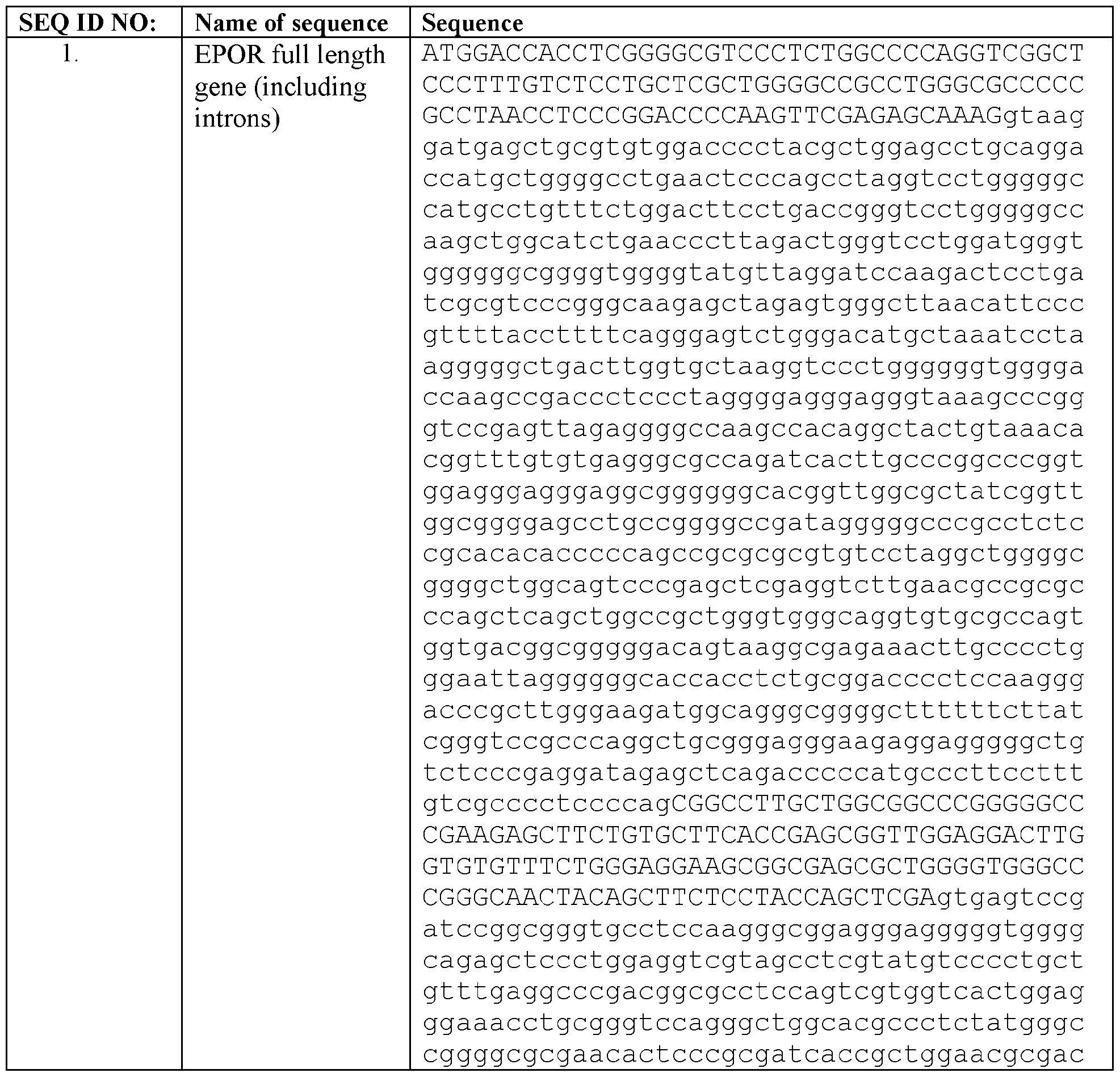


Claims
1. A method of treating a hemoglobinopathy in a subject in need thereof, the method comprising:
(a) transfecting a plurality of human stem cells (HSCs) with a first nucleic acid encoding a guide RNA and a second nucleic acid encoding a non-double strand breakdependent gene editor protein thereby forming transfected HSCs, wherein said guide RNA is capable of binding to said non-double strand break-dependent gene editor protein thereby forming a non-double strand break-dependent gene editor complex, wherein said non-double strand break-dependent gene editor complex is capable of editing at least one base within a genomic nucleic acid sequence resulting in an edited genomic nucleic acid encoding a modified erythropoietin receptor (EPOR) protein;
(b) culturing the transfected HSCs thereby forming transfected erythrocytes; and
(c) administering the transfected erythrocytes to the subject, thereby treating the hemoglobinopathy.
2. The method of claim 1, wherein the modified EPOR protein comprises a missense mutation.
3. The method of claim 2, wherein the missense mutation is a L436S mutation, a L436P mutation, or a S462P mutation in a naturally occurring EPOR amino acid sequence.
4. The method of claim 1, wherein the modified EPOR protein comprises the amino acid sequence of SEQ ID NO:52, SEQ ID NO:53, or SEQ ID NO:54.
5. The method of claim 1, wherein the modified EPOR protein is a truncated erythropoietin receptor protein (tEPOR).
6. The method of claim 1, wherein the plurality of HSCs are derived from a second subject, wherein the second subject does not have a hemoglobinopathy.
7. The method of claim 1, wherein the plurality of HSCs are derived from the subject.
8. The method of claim 1, wherein the non-double strand break-dependent gene editor protein comprises a base editor protein (BE) or a prime editor protein (PE).
9 . The method of claim 8, wherein the base editor protein comprises a cytidine base editor protein (CBE), an adenine base editor protein (ABE), or a dual base editor protein.
10. The method of claim 8, wherein the base editor protein comprises a BE1 protein, a BE2 protein, a BE3 protein, an HF2-BE2 protein, an HF-BE3 protein, an SaBE4 protein, an SaBE4-Gam protein, a BE4 protein, a BE4-Gam protein, a BE4max protein, an AncBE4max protein, a CBE6 protein, an eBE-Sl protein, an eBE-S3 protein, a YE1-BE3 protein, a YE2-BE3 protein, an EE-BE3 protein, a YEE-BE3 protein, a VQR-BE3 protein, a VRER-BE3 protein, an SaBE3 protein, an SaKK14-BE3 protein, a dCpfl-BE protein, a dCpfl- BE-YE protein, a dCpfl-eBE protein, a dCpfl-eBE-YE protein, an xBE3, a BE-PLUS protein, an hA3A-BE3 protein, an hA3A-BE3-Y13OF protein, an hA3A-BE3-Y132D protein, an hA3A- eBE-Y130F protein, an hA3A-eBE-Y132D protein, an eA3A-BE3 protein, an eA3A-HFl -BE3- 2xUGI protein, an eA3A-Hypa-BE3-2xUGI protein, a DBE-A3A protein, a Target-AID protein, a Target-AID-NG protein, a TAM protein, a CRISPR-X protein, a DBE-AIDmono protein, an ABE7.9 protein, an ABE7.10 protein, an AB Emax protein, an xABE protein, a VQR-ABE protein, a VRER-ABE protein, an SaKKH-ABE protein, an ABEsa protein, an ABE8e protein, an A&C-BEmax protein, an SpCas9 TadDE protein, an SaCas9 TadDE protein, or a CABE protein.
11. The method of claim 8, wherein the prime editor protein comprises a PEI protein, a PE2 protein, a PE3 protein, a PE4 protein, a PE5 protein, a PE6 protein, a PE7 protein, a PE2max protein, a PE3max protein, a PE4max protein, or a PE5max protein.
12. The method of claim 1, wherein the edited genomic nucleic acid does not comprise double-stranded DNA breaks caused by the non-double strand break-dependent gene editor complex.
13. The method of claim 1, wherein the genomic nucleic acid sequence comprises the nucleotide sequence of SEQ ID NO: 1 or SEQ ID NO:2.
14. The method of claim 1, wherein the guide RNA comprises the nucleotide sequence of SEQ ID NO:4, SEQ ID NO:5, SEQ ID NO:6, SEQ ID NO:7, SEQ ID NO:8, SEQ ID N0:9, SEQ ID NO: 10, SEQ ID NO: 11, SEQ ID NO: 12, SEQ ID NO:45, SEQ ID NO:46, or SEQ ID NO:47.
15. The method of claim 5, wherein the edited genomic nucleic acid comprises the nucleotide sequence of SEQ ID N0: 13, SEQ ID NO: 14, SEQ ID NO:15, SEQ ID NO:16, SEQ ID NO 18, or SEQ ID NO: 19.
16. The method of claim 5, wherein the tEPOR protein comprises the amino acid sequence of SEQ ID NO: 17 or SEQ ID NO:20.
17. The method of claim 5, wherein the tEPOR protein does not comprise an amino acid sequence with at least 70% sequence identity to the amino acid sequence of SEQ ID NO:48, SEQ ID NO:49, SEQ ID NO:50, or SEQ ID NO:51.
18. The method of claim 1, wherein at least 50% of the transfected erythrocytes express the tEPOR protein.
19. The method of claim 1, wherein the method does not comprise myeloablation.
20. A method of generating a population of transfected erythrocytes, the method comprising:
(a) transfecting a plurality of human stem cells (HSCs) with a first nucleic acid encoding a guide RNA and a second nucleic acid encoding a non-double strand break-
dependent gene editor protein thereby forming transfected HSCs, wherein said guide RNA is capable of binding to said non-double strand break-dependent gene editor protein thereby forming a non-double strand break-dependent gene editor complex, where said non-double strand break-dependent gene editor complex is capable of editing at least one base within a genomic nucleic acid sequence resulting in an edited genomic nucleic acid encoding a modified erythropoietin receptor (EPOR) protein; and
(b) culturing the transfected HSCs thereby forming transfected erythrocytes.
21. The method of claim 20, wherein the modified EPOR protein comprises a missense mutation.
22. The method of claim 21, wherein the missense mutation is a L436S mutation, a L436P mutation, or a S462P mutation in a naturally occurring EPOR amino acid sequence.
23. The method of claim 20, wherein the modified EPOR protein comprises the amino acid sequence of SEQ ID NO:52, SEQ ID NO:53, or SEQ ID NO:54.
24. The method of claim 20, wherein the modified EPOR protein is a truncated erythropoietin receptor protein (tEPOR).
25. The method of claim 20, wherein the non-double strand break-dependent gene editor protein comprises a base editor protein (BE) or a prime editor protein (PE).
26. The method of claim 25, wherein the base editor protein comprises a cytidine base editor protein (CBE), an adenine base editor protein (ABE), or a dual base editor protein.
27. The method of claim 25, wherein the base editor protein comprises a BE1 protein, a BE2 protein, a BE3 protein, an HF2-BE2 protein, an HF-BE3 protein, an SaBE4 protein, an SaBE4-Gam protein, a BE4 protein, a BE4-Gam protein, a BE4max protein, an AncBE4max protein, a CBE6 protein, an eBE-Sl protein, an eBE-S3 protein, a YE1-BE3 protein, a YE2-BE3 protein, an EE-BE3 protein, a YEE-BE3 protein, a VQR-BE3 protein, a
VRER-BE3 protein, an SaBE3 protein, an SaKKH-BE3 protein, a dCpfl -BE protein, a dCpfl- BE-YE protein, a dCpfl-eBE protein, a dCpfl-eBE-YE protein, an xBE3, a BE-PLUS protein, an hA3A-BE3 protein, an hA3A-BE3-Y13OF protein, an hA3A-BE3-Y132D protein, an hA3A- eBE-Y130F protein, an hA3A-eBE-Y132D protein, an eA3A-BE3 protein, an eA3A-HFl-BE3- 2xUGI protein, an eA3A-Hypa-BE3-2xUGI protein, a DBE-A3A protein, a Target-AID protein, a Target-AID-NG protein, a TAM protein, a CRISPR-X protein, a DBE-AIDmono protein, an ABE7.9 protein, an ABE7.10 protein, an AB Emax protein, an xABE protein, a VQR-ABE protein, a VRER-ABE protein, an SaKKH-ABE protein, an ABEsa protein, an ABE8e protein, an A&C-BEmax protein, an SpCas9 TadDE protein, an SaCas9 TadDE protein, or a CABE protein.
28. The method of claim 25, wherein the prime editor protein comprises a PEI protein, a PE2 protein, a PE3 protein, a PE4 protein, a PE5 protein, a PE6 protein, a PE7 protein, a PE2max protein, a PE3max protein, a PE4max protein, or a PE5max protein.
29. The method of claim 20, wherein the edited genomic nucleic acid does not comprise double-stranded DNA breaks caused by the non-double strand break-dependent gene editor complex.
30. The method of claim 20, wherein the genomic nucleic acid sequence comprises the nucleotide sequence of SEQ ID NO: 1 or SEQ ID NO:2.
31. The method of claim 20, wherein the guide RNA comprises the nucleotide sequence of SEQ ID NO:4, SEQ ID NO:5, SEQ ID NO:6, SEQ ID NO:7, SEQ ID NO:8, SEQ ID N0:9, SEQ ID NO: 10, SEQ ID NO: 11, SEQ ID NO: 12, SEQ ID NO:45, SEQ ID NO:46, or SEQ ID NO:47.
32. The method of claim 25, wherein the edited genomic nucleic acid comprises the nucleotide sequence of SEQ ID N0: 13, SEQ ID NO: 14, SEQ ID NO:15, SEQ ID NO: 16, SEQ ID NO: 18, or SEQ ID NO: 19.
33. The method of claim 25, wherein the tEPOR protein comprises the amino acid sequence of SEQ ID NO: 17 or SEQ ID NO:20.
34. The method of claim 25, wherein the tEPOR protein does not comprise an amino acid sequence with at least 70% sequence identity to the amino acid sequence of SEQ ID NO:48, SEQ ID NO:49, SEQ ID NO:50, or SEQ ID NO:51.
35. The method of claim 25, wherein at least 50% of the population of transfected erythrocytes express the tEPOR protein.
36. A cell comprising a first nucleic acid encoding a guide RNA and a second nucleic acid encoding a non-double strand break-dependent gene editor protein, wherein said guide RNA is capable of binding to said non-double strand break-dependent gene editor protein thereby forming a non-double strand break-dependent gene editor complex, where said non- double strand break-dependent gene editor complex is capable of editing at least one base within a genomic nucleic acid sequence resulting in an edited genomic nucleic acid encoding a modified erythropoietin receptor (EPOR) protein.
37. The cell of claim 36, wherein the modified EPOR protein comprises a missense mutation.
38. The cell of claim 37, wherein the missense mutation is a L436S mutation, a L436P mutation, or a S462P mutation in a naturally occurring EPOR amino acid sequence.
39. The cell of claim 36, wherein the modified EPOR protein comprises the amino acid sequence of SEQ ID NO:52, SEQ ID NO:53, or SEQ ID NO:54.
40. The cell of claim 36, wherein the modified EPOR protein is a truncated erythropoietin receptor protein (tEPOR).
41. The cell of claim 36, wherein the non-double strand break-dependent gene editor protein comprises a base editor protein (BE) or a prime editor protein (PE).
42. The cell of claim 41, wherein the base editor protein comprises a cytidine base editor protein (CBE), an adenine base editor protein (ABE), or a dual base editor protein.
43. The cell of claim 41, wherein the cytidine base editor protein comprises a BE1 protein, a BE2 protein, a BE3 protein, an HF2-BE2 protein, an HF-BE3 protein, an SaBE4 protein, an SaBE4-Gam protein, a BE4 protein, a BE4-Gam protein, a BE4max protein, an AncBE4max protein, a CBE6 protein, an eBE-Sl protein, an eBE-S3 protein, a YE1-BE3 protein, a YE2-BE3 protein, an EE-BE3 protein, a YEE-BE3 protein, a VQR-BE3 protein, a VRER-BE3 protein, an SaBE3 protein, an SaKKH-BE3 protein, a dCpfl-BE protein, a dCpfl- BE-YE protein, a dCpfl-eBE protein, a dCpfl-eBE-YE protein, an xBE3, a BE-PLUS protein, an hA3A-BE3 protein, an hA3A-BE3-Y13OF protein, an hA3A-BE3-Y132D protein, an hA3A- eBE-Y130F protein, an hA3A-eBE-Y132D protein, an eA3A-BE3 protein, an eA3A-HFl-BE3- 2xUGI protein, an eA3A-Hypa-BE3-2xUGI protein, a DBE-A3A protein, a Target-AID protein, a Target-AID-NG protein, a TAM protein, a CRISPR-X protein, a DBE-AIDmono protein, an ABE7.9 protein, an ABE7.10 protein, an AB Emax protein, an xABE protein, a VQR-ABE protein, a VRER-ABE protein, an SaKKH-ABE protein, an ABEsa protein, an ABE8e protein, an A&C-BEmax protein, an SpCas9 TadDE protein, an SaCas9 TadDE protein, or a CABE protein.
44. The cell of claim 41, wherein the prime editor protein comprises a PEI protein, a PE2 protein, a PE3 protein, a PE4 protein, a PE5 protein, a PE6 protein, a PE7 protein, a PE2max protein, a PE3max protein, a PE4max protein, or a PE5max protein.
45. The cell of claim 36, wherein the edited genomic nucleic acid does not comprise double-stranded DNA breaks caused by the non-double strand break-dependent gene editor complex.
46. The cell of claim 36, wherein the genomic nucleic acid sequence comprises the nucleotide sequence of SEQ ID NO: 1 or SEQ ID NO:2.
47. The cell of claim 36, wherein the guide RNA comprises the nucleotide sequence of SEQ ID NO:4, SEQ ID NO:5, SEQ ID NO:6, SEQ ID NO:7, SEQ ID NO:8, SEQ ID N0:9, SEQ ID NO: 10, SEQ ID NO: 11, SEQ ID NO: 12, SEQ ID NO:45, SEQ ID NO:46, or SEQ ID NO:47.
48. The cell of claim 41, wherein the edited genomic nucleic acid comprises the nucleotide sequence of SEQ ID NO: 13, SEQ ID NO: 14, SEQ ID NO: 15, SEQ ID NO: 16, SEQ ID NOT8, or SEQ ID NO: 19.
49. The cell of claim 41, wherein the tEPOR protein comprises the amino acid sequence of SEQ ID NO: 17 or SEQ ID NO:20.
50. The cell of claim 41, wherein the tEPOR protein does not comprise an amino acid sequence with at least 70% sequence identity to the amino acid sequence of SEQ ID NO:48, SEQ ID NO:49, SEQ ID NO:50, or SEQ ID NO:51.
51. A ribonucleic acid comprising the nucleotide sequence of SEQ ID NO:4 , SEQ ID NO:5, SEQ ID NO:6, SEQ ID NO:7, SEQ ID NO:8, SEQ ID NO:9, SEQ ID NOTO, SEQ ID NO: 11, SEQ ID NO: 12, SEQ ID NO:45, SEQ ID NO: 46, or SEQ ID NO:47.
52. The ribonucleic acid of claim 51, wherein the nucleic acid sequence is selected from the group consisting of SEQ ID NOT, SEQ ID NO:5, SEQ ID NO:6, SEQ ID NOT, SEQ ID NO:8, SEQ ID NO:9, SEQ ID NOTO, SEQ ID NO: 11, SEQ ID NOT2, SEQ ID NO:45, SEQ ID NO 46, and SEQ ID NO:47.
53. The ribonucleic acid of claim 51, wherein the guide RNA is bound to a non-double strand break-dependent gene editor protein.
54. The ribonucleic acid of claim 53, wherein the non-double strand breakdependent gene editor protein comprises a base editor protein (BE) or a prime editor protein (PE).
55. The ribonucleic acid of claim 54, wherein the base editor protein comprises a cytidine base editor protein (CBE), an adenine base editor protein (ABE), or a dual base editor protein.
56. The ribonucleic acid of claim 54, wherein the base editor protein comprises a BE1 protein, a BE2 protein, a BE3 protein, an HF2-BE2 protein, an HF-BE3
protein, an SaBE4 protein, an SaBE4-Gam protein, a BE4 protein, a BE4-Gam protein, a BE4max protein, an AncBE4max protein, a CBE6 protein, an eBE-Sl protein, an eBE-S3 protein, a YE1-BE3 protein, a YE2-BE3 protein, an EE-BE3 protein, a YEE-BE3 protein, a VQR-BE3 protein, a VRER-BE3 protein, an SaBE3 protein, an SaKKH-BE3 protein, a dCpfl- BE protein, a dCpfl-BE-YE protein, a dCpfl-eBE protein, a dCpfl-eBE-YE protein, an xBE3, a BE-PLUS protein, an 11A3A-BE3 protein, an hA3A-BE3-Y130F protein, an hA3A-BE3-Y132D protein, an hA3A-eBE-Y130F protein, an hA3A-eBE-Y132D protein, an eA3A-BE3 protein, an eA3A-HFl-BE3-2xUGI protein, an eA3A-Hypa-BE3-2xUGI protein, a DBE-A3A protein, a Target-AID protein, a Target- AID-NG protein, a TAM protein, a CRISPR-X protein, a DBE- AIDmono protein, an ABE7.9 protein, an ABE7.10 protein, an ABEmax protein, an xABE protein, a VQR-ABE protein, a VRER-ABE protein, an SaKKH-ABE protein, an ABEsa protein, an ABE8e protein, an A&C-BEmax protein, an SpCas9 TadDE protein, an SaCas9 TadDE protein, or a CABE protein.
57. The ribonucleic acid of claim 54, wherein the prime editor protein comprises a PEI protein, a PE2 protein, a PE3 protein, a PE4 protein, a PE5 protein, a PE6 protein, a PE7 protein, a PE2max protein, a PE3max protein, a PE4max protein, or a PE5max protein.
Applications Claiming Priority (2)
| Application Number | Priority Date | Filing Date | Title |
|---|---|---|---|
| US202363599939P | 2023-11-16 | 2023-11-16 | |
| US63/599,939 | 2023-11-16 |
Publications (1)
| Publication Number | Publication Date |
|---|---|
| WO2025106932A1 true WO2025106932A1 (en) | 2025-05-22 |
Family
ID=95743433
Family Applications (1)
| Application Number | Title | Priority Date | Filing Date |
|---|---|---|---|
| PCT/US2024/056296 Pending WO2025106932A1 (en) | 2023-11-16 | 2024-11-15 | Methods for increasing erythropoiesis |
Country Status (1)
| Country | Link |
|---|---|
| WO (1) | WO2025106932A1 (en) |
Citations (4)
| Publication number | Priority date | Publication date | Assignee | Title |
|---|---|---|---|---|
| US5278065A (en) * | 1989-02-03 | 1994-01-11 | Genetics Institute, Inc. | Recombinant DNA endoding an erythropoietin receptor |
| US20220162584A1 (en) * | 2016-04-19 | 2022-05-26 | The Broad Institute, Inc. | Cpf1 complexes with reduced indel activity |
| WO2022216877A1 (en) * | 2021-04-06 | 2022-10-13 | Ensoma, Inc. | Modification of epor-encoding nucleic acids |
| WO2023064798A2 (en) * | 2021-10-13 | 2023-04-20 | The Board Of Trustees Of The Leland Stanford Junior University | Differential proliferation of human hematopoietic stem and progenitor cells using truncated erythropoietin receptors |
-
2024
- 2024-11-15 WO PCT/US2024/056296 patent/WO2025106932A1/en active Pending
Patent Citations (4)
| Publication number | Priority date | Publication date | Assignee | Title |
|---|---|---|---|---|
| US5278065A (en) * | 1989-02-03 | 1994-01-11 | Genetics Institute, Inc. | Recombinant DNA endoding an erythropoietin receptor |
| US20220162584A1 (en) * | 2016-04-19 | 2022-05-26 | The Broad Institute, Inc. | Cpf1 complexes with reduced indel activity |
| WO2022216877A1 (en) * | 2021-04-06 | 2022-10-13 | Ensoma, Inc. | Modification of epor-encoding nucleic acids |
| WO2023064798A2 (en) * | 2021-10-13 | 2023-04-20 | The Board Of Trustees Of The Leland Stanford Junior University | Differential proliferation of human hematopoietic stem and progenitor cells using truncated erythropoietin receptors |
Similar Documents
| Publication | Publication Date | Title |
|---|---|---|
| JP7844400B2 (en) | Compositions and methods for the treatment of abnormal hemoglobin disorders | |
| US12559748B2 (en) | Compositions and methods for the treatment of hemoglobinopathies | |
| JP7030522B2 (en) | Optimized CRISPR / CAS9 system and method for gene editing in stem cells | |
| JP6974349B2 (en) | Materials and methods for the treatment of hemoglobin abnormalities | |
| US20240067983A1 (en) | Guide RNA Designs and Complexes for Tracr-less Type V Cas Systems | |
| Moiani et al. | Non-viral DNA delivery and TALEN editing correct the sickle cell mutation in hematopoietic stem cells | |
| CN118056014A (en) | Method and application of single base editing to repair HBA2 gene mutation | |
| EP4689089A1 (en) | Crispr nuclease polypeptides and gene editing systems comprising such | |
| EP4453196A1 (en) | Type ii cas proteins and applications thereof | |
| EP4288548A1 (en) | Fusion proteins for crispr-based transcriptional repression | |
| Lai et al. | Clinical application of base editing for treating β-thalassaemia | |
| WO2026071097A1 (en) | Stem-loop adapter, polynucleotide library for grna production, and methods for using same | |
| WO2025207970A1 (en) | Regulatable gene expression via adaptamers | |
| WO2025207710A1 (en) | Rna-guided nuclease polypeptides and gene editing systems comprising such | |
| CN117402882A (en) | Nucleotide molecules for beta-thalassaemia gene therapy and their applications | |
| Field | Optimising CRISPR for targeting of primary haematopoietic stem cells | |
| WO2025003344A1 (en) | Type ii cas proteins and applications thereof | |
| WO2024173692A2 (en) | Methods and compositions for bach2 gene editing | |
| Subramaniam et al. | David Yudovich1, 2, Alexandra Bäckström1, 2, Ludwig Schmiderer1, Kristijonas Žemaitis1 | |
| WO2024056880A2 (en) | Enqp type ii cas proteins and applications thereof | |
| BR112019016205B1 (en) | GRNA molecule, composition, use thereof, and methods for alteration and preparation of a hematopoietic stem cell or hematopoietic progenitor cell (HPC) | |
| EA051805B1 (en) | Compositions and methods for treating hemoglobinopathies |
Legal Events
| Date | Code | Title | Description |
|---|---|---|---|
| 121 | Ep: the epo has been informed by wipo that ep was designated in this application |
Ref document number: 24892399 Country of ref document: EP Kind code of ref document: A1 |