WO2025104767A1 - 土地利用分類システム、土地利用分類方法、及び土地利用分類プログラム - Google Patents
土地利用分類システム、土地利用分類方法、及び土地利用分類プログラム Download PDFInfo
- Publication number
- WO2025104767A1 WO2025104767A1 PCT/JP2023/040679 JP2023040679W WO2025104767A1 WO 2025104767 A1 WO2025104767 A1 WO 2025104767A1 JP 2023040679 W JP2023040679 W JP 2023040679W WO 2025104767 A1 WO2025104767 A1 WO 2025104767A1
- Authority
- WO
- WIPO (PCT)
- Prior art keywords
- image
- land use
- satellite
- satellite image
- resolution
- Prior art date
- Legal status (The legal status is an assumption and is not a legal conclusion. Google has not performed a legal analysis and makes no representation as to the accuracy of the status listed.)
- Pending
Links
Images





Classifications
-
- G—PHYSICS
- G06—COMPUTING OR CALCULATING; COUNTING
- G06T—IMAGE DATA PROCESSING OR GENERATION, IN GENERAL
- G06T7/00—Image analysis
Definitions
- the present disclosure relates to a land use classification system, a land use classification method, and a land use classification program.
- the present disclosure relates to a method for learning a land use classification technique for remote sensing data.
- remote sensing include methods that use aircraft or UAVs (drones), as well as optical satellites or synthetic aperture radar satellites.
- Optical satellite images are used as a means of monitoring various objects on the earth's surface.
- data showing any remote sensing image is prepared as an input image
- data showing a label image in which features on the ground surface captured in the remote sensing image are labeled is generated and prepared as a teacher image
- machine learning is performed using the prepared data pairs to generate a land use status assessment model (see, for example, Patent Document 1).
- Patent Document 1 discloses a method for estimating the position and shape of buildings from an input image.
- a pre-trained model with high generalized performance has been made public for the task of classifying land use conditions, including conventional techniques.
- one or more aspects of the present disclosure relate to a learning method for a trained model that classifies land use conditions for optical satellite images, and aim to provide a learning method for generating a trained model that classifies land use conditions with relatively high accuracy when an actual optical satellite image is input into the trained model.
- the land use classification system comprises: A land use classification system including a learning device including a model generation unit that generates a trained model for inferring the land use map from the simulated satellite image by learning a correspondence between the simulated satellite image and the land use map based on machine learning using learning data consisting of a combination of a simulated satellite image, the simulated satellite image being an image generated by applying degradation processing to a first reference image, which is a reference high-resolution image having a resolution higher than that of a first satellite image, the first satellite image being a target satellite image captured by a target satellite, and a land use map showing a land use situation in an observation range of the first reference image, the trained model including: The first satellite image is used in inference processing using the trained model.
- a trained model is generated that generates a trained model for inferring land use maps from simulated satellite images, where the simulated satellite images are simulated optical satellite images generated by applying degradation processes to a reference high-resolution image. Therefore, according to one or more aspects of the present disclosure, a learning method can be provided for generating a trained model that can classify land use conditions on the earth's surface from optical satellite images with relatively high accuracy when optical satellite images are input into the trained model.
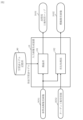
- FIG. 1 is a diagram showing an example of the configuration of a land use classification system 1 according to a first embodiment.
- 1 is a diagram showing an example of the configuration of an input image generating device 10 according to a first embodiment.
- FIG. 2 is a diagram showing an example of the configuration of a degradation processing unit 102 according to the first embodiment.
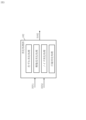
- FIG. 2 is a diagram showing an example of the configuration of a learning device 20 according to the first embodiment. Schematic diagram of a neural network.
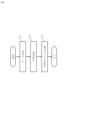
- FIG. 2 is a diagram showing an example of the configuration of an inference device 30 according to the first embodiment.
- FIG. 13 is a diagram showing an example of the configuration of an input image generating device 10b according to a modified example of the first embodiment.
- FIG. 13 is a diagram showing an example of a hardware configuration of an input image generating device 10 according to a modified example of the first embodiment.
- the land use classification system 1 is a system that realizes a land use classification technology that estimates the land use status of the earth's surface from satellite images based on machine learning.
- the land use classification system 1 includes an input image generation device 10 that generates input images for learning, a learning device 20 that functions as a model generation device, an inference device 30 that functions as a utilization device, and a trained model storage unit 90.
- the processing method performed in the inference device 30 corresponds to a utilization method.
- the multiple devices included in the land use classification system 1 may be configured integrally as appropriate.
- the land use classification system 1 classifies the target satellite image DIN3 according to land use using the trained model.
- a land use label may be assigned to the target satellite image DIN3.
- the land use label is a label indicating the land use status. Specific examples of the land use label include a label indicating any of "building", “road”, “water body”, “forest”, “bare land”, and "field”.
- the land use classification system 1 may assign one land use label to the entire target satellite image DIN3, or may assign a land use label to each feature shown in the target satellite image DIN3.
- the process of assigning a label to an image is also called segmentation.
- the trained model is an inference model generated by executing machine learning by the learning device 20. In generating the trained model, as a specific example, an open source pre-trained model is utilized.
- the pre-trained model is an inference model that infers a land use map from satellite images.
- the pre-trained model uses images having a higher resolution than the resolution of the target satellite image DIN3.
- the trained model storage unit 90 stores pre-trained models and trained models.
- FIG. 2 is a block diagram illustrating an example of the configuration of the input image generating device 10.
- the input image generating device 10 includes an inference unit 101 and a degradation processing unit 102 .
- the inference unit 101 acquires a pre-trained model from the trained model storage unit 90, and generates a high-precision land-use map D101 by inputting the reference high-resolution image DIN1 to the acquired pre-trained model. By using the pre-trained model, the inference unit 101 can classify land use conditions with relatively high accuracy.
- the degradation processing unit 102 executes degradation processing.
- the degradation processing unit 102 receives a reference high-resolution image DIN1 and target satellite information DIN2 as input, and applies degradation processing to the reference high-resolution image DIN1 to generate a simulated satellite image D102.
- the satellite image is an image captured by an artificial satellite, and a specific example is an optical satellite image.
- the degradation process is a process for generating a simulated satellite image of a target satellite by degrading the reference high-resolution image DIN1.
- the degradation process may be a process corresponding to the target satellite information DIN2. If the degradation process is not a process corresponding to the target satellite information DIN2, the target satellite information DIN2 does not need to be input to the degradation processing unit 102.
- the reference high-resolution image DIN1 is an image acquired by a remote sensing method capable of acquiring an image having a higher resolution than the resolution of the target satellite image DIN3.
- the remote sensing method include aerial photography methods using a helicopter, a UAV (Unmanned Aerial Vehicle), an aircraft, or the like, as well as a method using a satellite capable of capturing an image having a higher resolution than the resolution of the target satellite image DIN3.
- the target satellite information DIN2 is information relating to a target satellite, specifically, information indicating the configuration and characteristics of the target satellite.
- the target satellite is an artificial satellite that captures the target satellite image DIN3.
- the target satellite image DIN3 is a satellite image used in inference processing using the learned model.
- the high-precision land-use map D101 is a land-use map that shows land use conditions estimated as land use conditions within the observation range of the reference high-resolution image DIN1.
- the simulated satellite image D102 is a simulated satellite image.
- the degradation process is a process that simulates image degradation caused by at least one of the following: the sensor arrangement of the target satellite, the PSF (Point Spread Function) characteristics, the GSD (Ground Sampling Distance), the sensitivity performance, the noise characteristics, the data compression process when generating the target satellite image DIN3, and the quantization process when generating the target satellite image DIN3.
- PSF Point Spread Function
- GSD Ground Sampling Distance
- Optical satellites are often equipped with multiple sensors that differ from each other for each wavelength band that they receive, and in many cases, a composite image is generated as a satellite image by combining multi-band images obtained from the multiple sensors.
- color shifts may occur in the composite image due to the influence of the amount of deviation in the physical arrangement positions between the sensors.
- color shifts may occur in sub-pixels.
- the degradation processing unit 102 shifts the downsampling offset (binning start position) for each band and downsamples, thereby generating a simulated satellite image D102 that reproduces the color shift of the sub-pixels.
- the degradation processing may be a process of performing downsampling with offsets that differ from each other for each wavelength band when downsampling the reference high-resolution image DIN1.
- the PSF is determined as an index of resolution that combines multiple degradation models, such as the sensor, optical performance, aperture shape, turbulence, and the effects of image streaming.
- the reference high-resolution image DIN1 also has a PSF as an index of resolution that takes into account the effects of the sensor, optical performance, and turbulence.
- the PSF when the PSF is checked for each band, the PSF may differ for each band.
- aliasing may occur in the multispectral image because the MTF (Modulated Transfer Function) of the multispectral band is higher than the PSF of the panchromatic band.
- the degradation processing unit 102 can also reproduce aliasing in the simulated satellite image D102 by incorporating such differences in PSF into the degradation process.
- the degradation processing unit 102 compares the GSD of the reference high-resolution image DIN1 with the GSD of the target satellite, and simulates the GSD using a downsampling method such as bilinear interpolation or bicubic interpolation.
- the ratio between the GSD of the reference high-resolution image DIN1 and the GSD of the target satellite be equal to or greater than the high-resolution magnification of the land use classification system 1.
- the signal-to-noise ratio (SNR) of the target satellite image can be estimated from the sensitivity performance of the target satellite and the amount of light from the assumed subject. If the noise is assumed to be additive white Gaussian noise, the SNR is related to the standard deviation of the Gaussian noise. Therefore, the degradation processing unit 102 can also perform degradation processing that applies noise equivalent to the noise of the target satellite image from the SNR to the reference high-resolution image DIN1.
- SNR signal-to-noise ratio
- the degradation processing unit 102 can also perform degradation processing to add the obtained noise characteristics to the reference high-resolution image DIN1.
- the degradation processing unit 102 can also perform degradation processing in which shot noise, 1/f noise, shading, or the like due to internal radiation is treated as noise characteristics and added to the reference high-resolution image DIN1.
- the degradation processing unit 102 generates these atmospheric-induced image degradations based on a publicly available atmospheric model, and can generate a simulated satellite image D102 by applying the generated image degradation to the reference high-resolution image DIN1.
- the degradation processing unit 102 can reproduce the degradation by applying the same data compression to the reference high-resolution image DIN1.
- the degradation processing unit 102 performs any one or a combination of color shift degradation processing, resolution degradation processing, noise degradation processing, and compression degradation processing.
- the compression degradation process is a process that simulates image degradation caused by data compression.
- FIG. 4 is a block diagram illustrating an example of the configuration of the learning device 20. As shown in FIG. The learning device 20 includes a data acquisition unit 201 and a model generation unit 202 .
- the data acquisition unit 201 acquires learning data.
- the learning data is teacher data indicating a combination of the simulated satellite image D102 and the reference high-resolution image DIN1 corresponding to the correct answer to be inferred from the target satellite image DIN3.
- the acquired learning data is provided to the model generation unit 202.
- the model generation unit 202 learns the high-precision land-use map D101 corresponding to the simulated satellite image D102 based on the learning data provided by the data acquisition unit 201. In other words, the model generation unit 202 learns a combination of the simulated satellite image D102 and the high-precision land-use map D101 indicated by the learning data, thereby generating a trained model for inferring the optimal high-precision land-use map D101 corresponding to the target satellite image DIN3. At this time, the model generation unit 202 may generate the trained model by modifying a pre-trained model. Thereafter, the model generation unit 202 stores the generated trained model in the trained model storage unit 90.
- the model generating unit 202 uses learning data consisting of a combination of the simulated satellite image D102 and a land use map showing the land use situation in the observation range of the first reference image to learn the correspondence between the simulated satellite image D102 and the land use map based on machine learning, thereby generating a trained model that infers the land use map from the simulated satellite image D102.
- the simulated satellite image D102 is an image generated by applying degradation processing to the first reference image, which is the reference high-resolution image DIN1, and is an image having a resolution equivalent to the resolution of the first satellite image.
- the image having a resolution equivalent to the resolution of the first satellite image may be an image having the same resolution as the resolution of the first satellite image, or may be an image having a resolution close to the resolution of the first satellite image.
- the first satellite image is a target satellite image DIN3 captured by a target satellite.
- the land use map according to this example corresponds to the high-precision land use map D101.
- the reference high-resolution image DIN1 according to this example has a resolution higher than the resolution of the first satellite image.
- the model generation unit 202 can use known algorithms such as supervised learning, unsupervised learning, or reinforcement learning as the learning algorithm. As an example, we will explain the case where a neural network is applied to a trained model.
- the simulated satellite image D102 and the high-precision land-use map D101 indicated by the learning data need to be a pair of data containing the same subject.
- the model generating unit 202 uses unsupervised learning, the simulated satellite image D102 and the high-precision land-use map D101 do not need to include the same subject.
- the model generating unit 202 learns a high-precision land-use map D101 corresponding to the simulated satellite image D102 by so-called supervised learning according to a neural network model.
- supervised learning refers to a technique in which a pair of data indicating an input and data indicating a result corresponding to the input is provided to a learning device as learning data, in order to learn the features present in the learning data and infer a result from the input based on the learning results.
- a neural network is composed of an input layer consisting of multiple neurons, an intermediate layer (hidden layer) consisting of multiple neurons, and an output layer consisting of multiple neurons.
- the number of intermediate layers may be one or two or more.
- FIG. 5 is a schematic diagram showing an example of a three-layer neural network.
- the input values are appropriately multiplied by the first weights w1_1 to w1_6 (hereinafter also referred to as the first weights W1).
- the calculated values obtained by appropriately multiplying the input values by the first weights w1_1 to w1_6 are input to the intermediate layers Y1 and Y2.
- the calculated values are appropriately multiplied by the second weights w2_1 to w2_6 (hereinafter also referred to as the second weights W2).
- the output values obtained by appropriately multiplying the calculated values by the second weights w2_1 to w2_6 are output from the output layers Z1 to Z3.
- the output values vary depending on the value of the first weight W1 and the value of the second weight W2.
- the model generation unit 202 learns a learned model for inferring an optimal high-precision land-use map D101 corresponding to the simulated satellite image D102 by so-called supervised learning, in accordance with a combination of the simulated satellite image D102 and the high-precision land-use map D101 indicated by the learning data acquired by the data acquisition unit 201. That is, as a specific example, in the learning process of the learned model, the model generation unit 202 adjusts the first weight W1 and the second weight W2 for the neural network related to the learned model so that the result output from the output layer by inputting a simulated satellite image D102 into the input layer approaches the high-precision land use map D101 as the correct answer.
- the inference device 30 includes a data acquisition unit 301 and an inference unit 302.
- the inference device 30 infers an estimated land use map DOUT from the target satellite image DIN3 using the learned model provided by the learning device 20.
- the target satellite image DIN3 is an image acquired from a target satellite.
- the data acquisition unit 301 has a function of acquiring a target satellite image DIN3.
- the acquired target satellite image DIN3 is provided to the inference unit 302. It is assumed that the target subject is captured in the target satellite image DIN3.
- the inference unit 302 infers an estimated land use map DOUT corresponding to the target subject from the target satellite image DIN3 using the learned model stored in the learned model storage unit 90. That is, the inference unit 302 inputs the target target satellite image DIN3 to the learned model, thereby acquiring an estimated land use map DOUT inferred from the input target satellite image DIN3, which corresponds to the target subject.
- the estimated land use map DOUT corresponding to a certain target satellite image DIN3 is a land use map that shows the land use situation estimated as the land use situation in the observation range of the certain target satellite image DIN3.
- the inference unit 302 infers a land use map showing the land use status in the observation range of the first satellite image by inputting the first satellite image to the learned model.
- FIG. 7 shows an example of the hardware configuration of the input image generating device 10 according to this embodiment.
- the input image generating device 10 is composed of a computer.
- the input image generating device 10 may be composed of multiple computers.
- the input image generating device 10 is a computer equipped with hardware such as a processor 51, a memory 52, an auxiliary storage device 53, an input/output IF (Interface) 54, and a communication device 55. These pieces of hardware are appropriately connected via signal lines 59.
- the processor 51 is an integrated circuit (IC) that performs arithmetic processing and controls the hardware of the computer.
- Specific examples of the processor 51 include a central processing unit (CPU), a digital signal processor (DSP), and a graphics processing unit (GPU).
- the input image generating device 10 may include a plurality of processors that replace the processor 51. The plurality of processors share the role of the processor 51.
- the memory 52 is typically a volatile storage device, and a specific example is RAM (Random Access Memory).
- the memory 52 is also called a primary storage device or main memory. Data stored in the memory 52 is saved in the auxiliary storage device 53 as necessary.
- the auxiliary storage device 53 is typically a non-volatile storage device, and specific examples thereof include a read only memory (ROM), a hard disk drive (HDD), or a flash memory. Data stored in the auxiliary storage device 53 is loaded into the memory 52 as necessary.
- the memory 52 and the auxiliary storage device 53 may be integrated into one unit.
- the input/output IF 54 is a port to which an input device and an output device are connected.
- the input/output IF 54 is a USB (Universal Serial Bus) terminal.
- the input device is a keyboard and a mouse.
- the output device is a display.
- the communication device 55 is a receiver and a transmitter.
- a specific example of the communication device 55 is a communication chip or a NIC (Network Interface Card).
- Each part of the input image generating device 10 may use the input/output IF 54 and the communication device 55 as appropriate when communicating with other devices, etc.
- the auxiliary storage device 53 stores a land use classification program.
- the land use classification program is a program that causes a computer to realize the functions of each part of the input image generation device 10.
- the land use classification program is loaded into the memory 52 and executed by the processor 51.
- the functions of each part of the input image generation device 10 are realized by software.
- Data used when executing the land use classification program and data obtained by executing the land use classification program are appropriately stored in a storage device.
- Each part of the input image generating device 10 appropriately uses a storage device.
- the storage device is composed of at least one of the memory 52, the auxiliary storage device 53, a register in the processor 51, and a cache memory in the processor 51.
- the terms "data” and "information” may have the same meaning.
- the storage device may be independent of the computer.
- the functions of the memory 52 and the auxiliary storage device 53 may be realized by other storage devices.
- the land use classification program may be recorded in a computer-readable non-volatile recording medium. Specific examples of the non-volatile recording medium include an optical disk and a flash memory.
- the land use classification program may be provided as a program product.
- the hardware configurations of the other devices included in the land use classification system 1 may also be similar to the hardware configuration of the input image generation device 10.
- FIG. 8 is a flowchart showing an example of the process by which the learning device 20 learns. The process of the learning device 20 will be explained using FIG. 8.
- Step S11 The data acquisition unit 201 acquires learning data via the input image generation device 10.
- the acquired learning data is provided to the model generation unit 202.
- the model generation unit 202 generates a trained model by learning the high-precision land use map D101, which is an output corresponding to the simulated satellite image D102, through so-called supervised learning based on a combination of the simulated satellite image D102 and the high-precision land use map D101 indicated by the learning data.
- the trained model storage unit 90 stores the generated trained model.
- FIG. 9 is a flowchart showing an example of a process in which the inference device 30 infers an estimated land use map DOUT corresponding to the target satellite image DIN3. The process of the inference device 30 will be explained using FIG. 9.
- Step S21 The data acquisition unit 301 acquires a target satellite image DIN3.
- the acquired target satellite image DIN3 is provided to the inference unit 302.
- Step S22 The inference unit 302 inputs a target satellite image DIN3 to the learned model stored in the learned model memory unit 90, and infers an estimated land use map DOUT corresponding to the input target satellite image DIN3.
- Step S23 The inference device 30 outputs an estimated land use map DOUT generated by inference.
- ⁇ Modification 1> In the first embodiment, an example in which supervised learning is applied as the learning algorithm used by the model generating unit 202 has been described, but the first embodiment is not limited to such an example. As a specific example, in addition to supervised learning, reinforcement learning, unsupervised learning, semi-supervised learning, or the like may be used as the learning algorithm.
- the model generating unit 202 may learn an estimated land use map corresponding to the simulated satellite image according to learning data created for a plurality of land use classification systems including the land use classification system 1.
- the model generating unit 202 may acquire learning data from a plurality of land use classification systems used in the same area, or may learn an estimated land use map corresponding to the simulated satellite image using learning data collected from a plurality of land use classification systems that operate independently in different areas.
- the model generation unit 202 may add or remove land use classification systems from which learning data is collected during the process. Furthermore, the model generation unit 202 may apply a trained model that has trained an estimated land use map corresponding to a simulated satellite image for a certain land use classification system 1 to another land use classification system, and re-train the estimated land use map corresponding to the simulated satellite image for the other land use classification system, thereby updating the trained model.
- Deep learning which is a learning algorithm that learns to extract features themselves, may be used as the learning algorithm used by the model generation unit 202.
- the model generation unit 202 may execute machine learning according to other known methods, specific examples of which include genetic programming, functional logic programming, and support vector machines.
- the learning device 20 may train the learned model using learning data consisting of a pair of a post-alignment satellite image D103 and a high-precision land use map D101 corresponding to the reference high-resolution image DIN1.
- the post-registration satellite image D103 is a satellite image generated by performing registration on the target satellite image DIN3 with reference to the reference high-resolution image DIN1.
- the input image generating device 10b includes a position alignment unit 103 instead of the degradation processing unit 102.
- a target satellite image DIN3 is input to the input image generating device 10b instead of the target satellite information DIN2.
- the registration unit 103 performs registration between the reference high-resolution image DIN1 and the target satellite image DIN3 to generate a registered satellite image D103.
- the learning data includes a pair of a second satellite image and a land use map showing the land use situation in the observation range of the second reference image.
- the alignment unit 103 performs an alignment process between the second reference image and the second satellite image to generate an aligned satellite image D103 that is an image corresponding to the second satellite image.
- the second reference image is a reference high-resolution image DIN1.
- the second satellite image is a target satellite image DIN3 that includes an observation result in the same range as the observation range of the second reference image.
- the trained model is a model generated by learning the correspondence between the second satellite image and the land use map corresponding to the second reference image based on machine learning, and is a model that infers the land use map corresponding to the second reference image from the second satellite image.
- the observation period of the target satellite image DIN3 be close to that of the reference high-resolution image DIN1, but this is not always the case in areas where there is little change in land use. Furthermore, when generating learning data, there are cases where a registration process is required between the reference high-resolution image DIN1 and the target satellite image DIN3. The registration unit 103 realizes the registration process in such cases.
- the target satellite image DIN3 may be an image captured by exposure to light having a wavelength in the visible light band, or it may be an image captured by exposure to light having a wavelength in the infrared light band, such as the near-infrared light band or the far-infrared light (thermal infrared) band.
- FIG. 11 shows an example of the hardware configuration of the input image generating device 10 according to this modified example.
- the input image generating device 10 includes a processing circuit 58 in place of the processor 51 , the processor 51 and a memory 52 , the processor 51 and an auxiliary storage device 53 , or the processor 51 , the memory 52 and the auxiliary storage device 53 .
- the processing circuitry 58 is hardware that realizes at least a portion of each unit of the input image generating device 10 .
- the processing circuitry 58 may be dedicated hardware, or may be a processor that executes programs stored in the memory 52 .
- processing circuitry 58 may be, for example, a single circuit, a multiple circuit, a programmed processor, a parallel programmed processor, an ASIC (Application Specific Integrated Circuit), an FPGA (Field Programmable Gate Array), or a combination thereof.
- the input image generating device 10 may include a plurality of processing circuits that replace the processing circuit 58. The plurality of processing circuits share the role of the processing circuit 58.
- the input image generating device 10 some functions may be realized by dedicated hardware, and the remaining functions may be realized by software or firmware.
- Processing circuitry 58 is illustratively implemented in hardware, software, firmware, or a combination thereof.
- the processor 51, the memory 52, the auxiliary storage device 53, and the processing circuit 58 are collectively referred to as the “processing circuitry.”
- the functions of the functional components of the input image generating device 10 are realized by the processing circuitry.
- the hardware configurations of the other devices included in the land use classification system 1 may also be similar to those of this modified example.
- 1 Land use classification system 10, 10b Input image generation device, 101 Inference unit, 102 Degradation processing unit, 103 Alignment unit, 20 Learning device, 201 Data acquisition unit, 202 Model generation unit, 30 Inference device, 301 Data acquisition unit, 302 Inference unit, 51 Processor, 52 Memory, 53 Auxiliary storage device, 54 Input/output IF, 55 Communication device, 58 Processing circuit, 59 Signal line, 90 Learned model storage unit, DIN1 Reference high-resolution image, DIN2 Target satellite information, DIN3 Target satellite image, D101 High-precision land use map, D102 Simulated satellite image, D103 Satellite image after alignment, DOUT Estimated land use map.
Landscapes
- Engineering & Computer Science (AREA)
- Computer Vision & Pattern Recognition (AREA)
- Physics & Mathematics (AREA)
- General Physics & Mathematics (AREA)
- Theoretical Computer Science (AREA)
- Image Processing (AREA)
- Image Analysis (AREA)
Priority Applications (2)
| Application Number | Priority Date | Filing Date | Title |
|---|---|---|---|
| JP2025557352A JPWO2025104767A1 (https=) | 2023-11-13 | 2023-11-13 | |
| PCT/JP2023/040679 WO2025104767A1 (ja) | 2023-11-13 | 2023-11-13 | 土地利用分類システム、土地利用分類方法、及び土地利用分類プログラム |
Applications Claiming Priority (1)
| Application Number | Priority Date | Filing Date | Title |
|---|---|---|---|
| PCT/JP2023/040679 WO2025104767A1 (ja) | 2023-11-13 | 2023-11-13 | 土地利用分類システム、土地利用分類方法、及び土地利用分類プログラム |
Publications (1)
| Publication Number | Publication Date |
|---|---|
| WO2025104767A1 true WO2025104767A1 (ja) | 2025-05-22 |
Family
ID=95742159
Family Applications (1)
| Application Number | Title | Priority Date | Filing Date |
|---|---|---|---|
| PCT/JP2023/040679 Pending WO2025104767A1 (ja) | 2023-11-13 | 2023-11-13 | 土地利用分類システム、土地利用分類方法、及び土地利用分類プログラム |
Country Status (2)
| Country | Link |
|---|---|
| JP (1) | JPWO2025104767A1 (https=) |
| WO (1) | WO2025104767A1 (https=) |
Citations (3)
| Publication number | Priority date | Publication date | Assignee | Title |
|---|---|---|---|---|
| JP2011002882A (ja) * | 2009-06-16 | 2011-01-06 | Olympus Corp | 撮像装置、画像処理プログラム、および撮像方法 |
| JP2022014139A (ja) * | 2020-07-06 | 2022-01-19 | 株式会社日立製作所 | 植生管理システム及び植生管理方法 |
| JP2022028451A (ja) * | 2020-08-03 | 2022-02-16 | 国立研究開発法人農業・食品産業技術総合研究機構 | マップ生成装置、マップ生成方法、マップ生成プログラム、学習済みモデルの生成方法および学習済みモデル生成装置 |
-
2023
- 2023-11-13 JP JP2025557352A patent/JPWO2025104767A1/ja active Pending
- 2023-11-13 WO PCT/JP2023/040679 patent/WO2025104767A1/ja active Pending
Patent Citations (3)
| Publication number | Priority date | Publication date | Assignee | Title |
|---|---|---|---|---|
| JP2011002882A (ja) * | 2009-06-16 | 2011-01-06 | Olympus Corp | 撮像装置、画像処理プログラム、および撮像方法 |
| JP2022014139A (ja) * | 2020-07-06 | 2022-01-19 | 株式会社日立製作所 | 植生管理システム及び植生管理方法 |
| JP2022028451A (ja) * | 2020-08-03 | 2022-02-16 | 国立研究開発法人農業・食品産業技術総合研究機構 | マップ生成装置、マップ生成方法、マップ生成プログラム、学習済みモデルの生成方法および学習済みモデル生成装置 |
Also Published As
| Publication number | Publication date |
|---|---|
| JPWO2025104767A1 (https=) | 2025-05-22 |
Similar Documents
| Publication | Publication Date | Title |
|---|---|---|
| US20250086968A1 (en) | System and method of feature detection in satellite images using neural networks | |
| CN114746895B (zh) | 用于图像去噪的噪声重构 | |
| CN109086668B (zh) | 基于多尺度生成对抗网络的无人机遥感影像道路信息提取方法 | |
| CN114511473B (zh) | 一种基于无监督自适应学习的高光谱遥感影像去噪方法 | |
| Cui et al. | Exploring resolution and degradation clues as self-supervised signal for low quality object detection | |
| JP7785225B2 (ja) | 高画質化システム、学習装置、学習方法および推論方法 | |
| JP2021179833A (ja) | 情報処理装置、情報処理方法及びプログラム | |
| Elmquist et al. | Modeling cameras for autonomous vehicle and robot simulation: An overview | |
| CN108229274B (zh) | 多层神经网络模型训练、道路特征识别的方法和装置 | |
| JP2021108120A (ja) | 点データをラスターデータに組み合わせる機械学習のための方法、装置、及び、プログラム | |
| Pazhani et al. | A novel haze removal computing architecture for remote sensing images using multi-scale Retinex technique | |
| CN115298693A (zh) | 数据生成方法、学习方法和估计方法 | |
| Deeba et al. | A novel image dehazing framework for robust vision‐based intelligent systems | |
| He et al. | An unsupervised dehazing network with hybrid prior constraints for hyperspectral image | |
| Fu et al. | Jointly adversarial networks for wavelength compensation and dehazing of underwater images | |
| Hossain et al. | Adaptive and automatic aerial image restoration pipeline leveraging pre-trained image restorer with lightweight Fully Convolutional Network | |
| CN113256556B (zh) | 一种图像选择方法及装置 | |
| WO2025104767A1 (ja) | 土地利用分類システム、土地利用分類方法、及び土地利用分類プログラム | |
| JP7614130B2 (ja) | 高分解能化システム、高分解能化方法、及び高分解能化プログラム | |
| CN117911525A (zh) | 多模态多通路互补视觉数据标定方法和装置 | |
| Yu et al. | Data-driven parameterized corner synthesis for efficient validation of perception systems for autonomous driving | |
| JP2025173664A (ja) | 学習装置、活用装置、土地被覆分類システム、学習方法、活用方法、学習プログラム、及び活用プログラム | |
| CN115965555A (zh) | 基于Transformer网络的噪声估计图像增强方法 | |
| Lyu et al. | Learning color space adaptation from synthetic to real images of cirrus clouds | |
| JP2025174098A (ja) | 高解像度化システム、高解像度化方法、モデル生成装置、推論装置、モデル生成方法、推論方法、モデル生成プログラムおよび推論プログラム |
Legal Events
| Date | Code | Title | Description |
|---|---|---|---|
| 121 | Ep: the epo has been informed by wipo that ep was designated in this application |
Ref document number: 23958781 Country of ref document: EP Kind code of ref document: A1 |
|
| ENP | Entry into the national phase |
Ref document number: 2025557352 Country of ref document: JP Kind code of ref document: A |
|
| WWE | Wipo information: entry into national phase |
Ref document number: 2025557352 Country of ref document: JP |
|
| WWE | Wipo information: entry into national phase |
Ref document number: 2601002296 Country of ref document: TH |