NOVEL CONJUGATES AND USES THEREOF CROSS-REFERENCE TO RELATED APPLICATION [0001] This application claims priority of US provisional application 63/594,143, filed October 30, 2023, the entire disclosure of which is hereby incorporated herein by reference. SEQUENCE LISTING [0002] The instant application contains an electronic sequence listing. The contents of the electronic sequence listing NAME: NOVEL CONJUGATES AND USES THEREOF 4888-9300- 7090.1.xml; Size: 4,140 bytes; and Date of Creation: October 22, 2024, are herein incorporated by reference in its entirety. FIELD OF THE DISCLOSURE [0003] This disclosure relates to compounds that can be conjugated to biomacromolecules, as well as conjugated biomacromolecules, to allow for delivery of the biomacromolecules across the blood brain barrier. BACKGROUND [0004] Biomacromolecules such as proteins and nucleic acids have been applied to diverse therapeutic applications. Oligonucleotides have become an important class of therapeutic agents that have been applied to the treatment of liver diseases, metabolic diseases and rare diseases, and currently, over twenty RNA-based therapeutics have been approved by the FDA. However, the efficient and safe delivery of these biomacromolecules to brain tissue remains a formidable challenge due to the blood-brain barrier (BBB). The inability of these biomacromolecules to reach the brain significantly hampers their therapeutic application in treating CNS diseases. [0005] Researchers have explored several approaches to enable BBB crossing for various therapeutics such as oligonucleotides, including lipid conjugation, peptide/protein modification, adeno- associated viruses, synthetic biomaterials and etc. For instance, cholesterol or α-tocopherol conjugation can facilitate the transportation of DNA/RNA heteroduplex oligonucleotides to the brain tissues via intravenous injection. Transferrin bounded antisense oligonucleotides (ASOs) can cross the BBB via the human transferrin receptor 1 (TfR1) in both mice and non-human primate models. A divalent siRNA structure for effective gene silencing of huntingtin gene in animals via a cerebrospinal fluid injection has been developed. Engineered AAV capsids enabled transgene expression in the macaque CNS after systemic administration.
Fucoidan-based nanoparticles can bind with caveolin-1 and undergo transcytosis to the brain. Nb62, an anti-mouse transferrin receptor VHH could deliver a neuropeptide to the mouse brain. Previous studies have reported that various active receptor-mediated transcytosis approaches facilitate the crossing of the BBB via systemic administration. Examples include the transferrin receptor, low-density protein receptor, and insulin receptor located on the BBB's luminal membrane. These receptors can initiate an endocytosis process and form transcytosis vesicles that traffic into the brain. Conjugation of siRNAs with palmityl modification has been found to effectively silence genes in the central nervous system (CNS) by intrathecal or intracerebroventricular injection. An Fc fragment, binding with the human transferrin receptor 1 (TfR1), which can cross the BBB and deliver antisense oligonucleotides (ASO) in animal models has been developed. Recently, Tofersen targeting superoxide dismutase 1 gene (SOD1) was approved by the FDA for the treatment of amyotrophic lateral sclerosis (ALS) via an intrathecal injection. However, these administration methods are often associated with an increased risk of adverse events (e.g., risk of infection) and invasive procedures. [0006] Additionally, prior studies reported that many other small molecule agents can cross the BBB through diverse pathways. For example, Tryptamine derivatives can cross the BBB through serotonin uptake transporters. Cinnamic derivatives are able to penetrate the brain and interact with the beta-sheet structures of amyloid-beta proteins. MK-0752 can reduce the production of Aβs after crossing the BBB. SR-57227 can bind with 5-HT3 receptors, which enable the transportation of this molecular to the brain. However, new methods of delivering therapeutics over the BBB are needed. Thus, there is an urgent demand to develop novel technologies that enable systemic administration to overcome BBB and enhance the delivery of biomacromolecule therapeutics to the central nervous system (CNS). SUMMARY OF THE INVENTION [0007] In an aspect, provided is a conjugate of formula (I):
wherein: M is a transport moiety, selected independently in each instance; W is a biomacromolecule or a small molecular agent; R
1 is hydrogen o
R
2 is selected independently in each instance from (C
1-C
20) alkyl or a (C
2-C
20) alkyl residue in which from one to six methylenes is replaced by -O-, -C(=O)O-, -OC(=O)-, -C(=O)NH-, or -NHC(=O)-; m is selected independently in each instance from an integer from 1 to 9; and Lp is a linker comprising one or more of: (a) -C(=O)(CH2)qNH-, wherein q is an integer from 1 to 6; (b) a polyamide comprising 1 to 5 ω-amino acids; (c) a triazole (d) a 3-thiopyrrolidine-2,5-dione (e) a disulfide or (f) a C2 to C20 oxaalkylene; wherein [CONH] indicates that the carboxy and amino termini can be at either point of attachment. [0008] In an aspect, provided is a conjugate of formula (Ia): 3
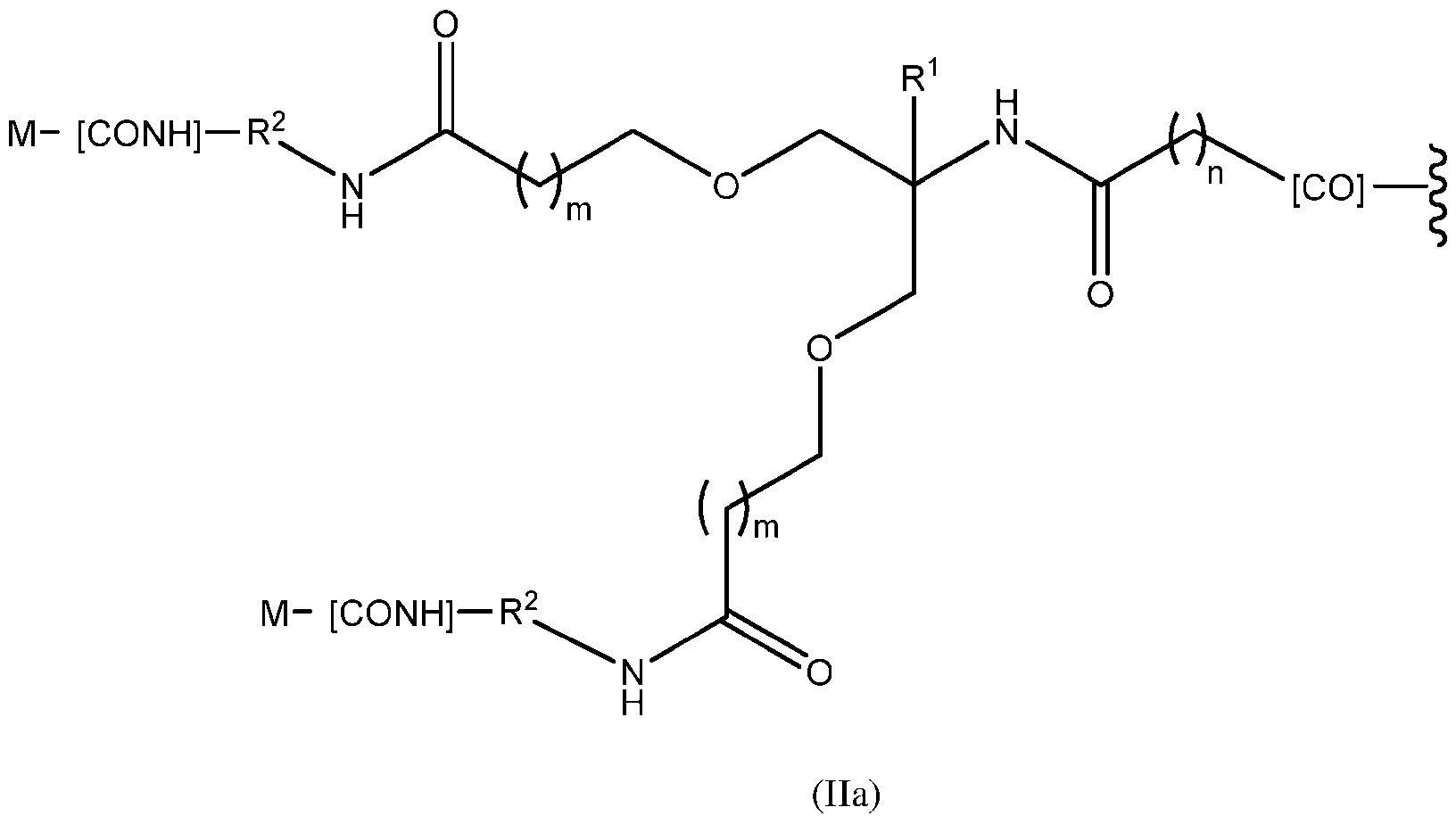
M
wherein: M is a transport moiety, selected independently in each instance; W is a biomacromolecule or a small molecular agent; R
1 is hydrogen o
R
2 is selected independently in each instance from (C
1-C
20) alkyl or a (C
2-C
20) alkyl residue in which from one to six methylenes is replaced by -O-, -C(=O)O-, -OC(=O)-, -C(=O)NH-, or -NHC(=O)-; m is selected independently in each instance from an integer from 1 to 9; and n is selected from an integer from 1 to 15; and wherein [CONH] indicates that the carboxy and amino termini can be at either point of attachment. [0009] In an aspect, provided is a compound of formula (II):
wherein: M is a transport moiety, selected independently in each instance; R
1 is hydrogen o
R
2 is selected independently in each instance from (C
1-C
20) alkyl or a (C
2-C
20) alkyl residue in which from one to six methylenes is replaced by -O-, -C(=O)O-, -OC(=O)-, -C(=O)NH-, or -NHC(=O)-; m is selected independently in each instance from an integer from 1 to 9; and n is selected from an integer from 1 to 15; and in formula (II) represents a bond to hydrogen or to a biomacromolecule or a small molecular agent; and wherein [CONH] indicates that the carboxy and amino termini can be at either point of attachment. [0010] In an aspect, provided is a compound of formula (IIa):
wherein: M is a transport moiety, selected independently in each instance; R
1 is hydrogen o
R
2 is selected independently in each instance from (C1-C20) alkyl or a (C2-C20) alkyl residue in which from one to six methylenes is replaced by -O-, -C(=O)O-, -OC(=O)-, -C(=O)NH-, or -NHC(=O)-; m is selected independently in each instance from an integer from 1 to 9; and
n is selected from an integer from 1 to 15; in formula (IIa) represents a bond to hydroxy or to a biomacromolecule or a small molecular agent; and in formula (IIb) represents a bond to hydrogen or to a biomacromolecule or a small molecular agent. [0011] In an aspect, provided is a compound of formula (IIIa): M
wherein: M is a transport moiety, selected independently in each instance;
R
2 is selected independently in each instance from (C
1-C
20) alkyl or a (C
2-C
20) alkyl residue in which from one to six methylenes is replaced by -O-, -C(=O)O-, -OC(=O)-, -C(=O)NH-, or -NHC(=O)-; m is selected independently in each instance from an integer from 1 to 9; and Q is a linker comprising one or more of: (a) acylalkyl of 1 to 10 carbons; (b) a polyamide comprising 1 to 5 ω-amino acids; (c) oxaalkylene of 1 to 10 carbons; or (d) alkyl of 1 to 10 carbons; R
10 is chosen from:
(a) N
3; (b ( ( (

(f) -NH2; and (g) -COOH. [0012] In an aspect, provided is a pharmaceutical formulation comprising a conjugate of formula (I) or formula (Ia) or a compound of formula (II), formula (IIa), formula (IIb), or formula (IIIa), and a pharmaceutically acceptable carrier. [0013] In an aspect, provided is a method of transporting a biomacromolecule to a target found within the blood brain barrier, comprising providing a conjugate of formula (I) or formula (Ia) to the target, wherein the target may be in vivo or in vitro. [0014] In an aspect, provided is a method of transporting a biomacromolecule to a target found within the blood brain barrier, comprising conjugating the biomacromolecule to the compound of formula (II), formula (IIa), formula (IIb), or formula (IIIa) to form a conjugated biomacromolecule, and providing said conjugated biomacromolecule to the target, wherein the target may be in vivo or in vitro. [0015] In an aspect, provided is a method of treating a subject with a neurological disease, comprising administering to said subject a conjugate of formula (I) or formula (Ia) comprising a biomacromolecule, wherein said biomacromolecule is an agent for treating the neurological disease, and wherein said conjugate is capable of crossing the blood-brain barrier or an in vitro model thereof. [0016] In an aspect, provided is a method of treating a subject with a neurological disease, comprising conjugating a biomacromolecule that is an agent for treating the neurological disease to the compound of formula (II), formula (IIa), formula (IIb), or formula (IIIa) to form a conjugated biomacromolecule, and administering said conjugated biomacromolecule to the subject, and wherein said conjugated biomacromolecule is capable of crossing the blood-brain barrier or an in vitro model thereof.
[0017] These, and other objects, features and advantages of this invention will become apparent from the following detailed description of the various aspects of the invention taken in conjunction with the accompanying drawings. BRIEF DESCRIPTION OF THE DRAWINGS [0018] FIG. 1A, FIG. 1B, and FIG. 1C present an evaluation of blood-brain barrier crossing conjugates (BCC) with Cy5 for brain penetration FIG.1A shows representative images of brains from mice i.v. treated with BCC-Cy5. FIG.1B demonstrates the fluorescent intensity of BCC-Cy5 treated mice (i.v.). The intensity was normalized to the free Cy5 group, n=3. Data are presented as mean ± SD. Statistical significance was determined by one-way ANOVA followed by Dunnett’s multiple comparison test. FIG. 1C demonstrates the fluorescent intensity of BCC-Cy5 treated mice (i.v.). The intensity was the percentage of injected dose per gram of brain (%ID/g) (n = 3 mice). [0019] FIG.2A and FIG.2B show synthetic routes for BCC10-Oligo and BCC10-mCherry, respectively. FIG.2C illustrates the structure of BCC10-ASO. [0020] FIG.3A shows the fluorescent intensity of DNA-Cy5, Chol-DNA-Cy5, and BCC-DNA- Cy5 treated mice (i.v.). The intensity was normalized to the free DNA-Cy5 group, n=3. FIG.3B shows FACS analysis of Cy5 signal in different brain cells. Data are presented as mean ± SD. Statistical significance was determined by one-way ANOVA followed by Dunnett’s multiple comparison test. FIG. 3C and FIG.3D illustrate the distribution of BCC10-Oligo at two different concentrations in different cell types from brain tissues via flow cytometric analysis. [0021] FIG.4A, FIG.4B, and FIG.4C demonstrate that BCC10- ASO
Malat1 reduces Malat1 mRNA level in multiple brain regions and cell types in mice. [0022] FIG.5A and FIG.5B show a quantitative analysis of Sod1 mRNA level (FIG.5A) or SOD1 protein concentration (FIG.5B) in the brains of SOD1
G93A ALS mice after treatment with BCC10- ASO
Sod1. [0023] FIG.6 shows the results of treatment with BCC10-Cy5 in an in vitro transwell model to simulate the BBB. [0024] FIG.7 shows a FACS analysis of mCherry expression in different brain cells comparing PBS, mCherry, and BCC10-mCherry. [0025] FIG.8 illustrates flow cytometry analysis of mCherry expression in different brain cells comparing PBS, mCherry, and BCC10-mCherry. [0026] FIG.9 illustrates flow cytometry analysis of TdTomato expression in different brain cells comparing PBS, mCherry, and BCC10-mCherry.
DETAILED DESCRIPTION [0027] A modular platform capable of enhancing the delivery of biomacromolecule therapeutics through intravenous administration across the BBB to the CNS via various transcytosis approaches has been designed. To achieve this objective, a novel platform has been conceived by covalently conjugating specific small molecule BBB crossing agents with biomacromolecules. Inspired by their BBB-penetrating potential, four classes of BBB crossing conjugates, which are derived from small molecules (cinnamic acid derivative, tryptamine derivative, MK-0752, and SR57227), were designed and synthesized to facilitate BBB penetration and transport cargos to the brain via systemic administration. Without being held to any one theory, it is hypothesized that these BBB-crossing conjugates (BCCs) can facilitate the biomacromolecules to cross the BBB and modulate multiple types of brain cells. [0028] In some embodiments, the conjugate is of formula (I):

wherein: M is a transport moiety, selected independently in each instance; W is a biomacromolecule or a small molecular agent; R
1 is hydrogen o
R
2 is selected independently in each instance from (C1-C20) alkyl or a (C2-C20) alkyl residue in which from one to six methylenes is replaced by -O-, -C(=O)O-, -OC(=O)-, -C(=O)NH-, or -NHC(=O)-; m is selected independently in each instance from an integer from 1 to 9; and
L
p is a linker comprising one or more of: (a) -C(=O)(CH
2)
qNH-, wherein q is an integer from 1 to 6; (b) a polyamide comprising 1 to 5 ω-amino acids; (c) a triazole (d) a 3-thiopyrrolidine-2,5-dione (e) a disulfide or (f) a C
2 to C
20 oxaalkylene; wherein [CONH] indicates that the carboxy and amino termini can be at either point of attachment. [0029] In some embodiments, the conjugate is of formula (Ia): wherein:
M is a transport moiety, selected independently in each instance; W is a biomacromolecule or a small molecular agent;
R
2 is selected independently in each instance from (C1-C20) alkyl or a (C2-C20) alkyl residue in which from one to six methylenes is replaced by -O-, -C(=O)O-, -OC(=O)-, -C(=O)NH-, or -NHC(=O)-; m is selected independently in each instance from an integer from 1 to 9; and n is selected from an integer from 1 to 15; and wherein [CONH] indicates that the carboxy and amino termini can be at either point of attachment.
[0030] In some embodiments, the compound is of formula (II):
wherein: M is a transport moiety, selected independently in each instance; R
1 is hydrogen o
R
2 is selected independently in each instance from (C1-C20) alkyl or a (C2-C20) alkyl residue in which from one to six methylenes is replaced by -O-, -C(=O)O-, -OC(=O)-, -C(=O)NH-, or -NHC(=O)-; m is selected independently in each instance from an integer from 1 to 9; and n is selected from an integer from 1 to 15; and in formula (II) represents a bond to hydrogen or to a biomacromolecule or a small molecular agent; and wherein [CONH] indicates that the carboxy and amino termini can be at either point of attachment. [0031] In some embodiments, the compound is of formula (IIa): 12
or (IIb):
wherein: M is a transport moiety, selected independently in each instance; R
1 is hydrogen o
R
2 is selected independently in each instance from (C1-C20) alkyl or a (C2-C20) alkyl residue in which from one to six methylenes is replaced by -O-, -C(=O)O-, -OC(=O)-, -C(=O)NH-, or -NHC(=O)-; m is selected independently in each instance from an integer from 1 to 9; and 1
n is selected from an integer from 1 to 15; in formula (IIa) represents a bond to hydroxy or to a biomacromolecule or a small molecular agent; and in formula (IIb) represents a bond to hydrogen or to a biomacromolecule or a small molecular agent. [0032] In some embodiments, the compound is of formula (IIIa): M
wherein: M is a transport moiety, selected independently in each instance; R
1 is hydrogen o
R
2 is selected independently in each instance from (C
1-C
20) alkyl or a (C
2-C
20) alkyl residue in which from one to six methylenes is replaced by -O-, -C(=O)O-, -OC(=O)-, -C(=O)NH-, or -NHC(=O)-; m is selected independently in each instance from an integer from 1 to 9; and Q is a linker comprising one or more of: (a) acylalkyl of 1 to 10 carbons; (b) a polyamide comprising 1 to 5 ω-amino acids; (c) oxaalkylene of 1 to 10 carbons; or
(d) alkyl of 1 to 10 carbons; R
10 is chosen from: (a) N
3; (b ( ( (
(f) -NH2; and (a) -COOH. [0033] Throughout this specification the terms and substituents retain their definitions. Substituents (e.g., R
n) are generally defined when introduced and retain that definition throughout the specification and in all independent claims. [0034] In some embodiments, M is a transport moiety, selected independently in each instance. In some embodiments, M is cinnamic acid. In other embodiments, M is a cinnamic acid derivative. In some embodiments, M is tryptamine. In other embodiments, M is a tryptamine derivative. In some embodiments, M is MK-0752. In other embodiments, M is SR-57227. Each M is selected independently, so all instances of M may be the same in one conjugate, or each instance of M may be different in one conjugate, or two instances of M may be the same and a third instance of M may be different in one conjugate. [0035] In some embodiments, W is a biomacromolecule. In other embodiments , W is a small molecular agent. In some embodiments, W is a protein. In other embodiments, W is a peptide. In other embodiments, W is a nucleic acid. In some embodiments, W is an oligonucleotide. In some embodiments, W is a dye. In other embodiments, W is a fluorescent dye. In some embodiments, W is a cyanine dye. In other embodiments, W is Cyanine5 (also called “Cy5”). In some embodiments, W is a fluorescent protein. In some embodiments, W is mCherry.
[0036] In some embodiments, R
2 is selected independently in each instance from (C1-C20) alkyl or a (C
2-C
20) alkyl residue in which from one to six methylenes is replaced by -O-, -C(=O)O-, -OC(=O)-, -C(=O)NH-, or -NHC(=O)-. In other embodiments, R
2 is selected from -CH
2CH
2OCH
2CH
2OCH
2CH
2-, - (CH2)6-, -(CH2)8-, -(CH2CH2O)3CH2CH2-, -(CH2)4-, -CH2CH2OCH2CH2-, -(CH2)3C(=O)NH(CH2)3-, - (CH2)3NHC(=O)(CH2)3-, -(CH2)3C(=O)O(CH2)3-, and -(CH2)3OC(=O)(CH2)3-. In still other embodiments, R
2 is (C2-C20) oxaalkyl. In some embodiments, R
2 is -CH2CH2OCH2CH2OCH2CH2-. In some embodiments, R
2 is (C1-C20) alkyl. In other embodiments, R
2 is (C6)alkyl. In other embodiments, R
2 is (C5)alkyl. In other embodiments, R
2 is (C7)alkyl. In other embodiments, R
2 is (C4)alkyl. In other embodiments, R
2 is (C8)alkyl. To be abundantly clear, all instances of R
2 may be of the same moiety (e.g., as a non-limiting example, all instances of R
2 may be -CH2CH2OCH2CH2OCH2CH2-, or all may be (C6)alkyl, or all may be (C8)alkyl, etc.), or one instance of R
2 may be different than one or more other instances of R
2 (e.g., as a non-limiting example, one instance of R
2 may be -CH2CH2OCH2CH2OCH2CH2- and one may be (C6)alkyl, and a third (if present) may be (C4)alkyl). [0037] In some embodiments, m is selected independently in each instance from an integer from 1 to 9. In some embodiments, m is 1. In some embodiments, m is 2. In some embodiments, m is 3. In some embodiments, m is 4. In some embodiments, m is 5. In some embodiments, m is 6. In some embodiments, m is 7. In some embodiments, m is 8. In some embodiments, m is 9. In some embodiments, m is selected independently in each instance from 1, 2, and 3. In some embodiments, m is selected independently in each instance from 1 and 2. In some embodiments, m is selected independently in each instance from 1, 2, 3, or 4. To be abundantly clear, all instances of m may be of the same value (e.g., as a non-limiting example, all instances of m may be 1, or may be 2, or may be 3, etc.), or one instance of m may be different than one or more other instances of m (e.g., as a non-limiting example, one instance of m may be 1 and one may be 2, and a third (if present) may be 1). [0038] In some embodiments, n is selected from an integer from 1 to 15. In some embodiments, n is 1. In some embodiments, n is 2. In some embodiments, n is 3. In some embodiments, n is 4. In some embodiments, n is 5. In some embodiments, n is 6. In some embodiments, n is 7. In some embodiments, n is 8. In some embodiments, n is 9. In some embodiments, n is 10. In some embodiments, n is 11. In some embodiments, n is 12. In some embodiments, n is 13. In some embodiments, n is 14. In some embodiments, n is 15. In some embodiments, n is selected from 3, 4, 5, 6, and 7. In some embodiments, n is selected from 1, 2, 3, 4, 5, and 6. In some embodiments, n is selected from 2, 3, 4 and 5. In some embodiments, n is selected from 2, 3, and 4. In some embodiments, n is selected from 2 and 3. In some embodiments, n is selected from 3 and 4. [0039] In some embodiments of formula (IIa), represents a bond to hydroxy. In some embodiments of formula (IIa), represents a bond to a biomacromolecule or a small molecular
agent. In some embodiments of formula (IIb), represents a bond to hydrogen. In some embodiments of formula (IIb), represents a bond to a biomacromolecule or a small molecular agent. [0040] In some embodiments, R
1 is hydrogen. In other embodiments, R
1 is
, herein M, m and R
2 are as defined supra. [0041] In some embodiments, R
1
and R
2 is -CH2CH2OCH2CH2OCH2CH2-. In other embodiments, R
1 is
l other embodiments, R
1 is
[0042] The biomacromolecule or small molecular agent W is attached to the nitrogen on the carbon to which R
1 is attached by a linker Lp, as shown in formula (I). In some embodiments, Lp is a linker comprising one or more of: -C(=O)(CH2)qNH-, wherein q is an integer from 1 to 6; a polyamide comprising 1 to 5 ω-amino acids; a triazole; a 3-thiopyrrolidine-2,5-dione; a disulfide; or a C2 to C20 oxaalkane. In other embodiments, Lp is a linker comprising 1 to 4 ω-amino acids and an 8,9-dihydro-3H- dibenzo[b,f][1,2,3]triazolo[4,5-d]azocine. In some embodiments, Lp is a linker comprising an acylalkylamine and 8,9-dihydro-3H-dibenzo[b,f][1,2,3]triazolo[4,5-d]azocine. In other embodiments, Lp is a linker comprising 1 to 4 ω-amino acids and a 3-thiopyrrolidine-2,5-dione. In some embodiments, Lp is a linker comprising an acylalkylamine and a 3-thiopyrrolidine-2,5-dione. [0043] In some embodiments, q is 1, or q is 2, or q is 3, or q is 4, or q is 5, or q is 6. [0044] Common biomacromolecule or small molecular agents include proteins, peptides, nucleic acids, oligonucleotides.
[0045] Cyanine5 is a typical small molecule agent. Cyanine 5 dyes are an art-recognized, commercially available class of fluorescent molecules that are bisindoles joined by a conjugated olefin chain. The indoles may be substituted with, for example, sulfonic acids. One of the indole nitrogens is quaternized, and one of the indole nitrogens (which may or may not be the quaternized nitrogen) is usually alkylated with a caproic acid side chain, which provides a point of attachment. All are called Cyanine 5 dyes. [0046] mCherry is a 236 aminoacid, fluorescent protein derived from Discosoma sp. Its structure and function were published by Shaner et al. in 2004 (Nature Biotechnology, 22(12) , 1567- 1572. (2004). doi: 10.1038/nbt1037) and subsequently by Shu et al. (Shu et al., Biochemistry.2006 Aug 15;45(32):9639-47. doi: 10.1021/bi060773l.) It is widely known and used in the art. The protein includes numerous lysine and glutamic acid residues, in addition to the termini, that permit attachment via amide bonds or, by the use of Traut’s reagent, attachment via sulfur. (An amino group in the protein is reacted with 2-iminothiolane to produce a mercaptobutyramidine, followed by reaction of the thiol with a maleimide to produce a 3-thiopyrrolidine-2,5-dione.) Other proteins and peptides may also include cysteine residues that can be directly attached through the sulfur of their cysteines. [0047] In addition to these two methods of attachment (formation of amide bonds and formation of thiopyrrolidinediones) one may attach W by click chemistry. Click chemistry has been well-known in the art for more than two decades and was the basis for the 2022 Nobel Prize in Chemistry. Fundamentally, it involves the reaction between an azide (N
3) and an alkyne (-C≡CH-) to provide a triazole. The acetylenic bond may be incorporated into a cyclic structure, such as dibenzocyclooctyne(DBCO), which introduces enough ring strain to allow the click reaction to proceed without the use of copper catalyst. The product is once again a triazole, in this case 8,9-dihydro-3H- dibenzo[b,f][1,2,3]triazolo[4,5-d]azocine:
. [0048] As would be readily appreciated by the person of skill, the linker Lp can thus be assembled in two ways. It can be attached to both termini as a fully assembled linker, in which case the penultimate step would be the reaction of
M
with W, wherein R
10 reacts with W or a derivatized W to form an amide bond (when R
10 is -NH
2 or COOH), a thiopyrrolidinedione (when R
10 is -SH or maleimide) or a triazine (when R
10 is azide or alkyne and W has been derivatized to the converse alkyne or azide). The resulting amide, thiopyrrolidinedione, or amide becomes part of Lp. The derivatization of W is described above and is well known in the art. Alternatively, one could attach a portion of Lp to the nitrogen adjacent to R
1 and another portion of Lp to W, and then couple the two portions of Lp into the full Lp. In either approach, an intermediate would be the compound of formula IIIa in which R
10 is chosen from: -N3;
[0049] From the synthesis of BCC’s described below, the person of skill will understand that the groups M may be attached to the 2-amino-2-(hydroxymethyl)propane-1,3-diol (Tris) core in similar fashion to the methods described above. In the syntheses below, standard peptide coupling reagents, well- known in the art, were used to connect M to Tris via amide bond formation between commercially available amino-terminal and carboxy-terminal structural units. In analogous fashion, the various R
2 units may be assembled from commercially available diamines, dicarboxylic acids, and ω-aminoacids using
standard peptide coupling procedures [see Principles of Peptide Synthesis, M. Bodanszky, Springer Science & Business Media, 2012 ISBN 3642967639, 9783642967634]. [0050] It is understood that the examples of click chemistry disclosed herein are not exhaustive, and other variations of click chemistry could be used by the person of skill. [0051] The conjugates disclosed herein can be used for treating a subject with a neurological disease. These conjugates are capable of crossing the blood-brain barrier to deliver a biomacromolecule to treat the neurological disease. Therefore, these conjugates are useful for treating a range of CNS disorders, such as the non-limiting examples of amyotrophic lateral sclerosis (ALS), Alzheimer’s disease (AD), Parkinson's disease, Huntington's disease, ischemic stroke, multiple sclerosis, schizophrenia, epilepsy, and addiction, including drug addiction, and cancer of the brain or spine. Definitions [0052] Unless defined otherwise, all technical and scientific terms used herein have the same meaning as is commonly understood by one of ordinary skill in the art to which this disclosure belongs. A comprehensive list of abbreviations utilized by organic chemists (i.e., persons of ordinary skill in the art) appears in the first issue of each volume of the Journal of Organic Chemistry. The list, which is typically presented in a table entitled “Standard List of Abbreviations” is incorporated herein by reference. In the event that there is a plurality of definitions for terms cited herein, those in this section prevail unless otherwise stated. [0053] As used herein, the terms “comprising” and “including” or grammatical variants thereof are to be taken as specifying the stated features, integers, steps or components but do not preclude the addition of one or more additional features, integers, steps, components or groups thereof. This term encompasses the terms “consisting of” and “consisting essentially of.” [0054] The phrase “consisting essentially of” or grammatical variants thereof when used herein are to be taken as specifying the stated features, integers, steps or components but do not preclude the addition of one or more additional features, integers, steps, components or groups thereof, but only if the additional features, integers, steps, components or groups thereof do not materially alter the basic and novel characteristics of the claimed composition or method. [0055] The notation “[CONH]” indicates that the carboxy and amino termini can be at either point of attachment, i.e., M-[CONH]-R
2 can denote either M-[CONH]-R
2 or M-[HNOC]-R
2. In some instances, the -C=O- or the -NH of -[CONH]- may be part of the M moiety or of W (the biomacromolecule or small molecular agent). [0056] Alkyl is a subset of hydrocarbon. Unless otherwise specified, alkyl (or alkylene) is intended to include linear or branched saturated hydrocarbon structures and combinations thereof. In
some embodiments, alkyl refers to alkyl groups from 1 to 20 carbon atoms, or from 1 to 10 carbon atoms, or from 1 to 8 carbon atoms, or from 1 to 6 carbon atoms, or from 1 to 5 carbon atoms, or from 1 to 4 carbon atoms. Examples of alkyl groups include methyl, ethyl, propyl, isopropyl, n-butyl, s-butyl, t-butyl and the like. The designation “(C
x)alkyl” (wherein x is an integer) herein is equivalent to -(CH
2)
x-. For example, “(C6)alkyl” means the same as -(CH2)6-. [0057] “Oxaalkyl” or “oxaalkane” or “oxaalkylene” refers to alkyl residues in which one or more carbons (and their associated hydrogens) have been replaced by oxygen. Examples include methoxypropoxy, 3,6,9-trioxadecyl and the like. The term oxaalkyl is intended as it is understood in the art [see Naming and Indexing of Chemical Substances for Chemical Abstracts, published by the American Chemical Society, 196, but without the restriction of 127(a)], i.e., it refers to compounds in which the oxygen is bonded via a single bond to its adjacent atoms (forming ether bonds); it does not refer to doubly bonded oxygen, as would be found in carbonyl groups. [0058] MK-0752 has been designated CAS No.471905-41-6 and has the structure
. [0060] Cinnamic acid has the structure
. nnamic acid derivatives are well known to the person of skill, and non-limiting examples of these derivatives include
hydroxycinnamic acid, caffeic acid, and ferulic acid. Additional non-limiting examples can be found in Ruwizhi N, Aderibigbe BA. Int J Mol Sci.2020 Aug 9;21(16):5712. doi: 10.3390/ijms21165712. PMID: 32784935; PMCID: PMC7460980. [0061] Tryptamine has the structure

ryptamine derivatives are well known to the person of skill, and non-limiting examples of these derivatives include serotonin, halo- or alkoxy-substituted tryptamines, and the like. Additional non-limiting examples can be found in Kousara et al., J Pharmacovigil 2017, 5:5 DOI: 10.4172/2329-6887.1000239. [0062] A “derivative” also includes cinnamic acid or tryptamine having substitutions or modifications by covalent attachment, such as, e.g., by alkylation, glycosylation, acetylation, phosphorylation, and the like, as well as other modifications known in the art. [0063] The terms “subject” and “patient,” are used interchangeably and, as used herein, include both humans and other animals, particularly mammals. Thus, the methods are applicable to both human therapy and veterinary applications. Examples of a “subject” include, but are not limited to, a human, rat, mouse, guinea pig, monkey, pig, goat, cow, horse, dog, cat, bird, and fowl. In some embodiments, the subject is a mammal, for example, a primate. In some embodiments, the subject is a human. In one embodiment, the subject is an infant, a juvenile, or an adult. [0064] The terms “treat” or “treatment,” unless otherwise indicated by context, refer to therapeutic treatment and prophylactic measures to prevent relapse, wherein the object is to inhibit or slow down (lessen) an undesired physiological change or disorder, such as the development or spread of cancer or a viral infection. [0065] For purposes of the present disclosure, beneficial or desired clinical results include, but are not limited to, alleviation of symptoms, diminishment of extent of disease, stabilized (i.e., not worsening) state of disease, delay or slowing of disease progression, amelioration or palliation of the disease state, and remission (whether partial or total), whether detectable or undetectable. “Treatment” can also mean prolonging survival as compared to expected survival if not receiving treatment. Those in need of treatment include those already having the condition or disorder as well as those prone to have the condition or disorder. [0066] Treatment can involve administering a conjugate or a compound described herein to a patient diagnosed with a disease, and may involve administering the compound to a patient who does not
have active symptoms. Conversely, treatment may involve administering the compositions or formulations to a patient at risk of developing a particular disease, or to a patient reporting one or more of the physiological symptoms of a disease, even though a diagnosis of this disease may not have been made. [0067] Therapeutically effective amounts of the conjugates and compounds described herein are administered to subjects. A “therapeutically effective” amount of the conjugates and compounds described herein is typically one which is sufficient to achieve the desired effect and may vary according to the nature and severity of the disease condition, and the potency of the compound. It will be appreciated that different concentrations may be employed for prophylaxis than for treatment of an active disease. A therapeutic benefit is achieved with the amelioration of one or more of the physiological symptoms associated with the underlying disorder such that an improvement is observed in the patient, notwithstanding that the patient may still be afflicted with the underlying disorder. It is to be understood that the therapeutically effective amount may relate to a biomacromolecule which is an agent for treating a neurological disease. [0068] As such, the therapeutic effect can be a decrease in the severity of symptoms associated with the disorder and/or inhibition (partial or complete) of progression of the disorder, or improved treatment, healing, prevention or elimination of a disorder, or side-effects. The amount needed to elicit the therapeutic response can be determined based on the age, health, size, and sex of the subject. Optimal amounts can also be determined based on monitoring of the subject’s response to treatment. The term “treatment” or “treat” may include effective inhibition, suppression or cessation of symptoms so as to prevent or delay the onset, retard the progression, or ameliorate the symptoms of a condition. [0069] As used herein, and as would be understood by the person of skill in the art, the recitation of “a compound” or “a conjugate”- unless expressly further limited - is intended to include pharmaceutically acceptable salts of that compound or conjugate in those instances in which a pharmaceutically acceptable salt would be appropriate. [0070] The term "pharmaceutically acceptable salt" refers to salts prepared from pharmaceutically acceptable non-toxic acids or bases including inorganic acids and bases and organic acids and bases. When the compounds of the present invention are basic, salts may be prepared from pharmaceutically acceptable non-toxic acids including inorganic and organic acids. Suitable pharmaceutically acceptable acid addition salts for the compounds of the present invention include acetic, adipic, alginic, ascorbic, aspartic, benzenesulfonic (besylate), benzoic, boric, butyric, camphoric, camphorsulfonic, carbonic, citric, ethanedisulfonic, ethanesulfonic, ethylenediaminetetraacetic, formic, fumaric, glucoheptonic, gluconic, glutamic, hydrobromic, hydrochloric, hydroiodic, hydroxynaphthoic, isethionic, lactic, lactobionic, laurylsulfonic, maleic, malic, mandelic, methanesulfonic, mucic,
naphthylenesulfonic, nitric, oleic, pamoic, pantothenic, phosphoric, pivalic, polygalacturonic, salicylic, stearic, succinic, sulfuric, tannic, tartaric acid, teoclatic, p-toluenesulfonic, and the like. When the compounds contain an acidic side chain, suitable pharmaceutically acceptable base addition salts for the compounds of the present invention include, but are not limited to, metallic salts made from aluminum, calcium, lithium, magnesium, potassium, sodium and zinc or organic salts made from lysine, arginine, N,N'-dibenzylethylenediamine, chloroprocaine, choline, diethanolamine, ethylenediamine, meglumine (N-methylglucamine) and procaine. Further pharmaceutically acceptable salts include, when appropriate, nontoxic ammonium cations and carboxylate, sulfonate and phosphonate anions attached to alkyl having from 1 to 20 carbon atoms. [0071] Unless otherwise stated or depicted, structures depicted herein are also meant to include all stereoisomeric (e.g., enantiomeric, diastereomeric, and cis-trans isomeric) forms of the structure; for example, the R and S configurations for each asymmetric center, (Z) and (E) double bond isomers, and (Z) and (E) conformational isomers. Therefore, single stereochemical isomers as well as enantiomeric, diastereomeric, and cis-trans isomeric (or conformational) mixtures of the present compounds are within the scope of the invention. Unless otherwise stated, all tautomeric forms of the compounds of the invention are within the scope of the invention. Additionally, unless otherwise stated, structures depicted herein are also meant to include compounds that differ only in the presence of one or more isotopically enriched atoms. For example, compounds having the present structures except for the replacement of hydrogen by deuterium or tritium, or the replacement of a carbon by a
13C- or
14C-enriched carbon are within the scope of this invention. Such compounds are useful, for example, as analytical tools or probes in biological assays. [0072] The graphic representations of racemic, ambiscalemic and scalemic or enantiomerically pure compounds used herein are a modified version of the denotations taken from Maehr J. Chem. Ed.62, 114-120 (1985): simple lines provide no information about stereochemistry and convey only connectivity; solid and broken wedges are used to denote the absolute configuration of a chiral element; solid and broken bold lines are geometric descriptors indicating the relative configuration shown but not necessarily denoting racemic character; and wedge outlines and dotted or broken lines denote enantiomerically pure compounds of indeterminate absolute configuration. For example, the graphic representation
indicates either, or both, of the two trans:trans enantiomers:
in any ratio, from pure enantiomers to racemates. The graphic representation:
indicates a single enantiomer of unknown absolute stereochemistry, i.e., it could be either of the two preceding structures, as a substantially pure single enantiomer. And, finally, the representation:

indicates a pure (R,R,S) absolute configuration. For the purpose of the present disclosure, a “pure” or “substantially pure” enantiomer is intended to mean that the enantiomer is at least 95% of the configuration shown and 5% or less of other enantiomers. Similarly, a “pure” or “substantially pure” diastereomer is intended to mean that the diastereomer is at least 95% of the relative configuration shown and 5% or less of other diastereomers. In some embodiments, the purity of the compound is at least 99%. [0073] In any of these possibilities, compounds can be a single stereoisomer or a mixture. If a mixture, the mixture will most commonly be racemic, but it need not be. Substantially pure single stereoisomers of biologically active compounds such as those described herein often exhibit advantages over their racemic mixture. [0074] Enantiomerically pure means greater than 80 e.e., and preferably greater than 90 e.e. For the purpose of the present disclosure, a “pure” or “substantially pure” stereoisomer is intended to mean that the stereoisomer is at least 95% of the configuration shown and 5% or less of other stereoisomers, or
at least 97% of the configuration shown and 3% or less of other stereoisomers, or at least 99% of the configuration shown and 1% or less of other stereoisomers. [0075] It may be found upon examination that certain species and genera are not patentable to the inventors in this application. In this case, the exclusion of species and genera in applicants' claims are to be considered artifacts of patent prosecution and not reflective of the inventors' concept or description of their invention, which encompasses all members of the genus that are not in the public’s possession. [0076] While it may be possible for the conjugates and compounds disclosed herein to be administered as the raw chemical, in some embodiments, they are presented as a pharmaceutical formulation. According to a further aspect, the present invention provides a pharmaceutical formulation comprising a conjugate or compound disclosed herein together with one or more pharmaceutically acceptable carriers. The carrier(s) must be "acceptable" in the sense of being compatible with the other ingredients of the formulation and not deleterious to the recipient thereof. In one embodiment, the pharmaceutically acceptable carrier is selected from the group consisting of a liquid filler, a solid filler, a diluent, an excipient, a solvent, and an encapsulating material. [0077] EMBODIMENTS [0078] Various preferred embodiments [EMB.1] to [EMB.7] of the invention can be described in the text below:

wherein: M is a transport moiety, selected independently in each instance; W is a biomacromolecule or a small molecular agent; R
1 is hydrogen or
R
2 is selected independently in each instance from (C1-C20) alkyl or (C2-C20) oxaalkyl; m is selected independently in each instance from an integer from 1 to 9; and n is selected from an integer from 1 to 15; and wherein [CONH] indicates that the carboxy and amino termini can be at either point of attachment. [EMB.2] The conjugate of [EMB.1], wherein: M is selected from cinnamic acid or a cinnamic acid derivative, tryptamine or a tryptamine derivative, MK-0752, or SR-57227; and/or W is selected from a protein, a nucleic acid, Cyanine5, or mCherry; and/or R
2 is selected independently in each instance from -CH
2CH
2OCH
2CH
2OCH
2CH
2- or (C
6)alkyl; and/or m is 1; and/or n is 5. [EMB.3] The conjugate of [EMB.1], wherein: M is MK-0752; and/or R
2 is (C
6)alkyl; and/or m is 1; and/or n is 5. [EMB.4] A compound of formula (II):
(II) wherein: M is a transport moiety, selected independently in each instance; R
1 is hydrogen or
ected independently in each instance from (C
1-C
20) alkyl or (C
2-C
20) oxaalkyl; m is selected independently in each instance from an
integer from 1 to 9; and n is selected from an integer from 1 to 15; and in formula (II) represents a bond to hydrogen or to a biomacromolecule or a small molecular agent; and wherein [CONH] indicates that the carboxy and amino termini can be at either point of attachment. [EMB.5] The compound of [EMB.4], wherein: M is selected from cinnamic acid or a cinnamic acid derivative, tryptamine or a tryptamine derivative, MK-0752, or SR-57227; and/or R
2 is selected independently in each instance from -CH
2CH
2OCH
2CH
2OCH
2CH
2- or (C
6)alkyl; and/or m is 1; and/or n is 5. [EMB.6] The compound of [EMB.4], wherein: M is MK-0752; and/or R
2 is (C
6)alkyl; and/or m is 1; and/or n is 5. [EMB.7] A pharmaceutical formulation comprising the conjugate of any one of [EMB.1], [EMB. 2], or [EMB.3] or the compound of any one of [EMB.4], [EMB.5], or [EMB.6], and a pharmaceutically acceptable carrier. [0079] Various preferred embodiments [A] to [AU] of the invention can be described in the text below: [Embodiment A] A conjugate of formula (I): M
wherein: M is a transport moiety, selected independently in each instance; W is a biomacromolecule or a small molecular agent;
R
1 is hydrogen o
R
2 is selected independently in each instance from (C1-C20) alkyl or a divalent (C2-C20) alkyl residue in which from one to six methylenes is replaced by -O-, -C(=O)O-, -OC(=O)-, -C(=O)NH-, or - NHC(=O)-; m is selected independently in each instance from an integer from 1 to 9; and Lp is a linker comprising one or more of: (a) -C(=O)(CH2)qNH-, wherein q is an integer from 1 to 6; (b) a polyamide comprising 1 to 5 ω-amino acids; (c) a triazole (d) a 3-thiopyrrolidine-2,5-dione (e) a disulfide or (f) a C
2 to C
20 oxaalkane; wherein [CONH] indicates that the carboxy and amino termini can be at either point of attachment. [Embodiment B] A conjugate of Embodiment [A] above, or according to other embodiments of the invention, wherein L
p is a linker comprising 1 to 4 ω-amino acids and an 8,9-dihydro-3H- dibenzo[b,f][1,2,3]triazolo[4,5-d]azocine. [Embodiment C] A conjugate of Embodiment [A] above, or according to other embodiments of the invention, wherein L
p is a linker comprising an acylalkylamine and 8,9-dihydro-3H- dibenzo[b,f][1,2,3]triazolo[4,5-d]azocine. [Embodiment D] A conjugate of Embodiment [A] above, or according to other embodiments of the invention, wherein L
p is a linker comprising 1 to 4 ω-amino acids and a 3-thiopyrrolidine-2,5-dione. [Embodiment E] A conjugate of Embodiment [A] above, or according to other embodiments of the invention, wherein L
p is a linker comprising an acylalkylamine and a 3-thiopyrrolidine-2,5-dione. [Embodiment F] A conjugate of Embodiment [A] above, or according to other embodiments of the invention, wherein said conjugate is of formula (Ia):
wherein: M is a transport moiety, selected independently in each instance; W is a biomacromolecule or a small molecular agent; R
1 is hydrogen o
R
2 is selected independently in each instance from (C1-C20) alkyl or a (C2-C20) alkyl residue in which from one to six methylenes is replaced by -O-, -C(=O)O-, -OC(=O)-, -C(=O)NH-, or -NHC(=O)-; m is selected independently in each instance from an integer from 1 to 9; and n is selected from an integer from 1 to 15; and wherein [CONH] indicates that the carboxy and amino termini can be at either point of attachment. [Embodiment G] A conjugate of any one of Embodiments [A] to [F] above, or according to other embodiments of the invention, wherein W is selected from a protein, a peptide, a nucleic acid, an oligonucleotide, or a fluorescent dye. [Embodiment H] A conjugate of any one of Embodiments [A] to [F] above, or according to other embodiments of the invention, wherein W is selected from a protein, a peptide, a nucleic acid, an oligonucleotide, Cyanine5, or mCherry. [Embodiment I] A conjugate of any one of Embodiments [A] to [F] above, or according to other embodiments of the invention, wherein W is a protein. [Embodiment J] A conjugate of any one of Embodiments [A] to [F] above, or according to other embodiments of the invention, wherein W is a peptide.
[Embodiment K] A conjugate of any one of Embodiments [A] to [F] above, or according to other embodiments of the invention, wherein W is a nucleic acid. [Embodiment L] A conjugate of any one of Embodiments [A] to [F] above, or according to other embodiments of the invention, wherein W is an oligonucleotide. [Embodiment M] A conjugate of any one of Embodiments [A] to [F] above, or according to other embodiments of the invention, wherein W is a fluorescent dye. [Embodiment N] A conjugate of any one of Embodiments [A] to [F] above, or according to other embodiments of the invention, wherein W is Cyanine5. [Embodiment O] A conjugate of any one of Embodiments [A] to [F] above, or according to other embodiments of the invention, wherein W is mCherry. [Embodiment P] A compound of formula (II):

wherein: M is a transport moiety, selected independently in each instance; R
1 is hydrogen o
R
2 is selected independently in each instance from (C
1-C
20) alkyl or a (C
2-C
20) alkyl residue in which from one to six methylenes is replaced by -O-, -C(=O)O-, -OC(=O)-, -C(=O)NH-, or -NHC(=O)-; m is selected independently in each instance from an integer from 1 to 9; and n is selected from an integer from 1 to 15; and
in formula (II) represents a bond to hydrogen or to a biomacromolecule or a small molecular agent; and wherein [CONH] indicates that the carboxy and amino termini can be at either point of attachment. [Embodiment Q] A compound of formula (IIa):
wherein: M is a transport moiety, selected independently in each instance; R
1 is hydrogen o
R
2 is selected independently in each instance from (C
1-C
20) alkyl or a (C
2-C
20) alkyl residue in which from one to six methylenes is replaced by -O-, -C(=O)O-, -OC(=O)-, -C(=O)NH-, or -NHC(=O)-; m is selected independently in each instance from an integer from 1 to 9; and n is selected from an integer from 1 to 15; in formula (IIa) represents a bond to hydroxy or to a biomacromolecule or a small molecular agent. [Embodiment R] A compound of Embodiment [Q] above, or according to other embodiments of the invention, wherein in formula (IIa) represents a bond to hydroxy. [Embodiment S] A compound of formula (IIb):
wherein: M is a transport moiety, selected independently in each instance; R
1 is hydrogen o
R
2 is selected independently in each instance from (C1-C20) alkyl or a (C2-C20) alkyl residue in which from one to six methylenes is replaced by -O-, -C(=O)O-, -OC(=O)-, -C(=O)NH-, or -NHC(=O)-; m is selected independently in each instance from an integer from 1 to 9; and n is selected from an integer from 1 to 15; and in formula (IIb) represents a bond to hydrogen or to a biomacromolecule or a small molecular agent. [Embodiment T] A compound of Embodiment [S] above, or according to other embodiments of the invention, wherein in formula (IIb) represents a bond to hydrogen. [Embodiment U] A compound of Embodiment [Q] or Embodiment [S] above, or according to other embodiments of the invention, wherein represents a bond to a biomacromolecule. [Embodiment V] A compound of Embodiment [Q] or Embodiment [S] above, or according to other embodiments of the invention, wherein represents a bond to a small molecular agent. [Embodiment W] A conjugate or compound of any one of Embodiments [F] to [V] above, or according to other embodiments of the invention, wherein n is selected from 1, 2, 3, 4, 5, and 6.
[Embodiment X] A conjugate or compound of any one of Embodiments [F] to [V] above, or according to other embodiments of the invention, wherein n is selected from 3, 4, and 5. [Embodiment Y] A conjugate or compound of any one of Embodiments [F] to [V] above, or according to other embodiments of the invention, wherein n is 3. [Embodiment Z] A compound of formula (IIIa): M

wherein: M is a transport moiety, selected independently in each instance; R
1 is hydrogen o
R
2 is selected independently in each instance from (C
1-C
20) alkyl or a (C
2-C
20) alkyl residue in which from one to six methylenes is replaced by -O-, -C(=O)O-, -OC(=O)-, -C(=O)NH-, or -NHC(=O)-; m is selected independently in each instance from an integer from 1 to 9; and Q is a linker comprising one or more of acylalkyl of 1 to 10 carbons; a polyamide comprising 1 to 5 ω-amino acids; oxaalkylene of 1 to 10 carbons; or alkyl of 1 to 10 carbons; R
10 is chosen from N3; -C≡CH; ; -SH; ; -NH2; and -COOH.
[Embodiment AA] A compound of Embodiment [Z] above, or according to other embodiments of the invention, wherein Q is a linker comprising one or more of acylalkyl of 1 to 10 carbons; a polyamide comprising 1 to 5 ω-amino acids; oxaalkylene of 1 to 10 carbons; or alkyl of 1 to 10 carbons; [Embodiment AB] A conjugate or compound of any one of the Embodiments [A] to [AA] above, or according to other embodiments of the invention, wherein M is selected individually in each instance from cinnamic acid or a cinnamic acid derivative, tryptamine or a tryptamine derivative, MK-0752, or SR-57227. [Embodiment AC] A conjugate or compound of any one of Embodiments [A] to [AA] above, or according to other embodiments of the invention, wherein M is cinnamic acid or a cinnamic acid derivative in each instance. [Embodiment AD] A conjugate or compound of any one of Embodiments [A] to [AA] above, or according to other embodiments of the invention, wherein M is tryptamine or a tryptamine derivative in each instance. [Embodiment AE] A conjugate or compound of any one of Embodiments [A] to [AA] above, or according to other embodiments of the invention, wherein M is MK-0752 in each instance. [Embodiment AF] A conjugate or compound of any one of Embodiments [A] to [AA] above, or according to other embodiments of the invention, wherein M is SR-57227 in each instance. [Embodiment AG] A conjugate or compound of any one of Embodiments [A] to [AF] above, or according to other embodiments of the invention, wherein m is selected independently in each instance from 1, 2, 3, or 4. [Embodiment AH] A conjugate or compound of any one of Embodiments [A] to [AF] above, or according to other embodiments of the invention, wherein m is 1 in at least one instance. [Embodiment AI] A conjugate or compound of any one of Embodiments [A] to [AF] above, or according to other embodiments of the invention, wherein m is 1 in all instances. [Embodiment AJ] A conjugate or compound of any one of Embodiments [A] to [AI] above, or according

to other embodiments of the invention, wherein R
1 is . [Embodiment AK] A conjugate or compound of any one of Embodiments [A] to [AI] above, or according to other embodiments of the invention, wherein R
1 is hydrogen. [Embodiment AL] A conjugate or compound of any one of Embodiments [A] to [AK] above, or according to other embodiments of the invention, wherein R
2 is selected from - CH2CH2OCH2CH2OCH2CH2-, -(CH2)6-, -(CH2)8-, -(CH2CH2O)3CH2CH2-, -(CH2)4-, -CH2CH2OCH2CH2-, -(CH2)3C(=O)NH(CH2)3-, -(CH2)3NHC(=O)(CH2)3-, -(CH2)3C(=O)O(CH2)3-, and -(CH2)3OC(=O)(CH2)3-. 35
[Embodiment AM] A conjugate or compound of any one of Embodiments [A] to [AK] above, or according to other embodiments of the invention, wherein R
2 is (C
2-C
20) oxaalkyl. [Embodiment AN] A conjugate or compound of any one of Embodiments [A] to [AK] above, or according to other embodiments of the invention, wherein R
2 is -CH
2CH
2OCH
2CH
2OCH
2CH
2-. [Embodiment AO] A conjugate or compound of any one of Embodiments [A] to [AK] above, or according to other embodiments of the invention, wherein R
2 is (C
1-C
20) alkyl. [Embodiment AP] A conjugate or compound of any one of Embodiments [A] to [AK] above, or according to other embodiments of the invention, wherein R
2 is (C6) alkyl. [Embodiment AQ] A pharmaceutical formulation comprising the conjugate or compound of any one of Embodiments [A] to [AP] above, or according to other embodiments of the invention, and a pharmaceutically acceptable carrier. [Embodiment AR] A method of transporting a biomacromolecule to a target found within the blood brain barrier, comprising providing a conjugate, compound, or pharmaceutical composition of any one of Embodiments [A] to [AQ] above, or according to other embodiments of the invention, to the target, wherein the target may be in vivo or in vitro. [Embodiment AS] A method of transporting a biomacromolecule to a target found within the blood brain barrier, comprising conjugating the biomacromolecule to the compound of any one of Embodiments [P] to [AQ] above, or according to other embodiments of the invention, to form a conjugated biomacromolecule, and providing said conjugated biomacromolecule to the target, wherein the target may be in vivo or in vitro. [Embodiment AT] A method of treating a subject with a neurological disease, comprising administering to said subject a conjugate of any one of Embodiments [A] to [O], [W] to [Y], or [AA] to [AS] above, or according to other embodiments of the invention, comprising a biomacromolecule, wherein said biomacromolecule is an agent for treating the neurological disease, and wherein said conjugate is capable of crossing the blood-brain barrier or an in vitro model thereof. [Embodiment AU] A method of treating a subject with a neurological disease, comprising conjugating a biomacromolecule that is an agent for treating the neurological disease to the compound of any one of Embodiments [P] to [AQ] above, or according to other embodiments of the invention, to form a conjugated biomacromolecule, and administering said conjugated biomacromolecule to the subject, and wherein said conjugated biomacromolecule is capable of crossing the blood-brain barrier or an in vitro model thereof. [0080] EXAMPLES
[0081] Based on the structures and functions of small molecular ligands capable of traversing the blood-brain barrier, four categories of BBB-crossing conjugates (BCCs) were designed and synthesized, including cinnamic acid derivatives, tryptamine derivatives, MK-0752 derivatives, and SR-57227 derivatives. Specifically, cinnamic acid derivatives can cross the BBB and interact with the beta-sheet of amyloid beta (Aβ). Tryptamine derivatives are actively transported into the brain, relying on Mg
2+ and ATP. MK-0752 is an γ-secretase inhibitor, effectively crossing BBB and lowering the Aβ generation. It has been evaluated in clinical trials for safety and generally showed an acceptable safety profile, with most patients tolerating the treatment well. SR-57227 can interact with 5-HT3 receptors, facilitating its transport into the brain. [0082] Nirogacestat and MK-0752 were purchased from MedChemExpress (NJ, USA). All oligonucleotides for experiments were purchased from Integrated DNA Technologies (IA, USA). mCherry was obtained from Creative Biomart (NY, USA). TAT-Cre Recombinase was obtained from Excellgen (MD, USA). All other chemicals and solvents were purchased from Thermo Fisher Scientific unless otherwise listed. BBB crossing conjugates were purified by column chromatography using a CombiFlash Rf system with a RediSep Gold Resolution silica column (Teledyne Isco) with gradient elution. All
1H NMR spectra were run on a Bruker Avance 400 MHz instrument. Mass spectrometric measurements were performed by 6210 TOF LC/MS (Agilent) and microFlex LRF MALDI-TOF-MS (Bruker Daltonics). The mouse brain endothelial cell line bEnd.3 cells (CRL-2299, BCEC) were purchased from ATCC and cultured according to manufacturer’s protocol. [0083] The animal experiments conducted in this study adhered to the guidelines approved by the Institutional Animal Care and Use Committee (IACUC) of the Icahn School of Medicine at Mount Sinai (IPROTO202200000134), and complied with local, state and federal regulations. C57BL/6 mice, Ai14 mice and SOD1
G93A transgenic mice expressing a G93A mutant form of human SOD1 aged 6-8 weeks were obtained from Jackson Laboratories. The numbers of mice analyzed are provided in the main text and/or in the figure legends. [0084] Several series of BBB crossing conjugates coupled to Cyanine5 (Cy5), a fluorescent dye, were synthesized. Each class of the newly synthesized BCCs consists of both biantennary and triantennary small molecular ligands, connected with a Cyanine5 (Cy5) fluorescent imaging probe. Two types of spacers, alkane and ethylene glycol spacers, were installed. These structures are shown below (BCC1-Cy5 to BCC12-Cy5).
41
[0085] Synthesis of BCCs [0086] Exemplary synthetic routes to BCC10-Cy5 molecules are shown in Scheme 1 above. Briefly, the synthesis of compound 2 involved the reaction of tris(hydroxymethyl)aminomethane with t- Butyl acrylate, followed by condensation with Fmoc-GABA and subsequent deprotection, yielding compound 4. Compound 4 was subsequently subjected to condensation in the presence of compound 5's amine moiety to yield compound 6, followed by Fmoc deprotection to produce BCC10. BCC10 underwent coupling reactions with Cy5-NHS, Maleimide-SH, and click reaction such as DBCO-Azide, yielding BCC10-Cy5, BCC10-Mal, and BCC10-DBCO, respectively. (DBCO = Dibenzocyclooctyne, NHS = N-Hydroxysuccinimide.) All compounds were purified by flash chromatography and validated by
1H NMR and mass spectrometry. The detailed description of the synthesis of BCC10-Cy5 shown in Scheme 1 follows. [0087] Compound 2 was synthesized according to previously reported procedures (D. Spitzer, L. L. Rodrigues, D. Straßburger, M. Mezger, P. Besenius, Angewandte Chemie International Edition 2017, 56, 15461-15465.). [0088] To a solution of 4-(Fmoc-amino) butyric acid (1.02 g, 3.1 mmol), DMF (5 mL) and N,N- diisopropylethylamine (1 mL, 5.7 mmol), (N,N,N',N'-tetramethyl-O-(3,4-dihydro-4-oxo-1,2,3- benzotriazin-3-yl)uronium tetrafluoroborate) (1.1 g, 3.2 mmol) was added. The resulting solution was stirred for 20 min at room temperature. Then compound 2 (1.2 g, 2.4 mmol) was added and the solution was stirred at room temperature overnight. The mixture was added into 50 mL NaHCO
3 solution and then extracted by ethyl acetate, washed 3 times with deionized water, and further purified by Combiflash column chromatography with a RediSep Gold Resolution silica column with gradient elution from 100% Hexane to Hexane/Ethyl acetate (40/60, v/v) to give compound 3 (1.35g, yield 71%).
1H NMR (400 MHz, CDCl
3) δ 7.74 (d, J = 7.4 Hz, 2H), 7.59 (d, J = 7.3 Hz, 2H), 7.37 (t, J = 7.3 Hz, 2H), 7.28 (t, J = 7.4 Hz, 2H), 4.38 – 4.29 (m, 2H), 4.19 (t, J = 6.9 Hz, 1H), 3.74 (m, 2H), 3.66 (m, 12H), 3.24 (m, 2H), 2.43 (t, J = 6.2 Hz, 6H), 2.23 (m, 2H), 1.94 – 1.70 (m, 2H), 1.43 (s, 27H). ESI-MS for C
44H
64N
2O
12 ([M+H]
+) Calculated: 813.5, Found: 813.5. [0089] Then compound 3 (0.51 g, 0.6 mmol) was dissolved in 10 mL of CH
2Cl
2 and 2 mL of CF
3COOH and the mixture stirred overnight. After the reaction was completed checked by TLC, the solvent was removed under reduced pressure. The resulting mixture was further purified by Combiflash column chromatography with a RediSep Gold Resolution silica column with gradient elution from 100% CH2Cl2 to CH2Cl2/MeCN (30/70, v/v) to give compound 4 (0.30g, 76%).
1H NMR (400 MHz, CDCl3) δ 7.76 (d, J = 6.7 Hz, 2H), 7.57 (d, J = 6.6 Hz, 2H), 7.44 – 7.35 (t, 2H), 7.30 (t, J = 7.4 Hz, 2H), 4.51 – 4.33 (m, 2H), 4.22 (t, J = 6.4 Hz, 1H), 3.88 – 3.54 (m, 12H), 3.22 (m, 2H), 2.67 – 2.46 (m, 6H), 2.35 – 2.09 (m, 2H), 1.88 – 1.67 (m, 2H); ESI-MS for C32H40N2O12 ([M+H]
+) Calculated: 645.2, Found: 645.2.
[0090] The synthesis of Compound 5 (N-(2-(2-(2-aminoethoxy)ethoxy)ethyl)-3-((1r,4s)-4-((4- chlorophenyl)sulfonyl)-4-(2,5-difluorophenyl)cyclohexyl)propenamide) is shown below:

[0091] A solution composed of compound 4 (80mg, 0.12mmol), DMF (5 mL), and N,N- diisopropylethylamine (0.1 mL, 0.57 mmol) was prepared. Subsequently, (N,N,N',N'-tetramethyl-O-(3,4- dihydro-4-oxo-1,2,3-benzotriazin-3-yl)uronium tetrafluoroborate) (198 mg, 0.57 mmol) was introduced into the solution. The resulting mixture was kept stirring for 20 minutes at room temperature. Following this, Compound 5 (295 mg, 0.52 mmol) was added, and the solution was stirred at room temperature overnight. The resultant mixture was added to a solution of 5% NaHCO3 (200 mL), followed by extraction using ethyl acetate. The extracted solution was then concentrated and subjected to further purification by Combiflash column chromatography, utilizing a RediSep Gold Resolution silica column with a gradient elution starting from 100% CH2Cl2 to CH2Cl2/MeOH (85/15, v/v) to give compound 6 (94 mg, 34% yield).
1H NMR (400 MHz, CDCl3) δ 7.76 (d, J = 7.5 Hz, 2H), 7.57 (t, J = 15.8 Hz, 2H), 7.42 – 7.27 (m, 12H), 7.08 – 6.93 (m, 4H), 6.91 – 6.74 (m, 4H), 6.57 – 6.33 (m, 3H), 4.45 – 4.33 (m, 2H), 4.19 (t, J = 12.8 Hz, 1H), 3.80 – 3.57 (m, 18H), 3.53 (m, 12H), 3.47 – 3.39 (m, 8H), 3.25 (t, J = 12.1 Hz, 2H), 2.42 (m, 12H), 2.30 – 2.13 (m, 6H), 1.88 – 1.62 (m, 20H), 1.45 (m, 6H). ESI-MS for C113H139Cl3F6N8O24S3 ([M+H]
+) Calculated: 2307.8, Found: 2307.8. [0092] Compound 6 (50mg, 0.21mmol) was dissolved in 5 mL of CH2Cl2 and 0.2 mL of Piperidine and the mixture was stirred for 30 min. After the reaction was completed checked by TLC, the solvent was removed under reduced pressure. The resulting solid was further purified by Combiflash column chromatography with a RediSep Gold Resolution silica column with gradient elution from 100% CH2Cl2 to CH2Cl2/MeOH/NH4OH (70/30/1, v/v/v) to give compound BCC10 (41mg, 91%).
1H NMR (400 MHz, MeOD) δ 7.49 (d, J = 8.5 Hz, 6H), 7.34 (d, J = 8.5 Hz, 6H), 7.19 – 7.05 (m, 6H), 7.02 – 6.90 (m, 3H), 3.67 (s, 18H), 3.60 (m, 12H), 3.54 (m, 14H), 3.30 (m, 19H), 2.83 (m, 2H), 2.53 – 2.29 (m, 19H), 2.24– 1.65 (m, 24H), 1.62 – 1.38 (m, 9H). ESI-MS for C98H129Cl3F6N8O22S3 ([M+2H]
2+) Calculated: 1043.4, Found: 1043.4. [0093] To a solution of BCC10, DMF and N, N-diisopropylethylamine, NHS-Cy5 was added. The resulting mixture was kept stirring at room temperature overnight. After the solvent was removed under reduced pressure. The resulting solid was obtained as BCC10-Cy5 having ESI-MS for C
130H
166Cl
3F
6N
10O
23S
3 + ([M+H]
2+) Calculated: 1275.5, Found: 1275.5.
[0094] BCC10-Mal and BCC-DBCO share similar synthetic procedures with BCC10-Cy5. ESI- MS for BCC-Mal: C
110H
142Cl
3F
6N
9O
25S
3 ([M+H]
+) Calculated: 2304.8; Found:2304.8. ESI-MS for BCC10-DBCO: C
119H
146Cl
3F
6N
9O
24S
3 ([M+H]
+) Calculated: 2400.9; Found: 2400.9. [0095] Synthetic procedures for BCC1-Cy5---BCC12-Cy5 are similar to that of BCC10-Cy5. [0096] BCC1:
1H NMR (400 MHz, MeOD) δ 7.44 (dd, J = 17.6, 12.3 Hz, 6H), 6.74 (d, J = 8.9 Hz, 4H), 6.40 (d, J = 15.6 Hz, 2H), 4.17 – 4.08 (m, 1H), 3.70 – 3.33 (m, 24H), 3.23 – 3.15 (m, 2H), 3.01 (s, 12H), 2.91 – 2.82 (m, 2H), 2.49 – 2.38 (m, 6H), 2.39 – 2.30 (m, 2H), 1.87 (m, 2H), and ESI-MS for C47H74N8O11 ([M+H]
+) Calculated: 1392.8 , Found: 1392.8. ESI-MS for BCC2-Cy5: C79H111N10O12
+ ([M+H]
2+) Calculated: 696.4, Found: 696.4. [0097] BCC2:
1H NMR (400 MHz, MeOD) δ 7.42 (dd, J = 19.7, 12.1 Hz, 9H), 6.67 (d, J = 8.6 Hz, 6H), 6.37 (d, J = 15.6 Hz, 3H), 3.72 – 3.22 (m, 36H), 2.96 (s, 18H), 2.92 – 2.83 (m, 2H), 2.41 (t, J = 5.6 Hz, 8H), 1.85 – 1.68 (m, 2H), and ESI-MS for C68H105N11O16 ([M+2H]
+) Calculated: 1332.8, Found: 1332.8. ESI-MS for BCC2-Cy5: C100H142N13O17
+ ([M+2H]
2+) Calculated: 899.5, Found: 899.5.
[0098] BCC3:
1H NMR (400 MHz, MeOD) δ 7.56 (d, J = 7.8 Hz, 2H), 7.33 (d, J = 8.0 Hz, 2H), 7.13 – 6.95 (m, 6H), 4.12 (m, 1H), 3.76 – 3.61 (m, 4H), 3.57 – 3.42 (m, 4H), 3.33 (m, 4H), 3.23 – 2.98 (m, 12H), 2.70 – 2.48 (m, 6H), 2.48 – 2.35 (m, 4H), 2.24 (t, J = 7.4 Hz, 2H), 1.85 – 1.12 (m, 20H), and ESI-MS for C
47H
70N
8O
7 ([M+H]
+) Calculated: 859.5, Found: 859.5. ESI-MS for BCC3-Cy5: C
79H
107N
10O
8 + ([M+H]
2+) Calculated: 662.4, Found: 662.4. [0099] BCC4:
1H NMR (400 MHz, MeOD) δ 7.56 (d, J = 7.8 Hz, 3H), 7.33 (d, J = 8.1 Hz, 3H), 7.16 – 6.89 (m, 9H), 3.66 (m, 12H), 3.33– 2.90 (m, 24H), 2.56 (t, J = 7.4 Hz, 6H), 2.41 (t, J = 6.0 Hz, 6H), 2.26 (t, J = 7.2 Hz, 2H), 1.54 – 1.08 (m, 24H), and ESI-MS for C
68H
99N
11O
10 ([M+H]
+) Calculated: 1230.8, Found: 1230.8. ESI-MS for BCC4-Cy5: C
100H
136N
13O
11 + ([M+2H]
2+) Calculated: 848.5, Found: 848.5. [0100] BCC5:
1H NMR (400 MHz, MeOD) δ 7.57 (d, J = 7.9 Hz, 2H), 7.34 (d, J = 8.1 Hz, 2H), 7.14 – 6.96 (m, 6H), 4.18 – 4.03 (m, 2H), 3.71 – 2.98 (m, 24H), 2.63 (m, 6H), 2.49 – 2.36 (m, 6H), 2.37 – 2.26 (m, 2H), and ESI-MS for C47H70N8O11([M+H]
+) Calculated: 923.5, Found: 923.5. ESI-MS for BCC5-Cy5: C79H107N10O12
+ ([M+H]
2+) Calculated: 694.4, Found: 694.4. [0101] BCC6:
1H NMR (400 MHz, MeOD) δ 7.54 (d, J = 7.9 Hz, 3H), 7.30 (d, J = 8.1 Hz, 3H), 7.10 – 6.90 (m, 9H), 3.68 – 3.56 (m, 12H), 3.46– 3.25 (m, 44H), 3.10 – 2.93 (m, 8H), 2.55 (t, J = 7.4 Hz, 6H), 2.37 (t, J = 5.9 Hz, 6H), 2.28 – 2.14 (m, 2H), and ESI-MS for C68H99N11O16 ([M+H]
+) Calculated: 1326.7, Found: 1326.7. ESI-MS for BCC6-Cy5: C100H136N13O17
+ ([M+2H]
2+) Calculated: 896.5, Found: 896.5. [0102] BCC7:
1H NMR (400 MHz, MeOD) δ 7.50 (d, J = 8.1 Hz, 4H), 7.36 (d, J = 8.3 Hz, 4H), 7.14 (m, 4H), 6.97 (m, 2H), 4.11 (m, 1H), 3.76 – 3.61 (m, 6H), 3.57 – 3.42 (m, 6H), 3.23 – 2.98 (m, 12H),
2.70 – 2.48 (m, 12H), 2.48 – 2.35 (m, 6H), 2.24 (t, J = 7.4 Hz, 2H), 1.85 – 1.12 (m, 42H), and ESI-MS for C
67H
90Cl
2F
4N
6O
11S
2 ([M+H]
+) Calculated: 1365.5, Found: 1365.5. ESI-MS for ESI-MS for BCC7-Cy5: C
99H
127Cl
2F
4N
8O
12S
2 + ([M+2H]
2+) Calculated: 915.9, Found: 915.9. [0103] BCC8:
1H NMR (400 MHz, MeOD) δ 7.50 (d, J = 8.1 Hz, 6H), 7.36 (d, J = 8.3 Hz, 6H), 7.14 (m, 6H), 6.97 (m, 3H), 3.76 – 3.61 (m, 4H), 3.57 – 3.42 (m, 4H), 3.23 – 2.98 (m, 12H), 2.70 – 2.48 (m, 18H), 2.48 – 2.35 (m, 6H), 2.24 (t, J = 7.4 Hz, 2H), 1.85 – 1.12 (m, 30H), and ESI-MS for C98H129Cl3F6N8O16S3 ([M+H]
+) Calculated: 1989.8, Found: 1989.8. ESI-MS for ESI-MS for BCC8-Cy5: C130H166Cl3F6N10O17S3
+ ([M+2H]
2+) Calculated: 1228.0, Found: 1228.0. [0104] BCC9:
1H NMR (400 MHz, MeOD)
1H NMR (400 MHz, MeOD) δ 7.50 (d, J = 8.1 Hz, 4H), 7.36 (d, J = 8.3 Hz, 4H), 7.14 (m, 4H), 6.97 (m, 2H), 4.11 (m, 1H), 3.75 – 3.43 (m, 34H), 2.94 (s, 20H), 2.55 – 2.29 (m, 12H), 2.24 (m, 6H), 1.89 – 1.22 (m, 18H), and ESI-MS for C82H100Cl2F4N6O17S2 ([M+H]
+) Calculated: 1651.6, Found: 1651.6. ESI-MS for BCC9-Cy5 C99H127Cl2F4N8O16S2
+ ([M+2H]
2+) Calculated: 947.4, Found: 947.4. [0105] BCC10:
1H NMR (400 MHz, MeOD) δ 7.49 (d, J = 8.5 Hz, 6H), 7.34 (d, J = 8.5 Hz, 6H), 7.19 – 7.05 (m, 6H), 7.02 – 6.90 (m, 3H), 3.67 (s, 18H), 3.60 (m, 12H), 3.54 (m, 14H), 3.30 (m, 19H), 2.83 (m, 2H), 2.53 – 2.29 (m, 19H), 2.24– 1.65 (m, 24H), 1.62 – 1.38 (m, 9H). ESI-MS for C98H129Cl3F6N8O22S3 ([M+2H]
2+) Calculated: 1043.4, Found: 1043.4. ESI-MS for BCC10-Cy5: C130H166Cl3F6N10O23S3
+ ([M+H]
2+) Calculated: 1275.5, Found: 1275.5. [0106] BCC11:
1H NMR (400 MHz, MeOD) δ 7.45 (t, J = 7.9 Hz, 2H), 6.69 (d, J = 8.4 Hz, 2H), 6.57 (d, J = 7.5 Hz, 2H), 4.16 – 4.03 (m, 1H), 3.78 – 3.40 (m, 28H), 3.14 – 3.05 (m, 6H), 2.99 (t, J = 11.8 Hz, 4H), 2.89 (t, J = 7.4 Hz, 2H), 2.51 – 1.24 (m, 24H), and ESI-MS for C
47H
74Cl
2N
10O
11 ([M+H]
+) Calculated: 1025.5, Found: 1025.5. ESI-MS for BCC11-Cy5: C
79H
111Cl
2N
12O
12 + ([M+H]
2+) Calculated: 745.4, Found: 745.4. [0107] BCC12:
1H NMR (400 MHz, MeOD) δ 7.45 (t, J = 7.9 Hz, 3H), 6.68 (d, J = 8.4 Hz, 3H), 6.56 (d, J = 7.4 Hz, 3H), 3.84 – 3.00 (m, 44H), 2.85 – 2.71 (m, 2H), 2.44 (t, J = 6.0 Hz, 12H), 2.33 – 2.22 (m, 2H), 2.00 – 1.33 (m, 28H), and ESI-MS for C
68H
105Cl
3N
14O
16 ([M+H]
+) Calculated: 1479.7, Found: 1479.7. ESI-MS for BCC12-Cy5: C
100H
142Cl
3N
16O
17 + ([M+H]
2+) Calculated: 972.5, Found: 972.5. [0108] Fluorescent intensity measurements by an intravenous injection. [0109] BCC-Cy5 at a dose of 1 mg/kg Cy5 was administered intravenously to 8–10 week C57BL/6 mice (n=3 for each group). After one hour, the mice were euthanized, and brain tissues were collected for observation using an In Vivo Imaging System (Biophotonic IVIS, Spectrum). To analyze the percentage of Cy5 accumulation in the brain, brains were collected post-perfusion after the intravenous injection of different BCCs-Cy5. Each brain was then weighed and homogenized. The amount of Cy5 was quantified using a spectrofluorometer, based on calibration curves for each BCC, and expressed as the
percentage of the injected dose per gram of brain (%ID/g). Most BCC-Cy5 compounds led to an increased percentage injected dose per gram of brain (%ID/g) compared to free Cy5 (FIG.1A and FIG. 1C). Particularly, tri-antennary cinnamic acid derivatives, tryptamine derivatives, and SR derivatives showed 62.5-fold, 97.0-fold, and 141.8-fold higher percent than free Cy5, respectively (FIG.1C). In general, tri-antennary BCCs demonstrated superior BBB penetration compared to bi-antennary BCCs. Intriguingly, BCC10 derived from tri-antennary MK-0752 displayed 220.5-fold higher accumulation in mouse brains compared to free Cy5. [0110] 8–10 week C57BL/6J mice (n=3 for each group) were intravenously injected with BCCs at the dose of 1 mg/kg. One hour post injection, the major organs, including the brain, were dissected and imaged using an IVIS imaging system (Xenogen). The BCC-Cy5 described herein were intravenously (i.v.) injected in mice and the accumulation of the administered BCC-Cy5 in brains was quantified. The fluorescent intensity of these BCCs was then quantified after intravenous injection in mice. Intriguingly, it was found that BCC10-Cy5 can effectively cross the BBB and exhibit strong fluorescent signals in mouse brain (FIG.1A and FIG.1B). Compared to free Cy5, BCC10-Cy5 showed 12-fold higher fluorescent intensity. These bi- and tri-antennary BCCs with Cy5 were evaluated for brain penetration after intravenous injection in mice. Most BCCs induced an increased fluorescent signal intensity in the brain compared to free Cy5. Specifically, tri-antennary cinnamic acid derivatives, tryptamine derivatives and SR derivatives showed 3.2-fold, 5.6-fold and 5.6-fold higher intensity than Cy5, respectively. Importantly, BCC10 derived from tri-antennary MK-0752 displayed 12-fold higher intensity in brain compared to Cy5. [0111] The four classes of BBB-crossing conjugates were also designed and synthesized by coupling these molecules with various agents such as proteins and nucleic acids, as described below. Representative compounds and conjugates made and described herein are shown in FIG.2A, FIG.2B, and FIG.2C. [0112] Conjugation of BCC10 with DNA [0113] BCC10-DNA-Cy5 was synthesized based on previously reported procedures. (S. M. Sarett et al., Proceedings of the National Academy of Sciences 2017, 114, E6490-E6497.) Azide-DNA- Cy5 was purchased from Integrated DNA Technologies (IA, USA) and reacted with five-fold molar excess of BCC10-DBCO for 12 h at a 1mg/mL DNA concentration in 30% methanol, 70% water at 25
oC. The mixture was lyophilized, then allowed to quantitatively precipitate by sequential addition of 50 μL of 1 M acetic acid, 25 μL of 3 M sodium acetate buffer (pH 5.0), and 500 μL of ethanol followed by 2-h incubation at -20 °C. The DNA was centrifuged, and the resulting DNA pellet was washed with ice-cold 90% (vol/vol) ethanol to obtain BCC10-DNA-Cy5.
[0114] The potential of BCC10 for the delivery of oligonucleotides to the brain was tested. First, BCC10 was conjugated with Cy5-labelled DNA (same as FIG.2A, but with the term “DNA-Cy5” in place of “Oligo”). Agarose gel electrophoresis showed that BCC10-DNA-Cy5 exhibited a reduced migration compared to that of DNA-Cy5. Molecular weight of BCC10-DNA-Cy5 was confirmed by MALDI-MS. Then, mice were treated (i.v.) with free DNA-Cy5, cholesterol-DNA-Cy5 (a previously reported DNA conjugate), and BCC10-DNA-Cy5. BCC10-DNA-Cy5 displayed a significantly higher intensity than DNA-Cy5 and cholesterol-DNA-Cy5 (FIG.3A). (p < 0.0001). FACS analysis revealed that BCC10-DNA-Cy5 can effectively deliver the DNA to microglia, neurons, astrocytes, and BCEC. (FIG.3B). [0115] Conjugation of BCC with oligonucleotides [0116] To test the potential of BCC10 for the delivery of oligonucleotides (Oligo) to the brain, BCC10 was first conjugated with Oligo (FIG.2A) based on previously reported procedures (Sarett, S.M. et al. Proceedings of the National Academy of Sciences 114, E6490-E6497 (2017).). Azide-Oligo was reacted with a 20-fold molar excess of BCC10-DBCO for 12 h at a 1mg/mL Oligo concentration in 30% methanol, 70% water at 25
oC. The resulting mixture was subjected to lyophilization and subsequently allowed to precipitate through the stepwise addition of 25 μL of 3 M sodium acetate (pH 5.0) and 500 μL of ethanol. This was followed by an incubation for three hours at -20 °C. The Oligo was centrifuged, and the resulting DNA pellet was washed by ice-cold 90% ethanol to obtain BCC10-Oligo having MALDI- MS calculated 8142.14, observed: 8142.28. [0117] BCC10 enhances oligonucleotide BBB penetration and gene silencing [0118] BCC-Oligo, free Oligo, and Chol-Oligo were intravenously administered to C57BL/6 mice (n=3) at doses of 1 mg/kg and 25 mg/kg of Oligo. One hour after administration, major organs—including the brain, heart, liver, spleen, lung, and kidney—were collected following perfusion. The concentration of Oligo in each organ was determined using established protocols. The Oligo concentrations in these tissues were quantified based on established calibration curves for BCC-Oligo, Oligo, and Chol-Oligo and were expressed as the percentage of the injected dose per gram of tissue (%ID/g). The pharmacokinetics of BCC-Oligo, Oligo, and Chol-Oligo were assessed using established procedures. Blood samples (50 μL) were collected at specific time intervals post-injection for analysis. The Oligo concentrations in the supernatant were measured using a spectrofluorometer, based on the calibration curves of BCC-Oligo, Oligo, and Chol-Oligo, respectively. Free Oligo, cholesterol conjugated Oligo (Chol-Oligo, a previously reported oligonucleotide conjugate; Kariolis, M.S. et al. Science Translational Medicine 12, eaay1359 (2020)), and BCC10-Oligo were intravenously injected into mouse model at doses of 1
mg/kg and 25 mg/kg of Oligo. Quantitative results showed that at a dose of 1 mg/kg Oligo, 0.49%ID/g of Oligo accumulated in brain tissue in the BCC10-Oligo treatment group. Upon increasing the dose to 25 mg/kg, 1.48%ID/g of Oligo accumulated in brain tissue in the BCC10- Oligo treatment group, that is, 66.0- and 7.3-fold higher than free Oligo and Chol-Oligo, respectively (p < 0.0001). Meanwhile, the accumulation of BCC10 in rat brains was also quantified. After intravenous injection, the amount of BCC10-Oligo in rat brain tissue (ID/g) was 20.8-fold higher than free Oligo. BCC10-Oligo facilitated greater accumulation of Oligo in brain tissue, primarily due to γ-secretase mediated transcytosis. [0119] A pharmacokinetic study of Oligo, Chol-Oligo, and BCC10-Oligo was also conducted. The plasma half-life (t1/2) values were 7.6 hours (Oligo), 11.2 hours (Chol-Oligo), and 10.9 hours (BCC10-Oligo), respectively (n = 3 rats, single i.v. injection at 1 mg/kg Oligo). The biodistribution data suggested that BCC10-Oligo primarily accumulated in the kidney, liver, brain, and lung. [0120] Flow cytometry analysis [0121] Subsequently, the distribution of BCC10-Oligo in different cell types from the brain tissues was studied via flow cytometric analysis. A single-cell of brain cell suspension was prepared as previously described.
13 Briefly, the brain was dissected after perfusion with ice-cold PBS. Then, the brain was finely cut into pieces and digested in a tube filled with TrypLE Express (Gibco, 15 mL) and DNase I (Sigma) at 37 °C for 15 min. [0122] Brain tissues were mechanically dissociated by pipette, followed by adding culture medium supplemented with 10% FBS and 1% pen–strep to stop digestion. Single cells were harvested by cell strainer 70 um nylon mesh (Thermo Fisher). The single-cell suspension obtained was processed for immunofluorescence staining, utilizing specific markers to identify various cell types: NeuN (1:100, Abcam) for neurons, GFAP (1:100, Abcam) for astrocytes, CD11b (1:100, Abcam) for microglia, CD31 (1:100, Abcam) for brain capillary endothelial cells (BCEC). Last, the cells were stained with 4’,6- diamino-2-phenylindole, dihydrochloride (DAPI) and analyzed using flow cytometry by recording 20,000 DAPI-positive events. Mouse brains were dissociated using the method described above, followed by cell separation with specific kits: the Microglia-Specific Anti-CD11b MicroBead Kit, the Anti-Astrocyte Cell Surface Antigen-2 MicroBead Kit, and the Neuron-Specific Neuron Isolation Kit (all from Miltenyi Biotec), in accordance with the manufacturer's protocols using the MACS technology. [0123] BCC10-Oligo showed strong positive signals across various cell types, including microglia (2.5%), neurons (4.6%), astrocytes (9.6%), and brain capillary endothelial cells (BCECs, 2.3%) (FIG.3C). When increasing the dose of Oligo to 25 mg/kg, much higher delivery was observed in these
cells: microglia (26.1%), neurons (23.9%), and BCECs (19.8%). In particular, 43.9% positive signal of astrocytes were observed in the treatment of BCC10-Oligo (FIG.3D). [0124] To visualize brain distribution of the BCC10-Oligo, immunofluorescence imaging of mouse brain using neuron-specific (NeuN
+) and astrocyte-specific (GFAP
+) antibodies was performed. Clear colocalization of BCC10-Oligo with neurons and astrocytes in the hippocampus, cerebral cortex, and striatum, was observed, demonstrating its presence; in contrast, no signal from free Oligo was detected in any of the brain regions at the same dose (data not shown). These results indicated that BCC10 can facilitate the BBB penetration of Oligo, allowing its distribution in broad brain regions. [0125] BCC-ASO induced gene silencing in wild type mice [0126] To further investigate whether the BCC10-Oligo conjugation can induce functional activity in the brain, we conjugated BCC10 with an antisense oligonucleotide (ASO) targeting the non- coding RNA metastasis-associated lung adenocarcinoma 1 (Malat1) that expressed throughout all types of cells in the brain. The free ASOMalat1 or BCC10-conjugated ASOMalat1 were i.v. injected at a dose from 1 mg/kg to 50 mg/kg of ASOMalat1, and Malat1 mRNA levels were measured by quantitative PCR (qPCR) after reverse transcription (n = 3 mice). All data are presented as mean ± SD. Statistical significance was calculated by unpaired two-tailed Student’s t test.
[0127] Free ASO
Malat1 treatment showed negligible knockdown of Malat1, consistent with previous findings that ASOs alone cannot efficiently induce gene knockdown in the brain after systemic administration. The BCC10-ASO
Malat1 conjugates effectively reduced Malat1 mRNA levels from 26.0% to 62.6% in a dose dependent manner (FIG.4A). In different regions of the brain including brain stem, hippocampus, striatum, cerebellum, and cerebral cortex, BCC10-ASO
Malat1 led to a Malat1 reduction from ~40% to ~70% following a single intravenous injection at a dose of 25 mg/kg ASO
Malat1(FIG.4C). Meanwhile, the levels of Malat1 in neurons, astrocytes, and microglial cells were also measured after isolation from the brains of mice treated with a single i.v. injection of BCC10-ASO
Malat1 at a dose of 25 mg/kg ASO
Malat1. Neurons, astrocytes, and microglial cells exhibited 45.3%, 62.1%, and 56.5% reduction, respectively (FIG.4B). Importantly, when the mice were pre-treated with Nirogacestat, the silencing activity of BCC10-ASO
Malat1 was dramatically reduced. These results indicated the important role of γ- secretase for BCC10 to cross the BBB. [0128] PBS, ASOMalat1, and BCC10-ASOMalat1 at a dose from 1mg/kg to 50 mg/kg ASOMalat1 were administered intravenously to C57BL/6 mice. After 72 hours of administration, the mice were anesthetized, and the brain was collected. The targeted gene was analyzed by quantitative real-time PCR. In brief, a portion of the brain tissue was collected and stored in RNAlater solution (Thermo Fisher Scientific) at -20 °C until RNA extraction. RNA was isolated from brain tissue by RNeasy Mini kit (QIAGEN) following the manufacturer’s protocol and quantified by Nanodrop One Microvolume UV-vis
Spectrophotometer (Thermo Fisher Scientific). The cDNA was then synthesized using TaqMan Reverse Transcription kit (Thermo Fisher) following the manufacturer’s protocol. q-PCR was finally performed using TaqMan Gene Expression Assay (Thermo Fisher) with the cDNA templates (10 ng). Gapdh was selected as the reference gene for data analysis. RNA expression levels were presented as a percentage of the PBS. The experiments used the following Taqman probes: MmMalat1 (Thermo Fisher) and MmGapdh (Thermo Fisher). Besides, PBS, free ASO
Mapt, or BCC10-ASO
Mapt at a dose of 25mg/kg ASO
Mapt were injected intravenously to C57BL/6 mice and similar procedures to knockdown of Malat1 were conducted using the Taqman probes, MmMapt (Thermo Fisher). Additionally, we examined an ASO targeting microtubule-associated protein tau (Mapt) mRNA, which is a promising target for treating Alzheimer’s disease (AD).
55 BCC10-ASOMapt significantly reduced Mapt mRNA levels by 63.5% following a single intravenous injection (p < 0.0001). [0129] Results from mouse brain studies often do not correlate well with those in human brain cells due to significant differences in genetic, cellular, and physiological characteristics between the species. To study the effects in primary human cells, we assessed the gene silencing activity of BCC10- ASOMalat1 in fresh human brain tissue ex vivo. The human cortical tissues were obtained from two adult Parkinson’s disease patients in the standard deep brain stimulation (DBS) procedure. Particularly, during DBS, a technique known as cauterization is used to assist in the safe implantation of the DBS electrode. The cauterization technique results in a small volume loss of 'non-eloquent' cortical tissue, which means that the loss has no discernable functional impact on the patient. As part of living brain project (LBP) protocol (TE00001203), this technique was adapted to retrieve a small biopsy from the prefrontal cortex (PFC) region, which would have been discarded post-cauterization. The biopsy of the PFC is taken using a 4mm biopsy punch and a microdissector before the cauterization. The obtained cortical tissue biopsies were promptly stored on ice and sectioned into slices 300 μm in thickness within 30 minutes. The slices were then cultured in DMDM/F12 with the addition of growth factors and allowed to stabilize for one hour before being separately treated with PBS and BCC10-ASO
Malat1 (400 nM). After 48 hours, the brain tissue was collected, and the levels of the target gene were detected using q-PCR, following the method described above. The experiments used the following Taqman probes: HsMalat1 (Thermo Fisher) and HsGapdh (Thermo Fisher). The human brain tissue was sectioned into small pieces and co-incubated with BCC10-ASO
Malat1, and the mRNA levels of the Malat1 were measured by qPCR. Quantitative results revealed that BCC10-ASO
Malat1 treatment resulted in an 81.3% reduction in Malat1 mRNA levels compared to the PBS group (p < 0.0001). Together, these results demonstrate the capability of BCC10- ASO to effectively deliver the ASO into the brain and lead to strong gene silencing in mouse brain and ex vivo human brain tissue. [0130] BCC10 silences SOD1 in an ALS mouse model
[0131] Amyotrophic lateral sclerosis (ALS) is a fatal neurological disorder. Mutations in the Superoxide Dismutase 1 (SOD1) gene, which encodes the enzyme superoxide dismutase 1, are one of the genetic causes of ALS, leading to toxic protein aggregation and motor neuron damage. To evaluate the translation potential of the BCC platform in an ALS disease model, we tested BCC10 in a SOD1
G93A transgenic mouse model expressing a G93A mutant form of human SOD1. SOD1
G93A transgenic mice (ALS mice) were used to assess the knockdown efficiency induced by BCC-ASOSod1. First, ASO targeting SOD1 with BCC10 was conjugated using the similar method mentioned above, and then BCC10-ASOSod1 or control treatments (PBS, free ASOSod1 and Chol-ASOSod1) at a dose of 25mg/kg ASOSod1 were administered intravenously to the SOD1
G93A transgenic mice. After 72 hours of administration, the mice were anesthetized, and the brain was collected. The levels of the target gene (SOD1) were detected using q-PCR, following the method described above. The experiments used the following Taqman probes: HsSod1 (Thermo Fisher) and HsGapdh (Thermo Fisher). The concentration of Sod1 protein in brain was detected through ELISA, according to the manufacturer's protocol. [0132] Post-treatment, we observed that BCC10-ASOSod1 resulted in the lowest Sod1 mRNA levels, exhibiting a 44.2% reduction compared to the PBS group after a single i.v. injection (FIG.5A). Meanwhile, the mice treated with free ASOSod1 and Chol-ASOSod1 showed a slight reduction in Sod1 mRNA levels compared to the PBS group. More importantly, BCC10-ASOSod1 reduced Sod1 protein concentration based on the ELISA results (FIG.5B). Given the therapeutic benefits of lowering Sod1 levels observed from clinical data, BCC-ASOSod1 with effective silencing of Sod1 mRNA and the corresponding expression of proteins is a practical approach for the treatment of ALS.
[0133] The safety of the BCC10-ASO
Sod1 in the SOD1
G93A ALS mice was studied. To further evaluate the systemic toxicity of BCC, the major organs were collected and stained with Hematoxylin and eosin (H&E) and observed under an optical microscope. To evaluate the effects of BCC10-ASO
Sod1 on liver and kidney function, key metabolic and excretory biomarkers, including alanine aminotransferase (ALT), aspartate aminotransferase (AST), and blood urea nitrogen (BUN), were measured using the ELISA kits (Abcam) in plasma samples after i.v injection with PBS, free ASO
Sod1, Chol-ASO
Sod1 or BCC10-ASO
Sod1. These biomarkers were in similar levels among different groups (PBS, free ASO
Sod1, Chol-ASO
Sod1 or BCC10-ASO
Sod1), indicating that BCC10-ASO
Sod1 administration did not affect hepatic or renal functions. Further examination of major organs by H&E staining revealed no apparent organ damage or inflammatory lesions following i.v. injection of BCC10-ASO
Sod1, in comparison to the PBS group. [0134] To investigate whether BCC10-ASOSod1 regulated γ-secretase related pathways in various organs, we performed RNA-sequencing (RNA-seq) assays to study the expression level of Notch-related mRNA transcripts in the liver, kidney, and brain. For the bulk RNA sequencing study, the mice were
intravenously injected with BCC10-ASO
Sod1 at a dose of 25mg/kg ASO
SOD1 or orally administered with MK-0752. After 72 hours, the brain, liver and kidney tissues of the treated mice were harvested and stored in RNA later solution (Thermo Fisher Scientific) at -20 °C until RNA extraction. mRNA in the brain, liver and kidney tissues were extracted following the method described above. The quantification of the extracted total RNA was performed utilizing a Qubit 4 Fluorometer (Thermo Fisher Scientific), and the integrity of the RNA was assessed via an Agilent 2100 Bioanalyzer (Agilent Technologies). The construction of the RNA-seq library commenced with the enrichment of mRNA through oligo(dT) beads, followed by its random fragmentation. The synthesis of complementary DNA (cDNA) was achieved using random hexamers primers. Subsequent processes included terminal repair, adaptor ligation, size selection, and PCR enrichment to finalize the double-stranded cDNA library preparation (Illumina). The prepared cDNA libraries were then sequenced on an Illumina NovaSeq 6000 system, enabling deep sequencing. [0135] Mice administered with MK-0752 showed substantial alterations in certain key γ- secretase-related transcripts consistent with results reported in the literature. Meanwhile, mice treated with BCC10-ASOSod1 at a dose of 25 mg/kg ASOSod1 displayed comparable expression levels of most γ- secretase-related genes to those in the PBS group in liver, kidney, and brain. Additionally, the impact of BCC10-ASOSod1 on the expression of various integral membrane proteins (type I transmembrane proteins) in the brain was studied. The results also showed that gene expression levels in mice treated with BCC10- ASOSod1 were similar to those in the PBS-treated group. [0136] 32 Mouse cytokines, chemokines, and growth factor were simultaneously measured in the plasma using Mouse Cytokine 32-Plex Discovery Assay (Eve Technologies) according to the manufacturer's protocol. To analyze the cytokine, chemokine, and growth factor profiles of BCC10- ASO
Sod1, plasma samples were collected from mice after i.v. injection of BCC10-ASO
Sod1 for comprehensive blood biochemical analysis. The results showed that the cytokine, chemokine, and growth factor profiles in the BCC10-ASO
Sod1 treatment group exhibited only minor changes compared to the PBS group. Notably, certain cytokine levels, such as IL-1α, IL-1β, IL-4, IL-6, IL-12P70, were increased in the groups of free ASO
Sod1 and Chol-ASO
Sod1. These results suggest that BCC10-ASO
Sod1 is well-tolerated in the SOD1
G93A ALS mice at the tested dose. [0137] Molecular Docking [0138] To further understand the interaction between BCC and γ-secretase, molecular docking studies of several representative BCCs (BCC8, BCC9 and BCC10) with γ-secretase were conducted. The γ-secretase is a transmembrane protein complex composed of presenilin-1 (PS1), nicastrin, APH-1, and PEN-2. Prior cryo-EM studies have provided the structural understanding of γ-secretase and its inhibitors and identified that inhibitors of γ-secretase occupy a binding pocket in the PS1.
[0139] The ligands of interest (BCC8, BCC9, and BCC10) were initially constructed using ChemDraw (RRID:SCR_016768) and then relaxed with the Glide Maestro macromolecule minimization module. For the receptor preparation, the PS1 domain of γ-secretase was obtained from the Protein Data Bank (PDB ID: 7d8x). A model of two secretases was created by duplicating the PS1 domain and positioning them so that their allosteric sites faced each other. The distance between the domains was adjusted to maintain a 10-Å buffer zone to prevent steric clashes. The prepared ligands were docked into the receptor using AutoDock Vina, resulting in 40 poses for the ethylene glycol spacer-ligand and 20 poses for the alkyl-spacer ligand. All generated poses were visually inspected, and the top 14 poses for the ethylene glycol spacer and 4 poses for the alkyl spacer that exhibited binding at the interface of two secretases were selected for further analysis. [0140] Based on these findings, the molecular docking results showed that BCCs were more likely to bind at the interface of two secretases than a single secretase. Without being held to any one theory, the docking score analysis showed that trivalent BCC binding was more favorable than divalent binding due to increased interactions and a larger contact area between the ligand and the proteins, reflected in a better docking score (-7.9~-8.2 kcal/mol vs. -6.4~-7.6 kcal/mol). The ethylene glycol linker in BCC10 facilitated more extensive contact with γ-secretase, enhancing binding efficiency. In contrast, the alkane linker in BCC9 tended to fold and curl, leading to fewer contacts and weaker binding with γ- secretase. This observation aligned with the overall docking scores for BCC10 (-8.2 kcal/mol) and BCC8 (-7.9 kcal/mol). These computational data are consistent with the experimental results. [0141] Mechanism of BBB penetration [0142] BCC10 originates from tri-antennary MK-0752, which is a γ-secretase inhibitor. Although many studies reported the functions of γ-secretase such as the cleavage of the amyloid precursor protein (APP), γ-secretase does not appear to have been previously considered as a mediator for biomacromolecule-related transcytosis. Without being held to any one hypothesis, γ-secretase may mediate transcytosis and enhance the penetration of BCC10 that is binding γ-secretase across the BBB. To examine this hypothesis, an in vitro transwell model was constructed to simulate the BBB. Briefly, brain endothelial cell line (bEnd.3 cells) were seeded in 24-well transwell upper chambers (Corning, USA, 1×10
4/well) with a pore diameter of 0.4 μm and incubated for 72 hours to establish an in vitro BBB model. A permeability assay using Dextran-FITC was conducted to verify the integrity and tightness of the transwell model. Nirogacestat (10 nM) and MK-0752 (10 nM) were added to the upper chamber. After a 1-hour incubation, BCC10-Cy5 was introduced into the upper chamber. The percentage of the BCC10-Cy5 in the lower chamber was then quantified using the methods described above. Compared to the untreated group, a dramatic decrease in the percent of BCC10-Cy5 was observed with the pre- treatment of MK-0752 molecules (FIG.6A). Subsequently, the transcytosis mechanism of BCC10 was
explored by blocking the γ-secretase in a transwell assay. To inhibit γ-secretase, bEnd.3 cell was pretreated with Nirogacestat, an FDA-approved γ-secretase inhibitor. The results showed that Nirogacestat obviously reduced the percentage of BCC10-Cy5 in brain compared to the untreated group (FIG.6A). [0143] To further investigate γ-secretase-mediated transcytosis in vivo, C57BL/6 mice were first treated with Nirogacestat (30 mg/kg) orally, then the mice were i.v. injected an hour later with BCC10- Cy5. Following another hour, the brain tissues were collected and the BCC10-Cy5 in the brain was quantified using the methods described above. Consistent with the in vitro findings, the percentage of injected dose of BBC10-Cy5 in the brain tissue was decreased by 78.1% in the presence of Nirogacestat compared to the mice without the treatment of Nirogacestat (p = 0.0003) (FIG.6B). These findings indicate that γ-secretase plays an important role in the transportation of BCC10-Cy5 through the BBB. These data consistently show that inhibition of γ-secretase dramatically blocks the BCC10 from the BBB penetration and demonstrate that γ-secretase plays an important role in the process of transportation of molecules to the brain. Given that this pathway is distinct from those of other well-known transcytosis receptors, such as transferrin and insulin, this represents a new paradigm for the delivery of various therapeutic cargoes to the brain. [0144] Conjugation of BCC10 with mCherry [0145] To further examine the BBB penetration ability of the BCC platform, BCC10 was conjugated to mCherry, a fluorescent protein. The conjugation of BCC10 with mCherry was following previously established protocols. (J. Xu et al., Advanced Materials 2020, 32, 1905145.) Briefly, a 0.1 mg/mL solution of mCherry in PBS was reacted with 5 equiv. of Traut's reagent (20 mg/mL in PBS), and the reaction was incubated overnight at room temperature. Then 10 equiv. of BCC10-mCherry (20 mg/mL in DMSO) was added. The reaction mixture was allowed to incubate at room temperature in the dark for 1 d and filtered using a 7K Zeba size-exclusion column. [0146] BCC10-mCherry significantly enhanced mCherry transportation in brain (2.2-fold increase relative to mCherry). The cellular distribution was quantified using flow cytometry analysis of multiple brain cell types. As shown in FIG.7, BCC10-mCherry can effectively deliver mCherry to microglia, neurons, astrocytes, and brain capillary endothelial cells (BCEC). Compared to free mCherry, BCC10-mCherry greatly increased mCherry signals in multiple brain cell types such as neurons (2.2- fold), astrocytes (16.3-fold), brain capillary endothelial cells (BCEC, 21.1-fold), and microglia (1.9-fold), respectively. Additionally, BCC10-DNA conjugates displayed 2.5-fold higher fluorescent signal in comparison to free DNA and Chol-DNA. Overall, these BCCs provide an innovative platform to overcome the BBB and deliver therapeutic agents to brain cells. [0147] Assessment of BCC-mCherry and BCC-Cre Recombinase for BBB penetration in mice
[0148] Studies were performed to demonstrate the applicability of the BCC platform for protein delivery. In the experiment, BCC10 was conjugated to mCherry and Cre recombinase, respectively. The conjugation of BCC with mCherry and Cre followed established protocols as described previously (Li, B. et al. Bioorganic & Medicinal Chemistry 24, 5855-5860 (2016)). Briefly, a solution containing 0.1 mg/mL of mCherry or Cre in PBS was mixed with 5 equivalents of Traut's reagent (20 mg/mL in PBS), and the reaction was left to incubate overnight. Subsequently, 10 equivalents of BCC (20 mg/mL in DMSO) were added. The reaction mixture was then allowed to incubate at 4 °C in the dark for 1 day before being filtered using a 7K Zeba size-exclusion column. [0149] To evaluate the mCherry delivery, wild-type C57BL/6 mice (n=3) were intravenously injected with mCherry and BCC10-mCherry at a dose of 1mg/kg mCherry. After one hour, the brain tissues were collected and quantified by ELISA (Abcam). To evaluate the TAT-Cre Recombinase transfection/editing efficiency, Ai14 mice were intravenously injected with TAT-Cre Recombinase and BCC10-Cre at a dose of 10 mg/kg TAT-Cre Recombinase. After 5 days, the brain tissues were collected and processed for flow cytometry analysis. [0150] BCC10-mCherry significantly enhanced mCherry transportation to the brain (3.9-fold increase relative to mCherry, p = 0.0014), and BCC10-mCherry can effectively deliver mCherry to microglia, neurons, astrocytes, and brain capillary endothelial cells (BCEC) significantly more effectively than can mCherry alone (FIG.8). In an Ai14 mouse model, BCC-Cre resulted in more effective editing across a wide range of brain cell types than free Cre based on flow cytometry analysis (FIG.9). These findings further reinforce the effectiveness of the BCC platform, highlighting its potential as a reliable method for transporting therapeutic agents across the BBB. [0151] Antisense oligonucleotide sequences [0152] Sequences are described here where “#” denotes a 2-methoxyethoxy (2’-MOE), “+” denotes a locked nucleic acid (LNA) to a subsequent nucleotide base and “*” denotes a phosphorothioate backbone linkage. The exact Malat1 ASO sequences
15, Mapt sequences
16, and SOD1 sequences
17 are found in Table S1. [0153] Table S1. Sequences of oligonucleotides Oligo 5’-Cy5-CTAGTTCACTGAATGC-3’ (SEQ ID NO: 1) Chol-Oligo 5’-Cy5-CTAGTTCACTGAATGC-Chol-3’ (SEQ ID NO: 1) Azide-Oligo 5’-Cy5-CTAGTTCACTGAATGC-Azide -3’ (SEQ ID NO: 1) ASOMalat1 5’-+G*+C*+A*T*T*C*T*A*A*T*A*G*C*+A*+G*+C-3’ (SEQ ID NO : 2) Azide-ASOMalat1 5’-Azide-+G*+C*+A*T*T*C*T*A*A*T*A*G*C*+A*+G*+C-3’ (SEQ ID NO : 2)

[0154] Statistical analysis [0155] Statistical analysis was performed using Graph Pad Prism software. In the statistical analysis for comparison between multiple data groups, one-way analysis of variance (ANOVA) followed by Tukey’s comparison tests were conducted. In the statistical analysis for comparison between two data groups, unpaired Student’s t tests were used. Data are presented as mean ± SD. [0156] Overall, a novel BCC platform capable of crossing the BBB and transporting biomacromolecules to diverse brain cells has been developed. This platform is promising for a wide variety of biomedical applications. [0157] While several aspects of the present invention have been described and depicted herein, alternative aspects may be effected by those skilled in the art to accomplish the same objectives. Accordingly, it is intended by the appended claims to cover all such alternative aspects as fall within the true spirit and scope of the invention.


 wherein: M is a transport moiety, selected independently in each instance; W is a biomacromolecule or a small molecular agent; R1 is hydrogen o
 R2 is selected independently in each instance from (C1-C20) alkyl or a (C2-C20) alkyl residue in which from one to six methylenes is replaced by -O-, -C(=O)O-, -OC(=O)-, -C(=O)NH-, or -NHC(=O)-; m is selected independently in each instance from an integer from 1 to 9; and Lp is a linker comprising one or more of: (g) -C(=O)(CH2)qNH-, wherein q is an integer from 1 to 6; (h) a polyamide comprising 1 to 5 ω-amino acids; (i) a triazole (j) a 3-thiopyrrolidine-2,5-dione (k) a disulfide or (l) a C2 to C20 oxaalkane;
wherein [CONH] indicates that the carboxy and amino termini can be at either point of attachment. 2. The conjugate of claim 1, wherein Lp is a linker comprising: (a) 1 to 4 ω-amino acids and an 8,9-dihydro-3H-dibenzo[b,f][1,2,3]triazolo[4,5-d]azocine; (b) an acylalkylamine and 8,9-dihydro-3H-dibenzo[b,f][1,2,3]triazolo[4,5-d]azocine; (c) 1 to 4 ω-amino acids and a 3-thiopyrrolidine-2,5-dione; or (d) an acylalkylamine and a 3-thiopyrrolidine-2,5-dione. 3. The conjugate of claim 1, wherein said conjugate is of formula (Ia): M
R2 is selected independently in each instance from (C1-C20) alkyl or a (C2-C20) alkyl residue in which from one to six methylenes is replaced by -O-, -C(=O)O-, -OC(=O)-, -C(=O)NH-, or -NHC(=O)-; m is selected independently in each instance from an integer from 1 to 9; and Lp is a linker comprising one or more of: (g) -C(=O)(CH2)qNH-, wherein q is an integer from 1 to 6; (h) a polyamide comprising 1 to 5 ω-amino acids; (i) a triazole (j) a 3-thiopyrrolidine-2,5-dione (k) a disulfide or (l) a C2 to C20 oxaalkane;
wherein [CONH] indicates that the carboxy and amino termini can be at either point of attachment. 2. The conjugate of claim 1, wherein Lp is a linker comprising: (a) 1 to 4 ω-amino acids and an 8,9-dihydro-3H-dibenzo[b,f][1,2,3]triazolo[4,5-d]azocine; (b) an acylalkylamine and 8,9-dihydro-3H-dibenzo[b,f][1,2,3]triazolo[4,5-d]azocine; (c) 1 to 4 ω-amino acids and a 3-thiopyrrolidine-2,5-dione; or (d) an acylalkylamine and a 3-thiopyrrolidine-2,5-dione. 3. The conjugate of claim 1, wherein said conjugate is of formula (Ia): M
 wherein: M is a transport moiety, selected independently in each instance; W is a biomacromolecule or a small molecular agent; R1 is hydrogen o
 R2 is selected independently in each instance from (C1-C20) alkyl or (C2-C20) oxaalkyl; m is selected independently in each instance from an integer from 1 to 9; and n is selected from an integer from 1 to 15; and wherein [CONH] indicates that the carboxy and amino termini can be at either point of attachment.
 R2 is selected independently in each instance from (C2-C20) oxaalkyl. 7. The conjugate of claim 1, wherein: M is MK-0752; and/or R2 is -CH2CH2OCH2CH2OCH2CH2-; and/or m is 1. 8. A compound of formula (II):