WO2025095071A1 - オボムコイドを含まない殻付き鶏卵の選別方法 - Google Patents
オボムコイドを含まない殻付き鶏卵の選別方法 Download PDFInfo
- Publication number
- WO2025095071A1 WO2025095071A1 PCT/JP2024/038918 JP2024038918W WO2025095071A1 WO 2025095071 A1 WO2025095071 A1 WO 2025095071A1 JP 2024038918 W JP2024038918 W JP 2024038918W WO 2025095071 A1 WO2025095071 A1 WO 2025095071A1
- Authority
- WO
- WIPO (PCT)
- Prior art keywords
- ovomucoid
- shell eggs
- light
- eggs
- shell
- Prior art date
- Legal status (The legal status is an assumption and is not a legal conclusion. Google has not performed a legal analysis and makes no representation as to the accuracy of the status listed.)
- Pending
Links
Classifications
-
- G—PHYSICS
- G01—MEASURING; TESTING
- G01N—INVESTIGATING OR ANALYSING MATERIALS BY DETERMINING THEIR CHEMICAL OR PHYSICAL PROPERTIES
- G01N21/00—Investigating or analysing materials by the use of optical means, i.e. using sub-millimetre waves, infrared, visible or ultraviolet light
- G01N21/17—Systems in which incident light is modified in accordance with the properties of the material investigated
- G01N21/25—Colour; Spectral properties, i.e. comparison of effect of material on the light at two or more different wavelengths or wavelength bands
- G01N21/27—Colour; Spectral properties, i.e. comparison of effect of material on the light at two or more different wavelengths or wavelength bands using photo-electric detection ; circuits for computing concentration
-
- G—PHYSICS
- G01—MEASURING; TESTING
- G01N—INVESTIGATING OR ANALYSING MATERIALS BY DETERMINING THEIR CHEMICAL OR PHYSICAL PROPERTIES
- G01N21/00—Investigating or analysing materials by the use of optical means, i.e. using sub-millimetre waves, infrared, visible or ultraviolet light
- G01N21/17—Systems in which incident light is modified in accordance with the properties of the material investigated
- G01N21/25—Colour; Spectral properties, i.e. comparison of effect of material on the light at two or more different wavelengths or wavelength bands
- G01N21/31—Investigating relative effect of material at wavelengths characteristic of specific elements or molecules, e.g. atomic absorption spectrometry
- G01N21/35—Investigating relative effect of material at wavelengths characteristic of specific elements or molecules, e.g. atomic absorption spectrometry using infrared light
- G01N21/359—Investigating relative effect of material at wavelengths characteristic of specific elements or molecules, e.g. atomic absorption spectrometry using infrared light using near infrared light
-
- G—PHYSICS
- G01—MEASURING; TESTING
- G01N—INVESTIGATING OR ANALYSING MATERIALS BY DETERMINING THEIR CHEMICAL OR PHYSICAL PROPERTIES
- G01N33/00—Investigating or analysing materials by specific methods not covered by groups G01N1/00 - G01N31/00
- G01N33/02—Food
- G01N33/08—Eggs, e.g. by candling
Definitions
- the present invention relates to a method for selecting shell eggs that do not contain ovomucoid.
- Patent Document 1 discloses a method for determining whether an egg is a shelled egg, comprising the steps of irradiating a shelled egg with light, receiving the light transmitted through the shelled egg, acquiring the spectrum of the transmitted light, performing multivariate analysis on the spectrum, and determining whether the egg is a shelled egg based on the spectrum.
- Patent Document 2 also discloses that by irradiating an egg with near-infrared light in a specific wavelength range and detecting the transmitted light, it is possible to quantify the cholesterol content in the egg with high accuracy without cracking the egg.
- Ovomucoid is a protein called ovomucoid, which is contained in egg white. Ovomucoid is stable to heat and digestive enzymes, so its allergenicity is not easily lost even when it is subjected to heat treatment and processing using digestive enzymes. For this reason, efforts are underway to create chicken eggs that do not contain ovomucoid.
- ovomucoid in chicken eggs is generally measured, for example, by liquid chromatography, ELISA, etc. using egg white obtained by cracking eggs.
- measurement methods are not commercially suitable because the procedures are complicated and the eggs must be cracked, limiting their applications. Therefore, there is a need to develop a non-destructive and simple method for selecting shell eggs that do not contain ovomucoid.
- the present invention aims to provide a non-destructive and simple method for selecting shell eggs that do not contain ovomucoid.
- the inventors discovered that by irradiating shell eggs with light containing a specific wavelength, measuring the amount of light absorbed at that specific wavelength, and then calculating a discrimination value from the amount of absorption using a specified conversion formula, it is possible to determine whether or not a shell egg does not contain ovomucoid based on the discrimination value, and thus completed the present invention.
- a method for sorting shell eggs comprising the steps of: A measuring step of irradiating a shell egg with light containing light of a specific wavelength and measuring the amount of light absorbed by the shell egg with light of the specific wavelength; A calculation step of calculating a discrimination value by substituting the absorption amount into a conversion formula, and a selection step of selecting shell eggs that do not contain ovomucoid based on the discrimination value,
- the above conversion formula is a formula derived from the results of measuring the amount of light absorbed at the specific wavelength for shell eggs containing ovomucoid and shell eggs not containing ovomucoid.
- a method for selecting shell eggs that do not contain ovomucoids [2] The sorting method according to [1], wherein the light of the specific wavelength is light having a wavelength in the range of 310 nm or more and 2500 nm or less. [3] The selection method according to [1] or [2], wherein the transformation formula is an equation derived by partial least squares discriminant analysis.
- the conversion formula is an equation derived by partial least squares discriminant analysis, with the discrimination value of the shell egg containing ovomucoid being 1 and the discrimination value of the shell egg not containing ovomucoid being 0,
- the discrimination value calculated in the calculation step is less than a threshold value
- the egg is sorted as a shell egg that does not contain ovomucoid
- a method for producing ovomucoid-free shell eggs comprising: A production method comprising a step of carrying out the selection method according to any one of [1] to [4] to select shell eggs that do not contain ovomucoid.
- the present invention provides a non-destructive and simple method for selecting shell eggs that do not contain ovomucoid.
- the present invention is characterized by providing a method for sorting shell eggs that do not contain ovomucoid, comprising a measurement step of irradiating shell eggs with light containing light of a specific wavelength and measuring the amount of light absorbed at the specific wavelength, a calculation step of calculating a discrimination value by substituting the amount of absorption into a conversion formula, and a sorting step of sorting shell eggs that do not contain ovomucoid based on the discrimination value, wherein the conversion formula is an equation derived from the results of measuring the amount of light absorbed at the specific wavelength for shell eggs that contain ovomucoid and shell eggs that do not contain ovomucoid.
- the method for selecting shell eggs that do not contain ovomucoid includes a measurement step of irradiating the shell eggs with light containing light of a specific wavelength and measuring the amount of light absorbed at the specific wavelength.
- a "shelled egg” refers to an egg in an unbroken state that has all of the eggshell, egg yolk, and egg white. As long as the shelled egg has all of the eggshell, egg yolk, and egg white, the shell may be cracked.
- a shelled egg that is used as a food material or the like can be used. There are no particular limitations on the breed of laying hens and/or the egg collection time for the shelled egg.
- the shell of the shelled egg may be a white eggshell or a colored eggshell such as brown or reddish brown.
- shell eggs not containing ovomucoid are shell eggs not containing ovomucoid, and are as described above for shell eggs, except that they do not contain ovomucoid.
- Ovomucoid is a protein contained in egg white, and is one of the substances that are allergens in chicken eggs. Ovomucoid is also water-soluble and has extremely high physicochemical stability. Therefore, its allergenicity is not easily lost even when subjected to heat treatment and processing using digestive enzymes.
- not containing ovomucoid means that the ovomucoid content in the egg white is less than 1 ⁇ g/mL, preferably 0 ⁇ g/mL, based on the total amount of egg white.
- ovomucoid-free shell eggs examples include boiled eggs, confectionery, cooking, bread making, ice cream, water kneading, ham, noodles, etc.
- "For boiled eggs” refers to use as a raw material for boiled eggs.
- "For confectionery” refers to use as a raw material for producing confectionery.
- Ovomucoid-free shell eggs for confectionery can be used as a raw material for sponge cake, etc.
- “For cooking” refers to use as a raw material for producing food and drink (excluding confectionery).
- Ovomucoid-free shell eggs for cooking can be used as a raw material for fried eggs, scrambled eggs, egg soup, fried eggs, omelets, rolled eggs, etc.
- the method for selecting ovomucoid-free shell eggs according to the present embodiment can also be used as a method for selecting ovomucoid-free shell eggs for boiled eggs, confectionery, or cooking.
- ovomucoid is an allergenic protein
- shell eggs that do not contain ovomucoid can also be used to develop hypoallergenic foods. Hypoallergenic foods refer to foods that are unlikely to cause allergies.
- Ovomucoid-free shell eggs may be distributed in the form of shell eggs, or may be distributed in the form of cracked eggs containing egg white and egg yolk, or may be distributed in the form of egg white or egg yolk after cracking and further separating the egg white and egg yolk.
- the amount of light absorbed at a specific wavelength (hereinafter also referred to as "absorption amount”) is measured using spectroscopy, in which light containing a specific wavelength is irradiated onto a shell egg and transmitted or reflected light is detected. That is, in the measurement step, the amount of absorption is measured by irradiating a shell egg with light containing a specific wavelength and detecting transmitted or reflected light.
- the amount of absorption measured may be an absolute value or a relative value (e.g., absorbance, etc.).
- the amount of absorption measured may be the amount of absorption of light of a single wavelength or may be the amount of absorption of light of multiple wavelengths.
- the amount of absorption measured is the amount of absorption of light of multiple wavelengths, it may be light of multiple continuous wavelengths or light of multiple discontinuous wavelengths.
- the amount of absorption of light of multiple wavelengths is measured, for example, an absorption spectrum including the amount of absorption of light of specific wavelengths may be measured.
- the amount of absorption can be measured, for example, by a visible near-infrared spectrophotometer, a near-infrared spectrophotometer, or the like.
- a visible near-infrared spectrophotometer for example, the Handy Lambda II NIR enh manufactured by SpectraCorp Inc. can be used.
- a near-infrared spectrophotometer for example, the near-infrared spectrometer Matrix-F manufactured by Bruker Optics Inc. can be used.
- the obtained data on the amount of absorption can be analyzed using commercially available software.
- commercially available software include The Unscrambler X (manufactured by CAMO Software) and OPUS (manufactured by Bruker Optics Inc.).
- the light of a specific wavelength in the measurement step may be light present within a wavelength range of, for example, 310 nm to 2500 nm, 310 nm to 2000 nm, 310 nm to 1500 nm, or 310 nm to 1100 nm, or 600 nm to 2500 nm, 800 nm to 2500 nm, or 1100 nm to 2500 nm.
- the light of a specific wavelength may be light present within the above wavelength range, and may be light of a single wavelength within the above wavelength range, or light of multiple wavelengths within the above wavelength range.
- the light irradiated to the shell eggs in the measurement step (hereinafter also referred to as "irradiation light”) is not particularly limited as long as it is light containing light of the specific wavelength.
- the irradiation light may contain light of a wavelength other than the specific wavelength, or may be light of the specific wavelength.
- the absorption amount is measured by irradiating the shell eggs with irradiation light.
- the irradiation light may be, for example, light in a wavelength range of 100 nm to 3000 nm, 150 nm to 2500 nm, 200 nm to 2000 nm, 300 nm to 1500 nm, or 310 nm to 1100 nm, or 500 nm to 3000 nm, 600 nm to 3000 nm, 700 nm to 2800 nm, 750 nm to 2600 nm, or 800 nm to 2500 nm.
- the shell egg may be arranged, for example, so that the long axis connecting the blunt end and the sharp end of the shell egg is parallel or approximately parallel to the horizontal plane, or so that the long axis is perpendicular or approximately perpendicular to the horizontal plane.
- the shell egg may be arranged so that the blunt end faces downward.
- the shell egg may be fixed so that it is arranged as described above.
- the irradiation light can be irradiated from various directions to the shelled egg.
- the irradiation of the irradiation light may be performed in a state where the shelled egg is fixed so that the shelled egg is disposed as described above, or in a non-fixed state.
- the irradiation light may be irradiated in a direction intersecting the long axis line connecting the blunt end and the sharp end of the shelled egg, or in a direction along the long axis line.
- the measurement of the absorption amount may be performed, for example, by irradiating the shelled egg in a direction intersecting the long axis line connecting the blunt end and the sharp end of the shelled egg in a state where the long axis line connecting the blunt end and the sharp end of the shelled egg is parallel or approximately parallel to the horizontal plane, and detecting transmitted light or reflected light.
- the measurement of the absorption amount may also be performed, for example, by irradiating the shelled egg in a direction intersecting the long axis line connecting the blunt end and the sharp end of the shelled egg in a state where the blunt end of the shelled egg is downward and the long axis line connecting the blunt end and the sharp end of the shelled egg is perpendicular or approximately perpendicular to the horizontal plane, and detecting transmitted light or reflected light.
- Detection of specific wavelengths of light When irradiating with irradiation light and detecting transmitted light, it is preferable to irradiate a portion of the egg yolk that does not pass through with the irradiation light and detect the transmitted light, from the viewpoint of enabling more accurate measurement.
- irradiating with irradiation light and detecting reflected light it is also possible to detect reflected light originating from the egg white portion of a shelled egg.
- the method for selecting shell eggs that do not contain ovomucoid includes a calculation step of calculating a discrimination value by substituting the above absorption amount into a conversion formula.
- the conversion formula is used to calculate a discriminant value from the absorption amount measured in the measurement step.
- the conversion formula is a formula derived from the results of measuring the absorption amount for shell eggs containing ovomucoid and shell eggs not containing ovomucoid. More specifically, it is a relational formula between the absorption amount and the discriminant value derived with the measured absorption amount as an explanatory variable and the discriminant value as a response variable.
- the conversion formula may be, for example, a formula derived by multivariate analysis, or a formula derived by partial least squares discriminant analysis (PLS-DA), logistic regression analysis, or the like, and is preferably a formula derived by partial least squares discriminant analysis.
- the discriminant value is a numerical value set by associating a predetermined numerical value with shell eggs containing ovomucoid and shell eggs not containing ovomucoid, and is a numerical value for discriminating shell eggs not containing ovomucoid.
- shell eggs containing ovomucoid may be associated with numerical values, with the discrimination value being 1 for shell eggs containing ovomucoid and the discrimination value being 0 for shell eggs not containing ovomucoid.
- the conversion equation may be an equation derived by partial least squares discriminant analysis from the results of measuring the absorption amounts, with the discrimination value being 1 for shell eggs containing ovomucoid and the discrimination value being 0 for shell eggs not containing ovomucoid.
- Multivariate analysis is a statistical technique used to classify subjects by simultaneously analyzing multiple data (variables, variables) obtained from the subject, to analyze the interrelationships between multiple data, and to comprehensively summarize multiple data. Multivariate analysis may be performed in combination with a spectrum filtering method, such as orthogonal signal correction (OSC) for removing interfering components, as necessary.
- OSC orthogonal signal correction
- Many analysis tools are commercially available as software, and any one of them is available. Such commercially available tools are generally provided with an operation manual so that multivariate analysis can be performed without knowledge of difficult mathematics and statistics. Multivariate analysis may be performed using part or all of the obtained analysis data.
- PLS-DA is a method of constructing a model for discriminating between two groups by applying partial least squares (PLS) to discriminant analysis (DA).
- PLS partial least squares
- DA discriminant analysis
- a model transformation formula
- the shell eggs containing ovomucoid in the calculation step are used to derive the conversion formula.
- the shell eggs containing ovomucoid are as described above for the shell eggs, except that they contain ovomucoid.
- Examples of shell eggs containing ovomucoid in the calculation step include shell eggs obtained from laying hens of wild-type chicken species.
- the shell eggs containing ovomucoid in the calculation step may be ones that are known to be shell eggs containing ovomucoid when the absorption amount of light of the specific wavelength is measured, or may be ones that are found to be shell eggs containing ovomucoid after the absorption amount is measured.
- the ovomucoid-free shell eggs in the calculation step are used to derive the conversion formula.
- the ovomucoid-free shell eggs are as described above.
- Examples of ovomucoid-free shell eggs in the calculation step include shell eggs obtained from chicken species in which the ovomucoid gene has been deleted (knocked out) by genetic manipulation or the like.
- the ovomucoid-free shell eggs in the calculation step may be ones that are known to be ovomucoid-free shell eggs when the amount of light absorption at the specific wavelength is measured, or may be ones that are found to be ovomucoid-free shell eggs after the absorption amount is measured.
- the discrimination value is calculated by substituting the absorption amount measured in the measurement step into the above conversion formula.
- the method for selecting shell eggs that do not contain ovomucoid includes a selection step of selecting shell eggs that do not contain ovomucoid based on the above discrimination value.
- the selection of shell eggs that do not contain ovomucoid is performed based on the calculated discrimination value of shell eggs. For example, the selection may be performed by comparing the calculated discrimination value of shell eggs with a preset threshold value.
- the above-mentioned threshold value may be preset depending on the purpose, and for example, from the viewpoint of the accuracy of the determination of shell eggs that do not contain ovomucoid, the threshold value may be set low to reduce false positives, and from an economic viewpoint, the threshold value may be set high to reduce false negatives. In other words, the above-mentioned threshold value can be appropriately set taking into consideration the degree to which the false negative rate and the false positive rate are balanced, etc.
- the conversion formula is derived by PLS-DA from the results of measuring the absorption amount, with the discrimination value of shell eggs containing ovomucoid being 1 and the discrimination value of shell eggs not containing ovomucoid being 0, then when the discrimination value of the shell eggs whose absorption amount has been measured is, for example, less than a threshold value, the shell eggs may be selected as shell eggs not containing ovomucoid.
- the threshold value may be, for example, within a range of more than 0 and 0.6 or less, or within a range of 0.05 to 0.6, 0.1 to 0.6, 0.1 to 0.5, 0.1 to 0.4, or 0.1 to 0.3, or within a range of 0.2 to 0.6, 0.3 to 0.5, or 0.4 to 0.5. Furthermore, since the proportion of shell eggs that do not contain ovomucoid among the selected shell eggs increases as the threshold value is set lower, when it is desired to reduce false positives, the threshold value may be set within the range of, for example, 0.1 to 0.4, 0.1 to 0.35, 0.1 to 0.3, 0.1 to 0.25, or 0.1 to 0.2.
- the threshold value may be set within the range of, for example, 0.35 to 0.6, 0.4 to 0.6, 0.45 to 0.6, or 0.5 to 0.6. If it is desired to reduce false positives while also reducing false negatives, the threshold value may be set within the range of, for example, 0.2 to 0.5, 0.2 to 0.4, 0.2 to 0.35, 0.3 to 0.5, 0.35 to 0.5, 0.4 to 0.5, or 0.3 to 0.4.
- the measurement step through the sorting step need only be performed once, and some or all of the measurement step through the sorting step may then be performed multiple times.
- the conditions for the first measurement step through the sorting step may be changed.
- the wavelength of the light of a specific wavelength in the measurement step may be changed to measure the absorbance, or the above-mentioned threshold value may be changed in the sorting step.
- the present invention is characterized by providing a method for producing ovomucoid-free shell eggs, which includes a step of carrying out the above-mentioned method for selecting shell eggs that do not contain ovomucoid, and selecting shell eggs that do not contain ovomucoid.
- the absorbance (absorption spectrum) of light of a specific wavelength was measured by irradiating light with a wavelength of 310 nm or more and 1100 nm or less in a direction intersecting the long axis line connecting the blunt end and the sharp end of the shell egg for deriving the conversion formula with the egg positioned so that the long axis line was approximately perpendicular to the horizontal plane, and detecting the transmitted light.
- the absorbance measurement data was obtained using a visible near-infrared spectrophotometer.
- the measuring equipment and conditions for the absorbance (absorption spectrum) are as follows. Equipment: Handy Lambda II NIR enh (SpectraCorp, Inc.) Analysis software: The Unscrambler X (manufactured by CAMO Software)
- the conversion formula was derived by the following procedure.
- the discrimination value of shell eggs containing ovomucoid for derivation of the conversion formula was set to 1, and the discrimination value of shell eggs not containing ovomucoid for derivation of the conversion formula was set to 0, and the discrimination value was used as the objective variable.
- Savitzky-Golay fitting was performed on the measured absorption spectrum with 25 smoothing points on both sides, and second-order differentiation (The Unscrambler X (manufactured by CAMO Software) was performed.
- PLS-DA was performed on the above objective variable using the second-order differential value of the absorbance of light of a specific wavelength in the absorption spectrum after the second-order differentiation process as the explanatory variable.
- the R 2 coefficient of determination of the derived conversion formula was a high value of 0.579, and the goodness of fit of the conversion formula was high.
- the absorption spectrum was measured in the same manner as in 1 above. Thereafter, the discriminant value was calculated by substituting the absorbance of light at the same wavelength as that used when the conversion formula was derived in the measured absorption spectrum of the shell eggs into the conversion formula.
- threshold values were set to 0.5, 0.4, 0.3, 0.2, and 0.1, and when the discriminant value was less than each threshold, the egg was determined to be a shell egg not containing ovomucoid.
- Table 2 The results of evaluation of the determination rate 2 calculated by the following formula (2) are shown in Table 3.
- the determination rate 1 was 96.30%. Furthermore, as the threshold was set to a lower value, the determination rate 1 tended to become higher. This is thought to be due to a decrease in the number of shell eggs containing ovomucoid that were determined to be shell eggs not containing ovomucoid (false positives).
- the determination rate 2 calculated using a calculation method such as formula (2) tended to decrease as the threshold was set to a lower value. This is thought to be because, as the threshold was lowered, the number of false positives decreased, while the number of shell eggs not containing ovomucoid that were determined to be shell eggs containing ovomucoid (false negatives) increased. Conversely, the determination rate 2 tended to increase as the threshold was set to a higher value. This is thought to be because the number of shell eggs not containing ovomucoid that were false negatives decreased. Therefore, the results in Tables 2 and 3 demonstrated that shell eggs not containing ovomucoid can be selected with high accuracy by setting an appropriate threshold value according to the purpose.
Landscapes
- Physics & Mathematics (AREA)
- Health & Medical Sciences (AREA)
- Chemical & Material Sciences (AREA)
- Life Sciences & Earth Sciences (AREA)
- Analytical Chemistry (AREA)
- Spectroscopy & Molecular Physics (AREA)
- Engineering & Computer Science (AREA)
- Biochemistry (AREA)
- General Health & Medical Sciences (AREA)
- General Physics & Mathematics (AREA)
- Immunology (AREA)
- Pathology (AREA)
- Food Science & Technology (AREA)
- Theoretical Computer Science (AREA)
- Mathematical Physics (AREA)
- Medicinal Chemistry (AREA)
- Investigating Or Analysing Materials By Optical Means (AREA)
Abstract
本発明は、殻付き鶏卵の選別方法であって、殻付き鶏卵に特定の波長の光を含む光を照射して、上記特定の波長の光の吸収量を測定する測定ステップ、上記吸収量を変換式に代入することにより判別値を算出する算出ステップ、及び上記判別値に基づいて、オボムコイドを含まない殻付き鶏卵を選別する選別ステップを含み、上記変換式は、オボムコイドを含む殻付き鶏卵、及びオボムコイドを含まない殻付き鶏卵に対して、上記特定の波長の光の吸収量を測定した結果から導出された式である、オボムコイドを含まない殻付き鶏卵の選別方法に関する。
Description
本発明は、オボムコイドを含まない殻付き鶏卵の選別方法に関する。
鶏卵中の成分を測定する方法として、種々の技術手段が提案されている。例えば、特許文献1には、殻付卵に光を照射する工程と、殻付卵の透過光を受光する工程と、前記透過光のスペクトルを取得する工程と、前記スペクトルを多変量解析する工程と、前記スペクトルに基づき殻付卵を判定する工程と、を備える、殻付卵の判定方法が開示されている。また、特許文献2には、特定の波長領域の近赤外線を鶏卵に照射して透過光を検出することにより、割卵することなく鶏卵中のコレステロール含有量を高精度で定量し得ることが開示されている。
鶏卵中のアレルゲンとなる物質の一つとして、例えば、卵白に含まれるオボムコイドというタンパク質が知られている。オボムコイドは、熱及び消化酵素に安定であるため、加熱処理及び消化酵素を用いた加工を施しても、そのアレルゲン性が失われにくい。このようなことから、オボムコイドを含まない鶏卵の作出の検討が進められている。
一方、鶏卵中のオボムコイドは、例えば、割卵して得た卵白を用いて液体クロマトグラフィー法、ELISA法等により測定することが一般的である。しかしながら、このような測定方法は、手順が煩雑であることに加え、割卵してしまうため用途が限定されてしまい、商業的に不適である。そこで、非破壊的かつ簡便に、オボムコイドを含有しない殻付き鶏卵を選別する方法の開発が望まれている。
本発明は、非破壊的かつ簡便に、オボムコイドを含まない殻付き鶏卵を選別する方法を提供することを目的とする。
本発明者らは、殻付き鶏卵に特定の波長の光を含む光を照射して、当該特定の波長の光の吸収量を測定した後、該吸収量から所定の変換式を用いて判別値を算出することにより、当該判別値に基づいて、オボムコイドを含まない殻付き鶏卵を判定できることを見出し、本発明を完成するに至った。
すなわち、本発明は、例えば以下の各発明に関する。
[1]
殻付き鶏卵の選別方法であって、
殻付き鶏卵に特定の波長の光を含む光を照射して、上記特定の波長の光の吸収量を測定する測定ステップ、
上記吸収量を変換式に代入することにより判別値を算出する算出ステップ、及び
上記判別値に基づいて、オボムコイドを含まない殻付き鶏卵を選別する選別ステップを含み、
上記変換式は、オボムコイドを含む殻付き鶏卵、及びオボムコイドを含まない殻付き鶏卵に対して、上記特定の波長の光の吸収量を測定した結果から導出された式である、
オボムコイドを含まない殻付き鶏卵の選別方法。
[2]
上記特定の波長の光は、波長310nm以上2500nm以下の範囲内に存在する光である、[1]に記載の選別方法。
[3]
上記変換式は、部分的最小二乗判別分析により導出された式である、[1]又は[2]に記載の選別方法。
[4]
上記変換式は、上記オボムコイドを含む殻付き鶏卵の判別値を1、上記オボムコイドを含まない殻付き鶏卵の判別値を0として部分的最小二乗判別分析により導出された式であり、
上記選別ステップは、上記算出ステップで算出した判別値が閾値未満の場合にオボムコイドを含まない殻付き鶏卵であるとして選別を行い、
上記閾値が、0超0.6以下の範囲内にある、[1]~[3]のいずれかに記載の選別方法。
[5]
オボムコイドを含まない殻付き鶏卵の製造方法であって、
[1]~[4]のいずれかに記載の選別方法を実施して、オボムコイドを含まない殻付き鶏卵を選別する工程を備える、製造方法。
[1]
殻付き鶏卵の選別方法であって、
殻付き鶏卵に特定の波長の光を含む光を照射して、上記特定の波長の光の吸収量を測定する測定ステップ、
上記吸収量を変換式に代入することにより判別値を算出する算出ステップ、及び
上記判別値に基づいて、オボムコイドを含まない殻付き鶏卵を選別する選別ステップを含み、
上記変換式は、オボムコイドを含む殻付き鶏卵、及びオボムコイドを含まない殻付き鶏卵に対して、上記特定の波長の光の吸収量を測定した結果から導出された式である、
オボムコイドを含まない殻付き鶏卵の選別方法。
[2]
上記特定の波長の光は、波長310nm以上2500nm以下の範囲内に存在する光である、[1]に記載の選別方法。
[3]
上記変換式は、部分的最小二乗判別分析により導出された式である、[1]又は[2]に記載の選別方法。
[4]
上記変換式は、上記オボムコイドを含む殻付き鶏卵の判別値を1、上記オボムコイドを含まない殻付き鶏卵の判別値を0として部分的最小二乗判別分析により導出された式であり、
上記選別ステップは、上記算出ステップで算出した判別値が閾値未満の場合にオボムコイドを含まない殻付き鶏卵であるとして選別を行い、
上記閾値が、0超0.6以下の範囲内にある、[1]~[3]のいずれかに記載の選別方法。
[5]
オボムコイドを含まない殻付き鶏卵の製造方法であって、
[1]~[4]のいずれかに記載の選別方法を実施して、オボムコイドを含まない殻付き鶏卵を選別する工程を備える、製造方法。
本発明によれば、非破壊的かつ簡便に、オボムコイドを含まない殻付き鶏卵を選別する方法を提供することができる。
以下、本発明を実施するための形態について詳細に説明する。ただし、本発明は以下の実施形態に限定されるものではない。
(オボムコイドを含まない殻付き鶏卵の選別方法)
本発明は、殻付き鶏卵に特定の波長の光を含む光を照射して、上記特定の波長の光の吸収量を測定する測定ステップ、上記吸収量を変換式に代入することにより判別値を算出する算出ステップ、及び上記判別値に基づいて、オボムコイドを含まない殻付き鶏卵を選別する選別ステップを含み、上記変換式は、オボムコイドを含む殻付き鶏卵、及びオボムコイドを含まない殻付き鶏卵に対して、上記特定の波長の光の吸収量を測定した結果から導出された式である、オボムコイドを含まない殻付き鶏卵の選別方法を提供することに特徴を有する。
本発明は、殻付き鶏卵に特定の波長の光を含む光を照射して、上記特定の波長の光の吸収量を測定する測定ステップ、上記吸収量を変換式に代入することにより判別値を算出する算出ステップ、及び上記判別値に基づいて、オボムコイドを含まない殻付き鶏卵を選別する選別ステップを含み、上記変換式は、オボムコイドを含む殻付き鶏卵、及びオボムコイドを含まない殻付き鶏卵に対して、上記特定の波長の光の吸収量を測定した結果から導出された式である、オボムコイドを含まない殻付き鶏卵の選別方法を提供することに特徴を有する。
(測定ステップ)
本実施形態に係るオボムコイドを含まない殻付き鶏卵の選別方法は、殻付き鶏卵に特定の波長の光を含む光を照射して、上記特定の波長の光の吸収量を測定する測定ステップを含む。
本実施形態に係るオボムコイドを含まない殻付き鶏卵の選別方法は、殻付き鶏卵に特定の波長の光を含む光を照射して、上記特定の波長の光の吸収量を測定する測定ステップを含む。
(殻付き鶏卵)
本明細書における「殻付き鶏卵」は、卵殻、卵黄及び卵白のすべてを備える非破壊状態の卵である。殻付き鶏卵は、卵殻、卵黄及び卵白のすべてを備えていれば、卵殻にヒビが入っているもの等であってもよい。殻付き鶏卵は、食品材料等として使用される殻付き鶏卵を用いることができる。殻付き鶏卵における産卵鶏の鶏種及び/又は採卵時期に特に限定はない。また、殻付き鶏卵の卵殻は、白色卵殻であってもよいし、褐色、赤褐色等の有色卵殻であってもよい。
本明細書における「殻付き鶏卵」は、卵殻、卵黄及び卵白のすべてを備える非破壊状態の卵である。殻付き鶏卵は、卵殻、卵黄及び卵白のすべてを備えていれば、卵殻にヒビが入っているもの等であってもよい。殻付き鶏卵は、食品材料等として使用される殻付き鶏卵を用いることができる。殻付き鶏卵における産卵鶏の鶏種及び/又は採卵時期に特に限定はない。また、殻付き鶏卵の卵殻は、白色卵殻であってもよいし、褐色、赤褐色等の有色卵殻であってもよい。
(オボムコイドを含まない殻付き鶏卵)
本明細書における「オボムコイドを含まない殻付き鶏卵」は、オボムコイドを含まない殻付き鶏卵であり、オボムコイドを含まないこと以外は上記殻付き鶏卵で記載したとおりである。オボムコイドは、卵白に含まれるタンパク質であり、鶏卵のアレルゲンとなる物質の一つである。また、オボムコイドは水溶性であり、物理化学的安定性が極めて高い。そのため、加熱処理及び消化酵素を用いた加工を施しても、そのアレルゲン性は失われにくい。
本明細書における「オボムコイドを含まない殻付き鶏卵」は、オボムコイドを含まない殻付き鶏卵であり、オボムコイドを含まないこと以外は上記殻付き鶏卵で記載したとおりである。オボムコイドは、卵白に含まれるタンパク質であり、鶏卵のアレルゲンとなる物質の一つである。また、オボムコイドは水溶性であり、物理化学的安定性が極めて高い。そのため、加熱処理及び消化酵素を用いた加工を施しても、そのアレルゲン性は失われにくい。
本明細書において、「オボムコイドを含まない」とは、卵白中のオボムコイド含有量が、卵白全量を基準として、1μg/mL未満、好ましくは0μg/mLであることを意味する。
(オボムコイドを含まない殻付き鶏卵の使用用途)
オボムコイドを含まない殻付き鶏卵の使用用途としては、例えば、ゆで卵用、製菓用、調理用、製パン用、氷菓用、水練り用、ハム用、麺用等が挙げられる。ゆで卵用とは、ゆで卵の原料として使用される用途を意味する。製菓用とは、菓子類の製造原料として使用される用途を意味する。製菓用のオボムコイドを含まない殻付き鶏卵は、例えば、スポンジケーキ等の原料として使用することができる。調理用とは、飲食品(但し菓子類は除く。)の製造原料として使用される用途を意味する。調理用のオボムコイドを含まない殻付き鶏卵は、例えば、炒り卵、スクランブルエッグ、タマゴスープ、目玉焼き、オムレツ、卵焼きの原料等として使用することができる。本実施形態に係るオボムコイドを含まない殻付き鶏卵の選別方法は、ゆで卵用、製菓用又は調理用のオボムコイドを含まない殻付き鶏卵の選別方法としても用いることができる。また、特にオボムコイドはアレルゲン性を有するタンパク質であるため、オボムコイドを含まない殻付き鶏卵は、低アレルゲン食品の開発にも用いることができる。低アレルゲン食品とは、アレルギーを起こしにくい食品を意味する。
オボムコイドを含まない殻付き鶏卵の使用用途としては、例えば、ゆで卵用、製菓用、調理用、製パン用、氷菓用、水練り用、ハム用、麺用等が挙げられる。ゆで卵用とは、ゆで卵の原料として使用される用途を意味する。製菓用とは、菓子類の製造原料として使用される用途を意味する。製菓用のオボムコイドを含まない殻付き鶏卵は、例えば、スポンジケーキ等の原料として使用することができる。調理用とは、飲食品(但し菓子類は除く。)の製造原料として使用される用途を意味する。調理用のオボムコイドを含まない殻付き鶏卵は、例えば、炒り卵、スクランブルエッグ、タマゴスープ、目玉焼き、オムレツ、卵焼きの原料等として使用することができる。本実施形態に係るオボムコイドを含まない殻付き鶏卵の選別方法は、ゆで卵用、製菓用又は調理用のオボムコイドを含まない殻付き鶏卵の選別方法としても用いることができる。また、特にオボムコイドはアレルゲン性を有するタンパク質であるため、オボムコイドを含まない殻付き鶏卵は、低アレルゲン食品の開発にも用いることができる。低アレルゲン食品とは、アレルギーを起こしにくい食品を意味する。
オボムコイドを含まない殻付き鶏卵は、殻付き鶏卵の形態で流通させてもよく、割卵して卵白及び卵黄を含む形態で流通させてもよく、割卵して更に卵白及び卵黄を分離した後、卵白の形態で、又は卵黄の形態で流通させてもよい。
(特定の波長の光の吸収量の測定方法)
特定の波長の光の吸収量(以下、「吸収量」とも記載する。)は、特定の波長の光を含む光を殻付き鶏卵に照射して、透過光又は反射光を検出する分光法を利用して測定される。すなわち、測定ステップでは、殻付き鶏卵に特定の波長の光を含む光を照射して、透過光又は反射光を検出することによって、吸収量を測定する。測定する吸収量は、絶対値であっても、相対値(例えば、吸光度等)であってもよい。また、測定する吸収量は、単一波長の光の吸収量であってもよく、複数波長の光の吸収量であってもよい。測定する吸収量が、複数波長の光の吸収量である場合、連続的な複数波長の光であってもよく、非連続的な複数波長の光であってもよい。複数波長の光の吸収量を測定する場合、例えば、特定の波長の光の吸収量を含む吸収スペクトルを測定してもよい。
特定の波長の光の吸収量(以下、「吸収量」とも記載する。)は、特定の波長の光を含む光を殻付き鶏卵に照射して、透過光又は反射光を検出する分光法を利用して測定される。すなわち、測定ステップでは、殻付き鶏卵に特定の波長の光を含む光を照射して、透過光又は反射光を検出することによって、吸収量を測定する。測定する吸収量は、絶対値であっても、相対値(例えば、吸光度等)であってもよい。また、測定する吸収量は、単一波長の光の吸収量であってもよく、複数波長の光の吸収量であってもよい。測定する吸収量が、複数波長の光の吸収量である場合、連続的な複数波長の光であってもよく、非連続的な複数波長の光であってもよい。複数波長の光の吸収量を測定する場合、例えば、特定の波長の光の吸収量を含む吸収スペクトルを測定してもよい。
本実施形態に係るオボムコイドを含まない殻付き鶏卵の選別方法では、透過光又は反射光を検出することによって、吸収量を測定することが好ましい。吸収量は、例えば、可視近赤外分光光度計、近赤外分光光度計等により測定することができる。可視近赤外分光光度計としては、例えば、株式会社スペクトラ・コープ社製のHandy Lambda II NIR enh等を使用することができる。近赤外分光光度計としては、例えば、ブルカー・オプティクス株式会社製の近赤外分光計Matrix-F等を使用することができる。得られた吸収量のデータの解析は、市販のソフトウェアを使用して行うことができる。市販のソフトウェアとしては、例えば、The Unscrambler X(CAMO Software社製)、OPUS(ブルカー・オプティクス株式会社製)が挙げられる。
(特定の波長の光)
測定ステップにおける特定の波長の光は、例えば、波長310nm以上2500nm以下、310nm以上2000nm以下、310nm以上1500nm以下、若しくは310nm以上1100nm以下、又は600nm以上2500nm以下、800nm以上2500nm以下、若しくは1100nm以上2500nm以下の範囲内に存在する光であってもよい。上述のとおり、特定の波長の光は、上記波長領域の範囲内に存在する光であればよく、上記波長領域のうちの単一波長の光であってもよく、上記波長領域のうちの複数波長の光であってもよい。この波長範囲内にある波長の光は、オボムコイドを含まない殻付き鶏卵と、オボムコイドを含む殻付き鶏卵とで、殻付き鶏卵への吸収量が変化するため、当該吸収量に基づきオボムコイドを含まない殻付き鶏卵を選別することが可能になる。
測定ステップにおける特定の波長の光は、例えば、波長310nm以上2500nm以下、310nm以上2000nm以下、310nm以上1500nm以下、若しくは310nm以上1100nm以下、又は600nm以上2500nm以下、800nm以上2500nm以下、若しくは1100nm以上2500nm以下の範囲内に存在する光であってもよい。上述のとおり、特定の波長の光は、上記波長領域の範囲内に存在する光であればよく、上記波長領域のうちの単一波長の光であってもよく、上記波長領域のうちの複数波長の光であってもよい。この波長範囲内にある波長の光は、オボムコイドを含まない殻付き鶏卵と、オボムコイドを含む殻付き鶏卵とで、殻付き鶏卵への吸収量が変化するため、当該吸収量に基づきオボムコイドを含まない殻付き鶏卵を選別することが可能になる。
(殻付き鶏卵に照射する光の波長)
測定ステップにおいて殻付き鶏卵に照射する光(以下、「照射光」とも記載する。)は、上記特定の波長の光を含む光であれば特に限定されない。すなわち、照射光は、上記特定の波長の光以外の波長の光を含んでいてもよく、上記特定の波長の光であってもよい。上記吸収量は、殻付き鶏卵に照射光を照射して測定される。照射光としては、例えば、100nm以上3000nm以下の波長領域の光であってもよく、150nm以上2500nm以下、200nm以上2000nm以下、300nm以上1500nm以下、若しくは310nm以上1100nm以下、又は500nm以上3000nm以下、600nm以上3000nm以下、700nm以上2800nm以下、750nm以上2600nm以下、若しくは800nm以上2500nm以下の波長領域の光であってもよい。
測定ステップにおいて殻付き鶏卵に照射する光(以下、「照射光」とも記載する。)は、上記特定の波長の光を含む光であれば特に限定されない。すなわち、照射光は、上記特定の波長の光以外の波長の光を含んでいてもよく、上記特定の波長の光であってもよい。上記吸収量は、殻付き鶏卵に照射光を照射して測定される。照射光としては、例えば、100nm以上3000nm以下の波長領域の光であってもよく、150nm以上2500nm以下、200nm以上2000nm以下、300nm以上1500nm以下、若しくは310nm以上1100nm以下、又は500nm以上3000nm以下、600nm以上3000nm以下、700nm以上2800nm以下、750nm以上2600nm以下、若しくは800nm以上2500nm以下の波長領域の光であってもよい。
(殻付き鶏卵の配置条件)
測定ステップにおいて、殻付き鶏卵は、例えば、殻付き鶏卵の鈍端部と鋭端部とを結ぶ長軸線が水平面と平行又は略平行になるように配置されてもよいし、該長軸線が水平面と垂直又は略垂直になるように配置されてもよい。長軸線が水平面と垂直又は略垂直になるように配置される場合、鈍端部が下方になるように殻付き鶏卵が配置されていてよい。測定ステップにおいて、殻付き鶏卵は、上記配置となるように固定されていてよい。
測定ステップにおいて、殻付き鶏卵は、例えば、殻付き鶏卵の鈍端部と鋭端部とを結ぶ長軸線が水平面と平行又は略平行になるように配置されてもよいし、該長軸線が水平面と垂直又は略垂直になるように配置されてもよい。長軸線が水平面と垂直又は略垂直になるように配置される場合、鈍端部が下方になるように殻付き鶏卵が配置されていてよい。測定ステップにおいて、殻付き鶏卵は、上記配置となるように固定されていてよい。
(殻付き鶏卵に照射する光の照射条件)
測定ステップにおいて、照射光は、殻付き鶏卵に対して様々な方向から照射されることができる。照射光の照射は、殻付き鶏卵が上記の配置となるように殻付き鶏卵を固定した状態で実施してもよく、非固定状態で実施してもよい。照射光は、例えば、殻付き鶏卵の鈍端部と鋭端部とを結ぶ長軸線と交差する方向に照射されてもよく、該長軸線に沿う方向に照射されてもよい。上記吸収量の測定は、例えば、殻付き鶏卵の鈍端部と鋭端部とを結ぶ長軸線が水平面と平行又は略平行になるように配置された状態で、照射を該長軸線と交差する方向に照射して、透過光又は反射光を検出することにより、実施してもよい。また、上記吸収量の測定は、例えば、殻付き鶏卵の鈍端部を下方にし、殻付き鶏卵の鈍端部と鋭端部とを結ぶ長軸線が水平面と垂直又は略垂直になるように配置された状態で、照射光を該長軸線と交差する方向に照射して、透過光又は反射光を検出することにより、実施してもよい。
測定ステップにおいて、照射光は、殻付き鶏卵に対して様々な方向から照射されることができる。照射光の照射は、殻付き鶏卵が上記の配置となるように殻付き鶏卵を固定した状態で実施してもよく、非固定状態で実施してもよい。照射光は、例えば、殻付き鶏卵の鈍端部と鋭端部とを結ぶ長軸線と交差する方向に照射されてもよく、該長軸線に沿う方向に照射されてもよい。上記吸収量の測定は、例えば、殻付き鶏卵の鈍端部と鋭端部とを結ぶ長軸線が水平面と平行又は略平行になるように配置された状態で、照射を該長軸線と交差する方向に照射して、透過光又は反射光を検出することにより、実施してもよい。また、上記吸収量の測定は、例えば、殻付き鶏卵の鈍端部を下方にし、殻付き鶏卵の鈍端部と鋭端部とを結ぶ長軸線が水平面と垂直又は略垂直になるように配置された状態で、照射光を該長軸線と交差する方向に照射して、透過光又は反射光を検出することにより、実施してもよい。
(特定の波長の光の検出)
照射光を照射して、透過光を検出する場合、より高精度な測定を可能とする観点から、卵黄を通過しない部位に照射光を照射して得た透過光を検出することが好ましい。照射光を照射して、反射光を検出する場合、殻付き鶏卵中の卵白部位に由来する反射光を検出することもできる。
照射光を照射して、透過光を検出する場合、より高精度な測定を可能とする観点から、卵黄を通過しない部位に照射光を照射して得た透過光を検出することが好ましい。照射光を照射して、反射光を検出する場合、殻付き鶏卵中の卵白部位に由来する反射光を検出することもできる。
(算出ステップ)
オボムコイドを含まない殻付き鶏卵の選別方法は、上記吸収量を変換式に代入することにより判別値を算出する算出ステップを含む。
オボムコイドを含まない殻付き鶏卵の選別方法は、上記吸収量を変換式に代入することにより判別値を算出する算出ステップを含む。
(変換式)
算出ステップにおいて、変換式は測定ステップにおいて測定した上記吸収量から判別値を算出するためのものである。変換式は、オボムコイドを含む殻付き鶏卵、及びオボムコイドを含まない殻付き鶏卵に対して、上記吸収量を測定した結果から導出された式である。より具体的には、上記測定した吸収量を説明変数とし、判別値を目的変数として導出された吸収量と判別値の関係式である。変換式は、例えば、多変量解析によって導出された式であってもよく、部分的最小二乗判別分析(PLS-DA)、ロジスティック回帰分析等によって導出された式であってよく、部分的最小二乗判別分析によって導出された式であることが好ましい。判別値は、オボムコイドを含む殻付き鶏卵及びオボムコイドを含まない殻付き鶏卵のそれぞれに所定の数値を対応付けて設定された数値であり、オボムコイドを含まない殻付き鶏卵を判別するための数値である。例えば、オボムコイドを含む殻付き鶏卵の判別値を1、オボムコイドを含まない殻付き鶏卵の判別値を0としてこれらの鶏卵と数値とを対応付けてもよい。この場合、変換式は、オボムコイドを含む殻付き鶏卵の判別値を1、オボムコイドを含まない殻付き鶏卵の判別値を0として、上記吸収量を測定した結果から、部分的最小二乗判別分析により導出された式であってもよい。
算出ステップにおいて、変換式は測定ステップにおいて測定した上記吸収量から判別値を算出するためのものである。変換式は、オボムコイドを含む殻付き鶏卵、及びオボムコイドを含まない殻付き鶏卵に対して、上記吸収量を測定した結果から導出された式である。より具体的には、上記測定した吸収量を説明変数とし、判別値を目的変数として導出された吸収量と判別値の関係式である。変換式は、例えば、多変量解析によって導出された式であってもよく、部分的最小二乗判別分析(PLS-DA)、ロジスティック回帰分析等によって導出された式であってよく、部分的最小二乗判別分析によって導出された式であることが好ましい。判別値は、オボムコイドを含む殻付き鶏卵及びオボムコイドを含まない殻付き鶏卵のそれぞれに所定の数値を対応付けて設定された数値であり、オボムコイドを含まない殻付き鶏卵を判別するための数値である。例えば、オボムコイドを含む殻付き鶏卵の判別値を1、オボムコイドを含まない殻付き鶏卵の判別値を0としてこれらの鶏卵と数値とを対応付けてもよい。この場合、変換式は、オボムコイドを含む殻付き鶏卵の判別値を1、オボムコイドを含まない殻付き鶏卵の判別値を0として、上記吸収量を測定した結果から、部分的最小二乗判別分析により導出された式であってもよい。
(多変量解析)
多変量解析では、例えば、対象から得られた複数のデータ(変数、変量)を同時に解析することで対象を分類するため、複数のデータ間の相互関係を分析するため、及び複数のデータを総合的に要約するために用いられる統計的技法である。多変量解析は、必要に応じて、スペクトルフィルタリング法、例えば、妨害成分を取り除くための直交シグナル補正(orthogonal signal correction:OSC)と組み合わせて行われてもよい。解析ツールは、ソフトウェアとして多数市販されており、任意のものが入手可能である。このような市販のツールは、一般的に、難しい数学・統計学の知識がなくても、多変量解析を行うことができるように操作マニュアルが備えられている。多変量解析は、得られた分析データの一部又は全部を用いて行われてよい。
多変量解析では、例えば、対象から得られた複数のデータ(変数、変量)を同時に解析することで対象を分類するため、複数のデータ間の相互関係を分析するため、及び複数のデータを総合的に要約するために用いられる統計的技法である。多変量解析は、必要に応じて、スペクトルフィルタリング法、例えば、妨害成分を取り除くための直交シグナル補正(orthogonal signal correction:OSC)と組み合わせて行われてもよい。解析ツールは、ソフトウェアとして多数市販されており、任意のものが入手可能である。このような市販のツールは、一般的に、難しい数学・統計学の知識がなくても、多変量解析を行うことができるように操作マニュアルが備えられている。多変量解析は、得られた分析データの一部又は全部を用いて行われてよい。
(部分的最小二乗判別分析(PLS-DA))
PLS-DAは、部分的最小二乗法(PLS)を判別分析(DA)に応用し、2つの群を判別するモデルを構築する方法である。本実施形態に係るオボムコイドを含まない殻付き鶏卵の選別方法においては、上記測定した吸収量からオボムコイドを含む殻付き鶏卵とオボムコイドを含まない殻付き鶏卵とを判別するモデル(変換式)を構築する。
PLS-DAは、部分的最小二乗法(PLS)を判別分析(DA)に応用し、2つの群を判別するモデルを構築する方法である。本実施形態に係るオボムコイドを含まない殻付き鶏卵の選別方法においては、上記測定した吸収量からオボムコイドを含む殻付き鶏卵とオボムコイドを含まない殻付き鶏卵とを判別するモデル(変換式)を構築する。
(算出ステップにおけるオボムコイドを含む殻付き鶏卵)
算出ステップにおけるオボムコイドを含む殻付き鶏卵は、上記変換式を導出するために用いられる。当該オボムコイドを含む殻付き鶏卵は、オボムコイドを含むこと以外は上記殻付き鶏卵に記載のとおりである。算出ステップにおけるオボムコイドを含む殻付き鶏卵としては、例えば、野生型鶏種の産卵鶏から得られた殻付き鶏卵等が挙げられる。算出ステップにおけるオボムコイドを含む殻付き鶏卵は、上記特定の波長の光の吸収量を測定する際に、オボムコイドを含む殻付き鶏卵であることが既知のものであってもよく、上記吸収量の測定後にオボムコイドを含む殻付き鶏卵であることが判明したものであってもよい。
算出ステップにおけるオボムコイドを含む殻付き鶏卵は、上記変換式を導出するために用いられる。当該オボムコイドを含む殻付き鶏卵は、オボムコイドを含むこと以外は上記殻付き鶏卵に記載のとおりである。算出ステップにおけるオボムコイドを含む殻付き鶏卵としては、例えば、野生型鶏種の産卵鶏から得られた殻付き鶏卵等が挙げられる。算出ステップにおけるオボムコイドを含む殻付き鶏卵は、上記特定の波長の光の吸収量を測定する際に、オボムコイドを含む殻付き鶏卵であることが既知のものであってもよく、上記吸収量の測定後にオボムコイドを含む殻付き鶏卵であることが判明したものであってもよい。
(算出ステップにおけるオボムコイドを含まない殻付き鶏卵)
算出ステップにおけるオボムコイドを含まない殻付き鶏卵は、上記変換式を導出するために用いられる。当該オボムコイドを含まない殻付き鶏卵は、上記のとおりである。算出ステップにおけるオボムコイドを含まない殻付き鶏卵としては、例えば、遺伝子操作等によりオボムコイド遺伝子を欠損させた(ノックアウトした)鶏種から得られた殻付き鶏卵等が挙げられる。算出ステップにおけるオボムコイドを含まない殻付き鶏卵は、上記特定の波長の光の吸収量を測定する際に、オボムコイドを含まない殻付き鶏卵であることが既知のものであってもよく、上記吸収量の測定後にオボムコイドを含まない殻付き鶏卵であることが判明したものであってもよい。
算出ステップにおけるオボムコイドを含まない殻付き鶏卵は、上記変換式を導出するために用いられる。当該オボムコイドを含まない殻付き鶏卵は、上記のとおりである。算出ステップにおけるオボムコイドを含まない殻付き鶏卵としては、例えば、遺伝子操作等によりオボムコイド遺伝子を欠損させた(ノックアウトした)鶏種から得られた殻付き鶏卵等が挙げられる。算出ステップにおけるオボムコイドを含まない殻付き鶏卵は、上記特定の波長の光の吸収量を測定する際に、オボムコイドを含まない殻付き鶏卵であることが既知のものであってもよく、上記吸収量の測定後にオボムコイドを含まない殻付き鶏卵であることが判明したものであってもよい。
(判別値の算出方法)
判別値の算出は、測定ステップにて測定した吸収量を上記変換式に代入することにより行われる。
判別値の算出は、測定ステップにて測定した吸収量を上記変換式に代入することにより行われる。
(選別ステップ)
オボムコイドを含まない殻付き鶏卵の選別方法は、上記判別値に基づいて、オボムコイドを含まない殻付き鶏卵の選別を行う選別ステップを含む。
オボムコイドを含まない殻付き鶏卵の選別方法は、上記判別値に基づいて、オボムコイドを含まない殻付き鶏卵の選別を行う選別ステップを含む。
(選別の方法)
オボムコイドを含まない殻付き鶏卵の選別は、算出された殻付き鶏卵の判別値に基づいて行われる。例えば、算出された殻付き鶏卵の判別値と、予め設定された閾値との比較により行われてよい。上述した閾値は、目的に応じて予め設定されたものであってよく、例えば、オボムコイドを含まない殻付き鶏卵の判定精度の観点から、偽陽性を減らすために閾値を低く設定してもよく、経済的な観点から、偽陰性を減らすために閾値を高く設定してもよい。すなわち、上述した閾値は、偽陰性率と偽陽性率をどの程度でバランスさせるか等を考慮して、適宜設定することができる。
オボムコイドを含まない殻付き鶏卵の選別は、算出された殻付き鶏卵の判別値に基づいて行われる。例えば、算出された殻付き鶏卵の判別値と、予め設定された閾値との比較により行われてよい。上述した閾値は、目的に応じて予め設定されたものであってよく、例えば、オボムコイドを含まない殻付き鶏卵の判定精度の観点から、偽陽性を減らすために閾値を低く設定してもよく、経済的な観点から、偽陰性を減らすために閾値を高く設定してもよい。すなわち、上述した閾値は、偽陰性率と偽陽性率をどの程度でバランスさせるか等を考慮して、適宜設定することができる。
変換式が、上記オボムコイドを含む殻付き鶏卵の判別値を1、上記オボムコイドを含まない殻付き鶏卵の判別値を0として上記吸収量を測定した結果から、PLS-DAにより導出されたものである場合、吸収量を測定した殻付き鶏卵の判別値が、例えば、閾値未満の場合にオボムコイドを含まない殻付き鶏卵であるとして選別を行ってもよい。上記閾値は、例えば、0超0.6以下の範囲内にあってもよく、0.05以上0.6以下、0.1以上0.6以下、0.1以上0.5以下、0.1以上0.4以下、又は0.1以上0.3以下の範囲内にあってもよく、0.2以上0.6以下、0.3以上0.5以下、又は0.4以上0.5以下の範囲内にあってもよい。また、閾値を低く設定するほど選別された殻付き鶏卵に占めるオボムコイドを含まない殻付き鶏卵の割合が高くなるため、偽陽性を減らしたい場合、上記閾値は、例えば、0.1以上0.4以下、0.1以上0.35以下、0.1以上0.3以下、0.1以上0.25以下、又は0.1以上0.2以下の範囲内で設定してもよい。閾値を高く設定するほどオボムコイドを含まない殻付き鶏卵が選別される割合が高くなるため、偽陰性を減らしたい場合は、上記閾値は、例えば、0.35以上0.6以下、0.4以上0.6以下、0.45以上0.6以下、又は0.5以上0.6以下の範囲内で設定してもよい。偽陽性を減らしつつ偽陰性も減らしたい場合、上記閾値は、例えば、0.2以上0.5以下、0.2以上0.4以下、0.2以上0.35以下、0.3以上0.5以下、0.35以上0.5以下、0.4以上0.5以下、又は0.3以上0.4以下の範囲内で設定してもよい。
本実施形態に係るオボムコイドを含まない殻付き鶏卵の選別方法は、測定ステップ~選別ステップを1回実施すればよく、その後測定ステップ~選別ステップの一部又は全部を更に複数回実施してもよい。その場合、1回目の測定ステップ~選別ステップと条件を変更して実施してもよい。例えば、測定ステップにおける特定の波長の光の波長を変更して吸光度を測定すること、選別ステップにおける上記閾値を変更して実施すること等が挙げられる。
(オボムコイドを含まない殻付き鶏卵の製造方法)
本発明は、上記オボムコイドを含まない殻付き鶏卵の選別方法を実施して、オボムコイドを含まない殻付き鶏卵を選別する工程を備える、オボムコイドを含まない殻付き鶏卵の製造方法を提供することに特徴を有する。
本発明は、上記オボムコイドを含まない殻付き鶏卵の選別方法を実施して、オボムコイドを含まない殻付き鶏卵を選別する工程を備える、オボムコイドを含まない殻付き鶏卵の製造方法を提供することに特徴を有する。
オボムコイドを含まない殻付き鶏卵の選別方法は、上述のとおりである。
以下、実施例等に基づいて、本発明をより具体的に説明する。ただし、本発明は以下の実施例に限定されるものではない。
[試験例1:オボムコイドを含まない殻付き鶏卵の判定(1)]
(1.変換式の導出)
下記表1に示す計453個の変換式導出用のオボムコイドを含む殻付き鶏卵及びオボムコイドを含まない殻付き鶏卵(共に非破壊状態の卵)について、波長310nm以上1100nm以下の光を照射して、特定の波長の光の吸光度(吸収スペクトル)を測定した。その後、吸光度の測定データを用いて変換式を導出した。
(1.変換式の導出)
下記表1に示す計453個の変換式導出用のオボムコイドを含む殻付き鶏卵及びオボムコイドを含まない殻付き鶏卵(共に非破壊状態の卵)について、波長310nm以上1100nm以下の光を照射して、特定の波長の光の吸光度(吸収スペクトル)を測定した。その後、吸光度の測定データを用いて変換式を導出した。
特定の波長の光の吸光度(吸収スペクトル)の測定は、変換式導出用の殻付き鶏卵の鈍端部と鋭端部とを結ぶ長軸線が水平面と略垂直になるように配置された状態で、波長310nm以上1100nm以下の光を長軸線と交差する方向に照射して、透過光を検出することにより実施した。上記吸光度の測定データは、可視近赤外分光光度計を用いて取得した。吸光度(吸収スペクトル)の測定機器及び条件は下記のとおりである。
機器:Handy Lambda II NIR enh(株式会社スペクトラ・コープ社製)
解析ソフトウェア:The Unscrambler X(CAMO Software社製)
機器:Handy Lambda II NIR enh(株式会社スペクトラ・コープ社製)
解析ソフトウェア:The Unscrambler X(CAMO Software社製)
変換式の導出は、以下の手順で行った。変換式導出用のオボムコイドを含む殻付き鶏卵の判別値が1、変換式導出用のオボムコイドを含まない殻付き鶏卵の判別値が0として設定した判別値を目的変数とした。測定した吸収スペクトルに対して、サビツキーゴーレイ(Savitzky-Golay)当てはめを平滑化点数両側25点で行い、二次微分(The Unscrambler X(CAMO Software社製)した。二次微分処理後の吸収スペクトルにおける特定の波長の光の吸光度の二次微分値を説明変数として、上記目的変数に対するPLS-DAを行った。導出した変換式のR2決定係数は0.579と高い数値であり、変換式の適合度は高かった。
(2.オボムコイドを含まない殻付き鶏卵の判定)
下記表1に示す計125個の評価用のオボムコイドを含む殻付き鶏卵及びオボムコイドを含まない殻付き鶏卵(共に非破壊状態の卵)について、同様に波長310nm以上1100nm以下の光を照射した。次いで、特定の波長の光の吸光度(吸収スペクトル)を測定し、上記1.で導出した変換式を用いて判別値を算出した後、当該判別値と閾値とを比較して、オボムコイドを含まない殻付き鶏卵であるか否かを判定した。
下記表1に示す計125個の評価用のオボムコイドを含む殻付き鶏卵及びオボムコイドを含まない殻付き鶏卵(共に非破壊状態の卵)について、同様に波長310nm以上1100nm以下の光を照射した。次いで、特定の波長の光の吸光度(吸収スペクトル)を測定し、上記1.で導出した変換式を用いて判別値を算出した後、当該判別値と閾値とを比較して、オボムコイドを含まない殻付き鶏卵であるか否かを判定した。
吸収スペクトルの測定は、上記1.と同様にして実施した。その後、測定した殻付き鶏卵についての吸収スペクトルにおける、変換式を導出した際と同じ波長の光の吸光度を変換式に代入することにより、判別値を算出した。オボムコイドを含まない殻付き鶏卵の選別は、閾値を0.5、0.4、0.3、0.2、0.1に設定し、判別値がそれぞれの閾値未満である場合に、オボムコイドを含まない殻付き鶏卵であると判定した。下記式(1)で算出した判定率1を評価した結果を表2に示し、下記式(2)で算出した判定率2を評価した結果を表3に示す。
式(1)判別率1(%)=(オボムコイドを含まない殻付き鶏卵の正解数/判別値が閾値未満である殻付き鶏卵の数)×100
式(2)判別率2(%)={(オボムコイドを含まない殻付き鶏卵の正解数+オボムコイドを含む殻付き鶏卵の正解数)/評価した殻付き鶏卵の総数}×100
式(1)判別率1(%)=(オボムコイドを含まない殻付き鶏卵の正解数/判別値が閾値未満である殻付き鶏卵の数)×100
式(2)判別率2(%)={(オボムコイドを含まない殻付き鶏卵の正解数+オボムコイドを含む殻付き鶏卵の正解数)/評価した殻付き鶏卵の総数}×100
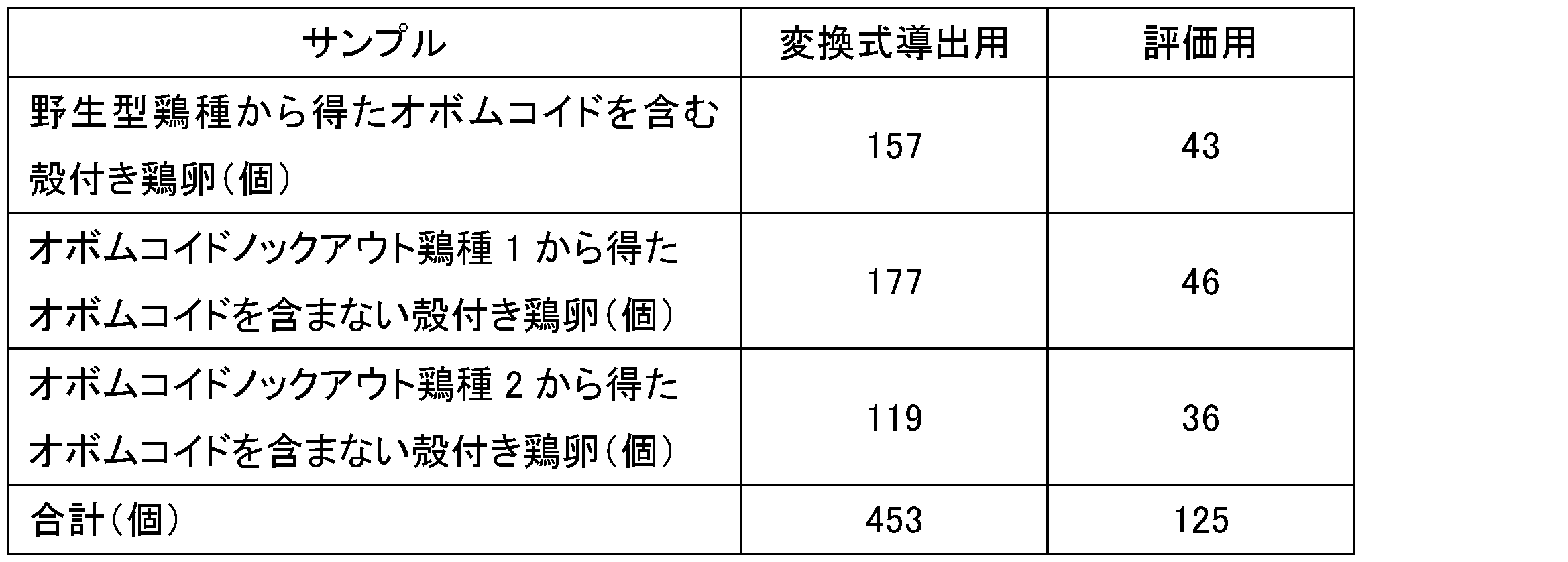
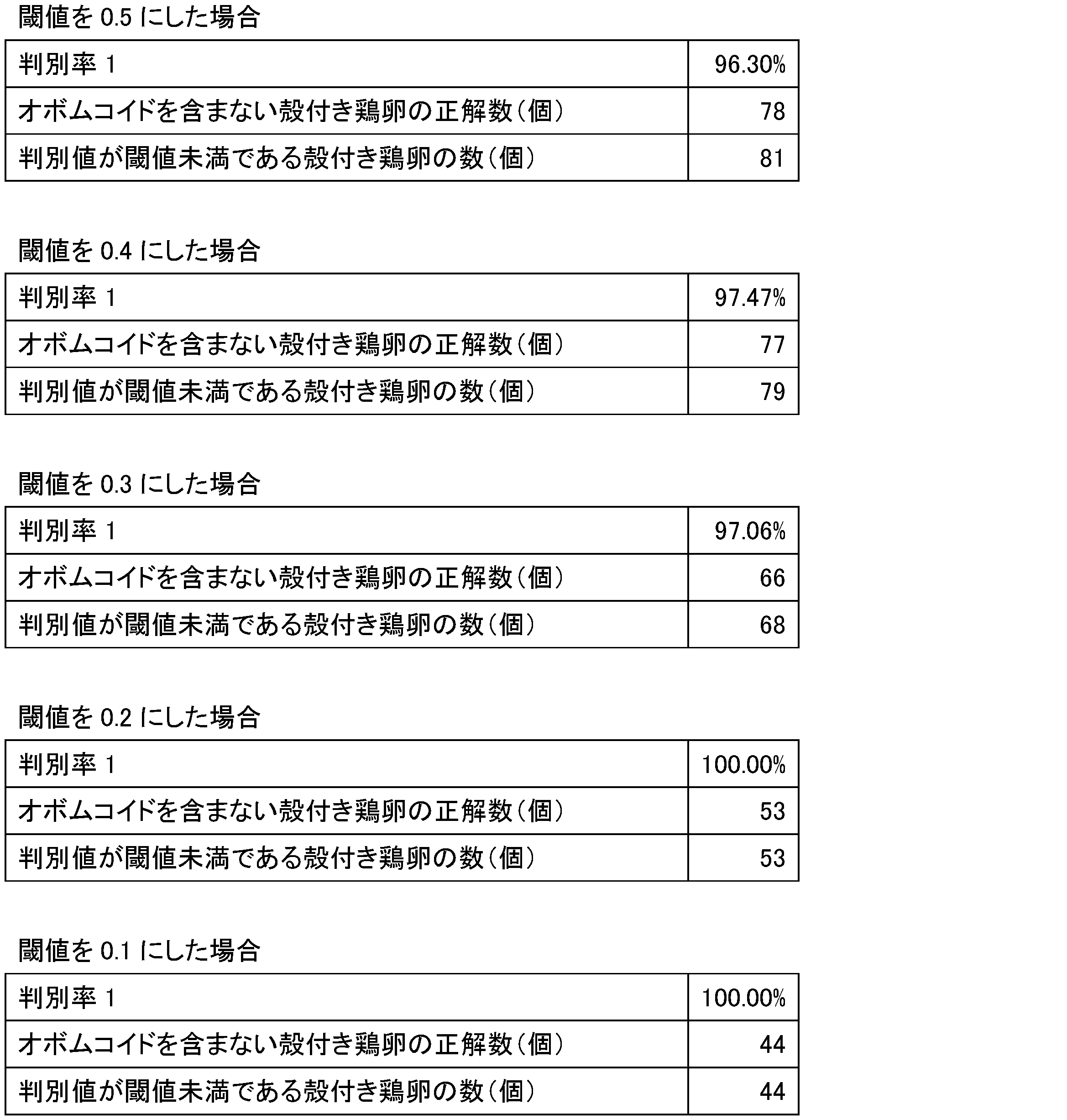
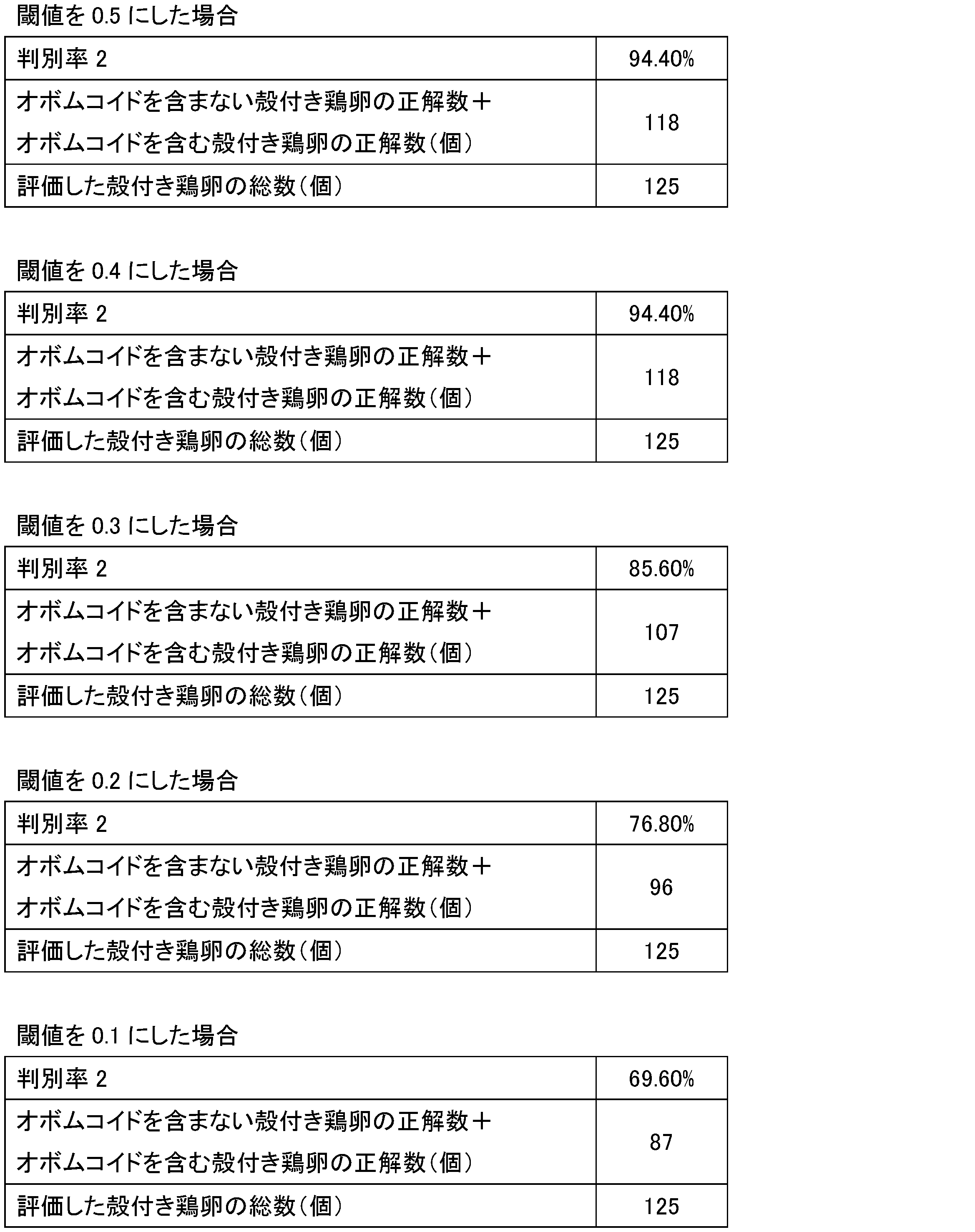
表2に示すとおり、閾値を0.5に設定した場合、判定率1は96.30%であった。また、閾値をより低い値に設定するにしたがって、判定率1はより高くなる傾向にあった。このことから、オボムコイドを含む殻付き鶏卵が、オボムコイドを含まない殻付き鶏卵として判定される(偽陽性)の数が減少しているためであると考えられる。この結果から、上記試験例1で行った方法により、高い精度でオボムコイドを含まない殻付き鶏卵を選別できることが示された。
さらに、表3に示すとおり、式(2)のような計算方法で算出した判定率2は、閾値をより低い値に設定するにしたがって、低くなる傾向にあった。これは、閾値を低くしていくにつれて、偽陽性が減っていく一方で、オボムコイドを含まない殻付き鶏卵が、オボムコイドを含む殻付き鶏卵として判定される(偽陰性)数が増加しているためであると考えられる。逆に、閾値をより高い値に設定するにしたがって、判定率2は高くなる傾向にある。これは、上記偽陰性となっていたオボムコイドを含まない殻付き鶏卵が減ったためであると考えられる。したがって、表2及び3の結果から、目的に応じて適宜閾値を設定して、高い精度でオボムコイドを含まない殻付き鶏卵を選別できることが示された。
[試験例2:オボムコイドを含まない殻付き鶏卵の判定(2)]
(1.変換式の導出)
変換式の導出は、殻付き鶏卵に照射する光の波長を変更したこと、それに伴って特定の波長の光における波長を変更したこと以外は試験例1と同様にして行った。下記表4に示す計119個の変換式導出用のオボムコイドを含む殻付き鶏卵及びオボムコイドを含まない殻付き鶏卵(共に非破壊状態の卵)について、波長800nm以上2500nm以下の光を照射して、特定の波長の光の吸光度(吸収スペクトル)を測定した。その後、吸光度の測定データを用いて変換式を導出した。導出した変換式のR2決定係数は0.701とかなり高い数値であり、変換式の適合度はかなり高かった。
(1.変換式の導出)
変換式の導出は、殻付き鶏卵に照射する光の波長を変更したこと、それに伴って特定の波長の光における波長を変更したこと以外は試験例1と同様にして行った。下記表4に示す計119個の変換式導出用のオボムコイドを含む殻付き鶏卵及びオボムコイドを含まない殻付き鶏卵(共に非破壊状態の卵)について、波長800nm以上2500nm以下の光を照射して、特定の波長の光の吸光度(吸収スペクトル)を測定した。その後、吸光度の測定データを用いて変換式を導出した。導出した変換式のR2決定係数は0.701とかなり高い数値であり、変換式の適合度はかなり高かった。
(2.オボムコイドを含まない殻付き鶏卵の判定)
オボムコイドを含まない殻付き鶏卵の判定は、殻付き鶏卵に照射する光の波長を変更したこと、それに伴って特定の波長の光における波長を変更したこと以外は試験例1と同様にして行った。下記表4に示す計29個の評価用のオボムコイドを含む殻付き鶏卵及びオボムコイドを含まない殻付き鶏卵(共に非破壊状態の卵)について、同様に波長800nm以上2500nm以下の光を照射した。次いで、特定の波長の光の吸光度(吸収スペクトル)を測定し、上記試験例2の1.で導出した変換式を用いて判別値を算出した後、当該判別値と閾値とを比較して、オボムコイドを含まない殻付き鶏卵であるか否かを判定した。上記式(1)で算出した判定率1を評価した結果を表5に示し、下記式(2)で算出した判定率2を評価した結果を表6に示す。
オボムコイドを含まない殻付き鶏卵の判定は、殻付き鶏卵に照射する光の波長を変更したこと、それに伴って特定の波長の光における波長を変更したこと以外は試験例1と同様にして行った。下記表4に示す計29個の評価用のオボムコイドを含む殻付き鶏卵及びオボムコイドを含まない殻付き鶏卵(共に非破壊状態の卵)について、同様に波長800nm以上2500nm以下の光を照射した。次いで、特定の波長の光の吸光度(吸収スペクトル)を測定し、上記試験例2の1.で導出した変換式を用いて判別値を算出した後、当該判別値と閾値とを比較して、オボムコイドを含まない殻付き鶏卵であるか否かを判定した。上記式(1)で算出した判定率1を評価した結果を表5に示し、下記式(2)で算出した判定率2を評価した結果を表6に示す。

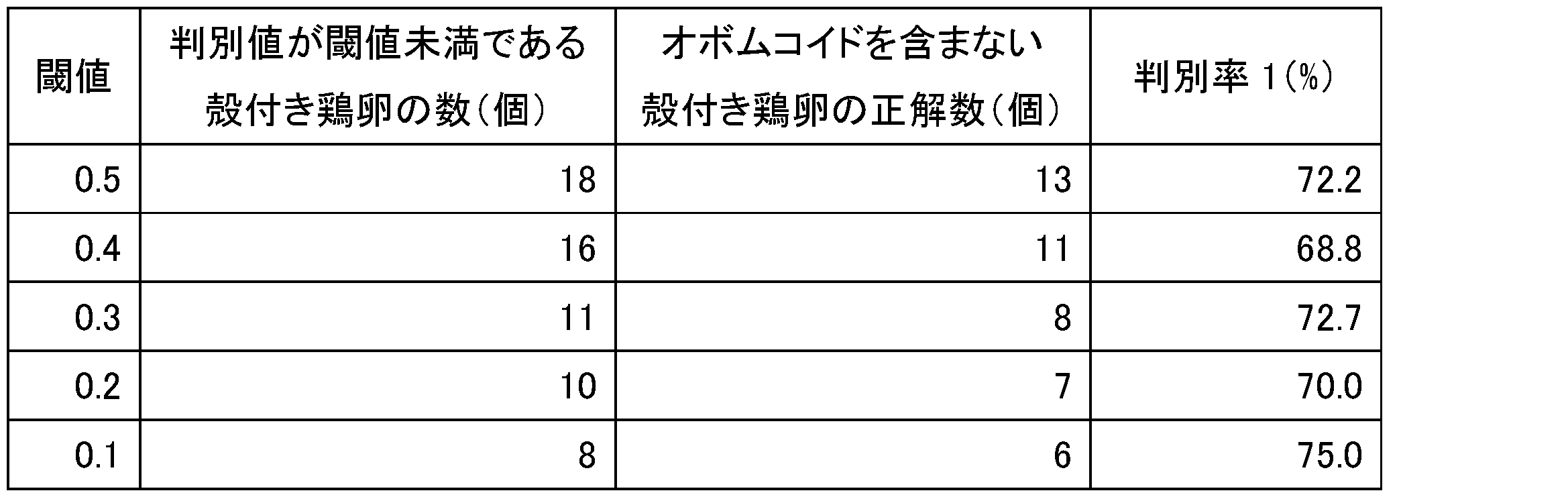

特定の波長の光における波長を変更しても、試験例1と同様の結果が得られた。閾値をより低い値に設定するにしたがって、判定率1はより高くなる傾向にあり、判定率2は低くなる傾向にあった。試験例2において導出した変換式は、試験例1で導出した変換式よりもR2決定係数が高いため、さらにロットを増やしていくことで、より判定精度は高くなると考えられる。以上の結果から、上記試験例2で行った方法によっても、高い精度でオボムコイドを含まない殻付き鶏卵を選別できることが示された。
Claims (5)
- 殻付き鶏卵の選別方法であって、
殻付き鶏卵に特定の波長の光を含む光を照射して、前記特定の波長の光の吸収量を測定する測定ステップ、
前記吸収量を変換式に代入することにより判別値を算出する算出ステップ、及び
前記判別値に基づいて、オボムコイドを含まない殻付き鶏卵を選別する選別ステップを含み、
前記変換式は、オボムコイドを含む殻付き鶏卵、及びオボムコイドを含まない殻付き鶏卵に対して、前記特定の波長の光の吸収量を測定した結果から導出された式である、
オボムコイドを含まない殻付き鶏卵の選別方法。 - 前記特定の波長の光は、波長310nm以上2500nm以下の範囲内に存在する光である、請求項1に記載の選別方法。
- 前記変換式は、部分的最小二乗判別分析により導出された式である、請求項1又は2に記載の選別方法。
- 前記変換式は、前記オボムコイドを含む殻付き鶏卵の判別値を1、前記オボムコイドを含まない殻付き鶏卵の判別値を0として部分的最小二乗判別分析により導出された式であり、
前記選別ステップは、前記算出ステップで算出した判別値が閾値未満の場合にオボムコイドを含まない殻付き鶏卵であるとして選別を行い、
前記閾値が、0超0.6以下の範囲内にある、請求項1又は2に記載の選別方法。 - オボムコイドを含まない殻付き鶏卵の製造方法であって、
請求項1又は2に記載の選別方法を実施して、オボムコイドを含まない殻付き鶏卵を選別する工程を備える、製造方法。
Applications Claiming Priority (2)
| Application Number | Priority Date | Filing Date | Title |
|---|---|---|---|
| JP2023-187783 | 2023-11-01 | ||
| JP2023187783A JP7445076B1 (ja) | 2023-11-01 | 2023-11-01 | オボムコイドを含まない殻付き鶏卵の選別方法 |
Publications (1)
| Publication Number | Publication Date |
|---|---|
| WO2025095071A1 true WO2025095071A1 (ja) | 2025-05-08 |
Family
ID=90096942
Family Applications (1)
| Application Number | Title | Priority Date | Filing Date |
|---|---|---|---|
| PCT/JP2024/038918 Pending WO2025095071A1 (ja) | 2023-11-01 | 2024-10-31 | オボムコイドを含まない殻付き鶏卵の選別方法 |
Country Status (2)
| Country | Link |
|---|---|
| JP (1) | JP7445076B1 (ja) |
| WO (1) | WO2025095071A1 (ja) |
Citations (2)
| Publication number | Priority date | Publication date | Assignee | Title |
|---|---|---|---|---|
| JP2006036669A (ja) * | 2004-07-26 | 2006-02-09 | Q P Corp | 卵アレルギー体質改善材または卵アレルギー予防材、およびこれらを用いた卵アレルギー体質改善用または卵アレルギー予防用加工食品 |
| JP6686216B1 (ja) * | 2018-11-29 | 2020-04-22 | キユーピー株式会社 | 殻付き鶏卵の選別方法、殻付き鶏卵の評価方法及びゆで卵の製造方法 |
-
2023
- 2023-11-01 JP JP2023187783A patent/JP7445076B1/ja active Active
-
2024
- 2024-10-31 WO PCT/JP2024/038918 patent/WO2025095071A1/ja active Pending
Patent Citations (2)
| Publication number | Priority date | Publication date | Assignee | Title |
|---|---|---|---|---|
| JP2006036669A (ja) * | 2004-07-26 | 2006-02-09 | Q P Corp | 卵アレルギー体質改善材または卵アレルギー予防材、およびこれらを用いた卵アレルギー体質改善用または卵アレルギー予防用加工食品 |
| JP6686216B1 (ja) * | 2018-11-29 | 2020-04-22 | キユーピー株式会社 | 殻付き鶏卵の選別方法、殻付き鶏卵の評価方法及びゆで卵の製造方法 |
Also Published As
| Publication number | Publication date |
|---|---|
| JP7445076B1 (ja) | 2024-03-06 |
| JP2025076086A (ja) | 2025-05-15 |
Similar Documents
| Publication | Publication Date | Title |
|---|---|---|
| Zhu et al. | Ripeness evaluation of ‘Sun Bright’tomato using optical absorption and scattering properties | |
| Barbin et al. | Prediction of chicken quality attributes by near infrared spectroscopy | |
| Ding et al. | Identification of broiler chicken meat using a visible/near‐infrared spectroscopic technique | |
| Prieto et al. | On-line application of visible and near infrared reflectance spectroscopy to predict chemical–physical and sensory characteristics of beef quality | |
| Pu et al. | Ripeness classification of bananito fruit (Musa acuminata, AA): A comparison study of visible spectroscopy and hyperspectral imaging | |
| Windham et al. | Visible/NIR spectroscopy for characterizing fecal contamination of chicken carcasses | |
| Stocco et al. | Accuracy and biases in predicting the chemical and physical traits of many types of cheeses using different visible and near-infrared spectroscopic techniques and spectrum intervals | |
| Fowler et al. | Preliminary investigation for the prediction of intramuscular fat content of lamb in-situ using a hand-held NIR spectroscopic device | |
| CN114136918B (zh) | 一种基于近红外的稻米食味品质评价方法 | |
| de Carvalho et al. | Occurrence of wooden breast and white striping in Brazilian slaughtering plants and use of near‐infrared spectroscopy and multivariate analysis to identify affected chicken breasts | |
| Canaza-Cayo et al. | A feasibility study of the classification of Alpaca (Lama pacos) wool samples from different ages, sex and color by means of visible and near infrared reflectance spectroscopy | |
| Ahmad et al. | Characterization of farinographic kneading process for different types of wheat flours using fluorescence spectroscopy and chemometrics | |
| ELLEKJAER et al. | Assessment of sensory quality of meat sausages using near infrared spectroscopy | |
| Wang et al. | Determining vitreous subclasses of hard red spring wheat using visible/near‐infrared spectroscopy | |
| Peng et al. | Application of near-infrared spectroscopy for assessing meat quality and safety | |
| Feng et al. | Detection of blood spots in eggs by hyperspectral transmittance imaging | |
| Bock et al. | Innovative uses of near‐infrared spectroscopy in food processing | |
| Bowling et al. | Using reflectance spectroscopy to predict beef tenderness | |
| DELWICHE et al. | Bread Quality of Wheat Flour by Near‐Infrared Spectrophotometry: Feasibility of Modeling | |
| Hashem et al. | Detection of adulteration of cattle and buffalo meat through NIRS and chemometric analysis | |
| WO2025095071A1 (ja) | オボムコイドを含まない殻付き鶏卵の選別方法 | |
| JP2002328088A (ja) | 近赤外分光法による異常肉の判別方法 | |
| Cai et al. | Detection of woody breast condition in broiler breast fillets using light scattering imaging | |
| Sun et al. | Rapid prediction of rice quality characteristics by near‐infrared reflectance spectroscopy for breeding programs | |
| CN114878545A (zh) | 一种基于拉曼光谱快速检测猪肉糜中tbars含量的方法 |
Legal Events
| Date | Code | Title | Description |
|---|---|---|---|
| 121 | Ep: the epo has been informed by wipo that ep was designated in this application |
Ref document number: 24885838 Country of ref document: EP Kind code of ref document: A1 |