WO2025088980A1 - 画像表示システム - Google Patents
画像表示システム Download PDFInfo
- Publication number
- WO2025088980A1 WO2025088980A1 PCT/JP2024/034445 JP2024034445W WO2025088980A1 WO 2025088980 A1 WO2025088980 A1 WO 2025088980A1 JP 2024034445 W JP2024034445 W JP 2024034445W WO 2025088980 A1 WO2025088980 A1 WO 2025088980A1
- Authority
- WO
- WIPO (PCT)
- Prior art keywords
- virtual
- door
- real
- data
- opening
- Prior art date
- Legal status (The legal status is an assumption and is not a legal conclusion. Google has not performed a legal analysis and makes no representation as to the accuracy of the status listed.)
- Pending
Links
Images


Classifications
-
- G—PHYSICS
- G06—COMPUTING OR CALCULATING; COUNTING
- G06F—ELECTRIC DIGITAL DATA PROCESSING
- G06F3/00—Input arrangements for transferring data to be processed into a form capable of being handled by the computer; Output arrangements for transferring data from processing unit to output unit, e.g. interface arrangements
- G06F3/01—Input arrangements or combined input and output arrangements for interaction between user and computer
-
- G—PHYSICS
- G06—COMPUTING OR CALCULATING; COUNTING
- G06F—ELECTRIC DIGITAL DATA PROCESSING
- G06F3/00—Input arrangements for transferring data to be processed into a form capable of being handled by the computer; Output arrangements for transferring data from processing unit to output unit, e.g. interface arrangements
- G06F3/01—Input arrangements or combined input and output arrangements for interaction between user and computer
- G06F3/048—Interaction techniques based on graphical user interfaces [GUI]
- G06F3/0484—Interaction techniques based on graphical user interfaces [GUI] for the control of specific functions or operations, e.g. selecting or manipulating an object, an image or a displayed text element, setting a parameter value or selecting a range
- G06F3/04845—Interaction techniques based on graphical user interfaces [GUI] for the control of specific functions or operations, e.g. selecting or manipulating an object, an image or a displayed text element, setting a parameter value or selecting a range for image manipulation, e.g. dragging, rotation, expansion or change of colour
-
- G—PHYSICS
- G06—COMPUTING OR CALCULATING; COUNTING
- G06T—IMAGE DATA PROCESSING OR GENERATION, IN GENERAL
- G06T19/00—Manipulating three-dimensional [3D] models or images for computer graphics
Definitions
- This disclosure relates to an image display system.
- Patent Document 1 discloses a system that allows users to experience mixed reality.
- an image of the real world captured by an imaging unit of a terminal device is displayed in real time on a display unit of the terminal device.
- a gate installed at a specified location is captured by the imaging unit, a virtual space different from reality is displayed inside the gate.
- the gate that connects to the virtual space is always open. Therefore, the virtual space displayed inside the gate is always visible to the user, making it difficult for the user to feel surprised when entering the virtual space, which may result in a decrease in user satisfaction.
- the present disclosure aims to provide an image display system that can improve user satisfaction with mixed reality experiences.
- An image display system includes an imaging unit and a display processing unit.
- the imaging unit captures an image of a real space in which a real opening/closing object that can be opened and closed is arranged.
- the display processing unit displays one virtual object determined from among the multiple virtual objects so as to be superimposed on the real opening/closing object.
- the display processing unit displays one virtual space corresponding to one virtual object from among multiple virtual spaces corresponding to each of the multiple virtual objects, at the opening portion of the opening/closing object.
- a virtual space appears in the opening when the opening/closing object goes from a closed state to an open state, so the appearance of the virtual space is linked to the user's tactile action of opening the real opening/closing object. This allows the user to feel that the virtual experience is more realistic. Furthermore, because a virtual object corresponding to the virtual space is superimposed on the real opening/closing object, the user can experience mixed reality even before opening the opening/closing object. This improves user satisfaction with mixed reality.
- an image display system that can improve a user's satisfaction with a mixed reality experience.
- FIG. 1 is a schematic diagram showing an example image display system.
- FIG. 2 is a diagram illustrating an example of an image visually recognized by a user in the example image display system.
- FIG. 3 is a flow chart for explaining the process of an example of an image display system.
- FIG. 4 is a diagram showing a hardware configuration of an example of a terminal device and a server that constitute an image construction system.
- the image display system 1 is a schematic diagram showing an example of an image display system.
- the image display system 1 (mixed reality providing system) is a system that provides a user with an experience of mixed reality (MR: Mixed Reality) by providing the user with an image in which a virtual object is displayed together with a real space.
- a virtual object is an object that is displayed virtually, and is virtual content that does not actually exist at the user's current location.
- the content may be, for example, any display information represented as a three-dimensional image.
- a virtual space that does not include a real space is provided to the user, so that the user can experience virtual reality (VR: Virtual Reality).
- the virtual space may be an image that represents in three dimensions a place different from the user's current location.
- the virtual space may also be an image that represents in three dimensions an imaginary place that does not actually exist in the real world.
- an image includes a still image and a video (image).
- An example image display system 1 may include a terminal device 10 used by a user and a server 20 (mixed reality providing device).
- the terminal device 10 and the server 20 may be communicatively connected to each other via a communication network.
- the communication network may include the so-called Internet, or may include an intranet.
- the terminal device 10 is a terminal that presents mixed reality to the user.
- the form of the terminal device 10 is not limited to a specific form.
- the terminal device 10 may be a wearable device that is worn on the user's head.
- the wearable device may include a remote control as an input device.
- Examples of wearable devices include head-mounted displays (HMDs) such as glasses-type devices (for example, smart glasses such as so-called MR glasses), goggle-type devices, and hat-type devices.
- the terminal device 10 may also be a mobile terminal such as a smartphone or a tablet.
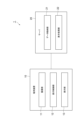
- the terminal device 10 has at least an imaging unit 11, a display control unit 12, and a display unit 13.
- the imaging unit 11 acquires an image of real space.
- the imaging unit 11 may be configured to include, for example, a camera (image sensor).
- the imaging unit 11 is disposed as part of the wearable device so as to acquire an image of real space corresponding to the user's line of sight.
- the imaging unit 11 is disposed on the front part of the wearable device, and acquires an image in the direction in which the user is looking in real time.
- the imaging unit 11 may include a depth sensor. The depth sensor measures the distance to each object shown in the image acquired by the imaging unit 11. This makes it possible to acquire three-dimensional information of the real space and to position and display virtual objects based on that information.
- the display control unit 12 integrates the image data of the real space input from the imaging unit 11 and the image data of the virtual environment sent from the server 20 to generate display image data.
- the display control unit 12 outputs the generated display image data to the display unit 13.
- the display unit 13 displays an image based on the display image data input from the display control unit 12.
- the display unit 13 is a display arranged in front of both eyes of the user.
- the display unit 13 may be composed of, for example, a liquid crystal display element, an organic EL (Electro Luminescence) element, etc.
- the display unit 13 may have a right-eye display arranged in front of the user's right eye, and a left-eye display arranged in front of the user's left eye, separately.
- the display unit 13 is composed of a touch panel display.
- the display unit 13 is composed of a video see-through display, and can display images acquired in real time by the imaging unit 11.
- FIG. 2 is a diagram that shows a schematic example of an image provided to a user in an example of an image display system 1.
- a real door 30 an example of a real opening and closing object
- an image SP2 is displayed in which a decorated virtual door 40 (an example of a virtual object) is superimposed on the door 30, and when the door 30 is opened by the user, a virtual space 45 is displayed behind the opening 35 (image SP3).
- a real opening and closing object may be an object that can be switched between a closed state that blocks a specific area and an open state that exposes the specific area in real space.
- a door as an opening and closing object may be a sliding door that slides left and right.
- a door as an opening and closing object may be an automatic opening and closing door that is controlled to open and close by a human sensor, a push button, or the like.
- An example of a virtual object may be a virtually displayed opening and closing object (for example, a door, an automatic door, a window, a vehicle door, etc.).
- the virtually displayed opening and closing object may be decorated. The decoration may be changed based on any of the theme of the virtual space, environmental information, etc., which will be described later.
- superimposition means that at least a part of the object overlaps.
- the virtual object when a virtual object is superimposed on a real object, it is sufficient that the virtual object is displayed so that at least a part of the virtual object overlaps with the real object.
- the virtual object may be displayed so that it exactly matches the shape of the real object, or the virtual object may be displayed so that it overlaps with a part of the real object.
- the server 20 in one example has, for example, a data storage unit 21 and a display processing unit 22.
- the data storage unit 21 has a plurality of types of virtual environment data sets to be output to the terminal device 10.
- Each data set includes data constituting the virtual space 45 and data constituting the virtual door 40.
- the data constituting the virtual space 45 may be three-dimensional image data of a place different from the user's current location, and may include environmental data of that place (e.g., lighting conditions, sounds, etc.).
- the data constituting the virtual space 45 may be updateable in real time. Note that this data set is one example.
- the data set may include information about a time period, such as the present, 10 years ago, or 20 years ago.
- the data constituting the virtual door 40 includes body data 41 and handle data 43.
- Body data 41 may be three-dimensional data constituting a rectangular plate-shaped door body, and may include data on the door shape, color (color, pattern, design), etc.
- Handle data 43 may include data on the handle shape, color, etc.
- the corresponding virtual space 45 data and virtual door 40 data constituting the virtual environment data set may be a combination that evokes conceptual similarity. That is, the two elements of the virtual space 45 data and the virtual door 40 data can be combined in a manner that corresponds to each other.
- the combination of the virtual space 45 data and the virtual door 40 data may have abstract or concrete commonalities, associations, etc. In other words, the corresponding virtual space 45 data and virtual door 40 data may have a common theme.
- the data for the virtual doors may have color data for either a color corresponding to "outdoors” (e.g., blue (the color of the sky)) or a color corresponding to "indoors” (e.g., white (the color of the walls)).
- the data for the virtual spaces is then combined with the data for the virtual doors, which have colors according to their classification, to form a dataset.
- the theme of a virtual environment is not limited to "outdoors” and "indoors”.
- the theme of a virtual environment may be information indicating the type of virtual environment (e.g., location, facility, situation, condition, time of day, era, etc.).
- the theme of a virtual environment may be a theme related to a location such as “coast”, “mountain”, or “city”, a theme related to the surrounding environment such as “bustling”, “normal”, or “quiet”, a theme related to a time such as “morning", “noon”, “evening", or “night”, or a theme related to a season such as “spring”, “summer”, “autumn", or “winter”.
- the theme of the virtual environment may also directly indicate the virtual space.
- the virtual space data and the virtual door data may be configured as a combination that is thematically associated with each other.
- the virtual space is configured with "forest” data
- the virtual door may be configured with "wooden door” data.
- the virtual door may be configured with data that forms a design reminiscent of the door of a temple (main hall).
- the theme of the virtual environment may also be used in a composite manner. For example, if the theme of the virtual environment includes information about "light” in the virtual space, the color of the decoration of the virtual door may be changed according to the "light” information. As an example, if the "light” information is “dark,” the color tone of the virtual door may be changed to a darker color, and conversely, if the "light” information is "bright,” the color tone of the virtual door may be changed to a brighter color.
- the display processing unit 22 outputs image data of the virtual environment to the terminal device 10.
- the display processing unit 22 acquires an image SP1 captured by the imaging unit 11 of the terminal device 10, and recognizes a real door 30 in the image.
- the display processing unit 22 may generate three-dimensional map data of the real space based on the acquired image SP1.
- the display processing unit 22 may generate three-dimensional map data of the real space using Visual SLAM (Simultaneous Localization And Mapping) technology.
- the display processing unit 22 may generate three-dimensional map data by comparing feature point group data collected in advance by a sensor (camera, laser, etc.) in the real space with information on feature points extracted by the imaging unit 11 of the terminal device 10.
- the display processing unit 22 may, for example, use a pre-trained learning device to recognize (or display) the real door 30.
- learning may be performed using a data set (teacher data) consisting of images of multiple doors.
- This data set may include any one or a combination of images of doors taken under various conditions, such as the door shape, color, material, and lighting conditions.
- the learning device can recognize the door in the image input from the imaging unit 11 by learning, such as deep learning, using this data set.
- the display processing unit 22 may use SLAM technology to obtain information such as the position, orientation, and degree of opening and closing of the real door 30.
- the real door 30 may be provided with a sensor for measuring the degree of opening and closing of the door.
- the display processing unit 22 may obtain the detection value of the sensor and determine the degree of opening and closing of the door 30 based on the detection value.
- the display processing unit 22 displays one virtual space 45 selected from the multiple virtual spaces stored in the data storage unit 21 behind the opening 35 of the door 30 in the image displayed on the display unit 13.
- the virtual space 45 to be displayed may be selected by the user.
- a list of virtual spaces may be displayed on the display unit 13 of the terminal device 10 in response to a user's operation.
- the list of virtual spaces may be a list of titles associated with the virtual spaces (for example, "shrine,” “scenic spot,” “temple,” etc., or specific proper nouns).
- the user can select the title of the desired virtual space from the displayed list using an input device or the like.
- Information (input information) related to the title selected by the user may be input to the display processing unit 22.
- the display processing unit 22 determines the virtual space to be displayed based on the input information.
- the display processing unit 22 integrates the three-dimensional map data of the real space and the three-dimensional map data of the virtual space, and arranges (or displays) the virtual space 45 in the spatial area including the real door 30.
- the display processing unit 22 determines whether the image visible to the user (terminal device 10) includes the back of the door 30 (the inside of the opening 35 (which may be called the opening portion)), and if the back of the door 30 is included, generates image data that displays the area of the virtual space 45 corresponding to the back of the door 30 visible to the user and does not display the other areas of the virtual space 45.
- This can generate a mixed reality in which the outside of the opening 35 is the real world and the inside of the opening 35 is the virtual world from the user's viewpoint.
- the display processing unit 22 may obtain the degree of opening/closing of the real door 30 based on the image obtained by the imaging unit 11, and determine whether the real door 30 is open or not.
- the display processing unit 22 superimposes the virtual door 40 on the real door 30 displayed on the display unit 13.
- the display processing unit 22 superimposes the virtual door 40 corresponding to the virtual space 45 displayed behind the real door 30 on the real door 30.
- the display processing unit 22 acquires the data of the virtual door 40 corresponding to the determined virtual space 45.
- the display processing unit 22 acquires the data of the virtual door 40 having a common theme with the virtual space 45 selected by the user.
- the display processing unit 22 generates image data in which the virtual door 40 is arranged on the three-dimensional map data so that the image of the acquired virtual door 40 is superimposed on the image of the real door 30.
- the display unit 13 displays the virtual door 40 so as to be superimposed on the real door 30.
- the display processing unit 22 may adjust the size of the virtual door 40 to match the real door 30.
- the display processing unit 22 acquires the size of the door body 31 of the real door 30 using SLAM technology based on image data acquired by the imaging unit 11.
- the display processing unit 22 also acquires the size of the handle 33 of the real door 30 and the position of the handle 33 relative to the door body 31 (the relative positional relationship between the door body and the handle) using SLAM technology.
- the display processing unit 22 then adjusts the size of the door body (body data 41) of the virtual door 40 stored in the data storage unit 21 to be the same as the size of the door body 31 of the real door 30, and superimposes it on the real door 30.
- the display processing unit 22 adjusts the size of the handle (handle data 43) of the virtual door 40 stored in the data storage unit 21 to be the same as the size of the handle 33 of the real door 30, and integrates the main body data 41 and the handle data 43 so that the handle of the virtual door 40 is superimposed on the position of the handle 33 of the real door 30.
- the real space is imaged by the imaging unit 11 of the terminal device 10 held (worn) by the user, and the image data is acquired by the server 20 (step S1).
- the display control unit 12 may output the image data of the real space to the display unit 13 in real time and cause the display unit 13 to display the image of the real space (see image SP1 in FIG. 2).
- the display processing unit 22 determines the door 30 from the image of the image data input to the server 20 (step S2), and superimposes the virtual door 40 at the position of the real door 30 on the three-dimensional map data generated based on the image data (step S3).
- the data of the virtual door 40 superimposed on the three-dimensional map data by the display processing unit 22 may be input to the display control unit 12 of the terminal device 10.
- the display control unit 12 integrates the data of the virtual door 40 and the image data of the real space to generate display image data.
- an image of the real space with the virtual door 40 superimposed thereon is displayed on the display unit 13 (see image SP2 in FIG. 2).
- the display processing unit 22 acquires the degree of opening/closing of the real door 30 based on the input image data of the real space (step S4).
- the display processing unit 22 outputs image data generated so that the virtual space 45 is displayed behind the opening 35 of the door 30 to the display control unit 12 of the terminal device 10.
- the display control unit 12 integrates the image data of the virtual space and the image data of the real space to generate display image data.
- a mixed reality image SP3 in which the virtual space 45 can be seen behind the opening of the virtual door 40 arranged in the real space is displayed on the display unit 13 (step S5). Note that when the user goes beyond the opening of the door 30, a virtual reality based on a virtual space that does not include an image of the real space may be provided to the user.
- the image display system 1 includes an imaging unit 11 and a display processing unit 22.
- the imaging unit 11 captures an image of a real space in which a real door 30 that can be opened and closed is arranged.
- the display processing unit 22 displays a virtual object so as to be superimposed on the real door 30, and when the real door 30 is in an open state, displays a virtual space corresponding to the virtual object at the opening portion of the door 30. More specifically, when the real door 30 is in an open state, the display processing unit 22 displays one virtual space corresponding to the virtual object superimposed on the door 30 from among a plurality of virtual spaces corresponding to each of the plurality of virtual objects at the opening portion of the door 30.
- the display processing unit 22 displays one virtual door 40 determined from among the plurality of virtual doors so as to be superimposed on the real door 30. Then, when the real door 30 is in an open state, the display processing unit 22 displays one virtual space 45 corresponding to one virtual door 40 from among a plurality of virtual spaces corresponding to each of the plurality of virtual doors at the opening portion of the door 30.
- the virtual space 45 appears behind the opening 35 when the door 30 is opened from the closed state, so that the user's tactile action of opening the real door 30 is linked to the appearance of the virtual space 45. This allows the user to feel the virtual experience more realistically. Furthermore, when the real door 30 is closed, the virtual door 40 corresponding to the virtual space 45 is superimposed on the real door 30, so the user can feel that the entrance to the virtual space 45 is integrated with the real door 30 even before opening the door 30. This makes the transition to the virtual space 45 smoother, and increases the sense of immersion in the mixed reality. Furthermore, the virtual door 40 is superimposed on the real door 30, so the user can naturally feel the boundary between reality and virtuality, and the reality of the virtual space is improved. Furthermore, the operation of entering the virtual space 45 by opening the virtual door 40 is intuitive for the user and has high operability. In this way, the image display system 1 can provide users with an advanced mixed reality experience, improving user satisfaction with mixed reality.
- the multiple virtual spaces may each have a specific theme.
- the corresponding virtual spaces 45 and virtual doors 40 have a common theme.
- the virtual door 40 allows the user to feel the virtual space 45 that spreads out behind the door 30 even before the door 30 is opened, allowing the user to experience a deeper sense of immersion.
- the virtual door 40 visible in real space and the virtual space 45 that appears after the door is opened have a common theme, a smooth transition from real space to virtual space is achieved.
- the real door 30 may have a door body 31 and a handle 33 provided on the door body 31.
- the virtual door 40 may have body data 41 corresponding to the door body 31 and handle data 43 corresponding to the handle 33.
- the display processing unit 22 matches the size of the body data 41 (the size of the door body displayed by the body data 41) to the size of the door body 31, matches the size of the handle data 43 (the size of the handle displayed by the handle data 43) to the size of the handle 33, and integrates the handle data 43 into the body data 41 so that the position of the handle data 43 is superimposed on the handle 33.
- the user since it is possible to superimpose virtual doors on doors of various sizes, it is possible to experience mixed reality using any door, not just dedicated doors installed at event venues, etc.
- the user since it is possible to get the feeling of operating a virtual handle by operating the real handle 33, the user can access the virtual space with natural movements.
- the display processing unit 22 may change the type of virtual door depending on the type of virtual space displayed in the opening.
- the virtual door changes every time the type of virtual space is changed, so the user can intuitively understand the new type of virtual space through the changing virtual door.
- the display processing unit 22 may determine which of a plurality of virtual spaces is to be displayed at the opening of the door 30, based on input information input by the user. In this configuration, the virtual door to be superimposed on the door 30 is determined according to the virtual space selected by the user.
- the recognition of the door 30 may be performed by other methods.
- the real door may be determined (specified) by the user from among the real image SP1 displayed on the display unit 13.
- the display processing unit 22 may be able to display the virtual door 40 near the real door 30.
- the display processing unit 22 may be able to display the virtual door 40 so that it is adjacent to the real door 30.
- the virtual door 40 may be displayed to open and close in response to the opening and closing of the real door 30.
- the user may be able to select a virtual door 40 to be superimposed on the real door 30.
- the user may be able to arbitrarily select a virtual door 40 to be superimposed on the real door 30 in response to an operation by the user.
- the user may be able to sequentially switch between the virtual doors 40 to be superimposed on the real door 30 by an instruction from an input device or the like, and may decide the selection of the virtual door by the input device or the like at the timing of switching to the desired virtual door.
- Information (input information) of the virtual door selected by the user may be input to the display processing unit 22.
- the display processing unit 22 decides the virtual door to be superimposed based on the input information.
- the virtual space 45 displayed behind the virtual door 40 corresponds to the virtual door 40 selected by the user.
- the display processing unit 22 can acquire data of the virtual space 45 corresponding to the virtual door 40 selected by the user from the data storage unit.
- each functional block may be realized using one device that is physically or logically coupled, or may be realized using two or more devices that are physically or logically separated and connected directly or indirectly (for example, using wires, wirelessly, etc.) and these multiple devices.
- the functional blocks may be realized by combining the one device or the multiple devices with software.
- Functions include, but are not limited to, judgement, determination, judgment, calculation, computation, processing, derivation, investigation, search, confirmation, reception, transmission, output, access, resolution, selection, election, establishment, comparison, assumption, expectation, regarding, broadcasting, notifying, communicating, forwarding, configuring, reconfiguring, allocating, mapping, and assignment.
- a functional block (component) that performs the transmission function is called a transmitting unit or transmitter.
- the terminal device 10 and server 20 in one embodiment of the present disclosure may function as a computer that performs the processing of the present disclosure.
- FIG. 4 is a diagram showing an example of the hardware configuration of the terminal device 10 and server 20 in one embodiment of the present disclosure.
- the terminal device 10 and server 20 described above may be physically configured as a computer device including a processor 1001, memory 1002, storage 1003, communication device 1004, input device 1005, output device 1006, bus 1007, etc.
- the word “apparatus” can be interpreted as a circuit, device, unit, etc.
- the hardware configuration of the terminal device 10 and the server 20 may be configured to include one or more of the devices shown in the figure, or may be configured to exclude some of the devices.
- the functions of the terminal device 10 and the server 20 are realized by loading specific software (programs) onto hardware such as the processor 1001 and memory 1002, causing the processor 1001 to perform calculations, control communications via the communication device 1004, and control at least one of the reading and writing of data in the memory 1002 and storage 1003.
- the processor 1001 for example, operates an operating system to control the entire computer.
- the processor 1001 may be configured as a central processing unit (CPU) including an interface with peripheral devices, a control device, an arithmetic unit, registers, etc.
- CPU central processing unit
- the above-mentioned display control unit 12, display processing unit 22, etc. may be realized by the processor 1001.
- the processor 1001 also reads out programs (program codes), software modules, data, etc. from at least one of the storage 1003 and the communication device 1004 into the memory 1002, and executes various processes according to these.
- the programs used are those that cause a computer to execute at least some of the operations described in the above-mentioned embodiments.
- the display control unit 12 may be realized by a control program stored in the memory 1002 and running on the processor 1001, and similarly may be realized for other functional blocks.
- the above-mentioned various processes have been described as being executed by one processor 1001, they may be executed simultaneously or sequentially by two or more processors 1001.
- the processor 1001 may be implemented by one or more chips.
- the programs may be transmitted from a network via a telecommunications line.
- Memory 1002 is a computer-readable recording medium, and may be composed of at least one of, for example, ROM (Read Only Memory), EPROM (Erasable Programmable ROM), EEPROM (Electrically Erasable Programmable ROM), RAM (Random Access Memory), etc. Memory 1002 may also be called a register, cache, main memory (primary storage device), etc. Memory 1002 can store executable programs (program codes), software modules, etc. for implementing a wireless communication method according to one embodiment of the present disclosure.
- ROM Read Only Memory
- EPROM Erasable Programmable ROM
- EEPROM Electrical Erasable Programmable ROM
- RAM Random Access Memory
- Memory 1002 may also be called a register, cache, main memory (primary storage device), etc.
- Memory 1002 can store executable programs (program codes), software modules, etc. for implementing a wireless communication method according to one embodiment of the present disclosure.
- Storage 1003 is a computer-readable recording medium, and may be composed of at least one of, for example, an optical disk such as a CD-ROM (Compact Disc ROM), a hard disk drive, a flexible disk, a magneto-optical disk (e.g., a compact disk, a digital versatile disk, a Blu-ray (registered trademark) disk), a smart card, a flash memory (e.g., a card, a stick, a key drive), a floppy (registered trademark) disk, a magnetic strip, etc.
- Storage 1003 may also be referred to as an auxiliary storage device.
- the above-mentioned storage medium may be, for example, a database, a server, or other suitable medium including at least one of memory 1002 and storage 1003.
- the communication device 1004 is hardware (transmitting/receiving device) for communicating between computers via at least one of a wired network and a wireless network, and is also referred to as, for example, a network device, a network controller, a network card, a communication module, etc.
- the communication device 1004 may be configured to include a high-frequency switch, a duplexer, a filter, a frequency synthesizer, etc., to realize, for example, at least one of Frequency Division Duplex (FDD) and Time Division Duplex (TDD).
- FDD Frequency Division Duplex
- TDD Time Division Duplex
- the input device 1005 is an input device (e.g., a keyboard, a mouse, a microphone, a switch, a button, a sensor, etc.) that accepts input from the outside.
- the output device 1006 is an output device (e.g., a display, a speaker, an LED lamp, etc.) that performs output to the outside. Note that the input device 1005 and the output device 1006 may be integrated into one structure (e.g., a touch panel).
- the terminal device 10 and the server 20 may be configured to include hardware such as a microprocessor, a digital signal processor (DSP), an application specific integrated circuit (ASIC), a programmable logic device (PLD), or a field programmable gate array (FPGA), and some or all of the functional blocks may be realized by the hardware.
- the processor 1001 may be implemented using at least one of these pieces of hardware.
- the input and output information may be stored in a specific location (e.g., memory) or may be managed using a management table.
- the input and output information may be overwritten, updated, or added to.
- the output information may be deleted.
- the input information may be sent to another device.
- the determination may be based on a value represented by one bit (0 or 1), a Boolean value (true or false), or a numerical comparison (e.g., a comparison with a predetermined value).
- notification of specific information is not limited to being done explicitly, but may be done implicitly (e.g., not notifying the specific information).
- Software shall be construed broadly to mean instructions, instruction sets, code, code segments, program code, programs, subprograms, software modules, applications, software applications, software packages, routines, subroutines, objects, executable files, threads of execution, procedures, functions, etc., whether referred to as software, firmware, middleware, microcode, hardware description language, or otherwise.
- Software, instructions, information, etc. may also be transmitted and received via a transmission medium.
- a transmission medium For example, if the software is transmitted from a website, server, or other remote source using at least one of wired technologies (such as coaxial cable, fiber optic cable, twisted pair, Digital Subscriber Line (DSL)), and/or wireless technologies (such as infrared, microwave), then at least one of these wired and wireless technologies is included within the definition of a transmission medium.
- wired technologies such as coaxial cable, fiber optic cable, twisted pair, Digital Subscriber Line (DSL)
- wireless technologies such as infrared, microwave
- the information, signals, etc. described in this disclosure may be represented using any of a variety of different technologies.
- the data, instructions, commands, information, signals, bits, symbols, chips, etc. that may be referred to throughout the above description may be represented by voltages, currents, electromagnetic waves, magnetic fields or magnetic particles, optical fields or photons, or any combination thereof.
- system and “network” are used interchangeably.
- information, parameters, etc. described in this disclosure may be expressed using absolute values, may be expressed using relative values from a predetermined value, or may be expressed using other corresponding information.
- determining may encompass a wide variety of actions.
- Determining and “determining” may include, for example, judging, calculating, computing, processing, deriving, investigating, looking up, search, inquiry (e.g., searching in a table, database, or other data structure), ascertaining something that is deemed to be a “judging” or “determining,” and the like.
- Determining and “determining” may also include receiving (e.g., receiving information), transmitting (e.g., sending information), input, output, accessing (e.g., accessing data in memory), and the like.
- judgment and “decision” can include considering resolving, selecting, choosing, establishing, comparing, etc., to have been “judged” or “decided.” In other words, “judgment” and “decision” can include considering some action to have been “judged” or “decided.” Additionally, “judgment” can be interpreted as “assuming,” “expecting,” “considering,” etc.
- connection refers to any direct or indirect connection or coupling between two or more elements, and may include the presence of one or more intermediate elements between two elements that are “connected” or “coupled” to each other.
- the coupling or connection between elements may be physical, logical, or a combination thereof.
- “connected” may be read as "access”.
- two elements may be considered to be “connected” or “coupled” to each other using at least one of one or more wires, cables, and printed electrical connections, as well as electromagnetic energy having wavelengths in the radio frequency range, microwave range, and optical (both visible and invisible) range, as some non-limiting and non-exhaustive examples.
- the phrase “based on” does not mean “based only on,” unless expressly stated otherwise. In other words, the phrase “based on” means both “based only on” and “based at least on.”
- any reference to an element using a designation such as "first,” “second,” etc., used in this disclosure does not generally limit the quantity or order of those elements. These designations may be used in this disclosure as a convenient method of distinguishing between two or more elements. Thus, a reference to a first and a second element does not imply that only two elements may be employed or that the first element must precede the second element in some way.
- a and B are different may mean “A and B are different from each other.”
- the term may also mean “A and B are each different from C.”
- Terms such as “separate” and “combined” may also be interpreted in the same way as “different.”
Landscapes
- Engineering & Computer Science (AREA)
- General Engineering & Computer Science (AREA)
- Theoretical Computer Science (AREA)
- Physics & Mathematics (AREA)
- General Physics & Mathematics (AREA)
- Human Computer Interaction (AREA)
- Computer Graphics (AREA)
- Computer Hardware Design (AREA)
- Software Systems (AREA)
- Processing Or Creating Images (AREA)
Priority Applications (1)
| Application Number | Priority Date | Filing Date | Title |
|---|---|---|---|
| JP2025552890A JPWO2025088980A1 (https=) | 2023-10-27 | 2024-09-26 |
Applications Claiming Priority (2)
| Application Number | Priority Date | Filing Date | Title |
|---|---|---|---|
| JP2023184488 | 2023-10-27 | ||
| JP2023-184488 | 2023-10-27 |
Publications (1)
| Publication Number | Publication Date |
|---|---|
| WO2025088980A1 true WO2025088980A1 (ja) | 2025-05-01 |
Family
ID=95515627
Family Applications (1)
| Application Number | Title | Priority Date | Filing Date |
|---|---|---|---|
| PCT/JP2024/034445 Pending WO2025088980A1 (ja) | 2023-10-27 | 2024-09-26 | 画像表示システム |
Country Status (2)
| Country | Link |
|---|---|
| JP (1) | JPWO2025088980A1 (https=) |
| WO (1) | WO2025088980A1 (https=) |
Citations (1)
| Publication number | Priority date | Publication date | Assignee | Title |
|---|---|---|---|---|
| JP2018109835A (ja) * | 2016-12-28 | 2018-07-12 | 株式会社バンダイナムコエンターテインメント | シミュレーションシステム及びプログラム |
-
2024
- 2024-09-26 WO PCT/JP2024/034445 patent/WO2025088980A1/ja active Pending
- 2024-09-26 JP JP2025552890A patent/JPWO2025088980A1/ja active Pending
Patent Citations (1)
| Publication number | Priority date | Publication date | Assignee | Title |
|---|---|---|---|---|
| JP2018109835A (ja) * | 2016-12-28 | 2018-07-12 | 株式会社バンダイナムコエンターテインメント | シミュレーションシステム及びプログラム |
Non-Patent Citations (3)
| Title |
|---|
| FAN, Kevin, 杉浦裕太, 神山洋一, 南澤孝太, 稲見昌彦, Dokodemo Door: A Doorway to Alternate Realities, エンタテインメントコンピューティング2014, [online], 12 September 2014, [retrieved on 05 December 2024], Internet<URL:http://id.nii.ac.jp/1001/00102947>, (SUGIURA, Yuta, KAMIYAMA, Yoichi, MINAMIZAWA, Kouta, INAMI, Masahiko, Entertainment Computing 2014) * |
| INTERNETTENJIKAI TV / WORLD TRADE SHOW TV: "[レジャージャパン 2019] ARコンテンツ「XR Door」 - KDDI株式会社", 9 December 2019 (2019-12-09), XP093309283, Retrieved from the Internet <URL:https://www.youtube.com/watch?v=Rzvy6VeW3Kg> * |
| TSUBASA TERAUCHI: "Emotion Door: Designing VR Content That Progresses with Each Door Opening and Closing", ENTERTAINMENT COMPUTING SYMPOSIUM 2018, JP, 18 September 2018 (2018-09-18), JP, pages 24 - 28, XP009564022 * |
Also Published As
| Publication number | Publication date |
|---|---|
| JPWO2025088980A1 (https=) | 2025-05-01 |
Similar Documents
| Publication | Publication Date | Title |
|---|---|---|
| US11500533B2 (en) | Mobile terminal for displaying a preview image to be captured by a camera and control method therefor | |
| US10467776B2 (en) | Information processing method and apparatus, terminal, and storage medium | |
| KR20200122362A (ko) | 혼합 현실 시스템들을 위한 브라우저 | |
| US11609541B2 (en) | System and method of IOT device control using augmented reality | |
| WO2015099293A1 (en) | Device and method for displaying user interface of virtual input device based on motion recognition | |
| KR20190035116A (ko) | Ar 객체를 표시하기 위한 장치 및 방법 | |
| US12094356B2 (en) | Colorblind assistive technology system and method to improve image rendering by generating a color translation table for color vision deficient users | |
| JP6105627B2 (ja) | Ocrキャッシュ更新 | |
| CN111833423A (zh) | 展示方法、装置、设备和计算机可读存储介质 | |
| WO2021218309A1 (zh) | 一种设置项处理方法、装置及计算机可读存储介质 | |
| CN108635859A (zh) | 用于图像染色的方法及装置、存储介质、电子设备 | |
| CN110502117A (zh) | 电子终端中的截图方法以及电子终端 | |
| US11836978B2 (en) | Related information output device | |
| WO2025088980A1 (ja) | 画像表示システム | |
| KR20230147649A (ko) | 이미지 처리 방법, 장치, 전자 기기 및 기억 매체 | |
| US20260072573A1 (en) | Human-computer interaction method, display method, apparatus, and device | |
| CN105676656A (zh) | 处理方法及电子设备 | |
| JP2022032319A (ja) | 作成文章評価装置 | |
| JP2021026431A (ja) | 仮想空間表示装置 | |
| US20250245947A1 (en) | Interaction method, storage medium, and terminal device | |
| KR20260017283A (ko) | 검색 어시스턴트를 제공하는 전자 장치, 방법, 및 비일시적 컴퓨터 판독가능 저장 매체 | |
| JP2025073160A (ja) | 表示制御装置 | |
| CN121548985A (zh) | 壁纸显示方法及电子设备 | |
| JP2026046253A (ja) | 表示制御装置及び表示制御方法 | |
| US10481791B2 (en) | Magnified input panels |
Legal Events
| Date | Code | Title | Description |
|---|---|---|---|
| 121 | Ep: the epo has been informed by wipo that ep was designated in this application |
Ref document number: 24882097 Country of ref document: EP Kind code of ref document: A1 |
|
| ENP | Entry into the national phase |
Ref document number: 2025552890 Country of ref document: JP Kind code of ref document: A |
|
| WWE | Wipo information: entry into national phase |
Ref document number: 2025552890 Country of ref document: JP |