WO2025079128A1 - 情報処理装置、制御方法、及び制御プログラム - Google Patents
情報処理装置、制御方法、及び制御プログラム Download PDFInfo
- Publication number
- WO2025079128A1 WO2025079128A1 PCT/JP2023/036679 JP2023036679W WO2025079128A1 WO 2025079128 A1 WO2025079128 A1 WO 2025079128A1 JP 2023036679 W JP2023036679 W JP 2023036679W WO 2025079128 A1 WO2025079128 A1 WO 2025079128A1
- Authority
- WO
- WIPO (PCT)
- Prior art keywords
- robot device
- information processing
- processing device
- image
- control unit
- Prior art date
- Legal status (The legal status is an assumption and is not a legal conclusion. Google has not performed a legal analysis and makes no representation as to the accuracy of the status listed.)
- Pending
Links
Images



Classifications
-
- G—PHYSICS
- G05—CONTROLLING; REGULATING
- G05D—SYSTEMS FOR CONTROLLING OR REGULATING NON-ELECTRIC VARIABLES
- G05D1/00—Control of position, course, altitude or attitude of land, water, air or space vehicles, e.g. using automatic pilots
- G05D1/40—Control within particular dimensions
- G05D1/43—Control of position or course in two dimensions [2D]
-
- G—PHYSICS
- G05—CONTROLLING; REGULATING
- G05D—SYSTEMS FOR CONTROLLING OR REGULATING NON-ELECTRIC VARIABLES
- G05D1/00—Control of position, course, altitude or attitude of land, water, air or space vehicles, e.g. using automatic pilots
- G05D1/40—Control within particular dimensions
- G05D1/46—Control of position or course in three dimensions [3D]
Definitions
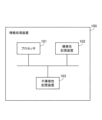
- the processor 101 controls the entire information processing device 100.
- the processor 101 is a CPU (Central Processing Unit), an FPGA (Field Programmable Gate Array), or the like.
- the processor 101 may be a multiprocessor.
- the information processing device 100 may also have a processing circuit.
- the volatile memory device 102 is the main memory device of the information processing device 100.
- the volatile memory device 102 is a RAM (Random Access Memory).
- the non-volatile memory device 103 is an auxiliary memory device of the information processing device 100.
- the non-volatile memory device 103 is a HDD (Hard Disk Drive) or an SSD (Solid State Drive).
- the information processing device 100 includes a storage unit 110, an acquisition unit 120, and a control unit .
- the storage unit 110 may be realized as a storage area secured in the volatile storage device 102 or the non-volatile storage device 103 .
- a part or all of the acquisition unit 120 and the control unit 130 may be realized by a processing circuit.
- a part or all of the acquisition unit 120 and the control unit 130 may be realized as a module of a program executed by the processor 101.
- the program executed by the processor 101 is also called a control program.
- the control program is recorded on a recording medium.
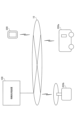
- the storage unit 110 stores map information, the current position of the robot device 200, the remaining battery charge of the robot device 200, information indicating the status of the robot device 200, etc. For example, the status of the robot device 200 may be stopped, moving, or being monitored.
- the acquisition unit 120 acquires information indicating that a target has been detected. For example, the acquisition unit 120 acquires the information from the robot device 200.
- the acquisition unit 120 may acquire the information from the robot device 200 via an external device.
- the external device is a cloud server. The external device is omitted from the diagram.
- the control unit 130 controls the robot device 200 to repeatedly capture images of the target.
- the control unit 130 transmits an instruction to the robot device 200 to repeatedly capture images of the target.
- the robot device 200 repeatedly captures images of the target.
- the robot device 200 may transmit a large amount of rare data to the information processing device 100, or may transmit a large amount of rare data to the terminal device 300. In this way, the information processing device 100 can cause the robot device 200 to collect a large amount of rare data.
- the target is a suspicious object.
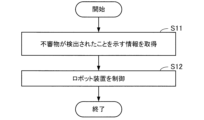
- 4 is a flowchart showing an example of processing executed by the information processing device.
- the robot device 200 is performing surveillance. It is assumed that the robot device 200 detects a suspicious object. Then, the robot device 200 transmits information indicating that a suspicious object has been detected.
- Step S11 The acquisition unit 120 acquires information indicating that a suspicious object has been detected.
- Step S12 The control unit 130 controls the robot device 200 to repeatedly capture images while moving around the suspicious object.
- the control unit 130 transmits an instruction to the robot device 200 to repeatedly capture images while moving around the suspicious object.
- the control unit 130 may also use map information to generate route information for moving around the suspicious object.
- the control unit 130 may transmit the instruction and the route information to the robot device 200.
- the robot device 200 repeats capturing images while moving around the suspicious object based on the instruction. Thus, many images of the suspicious object are collected.
- FIG. 5 is a flowchart showing an example of processing executed by the information processing device of the first modified example.
- the robot device 200 is performing surveillance. It is assumed that the robot device 200 has detected a suspicious person. For example, the robot device 200 captures an image of a person behaving suspiciously, and detects the suspicious person using the captured image and a trained model. Also, for example, the robot device 200 detects the suspicious person using the image and image recognition technology. Furthermore, for example, when the robot device 200 detects a person speaking loudly, it detects the person as a suspicious person. Then, the robot device 200 transmits information indicating that a suspicious person has been detected.
- Step S21 The acquisition unit 120 acquires information indicating that a suspicious individual has been detected.
- Step S22 The control unit 130 controls the robot device 200 to repeatedly capture images while tracking the suspicious individual. In detail, the control unit 130 transmits an instruction to the robot device 200 to repeatedly capture images while tracking the suspicious individual. As a result, the robot device 200 repeatedly captures images while tracking the suspicious individual. Thus, many images of the suspicious individual are collected.
- FIG. 6 is a flowchart showing an example of processing executed by the information processing device of the second modified example.
- the robot device 200 is performing monitoring. It is assumed that the robot device 200 detects a location where aging deterioration is occurring. For example, when the robot device 200 detects a crack in a building, it takes an image of the location where the crack exists, inputs the image obtained by taking the image into the trained model, and when the trained model outputs information indicating that aging deterioration is occurring, detects the location as a location where aging deterioration is occurring.
- the robot device 200 may detect the location where aging deterioration is occurring using the image and image recognition technology. Then, the robot device 200 transmits information indicating that a location where aging deterioration is occurring has been detected.
- Step S31 The acquisition unit 120 acquires information indicating that a portion in which aging deterioration has occurred has been detected.
- Step S32 The control unit 130 controls the robot device 200 to periodically capture images of the areas where aging deterioration is occurring. In detail, the control unit 130 transmits an instruction to the robot device 200 to periodically capture images of the areas where aging deterioration is occurring. As a result, the robot device 200 periodically captures images of the areas where aging deterioration is occurring. Thus, many images of the areas where aging deterioration is occurring are collected.
- the control unit 130 may transmit an instruction to the robot device 200 to capture the image using any of the following methods: a method using an RGB-D camera, a method using an RGB camera and a depth sensor, and a method of capturing images of the location from various angles.
- a method using an RGB-D camera a method using an RGB camera and a depth sensor
- a method of capturing images of the location from various angles.
- the control unit 130 can generate three-dimensional information of the location using the image.
- the control unit 130 may output the three-dimensional information of the location.
- the control unit 130 outputs the three-dimensional information of the location to the terminal device 300. This allows the user to recognize the location in three dimensions.
- FIG. 7 is a flowchart showing an example of processing executed by the information processing device of the third modified example.
- the robot device 200 is performing monitoring. It is assumed that the robot device 200 detects a site where danger is occurring. For example, after an earthquake occurs, the robot device 200 captures an image of a bridge, inputs the captured image into the trained model, and when the trained model outputs information indicating that the bridge is in a state where it is about to collapse, it detects the site where the bridge exists as a site where danger is occurring. In addition, the robot device 200 may detect the site where danger is occurring using an image recognition technology. Then, the robot device 200 transmits information indicating that the site where danger is occurring has been detected.
- Step S41 The acquisition unit 120 acquires information indicating that a scene in which a danger has occurred has been detected.
- Step S42 The control unit 130 controls the robot device 200 to periodically capture an image of the site where a danger is occurring. In detail, the control unit 130 transmits an instruction to the robot device 200 to periodically capture an image of the site where a danger is occurring. As a result, the robot device 200 periodically captures an image of the site where a danger is occurring. Thus, many images of the site where a danger is occurring are collected.
- the control unit 130 may transmit an instruction to the robot device 200 to capture the image using any of the following methods: a method using an RGB-D camera, a method using an RGB camera and a depth sensor, and a method of capturing images of the site from various angles.
- a method using an RGB-D camera a method using an RGB camera and a depth sensor
- a method of capturing images of the site from various angles.
- the control unit 130 can generate three-dimensional information of the site using the image.
- the control unit 130 may output the three-dimensional information of the site.
- the control unit 130 outputs the three-dimensional information of the site to the terminal device 300. This allows the user to recognize the site in three dimensions.
Landscapes
- Engineering & Computer Science (AREA)
- Aviation & Aerospace Engineering (AREA)
- Radar, Positioning & Navigation (AREA)
- Remote Sensing (AREA)
- Physics & Mathematics (AREA)
- General Physics & Mathematics (AREA)
- Automation & Control Theory (AREA)
- Control Of Position, Course, Altitude, Or Attitude Of Moving Bodies (AREA)
- Manipulator (AREA)
Priority Applications (2)
| Application Number | Priority Date | Filing Date | Title |
|---|---|---|---|
| JP2024513420A JPWO2025079128A1 (https=) | 2023-10-10 | 2023-10-10 | |
| PCT/JP2023/036679 WO2025079128A1 (ja) | 2023-10-10 | 2023-10-10 | 情報処理装置、制御方法、及び制御プログラム |
Applications Claiming Priority (1)
| Application Number | Priority Date | Filing Date | Title |
|---|---|---|---|
| PCT/JP2023/036679 WO2025079128A1 (ja) | 2023-10-10 | 2023-10-10 | 情報処理装置、制御方法、及び制御プログラム |
Publications (1)
| Publication Number | Publication Date |
|---|---|
| WO2025079128A1 true WO2025079128A1 (ja) | 2025-04-17 |
Family
ID=95395300
Family Applications (1)
| Application Number | Title | Priority Date | Filing Date |
|---|---|---|---|
| PCT/JP2023/036679 Pending WO2025079128A1 (ja) | 2023-10-10 | 2023-10-10 | 情報処理装置、制御方法、及び制御プログラム |
Country Status (2)
| Country | Link |
|---|---|
| JP (1) | JPWO2025079128A1 (https=) |
| WO (1) | WO2025079128A1 (https=) |
Citations (6)
| Publication number | Priority date | Publication date | Assignee | Title |
|---|---|---|---|---|
| JP2014119901A (ja) * | 2012-12-14 | 2014-06-30 | Secom Co Ltd | 自律移動ロボット |
| JP2016206876A (ja) * | 2015-04-21 | 2016-12-08 | Cyberdyne株式会社 | 自律移動体の走行経路教示システムおよび走行経路教示方法 |
| WO2017065103A1 (ja) * | 2015-10-16 | 2017-04-20 | 株式会社プロドローン | 小型無人飛行機の制御方法 |
| JP2020006793A (ja) * | 2018-07-06 | 2020-01-16 | パナソニックIpマネジメント株式会社 | 収音機能付き無人航空機 |
| WO2020246085A1 (ja) * | 2019-06-03 | 2020-12-10 | 株式会社イクシス | 点検支援システム |
| JP2022149017A (ja) * | 2021-03-25 | 2022-10-06 | 株式会社フジタ | 無人移動体 |
-
2023
- 2023-10-10 JP JP2024513420A patent/JPWO2025079128A1/ja active Pending
- 2023-10-10 WO PCT/JP2023/036679 patent/WO2025079128A1/ja active Pending
Patent Citations (6)
| Publication number | Priority date | Publication date | Assignee | Title |
|---|---|---|---|---|
| JP2014119901A (ja) * | 2012-12-14 | 2014-06-30 | Secom Co Ltd | 自律移動ロボット |
| JP2016206876A (ja) * | 2015-04-21 | 2016-12-08 | Cyberdyne株式会社 | 自律移動体の走行経路教示システムおよび走行経路教示方法 |
| WO2017065103A1 (ja) * | 2015-10-16 | 2017-04-20 | 株式会社プロドローン | 小型無人飛行機の制御方法 |
| JP2020006793A (ja) * | 2018-07-06 | 2020-01-16 | パナソニックIpマネジメント株式会社 | 収音機能付き無人航空機 |
| WO2020246085A1 (ja) * | 2019-06-03 | 2020-12-10 | 株式会社イクシス | 点検支援システム |
| JP2022149017A (ja) * | 2021-03-25 | 2022-10-06 | 株式会社フジタ | 無人移動体 |
Also Published As
| Publication number | Publication date |
|---|---|
| JPWO2025079128A1 (https=) | 2025-04-17 |
Similar Documents
| Publication | Publication Date | Title |
|---|---|---|
| CN104919794B (zh) | 用于从主从式相机跟踪系统提取元数据的方法和系统 | |
| KR102123983B1 (ko) | 시설물 안전 진단용 스마트 드론 및 이를 이용한 시설물 안전 진단 방법 | |
| Sruthi et al. | YOLOv5 based open-source UAV for human detection during search and rescue (SAR) | |
| CN108839016B (zh) | 机器人巡检方法、存储介质、计算机设备及巡检机器人 | |
| CN105574468B (zh) | 视频火焰检测方法、装置及系统 | |
| Ojha et al. | Affordable multiagent robotic system for same-level fall hazard detection in indoor construction environments | |
| WO2020174916A1 (ja) | 撮影システム | |
| CN206164731U (zh) | 一种基于红外探测的移动物体图像跟踪系统 | |
| KR101944374B1 (ko) | 이상 개체 검출 장치 및 방법, 이를 포함하는 촬상 장치 | |
| KR102671607B1 (ko) | 영상 기반 재난 감지 방법 및 장치 | |
| CN106504274A (zh) | 一种基于红外摄像头下的视觉跟踪方法及系统 | |
| CN110377066A (zh) | 一种巡检设备的控制方法、装置和设备 | |
| CN115220375B (zh) | 机器人控制方法、装置、存储介质及电子设备 | |
| CN112731919A (zh) | 一种基于人群密度估计的指引机器人方法及系统 | |
| CN115760912A (zh) | 运动目标跟踪方法、装置、设备及计算机可读存储介质 | |
| CN113870221B (zh) | 可达空间的检测方法、装置、车载终端及存储介质 | |
| CN114782883B (zh) | 基于群体智能的异常行为检测方法、装置和设备 | |
| CN108388252A (zh) | 一种机器人示教方法、装置、设备和介质 | |
| US20230401748A1 (en) | Apparatus and methods to calibrate a stereo camera pair | |
| KR20230020220A (ko) | 구조물 건전성 경보 시스템 및 이를 이용한 경보 방법 | |
| TWI784254B (zh) | 無人機及其影像辨識方法 | |
| KR101664733B1 (ko) | 전 방향 고해상도 추적 녹화 장치 및 방법 | |
| CN116558364A (zh) | 一种针对未知飞行器的干扰拦截系统及方法 | |
| WO2025079128A1 (ja) | 情報処理装置、制御方法、及び制御プログラム | |
| WO2023078445A1 (zh) | 一种无人机目标跟踪方法、装置、电子设备及存储介质 |
Legal Events
| Date | Code | Title | Description |
|---|---|---|---|
| ENP | Entry into the national phase |
Ref document number: 2024513420 Country of ref document: JP Kind code of ref document: A |
|
| WWE | Wipo information: entry into national phase |
Ref document number: 2024513420 Country of ref document: JP |
|
| 121 | Ep: the epo has been informed by wipo that ep was designated in this application |
Ref document number: 23955380 Country of ref document: EP Kind code of ref document: A1 |