WO2025052663A1 - 作業解析システム及び作業解析方法 - Google Patents
作業解析システム及び作業解析方法 Download PDFInfo
- Publication number
- WO2025052663A1 WO2025052663A1 PCT/JP2023/032866 JP2023032866W WO2025052663A1 WO 2025052663 A1 WO2025052663 A1 WO 2025052663A1 JP 2023032866 W JP2023032866 W JP 2023032866W WO 2025052663 A1 WO2025052663 A1 WO 2025052663A1
- Authority
- WO
- WIPO (PCT)
- Prior art keywords
- work
- measurement data
- specified
- unit
- task
- Prior art date
- Legal status (The legal status is an assumption and is not a legal conclusion. Google has not performed a legal analysis and makes no representation as to the accuracy of the status listed.)
- Pending
Links
Images




Classifications
-
- G—PHYSICS
- G06—COMPUTING OR CALCULATING; COUNTING
- G06Q—INFORMATION AND COMMUNICATION TECHNOLOGY [ICT] SPECIALLY ADAPTED FOR ADMINISTRATIVE, COMMERCIAL, FINANCIAL, MANAGERIAL OR SUPERVISORY PURPOSES; SYSTEMS OR METHODS SPECIALLY ADAPTED FOR ADMINISTRATIVE, COMMERCIAL, FINANCIAL, MANAGERIAL OR SUPERVISORY PURPOSES, NOT OTHERWISE PROVIDED FOR
- G06Q10/00—Administration; Management
- G06Q10/06—Resources, workflows, human or project management; Enterprise or organisation planning; Enterprise or organisation modelling
- G06Q10/063—Operations research, analysis or management
- G06Q10/0639—Performance analysis of employees; Performance analysis of enterprise or organisation operations
-
- G—PHYSICS
- G06—COMPUTING OR CALCULATING; COUNTING
- G06Q—INFORMATION AND COMMUNICATION TECHNOLOGY [ICT] SPECIALLY ADAPTED FOR ADMINISTRATIVE, COMMERCIAL, FINANCIAL, MANAGERIAL OR SUPERVISORY PURPOSES; SYSTEMS OR METHODS SPECIALLY ADAPTED FOR ADMINISTRATIVE, COMMERCIAL, FINANCIAL, MANAGERIAL OR SUPERVISORY PURPOSES, NOT OTHERWISE PROVIDED FOR
- G06Q10/00—Administration; Management
- G06Q10/06—Resources, workflows, human or project management; Enterprise or organisation planning; Enterprise or organisation modelling
- G06Q10/063—Operations research, analysis or management
-
- G—PHYSICS
- G06—COMPUTING OR CALCULATING; COUNTING
- G06Q—INFORMATION AND COMMUNICATION TECHNOLOGY [ICT] SPECIALLY ADAPTED FOR ADMINISTRATIVE, COMMERCIAL, FINANCIAL, MANAGERIAL OR SUPERVISORY PURPOSES; SYSTEMS OR METHODS SPECIALLY ADAPTED FOR ADMINISTRATIVE, COMMERCIAL, FINANCIAL, MANAGERIAL OR SUPERVISORY PURPOSES, NOT OTHERWISE PROVIDED FOR
- G06Q10/00—Administration; Management
- G06Q10/20—Administration of product repair or maintenance
-
- G—PHYSICS
- G06—COMPUTING OR CALCULATING; COUNTING
- G06V—IMAGE OR VIDEO RECOGNITION OR UNDERSTANDING
- G06V10/00—Arrangements for image or video recognition or understanding
- G06V10/40—Extraction of image or video features
-
- G—PHYSICS
- G06—COMPUTING OR CALCULATING; COUNTING
- G06V—IMAGE OR VIDEO RECOGNITION OR UNDERSTANDING
- G06V20/00—Scenes; Scene-specific elements
- G06V20/40—Scenes; Scene-specific elements in video content
- G06V20/41—Higher-level, semantic clustering, classification or understanding of video scenes, e.g. detection, labelling or Markovian modelling of sport events or news items
-
- G—PHYSICS
- G06—COMPUTING OR CALCULATING; COUNTING
- G06V—IMAGE OR VIDEO RECOGNITION OR UNDERSTANDING
- G06V20/00—Scenes; Scene-specific elements
- G06V20/40—Scenes; Scene-specific elements in video content
- G06V20/46—Extracting features or characteristics from the video content, e.g. video fingerprints, representative shots or key frames
-
- G—PHYSICS
- G06—COMPUTING OR CALCULATING; COUNTING
- G06V—IMAGE OR VIDEO RECOGNITION OR UNDERSTANDING
- G06V20/00—Scenes; Scene-specific elements
- G06V20/50—Context or environment of the image
- G06V20/52—Surveillance or monitoring of activities, e.g. for recognising suspicious objects
Definitions
- the present invention relates to a work analysis system and a work analysis method.
- Patent Document 1 discloses a learning support system that enables efficient acquisition of skills.
- the learning support system includes a display unit worn by the learner, an imaging unit worn by the learner to capture a visual field image of the learner, and a storage unit that stores a model video, which is a video of an instructor's work movements that serves as a model for the learner's movements.
- the model video is displayed on the display unit superimposed on the visual field image captured by the imaging unit, and the display content of the model video is dynamically changed according to the characteristics of the learner's work movements contained in the visual field image.
- Patent Document 1 many ideas are being considered that use sensors to monitor and support manual work. While these ideas are expected to improve the efficiency of manual work, they are premised on the fact that the work is being done by hand, and so improvements cannot be made beyond the limits of human ability.
- the present invention aims to provide a work analysis system and work analysis method that provide a perspective for work improvement based on work monitoring data obtained by sensors.
- the work analysis system which is one embodiment of the present invention, has a work measurement unit that collects measurement data from a sensor that measures the movements of a worker in a specified task, a measurement data storage unit that accumulates the measurement data collected by the work measurement unit, and a measurement data analysis unit that analyzes the specified task based on the measurement data accumulated in the measurement data storage unit.
- the measurement data analysis unit includes a workability evaluation unit that evaluates the workability of the specified task based on the measurement data accumulated in the measurement data storage unit, and a work improvement approach determination unit that determines a work improvement approach for the specified task based on the workability of the specified task evaluated by the workability evaluation unit.
- a work analysis system and a work analysis method are provided that provide insight into work improvement based on work monitoring data obtained by sensors.
- Other objects and novel features will become apparent from the description of this specification and the accompanying drawings.
- FIG. 1 is a schematic configuration diagram of a work analysis system. 1 shows a hardware configuration of an information processing device.
- FIG. 2 is a functional block diagram of the work analysis system. 1 shows a flow of maintenance work for semiconductor manufacturing equipment.
- FIG. 2 is a diagram for explaining work performed in each step of the maintenance work.
- This is an example of complexity assessment of a device dismantling process. This is an example of evaluating the complexity of a maintenance process.
- 1 is an example of a workability evaluation table. 13 is a histogram of work time. This is an example of a skill evaluation of the device dismantling process. This is an example of a dexterity evaluation of a maintenance process.
- This is a judgment flow for work improvement approaches.
- 13 is an example of a work element conversion table. This is a flow for creating a proposal for automating a process.
- FIG. 1 shows a schematic diagram of the work analysis system.
- the work analysis system has a group of sensors 101-106 that monitor the work of the operator on semiconductor manufacturing equipment 100, a measurement data collection device 110 that collects measurement data related to the operator's movements during work detected by the group of sensors 101-106, a measurement data storage unit 120 that stores the measurement data collected by the measurement data collection device 110, and a work analysis device 140 that analyzes the work and makes improvement suggestions based on the measurement data stored in the measurement data storage unit 120.
- the measurement data collection device 110, the measurement data storage unit 120, and the work analysis device 140 are connected to each other via a network 130 so that they can communicate with each other.
- the network 130 may be wired or wireless, and the communication standard is arbitrary.
- FIG. 2A shows the hardware configuration of the measurement data collection device 110 and the work analysis device 140. These are realized by an information processing device including a processor (CPU) 201, memory 202, storage device 203, input interface (I/F) 204, output I/F 205, communication I/F 206, and bus 207 as main components as shown in Figure 2A.
- the processor 201 functions as a functional unit (functional block) that provides a specified function by executing processing according to a program loaded in the memory 202.
- the storage device 203 stores data and programs used in the functional unit.
- a non-volatile storage medium such as an HDD (Hard Disk Drive) or SSD (Solid State Drive) is used.
- the input I/F 204 is an interface that connects an input device 208 such as a keyboard or pointing device
- the output I/F 205 is an interface that connects a display device 209.
- the communication I/F 206 enables communication with other information processing devices via the network 130. These are connected to each other so that they can communicate with each other via a bus 207.
- each of the measurement data collection device 110 and the work analysis device 140 may be realized on a single information processing device, with the measurement data being stored in the storage device 203.
- the storage device 203 functions as the measurement data storage unit 120.
- some or all of the functions of the measurement data collection device 110 and the work analysis device 140 may be realized as an application on the cloud.
- FIG. 2B shows a functional block diagram of the work analysis system.
- the work measurement unit 210 of the measurement data collection device 110 controls the sensors and accumulates the measurement data in the measurement data accumulation unit 120.
- the sensors include a camera 101 that captures an overview of the worker's work, a device-mounted camera 102, an HMD (Head Mounted Display) 103, a work clothes sensor 104 and a glove-type sensor 105 worn by the worker, and a 360° camera 106 that captures the entire work area.
- the sensor group shown in Figure 1 is merely an example, and sensors other than those illustrated may be used, and it is not necessary to use the sensors illustrated.
- the work measurement unit 210 monitors the state of the worker's work using these sensors.
- RGB (color) data (video data) is obtained from the camera, and if an RGBD camera is used as the camera, which is a sensor that can obtain the distance to the object in addition to RGB data, distance measurement data indicating distance information from the subject is also obtained in addition to the video data, the movement data of the worker's line of sight from the HMD 103, the movement data of the worker's skeleton from the work clothes sensor 104, and the movement data of the worker's fingers from the glove sensor 105 are all stored as measurement data in the measurement data storage unit 120. It is desirable to record all measurement data stored in the measurement data storage unit 120 with a time stamp (time information) based on the same reference time. This allows the measurement data from multiple sensors to be integrated when analyzing the measurement data by the work analysis device 140 to analyze the work.
- time stamp time information
- the measurement data analysis unit 220 of the work analysis device 140 analyzes the work using the measurement data stored in the measurement data storage unit 120.
- the work analysis results by the measurement data analysis unit 220 are displayed on the display device 209 of the work analysis device 140 by the analysis result output unit 225.
- the processing of the measurement data analysis unit 220 will be described later with reference to a specific example.
- the maintenance work is a work example in which the semiconductor manufacturing equipment is dismantled, maintenance is performed on the target units, and then the parts are reassembled to return the equipment to an operational state, and as shown in Figure 3, it is broadly made up of three steps: equipment dismantling (S01), maintenance of the target units (S02), and part assembly (S03).
- S01 equipment dismantling
- S02 maintenance of the target units
- S03 part assembly
- the semiconductor manufacturing equipment is shown diagrammatically as comprising a main body 401, an upper unit 402, and a lower unit 403.
- the semiconductor manufacturing equipment is a plasma processing device
- the upper unit 402 is a cavity that generates plasma
- the lower unit 403 is a vacuum vessel in which a sample to be processed is placed.
- the maintenance location is the lower unit 403.
- the device dismantling process (S01) corresponds to states S11 to S14.
- State S11 is the state at the start of work
- state S12 is the state in which the upper unit 402 and lower unit 403, which are connected to each other, have been separated from the main body 401.
- State S13 shows the state in which the screws are being removed manually using a tool such as a screwdriver to separate the upper unit 402 from the lower unit 403.
- State S14 is the state in which the upper unit 402 has been separated from the lower unit 403, allowing work to be done on the lower unit 403.
- the maintenance process (S02) corresponds to states S21 to S23.
- State S21 shows the state in which the O-ring 405, which is a consumable item, has been removed from the lower unit 403.
- State S22 shows the state in which the lower unit 403 is being cleaned by wiping off any deposits or dirt on it.
- State S23 shows the state in which the consumable item is replaced and a new O-ring 406 is attached.
- the parts assembly process (S03) corresponds to states S31 to S33.
- state S31 the separated upper unit 402 is aligned with the lower unit 403, and in state S32, the screws are tightened to connect them.
- state S33 the connected upper unit 402 and lower unit 403 are attached to the main body 401, completing the assembly work.
- the measurement data analysis unit 220 has a workability evaluation unit 221, a work improvement approach determination unit 222, and a work improvement approach display generation unit 223 (see FIG. 2B).
- the workability evaluation unit 221 evaluates workability using the measurement data.
- the workability evaluation unit 221 evaluates the work from the viewpoint of complexity and dexterity.
- the evaluation uses the collected measurement data and calculates the evaluation value quantitatively according to a predetermined index.
- the complexity of the work means the complexity of the work performed by the worker, and for example, the number of work elements that make up the work, the ease of the work, which indicates the ease of the work elements, the length of the work time, etc. are indexes.
- the dexterity of the work means the degree of experience and knowledge required for the worker to perform the work.
- a work in which there is almost no difference in work efficiency or work quality between an expert and an unskilled person is evaluated as a work with low dexterity
- a work in which there is a large difference in work efficiency or work quality between an expert and an unskilled person is evaluated as a work with high dexterity.
- the variance (dispersion) of the work time depending on the worker is indexes.
- the workability evaluation unit 221 performs pre-processing to divide the measurement data into process units.
- the measurement data is divided into three processes: the device dismantling process S01, the maintenance process S02, and the parts assembly process S03.
- the division can be performed by performing video analysis on the video data showing the work, recognizing characteristic objects and work, and identifying the timing at which the processes are separated.
- the timing at which the upper unit 402 and the lower unit 403 are separated can be captured by image recognition, and the timestamp of the video data at that time can be used as the timing at which the device dismantling process S01 and the maintenance process S02 are divided.
- the timing at which the worker's hand is released from the O-ring 406 attached to the lower unit 403 can be captured by image recognition, and the timestamp of the video data at that time can be used as the timing at which the maintenance process S02 and the parts assembly process S03 are divided. It becomes possible to divide other measurement data acquired simultaneously with the video data into process units based on the timestamp. It is up to the user to decide how far to divide a process into a single unit, but for example, one option is to divide a task that is grouped together in a work procedure manual into a single process. Next, the work is evaluated based on the measurement data divided into each process, using the timestamp as a reference.
- the work elements are defined in advance in the work ease evaluation table shown in Figure 6 as tasks of the final granularity for evaluating the ease of work.
- work elements are classified according to the ease of work and assigned evaluation values. For example, moving a part from top to bottom is an easy action due to gravity and is evaluated as A (easy). On the other hand, moving sideways or upwards is more difficult and is evaluated as B (normal).
- the work elements shown in Figure 6 are only a small part of the examples, and the table has been created comprehensively so that all work included in the maintenance work for semiconductor manufacturing equipment falls into one of the work elements.
- Work element number 501 is a number that identifies a work element included in the process to be analyzed, and work element 502 indicates the content of the work element included in the process.
- Work time 503 is the work time required to perform the work element, and is measured from measurement data. If a work element is performed multiple times within a process, it indicates, for example, the average time.
- Work ease 504 indicates the assessment value assigned to the work element in the work ease assessment table. For example, A means easy, B means normal, and C means difficult.
- Complexity assessment (by work element) 505 indicates the complexity assessment score for each work element
- complexity assessment (process) 506 indicates the complexity assessment score for the process as a whole.
- the complexity evaluation score for each work element is calculated quantitatively using work time and ease of work as indicators.
- work time is divided into short, medium, and long, with evaluation scores of 0.5, 1, and 1.5 respectively, and work ease A, B, and C are assigned evaluation scores of 10, 20, and 30 respectively.
- the complexity evaluation score for each work element is calculated as the product of the evaluation score for work time and the evaluation score for work ease. At this time, if a work element is performed repeatedly (work elements No. 2 to 4), the number of repetitions is further multiplied.
- the complexity evaluation score for the entire process is calculated as the sum of the complexity evaluation scores for each work element. Note that the method of calculating and allocating evaluation scores shown here is just an example.
- the complexity evaluation of the maintenance process S02 obtained in a similar manner, is shown in Figure 5B.
- the complexity evaluation score of the equipment dismantling process S01 was 355 points
- the complexity evaluation score of the maintenance process S02 was 40 points. Based on the complexity evaluation scores, the equipment dismantling process S01 can be evaluated as being a more complex process than the maintenance process S02.
- the task time becomes averaged. Therefore, by increasing the number of samples, the precision of the task time gradually improves, and the accuracy of the complexity assessment can be improved.
- FIG. 7 shows a histogram 701 of the task time for task element A and a histogram 702 of the task time for task element B. From histogram 701, it can be determined that task element A has little variation between workers and is not greatly influenced by the worker's skill, experience, or knowledge, and from histogram 702, it can be determined that task element B has large variation between workers and is strongly influenced by the worker's skill, experience, and knowledge.
- the magnitude of variation in task time can be quantitatively grasped, for example, by calculating the variance of the histogram.
- Movement variance is a direct evaluation of the worker's movements or eye movements, etc.
- the work movements are efficient and effective. Therefore, for example, it is possible to monitor the movements of an expert to identify ideal work movements and evaluate deviations from these. If most of the sampled measurement data shows an approximation to the ideal work movements, it can be evaluated that movement variance is small, and if the sampled measurement data contains a lot of measurement data that deviates from the ideal work movements, it can be evaluated that movement variance is large.
- the work success rate is calculated by calculating the ratio of the number of successes to the number of executions of the work element, with failure being considered when a problem is discovered in the work in the subsequent process and rework is required.
- the dexterity evaluation of the device dismantling process S01 is shown in FIG. 8A.
- the work element number 801 is a number that identifies the work element included in the process to be analyzed, and the work element 802 indicates the content of the work element included in the process.
- the time variance 803 is the variance of the work time required to execute the work element, and is the variance of the work time measured from the measurement data. Here, it is not the value itself, but is shown as three categories, for example, small, medium, and large.
- the movement variance 804 shows the variance as described above for each element of the body and the line of sight.
- the work success rate 805 shows the work success rate described above.
- the dexterity evaluation (by work element) 806 shows the dexterity evaluation score for each work element, and the dexterity evaluation (process) 807 shows the dexterity evaluation score for the entire process.
- the dexterity evaluation score for each task element is calculated quantitatively using time variance, movement variance (overall), and task success rate as indicators.
- time variance and movement variance are classified as small, medium, and large, with evaluation scores of 1, 1.5, and 2, respectively, and the dexterity evaluation score for each task element is calculated as the product of (100 - task success rate [%]), the evaluation score for time variance, and the evaluation score for movement variance (overall).
- the dexterity evaluation score for the entire process is calculated as the average of the dexterity evaluation scores for each task element. Note that the method of calculating and allocating the evaluation scores shown here is one example. Also, although an example of evaluating dexterity on a task element basis is shown here, it is sufficient that the evaluation is done on a unit of action, and for example, dexterity evaluation may be done on multiple task elements executed in succession as one unit.
- the task improvement approach determination unit 222 uses the complexity evaluation and dexterity evaluation performed for each process by the workability evaluation unit 221 to determine in what direction the task in the process should be improved.
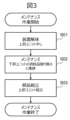
- Figure 9 shows the determination flow executed by the task improvement approach determination unit 222.
- the workability evaluation results are obtained (S51).
- the complexity evaluation result shown in FIG. 5A and the dexterity evaluation result shown in FIG. 8A are obtained for the equipment dismantling process S01
- the complexity evaluation result shown in FIG. 5B and the dexterity evaluation result shown in FIG. 8B are obtained for the maintenance process S02.
- the complexity evaluation result is compared with a predetermined threshold (S52). If the complexity evaluation score is equal to or greater than the threshold, "task simplification" is determined as the work improvement approach (S53). For example, if the threshold is set at 250 points, the complexity evaluation score (355 points) of the equipment dismantling process S01 is equal to or greater than the threshold, and so the work improvement approach is determined to be "work simplification”. On the other hand, the complexity evaluation score (40 points) of the maintenance process S02 is less than the threshold. Processes determined to be "work simplification” are overly complicated and redundant work processes, so the first step is to simplify such processes.
- the dexterity evaluation result is compared with a predetermined threshold (S54). If the dexterity evaluation score is equal to or greater than the threshold, "advanced work support" is determined as the work improvement approach (S55). For example, if the threshold is set at 40 points, the dexterity evaluation score (53.7 points) of the maintenance process S02 is equal to or greater than the threshold, and the work improvement approach is determined to be "advanced work support".
- a process determined to be "advanced work support” is a simplified work process with low complexity, while a process that is highly dexterous and utilizes robots, etc., is difficult to automate. For this reason, it is effective to create a mechanism that compensates for the lack of skill of workers by enhancing work support, such as by using AR/VR.
- the results of the work improvement approach judgment for each process as described above are stored in the storage device 203 of the work analysis device 140 (S57).
- S57 work analysis device 140
- a process judged as "task simplification” is a process that is judged to be excessively complicated and redundant.
- the complexity evaluation value of a process can be lowered by replacing a work element with a high evaluation value with a work element with a low evaluation value.
- An example of a work element conversion table is shown in FIG. 10.
- the work element conversion table is the work ease evaluation table shown in FIG. 6 with information on work elements that are improvement candidates for work elements with high evaluation values added. In the example of FIG. 10, the work elements that are improvement candidates and the evaluation values for the improvement candidates are added.
- the work improvement approach judgment unit 222 uses the work element conversion table to replace a work element with a high evaluation value included in a process judged as "task simplification" with a work element with a lower evaluation value, thereby creating a process improvement proposal, and calculating the complexity evaluation value that will be improved in that case and storing it together with the judgment result.
- FIG 11 shows a flow of creating a proposal for process automation performed by the work improvement approach determination unit 222.
- the work elements included in the process are replaced with machine functions (S61).
- the machine function conversion table shown in Figure 12 is used.
- the machine function conversion table has registered therein functions 1201 to be mechanized and costs 1202 required to mechanize the functions.
- the cost is calculated assuming that all work elements included in the process that can be mechanized are mechanized.
- step S62 it is determined whether the calculated cost is within the user's tolerance.
- the user may set an upper limit of the cost that is acceptable for automation in advance, or the calculated cost may be displayed on the GUI, and the user may be asked to accept or reject the proposal, and if not, to enter the upper limit of the cost.
- the content created in step S61 is used as a proposal for process automation (S64).
- a process automation proposal is created in which some of the work elements that can be replaced with machine functions are replaced with machine functions so that the cost falls within the allowable cost (S63, S64).
- the flow in FIG. 9 is just one example, and various modifications are possible.
- the "advanced work support” judgment is made based on an evaluation of workability alone, but it may also be made after a cost evaluation.
- the "work simplification” judgment is made based on a complexity evaluation, but the user may be allowed to select "equipment simplification.”
- Equipment simplification is an approach that aims to simplify the process by changing the structure of the equipment or product that is the subject of the work (semiconductor manufacturing equipment in this example), and if the user does not select "equipment simplification," "work simplification” may be selected.
- the work improvement approach display generation unit 223 summarizes the analysis results for the work described above and displays them as a work analysis report via the analysis result output unit 225.
- FIG. 13 shows an example of a work analysis report display screen.
- a summary 1301 displays a summary of the analysis results.
- the improvement approach display unit 1302 displays a summary of the improvement approach determined for the work analyzed by the measurement data analysis unit 220. The number of improvement approaches, the specific target processes, costs, etc. are displayed.
- the workability analysis report 1303 displays the workability analysis results that were the basis for determining the analysis approach for the selected process.
- the example in FIG. 13 shows an example in which a workability analysis report is displayed for process A that was determined to be "work simplification.” The user checks this content and makes improvements to the work.
- the display of some of the content may be modified or restricted depending on the position or role of the person viewing this screen.
- the display shown in FIG. 13 is an example of a display presented to a user whose role is to promote work improvements, which is the original purpose.
- This type of presentation has the secondary effect of being useful in terms of work training for workers.
Landscapes
- Engineering & Computer Science (AREA)
- Business, Economics & Management (AREA)
- Human Resources & Organizations (AREA)
- Physics & Mathematics (AREA)
- Theoretical Computer Science (AREA)
- General Physics & Mathematics (AREA)
- Economics (AREA)
- Entrepreneurship & Innovation (AREA)
- Strategic Management (AREA)
- Multimedia (AREA)
- Marketing (AREA)
- General Business, Economics & Management (AREA)
- Tourism & Hospitality (AREA)
- Quality & Reliability (AREA)
- Operations Research (AREA)
- Development Economics (AREA)
- Educational Administration (AREA)
- Game Theory and Decision Science (AREA)
- Computational Linguistics (AREA)
- Software Systems (AREA)
- Management, Administration, Business Operations System, And Electronic Commerce (AREA)
- Measurement Of The Respiration, Hearing Ability, Form, And Blood Characteristics Of Living Organisms (AREA)
- Testing Or Calibration Of Command Recording Devices (AREA)
Priority Applications (5)
| Application Number | Priority Date | Filing Date | Title |
|---|---|---|---|
| PCT/JP2023/032866 WO2025052663A1 (ja) | 2023-09-08 | 2023-09-08 | 作業解析システム及び作業解析方法 |
| JP2024543557A JP7789937B2 (ja) | 2023-09-08 | 2023-09-08 | 作業解析システム及び作業解析方法 |
| CN202380024665.3A CN119968643A (zh) | 2023-09-08 | 2023-09-08 | 作业解析系统以及作业解析方法 |
| KR1020247027939A KR20250037699A (ko) | 2023-09-08 | 2023-09-08 | 작업 해석 시스템 및 작업 해석 방법 |
| TW113133606A TW202511910A (zh) | 2023-09-08 | 2024-09-05 | 作業解析系統及作業解析方法 |
Applications Claiming Priority (1)
| Application Number | Priority Date | Filing Date | Title |
|---|---|---|---|
| PCT/JP2023/032866 WO2025052663A1 (ja) | 2023-09-08 | 2023-09-08 | 作業解析システム及び作業解析方法 |
Publications (1)
| Publication Number | Publication Date |
|---|---|
| WO2025052663A1 true WO2025052663A1 (ja) | 2025-03-13 |
Family
ID=94923935
Family Applications (1)
| Application Number | Title | Priority Date | Filing Date |
|---|---|---|---|
| PCT/JP2023/032866 Pending WO2025052663A1 (ja) | 2023-09-08 | 2023-09-08 | 作業解析システム及び作業解析方法 |
Country Status (5)
| Country | Link |
|---|---|
| JP (1) | JP7789937B2 (https=) |
| KR (1) | KR20250037699A (https=) |
| CN (1) | CN119968643A (https=) |
| TW (1) | TW202511910A (https=) |
| WO (1) | WO2025052663A1 (https=) |
Citations (4)
| Publication number | Priority date | Publication date | Assignee | Title |
|---|---|---|---|---|
| JP2004355482A (ja) * | 2003-05-30 | 2004-12-16 | Denso Corp | 組立性評価システム |
| JP2020129018A (ja) * | 2019-02-07 | 2020-08-27 | 株式会社日立製作所 | 動作評価システムおよび方法 |
| JP2022168542A (ja) * | 2021-04-26 | 2022-11-08 | キヤノン株式会社 | 習熟度評価方法、習熟度評価システム、およびプログラム |
| JP2023028120A (ja) * | 2021-08-18 | 2023-03-03 | 株式会社日立産機システム | 作業支援システムおよび作業支援方法 |
Family Cites Families (1)
| Publication number | Priority date | Publication date | Assignee | Title |
|---|---|---|---|---|
| JP7116696B2 (ja) | 2019-03-06 | 2022-08-10 | 株式会社日立製作所 | 学習支援システム及びプログラム |
-
2023
- 2023-09-08 CN CN202380024665.3A patent/CN119968643A/zh active Pending
- 2023-09-08 KR KR1020247027939A patent/KR20250037699A/ko active Pending
- 2023-09-08 WO PCT/JP2023/032866 patent/WO2025052663A1/ja active Pending
- 2023-09-08 JP JP2024543557A patent/JP7789937B2/ja active Active
-
2024
- 2024-09-05 TW TW113133606A patent/TW202511910A/zh unknown
Patent Citations (4)
| Publication number | Priority date | Publication date | Assignee | Title |
|---|---|---|---|---|
| JP2004355482A (ja) * | 2003-05-30 | 2004-12-16 | Denso Corp | 組立性評価システム |
| JP2020129018A (ja) * | 2019-02-07 | 2020-08-27 | 株式会社日立製作所 | 動作評価システムおよび方法 |
| JP2022168542A (ja) * | 2021-04-26 | 2022-11-08 | キヤノン株式会社 | 習熟度評価方法、習熟度評価システム、およびプログラム |
| JP2023028120A (ja) * | 2021-08-18 | 2023-03-03 | 株式会社日立産機システム | 作業支援システムおよび作業支援方法 |
Also Published As
| Publication number | Publication date |
|---|---|
| CN119968643A (zh) | 2025-05-09 |
| KR20250037699A (ko) | 2025-03-18 |
| JPWO2025052663A1 (https=) | 2025-03-13 |
| TW202511910A (zh) | 2025-03-16 |
| JP7789937B2 (ja) | 2025-12-22 |
Similar Documents
| Publication | Publication Date | Title |
|---|---|---|
| US11520947B1 (en) | System and method for adapting graphical user interfaces to real-time user metrics | |
| JP6928880B2 (ja) | 動作分析装置、動作分析方法、動作分析プログラム及び動作分析システム | |
| JP2019016226A (ja) | 作業データ管理システム及び作業データ管理方法 | |
| CN110738135A (zh) | 一种工人作业工步规范视觉识别判定与指导方法及系统 | |
| JP7509659B2 (ja) | 生産情報管理システムおよび生産情報管理方法 | |
| AU2018204669B2 (en) | Monitors for movements of workers | |
| JP7004218B2 (ja) | 動作分析装置、動作分析方法、動作分析プログラム及び動作分析システム | |
| CN119091343A (zh) | 一种手工组装电机的不良品预测预警方法及系统 | |
| JP2019121294A (ja) | 計算機システム | |
| JP7777936B2 (ja) | 作業状況分析システム及び作業状況分析方法 | |
| JP7495834B2 (ja) | 作業評価システムおよび方法 | |
| JP2020087091A (ja) | 熟練度判定システム | |
| WO2025052663A1 (ja) | 作業解析システム及び作業解析方法 | |
| EP3961330A1 (en) | Assembly assistance device and method | |
| WO2007126026A1 (ja) | 作業工程の中から改善すべき動作要素を自動抽出するシステム | |
| JP7180886B2 (ja) | 作業稼働率測定装置及び作業稼働率測定方法 | |
| WO2019073615A1 (ja) | 工事現場画像判定装置及び工事現場画像判定プログラム | |
| KR102570756B1 (ko) | 제조공정 가시화 장치 및 방법 | |
| CN112936342B (zh) | 基于人体姿态识别算法的实体机器人动作评测系统及方法 | |
| CN113033469A (zh) | 工器具损坏识别方法、装置、设备、系统及可读存储介质 | |
| HK40078068A (en) | Work rate measurement device and work rate measurement method | |
| CN117092972B (zh) | 一种工业平板电脑的控制系统 | |
| US20250200482A1 (en) | Work analyzing device and work analyzing method | |
| US20250116996A1 (en) | Factory data generation with intelligent labelling | |
| CN121122099A (zh) | 一种结合ar眼镜的生产线操作人员实时培训方法 |
Legal Events
| Date | Code | Title | Description |
|---|---|---|---|
| ENP | Entry into the national phase |
Ref document number: 2024543557 Country of ref document: JP Kind code of ref document: A |
|
| WWE | Wipo information: entry into national phase |
Ref document number: 2024543557 Country of ref document: JP |
|
| WWE | Wipo information: entry into national phase |
Ref document number: 202380024665.3 Country of ref document: CN |
|
| WWE | Wipo information: entry into national phase |
Ref document number: 18846922 Country of ref document: US |
|
| WWP | Wipo information: published in national office |
Ref document number: 1020247027939 Country of ref document: KR |
|
| 121 | Ep: the epo has been informed by wipo that ep was designated in this application |
Ref document number: 23951561 Country of ref document: EP Kind code of ref document: A1 |
|
| WWP | Wipo information: published in national office |
Ref document number: 202380024665.3 Country of ref document: CN |