WO2025041207A1 - Dispositif de chiffrement, procédé de chiffrement, et programme - Google Patents
Dispositif de chiffrement, procédé de chiffrement, et programme Download PDFInfo
- Publication number
- WO2025041207A1 WO2025041207A1 PCT/JP2023/029895 JP2023029895W WO2025041207A1 WO 2025041207 A1 WO2025041207 A1 WO 2025041207A1 JP 2023029895 W JP2023029895 W JP 2023029895W WO 2025041207 A1 WO2025041207 A1 WO 2025041207A1
- Authority
- WO
- WIPO (PCT)
- Prior art keywords
- internal state
- space
- encryption
- function
- block cipher
- Prior art date
- Legal status (The legal status is an assumption and is not a legal conclusion. Google has not performed a legal analysis and makes no representation as to the accuracy of the status listed.)
- Pending
Links
Images



Classifications
-
- H—ELECTRICITY
- H04—ELECTRIC COMMUNICATION TECHNIQUE
- H04L—TRANSMISSION OF DIGITAL INFORMATION, e.g. TELEGRAPHIC COMMUNICATION
- H04L9/00—Cryptographic mechanisms or cryptographic arrangements for secret or secure communications; Network security protocols
- H04L9/06—Cryptographic mechanisms or cryptographic arrangements for secret or secure communications; Network security protocols the encryption apparatus using shift registers or memories for block-wise or stream coding, e.g. DES systems or RC4; Hash functions; Pseudorandom sequence generators
- H04L9/065—Encryption by serially and continuously modifying data stream elements, e.g. stream cipher systems, RC4, SEAL or A5/3
Definitions
- This disclosure relates to technology that achieves high-performance encryption while ensuring security in white-box and hybrid models.
- a symmetric key cipher is an encryption device that encrypts a message M with a private key K and uses the same key K for decryption.
- a pseudo-random number also called a "keystream”
- An encryption device that performs stream ciphering includes two parts: an initialization section that mixes the initialization vector IV and private key K to generate a random internal state, and a pseudo-random number generation (Keystream Generator) section that outputs pseudo-random numbers while updating the state from the random internal state.
- the initialization section holds an Update function for updating the internal state
- the pseudo-random number generation section holds a Filter function for generating pseudo-random numbers from the internal state.
- Non-Patent Document 1 discloses a space-hard block cipher.
- a space-hard block cipher is a block cipher method that uses a huge memory generated by expanding a short secret state for encryption.
- Non-Patent Document 1 shows a space-hard block cipher called SPACE as a specific method.
- Figure 8 is a schematic diagram of the round function of SPACE.
- the rth function divides the input into the most significant n a bits and the rest, applies a round function Fr that converts the most significant n a bits from n a bits to (nn a ) bits, exclusive-ORs the output with the least significant (nn a ) bits, and shifts the whole to the left by n a bits.
- a private key K is used to generate the round function Fr , and a mapping from the restricted plaintext space of the secure block cipher EK to the truncated ciphertext space is used for the round function Fr.
- space-hard block ciphers solve is ensuring security in a white-box model.
- the security of symmetric key cryptography is generally discussed in terms of whether or not the private key K can be decrypted while the private key K is kept secret, and while the ciphertext C obtained by applying a cryptographic device to a known or selected message M, and the message M obtained by applying a decryption device (the inverse function of the cryptographic device) to the known or selected ciphertext C, are given. This is a discussion based on the black box model.
- the white box model differs from the black box model in that it is possible to monitor and manipulate all of the internal calculations of the cryptographic device.
- Non-Patent Document 1 In addition to the above, since the table of function Fr is generated from a secure block cipher EK , the table information cannot be compressed. In Non-Patent Document 1, this is called space hardness, and is presented as a countermeasure against the theft of the program itself by an attacker in a white-box model, and against code lifting attacks. The definition of space hardness introduced in Non-Patent Document 1 is shown below.
- Definition 1 ((M,Z)-space hardness).
- the implementation of a block cipher E K is (M,Z)-space hard if it is infeasible to encrypt (decrypt) any randomly drawn plaintext (ciphertext) with probability of more than 2 -Z given any code (table) of size less than M.
- space-hard block ciphers with various parameters have been proposed depending on the security level of space hardness.
- table size for each SPACE parameter is T
- Non-Patent Document 2 also proposes SPNbox as a more efficient method than SPACE, which also has four parameters, and uses tables of SPNbox-8: 256 Bytes, SPNbox-16: 128 KB, SPNbox-24: 48 MB, and SPNbox-32: 16 GB.
- Non-Patent Document 3 shows that code lifting of a compressed program by a white-box model attacker affects security against a black-box model attacker.
- the discussion of security against a black-box model attacker after code lifting of a compressed program by a white-box model attacker is called the "hybrid model.”
- the space-hard cipher is said to be secure under the hybrid model.
- space-hard block ciphers are effective as a technology for ensuring security in white-box and hybrid models.
- a space-hard block cipher requires frequent access to a function Fr that is implemented as a table, and the implementation requires frequent access to a storage unit (memory).
- Non-Patent Document 2 The performance of SPACE and SPNbox implementations on an Intel Core i7-6700 CPU is summarized in Non-Patent Document 2. Specifically, the performance of SPACE-16 is reported to be 305.11 cpb, and that of SPNbox-16 is 17.59 cpb. Considering that the performance of today's symmetric key ciphers is around 0.3 to 2 cpb, it can be seen that the current Space-hard block cipher is nearly 10 times slower than normal symmetric key ciphers.
- space-hard block ciphers process each block independently, and unless sufficient table lookups are performed for each block, security cannot be guaranteed in space hardness or hybrid models.
- the invention of claim 1 is a cryptographic device that performs stream encryption and has an initialization unit that generates a random internal state by mixing an initialization vector and a secret key based on a table related to a predetermined function generated from an initialization vector and a block cipher by referring to the table a certain number of times or more, and a pseudo-random number generation unit that outputs pseudo-random numbers while updating the state from the random internal state using a black box model in which intermediate values cannot be recognized from the outside.
- the present invention has the effect of realizing the security of the white-box model of space-hard block ciphers in stream ciphers.
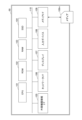
- the encryption device 50 is a device that performs stream encryption by performing exclusive OR on the plaintext message M with a pseudorandom number and then encrypting it.
- the encryption device 50 has an acquisition unit 51, an initialization unit 52, a pseudo-random number generation (Keystream Generator) unit 53, and an output unit 54. Each of these units has a function realized by an instruction from the CPU 101 in FIG. 6 based on a program.
- the encryption device 50 also has a storage unit (memory) M realized by the RAM 104 shown in FIG. 6, etc.
- the acquisition unit 51 acquires the message M as plaintext from outside the encryption device 50.
- the pseudorandom number generation unit 53 holds a filter function in the memory unit M for generating pseudorandom numbers from an internal state, and outputs pseudorandom numbers while updating the state from a random internal state using a black box model in which intermediate values cannot be recognized from the outside.
- the output unit 54 performs stream encryption by exclusive ORing the plaintext message M with a pseudorandom number, encrypting it, and outputs the encrypted message.
- the initialization unit 52 and pseudo-random number generation unit 53 will be explained in more detail below.
- Non-Patent Documents 1, 2, and 3 in order to ensure security in space hardness and hybrid models, a certain number of table lookups are required before an attacker can generate a ciphertext that can be observed in the black-box model from a message that can be selected in the black-box model.
- the number of table lookups required is set to T or more.
- each block is processed independently, so to process M bits using an n-bit block cipher, M/n blocks need to be processed, and a minimum of (T x M/n) table lookups are required.
- Stream ciphers do not have a data encryption section that processes messages directly, as do block ciphers.
- the target of attack is the function that generates the pseudorandom numbers (keystream) that can be observed in the black box model, starting from the initialization vector IV, which the attacker can select in the black box model. If this function cannot be compressed, as in the case of a space-hard block cipher, then a space-hard stream cipher can be realized.
- the Update and Filter functions of the stream cipher are generated from a secure block cipher E K. This makes it difficult to compress the generated Update and Filter functions.
- the initialization unit 52 of the stream cipher requires a certain number of table lookups, just like the space-hard block cipher, due to the similarity of structure to the block cipher.
- Update function which allows table reference to be performed at any time.
- table lookups are performed sequentially. That is, after the result of one table lookup is obtained, the next table lookup can be started. As a result, the implementation performance depends on high latency of memory access.
- Update and Filter functions for a stream cipher suitable for implementing this embodiment.
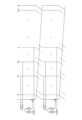
- Fig. 2 is a schematic diagram of the Update function (upper part) and the Filter function (lower part) suitable for implementing this embodiment.
- the internal state is divided into n branches, and each branch takes on n 0- bit values.
- Select m branches, j1 , j2 , ..., jm mix these m branches using the ⁇ function, and output n1 bits, where n1 ⁇ n0 .
- the ⁇ function can be a simple function, such as an exclusive OR or a truncation function.
- Functions f and g are functions that take n 1 bits as input and output n 0 bits.
- the output of function f is exclusive-ORed with the 1st Branch
- function g is exclusive-ORed with the oth Branch, and the latter is output as a pseudorandom number.
- functions f and g are generated using a block cipher E K that is secure in the black-box model, and specifically, a mapping from E K 's restricted plaintext space to a truncated ciphertext space is used.
- the Space-hard stream cipher of this embodiment can significantly improve implementation efficiency compared to conventional Space-hard block ciphers.
- the space-hard stream cipher of this embodiment achieves a processing speed about 10 times faster than the conventional space-hard block cipher SPNbox in the same measurement environment.
- the implementation comparison is shown in Fig. 3.
- Fig. 3 is a diagram showing a comparison of seven parameters and the implementation performance of the existing SPNbox.
- the measurement environment was based on a single core of an Intel Core i7-1185G7 with Hyperthreading and Turboboost disabled.
- each parameter cannot be compressed further than its compression limit.
- the SPNbox-16 requires 10.04 x 2048 cycles to process 2KB, whereas the parameter 16 of this embodiment can process it in 1.38 x 2048 cycles.
- parameter 16 uses a 256KB table and cannot be compressed to 32KB or less. Each branch takes a 16-bit value, and its internal state is expressed by 32 16-bit values, totaling 512 bits.
- the functions f and g used in parameter 16 have a 16-bit input and a 16-bit output, and are generated as shown in (Equation 1) using the block cipher AES (Advanced Encryption Standard). (g
- f)(x) msb 32 (AES K (0 112
- the functions f and g can be considered as a 16-bit input and a 32-bit output in combination.
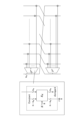
- Figure 4 is a conceptual diagram showing the Update function (upper part) and Filter function (lower part) for eight stages of parameters 16.
- the internal state of parameter 16 is assumed to be s ⁇ ( ⁇ 0,1 ⁇ 16 ) 32 .
- a 128-bit initialization vector IV is input, and the initial state of the internal state is generated as follows. Note that in the text of this specification, the symbol representing exclusive OR is expressed as (+).
- s r be the output internal state of the rth round of the Update function.
- Update function once every eight Update functions, a function with the current round number as the key and the number of AES iterations reduced to four is applied.
- parameter t can be an integer between 17 and 32.
- Each branch takes a 32-bit value, and its internal state is expressed by 32 32-bit values, totaling 1024 bits.
- the functions f and g used with parameter t have a 32-bit output for t-bit input, and are generated using the block cipher AES as shown in the following (Equation 2).
- FIG. 5 is a conceptual diagram of the Update function (top) and Filter function (bottom) for four stages of parameter t.
- the internal state of the parameter t is set to s ⁇ ( ⁇ 0,1 ⁇ 32 ) 32.
- a 128-bit initialization vector IV is input, and the initial state of the internal state is generated as follows.
- s r be the output internal state of the rth round of the Update function.
- the following function is applied, which reduces the number of AES iterations to four, using the current round number as the key.
- constant table lookup of this embodiment is not limited to stream ciphers. Specifically, it can be used in a variety of applications that utilize symmetric key ciphers, such as block ciphers, message authentication codes, and authentication ciphers.
- Fig. 6 is a diagram showing the electrical hardware configuration of the encryption device.
- the encryption device 10 is a computer that includes a CPU 101, a ROM 102, a RAM 103, an SSD 104, an external device connection I/F (Interface) 105, a network I/F 106, a display 107, an input device 108, a media I/F 109, and a bus line 110.
- CPU 101 controls the operation of the entire encryption device 10.
- ROM 102 stores programs used to drive CPU 101, such as IPL.
- RAM 103 is used as a work area for CPU 101.
- the SSD 104 reads and writes various data according to the control of the CPU 101. Note that a HDD (Hard Disk Drive) may be used instead of the SSD 104.
- HDD Hard Disk Drive
- the external device connection I/F 105 is an interface for connecting various external devices.
- the external devices include a display, a speaker, a keyboard, a mouse, a USB memory, and a printer.
- the network I/F 106 is an interface for data communication via the communication network 100.
- the display 107 is a type of display means such as a liquid crystal or organic EL (Electro Luminescence) that displays various images.
- a liquid crystal or organic EL Electro Luminescence
- the input device 108 is a keyboard, a pointing device, etc., and is an example of an input means for accepting input operations such as characters, numbers, and various instructions.
- the media I/F 109 controls the reading and writing (storing) of data to a recording medium 109m such as a flash memory.
- Recording media 109m includes DVDs and Blu-ray Discs (registered trademarks).
- the bus line 110 is an address bus, a data bus, etc., for electrically connecting each component such as the CPU 101 shown in FIG. 2.
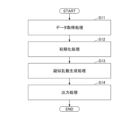
- Fig. 7 is a flowchart showing the process or operation of the encryption device according to the embodiment.
- the acquisition unit 51 acquires the message M as plaintext from outside the encryption device 50.
- the initialization unit 52 generates a random internal state based on the initialization vector IV and a table related to a specific function generated from the block cipher by referencing the table a certain number of times or more.
- the pseudorandom number generation unit 53 uses a black box model to output pseudorandom numbers while updating the state from a random internal state.
- the output unit 54 performs stream encryption by exclusive-ORing the plaintext message M with a pseudorandom number, then encrypts it, and outputs the encrypted message.
- Update function allows constant execution of table lookups, it is possible to start execution of the Update function (round function) in the r+1th stage or later before the result of the table lookup in the Update function (round function) in the rth stage is obtained.
- table lookups are constantly being executed while the encryption device 50 is running. Normally, random access to memory (storage unit M) has a slow latency but a fast throughput. This means that implementation performance depends on high throughput rather than high latency of memory access, and a significant performance improvement can be expected.
- the present invention is not limited to the above-described embodiment, and may have the following configurations or processes (operations).
- the encryption device 10 can be realized by a computer and a program, but this program can also be recorded on a (non-temporary) recording medium or provided via a communication network such as the Internet.
- the CPU 101 as a processor may be multiple or may be single.
- the encryption device 10 is described as performing stream encryption, but when the Update function is used, encryption using a block cipher may be performed.
- the encryption device 10 may use a message authentication code (MAC).
- MAC message authentication code
Landscapes
- Engineering & Computer Science (AREA)
- Computer Security & Cryptography (AREA)
- Computer Networks & Wireless Communication (AREA)
- Signal Processing (AREA)
- Storage Device Security (AREA)
Abstract
L'objectif de la présente divulgation est d'assurer la sécurité dans un modèle de boîte blanche ayant un chiffrement par blocs spatio-dur en chiffrement de flux. La présente divulgation concerne un dispositif de chiffrement qui effectue un chiffrement de flux, le dispositif de chiffrement comprenant : une unité d'initialisation qui, sur la base d'un vecteur d'initialisation et d'une table se rapportant à une fonction prescrite générée à partir d'un chiffrement par blocs, génère un état interne aléatoire, dans lequel le vecteur d'initialisation et une clé secrète ont été mélangés, en se référant à la table au moins un certain nombre de fois; et une unité de génération de nombre pseudo-aléatoire qui utilise un modèle de boîte noire dans lequel une valeur intermédiaire ne peut pas être déterminée depuis l'extérieur, pour délivrer un nombre pseudo-aléatoire tout en mettant à jour l'état à partir de l'état interne aléatoire.
Priority Applications (1)
| Application Number | Priority Date | Filing Date | Title |
|---|---|---|---|
| PCT/JP2023/029895 WO2025041207A1 (fr) | 2023-08-18 | 2023-08-18 | Dispositif de chiffrement, procédé de chiffrement, et programme |
Applications Claiming Priority (1)
| Application Number | Priority Date | Filing Date | Title |
|---|---|---|---|
| PCT/JP2023/029895 WO2025041207A1 (fr) | 2023-08-18 | 2023-08-18 | Dispositif de chiffrement, procédé de chiffrement, et programme |
Publications (1)
| Publication Number | Publication Date |
|---|---|
| WO2025041207A1 true WO2025041207A1 (fr) | 2025-02-27 |
Family
ID=94731777
Family Applications (1)
| Application Number | Title | Priority Date | Filing Date |
|---|---|---|---|
| PCT/JP2023/029895 Pending WO2025041207A1 (fr) | 2023-08-18 | 2023-08-18 | Dispositif de chiffrement, procédé de chiffrement, et programme |
Country Status (1)
| Country | Link |
|---|---|
| WO (1) | WO2025041207A1 (fr) |
Citations (2)
| Publication number | Priority date | Publication date | Assignee | Title |
|---|---|---|---|---|
| WO2013069392A1 (fr) * | 2011-11-09 | 2013-05-16 | Kddi株式会社 | Processeur non linéaire, dispositifs de cryptage et de décryptage pour chiffrement de flux, procédé de traitement de masquage, procédés de cryptage et de décryptage pour chiffrement de flux et programme |
| WO2019031025A1 (fr) * | 2017-08-10 | 2019-02-14 | ソニー株式会社 | Dispositif et procédé de chiffrement ainsi que dispositif et procédé de déchiffrement |
-
2023
- 2023-08-18 WO PCT/JP2023/029895 patent/WO2025041207A1/fr active Pending
Patent Citations (2)
| Publication number | Priority date | Publication date | Assignee | Title |
|---|---|---|---|---|
| WO2013069392A1 (fr) * | 2011-11-09 | 2013-05-16 | Kddi株式会社 | Processeur non linéaire, dispositifs de cryptage et de décryptage pour chiffrement de flux, procédé de traitement de masquage, procédés de cryptage et de décryptage pour chiffrement de flux et programme |
| WO2019031025A1 (fr) * | 2017-08-10 | 2019-02-14 | ソニー株式会社 | Dispositif et procédé de chiffrement ainsi que dispositif et procédé de déchiffrement |
Non-Patent Citations (1)
| Title |
|---|
| YUJI KOIKE, KOSEI SAKAMOTO, TAKUYA HAYASHI, TAKANORI ISOBE: "1F1-1 Galaxy: Spacehard Cipher based on Stream Cipher", PROCEEDINGS OF COMPUTER SECURITY SYMPOSIUM 2019; CSS 2019; OCTOBER 21-24, 2019, INFORMATION PROCESSING SOCIETY OF JAPAN, JP, 14 October 2019 (2019-10-14) - 24 October 2019 (2019-10-24), JP, pages 328 - 333, XP009561888 * |
Similar Documents
| Publication | Publication Date | Title |
|---|---|---|
| CN110677237B (zh) | 一种具有似混沌特性的文件加密方法 | |
| JP5306465B2 (ja) | セキュアなメモリに応用するメッセージ認証コードの事前計算 | |
| JP3927501B2 (ja) | Tcpaによるマイグレート可能鍵 | |
| CN114928438B (zh) | 抗内存信息泄露攻击的椭圆曲线数字签名计算方法及装置 | |
| CN113098675B (zh) | 基于多项式完全同态的二进制数据加密系统及方法 | |
| CN112199696B (zh) | 基于白盒分组密码的加解密方法 | |
| EP2873187A1 (fr) | Procédé de cryptage de données | |
| CN114826590B (zh) | 一种分组模式加密方法、解密方法及其装置、设备 | |
| WO2017000726A1 (fr) | Procédé de transformation de clé, appareil, et terminal | |
| CN104704501A (zh) | 在计算机系统中安全生成和存储密码 | |
| WO2021114850A1 (fr) | Procédé et appareil de chiffrement, de déchiffrement, de lecture et d'écriture de messages, dispositif informatique et support d'enregistrement | |
| US8804953B2 (en) | Extensive ciphertext feedback | |
| CN111314050A (zh) | 一种加解密方法及装置 | |
| Abdulraheem | Performance Comparison of Xen AND Hyper-V in Cloud Computing While Using Cryptosystems. | |
| Demir et al. | Optimizing dm-crypt for XTS-AES: Getting the Best of Atmel Cryptographic Co-Processors (long version) | |
| CN111314051B (zh) | 一种加解密方法和装置 | |
| US11876888B2 (en) | Encryption device, decryption device, encryption method, decryption method, and computer readable medium | |
| CN117725605A (zh) | 一种远端自动编制电子档案文件信息保密的方法和系统 | |
| JP7317261B2 (ja) | 暗号化装置、復号装置、暗号化方法、暗号化プログラム、復号方法及び復号プログラム | |
| CN116796345A (zh) | 加解密方法、装置、设备及存储介质 | |
| CN111314052A (zh) | 一种基于均匀分布对称压缩算法的数据加密和解密方法 | |
| Shete et al. | Image encryption using AES algorithm: study and evaluation | |
| CN111314079B (zh) | 一种加解密方法、装置 | |
| JP7573788B1 (ja) | 認証暗号装置、認証暗号方法及び認証暗号プログラム | |
| JPS6281145A (ja) | デ−タ暗号化方式 |
Legal Events
| Date | Code | Title | Description |
|---|---|---|---|
| 121 | Ep: the epo has been informed by wipo that ep was designated in this application |
Ref document number: 23949669 Country of ref document: EP Kind code of ref document: A1 |
|
| NENP | Non-entry into the national phase |
Ref country code: DE |