WO2025033279A1 - 無機質成形体 - Google Patents
無機質成形体 Download PDFInfo
- Publication number
- WO2025033279A1 WO2025033279A1 PCT/JP2024/027326 JP2024027326W WO2025033279A1 WO 2025033279 A1 WO2025033279 A1 WO 2025033279A1 JP 2024027326 W JP2024027326 W JP 2024027326W WO 2025033279 A1 WO2025033279 A1 WO 2025033279A1
- Authority
- WO
- WIPO (PCT)
- Prior art keywords
- calcium carbonate
- carbonate compound
- molded body
- mass
- inorganic molded
- Prior art date
- Legal status (The legal status is an assumption and is not a legal conclusion. Google has not performed a legal analysis and makes no representation as to the accuracy of the status listed.)
- Pending
Links
Images


Classifications
-
- C—CHEMISTRY; METALLURGY
- C04—CEMENTS; CONCRETE; ARTIFICIAL STONE; CERAMICS; REFRACTORIES
- C04B—LIME, MAGNESIA; SLAG; CEMENTS; COMPOSITIONS THEREOF, e.g. MORTARS, CONCRETE OR LIKE BUILDING MATERIALS; ARTIFICIAL STONE; CERAMICS; REFRACTORIES; TREATMENT OF NATURAL STONE
- C04B14/00—Use of inorganic materials as fillers, e.g. pigments, for mortars, concrete or artificial stone; Treatment of inorganic materials specially adapted to enhance their filling properties in mortars, concrete or artificial stone
- C04B14/02—Granular materials, e.g. microballoons
- C04B14/04—Silica-rich materials; Silicates
-
- C—CHEMISTRY; METALLURGY
- C04—CEMENTS; CONCRETE; ARTIFICIAL STONE; CERAMICS; REFRACTORIES
- C04B—LIME, MAGNESIA; SLAG; CEMENTS; COMPOSITIONS THEREOF, e.g. MORTARS, CONCRETE OR LIKE BUILDING MATERIALS; ARTIFICIAL STONE; CERAMICS; REFRACTORIES; TREATMENT OF NATURAL STONE
- C04B14/00—Use of inorganic materials as fillers, e.g. pigments, for mortars, concrete or artificial stone; Treatment of inorganic materials specially adapted to enhance their filling properties in mortars, concrete or artificial stone
- C04B14/02—Granular materials, e.g. microballoons
- C04B14/26—Carbonates
- C04B14/28—Carbonates of calcium
-
- C—CHEMISTRY; METALLURGY
- C04—CEMENTS; CONCRETE; ARTIFICIAL STONE; CERAMICS; REFRACTORIES
- C04B—LIME, MAGNESIA; SLAG; CEMENTS; COMPOSITIONS THEREOF, e.g. MORTARS, CONCRETE OR LIKE BUILDING MATERIALS; ARTIFICIAL STONE; CERAMICS; REFRACTORIES; TREATMENT OF NATURAL STONE
- C04B14/00—Use of inorganic materials as fillers, e.g. pigments, for mortars, concrete or artificial stone; Treatment of inorganic materials specially adapted to enhance their filling properties in mortars, concrete or artificial stone
- C04B14/38—Fibrous materials; Whiskers
-
- C—CHEMISTRY; METALLURGY
- C04—CEMENTS; CONCRETE; ARTIFICIAL STONE; CERAMICS; REFRACTORIES
- C04B—LIME, MAGNESIA; SLAG; CEMENTS; COMPOSITIONS THEREOF, e.g. MORTARS, CONCRETE OR LIKE BUILDING MATERIALS; ARTIFICIAL STONE; CERAMICS; REFRACTORIES; TREATMENT OF NATURAL STONE
- C04B16/00—Use of organic materials as fillers, e.g. pigments, for mortars, concrete or artificial stone; Treatment of organic materials specially adapted to enhance their filling properties in mortars, concrete or artificial stone
- C04B16/02—Cellulosic materials
-
- C—CHEMISTRY; METALLURGY
- C04—CEMENTS; CONCRETE; ARTIFICIAL STONE; CERAMICS; REFRACTORIES
- C04B—LIME, MAGNESIA; SLAG; CEMENTS; COMPOSITIONS THEREOF, e.g. MORTARS, CONCRETE OR LIKE BUILDING MATERIALS; ARTIFICIAL STONE; CERAMICS; REFRACTORIES; TREATMENT OF NATURAL STONE
- C04B16/00—Use of organic materials as fillers, e.g. pigments, for mortars, concrete or artificial stone; Treatment of organic materials specially adapted to enhance their filling properties in mortars, concrete or artificial stone
- C04B16/04—Macromolecular compounds
- C04B16/06—Macromolecular compounds fibrous
-
- C—CHEMISTRY; METALLURGY
- C04—CEMENTS; CONCRETE; ARTIFICIAL STONE; CERAMICS; REFRACTORIES
- C04B—LIME, MAGNESIA; SLAG; CEMENTS; COMPOSITIONS THEREOF, e.g. MORTARS, CONCRETE OR LIKE BUILDING MATERIALS; ARTIFICIAL STONE; CERAMICS; REFRACTORIES; TREATMENT OF NATURAL STONE
- C04B20/00—Use of materials as fillers for mortars, concrete or artificial stone according to more than one of groups C04B14/00 - C04B18/00 and characterised by shape or grain distribution; Treatment of materials according to more than one of the groups C04B14/00 - C04B18/00 specially adapted to enhance their filling properties in mortars, concrete or artificial stone; Expanding or defibrillating materials
-
- C—CHEMISTRY; METALLURGY
- C04—CEMENTS; CONCRETE; ARTIFICIAL STONE; CERAMICS; REFRACTORIES
- C04B—LIME, MAGNESIA; SLAG; CEMENTS; COMPOSITIONS THEREOF, e.g. MORTARS, CONCRETE OR LIKE BUILDING MATERIALS; ARTIFICIAL STONE; CERAMICS; REFRACTORIES; TREATMENT OF NATURAL STONE
- C04B28/00—Compositions of mortars, concrete or artificial stone, containing inorganic binders or the reaction product of an inorganic and an organic binder, e.g. polycarboxylate cements
- C04B28/02—Compositions of mortars, concrete or artificial stone, containing inorganic binders or the reaction product of an inorganic and an organic binder, e.g. polycarboxylate cements containing hydraulic cements other than calcium sulfates
Definitions
- the present invention relates to an inorganic molded body.
- Inorganic molded bodies are mostly composed of inorganic substances such as hydraulic materials and siliceous materials, and because they have properties such as fire resistance, light weight, high strength, and ease of work, they are widely used for exterior wall materials for houses, roof underlayment materials, eaves ceiling materials, etc.
- seawater residue which is mainly composed of calcium carbonate and magnesium hydroxide and is by-produced in the process of removing carbonates from seawater during the process of producing magnesium hydroxide from seawater, is applied to calcareous materials (JP Patent Publication No. 2012-116685).
- the object of the present invention is to provide an inorganic molded body that can sufficiently reduce warping and cracking when heated when used in building materials.
- the present invention comprises: 5% by mass or more and 45% by mass or less of hydraulic material, A silicate material is 10% by mass or more and 55% by mass or less, Reinforcing fiber material: 1.5% by mass or more and 30% by mass or less;
- the present invention relates to an inorganic molded body comprising 5% by mass or more and 60% by mass or less of a calcium carbonate compound having an aspect ratio of an average major axis to an average minor axis of 2 or more and 19 or less.
- the inorganic molding contains 5% by mass or more and 60% by mass or less of calcium carbonate compounds having an aspect ratio of 2 to 19, and therefore warping and cracking during heating can be sufficiently reduced when used as a building material. Although the reason for this is unclear, it is speculated as follows. The inventors considered the cause of the heating behavior and thought that the degree of shrinkage of the heated surface was large, which caused cracks on the heated surface. They also speculated that the cracks on the heated surface were the cause of cracking and warping throughout the inorganic molding.
- the inventors found that by blending a high content of calcium carbonate compounds having a high aspect ratio into the inorganic molding, it is possible to suppress both the shrinkage of the heated surface and the rise in temperature on the back surface during heating.
- the high aspect ratio calcium carbonate compound functions as a so-called reinforcing material, which can suppress shrinkage of the heated surface and prevent cracks from occurring. It can also reduce warping during thermal shock.
- the insulation properties in the thickness direction of the inorganic molded body are increased, and the rise in the back surface temperature can be suppressed, thereby suppressing the occurrence of thermal shock. As a result, it is presumed that warping and cracking can be prevented throughout the inorganic molded body.
- calcium-based carbonate compound refers to a compound that contains calcium carbonate as a main component, and is a concept that allows the inclusion or coexistence of other subcomponents that may be incorporated during the manufacturing process, etc.
- the calcium carbonate content in the calcium-based carbonate compound is preferably 90 mass% or more.
- the calcium carbonate content in the calcium-based carbonate compound can be suitably measured by XRF (X-ray fluorescence analysis).
- the calcium carbonate compound is preferably a synthetic calcium carbonate compound.
- a synthetic calcium carbonate compound which is a reaction product of calcium hydroxide and carbon dioxide, as the calcium carbonate compound, it is possible to reuse carbon dioxide that is generated secondarily in the industrial process, which can contribute to reducing carbon dioxide emissions throughout the entire industrial process.
- the average particle size of the calcium carbonate compound is preferably 1.1 ⁇ m or more and 12.5 ⁇ m or less in terms of suppressing shrinkage of the heating surface.
- the average major axis of the calcium carbonate compound is preferably 0.5 ⁇ m or more and 25 ⁇ m or less.
- the BET specific surface area of the calcium carbonate compound is preferably 1 m 2 /g or more and 10 m 2 /g or less.
- the ratio Ia/Ic of the peak intensity Ia of aragonite to the peak intensity Ic of calcite is preferably 0.02 or more, which can efficiently impart a high aspect ratio to the calcium carbonate compound and can reduce the occurrence of warping and cracking of the inorganic molded body to a higher level.
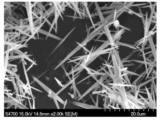
- FIG. 1 is a SEM photograph of a calcium carbonate compound of Production Example 1-1 of the present invention.
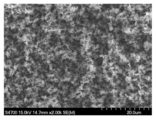
- 1 is a SEM photograph of a calcium carbonate compound of Production Example 1-2 of the present invention.
- 1 is a SEM photograph of a calcium carbonate compound of Production Example 1-3 of the present invention.
- 1 is a SEM photograph of a calcium carbonate compound of Production Example 1-4 of the present invention.
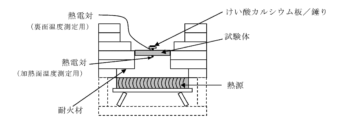
- FIG. 2 is a partial perspective view showing a schematic diagram of a heating tester.
- the inorganic molded body contains a hydraulic material, a siliceous material, a reinforcing fiber material, and a calcium carbonate compound having a predetermined aspect ratio, each of which is contained in a specific amount.
- hydraulic materials examples include cementitious materials, gypsum, lime, slag, etc.
- cementitious materials include commonly used cements, such as ordinary Portland cement, high-early-strength cement, moderate-heat cement, fly ash cement, blast furnace slag cement, and alumina cement.
- gypsum examples include anhydrous gypsum, hemihydrate gypsum, dihydrate gypsum, etc.
- slag examples include blast furnace slag, converter slag, etc.
- the content of the hydraulic material is from 5% by mass to 45% by mass, preferably from 8% by mass to 42% by mass, and more preferably from 10% by mass to 40% by mass, based on the total amount of materials constituting the inorganic molded body.
- siliceous materials include materials containing a large amount of SiO 2, such as silica sand, silica powder, silica fume, fly ash, diatomaceous earth, layered silicates (e.g., mica, talc, kaolin, bentonite), wollastonite, and lightweight aggregates (e.g., fly ash balloons, perlite, shirasu balloons, glass foams, etc.). These siliceous materials can be used alone or in combination of two or more. Talc, mica, and wollastonite can also be used as reinforcing fiber materials described below.
- the content of the siliceous material is 10% by mass or more and 55% by mass or less, preferably 12% by mass or more and 50% by mass or less, and more preferably 15% by mass or more and 45% by mass or less, based on the total amount of the materials constituting the inorganic molded body. If the content of the siliceous material is within the above range, it is possible to set the bending strength, bulk density, water absorption rate, dimensional stability, etc. of the inorganic molded body to the desired range.
- a lightweight aggregate having a unit volume mass of 0.5 g / cm 3 or less such as perlite, fly ash balloon, and shirasu balloon is mixed as the siliceous material
- reinforcing fiber material examples include pulps such as softwood pulp, hardwood pulp, pulps fibrillated with these pulps, and pulps obtained by defibrating waste paper, organic reinforcing fiber materials such as vinylon fiber, acrylonitrile fiber, and polypropylene fiber, and inorganic reinforcing fiber materials such as rock wool and glass fiber. These reinforcing fiber materials can be used alone or in combination of two or more.
- the content of the reinforcing fiber material is 1.5% by mass or more and 30% by mass or less, preferably 3% by mass or more and 26% by mass or less, and more preferably 4% by mass or more and 22% by mass or less, based on the total amount of materials constituting the inorganic molded body.
- an inorganic reinforcing fiber material with an average length of 1 mm to 50 mm is blended as the reinforcing fiber material, it is preferable to use other reinforcing fiber materials in combination so that the content is 10% by mass or less, based on the total amount of materials constituting the inorganic molded body, in order to improve the smoothness of the inorganic molded body.
- the aspect ratio of the average major axis to the average minor axis of the calcium carbonate compound is 2 or more and 19 or less, preferably 2.5 or more and 17 or less, and more preferably 3 or more and 15 or less. It has been found that the shrinkage of the heated surface and the rise in the back surface temperature during heating can be suppressed.
- the calcium carbonate compound with a high aspect ratio effectively functions as a reinforcing material, suppressing the shrinkage of the heated surface and the rise in the back surface temperature, thereby preventing warping and cracking in the entire inorganic molded body.
- the crystal structure of the calcium carbonate compound can be preferably a calcite type, an aragonite type, or a combination of these. In order to give the calcium carbonate compound the above aspect ratio, it is preferable that it contains at least an aragonite type crystal structure.
- the ratio Ia / Ic of the peak intensity Ia of aragonite to the peak intensity Ic of calcite is preferably 0.02 or more, more preferably 0.20 or more, and even more preferably 1.00 or more. This makes it possible to efficiently impart a high aspect ratio to the calcium carbonate compound, and to reduce the occurrence of warping and cracking of the inorganic molded body to a higher level.
- the average particle size of the calcium carbonate compound measured by laser diffraction is preferably 1.1 ⁇ m or more and 12.5 ⁇ m or less, more preferably 1.5 ⁇ m or more and 12 ⁇ m or less, and even more preferably 2 ⁇ m or more and 11.5 ⁇ m or less. This improves the dispersibility of the calcium carbonate compound and efficiently suppresses shrinkage of the heating surface.
- the average major axis of the calcium carbonate compound is preferably 0.5 ⁇ m or more and 25 ⁇ m or less, more preferably 1 ⁇ m or more and 22 ⁇ m or less, and even more preferably 2 ⁇ m or more and 18 ⁇ m or less. This suppresses aggregation between the calcium carbonate compounds or between the calcium carbonate compounds and other components, and as a result, the shrinkage of the heating surface and the rise in the back surface temperature during heating can be suppressed to a higher level.
- the BET specific surface area of the calcium carbonate compound is preferably 1 m2 /g or more and 10 m2 /g or less, more preferably 2 m2 /g or more and 9 m2 /g or less, and even more preferably 3 m2 /g or more and 8 m2 /g or less, which can improve the dispersibility of the calcium carbonate compound and, as a result, can suppress the shrinkage of the heating surface and the rise in the back surface temperature during heating to a higher level.
- the apparent specific gravity of the calcium carbonate compound is preferably 0.1 g/mL or more and 1.0 g/mL or less, more preferably 0.2 g/mL or more and 0.9 g/mL or less, and even more preferably 0.3 g/mL or more and 0.8 g/mL or less.
- the calcium carbonate compound is preferably a synthetic calcium carbonate compound.
- a synthetic calcium carbonate compound which is a reaction product of calcium hydroxide and carbon dioxide gas (carbon dioxide), as the calcium carbonate compound, it is possible to reuse the carbon dioxide that is generated secondarily in the industrial process, which contributes to reducing carbon dioxide emissions throughout the industrial process.
- carbon dioxide carbon dioxide gas
- the calcium carbonate compound by-produced in the process of removing carbonates from seawater and seawater residue mainly composed of magnesium hydroxide can also be used as a source of calcium carbonate compound.
- the content of the calcium carbonate compound is 5% by mass or more and 60% by mass or less, preferably 8% by mass or more and 55% by mass or less, and more preferably 12% by mass or more and 50% by mass or less, based on the total amount of materials constituting the inorganic molded body.
- the method for synthesizing calcium carbonate compounds is not particularly limited, and known manufacturing methods can be adopted.
- the carbon dioxide gas method is preferred in which carbon dioxide gas is blown into milk of lime (a slurry in which excess slaked lime is added to a saturated aqueous solution of slaked lime) to carbonate it.
- the carbon dioxide gas used in the carbon dioxide gas method can be the flue gas of a lime calciner, a boiler, a waste incinerator, or the like, which is installed in the vicinity of a calcium carbonate compound manufacturing plant.
- a known method can also be used as a method for imparting a predetermined aspect ratio to a calcium carbonate compound based on the carbon dioxide gas method.
- Specific examples of such methods include a method for producing a calcium carbonate compound in which the amount of carbon dioxide gas is adjusted at each stage in the carbonation process, a method for producing a calcium carbonate compound in which heating is performed at the carbonation stage, a method for producing a calcium carbonate compound in which needle-shaped light calcium carbonate compound is used as seed crystals in a slaked lime slurry, carbon dioxide gas is introduced into the slurry, and the seed crystals are grown to a desired particle size by a carbonation reaction, a method for producing a calcium carbonate compound in which an aragonite-type needle-shaped calcium carbonate compound is added to a slaked lime slurry and a carbonation reaction is performed while stirring with high stirring power, a method for producing an aragonite crystal-type calcium carbonate compound by adding a phosphoric acid compound, a method for producing
- the concentration of carbon dioxide varies depending on the type of exhaust gas generated by each combustion engine, but when carbonation efficiency is taken into consideration, 1% by volume or more is preferable, 5% by volume or more is more preferable, and 10% by volume or more is even more preferable.
- the carbonation temperature (the slurry temperature) is not particularly limited, and is preferably 15°C or higher and 100°C or lower, more preferably 20°C or higher and 90°C or lower, and even more preferably 25°C or higher and 80°C or lower.
- the calcium carbonate compound produced may be filtered and dried to obtain a powder, or may be used as a source of calcium carbonate compound in the form of a slurry or cake without filtering or drying.
- a water utilization method in which magnesium hydroxide is produced by adding slaked lime or the like to seawater and then removing magnesium from the residue (hereinafter referred to as "utilized water") is added to the residue, and carbon dioxide gas is then blown into it, is also preferable from the standpoint of waste utilization and carbon dioxide reduction.
- utilization water in which magnesium hydroxide is produced by adding slaked lime or the like to seawater and then removing magnesium from the residue
- carbon dioxide gas is then blown into it
- Optional ingredients in addition to the above materials, in order to impart various functions to the inorganic molded body, various materials such as resin hollow bodies, wood chips, wood powder, resin powder, defoaming agents, flocculants, water repellents, thickeners (methyl cellulose, hydroxyethyl methyl cellulose, hydroxypropyl methyl cellulose, etc.), dispersants, etc. can be mixed into the inorganic molded body depending on the purpose. It is also possible to appropriately add recycled materials obtained by crushing scraps generated during processing of the inorganic molded body.
- the method for producing the inorganic molded body according to this embodiment is not particularly limited, and generally used methods such as papermaking, extrusion molding, flow-on molding, pouring molding, and press (compression) molding can be used.
- the inorganic molded body can be obtained by subjecting a green sheet molded by these methods to a patterning process such as press dehydration or embossing, and then curing the green sheet at room temperature, steam curing, autoclave curing, etc. Furthermore, the green sheet may be dried, and shaped or painted as necessary.
- the aspect ratio of the calcium carbonate compound is preferably 4 to 19, more preferably 6 to 18, and even more preferably 8 to 17.
- the aspect ratio of the calcium carbonate compound is preferably 2 or more and 12 or less, more preferably 2.5 or more and 10 or less, and even more preferably 3 or more and 8 or less.
- the use of the inorganic molded body is not particularly limited, and it can be suitably used as a performance maintaining material such as a wall material, a floor material, a roofing material, various boards, external decorative members, interior and exterior finishing materials such as fittings, a sealing material, a heat insulating material, a sound absorbing material, a waterproofing material, etc.
- the inorganic molded body is preferably a cement-based molded body containing a cementitious material, and more preferably a calcium silicate molded body. Among them, the molded body is more preferably a molded board.
- the inorganic molded body may be a concrete structure.
- the concrete structure is composed of a hardened body of a hydraulic composition.
- the hydraulic composition is composed of a powder containing, in addition to calcium carbonate, at least one of blast furnace slag, an expansive material, slaked lime, quicklime, fly ash, and a cementitious material.
- the calcium carbonate the above-mentioned calcium carbonate compound can be suitably used.
- the cementitious material the cementitious material shown in the hydraulic material can be suitably used.
- aggregates such as sand and gravel, chemicals such as chemical admixtures for concrete, and fibrous materials made of metals or polymeric materials may be added to form a hydraulic composition mixture.
- the hardened hydraulic composition is a paste obtained by kneading the hydraulic composition with water and hardening the paste.
- the hardened hydraulic composition mixture is a mixture obtained by kneading the hydraulic composition with water and hardening the mixture (equivalent to fresh mortar or fresh concrete), and is equivalent to mortar or concrete.
- BET Specific Surface Area A powder sample was pretreated in a nitrogen gas atmosphere at about 130°C for about 30 minutes using an 8-unit preheat unit (manufactured by MOUNTECH), and the BET specific surface area ( m2 /g) was measured by a nitrogen gas adsorption method using a Macsorb HM Model-1208 (manufactured by MOUNTECH) as a BET specific surface area measuring device.
- Average particle size by laser diffraction method 50 mL of ethanol was placed in a 100 mL beaker, and about 0.2 g of the sample powder was placed in the 100 mL beaker and subjected to ultrasonic treatment (UD-201, manufactured by Tommy Seiko Co., Ltd.) for 3 minutes to prepare a dispersion.
- This dispersion was measured using a laser diffraction method-particle size distribution meter (Microtrac HRA Model 9320-X100, manufactured by Nikkiso Co., Ltd.) to measure the volume-based D50 value as the average particle size ( ⁇ m).
- Double-sided tape was attached to an aluminum sample stage, and the sample powder was applied on the double-sided tape by tracing it with a spatula. After platinum deposition, the particle image of the sample powder was photographed at 2,000 times magnification using a scanning electron microscope (FE-SEM: S-4700 manufactured by Hitachi, Ltd.). SEM photographs are shown in Figures 1 to 4. For the obtained SEM photograph, 20 particles in the photograph were randomly selected using image analysis software (Image J), and the average values of the major axis, minor axis and aspect ratio (ratio of major axis to minor axis) of the primary particles were calculated.
- Image J image analysis software
- the measurement of the major axis and minor axis was performed according to the following procedure. For one randomly selected particle image, the length of the straight line with the maximum span was taken as the "major axis", and the span on the particle image of the straight line perpendicular to the major axis at the center of the straight line (major axis) that gives the major axis was taken as the "minor axis”.
- a pipe for extracting exhaust gas was connected to the exhaust outlet of a steam production boiler using LNG as fuel, and the CO2 concentration was measured using a CO2 concentration meter (XP-3140 manufactured by Shin Cosmos Electric Co., Ltd.) while drawing in the exhaust gas using a test blower.
- the CO2 concentration was 10% by volume.
- Exhaust gas was introduced into the above-mentioned 220L SUS vessel using a test blower at a speed of 100L/min and reacted for 7 hours. Thereafter, the mixture was filtered, washed with about 5 times the amount of water relative to the solid content, dried at 110° C. for 24 hours, and pulverized to obtain a sample powder of a calcium carbonate compound.
- Inorganic molded bodies were manufactured by the papermaking method and extrusion molding method according to the following procedures. The amounts of the components used are all shown in “parts by mass” unless otherwise specified. In the table below, “-" indicates that the corresponding component was not used.
- Example 1-1 Production of inorganic molded body by papermaking method The materials shown in Table 2 below were put into a plastic container and mixed by stirring to obtain a raw material slurry.
- the calcium carbonate compound of Production Example 1-1 was used as the calcium carbonate compound.
- the raw material slurry was divided and put into a filter covered with felt, and a laminate (long side 28 mm x short side 24 mm x thickness 14 mm) was produced while performing suction filtration with a vacuum pump.
- the laminate was removed from the filter and subjected to dehydration pressing. The thickness after pressing was 13 mm.
- Example 1-2 Production of Inorganic Molded Body by Papermaking Method An inorganic molded body was obtained in the same manner as in Example 1-1, except that the calcium carbonate compound of Production Example 1-2 was used as the calcium carbonate compound.
- Example 1-3 Production of Inorganic Molded Body by Papermaking Method An inorganic molded body was obtained in the same manner as in Example 1-1, except that the calcium carbonate compound of Production Example 1-3 was used as the calcium carbonate compound.
- Example 1-1 Production of Inorganic Molded Body by Papermaking Method An inorganic molded body was obtained in the same manner as in Example 1-1, except that the calcium carbonate compound of Production Example 1-4 was used as the calcium carbonate compound.
- Comparative Example 1-2 Production of Inorganic Molded Body by Papermaking Method An inorganic molded body was obtained in the same manner as in Example 1-1, except that the materials shown in Table 2 below were used and no calcium carbonate compound was added.
- Example 1-3 Production of inorganic molded body by papermaking method An inorganic molded body was obtained in the same manner as in Example 1-1, except that a calcium carbonate compound having an aspect ratio of 25 was used as the calcium carbonate compound. However, the calcium carbonate compound was broken during molding and could not maintain its original shape, so no evaluation was performed.
- Example 1-4 to 1-10 Production of inorganic molded bodies by papermaking process Inorganic molded bodies were obtained in the same manner as in Example 1-1, except that the materials shown in Table 3 below were used. For reference, Table 3 also lists the materials and evaluations of Examples 1-1 to 1-3 and Comparative Example 1-2.
- the bulk density was measured in accordance with JIS A 5430.
- FIG. 5 is a schematic partial perspective view of the heating tester.
- an electric heater was used as a heat source to stabilize the temperature at around 900° C., and a fireproof material was assembled between the test specimen and the heat source, so that the temperature of the back side of the test specimen could be measured with a thermocouple.
- an electric heater (1.2 kW heater) was used as the heat source equipment, and a K thermocouple and a temperature regulator were connected.
- each thermocouple was connected to a data logger. The distance between the heating surface side of the test specimen and the heat source was fixed to about 70 mm.
- the test procedure was as follows. (1) A scrap board was placed, preheating was performed up to 902°C, and then heating was performed once. (2) The test specimen was inserted after the heated surface had cooled below 200°C. (3) A thermocouple was placed in the center of the back surface of the test specimen (top surface in the figure), and a calcium silicate plate (approximately 30 mm x 70 mm) and a weight were placed on top and fixed in place. (4) Heating was started, and the specimen was left for a specified time (45 minutes), after which the temperatures of the front and back sides were recorded with a data logger.
- the temperature of the electric heater was set to 902°C on the heating side, and was controlled with a temperature controller with a lower limit of 900°C.
- the data logger also measured the temperature every 10 seconds, and the data was recorded at this interval.
- the test specimen was removed and the following items were measured (each item was also measured before the test): Dimensions: The length and width of the back surface and the heated surface were measured with a vernier caliper. The area (mm 2 ) of the heated surface before and after the test was calculated, and the heated surface shrinkage (%) was calculated based on the following formula.
- Heating surface shrinkage (%) ⁇
- Warpage The test specimen was placed on an iron surface plate, and the height of the center of each side of the test specimen from the iron surface plate was measured with a thickness gauge, and the average value (mm) was calculated. This average value was defined as the warpage (mm) after heating. - Photographs of the sample before and after the test (photos showing the extent of cracks before and after heating)
- the inorganic molded body of the embodiment was superior to the comparative example in terms of shrinkage on the heated surface, temperature rise on the reverse surface, and warping after heating. In addition, the inorganic molded body of the embodiment did not develop cracks after heating (not shown).
- Example 2-1 Production of inorganic molded body by extrusion molding
- the materials shown in Table 3 below were put into an omni mixer and the raw materials were dry-mixed for 3 minutes.
- the calcium carbonate compound of Production Example 1-1 was used as the calcium carbonate compound.
- water was added and wet-mixed for 2 minutes.
- the raw materials after wet mixing were kneaded with an Ishikawa extruder, and then extrusion-molded with the Ishikawa extruder. This produced a molded body with a long side of 600 mm x short side of 190 mm x thickness of 13 mm.
- the molded body After obtaining the molded body, it was put into a thermostatic chamber set at 60 ° C / 98% and subjected to primary curing, and further pressure was increased to 9 kgf and autoclave curing was performed for 12 hours. Both sides of the molded body were polished with a sander to make the thickness 12 mm, and an inorganic molded body was produced.
- Example 2-2 Production of Inorganic Molded Body by Extrusion Molding Method An inorganic molded body was obtained in the same manner as in Example 2-1, except that the calcium carbonate compound of Production Example 1-2 was used as the calcium carbonate compound.
- Example 2-3 Production of Inorganic Molded Body by Extrusion Molding Method An inorganic molded body was obtained in the same manner as in Example 2-1, except that the calcium carbonate compound of Production Example 1-3 was used as the calcium carbonate compound.
- Example 2-1 Production of Inorganic Molded Product by Extrusion Molding Method An inorganic molded product was obtained in the same manner as in Example 2-1, except that the calcium carbonate compound of Production Example 1-4 was used as the calcium carbonate compound.
- Comparative Example 2-2 Production of inorganic molded body by extrusion molding. An inorganic molded body was obtained in the same manner as in Example 2-1, except that the materials and contents shown in Table 3 below were used and no calcium carbonate compound was added.
- Example 2-3 Production of inorganic molded body by extrusion molding method An inorganic molded body was obtained in the same manner as in Example 2-1, except that a calcium carbonate compound having an aspect ratio of 25 was used as the calcium carbonate compound. However, the calcium carbonate compound broke during molding and could not maintain its original shape, so no evaluation was performed.
- the bulk density was measured in accordance with JIS A 5430.
- Heating test The measurement was carried out in the same manner as in the papermaking method.
- the inorganic molded bodies of the Examples were superior to the Comparative Examples in both the heated surface shrinkage and the warpage after heating. Furthermore, the inorganic molded bodies of the Examples did not develop cracks after heating (not shown).
Landscapes
- Chemical & Material Sciences (AREA)
- Engineering & Computer Science (AREA)
- Ceramic Engineering (AREA)
- Materials Engineering (AREA)
- Structural Engineering (AREA)
- Organic Chemistry (AREA)
- Civil Engineering (AREA)
- Chemical Kinetics & Catalysis (AREA)
- Inorganic Chemistry (AREA)
- Curing Cements, Concrete, And Artificial Stone (AREA)
- Paper (AREA)
Priority Applications (3)
| Application Number | Priority Date | Filing Date | Title |
|---|---|---|---|
| AU2024322667A AU2024322667A1 (en) | 2023-08-10 | 2024-07-31 | Inorganic molded body |
| JP2024568143A JP7662908B1 (ja) | 2023-08-10 | 2024-07-31 | 無機質成形体 |
| CN202480051874.1A CN121666370A (zh) | 2023-08-10 | 2024-07-31 | 无机质成形体 |
Applications Claiming Priority (2)
| Application Number | Priority Date | Filing Date | Title |
|---|---|---|---|
| JP2023131202 | 2023-08-10 | ||
| JP2023-131202 | 2023-08-10 |
Publications (1)
| Publication Number | Publication Date |
|---|---|
| WO2025033279A1 true WO2025033279A1 (ja) | 2025-02-13 |
Family
ID=94534704
Family Applications (1)
| Application Number | Title | Priority Date | Filing Date |
|---|---|---|---|
| PCT/JP2024/027326 Pending WO2025033279A1 (ja) | 2023-08-10 | 2024-07-31 | 無機質成形体 |
Country Status (4)
| Country | Link |
|---|---|
| JP (1) | JP7662908B1 (https=) |
| CN (1) | CN121666370A (https=) |
| AU (1) | AU2024322667A1 (https=) |
| WO (1) | WO2025033279A1 (https=) |
Citations (6)
| Publication number | Priority date | Publication date | Assignee | Title |
|---|---|---|---|---|
| JPH01278566A (ja) * | 1988-05-02 | 1989-11-08 | Maruo Calcium Co Ltd | 熱可塑性樹脂組成物及びそれからなる成形体 |
| JP2005231920A (ja) * | 2004-02-17 | 2005-09-02 | Yahashi Kogyo Kk | 水酸アパタイト−炭酸カルシウム複合粒子、およびその製造方法 |
| JP2012116685A (ja) | 2010-11-30 | 2012-06-21 | Ube Industries Ltd | セメント系無機質板 |
| JP2014108918A (ja) * | 2012-12-04 | 2014-06-12 | A & A Material Corp | けい酸カルシウム成形体及びその製造法 |
| WO2018003612A1 (ja) * | 2016-06-30 | 2018-01-04 | 株式会社クラレ | 繊維補強炭酸化セメント成形物およびその製造方法 |
| WO2023074608A1 (ja) * | 2021-10-27 | 2023-05-04 | 白石工業株式会社 | 炭酸カルシウム水スラリーおよび炭酸カルシウム水スラリーの製造方法 |
-
2024
- 2024-07-31 CN CN202480051874.1A patent/CN121666370A/zh active Pending
- 2024-07-31 JP JP2024568143A patent/JP7662908B1/ja active Active
- 2024-07-31 AU AU2024322667A patent/AU2024322667A1/en active Pending
- 2024-07-31 WO PCT/JP2024/027326 patent/WO2025033279A1/ja active Pending
Patent Citations (6)
| Publication number | Priority date | Publication date | Assignee | Title |
|---|---|---|---|---|
| JPH01278566A (ja) * | 1988-05-02 | 1989-11-08 | Maruo Calcium Co Ltd | 熱可塑性樹脂組成物及びそれからなる成形体 |
| JP2005231920A (ja) * | 2004-02-17 | 2005-09-02 | Yahashi Kogyo Kk | 水酸アパタイト−炭酸カルシウム複合粒子、およびその製造方法 |
| JP2012116685A (ja) | 2010-11-30 | 2012-06-21 | Ube Industries Ltd | セメント系無機質板 |
| JP2014108918A (ja) * | 2012-12-04 | 2014-06-12 | A & A Material Corp | けい酸カルシウム成形体及びその製造法 |
| WO2018003612A1 (ja) * | 2016-06-30 | 2018-01-04 | 株式会社クラレ | 繊維補強炭酸化セメント成形物およびその製造方法 |
| WO2023074608A1 (ja) * | 2021-10-27 | 2023-05-04 | 白石工業株式会社 | 炭酸カルシウム水スラリーおよび炭酸カルシウム水スラリーの製造方法 |
Also Published As
| Publication number | Publication date |
|---|---|
| AU2024322667A1 (en) | 2026-02-19 |
| CN121666370A (zh) | 2026-03-13 |
| JP7662908B1 (ja) | 2025-04-15 |
| JPWO2025033279A1 (https=) | 2025-02-13 |
| TW202513503A (zh) | 2025-04-01 |
Similar Documents
| Publication | Publication Date | Title |
|---|---|---|
| AU2009263979A1 (en) | Binder composition | |
| JP7696070B1 (ja) | 炭酸カルシウム | |
| JP7662908B1 (ja) | 無機質成形体 | |
| JP7745784B2 (ja) | 無機質成形体用カルシウム系炭酸化合物 | |
| TWI916922B (zh) | 無機質成形體 | |
| JP7678868B1 (ja) | カルシウム系炭酸化合物及び無機質成形体 | |
| JP7797452B2 (ja) | カルシウム系炭酸化合物及び含水組成物 | |
| JP7809239B1 (ja) | カルシウム系炭酸化合物、組成物、成形板、無機質成形体、及び、カルシウム系炭酸化合物の製造方法 | |
| JP7811980B1 (ja) | CaO含有組成物、カルシウム系炭酸化合物の製造方法、カルシウム系炭酸化合物、無機質成形体、及び、無機質成形体のCO2固定化率を上昇させる方法 | |
| JP7811981B1 (ja) | カルシウム系炭酸化合物製造用のCaO含有組成物、カルシウム系炭酸化合物の製造方法、カルシウム系炭酸化合物、無機質成形体、及び、無機質成形体のCO2固定化率を上昇させる方法 | |
| JP7751060B2 (ja) | カルシウム系炭酸化合物及び無機質成形体 | |
| JP7710084B2 (ja) | カルシウム系炭酸化合物及び無機質成形体 | |
| TWI922213B (zh) | 鈣系碳酸化合物之製造方法、含CaO之組成物、鈣系碳酸化合物及無機質成形體 | |
| TWI902584B (zh) | 鈣系碳酸化合物及無機質成形體 | |
| CN121986077A (en) | Calcium carbonate compound and aqueous composition | |
| JP2025155890A (ja) | カルシウム系炭酸化合物の製造方法、CaO含有組成物、カルシウム系炭酸化合物及び無機質成形体 | |
| WO2025204487A1 (ja) | カルシウム系炭酸化合物の製造方法、CaO含有組成物、カルシウム系炭酸化合物及び無機質成形体 | |
| WO2025142773A1 (ja) | カルシウム系炭酸化合物及び無機質成形体 | |
| JP2011051804A (ja) | 木質セメント成形体 | |
| WO2024142496A1 (ja) | カルシウム炭酸化物の製造方法及びセメント組成物の製造方法 |
Legal Events
| Date | Code | Title | Description |
|---|---|---|---|
| ENP | Entry into the national phase |
Ref document number: 2024568143 Country of ref document: JP Kind code of ref document: A |
|
| WWE | Wipo information: entry into national phase |
Ref document number: 2024568143 Country of ref document: JP |
|
| 121 | Ep: the epo has been informed by wipo that ep was designated in this application |
Ref document number: 24851704 Country of ref document: EP Kind code of ref document: A1 |
|
| WWE | Wipo information: entry into national phase |
Ref document number: AU2024322667 Country of ref document: AU |
|
| ENP | Entry into the national phase |
Ref document number: 2024322667 Country of ref document: AU Date of ref document: 20240731 Kind code of ref document: A |
|
| WWE | Wipo information: entry into national phase |
Ref document number: 2024851704 Country of ref document: EP |
|
| NENP | Non-entry into the national phase |
Ref country code: DE |