WO2025028457A1 - コンピュータプログラム、情報処理装置、情報処理方法、及び医療支援システム - Google Patents
コンピュータプログラム、情報処理装置、情報処理方法、及び医療支援システム Download PDFInfo
- Publication number
- WO2025028457A1 WO2025028457A1 PCT/JP2024/026865 JP2024026865W WO2025028457A1 WO 2025028457 A1 WO2025028457 A1 WO 2025028457A1 JP 2024026865 W JP2024026865 W JP 2024026865W WO 2025028457 A1 WO2025028457 A1 WO 2025028457A1
- Authority
- WO
- WIPO (PCT)
- Prior art keywords
- patient
- data
- medical
- adl
- terminal device
- Prior art date
- Legal status (The legal status is an assumption and is not a legal conclusion. Google has not performed a legal analysis and makes no representation as to the accuracy of the status listed.)
- Pending
Links
Images





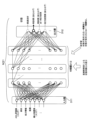


Classifications
-
- G—PHYSICS
- G16—INFORMATION AND COMMUNICATION TECHNOLOGY [ICT] SPECIALLY ADAPTED FOR SPECIFIC APPLICATION FIELDS
- G16H—HEALTHCARE INFORMATICS, i.e. INFORMATION AND COMMUNICATION TECHNOLOGY [ICT] SPECIALLY ADAPTED FOR THE HANDLING OR PROCESSING OF MEDICAL OR HEALTHCARE DATA
- G16H10/00—ICT specially adapted for the handling or processing of patient-related medical or healthcare data
- G16H10/60—ICT specially adapted for the handling or processing of patient-related medical or healthcare data for patient-specific data, e.g. for electronic patient records
-
- G—PHYSICS
- G16—INFORMATION AND COMMUNICATION TECHNOLOGY [ICT] SPECIALLY ADAPTED FOR SPECIFIC APPLICATION FIELDS
- G16H—HEALTHCARE INFORMATICS, i.e. INFORMATION AND COMMUNICATION TECHNOLOGY [ICT] SPECIALLY ADAPTED FOR THE HANDLING OR PROCESSING OF MEDICAL OR HEALTHCARE DATA
- G16H50/00—ICT specially adapted for medical diagnosis, medical simulation or medical data mining; ICT specially adapted for detecting, monitoring or modelling epidemics or pandemics
- G16H50/30—ICT specially adapted for medical diagnosis, medical simulation or medical data mining; ICT specially adapted for detecting, monitoring or modelling epidemics or pandemics for calculating health indices; for individual health risk assessment
Definitions
- the present invention relates to a computer program, an information processing device, an information processing method, and a medical support system that support pain management for patients.
- QOL quality of life
- Patent Document 1 The need for managing patient pain even during remote medical care is disclosed in Patent Document 1 and other publications.
- Conventional systems require patients to input information accurately, but as with the above-mentioned self-reporting of pain to doctors, it is not always possible to input facts accurately.
- an evaluation must be carried out based on tests for a large number of items, and there is a shortage of specialists who can perform such evaluations.
- the present invention was made in consideration of these circumstances, and aims to provide a computer program, an information processing device, an information processing method, and a medical support system that support pain management for patients.
- the computer program of the present invention causes a computer to execute a process of acquiring medical data corresponding to the contents of medical treatment for a patient and ADL data related to the activities of daily living of the patient, and outputting condition data indicating the condition of the patient after the medical treatment based on the acquired medical data and ADL data.
- the computer when the computer receives clinical data corresponding to the contents of past medical treatment and ADL data after the treatment, the computer may be caused to execute a process of using a learning model that has been trained using the medical records of multiple patients, inputting the acquired clinical data and ADL data into the learning model, and outputting the condition data obtained from the learning model, so as to output the condition data.
- condition data is data indicating whether or not treatment is required for the patient and, if treatment is required, the content of the treatment, and the learning model may be trained so that a reward is given the closer the evaluation value of the patient's condition is to a numerical value indicating good after the treatment indicated by the condition data output from the learning model is performed or after no treatment is performed.
- the computer may be caused to execute a process of deriving an evaluation value of the patient's activities of daily living based on the acquired medical data and ADL data, and outputting the condition data based on the derived evaluation value.
- the ADL data may include at least one of answers to questions output on the patient's patient terminal device, detection results of the patient's activities of daily living, and vital data of the patient.
- the computer may be caused to execute a process of transmitting screen data including text or an image showing the condition of the patient after the medical treatment to a medical provider's medical terminal device or a patient terminal device of the patient.
- the screen data may include a graph showing a time series change in the evaluation value of the patient's activities of daily living after the medical treatment.
- the screen data may include at least one of medication information, examination information, subjective pain, and medical history of the patient related to medical treatment for the patient.
- the computer may be caused to execute a process of outputting control data for a medication device or prescription information based on condition data indicating the condition of the patient after the medical treatment for the patient.
- the information processing device includes a processing unit that acquires medical data corresponding to the contents of medical treatment for a patient and ADL data related to the patient's activities of daily living, and outputs status data indicating the status of the patient after the medical treatment for the patient based on the acquired medical data and ADL data.
- the information processing method includes a process of acquiring medical data corresponding to the contents of medical treatment for a patient and ADL data related to the activities of daily living of the patient, and outputting condition data indicating the condition of the patient after the medical treatment for the patient based on the acquired medical data and ADL data.
- a medical support system includes a patient terminal device, a medical professional terminal device, and an information processing device capable of communicating with the patient terminal device and the medical professional terminal device, and the information processing device acquires medical data corresponding to the contents of medical treatment for a patient from the medical professional terminal device, acquires ADL data relating to the patient's activities of daily living from the patient terminal device, derives an evaluation value for evaluating the patient's activities of daily living based on the acquired medical data and ADL data, judges the condition of the patient after the medical treatment based on the derived evaluation value, and outputs the judgment result to the patient terminal device or the medical professional terminal device.
- the condition of the patient after the treatment which is derived from the medical data and ADL data related to activities of daily living, is output in a manner that allows the patient and medical professional to understand. This allows both the patient and the medical professional to confirm the effectiveness of the treatment and prescription, and is expected to improve the satisfaction of both the patient and their family, and the medical professional.
- FIG. 1 is a schematic diagram of a medical support system according to a first embodiment.
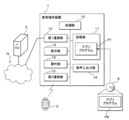
- FIG. 2 is a block diagram showing a configuration of a patient terminal device.
- FIG. 1 is a block diagram showing a configuration of an information processing device.
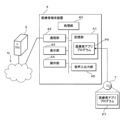
- FIG. 2 is a block diagram showing the configuration of a medical professional terminal device.
- 11 is a flowchart illustrating an example of a processing procedure performed by an information processing device. 1 shows an example of the correspondence between evaluation items and scores for a patient's ADL.
- FIG. 11 is a diagram showing an example of an input screen based on an application program.
- FIG. 11 is a diagram showing an example of an output screen based on an application program.
- FIG. 11 is a diagram showing an example of an output screen based on an application program.
- FIG. 11 is a diagram showing an example of an output screen based on an application program.
- FIG. 13 is a diagram showing an example of an output screen based on a medical professional application program.
- FIG. 11 is a block diagram showing a configuration of an information processing apparatus according to a second embodiment.
- FIG. 11 is a schematic diagram of a first learning model according to the second embodiment.
- FIG. 13 is a block diagram showing a configuration of an information processing apparatus according to a third embodiment.
- FIG. 13 is a schematic diagram of a second learning model.
- 13 is a flowchart showing an example of a procedure for deriving an ADL evaluation value.
- First Embodiment 1 is a schematic diagram of a medical support system 300 according to a first embodiment.
- the medical support system 300 includes a patient terminal device 1 used by a patient or his/her caregiver or family member, a device 2 that measures data related to the patient's vital signs or ADL, an information processing device 3 that collects data from the patient terminal device 1 and the device 2 of each patient, and a medical professional terminal device 4 used by a medical business operator.
- the medical support system 300 includes a network N that realizes communication connections between the devices.
- the patient terminal device 1 is installed at the patient's residence or carried by the patient.
- the patient terminal device 1 is not limited to being used by the patient himself/herself, but may be used by the patient, his/her caregiver, or family member as described above.
- the patient terminal device 1 is a smartphone, tablet terminal, personal computer, etc.
- the patient terminal device 1 is capable of communication via the network N.
- the device 2 is worn by the patient or installed at the patient's residence.
- the device 2 is a heart rate monitor, blood pressure monitor, camera, etc.
- the device 2 may be a wearable device or a stationary testing device equipped with a measuring device such as a heart rate monitor or camera and a communication unit.
- the device 2 is capable of communication via the network N via the patient terminal device 1 or directly.
- the medical staff terminal device 4 is used by medical personnel such as doctors, nurses, pharmacists, and clinical laboratory technicians at medical institutions.
- the medical staff terminal device 4 is a personal computer, a tablet terminal, etc.
- the medical staff terminal device 4 is connected to the network N via the medical institution's local network.
- the medical institution may also have other testing devices connected to the local network.
- the information processing device 3 is a device managed by a medical business operator or a medical device manufacturer.
- the information processing device 3 can send and receive data between the patient terminal device 1 and the medical professional terminal device 4 via the network N.
- the information processing device 3 acquires data inputted into the patient terminal device 1 and data obtained from the device 2 via the network N in association with a patient ID that identifies the patient, and stores the data in a database 310 constructed in an internal or external storage device.
- the information processing device 3 acquires interview results and prescription information for the patient inputted into the medical professional terminal device 4 via the network N in association with a patient ID and a medical professional ID via the network N, and stores the information in the database 310.
- the information processing device 3 acquires test results obtained from the medical institution's testing device via the medical professional terminal device 4 or directly via the network N in association with the patient ID and medical professional ID of the subject, and stores the information in the database 310.
- the network N includes a public communication network (Internet), a carrier network, and local networks in various locations.
- the network N may also include a dedicated line or an intranet between the patient terminal device 1, the information processing device 3, and the medical staff terminal device 4.
- the information processing device 3 uses the information stored in the database 310 as described above to derive status data indicating the condition of a patient after medical treatment, using the information stored in the database 310 as described above, regarding the daily life of a patient who has been examined by a doctor at a medical institution or the like and been prescribed medicine or treated. This may be not only medical treatment but also interviewing only.
- the status data indicating the patient's condition after medical treatment may be the progress of the disease or may be data indicating the treatment to be performed.
- the information processing device 3 outputs status data indicating the patient's condition until the next medical treatment or interview to the patient terminal device 1 or the medical practitioner terminal device 4.
- the patient can refer to the information indicated by the status data output from the patient terminal device 1 to determine whether or not to receive an interview from the doctor in charge, and the medical provider can consider whether to continue the medical treatment, change the type or amount of medicine, or change the method of administration, depending on the output from the medical practitioner terminal device 4.
- Both patients and doctors can evaluate the results of medical treatment and prescriptions based on the condition of patients between visits to medical institutions, which can improve the accuracy of treatment, improve or maintain patients' quality of life, and increase satisfaction.
- FIG. 2 is a block diagram showing the configuration of the patient terminal device 1.
- the patient terminal device 1 includes a processing unit 10, a storage unit 11, a first communication unit 12, a second communication unit 13, a display unit 14, an operation unit 15, and a voice input/output unit 16.
- the processing unit 10 is a processor such as a CPU (Central Processing Unit), MPU (Micro-Processing Unit), or GPU (Graphics Processing Unit).
- the processing unit 10 performs input and output of information related to medical treatment for patients and data related to ADL based on the application program P1 stored in the memory unit 11.
- the storage unit 11 uses a non-volatile memory such as a flash memory or SSD (Solid State Drive).
- the storage unit 11 stores an application program P1 and data referenced by the processing unit 10.
- the application program P1 may be an application program P8 stored in the storage medium 8 that is read by the processing unit 10 and copied to the storage unit 11.
- the application program P1 may be downloaded from the information processing device 3, which is a server, or from another program server device via the first communication unit 12 and stored in an executable manner.
- the first communication unit 12 realizes communication with the information processing device 3 via the network N.
- the first communication unit 12 is a wired network card, a carrier communication device, or a wireless communication device for WiFi.
- the processing unit 10 can transmit and receive data between the information processing device 3 and the first communication unit 12.
- the second communication unit 13 realizes a communication connection with the device 2.
- the second communication unit 13 is a USB interface, a wireless communication device for WiFi, or a short-range wireless communication device such as Bluetooth (registered trademark).
- the processing unit 10 can acquire data measured by the device 2 via the second communication unit 13.
- the display unit 14 uses a display device such as a liquid crystal display or an organic EL (Electro Luminescence) display.
- the display unit 14 is an interface that accepts operations.
- the operation unit 15 uses physical buttons, a keyboard, a pointing device, a touch panel device built into the display unit 14, etc.
- the operation unit 15 may accept operations on the screen displayed on the display unit 14 using physical buttons or a touch panel.
- the audio input/output unit 16 uses a speaker and a microphone.
- the processing unit 10 can output audio from the speaker and accept audio input from the microphone.
- the processing unit 10 may use the audio input/output unit 16 as part of the operation by the operation unit 15. In other words, the processing unit 10 may recognize the operation content from the input audio via the microphone, and accept the operation in an interactive format with the audio output from the speaker.
- the patient terminal device 1 accepts input of vital data or data related to ADL via the operation unit 15 on the application screen displayed based on the application program P1.
- the patient terminal device 1 may accept the vital data or data related to ADL measured by the device 2 via the second communication unit 13.
- the patient terminal device 1 itself may be equipped with a measurement unit, and the patient terminal device 1 itself may be able to acquire the vital data or data related to ADL.
- the vital data obtained from the device 2 or the patient terminal device 1 itself may be any of body temperature, heart rate, brain waves, EDA (electrodermal activity), etc.
- the vital data output from the device 2 or the patient terminal device 1 itself is not limited to these, and may include any vital data that is assumed to be related to pain caused by the patient's illness.
- the vital data obtained from the device 2 or the patient terminal device 1 itself may include, for example, blood pressure, pulse pressure, pulse waves, blood glucose level, weight, number of steps, amount of activity, etc.
- the data on ADL obtained from the device 2 or the patient terminal device 1 itself includes data input to an application screen based on the application program P1.
- the application screen questions about pain are output and responses are obtained, so that the processing unit 10 of the patient terminal device 1 can calculate a pain evaluation index based on the application program P1.
- the pain evaluation index includes a visual analog scale (VAS), a numeric rating scale (NRS), a verbal rating scale (VRS), a face rating scale (FRS), a subjective evaluation by the patient himself/herself such as the nature of pain and the degree of interference with daily life, or an objective evaluation by a medical professional, etc.
- VAS, NRS, VRS, and FRS are all indices that indicate the intensity of pain.
- the VAS is a visual scale that indicates the degree of the current pain, and the patient can answer by checking the scale.
- the NRS is a graded scale that divides pain into 11 stages from 0 to 10 and indicates the degree of the current pain.
- the VRS is a scale that indicates pain in four stages.
- the FRS is a facial expression scale that indicates the intensity of pain through facial expressions. Facial expressions may be determined by the processing unit 10 based on image data obtained from a camera equipped in the patient terminal device 1.
- the nature of the pain can be determined by identifying the pain or symptoms felt, and the patient is asked to answer the degree of pain for each type of pain, such as "throbbing pain,” “sharp pain,” “pain when touched,” “tingling,” and “itchy.”
- the pain is evaluated by evaluating the extent to which it affects daily life, and the patient may be asked to answer, for example, whether it hurts even when still, whether it hurts when moving, whether it is possible to go out, whether the pain keeps the patient from sleeping, etc.
- the processing unit 10 of the patient terminal device 1 outputs several questions on the application screen, such as whether the patient was able to go out on his/her own, whether he/she was able to go out with assistance, whether he/she took a bath on his/her own, whether he/she was able to take a bath with assistance, and whether he/she was able to sleep, and obtains the answers.
- the data on ADL here the detection result of the patient's movement, may include still image data and video data that can confirm the patient's ADL. For this reason, some of the devices 2 may be cameras.
- the processing unit 10 may be capable of determining whether the patient got up from the bed and whether the patient moved from the bed based on images obtained from the devices 2 by processing based on the application program P1 of the processing unit 10 of the patient terminal device 1, by installing multiple devices 2 at the patient's residence.
- the data on ADL may include a record of activity, such as the number of steps obtained from location information obtained by a GPS receiving unit provided in the patient terminal device 1 or an acceleration sensor or the like provided in the patient terminal device 1.
- the data on ADL may be the detection result using radar using radio waves such as millimeter waves, or an optical sensor such as infrared rays. This may be the result of detecting whether the patient has gotten up from the bed using a radar or sensor installed on the bed.
- the processing unit 10 may accept input from the patient or a caregiver on the application screen regarding the patient's physical condition, including the amount of activity, sleep time, drowsiness, lethargy, delirium, constipation, voice, facial expression, etc.
- the processing unit 10 of the patient terminal device 1 configured in this manner transmits data obtained from the device 2 or the patient terminal device 1 itself, and data input by operating the operation unit 15, to the information processing device 3.
- the processing unit 10 may process the data obtained from the device 2 or the patient terminal device 1 itself (such as deriving binary data by image recognition indicating whether the patient has woken up and moved from the bed or has been able to go out, etc.) before transmitting it.
- the processing unit 10 links the data to the patient ID stored in the storage unit 11 and transmits it.
- the device ID, type, model number, etc. of each device 2 may also be transmitted together.
- the vital data or ADL-related data transmitted from the patient terminal device 1 is sequentially added to the database 310 of the information processing device 3.
- FIG. 3 is a block diagram showing the configuration of the information processing device 3.
- the information processing device 3 includes a processing unit 30, a storage unit 31, a communication unit 32, and an input/output unit 33.
- the processing unit 30 is a processor that uses a CPU, MPU, GPU, etc.
- the processing unit 30 controls each component using built-in RAM and ROM.
- the processing unit 30 reads out the information processing program P3 stored in the memory unit 31, and executes processing on data related to ADL, etc., as described below, and transmits the processing results to the patient terminal device 1 or the medical staff terminal device 4.
- the storage unit 31 uses a flash memory, SSD, or hard disk.
- the storage unit 31 stores the information processing program P3, as well as data referenced by the processing unit 30.
- the information processing device 3 builds a database 310 in a recording device provided inside or outside the storage unit 31.
- the information processing program P3 stored in the storage unit 31 may be an information processing program P9 stored in a computer-readable storage medium 9 that has been read by the processing unit 30 and stored in the storage unit 31, or it may be a program downloaded from a program distribution server.
- the storage unit 31 stores the relationship between the contents of data used in the processing described below and the scores for calculating the ADL evaluation value.
- the relationship between the value of vital data and the score specifically, a correspondence relationship in which if the weight is within a predetermined range corresponding to the patient's age, the score is set to +10, is stored.
- the relationship between an answer entered in the application program P1 of the patient terminal device 1 and the score may be stored.
- a correspondence relationship in which if the answer is that the patient was able to go out, the score for that day is set to +10 is stored.
- the communication unit 32 realizes communication with the patient terminal device 1 or the medical professional terminal device 4 via the network N.
- the processing unit 30 can transmit and receive data between multiple patient terminal devices 1 and medical professional terminal devices 4 via the network N using the communication unit 32.
- the input/output unit 33 is an interface for connecting to an external storage device that stores the database 310. It is not necessary if the database 310 is provided within the storage unit 31.
- the database 310 includes an ADL table that stores data input by the application program P1 of the patient terminal device 1 in association with a patient ID that identifies the patient to be processed. Each piece of data is associated with time information that was input.
- the database 310 also stores data obtained directly from the device 2 in the ADL table in association with a device ID (patient ID) and time information.
- the database 310 includes a medical examination table that stores the results of medical examinations (interview results) that patients receive at medical institutions.
- the medical examination table includes identification data that identifies the medical institution and the date and time of examination in association with the patient ID.
- the medical examination table may include diagnosis results and prescription information.
- the information processing device 3 thus configured outputs status data indicating the progress of a patient who has been examined and prescribed medicine, or whether or not further treatment is required, based on the data stored in the database 310, as described below. The processing procedure will be described later.
- FIG. 4 is a block diagram showing the configuration of the medical professional terminal device 4.
- the medical professional terminal device 4 includes a processing unit 40, a storage unit 41, a communication unit 42, a display unit 43, an operation unit 44, and an audio input/output unit 45.
- the processing unit 40 is a processor that uses a CPU, MPU, GPU, etc.
- the processing unit 40 controls each component using built-in RAM and ROM.
- the processing unit 40 reads out the medical professional application program P4 stored in the memory unit 41, and transmits data regarding the doctor's medical treatment and test results to the information processing device 3, as described below.
- the storage unit 41 uses a flash memory, SSD, or hard disk.
- the storage unit 41 stores the medical professional app program P4, as well as data referenced by the processing unit 40.
- the medical professional app program P4 stored in the storage unit 41 may be the medical professional app program P4 stored in the computer-readable storage medium 7 that has been read by the processing unit 40 and stored in the storage unit 41, or it may be downloaded from a program distribution server.
- the medical professional app program P4 may be a web application program that can execute the processing described below when logging in to the web page of the medical support system 300 provided by the information processing device 3 with a medical professional account.
- the communication unit 42 realizes communication with the information processing device 3 via the network N.
- the communication unit 42 is a wired network card, a carrier communication device, or a wireless communication device for WiFi.
- the processing unit 40 can transmit and receive data between the information processing device 3 and the communication unit 42.
- the display unit 43 uses a display device such as a liquid crystal display or an organic EL display.
- the display unit 43 is an interface that accepts operations.
- the operation unit 44 uses physical buttons, a keyboard, a pointing device, a touch panel device built into the display unit 43, etc.
- the operation unit 44 may accept operations on the screen displayed on the display unit 43 using physical buttons or a touch panel.
- the audio input/output unit 45 uses a speaker and a microphone.
- the processing unit 40 can output audio from the speaker and accept audio input from the microphone.
- the processing unit 40 may use the audio input/output unit 45 as part of the operation by the operation unit 44. In other words, the processing unit 40 may recognize the operation content from the input audio via the microphone, and accept the operation in an interactive format with the audio output from the speaker.
- the processing unit 40 of the medical professional terminal device 4 accepts input of medical treatment details from a medical provider such as a doctor through the medical professional app program P4, it transmits a notification that medical treatment has been performed to the information processing device 3, along with the identification data of the medical institution and the date of treatment, in association with the patient ID of the patient being treated.
- the processing unit 40 may transmit the input medical treatment data indicating the medical treatment details to the information processing device 3.
- the medical treatment data indicating the medical treatment details may include pain index values obtained by a doctor or nurse through questioning the patient, and findings obtained through questioning, visual examination, palpation, percussion, etc.
- the processing unit 40 obtains data from an examination device, it transmits the data to the information processing device 3 in association with the patient ID of the subject.
- the data obtained from the examination device may be the results of a blood test, a urine test, or an imaging test.
- the data regarding medical treatment transmitted to the information processing device 3 is personal information, and therefore may be encrypted or data that can identify the medical treatment details itself may not
- the processing unit 40 can specify the patient ID through the medical practitioner application program P4, send a request to output the post-treatment progress to the information processing device 3, and view a screen to confirm the progress.
- the processing of the post-treatment progress will be described later with reference to the screen.
- the information processing device 3 updates the ADL table with the transmitted ADL-related data (answer based on the application program P1, image recognition results, vital data) each time an input operation is performed on the patient terminal device 1 or a measurement is performed on the device 2 and data is transmitted to the information processing device 3.
- the information processing device 3 updates the medical examination table with the interview results each time input is performed on the medical practitioner terminal device 4 and data is transmitted to the information processing device 3.
- the information processing device 3 derives evaluation data based on the ADL table and medical treatment table, which are updated periodically regarding the effectiveness of medical treatment or whenever the database 310 is updated.
- the specific processing procedure is described below.
- FIG. 5 is a flowchart showing an example of a processing procedure by the information processing device 3.
- the information processing device 3 continuously executes the following processing based on the information processing program P3. After medical treatment is performed, the information processing device 3 executes the following processing for each patient.
- the processing unit 30 of the information processing device 3 receives a notification from the medical practitioner terminal device 4 that medical treatment has been performed (step S101).
- the processing unit 30 identifies the identification data of the medical institution in which the medical practitioner terminal device 4 that sent the notification is installed, the date and time of the medical treatment, and the patient ID of the patient who is the subject of the treatment (step S102).
- the processing unit 30 may identify the diagnosis result and prescription from the data indicating the contents of the medical treatment (diagnosis result, prescription).
- the processing unit 30 executes the following process for the patient ID identified in step S102.
- the processing unit 30 determines whether it is time to ask the patient a question (step S103).
- the processing unit 30 may determine whether it is time to ask a question based on whether a predetermined time (a specific time every day, a specific time every week) has arrived.
- the processing unit 30 may determine that it is time to ask a question when the app program P1 is launched and logged in based on the patient ID for the first time every predetermined period (one day, one week).
- the processing unit 30 determines that it is time to ask a question (S103: YES), it outputs the question associated with the data indicating the medical treatment details identified in step S102 to the patient terminal device 1 (step S104), and proceeds to step S105.
- the processing unit 30 of the information processing device 3 sequentially adds it to the database 310.
- processing unit 30 determines that it is not time to ask a question (S103: NO), the processing unit 30 proceeds directly to step S105.
- the processing unit 30 determines whether the output timing has arrived (step S105). In step S105, the processing unit 30 may determine whether the output timing has arrived based on whether a predetermined time (one day, three days, etc.) has passed since the patient was treated in step S101. In step S105, the processing unit 30 may determine that the output timing has arrived when an output request specifying the patient ID identified in step S102 is received from the medical professional terminal device 4. In step S105, the processing unit 30 may determine that the output timing has arrived when an output request specifying the patient ID is received from the patient terminal device 1. The processing unit 30 may determine whether the cycle has arrived, such as once a day, once every three days, or a cycle set according to the condition of the patient.
- processing unit 30 determines that the output timing has not arrived (S105: NO)
- the processing unit 30 returns to step S103 and repeats steps S103-S105 until it determines that the output timing has arrived for the target patient.
- the processing unit 30 uses the patient ID to read the patient's medical history from the medical table along with the date and time of the medical treatment (step S106).
- the processing unit 30 reads, for example, the contents of medications prescribed in the past. If data indicating the contents of the medical treatment is stored in step S106, the processing unit 30 reads this data.
- the processing unit 30 reads the vital signs data and/or ADL-related data that are transmitted in association with the patient ID and stored in the database 310 one by one after the medical treatment (step S107).
- the processing unit 30 derives an evaluation value for ADL based on the read medical history, vital data, and/or data related to ADL (step S108). Step S108 makes it possible to determine whether the patient's QOL has improved or is being maintained, as described below.
- the processing of step S108 may be executed by another device.
- the processing unit 30 may obtain the evaluation value derived by an external device.
- step S108 the processing unit 30 calculates a score for each answer, which is preset for each answer, for each predetermined period, such as daily or weekly, from the correspondence stored in the storage unit 31 based on the answers to the questions inputted, for example, through the patient terminal device 1.
- FIG. 6 shows an example of the correspondence between the evaluation items and scores for the patient's ADL.
- the evaluation item "sitting up” is a score of +1
- “getting out of bed (within 5 minutes)” is a score of +2
- “getting out of bed (more than 5 minutes but less than 30 minutes)” is a score of +4
- “getting out of bed (more than 30 minutes)” is a score of +8, and "going out” is a score of +10.
- the processing unit 30 adds +1 to the score.
- the score can be set to +8. Image recognition may be performed by either the patient terminal device 1 or the information processing device 3.
- the processing unit 30 can also add -10 to the score if there is a record of a pacemaker being fitted as part of the medical history and if it is possible to recognize "arrhythmia" based on the heart rate data obtained from the device 2.
- the processing unit 30 narrows down the answers received by the application program P1 from items such as the parcel index, and derives an evaluation value of the ADL (activity amount) using vital data automatically obtained from the device 2, etc.
- the parcel index has many items such as not only eating, but also whether the upper body was moved, whether the lower body was moved, whether input was made, whether urination was performed independently, whether defecation was performed independently, and whether movement was performed independently.
- the processing unit 30 can calculate a score using data obtained from the device 2 and derive an evaluation value by combining the scores with the answers obtained by the application program P1.
- the processing unit 30 judges whether the magnitude of the evaluation value derived in step S108 or the change in the evaluation value satisfies the condition stored in the storage unit 31 (step S109). In step S109, the processing unit 30 judges whether the predetermined condition is satisfied based on the range in which the evaluation value (score) falls for each medical treatment content, based on the data indicating the medical treatment content specified in step S102. In step S109, the processing unit 30 may judge whether the condition is satisfied based on the magnitude of the evaluation value in multiple stages. In step S109, the processing unit 30 may judge whether the change in the evaluation value is a change of more than a predetermined rate in a predetermined period.
- step S109 determines that the condition is satisfied (S109: YES)
- step S110 determines that the condition requires treatment (worsening) (step S110).
- the processing unit 30 may only determine whether treatment is required, or may specify the treatment content.
- the processing unit 30 may determine that a medical examination (revisit) should be performed, or that the drug prescription should be changed, but the processing unit 30 may also determine that the control data (speed, dosage, etc.) of the drug administration pump should be changed.
- the processing unit 30 stores the judgment result for each setting of the specified condition that is determined to be satisfied in step S109, and reads out the satisfied judgment result in step S110.
- the processing unit 30 notifies the patient terminal device 1 and the medical staff terminal device 4 of a message indicating the judgment result of step S110 (step S111). For each setting of a predetermined condition that is determined to be satisfied in step S109, the processing unit 30 stores the contents of the message indicating the judgment result according to the medical treatment content in the memory unit 31, and in step S111, reads out and notifies the message according to the satisfied condition.
- the processing unit 30 stores the evaluation value derived in step S108 and the judgment result in step S110 in the database 310 in association with the patient ID (step S112), and ends the process.
- step S113 the processing unit 30 determines, for example, to maintain the drug prescription and determines that hospital visits are not necessary until regular checkups.
- the processing unit 30 notifies the patient terminal device 1 and medical staff terminal device 4 of a message indicating the determination result of step S113 (S111).
- the processing unit 30 stores the determination result of step S113 in the database 310 in association with the patient ID (S112), and ends the process.
- data showing the progress after treatment can be fed back to the medical provider or the patient based on an inquiry (output request) from the medical provider or an inquiry (output request) from the patient, even if no abnormality is found.
- FIG. 7 is a diagram showing an example of an input screen 150 based on the application program P1.
- a question is displayed on the input screen 150 shown in FIG. 7.
- the question is a question asking whether or not there is any hindrance to daily life.
- a question message 151 such as "Were you able to take a bath by yourself today?" and an input field 152 are displayed.
- the question message 151 displayed on the input screen 150 is limited to questions that are pre-associated with the medical treatment contents from the information processing device 3.
- the database 310 of the information processing device 3 stores a correspondence between data identifying the medical treatment contents and medical condition and questions, and the processing unit 30 may refer to this. Different questions may be stored for each number of visits to the hospital and medical history. Instead of the correspondence in the database 310, a learning model that has been trained to output questions to be asked to the patient when the medical treatment contents, medical condition, medical history, etc. are input may be used.
- the input fields 152 on the input screen 150 may be radio buttons as shown in FIG. 7, text boxes that allow input in natural language, or pull-down lists of options or check boxes.
- the input screen 150 includes a "Send” button 153. When the patient or caregiver selects the "Send” button 153 on the input screen 150, the processing unit 10 of the patient terminal device 1 accepts this, associates it with the patient ID along with the date and time, and transmits it to the information processing device 3.
- the information processing device 3 derives an evaluation value related to ADL and makes an appropriate decision accordingly.
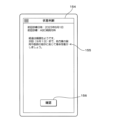
- FIGS. 8 and 9 are diagrams showing an example of an output screen 154 based on the application program P1.
- the output screen 154 shown in FIG. 8 shows an example of the content displayed in response to the notification in step S111 when it is determined in step S109 that the predetermined conditions are met and that action is required (S110) in the processing procedure shown in the flowchart in FIG. 5.
- the output screen 154 shown in FIG. 9 shows an example of the content displayed in response to the notification in step S111 when it is determined in step S109 that the predetermined conditions are not met and that action is not required (S113).
- a message 155 indicating the result of the judgment is displayed on the output screen 154.
- a message 155 is displayed indicating that the pain has not been alleviated, that the prescription should be changed, and that a follow-up visit is recommended.
- the output screen 154 includes a "Confirm” button 156. When the "Confirm” button 156 is selected, the output screen 154 is closed. In the case of a message 155 that recommends a follow-up visit, when the "Confirm" button 156 is selected, the process may proceed to a reservation procedure with the corresponding medical institution based on the application program P1 of the patient terminal device 1.
- a message 155 indicating the result of the judgment is also displayed.
- a message 155 is displayed indicating that the progress is going smoothly according to the prescription based on the medical examination and instructions from the doctor, and that the treatment should be continued.
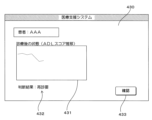
- FIG. 10 is a diagram showing an example of an output screen 430 based on the medical professional app program P4.
- the output screen 430 includes information for identifying the patient (e.g., the patient's name) and a graph 431 showing the progress of the evaluation value based on data related to ADL from the previous medical examination.
- the output screen 430 displays a message 432 indicating that the medication prescription should be changed.
- the output screen 430 includes a "Confirm” button 433. When the "Confirm” button 433 is selected, the output screen 430 is closed. When the "Confirm” button 433 is selected, it may be possible to confirm the details of the corresponding patient's medical history or the patient's appointment status.
- the medical support system 300 of this embodiment is able to judge the progress after medical treatment from the perspective of ADL, and is able to allow the doctor to recognize the state of the patient between medical treatments or interviews, rather than only diagnosing the patient's condition when the doctor interviews or tests are performed.
- the medical support system 300 is not limited to detecting and notifying a state in which a re-examination is necessary, but can also output an evaluation based on vital data and ADL data, even if the progress is good, and use this in subsequent medical treatments. Both the patient and the medical provider can confirm the effectiveness of the medical treatment and prescription, which is expected to improve the satisfaction of both the patient and their family, as well as the medical provider.
- the information processing device 3 judges the state of the patient after medical treatment based on whether the evaluation value related to ADL satisfies a predetermined condition (S109, S110, S113).
- the processing unit 30 of the information processing device 3 uses a learning model that is trained to output a result that specifies what to do next when the evaluation value, conditions, etc. are input.
- the evaluation value is handled as not only a specific index value but also multidimensional index values such as "symptoms", “prescription information", "ADL index”, and "pain index value", enabling more detailed output.
- the configuration of the medical support system 300 of the second embodiment is the same as that of the medical support system 300 of the first embodiment, except that a learning model is used to determine the patient's condition after medical treatment. Therefore, among the configurations of the medical support system 300 of the second embodiment, the configurations common to the medical support system 300 of the first embodiment are given the same reference numerals and detailed descriptions are omitted.
- the information processing device 3 of the second embodiment stores a first learning model M31 in the storage unit 31.
- the first learning model M31 is learned in advance based on teacher data in which the result of a state judgment made by a medical provider such as a doctor or a specialized laboratory technician based on past vital data and/or ADL-related values, evaluation values, and medical treatment contents is taken as the correct answer.
- the first learning model M31 may be a first learning model M91 stored in the storage medium 9, which is copied by the processing unit 30 to the storage unit 31, similar to the information processing program P3.
- the first learning model M31 may be continuously re-learned by reinforcement learning in which a reward is given when the state improves and no reward is given when the state worsens, based on the ADL evaluation value, by processing of the processing unit 30 of the information processing device 3.
- FIG. 12 is a schematic diagram of the first learning model M31 of the second embodiment.
- the first learning model M31 is trained to output data indicating a judgment result regarding the patient's progress (whether the prescription should be changed or treatment should be provided) when data indicating the medical treatment for the patient and an ADL evaluation value derived from vital data and/or ADL-related values are input.
- the first learning model M31 is trained using, for example, an SVM (support vector machine), a decision tree, a random forest, Adaboost, a neural network, etc.
- the first learning model M31 includes an input layer 311 for inputting data indicating the medical treatment for the patient and an ADL evaluation value derived from vital data and/or ADL-related values.
- the data indicating the medical treatment is, for example, a data string of medical conditions in which data corresponding to the diagnosed medical condition is set to 1 and the rest is set to 0 (zero).
- the ADL evaluation value may be a single value indicating a score, or may be vector data such as the good or bad state of the "medical condition", the product number of the medicine in the "prescription information", whether or not the medicine is taken, the score of the "ADL index", and the score of the "pain index value” obtained from the patient's subjective answer to the question.
- the "pain index value” is, for example, a score that is high when the pain is so severe that the patient cannot move, and a score according to the answer such as whether the pain is so severe that the patient cannot sleep.
- the "pain index value” may be a score identified by a facial expression identified from an image obtained by the device 2.
- the “pain index value” may be a score obtained from another examination device.
- the first learning model M31 includes an output layer 312 that outputs a state judgment result indicating the state of the patient after medical treatment.
- the output layer 312 is a data sequence that corresponds to the necessity of treatment and the content of treatment if treatment is necessary, such as ⁇ "progressing well", “re-examination required (not improved)”, “re-examination required (not improved) and change in drug prescription", “prescription change required (not improved)”, ... ⁇ .
- the state judgment result may include the product number and number of the drug to be prescribed, or a specific example of the drug administration method using a pump.
- the first learning model M31 includes an intermediate layer 313 having parameters trained so that the condition judgment result output from the output layer 312 matches the judgment result by the medical provider.
- reinforcement learning may be performed so that the closer the ADL evaluation value when the condition judgment result is good and no treatment is performed, or the ADL evaluation value when the condition judgment result is that a re-examination is required and treatment (medical care) is performed, to a value indicating good, the more likely it is that the output result of the need for previous treatment and the content of the treatment is judged to be correct.
- the intermediate layer 313 preferably includes multiple nodes and multiple layers.
- the processing unit 30 inputs data indicating the medical treatment content identified in step S102 and the ADL evaluation value derived in step S108 to the first learning model M31.
- the processing unit 30 judges the result from the condition judgment result output from the first learning model M31, and notifies a message (S111) or stores it (S112).
- the information processing device 3 derives the evaluation value regarding ADL based on the read medical history and the vital data and/or the data regarding ADL by adding the score from the correspondence between the data and the score (S108).
- the processing unit 30 of the information processing device 3 uses the second learning model M32 that is trained to output an evaluation value when the read medical history and the vital data and/or the data regarding ADL are input.
- FIG. 13 is a block diagram showing the configuration of an information processing device 3 according to the third embodiment.
- the information processing device 3 according to the third embodiment stores a second learning model M32 in the storage unit 31.
- the second learning model M32 is learned in advance based on teacher data in which the answer is an ADL evaluation value derived from parameters including past vital data and/or data related to ADL.
- the second learning model M32 may be a copy of the second learning model M92 stored in the storage medium 9, which is copied by the processing unit 30 into the storage unit 31, similar to the information processing program P3.
- FIG. 14 is a schematic diagram of the second learning model M32.
- the second learning model M32 is a model that is trained to output an evaluation value estimated from available data even when the data required to derive a value related to a specialized ADL evaluation, such as the parcel index, is insufficient.
- the second learning model M32 includes an input layer 321 that inputs vital data and/or data related to ADL that can be acquired by the patient terminal device 1 or device 2 of the medical support system 300.
- the second learning model M32 includes an output layer 322 that outputs an ADL evaluation value used in the specialized field of ADL.
- the output layer 322 may output a multidimensional data string or a single score.
- the second learning model M32 includes an intermediate layer 323 having parameters learned using as training data a large number of ADL-related parameters and vital data, and past data of the ADL evaluation value score calculated from the parameters and vital data.
- the intermediate layer 323 is trained using past training data so that when vital data and/or ADL-related data obtainable by the patient terminal device 1 or device 2, among the ADL-related parameters and vital data used to calculate the ADL evaluation value score, is input to the input layer 321, the difference between the ADL evaluation value output from the output layer 322 and the ADL evaluation value calculated from all parameters including the input data is reduced.
- the intermediate layer 323 preferably includes multiple nodes and multiple layers.
- the ADL evaluation value used in the specialized field of ADL evaluation for example, 20 or more items such as whether the patient was able to eat by themselves or with assistance, how the upper body moved, and how the lower body moved are required to be input.
- 20 items if it is difficult to obtain results on whether or not the patient was able to eat by themselves or with assistance, for 20 items, if it is possible to obtain results on, for example, four items, such as time to get out of bed, bathing level (by themselves: 10, with assistance: 5, unable: 0), eating level (by themselves: 10, with assistance: 5, unable: 0), and medical condition (heart disease, etc.), when data on these four items is input, it is possible to derive the ADL evaluation value by supplementing the other missing items with other vital data (age, blood pressure, heart rate).
- FIG. 15 is a flowchart showing an example of a procedure for deriving an ADL evaluation value.
- the processing procedure shown in the flowchart of FIG. 15 corresponds to details of step S108.
- the processing unit 30 creates data for items to be input to the second learning model M32 from the read medical history, vital signs data, and/or ADL-related data (step S801).
- the processing unit 30 inputs the created data to the second learning model M32 (step S802).
- the processing unit 30 acquires the ADL evaluation value output from the second learning model M32 (step S803), and proceeds to step S109 in the flowchart of FIG. 5.
Landscapes
- Health & Medical Sciences (AREA)
- Engineering & Computer Science (AREA)
- Medical Informatics (AREA)
- Public Health (AREA)
- Epidemiology (AREA)
- General Health & Medical Sciences (AREA)
- Primary Health Care (AREA)
- Biomedical Technology (AREA)
- Data Mining & Analysis (AREA)
- Databases & Information Systems (AREA)
- Pathology (AREA)
- Accommodation For Nursing Or Treatment Tables (AREA)
Priority Applications (1)
| Application Number | Priority Date | Filing Date | Title |
|---|---|---|---|
| JP2025537406A JPWO2025028457A1 (https=) | 2023-08-03 | 2024-07-26 |
Applications Claiming Priority (2)
| Application Number | Priority Date | Filing Date | Title |
|---|---|---|---|
| JP2023-127272 | 2023-08-03 | ||
| JP2023127272 | 2023-08-03 |
Publications (1)
| Publication Number | Publication Date |
|---|---|
| WO2025028457A1 true WO2025028457A1 (ja) | 2025-02-06 |
Family
ID=94394730
Family Applications (1)
| Application Number | Title | Priority Date | Filing Date |
|---|---|---|---|
| PCT/JP2024/026865 Pending WO2025028457A1 (ja) | 2023-08-03 | 2024-07-26 | コンピュータプログラム、情報処理装置、情報処理方法、及び医療支援システム |
Country Status (2)
| Country | Link |
|---|---|
| JP (1) | JPWO2025028457A1 (https=) |
| WO (1) | WO2025028457A1 (https=) |
Citations (1)
| Publication number | Priority date | Publication date | Assignee | Title |
|---|---|---|---|---|
| JP2019102002A (ja) * | 2017-12-07 | 2019-06-24 | 医療法人栄宏会 | クリニック支援プログラム、クリニック支援方法、及び、クリニック支援装置 |
-
2024
- 2024-07-26 JP JP2025537406A patent/JPWO2025028457A1/ja active Pending
- 2024-07-26 WO PCT/JP2024/026865 patent/WO2025028457A1/ja active Pending
Patent Citations (1)
| Publication number | Priority date | Publication date | Assignee | Title |
|---|---|---|---|---|
| JP2019102002A (ja) * | 2017-12-07 | 2019-06-24 | 医療法人栄宏会 | クリニック支援プログラム、クリニック支援方法、及び、クリニック支援装置 |
Also Published As
| Publication number | Publication date |
|---|---|
| JPWO2025028457A1 (https=) | 2025-02-06 |
Similar Documents
| Publication | Publication Date | Title |
|---|---|---|
| US12278005B2 (en) | Artificial-intelligence-based facilitation of healthcare delivery | |
| Chatrati et al. | Smart home health monitoring system for predicting type 2 diabetes and hypertension | |
| US20240293051A1 (en) | Intermittent monitoring | |
| US20220273204A1 (en) | Intermittent Monitoring | |
| JP6647583B1 (ja) | 情報処理装置、プログラム及び情報処理方法 | |
| KR102116664B1 (ko) | 온라인 기반의 건강 관리 방법 및 장치 | |
| CN109979587A (zh) | 患者健康护理交互设备及其实施方法 | |
| JPWO2020059794A1 (ja) | 情報処理方法、情報処理装置及びプログラム | |
| US11322250B1 (en) | Intelligent medical care path systems and methods | |
| CN113506622A (zh) | 一种智能诊断分析系统及其使用方法 | |
| US20250166850A1 (en) | Non-transient computer-readable medium for generating pain treatment assistant information using a learning model | |
| US11721421B2 (en) | Pharmaceutical dispensing system | |
| CN118613877A (zh) | 高性价比的治疗建议 | |
| US20250160762A1 (en) | Non-transient computer-readable medium, information processing device, information processing method, and learning model generation method | |
| KR101808836B1 (ko) | 학습 장치, 학습 시스템, 그리고 이를 이용한 학습 방법 | |
| WO2025028457A1 (ja) | コンピュータプログラム、情報処理装置、情報処理方法、及び医療支援システム | |
| WO2023057232A1 (en) | System and method for supporting a patient's health control | |
| CN119604940A (zh) | 计算机程序、信息处理装置、信息处理方法以及学习模型生成方法 | |
| Manarvi et al. | Investigating information needs of Saudi diabetic patients | |
| JP2024011287A (ja) | 健康管理支援装置、健康管理支援システム、健康管理支援方法、およびプログラム | |
| WO2025097242A1 (en) | System and method for remote data collection and outcome prediction | |
| WO2021151191A1 (en) | System and method for consistent user data acquisition and monitoring | |
| Kumar | Care of Elderly with Diabetes | |
| HK1262927A1 (en) | Platform and system for digital personalized medicine |
Legal Events
| Date | Code | Title | Description |
|---|---|---|---|
| 121 | Ep: the epo has been informed by wipo that ep was designated in this application |
Ref document number: 24849109 Country of ref document: EP Kind code of ref document: A1 |
|
| ENP | Entry into the national phase |
Ref document number: 2025537406 Country of ref document: JP Kind code of ref document: A |
|
| WWE | Wipo information: entry into national phase |
Ref document number: 2025537406 Country of ref document: JP |
|
| NENP | Non-entry into the national phase |
Ref country code: DE |