WO2025027801A1 - ゲームコントローラ - Google Patents
ゲームコントローラ Download PDFInfo
- Publication number
- WO2025027801A1 WO2025027801A1 PCT/JP2023/028162 JP2023028162W WO2025027801A1 WO 2025027801 A1 WO2025027801 A1 WO 2025027801A1 JP 2023028162 W JP2023028162 W JP 2023028162W WO 2025027801 A1 WO2025027801 A1 WO 2025027801A1
- Authority
- WO
- WIPO (PCT)
- Prior art keywords
- button
- game controller
- protrusion
- terminal
- top surface
- Prior art date
- Legal status (The legal status is an assumption and is not a legal conclusion. Google has not performed a legal analysis and makes no representation as to the accuracy of the status listed.)
- Pending
Links
Images

















Classifications
-
- A—HUMAN NECESSITIES
- A63—SPORTS; GAMES; AMUSEMENTS
- A63F—CARD, BOARD, OR ROULETTE GAMES; INDOOR GAMES USING SMALL MOVING PLAYING BODIES; VIDEO GAMES; GAMES NOT OTHERWISE PROVIDED FOR
- A63F13/00—Video games, i.e. games using an electronically generated display having two or more dimensions
- A63F13/20—Input arrangements for video game devices
- A63F13/24—Constructional details thereof, e.g. game controllers with detachable joystick handles
-
- A—HUMAN NECESSITIES
- A63—SPORTS; GAMES; AMUSEMENTS
- A63F—CARD, BOARD, OR ROULETTE GAMES; INDOOR GAMES USING SMALL MOVING PLAYING BODIES; VIDEO GAMES; GAMES NOT OTHERWISE PROVIDED FOR
- A63F13/00—Video games, i.e. games using an electronically generated display having two or more dimensions
- A63F13/20—Input arrangements for video game devices
- A63F13/21—Input arrangements for video game devices characterised by their sensors, purposes or types
- A63F13/214—Input arrangements for video game devices characterised by their sensors, purposes or types for locating contacts on a surface, e.g. floor mats or touch pads
-
- A—HUMAN NECESSITIES
- A63—SPORTS; GAMES; AMUSEMENTS
- A63F—CARD, BOARD, OR ROULETTE GAMES; INDOOR GAMES USING SMALL MOVING PLAYING BODIES; VIDEO GAMES; GAMES NOT OTHERWISE PROVIDED FOR
- A63F13/00—Video games, i.e. games using an electronically generated display having two or more dimensions
- A63F13/20—Input arrangements for video game devices
- A63F13/22—Setup operations, e.g. calibration, key configuration or button assignment
-
- A—HUMAN NECESSITIES
- A63—SPORTS; GAMES; AMUSEMENTS
- A63F—CARD, BOARD, OR ROULETTE GAMES; INDOOR GAMES USING SMALL MOVING PLAYING BODIES; VIDEO GAMES; GAMES NOT OTHERWISE PROVIDED FOR
- A63F13/00—Video games, i.e. games using an electronically generated display having two or more dimensions
- A63F13/20—Input arrangements for video game devices
- A63F13/23—Input arrangements for video game devices for interfacing with the game device, e.g. specific interfaces between game controller and console
-
- A—HUMAN NECESSITIES
- A63—SPORTS; GAMES; AMUSEMENTS
- A63F—CARD, BOARD, OR ROULETTE GAMES; INDOOR GAMES USING SMALL MOVING PLAYING BODIES; VIDEO GAMES; GAMES NOT OTHERWISE PROVIDED FOR
- A63F13/00—Video games, i.e. games using an electronically generated display having two or more dimensions
- A63F13/25—Output arrangements for video game devices
- A63F13/28—Output arrangements for video game devices responding to control signals received from the game device for affecting ambient conditions, e.g. for vibrating players' seats, activating scent dispensers or affecting temperature or light
- A63F13/285—Generating tactile feedback signals via the game input device, e.g. force feedback
-
- A—HUMAN NECESSITIES
- A63—SPORTS; GAMES; AMUSEMENTS
- A63F—CARD, BOARD, OR ROULETTE GAMES; INDOOR GAMES USING SMALL MOVING PLAYING BODIES; VIDEO GAMES; GAMES NOT OTHERWISE PROVIDED FOR
- A63F13/00—Video games, i.e. games using an electronically generated display having two or more dimensions
- A63F13/90—Constructional details or arrangements of video game devices not provided for in groups A63F13/20 or A63F13/25, e.g. housing, wiring, connections or cabinets
- A63F13/92—Video game devices specially adapted to be hand-held while playing
-
- A—HUMAN NECESSITIES
- A63—SPORTS; GAMES; AMUSEMENTS
- A63F—CARD, BOARD, OR ROULETTE GAMES; INDOOR GAMES USING SMALL MOVING PLAYING BODIES; VIDEO GAMES; GAMES NOT OTHERWISE PROVIDED FOR
- A63F13/00—Video games, i.e. games using an electronically generated display having two or more dimensions
- A63F13/90—Constructional details or arrangements of video game devices not provided for in groups A63F13/20 or A63F13/25, e.g. housing, wiring, connections or cabinets
- A63F13/98—Accessories, i.e. detachable arrangements optional for the use of the video game device, e.g. grip supports of game controllers
-
- G—PHYSICS
- G06—COMPUTING OR CALCULATING; COUNTING
- G06F—ELECTRIC DIGITAL DATA PROCESSING
- G06F3/00—Input arrangements for transferring data to be processed into a form capable of being handled by the computer; Output arrangements for transferring data from processing unit to output unit, e.g. interface arrangements
- G06F3/01—Input arrangements or combined input and output arrangements for interaction between user and computer
- G06F3/02—Input arrangements using manually operated switches, e.g. using keyboards or dials
-
- G—PHYSICS
- G06—COMPUTING OR CALCULATING; COUNTING
- G06F—ELECTRIC DIGITAL DATA PROCESSING
- G06F3/00—Input arrangements for transferring data to be processed into a form capable of being handled by the computer; Output arrangements for transferring data from processing unit to output unit, e.g. interface arrangements
- G06F3/01—Input arrangements or combined input and output arrangements for interaction between user and computer
- G06F3/02—Input arrangements using manually operated switches, e.g. using keyboards or dials
- G06F3/0202—Constructional details or processes of manufacture of the input device
- G06F3/0205—Lever arrangements for operating keyboard cursor control keys in a joystick-like manner
-
- G—PHYSICS
- G06—COMPUTING OR CALCULATING; COUNTING
- G06F—ELECTRIC DIGITAL DATA PROCESSING
- G06F3/00—Input arrangements for transferring data to be processed into a form capable of being handled by the computer; Output arrangements for transferring data from processing unit to output unit, e.g. interface arrangements
- G06F3/01—Input arrangements or combined input and output arrangements for interaction between user and computer
- G06F3/03—Arrangements for converting the position or the displacement of a member into a coded form
- G06F3/0304—Detection arrangements using opto-electronic means
-
- G—PHYSICS
- G06—COMPUTING OR CALCULATING; COUNTING
- G06F—ELECTRIC DIGITAL DATA PROCESSING
- G06F3/00—Input arrangements for transferring data to be processed into a form capable of being handled by the computer; Output arrangements for transferring data from processing unit to output unit, e.g. interface arrangements
- G06F3/01—Input arrangements or combined input and output arrangements for interaction between user and computer
- G06F3/03—Arrangements for converting the position or the displacement of a member into a coded form
- G06F3/033—Pointing devices displaced or positioned by the user, e.g. mice, trackballs, pens or joysticks; Accessories therefor
- G06F3/0354—Pointing devices displaced or positioned by the user, e.g. mice, trackballs, pens or joysticks; Accessories therefor with detection of two-dimensional [2D] relative movements between the device, or an operating part thereof, and a plane or surface, e.g. 2D mice, trackballs, pens or pucks
- G06F3/03543—Mice or pucks
Definitions
- Patent Document 1 JP Patent Publication No. 2017-000757 discloses a game controller.
- the game controller is detachably attached to a main unit capable of executing game processing, the main unit having a recess and a first magnet and a second magnet at the bottom of the recess.
- the game controller comprises a first input unit, a protrusion, a first button, and a second button.
- the first input unit is provided on the front side.
- the protrusion protrudes from the first side surface and extends along the longitudinal direction of the first side surface.
- the protrusion is configured to fit into the recess.
- the first button and the second button are provided on the top surface of the protrusion along the longitudinal direction.
- the first button and the second button are pressed by a user.
- the first button is attracted to the first magnet by magnetic force.
- the second button is attracted to the second magnet by magnetic force.
- At least the portions of the first button and the second button that are exposed from the top surface of the convex portion may be made of a magnet or a soft magnetic material.
- the exposed parts may be painted with a non-magnetic material.
- the portions of the first button and the second button that are made of a magnet or soft magnetic material and have electrical conductivity may each be connected to the ground of the electronic circuitry inside the game controller.
- the first button and the second button may be made of a soft magnetic material.
- the first button and the second button may be configured to be movable from an initial position, which is the position when not pressed by the user, in a direction opposite to the pressing direction by the magnetic force of the first magnet and the second magnet, respectively.
- the convex portion may have a first opening and a second opening on the top surface that expose the button top surfaces of the first button and the second button, respectively.
- the first button and the second button may each have a side wall that extends from the button top surface through the first opening and the second opening, respectively, into the inside of the convex portion, and a flange that extends outward from a portion of the button side wall that is located inside the convex portion.
- the first elastic deformation body and the second elastic deformation body may be fixed to the first inner surface.
- the first elastic deformation body and the second elastic deformation body may be provided closer to the second inner surface, which is the inner surface of the protrusion facing the side wall, than to the side wall.
- a portion of the first elastic deformation body and the second elastic deformation body may protrude from an opening provided on the outer peripheral surface of the convex portion.
- the height of each of the first button and the second button from the first side surface of the button top surface in the initial position may be lower than the maximum height from the first side surface of the top surface of the convex portion.
- the first button and the second button may each be configured so that their height from the first side surface of the button top surface can be moved up to the maximum height or to a position higher than that.
- the height of each of the first button and the second button from the first side surface of the button top surface in the initial position may be lower than the maximum height of the top surface of the convex portion from the first side surface.
- the first button and the second button may be configured such that the height of the button top surface moves closer to the bottom of the recess by the magnetic forces of the first magnet and the second magnet when the game controller is attached to the main unit.
- the game controller according to the above may further include a raised portion that is integrally provided on the top surface of the convex portion or that is provided by placing a separate part on the top surface of the convex portion, and the maximum height may be the maximum height including the raised portion.
- the convex portion may have a top surface with a width that narrows toward the end, at least in the end region in the longitudinal direction.
- the height of at least one end region of the top surface of the convex portion in the longitudinal direction from the first side surface may be greater than the height of the regions in which the first button and the second button are provided from the first side surface.
- a terminal accommodating portion for accommodating a terminal may be opened on the top surface of the protrusion.
- the height of at least one end region of the top surface of the protrusion in the longitudinal direction from the first side surface may be greater than the height of the region where the terminal accommodating portion is opened from the first side surface.
- the maximum height of the top surface of the convex portion from the first side surface may be greater than the depth of the concave portion.
- the game controller according to the above may have a first engagement hole on at least one end face in the longitudinal direction of the outer circumferential surface of the protrusion.
- a device having a first engagement element corresponding to the first engagement hole may be removably attached.
- the game controller described above may have a second engagement hole on the other end face in the longitudinal direction of the outer circumferential surface of the protrusion.
- a device further having a second engagement element corresponding to the second engagement hole may be detachably attached.
- the first engagement hole and the second engagement hole may have different shapes.
- the operation unit may be provided on the back.
- the operation direction may be the opposite direction to the protruding direction of the convex portion and a direction approaching the rear surface.
- the game controller described above may further include a rotating shaft to which the operation unit is connected, and a pusher actuator connected to the rotating shaft and abutting against the pusher to protrude the pusher in response to an operation on the operation unit.
- the distance from the rotation axis to the contact point between the pusher actuator and the pusher may be longer when the amount of protrusion of the pusher is large than when it is small.
- the main unit may further include a main unit terminal provided within the recess.
- the terminal may be provided between the first button and the second button when viewed from the direction of the top surface of the protrusion, and may be electrically connected to the main unit terminal.
- the upper end of the terminal may be positioned at a height from the first side surface that is lower than the top surface of the protrusion.
- the light-emitting section may be provided between the first button and the second button in the longitudinal direction.
- the terminal may be provided along the inner circumferential surface of the terminal accommodating portion, that is, along the inner circumferential surface of the rear side, of the inner circumferential surface of the front side and the inner circumferential surface of the rear side.
- the game controller may have a fifth opening on the top surface of the convex portion.
- the game controller may further include a light-emitting unit that emits light outward from the fifth opening, and a light-receiving sensor that detects reflected light of the light-emitting unit that is received from the fifth opening and changes with relative movement with respect to the ground surface.
- the convex portion may have a first opening and a second opening on the top surface that expose the top surfaces of the first button and the second button, respectively.
- the main unit may further include a main unit terminal provided within the recess.
- a fourth opening may be provided on the top surface of the protrusion between the first button and the second button.
- the game controller may further include a terminal inside the protrusion accessed from the fourth opening, which electrically connects to the main unit terminal.
- a fifth opening may be provided between the first opening and the fourth opening.
- the height of the area of the top surface of the convex portion where the fifth opening is provided from the first side surface may be greater than the height of the area where the first button and the second button are provided from the first side surface.
- the game controller described above may further include a mouse sole that is placed on the top surface of the convex portion and that contacts the ground surface when the game controller is placed so that the top surface of the convex portion faces the ground surface.
- the game controller may further include an operation unit having a through hole in the mouse sole and operated by a user, and a pusher that protrudes from a third opening provided on the top surface of the convex portion in response to an operation on the operation unit.
- the mouse sole may be placed so that the through hole communicates with the third opening.
- the game controller described above may further include a second input unit on a side different from the first side.
- the game controller described above may further include a third input unit on the back surface.
- the first input unit may include a third button that is pressed by the user and a joystick.
- the game controller may further include a second input unit on a side different from the first side.
- the joystick is provided to the left of the third button, and the second input unit may be provided on a side surface continuing from the right end of the first side.
- the recess may be provided on both the first side and the second side of the main unit.
- the protrusion may be configured to fit into each of the recesses on the first side and the second side.
- the game controller has a recess, a first magnet and a second magnet at the bottom of the recess, and is removably attached to a main unit capable of executing game processing.
- the game controller comprises an input unit, a protrusion, a first push-down portion, and a second push-down portion.
- the input unit is provided on the front side.
- the protrusion protrudes from the first side surface and extends along the longitudinal direction of the first side surface.
- the protrusion is configured to fit into the recess.
- the first push-down portion and the second push-down portion are provided on the top surface of the protrusion along the longitudinal direction. The first push-down portion and the second push-down portion move when pressed by a user.
- the first push-down portion is attracted to the first magnet by magnetic force.
- the second push-down portion is attracted to the second magnet by magnetic force.
- the game controller of the present disclosure is removably attached to a game device having a recess and a first magnet and a second magnet at the bottom of the recess.
- the game controller comprises a first input unit, a first convex portion, a second convex portion, a first button, and a second button.
- the first input unit is provided on the front.
- the first convex portion and the second convex portion protrude from the first side surface and are arranged along the longitudinal direction of the first side surface.
- the first convex portion and the second convex portion are configured to fit into the recess.
- the first button is provided on the top surface of the first convex portion.
- the first button is pressed by a user.
- the first button is attracted to the first magnet by magnetic force.
- the second button is provided on the top surface of the second convex portion.
- the second button is pressed by a user.
- the second button is attracted to the second magnet by magnetic force.
- FIG. 1 is a schematic front view illustrating a configuration of an example of an information processing device according to an embodiment of the present invention.
- 2 is a schematic front view showing a state in which the first game controller and the second game controller are each detached from the main unit.
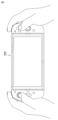
- FIG. FIG. 1 is a diagram illustrating an example of a state in which the information processing device is held and operated.
- 1A and 1B are diagrams illustrating an example of a state in which the controller is held and operated laterally.
- 1A and 1B are diagrams illustrating an example of a state in which the controller is held vertically and operated.
- FIG. 2 is a schematic assembly perspective view showing the configuration of the right side of the main unit. 2 is an exploded perspective view showing the configuration of the right side of the main unit.
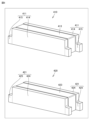
- FIG. 2 is a schematic perspective view showing the configuration of a first magnetic element and a second magnetic element.
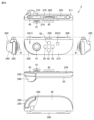
- FIG. 2 is a six-sided schematic diagram showing the configuration of a first aspect of the first game controller.
- FIG. 2 is a schematic perspective view showing a detailed configuration of a first mode of the first game controller.
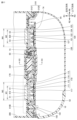
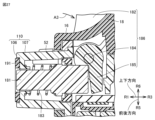
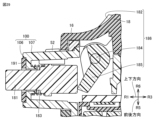
- FIG. 12 is a schematic cross-sectional view taken along line XII-XII in FIG. 10.
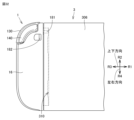
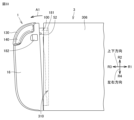
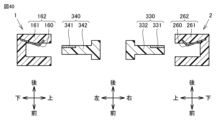
- 13 is a schematic cross-sectional view showing a state in which the top button (right) is attracted to the first magnetic element.
- FIG. 4 is a schematic plan view showing the configuration of a first elastic deformation body.
- FIG. 1 is a schematic front view showing the configuration of a first aspect of a game controller.
- FIG. 16 is an enlarged schematic diagram of region XVI in FIG. 15 .
- 2 is a schematic cross-sectional view showing the game controller attached to the main unit.
- FIG. FIG. 18 is an enlarged schematic diagram of region XVIII in FIG. 17 .
- FIG. 19 is a schematic cross-sectional view taken along line XIX in FIG. 18 .
- FIG. 18 is a schematic cross-sectional view taken along line XX-XX in FIG. 17.
- FIG. 2 is a schematic cross-sectional view illustrating a configuration of an example of a first terminal. 1 is a schematic top view showing the configuration of a first aspect of a game controller.
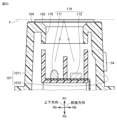
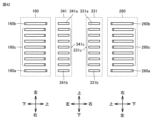
- FIG. 23 is a schematic cross-sectional view showing only the protrusions taken along line XXIII-XXIII in FIG.
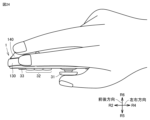
- FIG. 2 is a schematic bottom view showing the game controller being used as a mouse.
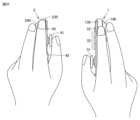
- FIG. 1 is a schematic diagram showing a state in which a mouse is used with both hands. 1 is a schematic rear view showing the configuration of a first embodiment of a game controller.
- FIG. 27 is a schematic cross-sectional view taken along line XXVII-XXVII in FIG. 26.
- FIG. 2 is a schematic perspective view showing a configuration of an example of a pusher operation member.
- FIG. 4 is a schematic cross-sectional view showing a state when an operating unit is being operated.
- FIG. 2 is a schematic diagram showing a state before an operating unit is operated.
- FIG. 4 is a schematic diagram showing a state when an operation unit is operated.
- FIG. 1 is a schematic rear view showing the state before the first game controller is removed from the main unit.
- FIG. 1 is a schematic rear view showing a first state in the process of removing the first game controller from the main unit.
- FIG. This is a schematic cross-sectional view taken along line XXXIV-XXXIV in Figure 22.
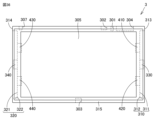
- FIG. 2 is a schematic front view showing an example of a configuration of a main body device.
- 4 is a conceptual schematic diagram showing a connection state of terminals in a first connection state.
- FIG. FIG. 2 is a schematic front view showing the configuration of an information processing device in a first connection state.
- FIG. 4 is a conceptual schematic diagram showing a terminal arrangement in a first connection state.
- FIG. 11 is a conceptual schematic diagram showing a second example of a connection state of the terminals.
- 11 is a schematic front view showing the configuration of the information processing device in a second connection state.
- FIG. FIG. 13 is a conceptual schematic diagram showing a terminal arrangement in a second connection state.
- 1 is a schematic top view of the main unit showing the state before the first game controller is removed from the main unit.
- FIG. 11 is a schematic top view of the main unit showing a second state in the process of removing the first game controller from the main unit.
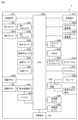
- FIG. 2 is a block diagram showing an example of an internal configuration of a main body device.
- FIG. 1 is a block diagram showing an example of an internal configuration of an information processing device;
- 11 is a schematic front view showing the configuration of a second aspect of the game controller.
- FIG. FIG. 13 is a schematic perspective view showing the configuration of a third embodiment of the game controller.
- the information processing device 1000 has a first game controller 1, a second game controller 2, and a main unit 3.
- the first game controller 1 or the second game controller 2 will be collectively referred to simply as the game controller.
- the main unit 3 has a roughly rectangular parallelepiped shape, with the upper and lower sides being longer than the right and left sides.
- the main unit 3 is capable of executing game processing.
- the game processing is executed based on an input to the game controller.
- the first game controller 1 and the second game controller 2 are detachable from the main unit 3. In the attached state shown in FIG. 1, the first game controller 1 is attached to the right side of the main unit 3, and the second game controller 2 is attached to the left side of the main unit 3.
- FIG. 2 is a schematic front view showing the first game controller 1 and the second game controller 2 when each is removed from the main unit 3.
- the game controller can be used both when attached to the main unit 3 and when detached from the main unit 3.
- the first game controller 1 and the second game controller 2 are operated by different users.
- the game controller can also be used with its longitudinal direction oriented vertically (or, from another perspective, perpendicular to the ground) when detached from the main unit 3.
- one user operates both the first game controller 1 and the second game controller 2.
- Each controller may be operated by a different user.
- the usage state shown in Figure 3 will be referred to as the integrally held state, the usage state shown in Figure 4 as the horizontally held state, and the usage state shown in Figure 5 as the vertically held state.
- the first game controller 1 has a convex portion 100 on the upper side 11 that protrudes from the side.
- the upper side 11 of the first game controller 1 is a side that extends along the longitudinal direction of the first game controller 1.
- the convex portion 100 extends in the longitudinal direction of the upper side 11.
- the second game controller 2 has a convex portion 200 on the upper side 211 that protrudes from the side and extends in the longitudinal direction of the side.
- the upper side 211 of the second game controller 2 is a side that extends along the longitudinal direction of the second game controller 2.
- the convex portion 200 extends in the longitudinal direction of the upper side 211.
- the main body device 3 has a recess 310 in the main body right side surface 313.
- the recess 310 extends in the longitudinal direction of the main body right side surface 313.
- the recess 310 extends along the up-down direction of the main body right side surface 313.
- the main body left side surface 314 of the main body device 3 has a recess 320.
- the recess 320 extends in the longitudinal direction of the main body left side surface 314.
- the recess 320 extends along the up-down direction of the main body left side surface 314 of the main body device 3.
- the recesses 310, 320 are elongated recesses that extend along the longitudinal direction of the main body right side surface 313 or the main body left side surface 314.
- the first game controller 1 is attached to the main unit 3 so that the protrusion 100 fits into the recess 310.
- the first game controller 1 is attached to the main unit 3 so that the upper side 11 of the first game controller 1 faces the main unit right side 313 of the main unit 3, and the longitudinal direction of the upper side 11 of the first game controller 1 is aligned with the longitudinal direction of the main unit right side 313 of the main unit 3.
- the second game controller 2 is attached to the main unit 3 so that the protrusion 200 fits into the recess 320.
- the second game controller 2 is attached to the main unit 3 so that the upper side 211 of the second game controller 2 faces the main unit left side 314 of the main unit 3, and the longitudinal direction of the upper side 211 of the second game controller 2 is aligned with the longitudinal direction of the main unit left side 314 of the main unit 3.
- the first game controller 1 and the second game controller 2 each include a joystick and a set of four buttons, but when attached to the main unit 3, the first game controller 1 is attached so that the four buttons are on the upper side and the joystick is on the lower side. On the other hand, the second game controller 2 is attached to the main unit 3 so that the joystick is on the upper side and the four buttons are on the lower side.
- a display 305 is provided on the front body 315 of the main body device 3.
- the display surface of the display 305 is exposed through an opening provided on the front body 315.
- the display 305 may be placed on the surface of the front body 315.
- the display 305 may be any display device, such as a liquid crystal display device or an OLED.
- a touch panel may be provided on the display surface of the display 305. Any touch detection method may be adopted for the touch panel.
- the display 305 displays, for example, an image acquired or generated by the main body device 3.
- the image may be a still image or a video.
- the main unit 3 has an audio input/output terminal 301.
- the audio input/output terminal 301 is provided on the upper side 316 of the main unit 3.
- the audio input/output terminal 301 is, for example, an earphone jack. Earphones and a microphone can be attached to the audio input/output terminal 301.
- the main unit 3 may also have a volume button next to the audio input/output terminal 301.
- the volume button is a button for issuing instructions to adjust the volume output by the main unit 3.
- the main unit 3 has a lower terminal 303.
- the lower terminal 303 is provided on a lower surface 317 of the main unit 3.
- the lower terminal 303 may be provided at the center in the left-right direction on the lower surface 317 of the main unit.
- the lower terminal 303 is, for example, a terminal for communicating with an external device.
- the lower terminal 303 constitutes, for example, a USB (Universal Serial Bus) connector.
- the main unit 3 may receive power from the outside via the lower terminal 303.
- the main unit 3 may output an image to the outside via the lower terminal 303.
- the lower terminal 303 When the main unit 3 is placed on a cradle from the lower surface side of the main unit, the lower terminal 303 may be connected to a terminal of the cradle.
- the main unit 3 may have an upper terminal 302 on the upper side 316 of the main unit in addition to the lower terminal 303.
- the upper terminal 302 may be provided at a position that is not symmetrical with respect to the front surface 315 of the main unit.
- the main unit 3 may not have these components.
- the main unit 3 may have other components in addition to or instead of these components.
- the main unit 3 may have a power button 307 and a storage medium slot 304 on the upper side 316 of the main unit.
- the main unit 3 may execute game processing by executing a game application stored in a storage medium inserted in the storage medium slot 304.
- the main unit 3 may also have a stand on the back of the main unit for supporting the main unit 3.
- the stand allows the main unit 3 to stand on a placement surface with the upper side 316 of the main unit facing upward.
- the stand may be rotatably connected to the main body housing 306 and rotate away from the main body housing 306 when in use.
- FIG. 6 is an assembled perspective view showing the configuration of the right side of the main unit 3.
- FIG. 7 is an exploded perspective view showing the configuration of the right side of the main unit 3. Note that the main unit 3 also has a similar configuration on the left side.
- a recess 310 is provided on the right side surface 313 of the main unit 3.
- the recess 310 is a recessed portion on the right side surface 313 of the main unit.
- the recess 310 has a bottom surface 3121 and an inner peripheral surface 3120 surrounding the bottom surface 3121.
- the portion of the main unit housing 306 that forms the right side surface of the main unit 3 is recessed to form the inner peripheral surface 3120 and a base surface (base surface 311 described below) that serves as the base of the bottom surface.
- base surface 311 base surface 311 described below
- the bottom surface 3121 of the recess 310 extends in the longitudinal direction of the right side surface 313 of the main body.
- the front side edge and the rear side edge of the bottom surface 3121 are each substantially straight and extend substantially parallel.
- the upper and lower regions of the bottom surface 3121 each narrow in width toward the end. More specifically, the upper and lower regions of the bottom surface 3121 narrow in width in a curved manner.
- the upper and lower regions of the bottom surface 3121 may narrow in width in a linear manner.
- the upper and lower regions of the bottom surface 3121 may have a constant width. Only one of the upper and lower regions of the bottom surface 3121 may narrow in width toward the end.
- the main unit 3 has a first plug connector 330, a cover 338, a pair of shoulder screws 334, and two magnetic elements 410, 420 arranged along the longitudinal direction of the recess 310.
- the first magnetic element 410 is arranged on the upper side
- the second magnetic element 420 is arranged on the lower side.
- the first magnetic element 410 is arranged in an area above the longitudinal center of the right side surface 313 of the main unit, and the second magnetic element 420 is arranged in a lower area. Both the magnetic elements 410, 420 may be arranged in the upper or lower area.
- the material of the cover 388 is not particularly limited, but may be, for example, a material having insulating properties.
- the material of the cover 388 may also be, for example, a material that is not attracted to a magnet.
- the material of the cover 388 may be, for example, plastic.
- FIG. 8 is a schematic perspective view showing the configuration of the first magnetic element 410 and the second magnetic element 420.
- the magnetic element is a part that is attracted to a magnet by magnetic force.
- the magnetic element includes a part made of a magnet or a material that is not a magnet but is attracted to a magnet, for example, a soft magnetic material.
- the first magnetic element 410 has a pair of yokes 411 and a magnet 413. That is, the first magnetic element 410 includes a magnet.
- the material of the magnet 413 is not particularly limited.
- the magnet 413 is, for example, a neodymium magnet.
- the material of the yoke 411 is not particularly limited.
- a soft magnetic material is used as the material of the yoke 411, for example, iron is used.
- the magnetic element 410 may have the magnet 413 without having the yoke 411.
- the magnetic element 410 may also have a part made of a soft magnetic material without having the magnet 413.
- the magnet 413 is sandwiched between a pair of yokes 411.
- the magnet 413 and the pair of yokes 411 are fixed, for example, by adhesive.
- the magnet 413 is a rectangular parallelepiped.
- Each of the pair of yokes 411 has a main body portion 414 and a pair of flange portions 415.
- the magnet 413 is sandwiched between the main body portion 414.
- One of the pair of flange portions 415 protrudes from a lower region of a surface at one end of the main body portion 414 (more specifically, a surface at one end in the longitudinal direction of the first main body portion 414).
- the other of the pair of first flange portions 415 protrudes from a lower region of a surface at the other end of the first main body portion 414 (more specifically, a surface at the other end in the longitudinal direction of the first main body portion 414).
- the second magnetic element 420 is similarly configured.
- the portion of the main housing 306 that forms the right side surface is recessed to form the base surface 311, which is the base of the bottom surface of the recess 310, and the inner circumferential surface 3120.
- the surface of the cover 338 placed on the base surface 311 constitutes the bottom surface 3121.
- the cover 338 is fixed to the base surface 311.
- the method of fixing the cover 338 is not particularly limited, but for example, the cover 388 may be fixed to the base surface 311 by an adhesive.
- the cover 388 may also be fixed to the base surface 311 by an adhesive tape.
- the material is not limited, but for example, it may be a material that has insulating properties or a material that does not attract a magnet.
- the shape of the base surface 311 and the shape of the cover 338 are substantially the same. In other embodiments, the shape of the base surface 311 and the shape of the cover 338 may be different.
- the cover 388 may have a shape that covers at least the first magnetic element 410, the second magnetic element 420, the first hole 401, and the second hole 402.
- the cover 388 may include a plurality of cover parts, not just one.
- the inner circumferential surface 3120 surrounds the entire circumference of the base surface 311, but it does not have to be configured to surround the entire circumference.
- the inner circumferential surface 3120 is continuous with the base surface 311 and the main body right side surface 313.
- the upper end of the inner circumferential surface 3120 (the right end portion in the main body device 3) is connected to the main body right side surface 313. From another perspective, the recess 310 is recessed further than the main body right side surface 313.
- the shape of the inner circumferential surface 3120 is roughly the outer circumferential surface shape of a truncated pyramid with the bottom surface 3121 as the upper base side.
- the inner circumferential surface 3120 has a shape that widens from the bottom surface toward the upper end.
- the end region in the longitudinal direction may be rounded, as described later.
- the recess 310 when the recess 310 is viewed from the opening side (i.e., the right side), the bottom surface 3121 and the inner peripheral surface 3120 surrounding the bottom surface 3121 are visible. In another embodiment, the inner peripheral surface 3120 may extend parallel to the left-right direction.
- the shape of the recess 310 is not limited to the outer peripheral surface shape of a truncated pyramid. As an example, the shape of the recess 310 may be the outer peripheral surface shape of a truncated cone or the outer peripheral surface shape of a rectangular parallelepiped.
- the opposite side of the main unit 3 is configured in the same way.
- the base surface 311 has a first hole 401 and a second hole 402 for accommodating the magnetic elements 410, 420.
- the first hole 401 and the second hole 402 are aligned in the longitudinal direction of the right side surface 313 of the main body. In other words, the first hole 401 and the second hole 402 are aligned in the longitudinal direction of the base surface 311.
- the first game controller 1 also has a magnetic element, and the magnetic element on the first game controller 1 side is attracted to the magnetic elements 410, 420, so that the game controller is attached to the main body device 3.
- the portion of the first magnetic element 410 above the flange portion 415 is accommodated in the first hole 401.
- the top surface of the first magnetic element 410 is substantially flush with the base surface 311.
- the portion of the first magnetic element 410 that is not accommodated in the first hole 401 i.e., the flange portion 415 and the portion of the main body portion 414 below the upper end of the flange portion 415) is located inside the main body housing 306.
- the length of the portion of the first magnetic element 410 including the flange portion 415 is longer than the length of the opening of the first hole 401 on the inside side of the main body housing 305.
- the flange portion 415 prevents the first magnetic element 410 from entering the first hole 401 as a whole, and prevents the first magnetic element 410 from falling out to the outside of the main body housing 306.
- the top surface of the first magnetic element 410 may be located deeper than the base surface 311.
- the top surface of the first magnetic element 410 may also protrude from the base surface 311. The same applies to the second magnetic element 420.
- the first magnetic element 410, the second magnetic element 420, the first hole 401 and the second hole 402 are covered by the cover 338. That is, the first magnetic element 410 and the second magnetic element 420 are covered by the cover 338 which constitutes the bottom surface 3121 of the recess 310.
- the magnetic element is embedded in the bottom of the recess 310 by the cover 338.
- the magnetic element may be disposed on the bottom surface 3121 of the recess 310.
- the magnetic element may also be disposed in an exposed manner on the surface or in a recessed position of a hole provided in the bottom surface 3121 of the recess 310.
- the second magnetic element 420 has a similar configuration to the first magnetic element 410. Also, like the first magnetic element 410, a portion of the second magnetic element 420 is housed in the second hole 402.
- the magnetic elements 430, 440 provided in the recess 320 on the left side and the holes in which the magnetic elements 430, 440 are respectively housed are also of a similar configuration.
- the first plug connector 330 has a support portion 333, a first tongue body 332 protruding from the support portion 333, and a main body first terminal 331 provided along the surface of the first tongue body 332.
- the support portion 333 and the first tongue body 332 may be integral or separate.
- the first plug connector 330 is provided between the first magnetic element 410 and the second magnetic element 420 in the longitudinal direction of the main body right side surface 313 when viewed from the bottom surface direction of the recess 310. Therefore, the main body first terminal 331 is provided between the first magnetic element 410 and the second magnetic element 420 in the longitudinal direction of the main body right side surface 313.
- the tip of the first tongue body 332 (the right end of the first tongue body 332) does not protrude from the recess 310.
- the first tongue body 332 does not protrude outward from the main body right side surface 313 and is provided within the recess 310. Therefore, the main body first terminal 331 provided on the first tongue body 332 is also provided within the recess 310.
- the first tongue body 332 and the main body first terminal 331 may protrude higher than the main body right side surface 313.
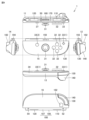
- FIG. 9 is a six-sided schematic diagram showing the configuration of the first mode of the first game controller 1.
- the second game controller 2 will be described later.
- the first game controller 1 of this embodiment has a joystick 31, which is an example of a directional input unit, a set of four buttons 32, a + button 33(1), and a home button 33(2) on its front.
- the set of four buttons 32 are arranged in a cross shape, but may be arranged in other ways.
- the first game controller 1 also has a top button (right) 110, a top button (left) 120, a synchronization button 50, a shoulder button (right) 130, and a Z shoulder button (right) 140.
- the top button (right) 110, the top button (left) 120, and the synchronization button 50 are provided on the protruding portion 100, as will be described in detail later.
- the first game controller 1 may also have other input units, such as a touch pad or a pressure sensor, instead of or in addition to these input units.
- the operation information of the input unit is transmitted to the main unit first terminal 331 of the main unit 3 through the first terminal 160 described below, and the CPU of the main unit 3 processes the information according to a program.
- the operation information of the input unit is transmitted to the CPU of the main unit 3 via a wireless chip provided in the game controller and a wireless chip provided in the main unit 3.
- the information processing device 1000 does not need to have the first terminal 160 and the main unit first terminal 331, in which case information is transmitted via the wireless chip even when the game controller is attached to the main unit 3.
- the first game controller 1 has a front side 15, a back side 16, an upper side 11, a right side 12, a lower side 13, and a left side 14.
- the front side 15 is the side that faces the user using the first game controller 1 when it is held as a unit, held horizontally, or held vertically.
- the back side 16 is on the opposite side to the front side 15.
- the front side 15 and back side 16 are connected to the upper side 11, right side 12, lower side 13, and left side 14, respectively.
- the direction perpendicular to the up-down direction and toward the right side surface 12 is also referred to as the second direction R2.
- the second direction R2 is also referred to as the right side or rightward direction.
- the opposite direction to the second direction R2 is also referred to as the fourth direction R4.
- the fourth direction R4 is also referred to as the left side or leftward direction.
- the second direction R2 and the fourth direction R4 are collectively referred to as the left-right direction.
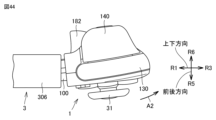
- the normal direction of the front surface 15 is also referred to as the fifth direction R5.
- the fifth direction R5 is also referred to as the front side or the front direction.
- the opposite direction to the fifth direction is also referred to as the sixth direction R6.
- the sixth direction R6 is also referred to as the rear side or the rear direction.
- the fifth direction R5 and the sixth direction R6 are collectively referred to as the front-to-rear direction.
- the upper side 11 is located on the upper side of the front surface.
- the upper side 11 is a side extending in the longitudinal direction of the front surface 15.
- the longitudinal direction of the front surface 15 is the left-right direction of the front surface 15.
- the upper side 11 extends in the left-right direction.
- the lower side 13 is located opposite the upper side 11.
- the lower side 13 is on the third direction R3 side of the upper side 11.
- the lower side 13 extends in the left-right direction.
- the right side 12 is connected to the right end of the upper side 11 and is a side extending in a direction away from the upper side 11.
- the end of the right side far from the upper side 11 is connected to the right end of the lower side 13.
- the left side 14 is connected to the left end of the upper side 11 and is a side extending in a direction away from the upper side 11.
- the end of the left side far from the upper side 11 is connected to the left end of the lower side 13.
- the right side is on the second direction R2 side of the left side.
- a + button 33(1) As shown in FIG. 9, on the front surface 15 of the first controller, from right to left, there are provided a + button 33(1), a set of four buttons 32, a joystick 31, and a home button 33(2).
- the set of four buttons 32 and the joystick 31 are adjacent to each other.
- the joystick 31 In the up-down direction, the joystick 31 is located between the upper button and the lower button of the set of four buttons 32.
- the joystick 31 In the left-right direction, the joystick 31 is located approximately on an extension of a straight line connecting the right button and the left button of the set of four buttons 32.
- the main unit 3 may perform a corresponding predetermined process based on the pressing of the + button 33(1) and the set of four buttons 32.
- the main unit 3 may call up a home menu in response to an input to the home button 33(2).
- the right shoulder button 130 is a button that is used, for example, when held as one unit, and is located at the top right of the first game controller 1 when held as one unit.
- the right shoulder button 130 may also be used when held vertically.
- the right shoulder button 130 has a curved operation surface.
- the right shoulder button 130 extends in a direction away from the upper side surface 11.
- the right shoulder button 130 is provided in a portion that is generally at the bottom right of the first game controller 1 when held horizontally. At least a portion of the right shoulder button 130 may be provided on the right side surface 12.
- the operation surface of the right shoulder button 130 generally curves along the bottom right portion of the first game controller 1.
- the main unit 3 performs a predetermined process in a program being executed based on the pressing of the right shoulder button.
- the Z shoulder button (right) 140 is a button that is used, for example, when held together, and is provided on the back side of the shoulder button (right) 130.
- the Z shoulder button (right) 140 may also be used when held vertically.
- the Z shoulder button (right) 140 has a curved operation surface.
- the shoulder button (right) 130 extends in a direction away from the upper surface 11.
- the Z shoulder button (right) 140 is provided roughly in the lower right part of the first game controller 1 when held horizontally. At least a part of the Z shoulder button (right) 140 may be provided on the right side surface 12. At least a part of the Z shoulder button (right) 140 may be provided on the back surface 16.
- the operation surface of the Z shoulder button (right) 140 curves roughly along the lower right part of the first game controller 1.
- the Z shoulder button (right) 140 may be entirely provided on the back surface. In the program being executed, the main unit 3 performs a specific process based on the pressing of the Z shoulder button (right) 140.
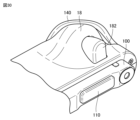
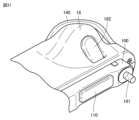
- FIG. 10 is a schematic perspective view showing a detailed configuration of the first embodiment of the first game controller 1.
- FIG. 11 is an exploded schematic perspective view including the protrusion 100.
- the first game controller 1 has a light emitting unit 150 that notifies the identification number of the game controller, a first terminal 160 that is connected to the main body first terminal 331 of the main body device 3, a mouse sensor opening 170 for guiding light to a mouse operation sensor 174 described below, a mouse sole 191, a mouse sole 192, and an operation unit 182 that constitutes a removal mechanism for removing the convex portion 100 from the main body device 3.
- the convex portion 100 protrudes upward from the upper surface 11. From another perspective, the convex portion 100 protrudes from the upper surface 11 in the first direction R1.
- the convex portion 100 extends along the longitudinal direction of the upper surface 11 (i.e., the length in the longitudinal direction is longer than in other directions). Note that the convex portion 100 does not have to extend in a strictly aligned manner with the longitudinal direction of the upper surface 11, but only needs to extend along the longitudinal direction. In other words, the longitudinal direction of the convex portion 100 is aligned with the longitudinal direction of the upper surface 11. Note that the longitudinal direction of the convex portion 100 does not have to strictly match the longitudinal direction of the upper surface 11.
- the convex portion 100 is an elongated convex portion that extends along the longitudinal direction of the upper surface 11. Note that the convex portion 100 has a similar configuration to the convex portion 100. The following explanation focuses on the configuration of the protruding part 100 of the first controller 1.
- the convex portion 100 has a truncated pyramid shape whose cross section becomes smaller toward the top surface 106. As described below, the end regions in the longitudinal direction may be rounded. From another perspective, when the convex portion 100 is viewed from the top surface 106 side (i.e., from above), the top surface 106 and the outer peripheral surface 107 surrounding the top surface 106 are visible.
- the shape of the convex portion 100 is not limited to a truncated pyramid. As an example, the convex portion 100 may be a truncated cone or a rectangular parallelepiped.
- the left-right length of the convex portion 100 (i.e., the longitudinal length of the convex portion 100) may be, for example, more than twice the length of the convex portion 100 in the front-to-rear direction, or more than five times.
- the left-right length of the convex portion 100 may be, for example, more than 50% of the left-to-right length of the upper surface 11, or more than 70% of the length.
- the left-to-right length of the convex portion 100 may be, for example, less than 25 times the length of the convex portion 100 in the front-to-rear direction, or less than 15 times.
- the horizontal length of the top surface (operation surface) of the upper button (right) 110 and upper button (left) 120 can be increased, improving operability. It also becomes easier to arrange the mouse sensor opening 170, mouse sole 191, mouse sole 192, etc. on the top surface of the convex portion 100.
- the protrusion 100 is sandwiched between the front housing 61 and the rear housing 62 that constitute the controller housing 10.
- the upper surface 11 is provided with a housing opening 17 formed by the end face of the front housing 61 and the end face of the rear housing 62.
- the protrusion 100 protrudes from the inside of the controller housing 10 through the housing opening 17.
- the convex portion 100 has a convex portion flange 19.
- the convex portion flange 19 extends outward (more specifically, in the left-right and front-rear directions) from the lower end of the wall portion constituting the outer circumferential surface 107.
- the region of the convex portion 100 above the convex portion flange 19 is exposed from the housing opening 17.
- the lower region of the convex portion 100 including the convex portion flange 19 is located inside the controller housing 10.
- the convex portion flange 19 functions as a retainer for the convex portion 100.
- the convex portion 100 may be composed of multiple parts.
- the convex portion 100 may be a part of the controller housing 10.
- the convex portion 100 may be formed by at least one of the front side housing 61 and the rear side housing 62.
- the convex portion 100 is configured to fit into the recess 310 from the front side of the recess (the right side of the main unit 3).
- the shape of the convex portion 100 is configured to match the shape of the recess 310.
- the top surface 106 and outer peripheral surface 107 of the convex portion are compatible with the shapes of the bottom surface 3121 and inner peripheral surface 3120 of the recess 310.
- the first game controller 1 when a user attaches the first game controller 1 to the main unit 3, the first game controller 1 is guided to an appropriate attachment position. Also, for example, the first game controller 1 attached to the main unit 3 is prevented from shifting in position in the up-down or front-back directions on the main unit 3. As an example, even if a force is applied to the game controller in the forward/backward or upward/downward directions in response to a user's operation input when held together, the game controller is prevented from significantly shifting in position relative to the main unit 3.
- the shape of the convex portion 100 and the shape of the recess 310 do not have to be strictly the same.
- the shape of the convex portion 100 and the shape of the recess 310 do not strictly match.
- the angle of inclination of the outer peripheral surface 107 relative to the top surface 106 and the angle of inclination of the inner peripheral surface 3120 relative to the bottom surface 3121 are different. Specifically, the angle of inclination of the outer peripheral surface 107 relative to the top surface 106 is smaller than the angle of inclination of the inner peripheral surface 3120 relative to the bottom surface 3121. This creates a clearance when fitting the convex portion 100 into the recess 310, leaving room for the approach angle.
- the angle of inclination of the outer peripheral surface 107 relative to the top surface 106 and the angle of inclination of the inner peripheral surface 3120 relative to the bottom surface 3121 may be the same. Furthermore, when the first game controller 1 is attached to the main unit 3, the top surface 106 and the bottom surface 3121, and the outer peripheral surface 107 and the inner peripheral surface 3120 do not necessarily always come into contact with each other, and may always come into contact with each other.
- the width of the protrusion 100 in the front-to-rear direction decreases toward the longitudinal end.
- the width of the top surface 106 decreases toward the end.
- the longitudinal end of the protrusion 100 is rounded. Therefore, when the first game controller 1 is attached at an angle to the main unit 3 (i.e., when the first game controller 1 is attached with the upper side 11 (the side with the protrusion 100) tilted relative to the right side of the main unit 3, the narrow end is inserted into the recess 310. This makes it easier to attach the first game controller 1.
- the protrusion 100 may have a bulging region in which the width in the front-to-rear direction is wider in an area other than the longitudinal end area. Also, only one of the longitudinal ends of the first protrusion 100 (for example, only the end that is on the lower side when attached) may be rounded.
- the outer peripheral surface 107 of the convex portion 100 has a first engagement hole 193 and a second engagement hole 194 on each of the longitudinal end faces.
- the first engagement hole 193 is provided on the first end face of the convex portion 100.
- the second engagement hole 194 is provided on the second end face of the convex portion 100.
- the shape of the first engagement hole 193 is different from the shape of the second engagement hole 194. In the front-rear direction, the length of the first engagement hole 193 may be different from the length of the second engagement hole 194. In the up-down direction, the length of the first engagement hole 193 may be different from the length of the second engagement hole 194.
- a peripheral device (not shown) is detachably attached to the first game controller 1.
- a strap attachment consisting of a strap that is wrapped around the wrist when using the first game controller 1 and a housing to which the strap is connected is provided.
- Such a peripheral device is provided with a recess similar to recess 310 of the main unit 3.
- a magnetic element may be provided within the recess.
- the peripheral device can be firmly attached to the first game controller 1.
- the peripheral device does not need to have a magnetic element, in which case it can be attached using the engagement hole and engagement element.
- the engagement holes 193, 194 are located on the end faces in the longitudinal direction, when the first game controller 1 is inserted obliquely into the recess of the peripheral device from the direction of the engagement holes 193, 194, the peripheral device can be easily attached to the first game controller 1 while engaging the engagement element with the engagement hole.
- the longitudinal end of the protrusion 100 is rounded, it is easy to insert the peripheral device into the recess from the longitudinal end.
- the shapes of the first engagement hole 193 and the second engagement hole 194 are different, it is possible to make it possible to attach the peripheral device only in a specified direction (or difficult to attach in the other direction) depending on the shape of the engagement element on the peripheral device side.
- first engagement hole 193 and the second engagement hole 194 may be the same. Also, the first game controller 1 may have only one of the first engagement hole 193 and the second engagement hole 194. Also, in another aspect, the first game controller 1 may not have an engagement hole, or may have an engagement element. In addition, in this embodiment, the main unit 3 does not have an engagement element, but in other embodiments, the main unit 3 may have an engagement element.
- the top button (right) 110 and the top button (left) 120 are provided on the convex portion 100.
- the top button (right) 110 and the top button (left) 120 are buttons that the user presses down, and are components that move downward when pressed down.
- a ground connection part 51 is connected to the underside of the top button (right) 110.
- a tact switch 117 is provided under the top button (right) 110. When the top button (right) 110 moves downward when pressed down by the user, the tact switch 117 is pressed down by the top button (right) 110.
- the top button (right) 110 and the tact switch 117 form a button switch.
- the top button (left) 120 and the tact switch 127 form a button switch.
- the top button (right) 110 is exposed from a first opening 197 provided in the top surface 106.
- the exposed portions of the top buttons 110 and 120 (110 and 120 in FIG. 9) form an operation section that is pressed by the user.
- a ground connection section 53 is connected to the underside of the top button (left) 120.
- a tact switch 127 is provided on the underside of the top button (left) 120. The tact switch 127 is pressed by the top button (right) 120.
- the on signals of the tact switch 117 and the tact switch 127 are transmitted to the main unit 3, and in the program being executed, processing is performed in response to the pressing of the top button (right) 110 and the top button (right) 120.
- the synchronization button 50 is provided on the convex portion 100.
- the synchronization button 50 is pressed by the user.
- the synchronization button 50 is provided between the top button (right) 110 and the top button (left) 120 in the longitudinal direction of the convex portion 100. More specifically, the synchronization button 50 is provided between the first terminal 160 and the top button (left) 120 in the longitudinal direction of the convex portion 100.
- the synchronization button 50 may be used to instruct a setting process related to wireless communication between the first game controller 1 and the main unit 3.
- the first game controller 1 has a terminal accommodating portion 167.
- the first terminal 160 is provided along the inner peripheral surface of the terminal accommodating portion 167.
- the first terminal 160 extends in the up-down direction.
- a terminal opening 196 is provided in the top surface 106.
- the terminal accommodating portion 167 communicates with the terminal opening 196. In other words, the terminal accommodating portion 167 opens into the top surface 106. Therefore, the first terminal 160 is accessible from outside the top surface 106.
- the terminal opening 196 is provided on the top surface 106 between the top button (right) 110 and the top button (left) 120. Therefore, the terminal accommodating portion 167 opens on the top surface 106 between the top button (right) 110 and the top button (left) 120.
- the first terminal 160 is provided between the top button (right) 110 and the top button (left) 120 in the longitudinal direction of the convex portion 100. Note that the first terminal 160 only needs to be at least partially between the top button (right) 110 and the top button (left) 120 in the left-right direction, and does not have to be between the top button (right) 110 and the top button (left) 120 in the front-rear and up-down directions.
- the terminal is provided between the top button (right) 110 and the top button (left) 120 when viewed from the direction of the top surface of the convex portion 100.
- the first terminal 160 is provided within the protruding portion 100.
- the first terminal 160 is arranged so that at least its upper end is below the top surface 106 or below the top surface 106 in the protruding direction of the protruding portion 100.
- the upper end of the first terminal 160 may be provided between the top surface 106 and the upper side surface 11.
- the lower end of the first terminal 160 may be arranged below the upper side surface 11, i.e., inside the controller housing 10.
- the mouse operation sensor 174 is provided in a storage section that opens into a mouse sensor opening 170 provided on the top surface 106.
- the mouse sensor opening 170 is provided between the top button (right) 110 and the top button (left) 120 in the longitudinal direction of the convex portion 100. More specifically, the mouse sensor opening 170 is provided between the first terminal 160 and the top button (right) 110 in the longitudinal direction of the convex portion 100.
- the light-emitting unit 150 is provided on the outer peripheral surface 107 of the convex portion 100. More specifically, the light-emitting unit 150 is provided on the front side of the outer peripheral surface 107. From another perspective, the area of the outer peripheral surface 107 where the light-emitting unit 150 is provided faces the front side. When the user looks at the front surface 15 of the first game controller 1, the user can see the light from the light-emitting unit 150.
- the light-emitting unit 150 typically emits light emitted by an LED to the outside.
- the light-emitting unit 150 can notify the user of specific information.
- the light-emitting unit 150 may show the user information identifying each game controller.
- the light-emitting unit 150 may show other information to the user.
- the number of light-emitting units 150 is not particularly limited, but is, for example, four.
- the four light-emitting units 150 are arranged side by side in the left-right direction. For example, of the four light-emitting units 150, a portion or number of light-emitting units 150 corresponding to the identification number assigned to the game controller may light up.
- the light emitting section 150 is provided between the top button (right) 110 and the top button (left) 120 in the longitudinal direction of the convex portion 100.
- the light emitting section 150 is provided between the synchronization button 50 and the mouse sensor opening 170 in the longitudinal direction of the convex portion 100.
- the light emitting section 150 is provided at a position overlapping with the first terminal 160 in the longitudinal direction of the convex portion 100. From another perspective, the light emitting section 150 is located below the terminal opening 196 when viewed from the front side.
- a first mouse sole 191 and a second mouse sole 192 are placed on the top surface 106 of the convex portion 100.
- the height of the top surface of the first mouse sole 191 and the second mouse sole 192 from the upper side surface 11 is higher than the height of the top surface 106 of the convex portion 100 from the upper side surface 11.
- the mouse soles 191 and 192 raise the height of the top surface of the convex portion 100. Note that the mouse soles 191 and 192 are not necessary.
- the first game controller 1 can be used as a mouse by placing it so that the top surface of the convex portion 100 faces a ground surface such as a desk. At that time, the mouse soles 191 and 192 themselves contact the ground surface, preventing the portion of the top surface 106 of the convex portion 100 that does not have the mouse soles from directly contacting the ground surface. In addition, the top surfaces of the mouse soles 191 and 192 contact the bottom surface 3121 of the recess 310 when the first game controller 1 is attached to the main unit 3.
- the height of the top surfaces of the mouse soles 191 and 192 is equal to or higher than the maximum height of the top surface 106 of the convex portion 100. From another perspective, the top surfaces of the mouse soles 191 and 192 are located at the topmost position on the first game controller 1.
- the shape of the mouse sole 191 is not particularly limited, and may be any shape, such as a circle, an ellipse, or a rectangle.
- the mouse sole 191 may have a through hole.
- the shapes of the mouse sole 191 and the mouse sole 192 may be the same or different.
- the mouse sole 191 is located closer to the right side surface 12 than the top button (right) 110.
- the top button (right) 110 is located between the first terminal 160 and the mouse sole 191. More specifically, in the longitudinal direction of the convex portion 100, the top button (right) 110 is located between the mouse sensor opening 170 and the mouse sole 191.
- the mouse sole 192 is located closer to the left side surface 14 than the top button (left) 120.
- the top button (left) 120 is located between the first terminal 160 and the mouse sole 192. More specifically, in the longitudinal direction of the convex portion 100, the top button (left) 120 is located between the synchronization button 50 and the mouse sole 192.
- the top button (right) 110 and the top button (left) 120 are arranged symmetrically.
- the top button (right) 110 and the top button (left) 120 are arranged symmetrically with respect to the center of the controller housing 10 in the left-right direction.
- the top button (right) 110 and the top button (left) 120 are arranged symmetrically with respect to the center of the upper side surface 11 in the left-right direction.
- the top button (right) 110 and the top button (left) 120 are arranged symmetrically with respect to the center of the convex portion 100 in the left-right direction.
- the top button (right) 110 and the top button (left) 120 are arranged symmetrically with respect to the center of the terminal opening 196 in the left-right direction.
- the center of the controller housing 10, the center of the upper side surface 11, the center of the convex portion 100, and the center of the terminal opening 196 coincide in the left-right direction. In other embodiments, all of these center positions may be different, or some of them may be different.
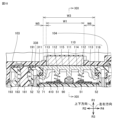
- FIG. 12 is a schematic cross-sectional view taken along line XII-XII in FIG. 10.
- the structure of the top button (right) 110 and its surroundings will be described in detail below.
- the structure of the top button (left) 120 and its surroundings is substantially symmetrical in the left-right direction to the structure of the top button (right) 110 and its surroundings.
- the portion of the top button (right) 110 exposed from the top surface of the convex portion 100 forms an operation surface 115 that is the surface operated by the user.
- the top button (right) 110 has a main body 114 including the operation surface 115, a side wall 118, a flange 113, a first protrusion 111, and a second protrusion 112.
- the operation surface 115 extends along the longitudinal direction of the convex portion 100 on the top surface 106 of the convex portion 100. In other words, the longitudinal direction of the operation surface 115 is the left-right direction. From another perspective, the longitudinal direction of the operation surface 115 coincides with the longitudinal direction of the convex portion 100.
- the top button (right) 110 is a single component, and the entirety of the top button (right) 110 is made of a material that is not a magnet but is attracted to a magnet.
- the material of the top button (right) 110 is not particularly limited, but may be made of a soft magnetic material.
- the material of the top button (right) 110 may be, for example, iron, and as an example, may be cold-rolled steel plate (SPCC).
- the material of the top button (right) 110 may also contain iron.
- the material of the top button (right) 110 may be, for example, iron with silicon and/or nickel added.
- the top button (right) 110 may be a single component in which resin is molded into a soft magnetic material.
- the top button (right) 110 may be made of a magnet or a combination of a magnet and a soft magnetic material.
- only a portion of the top button (right) 110 may be made of a soft magnetic material or a magnet.
- at least the portion exposed from the top surface 106 of the convex portion 100 may be made of a soft magnetic material or a magnet.
- At least the portion forming the operation surface 115 may be made of a soft magnetic material or a magnet.
- the top button (right) 110 may not include a magnet, and only a portion of it may be made of a soft magnetic material.
- the top button (right) 110 may be composed of multiple parts, at least some of which may be made of a soft magnetic material or a magnet.
- the multiple parts constituting the top button (right) 110 are fixed to each other by a method such as gluing or crimping, and are movable as a unit.
- at least the parts exposed from the top surface 106 of the convex portion 100 may be made of a soft magnetic material or a magnet.
- the parts forming the operation surface 115 may be made of a soft magnetic material or a magnet.
- a part made of a magnet or a soft magnetic material may be arranged on the back side of the part exposed from the top surface 106 of the convex portion 100 so as to move integrally with the part exposed from the top surface 106 of the convex portion 100.
- a part made of a magnet or a soft magnetic material may be arranged on the back side of the part forming the operation surface 115 so as to move integrally with the part forming the operation surface 115.
- the part forming the operation surface 115 does not have to be a soft magnetic material.
- a part made of a magnet or soft magnetic material may be fixed to the surface of the operation surface 115.
- the top button (right) 110 may not include a magnet and may be composed of multiple parts, at least some of which may be made of a soft magnetic material.
- the top button (right) 110 may have a first part (roughly shaped like part 110 shown in FIG. 11) having a main body having an operating surface, a side wall extending from the main body into the controller housing, and a flange extending outward from the side wall, and a second part arranged so that the top and sides are surrounded by the first part (in other words, arranged inside the first part).
- the second part is configured to move integrally with the first part. This may be done by gluing the second part to the first part, or, for example, by placing a lid on the lower end of the first part and arranging the second part in the space surrounded by the first part and the lid. Both the first part and the second part may be soft magnetic materials or magnets.
- the thickness of the first part may be thinner than the thickness of the second part.
- the shape of the part including the operating surface may be determined by the thin first part, and a block-shaped second part may be arranged inside it to strengthen the magnetic force.
- the first part may be made of a non-magnetic material such as resin.
- the top button (right) 110 may have a first part that is rectangular cylindrical and has a part of its outer circumferential surface that constitutes the operation surface, a second part that is disposed inside the first part, and a flange part that is provided to extend outward from the opening of the tube of the first part.
- the first part and the second part may both be soft magnetic materials or magnets.
- the thickness of the first part may be thinner than the thickness of the second part.
- the flange part may be made of a non-magnetic material such as resin.
- the first part may be made of a non-magnetic material such as resin.
- the remaining parts may be non-magnetic, soft magnetic, or magnetized.
- the operation surface 115 of the top button (right) 110 may be covered with a non-magnetic sheet or the like, or may be coated with a non-magnetic paint.
- a magnet or soft magnetic material is included in at least a portion of the top button (right) 110 or top button (left) 120.
- top buttons 110, 120 did not include a magnet or soft magnetic material, it would be necessary to provide a magnetic element on the top surface 106 of the convex portion 100 or the upper surface 11 of the first game controller 1 that is magnetically attracted to the magnetic elements 410, 420 provided in the recess 310 of the main unit 3. In that case, the size and position of the operation surface of the top buttons 110, 120 would be limited. In other words, the operation surfaces of the top buttons 110, 120 would need to avoid positions corresponding to the magnetic elements 410, 420 provided in the recess 310. By including a magnetic element in the top buttons 110, 120 as described above, it is possible to increase the degree of freedom in designing the position and size of the operation surfaces of the top buttons 110, 120 while taking operability into consideration.
- the top buttons 110, 120 are made of a soft magnetic material. That is, the top buttons 110, 120 do not include a magnet.
- the magnetic elements 410, 420 of the main unit 3 include magnets, so that the top buttons 110, 120 are attracted to the magnetic elements. Since the top buttons 110, 120 are provided on the top surface 106 of the protrusion 100, there is a possibility that they may approach or come into contact with objects around the first game controller 1 when the first game controller 1 is removed from the main unit 3. At this time, since the top buttons 110, 120 do not include a magnet, they do not unintentionally attract surrounding objects that are attracted to the magnet.
- the magnetic elements 410, 420 of the main unit 3 are provided at the bottom of the recess 310. Therefore, even if there are objects around the main unit 3 that are attracted to a magnet, there is a distance between the right side surface 313 of the main unit and the bottom of the recess 310, so that the buttons are separated from such objects, and unintentional attraction of surrounding objects is suppressed. In addition, the right side surface 313 of the main body surrounding the recess 310 prevents such objects from entering the recess 310.
- the operation surface 115 is the operation surface of the top button (right) 110, which is exposed from the first opening 197 and is pressed by the user.
- the operation surface 115 faces the first direction R1.
- the operation surface 115 extends in the left-right direction.
- the left-right length of the operation surface 115 may be 10% or more, or may be 20% or more, of the left-right length of the top surface 106 of the convex portion 100.
- the left-right length of the operation surface 115 may be 10% or more, or may be 20% or more, of the left-right length of the upper side surface 11 of the convex portion 100.
- a tactile switch 117 is provided below the first protrusion 111.
- the tactile switch 117 is disposed on a flexible printed circuit 90 (hereinafter also referred to as FPC 90).
- FPC 90 flexible printed circuit 90
- the upper part of the tactile switch 117 is a leaf spring.
- the top button (right) 110 When the top button (right) 110 is not pressed by the user, the first protrusion 111 is supported from below by the tact switch 117.
- the top button (right) 110 When the top button (right) 110 is pressed by the user, the top button (right) 110 moves downward from its initial position.
- the first protrusion 111 of the top button (right) 110 moving downward presses the upper part of the tact switch 117.
- the upper part of the tact switch 117 deforms so as to sink downward. This turns on the switch inside the tact switch.
- the upper part of the tact switch 117 returns to its original shape. The return of the shape of the upper part of the tact switch 117 pushes the first protrusion 111 back upward.
- the top button (right) 110 moves to its initial position. That is, when the top button (right) 110 is pressed, the tactile switch 117 biases the top button (right) 110 in the direction opposite to the pressing direction. Note that the tactile switch 117 may bias the top button (right) 110 in the direction opposite to the pressing direction even when the top button (right) 110 is not pressed.
- the top button (right) 110 may be biased upward by a biasing body such as a spring.
- the top button (right) 110 may be biased upward by a biasing body such as a spring and separated from the tactile switch 117 at least when pressed by the user (which may also include when not pressed by the user).
- a rubber switch may be used instead of the tactile switch 117.
- the second protrusion 112 protrudes from the back surface of the main body 114 in the third direction R3.
- the number of second protrusions 112 is not particularly limited. In this embodiment, two second protrusions 112 are provided on either side of the first protrusion 111 in the left-right direction.
- a ground electrode is provided below the second protrusions 112 on the FPC 90.
- a ground connection portion 51 is provided between the second protrusions 112 and the ground electrode in the up-down direction.
- the ground connection portion 51 is conductive.
- the shape and material of the ground connection portion 51 are not particularly limited, but in this embodiment, it is an iron coil spring. The upper end of the ground connection portion 51 contacts the back surface of the main body 114 and is conductive with the main body.
- the lower end of the second protrusion 112 is surrounded by the ground connection portion 51, which is a coil spring.
- the lower end of the ground connection portion 51 contacts the ground electrode.
- the fixing method of the ground connection portion 51 is not particularly limited, but it may be fixed to the ground electrode by soldering.
- the upper end of the ground connection portion 51 does not have to be fixed to the back surface of the main body portion 114.
- the ground connection portion 51 may be assembled in a compressed state so that it is always in contact with the back surface of the main body portion 114 even if the main body portion 114 moves up and down.
- the ground connection portion 51 may also be connected to a ground electrode of an electronic circuit different from the FPC 90.
- the ground connection portion 51 may also be in contact with other areas of the top button (right) 110.
- the top button (right) 110 is a soft magnetic material, and is made of iron, for example, and has electrical conductivity. Therefore, when a charged object touches the top button (right) 110, the potential of the top button (right) 110 changes, which may affect the protrusion 100 and the internal electronic components of the controller housing 10. However, in this embodiment, the potential of the top button (right) 110 becomes the ground potential because the top button (right) 110 is electrically connected to the ground electrode by the ground connection part 51. Therefore, even if a charged object touches the top button (right) 110, the possibility of affecting the internal electronic components is suppressed. Note that in this embodiment, the top button (right) 110 itself does not provide electrical functions such as transmitting signals to the outside or receiving and transmitting power through the top button (right) 110. Note that in other aspects, the top button (right) 110 may provide such functions.
- the ground connection portion 51 is a coil spring in a compressed state, and the top button (right) 110 is biased upward by the coil spring.
- the biasing force of the coil spring is small, and the top button (right) 110 is in contact with the top of the tactile switch 117 in the initial position.
- the top button (right) 110 may be separated from the tactile switch 117 in the initial position by the biasing force of the coil spring, which is the ground connection portion 51.
- the first game controller 1 may not have a ground connection portion 51.
- the top button (right) 110 has a main body 114 whose surface constitutes the operation surface, a side wall 118 extending from the bottom surface of the main body 114, and a flange 113 extending outward from the side wall 118.
- the side wall 118 extends into the protrusion 100 through the first opening 197.
- the flange 113 extends outward from the side wall 118 inside the protrusion 100.
- the flange may extend outward from the bottom end of the side wall 118.
- the flange 113 has a flange portion that protrudes rightward from the right end of the side wall 118, and a flange portion that extends leftward from the left end of the side wall 118.
- the top surface of the flange 113 faces a part of the surface inside the protrusion 100 (hereinafter referred to as the first inner surface 71) in the direction opposite to the pressing direction of the top button (right) 110.
- the first inner surface 71 does not have to be the inner surface of the protrusion 100 itself.
- the upper surface of the flange 113 is located in the direction in which the top button (right) 110 is pressed relative to the first inner surface 71. Therefore, the flange 113 has the function of preventing the top button (right) 110 from coming off by directly or indirectly getting caught on the first inner surface 71.
- the outer peripheral surface of the side wall 118 faces a part of the inner surface of the convex portion 100 (hereinafter referred to as the second inner surface 72) in the left-right direction. Note that the second inner surface 72 does not have to be the inner surface of the convex portion 100 itself.
- the outer peripheral surface of the side wall 118 is located in a direction perpendicular to the pressing direction of the top button (right) 110 relative to the second inner surface 72.
- the first game controller 1 has a first elastic deformation body 52 between the upper surface of the flange 113 and the first inner surface 71.
- the first elastic deformation body 52 elastically deforms when a force is applied, and elastically returns to its original shape when the force is removed.
- the material of the first elastic deformation body 52 may be rubber, for example.
- the first elastic deformation body 52 may be fixed to the first inner surface 71.
- the first elastic deformation body 52 may be fixed to the first inner surface 71 using, for example, an adhesive, or may be fixed to the first inner surface 71 by being fitted into a hole formed in the first inner surface 71.
- the top button (right) 110 When the top button (right) 110 is in the initial position, the first elastic deformation body 52 is in contact with the first inner surface 71 and the flange 113. At this time, the top button (right) 110 may be maintained in the initial position by balancing the biasing force in the direction opposite to the pressing direction by the tact switch 117 or the ground connection part 51 with the biasing force in the pressing direction by the first elastic deformation body 52. Note that when the top button (right) 110 is in the initial position, the first elastic deformation body 52 may be in contact with only one of the first inner surface 71 and the flange 113, or may not be in contact with both.
- the first elastic deformation body 52 is provided between the outer peripheral surface of the side wall 118 and the second inner surface 72 in the left-right direction, on the side closer to the second inner surface 72.
- the first elastic deformation body 52 is spaced apart from the side wall 118.
- the first elastic deformation body 52 may be in contact with the second inner surface 72.
- the first elastic deformation body 52 may also be spaced apart from the second inner surface 72.
- the distance between the second inner surface 72 and the first elastic deformation body 52 in the left-right direction is smaller than the distance between the side wall 118 and the first elastic deformation body 52.
- the first elastic deformation body 52 may be provided on the side closer to the side wall 118.
- FIG. 13 is a schematic cross-sectional view showing the top button (right) 110 attracted to the first magnetic element 410.
- the top button (right) 110 and the first magnetic element 410 face each other.
- the top button (right) 110 is made of a soft magnetic material
- the top button (right) 110 is pulled by the magnetic force of the first magnetic element 410.
- a force in the opposite direction to the pressing direction is applied to the top button (right) 110.
- the first elastic deformation body 52 provided between the flange 113 and the first inner surface 71 is pressed toward the first inner surface 71 by the flange 113, and elastically deforms to contract in the opposite direction to the pressing direction.
- the top button (right) 110 moves in the opposite direction to the pressing direction.
- the top button (right) 110 moves in the opposite direction to the pressing direction from an initial position, which is a position when the top button (right) 110 is not pressed by the user.
- the pressing direction is, for example, the third direction R3.
- the opposite direction to the pressing direction is, for example, the first direction R1.
- the top button (left) 120 has a similar configuration to the top button (right) 110.
- a tactile switch 127 is provided below the top button (left) 120, and when the top button (left) 120 is pressed, the tactile switch 127 biases the top button (left) 120 in a direction opposite to the pressing direction.
- the top button (left) 120 has a main body 124, a side wall 128, and a flange 123.
- the second elastic deformation body 54 is disposed between the upper surface of the flange 123 and the first inner surface 73.
- the second elastic deformation body 54 may be fixed to the first inner surface 73.
- the second elastic deformation body 54 may be provided between the outer peripheral surface of the side wall 128 and the second inner surface 74 in the left-right direction, on the side closer to the second inner surface 74.
- the operation surface 115 moves until it comes into contact with the surface of the cover 338 that constitutes the bottom surface 3121 of the recess 310.
- the magnetic force acting between the top button (right) 110 and the first magnetic element 410 becomes large, and a strong attraction force can be obtained.
- the size and elastic coefficient of the first elastic deformation body 52 are designed so that the operation surface 115 moves until it comes into contact with the bottom surface 3121 of the recess (in this embodiment, more than that).
- the operation surface 115 does not have to move until it comes into contact with the bottom surface 3121 of the recess 310.
- the magnetic force becomes large, and a strong attraction force can be obtained.
- the "top button (right) 110 and the first magnetic element 410 are attracted to each other" is also said when another component (specifically, the cover 338) is interposed between the top button (right) 110 and the first magnetic element 410.
- the operation surface 115 may be in direct contact with the first magnetic element 410 provided on the base surface 311.
- the operation surface 115 may be in contact with the bottom surface 3121 while being spaced apart from the first magnetic element 410 so as to cover an opening provided on the bottom surface 3121 through which the first magnetic element 410 is exposed.
- the operation surface 115 may not be in contact with the cover 338, but may be at least closer than the initial position.
- the top button (right) 110 By moving the top button (right) 110 upward, the top button (right) 110 moves closer to the first magnetic element 410 compared to when the top button (right) 110 is in its initial position.
- the top button (right) 110 and the first magnetic element 410 are attracted to each other by magnetic force, so the shorter the distance between them, the stronger the attraction force. Therefore, by allowing the top button (right) 110 to move in the direction opposite to the pressing direction, the attachment between the first game controller 1 and the main unit 3 can be made more secure.
- the top button (right) 110 and the first magnetic element 410 are attracted to each other, that is, when the first game controller 1 is attached to the main unit 3, the first elastic deformation body 52 is crushed in the vertical direction.
- the top button (right) 110 tries to move away from the first magnetic element 410, but since they are attracted to each other by magnetic force, the top button (right) 110 moves further upward and the first elastic deformation body 52 is further crushed in the vertical direction.
- the top button (right) 110 tries to move further upward in an instant while maintaining its attraction to the first magnetic element 410.
- a stickiness or resistance is generated, and the top button (right) 110 is prevented from suddenly coming off the first magnet.
- the first elastic deformation body 52 restores and extends in the vertical direction. If the vertical length of the first elastic deformation body 52 in its natural state is shorter than the distance between the flange 113 and the inner surface 71, the first elastic deformation body 52 may move downward while remaining attached to the flange 113. The same applies when the top button (right) 110 moves from its initial position in the pressing direction. At this time, if the first elastic deformation body 52 comes into contact with, for example, the inner surface 72, the vertical movement of the top button (right) 110 may be hindered.
- the first elastic deformation body 52 is fixed to the first inner surface 71, the first elastic deformation body 52 is prevented from moving downward together with the top button (right) 110. Therefore, the hindrance of the vertical movement of the top button (right) 110 is suppressed.
- the upper surface of the flange 113 is subjected to a surface treatment such as mirror finishing, the first elastic deformation body 52 is prevented from adhering to the flange 113.
- the first elastic deformation body 52 When the first elastic deformation body 52 is compressed in the up-down direction, depending on the material of the first elastic deformation body 52, the first elastic deformation body 52 may expand in the left-right direction. At this time, the first elastic deformation body 52 may come into contact with the side wall 118. This may hinder the up-down movement of the top button (right) 110.
- the first elastic deformation body 52 is provided closer to the second inner surface 72 than the side wall 118 in the left-right direction. This prevents the first elastic deformation body 52 from touching the side wall 118. This prevents the up-down movement of the top button (right) 110 from being hindered.
- the top button (left) 120 and the second elastic deformation body 54 also have the same effect.
- FIG. 14 is a schematic diagram of the convex portion 100 when viewed from inside the convex portion 100 toward the top surface 106, and is a schematic plan view showing the configuration of the first elastic deformation body 52.
- the first elastic deformation body 52 has a first elastic portion 52a and a second elastic portion 52b.
- the second elastic portion 52b is spaced apart from the first elastic portion 52a.
- the first elastic portion 52a is located on the second direction R2 side relative to the first opening 197.
- the second elastic portion 52b is located on the fourth direction R4 side relative to the first opening 197.
- a part of the first elastic deformation body 52 protrudes from the outer peripheral surface 107 of the convex portion 100.
- the first elastic portion 52a is provided so as to protrude from the inside of the convex portion 100 to the outside through an opening formed in the outer peripheral surface 107 of the convex portion 100.
- the second elastic portion 52b is provided inside the convex portion 100 and does not have to protrude to the outside. Note that the opening through which the first elastic deformation body 52 protrudes may be formed in the outer peripheral surface 107 of the convex portion 100 by a notch formed in the convex portion 100 and the upper surface 11.
- the first elastic portion 52a has a first elastic region 52c and a second elastic region 52d. In the up-down direction, the first elastic region 52c is located lower than the second elastic region 52d. In the left-right direction, the first elastic region 52c may be located on the second direction R2 side than the second elastic region 52d. A part of the first elastic region 52c protrudes from the outer peripheral surface 107 of the convex portion 100. The second elastic region 52d is located inside the convex portion 100.
- the first elastic deformation body 52 is provided on the outer peripheral surface 107 on the rear surface 16 side. From another perspective, the first elastic deformation body 52 protrudes from the outer peripheral surface 107 of the convex portion 100 in the sixth direction R6. Therefore, when held vertically or horizontally, the first elastic deformation body 52 is difficult to see by a user facing the front surface 15 of the first game controller 1. Note that the first elastic deformation body 52 may be provided on the front surface 15 side of the outer peripheral surface 107 as well, or may be provided only on the front surface 15 side.
- the outer peripheral surface 107 and the inner peripheral surface 3120 face each other.
- the first elastic deformation body 52 provided on the outer peripheral surface 107 may come into contact with the opposing inner peripheral surface 3120. This allows the protrusion 100 to be more firmly attached to the recess 310. More specifically, when the inner peripheral surface 3120 facing the back side of the outer peripheral surface 107 comes into contact with the first elastic deformation body 52, the protrusion 100 is biased in the front direction by the inner peripheral surface 3120 via the first elastic deformation body 52. As a result, the front side of the outer peripheral surface 107 of the protrusion 100 is pressed against the opposing inner peripheral surface 3120, making the attachment stronger.
- the first elastic deformation body 52 is elastically deformable, when the protrusion 100 is fitted into the recess 310, the first elastic deformation body 52 is elastically deformed so as to shrink in the front-rear direction, thereby preventing the wearability from decreasing. Furthermore, in this embodiment, the first elastic deformation body 52 is exposed from the base of the outer peripheral surface 107. That is, the protruding first elastic deformation body 52 is adjacent to the upper side surface 11. From another perspective, the position of the upper end of the first elastic deformation body is lower than the top surface of the protrusion 100.
- the protrusion 100 when the protrusion 100 is inserted into the recess 310, it first enters the recess 310 from a part of the outer peripheral surface 107 where the first elastic deformation body 52 is not provided. That is, at the beginning of insertion, the first elastic deformation body 52 does not touch the inner peripheral surface 3120. Therefore, the wearability is prevented from decreasing.
- a portion of the second elastic deformation body 54 may protrude from an opening provided on the outer peripheral surface of the convex portion 100.
- the second elastic deformation body 54 may protrude from the same surface of the outer peripheral surface 107 as the surface from which the first elastic deformation body 52 protrudes. Both the first elastic deformation body 52 and the second elastic deformation body 54 may protrude from the back side of the outer peripheral surface 107.
- the elastic deformation body provided on the outer peripheral surface 107 may be separate from the elastic deformation bodies 52, 54 provided on the upper surface of the flange 113. In this case, the materials of each may be different. In this case, the elastic deformation body may also be provided on the back side of the outer peripheral surface 107. In this embodiment, focusing on the function of both being elastically deformable, these elastic members are made into one component. This prevents an increase in the number of components. On the other hand, making them separate increases the freedom of their placement and materials. Note that while an elastic deformation body may be provided on the outer peripheral surface 107, it is not necessary to provide an elastic deformation body inside the convex portion 100.
- the top surface 106 of the convex portion 100 has regions that are each at a different height from the upper side surface 11.
- the top surface 106 of the convex portion 100 has a first region 101, a second region 102, a third region 103, a fourth region 104, and a fifth region 105.
- the first region 101 is an area of the housing forming the top surface 106 of the convex portion 100 where the top button (right) 110 is provided.
- the top button (right) 110 is provided so as to pass through a first opening 197 formed in the first region 101.
- the second region 102 is an area where the top button (left) 120 is provided.
- the top button (left) 120 is provided so as to pass through a second opening 198 formed in the second region 102.
- the third region 103 is a region of the housing that forms the top surface 106 of the convex portion 100, including the top surface 106 at one end region of the convex portion 100. From another perspective, the third region 103 is continuous with the end face on the second direction R2 side of the outer circumferential surface 107 of the convex portion 100.
- the third region 103 is a region that is located closer to the first direction R1 than each of the first region 101 and the second region 102. In the longitudinal direction of the convex portion 100, the length of the third region may be shorter than each of the lengths of the first region 101 and the second region 102.
- a mouse sole 191 is provided in the third region 103. More specifically, as shown in FIG. 12, the mouse sole 191 is disposed in a recess provided in the third region 103. A portion of the mouse sole 191 is exposed from the recess. Note that the third region 103 may be flat without a recess. The mouse sole 191 may be placed on the flat surface of the third region.
- the fifth region 105 is a region of the housing that forms the top surface 106 of the convex portion 100, including the top surface 106 at the other end region of the convex portion 100. From another perspective, the fifth region 105 is continuous with the end face on the fourth direction R4 side of the outer circumferential surface 107 of the convex portion 100. The fifth region 105 is a region that is located closer to the first direction R1 than each of the first region 101 and the second region 102. In the longitudinal direction of the convex portion 100, the length of the fifth region 105 may be shorter than the length of each of the first region 101 and the second region 102.
- the fifth region 105 is provided with a mouse sole 192.
- the mouse sole 192 is disposed in a recess provided in the fifth region 105. A portion of the mouse sole 192 is exposed from the recess. Note that the fifth region 105 may be flat without a recess.
- the mouse sole 192 may be placed on the flat surface of the fifth region. It can also be said that the mouse soles 191, 192 increase the height of the convex portion 100 from the upper surface 11.
- the fourth region 104 is a region of the housing that forms the top surface 106 of the protrusion 100, located between the first region 101 and the second region 102 in the longitudinal direction of the top surface 106.
- the fourth region is provided with an opening 170 for a mouse sensor, an opening 196 for a terminal, and an opening 195 for a synchronization button.
- the third region 103 is located on the convex side of the fourth region 104.
- the fifth region 105 is located on the convex side of the fourth region 104.
- the first region 101 is located between the third region 103 and the fourth region 104.
- the second region 102 is located between the fifth region 105 and the fourth region 104.
- each of the first region 101, the second region 102, and the fourth region 104 is located between the third region 103 and the fifth region 105.
- the height of the first region 101 from the upper side surface 11 is a first height T1. From another perspective, the distance from the upper side surface 11 to the first region 101 in the vertical direction is the first height T1. Similarly, the height of the second region 102 from the upper side surface 11 is a second height T2. From another perspective, the distance from the upper side surface 11 to the second region 102 in the vertical direction is the second height T2. In this embodiment, the first height T1 and the second height T2 are the same, but may be different.
- the first region 101 and the second region 102 may be provided from one end to the other end of the top surface 106 in a direction perpendicular to the longitudinal direction of the protrusion 100.
- the height of the third region 103 from the upper surface 11 is a third height T3. From another perspective, the distance from the upper surface 11 to the third region 103 in the vertical direction is the third height T3. Similarly, the height of the fifth region 105 from the upper surface 11 is a fifth height T5. From another perspective, the distance from the upper surface 11 to the fifth region 105 in the vertical direction is the fifth height T5.
- the third height T3 and the fifth height T5 are the same, but may be different. In this embodiment, the third height T3 and the fifth height T5 are higher than the first height T1 and the second height T2, but may be the same or lower.
- the third region 103 and the fifth region 105 may be provided from one end to the other end of the top surface 106 in a direction perpendicular to the longitudinal direction of the protrusion 100.
- the height of the fourth region 104 from the upper surface 11 is the fourth height T4. From another perspective, the distance from the upper surface 11 to the fourth region 104 in the vertical direction is the fourth height T4.
- the fourth height T4 is higher than the first height T1 and the second height T2, but may be the same as or lower than them.
- the fourth height T4 is lower than the third height T3 and the fifth height T5, but may be the same as or higher than them.
- the fourth region 104 may be provided from one end to the other end of the top surface 106 in a direction perpendicular to the longitudinal direction of the protrusion 100.
- the height of the top surface of the mouse sole 191 from the upper surface 11 is a sixth height T6. From another perspective, the distance from the upper surface 11 to the top surface of the mouse sole 191 in the vertical direction is the sixth height T6. Similarly, the height of the top surface of the mouse sole 192 from the upper surface 11 is a seventh height T7. From another perspective, the distance from the upper surface 11 to the top surface of the mouse sole 192 in the vertical direction is the seventh height T7.
- the sixth height T6 and the seventh height T7 are the same, but may be different. In this embodiment, the sixth height T6 and the seventh height T7 are higher than any of the first height T1 to the fifth height T5. From another perspective, the sixth height T6 and the seventh height T7 are the highest heights from the upper surface 11 in the convex portion 100. Note that the sixth height T6 and the seventh height T7 may be the same as the highest height among any of the first height T1 to the fifth height T5. For example, the sixth height T6 and the seventh height T7 may be the same as the third height T3 and the fifth height T5.
- the height of the operation surface 115 from the top surface 11 is the eighth height T8. From another perspective, the distance from the top surface 11 to the operation surface 115 in the vertical direction is the eighth height T8. Similarly, the height of the operation surface 125 from the top surface 11 when the top button (left) 120 is in its initial position is the ninth height T9. From another perspective, the distance from the top surface 11 to the operation surface 125 in the vertical direction is the ninth height T9.
- the eighth height T8 and the ninth height T9 are the same, but may be different.
- the eighth height T8 and the ninth height T9 are higher than the first height T1 and the second height T2.
- the eighth height T8 and the ninth height T9 are lower than the sixth height T6 and the seventh height T7.
- the eighth height T8 and the ninth height T9 are lower than the highest maximum height from the upper surface 11.
- the eighth height T8 and the ninth height T9 are lower than the third height T3 and the fifth height T5, but may be the same or higher.
- the eighth height T8 and the ninth height T9 are the same as the fourth height T4, but may be different.
- FIG. 15 is a schematic front view showing the configuration of the first mode of the game controller.
- FIG. 15 shows, as an example, the posture when the first game controller 1 is used as a mouse.
- FIG. 16 is an enlarged schematic view of region XVI in FIG. 15.
- the mouse sole 191 comes into contact with the ground surface F.
- the mouse sole 192 also comes into contact with the ground surface F.
- the ground surface F is not particularly limited, but may be, for example, the surface of a desk.
- the first game controller 1 is movable on the ground surface F.
- the thickness of the part of the mouse sole 191 exposed from the third region is, for example, 0.2 mm.
- the third region 103 is separated from the ground surface F. In the vertical direction, the distance between the ground surface F and the third region 103 is, for example, 0.2 mm.
- the operation surface 115 of the top button (right) 110 is spaced apart from the ground surface F.
- the top button (right) 110 is in its initial position. In the up-down direction, the distance between the ground surface F and the first region 101 is longer than the distance between the ground surface F and the third region 103. In the left-right direction, the distance between the ground surface F and the first region 101 is, for example, 1.2 mm.
- the distance between the contact surface F and the operation surface 115 of the top button (right) 110 is longer than the distance between the contact surface F and the third region 103 of the top surface 106. In the vertical direction, the distance between the contact surface F and the operation surface 115 of the top button (right) 110 is defined as a gap G.
- the gap G is, for example, 0.3 mm.
- the third height T3 and the height T5 are higher than the first height T1 and the second height T2.
- the length of the first region 101 and the second region 102 is longer than the length of the third region 103 and the fifth region 105. Therefore, the limited space on the top surface 106 of the protrusion 100 can be effectively utilized, achieving both button operability and ease of attachment of the game controller.
- the fourth height T4 is higher than the first height T1 and the second height T2.
- the fourth region 104 is provided with a terminal opening 196 that communicates with the terminal accommodating portion 167, and when the user holds the first game controller 1 sideways and operates the top button (right) 110 and the top button (left) 120, the user's fingers are prevented from touching the terminal opening 196.
- the fourth height T4 is lower than the third height T3 and the fifth height T5.
- the fourth region 104 is provided with a terminal opening 196 through which the terminal accommodating portion 167 opens, which prevents the terminal opening 196 from coming into contact with the ground surface when the first game controller 1 is operated like a mouse on the ground surface. Furthermore, by having the third and fifth regions protrude, the vertical height of the first game controller 1 can be reduced while improving the fit of the first game controller 1.
- the eighth height T8 and the ninth height T9 are lower than the sixth height T6 and the seventh height T7.
- the height of the top surface button (right) 110 and the top surface button (left) 120 from the upper surface 11 at the initial position of each of the button top surfaces is lower than the maximum height from the upper surface 11 of the top surface 106. Therefore, even when the first game controller 1 is carried while detached from the main unit 3, the top surface button (right) 110 and the top surface button (left) 120 are prevented from accidentally coming into contact with something. In addition, when the game controller is operated like a mouse on a ground surface, the top surface button (right) 110 and the top surface button (left) 120 are prevented from coming into contact with the ground surface.
- the eighth height T8 and the ninth height T9 are lower than the third height T3 and the fifth height T5. Therefore, even if the mouse sole 191 and the mouse sole 192 are removed from the third region 103 and the fifth region 105, the eighth height T8 and the ninth height T9 are lower than the maximum height.
- the top button (right) 110 can move upward.
- the height of the operation surface 115 from the upper side 11 when the top button (right) 110 is attracted to the first magnetic element 410 and in contact with the bottom surface 3121 is a tenth height T10.
- the height of the operation surface 125 from the upper side 11 when the top button (left) 120 is attracted to the second magnetic element 420 and in contact with the bottom surface 3121 is an eleventh height T11.
- the top button (right) 110 may be movable to a position even higher than the height T10. For example, when the first game controller 1 is to be removed from the main unit 3 with the top button (right) 110 attached to the first magnetic element 410, the top button (right) 110 may remain attached to the first magnetic element 410 while the convex portion 100 begins to be removed from the concave portion 310. At this time, the first elastic deformation body 52 is further compressed, so that the top button (right) 110 moves further from the position of the tenth height T10 in the direction opposite to the pressing direction. The top button (right) 110 may be movable upward so as to approach the bottom surface 3121 even if the top surface of the top button (right) 110 does not contact the bottom surface 3121.
- the tenth height T10 and the eleventh height T11 are the same, but may be different. In this embodiment, the tenth height T10 and the eleventh height T11 are higher than any of the first height T1 to the fifth height T5, and are the same as the sixth height T6 and the seventh height T7.
- the top button (right) 110 and the top button (left) 120 can be moved to a position where the height of the operation surface is the highest height of the top surface 106.
- the top button (right) 110 and the top button (left) 120 may be moved upward from the position where the height of the operation surface is the highest height of the top surface 106.
- the tenth height T10 and the eleventh height T11 may be lower than the sixth height T6 and the seventh height T7.
- the tenth height T10 and the eleventh height T11 may be the same as the third height T3 and the fifth height T5, or may be lower.
- the top button (right) 110 and the top button (left) 120 can exert a strong adhesive force with the first magnetic element 410 and the second magnetic element 420.
- the top button (right) 110 and the top button (left) 120 can approach the first magnetic element 410 and the second magnetic element 420 by moving to near the maximum height of the top surface 106 even if the height of the button top surface does not reach the maximum height of the top surface 106. Therefore, a strong adhesive force with the first magnetic element 410 is exerted.
- the top button (right) 110 and the top button (left) 120 can approach the first magnetic element 410 and the second magnetic element 420 by moving the height of the button tops until they contact the bottom surface 3121 of the recess 310 due to the first magnetic element 410 and the second magnetic element 420.
- a strong adhesive force with the first magnetic element 410 and the second magnetic element 420 is exerted.
- FIG. 17 is a schematic cross-sectional view showing the state in which the game controller is attached to the main unit 3.
- the schematic cross-sectional view shown in FIG. 17 is parallel to both the left-right direction and the up-down direction.
- FIG. 18 is an enlarged schematic view of area XVIII in FIG. 17.
- the convex portion 100 of the first game controller 1 fits into the concave portion 310 of the main unit 3.
- the top button (right) 110 on the top surface is attracted to the first magnetic element 410 by magnetic force.
- the top button (left) 120 is attracted to the second magnetic element 420 by magnetic force.
- the length of the operating surface 115 in the longitudinal direction of the convex portion 100 is the third length W3.
- the length of the opening of the first hole 401 in the longitudinal direction of the recess 310 is the first length W1.
- the third length W3 is longer than the first length W1.
- the fourth length W4 is longer than the second length W2.
- the center of the first magnetic element 410 may be located on the second direction R2 side of the center of the top button (right) 110.
- the distance (fifth length W5) between the end of the opening of the first hole 401 on the second direction R2 side and the end of the operation surface 115 of the top button (right) 110 on the second direction R2 side may be smaller than the distance (sixth length W6) between the end of the opening of the first hole 401 on the fourth direction R4 side and the end of the operation surface 115 of the top button (right) 110 on the fourth direction R4 side.
- the first game controller 1 has a top button (right) 110 and a top button (left) 120 on the top surface 106 of the convex portion 100 protruding from the upper side surface 11. Therefore, when holding the first game controller 1 horizontally and operating the top button (right) 110 with the index finger of the right hand and the top button (left) 120 with the index finger of the left hand, for example, the two top buttons can be pressed while limiting the amount of bending of the fingers. Therefore, when holding the first game controller 1 with both hands so that the top surface 106 of the convex portion 100 faces upward, it is easy to operate the two top buttons.
- the protrusion 100 on which the two top buttons are provided fits into a recess 310 provided in the main unit 3. Therefore, the protrusion 100 and the recess 310 can prevent misalignment of the first controller 1 when attaching or detaching the main unit 3 and the first controller 1 while they are being worn.
- the two top buttons provided on the top surface 106 can be attracted to two magnetic elements provided at the bottom of the recess 310.
- the two top buttons not only have the function of receiving operational input from the user, but also the function of attaching the first controller 1 to the main unit 3. Therefore, the two top buttons can be made large within the limited space on the top surface 106 of the protrusion 100. More specifically, the length of the two top buttons can be increased in the longitudinal direction of the top surface.
- the first game controller 1 is held to the main unit 3 at at least two points. Therefore, compared to when the first game controller 1 is held to the main unit 3 at only one point, at least rotational misalignment of the first game controller 1 relative to the main unit 3 is suppressed.
- the top button (right) 110 and the top button (left) 120 are not exposed, and therefore the user cannot operate them.
- the shoulder button (right) 130 and the Z shoulder button (right) 140 are located at a position that the index finger of the right hand can reach, and the shoulder button (left) 230 and the Z shoulder button (left) 240 are located at a position that the index finger of the left hand can reach. Therefore, the user can use the shoulder button (right) 130 and the shoulder button (left) 230, or the Z shoulder button (right) 140 and the Z shoulder button (left) 240, instead of the top button (right) 110 and the top button (left) 120 that are used when the first game controller 1 is held horizontally with both hands.
- buttons of the first game controller 1 that are not used when the first game controller 1 is attached to the main unit 3 have the function of adsorbing to the main unit 3. Therefore, the game controller can be attached to the main unit 3 using the buttons without causing operational inconvenience to the user.
- the second game controller 2 also achieves the same effect.
- FIG. 19 is a schematic cross-sectional view taken along line XIX in FIG. 18.
- the schematic cross-sectional view shown in FIG. 19 is parallel to the front-rear and up-down directions of the game controller.
- the maximum heights from the upper side surface 11 to the top surface 106 of the convex portion 100 are T6, T7, T10, and T11.
- the height from the main body right side surface 313 to the bottom surface 3121 is a sixth distance B6.
- T6, T7, T10, and T11 are higher than the sixth distance B6.
- the upper side surface 11 is spaced apart from the main body right side surface 313.
- the distance B8 between the upper side surface 11 and the main body right side surface 313 may be, for example, 0.05 mm or more.
- the contact point may act as a fulcrum, making it easier for a force to be applied in the detachment direction.
- the upper surface 11 is spaced from the main body right side 313, so when a force is applied to rotate the first game controller 1, the contact point between the convex portion 100 and the concave portion 310, or the side of the upper surface 11 closer to the convex portion 100, acts as a fulcrum, suppressing the force applied in the detachment direction.
- the second game controller 2 the contact point between the convex portion 100 and the concave portion 310, or the side of the upper surface 11 closer to the convex portion 100, acts as a fulcrum, suppressing the force applied in the detachment direction.
- the second game controller 2 acts as a fulcrum, suppressing the force applied in the detachment direction.
- the width of the opening of the first hole 401 in the front-rear direction is a first width C1.
- the thickness of the first magnetic element 410 in the front-rear direction is a second thickness C2.
- the first width C1 is greater than the second thickness C2.
- the width of the recess 310 in the front-rear direction may increase from the bottom surface 3121 toward the right side surface 313 of the main body.
- the width of the protrusion 100 in the front-rear direction may increase from the top surface 106 toward the upper surface 11.
- FIG. 20 is a schematic cross-sectional view taken along line XX-XX in FIG. 17.
- the schematic cross-sectional view shown in FIG. 20 is parallel to both the front-back direction and the up-down direction.
- the female connector 162 has a first terminal 160 and a socket 161.
- An inner wall surface 166 of the socket 161 constitutes at least a part of a terminal accommodating portion 167.
- the inner wall surface 166 of the socket 161 communicates with a terminal opening 196 provided in the top surface 106 of the convex portion 100.
- the inner wall surface 166 of the socket 161 may be inclined so that the cross-sectional area becomes smaller from the terminal opening 196 side toward the back.
- the first game controller 1 does not have a first female connector 162, and the terminal accommodating portion 167 may be formed by recessing the top surface 106 of the convex portion 100.
- the inner wall surface 166 of the socket 161 may have a first rear side wall surface 165 and a first front side wall surface 164.
- the first front side wall surface 164 is the wall surface of the inner wall surface 166 that faces the front side of the first game controller 1.
- the first rear side wall surface 165 is the wall surface of the inner wall surface 166 that faces the rear side of the first game controller 1.
- the first rear side wall surface 165 faces the first front side wall surface 164.
- the wall forming the first rear side wall 165 is provided with a slit extending in the vertical direction of the first game controller 1 (i.e., the convex direction of the convex portion 100).
- the first terminal 160 extends in the direction in which the slit extends, and a portion of the first terminal 160 penetrates the slit and is exposed from the first rear side wall 165. That is, the first terminal 160 is provided along the first rear side wall 165. From another perspective, the first terminal 160 is provided along the inner circumferential surface of the terminal accommodating portion 167.
- the first terminal 160 is not provided along the first front side wall 164.
- the first terminal 160 may be provided along the first front side wall 164.
- the first terminal 160 may also be provided along both the first front side wall 164 and the first rear side wall 165.
- the first terminal 160 may be a leaf spring.
- the upper end of the first terminal 160 extends to a position lower than the terminal opening 196. Therefore, in the vertical direction, the position of the upper end of the first terminal 160 is higher than the upper surface 11 and lower than the top surface 106 of the convex portion 100.
- the position of the lower end of the first terminal 160 may be higher or lower than the upper surface 11.
- the first plug connector 330 of this embodiment is inserted into the terminal accommodating portion 167. More specifically, the first tongue body 332 on which the main body first terminal 331 is provided is inserted into the terminal accommodating portion 167.
- the main body first terminal 331 is provided on the rear side of the first tongue body 332. Inside the terminal accommodating portion 167, the first terminal 160 contacts the main body first terminal 331.
- the main body first terminal 331 may contact a portion of the first terminal 160 that protrudes from the slit.
- the weight of the main unit 3 may cause the main unit 3 to move slightly toward the rear side of the game controller.
- the first tongue body 332 may move toward the rear side inside the terminal accommodating portion 167, but since the first terminal 160 is provided along the first rear side wall surface 165, contact between the first terminal 160 and the main unit first terminal 331 provided on the first tongue body 332 is likely to be maintained.
- the weight of the main unit 3 may cause the main unit 3 to tilt toward the rear side with the first game controller 1 being held as a fulcrum.
- the distance between the upper surface 11 of the first game controller 1 and the main unit right side surface 313 of the main unit 3 may be greater on the front side than on the rear side. That is, while there is a possibility that the front side of the first game controller 1 may be farther away from the main unit 3 than the rear side, in this embodiment, the first terminal 160 is provided along the first rear wall surface 165, so that contact between the first terminal 160 and the main unit first terminal 331 is easily maintained. Note that the first terminal 160 is provided at a position on the first rear wall surface 165 that approaches the main unit first terminal 331 provided on the first tongue body 332 when the main unit 3 is tilted rearward relative to the first game controller 1, so that contact with the main unit first terminal 331 is more easily maintained.
- the terminal 160 since the position of the upper end of the first terminal 160 is lower than the top surface 106 of the convex portion 100, the terminal 160 is difficult for the user to touch when operating the first game controller 1. Furthermore, since the first terminal 160 is provided in the terminal accommodating portion 167 provided inside the convex portion 100, this leads to effective use of the vertical space formed by the protruding convex portion 100. On the other hand, while the main body first terminal 331 needs to protrude in order to connect to the first terminal 160 inside the terminal accommodating portion 167, the main body first terminal 331 is provided in the recess 310. Therefore, the protruding main body first terminal 331 is protected by the inner peripheral surface 3120 of the recess 310.
- the main body first terminal 331 may be provided from the side to the top surface of the first tongue body 332. From another perspective, the main body first terminal 331 may be provided on the surface of the first tongue body 332 from the rear side to the right side surface of the main device. When the first tongue body 332 is inserted into the terminal accommodating portion 167, the tip (right side surface) of the first tongue body 332 may come into contact with the first terminal 160, but even in that case, the first terminal 160 can come into contact with the main body first terminal 331.
- FIG. 21 is a schematic cross-sectional view showing an example of the configuration of the first terminal 160.
- the schematic cross-sectional view shown in FIG. 21 is parallel to both the up-down direction and the left-right direction.
- the first terminals 160 may form a first game controller terminal group.
- the first game controller terminal group may have multiple terminal parts each made up of one or more terminals.
- the multiple terminal parts are lined up in the left-right direction, for example.
- the multiple terminal portions include a first right side terminal portion 160a, a first left side terminal portion 160b, and a first intermediate terminal portion 160c.
- the first right side terminal portion 160a is the terminal located furthest to the second direction R2 side in the left-right direction.
- the first left side terminal portion 160b is the terminal located furthest to the fourth direction R4 side in the left-right direction.
- the first intermediate terminal portion 160c is located between the first right side terminal portion 160a and the left side terminal portion 160b.
- the first intermediate terminal portion 160c may have multiple terminals.
- each of the first right side terminal portion 160a and the first left side terminal portion 160b may be longer than the length of the first intermediate terminal portion 160c.
- the distance from the fourth region 104 to the first right side terminal portion 160a and the distance from the fourth region 104 to the first left side terminal portion 160b may each be shorter than the distance from the fourth region 104 to the first intermediate terminal portion 160c.
- the first right terminal portion 160a and the first left terminal portion 160b are ground terminals. Therefore, even if the main body first terminal 331 (which may constitute a terminal group like the first terminal 160) inserted into the terminal accommodating portion 167 is slightly tilted, it is highly likely to come into contact with the first right terminal portion 160a or the first left terminal portion 160b that is adjacent to the terminal opening 196. Therefore, when the terminals are electrically connected to each other, the ground terminals can come into contact first. ⁇ Mouse>
- the first game controller 1 is also used as a mouse.
- Fig. 22 is a schematic top view showing the configuration of the first mode of the game controller.
- Fig. 23 is a schematic cross-sectional view showing only the convex portion along the line XXIII-XXIII in Fig. 22.
- a mouse sensor opening 170 is provided on the top surface 106 of the convex portion 100.
- the first game controller 1 has a mouse operation sensor 174.
- the mouse operation sensor 174 is disposed inside the convex portion 100.
- the mouse operation sensor 174 is, for example, an optical mouse sensor.
- the mouse operation sensor 174 has, for example, a light source 171 and a light receiving sensor 172.
- the first game controller 1 may be provided with a lens for collecting the light emitted from the light source 171 and/or the light guided to the light receiving sensor 172.
- the light source 171 emits light.
- the light may be, for example, red light, blue light, or laser light. There is no particular limitation on the wavelength of the light.
- the light from the light source 171 is irradiated onto the ground surface through the mouse sensor opening 170.
- the light receiving sensor 172 detects the reflected light from the ground surface of the light emitted from the light source 171, which enters through the mouse sensor opening 170 and changes in accordance with the relative movement of the first game controller 1 with respect to the ground surface.
- the second game controller 2 has a similar configuration.
- the first game controller 1 can also be used as a mouse by being equipped with a mouse operation sensor 174.
- a mouse sensor opening 170 is provided on the top surface 106 of the convex portion 100 that protrudes from the upper side 11, so that when the first game controller 1 is placed on a ground surface with the top surface 106 of the convex portion 100 facing the ground surface, the mouse sensor opening 170 is positioned close to the ground surface. Therefore, the mouse sensor opening 170 can effectively capture reflected light from the ground surface.
- the information processing unit of the main unit 3 may calculate movement parameters (e.g., movement direction and movement distance) related to the movement of the first game controller 1 relative to the ground surface.
- the main unit 3 may also execute a predetermined game process based on the movement parameters determined in the program being executed.
- the movement parameters may be calculated within the first game controller 1 (by the mouse operation sensor 174 or the information processing unit provided in the first game controller 1), and the calculated parameters may be transmitted to the main unit 3.
- the first game controller 1 moves relative to the ground surface while separated from the ground surface, the movement of the first game controller 1 relative to the ground surface may not be accurately measured.
- the first game controller 1 may be configured such that, when the top surface 106 of the convex portion 100 is separated from the ground surface by 1 cm or more, 5 mm or more, or 1 mm or more, the reflected light from the ground surface for measuring the movement relative to the ground surface cannot be properly detected.
- the mouse operation sensor 174 may be designed so that the distance from the ground surface of the first game controller 1 at which the direction and distance of movement of the first game controller 1 relative to the ground surface can be accurately detected is within 1 cm, or within 5 mm, or within 1 mm.
- the protrusion 100 fits into the recess 310, so the top surface 106 of the protrusion 100 is not exposed to the outside. Therefore, when the first game controller 1 is in an integrated state and not being used as a mouse, the mouse sensor opening 170 is not exposed, which prevents the user from touching it unnecessarily.
- FIG. 24 is a schematic diagram showing a state in which a game controller is used as a mouse.
- the palm of the user's hand is placed so as to cover the underside 13 of the first game controller 1.
- the thumb of the user's right hand is placed on the front side 15.
- the thumb of the user's right hand is placed on the joystick 31.
- the index finger of the user's right hand is placed on the shoulder button (right) 130.
- the middle finger of the user's right hand is placed on the Z shoulder button (right) 140.
- the user can operate the shoulder button (right) 130 with the index finger of his right hand.
- the user can operate the Z shoulder button (right) 140 with the middle finger of his right hand.
- the user may operate the Z shoulder button (right) 140 with the index finger of his right hand.
- the user can operate the input unit on the front with his right thumb.
- the user can operate the joystick 31, the + button 33(1), and the set of four buttons 33(2) with his thumb.
- the second game controller 2 may also be used as a mouse with the left hand in a similar manner.
- FIG. 25 is a schematic diagram showing a state in which a mouse is used with both hands. As shown in FIG. 44, the first game controller is operated with the right hand, and the second game controller 2 is operated with the left hand.
- the user may use one of the first game controller 1 and the second game controller 2 as a mouse, and the other as a vertically held game controller.
- the first user may use the first game controller 1 as a mouse
- the second user may use the second game controller 2 as a mouse.
- the first game controller 1 may be operated as a mouse with the left hand.
- the second game controller 2 may be operated as a mouse with the right hand.
- the user can use the input section on the front of the game controller, which is primarily used when holding it vertically or horizontally, when using the game controller as a mouse. Also, the user can use the shoulder buttons and Z shoulder buttons of the game controller, which are primarily used when holding it vertically or as one unit, like the right-click and left-click buttons on a mouse.
- the game controller when the game controller is removed from the main unit 3, it is used as a vertically held game controller with the top side facing sideways, as a horizontally held game controller with the top side facing upwards, and as a mouse with the top side facing downwards.
- the game controller while it is a single game controller, it can be used in three different ways by changing the direction in which it is held.
- the mouse sensor opening 170 is located between the top button (right) 110 and the top button (left) 120 in the longitudinal direction of the top surface 106 of the convex portion 100. In other words, it is located relatively close to the center in the longitudinal direction of the first game controller 1. This makes it easy to operate the mouse in accordance with the user's intentions.
- a synchronization button 50 is provided on the top surface 106 of the convex portion 100 in the longitudinal direction of the convex portion 100 between the top button (left) 120 and the terminal opening 196, and a mouse sensor opening is provided between the terminal opening 196 and the top button (right) 110.
- the terminal opening 196 When the game controller is operated in a horizontally held state, the terminal opening 196 is sandwiched on one side between the top button (right) 110 and the mouse sensor opening 170, and on the other side between the synchronization button 50 and the top button (left) 120, making it difficult for the user's fingers to touch the terminal opening 196. Also, when the user tries to operate the synchronization button 50, the mouse sensor opening 170 is located on the opposite side of the terminal opening 196, making it difficult for the user's fingers to touch the mouse sensor opening 170.
- FIG. 26 is a schematic rear view showing the configuration of the first embodiment of the game controller.
- FIG. 27 is a schematic cross-sectional view taken along line XXVII-XXVII in FIG. 26.
- the first game controller 1 has a pusher 181, a pusher operating member 186, and a biasing portion 183. These constitute a removal mechanism.
- the pusher operating member 186 has an operating portion 182, a pusher actuating portion 185, and a rotating shaft 184.
- the pusher 181 protrudes from the top surface 106 of the convex portion 100.
- the protruding pusher 181 presses against the bottom surface 3121 of the recess 310.
- the top surface 106 of the convex portion 100 moves in a direction away from the bottom surface 3121.
- the first game controller 1 rotates around the end opposite the end where the pusher 181 is provided as a fulcrum. As described above, the first game controller 1 can be easily removed from the main unit 3.
- the operation unit 182 is provided on the rear surface 16, for example.
- the operation unit 182 is arranged so as to be exposed from an opening provided on the rear surface 16.
- the operation unit 182 is operated by the user.
- the operation unit 182 is operated in the direction of the third arrow A3.
- the direction of the third arrow A3 is a rotation direction from the main body right side surface 313 to the right side and from the rear side to the front side of the main body device 3.
- the direction of the third arrow A3 is a rotation direction in the first controller 1 that faces the third direction R3 and the fifth direction R5.
- the operation unit 182 may be configured to be operated in a direction parallel to the third direction R3.
- FIG. 27 shows a state (natural state) before the operation of the operation unit 182.
- FIG. 28 is a schematic perspective view showing an example of the configuration of the pusher operating member 186.
- each of the operating portion 182 and the pusher actuation portion 185 is connected to the rotating shaft 184.
- the pusher operating member 186 is a single component. Note that the pusher operating member 186 may be composed of multiple components.
- the rotating shaft 184 rotates together with each of the operating portion 182 and the pusher actuation portion 185. From another perspective, the pusher operating member 186 rotates around the rotating shaft 184.
- the pusher actuation portion 185 abuts against the pusher 181.
- FIG. 29 is a schematic cross-sectional view showing the state when the operating unit 182 is being operated.
- the rotating shaft 184 rotates together with the pusher operating unit 185 by operating the operating unit 182.
- the pusher operating unit 185 causes the pusher 181 to protrude.
- the pusher 181 Before the operating unit 182 is operated, the pusher 181 is disposed inside the convex portion 100.
- the biasing portion 183 biases the pusher 181 in the third direction R3.
- the biasing portion 183 is, for example, a coil spring.
- the rotating shaft 184 rotates together with the operating unit 182 and the pusher operating portion 185, and the pusher operating portion 185 pushes the pusher 181 in the first direction R1.
- a part of the pusher 181 protrudes from the convex portion 100.
- the biasing portion 183 extends, causing the pusher 181 to move in the third direction R3. This causes the pusher 181 to return to its natural position.
- the distance (first distance B1) from the rotating shaft 184 to the end of the operating unit 182 is longer than the distance (second distance B2) from the rotating shaft 184 to the end of the pusher operating unit 185. Therefore, the torque of the pusher operating unit that protrudes the pusher can be increased.
- the operating unit 182 and the pusher operating unit 185 are arranged side by side along the direction in which the rotating shaft 184 extends.
- the distance from the rotating shaft 184 to the contact portion between the pusher 181 and the pusher actuation portion 185 is longer when the amount of protrusion of the pusher 181 is large than when it is small.
- the distance from the rotating shaft 184 to the contact portion between the pusher 181 and the pusher actuation portion 185 after the operation portion 182 is operated is longer than the distance from the rotating shaft 184 to the contact portion between the pusher 181 and the pusher actuation portion 185 in the initial state.
- the distance from the rotating shaft 184 to the contact portion between the pusher 181 and the pusher actuation portion 185 may become longer as the pusher 181 protrudes.
- the contact portion between the pusher actuation portion 185 and the pusher 181 moves as the pusher operation member 186 rotates. Note that in the initial state, the pusher 181 and the pusher actuation portion 185 do not have to contact each other.
- the distance between the top surface 106 of the convex portion 100 and the bottom surface 3121 of the recess 310 is short, and the magnetic force between the top button (right) 110 and the first magnetic element 410, and the magnetic force between the top button (left) 120 and the second magnetic element 420 are strong. Therefore, when the pusher 181 is initially protruded, the contact point between the pusher operating unit 185 and the pusher 181 is brought closer to the rotation axis 184, thereby increasing the acting force of the pusher operating unit 185 relative to the force on the operation unit 182.
- the distance between the top surface 106 of the convex portion 100 and the bottom surface 3121 of the recess 310 also increases to a certain extent, and the magnetic force between the top button (right) 110 and the first magnetic element 410 and the magnetic force between the top button (left) 120 and the second magnetic element 420 (particularly the magnetic force between the button closer to the pusher 181 and the magnet) also weakens. Therefore, by moving the contact portion between the pusher actuation portion 185 and the pusher 181 away from the rotation shaft 184, the acting force can be reduced while the amount of movement of the pusher actuation portion 185 relative to the amount of rotation of the rotation shaft 184 can be increased. In this way, by changing the acting force and the amount of protrusion of the pusher 181 depending on the state of the pusher protrusion, it becomes easier to remove the first game controller 1.
- the operation unit 182 is operated at least in the third direction R3.
- the operation unit 182 is rotated in a direction including the third direction R3 and the fifth direction R5. That is, the operation direction of the operation unit 182 is the third direction R3 (direction moving away from the upper surface 11) when viewed from the rear of the first game controller 1, and is the fifth direction R5 (direction moving closer to the rear) when viewed from the side.
- the pusher 181 moves in the first direction R1. From another perspective, the pusher 181 moves in the opposite direction to the operation direction of the operation unit 182.
- FIG. 30 and 31 are schematic diagrams showing the operation mode of the operation unit.
- the rear surface 16 has a protruding portion 18.
- the protruding portion 18 is located on the third direction R3 side with respect to the operation unit 182.
- the protruding portion 18 protrudes in the sixth direction R6 from the rear surface 16.
- the operation unit 182 When the operation unit 182 is operated, it moves in the third direction R3 and the fifth direction R5 and is buried in the protruding portion 18 (FIG. 31). Note that the entire operation unit 182 does not have to be completely buried. A part of the operation unit 182 is exposed from the protruding portion 18.
- the maximum height of the operation unit 182 from the rear surface 16 when not operated is lower than the maximum height of the protruding portion 18 from the rear surface 16.
- FIG. 32 is a schematic rear view showing the state before the first game controller 1 is removed from the main unit 3.
- FIG. 33 is a schematic rear view showing the first state in the middle of removing the first game controller 1 from the main unit 3.
- the operation unit 182 is located on the second direction R2 side (upper side when held as one unit) on the back surface 16, when the user operates the operation unit 182, the user can operate the operation unit 182 by gripping the main unit 3 and first game controller 1 with the index finger and middle finger of the right hand, which are located on the back surface, as if they are clenching them.
- the direction in which the operation unit 182 is operated is the direction in which the first game controller 1 is detached. Therefore, when detaching the first game controller 1, an intuitive operation is possible.
- the operation unit 182 when the operation unit 182 is pushed all the way in the third direction R3, the operation unit 182 is buried in the protruding portion 18, and the user's finger operating the operation unit 182 comes into contact with the protruding portion 18.
- the user can apply force to the protruding portion 18 by continuing to apply force with their finger in the third direction R3, which is the direction in which the first game controller 1 is detached.
- the force required for removal can be applied as a series of operations following the operation of the operation unit 182.
- the user's finger comes into contact with the protruding portion 18 around the buried operation unit 182 in addition to the operation unit 182, the first game controller 1 can be removed while being firmly gripped.
- the protrusion 18 protrudes rearward from the back surface 16 so as to cover the Z shoulder button (right) 140 from below.
- the protrusion 18 may be configured so that when the first game controller 1 is placed with the back surface 16 facing a ground surface, the protrusion 18 touches the ground surface but the Z shoulder button (right) 140 does not.
- the pusher 181 may protrude from the outside of the top button (right) 110 (to the right of the top button (right) 110) in the longitudinal direction of the convex portion 100. In another embodiment, the pusher 181 may protrude from the outside of the top button (left) 120 (to the left of the top button (left) 120) in the longitudinal direction of the convex portion 100. This increases the distance between the pusher 181 and the portion opposite the end where the pusher 181 is provided (for example, the end of the top surface 106, or the portion of the upper surface 11 outside the convex portion 100), which serves as a fulcrum when removing the controller. This allows the pusher 181 to be used as a lever, so that the first game controller 1 can be removed from the main unit 3 with less force.
- the pusher 181 may protrude from the right side of the operating portion 182 in the longitudinal direction of the convex portion 100.
- the center of the pusher 181 may be located to the right of the center of the operating portion 182 in the longitudinal direction of the convex portion 100.
- the pusher 181 may protrude from the right side of the first elastic deformation body 52 in the longitudinal direction of the convex portion 100.
- the center of the pusher 181 may be located to the right of the center of the first elastic deformation body 52 in the longitudinal direction of the convex portion 100.
- the pusher 181 may be configured to protrude from the outside of the top button (right) 110 and the top button (left) 120, whichever is on the upper side when held together. This allows the pusher 181 to push the side of the main unit 3 from the first game controller 1 side while using the lower side of the main unit 3 as a fulcrum, making removal easy.
- the pusher 181 protrudes from the third region 103 of the top surface 106.
- a mouse sole 191 having a through hole is provided on the top surface 106.
- the pusher 181 is provided so as to protrude from the through hole of the mouse sole 191. Therefore, on the top surface 106 of the convex portion 100, it is not necessary to separate the region from which the pusher 181 protrudes and the region in which the mouse sole 191 is provided. This makes it possible to effectively utilize the space on the top surface 106.
- the pusher 181 may be configured to protrude from a region having the highest height on the top surface 106. This allows the tip of the pusher 181 to contact the bottom surface 3121 immediately after the pusher 181 protrudes from the top surface 106. This makes it possible to reduce the amount of protrusion of the pusher 181 before it contacts the bottom surface 3121. This makes it possible to reduce the size of the pusher 181 and the amount of operation of the operating unit 182.
- the amount of protrusion of the pusher 181 may be such that the operation surface 115 of the top button (right) 110 is separated from the surface of the cover 338 that constitutes the bottom surface 3121 of the recess 310 by the protrusion of the pusher 181. From another perspective, the amount of protrusion of the pusher 181 may be such that the operation surface 115 of the top button (right) 110 is separated from the surface of the cover 338 that constitutes the bottom surface 3121 of the recess 310 even if the top button (right) 110 moves upward to the maximum extent by being attracted to the first magnetic element 410. This allows the first game controller 1 to be easily removed from the main unit 3.
- the amount of protrusion of the pusher 181 may be such that at least a part of the operation surface 125 of the top button (left) 120 does not separate from the surface of the cover 338. This prevents the first game controller 1 from being suddenly removed from the main unit 3.
- the amount of protrusion of the pusher 181 may be such that the right end (the end on the second direction R2 side in FIG. 33) of the top surface 106 of the convex portion 100 is exposed from the opening of the recess 310 when the pusher 181 protrudes.
- the amount of protrusion of the pusher 181 may be such that the right end of the top surface 106 is not exposed from the opening of the recess even when the pusher 181 protrudes.
- the amount of protrusion of the pusher 181 may be such that the entire first elastic deformation body 52 exposed from the outer peripheral surface 107 of the convex portion 100 is exposed from the opening of the recess 310 as shown in FIG. 33.
- the amount of protrusion of the pusher 181 may be such that the light emission opening 154 provided on the outer peripheral surface 107 is not exposed from the opening of the recess 310 even when the pusher 181 protrudes.
- the amount of protrusion of the pusher 181 may be such that the right end of the upper surface 11 (the end on the second direction R2 side in FIG. 33) and the top end of the main body right side surface 313 are separated by a distance of, for example, 0.5 mm to 1 cm.
- the distance may be, for example, 1 mm to 5 mm.
- the distance may be, for example, 2 mm.
- FIG. 34 is a schematic cross-sectional view taken along line XXXIV-XXXIV in FIG. 22.
- the first game controller 1 has a light-emitting element 152 and a light-emitting section 150 that emits light outward.
- the light-emitting section 150 is a user indicator.
- the light-emitting section 150 includes, for example, a light-emitting opening 154 and a portion of a lens 151.
- the light-emitting section 150 may be provided on the front outer peripheral surface section 1071.
- the light emitting opening 154 is an opening provided, for example, on the outer peripheral surface 107 of the convex portion 100.
- the protrusion of the lens 151 is located within the light emitting opening 154. The user can see the light that passes through the lens 151 and is emitted outward from the light emitting opening 154.
- the light emitting portion 150 does not need to have the lens 151.
- the light emitting portion 150 may be provided on the rear outer peripheral surface portion 1072.
- the light-emitting element 152 is disposed on, for example, the FPC 90.
- the light-emitting element 152 is, for example, a light-emitting diode (LED).
- the light-emitting diode emits, for example, visible light.
- the light emitted by the light-emitting diode is not particularly limited, but may be, for example, red, blue, or green.
- the light-emitting element 152 itself may be the light-emitting portion 150. In other words, the light-emitting element 152 may be provided on the outer peripheral surface 107 of the convex portion 100.
- the convex portion 100 has a certain protruding height, and by providing the light-emitting portion 150 on the outer peripheral surface 107, the space in the protruding direction of the outer peripheral surface 107 can be effectively utilized.
- the light from the light-emitting unit 150 is emitted in a forward direction from the outer circumferential surface 107. This makes it easy for the user to see the light when operating the first game controller 1 while facing the front of it. On the other hand, when the first game controller 1 is attached to the main unit 3, the outer circumferential surface 107 is not exposed, allowing the user to concentrate on, for example, gameplay.
- the light-emitting portion 150 provided on the outer peripheral surface 107 may be provided between the top button (right) 110 and the top button (left) 120 in the longitudinal direction of the convex portion 100.
- the left and right fingers are likely to move along the top surface 106.
- the fingers are unlikely to rest on the front side of the outer circumferential surface 107, and the light-emitting portion 150 is unlikely to be covered by the fingers. Therefore, the light from the light-emitting portion 150 is easily visible.
- the light-emitting element 152 faces the light-emitting portion 150. More specifically, the light-emitting element 152 faces the light-emitting opening 154. A user can see the light emitted by the light-emitting element 152 through the light-emitting opening 154.
- the lens 151 may be attached to the inner wall surface of the convex portion 100 using double-sided tape 155. In the front-rear direction, the light-emitting element 152 is located between the FPC 90 and the light-emitting portion 150.
- the light emitting portion 150 is located closer to the fifth direction R5 than the first terminal 160.
- the light emitting portion 150 is provided at a position overlapping with the first terminal 160 in the longitudinal direction of the convex portion 100.
- the first terminal 160 is provided on the inner circumferential surface of the terminal accommodating portion 167 on the rear side, and the light emitting portion 150 is provided on the front side of the terminal accommodating portion 167, on the front side of the outer circumferential surface 107.
- the first terminal 160 is provided so as to protrude through a slit provided in the wall portion forming the first rear side wall surface 165, space is required inside the convex portion 100 on the back side of the inner wall surface 166. This space also includes space for the first terminal 160 not to interfere with the surrounding configuration when the first terminal 160 is pushed deeply inside the convex portion 100.
- the light emitting portion 150 also requires space inside the convex portion 100 to provide, for example, the lens 151 and the light emitting element 152. Therefore, by providing the first terminal 160 and the light emitting portion 150 on opposite sides in the front-to-rear direction, the internal space of the convex portion 100 can be effectively utilized.
- the basic configuration of the second game controller 2 is the same as that of the first game controller 1. Below, only an outline of the second game controller 2 will be shown.
- the second game controller 2 has, for example, a joystick 41, which is an example of a directional input section, and a set of four buttons 42 arranged in a cross shape. Furthermore, while the first game controller 1 has a + button 33(1) and a home button 33(2), the second game controller 2 has a - button 43(1) and a capture button 43(2). Furthermore, the second game controller 2 has a top button (right) 210, a top button (left) 220, a synchronization button, a shoulder button (left) 230, and a Z shoulder button (left) 240.
- the top button (right) 210, the top button (left) 220, and the synchronization button are provided on the convex portion 200.
- the second game controller 2 has a light emitting section 250, a second terminal 260 that is connected to the main body second terminal 341 of the main body 3, a mouse sensor opening 270 for guiding light to a mouse operation sensor 274, a mouse sole 253, a mouse sole 254, and an operation section 282 that constitutes a removal mechanism for removing the convex portion 200 from the main body 3.
- the structure and function of each component are substantially the same as those of the first game controller 1. However, some functions may be different.
- the capture button 43(2) may be used to save an image output to the display 305.
- the positional relationship between the joystick 31 and the set of four buttons 32 in the first game controller 1 is the same as the positional relationship between the joystick 41 and the set of four buttons 42 in the second game controller 2. That is, in the first game controller 1, the joystick 31 is located to the left of the set of four buttons 32. Similarly, in the second game controller 2, the joystick 41 is located to the left of the set of four buttons 42. Meanwhile, in the horizontally held state, the shoulder button (right) 130 and the Z shoulder button (right) 140 are on the right side in the first game controller 1, while the shoulder button (left) 230 and the Z shoulder button (left) 240 are on the left side in the second game controller 2.
- the joystick 31 in the first game controller 1 is located below the set of four buttons 32, but the joystick 41 in the second game controller 2 is located above the set of four buttons 42.
- the shoulder button (right) 130 and Z shoulder button (right) 140 of the first game controller 1 and the shoulder button (left) 230 and Z shoulder button (left) 240 of the second game controller 2 are both located on the upper side.
- FIG. 36 is a schematic front view showing an example of the configuration of the main unit 3.
- the main unit left side 314 is located on the opposite side of the main unit 3 from the main unit right side 313 when viewed from the front of the main unit 3.
- the main unit left side 314 has the same configuration as the main unit right side 313.
- a recess 320 is provided in the main unit left side 314.
- a second plug connector 340, a third magnetic element 430, and a fourth magnetic element 440 are provided in the recess 320.
- the third magnetic element 430 and the fourth magnetic element 440 include magnets.
- the second plug connector 340 is disposed between the third magnetic element 430 and the fourth magnetic element 440.
- the protrusion 100 is shaped to fit into each of the recesses 310 and 320.
- the protrusion 200 is shaped to fit into each of the recesses 310 and 320.
- the recess 310 may be substantially symmetrical with respect to the longitudinal direction of the recess 310.
- the recess 320 may be substantially symmetrical with respect to the longitudinal direction of the recess 320.
- the protrusion 100 may be substantially symmetrical with respect to the longitudinal direction of the protrusion 100.
- the protrusion 200 may be substantially symmetrical with respect to the longitudinal direction of the protrusion 200.
- the longitudinal direction of recess 310 may be parallel to the longitudinal direction of recess 320. Each of the longitudinal directions of recess 310 and recess 320 may be parallel to the up-down direction.
- the width direction of recess 310 may be parallel to the width direction of recess 320. Each of the width directions of recess 310 and recess 320 may be parallel to the front-rear direction.
- Figure 37 is a conceptual schematic diagram showing the connection state of the terminals in the first connection state.
- Figure 37 shows a simplified view of the connection state of each terminal when viewed from above in the attached state. For ease of understanding, the terminals are shown separated from each other.
- Figure 37 shows at least a simplified view of the main body first terminal 331, first tongue body 332, main body device side second terminal 341, and second tongue body 342.
- the first terminal 160 is provided along the first rear side wall.
- the first terminal 160 does not have to be provided on the first front side wall.
- the second terminal 260 is provided along the second rear side wall.
- the second terminal 260 does not have to be provided on the second front side wall.
- the first main body terminal 331 is provided along the back surface of the first tongue body 332.
- the first main body terminal 331 does not have to be provided on the front surface of the first tongue body 332.
- the second main body terminal 341 is provided along the back surface of the second tongue body 342.
- the second main body terminal 341 does not have to be provided on the front surface of the second tongue body 342.
- FIG. 38 is a schematic front view showing the configuration of the information processing device 1000 in the first connection state.
- FIG. 39 is a conceptual schematic diagram showing the terminal arrangement in the first connection state.
- FIG. 39 shows a simplified connection state of each terminal as viewed from the front side in the attached state. For ease of understanding, the terminals are shown separated from each other.
- the main body first terminal 331 also called the third terminal 331
- the first main body terminal group may have a plurality of third terminal portions composed of one or more terminals.
- the multiple third terminal portions are lined up in the vertical direction. The functions of the multiple third terminal portions do not have to be symmetrical in the vertical direction.
- the second main body terminal 341 (also called the fourth terminal 341) may constitute a second main body terminal group.
- the second main body terminal group 341 may have a plurality of fourth terminal parts composed of one or a plurality of terminals.
- the plurality of fourth terminal parts are lined up in the vertical direction.
- the arrangement of the functions of the plurality of third terminal parts and the arrangement of the functions of the plurality of fourth terminal parts may be reversed in the vertical direction.
- the second terminal 260 may form a second game controller terminal group, similar to the first terminal 160.
- the second game controller terminal group has a plurality of second terminal parts each made up of one or more terminals.
- the plurality of second terminal parts are arranged in the vertical direction.
- the sequence of functions of the multiple first terminals 160 and the sequence of functions of the multiple third terminals 331 may be the same in the vertical direction of the main device.
- the functions of the multiple first terminals 160 may be, in order from top to bottom in the vertical direction of the main device, ground, connection detection from one side to the other, signal, power supply from one side to the other, empty, power supply from the other to the one, signal, connection detection from the other to the one, and ground.
- the functions of the multiple third terminals 331 may be, in order from top to bottom, ground, connection detection from one side to the other, signal, power supply from one side to the other, empty, power supply from the other to the one, signal, connection detection from the other to the one, and ground.
- the sequence of functions of the second terminals 260 and the sequence of functions of the fourth terminals 341 may be the same in the vertical direction of the main device.
- the functions of the second terminals 260 may be, in order from top to bottom in the vertical direction of the main device, ground, connection detection from one side to the other, signal, power supply from one side to the other, empty, power supply from the other to the one, signal, connection detection from the other to the one, and ground.
- the functions of the fourth terminals 341 may be, in order from top to bottom, ground, connection detection from one side to the other, signal, power supply from one side to the other, empty, power supply from the other to the one, signal, connection detection from the other to the one, and ground.
- the multiple second terminal portions have a second left terminal portion 260a, a second right terminal portion 260b, and a second intermediate terminal portion 260c.
- the second left terminal portion 260a is located on the leftmost side in the left-right direction.
- the second right terminal portion 260b is located on the rightmost side in the left-right direction.
- the second intermediate terminal portion 260c is located between the second left terminal portion 260a and the second right terminal portion 260b.
- the multiple third terminal portions include a third upper terminal portion 331a, a third lower terminal portion 331b, and a third intermediate terminal portion 331c.
- the third upper terminal portion 331a is located at the topmost position in the vertical direction of the main unit 3.
- the third lower terminal portion 331b is located at the bottommost position in the vertical direction of the main unit 3.
- the third intermediate terminal portion 331c is located between the third upper terminal portion 331a and the third lower terminal portion 331b.
- the multiple fourth terminal portions include a fourth upper terminal portion 341a, a fourth lower terminal portion 341b, and a fourth intermediate terminal portion 341c.
- the fourth upper terminal portion 341a is located at the topmost position in the vertical direction of the main unit 3.
- the fourth lower terminal portion 341b is located at the bottommost position in the vertical direction of the main unit 3.
- the fourth intermediate terminal portion 341c is located between the fourth upper terminal portion 341a and the fourth lower terminal portion 341b.
- the first terminal 160 is connected to the main body first terminal 331.
- the first right side terminal portion 160a is electrically connected to the third upper side terminal portion 331a.
- the first left side terminal portion 160b is electrically connected to the third lower side terminal portion 331b.
- the first intermediate terminal portion 160c is electrically connected to the third intermediate terminal portion 331c.
- the second terminal 260 is connected to the main body second terminal 341.
- the second left side terminal portion 260a is electrically connected to the fourth upper side terminal portion 341a.
- the second right side terminal portion 260b is electrically connected to the fourth lower side terminal portion 341b.
- the second intermediate terminal portion 260c is electrically connected to the fourth intermediate terminal portion 341c.
- FIG. 40 is a conceptual schematic diagram showing a second example of the connection state of the terminals.
- FIG. 41 is a schematic front view showing the configuration of the information processing device 1000 in the second connection state.
- the first game controller 1 is attached to the left side of the main unit 3.
- the right side of the first game controller 1 faces the same as the bottom side of the main unit 3.
- the front side of the first game controller 1 faces the same as the front side of the main unit 3.
- the second game controller 2 is attached to the right side of the main unit 3.
- the left side of the second game controller 2 faces the same as the bottom side of the main unit 3.
- the front side of the second game controller 2 faces the same as the front side of the main unit 3.
- FIG. 42 is a conceptual schematic diagram showing the terminal arrangement in the second connection state.
- the second game controller terminal group is connected to the first main body terminal group.
- the second left side terminal portion 260a is electrically connected to the third lower side terminal portion 331b.
- the second right side terminal portion 260b is electrically connected to the third upper side terminal portion 331a.
- the second intermediate terminal portion 260c is electrically connected to the third intermediate terminal portion 331c.
- the first game controller terminal group is connected to the second main body terminal group 341.
- the first right side terminal portion 160a is electrically connected to the fourth lower side terminal portion 341b.
- the first left side terminal portion 160b is electrically connected to the fourth upper side terminal portion 341a.
- the second intermediate terminal portion 260c is electrically connected to the fourth intermediate terminal portion 341c.
- both the first terminal 160 and the second terminal 260 are provided on the rear side of the inner wall surface.
- both the main body first terminal 331 and the main body second terminal 341 of the main body 3 are provided on the rear side of the tongue body. Therefore, even if the first game controller 1 and the second game controller 2 are attached to the main body 3 on the opposite sides in the left-right direction while being inverted up and down, the game controller can be electrically connected to the main body 3. For example, if the main body 3 has an audio input/output terminal only on the upper side, the user can attach the game controller so that the audio input/output terminal faces up or down.
- the user can insert earphones into the audio input/output terminal from the direction of his/her preference.
- the main body 3 may switch the top and bottom of the image displayed on the display 305 depending on the mounting direction of the game controller.
- the image may be output so that the top side in the integrally held state coincides with the top side of the image displayed on the display 305.
- the arrangement of the first terminals 160 is reversed in the left-right direction from the arrangement of the second terminals 260, but the arrangement of the terminals may be in other forms.
- both game controllers may be mounted in the recesses 310 on both sides so that the front of the controller faces the rear of the main unit.
- the terminals are not connected to each other in this case.
- FIG. 43 is a schematic top view of the main unit showing a state before the first game controller 1 is removed from the main unit 3.
- FIG. 44 is a schematic top view of the main unit showing a second state in the middle of removing the first game controller 1 from the main unit 3.
- the first game controller 1 is easily removed from the main unit 3 by the user operating the operation unit 182.
- the game controller may not include a removal mechanism.
- the first game controller 1 may be configured to be removable.
- the first game controller 1 may be removed from the main unit 3 by the user rotating the first game controller 1 in the direction of the first arrow A1 around the longitudinal end of the first convex portion 100 as a fulcrum. Note that even if the first game controller 1 has a removal mechanism, the first game controller 1 may be removed from the main unit 3 without operating the operation unit 182.
- the first game controller 1 may also be removed by rotating it in a direction different from the above. As shown in FIG. 44, the first game controller 1 may be removed from the main unit 3 by rotating the first game controller 1 in the direction of the second arrow A2 around the rear side of the convex portion 100 (for example, the rear side of the outer circumferential surface 107 or the rear side area of the upper surface 11) as a fulcrum. After rotating in the direction of the second arrow A2, the first game controller 1 may be pulled out in the left-right direction.
- the method of removing the first game controller 1 according to this embodiment is not limited to the above.
- the first game controller 1 may be removed from the recess 310 by simply pulling it in the left-right direction without rotating it.
- the method of removing the second game controller 2 is substantially the same as the method of removing the first game controller 1.
- FIG. 45 is a block diagram showing an example of the internal configuration of the main unit 3.
- the main unit 3 includes the components 2081 to 2098 shown in FIG. 45. These components 2081 to 2098 are mounted on an electronic circuit board as electronic components and stored in the housing of the main unit 3.
- the main unit 3 includes a CPU (Central Processing Unit) 2081.
- the CPU 2081 is an information processing unit that executes various types of information processing executed in the main unit 3.
- the CPU 2081 executes various types of information processing by executing information processing programs stored in a storage unit that it can access (specifically, an internal storage medium such as the flash memory 2084, or an external storage medium attached to the first slot 304 and the second slot 2024, etc.).
- the main unit 3 is equipped with a flash memory 2084 and a dynamic random access memory (DRAM) 2085 as examples of internal storage media built into the main unit 3.
- DRAM dynamic random access memory
- the main unit 3 has multiple slots. A storage medium is inserted into each slot.
- the CPU 2081 reads and writes data from and to the flash memory 2084, the DRAM 2085, and the storage media as appropriate to execute the information processing described above.
- the main body device 3 includes a network communication unit 2082.
- the network communication unit 2082 is connected to the CPU 2081.
- the network communication unit 2082 communicates (specifically, wirelessly) with an external device via a network.
- the network communication unit 2082 is, for example, a communication module that has been authenticated by Wi-Fi, and in addition to (or instead of) the function of communicating with an external device via a wireless LAN, it may have a function of connecting to a mobile communication network (in other words, a mobile phone communication network) and communicating.
- the communication module may include a wireless chip.
- the main unit 3 includes a controller communication unit 2083.
- the controller communication unit 2083 is connected to the CPU 2081.
- the controller communication unit 2083 performs wireless communication with the first controller 1 and/or the second controller 2.
- the communication method between the main unit 3 and each controller is arbitrary, but in this embodiment, the controller communication unit 2083 performs communication with each controller according to the Bluetooth (registered trademark) standard.
- the CPU 2081 is connected to the left terminal 341, the right terminal 331, and the lower terminal 303.
- the CPU 2081 transmits and receives data to and from the second controller 2 via the left terminal 341.
- the CPU 2081 transmits and receives data to and from the first controller 1 via the right terminal 331.
- the CPU 2081 transmits and receives data to and from the cradle 5 via the lower terminal 303.
- the main body device 3 can perform both wired communication and wireless communication with each of the first controller 1 and the second controller 2. (Configuration related to input/output to/from the main unit)
- the display 305 is connected to the CPU 2081.
- the CPU 2081 displays on the display 305 images generated (for example, by executing the above-mentioned information processing) and/or images acquired from the outside.
- the main unit 3 includes a power control unit 2097 and a battery 2098.
- the power control unit 2097 is connected to the battery 2098 and the CPU 2081. Although not shown, the power control unit 2097 is also connected to each part of the main unit 3 (specifically, each part that receives power from the battery 2098, the left terminal 341, and the right terminal 331).
- the power control unit 2097 controls the power supply from the battery 2098 to each of the above-mentioned parts based on instructions from the CPU 2081.
- FIG. 46 is a block diagram showing an example of the internal configuration of the information processing device 1000. Note that details of the internal configuration of the main unit 3 of the information processing device 1000 are omitted in FIG. 46 because they are shown in FIG. 45.
- the second controller 2 includes a communication control unit 2101 that communicates with the main unit 3. As shown in FIG. 46, the communication control unit 2101 is connected to each component including the second terminal 260 described above. In this embodiment, the communication control unit 2101 can communicate with the main unit 3 by both wired communication via the second terminal 260 and wireless communication not via the second terminal 260. That is, the communication control unit 2101 may include a wireless chip.
- the communication control unit 2101 controls the communication method that the second controller 2 uses with the main unit 3. That is, when the second controller 2 is attached to the main unit 3, the communication control unit 2101 communicates with the main unit 3 via the second terminal 260.
- the communication control unit 2101 performs wireless communication with the main unit 3 (specifically, the controller communication unit 2083).
- the wireless communication between the controller communication unit 2083 and the communication control unit 2101 is performed according to the Bluetooth (registered trademark) standard.
- the second controller 2 also includes a memory 2102, such as a flash memory.
- the communication control unit 2101 is configured, for example, by a microcomputer (also called a microprocessor), and executes various processes by executing firmware stored in the memory 2102. In other words, the communication control unit 2101 functions as an information processing unit.
- Each button 2103 and joystick 2032 repeatedly outputs information about operations performed on itself to the communication control unit 2101 at appropriate timing.
- the second controller 2 may also have various other sensors. For example, it may have a mouse operation sensor 274. Information from the various sensors is output to the communication control unit 2101 and transmitted to the main unit 3.
- commands may be sent from the communication control unit 2101 to various sensors.
- the communication LED 2045 arranged in the second light emitting unit 250 is controlled by commands from the main device 3.
- the second controller 2 includes a power supply unit 2108.
- the power supply unit 2108 includes a battery and a power control circuit.
- the power control circuit is connected to the battery and to each part of the second controller 2 (specifically, each part that receives power from the battery). The power control circuit controls the power supply from the battery to each of the above parts.
- the battery is also connected to the second terminal 260.
- the battery is charged by power supplied from the main unit 3 via the second terminal 260 under certain conditions.
- the first controller 1 has a similar configuration to the second controller 2, and therefore a description thereof will be omitted.
- the first controller 1 may include an NFC communication unit 2122.
- the second controller 2 may not include the NFC communication unit 2122.
- the NFC communication unit 2122 performs short-range wireless communication based on the NFC (Near Field Communication) standard.
- the first controller 1 may include a processing unit 2121 that executes management processing for the NFC communication unit 2122 in response to a command from the main body device 3. [Second aspect]
- the other controller may also have a similar configuration. Also, when an aspect in which only one controller is attached to the device is illustrated, the other controller may also be attached.
- FIG. 47 is a schematic front view showing the configuration of the second aspect of the game controller 1.
- the configuration of the game controller 1 according to this embodiment differs from the first aspect mainly in that the convex portion is divided into multiple parts. Of the multiple convex portions, at least two or more convex portions are configured to fit into the recess as a whole. The following will mainly explain the configuration that differs from the first aspect.
- the multiple convex portions of the game controller 1 are divided into multiple portions in the left-right direction.
- the game controller 1 has a right convex portion 510, a left convex portion 520, and a central convex portion 530. Each convex portion is separate.
- the central convex portion 530 is located between the right convex portion 510 and the left convex portion 520.
- the right convex portion 510, the left convex portion 520, and the central convex portion 530 are arranged along the longitudinal direction of the upper side surface 11.
- at least the right convex portion 510 and the left convex portion 520 are arranged along the longitudinal direction of the upper side surface 11.
- the right convex portion 510 is provided with a top button (right) 110.
- the top button (right) 110 includes a magnet or a soft magnetic material.
- the top button (right) 110 may be disposed on the top surface of the right convex portion 510.
- the top button (right) 110 may be disposed so as to be exposed from an opening provided on the top surface of the right convex portion 510.
- the left convex portion 520 is provided with a top button (left) 120.
- the top button (left) 120 includes a magnet or a soft magnetic material.
- the top button (left) 120 may be disposed on the top surface of the left convex portion 520.
- the top button (left) 120 may be disposed so as to be exposed from an opening provided on the top surface of the left convex portion 520.
- the first terminal 160 is provided on the central convex portion 530.
- the central convex portion 530 may also be provided with a mouse operation sensor 174 and a synchronization button 50.
- a light emitting portion 150 may be provided on the outer peripheral surface of the central convex portion 530.
- At least the right convex portion 510 and the left convex portion 520 are configured to fit as a whole into the recess 310 provided in the main unit 3. From another perspective, the right convex portion 510 and the left convex portion 520 are configured to fit into the recess 310 in a region including at least the longitudinal end of the recess 310 extending in the longitudinal direction.
- the central convex portion 530 may also be configured to fit into the recess 310 provided in the main unit 3. In other words, the right convex portion 510, the central convex portion 530, and the left convex portion 520 may be configured as a whole to fit into the recess 310 provided in the main unit 3.
- the central convex portion 530 may be lower in height from the upper surface 11 than the right convex portion 510 and the left convex portion 520.
- the central convex portion 530 may be thinner in width in the front-to-rear direction than the right convex portion 510 and the left convex portion 520. From another perspective, the central convex portion 530 may be smaller than the right convex portion 510 and the left convex portion 520.
- the game controller 1 can be firmly attached to the main unit 3 by having at least a top button including a magnet or soft magnetic material, and the right convex portion 510 and the left convex portion 520 located on the outer side in the longitudinal direction of the upper surface 11 protruding sufficiently from the upper surface 11 and fitting into the recess.
- the number of protrusions is not limited to three.
- the game controller 1 may have two protrusions, a right protrusion 510 and a left protrusion 520, without having a central protrusion 530.
- the number of protrusions may be four or more.
- the height from the upper surface 11 of the protrusions on both sides in the longitudinal direction of the upper surface may be higher than the height from the upper surface 11 of the other protrusions.
- a protrusion having a button including a magnet or a soft magnetic material may be provided so as to sandwich the protrusion on which the first terminal 160 is provided in the longitudinal direction of the upper surface 11.
- the first terminal 160 may not be provided.
- the button may not include a magnet or a soft magnetic material, and the protrusion may be provided with only a button that does not include a magnet or a soft magnetic material, or only a magnet or a soft magnetic material.
- the outer shape of the top surface buttons 110, 120 themselves may form part of the convex portions 510, 530.
- the top surface buttons 110, 120 may be configured so that when the user presses the top surface buttons 110, 120 in the downward direction, the convex portions 510, 530 themselves sink into the inside of the controller housing 10.
- the third convex portion 530 may be configured not to sink into the inside of the controller housing 10.
- the upper surface buttons 110, 120 may be provided at a position protruding upward on the upper side surface 11.
- the upper surface buttons 110, 120 may be provided on a protruding part protruding backward on the back surface.
- the game controller may have an additional magnetic element other than the top button made of a soft magnetic material.
- the additional magnetic element may be a magnet.
- the additional magnetic element may be provided on the top surface of the convex portion, on the outer circumferential surface of the convex portion, or inside the game controller.
- Such an additional magnetic element on the game controller may be attracted by magnetic force to a magnetic element provided at the bottom of the recess in the main unit, together with the top button.
- An additional magnetic element may also be provided at the bottom of the recess 310 on the main unit, and the additional magnetic element on the game controller may be attracted to the additional magnetic element on the main unit.
- top button (right) and top button (left) do not have to be positioned symmetrically.
- the shape of the game controller is not limited to the shapes disclosed.
- the game controller may have a protrusion for gripping.
- the game controller may have a semicircular front.
- the height of the top surface of the top button from the top surface in its initial position may be the same as or higher than the maximum height of the top surface of the convex portion from the top surface.
- the game controller may not have a removal mechanism.
- the game controller may have a mechanism different from the disclosed removal mechanism.
- the game controller may have a mechanism that automatically protrudes a pusher by operating a specific input unit.
- the pusher may automatically protrude from a recess in response to an instruction from the game controller or the main unit 3.
- the removal mechanism may be constituted by a mechanical or electrical mechanism different from the pusher.
- the game controller does not have to have an engagement hole.
- the game controller may have other mechanical holding means.
- it may have a pressing member that protrudes toward the outer circumferential surface of the convex portion and presses against the inner circumferential surface of the concave portion.
- the Z shoulder button may be provided in the center of the back surface, i.e., closer to the center than the right and left ends of the back surface.
- a wall portion for locating the Z shoulder button may protrude in the rear direction from the center of the back surface.
- the terminals of the game controller and main device may have other shapes. For example, they may be pin-shaped.
- the pin-shaped terminals may be electrically connected by contacting each other with their tips facing each other.
- the terminals of the game controller may be exposed from the top surface of the convex portion.
- the terminals of the main device may be provided on the bottom surface of the recess, substantially flush with the bottom surface.
- the light-emitting section is not limited to simply emitting light, but may also emit light that constitutes an image, such as a moving image or a still image.
- the game controller and main unit 3 disclosed herein can also be considered as a game system. That is, the present invention can also be understood as a game system comprising a game device capable of executing game processing, a first game controller, and a second game controller, wherein the game device has a recess on each of its right and left sides and is provided with two magnets at the bottom of each of the recesses, the first game controller comprising a first input unit provided on the front side, a convex portion protruding from a first side extending along the longitudinal direction of the front side and configured to fit into the recess on the right side of the game device, and two buttons provided on the top surface of the convex portion to be pressed by a user, each of which is magnetically attracted to at least one of the magnets provided in the recesses on the right side, and the second game controller comprising a first input unit provided on the front side, a convex portion protruding from a first side extending along the longitudinal direction of the front side and configured to
- the game controller may not have a protrusion.
- the game controller may have a different mechanism for mounting to the main unit 3.
- the game controller may also have at least one or all of the following on the upper side or on a different mechanism: a top button, a terminal, an opening for a mouse sensor, a mouse sole, and an opening through which a pusher protrudes.
- the game controller may also have a mechanism for preventing misalignment with the main unit 3.
Landscapes
- Engineering & Computer Science (AREA)
- Multimedia (AREA)
- Human Computer Interaction (AREA)
- General Engineering & Computer Science (AREA)
- Theoretical Computer Science (AREA)
- Physics & Mathematics (AREA)
- General Physics & Mathematics (AREA)
- Switches With Compound Operations (AREA)
- Push-Button Switches (AREA)
- Input From Keyboards Or The Like (AREA)
Priority Applications (9)
| Application Number | Priority Date | Filing Date | Title |
|---|---|---|---|
| KR1020257027545A KR20250129117A (ko) | 2023-08-01 | 2023-08-01 | 게임 컨트롤러 |
| PCT/JP2023/028162 WO2025027801A1 (ja) | 2023-08-01 | 2023-08-01 | ゲームコントローラ |
| CN202380087939.3A CN120476011A (zh) | 2023-08-01 | 2023-08-01 | 游戏控制器 |
| CN202511039858.3A CN120643901A (zh) | 2023-08-01 | 2023-08-01 | 游戏控制器 |
| EP23947598.1A EP4681793A1 (en) | 2023-08-01 | 2023-08-01 | Game controller |
| JP2025511662A JP7690703B1 (ja) | 2023-08-01 | 2023-08-01 | ゲームコントローラ |
| TW113128739A TW202521194A (zh) | 2023-08-01 | 2024-08-01 | 遊戲控制器 |
| JP2025089647A JP2025122180A (ja) | 2023-08-01 | 2025-05-29 | ゲームコントローラ |
| US19/384,476 US20260061307A1 (en) | 2023-08-01 | 2025-11-10 | Game controller |
Applications Claiming Priority (1)
| Application Number | Priority Date | Filing Date | Title |
|---|---|---|---|
| PCT/JP2023/028162 WO2025027801A1 (ja) | 2023-08-01 | 2023-08-01 | ゲームコントローラ |
Related Child Applications (1)
| Application Number | Title | Priority Date | Filing Date |
|---|---|---|---|
| US19/384,476 Continuation US20260061307A1 (en) | 2023-08-01 | 2025-11-10 | Game controller |
Publications (1)
| Publication Number | Publication Date |
|---|---|
| WO2025027801A1 true WO2025027801A1 (ja) | 2025-02-06 |
Family
ID=94394880
Family Applications (1)
| Application Number | Title | Priority Date | Filing Date |
|---|---|---|---|
| PCT/JP2023/028162 Pending WO2025027801A1 (ja) | 2023-08-01 | 2023-08-01 | ゲームコントローラ |
Country Status (7)
| Country | Link |
|---|---|
| US (1) | US20260061307A1 (https=) |
| EP (1) | EP4681793A1 (https=) |
| JP (2) | JP7690703B1 (https=) |
| KR (1) | KR20250129117A (https=) |
| CN (2) | CN120476011A (https=) |
| TW (1) | TW202521194A (https=) |
| WO (1) | WO2025027801A1 (https=) |
Citations (7)
| Publication number | Priority date | Publication date | Assignee | Title |
|---|---|---|---|---|
| US20150018101A1 (en) * | 2013-07-11 | 2015-01-15 | Clamcase, Llc | Apparatus and method for controller accessory |
| US20150084900A1 (en) * | 2013-01-18 | 2015-03-26 | Microsoft Technology Licensing, Llc | Removable input module |
| JP2016511885A (ja) * | 2013-02-05 | 2016-04-21 | マイクロソフト テクノロジー ライセンシング,エルエルシー | アドオン入力デバイス |
| JP2017000757A (ja) | 2015-06-12 | 2017-01-05 | 任天堂株式会社 | ゲームコントローラ |
| JP2019146737A (ja) * | 2018-02-27 | 2019-09-05 | 任天堂株式会社 | ゲームコントローラ |
| JP2021504817A (ja) * | 2017-11-24 | 2021-02-15 | シャンハイ ジョンリエン テクノロジーズ リミテッド,カンパニーShanghai Zhonglian Technologies Ltd.,Co | インテリジェント端末用の入力装置、ハウジング、及びインテリジェント端末 |
| WO2021246258A1 (ja) * | 2020-06-04 | 2021-12-09 | ソニーグループ株式会社 | 情報処理装置、情報処理方法及びプログラム |
-
2023
- 2023-08-01 CN CN202380087939.3A patent/CN120476011A/zh active Pending
- 2023-08-01 WO PCT/JP2023/028162 patent/WO2025027801A1/ja active Pending
- 2023-08-01 KR KR1020257027545A patent/KR20250129117A/ko active Pending
- 2023-08-01 JP JP2025511662A patent/JP7690703B1/ja active Active
- 2023-08-01 EP EP23947598.1A patent/EP4681793A1/en active Pending
- 2023-08-01 CN CN202511039858.3A patent/CN120643901A/zh active Pending
-
2024
- 2024-08-01 TW TW113128739A patent/TW202521194A/zh unknown
-
2025
- 2025-05-29 JP JP2025089647A patent/JP2025122180A/ja active Pending
- 2025-11-10 US US19/384,476 patent/US20260061307A1/en active Pending
Patent Citations (7)
| Publication number | Priority date | Publication date | Assignee | Title |
|---|---|---|---|---|
| US20150084900A1 (en) * | 2013-01-18 | 2015-03-26 | Microsoft Technology Licensing, Llc | Removable input module |
| JP2016511885A (ja) * | 2013-02-05 | 2016-04-21 | マイクロソフト テクノロジー ライセンシング,エルエルシー | アドオン入力デバイス |
| US20150018101A1 (en) * | 2013-07-11 | 2015-01-15 | Clamcase, Llc | Apparatus and method for controller accessory |
| JP2017000757A (ja) | 2015-06-12 | 2017-01-05 | 任天堂株式会社 | ゲームコントローラ |
| JP2021504817A (ja) * | 2017-11-24 | 2021-02-15 | シャンハイ ジョンリエン テクノロジーズ リミテッド,カンパニーShanghai Zhonglian Technologies Ltd.,Co | インテリジェント端末用の入力装置、ハウジング、及びインテリジェント端末 |
| JP2019146737A (ja) * | 2018-02-27 | 2019-09-05 | 任天堂株式会社 | ゲームコントローラ |
| WO2021246258A1 (ja) * | 2020-06-04 | 2021-12-09 | ソニーグループ株式会社 | 情報処理装置、情報処理方法及びプログラム |
Non-Patent Citations (2)
| Title |
|---|
| ANONYMOUS: "Started handling "GAMEVICE" mobile game controller products", ARK CO., LTD., 21 August 2018 (2018-08-21), XP093270595, Retrieved from the Internet <URL:https://www.ark-pc.co.jp/news/article/3002238> * |
| See also references of EP4681793A1 |
Also Published As
| Publication number | Publication date |
|---|---|
| US20260061307A1 (en) | 2026-03-05 |
| CN120643901A (zh) | 2025-09-16 |
| TW202521194A (zh) | 2025-06-01 |
| JPWO2025027801A1 (https=) | 2025-02-06 |
| JP7690703B1 (ja) | 2025-06-10 |
| KR20250129117A (ko) | 2025-08-28 |
| EP4681793A1 (en) | 2026-01-21 |
| JP2025122180A (ja) | 2025-08-20 |
| CN120476011A (zh) | 2025-08-12 |
Similar Documents
| Publication | Publication Date | Title |
|---|---|---|
| US11941182B2 (en) | Electronic apparatus | |
| JP7690703B1 (ja) | ゲームコントローラ | |
| US12368986B2 (en) | Electronic apparatus | |
| HK40129114A (zh) | 游戏控制器 | |
| HK40126823A (zh) | 游戏控制器 | |
| JP7708996B2 (ja) | アタッチメント | |
| JP7762339B2 (ja) | 周辺機器 | |
| US12374510B2 (en) | Button device and electronic apparatus | |
| JP7807611B1 (ja) | 装置 | |
| JP7671421B1 (ja) | 入力装置およびシステム | |
| WO2025027802A1 (ja) | ゲーム機およびゲームシステム | |
| WO2026028405A1 (ja) | 装置 | |
| JP2025160403A (ja) | 周辺機器およびシステム | |
| WO2025163860A1 (ja) | 周辺機器およびシステム |
Legal Events
| Date | Code | Title | Description |
|---|---|---|---|
| WWE | Wipo information: entry into national phase |
Ref document number: 2025511662 Country of ref document: JP |
|
| 121 | Ep: the epo has been informed by wipo that ep was designated in this application |
Ref document number: 23947598 Country of ref document: EP Kind code of ref document: A1 |
|
| WWE | Wipo information: entry into national phase |
Ref document number: 202380087939.3 Country of ref document: CN |
|
| WWP | Wipo information: published in national office |
Ref document number: 202380087939.3 Country of ref document: CN |
|
| ENP | Entry into the national phase |
Ref document number: 1020257027545 Country of ref document: KR Free format text: ST27 STATUS EVENT CODE: A-0-1-A10-A15-NAP-PA0105 (AS PROVIDED BY THE NATIONAL OFFICE) |
|
| WWE | Wipo information: entry into national phase |
Ref document number: 1020257027545 Country of ref document: KR |
|
| WWP | Wipo information: published in national office |
Ref document number: 1020257027545 Country of ref document: KR |
|
| WWE | Wipo information: entry into national phase |
Ref document number: 2023947598 Country of ref document: EP |
|
| WWE | Wipo information: entry into national phase |
Ref document number: 202517104803 Country of ref document: IN |
|
| ENP | Entry into the national phase |
Ref document number: 2023947598 Country of ref document: EP Effective date: 20251013 |
|
| ENP | Entry into the national phase |
Ref document number: 2023947598 Country of ref document: EP Effective date: 20251013 |
|
| ENP | Entry into the national phase |
Ref document number: 2023947598 Country of ref document: EP Effective date: 20251013 |
|
| ENP | Entry into the national phase |
Ref document number: 2023947598 Country of ref document: EP Effective date: 20251013 |
|
| WWP | Wipo information: published in national office |
Ref document number: 202517104803 Country of ref document: IN |
|
| ENP | Entry into the national phase |
Ref document number: 2023947598 Country of ref document: EP Effective date: 20251013 |
|
| NENP | Non-entry into the national phase |
Ref country code: DE |