WO2025022999A1 - マルチimuチップ、およびマルチimuチップの作動方法、マルチimu、並びにプログラム - Google Patents
マルチimuチップ、およびマルチimuチップの作動方法、マルチimu、並びにプログラム Download PDFInfo
- Publication number
- WO2025022999A1 WO2025022999A1 PCT/JP2024/024711 JP2024024711W WO2025022999A1 WO 2025022999 A1 WO2025022999 A1 WO 2025022999A1 JP 2024024711 W JP2024024711 W JP 2024024711W WO 2025022999 A1 WO2025022999 A1 WO 2025022999A1
- Authority
- WO
- WIPO (PCT)
- Prior art keywords
- imu
- unit
- self
- master
- composite value
- Prior art date
- Legal status (The legal status is an assumption and is not a legal conclusion. Google has not performed a legal analysis and makes no representation as to the accuracy of the status listed.)
- Pending
Links
Images









Classifications
-
- G—PHYSICS
- G01—MEASURING; TESTING
- G01C—MEASURING DISTANCES, LEVELS OR BEARINGS; SURVEYING; NAVIGATION; GYROSCOPIC INSTRUMENTS; PHOTOGRAMMETRY OR VIDEOGRAMMETRY
- G01C19/00—Gyroscopes; Turn-sensitive devices using vibrating masses; Turn-sensitive devices without moving masses; Measuring angular rate using gyroscopic effects
- G01C19/56—Turn-sensitive devices using vibrating masses, e.g. vibratory angular rate sensors based on Coriolis forces
-
- G—PHYSICS
- G01—MEASURING; TESTING
- G01P—MEASURING LINEAR OR ANGULAR SPEED, ACCELERATION, DECELERATION, OR SHOCK; INDICATING PRESENCE, ABSENCE, OR DIRECTION, OF MOVEMENT
- G01P15/00—Measuring acceleration; Measuring deceleration; Measuring shock, i.e. sudden change of acceleration
-
- G—PHYSICS
- G01—MEASURING; TESTING
- G01P—MEASURING LINEAR OR ANGULAR SPEED, ACCELERATION, DECELERATION, OR SHOCK; INDICATING PRESENCE, ABSENCE, OR DIRECTION, OF MOVEMENT
- G01P21/00—Testing or calibrating of apparatus or devices covered by the preceding groups
Definitions
- the present disclosure relates to a multi-IMU chip, a method for operating the multi-IMU chip, a multi-IMU, and a program, and in particular to a multi-IMU chip that enables acceleration and angular velocity to be measured at low cost and with high accuracy, a method for operating the multi-IMU chip, a multi-IMU, and a program.
- a technology has been proposed that improves measurement accuracy by integrating the measurement results of multiple sensors.
- Patent Document 1 in order to improve the measurement accuracy, it is necessary to place inertial force sensors with different axial directions, and there is a risk of increasing costs because inertial force sensors with different axial directions are placed separately.
- This disclosure has been made in light of these circumstances, and in particular, by using multiple identical multi-IMUs (Inertial Measurement Units), acceleration and angular velocity can be measured at low cost and with high accuracy.
- IMUs Inertial Measurement Units
- the multi-IMU chip and program of the first aspect of the present disclosure are a multi-IMU chip and program including an IMU unit having N IMUs (Inertial Measurement Units) for detecting acceleration and angular velocity, a self-synthesis unit that synthesizes the measurement results of the N IMUs to generate a self-synthesized value, a self-other synthesis unit that synthesizes the self-synthesized value with an other-unit synthetic value that is a synthetic value of the measurement results of the N IMUs of another IMU unit different from the IMU unit to generate a self-other synthetic value, and a transmission unit that transmits the self-synthesized value or the self-other synthetic value to a destination specified as the measurement result.
- N IMUs Inertial Measurement Units
- the method of operating a multi-IMU chip is a method of operating a multi-IMU chip equipped with an IMU unit having N IMUs (Inertial Measurement Units) for detecting acceleration and angular velocity, and includes the steps of: combining the measurement results of the N IMUs to generate a self-composite value; combining the self-composite value with an other-unit composite value, which is a composite value of the measurement results of the N IMUs of another IMU unit different from the IMU unit, to generate a self-other composite value; and transmitting the self-composite value or the self-other composite value to a destination specified as the measurement result.
- N IMUs Inertial Measurement Units
- an IMU unit is provided with N IMUs (Inertial Measurement Units) that detect acceleration and angular velocity, and the measurement results of the N IMUs are combined to generate a self-composite value, and the self-composite value is combined with an other-unit composite value, which is a composite value of the measurement results of the N IMUs of another IMU unit different from the IMU unit, to generate a self-other composite value, and the self-composite value or the self-other composite value is transmitted to a destination specified as the measurement result.
- N IMUs Inertial Measurement Units
- the multi-IMU of the second aspect of the present disclosure is a multi-IMU that includes an IMU unit having N IMUs (Inertial Measurement Units) that detect acceleration and angular velocity, a self-synthesis unit that synthesizes the measurement results of the N IMUs to generate a self-synthesized value, a self-other synthesis unit that synthesizes the self-synthesized value with an other-unit synthetic value that is a synthetic value of the measurement results of the N IMUs of other IMU units different from the IMU unit to generate a self-other synthetic value, and a transmitter that transmits the self-synthesized value or the self-other synthetic value to a destination specified as the measurement result, and a host controller that sets the IMU units as master or slave and acquires the measurement results, and the transmitter of the IMU unit set as the master transmits the self-other synthetic value to the host controller as the measurement result.
- N IMUs Inertial Measurement Units
- an IMU unit is provided with N IMUs (Inertial Measurement Units) that detect acceleration and angular velocity using multiple multi-IMU chips, and the measurement results of the N IMUs are combined to generate a self-composite value, the self-composite value is combined with an other-unit composite value, which is a composite value of the measurement results of the N IMUs of another IMU unit different from the IMU unit, to generate a self-other composite value, the self-composite value or the self-other composite value is transmitted to a destination specified as the measurement result, a host controller sets the IMU unit as a master or slave, the measurement result is acquired, and the IMU unit set as the master transmits the self-other composite value to the host controller as the measurement result.
- N IMUs Inertial Measurement Units
- FIG. 1 is a diagram illustrating a multi-IMU.
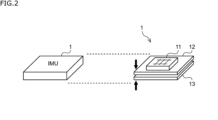
- FIG. 1 is a diagram illustrating the structure of an IMU. 3 is a diagram for explaining the circuit configuration of a readout circuit of the IMU in FIG. 2.
- FIG. 3 is a diagram for explaining the operation of the IMU in FIG. 2 .
- FIG. 1 is a diagram illustrating the operation of a multi-IMU.
- FIG. 1 is a diagram illustrating a configuration example of a first embodiment of a multi-IMU according to the present disclosure.
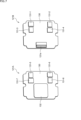
- FIG. 7 is a diagram for explaining a configuration example of the IMU unit in FIG. 6 .
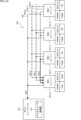
- FIG. 7 is a diagram for explaining functions realized by the multi-IMU of FIG.
- FIG. 9 is a diagram for explaining functions realized by the IMU unit of FIG.
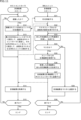
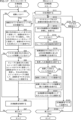
- FIG. 1 is a diagram illustrating an example of a master and slave setting of an IMU unit. 9 is a flowchart illustrating a measurement process by the multi-IMU in FIG. 8 .
- FIG. 1 is a diagram illustrating a first variation of the first embodiment of the multi-IMU of the present disclosure.
- FIG. 13 is a diagram illustrating a second variation of the first embodiment of the multi-IMU of the present disclosure.
- FIG. 1 is a diagram illustrating a first application example of the first embodiment of the multi-IMU of the present disclosure.
- 15 is a flowchart illustrating a measurement process by the multi-IMU in FIG. 14 .
- FIG. 13 is a diagram illustrating a second application example of the first embodiment of the multi-IMU of the present disclosure.
- FIG. 17 is a flowchart illustrating the measurement process by the multi-IMU in FIG. 16 .
- FIG. 10 is a diagram illustrating a configuration example of a second embodiment of a multi-IMU according to the present disclosure.
- FIG. 10 is a diagram illustrating a configuration example of a second embodiment of a multi-IMU according to the present disclosure.
- FIG. 13 is a diagram illustrating a configuration example of a third embodiment of a multi-IMU according to the present disclosure.
- FIG. 13 is a diagram illustrating a configuration example of a fourth embodiment of a multi-IMU according to the present disclosure.
- FIG. 13 is a diagram illustrating a configuration example of a fourth embodiment of a multi-IMU according to the present disclosure.
- FIG. 1 is a diagram illustrating an example of the configuration of a general-purpose personal computer.
- Multi-IMU Intelligent Measurement Units
- a single IMU 1 is configured with an acceleration sensor that detects the acceleration, which is translational motion, in each of the three axial directions consisting of the X, Y and Z axes, and a gyro sensor that detects the angular velocity, which is rotational motion, and detects the acceleration and angular velocity in each of the three axial directions.
- multiple (e.g., n) low-precision but inexpensive IMUs 1 are provided, such as IMUs 1-1 through 1-n, and a synthesis unit 2 synthesizes the acceleration and angular velocity, which are the measurement results of each of IMUs 1-1 through 1-n, thereby reducing noise density and bias fluctuation to 1/ ⁇ n, improving measurement accuracy, and creating a multi-IMU 10.
- the size and cost of the individual low-precision, inexpensive IMUs 1-1 to 1-n that make up the multi-IMU 10 shown on the right side of Figure 1 can be made sufficiently smaller than the size and cost of a standalone high-precision IMU 1 as shown on the left side of Figure 1, and it is also possible to achieve low costs.
- IMU 1 when there is no need to distinguish between IMUs 1-1 to 1-n, they will simply be referred to as IMU 1, and other configurations will be referred to in the same manner. Furthermore, in the following of this specification, IMU 1 will be referred to as a small, inexpensive IMU with relatively low accuracy, but it may also be a large, expensive, high-accuracy IMU.
- each of the IMUs 1 that make up the multi-IMU 10 is composed of, from the top in the figure, a silicon oscillator 11, a base 12 that fixes the oscillator 11, and a readout circuit 13 that reads the vibration of the oscillator 11 and outputs the angular velocity, which are pasted (bonded) together in the order shown in the right part of Figure 2, and integrated by a resin mold as shown in the left part of Figure 2.
- the configuration for detecting angular velocity will be explained as part of the readout circuit that constitutes the IMU 1.
- the configuration for detecting acceleration in the IMU 1 is a configuration that excludes the detection circuit from the configuration for detecting angular velocity, so the explanation will focus on the more complex configuration for detecting angular velocity.
- the readout circuit 13 is composed of a drive circuit block 31, a sense circuit block 32, and a digital output circuit block 33.
- the drive circuit block 31 supplies an oscillation signal having a predetermined drive frequency to the vibrator 11, which is made up of a MEMS (Micro Electro Mechanical Systems), and the sense circuit block 32, causing the vibrator 11 to vibrate based on the oscillation signal.
- MEMS Micro Electro Mechanical Systems
- the sense circuit block 32 detects the vibrations that occur in response to the Coriolis force acting on the oscillator 11, which vibrates based on the oscillation signal, as an analog signal and outputs it to the digital output circuit block 33.
- the digital output circuit block 33 converts the vibration generated in response to the Coriolis force acting on the oscillator 11, supplied by the sense circuit block 32, from an analog signal to a digital signal, and outputs it as an angular velocity.
- the drive circuit block 31 includes an oscillator circuit 51 and an automatic gain control circuit 52.
- the oscillator circuit 51 is composed of an RC circuit, and generates an oscillation signal using the vibration supplied from the vibrator 11 as a reference signal, and outputs it to the automatic gain control circuit 52 and the phase shift circuit 72 of the sense circuit block 32.
- the automatic gain adjustment circuit 52 adjusts the gain of the oscillation signal consisting of the drive frequency supplied by the oscillation circuit 51, and supplies it to the vibrator 11, causing the vibrator 11 to vibrate.
- the sense circuit block 32 includes a charge amplifier circuit 71, a phase shift circuit 72, a synchronous detection circuit 73, and an LPF 74.
- the charge amplifier circuit 71 detects the vibration of the vibrator 11 as a vibration signal, amplifies it, and supplies it to the phase shift circuit 72.
- the phase shift circuit 72 adjusts the phase of the vibration signal of the vibrator 11 detected by the charge amplifier circuit 71 based on the oscillation signal supplied by the oscillator circuit 51, and outputs it to the synchronous detection circuit 73.
- the synchronous detection circuit 73 detects a waveform representing the Coriolis force acting on the oscillator 11, which is expressed by an envelope, from the vibration signal of the oscillator 11 whose phase has been adjusted, and outputs the waveform to the LPF 74.
- the LPF 74 smoothes the waveform indicating the Coriolis force acting on the oscillator 11 and outputs it to the digital output circuit block 33 as angular velocity information consisting of an analog signal.
- the digital output circuit block 33 includes an AD conversion circuit 91, a decimation filter 92, and a digital output circuit 93.
- the AD conversion circuit 91 converts the angular velocity information consisting of the Coriolis force acting on the oscillator 11, which is an analog signal, into a digital signal and outputs it to the decimation filter 92.
- the decimation filter 92 averages the angular velocity information, which is a digital signal, and outputs it to the digital output circuit 93.
- the digital output circuit 93 outputs the digitized and averaged angular velocity information as a digital signal.
- the vibrator 11 vibrates based on a reference signal consisting of an oscillation signal of a drive frequency fb that is oscillated by an oscillation circuit 51 and has its gain adjusted by an automatic gain control circuit 52.
- the synchronous detection circuit 73 detects the amplitude modulation due to the Coriolis force from the envelope of the waveform fbc as the Coriolis force, i.e., the waveform of an analog signal indicating the angular velocity, and outputs it to the LPF 74.
- the waveform of the analog signal extracted in this way as the Coriolis force is converted to a digital signal by the digital output circuit block 33 and output as a digitized angular velocity value.
- the multi-IMU integrates n IMUs 1 as described above, for example as shown in FIG. 5, and outputs the angular velocities detected by each of IMUs 1-1 to 1-n with high accuracy by synthesizing them in a synthesizing unit 2.
- one of the multiple multi-IMUs 10 is set as the master, and the other multi-IMUs 10 are set as slaves, so that, for example, the multi-IMU 10 set as the slave transmits its measurement results to the multi-IMU 10 that is the master.
- the master multi-IMU 10 then synthesizes the measurement results from the slave multi-IMUs 10, including its own measurement results, and outputs the synthesized measurement results.
- multiple multi-IMUs 10 only need to use the same configuration, which reduces the cost of manufacturing the multi-IMUs 10.
- the multi-IMU disclosed herein is realized by connecting multiple IMU units, each of which is made up of the multi-IMU 10 or IMU 1 described above.
- IMU units configurations corresponding to the above-mentioned multi-IMU 10 and IMU 1 will be referred to as IMU units, and will be distinguished from the multi-IMU of this disclosure.
- the IMU unit will be described using only the configuration corresponding to the multi-IMU 10 described above. However, this is for the sake of simplicity, and it goes without saying that the IMU unit may also be IMU 1. Furthermore, since the multi-IMU disclosed herein is composed of multiple multi-IMUs 10, it can also be considered a multi-IMU system.
- FIG. 6 is a top view of the multi-IMU 101 of the present disclosure.
- the multi-IMU 101 of the present disclosure is composed of a board 111, IMU units 121-0 to 121-3, cables 122-0 to 122-4, an integrated board 123, and a host controller 124.
- IMU units 121-0 to 121-3 correspond to the multi-IMU 10 described above, and each is equipped with eight IMUs 131-1 to 131-8 ( Figure 7), and are attached to the four corners of the substrate 111.
- IMU units 121-0 to 121-3 are connected to the integrated board 123 via cables 122-0 to 122-3, which are connected to terminals 121a-0 to 121a-3, respectively.
- the integrated board 123 is joined to the center of the board 111 and is electrically connected to cables 122-0 to 122-3, which are connected to terminals 123a-0 to 123a-3.
- the integrated board 123 is electrically connected to the host controller 124 via a cable 122-4 connected to the terminal 123a-4.
- the integrated board 123 integrates and electrically connects the IMU units 121-0 through 121-3 and the host controller 124 via cables 122-0 through 122-4.
- FIG. 7 a configuration example of the IMU unit 121 will be described with reference to Fig. 7.
- an IMU unit 121A on the left side of Fig. 7 shows the configuration of the back side of the IMU unit 121 in Fig. 6, and an IMU unit 121B on the right side of Fig. 7 shows the configuration of the front side of the IMU unit 121 in Fig. 6.
- the IMU unit 121 has terminal 121a and IMUs 131-1 to 131-4 on the front side of the board 130, and IMUs 131-5 to 131-8 and a control unit 132 on the back side.
- IMUs 131-1 to 131-8 correspond to the IMU 1 described above.
- the IMU unit 121 in Figs. 6 and 7 is provided with a total of eight IMUs 131-1 to 131-8.
- IMUs 131 are provided for one IMU unit 121, but the number of IMUs 131 is not limited to this and may be any other number, and may be any number greater than or equal to one.
- the control unit 132 is controlled by the host controller 124, and one of the four IMU units 121-0 to 121-3 in FIG. 6 is set as the master, and the rest are set as slaves.
- control unit 132 When the control unit 132 is set as a slave, it combines the angular velocity and acceleration information that are the measurement results from the IMUs 131-1 to 131-8, and outputs it to the IMU unit 121 that is set as the master.
- control unit 132 When the control unit 132 is set as the master, it combines the angular velocity and acceleration information that is the measurement result from the IMUs 131-1 to 131-8, and also combines the results from the IMU unit 121 that is set as the slave, and outputs the combined result to the host controller 124.
- synthesizing information here refers to the process itself performed by synthesizer 2 described above. Therefore, when IMU unit 121 is set as a slave, it synthesizes the angular velocity and acceleration information of IMUs 131-1 to 131-8 and outputs it to IMU unit 121 set as a master.
- the IMU unit 121 when the IMU unit 121 is set as the master, it combines the angular velocity and acceleration information that is the measurement result from the IMUs 131-1 to 131-8, and also combines the results from the IMU unit 121 that is set as the slave, and outputs the combined result to the host controller 124 as the measurement result.
- IMU unit 121 The functions realized by the IMU unit 121 will be described in detail later with reference to Figure 8.
- FIG. 6 shows an example in which there are four IMU units 121, there is no limit to the number of IMU units 121 in order to realize a multi-IMU 101, and other numbers may be used.
- the more IMUs 131 that correspond to IMU 1 the better the measurement accuracy will be, so when higher accuracy is required, it is desirable to connect more IMU units 121.
- IMU units 121 increase costs, so there is a trade-off between the required accuracy and cost.
- IMU units 121 since the IMU units 121 only require the use of multiple mass-produced units with the same configuration, it is possible to reduce manufacturing costs even if more IMU units 121 are required.
- the IMU unit 121 is the multi-IMU 10 itself, and as explained with reference to Figure 7, it is configured with eight IMUs 131 and a control unit 132 on a single board 130, so it can also be said to constitute a multi-IMU chip.
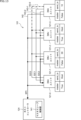
- the functions of the multi-IMU 101 are realized by IMU units 121-0 to 121-3 and the host controller 124.
- the host controller 124 and IMU units 121-0 through 121-3 are each connected via an SPI bus 142 that realizes SPI (Serial Peripheral Interface) communication.
- SPI Serial Peripheral Interface
- IMU units 121-0 to 121-3 are connected to each other via three I2C (Inter Integrated Circuit) (registered trademark) buses 143-0 to 143-2 that realize I2C communication.
- I2C Inter Integrated Circuit
- I2C buses 143-0 to 143-2 are also drawn as I2C0 to I2C2, respectively.
- I2C buses 143-0 to 143-2 may be other buses that have similar functions, for example, an I3C (Improved Inter Integrated Circuits) (registered trademark) bus that is an extension of the I2C bus.
- I3C Improved Inter Integrated Circuits
- the I3C bus allows for faster communication than I2C, so by using I3C instead of I2C, it is possible to speed up processing.
- the host controller 124 and the IMU units 121-0 to 121-3 are not connected via the I2C bus 143, but the two may be connected via the I2C bus 143 in addition to the SPI bus 142.
- the communication paths realized by the SPI bus 142 and the I2C buses 143-0 to 143-2 may be realized in other configurations as long as similar communication is possible. For example, they may be connected by wired communication using other communication methods, or they may be connected by wireless communication.
- the host controller 124 is provided with a master-slave control unit 141.
- the master-slave control unit 141 sets one of the IMU units 121-0 to 121-3 as the master and the others as slaves by communicating with the IMU units 121-0 to 121-3 via the SPI bus 142.
- the master-slave control unit 141 communicates with the IMU units 121-0 to 121-3 via the SPI bus 142 to obtain the IDs of each unit, and sets the IMU unit 121 with the smallest ID value as the master and the others as slaves.
- the master-slave control unit 141 sets the IMU unit 121 set as the master as the transmission destination of the measurement results for the IMU unit 121 set as the slave, and sets the host controller 124 as the transmission destination for the IMU unit 121 set as the master.
- the IMU unit 121 set as a slave transmits its measurement results to the destination IMU unit 121 set as a master via I2C buses 143-0 to 143-2.
- the IMU unit 121 set as the master acquires the measurement results from the IMU unit 121 set as the slave via the I2C buses 143-0 to 143-2, synthesizes all the measurement results, including its own measurement results, and transmits the synthesized results to the destination host controller 124 via the SPI bus 142.
- the functions of the IMU unit 121 are realized by the IMU 131 and the control unit 132.
- N 8.
- the control unit 132 includes a master-slave management unit 151, a destination control unit 152, a self-synthesis unit 153, a other unit synthesis unit 154, a transmission unit 155, and an ID storage unit 156.
- the master-slave management unit 151 stores and manages the settings for either the master or slave that are set by the master-slave control unit 141 of the host controller 124.
- the destination control unit 152 controls the destination of its own measurement results, which is set by the master-slave control unit 141 of the host controller 124; when it is set as the master, it sets the destination to the host controller 124, and when it is set as the slave, it sets the destination to the IMU unit 121 that is set as the master.
- the self-combining unit 153 and other unit combination unit 154 operate according to the master or slave setting.
- the self-combining unit 153 When set as a slave in the master-slave management unit 151, the self-combining unit 153 combines the measurement results of IMUs 131-1 to 131-8 provided in its own IMU unit 121 to generate a self-combined value.
- the transmission unit 155 transmits the self-combined value as a measurement result to the IMU unit 121 set as the master, which is the transmission destination, via the I2C bus 143. In this case, the other unit combination unit 154 does not function.
- the self-combining unit 153 combines the measurement results of the IMUs 131-1 to 131-8 provided in its own IMU unit 121 to generate a self-combined value. Furthermore, the other-unit combination unit 154 acquires the measurement results from the IMU unit 121 set as a slave via the I2C bus 143, combines them with the self-combined value combined by the self-combining unit 153, and generates a self-other combined value. The transmission unit 155 transmits the self-other combined value as the measurement result to the destination host controller 124 via the SPI bus 142.
- the ID storage unit 156 stores an ID that identifies the IMU unit 121, and when the multi-IMU 101 starts up, the master-slave control unit 141 of the host controller 124 supplies the stored ID when it requests an ID from the IMU unit 121. Based on the ID thus obtained, the master-slave control unit 141 sets which of the IMU units 121 is to be the master and which is to be the slave.
- the master-slave control unit 141 of the host controller 124 communicates with the IMU units 121-0 to 121-3 via the SPI bus 142 and obtains their respective IDs.
- the master-slave control unit 141 sets the IMU unit with the smallest ID, for example, as the master based on the acquired IDs of the IMU units 121-0 to 121-3.
- the IDs of the IMU units 121-0 to 121-3 are assumed to be 00, 01, 10, and 11, respectively.
- the master-slave control unit 141 sets the destination of the measurement results of the IMU units 121-1 to 121-3 set as slaves to the ID of the IMU unit 121-0 set as the master, and sets the destination of the measurement results of the IMU unit 121-0 set as the master to the host controller 124.
- the master or slave setting information (master) managed by the master-slave management unit 151 is displayed in the lower left corner of IMU units 121-0 to 121-3, and the destination information (send to) set in the destination control unit 152 is displayed in the lower right corner.
- the master or slave setting information (master) managed by the master-slave management unit 151 is set to True, indicating that it has been set as the master.
- the information (send to) stored in the destination control unit 152 is set to Host, indicating that the destination is the host controller.
- the IMU unit 121-1 set as the slave outputs the self-synthesized value as its own measurement result to the IMU unit 121-0 set as the master via the I2C bus (I2C2) 143-2, as shown by the thick solid arrow in Figure 10.
- the IMU unit 121-2 set as the slave outputs the self-synthesized value as its own measurement result to the IMU unit 121-0 set as the master via the I2C bus (I2C1) 143-1, as shown by the thick dashed arrow in Figure 10.
- the IMU unit 121-3 set as the slave outputs the self-synthesized value as its own measurement result to the IMU unit 121-0 set as the master via the I2C bus (I2C0) 143-0, as indicated by the thick dashed dotted arrow in Figure 10.
- the IMU unit 121-0 set as the master acquires the measurement results supplied from the IMU units 121-1 to 121-3 set as the slaves via the I2C buses 143-2 to 143-0, and combines them with the self-composite value, which is its own measurement result, to generate a self-other composite value.
- the transmitter 155 outputs the self-other composite value to the host controller 124 via the SPI bus 142 as the measurement result.
- the host controller 124 can set one of the IMU units 121-0 to 121-3 as the master and the others as slaves only when the multi-IMU 101 is started, and can obtain highly accurate acceleration and angular velocity information simply by obtaining the measurement results of the multiple IMU units 121-0 to 121-3 from the IMU unit 121 set as the master.
- the host controller 124 only needs to initially determine the master/slave and acquire one measurement result provided by the IMU unit 121 set as the master, thereby reducing the processing load.
- step S11 the master-slave control unit 141 of the host controller 124 determines whether the multi-IMU 101 has started up.
- step S11 If it is determined in step S11 that the multi-IMU 101 has started up, the process proceeds to step S12.
- step S12 the master-slave control unit 141 communicates with the IMU units 121-0 through 121-3 via the SPI bus 142 and obtains their respective IDs.
- step S31 the ID storage unit 156 in the control unit 132 of the IMU unit 121 supplies the stored ID to the master-slave control unit 141 of the host controller 124.
- step S13 the master-slave control unit 141 sets the IMU unit 121 with the smallest ID as the master and the others as slaves based on the acquired IDs of the IMU units 121-0 to 121-3. At this time, the master-slave control unit 141 sets the master's transmission destination to the host controller 124 and the slave's transmission destination to the master IMU unit 121.
- one of the IMU units 121-0 to 121-3 since it is sufficient to set one of the IMU units 121-0 to 121-3 as the master based on the ID, it may be the one with the smallest ID, the one with the largest ID, or one selected randomly.
- step S32 the master-slave management unit 151 in the control unit 132 of the IMU unit 121 accepts the setting contents by the master-slave control unit 141 and stores the master or slave setting information.
- the destination control unit 152 accepts the setting contents by the master-slave control unit 141 and sets the destination as the host controller 124 if it is a master, or sets the destination as the IMU unit 121 set as the master if it is a slave, and stores the destination.
- step S11 If it is determined in step S11 that the program has not started or has already started, steps S12 and S13 are skipped.
- step S33 the self-synthesizing unit 153 acquires acceleration and angular velocity information that is the measurement result of IMUs 131-1 to 131-8, synthesizes it, and generates a self-synthesized value that is its own measurement result.
- step S34 the master-slave management unit 151 determines whether it is set as the master.
- step S34 If it is determined in step S34 that the device is not the master, i.e., is a slave, the process proceeds to step S39.
- step S39 the transmission unit 155 transmits the measurement result consisting of the self-synthesized value via the I2C bus 143 to the IMU unit 121 set as the master, which is set in the destination control unit 152.
- step S33 determines whether it is the master. If it is determined in step S33 that it is the master, processing proceeds to step S35.
- step S35 the other unit synthesis unit 154 acquires the measurement results sent via the I2C bus 143 from the other IMU units 121 set as slaves.
- step S36 the other unit synthesis unit 154 synthesizes the measurement results sent via the I2C bus 143 from the other IMU units 121 set as the acquired slaves with the self-synthesized value, which is its own measurement result, to generate a self-other synthesized value.
- step S37 the transmission unit 155 transmits the self-other composite value consisting of all the composite results as the measurement result via the SPI bus 142 to the host controller 124 set in the destination control unit 152.
- step S14 the host controller 124 acquires the measurement results sent from the IMU unit 121 set as the master via the SPI bus 142.
- steps S15 and S38 it is determined whether or not an instruction to end the process has been given. If an instruction to end the process has not been given, the process returns to steps S11 and S33, and the subsequent steps are repeated.
- the host controller 124 can acquire highly accurate acceleration and angular velocity information by simply setting one of the IMU units 121-0 to 121-3 as the master and setting the others as slaves only when the multi-IMU 101 is started, and obtaining the measurement results of the multiple IMU units 121-0 to 121-3 from the IMU unit 121 set as the master.
- the host controller 124 only needs to initially determine the master/slave and acquire one measurement result provided by the IMU unit 121 set as the master, thereby reducing the processing load.
- the IMU units 121 set as slaves may also be configured to sequentially transmit to the IMU unit 121 set as master in relay format.
- IMU unit 121-0 is set as the master and IMU units 121-1 to 121-3 are set as slaves, as shown in FIG. 12.
- the self-synthesizing unit 153 of the IMU unit 121-3 generates a self-synthesized value, which is the result of its own measurement.
- the transmitting unit 155 transmits this to the IMU unit 121-2, which is set as the slave, via the I2C bus (I2C0) 143-0, as shown by the thick dashed dotted arrow in FIG. 12.
- the other-unit synthesis unit 154 of the IMU unit 121-2 acquires the measurement result from the IMU unit 121-3, it synthesizes it with the self-synthesized value, which is its own measurement result synthesized by the self-synthesizing unit 153, to generate a self-other synthesized value.
- the transmission unit 155 transmits the self-other synthesized value as a measurement result to the IMU unit 121-1 set as a slave via the I2C bus (I2C1) 143-1.
- the other-unit synthesis unit 154 of the IMU unit 121-1 acquires the measurement result from the IMU unit 121-2, it synthesizes it with the self-synthesized value, which is its own measurement result synthesized by the self-synthesizing unit 153, to generate a self-other synthesized value.
- the transmission unit 155 transmits the self-other synthesized value as the measurement result to the IMU unit 121-0 set as the master via the I2C bus (I2C2) 143-2.
- the other-unit synthesis unit 154 of the IMU unit 121-0 set as the master acquires the measurement results supplied from the IMU unit 121-1 set as the slave via the I2C bus 143-2, and synthesizes it with the self-synthesized value, which is its own measurement result synthesized by the self-synthesizing unit 153, to generate a self-other synthesized value.
- the transmission unit 155 transmits the self-other synthesized value as the measurement result to the host controller 124 via the SPI bus 142 as the measurement result, as shown by the thick dotted arrow in Figure 12.
- the information (master) managed by the master-slave management unit 151 is set to True, indicating that it has been set as the master.
- the information (send to) stored in the destination control unit 152 is set to Host, indicating that the destination is the host controller.
- False indicating that it has been set as a slave
- False indicating that it has been set as a slave
- the method of transmitting measurement results from the IMU unit 121 set as a slave to the IMU unit 121 set as a master may be selected by the master-slave control unit 141 in response to a user request.
- FIG. 12 shows an example in which the IMU units 121 set as slaves transmit their measurement results in relay format via different I2C buses 143, but some of them may transmit in relay format via the same I2C bus 143, or all may transmit via the same I2C bus 143.
- the transmitters 155 of IMU units 121-3 and 121-2 may transmit their measurement results to IMU units 121-2 and 121-1, respectively, via I2C bus (I2C0) 143-0, and the transmitter 155 of IMU unit 121-1 may transmit its measurement results to IMU unit 121-0 via I2C bus (I2C2) 143-2.
- the transmitters 155 of IMU unit 121-3 and IMU units 121-2 and 121-1 may each transmit their measurement results to IMU units 121-2 through 121-0 via the I2C bus (I2C1) 143-1.
- the I2C bus 143 that the slave IMU unit 121 uses to transmit measurement results may be set, for example, by the master-slave control unit 141 in response to a user request.
- IMU units 121-0 and 121-2 may be set as masters, and IMU units 121-1 and 121-3 may be set as slaves corresponding to the respective masters.
- the transmitter 155 of the IMU unit 121-3 generates a self-synthesized value, which is its own measurement result.
- the transmitter 155 transmits this to the IMU unit 121-2, which is set as the master, via the I2C bus (I2C0) 143-0, as shown by the thick dashed dotted arrow in FIG. 13.
- the other-unit synthesis unit 154 of the IMU unit 121-2 set as the master acquires the measurement results supplied via the I2C bus 143-0 from the IMU unit 121-3 set as its slave, and synthesizes it with its own measurement results synthesized by the self-combining unit 153 to generate a self-other synthesized value.
- the transmission unit 155 transmits the self-other synthesized value as the measurement result to the host controller 124 via the SPI bus 142, as shown by the thick dotted arrow in Figure 13.
- the self-synthesizing unit 153 of the IMU unit 121-1 generates a self-synthesized value, which is the result of its own measurement.
- the transmitting unit 155 transmits the self-synthesized value as the measurement result to the IMU unit 121-1 set as the master via the I2C bus (I2C2) 143-2, as shown by the thick solid arrow in FIG. 13.
- the other-unit synthesis unit 154 of the IMU unit 121-0 set as the master acquires the measurement results supplied via the I2C bus 143-2 from the IMU unit 121-1 set as its slave, and synthesizes it with its own measurement results synthesized by the self-combining unit 153 to generate a self-other synthesized value.
- the transmission unit 155 transmits the self-other synthesized value as the measurement result to the host controller 124 via the SPI bus 142, as shown by the thick dotted arrow in Figure 13.
- the information (master) managed by the master-slave management unit 151 is set to True, indicating that it has been set as the master.
- the information (send to) stored in the destination control unit 152 is set to Host, indicating that the destination is the host controller.
- the information (master) managed by the master-slave management unit 151 is set to True, indicating that it has been set as the master. Also, the information (send to) stored in the destination control unit 152 is set to Host, indicating that the destination is the host controller.
- False indicating that it has been set as a slave
- the host controller 124 receives measurement results from the two master IMU units 121-0 and 121-2, which increases redundancy but reduces measurement accuracy.
- the Multi-IMU 101 may be used in situations where even a momentary interruption in measurement results could cause fatal damage or affect human life, such as in outer space, smart agriculture, and autonomous driving, and in such cases high redundant reliability is required.
- multiple masters may be set according to the required level of redundant reliability.
- the method of transmitting measurement results from the IMU unit 121 set as a slave to the IMU unit 121 set as a master may be selectable by the master-slave control unit 141 in response to a request from the user.
- the transmitters 155 of the IMU units 121-3 and 121-1 may transmit the self-synthesized values as measurement results to the IMU units 121-2 and 121-0 via one of the I2C buses 143-0 to 143-2.
- the I2C bus 143 that the slave IMU unit 121 uses to transmit measurement results may be selected by the master-slave control unit 141, for example, in response to a request from the user.
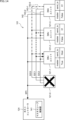
- the master-slave control unit 141 may assume that a malfunction has occurred and set one of the IMU units 121 set as the slave to become an alternative master, thereby allowing the output of measurement results to continue.
- IMU unit 121-0 when IMU unit 121-0 is set as the master and IMU units 121-1 to 121-3 are set as slaves, if some kind of fault occurs in IMU unit 121-0 and it breaks down, the host controller 124 will not be able to obtain measurement results from IMU unit 121-0.
- the master-slave control unit 141 sets, as in the state at startup, the IMU unit 121-1 with the smallest ID, for example, of the IMU units 121-1 to 121-3, as the master, and sets IMU units 121-2 and 121-3 as slaves.
- the IMU unit 121-2 set as the slave sends its measurement results to the IMU unit 121-1 set as the master via the I2C bus (I2C1) 143-1.
- the IMU unit 121-3 set as the slave transmits its measurement results to the IMU unit 121-1 set as the master via the I2C bus (I2C2) 143-2.
- the IMU unit 121-1 set as the master acquires the measurement results supplied from the IMU units 121-2 and 121-3 set as slaves via the I2C buses 143-1 and 143-0, and combines them with its own measurement result, which is its own composite value, to generate a self-other composite value, which it outputs as the measurement result to the host controller 124 via the SPI bus 142.
- the master-slave control unit 141 of the host controller 124 is unable to obtain measurement results from the IMU unit 121 set as the master, it will select an alternative master from among the IMU units 121 set as slaves and reconfigure the others as slaves.
- the IMU unit 121 set as the master is deemed to have failed, and one of the IMU units 121 that had previously been set as a slave is set as an alternative master, and the other IMU units 121 are set as slaves, making it possible to obtain measurement results again.
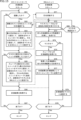
- steps S51 to S53, S56, S57, and S71 to S79 in the flowchart of FIG. 15 are similar to the processes in steps S11 to S15, and S31 to S39 in the flowchart of FIG. 11, so their explanation will be omitted.
- the multi-IMU 101 when the multi-IMU 101 starts up, one of the multiple IMU units 121 is set as the master, and the others are set as slaves.
- the IMU unit 121 set as the slave then supplies its measurement results to the IMU unit 121 set as the master, and the IMU unit 121 set as the master combines the measurement results from the IMU unit 121 set as the slave with a self-combined value, which is its own measurement result, to generate a self-other combined value, which is then transmitted to the host controller 124 as the measurement result.
- step S54 the master-slave control unit 141 determines whether the IMU unit 121 set as the master has failed. More specifically, the master-slave control unit 141 determines whether the IMU unit 121 set as the master has failed, for example, based on whether the measurement results from the IMU unit 121 set as the master are not being transmitted.
- step S54 If, in step S54, it is determined that the measurement results are not being transmitted from the IMU unit 121 set as the master and that the IMU unit 121 set as the master is faulty, processing proceeds to step S55.
- step S55 the master-slave control unit 141 sets the IMU unit 121 with the smallest ID as the master based on the IDs of the IMU units 121 set as slaves, and resets the others as slaves. At this time, the master-slave control unit 141 sets the master's transmission destination to the host controller 124, and sets the slave's transmission destination to the master IMU unit 121.
- step S80 the master-slave management unit 151 in the control unit 132 of the IMU unit 121 determines whether the master is to be reconfigured.
- step S80 if the master is re-established by the master-slave control unit 141 of the host controller 124 through the processing of step S55, the processing returns to step S72.
- the master-slave management unit 151 in the control unit 132 of the IMU unit 121 accepts the settings made by the master-slave control unit 141 and stores the master or slave setting information.
- the destination control unit 152 also accepts the settings made by the master-slave control unit 141 and, if it is a master, sets the destination as the host controller 124, and if it is a slave, sets the destination as the IMU unit 121 set as the master, and stores the settings.
- step S54 If, in step S54, no failure has occurred in the IMU unit 121 set as the master, the process of step S55 is skipped, and in step S80, it is deemed that the master is not being reset, and the process returns to step S73.
- the master-slave control unit 141 of the host controller 124 is unable to obtain measurement results from the IMU unit 121 set as the master, it will set an alternative master from among the IMU units 121 set as slaves and reconfigure the others as slaves.
- the IMU unit 121 set as the master is deemed to have failed, and one of the IMU units 121 that had previously been set as a slave is set as an alternative master, and the other IMU units 121 are set as slaves, making it possible to obtain measurement results again.
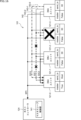
- the other unit synthesis unit 154 of the control unit 132 in the IMU unit 121 set as the master combines the measurement results from the IMU unit 121 set as the slave with the self-synthesized value, which is the IMU unit's own measurement result synthesized by the self-synthesizing unit 153, to detect the presence or absence of an outlier, thereby determining whether the IMU unit 121 is faulty.
- the other unit synthesis unit 154 then registers the IMU unit 121 in which a fault has been detected, and thereafter does not use the measurement results in synthesis.
- IMU unit 121-0 is set as the master and IMU units 121-1 to 121-3 are set as slaves, as shown in FIG. 16.
- the other unit synthesis unit 154 of the IMU unit 121-0 set as the master compares the measurement results from the IMU units 121-1 to 121-3 set as slaves with its own measurement results to determine whether there are any outliers.
- the other unit synthesis unit 154 assumes that IMU unit 121-2 is faulty and registers the corresponding ID as faulty.
- the other unit synthesis unit 154 excludes the measurement results from the IMU unit 121-2 corresponding to the ID registered as faulty, and synthesizes the measurement results from the IMU units 121-1 and 121-3 set as other slaves with the self-synthesized value, which is its own measurement result, to generate a self-other synthesized value.
- the transmission unit 155 outputs the self-other synthesized value to the host controller 124 as the measurement result.
- the measurement result supplied from IMU unit 121-3 via I2C bus (I2C0) 143-0, as shown by the thick solid arrow, and the measurement result supplied from IMU unit 121-1 via I2C bus (I2C2) 143-2 and the measurement result of the device itself are combined to generate a self-other composite value.
- the generated self-other composite value is then sent to the host controller 124 as the measurement result.
- This configuration makes it possible to respond to individual abnormalities in the IMU unit 121, making it possible to suppress a decrease in measurement accuracy due to a malfunction. As a result, it is possible to realize a multi-IMU 101 that measures acceleration and angular velocity with high accuracy at low cost.
- steps S91 to S97, S111 to S115, and S122 to S124 in the flowchart of FIG. 17 are similar to the processes in steps S51 to S57, S71 to S75, and S78 to S80 in the flowchart of FIG. 15, and therefore will not be described here.
- the multi-IMU 101 when the multi-IMU 101 starts up, one of the multiple IMU units 121 is set as the master, and the others are set as slaves.
- the IMU unit 121 set as the slave supplies its measurement results to the IMU unit 121 set as the master.
- the IMU unit 121 set as the master combines the measurement results from the IMU unit 121 set as the slave with a self-combined value, which is its own measurement result, to generate a self-other combined value, and transmits the self-other combined value to the host controller 124 as the measurement result.
- step S116 the other-unit synthesis unit 154 of the control unit 132 of the IMU unit 121 set as the master synthesizes the measurement results of the IMU units other than the IMU unit 121 registered as faulty with its own measurement results synthesized by the self synthesis unit 153 to generate a self-other synthesis value. Note that in the initial processing, since there is no ID information for the IMU unit 121 registered as faulty, the measurement results of all IMU units 121 are synthesized with the self synthesis value, which is its own measurement result.
- step S117 the other unit synthesis unit 154 compares all the acquired measurement results to search for outliers.
- step S118 the other unit synthesis unit 154 determines whether or not a faulty IMU unit 121 exists based on the presence or absence of an outlier.
- step S118 If it is determined in step S118 that a faulty IMU unit 121 exists, processing proceeds to step S119.
- step S119 the other unit synthesis unit 154 registers a fault with the ID that identifies the IMU unit 121 that output the outlier measurement result.
- step S120 the other unit synthesis unit 154 excludes the measurement results from the faulty IMU unit 121, synthesizes the measurement results, and generates a self-other synthesis value.
- step S121 the other unit synthesis unit 154 outputs the self-other synthesis value to the host controller 124 as the measurement result.
- step S118 If it is determined in step S118 that there is no faulty IMU unit 121, steps S119 and S120 are skipped, and the synthesis result of step S116 is output to the host controller 124 by the process of step S120.
- the self-other composite value excluding the measurement results from the faulty IMU unit 121 that outputs the outlier measurement results can be output to the host controller 124 as the measurement result. This makes it possible to avoid using the measurement results of the faulty IMU unit 121, and makes it possible to suppress the decrease in measurement accuracy that occurs when the measurement results of the faulty IMU unit 121 are used.
- the other unit synthesis unit 154 of the IMU unit 121 set as the master determines that it is malfunctioning, it may exclude its own measurement results and continue the synthesis process. In this case, since the function of the other unit synthesis unit 154 itself may be malfunctioning, the transmission of the synthesized measurement results may be stopped.
- the master-slave control unit 141 of the host controller 124 can recognize that a failure has occurred when the IMU unit 121 set as the master does not provide measurement results, and a new replacement master is set, enabling processing to be performed without the master controller 141 itself.
- the four IMU units 121 may have other configurations as long as they are electrically connected.
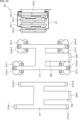
- IMU units 121-0 to 121-3 may be integrated by electrically connecting them to a foldable flexible cable 211, stored in a housing 221b, configured on a base plate 221a, and connected to a host controller 124 via a cable 222.
- the left part of Figure 18 shows a configuration in which individual IMU units 121-0 to 121-3 are electrically connected to a flexible cable 211.
- the IMU units 121-0 to 121-3 are compactly integrated by folding the flexible cable 211 while electrically connected to form the IMU unit box 221, and the IMU unit box 221 and the host controller 124 are connected via a cable 222 to form the multi-IMU 201.
- the IMU unit box 221 is composed of a base plate 221a and a housing 221b.
- the flexible cable 211, to which the IMU units 121-0 to 121-3 are electrically connected, is folded and connected to the base plate 221a.
- the four IMU units 121-0 to 121-3 are stacked on the base plate 221a and electrically connected.
- the four IMU units 121-0 to 121-3 stacked on the base plate 221a are stored in the housing 221b, and the base plate 221a and the housing 221b are integrated to form the IMU unit box 221.
- the flexible cable 211 has an H-shaped configuration as shown on the left side of FIG. 19, with terminals 211a-0 to 211a-3 provided at each end.
- a cable 222 is formed integrally with the central bar of the H-shape that constitutes the flexible cable 211, and terminal 222a at the end of the cable 222 is electrically connected to the host controller 124.
- terminals 211a-0 through 211a-3 are connected to terminals 121a-0 through 121a-3 of IMU units 121-0 through 121-3, respectively.
- the IMU units 121-0 to 121-3 are integrated in a stacked state from the left in the figure, as shown in the right part of Figure 19.
- This configuration makes it possible to integrate the four IMU units 121-0 to 121-3 in a compact manner.
- the IMU unit box 221 itself as shown in FIG. 18 may be treated as an IMU unit, and a multi-IMU may be configured with multiple IMUs 131.
- Figure 20 shows an example of a multi-IMU configuration with more IMUs 131, with the IMU unit box 221 itself considered as one IMU unit.
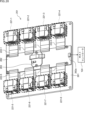
- the multi-IMU 251 in FIG. 20 is composed of IMU unit boxes 221-1 to 221-8, cables 222-1 to 222-8, an integrated board 262, an integrated processing unit 263, and a controller 124.
- IMU unit boxes 221-1 to 221-8 are connected to the integrated board 262 via cables 222-1 to 222-8, respectively.
- the integrated board 262 is provided with an integrated processing unit 263, which synthesizes the measurement results supplied from the IMU unit boxes 221-1 to 221-8 and outputs them to the host controller 124 via a terminal 262a provided on the integrated board 262.
- the integrated processing unit 263 has the same function as the other unit synthesis unit 154 in the control unit 132 of the IMU unit 121, so it may be substituted with the IMU unit 121, for example, and only the other unit synthesis unit 154 may be made to function.
- the multi-IMU 251 in FIG. 20 is provided with eight IMU unit boxes 221, the IMU unit boxes 221 are provided with four IMU units 121, and the IMU units 121 are provided with eight IMUs 131.
- the processing in the multi-IMU 251 in FIG. 20 is similar to that described above, but the host controller 124 controls 32 IMU units 121.
- processor-mounted boards also called microcomputer boards
- microcomputers which are boards equipped with microcomputers (hereinafter referred to as microcomputers) and processors capable of signal processing based on measurement results, may be used to obtain measurement results related to acceleration and angular velocity and to realize highly accurate signal processing based on the obtained measurement results.
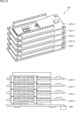
- Fig. 21 shows an example of a multi-IMU configuration using multiple processor-mounted boards.
- the top part of Fig. 21 is an external perspective view of a multi-IMU 301 using multiple processor-mounted boards, and the bottom part is a side view of the multi-IMU 301.
- the multi-IMU 301 is composed of processor mounting boards 321-0 to 321-3 and a host controller board 322.
- the processor mounting boards 321-0 to 321-3 correspond to the IMU units 121-0 to 121-3, respectively, and the host controller board 322 corresponds to the host controller 124.
- IMUs 331-1 to 331-4, a female stack connector 332a, and a DIP switch 333 are provided on the surface 321A of the processor mounting board 321 (the surface viewed from above in FIG. 21 is the surface).
- IMUs 331-5 to 331-8, male stack connector 332b, and control processor 334 are provided on the back surface 321B of processor mounting board 321 (the surface viewed from below in FIG. 21 is regarded as the back surface).
- the upper left part is an external perspective view of the front surface 321A of the processor mounting board 321
- the lower left part is an external perspective view of the back surface 321B of the processor mounting board 321.
- the upper center of Figure 22 is an external perspective view of the surface portion 321A of the processor mounting board 321 with a cover 351 installed to cover the IMUs 331-1 to 331-4 and prevent accuracy degradation due to irregular outside air conditions.
- FIG. 22 is an external perspective view of the back surface 321B of the processor mounting board 321 with a cover 351 installed to cover the IMUs 331-5 to 331-8 and suppress deterioration of accuracy due to the influence of irregular outside air.
- the upper right part of FIG. 22 is the exterior part 351A of the cover 351, and the lower right part of FIG. 33 is the interior part 351B of the cover 351.
- IMUs 331-1 to 331-8 have configurations corresponding to IMUs 131-1 to 131-8, respectively, and have similar functions.
- IMUs 331-1 to 331-4 are protected by a cover 351
- IMUs 331-5 to 331-8 are protected by a cover 351.
- the female stack connector 332a and the male stack connector 332b are arranged in corresponding positions, and multiple processor-mounted boards 321 are stacked and electrically connected by inserting the protrusion of the male stack connector 332b into the hole of the female stack connector 332a.
- DIP switch 333 is a physical switch that is operated to switch between specified operating modes.
- the control processor 334 corresponds to the above-mentioned control unit 132 and has the same functions, and can also perform signal processing on the measurement results through programming. For example, the control processor 334 can calculate the position, distance traveled, speed, etc. based on the acceleration and angular velocity information, which are the measurement results, and output these as calculation results together with the measurement results.
- the host controller board 322 can combine and output the results of calculations based on the acceleration and angular velocity measurements supplied from the multiple processor-mounted boards 321.
- Example of execution by software>> The above-mentioned series of processes can be executed by hardware, but can also be executed by software.
- the programs constituting the software are installed from a recording medium into a computer built into dedicated hardware, or into, for example, a general-purpose computer capable of executing various functions by installing various programs.
- FIG 23 shows an example of the configuration of a general-purpose computer.
- This personal computer has a built-in CPU (Central Processing Unit) 1001.
- An input/output interface 1005 is connected to the CPU 1001 via a bus 1004.
- a ROM (Read Only Memory) 1002 and a RAM (Random Access Memory) 1003 are connected to the bus 1004.
- an input unit 1006 consisting of input devices such as a keyboard and mouse through which the user inputs operation commands
- an output unit 1007 which outputs a processing operation screen and images of the processing results to a display device
- a storage unit 1008 consisting of a hard disk drive for storing programs and various data
- a communication unit 1009 consisting of a LAN (Local Area Network) adapter and the like, which executes communication processing via a network such as the Internet.
- LAN Local Area Network
- a drive 1010 which reads and writes data to removable storage media 1011 such as a magnetic disk (including a flexible disk), an optical disk (including a CD-ROM (Compact Disc-Read Only Memory) and a DVD (Digital Versatile Disc)), a magneto-optical disk (including an MD (Mini Disc)), or a semiconductor memory.
- removable storage media 1011 such as a magnetic disk (including a flexible disk), an optical disk (including a CD-ROM (Compact Disc-Read Only Memory) and a DVD (Digital Versatile Disc)), a magneto-optical disk (including an MD (Mini Disc)), or a semiconductor memory.
- the CPU 1001 executes various processes according to a program stored in the ROM 1002, or a program read from a removable storage medium 1011 such as a magnetic disk, optical disk, magneto-optical disk, or semiconductor memory and installed in the storage unit 1008, and loaded from the storage unit 1008 to the RAM 1003.
- the RAM 1003 also stores data necessary for the CPU 1001 to execute various processes, as appropriate.
- the CPU 1001 loads a program stored in the storage unit 1008, for example, into the RAM 1003 via the input/output interface 1005 and the bus 1004, and executes the program, thereby performing the above-mentioned series of processes.
- the program executed by the computer (CPU 1001) can be provided, for example, by recording it on a removable storage medium 1011 such as a package medium.
- the program can also be provided via a wired or wireless transmission medium such as a local area network, the Internet, or digital satellite broadcasting.
- a program can be installed in the storage unit 1008 via the input/output interface 1005 by inserting the removable storage medium 1011 into the drive 1010.
- the program can also be received by the communication unit 1009 via a wired or wireless transmission medium and installed in the storage unit 1008.
- the program can be pre-installed in the ROM 1002 or storage unit 1008.
- the program executed by the computer may be a program in which processing is performed chronologically in the order described in this specification, or a program in which processing is performed in parallel or at the required timing, such as when called.
- the CPU 1001 in FIG. 23 realizes the functions of the host controller 124 in FIG. 8, FIG. 18, and FIG. 20, and the host controller board 322 in FIG. 21.
- a system refers to a collection of multiple components (devices, modules (parts), etc.), regardless of whether all the components are in the same housing. Therefore, multiple devices housed in separate housings and connected via a network, and a single device in which multiple modules are housed in a single housing, are both systems.
- the present disclosure can be configured as a cloud computing system in which a single function is shared and processed collaboratively by multiple devices over a network.
- each step described in the above flowchart can be executed by a single device, or can be shared and executed by multiple devices.
- a single step includes multiple processes
- the processes included in that single step can be executed by a single device, or can be shared and executed by multiple devices.
- the present disclosure can also be configured as follows.
- An IMU unit having N IMUs (Inertial Measurement Units) for detecting acceleration and angular velocity; a self-combining unit that combines the measurement results of the N IMUs to generate a self-combined value; an self-other synthesis unit that synthesizes the self-composite value and an other-unit composite value that is a composite value of the measurement results of the N IMUs of other IMU units different from the IMU unit, to generate a self-other composite value;
- a multi-IMU chip comprising: a transmitter that transmits the self-composite value or the self-other-composite value to a destination specified as the measurement result.
- a master/slave management unit that receives and manages a master or slave setting by the host controller, When the master-slave management unit is set to the slave, the transmission unit transmits the self-composite value or the self-other composite value as the measurement result to another IMU unit designated by the master-slave management unit, The multi-IMU chip described in ⁇ 1>, wherein when the master-slave management unit is set as the master, the transmission unit transmits the self-other composite value to the host controller as the measurement result.
- the transmission unit transmits at least the self-composite value or the self-other-composite value as the measurement result to another IMU unit via wired communication or wireless communication,
- the multi-IMU chip described in ⁇ 2> wherein the transmission unit transmits the self-other composite value as the measurement result to the host controller via wired communication or wireless communication.
- the transmission unit transmits at least the self-composite value or the self-other composite value as the measurement result to another IMU unit via an I2C (Inter Integrated Circuits) (registered trademark) bus or an I3C (Improved Inter Integrated Circuits) (registered trademark) bus;
- I2C Inter Integrated Circuits
- I3C Improved Inter Integrated Circuits
- the multi-IMU chip according to ⁇ 3> wherein the transmission unit transmits the self-other composite value as the measurement result to the host controller via a Serial Peripheral Interface (SPI) bus.
- SPI Serial Peripheral Interface
- a transmission destination setting unit that sets the other IMU unit to be a transmission destination of the self-composite value or the self-other-composite value The multi-IMU chip according to ⁇ 2>, wherein the transmission unit transmits the self-composite value or the self-other-composite value as the measurement result to the other IMU units set in the destination setting unit.
- ⁇ 7> The multi-IMU chip according to ⁇ 2>, wherein the master or the slave set in the master-slave management unit is set by the host controller at the time of startup.
- ⁇ 8> The multi-IMU chip according to ⁇ 2>, wherein the master or the slave set in the master-slave management unit is set by the host controller based on an identifier for identifying the IMU unit and the other IMU unit.
- ⁇ 9> The multi-IMU chip described in ⁇ 2>, wherein, when set as the master in the master-slave management unit, the self-other synthesis unit detects the presence or absence of an outlier by comparing the self-composite value with the other-unit synthesized value of the other IMU unit, and when the outlier is detected, the self-composite value or the other-unit synthesized value that is the outlier is excluded, and the self-other synthesized value and the other-unit synthesized value are synthesized to generate the self-other synthesized value.
- the multi-IMU chip described in ⁇ 9> wherein when the self-other synthesis unit detects the outlier, it stores an identifier that identifies the IMU unit of the outlier or the other IMU unit as fault information, and thereafter, excludes the self-composite value of the IMU unit corresponding to the identifier registered in the fault information, or the other-unit composite value of the other IMU unit corresponding to the registered identifier, and synthesizes the self-composite value and the other-unit composite value to generate the self-other composite value.
- ⁇ 11> The multi-IMU chip described in ⁇ 2>, in which, when set as the master in the master-slave management unit, the self-other synthesis unit detects the presence or absence of the outlier by comparing the self-synthetic value with the other-unit synthesized value of the other IMU unit, and when the self-synthetic value is the outlier, the transmission unit stops transmitting the self-other synthesized value as the measurement result to the host controller.
- ⁇ 12> The multi-IMU chip according to ⁇ 11>, wherein the master or the slave set in the master-slave management unit is re-set by the host controller when the measurement result is not transmitted to the host controller.
- a method for operating a multi-IMU chip having an IMU unit provided with N IMUs (Inertial Measurement Units) for detecting acceleration and angular velocity comprising: Synthesizing the measurement results of the N IMUs to generate a self-synthesized value; The self-composite value is combined with a other-unit composite value, which is a composite value of the measurement results of the N IMUs of other IMU units different from the IMU unit, to generate a self-other composite value; A method for operating a multi-IMU chip, comprising the step of transmitting the self-composite value or the self-other-composite value to a destination designated as the measurement result.
- N IMUs Inertial Measurement Units
- a computer that controls a multi-IMU chip having an IMU unit provided with N IMUs (Inertial Measurement Units) that detect acceleration and angular velocity, a self-combining unit that combines the measurement results of the N IMUs to generate a self-combined value; an self-other synthesis unit that synthesizes the self-composite value and an other-unit composite value that is a composite value of the measurement results of the N IMUs of other IMU units different from the IMU unit, to generate a self-other composite value; A program that functions as a transmitting unit that transmits the self-composite value or the self-other-composite value as the measurement result to a designated destination.
- N IMUs Inertial Measurement Units
- An IMU unit having N IMUs (Inertial Measurement Units) for detecting acceleration and angular velocity; a self-combining unit that combines the measurement results of the N IMUs to generate a self-combined value; an self-other synthesis unit that synthesizes the self-composite value and an other-unit composite value that is a composite value of the measurement results of the N IMUs of other IMU units different from the IMU unit, to generate a self-other composite value; A transmitter that transmits the self-composite value or the self-other-composite value to a destination designated as the measurement result; A host controller that sets the IMU unit as a master or a slave and acquires the measurement results; A multi-IMU, wherein the transmitter of the IMU unit set as the master transmits the self-other composite value to the host controller as a measurement result.
- N IMUs Inertial Measurement Units
- Multi-IMU 101 Multi-IMU, 121, 121-0 to 121-3 IMU unit, 124 Host controller, 131, 131-1 to 131-8 IMU, 132 Control unit, 141 Master-slave control unit, 142 SPI bus, 143, 143-0 to 143-2 I2C bus, 151 Master-slave management unit, 152 Destination control unit, 153 Self-synthesis unit, 154 Other units Unit synthesis unit, 155 ID storage unit, 201 Multi-IMU, 221, 221-1 to 221-8 IMU unit box, 221a Board, 221b Housing, 251 Multi-IMU, 301 Multi-IMU, 321, 321-0 to 321-3 Processor mounting board, 322 Host controller board, 331, 331-1 to 331-8 IMU, 334 Control processor
Landscapes
- Physics & Mathematics (AREA)
- General Physics & Mathematics (AREA)
- Engineering & Computer Science (AREA)
- Radar, Positioning & Navigation (AREA)
- Remote Sensing (AREA)
- Arrangements For Transmission Of Measured Signals (AREA)
- Navigation (AREA)
Priority Applications (2)
| Application Number | Priority Date | Filing Date | Title |
|---|---|---|---|
| CN202480048278.8A CN121569199A (zh) | 2023-07-27 | 2024-07-09 | 多imu芯片、多imu芯片的操作方法、多imu和程序 |
| JP2025535700A JPWO2025022999A1 (https=) | 2023-07-27 | 2024-07-09 |
Applications Claiming Priority (2)
| Application Number | Priority Date | Filing Date | Title |
|---|---|---|---|
| JP2023-122551 | 2023-07-27 | ||
| JP2023122551 | 2023-07-27 |
Publications (1)
| Publication Number | Publication Date |
|---|---|
| WO2025022999A1 true WO2025022999A1 (ja) | 2025-01-30 |
Family
ID=94374291
Family Applications (1)
| Application Number | Title | Priority Date | Filing Date |
|---|---|---|---|
| PCT/JP2024/024711 Pending WO2025022999A1 (ja) | 2023-07-27 | 2024-07-09 | マルチimuチップ、およびマルチimuチップの作動方法、マルチimu、並びにプログラム |
Country Status (3)
| Country | Link |
|---|---|
| JP (1) | JPWO2025022999A1 (https=) |
| CN (1) | CN121569199A (https=) |
| WO (1) | WO2025022999A1 (https=) |
Citations (9)
| Publication number | Priority date | Publication date | Assignee | Title |
|---|---|---|---|---|
| JPH11110092A (ja) * | 1997-09-30 | 1999-04-23 | Canon Inc | 接続装置、周辺装置、周辺装置システム及びそれらの制御方法 |
| JP2014175755A (ja) * | 2013-03-07 | 2014-09-22 | Seiko Epson Corp | 同期計測システム |
| WO2016147267A1 (ja) * | 2015-03-13 | 2016-09-22 | 富士通株式会社 | 制御装置、制御プログラム、及びセンサノード |
| JP2018019568A (ja) * | 2016-07-29 | 2018-02-01 | 国立研究開発法人宇宙航空研究開発機構 | リアクションホイール装置 |
| JP2019164443A (ja) * | 2018-03-19 | 2019-09-26 | セイコーエプソン株式会社 | センサーモジュール、計測システム、電子機器、及び移動体 |
| WO2021152884A1 (ja) * | 2020-01-31 | 2021-08-05 | ソニーグループ株式会社 | センサ装置 |
| JP2022036477A (ja) * | 2020-08-24 | 2022-03-08 | セイコーエプソン株式会社 | 慣性センサー装置、及び慣性計測ユニット |
| JP2022039132A (ja) * | 2020-08-28 | 2022-03-10 | 沖電気工業株式会社 | 通信装置、故障予兆検知システム、故障予兆検知方法およびプログラム |
| JP2022075075A (ja) | 2020-11-06 | 2022-05-18 | 株式会社デンソー | 多軸慣性力センサ |
-
2024
- 2024-07-09 JP JP2025535700A patent/JPWO2025022999A1/ja active Pending
- 2024-07-09 WO PCT/JP2024/024711 patent/WO2025022999A1/ja active Pending
- 2024-07-09 CN CN202480048278.8A patent/CN121569199A/zh active Pending
Patent Citations (9)
| Publication number | Priority date | Publication date | Assignee | Title |
|---|---|---|---|---|
| JPH11110092A (ja) * | 1997-09-30 | 1999-04-23 | Canon Inc | 接続装置、周辺装置、周辺装置システム及びそれらの制御方法 |
| JP2014175755A (ja) * | 2013-03-07 | 2014-09-22 | Seiko Epson Corp | 同期計測システム |
| WO2016147267A1 (ja) * | 2015-03-13 | 2016-09-22 | 富士通株式会社 | 制御装置、制御プログラム、及びセンサノード |
| JP2018019568A (ja) * | 2016-07-29 | 2018-02-01 | 国立研究開発法人宇宙航空研究開発機構 | リアクションホイール装置 |
| JP2019164443A (ja) * | 2018-03-19 | 2019-09-26 | セイコーエプソン株式会社 | センサーモジュール、計測システム、電子機器、及び移動体 |
| WO2021152884A1 (ja) * | 2020-01-31 | 2021-08-05 | ソニーグループ株式会社 | センサ装置 |
| JP2022036477A (ja) * | 2020-08-24 | 2022-03-08 | セイコーエプソン株式会社 | 慣性センサー装置、及び慣性計測ユニット |
| JP2022039132A (ja) * | 2020-08-28 | 2022-03-10 | 沖電気工業株式会社 | 通信装置、故障予兆検知システム、故障予兆検知方法およびプログラム |
| JP2022075075A (ja) | 2020-11-06 | 2022-05-18 | 株式会社デンソー | 多軸慣性力センサ |
Also Published As
| Publication number | Publication date |
|---|---|
| CN121569199A (zh) | 2026-02-24 |
| JPWO2025022999A1 (https=) | 2025-01-30 |
Similar Documents
| Publication | Publication Date | Title |
|---|---|---|
| US11303852B2 (en) | Sensor information processing system using container orchestration technique | |
| US20220136160A1 (en) | Method, device, and system for detecting dynamic imbalance of washing machine | |
| EP3918890B1 (en) | System and method for determining location and navigating a datacenter using augmented reality and available sensor data | |
| JP5963567B2 (ja) | 慣性センサ | |
| US20100071467A1 (en) | Integrated multiaxis motion sensor | |
| US20160036916A1 (en) | Synchronous measurement system | |
| JP7760874B2 (ja) | 慣性センサーモジュール | |
| JP7740425B2 (ja) | 慣性センサー装置、及び慣性計測ユニット | |
| US11579166B1 (en) | Resonant accelerometer | |
| US10955243B2 (en) | Inertial sensor | |
| JP2019152493A (ja) | 判定装置および判定装置の制御方法 | |
| JP2023042129A (ja) | 慣性センサーモジュール | |
| WO2025022999A1 (ja) | マルチimuチップ、およびマルチimuチップの作動方法、マルチimu、並びにプログラム | |
| CN113243027A (zh) | 使用音频返回路径用于功能安全校验的方法、系统和装置 | |
| US11333679B1 (en) | Electrostatically softened accelerometer spring | |
| US12007407B2 (en) | Sensor module and measurement system | |
| US11479459B2 (en) | Method and system for sensor configuration | |
| US20230110372A1 (en) | Method and system for sensor configuration | |
| US12498392B2 (en) | Dual axis accelerometer with compensation electrodes | |
| Vigna | It makes sense: How extreme analog and sensing will change the world | |
| WO2020093861A1 (zh) | 一种飞行控制器及无人飞行器 | |
| KR102719760B1 (ko) | 하드웨어 초기화를 위한 시스템 및 방법 | |
| US12474367B2 (en) | Inertial sensor module and inertial measurement system | |
| US20250180374A1 (en) | Diagnostic method and diagnostic system of mems sensor | |
| JP7394220B2 (ja) | 半導体装置 |
Legal Events
| Date | Code | Title | Description |
|---|---|---|---|
| 121 | Ep: the epo has been informed by wipo that ep was designated in this application |
Ref document number: 24845380 Country of ref document: EP Kind code of ref document: A1 |
|
| ENP | Entry into the national phase |
Ref document number: 2025535700 Country of ref document: JP Kind code of ref document: A |
|
| WWE | Wipo information: entry into national phase |
Ref document number: 2025535700 Country of ref document: JP |
|
| WWE | Wipo information: entry into national phase |
Ref document number: 2024845380 Country of ref document: EP |
|
| NENP | Non-entry into the national phase |
Ref country code: DE |