WO2025018372A1 - リング型コントローラーおよび無線通信システム - Google Patents
リング型コントローラーおよび無線通信システム Download PDFInfo
- Publication number
- WO2025018372A1 WO2025018372A1 PCT/JP2024/025738 JP2024025738W WO2025018372A1 WO 2025018372 A1 WO2025018372 A1 WO 2025018372A1 JP 2024025738 W JP2024025738 W JP 2024025738W WO 2025018372 A1 WO2025018372 A1 WO 2025018372A1
- Authority
- WO
- WIPO (PCT)
- Prior art keywords
- ring
- finger
- proximity sensor
- controller
- user
- Prior art date
- Legal status (The legal status is an assumption and is not a legal conclusion. Google has not performed a legal analysis and makes no representation as to the accuracy of the status listed.)
- Pending
Links
Images







Classifications
-
- G—PHYSICS
- G06—COMPUTING OR CALCULATING; COUNTING
- G06F—ELECTRIC DIGITAL DATA PROCESSING
- G06F3/00—Input arrangements for transferring data to be processed into a form capable of being handled by the computer; Output arrangements for transferring data from processing unit to output unit, e.g. interface arrangements
- G06F3/01—Input arrangements or combined input and output arrangements for interaction between user and computer
-
- G—PHYSICS
- G06—COMPUTING OR CALCULATING; COUNTING
- G06F—ELECTRIC DIGITAL DATA PROCESSING
- G06F3/00—Input arrangements for transferring data to be processed into a form capable of being handled by the computer; Output arrangements for transferring data from processing unit to output unit, e.g. interface arrangements
- G06F3/01—Input arrangements or combined input and output arrangements for interaction between user and computer
- G06F3/03—Arrangements for converting the position or the displacement of a member into a coded form
- G06F3/033—Pointing devices displaced or positioned by the user, e.g. mice, trackballs, pens or joysticks; Accessories therefor
- G06F3/0346—Pointing devices displaced or positioned by the user, e.g. mice, trackballs, pens or joysticks; Accessories therefor with detection of the device orientation or free movement in a three-dimensional [3D] space, e.g. 3D mice, 6-DOF [six degrees of freedom] pointers using gyroscopes, accelerometers or tilt-sensors
Definitions
- This disclosure relates to a ring-type controller and a wireless communication system.
- controllers for operating electronic devices include controllers that are portable by a person and controllers that are worn on the person's body when used.
- controllers that are worn on the human body need to be miniaturized, and so there are cases where the content that can be operated is limited.
- Patent Document 1 uses a flexion sensor to measure finger flexion or extension (see Patent Document 1).
- This disclosure has been made in consideration of these circumstances, and aims to provide a ring-type controller and wireless communication system that can be easily operated by the user.
- One aspect is a ring-type controller comprising a first ring device having a first ring portion and a first proximity sensor provided on the first ring portion, and a second ring device having a second ring portion and a second proximity sensor provided on the second ring portion and held on the first ring device so as to be movable relative to the first ring device, the first proximity sensor being disposed at a position capable of detecting the distance between a specific first finger on which the first ring portion and the second ring portion are worn and another second finger, and the second proximity sensor being disposed at a position capable of detecting the distance between the first finger on which the first ring portion and the second ring portion are worn and another third finger.
- One aspect is a wireless communication system that includes a ring controller and a host computer that can communicate via a wireless module.
- the present disclosure makes it possible to simplify operation for users in a ring-type controller and wireless communication system.
- FIG. 1 is a diagram showing a schematic configuration of a ring controller according to an embodiment.
- 4A and 4B are diagrams illustrating an example of the configuration of a movement section of a ring-type controller according to an embodiment.
- 4A and 4B are diagrams illustrating an example of the configuration of a movement section of a ring-type controller according to an embodiment.
- 1A to 1C are diagrams illustrating an example of the configuration of a wireless communication system according to an embodiment and an example of the configuration of functional blocks of a control circuit of a ring type controller.
- 1A to 1C are diagrams illustrating a method for wearing the ring-type controller according to an embodiment on the left hand.
- 1A to 1C are diagrams illustrating a method for wearing the ring-type controller according to an embodiment on the left hand.
- 1A to 1C are diagrams illustrating a method of wearing the ring-type controller according to the embodiment on the right hand.
- 11A to 11C are cross-sectional views illustrating a method for wearing the ring-type controller according to the embodiment on the right hand.
- 11A and 11B are diagrams showing an example of a posture of a left hand wearing a ring-type controller according to an 11A and 11B are diagrams showing an example of a posture of a left hand wearing a ring-type controller according to an embodiment.
- FIGS. 11A and 11B are diagrams showing an example of a posture of a left hand wearing a ring-type controller according to an 11A and 11B are diagrams showing an example of a posture of a left hand wearing a ring-type controller according to an embodiment.
- 1A and 1B are diagrams illustrating an example of how to use the ring controller according to an embodiment.
- FIG. 11 is a diagram showing a schematic configuration of a ring controller according to a second embodiment.
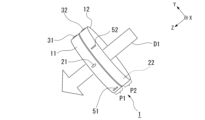
- Fig. 1 is a diagram showing a schematic configuration of a ring-type controller 1 according to an embodiment.
- XYZ orthogonal coordinate axes which are three-dimensional orthogonal coordinate axes, are shown in Fig. 1.
- the ring-type controller 1 includes two ring units 11 and 12, two proximity sensors 21 and 22, and four positioning units 31, 32, 51, and 52.
- one proximity sensor 21 and two positioning units 31, 51 are provided on the ring unit 11, and these constitute a first ring device P1.
- the ring portion 12 is provided with one proximity sensor 22 and two positioning portions 32, 52, which together form a second ring device P2.
- the first ring device P1 and the second ring device P2 are combined to form a ring type controller 1.
- the ring type controller 1 has a double ring structure.
- the ring type controller 1 may be called, for example, a ring device.
- the ring portion may be referred to simply as a ring, for example.
- the names of the other components in this embodiment are also examples for the purpose of explanation, and the components may be called by any other names.
- the ring portion 11 has a ring shape.
- the ring shape of the ring portion 11 is not particularly limited, and may be, for example, a circular or elliptical shape.
- the ring portion 11 has a circular shape when projected onto the XY plane.
- the ring portion 11 has a hole that penetrates the center of the circular shape in a direction parallel to the Z axis.
- the ring portion 11 is, for example, a portion having a single stage.
- the ring portion 12 has a ring shape.
- the ring shape of the ring portion 12 is not particularly limited, and may be, for example, a circular or elliptical shape.
- the ring portion 12 has a circular shape when projected onto the XY plane.
- the ring portion 12 has a hole that penetrates the center of the circular shape in a direction parallel to the Z axis.
- the ring portion 12 is, for example, a portion having a single stage.
- such a circular shape (for example, the inner circumference of the circle) is the same for the two ring portions 11 and 12 .
- the two ring units 11 and 12 are combined so that these circular shapes fit together.
- the ring unit 11 and the ring unit 12 share this circular shape, and it appears to the user as if there is one circular shape (double rings).
- One proximity sensor 21 is disposed on the outer circumferential side surface of the ring portion 11 .
- the other proximity sensor 22 is disposed on the outer circumferential side surface of the ring portion 12 .
- These two proximity sensors 21, 22 are arranged at a predetermined interval from each other on the side surfaces of these ring portions 11, 12.
- the predetermined interval may be expressed, for example, by a rotation angle about the central axis of the circular shape of these ring portions 11, 12, or may be expressed by a distance on the side surfaces of the outer periphery of these ring portions 11, 12.
- the positioning portion 31 and the positioning portion 51 are each disposed on the outer circumferential side surface of the ring portion 11 .
- the positioning portion 31 and the positioning portion 51 are each disposed on the side surface at a predetermined distance from the proximity sensor 21 .
- the positioning portion 32 and the positioning portion 52 are each disposed on the outer circumferential side surface of the ring portion 12 .
- the positioning portion 32 and the positioning portion 52 are each disposed on the side surface at a predetermined distance from the proximity sensor 22 .
- each of the positioning portions 31, 32, 51, and 52 is not particularly limited, and may be, for example, a protruding shape such as a cube or a sphere, or may be any decorative shape.
- the decoration may be, for example, a letter, a number, or a symbol, or may be any pattern.
- the shape of each positioning portion 31, 32, 51, 52 may, for example, have a shape that protrudes from the outer circumferential side surface of the ring portions 11, 12, or may have a shape that is engraved on the outer circumferential side surface of the ring portions 11, 12.
- the positioning units 31, 32, 51, and 52 indicate to a user (human) the wearing position for the finger (in this embodiment, the index finger) on which the ring-type controller 1 is worn. That is, in this embodiment, the user wears the ring controller 1 on a predetermined finger of a predetermined hand of the user so that the positioning units 31, 32, 51, and 52 are located in predetermined locations when the ring controller 1 is worn on a predetermined finger of a predetermined hand of the user. Note that the user may wear the ring controller 1 by referring to only some of the four positioning units 31, 32, 51, and 52.
- FIG. 1 shows a case where the ring-type controller 1 is worn on the index finger of the user's left hand.
- FIG. 1 shows a direction D1 in which the index finger of the left hand is inserted into the ring portions 11 and 12.
- the ring type controller 1 when the ring type controller 1 is inserted onto the index finger of the user's left hand, the ring type controller 1 is inserted onto the index finger so that the positioning portions 31, 32 are positioned above the index finger.
- the proximity sensor 21 detects whether or not the middle finger of the user's left hand is in proximity.
- the proximity sensor 22 detects whether or not the thumb of the user's left hand is in proximity.
- the position determined by the positioning units 31 and 32 is not particularly limited, and does not necessarily have to be on the upper side of the finger on which the ring-type controller 1 is worn, but may be, for example, on the lower side or side of the finger on which the ring-type controller 1 is worn.
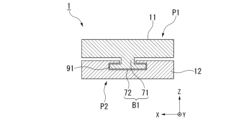
- FIG. 2A is a diagram showing an example of the configuration of the moving part B1 of the ring type controller 1 according to the embodiment.
- FIG. 2B is a cross-sectional view showing an example of the configuration of the moving part B1 of the ring-type controller 1 according to the embodiment.
- 2A and 2B each show an XYZ orthogonal coordinate system similar to that shown in FIG.
- FIG. 2A shows the external appearance of a portion of the ring controller 1.
- an example of the configuration near the circular surface where ring portion 11 and ring portion 12 are combined is shown as viewed from the side surface of the outer periphery of ring-type controller 1 (in the example of Figure 2, a part of that side surface).
- FIG. 2B shows a cross-sectional view of area A1 shown in FIG. 2A.
- one ring portion 11 has a protrusion 71 around one circumference of its circular shape on the side facing the circumferential shape of the other ring portion 12.
- the protrusion 71 has an engagement portion 91 that is wider on the side of the other ring portion 12 than on the side of the one ring portion 11.
- the other ring portion 12 has a hole 72 around the entire circumference of its circular shape, into which the engagement portion 91 fits.
- the engagement portion 91 of one ring portion 11 fits into the hole portion 72 of the other ring portion 12, and these two ring portions 11, 12 are configured to be able to rotate relatively to each other around the central axis of their circular shapes.
- the protrusion 71 and the hole 72 form the moving part B1.
- the inner circumference of the first ring device P1 (the inner circumference of the ring portion 11) and the inner circumference of the second ring device P2 (the inner circumference of the ring portion 12) have the same shape.
- the first ring device P1 and the second ring device P2 are held so that the two inner circumferences overlap with each other in the direction in which a specific finger is inserted into them.
- the two ring portions 11, 12 rotate relative to each other, thereby making it possible to change the relative positional relationship between the arrangement of the proximity sensor 21, positioning portion 31 and positioning portion 51 provided on one ring portion 11 and the arrangement of the proximity sensor 22, positioning portion 32 and positioning portion 52 provided on the other ring portion 12.
- the user can change the relative positions of the two ring portions 11 and 12 .
- any mechanism may be used as a mechanism capable of changing the relative positional relationship between the two ring portions 11, 12 (in this embodiment, the relative rotation angle between the two ring portions 11, 12).
- the ring-type controller 1 may be provided with a fastener (e.g., a clasp or the like) for fixing the positional relationship between the two ring units 11 and 12.
- a fastener e.g., a clasp or the like
- the user releases the fastener to change the positional relationship between the two ring units 11 and 12 to a desired positional relationship, and then fixes the two ring units 11 and 12 with the fastener.
- FIG. 3 is a diagram showing an example of the configuration of a wireless communication system Q1 according to the embodiment and an example of the configuration of functional blocks of a control circuit 211 of the ring type controller 1.
- the wireless communication system Q1 includes a ring controller 1, a host computer 212, and a charger 213.
- the host computer 212 and the charger 213 are devices external to the ring controller 1 .
- the control circuit 211 is provided in the ring type controller 1 .
- the charger 213 may be considered not to be included in the wireless communication system Q1.
- the ring controller 1 transmits, for example, various instructions and various information to the host computer 212 by wirelessly communicating with the host computer 212 .
- the host computer 212 obtains various instructions or various information based on the information received from the ring controller 1 .
- the charger 213 supplies power to the ring type controller 1 .
- the host computer 212 may be any device, such as a personal computer (PC), a smartphone, AR glasses, or VR (Virtual Reality) glasses. Additionally, various types of charger 213 may be used.
- the control circuit 211 includes a proximity sensor unit 231, an IMU (Inertial Measurement Unit) sensor 232, a wireless module 233, a battery 234, a charging connector 235, a battery control IC (Integrated Circuit) 236, and a microcontroller (also referred to as a microcomputer in this embodiment for convenience of explanation) 237.
- the proximity sensor unit 231 includes a proximity sensor 21 and a proximity sensor 22 .
- Each of the proximity sensors 21 and 22 of the proximity sensor unit 231 functions as a distance measuring sensor.
- the proximity sensor 21 detects information regarding the degree of proximity to a predetermined finger.
- the degree may be, for example, information indicating the distance from the finger.
- the proximity sensor 22 detects information regarding the degree of proximity to a predetermined finger.
- the degree may be, for example, information indicating the distance to the finger.
- the proximity sensor unit 231 transmits information regarding the detection results of the proximity sensor 21 (detection information) and information regarding the detection results of the proximity sensor 22 (detection information) to the microcomputer 237 .
- the proximity sensor unit 231 is controlled by a microcomputer 237 .
- detection may be called, for example, measurement or measurement.
- detection information may be called, for example, measurement information or measurement information, and may be called, for example, a detection value, a measurement value, or a measurement value.
- various types of information may be referred to as, for example, data.
- the IMU sensor 232 includes, for example, an acceleration sensor and a gyro sensor, and detects information according to the movement of the hand on which the ring controller 1 is worn.
- the IMU sensor 232 transmits information regarding the detection result (detection information) to the microcomputer 237 .
- the IMU sensor 232 is controlled by a microcomputer 237 .
- the IMU sensor 232 may include, for example, any one of an acceleration sensor and a gyro sensor.
- the wireless module 233 performs wireless communication with the host computer 212 .
- the wireless communication method is not particularly limited, and for example, a method such as Bluetooth (registered trademark) may be used.
- the wireless module 233 is controlled for transmission and reception by a microcomputer 237 .
- the battery 234 is, for example, a secondary battery, and is capable of charging and supplying power.
- the battery 234 may be configured to be detachable from the main body of the ring controller 1 (in the example of FIG. 3, the parts of the ring controller 1 other than the battery 234), or may be integrated in a non-detachable manner.
- a replaceable primary battery may be used as the battery 234, in which case it is not necessary to provide the charger 213 and the charging connector 235.
- the battery 234 may be considered to be an external component of the ring controller 1.
- the charging connector 235 receives power supplied from the charger 213 and supplies the power to the battery control IC 236 .
- the charging connector 235 and the charger 213 may be configured to supply power contactlessly, or may be configured to supply power via a wire.
- power may be supplied when the ring controller 1 is not worn by the user.
- the battery control IC 236 controls charging of the battery 234 and power supply from the battery 234 .
- the battery control IC 236 uses the power charged in the battery 234 to supply power to each of the proximity sensor unit 231, the IMU sensor 232, the wireless module 233, and the microcomputer 237.
- the battery control IC 236 charges the battery 234 using power supplied from the charging connector 235 .
- the microcomputer 237 performs various types of processing and control.
- the microcomputer 237 communicates information with the host computer 212 via the wireless module 233 .
- the microcomputer 237 receives information about the detection result (detection information) from the proximity sensor unit 231 .
- the microcomputer 237 receives information regarding the detection results (detection information) from the IMU sensor 232.
- the microcomputer 237 transmits an instruction to the host computer 212 according to the user's operation, for example, based on one or both of information from the proximity sensor unit 231 and information from the IMU sensor 232 .
- the microcontroller 237 may, for example, determine an instruction corresponding to the user's operation content based on both information from the proximity sensor unit 231 and information from the IMU sensor 232, or may determine an instruction corresponding to the user's operation content based on any one of the information from the proximity sensor unit 231 and information from the IMU sensor 232.
- the microcomputer 237 may transmit one or both of the information from the proximity sensor unit 231 and the information from the IMU sensor 232 to the host computer 212 without identifying an instruction corresponding to the user's operation. In this case, the host computer 212 identifies an instruction corresponding to the user's operation based on the information received from the microcomputer 237.
- the processes performed by the microcomputer 237 and the processes performed by the host computer 212 may be divided arbitrarily.
- the microcomputer 237 may transmit to the host computer 212 information on the detection results (e.g., distance) of the proximity sensors 21 and 22 themselves, or information on the presence or absence of proximity obtained from the detection results.
- the microcontroller 237 may transmit to the host computer 212 information on the detection results by the IMU sensor 232 (e.g., one or both of the acceleration and angular velocity), or information on the movement obtained from the detection results (e.g., information such as the distance moved by the ring-type controller 1).
- the microcomputer 237 may generate predetermined information based on the detection results of the proximity sensor unit 231 and the IMU sensor 232 and transmit the information to the host computer 212 .
- the predetermined information may be information for display.
- the host computer 212 displays the information received from the microcomputer 237 via the wireless module 233 on a screen.
- the microcomputer 237 or the host computer 212 may determine whether or not a predetermined finger is in proximity to the proximity sensor 21 based on, for example, detection information from the proximity sensor 21.
- the detection information is information on the distance (separation distance) from the finger, and it may be determined that the finger is in proximity when the distance from the finger is equal to or less than a predetermined threshold (or is less than the predetermined threshold), and may be determined not to be in proximity in other cases.
- the microcomputer 237 or the host computer 212 may determine whether or not a predetermined finger is in proximity to the proximity sensor 22, for example, based on detection information from the proximity sensor 22.
- the detection information is information on the distance (separation distance) from the finger, and it may be determined that the finger is in proximity when the distance from the finger is equal to or less than a predetermined threshold (or is less than the predetermined threshold), and may be determined not to be in proximity in other cases.
- the threshold values of the proximity sensors 21 and 22 may be the same or different, for example.
- the proximity sensors 21 and 22 are used by being disposed at different locations (positions) spaced apart from each other on the ring portions 11 and 12, for example. 3 may be disposed together in one location on the ring portion 11 or the ring portion 12, or may be disposed separately in a plurality of separate locations on the ring portion 11 and the ring portion 12. When these components are disposed together in one location on the ring portion 11 or the ring portion 12, this location may be, for example, the same location as any one of the two proximity sensors 21, 22, or may be a different location from the two proximity sensors 21, 22.
- Control of the control circuit from the host computer> A configuration in which a predetermined instruction (control data) is transmitted from the host computer 212 to the microcomputer 237 of the control circuit 211 may be used.
- the instruction may be a sleep instruction.
- the host computer 212 may provide the sleep instruction to the microcomputer 237 via the wireless module 233.
- the microcomputer 237 puts all or part of the control circuit 211 into a sleep state. In the sleep state, for example, power consumption is reduced, and in this case, the sleep state may be called a power saving state.
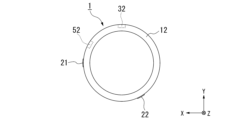
- FIGS. 4A and 4B are diagrams illustrating a method of wearing the ring-type controller 1 according to the embodiment on the left hand.
- the example of Fig. 4A and the example of Fig. 4B are illustrated from different perspectives.
- FIGS. 4A and 4B each show an XYZ orthogonal coordinate system similar to that shown in FIG.
- FIG. 4A shows the ring-type controller 1 from the perspective of looking at the holes in the ring portions 11 and 12 of the ring-type controller 1.
- FIG. 4B shows the ring-type controller 1 from the perspective of looking at the vicinity of the outer periphery of the ring portion 11 of the ring-type controller 1.
- the positional relationship between the two ring portions 11 and 12 is adjusted so that the location of the positioning portion 31 of the ring portion 11 indicated with "L" and the location of the positioning portion 32 of the ring portion 12 are positioned at the same position on the circumference of the two ring portions 11 and 12 (the position having the same rotation angle when centered on the central axis of the circular shape), and the ring portion is worn and used on the user's left hand.
- FIG. 4B shows a direction D1 in which the fingers of the user's left hand are inserted.
- the index finger of the user's left hand is inserted in a direction from the front side to the back side of the paper surface of FIG. 4A, whereby the ring-type controller 1 is worn on the index finger.
- the proximity sensor 21 is disposed at a position where it is possible to detect whether or not the middle finger of the user's left hand is in proximity to the index finger.
- the proximity sensor 22 is disposed at a position where it is possible to detect whether or not the thumb of the user's left hand is in proximity to the index finger. Therefore, the microcomputer 237 or the host computer 212 can identify an instruction corresponding to the user's operation based on the detection results of the two proximity sensors 21 and 22.
- FIGS. 5A and 5B are diagrams illustrating a method of wearing the ring-type controller 1 according to an embodiment on the right hand.
- the example of Fig. 5A and the example of Fig. 5B are illustrated from different viewpoints.
- each of FIGS. 5A and 5B shows XYZ orthogonal coordinate axes similar to those in FIG.
- FIG. 5A shows the ring-type controller 1 from the perspective of looking at the holes in the ring portions 11 and 12 of the ring-type controller 1.
- FIG. 5B shows the ring-type controller 1 from the perspective of looking at the vicinity of the outer periphery of the ring portion 11 of the ring-type controller 1.
- the positional relationship between the two ring portions 11 and 12 is adjusted so that the location of the positioning portion 51 of the ring portion 11 indicated with an "R" and the location of the positioning portion 52 of the ring portion 12 are positioned at the same position on the circumference of the two ring portions 11 and 12 (the position having the same rotation angle when centered on the central axis of the circular shape), and the ring portion is worn and used on the user's right hand.
- FIG. 5B shows a direction D2 in which the fingers of the user's right hand are inserted.
- the index finger of the user's right hand is inserted in a direction from the front side to the back side of the page of FIG. 5A, thereby causing the ring-type controller 1 to be worn on the index finger.
- the proximity sensor 21 is disposed at a position where it is possible to detect whether or not the middle finger of the user's right hand is in proximity to the index finger.
- the proximity sensor 22 is disposed at a position where it is possible to detect whether or not the thumb of the user's right hand is in proximity to the index finger. Therefore, the microcomputer 237 or the host computer 212 can identify an instruction corresponding to the user's operation based on the detection results of the two proximity sensors 21 and 22.
- the positions of the positioning portion 31 and the positioning portion 51 are shifted by 180 degrees (or approximately 180 degrees) in terms of the rotation angle when centered on the central axis of the circular shape of the ring portion 11.
- the position of the positioning portion 32 and the position of the positioning portion 52 are shifted by an angle ranging from 45 degrees to 90 degrees (for example, 45 degrees or 90 degrees) in terms of the rotation angle when centered on the central axis of the circular shape of the ring portion 12.
- the proximity sensor 21 when viewed from the negative side to the positive side of the Z axis, the proximity sensor 21 is disposed at the center (or near the center) of the circumference on the left side (the left side in FIG.
- the position of the positioning portion 31 and the position of the proximity sensor 21 are shifted by 90 degrees (or about 90 degrees) in terms of the rotation angle when the central axis of the circular shape of the ring portion 11 is the center, and similarly, the position of the proximity sensor 21 and the positioning portion 51 are shifted by 90 degrees (or about 90 degrees).
- the proximity sensor 22 when viewed from the negative side to the positive side of the Z axis, the proximity sensor 22 is disposed at a position about 90 degrees to 180 degrees (e.g., 157.5 degrees or 135 degrees) on the circumference on the right side (the right side in FIG.
- the position of the positioning portion 32 and the position of the proximity sensor 22 are shifted by about 90 degrees to 180 degrees in terms of the rotation angle when the central axis of the circular shape of the ring portion 12 is the center.
- the position of proximity sensor 21 and the position of proximity sensor 22 are shifted by an angle in the range of approximately 90 degrees to 180 degrees (for example, 112.5 degrees or 135 degrees) in terms of the rotation angle when centered on the central axis of the circular shape of ring portions 11 and 12.
- the arrangement of each component shown in this embodiment (e.g., the position of the rotation angle) is an example for explanatory purposes and does not necessarily have precise values. Any arrangement that is practically effective may be used for the arrangement of each component.
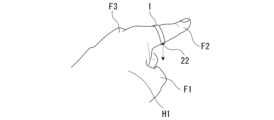
- Examples of user operations 6A to 6D, examples of user operations are shown.
- the ring-type controller 1 is worn on the index finger F2 of the user's left hand H1.
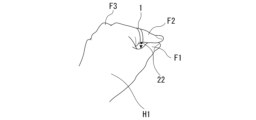
- 6A and 6B are diagrams showing an example of the posture of the left hand H1 wearing the ring-type controller 1 according to the embodiment.
- 6A and 6B are diagrams showing the same posture of the left hand H1 from different viewpoints.
- the user is in a pointing pose with only the index finger F2 of the left hand H1 extended.
- the middle finger F3 of the user's left hand H1 is not close to the index finger F2
- the thumb F1 of the user's left hand H1 is not close to the index finger F2.
- FIG. 6C is a diagram showing an example of the posture of the left hand H1 wearing the ring-type controller 1 according to the embodiment.
- the user extends the index finger F2 and middle finger F3 of the left hand H1 in a two-finger pointing pose.
- the middle finger F3 of the user's left hand H1 is in close proximity to the index finger F2
- the thumb F1 of the user's left hand H1 is not in close proximity to the index finger F2.
- FIG. 6D is a diagram showing an example of the posture of the left hand H1 wearing the ring-type controller 1 according to the embodiment.
- the user assumes a posture for performing a grasp operation by extending the index finger F2 and middle finger F3 of the left hand H1 so that the index finger F2 and thumb F1 are in contact with each other.
- the middle finger F3 of the user's left hand H1 is close to the index finger F2
- the thumb F1 of the user's left hand H1 is close to the index finger F2.
- the user's operation contents shown in FIG. 6A to FIG. 6D are merely examples, and any posture may be used as the posture of the left hand H1 for determining the user's operation content.
- the example of Figures 6A to 6D shows a case where the user's operation content is identified based on the detection results of the proximity sensors 21, 22 in response to the posture of the user's left hand H1.
- the user's operation content may be identified based on both the detection results of the proximity sensors 21, 22 and the detection result of the IMU sensor 232.
- FIG. 7 is a diagram showing an example of how the ring controller 1 according to the embodiment is used.
- FIG. 7 shows a screen 331 being projected onto a wall 311 by the function of a projector.
- the image on the screen 331 includes an image of an operation target 351 .
- a screen 331 is a projected screen that is processed by the host computer 212.
- an operation target 351 is a cursor that can be moved on the screen 331.
- FIG. 7 also shows the ring controller 1 and the user's left hand H1 on which the ring controller 1 is worn.
- the ring controller 1 is worn on the index finger F2 of the left hand H1.
- an instruction corresponding to that position can be notified to the host computer 212 via the ring controller 1.
- that position is a position in which the tip of the index finger F2 is pointed in a predetermined direction D11.
- the host computer 212 executes various processes based on the contents of the instructions (user's operation contents) received from the ring controller 1.
- the processes are not particularly limited, and may be, for example, a process related to an object pointed to by the cursor, or a process of moving the cursor.
- the host computer 212 identifies a process corresponding to the user's operation contents based on the relationship (for example, relative position, etc.) between a screen generated by the host computer 212 (in this example, the screen 331 displayed on the wall 311) and the user's operation contents, and executes the process.
- a case is shown in which the content of a user's operation is notified from the ring controller 1 to the host computer 212, but as another example, there may be a case in which the content of a user's operation is identified by the microcomputer 237 of the ring controller 1, and the microcomputer 237 executes processing according to the content of the operation.
- a case has been exemplified in which a specific screen (screen 331 in the example of FIG. 7) is projected onto wall 311, but as another example, a configuration in which such a screen is projected onto one or both sides of glasses worn by a user may be used.
- the ring controller 1 can simplify operations for the user (human).
- the user can intuitively perform operations by pointing at the space projected on the wall 311 or AR glasses, etc.
- a user can operate or control an electronic device (in this embodiment, the host computer 212) by wearing the ring-type controller 1 on the fingers of the hand and positioning the hand in a specific position.
- the user can easily operate the user interface by, for example, bringing the finger wearing the ring controller 1 close to another finger. Furthermore, the user can easily operate the user interface by, for example, performing an action such as bringing the finger wearing the ring controller 1 close to two or more other fingers.
- the user can easily visually recognize how the ring type controller 1 should be attached.
- information relating to the detection results of the proximity sensors 21, 22 can be transmitted to the host computer 212, and therefore, for example, the host computer 212 can accurately grasp the position of another specified finger relative to the finger of the user wearing the ring controller 1 (for example, whether or not that finger is in proximity).
- the host computer 212 can accurately grasp the position of another specified finger relative to the finger of the user wearing the ring controller 1 (for example, whether or not that finger is in proximity).
- the detection results of each sensor in this embodiment, the proximity sensors 21, 22, and the IMU sensor 232
- accurate information regarding the position of the ring controller 1, etc. can be presented to the host computer 212.
- Figures 6A to 6D and Figure 7 have been described with reference to cases where the ring-type controller 1 is worn on the fingers of the user's left hand, but the same applies to cases where the ring-type controller 1 is worn on the fingers of the user's right hand.
- the ring controller 1 when the ring controller 1 is worn on the fingers of the user's right hand, it may have a configuration that is symmetrical to when the ring controller 1 is worn on the fingers of the user's left hand, or it may have another configuration.
- the ring-type controller 1 worn on the index finger has been exemplified, but as another example, a ring-type controller worn on a finger other than the index finger may be implemented.
- a configuration may be used in which the ring-type controller 1 is worn on the middle finger of a specific hand of a user, and the degree of proximity between the middle finger and other fingers is detected by a proximity sensor.
- the other fingers may be, for example, one or more of the index finger, ring finger, or thumb.
- the locations where the two proximity sensors 21, 22 and the positioning units 31, 32, 51, 52 are provided on the ring units 11, 12 of the ring-type controller 1 are shown in the arrangement of this embodiment as an example, and the locations where each of them is provided may be designed arbitrarily.
- a ring-type controller 1 is shown having two proximity sensors 21, 22 on the ring portions 11, 12.
- a ring-type controller having three or more proximity sensors on the ring portion may be implemented.
- the ring-type controller may have at least two proximity sensors on different locations on the ring portion.
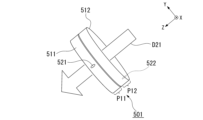
- FIG. 8 is a diagram showing a schematic configuration of a ring controller 501 according to the second embodiment.
- the ring type controller 501 includes two ring units 511 and 512 and two proximity sensors 521 and 522 .
- one proximity sensor 521 is provided in the ring portion 511, and these constitute a first ring device P11.
- the ring portion 512 is provided with one proximity sensor 522, which together constitute a second ring device P12.
- the first ring device P11 and the second ring device P12 are combined to form a ring type controller 501.
- the relative rotation angle of the two ring portions 511 and 512 can be changed, and thus the relative positions of the two ring portions 511 and 512 can be changed.
- the proximity sensor 521 is disposed at a predetermined position on the outer circumferential side surface of the ring portion 511 . Further, the proximity sensor 522 is disposed at a predetermined position on the outer circumferential side surface of the ring portion 512 . As an example, these two proximity sensors 521, 522 may be disposed in the same locations as the two proximity sensors 21, 22 according to the first embodiment. Each of the proximity sensors 521 and 522 has a function similar to that of the proximity sensors 21 and 22 shown in FIG.
- the ring controller 501 includes a control circuit having a similar configuration to the control circuit 211 shown in FIG. 3, for example.
- the control circuit or host computer (a device equivalent to host computer 212 shown in Figure 3) identifies the user's operation content based on the detection results of the two proximity sensors 521, 522, or the detection results of the two proximity sensors 521, 522 and the detection results of the IMU sensor (a sensor equivalent to IMU sensor 232 shown in Figure 3).
- the ring type controller 501 differs from the ring type controller 1 according to the first embodiment generally in that it does not include a positioning unit.
- the ring portion 511 and the ring portion 512 are not provided with a positioning portion, and the user places the ring-type controller 501 on a specified finger by referring to, for example, the positions of the proximity sensors 521, 522 provided on the ring portion 511 and the ring portion 512.
- the ring-type controller 501 can simplify operation for the user (human).
- the user can achieve a simple operation by, for example, bringing the finger wearing the ring-type controller 501 close to another finger.
- the user can achieve simple operations by, for example, bringing the finger wearing the ring controller 1 close to two or more other fingers.
- a program for implementing the functions of any of the components in any of the above-described devices may be recorded in a computer-readable recording medium, and the program may be read and executed by a computer system.
- the term "computer system” as used herein includes hardware such as an operating system or peripheral devices.
- the term "computer-readable recording medium” refers to portable media such as flexible disks, optical magnetic disks, ROMs, and CD (Compact Disc)-ROM (Read Only Memory), as well as storage devices such as hard disks built into computer systems.
- the term "computer-readable recording medium” also refers to storage devices that hold a program for a certain period of time, such as volatile memory inside a computer system that becomes a server or client when a program is transmitted via a network such as the Internet or a communication line such as a telephone line.
- the volatile memory may be, for example, a RAM (Random Access Memory).
- the recording medium may be, for example, a non-temporary recording medium.
- the above-mentioned program may be transmitted from a computer system in which the program is stored in a storage device or the like to another computer system via a transmission medium or by transmission waves in the transmission medium.
- the "transmission medium” that transmits the program refers to a medium that has a function of transmitting information, such as a network such as the Internet or a communication line such as a telephone line.
- the above program may be for implementing some of the above functions.
- the above program may be a so-called differential file that can implement the above functions in combination with a program already recorded in the computer system.
- the differential file may be called a differential program.
- each process in the embodiment may be realized by a processor that operates based on information such as a program, and a computer-readable recording medium that stores information such as the program.
- the functions of each part of the processor may be realized by individual hardware, or the functions of each part may be realized by integrated hardware.
- the processor may include hardware, and the hardware may include at least one of a circuit for processing digital signals and a circuit for processing analog signals.
- the processor may be configured using one or more circuit devices mounted on a circuit board, or one or both of one or more circuit elements.
- An IC (Integrated Circuit) or the like may be used as the circuit device, and a resistor or a capacitor may be used as the circuit element.
- the processor may be, for example, a CPU.
- the processor is not limited to a CPU, and various processors such as a GPU (Graphics Processing Unit) or a DSP (Digital Signal Processor) may be used.
- the processor may be, for example, a hardware circuit using an ASIC (Application Specific Integrated Circuit).
- the processor may be, for example, a plurality of CPUs, or a hardware circuit using a plurality of ASICs.
- the processor may be, for example, a combination of a plurality of CPUs and a hardware circuit using a plurality of ASICs.
- the processor may include, for example, one or more of an amplifier circuit or a filter circuit that processes analog signals.
- a first ring device having a first ring portion and a first proximity sensor provided on the first ring portion; a second ring device having a second ring section and a second proximity sensor provided on the second ring section and held by the first ring device so as to be movable relative to the first ring device; the first proximity sensor is disposed at a position capable of detecting a distance between a predetermined first finger on which the first ring portion and the second ring portion are worn and another second finger; the second proximity sensor is disposed at a position capable of detecting a distance between the first finger on which the first ring portion and the second ring portion are worn and another third finger, Ring controller.
- the user can easily perform operations by a combination of simple actions such as bringing the first finger and the second finger closer together, and bringing the first finger and the third finger closer together.
- the user's finger actions for example, it is possible to give various instructions by bringing the finger on which the ring controller is attached closer to another finger (for example, the thumb) or by pointing at a specific object with two fingers.
- the ring controller can be used in both the left and right hands.
- the first finger, the second finger, and the third finger may each be any finger.
- the ring controller may also be applicable to either or both of the right and left hands.
- the ring-type controller 1, 501 is an example of a ring-type controller
- the first ring devices P1, P11 are examples of a first ring device
- the second ring devices P2, P12 are examples of a second ring device
- the ring sections 11, 511 are examples of a first ring section
- the ring sections 12, 512 are examples of a second ring section
- the proximity sensors 21, 521 are examples of a first proximity sensor
- the proximity sensors 22, 522 are examples of a second proximity sensor
- the index finger F2 of the left hand H1 or the index finger of the right hand is an example of a first finger
- the middle finger F3 of the left hand H1 or the middle finger of the right hand is an example of a second finger
- the thumb F1 of the left hand H1 or the thumb of the right hand is an example of a third finger.
- the first ring device and the second ring device each include a moving part having a mechanism for moving along an outer periphery of the first ring device and the second ring device.
- a first inner circumference of the first ring device and a second inner circumference of the second ring device have the same shape; The first inner circumference and the second inner circumference are held so as to overlap with each other in a direction in which the first finger is inserted into the first ring device and the second ring device.
- the ring controller according to [Configuration Example 1] or [Configuration Example 2].
- the ring controller can be smoothly inserted into the finger.
- the user can easily perform operations with simple actions such as bringing adjacent first and second fingers closer to each other, and bringing adjacent first and third fingers closer to each other.
- the user can easily perform operations with a simple action such as bringing the index finger close to the adjacent finger (thumb or middle finger).
- the first ring device includes a first positioning portion and a second positioning portion that indicate a wearing position on the first finger
- the second ring device includes a third positioning portion and a fourth positioning portion that indicate a wearing position on the first finger
- a first insertion direction in which one of a left finger and a right finger is inserted is indicated
- a second insertion direction in which the other of the left and right fingers is inserted is indicated.
- the ring controller according to any one of [Configuration Example 1] to [Configuration Example 5].
- the ring controller can be worn on both the fingers of the left hand and the fingers of the right hand, and the convenience of wearing the controller can be improved according to, for example, the user's dominant hand, etc. Also, with the ring controller, the user can easily recognize how to wear the ring controller by referring to the positioning part.
- the positioning portion 31 and the positioning portion 51 of the ring portion 11 are examples of the first positioning portion and the second positioning portion
- the positioning portion 32 and the positioning portion 52 of the ring portion 12 are examples of the third positioning portion and the fourth positioning portion
- the direction D1 is an example of the first insertion direction
- the direction D2 is an example of the second insertion direction.
- the ring controller according to any one of [Configuration Example 1] to [Configuration Example 6], comprising:
- the IMU sensor 232 includes an acceleration sensor function and a gyro sensor function
- the microcomputer 237 is an example of a microcomputer
- the battery 234 is an example of a battery.
- the ring controller is capable of charging the battery and is also capable of transmitting and receiving data to and from an external device (eg, the host computer 212), for example.
- the charging connector 235 is an example of a charging connector
- the wireless module 233 is an example of a wireless module.
- the wireless communication system Q1 is an example of a wireless communication system.
Landscapes
- Engineering & Computer Science (AREA)
- General Engineering & Computer Science (AREA)
- Theoretical Computer Science (AREA)
- Human Computer Interaction (AREA)
- Physics & Mathematics (AREA)
- General Physics & Mathematics (AREA)
- Position Input By Displaying (AREA)
Priority Applications (2)
| Application Number | Priority Date | Filing Date | Title |
|---|---|---|---|
| JP2025534084A JPWO2025018372A1 (https=) | 2023-07-18 | 2024-07-18 | |
| CN202480047396.7A CN121532738A (zh) | 2023-07-18 | 2024-07-18 | 环型控制器及无线通信系统 |
Applications Claiming Priority (2)
| Application Number | Priority Date | Filing Date | Title |
|---|---|---|---|
| JP2023-117148 | 2023-07-18 | ||
| JP2023117148 | 2023-07-18 |
Publications (1)
| Publication Number | Publication Date |
|---|---|
| WO2025018372A1 true WO2025018372A1 (ja) | 2025-01-23 |
Family
ID=94282314
Family Applications (1)
| Application Number | Title | Priority Date | Filing Date |
|---|---|---|---|
| PCT/JP2024/025738 Pending WO2025018372A1 (ja) | 2023-07-18 | 2024-07-18 | リング型コントローラーおよび無線通信システム |
Country Status (3)
| Country | Link |
|---|---|
| JP (1) | JPWO2025018372A1 (https=) |
| CN (1) | CN121532738A (https=) |
| WO (1) | WO2025018372A1 (https=) |
Citations (8)
| Publication number | Priority date | Publication date | Assignee | Title |
|---|---|---|---|---|
| JP2010537302A (ja) * | 2007-08-19 | 2010-12-02 | リングボウ エルティディ. | 指に装着される装置とその使用方法 |
| JP2017527922A (ja) | 2014-09-17 | 2017-09-21 | マイクロソフト テクノロジー ライセンシング,エルエルシー | スマートリング |
| JP2019526864A (ja) * | 2017-06-29 | 2019-09-19 | アップル インコーポレイテッドApple Inc. | センサ及び触覚を用いた指装着デバイス 本出願は、2018年6月21日付出願の米国特許出願第16/015,043号、及び2017年6月29日付出願の米国仮特許出願第62/526,792号に対する優先権を主張するものであり、それらの全体が参照により本明細書に組み込まれる。 |
| US20210096657A1 (en) * | 2019-09-26 | 2021-04-01 | Apple Inc. | Ring input devices |
| US20220091683A1 (en) * | 2020-09-24 | 2022-03-24 | Apple Inc. | Ring input device with pressure-sensitive input |
| JP7078693B2 (ja) * | 2017-01-11 | 2022-05-31 | 株式会社ソニー・インタラクティブエンタテインメント | コントローラ |
| JP2022542845A (ja) * | 2019-07-31 | 2022-10-07 | サンブレイ テクノロジーズ ソシエダー リミターダ | 手装着データ入力装置 |
| WO2023286316A1 (ja) * | 2021-07-14 | 2023-01-19 | ソニーグループ株式会社 | 入力装置、システム、および制御方法 |
-
2024
- 2024-07-18 JP JP2025534084A patent/JPWO2025018372A1/ja active Pending
- 2024-07-18 WO PCT/JP2024/025738 patent/WO2025018372A1/ja active Pending
- 2024-07-18 CN CN202480047396.7A patent/CN121532738A/zh active Pending
Patent Citations (8)
| Publication number | Priority date | Publication date | Assignee | Title |
|---|---|---|---|---|
| JP2010537302A (ja) * | 2007-08-19 | 2010-12-02 | リングボウ エルティディ. | 指に装着される装置とその使用方法 |
| JP2017527922A (ja) | 2014-09-17 | 2017-09-21 | マイクロソフト テクノロジー ライセンシング,エルエルシー | スマートリング |
| JP7078693B2 (ja) * | 2017-01-11 | 2022-05-31 | 株式会社ソニー・インタラクティブエンタテインメント | コントローラ |
| JP2019526864A (ja) * | 2017-06-29 | 2019-09-19 | アップル インコーポレイテッドApple Inc. | センサ及び触覚を用いた指装着デバイス 本出願は、2018年6月21日付出願の米国特許出願第16/015,043号、及び2017年6月29日付出願の米国仮特許出願第62/526,792号に対する優先権を主張するものであり、それらの全体が参照により本明細書に組み込まれる。 |
| JP2022542845A (ja) * | 2019-07-31 | 2022-10-07 | サンブレイ テクノロジーズ ソシエダー リミターダ | 手装着データ入力装置 |
| US20210096657A1 (en) * | 2019-09-26 | 2021-04-01 | Apple Inc. | Ring input devices |
| US20220091683A1 (en) * | 2020-09-24 | 2022-03-24 | Apple Inc. | Ring input device with pressure-sensitive input |
| WO2023286316A1 (ja) * | 2021-07-14 | 2023-01-19 | ソニーグループ株式会社 | 入力装置、システム、および制御方法 |
Also Published As
| Publication number | Publication date |
|---|---|
| JPWO2025018372A1 (https=) | 2025-01-23 |
| CN121532738A (zh) | 2026-02-13 |
Similar Documents
| Publication | Publication Date | Title |
|---|---|---|
| US11009951B2 (en) | Wearable muscle interface systems, devices and methods that interact with content displayed on an electronic display | |
| US8570273B1 (en) | Input device configured to control a computing device | |
| US10534431B2 (en) | Tracking finger movements to generate inputs for computer systems | |
| CN104919391B (zh) | 计算接口系统 | |
| Weigel et al. | Deformwear: Deformation input on tiny wearable devices | |
| US20220155866A1 (en) | Ring device having an antenna, a touch pad, and/or a charging pad to control a computing device based on user motions | |
| US20240019938A1 (en) | Systems for detecting gestures performed within activation-threshold distances of artificial-reality objects to cause operations at physical electronic devices, and methods of use thereof | |
| US12422934B2 (en) | Techniques for neuromuscular-signal-based detection of in-air hand gestures for text production and modification, and systems, wearable devices, and methods for using these techniques | |
| US10766208B2 (en) | Electronic device and information processing method | |
| US20240272764A1 (en) | User interface elements for facilitating direct-touch and indirect hand interactions with a user interface presented within an artificial-reality environment, and systems and methods of use thereof | |
| WO2021207033A1 (en) | Input device to control a computing device with a touch pad having a curved surface configured to sense touch input | |
| CN117742505A (zh) | 用于手持式控制器的跟踪设备 | |
| US20260056620A1 (en) | Techniques for detection of in-air hand gestures for text modification, and systems, wearable devices, and methods for using these techniques | |
| WO2025018372A1 (ja) | リング型コントローラーおよび無線通信システム | |
| US12530526B2 (en) | Methods of utilizing reinforcement learning for enhanced text suggestions, and systems and devices therefor | |
| WO2025018377A1 (ja) | リング型コントローラーおよび無線通信システム | |
| EP4439246A1 (en) | Method for issuing an input to a computer from a head-mounted device | |
| US20250190057A1 (en) | Method and apparatus for user-defined gesture profile generation and gesture recognition, based on repeated motion of user | |
| US10809797B1 (en) | Calibration of multiple sensor modules related to an orientation of a user of the sensor modules | |
| Yeo et al. | WatchMI: applications of watch movement input on unmodified smartwatches | |
| US12455639B2 (en) | Stylus with attachment detection | |
| KR20220131658A (ko) | 기계 학습에 기반하여 호스트 장치를 제어하기 위한 모션 신호를 결정하는 웨어러블 디바이스 | |
| Parizi | Towards Subtle and Continuously Available Input Devices for the Modern Wearable Devices | |
| KR102901144B1 (ko) | 카메라 기반 관절 움직임 트래킹과 센서에 기반한 모션 트래킹 방법 및 시스템 | |
| US20260050325A1 (en) | Ultrasound-enabled rings configured for interacting with other devices and systems |
Legal Events
| Date | Code | Title | Description |
|---|---|---|---|
| 121 | Ep: the epo has been informed by wipo that ep was designated in this application |
Ref document number: 24843161 Country of ref document: EP Kind code of ref document: A1 |
|
| ENP | Entry into the national phase |
Ref document number: 2025534084 Country of ref document: JP Kind code of ref document: A |
|
| WWE | Wipo information: entry into national phase |
Ref document number: 2025534084 Country of ref document: JP |
|
| WWE | Wipo information: entry into national phase |
Ref document number: 2024843161 Country of ref document: EP |
|
| NENP | Non-entry into the national phase |
Ref country code: DE |