WO2025018328A1 - 情報処理システム、情報処理方法及びプログラム - Google Patents
情報処理システム、情報処理方法及びプログラム Download PDFInfo
- Publication number
- WO2025018328A1 WO2025018328A1 PCT/JP2024/025452 JP2024025452W WO2025018328A1 WO 2025018328 A1 WO2025018328 A1 WO 2025018328A1 JP 2024025452 W JP2024025452 W JP 2024025452W WO 2025018328 A1 WO2025018328 A1 WO 2025018328A1
- Authority
- WO
- WIPO (PCT)
- Prior art keywords
- data
- transmission data
- type electronic
- electronic device
- transmission
- Prior art date
- Legal status (The legal status is an assumption and is not a legal conclusion. Google has not performed a legal analysis and makes no representation as to the accuracy of the status listed.)
- Pending
Links
Images


Classifications
-
- H—ELECTRICITY
- H04—ELECTRIC COMMUNICATION TECHNIQUE
- H04L—TRANSMISSION OF DIGITAL INFORMATION, e.g. TELEGRAPHIC COMMUNICATION
- H04L9/00—Cryptographic mechanisms or cryptographic arrangements for secret or secure communications; Network security protocols
- H04L9/32—Cryptographic mechanisms or cryptographic arrangements for secret or secure communications; Network security protocols including means for verifying the identity or authority of a user of the system or for message authentication, e.g. authorization, entity authentication, data integrity or data verification, non-repudiation, key authentication or verification of credentials
-
- H—ELECTRICITY
- H04—ELECTRIC COMMUNICATION TECHNIQUE
- H04W—WIRELESS COMMUNICATION NETWORKS
- H04W12/00—Security arrangements; Authentication; Protecting privacy or anonymity
- H04W12/03—Protecting confidentiality, e.g. by encryption
-
- H—ELECTRICITY
- H04—ELECTRIC COMMUNICATION TECHNIQUE
- H04W—WIRELESS COMMUNICATION NETWORKS
- H04W84/00—Network topologies
- H04W84/02—Hierarchically pre-organised networks, e.g. paging networks, cellular networks, WLAN [Wireless Local Area Network] or WLL [Wireless Local Loop]
- H04W84/10—Small scale networks; Flat hierarchical networks
-
- H—ELECTRICITY
- H04—ELECTRIC COMMUNICATION TECHNIQUE
- H04W—WIRELESS COMMUNICATION NETWORKS
- H04W84/00—Network topologies
- H04W84/18—Self-organising networks, e.g. ad-hoc networks or sensor networks
Definitions
- the present invention relates to an information processing system, an information processing method, and a program.
- the present invention was made in light of these circumstances, and aims to realize wireless communication within a factory while minimizing the number of channels, strengthening the security of data transmission, reducing and simplifying data transmission cables within the factory, and enabling safe data sharing with the outside world.
- an information processing system comprises: a first type electronic device having at least a transmission function for transmitting transmission data in accordance with a predetermined wireless communication system; a second type electronic device having at least a receiving function for receiving the transmission data in accordance with the predetermined wireless communication method and including a storage medium for storing the transmission data;
- An information processing system comprising: The first type electronic device is a target data acquisition and processing means for acquiring target data to be transmitted, or acquiring original data of the target data and processing the original data to generate the target data; a transmission data generating means for generating the transmission data for each predetermined unit based on the target data; a transmission data transmission control means for executing control for transmitting the transmission data to the second type electronic device in accordance with the predetermined wireless communication method; Equipped with The second type electronic device is a transmission data reception control means for executing control for receiving the transmission data in accordance with the predetermined wireless communication system; a validity confirmation means for confirming the validity of the received transmission data;
- An information processing method and program according to one aspect of the present invention is an information processing method and program corresponding to the information processing system according to one aspect of the present invention described above.
- the present invention makes it possible to provide an information processing system that realizes wireless communication within a factory while minimizing the number of channels, strengthening the security of data transmission, reducing and simplifying data transmission cables within the factory, and enabling safe data sharing with the outside world.
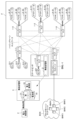
- FIG. 1 is a block diagram showing an example of the overall configuration of an information processing system according to an embodiment of the present invention
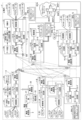
- FIG. 2 is a block diagram showing an example of the overall configuration of an information processing system according to an embodiment of the invention, which is different from that shown in FIG. 1, and is a diagram illustrating the operation of the information processing system.
- This is a diagram showing the functional configuration of the hash chain chips present in the information processing system shown in Figure 1 or Figure 2, distinguishing them into transmitting hash chain chips with a transmitting function and receiving hash chain chips with a receiving function.
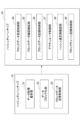
- 4 is a diagram showing a specific example of a structure of data transmitted in an information processing system having the functional configuration of FIG. 3;
- FIG. 3 is a block diagram showing an example of the overall configuration of an information processing system according to an embodiment of the present invention
- FIG. 2 is a block diagram showing an example of the overall configuration of an information processing system according to an embodiment of the invention, which is different from that shown in FIG. 1, and is a diagram illustrating the operation of
- FIG. 3 is a block diagram showing the connection between a hash chain network and a blockchain network in the information processing system of FIG. 1 or FIG.
- FIG. 2 is a diagram illustrating an example of a communication protocol in the information processing system according to one embodiment of the present invention.
- 1 is a diagram showing a data transmission structure in an information processing system according to an embodiment of the present invention;
- FIG. 1 is a diagram showing the overall configuration of an information processing system according to an embodiment of the present invention.
- the information processing system shown in FIG. 1 is a system that exists within a factory, and is configured by hash chain chips 1-1 to 1-6 that are interconnected via a network of a specified wireless communication method (hereinafter referred to as the "hash chain network").
- the hash chain chips 1-1 through 1-6 including those shown in FIG. 2 and subsequent figures
- the hash chain chip 1 has at least one of a transmission function for transmitting transmission data according to a specified wireless communication method and a reception function for receiving transmission data according to the specified wireless communication method.
- the specified wireless communication method is not particularly limited, but in the example of FIG. 1, a Bluetooth (registered trademark) wireless mesh method with 1:N flooding function is adopted.
- the wireless mesh is one network and has only one channel. Therefore, it has the effect of being able to efficiently connect a large number of devices (hash chain chip 1 in this embodiment).
- hash chain chip 1-1 has a transmission function (corresponding to transmitting hash chain chip 1S in FIG. 5 described below) and obtains detection signals from connected sensors S11 to S13 as target data to be transmitted, or obtains the detection signals as original data for the target data and then processes them to turn them into target data.
- Hash chain chip 1-1 generates transmission data for each block (described below) from the target data.
- Hash chain chip 1-1 broadcasts the transmission data for each block to the hash chain network.
- Sensors S11 to S13 are elements that collect information about a certain object and convert it into a signal (detection signal) that can be handled by a machine, such as various sensors that output digitized data such as temperature, humidity, pressure, current, voltage, etc., or non-numerical data such as image data and audio data to the outside as a detection signal.
- a detection signal digitized data
- sensors S11 to S13 including those in FIG. 2 and subsequent figures described below
- the hash chain chip 1-2 has a transmission function, and uses a detection signal from the built-in sensor S21 as target data, generates transmission data for each block unit described below from the target data, and transmits it by broadcast to the hash chain network.
- the hash chain chip 1-2 is configured as a smart sensor incorporating the sensor 21.
- the hash chain chip 1 - 2 has a built-in wireless power supply unit 3 and is driven by power supplied wirelessly from an external power transmission unit 2 .
- the external power transmission unit 2 wirelessly transmits microwaves as power, for example.
- the wireless power supply unit 3 has an antenna unit 31, a battery/cell unit 32, and a power control unit 33 in order to supply power for driving the hash chain chip 1-2.
- the antenna unit 31 receives power supplied wirelessly as microwaves from the external power transmission unit 2 .
- the battery/cell section 32 stores the power received by the antenna section 31 .
- the power control unit 33 obtains power from the antenna unit 31 and the battery/cell unit 32, and supplies the power to, for example, the driving units of the hash chain chip 1-2.
- the hash chain chip 1-3 has transmitting and receiving functions, and sends and receives transmission data in block units sent and received within the factory to another network, the blockchain network BCN. For this reason, the hash chain chip 1-3 has the function of connecting via the blockchain light node BNL-1 of the blockchain network BCN. In addition, the hash chain chips 1-3 may have the function of connecting to any of the blockchain full nodes BNF1 to BNF4, or to a blockchain ultra-light node not shown.
- the blockchain network BCN is a distributed network that manages the "blockchain.”
- a “blockchain” is a series of data linked like a chain of “blocks,” each of which contains various information (such as the data itself, metadata, and data related to verifying soundness, such as hash values) about one or more pieces of data (for example, data based on measurements by a sensor S or data of device control instructions).
- the blockchain network BCN is composed of multiple nodes, and at least one node exists on the cloud.
- each of the four blockchain full nodes BNF1 to BNF4 functions as a full node on the cloud.
- a "full node” is an information processing device (node) that provides all functions of a node in a blockchain, such as a calculation processing function related to block generation and a storage function for the blockchain data itself.
- the blockchain full nodes BNF1 to BNF4 form a blockchain network BCN that communicates with each other.
- a blockchain light node BNL-1 connected to hash chain chip 1-3 is in operation.
- a “blockchain light node” or a “blockchain ultra-light node” is a node that does not function as a full node, but is responsible for part of the computational processing function related to block generation and the storage function of the blockchain data itself, or an information processing device (node) that does not provide computational processing function related to block generation or storage function of the blockchain data itself, but provides very limited functions such as the function of sending and receiving data with the blockchain network BCN.
- a blockchain light node or blockchain ultra-light node requires few computational resources, etc. to be realized, so it is implemented as part or all of a chip or program that provides the above-mentioned functions. However, it may also be implemented as a separate information processing device.
- the blockchain light node BNL-1 connected to the hash chain chip 1-3 communicates with the blockchain network BCN by connecting to the cloud via a dedicated line.
- hash chain chips 1 that have the function of connecting to a blockchain (the function of connecting to a blockchain light node). Specific examples of these patterns will be described later with reference to Figure 5.
- the hash chain chip 1-4 has a receiving function for receiving transmission data (corresponding to the receiving hash chain chip 1R in Figure 4 described below), and receives transmission data in block units transmitted from the hash chain chip 1 (for example, the hash chain chip 1-1) which has a transmitting function.
- the hash chain chip 1-4 checks the validity of the received transmission data for each block.
- the hash chain chip 1-4 stores the transmission data for each block unit whose validity has been confirmed in a built-in memory unit, and provides the actuators A41 to A43 with control data based on the transmission data for each block unit, thereby controlling the actuators A41 to A43.
- the hash chain chip 1-4 can control the actuators A41 to A43 using an ON/OFF control function at a TTL (Transistor-Transistor Logic) level.
- Actuators A41 to A43 operate in accordance with the control data.
- actuator A When there is no need to distinguish between individual actuators A41 to A43 (including those in Figure 2 and subsequent figures), they will be collectively referred to as "actuator A.”
- Actuator A is a driving device that moves equipment in a desired manner.
- Actuator A provides various motions, such as linear motion, rotational motion, etc., using electricity, hydraulics, pneumatics, etc.
- Actuator A operates industrial machines, for example, in a factory.
- Hash chain chip 1-5 has the same functions as hash chain chip 1-4 (including receiving functions) and performs control over actuators A51 to A53.
- Hash chain chip 1-6 has the same functions as hash chain chip 1-4 (including receiving functions) and performs control over actuators A61 to A63.
- the hash chain chips 1 are connected to each other, for example, in a hash chain network in a local area in a factory. This allows the hash chain chips 1 to transmit and receive transmission data in accordance with a wireless method that can be performed on one channel. As a result, by applying an information processing system (one embodiment of an information processing system to which the present invention is applied) to which multiple hash chain chips 1 are connected, it becomes possible to efficiently connect a large number of devices (for example, sensors S and actuators A) in a factory.
- an information processing system one embodiment of an information processing system to which the present invention is applied
- the hash chain chip 1 having a transmission function generates transmission data for each block unit from transmission data such as a detection signal from the sensor S, and transmits it wirelessly using a predetermined wireless communication method (wireless mesh method in the example of FIG. 1).
- the hash chain chip 1 having a receiving function receives the transmission data for each block unit transmitted wirelessly, and controls the actuator A based on the transmission data. In this way, the transmission data for each block unit accompanied by a hash value is transmitted from the sensor S to the actuator A with high security.
- the transmission data for each block unit is transmitted to the block chain network BCN and stored, making it possible to safely share it with the outside by the block chain.
- the transmission cables within a factory are made wireless, and a simple control system is realized.
- FIG. 2 is a block diagram showing an example of the overall configuration of an information processing system according to one embodiment of the invention, which is different from that shown in FIG. 1, and explains the operation of the information processing system.
- the information processing system in the example of Figure 2 is a system that exists within a factory, similar to the example of Figure 1, and is configured by hash chain chips 1-A to 1-G being interconnected via a predetermined wireless communication method (the example of Figure 2 is a network similar to the example of Figure 1 (hereinafter referred to as a "hash chain network”)).
- the hash chain chip 1-A has a transmission function (corresponding to the transmission hash chain chip 1S in FIG. 5 described later) and obtains detection signals from the connected sensors S-A1 to S1-A3 as target data, or obtains the detection signals as the original data of the target data and then processes them to make them into target data.
- the hash chain chip 1-A generates transmission data for each block unit described later from the target data.
- the hash chain chip 1-A broadcasts the transmission data for each block unit to the hash chain network.
- the hash chain chip 1-A is driven by power supplied from the wireless power supply unit 3, similar to the hash chain chip 1-2 in FIG.
- the hash chain chip 1-A has a control unit 11-A, a hash chain transmission unit 12-A, and a wireless communication unit 14-A.
- the control unit 11-A obtains detection data from the sensors S-A1 to S-A3 as target data, or obtains the data as original data and processes the original data (e.g., shaping the data format and data length, etc.) to obtain target data.
- the hash chain transmission unit 12-A generates transmission data based on the hash value for each block from the target data, and then encrypts and signs the data. Note that encryption and signing are not essential.
- the wireless communication unit 14-A transmits transmission data (encrypted data) for each block to the hash chain according to a specified wireless communication method.
- a wireless mesh method is used as the specified wireless communication method, so there is one channel, and the wireless communication unit 14-A transmits (broadcasts) the transmission data (encrypted data) for each block to all hash chain chips 1.
- Hash chain chip 1-B has a built-in sensor S-B1 and has the same functions as hash chain chip 1-A.
- hash chain chip 1-B is configured as a smart sensor like hash chain chip 1-2 in Figure 1, making it possible to provide a smaller system with fewer cables.
- the hash chain chip 1-C has a hash chain transmission unit 12-C and a wireless communication unit 14-C. That is, the control unit 11-C is provided outside the hash chain chip 1-C, and acquires detection data from the external sensors S-C1 to S-C3 as target data, or acquires the detection data as original data and processes the original data (for example, shaping the data format and data length, etc.) to convert it into target data.
- the hash chain transmission unit 12-C has the same function as the hash chain transmission unit 12-A, and generates transmission data based on a hash value for each block unit from the target data, and further encrypts and signs the data. Note that encryption and signing are not essential.
- the wireless communication unit 14-C has the same function as the wireless communication unit 14-A, and transmits transmission data (encrypted data) in block units to the hash chain in accordance with a predetermined wireless communication method.
- the hash chain chip 1-D has a receiving function (corresponding to the receiving hash chain chip 1R in Figure 4 described below) and includes a wireless communication unit 14-D, a hash chain receiving unit 13-D, a control unit 11-D, and a data hash recording unit 15-D.
- the wireless communication unit 14-D receives transmission data (encrypted data) in block units transmitted from a hash chain chip 1 having a transmission function (for example, the hash chain chip 1-A).
- the hash chain receiving unit 13-D verifies the signature of the transmission data for each block unit, decrypts it, and confirms the validity. Since a signature is not required, signature verification is not required either. Furthermore, since encryption is not required, decryption is also not required.
- the control unit 11-D checks the decoded transmission data for each block, and controls the actuators A-D1 to A-D3 by executing commands to the actuators A-D1 to A-D3 based on the transmission data.
- the data and hash recording unit 15-D records the transmission data and the hash value for each block. The relationship between the transmission data for each block and the hash value will be described later with reference to FIG.
- the data hash recording unit 15-D is connected to the blockchain light node BNL-D by wire or wirelessly.
- the blockchain light node BNL-D is connected to the blockchain full node BNF-4 of the blockchain network BCN. If the hash values of the hash value group stored in the data hash recording unit 15-D are the same, the hash value is recorded in the blockchain network BCN together with the transmission data for each block unit.
- the hash chain chip 1-E has a wireless communication unit 14-E, a hash chain receiving unit 13-E, a control unit 11-E, and a data hash recording unit 15-E. That is, the hash chain chip 1-E has the same functions as the hash chain chip 1-D, and controls the actuator A-E1.
- hash chain chip 1-E compared to hash chain chip 1-D, hash chain chip 1-E has an actuator A-E1 built in (having a configuration similar to that of a smart sensor), making the overall system configuration smaller and simpler.
- the hash chain chip 1-F like the hash chain chip 1-3 in the example of Figure 1, has transmitting and receiving functions, and transmits and receives transmission data in block units sent and received within the factory to another network, the blockchain network BCN. For this reason, the hash chain chip 1-F has a wireless communication unit 14-F, a hash chain receiving unit 13-F, and a data hash recording unit 15-F. The data hash recording unit 15-F is connected to the blockchain light node BNL-F.
- the hash chain chip 1-F does not have a control unit 11 or an actuator A.
- the hash chain chip 1-F records the hash value along with the transmission data for each block unit in the block chain network BCN.
- the hash chain chip 1-F records the transmission data and hash value for each block unit in the block chain network BCN, and can be said to have a function limited to improving the security of data transmission.
- the hash chain chip 1-G has both the functions of the hash chain chip 1-A and the functions of the hash chain chip 1-D. For this reason, the hash chain chip 1-G has a control unit 11-G connected to the sensor S-G1, a control unit 11-G connected to the actuators A-G1 and A-G2, a hash chain transmitting unit 12-G, a hash chain receiving unit 13-G, a wireless communication unit 14-G, and a data hash recording unit 15-G connected to the blockchain light node BNL-G.
- the unique information and the private key/public key are held in advance in the hash chain transmission unit 12 and the hash chain reception unit 13, and the public keys are each pre-recorded in the block chain network BCN.
- RSA Rivest Shamir Adleman
- AES Advanced Encryption Standard
- the public keys of each element hash chain transmission unit 12 and hash chain reception unit 13) in the hash chain network are downloaded from the blockchain network BCN, encrypted and signed, and then transmitted.
- the common key is updated periodically.
- the encryption method is not particularly limited to a method using a common key, and various encryption methods can be adopted. Furthermore, encryption is not required.
- step S1 the control unit 11-A of the hash chain chip 1A acquires detection data from the sensors S-A1 to S-A3 as original data, and processes the original data (for example, shaping the data format, data length, etc.) to generate target data.
- the original data for example, shaping the data format, data length, etc.
- step S2 the hash chain transmission unit 12-A calculates a hash value of the previous block (previously transmitted data for each block unit) based on the target data, and a hash value of the unique information and data combined.
- the hash chain transmission unit 12-A generates a current block (currently transmitted data for each block unit) by adding the calculated hash value to the end of the block as the current one (in this example, the hash value of the previous block is also added to the front of the block).
- the hash chain transmission unit 12-A encrypts the current transmitted data for each block unit according to a predetermined encryption method and signs it. Note that encryption and signing are not essential. The specific method for generating transmission data for each block in step S2 will be described later with reference to FIG.
- step S3 the wireless communication unit 14-A wirelessly broadcasts the encrypted transmission data in blocks.
- step S4 the encrypted current transmission data in block units is received by the wireless communication unit 14-D of the hash chain chip 1-D, which has the hash chain receiving unit 13-D, via the hash chain network.
- the wireless communication unit 14-D receives the encrypted current transmission data in block units.
- step S5 the hash chain receiving unit 13-D verifies the signature of the encrypted currently transmitted data for each block, and then decrypts the data.
- the hash chain receiving unit 13-D acquires the hash value of the previously transmitted data for each block unit (hereinafter referred to as the "previously stored previous hash value"), which is stored as the latest hash value in the data hash recording unit 15-D.
- the hash chain receiving unit 13-D confirms whether the hash value of the previous transmission data (first association information HD2 in Figure 4 described below) contained in the current transmission data for each block (for example, transmission data B2 in Figure 4 described below) is identical to the previous hash value stored last time (the hash value of transmission data B1 in Figure 4 described below, which is the value of second association information FT1 of transmission data B1).
- the hash chain receiving unit 13-D recalculates the hash value of the current transmission data (hereinafter referred to as the ⁇ current hash value'') from the current transmission data (for example, transmission data B2 in Figure 4 described below) for each block unit, combining the hash value of the previous transmission data for each block unit (hereinafter referred to as the ⁇ current recalculated previous hash value'', for example, the first association information HD2 in Figure 4 described below), the current actual data (for example, data block BD2 in Figure 4 described below), and the unique information.
- the ⁇ current hash value'' the hash value of the current transmission data
- the ⁇ current hash value'' combining the hash value of the previous transmission data for each block unit (hereinafter referred to as the ⁇ current recalculated previous hash value'', for example, the first association information HD2 in Figure 4 described below), the current actual data (for example, data block BD2 in Figure 4 described below), and the unique information.
- the hash chain receiving unit 13-D verifies whether the current hash value included in the current transmission data for each block unit (for example, the value of the second association information FT2 in Figure 4 described below) is the same as the current hash value obtained by recalculation.
- These confirmations and verifications of identity are examples of validation. If they are identical, it is guaranteed that the current transmission data in block units and the previous transmission data in block units are consecutive data from the transmitting hash chain chip 1S having unique information (i.e., the validity of the data), and it can be proven that they are not counterfeit data created by hacking or the like.
- step S6 the hash chain chip 1-D stores the current transmission data for each block whose validity has been confirmed in the data hash recording unit 15-D together with the current hash value (the most recent hash value), and also broadcasts it to the other data hash recording units 15 so that all data hash recording units 15 in the system have the same data.
- step S7 the control unit 11-D connected to the actuators A-D1 to A-D3 controls the actuators A-D1 to A-D3 by executing commands to the actuators A-D1 to A-D3 using information based on the current transmission data for each decoded block unit.
- step S8 the data hash recording unit 15-D checks at a predetermined timing whether the hash values recorded in the data hash recording units 15 of the multiple receiving hash chain chips 1R, including itself, match. For example, the data hash recording unit 15-D calculates a hash value of a group of hash values stored during a certain period of time, and checks whether the value is the same in all the data hash recording units 15.
- an archive device dedicated to recording hash values may be prepared in advance. In this case, it is preferable to provide three or more archive devices per hash chain network. The archive device may store information from all hash chain chips 1.
- step S9 if the data and hash recording unit 15-D confirms that the hash values match in step S8, it executes control to store the transmission data and hash values for each block in the blockchain network BCN.
- Figure 3 shows the functional configuration of the hash chain chips present in the information processing system shown in Figure 1 or Figure 2, with a distinction between transmitting hash chain chips with a transmitting function and receiving hash chain chips with a receiving function.
- the transmitting hash chain chip 1S has a transmitting function for transmitting transmission data according to a predetermined wireless communication method (for example, a wireless mesh method in the examples of Figures 1 and 2).
- a predetermined wireless communication method for example, a wireless mesh method in the examples of Figures 1 and 2.
- the hash chain chip 1-1 in Figure 1 and the hash chain chip 1-A in Figure 2 are examples of the transmitting hash chain chip 1S.
- a data acquisition and formatting unit 51 acquires target data to be transmitted (e.g., detection signals from sensors S-A1 to S-A3 connected to the hash chain chip 1-A in Figure 2), or acquires original data of the target data and processes the original data to generate the target data.
- the data blocking unit 52 generates transmission data for each predetermined unit (for example, in this embodiment, the predetermined unit is a block) based on the target data.
- the block data transmission control unit 53 executes control to transmit transmission data in predetermined units to the receiving hash chain chip 1R in accordance with a predetermined wireless communication method.
- FIG. 4 is a diagram showing a specific example of the structure of transmission data for each predetermined unit transmitted between the transmitting hash chain chip and the receiving hash chain chip of FIG.
- the data blocking unit 52 repeats a process of generating data (data blocks BD1 to BD3 in the example of FIG. 4) for each predetermined unit (here, block unit) based on the target data.
- the data blocking unit 52 generates the currently generated unit of data to be processed as first unit data (e.g., data block BD2 in FIG. 4), the previously generated unit of data as second unit data (e.g., data block BD1 in FIG. 4), and generates information including at least a hash value obtained from the second unit data as first association information (e.g., first association information HD2 in FIG. 4), and adds the first association information to the first unit data to be processed.
- first unit data e.g., data block BD2 in FIG. 4
- second unit data e.g., data block BD1 in FIG. 4
- first association information e.g., first association information HD2 in FIG. 4
- the data blocking unit 52 generates information including at least a hash value obtained from the first unit data as second association information (e.g., second association information FT2 in Figure 4), and adds the second association information to the first unit data to be processed.
- second association information e.g., second association information FT2 in Figure 4
- the receiving hash chain chip 1R has a receiving function for receiving transmission data according to a specified wireless communication method, and includes a storage medium (data hash recording unit 15 in FIG. 2) for storing the transmission data.
- a storage medium data hash recording unit 15 in FIG. 2 for storing the transmission data.
- the hash chain chip 1-4 in FIG. 1 and the hash chain chip 1-D in FIG. 2 are examples of the receiving hash chain chip 1R.
- a block data receiving control unit 54 executes control to receive transmission data in predetermined units according to a predetermined wireless communication method (for example, a wireless mesh method in the examples of FIGS. 1 and 2).
- the block data verification unit 55 verifies the validity of the received transmission data.
- the block data reception control unit 54 executes control to receive the p-th transmission data (for example, the transmission data B2 in FIG. 4).
- the block data confirmation verification unit 55 confirms that the (p-1)th hash value obtained from the first association information (e.g., the first association information HD2 in Figure 4) of the pth transmission data (e.g., the transmission data B2 in Figure 4) matches the (p-1)th hash value (e.g., the hash value FT1 of the transmission data B1 in Figure 4) stored in the storage medium (e.g., the data hash recording unit 15 in Figure 2). Furthermore, the block data checking and verifying unit 55 recalculates the pth hash value based on the (p-1)th hash value obtained from the first association information (e.g., the first association information HD2 in FIG.
- the first association information e.g., the first association information HD2 in Figure 4
- the block data checking and verifying unit 55 verifies that the recalculated pth hash value matches the pth hash value obtained from the second association information (e.g., the second association information FT2 in FIG. 4) in the pth transmission data (e.g., the transmission data B2 in FIG. 4).
- the block data checking and verifying unit 55 checks the validity of the p-th transmission data (eg, transmission data B2 in FIG. 4) through these two checks.
- the block data recording control unit 56 executes control to store the p-th transmission data, whose validity has been confirmed, in a storage medium (e.g., the data hash recording unit 15 in FIG. 2) together with the second association information of the p-th transmission data (e.g., the hash value FT2 of the transmission data B2 in FIG. 4).
- a storage medium e.g., the data hash recording unit 15 in FIG. 2
- the second association information of the p-th transmission data e.g., the hash value FT2 of the transmission data B2 in FIG. 4
- an actuator control unit 57 controls the receiving hash chain chip 1R. Furthermore, in the receiving hash chain chip 1R, an actuator control unit 57, a hash value periodic verification unit 58, and a block chain record control unit 59 function.
- the actuator control unit 57 provides control data to actuator A (e.g., actuators A41 to A43 in FIG. 1).
- actuator A operates in accordance with the control data.
- the hash value periodic confirmation unit 58 confirms at a specified timing that the pth hash value stored in each of the receiving hash chain chips 1R, including itself, matches.
- an archive device (not shown in FIG. 1) dedicated to recording the hash value and the transmission data for each block. It is preferable that information from all hash chain chips 1 is recorded in the archive device. It is preferable to provide three or more archive devices for one hash chain network.
- the blockchain recording control unit 59 confirms that the pth hash value (e.g., the second association information FT2 in FIG. 4) stored in each data hash recording unit 15 of the receiving hash chain chip 1R matches, it executes control to store the pth hash value in another blockchain network BCN.
- the pth hash value e.g., the second association information FT2 in FIG. 4
- Figure 5 shows various patterns of hash chain chips that have the function of connecting to the blockchain network shown in Figure 1 or Figure 2 (the function of connecting to a blockchain full node).
- hash chain master is the hash chain chip 1, which has master functionality.
- the hash chain chip 1 with master functionality sends and receives transmission data, etc., in block units with the blockchain network BCN through the blockchain light node BNL.
- the hash chain chip 1 marked as hash chain slave generates transmission data in block units from target data based on the detection signal from the sensor S, and sends the transmission data in block units to the hash chain chip 1 with master functionality.
- the hash chain chip 1-m1 is integrated with a blockchain light node BNL-m1, a control unit 11-m1, and actuators A-m11 and A-m12.
- the hash chain chip 1-m1 receives transmission data in block units from the hash chain chips 1-SL1 and 1-SL2.
- the blockchain light node BNL-m1 is connected to the blockchain network BCN and transmits and receives transmission data, etc. in block units with the blockchain network BCN.
- the control unit 11-m1 provides control data to the actuators A-m11 and A-m12 based on the transmission data in block units.
- the actuators A-m11 and A-m12 operate in accordance with the control data.
- Hash chain chip 1-m2 is an example of hash chain chip 1 functioning alone.
- the hash chain chip 1-m2 receives transmission data in block units from the hash chain chips 1-SL1 through 1-SL3.
- the hash chain chip 1-m2 transmits transmission data, etc. in block units to the blockchain light node BNL-m2.
- the blockchain light node BNL-m2 is connected to the blockchain network BCN and transmits and receives transmission data for each block with the blockchain network BCN.
- the blockchain light node BNL-m2 is preferably installed in the factory F. This makes it easy to perform maintenance on related equipment.
- the hash chain chip 1-m3 is integrated with a control unit 11-m3.
- the hash chain chip 1-m3 receives transmission data in block units from the hash chain chips 1-SL2 through 1-SL4.
- the hash chain chip 1-m3 transmits and receives transmission data, etc. in block units with the blockchain light node BNL-m3.
- the blockchain light node BNL-m3 is connected to the blockchain network BCN and transmits and receives transmission data, etc. in block units with the blockchain network BCN.
- the control unit 11-m3 provides control data to the actuators A-m31 and A-m32.
- the actuators A-m31 and A-m32 operate in accordance with the control data.
- the hash chain chip 1-m4 is integrated with the blockchain light node BNL-m4.
- the hash chain chip 1-m4 receives transmission data in block units from the hash chain chips 1-SL4 through 1-SL6.
- the hash chain chip 1-m4 sends and receives transmission data, etc. in block units with the blockchain light node BNL-m4.
- the blockchain light node BNL-m4 is connected to the blockchain network BCN and transmits and receives transmission data, etc. in block units with the blockchain network BCN.
- the hash chain chip 1-m1 having the hash chain master in FIG. 5 has at least one of a transmission function and a reception function for transmission data in block units.
- the hash chain chip 1-m1 has a network connection function for connecting to a blockchain network BCN, which is another network that uses blockchain or distributed ledger technology.
- a hash chain chip 1 may be provided separately from the transmitting hash chain chip 1S having a transmission function for transmission data in block units and the receiving hash chain chip 1R having a reception function for transmission data in block units, or may be used in conjunction with the transmitting hash chain chip 1S having a transmission function for transmission data in block units or the receiving hash chain chip 1R having a reception function for transmission data in block units.
- the blockchain light node BNL is installed, for example, in a factory F. This enables power to be supplied via wireless power supply (not shown in FIG. 5), and enables transmission of transmission data in block units to the blockchain node in the factory, making it possible to build a mechanism for safely sharing transmission data in block units with the outside world.
- the wireless method for wirelessly sending and receiving transmission data is not particularly limited to the wireless mesh method of the above embodiment, and may be, for example, a method conforming to the protocol shown in Fig. 6.
- FIG. 6 is a diagram showing an example of a wireless communication method applicable to the information processing system according to an embodiment of the present invention, which is different from the example of the wireless mesh of Bluetooth (registered trademark) shown in FIGS. 1 and 2.
- the transmission data for each block having a hash value portion is encrypted before transmission, although encryption is not essential.
- the protocol will be explained by focusing on the first slave (the slave designated with the reference number 1 in FIG. 6), the second slave (the slave designated with the reference number 2 in FIG. 6), and the master.
- application of this protocol is not particularly limited to the example in Fig. 6.
- slave:master N:M (N and M are any integers independent of each other).
- a device does not have to function as either a slave or a master as in the example in Fig. 6, and a device that can be either a slave or a master may be applied.
- the protocol shown in FIG. 6 is applied to the hash chain network in FIG. 2, the first slave corresponds, for example, to hash chain chip 1-A in FIG. 2, the second slave corresponds, for example, to hash chain chip 1-B in FIG. 2, and the master corresponds, for example, to hash chain chip 1-G in FIG. 2.
- the following explanation is limited to the case where the first slave (hash chain chip 1-A) sends transmission data in block units to the master (hash chain chip 1-G).
- the protocol shown in Figure 6 specifies that a series of processing steps, S21 to S25, be executed.
- step S21 when the first slave requests the master to transmit text, it transmits an ENQ (Enquiry) signal as an inquiry signal to the master.
- step S22 upon receiving the ENQ signal, the master transmits an ACK (Acknowledge) signal to the first slave as an acknowledgement signal for the first slave.
- step S23 the master transmits a DLE (Data Link Escape) signal as a data link escape signal to all slaves. This DLE signal indicates that the following data is a control signal.
- the slaves that receive the DLE signal enter a transmission standby (idling) state. However, the first slave that receives an ACK signal in response to the ENQ signal ignores the DLE signal and does not enter an idling state.
- step S24 the first slave transmits text (for example, transmission data in units of blocks).
- step S25 upon receiving the text (for example, transmission data in units of blocks), the master transmits an ACK signal to the first slave.
- the destination of the DLE signal may be not only the first slave but also another slave (the second slave in the example of FIG. 6).
- the protocol may specify that the order of steps S22 and S23 is reversed.
- the first slave sends a text transmission request to the master as an ENQ signal.
- the master sends a DLE signal to all slaves other than the first slave.
- the slaves that receive the DLE signal go into a transmission standby (idling) state.
- the master receives the ENQ signal, it sends an ACK signal to the first slave.
- the first slave that receives an ACK signal in response to the ENQ signal ignores the DLE signal.
- the first slave sends the text.
- the master receives the text, it sends an ACK signal to the first slave.
- the application of the wireless protocol shown in FIG. 6 is not limited to the wireless network (hash chain network) that connects the hash chain chip 1 in FIG. 1 and FIG. 2, but can be any network to which a master and a slave can be applied.
- FIG. 7 shows an example of a data structure in the protocol shown in FIG.
- the protocol in FIG. 6 specifies that there are connection frames for transmitting commands such as an ENQ signal and an ACK signal, and data transmission frames for transmitting text data or the like from a slave to a master.
- Symbols such as SYN (Synchronous Idle), EOT (End of Transmission), SOH (Start of Heading), STX (Start of Text), and ETX (End of Text) shown in Fig. 7 are used as control characters in data communications. These indicate the start and end of wireless communications, data delimiters, etc.
- connection frame has a one-byte signal consisting of a command such as an ENQ signal or an ACK signal.
- a command such as an ENQ signal or an ACK signal.
- the transmission or communication of text is controlled based on this command.
- the data transmission frame has variable-length text, for example, about 570 bytes.
- the text has, for example, an 8-byte receive count, an initialization vector of about 50 bytes, and an encrypted string of about 512 bytes.
- the encrypted string stores the transmission data in block units.
- encryption is not essential.
- the first association information HD indicating the previous hash value may be the header of the block in the above embodiment, but is not limited to this and can be added to any position of the block.
- the second association information FT indicating the current hash value may be the footer of the block in the above embodiment, but is not limited to this and can be added to any position of the block.
- control unit 11 may be provided with a CPU.
- Any processor capable of performing information processing operations may be used as the CPU, and in addition to the above-mentioned CPU, a GPU (Graphics Processing Unit) or the like may also be used.
- a GPU Graphics Processing Unit
- the functional block diagram shown in FIG. 3 is merely an example and is not particularly limited. In other words, it is sufficient if the system is provided with the functionality to execute the above-mentioned series of processes as a whole, and the type of functional block used to realize this functionality is not particularly limited to the example in FIG. 3.
- a single functional block may be configured as hardware alone, software alone, or a combination of both.
- the program constituting the software is installed into a computer or the like from a network or a recording medium.
- the computer may be a computer built into dedicated hardware, or may be a computer capable of executing various functions by installing various programs, such as a server, a general-purpose smartphone, or a personal computer.
- the recording medium containing such a program may be composed of not only removable media (not shown) that is distributed separately from the device body in order to provide the user with the program, but also recording media provided to the user in a state where it is already installed in the device body.
- Removable media may be, for example, a magnetic disk (including a floppy disk), an optical disk, or a magneto-optical disk.
- Optical disks may be, for example, CD-ROMs (Compact Disk-Read Only Memory) or DVDs (Digital Versatile Disks).
- Magneto-optical disks may be, for example, MDs (Mini-Disks).
- Recording media provided to the user in a state where it is already installed in the device body may be, for example, a ROM or hard disk (not shown) on which the program is recorded.
- the steps of describing a program to be recorded on a recording medium include not only processes that are performed chronologically according to the order, but also processes that are not necessarily performed chronologically but are executed in parallel or individually.
- the term "system” refers to an overall device that is composed of a plurality of devices, a plurality of means, etc.
- the information processing system to which the present invention is applied may have the following configuration, and may take a variety of different embodiments. That is, the information processing system to which the present invention is applied is A first type electronic device (e.g., a transmission hash chain chip 1S in FIG. 3) having a transmission function for transmitting transmission data in accordance with a predetermined wireless communication method; a second type electronic device (e.g., a receiving hash chain chip 1R in FIG. 3) having a receiving function for receiving the transmission data according to the predetermined wireless communication method and including a storage medium for storing the transmission data (e.g., the data hash recording unit 15 in FIG.
- a first type electronic device e.g., a transmission hash chain chip 1S in FIG. 3
- a second type electronic device e.g., a receiving hash chain chip 1R in FIG. 3
- a storage medium for storing the transmission data e.g., the data hash recording unit 15 in FIG.
- the first type electronic device is A target data acquisition and processing means (e.g., the data acquisition and shaping unit 51 in FIG. 3 ) for acquiring target data to be transmitted or acquiring original data of the target data and processing the original data to generate the target data; a transmission data generating means (e.g., the data blocking unit 52 in FIG. 3) for generating the transmission data for each predetermined unit based on the target data; a transmission data transmission control unit (e.g., the block data transmission control unit 53 in FIG.
- a target data acquisition and processing means e.g., the data acquisition and shaping unit 51 in FIG. 3
- a transmission data generating means e.g., the data blocking unit 52 in FIG. 3
- a transmission data transmission control unit e.g., the block data transmission control unit 53 in FIG.
- the second type electronic device is a transmission data reception control means (e.g., the block data reception control unit 54 in FIG. 3) that executes control for receiving the transmission data in accordance with the predetermined wireless communication method; a validity confirmation unit (e.g., the block data confirmation verification unit 55 in FIG. 3) for confirming the validity of the received transmission data; a storage control unit (e.g., the block data recording control unit 56 in FIG.
- the transmission data generating means of the first type electronic device a generating means for repeating a process of generating data for each predetermined unit based on the target data; a first processing means for generating information including at least a hash value obtained from the second unit data as first association information, the first unit data being the data of the predetermined unit (e.g., block unit) currently being processed and generated by the generating means, and the second unit data being the data of the predetermined unit previously being generated by the generating means, and adding the first association information to the first unit data being processed; a second processing means for generating second association information (e.g., second association information FT2 in FIG.
- the transmission data sending control means of the first type electronic device executes control to send the p-th transmission data to the second type electronic device
- the validity confirmation means of the second type electronic device confirms that the (p-1)th hash value obtained from the first association information (e.g., the first association information HD2 in FIG. 4) of the p-th transmission data matches the (p-1)th hash value stored in the storage medium, and Along with, recalculating the p-th hash value based on the (p-1)th hash value obtained from the first association information (e.g., the first association information HD2 in FIG. 4 ) in the p-th transmission data (e.g., the transmission data B2 in FIG.
- the storage control means of the second type electronic device executes control to store the pth transmission data, the validity of which has been confirmed, in the storage medium together with the pth hash value obtained from the second association information of the pth transmission data.
- the first type of electronic device includes electronic devices having only a transmission function among transmission and reception functions, and electronic devices having transmission and reception functions (both transmission and reception functions).
- the second type of electronic device includes electronic devices having only a reception function among transmission and reception functions, and electronic devices having transmission and reception functions (both transmission and reception functions).
- the specified wireless communication method can also be a method that has a rule (e.g., the wireless protocol shown in FIG. 6) that prohibits other first electronic devices from transmitting the transmission data when the first electronic device transmits the transmission data, thereby making it possible to reduce the number of channels between the first electronic device and the second electronic device to one.
- a rule e.g., the wireless protocol shown in FIG. 6
- the transmission data generating means of the first type electronic device further encrypts the transmission data in accordance with a predetermined encryption method
- the transmission data sending control means of the first type electronic device executes control for sending the encrypted transmission data
- the validity confirmation means of the second type electronic device can further decrypt the encrypted transmission data according to a decryption method corresponding to the predetermined encryption method.
- the transmission data generating means of the first type electronic device further signs the transmission data
- the validity confirmation means of the second type electronic device can confirm the signature and then decrypt the encrypted transmission data.
- a sensor e.g., the sensor S in FIG. 1 or FIG. 2 that outputs a detection signal is connected to the first type electronic device
- an actuator e.g., actuator A in FIG. 1 or FIG. 2 that utilizes the detection signal is connected to the second type electronic device
- the target data acquisition and processing means of the first type electronic device acquires the detection signal as the target data, or acquires the detection signal as original data and processes the original data to generate the target data
- the second type electronic device is An actuator control means (e.g., the actuator control unit 57 in FIG. 3) that executes control of the actuator based on the transmission data whose validity has been confirmed.
- the device may further include:
- a third type electronic device e.g., a hash chain chip 1-m1 having a hash chain master in FIG. 5 that has at least one of the transmission function and the reception function and has a function of connecting to another network (e.g., the block chain network BCN in FIG. 1 or FIG. 2) using block chain or distributed ledger technology; It may further include:
- the second type electronic device is a hash value matching unit (e.g., the hash value periodic checking unit 58 in FIG. 3 ) that checks at a predetermined timing whether the pth hash value stored in each of the storage media of the plurality of second type electronic devices including itself matches; When it is confirmed that the p-th hash value stored in the storage media of the plurality of second-type electronic devices matches, another network storage control means (e.g., the block chain recording control unit 59 in FIG. 3) executes control to store the p-th transmission data and the p-th hash value in the other network;
- the device may further include:
- This realizes a function for detecting data tampering, improving the reliability of the system. It also strengthens the security of data transmission. Since the hash value is checked at a specified timing, for example, by extending the interval between the specified timing, it is possible to reduce communication congestion, lower power consumption, and reduce the load on communication devices.
- 1-1 to 1-6 hash chain chip
- 2 power transmission unit
- 3 wireless power supply unit
- 31 antenna unit
- 32 battery/cell unit
- 33 power control unit
- A-41 to A-43, A-51 to A-53, and A-61 to A-63 actuators
- S11 to S13, and S21 sensors
- BNL-1 blockchain light node
- BCN blockchain network
- BNF1 to BNF4 blockchain full node
Landscapes
- Engineering & Computer Science (AREA)
- Computer Networks & Wireless Communication (AREA)
- Signal Processing (AREA)
- Computer Security & Cryptography (AREA)
- Information Retrieval, Db Structures And Fs Structures Therefor (AREA)
Priority Applications (1)
| Application Number | Priority Date | Filing Date | Title |
|---|---|---|---|
| JP2025534055A JPWO2025018328A1 (https=) | 2023-07-14 | 2024-07-16 |
Applications Claiming Priority (2)
| Application Number | Priority Date | Filing Date | Title |
|---|---|---|---|
| JP2023116035 | 2023-07-14 | ||
| JP2023-116035 | 2023-07-14 |
Publications (1)
| Publication Number | Publication Date |
|---|---|
| WO2025018328A1 true WO2025018328A1 (ja) | 2025-01-23 |
Family
ID=94281571
Family Applications (1)
| Application Number | Title | Priority Date | Filing Date |
|---|---|---|---|
| PCT/JP2024/025452 Pending WO2025018328A1 (ja) | 2023-07-14 | 2024-07-16 | 情報処理システム、情報処理方法及びプログラム |
Country Status (2)
| Country | Link |
|---|---|
| JP (1) | JPWO2025018328A1 (https=) |
| WO (1) | WO2025018328A1 (https=) |
Citations (4)
| Publication number | Priority date | Publication date | Assignee | Title |
|---|---|---|---|---|
| JP2003078524A (ja) * | 2001-09-05 | 2003-03-14 | Hitachi Ltd | 網監視システム |
| JP2004529591A (ja) * | 2001-06-12 | 2004-09-24 | リサーチ イン モーション リミテッド | モバイルデータ通信デバイスと交換するためのセキュアなeメールを圧縮するシステムおよび方法 |
| WO2020218478A1 (ja) * | 2019-04-26 | 2020-10-29 | 株式会社シーズ | 電子機器、情報処理システム |
| WO2021024717A1 (ja) * | 2019-08-06 | 2021-02-11 | ソニー株式会社 | 情報処理装置、情報処理方法及びプログラム |
-
2024
- 2024-07-16 WO PCT/JP2024/025452 patent/WO2025018328A1/ja active Pending
- 2024-07-16 JP JP2025534055A patent/JPWO2025018328A1/ja active Pending
Patent Citations (4)
| Publication number | Priority date | Publication date | Assignee | Title |
|---|---|---|---|---|
| JP2004529591A (ja) * | 2001-06-12 | 2004-09-24 | リサーチ イン モーション リミテッド | モバイルデータ通信デバイスと交換するためのセキュアなeメールを圧縮するシステムおよび方法 |
| JP2003078524A (ja) * | 2001-09-05 | 2003-03-14 | Hitachi Ltd | 網監視システム |
| WO2020218478A1 (ja) * | 2019-04-26 | 2020-10-29 | 株式会社シーズ | 電子機器、情報処理システム |
| WO2021024717A1 (ja) * | 2019-08-06 | 2021-02-11 | ソニー株式会社 | 情報処理装置、情報処理方法及びプログラム |
Also Published As
| Publication number | Publication date |
|---|---|
| JPWO2025018328A1 (https=) | 2025-01-23 |
Similar Documents
| Publication | Publication Date | Title |
|---|---|---|
| WO2022067132A1 (en) | System and methods for secure communication using post-quantum cryptography | |
| US8571206B2 (en) | Information transmitting apparatus, information transmitting method, and computer product | |
| WO2018213916A1 (en) | A secure transmission method for blockchain data based on sctp | |
| WO2014112551A1 (ja) | 秘密鍵分割保管システム、分割保管装置、秘密鍵分割保管方法 | |
| JP2005268931A (ja) | 情報セキュリティ装置及び情報セキュリティシステム | |
| CN109194669B (zh) | 一种轻量级节点的数据传输方法、装置、设备和介质 | |
| US20170213054A1 (en) | Secure transactions in a memory fabric | |
| JP2019195116A (ja) | データ転送システム及び転送方法 | |
| JP2024512110A (ja) | データ伝送方法、装置、電子機器及び記憶媒体 | |
| JP2011151689A (ja) | 情報処理装置および情報処理方法 | |
| US8081761B2 (en) | Communication encryption processing apparatus | |
| JP6023853B1 (ja) | 認証装置、認証システム、認証方法、およびプログラム | |
| CN121264005A (zh) | 多部分事务完整性保护和加密 | |
| WO2010067660A1 (ja) | 通信装置、通信方法及びプログラム | |
| CN114297114B (zh) | 加密卡及其数据交互方法、装置及计算机可读存储介质 | |
| WO2025018328A1 (ja) | 情報処理システム、情報処理方法及びプログラム | |
| CN118199881B (zh) | 一种多源异构密码资源池复用方法及装置 | |
| WO2025139338A1 (zh) | 证书颁发方法、系统和区块链节点 | |
| JP2008205632A (ja) | 暗号通信プログラム、暗号通信方法および暗号通信装置 | |
| JP7384028B2 (ja) | データ記憶システム、データ記憶装置、コンピュータプログラム及びデータ記憶方法 | |
| CN118488111A (zh) | 一种通信方法及装置 | |
| CN112416525B (zh) | 设备驱动初始化方法、直接存储访问方法及相关装置 | |
| JP5691549B2 (ja) | ポリシ管理サーバ装置、サーバ装置、クライアント装置、及びこれらを有する暗号アルゴリズム切換システム | |
| JP2010141619A (ja) | 通信装置、サーバ装置、通信プログラム、及びデータ | |
| JP2011146898A (ja) | 鍵生成装置及び第1の通信装置及び第2の通信装置及び情報処理システム |
Legal Events
| Date | Code | Title | Description |
|---|---|---|---|
| 121 | Ep: the epo has been informed by wipo that ep was designated in this application |
Ref document number: 24843118 Country of ref document: EP Kind code of ref document: A1 |
|
| ENP | Entry into the national phase |
Ref document number: 2025534055 Country of ref document: JP Kind code of ref document: A |
|
| NENP | Non-entry into the national phase |
Ref country code: DE |