WO2025008399A1 - Purification process comprising one or more cosmetic ingredients with at least one electrodialysis - Google Patents

Purification process comprising one or more cosmetic ingredients with at least one electrodialysis Download PDF

Info

Publication number
WO2025008399A1
WO2025008399A1 PCT/EP2024/068727 EP2024068727W WO2025008399A1 WO 2025008399 A1 WO2025008399 A1 WO 2025008399A1 EP 2024068727 W EP2024068727 W EP 2024068727W WO 2025008399 A1 WO2025008399 A1 WO 2025008399A1
Authority
WO
WIPO (PCT)
Prior art keywords
formula
preferentially
compound
ranging
electrodialysis
Prior art date
Legal status (The legal status is an assumption and is not a legal conclusion. Google has not performed a legal analysis and makes no representation as to the accuracy of the status listed.)
Ceased
Application number
PCT/EP2024/068727
Other languages
French (fr)
Inventor
Florence WAFFLART
Olivier KOSTELITZ
Florence PARLY
Current Assignee (The listed assignees may be inaccurate. Google has not performed a legal analysis and makes no representation or warranty as to the accuracy of the list.)
LOreal SA
Original Assignee
LOreal SA
Priority date (The priority date is an assumption and is not a legal conclusion. Google has not performed a legal analysis and makes no representation as to the accuracy of the date listed.)
Filing date
Publication date
Application filed by LOreal SA filed Critical LOreal SA
Priority to KR1020257040373A priority Critical patent/KR20260004510A/en
Priority to CN202480042291.2A priority patent/CN121358720A/en
Publication of WO2025008399A1 publication Critical patent/WO2025008399A1/en
Anticipated expiration legal-status Critical
Ceased legal-status Critical Current

Links

Classifications

    • CCHEMISTRY; METALLURGY
    • C07ORGANIC CHEMISTRY
    • C07DHETEROCYCLIC COMPOUNDS
    • C07D309/00Heterocyclic compounds containing six-membered rings having one oxygen atom as the only ring hetero atom, not condensed with other rings
    • C07D309/02Heterocyclic compounds containing six-membered rings having one oxygen atom as the only ring hetero atom, not condensed with other rings having no double bonds between ring members or between ring members and non-ring members
    • C07D309/08Heterocyclic compounds containing six-membered rings having one oxygen atom as the only ring hetero atom, not condensed with other rings having no double bonds between ring members or between ring members and non-ring members with hetero atoms or with carbon atoms having three bonds to hetero atoms with at the most one bond to halogen, e.g. ester or nitrile radicals, directly attached to ring carbon atoms
    • C07D309/10Oxygen atoms
    • BPERFORMING OPERATIONS; TRANSPORTING
    • B01PHYSICAL OR CHEMICAL PROCESSES OR APPARATUS IN GENERAL
    • B01DSEPARATION
    • B01D61/00Processes of separation using semi-permeable membranes, e.g. dialysis, osmosis or ultrafiltration; Apparatus, accessories or auxiliary operations specially adapted therefor
    • B01D61/42Electrodialysis; Electro-osmosis ; Electro-ultrafiltration; Membrane capacitive deionization
    • B01D61/422Electrodialysis
    • BPERFORMING OPERATIONS; TRANSPORTING
    • B01PHYSICAL OR CHEMICAL PROCESSES OR APPARATUS IN GENERAL
    • B01DSEPARATION
    • B01D61/00Processes of separation using semi-permeable membranes, e.g. dialysis, osmosis or ultrafiltration; Apparatus, accessories or auxiliary operations specially adapted therefor
    • B01D61/42Electrodialysis; Electro-osmosis ; Electro-ultrafiltration; Membrane capacitive deionization
    • B01D61/44Ion-selective electrodialysis
    • B01D61/445Ion-selective electrodialysis with bipolar membranes; Water splitting
    • AHUMAN NECESSITIES
    • A61MEDICAL OR VETERINARY SCIENCE; HYGIENE
    • A61KPREPARATIONS FOR MEDICAL, DENTAL OR TOILETRY PURPOSES
    • A61K2800/00Properties of cosmetic compositions or active ingredients thereof or formulation aids used therein and process related aspects
    • A61K2800/80Process related aspects concerning the preparation of the cosmetic composition or the storage or application thereof
    • A61K2800/805Corresponding aspects not provided for by any of codes A61K2800/81 - A61K2800/95
    • AHUMAN NECESSITIES
    • A61MEDICAL OR VETERINARY SCIENCE; HYGIENE
    • A61KPREPARATIONS FOR MEDICAL, DENTAL OR TOILETRY PURPOSES
    • A61K8/00Cosmetics or similar toiletry preparations
    • A61K8/18Cosmetics or similar toiletry preparations characterised by the composition
    • A61K8/30Cosmetics or similar toiletry preparations characterised by the composition containing organic compounds
    • A61K8/49Cosmetics or similar toiletry preparations characterised by the composition containing organic compounds containing heterocyclic compounds
    • A61K8/4973Cosmetics or similar toiletry preparations characterised by the composition containing organic compounds containing heterocyclic compounds with oxygen as the only hetero atom
    • A61K8/498Cosmetics or similar toiletry preparations characterised by the composition containing organic compounds containing heterocyclic compounds with oxygen as the only hetero atom having 6-membered rings or their condensed derivatives, e.g. coumarin
    • AHUMAN NECESSITIES
    • A61MEDICAL OR VETERINARY SCIENCE; HYGIENE
    • A61QSPECIFIC USE OF COSMETICS OR SIMILAR TOILETRY PREPARATIONS
    • A61Q19/00Preparations for care of the skin

Definitions

  • TITLE Purification process comprising one or more cosmetic ingredients with at least one electrodialysis
  • the present invention relates to a process for the purification (PU) of at least one aqueous medium based on at least one cosmetic ingredient, notably at least one C- glycoside derivative corresponding to the formula (I), as described below, preferably corresponding to the formula (I’) or (I”), and to the optical isomers or geometrical isomers thereof, and/or the solvates thereof, such as the hydrates, and at least one salt, comprising at least one step of electrodialysis (PU1) of said aqueous medium.
  • PU1 electrodialysis
  • the invention also relates to a process for the preparation (PR) of at least one cosmetic ingredient, notably at least one C-glycoside derivative, as described below, comprising at least one step of purification (PU) by electrodialysis of at least one aqueous medium comprising at least said cosmetic ingredient and notably at least one C-glycoside derivative and at least one salt.
  • PR preparation of at least one cosmetic ingredient, notably at least one C-glycoside derivative
  • PU purification
  • impurities when they are present with the final cosmetic ingredient, can generate a colour, a modification in texture or an odour which is not desired in the cosmetic compositions employing said ingredient.
  • impurities can be the source of an unpleasant and marked odour, for example a pungent and strongly vinegary odour, liable to manifest itself, even after one or more purification operations have been carried out, and to prove to be inconvenient and persistent even after formulation for consumers, all the more so since the current trend is to use fewer and fewer fragrances in cosmetic products to mask or neutralize odours of this type.
  • Such impurities can also give rise to problems of compatibility with other additives optionally present in the final cosmetic formulations.
  • Such impurities can also be salts of acids or of bases which will have an effect on the pH in an aqueous medium. This effect is all the more of a nuisance as the cosmetic active agent is isolated in the form of a concentrated aqueous solution.
  • the presence of such impurities, in particular of inorganic and/or organic salts can induce a considerable increase in the viscosity of the aqueous reaction medium comprising the cosmetic ingredient(s), thus making it difficult, in certain cases, to obtain concentrated solutions of cosmetic ingredients intended for the formulation.
  • C-glycoside derivatives are water-soluble organic compounds, the properties of which are generally advantageous in the field of cosmetics, in particular in care compositions, in order to be used to stimulate the synthesis of glycosaminoglycans present in the dermis and in particular to provide density and firmness to the skin (see, for example, the scientific paper entitled “Synthesis of Pro-XylaneTM: A new biologically active C-glycoside in aqueous media”, M. Dalko-Csiba el al.. Bioorganic & Medicinal Chemistry Letters, 19 (2009), 845-849).
  • C-glycoside derivatives such as xylose C-glycoside derivatives
  • xylose C-glycoside derivatives are generally synthesized by means of a reaction, known as the Lubineau reaction (Rodrigues, F., Canac, Y. and Lubineau, A., A convenient, one-step, synthesis of P-C-glycosidic ketones in aqueous media, Chemical Communications, 2000 (20), 2049-2050), from a monosaccharide or a polysaccharide which is unprotected, for example D-xylose, and a P-dicarbonyl compound, for example acetyl acetone, in an aqueous medium in the presence of alkaline agent(s).
  • Lubineau reaction Radrigues, F., Canac, Y. and Lubineau, A.
  • P-dicarbonyl compound for example acetyl acetone
  • the Lubineau reaction is carried out with at least one alkaline agent, such as sodium bicarbonate or sodium hydroxide, present in an equimolar amount or in excess with respect to the monosaccharide or polysaccharide, preferably in excess, for a reaction time capable of varying from 5 minutes to 20 hours depending on the nature of the alkaline agent and/or on the reaction parameters, such as the concentration and/or the temperature.
  • alkaline agent such as sodium bicarbonate or sodium hydroxide
  • the aqueous reaction medium can be neutralized with at least one mineral acidifying agent, notably hydrochloric acid, in order to convert the organic acid salt into an organic acid, in particular by converting sodium acetate into acetic acid, then several cycles of addition of water and distillations are subsequently carried out, in order to reduce the amounts of organic acid to commercially acceptable contents.
  • at least one mineral acidifying agent notably hydrochloric acid
  • the neutralization of the reaction medium with at least one mineral acidifying agent, such as hydrochloric acid also results in the formation of salts, in particular of sodium chloride, which can be removed by precipitation by virtue of the addition of water-miscible solvents, such as alcohols, in particular isobutanol or ethanol.
  • water-miscible solvents such as alcohols, in particular isobutanol or ethanol.
  • successive distillation operations, in particular to remove the water, then the addition of alcohol can cause crystallization of salts, followed by optional washing operation(s), carried out with several cycles of addition of water, to reduce the amount of salts to acceptable contents within commercial solutions intended to be used in the cosmetic field.
  • the C- glycoside derivatives obtained may be pure and solvent-free and are subsequently subjected, in certain cases, to a hydrogenation reaction targeted at reducing the ketone function of the C-glycoside derivative resulting from the P-dicarbonyl derivative to give a hydroxyl function.
  • the cosmetic ingredients and notably the xylose C-glycoside derivatives such as C-P-D-xylopyranoside-n-propan-2-one, can subsequently be subjected to a reduction reaction to result in C-P-D-xylopyranoside-2-hydroxypropane.
  • washing and/or purification operations do not make it possible to satisfactorily reduce the quantities of impurities in ionic form and/or resulting from an ionic form which are generated during the synthesis step, in particular on an industrial scale.
  • washing and/or purification operations exhibit the disadvantage of having to be carried out several times in order to sufficiently reduce the content of impurities satisfactorily and, when the impurities are malodorous, to minimize the odours generated by certain impurities, such as acetic acid, which are disagreeable and to be avoided for cosmetic use.
  • organic solvents in particular (non-)polar aprotic organic solvents
  • additional operations indeed even of purification by chromatography and/or crystallization, likely to be detrimental to the yield.
  • additional operations are also tedious to carry out on the industrial scale.
  • residual contents of organic solvent(s) can persist in the solutions of cosmetic ingredients employed in the final cosmetic formulations, which is not desirable.
  • washing and/or purification operations conventionally carried out to reduce the content of salts in media comprising at least one C-glycoside derivative do not lead to satisfactory results, notably in terms of yield and degree of purity, in particular for a reproducible and robust industrial-scale production, for use in the cosmetic field.
  • one of the aims of the present invention is in particular to provide a process capable of treating at least one aqueous medium comprising at least one cosmetic ingredient, notably at least one C-glycoside derivative and at least one salt, on an industrial scale for cosmetic applications.
  • one of the aims of the present invention is to provide a process for the preparation of one or more cosmetic ingredients, notably one or more C- glycoside derivatives, during which the impurities, including those capable of generating an unpleasant or disagreeable odour, for example a pungent and strongly vinegary odour, in particular resulting from the synthesis step, are minimized in order to be able to be efficiently carried out on the industrial scale for cosmetic applications.
  • the impurities including those capable of generating an unpleasant or disagreeable odour, for example a pungent and strongly vinegary odour, in particular resulting from the synthesis step
  • Another aim of the invention is to provide a process for separating and recovering the free acid generated during the synthesis of cosmetic ingredient(s) and notably C-glycoside derivative(s) in an aqueous solution comprising at least one acid salt, notably at least one acetic acid salt.
  • One subject of the present invention is thus a process for purification (PU) of at least one aqueous medium comprising: at least one cosmetic ingredient, notably at least one compound of formula (I) below: (I) in which formula (I):
  • - SA' represents a monosaccharide group or a polysaccharide group comprising up to 20 sugar units, in particular up to 6 sugar units, preferably a monosaccharide, disaccharide or trisaccharide, more preferentially monosaccharide, in pyranose and/or furanose form and of L and/or D series, said monosaccharide group or polysaccharide group being substituted with at least one free hydroxyl group, and optionally at least one amine group which is optionally protected, in particular by an acetyl group R’-C(Y)- with R’ representing a hydrogen atom or a (Ci-Ce)alkyl group, such as methyl, and Y representing O or S, preferably O;
  • - X represents a divalent radical -C(O)- or -CH(OR)-
  • - R represents a hydrogen atom, a C1-C10, preferably C1-C4, alkyl group, such as methyl, or a (Ci-C4)alkylcarbonyl group, such as acetyl, preferably a hydrogen atom,
  • - Ri represents a saturated or unsaturated, linear or branched, cyclic or acyclic, preferably acyclic, C1-C10, preferably C1-C4 hydrocarbon chain, which is more preferentially saturated; and also one of the optical isomers or geometrical isomers thereof, and/or one of the solvates thereof, such as the hydrates, and at least one salt; said process comprising at least one step of electrodialysis (PU1) of said aqueous medium.
  • PU1 electrodialysis
  • the purification process (PU) according to the invention thus makes it possible to effectively reduce the amount of salt(s) and/or the conjugate acid form(s) of said salts present as a mixture with at least one cosmetic ingredient and in particular at least one compound of formula (I) in an aqueous medium.
  • the salt(s) may be derived from at least one step of preparing said cosmetic ingredient and/or may be derived from one or more washing operations and/or from one or more neutralization operations carried out after at least one of the steps of a process for preparation of said cosmetic ingredient(s).
  • the purification process (PU) according to the invention thus makes it possible to effectively reduce the amount of salt(s) present as a mixture with at least one cosmetic ingredient, notably at least one compound of formula (I) in an aqueous medium.
  • the salt(s) may be derived from at least one step of preparing said cosmetic ingredient and/or may be derived from one or more washing operations and/or from one or more neutralization operations carried out after at least one of the steps of a process for the preparation of said cosmetic ingredient.
  • the salt(s) present in the aqueous medium may be derived from at least one of the steps of a process for the preparation of at least one cosmetic ingredient and notably of at least one compound of formula (I) and/or be derived from one or more washing operations and/or from one or more neutralization operations carried out after at least one of the steps of a process for the preparation of a cosmetic ingredient and notably of a process for the preparation of the compound of formula (I).
  • the salt(s), present in the aqueous medium may also result from an addition to said aqueous medium.
  • This may in particular be an addition of mineral acids such as hydrogen halides notably hydrochloric acid, sulfonic acids, and carboxylic acids such as acetic acid.
  • the purification process (PU) makes it possible to treat any aqueous medium comprising at least one cosmetic ingredient, notably at least one compound of formula (I), and at least one salt, which may or may not be an impurity, with a view to at least one cosmetic use, preferably for caring for keratin materials, such as the skin.
  • the purification process (PU) advantageously makes it possible to reduce the presence of at least one salt, which may or may not be an impurity, in an aqueous medium without significantly impacting the quality and/or degree of purity of the cosmetic ingredient.
  • the purification process (PU) advantageously makes it possible to reduce the presence of at least one salt, which may or may not be an impurity, in an aqueous medium without significantly impacting the quality and/or degree of purity of a compound of formula (I).
  • the purification process (PU) makes it possible in particular to significantly reduce the content of one or more ionic impurities, including those that are the source of an unpleasant odour, present as a mixture with at least one compound of formula (I) in an aqueous medium.
  • the purification process (PU) according to the invention can be carried out after one or more steps of synthesizing at least one cosmetic ingredient and in particular at least one compound of formula (I) and/or after at least one step of washing and/or neutralizing an aqueous reaction medium comprising at least said compound of formula (I).
  • the purification process (PU) according to the invention can thus be carried out during a process for the preparation of one or more cosmetic ingredients preferably chosen from the compounds of formula (I), for example at the end of the preparation process or after one of the steps of the process, for example, between steps of the process.
  • Another object of the present invention is, in addition, to provide a process for the preparation (PR) of one or more cosmetic ingredients preferably chosen from the compounds of formula (I), comprising at least one purification (PU) comprising at least one step of electrodialysis (PU1) of at least one aqueous medium comprising at least said cosmetic ingredient, preferably said compound of formula (I), and at least one salt.
  • PU purification
  • PU1 electrodialysis
  • the invention relates to a process for the preparation (PR) of one or more cosmetic ingredients preferably chosen from the compounds of formula (I), comprising at least one purification (PU) during which at least one aqueous medium comprising at least said at least one cosmetic ingredient preferably chosen from the compound(s) of formula (I) and at least one salt, is subjected to at least one electrodialysis (PU1).
  • PU purification
  • PU1 electrodialysis
  • the invention relates in particular to a process for the preparation (PR) of one or more cosmetic ingredients preferably chosen from the compounds of formula (I), comprising: at least one step (PRi) of synthesizing at least one cosmetic ingredient preferably chosen from at least one compound of formula (I), leading to the formation of at least said cosmetic ingredient, preferably said compound of formula (I), and at least one salt in an aqueous medium, o optionally, at least one washing and/or neutralization step (PRO), preferably at least one step (PRO) of neutralizing the aqueous reaction medium resulting from at least one of the synthesis steps (PRi), at least one purification (PU) comprising at least one step (PU1) of electrodialysis of at least said aqueous reaction medium comprising: at least said cosmetic ingredient preferably chosen from the compounds of formula (I), and at least one salt.
  • the invention relates in particular to a process for the preparation (PR) of one or more compounds of formula (I), comprising: at least one step (PRi) of synthesizing at least one compound of formula (I), leading to the formation of at least one compound of formula (I), and at least one salt in an aqueous medium, o optionally, at least one washing and/or neutralization step (PRO), preferably at least one step (PRO) of neutralizing the aqueous reaction medium resulting from at least one of the synthesis steps (PRi), at least one purification (PU) comprising at least one step (PU1) of electrodialysis of at least said aqueous reaction medium comprising at least said compound of formula (I), and at least said salt.
  • PRi washing and/or neutralization step
  • the preparation process (PR) according to the invention thus makes it possible to achieve the objectives as described above, that is to say that it results in one or more cosmetic ingredients, preferably chosen from the compounds of formula (I), having a high degree of purity with a satisfactory yield while exhibiting an optimized industrial-scale implementation, which is notably robust and reproducible, in particular compared with the processes conventionally employed in the prior art.
  • the preparation process (PR) according to the invention has the advantage of minimizing the impurities in ionic form, and/or the nonionic conjugate forms thereof, including those usually giving rise to a marked and unpleasant odour, such as a pungent and strongly vinegary odour, which are particularly time-consuming and difficult to remove with conventional washing and/or purification operations.
  • the preparation process (PR) according to the invention has the advantage of minimizing the impurities in ionic form, such as the acid form thereof, including those usually giving rise to a marked and unpleasant odour, such as a pungent and strongly vinegary odour, which are particularly time-consuming and difficult to remove with conventional washing and/or purification operations.
  • the electrodialysis step (PU1) advantageously makes it possible to remove very large amounts of an impurity or impurities in ionic form, resulting from at least one synthesis step (PRi), and optionally resulting from at least one neutralization step (PRO) carried out with at least one inorganic or organic acidifying agent, preferably organic acidifying agent.
  • the electrodialysis step (PU1) also advantageously makes it possible to remove very large amounts of an impurity or impurities in ionic form, and/or in nonionic conjugate form such as the acid form thereof, resulting from at least one synthesis step (PRi), said impurity or impurities and optionally resulting from at least one neutralization step (PRO) carried out with at least one inorganic or organic acidifying agent, preferably organic acidifying agent.
  • the process (PR) according to the invention then advantageously makes it possible to reduce the amounts of fragrances used and/or to increase the range of fragrance(s) that can be envisaged for masking or neutralizing the odours liable to be disagreeable during the preparation of a cosmetic formulation based on at least one cosmetic ingredient, preferably a compound of formula (I).
  • the process (PR) according to the invention also makes it possible to effectively reduce the organic effluents at the reactor outlet and to limit the numerous solvent change and/or washing operations conventionally carried out in the processes described in the prior art.
  • the electrodialysis step (PU1) allows the process according to the invention to be carried out in any reactor, which makes it industrially versatile and flexible.
  • step(s) (PR1) of synthesizing the compound(s) of formula (I) can be carried out in any reactor.
  • the process (PR) according to the invention also has the advantage of not using an organic solvent to reduce the impurities resulting from at least one of the synthesis steps, which improves its environmental footprint.
  • the preparation process (PR) according to the invention thus makes it possible to achieve a saving in the number of steps to be carried out on conclusion of the synthesis reaction in order to reduce the content of impurities and facilitates, on an industrial level, the implementation of additional reactions of the cosmetic ingredient such as the additional reactions carried out in the process for preparing cosmetic ingredient(s), in particular the compound of formula (I), for example a step of reducing the compound of formula (I).
  • the preparation process (PR) according to the invention also has the advantage of effectively resulting in several grades of a cosmetic ingredient depending on the desired content of impurities owing to the use of electrodialysis.
  • the preparation process (PR) according to the invention thus also has the advantage of effectively resulting in several grades of a cosmetic ingredient and notably of the compound of formula (I) depending on the desired content of impurities owing to the use of electrodialysis.
  • the preparation process (PR) according to the invention thus makes it possible to control more easily the contents of impurities in the final solution obtained which is intended for cosmetic use.
  • a “Cn” or “Cn” compound or group denotes a compound or a group containing, in its chemical structure, "n” carbon atoms.
  • the term “cosmetic ingredient” is equivalent to “cosmetic active agent” and denotes any compound possessing an activity of interest in the cosmetic field, such as an active agent having a biological action after application to keratin materials, such as non-therapeutic active agents intended to prevent or treat signs of ageing, such as moisturizers and humectants, active agents that have an action on the barrier function, such as UV screening agents, and/or any compound that modifies the appearance of keratin materials such as colorants.
  • an active agent having a biological action after application to keratin materials such as non-therapeutic active agents intended to prevent or treat signs of ageing, such as moisturizers and humectants, active agents that have an action on the barrier function, such as UV screening agents, and/or any compound that modifies the appearance of keratin materials such as colorants.
  • keratin materials are understood to mean the skin such as the skin of the body, hands, legs, face and decollete, and keratin fibres, preferably the hair, more preferentially the skin.
  • purification (P) and “purification step (P)” are used without distinction.
  • alkaline agen ' and basic agent are used without distinction.
  • the basifying agent(s) can be inorganic alkaline agents, preferably chosen from the group constituted of alkali metal hydroxides or alkaline earth metal hydroxides, such as lithium hydroxide, sodium hydroxide, potassium hydroxide, alkali metal or alkaline earth metal (bi)carbonates, such as sodium or potassium (bi)carbonates, and mixtures thereof.
  • the basifying agent(s) can be organic alkaline agents, preferably chosen from the group constituted of mono(Ci- C6)(hydroxy)alkylamines, di(Ci-C6)(hydroxy)alkylamines, tri(Ci-
  • C6)(hydroxy)alkylamines (preferably tri(Ci-C6)(hydroxy)alkylamines), saturated or unsaturated cyclic amines which are aromatic, such as pyridine, or non-aromatic, optionally substituted by one or more (Ci-C4)alkyl groups, such as tetrahydropyridine optionally substituted by one or more (Ci-C4)alkyl groups, piperidine optionally substituted by one or more (Ci-C4)alkyl groups or piperazine optionally substituted by one or more (Ci-C4)alkyl groups.
  • the alkaline agents of the invention are tertiary amines.
  • the basifying agents are chosen from the group constituted of alkali metal or alkaline earth metal hydroxides, in particular sodium hydroxide, alkali metal or alkaline earth metal (bi)carbonates, in particular sodium or potassium (bi)carbonates, and tri(Ci-C6)(hydroxy)alkylamines, in particular tri(Ci- Ce)alkylamines, notably triethylamine.
  • alkali metal or alkaline earth metal hydroxides in particular sodium hydroxide
  • alkali metal or alkaline earth metal (bi)carbonates in particular sodium or potassium (bi)carbonates
  • tri(Ci-C6)(hydroxy)alkylamines in particular tri(Ci- Ce)alkylamines, notably triethylamine.
  • the basifying agents are inorganic.
  • the basifying agents are inorganic and are chosen from the group constituted of alkali metal or alkaline earth metal hydroxides, alkali metal or alkaline earth metal (bi)carbonates, and mixtures thereof, in particular alkali metal or alkaline earth metal hydroxides, in particular sodium hydroxide.
  • the acidifying agents which can be used in the process according to the invention can be any acidification means known to those skilled in the art, such as the use of acidic resins or the addition of organic or inorganic acidifying agent(s), preferably inorganic acidifying agent(s).
  • the acidifying agents may be inorganic, such as sulfuric acid, phosphoric acid, sulfonic acid or phosphonic acid, the H + Hal' hydrogen halide acids with Hal representing a halogen atom chosen from the group constituted of chlorine, bromine and iodine, preferably the H Hal' acids with Hal preferably representing a chlorine atom; preferably by addition of inorganic acidifying agents, in particular of the inorganic acid type, such as sulfuric acid, phosphoric acid, sulfonic acid or phosphonic acid, the H Hal' acids with Hal representing a halogen atom chosen from the group constituted of chlorine, bromine and iodine, preferably the H + Hal' acids with Hal preferably representing a chlorine atom.
  • inorganic acidifying agents in particular of the inorganic acid type, such as sulfuric acid, phosphoric acid, sulfonic acid or phosphonic acid
  • the organic acidifying agents may be chosen from the group constituted of i) carboxylic acids, in particular (poly)hydroxy(Ci-C6)alkyl(poly)carboxylic acids, such as, for example, acetic acid, tartaric acid, citric acid and lactic acid, and ii) sulfonic acids, in particular (Ci-C6)alkylsulfonic acids.
  • the purification process (PU) is carried out in an aqueous medium comprising at least one cosmetic ingredient, preferably at least one compound of formula (I), and at least one salt.
  • the process (PU) is a process for the treatment by electrodialysis of at least one aqueous medium comprising at least one cosmetic ingredient, preferably at least one compound of formula (I) and at least one salt.
  • the process (PU) makes it possible to treat an aqueous solution comprising at least one cosmetic ingredient, preferably at least one compound of formula (I) and at least one salt.
  • Aqueous medium comprising at least one cosmetic ingredient, preferably at least one compound of formula (I) and at least one salt.
  • the aqueous medium treated comprises at least one cosmetic ingredient and at least one salt.
  • the aqueous medium comprises at least one compound of formula (I) and at least one salt.
  • - SA' represents a monosaccharide group or a polysaccharide group comprising up to 20 sugar units, in particular up to 6 sugar units, preferably a monosaccharide, disaccharide or trisaccharide, more preferentially monosaccharide, in pyranose and/or furanose form and of L and/or D series, said monosaccharide or polysaccharide being substituted with at least one free hydroxyl group, and optionally at least one amine group which is optionally protected, in particular by an acetyl group R’-C(Y)- with R’ representing a hydrogen atom or a (Ci-Ce)alkyl group, such as methyl, and Y representing O or S, preferably O,
  • - X represents a divalent group chosen from: -C(O)- or -CH(OR)-,
  • - R represents a hydrogen atom, a C1-C10, preferably C1-C4, alkyl group, such as methyl, or a (Ci-C4)alkylcarbonyl group, such as acetyl, preferably a hydrogen atom,
  • - Ri represents a saturated or unsaturated, linear or branched, cyclic or acyclic, preferably acyclic, C1-C10, preferably Ci-Ce, more preferentially C1-C4, in particular Ci, hydrocarbon chain, which is more preferentially saturated; and also one of the optical isomers or geometrical isomers thereof, and/or one of the solvates thereof, such as the hydrates.
  • bonds between SA' and CH2-X which “is a bond of C- anomeric nature” is understood to mean that the portion of the sugar moiety SA' is connected to the remainder of the molecule via the methylene group -CH2- by a carboncarbon C-C bond (i.e., carbon of the sugar SA'-carbon of the methylene -CH2-) and not by an oxygen-carbon O-C bond (i.e., not by an oxygen of the sugar SA'-carbon of the methylene -CH2- bond).
  • SA' comprises a monosaccharide or polysaccharide SA group comprising up to 20 sugar units, as defined above, SA being substituted by at least one free hydroxyl group.
  • SA' has the same meaning as SA and comprises at least one free hydroxyl group (-OH).
  • SA' can represent a monosaccharide group or a polysaccharide group comprising up to 20 sugar units, in particular up to 6 sugar units, in pyranose and/or furanose form and of the L and/or D series, of a or p anomer, and said monosaccharide or polysaccharide comprising at least one free hydroxyl group, and optionally at least one optionally protected amine group.
  • SA' is a monosaccharide group chosen from the group constituted of glucose, galactose, mannose, xylose, fucose, arabinose, rhamnose, glucuronic acid, galacturonic acid, iduronic acid, N-acetylglucosamine and N-acetylgalactosamine and more particularly SA is a monosaccharide chosen from the group constituted of D-glucose, D-galactose, D-mannose, D-xylose, L-fucose, L- arabinose, L-rhamnose, D-glucuronic acid, D-galacturonic acid, D-iduronic acid, N- acetyl-D-glucosamine and N-acetyl-D-galactosamine.
  • SA' is a monosaccharide chosen from the group constituted of glucose, xylose, N-acetylgalactosamine and fucose, in particular glucose, xylose and fucose, more particularly xylose.
  • SA' is a monosaccharide group chosen from the group constituted of D-glucose, D-xylose, N-acetyl-D-galactosamine and L-fucose, in particular D-glucose, D-xylose and L-fucose, more particularly D-xylose.
  • SA' is a polysaccharide group comprising up to 6 sucrose units and chosen from the group constituted of D-maltose, D-lactose, D- cellobiose, D-maltotriose, a disaccharide combining a uronic acid chosen from D- iduronic acid or D-glucuronic acid with a hexosamine chosen from D-galactosamine, D-glucosamine, N-acetyl-D-galactosamine or N-acetyl-D-glucosamine, an oligosaccharide containing at least one xylose advantageously chosen from xylobiose, methyl P-xylobioside, xylotriose, xylotetrose, xylopentose and xylohexose, and preferentially xylobiose, which is composed of two xylose molecules linked via a 1,4 bond.
  • SA' represents a monosaccharide group.
  • SA' represents a monosaccharide group chosen from the group constituted of glucose, in particular D-glucose, xylose, in particular D-xylose, fucose, in particular L-fucose, arabinose, in particular L-arabinose, rhamnose, in particular L- rhamnose, glucuronic acid, in particular D-glucuronic acid, galacturonic acid, in particular D-galacturonic acid, iduronic acid, in particular D-iduronic acid, N- acetylglucosamine, in particular N-acetyl-D-glucosamine, andN-acetylgalactosamine, in particular N-acetyl-D-galactosamine, and preferably SA is chosen from D-glucose, D-xylose, L-fucose, L-arabinose, L-rhamnose, D-glucuronic acid, D
  • SA' represents a monosaccharide group chosen from the group constituted of glucose, xylose, N-acetylgalactosamine and fucose; more preferentially, SA' is chosen from the group constituted of glucose, xylose and fucose.
  • SA' represents a monosaccharide group chosen from the group constituted of D-glucose, D-xylose, N-acetyl-D-galactosamine and L-fucose; more preferentially, SA' is chosen from the group constituted of D-glucose, D-xylose and L- fucose.
  • SA' represents a xylose group and more preferentially still D-xylose.
  • Ri represents a linear or branched, saturated or unsaturated, cyclic or acyclic Ci-Cio, preferably Ci-Ce, more preferentially C1-C4, in particular Ci, hydrocarbon chain.
  • Ri represents a linear or branched, saturated or unsaturated, cyclic or acyclic, preferably acyclic, Ci-Ce, more preferentially C1-C4, in particular Ci, hydrocarbon chain.
  • Ri represents a linear or branched, saturated or unsaturated, preferably saturated, cyclic, such as cyclohexyl or cyclopentyl, or acyclic, Ci-Ce, more preferentially C1-C4, in particular Ci, alkyl chain.
  • Ri represents a linear or branched, preferably linear, saturated or unsaturated, preferably saturated, acyclic C1-C10, preferably Ci-Ce, more preferentially C1-C4, in particular Ci, hydrocarbon chain.
  • Ri represents a linear, saturated or unsaturated, preferably saturated, acyclic C1-C10, preferably Ci-Ce, more preferentially C1-C4, in particular Ci, alkyl chain.
  • Ri represents a linear, saturated or unsaturated, acyclic, C1-C4, in particular Ci, alkyl chain.
  • X represents a divalent radical -C(O)- or -CH(OH)-.
  • X represents a divalent radical -C(O)- or -CH(OH)-
  • SA represents a monosaccharide group chosen from the group constituted of D-glucose, D-galactose, D-mannose, D-xylose, L-fucose, L-arabinose, L-rhamnose, D-glucuronic acid, D-galacturonic acid, D-iduronic acid, N- acetyl-D-glucosamine and N-acetyl-D-galactosamine, preferably chosen from D-glucose, D-galactose, D-mannose, D-xylose, L-fucose, L- arabinose, L-rhamnose, D-glucuronic acid, D-galacturonic acid or D- iduronic acid, more preferentially chosen from D-glucose, D-xylose or L- fucose;
  • - Ri represents a linear, saturated or unsaturated, preferably saturated, acyclic, C1-C10, preferably Ci-Ce, more preferentially C1-C4, hydrocarbon chain, in particular a methyl group.
  • the compound of formula (I) is a compound corresponding to formula (I’) below: in which formula (I’): n is equal to 0 or 1, preferably is equal to 1, p is an integer varying from 1 to 4; preferably, the subscript p is equal to 3,
  • Ri has the same meaning as in formula (I), preferably represents a linear, preferably acyclic, C1-C10, preferably Ci-Ce more preferentially C1-C4, in particular Ci , alkyl chain;
  • X represents a divalent radical -C(O)- or -CH(OR)-
  • R represents a hydrogen atom, a C1-C10, preferably C1-C4, alkyl group, such as methyl, or a (Ci-C4)alkylcarbonyl group, such as acetyl; preferably, R represents a hydrogen atom; and also one of the optical isomers or geometrical isomers thereof, and/or one of the solvates thereof, such as the hydrates.
  • the compound of formula (I) is preferentially selected from the group constituted of the compounds of formula (I’) and also one of the optical isomers or geometrical isomers thereof, and/or one of the solvates thereof, such as the hydrates, and mixtures thereof.
  • the subscript n is equal to 1 and the subscript p is an integer varying from 1 to 4; preferably, the subscript p is equal to 3.
  • the compound of formula (I) is a compound corresponding to formula (I”) below: a”) in which formula (I"):
  • Ri has the same meaning as in formula (I), preferably represents a linear, preferably acyclic, C1-C10, preferably Ci-Ce more preferentially C1-C4, in particular Ci , alkyl chain;
  • X represents a divalent radical -C(O)- or -CH(OR)-, preferably -C(O)-;
  • R represents a hydrogen atom, a C1-C10, preferably C1-C4, alkyl group, such as methyl, or a (Ci-C4)alkylcarbonyl group, such as acetyl; preferably, R represents a hydrogen atom; and also one of the optical isomers or geometrical isomers thereof, and/or one of the solvates thereof, such as the hydrates.
  • the compound of formula (I) is more preferentially chosen from the group constituted of the compounds of formula (I”) and mixtures thereof.
  • R is a hydrogen atom.
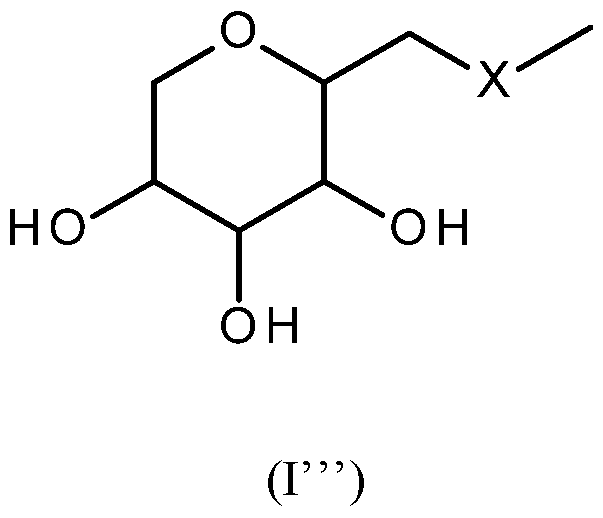
  • the compound of formula (I) is a compound corresponding to formula (I’”) below: in which formula (I’”):
  • X corresponds to a divalent radical -C(O)- or -(CH)OH-, preferably -C(O)-, and also one of the optical isomers or geometrical isomers thereof, and/or one of the solvates thereof, such as the hydrates.
  • the cosmetic ingredient(s), and preferably the compound(s) of formula (I) as described above, may be present in a content of at least 25% by weight of active ingredient of cosmetic ingredient and in particular of formula (I), preferentially in a content ranging from 25% to 80% by weight, more preferentially ranging from 25% to 75% by weight, more preferentially ranging from 30% to 70% relative to the total weight of the aqueous medium.
  • the aqueous medium comprises at least one compound of formula (T) in a content of at least 25% by weight, preferably in a content ranging from 25% to 80% by weight, more preferentially in a content ranging from 28% to 75% by weight, relative to the total weight of the aqueous medium.
  • the aqueous medium comprises at least one compound of formula (I”) or (I’”) in a content of at least 25% by weight, preferably in a content ranging from 40% to 80% by weight, more preferentially in a content ranging from 50% to 75% by weight, relative to the total weight of the aqueous medium.
  • said at least one salt is in particular different from a surfactant.
  • said at least one salt is chosen from the group constituted of inorganic salts, organic salts and mixtures thereof.
  • said at least one salt is chosen from the compounds of formula
  • A is an organic or inorganic anion, preferably an organic anion
  • D is an organic or inorganic cation, preferably an inorganic cation
  • the salt respects electroneutrality, that is to say that the absolute value of the sum of the negative charges of the anions is equal to the sum of the positive charges of the cations.
  • w is equal to 1 or 2, preferably 1, y is equal to 1 or 2, preferably 1.
  • w is equal to 1 and y is equal to 1.
  • a w ' may be an inorganic anion chosen from the group constituted of nitrate (NO 3 ), carbonate (CO3 2 ), halides, in particular chloride (Cl ), more preferentially from the group constituted of nitrate (NO3 ) and halides, in particular chloride (Cl").
  • a w ' may be an organic anion chosen from the group constituted of Ci-Cis, preferably C1-C10, preferentially Ci-Ce, more preferentially C1-C4, even more preferentially C1-C2, better still C2 carboxylic acids, in particular from the group constituted of Ci-Ce carboxylic acids.
  • a w ' is an organic anion, preferably chosen from the group constituted of linear or branched, cyclic or acyclic Ci-Cis, preferably C1-C10, more preferentially Ci-Ce carboxylic acids.
  • a w ' is an organic anion chosen from the group constituted of linear Ci-Cis, more preferentially Ci-Ce carboxylic acids.
  • a w ' is an organic anion chosen from the group constituted of Ci- C4, preferentially C1-C2, better still C2 carboxylic acids such as acetate (CH3COO ).
  • D y+ may be an organic cation, preferably chosen from the group constituted of ammonium, phosphonium, imadazolium, pyrazolium, piperidinium and piperazinium ions.
  • D y+ is an inorganic cation chosen from the group constituted of alkali metal cations and alkaline earth metal cations.
  • D y+ is a cation chosen from the group constituted of alkali metal cations, alkaline earth metal cations and the ammonium ion (NH4 + ), in particular alkali metal cations and alkaline earth metal cations.
  • D y+ is a cation chosen from the group constituted of the calcium ion (Ca 2+ ), the magnesium ion (Mg 2+ ), the sodium ion (Na + ) and the potassium ion (K + ), in particular the calcium ion and the sodium ion, more particularly the sodium ion.
  • the salt corresponds to formula (IV1) below:
  • R2 represents a linear or branched, saturated or unsaturated, cyclic or acyclic, preferably acyclic, Ci-Ce, more preferentially C1-C4, in particular Ci, alkyl chain.
  • R2 represents a linear or branched, saturated or unsaturated, cyclic, such as cyclohexyl or cyclopentyl, or acyclic, Ci-Ce, more preferentially C1-C4, in particular Ci, alkyl chain.
  • R2 represents a linear or branched, preferably linear, saturated or unsaturated, acyclic, C1-C10, preferably Ci-Ce, more preferentially C1-C4, in particular Ci, alkyl chain.
  • R2 represents a linear, saturated or unsaturated, acyclic, C1-C10, preferably Ci-Ce, more preferentially C1-C4, in particular Ci, alkyl chain.
  • R2 represents a linear, saturated or unsaturated, acyclic, C1-C4, in particular Ci, alkyl chain.
  • D + represents an inorganic cation chosen from the group constituted of alkali metal cations and alkaline earth metal cations.
  • D + is a cation chosen from the group constituted of alkali metal cations, alkaline earth metal cations and the ammonium ion (NH 4 + ), in particular alkali metal cations and alkaline earth metal cations, in particular the sodium ion (Na + ), potassium ion (K + ) or an ammonium (NH4 + ).
  • D + represents the sodium ion (Na + ).
  • said at least one salt is chosen from the group constituted of alkali metal salts, alkaline earth metal salts, ammonium salts and mixtures thereof.
  • said at least one salt is chosen from the group constituted of calcium salts, magnesium salts, sodium salts, potassium salts and mixtures thereof, more preferentially chosen from the group constituted of calcium salts, sodium salts and mixtures thereof.
  • said at least one salt is chosen from the group constituted of alkali metal salts of Ci-Ce, preferably C1-C4, more preferably C1-C2, better still C2 carboxylic acids, such as sodium acetate.
  • said at least one salt is chosen from the group constituted of alkali metal salts, alkaline earth metal salts, ammonium salts and mixtures thereof.
  • said at least one salt is chosen from the group constituted of calcium salts, magnesium salts, sodium salts, potassium salts and mixtures thereof, more preferentially chosen from the group constituted of calcium salts, sodium salts and mixtures thereof.
  • said at least one salt is chosen from the group constituted of alkali metal salts of Ci-Ce, preferably C1-C4, more preferably C1-C2, better still C2 carboxylic acids, such as sodium acetate.
  • the salt may or may not be an impurity.
  • the salt may be an impurity, for example resulting from at least one of the steps of a process for preparing at least one cosmetic ingredient, preferably at least one compound of formula (I) and/or resulting from at least one step of at least one washing and/or purification process carried out before, after or during, preferably after at least one of the steps of a process for preparing said at least one cosmetic ingredient, preferably said at least one compound of formula (I).
  • the salt is an impurity.
  • the salt corresponding to formula (IV1) may be present in a content ranging from 0.05% to 45% by weight, in particular in a content ranging from 0.1% to 35% by weight, more particularly in a content ranging from 0.5% to 25% by weight, relative to the total weight of the aqueous medium.
  • the aqueous medium comprises:
  • the aqueous medium comprises:
  • the process (PU) according to the invention comprises at least one step (PU1) during which at least the aqueous medium, as defined above, is subjected to at least one electrodialysis, preferably to one electrodialysis.
  • the aqueous medium as defined above, is conveyed into an electrodialyzer in order to separate said salt(s) from said aqueous medium.
  • the purification process (PU) comprises at least one step of electrodialysis (PU1) of at least one aqueous medium comprising at least said compound of formula (I) and at least one salt of formula (IV1), as are defined above.
  • Electrodialysis is a process known to those skilled in the art; it is an electrochemical process that makes it possible to extract ions (anions, or cations) contained in a solution (see, for example I’actualite chimique, L’electrodialyse et sesumble applications [Electrodialysis and its many applications], F. Lutin - no. 327-328, February -March 2009).
  • the principle of the process is to use electrically charged (cationic or anionic) membranes which are used to separate ions from the solution, notably aqueous solution, using the driving force of the potential difference.
  • the electrodialysis device is often built on the filter press principle of a stack of successive membranes that can comprise several tens or even hundreds of alternate cationic and anionic membranes between two electrodes; the solution, notably aqueous solution, arriving in the device (feed solution) flows through the various cells (i.e. space between 2 successive membranes, also pair of membranes).
  • feed solution flows through the various cells (i.e. space between 2 successive membranes, also pair of membranes).
  • the extraction of the ions is carried out by migration of the ions through at least 2 selective (anionic or cationic) membranes under the action of an electric field. Only anions can pass through an anionic membrane and only cations can pass through a cationic membrane. By placing several membranes in parallel that alternately let the positive ions and the negative ions pass through, it is possible to remove certain ions from the solution, notably aqueous solution.
  • electrodialysis can separate, concentrate and/or purify a C-glycoside derivative such as a compound of formula (I), from aqueous solutions.
  • ED electrodialysis
  • BPED bipolar electrodialysis
  • the process uses conventional electrodialysis.
  • conventional electrodialysis or ED or concentration electrodialysis is understood to mean a device that carries out the electrochemical separation of ions of a composition, in particular an aqueous composition, which are transferred from one membrane to the next through selective exchange by means of a DC voltage.
  • Conventional electrodialysis can therefore be used to purify, concentrate and demineralize.
  • bipolar electrodialysis or BPED is understood to mean an ion exchange membrane electrodialysis device that uses at least one bipolar membrane to split water into proton and hydroxide ion, i.e. generating acid and alkaline streams. Under the driving force of an electric field, a bipolar membrane dissociates water into hydrogen (H + ) and hydroxide (OH ) ions.
  • a bipolar membrane is formed of an exchange layer of anions and cations that are bonded together, and of a very thin interface where water diffuses from the external aqueous saline solutions.
  • hydroxyl anions With the anion exchange side facing the anode and the cation exchange side facing the cathode, hydroxyl anions will be transported through the anion exchange layer and hydrogen cations through the cation exchange layer.
  • a bipolar membrane allows the generation and concentration of hydroxyl and hydrogen ions on its surface. These ions can be used in an electrodialysis stack to combine with the cations and anions of the salt to produce acids and bases (or alkaline agent).
  • This process makes it possible to adjust the pH of a solution without adding alkaline agent or acid.
  • the membranes of the electrolysis device are anionic or cationic.
  • Cationic membranes are often constituted of sulf(on)ated or phosph(on)ated polymers such as sulfonated polystyrenes, whereas anionic membranes are often constituted of polymers containing quaternary ammonium or phosphonium such as polystyrenes with quaternary ammoniums.
  • anionic membranes are constituted of polymers containing quaternary ammonium or phosphonium such as polystyrenes with quaternary ammoniums.
  • the membranes are sulfonated and quaternary ammonium membranes.
  • the composition Before electrolysis, the composition can be filtered or passed over an ionexchange resin.
  • the pH of the aqueous composition comprising the cosmetic ingredient(s) is higher than the pKa of the salt of the conjugate acid (weak acid).
  • the pH of the aqueous composition comprising the C-glycoside derivatives is preferably at least 4, more preferentially at least 5, even more preferentially at least 6, even more preferentially at least 7.
  • the pH can be adjusted using alkaline agent or acid such as acetic acid, sodium hydroxide or alkaline agent (bi)carbonates.
  • Anion exchange membranes or cation exchange membranes suitable for concentrating by electrodialysis can be used in the processes of the present invention.
  • Such membranes are commercially available from Astom Corp. (Tokyo, Japan), for example Neosepta membranes, Tokuyama Co., Ltd. (Tokyo, Japon), Ameridia (Somerset).
  • the conventional electrodialysis step can be carried out with any commercially available electrodialysis unit.
  • electrodialysis unit Such units are commercially available from various suppliers such as Valeo (France), Eurodia Industrie SA (France), EET Corporation (US), Ameridia (US), or Mega AS (Czech Republic).
  • Concentration electrodialysis is preferably carried out using a configuration known as an electrodialysis cell.
  • the cell is composed of a feed (diluate) compartment and a concentrate (brine) compartment formed by an anion exchange membrane and a cation exchange membrane placed between two electrodes.
  • the electrodialysis process preferably uses multiple electrodialysis cells arranged in a configuration known as an electrodialysis stack, with alternating anion and cation exchange membranes forming the multiple electrodialysis cells.
  • the number of cells can range from a few cells, for example ten cells, to hundreds of cells in a stack.
  • the electrodialysis parameters are notably the current density, cell voltage, current efficiency, diluate concentration and concentrate concentration.
  • the amount of current determines the equivalent amount in grams of product transported through the membranes. Operating at high current density can reduce the required surface area of electrodialysis cells.
  • the current density is preferably balanced with the increase in the cell voltage, which nevertheless can lead to higher energy consumption.
  • limiting current is understood to mean the maximum current density allowed in order to avoid an abrupt increase in the cell voltage.
  • the limiting current may depend on parameters such as the design of the stack, the concentrations of the composition, in particular aqueous composition, the temperature, etc.
  • the current efficiency also determines the surface area of the membranes required for the process of the present invention.
  • the current efficiency takes into account all potential parasitic phenomena occurring in the membrane stack (e.g. membrane permselectivity ⁇ 100%, physical leakage (leading to impurities in the products, which can be reduced by optimized stack design and membrane selection).
  • the ratio of electrical energy consumed/kg is between 0.01 kW/h/kg and 0.2 kW/h/kg, better still between 0.03 kW/h/kg and 0.1 kW/h/kg.
  • the conductivity ratio affects the current efficiency, limiting the maximum concentration for the concentrate (brine) stream.
  • the minimum concentration of diluate is limited by conductivity considerations due to the ohmic resistance of the diluate cells and the low limiting currents at low conductivities.
  • the minimum conductivity that can be envisaged is about 0.5 mS/cm.
  • the minimum starting concentration of salts/cosmetic ingredient, in particular C-glycoside derivative, for carrying out the concentration electrodialysis is that for which the conductivity is preferably at least 10 mS/cm, more preferentially at least 20 mS/cm, even more preferably at least 30 mS/cm.
  • the composition in particular aqueous composition, is preferably pretreated to remove impurities and particles, in particular to remove acetic acid.
  • Any pretreatment method known to those skilled in the art may be used, such as centrifugation, microfiltration, nanofiltration, ion exchange or distillation, in particular by distillation, preferably under reduced pressure.
  • the membranes When the membranes are fouled by impurities, they can be cleaned using conventional processes known to those skilled in the art, such as the use of current reversal solutions or dilute acid, caustic and/or enzymatic solutions.
  • the temperature range in conventional or bipolar electrodialysis stacks is preferably between from 10°C to 50°C, in particular at a temperature between 35°C and 40°C.
  • the pH range in electrodialysis stacks is preferably between 3 and 8, more preferentially between 4 and 7.
  • the conventional or bipolar electrodialysis of the process of the invention is carried out at a temperature of between 10°C and 50°C, particularly between 15°C and 40°C, preferably the temperature is between 20°C and 35°C such as 25°C.
  • the process of the invention uses a conventional electrolysis step, in particular carried out at a pH of at least 4, preferably at least 5, more preferentially at least 6 and preferably at a pH of less than or equal to 8.
  • the composition in particular aqueous composition, comprising the salt(s)/ the cosmetic ingredient(s), in particular the C-glycoside derivatives, is introduced into the electrodialysis stack through the diluate compartment.
  • the direct voltage causes positively charged cations to migrate to the cathode and negatively charged anions to migrate to the anode.
  • the properties of the membrane determine whether the ions are rejected or allowed to pass through. Ions that can pass through the membranes are retained in the following compartment since the next membrane in its path will be of opposite charge. Therefore, there are compartments from which ions are removed and compartments where they are concentrated. If the solutions circulate rapidly through the stack, a stream of diluate and a stream of concentrate are obtained.
  • the product can be the desalted stream, the concentrated stream, or both.
  • the process carries out at least one bipolar electrodialysis or bipolar membrane electrodialysis step.
  • This bipolar electrodialysis may involve first contacting the concentrate resulting from conventional electrodialysis followed by at least one bipolar membrane electrodialysis in order to convert the C-glycoside derivatives of formula (I).
  • the process carries out a bipolar electrodialysis step without first carrying out a conventional electrodialysis step.
  • Bipolar membrane electrodialysis can be performed with any available bipolar membrane electrodialysis unit.
  • Such units are commercially available from suppliers such as The Electrosynthesis Company, Inc. (US), FuMA-Tech GmbH (Germany), Solvay SA (Belgium), Tokuyama Co. Ltd. (Japan), Graver Water Co. (US), Tianwei, Membrane Technology Co. Ltd. (China), Ameridia (US), Eurodia Industrie SA (France).
  • Any bipolar membrane suitable for bipolar membrane electrodialysis can be used in the processes of the present invention.
  • Such membranes are commercially available from Astom Corp. (Tokyo, Japan), for example Neosepta membranes, Tokuyama Co., Ltd.
  • membranes sold by Veolia AR204 Mention may be made of the membranes sold by Veolia AR204; AR103, AR908, CR64, CR67, CR61.
  • the membranes may be supported, woven or the polymers may be cast on a variety of cloths.
  • Each type of fabric is denoted by a single letter:
  • each membrane type may be the combination of the membrane chemistry and the support structure (for example AR103P, CR67T).
  • the membranes have a certain electrical resistance and permselectivity.
  • Ion-exchange membranes such as Ionics have certifications for example NSF 61 for drinking water, 21 CFR 175, 176, 177, 178, 182; EU 1935/2004 and EU 10/2001 for food contact materials.
  • the bipolar membrane electrodialysis of the process of the invention is carried out at a temperature of between 10°C and 40°C, particularly between 15°C and 35°C, preferably the temperature is between 20°C and 30°C such as 25°C.
  • concentration electrodialysis unit and the bipolar membrane electrodialysis unit can be incorporated in the same apparatus.
  • a three-compartment cell is obtained by adding the bipolar membrane to a conventional electrodialysis cell.
  • the bipolar membrane is placed on either side of the anion and cation exchange membranes described above to form three compartments: acid between the bipolar and anion exchange membranes, base between the bipolar and cation exchange membranes, and salt between the cation and anion exchange membranes.
  • a two-compartment cell can be obtained by adding bipolar and cation exchange membranes or by adding bipolar and anion exchange membranes.
  • an alternation of cation exchange membranes and bipolar membranes is used.
  • the electrodialysis step (PU1) is carried out at a pH ranging from 4 to 9, preferably at a pH ranging from 4.5 to 8.5, more preferentially in a pH range of from 5 to 8, more preferentially at a pH ranging from 6.5 to 7.5.
  • the electrodialysis step (PU1) is preferably carried out at a pH of less than 8 so as to effectively reduce the contents of ionic impurities, that is to say the contents of salt, preferably corresponding to formula (II), more preferentially to formula (IT).
  • the electrodialysis step (PU1) can be carried out at a temperature ranging from 20°C to 50°C, preferentially at a temperature ranging from 25°C to 45°C.
  • the electrodialysis step (PU1) is carried out with conventional electrolysis, more preferentially at a “product” conductivity (i.e. before treatment), ranging from 50 to 0.05 mS/cm, preferably ranging from 40 to 0.2 mS/cm, measured in particular at a temperature ranging from 20°C to 50°C.
  • a “product” conductivity i.e. before treatment
  • the electrodialysis step (PU1) is carried out with bipolar membrane electrolysis with a product conductivity (before treatment) ranging from 60 to 0.5 mS/cm, preferably ranging from 55 to 1 mS/cm, more preferentially ranging from 50 to 10 mS/cm, even more preferentially ranging from 45 to 20 mS/cm, measured in particular at a temperature ranging from 20°C to 50°C.
  • the concentration of the cosmetic ingredient(s), notably C-glycoside derivative is between 10% and 70% by weight, particularly between 20% and 60% by weight, more particularly between 30% and 50% by weight.
  • the step (PU1) of electrodialysis in particular conventional electrodialysis, is carried out at a pH ranging from 5 to 8, more preferentially at a pH ranging from 4 to 8, and at a temperature ranging from 20°C to 50°C, more preferentially at a temperature ranging from 25°C to 45°C.
  • the step (PU1) of electrodialysis, bipolar membrane electrodialysis is carried out at an alkaline pH, i.e. > 7, more preferentially at a pH greater than or equal to 8, better still greater than or equal to 9, in particular between 9.5 and 12, and at a temperature in particular ranging from 20°C to 50°C, more preferentially at a temperature ranging from 25°C to 45°C.
  • the electrodialyzer comprises in particular a first electrode, constituting the anode, and a second electrode, constituting the cathode, so that, when a direct current source is applied, an electric field is applied across all the components of the electrodialyzer between the first electrode and the second electrode.
  • the electrodialyzer may comprise a series of compartments mounted in parallel and each formed by two membranes, in particular an anionic or anion-exchange membrane, i.e. a membrane permeable to anions and impermeable to cations, and a cationic or cation-exchange membrane, i.e. a membrane permeable to cations and impermeable to anions.
  • the anionic and cationic membranes are arranged alternately within the electrodialyzer.
  • each compartment is formed by an anionic membrane and a cationic membrane which are spaced apart from one another.
  • the electrodialyzer can be of the conventional type comprising a stack of alternately cation-exchange and anion-exchange membranes, placed in an electric field created by electrodes.
  • the electrodialyzer comprises a compartment, generally located in the centre of the device, referred to as the dilution compartment, in which the aqueous solution, as defined above, circulates.
  • the dilution compartment is arranged between two adjacent compartments, referred to as concentration compartments.
  • concentration compartments are located on either side of the dilution compartment.
  • the dilution and concentration compartments are arranged alternately within the electrodialyzer.
  • the dilution compartment is sandwiched between two concentration compartments.
  • the cations of the salt attracted by the cathode, will migrate from the dilution compartment to the concentration compartment by crossing the cationic membrane and will remain stuck in this concentration compartment due to the anionic membrane.
  • the salt is extracted from the dilution compartment, in which the aqueous medium circulates, while the anions and cations of the salt become concentrated respectively in each adjacent concentration compartment.
  • the electrodialysis step (PU1) thus makes it possible to reduce the content of salts in the aqueous medium as defined above.
  • Electrodialysis advantageously makes it possible to remove very large amounts of impurities in ionic form from the aqueous medium comprising at least said cosmetic ingredient, preferably said compound of formula (I) as defined above.
  • the electrodialysis step (PU1) thus makes it possible to result in a salt content likely to be less than or equal to 10% by weight, preferably is less than or equal to 5% by weight, more preferentially varies from 1% to 5% by weight, better still varies from 1.5% to 2% by weight, relative to the total weight of the dry extract containing the cosmetic active agent.
  • said cosmetic ingredient preferably said compound of formula (I) is preferentially in the form of a dry extract comprising a content of less than or equal to 10% by weight, preferably is less than or equal to 5% by weight, more preferably varies from 1% to 5% by weight, better still varies from 1.5% to 2% by weight, of at least one salt, preferably of at least one compound of formula (IV) or (IV’), relative to the total weight of the dry extract.
  • the aqueous medium or aqueous solution thus recovered can be used for cosmetic applications.
  • the purification process (PU) comprises at least one step (PU1) of electrodialysis of at least one aqueous medium comprising at least one cosmetic ingredient, preferably at least one compound of formula (I), as defined above, and at least one salt, preferably corresponding to formula (II), more preferentially corresponding to formula (II’).
  • the purification process (PU) comprises at least one step (PU1) of electrodialysis of at least one aqueous medium comprising: at least one cosmetic ingredient, at least one salt, preferably corresponding to formula (IV1).
  • the purification process (P) comprises at least one step (Pl) of electrodialysis of at least one aqueous medium comprising: at least one cosmetic ingredient, at least one salt corresponding to formula (IV1) notably chosen from the group constituted of alkali metal salts, alkaline earth metal salts, ammonium salts and mixtures thereof.
  • the purification process (PU) comprises at least one step (PU1) of electrodialysis of at least one aqueous medium comprising: at least one compound of formula (T) as defined above, o preferably, in formula (T), Ri represents a linear Ci-Cio, prefereably Ci-Ce, more preferentially C1-C4, in particular Ci alkyl chain, at least one salt, preferably corresponding to formula (IV1).
  • the purification process (P) comprises at least one step (Pl) of electrodialysis of at least one aqueous medium comprising: at least one compound of formula (I”) as defined above, o preferably, in formula (I”), Ri represents a linear C1-C10, preferably Ci-Ce, more preferentially C1-C4, in particular Ci , alkyl chain, at least one salt corresponding to formula (IV1) notably chosen from the group constituted of alkali metal salts, alkaline earth metal salts, ammonium salts and mixtures thereof.
  • the preparation process (PR) is a process for the preparation (PR) of at least one cosmetic ingredient preferably chosen from the compounds corresponding to the formula (I) below: in which formula (I):
  • - X represents a divalent radical -C(O)- or -CH(OR)-, preferably -C(O)-,
  • - R represents a hydrogen atom, a Ci-Cio, preferably C1-C4, alkyl group, such as methyl, or a (Ci-C4)alkylcarbonyl group, such as acetyl, preferably a hydrogen atom,
  • - Ri represents a saturated or unsaturated, linear or branched, cyclic or acyclic, preferably acyclic, C1-C10, preferably C1-C4, more preferentially saturated, hydrocarbon chain, and also one of the optical isomers or geometrical isomers thereof, and/or one of the solvates thereof, such as the hydrates; said process comprising:
  • At least one neutralization step (PRO) comprising the addition of at least one inorganic or organic acidifying agent, preferably organic acidifying agent, to the aqueous reaction medium obtained from said step (PR1),
  • PU at least one purification
  • PU1 at least one step (PU1), as defined above, of electrodialysis of at least one aqueous reaction medium comprising at least one compound of formula (IA) or (IB) and at least one compound of formula (IV1).
  • SA' corresponds to SA-OH with SA having the same meaning as SA', as defined above, and the hydroxyl group -OH is a free hydroxyl group.
  • a compound of formula (IA) is a compound of formula (I) in which X corresponds to a radical -C(O)-.
  • a compound of formula (IB) is a compound of formula (I) in which X corresponds to a radical -CH(OR)- with R as defined above.
  • the process (PR) according to the invention is particularly advantageous because the electrodialysis step (PU1) makes it possible to effectively reduce not only the content of salts resulting from the synthesis step (PR1) and/or the reaction step (PRii) but also the content of salts formed at the end of the neutralization step (PRO).
  • reaction step (PR1) is carried out in an aqueous medium, in the presence: o of at least one compound of formula (II), o of at least one compound of formula (III), preferably in an equimolar amount or in excess with respect to the compound of formula (II), preferably in excess,
  • the compound of formula (III) is in an amount greater than 1, preferably in an amount ranging from 1 to 5, more preferentially ranging from 1 to 4, even more preferentially ranging from 1 to 3, better still ranging from 1 to 2, in particular ranging from 1 to 1.5 molar equivalents relative to the compound of formula (II); o of at least one alkaline agent,
  • alkaline agent as described above which is preferentially mineral, more preferentially chosen from the group consisting of alkali metal and alkaline earth metal hydroxides, alkali metal and alkaline earth metal (bi)carbonates, and mixtures thereof; in particular alkali metal and alkaline earth metal hydroxides, more preferentially alkali metal hydroxides such as sodium hydroxide, o the alkaline agent being in an equimolar amount or in excess, relative to the compound of formula (II), preferably in excess,
  • the alkaline agent is present in an amount ranging from 1 to 5 molar equivalents, more preferentially in an amount ranging from 1 to 4 molar equivalents, more preferentially in an amount ranging from 1 to 3 molar equivalents, better still in an amount ranging from 1 to 2 molar equivalents, relative to the compound of formula (II), o preferably, the reaction step (i) takes place:
  • from 10 minutes to 10 hours, preferably from 20 minutes to 5 hours, more preferentially from 30 minutes to 4 hours.
  • the reaction step (PR1) is carried out in an aqueous medium and comprises successively: o preferably, the addition of at least one compound of formula (II) to an aqueous medium, in particular at a temperature varying from 30°C to 80°C, o preferably, after solubilization of the compound of formula (II) in the aqueous medium, the temperature is advantageously reduced, o preferably, the addition of at least one compound of formula (III) to the aqueous medium comprising at least the compound of formula (II), o preferably, the addition of at least one alkaline agent, preferably inorganic alkaline agent, in an equimolar amount or in excess, preferably in excess, as described above, relative to the compound of formula (II), at a temperature preferentially below or equal to 45°C, o preferably, the reaction medium comprising at least the compound of formula (II), at least one compound of formula (III) and at least one alkaline agent is heated to the reaction temperature as described
  • the pH can be adjusted to a value of less than or equal to 8.5 and even more preferentially to a value of greater than or equal to 2.5, preferably varies within a range extending from 2.5 to 8.5.
  • the neutralization step (PRO) can be carried out simultaneously or sequentially, preferably sequentially, preferably before the electrodialysis step (PU1).
  • the neutralization step (PRO) advantageously makes it possible to neutralize the excess alkaline agent present in the aqueous reaction medium resulting from step (PR1).
  • the preparation process (PR) comprises at least one neutralization step (PRO) comprising at least one acidifying treatment as defined above, such as the use of a resin or the addition of at least one acidifying agent as defined above, preferably organic acidifying agent.
  • the at least one electrodialysis step (PU1) is carried out after the reaction step (PR1) or after one of the reaction steps (PRii), or between the reaction step (PR1) and at least one reaction step (PRii), and optionally after the neutralization step (PRO).
  • the at least one electrodialysis step (PU1) is carried out after the reaction step (PR1).
  • the at least one electrodialysis step (PU1) is carried out between the reaction step (PR1) and at least one reaction step (PRii).
  • the process (PR) according to the invention comprises:
  • step (PRO) at least one step (PRO), as defined above, of neutralizing the reaction medium resulting from the step (PR1),
  • PU at least one purification step (PU), as described above, preferably carried out after the reaction step (PR1) or optionally after the reaction step (PRii), more preferentially between the reaction step (PR1) and the reaction step (PRii).
  • the at least one electrodialysis step (PU1) is carried out after the neutralization step (PRO).
  • the process according to the invention comprises an electrodialysis step (PU1).
  • the process according to the invention comprises several electrodialysis steps (PU1).
  • At least one electrodialysis step (PU1) is carried out after the reaction step(s) (PR1).
  • the electrodialysis step (PU1) is carried out at least once after the reaction step(s) (PRii).
  • the electrodialysis step (PU1) is carried out at least once after the step(s) (PR1) and the process of the invention does not comprise a step (PRii).
  • the process of the invention comprises at least one step (PR1), preferably one step (PR1), and at least one step (PRii), preferably one step (PRii), and the electrodialysis step (PU1) is carried out at least once after at least one step (PR1) without being carried out after the step(s) (PRii).
  • the process of the invention comprises at least one step (PR1), preferably one step (PR1), and at least one step (PRii), preferably one step (PRii), and the electrodialysis step (PU1) is carried out at least once after at least one step (PRii) without being carried out on conclusion of the step(s) (PR1).
  • the process of the invention comprises one step (PR1), and one step (PRii), and the electrodialysis step (PU1) is carried out at least once after the step (PR1) without being carried out on conclusion of the step(s) (PRii).
  • the preparation process (PR) may optionally further comprise at least one step (PRii) of reacting at least said cosmetic ingredient.
  • the preparation process (PR) may optionally further comprise at least one step (PRii) of reacting at least said compound of formula (I) in which X corresponds to a radical -C(O)- (i.e. a compound of formula (IA)) to form at least one compound of formula (I) in which X corresponds to a radical -CH(OR)- (i.e. a compound of formula (IB)).
  • PRii of reacting at least said compound of formula (I) in which X corresponds to a radical -C(O)- (i.e. a compound of formula (IA)) to form at least one compound of formula (I) in which X corresponds to a radical -CH(OR)- (i.e. a compound of formula (IB)).
  • reaction step (PRii) is preferably a reduction step (PR2) taking place in an aqueous medium according to the following synthetic pathway (B):
  • LA (FB) in which synthetic pathway (B): o SA' and Ri have the same meanings as in the formula (I).
  • a compound of formula (I’B) is a compound of formula (I) in which X corresponds to a radical -CH(OR)- with R representing a hydrogen atom.
  • the preparation process according to the invention comprises: at least one reaction step (PR1), as described above, optionally at least one step (PRO), as defined above, of neutralizing the reaction medium resulting from the reaction step (PR1),
  • At least one reduction stage (PR2) which takes place in an aqueous medium according to the synthetic pathway (B) as defined above, at least one purification step (PU), as described above, carried out before and/or after the reduction step (PR2), preferably before the reduction step (PR2).
  • at least one purification step (PU) carried out before and/or after the reduction step (PR2), preferably before the reduction step (PR2).
  • the step of reducing the carbonyl group in order to result in an alcohol group is carried out by a conventional reduction method known to those skilled in the art. Mention may be made, for example, of the work Adv. Org. Chem.. J. March, 4th Ed., John Wiley & Son, pp. 910-919 (1992).
  • the reduction step (PR2) may be a reduction carried out in the presence of one or more hydrides, in particular borohydrides, such as NaBEU or NaBHsCN, an enzymatic reduction or a reduction by catalytic hydrogenation.
  • hydrides in particular borohydrides, such as NaBEU or NaBHsCN, an enzymatic reduction or a reduction by catalytic hydrogenation.
  • the at least one reduction step (PR2) is a reduction by catalytic hydrogenation.
  • the at least one reduction step (PR2) is advantageously a hydrogenation carried out in the presence of at least one catalyst and optionally of an acidifying agent.
  • the hydrogenation can, for example, be carried out under conditions described in the literature (Heterocycles, M. Hashimoto and M. Takahashi, 77 (1), 227- 231 (2009)).
  • the catalyst is preferably a metal catalyst, such as ruthenium (Ru), rhodium (Rh), platinum (Pt), iridium (Ir), nickel (Ni) or palladium (Pd), preferably ruthenium (Ru), more preferentially a metal catalyst chosen from ruthenium (Ru), rhodium (Rh), platinum (Pt) or iridium (Ir), better still ruthenium (Ru).
  • the catalyst is supported, preferentially is supported ruthenium, such as on carbon (or graphite), on alumina, on Al Si, on zeolite or on barium sulfate (BaSCh).
  • ruthenium such as on carbon (or graphite), on alumina, on Al Si, on zeolite or on barium sulfate (BaSCh).
  • the hydrogenation is catalyzed by Rh on carbon (Pd/C) or Ru on carbon (Ru/C).
  • the catalyst is chosen from the group constituted of ruthenium on carbon (Ru/C), ruthenium on alumina (Ru/Al), ruthenium on AlSi, ruthenium on zeolite or ruthenium on barium sulfate (BaSCh).
  • Ru/C ruthenium on carbon
  • Ru/Al ruthenium on alumina
  • Ru/Al ruthenium on AlSi
  • ruthenium on zeolite ruthenium on barium sulfate
  • the catalyst is ruthenium (Ru), for example on carbon (Ru/C).
  • the at least one reduction step (PR2) is carried out under a hydrogen pressure ranging from 2 to 100 bar, preferably ranging from 3 to 50 bar, more preferentially ranging from 4 to 25 bar, more preferentially still ranging from 5 to 15 bar, better still ranging from 6 to 12 bar, such as 10 bar.
  • the at least one reduction step (PR2) is carried out at a temperature which can range from 20°C to 150°C, preferably at a temperature ranging from 30°C to 100°C, more preferentially at a temperature ranging from 40°C to 100°C.
  • the at least one reduction step (PR2) takes place over a period which can range from 30 minutes to 30 hours, preferably from 45 minutes to 10 hours, in particular ranging from 1 hour to 7 hours.
  • the at least one reduction step (PR2) is a reduction by catalytic hydrogenation in the presence of at least one catalyst, in particular ruthenium, under a hydrogen pressure ranging from 2 to 100 bar and at a temperature ranging from 30°C to 150°C.
  • the at least one reduction step (PR2) is a reduction by catalytic hydrogenation in the presence of at least one metal catalyst, especially ruthenium.
  • the at least one reduction step (PR2) is a reduction by catalytic hydrogenation in the presence of at least one catalyst, in particular ruthenium, under a hydrogen pressure ranging from 4 to 50 bar and at a temperature ranging from 40°C to 100°C.
  • at least one catalyst in particular ruthenium
  • the at least one reduction step (PR2) is a reduction by catalytic hydrogenation in the presence of at least one catalyst, in particular ruthenium, under a hydrogen pressure ranging from 5 to 25 bar and at a temperature ranging from 40°C to 100°C.
  • at least one catalyst in particular ruthenium
  • the at least one reduction step (PR2) is carried out, in an aqueous medium:
  • the reaction medium can be cooled to a temperature varying from 15°C to 25°C and then is purged under an inert atmosphere such as nitrogen.
  • reaction medium resulting from step (PR2) is subsequently preferably filtered.
  • the preparation process according to the invention successively comprises: o at least one reduction step (PR2) as defined above,
  • reaction medium before, during or on conclusion of the reduction step (PR2), undergoes at least one treatment with carbon black, more preferentially before or after the reduction step (PR2),
  • optionally, at least one step of adding at least one acidifying or basifying agent to the reaction medium resulting from the reduction stage (PR2), o optionally, at least one step (PR2) of concentrating the compound of formula (IB) in the reaction medium resulting from the reduction step (PR2),
  • At least one concentrating step is carried out, in particular by distillation, preferably under reduced pressure, o optionally, at least one purification step, such as a filtration, o optionally, at least one step of adding at least one bactericidal or bacteriostatic agent, preferably bacteriostatic agent, preferably derived from glycol, such as propylene glycol, pentylene glycol or caprylyl glycol, more preferentially propylene glycol;
  • the bacteriostatic agent in particular propylene glycol, is present in a content ranging from 2% to 50% by weight, preferentially from 5% to 40% by weight, with respect to the total weight of the mixture comprising at least the compound of formula (IB) and the bacteriostatic agent,
  • optionally, at least one purification step, such as a distillation.
  • biobased is understood to mean that the propylene glycol is derived from compounds of plant origin.
  • reaction step (PRii) can also be an addition or O-alkoxylation step (PR3) taking place in an aqueous or non-aqueous medium according to the following synthetic pathway (Bl): d'Bi ( TBi in which synthetic pathway (Bl):
  • R corresponds to a C1-C10, preferably C1-C4, alkyl group, such as methyl, or a (Ci-C4)alkylcarbonyl group, such as acetyl.
  • the process (PR) comprises: at least one reaction step (PR1) as defined above, at least one reaction step (PRii) corresponding to a reduction step (PR2) as defined above, at least one reaction step (PRiii) corresponding to an addition step (PR3) as defined above, at least one purification (PU), as defined above, carried out between the reaction step (PR1) and the reduction step (PR2), and/or at least after the reduction step (PR2), preferably between the reduction step (PR2) and the addition step (PR3), and/or after the addition step (PR3).
  • PR1 reaction step
  • PRiii corresponding to a reduction step
  • PR3 an addition step
  • PU purification
  • the compounds (I"B) are obtained by addition of at least one molar equivalent of at least one nucleophilic compound R-G to (IA), with R as defined above and G representing an electrodeficient atom or group, such as an alkali metal, such as sodium, potassium or lithium, or else a magnesium halide, such as MgCl; in particular this reaction is carried out under an inert atmosphere and in a solvent, preferably a polar aprotic organic solvent, particularly an ethereal solvent, such as diethyl ether or THF, followed by a hydrolysis reaction.
  • a solvent preferably a polar aprotic organic solvent, particularly an ethereal solvent, such as diethyl ether or THF, followed by a hydrolysis reaction.
  • the process (PR) may comprise at least one step of separating the excess of compound of formula (III) from the reaction medium resulting from step (PR1), in particular carried out by distillation, for example by vacuum distillation.
  • the step of separating the excess of the compound of formula (III) can be carried out simultaneously or sequentially, preferably sequentially, preferably after the neutralization step (PRO).
  • the process (PR) comprises at least: at least one reaction step (PR1) as defined above, at least one step (PRO) of neutralizating the reaction medium resulting from step (PR1), at least one step of separating the excess of the compound of formula (III) carried out simultaneously or sequentially with the neutralization step (PRO), preferably after the neutralization step (PRO), at least one reduction step (PR2) as defined above, at least one purification step (PU), as described above, preferably carried out before and/or after the reduction step (PR2), preferably before or after the reduction step (PR2), more preferentially before the reduction step (PR2).
  • the compound of formula (I), in which X corresponds to a divalent radical -C(O)- or -CH(OR)- can be packaged in the form of a dry extract (without solvent).
  • the compound of formula (I), in which X corresponds to a divalent radical -C(O)- or - CH(OR)- is in solution in a liquid which comprises a content of at least 25% by weight of active material (cosmetic ingedient(s), preferably compound(s) of formula (I)), preferentially a content ranging from 25% to 90% by weight, relative to the total weight of the solution.
  • active material cosmetic ingedient(s), preferably compound(s) of formula (I)
  • the compound of formula (I), in which X corresponds to a divalent radical -C(O)- or - CH(OR)- is in solution in a liquid which comprises a content of at least 20% by weight of active material, more preferentially a content ranging from 20% to 90% by weight, relative to the total weight of the solution.
  • the compound of formula (I), in which X corresponds to a divalent radical -C(O)- or - CH(OR)- is in solution in a liquid which comprises a content of at least 20% by weight of active material, more preferentially a content ranging from 20% to 90% by weight, relative to the total weight of the solution.
  • the compound of formula (I), in which X corresponds to a divalent radical -C(O)- or -CH(OR)- is packaged in a liquid and the pH is adjusted to a target value, preferably between 3.5 and 7, by addition of at least one basifying agent or of at least one acidifying agent.
  • the process according to the invention is a process for the preparation (PR') of one or more compounds of formula (I') as defined above.
  • the process according to the invention is preferably a process for the preparation (PR 1 ) of at least one compound corresponding to the formula (I’) below: in which formula (I’): n is equal to 0 or 1, preferably is equal to 1, p is an integer varying from 1 to 4; preferably, the subscript p is equal to
  • Ri has the same meaning as in formula (I), preferably represents a linear, preferably acyclic, Ci-Cio, preferably Ci-Ce, more preferentially C1-C4, in particular Ci , alkyl chain;
  • X represents a divalent radical -C(O)- or -CH(OR)-
  • R represents a hydrogen atom, a C1-C10, preferably C1-C4, alkyl group, such as methyl, or a (Ci-C4)alkylcarbonyl group, such as acetyl; preferably, R represents a hydrogen atom, and also one of the optical isomers or geometrical isomers thereof, and/or one of the solvates thereof, such as the hydrates; said process comprising:
  • o n is equal to 0 or 1, preferably is equal to 1
  • o p is an integer varying from 1 to 4; preferably, the subscript p is equal to 3
  • o Ri and R2 are identical or different, preferably identical, with R2 having the same meaning as Ri in the formula (I’)
  • o D + is an organic or inorganic cation, preferably an inorganic cation, more preferentially chosen from the group consisting of alkali metal cations, alkaline earth metal cations and the ammonium cation (NH4+), better still from the group consisting of alkali metal cations and alkaline earth metal cations, said reaction step (PR1) being carried out in an aqueous medium in the presence: o of at least one compound of formula (II’), o of at least one compound of formula (III), preferably present in an equimolar amount or in excess relative to the compound of
  • the compound of formula (III) is present in an amount of greater than 1, preferably in an amount ranging from 1 to 5, more preferentially ranging from 1 to 4, molar equivalents relative to the compound of formula (II’), o of at least one alkaline agent in an equimolar amount or in excess relative to the compound of formula (II’), preferably in excess,
  • the alkaline agent is present in an amount ranging from 1 to 5 molar equivalents, more preferentially in an amount ranging from 1 to 4 molar equivalents, relative to the compound of formula (II’),
  • the alkaline agent preferably being mineral, more preferentially chosen from the group constituted of alkali metal and alkaline earth metal hydroxides, alkali metal and alkaline earth metal (bi)carbonates, and mixtures thereof; in particular alkali metal and alkaline earth metal hydroxides, such as sodium hydroxide, to result in the formation of at least one compound of formula (I’ Al) and of at least one compound of formula (IV1);
  • At least one neutralization step (PRO) comprising an acidification such as the addition of at least one inorganic or organic acidifying agent, preferably organic acidifying agent, to the aqueous reaction medium obtained from said step (PR1), - optionally, at least one step (PRii) of reacting at least said compound of formula (I’Al) to result in at least one compound corresponding to the formula (I’B 1):
  • reaction step (PRii) is a reduction step (PR2), as defined above,
  • PU at least one purification
  • PU1 at least one step (PU1), as defined above, of electrodialysis of at least one aqueous reaction medium comprising at least one compound of formula (I’ A) or (I’B) and at least one compound of formula (IV1).
  • reaction step (PR1), the reduction step (PR2) and the purification (PU), in particular the electrodialysis step (PU1), are as defined above.
  • the purification (PU) is carried out after the reaction step (PR1), more preferentially at least between the reaction step (PR1) and at least one reaction step (PRii), and/or at least after at least one reaction step (PRii), for example after the reduction step (PR2).
  • reaction step (PRii) is a reduction step (PR2) taking place in an aqueous medium according to the following synthetic pathway (Bl):
  • the reduction step (PR2) is a reduction by catalytic hydrogenation, as defined above.
  • a compound of formula (I’Al) is a compound of formula (I’) in which X corresponds to a divalent radical -C(O)-.
  • a compound of formula (I’B 1) is a compound of formula (I’) in which X corresponds to a divalent radical - CH(OH)-
  • the compound(s) of formula (III)/compound(s) of formula (IF) molar ratio is greater than or equal to 1, preferably between 1 and 5, more preferentially between 1 and 4, more particularly still between 1 and 3, better still between 1 and 2, in particular ranging from 1 to 1.5; according to a particular embodiment, the compound(s) of formula (III)/compound(s) of formula (II’) molar ratio is greater than 1.
  • the alkaline agent(s)/compound(s) of formula (II”) molar ratio is greater than or equal to 1, preferably between 1 and 5, more preferentially between 1 and 4, more particularly still between 1 and 3, better still between 1 and 2; according to a particular embodiment, the alkaline agent/compound of formula (II”) molar ratio is greater than 1.
  • the process according to the invention is a process for the preparation (PR”) of one or more compounds corresponding to the formula (I’”) below: in which formula (I’”) X represents a divalent radical -C(O)- or -(CH)OR- with R representing a hydrogen atom, and also one of the optical isomers or geometrical isomers thereof, and/or one of the solvates thereof, such as the hydrates; said process comprising:
  • reaction step (PR1) taking place according to the following synthesis scheme (A”): in which synthetic pathway (A”): o D + is a cation chosen from the group consisting of alkali metal cations, alkaline earth metal cations and the ammonium ion (NH + ); said reaction step (PR1) being carried out in an aqueous medium in the presence: o of at least one compound of formula (III’), preferably present in an equimolar amount or in excess, preferably in excess, relative to the compound of formula (II”),
  • the compound of formula (III’) is present in an amount of greater than 1, preferably in an amount ranging from 1 to 5, more preferentially ranging from 1 to 4, molar equivalents relative to the compound of formula (II”), o of at least one alkaline agent in an equimolar amount or in excess, preferably in excess, relative to the compound of formula (II”),
  • the alkaline agent is present in an amount ranging from 1 to 5 molar equivalents, more preferentially in an amount ranging from 1 to 4 molar equivalents, relative to the compound of formula (II”),
  • the alkaline agent preferably being inorganic, more preferentially chosen from the group constituted of alkali metal and alkaline earth metal hydroxides, in particular chosen from alkali metal hydroxides such as sodium hydroxide, to result in the formation of at least one compound of formula (I’” A) and of at least one compound of formula (IV2);
  • At least one neutralization step (PRO) comprising at least one acidification such as the addition of at least one inorganic or organic acidifying agent, preferably organic acidifying agent, to the aqueous reaction medium obtained from said step (PR1),
  • reaction step (PRii) is a reduction step (PR2), as defined above,
  • PU at least one purification
  • PU1 at least one step (PU1), as defined above, of electrodialysis of at least one aqueous reaction medium comprising at least one compound of formula (F ’A) or (I’ ’Bl) and at least one compound of formula (IV2).
  • reaction step (PR1) and the purification step (PU) are as defined above.
  • the purification (PU) is carried out at least between the reaction step (PR1) and at least one reaction step (PRii), and/or at least after at least one reaction step (PRii), for example after the reduction step (PR2).
  • the purification step PU1 is carried out after the reaction step (PR1) and before the reaction step (PRii).
  • a compound of formula (I’” A) is a compound of formula (I’”) in which X corresponds to a divalent radical -C(O)-.
  • a compound of formula (I’”B) is a compound of formula (I’”) in which X corresponds to a radical - CH(OH).
  • the compound(s) of formula (III)/compound(s) of formula (II”) molar ratio is greater than or equal to 1, preferably between 1 and 5, more preferentially between 1 and 4, more particularly still between 1 and 3, better still between 1 and 2, in particular ranging from 1 to 1.5; according to a particular embodiment, the compound(s) of formula (III)/compound(s) of formula (II”) molar ratio is greater than 1.
  • the alkaline agent(s)/compound(s) of formula (II”) molar ratio is greater than or equal to 1, preferably between 1 and 5, more preferentially between 1 and 4, more particularly still between 1 and 3, better still between 1 and 2; according to a particular embodiment, the alkaline agent/compound of formula (II”) molar ratio is greater than 1.
  • reaction step (PRii) is a reduction step (PR2) taking place in an aqueous medium according to the following synthetic pathway (B”):
  • the reduction step (PR2) is a reduction by catalytic hydrogenation, as defined above.
  • the purification (PU) is carried out at least between the reaction step (PR1) and the reduction step (PR2).
  • the process for the preparation of at least one compound of formula (T) or (T ’) can also comprise the additional steps described for the process for the preparation of at least one compound of formula (I).
  • Step 1 Preparation of a compound of formula
  • Step 1 Lubineau reaction and purification by electrodialysis
  • An electrodialysis pass is then carried out at a pH of between 4.0 and 8.0 between 25°C and 45°C until an acetic acid content of less than 10 000 ppm or even less than or equal to 6000 ppm is obtained.
  • the solution is then brought into contact with carbon black and then optionally concentrated to a solids content of 30% to 60%, then the pH is adjusted to 6.0-7.0.
  • the product is isolated with a yield of 90-95%.
  • the compound of formula (I’) (2.08 kg) in aqueous solution with the appropriate acetic acid content is introduced into a hydrogenator with ruthenium on carbon (catalytic amount).
  • the mixture is purged at least once with nitrogen and then with hydrogen.
  • the mixture can be heated to a temperature above 25°C and then hydrogen is introduced under pressure up to a pressure of approximately 10 bar.
  • the mixture is heated to a temperature below or equal to 100°C for a period of time ranging from 2 to 7 hours under a pressure ranging from 8 to 12 bar.
  • the hydrogenation reaction is carried out until the end of the consumption of the hydrogen.
  • the reaction medium can be left to return to ambient temperature (20°C) and is then optionally purged with an inert gas (nitrogen).
  • the catalyst is subsequently filtered off and the filtrate is subsequently optionally brought into contact with carbon black.
  • the solution is concentrated until a solids content of 40% to 80% is obtained.
  • the pH of the filtrate is adjusted to acidic pH (e.g. between 4 and 6).
  • a glycol derivative such as propylene glycol, can be added as solvent to the above solution in order to obtain a content of compound of formula (I) of 20% to 90%.
  • the product is isolated in solution with a good yield (between 90-95%) and an acetic acid content of the solution of less than 20 000 ppm.

Landscapes

  • Chemical & Material Sciences (AREA)
  • Engineering & Computer Science (AREA)
  • Water Supply & Treatment (AREA)
  • Organic Chemistry (AREA)
  • Health & Medical Sciences (AREA)
  • Urology & Nephrology (AREA)
  • Chemical Kinetics & Catalysis (AREA)
  • Cosmetics (AREA)
  • Life Sciences & Earth Sciences (AREA)
  • Public Health (AREA)
  • Animal Behavior & Ethology (AREA)
  • General Health & Medical Sciences (AREA)
  • Veterinary Medicine (AREA)
  • Dermatology (AREA)
  • Birds (AREA)
  • Epidemiology (AREA)

Abstract

The present invention relates to a process for the purification (PU) of at least one aqueous medium based on at least one C-glycoside derivative corresponding to the formula (I), preferably corresponding to the formula (I') or (I''), and the optical isomers or geometrical isomers thereof, and/or the solvates thereof, such as the hydrates, and at least one salt, comprising at least one step of electrodialysis (PU1) of said aqueous medium. The invention also relates to a process for the preparation (PR) of at least one C-glycoside derivative, as described herein, comprising at least one step of purification (PU) by electrodialysis of at least one aqueous medium comprising at least said C- glycoside derivative and at least one salt.

Description

DESCRIPTION
TITLE: Purification process comprising one or more cosmetic ingredients with at least one electrodialysis
The present invention relates to a process for the purification (PU) of at least one aqueous medium based on at least one cosmetic ingredient, notably at least one C- glycoside derivative corresponding to the formula (I), as described below, preferably corresponding to the formula (I’) or (I”), and to the optical isomers or geometrical isomers thereof, and/or the solvates thereof, such as the hydrates, and at least one salt, comprising at least one step of electrodialysis (PU1) of said aqueous medium.
The invention also relates to a process for the preparation (PR) of at least one cosmetic ingredient, notably at least one C-glycoside derivative, as described below, comprising at least one step of purification (PU) by electrodialysis of at least one aqueous medium comprising at least said cosmetic ingredient and notably at least one C-glycoside derivative and at least one salt.
Processes for the preparation of water-soluble organic ingredients having advantageous cosmetic properties, for example on keratin materials, may lead to the formation of one or more impurities, in an ionic form, which generally prove to be tedious to minimize, or even to remove, without impacting to a greater or lesser extent the yield of the cosmetic ingredient synthesized.
Moreover, such impurities, when they are present with the final cosmetic ingredient, can generate a colour, a modification in texture or an odour which is not desired in the cosmetic compositions employing said ingredient. Thus, such impurities can be the source of an unpleasant and marked odour, for example a pungent and strongly vinegary odour, liable to manifest itself, even after one or more purification operations have been carried out, and to prove to be inconvenient and persistent even after formulation for consumers, all the more so since the current trend is to use fewer and fewer fragrances in cosmetic products to mask or neutralize odours of this type.
Such impurities can also give rise to problems of compatibility with other additives optionally present in the final cosmetic formulations.
Such impurities can also be salts of acids or of bases which will have an effect on the pH in an aqueous medium. This effect is all the more of a nuisance as the cosmetic active agent is isolated in the form of a concentrated aqueous solution.
In addition, the presence of such impurities, in particular of inorganic and/or organic salts, can induce a considerable increase in the viscosity of the aqueous reaction medium comprising the cosmetic ingredient(s), thus making it difficult, in certain cases, to obtain concentrated solutions of cosmetic ingredients intended for the formulation.
By way of example, C-glycoside derivatives are water-soluble organic compounds, the properties of which are generally advantageous in the field of cosmetics, in particular in care compositions, in order to be used to stimulate the synthesis of glycosaminoglycans present in the dermis and in particular to provide density and firmness to the skin (see, for example, the scientific paper entitled “Synthesis of Pro-Xylane™: A new biologically active C-glycoside in aqueous media”, M. Dalko-Csiba el al.. Bioorganic & Medicinal Chemistry Letters, 19 (2009), 845-849).
C-glycoside derivatives, such as xylose C-glycoside derivatives, are generally synthesized by means of a reaction, known as the Lubineau reaction (Rodrigues, F., Canac, Y. and Lubineau, A., A convenient, one-step, synthesis of P-C-glycosidic ketones in aqueous media, Chemical Communications, 2000 (20), 2049-2050), from a monosaccharide or a polysaccharide which is unprotected, for example D-xylose, and a P-dicarbonyl compound, for example acetyl acetone, in an aqueous medium in the presence of alkaline agent(s).
The Lubineau reaction is carried out with at least one alkaline agent, such as sodium bicarbonate or sodium hydroxide, present in an equimolar amount or in excess with respect to the monosaccharide or polysaccharide, preferably in excess, for a reaction time capable of varying from 5 minutes to 20 hours depending on the nature of the alkaline agent and/or on the reaction parameters, such as the concentration and/or the temperature.
However, such a synthesis reaction exhibits in particular the major pitfail of resulting in the formation of impurities, which are in particular in the form of salts, for example in the form of an organic salt, such as sodium acetate, the residual amounts of which can prove to be significant and difficult to reduce, even by carrying out several conventional purification and/or washing operations.
On conclusion of this reaction, the aqueous reaction medium can be neutralized with at least one mineral acidifying agent, notably hydrochloric acid, in order to convert the organic acid salt into an organic acid, in particular by converting sodium acetate into acetic acid, then several cycles of addition of water and distillations are subsequently carried out, in order to reduce the amounts of organic acid to commercially acceptable contents.
However, the neutralization of the reaction medium with at least one mineral acidifying agent, such as hydrochloric acid, also results in the formation of salts, in particular of sodium chloride, which can be removed by precipitation by virtue of the addition of water-miscible solvents, such as alcohols, in particular isobutanol or ethanol. To do this, successive distillation operations, in particular to remove the water, then the addition of alcohol, can cause crystallization of salts, followed by optional washing operation(s), carried out with several cycles of addition of water, to reduce the amount of salts to acceptable contents within commercial solutions intended to be used in the cosmetic field.
On conclusion of these various washing and/or purification operations, the C- glycoside derivatives obtained may be pure and solvent-free and are subsequently subjected, in certain cases, to a hydrogenation reaction targeted at reducing the ketone function of the C-glycoside derivative resulting from the P-dicarbonyl derivative to give a hydroxyl function.
In particular, the cosmetic ingredients and notably the xylose C-glycoside derivatives, such as C-P-D-xylopyranoside-n-propan-2-one, can subsequently be subjected to a reduction reaction to result in C-P-D-xylopyranoside-2-hydroxypropane.
However, the washing and/or purification operations, including operations carried out several times in succession, do not make it possible to satisfactorily reduce the quantities of impurities in ionic form and/or resulting from an ionic form which are generated during the synthesis step, in particular on an industrial scale.
In particular, such washing and/or purification operations exhibit the disadvantage of having to be carried out several times in order to sufficiently reduce the content of impurities satisfactorily and, when the impurities are malodorous, to minimize the odours generated by certain impurities, such as acetic acid, which are disagreeable and to be avoided for cosmetic use.
The successive implementation of these purification and/or washing operations thus exhibits the disadvantage of reducing the yield, of generating additional organic effluents, of increasing the number of steps and/or of being tedious to carry out industrially both to reduce the content of organic acid, in particular of acetic acid, and to reduce the content of salts, for example of sodium chloride, in the final cosmetic ingredient intended for the formulation of cosmetic products for a cosmetic use.
Moreover, the use of organic solvents, in particular (non-)polar aprotic organic solvents, during washing operations often has the disadvantage of not sufficiently reducing the impurities and of leading to the implementation of additional operations of washing or neutralization, indeed even of purification by chromatography and/or crystallization, likely to be detrimental to the yield. Such additional operations are also tedious to carry out on the industrial scale. In addition, residual contents of organic solvent(s) can persist in the solutions of cosmetic ingredients employed in the final cosmetic formulations, which is not desirable.
Moreover, disadvantages similar to those described above are also found when it is desired to reduce, or even minimize, the content of salts in aqueous formulations based on one or more cosmetic ingredients, in particular one or more C- glycoside derivatives.
As a result, the washing and/or purification operations conventionally carried out to reduce the content of salts in media comprising at least one C-glycoside derivative do not lead to satisfactory results, notably in terms of yield and degree of purity, in particular for a reproducible and robust industrial-scale production, for use in the cosmetic field.
There is a need for improved industrializable processes for separating and recovering a C-glycoside derivative from an aqueous composition.
In view of the foregoing, there thus exists a real need to employ a new process for the purification of at least one aqueous medium comprising at least one cosmetic ingredient and notably at least one C-glycoside derivative and at least one salt, which does not exhibit the abovementioned disadvantages, resulting in particular in an improved degree of purity and a higher yield and the implementation of which is more optimized, specifically industrially, in terms of quality of the product on the industrial scale, of number of purification steps, of implementation and/or of organic effluents generated.
In other words, one of the aims of the present invention is in particular to provide a process capable of treating at least one aqueous medium comprising at least one cosmetic ingredient, notably at least one C-glycoside derivative and at least one salt, on an industrial scale for cosmetic applications.
In particular, one of the aims of the present invention is to provide a process for the preparation of one or more cosmetic ingredients, notably one or more C- glycoside derivatives, during which the impurities, including those capable of generating an unpleasant or disagreeable odour, for example a pungent and strongly vinegary odour, in particular resulting from the synthesis step, are minimized in order to be able to be efficiently carried out on the industrial scale for cosmetic applications.
Another aim of the invention is to provide a process for separating and recovering the free acid generated during the synthesis of cosmetic ingredient(s) and notably C-glycoside derivative(s) in an aqueous solution comprising at least one acid salt, notably at least one acetic acid salt.
One subject of the present invention is thus a process for purification (PU) of at least one aqueous medium comprising: at least one cosmetic ingredient, notably at least one compound of formula (I) below:
Figure imgf000005_0001
(I) in which formula (I):
- SA' represents a monosaccharide group or a polysaccharide group comprising up to 20 sugar units, in particular up to 6 sugar units, preferably a monosaccharide, disaccharide or trisaccharide, more preferentially monosaccharide, in pyranose and/or furanose form and of L and/or D series, said monosaccharide group or polysaccharide group being substituted with at least one free hydroxyl group, and optionally at least one amine group which is optionally protected, in particular by an acetyl group R’-C(Y)- with R’ representing a hydrogen atom or a (Ci-Ce)alkyl group, such as methyl, and Y representing O or S, preferably O;
- the bond between SA' and -CH2X is a bond of C-anomeric nature,
- X represents a divalent radical -C(O)- or -CH(OR)-,
- R represents a hydrogen atom, a C1-C10, preferably C1-C4, alkyl group, such as methyl, or a (Ci-C4)alkylcarbonyl group, such as acetyl, preferably a hydrogen atom,
- Ri represents a saturated or unsaturated, linear or branched, cyclic or acyclic, preferably acyclic, C1-C10, preferably C1-C4 hydrocarbon chain, which is more preferentially saturated; and also one of the optical isomers or geometrical isomers thereof, and/or one of the solvates thereof, such as the hydrates, and at least one salt; said process comprising at least one step of electrodialysis (PU1) of said aqueous medium.
The purification process (PU) according to the invention thus makes it possible to effectively reduce the amount of salt(s) and/or the conjugate acid form(s) of said salts present as a mixture with at least one cosmetic ingredient and in particular at least one compound of formula (I) in an aqueous medium.
The salt(s) may be derived from at least one step of preparing said cosmetic ingredient and/or may be derived from one or more washing operations and/or from one or more neutralization operations carried out after at least one of the steps of a process for preparation of said cosmetic ingredient(s).
The purification process (PU) according to the invention thus makes it possible to effectively reduce the amount of salt(s) present as a mixture with at least one cosmetic ingredient, notably at least one compound of formula (I) in an aqueous medium.
The salt(s) may be derived from at least one step of preparing said cosmetic ingredient and/or may be derived from one or more washing operations and/or from one or more neutralization operations carried out after at least one of the steps of a process for the preparation of said cosmetic ingredient.
The salt(s) present in the aqueous medium may be derived from at least one of the steps of a process for the preparation of at least one cosmetic ingredient and notably of at least one compound of formula (I) and/or be derived from one or more washing operations and/or from one or more neutralization operations carried out after at least one of the steps of a process for the preparation of a cosmetic ingredient and notably of a process for the preparation of the compound of formula (I).
The salt(s), present in the aqueous medium, may also result from an addition to said aqueous medium. This may in particular be an addition of mineral acids such as hydrogen halides notably hydrochloric acid, sulfonic acids, and carboxylic acids such as acetic acid.
In other words, the purification process (PU) according to the invention makes it possible to treat any aqueous medium comprising at least one cosmetic ingredient, notably at least one compound of formula (I), and at least one salt, which may or may not be an impurity, with a view to at least one cosmetic use, preferably for caring for keratin materials, such as the skin.
The purification process (PU) advantageously makes it possible to reduce the presence of at least one salt, which may or may not be an impurity, in an aqueous medium without significantly impacting the quality and/or degree of purity of the cosmetic ingredient.
The purification process (PU) advantageously makes it possible to reduce the presence of at least one salt, which may or may not be an impurity, in an aqueous medium without significantly impacting the quality and/or degree of purity of a compound of formula (I).
The purification process (PU) makes it possible in particular to significantly reduce the content of one or more ionic impurities, including those that are the source of an unpleasant odour, present as a mixture with at least one compound of formula (I) in an aqueous medium.
The purification process (PU) further facilitates the preparation of commercial solutions, based on at least one cosmetic ingredient and in particular at least one compound of formula (I), intended for at least one cosmetic use, preferably for caring for keratin materials, such as the skin.
The purification process (PU) according to the invention can be carried out after one or more steps of synthesizing at least one cosmetic ingredient and in particular at least one compound of formula (I) and/or after at least one step of washing and/or neutralizing an aqueous reaction medium comprising at least said compound of formula (I). The purification process (PU) according to the invention can thus be carried out during a process for the preparation of one or more cosmetic ingredients preferably chosen from the compounds of formula (I), for example at the end of the preparation process or after one of the steps of the process, for example, between steps of the process.
Another object of the present invention is, in addition, to provide a process for the preparation (PR) of one or more cosmetic ingredients preferably chosen from the compounds of formula (I), comprising at least one purification (PU) comprising at least one step of electrodialysis (PU1) of at least one aqueous medium comprising at least said cosmetic ingredient, preferably said compound of formula (I), and at least one salt.
In other words, the invention relates to a process for the preparation (PR) of one or more cosmetic ingredients preferably chosen from the compounds of formula (I), comprising at least one purification (PU) during which at least one aqueous medium comprising at least said at least one cosmetic ingredient preferably chosen from the compound(s) of formula (I) and at least one salt, is subjected to at least one electrodialysis (PU1).
In yet other words, the invention relates in particular to a process for the preparation (PR) of one or more cosmetic ingredients preferably chosen from the compounds of formula (I), comprising: at least one step (PRi) of synthesizing at least one cosmetic ingredient preferably chosen from at least one compound of formula (I), leading to the formation of at least said cosmetic ingredient, preferably said compound of formula (I), and at least one salt in an aqueous medium, o optionally, at least one washing and/or neutralization step (PRO), preferably at least one step (PRO) of neutralizing the aqueous reaction medium resulting from at least one of the synthesis steps (PRi), at least one purification (PU) comprising at least one step (PU1) of electrodialysis of at least said aqueous reaction medium comprising: at least said cosmetic ingredient preferably chosen from the compounds of formula (I), and at least one salt.
According to a preferred embodiment, the invention relates in particular to a process for the preparation (PR) of one or more compounds of formula (I), comprising: at least one step (PRi) of synthesizing at least one compound of formula (I), leading to the formation of at least one compound of formula (I), and at least one salt in an aqueous medium, o optionally, at least one washing and/or neutralization step (PRO), preferably at least one step (PRO) of neutralizing the aqueous reaction medium resulting from at least one of the synthesis steps (PRi), at least one purification (PU) comprising at least one step (PU1) of electrodialysis of at least said aqueous reaction medium comprising at least said compound of formula (I), and at least said salt.
The preparation process (PR) according to the invention thus makes it possible to achieve the objectives as described above, that is to say that it results in one or more cosmetic ingredients, preferably chosen from the compounds of formula (I), having a high degree of purity with a satisfactory yield while exhibiting an optimized industrial-scale implementation, which is notably robust and reproducible, in particular compared with the processes conventionally employed in the prior art.
In particular, the preparation process (PR) according to the invention has the advantage of minimizing the impurities in ionic form, and/or the nonionic conjugate forms thereof, including those usually giving rise to a marked and unpleasant odour, such as a pungent and strongly vinegary odour, which are particularly time-consuming and difficult to remove with conventional washing and/or purification operations.
In particular, the preparation process (PR) according to the invention has the advantage of minimizing the impurities in ionic form, such as the acid form thereof, including those usually giving rise to a marked and unpleasant odour, such as a pungent and strongly vinegary odour, which are particularly time-consuming and difficult to remove with conventional washing and/or purification operations.
The electrodialysis step (PU1) advantageously makes it possible to remove very large amounts of an impurity or impurities in ionic form, resulting from at least one synthesis step (PRi), and optionally resulting from at least one neutralization step (PRO) carried out with at least one inorganic or organic acidifying agent, preferably organic acidifying agent.
The electrodialysis step (PU1) also advantageously makes it possible to remove very large amounts of an impurity or impurities in ionic form, and/or in nonionic conjugate form such as the acid form thereof, resulting from at least one synthesis step (PRi), said impurity or impurities and optionally resulting from at least one neutralization step (PRO) carried out with at least one inorganic or organic acidifying agent, preferably organic acidifying agent.
The process (PR) according to the invention then advantageously makes it possible to reduce the amounts of fragrances used and/or to increase the range of fragrance(s) that can be envisaged for masking or neutralizing the odours liable to be disagreeable during the preparation of a cosmetic formulation based on at least one cosmetic ingredient, preferably a compound of formula (I). The process (PR) according to the invention also makes it possible to effectively reduce the organic effluents at the reactor outlet and to limit the numerous solvent change and/or washing operations conventionally carried out in the processes described in the prior art.
The process (PR) according to the invention has in particular an implementation which is easier to optimize industrially than the conventional processes of the prior art, in particular those involving a successive implementation of several distillations to reduce the impurities in ionic form as much as possible, which makes it possible to process the synthesis reaction and also the purification and/or washing steps in one and the same reactor having a format suitable for the batch treated.
The electrodialysis step (PU1) allows the process according to the invention to be carried out in any reactor, which makes it industrially versatile and flexible.
In particular, the step(s) (PR1) of synthesizing the compound(s) of formula (I)can be carried out in any reactor.
The process (PR) according to the invention also has the advantage of not using an organic solvent to reduce the impurities resulting from at least one of the synthesis steps, which improves its environmental footprint.
The preparation process (PR) according to the invention thus makes it possible to achieve a saving in the number of steps to be carried out on conclusion of the synthesis reaction in order to reduce the content of impurities and facilitates, on an industrial level, the implementation of additional reactions of the cosmetic ingredient such as the additional reactions carried out in the process for preparing cosmetic ingredient(s), in particular the compound of formula (I), for example a step of reducing the compound of formula (I).
The preparation process (PR) according to the invention also has the advantage of effectively resulting in several grades of a cosmetic ingredient depending on the desired content of impurities owing to the use of electrodialysis.
The preparation process (PR) according to the invention thus also has the advantage of effectively resulting in several grades of a cosmetic ingredient and notably of the compound of formula (I) depending on the desired content of impurities owing to the use of electrodialysis.
The preparation process (PR) according to the invention thus makes it possible to control more easily the contents of impurities in the final solution obtained which is intended for cosmetic use.
Other subjects, characteristics, aspects and advantages of the invention will become still more clearly apparent on reading the description and the example which follow. In the text hereinbelow, unless otherwise indicated, the limits of a range of values are included in that range, notably in the expressions “between” and “ranging from ... to ...”.
Moreover, the expression “at least one” used in the present description is equivalent to the expression “one or more”.
In addition, the expression "at least" used in the present description is equivalent to the expression "greater than or equal to". Finally, in a manner known per se, a "Cn" or "Cn" compound or group denotes a compound or a group containing, in its chemical structure, "n" carbon atoms.
For the purposes of the present invention, the term “cosmetic ingredient” is equivalent to “cosmetic active agent” and denotes any compound possessing an activity of interest in the cosmetic field, such as an active agent having a biological action after application to keratin materials, such as non-therapeutic active agents intended to prevent or treat signs of ageing, such as moisturizers and humectants, active agents that have an action on the barrier function, such as UV screening agents, and/or any compound that modifies the appearance of keratin materials such as colorants.
For the purposes of the present invention, keratin materials are understood to mean the skin such as the skin of the body, hands, legs, face and decollete, and keratin fibres, preferably the hair, more preferentially the skin.
Within the meaning of the present invention, the terms "purification (P)" and "purification step (P)" are used without distinction.
Within the meaning of the present invention, the terms “alkaline agen ' and "basifying agent" are used without distinction.
The basifying agent(s) can be inorganic alkaline agents, preferably chosen from the group constituted of alkali metal hydroxides or alkaline earth metal hydroxides, such as lithium hydroxide, sodium hydroxide, potassium hydroxide, alkali metal or alkaline earth metal (bi)carbonates, such as sodium or potassium (bi)carbonates, and mixtures thereof. The basifying agent(s) can be organic alkaline agents, preferably chosen from the group constituted of mono(Ci- C6)(hydroxy)alkylamines, di(Ci-C6)(hydroxy)alkylamines, tri(Ci-
C6)(hydroxy)alkylamines (preferably tri(Ci-C6)(hydroxy)alkylamines), saturated or unsaturated cyclic amines which are aromatic, such as pyridine, or non-aromatic, optionally substituted by one or more (Ci-C4)alkyl groups, such as tetrahydropyridine optionally substituted by one or more (Ci-C4)alkyl groups, piperidine optionally substituted by one or more (Ci-C4)alkyl groups or piperazine optionally substituted by one or more (Ci-C4)alkyl groups. Preferably, the alkaline agents of the invention are tertiary amines. Preferably, the basifying agents are chosen from the group constituted of alkali metal or alkaline earth metal hydroxides, in particular sodium hydroxide, alkali metal or alkaline earth metal (bi)carbonates, in particular sodium or potassium (bi)carbonates, and tri(Ci-C6)(hydroxy)alkylamines, in particular tri(Ci- Ce)alkylamines, notably triethylamine.
Preferably, the basifying agents are inorganic.
More preferentially, the basifying agents are inorganic and are chosen from the group constituted of alkali metal or alkaline earth metal hydroxides, alkali metal or alkaline earth metal (bi)carbonates, and mixtures thereof, in particular alkali metal or alkaline earth metal hydroxides, in particular sodium hydroxide.
The acidifying agents which can be used in the process according to the invention can be any acidification means known to those skilled in the art, such as the use of acidic resins or the addition of organic or inorganic acidifying agent(s), preferably inorganic acidifying agent(s).
The acidifying agents may be inorganic, such as sulfuric acid, phosphoric acid, sulfonic acid or phosphonic acid, the H+Hal' hydrogen halide acids with Hal representing a halogen atom chosen from the group constituted of chlorine, bromine and iodine, preferably the H Hal' acids with Hal preferably representing a chlorine atom; preferably by addition of inorganic acidifying agents, in particular of the inorganic acid type, such as sulfuric acid, phosphoric acid, sulfonic acid or phosphonic acid, the H Hal' acids with Hal representing a halogen atom chosen from the group constituted of chlorine, bromine and iodine, preferably the H+Hal' acids with Hal preferably representing a chlorine atom.
The organic acidifying agents may be chosen from the group constituted of i) carboxylic acids, in particular (poly)hydroxy(Ci-C6)alkyl(poly)carboxylic acids, such as, for example, acetic acid, tartaric acid, citric acid and lactic acid, and ii) sulfonic acids, in particular (Ci-C6)alkylsulfonic acids.
Purification process (PU)
As indicated above, the purification process (PU) is carried out in an aqueous medium comprising at least one cosmetic ingredient, preferably at least one compound of formula (I), and at least one salt.
In other words, the process (PU) is a process for the treatment by electrodialysis of at least one aqueous medium comprising at least one cosmetic ingredient, preferably at least one compound of formula (I) and at least one salt.
Thus, the process (PU) makes it possible to treat an aqueous solution comprising at least one cosmetic ingredient, preferably at least one compound of formula (I) and at least one salt. Aqueous medium
The aqueous medium treated comprises at least one cosmetic ingredient and at least one salt.
Preferably, the aqueous medium comprises at least one compound of formula (I) and at least one salt.
As indicated above, the compound of formula (I) corresponds to formula (I) below:
Figure imgf000013_0001
in which formula (I):
- SA' represents a monosaccharide group or a polysaccharide group comprising up to 20 sugar units, in particular up to 6 sugar units, preferably a monosaccharide, disaccharide or trisaccharide, more preferentially monosaccharide, in pyranose and/or furanose form and of L and/or D series, said monosaccharide or polysaccharide being substituted with at least one free hydroxyl group, and optionally at least one amine group which is optionally protected, in particular by an acetyl group R’-C(Y)- with R’ representing a hydrogen atom or a (Ci-Ce)alkyl group, such as methyl, and Y representing O or S, preferably O,
- the bond between SA' and -CH2X is a bond of C-anomeric nature,
- X represents a divalent group chosen from: -C(O)- or -CH(OR)-,
- R represents a hydrogen atom, a C1-C10, preferably C1-C4, alkyl group, such as methyl, or a (Ci-C4)alkylcarbonyl group, such as acetyl, preferably a hydrogen atom,
- Ri represents a saturated or unsaturated, linear or branched, cyclic or acyclic, preferably acyclic, C1-C10, preferably Ci-Ce, more preferentially C1-C4, in particular Ci, hydrocarbon chain, which is more preferentially saturated; and also one of the optical isomers or geometrical isomers thereof, and/or one of the solvates thereof, such as the hydrates.
The expression “bond between SA' and CH2-X" which “is a bond of C- anomeric nature" is understood to mean that the portion of the sugar moiety SA' is connected to the remainder of the molecule via the methylene group -CH2- by a carboncarbon C-C bond (i.e., carbon of the sugar SA'-carbon of the methylene -CH2-) and not by an oxygen-carbon O-C bond (i.e., not by an oxygen of the sugar SA'-carbon of the methylene -CH2- bond).
Within the meaning of the present invention, SA' comprises a monosaccharide or polysaccharide SA group comprising up to 20 sugar units, as defined above, SA being substituted by at least one free hydroxyl group.
In other words, SA' has the same meaning as SA and comprises at least one free hydroxyl group (-OH).
SA' can represent a monosaccharide group or a polysaccharide group comprising up to 20 sugar units, in particular up to 6 sugar units, in pyranose and/or furanose form and of the L and/or D series, of a or p anomer, and said monosaccharide or polysaccharide comprising at least one free hydroxyl group, and optionally at least one optionally protected amine group.
According to one embodiment, SA' is a monosaccharide group chosen from the group constituted of glucose, galactose, mannose, xylose, fucose, arabinose, rhamnose, glucuronic acid, galacturonic acid, iduronic acid, N-acetylglucosamine and N-acetylgalactosamine and more particularly SA is a monosaccharide chosen from the group constituted of D-glucose, D-galactose, D-mannose, D-xylose, L-fucose, L- arabinose, L-rhamnose, D-glucuronic acid, D-galacturonic acid, D-iduronic acid, N- acetyl-D-glucosamine and N-acetyl-D-galactosamine.
Preferably, SA' is a monosaccharide chosen from the group constituted of glucose, xylose, N-acetylgalactosamine and fucose, in particular glucose, xylose and fucose, more particularly xylose.
More preferentially, SA' is a monosaccharide group chosen from the group constituted of D-glucose, D-xylose, N-acetyl-D-galactosamine and L-fucose, in particular D-glucose, D-xylose and L-fucose, more particularly D-xylose.
According to one embodiment, SA' is a polysaccharide group comprising up to 6 sucrose units and chosen from the group constituted of D-maltose, D-lactose, D- cellobiose, D-maltotriose, a disaccharide combining a uronic acid chosen from D- iduronic acid or D-glucuronic acid with a hexosamine chosen from D-galactosamine, D-glucosamine, N-acetyl-D-galactosamine or N-acetyl-D-glucosamine, an oligosaccharide containing at least one xylose advantageously chosen from xylobiose, methyl P-xylobioside, xylotriose, xylotetrose, xylopentose and xylohexose, and preferentially xylobiose, which is composed of two xylose molecules linked via a 1,4 bond.
Preferably, SA' represents a monosaccharide group. Preferably, SA' represents a monosaccharide group chosen from the group constituted of glucose, in particular D-glucose, xylose, in particular D-xylose, fucose, in particular L-fucose, arabinose, in particular L-arabinose, rhamnose, in particular L- rhamnose, glucuronic acid, in particular D-glucuronic acid, galacturonic acid, in particular D-galacturonic acid, iduronic acid, in particular D-iduronic acid, N- acetylglucosamine, in particular N-acetyl-D-glucosamine, andN-acetylgalactosamine, in particular N-acetyl-D-galactosamine, and preferably SA is chosen from D-glucose, D-xylose, L-fucose, L-arabinose, L-rhamnose, D-glucuronic acid, D-galacturonic acid or D-iduronic acid.
Preferably, SA' represents a monosaccharide group chosen from the group constituted of glucose, xylose, N-acetylgalactosamine and fucose; more preferentially, SA' is chosen from the group constituted of glucose, xylose and fucose.
Preferably, SA' represents a monosaccharide group chosen from the group constituted of D-glucose, D-xylose, N-acetyl-D-galactosamine and L-fucose; more preferentially, SA' is chosen from the group constituted of D-glucose, D-xylose and L- fucose.
More preferentially, SA' represents a xylose group and more preferentially still D-xylose.
As indicated above, Ri represents a linear or branched, saturated or unsaturated, cyclic or acyclic Ci-Cio, preferably Ci-Ce, more preferentially C1-C4, in particular Ci, hydrocarbon chain.
According to one embodiment, Ri represents a linear or branched, saturated or unsaturated, cyclic or acyclic, preferably acyclic, Ci-Ce, more preferentially C1-C4, in particular Ci, hydrocarbon chain.
According to one embodiment, Ri represents a linear or branched, saturated or unsaturated, preferably saturated, cyclic, such as cyclohexyl or cyclopentyl, or acyclic, Ci-Ce, more preferentially C1-C4, in particular Ci, alkyl chain.
Preferably, Ri represents a linear or branched, preferably linear, saturated or unsaturated, preferably saturated, acyclic C1-C10, preferably Ci-Ce, more preferentially C1-C4, in particular Ci, hydrocarbon chain.
Preferably, Ri represents a linear, saturated or unsaturated, preferably saturated, acyclic C1-C10, preferably Ci-Ce, more preferentially C1-C4, in particular Ci, alkyl chain.
Preferentially, Ri represents a linear, saturated or unsaturated, acyclic, C1-C4, in particular Ci, alkyl chain.
Preferably, X represents a divalent radical -C(O)- or -CH(OH)-.
Advantageously, in the formula (I):
X represents a divalent radical -C(O)- or -CH(OH)-, SA represents a monosaccharide group chosen from the group constituted of D-glucose, D-galactose, D-mannose, D-xylose, L-fucose, L-arabinose, L-rhamnose, D-glucuronic acid, D-galacturonic acid, D-iduronic acid, N- acetyl-D-glucosamine and N-acetyl-D-galactosamine, preferably chosen from D-glucose, D-galactose, D-mannose, D-xylose, L-fucose, L- arabinose, L-rhamnose, D-glucuronic acid, D-galacturonic acid or D- iduronic acid, more preferentially chosen from D-glucose, D-xylose or L- fucose;
- Ri represents a linear, saturated or unsaturated, preferably saturated, acyclic, C1-C10, preferably Ci-Ce, more preferentially C1-C4, hydrocarbon chain, in particular a methyl group.
Preferably, the compound of formula (I) is a compound corresponding to formula (I’) below:
Figure imgf000016_0001
in which formula (I’): n is equal to 0 or 1, preferably is equal to 1, p is an integer varying from 1 to 4; preferably, the subscript p is equal to 3,
- Ri has the same meaning as in formula (I), preferably represents a linear, preferably acyclic, C1-C10, preferably Ci-Ce more preferentially C1-C4, in particular Ci , alkyl chain;
X represents a divalent radical -C(O)- or -CH(OR)-,
- R represents a hydrogen atom, a C1-C10, preferably C1-C4, alkyl group, such as methyl, or a (Ci-C4)alkylcarbonyl group, such as acetyl; preferably, R represents a hydrogen atom; and also one of the optical isomers or geometrical isomers thereof, and/or one of the solvates thereof, such as the hydrates.
In other words, the compound of formula (I) is preferentially selected from the group constituted of the compounds of formula (I’) and also one of the optical isomers or geometrical isomers thereof, and/or one of the solvates thereof, such as the hydrates, and mixtures thereof.
Preferably, in the formula (I’), the subscript n is equal to 1 and the subscript p is an integer varying from 1 to 4; preferably, the subscript p is equal to 3. Preferably, the compound of formula (I) is a compound corresponding to formula (I”) below:
Figure imgf000017_0001
a”) in which formula (I"):
- Ri has the same meaning as in formula (I), preferably represents a linear, preferably acyclic, C1-C10, preferably Ci-Ce more preferentially C1-C4, in particular Ci , alkyl chain;
X represents a divalent radical -C(O)- or -CH(OR)-, preferably -C(O)-;
- R represents a hydrogen atom, a C1-C10, preferably C1-C4, alkyl group, such as methyl, or a (Ci-C4)alkylcarbonyl group, such as acetyl; preferably, R represents a hydrogen atom; and also one of the optical isomers or geometrical isomers thereof, and/or one of the solvates thereof, such as the hydrates.
In other words, the compound of formula (I) is more preferentially chosen from the group constituted of the compounds of formula (I”) and mixtures thereof.
Preferably, in formula (I”), R is a hydrogen atom.
Preferably, the compound of formula (I) is a compound corresponding to formula (I’”) below:
Figure imgf000017_0002
in which formula (I’”):
X corresponds to a divalent radical -C(O)- or -(CH)OH-, preferably -C(O)-, and also one of the optical isomers or geometrical isomers thereof, and/or one of the solvates thereof, such as the hydrates. The cosmetic ingredient(s), and preferably the compound(s) of formula (I) as described above, may be present in a content of at least 25% by weight of active ingredient of cosmetic ingredient and in particular of formula (I), preferentially in a content ranging from 25% to 80% by weight, more preferentially ranging from 25% to 75% by weight, more preferentially ranging from 30% to 70% relative to the total weight of the aqueous medium.
Preferably, the aqueous medium comprises at least one compound of formula (T) in a content of at least 25% by weight, preferably in a content ranging from 25% to 80% by weight, more preferentially in a content ranging from 28% to 75% by weight, relative to the total weight of the aqueous medium.
More preferentially, the aqueous medium comprises at least one compound of formula (I”) or (I’”) in a content of at least 25% by weight, preferably in a content ranging from 40% to 80% by weight, more preferentially in a content ranging from 50% to 75% by weight, relative to the total weight of the aqueous medium.
Salt
According to a general feature of the present invention, said at least one salt is in particular different from a surfactant.
Preferably, said at least one salt is chosen from the group constituted of inorganic salts, organic salts and mixtures thereof.
Preferably, said at least one salt is chosen from the compounds of formula
(IV):
Dy+Aw~ (IV) in which formula (IV): y is an integer ranging from 1 to 3, w is an integer ranging from 1 to 3,
A is an organic or inorganic anion, preferably an organic anion,
D is an organic or inorganic cation, preferably an inorganic cation,
The salt respects electroneutrality, that is to say that the absolute value of the sum of the negative charges of the anions is equal to the sum of the positive charges of the cations.
Preferably, in formula (IV), w is equal to 1 or 2, preferably 1, y is equal to 1 or 2, preferably 1.
Preferably, in formula (IV), w is equal to 1 and y is equal to 1. Aw' may be an inorganic anion chosen from the group constituted of nitrate (NO3 ), carbonate (CO32 ), halides, in particular chloride (Cl ), more preferentially from the group constituted of nitrate (NO3 ) and halides, in particular chloride (Cl").
Aw' may be an organic anion chosen from the group constituted of Ci-Cis, preferably C1-C10, preferentially Ci-Ce, more preferentially C1-C4, even more preferentially C1-C2, better still C2 carboxylic acids, in particular from the group constituted of Ci-Ce carboxylic acids.
Preferably, Aw' is an organic anion, preferably chosen from the group constituted of linear or branched, cyclic or acyclic Ci-Cis, preferably C1-C10, more preferentially Ci-Ce carboxylic acids.
Preferably, Aw' is an organic anion chosen from the group constituted of linear Ci-Cis, more preferentially Ci-Ce carboxylic acids.
Preferably, Aw' is an organic anion chosen from the group constituted of Ci- C4, preferentially C1-C2, better still C2 carboxylic acids such as acetate (CH3COO ).
According to one embodiment, Dy+ may be an organic cation, preferably chosen from the group constituted of ammonium, phosphonium, imadazolium, pyrazolium, piperidinium and piperazinium ions.
According to one embodiment, Dy+ is an inorganic cation chosen from the group constituted of alkali metal cations and alkaline earth metal cations.
Advantageously, Dy+ is a cation chosen from the group constituted of alkali metal cations, alkaline earth metal cations and the ammonium ion (NH4+), in particular alkali metal cations and alkaline earth metal cations.
Preferably, Dy+ is a cation chosen from the group constituted of the calcium ion (Ca2+), the magnesium ion (Mg2+), the sodium ion (Na+) and the potassium ion (K+), in particular the calcium ion and the sodium ion, more particularly the sodium ion.
Preferably, the salt corresponds to formula (IV1) below:
Figure imgf000019_0001
(IV1) in which formula (IV1):
D+ has the same meaning as that given in formula (IV) with y=l, R2 represents a saturated or unsaturated, linear or branched, cyclic or acyclic, preferably acyclic, Ci-Cio, preferably Ci-Ce, more preferentially C1-C4, in particular Ci, alkyl chain.
Preferably, R2 represents a linear or branched, saturated or unsaturated, cyclic or acyclic, preferably acyclic, Ci-Ce, more preferentially C1-C4, in particular Ci, alkyl chain.
According to one embodiment, R2 represents a linear or branched, saturated or unsaturated, cyclic, such as cyclohexyl or cyclopentyl, or acyclic, Ci-Ce, more preferentially C1-C4, in particular Ci, alkyl chain.
Preferably, R2 represents a linear or branched, preferably linear, saturated or unsaturated, acyclic, C1-C10, preferably Ci-Ce, more preferentially C1-C4, in particular Ci, alkyl chain.
Preferably, R2 represents a linear, saturated or unsaturated, acyclic, C1-C10, preferably Ci-Ce, more preferentially C1-C4, in particular Ci, alkyl chain.
Preferentially, R2 represents a linear, saturated or unsaturated, acyclic, C1-C4, in particular Ci, alkyl chain.
Preferably, in formula (IV1), D+ represents an inorganic cation chosen from the group constituted of alkali metal cations and alkaline earth metal cations.
Advantageously, in formula (IV1), D+ is a cation chosen from the group constituted of alkali metal cations, alkaline earth metal cations and the ammonium ion (NH4 +), in particular alkali metal cations and alkaline earth metal cations, in particular the sodium ion (Na+), potassium ion (K+) or an ammonium (NH4+).
More preferentially, in formula (IV1), D+ represents the sodium ion (Na+).
Preferably, said at least one salt is chosen from the group constituted of alkali metal salts, alkaline earth metal salts, ammonium salts and mixtures thereof.
Preferably, said at least one salt is chosen from the group constituted of calcium salts, magnesium salts, sodium salts, potassium salts and mixtures thereof, more preferentially chosen from the group constituted of calcium salts, sodium salts and mixtures thereof.
Preferably, said at least one salt is chosen from the group constituted of alkali metal salts of Ci-Ce, preferably C1-C4, more preferably C1-C2, better still C2 carboxylic acids, such as sodium acetate.
Preferably, said at least one salt is chosen from the group constituted of alkali metal salts, alkaline earth metal salts, ammonium salts and mixtures thereof.
Preferably, said at least one salt is chosen from the group constituted of calcium salts, magnesium salts, sodium salts, potassium salts and mixtures thereof, more preferentially chosen from the group constituted of calcium salts, sodium salts and mixtures thereof. Preferably, said at least one salt is chosen from the group constituted of alkali metal salts of Ci-Ce, preferably C1-C4, more preferably C1-C2, better still C2 carboxylic acids, such as sodium acetate.
The salt may or may not be an impurity.
Preferably, the salt may be an impurity, for example resulting from at least one of the steps of a process for preparing at least one cosmetic ingredient, preferably at least one compound of formula (I) and/or resulting from at least one step of at least one washing and/or purification process carried out before, after or during, preferably after at least one of the steps of a process for preparing said at least one cosmetic ingredient, preferably said at least one compound of formula (I).
Preferably, the salt is an impurity.
The salt, preferably of formula (IV), more preferentially of formula (IV1), may be present in a content ranging from 0.05% to 50% by weight, in particular in a content ranging from 0.1% to 40% by weight, more particularly, in a content ranging from 0.5% to 30% by weight, relative to the total weight of the aqueous medium.
More preferentially, the salt corresponding to formula (IV1) may be present in a content ranging from 0.05% to 45% by weight, in particular in a content ranging from 0.1% to 35% by weight, more particularly in a content ranging from 0.5% to 25% by weight, relative to the total weight of the aqueous medium.
Preferably, the aqueous medium comprises:
- at least one compound of formula (I) as defined above, and
- at least one salt corresponding to formula (IV), as defined above, more preferentially to formula (IV1), as defined above.
Advantageously, the aqueous medium comprises:
- at least one compound of formula (T) as defined above, and
- at least one salt corresponding to formula (IV1), as defined above, notably chosen from the group constituted of alkali metal salts, alkaline earth metal salts, ammonium salts and mixtures thereof.
More preferentially, the aqueous medium comprises:
- at least one compound of formula (I”) as defined above, and
- at least one salt corresponding to formula (IV1), as defined above, notably chosen from the group constituted of alkali metal salts, alkaline earth metal salts, ammonium salts and mixtures thereof.
Electrodialysis step (PUD
As indicated above, the purification process (PU) according to the invention comprises at least one step of electrodialysis (PU1) of at least one aqueous medium comprising at least said cosmetic ingredient, preferably said compound of formula (I), and at least one salt, as are defined above.
In other words, the process (PU) according to the invention comprises at least one step (PU1) during which at least the aqueous medium, as defined above, is subjected to at least one electrodialysis, preferably to one electrodialysis.
In yet other words, the aqueous medium, as defined above, is conveyed into an electrodialyzer in order to separate said salt(s) from said aqueous medium.
Preferably, the purification process (PU) according to the invention comprises at least one step of electrodialysis (PU1) of at least one aqueous medium comprising at least said compound of formula (I) and at least one salt of formula (IV1), as are defined above.
The process of the invention carries out an electrolysis step. Electrodialysis is a process known to those skilled in the art; it is an electrochemical process that makes it possible to extract ions (anions, or cations) contained in a solution (see, for example I’actualite chimique, L’electrodialyse et ses nombreuses applications [Electrodialysis and its many applications], F. Lutin - no. 327-328, February -March 2009).
The principle of the process is to use electrically charged (cationic or anionic) membranes which are used to separate ions from the solution, notably aqueous solution, using the driving force of the potential difference. The electrodialysis device is often built on the filter press principle of a stack of successive membranes that can comprise several tens or even hundreds of alternate cationic and anionic membranes between two electrodes; the solution, notably aqueous solution, arriving in the device (feed solution) flows through the various cells (i.e. space between 2 successive membranes, also pair of membranes). When an electrical potential difference is applied between two electrodes, positively charged cations in the feed solution move towards the cathode. These ions easily pass through the negatively charged cation exchange membranes, but are retained by the positively charged anion exchange membranes. Conversely, the negatively charged anions migrate towards the anode, pass through the anion exchange membrane and are retained by the cation exchange membrane. Owing to the arrangement of ion-selective membranes, the migrating ions become concentrated in each alternate cell of the stack. Thus, ions removed from the aqueous feed solution are concentrated into two separate streams.
In summary, the extraction of the ions is carried out by migration of the ions through at least 2 selective (anionic or cationic) membranes under the action of an electric field. Only anions can pass through an anionic membrane and only cations can pass through a cationic membrane. By placing several membranes in parallel that alternately let the positive ions and the negative ions pass through, it is possible to remove certain ions from the solution, notably aqueous solution. Thus, electrodialysis can separate, concentrate and/or purify a C-glycoside derivative such as a compound of formula (I), from aqueous solutions.
In some compartments there is concentration of ions and in others the ions are removed. Particles that do not carry an electrical charge are not removed.
In the process of the invention, conventional electrodialysis (ED) or bipolar electrodialysis (BPED) can be used.
According to one embodiment of the invention, the process uses conventional electrodialysis.
The term "conventional electrodialysis" or ED or concentration electrodialysis is understood to mean a device that carries out the electrochemical separation of ions of a composition, in particular an aqueous composition, which are transferred from one membrane to the next through selective exchange by means of a DC voltage. Conventional electrodialysis can therefore be used to purify, concentrate and demineralize.
The term "bipolar electrodialysis" or BPED is understood to mean an ion exchange membrane electrodialysis device that uses at least one bipolar membrane to split water into proton and hydroxide ion, i.e. generating acid and alkaline streams. Under the driving force of an electric field, a bipolar membrane dissociates water into hydrogen (H+) and hydroxide (OH ) ions. A bipolar membrane is formed of an exchange layer of anions and cations that are bonded together, and of a very thin interface where water diffuses from the external aqueous saline solutions. With the anion exchange side facing the anode and the cation exchange side facing the cathode, hydroxyl anions will be transported through the anion exchange layer and hydrogen cations through the cation exchange layer. A bipolar membrane allows the generation and concentration of hydroxyl and hydrogen ions on its surface. These ions can be used in an electrodialysis stack to combine with the cations and anions of the salt to produce acids and bases (or alkaline agent).
This process makes it possible to adjust the pH of a solution without adding alkaline agent or acid.
The membranes of the electrolysis device are anionic or cationic. Cationic membranes are often constituted of sulf(on)ated or phosph(on)ated polymers such as sulfonated polystyrenes, whereas anionic membranes are often constituted of polymers containing quaternary ammonium or phosphonium such as polystyrenes with quaternary ammoniums. Preferably, the membranes are sulfonated and quaternary ammonium membranes.
It may be necessary to carry out a pretreatment before electrodialysis. Suspended solids with a diameter greater than 10 mm must be removed, otherwise they may clog the pores of the membrane. There are also substances that are capable of neutralizing the membrane, such as large organic anions, colloids, iron oxides and manganese oxides. They disrupt the selective effect of the membrane.
Before electrolysis, the composition can be filtered or passed over an ionexchange resin.
Before electrodialysis, the pH of the aqueous composition comprising the cosmetic ingredient(s) is higher than the pKa of the salt of the conjugate acid (weak acid). Preferably, before electrolysis, the pH of the aqueous composition comprising the C-glycoside derivatives is preferably at least 4, more preferentially at least 5, even more preferentially at least 6, even more preferentially at least 7. The pH can be adjusted using alkaline agent or acid such as acetic acid, sodium hydroxide or alkaline agent (bi)carbonates.
Anion exchange membranes or cation exchange membranes suitable for concentrating by electrodialysis can be used in the processes of the present invention. Such membranes are commercially available from Astom Corp. (Tokyo, Japan), for example Neosepta membranes, Tokuyama Co., Ltd. (Tokyo, Japon), Ameridia (Somerset).
The conventional electrodialysis step can be carried out with any commercially available electrodialysis unit. Such units are commercially available from various suppliers such as Valeo (France), Eurodia Industrie SA (France), EET Corporation (US), Ameridia (US), or Mega AS (Czech Republic).
Concentration electrodialysis is preferably carried out using a configuration known as an electrodialysis cell. The cell is composed of a feed (diluate) compartment and a concentrate (brine) compartment formed by an anion exchange membrane and a cation exchange membrane placed between two electrodes. The electrodialysis process preferably uses multiple electrodialysis cells arranged in a configuration known as an electrodialysis stack, with alternating anion and cation exchange membranes forming the multiple electrodialysis cells. The number of cells can range from a few cells, for example ten cells, to hundreds of cells in a stack.
The electrodialysis parameters are notably the current density, cell voltage, current efficiency, diluate concentration and concentrate concentration.
The amount of current (current density) determines the equivalent amount in grams of product transported through the membranes. Operating at high current density can reduce the required surface area of electrodialysis cells. The current density is preferably balanced with the increase in the cell voltage, which nevertheless can lead to higher energy consumption.
The term "limiting current" is understood to mean the maximum current density allowed in order to avoid an abrupt increase in the cell voltage. The limiting current may depend on parameters such as the design of the stack, the concentrations of the composition, in particular aqueous composition, the temperature, etc.
The current efficiency also determines the surface area of the membranes required for the process of the present invention.
The term "current efficiency" is understood to mean the efficiency of an electrochemical process.
The current efficiency takes into account all potential parasitic phenomena occurring in the membrane stack (e.g. membrane permselectivity < 100%, physical leakage (leading to impurities in the products, which can be reduced by optimized stack design and membrane selection).
According to a particular embodiment of the invention, the ratio of electrical energy consumed/kg is between 0.01 kW/h/kg and 0.2 kW/h/kg, better still between 0.03 kW/h/kg and 0.1 kW/h/kg.
Another important parameter is the concentrations (conductivities) of the two streams. The conductivity ratio affects the current efficiency, limiting the maximum concentration for the concentrate (brine) stream. In general, the minimum concentration of diluate is limited by conductivity considerations due to the ohmic resistance of the diluate cells and the low limiting currents at low conductivities. The minimum conductivity that can be envisaged is about 0.5 mS/cm. The minimum starting concentration of salts/cosmetic ingredient, in particular C-glycoside derivative, for carrying out the concentration electrodialysis is that for which the conductivity is preferably at least 10 mS/cm, more preferentially at least 20 mS/cm, even more preferably at least 30 mS/cm.
According to a particular embodiment of the invention, the composition, in particular aqueous composition, is preferably pretreated to remove impurities and particles, in particular to remove acetic acid. Any pretreatment method known to those skilled in the art may be used, such as centrifugation, microfiltration, nanofiltration, ion exchange or distillation, in particular by distillation, preferably under reduced pressure.
When the membranes are fouled by impurities, they can be cleaned using conventional processes known to those skilled in the art, such as the use of current reversal solutions or dilute acid, caustic and/or enzymatic solutions.
The temperature range in conventional or bipolar electrodialysis stacks is preferably between from 10°C to 50°C, in particular at a temperature between 35°C and 40°C.
The pH range in electrodialysis stacks, notaby conventional electrodialysis stacks, is preferably between 3 and 8, more preferentially between 4 and 7. According to a particular embodiment, the conventional or bipolar electrodialysis of the process of the invention is carried out at a temperature of between 10°C and 50°C, particularly between 15°C and 40°C, preferably the temperature is between 20°C and 35°C such as 25°C.
According to one embodiment, the process of the invention uses a conventional electrolysis step, in particular carried out at a pH of at least 4, preferably at least 5, more preferentially at least 6 and preferably at a pH of less than or equal to 8.
According to a particular embodiment of the invention, in the electrodialysis step of the process, the composition, in particular aqueous composition, comprising the salt(s)/ the cosmetic ingredient(s), in particular the C-glycoside derivatives, is introduced into the electrodialysis stack through the diluate compartment.
When the solution arrives in the active area of the cells, the direct voltage (DC) causes positively charged cations to migrate to the cathode and negatively charged anions to migrate to the anode. When the ions reach an ion-exchange membrane, the properties of the membrane determine whether the ions are rejected or allowed to pass through. Ions that can pass through the membranes are retained in the following compartment since the next membrane in its path will be of opposite charge. Therefore, there are compartments from which ions are removed and compartments where they are concentrated. If the solutions circulate rapidly through the stack, a stream of diluate and a stream of concentrate are obtained. The product can be the desalted stream, the concentrated stream, or both.
Bipolar membrane electrodialysis
According to a preferred embodiment of the invention, the process carries out at least one bipolar electrodialysis or bipolar membrane electrodialysis step.
This bipolar electrodialysis may involve first contacting the concentrate resulting from conventional electrodialysis followed by at least one bipolar membrane electrodialysis in order to convert the C-glycoside derivatives of formula (I).
According to a preferred embodiment of the invention, the process carries out a bipolar electrodialysis step without first carrying out a conventional electrodialysis step.
Bipolar membrane electrodialysis can be performed with any available bipolar membrane electrodialysis unit. Such units are commercially available from suppliers such as The Electrosynthesis Company, Inc. (US), FuMA-Tech GmbH (Germany), Solvay SA (Belgium), Tokuyama Co. Ltd. (Japan), Graver Water Co. (US), Tianwei, Membrane Technology Co. Ltd. (China), Ameridia (US), Eurodia Industrie SA (France). Any bipolar membrane suitable for bipolar membrane electrodialysis can be used in the processes of the present invention. Such membranes are commercially available from Astom Corp. (Tokyo, Japan), for example Neosepta membranes, Tokuyama Co., Ltd. (Tokyo, Japan), Ameridia (Somerset, NJ, USA), Eurodia Industrie SA (Wissous, France), CelTech, Inc. (Fayetteville, North Carolina, USA), Eden Purification Systems (North Haven, CT, USA), Ion Power, Inc. (Bear, DE, USA), Minntech Corporation (Minneapolis, MN, USA) and GE Water & Process Technologies (Trevose, Pennsylvania, USA), Veolia, France.
Mention may be made of the membranes sold by Veolia AR204; AR103, AR908, CR64, CR67, CR61. The membranes may be supported, woven or the polymers may be cast on a variety of cloths. Each type of fabric is denoted by a single letter:
R —> woven acrylic fabric, H —> heavy woven acrylic fabric, E —> non-woven polyester fabric, T —> thin non-woven polyester fabric, U —> ultra-thin non-woven polyester fabric, P —> woven polypropylene cloth, N —> thin non-woven polypropylene cloth. The name of each membrane type may be the combination of the membrane chemistry and the support structure (for example AR103P, CR67T). The membranes have a certain electrical resistance and permselectivity.
Ion-exchange membranes such as Ionics have certifications for example NSF 61 for drinking water, 21 CFR 175, 176, 177, 178, 182; EU 1935/2004 and EU 10/2001 for food contact materials.
According to a particular embodiment, the bipolar membrane electrodialysis of the process of the invention is carried out at a temperature of between 10°C and 40°C, particularly between 15°C and 35°C, preferably the temperature is between 20°C and 30°C such as 25°C.
It is understood here that the concentration electrodialysis unit and the bipolar membrane electrodialysis unit can be incorporated in the same apparatus.
Various bipolar membrane electrodialysis configurations are possible and described by the manufacturers.
A three-compartment cell is obtained by adding the bipolar membrane to a conventional electrodialysis cell. In such a case, the bipolar membrane is placed on either side of the anion and cation exchange membranes described above to form three compartments: acid between the bipolar and anion exchange membranes, base between the bipolar and cation exchange membranes, and salt between the cation and anion exchange membranes.
A two-compartment cell can be obtained by adding bipolar and cation exchange membranes or by adding bipolar and anion exchange membranes. 1
According to one embodiment of the invention, an alternation of cation exchange membranes and bipolar membranes is used.
Advantageously, the electrodialysis step (PU1) is carried out at a pH ranging from 4 to 9, preferably at a pH ranging from 4.5 to 8.5, more preferentially in a pH range of from 5 to 8, more preferentially at a pH ranging from 6.5 to 7.5.
The electrodialysis step (PU1) is preferably carried out at a pH of less than 8 so as to effectively reduce the contents of ionic impurities, that is to say the contents of salt, preferably corresponding to formula (II), more preferentially to formula (IT).
The electrodialysis step (PU1) can be carried out at a temperature ranging from 20°C to 50°C, preferentially at a temperature ranging from 25°C to 45°C.
Preferably, the electrodialysis step (PU1) is carried out with conventional electrolysis, more preferentially at a “product” conductivity (i.e. before treatment), ranging from 50 to 0.05 mS/cm, preferably ranging from 40 to 0.2 mS/cm, measured in particular at a temperature ranging from 20°C to 50°C.
According to one embodiment, the electrodialysis step (PU1) is carried out with bipolar membrane electrolysis with a product conductivity (before treatment) ranging from 60 to 0.5 mS/cm, preferably ranging from 55 to 1 mS/cm, more preferentially ranging from 50 to 10 mS/cm, even more preferentially ranging from 45 to 20 mS/cm, measured in particular at a temperature ranging from 20°C to 50°C. Preferably, the concentration of the cosmetic ingredient(s), notably C-glycoside derivative, is between 10% and 70% by weight, particularly between 20% and 60% by weight, more particularly between 30% and 50% by weight.
Preferably, the step (PU1) of electrodialysis, in particular conventional electrodialysis, is carried out at a pH ranging from 5 to 8, more preferentially at a pH ranging from 4 to 8, and at a temperature ranging from 20°C to 50°C, more preferentially at a temperature ranging from 25°C to 45°C.
Preferably, the step (PU1) of electrodialysis, bipolar membrane electrodialysis, is carried out at an alkaline pH, i.e. > 7, more preferentially at a pH greater than or equal to 8, better still greater than or equal to 9, in particular between 9.5 and 12, and at a temperature in particular ranging from 20°C to 50°C, more preferentially at a temperature ranging from 25°C to 45°C.
The electrodialyzer comprises in particular a first electrode, constituting the anode, and a second electrode, constituting the cathode, so that, when a direct current source is applied, an electric field is applied across all the components of the electrodialyzer between the first electrode and the second electrode.
Between the first electrode and the second electrode, the electrodialyzer may comprise a series of compartments mounted in parallel and each formed by two membranes, in particular an anionic or anion-exchange membrane, i.e. a membrane permeable to anions and impermeable to cations, and a cationic or cation-exchange membrane, i.e. a membrane permeable to cations and impermeable to anions. The anionic and cationic membranes are arranged alternately within the electrodialyzer.
Thus, each compartment is formed by an anionic membrane and a cationic membrane which are spaced apart from one another.
In other words, the electrodialyzer can be of the conventional type comprising a stack of alternately cation-exchange and anion-exchange membranes, placed in an electric field created by electrodes.
Between the first electrode and the second electrode, the electrodialyzer comprises a compartment, generally located in the centre of the device, referred to as the dilution compartment, in which the aqueous solution, as defined above, circulates.
The dilution compartment is arranged between two adjacent compartments, referred to as concentration compartments. In other words, the concentration compartments are located on either side of the dilution compartment. In other words, the dilution and concentration compartments are arranged alternately within the electrodialyzer. In yet other words, the dilution compartment is sandwiched between two concentration compartments.
Thus, during the circulation of an aqueous medium, as defined above, in the dilution compartment, firstly, under the effect of the electric current, the anions of the salt, attracted towards the anode, will migrate from the dilution compartment to the concentration compartment by crossing the anionic membrane and will remain stuck in this concentration compartment due to the cationic membrane.
Secondly, the cations of the salt, attracted by the cathode, will migrate from the dilution compartment to the concentration compartment by crossing the cationic membrane and will remain stuck in this concentration compartment due to the anionic membrane.
Thus, the salt is extracted from the dilution compartment, in which the aqueous medium circulates, while the anions and cations of the salt become concentrated respectively in each adjacent concentration compartment.
The electrodialysis step (PU1) thus makes it possible to reduce the content of salts in the aqueous medium as defined above.
The aqueous medium according to the invention comprising at least the compound of formula (I), located in the dilution compartment, is then recovered at the electrodialyzer outlet via a pipe.
Electrodialysis advantageously makes it possible to remove very large amounts of impurities in ionic form from the aqueous medium comprising at least said cosmetic ingredient, preferably said compound of formula (I) as defined above. The electrodialysis step (PU1) thus makes it possible to result in a salt content likely to be less than or equal to 10% by weight, preferably is less than or equal to 5% by weight, more preferentially varies from 1% to 5% by weight, better still varies from 1.5% to 2% by weight, relative to the total weight of the dry extract containing the cosmetic active agent.
In other words, on conclusion of the purification process (PU), said cosmetic ingredient, preferably said compound of formula (I), is preferentially in the form of a dry extract comprising a content of less than or equal to 10% by weight, preferably is less than or equal to 5% by weight, more preferably varies from 1% to 5% by weight, better still varies from 1.5% to 2% by weight, of at least one salt, preferably of at least one compound of formula (IV) or (IV’), relative to the total weight of the dry extract.
The aqueous medium or aqueous solution thus recovered can be used for cosmetic applications.
Preferably, the purification process (PU) comprises at least one step (PU1) of electrodialysis of at least one aqueous medium comprising at least one cosmetic ingredient, preferably at least one compound of formula (I), as defined above, and at least one salt, preferably corresponding to formula (II), more preferentially corresponding to formula (II’).
According to one embodiment, the purification process (PU) according to the invention comprises at least one step (PU1) of electrodialysis of at least one aqueous medium comprising: at least one cosmetic ingredient, at least one salt, preferably corresponding to formula (IV1).
Even more preferentially, the purification process (P) according to the invention comprises at least one step (Pl) of electrodialysis of at least one aqueous medium comprising: at least one cosmetic ingredient, at least one salt corresponding to formula (IV1) notably chosen from the group constituted of alkali metal salts, alkaline earth metal salts, ammonium salts and mixtures thereof.
More preferentially, the purification process (PU) according to the invention comprises at least one step (PU1) of electrodialysis of at least one aqueous medium comprising: at least one compound of formula (T) as defined above, o preferably, in formula (T), Ri represents a linear Ci-Cio, prefereably Ci-Ce, more preferentially C1-C4, in particular Ci alkyl chain, at least one salt, preferably corresponding to formula (IV1).
Even more preferentially, the purification process (P) according to the invention comprises at least one step (Pl) of electrodialysis of at least one aqueous medium comprising: at least one compound of formula (I”) as defined above, o preferably, in formula (I”), Ri represents a linear C1-C10, preferably Ci-Ce, more preferentially C1-C4, in particular Ci , alkyl chain, at least one salt corresponding to formula (IV1) notably chosen from the group constituted of alkali metal salts, alkaline earth metal salts, ammonium salts and mixtures thereof.
Process for the preparation (PR) of at least one cosmetic active agent
As indicated above, the preparation process (PR) according to the invention is a process for the preparation (PR) of at least one cosmetic ingredient preferably chosen from the compounds corresponding to the formula (I) below:
Figure imgf000031_0001
in which formula (I):
- SA' represents a monosaccharide group or a polysaccharide group comprising up to 20 sugar units, in particular up to 6 sugar units, in pyranose and/or furanose form and of the L and/or D series, of a or P anomer, said monosaccharide or polysaccharide comprising at least one free hydroxyl group, and optionally at least one optionally protected amine group,
- the SA-CH2-X bond represents a bond of C-anomeric nature,
- X represents a divalent radical -C(O)- or -CH(OR)-, preferably -C(O)-,
- R represents a hydrogen atom, a Ci-Cio, preferably C1-C4, alkyl group, such as methyl, or a (Ci-C4)alkylcarbonyl group, such as acetyl, preferably a hydrogen atom,
- Ri represents a saturated or unsaturated, linear or branched, cyclic or acyclic, preferably acyclic, C1-C10, preferably C1-C4, more preferentially saturated, hydrocarbon chain, and also one of the optical isomers or geometrical isomers thereof, and/or one of the solvates thereof, such as the hydrates; said process comprising:
- at least one reaction step (PR1) taking place according to the following synthesis scheme (A):
Figure imgf000032_0001
(II) (III) (I ) (IV1) in which synthetic pathway (A): o Ri and R2 are identical or different; with R2 having the same meaning as Ri in the formula (I), o SA1 has the same meaning as in the formula (I), o D+ is an organic or inorganic cation resulting from the alkaline agent; preferably, D+ is an inorganic cation, said reaction step (PR1) being carried out in an aqueous medium in the presence: o of at least one compound of formula (II), o of at least one compound of formula (III), and o of at least one alkaline agent in an equimolar amount or in excess, with respect to the compound of formula (II), preferably in excess, to result in the formation of at least one compound of formula (IA) and of at least one compound of formula (IV1) in an aqueous medium,
- optionally at least one neutralization step (PRO) comprising the addition of at least one inorganic or organic acidifying agent, preferably organic acidifying agent, to the aqueous reaction medium obtained from said step (PR1),
- optionally, at least one step of reduction (PRii) of at least said compound of formula (IA) in a preferably aqueous medium, to result in the formation of at least one compound corresponding to the following formula (IB):
Figure imgf000032_0002
(IB) in which formula (IB):
- SA1, Ri and R have the same meanings as in the formula (I),
- at least one purification (PU) comprising at least one step (PU1), as defined above, of electrodialysis of at least one aqueous reaction medium comprising at least one compound of formula (IA) or (IB) and at least one compound of formula (IV1). For the purposes of the present invention, SA' corresponds to SA-OH with SA having the same meaning as SA', as defined above, and the hydroxyl group -OH is a free hydroxyl group.
Within the meaning of the present invention, a compound of formula (IA) is a compound of formula (I) in which X corresponds to a radical -C(O)-.
Within the meaning of the present invention, a compound of formula (IB) is a compound of formula (I) in which X corresponds to a radical -CH(OR)- with R as defined above.
The process (PR) according to the invention is particularly advantageous because the electrodialysis step (PU1) makes it possible to effectively reduce not only the content of salts resulting from the synthesis step (PR1) and/or the reaction step (PRii) but also the content of salts formed at the end of the neutralization step (PRO).
Advantageously, the reaction step (PR1) is carried out in an aqueous medium, in the presence: o of at least one compound of formula (II), o of at least one compound of formula (III), preferably in an equimolar amount or in excess with respect to the compound of formula (II), preferably in excess,
■ preferably, the compound of formula (III) is in an amount greater than 1, preferably in an amount ranging from 1 to 5, more preferentially ranging from 1 to 4, even more preferentially ranging from 1 to 3, better still ranging from 1 to 2, in particular ranging from 1 to 1.5 molar equivalents relative to the compound of formula (II); o of at least one alkaline agent,
■ preferably at least one alkaline agent as described above which is preferentially mineral, more preferentially chosen from the group consisting of alkali metal and alkaline earth metal hydroxides, alkali metal and alkaline earth metal (bi)carbonates, and mixtures thereof; in particular alkali metal and alkaline earth metal hydroxides, more preferentially alkali metal hydroxides such as sodium hydroxide, o the alkaline agent being in an equimolar amount or in excess, relative to the compound of formula (II), preferably in excess,
■ preferably, the alkaline agent is present in an amount ranging from 1 to 5 molar equivalents, more preferentially in an amount ranging from 1 to 4 molar equivalents, more preferentially in an amount ranging from 1 to 3 molar equivalents, better still in an amount ranging from 1 to 2 molar equivalents, relative to the compound of formula (II), o preferably, the reaction step (i) takes place:
■ at a temperature ranging from 30°C to 80°C, preferably at a temperature ranging from 30°C to 70°C, more preferentially at a temperature ranging from 30°C to 60°C, better still at a temperature ranging from 30°C to 50°C, o preferably, the duration of the reaction varies:
■ from 10 minutes to 10 hours, preferably from 20 minutes to 5 hours, more preferentially from 30 minutes to 4 hours.
Preferably, the reaction step (PR1) is carried out in an aqueous medium and comprises successively: o preferably, the addition of at least one compound of formula (II) to an aqueous medium, in particular at a temperature varying from 30°C to 80°C, o preferably, after solubilization of the compound of formula (II) in the aqueous medium, the temperature is advantageously reduced, o preferably, the addition of at least one compound of formula (III) to the aqueous medium comprising at least the compound of formula (II), o preferably, the addition of at least one alkaline agent, preferably inorganic alkaline agent, in an equimolar amount or in excess, preferably in excess, as described above, relative to the compound of formula (II), at a temperature preferentially below or equal to 45°C, o preferably, the reaction medium comprising at least the compound of formula (II), at least one compound of formula (III) and at least one alkaline agent is heated to the reaction temperature as described above, o preferably, on conclusion of the reaction (PR1), the reaction medium can be cooled by at least 5°C, preferably by at least 10°C, more preferentially by at least 15 °C.
Preferably, on conclusion of the reaction step (PR1), the pH can be adjusted to a value of less than or equal to 8.5 and even more preferentially to a value of greater than or equal to 2.5, preferably varies within a range extending from 2.5 to 8.5.
The neutralization step (PRO) can be carried out simultaneously or sequentially, preferably sequentially, preferably before the electrodialysis step (PU1).
The neutralization step (PRO) advantageously makes it possible to neutralize the excess alkaline agent present in the aqueous reaction medium resulting from step (PR1). Preferably, the preparation process (PR) comprises at least one neutralization step (PRO) comprising at least one acidifying treatment as defined above, such as the use of a resin or the addition of at least one acidifying agent as defined above, preferably organic acidifying agent.
Preferably, the at least one electrodialysis step (PU1) is carried out after the reaction step (PR1) or after one of the reaction steps (PRii), or between the reaction step (PR1) and at least one reaction step (PRii), and optionally after the neutralization step (PRO).
Advantageously, the at least one electrodialysis step (PU1) is carried out after the reaction step (PR1).
Also advantageously, the at least one electrodialysis step (PU1) is carried out between the reaction step (PR1) and at least one reaction step (PRii).
Thus, according to an advantageous embodiment, the process (PR) according to the invention comprises:
- at least one reaction step (PR1) as defined above,
- at least one step (PRO), as defined above, of neutralizing the reaction medium resulting from the step (PR1),
- optionally at least one reaction step (PRii) as defined above,
- at least one purification step (PU), as described above, preferably carried out after the reaction step (PR1) or optionally after the reaction step (PRii), more preferentially between the reaction step (PR1) and the reaction step (PRii).
Also advantageously, the at least one electrodialysis step (PU1) is carried out after the neutralization step (PRO).
According to one embodiment, the process according to the invention comprises an electrodialysis step (PU1).
According to another embodiment, the process according to the invention comprises several electrodialysis steps (PU1).
According to one embodiment, at least one electrodialysis step (PU1) is carried out after the reaction step(s) (PR1).
According to another embodiment, the electrodialysis step (PU1) is carried out at least once after the reaction step(s) (PRii).
According to a particular embodiment, the electrodialysis step (PU1) is carried out at least once after the step(s) (PR1) and the process of the invention does not comprise a step (PRii). According to another embodiment, the process of the invention comprises at least one step (PR1), preferably one step (PR1), and at least one step (PRii), preferably one step (PRii), and the electrodialysis step (PU1) is carried out at least once after at least one step (PR1) without being carried out after the step(s) (PRii).
According to yet another embodiment, the process of the invention comprises at least one step (PR1), preferably one step (PR1), and at least one step (PRii), preferably one step (PRii), and the electrodialysis step (PU1) is carried out at least once after at least one step (PRii) without being carried out on conclusion of the step(s) (PR1).
According to another embodiment, the process of the invention comprises at least one step (PR1), preferably one step (PR1), and at least one step (PRii), preferably one step (PRii), and the electrodialysis step (PU1) is carried out at least once after at least one step (PR1) and at least once after at least one step (PRii).
According to a preferred embodiment, the process of the invention comprises one step (PR1), and one step (PRii), and the electrodialysis step (PU1) is carried out at least once after the step (PR1) without being carried out on conclusion of the step(s) (PRii).
Reaction step (PRii)
The preparation process (PR) may optionally further comprise at least one step (PRii) of reacting at least said cosmetic ingredient.
The preparation process (PR) may optionally further comprise at least one step (PRii) of reacting at least said compound of formula (I) in which X corresponds to a radical -C(O)- (i.e. a compound of formula (IA)) to form at least one compound of formula (I) in which X corresponds to a radical -CH(OR)- (i.e. a compound of formula (IB)).
According to an advantageous embodiment, the process (PR) according to the invention additionally comprises at least one step (PRii) of reacting at least said compound of formula (IA) to form at least one compound of formula (IB).
Reduction step (PRii)
The reaction step (PRii) is preferably a reduction step (PR2) taking place in an aqueous medium according to the following synthetic pathway (B):
Figure imgf000037_0001
(LA (FB) in which synthetic pathway (B): o SA' and Ri have the same meanings as in the formula (I).
Within the meaning of the present invention, a compound of formula (I’B) is a compound of formula (IB) in which R represents a hydrogen atom.
In other words, a compound of formula (I’B) is a compound of formula (I) in which X corresponds to a radical -CH(OR)- with R representing a hydrogen atom.
Preferably, the preparation process according to the invention comprises: at least one reaction step (PR1), as described above, optionally at least one step (PRO), as defined above, of neutralizing the reaction medium resulting from the reaction step (PR1),
- at least one reduction stage (PR2), which takes place in an aqueous medium according to the synthetic pathway (B) as defined above, at least one purification step (PU), as described above, carried out before and/or after the reduction step (PR2), preferably before the reduction step (PR2).
The step of reducing the carbonyl group in order to result in an alcohol group is carried out by a conventional reduction method known to those skilled in the art. Mention may be made, for example, of the work Adv. Org. Chem.. J. March, 4th Ed., John Wiley & Son, pp. 910-919 (1992).
The reduction step (PR2) may be a reduction carried out in the presence of one or more hydrides, in particular borohydrides, such as NaBEU or NaBHsCN, an enzymatic reduction or a reduction by catalytic hydrogenation.
Preferably, the at least one reduction step (PR2) is a reduction by catalytic hydrogenation.
In other words, the at least one reduction step (PR2) is advantageously a hydrogenation carried out in the presence of at least one catalyst and optionally of an acidifying agent. The hydrogenation can, for example, be carried out under conditions described in the literature (Heterocycles, M. Hashimoto and M. Takahashi, 77 (1), 227- 231 (2009)).
The catalyst is preferably a metal catalyst, such as ruthenium (Ru), rhodium (Rh), platinum (Pt), iridium (Ir), nickel (Ni) or palladium (Pd), preferably ruthenium (Ru), more preferentially a metal catalyst chosen from ruthenium (Ru), rhodium (Rh), platinum (Pt) or iridium (Ir), better still ruthenium (Ru).
Preferably, the catalyst is supported, preferentially is supported ruthenium, such as on carbon (or graphite), on alumina, on Al Si, on zeolite or on barium sulfate (BaSCh). According to one embodiment, the hydrogenation is catalyzed by Rh on carbon (Pd/C) or Ru on carbon (Ru/C).
Preferably, the catalyst is chosen from the group constituted of ruthenium on carbon (Ru/C), ruthenium on alumina (Ru/Al), ruthenium on AlSi, ruthenium on zeolite or ruthenium on barium sulfate (BaSCh).
Preferentially, the catalyst is ruthenium (Ru), for example on carbon (Ru/C).
Preferably, the at least one reduction step (PR2) is carried out under a hydrogen pressure ranging from 2 to 100 bar, preferably ranging from 3 to 50 bar, more preferentially ranging from 4 to 25 bar, more preferentially still ranging from 5 to 15 bar, better still ranging from 6 to 12 bar, such as 10 bar.
Preferably, the at least one reduction step (PR2) is carried out at a temperature which can range from 20°C to 150°C, preferably at a temperature ranging from 30°C to 100°C, more preferentially at a temperature ranging from 40°C to 100°C.
Preferably, the at least one reduction step (PR2) takes place over a period which can range from 30 minutes to 30 hours, preferably from 45 minutes to 10 hours, in particular ranging from 1 hour to 7 hours. Preferably, the at least one reduction step (PR2) is a reduction by catalytic hydrogenation in the presence of at least one catalyst, in particular ruthenium, under a hydrogen pressure ranging from 2 to 100 bar and at a temperature ranging from 30°C to 150°C.
Preferably, the at least one reduction step (PR2) is a reduction by catalytic hydrogenation in the presence of at least one metal catalyst, especially ruthenium.
Preferably, the at least one reduction step (PR2) is a reduction by catalytic hydrogenation in the presence of at least one catalyst, in particular ruthenium, under a hydrogen pressure ranging from 4 to 50 bar and at a temperature ranging from 40°C to 100°C.
Preferably, the at least one reduction step (PR2) is a reduction by catalytic hydrogenation in the presence of at least one catalyst, in particular ruthenium, under a hydrogen pressure ranging from 5 to 25 bar and at a temperature ranging from 40°C to 100°C.
Advantageously, the at least one reduction step (PR2) is carried out, in an aqueous medium:
- in the presence: o of at least one compound of formula (I), in which X corresponds to a divalent radical -C(O)-, o of at least one catalyst, more preferentially chosen from the group constituted of palladium and ruthenium, in particular ruthenium on carbon,
- under a hydrogen pressure varying from 2 to 50 bar, more preferentially from 4 to 12 bar,
- at a temperature ranging from 40°C to 100°C.
On conclusion of the at least one reduction step (PR2), the reaction medium can be cooled to a temperature varying from 15°C to 25°C and then is purged under an inert atmosphere such as nitrogen.
The reaction medium resulting from step (PR2) is subsequently preferably filtered.
Preferably, the preparation process according to the invention successively comprises: o at least one reduction step (PR2) as defined above,
■ preferably, the reaction medium, before, during or on conclusion of the reduction step (PR2), undergoes at least one treatment with carbon black, more preferentially before or after the reduction step (PR2),
■ optionally, at least one step of adding at least one acidifying or basifying agent to the reaction medium resulting from the reduction stage (PR2), o optionally, at least one step (PR2) of concentrating the compound of formula (IB) in the reaction medium resulting from the reduction step (PR2),
■ preferably, at least one concentrating step (PC) is carried out, in particular by distillation, preferably under reduced pressure, o optionally, at least one purification step, such as a filtration, o optionally, at least one step of adding at least one bactericidal or bacteriostatic agent, preferably bacteriostatic agent, preferably derived from glycol, such as propylene glycol, pentylene glycol or caprylyl glycol, more preferentially propylene glycol;
■ preferably, the bacteriostatic agent, in particular propylene glycol, is present in a content ranging from 2% to 50% by weight, preferentially from 5% to 40% by weight, with respect to the total weight of the mixture comprising at least the compound of formula (IB) and the bacteriostatic agent,
■ optionally, at least one purification step, such as a distillation.
Within the meaning of the present invention, the term "biobased" is understood to mean that the propylene glycol is derived from compounds of plant origin.
Reaction step (PR3) The reaction step (PRii) can also be an addition or O-alkoxylation step (PR3) taking place in an aqueous or non-aqueous medium according to the following synthetic pathway (Bl):
Figure imgf000040_0001
d'Bi ( TBi in which synthetic pathway (Bl):
R corresponds to a C1-C10, preferably C1-C4, alkyl group, such as methyl, or a (Ci-C4)alkylcarbonyl group, such as acetyl.
Advantageously, the process (PR) according to the invention comprises: at least one reaction step (PR1) as defined above, at least one reaction step (PRii) corresponding to a reduction step (PR2) as defined above, at least one reaction step (PRiii) corresponding to an addition step (PR3) as defined above, at least one purification (PU), as defined above, carried out between the reaction step (PR1) and the reduction step (PR2), and/or at least after the reduction step (PR2), preferably between the reduction step (PR2) and the addition step (PR3), and/or after the addition step (PR3).
According to another alternative embodiment of the invention, the compounds (I"B) are obtained by addition of at least one molar equivalent of at least one nucleophilic compound R-G to (IA), with R as defined above and G representing an electrodeficient atom or group, such as an alkali metal, such as sodium, potassium or lithium, or else a magnesium halide, such as MgCl; in particular this reaction is carried out under an inert atmosphere and in a solvent, preferably a polar aprotic organic solvent, particularly an ethereal solvent, such as diethyl ether or THF, followed by a hydrolysis reaction.
Optional step of separating an excess of compound of formula (III)
Preferably, the process (PR) may comprise at least one step of separating the excess of compound of formula (III) from the reaction medium resulting from step (PR1), in particular carried out by distillation, for example by vacuum distillation.
The step of separating the excess of the compound of formula (III) can be carried out simultaneously or sequentially, preferably sequentially, preferably after the neutralization step (PRO). According to one advantageous embodiment, the process (PR) comprises at least: at least one reaction step (PR1) as defined above, at least one step (PRO) of neutralizating the reaction medium resulting from step (PR1), at least one step of separating the excess of the compound of formula (III) carried out simultaneously or sequentially with the neutralization step (PRO), preferably after the neutralization step (PRO), at least one reduction step (PR2) as defined above, at least one purification step (PU), as described above, preferably carried out before and/or after the reduction step (PR2), preferably before or after the reduction step (PR2), more preferentially before the reduction step (PR2).
Packaging of the compound of formula (I)
On conclusion of the process according to the invention, the compound of formula (I), in which X corresponds to a divalent radical -C(O)- or -CH(OR)-, can be packaged in the form of a dry extract (without solvent).
Preferably, on conclusion of the process according to the invention, the compound of formula (I), in which X corresponds to a divalent radical -C(O)- or - CH(OR)-, is in solution in a liquid which comprises a content of at least 25% by weight of active material (cosmetic ingedient(s), preferably compound(s) of formula (I)), preferentially a content ranging from 25% to 90% by weight, relative to the total weight of the solution.
Preferably, on conclusion of the process according to the invention, the compound of formula (I), in which X corresponds to a divalent radical -C(O)- or - CH(OR)-, is in solution in a liquid which comprises a content of at least 20% by weight of active material, more preferentially a content ranging from 20% to 90% by weight, relative to the total weight of the solution.
Preferably, on conclusion of the process according to the invention, the compound of formula (I), in which X corresponds to a divalent radical -C(O)- or - CH(OR)-, is in solution in a liquid which comprises a content of at least 20% by weight of active material, more preferentially a content ranging from 20% to 90% by weight, relative to the total weight of the solution. According to one embodiment, the compound of formula (I), in which X corresponds to a divalent radical -C(O)- or -CH(OR)-, is packaged in a liquid and the pH is adjusted to a target value, preferably between 3.5 and 7, by addition of at least one basifying agent or of at least one acidifying agent.
Process for the preparation of at least one compound of formula (D
Preferably, the process according to the invention is a process for the preparation (PR') of one or more compounds of formula (I') as defined above.
The process according to the invention is preferably a process for the preparation (PR1) of at least one compound corresponding to the formula (I’) below:
Figure imgf000042_0001
in which formula (I’): n is equal to 0 or 1, preferably is equal to 1, p is an integer varying from 1 to 4; preferably, the subscript p is equal to
3,
- Ri has the same meaning as in formula (I), preferably represents a linear, preferably acyclic, Ci-Cio, preferably Ci-Ce, more preferentially C1-C4, in particular Ci , alkyl chain;
X represents a divalent radical -C(O)- or -CH(OR)-,
- R represents a hydrogen atom, a C1-C10, preferably C1-C4, alkyl group, such as methyl, or a (Ci-C4)alkylcarbonyl group, such as acetyl; preferably, R represents a hydrogen atom, and also one of the optical isomers or geometrical isomers thereof, and/or one of the solvates thereof, such as the hydrates; said process comprising:
- at least one reaction step (PR1) taking place according to the following synthesis scheme (A’):
Figure imgf000042_0002
(ll'J !HI) (fAl) (IV1J in which synthetic pathway (A’): o n is equal to 0 or 1, preferably is equal to 1, o p is an integer varying from 1 to 4; preferably, the subscript p is equal to 3, o Ri and R2 are identical or different, preferably identical, with R2 having the same meaning as Ri in the formula (I’), o D+ is an organic or inorganic cation, preferably an inorganic cation, more preferentially chosen from the group consisting of alkali metal cations, alkaline earth metal cations and the ammonium cation (NH4+), better still from the group consisting of alkali metal cations and alkaline earth metal cations, said reaction step (PR1) being carried out in an aqueous medium in the presence: o of at least one compound of formula (II’), o of at least one compound of formula (III), preferably present in an equimolar amount or in excess relative to the compound of formula (II’),
■ preferably, the compound of formula (III) is present in an amount of greater than 1, preferably in an amount ranging from 1 to 5, more preferentially ranging from 1 to 4, molar equivalents relative to the compound of formula (II’), o of at least one alkaline agent in an equimolar amount or in excess relative to the compound of formula (II’), preferably in excess,
■ preferably, the alkaline agent is present in an amount ranging from 1 to 5 molar equivalents, more preferentially in an amount ranging from 1 to 4 molar equivalents, relative to the compound of formula (II’),
■ the alkaline agent preferably being mineral, more preferentially chosen from the group constituted of alkali metal and alkaline earth metal hydroxides, alkali metal and alkaline earth metal (bi)carbonates, and mixtures thereof; in particular alkali metal and alkaline earth metal hydroxides, such as sodium hydroxide, to result in the formation of at least one compound of formula (I’ Al) and of at least one compound of formula (IV1);
- preferably at least one neutralization step (PRO) comprising an acidification such as the addition of at least one inorganic or organic acidifying agent, preferably organic acidifying agent, to the aqueous reaction medium obtained from said step (PR1), - optionally, at least one step (PRii) of reacting at least said compound of formula (I’Al) to result in at least one compound corresponding to the formula (I’B 1):
Figure imgf000044_0001
(I’Bl) in which formula (I’Bl) the subscripts n, p and Ri have the same meanings as in the formula (I); o preferably, the reaction step (PRii) is a reduction step (PR2), as defined above,
- at least one purification (PU) comprising at least one step (PU1), as defined above, of electrodialysis of at least one aqueous reaction medium comprising at least one compound of formula (I’ A) or (I’B) and at least one compound of formula (IV1).
The reaction step (PR1), the reduction step (PR2) and the purification (PU), in particular the electrodialysis step (PU1), are as defined above.
Preferably, the purification (PU) is carried out after the reaction step (PR1), more preferentially at least between the reaction step (PR1) and at least one reaction step (PRii), and/or at least after at least one reaction step (PRii), for example after the reduction step (PR2).
Preferably, the reaction step (PRii) is a reduction step (PR2) taking place in an aqueous medium according to the following synthetic pathway (Bl):
Figure imgf000044_0002
(I’Al) (I’Bl) in which synthetic pathway (Bl):
- Ri has the same meaning as in formula (I).
Preferably, the reduction step (PR2) is a reduction by catalytic hydrogenation, as defined above.
Within the meaning of the present invention, a compound of formula (I’Al) is a compound of formula (I’) in which X corresponds to a divalent radical -C(O)-. Within the meaning of the present invention, a compound of formula (I’B 1) is a compound of formula (I’) in which X corresponds to a divalent radical - CH(OH)-
Preferably, in the reaction step (PR1), the compound(s) of formula (III)/compound(s) of formula (IF) molar ratio is greater than or equal to 1, preferably between 1 and 5, more preferentially between 1 and 4, more particularly still between 1 and 3, better still between 1 and 2, in particular ranging from 1 to 1.5; according to a particular embodiment, the compound(s) of formula (III)/compound(s) of formula (II’) molar ratio is greater than 1.
Preferably, the alkaline agent(s)/compound(s) of formula (II”) molar ratio is greater than or equal to 1, preferably between 1 and 5, more preferentially between 1 and 4, more particularly still between 1 and 3, better still between 1 and 2; according to a particular embodiment, the alkaline agent/compound of formula (II”) molar ratio is greater than 1.
Process for the preparation of at least one compound of formula (I’”)
Preferably, the process according to the invention is a process for the preparation (PR”) of one or more compounds corresponding to the formula (I’”) below:
Figure imgf000045_0001
in which formula (I’”) X represents a divalent radical -C(O)- or -(CH)OR- with R representing a hydrogen atom, and also one of the optical isomers or geometrical isomers thereof, and/or one of the solvates thereof, such as the hydrates; said process comprising:
- at least one reaction step (PR1) taking place according to the following synthesis scheme (A”):
Figure imgf000046_0001
in which synthetic pathway (A”): o D+ is a cation chosen from the group consisting of alkali metal cations, alkaline earth metal cations and the ammonium ion (NH +); said reaction step (PR1) being carried out in an aqueous medium in the presence: o of at least one compound of formula (III’), preferably present in an equimolar amount or in excess, preferably in excess, relative to the compound of formula (II”),
■ preferably, the compound of formula (III’) is present in an amount of greater than 1, preferably in an amount ranging from 1 to 5, more preferentially ranging from 1 to 4, molar equivalents relative to the compound of formula (II”), o of at least one alkaline agent in an equimolar amount or in excess, preferably in excess, relative to the compound of formula (II”),
■ preferably, the alkaline agent is present in an amount ranging from 1 to 5 molar equivalents, more preferentially in an amount ranging from 1 to 4 molar equivalents, relative to the compound of formula (II”),
■ the alkaline agent preferably being inorganic, more preferentially chosen from the group constituted of alkali metal and alkaline earth metal hydroxides, in particular chosen from alkali metal hydroxides such as sodium hydroxide, to result in the formation of at least one compound of formula (I’” A) and of at least one compound of formula (IV2);
- preferably at least one neutralization step (PRO) comprising at least one acidification such as the addition of at least one inorganic or organic acidifying agent, preferably organic acidifying agent, to the aqueous reaction medium obtained from said step (PR1),
- optionally, at least one step (PRii) of reacting at least said compound of formula (I’” A) to result in at least one compound corresponding to the following formula (I’”B):
Figure imgf000047_0001
o preferably, the reaction step (PRii) is a reduction step (PR2), as defined above,
- at least one purification (PU) comprising at least one step (PU1), as defined above, of electrodialysis of at least one aqueous reaction medium comprising at least one compound of formula (F ’A) or (I’ ’Bl) and at least one compound of formula (IV2).
The reaction step (PR1) and the purification step (PU) are as defined above.
Preferably, the purification (PU) is carried out at least between the reaction step (PR1) and at least one reaction step (PRii), and/or at least after at least one reaction step (PRii), for example after the reduction step (PR2).
Preferably, the purification step PU1 is carried out after the reaction step (PR1) and before the reaction step (PRii).
Within the meaning of the present invention, a compound of formula (I’” A) is a compound of formula (I’”) in which X corresponds to a divalent radical -C(O)-.
Within the meaning of the present invention, a compound of formula (I’”B) is a compound of formula (I’”) in which X corresponds to a radical - CH(OH).
Preferably, the compound(s) of formula (III)/compound(s) of formula (II”) molar ratio is greater than or equal to 1, preferably between 1 and 5, more preferentially between 1 and 4, more particularly still between 1 and 3, better still between 1 and 2, in particular ranging from 1 to 1.5; according to a particular embodiment, the compound(s) of formula (III)/compound(s) of formula (II”) molar ratio is greater than 1.
Preferably, the alkaline agent(s)/compound(s) of formula (II”) molar ratio is greater than or equal to 1, preferably between 1 and 5, more preferentially between 1 and 4, more particularly still between 1 and 3, better still between 1 and 2; according to a particular embodiment, the alkaline agent/compound of formula (II”) molar ratio is greater than 1.
Preferably, the reaction step (PRii) is a reduction step (PR2) taking place in an aqueous medium according to the following synthetic pathway (B”):
Figure imgf000048_0001
Preferably, the reduction step (PR2) is a reduction by catalytic hydrogenation, as defined above.
Preferably, the purification (PU) is carried out at least between the reaction step (PR1) and the reduction step (PR2).
The process for the preparation of at least one compound of formula (T) or (T ’) can also comprise the additional steps described for the process for the preparation of at least one compound of formula (I).
The invention is illustrated in more detail in the following non-limiting examples.
EXAMPLE
Example 1 - Preparation of C-fi-D-xylopyranoside-2-hvdroxypropan-2- one
Step 1: Preparation of a compound of formula
Figure imgf000048_0002
Figure imgf000048_0003
Step 1: Lubineau reaction and purification by electrodialysis
Water (1.04 kg) is charged to a reactor at 20°C. Heating to 50°C is carried out, then xylose (700 g) is charged and stirring is carried out until the medium is homogeneous. The mixture is cooled to 15°C and acetylacetone (555 g) is charged. The 50% sodium hydroxide solution (540 g) is charged at a temperature below 45°C. The mixture is then heated to from 30°C to 50°C for 30 min to 4 hours. The mixture is cooled to 20°C and then acidified to a pH below 6. The medium is concentrated to 30% to 60%.
An electrodialysis pass is then carried out at a pH of between 4.0 and 8.0 between 25°C and 45°C until an acetic acid content of less than 10 000 ppm or even less than or equal to 6000 ppm is obtained.
The solution is then brought into contact with carbon black and then optionally concentrated to a solids content of 30% to 60%, then the pH is adjusted to 6.0-7.0. The product is isolated with a yield of 90-95%.
Step 2: hydrogenation
Figure imgf000049_0001
The compound of formula (I’) (2.08 kg) in aqueous solution with the appropriate acetic acid content is introduced into a hydrogenator with ruthenium on carbon (catalytic amount). The mixture is purged at least once with nitrogen and then with hydrogen. The mixture can be heated to a temperature above 25°C and then hydrogen is introduced under pressure up to a pressure of approximately 10 bar.
The mixture is heated to a temperature below or equal to 100°C for a period of time ranging from 2 to 7 hours under a pressure ranging from 8 to 12 bar. The hydrogenation reaction is carried out until the end of the consumption of the hydrogen.
The reaction medium can be left to return to ambient temperature (20°C) and is then optionally purged with an inert gas (nitrogen). The catalyst is subsequently filtered off and the filtrate is subsequently optionally brought into contact with carbon black. The solution is concentrated until a solids content of 40% to 80% is obtained.
The pH of the filtrate is adjusted to acidic pH (e.g. between 4 and 6). A glycol derivative, such as propylene glycol, can be added as solvent to the above solution in order to obtain a content of compound of formula (I) of 20% to 90%.
The product is isolated in solution with a good yield (between 90-95%) and an acetic acid content of the solution of less than 20 000 ppm.

Claims

1. Process for purification (PU) of at least one aqueous medium comprising: at least one cosmetic ingredient chosen from the compounds of formula (I) below:
Figure imgf000050_0001
in which formula (I):
- SA' represents a monosaccharide group or a polysaccharide group comprising up to 20 sugar units, in particular up to 6 sugar units, in pyranose and/or furanose form and of the L and/or D series, said monosaccharide group or polysaccharide group having at least one free hydroxyl group, and optionally at least one optionally protected amine group,
- the bond between SA' and CH2-X is a bond of C-anomeric nature,
- X represents a divalent radical -C(O)- or -CH(OR)-, preferably -C(O)- or - CH(OH)-;
- R represents a hydrogen atom, a C1-C10, preferably C1-C4, alkyl group, such as methyl, or a (Ci-C4)alkylcarbonyl group, such as acetyl, preferably a hydrogen atom,
- Ri represents a saturated or unsaturated, linear or branched, cyclic or acyclic, preferably acyclic, C1-C10, preferably C1-C4 hydrocarbon chain, which is more preferentially saturated; particularly Ri represents a linear or branched, saturated or unsaturated, cyclic or acyclic, C1-C10, more particularly Ci-Ce, even more preferentially C1-C4, such as Ci hydrocarbon chain,
- and also one of the optical isomers or geometrical isomers thereof, and/or one of the solvates thereof, such as the hydrates, and
- at least one salt; said process comprising at least one step of electrodialysis (PU1) of said aqueous medium.
2. Process according to the preceding claim, characterized in that SA' represents a monosaccharide group chosen from the group constituted of glucose, notably D-glucose, xylose, notably D-xylose, fucose, notably L-fucose, arabinose, notably L-arabinose, rhamnose, notably L-rhamnose, glucuronic acid, notably D- glucuronic acid, galacturonic acid, notably D-galacturonic acid, iduronic acid, notably D-iduronic acid, N-acetylglucosamine, notably N-acetyl-D-glucosamine, N- acetylgalactosamine, notably N-acetyl-D-galactosamine and preferably SA is chosen from D-glucose, D-xylose, L-fucose, L-arabinose, L-rhamnose, D-glucuronic acid, D- galacturonic acid, D-iduronic acid.
3. Process according to Claim 1 or 2, characterized in that Ri represents a linear, saturated or unsaturated, acyclic Ci-Ce, more preferentially C1-C4, in particular Ci hydrocarbon chain.
4. Process according to any one of Claims 1 to 3, characterized in that X represents a divalent radical -C(O)- or -CH(OH)-.
5. Process according to any one of Claims 1 to 4, characterized in that the cosmetic agent(s) represent a compound of formula (I”):
Figure imgf000051_0001
(I”) in which formula (I”) Ri and X are as defined in any one of Claims 1, 3 or 4, and also one of the optical isomers or geometrical isomers thereof, and/or one of the solvates thereof, such as the hydrates; and preferably of formula (I’”):
Figure imgf000051_0002
in which formula (I’”):
X corresponds to a divalent radical -C(O)- or -(CH)OH-, preferably -C(O)-, and also one of the optical isomers or geometrical isomers thereof, and/or one of the solvates thereof, such as the hydrates.
6. Process according to any one of the preceding claims, characterized in that the cosmetic ingredient(s) is (are) present in a content of at least 25% by weight of active ingredient of cosmetic ingredient(s), preferentially in a content ranging from 25% to 80% by weight, more preferentially ranging from 25% to 75% by weight, more preferentially ranging from 30% to 70% relative to the total weight of the aqueous medium.
7. Process according to any one of the preceding claims, characterized in that said salt corresponds to formula (IV) below:
Figure imgf000052_0001
in which formula (IV): y is an integer ranging from 1 to 3, preferably 1; w is an integer ranging from 1 to 3, preferably 1;
A is an organic or inorganic anion, preferably an organic anion, more preferentially chosen from the group constituted of Ci-Cis, even more preferentially Ci-Cio, better still Ci-Ce carboxylic acids;
D is an organic or inorganic cation, preferably an inorganic cation, more preferentially chosen from the group constituted of alkali metal cations, alkaline earth metal cations and ammonium cations (NHV).
8. Process according to the preceding claim, characterized in that said salt corresponds to formula (IV1) below:
Figure imgf000052_0002
in which formula (IV1):
D is an organic or inorganic cation, preferably an inorganic cation,
R2 represents a saturated or unsaturated, linear or branched, cyclic or acyclic, preferably acyclic, Ci-Cio, preferably Ci-Ce, more preferentially C1-C4, in particular Ci, hydrocarbon chain.
9. Process according to one of the preceding claims, characterized in that the salt is present in a content ranging from 0.05% to 50% by weight, in particular in a content ranging from 0.1% to 40% by weight, more particularly in a content ranging from 0.5% to 30% by weight, relative to the total weight of the aqueous medium.
10. Process according to any one of the preceding claims, characterized in that the electrodialysis step (PU1) is carried out at a pH of between 4 and 9, more preferentially between 4.5 and 8.5.
11. Process according to any one of the preceding claims, characterized in that the electrodialysis step (PU1) is carried out at a temperature ranging from 20°C to 50°C, preferably at a temperature ranging from 25°C to 45°C.
12. Process according to any one of the preceding claims, characterized in that the electrodialysis step (PU1) is carried out with conventional electrolysis, preferentially at a product conductivity, before treatment, ranging from 50 to 0.05 mS/cm, preferably ranging from 40 to 0.2 mS/cm, measured in particular at a temperature ranging from 20°C to 50°C.
13. Process according to any one of the preceding claims, characterized in that the electrodialysis step (PU1) is carried out with bipolar membrane electrolysis with a product conductivity (before treatment) ranging from 60 to 0.5 mS/cm, preferably ranging from 55 to 1 mS/cm, more preferentially ranging from 50 to 10 mS/cm, even more preferentially ranging from 45 to 20 mS/cm, measured in particular at a temperature ranging from 20°C to 50°C.
14. Process according to any one of the preceding claims, characterized in that, on conclusion of the electrodialysis step (PU1), the salt content is less than or equal to 10% by weight, preferably is less than or equal to 5% by weight, more preferentially varies from 1% to 5% by weight, better still varies from 1% to 2% by weight, relative to the total weight of the dry extract containing the cosmetic ingredient.
15. Process for preparing (PR) at least one compound of formula (I), as defined in any one of Claims 1 to 5, characterized in that it comprises:
- at least one reaction step (PR1) taking place according to the following synthesis
Figure imgf000053_0001
(it) i) (iA) (wi) in which synthetic pathway (A): o Ri and R2 are identical or different; with R2 having the same meaning as Ri in the formula (I), o SA' has the same meaning as in the formula (I), o D+ is an organic or inorganic cation, preferably an inorganic cation, said reaction step (PR1) being carried out in an aqueous medium in the presence: o of at least one compound of formula (II), o of at least one compound of formula (III), and o of at least one alkaline agent in an equimolar amount or in excess relative to the compound of formula (II), to result in the formation of at least one compound of formula (IA) and of at least one compound of formula (IV1) in an aqueous medium,
- optionally at least one neutralisation step (PRO) comprising the addition of at least one inorganic or organic acidifying agent, preferably organic acidifying agent, to the aqueous reaction medium obtained from said step (PR1),
- optionally, at least one step (PRii) of reacting at least said compound of formula (IA) to result in the formation of at least one compound corresponding to the following formula (IB):
Figure imgf000054_0001
(IB) in which formula (IB):
- SA, Ri and R have the same meanings as in the formula (I),
- at least one purification (PU) comprising at least one electrodialysis step (PU1), as defined according to any one of Claims 1 or 10 to 13, of at least one aqueous reaction medium comprising at least one compound of formula (IA) or (IB) and at least one compound of formula (IV1).
16. Process according to the preceding claim, characterized in that the purification (PU) is carried out after at least the neutralization step (PRO).
17. Process according to Claim 15 or 16, characterized in that the reaction step (PRii) is a reduction step (PR2) taking place in an aqueous medium according to the following synthetic pathway (B):
Figure imgf000054_0002
(IA) (FB) in which synthetic pathway (B):
- SA' and Ri have the same meanings as in the formula (I).
18. Process according to Claim 15 or 17, characterized in that the reduction step (PR2) is a reduction by catalytic hydrogenation, preferably with a metal catalyst, such as ruthenium (Ru), rhodium (Rh), platinum (Pt), iridium (Ir), nickel (Ni) or palladium (Pd), preferably ruthenium (Ru) more preferentially a metal catalyst chosen from ruthenium (Ru), rhodium (Rh), platinum (Pt), Iridium (Ir), and better still ruthenium (Ru).
19. Process according to any one of Claims 15 to 18, characterized in that the purification (PU) is carried out after the reaction step (PR1), or between the reaction step (PR1) and the reaction step (PRii), or after the reaction step (PRii), preferably between the reaction step (PR1) and the reaction step (PRii).
20. Process according to any one of Claims 15 to 19, characterized in that the alkaline agent(s) of the (PRO) step is or are inorganic alkaline agents chosen from the group constituted of alkali metal or alkaline earth metal hydroxides, alkali metal or alkaline earth metal (bi)carbonates, and mixtures thereof, in particular alkali metal or alkaline earth metal hydroxides, in particular sodium hydroxide.
PCT/EP2024/068727 2023-07-04 2024-07-03 Purification process comprising one or more cosmetic ingredients with at least one electrodialysis Ceased WO2025008399A1 (en)

Priority Applications (2)

Application Number Priority Date Filing Date Title
KR1020257040373A KR20260004510A (en) 2023-07-04 2024-07-03 A method for purifying one or more cosmetic ingredients using at least one electrodialysis method.
CN202480042291.2A CN121358720A (en) 2023-07-04 2024-07-03 Purification methods including one or more cosmetic ingredients using at least one electrodialysis step.

Applications Claiming Priority (2)

Application Number Priority Date Filing Date Title
FRFR2307134 2023-07-04
FR2307134A FR3150718A1 (en) 2023-07-04 2023-07-04 Purification process comprising one or more cosmetic ingredients with at least one electrodialysis

Publications (1)

Publication Number Publication Date
WO2025008399A1 true WO2025008399A1 (en) 2025-01-09

Family

ID=88146528

Family Applications (1)

Application Number Title Priority Date Filing Date
PCT/EP2024/068727 Ceased WO2025008399A1 (en) 2023-07-04 2024-07-03 Purification process comprising one or more cosmetic ingredients with at least one electrodialysis

Country Status (4)

Country Link
KR (1) KR20260004510A (en)
CN (1) CN121358720A (en)
FR (1) FR3150718A1 (en)
WO (1) WO2025008399A1 (en)

Citations (9)

* Cited by examiner, † Cited by third party
Publication number Priority date Publication date Assignee Title
JPH08323156A (en) * 1995-04-05 1996-12-10 Rhone Poulenc Chim Purification method for ampholytic surfactant by electrodialysis
JP2001039838A (en) * 1999-07-30 2001-02-13 Seiwa Kasei:Kk Hair treatment agent
JP2001064121A (en) * 1999-08-23 2001-03-13 Seiwa Kasei:Kk Hair cosmetics
JP2002179520A (en) * 2000-12-11 2002-06-26 Seiwa Kasei:Kk Cosmetics
WO2002051828A2 (en) * 2000-12-22 2002-07-04 L'oreal Novel c-glycoside derivatives and use thereof
CN110845550A (en) * 2019-12-03 2020-02-28 中国科学院青岛生物能源与过程研究所 Deep desalination and purification method of glycerol glucoside
US20200354760A1 (en) * 2017-11-21 2020-11-12 Jennewein Biotechnologie Gmbh Process for the purification of l-fucose from a fermentation broth
WO2022034078A1 (en) * 2020-08-10 2022-02-17 Inbiose N.V. Method to produce a purified mixture of different oligosaccharides produced by cell cultivation or microbial fermentation
WO2022072333A1 (en) * 2020-09-29 2022-04-07 Dupont Nutrition Biosciences Aps Process for purifying a human milk oligosaccharide and related compositions

Patent Citations (9)

* Cited by examiner, † Cited by third party
Publication number Priority date Publication date Assignee Title
JPH08323156A (en) * 1995-04-05 1996-12-10 Rhone Poulenc Chim Purification method for ampholytic surfactant by electrodialysis
JP2001039838A (en) * 1999-07-30 2001-02-13 Seiwa Kasei:Kk Hair treatment agent
JP2001064121A (en) * 1999-08-23 2001-03-13 Seiwa Kasei:Kk Hair cosmetics
JP2002179520A (en) * 2000-12-11 2002-06-26 Seiwa Kasei:Kk Cosmetics
WO2002051828A2 (en) * 2000-12-22 2002-07-04 L'oreal Novel c-glycoside derivatives and use thereof
US20200354760A1 (en) * 2017-11-21 2020-11-12 Jennewein Biotechnologie Gmbh Process for the purification of l-fucose from a fermentation broth
CN110845550A (en) * 2019-12-03 2020-02-28 中国科学院青岛生物能源与过程研究所 Deep desalination and purification method of glycerol glucoside
WO2022034078A1 (en) * 2020-08-10 2022-02-17 Inbiose N.V. Method to produce a purified mixture of different oligosaccharides produced by cell cultivation or microbial fermentation
WO2022072333A1 (en) * 2020-09-29 2022-04-07 Dupont Nutrition Biosciences Aps Process for purifying a human milk oligosaccharide and related compositions

Non-Patent Citations (7)

* Cited by examiner, † Cited by third party
Title
CAVEZZA A ET AL: "Synthesis of Pro-Xylane^T^M: A new biologically active C-glycoside in aqueous media", BIOORGANIC & MEDICINAL CHEMISTRY LETTERS, ELSEVIER, AMSTERDAM NL, vol. 19, no. 3, 1 February 2009 (2009-02-01), pages 845 - 849, XP025925835, ISSN: 0960-894X, [retrieved on 20081213], DOI: 10.1016/J.BMCL.2008.12.037 *
F. LUTIN, ELECTRODIALYSIS AND ITS MANY APPLICATIONS, February 2009 (2009-02-01), pages 327 - 328
J. MARCH: "Adv. Org. Chem.", 1992, JOHN WILEY & SON, pages: 910 - 919
M. DALKO-CSIBA ET AL.: "Synthesis of Pro-XylaneTM: A new biologically active C-glycoside in aqueous media", BIOORGANIC & MEDICINAL CHEMISTRY LETTERS, vol. 19, 2009, pages 845 - 849, XP025925835, DOI: 10.1016/j.bmcl.2008.12.037
M. HASHIMOTOM. TAKAHASHI, HETEROCYCLES, vol. 77, no. 1, 2009, pages 227 - 231
RODRIGUES, F.CANAC, Y.LUBINEAU, A.: "A convenient, one-step, synthesis of β-C-glycosidic ketones in aqueous media", CHEMICAL COMMUNICATIONS, no. 20, 2000, pages 2049 - 2050, XP002174157, DOI: 10.1039/b006642g
RUIZHI HAN ET AL: "Functions, applications and production of 2-O--glucopyranosyl--ascorbic acid", APPLIED MICROBIOLOGY AND BIOTECHNOLOGY, SPRINGER, BERLIN, DE, vol. 95, no. 2, 26 May 2012 (2012-05-26), pages 313 - 320, XP035068544, ISSN: 1432-0614, DOI: 10.1007/S00253-012-4150-9 *

Also Published As

Publication number Publication date
KR20260004510A (en) 2026-01-08
FR3150718A1 (en) 2025-01-10
CN121358720A (en) 2026-01-16

Similar Documents

Publication Publication Date Title
EP1320410B1 (en) Bipolar membrane electrodialysis of multivalent metal salts
US5338420A (en) Process for preparing high α-glycosyl-L-ascorbic acid, and separation system for the process
EP2896628A1 (en) Process for efficient purification of neutral human milk oligosaccharides (HMOs) from microbial fermentation
JP4233764B2 (en) Method for producing or purifying onium hydroxide using electrodialysis
US6284116B1 (en) Process for treating aqueous solutions comprising bases and organic acids
DK175066B1 (en) Process for purifying L-ascorbic acid
JP2005514447A (en) Purification of onium hydroxide by electrodialysis
WO2025008399A1 (en) Purification process comprising one or more cosmetic ingredients with at least one electrodialysis
JPH10225624A (en) Process for purifying hydroxide compounds
ES2927978T3 (en) Preparation of HMF catalyzed by anolyte fraction
JP2775992B2 (en) Method for producing hydroxylamine
AU2014249310B2 (en) Methods for the electrolytic decarboxylation of sugars
CN105473765B (en) Method for simultaneous electrolytic decarboxylation and reduction of sugars
JP4831765B2 (en) Method for separating iodine ions
JPH09202984A (en) Method for producing ascorbic acid
JP2820206B2 (en) Purification method of dipeptide ester
FR3150801A1 (en) Process for purifying one or more cosmetic ingredients comprising a purification step with at least one cationic ion exchange resin and at least one electrodialysis
JP2001270844A (en) Method for recovering sodium formate from wastewater from hydrosulfite production
JP4050586B2 (en) Method for producing aqueous sodium permanganate solution
CA2153362A1 (en) Process for the separation of lactulose
WO1990014877A1 (en) Minimizing electrical resistance of bipolar membrane by limiting carbon dioxide uptake by solution
BR112020024325B1 (en) PROCESS FOR THE PRODUCTION OF 5-HYDROXYMETHYLFURFURAL (HMF)
JPH11147043A (en) Method for selective oxidation of primary hydroxyl group of organic compound and catalyst-adsorbing resin used in the method
KR20260004467A (en) Method for preparing one or more C-glycoside derivatives comprising a catalytic reduction step
HK1220497B (en) Methods for the electrolytic decarboxylation of sugars

Legal Events

Date Code Title Description
121 Ep: the epo has been informed by wipo that ep was designated in this application

Ref document number: 24739510

Country of ref document: EP

Kind code of ref document: A1

WWE Wipo information: entry into national phase

Ref document number: 202517112858

Country of ref document: IN

ENP Entry into the national phase

Ref document number: 2025569102

Country of ref document: JP

Kind code of ref document: A

WWE Wipo information: entry into national phase

Ref document number: 2025569102

Country of ref document: JP

ENP Entry into the national phase

Ref document number: 1020257040373

Country of ref document: KR

Free format text: ST27 STATUS EVENT CODE: A-0-1-A10-A15-NAP-PA0105 (AS PROVIDED BY THE NATIONAL OFFICE)

WWE Wipo information: entry into national phase

Ref document number: 1020257040373

Country of ref document: KR

WWP Wipo information: published in national office

Ref document number: 1020257040373

Country of ref document: KR

WWP Wipo information: published in national office

Ref document number: 202517112858

Country of ref document: IN

WWE Wipo information: entry into national phase

Ref document number: 2024739510

Country of ref document: EP

NENP Non-entry into the national phase

Ref country code: DE

ENP Entry into the national phase

Ref document number: 2024739510

Country of ref document: EP

Effective date: 20260204