WO2025005149A1 - 無機多孔体を含む経口組成物 - Google Patents
無機多孔体を含む経口組成物 Download PDFInfo
- Publication number
- WO2025005149A1 WO2025005149A1 PCT/JP2024/023237 JP2024023237W WO2025005149A1 WO 2025005149 A1 WO2025005149 A1 WO 2025005149A1 JP 2024023237 W JP2024023237 W JP 2024023237W WO 2025005149 A1 WO2025005149 A1 WO 2025005149A1
- Authority
- WO
- WIPO (PCT)
- Prior art keywords
- zeolite
- choline
- disease
- tma
- oral composition
- Prior art date
- Legal status (The legal status is an assumption and is not a legal conclusion. Google has not performed a legal analysis and makes no representation as to the accuracy of the status listed.)
- Ceased
Links
Images








Classifications
-
- A—HUMAN NECESSITIES
- A61—MEDICAL OR VETERINARY SCIENCE; HYGIENE
- A61K—PREPARATIONS FOR MEDICAL, DENTAL OR TOILETRY PURPOSES
- A61K33/00—Medicinal preparations containing inorganic active ingredients
- A61K33/06—Aluminium, calcium or magnesium; Compounds thereof, e.g. clay
-
- A—HUMAN NECESSITIES
- A61—MEDICAL OR VETERINARY SCIENCE; HYGIENE
- A61P—SPECIFIC THERAPEUTIC ACTIVITY OF CHEMICAL COMPOUNDS OR MEDICINAL PREPARATIONS
- A61P1/00—Drugs for disorders of the alimentary tract or the digestive system
- A61P1/04—Drugs for disorders of the alimentary tract or the digestive system for ulcers, gastritis or reflux esophagitis, e.g. antacids, inhibitors of acid secretion, mucosal protectants
-
- A—HUMAN NECESSITIES
- A61—MEDICAL OR VETERINARY SCIENCE; HYGIENE
- A61P—SPECIFIC THERAPEUTIC ACTIVITY OF CHEMICAL COMPOUNDS OR MEDICINAL PREPARATIONS
- A61P1/00—Drugs for disorders of the alimentary tract or the digestive system
- A61P1/16—Drugs for disorders of the alimentary tract or the digestive system for liver or gallbladder disorders, e.g. hepatoprotective agents, cholagogues, litholytics
-
- A—HUMAN NECESSITIES
- A61—MEDICAL OR VETERINARY SCIENCE; HYGIENE
- A61P—SPECIFIC THERAPEUTIC ACTIVITY OF CHEMICAL COMPOUNDS OR MEDICINAL PREPARATIONS
- A61P13/00—Drugs for disorders of the urinary system
- A61P13/12—Drugs for disorders of the urinary system of the kidneys
-
- A—HUMAN NECESSITIES
- A61—MEDICAL OR VETERINARY SCIENCE; HYGIENE
- A61P—SPECIFIC THERAPEUTIC ACTIVITY OF CHEMICAL COMPOUNDS OR MEDICINAL PREPARATIONS
- A61P15/00—Drugs for genital or sexual disorders; Contraceptives
-
- A—HUMAN NECESSITIES
- A61—MEDICAL OR VETERINARY SCIENCE; HYGIENE
- A61P—SPECIFIC THERAPEUTIC ACTIVITY OF CHEMICAL COMPOUNDS OR MEDICINAL PREPARATIONS
- A61P25/00—Drugs for disorders of the nervous system
- A61P25/14—Drugs for disorders of the nervous system for treating abnormal movements, e.g. chorea, dyskinesia
- A61P25/16—Anti-Parkinson drugs
-
- A—HUMAN NECESSITIES
- A61—MEDICAL OR VETERINARY SCIENCE; HYGIENE
- A61P—SPECIFIC THERAPEUTIC ACTIVITY OF CHEMICAL COMPOUNDS OR MEDICINAL PREPARATIONS
- A61P25/00—Drugs for disorders of the nervous system
- A61P25/28—Drugs for disorders of the nervous system for treating neurodegenerative disorders of the central nervous system, e.g. nootropic agents, cognition enhancers, drugs for treating Alzheimer's disease or other forms of dementia
-
- A—HUMAN NECESSITIES
- A61—MEDICAL OR VETERINARY SCIENCE; HYGIENE
- A61P—SPECIFIC THERAPEUTIC ACTIVITY OF CHEMICAL COMPOUNDS OR MEDICINAL PREPARATIONS
- A61P27/00—Drugs for disorders of the senses
- A61P27/02—Ophthalmic agents
- A61P27/06—Antiglaucoma agents or miotics
-
- A—HUMAN NECESSITIES
- A61—MEDICAL OR VETERINARY SCIENCE; HYGIENE
- A61P—SPECIFIC THERAPEUTIC ACTIVITY OF CHEMICAL COMPOUNDS OR MEDICINAL PREPARATIONS
- A61P3/00—Drugs for disorders of the metabolism
- A61P3/04—Anorexiants; Antiobesity agents
-
- A—HUMAN NECESSITIES
- A61—MEDICAL OR VETERINARY SCIENCE; HYGIENE
- A61P—SPECIFIC THERAPEUTIC ACTIVITY OF CHEMICAL COMPOUNDS OR MEDICINAL PREPARATIONS
- A61P3/00—Drugs for disorders of the metabolism
- A61P3/08—Drugs for disorders of the metabolism for glucose homeostasis
- A61P3/10—Drugs for disorders of the metabolism for glucose homeostasis for hyperglycaemia, e.g. antidiabetics
-
- A—HUMAN NECESSITIES
- A61—MEDICAL OR VETERINARY SCIENCE; HYGIENE
- A61P—SPECIFIC THERAPEUTIC ACTIVITY OF CHEMICAL COMPOUNDS OR MEDICINAL PREPARATIONS
- A61P35/00—Antineoplastic agents
-
- A—HUMAN NECESSITIES
- A61—MEDICAL OR VETERINARY SCIENCE; HYGIENE
- A61P—SPECIFIC THERAPEUTIC ACTIVITY OF CHEMICAL COMPOUNDS OR MEDICINAL PREPARATIONS
- A61P9/00—Drugs for disorders of the cardiovascular system
-
- A—HUMAN NECESSITIES
- A61—MEDICAL OR VETERINARY SCIENCE; HYGIENE
- A61P—SPECIFIC THERAPEUTIC ACTIVITY OF CHEMICAL COMPOUNDS OR MEDICINAL PREPARATIONS
- A61P9/00—Drugs for disorders of the cardiovascular system
- A61P9/04—Inotropic agents, i.e. stimulants of cardiac contraction; Drugs for heart failure
Definitions
- the present disclosure relates to an oral composition containing an inorganic porous material, which is formulated to selectively adsorb primary, secondary, or tertiary amines or ammonia relative to choline.
- trimethylamine fish odor syndrome
- trimethylamine a volatile component
- FMO3 trimethylamine metabolizing enzyme
- Trimethylamine a volatile component
- sweat, breath, urine, and other body fluids causing a body odor similar to that of rotten fish, reducing the quality of life and social activity of patients with trimethylaminuria, and even causing mental symptoms such as depression.
- symptomatic treatments are mainly used, such as dietary restrictions on foods that contain a lot of trimethylamine precursors such as choline, lecithin (phosphatidylcholine), carnitine, betaine (N,N,N-trimethylglycine), and trimethylamine-N-oxide (TMAO), and washing the body with acidic soap, which efficiently washes away the basic substance trimethylamine.
- trimethylamine precursors such as choline, lecithin (phosphatidylcholine), carnitine, betaine (N,N,N-trimethylglycine), and trimethylamine-N-oxide (TMAO)
- TMAO a metabolite of trimethylamine
- coronary heart disease heart failure with preserved ejection fraction
- ST-segment elevation myocardial infarction atrial fibrillation
- abdominal aortic aneurysm ischemic stroke
- post-stroke cognitive impairment mild cognitive impairment
- Alzheimer's dementia obesity, advanced chronic kidney disease in patients with type 2 diabetes, cardiovascular complications in chronic kidney disease, diabetic retinopathy, non-alcoholic steatohepatitis, polycystic ovary syndrome, Parkinson's disease, and colorectal cancer.
- adsorbents that adsorb and remove basic compounds from biological fluids, and more broadly from water, include activated carbon, cation exchange resins, clay minerals, inorganic porous bodies, and metal organic frameworks (MOFs).
- activated carbon e.g., activated carbon
- cation exchange resins e.g., activated carbon
- clay minerals e.g., clay minerals
- inorganic porous bodies e.g., cation exchange resins, clay minerals, inorganic porous bodies
- MOFs metal organic frameworks
- Choline, primary, secondary, and tertiary amines, and ammonia are all basic compounds, and when they exist as the same cationic species in water, it is difficult to distinguish between choline and primary, secondary, and tertiary amines or ammonia and adsorb them, and no such adsorbents are known.
- Patent Document 1 discloses the use of zeolite to treat trimethylaminuria.
- Patent Document 1 does not disclose any specific examples of adsorbing trimethylamine using zeolite, does not disclose selective adsorption of trimethylamine to zeolite relative to choline, and does not disclose specific characteristics of zeolite for this purpose, and does not pay any attention to the above-mentioned adsorption selectivity.
- the present disclosure has been made in consideration of the above circumstances, and provides an oral composition that is safe and can selectively adsorb and remove primary, secondary, and tertiary amines, ammonia, or metabolites thereof.
- the inventors conducted extensive research into adsorbents to solve the above problems, and discovered an oral composition containing an inorganic porous material that selectively adsorbs primary, secondary, and tertiary amines or ammonia compared to choline.
- the present disclosure has been completed based on the above findings. That is, the gist of the present disclosure includes the following.
- a porous inorganic material An oral composition, in which when 11.8 g of the inorganic porous material per 1 mmol of choline is mixed for 1 hour at a concentration of 2 g/L with choline and primary, secondary, tertiary amine or ammonia present as a mixture in equimolar amounts in artificial intestinal juice, the adsorption rate of primary, secondary, tertiary amine or ammonia is 60.0% or more and the adsorption rate of choline is 40.0% or less.
- composition for oral administration according to the above-mentioned [1], wherein when 11.8 g of the inorganic porous material per 1 mmol of choline is mixed for 1 hour at a concentration of 2 g/L with choline and primary, secondary, tertiary amine or ammonia present as a mixture in equimolar amounts in artificial intestinal juice, the adsorption rate of the primary, secondary, tertiary amine or ammonia is 70.0% or more and the adsorption rate of choline is 40.0% or less.
- composition for oral administration according to the above [1] or [1-1], wherein when 11.8 g of the inorganic porous material per 1 mmol of choline is mixed for 1 hour at a concentration of 2 g/L with choline and primary, secondary, tertiary amine or ammonia present as a mixture in equimolar amounts in artificial intestinal juice, the adsorption rate of the primary, secondary, tertiary amine or ammonia is 80.0% or more and the adsorption rate of choline is 40.0% or less.
- composition for oral administration according to any one of the above [1] to [1-2], wherein when 11.8 g of the inorganic porous material per 1 mmol of choline is mixed for 1 hour at a concentration of 2 g/L with choline and primary, secondary, tertiary amine or ammonia present as a mixture in equimolar amounts in artificial intestinal juice, the adsorption rate of the primary, secondary, tertiary amine or ammonia is 90.0% or more and the adsorption rate of choline is 40.0% or less.
- composition for oral administration according to the above [1] or [1-1], wherein when 11.8 g of the inorganic porous material per 1 mmol of choline is mixed for 1 hour at a concentration of 2 g/L with choline and primary, secondary, tertiary amine or ammonia present as a mixture in equimolar amounts in artificial intestinal juice, the adsorption rate of the primary, secondary, tertiary amine or ammonia is 70.0% or more and the adsorption rate of choline is 30.0% or less.
- composition for oral administration according to any one of the above [1] to [1-2], wherein when 11.8 g of the inorganic porous material per 1 mmol of choline is mixed for 1 hour at a concentration of 2 g/L with choline and primary, secondary, tertiary amine or ammonia present as a mixture in equimolar amounts in artificial intestinal juice, the adsorption rate of primary, secondary, tertiary amine or ammonia is 80.0% or more and the adsorption rate of choline is 20.0% or less.
- composition for oral administration according to any one of the above [1] to [1-3], wherein when 11.8 g of the inorganic porous material per 1 mmol of choline is mixed for 1 hour at a concentration of 2 g/L with choline and primary, secondary, tertiary amine or ammonia present as a mixture in equimolar amounts in artificial intestinal juice, the adsorption rate of the primary, secondary, tertiary amine or ammonia is 90.0% or more and the adsorption rate of choline is 10.0% or less.
- composition for oral administration according to any one of the above [1] to [2-1], wherein the inorganic porous material is an aluminosilicate or a silicate.
- [5] The composition for oral administration according to the above-mentioned [4], wherein the maximum number of rings of the zeolite is 10, and the maximum spherical diameter of diffusion in pores is 3.68 ⁇ or more.
- [5-1] The composition for oral administration according to the above [5], wherein the maximum number of rings of the zeolite is 10, and the maximum spherical diameter of diffusion in pores is 3.70 ⁇ or more.
- [5-2] The composition for oral administration according to the above [5] or [5-1], wherein the zeolite has a maximum ring number of 10 and a maximum spherical diameter of diffusion in pores of 3.75 ⁇ or more.
- [5-3] The composition for oral administration according to any one of the above [5] to [5-2], wherein the zeolite has a maximum ring number of 10 and a maximum spherical diameter for diffusion in pores of 4.22 ⁇ or more.
- [5-4] The composition for oral administration according to any one of the above [5] to [5-3], wherein the zeolite has a maximum ring number of 10 and a maximum spherical diameter for diffusion in pores of 4.50 ⁇ or more.
- [5-5] The composition for oral administration according to any one of the above [5] to [5-4], wherein the zeolite has a maximum ring number of 10 and a maximum spherical diameter for diffusion in pores of 4.65 ⁇ or more.
- [5-6] The composition for oral administration according to any one of the above [5] to [5-5], wherein the zeolite has a maximum ring number of 10 and a maximum spherical diameter of diffusion in pores of 4.69 ⁇ or more.
- [5-7] The composition for oral administration according to any one of the above [5] to [5-6], wherein the zeolite has a maximum ring number of 10 and a maximum spherical diameter of diffusion in pores of 4.91 ⁇ or less.
- [5-8] The composition for oral administration according to any one of the above [5] to [5-7], wherein the zeolite has a maximum ring number of 10 and a maximum spherical diameter for diffusion in pores of 4.90 ⁇ or less.
- [5-9] The composition for oral administration according to any one of the above [5] to [5-8], wherein the zeolite has a maximum ring number of 10 and a maximum spherical diameter of diffusion in pores of 4.85 ⁇ or less.
- [5-10] The composition for oral administration according to any one of the above [5] to [5-9], wherein the zeolite has a maximum ring number of 10 and a maximum spherical diameter of diffusion in pores of 4.80 ⁇ or less.
- [5-11] The composition for oral administration according to any one of the above [5] to [5-10], wherein the zeolite has a maximum ring number of 10 and a maximum spherical diameter of diffusion in pores of 4.75 ⁇ or less.
- [5-12] The composition for oral administration according to any one of the above [5] to [5-11], wherein the zeolite has a maximum ring number of 10 and a maximum spherical diameter of diffusion in pores of 4.73 ⁇ or less.
- [5-13] The composition for oral administration according to any one of the above [5] to [5-12], wherein the zeolite has a maximum ring number of 10 and a maximum spherical diameter for diffusion in pores of 4.71 ⁇ or less.
- [6] The composition for oral administration according to any one of the above [4] to [5-13], wherein the zeolite has an MFI structure or an FER structure.
- [6-1] The composition for oral administration described in the above [6], wherein the zeolite has an MFI structure.
- [7-1] The composition for oral administration described in the above [7], wherein the zeolite has a molar ratio of SiO 2 to Al 2 O 3 of 18.0 or more and 129,000.0 or less.
- [7-2] The composition for oral administration described in [7] or [7-1] above, wherein the zeolite has a molar ratio of SiO 2 to Al 2 O 3 of 30.0 or more and 129,000.0 or less.
- [8] The composition for oral administration described in any one of [7] to [7-2] above, wherein the zeolite has a molar ratio of SiO 2 to Al 2 O 3 of 30.0 or more and 80.0 or less.
- composition for oral administration according to any one of the above [4] to [9-7], wherein the zeolite has an MFI structure, and the half-width of the maximum peak present in the range of 2 ⁇ 7.9000° ⁇ 0.5000° in a powder X-ray diffraction pattern measured with Cu-K ⁇ radiation is 0.0100° or more and 0.1300° or less.
- composition for oral administration according to the above [10] which is used for the prevention, treatment or alleviation of a disease caused by primary, secondary or tertiary amines, ammonia or a metabolite thereof.
- composition for oral administration according to the above-mentioned [11], wherein the primary, secondary, or tertiary amine, ammonia, or a metabolite thereof includes one or more selected from the group consisting of trimethylamine, dimethylamine, methylamine, histamine, ammonia, and trimethylamine-N-oxide.
- the composition for oral administration according to the above [12], wherein the primary, secondary or tertiary amine, ammonia or a metabolite thereof is trimethylamine or trimethylamine-N-oxide.
- composition for oral administration according to any one of the above [11] to [13], wherein the disease caused by a primary, secondary or tertiary amine, ammonia or a metabolite thereof is selected from the group consisting of trimethylaminuria, cardiovascular disease, glaucoma, atherosclerosis, coronary heart disease, heart failure with preserved ejection fraction, ST-segment elevation myocardial infarction, atrial fibrillation, abdominal aortic aneurysm, ischemic stroke, post-stroke cognitive impairment, mild cognitive impairment, Alzheimer's dementia, obesity, advanced chronic kidney disease with type 2 diabetes, cardiovascular complications in chronic kidney disease, diabetic retinopathy, non-alcoholic steatohepatitis, polycystic ovary syndrome, Parkinson's disease, colorectal cancer, irritable bowel syndrome, hyperammonemia, urea cycle disorders, organic acidemia, hepatic encephalopathy, and portosystemic shunt.
- the disease is a disease caused by trimethylamine, and the disease is trimethylaminuria.
- composition for oral administration according to the above-mentioned [14], wherein the disease is a disease caused by trimethylamine-N-oxide, and the disease is atherosclerosis, coronary heart disease, heart failure with preserved ejection fraction, ST-segment elevation myocardial infarction, atrial fibrillation, abdominal aortic aneurysm, ischemic stroke, post-stroke cognitive impairment, mild cognitive impairment, Alzheimer's dementia, obesity, advanced chronic kidney disease with type 2 diabetes, cardiovascular complications in chronic kidney disease, diabetic retinopathy, non-alcoholic steatohepatitis, polycystic ovary syndrome, Parkinson's disease, or colorectal cancer.
- the disease is a disease caused by trimethylamine-N-oxide
- the disease is atherosclerosis, coronary heart disease, heart failure with preserved ejection fraction, ST-segment elevation myocardial infarction, atrial fibrillation, abdominal aortic aneurysm, ischemic stroke, post-stroke cognitive impairment,
- a method for producing the composition for oral administration according to any one of [4] to [20] above comprising obtaining a zeolite by hydrothermal synthesis without using an organic structure-directing agent.
- the method according to [21] or [22] above which comprises converting the compound into a proton form with an acid.
- [26] Contains zeolite, The zeolite has an MFI structure and a molar ratio of SiO2 to Al2O3 is 30.0 or more and 130000.0 or less, or The zeolite has an FER structure and a molar ratio of SiO2 to Al2O3 is 15.0 or more and 130000.0 or less; 1.
- the zeolite has an MFI structure, and the molar ratio of SiO2 to Al2O3 is 30.0 or more and 80.0 or less;
- composition for oral administration according to any one of the above [26] to [28-7], wherein the zeolite has an MFI structure, and the half-width of the maximum peak present in the range of 2 ⁇ 7.9000° ⁇ 0.5000° in a powder X-ray diffraction pattern measured with Cu-K ⁇ radiation is 0.0100° or more and 0.1300° or less.
- composition for oral administration according to the above-mentioned [29] which is administered 1 to 5 times a day, and the dosage of the zeolite is 200 mg to 42,000 mg per administration.
- [32] A method for producing the composition for oral administration according to any one of [26] to [31] above, comprising obtaining a zeolite by hydrothermal synthesis without using an organic structure-directing agent. [33] The method according to the above [32], wherein sodium carbonate or sodium sulfate is used as a raw material. [34] The method according to [32] or [33] above, which comprises converting the compound into a proton form with an acid. [35] The method according to [34] above, wherein the acid is sulfuric acid or nitric acid. [36] The method according to any one of [32] to [35] above, further comprising subjecting the zeolite after hydrothermal synthesis to a surface treatment in a solution containing a Si element source.
- a method for treating or preventing a disease selected from the group consisting of trimethylaminuria, atherosclerosis, irritable bowel syndrome, and hyperammonemia comprising administering a therapeutically effective amount of an oral composition containing zeolite as an active ingredient to a subject in need of treatment, prevention, or relief of symptoms of the disease,
- the oral composition is the oral composition according to any one of the above-mentioned [26] to [31].
- zeolite for producing an oral composition for treating, preventing, or alleviating a symptom of a disease selected from the group consisting of trimethylaminuria, atherosclerosis, irritable bowel syndrome, and hyperammonemia, comprising:
- the oral composition is an oral composition according to any one of the above [26] to [31].
- An oral composition comprising zeolite for use in treating, preventing, or alleviating symptoms of a disease selected from the group consisting of trimethylaminuria, atherosclerosis, irritable bowel syndrome, and hyperammonemia, comprising:
- An oral composition which is the oral composition according to any one of [26] to [31] above.
- an oral composition containing an inorganic porous body by using an oral composition containing an inorganic porous body, it is possible to selectively remove primary, secondary, and tertiary amines or ammonia that act as toxins or pathogenic substances without substantially removing the essential nutrient choline, and this is useful for preventing, treating, or alleviating symptoms of diseases caused by primary, secondary, and tertiary amines, ammonia, or their metabolites.
- FIG. 2 is a graph showing the results of particle size distribution for the zeolites of Example 26, Example 34, Comparative Example 6, and Comparative Example 22.
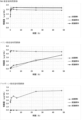
- FIG. 3 is a graph showing the time course of the adsorption amounts of TMA (top), choline (middle) and arginine (bottom) for Example 26, Example 34 and Comparative Example 6.
- FIG. 4 is a graph showing the time course of choline release amount for Comparative Example 6, Comparative Example 22, Example 26 and Example 34.
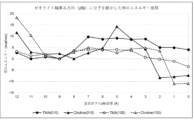
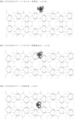
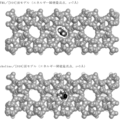
- FIG. 5 is a graph showing energy transitions when the process of TMA or choline adsorption in the thickness direction (z-axis direction) of the zeolite layer on the [010] and [100] planes is analyzed by first-principles calculations based on the density functional method.
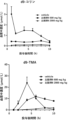
- Figure 8 is a graph showing the plasma concentration of d9-TMA over time (top) and its AUC (bottom) when fasted choline-loaded mice were administered multiple doses of the zeolite of Example 34.
- FIG. 10 shows the XRPD patterns of Example 34 (top) and Example 52 (bottom).
- FIG. 11 is a schematic diagram of a physiologically based pharmacokinetic (PBPK) model for d9-choline, d9-TMA, and d9-TMAO when d9-choline was orally administered to mice.
- Figure 12-1 is a graph showing a comparison of the individual measured values (dashed lines) and the predicted values (solid lines) by the PBPK model for the plasma concentration time courses of d9-choline (top), d9-TMA (middle), and d9-TMAO (bottom) in the vehicle group of choline-loaded mice under fasting conditions.
- Figure 12-2 is a graph comparing the individual measured values (dashed lines) and the predicted values (solid lines) by the PBPK model for the plasma concentration over time of d9-choline (top), d9-TMA (middle), and d9-TMAO (bottom) when fasted choline-loaded mice were administered the zeolite of Example 34 at a dose of 500 mg/kg.
- Figure 12-3 is a graph comparing the individual measured values (dashed line) and the predicted values (solid line) by the PBPK model for the plasma concentration over time of d9-choline (top), d9-TMA (middle), and d9-TMAO (bottom) when fasted choline-loaded mice were administered the zeolite of Example 34 at a dose of 1000 mg/kg.
- Figure 12-4 is a graph comparing the individual measured values (dashed line) and the predicted values (solid line) by the PBPK model for the plasma concentration over time of d9-choline (top), d9-TMA (middle), and d9-TMAO (bottom) when fasted choline-loaded mice were administered the zeolite of Example 34 at a dose of 2000 mg/kg.
- Figure 13 shows the urinary excretion of d9-TMA and TMAO (top), native TMA and TMAO (middle), and d9-TMA, d9-TMAO, native TMA and native TMAO (bottom) when multiple doses of the zeolite of Example 34 were administered to fed choline-loaded mice.
- Results are shown as mean ⁇ standard error, with # indicating significant difference compared to the vehicle group (Williams multiple comparison test, #: P ⁇ 0.025, ##: P ⁇ 0.005, ###: P ⁇ 0.0005).
- the graph also includes the urinary excretion of the zeolite of Example 70 administered at a dose of 1000 mg/kg. Results are shown as mean ⁇ standard error, with * indicating significant difference compared to the vehicle group (Student's t test, *: P ⁇ 0.05, **: P ⁇ 0.01).
- the oral composition of the present disclosure comprises: Contains an inorganic porous material, When 11.8 g of the inorganic porous material per 1 mmol of choline is mixed with a mixture of equimolar amounts of choline and a primary, secondary, or tertiary amine or ammonia in artificial intestinal juice at a concentration of 2 g/L for 1 hour, the adsorption rate of the primary, secondary, or tertiary amine or ammonia is 60.0% or more, and the adsorption rate of choline is 40.0% or less.
- the inorganic porous body is an inorganic material having a plurality of pores therein, and preferably means an inorganic material having a large number of fine pores with a pore diameter of 100 ⁇ m or less therein.
- the inorganic material is preferably a silicate.
- a silicate is a compound that contains at least silicon (Si) and oxygen (O), and some of these atoms may be replaced by other atoms.
- the silicate may be an aluminosilicate in which some silicon atoms are substituted with aluminum atoms.
- the inorganic material is preferably a silicate or an aluminosilicate.
- An aluminosilicate is a compound containing at least aluminum (Al), silicon (Si), and oxygen (O), and some of these atoms may be substituted with other atoms.
- the aluminosilicate of the present disclosure includes compounds labeled with isotopes (e.g., 2H , 3H , 17O , 18O , 29Si , 30Si , etc.).
- Aluminosilicates include zeolite, mullite, kaolinite, illite, etc., with zeolite being preferred.
- IZA International Zeolite Association
- the molar ratio of SiO2 to Al2O3 in the zeolite i.e., the SiO2 / Al2O3 ratio
- the polarity of the zeolite can be controlled within a certain range, and high adsorption selectivity for primary, secondary, and tertiary amines or ammonia can be maintained compared to choline.
- the SiO2 / Al2O3 ratio is the ratio of SiO2 to Al2O3 when the molar ratio of the amounts of Si and Al contained in the zeolite is converted into the molar amounts of SiO2 and Al2O3 , respectively.
- the SiO 2 /Al 2 O 3 ratio of the zeolite can be adjusted by the reaction conditions for synthesizing the zeolite.
- the structure of zeolite can be expressed in the codes specified by IZA, for example: ABW, ACO, AEI, AEN, AFI, AFT, AFX, ANA, ATN, ATT, ATV, AWO, AWW, BIK, CHA, DDR, DFT, EAB, EPI, ERI, ESV, GIS, GOO, ITE, JBW, KFI, LEV, LTA, MER, MON, MTF, OWE, PAU, PHI, RHO, RTE, RWR, SAS, SAT, SAV, SIV, TSC, UFI, VNI, YUG, AEL, AFO, AHT, DAC, FER, HEU, IMF, I Examples include TH, MEL, MFS, MWW, OBW, RRO, SFG, STI, SZR, TER, TON, TUN, WEI, MFI, MON, PAU, PHI, MOR, FAU, and the like.
- the structure of a zeolite is a crystal structure in which tetrahedra, in which four oxygen atoms are coordinated to a cation, are linked together while sharing the apex oxygen with adjacent cations.
- the zeolite contains a zeolite having a pore structure with a maximum number of rings of 10. This allows the pore size to be controlled, and the adsorption selectivity for primary, secondary, and tertiary amines or ammonia to be increased compared to choline.
- the number of rings refers to the number of oxygen atoms contained in the ring structure that constitutes the cross section of the zeolite's pores, and the maximum number of rings refers to the pore with the largest number of oxygen atoms among the pores that are composed of oxygen and T elements (elements other than oxygen that constitute the framework) that form the zeolite framework.
- the maximum number of rings refers to the pore with the largest number of oxygen atoms among the pores that are composed of oxygen and T elements (elements other than oxygen that constitute the framework) that form the zeolite framework.
- T elements elements other than oxygen that constitute the framework
- the maximum spherical diameter of diffusion in the zeolite pores is preferably 3.68 ⁇ or more, more preferably 3.70 ⁇ or more, even more preferably 3.75 ⁇ or more, even more preferably 4.22 ⁇ or more, even more preferably 4.50 ⁇ or more, particularly preferably 4.65 ⁇ or more, and most preferably 4.69 ⁇ or more.
- the upper limit of the maximum spherical diameter of diffusion in the pores is preferably 4.91 ⁇ or less, more preferably 4.90 ⁇ or less, even more preferably 4.85 ⁇ or less, even more preferably 4.80 ⁇ or less, even more preferably 4.75 ⁇ or less, particularly preferably 4.73 ⁇ or less, and most preferably 4.71 ⁇ or less.
- the maximum sphere diameter ( ⁇ ) of diffusion within a pore can be found by referring to the Maximum diameter of a sphere that can diffuse along in each framework code page of the Zeolite Framework Types (https://asia.iza-structure.org/IZA-SC/ftc_table.php) of the Structure Commission of the International Zeolite Association (IZA-SC). When there are multiple values for the a, b, and c axes, the maximum one is referred to.
- Examples of zeolites having a pore structure with a maximum of 10 rings include AEL, AFO, AHT, CGF, CGS, DAC, EUO, FER, HEU, IMF, ITH, LAU, MEL, MFI, MFS, MTT, MWW, NES, OBW, PON, RRO, SFF, SFG, STF, STI, SZR, TER, TON, TUN, and WEI.
- zeolites having a pore structure with a maximum of 10 rings and a maximum spherical diameter of diffusion within the pores of 3.68 ⁇ or more are preferred.
- FER or MFI is preferred, and MFI is more preferred.
- the counter cation of zeolite includes H + (proton), NH4 + , alkali metal ions (Li + , Na + , K + , Rb + , Cs +, etc.), group 2 element ions (Ca2 + , Mg2 + , Sr2 + , Ba2 +, etc.), transition metal ions (Fe2 + , Cu2 + , Zn2 + , etc.).
- proton NH4 + , Li + , Na + , K +, etc. are preferred.
- proton is preferred because it can prevent over-intake of various ions and can be used safely by living organisms.
- a zeolite having an external surface area of less than 33.0 m 2 /g More preferably, it is less than 30.0 m 2 /g, even more preferably, it is less than 26.0 m 2 /g, even more preferably, it is less than 25.8 m 2 /g, even more preferably, it is 25.6 m 2 /g or less, particularly preferably, it is 20.0 m 2 /g or less, particularly preferably, it is 15.0 m 2 /g or less, and most preferably, it is 13.3 m 2 /g or less.
- the lower limit is not particularly limited, but is, for example, 0.1 m 2 /g or more, 1.0 m 2 /g or more, 3.0 m 2 /g or more, 5.0 m 2 /g or more, 6.5 m 2 /g or more.
- the external surface area refers to the total surface area per unit mass of the solid minus the internal surface area of the pores per unit mass. This value can be calculated from the slope and intercept of the plateau portion of the t-plot (standard isotherm: de-Bore formula) obtained by measuring the nitrogen adsorption isotherm at liquid nitrogen temperature for a powder that has been pretreated by heating and degassing.
- the half-width refers to the spectral width at half the peak maximum value.
- the zeolite used has a median diameter of particle size distribution of preferably 5.5 ⁇ m or more, more preferably 10.0 ⁇ m or more, and even more preferably 11.7 ⁇ m or more. There is no particular upper limit, but it is, for example, 10.0 mm or less. By setting the median diameter of the particle size distribution within a certain range, it is possible to improve the selectivity of adsorption for primary, secondary, and tertiary amines or ammonia compared to choline.
- zeolite having a cumulative frequency 10% diameter of particle size distribution of 2.5 ⁇ m or more, more preferably 5.0 ⁇ m or more, and further preferably 5.3 ⁇ m or more.
- the median diameter and 10% cumulative frequency diameter in the particle size distribution are the particle sizes at which the cumulative values in the particle size distribution determined by the laser diffraction/scattering method are 50% and 10%, respectively, and are the values measured using pure water as the dispersion medium, after applying ultrasound, while circulating in a flow cell.
- the crystal shape of the MFI zeolite is preferably a coffin type.
- the crystal shape of the MFI zeolite is preferably a coffin type.
- the coffin shape refers to a shape in which the [010] plane dominates when observed with a scanning electron microscope (SEM).
- Zeolite can be purchased commercially or can be synthesized by hydrothermal synthesis, as described below.
- the oral composition disclosed herein has an adsorption rate of 60.0% or more for primary, secondary, tertiary amines or ammonia and an adsorption rate of 40.0% or less for choline when 11.8 g of the inorganic porous material per 1 mmol of choline is mixed with choline and primary, secondary, tertiary amines or ammonia present as a mixture in equimolar amounts in artificial intestinal fluid for 1 hour at a concentration of 2 g/L.
- the adsorption rate of primary, secondary, and tertiary amines or ammonia is usually 60.0% or more, preferably 60.4%, more preferably 70.0% or more, even more preferably 80.0%, and particularly preferably 90.0% or more.
- the adsorption rate of primary, secondary, and tertiary amines or ammonia can be, for example, 100.0% or less.
- the choline adsorption rate is usually 40.0% or less, preferably 30.0% or less, more preferably 20.0% or less, and even more preferably 10.0% or less.
- the choline adsorption rate can be, for example, 0.0% or more, 0.1% or more, or 0.2% or more.
- the adsorption rate of the primary, secondary, or tertiary amine or ammonia is preferably 2.00 times or more, more preferably 2.49 times or more, and even more preferably 2.50 times or more, the adsorption rate of the choline.
- the adsorption rate of the primary, secondary, or tertiary amine or ammonia can be 350.00 times or less, 342.00 times or less, or 341.70 times or less, the adsorption rate of the choline.
- choline is a compound identified by CAS Registry Number 62-49-7, and is a quaternary ammonium cation represented by the rational formula (CH 3 ) 3 N + (CH 2 ) 2 OH.
- Ammonia is a chemical compound identified by CAS Registry Number 7664-41-7 and has the rational formula NH3 . It also contains the ammonium cation ( NH4 + ).
- Primary, secondary, and tertiary amines are compounds in which the hydrogen atom of ammonia has been replaced with a hydrocarbon group or an aromatic atomic group; if there is one substitution, it is called a primary amine, if there are two substitutions, it is called a secondary amine, and if there are three substitutions, it is called a tertiary amine.
- heterocyclic aromatic compounds such as imidazole and pyridine are also included in the category of amines.
- Primary, secondary, and tertiary amines also include their conjugate acids.
- FaSSIF fasting-state simulated small intestinal fluid
- FaSSIF (pH 6.5) having the following composition can be used.
- the adsorption rate is calculated by dividing the concentration of the substance in the solution after the adsorption operation by the concentration in the solution before the adsorption operation, and then subtracting this value from 1.
- choline and primary, secondary, and tertiary amines or ammonia are placed in artificial intestinal fluid, and adding an inorganic porous material equivalent to 11.8 g per 1 mmol of choline at a concentration of 2 g/L, and allowing the adsorption reaction to occur at room temperature for 1 hour, the adsorption rates of choline and primary, secondary, and tertiary amines or ammonia are measured, and it can be confirmed that the adsorption rate of primary, secondary, and tertiary amines or ammonia is 60.0% or more and that the adsorption rate of choline is 40.0% or less.
- Room temperature is 20°C ⁇ 10°C.
- the adsorption rates of choline and TMA can be measured, and it can be confirmed that the adsorption rate of TMA is 60.0% or more and the adsorption rate of choline is 40.0% or less.
- the oral composition refers to a mixture of substances suitable for oral administration to an individual.
- the oral composition may include one or more inorganic porous bodies and orally acceptable carriers (excipients, binders, disintegrants, flavorings, odorants, emulsifiers, diluents, solubilizing agents, etc.).
- Acceptable carriers for oral administration are appropriately selected depending on the dosage form, and examples include excipients, lubricants, binders, and disintegrants in solid preparations, and solvents, solubilizers, emulsifiers, diluents, suspending agents, isotonicity agents, buffers, and soothing agents in liquid preparations.
- conventional additives such as preservatives, antioxidants, colorants, flavorings, odorants, and wetting agents can be used in appropriate amounts as needed.
- the dosage form of the oral composition may be a solid or liquid dosage form, specifically, tablets, coated tablets, pills, fine granules, granules, powders, capsules, syrups, emulsions, suspensions, injections, troches, enteric-coated capsules, etc.
- the oral composition of the present disclosure may further contain other therapeutically effective drugs, for example, inhibitors of TMA-producing enzymes such as cutC and cntAB, TMA-degrading enzymes such as trimethylamine dehydrogenase, riboflavin, and antibacterial agents.
- inhibitors of TMA-producing enzymes such as cutC and cntAB
- TMA-degrading enzymes such as trimethylamine dehydrogenase
- riboflavin riboflavin
- An oral composition containing the inorganic porous material of the present disclosure can be used, for example, as a pharmaceutical composition, a supplement, a food, or a food additive.
- the supplements, foods, and food additives may be supplements, foods, and food additives that are indicated with a function or use such as for adsorbing primary, secondary, or tertiary amines or ammonia, for adsorbing and removing primary, secondary, or tertiary amines or ammonia, or for preventing, treating, or alleviating symptoms of diseases caused by primary, secondary, or tertiary amines, ammonia, or metabolites thereof.
- the oral composition containing the inorganic porous body of the present disclosure can be preferably used as a pharmaceutical composition, and specifically can be used to treat, prevent, or alleviate symptoms of diseases caused by primary, secondary, or tertiary amines, ammonia, or metabolites thereof.
- the inorganic porous material contained in the oral composition of the present disclosure is insoluble in water and has a particle size (100 nm) that is suitable for endocytosis, so absorption into the body is negligible.
- the zeolite contained in the oral composition of the present disclosure exists stably in the stomach and other parts of the digestive tract, and the elution of the components, including silicon and aluminum, is very small, making it highly safe when taken.
- One embodiment of the present disclosure is a pharmaceutical composition for treating, preventing, or alleviating symptoms of a disease caused by primary, secondary, or tertiary amines, ammonia, or metabolites thereof, which comprises an inorganic porous body according to the above-described embodiment of the present disclosure or an oral composition containing the same.
- One embodiment of the present disclosure is a method for treating, preventing, or alleviating symptoms of a disease caused by primary, secondary, or tertiary amines, ammonia, or metabolites thereof, comprising the step of administering to a subject an effective amount of an inorganic porous body according to the above-described embodiment of the present disclosure or an oral composition containing the same.
- One embodiment of the present disclosure is the use of an inorganic porous body according to the above-described embodiment of the present disclosure or an oral composition containing the same to manufacture a medicine for treating, preventing, or alleviating symptoms of a disease caused by a primary, secondary, or tertiary amine, ammonia, or a metabolite thereof.
- One embodiment of the present disclosure is an inorganic porous body according to the above-described embodiment of the present disclosure or an oral composition containing the same for treating, preventing, or alleviating symptoms of a disease caused by a primary, secondary, or tertiary amine, ammonia, or a metabolite thereof.
- the primary, secondary, and tertiary amines, ammonia, or metabolites thereof are preferably one or more selected from the group consisting of trimethylamine, dimethylamine, methylamine, histamine, ammonia, and trimethylamine-N-oxide, and more preferably trimethylamine or trimethylamine-N-oxide.
- Diseases caused by primary, secondary, and tertiary amines, ammonia, or their metabolites are not particularly limited as long as they are diseases or symptoms that can be caused by these substances, but examples include diseases that can be treated, prevented, or alleviated by reducing or removing these substances.
- diseases caused by primary, secondary, and tertiary amine ammonia or their metabolites include trimethylaminuria, cardiovascular disease, glaucoma, atherosclerosis, coronary heart disease, heart failure with preserved ejection fraction, ST-segment elevation myocardial infarction, atrial fibrillation, abdominal aortic aneurysm, ischemic stroke, post-stroke cognitive impairment, mild cognitive impairment, Alzheimer's dementia, obesity, advanced chronic kidney disease with type 2 diabetes, cardiovascular complications in chronic kidney disease, diabetic retinopathy, non-alcoholic steatohepatitis, polycystic ovary syndrome, Parkinson's disease, colorectal cancer, irritable bowel syndrome, hyperammonemia, urea cycle disorders, organic acidemia, hepatic encephalopathy, and portosystemic shunts.
- the causative substance of a disease when the causative substance of a disease is trimethylamine, the disease that can be treated, prevented, or alleviated by an oral composition containing the inorganic porous body of the present disclosure can be trimethylaminuria, cardiovascular disease, or glaucoma, and preferably is trimethylaminuria.
- trimethylaminuria is a disease in which trimethylamine, which is generated during digestion and decomposition of ingested food, is not metabolized in the body and is excreted in sweat, urine, and breath. It is also called fish odor syndrome because trimethylamine smells like rotten fish.
- type 1 primary trimethylaminuria
- type 2 secondary trimethylaminuria
- type 1 primary trimethylaminuria
- FMO3 flavin-containing monooxygenase 3
- type 2 secondary trimethylaminuria
- Trimethylaminuria European Journal of Human Genetics volume 23, page1269 (2015) Cardiovascular disease: Toxins 2019, 11(9), 490 Glaucoma: International Ophthalmology volume 41, pages 341-347 (2021)
- the disease that can be treated, prevented, or alleviated by an oral composition containing the inorganic porous material of the present disclosure can be atherosclerosis, coronary heart disease, heart failure with preserved ejection fraction, ST-segment elevation myocardial infarction, atrial fibrillation, abdominal aortic aneurysm, ischemic stroke, post-stroke cognitive impairment, mild cognitive impairment, Alzheimer's dementia, obesity, advanced chronic kidney disease with type 2 diabetes, cardiovascular complications in chronic kidney disease, diabetic retinopathy, non-alcoholic steatohepatitis, polycystic ovary syndrome, Parkinson's disease, or colorectal cancer, preferably atherosclerosis.
- Atherosclerosis is a disease in which patchy intimal plaques (atheromas) form that grow toward the lumen of medium and large arteries, thereby reducing or blocking blood flow.
- Diabetic retinopathy Acta Diabetologica 58, 221-229 (2021)
- Nonalcoholic fatty liver disease Diabetes & Metabolism 47 (2021) 101183 Polycystic ovary syndrome: BMC Endocr Disord. 2020; 20: 3.
- Parkinson's Disease Clinica Chimica Acta Volume 501, February 2020, Pages 165-173 Colorectal cancer: International Journal of Molecular Sciences 2020, 21, 6782
- a disease that can be treated, prevented, or alleviated by an oral composition containing the inorganic porous material of the present disclosure can be irritable bowel syndrome.
- irritable bowel syndrome refers to a syndrome in which abnormal bowel movements such as chronic diarrhea or constipation, abdominal pain, and abdominal distension occur despite the absence of organic abnormalities such as ulcers or tumors in the large or small intestine.
- histamine and irritable bowel syndrome is described, for example, in the following literature: Science Translational Medicine 14, eabj1895 (2022)
- the disease that can be treated, prevented, or alleviated by an oral composition containing the inorganic porous material of the present disclosure can be hyperammonemia, urea cycle disorder, organic acidemia, hepatic encephalopathy, or portosystemic shunt, and is preferably hyperammonemia.
- hyperammonemia is a disease in which the body is unable to metabolize ammonia, resulting in the accumulation of ammonia in the blood.
- Known causes include impaired function of the urea cycle due to liver cirrhosis, fulminant hepatitis, and impaired liver function, portosystemic shunts, urea cycle disorders, organic acidemia, ammonia production associated with infection with urease-producing bacteria, and drug-induced ammonia (sodium valproate, pivalic acid-containing antibiotics).
- Hyperammonemia can also lead to symptoms such as hepatic encephalopathy and hepatic coma.
- zeolites in particular one or more types of zeolites selected from the group consisting of zeolites having a molar ratio of SiO2 to Al2O3 within a specific range and zeolites having a maximum number of rings of 10 and a maximum spherical diameter of diffusion within pores of 3.68 ⁇ or more, have excellent performance in selectively adsorbing primary, secondary, and tertiary amines or ammonia compared to choline, and are useful for treating, preventing, or alleviating symptoms of diseases caused by primary, secondary, and tertiary amines, ammonia, or metabolites thereof.
- one embodiment of the oral composition of the present disclosure is: Contains zeolite, The zeolite has an MFI structure and a molar ratio of SiO2 to Al2O3 is 30.0 or more and 130000.0 or less, or The zeolite has an FER structure and a molar ratio of SiO2 to Al2O3 is 15.0 or more and 130000.0 or less; and an oral composition for use in the treatment, prevention, or alleviation of symptoms of one or more diseases selected from the group consisting of trimethylaminuria, atherosclerosis, irritable bowel syndrome, and hyperammonemia.
- a preferred embodiment of the oral composition of the present disclosure is Contains zeolite,
- the zeolite has an MFI structure and a molar ratio of SiO2 to Al2O3 is 30.0 or more and 80.0 or less, or
- the zeolite has an FER structure and a molar ratio of SiO2 to Al2O3 is 15.0 or more and 130000.0 or less; and an oral composition for use in the treatment, prevention, or alleviation of symptoms of one or more diseases selected from the group consisting of trimethylaminuria, atherosclerosis, irritable bowel syndrome, and hyperammonemia.
- the oral composition or pharmaceutical composition containing the inorganic porous material of the present disclosure can be administered orally to a subject.
- the "subject" to which the oral composition or pharmaceutical composition of the present disclosure is administered includes humans and non-human mammals (e.g., one or more of mouse, guinea pig, hamster, rat, mouse, rabbit, pig, sheep, goat, cow, horse, cat, dog, marmoset, monkey, chimpanzee, etc.).
- the "subject” may be a patient diagnosed with a disease caused by primary, secondary, or tertiary amines, ammonia, or a metabolite thereof, or a subject at risk of developing a disease caused by primary, secondary, or tertiary amines, ammonia, or a metabolite thereof.
- Treatment includes any treatment of a disease in a mammal, particularly a human, and includes inhibiting the symptoms of the disease, i.e., arresting its progression or eliminating the disease or condition, causing regression of the disease or condition, or slowing the progression of the condition.
- Relief of symptoms includes reducing or alleviating the symptoms of the above-mentioned disease and reducing the frequency of symptoms in a mammal, particularly a human.
- Prevention includes preventing the onset of the above-mentioned diseases in mammals, particularly humans.
- the dosage of the oral composition or pharmaceutical composition containing the inorganic porous body of the present disclosure is determined by a physician based on various factors, such as the type of disease, the severity of symptoms, the patient's age, sex, weight, severity of the disease, pharmacological findings such as pharmacokinetic and toxicological characteristics, whether a drug delivery system is used, and whether it is administered as part of a combination of other drugs.
- Orally administered, for an adult (body weight 60 kg) the dosage is usually 200 mg to 42,000 mg, preferably 500 mg to 2,000 mg. Administration may be once or multiple times per day, for example, 1 to 5 times per day.
- One aspect of the present disclosure relates to a method for producing zeolite.
- the zeolite contained in the oral composition of the present disclosure is not limited to those obtained by the following production methods.
- Hydrothermal synthesis is a method of synthesis and crystal growth of substances that is carried out in the presence of high-temperature water of 50°C or higher.
- hydrothermal synthesis is carried out in a reaction system that contains a Si element source (a substance that contains at least silicon (Si)), an Al element source (a substance that contains at least aluminum (Al)), an alkali metal salt, and water, and further contains a structure directing agent as necessary.
- Si element source a substance that contains at least silicon (Si)
- Al element source a substance that contains at least aluminum (Al)
- an alkali metal salt a substance that contains at least aluminum (Al)
- Zeolite seed crystals may be added to the reaction system.
- the aluminum element source typically includes aluminum sulfate, aluminum nitrate, aluminum hydroxide, sodium aluminate, pseudoboehmite, alumina sol, aluminum alkoxides such as aluminum isopropoxide, etc.
- aluminum-containing zeolites such as FAU-type zeolite (e.g., Y-type zeolite) and CHA-type zeolite may be used as the aluminum source.
- FAU-type zeolite e.g., Y-type zeolite
- CHA-type zeolite may be used as the aluminum source.
- aluminum sulfate, aluminum nitrate, aluminum hydroxide, or aluminum-containing zeolites are preferred in terms of reactivity, and aluminum hydroxide or aluminum-containing zeolites are more preferred.
- the amount of the Al element source used is, in terms of ease of preparation of the pre-reaction mixture or the aqueous gel obtained by aging the pre-reaction mixture, and production efficiency, typically 0.001 or more, preferably 0.005 or more, more preferably 0.01 or more, and even more preferably 0.02 or more, in terms of the molar ratio of aluminum (Al) in the Al element source to silicon (Si) contained in the raw material mixture other than the seed crystals added as necessary.
- the Al element source uniformly in the aqueous gel, it is typically 1 or less, preferably 0.5 or less, more preferably 0.25 or less, even more preferably 0.1 or less, particularly preferably 0.08 or less, and most preferably 0.06 or less.
- the source of the Si element is not particularly limited, and various known substances can be used, such as colloidal silica, amorphous silica, sodium silicate, trimethylethoxysilane, tetraethylorthosilicate, aluminosilicate gel, and zeolite containing Si atoms. These may be used alone or in combination of two or more. Of these, raw materials that can be mixed sufficiently uniformly with other components and that are particularly easily soluble in water are preferred, and colloidal silica, trimethylethoxysilane, tetraethylorthosilicate, or aluminosilicate gel are preferred.
- Alkali metal cations exist near aluminum anions to compensate for the charge, and like structure-directing agents, they have the effect of assisting crystal growth of the desired structure.
- the alkali metal salt includes sodium salts and/or potassium salts, and may also include other alkali metal atoms. There are no particular limitations on the other alkali metal atoms, and any known alkali metal atom used in zeolite synthesis may be used, such as lithium, rubidium, and cesium, and two or more of these may be used in combination.
- alkali metal salt inorganic acid salts such as hydroxides, oxides, carbonates, sulfates, nitrates, phosphates, chlorides, bromides, etc. of the above alkali metal atoms, and organic acid salts such as acetates, oxalates, citrates, etc. can be used.
- organic acid salts such as acetates, oxalates, citrates, etc.
- the amount of water used is usually 5 or more, preferably 10 or more, more preferably 12 or more, even more preferably 15 or more, and particularly preferably 17 or more, in terms of the molar ratio to the silicon (Si) contained in the raw material mixture other than the seed crystals. This range is preferable because it makes crystal formation easier.
- the molar ratio to the silicon (Si) contained in the raw material mixture other than the seed crystals is usually 100 or less, preferably 90 or less, more preferably 75 or less, and even more preferably 50 or less.
- a structure-directing agent is a substance that may be added as a raw material during the synthesis of zeolite, and is a material added to control the structure of the zeolite obtained by synthesis.
- one type of structure-directing agent may be used, or two or more types may be used in combination, or these structure-directing agents may not be used at all.
- Structure directing agents are broadly divided into organic structure directing agents and inorganic structure directing agents.
- Organic structure directing agents typically include amines, quaternary ammonium salts, and primary alcohols.
- Inorganic structure directing agents include nitrates, sulfates, and carbonates, which have inorganic ions as cations.
- the method for producing the oral pharmaceutical composition of the present disclosure is a method that includes obtaining zeolite by hydrothermal synthesis without using an organic structure-directing agent.
- an inorganic structure-directing agent in the hydrothermal synthesis.
- the target zeolite is an MFI type
- a Si element source, an Al element source, an alkali metal salt, and water, and optionally a structure-directing agent are mixed together to obtain a mixture, and if necessary, seed crystals are further added to the mixture, and the obtained pre-reaction mixture is subjected to hydrothermal synthesis.
- the order of mixing these raw materials is not particularly limited. However, it is preferable to prepare an alkaline solution by mixing water and an alkali metal salt, and then add the Al element source, Si element source, and optionally seed crystals in this order to the alkaline solution, in order from the viewpoint of dissolving the raw materials more uniformly when the Si element source and the Al element source are added after the alkaline solution is prepared.
- Zeolite is usually used as the seed crystal. If the zeolite to be produced is an aluminosilicate, the seed crystal is preferably an aluminosilicate zeolite.
- the seed crystal may contain an amorphous component as a part thereof.
- the zeolite used as the seed crystal may or may not contain an organic structure directing agent.
- the method for producing the zeolite to be the seed crystal is not particularly limited, and may be produced by the zeolite production method exemplified as the production method of the oral composition of the present disclosure, or may be produced by other methods, such as a general batch method using an autoclave.
- the amount of the seed crystal is preferably large in terms of the effect of promoting crystallization as the seed crystal being easily manifested.
- the amount of the seed crystal is small in terms of the ease of dissolving the seed crystal and the ease of functioning as the seed crystal. Therefore, the amount of the seed crystal is preferably 0.1% by mass or more, more preferably 0.5% by mass or more, and even more preferably 1.0% by mass or more, relative to the silica (SiO 2 ) contained in the raw material mixture other than the seed crystal contained in the raw material composition, and more preferably 0.5% by mass or more. On the other hand, it is preferably 30% by mass or less, more preferably 20% by mass or less, even more preferably 15% by mass or less, and particularly preferably 10% by mass or less.
- auxiliary agents that serve as components to aid in the synthesis of zeolite, such as acid components that promote the reaction, and other additives such as metal stabilizers such as polyamines, may be added and mixed at any step as required to prepare a pre-reaction mixture.
- the pre-reaction mixture prepared as described above may be hydrothermally synthesized immediately after preparation, but in order to obtain a zeolite with high crystallinity, it is preferable to age it for a certain period of time under a specified temperature condition.
- a specified temperature condition In particular, when scaling up, the stirring property is deteriorated and the raw material is likely to be insufficiently mixed. Therefore, it is preferable to improve the raw material to a more uniform state by aging the raw material while stirring it for a certain period of time.
- the aging temperature is usually 100°C or less, preferably 95°C or less, more preferably 90°C or less, and although there is no particular lower limit, it is usually 0°C or more, preferably 10°C or more.
- the aging temperature may be constant during aging, or may be changed stepwise or continuously.
- the aging time is not particularly limited, but is usually 2 hours or more, preferably 3 hours or more, more preferably 5 hours or more, and is usually 30 days or less, preferably 10 days or less, and more preferably 4 days or less.
- Hydrothermal synthesis is carried out, for example, by placing the pre-reaction mixture prepared as described above or the aqueous gel obtained by maturing the pre-reaction mixture in a pressure-resistant container and maintaining a predetermined temperature under self-generated pressure or under gas pressure to an extent that does not inhibit crystallization, while stirring, rotating or rocking the container, or leaving it still.
- the reaction temperature during hydrothermal synthesis is usually 100°C or higher and usually 230°C or lower, preferably 220°C or lower, more preferably 200°C or lower, and even more preferably 190°C or lower.
- the reaction time is not particularly limited, but is usually 2 hours or more, preferably 3 hours or more, more preferably 5 hours or more, and especially preferably 1 day or more. There is no particular upper limit, but it is usually 30 days or less, preferably 10 days or less, more preferably 7 days or less, and even more preferably 5 days or less.
- the reaction temperature may be constant during the reaction, or may be changed stepwise or continuously.
- the zeolite produced is separated from the hydrothermal synthesis reaction liquid.
- the method for separating the zeolite from the hydrothermal synthesis reaction liquid is not particularly limited, but typically includes methods such as filtration, decantation, or direct drying.
- the zeolite separated and recovered from the hydrothermal synthesis reaction liquid is washed with water and dried, if necessary.
- the drying temperature is usually 50°C or higher, preferably 80°C or higher, and more preferably 100°C or higher. On the other hand, the drying temperature is usually 200°C or lower, and preferably 150°C or lower.
- the drying time is not particularly limited as long as the zeolite is sufficiently dried, and is preferably 0.5 hours or more, and more preferably 1 hour or more. There is no particular upper limit, and it is usually 200 hours or less, preferably 150 hours or less, and more preferably 100 hours or less.
- organic structure-directing agent is used in the hydrothermal synthesis, the organic structure-directing agent is removed by calcination after drying.
- the firing temperature is usually 350°C or higher, preferably 400°C or higher, more preferably 430°C or higher, and even more preferably 480°C or higher.
- the firing temperature is usually 900°C or lower, preferably 850°C or lower, more preferably 800°C or lower, and even more preferably 750°C or lower.
- the heating time during baking is not particularly limited as long as it is the time required for the organic structure directing agent to decompose, and is preferably 0.5 hours or more, more preferably 1 hour or more.
- the upper limit is not particularly limited, and is usually 200 hours or less, preferably 150 hours or less, more preferably 100 hours or less.
- the heat treatment may be performed in an air atmosphere, but may also be performed in an atmosphere containing an inert gas such as N2 or oxygen.
- the method for producing zeolite according to one embodiment of the present disclosure may further include exchanging cations by ion exchange.
- the ion exchange is usually performed after removing the organic structure-directing agent.
- Ions to be exchanged include H + (proton), NH 4 + , alkali metal ions (Li + , Na + , K + , Rb + , Cs +, etc.), Group 2 element ions (Ca 2+ , Mg 2+ , Sr 2+ , Ba 2+, etc.), transition metal ions (Fe 2+ , Cu + , Cu 2+ , Zn 2+, etc.), etc.
- ions such as proton, NH 4 + , Li + , Na + , and K + are preferred.
- proton is preferred because it can prevent excessive intake of various ions and can be used safely by the living body.
- Ion exchange may be performed by treating the zeolite with an aqueous solution containing a nitrate such as NH 4 NO 3 or KNO 3 or an ion to be exchanged, or in some cases with an acid such as hydrochloric acid, usually at a temperature of room temperature to 100° C., followed by washing with water. Furthermore, the zeolite may be calcined at 100° C. to 750° C. as necessary.
- a nitrate such as NH 4 NO 3 or KNO 3
- an ion to be exchanged or in some cases with an acid such as hydrochloric acid, usually at a temperature of room temperature to 100° C., followed by washing with water.
- the zeolite may be calcined at 100° C. to 750° C. as necessary.
- a method for synthesizing a proton-type zeolite in which 50% or more of the cations present inside the zeolite as charge compensation for the atoms constituting the zeolite framework are protons (H + ) a method of calcining after ion exchange with ammonium ions or a method of contacting with an acid and treating the zeolite can be mentioned.
- examples of the acid used include organic acids such as carboxylic acids and sulfonic acids, and inorganic acids such as sulfuric acid, nitric acid, phosphoric acid, and hydrochloric acid, which can be used alone or in combination of two or more kinds.
- organic acids such as carboxylic acids and sulfonic acids
- inorganic acids such as sulfuric acid, nitric acid, phosphoric acid, and hydrochloric acid, which can be used alone or in combination of two or more kinds.
- sulfuric acid or nitric acid is more preferable because it is a strong acid and efficiently promotes ion exchange.
- the method for producing zeolite according to one embodiment of the present disclosure may further include subjecting the zeolite after hydrothermal synthesis to a surface treatment in a solution containing a Si element source.
- the solution used for this surface treatment is not particularly limited as long as it is in a state in which zeolite can be treated under the conditions of the surface treatment, and may be a solution of a Si compound with a solvent added, a liquid without adding a solvent, or a sol or gel.
- the solvent may be water or an organic solvent.
- Solvents that are liquid under pressure at temperatures above their boiling point are also included. In this case, the pressure may be either autogenous pressure or pressurized pressure.
- the liquid for surface treatment is required to contain at least a Si compound, and may also contain other element sources (compounds), such as an Al compound.
- Si compounds that can be used include alkyl halide silanes such as trichloroethylsilane, dichlorohexylmethylsilane, and chlorotrimethylsilane, alkylalkoxysilanes such as methyltriethoxysilane, 3-aminopropyltriethoxysilane, and 1,1,3,3-tetramethoxy-1,3-dimethylpropanedisiloxane, organosilicon compounds having siloxanes such as hexamethyldisiloxane, organosilicon compounds having silazanes such as hexamethyldisilazane, silicates such as tetramethoxysilane and tetraethoxysilane, silicate oligomers such as methylsilicate oligomers and ethylsilicate oligomers, amorphous silica, fumed silica, colloidal silica, silica gel, sodium silicate
- the zeolite may be immersed in a liquid to form a chemical bond with the Si compound, or the chemical bond may be formed after immersion, or the chemical bond may be formed both during and after immersion. Also, the zeolite may be brought into contact with the gas phase of a liquid that has been evaporated by heating or other methods to form a chemical bond, or the chemical bond may be formed after contact.
- Test Method Glycine, lysine, and histidine were added to fasted-state simulated small intestine fluid (FaSSIF or artificial intestinal fluid) prepared according to the preparation method described in the literature (Dissolution Technologies 20(3):44-50) to prepare a reaction solvent.
- concentrations of glycine, lysine, and histidine in the reaction solvent at this time were 0.30, 0.42, and 0.21 mg/mL, respectively.
- TMA/choline/arginine three-component mixture adsorption rate test 1N hydrochloric acid was diluted with purified water to prepare 0.1N hydrochloric acid solution (2.0 mL). 13.53 mg of arginine, 10.84 mg of choline chloride, and 7.42 mg of TMA hydrochloride were precisely weighed and dissolved in the solution by shaking well to prepare a standard solution. 10 mg of zeolite was precisely weighed into a 25 mL tube, and 5 mL of FaSSIF was added. A stir bar and 50 ⁇ L of standard solution were added to this solution. Each solution was sampled only once, and the same number of reaction solutions as the number of samples were prepared in the same manner.
- samples were taken in the same manner as in the [Sample Preparation] for the in vitro adsorption test, and the time course of the adsorption amount of each component was calculated from the supernatant concentrations of TMA, choline, and arginine at each time point.
- the adsorption amount ( ⁇ g/mL) on the vertical axis of Figure 3 is the value obtained by subtracting the concentration of each component in the sample solution from the concentration of each component in the blank solution.
- zeolite was precisely weighed out, and 5 mL of phosphate buffer and 50 ⁇ L of the above choline solution were added. After stirring overnight at room temperature, the zeolite was filtered out and dried under reduced pressure at 40 °C for 30 minutes. The filtrate was sampled in the same manner as in the [Sample Preparation] of the in vitro adsorption test, and then further diluted 50 times with purified water, and the blank solution and sample solution were measured. 10 mg of the zeolite powder was precisely weighed and 5 mL of phosphate buffer was added. Each solution was sampled only once, and the same number of reaction solutions as the number of samples were prepared in the same manner.
- the choline concentration in the blank solution was subtracted from the choline concentration in the sample solution when choline was adsorbed overnight, and the value was multiplied by 50/7 to obtain the adsorption amount at 0 hours, and the choline concentration in the sample solution at each time point of the release test was subtracted from the choline concentration in the blank solution to obtain the adsorption amount at each time point.
- each item in the table indicates the following: Maximum number of rings: Maximum number of rings of the zeolite used in this example.
- Skeleton code Skeleton code of the zeolite used in this example, which conforms to the code that specifies the zeolite skeleton structure defined by IZA (International Zeolite Association). If the compound is other than zeolite, the name of the compound is written.
- the numerical value of the maximum sphere diameter of diffusion in pores was referenced to the Maximum diameter of a sphere that can diffuse along in each framework code page of Zeolite Framework Types (https://asia.iza-structure.org/IZA-SC/ftc_table.php) of the Structure Commission of the International Zeolite Association (IZA-SC).
- IZA-SC Structure Commission of the International Zeolite Association
- Pore dimension pore dimension of the zeolite used in this example
- Counter cation counter cation of the zeolite used in this example
- SAR molar ratio of SiO2 to Al2O3 of the zeolite used in this example; for Examples 70 and 78 , molar ratio of SiO2 to Al2O3 of the raw zeolite before surface treatment
- TMA adsorption rate TMA adsorption rate in the adsorption test performed in this example
- Choline adsorption rate Choline adsorption rate in the adsorption test performed in this example
- TMA/choline value obtained by dividing the TMA adsorption rate in the adsorption test performed in this example by the choline adsorption rate
- Acid Name of the acid reagent used in this example.
- Acid treatment temperature Temperature of the acid treatment carried out in this example.
- Acid treatment time Time of the acid treatment carried out in this example.
- Na residual rate Na residual rate in the zeolite after the acid treatment carried out in this example.
- the residual Na ratio was calculated from the Na/Al calibration curve in XRF, with the zeolite of Example 48 before ion exchange set at 100%.
- Raw zeolite Example number of the zeolite used as the raw material for the surface treatment reaction in this example.
- Raw zeolite SAR Molar ratio of SiO2 to Al2O3 in the zeolite used as the raw material for the surface treatment reaction in this example.
- Surface treatment reagent Surface treatment reagent used in this example.
- Reaction conditions Reaction conditions for the surface treatment reaction carried out in this example.
- TMA AUC change rate Rate of change in d9-TMA AUC of the zeolite-administered group relative to the vehicle group in the fasting choline loading test carried out in this example.
- Choline AUC change rate Rate of change in d9-choline AUC of the zeolite-administered group relative to the vehicle group in the fasting choline loading test carried out in this example.
- Post-hydrothermal synthesis treatment Post-treatment method after hydrothermal synthesis carried out in this example.
- XRPD pattern characteristics Characteristics of the XRPD pattern of the zeolite used in this example.
- External surface area External surface area of the zeolite used in this example.
- SEM image SEM image of zeolite used in this example.
- Concomitant drugs Classification and name of the concomitant drugs used in this example based on the compound properties. Free molecular weight: Free molecular weight of the concomitant drugs used in this example.
- pKa pKa of the concomitant drugs used in this example. Describes acidic compounds.
- pKa of conjugate acid pKa of the conjugate acid of the concomitant drug used in this example.
- Adsorption rate (%) to zeolite Adsorption rate (%) of concomitant drug to zeolite used in this example
- Table 4 shows the characteristics of the zeolite such as the maximum number of rings and the skeleton, as well as the TMA adsorption rate and the choline adsorption rate in the in vitro adsorption test for Examples 1, 26 and 34 and Comparative Examples 1 to 5 and 7 to 21.
- the pore size is smaller than the molecular size of TMA or choline, and it is considered that the adsorption of TMA or choline into the pores did not occur.
- choline adsorption was observed in Comparative Example 16, it is considered that this was due to the contribution of surface adsorption.
- zeolites with a maximum number of rings of 10 both choline and TMA were efficiently adsorbed, except for HEU zeolite.
- MFI zeolites there were compounds that completely adsorbed the TMA in the system (Examples 26 and 34), and these compounds preferentially adsorbed TMA over choline.
- HEU zeolites the 10-ring pores are collapsed, and the maximum spherical diameter of diffusion in the pores is small at 3.67 ⁇ , so it is believed that TMA did not adsorb into the pores.
- zeolites with a maximum ring number of 12 adsorb both choline and TMA, they are not selective for TMA.
- TMA and choline cannot be distinguished from each other.
- adsorbents such as activated carbon (Comparative Example 1) and molecular sieves 4A (Comparative Examples 4 and 5)
- the potassium adsorbent Lokelma registered trademark used as a drug for hyperkalemia (Comparative Example 2)
- clinoptilolite used in zeolite supplements in the United States (Comparative Example 3).
- SAR silica/alumina ratio
- Tables 5-1 and 5-2 When the SAR was less than 33.0, the TMA/choline selectivity ranged from about 1 to 3. When the SAR was between 33.0 and 79.4, the TMA/choline selectivity was generally high, and the TMA adsorption rate was also high. When the SAR was greater than 79.4, the TMA/choline selectivity was generally high, but the TMA adsorption rate tended to decrease compared to when the SAR was between 33.0 and 79.4.
- SAR correlates with TMA/choline selectivity, but also the quality of crystals, i.e., the peak half-width of XRPD, is thought to correlate with TMA/choline selectivity.
- Example 49 Using the zeolite of Example 48 (maximum number of rings: 10, skeleton code: MFI) which was subjected only to drying treatment after hydrothermal synthesis, the effect of differences in protonation treatment on the Na/H exchange efficiency was confirmed (Table 7). Considering the residual Na ratios of the zeolites in Examples 68 and 69, it is believed that the Na/H cation exchange reaction reached equilibrium in a 1 mol/L nitric acid aqueous solution with stirring at room temperature for about 1 hour. The residual Na ratio at this time was comparable to that in the case of proton-type zeolite produced by ammonium ion exchange and calcination (Example 49).
- Examples 77-88 the change in the choline adsorption rate was small when reacted by the vapor method (Examples 77 and 80), so it is considered that the surface treatment reaction was insufficient by the vapor method. Whether toluene-2 conditions or neat conditions were better depended on the polymer surface treatment reagent.
- the selectivity of TMA adsorption relative to choline is high when adsorbing using the internal pores of zeolite by recognizing the difference in molecular size, but the selectivity is low for compounds with a large external surface area because the contribution of adsorption on the external surface of zeolite particles, which does not recognize the difference in molecular size, is large.
- the adsorption process of each component on zeolite is considered to proceed in the order of (1) surface adsorption, (2) adsorption into the pores of the surface layer, and (3) diffusion into the pores to the deeper layers. Even if (1) is fast, if the adsorption and diffusion into the pores of (2) and (3) are slow, this becomes the adsorption rate-determining process.
- the difference in the adsorption rate of TMA and choline in Examples 26 and 34 is considered to reflect the difference in the rate of the adsorption process in the pores of (2) and (3). That is, choline, which has a larger molecular size than TMA, was slower than TMA in the adsorption and diffusion process in the pores due to steric hindrance, etc.
- Calculation model A periodic slab model corresponding to the [010] surface of MFI zeolite and a periodic slab model corresponding to the [100] surface were prepared in accordance with the data described in the paper (ACS Catalysis 2020 10, 3297-3312).
- TMA and choline were placed on the surface model, TMA was treated as a neutral molecule, and choline was treated as a monovalent cation molecule.
- the z coordinate of nitrogen was moved 1 ⁇ at a time toward the surface, and each time, an optimization calculation was performed for the atomic positions other than the z coordinate of nitrogen.
- the energy barrier for TMA and choline molecules when entering zeolite from the [100] plane is about 5 kcal/mol (energy difference within 1 kcal/mol of quantum chemical precision), and it is considered that there is no difference in the adsorption rate.
- the energy barrier for TMA molecules when entering zeolite from the [010] plane is about 10 kcal/mol, while it is about 15 kcal/mol for choline molecules, and it is predicted that the adsorption rate of choline molecules is slower than that of TMA.
- TMA a tertiary amine
- choline a quaternary ammonium ion
- choline a quaternary ammonium ion
- the three-dimensional channels of MFI zeolite are composed of linear [010] channels and sinusoidal [100] channels connected to each other, and molecules diffuse in the [001] direction by alternating between the [010] and [100] channels. It is assumed that the steric hindrance in the process of choline infiltrating the [010] surface also occurs in the interpore movement beyond the [010] surface inside the crystal, so that the diffusion rate of choline is slower than that of TMA in the intracrystalline diffusion in the [010] and [001] directions.
- ⁇ Fasting Choline Tolerance Test Test method Seven-week-old male C57BL/6 mice were fasted for 12 hours, and then d9-choline chloride (Toronto Research Chemicals Inc.) dissolved in distilled water, 0.5 w/v% methylcellulose 400 solution, and zeolite suspended in sterilized (Fujifilm Wako Pure Chemical Industries, Ltd.) were orally administered at doses of 78.78 mg/kg (60 mg/kg as d9-choline) and 500-2000 mg/kg, respectively. Blood was then collected from the tail vein 1, 2, 4, 6, 8, and 10 hours later, and the concentrations of d9-choline, d9-TMA, and d9-TMAO in plasma were measured by LC/MS/MS.
- the plasma concentration over time was plotted with the plasma concentration on the vertical axis and the time after administration on the horizontal axis, and the area under the curve (AUC) up to 10 hours after administration was calculated.
- the pharmacological effect of zeolite was confirmed by comparing these values between the non-zeolite-administered group (vehicle group) and the zeolite-administered group.
- the pharmacological effect of each zeolite was compared using the AUC change rate, which was calculated by normalizing the amount of AUC change from the vehicle group by the vehicle group AUC.
- the AUC change rate was calculated using the following formula.
- FIG. 8 shows the time course of d9-TMA plasma concentration and its AUC when multiple doses of the zeolite of Example 34 were administered to choline-loaded mice under fasting conditions.
- the zeolite of Example 34 dose-dependently decreased the plasma d9-TMA concentration and AUC, and at the highest dose of 2000 mg/kg, it almost completely suppressed the increase in plasma d9-TMA, which is considered to have adsorbed most of the d9-TMA in the digestive tract.
- FIG. 9 shows the time course of plasma concentrations of d9-choline and d9-TMA when a large dose of the zeolite of Comparative Example 6 was administered to choline-loaded mice under fasting conditions.
- T max the time to reach the maximum plasma concentration of d9-TMA
- T max the maximum plasma concentration of d9-TMA
- Example 35 is a Na-type zeolite that was not proton-exchanged
- Example 34 is a proton-type zeolite obtained by calcining the Na-type after ammonium ion exchange
- Example 68 is a proton-type zeolite obtained by treating the Na-type with nitric acid.
- the efficacy of both zeolites was confirmed in a fasting choline loading test. Compared to the proton-type zeolite calcined after ammonium ion exchange, the proton-type zeolite treated with nitric acid showed a higher reduction in the AUC of d9-TMA.
- each zeolite of Examples 34, 70 and 78 was administered to fasting choline loading mice, and their pharmacological effects were compared.
- Table 14 summarizes the compound profile and the results of the fasting choline loading test.
- the zeolites of Examples 70 and 78 were obtained by subjecting the zeolites obtained by Example 34 or a similar synthesis method to surface treatment.
- the surface treatment resulted in a decrease in d9-TMA AUC at the same level or higher than that before surface treatment, while preventing a decrease in d9-choline AUC.
- the effect of preventing choline adsorption by the surface treatment was also confirmed in a fasting choline loading test.
- Example 52 which contains a large amount of quartz, the MFI type zeolite content per weight is reduced, and the efficacy (d9-TMA AUC reduction rate) in the fasting choline loading test is considered to be lower than that of Example 34.
- the adsorption rate of choline and TMA is governed by the penetration rate of molecules from the medium into the zeolite pores and the diffusion rate of molecules in the crystal pores.
- MFI zeolite which has a three-dimensional pore structure, it is considered that the penetration rate and the diffusion rate in the three-dimensional coordinate axis direction of the crystal are different due to differences in the crystal plane.
- TMA/choline selectivity was high when the crystal plane of the [010] plane was wide, it is presumed that the [010] plane is the crystal plane with the highest TMA/choline selectivity. It has been confirmed in SCIENCE, 2003, Vol 300, Issue 5618, pp.
- the widest crystal plane of MFI zeolite, which has a coffin-shaped crystal shape is the [010] plane.
- further selectivity improvement is expected by selectively treating the surface of the surface other than the [010] plane, into which choline has difficulty penetrating.
- the length of the crystal axis of the coffin-shaped crystal is in the order of [001] axis > [100] axis > [010] axis, it is also presumed that TMA/choline selectivity is obtained during the diffusion process in the crystal pores in the [001] axis direction.
- Example 52 which has been confirmed to contain a large amount of quartz from the XRPD data, also has many particles other than MFI type zeolite that appear to be quartz in the SEM image, compared to Example 34.
- PK study of single intravenous administration of d9-TMA and d9-TMAO 7-9 week old male C57BL/6 mice were intravenously administered 11.5 mg/kg or 10 mg/kg of d9-TMA or d9-TMAO, and blood samples were taken over time. 7 week old male C57BL/6 mice were intravenously administered 10 mg/kg of d9-TMA, and urine samples were taken for 24 hours. Plasma and urinary concentrations of d9-TMA and d9-TMAO were measured by LC-MS/MS.
- Single-dose oral PK study of d9-TMA d9-TMA was orally administered at a dose of 34.6 mg/kg to 7-week-old male C57BL/6 mice under fasting conditions, and blood samples were taken over time. Plasma d9-TMA and d9-TMAO concentrations were measured by LC-MS/MS.
- a PBPK model was built for d9-choline, d9-TMA, and d9-TMAO when d9-choline was orally administered to mice, using a transit model that takes into account the conversion process of d9-choline to d9-TMA by intestinal bacteria in the large intestine and the transit time from the upper digestive tract to the large intestine.
- a schematic diagram of the PBPK model is shown in Figure 11.
- in building the model in vivo data from the vehicle group of the previously mentioned "fasting choline loading test" and in vivo data from a single-dose PK test were used.
- PBPK model The following steps were applied to construct the PBPK model. - It was assumed that there are no species differences in the liver/plasma partition coefficients, erythrocyte/plasma partition coefficients, and plasma protein unbound fractions of d9-TMA and d9-TMAO, and the values reported by Shimizu et al.1) were used. - Liver volume and hepatic blood flow were quoted from the values reported by Yamashita et al.2) . PK parameters of d9-TMA and d9-TMAO were estimated using data from single intravenous administration PK studies of d9-TMA and d9-TMAO. Renal clearance was optimized to accurately reproduce the urinary excretion rate of d9-TMA.
- the absorption parameters of d9-TMA were estimated using the data of the vehicle group in the fasted choline loading study.
- the conversion rate was calculated by dividing the dose-adjusted AUC of d9-TMA in the vehicle group in the fasted choline loading study normalized by the dose-adjusted AUC of d9-TMA in the d9-TMA administration group in the single intravenous administration PK study by the absorption rate of d9-TMA calculated using the PBPK model.
- the AUC reduction rate of d9-choline and d9-TMA was considered to reflect the gastrointestinal absorption inhibition rate due to adsorption to zeolite (hereinafter, sometimes referred to as IR pre and IR, respectively), and the relationship equations of IR pre and IR with respect to the zeolite dose were constructed.
- IR pre and IR gastrointestinal absorption inhibition rate due to adsorption to zeolite
- gastrointestinal absorption inhibition rate of d9-TMA theoretical acid amount of unadsorbed zeolite / (water volume in the large intestine ⁇ dissociation constant + theoretical acid amount of unadsorbed zeolite).
- SimCYP (V23) manufactured by Certara was used for the water volume in the large intestine.
- Figure 12 is a graph comparing the measured plasma concentrations of d9-choline, d9-TMA, and d9-TMAO with the plasma concentration transitions predicted by the PBPK model when a large dose of the zeolite of Example 34 was administered to fasted choline-loaded mice.
- the predicted results of the 24-hour urinary excretion amounts calculated from the PBPK model are also shown in Table 16-4.
- the plasma concentration transitions of d9-choline, d9-TMA, and d9-TMAO simulated by the PBPK model largely reproduced the measured plasma concentration transitions.
- ⁇ Food-induced choline loading test 10-week-old male C57BL/6 mice were habituated to a day-night reversal and restricted feeding regimen and fed a choline-free diet (A21122102) (EP Trading Co., Ltd.) and were orally administered d9-choline chloride (Toronto Research Chemicals Inc.) dissolved in distilled water and the zeolite of Example 34 suspended in a 0.5 w/v% methylcellulose 400 solution or sterilized (Fujifilm Wako Pure Chemical Co., Ltd.) at doses of 78.78 mg/kg and 500 to 2000 mg/kg, respectively.
- d9-choline chloride dissolved in distilled water and the zeolite of Example 70 suspended in a 0.5 w/v% methylcellulose 400 solution or sterilized were orally administered at doses of 78.78 mg/kg and 1000 mg/kg, respectively.
- the animals were placed in metabolic cages and urine was collected for 24 hours.
- the concentrations of d9-TMA, d9-TMAO, native TMA, and native TMAO in the obtained urine were measured by LC/MS/MS, and the 24-hour urinary excretion amount of each was calculated from the urine volume.
- native means that the molecule is composed of the isotope element with the largest isotope abundance ratio.
- the zeolite of Example 34 reduced the urinary excretion of d9-TMA and TMAO. This shows that even under fed conditions where there are various impurities in the digestive tract, the zeolite of Example 34 specifically recognized and adsorbed and removed TMA. It was strongly suggested that the use of zeolite with high selectivity for TMA would be effective in TMAU patients.
- the inhibition rate of gastrointestinal TMA absorption by the zeolite of Example 34 was calculated from the total urinary excretion amounts of d9-TMA and d9-TMAO in a choline loading test under feeding, and the effective dose was corrected by the ratio of the gastrointestinal TMA amounts in mice and humans to estimate the clinically effective dose of the zeolite of Example 34.
- the gastrointestinal TMA absorption inhibition rate of the zeolite of Example 34 in this test was calculated from the total urinary d9-TMA and d9-TMAO excretion amounts when vehicle or the zeolite of Example 34 was orally administered simultaneously with d9-choline, using the following formula.
- the daily intake of TMA in a typical Western diet is 50 mg TMA/day5 )
- the threshold for urinary excretion that causes odor in TMAU patients is reported to be 20 mg TMA/day6 ) .
- Fennema D Phillips IR
- Shephard EA Trimethylamine and Trimethylamine N-Oxide, a Flavin-Containing Monooxygenase 3 (FMO3)-Mediated Host-Microbiome Metabolic Axis Implicated in Health and Disease. Drug Metab Dis 2016; 44:1839-1850 6) Michell SC, Smith RL. Trimethylaminuria: The Fish Malodor Syndrome. Drug Metab Dis 2001; 29:517-521 7) Shimizu M, Allerston CK, Shephard EA, Yamazaki H, Phillips IR. Relationships between flavin-containing mono-oxygenase 3 (FMO3) genotype and trimethylaminuria phenotype in a Japanese population. Br J Clin Pharmacol 2013; 77(5): 839 -851
- the adsorption rate of zeolite is determined by the ratio of the substance to be adsorbed and zeolite. Based on this idea, when the TMA adsorption rate in mice (gastrointestinal TMA absorption inhibition rate) is equivalent to the clinically targeted TMA adsorption rate, the mouse dose (mouse effective dose) was corrected by the ratio of the standard gastrointestinal TMA amount in mice and humans, to estimate the clinically effective dose of the zeolite in Example 34. The formula used for the calculation is shown below.
- the total amount of d9-TMA and d9-TMAO excreted in urine (mol) in the vehicle group was divided by the urinary recovery rate (0.9) and the bioavailability of TMA (assumed to be 0.8, the same as in rats), and converted to a TMA equivalent weight.
- the urinary recovery rate (0.9) was calculated by dropping mouse urine into a metabolic cage, collecting it, and using the urine volume before and after dropping as an index.
- the gastrointestinal TMA absorption inhibition rate calculated from the above formula is shown in Table 17, and the clinically targeted gastrointestinal TMA absorption inhibition rate is shown in Table 18.
- the gastrointestinal TMA absorption inhibition rate was 42.8% at 500 mg/kg, 58.4% at 1000 mg/kg, and 90.4% at 2000 mg/kg.
- the clinical target gastrointestinal absorption rate was calculated to be 42.6% in severe patients and 53.5% in patients considered to be the most severe in literature reports. From the above results, the gastrointestinal TMA absorption inhibition rate when the zeolite of Example 34 was administered to mice at 500 mg/kg and 1000 mg/kg was considered to be equivalent to the target inhibition rate expected for severe and most severe patients, respectively.
- the estimated clinically effective dose of the zeolite of Example 34 calculated from the above formula is shown in Table 19.
- the clinically effective dose expected to have a therapeutic effect on severe patients was estimated to be 793 mg/man/meal, equivalent to 500 mg/kg of TMAU model mouse, and the clinically effective dose for the most severe patients was estimated to be 1595 mg/man/meal, equivalent to 1000 mg/kg of the same model mouse.
- a Si and Al elution test was carried out. 250 mg of zeolite was precisely weighed out, 5 mL of 1N hydrochloric acid was added, and the mixture was stirred at 37°C for 3 hours. This liquid was centrifuged. 2 mL of the supernatant was centrifuged again to obtain a new supernatant (initial elution liquid). The remaining zeolite-containing liquid was filtered using filter paper (No. 5B) to filter out the zeolite.
- This zeolite was added to 5 mL of newly prepared 1N hydrochloric acid, and the mixture was stirred at 37°C for 3 hours. 2 mL of the supernatant of this liquid was taken and centrifuged to obtain a new supernatant (second elution liquid). 1000 mg of each of the first and second elution liquids was weighed out, 2 mL of 38% (12N) hydrochloric acid was added, and purified water was added to make the total volume 25 mL. The Si and Al concentrations of these solutions were measured using ICP-AES, and the concentrations and elution rates of Si and Al in the elution liquid were calculated (Table 20).
- the elution rate was calculated by dividing the weight of Si or Al in the zeolite used in the test by the weight of Si or Al present in eluate equivalent to 5 mL, assuming that the counter cation of the zeolite is a proton and that the zeolite does not contain water.
- the elution rate of Al in the zeolite of Example 34 was 10% or less, and in the zeolite of Example 26, it was about 0.1%.
- the elution of Si was 0.1% or less in all compounds.
- the amount of eluted Si and Al was reduced during re-elution compared to the initial elution. This is thought to be because the trace impurities other than zeolite that were present during the initial elution and the incomplete structure of the zeolite surface were no longer present during re-elution. It is thought that the amount of eluted Si and Al in the digestive tract during administration to a living body can be reduced by adding an acid treatment as a post-treatment after zeolite synthesis.
- ⁇ Gastrointestinal Absorption Evaluation Test> The fecal excretion rates of the zeolites of Examples 26 and 34 when each was orally administered once to rats were calculated from the Si and Al concentrations in the feces, and it was shown that almost the entire amount of the administered zeolite was excreted in the feces and was hardly absorbed from the digestive tract.
- Test method The zeolite of Example 26 or Example 34 was orally administered once to 6-week-old male Crl:CD(SD) rats at a dose of 2000 mg/kg, and feces were collected up to 48 hours after administration. Ultrapure water was added to the collected feces, and homogenates were prepared using a polytron and freeze-dried. An appropriate amount of dried feces was weighed out, and the samples were dissolved by incineration, alkali salt fusion, dilute acid dissolution, etc., and ICP emission spectrometry was performed to measure the Si and Al concentrations in the feces.
- feces obtained from 24 hours before administration of each zeolite until just before administration were used as blank feces, and a specified amount of each zeolite was added to the blank dried feces that were homogenized and freeze-dried in the same manner as above, and the fecal Si and Al concentrations were measured by the same experimental procedure as above, to create a calibration curve of the fecal Si and Al concentrations against the added zeolite concentration, and the fecal excretion rate of zeolite was calculated.
- the fecal excretion rates of the zeolite of Example 26 were 99% to 118% (based on Si concentration) and 98% to 116% (based on Al concentration), and the fecal excretion rates of the zeolite of Example 34 were 91% to 104% (based on Si concentration) and 96% to 109% (based on Al concentration).
- Cytotoxicity Test The cytotoxicity of each of the zeolites of Comparative Examples 6, 10, 12, 15 and 16, and Examples 9, 13, 25, 26, 58, 70 and 79 was evaluated using HepG2 cells based on the number of viable cells indicated by the amount of ATP at a maximum dose of 500 ⁇ g/mL. It was confirmed that the 50% inhibitory concentration (IC 50 ) of each of the zeolites was higher than 500 ⁇ g/mL.
- Example 34 Single-dose toxicity test
- the zeolite of Example 34 was orally administered once to 6- or 7-week-old Crl:CD(SD) rats (male) at a maximum dose of 6000 mg/kg/day (2000 mg/kg three times a day), and a tolerability evaluation was performed based on general condition, body weight, food intake, and macroscopic examination (external surface, thoracic and abdominal cavities, and their internal organs and tissues). It was confirmed that the zeolite was tolerable up to the maximum dose.
- Example 34 One-week toxicity test The zeolite of Example 34 was orally administered repeatedly to 6 or 7-week-old Crl:CD(SD) rats (male) at a maximum dose of 6000 mg/kg/day (2000 mg/kg three times a day) for one week, and the general condition, body weight, food intake, ophthalmological examination, hematological examination (red blood cell count, hemoglobin concentration, hematocrit value, mean red blood cell volume, mean red blood cell hemoglobin content, mean red blood cell hemoglobin concentration, red blood cell volume distribution width, reticulocytes, platelet count, mean platelet volume, white blood cell count, white blood cell differential, prothrombin time, activated partial thromboplastin time), blood biochemistry examination (aspartate aminotransferase, alanine aminotransferase, alkaline phosphatase, glutamate dehydrogenase, glucose, total bilirubin, direct bilirubin, indirect bilirubin, total bile
- Example 13 In vitro genotoxicity test The zeolite of Example 13 was used to evaluate the presence or absence of mutagenicity based on the number of revertant colonies under two conditions (without and with metabolic activation system) using the bacterial strains Salmonella typhimurium TA100, TA98, TA1537, TA1535, and Escherichia coli WP2uvrA at a maximum dose of 5000 ⁇ g/plate, which is the upper limit specified in the guidelines. The results were determined to be negative (Ames test).
- the zeolite of Example 13 was used in CHL/IU cells to evaluate the micronucleus induction potential under three conditions (6 hours of treatment without metabolic activation, 6 hours of treatment with metabolic activation, and 24 hours of treatment without metabolic activation) with the lowest precipitation dose of 0.5 ⁇ g/mL as the maximum dose, and the result was negative. (In vitro micronucleus test)
- ⁇ Adsorption selectivity test> We conducted adsorption tests on zeolite to confirm the adsorption selectivity of ions and compounds in the body that may be adsorbed competitively with the compounds to be removed or that may cause problems when adsorbed to humans.
- the zeolite of Example 4 was subjected to an adsorption test for alkali metals and ammonia. 3 mg of zeolite was precisely weighed out, and 0.5 mL of mixed cation standard solution III (Kanto Chemical, Na + , NH 4 + and K + : 100 mg/mL) and 9.5 mL of purified water were added and stirred at room temperature for 1 hour. The solution was centrifuged, and the various components of the supernatant were measured by ion chromatography to calculate the adsorption rate, resulting in the results shown in Table 21-2. The zeolite of Example 4, which has a high SAR, hardly adsorbed Na + , NH 4 + or K + .
- Each cation needs to be dehydrated in the process of being adsorbed from water into the zeolite pores.
- the heat of hydration is Li + >Na + >K + ⁇ NH 4 + , and it is thought that the adsorption of Li + and Na + was weak because there was not enough stabilization energy in the pores to compensate for this heat of hydration.
- Mg 2+ and Ca 2+ are divalent cations, and in order to be stabilized by electrostatic interactions in the zeolite pores, multiple acid sites must exist in the unit pore.
- the SAR ratio of the zeolite used in this study showed that the proportion of multiple acid sites in the unit pore was low, and it is thought that this was not suitable for the adsorption of divalent cations.
- this study revealed that the adsorption of TMA was prioritized over the adsorption of NH 4 + and K + (see Tables 21-1 and 21-3).
- II cobalt
- II
- This liquid was centrifuged, and high-purity nitric acid (60%) was added to 1000 ⁇ L of the supernatant, and the solution was diluted with purified water to a constant volume of 50 mL (HNO 3 2%).
- the components were measured by ICP-AES and the adsorption rates were calculated, with the results shown in Table 22.
- the reagents used in the reaction are shown in Table 23.
- the amino acid mixed standard solution is a mixed standard solution of 25 kinds of amino acids including acidic and neutral amino acids, and the concentrations of each component are L-aspartic acid, L-threonine, L-serine, L-glutamic acid, glycine, L-alanine, L-citrulline, L-valine, L-cystine, L-methionine, L-isoleucine, L-leucine, L-tyrosine, L-phenylalanine, ⁇ -alanine, DL-3-aminoisobutyric acid, L-hydroxyproline, and L-proline at 2.5 ⁇ mol/mL each, O-phospho-L-serine, taurine, O-phosphoethanolamine, DL-2-aminobutyric acid, and L-cystathionine at 1.25 ⁇ mol/mL each, sarcosine at 6.25 ⁇ mol/mL, and urea at 50 ⁇ mol/m
- the amino acid mixed standard solution type B (high concentration type), is a mixed standard solution of 12 amino acids including three basic amino acids, and contains 2.5 ⁇ mol/mL each of 4-aminobutyric acid, ethanolamine, ammonium chloride, 5-hydroxy-DL-lysine, L-ornithine, L-lysine, 1-methyl-L-histidine, L-histidine, 3-methyl-L-histidine, L-anserine, L-carnosine, and L-arginine.
- the reagents used are listed in Table 24.
- Amino acid analysis was performed using a high-speed amino acid analyzer L-8900 (Hitachi High-Tech) with the ninhydrin color reaction method (post-labeling method).
- 0.8 mL of mixed amino acid standard solution, AN type, and 0.8 mL of mixed amino acid standard solution, B type, were mixed and the standard solution was adjusted to 10 mL with purified water to create a calibration curve.
- 10 ⁇ L of the membrane permeate was then injected, and the concentrations of various amino acids in the membrane permeate were determined using a single-point calibration curve from the peak areas, and the adsorption rates were calculated.
- the adsorption rates of proteinogenic amino acids and non-proteinogenic amino acids are shown in Tables 25 and 26, respectively.
- silicalite of Example 5 none of the proteinogenic amino acids were adsorbed, and for the zeolite of Example 34, no proteinogenic amino acids were adsorbed except for L-asparagine and L-glutamine.
- zeolite of Comparative Example 6 adsorption of the basic amino acids L-lysine and L-arginine was observed. Since Comparative Example 6 has a larger outer surface area and a lower SAR than Example 34, it is considered that adsorption of basic amino acids to the outer surface acid sites was likely to occur.
- Example 34 For non-proteinogenic amino acids, adsorption of 4-aminobutyric acid and ethanolamine was observed for Example 34. Both are primary amines consisting of linear alkyl chains, and considering the minimum diameter of the molecule, they can enter the inside of the zeolite pores, so there is a possibility that they were adsorbed not only on the surface but also inside. Other non-proteinogenic amino acids were hardly adsorbed regardless of molecular size. Both are highly water-soluble compounds, and it is considered that the hydrated state was more stable than in the hydrophobic zeolite pores.
- urea is present in large amounts in the digestive tract and has a molecule smaller than the pore size, so there was concern that it would competitively inhibit the adsorption of amines to zeolite, but it was not adsorbed in this study. It can be said that the selectivity of the zeolite used in this study, which is important for its medicinal effect in the body, was confirmed.
- Vitamins Adsorption tests of vitamins were carried out for each of the zeolites of Example 34, Example 70, and Comparative Example 6. 3 mg of zeolite was precisely weighed out, and 10 mL of purified water was added. 100 ⁇ L of an aqueous solution in which 25 ⁇ mol of vitamins were dissolved in 1.0 mL of purified water was added to the zeolite suspension, and the mixture was stirred at room temperature for 1 hour. The solution was centrifuged, and the vitamin concentration of the supernatant was measured by LC-UV (detection wavelength 210 nm), resulting in the results shown in Table 27. The reagents used are shown in Table 28. Note that the adsorption tests and analysis were carried out for each vitamin individually, without mixing them.
- the adsorption rate of VK1 was about 50%, but the adsorption rates of VA, VD3 and VE were 15% or less.
- the molecular size of all fat-soluble vitamins is large, and it is thought that they cannot penetrate into the pores of MFI-type zeolite, so it is thought that this is due to surface adsorption. Since the SAR of Example 34 is higher than that of Comparative Example 6, the fat solubility of the outer surface is higher, and it is thought that the fat solubility of the outer surface of Example 70 is further increased by the amount of surface treatment. It can be seen that the adsorption rate of fat-soluble vitamins is higher, reflecting the fat solubility of these outer surfaces.
- Example 70 which has a reduced number of outer surface acid sites by surface treatment, than in Example 34, which still has outer surface acid sites.
- VB3 has a pyridine structure, which is a tertiary amine, and is thought to be easily stabilized in the zeolite pores having an anionic framework.
- VB6 also has a pyridine structure, but it has many substituents on the pyridine, and it is thought that due to its size, it did not adsorb into the pores.
- the other water-soluble vitamins that are difficult to adsorb have a larger molecular size than the water-soluble vitamins that are easily adsorbed, so they cannot penetrate into the pores of the zeolite, and they are highly water-soluble, so they exist stably in a hydrated state.
- Short-chain fatty acids Adsorption tests of short-chain fatty acids were carried out for each of the zeolites of Example 5, Example 34, Example 70, and Comparative Example 6. 3 mg of zeolite was precisely weighed and 9.44 mL of purified water was added. 0.143 mL, 0.187 mL, and 0.229 mL of acetic acid, propionic acid, and butyric acid were added to the solution so that each component was 2.5 ⁇ mol. A stir bar was added to the solution and the solution was stirred for 1 hour. After removing the stir bar, the solution was centrifuged. After centrifugation, the solution was diluted 10,000 times with purified water and measured by ion chromatography. The reagents used are shown in Table 29.
- Short-chain fatty acids dissociate in aqueous solution to produce anions of the conjugate base, and are not stabilized by electrostatic interactions with zeolites, which are made of anionic frameworks, and are therefore not adsorbed into the zeolites.
- Short-chain fatty acids are abundant in the digestive tract of living organisms, and because their molecules are large enough to enter the pores of zeolite, there was concern that they would competitively inhibit the adsorption of amines to zeolites. This study confirmed the selectivity that is important for zeolites to exert their medicinal effects in the body.
- Concomitant Drugs Adsorption tests were carried out using the zeolites of Examples 34, 70 and 79 for drugs that may be used in combination with the inorganic porous oral composition of this Example (hereinafter referred to as "concomitant drugs").
- 3 mg of zeolite was precisely weighed out and 9.9 mL of purified water was added.
- 100 ⁇ L of a DMSO solution in which 25 ⁇ mol of the concomitant drug was dissolved in 1.0 mL of DMSO was added to the zeolite suspension and stirred at room temperature for 1 hour.
- the solubility of basic compounds, carvedilol and miconazole was increased by suspending the zeolite in purified water and then adding 10 ⁇ L of 1N hydrochloric acid (the pH of the solution immediately after adding the DMSO solution of the concomitant drug was 6-7). Note that the adsorption tests and analysis were performed for each concomitant drug individually, without mixing them.
- lactulose Neither of the neutral compounds, pirfenidone nor chloramphenicol, was adsorbed at all, and the adsorption rate of lactulose was also low. Neutral compounds do not have electrostatic interactions with surface acid sites, so they are less likely to be adsorbed than basic compounds. Because lactulose has many hydroxyl groups, it is possible that weak surface adsorption occurred due to multiple hydrogen bonds with the silanols on the outer surface of the zeolite.
- Metformin is a basic compound with a small molecular size, so it is thought that some of it was adsorbed within the zeolite. In this case, the metformin adsorption rate was lower in surface-treated Examples 72 and 80 than in non-surface-treated Example 34. It is thought that the surface treatment partially prevented the adsorption of metformin to the acid sites on the outer surface.
- TMA Precursor Adsorption tests of TMA precursor were carried out for each of the zeolites of Example 34, Example 70, and Comparative Example 6.
- 3 mg of zeolite was precisely weighed out, and 10 mL of purified water was added.
- 100 ⁇ L of an aqueous solution in which 25 ⁇ mol of betaine (trimethylglycine) or carnitine was dissolved in 1.0 mL of purified water was added to the zeolite suspension, and the mixture was stirred at room temperature for 1 hour. The solution was centrifuged, and the betaine or carnitine concentration in the supernatant was measured using an LC-CAD (Charged Aerosol Detector), resulting in the results shown in Table 32.
- LC-CAD Charge Aerosol Detector
- Example 34 All zeolites showed adsorption of betaine, but carnitine was not adsorbed in Example 34. Betaine has almost the same molecular size as choline, and it is believed that internal adsorption occurred. On the other hand, carnitine has a larger molecular size than betaine and choline, and it is believed that internal adsorption is unlikely to occur. In Comparative Example 6, the adsorption amounts of betaine and carnitine were greater than in Examples 34 and 70. Comparative Example 6 has a larger external surface area and lower SAR than Examples 34 and 70, and it is believed that basic substances are more likely to be adsorbed to the external surface. The reagents used are listed in Table 33.
- Betaine and carnitine like choline, are TMA precursors and are also known as nutrients. They are decomposed by bacteria in the digestive tract to produce TMA, so adsorption and release of these TMA precursors affects the amount of TMA absorbed. As with choline, there is a concern that zeolite may act as a delivery agent for these TMA precursors to the large intestine, so it is desirable not to adsorb them. In this test, it was confirmed that the adsorption of betaine and carnitine was weak for Examples 34 and 70.
- TMAO which is also known as a TMA precursor, does not have a basic structure like betaine and carnitine and is highly hydrophilic, so it was assumed that it would not be adsorbed onto zeolite in water, and therefore no adsorption tests were performed.
- Serotonin Adsorption tests of serotonin were carried out for each of the zeolites of Example 34, Example 70, and Comparative Example 6.
- 3 mg of zeolite was precisely weighed out, and 10 mL of purified water was added.
- 100 ⁇ L of an aqueous solution in which 25 ⁇ mol of serotonin (5-hydroxytryptamin, Fujifilm Wako Pure Chemical Industries, Ltd.) was dissolved in 1.0 mL of purified water was added to the zeolite suspension, and the mixture was stirred at room temperature for 1 hour. The solution was centrifuged, and the serotonin concentration of the supernatant was measured by LC-CAD, resulting in the results shown in Table 34.
- Example 35 shows the origin of the compounds in Examples 1 to 3 and Comparative Examples 1 to 14.
- Examples 1, 3, and Comparative Examples 1 to 14 commercially available products were purchased and used as they were.
- Example 2 the purchased zeolite was converted from the ammonia type to the proton type by calcining it under air flow at 500°C for 4 hours.
- Skeleton code This is the skeleton code of the zeolite used in this example, and conforms to the code that specifies the skeleton structure of zeolite as defined by IZA (International Zeolite Association).
- Counter cation The counter cation of the zeolite used in this example.
- SAR The molar ratio of SiO2 to Al2O3 of the zeolite used in this example.
- Product name (product code) The product name of the compound used in this example. The product code is in parentheses.
- Seller The seller of the compound used in this example.
- silica As aluminum hydroxide, and 225 g of colloidal silica "Cataloid SI-30" manufactured by JGC Catalysts and Chemicals Co., Ltd. as silica.
- the resulting mixture was placed in a pressure vessel and subjected to hydrothermal synthesis at 160°C for 48 hours under rotation conditions of 100 rpm, and the resulting gel was filtered by suction and washed with desalted water, and then dried by heating at 100°C for 8 hours or more (hereinafter, the drying operation was performed under these conditions unless otherwise specified).
- the resulting powder was calcined in air flow at 550°C for 6 hours to remove the OSDA from the powder.
- the resulting mixture was placed in a pressure vessel and subjected to hydrothermal synthesis in a 140°C oven for 120 hours under stationary conditions, and the resulting gel was suction filtered, washed with desalted water, and then dried.
- the resulting powder was calcined at 550°C for 6 hours under air flow to remove OSDA from the powder. Furthermore, the procedure of [ion exchange and calcination] in Comparative Example 15 was repeated to obtain a proton-type zeolite.
- the resulting mixture was placed in a pressure-resistant container and subjected to hydrothermal synthesis in an oven at 180° C. for 24 hours under a rotation condition of 15 rpm, and the resulting gel was filtered by suction, washed with demineralized water, and then dried.
- the obtained powder was calcined in an air stream at 600° C. for 6 hours to remove OSDA from the powder.
- the procedure of [ion exchange and calcination] in Comparative Example 15 was then repeated to obtain a proton-type zeolite.
- the resulting mixture was placed in a pressure-resistant container and hydrothermal synthesis was carried out.
- the resulting gel was then suction filtered, thoroughly washed with demineralized water, and dried by heating at 100°C in an air atmosphere for 8 hours or more.
- the resulting zeolite powder was then subjected to post-treatment.
- Si source type of Si source added in this example
- Si content amount of Si in the Si source added in this example (unit: mol)
- Al source type of Al source added in this example.
- Charged SAR molar ratio of SiO2 to Al2O3 contained in the raw material mixture other than the seed crystals added in this example. If Al2O3 is not included, it is represented as " ⁇ " .
- Amount of Na Molar ratio of Na derived from the Si source and NaOH to Si contained in the raw material mixture other than the seed crystals added in this example.
- SDA1 Type of the first type of SDA added in this example.
- Amount of SDA1 Molar ratio of SDA1 to Si contained in the raw material mixture other than the seed crystals added in this example.
- SDA2 Type of the second type of SDA added in this example.
- Amount of SDA2 Molar ratio of SDA2 to Si contained in the raw material mixture other than the seed crystals added in this example.
- Amount of H2O Molar ratio of H2O to Si contained in the raw material mixture other than the seed crystals added in this example.
- Seed crystal Structure of the seed crystal zeolite added in this example.
- Seed crystal SAR Molar ratio of SiO2 to Al2O3 in the seed crystal zeolite added in this example.
- Amount of seed crystal Proportion (mass%) of the seed crystals added to the amount of all Si contained in the raw material mixture other than the seed crystals added in this example, converted into SiO2
- Hydrothermal synthesis temperature the temperature at which the hydrothermal synthesis was carried out in this example (unit: ° C.)
- Hydrothermal synthesis time the time during which the hydrothermal synthesis was carried out in this example (unit: hour)
- Stirring speed Stirring speed at which hydrothermal synthesis was carried out in this example (unit: rpm; 0 means stationary conditions)
- Container Capacity of the pressure-resistant container in which the hydrothermal synthesis was carried out in this example (unit: L)
- Post-treatment Post-treatment method carried out on the zeolite powder obtained by hydrothermal synthesis in this example. The following combinations of [SDA removal], [ion exchange/calcination] and [acid treatment] were carried out in the order listed in the table.
- Zeolite powder was dispersed at 10% by mass in a 1 mol/L ammonium nitrate aqueous solution prepared using ammonium nitrate and demineralized water, and ammonium ion-exchange was performed at 80°C for 2 hours, followed by suction filtration and washing with demineralized water. The ion-exchange and washing were then repeated two more times. The ion-exchanged powder was then dried and calcined at 500°C for 4 hours under air flow to obtain proton-type zeolite.
- the obtained zeolite powder was added at 10% by mass to a 1 mol/L aqueous nitric acid solution and stirred at room temperature for 1 hour, filtered by suction, washed with desalted water, and then dried to obtain a proton-type zeolite powder.
- Example 68 the zeolite was treated with acid under the reaction conditions shown below.
- Example 69 the zeolite was acid-treated in the same manner as in Example 68, except that the reaction time was changed to 2 hours.
- HMDS neat (HMDS)
- HMDS was added to a precisely measured amount of raw zeolite in a weight ratio of 10 g-HMDS/g-zeolite.
- the reaction solution was heated to 100°C in an oil bath and stirred under a nitrogen stream for 5 hours.
- the resulting powder was filtered using a Kiriyama funnel.
- the filtered product was washed with acetone, air-dried in the air for 8 hours or more, and then dried by heating at 100°C in an air atmosphere for 8 hours or more.
- reaction conditions toluene-1
- Toluene was added to the raw zeolite, 20 mL/g-zeolite.
- the surface treatment reagent was added at an equivalent ratio of 0.5 mmol/g-zeolite, and the mixture was stirred at room temperature for 5 hours.
- the powder obtained was filtered using a Kiriyama funnel. The filtered product was washed with ethanol and dried under reduced pressure at 40°C overnight.
- reaction conditions vapor
- a glass bottle containing 100 mg of raw zeolite, an Eppendorf tube containing two drops of purified water, and an Eppendorf tube containing two drops of the surface treatment reagent were placed in a sealable container.
- the container was sealed and placed in a cabinet heated to 100°C for 5 hours.
- the zeolite was then dried under reduced pressure at 40°C for 2 hours.
- reaction conditions neat
- a precisely weighed amount of raw zeolite was placed in a thermohygrostat and allowed to absorb moisture overnight under conditions of 25°C/75% RH.
- 20 mL/g-zeolite of surface treatment reagent was added, and the mixture was stirred at room temperature for 5 hours.
- the resulting powder was filtered using a Kiriyama funnel.
- the filtered product was washed with ethanol and dried under reduced pressure at 40°C for 2 hours.
- reaction conditions toluene-2
- Toluene (7 mL) was added to 100 mg of precisely weighed raw zeolite.
- Two drops of surface treatment reagent were added, and the mixture was stirred at room temperature for 5 hours.
- the powder obtained was filtered using a Kiriyama funnel.
- the filtered product was washed with ethanol and dried under reduced pressure at 40°C for 2 hours.
- the zeolite of Example 34 was dispersed in 1 mol/L ammonium nitrate aqueous solution at 10% by mass, and ammonium ion-exchanged at 80°C for 2 hours, suction filtered, and washed with desalted water. The ion-exchange, filtration, and washing were then repeated twice. The resulting powder was dried to obtain an ammonia-type zeolite (Example 89).
- the zeolite of Example 89 was dispersed in 10% by mass in a 1 mol/L lithium nitrate or potassium nitrate aqueous solution, and cation exchange was performed at 80°C for 2 hours, followed by suction filtration and washing with desalted water. The cation exchange, filtration and washing were then repeated two more times. The resulting powder was dried to obtain lithium or potassium type zeolite (Examples 36 and 71).
- the silicon, aluminum and sodium atom contents (weight %) in the zeolite samples were determined by ICP-AES or X-ray fluorescence analysis using a calibration curve with ICP-AES.
- hydrofluoric acid was added to a precisely weighed sample and heated to volatilize and remove the silicon, and the remaining ash was dissolved in acid.
- the aluminum atom content (weight %) was determined by ICP-AES using the acid concentration matching calibration curve method.
- ICP-AES was performed using a Horiba ULTIMA 2C.
- X-ray fluorescence analysis was performed using a Rigaku Supermini200.
- Powder X-ray Diffraction Measurement Measurements and data analysis were performed under the following conditions using a powder X-ray diffractometer X'PertPro (PANalytical B.V.).
- X-ray generator X-ray tube (anticathode: copper, tube voltage: 45 kV, tube current: 40 mA)
- Incident optical system Focusing condenser mirror Receiving optical system: High-speed semiconductor array detector (X-Celerator), extended receiving arm
- Sample stage HTS sample stage (oscillates in the X-axis direction with a width of 4 mm)
- Number of measurements: 5 (angle of incidence changed to -2, -1, 0, 1 and 2°) Measurement range: 2 ⁇ 3 to 40°
- the adsorption isotherm was measured for the pretreated zeolite powder.
- a constant volume gas adsorption measuring device (Quantachrome Autosorb iQ-XR-XR-XR or Autosorb iQ3-MP-XR) was used for the measurement, and the adsorption isotherm was measured at a relative pressure range of 1 ⁇ 10 -5 to 0.995 at liquid nitrogen temperature using nitrogen as the adsorbate.
- a BET plot was created from the obtained adsorption isotherm, and a BET multipoint analysis was performed in the range with good linearity to determine the BET specific surface area.
- a t-plot standard isotherm: de-Bore formula
- SEM Platinum was deposited on the surface of the zeolite sample to a thickness of approximately 9 nm using an Ion Coater IB-3 manufactured by Eiko Co., Ltd., and the shape was then observed using a scanning electron microscope S-4500 manufactured by Hitachi High-Tech Corporation or a JEOL JSM-6010LV.
- Particle size distribution was measured using a laser diffraction/scattering particle size distribution analyzer LA-950V2 manufactured by Horiba, Ltd. The measurement was performed in a flow cell with pure water as the dispersion medium, the refractive index of the sample set to 1.450-0.000i, the refractive index of the dispersion medium set to 1.333-0.000i, the circulation speed range set to 5, and the stirring speed range set to 2.
Landscapes
- Health & Medical Sciences (AREA)
- Engineering & Computer Science (AREA)
- Bioinformatics & Cheminformatics (AREA)
- Pharmacology & Pharmacy (AREA)
- Veterinary Medicine (AREA)
- Public Health (AREA)
- General Health & Medical Sciences (AREA)
- Animal Behavior & Ethology (AREA)
- Chemical & Material Sciences (AREA)
- Life Sciences & Earth Sciences (AREA)
- Medicinal Chemistry (AREA)
- General Chemical & Material Sciences (AREA)
- Nuclear Medicine, Radiotherapy & Molecular Imaging (AREA)
- Chemical Kinetics & Catalysis (AREA)
- Organic Chemistry (AREA)
- Diabetes (AREA)
- Neurosurgery (AREA)
- Neurology (AREA)
- Biomedical Technology (AREA)
- Cardiology (AREA)
- Hematology (AREA)
- Endocrinology (AREA)
- Heart & Thoracic Surgery (AREA)
- Hospice & Palliative Care (AREA)
- Ophthalmology & Optometry (AREA)
- Obesity (AREA)
- Epidemiology (AREA)
- Psychiatry (AREA)
- Gastroenterology & Hepatology (AREA)
- Urology & Nephrology (AREA)
- Emergency Medicine (AREA)
- Inorganic Chemistry (AREA)
- Psychology (AREA)
- Child & Adolescent Psychology (AREA)
- Reproductive Health (AREA)
- Pharmaceuticals Containing Other Organic And Inorganic Compounds (AREA)
Abstract
Description
特許文献1には、具体的にゼオライトを用いてトリメチルアミンを吸着させた実施例の開示はなく、コリンに対してトリメチルアミンを選択的にゼオライトに吸着させること及びそのためのゼオライトの具体的特徴は開示されておらず、上記吸着選択性について全く着目していない。
すなわち、本開示の要旨は、以下を含む。
人工腸液中で同モル量の混合物として存在するコリン及び第1,2,3級アミン又はアンモニアに対して、コリン1mmol当たり11.8gの前記無機多孔体を2g/Lの濃度で1時間混合させた時に、第1,2,3級アミン又はアンモニアの吸着率が60.0%以上であり、且つ、コリンの吸着率が40.0%以下である、経口用組成物。
[1-1] 人工腸液中で同モル量の混合物として存在するコリン及び第1,2,3級アミン又はアンモニアに対して、コリン1mmol当たり11.8gの前記無機多孔体を2g/Lの濃度で1時間混合させた時に、第1,2,3級アミン又はアンモニアの吸着率が70.0%以上であり、且つ、コリンの吸着率が40.0%以下である、上記[1]に記載の経口用組成物。
[1-2] 人工腸液中で同モル量の混合物として存在するコリン及び第1,2,3級アミン又はアンモニアに対して、コリン1mmol当たり11.8gの前記無機多孔体を2g/Lの濃度で1時間混合させた時に、第1,2,3級アミン又はアンモニアの吸着率が80.0%以上であり、且つ、コリンの吸着率が40.0%以下である、上記[1]又は上記[1-1]に記載の経口用組成物。
[1-3] 人工腸液中で同モル量の混合物として存在するコリン及び第1,2,3級アミン又はアンモニアに対して、コリン1mmol当たり11.8gの前記無機多孔体を2g/Lの濃度で1時間混合させた時に、第1,2,3級アミン又はアンモニアの吸着率が90.0%以上であり、且つ、コリンの吸着率が40.0%以下である、上記[1]~上記[1-2]のいずれか一つに記載の経口用組成物。
[1-4] 人工腸液中で同モル量の混合物として存在するコリン及び第1,2,3級アミン又はアンモニアに対して、コリン1mmol当たり11.8gの前記無機多孔体を2g/Lの濃度で1時間混合させた時に、第1,2,3級アミン又はアンモニアの吸着率が70.0%以上であり、且つ、コリンの吸着率が30.0%以下である、上記[1]又は上記[1-1]に記載の経口用組成物。
[1-5] 人工腸液中で同モル量の混合物として存在するコリン及び第1,2,3級アミン又はアンモニアに対して、コリン1mmol当たり11.8gの前記無機多孔体を2g/Lの濃度で1時間混合させた時に、第1,2,3級アミン又はアンモニアの吸着率が80.0%以上であり、且つ、コリンの吸着率が20.0%以下である、上記[1]~上記[1-2]のいずれか一つに記載の経口用組成物。
[1-6] 人工腸液中で同モル量の混合物として存在するコリン及び第1,2,3級アミン又はアンモニアに対して、コリン1mmol当たり11.8gの前記無機多孔体を2g/Lの濃度で1時間混合させた時に、第1,2,3級アミン又はアンモニアの吸着率が90.0%以上であり、且つ、コリンの吸着率が10.0%以下である、上記[1]~上記[1-3]のいずれか一つに記載の経口用組成物。
[2] 前記無機多孔体は、第1,2,3級アミン又はアンモニアの吸着率が、コリンの吸着率の2.00倍以上である、上記[1]~上記[1-6]のいずれか一つに記載の経口用組成物。
[2-1] 前記無機多孔体は、第1,2,3級アミン又はアンモニアの吸着率が、コリンの吸着率の2.50倍以上である、上記[2]に記載の経口用組成物。
[3] 前記無機多孔体がアルミノシリケート又はシリケートである、上記[1]~上記[2-1]のいずれか一つに記載の経口用組成物。
[4] 前記アルミノシリケートがゼオライトである、上記[3]に記載の経口用組成物。
[5-1] 前記ゼオライトの最大員環数が10であり、且つ、細孔内拡散最大球径が3.70Å以上である、上記[5]に記載の経口用組成物。
[5-2] 前記ゼオライトの最大員環数が10であり、且つ、細孔内拡散最大球径が3.75Å以上である、上記[5]又は上記[5-1]に記載の経口用組成物。
[5-3] 前記ゼオライトの最大員環数が10であり、且つ、細孔内拡散最大球径が4.22Å以上である、上記[5]~上記[5-2]のいずれか一つに記載の経口用組成物。
[5-4] 前記ゼオライトの最大員環数が10であり、且つ、細孔内拡散最大球径が4.50Å以上である、上記[5]~上記[5-3]のいずれか一つに記載の経口用組成物。
[5-5] 前記ゼオライトの最大員環数が10であり、且つ、細孔内拡散最大球径が4.65Å以上である、上記[5]~上記[5-4]のいずれか一つに記載の経口用組成物。
[5-6] 前記ゼオライトの最大員環数が10であり、且つ、細孔内拡散最大球径が4.69Å以上である、上記[5]~上記[5-5]のいずれか一つに記載の経口用組成物。
[5-7] 前記ゼオライトの最大員環数が10であり、且つ、細孔内拡散最大球径が4.91Å以下である、上記[5]~上記[5-6]のいずれか一つに記載の経口用組成物。
[5-8] 前記ゼオライトの最大員環数が10であり、且つ、細孔内拡散最大球径が4.90Å以下である、上記[5]~上記[5-7]のいずれか一つに記載の経口用組成物。
[5-9] 前記ゼオライトの最大員環数が10であり、且つ、細孔内拡散最大球径が4.85Å以下である、上記[5]~上記[5-8]のいずれか一つに記載の経口用組成物。
[5-10] 前記ゼオライトの最大員環数が10であり、且つ、細孔内拡散最大球径が4.80Å以下である、上記[5]~上記[5-9]のいずれか一つに記載の経口用組成物。
[5-11] 前記ゼオライトの最大員環数が10であり、且つ、細孔内拡散最大球径が4.75Å以下である、上記[5]~上記[5-10]のいずれか一つに記載の経口用組成物。
[5-12] 前記ゼオライトの最大員環数が10であり、且つ、細孔内拡散最大球径が4.73Å以下である、上記[5]~上記[5-11]のいずれか一つに記載の経口用組成物。
[5-13] 前記ゼオライトの最大員環数が10であり、且つ、細孔内拡散最大球径が4.71Å以下である、上記[5]~上記[5-12]のいずれか一つに記載の経口用組成物。
[6] 前記ゼオライトがMFI構造又はFER構造である、上記[4]~上記[5-13]のいずれか一つに記載の経口用組成物。
[6-1] 前記ゼオライトがMFI構造である、上記[6]に記載の経口用組成物。
[7] 前記ゼオライトがAl2O3に対するSiO2のモル比が15.0以上130000.0以下のゼオライトである、上記[4]~上記[6-1]のいずれか一つに記載の経口用組成物。
[7-1] 前記ゼオライトがAl2O3に対するSiO2のモル比が18.0以上129000.0以下のゼオライトである、上記[7]に記載の経口用組成物。
[7-2] 前記ゼオライトがAl2O3に対するSiO2のモル比が30.0以上129000.0以下のゼオライトである、上記[7]又は上記[7-1]に記載の経口用組成物。
[8] 前記ゼオライトがAl2O3に対するSiO2のモル比が30.0以上80.0以下のゼオライトである、上記[7]~上記[7-2]のいずれか一つに記載の経口用組成物。
[9-1] 前記ゼオライトの外表面積が30.0m2/g未満である、上記[4]~上記[9]のいずれか一つに記載の経口用組成物。
[9-2] 前記ゼオライトの外表面積が26.0m2/g未満である、上記[4]~上記[9-1]のいずれか一つに記載の経口用組成物。
[9-3] 前記ゼオライトの外表面積が20.0m2/g以下である、上記[4]~上記[9-2]のいずれか一つに記載の経口用組成物。
[9-4] 前記ゼオライトの外表面積が15.0m2/g以下である、上記[4]~上記[9-3]のいずれか一つに記載の経口用組成物。
[9-5] 前記ゼオライトの外表面積が13.3m2/g以下である、上記[4]~上記[9-4]のいずれか一つに記載の経口用組成物。
[9-6] 前記ゼオライトがMFI構造であり、且つ、Cu-Kα線で測定される粉末X線回折像において2θ=7.9000°±0.5000°の範囲に存在する最大のピークの半値幅が0.0100°以上0.1800°以下である、上記[4]~上記[9-5]のいずれか一つに記載の経口用組成物。
[9-7] 前記ゼオライトがMFI構造であり、且つ、Cu-Kα線で測定される粉末X線回折像において2θ=7.9000°±0.5000°の範囲に存在する最大のピークの半値幅が0.0100°以上0.1500°以下である、上記[4]~上記[9-6]のいずれか一つに記載の経口用組成物。
[9-8] 前記ゼオライトがMFI構造であり、且つ、Cu-Kα線で測定される粉末X線回折像において2θ=7.9000°±0.5000°の範囲に存在する最大のピークの半値幅が0.0100°以上0.1300°以下である、上記[4]~上記[9-7]のいずれか一つに記載の経口用組成物。
[9-9] 前記ゼオライトのメジアン径が5.5μm以上である、上記[4]~上記[9-8]のいずれか一つに記載の経口用組成物。
[9-10] 前記ゼオライトのメジアン径が10.0μm以上である、上記[4]~上記[9-9]のいずれか一つに記載の経口用組成物。
[9-11] 前記ゼオライトのメジアン径が11.7μm以上である、上記[4]~上記[9-10]のいずれか一つに記載の経口用組成物。
[9-12] 前記ゼオライトの累積頻度10%径が2.5μm以上である、上記[4]~上記[9-11]のいずれか一つに記載の経口用組成物。
[9-13] 前記ゼオライトの累積頻度10%径が5.0μm以上である、上記[4]~上記[9-12]のいずれか一つに記載の経口用組成物。
[9-14] 前記ゼオライトの累積頻度10%径が5.3μm以上である、上記[4]~上記[9-13]のいずれか一つに記載の経口用組成物。
[9-15] 前記ゼオライトの結晶形状が棺型である、上記[4]~上記[9-13]のいずれか一つに記載の経口用組成物。
[10] 医薬組成物である、上記[1]~上記[9-16]のいずれか一つに記載の経口用組成物。
[11] 第1,2,3アミン、アンモニア又はそれらの代謝物に起因する疾患の予防、治療又は症状軽減に使用される、上記[10]に記載の経口用組成物。
[12] 第1,2,3級アミン、アンモニア又はそれらの代謝物が、トリメチルアミン、ジメチルアミン、メチルアミン、ヒスタミン、アンモニア及びトリメチルアミン-N-オキシドからなる群より選ばれる1種類以上を含む、上記[11]に記載の経口用組成物。
[13] 第1,2,3級アミン、アンモニア又はそれらの代謝物がトリメチルアミン又はトリメチルアミン-N-オキシドである、上記[12]に記載の経口用組成物。
[14] 第1,2,3級アミン、アンモニア又はそれらの代謝物に起因する疾患が、トリメチルアミン尿症、心血管疾患、緑内障、アテローム性動脈硬化症、冠状動脈性心疾患、駆出率保持心不全、ST上昇型心筋梗塞、心房細動、腹部大動脈瘤、虚血性脳卒中、脳卒中後認知機能障害、軽度認知障害、アルツハイマー型認知症、肥満症、2型糖尿病をもつ進行慢性腎臓病、慢性腎臓病における心血管合併症、糖尿病性網膜症、非アルコール性脂肪肝炎、多嚢胞性卵巣症候群、パーキンソン病、結腸直腸がん、過敏性腸症候群、高アンモニア血症、尿素サイクル異常症、有機酸血症、肝性脳症、及び門脈体循環短絡症からなる群より選ばれる、上記[11]~上記[13]のいずれか一つに記載の経口用組成物。
[15] 前記疾患がトリメチルアミンに起因する疾患であって、前記疾患がトリメチルアミン尿症、心血管疾患、又は緑内障である、上記[14]に記載の経口用組成物。
[15-1] 前記疾患がトリメチルアミンに起因する疾患であって、前記疾患がトリメチルアミン尿症である、上記[15]に記載の経口用組成物。
[16] 前記疾患がトリメチルアミン-N-オキシドに起因する疾患であって、前記疾患がアテローム性動脈硬化症、冠状動脈性心疾患、駆出率保持心不全、ST上昇型心筋梗塞、心房細動、腹部大動脈瘤、虚血性脳卒中、脳卒中後認知機能障害、軽度認知障害、アルツハイマー型認知症、肥満症、2型糖尿病をもつ進行慢性腎臓病、慢性腎臓病における心血管合併症、糖尿病性網膜症、非アルコール性脂肪肝炎、多嚢胞性卵巣症候群、パーキンソン病、又は結腸直腸がんである、上記[14]に記載の経口用組成物。
[16-1] 前記疾患がトリメチルアミン-N-オキシドに起因する疾患であって、前記疾患がアテローム性動脈硬化症である、上記[16]に記載の経口用組成物。
[17] 前記疾患がヒスタミンに起因する疾患であって、前記疾患が過敏性腸症候群である、上記[14]に記載の経口用組成物。
[18] 前記疾患がアンモニアに起因する疾患であって、前記疾患が高アンモニア血症、尿素サイクル異常症、有機酸血症、肝性脳症、又は門脈体循環短絡症である、上記[14]に記載の経口用組成物。
[19] ゼオライトを有効成分として含有し、1日1~5回投与され、前記ゼオライトの投与量が1回あたり200mg~42000mgである、上記[10]~上記[18]のいずれか一つに記載の経口用組成物。
[20] 前記ゼオライトの投与量が1回あたり500mg~2000mgである、上記[19]に記載の経口用組成物。
[22] 原料として炭酸ナトリウムないしは硫酸ナトリウムを用いる、上記[21]に記載の方法。
[23] 酸によってプロトン型に変換することを含む、上記[21]又は上記[22]に記載の方法。
[24] 前記酸が硫酸又は硝酸である、上記[23]に記載の方法。
[25] 水熱合成後のゼオライトに対してSi元素源を含む溶液中で表面処理を行うことを更に含む、上記[20]~上記[24]のいずれか一つに記載の方法。
前記ゼオライトがMFI構造を有し、且つ、Al2O3に対するSiO2のモル比が30.0以上130000.0以下であり、又は、
前記ゼオライトがFER構造を有し、且つ、Al2O3に対するSiO2のモル比が15.0以上130000.0以下であり、
トリメチルアミン尿症、アテローム性動脈硬化症、過敏性腸症候群及び高アンモニア血症からなる群より選択される疾患の治療、予防又は症状軽減に使用される、経口用組成物。
[26-1] 前記ゼオライトがMFI構造を有し、且つ、Al2O3に対するSiO2のモル比が30.0以上80.0以下であり、
前記ゼオライトがFER構造を有し、且つ、Al2O3に対するSiO2のモル比が15.0以上130000.0以下である、上記[26]に記載の経口用組成物。
[27] 前記ゼオライトがAl2O3に対するSiO2のモル比が30.0以上80.0以下のゼオライトである、上記[26]又は上記[26-1]に記載の経口用組成物。
[28-1] 前記ゼオライトの外表面積が30.0m2/g未満である、上記[26]~上記[28]のいずれか一つに記載の経口用組成物。
[28-2] 前記ゼオライトの外表面積が26.0m2/g未満である、上記[26]~上記[28-1]のいずれか一つに記載の経口用組成物。
[28-3] 前記ゼオライトの外表面積が20.0m2/g以下である、上記[26]~上記[28-2]のいずれか一つに記載の経口用組成物。
[28-4] 前記ゼオライトの外表面積が15.0m2/g以下である、上記[26]~上記[28-3]のいずれか一つに記載の経口用組成物。
[28-5] 前記ゼオライトの外表面積が13.3m2/g以下である、上記[26]~上記[28-4]のいずれか一つに記載の経口用組成物。
[28-6] 前記ゼオライトがMFI構造であり、且つ、Cu-Kα線で測定される粉末X線回折像において2θ=7.9000°±0.5000°の範囲に存在する最大のピークの半値幅が0.0100°以上0.1800°以下である、上記[26]~上記[28-5]のいずれか一つに記載の経口用組成物。
[28-7] 前記ゼオライトがMFI構造であり、且つ、Cu-Kα線で測定される粉末X線回折像において2θ=7.9000°±0.5000°の範囲に存在する最大のピークの半値幅が0.0100°以上0.1500°以下である、上記[26]~上記[28-6]のいずれか一つに記載の経口用組成物。
[28-8] 前記ゼオライトがMFI構造であり、且つ、Cu-Kα線で測定される粉末X線回折像において2θ=7.9000°±0.5000°の範囲に存在する最大のピークの半値幅が0.0100°以上0.1300°以下である、上記[26]~上記[28-7]のいずれか一つに記載の経口用組成物。
[28-9] 前記ゼオライトのメジアン径が5.5μm以上である、上記[26]~上記[28-8]のいずれか一つに記載の経口用組成物。
[28-10] 前記ゼオライトのメジアン径が10.0μm以上である、上記[26]~上記[28-9]のいずれか一つに記載の経口用組成物。
[28-11] 前記ゼオライトのメジアン径が11.7μm以上である、上記[26]~上記[28-10]のいずれか一つに記載の経口用組成物。
[28-12] 前記ゼオライトの累積頻度10%径が2.5μm以上である、上記[26]~上記[28-11]のいずれか一つに記載の経口用組成物。
[28-13] 前記ゼオライトの累積頻度10%径が5.0μm以上である、上記[26]~上記[28-12]のいずれか一つに記載の経口用組成物。
[28-14] 前記ゼオライトの累積頻度10%径が5.3μm以上である、上記[26]~上記[28-13]のいずれか一つに記載の経口用組成物。
[28-15] 前記ゼオライトの結晶形状が棺型である、上記[26]~上記[28-14]のいずれか一つに記載の経口用組成物。
[30] 1日1~5回投与され、前記ゼオライトの投与量が1回あたり200mg~42000mgである、上記[29]に記載の経口用組成物。
[31] 前記ゼオライトの投与量が1回あたり500mg~2000mgである、上記[30]に記載の経口用組成物。
[33] 原料として炭酸ナトリウムないしは硫酸ナトリウムを用いる、上記[32]に記載の方法。
[34] 酸によってプロトン型に変換することを含む、上記[32]又は上記[33]に記載の方法。
[35] 前記酸が硫酸又は硝酸である、上記[34]に記載の方法。
[36] 水熱合成後のゼオライトに対してSi元素源を含む溶液中で表面処理を行うことを更に含む、上記[32]~上記[35]のいずれか一つに記載の方法。
前記経口用組成物は、上記[26]~上記[31]のいずれか一つに記載の経口用組成物である、トリメチルアミン尿症、アテローム性動脈硬化症、過敏性腸症候群及び高アンモニア血症からなる群より選択される疾患の治療方法、予防方法又は症状軽減方法。
[38] トリメチルアミン尿症、アテローム性動脈硬化症、過敏性腸症候群及び高アンモニア血症からなる群より選択される疾患の治療、予防又は症状軽減するための経口用組成物を製造するための、ゼオライトの使用であって、
前記経口用組成物は、上記[26]~上記[31]のいずれか一つに記載の経口用組成物である、使用。
[39] トリメチルアミン尿症、アテローム性動脈硬化症、過敏性腸症候群及び高アンモニア血症からなる群より選択される疾患の治療、予防又は症状軽減における使用のための、ゼオライトを含む経口用組成物であって、
上記[26]~上記[31]のいずれか一つに記載の経口用組成物である、経口用組成物。
本開示の経口用組成物は、
無機多孔体を含み、
人工腸液中で同モル量の混合物として存在するコリン及び第1,2,3級アミン又はアンモニアに対して、コリン1mmol当たり11.8gの前記無機多孔体を2g/Lの濃度で1時間混合させた時に、第1,2,3級アミン又はアンモニアの吸着率が60.0%以上であり、且つ、コリンの吸着率が40.0%以下である。
無機多孔体は、無機材料であって内部に複数の孔を有する材料であり、好ましくは、内部に孔径が100μm以下の微細な孔を多数有する無機材料を意味する。
アルミノシリケートとは少なくともアルミニウム(Al)、ケイ素(Si)、酸素(O)を含む化合物であるが、さらにこれらの原子の一部が他の原子で置換されていてもよい。本開示におけるアルミノシリケートは、同位元素(例えば、2H、3H、17O、18O、29Si、30Siなど)で標識された化合物を包含する。
このような特定の範囲のSiO2/Al2O3モル比のゼオライトを使用することにより、ゼオライトの極性を一定範囲に制御し、コリンと比して、第1,2,3級アミン又はアンモニアに対する吸着の高選択性を保つことができる。
なお、ゼオライトのSiO2/Al2O3比は、ゼオライト合成の反応条件等により調整することができる。
細孔内拡散最大球径が上記範囲内であることで、コリンと比して、第1,2,3級アミン又はアンモニアに対する吸着選択性をより高めることができる。
外表面積を一定の範囲とすることで、コリンと比して、第1,2,3級アミン又はアンモニアに対する吸着の選択性をより良好なものとすることができる。
Cu-Kα線で測定される粉末X線回折像において2θ=7.9000°±0.5000°の範囲に存在する最大のピークの半値幅を一定の範囲とすることで、コリンと比して、第1,2,3級アミン又はアンモニアに対する吸着の選択性をより良好なものとすることができる。
粒度分布のメジアン径を一定の範囲とすることで、コリンと比して、第1,2,3級アミン又はアンモニアに対する吸着の選択性をより良好なものとすることができる。
粒度分布の累積頻度10%径を一定の範囲とすることで、コリンと比して、第1,2,3級アミン又はアンモニアに対する吸着の選択性をより良好なものとすることができる。
MFI型ゼオライトの結晶形状を一定の形状とすることで、コリンと比して、第1,2,3級アミン又はアンモニアに対する吸着の選択性をより良好なものとすることができる。
参考文献:Dissolution Technologies 20(3):44-50 "Comparison of the Solubility and Dissolution of Drugs in Fasted-State Biorelevant Media (FaSSIF and FaSSIF-V2)"
具体的には、下記の組成を有するFaSSIF(pH6.5)が使用できる。
3.5mMタウロコール酸ナトリウム、0.75mMレシチン、105.85mM塩化ナトリウム、10.5mM水酸化ナトリウム、28.65mMリン酸二水素ナトリウム。
経口用組成物とは、個体への経口投与に適した物質の混合物を意味する。例えば、経口用組成物は1種又は複数の無機多孔体及び経口服用上許容しうる担体(賦形剤、結合剤、崩壊剤、矯味剤、矯臭剤、乳化剤、希釈剤、溶解補助剤など)を含み得る。
なお、サプリメント、食品及び食品添加物は、それぞれ、第1,2,3級アミンもしくはアンモニア吸着用、第1,2,3級アミンもしくはアンモニア吸着除去用、又は第1,2,3級アミン、アンモニアもしくはそれらの代謝物に起因する疾患の予防、治療又は症状軽減用、などの機能や用途を表示した、サプリメント、食品及び食品添加物であってもよい。
トリメチルアミン尿症:European Journal of Human Genetics volume 23, page1269 (2015)
心血管疾患:Toxins 2019, 11(9), 490
緑内障:International Ophthalmology volume 41, pages 341-347 (2021)
アテローム性動脈硬化:Nature Medicine volume 19, pages 576-585 (2013)
冠状動脈性心疾患:BMC Cardiovascular Disorders (2020) 20:7
駆出率保持心不全:BMC Cardiovascular Disorders (2020) 20:394
ST上昇型心筋梗塞:American Journal of Cardiology. 2019 Mar 15;123(6):894-898.腹部大動脈瘤:Circulation Volume 147, Issue 14, 4 April 2023; Pages 1079-1096
心房細動:International Journal of Cardiology Volume 267, 15 September 2018, Pages 100-106
虚血性脳卒中:Journal of Biochemical and Molecular Toxicology 2019 Feb;33(2):e22246
脳卒中後認知機能障害:Neurological Sciences volume 41, pages57-63 (2020)
軽度認知障害及びアルツハイマー型認知症:Alzheimer's Research & Therapy (2018) 10:124
肥満症:Obesity Reviews. 2020;21(5):e12993.
2型糖尿病をもつ進行慢性腎臓病:Journal of Clinical Medicine 2017, 6(9), 86
慢性腎臓病における心血管合併症:Kidney International Volume 92, Issue 4, October 2017, Pages 809-815
糖尿病性網膜症:Acta Diabetologica 58, 221-229 (2021)
非アルコール性脂肪肝炎:Diabetes & Metabolism 47 (2021) 101183
多嚢胞性卵巣症候群:BMC Endocr Disord. 2020; 20: 3.
パーキンソン病:Clinica Chimica Acta Volume 501, February 2020, Pages 165-173
結腸直腸がん:International Journal of Molecular Sciences 2020, 21, 6782
ヒスタミンと過敏性腸症候群の関係は例えば以下の文献に記載されている。
Science Translational Medicine 14, eabj1895 (2022)
Pediatric Nephrology volume 27, pages207-222 (2012)
ゼオライトを含有し、
前記ゼオライトがMFI構造を有し、且つ、Al2O3に対するSiO2のモル比が30.0以上130000.0以下であり、又は、
前記ゼオライトがFER構造を有し、且つ、Al2O3に対するSiO2のモル比が15.0以上130000.0以下であり、
トリメチルアミン尿症、アテローム性動脈硬化症、過敏性腸症候群、及び高アンモニア血症からなる群より選ばれる1種以上の疾患の治療、予防又は症状軽減に使用される経口用組成物、が挙げられる。
ゼオライトを含有し、
前記ゼオライトがMFI構造を有し、且つ、Al2O3に対するSiO2のモル比が30.0以上80.0以下であり、又は、
前記ゼオライトがFER構造を有し、且つ、Al2O3に対するSiO2のモル比が15.0以上130000.0以下であり、
トリメチルアミン尿症、アテローム性動脈硬化症、過敏性腸症候群、及び高アンモニア血症からなる群より選ばれる1種以上の疾患の治療、予防又は症状軽減に使用される経口用組成物、が挙げられる。
本開示の一態様は、ゼオライトの製造方法に関する。ただし、本開示の経口用組成物に含まれるゼオライトは下記の製法によって得られたものには限定されない。
これらの原料の混合順序は特に限定はないが、好ましくはアルカリ溶液を調製した後にSi元素源、Al元素源を添加した方がより均一に原料が溶解する点から、水及びアルカリ金属塩を混合してアルカリ溶液を調製した後、このアルカリ溶液へAl元素源、Si元素源、必要に応じて種結晶の順番で添加して混合することが好ましい。
水熱合成反応液から分離回収したゼオライトは、必要に応じて水洗、乾燥する。
以下の手順により、各種ゼオライトについてTMAやコリン等の吸着能のin vitro評価を行った。なお、各種ゼオライトは後述の参考例にしたがって合成又は入手した。
[吸着試験]
文献(Dissolution Technologies 20(3):44-50)記載の調製法に従い調製した空腹時人工腸液(Fasted-state Simulated Small Intestine Fluid;以下、FaSSIF又は人工腸液と記す場合もある)に、グリシン、リジン、ヒスチジンを添加して反応溶媒を調製した。この時の反応溶媒のグリシン、リジン、ヒスチジンの濃度は、それぞれ0.30、0.42、0.21 mg/mLであった。1N塩酸を精製水で希釈して調製した0.1N塩酸水溶液50 mLにアルギニン2050 mg、塩化コリン120 mg、TMA塩酸塩 80 mgを精密に量り取り、よく振り混ぜて溶解させ、標準液を調製した。25 mLチューブに各種ゼオライト10 mgを精密に量り取り、反応溶媒5 mLを加えた。この液にスターラーバー及び標準液 50 μLを加えた。この液を1時間撹拌し、反応溶液とした。別途、25 mLチューブに反応溶媒5 mL及び標準液を50 μL添加し、blank原液とした。blank原液は調製のばらつきを確認するため、2つ調製した。
反応溶液のスターラーバーを取り除き、3000 rpmで5分間遠心分離した(以下、特に記載しない限り遠心分離は日立工機製 himac CF 9RXを用いて3000 rpm、5分間の条件で実施した)。この液の上澄み1.5 mLを2 mLチューブに取り、1N塩酸 100 μLを添加した(pH=1~2)。この液を10000 rpmで10分間遠心分離した後、50 mLチューブにこの液1 mLを取り、精製水9 mLを加えて試料溶液とした。
別途、blank原液1.5 mLを2 mLチューブに取り、1N塩酸100 μLを添加した(pH=1~2)。この液を10000 rpmで10分間遠心分離した後、50 mLチューブにこの液1 mLを取り、精製水9 mLを加えてblank溶液とした。blank溶液は調製のばらつきを確認するため、2つ調製した。
表1に試験に使用した試薬、表2に試験に使用した容器及び機器を記す。

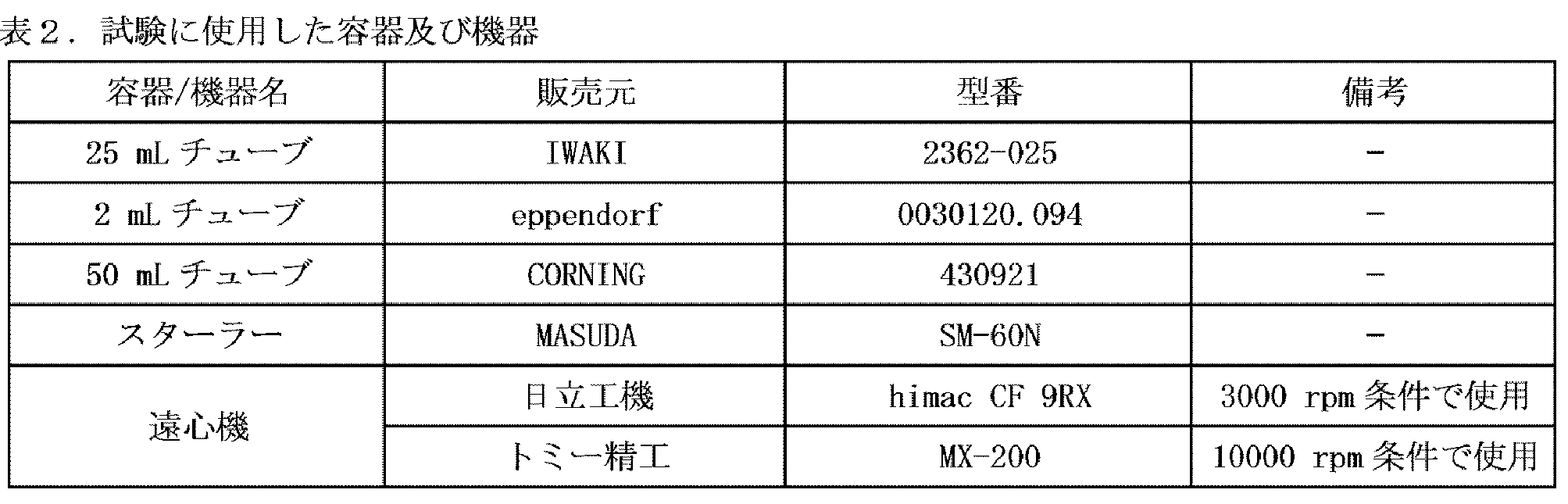
Thermo Fischer社製Integrion RFICシステム電気化学検出器を用いて、下記のイオンクロマトグラフィー条件で実施した。
ガードカラム:CG17(4×250 mm)
検出器:電気伝導度検出器
流速:1.0 mL/分
溶離液:メタンスルホン酸(溶離液ジェネレータ)
グラジエント条件:表3
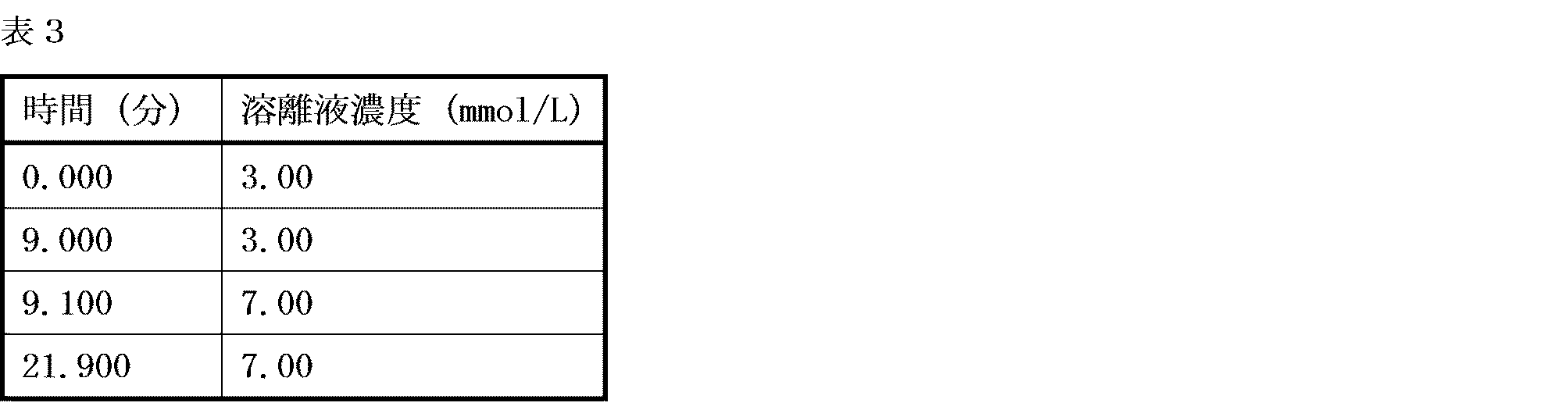
注入量:50 μL
サプレッサー:CERS500e (4 mm)
測定時間:22分
別途調製した検量線(直線性)及び算出した検出・定量限界を元に、試料溶液中のTMA及びコリン濃度を算出し、ゼオライトに吸着した各物質の吸着率、及びコリンに対するTMA吸着率の比を求めた。
アルギニン2050 mg、塩化コリン120 mg、TMA塩酸塩80 mgを精密に量り取り、精製水約25 mL加えてよく撹拌し、溶解させた。その後、精製水を加えて50 mLに定容した。この液を用いて、試料溶液に添加した各物質の濃度を挟むような5点の溶液を調製し、検量線(直線性)とした。さらにTMA及びコリンが検出・定量できる濃度まで希釈した液につき、6回測定した各物質の相対標準偏差及び直線性を確認し、検出・定量限界値を算出した。
検量線(直線性)及び検出・定量限界は3ヶ月に1度確認し、直近の結果を評価に使用した。
[TMA/コリン/アルギニン三成分混合吸着速度試験]
1N塩酸を精製水で希釈して調製した0.1N塩酸水溶液2.0 mLにアルギニン13.53 mg、塩化コリン10.84 mg、TMA塩酸塩 7.42 mgを精密に量り取り、よく振り混ぜて溶解させ、標準液を調製した。
25 mLチューブにゼオライト10 mgを精密に量り取り、FaSSIF 5 mLを加えた。この液にスターラーバー及び標準液 50 μLを加えた。1溶液あたり1度だけサンプリングすることとし、同様の手順でサンプリング数と同数の反応溶液を調製した。所望の時間攪拌後(3分、10分、30分、1時間、3時間、6時間、24時間、48時間)、in vitro吸着試験の[試料調製]と同様の手順でサンプリングし、各時点でのTMA、コリン及びアルギニンの上澄み中濃度から各成分吸着量の時間推移を求めた。なお、図3縦軸の吸着量(μg/mL)とは、blank溶液中の各成分濃度から試料溶液中の各成分濃度を差し引いた値である。
塩化ナトリウム12.38 g、リン酸二水素ナトリウム二水和物8.94 g、水酸化ナトリウム0.84 gを量り取り、精製水約1.8 Lを加えてよく撹拌し、溶解させ、1 mol/L水酸化ナトリウム水溶液、もしくは1 mol/L 塩酸でpH 6.5に調整した。精製水を加えて、2 Lに定容し、リン酸バッファーを得た。リン酸バッファー2 mLに塩化コリン991.2 mgを加え、コリン溶液を調整した。ゼオライト70 mgを精密に量り取り、リン酸バッファー5 mL、及び上記コリン溶液 50μLを加えた。室温で終夜攪拌後、ゼオライトを濾取し、40℃で30分間減圧乾燥した。濾液についてin vitro吸着試験の[試料調製]と同様の手順でサンプリングした後、さらに精製水で50倍に希釈し、blank溶液及び試料溶液の測定を行った。
本ゼオライト粉末10 mgを精密に量り取り、リン酸バッファー5 mLを添加した。1溶液あたり1度だけサンプリングすることとし、同様の手順でサンプリング数と同数の反応溶液を調製した。所望の時間攪拌後(30分、1時間、3時間、8時間、24時間)、in vitro吸着試験の[試料調製]と同様の手順でサンプリングし、各時点の上澄み中コリン濃度からコリン放出量の時間推移を求めた。なお、図4縦軸の吸着量(μg/mL)については、blank溶液中コリン濃度から、終夜コリン吸着させた際の試料溶液中コリン濃度を差し引いた値に50/7を掛けて0時間時点の吸着量とし、そこから放出試験各時点の試料溶液中コリン濃度を差し引いた値を各時点の吸着量とした。
最大員環数:本実施例で用いたゼオライトの最大員環数
骨格コード:本実施例で用いたゼオライトの骨格コードであり、IZA(International Zeolite Association)が定めるゼオライトの骨格構造を規定するコードに準ずる。化合物がゼオライト以外の場合は、その化合物の名称を記す。
細孔内拡散最大球径(Å):本実施例で用いたゼオライトの細孔内拡散最大球径。細孔内拡散最大球径の数値は、the Structure Commission of the International Zeolite Association (IZA-SC)のZeolite Framework Types(https://asia.iza-structure.org/IZA-SC/ftc_table.php)の各骨格コードページにおけるMaximum diameter of a sphereのthat can diffuse alongを参照した。a、b、c軸に関して複数数値が有る場合には最大のものを参照している。
細孔の次元:本実施例で用いたゼオライトの細孔の次元
カウンターカチオン:本実施例で用いたゼオライトのカウンターカチオン
SAR:本実施例で用いたゼオライトのAl2O3に対するSiO2のモル比;実施例70、78に関しては表面処理を行う前の原料ゼオライトのAl2O3に対するSiO2のモル比
(In vitro)TMA吸着率:本実施例で実施した吸着試験のTMA吸着率
(In vitro)コリン吸着率:本実施例で実施した吸着試験のコリン吸着率
(In vitro)TMA/コリン:本実施例で実施した吸着試験のTMA吸着率をコリン吸着率で除した値
XRPD半値幅:本実施例で用いたMFI型ゼオライトの粉末X線回折(X-ray Powder Diffraction;以下、XRPDと記す)における2θ=7.9000°±0.5000°の範囲に存在する最大のピーク(以下、2θ=7.9°ピークと記す)の半値幅(単位:°(2θ))
酸処理前のゼオライト:本実施例で実施した酸処理前のゼオライトの実施例番号
酸:本実施例で用いた酸の試薬名
酸処理温度:本実施例で実施した酸処理の温度
酸処理時間:本実施例で実施した酸処理の時間
Na残存率:本実施例で実施した酸処理後のゼオライト中のNa残存率。Na残存率はXRFにおけるNa/Al検量線から、イオン交換前の実施例48のゼオライトを100%とし算出
原料ゼオライト:本実施例で表面処理反応の原料に用いたゼオライトの実施例番号
原料ゼオライトSAR:本実施例で表面処理反応の原料に用いたゼオライトのAl2O3に対するSiO2のモル比
表面処理試薬:本実施例で用いた表面処理試薬
反応条件:本実施例で実施した表面処理反応の反応条件
TMA AUC変化率:本実施例で実施した絶食下コリン負荷試験のvehicle群に対するゼオライト投与群のd9-TMA AUC変化率
コリンAUC変化率:本実施例で実施した絶食下コリン負荷試験のvehicle群に対するゼオライト投与群のd9-コリン AUC変化率
水熱合成後処理:本実施例で実施した水熱合成後の後処理方法
XRPDパターンの特徴:本実施例で用いたゼオライトのXRPDパターンの特徴
外表面積:本実施例で用いたゼオライトの外表面積
SEM画像:本実施例で用いたゼオライトのSEM画像
併用薬:本実施例で用いた併用薬の化合物物性による分類及び名称
フリー体分子量:本実施例で用いた併用薬のフリー体分子量
pKa:本実施例で用いた併用薬のpKa。酸性化合物について記載。
共役酸のpKa:本実施例で用いた併用薬の共役酸のpKa。塩基性化合物について記載。
ゼオライトへの吸着率(%):本実施例で用いたゼオライトへの併用薬の吸着率(%)
In vitro吸着試験
実施例1、26及び34、並びに比較例1~5及び7~21について、ゼオライトの最大員環数や骨格等の特徴とin vitro吸着試験のTMA吸着率、コリン吸着率を表4にまとめた。
最大員環数が8のゼオライトでは、細孔径がTMAやコリンの分子径より小さく、TMAやコリンの細孔内吸着が起こらなかったと考えられる。比較例16でコリン吸着が観測されているが、表面吸着による寄与と考えられる。
最大員環数が10のゼオライトでは、HEU型ゼオライトを除きコリン・TMA共に効率良い吸着が起こった。特にMFI型ゼオライトでは系中のTMAを完全に吸着しきる化合物もあり(実施例26及び34)、それらではコリンよりTMAを優先して吸着した。HEU型ゼオライトでは、10員環の細孔がひしゃげており、細孔内拡散最大球径は3.67Åであり小さいことから、細孔内へのTMA吸着が起こらなかったと考えられる。
最大員環数が12のゼオライトではコリン・TMA共に吸着するがTMA選択的ではない。これは細孔径がTMAやコリンより大きくなり、TMAとコリンを識別できないためと考えられる。
一般的な吸着剤である活性炭(比較例1)やモレキュラーシーブス4A(比較例4及び5)、また、高カリウム血症の薬として用いられるカリウム吸着剤ロケルマ(商標登録)(比較例2)や、米国でゼオライトサプリメントに用いられるクリノプチロライト(比較例3)では、TMAの吸着がほとんど起こらなかった。
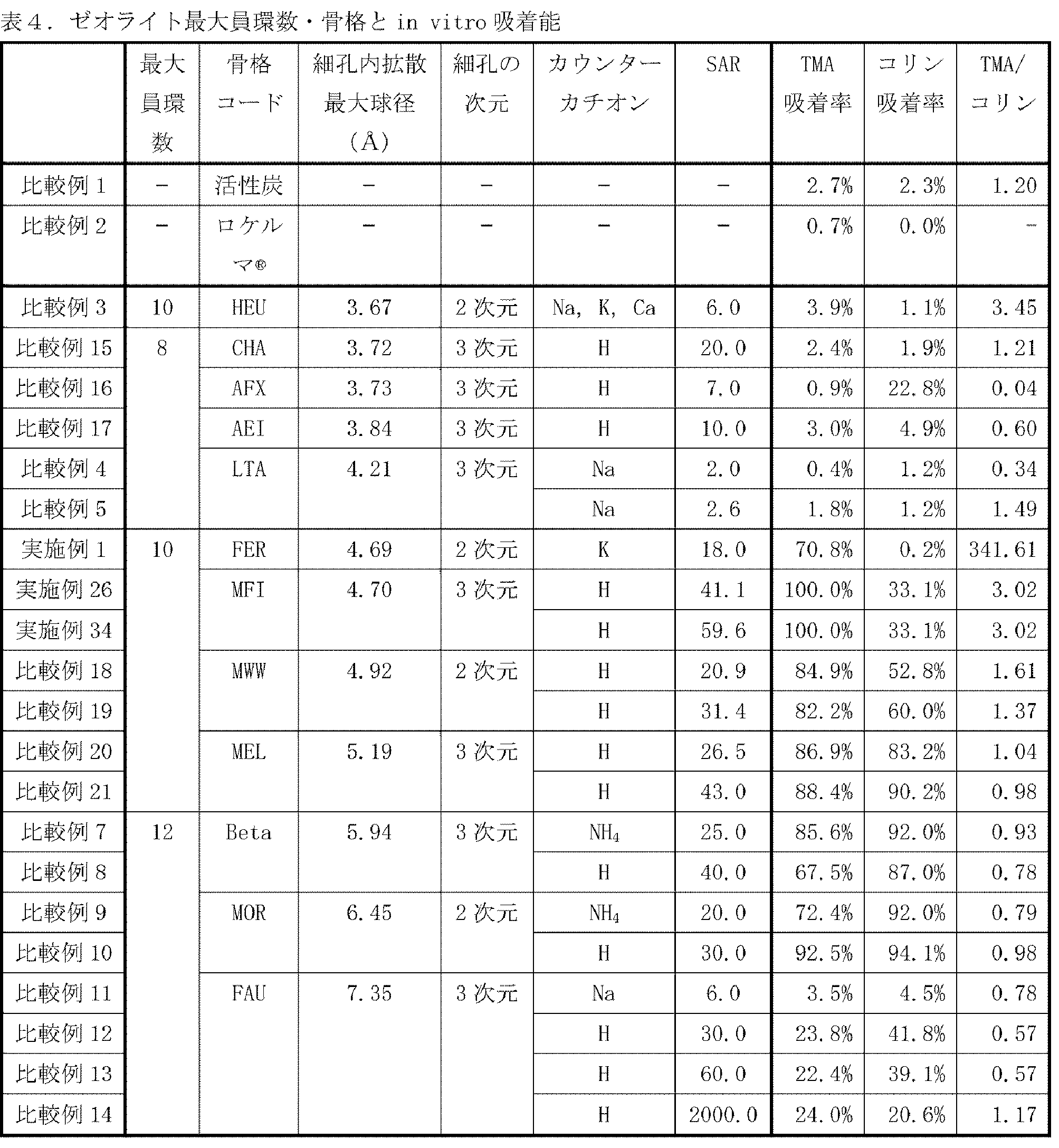
SARが33.0未満の場合、TMA/コリン選択性が1~3程度で推移した。SARが33.0 以上79.4以下の場合、TMA/コリン選択性は概ね高く、TMA吸着率も高かった。SARが79.4を超える場合、TMA/コリン選択性は概ね高いが、TMA吸着率は33.0以上79.4以下と比較し低下傾向が見られる。
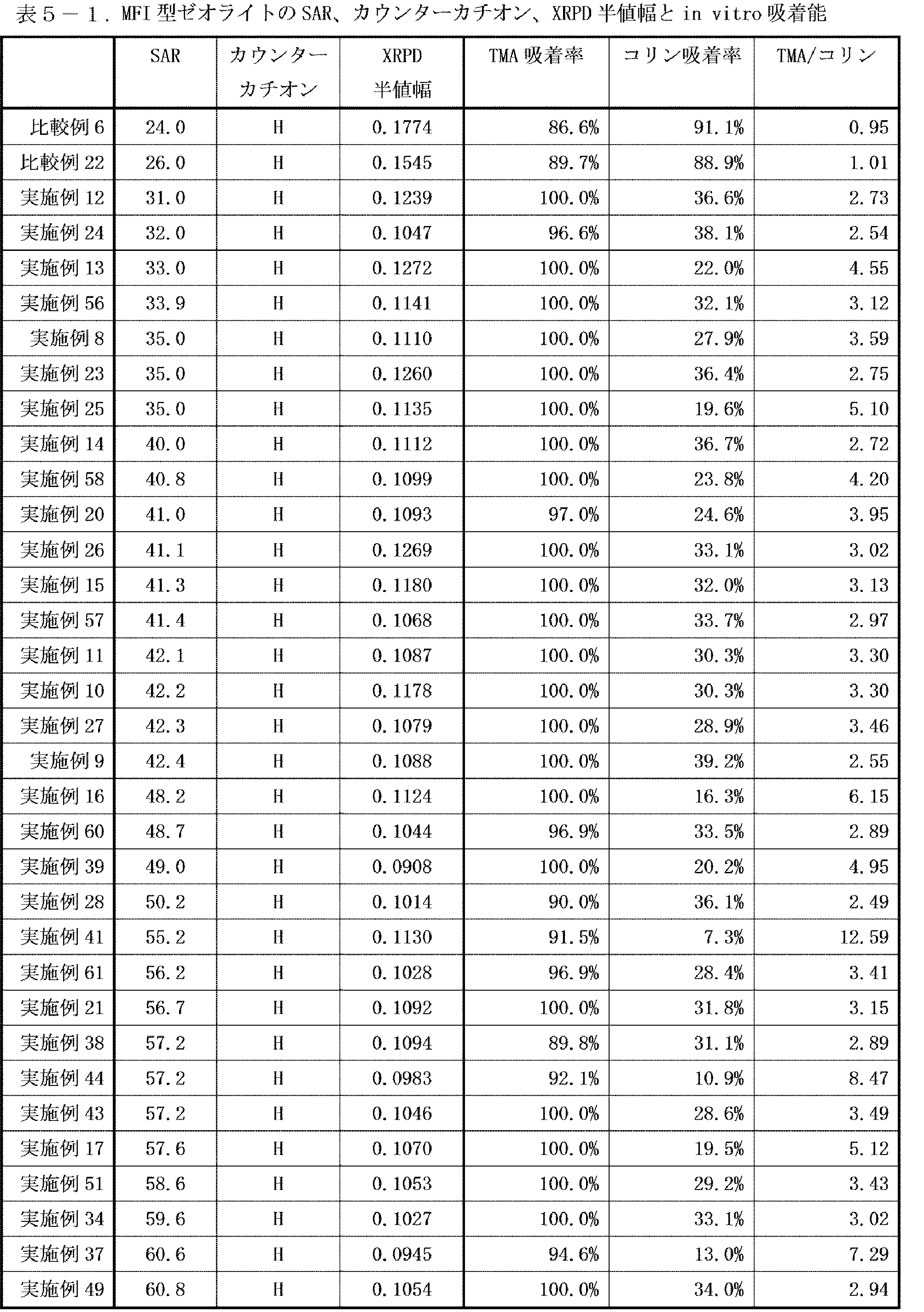
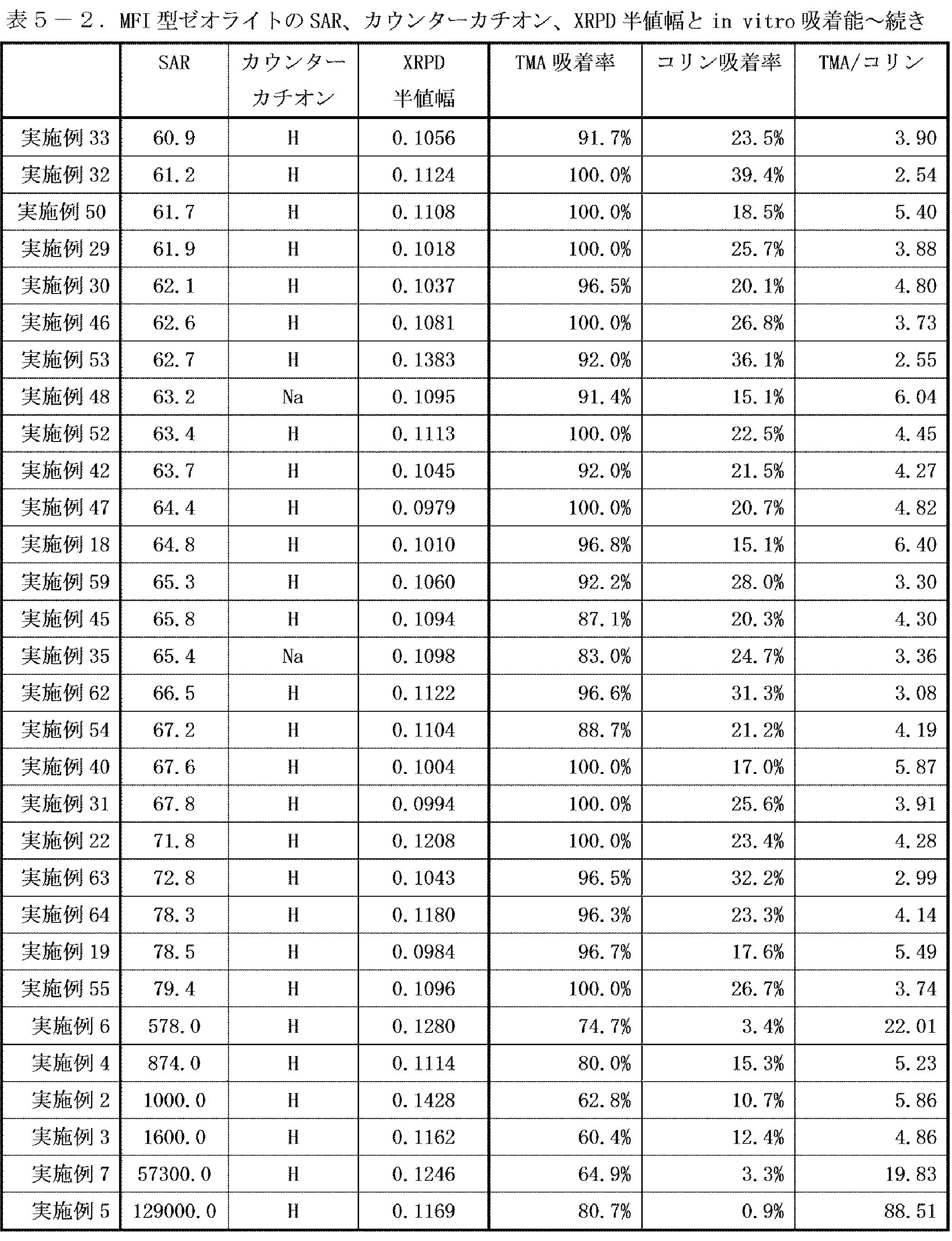
MFI型ゼオライトにおいてSARのみがTMA/コリン選択性と相関する訳ではなく、結晶の質、すなわちXRPDのピーク半値幅もTMA/コリン選択性と相関していると考えられる。TMA吸着率が60.0%以上且つコリン吸着率が40.0%以下の化合物では、半値幅が小さい方の頻度が多くなり、全て0.15°以下であった。一方、TMA吸着率が60.0%未満又はコリン吸着率が40.0%超の化合物では、ピーク半値幅が0.15°を超えていた。
Scherrerの式から、ピーク半値幅が小さいほどゼオライトの結晶子サイズは大きくなる。結晶子サイズが大きいゼオライトの方が、結晶細孔内拡散速度の影響を大きく受けると想定され、コリンよりもTMAの吸着が優先されると考えられる。
実施例50のゼオライト(最大員環数:10、骨格コード:MFI)を用いて、酸性条件下での骨格の安定性を確認した。
表6に検討結果をまとめる。いずれの条件でもXRPD半値幅は大きく変化しなかったことから、MFI骨格構造は維持されていると考えられる。酸処理によってTMA吸着率は低下せず、コリン吸着率も大きな変化はなかった。

実施例68及び69のゼオライトのNa残存率から考えて、1 mol/L硝酸水溶液中、室温1時間程度の撹拌操作でNa/Hカチオン交換反応はほぼ平衡に達したと考えられる。この時のNa残存率は、アンモニウムイオン交換・焼成でプロトン型のゼオライトを作った場合と同程度である(実施例49)。
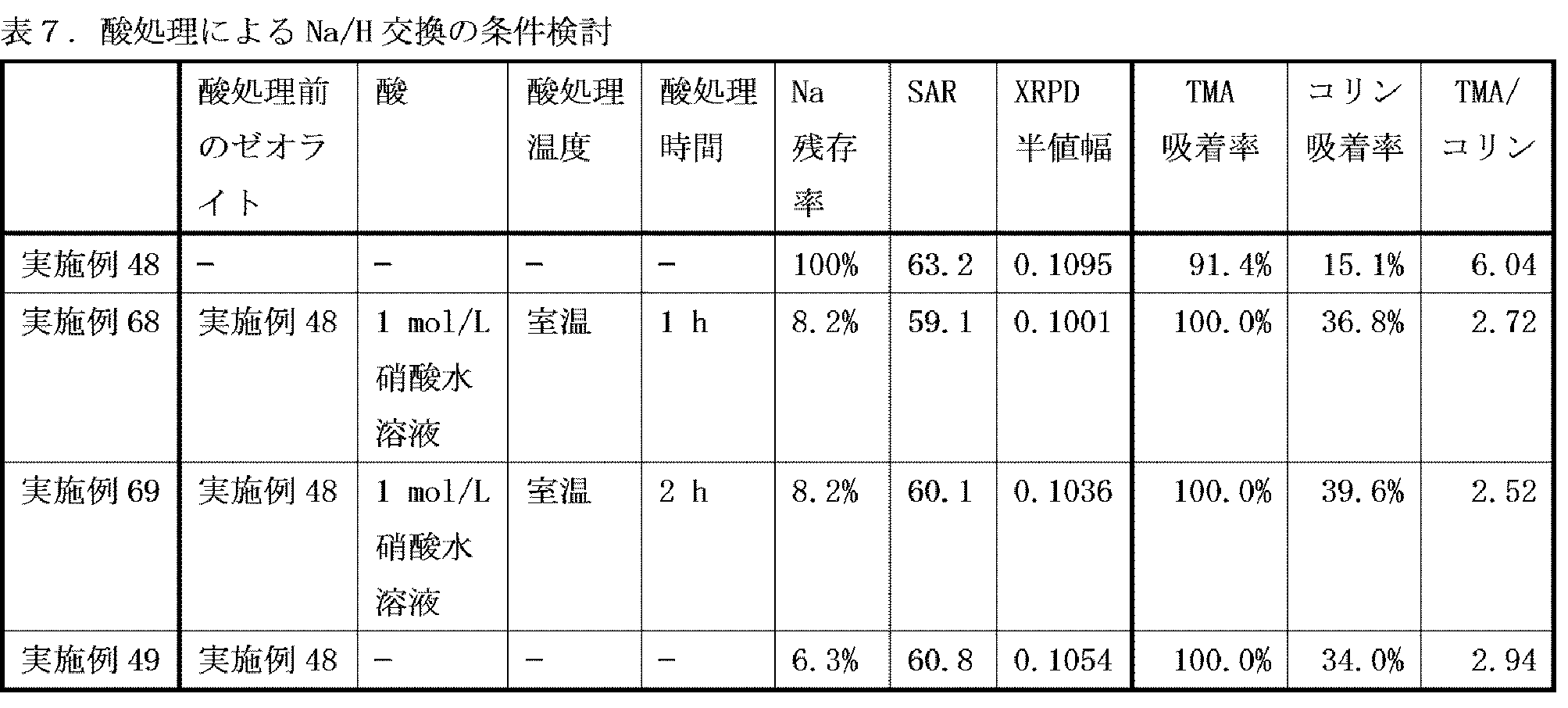
ゼオライトへの表面処理が与える吸着能の変化を確認した。
表8に検討結果をまとめる。
いずれの化合物も表面処理することにより、in vitroのTMA/コリン吸着選択性が向上した。低分子の表面処理試薬(比較例23、実施例70及び72~76)に関しては、長鎖アルキル鎖であるオクタデシル基を含む表面処理試薬で処理した実施例74及び76のゼオライトでTMA吸着率が低下した。一因として、長いアルキル鎖によって内部細孔が塞がれている可能性が考えられる。ポリマーからなる表面処理試薬(実施例77~88)に関しては、vapor法で反応させた場合にコリン吸着率の変化が少ない(実施例77及び80)ことから、vapor法では表面処理反応が不十分であったと考えられる。toluene-2条件とneat条件のどちらが良いかは、ポリマー表面処理試薬により異なった。
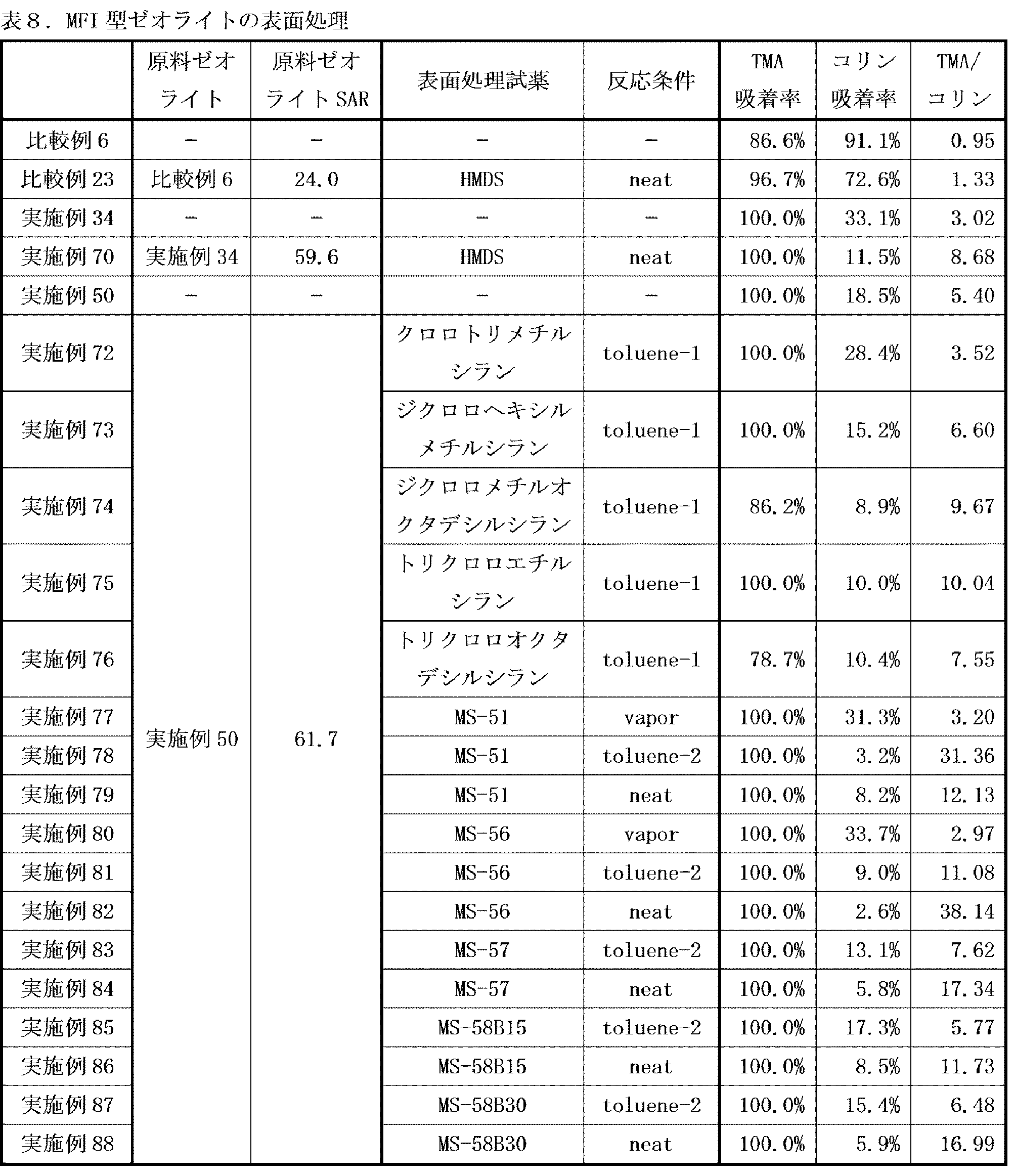
水熱合成条件が同一で、カウンターカチオンのみ異なる実施例34~36、71及び89のゼオライト(最大員環数:10、骨格コード:MFI)を用いて、カウンターカチオンの違いが吸着能に及ぼす影響を確認した(表9)。
カウンターカチオンを、H+からLi+、Na+、K+又はNH4 +に変えた場合において、いずれもin vitroのTMA/コリン吸着選択性は大きく減少しなかった。なお、経口用途においては、過剰なイオン摂取による生体への影響が起こりにくいプロトン型が好ましい。

実施例5、11、19、26、34、38、49、52及び53、並びに比較例6及び22のゼオライト(最大員環数:10、骨格コード:MFI)について、BET表面吸着試験から得られたBET比表面積及び外表面積の結果を表10に記した。
外表面積が30 m2/gを超える化合物では、コリンに対するTMA吸着の選択性が低かった。ゼオライト内部細孔を用いた吸着では分子サイズの違いを認識することでコリンに対するTMA吸着の選択性が高くなるが、外表面積が大きい化合物においては分子サイズの違いを認識しないゼオライト粒子外表面での吸着の寄与が大きくなるため、選択性が低くなっていると考えられる。

実施例26及び34、並びに比較例6及び22のゼオライト(最大員環数:10、骨格コード:MFI)について、粒度分布の結果を表11-1及び図2に記した。
比較例6及び22では、2つの頻度分布の山があり、最初の頻度分布の山は1μm以下であり、それを反映して累積頻度10%径は小さく(<2.5μm)になっている。一方、実施例26及び34では頻度分布の山は1つであり、累積頻度10%径は大きく(>2.5μm)なっている。同様に実施例26及び34のメジアン径は比較例6及び22の値より大きい。比較例6及び22では外表面積が実施例26及び34より大きく、それは粒子径の違いが反映されていると考えられる。また、粒子径が小さいことはコリンに対するTMA吸着の選択性が低いこととも相関している。

実施例26及び34のゼオライトを低用量用いたin vitro吸着試験を実施した。既出の[吸着試験]について、ゼオライト添加量を10 mgから3 mg又は1 mgに変更した他は同様の試験方法で、in vitro吸着試験を実施した。結果を表11-2に示す。TMA吸着率が高く且つTMA/コリン選択性があるゼオライトについては、in vitro吸着試験におけるゼオライトの添加量を下げることで、TMA吸着率/コリン吸着率の比が向上すると考えられる。
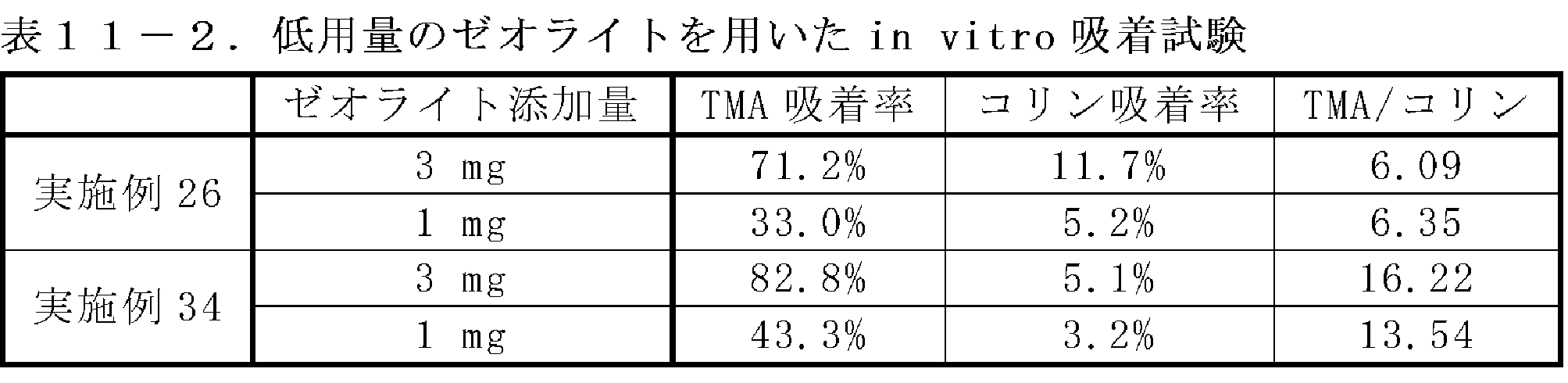
実施例26、実施例34及び比較例6のゼオライト(最大員環数:10、骨格コード:MFI)について、TMA、コリン及びアルギニンの吸着量時間推移を図3に示した。
TMAに関してはいずれの化合物も短時間で吸着がプラトーに達した。アルギニンは比較例6に関しては吸着されたが、実施例26及び34においては吸着されなかった。コリンの吸着は比較例6では吸着試験開始3分以内でプラトーに達しているが、実施例26及び34においてはプラトーに達していなかった。
MFIゼオライトへのTMA及びコリンの吸着速度差、並びにTMA/コリン選択性の理由を裏付けるべく、密度汎関数法に基づく第一原理計算による吸着過程の解析を行った。
使用アプリケーションとヴァージョン:VASP(Vienna Ab initio Simulation Package)ver.6.3.2(計算実行(三菱ケミカル(株)三上昌義))
密度汎関数法:交換相関エネルギーは一般化密度勾配補正(GGA-PBE)、分散力補正はDFT+D3(Grimm)。PAW法(平面波基底のカットオフエネルギー 400 eV)。k点サンプリングはΓ点、SCF計算の閾値1.0×10⁻⁶ eV、構造最適化の力の閾値1.0×10⁻⁵ eV/Å
MFIゼオライトの[010]表面に対応する周期的スラブモデル及び[100]表面に対応する周期的スラブモデルを論文(ACS Catalysis 2020 10, 3297-3312)記載データに準拠する形で準備した。ここでTMA及びコリンを表面モデルに配置する際、TMAは中性分子として扱い、コリンについては1価カチオン分子として取り扱っている。なお、1価カチオン状態の計算では系全体の電荷中性を保つために逆符号の一様な背景電荷を分布させた計算が必要となるが、VASPでは電子占有数(NELECT)を調節して1価カチオンに対応する状態で計算すると自動的に背景電荷を分布させた計算を実施できる。各表面モデルのゼオライト層の厚み方向(z軸方向)の中央位置を基準とし(z=0とする)、そこにTMA分子の窒素原子ないしはコリン分子の窒素原子を配置し、窒素原子のz座標以外の原子位置最適化計算により分子の安定配置を求めた(内部吸着)。さらに、窒素のz座標を1Åずつ表面方向に移動させ、その都度、窒素のz座標以外の原子位置最適化計算を実施した。表面付近(z=8~11Å)において各分子の全エネルギーが低くなる点を0 kcal/molとし、エネルギー基準点とした。また表面からゼオライト内部に侵入する時にエネルギー障壁が一番高くなる点(z=5~7Å)をエネルギー障壁最高点とした。
TMA又はコリンの、[010]面及び[100]面からの吸着過程に関するエネルギープロファイルを図5に示し、エネルギー基準点、エネルギー障壁最高点、及び内部吸着時のゼオライト層断面構造を図6-1、図6-2、図6-3、図6-4に示し、[010]モデルのエネルギー障壁最高点のz軸視点からの構造を図7に示した。
MFIゼオライトの3次元チャネルは、直線状の[010]チャネルと正弦波状の[100]チャネルが互いに繋がった形で構成され、[010]及び[100]チャネルを交互に用いることで[001]方向に分子は拡散していく。コリンの[010]表面侵入過程における立体障害は、結晶内部の[010]面を超える細孔間移動においても同様に生じると想定されるため、[010]及び[001]方向への結晶内拡散において、コリンの拡散速度がTMAよりも遅くなると想定される。これは、[001]方向に長い棺型結晶においてTMA/コリン選択性が高いという実験結果(後述する「SEM画像、外表面積と絶食下コリン負荷試験薬効」の結果)と合致し、粒子径の大きい実施例26及び34においてコリンの吸着速度が遅いという速度論試験の結果(既出の「速度論試験」の結果)とも合致する。
試験方法
7週齢雄のC57BL/6マウスを12時間絶食させた後、蒸留水に溶解したd9-choline chloride(Toronto Research Chemicals Inc.)と0.5 w/v%メチルセルロース400溶液、滅菌済(富士フイルム和光純薬株式会社)に懸濁したゼオライトを、それぞれ78.78 mg/kg(d9-コリンとして60 mg/kg)及び500~2000 mg/kgの用量で同時に経口投与した。その後、1、2、4、6、8及び10時間後に尾静脈から採血を行い、血漿中のd9-コリン、d9-TMA及びd9-TMAOの濃度をLC/MS/MSにより測定した。

絶食下コリン負荷試験
実施例1、5、9、13、15、26、34及び55、並びに比較例8、6及び22のゼオライトについて、表12に化合物プロファイルと絶食下コリン負荷試験の結果をまとめた。
いずれの化合物も500 mg/kgの用量で試験を行った(以下、特に指定しない限り、絶食下コリン負荷試験の結果は500 mg/kgの用量で行ったものを指す)。

実施例34のゼオライトは用量依存的に血漿中d9-TMA濃度及びAUCを低下させ、2000 mg/kgの最高用量ではほぼ完全に血漿中d9-TMAの上昇を抑えた。この時、実施例34のゼオライトは消化管内でほとんどのd9-TMAを吸着していたと考えられる。
TMA/コリン選択性が低い比較例6のゼオライトでは、600 mg/kgにおいて、d9-TMAの最高血漿中濃度到達時間(以下、Tmaxと記す)がvehicle群から遅延し、Tmax以降のd9-TMA血漿中濃度減少カーブが緩やかになっている。また、2000 mg/kg群では4~10 hにかけて緩やかにd9-TMA血漿中濃度が上昇している。いずれの投与量においてもコリンの血漿中濃度は常に低レベルで抑えられている。
実施例34、35及び68のゼオライトについて、カウンターカチオンの違い、また、後処理方法の違いによる絶食下コリン負荷試験への影響が有るか、同一試験内で比較を行った(表13)。実施例35はプロトン交換を行わなかったNa型のゼオライトであり、実施例34はNa型をアンモニウムイオン交換後焼成して得たプロトン型のゼオライト、そして実施例68はNa型を硝酸処理して得たプロトン型のゼオライトである。
いずれのゼオライトについても絶食下コリン負荷試験で薬効が確認された。アンモニウムイオン交換後焼成したプロトン型のゼオライトと比較し、硝酸処理したプロトン型のゼオライト方がd9-TMAのAUC減少率が高かった。
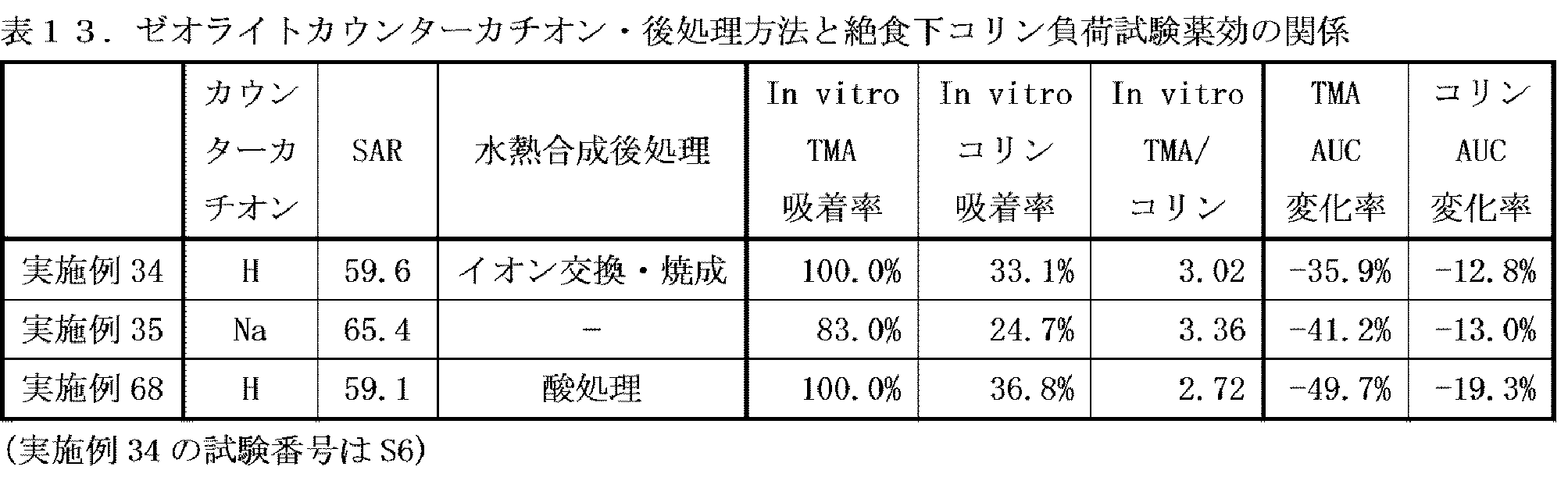
ゼオライト表面処理が薬理効果に与える影響を確認するため、実施例34、70及び78の各ゼオライトを絶食下コリン負荷マウスに投与し、その薬理効果を比較検討した。表14に、化合物プロファイルと絶食下コリン負荷試験の結果をまとめた。
実施例70及び78のゼオライトは、実施例34又はそれと同様の合成法で得られたゼオライトに対して表面処理を行ったものである。表面処理により、d9-TMA AUC減少率は表面処理前と同程度又はそれ以上となり、一方でd9-コリンAUCの減少は防がれた。絶食下コリン負荷試験においても、表面処理によるコリンの吸着防止効果が確認された。

実施例34及び52のゼオライトについて、化合物プロファイル及び絶食下コリン負荷試験におけるAUC変化を表15に示す。図10に実施例34(上段)及び実施例52(下段)のXRPDパターンを示す。縦軸は強度(cps) であり、横軸は回折角度2θ(°) である。
実施例52は実施例34と比較して、2θ=21°及び27°付近に特徴的なクオーツのピークを多く含むことが分かる。クオーツが多い実施例52のゼオライトでは、絶食下コリン負荷試験におけるd9-TMA AUC減少率が小さかった(表15)。クオーツは細孔構造を持たずTMA吸着作用はないと考えられる。すなわち、クオーツを多く含む実施例52では、重量当たりのMFI型ゼオライト含有率が減少し、絶食下コリン負荷試験における薬効(d9-TMA AUC減少率)が実施例34に比べて低下したと考えられる。
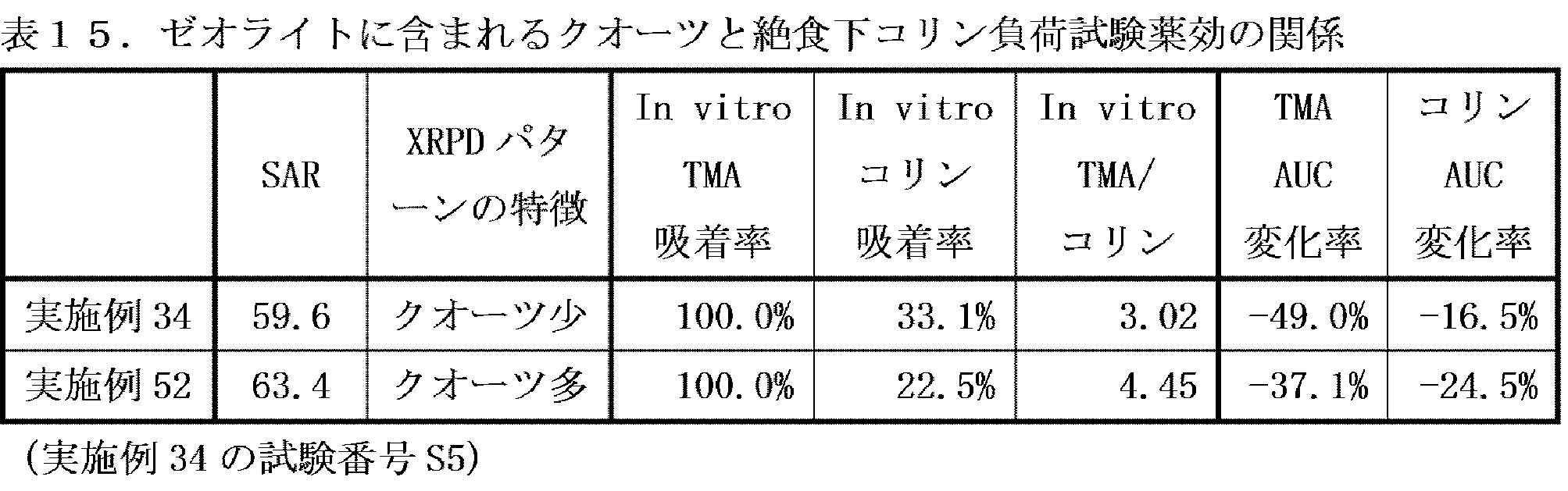
In vitro吸着試験及び絶食下コリン負荷試験に用いたゼオライトについて、薬効、外表面積及びSEM画像間の相関を確認した(表16-1、表16-2)。
絶食下コリン負荷試験におけるd9-TMA AUC減少率とd9-コリンAUC減少率が同程度であった比較例6及び22のゼオライトに関しては、そのほとんどが1~2μm以下の微粒子とその凝集体から成る事がSEM画像から確認された。一方、絶食下コリン負荷試験においてd9-TMA AUC減少率がd9-コリンAUC減少率よりも大きかったゼオライト(実施例5、26、34及び52)については、比較例6及び22と比較して1~2μm以下の微粒子やその凝集体の割合が少なく、結晶が大きく成長していることが確認された。In vitro吸着選択性が高く、d9-TMA AUC減少率とd9-コリンAUC減少率との差が特に大きかった実施例5、26及び34については、結晶形状が棺型(coffin型)であり、[010]面の結晶面が広いことがSEMを用いた粒子観察により確認された。コリン及びTMAの吸着速度は、媒体からゼオライト細孔への分子の侵入速度、及び結晶細孔中での分子の拡散速度によって支配され、MFI型ゼオライトのように細孔構造が3次元である場合には、さらに、結晶面の違いによる侵入速度、及び結晶の3次元座標軸方向の拡散速度に違いが生じると考えられる。MFI型ゼオライトにおいて、[010]面の結晶面が広い場合にTMA/コリン選択性が高かったことから、特に[010]面がTMA/コリン選択性が高い結晶面だと推定される。なお、結晶形状が棺型のMFI型ゼオライトについては、最も広い結晶面が[010]面であることが、SCIENCE, 2003, Vol 300, Issue 5618, pp. 456-460において確認されている。また、J. Am. Chem. Soc. 2023, 145, 9021-9028の報告にあるように、コリンが侵入しにくい[010]面以外を選択的に表面処理することで更なる選択性向上が見込める。また、棺型結晶の結晶軸の長さは[001]軸>[100]軸>[010]軸の順であることから、[001]軸方向への結晶細孔内拡散過程でTMA/コリン選択性が得られていることも同じく推定される。
SEM画像において1~2μm以下の微粒子やその凝集体(比較例6及び22)又は鱗片状構造(実施例19及び53)が多いほど外表面積が大きくなる傾向が確認された。さらに、外表面積が大きくなるほど、絶食下コリン負荷試験におけるd9-コリンAUC減少率が高くなるという相関関係も確認された。
XRPDデータよりクオーツを多く含むことが確認されている実施例52は、SEM画像においても、実施例34と比較してクオーツと見られるMFI型ゼオライトとは異なる粒子が多く存在している。

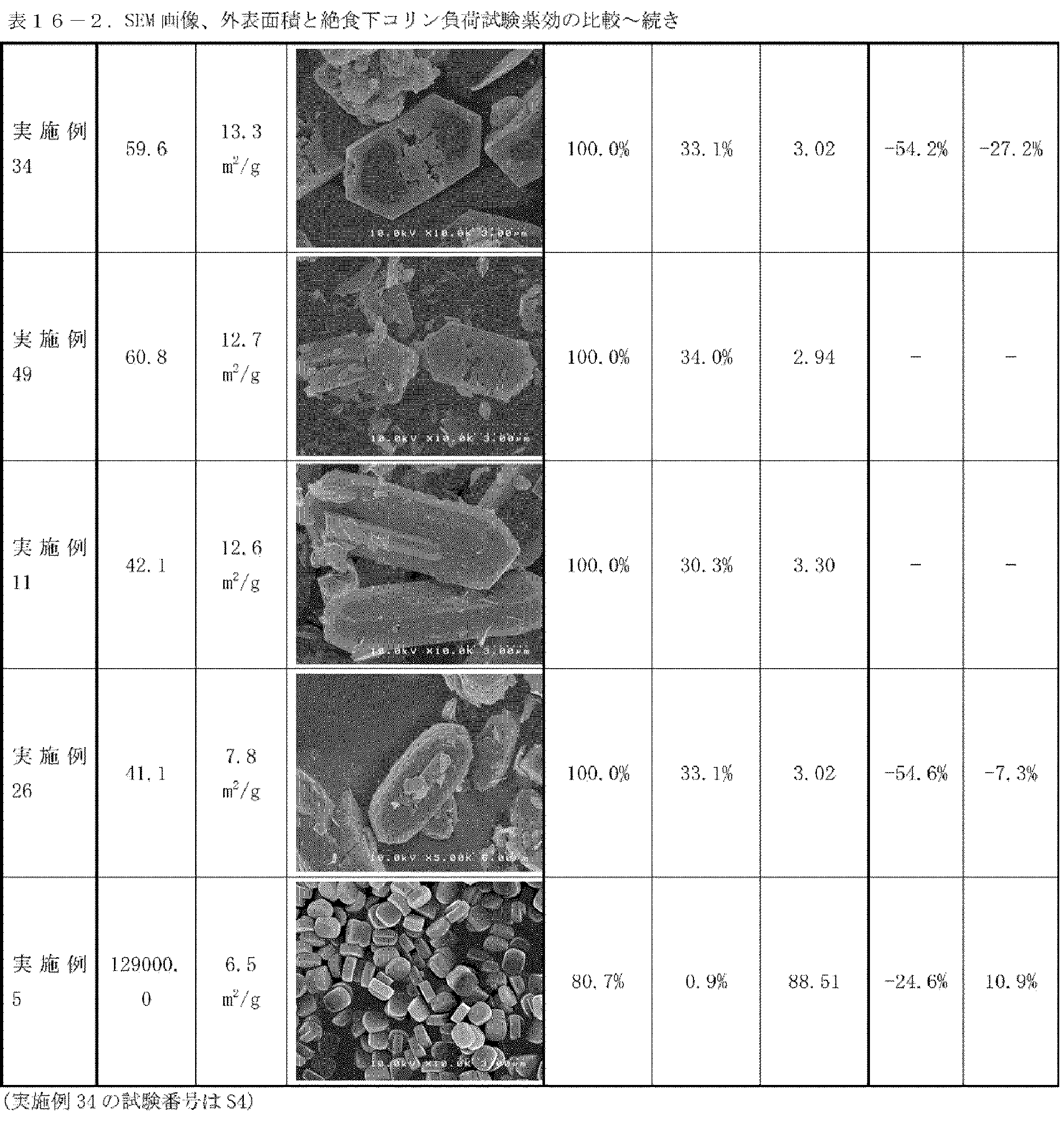
d9-TMA及びd9-TMAOの単回静脈内投与PK試験
7-9週齢雄のC57BL/6マウスにd9-TMA又はd9-TMAOを11.5 mg/kg又は10 mg/kgの用量で静脈内投与し、経時採血を行った。また、7週齢雄のC57BL/6マウスにd9-TMAを10 mg/kgの用量で静脈内投与し、24時間採尿を行った。血漿及び尿中のd9-TMA及びd9-TMAOの濃度をLC-MS/MSにより測定した。
7週齢雄のC57BL/6マウスにd9-TMAを絶食下34.6 mg/kgの用量で経口投与し、経時採血を行った。血漿中のd9-TMA及びd9-TMAOの濃度をLC-MS/MSにより測定した。
Shimizuらによる報告1)を参考にしつつ、大腸での腸内細菌によるd9-コリンからd9-TMAへの変換過程、及び上部消化管から大腸への移行時間を加味したトランジットモデルを採用して、d9-コリンをマウスに経口投与したときの、d9-コリン、d9-TMA及びd9-TMAOについてPBPKモデルを構築した。図11にPBPKモデルの概念図を示す。構築に当たっては、既出の「絶食下コリン負荷試験」のvehicle群のin vivoデータ、及び単回PK試験のin vivoデータを使用した。
1) Shimizu, M. et al. Human plasma concentrations of trimethylamine N-oxide extrapolated using pharmacokinetic modeling based on metabolic profiles of deuterium-labeled trimethylamine in humanized-liver mice. J. Toxicol. Sci. 43, 387-393 (2018).
・d9-TMA及びd9-TMAOの肝/血漿分配係数、血球/血漿分配係数及び血漿蛋白未結合分率は種差がないことを仮定し、Shimizuらの報告値1)を引用した。
・肝臓容量及び肝血流量は、Yamashitaらの報告値2)を引用した。
・d9-TMA及びd9-TMAOの単回静脈内投与PK試験のデータを用いて、d9-TMA及びd9-TMAOのPKパラメータを推定した。d9-TMAの尿排泄率が精度良く再現されるよう腎クリアランスを最適化した。
・絶食下コリン負荷試験のvehicle群のデータを用いて、d9-TMAの吸収パラメータ(上部消化管から大腸へのトランジットの速度定数及びd9-コリンからd9-TMAへの変換率を含む)を推定した。変換率は、絶食下コリン負荷試験のvehicle群におけるd9-TMAの用量補正AUCを単回静脈内投与PK試験のd9-TMA投与群におけるd9-TMAの用量補正AUCで規格化した値を、PBPKモデルにて求めたd9-TMAの吸収率で割ることで算出した。
・d9-コリン及びd9-TMAのAUC減少率は、ゼオライトへの吸着による消化管吸収抑制率(以下、それぞれIRpre及びIRと記す場合もある)を反映していると考えて、ゼオライト投与量に対するIRpre及びIRの関係式をそれぞれ構築した。d9-コリンについては、消化管吸収抑制率とゼオライト投与量の関係をEmaxモデルに当てはめて、50%有効用量を算出した。d9-TMAについては、消化管内で吸着平衡に達していると仮定し、d9-TMAの消化管吸収抑制率=未吸着ゼオライトの理論酸量/(大腸内水分容積×解離定数 + 未吸着ゼオライトの理論酸量) の式に従うと考え、ゼオライトとd9-TMAの解離定数を算出した。大腸内水分容積は、Certara社製SimCYP(V23)の値を引用した。
2) Yamashita, M. et al. Human plasma concentrations of herbicidal carbamate molinate extrapolated from the pharmacokinetics established in in vivo experiments with chimeric mice with humanized liver and physiologically based pharmacokinetic modeling. Regulatory Toxicology and Pharmacology 70, 214-221 (2014).
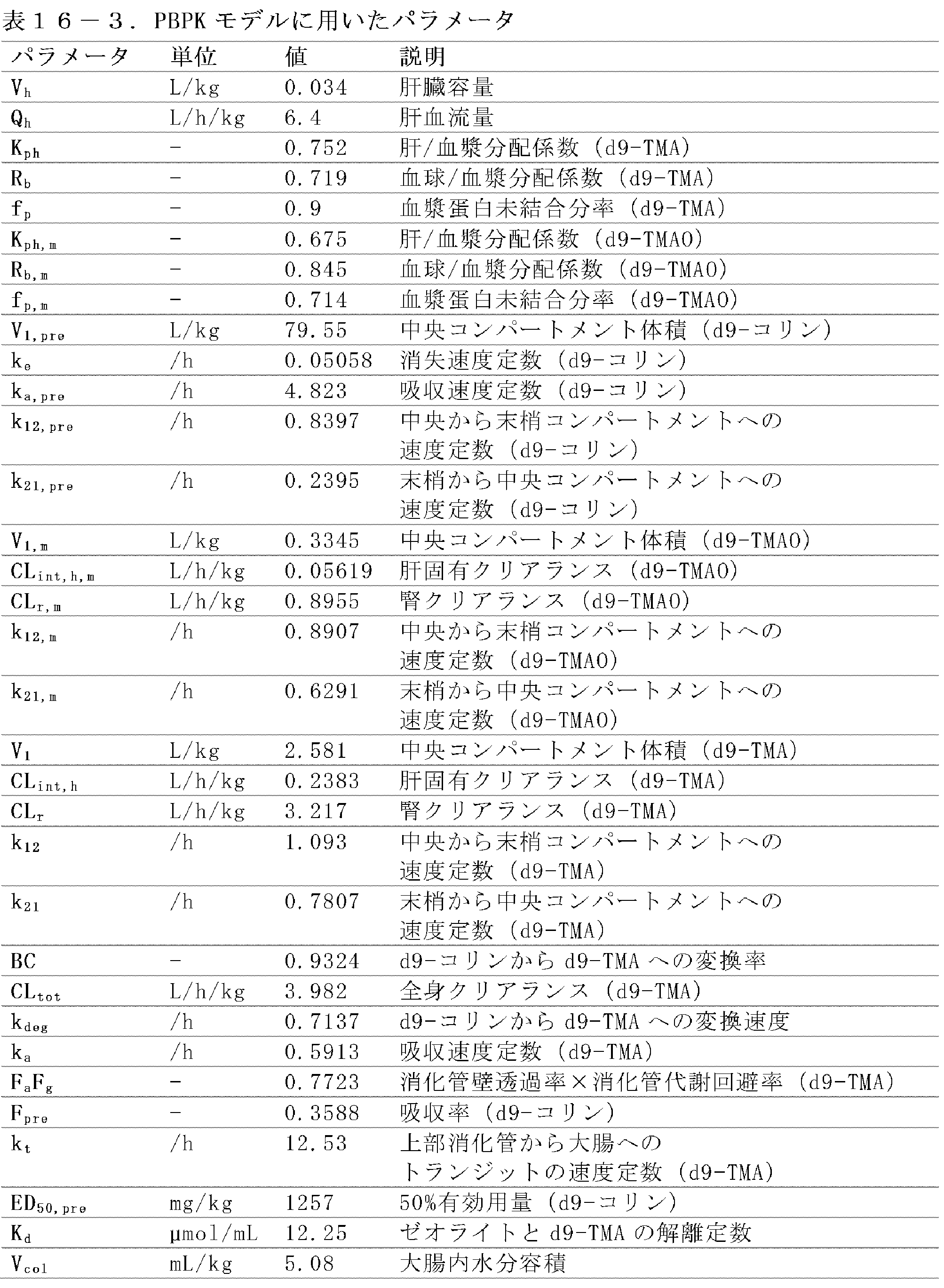
絶食下コリン負荷マウスに実施例34のゼオライトを多用量投与したときの、d9-コリン、d9-TMA及びd9-TMAOの血漿中濃度実測値と、PBPKモデルから予測した血漿中濃度推移を比較したグラフを図12に示す。また、同じくPBPKモデルから算出された24時間尿中排泄量の予測結果を表16-4に示す。PBPKモデルにてシミュレートされたd9-コリン、d9-TMA及びd9-TMAOの血漿中濃度推移は実測された血漿中濃度推移を概ね再現した。

試験方法
昼夜逆転及び制限給餌馴化を実施し、コリン非含有餌(A21122102)(EPトレーディング株式会社)を給餌した10週齢雄のC57BL/6マウスに、蒸留水に溶解したd9-choline chloride(Toronto Research Chemicals Inc.)と0.5 w/v%メチルセルロース400溶液、滅菌済(富士フイルム和光純薬株式会社)に懸濁した実施例34のゼオライトを、それぞれ78.78 mg/kg及び500~2000 mg/kgの用量で同時に経口投与した。同様に、蒸留水に溶解したd9-choline chlorideと0.5 w/v%メチルセルロース400溶液、滅菌済に懸濁した実施例70のゼオライトを、それぞれ78.78 mg/kg及び1000 mg/kgの用量で同時に経口投与した。経口投与後の動物は代謝ケージに収容し、24時間採尿を実施した。得られた尿中のd9-TMA、d9-TMAO、native TMA及びnative TMAOの濃度をLC/MS/MSにより測定し、尿量からそれぞれの24時間尿中排泄量を算出した。ここでnativeとは、同位体存在比が最も大きい同位体元素で構成される分子であることを表す。
絶食下条件のコリン負荷試験ではなく、ヒトの食事条件を模してd9-コリンを負荷した摂食下条件において、実施例34のゼオライトがd9-TMA及びTMAOの尿中排泄量を減少させた。すなわち、摂食下で消化管内に様々な夾雑物がある条件においても、実施例34のゼオライトがTMAを特異的に認識し吸着除去したことを示している。TMAに対する高い選択性をもつゼオライトを用いることで、TMAU患者において薬効を示すことが強く示唆された。
摂食下コリン負荷試験における尿中d9-TMA及びd9-TMAO総排泄量から実施例34のゼオライトによる消化管TMA吸収抑制率を算出し、その有効投与量をマウス及びヒトにおける消化管TMA量比で補正することにより、実施例34のゼオライトの臨床有効投与量を推定した。
ヒト及びラットに14C-TMAを経口投与したとき、投与後24時間の尿中にそれぞれ95%あるいは80%以上の放射能が排泄され、その大部分がTMA及びTMAOであった3, 4)ことから、マウスにおいて尿中TMA及びTMAOの総排泄量から消化管TMA量を推察できると考えられた。
3) Al-Waiz M, Mitchell SC, Idle JR, Smith RL. The metabolism of 14C-labelled trimethylamine and its N-oxide in man. Xenobiotica 1987; 17(5): 551-558
4) Al-Waiz M, Mitchell SC. The fate of trimethylamine in the rat. Drug Metab and Drug Interact 1991; 9(1): 41-48


6) Michell SC, Smith RL. Trimethylaminuria: The Fish Malodor Syndrome. Drug Metab Dis 2001; 29:517-521
7) Shimizu M, Allerston CK, Shephard EA, Yamazaki H, Phillips IR. Relationships between flavin-containing mono-oxygenase 3 (FMO3) genotype and trimethylaminuria phenotype in a Japanese population. Br J Clin Pharmacol 2013; 77(5): 839-851
ゼオライトの吸着率は吸着対象物質とゼオライトの存在比率によって決まる。この考えに基づき、マウスでのTMA吸着率(消化管TMA吸収抑制率)が臨床で目標とするTMA吸着率と同等である時、そのマウス投与量(マウス有効投与量)を、マウスとヒトにおける標準的な消化管TMA量の比で補正することで、実施例34のゼオライトの臨床有効投与量を推定した。算出に用いた式を以下に示す。

上記計算式から算出した消化管TMA吸収抑制率を表17に、臨床で目標とする消化管TMA吸収抑制率を表18に示した。実施例34のゼオライトと60 mg/kgのd9-コリンをマウスに同時投与したときの消化管TMA吸収抑制率は500 mg/kgで42.8%、1000 mg/kgで58.4%、2000 mg/kgで90.4%であった。
また、臨床で目標とする消化管吸収率は、重症患者において42.6%、論文報告において最重症と考えられる患者では53.5%と算出された。以上の結果から、実施例34のゼオライトを500 mg/kg及び1000 mg/kgでマウスに投与したときの消化管TMA吸収抑制率は、それぞれ重症患者層及び最重症患者で想定される目標抑制率と同等と考えられた。
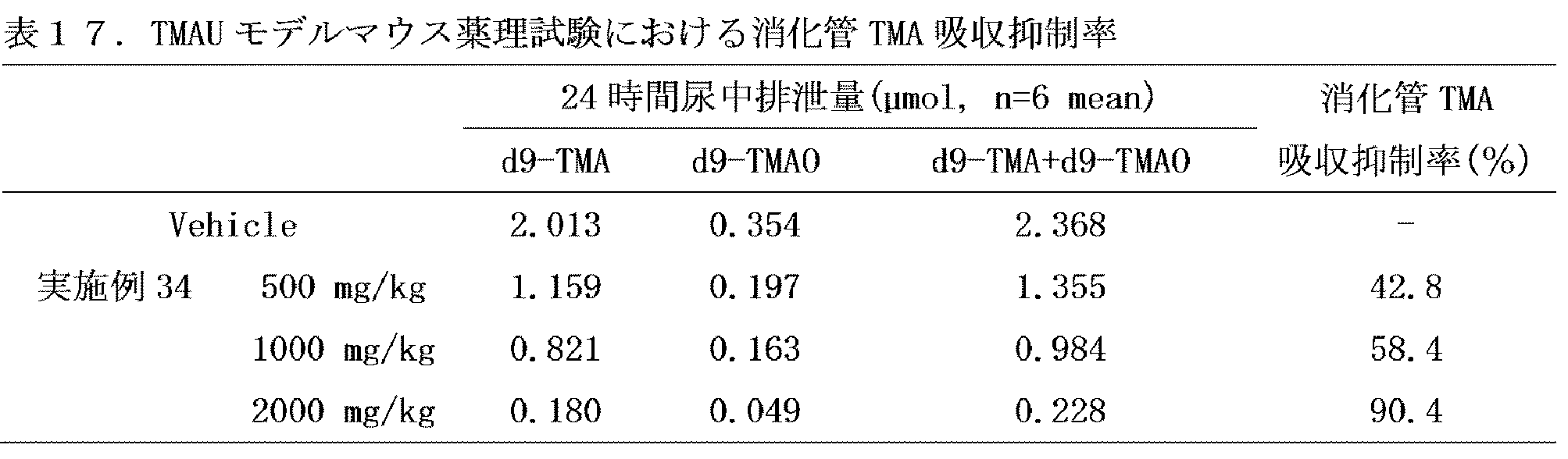
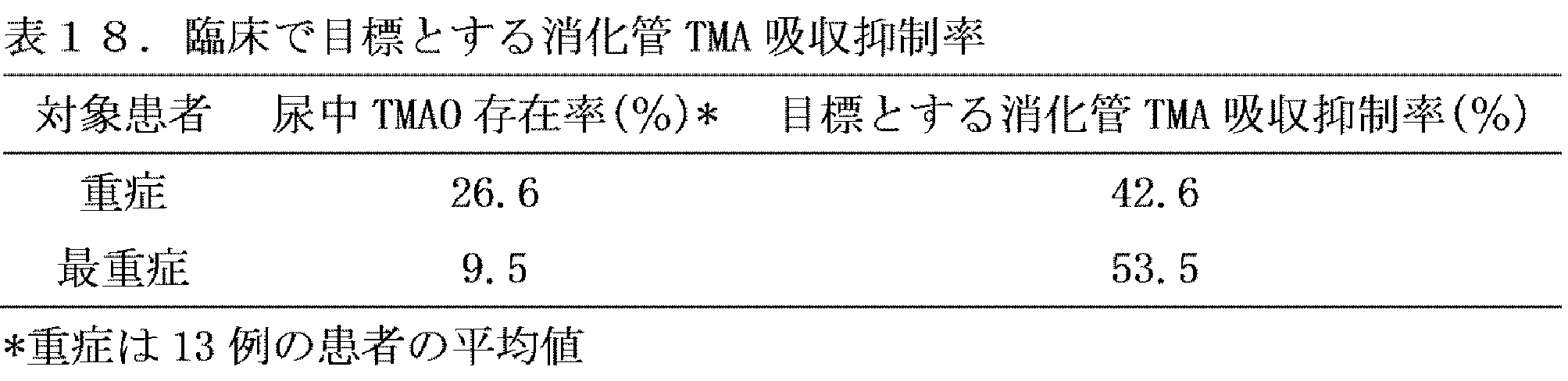
上記計算式から算出された実施例34のゼオライトの推定臨床有効投与量を表19に示した。重症患者への治療効果が期待できる臨床有効投与量は、TMAUモデルマウス500 mg/kg相当として793 mg/man/meal、同じく最重症患者に対する臨床有効投与量は同モデルマウス1000 mg/kg相当として1595 mg/man/mealと推定された。
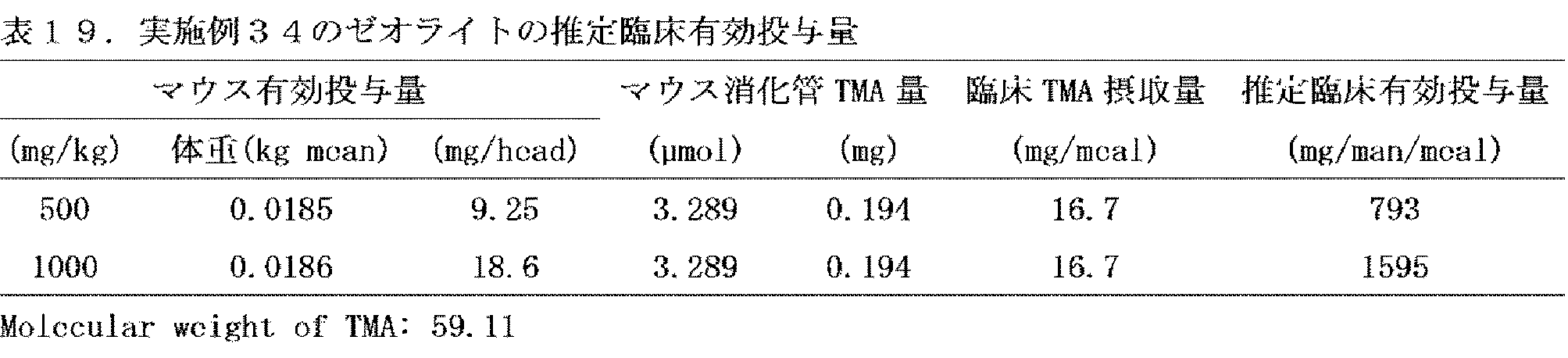
試験方法&結果
実施例26及び34の各ゼオライトについて、Si及びAlの溶出試験を実施した。ゼオライト250 mgを精密に量り取り、1N塩酸5 mLを加え、37℃で3時間撹拌した。この液を遠心分離した。上澄み2 mLを再度遠心分離し、新たな上澄みを得た(初回溶出液)。残りのゼオライト含有液を、濾紙(No. 5B)を用いて濾過し、ゼオライトを濾取した。このゼオライトを新たに用意した1N塩酸5 mLに加え、37℃で3時間撹拌した。この液の上澄み2 mLを取り、遠心分離し、新たな上澄みを得た(再溶出液)。初回及び再溶出液を各々1000 mg秤取し、38%(12N)塩酸 2 mLを添加し、精製水を加えて25 mLにした。これらの溶液につき、ICP-AES を用いてSi及びAl濃度を測定し、Si及びAlの溶出液中濃度及び溶出率を計算した(表20)。なお、溶出率は、ゼオライトのカウンターカチオンをプロトンとし、ゼオライト中に水は含まれないものとして、試験に用いたゼオライトのSi又はAl重量を計算し、5 mL相当の溶出液中に存在するSi又はAl重量に対してこれを除した値である。
生体投与時には、胃酸中で微量のSi及びAl溶出が想定されるため、身体に与える影響を考慮する必要がある。仮に、実施例26及び34のゼオライトを体重70 kgのヒトが1日3 g服用した時、消化管内で本試験と同程度溶出したとしても、Al溶出量はFAO/WHO 合同食品添加物専門家会議(JECFA)が設定したAlの暫定耐容週間摂取量(2 mg/kg体重/週)を超えることはなく、安全性上の懸念は少ないと考えられる。
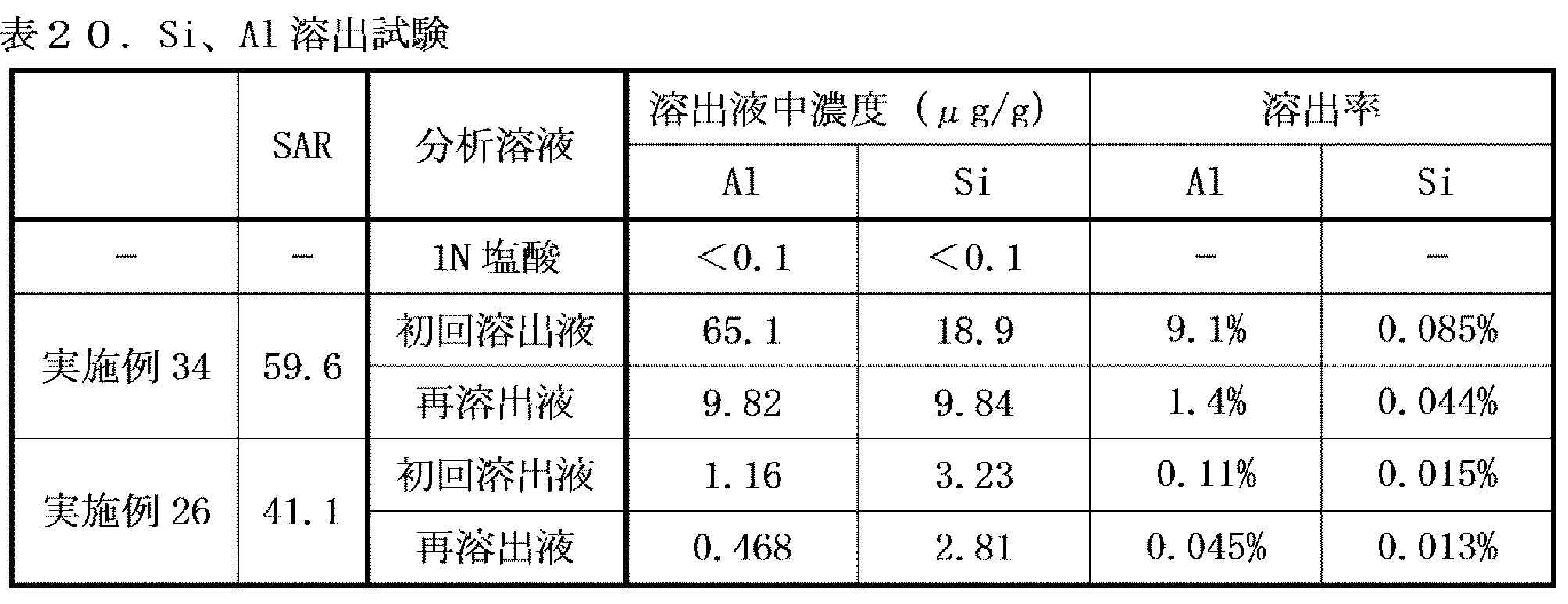
実施例26及び34のゼオライトについて、それぞれラットに単回経口投与した時の糞中排泄率を糞中のSi及びAl濃度から算出したところ、いずれのゼオライトについても投与したゼオライトのほぼ全量が糞中に排泄され、消化管からほとんど吸収されないことが示された。以下、具体的に示す。
実施例26又は実施例34のゼオライトを、6週齢の雄性Crl:CD(SD)ラットに2000 mg/kgの用量で単回経口投与し、投与後48時間までの糞を回収した。回収した糞に超純水を添加後、ポリトロンを用いてホモジネートを調製し凍結乾燥させた。乾燥糞を適量秤取し、灰化、アルカリ塩溶融及び希酸溶解等を行って溶液化した試料についてICP発光分光分析を行い糞中Si及びAl濃度を測定した。また、各ゼオライト投与前24時間から投与直前までに得られた糞をブランク糞とし、上記と同様にホモジネート及び凍結乾燥を行ったブランク乾燥糞に対して各ゼオライトを規定量添加して上記と同様の実験操作により糞中Si及びAl濃度を測定することで添加ゼオライト濃度に対する糞中Si及びAl濃度の検量線を作成し、ゼオライトの糞中排泄率を求めた。
実施例26のゼオライトの糞中排泄率は99%~118%(Si濃度ベース)、98%~116%(Al濃度ベース)であり、実施例34のゼオライトの糞中排泄率は91%~104%(Si濃度ベース)、96%~109%(Al濃度ベース)であった。
各種ゼオライトを用いて、細胞毒性試験、単回毒性試験、一週毒性試験及びin vitro遺伝毒性試験を行ったところ、いずれの試験でも高い安全性が確認された。以下、具体的に示す。
比較例6、10、12、15及び16、並びに実施例9、13、25、26、58、70及び79の各ゼオライトについて、HepG2細胞を用いて、最高500 μg/mLの用量でATP量を指標とした生細胞数に基づいて細胞毒性を評価したところ、いずれのゼオライトについても、50%阻害濃度(IC50)が500 μg/mL よりも高いことが確認された。
実施例34のゼオライトを、6又は7週齢のCrl:CD(SD)ラット(雄性)に最高6000 mg/kg/day(2000 mg/kgを1日3回)の投与量で単回経口投与し、一般状態、体重、摂餌量、肉眼検査(外表、胸腔及び腹腔並びにその内部器官・組織)に基づいた忍容性評価を行ったところ、最高投与量まで忍容性があることが確認された。
実施例34のゼオライトを、6又は7週齢のCrl:CD(SD)ラット(雄性)に最高6000 mg/kg/day(2000 mg/kgを1日3回)の投与量で1週間反復経口投与し、一般状態、体重、摂餌量、眼科学的検査、血液学的検査(赤血球数、ヘモグロビン濃度、ヘマトクリット値、平均赤血球容積、平均赤血球血色素量、平均赤血球血色素濃度、赤血球容積分布幅、網赤血球、血小板数、平均血小板容積、白血球数、白血球分類、プロトロンビン時間、活性化部分トロンボプラスチン時間)、血液生化学的検査(アスパラギン酸アミノトランスフェラーゼ、アラニンアミノトランスフェラーゼ、アルカリホスファターゼ、グルタミン酸脱水素酵素、グルコース、総ビリルビン、直接ビリルビン、間接ビリルビン、総胆汁酸、尿素窒素、クレアチニン、総コレステロール、中性脂肪、無機リン、カルシウム、ナトリウム、カリウム、クロール、総蛋白、蛋白分画、アルブミン・グロブリン比)、器官重量(心臓、胸腺、脾臓、肺、肝臓、腎臓、下垂体、副腎、精巣、精巣上体、前立腺、脳)、肉眼検査(外表、胸腔及び腹腔並びにその内部器官・組織)、病理組織学的検査(心臓、胸骨、胸骨骨髄、大腿骨、膝関節、大腿骨骨髄、胸腺、脾臓、腸間膜リンパ節、気管支、肺、胃、十二指腸、空腸、回腸、パイエル板、盲腸、結腸、直腸、肝臓、膵臓、腎臓、副腎、精巣、脳、坐骨神経、眼、視神経、骨格筋)及び骨髄小核評価を行った。いずれの投与量群についても、毒性学的変化は認められなかった。
実施例13のゼオライトを、菌株Salmonella typhimurium TA100、TA98、TA1537、TA1535、Escherichia coli WP2uvrAを用いて,ガイドライン規定の上限である5000 μg/プレートを最高用量として、2条件(代謝活性化系非存在下及び代謝活性化系存在下)について復帰変異コロニー数に基づいて突然変異誘発性の有無を評価したところ、陰性と判定された。(Ames試験)
実施例13のゼオライトを、CHL/IU細胞を用いて、析出最低用量である0.5 μg/mLを最高用量として、3条件(代謝活性化系非存在下6時間処理、代謝活性化系存在下6時間処理及び代謝活性化系非存在下24時間処理)について小核誘発性の有無を評価したところ、陰性と判定された。(in vitro小核試験)
ヒトに投与した時に、除去しようとする化合物と競合的に吸着が起こり得る、又は吸着することで問題が生じ得る生体中のイオンや化合物について、ゼオライトへの吸着試験を行い、吸着選択性を確認した。
実施例5、34及び70並びに比較例6の各ゼオライトについて、アルカリ金属、アルカリ土類金属及びアンモニアの吸着試験を実施した。ゼオライト3 mgを精密に量り取り、陽イオン混合標準液II(関東化学、Li+: 0.5 mg/mL、Na+及びNH4 +: 2 mg/mL、K+、Mg2+及びCa2+: 5 mg/mL)10 mLを加え、1時間室温で撹拌した。この液を遠心分離し、上澄みの各種成分をイオンクロマトグラフィーで測定し吸着率を計算したところ、表21-1のような結果となった。SARが高い実施例5以外の3化合物についてはNH4 +及びK+を吸着した。Li+、Na+、Mg2+及びCa2+についてはいずれの化合物でも吸着率は低かった。
実施例4のゼオライトについて、アルカリ金属及びアンモニアの吸着試験を実施した。ゼオライト3 mgを精密に量り取り、陽イオン混合標準液III(関東化学、Na+、NH4 +及びK+: 100 mg/mL)0.5 mL及び精製水9.5 mLを加え、1時間室温で撹拌した。この液を遠心分離し、上澄みの各種成分をイオンクロマトグラフィーで測定し吸着率を計算したところ、表21-2のような結果となった。SARの高い実施例4のゼオライトはNa+、NH4 +及びK+をほとんど吸着しなかった。
実施例34及び70並びに比較例6の各ゼオライトについて、TMA共存下でのアルカリ金属及びアンモニアの吸着試験を実施した。1N塩酸を希釈して調製した0.1N塩酸水溶液50 mLにTMA塩酸塩 80 mgを精密に量り取り、よく振り混ぜて溶解させ、TMA標準液とした。ゼオライト3 mgを精密に量り取り、陽イオン混合標準液III(関東化学、Na+、NH4 +及びK+: 100 mg/mL)0.5 mL、精製水9.5 mL、TMA標準液50 μL加え、1時間室温で撹拌した。この液を遠心分離し、上澄みの各種成分をイオンクロマトグラフィーで測定し吸着率を計算したところ、表21-3のような結果となった。いずれの化合物もTMA共存下ではTMAを全量吸着し、TMA非共存下と比べてNH4 +及びK+の吸着が減少した(表21-1参照)。
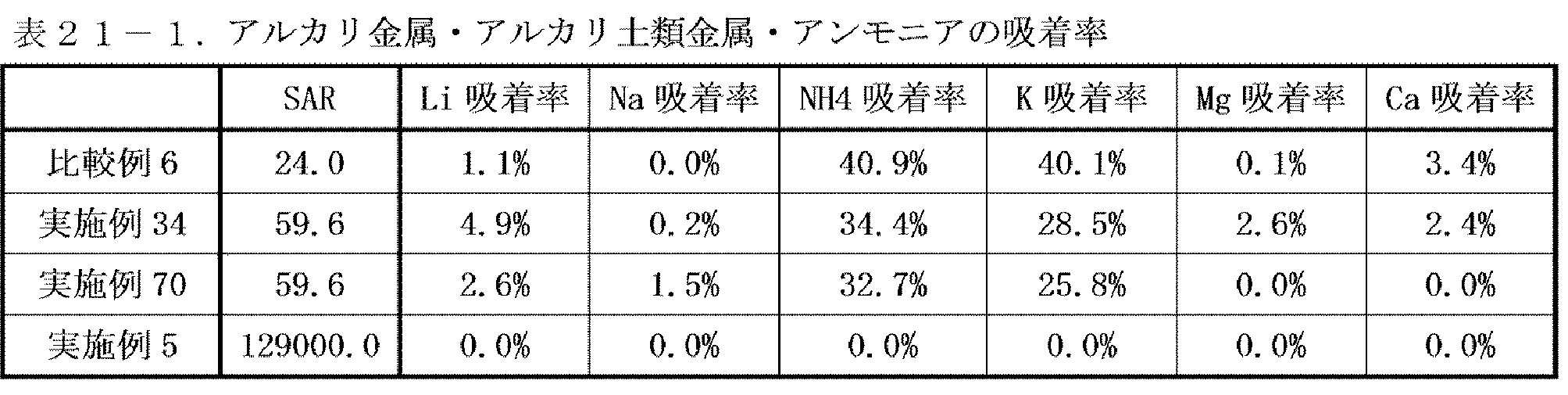


実施例5、34及び70並びに比較例6の各ゼオライトについて、ヒトの必須金属元素の吸着試験を実施した。化合物3 mgを精密に量り取り、1 mol/L 硝酸水溶液を精製水で10倍希釈することで調製した0.1 mol/L硝酸水溶液9.25 mL、0.1 mol/L 硝酸コバルト(II)水溶液 0.15 mL、0.1 mol/L 硝酸マンガン(II)水溶液 0.14mL、0.1 mol/L 硝酸亜鉛(II)水溶液 0.16 mL、0.1 mol/L 硝酸銅(II)水溶液 0.16 mL及び0.2 mol/L 硝酸鉄(III)水溶液 0.14 mLを加え、室温で1時間撹拌した。この液を遠心分離し、上澄み1000 μLに対して高純度硝酸(60%)を添加、精製水で希釈することで50 mLに定容した(HNO3 2%)。ICP-AESで各種成分を測定し、吸着率を計算したところ、表22のような結果となった。反応に用いた試薬を表23に記す。
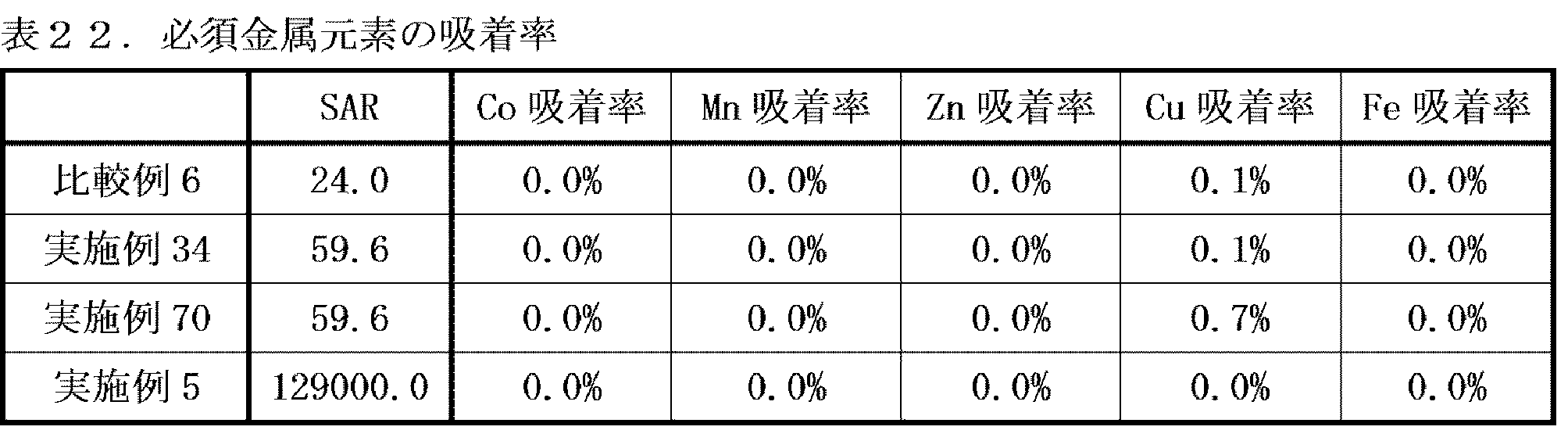

実施例5、実施例34、及び比較例6の各ゼオライトについて、下記2種のアミノ酸混合溶液を用いアミノ酸の吸着試験を実施した。
ゼオライト3 mgを精密に量り取り、アミノ酸混合標準液, AN型(高濃度タイプ, 富士フイルム和光純薬)1.0 mL、アミノ酸混合標準液, B型(高濃度タイプ, 富士フイルム和光純薬)1.0 mL、リン酸buffer 8 mLを加え、室温で1時間撹拌した。この液を遠心分離し、上澄みを限外濾過(MWCO=10,000)し、膜通過液をアミノ酸分析に供した。
なお、アミノ酸混合標準液, AN型(高濃度タイプ)は、酸性、中性アミノ酸を含む25種のアミノ酸類の混合標準液であり、各成分の濃度は、L-アスパラギン酸、L-トレオニン、L-セリン、L-グルタミン酸、グリシン、L-アラニン、L-シトルリン、L-バリン、L-シスチン、L-メチオニン、L-イソロイシン、L-ロイシン、L-チロシン、L-フェニルアラニン、β-アラニン、DL-3-アミノイソ酪酸、L-ヒドロキシプロリン、及びL-プロリンを各2.5 μmol/mL含み、O-ホスホ-L-セリン、タウリン、O-ホスホエタノールアミン、DL-2-アミノ酪酸及びL-シスタチオニンを各1.25 μmol/mL含み、サルコシンを6.25 μmol/mL含み、尿素を50 μmol/mL含む。また、アミノ酸混合標準液、B型(高濃度タイプ)は、塩基性アミノ酸3種を含む12種アミノ酸類の混合標準液であり、4-アミノ酪酸、エタノールアミン、塩化アンモニウム、5-ヒドロキシ-DL-リシン、L-オルニチン、L-リシン、1-メチル-L-ヒスチジン、L-ヒスチジン、3-メチル-L-ヒスチジン、L-アンセリン、L-カルノシン、及びL-アルギニンを各2.5 μmol/mL含む。
ゼオライト3 mgを精密に量り取り、アミノ酸混合液(精製水1 mLあたりL-トリプトファン40.8 μg (0.20 μmol)、L-グルタミン29.2 μg (0.20 μmol)、L-アスパラギン26.4 μg (0.20 μmol)を含む)10 mLを加え、室温で1時間撹拌した。この液を遠心分離し、上澄みを限外濾過(MWCO=10,000)し、膜通過液をアミノ酸分析に供した。用いた試薬を表24に記す。
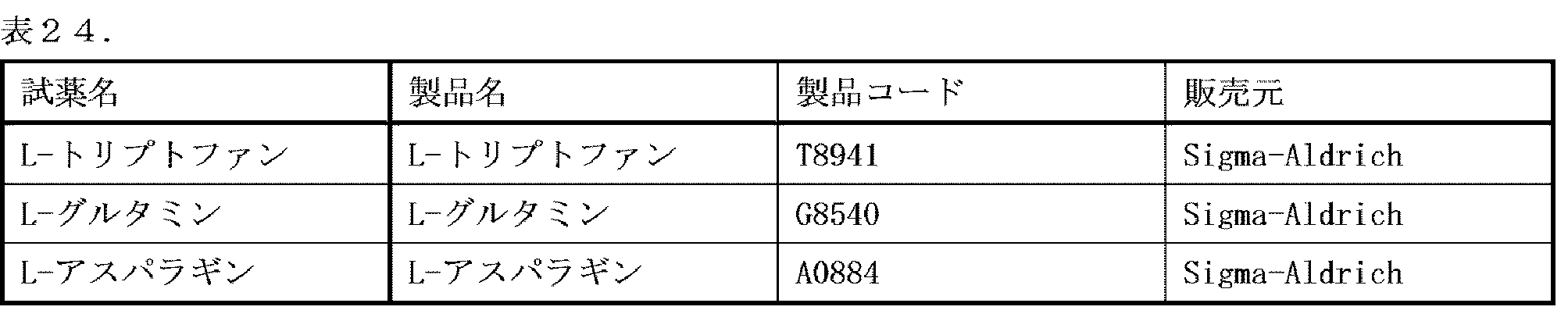
実施例5のシリカライトに関しては、全てのタンパク質構成アミノ酸を吸着せず、実施例34のゼオライトに関しては、L-アスパラギン、L-グルタミンを除き、蛋白質構成アミノ酸の吸着は起こらなかった。比較例6のゼオライトに関しては、塩基性アミノ酸のL-リシンやL-アルギニンの吸着が観測された。比較例6は実施例34と比較して外表面積が大きく且つSARが低いため、外表面酸点への塩基性アミノ酸の吸着が起こり易かったと考えられる。非タンパク質構成アミノ酸類については、4-アミノ酪酸やエタノールアミンの吸着が実施例34に関して観測された。いずれも直鎖アルキルからなる一級アミンであり、分子の最小径から考えるとゼオライト細孔内部に侵入可能であるため、表面吸着のみならず内部吸着された可能性がある。その他の非タンパク質構成アミノ酸類は分子サイズによらずほとんど吸着されなかった。いずれも水溶性の高い化合物であり、疎水性のゼオライト細孔内よりも水和された状態がより安定だったと考えられる。特に尿素は、生体消化管内に多く存在し、且つ細孔サイズよりも小さな分子のため、アミン類のゼオライトへの吸着を競合的に阻害する懸念があったが、本検討において吸着されなかった。本検討に用いたゼオライトが生体内で薬効を示す上で重要な選択性が確認されたと言える。

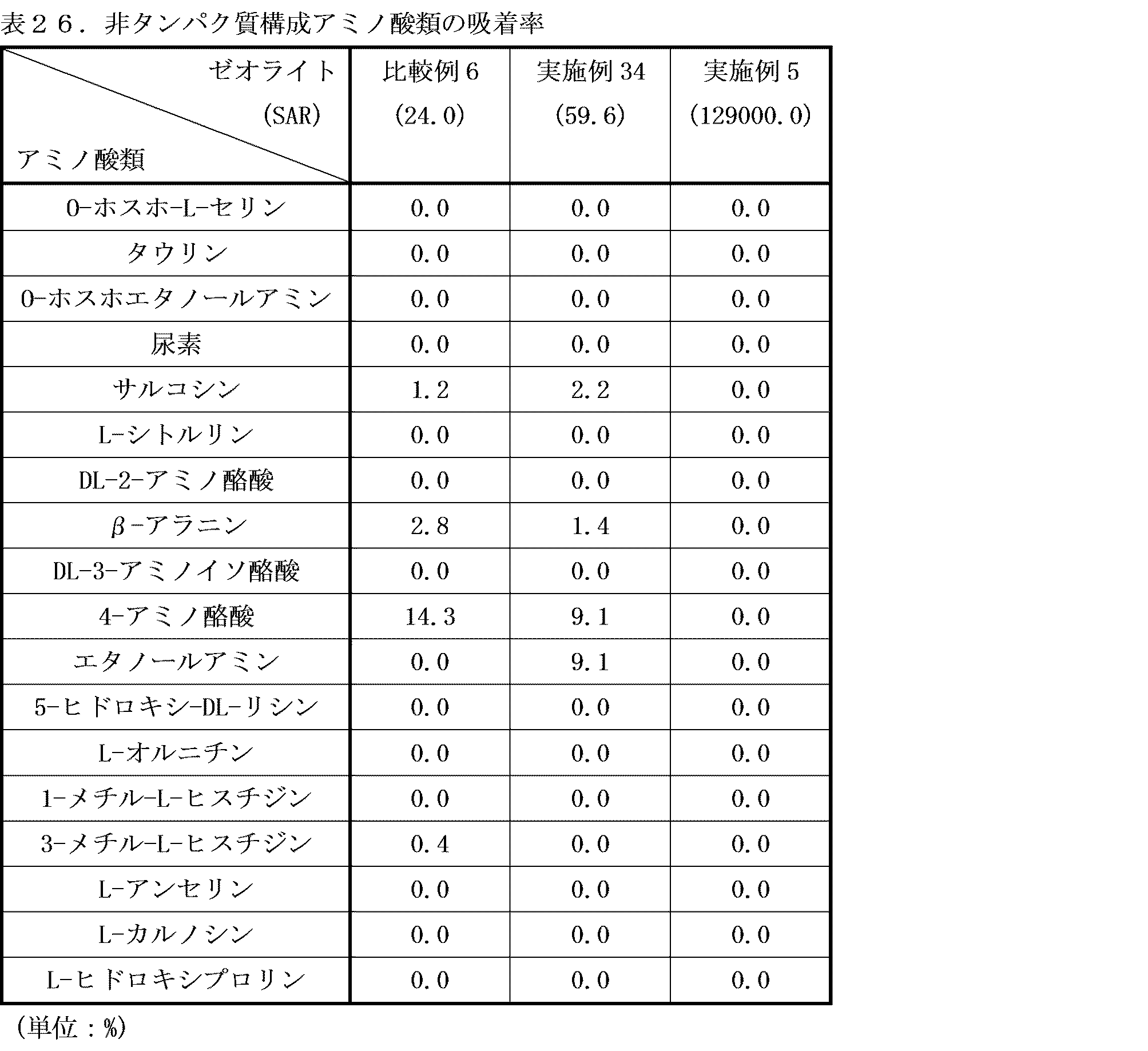
実施例34、実施例70、及び比較例6の各ゼオライトについて、ビタミンの吸着試験を実施した。ゼオライト3 mgを精密に量り取り、精製水10 mLを加えた。ゼオライトの懸濁液に対し、ビタミン25 μmolを精製水 1.0 mLに溶解した水溶液を100 μL加え、室温で1時間撹拌した。この液を遠心分離し、上澄みのビタミン濃度をLC-UV(検出波長210 nm)で測定したところ、表27のような結果となった。用いた試薬を表28に記す。なお、各ビタミンは混合することなく、一種類ずつ単独で吸着試験・分析を行った。
水溶性ビタミン(VB1、VB3、VB5、VB6、VB12、VC)の内、VB1、VB5、VB6(3 種)、VB12はいずれのゼオライトにもほとんど吸着されなかった(最大で10%程度)。その一方で水溶性ビタミンのVCは10~30%程度吸着され、VB3(2種)は40~60%程度吸着された。VCは水酸基を多く持ちゼオライト外表面のシラノールとの多点の水素結合により表面吸着していると想定され、外表面積が小さい実施例34よりも外表面積が大きい比較例6で吸着率が高くなったと考えられる。また、VCは酸性化合物であるため、外表面酸点の残る実施例34よりも、表面処理を施すことで外表面酸点を少なくした実施例70で表面吸着がより起こりやすくなったと考えられる。VB3に関しては、第3級アミンであるピリジン構造を有しており、アニオン性フレームワークを有するゼオライト細孔内で安定化されやすいと考えられる。VB6でも同じくピリジン構造を有するが、ピリジン上の置換基が多く、サイズ的に細孔内への吸着が起こらなかったと考えられる。その他の吸着されにくい水溶性ビタミンは、吸着されやすい水溶性ビタミンと比較して分子サイズが大きいためゼオライト細孔内部へ侵入できず、また、水溶性が高いため水和状態で安定に存在したのだと考えられる。VB3(2種)のような、置換基数が少ない、又はサイズの小さい複素環式アミンの吸着・除去や徐放性製剤や放出制御製剤のキャリアーとして、実施例のゼオライトを応用する可能性が示された。


実施例5、実施例34、実施例70、及び比較例6の各ゼオライトについて、短鎖脂肪酸の吸着試験を実施した。ゼオライト3 mgに精密に量り取り、精製水9.44 mLを加えた。さらに酢酸、プロピオン酸及び酪酸の各成分が2.5 μmolになるような量としてそれぞれ0.143 mL、0.187 mL及び0.229 mLを加えた。この液にスターラーバーを加えて1時間撹拌した。スターラーバーを取り除いた後、遠心分離した。遠心分離後、精製水で10000倍希釈した液につき、イオンクロマトグラフィーで測定した。用いた試薬を表29に記す。

本実施例の無機多孔体経口組成物と併用される可能性のある薬剤(以下、併用薬と記す)について、実施例34、70及び79の各ゼオライトを用いて吸着試験を実施した。ゼオライト3 mgを精密に量り取り、精製水9.9 mLを加えた。ゼオライトの懸濁液に対し、併用薬25 μmolをDMSO 1.0 mLに溶解したDMSO溶液を100 μL加え、室温で1時間撹拌した。この液を遠心分離し、上澄み中の併用薬濃度をLC-MS/MSで測定し吸着率(上澄み中併用薬濃度を初期濃度250 μmol/Lで除した値を1から引いた値を百分率で示した。また、負の値となったものは0と表記した)を計算したところ、表30のような結果となった。用いた試薬を表31に記す。なお、カルベジロール及びミコナゾールについては、ゼオライトを精製水に懸濁後、1N塩酸を10 μL添加することで、塩基性化合物であるカルベジロール及びミコナゾールの溶解度を高めた(併用薬のDMSO溶液を加えた直後の溶液中pHは6~7を示した)。なお、各併用薬は混合することなく、一種類ずつ単独で吸着試験・分析を行った。


実施例34、実施例70及び比較例6の各ゼオライトについて、TMA前駆体の吸着試験を実施した。ゼオライト3 mgを精密に量り取り、精製水10 mLを加えた。ゼオライトの懸濁液に対し、ベタイン(トリメチルグリシン)又はカルニチン25 μmolを精製水 1.0 mLに溶解した水溶液を100 μL加え、室温で1時間撹拌した。この液を遠心分離し、上澄みのベタイン又はカルニチン濃度をLC-CAD(Charged Aerosol Detector; 荷電化粒子検出器)で測定したところ、表32のような結果となった。
なお、同じくTMA前駆体として知られるTMAOは、ベタイン・カルニチンのように塩基性構造を持たず、親水性が高いため、水中でゼオライトへの吸着が起こらないのは自明と考え、吸着試験を行わなかった。


実施例34、実施例70及び比較例6の各ゼオライトについて、セロトニンの吸着試験を実施した。ゼオライト3 mgを精密に量り取り、精製水10 mLを加えた。ゼオライトの懸濁液に対し、セロトニン(5-Hydroxytryptamin、富士フイルム和光純薬)25 μmolを精製水 1.0 mLに溶解した水溶液を100 μL加え、室温で1時間撹拌した。この液を遠心分離し、上澄みのセロトニン濃度をLC-CADで測定したところ、表34のような結果となった。
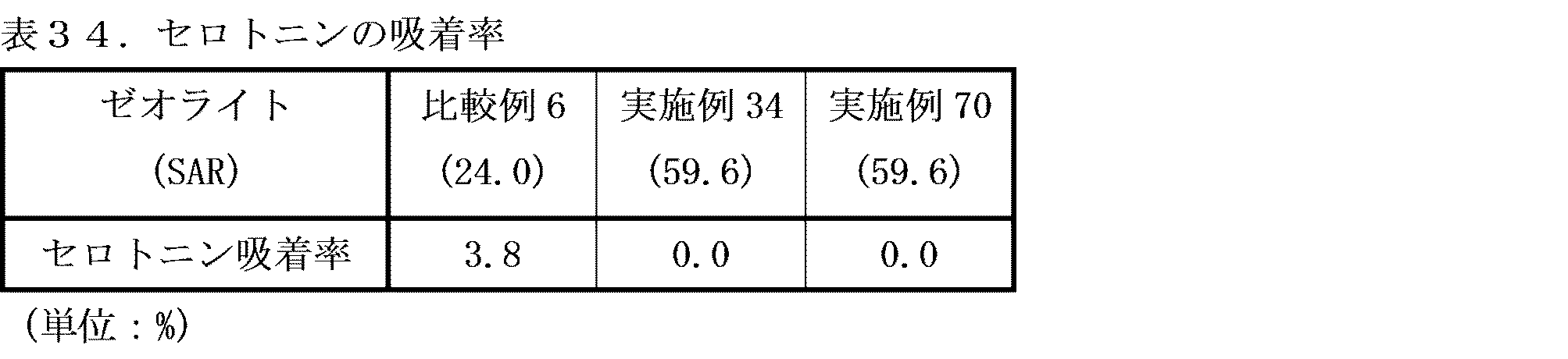
以下、上記実施例で評価に使用した実施例及び比較例のゼオライトの入手法及び合成法並びにゼオライトの物性測定法を示す。
表35に実施例1~3及び比較例1~14の化合物由来を記す。実施例1、実施例3及び比較例1~14については、市販品を購入してそのまま使用した。実施例2については、購入したゼオライトを空気流通下で500℃、4時間にわたり焼成することによりアンモニア型からプロトン型に変換した。
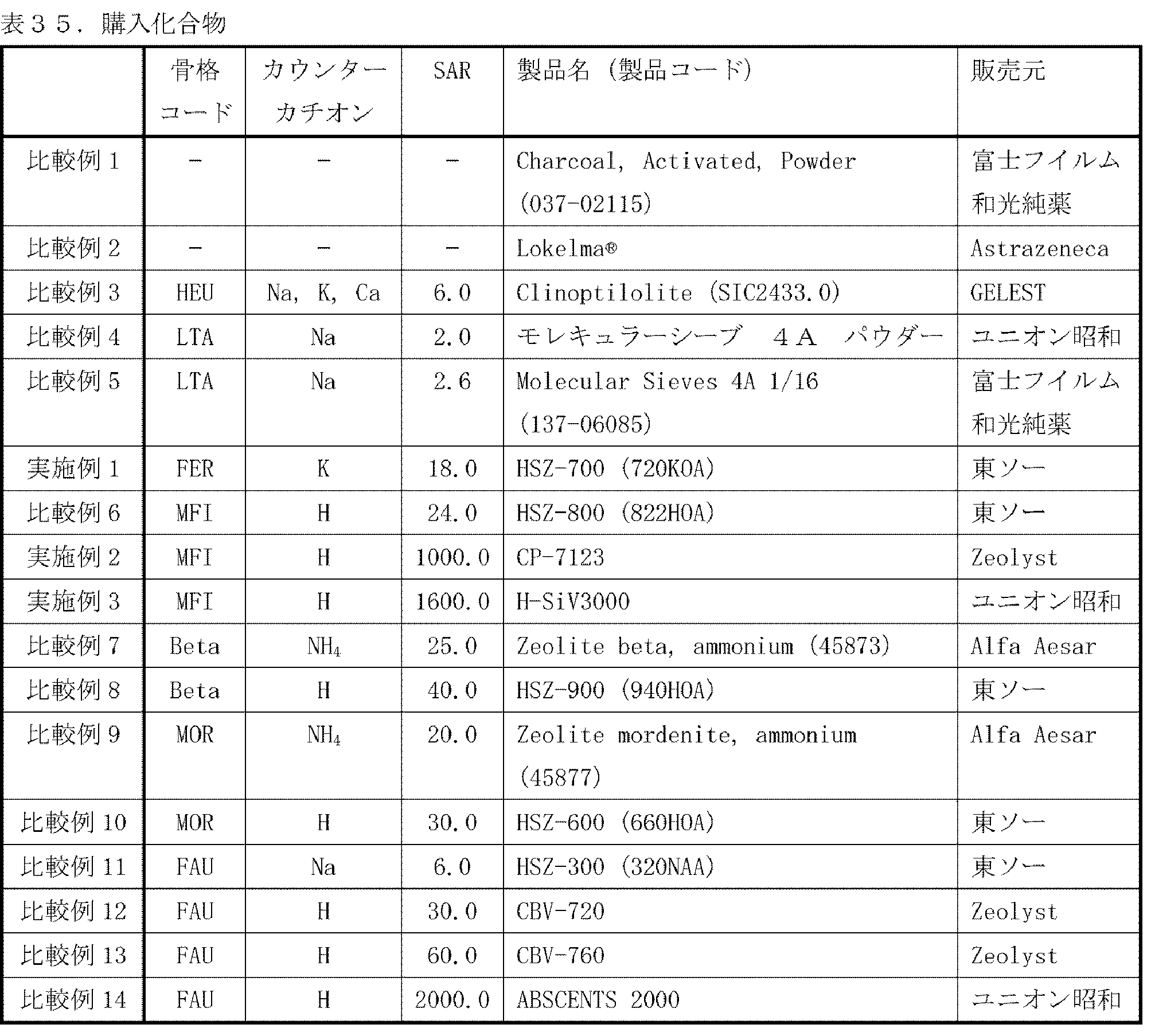
骨格コード:本実施例で用いたゼオライトの骨格コードであり、IZA(International Zeolite Association)が定めるゼオライトの骨格構造を規定するコードに準ずる
カウンターカチオン:本実施例で用いたゼオライトのカウンターカチオン
SAR:本実施例で用いたゼオライトのAl2O3に対するSiO2のモル比
製品名(製品コード):本実施例で用いた化合物の製品名。括弧内は製品コード
販売元:本実施例で用いた化合物の販売元
[水熱合成・有機構造規定剤の焼成]
容器に水酸化ナトリウム(NaOH)顆粒4.5 g、水酸化カリウム(KOH)顆粒3.8 g、有機構造規定剤(Organic Structure Directing Agent;以下、OSDAと記す)としてセイケム製の25質量%N,N,N-トリメチル-1-アダマンチルアンモニウムヒドロキシド(TMAdaOH)水溶液66.6 g、脱塩水195 g、水酸化アルミニウムとして協和化学工業製の「キョーワード200S(アルミナ含有量53.5質量%)」7.1 g、シリカとして日揮触媒化成製のコロイダルシリカ「カタロイドSI-30」225 gを順次加えた。得られた混合物の組成及びモル比はSiO2:Al2O3:NaOH:KOH:TMAdaOH:H2O=1.0:0.033:0.1:0.06:0.07:20であった。これらの原料をよく混合した後、得られた混合物を耐圧容器に入れ、100 rpmの回転条件下、160℃で48時間にわたり水熱合成を行い、得られたゲルを吸引濾過及び脱塩水によって洗浄した後、100℃、8時間以上加熱することにより乾燥させた(以下、乾燥操作は特に指定しない限り、本条件で行った)。得られた粉末を空気流通下で、550℃、6時間にわたり焼成することにより、粉末からOSDAを除去した。
硝酸アンモニウム及び脱塩水から調製した1 mol/L硝酸アンモニウム水溶液に対して、OSDAを除去した粉末を10質量%で分散させ、80℃で2時間アンモニウムイオン交換を行い、吸引濾過及び脱塩水で洗浄した。その後、前記のイオン交換と洗浄を更に繰り返し2回行った。さらにイオン交換した粉末を乾燥させた後に、空気流通下で500℃、4時間にわたり焼成することにより、プロトン型のゼオライトを得た。
容器に水酸化ナトリウム顆粒1.0 g、OSDAとしてセイケム製の18質量%1,1’-(1,4-ブタンジイル)ビス(1-アゾニア-4-アザビシクロ[2.2.2]オクタン) ・ジヒドロキシド(Dab-4)水溶液8.7 g、脱塩水8 g、水酸化アルミニウムとして「キョーワード200S」0.94 g、シリカとして「スノーテックス40」7.5 g、種晶として比較例15で合成したCHA型ゼオライト0.15 gを順次加えた。得られた混合物の組成及びモル比はSiO2:Al2O3:NaOH:Dab-4:H2O=1.0:0.1:0.5:0.1:22であった。これらの原料をよく混合した後、得られた混合物を耐圧容器に入れ、静置条件下、140℃のオーブンで120時間にわたり水熱合成を行い、得られたゲルを吸引濾過及び脱塩水によって洗浄した後に乾燥した。得られた粉末を空気流通下で、550℃、6時間にわたり焼成することにより、粉末からOSDAを除去した。さらに、比較例15の[イオン交換・焼成]の操作を行い、プロトン型のゼオライトを得た。
容器に水酸化ナトリウム顆粒0.772 g、OSDAとしてセイケム製の35質量%N,N-ジメチル-3,5-ジメチルピペリジニウムヒドロキシド(DMDMPIOH)水溶液2.262 g、脱塩水9.9 g、水酸化アルミニウムとして「キョーワード200S」0.726 g、シリカとして「スノーテックス40」7.454 g、種晶として比較例15で合成したCHA型ゼオライト0.300 gを順次加えた。得られた混合物の組成及びモル比はSiO2:Al2O3:NaOH:DMDMPIOH:H2O=1.0:0.013:0.4:0.1:17.5であった。これらの原料をよく混合した後、得られた混合物を耐圧容器に入れ、15 rpmの回転条件下、180℃のオーブンで24時間にわたり水熱合成を行い、得られたゲルを吸引濾過及び脱塩水によって洗浄した後に乾燥した。得られた粉末を空気流通下で、600℃、6時間にわたり焼成することにより、粉末からOSDAを除去した。さらに、比較例15の[イオン交換・焼成]の操作を行い、プロトン型のゼオライトを得た。
容器に水酸化ナトリウム顆粒1.135 g、OSDAとして東京化成工業製のヘキサメチレンイミン(HMI)4.959 g、脱塩水63.2 g、水酸化アルミニウムとして「キョーワード200S」0.944 g、シリカとして「スノーテックス40」14.908 gを順次加えた。得られた混合物の組成及びモル比はSiO2:Al2O3:NaOH:HMI:H2O=1.0:0.033:0.3:0.5:40であった。これらの原料をよく混合した後、得られた混合物を耐圧容器に入れ、静置条件下、150℃のオーブンで144時間にわたり水熱合成を行い、得られたゲルを吸引濾過及び脱塩水によって洗浄した後に乾燥した。得られた粉末を空気流通下で、550℃、6時間にわたり焼成することにより、粉末からOSDAを除去した。さらに、比較例15の[イオン交換・焼成]の操作を行い、プロトン型のゼオライトを得た。
比較例19において、原料混合物の組成及びモル比をSiO2:Al2O3:NaOH:HMI:H2O=1.0:0.02:0.3:0.5:40に変更した以外は、比較例18の合成法と同様の手順にてゼオライトの合成を行った。
容器に1 mol/L水酸化ナトリウム水溶液7.750 g、OSDAとして東京化成工業製の40質量%テトラブチルアンモニウムヒドロキシド(TBAOH)水溶液6.487 g、脱塩水15.9 g、水酸化アルミニウムとして「キョーワード200S」0.629 g、シリカとして「スノーテックス40」14.908 gを順次加えた。得られた混合物の組成及びモル比はSiO2:Al2O3:NaOH:TBAOH:H2O=1.0:0.033:0.1:0.1:20であった。これらの原料をよく混合した後、得られた混合物を耐圧容器に入れ、15 rpmの回転条件下、175℃のオーブンで72時間にわたり水熱合成を行い、得られたゲルを吸引濾過及び脱塩水によって洗浄した後に乾燥した。得られた粉末を空気流通下で、550℃、6時間にわたり焼成することにより、粉末からOSDAを除去した。さらに、比較例15の[イオン交換・焼成]の操作を行い、プロトン型のゼオライトを得た。
比較例21において、原料混合物の組成及びモル比をSiO2:Al2O3:NaOH:TBAOH:H2O=1.0:0.02:0.1:0.1:20に変更した以外は、比較例20と同様の手順にてゼオライトの合成を行った。
比較例15~21のゼオライトについて、骨格コード及びSARを表36にまとめた。ゼオライト骨格については、XRPDの回折パターンを確認することで特定した。いずれのゼオライトもカウンターカチオンはプロトンである。

実施例4~34、実施例37~64及び比較例22において、使用原料、仕込み量、水熱合成条件、攪拌方法及び後処理を表37-1、表37-2、表37-3に示す通り変更した以外は以下と同様の手順にてゼオライトの合成を行った。いずれのゼオライトも、XRPDにおいてMFI型ゼオライトの回折パターンを示した。
容器に1 mol/L水酸化ナトリウム水溶液、構造規定剤(Structure Directing Agent;以下、SDAと記す)を0~2種類、脱塩水、アルミニウム(Al)源、ケイ素(Si)源、種結晶を順次加えた。これらの原料をよく混合した後、得られた混合物を耐圧容器に入れ、水熱合成を行った。その後、得られたゲルを吸引濾過し、脱塩水を用いてよく洗浄した後、空気雰囲気下で100℃、8時間以上加熱することにより乾燥させた。得られたゼオライト粉末に対して、後処理を行った。


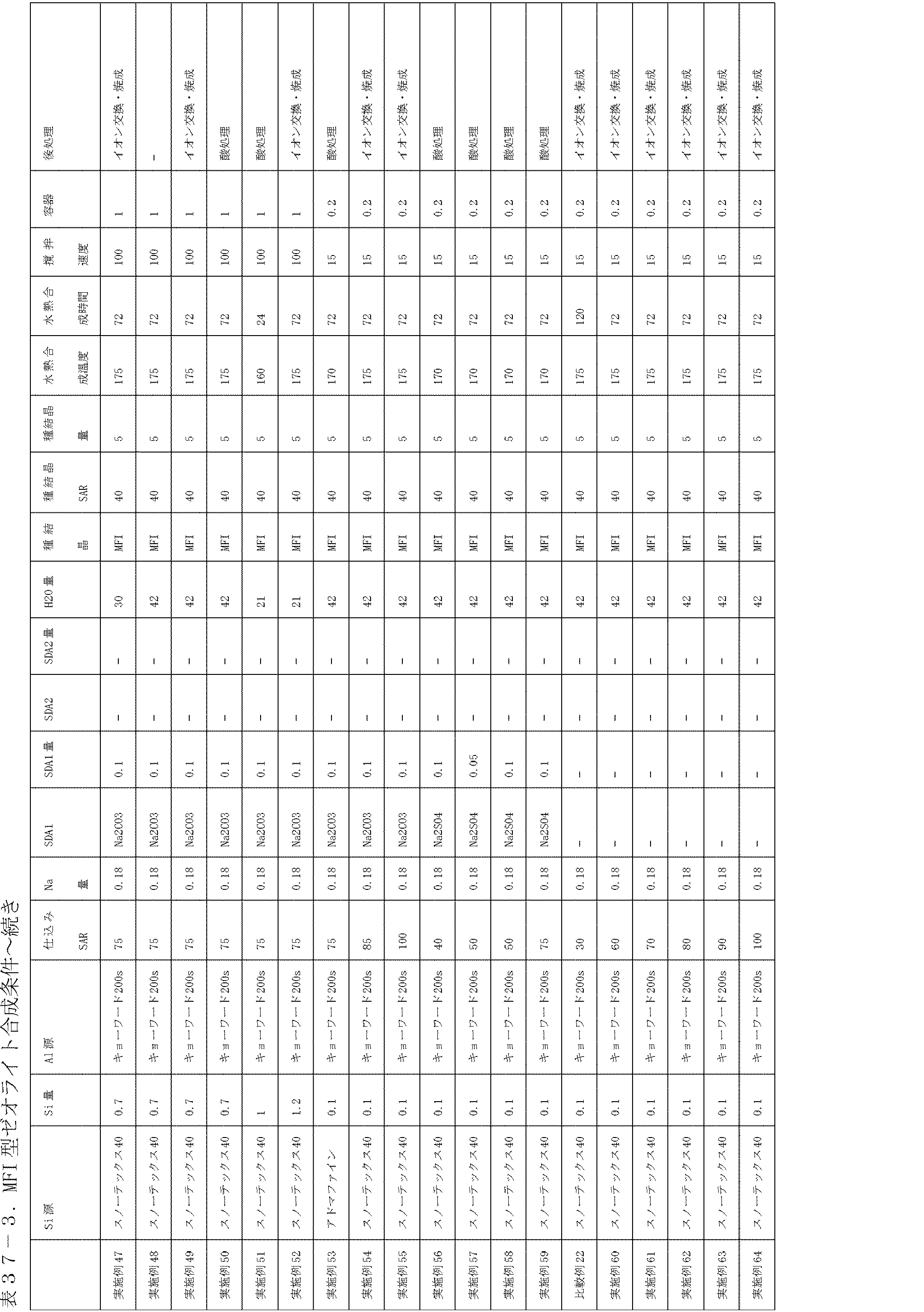
Si源:本実施例で添加したSi源の種類
Si量:本実施例で添加したSi源中のSi量(単位:mol)
Al源:本実施例で添加したAl源の種類
仕込みSAR:本実施例で添加した種結晶以外の原料混合物に含まれるAl2O3に対するSiO2のモル比。Al2O3が含まれない場合は「∞」と表記。
Na量:本実施例で添加した種結晶以外の原料混合物に含まれるSiに対する、Si源及びNaOH由来のNaのモル比
SDA1:本実施例で添加した1種類目のSDAの種類
SDA1量:本実施例で添加した種結晶以外の原料混合物に含まれるSiに対するSDA1のモル比
SDA2:本実施例で添加した2種類目のSDAの種類
SDA2量:本実施例で添加した種結晶以外の原料混合物に含まれるSiに対するSDA2のモル比
H2O量:本実施例で添加した種結晶以外の原料混合物に含まれるSiに対するH2Oのモル比
種結晶:本実施例で添加した種結晶ゼオライトの構造
種結晶SAR:本実施例で添加した種結晶ゼオライトのAl2O3に対するSiO2のモル比
種結晶量:本実施例で添加した種結晶以外の原料混合物に含まれるSiを全てSiO2に換算した量に対して添加した種結晶の割合(質量%)
水熱合成温度:本実施例で水熱合成を実施した温度(単位:℃)
水熱合成時間:本実施例で水熱合成を実施した時間(単位:時間)
攪拌速度:本実施例で水熱合成を実施した攪拌速度(単位:rpm。0は静置条件を意味する)
容器:本実施例で水熱合成を実施した耐圧容器の容量(単位:L)
後処理:本実施例で水熱合成で得られたゼオライト粉末に対して行った後処理方法。以下に示す [SDA除去]、[イオン交換・焼成]又は[酸処理]を組み合わせて、表中記載順に実施。
得られたゼオライト粉末を空気流通下で、550℃、6時間にわたり焼成することにより、粉末からSDAを除去した。
硝酸アンモニウム及び脱塩水を用いて調製した1 mol/L硝酸アンモニウム水溶液に対してゼオライト粉末を10質量%で分散させ、80℃で2時間アンモニウムイオン交換を行い、吸引濾過及び脱塩水で洗浄した。その後、前記のイオン交換と洗浄を更に繰り返し2回行った。さらにイオン交換した粉末を乾燥させた後に、空気流通下で500℃、4時間にわたり焼成することにより、プロトン型のゼオライトを得た。
得られたゼオライト粉末を1 mol/L硝酸水溶液に対して10質量%加え室温で1時間攪拌し、吸引濾過及び脱塩水を用いて洗浄した後に乾燥することにより、プロトン型のゼオライト粉末を得た。
実施例4~35、実施例37~64及び比較例15~22の合成例で使用した試薬について、表38にまとめた。

実施例65~67において、表39に示す硝酸、温度で、以下に示す反応条件でゼオライトの酸処理を実施した。
精密に量り取った実施例50のゼオライト100 mgに対して、関東化学製の1 mol/L硝酸水溶液(1 mol/L硝酸(1N))又は濃硝酸(硝酸 1.38)を5 mL加えた。スターラーを用いて反応溶液を室温又は100℃で5時間撹拌後、桐山ロートを用いてゼオライトを濾取した。濾取物を精製水で洗浄し、40℃で2時間減圧乾燥した。

精密に量り取った実施例48のゼオライト1 gに対して、キシダ化学製1 mol/L硝酸水溶液10 gを加えた。スターラーを用いて反応溶液を室温で1時間にわたって撹拌後、桐山ロートを用いてゼオライトを濾取した。濾取物を脱塩水で洗浄し、空気雰囲気下100℃で12時間乾燥した。
比較例23及び実施例70、72~88において、表40に示す原料ゼオライト、表面処理試薬を用い、以下に示すいずれかの反応条件でゼオライトの表面処理体を合成した。反応に用いた表面処理試薬を表41に記す。
精密に測り取った原料ゼオライトに対してHMDSを10 g-HMDS/g-zeoliteの重量比で加えた。この反応溶液をオイルバス内で100℃に加熱しながら、窒素気流下で5時間攪拌した。得られた粉末を桐山ロートで濾取した。濾取物をアセトンで洗浄し、8時間以上大気中で風乾した後に、空気雰囲気下で、100℃、8時間以上加熱することにより、乾燥させた。
精密に量り取った原料ゼオライトに対してトルエンを20 mL/g-zeolite加えた。表面処理試薬を0.5 mmol/g-zeoliteの当量比で加え、室温で5時間撹拌し、得られた粉末を桐山ロートで濾取した。濾取物をエタノールで洗浄し、40℃で1晩減圧乾燥した。
密閉できる容器内に、原料ゼオライト100 mgを量り取ったガラス瓶、精製水を2滴加えたエッペンドルフチューブ、及び表面処理試薬を2滴加えたエッペンドルフチューブを入れた。容器を密閉し、100℃に加熱した庫内に入れて5時間加温した。その後、ゼオライトを40℃で2時間減圧乾燥した。
精密に量り取った原料ゼオライトを恒温恒湿槽に入れ、25℃/75%RH条件下で一晩吸湿した。表面処理試薬を20 mL/g-zeolite加え、室温で5時間撹拌し、得られた粉末を桐山ロートで濾取した。濾取物をエタノールで洗浄し、40℃で2時間減圧乾燥した。
精密に量り取った原料ゼオライト100 mgに対してトルエン7 mLを加えた。表面処理試薬を2滴加え、室温で5時間撹拌し、得られた粉末を桐山ロートで濾取した。濾取物をエタノールで洗浄し、40℃で2時間減圧乾燥した。


実施例36、71及び89において、表42に対応する試薬及び脱塩水から調製した1 mol/L硝酸塩水溶液を用いて、以下に示す反応条件でカウンターカチオンの交換を行った。
1 mol/L硝酸アンモニウム水溶液に対して、実施例34のゼオライトを10質量%で分散させ、80℃で2時間アンモニウムイオン交換を行い、吸引濾過及び脱塩水で洗浄した。その後、前記のイオン交換と濾過・洗浄を更に繰り返し2回行った。得られた粉末を乾燥させることにより、アンモニア型のゼオライトを得た(実施例89)。
1 mol/L硝酸リチウム又は硝酸カリウム水溶液に対して、実施例89のゼオライトを10質量%で分散させ、80℃で2時間カチオン交換を行い、吸引濾過及び脱塩水で洗浄した。その後、前記のカチオン交換と濾過・洗浄を更に繰り返し2回行った。得られた粉末を乾燥させることにより、リチウム又はカリウム型のゼオライトを得た(実施例36、71)。
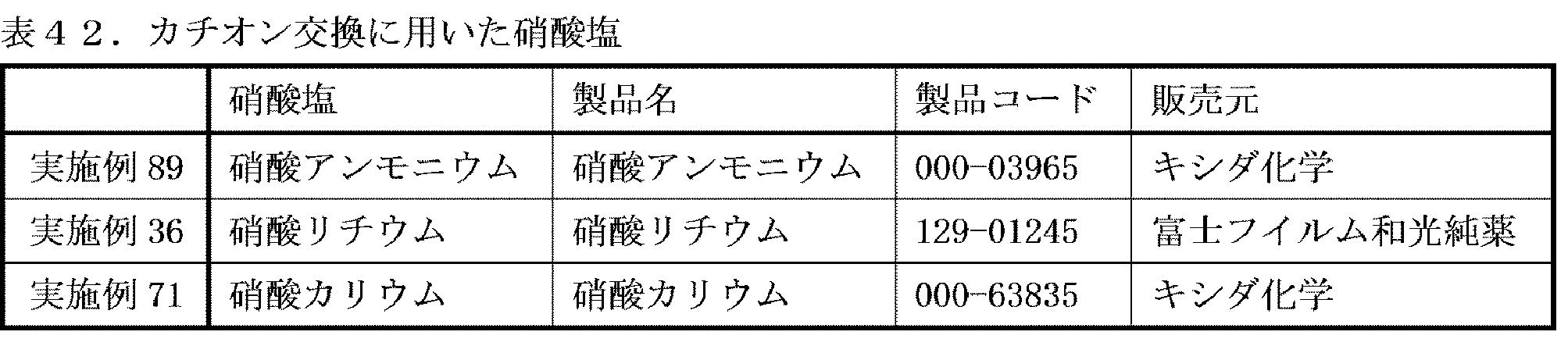
測定方法
ゼオライト組成の分析
ゼオライト標準試料中のケイ素原子、アルミニウム原子及びナトリウム原子の元素分析を以下の通り行った。
精秤した試料にアルカリ塩融剤を添加して加熱融解させたものを、温水に溶解させ、その後酸を添加した溶液で適宜希釈し、誘導結合プラズマ発光分光分析法(Inductively Coupled Plasma Atomic Emission Spectroscopy;以下、ICP-AESと記す)で酸濃度マッチング検量線法によりケイ素原子、アルミニウム原子及びナトリウム原子の含有量(重量%)を求めた。さらに、ゼオライト標準試料中の分析元素の蛍光X線強度を求め、ICP-AESから求めた原子濃度との検量線を作成した。
粉末X線回折測定装置X’PertPro(PANalyticalB.V.社製)を用いて、以下の条件で測定・データ解析した。
X線発生装置:X線管球(対陰極:銅、管電圧:45 kV、管電流:40 mA)
入射光学系:フォーカシング集光ミラー
受光光学系:高速半導体アレイ検出器(X-Celerator)、拡張受光側アーム
サンプルステージ:HTSサンプルステージ(X軸方向に4 mm幅で振動)
積算回数:5回(それぞれ入射角を-2、-1、0、1及び2°に変更)
測定範囲:2θ=3~40°
スキャン速度:0.668451°/秒
ステップ:0.0167°
ソフトウェア:High Score Plus
ピークサーチ
最小有意度:1.00
最小ピークチップ(°2Th.):0.01
最大ピークチップ(°2Th.):1.00
ピークベース幅(°2Th.):2.00
<Profile fit> Default Profile Fitを3回実施
(前処理)
表面積の測定に先立ち、前処理としてゼオライト粉末を測定セルに30~80 mg充填し、前処理装置(カンタクローム社製マスタープレップ)を用いて350℃、減圧下で5時間加熱減圧脱気処理を実施した。
前処理後のゼオライト粉末について、吸着等温線を測定した。測定は定容量ガス吸着測定装置(カンタクローム社製オートソーブiQ-XR-XR-XR或いはオートソーブiQ3-MP-XR)を用い、吸着質は窒素、液体窒素温度下で相対圧1×10⁻⁵~0.995の範囲の吸着等温線を測定した。得られた吸着等温線よりからBETプロットを作成し、直線性が良好な範囲でBET多点法解析を実施しBET比表面積を求めた。更に、t-プロット(標準等温線:de-Bore式)を作成し、プラトー部分の傾きと切片より外表面積を算出した。
エイコー社製イオンコーターIB-3にてゼオライト試料表面に白金を厚みが約9 nmになるように蒸着させてから、日立ハイテク社製走査型電子顕微鏡S-4500又は日本電子製JSM-6010LVを用いて形状観察を行った。
粒度分布は、堀場製作所製レーザー回折/散乱式粒子径分布測定装置LA-950V2を用いて測定した。純水を分散媒とし、試料の屈折率を1.450-0.000i、分散媒の屈折率を1.333-0.000i、循環速度のレンジを5、攪拌速度のレンジを2に設定したフローセル中で測定を行った。
Claims (36)
- 無機多孔体を含み、
人工腸液中で同モル量の混合物として存在するコリン及び第1,2,3級アミン又はアンモニアに対して、コリン1mmol当たり11.8gの前記無機多孔体を2g/Lの濃度で1時間混合させた時に、第1,2,3級アミン又はアンモニアの吸着率が60.0%以上であり、且つ、コリンの吸着率が40.0%以下である、経口用組成物。 - 前記無機多孔体は、第1,2,3級アミン又はアンモニアの吸着率が、コリンの吸着率の2.00倍以上である、請求項1に記載の経口用組成物。
- 前記無機多孔体がアルミノシリケート又はシリケートである、請求項1に記載の経口用組成物。
- 前記アルミノシリケートがゼオライトである、請求項3に記載の経口用組成物。
- 前記ゼオライトの最大員環数が10であり、且つ、細孔内拡散最大球径が3.68Å以上である、請求項4に記載の経口用組成物。
- 前記ゼオライトがMFI構造又はFER構造である、請求項4に記載の経口用組成物。
- 前記ゼオライトがAl2O3に対するSiO2のモル比が15.0以上130000.0以下のゼオライトである、請求項4に記載の経口用組成物。
- 前記ゼオライトがAl2O3に対するSiO2のモル比が30.0以上80.0以下のゼオライトである、請求項7に記載の経口用組成物。
- 前記ゼオライトの外表面積が33.0m2/g以下である、請求項4に記載の経口用組成物。
- 医薬組成物である、請求項1に記載の経口用組成物。
- 第1,2,3級アミン、アンモニア又はそれらの代謝物に起因する疾患の予防、治療又は症状軽減に使用される、請求項10に記載の経口用組成物。
- 第1,2,3級アミン、アンモニア又はそれらの代謝物が、トリメチルアミン、ジメチルアミン、メチルアミン、ヒスタミン、アンモニア及びトリメチルアミン-N-オキシドからなる群より選ばれる1種類以上を含む、請求項11に記載の経口用組成物。
- 第1,2,3級アミン、アンモニア又はそれらの代謝物が、トリメチルアミン又はトリメチルアミン-N-オキシドである、請求項11に記載の経口用組成物。
- 第1,2,3級アミン、アンモニア又はそれらの代謝物に起因する疾患が、トリメチルアミン尿症、心血管疾患、緑内障、アテローム性動脈硬化症、冠状動脈性心疾患、駆出率保持心不全、ST上昇型心筋梗塞、心房細動、腹部大動脈瘤、虚血性脳卒中、脳卒中後認知機能障害、軽度認知障害、アルツハイマー型認知症、肥満症、2型糖尿病をもつ進行慢性腎臓病、慢性腎臓病における心血管合併症、糖尿病性網膜症、非アルコール性脂肪肝炎、多嚢胞性卵巣症候群、パーキンソン病、結腸直腸がん、過敏性腸症候群、高アンモニア血症、尿素サイクル異常症、有機酸血症、肝性脳症、及び門脈体循環短絡症からなる群より選ばれる、請求項11に記載の経口用組成物。
- 前記疾患がトリメチルアミンに起因する疾患であって、前記疾患がトリメチルアミン尿症、心血管疾患、又は緑内障である、請求項14に記載の経口用組成物。
- 前記疾患がトリメチルアミン-N-オキシドに起因する疾患であって、前記疾患がアテローム性動脈硬化症、冠状動脈性心疾患、駆出率保持心不全、ST上昇型心筋梗塞、心房細動、腹部大動脈瘤、虚血性脳卒中、脳卒中後認知機能障害、軽度認知障害、アルツハイマー型認知症、肥満症、2型糖尿病をもつ進行慢性腎臓病、慢性腎臓病における心血管合併症、糖尿病性網膜症、非アルコール性脂肪肝炎、多嚢胞性卵巣症候群、パーキンソン病、又は結腸直腸がんである、請求項14に記載の経口用組成物。
- 前記疾患がヒスタミンに起因する疾患であって、前記疾患が過敏性腸症候群である、請求項14に記載の経口用組成物。
- 前記疾患がアンモニアに起因する疾患であって、前記疾患が高アンモニア血症、尿素サイクル異常症、有機酸血症、肝性脳症、又は門脈体循環短絡症である、請求項14に記載の経口用組成物。
- ゼオライトを有効成分として含有し、1日1~5回投与され、前記ゼオライトの投与量が1回あたり200mg~42000mgである、請求項10に記載の経口用組成物。
- 前記ゼオライトの投与量が1回あたり500mg~2000mgである、請求項19に記載の経口用組成物。
- 請求項4に記載の経口用組成物を製造するための方法であって、有機構造規定剤を用いずに水熱合成によってゼオライトを得ることを含む、方法。
- 原料として炭酸ナトリウムないしは硫酸ナトリウムを用いる、請求項21に記載の方法。
- 酸によってプロトン型に変換することを含む、請求項21に記載の方法。
- 前記酸が硫酸又は硝酸である、請求項23に記載の方法。
- 水熱合成後のゼオライトに対してSi元素源を含む溶液中で表面処理を行うことを更に含む、請求項21に記載の方法。
- ゼオライトを含有し、
前記ゼオライトがMFI構造を有し、且つ、Al2O3に対するSiO2のモル比が30.0以上130000.0以下であり、又は、
前記ゼオライトがFER構造を有し、且つ、Al2O3に対するSiO2のモル比が15.0以上130000.0以下であり、
トリメチルアミン尿症、アテローム性動脈硬化症、過敏性腸症候群及び高アンモニア血症からなる群より選択される疾患の治療、予防又は症状軽減に使用される、経口用組成物。 - 前記ゼオライトがAl2O3に対するSiO2のモル比が30.0以上80.0以下のゼオライトである、請求項26に記載の経口用組成物。
- ゼオライトの外表面積が33.0m2/g未満である、請求項26に記載の経口用組成物。
- 医薬組成物である、請求項26に記載の経口用組成物。
- 1日1~5回投与され、前記ゼオライトの投与量が1回あたり200mg~42000mgである、請求項29に記載の経口用組成物。
- 前記ゼオライトの投与量が1回あたり500mg~2000mgである、請求項30に記載の経口用組成物。
- 請求項26に記載の経口用組成物を製造するための方法であって、有機構造規定剤を用いずに水熱合成によってゼオライトを得る、方法。
- 原料として炭酸ナトリウムないしは硫酸ナトリウムを用いる、請求項32に記載の方法。
- 酸によってプロトン型に変換することを含む、請求項32に記載の方法。
- 前記酸が硫酸又は硝酸である、請求項34に記載の方法。
- 水熱合成後のゼオライトに対してSi元素源を含む溶液中で表面処理を行うことを更に含む、請求項32に記載の方法。
Priority Applications (3)
| Application Number | Priority Date | Filing Date | Title |
|---|---|---|---|
| CN202480043171.4A CN121419781A (zh) | 2023-06-27 | 2024-06-26 | 包含无机多孔体的经口组合物 |
| EP24832008.7A EP4736861A1 (en) | 2023-06-27 | 2024-06-26 | Oral composition containing inorganic porous body |
| JP2025530176A JPWO2025005149A1 (ja) | 2023-06-27 | 2024-06-26 |
Applications Claiming Priority (2)
| Application Number | Priority Date | Filing Date | Title |
|---|---|---|---|
| JP2023105129 | 2023-06-27 | ||
| JP2023-105129 | 2023-06-27 |
Publications (1)
| Publication Number | Publication Date |
|---|---|
| WO2025005149A1 true WO2025005149A1 (ja) | 2025-01-02 |
Family
ID=93938682
Family Applications (1)
| Application Number | Title | Priority Date | Filing Date |
|---|---|---|---|
| PCT/JP2024/023237 Ceased WO2025005149A1 (ja) | 2023-06-27 | 2024-06-26 | 無機多孔体を含む経口組成物 |
Country Status (4)
| Country | Link |
|---|---|
| EP (1) | EP4736861A1 (ja) |
| JP (1) | JPWO2025005149A1 (ja) |
| CN (1) | CN121419781A (ja) |
| WO (1) | WO2025005149A1 (ja) |
Citations (4)
| Publication number | Priority date | Publication date | Assignee | Title |
|---|---|---|---|---|
| US20050106267A1 (en) * | 2003-10-20 | 2005-05-19 | Framework Therapeutics, Llc | Zeolite molecular sieves for the removal of toxins |
| US20180200291A1 (en) * | 2017-01-18 | 2018-07-19 | Neuroscience, Inc. | Compositions comprising a zeolite and use thereof for the treatment of trimethylaminuria |
| WO2018139047A1 (ja) * | 2017-01-30 | 2018-08-02 | 国立研究開発法人物質・材料研究機構 | 尿素吸着ファイバー、その製造方法、それを用いた血液浄化用フィルターおよびそれを用いた血液浄化装置 |
| JP2019099451A (ja) * | 2017-11-29 | 2019-06-24 | 日揮触媒化成株式会社 | ゼオライトの製造方法 |
-
2024
- 2024-06-26 JP JP2025530176A patent/JPWO2025005149A1/ja active Pending
- 2024-06-26 EP EP24832008.7A patent/EP4736861A1/en active Pending
- 2024-06-26 WO PCT/JP2024/023237 patent/WO2025005149A1/ja not_active Ceased
- 2024-06-26 CN CN202480043171.4A patent/CN121419781A/zh active Pending
Patent Citations (4)
| Publication number | Priority date | Publication date | Assignee | Title |
|---|---|---|---|---|
| US20050106267A1 (en) * | 2003-10-20 | 2005-05-19 | Framework Therapeutics, Llc | Zeolite molecular sieves for the removal of toxins |
| US20180200291A1 (en) * | 2017-01-18 | 2018-07-19 | Neuroscience, Inc. | Compositions comprising a zeolite and use thereof for the treatment of trimethylaminuria |
| WO2018139047A1 (ja) * | 2017-01-30 | 2018-08-02 | 国立研究開発法人物質・材料研究機構 | 尿素吸着ファイバー、その製造方法、それを用いた血液浄化用フィルターおよびそれを用いた血液浄化装置 |
| JP2019099451A (ja) * | 2017-11-29 | 2019-06-24 | 日揮触媒化成株式会社 | ゼオライトの製造方法 |
Non-Patent Citations (2)
| Title |
|---|
| HIKIMA, SHU ET AL.: "Drug discovery of the world's first oral medicine of zeolite for the treatment of trimethylammonuria", LECTURE PREPRINTS OF ZEOLITE WORKSHOPS JAPAN; TOKYO, JAPAN; NOVEMBER 30 - DECEMBER 1, 2023, JAPAN ZEOLITE ASSOCIATION, JP, vol. 39, 30 November 2023 (2023-11-30) - 1 December 2023 (2023-12-01), JP, pages 81, XP009560829 * |
| ISHIBASHI MUMIO, SUMIE YOSHIOKA, TOSHIO SHIBAZAKI, MITSURU UCHIYAMA, TOSHIFUMI WATANABE, YUZO KUROMATSU, SHINJI TAKAI: "Application of Synthetic Hydrated Aluminum Silicates as Orally Administered Absorbents of Ammonium Ion. ", CHEM. PHARM. BULL, vol. 34, no. 2, 1 January 1986 (1986-01-01), pages 806 - 812, XP093253573 * |
Also Published As
| Publication number | Publication date |
|---|---|
| CN121419781A (zh) | 2026-01-27 |
| EP4736861A1 (en) | 2026-05-06 |
| JPWO2025005149A1 (ja) | 2025-01-02 |
Similar Documents
| Publication | Publication Date | Title |
|---|---|---|
| JP5667343B2 (ja) | 医薬グレードの第二鉄有機化合物、その使用およびその製造方法 | |
| US11083748B2 (en) | Zeolite molecular sieves for the removal of toxins | |
| US8754257B2 (en) | Pharmaceutical-grade ferric organic compounds, uses thereof and methods of making same | |
| HK1215861A1 (zh) | 用於治疗高钙血症患者高钾血症的微孔硅酸锆以及用於治疗高钾血症的改进的含钙组合物 | |
| IL227907A (en) | Microporous zirconium silicate for the treatment of hyperkalemia | |
| US20130123095A1 (en) | Orally administered adsorbent, method of producing the same, and drug produced by using the same | |
| WO2025005149A1 (ja) | 無機多孔体を含む経口組成物 | |
| JP2009526086A (ja) | 燐酸過剰血による病気を治療する薬物及びその製造方法 | |
| US6887897B2 (en) | Calcium glutarate supplement and phosphorus binder | |
| CA1121267A (en) | Method of reducing blood lipid concentration | |
| US20260027151A1 (en) | PROCESS FOR REMOVING Pb2+ IONS FROM BODILY FLUIDS USING TITANATE-BASED ION EXCHANGERS | |
| US20250032537A1 (en) | PROCESS FOR REMOVING Pb2+ IONS FROM BODILY FLUIDS USING METAL TITANATE ION EXCHANGERS | |
| WO2026024527A1 (en) | Methods for treatment of lead poisoning | |
| KR20090031595A (ko) | 인 장해 예방 개선 치료제, 음식품 또는 약품 중 인산 이온을 흡착하기 위한 경구제 및 이들의 제조 방법 | |
| KR20160096178A (ko) | 리튬 공동 투여 없이 고칼륨혈증을 치료하기 위한 규산지르코늄 | |
| HK1228669B (en) | Method of treating chronic kidney disease | |
| ITMI20011378A1 (it) | Composizione farmaceutica per il trattamento dell'iperfosfatemia |
Legal Events
| Date | Code | Title | Description |
|---|---|---|---|
| 121 | Ep: the epo has been informed by wipo that ep was designated in this application |
Ref document number: 24832008 Country of ref document: EP Kind code of ref document: A1 |
|
| ENP | Entry into the national phase |
Ref document number: 2025530176 Country of ref document: JP Kind code of ref document: A |
|
| WWE | Wipo information: entry into national phase |
Ref document number: 2025530176 Country of ref document: JP |
|
| WWE | Wipo information: entry into national phase |
Ref document number: 2024832008 Country of ref document: EP |
|
| NENP | Non-entry into the national phase |
Ref country code: DE |
|
| ENP | Entry into the national phase |
Ref document number: 2024832008 Country of ref document: EP Effective date: 20260127 |
|
| ENP | Entry into the national phase |
Ref document number: 2024832008 Country of ref document: EP Effective date: 20260127 |