WO2025004665A1 - 検出装置 - Google Patents
検出装置 Download PDFInfo
- Publication number
- WO2025004665A1 WO2025004665A1 PCT/JP2024/019489 JP2024019489W WO2025004665A1 WO 2025004665 A1 WO2025004665 A1 WO 2025004665A1 JP 2024019489 W JP2024019489 W JP 2024019489W WO 2025004665 A1 WO2025004665 A1 WO 2025004665A1
- Authority
- WO
- WIPO (PCT)
- Prior art keywords
- finger
- light
- unit
- sensor unit
- dark
- Prior art date
- Legal status (The legal status is an assumption and is not a legal conclusion. Google has not performed a legal analysis and makes no representation as to the accuracy of the status listed.)
- Ceased
Links
Images



Classifications
-
- G—PHYSICS
- G01—MEASURING; TESTING
- G01L—MEASURING FORCE, STRESS, TORQUE, WORK, MECHANICAL POWER, MECHANICAL EFFICIENCY, OR FLUID PRESSURE
- G01L1/00—Measuring force or stress, in general
- G01L1/24—Measuring force or stress, in general by measuring variations of optical properties of material when it is stressed, e.g. by photoelastic stress analysis using infrared, visible light, ultraviolet
- G01L1/248—Measuring force or stress, in general by measuring variations of optical properties of material when it is stressed, e.g. by photoelastic stress analysis using infrared, visible light, ultraviolet using infrared
-
- A—HUMAN NECESSITIES
- A61—MEDICAL OR VETERINARY SCIENCE; HYGIENE
- A61B—DIAGNOSIS; SURGERY; IDENTIFICATION
- A61B5/00—Measuring for diagnostic purposes; Identification of persons
- A61B5/02—Detecting, measuring or recording for evaluating the cardiovascular system, e.g. pulse, heart rate, blood pressure or blood flow
-
- A—HUMAN NECESSITIES
- A61—MEDICAL OR VETERINARY SCIENCE; HYGIENE
- A61B—DIAGNOSIS; SURGERY; IDENTIFICATION
- A61B5/00—Measuring for diagnostic purposes; Identification of persons
- A61B5/02—Detecting, measuring or recording for evaluating the cardiovascular system, e.g. pulse, heart rate, blood pressure or blood flow
- A61B5/02007—Evaluating blood vessel condition, e.g. elasticity, compliance
-
- A—HUMAN NECESSITIES
- A61—MEDICAL OR VETERINARY SCIENCE; HYGIENE
- A61B—DIAGNOSIS; SURGERY; IDENTIFICATION
- A61B5/00—Measuring for diagnostic purposes; Identification of persons
- A61B5/117—Identification of persons
- A61B5/1171—Identification of persons based on the shapes or appearances of their bodies or parts thereof
-
- A—HUMAN NECESSITIES
- A61—MEDICAL OR VETERINARY SCIENCE; HYGIENE
- A61B—DIAGNOSIS; SURGERY; IDENTIFICATION
- A61B90/00—Instruments, implements or accessories specially adapted for surgery or diagnosis and not covered by any of the groups A61B1/00 - A61B50/00, e.g. for luxation treatment or for protecting wound edges
- A61B90/06—Measuring instruments not otherwise provided for
-
- G—PHYSICS
- G06—COMPUTING OR CALCULATING; COUNTING
- G06T—IMAGE DATA PROCESSING OR GENERATION, IN GENERAL
- G06T7/00—Image analysis
-
- G—PHYSICS
- G06—COMPUTING OR CALCULATING; COUNTING
- G06V—IMAGE OR VIDEO RECOGNITION OR UNDERSTANDING
- G06V40/00—Recognition of biometric, human-related or animal-related patterns in image or video data
- G06V40/10—Human or animal bodies, e.g. vehicle occupants or pedestrians; Body parts, e.g. hands
- G06V40/14—Vascular patterns
-
- G—PHYSICS
- G06—COMPUTING OR CALCULATING; COUNTING
- G06V—IMAGE OR VIDEO RECOGNITION OR UNDERSTANDING
- G06V40/00—Recognition of biometric, human-related or animal-related patterns in image or video data
- G06V40/10—Human or animal bodies, e.g. vehicle occupants or pedestrians; Body parts, e.g. hands
- G06V40/14—Vascular patterns
- G06V40/145—Sensors therefor
-
- G—PHYSICS
- G08—SIGNALLING
- G08B—SIGNALLING SYSTEMS, e.g. PERSONAL CALLING SYSTEMS; ORDER TELEGRAPHS; ALARM SYSTEMS
- G08B21/00—Alarms responsive to a single specified undesired or abnormal condition and not otherwise provided for
- G08B21/18—Status alarms
- G08B21/182—Level alarms, e.g. alarms responsive to variables exceeding a threshold
-
- A—HUMAN NECESSITIES
- A61—MEDICAL OR VETERINARY SCIENCE; HYGIENE
- A61B—DIAGNOSIS; SURGERY; IDENTIFICATION
- A61B90/00—Instruments, implements or accessories specially adapted for surgery or diagnosis and not covered by any of the groups A61B1/00 - A61B50/00, e.g. for luxation treatment or for protecting wound edges
- A61B90/06—Measuring instruments not otherwise provided for
- A61B2090/064—Measuring instruments not otherwise provided for for measuring force, pressure or mechanical tension
-
- A—HUMAN NECESSITIES
- A61—MEDICAL OR VETERINARY SCIENCE; HYGIENE
- A61B—DIAGNOSIS; SURGERY; IDENTIFICATION
- A61B2562/00—Details of sensors; Constructional details of sensor housings or probes; Accessories for sensors
- A61B2562/02—Details of sensors specially adapted for in-vivo measurements
- A61B2562/0233—Special features of optical sensors or probes classified in A61B5/00
- A61B2562/0238—Optical sensor arrangements for performing transmission measurements on body tissue
-
- A—HUMAN NECESSITIES
- A61—MEDICAL OR VETERINARY SCIENCE; HYGIENE
- A61B—DIAGNOSIS; SURGERY; IDENTIFICATION
- A61B5/00—Measuring for diagnostic purposes; Identification of persons
- A61B5/145—Measuring characteristics of blood in vivo, e.g. gas concentration or pH-value ; Measuring characteristics of body fluids or tissues, e.g. interstitial fluid or cerebral tissue
- A61B5/1455—Measuring characteristics of blood in vivo, e.g. gas concentration or pH-value ; Measuring characteristics of body fluids or tissues, e.g. interstitial fluid or cerebral tissue using optical sensors, e.g. spectral photometrical oximeters
- A61B5/14551—Measuring characteristics of blood in vivo, e.g. gas concentration or pH-value ; Measuring characteristics of body fluids or tissues, e.g. interstitial fluid or cerebral tissue using optical sensors, e.g. spectral photometrical oximeters for measuring blood gases
- A61B5/14552—Details of sensors specially adapted therefor
Definitions
- This disclosure relates to a detection device.
- a mechanism for detecting blood vessels in a human finger by pressing the finger against an optical sensor and using the optical sensor to detect light (for example, see Patent Document 1).
- This disclosure was made in consideration of the above problems, and aims to provide a detection device that can obtain information about the pressure applied by a finger without providing a dedicated pressure sensor.
- a detection device includes a sensor unit having a plurality of optical sensors arranged two-dimensionally, and an acquisition unit that acquires the pattern of blood vessels in a human finger contained in the light and dark pattern detected by the sensor unit, and the acquisition unit acquires information regarding the pressure applied from the finger to the sensor unit based on the light and dark pattern.
- FIG. 1 is a block diagram showing an example of the main configuration of a detection device.
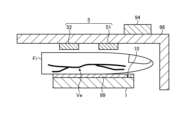
- FIG. 2 is a schematic diagram showing the positional relationship between the sensor module, the light source unit, and their peripheral configuration, and the blood vessels of a finger that are the object to be detected by the sensor module.
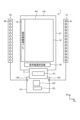
- FIG. 3 is a plan view showing an example of a sensor module, a light source unit, and a configuration connected thereto.
- FIG. 4 is a block diagram showing a more detailed example of the functional configuration of the configuration shown in FIG.
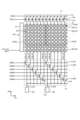
- FIG. 5 is a circuit diagram showing the sensor module.
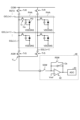
- FIG. 6 is a circuit diagram showing a plurality of partial detection regions.
- FIG. 7 is a schematic diagram showing the relationship between the degree of pressure applied from a finger to the sensor section and the sensing result by the sensor section.
- the detection device 100 includes a sensor module 1, a light source unit 5, an AFE 91, a control unit 92, a storage unit 93, a notification unit 94, and a communication unit 95.
- the sensor module 1 is provided so as to be able to detect light.
- the light source unit 5 is a light source that emits light of a wavelength that can be detected by the sensor module 1.
- the AFE 91 denotes an analog front end.
- the light source unit 5 has, for example, a first light source substrate 51 and a second light source substrate 52.
- the specific configuration example of the light source unit 5 shown in FIG. 2 is merely an example and is not limited thereto, and may have, for example, either the first light source substrate 51 or the second light source substrate 52 and a light source provided on that one, or may have three or more light source substrates and light sources provided on the light source substrates.
- a louver 99 is provided between the sensor module 1 and the finger Fi.
- the louver 99 is, for example, a light-shielding member provided with a plurality of light-guiding holes penetrating in the opposing direction between the finger Fi and the sensor unit 10, and acts to limit the direction of travel of light passing between the finger Fi and the sensor unit 10 to the opposing direction between the finger Fi and the sensor unit 10.
- the light source unit 5 is supported by a light-shielding member 98 on the opposite side of the sensor unit 10 with the finger Fi between them.
- the light-shielding member 98 is a cover-like member that covers the detection surface of the sensor unit 10 so that light other than the light emitted from the light source unit 5 does not enter the sensor unit 10.
- the light source unit 5 is provided on the sensor unit 10 side (one side) of the light-shielding member 98.
- a notification unit 94 is provided on the light-shielding member 98.
- the notification unit 94 is provided on the other side of the light-shielding member 98. To a user who inserts his finger Fi between the light source unit 5 and the sensor unit 10, the notification unit 94 appears to be provided on the light-shielding member 98.
- the sensor module 1 and light source unit 5 are described below with reference to Figures 3 to 6.
- FIG. 3 is a plan view showing an example of the sensor module 1 and the light source unit 5, as well as a configuration connected thereto.
- the sensor module 1 has a sensor substrate 21, a sensor unit 10, a gate line driving circuit 15, a signal line selection circuit 16, an AFE 91, a control circuit 122, a power supply circuit 123, a first light source substrate 51, a second light source substrate 52, at least one first light source 61, and at least one second light source 62.
- first light source 61 and second light source 62 are exemplified as the light source in the embodiment, there may be only one type of light source.
- the sensor substrate 21 has a detection area AA and a peripheral area GA.
- the detection area AA is an area in which multiple photodiodes PD (see FIG. 6) of the sensor unit 10 are provided.
- the peripheral area GA is an area between the outer periphery of the detection area AA and the end of the sensor substrate 21, and is an area that does not overlap with the photodiodes PD.
- the gate line driving circuit 15 and the signal line selection circuit 16 are provided in the peripheral area GA. Specifically, the gate line driving circuit 15 is provided in a region of the peripheral area GA that extends along the second direction Dy. The signal line selection circuit 16 is provided in a region of the peripheral area GA that extends along the first direction Dx, and is provided between the sensor unit 10 and the AFE 91.
- the first direction Dx is a direction in a plane parallel to the sensor substrate 21.
- the second direction Dy is a direction in a plane parallel to the sensor substrate 21, and is a direction perpendicular to the first direction Dx.
- the second direction Dy may intersect the first direction Dx without being perpendicular to it.
- the third direction Dz is a direction perpendicular to the first direction Dx and the second direction Dy, and is a normal direction of the sensor substrate 21.
- the multiple first light sources 61 are provided on the first light source substrate 51 and are arranged along the second direction Dy.
- the multiple second light sources 62 are provided on the second light source substrate 52 and are arranged along the second direction Dy.
- the first light source substrate 51 and the second light source substrate 52 are electrically connected to the control circuit 122 and the power supply circuit 123 via terminal portions 124 and 125, respectively, provided on the control board 121.
- the first light sources 61 and the second light sources 62 are, for example, inorganic light emitting diodes (LEDs) or organic light emitting diodes (OLEDs).
- the first light sources 61 and the second light sources 62 emit first light L61 (see FIG. 38) and second light L62 (see FIG. 31, etc.) of different wavelengths.
- the first light L61 and the second light L62 have different maximum emission wavelengths.
- the maximum emission wavelength is the wavelength that shows the maximum emission intensity in the emission spectrum that shows the relationship between the wavelength and emission intensity of each of the first light L61 and the second light L62.
- the numerical value of the wavelength is simply stated, it is assumed to indicate the assumed maximum emission wavelength.
- the first light L61 emitted from the first light source 61 is mainly reflected by the surface of the object to be detected, such as a finger Fg, and enters the sensor unit 10. This allows the sensor unit 10 to detect a fingerprint by detecting the uneven shape of the surface of the finger Fg.
- the second light L62 emitted from the second light source 62 is mainly reflected inside the finger Fg or passes through the finger Fg and enters the sensor unit 10. This allows the sensor unit 10 to detect information about the living body inside the finger Fg.
- Information about the living body includes, for example, the pulse waves, pulse, and blood vessel images of the finger Fg or palm.
- the first light L61 may have a wavelength of 520 nm or more and 600 nm or less
- the second light L62 may have a wavelength of 780 nm or more and 900 nm or less, for example, about 850 nm.
- the first light L61 is blue or green visible light
- the second light L62 is infrared light.
- the sensor unit 10 can detect a fingerprint based on the first light L61 emitted from the first light source 61.
- the second light L62 emitted from the second light source 62 is reflected inside the detection object such as a finger Fg or transmitted and absorbed by the finger Fg or the like and enters the sensor unit 10. This allows the sensor unit 10 to detect a pulse wave or a blood vessel image (blood vessel pattern) as information about the living body inside the finger Fg or the like.
- the first light L61 may have a wavelength of 600 nm or more and 700 nm or less, for example, about 660 nm
- the second light L62 may have a wavelength of 780 nm or more and 900 nm or less, for example, about 850 nm.
- the sensor unit 10 can detect information about the living body, such as pulse waves, pulse, and blood vessel images, as well as blood oxygen saturation.
- the detection device 100 since the detection device 100 has the first light source 61 and multiple second light sources 62, it can detect various information about the living body by performing detection based on the first light L61 and detection based on the second light L62.
- the arrangement of the first light source 61 and the second light source 62 shown in FIG. 3 is merely an example and can be changed as appropriate.
- a plurality of first light sources 61 and a plurality of second light sources 62 may be arranged on each of the first light source substrate 51 and the second light source substrate 52.
- a group including a plurality of first light sources 61 and a group including a plurality of second light sources 62 may be arranged side by side in the second direction Dy, or the first light sources 61 and the second light sources 62 may be arranged alternately in the second direction Dy.
- the number of light source substrates on which the first light source 61 and the second light source 62 are provided may be one or three or more.
- either the first light source 61 or the second light source 62 may be provided.
- a light source that emits light including infrared rays is provided.
- the infrared rays are infrared rays with a wavelength closer to visible light, so-called near-infrared rays.
- FIG. 4 is a block diagram showing a more detailed example of the functional configuration of the configuration shown in FIG. 3.
- the sensor module 1 further has a detection control unit 11 and a detection unit 40. Some or all of the functions of the detection control unit 11 are included in the control circuit 122. In addition, some or all of the functions of the detection unit 40 other than the AFE 91 are included in the control circuit 122.
- the sensor unit 10 is an optical sensor having a photodiode PD, which is a photoelectric conversion element.
- the photodiode PD of the sensor unit 10 outputs an electrical signal corresponding to the irradiated light to the signal line selection circuit 16.
- the signal line selection circuit 16 sequentially selects the signal lines SGL according to the selection signal ASW from the detection control unit 11. As a result, the electrical signal is output to the detection unit 40 as the detection signal Vdet.
- the sensor unit 10 also performs detection according to the gate drive signal Vgcl supplied from the gate line drive circuit 15.
- the detection control unit 11 is a circuit that supplies control signals to the gate line driving circuit 15, the signal line selection circuit 16, and the detection unit 40, respectively, and controls their operation.
- the detection control unit 11 supplies various control signals, such as a start signal STV, a clock signal CK, and a reset signal RST1, to the gate line driving circuit 15.
- the detection control unit 11 also supplies various control signals, such as a selection signal ASW, to the signal line selection circuit 16.
- the detection control unit 11 also supplies various control signals to the first light source 61 and the second light source 62, and controls the lighting and non-lighting of each.
- the signal line selection circuit 16 is a switch circuit that sequentially or simultaneously selects multiple signal lines SGL (see FIG. 5).
- the signal line selection circuit 16 is, for example, a multiplexer.
- the signal line selection circuit 16 connects the selected signal line SGL to the AFE 91 based on a selection signal ASW supplied from the detection control unit 11. As a result, the signal line selection circuit 16 outputs the detection signal Vdet of the photodiode PD to the detection unit 40.
- the detection unit 40 includes an AFE 91, a signal processing unit 44, a storage unit 93, a detection timing control unit 47, and an output processing unit 50.
- the detection timing control unit 47 controls the AFE 91 and the signal processing unit 44 to operate in synchronization based on a control signal supplied from the detection control unit 11.
- the AFE 91 is, for example, a signal processing circuit having the functions of a detection signal amplifier 42 and an A/D converter 43.
- the detection signal amplifier 42 amplifies the detection signal Vdet.
- the A/D converter 43 converts the analog signal output from the detection signal amplifier 42 into a digital signal.
- the signal processing unit 44 is a logic circuit that detects a predetermined physical quantity input to the sensor unit 10 based on the output signal of the AFE 91.
- the signal processing unit 44 can detect the unevenness of the surface of the finger Fg or the palm based on the signal from the AFE 91.
- the signal processing unit 44 can also detect information about the living body based on the signal from the AFE 91.
- the information about the living body is, for example, the blood vessel image of the finger Fg or the palm, pulse wave, pulse rate, blood oxygen saturation, etc.
- the first light L61 When acquiring the blood oxygen saturation of a human, for example, 660 nm (this range is 500 nm to 700 nm) is adopted as the first light L61, and about 850 nm (this range is 800 nm to 930 nm) is adopted as the second light L62. Since the amount of light absorption changes depending on the amount of oxygen taken up by hemoglobin, the amount of light obtained by subtracting the light absorbed by blood (hemoglobin) from the irradiated first light L61 and second light L62 is detected by the photodiode PD. Most of the oxygen in blood is reversibly bound to hemoglobin in red blood cells, and only a small portion is dissolved in plasma.
- oxygen saturation SpO 2
- the value of what percentage of the allowable amount of oxygen is bound to the blood as a whole is called oxygen saturation (SpO 2 ).
- the signal processing unit 44 may also acquire detection signals Vdet (information about the living body) simultaneously detected by multiple photodiodes PD and perform a process of averaging these.
- the detection unit 40 can suppress measurement errors caused by noise and relative positional deviation between the sensor unit 10 and the detected object such as a finger Fg, enabling stable detection.
- the memory unit 93 temporarily stores the signal calculated by the signal processing unit 44.
- the memory unit 93 may be, for example, a RAM (Random Access Memory), a register circuit, etc.
- the output processing unit 50 functions as a processing unit that performs processing based on the outputs from the multiple photodiodes PD. Specifically, the output processing unit 50 of the embodiment outputs a sensor output Vo that includes at least pulse wave data based on at least the detection signal Vdet acquired via the signal processing unit 44. In the embodiment, the signal processing unit 44 outputs data indicating the change (amplitude) in the output of the detection signal Vdet of each photodiode PD described below, and the output processing unit 50 decides which output is to be adopted as the sensor output Vo, but both may be performed by the signal processing unit 44 or the output processing unit 50.
- the signal processing unit 44 may be provided with a noise filter as necessary.
- the frequency components of noise caused by breathing and changes in posture are, for example, 1 Hz or less, which is a sufficiently lower frequency than the frequency components of the pulse wave, and can be removed by using a bandpass filter as a noise filter.
- the bandpass filter can be provided, for example, in the detection signal amplifier unit 42.
- the frequency components of noise caused by human body movements, etc. are, for example, several Hz to 100 Hz, and may overlap with the frequency components of the pulse wave.
- the frequency is not a constant frequency but has frequency fluctuations, so a noise filter is used to remove frequencies with fluctuation components.
- a noise filter is used to remove frequencies with fluctuation components.
- first fluctuation component removal method the property that a time lag occurs in the peak value of a pulse wave depending on the measurement location on the human body may be used.
- a time lag occurs in the pulse wave depending on the measurement location on the human body, and noise caused by human body movements, etc. does not have a time lag or has a smaller time lag than the pulse wave. Therefore, the pulse wave is measured at at least two different locations, and if the peak values measured at the different locations are within a predetermined time, they are removed as noise.
- the waveform due to noise and the waveform due to the pulse wave overlap by chance, but in this case, the two waveforms overlap only at one of the different locations, making it possible to distinguish between the waveform due to noise and the waveform due to the pulse wave.
- This process can be performed, for example, by the signal processing unit 44.
- a method for removing frequencies having fluctuation components (second fluctuation component removal method)
- frequency components with different phases are removed by the signal processing unit 44.
- a short-time Fourier transform may be performed to remove the fluctuation components, and an inverse Fourier transform may be performed.
- noise sources 50 Hz, 60 Hz
- noise caused by commercial frequency power sources may be removed by providing a shield on the surface opposite to the detection surface of the detector.
- FIG. 5 is a circuit diagram showing the sensor unit 10.
- FIG. 6 is a circuit diagram showing a plurality of partial detection areas. Note that FIG. 6 also shows the circuit configuration of the AFE 91.
- the sensor unit 10 has a plurality of partial detection areas PAA arranged in a matrix. Each of the partial detection areas PAA is provided with a photodiode PD.
- the gate line GCL extends in the first direction Dx and is connected to a plurality of partial detection areas PAA arranged in the first direction Dx.
- the plurality of gate lines GCL(1), GCL(2), ..., GCL(8) are arranged in the second direction Dy and are each connected to the gate line driving circuit 15.
- gate lines GCL when there is no need to distinguish between the plurality of gate lines GCL(1), GCL(2), ..., GCL(8), they are simply referred to as gate lines GCL.
- the signal line SGL extends in the second direction Dy and is connected to the photodiodes PD of the multiple partial detection areas PAA arranged in the second direction Dy.
- the multiple signal lines SGL(1), SGL(2), ..., SGL(12) are arranged in the first direction Dx and are each connected to the signal line selection circuit 16 and the reset circuit 17. In the following description, when it is not necessary to distinguish between the multiple signal lines SGL(1), SGL(2), ..., SGL(12), they will simply be referred to as signal lines SGL.
- the resolution of the sensor is, for example, 508 dpi (dots per inch), and the number of cells is 252 ⁇ 256.
- the sensor unit 10 is provided between the signal line selection circuit 16 and the reset circuit 17. This is not limited, and the signal line selection circuit 16 and the reset circuit 17 may be connected to the ends of the signal lines SGL in the same direction.
- the substantial area of one sensor is, for example, substantially 50 ⁇ 50 ⁇ m 2
- the area of the detection area AA is, for example, 12.6 ⁇ 12.8 mm 2 .
- the gate line driving circuit 15 receives various control signals, such as a start signal STV, a clock signal CK, and a reset signal RST1, from the control circuit 122 (see FIG. 3). Based on the various control signals, the gate line driving circuit 15 sequentially selects multiple gate lines GCL(1), GCL(2), ..., GCL(8) in a time-division multiplexing manner. The gate line driving circuit 15 supplies a gate driving signal Vgcl to the selected gate line GCL. As a result, the gate driving signal Vgcl is supplied to multiple first switching elements Tr connected to the gate line GCL, and multiple partial detection areas PAA arranged in the first direction Dx are selected as detection targets.
- various control signals such as a start signal STV, a clock signal CK, and a reset signal RST1
- the gate line driving circuit 15 may perform different driving for each detection mode of fingerprint detection and information related to a plurality of different biological bodies (pulse wave, pulse, blood vessel image, blood oxygen saturation, etc.). For example, the gate line driving circuit 15 may drive a bundle of multiple gate lines GCL.
- the gate line driving circuit 15 may simultaneously select a predetermined number of gate lines GCL from the gate lines GCL(1), GCL(2), ..., GCL(8) based on the control signal. For example, the gate line driving circuit 15 simultaneously selects the six gate lines GCL(1) to GCL(6) and supplies the gate driving signal Vgcl. The gate line driving circuit 15 supplies the gate driving signal Vgcl to the first switching elements Tr via the six selected gate lines GCL. As a result, group areas PAG1 and PAG2 including a plurality of partial detection areas PAA arranged in the first direction Dx and the second direction Dy are selected as detection targets.
- the gate line driving circuit 15 drives a predetermined number of gate lines GCL in a bundle and sequentially supplies the gate driving signal Vgcl to each of the predetermined number of gate lines GCL.
- group areas PAG when the positions of the different group areas such as the group areas PAG1 and PAG2 are not particularly distinguished, they will be referred to as group areas PAG.
- the signal line selection circuit 16 has a plurality of selection signal lines Lsel, a plurality of output signal lines Lout, and a third switching element TrS.
- the plurality of third switching elements TrS are provided corresponding to the plurality of signal lines SGL, respectively.
- the six signal lines SGL(1), SGL(2), ..., SGL(6) are connected to a common output signal line Lout1.
- the six signal lines SGL(7), SGL(8), ..., SGL(12) are connected to a common output signal line Lout2.
- the output signal lines Lout1, Lout2 are each connected to the AFE 91.
- the signal lines SGL(1), SGL(2), ..., SGL(6) are defined as a first signal line block
- the signal lines SGL(7), SGL(8), ..., SGL(12) are defined as a second signal line block.
- the multiple selection signal lines Lsel are each connected to the gate of the third switching element TrS included in one signal line block. Furthermore, one selection signal line Lsel is connected to the gate of the third switching element TrS of multiple signal line blocks.
- the selection signal lines Lsel1, Lsel2, ..., Lsel6 are connected to the third switching elements TrS corresponding to the signal lines SGL(1), SGL(2), ..., SGL(6), respectively.
- the selection signal line Lsel1 is connected to the third switching element TrS corresponding to the signal line SGL(1) and the third switching element TrS corresponding to the signal line SGL(7).
- the selection signal line Lsel2 is connected to the third switching element TrS corresponding to the signal line SGL(2) and the third switching element TrS corresponding to the signal line SGL(8).
- the control circuit 122 (see FIG. 3) sequentially supplies the selection signal ASW to the selection signal line Lsel.
- the signal line selection circuit 16 sequentially selects the signal lines SGL in one signal line block in a time-division manner through the operation of the third switching element TrS.
- the signal line selection circuit 16 also selects one signal line SGL each in each of the multiple signal line blocks.
- the signal line selection circuit 16 may bundle multiple signal lines SGL and connect them to the AFE 91.
- the control circuit 122 (see FIG. 3) simultaneously supplies the selection signal ASW to the selection signal lines Lsel.
- the signal line selection circuit 16 selects multiple signal lines SGL (e.g., six signal lines SGL) in one signal line block by the operation of the third switching element TrS, and connects the multiple signal lines SGL to the AFE 91.
- signals detected in each group area PAG are output to the AFE 91.
- signals from multiple partial detection areas PAA (photodiodes PD) are integrated in group area PAG units and output to the AFE 91.
- the sensor module 1 can repeatedly perform detection in a short period of time, improving the S/N ratio and enabling accurate detection of temporal changes in information related to a living body, such as pulse waves.
- the reset circuit 17 has a reference signal line Lvr, a reset signal line Lrst, and a fourth switching element TrR.
- the fourth switching element TrR is provided corresponding to the multiple signal lines SGL.
- the reference signal line Lvr is connected to one of the sources or drains of the multiple fourth switching elements TrR.
- the reset signal line Lrst is connected to the gates of the multiple fourth switching elements TrR.
- the control circuit 122 supplies a reset signal RST2 to the reset signal line Lrst. This turns on the multiple fourth switching elements TrR, and the multiple signal lines SGL are electrically connected to the reference signal line Lvr.
- the power supply circuit 123 supplies a reference signal COM to the reference signal line Lvr. This causes the reference signal COM to be supplied to the capacitive elements Ca (see FIG. 6) included in the multiple partial detection areas PAA.
- the partial detection area PAA includes a photodiode PD, a capacitance element Ca, and a first switching element Tr.
- a photodiode PD two gate lines GCL(m) and GCL(m+1) arranged in the second direction Dy among the multiple gate lines GCL are shown.
- the partial detection area PAA is an area surrounded by the gate lines GCL and the signal lines SGL.
- the first switching element Tr is provided corresponding to the photodiode PD.
- the first switching element Tr is composed of a thin film transistor, and in this example, is composed of an n-channel MOS (Metal Oxide Semiconductor) type TFT (Thin Film Transistor).
- MOS Metal Oxide Semiconductor
- the gates of the first switching elements Tr belonging to the multiple partial detection areas PAA aligned in the first direction Dx are connected to the gate line GCL.
- the sources of the first switching elements Tr belonging to the multiple partial detection areas PAA aligned in the second direction Dy are connected to the signal line SGL.
- the drains of the first switching elements Tr are connected to the cathodes of the photodiodes PD and the capacitance elements Ca.
- the anode of the photodiode PD is supplied with a sensor power supply signal VDDSNS from the power supply circuit 123.
- the signal line SGL and the capacitance element Ca are supplied with a reference signal COM, which is the initial potential of the signal line SGL and the capacitance element Ca, from the power supply circuit 123.
- the AFE 91 functions as at least the A/D converter 43, converting an analog signal output from the sensor unit 10 into a digital signal and outputting it to the controller 92.
- the AFE 91 may also function as the detection signal amplifier 42.
- the digital signal is a signal that can be interpreted by a calculation circuit provided in the controller 92 and functioning as the signal processor 44.
- the AFE 91 also outputs a signal for controlling the illumination of the first light source 61 and the second light source 62 under the control of the controller 92.
- the controller 92 in the embodiment in which the configuration described with reference to FIGS. 3 to 6 is applied includes the signal processor 44, the detection timing controller 47, and the output processor 50.
- the AFE 91 and the control unit 92 each have one or more circuits implemented to realize the functions described above. Such circuits may be circuits that integrate multiple functions, or may be circuits that are provided separately for each function.
- the notification unit 94 has a light source that turns on or off in response to the result of a determination regarding the degree of pressure applied from the finger Fi to the sensor unit 10.
- the light source is, for example, an LED or OLED, but is not limited to this and may be another specific configuration that functions in a similar manner. The determination and the operation of the notification unit 94 will be described in detail later.
- the communication unit 95 performs processing related to communication with external devices.
- the communication unit 95 has a circuit to function as a NIC (Network Interface Controller) and performs processing related to communication with external devices according to a predetermined protocol.
- the communication path used for such communication may be a wired, wireless, or mixed wired and wireless line path, and may include a public communication network such as the Internet as part of it.
- control unit 92, the storage unit 93, and the communication unit 95 are integrated into the control circuit 122, but the specific implementation form is arbitrary.
- control unit 92, the storage unit 93, and the communication unit 95 may be provided as independent circuits.
- FIG. 7 is a schematic diagram showing the relationship between the degree of pressure applied from the finger Fi to the sensor unit 10 and the sensing result by the sensor module 1.
- the sensing result here refers to the light and dark pattern of the detection area obtained by the multiple photodiodes PD arranged in the detection area individually detecting light.
- the blood vessels Ve are assumed to be veins, but may also be arteries.
- the sensor module 1 of the embodiment can identify blood vessels Ve in the finger Fi depending on the distance from the finger Fi, even when the object to be detected (finger Fi) is not in contact with the louver 99. Specifically, as shown in “Pattern 1" in FIG. 7, when the distance between the louver 99 and the finger Fi is distance D1, a sensing result Sd1 is obtained in which there is no shadow of light corresponding to the finger Fi, i.e., no dark area in the sensing result. Note that, as shown in "Pattern 1", the presence of the louver 99 does not substantially cause a shadow in the sensing result.
- the sensing result when simply referred to as a dark area, it refers to a dark area in the sensing result that is caused by a shadow cast by the finger Fi blocking the light emitted from the light source unit 5 toward the sensor unit 10.
- the white area surrounding the dark area in the sensing result is a bright area that is caused by the light emitted from the light source unit 5 toward the sensor unit 10 being detected almost as is. Therefore, it can be said that the sensing result shows a light and dark pattern that is either a state of only bright areas, a state of only dark areas, or a state in which bright and dark areas are mixed.
- a sensing result Sd4 is obtained in which the dark areas corresponding to the finger Fi are darker than in the sensing result Sd3.
- the pattern of the blood vessels Ve in the sensing result Sd4 can be confirmed, for example, within the area Fa2.
- Pattern 1 to “Pattern 5" in FIG. 7 can also be seen as examples of the transition from a state in which the finger Fi is separated from the louver 99 to a state in which the finger Fi is pressed against the louver 99.
- the sensing results transition as in sensing results Sd1, Sd2, Sd3, Sd4, and Sd5, and the dark areas included in the sensing results gradually expand with each transition.
- the change in the range occupied by the dark area in the sensing result may also include movement due to positional deviation of the finger Fi. Whether the change in the range occupied by the dark area in the sensing result corresponds to movement or enlargement can be identified based on a comparison of the sensing results before and after the transition.
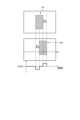
- FIG. 8 is a schematic diagram showing a case where a change in the range occupied by dark areas in the sensing results corresponds to movement.
- the dark area included in the sensing result from the sensing performed at a relatively earlier timing is designated as dark area Si1.
- dark area Si2 the dark area included in the sensing result from the sensing performed at a relatively later timing.
- the dark areas Si1 and Si2 shown in FIG. 8 are positioned differently in the first direction Dx.
- the difference between the presence and absence of dark areas in the first direction Dx is shown in a graph to show the change in the range occupied by the dark areas in the sensing results.
- the horizontal axis represents the coordinate (x-coordinate) in the first direction Dx
- the vertical axis represents the output of the sensing results acquired by the AFE91 from the sensor module 1.
- the dark areas are increasing relatively in the later sensing results, this is treated as a positive output
- the dark areas are decreasing relatively in the later sensing results, this is treated as a negative output in the vertical direction.
- the sensing result at one timing is considered to be the sensing result of "one frame," when a dark area that appears in the sensing result of a relatively later frame among two or more different timings is larger than a dark area that appears in the sensing result of a relatively earlier frame, it can be considered that the pressure from the detected object (e.g., a finger Fi) that creates the dark area toward the detection area of the sensor unit 10 has increased during the multiple timings.
- the detected object in question can be considered to be a finger Fi.
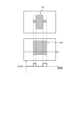
- FIG. 9 is a schematic diagram showing a case where the change in the range occupied by the dark area in the sensing result corresponds to an enlargement.
- the dark area included in the sensing result from sensing performed at a relatively later timing is designated as dark area Si3.
- the change in the dark area in the sensing result i.e., the reduction in the dark area
- the change in the dark area in the sensing result is considered to be due to a change in the relative distance between the finger Fi and the sensor unit 10 (increasing distance) or a decrease in the pressure from the finger Fi toward the sensor unit 10.
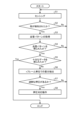
- FIG. 10 is a flowchart showing the process flow of the detection device 100, including the determination and notification that the pressure from the finger Fi toward the sensor unit 10 is too strong.
- sensing is performed (step S1). Specifically, the photodiode PD of the sensor module 1 operates, and an output is generated according to the intensity of the light emitted from the light source unit 5 and detected by the photodiode PD. This output is processed by the AFE 91 and the control unit 92, and becomes data that can be interpreted as a sensing result as described with reference to FIGS. 7 and 8.
- the control unit 92 judges whether a finger is detected by the sensing process of step S1 (step S2). Specifically, the control unit 92 performs a judgment process to judge whether the sensing result obtained by the process of step S1 includes a dark area that can be judged to have been caused by the finger Fi.
- the judgment process includes a number of judgments, such as whether a dark area has been generated, whether the ratio of the dark area to the entire sensing result is an appropriate ratio that can be interpreted as a dark area caused by the finger Fi if a dark area has been generated, and whether the shape of the dark area is an appropriate shape that can be interpreted as a dark area caused by the finger Fi if a dark area has been generated, but the specific content can be changed as appropriate.
- a range of the ratio that can be considered as an appropriate ratio that can be interpreted as a dark area caused by the finger Fi is determined in advance based on a prior test or the like, and is held by the control unit 92.
- whether the shape of the dark area can be interpreted as a dark area caused by a finger Fi is determined based on, for example, pattern matching with sample data of dark areas caused by a finger Fi that has been prepared in advance, and when such pattern matching is used, the sample data is stored in the control unit 92 or a storage device that can be referenced by the control unit 92 and is provided in the detection device 100.
- step S2 If it is determined in step S2 that a finger has not been detected (step S2; No), the process proceeds to step S1. That is, sensing is performed again. On the other hand, if it is determined in step S2 that a finger has been detected (step S2; Yes), the control unit 92 performs a process of acquiring a pattern of the blood vessels Ve from the sensing results obtained in step S1 (step S3).
- the process of acquiring the pattern of the blood vessels Ve is based on, for example, the contrast between the blood vessels Ve and the area other than the blood vessels Ve in the dark area created by the finger Fi, and pattern matching with the shape of the area determined to be possibly a blood vessel Ve based on the contrast, but the specific content can be changed as appropriate.
- the sample data is stored in the control unit 92 or a storage device that can be referenced by the control unit 92 and is provided in the detection device 100.
- step S5 determines whether sufficient data corresponding to the purpose of the predetermined process has been obtained.
- the predetermined process is a "personal authentication process based on the blood vessel pattern”. In this case, it is sufficient that one or more patterns of the blood vessel Ve that can be compared with the blood vessel pattern prepared in advance are obtained in the process of step S3.
- the predetermined process is a "pulse measurement process”. In this case, it is sufficient that multiple sensing results are obtained in a predetermined cycle.
- step S5 makes it possible to calculate the pulse from the relationship between the pulsation indicated by the patterns of the multiple blood vessels Ve and the time length of the predetermined cycle. Even in the case of processes other than those exemplified here, the result of the process of step S5 corresponds to the specific content of the predetermined process.
- step S5 If it is determined in step S5 that sufficient data according to the purpose has been obtained in the predetermined process (step S5; Yes), the process by the detection device 100 ends. On the other hand, if it is determined in step S5 that sufficient data according to the purpose has not been obtained in the predetermined process (step S5; No), difference extraction is performed in n-frame units (step S6). Specifically, after the process starts, of the sensing results obtained in step S1 that has already been performed up to the process of step S6, the most recent n sensing results (n is a natural number equal to or greater than 2) are extracted as targets for the process of step S7 described below. Note that if the number of times that step S1 has already been performed up to the process of step S6 is less than n, all sensing results are extracted as targets for the process of step S7.
- the control unit 92 determines whether there is excessive pressure from the finger Fi toward the sensor unit 10 (step S7). Specifically, the control unit 92 compares the sensing results obtained in later sensing with earlier sensing results among the sensing results extracted in the processing of step S6. If the result of such comparison indicates that the pattern of the blood vessel Ve is unclear or has disappeared in the sensing result obtained in the later sensing compared to the earlier sensing result, the control unit 92 determines that there is excessive pressure from the finger Fi toward the sensor unit 10 to the extent that the above-mentioned crushing Cr occurs.
- control unit 92 may determine that the cause of the disappearance of the pattern of the blood vessel Ve in the sensing result obtained in the later sensing is not due to the movement of the finger Fi from the earlier sensing result, using a concept similar to that described with reference to FIG. 8. Conversely, if the finger Fi has moved, and the pattern of blood vessels Ve in the finger Fi that was generated in the previous sensing result is generated at a position corresponding to the finger Fi after the movement, it is deemed that there is no excessive pressure from the finger Fi toward the sensor unit 10.
- step S7 determines that there is excessive pressure from the finger Fi towards the sensor unit 10 (step S7; Yes)
- the detection device 100 performs a pressure response operation (step S8).
- the control unit 92 turns on the notification unit 94.
- the notification unit 94 it is possible to notify a person who can see the notification unit 94, such as a user who is pressing the finger Fi against the sensor unit 10, that excessive pressure from the finger Fi is occurring towards the sensor unit 10.
- the notification unit 94 functions as a component for notifying that excessive pressure from the finger Fi is occurring towards the sensor unit 10.
- step S8 After the processing of step S8 or in the processing of step S7, if it is determined that there is no excessive pressure from the finger Fi toward the sensor unit 10 (step S7; No), the processing proceeds to step S1.
- step S2 can be omitted. That is, after the processing of step S1, the process may automatically proceed to the processing of step S3.
- the control unit 92 may determine that the finger Fi has been detected when the pattern of the blood vessel Ve is obtained in the processing of step S4 (step S4; Yes). That is, the processing of step S4 may also serve as the processing of step S2.
- the lighting of the notification unit 94 is not limited to the processing of step S8.
- the notification unit 94 may be configured to light up in the first pattern when the pattern of the blood vessel Ve is obtained in the processing of step S4 (step S4; Yes), and to light up in the second pattern when the processing of step S8 is performed.
- the first pattern indicates that the pattern of the blood vessel Ve has been obtained normally.
- the second pattern indicates that the pressing force from the finger Fi to the sensor unit 10 side is too strong.
- the first pattern and the second pattern are different lighting patterns, but how they are made different is arbitrary.
- the color of the light source that is turned on in the first pattern may be different from the color of the light source that is turned on in the second pattern.
- the lighting state according to the first pattern and the lighting state according to the second pattern may be different.
- the light source continues to light up in the first pattern, and the light source repeatedly flashes in the second pattern.
- the detection device includes a sensor unit (sensor unit 10) having a plurality of optical sensors (photodiodes PD) arranged two-dimensionally, and an acquisition unit (control unit 92) that acquires the pattern of blood vessels (blood vessels Ve) of a human finger (finger Fi) contained in the light and dark pattern detected by the sensor unit, and the acquisition unit acquires information regarding the pressure from the finger toward the sensor unit based on the light and dark pattern. Therefore, according to the embodiment, the pressure can be detected based on the light and dark pattern without providing a dedicated pressure sensor for detecting the pressure.
- the acquisition unit determines that the pressure from the finger (finger Fi) has increased during acquisition of the multiple light and dark patterns. This makes it possible to detect whether the pressure has increased based on whether the size of the dark areas included in the light and dark patterns has increased.
- the acquisition unit determines that the pressure from the finger (finger Fi) was too strong when the relatively later light and dark pattern was obtained. This makes it possible to detect that the pressure is too strong based on the blood vessel pattern contained in the light and dark patterns.
- the detection device also includes a notification unit (notification unit 94) that notifies the user of the pressure from the finger (finger Fi) to the sensor unit (sensor unit 10). This makes it possible to notify information about the pressure to a person who can receive a notification from the notification unit, such as a user who is pressing the finger (finger Fi) against the sensor unit.
- a notification unit notification unit 94
- the device also has a light source (second light source 62) that is disposed opposite the surface on which the multiple optical sensors (photodiodes PD) are arranged and emits light that includes at least one of visible light and infrared light. This makes it easier and more reliable for the finger (finger Fi) to create dark areas on the surface.
- a light source (second light source 62) that is disposed opposite the surface on which the multiple optical sensors (photodiodes PD) are arranged and emits light that includes at least one of visible light and infrared light. This makes it easier and more reliable for the finger (finger Fi) to create dark areas on the surface.
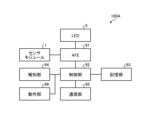
- FIG. 11 is a block diagram showing an example of the main configuration of a detection device 100A according to a modified example.
- the detection device 100A further includes an operating unit 96.
- the operating unit 96 is provided so as to be switchable between a state in which it protrudes toward the finger Fi and a state in which it does not protrude toward the finger Fi, based on the closest position of the finger Fi to the sensor unit 10.
- the "closest position of the finger Fi to the sensor unit 10" is, for example, the position BL of the surface of the louver 99 on the finger Fi side.
- the finger Fi when the finger Fi abuts against the surface of the louver 99 on the finger Fi side, the finger Fi is considered to be closest to the sensor unit 10.
- the "closest position of the finger Fi to the sensor unit 10" is the surface on which the multiple photodiodes PD are provided in the sensor unit 10, i.e., the surface of the detection area.
- the operating unit 96 drives the operating unit to push up the finger Fi.
- the pressing force of the finger Fi is too high, it is, for example, the case of pattern 5 described with reference to FIG. 7, and in such a case, the pressing force of the finger Fi is deemed to be too high (above a predetermined value).
- which part of the eccentric cam is on the "closest position of the finger Fi to the sensor unit 10" side changes depending on the rotation angle of the rotation shaft.
- the operating unit 96 is arranged so that both a rotation angle of the rotation shaft at which a part of the outer circumferential surface of the eccentric cam protrudes toward the finger Fi from the "closest position of the finger Fi to the sensor unit 10" and a rotation angle of the rotation shaft at which the eccentric cam does not protrude toward the finger Fi from the "closest position of the finger Fi to the sensor unit 10" are generated.
- this example is merely one example of a specific configuration of the operating unit 96 and is not limited to this.
- the operating unit 96 may be an operating mechanism that is configured to be able to switch between protruding and not protruding toward the finger Fi from the "closest position of the finger Fi to the sensor unit 10" by linear motion of an actuator.
- the operating unit 96 only needs to be configured to be able to switch between protruding and not protruding toward the finger Fi based on the "closest position of the finger Fi to the sensor unit 10", and the specific configuration is not limited to this.
- the operating unit 96 operates to protrude toward the finger Fi from the "closest position of the finger Fi to the sensor unit 10" when the pressing force from the finger Fi is deemed to be too strong.
- the control unit 92 operates the operating unit 96 to protrude toward the finger Fi from the "closest position of the finger Fi to the sensor unit 10".
- the finger Fi is placed in a state in which it receives a biasing force from the operating unit 96 in a direction away from the "closest position of the finger Fi to the sensor unit 10".
- the operation of the operating unit 96 is intended to suggest to the user of the finger Fi through the tactile contact with the operating unit 96 that the pressing force toward the "closest position of the finger Fi to the sensor unit 10" is to be reduced.
- the user of the finger Fi can easily realize that the pressing force applied from the finger Fi to the sensor unit 10 side is too strong.
- step S7 determines that there is no excessive pressure from the finger Fi towards the sensor unit 10 (step S7; No)
- the control unit 92 operates the operating unit 96 so that it does not protrude towards the finger Fi from the "closest position of the finger Fi to the sensor unit 10". This makes it easier for the user of the finger Fi to realize that the state in which the pressure applied from the finger Fi towards the sensor unit 10 is too strong has been resolved.
- lighting control of the notification unit 94 may also be performed as in the embodiment.
- the modified example is the same as the embodiment.
- an operating unit (operating unit 96) is provided adjacent to the sensor unit (sensor unit 10) and is switchable between a state in which it protrudes toward the finger and a state in which it does not protrude toward the finger in response to the pressure from the finger toward the sensor unit, based on the closest position (position BL) of the finger (finger Fi) to the sensor unit. This allows output according to the pressure to be generated via the operating unit.
- the operating unit (operating unit 96) also protrudes toward the finger when the pressure from the finger (finger Fi) is deemed to be too strong. This allows the operating unit to indicate to the user, who is pressing the finger (finger Fi) against the sensor unit (sensor unit 10), that the pressure is too strong, through the feeler sensations that the operating unit creates on the finger.
- the configuration that functions as the notification unit is not limited to the notification unit 94 and the operation unit 96, and the specific configuration can be changed as appropriate.
- a voice output device including a speaker that notifies the user by voice that the pressing force is too strong, an amplifier, and a storage device that stores voice data may be used as the notification unit.
- a display device that provides notifications by outputting images, such as images including text information, a display driver circuit, and a storage device that stores image data output by the display may be used as the notification unit.
- Reference Signs List 1 sensor module 5: light source unit 10: sensor unit 62: second light source 92: control unit 94: notification unit 96: operation unit 100, 100A: detection device Fi: finger Ve: blood vessel
Landscapes
- Health & Medical Sciences (AREA)
- Engineering & Computer Science (AREA)
- Life Sciences & Earth Sciences (AREA)
- Physics & Mathematics (AREA)
- General Health & Medical Sciences (AREA)
- Surgery (AREA)
- General Physics & Mathematics (AREA)
- Biomedical Technology (AREA)
- Public Health (AREA)
- Pathology (AREA)
- Veterinary Medicine (AREA)
- Heart & Thoracic Surgery (AREA)
- Medical Informatics (AREA)
- Molecular Biology (AREA)
- Animal Behavior & Ethology (AREA)
- Vascular Medicine (AREA)
- Biophysics (AREA)
- Theoretical Computer Science (AREA)
- Physiology (AREA)
- Cardiology (AREA)
- Human Computer Interaction (AREA)
- Multimedia (AREA)
- Business, Economics & Management (AREA)
- Emergency Management (AREA)
- Nuclear Medicine, Radiotherapy & Molecular Imaging (AREA)
- Oral & Maxillofacial Surgery (AREA)
- Computer Vision & Pattern Recognition (AREA)
- Measuring Pulse, Heart Rate, Blood Pressure Or Blood Flow (AREA)
- Measurement Of The Respiration, Hearing Ability, Form, And Blood Characteristics Of Living Organisms (AREA)
Priority Applications (2)
| Application Number | Priority Date | Filing Date | Title |
|---|---|---|---|
| JP2025529549A JPWO2025004665A1 (https=) | 2023-06-29 | 2024-05-28 | |
| US19/431,377 US20260118193A1 (en) | 2023-06-29 | 2025-12-23 | Detection device |
Applications Claiming Priority (2)
| Application Number | Priority Date | Filing Date | Title |
|---|---|---|---|
| JP2023107160 | 2023-06-29 | ||
| JP2023-107160 | 2023-06-29 |
Related Child Applications (1)
| Application Number | Title | Priority Date | Filing Date |
|---|---|---|---|
| US19/431,377 Continuation US20260118193A1 (en) | 2023-06-29 | 2025-12-23 | Detection device |
Publications (1)
| Publication Number | Publication Date |
|---|---|
| WO2025004665A1 true WO2025004665A1 (ja) | 2025-01-02 |
Family
ID=93938127
Family Applications (1)
| Application Number | Title | Priority Date | Filing Date |
|---|---|---|---|
| PCT/JP2024/019489 Ceased WO2025004665A1 (ja) | 2023-06-29 | 2024-05-28 | 検出装置 |
Country Status (3)
| Country | Link |
|---|---|
| US (1) | US20260118193A1 (https=) |
| JP (1) | JPWO2025004665A1 (https=) |
| WO (1) | WO2025004665A1 (https=) |
Citations (4)
| Publication number | Priority date | Publication date | Assignee | Title |
|---|---|---|---|---|
| JP2011525284A (ja) * | 2008-06-19 | 2011-09-15 | マサチューセッツ インスティテュート オブ テクノロジー | 弾性撮像を使用する接触センサ |
| JP2011191838A (ja) * | 2010-03-12 | 2011-09-29 | Hitachi Ltd | 指静脈認証装置 |
| JP2012098974A (ja) * | 2010-11-04 | 2012-05-24 | Hitachi Ltd | 生体認証装置および方法 |
| US20170316248A1 (en) * | 2015-10-23 | 2017-11-02 | Shenzhen GOODIX Technology Co., Ltd. | Optical fingerprint sensor with force sensing capability |
-
2024
- 2024-05-28 JP JP2025529549A patent/JPWO2025004665A1/ja active Pending
- 2024-05-28 WO PCT/JP2024/019489 patent/WO2025004665A1/ja not_active Ceased
-
2025
- 2025-12-23 US US19/431,377 patent/US20260118193A1/en active Pending
Patent Citations (4)
| Publication number | Priority date | Publication date | Assignee | Title |
|---|---|---|---|---|
| JP2011525284A (ja) * | 2008-06-19 | 2011-09-15 | マサチューセッツ インスティテュート オブ テクノロジー | 弾性撮像を使用する接触センサ |
| JP2011191838A (ja) * | 2010-03-12 | 2011-09-29 | Hitachi Ltd | 指静脈認証装置 |
| JP2012098974A (ja) * | 2010-11-04 | 2012-05-24 | Hitachi Ltd | 生体認証装置および方法 |
| US20170316248A1 (en) * | 2015-10-23 | 2017-11-02 | Shenzhen GOODIX Technology Co., Ltd. | Optical fingerprint sensor with force sensing capability |
Also Published As
| Publication number | Publication date |
|---|---|
| US20260118193A1 (en) | 2026-04-30 |
| JPWO2025004665A1 (https=) | 2025-01-02 |
Similar Documents
| Publication | Publication Date | Title |
|---|---|---|
| KR102202342B1 (ko) | 생물학적 특성을 검출하는 일체형 발광 디스플레이 및 센서 | |
| US10713458B2 (en) | Integrated light emitting display and sensors for detecting biologic characteristics | |
| US10963671B2 (en) | Multifunction fingerprint sensor having optical sensing capability | |
| JP6388604B2 (ja) | 被験者のバイタルサイン情報を決定するためのシステム及び方法 | |
| US12490912B2 (en) | Heart rate detection method, heart rate detection apparatus and electronic device | |
| US20090039241A1 (en) | Biometric device and information terminal | |
| JP7253751B2 (ja) | 検出装置 | |
| US20180098708A1 (en) | Human Body Wearable Device and Operation Method Thereof | |
| US8045001B2 (en) | Compound-eye imaging device | |
| EP1410755A1 (en) | Monitoring apparatus | |
| CN114241528A (zh) | 指纹感测装置及其操作方法 | |
| KR20050096142A (ko) | 인체 인식 방법 및 장치 | |
| KR20190025841A (ko) | 생물학적 특성을 검출하는 발광기 및 센서 | |
| JP2016512445A (ja) | バイタルサイン情報の決定に使用する発光エリアを有するマーカー | |
| US20250241550A1 (en) | Detection device | |
| JP2009502270A (ja) | 少なくとも1つの組織表面部、特に皮膚組織における酸素分圧分布を決定するための方法及び測定システム | |
| US11741745B2 (en) | Multicolor illumination in an optical fingerprint sensor for anti-spoofing | |
| WO2025004665A1 (ja) | 検出装置 | |
| US12417653B2 (en) | Detection device | |
| TWI670043B (zh) | 具有生醫感測功能之光學指紋感測裝置 | |
| US20230011192A1 (en) | Detection device | |
| JP2021076946A (ja) | 検出装置 | |
| JP2005211329A (ja) | 眼球運動測定装置 | |
| JP2025167900A (ja) | 計測装置 | |
| CN121549817A (zh) | 一种心率和血氧饱和度的ppg检测装置的检测方法 |
Legal Events
| Date | Code | Title | Description |
|---|---|---|---|
| 121 | Ep: the epo has been informed by wipo that ep was designated in this application |
Ref document number: 24831536 Country of ref document: EP Kind code of ref document: A1 |
|
| ENP | Entry into the national phase |
Ref document number: 2025529549 Country of ref document: JP Kind code of ref document: A |
|
| WWE | Wipo information: entry into national phase |
Ref document number: 2025529549 Country of ref document: JP |
|
| NENP | Non-entry into the national phase |
Ref country code: DE |