WO2025003523A1 - Hard-boiled egg analogue product - Google Patents

Hard-boiled egg analogue product Download PDF

Info

Publication number
WO2025003523A1
WO2025003523A1 PCT/EP2024/068512 EP2024068512W WO2025003523A1 WO 2025003523 A1 WO2025003523 A1 WO 2025003523A1 EP 2024068512 W EP2024068512 W EP 2024068512W WO 2025003523 A1 WO2025003523 A1 WO 2025003523A1
Authority
WO
WIPO (PCT)
Prior art keywords
suspension
emulsion
egg
product
analogue
Prior art date
Legal status (The legal status is an assumption and is not a legal conclusion. Google has not performed a legal analysis and makes no representation as to the accuracy of the status listed.)
Ceased
Application number
PCT/EP2024/068512
Other languages
French (fr)
Inventor
Andrea Belen ENDARA VARGAS
Antoine Cros
Fanny LAZZARO
Current Assignee (The listed assignees may be inaccurate. Google has not performed a legal analysis and makes no representation or warranty as to the accuracy of the list.)
Societe des Produits Nestle SA
Nestle SA
Original Assignee
Societe des Produits Nestle SA
Nestle SA
Priority date (The priority date is an assumption and is not a legal conclusion. Google has not performed a legal analysis and makes no representation as to the accuracy of the date listed.)
Filing date
Publication date
Application filed by Societe des Produits Nestle SA, Nestle SA filed Critical Societe des Produits Nestle SA
Publication of WO2025003523A1 publication Critical patent/WO2025003523A1/en
Priority to IL325629A priority Critical patent/IL325629A/en
Anticipated expiration legal-status Critical
Ceased legal-status Critical Current

Links

Classifications

    • A—HUMAN NECESSITIES
    • A23—FOODS OR FOODSTUFFS; TREATMENT THEREOF, NOT COVERED BY OTHER CLASSES
    • A23L—FOODS, FOODSTUFFS OR NON-ALCOHOLIC BEVERAGES, NOT OTHERWISE PROVIDED FOR; PREPARATION OR TREATMENT THEREOF
    • A23L15/00—Egg products; Preparation or treatment thereof
    • A23L15/35—Egg substitutes
    • A—HUMAN NECESSITIES
    • A23—FOODS OR FOODSTUFFS; TREATMENT THEREOF, NOT COVERED BY OTHER CLASSES
    • A23D—EDIBLE OILS OR FATS, e.g. MARGARINES, SHORTENINGS OR COOKING OILS
    • A23D7/00—Edible oil or fat compositions containing an aqueous phase, e.g. margarines
    • A23D7/005—Edible oil or fat compositions containing an aqueous phase, e.g. margarines characterised by ingredients other than fatty acid triglycerides
    • A23D7/0053—Compositions other than spreads
    • A—HUMAN NECESSITIES
    • A23—FOODS OR FOODSTUFFS; TREATMENT THEREOF, NOT COVERED BY OTHER CLASSES
    • A23L—FOODS, FOODSTUFFS OR NON-ALCOHOLIC BEVERAGES, NOT OTHERWISE PROVIDED FOR; PREPARATION OR TREATMENT THEREOF
    • A23L15/00—Egg products; Preparation or treatment thereof
    • A23L15/20—Addition of proteins, e.g. hydrolysates, fats, carbohydrates, natural plant hydrocolloids; Addition of animal or vegetable substances containing proteins, fats, or carbohydrates
    • A—HUMAN NECESSITIES
    • A23—FOODS OR FOODSTUFFS; TREATMENT THEREOF, NOT COVERED BY OTHER CLASSES
    • A23L—FOODS, FOODSTUFFS OR NON-ALCOHOLIC BEVERAGES, NOT OTHERWISE PROVIDED FOR; PREPARATION OR TREATMENT THEREOF
    • A23L29/00—Foods or foodstuffs containing additives; Preparation or treatment thereof
    • A23L29/015—Inorganic compounds
    • A—HUMAN NECESSITIES
    • A23—FOODS OR FOODSTUFFS; TREATMENT THEREOF, NOT COVERED BY OTHER CLASSES
    • A23D—EDIBLE OILS OR FATS, e.g. MARGARINES, SHORTENINGS OR COOKING OILS
    • A23D7/00—Edible oil or fat compositions containing an aqueous phase, e.g. margarines
    • A23D7/02—Edible oil or fat compositions containing an aqueous phase, e.g. margarines characterised by the production or working-up
    • A23D7/04—Working-up
    • A23D7/05—Working-up characterised by essential cooling
    • A—HUMAN NECESSITIES
    • A23—FOODS OR FOODSTUFFS; TREATMENT THEREOF, NOT COVERED BY OTHER CLASSES
    • A23J—PROTEIN COMPOSITIONS FOR FOODSTUFFS; WORKING-UP PROTEINS FOR FOODSTUFFS; PHOSPHATIDE COMPOSITIONS FOR FOODSTUFFS
    • A23J3/00—Working-up of proteins for foodstuffs
    • A23J3/14—Vegetable proteins
    • A23J3/16—Vegetable proteins from soybean
    • A—HUMAN NECESSITIES
    • A23—FOODS OR FOODSTUFFS; TREATMENT THEREOF, NOT COVERED BY OTHER CLASSES
    • A23P—SHAPING OR WORKING OF FOODSTUFFS, NOT FULLY COVERED BY A SINGLE OTHER SUBCLASS
    • A23P10/00—Shaping or working of foodstuffs characterised by the products
    • A23P10/30—Encapsulation of particles, e.g. foodstuff additives
    • A—HUMAN NECESSITIES
    • A23—FOODS OR FOODSTUFFS; TREATMENT THEREOF, NOT COVERED BY OTHER CLASSES
    • A23P—SHAPING OR WORKING OF FOODSTUFFS, NOT FULLY COVERED BY A SINGLE OTHER SUBCLASS
    • A23P30/00—Shaping or working of foodstuffs characterised by the process or apparatus
    • A23P30/10—Moulding

Definitions

  • the offer for ready to eat egg analogs is highly undeveloped.
  • the products are characterized by a poor nutritional value compared to the animal counterpart they intend to replace, for example lower in protein content, higher in carbohydrate, and higher in sodium. They also have a long ingredient list and fail to convince consumers from a sensorial perspective.
  • the present invention is a superior vegan alternative to hard-boiled egg.
  • the overall sensorial performance is greatly improved compared to prior art products.
  • the product is a suspension and/or an emulsion based on legume protein, preferably soy isolate, vegetable oil, firming agent and water.
  • the product undergoes a series of temperature steps and treatments, including coldset gelation, heating and/or freezing which provide it with superior taste, appearance, and texture.
  • Hardness score expressed relatively to cooked chicken egg yolk considering the following parameters: system, pH, firming agent and its concentration.
  • Figure 4 Hardness score expressed relatively to cooked chicken egg yolk, egg white and egg mix for suspension samples without the cold set gelation step and considering the following parameters: pH, firming agent and its concentration.
  • the invention relates to a method of making a plant-based cooked egg analogue product, for example a hard-boiled egg analogue product.
  • the hard-boiled egg analogue product may be an egg white analogue, or an egg yolk analogue, or an egg mix analogue product.
  • the invention further relates to a method of making a plant-based cooked egg analogue product, for example a hard-boiled egg analogue product, said method comprising providing a plant protein suspension; ensuring the pH of the suspension is between pH 5 to 10; adding a firming agent and mixing; optionally performing a cold set gelation; and performing a freezing step.
  • the invention further relates to a method of making a plant-based cooked egg analogue product, for example a hard-boiled egg analogue product, said method comprising providing a plant protein suspension; adding oil to the suspension and mixing to form an emulsion; ensuring the pH of the emulsion is between pH 5 to 10; adding a firming agent and mixing; optionally performing a cold set gelation; and performing a freezing step.
  • the invention relates to a method of making a plant-based cooked egg analogue product, for example a hard-boiled egg analogue product, said method comprising providing a plant protein suspension; ensuring the pH of the suspension or emulsion is between pH 5 to 10, preferably between 7 to 9; adding a firming agent and mixing; optionally performing a cold set gelation at between 0 to 30°C to form a gel; and performing a freezing step to modulate the gel strength.
  • the invention relates to a method of making a plant-based cooked egg analogue product, for example a hard-boiled egg analogue product, said method comprising providing a plant protein suspension; adding oil to the suspension and mixing to form an emulsion; ensuring the pH of the suspension or emulsion is between pH 5 to 10, preferably between 7 to 9; adding a firming agent and mixing; optionally performing a cold set gelation at between 0 to 30°C to form a gel; and performing a freezing step to modulate the gel strength.
  • the invention relates to a method of making a plant-based cooked egg analogue product, for example a hard-boiled egg analogue product, said method comprising: a) providing a plant protein suspension; b) optionally adding oil to the suspension and mixing to form an emulsion; c) ensuring the pH of the suspension or emulsion is between pH 5 to 10, preferably between 7 to 9; d) adding a firming agent and mixing; e) optionally performing a cold set gelation at between 0 to 30°C to form a gel; f) performing a freezing step to modulate the gel strength.
  • the plant protein suspension in step a) is a legume protein suspension.
  • the legume protein suspension is preferably a pulse protein suspension.
  • the pulse protein suspension is, for example, a soy protein suspension.
  • the plant protein suspension in step a) has a protein concentration of between 3 to 30 wt%.
  • the plant protein suspension in step a) has a protein concentration of between 5 to 15 wt%, or about 11 wt%.
  • the suspension is heated in step a) to at least 60°C, preferably to at least 90°C. In one embodiment, the emulsion is heated in step b) to at least 60°C, preferably to at least 90°C.
  • the cold set gelation is performed at between 0 to 10°C.
  • freezing step f) is performed at a temperature below the crystallization temperature of the gel.
  • freezing step f) is performed at a temperature which is above the secondary melting transition temperature (Tm') of the suspension or emulsion.
  • freezing step f) is performed at a temperature which is below the secondary glassy transition temperature (Tg') of the suspension or emulsion.
  • freezing step f) is performed at a temperature which is a) above the secondary melting transition temperature (Tm') of the suspension or emulsion; and b) below the secondary glassy transition temperature (Tg') of the suspension or emulsion.
  • step e) is not optional and said method further comprises a heat treatment step after step e), for example pasteurization.
  • the firming agent is a soluble mineral salt.
  • the firming agent is calcium chloride or potassium chloride.
  • the invention further relates to a plant-based cooked egg analogue product, for example a hard- boiled egg analogue product, made from a suspension or an emulsion.
  • the egg analogue product is an egg yolk analogue product. In one embodiment, the egg analogue product is an egg white analogue product. In one embodiment, the egg analogue product is an egg mix analogue product.
  • the suspension comprises plant protein, preferably pulse protein, firming agent and water.
  • the emulsion comprises plant protein, preferably pulse protein, firming agent and water, and further comprises a lipid component.
  • the suspension or emulsion further comprises a carbohydrate-based ingredient. In one embodiment, the suspension or emulsion further comprises a flavor. In one embodiment, the suspension or emulsion further comprises a color.
  • rapeseed oil typically for emulsion recipes, between 16 to 28, or 18 to 26, or 20 to 24, or about 22% w/w oil, for example rapeseed oil, is added.
  • the plant protein isolate is hydrated, for example at least at 60°C, at least at 70°C, at least at 80°C, at least at 90°C, or at about 95°C. Hydration may be for about 15 minutes, for example under mixing.
  • the mixture is cooled down to below 65°C, for example using an ice bath for about 4 minutes.
  • a fine emulsion with a fat droplet particle size distribution with a D90 of less than 10 microns is formed.
  • the pH can be further adjusted under stirring to reach the desired value, for example by using HCI or KOH 1 M, followed by the addition of CaCl2 as a firming agent, when required.
  • the suspension or emulsion undergoes different temperature procedures.
  • the suspension or emulsion undergoes cold-set gelation.
  • the suspension or emulsion undergoes heating.
  • the suspension or emulsion undergoes freezing.
  • suspension and emulsion molded recipes are stored at about 4 °C for about 24 hours. This induces the cold-set gelation step and to obtain suspension and emulsion gels.
  • a heat treatment step is performed, for example using a steam oven at about 120 °C for about 14 minutes for a suspension.
  • a heat treatment step is performed, for example using a steam oven at about 120 °C for about 14 minutes for an emulsion.
  • the heat treatment step achieves 71 °C as an internal temperature in the product for food safety purposes.
  • the freezing step may be performed at less than 0°C, or less than -1°C, or less than -2°C, or less than -3°C, or less than -4°C, or less than -5°C, or less than -7°C, or at about -8°C.
  • the freezing step may be performed at between -20°C and 0°C, or between -18°C and -2°C, between -14°C and -4°C, or between -10°C and -6°C.
  • the freezing step may be performed at less than -40°C, or less than -50°C, or less than -55°C, or less than -60°C, or less than -65°C, or less than -70°C, or less than -75°C, or at about -80°C.
  • the freezing step may be performed at between -100°C and -60°C, or between -95°C and -65°C, between -90°C and -70°C, or between -85°C and -75°C.
  • Frozen gels are thawed until reaching room temperature for about 2 hours.
  • the protein concentration is between 3 to 30 wt%. In one embodiment, the protein concentration is between 5 to 15 wt%. In one embodiment, the protein concentration is about 11 wt%.
  • the firming agent is a soluble salt of monovalent ions. In one embodiment, the firming agent is a soluble salt of divalent ions. In one embodiment, the firming agent is a soluble salt of trivalent ions.
  • the firming agent is a soluble salt of calcium. In one embodiment, the firming agent is a soluble salt of magnesium. In one embodiment, the firming agent is a soluble salt of potassium. In one embodiment, the firming agent is a soluble salt of sodium. In one embodiment, the firming agent is a soluble salt of phosphates. In one embodiment, the firming agent is a soluble salt of mixtures thereof of magnesium, potassium, sodium, and phosphates. In one embodiment, the firming agent has an ion concentration between 1 - 100 mmol/100 g. In one embodiment, the firming agent has an ion concentration of about 20 mmol/lOOg.
  • the water concentration is between 15 to 97 wt%.
  • the lipid component is liquid oil, or melted fat, preferably vegetable oil, and wherein the lipid concentration is up to 50 wt%, preferably about 22 wt%.
  • the product has the sensory attributes, preferably texture, of a cooked chicken egg.
  • the invention further relates to a plant based cooked egg analogue product, preferably solid, made by a method according to the invention.
  • the invention further relates to a plant based cooked egg analogue product according to the invention, suitable for direct consumption or as part of a preparation.
  • the method of the invention comprises making or providing a plant protein suspension.
  • the plant protein suspension is a soy protein suspension.
  • the plant protein suspension comprises between 8 to 14, or 9 to 13, or 10 to 12, or about 11 % protein w/w.
  • a firming agent is added.
  • the firming agent may be Calcium Chloride Dihydrate, for example at between 10 to 30, or between 12 to 28, or between 14 to 26, or between 16 to 24, or between 18 to 22, or about 20 mmol / kg.
  • Between 80 to 94, or between 82 to 92, or between 84 to 90, or between 86 to 88, or about 87 % w/w water is added.
  • the plant protein isolate is hydrated, for example at least at 60°C, at least at 70°C, at least at 80°C, at least at 90°C, or at about 95°C. Hydration may be for about 15 minutes, for example under mixing. Typically, the mixture is cooled down to room temperature, for example using an ice bath for about 30 minutes for pH adjustment. The pH can be further adjusted under stirring to reach the desired value, for example by using HCI or KOH 1 M, followed by the addition of CaCl2 as a firming agent, when required.
  • the method of the invention comprises the making or providing a plant protein emulsion.
  • the plant protein emulsion is a soy protein emulsion.
  • the plant protein emulsion comprises between 4 to 13, or 5 to 12, or 6 to 11, or about 8.5 % protein w/w.
  • a firming agent is added.
  • the firming agent may be Calcium Chloride Dihydrate, for example at between 10 to 30, or between 12 to 28, or between 14 to 26, or between 16 to 24, or between 18 to 22, or about 20 mmol / kg.
  • Between 61 to 75, or between 63 to 73, or between 65 to 71, or between 67 to 69, or about 68 % w/w water is added.
  • the plant protein isolate is hydrated, for example at least at 60°C, at least at 70°C, at least at 80°C, at least at 90°C, or at about 95°C. Hydration may be for about 15 minutes, for example under mixing. Typically, the mixture is cooled down to below 65°C, for example using an ice bath for about 4 minutes. A fine emulsion with a fat droplet particle size distribution with a D90 of less than 10 microns is formed.
  • the pH can be further adjusted under stirring to reach the desired value, for example by using HCI or KOH 1 M, followed by the addition of CaCl2 as a firming agent, when required.
  • the suspension and emulsion molded recipes are stored at about 4 °C for about 24 hours. This induces the cold-set gelation step and to obtain suspension and emulsion gels.
  • a heat treatment step is performed, for example using a steam oven at about 120 °C for about 14 minutes (suspension) and 15 minutes (emulsion). This is to achieve 71 °C as an internal temperature in the product for food safety purposes.
  • the suspension and emulsion gels are stored at about -8 °C and about -80 °C for about 7 days. This to modulate the gel strength. Frozen gels are thawed until reaching room temperature for around 2 hours.
  • a suspension recipe of the invention may be made using substantially the same method as described herein.
  • the suspension recipe may comprise the same ingredients in substantially the same amounts as described for recipes 1 to 6, preferably recipes 4, 5, and 6, in Table 1.
  • the firming agent may be calcium chloride.
  • the firming agent may be potassium chloride.
  • the pH may be adjusted to between 7 to 9, or to about 7, or to about 8, or to about 9.
  • the protein concentration may be about 11% w/w.
  • the final pH after addition of firming agent may be between 6.91 to 8.92, or about 6.91, or about 6.99, or about 7.75, or about 7.82, or about 7.87, or about 8.92.
  • An emulsion recipe of the invention may be made using substantially the same method as described herein.
  • the emulsion recipe may comprise the same ingredients in substantially the same amounts as described for recipes 7 to 12, preferably recipe 10, in Table 1.
  • the firming agent may be calcium chloride.
  • the firming agent may be potassium chloride.
  • the pH may be adjusted to between 7 to 9, or to about 7, or to about 8, or to about 9.
  • the protein concentration may be about 8.5% w/w.
  • the lipid concentration may be about 22% w/w.
  • the final pH after addition of firming agent may be between 6.99 to 9.15, or about 6.99, or about 7.00, or about 7.77, or about 7.89, or about 8.05, or about 9.15.
  • a cooked egg white analogue recipe may be made in substantially the same way as recipes 6 or 10 described herein.
  • a suspension and/or an emulsion recipe may be followed.
  • the pH is adjusted to above pH 8.
  • a firming agent at about 20 mmol / kg is added.
  • a freezing step at about - 8 °C is performed.
  • Cooked egg yolk analogue recipe may be made in substantially the same way as recipes 4, 5, or 6 described herein. For example, a suspension recipe may be followed. Typically, the pH is adjusted to above pH 8. Typically, a firming agent at about 20 mmol / kg is added. Typically, a freezing step at about - 8 °C is performed.
  • a cooked egg white analogue recipe may be made in substantially the same way as recipes 4 or 5 described herein.
  • a suspension recipe may be followed.
  • the pH is adjusted to above pH 8.
  • a firming agent at about 20 mmol / kg is added.
  • a freezing step at about - 8 °C is performed.
  • the terms "about” or “substantially” are understood to refer to numbers in a range of numerals, for example the range of -30% to +30% of the referenced number, or -20% to +20% of the referenced number, or -10% to +10% of the referenced number, or -5% to +5% of the referenced number, or -1% to +1% of the referenced number. All numerical ranges herein should be understood to include all integers, whole or fractions, within the range.
  • analogue is considered to be an edible substitute of a substance in regard to one or more of its major characteristics.
  • a "hard-boiled egg analogue” as used herein is a substitute of hard-boiled egg in the major characteristics of purpose and usage.
  • the egg analogue product is an analogue of chicken egg.
  • the egg analogue is a substitute of chicken egg and is statistically similar, or has to within 60 - 100% to the texture of chicken egg, for example statistically similar firm, pieces, compact, or chewy texture of chicken hard-boiled egg.
  • the term "vegan” refers to an edible composition which is entirely devoid of animal products, or animal derived products, for example eggs, milk, honey, fish, and meat.
  • a "protein isolate” comprises at least 70 wt% protein, more preferably at least 80 wt% protein, or about 87 wt.% protein, or about 91.5 wt% protein.
  • Soy protein isolate may comprise about 87 wt% protein, about 3.5 wt% fat, about 3.5 wt% fiber.
  • soy-based emulsion recipes (7-12) were made using soy protein isolate (8,5 % protein w/w), Calcium Chloride Dihydrate (CaCl2) (20 mmol / kg) as the firming agent, water (68 % w/w), and rapeseed oil (22% w/w), as the lipid component.
  • Soy protein isolate was hydrated at 95 °C for 15 minutes under constant mixing (approx. 1,100 rpm). The mixture was cooled down to below 65 °C, using an ice bath for 4 minutes, to avoid destabilization when forming the emulsion.
  • rapeseed oil 22 % w/w was added as the lipid component, under intensified mixing conditions (approx. 10,200 rpm).
  • This emulsification step formed a fine emulsion with a fat droplet particle size distribution with a D90 of less than 10 microns.
  • the mixture was cooled down to room temperature, using an ice bath for 30 minutes for pH adjustment.
  • the pH was furthered adjusted under stirring to reach the desired value by using HCI or KOH 1 M, followed by the addition of CaCl2 as a firming agent, when required.
  • the final pH was measured. All recipes were molded in metallic rings of 3.2 cm diameter and 2 cm height, which had previously been oiled using rapeseed oil and covered with food-wrap plastic. The description of the emulsion recipes can be observed in Table 1.
  • the suspension and emulsion molded recipes were stored at 4 °C for 24 hours to induce the coldset gelation step and to obtain suspension and emulsion gels. Afterwards, a heat treatment step was performed using a steam oven at 120 °C for 14 minutes (suspension) and 15 minutes (emulsion), to achieve 71 °C as an internal temperature in the product for food safety purposes. Finally, the suspension and emulsion gels were stored at -8 °C and -80 °C for 7 days in order to modulate the gel strength. Frozen gels were thawed until reaching room temperature for around 2 hours. These gels were analyzed for Texture Profile Analysis (TPA) and sensory analysis.
  • TPA Texture Profile Analysis
  • Analytical texture characterization of the generated gels for each recipe was performed using the TPA method (https://www.rheologylab.com/services/texture-analysis/), applied with a TA.HDplusC Texture Analyzer from Stable Micro Systems company.
  • the TPA method involves a double compression, standardized in volume and shape, using a compression plate with a 75mm diameter. The suspension and emulsion gels were analyzed for TPA to obtain an average value of three replicates.
  • Three cooked chicken egg systems were used as the reference to which the suspension and emulsion gels were compared in terms of TPA.
  • Each egg system was properly and homogenously mixed, and then molded just like the suspension and emulsion recipes, in metallic rings of 3.2 cm diameter and 2 cm height, previously oiled using rapeseed oil and covered with food-wrap plastic.
  • a heat treatment step was performed to obtain cooked egg yolk, white and mix.
  • a steam oven at 120 °C was used, but with different times: 11 minutes for the egg white, 8 minutes for the egg yolk and 9 minutes for the egg mix.
  • the egg systems used as reference were analyzed for TPA to obtain an average value of 4 replicates.
  • RMA Rate All That Apply
  • Two cooked chicken egg systems (egg white and egg yolk) were used as a reference and warmup samples, to which the suspension and emulsion gels were compared in terms of sensory analysis.
  • water was set to boiling point and chicken eggs were added for 10 min to obtain cooked egg white and egg yolk.
  • Figures 1 to 3 show a comparison of the average of different suspension and emulsion gel recipes for the "hardness" texture parameter measured by TPA.
  • the hardness is expressed relative to that of cooked chicken egg yolk, egg white and egg mix, respectively.
  • Figure 1 show an average of 3 different suspension recipes (recipes 4, 5 and 6), with and without freezing step, that have between 60 - 140 % of the texture property (hardness) of the cooked chicken egg yolk, as referred to in example 1.
  • Figure 5 shows a comparison of the average values of sensory attributes firm, pieces, compact and chewy for suspension recipes with firming agent (recipes 4, 5 and 6) and all emulsion recipes with firming agent (recipes 10, 11 and 12). These values are expressed relatively to the ones of cooked chicken egg yolk and are displayed compared to the 60 - 140 % range of the sensory properties of the cooked chicken egg yolk.
  • Figure 6 shows the firmness sensory attribute average value for different suspension recipes with and without firming agent at pH 9 (recipe 5 and recipe 3, respectively) and different emulsion recipes with and without firming agent at pH 8 (recipe 10 and recipe 8, respectively).
  • the results show that the recipes with firming agent (recipes 5 and 10) have between 60 - 140 % of the firmness sensory attribute of the cooked chicken egg yolk and are performing better than the recipes without firming agent (recipes 3 and 8).
  • it demonstrates that to be comparable to the cooked chicken egg yolk, a suspension and/or an emulsion with high pH (adjusted suspension/emulsions pH above 8), and a freezing step at - 8 °C are needed.
  • Figure 7 shows a comparison of the average value of sensory attributes firm, pieces, compact and chewy for suspension recipes with firming agent (recipes 4, 5 and 6) and all emulsions with firming agent (recipes 10, 11 and 12). These values are expressed relatively to the ones of cooked chicken egg white and are displayed compared to the 60 - 140 % range of the sensory properties of the cooked chicken egg white.
  • Figure 8 shows the firmness sensory attribute average value for different suspension recipes with and without firming agent at pH 8 (recipe 4 and recipe 2, respectively) and different emulsion recipes with and without firming agent at pH 8 (recipe 10 and recipe 8, respectively).
  • the results show that the recipes with firming agent (recipes 4 and 10) have between 60 - 140 % of the firmness sensory attribute of the cooked chicken egg white and are performing better than the recipes without firming agent (recipes 2 and 8).
  • it demonstrates that to be comparable to the cooked chicken egg white, a suspension and/or an emulsion with high pH (adjusted suspension/emulsions pH above 8), and a freezing step at - 8 °C are needed.

Landscapes

  • Chemical & Material Sciences (AREA)
  • Life Sciences & Earth Sciences (AREA)
  • Engineering & Computer Science (AREA)
  • Food Science & Technology (AREA)
  • Polymers & Plastics (AREA)
  • Health & Medical Sciences (AREA)
  • Nutrition Science (AREA)
  • Oil, Petroleum & Natural Gas (AREA)
  • Inorganic Chemistry (AREA)
  • Botany (AREA)
  • Molecular Biology (AREA)
  • Biochemistry (AREA)
  • Manufacturing & Machinery (AREA)
  • Meat, Egg Or Seafood Products (AREA)

Abstract

The present invention relates to a method of making a plant-based cooked egg analogue product, for example a hard-boiled egg analogue product, said method comprising providing a plant protein suspension; optionally adding oil to the suspension and mixing to form an emulsion; ensuring the pH of the suspension or emulsion is between pH 5 to 10, preferably between 7 to 9; adding a firming agent and mixing; optionally performing a cold set gelation at between 0 to 30°C; and performing a freezing step.

Description

Hard-boiled egg analogue product
Introduction
Demand for plant-based alternatives to animal products has grown significantly across many food categories and applications. Just as plant-based alternatives for meat and dairy products are becoming mainstream, consumers are also becoming more interested in egg-like substitutes.
The trend for these products has been driven by many factors including allergenicity, sustainability, animal welfare, and a consumer shift towards more "flexitarian" diets.
Over the last decade, several companies have developed commercial versions of egg replacers. These kinds of products are typically sold as powders to be reconstituted in water and subsequently cooked, or in liquid format for cooking applications.
The offer for ready to eat egg analogs is highly undeveloped. The products are characterized by a poor nutritional value compared to the animal counterpart they intend to replace, for example lower in protein content, higher in carbohydrate, and higher in sodium. They also have a long ingredient list and fail to convince consumers from a sensorial perspective.
Summary of invention
The present invention is a superior vegan alternative to hard-boiled egg. The overall sensorial performance is greatly improved compared to prior art products. The product is a suspension and/or an emulsion based on legume protein, preferably soy isolate, vegetable oil, firming agent and water. The product undergoes a series of temperature steps and treatments, including coldset gelation, heating and/or freezing which provide it with superior taste, appearance, and texture.
Brief description of the figures Figure 1. Hardness score expressed relatively to cooked chicken egg yolk considering the following parameters: system, pH, firming agent and its concentration.
Figure 2. Hardness score expressed relatively to cooked chicken egg white considering the following parameters: system, pH, firming agent and its concentration.
Figure 3. Hardness score expressed relatively to cooked chicken egg mix considering the following parameters: system, pH, firming agent and its concentration.
Figure 4. Hardness score expressed relatively to cooked chicken egg yolk, egg white and egg mix for suspension samples without the cold set gelation step and considering the following parameters: pH, firming agent and its concentration.
Figure 5. Sensory scores for firm, pieces, compact and chewy attributes, expressed relatively to egg yolk considering the following parameters: system, pH, firming agent and its concentration.
Figure 6. Sensory firmness attribute score, expressed relatively to egg yolk, of four different recipes demonstrating the effect of firming agent addition (recipes 5 and 10) versus no addition of firming agent (recipes 3 and 8).
Figure 7. Sensory scores for firm, pieces, compact and chewy attributes, expressed relatively to egg white considering the following parameters: system, pH, firming agent and its concentration.
Figure 8. Sensory firmness attribute score, expressed relatively to egg white, of four different recipes demonstrating the effect of firming agent addition (recipes 4 and 10) versus no addition of firming agent (recipes 2 and 8).
Embodiments of the invention
The invention relates to a method of making a plant-based cooked egg analogue product, for example a hard-boiled egg analogue product. The hard-boiled egg analogue product may be an egg white analogue, or an egg yolk analogue, or an egg mix analogue product. The invention further relates to a method of making a plant-based cooked egg analogue product, for example a hard-boiled egg analogue product, said method comprising providing a plant protein suspension; ensuring the pH of the suspension is between pH 5 to 10; adding a firming agent and mixing; optionally performing a cold set gelation; and performing a freezing step.
The invention further relates to a method of making a plant-based cooked egg analogue product, for example a hard-boiled egg analogue product, said method comprising providing a plant protein suspension; adding oil to the suspension and mixing to form an emulsion; ensuring the pH of the emulsion is between pH 5 to 10; adding a firming agent and mixing; optionally performing a cold set gelation; and performing a freezing step.
The invention relates to a method of making a plant-based cooked egg analogue product, for example a hard-boiled egg analogue product, said method comprising providing a plant protein suspension; ensuring the pH of the suspension or emulsion is between pH 5 to 10, preferably between 7 to 9; adding a firming agent and mixing; optionally performing a cold set gelation at between 0 to 30°C to form a gel; and performing a freezing step to modulate the gel strength.
The invention relates to a method of making a plant-based cooked egg analogue product, for example a hard-boiled egg analogue product, said method comprising providing a plant protein suspension; adding oil to the suspension and mixing to form an emulsion; ensuring the pH of the suspension or emulsion is between pH 5 to 10, preferably between 7 to 9; adding a firming agent and mixing; optionally performing a cold set gelation at between 0 to 30°C to form a gel; and performing a freezing step to modulate the gel strength.
The invention relates to a method of making a plant-based cooked egg analogue product, for example a hard-boiled egg analogue product, said method comprising: a) providing a plant protein suspension; b) optionally adding oil to the suspension and mixing to form an emulsion; c) ensuring the pH of the suspension or emulsion is between pH 5 to 10, preferably between 7 to 9; d) adding a firming agent and mixing; e) optionally performing a cold set gelation at between 0 to 30°C to form a gel; f) performing a freezing step to modulate the gel strength. In one embodiment, the plant protein suspension in step a) is a legume protein suspension. The legume protein suspension is preferably a pulse protein suspension. The pulse protein suspension is, for example, a soy protein suspension.
In one embodiment, the plant protein suspension in step a) has a protein concentration of between 3 to 30 wt%. Preferably, the plant protein suspension in step a) has a protein concentration of between 5 to 15 wt%, or about 11 wt%.
In one embodiment, the suspension is heated in step a) to at least 60°C, preferably to at least 90°C. In one embodiment, the emulsion is heated in step b) to at least 60°C, preferably to at least 90°C.
In one embodiment, the cold set gelation is performed at between 0 to 10°C.
In one embodiment, freezing step f) is performed at a temperature below the crystallization temperature of the gel.
In one embodiment, freezing step f) is performed at a temperature which is above the secondary melting transition temperature (Tm') of the suspension or emulsion.
In one embodiment, freezing step f) is performed at a temperature which is below the secondary glassy transition temperature (Tg') of the suspension or emulsion.
In one embodiment, freezing step f) is performed at a temperature which is a) above the secondary melting transition temperature (Tm') of the suspension or emulsion; and b) below the secondary glassy transition temperature (Tg') of the suspension or emulsion.
In one embodiment, step e) is not optional and said method further comprises a heat treatment step after step e), for example pasteurization.
In one embodiment, the firming agent is a soluble mineral salt. Preferably, the firming agent is calcium chloride or potassium chloride. The invention further relates to a plant-based cooked egg analogue product, for example a hard- boiled egg analogue product, made from a suspension or an emulsion.
In one embodiment, the egg analogue product is an egg yolk analogue product. In one embodiment, the egg analogue product is an egg white analogue product. In one embodiment, the egg analogue product is an egg mix analogue product.
In one embodiment, the suspension comprises plant protein, preferably pulse protein, firming agent and water.
In one embodiment, the emulsion comprises plant protein, preferably pulse protein, firming agent and water, and further comprises a lipid component.
In one embodiment, the suspension or emulsion further comprises a carbohydrate-based ingredient. In one embodiment, the suspension or emulsion further comprises a flavor. In one embodiment, the suspension or emulsion further comprises a color.
Typically for emulsion recipes, between 16 to 28, or 18 to 26, or 20 to 24, or about 22% w/w oil, for example rapeseed oil, is added.
Typically, the plant protein isolate is hydrated, for example at least at 60°C, at least at 70°C, at least at 80°C, at least at 90°C, or at about 95°C. Hydration may be for about 15 minutes, for example under mixing.
Typically, the mixture is cooled down to below 65°C, for example using an ice bath for about 4 minutes.
Typically, a fine emulsion with a fat droplet particle size distribution with a D90 of less than 10 microns is formed.
The pH can be further adjusted under stirring to reach the desired value, for example by using HCI or KOH 1 M, followed by the addition of CaCl2 as a firming agent, when required. In one embodiment, the suspension or emulsion undergoes different temperature procedures. In one embodiment, the suspension or emulsion undergoes cold-set gelation. In one embodiment, the suspension or emulsion undergoes heating. In one embodiment, the suspension or emulsion undergoes freezing.
Typically, the suspension and emulsion molded recipes are stored at about 4 °C for about 24 hours. This induces the cold-set gelation step and to obtain suspension and emulsion gels.
Typically, a heat treatment step is performed, for example using a steam oven at about 120 °C for about 14 minutes for a suspension.
Typically, a heat treatment step is performed, for example using a steam oven at about 120 °C for about 14 minutes for an emulsion.
The heat treatment step achieves 71 °C as an internal temperature in the product for food safety purposes.
For suspension recipes, the freezing step may be performed at less than 0°C, or less than -1°C, or less than -2°C, or less than -3°C, or less than -4°C, or less than -5°C, or less than -7°C, or at about -8°C. For suspension recipes, the freezing step may be performed at between -20°C and 0°C, or between -18°C and -2°C, between -14°C and -4°C, or between -10°C and -6°C.
For emulsion recipes, the freezing step may be performed at less than -40°C, or less than -50°C, or less than -55°C, or less than -60°C, or less than -65°C, or less than -70°C, or less than -75°C, or at about -80°C. For emulsion recipes, the freezing step may be performed at between -100°C and -60°C, or between -95°C and -65°C, between -90°C and -70°C, or between -85°C and -75°C.
Frozen gels are thawed until reaching room temperature for about 2 hours.
In one embodiment, the protein concentration is between 3 to 30 wt%. In one embodiment, the protein concentration is between 5 to 15 wt%. In one embodiment, the protein concentration is about 11 wt%. In one embodiment, the firming agent is a soluble salt of monovalent ions. In one embodiment, the firming agent is a soluble salt of divalent ions. In one embodiment, the firming agent is a soluble salt of trivalent ions.
In one embodiment, the firming agent is a soluble salt of calcium. In one embodiment, the firming agent is a soluble salt of magnesium. In one embodiment, the firming agent is a soluble salt of potassium. In one embodiment, the firming agent is a soluble salt of sodium. In one embodiment, the firming agent is a soluble salt of phosphates. In one embodiment, the firming agent is a soluble salt of mixtures thereof of magnesium, potassium, sodium, and phosphates. In one embodiment, the firming agent has an ion concentration between 1 - 100 mmol/100 g. In one embodiment, the firming agent has an ion concentration of about 20 mmol/lOOg.
In one embodiment, the water concentration is between 15 to 97 wt%.
In one embodiment, the lipid component is liquid oil, or melted fat, preferably vegetable oil, and wherein the lipid concentration is up to 50 wt%, preferably about 22 wt%.
In one embodiment, the product has the sensory attributes, preferably texture, of a cooked chicken egg.
The invention further relates to a plant based cooked egg analogue product, preferably solid, made by a method according to the invention.
The invention further relates to a plant based cooked egg analogue product according to the invention, suitable for direct consumption or as part of a preparation.
Detailed description of the invention
Suspension recipe
The method of the invention comprises making or providing a plant protein suspension. Typically, the plant protein suspension is a soy protein suspension. The plant protein suspension comprises between 8 to 14, or 9 to 13, or 10 to 12, or about 11 % protein w/w. Typically, a firming agent is added. The firming agent may be Calcium Chloride Dihydrate, for example at between 10 to 30, or between 12 to 28, or between 14 to 26, or between 16 to 24, or between 18 to 22, or about 20 mmol / kg. Between 80 to 94, or between 82 to 92, or between 84 to 90, or between 86 to 88, or about 87 % w/w water is added. Typically, the plant protein isolate is hydrated, for example at least at 60°C, at least at 70°C, at least at 80°C, at least at 90°C, or at about 95°C. Hydration may be for about 15 minutes, for example under mixing. Typically, the mixture is cooled down to room temperature, for example using an ice bath for about 30 minutes for pH adjustment. The pH can be further adjusted under stirring to reach the desired value, for example by using HCI or KOH 1 M, followed by the addition of CaCl2 as a firming agent, when required.
Emulsion recipe
The method of the invention comprises the making or providing a plant protein emulsion. Typically, the plant protein emulsion is a soy protein emulsion. The plant protein emulsion comprises between 4 to 13, or 5 to 12, or 6 to 11, or about 8.5 % protein w/w. Typically, a firming agent is added. The firming agent may be Calcium Chloride Dihydrate, for example at between 10 to 30, or between 12 to 28, or between 14 to 26, or between 16 to 24, or between 18 to 22, or about 20 mmol / kg. Between 61 to 75, or between 63 to 73, or between 65 to 71, or between 67 to 69, or about 68 % w/w water is added. Typically, between 16 to 28, or 18 to 26, or 20 to 24, or about 22% w/w oil, for example rapeseed oil, is added. Typically, the plant protein isolate is hydrated, for example at least at 60°C, at least at 70°C, at least at 80°C, at least at 90°C, or at about 95°C. Hydration may be for about 15 minutes, for example under mixing. Typically, the mixture is cooled down to below 65°C, for example using an ice bath for about 4 minutes. A fine emulsion with a fat droplet particle size distribution with a D90 of less than 10 microns is formed. The pH can be further adjusted under stirring to reach the desired value, for example by using HCI or KOH 1 M, followed by the addition of CaCl2 as a firming agent, when required.
Further recipe treatments
Typically, the suspension and emulsion molded recipes are stored at about 4 °C for about 24 hours. This induces the cold-set gelation step and to obtain suspension and emulsion gels. A heat treatment step is performed, for example using a steam oven at about 120 °C for about 14 minutes (suspension) and 15 minutes (emulsion). This is to achieve 71 °C as an internal temperature in the product for food safety purposes. The suspension and emulsion gels are stored at about -8 °C and about -80 °C for about 7 days. This to modulate the gel strength. Frozen gels are thawed until reaching room temperature for around 2 hours.
Example suspension recipes
A suspension recipe of the invention may be made using substantially the same method as described herein. The suspension recipe may comprise the same ingredients in substantially the same amounts as described for recipes 1 to 6, preferably recipes 4, 5, and 6, in Table 1. The firming agent may be calcium chloride. The firming agent may be potassium chloride. The pH may be adjusted to between 7 to 9, or to about 7, or to about 8, or to about 9. The protein concentration may be about 11% w/w. The final pH after addition of firming agent may be between 6.91 to 8.92, or about 6.91, or about 6.99, or about 7.75, or about 7.82, or about 7.87, or about 8.92.
Example emulsion recipes
An emulsion recipe of the invention may be made using substantially the same method as described herein. The emulsion recipe may comprise the same ingredients in substantially the same amounts as described for recipes 7 to 12, preferably recipe 10, in Table 1. The firming agent may be calcium chloride. The firming agent may be potassium chloride. The pH may be adjusted to between 7 to 9, or to about 7, or to about 8, or to about 9. The protein concentration may be about 8.5% w/w. The lipid concentration may be about 22% w/w. The final pH after addition of firming agent may be between 6.99 to 9.15, or about 6.99, or about 7.00, or about 7.77, or about 7.89, or about 8.05, or about 9.15.
Cooked egg white analogue recipe
A cooked egg white analogue recipe may be made in substantially the same way as recipes 6 or 10 described herein. For example, a suspension and/or an emulsion recipe may be followed. Typically, the pH is adjusted to above pH 8. Typically, a firming agent at about 20 mmol / kg is added. Typically, a freezing step at about - 8 °C is performed.
Cooked egg yolk analogue recipe A cooked egg white analogue recipe may be made in substantially the same way as recipes 4, 5, or 6 described herein. For example, a suspension recipe may be followed. Typically, the pH is adjusted to above pH 8. Typically, a firming agent at about 20 mmol / kg is added. Typically, a freezing step at about - 8 °C is performed.
Cooked egg mix analogue recipe
A cooked egg white analogue recipe may be made in substantially the same way as recipes 4 or 5 described herein. For example, a suspension recipe may be followed. Typically, the pH is adjusted to above pH 8. Typically, a firming agent at about 20 mmol / kg is added. Typically, a freezing step at about - 8 °C is performed.
Definitions
When a product or emulsion is described herein in terms of wt%, this means a mixture of the ingredients on a wet basis, unless indicated otherwise.
As used herein, the terms "about" or "substantially" are understood to refer to numbers in a range of numerals, for example the range of -30% to +30% of the referenced number, or -20% to +20% of the referenced number, or -10% to +10% of the referenced number, or -5% to +5% of the referenced number, or -1% to +1% of the referenced number. All numerical ranges herein should be understood to include all integers, whole or fractions, within the range.
As used herein, the term "analogue" is considered to be an edible substitute of a substance in regard to one or more of its major characteristics. A "hard-boiled egg analogue" as used herein is a substitute of hard-boiled egg in the major characteristics of purpose and usage. Preferably, the egg analogue product is an analogue of chicken egg. Preferably, the egg analogue is a substitute of chicken egg and is statistically similar, or has to within 60 - 100% to the texture of chicken egg, for example statistically similar firm, pieces, compact, or chewy texture of chicken hard-boiled egg.
As used herein, the term "vegan" refers to an edible composition which is entirely devoid of animal products, or animal derived products, for example eggs, milk, honey, fish, and meat.
As used herein, the term "vegetarian" relates to an edible composition which is entirely devoid of meat, poultry, game, fish, shellfish or by-products of animal slaughter. As used herein, a "protein isolate" comprises at least 70 wt% protein, more preferably at least 80 wt% protein, or about 87 wt.% protein, or about 91.5 wt% protein.
Soy protein isolate may comprise about 87 wt% protein, about 3.5 wt% fat, about 3.5 wt% fiber. Those skilled in the art will understand that they can freely combine all features of the present invention disclosed herein. In particular, features described for the compositions of the present invention may be combined with the method or uses of the present invention and vice versa. Further, features described for different embodiments of the present invention may be combined. Where known equivalents exist to specific features, such equivalents are incorporated as if specifically referred to in this specification.
Further advantages and features of the present invention are apparent from the figures and nonlimiting examples.
EXAMPLES
Example 1
Vegan hard-boiled egg analogue recipes
Six soy-based suspension recipes (1-6) were made using soy protein isolate (11 % protein w/w), Calcium Chloride Dihydrate (CaCl2) (20 mmol / kg) as the firming agent, and water (87 % w/w). Soy protein isolate was hydrated at 95 °C for 15 minutes under constant mixing (approx. 1,100 rpm). The mixture was cooled down to room temperature, using an ice bath for 30 minutes for pH adjustment. The pH was further adjusted under stirring to reach the desired value by using HCI or KOH 1 M, followed by the addition of CaCl2 as a firming agent, when required. The final pH was measured. All recipes were molded in metallic rings of 3.2 cm diameter and 2 cm height, which had previously been oiled using rapeseed oil and covered with food-wrap plastic. The description of the suspension recipes can be observed in Table 1.
Six soy-based emulsion recipes (7-12) were made using soy protein isolate (8,5 % protein w/w), Calcium Chloride Dihydrate (CaCl2) (20 mmol / kg) as the firming agent, water (68 % w/w), and rapeseed oil (22% w/w), as the lipid component. Soy protein isolate was hydrated at 95 °C for 15 minutes under constant mixing (approx. 1,100 rpm). The mixture was cooled down to below 65 °C, using an ice bath for 4 minutes, to avoid destabilization when forming the emulsion. After, rapeseed oil (22 % w/w) was added as the lipid component, under intensified mixing conditions (approx. 10,200 rpm). This emulsification step formed a fine emulsion with a fat droplet particle size distribution with a D90 of less than 10 microns. The mixture was cooled down to room temperature, using an ice bath for 30 minutes for pH adjustment. The pH was furthered adjusted under stirring to reach the desired value by using HCI or KOH 1 M, followed by the addition of CaCl2 as a firming agent, when required. The final pH was measured. All recipes were molded in metallic rings of 3.2 cm diameter and 2 cm height, which had previously been oiled using rapeseed oil and covered with food-wrap plastic. The description of the emulsion recipes can be observed in Table 1.
The suspension and emulsion molded recipes were stored at 4 °C for 24 hours to induce the coldset gelation step and to obtain suspension and emulsion gels. Afterwards, a heat treatment step was performed using a steam oven at 120 °C for 14 minutes (suspension) and 15 minutes (emulsion), to achieve 71 °C as an internal temperature in the product for food safety purposes. Finally, the suspension and emulsion gels were stored at -8 °C and -80 °C for 7 days in order to modulate the gel strength. Frozen gels were thawed until reaching room temperature for around 2 hours. These gels were analyzed for Texture Profile Analysis (TPA) and sensory analysis.
Table 1. Description of suspensions and emulsions recipes.
Figure imgf000013_0001
12
Figure imgf000014_0001
Example 2
Analytical texture characterization using cooked chicken egg as reference
Analytical texture characterization of the generated gels for each recipe was performed using the TPA method (https://www.rheologylab.com/services/texture-analysis/), applied with a TA.HDplusC Texture Analyzer from Stable Micro Systems company. The TPA method involves a double compression, standardized in volume and shape, using a compression plate with a 75mm diameter. The suspension and emulsion gels were analyzed for TPA to obtain an average value of three replicates.
Three cooked chicken egg systems (egg white, egg yolk and egg mix) were used as the reference to which the suspension and emulsion gels were compared in terms of TPA. Each egg system was properly and homogenously mixed, and then molded just like the suspension and emulsion recipes, in metallic rings of 3.2 cm diameter and 2 cm height, previously oiled using rapeseed oil and covered with food-wrap plastic. A heat treatment step was performed to obtain cooked egg yolk, white and mix. As for the suspension and emulsion gels, a steam oven at 120 °C was used, but with different times: 11 minutes for the egg white, 8 minutes for the egg yolk and 9 minutes for the egg mix. The egg systems used as reference (egg white, egg yolk and egg mix) were analyzed for TPA to obtain an average value of 4 replicates.
Example 3
Sensory analysis using cooked chicken egg as reference
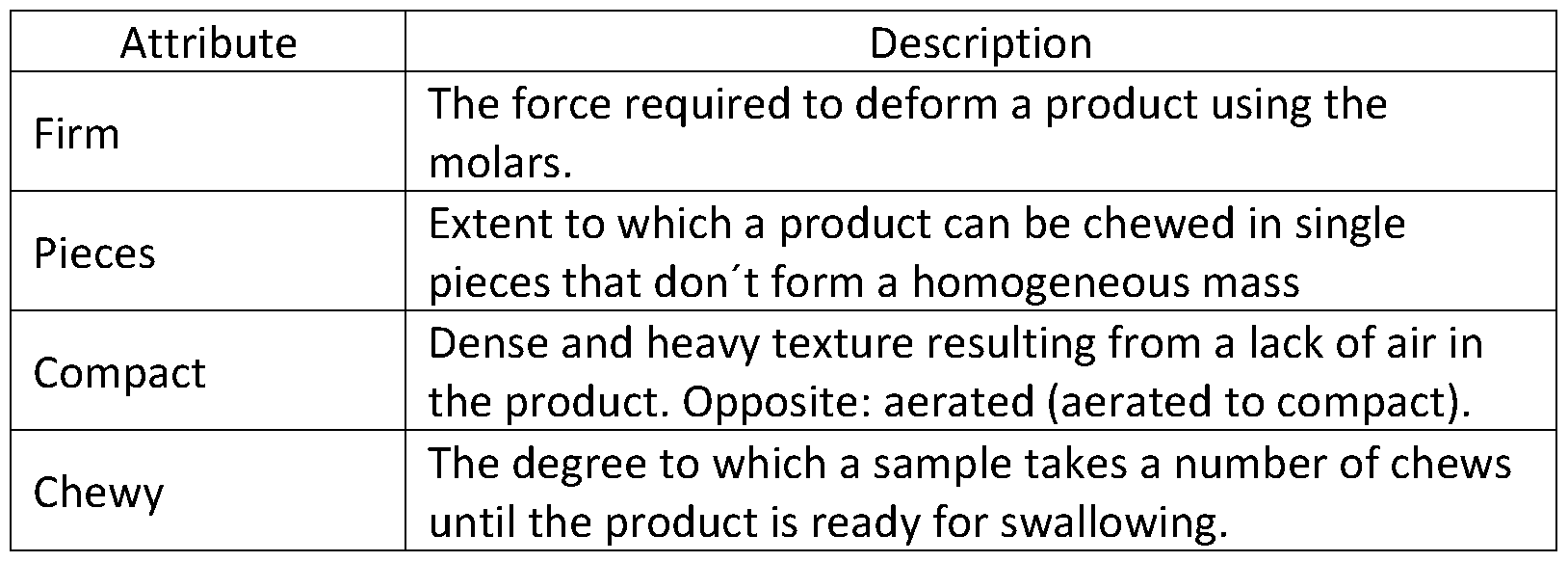
Rate All That Apply (RATA) sensory methodology was applied for assessing the suspension and emulsion gels, and the chicken egg references (egg white and egg yolk). Panelists (n = 12, Nestle employees), were trained based on the sensory glossary (Table 2), and a warm-up sample (cooked chicken egg white and egg yolk), with given attribute rankings, that was used prior to each sensory evaluation session to set the scale for the defined attributes before the gels assessment. Panelists were asked to check the attributes they considered appropriate for describing samples and then to rate the intensity of the applicable terms using a 5-point structured scale with anchors 'just noticeable, 'slight', 'moderate', 'high' or 'very high'. A total of three sessions were conducted, using a sensory glossary with terms about texture perception and flavour and taste. Data were collected with EyeQuestion® software in individual sensory booths, under red light, and were analyzed using EyeOpenR® software (Logic 8, Elst, the Netherlands). The attributes displayed in the figures for the following examples correspond to firm, pieces, compact and chewy that are described in Table 1.
Table 2. Sensory texture attributes used in the examples
Figure imgf000015_0001
Two cooked chicken egg systems (egg white and egg yolk) were used as a reference and warmup samples, to which the suspension and emulsion gels were compared in terms of sensory analysis. For their preparation, water was set to boiling point and chicken eggs were added for 10 min to obtain cooked egg white and egg yolk.
Example 3
Plant based cooked egg analogue hardness texture performance by TPA and its comparison to cooked chicken egg yolk, egg white and egg mix.
Figures 1 to 3 show a comparison of the average of different suspension and emulsion gel recipes for the "hardness" texture parameter measured by TPA. The hardness is expressed relative to that of cooked chicken egg yolk, egg white and egg mix, respectively. The preparation and cooking of the gel recipes and cooked chicken egg references, as well as the methodology for the TPA, were performed according to example 1. Error bars represent the standard deviation of the average recipes used for comparison.
The results in Figure 1 show an average of 3 different suspension recipes (recipes 4, 5 and 6), with and without freezing step, that have between 60 - 140 % of the texture property (hardness) of the cooked chicken egg yolk, as referred to in example 1.
This figure demonstrates that, by considering the recipes 4, 5 and 6 of plant based cooked egg analogue, to be comparable to the cooked chicken egg yolk, a suspension, with high pH (adjusted suspension pH above 8), a firming agent (20 mmol / kg), and a freezing step at - 8 °C are needed.
The results in Figure 2 show an average of 2 different recipes, a suspension (recipe 6) and an emulsion (recipe 10), with and without freezing step, that have between 60- 140 % of the texture property (hardness) of the cooked chicken egg white, as referred to in example 1.
This figure demonstrates that, by considering the recipes 6 and 10 of plant based cooked egg analogue, to be comparable to the cooked chicken egg white, a suspension and/or an emulsion with high pH (adjusted suspension/emulsion pH above 8), a firming agent (20 mmol / kg), and a freezing step at - 8 °C are needed.
The results in Figure 3 show an average of 2 different suspension recipes (recipes 4 and 5), with and without freezing step, that have between 60 - 140 % of the texture property (hardness) of the cooked chicken egg mix, as referred to in example 1.
This figure demonstrates that, by considering recipes 4 and 5 of plant based cooked egg analogue, to be comparable to the cooked chicken egg mix, a suspension with high pH (adjusted suspension pH above 8), a firming agent (20 mmol / kg), and a freezing step at - 8 °C are needed.
Example 4
Comparison to cooked chicken egg yolk, egg white and egg mix for samples without the cold set gelation step The results in Figure 4 show a suspension recipe with 20 mmol / kg CaCl2 and pH 9, without the cold gelation step, that have between 60 - 140 % of the texture property (hardness) of the cooked chicken egg yolk, egg white and egg mix, as referred in example 1.
Example 5
Plant based cooked egg analogue texture performance by sensory analysis and its comparison to cooked chicken egg yolk and egg white.
Sensory data, acquired according to the methodology described in example 1, were processed with EyeOpenR ® software (Logic 8, Elst, the Netherlands). The least significant difference (LSD) is plotted to the bar charts to show a proxy of the panel intra-variability. The confidence level was set to 5% (p-value <0.05). LSD bars overlapping signifies the recipe is not significantly different than cooked chicken hard-boiled egg yolk and egg white
Figure 5 shows a comparison of the average values of sensory attributes firm, pieces, compact and chewy for suspension recipes with firming agent (recipes 4, 5 and 6) and all emulsion recipes with firming agent (recipes 10, 11 and 12). These values are expressed relatively to the ones of cooked chicken egg yolk and are displayed compared to the 60 - 140 % range of the sensory properties of the cooked chicken egg yolk.
This figure demonstrates that, by considering recipes 5, 6 and 10 of plant based cooked egg analogue, to be comparable to the cooked chicken egg yolk, a suspension and/or an emulsion with high pH (adjusted suspension/emulsion pH above 8), a firming agent (20 mmol / kg), and a freezing step at - 8 °C are needed. It can be observed that recipe 5 performs slightly out of range for the attribute "chewy", as well as recipes 6 and 10 for the attribute "compact". However, the LSD bars are overlapping with the cooked chicken egg yolk 60 - 140 % range of the sensory attributes described, thus this signifies that recipes 5, 6 and 10 are statistically comparable to the cooked chicken egg yolk for the four attributes.
Figure 6 shows the firmness sensory attribute average value for different suspension recipes with and without firming agent at pH 9 (recipe 5 and recipe 3, respectively) and different emulsion recipes with and without firming agent at pH 8 (recipe 10 and recipe 8, respectively). The results show that the recipes with firming agent (recipes 5 and 10) have between 60 - 140 % of the firmness sensory attribute of the cooked chicken egg yolk and are performing better than the recipes without firming agent (recipes 3 and 8). Also, it demonstrates that to be comparable to the cooked chicken egg yolk, a suspension and/or an emulsion with high pH (adjusted suspension/emulsions pH above 8), and a freezing step at - 8 °C are needed.
Figure 7 shows a comparison of the average value of sensory attributes firm, pieces, compact and chewy for suspension recipes with firming agent (recipes 4, 5 and 6) and all emulsions with firming agent (recipes 10, 11 and 12). These values are expressed relatively to the ones of cooked chicken egg white and are displayed compared to the 60 - 140 % range of the sensory properties of the cooked chicken egg white.
This figure demonstrates that, by considering recipes 5 and 10 of plant based cooked egg analogue, to be comparable to the cooked chicken egg white, a suspension and/or an emulsion with high pH (adjusted suspension/emulsion pH above 8), a firming agent (20 mmol / kg), and a freezing step at - 8 °C are needed. It can be observed that recipe 10 performs slightly out of range for only one ("compact") out of the four sensory attributes. Except for the sensory "compact" attribute related to recipe 10, recipes 5 and 10 are statistically comparable to the cooked chicken egg white.
Figure 8 shows the firmness sensory attribute average value for different suspension recipes with and without firming agent at pH 8 (recipe 4 and recipe 2, respectively) and different emulsion recipes with and without firming agent at pH 8 (recipe 10 and recipe 8, respectively). The results show that the recipes with firming agent (recipes 4 and 10) have between 60 - 140 % of the firmness sensory attribute of the cooked chicken egg white and are performing better than the recipes without firming agent (recipes 2 and 8). Also, it demonstrates that to be comparable to the cooked chicken egg white, a suspension and/or an emulsion with high pH (adjusted suspension/emulsions pH above 8), and a freezing step at - 8 °C are needed.

Claims

Claims
1. A method of making a plant-based cooked egg analogue product, for example a hard- boiled egg analogue product, said method comprising: a. Providing a plant protein suspension; b. Optionally adding oil to the suspension and mixing to form an emulsion; c. Ensuring the pH of the suspension or emulsion is between pH 5 to 10, preferably between 7 to 9; d. Adding a firming agent and mixing; f. Performing a freezing step, wherein the firming agent is a soluble mineral salt.
2. The method of making a product according to claim 1, said method after step d. comprising the step of: e. performing a cold set gelation at between 0 to 30°C.
3. The method of making a product according to any one of claims 1 and 2, wherein the plant protein suspension in step a) is a legume protein suspension, preferably a pulse protein suspension, for example a soy protein suspension and wherein the plant protein suspension in step a) has a protein concentration of between 3 to 30 wt%, preferably between 5 to 15 wt%.
4. The method of making a product according to any one of claims 1 to 3, wherein (i) the suspension is heated in step a) to at least 60°C, preferably to at least 90°C; or (ii) the emulsion is heated in step b) to at least 60°C, preferably to at least 90°C.
5. The method of making a product according to any one of claims 1 to 4, wherein the cold set gelation is performed at between 0 to 10°C.
6. The method of making a product according to any one of claims 1 to 5, wherein freezing step f) is performed at a temperature below the crystallization temperature of the gel.
7. The method of making a product according to any one of claims 1 to 6, wherein freezing step f) is performed at a temperature which is a. above the secondary melting transition temperature (Tm') of the suspension or emulsion; and b. below the secondary glassy transition temperature (Tg') of the suspension or emulsion.
8. The method of making a product according to any one of claims 2 to 7, wherein said method further comprises a heat treatment step after step e), for example pasteurization.
9. The method of making a product according to any one of claims 1 to 8, wherein the soluble mineral salt firming agent is calcium chloride or potassium chloride.
10. The method of making a product according to any one of claims 1 to 9, wherein the product is an egg white analogue, or an egg yolk analogue, or an egg mix analogue product.
11. The method of making a product according to claim 10, wherein the product is an egg white analogue and the method comprises a. Providing a plant protein suspension; b. Ensuring the pH of the suspension is between 7 to 9, or about pH 8; c. Adding a potassium chloride and mixing; and d. Performing a freezing step.
12. The method of making a product according to claim 10, wherein the product is an egg white analogue and the method comprises a. Providing a plant protein suspension; b. Adding oil to the suspension and mixing to form an emulsion; c. Ensuring the pH of the suspension is between 7 to 9, or about pH 8; d. Adding a calcium chloride and mixing; and e. Performing a freezing step.
13. The method of making a product according to claim 10, wherein the product is an egg yolk analogue and the method comprises a. Providing a plant protein suspension; b. Ensuring the pH of the suspension is between 7 to 9, or between pH 8 to 9; c. Adding a firming agent and mixing; and d. Performing a freezing step.
14. The method of making a product according to claim 10, wherein the product is an egg mix analogue and the method comprises a. Providing a plant protein suspension; b. Ensuring the pH of the suspension is between pH 8 to 9; c. Adding calcium chloride and mixing; and d. Performing a freezing step.
15. The method of making a product according to any one of claims 10 to 14, wherein the product is an egg white, egg yolk, or egg mix analogue and the pH after addition of firming agent is between pH 6.5 to 8.
16. A plant-based cooked egg analogue product, for example a hard-boiled egg analogue product, made from a suspension or an emulsion, wherein the suspension or emulsion comprises plant protein, preferably pulse protein, firming agent and water, and wherein the emulsion further comprises a lipid component.
17. The product according to claim 16, wherein the suspension or emulsion further comprises a carbohydrate-based ingredient, flavor, and color.
18. The product according to any one of claims 16 and 17, wherein the suspension or emulsion undergoes cold-set gelation, heating and/or freezing.
19. A plant based cooked egg analogue product made by a method according to any one of claims 1 to 15.
PCT/EP2024/068512 2023-06-30 2024-07-01 Hard-boiled egg analogue product Ceased WO2025003523A1 (en)

Priority Applications (1)

Application Number Priority Date Filing Date Title
IL325629A IL325629A (en) 2023-06-30 2025-12-25 Hard-boiled egg analogue product

Applications Claiming Priority (2)

Application Number Priority Date Filing Date Title
EP23182670.2 2023-06-30
EP23182670 2023-06-30

Publications (1)

Publication Number Publication Date
WO2025003523A1 true WO2025003523A1 (en) 2025-01-02

Family

ID=87070937

Family Applications (1)

Application Number Title Priority Date Filing Date
PCT/EP2024/068512 Ceased WO2025003523A1 (en) 2023-06-30 2024-07-01 Hard-boiled egg analogue product

Country Status (2)

Country Link
IL (1) IL325629A (en)
WO (1) WO2025003523A1 (en)

Citations (6)

* Cited by examiner, † Cited by third party
Publication number Priority date Publication date Assignee Title
US3640732A (en) * 1969-10-09 1972-02-08 Gen Mills Inc Simulated cooked egg
JP2005073526A (en) * 2003-08-28 2005-03-24 Sanei Gen Ffi Inc Solidified egg yolk-like composition
JP2017169499A (en) * 2016-03-24 2017-09-28 不二製油株式会社 Coagulated egg white substitute composition having freezing resistance
WO2022020149A1 (en) * 2020-07-23 2022-01-27 Cargill, Incorporated Plant-based egg substitute
WO2022264330A1 (en) * 2021-06-16 2022-12-22 キユーピー株式会社 Scrambled-egg-like food product and cooked-egg-like food product
EP4115745A1 (en) * 2021-07-07 2023-01-11 Nabati Foods Inc. Egg substitute and method of manufacture

Patent Citations (6)

* Cited by examiner, † Cited by third party
Publication number Priority date Publication date Assignee Title
US3640732A (en) * 1969-10-09 1972-02-08 Gen Mills Inc Simulated cooked egg
JP2005073526A (en) * 2003-08-28 2005-03-24 Sanei Gen Ffi Inc Solidified egg yolk-like composition
JP2017169499A (en) * 2016-03-24 2017-09-28 不二製油株式会社 Coagulated egg white substitute composition having freezing resistance
WO2022020149A1 (en) * 2020-07-23 2022-01-27 Cargill, Incorporated Plant-based egg substitute
WO2022264330A1 (en) * 2021-06-16 2022-12-22 キユーピー株式会社 Scrambled-egg-like food product and cooked-egg-like food product
EP4115745A1 (en) * 2021-07-07 2023-01-11 Nabati Foods Inc. Egg substitute and method of manufacture

Non-Patent Citations (1)

* Cited by examiner, † Cited by third party
Title
DATABASE GNPD [online] MINTEL; 31 January 2022 (2022-01-31), ANONYMOUS: "Plant-Based Boiled Egg", XP093105631, retrieved from https://www.gnpd.com/sinatra/recordpage/9349610/ Database accession no. 9349610 *

Also Published As

Publication number Publication date
IL325629A (en) 2026-02-01

Similar Documents

Publication Publication Date Title
CA1279220C (en) Preparation of gelled food products
AU2017210533B2 (en) Method for producing meat substitute products
US20150056346A1 (en) Plant-Based Food Products, Compositions, and Methods
US20030045689A1 (en) Gelling vegetable protein
AU2019373675A1 (en) Non-dairy food composition and process for preparation thereof
Flores et al. Effect of a new emulsifier containing sodium stearoyl-2-lactylate and carrageenan on the functionality of meat emulsion systems
KR890000400B1 (en) Heat irreversible gelling system
EP2625969B1 (en) Method for the preparation of oil-containing meat-based products comprising a direct oil addition protocol
JPH02107162A (en) Gelatinization of emulsified material
CA3203215A1 (en) A process for preparing a vegan edible product from edible non-animal proteins
US20020028277A1 (en) Food ingredient
Ritzoulis et al. Proteins as texture modifiers
KR101275896B1 (en) Manufactured method of gelling material of emulsifying mixtures and gelling material using the same
PL245127B1 (en) Method of producing vegetarian and vegan analogues of meat products
NZ202466A (en) Spreadable refrigerated butter and production thereof
TWI764738B (en) Heterogeneous edible fat composition and preparation method thereof
JP2015154756A (en) Soybean protein raw material for enriching food protein
US4849244A (en) Comminuted meat products supplemented with corn germ protein
JP2015080441A (en) Emulsified oil and fat composition for shoe
EP4333637A1 (en) Egg analogue product
JPH08173074A (en) Batter liquid for fried food
JP2023144495A (en) Oil-in-water type emulsified fat composition
RU2125803C1 (en) Method of producing semi-smoked sausage products
Rutkowski et al. Functional properties of plant proteins in meat systems
RU2800797C2 (en) Non-dairy food composition and method of its preparation

Legal Events

Date Code Title Description
121 Ep: the epo has been informed by wipo that ep was designated in this application

Ref document number: 24737103

Country of ref document: EP

Kind code of ref document: A1

WWE Wipo information: entry into national phase

Ref document number: 325629

Country of ref document: IL

NENP Non-entry into the national phase

Ref country code: DE

WWP Wipo information: published in national office

Ref document number: 325629

Country of ref document: IL

122 Ep: pct application non-entry in european phase

Ref document number: 24737103

Country of ref document: EP

Kind code of ref document: A1