WO2024263183A1 - Distance-based physical random- access channel root sequence allocation to facilitate cell range improvement - Google Patents
Distance-based physical random- access channel root sequence allocation to facilitate cell range improvement Download PDFInfo
- Publication number
- WO2024263183A1 WO2024263183A1 PCT/US2023/036202 US2023036202W WO2024263183A1 WO 2024263183 A1 WO2024263183 A1 WO 2024263183A1 US 2023036202 W US2023036202 W US 2023036202W WO 2024263183 A1 WO2024263183 A1 WO 2024263183A1
- Authority
- WO
- WIPO (PCT)
- Prior art keywords
- prach
- group
- access point
- root sequences
- cell range
- Prior art date
- Legal status (The legal status is an assumption and is not a legal conclusion. Google has not performed a legal analysis and makes no representation as to the accuracy of the status listed.)
- Ceased
Links
Classifications
-
- H—ELECTRICITY
- H04—ELECTRIC COMMUNICATION TECHNIQUE
- H04W—WIRELESS COMMUNICATION NETWORKS
- H04W74/00—Wireless channel access
- H04W74/08—Non-scheduled access, e.g. ALOHA
- H04W74/0833—Random access procedures, e.g. with 4-step access
-
- H—ELECTRICITY
- H04—ELECTRIC COMMUNICATION TECHNIQUE
- H04W—WIRELESS COMMUNICATION NETWORKS
- H04W74/00—Wireless channel access
- H04W74/002—Transmission of channel access control information
- H04W74/006—Transmission of channel access control information in the downlink, i.e. towards the terminal
-
- H—ELECTRICITY
- H04—ELECTRIC COMMUNICATION TECHNIQUE
- H04W—WIRELESS COMMUNICATION NETWORKS
- H04W74/00—Wireless channel access
- H04W74/08—Non-scheduled access, e.g. ALOHA
- H04W74/0866—Non-scheduled access, e.g. ALOHA using a dedicated channel for access
-
- H—ELECTRICITY
- H04—ELECTRIC COMMUNICATION TECHNIQUE
- H04W—WIRELESS COMMUNICATION NETWORKS
- H04W4/00—Services specially adapted for wireless communication networks; Facilities therefor
- H04W4/70—Services for machine-to-machine communication [M2M] or machine type communication [MTC]
Definitions
- TECHNICAL FIELD [0002] The subject disclosure generally relates to embodiments for distance-based physical random-access channel (PRACH) root sequence allocation to facilitate cell range improvement.
- PRACH physical random-access channel
- UEs user equipment
- different numbers of root sequences and cyclic shifts per root sequence can be used.
- a minimum numbers of required root sequences, and cyclic shifts per root sequence, are determined so as to generate 64 PRACH preambles for PRACH transmission.
- a user equipment UE
- the UE will send one of the 64 PRACH preambles to a gNodeB (gNB).
- gNB gNodeB
- a PRACH receiver chain of the gNB correlates a corresponding received signal with all of the configured root sequences to detect a preamble peak, in which the peak position determines a preamble index.
- the computational complexity of a PRACH receiver of the gNB is proportional to the number of configured root sequences that are used for the PRACH transmission.
- FIG.1 illustrates a block diagram of a wireless communication environment including a distance-based PRACH root sequence allocation system to facilitate cell range improvement of a wireless access point, in accordance with various example embodiments;
- FIG.2 illustrates a block diagram of a distance-based PRACH root sequence allocation system, in accordance with various example embodiments;
- FIG.3 illustrates a block diagram of a user equipment (UE), in accordance with various example embodiments;
- FIG.4 illustrates a table indicating a number PRACH preambles corresponding to respective groups of PRACH root sequences, in accordance with various example embodiments; [0010] FIG 5.
- FIG.14 illustrates a block diagram representing an illustrative non-limiting computing system or operating environment in which one or more aspects of various embodiments described herein can be implemented.
- a supported cell range of a gNB utilizing PRACH technology depends on a 132855.02 (DELLP828WO) detection window size ( ⁇ ⁇ ) that is configured by the gNB.
- a PRACH root sequence allocation system increases a cell range of a gNB - while reducing a computational load on the gNB - by allocating different PRACH detection window sizes to be used by respective groups of UEs based on respective distances of the UEs from the gNB, while limiting an amount of root sequences - and accordingly limiting an amount of PRACH preambles - to be generated by the respective groups of UEs.
- a system e.g., a distance-based PRACH root sequence allocation system, performs operations comprising: based on a defined criterion, determining a cell range of a wireless access point, e.g., gNB, which is configured for PRACH-based communications; dividing a defined amount of PRACH root sequences into respective groups of root sequences; allocating a first group of root sequences of the respective groups of root sequences to a first group of user equipments that are located at first respective distances from the wireless access point that are less than or equal to the cell range; allocating a second group of root sequences of the respective groups of root sequences to a second group of user equipments that are located at second respective distances from the wireless access point that are greater than the cell range; determining a first detection window size for first respective PRACH-based communications corresponding to the first group of user equipments; determining a second detection window size for second respective PRACH- based communications corresponding to the second group of user
- a method comprises: determining, by a system comprising a processor (e.g., a distance-based PRACH root sequence allocation system), a cell range of a wireless access point that is configured for PRACH-based communications; allocating, by the system, root sequences to respective groups of root sequences, in which a first group of root sequences of the respective groups of root sequences corresponds to a first group of wireless devices that are located at first respective distances from the wireless access point that are greater than the cell range, and in which a second group of root sequences of the respective groups of root sequences corresponds to a second group of wireless devices that are located at second respective distances from the wireless access point that are less than or equal to the cell range; determining, by the system, a first number of cyclic shifts per root sequence for first respective PRACH-based communications that are associated with the first group of wireless devices that are located at the first respective distances from the wireless access point that are greater than the cell range; determining, by the system, a second
- the method comprises: receiving, by the system based on a cyclic shifted version of the first group of root sequences corresponding to the first group of wireless devices that are located at the first respective distances from the wireless access point that are greater than the cell range, a PRACH-based communication from a wireless device that has estimated a distance between the wireless device and the wireless access point to be greater than the cell range of the wireless access point.
- a method comprises: receiving, by a user equipment comprising a processor, cell range information representing a cell range of a wireless access point and location-based information associated with a position of the wireless access point; 132855.02 (DELLP828WO) receiving, by the user equipment, group root sequence information representing respective groups of physical random-access channel (PRACH)-based root sequences comprising a first group of PRACH-based root sequences and a second group of PRACH-based root sequences, in which the first group of PRACH-based root sequences corresponds to a first group of wireless devices that are located at first respective distances from the wireless access point that are greater than the cell range, and in which the second group of PRACH-based root sequences corresponds to a second group of wireless devices that are located at second respective distances from the wireless access point that are less than or equal to the cell range.
- PRACH physical random-access channel
- the method comprises: receiving, by the user equipment, detection window information representing a first detection window size for first respective PRACH- based communications corresponding to the first group of wireless devices that are located at the first respective distances from the wireless access point that are greater than the cell range, and a second detection window size for second respective PRACH-based communications corresponding to the second group of wireless devices that are located at the second respective distances from the wireless access point that are less than or equal to the cell range; based on the cell range information and the location-based information, estimating, by the user equipment, a distance between the user equipment and the wireless access point; and in response to determining that the distance is greater than the cell range of the wireless access point, generating, by the user equipment based on the detection window information and the group root sequence information, a PRACH-based communication utilizing the first group of root sequences and the first detection window size, and sending, by the user equipment, the PRACH-based communication to the wireless access point.
- a distance-based PRACH root sequence allocation system (110) of a wireless communication environment (101) increases a cell range of a gNB by allocating different PRACH detection window sizes to be used by respective groups of UEs based on respective distances of the UEs from a gNB, while limiting an amount of root sequences to be generated by the respective groups of UEs.
- the distance-based PRACH root sequence allocation system includes a cell range 132855.02 (DELLP828WO) determination component (210), a PRACH-based communication component (220), a processing component (230), and a memory component (240).
- the memory component stores executable instructions that, when executed by the processing component, facilitate performance of operations by the distance-based PRACH root sequence allocation system, e.g., via the cell range determination component and the PRACH-based communication component.
- the cell range determination component based on a defined criterion, determines a cell range (r0) of a wireless access point (102) that is configured for PRACH-based communications.
- the PRACH-based communication component divides a defined amount of PRACH root sequences into respective groups of root sequences. Further, the PRACH-based communication component allocates a first group of root sequences of the respective groups of root sequences to a first group of user equipments (e.g., 120) that are located at first respective distances from the wireless access point that are less than or equal to the cell range; and allocates a second group of root sequences of the respective groups of root sequences to a second group of user equipments (e.g., 130) that are located at second respective distances from the wireless access point that are greater than the cell range.
- a first group of user equipments e.g. 120
- second group of root sequences of the respective groups of root sequences e.g., 130
- the PRACH-based communication component determines a first detection window size for first respective PRACH-based communications corresponding to the first group of user equipments; and determines a second detection window size for second respective PRACH-based communications corresponding to the second group of user equipments, in which the second detection window size is greater than the first detection window size to facilitate an increase of the cell range of the wireless access point.
- the PRACH-based communication component receives, from a user equipment (e.g., 310 described below) via the second detection window size and the second group of root sequences, a PRACH-based communication to facilitate the increase of the cell range of the wireless access point, in which a distance between the user equipment and the wireless access point has been estimated by the user equipment to be greater than the cell range of the wireless access point.
- a first total number of PRACH-based preambles is generated, based on the first detection window size via the first group of user equipments utilizing the first group of root sequences, for the first respective PRACH-based communications.
- a second total number of PRACH-based preambles is generated, 132855.02 (DELLP828WO) based on the second detection window size via the second group of user equipments utilizing the second group of root sequences, for the second respective PRACH-based communications - the first total number of PRACH-based preambles being greater than the second total number of PRACH-based preambles.
- the PRACH-based communication component divides the defined amount of PRACH root sequences into the respective groups of root sequences by dividing the defined amount of PRACH root sequences into two groups of PRACH root sequences comprising the first group of root sequences and the second group of root sequences.
- the PRACH-based communication component divides the defined amount of PRACH root sequences into the two groups of PRACH root sequences by dividing equal amounts of the defined amount of PRACH root sequences into the first group of root sequences and the second group of root sequences. [0033] In other embodiment(s), the PRACH-based communication component divides the defined amount of PRACH root sequences into the respective groups of root sequences by dividing the defined amount of PRACH root sequences based on respective geographical distributions of user equipments within the cell range of the wireless access point.
- the PRACH-based communication component sends, to the user equipment, e.g., via respective system information block (SIB) messages, cell range information representing the cell range of the wireless access point and location-based information associated with a position of the wireless access point – to facilitate an estimation, by user equipment based on the cell range information and the location-based information, of the distance.
- SIB system information block
- the location-based information comprises global positioning system (GPS) information representing a location of the wireless access point, or path-loss information representing a signal loss corresponding to the user equipment.
- GPS global positioning system
- the PRACH-based communication component sends, to the user equipment, information comprising group root sequence information representing the first group of root sequences and the second group of root sequences, and detection window information representing the first detection window size corresponding to the first group of user equipments, and representing the second detection window size corresponding to the second group of user equipments – to facilitate a selection, by the user equipment based on the distance, the group root sequence information, and the detection 132855.02 (DELLP828WO) window information, of the second group of root sequences for generation of the PRACH- based communication.
- group root sequence information representing the first group of root sequences and the second group of root sequences
- detection window information representing the first detection window size corresponding to the first group of user equipments
- second detection window size corresponding to the second group of user equipments – to facilitate a selection, by the user equipment based on the distance, the group root sequence information, and the detection 132855.02 (DELLP828WO) window information, of the second group of root sequences for generation of the PRACH-
- the PRACH-based communication is a first PRACH- based communication
- the PRACH-based communication component receives, from the user equipment via the first detection window size and the first group of root sequences, a second PRACH-based communication, in which the distance between the user equipment and the wireless access point has been estimated by the user equipment to be less than or equal to the cell range of the wireless access point.
- the PRACH-based communication component in response to a failure in the second PRACH-based communication being determined to have occurred, receives, from the user equipment via the second detection window size and the second group of root sequences, a third PRACH-based communication.
- FIG.3 a block diagram (300) of a user equipment (UE) (310) is illustrated, in accordance with various example embodiments.
- the user equipment includes a distance estimation component (320), a UE PRACH-based communication component (330), a processing component (340), and a memory component (350).
- the memory component stores executable instructions that, when executed by the processing component, facilitate performance of operations by the UE, e.g., via the distance estimation component and the UE PRACH-based communication component.
- the UE receives cell range information representing a cell range of a wireless access point and location-based information associated with a position of the wireless access point. Further, the UE receives group root sequence information representing respective groups of PRACH-based root sequences comprising a first group of PRACH-based root sequences and a second group of PRACH-based root sequences, in which the first group of PRACH-based root sequences corresponds to a first group of wireless devices (e.g., 130) that are located at first respective distances from the wireless access point that are greater than the cell range, and in which the second group of PRACH-based root sequences corresponds to a second group of wireless devices (e.g., 120) that are located at second respective distances from the wireless access point that are less than or equal to the cell range.
- group root sequence information representing respective groups of PRACH-based root sequences comprising a first group of PRACH-based root sequences and a second group of PRACH-based root sequences, in which the first group of PRACH-based root sequences corresponds to
- the UE receives detection window information representing a first detection window size for first respective PRACH-based communications corresponding to the first group of wireless devices that are located at the first respective distances from the wireless access point that are greater than the cell range, and a second detection window size for second respective PRACH-based communications corresponding to the second group of wireless devices that are located at second respective distances from the wireless access point that are less than or equal to the cell range.
- the distance estimation component estimates a distance between the UE and the wireless access point.
- the UE PRACH-based communication component in response to determining that the distance is greater than the cell range of the wireless access point, the UE PRACH-based communication component generates, based on the detection window information and the group root sequence information, a PRACH-based communication utilizing the first group of root sequences and the first detection window size, and sends the PRACH-based communication to the wireless access point.
- the PRACH-based communication is a first PRACH- based communication
- the UE PRACH-based communication component in response to determining that the distance is less than or equal to the cell range of the wireless access point, the UE PRACH-based communication component generates, based on the detection window information and the group root sequence information, a second PRACH-based communication utilizing the second group of root sequences and the second detection window size, and sends the second PRACH-based communication to the wireless access point.
- the UE PRACH-based communication component in response to a failure in the second PRACH-based communication being determined to have occurred, the UE PRACH-based communication component generates, based on the detection window information and the group root sequence information, a third PRACH-based communication utilizing the first group of root sequences and the first detection window size, and sends the third PRACH-based communication to the wireless access point.
- the UE PRACH-based communication component in response to a failure in the second PRACH-based communication being determined to have occurred, the UE PRACH-based communication component generates, based on the detection window information and the group root sequence information, a third PRACH-based communication utilizing the first group of root sequences and the first detection window size, and sends the third PRACH-based communication to the wireless access point.
- ⁇ ⁇ is required to 132855.02 (DELLP828WO) increase a cell range of a gNB that is performing PRACH-based communications with corresponding user equipments.
- Conventional PRACH-based technologies utilize a common detection window size when generating all preambles for all user equipments communicatively coupled to the gNB, regardless of respective locations of the user equipments within a cell of the gNB – increasing a required number of root sequences for generation all of the preambles, and, consequently, a computational complexity of PRACH processing.
- the distance-based PRACH root sequence allocation system increases the cell range of an eNB by grouping user equipments based on their distance from the gNB.
- the distance-based PRACH root sequence allocation system utilizes a subset of the root sequences for generating respective preambles for each group of user equipments – enabling use of a larger detection window size for distant user equipments within the cell (e.g., for user equipments that are located at respective distances within the cell that are greater than the cell range (r0)), while reducing a total amount of available preambles to be utilized by each group of user equipments.
- the distance-based PRACH root sequence allocation system utilizes PRACH-based preamble format A1 and a subcarrier spacing (SCS) of 30 kHz with parameters given in Table 6.3.3.1 of 3GPP TS 38.211 - "5G NR; Physical channel and modulation", version 15.8.0 Release 15 - to determine ⁇ ⁇ according to the following steps - later determining r 0 based on ⁇ ⁇ : [0049]
- the distance-based PRACH root sequence determines 132855.02 (DELLP828WO)
- F G is the delay spread at 15 kHz.
- the user equipment estimates its distance from the gNB by one of these options: by using the path loss calculated using SIB messages (already an existing feature for all 5G user equipments) such that the distance from the gNB is estimated using the path loss and the free propagation model or other suitable channel models; or by using user equipment GPS information representing a location of the user equipment and gNB GPS information representing a location of the gNB, e.g., provided via an SIB message.
- the user equipment in response to the distance-based PRACH root sequence allocation system sending, to the user equipment, information comprising group root sequence information representing the first group of root sequences (e.g., Group 1) and the second group of root sequences (e.g., Group 2), and detection window information representing the first detection window size corresponding to Group 1, and representing the second detection window size corresponding to Group 2, the user equipment will select the first group of root sequences or the second group of root sequences based on the distance (L) estimated by the user equipment: if L ⁇ ⁇ % , the user equipment will use the first group of root sequences for generating preambles; otherwise, the user equipment will use the second group of root sequences for generating preambles.
- group root sequence information representing the first group of root sequences (e.g., Group 1) and the second group of root sequences (e.g., Group 2)
- detection window information representing the first detection window size corresponding to Group 1
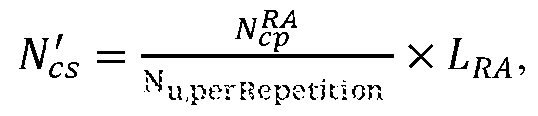
- the user equipment in response to utilizing the first group of root sequences, the user equipment generates / 0 ⁇ ⁇ N ⁇ ! ⁇ ,O ⁇ ! ⁇ 3 preambles.
- the cell range for the first group of user e.g., 120
- ⁇ ⁇ is transmitted by the distance-based PRACH root sequence allocation system to the user equipment using the existing higher layer parameter zero correlation zone configuration (ZCZC) index defined in 3GPP technical specifications.
- table 400 represents various calculations that have been performed by the user equipment for different values of ⁇ ⁇ for Group 2, in response to the second group of root sequences being used by the user equipment based on the distance being estimated by the user equipment to be greater than ⁇ % .
- 35 preambles (indexes 0-34) belong to Group 1.
- preamble indexes shall be a linear number (from 0 – 63) for both groups of root sequences to avoid contention between the two groups of root sequences due to similar preambles indexes.
- FIGs.6-7 illustrate flow charts (600, 700) of a method associated with a system, e.g., a distance-based PRACH root sequence allocation system (110), in accordance with various example embodiments.
- the system determines a cell range of a wireless access point that is configured for PRACH-based communications. 132855.02 (DELLP828WO)
- the system divides a defined amount of PRACH root sequences into respective groups of root sequences.
- the system allocates a first group of root sequences of the respective groups of root sequences to a first group of user equipments that are located at first respective distances from the wireless access point that are less than or equal to the cell range.
- the system allocates a second group of root sequences of the respective groups of root sequences to a second group of user equipments that are located at second respective distances from the wireless access point that are greater than the cell range.
- the system determines a first detection window size for first respective PRACH-based communications corresponding to the first group of user equipments.
- the system determines a second detection window size for second respective PRACH-based communications corresponding to the second group of user equipments, in which the second detection window size is greater than the first detection window size to facilitate an increase of the cell range of the wireless access point.
- the system receives, from a user equipment via the second detection window size and the second group of root sequences, a PRACH-based communication to facilitate the increase of the cell range of the wireless access point, in which a distance between the user equipment and the wireless access point has been estimated by the user equipment to be greater than the cell range of the wireless access point.
- FIGs.8-10 illustrate flow charts (800 – 1000) of another method associated with a system, e.g., distance-based PRACH root sequence allocation system (110), in accordance with various example embodiments.
- the system determines a cell range of a wireless access point that is configured for PRACH-based communications.
- the system allocates root sequences to respective groups of root sequences, in which a first group of root sequences of the respective groups of root sequences corresponds to a first group of wireless devices that are located at first respective distances from the wireless access point that are greater than the cell range, and in which a second group of root sequences of the respective groups of root sequences corresponds to a second group of wireless devices that are located at second respective distances from the wireless access point that are less than or equal to the cell range.
- the system determines a first number of cyclic shifts per root sequence for first respective PRACH-based communications that are associated with the first group of 132855.02 (DELLP828WO) wireless devices that are located at the first respective distances from the wireless access point that are greater than the cell range.
- DELLP828WO 132855.02
- the system determines a second number of cyclic shifts per root sequence for second respective PRACH-based communications that are associated with the second group of wireless devices that are located at the second respective distances from the wireless access point that are less than or equal to the cell range, in which the first number of cyclic shifts per root sequence for the first respective PRACH-based communications is smaller than the second number of cyclic shifts per root sequence for the second respective PRACH- based communications to facilitate an increase of the cell range of the wireless access point.
- the system receives, based on a first cyclic shifted version of the first group of root sequences corresponding to the first group of wireless devices that are located at first respective distances from the wireless access point that are greater than the cell range, a first PRACH-based communication from a first wireless device that has estimated a first distance between the first wireless device and the wireless access point to be greater than the cell range of the wireless access point.
- the system receives, based on second cyclic shifted version of the second group of root sequences corresponding to the second group of wireless devices, a second PRACH-based communication from a second wireless device that has estimated a second distance between the second wireless device and the wireless access point to be less than or equal to the cell range of the wireless access point.
- the system receives, based on the first cyclic shift offset via the first group of root sequences that have been allocated to the first group of wireless devices, a third PRACH-based communication from the second wireless device.
- FIGs.11-13 illustrate flow charts (1100 – 1300) of a method associated with a user equipment (310), in accordance with various example embodiments.
- the user equipment receives cell range information representing a cell range of a wireless access point and location-based information associated with a position of the wireless access point.
- the user equipment receives group root sequence information representing respective groups of PRACH-based root sequences comprising a first group of PRACH-based root sequences and a second group of PRACH-based root sequences, in which the first group of PRACH-based root sequences corresponds to a first group of wireless devices that are located 132855.02 (DELLP828WO) at first respective distances from the wireless access point that are greater than the cell range, and in which the second group of PRACH-based root sequences corresponds to a second group of wireless devices that are located at second respective distances from the wireless access point that are less than or equal to the cell range.
- group root sequence information representing respective groups of PRACH-based root sequences comprising a first group of PRACH-based root sequences and a second group of PRACH-based root sequences
- the user equipment receives detection window information representing a first detection window size for first respective PRACH-based communications corresponding to the first group of wireless devices that are located at the first respective distances from the wireless access point that are greater than the cell range, and representing a second detection window size for second respective PRACH-based communications corresponding to the second group of wireless devices that are located at second respective distances from the wireless access point that are less than or equal to the cell range.
- the user equipment estimates a distance between the user equipment and the wireless access point.
- the user equipment in response to a determination that the distance is greater than the cell range of the wireless access point, the user equipment generates, based on the detection window information and the group root sequence information, a first PRACH-based communication utilizing the first group of root sequences and the first detection window size, and sends the first PRACH-based communication to the wireless access point.
- the user equipment in response to a determination that the distance is less than or equal to the cell range of the wireless access point, the user equipment generates, based on the detection window information and the group root sequence information, a second PRACH- based communication utilizing the second group of root sequences and the second detection window size, and sends the second PRACH-based communication to the wireless access point.
- the user equipment in response to a determination that a failure in the second PRACH-based communication has occurred, the user equipment generates, based on the detection window information and the group root sequence information, a third PRACH-based communication utilizing the first group of root sequences and the first detection window size, and sends the third PRACH-based communication to the wireless access point.
- Reference throughout this specification to “one embodiment,” “an embodiment,” “another embodiment”, “yet another embodiment”, “embodiment(s)”, “other “embodiment(s)”, and “yet other embodiment(s)” means that a particular feature, structure, or characteristic described in connection with the embodiment is included in at least one 132855.02 (DELLP828WO) embodiment.
- the term “or” is intended to mean an inclusive “or” rather than an exclusive “or”. That is, unless specified otherwise, or clear from context, “X employs A or B” is intended to mean any of the natural inclusive permutations. That is, if X employs A; X employs B; or X employs both A and B, then “X employs A or B” is satisfied under any of the foregoing instances.
- the articles “a” and “an” as used in this application and the appended claims should generally be construed to mean “one or more” unless specified otherwise or clear from context to be directed to a singular form.
- a component can be a processor, a process running on a processor, an object, an executable, a program, a storage device, and/or a computer.
- an application running on a server, client, etc. and the server, client, etc. can be a component.
- One or more components can reside within a process, and a component can be localized on one computer and/or distributed between two or more computers.
- components can execute from various computer readable media having various data structures stored thereon.
- a component can be an apparatus with specific functionality provided by mechanical parts operated by electric or electronic circuitry; the electric or electronic circuitry can be operated by a software application or a firmware application executed by one or more processors; the one or more processors can be internal or external to 132855.02 (DELLP828WO) the apparatus and can execute at least a part of the software or firmware application.
- a signal having one or more data packets (e.g., data from one component interacting with another component in a local system, distributed system, and/or across a network, e.g., the Internet, with other systems via the signal).
- a component can be an apparatus with specific functionality provided by mechanical parts operated by electric or electronic circuitry; the electric or electronic circuitry can be operated by a software application or a firmware application executed by one or more processors; the one or more processors can be internal or external to 132855.02 (DELLP828WO) the apparatus and can execute at least a part of the software or firmware application.
- a component can be an apparatus that provides specific functionality through electronic components without mechanical parts; the electronic components can comprise one or more processors therein to execute software and/or firmware that confer(s), at least in part, the functionality of the electronic components.
- Aspects of systems, apparatus, and processes explained herein can constitute machine-executable instructions embodied within a machine, e.g., embodied in a computer readable medium (or media) associated with the machine. Such instructions, when executed by the machine, can cause the machine to perform the operations described.
- the systems, processes, process blocks, etc. can be embodied within hardware, such as an application specific integrated circuit (ASIC) or the like.
- ASIC application specific integrated circuit
- any aspect or design described herein as “exemplary” and/or “demonstrative” is not necessarily to be construed as preferred or advantageous over other aspects or designs, nor is it meant to preclude equivalent exemplary structures and techniques known to those of ordinary skill in the art having the benefit of the instant disclosure.
- the disclosed subject matter can be implemented as a method, apparatus, or article of manufacture using standard programming and/or engineering techniques to produce software, firmware, hardware, or any combination thereof to control a computer to implement the disclosed subject matter.
- article of manufacture as used herein is intended to encompass a computer program accessible from any computer-readable device, computer- readable carrier, or computer-readable media.
- computer-readable media can comprise, but are not limited to: random access memory (RAM); read only memory (ROM); electrically erasable programmable read only memory (EEPROM); flash memory or other memory technology (e.g., card, stick, key drive, thumb drive, smart card); solid state drive (SSD) or other solid-state storage technology; optical disk storage (e.g., compact disk (CD) read only memory (CD ROM), digital video/versatile disk (DVD), Blu-ray disc); cloud-based 132855.02 (DELLP828WO) (e.g., Internet based) storage; magnetic storage (e.g., magnetic cassettes, magnetic tape, magnetic disk storage or other magnetic storage devices); a virtual device that emulates a storage device and/or any of the above computer-readable media; or other tangible and/or non-transitory media which can be used to store desired information.
- RAM random access memory
- ROM read only memory
- EEPROM electrically erasable programmable read only memory
- flash memory or other memory technology e
- processing component can refer to substantially any computing processing unit or device comprising, but not limited to comprising, single-core processors; single-processors with software multithread execution capability; multi-core processors; multi-core processors with software multithread execution capability; multi-core processors with hardware multithread technology; parallel platforms; and parallel platforms with distributed shared memory.
- a processor can refer to an integrated circuit, an application specific integrated circuit (ASIC), a digital signal processor (DSP), a field programmable gate array (FPGA), a programmable logic controller (PLC), a complex programmable logic device (CPLD), a discrete gate or transistor logic, discrete hardware components, or any combination thereof designed to perform the functions and/or processes described herein.
- ASIC application specific integrated circuit
- DSP digital signal processor
- FPGA field programmable gate array
- PLC programmable logic controller
- CPLD complex programmable logic device
- a processor may also be implemented as a combination of computing processing units.
- nonvolatile memory for example, can be included in a memory component (240, 350), non-volatile memory 1422 (see below), disk storage 1424 (see below), and/or memory storage 1446 (see below). Further, nonvolatile memory can be included in read only memory (ROM), programmable ROM (PROM), 132855.02 (DELLP828WO) electrically programmable ROM (EPROM), electrically erasable ROM (EEPROM), or flash memory. Volatile memory (e.g., 1420) can comprise random access memory (RAM), which acts as external cache memory.
- RAM random access memory
- RAM is available in many forms such as synchronous RAM (SRAM), dynamic RAM (DRAM), synchronous DRAM (SDRAM), double data rate SDRAM (DDR SDRAM), enhanced SDRAM (ESDRAM), Synchlink DRAM (SLDRAM), and direct Rambus RAM (DRRAM).
- SRAM synchronous RAM
- DRAM dynamic RAM
- SDRAM synchronous DRAM
- DDR SDRAM double data rate SDRAM
- ESDRAM enhanced SDRAM
- SLDRAM Synchlink DRAM
- DRRAM direct Rambus RAM
- program modules comprise routines, programs, components, data structures, etc. that perform particular tasks and/or implement particular abstract data types.
- inventive systems can be practiced with other computer system configurations, comprising single-processor or multiprocessor computer systems, computing devices, mini-computing devices, mainframe computers, as well as personal computers, hand-held computing devices (e.g., PDA, phone, watch), microprocessor-based or programmable consumer or industrial electronics, and the like.
- Computer 1412 comprises a processing unit 1414, a system memory 1416, and a system bus 1418.
- System bus 1418 couples system components comprising, but not limited to, system memory 1416 to processing unit 1414.
- Processing unit 1414 can be any of various available processors.
- System bus 1418 can be any of several types of bus structure(s) comprising a memory bus or a memory controller, a peripheral bus or an external bus, and/or a local bus using any variety of available bus architectures comprising, but not limited to, industrial standard architecture (ISA), micro-channel architecture (MSA), extended ISA (EISA), intelligent drive electronics (IDE), VESA local bus (VLB), peripheral component interconnect (PCI), card bus, universal serial bus (USB), advanced graphics port (AGP), personal computer memory card international association bus (PCMCIA), Firewire (IEEE 1394), small computer systems interface (SCSI), and/or controller area network (CAN) bus used in vehicles.
- ISA industrial standard architecture
- MSA micro-channel architecture
- EISA extended ISA
- IDE intelligent drive electronics
- VLB VESA local bus
- PCI peripheral component interconnect
- card bus universal serial bus
- USB universal serial bus
- AGP advanced graphics port
- PCMCIA personal computer memory card international association bus
- Firewire IEEE 1394
- SCSI small computer
- System memory 1416 comprises volatile memory 1420 and nonvolatile memory 1422.
- a basic input/output system (BIOS) containing routines to transfer information between elements within computer 1412, such as during start-up, can be stored in nonvolatile memory 1422.
- nonvolatile memory 1422 can comprise ROM, PROM, EPROM, EEPROM, or flash memory.
- Volatile memory 1420 comprises RAM, which acts as external cache memory.
- Computer 1412 also comprises removable/non-removable, volatile/non-volatile computer storage media.
- Disk storage 1424 comprises, but is not limited to, devices like a magnetic disk drive, floppy disk drive, tape drive, Jaz drive, Zip drive, LS-100 drive, flash memory card, or memory stick.
- disk storage 1424 can comprise storage media separately or in combination with other storage media comprising, but not limited to, an optical disk drive such as a compact disk ROM device (CD-ROM), CD recordable drive (CD-R Drive), CD rewritable drive (CD- RW Drive) or a digital versatile disk ROM drive (DVD-ROM).
- an optical disk drive such as a compact disk ROM device (CD-ROM), CD recordable drive (CD-R Drive), CD rewritable drive (CD- RW Drive) or a digital versatile disk ROM drive (DVD-ROM).
- CD-ROM compact disk ROM device
- CD-R Drive CD recordable drive
- CD- RW Drive CD rewritable drive
- DVD-ROM digital versatile disk ROM drive
- FIG.14 describes software that acts as an intermediary between users, e.g., subscribers, and computer resources described in suitable operating 132855.02 (DELLP828WO) environment 1400. Such software comprises an operating system 1428.
- Operating system 1428 which can be stored on disk storage 1424, acts to control and allocate resources of computer system 1412.
- System applications 1430 take advantage of the management of resources by operating system 1428 through program modules 1432 and program data 1434 stored either in system memory 1416 or on disk storage 1424. It is to be appreciated that the disclosed subject matter can be implemented with various operating systems or combinations of operating systems.
- a user e.g., subscriber, can enter commands or information into computer 1412 through input device(s) 1436.
- Input devices 1436 comprise, but are not limited to, a pointing device such as a mouse, trackball, stylus, touch pad, keyboard, microphone, joystick, game pad, satellite dish, scanner, TV tuner card, digital camera, digital video camera, web camera, cellular phone, user equipment, smartphone, and the like. These and other input devices connect to processing unit 1414 through system bus 1418 via interface port(s) 1438.
- Interface port(s) 1438 comprise, for example, a serial port, a parallel port, a game port, a universal serial bus (USB), a wireless based port, e.g., Wi-Fi, Bluetooth, etc.
- Output device(s) 1440 use some of the same type of ports as input device(s) 1436.
- a USB port can be used to provide input to computer 1412 and to output information from computer 1412 to an output device 1440.
- Output adapter 1442 is provided to illustrate that there are some output devices 1440, like display devices, light projection devices, monitors, speakers, and printers, among other output devices 1440, which use special adapters.
- Output adapters 1442 comprise, by way of illustration and not limitation, video and sound devices, cards, etc. that provide means of connection between output device 1440 and system bus 1418. It should be noted that other devices and/or systems of devices provide both input and output capabilities such as remote computer(s) 1444.
- Computer 1412 can operate in a networked environment using logical connections to one or more remote computers, such as remote computer(s) 1444.
- Remote computer(s) 1444 can be a personal computer, a server, a router, a network PC, a workstation, a microprocessor based appliance, a peer device, or other common network node and the like, and typically comprises many or all of the elements described relative to computer 1412.
- a memory storage device 1446 is illustrated with remote computer(s) 1444.
- Remote computer(s) 1444 is logically connected to computer 1412 through a network interface 1448 and then physically and/or wirelessly connected via communication connection 1450.
- Network interface 1448 encompasses wire and/or wireless 132855.02 (DELLP828WO) communication networks such as local-area networks (LAN) and wide-area networks (WAN).
- LAN technologies comprise fiber distributed data interface (FDDI), copper distributed data interface (CDDI), Ethernet, token ring and the like.
- WAN technologies comprise, but are not limited to, point-to-point links, circuit switching networks like integrated services digital networks (ISDN) and variations thereon, packet switching networks, and digital subscriber lines (DSL).
- ISDN integrated services digital networks
- DSL digital subscriber lines
- Communication connection(s) 1450 refer(s) to hardware/software employed to connect network interface 1448 to bus 1418. While communication connection 1450 is shown for illustrative clarity inside computer 1412, it can also be external to computer 1412.
- the hardware/software for connection to network interface 1448 can comprise, for example, internal and external technologies such as modems, comprising regular telephone grade modems, cable modems and DSL modems, wireless modems, ISDN adapters, and Ethernet cards.
- the computer 1412 can operate in a networked environment using logical connections via wired and/or wireless communications to one or more remote computers, cellular based devices, user equipment, smartphones, or other computing devices, such as workstations, server computers, routers, personal computers, portable computers, microprocessor-based entertainment appliances, peer devices or other common network nodes, etc.
- the computer 1412 can connect to other devices/networks by way of antenna, port, network interface adaptor, wireless access point, modem, and/or the like.
- the computer 1412 is operable to communicate with any wireless devices or entities operatively disposed in wireless communication, e.g., a printer, scanner, desktop and/or portable computer, portable data assistant, communications satellite, user equipment, cellular base device, smartphone, any piece of equipment or location associated with a wirelessly detectable tag (e.g., scanner, a kiosk, news stand, restroom), and telephone.
- any wireless devices or entities operatively disposed in wireless communication e.g., a printer, scanner, desktop and/or portable computer, portable data assistant, communications satellite, user equipment, cellular base device, smartphone, any piece of equipment or location associated with a wirelessly detectable tag (e.g., scanner, a kiosk, news stand, restroom), and telephone.
- This comprises at least Wi-Fi and Bluetooth wireless technologies.
- the communication can be a predefined structure as with a conventional network or simply an ad hoc communication between at least two devices.
- Wi-Fi allows connection to the Internet from a desired location (e.g., a vehicle, couch at home, a bed in a hotel room, or a conference room at work, etc.) without wires.
- Wi- Fi is a wireless technology similar to that used in a cell phone that enables such devices, e.g., mobile phones, computers, etc., to send and receive data indoors and out, anywhere within the range of a base station.
- Wi-Fi networks use radio technologies called IEEE 802.11 (a, b, 132855.02 (DELLP828WO) g, etc.) to provide secure, reliable, fast wireless connectivity.
- a Wi-Fi network can be used to connect communication devices (e.g., mobile phones, computers, etc.) to each other, to the Internet, and to wired networks (which use IEEE 802.3 or Ethernet).
- Wi-Fi networks operate in the unlicensed 2.4 and 5 GHz radio bands, at an 11 Mbps (802.11a) or 54 Mbps (802.11b) data rate, for example, or with products that contain both bands (dual band), so the networks can provide real-world performance similar to the basic 10BaseT wired Ethernet networks used in many offices.
Landscapes
- Engineering & Computer Science (AREA)
- Computer Networks & Wireless Communication (AREA)
- Signal Processing (AREA)
- Mobile Radio Communication Systems (AREA)
Abstract
Description


Claims
Priority Applications (2)
| Application Number | Priority Date | Filing Date | Title |
|---|---|---|---|
| EP23813507.3A EP4732623A1 (en) | 2023-06-23 | 2023-10-28 | Distance-based physical random- access channel root sequence allocation to facilitate cell range improvement |
| CN202380099660.7A CN121464721A (en) | 2023-06-23 | 2023-10-28 | Distance-based physical random access channel root sequence allocation facilitating cell range improvement |
Applications Claiming Priority (2)
| Application Number | Priority Date | Filing Date | Title |
|---|---|---|---|
| US18/340,798 | 2023-06-23 | ||
| US18/340,798 US20240430939A1 (en) | 2023-06-23 | 2023-06-23 | Distance-based physical random-access channel root sequence allocation to facilitate cell range improvement |
Publications (1)
| Publication Number | Publication Date |
|---|---|
| WO2024263183A1 true WO2024263183A1 (en) | 2024-12-26 |
Family
ID=88969583
Family Applications (1)
| Application Number | Title | Priority Date | Filing Date |
|---|---|---|---|
| PCT/US2023/036202 Ceased WO2024263183A1 (en) | 2023-06-23 | 2023-10-28 | Distance-based physical random- access channel root sequence allocation to facilitate cell range improvement |
Country Status (4)
| Country | Link |
|---|---|
| US (1) | US20240430939A1 (en) |
| EP (1) | EP4732623A1 (en) |
| CN (1) | CN121464721A (en) |
| WO (1) | WO2024263183A1 (en) |
Citations (2)
| Publication number | Priority date | Publication date | Assignee | Title |
|---|---|---|---|---|
| US20210014900A1 (en) * | 2019-07-09 | 2021-01-14 | Qualcomm Incorporated | Positioning assisted resource configuration and selection for two-step random access channel procedure |
| US20210385879A1 (en) * | 2018-10-30 | 2021-12-09 | Idac Holdings, Inc. | Methods, apparatus, systems and procedures for distance dependent random access channel (rach) preamble selection in non-terrestrial networks (ntns) |
Family Cites Families (2)
| Publication number | Priority date | Publication date | Assignee | Title |
|---|---|---|---|---|
| US11979919B2 (en) * | 2021-09-17 | 2024-05-07 | Qualcomm Incorporated | Flexible random access channel configurations |
| EP4161204B9 (en) * | 2021-09-30 | 2025-07-09 | SkyFive AG | Random access improvement for 5g air-to-ground-system |
-
2023
- 2023-06-23 US US18/340,798 patent/US20240430939A1/en active Pending
- 2023-10-28 EP EP23813507.3A patent/EP4732623A1/en active Pending
- 2023-10-28 CN CN202380099660.7A patent/CN121464721A/en active Pending
- 2023-10-28 WO PCT/US2023/036202 patent/WO2024263183A1/en not_active Ceased
Patent Citations (2)
| Publication number | Priority date | Publication date | Assignee | Title |
|---|---|---|---|---|
| US20210385879A1 (en) * | 2018-10-30 | 2021-12-09 | Idac Holdings, Inc. | Methods, apparatus, systems and procedures for distance dependent random access channel (rach) preamble selection in non-terrestrial networks (ntns) |
| US20210014900A1 (en) * | 2019-07-09 | 2021-01-14 | Qualcomm Incorporated | Positioning assisted resource configuration and selection for two-step random access channel procedure |
Non-Patent Citations (1)
| Title |
|---|
| 3GPP TS 38.211 |
Also Published As
| Publication number | Publication date |
|---|---|
| CN121464721A (en) | 2026-02-03 |
| EP4732623A1 (en) | 2026-04-29 |
| US20240430939A1 (en) | 2024-12-26 |
Similar Documents
| Publication | Publication Date | Title |
|---|---|---|
| JP7322349B2 (en) | Resource selection method and terminal device | |
| US11582729B2 (en) | Method for data transmission in sidelink and terminal device | |
| CN109644119B (en) | Method, terminal device and network device for wireless communication | |
| JP2021508185A (en) | Resource selection method and terminal equipment in D2D communication | |
| CN116686377A (en) | Method and device for device discovery using UWB | |
| CN114599016B (en) | Resource selection method, device, electronic device and storage medium | |
| US20230039093A1 (en) | Sidelink resource determining method and communication apparatus | |
| WO2019051798A1 (en) | Resource allocation method and apparatus, and computer storage medium | |
| JP6972114B2 (en) | How to control transmitted power, mobile stations and base stations | |
| CN107005939B (en) | Prioritized RTS-CTS resources | |
| JP2021517416A (en) | Signal transmission method, network equipment and terminal equipment | |
| AU2018422466A1 (en) | Information determination method, terminal apparatus, and network apparatus | |
| US20250386358A1 (en) | Communication method and apparatus | |
| WO2015131493A1 (en) | Device discovering method and device discovering apparatus for d2d communication | |
| CN113273121B (en) | Method, apparatus and computer readable medium for measuring sidelink received signal strength | |
| US20240430939A1 (en) | Distance-based physical random-access channel root sequence allocation to facilitate cell range improvement | |
| CN106912112B (en) | A kind of dispatching method and base station | |
| EP4440025B1 (en) | Comb-level sensing for sidelink positioning reference signal resource selection | |
| RU2745417C1 (en) | Method of monitoring and terminal device in the internet system of vehicles | |
| CN107333283B (en) | Random access detection method and device | |
| CN106416414B (en) | Method and device for communicating with wireless access point by device | |
| CN104837203B (en) | Wireless communications method, base station and system based on heterogeneous network | |
| US20240284407A1 (en) | Sidelink response time value selection | |
| WO2020154923A1 (en) | Drs sending method and apparatus | |
| CN116193468A (en) | A method and device for identifying blocked cells |
Legal Events
| Date | Code | Title | Description |
|---|---|---|---|
| 121 | Ep: the epo has been informed by wipo that ep was designated in this application |
Ref document number: 23813507 Country of ref document: EP Kind code of ref document: A1 |
|
| WWE | Wipo information: entry into national phase |
Ref document number: 2023813507 Country of ref document: EP |
|
| NENP | Non-entry into the national phase |
Ref country code: DE |
|
| ENP | Entry into the national phase |
Ref document number: 2023813507 Country of ref document: EP Effective date: 20260123 |
|
| ENP | Entry into the national phase |
Ref document number: 2023813507 Country of ref document: EP Effective date: 20260123 |
|
| ENP | Entry into the national phase |
Ref document number: 2023813507 Country of ref document: EP Effective date: 20260123 |