WO2024262064A1 - 電子部品 - Google Patents
電子部品 Download PDFInfo
- Publication number
- WO2024262064A1 WO2024262064A1 PCT/JP2024/000393 JP2024000393W WO2024262064A1 WO 2024262064 A1 WO2024262064 A1 WO 2024262064A1 JP 2024000393 W JP2024000393 W JP 2024000393W WO 2024262064 A1 WO2024262064 A1 WO 2024262064A1
- Authority
- WO
- WIPO (PCT)
- Prior art keywords
- glass film
- groove
- element body
- potassium
- electronic component
- Prior art date
- Legal status (The legal status is an assumption and is not a legal conclusion. Google has not performed a legal analysis and makes no representation as to the accuracy of the status listed.)
- Ceased
Links
Images







Classifications
-
- H—ELECTRICITY
- H01—ELECTRIC ELEMENTS
- H01C—RESISTORS
- H01C7/00—Non-adjustable resistors formed as one or more layers or coatings; Non-adjustable resistors made from powdered conducting material or powdered semi-conducting material with or without insulating material
- H01C7/04—Non-adjustable resistors formed as one or more layers or coatings; Non-adjustable resistors made from powdered conducting material or powdered semi-conducting material with or without insulating material having negative temperature coefficient
-
- H—ELECTRICITY
- H01—ELECTRIC ELEMENTS
- H01C—RESISTORS
- H01C1/00—Details
- H01C1/02—Housing; Enclosing; Embedding; Filling the housing or enclosure
-
- H—ELECTRICITY
- H01—ELECTRIC ELEMENTS
- H01C—RESISTORS
- H01C7/00—Non-adjustable resistors formed as one or more layers or coatings; Non-adjustable resistors made from powdered conducting material or powdered semi-conducting material with or without insulating material
- H01C7/04—Non-adjustable resistors formed as one or more layers or coatings; Non-adjustable resistors made from powdered conducting material or powdered semi-conducting material with or without insulating material having negative temperature coefficient
- H01C7/041—Non-adjustable resistors formed as one or more layers or coatings; Non-adjustable resistors made from powdered conducting material or powdered semi-conducting material with or without insulating material having negative temperature coefficient formed with two or more layers
-
- H—ELECTRICITY
- H01—ELECTRIC ELEMENTS
- H01F—MAGNETS; INDUCTANCES; TRANSFORMERS; SELECTION OF MATERIALS FOR THEIR MAGNETIC PROPERTIES
- H01F17/00—Fixed inductances of the signal type
- H01F17/04—Fixed inductances of the signal type with magnetic core
-
- H—ELECTRICITY
- H01—ELECTRIC ELEMENTS
- H01F—MAGNETS; INDUCTANCES; TRANSFORMERS; SELECTION OF MATERIALS FOR THEIR MAGNETIC PROPERTIES
- H01F27/00—Details of transformers or inductances, in general
- H01F27/02—Casings
-
- H—ELECTRICITY
- H01—ELECTRIC ELEMENTS
- H01G—CAPACITORS; CAPACITORS, RECTIFIERS, DETECTORS, SWITCHING DEVICES, LIGHT-SENSITIVE OR TEMPERATURE-SENSITIVE DEVICES OF THE ELECTROLYTIC TYPE
- H01G4/00—Fixed capacitors; Processes of their manufacture
- H01G4/002—Details
- H01G4/224—Housing; Encapsulation
-
- H—ELECTRICITY
- H01—ELECTRIC ELEMENTS
- H01G—CAPACITORS; CAPACITORS, RECTIFIERS, DETECTORS, SWITCHING DEVICES, LIGHT-SENSITIVE OR TEMPERATURE-SENSITIVE DEVICES OF THE ELECTROLYTIC TYPE
- H01G4/00—Fixed capacitors; Processes of their manufacture
- H01G4/30—Stacked capacitors
Definitions
- This disclosure relates to electronic components.
- the invention described in Patent Document 1 comprises an element body, an internal electrode, a glass layer, and an external electrode.
- the internal electrode is located inside the element body.
- the glass layer covers the surface of the element body.
- the glass layer has a plurality of through holes. The through holes extend from the outer surface of the glass layer to the boundary of the glass layer with the element body.
- the external electrode is laminated on the outer surface of the glass layer. Furthermore, the external electrode is electrically connected to the internal electrode.
- one aspect of the present disclosure is an electronic component comprising an element body and a glass film covering an outer surface of the element body, the glass film extending on the outer surface of the glass film, and having a groove recessed from the outer surface of the glass film toward the outer surface of the element body in a specific cross section in a direction perpendicular to the outer surface of the glass film, the bottom of the groove being located closer to the outer surface of the glass film than the outer surface of the element body, and the bottom of the groove being arc-shaped in the specific cross section.
- the above configuration makes it possible to suppress stress concentration in the glass film while ensuring the barrier properties of the glass film.
- FIG. 1 is a perspective view of an electronic component.
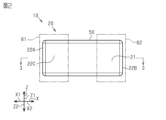
- FIG. 2 is a side view of the electronic component.
- FIG. 3 is a cross-sectional view taken along line 3-3 in FIG.
- FIG. 4 is an enlarged view of the outer surface of the glass film of the electronic component.
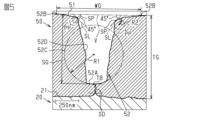
- FIG. 5 is an enlarged view of the vicinity of the glass film when the electronic component is viewed in a specific cross section.
- FIG. 6 is an explanatory diagram for explaining a method for manufacturing an electronic component.
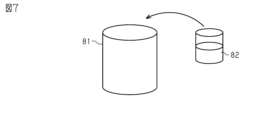
- FIG. 7 is an explanatory diagram for explaining a method for manufacturing an electronic component.
- FIG. 8 is an explanatory diagram for explaining a method for manufacturing an electronic component.
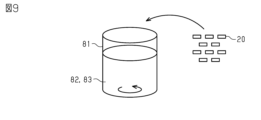
- FIG. 9 is an explanatory diagram for explaining a method for manufacturing an electronic component.
- FIG. 1 is a perspective view of an electronic component.
- FIG. 2 is a side view of the electronic component.
- FIG. 3 is a cross-sectional view taken along line 3-3 in FIG.
- FIG. 4 is an enlarged view of the
- FIG. 10 is an explanatory diagram for explaining a method for manufacturing an electronic component.
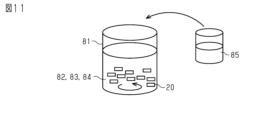
- FIG. 11 is an explanatory diagram for explaining a method for manufacturing an electronic component.
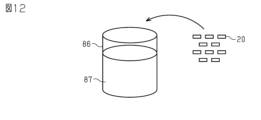
- FIG. 12 is an explanatory diagram illustrating a method for manufacturing an electronic component.
- FIG. 13 is an enlarged view of the vicinity of the glass film when the electronic component according to the modified example is viewed in a specific cross section.
- the electronic component 10 is, for example, a surface-mount type negative temperature coefficient thermistor component that is mounted on a circuit board, etc. Note that a negative temperature coefficient thermistor component has a characteristic that its resistance value decreases as the temperature increases.
- the electronic component 10 includes an element body 20.
- the element body 20 is generally rectangular and has a central axis CA.
- an axis extending along the central axis CA is referred to as a first axis X.
- One of the axes perpendicular to the first axis X is referred to as a second axis Y.
- An axis perpendicular to the first axis X and the second axis Y is referred to as a third axis Z.
- One of the directions along the first axis X is referred to as a first positive direction X1
- the direction along the first axis X opposite to the first positive direction X1 is referred to as a first negative direction X2.
- One of the directions along the second axis Y is referred to as a second positive direction Y1, and the direction along the second axis Y opposite to the second positive direction Y1 is referred to as a second negative direction Y2.
- One of the directions along the third axis Z is referred to as a third positive direction Z1, and the direction along the third axis Z opposite to the third positive direction Z1 is referred to as a third negative direction Z2.
- the outer surface 21 of the element body 20 has six flat surfaces.
- the "surface” of the element body 20 here refers to a surface that can be observed when the entire element body 20 is observed. In other words, even if there are minute irregularities or steps that cannot be seen unless a part of the element body 20 is magnified and observed with a microscope, the surface is expressed as a flat surface or a curved surface.
- the six flat surfaces face in different directions.
- the six flat surfaces are broadly divided into a first end surface 22A facing the first positive direction X1, a second end surface 22B facing the first negative direction X2, and four side surfaces 22C.
- the four side surfaces 22C are a surface facing the third positive direction Z1, a surface facing the third negative direction Z2, a surface facing the second positive direction Y1, and a surface facing the second negative direction Y2, respectively.
- the boundary portions between two adjacent flat surfaces and between three adjacent flat surfaces of the outer surface 21 of the element body 20 are curved. In other words, the corners of the element body 20 are rounded and chamfered. Note that in Figures 1 and 2, the surface of the glass film 50, which will be described later, is identified with the outer surface 21 of the element body 20 and is given a reference number.
- the element body 20 has a larger dimension along the first axis X than along the third axis Z. Also, as shown in FIG. 1, the element body 20 has a larger dimension along the first axis X than along the second axis Y. Also, the material of the element body 20 is a ceramic made by sintering a metal oxide containing one or more elements selected from Mn, Fe, Ni, Co, Ti, Ba, Al, and Zn.
- the electronic component 10 has two first internal electrodes 41 and two second internal electrodes 42.
- the first internal electrodes 41 and the second internal electrodes 42 are embedded inside the element body 20.
- the material of the first internal electrode 41 is a conductive material.
- the material of the first internal electrode 41 is palladium.
- the material of the second internal electrode 42 is the same as the material of the first internal electrode 41.
- the first internal electrode 41 has a rectangular plate shape.
- the main surface of the first internal electrode 41 is perpendicular to the second axis Y.
- the second internal electrode 42 has the same rectangular plate shape as the first internal electrode 41.
- the main surface of the second internal electrode 42 is perpendicular to the second axis Y, similar to the first internal electrode 41.
- the dimension of the first internal electrode 41 in the direction along the first axis X is smaller than the dimension of the element body 20 in the direction along the first axis X. Also, as shown in FIG. 1, the dimension of the first internal electrode 41 in the direction along the third axis Z is approximately two-thirds of the dimension of the element body 20 in the direction along the third axis Z. The dimensions of the second internal electrode 42 in each direction are the same as those of the first internal electrode 41.
- the first internal electrodes 41 and the second internal electrodes 42 are positioned alternately in the direction along the second axis Y. That is, from the side surface 22C facing the second positive direction Y1 to the second negative direction Y2, the first internal electrode 41, the second internal electrode 42, the first internal electrode 41, the second internal electrode 42 are arranged in this order. In this embodiment, the distances between each internal electrode in the direction along the second axis Y are equal.
- the two first internal electrodes 41 and the two second internal electrodes 42 are both located at the center of the element body 20 in the direction along the third axis Z.
- the first internal electrode 41 is located closer to the first positive direction X1.
- the second internal electrode 42 is located closer to the first negative direction X2.
- the end of the first internal electrode 41 on the first positive direction X1 side coincides with the end of the element body 20 on the first positive direction X1 side.
- the end of the first internal electrode 41 on the first negative direction X2 side is located inside the element body 20 and does not reach the end of the element body 20 on the first negative direction X2 side.
- the end of the second internal electrode 42 on the first negative direction X2 side coincides with the end of the element body 20 on the first negative direction X2 side.
- the end of the second internal electrode 42 on the first positive direction X1 side is located inside the element body 20 and does not reach the end of the element body 20 on the first positive direction X1 side.
- the electronic component 10 includes a glass film 50.
- the glass film 50 covers the outer surface 21 of the element body 20.
- the glass film 50 covers the entire area of the outer surface 21 of the element body 20.
- the main material of the glass film 50 is insulating glass. Therefore, the glass film 50 contains silicon dioxide.
- the glass film 50 also contains one or more elements selected from alkali metals and alkaline earth metals as an additive. Specifically, the glass film 50 contains potassium as an additive. Therefore, in an element mapping image in a cross-sectional image of the glass film 50, the glass film 50 may have an interface due to the presence of potassium.
- the electronic component 10 includes a first external electrode 61 and a second external electrode 62.
- the first external electrode 61 includes a first base electrode 61A and a first metal layer 61B.
- the first base electrode 61A is laminated on the glass film 50 in a portion of the outer surface 21 of the element body 20, including the first end face 22A.
- the first base electrode 61A is a five-sided electrode that covers the first end face 22A of the element body 20 and portions of the four side faces 22C in the first positive direction X1.
- the material of the first base electrode 61A is silver and glass.
- the first metal layer 61B covers the first base electrode 61A from the outside. Therefore, the first metal layer 61B is laminated on the first base electrode 61A. Although not shown in the figure, the first metal layer 61B has a two-layer structure consisting of, in order from the first base electrode 61A side, a nickel layer and a tin layer.
- the second external electrode 62 has a second base electrode 62A and a second metal layer 62B.
- the second base electrode 62A is laminated on the glass film 50 in a portion of the outer surface 21 of the element body 20, including the second end face 22B.
- the second base electrode 62A is a five-sided electrode that covers the second end face 22B of the element body 20 and portions of the four side faces 22C in the first negative direction X2.
- the material of the second base electrode 62A is the same as the material of the first external electrode 61, which is a mixture of silver and glass.
- the second metal layer 62B covers the second base electrode 62A from the outside. Therefore, the second metal layer 62B is laminated on the second base electrode 62A. Specifically, the second metal layer 62B has a two-layer structure of nickel plating and tin plating, similar to the first metal layer 61B.
- the second external electrode 62 does not reach the first external electrode 61 on the side surface 22C, and is disposed away from the first external electrode 61 in the direction along the first axis X.
- the first external electrode 61 and the second external electrode 62 are not laminated, and the glass film 50 is exposed. Note that in Figures 1 to 3, the first external electrode 61 and the second external electrode 62 are illustrated by two-dot chain lines.
- the first external electrode 61 and the end of the first internal electrode 41 on the first positive direction X1 side are connected via a first extension 71 that penetrates the glass film 50.
- the first extension 71 is formed during the manufacturing process of the electronic component 10 when the palladium that constitutes the first internal electrode 41 extends toward the first external electrode 61.
- the second external electrode 62 and the end of the second internal electrode 42 on the first negative direction X2 side are connected via a second extension 72 that penetrates the glass film 50.
- the second extension 72 is formed by the palladium that constitutes the second internal electrode 42 extending toward the second external electrode 62 during the manufacturing process of the electronic component 10.
- the first internal electrode 41 and the first extension 71 are illustrated as separate members with a boundary, but in reality there is no clear boundary between the two. The same applies to the second extension 72.
- the first extension 71 and the second extension 72 are not illustrated in FIGS. 1 and 2.
- glass film 50 has grooves 52 extending on outer surface 51 of glass film 50.
- the width of opening edge 52B of groove 52 on outer surface 51 of glass film 50 is defined as opening width WG.
- the extension length of the opening is 5 times or more the opening width WG, it is defined as "groove 52 extending on outer surface 51 of glass film 50".
- a cross section in a direction perpendicular to the outer surface 51 of the glass film 50 is taken as the specific cross section.
- the groove 52 is recessed from the outer surface 21 of the glass film 50 toward the outer surface 21 of the element body 20.
- the bottom 52A of the groove 52 is located closer to the outer surface 51 of the glass film 50 than the outer surface 21 of the element body 20. In other words, the groove 52 does not penetrate the glass film 50.
- the bottom 52A and opening edge 52B of the groove 52 are determined as follows. First, the surface of the glass film 50 is photographed with an electron microscope. Then, cross-sectional processing is performed on any specific cross-section that includes the observed groove 52. Element mapping is then performed on the specific cross-section to obtain a mapping image that identifies the boundary with the element body 20 in the glass film 50 and the surface opposite the element body 20. In the mapping image, the bottom point TB of the groove 52 that is closest to the outer surface 21 of the element body 20 is identified. Then, the part of the region that includes the bottom point TB is the bottom 52A.
- a mapping image of the glass film 50 is obtained in the specific cross section as described above. Then, in the mapping image, an imaginary line V is drawn that circumscribes both of the outer surfaces 51 of the glass film 50 on both sides of the groove 52. At this time, the imaginary line V may partially coincide with the outer surface 51 of the glass film 50. Then, among the points of contact between this imaginary line V and the outer surface 51 of the glass film 50, the end closest to the center of the groove 52 is defined as the opening edge 52B.
- the maximum depth SG of the groove 52 is approximately 750 nm.
- the maximum depth SG is the greater of the distances from both opening edges 52B to the lowest point TB in a direction perpendicular to the imaginary line V described above.
- the opening width WG is approximately 870 nm.
- the opening width WG is the distance from one opening edge 52B to the other opening edge 52B on the imaginary line V.
- the bottom 52A of the groove 52 is arc-shaped.
- the region that includes the lowest point TB in the specific cross section and is arc-shaped is the bottom 52A.
- the "arc” here refers to the overall arc shape, ignoring minute irregularities of less than 1 nm that cannot be clearly determined by observation with an electron microscope, for example.
- the radius of curvature R1 of the bottom 52A of the groove 52 is 10 nm or more. In this embodiment, the radius of curvature R1 of the bottom 52A of the groove 52 is approximately 315 nm.
- the opening width WG of the groove 52 is approximately 870 nm. Therefore, the radius of curvature R1 of the bottom 52A is at least one-fourth of the opening width WG.
- the radius of curvature R1 of the bottom 52A is defined as follows. First, a mapping image of the glass film 50 including the bottom 52A is obtained as described above. Then, in the mapping image, an arc that approximates the surface of the bottom 52A is identified. Then, an approximation circle 52C that includes this arc is identified. The radius of this approximation circle 52C is defined as the radius of curvature R1.
- a portion of the inner wall 52D of the groove 52 is arc-shaped.
- a specific tangent line SL is a tangent line that is inclined at 45 degrees with respect to the imaginary line V and is in contact with the inner wall 52D of the groove 52.
- a specific tangent line SP is a point of contact between the specific tangent line SL and the inner wall 52D of the groove 52.
- a portion PP of the inner wall 52D of the groove 52 that includes the specific tangent line SP is arc-shaped.
- the radius of curvature R2 of the portion PP is 10 nm or more. In this embodiment, the radius of curvature R2 of the portion PP that includes the specific tangent line SP is approximately 40 nm to 60 nm. Note that the radius of curvature R2 of one of the portions PP is not shown in FIG. 5.
- the shortest distance from outer surface 21 of element body 20 to outer surface 51 of glass film 50 is defined as thickness TG of glass film 50.
- the average value of thickness TG of glass film 50 in areas where grooves 52 are not present is 300 nm or more. Specifically, in this embodiment, the average value of thickness TG of glass film 50 is approximately 850 nm.
- the average value of thickness TG of glass film 50 in areas where grooves 52 are not present is calculated as follows.
- a location on the outer surface 51 of the glass film 50 where no grooves 52 exist is identified.
- a specific cross section of the glass film 50 at that location is photographed with an electron microscope.
- a range of at least 5 ⁇ m in the direction along the outer surface 51 of the glass film 50 is set as the measurement range.
- image processing is used to calculate the cross-sectional area of the glass film 50 in that measurement range.
- the average value of the thickness TG of the glass film 50 is calculated by dividing the cross-sectional area of the glass film 50 in that measurement range by the length of that measurement range in the direction along the outer surface 51 of the glass film 50.
- the average value of the thickness TG of the glass film 50 is the average value of the thickness TG in the measurement range.
- the shortest distance SD from the bottom 52A of the groove 52 to the outer surface 21 of the element body 20 is approximately 90 nm.
- the ratio of the shortest distance SD from the bottom 52A of the groove 52 to the outer surface 21 of the element body 20 to the average thickness TG of the glass film 50 is 10% or more. In this embodiment, this ratio is approximately 10.6%.
- the method for producing electronic component 10 includes a laminate preparation step S11, an R-chamfering process step S12, a solvent introduction step S13, a catalyst introduction step S14, an element introduction step S15, a polymer introduction step S16, and a metal alkoxide introduction step S17.
- the method for producing electronic component 10 further includes a film formation step S18, a drying step S19, an immersion step S20, a baking step S21, a conductor coating step S22, a curing step S23, and a plating step S24.
- a laminate that is a rectangular parallelepiped element body 20 is prepared. That is, the laminate at this stage is in a state before R-chamfering.
- a plurality of ceramic sheets that will become the element body 20 are prepared. The sheets are thin plates.
- a conductive paste that will become the first internal electrode 41 is laminated on the sheets.
- a ceramic sheet that will become the element body 20 is laminated on the laminate paste.
- a conductive paste that will become the second internal electrode 42 is laminated on the sheet. In this manner, the ceramic sheet and the conductive paste are laminated.
- an unfired laminate is formed. After that, the unfired laminate is fired at a high temperature to prepare the laminate.
- the R-chamfering process S12 is performed.
- curved surfaces are formed at the boundary portions between two adjacent flat surfaces and the boundary portions between three adjacent flat surfaces of the laminate prepared in the laminate preparation process S11.
- the corners of the laminate are R-chamfered by barrel polishing to form curved surfaces at the above-mentioned boundary portions.
- a solvent introduction step S13 is performed as shown in Fig. 6.
- a solvent introduction step S13 2-propanol is introduced into a reaction vessel 81 as a solvent 82.
- a catalyst introduction step S14 is performed as shown in Fig. 6.
- the catalyst introduction step S14 first, stirring of the solvent 82 in the reaction vessel 81 is started. Then, ammonia water is introduced into the reaction vessel 81 as an aqueous solution 83 containing a catalyst.
- the catalyst in this embodiment is a hydroxide ion, which functions as a catalyst for promoting hydrolysis of a metal alkoxide 85 described later.
- the element introduction step S15 is performed. As shown in FIG. 9, in the element introduction step S15, a plurality of element bodies 20 that have been previously formed in the R chamfering step S12 as described above are introduced into a reaction vessel 81.
- a polymer introduction step S16 is performed.
- polyvinylpyrrolidone is introduced into the reaction vessel 81 as the polymer 84.
- the polymer 84 introduced into the reaction vessel 81 is adsorbed onto the outer surface 21 of the element body 20.
- a metal alkoxide introduction step S17 is performed.
- liquid tetraethyl orthosilicate is introduced into the reaction vessel 81 as the metal alkoxide 85.
- tetraethyl orthosilicate is also called tetraethoxysilane.
- the amount of metal alkoxide 85 introduced in the metal alkoxide introduction step S17 is calculated based on the area of the outer surface 21 of the element body 20 introduced in the element introduction step S15. Specifically, the amount of metal alkoxide 85 required per element body 20 to form the glass film 50 covering the outer surface 21 of the element body 20 is multiplied by the number of element bodies 20 to calculate the amount.
- the film formation step S18 is performed.
- the stirring of the solvent 82 started in the above-mentioned solvent introduction step S13 is continued for a predetermined time after the metal alkoxide 85 is introduced into the reaction vessel 81 in the metal alkoxide introduction step S17.
- the metal alkoxide 85 is hydrolyzed by the hydroxide ions serving as a catalyst.
- the hydrolyzed metal alkoxide 85 adheres to the surface of the element body 20.
- the metal alkoxides 85 attached to the surface of the element body 20 are dehydrated and condensed with each other to form the glass film 50.
- a sol-like glass film 50 is formed by a liquid-phase reaction in the reaction vessel 81.
- a drying step S19 is performed.
- the drying step S19 after the film-forming step S18, the element 20 is removed from the reaction vessel 81 and dried. As a result, the sol-like glass film 50 is dried and becomes a gel-like glass film 50.
- the drying step S19 cracks are generated that penetrate the glass film 50. These cracks are a precursor to the formation of grooves 52, which will be described later. The generation of the cracks distributes the stress in the glass film 50.
- the immersion step S20 is performed.
- a solution 87 containing at least one element selected from alkali metals and alkaline earth metals as an additive is first placed in a reaction vessel 86 different from the reaction vessel 81 used up to the film-forming step S18.
- the solution 87 is a solution containing a potassium oxide precursor.
- the element 20 having the gelled glass film 50 is immersed in the solution 87.
- the solution 87 adheres to the surface of the glass film 50.
- the melting point temperature of the glass film 50 is lowered.
- the baking step S21 is performed.
- the element 20 immersed in the solution 87 in the immersion step S20 is removed from the reaction vessel 86.
- the removed element 20 is then baked in an atmosphere at 800 degrees for 20 minutes.
- a part of the dissolved glass film 50 penetrates into the cracks that occurred in the drying step S19.
- the bottom 52A of the glass film 50 is formed on the outer surface 21 of the element 20 exposed inside the cracks of the glass film 50, and a groove 52 is formed.
- the glass is wetted up at the point where it contacts the wall surface of the crack due to surface tension. Therefore, the bottom 52A becomes arc-shaped in a specific cross section.
- the solvent of the solution 87 attached to the surface of the glass film 50 evaporates. Meanwhile, the potassium oxide precursor contained in the solution 87 precipitates on the outer surface 51 of the glass film 50.
- the conductor application process S22 is performed.
- conductor paste is applied to two locations on the surface of the glass film 50: a portion including a portion covering the first end face 22A of the element body 20, and a portion including a portion covering the second end face 22B of the element body 20.
- the conductor paste is applied to a portion of the element body 20 on the first positive direction X1 side, including the entire area of the first end face 22A, so as to cover the glass film 50.
- the conductor paste is applied to a portion of the element body 20 on the first negative direction X2 side, including the entire area of the second end face 22B, so as to cover the glass film 50.
- the curing step S23 is performed. Specifically, in the curing step S23, the glass film 50 and the element body 20 to which the conductive paste has been applied are heated. As a result, the precipitated potassium oxide precursor becomes potassium oxide. The potassium oxide diffuses into the glass film 50 that covers the outer surface 21 of the element body 20. Then, water and polymer 84 evaporate from the gel-like glass film 50, hardening the sol that covers a portion of the outer surface 21 of the element body 20. Furthermore, the conductive paste applied to the outer surface 21 of the element body 20 hardens. That is, the first base electrode 61A and the second base electrode 62A are fired.
- the Kirkendall effect which arises from the difference in diffusion rate between the first internal electrode 41 and the first base electrode 61A, attracts palladium contained in the first internal electrode 41 to the first base electrode 61A, which contains silver.
- the first extension 71 extends from the first internal electrode 41 toward the first base electrode 61A through the glass film 50, connecting the first internal electrode 41 to the first base electrode 61A.
- the second extension 72 that connects the second internal electrode 42 to the second base electrode 62A.
- the plating process S24 is performed. Electroplating is performed on the first base electrode 61A and the second base electrode 62A. As a result, a first metal layer 61B is formed on the surface of the first base electrode 61A. Also, a second metal layer 62B is formed on the surface of the second base electrode 62A. Although not shown in the figure, the first metal layer 61B and the second metal layer 62B are electroplated with two types of metal, nickel and tin, to form a two-layer structure. In this manner, the electronic component 10 is formed.
- a barrier property test was carried out on the element 20 covered with the glass film 50 having the groove 52.
- five groups of samples were prepared in multiples for each group. That is, multiples of each of Sample 1, Sample 2, Sample 3, Sample 4, and Sample 5 were prepared.
- the glass film 50 was formed by carrying out the above-mentioned element input process S15 to baking process S21.
- the conditions of each process for each of Samples 1 to 5 were changed to make the thickness TG of the glass film 50 different for each group of samples.
- each sample was left for 500 hours under conditions of a temperature of 85 degrees and a relative humidity of 90 to 95%. Thereafter, the resistance value of each sample was measured.
- the average thickness TG of the glass film 50 was 300 nm.
- the average radius of curvature R1 of the bottom 52A of the groove 52 in sample 1 was 540 nm.
- the average radius of curvature R2 of the portion PP of the groove 52 in sample 1 was 130 nm.
- the rate of defective products in sample 1 was 0%.
- the average thickness TG of the glass film 50 was 850 nm.
- the average radius of curvature R1 of the bottom 52A of the groove 52 in sample 2 was 310 nm.
- the average radius of curvature R2 of the portion PP of the groove 52 in sample 2 was 10 nm.
- the rate of defective products in sample 2 was 0%.
- the average thickness TG of the glass film 50 was 300 nm.
- the average radius of curvature R1 of the bottom 52A of the groove 52 in sample 3 was 10 nm.
- the average radius of curvature R2 of the portion PP of the groove 52 in sample 3 was 40 nm.
- the rate of defective products in sample 3 was 0%.
- the average thickness TG of the glass film 50 was 100 nm.
- the average radius of curvature R1 of the bottom 52A of the groove 52 in sample 4 was 30 nm.
- the average radius of curvature R2 of the portion PP of the groove 52 in sample 4 was 50 nm.
- the rate of defective products in sample 4 was 0.3%.
- the average thickness TG of the glass film 50 was 300 nm.
- the average radius of curvature R1 of the bottom 52A of the groove 52 in sample 5 was 3 nm.
- the average radius of curvature R2 of the portion PP of the groove 52 in sample 5 was 8 nm.
- the rate of defective products in sample 5 was 0.2%.
- the average thickness TG of the glass film 50 is preferably 300 nm or more, and that the radius of curvature R1 of the bottom 52A of the groove 52 is preferably 10 nm or more. Furthermore, if the radius of curvature R2 of the portion PP of the groove 52 is large, it can be said that other objects are less likely to get caught near the opening edge 52B of the groove 52. In order to prevent such snagging and ensure the characteristics of the product, it can be said that the radius of curvature R2 of the portion PP of the groove 52 is preferably 10 nm or more.
- the groove 52 is present in the element body 20, and thus the stress of the glass film 50 is released at the groove 52. This prevents stress from concentrating at a specific location of the glass film 50. Moreover, the groove 52 does not penetrate the glass film 50. That is, the outer surface 21 of the element body 20 is not exposed inside the groove 52. Therefore, according to the above configuration, the barrier properties of the glass film 50 are ensured. Furthermore, the bottom 52A of the groove 52 is arc-shaped. This prevents the groove 52 from extending toward the outer surface 21 of the element body 20. That is, it is also possible to prevent the groove 52 from unintentionally reaching the element body 20 and impairing the barrier properties of the glass film 50 due to the groove 52.
- the radius of curvature R1 of the bottom 52A of the groove 52 in the specific cross section is 10 nm or more. With this arc size, the curvature of the bottom 52A of the groove 52 is ensured to a certain extent. Therefore, the effect described in (1) can be sufficiently obtained.
- the radius of curvature R1 of the bottom 52A of the groove 52 is equal to or greater than one-fourth the opening width WG of the opening edge 52B of the groove 52.
- the arc shape of the bottom 52A in the above embodiment is a sufficiently gentle arc, similar to the arc shape of the bottom 52A when the groove 52 is assumed to be semicircular. If the arc of the bottom 52A is gentle in this way, then even if an external force acts on the glass film 50, the groove 52 can be effectively prevented from progressing from the bottom 52A.
- the portion PP of the inner wall 52D of the groove 52 which includes the specific contact SP, is arc-shaped.
- the radius of curvature R2 of the portion PP is 10 nm or more.
- the specific contact SP of the inner wall 52D is a portion where the inclination of the groove 52 becomes steeper, at 45 degrees or more. Therefore, the portion corresponding to the specific contact SP is a portion that is likely to get caught when another object rubs against the electronic component 10.
- the portion PP including the specific contact SP is rounded, another object is less likely to get caught at the portion of the groove 52 corresponding to the specific contact SP. By suppressing such catching, the scratch resistance of the glass film 50 is improved.
- the average thickness TG of the glass film 50 at locations where the grooves 52 are not present is 300 nm or more. With this configuration, the barrier properties of the glass film 50 are sufficiently ensured.
- the ratio of the shortest distance SD from the bottom 52A of the groove 52 to the outer surface 21 of the element body 20 to the average value of the thickness TG of the glass film 50 is 10% or more.
- the electronic component 10 is not limited to a negative temperature coefficient thermistor component.
- the electronic component 10 may be a multilayer capacitor component or an inductor component.
- the material of the element body 20 is not limited to the example in the above embodiment.
- the material of the element body 20 may be a composite body of resin and metal powder.
- the shape of the element body 20 is not limited to the example of the above embodiment.
- the element body 20 may be a polygonal column shape other than a rectangular column shape having a central axis CA.
- the element body 20 may also be the core of a wire-wound inductor component.
- the core may have a so-called drum core shape.
- the core may have a cylindrical winding core portion and flange portions provided at each end of the winding core portion.
- the boundary portion between adjacent flat surfaces of the outer surface 21 of the element body 20 does not have to be chamfered. In this case, no curved surface exists at the boundary portion.
- the first internal electrode 41 and the second internal electrode 42 may have any shape as long as they can ensure electrical conduction with the corresponding first external electrode 61 and second external electrode 62. Furthermore, the number of first internal electrodes 41 and second internal electrodes 42 does not matter, and the number of internal electrodes may be one, or three or more.
- the configuration of the first external electrode 61 is not limited to the example of the above embodiment.
- the first external electrode 61 may be composed of only the first base electrode 61A, and the first metal layer 61B may not have a two-layer structure. The same applies to the second external electrode 62.
- the combination of materials for the first internal electrode 41 and the first base electrode 61A is not limited to the combination of palladium and silver.
- it may be a combination of copper and nickel, copper and silver, silver and gold, nickel and cobalt, or nickel and gold.
- it may be a combination of one being silver and the other being silver and palladium.
- it may be a combination of one being palladium and the other being silver and palladium, or it may be a combination of one being copper and the other being silver and palladium.
- it may be a combination of one being gold and the other being silver and palladium.
- the Kirkendall effect may not be obtained.
- the first internal electrode 41 may be processed so as to be exposed from the glass film 50 before the conductor application step S22.
- the glass film 50 on the first end surface 22A side of the element body 20 may be polished to physically remove a part of the glass film 50.
- the conductor application step S22 may then be performed to connect the first internal electrode 41 and the first base electrode 61A.
- the glass film 50 may be formed including the surface of the first base electrode 61A, and the glass film 50 covering the surface of the first base electrode 61A may be removed. This also applies to the combination of materials for the second internal electrode 42 and the second base electrode 62A.
- the location of the first external electrode 61 is not limited to the example of the above embodiment.
- the first external electrode 61 may be disposed only on the first end surface 22A and one side surface 22C.
- the radius of curvature R1 of the bottom 52A of the groove 52 may be less than 10 nm. As long as at least the bottom 52A is arc-shaped, the effect described in (1) can be expected.
- the radius of curvature R2 of the portion PP of the inner wall 52D of the groove 52 that includes the specific contact point SP may be less than 10 nm.
- the portion PP does not have to be arc-shaped.
- a portion of the glass film 50 including the opening edge 52B may be arc-shaped.
- the glass film 50 has a groove 52 extending on the outer surface 51 of the glass film 50.
- a cross section in a direction perpendicular to the outer surface 51 of the glass film 50 is taken as the specific cross section.
- the groove 52 is recessed from the outer surface 21 of the glass film 50 toward the outer surface 21 of the element body 20.
- the bottom 52A of the groove 52 is located closer to the outer surface 51 of the glass film 50 than the outer surface 21 of the element body 20. In other words, the groove 52 does not penetrate the glass film 50.
- the bottom 52A of the groove 52 is arc-shaped.
- the radius of curvature R1 of the bottom 52A of the groove 52 is about 1 ⁇ m.
- a portion PQ including the opening edge 52B of the groove 52 is arc-shaped.
- the portion PQ is arc-shaped and convex toward the opposite side to the base body 20.
- the radius of curvature of the portion PQ is 10 nm or more. In the example shown in FIG. 13, the radius of curvature of the arc of the portion PQ is approximately 10 to 30 nm.
- the opening width WG of the opening edge 52B of the groove 52 in the specific cross section is approximately 1.2 ⁇ m.
- the radius of curvature R1 of the bottom 52A of the groove 52 in the specific cross section is equal to or greater than one-fourth the opening width WG of the opening edge 52B of the groove 52.
- a first virtual line V1 is drawn connecting the opening edges 52B on both sides of the groove 52 in a specific cross section. Then, the position where the maximum depth SG of the groove 52 is half is set as the intermediate position MP, and a second virtual line V2 is drawn through the intermediate position MP and parallel to the first virtual line V1.
- the value obtained by multiplying the radius of curvature R1 of the bottom 52A of the groove 52 by two is equal to or greater than the length of the second virtual line V2 bounded by the inner wall 52D of the groove 52 in the specific cross section. With this configuration, the arc of the bottom 52A of the groove 52 is larger than the scale of the opening width WG of the groove 52.
- twice the radius of curvature R1 of the bottom 52A of the groove 52 is equal to or greater than the length of the second virtual line V2 bounded by the inner wall 52D of the groove 52 in a particular cross section.
- the average thickness TG of the glass film 50 at locations where grooves 52 are not present may be less than 300 nm.
- the ratio of the shortest distance SD from the bottom 52A of the groove 52 to the outer surface 21 of the element body 20 to the average thickness TG of the glass film 50 may be less than 10%. In other words, it is sufficient that the bottom 52A of the groove 52 is located closer to the outer surface 51 of the glass film 50 than the outer surface 21 of the element body 20.
- the configuration of the glass film 50 is not limited to the example of the above embodiment. For example, it does not have to cover all areas of the outer surface 21 of the element body 20.
- the area covered by the glass film 50 may be changed as appropriate depending on the shape of the element body 20, the positions of the first external electrode 61 and the second external electrode 62, etc.
- the glass contained in the glass film 50 may diffuse into the first base electrode 61A, causing the glass film 50 and the first base electrode 61A to become integrated. This also applies to the glass film 50 and the second base electrode 62A.
- the glass film 50 does not have to contain one or more elements selected from the group consisting of alkali metals and alkaline earth metals as additives.
- the material of the glass film 50 is not limited to the example of the above embodiment.
- the glass is not limited to silicon dioxide, and may be a multi-component oxide containing Si, such as B-Si, Si-Zn, Zr-Si, or Al-Si oxides.
- the glass may be a multi-component oxide containing an alkali metal and Si, such as Al-Si, Na-Si, or Li-Si oxides.
- the glass may be a multi-component oxide containing an alkaline earth metal and Si, such as Mg-Si, Ca-Si, Ba-Si, or Sr-Si.
- the glass may not contain Si, and may be a mixture of these.
- the material of the glass film 50 may contain, in addition to glass, a surface treatment agent or an antistatic agent, such as a pigment, a silicone-based flame retardant, a silane coupling agent, or a titanate coupling agent.
- a surface treatment agent or an antistatic agent such as a pigment, a silicone-based flame retardant, a silane coupling agent, or a titanate coupling agent.
- the glass film 50 may contain additives such as organic acid salts, oxides, inorganic salts, organic salts, and other fine particles and nanoparticles of metal oxides.
- additives contained in the solution 87 are not limited to potassium oxide precursors.
- organic acid salts include salts of oxoacids such as soda ash, sodium carbonate, sodium hydrogen carbonate, sodium percarbonate, sodium sulfite, sodium hydrogen sulfite, sodium sulfate, sodium thiosulfate, sodium nitrate, and sodium sulfite, and halogen compounds such as sodium fluoride, sodium chloride, sodium bromide, and sodium iodide.
- oxoacids such as soda ash, sodium carbonate, sodium hydrogen carbonate, sodium percarbonate, sodium sulfite, sodium hydrogen sulfite, sodium sulfate, sodium thiosulfate, sodium nitrate, and sodium sulfite
- halogen compounds such as sodium fluoride, sodium chloride, sodium bromide, and sodium iodide.
- An example of the oxide is sodium peroxide
- an example of the hydroxide is sodium hydroxide.
- examples of inorganic salts include sodium hydride, sodium sulfide, sodium hydrogen sulfide, sodium silicate, trisodium phosphate, sodium borate, sodium borohydride, sodium cyanide, sodium cyanate, and sodium tetrachloroaurate.
- Inorganic salts include calcium peroxide, calcium hydroxide, calcium fluoride, calcium chloride, calcium bromide, calcium iodide, calcium hydride, calcium carbide, and calcium phosphide.
- Additives may be oxoacid salts such as calcium carbonate, calcium bicarbonate, calcium nitrate, calcium sulfate, calcium sulfite, calcium silicate, calcium phosphate, calcium pyrophosphate, calcium hypochlorite, calcium chlorate, calcium perchlorate, calcium bromate, calcium iodate, calcium arsenite, calcium chromate, calcium tungstate, calcium molybdate, calcium magnesium carbonate, and hydroxyapatite.
- Other examples of additives include calcium acetate, calcium gluconate, calcium citrate, calcium malate, calcium lactate, calcium benzoate, calcium stearate, and calcium aspartate.
- the additive may be lithium carbonate, lithium chloride, lithium titanate, lithium nitride, lithium peroxide, lithium citrate, lithium fluoride, lithium hexafluorophosphate, lithium acetate, lithium iodide, lithium hypochlorite, lithium tetraborate, lithium bromide, lithium nitrate, lithium hydroxide, lithium aluminum hydride, lithium triethylborohydride, lithium hydride, lithium amide, lithium imide, lithium diisopropylamide, lithium tetramethylpiperidide, lithium sulfide, lithium sulfate, lithium thiophenolate, or lithium phenoxide.
- the additive may be boron triiodide, sodium cyanoborohydride, sodium borohydride, tetrafluoroboric acid, triethylborane, borax, or boric acid.
- the additive may be barium sulfite, barium chloride, barium chlorate, barium perchlorate, barium peroxide, barium chromate, barium acetate, barium cyanide, barium bromide, barium oxalate, barium nitrate, barium hydroxide, barium hydride, barium carbonate, barium iodide, barium sulfide, or barium sulfate.
- the additive may be sodium acetate or sodium citrate.
- the additive may also be fine particles or nanoparticles of metal oxides, such as sodium oxide, calcium oxide, lithium oxide, boron oxide, barium oxide, silicon oxide, titanium oxide, zirconium oxide, aluminum oxide, zinc oxide, and magnesium oxide.
- metal oxides such as sodium oxide, calcium oxide, lithium oxide, boron oxide, barium oxide, silicon oxide, titanium oxide, zirconium oxide, aluminum oxide, zinc oxide, and magnesium oxide.
- the potassium oxide precursor may be, for example, potassium arsenide, potassium bromide, potassium carbonate, potassium chloride, potassium fluoride, potassium hydride, potassium iodide, potassium triiodide, potassium azide, potassium nitride, potassium superoxide, potassium ozonate, potassium peroxide, potassium phosphide, potassium sulfide, potassium selenide, potassium telluride, potassium tetrafluoroaluminate, potassium tetrafluoroborate, potassium tetrahydroborate, potassium methanide, potassium cyanide, potassium formate, or hydrogen fluoride.
- potassium arsenide potassium bromide, potassium carbonate, potassium chloride, potassium fluoride, potassium hydride, potassium iodide, potassium triiodide, potassium azide, potassium nitride, potassium superoxide, potassium ozonate, potassium peroxide, potassium phosphide, potassium sulfide, potassium selenide, potassium telluride, potassium
- Metal alkoxide 85 includes, for example, sodium methoxide, sodium ethoxide, calcium diethoxide, lithium isopropoxide, lithium ethoxide, lithium tert-butoxide, lithium methoxide, boron alkoxide, potassium t-butoxide, tetraethyl orthosilicate, allyltrimethoxysilane, isobutyl(trimethoxy)silane, tetrapropyl orthosilicate, tetramethyl orthosilicate, [3-(diethylamino)propyl]trimethoxysilane, triethoxy (Octyl)silane, triethoxyvinylsilane, triethoxyphenylsilane, trimethoxyphenylsilane, trimethoxymethylsilane, butyltrichlorosilane, n-propyltriethoxysilane, methyltrichlorosilane, dimeth
- the manufacturing method of the electronic component 10 may be a method different from that of the above embodiment.
- the glass film 50 may be formed by the following method. First, a thin film that serves as the base of the glass film 50 is formed on the outer surface 21 of the chamfered element 20 by a barrel spray method or the like. Then, an additive containing at least one element selected from alkali metals and alkaline earth metals is added to the thin film to form the glass film 50.
- the solvent 82 introduced in the solvent introduction step S13 is not limited to the example in the above embodiment, and may be any liquid capable of dispersing the metal alkoxide 85 appropriately.
- the solvent introduction step S13 may be performed after the catalyst introduction step S14 or the matrix introduction step S15.
- the solvent introduction step S13 may be performed prior to at least one of the metal alkoxide introduction step S17 and the catalyst introduction step S14.
- the solvent introduction step S13 may be omitted. In this case, for example, if the amount of water contained in the aqueous solution 83 containing the catalyst is appropriately large, the metal alkoxide 85 reacts in the liquid phase.
- the aqueous solution 83 containing the catalyst may be introduced in a state where it is mixed with an organic solvent as the solvent 82.
- the aqueous solution 83 containing a catalyst is ammonia water, and the catalyst is hydroxide ions, but the catalyst is not limited to this.
- a basic aqueous solution can catalyze the hydrolysis of the metal alkoxide 85, just like the ammonia water in the above embodiment, and even an acidic aqueous solution can catalyze the hydrolysis of the metal alkoxide 85.
- a neutral aqueous solution can be used as long as it contains ions that can catalyze hydrolysis.
- a solid compound containing the catalyst and water may be added separately to the reaction vessel 81.
- the catalyst can be considered to have been added to the reaction vessel 81 when it is produced in the reaction vessel 81.
- a solid compound containing the catalyst may be added to the reaction vessel 81, and moisture in the air may be used as the water required for hydrolysis.
- the base body introduction step S15 may be performed prior to the catalyst introduction step S14. Also, if the base body introduction step S15 is performed prior to the catalyst introduction step S14, the metal alkoxide introduction step S17 may be performed prior to the catalyst introduction step S14 and the base body introduction step S15. The base body introduction step S15 may be performed prior to at least one of the metal alkoxide introduction step S17 and the catalyst introduction step S14.
- a solution containing a precursor for generating the metal alkoxide 85 may be added instead of the metal alkoxide 85.
- a metal complex or acetate which is a metal alkoxide precursor, may be added.
- metal complexes include acetylacetonates such as lithium acetylacetonate, titanium (IV) oxyacetylacetonate, titanium diisopropoxide bis(acetylacetonate), zirconium (IV) trifluoroacetylacetonate, zirconium (IV) acetylacetonate, aluminum acetylacetonate, aluminum (III) acetylacetonate, calcium (II) acetylacetonate, and zinc (II) acetylacetonate.
- acetates include zirconium acetate, zirconium (IV) hydroxide acetate, and basic aluminum acetate.
- the metal alkoxide 85 may be generated in the reaction vessel 81 instead of being introduced into the reaction vessel 81 after generating the metal alkoxide 85 outside the reaction vessel 81.
- the metal alkoxide 85 is generated by reacting a metal salt with an alcohol. Therefore, when a metal salt and an alcohol, which are metal alkoxide precursors, are introduced into the reaction vessel 81 and react with each other to generate the metal alkoxide 85, the metal alkoxide 85 can be considered to have been introduced into the reaction vessel 81.
- Metal alkoxide 85 is not limited to tetraethyl orthosilicate.
- the metal contained in metal alkoxide 85 may be titanium, zirconium, aluminum, or the like. If the metal contained in metal alkoxide 85 is silicon, the reaction rate is slower than other metals, and it is easier to control the reaction rate of metal alkoxide 85 to a constant value.
- the alkoxy group of metal alkoxide 85 may be a methoxy group, a propoxy group, or the like, or may be modified with a functional group such as a long-chain alkyl group or an epoxy group as in a coupling agent.
- the coordination number for the metal contained in metal alkoxide 85 is not limited to 4-coordination, and may be 3-coordination or 2-coordination.
- the reaction vessel 81 used in the immersion step S20 and the reaction vessel 86 used in the film-forming step S18 do not need to be different.
- the immersion step S20 it is only necessary that the solution 87 adheres to the glass film 50 covering the outer surface 21 of the element body 20, and it is not necessary to immerse the entire element body 20 in the solution 87 in the reaction vessel 86.
- the solution 87 may be applied only to the portion of the outer surface 21 of the element body 20 that is covered with the glass film 50.
- the method of adding the alkali metal and alkaline earth metal to the gelled glass film 50 is not limited to the immersion method, and they may be added by spraying or the like.
- the curing step S23 is not limited to a step of curing the glass film 50 and the conductive paste at the same time.
- the conductive paste is a material that is cured by ultraviolet light irradiation
- a heating step may be performed as a step of curing the glass film 50, and ultraviolet light may be irradiated as a step of curing the conductive paste.
- the process from the element introduction step S15 to the drying step S19 may be performed again repeatedly. By performing these steps repeatedly, the thickness TG of the glass film 50 increases.
- the immersion step S20 and the baking step S21 may be performed again repeatedly.
- the shortest distance SD from the bottom 52A of the groove 52 to the outer surface 21 of the base body 20 increases, and the radius of curvature R1 of the bottom 52A changes.
- An electronic component comprising: an element body; and a glass film covering an outer surface of the element body, the glass film extending on the outer surface of the glass film and having a groove recessed from the outer surface of the glass film toward the outer surface of the element body in a specific cross section in a direction perpendicular to the outer surface of the glass film, the bottom of the groove being located closer to the outer surface of the glass film than the outer surface of the element body, and the bottom of the groove being arc-shaped in the specific cross section.
Landscapes
- Engineering & Computer Science (AREA)
- Microelectronics & Electronic Packaging (AREA)
- Power Engineering (AREA)
- Physics & Mathematics (AREA)
- Electromagnetism (AREA)
- Manufacturing & Machinery (AREA)
- Fixed Capacitors And Capacitor Manufacturing Machines (AREA)
- Coils Or Transformers For Communication (AREA)
Priority Applications (3)
| Application Number | Priority Date | Filing Date | Title |
|---|---|---|---|
| JP2025527431A JPWO2024262064A1 (https=) | 2023-06-19 | 2024-01-11 | |
| CN202480002930.2A CN119497897A (zh) | 2023-06-19 | 2024-01-11 | 电子部件 |
| US18/986,789 US20250118462A1 (en) | 2023-06-19 | 2024-12-19 | Electronic component |
Applications Claiming Priority (2)
| Application Number | Priority Date | Filing Date | Title |
|---|---|---|---|
| JP2023-100195 | 2023-06-19 | ||
| JP2023100195 | 2023-06-19 |
Related Child Applications (1)
| Application Number | Title | Priority Date | Filing Date |
|---|---|---|---|
| US18/986,789 Continuation US20250118462A1 (en) | 2023-06-19 | 2024-12-19 | Electronic component |
Publications (1)
| Publication Number | Publication Date |
|---|---|
| WO2024262064A1 true WO2024262064A1 (ja) | 2024-12-26 |
Family
ID=93935262
Family Applications (1)
| Application Number | Title | Priority Date | Filing Date |
|---|---|---|---|
| PCT/JP2024/000393 Ceased WO2024262064A1 (ja) | 2023-06-19 | 2024-01-11 | 電子部品 |
Country Status (4)
| Country | Link |
|---|---|
| US (1) | US20250118462A1 (https=) |
| JP (1) | JPWO2024262064A1 (https=) |
| CN (1) | CN119497897A (https=) |
| WO (1) | WO2024262064A1 (https=) |
Citations (3)
| Publication number | Priority date | Publication date | Assignee | Title |
|---|---|---|---|---|
| JP6680075B2 (ja) * | 2016-05-18 | 2020-04-15 | Tdk株式会社 | 積層コイル部品 |
| JP2022026326A (ja) * | 2020-07-30 | 2022-02-10 | Tdk株式会社 | 半導体セラミック電子部品 |
| WO2022264634A1 (ja) * | 2021-06-15 | 2022-12-22 | 株式会社村田製作所 | 電子部品 |
-
2024
- 2024-01-11 WO PCT/JP2024/000393 patent/WO2024262064A1/ja not_active Ceased
- 2024-01-11 JP JP2025527431A patent/JPWO2024262064A1/ja active Pending
- 2024-01-11 CN CN202480002930.2A patent/CN119497897A/zh active Pending
- 2024-12-19 US US18/986,789 patent/US20250118462A1/en active Pending
Patent Citations (3)
| Publication number | Priority date | Publication date | Assignee | Title |
|---|---|---|---|---|
| JP6680075B2 (ja) * | 2016-05-18 | 2020-04-15 | Tdk株式会社 | 積層コイル部品 |
| JP2022026326A (ja) * | 2020-07-30 | 2022-02-10 | Tdk株式会社 | 半導体セラミック電子部品 |
| WO2022264634A1 (ja) * | 2021-06-15 | 2022-12-22 | 株式会社村田製作所 | 電子部品 |
Also Published As
| Publication number | Publication date |
|---|---|
| JPWO2024262064A1 (https=) | 2024-12-26 |
| CN119497897A (zh) | 2025-02-21 |
| US20250118462A1 (en) | 2025-04-10 |
Similar Documents
| Publication | Publication Date | Title |
|---|---|---|
| US12476049B2 (en) | Electronic component and method for manufacturing the same | |
| US20240021347A1 (en) | Electronic component | |
| JP2012031425A (ja) | 表面処理蛍光体及び表面処理蛍光体の製造方法 | |
| US12557212B2 (en) | Electronic component | |
| US20240021346A1 (en) | Electronic component | |
| US20250266189A1 (en) | Protective glass film | |
| US12308174B2 (en) | Electronic component | |
| JP7156520B2 (ja) | 表面改質ガラス、電子部品、及び、ケイ酸塩皮膜の形成方法 | |
| JP7687537B2 (ja) | 電子部品 | |
| WO2024262064A1 (ja) | 電子部品 | |
| US20240221981A1 (en) | Electronic component and film forming method | |
| JP7582508B2 (ja) | 電子部品 | |
| WO2025004432A1 (ja) | 電子部品 | |
| WO2025249192A1 (ja) | 電子部品 | |
| WO2025169709A1 (ja) | 電子部品 | |
| WO2025249191A1 (ja) | 電子部品 | |
| US20250118461A1 (en) | Electronic component and method for manufacturing electronic component | |
| CN116057743A (zh) | 电解质片和二次电池的制造方法 | |
| WO2025089298A1 (ja) | 電子部品、保護膜の成膜方法、及び電子部品の製造方法 | |
| KR102019834B1 (ko) | 금속 표면 처리 방법 및 이를 이용하여 표면 처리된 구조체 | |
| WO2024236846A1 (ja) | 電子部品、及び成膜方法 | |
| KR20260046658A (ko) | 배터리 외장재 표면처리용 조성물 및 이를 포함하는 배터리 외장재 |
Legal Events
| Date | Code | Title | Description |
|---|---|---|---|
| WWE | Wipo information: entry into national phase |
Ref document number: 202480002930.2 Country of ref document: CN |
|
| 121 | Ep: the epo has been informed by wipo that ep was designated in this application |
Ref document number: 24825476 Country of ref document: EP Kind code of ref document: A1 |
|
| WWP | Wipo information: published in national office |
Ref document number: 202480002930.2 Country of ref document: CN |
|
| ENP | Entry into the national phase |
Ref document number: 2025527431 Country of ref document: JP Kind code of ref document: A |
|
| WWE | Wipo information: entry into national phase |
Ref document number: 2025527431 Country of ref document: JP |
|
| NENP | Non-entry into the national phase |
Ref country code: DE |