WO2024257595A1 - 車両サービス管理装置、車両サービス管理方法および車両サービス管理プログラム - Google Patents
車両サービス管理装置、車両サービス管理方法および車両サービス管理プログラム Download PDFInfo
- Publication number
- WO2024257595A1 WO2024257595A1 PCT/JP2024/019431 JP2024019431W WO2024257595A1 WO 2024257595 A1 WO2024257595 A1 WO 2024257595A1 JP 2024019431 W JP2024019431 W JP 2024019431W WO 2024257595 A1 WO2024257595 A1 WO 2024257595A1
- Authority
- WO
- WIPO (PCT)
- Prior art keywords
- vehicle
- service
- capacity
- unit
- management device
- Prior art date
- Legal status (The legal status is an assumption and is not a legal conclusion. Google has not performed a legal analysis and makes no representation as to the accuracy of the status listed.)
- Ceased
Links
Images






Classifications
-
- B—PERFORMING OPERATIONS; TRANSPORTING
- B60—VEHICLES IN GENERAL
- B60R—VEHICLES, VEHICLE FITTINGS, OR VEHICLE PARTS, NOT OTHERWISE PROVIDED FOR
- B60R16/00—Electric or fluid circuits specially adapted for vehicles and not otherwise provided for; Arrangement of elements of electric or fluid circuits specially adapted for vehicles and not otherwise provided for
- B60R16/02—Electric or fluid circuits specially adapted for vehicles and not otherwise provided for; Arrangement of elements of electric or fluid circuits specially adapted for vehicles and not otherwise provided for electric constitutive elements
-
- B—PERFORMING OPERATIONS; TRANSPORTING
- B60—VEHICLES IN GENERAL
- B60R—VEHICLES, VEHICLE FITTINGS, OR VEHICLE PARTS, NOT OTHERWISE PROVIDED FOR
- B60R16/00—Electric or fluid circuits specially adapted for vehicles and not otherwise provided for; Arrangement of elements of electric or fluid circuits specially adapted for vehicles and not otherwise provided for
- B60R16/02—Electric or fluid circuits specially adapted for vehicles and not otherwise provided for; Arrangement of elements of electric or fluid circuits specially adapted for vehicles and not otherwise provided for electric constitutive elements
- B60R16/03—Electric or fluid circuits specially adapted for vehicles and not otherwise provided for; Arrangement of elements of electric or fluid circuits specially adapted for vehicles and not otherwise provided for electric constitutive elements for supply of electrical power to vehicle subsystems or for
- B60R16/033—Electric or fluid circuits specially adapted for vehicles and not otherwise provided for; Arrangement of elements of electric or fluid circuits specially adapted for vehicles and not otherwise provided for electric constitutive elements for supply of electrical power to vehicle subsystems or for characterised by the use of electrical cells or batteries
-
- G—PHYSICS
- G06—COMPUTING OR CALCULATING; COUNTING
- G06Q—INFORMATION AND COMMUNICATION TECHNOLOGY [ICT] SPECIALLY ADAPTED FOR ADMINISTRATIVE, COMMERCIAL, FINANCIAL, MANAGERIAL OR SUPERVISORY PURPOSES; SYSTEMS OR METHODS SPECIALLY ADAPTED FOR ADMINISTRATIVE, COMMERCIAL, FINANCIAL, MANAGERIAL OR SUPERVISORY PURPOSES, NOT OTHERWISE PROVIDED FOR
- G06Q50/00—Information and communication technology [ICT] specially adapted for implementation of business processes of specific business sectors, e.g. utilities or tourism
- G06Q50/10—Services
-
- H—ELECTRICITY
- H02—GENERATION; CONVERSION OR DISTRIBUTION OF ELECTRIC POWER
- H02J—ELECTRIC POWER NETWORKS; CIRCUIT ARRANGEMENTS OR SYSTEMS FOR SUPPLYING OR DISTRIBUTING ELECTRIC POWER; SYSTEMS FOR STORING ELECTRIC ENERGY
- H02J7/00—Circuit arrangements for charging or discharging batteries or for supplying loads from batteries
Definitions
- the present disclosure relates to a vehicle service management device, a vehicle service management method, and a vehicle service management program.
- This application claims priority based on Japanese Patent Application No. 2023-96092, filed on June 12, 2023, the disclosure of which is incorporated herein in its entirety.
- Patent Document 1 JP Patent Publication 2019-055667 discloses the following on-board electronic control device. That is, in the on-board electronic control device, a control voltage is supplied from the on-board battery to a calculation control unit via a main power supply switching element, a front-stage constant voltage circuit, and a rear-stage constant voltage circuit, and the control voltage is supplied via the backup constant voltage circuit using the backup power supply voltage obtained via the backup power supply switching element and a power outage auxiliary capacitor charged from the on-board battery via a first reverse current blocking diode or a second reverse current blocking diode, and even if a ground fault occurs in the power line, backflow is blocked by the output transistor in the rear-stage constant voltage circuit, preventing backflow discharge of the power outage auxiliary capacitor.
- the vehicle service management device of the present disclosure is a vehicle service management device mounted on a vehicle, and includes a monitoring unit that monitors a battery capacity, which is the capacity of a battery provided in the vehicle, when the vehicle is in a target state in which the vehicle is stopped or parked, a storage capacity acquisition unit that acquires a storage capacity, which is the capacity of the battery required for storage of a service executed in the vehicle, the storage capacity required for storage of a target service, which is the service executed in the target state, and a determination unit that performs a storage determination process to determine the storage of the target service being executed based on the battery capacity monitored by the monitoring unit and the storage capacity acquired by the storage capacity acquisition unit.
- a monitoring unit that monitors a battery capacity, which is the capacity of a battery provided in the vehicle, when the vehicle is in a target state in which the vehicle is stopped or parked
- a storage capacity acquisition unit that acquires a storage capacity, which is the capacity of the battery required for storage of a service executed in the vehicle, the storage capacity required for
- One aspect of the present disclosure can be realized not only as a vehicle service management device equipped with such a characteristic processing unit, but also as a semiconductor integrated circuit that realizes part or all of the vehicle service management device, or as a system that includes the vehicle service management device.
- FIG. 6 is a diagram illustrating an example of a correspondence table after being updated by the vehicle service management device according to the embodiment of the present disclosure.
- FIG. 7 is a flowchart that defines an operation procedure when the vehicle service management device according to the embodiment of the present disclosure performs the evacuation determination process.
- FIG. 8 is a flowchart that defines an operation procedure when the vehicle service management device according to the embodiment of the present disclosure performs the evacuation determination process.
- FIG. 9 is a diagram illustrating an example of a processing sequence of the vehicle service management device and the in-vehicle device in the in-vehicle system according to the embodiment of the present disclosure.
- FIG. 10 is a diagram illustrating an example of a configuration of an in-vehicle system according to a first modification of the embodiment of the present disclosure.
- FIG. 10 is a diagram illustrating an example of a configuration of an in-vehicle system according to a first modification of the embodiment of the present disclosure.
- FIG. 11 is a diagram illustrating an example of a configuration of a vehicle service management device according to a first modification of the embodiment of the present disclosure.
- FIG. 12 is a diagram illustrating an example of a correspondence table after being updated by a vehicle service management device according to the first modification of the embodiment of the present disclosure.
- FIG. 13 is a diagram illustrating an example of a statistical table after updating by the vehicle service management device according to the first modification of the embodiment of the present disclosure.
- FIG. 14 is a diagram illustrating another example of the statistical table after updating by the vehicle service management device according to the first modification of the embodiment of the present disclosure.
- FIG. 15 is a diagram illustrating an example of a correspondence table stored by a vehicle service management device according to the second modification of the embodiment of the present disclosure.
- a service being executed while a vehicle is stopped or parked can be evacuated at an appropriate time.
- the judgment unit may make a positive judgment regarding the evacuation when the battery capacity monitored by the monitoring unit is equal to or less than a value obtained by adding a predetermined margin value to the evacuation capacity acquired by the evacuation capacity acquisition unit in the evacuation judgment process.
- the vehicle may be equipped with a plurality of on-board devices, and the vehicle service management device may further include an identification unit that, when the determination unit makes a positive determination regarding the evacuation in the evacuation determination process, identifies, among the plurality of on-board devices, a service-compatible device that is the on-board device that corresponds to the target service being executed, and a stop processing unit that performs a stop process to stop the operation of the service-compatible device identified by the identification unit.
- This configuration makes it possible to stop the operation of the in-vehicle device corresponding to the service to be evacuated, so that the evacuation of the service can be performed more reliably.
- the stop processing unit may further acquire sequence information indicating a correspondence relationship between the target service and an order in which the operation of the multiple service-enabled devices is stopped, and the stop processing unit may perform the stop processing according to the corresponding sequence, which is the sequence corresponding to the target service that is being executed, based on the acquired sequence information.
- the order information can be used to easily determine the order in which to stop the operation of the multiple service-enabled devices.
- the vehicle service management device may further include a power measurement unit that measures the power consumption of each of the service-enabled devices, a stop time measurement unit that measures the stop time required for each of the service-enabled devices to stop operating, and a sequence information update unit that updates the response sequence in the sequence information based on the power consumption measured by the power measurement unit and the stop time measured by the stop time measurement unit.
- the operation of the multiple service-enabled devices can be stopped in an appropriate order according to the actual measured power consumption and shutdown time of each service-enabled device.
- the evacuation capacity acquisition unit may further acquire capacity information indicating a correspondence between the target service and the evacuation capacity, and the evacuation capacity acquisition unit may acquire the evacuation capacity corresponding to the running target service based on the acquired capacity information.
- the capacity information can be used to easily obtain the evacuation capacity to be used in the evacuation determination process.
- the vehicle service management device may further include a capacity information update unit that updates, based on the battery capacity monitored by the monitoring unit, the saved capacity in the capacity information that corresponds to the target service that was being executed when the monitoring unit monitored the battery capacity.
- the battery capacity required to evacuate the target service may change due to factors such as battery deterioration.
- the evacuation decision process can be performed using an appropriate evacuation capacity according to the battery state, allowing for more accurate decisions regarding the evacuation of the target service.
- a vehicle service management method is a vehicle service management method in a vehicle service management device mounted on a vehicle, and includes the steps of monitoring a battery capacity, which is the capacity of a battery provided in the vehicle, when the vehicle is in a target state in which the vehicle is stopped or parked, acquiring a storage capacity, which is the capacity of the battery required for storage of a service executed in the vehicle, the storage capacity required for storage of a target service, which is the service executed in the target state, and performing an evacuation determination process to determine the evacuation of the target service being executed based on the monitored battery capacity and the acquired evacuation capacity.
- a vehicle service management program is a vehicle service management program used in a vehicle service management device mounted on a vehicle, and causes a computer to function as a monitoring unit that monitors a battery capacity, which is the capacity of a battery provided in the vehicle, when the vehicle is in a target state in which the vehicle is stopped or parked; a storage capacity acquisition unit that acquires a storage capacity, which is the capacity of the battery required for the storage of a service executed in the vehicle, the storage capacity required for the storage of a target service, which is the service executed in the target state; and a judgment unit that performs an evacuation judgment process that judges the evacuation of the target service being executed based on the battery capacity monitored by the monitoring unit and the evacuation capacity acquired by the evacuation capacity acquisition unit.
- Fig. 1 is a diagram showing an example of a configuration of an in-vehicle system according to an embodiment of the present disclosure.
- the in-vehicle system 301 includes a vehicle service management device 101, one or more in-vehicle devices 202, a power supply unit 51, and a relay 71.
- Fig. 1 shows, as an example, a case in which the in-vehicle system 301 includes a plurality of in-vehicle devices 202.
- the in-vehicle system 301 is mounted on a vehicle 1.
- the in-vehicle device 202 is, for example, an in-vehicle ECU (Electronic Control Unit). Specifically, the in-vehicle device 202 is a TCU (Telematics Communication Unit), an engine ECU, a body control ECU, an autonomous driving ECU, an ECU for face recognition, an ECU for door locks, etc. Note that the in-vehicle device 202 is not limited to an in-vehicle ECU, and may be an OTA (Over The Air) master, a sensor, a navigation device, a human-machine interface, a camera, etc.
- OTA Over The Air
- the vehicle service management device 101 and each in-vehicle device 202 communicate with each other to provide various services, i.e., applications, in the vehicle 1.
- Vehicle 1 executes a lighting control service that controls the timing of lighting the headlights of vehicle 1, a perimeter monitoring service that monitors the perimeter of vehicle 1, and a software update service that updates various software used in in-vehicle network 401 via OTA (Over the Air).
- the lighting control service is executed, for example, when vehicle 1 is traveling.
- the perimeter monitoring service and software update service are executed, for example, when vehicle 1 is in a target state where vehicle 1 is parked.
- the in-vehicle device 202 transitions from a wake-up mode to a sleep mode and from a sleep mode to a wake-up mode.
- the wake-up mode the in-vehicle device 202 communicates with other devices in the in-vehicle system 301, and in the sleep mode, the in-vehicle device 202 stops communication with other devices in the in-vehicle system 301.
- the sleep mode is a state in which power consumption is smaller than that in the wake-up mode due to the suspension of some functions of the in-vehicle device 202 or a decrease in the clock frequency of the in-vehicle device 202.
- the in-vehicle device 202 is in the sleep mode, it is possible for the in-vehicle device 202 to receive a CAN frame.
- sleep conditions which are conditions for transitioning the in-vehicle device 202 to a sleep mode
- wake-up conditions which are conditions for transitioning the in-vehicle device 202 to a wake-up mode
- the sleep conditions are when vehicle 1 is parked, when vehicle 1 is stopped, when vehicle 1 has its ignition turned off, etc.
- the wake-up conditions are when vehicle 1 starts to move, when vehicle 1 has its ignition turned on, etc.
- the in-vehicle device 202 transmits a CAN frame (hereinafter also referred to as an "NM frame") that stores an NM (Network Management) message conforming to the AUTOSAR (AUTOmotive Open System Architecture) (registered trademark) to each device in the in-vehicle system 301.
- NM frame a CAN frame
- AUTOSAR AUTOmotive Open System Architecture
- each in-vehicle device 202 broadcasts an NM frame to each device for alive monitoring, for example.
- the in-vehicle device 202 when the in-vehicle device 202's own operation mode transitions from wake-up mode to sleep mode, it stops transmitting NM frames.
- the power supply unit 51 supplies power in the vehicle 1.
- the power supply unit 51 is connected to the vehicle service management device 101 via a power line 4.
- the power supply unit 51 supplies power to the vehicle service management device 101 via the power line 4.
- the power supply unit 51 is connected to each in-vehicle device 202 via the power line 5.
- the power supply unit 51 supplies power to each in-vehicle device 202 via the power line 5.
- the power supply unit 51 is connected to each in-vehicle device 202 connected to the CAN bus 2A via, for example, the power supply line 5A, which is the power supply line 5.
- Each in-vehicle device 202 connected to the CAN bus 2A operates using the power supplied by the power supply unit 51.
- the power supply unit 51 is also connected to each of the in-vehicle devices 202 connected to the CAN bus 2B, for example, via the power supply line 5B, which is the power supply line 5.
- Each of the in-vehicle devices 202 connected to the CAN bus 2B operates using the power supplied by the power supply unit 51.
- the power supply unit 51 includes, for example, a main battery 61 and a sub-battery 62.
- the power supply source for each device is switched between the main battery 61 and the sub-battery 62 depending on the state of the vehicle 1, etc.
- the main battery 61 supplies power to each device in the in-vehicle system 301 while the vehicle 1 is traveling. Also, for example, when the capacity of the sub-battery 62 (hereinafter also referred to as "sub-battery capacity") is less than a predetermined threshold Th1 while the vehicle 1 is parked, the main battery 61 supplies power to each device. When the sub-battery capacity is equal to or greater than the threshold Th1 while the vehicle 1 is parked, the sub-battery 62 supplies power to each device.
- sub-battery capacity hereinafter also referred to as "sub-battery capacity”
- relay 71 is a device for switching the power supply source for each device in in-vehicle system 301 between main battery 61 and sub-battery 62.
- In-vehicle system 301 includes, for example, relays 71A and 71B.
- Relay 71A is connected between the main battery 61 and each in-vehicle device 202.
- Relay 71B is connected between the sub-battery 62 and each in-vehicle device 202.
- Relays 71A and 71B switch between the on and off states according to the control of a relay control device (not shown) in the in-vehicle system 301.
- relay 71A when the ignition power supply of vehicle 1 is turned on, relay 71A is in the on state and relay 71B is in the off state. Also, for example, when the ignition power supply is turned off and the sub-battery capacity is less than threshold value Th1, relay 71A is in the on state and relay 71B is in the off state. Also, for example, when the ignition power supply is turned off and the sub-battery capacity is greater than threshold value Th1, relay 71A is in the off state and relay 71B is in the on state.
- the in-vehicle system 301 is not limited to a configuration in which two CAN buses 2 are provided, and may be a configuration in which one or three or more CAN buses 2 are provided.
- vehicle service management device 101 and the in-vehicle device 202 may be configured to communicate in accordance with a communication protocol such as CAN FD (CAN with Flexible Data Rate), Ethernet (registered trademark), FlexRay (registered trademark), MOST (Media Oriented System Transport) (registered trademark), LIN (Local Interconnect Network), and CXPI (Clock Extension Peripheral Interface) (registered trademark), instead of or in addition to communication in accordance with the CAN standard.
- CAN FD CAN with Flexible Data Rate
- Ethernet registered trademark
- FlexRay registered trademark
- MOST Media Oriented System Transport
- LIN Local Interconnect Network
- CXPI Chip Extension Peripheral Interface
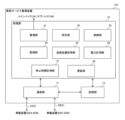
- FIG. 2 is a diagram showing an example of the configuration of a vehicle service device according to an embodiment of the present disclosure.
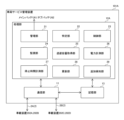
- the vehicle service management device 101 includes a communication unit 11, a processing unit 12, and a storage unit 13.
- the processing unit 12 includes a management unit 21, a specification unit 22, a control unit 23, a monitoring unit 24, a storage capacity acquisition unit 25, a power measurement unit 26, a stop time measurement unit 27, and an update unit 28.
- One or both of the communication unit 11 and the processing unit 12 are realized, for example, by a processing circuit (Circuitry) including one or more processors.
- the storage unit 13 is, for example, a non-volatile memory included in the processing circuit.
- the management unit 21 is an example of a determination unit.
- the control unit 23 is an example of a stop processing unit.
- the management unit 21 performs a state determination process to determine whether or not the vehicle 1 is in a target state. More specifically, for example, the management unit 21 monitors the output voltage of an ignition power supply of the vehicle 1 in the state determination process.
- the management unit 21 measures the output voltage of the ignition power supply of the vehicle 1, and if the measured voltage value is less than a predetermined threshold value Th2, it determines that the vehicle 1 is parked, i.e., in the target state. In this case, each in-vehicle device 202 transitions to the sleep mode because the sleep condition is satisfied.
- the management unit 21 determines that the vehicle 1 is not in the target state.
- the storage unit 13 stores type information indicating the type of service (hereinafter also referred to as the "target service") to be executed in the target state.
- the type information indicates, for example, a perimeter monitoring service and a software update service as the types of the target service.
- the management unit 21 determines that the vehicle 1 is in a target state, it acquires type information from the storage unit 13. Then, the management unit 21 outputs the acquired type information to the identification unit 22 and the storage capacity acquisition unit 25.
- the identification unit 22 When the identification unit 22 receives type information from the management unit 21, it identifies the in-vehicle device 202 (hereinafter also referred to as the "service-compatible device") that corresponds to the target service indicated by the type information.
- the in-vehicle device 202 hereinafter also referred to as the "service-compatible device”
- the storage unit 13 stores a correspondence table Tb1 that indicates a correspondence relationship E1 between a target service and a service-compatible device.
- the correspondence table Tb1 is registered in the storage unit 13 by the manufacturer of the vehicle 1, for example, when the vehicle 1 is shipped.
- the correspondence table Tb1 is an example of sequence information and an example of capacity information.
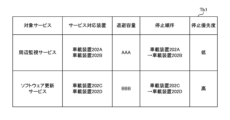
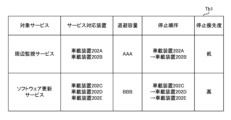
- FIG. 3 is a diagram showing an example of a correspondence table stored by a vehicle service management device according to an embodiment of the present disclosure.
- the service-compatible device (hereinafter also referred to as “service-compatible device S1") that corresponds to the perimeter monitoring service is the vehicle-mounted devices 202A and 202B.
- the service-compatible device (hereinafter also referred to as “service-compatible device S2”) that corresponds to the software update service is the vehicle-mounted devices 202C and 202D.
- the "Saving capacity”, “Stop order”, and “Stop priority” shown in FIG. 3 will be described later.
- the identification unit 22 When the identification unit 22 receives type information from the management unit 21, it identifies the service-compatible devices S1 and S2 by referring to the correspondence table Tb1 in the storage unit 13. Then, the identification unit 22 outputs device information D1 indicating the identified service-compatible devices S1 and S2 to the control unit 23.
- the storage unit 13 further stores a CAN table indicating the correspondence between the in-vehicle device 202 and the CAN-ID.
- control unit 23 When the control unit 23 receives the device information D1 from the identification unit 22, it identifies the CAN-ID corresponding to the service-compatible device S1 indicated by the device information D1 by referring to the CAN table in the storage unit 13. Specifically, the control unit 23 identifies the CAN-ID corresponding to the in-vehicle device 202A and the CAN-ID corresponding to the in-vehicle device 202B.
- the control unit 23 also identifies the CAN-ID corresponding to the service-compatible device S2 indicated by the device information D1. Specifically, the control unit 23 identifies the CAN-ID corresponding to the in-vehicle device 202C and the CAN-ID corresponding to the in-vehicle device 202D.
- control unit 23 When the control unit 23 identifies the CAN-ID corresponding to each service-enabled device, it creates a CAN frame (hereinafter also referred to as a "wake-up request frame") that includes the identified CAN-ID and a wake-up request, and outputs it to the communication unit 11.
- a CAN frame hereinafter also referred to as a "wake-up request frame”
- the memory unit 13 further stores a routing table that indicates the correspondence between the CAN-ID and the CAN bus to which the destination of the CAN frame is connected (hereinafter also referred to as the "destination bus").
- the communication unit 11 When the communication unit 11 receives a wake-up request frame from the control unit 23, it refers to the routing table in the memory unit 13 to identify the destination bus that corresponds to the CAN-ID included in the wake-up request frame, and outputs the wake-up request frame to the identified destination bus.
- each service-compatible device When each service-compatible device receives a wake-up request frame from the vehicle service management device 101, it transitions to wake-up mode.
- each service-compatible device when each service-compatible device receives a wake-up request frame from the vehicle service management device 101, it checks whether its own CAN-ID is included in the wake-up request frame.
- a service-enabled device operating in sleep mode discards CAN frames that do not include its own CAN-ID.
- a service-enabled device operating in sleep mode receives a wake-up request frame that includes its own CAN-ID, it starts up a power supply IC (Integrated Circuitry) (not shown) provided in the service-enabled device and transitions to wake-up mode.
- the service-enabled device communicates with other devices in the in-vehicle system 301 using the output voltage of the power supply IC.
- the inventors of the present application have discovered that while the vehicle 1 is stopped or parked, the main battery 61 and the sub-battery 62 are not charged or are charged insufficiently, and therefore it is likely to become difficult to maintain the target service due to a decrease in the capacity of at least one of the main battery 61 and the sub-battery 62. For example, if the power supply to the in-vehicle device 202 corresponding to the target service is stopped at an unintended timing, a malfunction such as a hang-up or failure occurs in the in-vehicle device 202, which may adversely affect the provision of the service thereafter.
- the in-vehicle system 301 solves the above problem by adopting the following configuration and operation.
- the monitoring unit 24 in the vehicle service management device 101 monitors the capacity of the main battery 61 (hereinafter also referred to as the "main battery capacity") and the capacity of the sub-battery in the target state.
- the main battery capacity and the sub-battery capacity refer to the remaining capacity of the battery.
- the monitoring unit 24 measures the output current of the main battery 61 at every predetermined time Ta.
- the monitoring unit 24 also measures the elapsed time T2 from when the main battery 61 is fully charged.
- the monitoring unit 24 then multiplies the measured current value of the main battery 61 by the elapsed time T2 to calculate the used capacity of the main battery 61.
- the monitoring unit 24 also measures the output current of the sub-battery 62 at each time Ta.
- the monitoring unit 24 also measures the elapsed time T3 from when the sub-battery 62 is fully charged.
- the monitoring unit 24 then multiplies the measured current value of the sub-battery 62 by the elapsed time T3 to calculate the usage capacity of the sub-battery 62.
- the memory unit 13 stores, for example, the capacity of the main battery 61 when fully charged and the capacity of the sub-battery 62 when fully charged.
- the monitoring unit 24 calculates the usage capacity of the main battery 61, it subtracts the usage capacity from the capacity of the main battery 61 when fully charged, which is stored in the memory unit 13, to calculate the main battery capacity.
- the monitoring unit 24 calculates the usage capacity of the sub-battery 62, it subtracts the usage capacity from the capacity of the sub-battery 62 when fully charged, which is stored in the memory unit 13, to calculate the sub-battery capacity.
- the monitoring unit 24 outputs calculation result information indicating the calculated main battery capacity and sub-battery capacity to the management unit 21.
- the save capacity acquisition unit 25 acquires the capacity of the main battery 61 and the sub-battery 62 required for saving the target service (hereinafter also referred to as "save capacity").
- the correspondence table Tb1 in the storage unit 13 indicates, in addition to the correspondence relationship E1, a correspondence relationship E2 between the target service and the backup capacity.
- the save capacity C1 corresponding to the perimeter monitoring service is "AAA” milliampere-hours.
- the save capacity C2 corresponding to the software update service is "BBB” milliampere-hours.
- the save capacity acquisition unit 25 When the save capacity acquisition unit 25 receives information from the type information from the management unit 21, it acquires the correspondence table Tb1 from the storage unit 13. Then, the save capacity acquisition unit 25 acquires the save capacity corresponding to the target service being executed based on the acquired correspondence table Tb1.
- the save capacity acquisition unit 25 when the save capacity acquisition unit 25 receives information from the type information from the management unit 21, it reads the correspondence table Tb1 in the storage unit 13. Then, by referring to the correspondence table Tb1, the save capacity acquisition unit 25 identifies the save capacity C1 corresponding to the peripheral monitoring service indicated by the type information, and the save capacity C2 corresponding to the software update service. Then, the save capacity acquisition unit 25 outputs save capacity information indicating the identified save capacities C1 and C2 to the management unit 21.
- the management unit 21 performs a save determination process to determine whether to save a target service that is being executed, based on the main battery capacity and the sub-battery capacity monitored by the monitoring unit 24 and the save capacity acquired by the save capacity acquisition unit 25.
- the management unit 21 when the management unit 21 receives the storage capacity information from the storage capacity acquisition unit 25, it calculates a value (hereinafter referred to as "reference value A") obtained by adding a predetermined margin value M to the total value of the storage capacity C1 and the storage capacity C2 indicated by the storage capacity information.
- reference value A a value obtained by adding a predetermined margin value M to the total value of the storage capacity C1 and the storage capacity C2 indicated by the storage capacity information.
- the management unit 21 makes a positive determination regarding the evacuation of the target service being executed.
- the management unit 21 determines to evacuate the peripheral monitoring service and software update service that are currently being executed.
- the management unit 21 When the management unit 21 completes the evacuation determination process, it outputs evacuation determination information indicating the types of target services that have been determined to be evacuated, i.e., the peripheral monitoring service and the software update service, to the identification unit 22.
- the management unit 21 decides not to evacuate the target service that is being executed.
- the identification unit 22 identifies a service supporting device.
- the identification unit 22 when the identification unit 22 receives evacuation judgment information from the management unit 21, the identification unit 22 refers to the correspondence table Tb1 in the storage unit 13 to identify multiple service-compatible devices S1 that correspond to the surrounding monitoring service indicated by the evacuation judgment information. The identification unit 22 also identifies multiple service-compatible devices S2 that correspond to the software update service indicated by the evacuation judgment information.
- the identification unit 22 outputs to the control unit 23 device information D2 indicating the type of target service indicated by the evacuation judgment information received from the management unit 21 and multiple service-compatible devices corresponding to the target service.
- control unit 23 performs a stop process to stop the operation of the multiple service supporting devices identified by the identification unit 22 .
- the correspondence table Tb1 in the storage unit 13 indicates, in addition to the correspondence relationships E1 and E2, a correspondence relationship E3 between a target service and an order in which the operations of a plurality of service supporting devices are stopped.
- the stop order corresponding to the perimeter monitoring service is first for in-vehicle device 202A, and second for in-vehicle device 202B.
- the stop order corresponding to the software update service is first for in-vehicle device 202C, and second for in-vehicle device 202D.
- the control unit 23 identifies the order in which the devices correspond to the target service being executed (hereinafter also referred to as the "corresponding order") based on the correspondence table Tb1 obtained from the memory unit 13.
- control unit 23 When the control unit 23 receives the device information D2 from the identification unit 22, it reads out the correspondence table Tb1 from the storage unit 13. Then, the control unit 23 refers to the correspondence table Tb1 to identify the response order corresponding to the perimeter monitoring service indicated by the device information D2 and the response order corresponding to the software update service.
- ⁇ Stop processing priority> When the device information D2 received from the identification unit 22 indicates a plurality of target services, the control unit 23 performs the stop process on the target services in descending order of priority.
- the correspondence table Tb1 in the memory unit 13 indicates, in addition to the correspondence relationships E1 to E3, a correspondence relationship E4 between the target service and the priority of the stop process (hereinafter also referred to as the "stop priority").
- the stop priority of the perimeter monitoring service is low, and the stop priority of the software update service is high.
- control unit 23 When the control unit 23 identifies the response order of each target service indicated by the device information D2 received from the identification unit 22, it checks the stop priority of each target service by referring to the response table Tb1 in the storage unit 13.
- control unit 23 checks the stop priority of each target service, it performs the stop process according to the checked stop priority.
- control unit 23 when the control unit 23 checks the stop priority corresponding to each target service, it performs a stop process on the multiple service-compatible devices corresponding to the target service with the highest stop priority according to the identified response order.
- control unit 23 sends a sleep request frame via the communication unit 11 and the destination bus to each service-compatible device corresponding to the target service with the highest stop priority, according to the identified response order.
- the control unit 23 since the software update service is the target service with the highest stop priority, the control unit 23 transmits a sleep request frame to the in-vehicle devices 202C and 202D that correspond to the software update service.
- control unit 23 When the control unit 23 transmits a sleep request frame to the in-vehicle devices 202C and 202D, it performs a stop process for the multiple service-compatible devices corresponding to the target service with the second highest stop priority according to the identified response order.
- the control unit 23 transmits a sleep request frame to the in-vehicle devices 202A and 202B corresponding to the perimeter monitoring service via the communication unit 11 and the destination bus, in the same manner as the stop process for the in-vehicle devices 202C and 202D.
- control unit 23 When the control unit 23 transmits a sleep request frame to each service-compatible device, it outputs a transmission notification N1 indicating that the sleep request frame has been transmitted to the monitoring unit 24 and the stop time measurement unit 27.
- each service-compatible device When each service-compatible device receives a sleep request frame from the vehicle service management device 101, it transitions to sleep mode. Also, when each service-compatible device receives a sleep request frame from the vehicle service management device 101, it saves various information while the target service is being executed in a storage unit (not shown). Specifically, for example, when a camera, which is an example of a service-compatible device that executes a perimeter monitoring service, receives a sleep request frame from the vehicle service management device 101, it saves information indicating its own startup time while the perimeter monitoring service is being executed, as well as captured images, etc., in the storage unit of the camera.
- Power measurement section 1 and 2 again, for example, power measurement unit 26 measures the power consumption of each service supporting device.
- the power measurement unit 26 measures, for example periodically, the current flowing through the power line 5 connected to each service-enabled device.
- the power measurement unit 26 measures the voltage of the power line 5 connected to each service-compatible device, for example, periodically. For example, the power measurement unit 26 measures the voltage at the same timing as the measurement of the current flowing through the power line 5.
- the power measurement unit 26 uses the measured current and voltage values to calculate the power consumption of each service-enabled device at the measurement time, and stores power calculation information G11 indicating the calculation results in the memory unit 13.
- the power measurement unit 26 calculates the statistical value of the power consumption of each service-compatible device every time a predetermined time T11 has elapsed since the target state was entered.
- the power measurement unit 26 calculates the average power consumption for each service-enabled device using the power calculation information G11 stored in the memory unit 13 during a predetermined time T11. The power measurement unit 26 then outputs the calculation result, i.e., power statistical information G21 indicating the average power consumption of each service-enabled device, to the update unit 28.
- the downtime measurement unit 27 measures the downtime required for each service supporting device to stop operating.
- stop time measurement unit 27 when the stop time measurement unit 27 receives a transmission notification N1 from the control unit 23, it starts a timer (not shown).
- the control unit 23 If a new NM frame does not arrive from a service-enabled device even after a certain time has elapsed since the control unit 23 sent a sleep request frame to the multiple service-enabled devices via the communication unit 11, the control unit 23 outputs a stop notification N2 indicating that the service-enabled device has stopped operating to the stop time measurement unit 27.
- the control unit 23 confirms that a new NM frame has not arrived for the multiple service-enabled devices, and outputs a stop notification N2 for each service-enabled device to the stop time measurement unit 27.
- control unit 23 when new NM frames stop arriving from all service-compatible devices for a certain target service, the control unit 23 outputs a termination notification N3 to the monitoring unit 24, indicating that all service-compatible devices have stopped operating.
- the stop time measurement unit 27 When the stop time measurement unit 27 receives a stop notification N2 from the control unit 23, it measures the time from when the timer is started until the stop notification N2 is received as the stop time of the service-compatible device indicated by the stop notification N2. Then, the stop time measurement unit 27 outputs stop time information K11 indicating the stop time for each service-compatible device to the update unit 28.
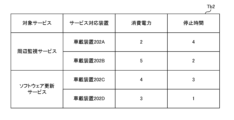
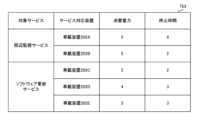
- FIG. 4 is a diagram illustrating an example of a statistical table stored by the vehicle service management device according to the embodiment of the present disclosure.
- the storage unit 13 further stores a statistical table Tb2 indicating the correspondence between the type of target service, the service-compatible device, the relative value R1 of power consumption, and the relative value R2 of downtime.
- the statistical table Tb2 is registered in the storage unit 13 by the manufacturer of the vehicle 1, for example, when the vehicle 1 is shipped.
- FIG. 4 shows the statistical table Tb2 registered in the memory unit 13 at the time of shipment of the vehicle 1. Therefore, in the statistical table Tb2 shown in FIG. 4, the relative value R1 of power consumption and the relative value R2 of downtime of each service-compatible device that executes the perimeter monitoring service are "not applicable.” Also, the relative value R1 of power consumption and the relative value R2 of downtime of each service-compatible device that executes the software update service are "not applicable.”
- Update statistics table When the update unit 28 receives the power statistical information G21 from the power measurement unit 26, it determines whether or not to update the statistical table Tb2 in the storage unit 13.
- the storage unit 13 stores a predicted value of power consumption in a target state for each service-compatible device.
- the update unit 28 When the update unit 28 receives the power statistical information G21 from the power measurement unit 26, it stores the power statistical information G21 in the storage unit 13. In addition, the update unit 28 calculates, for each service-compatible device, a relative power consumption value R1 by dividing the average power consumption indicated by the power statistical information G21 by the predicted power consumption value stored in the storage unit 13.
- the update unit 28 receives the first power statistical information G21 from the power measurement unit 26, it determines to update the statistical table Tb2. Then, the update unit 28 performs an update process L1 in which the calculated relative value R1 is associated with the service compatible device and registered in the statistical table Tb2.
- the update unit 28 receives the second or subsequent power statistical information G21 from the power measurement unit 26, it checks whether the currently calculated relative value R1 is the same as the relative value R1 of the power consumption of the corresponding service corresponding device in the statistical table Tb2 stored in the memory unit 13. If the currently calculated relative value R1 is the same as the relative value R1 of the power consumption of the corresponding service corresponding device in the statistical table Tb2, the update unit 28 determines not to update the statistical table Tb2.
- the update unit 28 determines to update the statistics table Tb2. Then, the update unit 28 performs update processing L1 on the statistics table Tb2.
- FIG. 5 is a diagram showing an example of a statistical table after updating by a vehicle service management device according to an embodiment of the present disclosure.
- the relative value R1 of the power consumption of the in-vehicle device 202A is "2".
- the relative value R1 of the power consumption of the in-vehicle device 202B is "5".
- the relative value R1 of the power consumption of the in-vehicle device 202C is "4".
- the relative value R1 of the power consumption of the in-vehicle device 202D is "3".
- the update unit 28 receives the stop time information K11 from the stop time measurement unit 27, it determines whether or not to update the statistical table Tb2.
- the storage unit 13 stores a predicted value of downtime for each service-enabled device.
- the update unit 28 When the update unit 28 receives the downtime information K11 from the power measurement unit 26, it stores the downtime information K11 in the storage unit 13. In addition, the update unit 28 calculates, for each service-compatible device, a value obtained by dividing the downtime indicated by the downtime information K11 by the predicted value of the downtime stored in the storage unit 13 as a relative value R2 of the downtime.
- the update unit 28 receives the second or subsequent stop time information K11 from the stop time measurement unit 27, it checks whether the currently calculated relative value R2 is the same as the relative value R2 of the stop time of the corresponding service corresponding device in the statistics table Tb2 stored in the memory unit 13. If the currently calculated relative value R2 is the same as the relative value R2 of the stop time of the corresponding service corresponding device in the statistics table Tb2, the update unit 28 determines not to update the statistics table Tb2.
- the update unit 28 determines to update the statistics table Tb2. Then, the update unit 28 performs update processing L2 on the statistics table Tb2.
- the relative value R2 of the stopped time of the in-vehicle device 202A is "4".
- the relative value R2 of the stopped time of the in-vehicle device 202B is “2”.
- the relative value R2 of the stopped time of the in-vehicle device 202C is "3”.
- the relative value R2 of the stopped time of the in-vehicle device 202D is "1".
- the update unit 28 updates the correspondence order in the correspondence table Tb1 based on the power consumption measured by the power measurement unit 26 and the downtime measured by the downtime measurement unit 27 .
- the update unit 28 when the update unit 28 newly registers a power consumption relative value R1 and a stop time relative value R2 in the statistical table Tb2, it calculates a value (hereinafter also referred to as "multiplication value B") obtained by multiplying the corresponding relative values R1 and R2 for each service-compatible device.
- multiplication value B a value obtained by multiplying the corresponding relative values R1 and R2 for each service-compatible device.
- the update unit 28 calculates the multiplication value B for each service-compatible device, and then determines the correspondence order based on the calculated multiple multiplication values B.
- the update unit 28 determines to stop the service-enabled devices in order starting from the service-enabled devices corresponding to the multiplication value B with the smallest value.
- the update unit 28 After determining the correspondence order for each target service, the update unit 28 reads the correspondence table Tb1 in the storage unit 13. The update unit 28 then refers to the correspondence table Tb1 to check whether the determined correspondence order for each target service is the same as the correspondence order indicated in the correspondence table Tb1.
- the update unit 28 decides not to update the correspondence relationship E3 in the correspondence table Tb1. On the other hand, if the determined correspondence order is different from the correspondence order shown in the correspondence table Tb1, the update unit 28 updates the correspondence relationship E3 in the correspondence table Tb1.
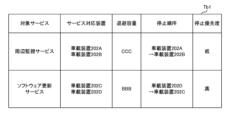
- FIG. 6 shows an example of a correspondence table after updating by a vehicle service management device according to an embodiment of the present disclosure.
- the correspondence order of the software update services has been changed so that the first correspondence is in-vehicle device 202D and the second correspondence is in-vehicle device 202C, compared to the correspondence table Tb1 shown in FIG. 3.
- the update unit 28 updates the evacuation capacity in the correspondence table Tb1 corresponding to the target service that was being executed when the monitoring unit 24 monitored the main battery capacity and the sub-battery capacity based on the main battery capacity and the sub-battery capacity monitored by the monitoring unit 24.
- the monitoring unit 24 when the monitoring unit 24 receives a transmission notification N1 from the control unit 23, it outputs calculation result information P1 indicating the most recent main battery capacity and sub-battery capacity to the update unit 28.
- the monitoring unit 24 when the monitoring unit 24 receives a termination notification N3 from the control unit 23, it outputs calculation result information P2 indicating the most recent main battery capacity and sub-battery capacity to the update unit 28.
- the update unit 28 When the update unit 28 receives the calculation result information P1 and P2, it calculates the saved capacity by subtracting the total value of the main battery capacity and the sub-battery capacity indicated by the calculation result information P2 from the total value of the main battery capacity and the sub-battery capacity indicated by the calculation result information P1.
- the update unit 28 After calculating the evacuation capacity for each target service, the update unit 28 reads the correspondence table Tb1 in the storage unit 13. The update unit 28 then refers to the correspondence table Tb1 to check whether the calculated evacuation capacity for each target service is the same as the evacuation capacity indicated in the correspondence table Tb1.
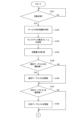
- FIGS. 7 and 8 are flowcharts that define an operation procedure when the vehicle service management device according to the embodiment of the present disclosure performs the evacuation determination process.
- the vehicle service management device 101 determines whether the vehicle 1 is in a target state (step S101), and if it is determined that the vehicle 1 is in a target state (YES in step S101), it identifies a service-compatible device that corresponds to the target service.
- the vehicle service management device 101 identifies multiple service-compatible devices (step S102).
- the vehicle service management device 101 transmits a wake-up request frame to each of the identified service-enabled devices to transition the devices to the wake-up mode (step S103).
- the vehicle service management device 101 measures the power consumption of each service-compatible device. For example, as described above, the vehicle service management device 101 periodically measures the power consumption of each service-compatible device and stores power calculation information G11 indicating the measurement results in the memory unit 13 (step S104).
- the vehicle service management device 101 determines whether or not to update the relative value R1 of power consumption indicated in the statistical table Tb2 in the memory unit 13. For example, as described above, the vehicle service management device 101 calculates the relative value R1 of power consumption for each service corresponding device. Then, the vehicle service management device 101 checks whether the calculated relative value R1 is the same as the relative value R1 of the corresponding service corresponding device in the statistical table Tb2 (step S105).
- step S105 when the vehicle service management device 101 determines that the statistical table Tb2 should be updated (YES in step S105), it performs an update process L1 in which the currently calculated relative value R1 is registered in the statistical table Tb2 in association with the service-compatible device (step S106).
- the vehicle service management device 101 determines whether to update the correspondence relationship E3 between the type of target service and the stop order indicated in the correspondence table Tb1 in the memory unit 13. For example, as described above, the vehicle service management device 101 calculates a multiplication value B by multiplying the corresponding power consumption relative value R1 and the stop time relative value R2 for each service-compatible device, and determines the stop order based on the calculated multiple multiplication values B. The vehicle service management device 101 then checks whether the determined stop order is the same as the stop order indicated in the correspondence table Tb1 (step S107).
- step S107 when the vehicle service management device 101 determines that the correspondence table Tb1 should be updated (YES in step S107), it updates the correspondence relationship E3 in the correspondence table Tb1 (step S108).
- the vehicle service management device 101 checks whether both the main battery capacity and the sub-battery capacity are below the reference value A (step S109).
- step S109 if both the main battery capacity and the sub-battery capacity are equal to or less than the reference value A (YES in step S109), the vehicle service management device 101 determines to evacuate the target service being executed (step S110).
- the vehicle service management device 101 identifies a service-compatible device that corresponds to the target service being executed.
- the vehicle service management device 101 identifies multiple service-compatible devices (step S111).
- the vehicle service management device 101 performs a stop process to stop the operation of the identified service-enabled devices. For example, as described above, the vehicle service management device 101 transmits a sleep request frame to each identified service-enabled device (step S112).
- the vehicle service management device 101 determines that the relative value R2 of the stop time indicated in the statistical table Tb2 should be updated (YES in step S114), it performs an update process L2 in which the relative value R2 calculated this time is registered in the statistical table Tb2 in association with the service corresponding device (step S115).
- the vehicle service management device 101 calculates the amount of storage space required to evacuate the target service that was being executed (step S116).
- the vehicle service management device 101 determines to update the correspondence table Tb1 (YES in step S117), it updates at least one of the correspondence relationship E3 between the service-compatible devices and the stop order and the correspondence relationship E2 between the service-compatible devices and the backup capacity in the correspondence table Tb1 (step S118).
- FIG. 9 is a diagram showing an example of a processing sequence of a vehicle service management device and an in-vehicle device in an in-vehicle system according to an embodiment of the present disclosure.
- the vehicle service management device 101 determines that vehicle 1 is in a target state (step S201).
- the vehicle service management device 101 identifies a service-compatible device that corresponds to the target service to be executed in the target state, and transmits a wake-up request frame to the identified service-compatible device.
- the vehicle service management device 101 identifies the vehicle-mounted devices 202A and 202B as the service-compatible devices, and transmits a wake-up request frame to the vehicle-mounted devices 202A and 202B (steps S202 and S203).
- step S204 and S205 transition to the wake-up mode.
- the vehicle service management device 101 measures the power consumption of each of the in-vehicle devices 202A and 202B (step S206).
- the vehicle service management device 101 determines whether or not to update the relative value R1 of power consumption indicated in the statistical table Tb2. For example, as described above, the vehicle service management device 101 calculates the relative value R1 of power consumption for each service corresponding device. Then, the vehicle service management device 101 checks whether the calculated relative value R1 is the same as the relative value R1 of power consumption of the corresponding service corresponding device in the statistical table Tb2. Here, it is assumed that the vehicle service management device 101 has determined to update the relative value R1 indicated in the statistical table Tb2 (step S207).
- the vehicle service management device 101 determines whether or not to update the correspondence relationship E3 between the type of target service and the stop order in the correspondence table Tb1. Here, it is assumed that the vehicle service management device 101 has determined to update the correspondence relationship E3 (step S208).
- the vehicle service management device 101 checks whether or not both the main battery capacity and the sub-battery capacity are equal to or less than the reference value A.
- the vehicle service management device 101 checks whether both the main battery capacity and the sub-battery capacity are equal to or less than the reference value A (step S209).
- the vehicle service management device 101 identifies the in-vehicle devices 202A and 202B as service-compatible devices that correspond to the target service being executed, and transmits a sleep request frame to the in-vehicle devices 202A and 202B (steps S210 and S211).
- step S212 and S213 the in-vehicle devices 202A and 202B transition to sleep mode.
- the vehicle service management device 101 measures the stop time of each of the in-vehicle devices 202A and 202B (step S214).
- the vehicle service management device 101 determines whether or not to update the relative value R2 of the downtime indicated in the statistical table Tb2 in the memory unit 13. For example, as described above, the vehicle service management device 101 calculates the relative value R2 of the downtime for each service corresponding device. Then, the vehicle service management device 101 checks whether the calculated relative value R2 is the same as the relative value R2 of the downtime of the corresponding service corresponding device in the statistical table Tb2. Here, it is assumed that the vehicle service management device 101 has determined to update the relative value R2 indicated in the statistical table Tb2 (step S215).
- the vehicle service management device 101 calculates the evacuation capacity required to evacuate the target service that was being executed (step S216).
- the vehicle service management device 101 determines whether or not to update the correspondence table Tb1 in the storage unit 13. For example, as described above, the vehicle service management device 101 determines the stop order of multiple service compatible devices based on the multiplied value B of the power consumption relative value R1 and the stop time relative value R2 in the statistical table Tb2. The vehicle service management device 101 then checks whether the determined stop order is the same as the stop order indicated in the correspondence table Tb1. The vehicle service management device 101 also checks whether the calculated evacuation capacity is the same as the evacuation capacity indicated in the correspondence table Tb1. Here, it is assumed that the vehicle service management device 101 has determined to update the correspondence relationship E3 in the statistical table Tb2 (step S217).
- the vehicle service management device 101 is configured to determine whether or not the running target service needs to be evacuated in the evacuation determination process, but this is not limited to this.
- the vehicle service management device 101 may be configured to determine the probability that in the handling state, the total value of the main battery capacity and the sub-battery capacity will be equal to or less than the evacuation capacity of the running target service.
- the vehicle service management device 101 calculates, for each target service, a probability corresponding to the difference between the total value of the main battery capacity and the sub-battery capacity in the target state and the evacuation capacity indicated in the correspondence table Tb1, and performs a stop process if the calculated probability is equal to or greater than a predetermined threshold.
- the vehicle service management device 101 is configured to identify a service-compatible device and perform a stop process on the service-compatible device when a positive determination is made regarding the evacuation of the target service in the evacuation determination process, but this is not limited to this.
- the vehicle service management device 101 may be configured to notify the user of the vehicle 1 of the determination result, for example.
- the vehicle service management device 101 when performing stop processing on multiple service-compatible devices, is configured to identify a stop order corresponding to the target service being executed and perform the stop processing according to the identified stop order, but this is not limited to this.
- the vehicle service management device 101 may also be configured to simultaneously stop the operation of multiple service-compatible devices.
- the vehicle service management device 101 is configured to update the correspondence relationship E3 between the type of target service and the stop order in the correspondence table Tb1 based on the power consumption and stop time of the service-supporting device, but this is not limited to this.
- the vehicle service management device 101 may also be configured not to update the correspondence relationship E3 in the correspondence table Tb1.
- the vehicle service management device 101 is configured to calculate the relative value R1 of the power consumption and the relative value R2 of the downtime of each service-compatible device, but this is not limited to this.
- a device other than the vehicle service management device 101 for example a server outside the vehicle, may be configured to calculate the relative values R1 and R2.
- the vehicle service management device 101 is configured to acquire the evacuation capacity in the evacuation determination process using the correspondence table Tb1 indicating the correspondence relationship E2 between the type of target service and the evacuation capacity, but this is not limited to this.
- the vehicle service management device 101 may also be configured to calculate the evacuation capacity using, for example, a predetermined arithmetic formula in the evacuation determination process.
- the vehicle service management device 101 is configured to update the correspondence relationship E2 between the type of target service and the storage capacity in the correspondence table Tb1 based on the main battery capacity and the sub-battery capacity monitored while the target service is being executed, but this is not limited to this.
- the vehicle service management device 101 may also be configured not to update the correspondence relationship E2 in the correspondence table Tb1.
- the power supply unit 51 is configured to include two batteries, i.e., the main battery 61 and the sub-battery 62, but this is not limited to this.
- the power supply unit 51 may be configured to include one battery or three or more batteries.
- Fig. 10 is a diagram showing an example of the configuration of an in-vehicle system according to the first modification of the embodiment of the present disclosure.
- the in-vehicle system 302 compared to the in-vehicle system 301 shown in Fig. 1, the in-vehicle system 302 further includes an in-vehicle device 202E which is the in-vehicle device 202.
- the in-vehicle device 202E is connected to the vehicle service management device 101 via a CAN bus 2B.
- the in-vehicle device 202E is also connected to the power supply unit 51 via a power line 5B.
- the in-vehicle device 202 newly added to the in-vehicle network 401 will also be referred to as a "new device,” and the in-vehicle network 401 including the new device will also be referred to as a "new network.”
- FIG. 11 is a diagram showing an example of the configuration of a vehicle service management device according to Variation 1 of an embodiment of the present disclosure.
- the vehicle service management device 101A includes a communication unit 11, a processing unit 12A, and a storage unit 13.
- One or both of the communication unit 11 and the processing unit 12A are realized, for example, by a processing circuit including one or more processors.
- the storage unit 13 is, for example, a non-volatile memory included in the processing circuit.
- the processing unit 12A further includes an addition detection unit 29.
- the addition detection unit 29 detects the addition of the in-vehicle device 202 to the in-vehicle network 401.
- the addition detection unit 29 detects the addition of the in-vehicle device 202E to the in-vehicle network 401.
- the in-vehicle device 202E when the in-vehicle device 202E is connected to the CAN bus 2B, it transmits a CAN frame (hereinafter also referred to as a "connection request frame") to the vehicle service management device 101 to request a communication connection in the in-vehicle network 401.
- a CAN frame hereinafter also referred to as a "connection request frame”
- the additional detection unit 29 when the additional detection unit 29 receives a connection request frame from the in-vehicle device 202E via the communication unit 11, it performs authentication processing of the in-vehicle device 202E using the authentication ID and authentication password included in the connection request frame.
- the additional detection unit 29 If the additional detection unit 29 succeeds in authenticating the in-vehicle device 202E, it transmits to the in-vehicle device 202E via the communication unit 11 and the CAN bus 2B a notification that the authentication was successful and type request information requesting notification of the type of service corresponding to the in-vehicle device 202E.
- the in-vehicle device 202E When the in-vehicle device 202E receives type request information from the vehicle service management device 101, it transmits service information indicating the type of service that corresponds to itself to the vehicle service management device 101 in response to the received type request information. In variant example 1, the in-vehicle device 202E transmits service information indicating a software update service as the type of service that corresponds to itself to the vehicle service management device 101.
- the additional detection unit 29 when the additional detection unit 29 receives service information from the in-vehicle device 202E via the communication unit 11, it checks whether the type of service indicated in the received service information is the target service by referring to the type information in the memory unit 13.
- the addition detection unit 29 outputs device addition information indicating the in-vehicle device 202E added to the in-vehicle network 401 and the type of the target service to the update unit 28.
- the additional detection unit 29 may be configured to periodically broadcast a search message for detecting the additional function unit via the communication unit 11.
- the additional function unit receives the search message and transmits connection request information in response to the received search message.
- the update unit 28 when the update unit 28 receives device addition information from the addition detection unit 29, it reads out the correspondence table Tb1 and the statistics table Tb2 in the storage unit 13. Then, the update unit 28 newly registers the in-vehicle device 202E indicated by the device addition information in the correspondence table Tb1 and the statistics table Tb2 as a service-compatible device that is compatible with the target service of the same type as the service type indicated by the device addition information, i.e., the software update service.
- the update unit 28 updates the stop order corresponding to the software update service in the statistical table Tb2 to the stop order in which the in-vehicle device 202E indicated by the device addition information received from the addition detection unit 29 was added last.
- FIG. 12 is a diagram showing an example of a correspondence table after updating by a vehicle service management device relating to Variation 1 of an embodiment of the present disclosure.
- the stop order that supports the "software update service” has been changed to first in-vehicle device 202A, second in-vehicle device 202B, and third in-vehicle device 202E.
- FIG. 13 is a diagram showing an example of a statistical table after updating by a vehicle service management device relating to Variation 1 of an embodiment of the present disclosure.
- vehicle-mounted device 202E is newly registered as a service-compatible device that supports the "software update service.”
- the relative value of power consumption and the relative value of downtime of vehicle-mounted device 202E are "not applicable.”
- the power measurement unit 26 calculates the power consumption of each service-enabled device in the new network in the target state, for example periodically, and stores power calculation information G12 indicating the calculation results in the memory unit 13.
- the power measurement unit 26 uses the power calculation information G12 stored in the memory unit 13 during the predetermined time T11 to calculate the average power consumption for each service-compatible device in the new network. Then, the power measurement unit 26 outputs power statistical information G22 indicating the calculation result to the update unit 28.
- the downtime measurement unit 27 measures the downtime of each service-compatible device in the new network, and outputs downtime information K21 indicating the measurement results to the update unit 28.
- FIG. 14 is a diagram showing another example of a statistical table after updating by a vehicle service management device according to an embodiment of the present disclosure.
- the management unit 21 may be configured to determine, in the evacuation determination process, that a target service being executed is to be evacuated when a predetermined operation is performed by a user of the vehicle 1.
- the user performs an operation on a navigation device (not shown) installed in vehicle 1 to instruct the start of a desired service.
- the management unit 21 in the vehicle service management device 101 receives service start information from the navigation device via the communication unit 11, it performs evacuation decision processing.
- FIG. 15 is a diagram showing an example of a correspondence table stored by a vehicle service management device relating to the second variation of the embodiment of the present disclosure.
- the correspondence table Tb11 includes a backup flag in addition to the correspondence relationships E1 to E4.
- the backup flag indicates whether or not the target service being executed is to be evacuated.
- the evacuation flag "1" indicates a target service that is to be evacuated when the power-saving service is executed.
- the evacuation flag "0" indicates a target service that is not to be evacuated when the power-saving service is executed.
- the backup flag for the peripheral monitoring service is "0.”
- the backup flag for the software update service is "1.”
- the management unit 21 When the management unit 21 receives service start information from the navigation device, it reads out the correspondence table Tb11 in the storage unit 13. Then, in the evacuation determination process, the management unit 21 refers to the correspondence table Tb11 and determines that the software update service with the evacuation flag "1" should be evacuated.
- Each process (each function) in the above-mentioned embodiments is realized by a processing circuit including one or more processors.
- the processing circuit may be composed of an integrated circuit or the like that combines one or more memories, various analog circuits, and various digital circuits in addition to the one or more processors.
- the one or more memories store programs (instructions) that cause the one or more processors to execute each of the above processes.
- the one or more processors may execute each of the above processes according to the programs read from the one or more memories, or may execute each of the above processes according to a logic circuit designed in advance to execute each of the above processes.
- the processor may be any of various processors suitable for computer control, such as a CPU (Central Processing Unit), a GPU (Graphics Processing Unit), a DSP (Digital Signal Processor), an FPGA (Field Programmable Gate Array), and an ASIC (Application Specific Integrated Circuit).
- the physically separated processors may cooperate with each other to execute the above processes.
- the processors mounted on each of the physically separated computers may cooperate with each other via a network such as a LAN (Local Area Network), a WAN (Wide Area Network), or the Internet to execute the above processes.
- the above program may be installed into the memory from an external server device or the like via the network, or may be distributed in a state stored on a recording medium such as a CD-ROM (Compact Disc Read Only Memory), DVD-ROM (Digital Versatile Disc Read Only Memory), or semiconductor memory, and installed into the memory from the recording medium.
- a recording medium such as a CD-ROM (Compact Disc Read Only Memory), DVD-ROM (Digital Versatile Disc Read Only Memory), or semiconductor memory, and installed into the memory from the recording medium.
- a vehicle service management device mounted on a vehicle A processing circuit is provided, The processing circuitry includes: monitoring a battery capacity, which is a capacity of a battery provided in the vehicle, in a target state in which the vehicle is stopped or parked; acquiring a storage capacity, which is a capacity of the battery required for storage of a service executed in the vehicle, the storage capacity being required for storage of a target service, which is the service executed in the target state; A vehicle service management device performs an evacuation determination process for determining evacuation of the target service being executed based on the monitored battery capacity and the acquired evacuation capacity.
Landscapes
- Engineering & Computer Science (AREA)
- Business, Economics & Management (AREA)
- Tourism & Hospitality (AREA)
- Mechanical Engineering (AREA)
- General Health & Medical Sciences (AREA)
- General Physics & Mathematics (AREA)
- Marketing (AREA)
- Primary Health Care (AREA)
- Strategic Management (AREA)
- Physics & Mathematics (AREA)
- General Business, Economics & Management (AREA)
- Human Resources & Organizations (AREA)
- Economics (AREA)
- Theoretical Computer Science (AREA)
- Health & Medical Sciences (AREA)
- Power Engineering (AREA)
- Charge And Discharge Circuits For Batteries Or The Like (AREA)
- Electric Propulsion And Braking For Vehicles (AREA)
- Management, Administration, Business Operations System, And Electronic Commerce (AREA)
Priority Applications (1)
| Application Number | Priority Date | Filing Date | Title |
|---|---|---|---|
| CN202480038513.3A CN121311390A (zh) | 2023-06-12 | 2024-05-27 | 车辆服务管理装置、车辆服务管理方法及车辆服务管理程序 |
Applications Claiming Priority (2)
| Application Number | Priority Date | Filing Date | Title |
|---|---|---|---|
| JP2023096092A JP2024177764A (ja) | 2023-06-12 | 2023-06-12 | 車両サービス管理装置、車両サービス管理方法および車両サービス管理プログラム |
| JP2023-096092 | 2023-06-12 |
Publications (1)
| Publication Number | Publication Date |
|---|---|
| WO2024257595A1 true WO2024257595A1 (ja) | 2024-12-19 |
Family
ID=93851760
Family Applications (1)
| Application Number | Title | Priority Date | Filing Date |
|---|---|---|---|
| PCT/JP2024/019431 Ceased WO2024257595A1 (ja) | 2023-06-12 | 2024-05-27 | 車両サービス管理装置、車両サービス管理方法および車両サービス管理プログラム |
Country Status (3)
| Country | Link |
|---|---|
| JP (1) | JP2024177764A (https=) |
| CN (1) | CN121311390A (https=) |
| WO (1) | WO2024257595A1 (https=) |
Families Citing this family (1)
| Publication number | Priority date | Publication date | Assignee | Title |
|---|---|---|---|---|
| WO2026004818A1 (ja) * | 2024-06-28 | 2026-01-02 | 株式会社デンソー | 車載システムおよび制御方法 |
Citations (3)
| Publication number | Priority date | Publication date | Assignee | Title |
|---|---|---|---|---|
| JP2015196218A (ja) * | 2014-04-01 | 2015-11-09 | 富士ソフト株式会社 | ロボット用動作計画作成システムおよび作成方法 |
| JP2019036140A (ja) * | 2017-08-16 | 2019-03-07 | 住友電気工業株式会社 | 制御装置、制御方法、およびコンピュータプログラム |
| JP2022128621A (ja) * | 2021-02-24 | 2022-09-05 | Necプラットフォームズ株式会社 | データ制御装置、データ制御方法、データ制御システム、およびデータ制御プログラム |
-
2023
- 2023-06-12 JP JP2023096092A patent/JP2024177764A/ja active Pending
-
2024
- 2024-05-27 CN CN202480038513.3A patent/CN121311390A/zh active Pending
- 2024-05-27 WO PCT/JP2024/019431 patent/WO2024257595A1/ja not_active Ceased
Patent Citations (3)
| Publication number | Priority date | Publication date | Assignee | Title |
|---|---|---|---|---|
| JP2015196218A (ja) * | 2014-04-01 | 2015-11-09 | 富士ソフト株式会社 | ロボット用動作計画作成システムおよび作成方法 |
| JP2019036140A (ja) * | 2017-08-16 | 2019-03-07 | 住友電気工業株式会社 | 制御装置、制御方法、およびコンピュータプログラム |
| JP2022128621A (ja) * | 2021-02-24 | 2022-09-05 | Necプラットフォームズ株式会社 | データ制御装置、データ制御方法、データ制御システム、およびデータ制御プログラム |
Also Published As
| Publication number | Publication date |
|---|---|
| JP2024177764A (ja) | 2024-12-24 |
| CN121311390A (zh) | 2026-01-09 |
Similar Documents
| Publication | Publication Date | Title |
|---|---|---|
| KR101393539B1 (ko) | 자동차 통합 네트워크 시스템 | |
| US20130159489A1 (en) | System and method for managing ethernet communication network for use in vehicle | |
| US11794672B2 (en) | Apparatus and method for controlling vehicle | |
| WO2024257595A1 (ja) | 車両サービス管理装置、車両サービス管理方法および車両サービス管理プログラム | |
| JP2011022934A (ja) | 電子制御ユニット、異常検出方法 | |
| US20240223404A1 (en) | On-board relay apparatus, on-board apparatus, and sleep notification method | |
| CN117480761A (zh) | 中继装置、中继系统、中继方法及计算机程序 | |
| US20110271132A1 (en) | Method and device for controlling the awaking of facilities belonging to at least one multiplexed network, by counting untimely wake-ups | |
| JP2012218467A (ja) | 電子制御装置 | |
| US20240192978A1 (en) | Power management on a vehicle | |
| US20240192977A1 (en) | Power management on a vehicle | |
| JP7525571B2 (ja) | 車載中継装置、スリープ制御方法およびスリープ制御プログラム | |
| WO2020105657A1 (ja) | 車載中継装置及び中継方法 | |
| JP7542042B2 (ja) | 車載装置、接続先通知方法および接続先通知プログラム | |
| WO2024127949A1 (ja) | 車載装置、起動制御方法および起動制御プログラム | |
| JP7790327B2 (ja) | 車載制御装置、動作制御方法および通信システム | |
| WO2025164388A1 (ja) | 異常判定装置、異常判定方法および異常判定プログラム | |
| US12334764B2 (en) | Battery depletion prevention system, battery depletion prevention method, and non-transitory recording medium | |
| US20230030558A1 (en) | Electronic control unit, information processing method, and non-transitory storage medium | |
| EP4701137A1 (en) | Managing activation and failure detection in a vehicle network | |
| US20260067128A1 (en) | In-vehicle network system and control method | |
| WO2024214525A1 (ja) | 車載中継装置、車載装置および車載システム | |
| JP2025135135A (ja) | 車両サービス管理装置、車両サービス管理方法および車両サービス管理プログラム | |
| JP2026019364A (ja) | 車載管理システムおよび管理方法 | |
| WO2024101115A1 (ja) | 車載装置、機能制御方法および機能制御プログラム |
Legal Events
| Date | Code | Title | Description |
|---|---|---|---|
| 121 | Ep: the epo has been informed by wipo that ep was designated in this application |
Ref document number: 24823215 Country of ref document: EP Kind code of ref document: A1 |
|
| WWE | Wipo information: entry into national phase |
Ref document number: CN2024800385133 Country of ref document: CN |
|
| NENP | Non-entry into the national phase |
Ref country code: DE |