WO2024256833A1 - Fluorochemical preparation - Google Patents
Fluorochemical preparation Download PDFInfo
- Publication number
- WO2024256833A1 WO2024256833A1 PCT/GB2024/051525 GB2024051525W WO2024256833A1 WO 2024256833 A1 WO2024256833 A1 WO 2024256833A1 GB 2024051525 W GB2024051525 W GB 2024051525W WO 2024256833 A1 WO2024256833 A1 WO 2024256833A1
- Authority
- WO
- WIPO (PCT)
- Prior art keywords
- activator
- fluoride
- acceptor
- water
- suitably
- Prior art date
- Legal status (The legal status is an assumption and is not a legal conclusion. Google has not performed a legal analysis and makes no representation as to the accuracy of the status listed.)
- Ceased
Links
Classifications
-
- C—CHEMISTRY; METALLURGY
- C07—ORGANIC CHEMISTRY
- C07B—GENERAL METHODS OF ORGANIC CHEMISTRY; APPARATUS THEREFOR
- C07B39/00—Halogenation
-
- C—CHEMISTRY; METALLURGY
- C07—ORGANIC CHEMISTRY
- C07C—ACYCLIC OR CARBOCYCLIC COMPOUNDS
- C07C201/00—Preparation of esters of nitric or nitrous acid or of compounds containing nitro or nitroso groups bound to a carbon skeleton
- C07C201/06—Preparation of nitro compounds
- C07C201/12—Preparation of nitro compounds by reactions not involving the formation of nitro groups
-
- C—CHEMISTRY; METALLURGY
- C07—ORGANIC CHEMISTRY
- C07C—ACYCLIC OR CARBOCYCLIC COMPOUNDS
- C07C247/00—Compounds containing azido groups
- C07C247/16—Compounds containing azido groups with azido groups bound to carbon atoms of six-membered aromatic rings of a carbon skeleton
-
- C—CHEMISTRY; METALLURGY
- C07—ORGANIC CHEMISTRY
- C07C—ACYCLIC OR CARBOCYCLIC COMPOUNDS
- C07C25/00—Compounds containing at least one halogen atom bound to a six-membered aromatic ring
- C07C25/02—Monocyclic aromatic halogenated hydrocarbons
- C07C25/13—Monocyclic aromatic halogenated hydrocarbons containing fluorine
-
- C—CHEMISTRY; METALLURGY
- C07—ORGANIC CHEMISTRY
- C07C—ACYCLIC OR CARBOCYCLIC COMPOUNDS
- C07C253/00—Preparation of carboxylic acid nitriles
- C07C253/30—Preparation of carboxylic acid nitriles by reactions not involving the formation of cyano groups
-
- C—CHEMISTRY; METALLURGY
- C07—ORGANIC CHEMISTRY
- C07F—ACYCLIC, CARBOCYCLIC OR HETEROCYCLIC COMPOUNDS CONTAINING ELEMENTS OTHER THAN CARBON, HYDROGEN, HALOGEN, OXYGEN, NITROGEN, SULFUR, SELENIUM OR TELLURIUM
- C07F5/00—Compounds containing elements of Groups 3 or 13 of the Periodic Table
- C07F5/02—Boron compounds
- C07F5/025—Boronic and borinic acid compounds
-
- C—CHEMISTRY; METALLURGY
- C07—ORGANIC CHEMISTRY
- C07F—ACYCLIC, CARBOCYCLIC OR HETEROCYCLIC COMPOUNDS CONTAINING ELEMENTS OTHER THAN CARBON, HYDROGEN, HALOGEN, OXYGEN, NITROGEN, SULFUR, SELENIUM OR TELLURIUM
- C07F7/00—Compounds containing elements of Groups 4 or 14 of the Periodic Table
- C07F7/02—Silicon compounds
- C07F7/08—Compounds having one or more C—Si linkages
- C07F7/12—Organo silicon halides
Definitions
- the present invention relates to processes for preparing fluorochemicals, as well as the fluorochemicals resulting therefrom.
- the processes of the present invention can avoid the need to use hydrofluoric acid as an intermediate for fluorochemical production.
- Fluorochemicals play a crucial role in modern society, and their use is highly important for a wide range of industrial, commercial, and consumer applications. They are found in everything from non-stick cookware to refrigerants, from firefighting foams to medical imaging agents, as well as pharmaceuticals and agrochemicals.
- the incorporation of fluorine into pharmaceutical molecules has been shown to improve their efficacy, bioavailability, and metabolic stability.
- many modern drugs, including several blockbuster drugs contain fluorine, most commonly in form of fluoroarenes.
- a process for the preparation of a fluorochemical comprising the step of: a) mixing together an inorganic fluoride source, an activator and a fluoride acceptor, wherein the activator is an organic compound having a pK a of -4 to 4.2 in water, and a water solubility of greater than 0.05 mol/L; and the fluoride acceptor is a hydroxide, an oxide, an alkoxide, a halide or a pseudohalide of B, Si, Ge, Al, P, Sb, Ti, S or Sn.
- a process for the preparation of a fluorochemical comprising the step of: a) mixing together an inorganic fluoride source, an activator and a fluoride acceptor, wherein the activator is selected from any one of compounds 1-55 defined herein, or a salt thereof; and the fluoride acceptor is a hydroxide, an oxide, an alkoxide, a halide or a pseudohalide of B, Si, Ge, Al, P, Sb, Ti, S or Sn.
- a process for the preparation of a fluorochemical comprising the step of: a) mixing together an inorganic fluoride source, an activator and a fluoride acceptor, wherein the activator is an organic compound having a pK a of -4 to 4.2 in water, and a water solubility of greater than 0.05 mol/L; and the fluoride acceptor is selected from B(OH)s, B(OH)2R, RsSiCI, SiCL, RSO2CI (wherein each R is independently (1-2C)alkyl, phenyl or tolyl, any of which are optionally substituted with one or more halo groups), (BOH ⁇ Os, H2B4O7, B2O3, SiO2, GeO2, AI2O3, Sb2Os or SbCIs.
- a process for the preparation of a fluorochemical comprising the step of: a) mixing together an inorganic fluoride source, an activator and a fluoride acceptor, wherein the activator is selected from any one of compounds 1-55 defined herein, or a salt thereof; and the fluoride acceptor is selected from B(OH)s, B(OH)2R, RsSiCI, SiCL, RSO2CI (wherein each R is independently (1-2C)alkyl, phenyl or tolyl, any of which are optionally substituted with one or more halo groups), (BOH ⁇ Os, H2B4O7, B2O3, SiO2, GeO2, AI2O3, Sb2Os or SbCIs.
- a process for the preparation of a fluorochemical comprising the step of: a) mixing together an inorganic fluoride source, an activator and a fluoride acceptor, wherein the activator is selected from any one of compounds 1-56 defined herein, or a salt thereof; and the fluoride acceptor is a hydroxide, an oxide, an alkoxide, a halide or a pseudohalide of B, Si, Ge, Al, P, Sb, Ti, S or Sn.
- a process for the preparation of a fluorochemical comprising the step of: a) mixing together an inorganic fluoride source, an activator and a fluoride acceptor, wherein the activator is selected from any one of compounds 1-56 defined herein, or a salt thereof; and the fluoride acceptor is selected from B(OH)s, B(OH)2R, RsSiCI, SiCk, RSO2CI (wherein each R is independently (1-2C)alkyl, phenyl or tolyl, any of which are optionally substituted with one or more halo groups), (BOH)sO3, H2B4O7, B2O3, SiC>2, GeO2, AI2O3, Sb2Os or SbCIs.
- the activator is selected from any one of compounds 1 , 2, 12, 24, 28, 51 or 53 defined herein, or salt thereof. More suitably, the activator is selected from any one of compounds 1 , 24 or 51 defined herein, or a salt thereof. Most suitably, the activator is compound 24 defined herein (i.e. , oxalic acid), or a salt thereof.
- the activator is selected from any one of compounds 1 , 2, 12, 24, 28, 51 , 53 or 56 defined herein, or salt thereof. More suitably, the activator is selected from any one of compounds 1 , 24, 51 or 56 defined herein, or a salt thereof. Most suitably, the activator is compound 24 defined herein (i.e., oxalic acid), or a salt thereof.
- the fluoride acceptor is selected from B(OH)s, 4-fluorophenyl-B(OH)2, B2O3, SiO2, PhsSiCI, SiCU, P-TOISO2CI, GeO2 or AI2O3. More suitably, the fluoride acceptor is selected from B(OH)s, SiO2, SiCk or P-TOISO2CI. Most suitably, the fluoride acceptor is B(OH)s.
- the activator is selected from any one of compounds 1 , 2, 12, 24, 28, 51 or 53 defined herein, or a salt thereof, and the fluoride acceptor is selected from B(OH)s, 4- fluorophenyl-B(OH)2, B2O3, SiO2, PhsSiCI, SiCk, P-TOISO2CI, GeO2 or AI2O3. More suitably, the activator is selected from any one of the compounds 1 , 24 or 51 defined herein, or a salt thereof, and the fluoride acceptor is selected from B(OH)s, SiO2, SiCk or P-TOISO2CI. Most suitably, the activator is compound 24 defined herein (i.e., oxalic acid), or a salt thereof, and the fluoride acceptor is B(OH)s.
- the activator is selected from any one of compounds 1 , 2, 12, 24, 28, 51 , 53 or 56 defined herein, or a salt thereof, and the fluoride acceptor is selected from B(OH)s, 4- fluorophenyl-B(OH)2, B2O3, SiC>2, PhsSiCI, SiCk, P-TOISO2CI, GeC>2 or AI2O3. More suitably, the activator is selected from any one of the compounds 1 , 24, 51 or 56 defined herein, or a salt thereof, and the fluoride acceptor is selected from B(OH)s, SiC>2, SiCk or P-TOISO2CI. Most suitably, the activator is compound 24 defined herein (i.e. , oxalic acid), or a salt thereof, and the fluoride acceptor is B(OH)s.
- the inorganic fluoride source in any one of the first, second, third, fourth, fifth or sixth aspects of the present invention is CaF2.
- the CaF2 may be in its naturally occurring form (i.e., fluorspar) or may be a synthetic, industrially produced material having fewer impurities (e.g., acidspar or metspar).
- the CaF2 may be present within a waste product (e.g., the CaF2 may be CaF2 sludge) or may have been obtained (e.g., purified) from such a waste product.
- the MgF2 may be derived from waste fluorochemicals.
- a fluorochemical obtained, directly obtained or obtainable by the process of any one of the first, second, third, fourth, fifth or sixth aspects of the present invention is provided.
- (m-nC) or "(m-nC) group” used alone or as a prefix, refers to any group having m to n carbon atoms.
- alkyl refers to straight or branched chain alkyl moieties, typically having 1 , 2, 3, 4, 5 or 6 carbon atoms. This term includes reference to groups such as methyl, ethyl, propyl (n-propyl or isopropyl), butyl (n-butyl, sec-butyl or tert-butyl), pentyl, hexyl and the like. In particular, an alkyl may have 1 , 2 or 3 carbon atoms.
- aryl or “aromatic” as used herein means an aromatic ring system comprising 6, 7, 8, 9 or 10 ring carbon atoms.
- Aryl is often phenyl but may be a polycyclic ring system, having two or more rings, at least one of which is aromatic. This term includes reference to groups such as phenyl, naphthyl and the like. A particularly suitable aryl group is phenyl.
- heteroaryl or “heteroaromatic” means an aromatic mono-, bi-, or polycyclic ring incorporating one or more (for example 1-4, particularly 1 , 2 or 3) heteroatoms selected from nitrogen, oxygen or sulfur.
- heteroaryl groups are monocyclic and bicyclic groups containing from five to twelve ring members, and more usually from five to ten ring members.
- the heteroaryl group can be, for example, a 5- or 6-membered monocyclic ring or a 9- or 10- membered bicyclic ring, for example a bicyclic structure formed from fused five and six membered rings or two fused six membered rings. Each ring may contain up to about four heteroatoms typically selected from nitrogen, sulfur and oxygen.
- substituted as used herein in reference to a moiety means that one or more, especially 1 , 2 or 3, of the hydrogen atoms in said moiety are replaced independently of each other by the corresponding number of the described substituents.
- optionally substituted as used herein means substituted or unsubstituted.
- the first, second, third, fourth, fifth and sixth aspects of the present invention provide a process for the preparation of a fluorochemical.
- fluoride sources such as CaF2 and others
- This is achieved by reacting an inorganic fluoride source with an activator and a fluoride acceptor.
- the process of the invention therefore allows for the preparation of value-added fluorochemicals using safer and environmentally friendly techniques.
- the processes of the present invention require the use of an inorganic fluoride source as one of the starting reagents.
- an inorganic fluoride source As described hereinbefore, the use of mineral fluoride sources is preferred, the majority of which have high lattice energies (determined by the Born-Haber cycle).
- the inorganic fluoride source may have a lattice energy of 1500 kJ/mol or greater.
- the inorganic fluoride source has a lattice energy of 2000 kJ/mol or greater. More suitably, the inorganic fluoride source has a lattice energy of 2300 kJ/mol or greater.
- the inorganic fluoride source may be an ionic compound.
- the inorganic fluoride source is an ionic compound comprising M 2+ and F; wherein M 2+ is an alkaline earth metal cation (i.e. , a group II metal cation).
- M 2+ may be Be 2+ , Mg 2+ , Ca 2+ , Sr 2+ or Ba 2+ .
- M 2+ is Mg 2+ , Ca 2+ , Sr 2+ or Ba 2+ .
- M 2+ is Ca 2+ .
- the activator may be an M 2+ -sequestering agent.
- the activator promotes the formation of the fluorochemical by sequestering the alkaline earth metal species that is formed when the inorganic fluoride source reacts with the fluoride acceptor.
- the M 2+ -sequestering agent comprises one or more M 2+ -coordinating groups. More suitably, the M 2+ -sequestering agent comprises two or more M 2+ -coordinating groups.
- M 2+ is Ca and the M 2+ -sequestering agent comprises two or more M 2+ -coordinating groups.
- Each M 2+ coordinating group may independently be an oxygen-containing M 2+ - coordinating group, a nitrogen-containing M 2+ -coordinating group or a sulfur-containing M 2+ - coordinating group.
- each M 2+ coordinating group is an oxygen-containing M 2+ - coordinating group.
- Oxygen-containing M 2+ coordinating groups may be hydroxy groups or oxo groups.
- Nitrogen-containing M 2+ coordinating groups may be amino groups.
- Sulfur-containing M 2+ coordinating groups may be thiol groups.
- the M 2+ -sequestering agent comprises two hydroxy M 2+ - coordinating groups (i.e., the M 2+ -sequestering agent is a bidentate ligand).
- M 2+ is Ca and the M 2+ -sequestering agent comprises two hydroxy M 2+ - coordinating groups (i.e., the M 2+ -sequestering agent is a bidentate ligand).
- the M 2+ -coordinating group may be capable of binding to M 2+ , thereby coordinating the M 2+ -sequestering agent (i.e., the activator) to M 2+ .
- the M 2+ -sequestering agent comprises two or more M 2+ -coordinating groups
- the M 2+ -sequestering agent may form a chelate with M 2+ .
- the M 2+ -sequestering agent forms a 5-, 6- or 7-membered chelate with M 2+ . More suitably, the M 2+ -sequestering agent forms a 5- or 6-membered chelate with M 2+ .
- the M 2+ -sequestering agent forms a 5-membered chelate with M 2+ .
- the M 2+ -sequestering agent comprises a first M 2+ -coordinating group and a second M 2+ -coordinating group, wherein the first M 2+ -coordinating group is separated from the second M 2+ -coordinating group by 3, 4 or 5 bond lengths.
- the M 2+ -sequestering agent comprises a first M 2+ -coordinating group and a second M 2+ -coordinating group, wherein the first M 2+ -coordinating group is separated from the second M 2+ -coordinating group by 3 or 4 bond lengths.
- the M 2+ -sequestering agent comprises a first M 2+ -coordinating group and a second M 2+ -coordinating group, wherein the first M 2+ -coordinating group is separated from the second M 2+ -coordinating group by 3 bond lengths.
- compound 24 i.e., oxalic acid
- M 2+ - sequestering agent i.e., activator
- the activator may have a pK a of -3 to 3 in water.
- the activator has a pK a of -3 to 2 in water.
- the activator has a pK a of -2.8 to 1.5 in water. It will be understood that the pK a values described herein refer to the dissociation of a first proton in the activator (i.e., pK a 1).
- the activator may be a mono-carboxylic acid, a di-carboxylic acid, a tri-carboxylic acid, a tetra-carboxylic acid, a penta-carboxylic acid, a hexa-carboxylic acid, a dione compound comprising 2-6 carbon atoms, or an SOs-Lewis base adduct.
- the activator is a mono-carboxylic acid, a di-carboxylic acid, a tetra-carboxylic acid, a dione-dihydroxy compound comprising 3-5 carbon atoms, a nitrogen-containing SOs-Lewis base adduct, or an oxygen-containing SOs-Lewis base adduct.
- the activator has a pK a of -3 to 3 in water and the activator is a mono-carboxylic acid, a di-carboxylic acid, a tetra-carboxylic acid, a dione-dihydroxy compound comprising 3-5 carbon atoms, a nitrogen-containing SOs-Lewis base adduct, or an oxygen-containing SOs-Lewis base adduct.
- the activator has a water solubility of greater than 0.10 mol/L. More suitably, the activator has a water solubility of greater than 0.15 mol/L. More suitably, the activator has a water solubility of greater than 0.19 mol/L. Even more suitably, the activator has a water solubility of greater than 0.50 mol/L. Yet still more suitably, the activator has a water solubility of greater than 0.75 mol/L.
- the activator has a water solubility of greater than 1.00 mol/L. Most suitably, the activator has a water solubility of greater than 1 .25 mol/L.
- the water solubility values described herein are determined by mixing (at 1000 rpm) a molar quantity of the activator in 1 mL distilled water for 1h at 20 °C. Following mixing, the molar quantity of the activator remaining (i.e. , not dissolved) is determined and the solubility in water of the activator is calculated accordingly.
- the activator has a pK a of -3 to 3 in water and a water solubility of greater than 0.10 mol/L. In particular embodiments, the activator has a pK a of -3 to 2 in water and a water solubility of greater than 0.19 mol/L.
- the activator has a pK a of -3 to 3 in water and a water solubility of greater than 1.00 mol/L. In particular embodiments, the activator has a pK a of -3 to 2 in water and a water solubility of greater than 1 .25 mol/L.
- the activator may be selected from any one of the following compounds 1-55:
- the activator may be selected from any one of the following compounds 1-56:
- the activator is selected from any one of the following compounds 1, 2, 8- 12, 24, 27, 28, 33, 38, 47 or 51-53:
- the activator is selected from any one of the following compounds 1, 2, 8- 12, 24, 27, 28, 33, 38, 47, 51-53 or 56:
- the activator is selected from any one of the following compounds 1,
- the activator is selected from any one of the following compounds 1, 2, 12, 24, 28, 51, 53 or 56: or a salt thereof.
- the activator is selected from any one of the following compounds 1 , 24 or 51:
- the activator is selected from any one of the following compounds 1 , 24, 51 or 56: or a salt thereof.
- the activator is compound 24 (i.e. , oxalic acid):
- salts of activators mentioned herein are also embraced by the invention, and may include ammonium salts (e.g., NH 4 + or TBA + ), group 1 salts (e.g., Li + , K + , Na + or Cs + ) and hydrates (e.g., dihydrates).
- the activator may therefore be oxalic acid, ammonium oxalate, tetra butyl ammonium oxalate, lithium oxalate, potassium oxalate, sodium oxalate, cesium oxalate or oxalic acid dihydrate, for example.
- the activator is oxalic acid dihydrate.
- the inorganic fluoride source may be CaF2, MgF2, BaF2, SrF2 or Cas(PO 4 )3F.
- the inorganic fluoride source is CaF2 or Cas PC hF.
- the inorganic fluoride source is CaF2 (e.g., CaF2 sludge, fluorspar, metspar or acidspar, of which acidspar is typically used).
- the activator is selected from any one of compounds 1-55 described herein, or a salt thereof, and the inorganic fluoride source is CaF2, MgF2, BaF2, SrF2 or Cas(PO4)3F.
- the activator is selected from any one of compounds 1 , 2, 12, 24, 28, 51 or 53 described herein, or a salt thereof, and the inorganic fluoride source is CaF2 or Cas PC hF.
- the activator is selected from any one of compounds 1-56 described herein, or a salt thereof, and the inorganic fluoride source is CaF2, MgF2, BaF2, SrF2 or Cas(PO4)3F.
- the activator is selected from any one of compounds 1 , 2, 12, 24, 28, 51 , 53 or 56 described herein, or a salt thereof, and the inorganic fluoride source is CaF2 or Cas PC hF.
- the fluoride acceptor can bind to fluoride (i.e. , Fj from the inorganic fluoride source, thereby forming a fluorochemical.
- fluorochemical denotes a fluorine- containing compound that is not the inorganic fluoride source.
- the fluorochemical may be used in a variety of industrial applications. For example, it may be that the fluorochemicals formed as part of the present invention are used directly as a fluorinating reagent to introduce fluorine into organic molecules, or further transformed to afford alternative types of fluorine- containing compounds, some of which may also be useful as fluorinating reagents (e.g., for the Halex reaction).
- the fluorochemicals may alternatively be used as ionic liquids.
- the fluoride acceptor may be: a hydroxide of B, Si, Ge, Al, Sb, Ti; an oxide of B, Si, Ge, Al, P, Sb, Ti; an alkoxide of B, Si, Ge, Al, Sb, Ti; or a halide or pseudohalide of B, Si, S, Ge, Al, Sb, Ti, Sn.
- the fluoride acceptor is: a hydroxide of B; an oxide of B, Si, Ge, Al, P, Sb, Ti; or a halide or pseudohalide of Si, S or Sb.
- the fluoride acceptor is a hydroxide of B, Si, Ge, Al, Sb, Ti; an oxide of B, Si, Ge, Al, P, Sb, Ti; an alkoxide of B, Si, Ge, Al, Sb, Ti; or a halide or pseudohalide of B, Si, S, Ge, Al, Sb, Ti, Sn and the inorganic fluoride source is CaF2, MgF2, BaF 2 , SrF 2 or Ca 5 (PO4)3F.
- the fluoride acceptor is: a hydroxide of B; an oxide of B, Si, Ge, Al, P, Sb, Ti; or a halide or pseudohalide of Si, S or Sb and the inorganic fluoride source is CaF2 or Cas PO ⁇ sF.
- the activator is selected from any one of compounds 1-55 described herein, or a salt thereof, and the fluoride acceptor is a hydroxide of B, Si, Ge, Al, Sb, Ti; an oxide of B, Si, Ge, Al, P, Sb, Ti; an alkoxide of B, Si, Ge, Al, Sb, Ti; or a halide or pseudohalide of B, Si, S, Ge, Al, Sb, Ti, Sn.
- the inorganic fluoride source may be CaF2, MgF2, BaF2, SrF2 or Cas PO ⁇ sF.
- the activator is selected from any one of compounds 1-56 described herein, or a salt thereof, and the fluoride acceptor is a hydroxide of B, Si, Ge, Al, Sb, Ti; an oxide of B, Si, Ge, Al, P, Sb, Ti; an alkoxide of B, Si, Ge, Al, Sb, Ti; or a halide or pseudohalide of B, Si, S, Ge, Al, Sb, Ti, Sn.
- the inorganic fluoride source may be CaF2, MgF2, BaF2, SrF2 or Cas PO ⁇ sF.
- the activator is selected from any one of compounds 1 , 2, 12, 24, 28, 51 or 53 described herein, or a salt thereof, and the fluoride acceptor is: a hydroxide of B; an oxide of B, Si, Ge, Al, P, Sb, Ti; or a halide or pseudohalide of Si, S or Sb.
- the inorganic fluoride source may be CaF2 or Cas PO ⁇ sF.
- the activator is selected from any one of compounds 1 , 2, 12, 24, 28, 51 , 53 or 56 described herein, or a salt thereof, and the fluoride acceptor is: a hydroxide of B; an oxide of B, Si, Ge, Al, P, Sb, Ti; or a halide or pseudohalide of Si, S or Sb.
- the inorganic fluoride source may be CaF2 or Cas PO ⁇ sF.
- the fluoride acceptor may be a hydroxide of B.
- the fluoride acceptor may be B(OH)s (i.e.
- orthoboric acid B(OH)2R, B(OH)R2 (wherein each R is independently (1-6C)alkyl, aryl or heteroaryl, wherein any alkyl is optionally substituted with one or more halo, hydroxide, oxo, amino, amido, thiol or phosphate groups, and wherein any aryl or heteroaryl is optionally substituted with one or more (1 -3C)alkyl, halo, hydroxide, oxo, amino, amido, thiol or phosphate groups), (BOH)sO3 (i.e., metaboric acid) or H2B4O7 (i.e., tetraboric acid).
- R is independently (1-6C)alkyl, aryl or heteroaryl, wherein any alkyl is optionally substituted with one or more halo, hydroxide, oxo, amino, amido, thiol or phosphate groups, and wherein any aryl or heteroaryl
- the fluoride acceptor is B(OH)s, B(OH)2R, B(OH)R2 (wherein each R is independently (1-4C)alkyl, aryl or heteroaryl, wherein any aryl or heteroaryl is optionally substituted with one or more halo or hydroxide groups), (BOH)sO3 or H2B4O7. More suitably, the fluoride acceptor is selected from B(OH)s, B(OH)2R (wherein each R is independently (1- 2C)alkyl, phenyl or tolyl, any of which are optionally substituted with one or more halo groups), (BOH) 3 O 3 or H2B4O7.
- the fluoride acceptor is selected from B(OH)s, B(OH)2R (wherein each R is independently phenyl optionally substituted with one or more fluoro) or H2B4O7.
- the fluoride acceptor is B(OH)s or 4-fluorophenyl-B(OH)2.
- the fluoride acceptor may be an oxide of B, Si, Ge, Al, P, Sb, Ti.
- the fluoride acceptor may be selected from B2O3, SiC>2, GeC>2, AI2O3, P2O5, Sb20s, TiO2, Ti2Os, TiO, SnO2 or Sb20s.
- the fluoride acceptor is selected from B2O3, SiO2, GeO2, AI2O3 or Sb 2 O5.
- the fluoride acceptor may be a halide or pseudohalide of Si, S or Sb.
- the fluoride acceptor may be selected from RsSiX, R2SiX2, RSiXs, SiX4, RSO2CI (wherein each X is independently Cl, Br, I, OH, OR or OSiRs; and wherein each R is independently (1- 6C)alkyl, aryl or heteroaryl, wherein any alkyl is optionally substituted with one or more halo, hydroxide, oxo, amino, amido, thiol or phosphate groups, and wherein any aryl or heteroaryl is optionally substituted with one or more (1 -3C)alkyl, halo, hydroxide, oxo, amino, amido, thiol or phosphate groups groups), SbCIs, or SbCh.
- the fluoride acceptor is selected from RsSiX, R2SiX2, RSiXs, SiX4, RSO2CI (wherein each X is independently Cl, Br or OH; and wherein each R is independently (1 -4C)alkyl, aryl or heteroaryl, wherein any aryl or heteroaryl is optionally substituted with one or more methyl, ethyl, halo or hydroxide groups), SbCIs, or SbCh.
- the fluoride acceptor is selected from RsSiCI, SiCk, RSO2CI (wherein each R is independently (1-2C)alkyl, phenyl or tolyl, any of which are optionally substituted with one or more halo groups), SbCIs or SbC .
- the fluoride acceptor is selected from RsSiCI, SiCk, RSO2CI (wherein each R is independently (1 -2C)alkyl, phenyl or tolyl, any of which are optionally substituted with one or more fluoro groups) or SbCh.
- the fluoride acceptor is selected from PhsSiCI, SiCk or P-TOISO2CI.
- the fluoride acceptor may be B(OH)s, B(OH)2R, B(OH)R2, RsSiX, R2SiX2, RSiXs, SiX4, RSO2X (wherein each X is independently Cl, Br, I, OH, OR or OSiRs; and wherein each R is independently (1-6C)alkyl, aryl or heteroaryl, wherein any alkyl is optionally substituted with one or more halo, hydroxide, oxo, amino, amido, thiol or phosphate groups, and wherein any aryl or heteroaryl is optionally substituted with one or more (1 -3C)alkyl , halo, hydroxide, oxo, amino, amido, thiol or phosphate groups), (BOH)sO3, H2B4O7, B2O3, SiC>2, GeC>2, AI2O3, P2O5, Sb 2 O5, TiC>2, Ti 2 Os, Ti
- the fluoride acceptor is B(OH)s B(OH)2 , B(OH)R2, RsSiX, R2SiX2, RSiXs, SiX4, RSO2X (wherein each X is independently Cl, Br or OH; and wherein each R is independently (1 -4C)alkyl, aryl or heteroaryl, wherein any aryl or heteroaryl is optionally substituted with one or more methyl, ethyl, halo or hydroxide groups), (BOH ⁇ Os, H2B4O7, B2O3, SiO2, Ge02, AI2O3, P2O5, Sb20s, TiO2, Ti2Os, TiO, SnO2, Sb20s, SbCIs or SbCh.
- the fluoride acceptor is B(OH)s, B(OH)2R, RsSiCI, SiCU, RSO2CI (wherein each R is independently (1-2C)alkyl, phenyl or tolyl, any of which are optionally substituted with one or more halo groups), (BOH ⁇ Os, H2B4O7, B2O3, SiO2, Ge02, AI2O3, Sb20s or SbCIs.
- the fluoride acceptor is B(OH)s, B(OH)2R, RsSiCI, SiCU, RSO2CI (wherein each R is independently (1-2C)alkyl, phenyl or tolyl, any of which are optionally substituted with one or more fluoro), H2B4O7, B2O3, SiO2, Ge02, AI2O3, Sb20s or SbCIs.
- the fluoride acceptor is selected from B(OH)s, 4-fluorophenyl-B(OH)2, B2O3, SiO2, PhsSiCI, SiCU, P-TOISO2CI, Ge02 or AI2O3.
- the fluoride acceptor is selected from B(OH)s, SiO2, SiCU or P-TOISO2CI.
- the fluoride acceptor is B(OH)s.
- the activator has a pK a of -3 to 3 in water and a water solubility of greater than 0.10 mol/L
- the fluoride acceptor is selected from B(OH)s, 4- fluorophenyl-B(OH)2, B2O3, SiO2, PhsSiCI, SiCU, P-TOISO2CI, GeO2 or AI2O3.
- the water solubility is greater than 0.19 mol/L.
- the activator has a pK a of -3 to 3 in water and a water solubility of greater than 0.75 mol/L
- the fluoride acceptor is selected from B(OH)s, 4- fluorophenyl-B(OH)2, B2O3, SiO2, PhsSiCI, SiCL, P-TOISO2CI, GeO2 or AI2O3.
- the water solubility is greater than 1 .0 mol/L.
- the activator is selected from any one of compounds 1-55 described herein, or a salt thereof, and the fluoride acceptor is selected from B(OH)s, 4- fluorophenyl-B(OH)2, B2O3, SiO2, PhsSiCI, SiCL, P-TOISO2CI, GeO2 or AI2O3.
- the inorganic fluoride source may be CaF2, MgF2, BaF2, SrF2 or Cas(PO4)3F.
- the activator is selected from any one of compounds 1-56 described herein, or a salt thereof, and the fluoride acceptor is selected from B(OH)s, 4- fluorophenyl-B(OH)2, B2O3, SiO2, PhsSiCI, SiCL, P-TOISO2CI, GeO2 or AI2O3.
- the inorganic fluoride source may be CaF2, MgF2, BaF2, SrF2 or Cas(PO4)3F.
- the activator is selected from any one of compounds 1 , 2, 12, 24, 28, 51 or 53 described herein, or a salt thereof, and the fluoride acceptor is B(OH)s, SiC>2, SiCk or P-TOISO2CI.
- the inorganic fluoride source may be CaF2 or Cas(PO4)3F.
- the activator is selected from any one of compounds 1 , 2, 12, 24, 28, 51 , 53 or 56 described herein, or a salt thereof, and the fluoride acceptor is B(OH)s, SiC>2, SiCk or P-TOISO2CI.
- the inorganic fluoride source may be CaF2 or Cas(PO4)3F.
- the activator is selected from any one of compounds 1 , 24 or 51 described herein, or a salt thereof, and the fluoride acceptor is B(OH)s.
- the inorganic fluoride source may be CaF2 or Cas PC hF.
- the activator is selected from any one of compounds 1 , 24, 51 or 56 described herein, or a salt thereof, and the fluoride acceptor is B(OH)s.
- the inorganic fluoride source may be CaF2 or Cas PC hF.
- the activator is compound 24 (i.e. , oxalic acid) described herein, or a salt thereof
- the fluoride acceptor is selected from B(OH)s, 4-fluorophenyl- B(OH)2, B2O3, SiC>2, PhsSiCI, SiCk, P-TOISO2CI, GeC>2 or AI2O3.
- the inorganic fluoride source may be CaF2 or Cas PC hF.
- the activator is compound 24 (i.e., oxalic acid) described herein, or a salt thereof, and the fluoride acceptor is B(OH)s.
- the inorganic fluoride source may be CaF2 or Cas PC hF.
- Step a) of the present invention involves mixing together an inorganic fluoride source, an activator and a fluoride acceptor.
- the reagents in this step may be added at any time and in any order during mixing. For example, it may be that the reagents are added at the same time (e.g., concurrently). Alternatively, it may be that the reagents are added separately (e.g., consecutively).
- the activator and fluoride acceptor may be mixed together before addition of the inorganic fluoride source. In such instances, it may be that the activator and the fluoride acceptor form an activator-acceptor complex before addition of the inorganic fluoride source.
- compound 24 i.e., oxalic acid
- B(OH)s as fluoride acceptor
- the activator-acceptor complex may be isolated before being mixed with the inorganic fluoride source.
- fluoride acceptor will include salts thereof. Salts of the fluoride acceptor may include group 1 salts (e.g., Li + , K + , Na + or Cs + ).
- tetraboric acid may be present as potassium tetraborate or borax (Na2[B4O 5 (OH)4]-8H 2 O).
- the fluoride acceptor can bind to fluoride from the inorganic fluoride source, thereby forming a fluorochemical. Therefore, in embodiments wherein the inorganic fluoride source is an ionic compound comprising M 2+ and F; the fluoride acceptor binds to F; forming a fluorochemical.
- the fluorochemical may have a solvent (discussed herein) solubility greater than the inorganic fluoride source.
- the activator can be an M 2+ -sequestering agent and can bind to M 2+ from the inorganic fluoride source, thereby forming an activator-M 2+ complex.
- the fluorochemical has a solvent solubility greater than the activator-M 2+ complex.
- the activator-M 2+ complex is insoluble in solvents that dissolve the fluorochemical, thereby allowing the latter to be readily purified, if required, by solvent extraction and/or filtration.
- the process of the present invention may comprise step b) isolating the fluorochemical resulting from step a) by solvent extraction and/or filtration.
- Step a) may be conducted in the presence of a solvent (e.g., an organic solvent).
- the solvent comprises water (e.g., H2O or D2O), ethylene glycol, dimethylformamide, dimethylsulfoxide, acetonitrile, acetone, pentane, hexane, toluene, xylene, methanol, ethanol, propanol and/or butanol.
- the solvent comprises water, methanol and/or ethanol.
- the solvent comprises water, a water: methanol mixture (e.g., 1 :1) or a waterethanol mixture (e.g., 1 :1).
- the solvent comprises water.
- the solvent consists of / consists essentially of water.
- Step a) may be conducted at a temperature of 0 °C to 100 °C.
- step a) is conducted at a temperature of 20 °C to 90 °C. More suitably, step a) is conducted at a temperature of 23 °C to 80 °C. Yet more suitably, step a) is conducted at a temperature of 50 °C to 80 °C.
- the ratio of equivalents of inorganic fluoride source : activator : fluoride acceptor may be from 1 : 1 : 4 to 4 : 4 : 1.
- the ratio of equivalents of inorganic fluoride source : activator : fluoride acceptor is from 1 : 1 : 3 to 3 : 3 : 1.
- the ratio of equivalents of inorganic fluoride source : activator : fluoride acceptor is from 1 : 1 : 2 to 2.5 : 2.5 : 1.
- a process for the preparation of a fluorochemical comprising the step of: a) mixing together an inorganic fluoride source, an activator and a fluoride acceptor, wherein the activator is an organic compound having a pK a of -4 to 4.2 in water, and a water solubility of greater than 0.05 mol/L; and the fluoride acceptor is a hydroxide, an oxide, an alkoxide, a halide or a pseudohalide of B, Si, Ge, Al, P, Sb, Ti, S or Sn.
- the inorganic fluoride source is an ionic compound comprising M 2+ and F; wherein M 2+ is an alkaline earth metal cation (i.e., a group II metal cation).
- M 2+ is Be 2+ , Mg 2+ , Ca 2+ , Sr 2+ or Ba 2+ .
- each M 2+ coordinating group is independently an oxygen-containing M 2+ -coordinating group, a nitrogen-containing M 2+ - coordinating group or a sulfur-containing M 2+ - coordinating group.
- each M 2+ coordinating group is an oxygen-containing M 2+ -coordinating group.
- the activator is a monocarboxylic acid, a di-carboxylic acid, a tri-carboxylic acid, a tetra-carboxylic acid, a pentacarboxylic acid, a hexa-carboxylic acid, a dione compound comprising 2-6 carbon atoms, or an SOs-Lewis base adduct.
- the fluoride acceptor is: a hydroxide of B, Si, Ge, Al, Sb, Ti; an oxide of B, Si, Ge, Al, P, Sb, Ti; an alkoxide of B, Si, Ge, Al, Sb, Ti; or a halide or pseudohalide of B, Si, S, Ge, Al, Sb, Ti, Sn.
- the fluoride acceptor is: a hydroxide of B; an oxide of B, Si, Ge, Al, P, Sb, Ti; or a halide or pseudohalide of Si, S or Sb.
- the fluoride acceptor is B(OH) 3 B(OH) 2 R, B(OH)R 2 , RsSiX, R 2 SiX 2 , RSiX 3 , SiX 4 , RS0 2 X (wherein each X is independently Cl, Br or OH; and wherein each R is independently (1-4C)alkyl, aryl or heteroaryl, wherein any aryl or heteroaryl is optionally substituted with one or more methyl, ethyl, halo or hydroxide groups), (BOH ⁇ Os, H2B4O7, B2O3, SiO2, Ge02, AI2O3, P2O5, Sb20s, TiO2, Ti20s, TiO, SnO2, Sb20s, SbCIs or SbCIs.
- fluoride acceptor is B(OH)s, B(0H)2R, RsSiCI, SiCk, RSO2CI (wherein each R is independently (1 -2C)alkyl, phenyl or tolyl, any of which are optionally substituted with one or more fluoro), H2B4O7, B2O3, SiO2, Ge02, AI2O3, Sb20s or SbCIs.
- fluoride acceptor is selected from B(OH)s, 4-fluorophenyl-B(OH)2, B2O3, SiO2, PhsSiCI, SiCk, P-TOISO2CI, Ge02 or AI2O3.
- fluoride acceptor is selected from B(OH)s, SiO2, SiCk or P-TOISO2CI.
- step a) is conducted in the presence of a solvent (e.g., an organic solvent).
- a solvent e.g., an organic solvent
- step a) is conducted at a temperature of 0 °C to 100 °C.
- step a) is conducted at a temperature of 20 °C to 90 °C.
- step a) is conducted at a temperature of 23 °C to 80 °C.
- step a) is conducted at a temperature of 50 °C to 80 °C.
- Fig. 1 tested activators in the activator screening
- Fig. 2 tested fluoride acceptors in the acceptor screening
- Fig. 3 applications of BF-containing compounds in organic chemistry
- Fig. 4 fluorine transfer to boronic acid with different activators
- Fig. 5 isolation of potassium tetrafluoroborate and fluoroarenes via tetrafluoroboric acid
- Fig. 6 fluorination with CaF2 using a boronic acid (4-fluorophenyl-B(OH)2);
- Fig. 7 use of KF derived from CaF2 in the Halex reaction
- Fig. 8 overview of accessible reagents via in-situ formation of H 2 SiF 6 ;
- Fig. 9 transfer of fluorine to organic silicon species
- Fig. 11 Screening of Bronsted acids for cooperative activation of acid grade fluorspar (AGF) with B(OH)s (2.0 mmol) at 50 °C in water; yields of HBF4 and HBF3OH determined by 19 F NMR spectroscopy. Yields for HCI and H2SO4 slightly differ from fig. 4 due to minor adjustments in reaction conditions, b. Preparation of HBF4 from AGF, B(OH)s and H2OX 2H2O with 19 F NMR (D2O) spectra of reaction mixture containing [B-F] products HBF4, HBF3OH and HOXBF2. c.
- Fig. 12 Powder X-ray diffraction patterns of insoluble by-product formed in the reaction of acid grade fluorspar (CaF2) with H2OX and B(OH)s after 15 h at 50 °C (top), CaOx H2O (middle) and acid grade fluorspar (CaF2) (bottom). All powder X-ray diffraction patterns recorded at room temperature;
- Fig. 13 Powder X-ray diffraction patterns of K2SiFe prepared via acid grade fluorspar and commercial K2SiFe collected at room temperature; Fig. 14. Reaction of acid grade fluorspar (CaF2) with H2OX in D2O at 50 °C monitored by 19 F NMR. Singlet diagnostic of HF observed at -166.0 ppm. Sodium triflate internal standard at -78.0 ppm;
- Fig. 15. Fluoroarenes prepared via Balz-Schiemann reaction using AGF-derived HBF4 or metspar-derived HBF4 (yield of diazotization/dediazotization). Diazotization reactions were carried out with 5.0 mmol of aryl amine. Dediazotization reactions were carried out on 1.0 mmol scale unless otherwise stated. All yields are for isolated products (unless otherwise stated), b. Fluoroarenes prepared via halex exchange (SNA ⁇ of chloroarenes using AGF- derived KF [KF] AGF or metspar-derived KF [KF] M or fluorodenitration reactions of nitroarenes using AGF-derived Me4NF AmOH.
- SNA ⁇ halex exchange
- the activators screened in figure 1 were assessed for their water solubility and pK a .
- the water solubility of the activators was determined by mixing (at 1000 rpm) a molar quantity of the activator in 1 mL distilled water for 1 h at 20 °C. Following mixing, the molar quantity of the activator remaining (i.e. , not dissolved) is determined and the solubility in water of the activator is calculated accordingly.
- Activators which afforded at least a trace quantity of fluoride had a water solubility of greater than 0.05 mol/L and a pKa value of -4 to 4.2.
- Activators which did not have a water solubility of greater than 0.05 mol/L and/or a pKa value of -4 to 4.2 did not afford any fluoride.
- the boron-fluorine bond plays a significant part in organic synthesis (see figure 3), i.e. as coupling partners (Molander salts), Lewis acids (BF3), non-coordinating anions (BF4- for a large number of complexes or ionic liquids) or even as reagents for C-F bond forming reactions (AgBF4, Balz-Schiemann reaction). To date, these species rely either directly or indirectly on the hydrofluoric acid supply chain.
- the in situ formed fluoroboric acid solution can be filtered to remove the calcium precipitate and used directly for further reactions. Addition of a potassium salt and cooling the solution led to precipitation of potassium tetrafluoroborate which could be isolated in 69% from CaF2 (figure 5a). Alternatively, its use in the Balz-Schiemann reaction was demonstrated in the synthesis of 2-fluorobiphenyl (figure 5b). Therein, the fluoroboric acid solution was treated with sodium nitrite and 2-aminobiphenyl at 0 °C to precipitate the respective diazonium salt. Drying the salt and heat-promoted decomposition afforded the desired fluoroarene in 42% yield from 2-aminobiphenyl.
- the formed KF can be used as fluorinating agent for various reactions such as the synthesis of aryl fluorides using the Halex-reaction which was chosen as model reaction (figure 7). Due to its requirement for rigorously dry conditions, the KF was heated with methanol, toluene and sulfolane to remove residual water. The subsequent Halex reaction afforded the product in a good yield 76% (NMR yield).
- the highly versatile fluoride TBAF could be prepared upon reacting in situ formed F ⁇ SiFe with a tetrabutylammonium hydroxide solution. Filtration and concentration gave a viscous liquid which could be purified by crystallisation as an alcohol complex (e.g., TBAF*4tBuOH).
- the TBAF-containing mixture could be used to prepare TBAT, another common non-hydroscopic fluoride source (figure 8).
- triphenylsilyl chloride (figure 9).
- the corresponding triphenylsilyl fluoride is the other component of the reagent TBAT which can therefore be prepared with both fluorides stemming directly from fluorspar.
- MgF2 and BaF2 can also be used.
- Fluorapatite is also a competent fluoride source (see figure 10).
- Fluorspar (acid grade 97%, 623.0 mg, 8.0 mmol, 0.6 equiv), silica gel (300.0 mg, 4.9 mmol, 0.37 equiv) and oxalic acid (628.6 mg, 7.0 mmol, 0.52 equiv) were weighed into a 50 mL Conical Sterile Polypropylene Centrifuge Tube. A stir bar and water (1.5 mL) were added and the mixture was heated under stirring in a sand bath at 70 °C for 15 h. The resulting suspension was cooled to ambient temperature, diluted with water (10 mL) and filtered with a Buchner funnel into a 50 mL PP tube. The solid and reaction tube were washed with water (2x 5 mL).
- the filtrate was equipped with a stir bar and KOH was added portionwise over 5 min (750.0 mg total, 13.4 mmol, 1.0 equiv). After the addition is complete, the tube was heated in a sand bath at 70 °C for 6 h. The resulting suspension was filtered using a Buchner funnel to separate insoluble silica from the solution and washed with water (2 x 5 mL). The filtrate was concentrated under reduced pressure (50 mbar, 60 °C), then methanol was added (30 mL) and the suspension was concentrated to dryness.
- the solid was transferred into a glass vial and further dried under vacuum while being heated with a heatgun to provide a white solid (637.7 mg, 82%, 776.6 mg theory).
- An aliquot of the solid was dissolved in H2O and the purity determined by NMR using an internal standard (NaOTf) to be 97% resulting in a purity corrected yield of 80%.
- Fluorspar (acid grade 97%, 500.0 mg, 6.4 mmol, 1.0 equiv), silica gel (180.0 mg, 3.0 mmol, 0.47 equiv) and oxalic acid (634.2 mg, 7.0 mmol, 1.1 equiv) were weighed into a 15 mL PP tube.
- a stir bar and water (2.0 mL) were added and the mixture was heated under stirring in a sand bath at 70 °C for 17 h.
- the resulting suspension was cooled to ambient temperature, diluted with water (10 mL) and filtered with a Buchner funnel into a 50 mL PP tube.
- the resulting solid and reaction tube were washed with water (2x 5 mL).
- Fluorotriphenylsilane (278.4 mg, 1.0 mmol, 1.0 equiv) was dissolved in dichloromethane (1.0 mL), 50.0 mg MgSCU and a solution of crude TBAF mixture (prepared directly from fluorspar as described above, purity 84% by NMR, 0.322 g, 1.03 equiv) in THF (1.0 mL). The suspension was filtered and concentrated under reduced pressure. The residue was treated with ethyl acetate (15 mL) and the suspension was heated to reflux until the solution became clear. The solution was allowed to cool to ambient temperature and before further cooling to -20 °C over 15 h, the crystals were collected to afford the desired compound (344.7 mg, 73%).
- Fluorspar (acid grade 97%, 500 mg, 6.4 mmol, 2.1 equiv), silica gel (180 mg, 3.0 mmol, 1.0 equiv) and oxalic acid (634.2 mg, 7.0 mmol, 2.35 equiv) were weighed into a 50 mL Conical Sterile Polypropylene Centrifuge Tube. A stir bar and water (2 mL) were added and the mixture was heated in a sand bath to 70 °C for 15 h. The resulting suspension was cooled to ambient temperature and filtered with a Buchner funnel into a 50 mL PP tube. The solid and reaction tube were washed with water (2x 16 mL) to give a filtrate containing a fluorosilicate anions. Aliquot analysis by 19 F NMR using NaOTf as internal standard revealed a yield of 99%.
- Fluorspar (acid grade 97%, 39.7 mg, 0.5 mmol, 0.6 equiv), chlorotriphenylsilane (250 mg, 0.85 mmol, 1 equiv), and oxalic acid (45.8 mg, 0.5 mmol, 0.6 equiv) were weighed into a 15 mL PP tube. A stir bar and water (4 mL) were added and the mixture was heated in a sand bath to 60 °C for 15 h. The resulting suspension was cooled to ambient temperature and extracted with dichloromethane (2 x 2 mL). The combined organic phases were dried over MgSC and the crude mixture was analysed by NMR showing a 48% yield of the desired product based on the internal standard (NaOTf).
- Fluorspar (acid grade 97%, 10.0 g, 128.1 mmol, 2.3 equiv), boric acid (3.4 mg, 55.7 mmol, 1.0 equiv) and oxalic acid (10.0 g, 111.4 mmol, 2.0 equiv) were weighed into a 50 mL Conical Sterile Polypropylene Centrifuge Tube. A stir bar and water (20 mL) were added and the mixture was heated in a sand bath to 60 °C for 22 h. The resulting suspension was cooled to ambient temperature and filtered with a Buchner funnel and washed with water (2 x 5 mL) to give a solution of aqueous tetrafluoroboric acid. Aliquot analysis by 19 F NMR using NaOTf as internal standard revealed a yield of >95%.
- Fluorspar (acid grade 97%, 312.3 mg, 4.0 mmol, 4.0 equiv), boron oxide (69.6 mg, 1.0 mmol, 1.0 equiv) and oxalic acid (360.2 mg, 4.0 mmol, 4.0 equiv) were weighed into a 15 mL Conical Sterile Polypropylene Centrifuge Tube. A stir bar and water (2 mL) were added and the mixture was heated in a sand bath to 60 °C for 17 h. The resulting suspension was cooled to ambient temperature and filtered with a Buchner funnel and washed with water (2 x 5 mL) to give a solution of aqueous tetrafluoroboric acid solution. Aliquot analysis by 19 F NMR using NaOTf as internal standard revealed a yield of >95%.
- Fluorspar (acid grade 97%, 30.0 mg, 0.38 mmol, 2.0 equiv) and bis(oxalate) boric acid (36.1 mg, 0.19 mmol, 1.0 equiv) were weighed into a 15 mL Conical Sterile Polypropylene Centrifuge Tube. A stir bar and water (3 mL) were added and the mixture was heated in a sand bath to 80 °C for 17 h. The resulting suspension was cooled to ambient temperature, filtered with a Buchner funnel and washed with water (2 x 5 mL) to give a solution of aqueous tetrafluoroboric acid. Aliquot analysis by 19 F NMR using NaOTf as internal standard revealed a yield of 77%.
- the resulting suspension was cooled to ambient temperature and the supernatant was analysed by 19 F NMR using NaOTf as internal standard.
- the yield of fluorine in solution was determined to be 86% spread over species such as tetrafluoroborate and the trifluoroborate ion.
- Fluorspar (acid grade 97%, 1.2 g, 15.3 mmol, 2.0 equiv), boric acid (475.2 mg, 7.7 mmol, 1.0 equiv) and oxalic acid (1.45 g, 16.1 mmol, 2.1 equiv) were weighed into a 15 mL Conical Sterile Polypropylene Centrifuge Tube. A stir bar and water (2 mL) were added and the mixture was heated in a sand bath to 70 °C for 15 h. The resulting suspension was cooled to ambient temperature and filtered with a Buchner funnel into a 15 mL PP tube. The solid and reaction tube were washed with methanol (2x 5 mL).
- the filtrate was concentrated under reduced pressure to a volume of 1 mL and an aqueous solution of K2HPO4 (1 .0 g, 5.75 mmol, 0.75 equiv) in 1 mL of H2O was added.
- the resulting precipitate was collected by filtration, washed with cold water (1 mL) and dried in an oven (80 °C) then under high vacuum to give the title compound as white crystalline solid (664.2 mg, 69%).
- Fluorspar (acid grade 97%, 168.0 mg, 2.2 mmol, 8.8 equiv), Potassium tetraborate tetrahydrate (74.7 mg, 0.24 mmol, 1.0 equiv), oxalic acid (154.1 mg, 1.7 mmol, 7.0 equiv) and potassium oxalate hydrate (45.1 mg, 0.24 mmol, 1 equiv) were weighed into a 15 mL Conical Sterile Polypropylene Centrifuge Tube. A stir bar and water (7.5 mL) were added and the mixture was heated in a sand bath to 50 °C for 60 h. The suspension was filtrated hot and concentrated under reduced pressure to a volume of approx. 2 mL. The mixture was cooled in an ice bath for 1 h, then filtered to afford the title compound after drying as white solid (28.3 mg, 21%).
- KFcaF2 (62.5 mg, 80% purity, 0.86 mmol, 2.0 equiv) was stirred in MeOH (0.2 mL) for 1 min before sulfolane (100.0 mg) and toluene (2.5 mL) were added.
- MeOH 0.2 mL
- sulfolane 100.0 mg
- toluene 2.5 mL
- the Schlenk flask is equipped with a Distilling link according to Claisen and placed in a sand bath at 150 °C for 1 h.
- methanol 2 mL
- pentachlorobenzonitrile 130.7 mg, 0.5 mmol
- a stock solution of sulfolane 2.5 mL containing 2.74 mg of TMAC (5 mol%) and 6.61 mg 18-crown-6 (5 mol%).
- H2OX 2H2O Oxalic acid dihydrate
- HBF4 and HBF3OH With efficacy similar to H2OX (total yield of 98%) upon treatment of AGF with B(OH)s at 50 °C for 15 h (Table 4). Subsequent studies were therefore performed with H2OX 2H2O.
- H2OX 2H2O was found to be a suitable activator for AGF when combined with silica (SiO2) in water at 50 °C for 15 h, with fluoride release as [Si-F] products (total 97%).
- Examples include the precursors of Lipitor (cholesterol-lowering), norfloxacin (antibiotic), raltegravir (HIV), eravacycline (antibiotic), rosuvastatin (cardiovascular disease), flurbiprofen (antiinflammatory), flunarizine (vertigo), and ezetimibe (cholesterol-lowering drug).
- the methodology was also suitable for the preparation of diverse fluoropyridines (4,8 and 13) that are building blocks for drugs such as MK2 inhibitors (autoimmune diseases), vericiguat (heart failure), and agrochemicals including the herbicide clodinafop.
- MK2 inhibitors autoimmune diseases
- vericiguat vericiguat
- agrochemicals including the herbicide clodinafop.
- KF AGF AGF-derived KF (KF AGF ) (90% purity) was found to achieve high yielding fluorination of chloroarene substrates using Me4NCI (5 mol%) in DMSO as solvent. It was noted that the performance of KF AGF was comparable to commercial KF (see Table 5).
- Metspar yielded the [B-F] products HBF4 and HBF3OH with an overall yield of 83%, upon activation with B(OH)s and H2OX 2H2O at 50 °C for 15 hours.
- the reaction of metsparwith H2OX 2H2O and SiO2 also enabled the preparation of metspar-derived KF (KF M ) (53% yield, calculated from metspar).
- KF M metspar-derived KF
Landscapes
- Chemical & Material Sciences (AREA)
- Organic Chemistry (AREA)
- Chemical Kinetics & Catalysis (AREA)
- Catalysts (AREA)
Abstract
The present invention relates to processes for preparing fluorochemicals. The present invention also relates to the fluorochemicals resulting from the processes of the present invention. The processes of the present invention can avoid the need to use hydrofluoric acid as an intermediate for fluorochemical production.
Description
FLUOROCHEMICAL PREPARATION
INTRODUCTION
[0001] The present invention relates to processes for preparing fluorochemicals, as well as the fluorochemicals resulting therefrom. The processes of the present invention can avoid the need to use hydrofluoric acid as an intermediate for fluorochemical production.
BACKGROUND OF THE INVENTION
[0002] Fluorochemicals play a crucial role in modern society, and their use is highly important for a wide range of industrial, commercial, and consumer applications. They are found in everything from non-stick cookware to refrigerants, from firefighting foams to medical imaging agents, as well as pharmaceuticals and agrochemicals. The incorporation of fluorine into pharmaceutical molecules has been shown to improve their efficacy, bioavailability, and metabolic stability. As a result, many modern drugs, including several blockbuster drugs, contain fluorine, most commonly in form of fluoroarenes.
[0003] Due to the lack of biologically produced fluorine-containing molecules, essentially all fluorochemicals originate from mineral fluorine sources, such as fluorspar (CaF2). To harvest the fluorine, CaF2 is heated with concentrated sulfuric acid which releases gaseous hydrofluoric acid (HF), a highly toxic and corrosive substance known to cause severe harm to human health and the environment. In spite of this, HF remains a key intermediate in the synthesis of many fluorochemicals. To minimize the risks associated with HF, strict safety protocols must be followed in its handling and disposal. However, accidents involving HF remain a problem in industry and frequently have severe consequences.
[0004] Efforts to avoid the use of HF altogether have been limited. The direct use of CaF2 from the mineral as a fluorochemical would be an ideal way to avoid HF, as well as having economic and ecologic advantages. However, the high lattice energy of CaF2 compared to other alkali metal fluorides used in organic synthesis means that its use as a fluorochemical is limited. Furthermore, its prohibitively low solubility in water and complete insolubility in solvents suitable for organic fluorination make this an unviable option.
[0005] Thus, there remains a need for safer and more environmentally-friendly processes for the preparation of fluorochemicals which avoid the generation of gaseous HF. The present invention was devised with the foregoing in mind.
SUMMARY OF THE INVENTION
[0006] According to a first aspect of the present invention there is provided a process for the preparation of a fluorochemical, the process comprising the step of: a) mixing together an inorganic fluoride source, an activator and a fluoride acceptor, wherein the activator is an organic compound having a pKa of -4 to 4.2 in water, and a water solubility of greater than 0.05 mol/L; and the fluoride acceptor is a hydroxide, an oxide, an alkoxide, a halide or a pseudohalide of B, Si, Ge, Al, P, Sb, Ti, S or Sn.
[0007] According to a second aspect of the present invention there is provided a process for the preparation of a fluorochemical, the process comprising the step of: a) mixing together an inorganic fluoride source, an activator and a fluoride acceptor, wherein the activator is selected from any one of compounds 1-55 defined herein, or a salt thereof; and the fluoride acceptor is a hydroxide, an oxide, an alkoxide, a halide or a pseudohalide of B, Si, Ge, Al, P, Sb, Ti, S or Sn.
[0008] According to a third aspect of the present invention there is provided a process for the preparation of a fluorochemical, the process comprising the step of: a) mixing together an inorganic fluoride source, an activator and a fluoride acceptor, wherein the activator is an organic compound having a pKa of -4 to 4.2 in water, and a water solubility of greater than 0.05 mol/L; and the fluoride acceptor is selected from B(OH)s, B(OH)2R, RsSiCI, SiCL, RSO2CI (wherein each R is independently (1-2C)alkyl, phenyl or tolyl, any of which are optionally substituted with one or more halo groups), (BOH^Os, H2B4O7, B2O3, SiO2, GeO2, AI2O3, Sb2Os or SbCIs.
[0009] According to a fourth aspect of the present invention there is provided a process for the preparation of a fluorochemical, the process comprising the step of: a) mixing together an inorganic fluoride source, an activator and a fluoride acceptor, wherein the activator is selected from any one of compounds 1-55 defined herein, or a salt thereof; and the fluoride acceptor is selected from B(OH)s, B(OH)2R, RsSiCI, SiCL, RSO2CI (wherein each R is independently (1-2C)alkyl, phenyl or tolyl, any of which are optionally substituted with one or more halo groups), (BOH^Os, H2B4O7, B2O3, SiO2, GeO2, AI2O3, Sb2Os or SbCIs.
[0010] According to a fifth aspect of the present invention there is provided a process for the preparation of a fluorochemical, the process comprising the step of: a) mixing together an inorganic fluoride source, an activator and a fluoride acceptor, wherein
the activator is selected from any one of compounds 1-56 defined herein, or a salt thereof; and the fluoride acceptor is a hydroxide, an oxide, an alkoxide, a halide or a pseudohalide of B, Si, Ge, Al, P, Sb, Ti, S or Sn.
[0011] According to a sixth aspect of the present invention there is provided a process for the preparation of a fluorochemical, the process comprising the step of: a) mixing together an inorganic fluoride source, an activator and a fluoride acceptor, wherein the activator is selected from any one of compounds 1-56 defined herein, or a salt thereof; and the fluoride acceptor is selected from B(OH)s, B(OH)2R, RsSiCI, SiCk, RSO2CI (wherein each R is independently (1-2C)alkyl, phenyl or tolyl, any of which are optionally substituted with one or more halo groups), (BOH)sO3, H2B4O7, B2O3, SiC>2, GeO2, AI2O3, Sb2Os or SbCIs.
[0012] Suitably in any one of the first, second, third, fourth, fifth or sixth aspects of the present invention, the activator is selected from any one of compounds 1 , 2, 12, 24, 28, 51 or 53 defined herein, or salt thereof. More suitably, the activator is selected from any one of compounds 1 , 24 or 51 defined herein, or a salt thereof. Most suitably, the activator is compound 24 defined herein (i.e. , oxalic acid), or a salt thereof.
[0013] Suitably in any one of the first, second, third, fourth, fifth or sixth aspects of the present invention, the activator is selected from any one of compounds 1 , 2, 12, 24, 28, 51 , 53 or 56 defined herein, or salt thereof. More suitably, the activator is selected from any one of compounds 1 , 24, 51 or 56 defined herein, or a salt thereof. Most suitably, the activator is compound 24 defined herein (i.e., oxalic acid), or a salt thereof.
[0014] Suitably in any one of the first, second, third, fourth, fifth or sixth aspects of the present invention, the fluoride acceptor is selected from B(OH)s, 4-fluorophenyl-B(OH)2, B2O3, SiO2, PhsSiCI, SiCU, P-TOISO2CI, GeO2 or AI2O3. More suitably, the fluoride acceptor is selected from B(OH)s, SiO2, SiCk or P-TOISO2CI. Most suitably, the fluoride acceptor is B(OH)s.
[0015] Suitably in any one of the first, second, third, fourth, fifth or sixth aspects of the present invention, the activator is selected from any one of compounds 1 , 2, 12, 24, 28, 51 or 53 defined herein, or a salt thereof, and the fluoride acceptor is selected from B(OH)s, 4- fluorophenyl-B(OH)2, B2O3, SiO2, PhsSiCI, SiCk, P-TOISO2CI, GeO2 or AI2O3. More suitably, the activator is selected from any one of the compounds 1 , 24 or 51 defined herein, or a salt thereof, and the fluoride acceptor is selected from B(OH)s, SiO2, SiCk or P-TOISO2CI. Most suitably, the activator is compound 24 defined herein (i.e., oxalic acid), or a salt thereof, and the fluoride acceptor is B(OH)s.
[0016] Suitably in any one of the first, second, third, fourth, fifth or sixth aspects of the present invention, the activator is selected from any one of compounds 1 , 2, 12, 24, 28, 51 , 53 or 56
defined herein, or a salt thereof, and the fluoride acceptor is selected from B(OH)s, 4- fluorophenyl-B(OH)2, B2O3, SiC>2, PhsSiCI, SiCk, P-TOISO2CI, GeC>2 or AI2O3. More suitably, the activator is selected from any one of the compounds 1 , 24, 51 or 56 defined herein, or a salt thereof, and the fluoride acceptor is selected from B(OH)s, SiC>2, SiCk or P-TOISO2CI. Most suitably, the activator is compound 24 defined herein (i.e. , oxalic acid), or a salt thereof, and the fluoride acceptor is B(OH)s.
[0017] Most suitably, the inorganic fluoride source in any one of the first, second, third, fourth, fifth or sixth aspects of the present invention is CaF2. The CaF2 may be in its naturally occurring form (i.e., fluorspar) or may be a synthetic, industrially produced material having fewer impurities (e.g., acidspar or metspar). Alternatively , the CaF2 may be present within a waste product (e.g., the CaF2 may be CaF2 sludge) or may have been obtained (e.g., purified) from such a waste product. The MgF2 may be derived from waste fluorochemicals.
[0018] According to a seventh aspect of the present invention there is provided a fluorochemical obtained, directly obtained or obtainable by the process of any one of the first, second, third, fourth, fifth or sixth aspects of the present invention.
DETAILED DESCRIPTION OF THE INVENTION
Definitions
[0019] The term "(m-nC)" or "(m-nC) group" used alone or as a prefix, refers to any group having m to n carbon atoms.
[0020] The term “alkyl” as used herein refers to straight or branched chain alkyl moieties, typically having 1 , 2, 3, 4, 5 or 6 carbon atoms. This term includes reference to groups such as methyl, ethyl, propyl (n-propyl or isopropyl), butyl (n-butyl, sec-butyl or tert-butyl), pentyl, hexyl and the like. In particular, an alkyl may have 1 , 2 or 3 carbon atoms.
[0021] The term "aryl" or “aromatic” as used herein means an aromatic ring system comprising 6, 7, 8, 9 or 10 ring carbon atoms. Aryl is often phenyl but may be a polycyclic ring system, having two or more rings, at least one of which is aromatic. This term includes reference to groups such as phenyl, naphthyl and the like. A particularly suitable aryl group is phenyl.
[0022] The term “heteroaryl” or “heteroaromatic” means an aromatic mono-, bi-, or polycyclic ring incorporating one or more (for example 1-4, particularly 1 , 2 or 3) heteroatoms selected from nitrogen, oxygen or sulfur. Examples of heteroaryl groups are monocyclic and bicyclic groups containing from five to twelve ring members, and more usually from five to ten ring members. The heteroaryl group can be, for example, a 5- or 6-membered monocyclic ring or a 9- or 10- membered bicyclic ring, for example a bicyclic structure formed from fused five and
six membered rings or two fused six membered rings. Each ring may contain up to about four heteroatoms typically selected from nitrogen, sulfur and oxygen.
[0023] The term “substituted” as used herein in reference to a moiety means that one or more, especially 1 , 2 or 3, of the hydrogen atoms in said moiety are replaced independently of each other by the corresponding number of the described substituents. The term “optionally substituted” as used herein means substituted or unsubstituted.
[0024] It will, of course, be understood that substituents are only at positions where they are chemically possible, the person skilled in the art being able to decide (either experimentally or theoretically) without inappropriate effort whether a particular substitution is possible.
[0025] Throughout the entirety of the description and claims of this specification, where subject matter is described herein using the term “comprise” (or “comprises” or “comprising”), the same subject matter instead described using the term “consist of’ (or “consists of” or “consisting of”) or “consist essentially of” (or “consists essentially of” or “consisting essentially of”) is also contemplated.
[0026] Throughout the description and claims of this specification, the singular encompasses the plural unless the context otherwise requires. In particular, where the indefinite article is used, the specification is to be understood as contemplating plurality as well as singularity, unless the context requires otherwise.
[0027] Features described in conjunction with a particular aspect (e.g., the first, second, third, fourth, fifth, sixth or seventh aspect of the present invention), embodiment or example of the invention are to be understood to be applicable to any other aspect (e.g., the first, second, third, fourth, fifth, sixth or seventh aspect of the present invention), embodiment or example described herein unless incompatible therewith. All of the features disclosed in this specification (including any accompanying claims, abstract and drawings), and/or all of the steps of any method or process so disclosed, may be combined in any combination, except combinations where at least some of such features and/or steps are mutually exclusive. The invention is not restricted to the details of any of the specific embodiments recited herein. The invention extends to any novel one, or any novel combination, of the features disclosed in this specification (including any accompanying claims, abstract and drawings), or to any novel one, or any novel combination, of the steps of any method or process so disclosed.
[0028] As described hereinbefore, the first, second, third, fourth, fifth and sixth aspects of the present invention provide a process for the preparation of a fluorochemical. Through rigorous investigations, the inventors have arrived at a solution to the long-standing problem described hereinbefore by devising a process that allows fluoride sources, such as CaF2 and
others, to be directly converted into fluorochemicals without the need for converting them into HF using sulfuric acid. This is achieved by reacting an inorganic fluoride source with an activator and a fluoride acceptor. The process of the invention therefore allows for the preparation of value-added fluorochemicals using safer and environmentally friendly techniques.
[0029] The processes of the present invention require the use of an inorganic fluoride source as one of the starting reagents. As described hereinbefore, the use of mineral fluoride sources is preferred, the majority of which have high lattice energies (determined by the Born-Haber cycle). The inorganic fluoride source may have a lattice energy of 1500 kJ/mol or greater. Suitably, the inorganic fluoride source has a lattice energy of 2000 kJ/mol or greater. More suitably, the inorganic fluoride source has a lattice energy of 2300 kJ/mol or greater.
[0030] The inorganic fluoride source may be an ionic compound. Suitably, the inorganic fluoride source is an ionic compound comprising M2+ and F; wherein M2+ is an alkaline earth metal cation (i.e. , a group II metal cation). For example M2+ may be Be2+, Mg2+, Ca2+, Sr2+ or Ba2+. Suitably, M2+ is Mg2+, Ca2+, Sr2+ or Ba2+. Most suitably, M2+ is Ca2+.
[0031] In embodiments wherein the inorganic fluoride source is an ionic compound comprising M2+ and F; the activator may be an M2+-sequestering agent. Without wishing to be bound by theory, it is believed that the activator promotes the formation of the fluorochemical by sequestering the alkaline earth metal species that is formed when the inorganic fluoride source reacts with the fluoride acceptor. Suitably, the M2+-sequestering agent comprises one or more M2+-coordinating groups. More suitably, the M2+-sequestering agent comprises two or more M2+-coordinating groups.
[0032] In particular embodiments, M2+ is Ca and the M2+-sequestering agent comprises two or more M2+-coordinating groups.
[0033] Each M2+ coordinating group may independently be an oxygen-containing M2+- coordinating group, a nitrogen-containing M2+-coordinating group or a sulfur-containing M2+- coordinating group. Suitably, each M2+ coordinating group is an oxygen-containing M2+- coordinating group.
[0034] Oxygen-containing M2+ coordinating groups may be hydroxy groups or oxo groups.
[0035] Nitrogen-containing M2+ coordinating groups may be amino groups.
[0036] Sulfur-containing M2+ coordinating groups may be thiol groups.
[0037] In particular embodiments, the M2+-sequestering agent comprises two hydroxy M2+- coordinating groups (i.e., the M2+-sequestering agent is a bidentate ligand). In particular
embodiments, M2+ is Ca and the M2+-sequestering agent comprises two hydroxy M2+- coordinating groups (i.e., the M2+-sequestering agent is a bidentate ligand).
[0038] The M2+-coordinating group may be capable of binding to M2+, thereby coordinating the M2+-sequestering agent (i.e., the activator) to M2+. When the M2+-sequestering agent comprises two or more M2+-coordinating groups, the M2+-sequestering agent may form a chelate with M2+. Suitably, the M2+-sequestering agent forms a 5-, 6- or 7-membered chelate with M2+. More suitably, the M2+-sequestering agent forms a 5- or 6-membered chelate with M2+. Most suitably, the M2+-sequestering agent forms a 5-membered chelate with M2+. Thus, it may be that the M2+-sequestering agent comprises a first M2+-coordinating group and a second M2+-coordinating group, wherein the first M2+-coordinating group is separated from the second M2+-coordinating group by 3, 4 or 5 bond lengths. More suitably, the M2+-sequestering agent comprises a first M2+-coordinating group and a second M2+-coordinating group, wherein the first M2+-coordinating group is separated from the second M2+-coordinating group by 3 or 4 bond lengths. Most suitably, the M2+-sequestering agent comprises a first M2+-coordinating group and a second M2+-coordinating group, wherein the first M2+-coordinating group is separated from the second M2+-coordinating group by 3 bond lengths. This particular embodiment is outlined below, using compound 24 (i.e., oxalic acid) as an exemplary M2+- sequestering agent (i.e., activator).

[0039] The activator may have a pKa of -3 to 3 in water. Suitably, the activator has a pKa of -3 to 2 in water. Most suitably, the activator has a pKa of -2.8 to 1.5 in water. It will be understood that the pKa values described herein refer to the dissociation of a first proton in the activator (i.e., pKa1).
[0040] The activator may be a mono-carboxylic acid, a di-carboxylic acid, a tri-carboxylic acid, a tetra-carboxylic acid, a penta-carboxylic acid, a hexa-carboxylic acid, a dione compound comprising 2-6 carbon atoms, or an SOs-Lewis base adduct. Suitably, the activator is a mono-carboxylic acid, a di-carboxylic acid, a tetra-carboxylic acid, a dione-dihydroxy compound comprising 3-5 carbon atoms, a nitrogen-containing SOs-Lewis base adduct, or an oxygen-containing SOs-Lewis base adduct.
[0041] In particular embodiments, the activator has a pKa of -3 to 3 in water and the activator is a mono-carboxylic acid, a di-carboxylic acid, a tetra-carboxylic acid, a dione-dihydroxy compound comprising 3-5 carbon atoms, a nitrogen-containing SOs-Lewis base adduct, or an oxygen-containing SOs-Lewis base adduct.
[0042] The inventors have found that activators with water solubilities of 0.05 mol/L or less are unable to form a fluorochemical according to the processes defined herein. Suitably, the activator has a water solubility of greater than 0.10 mol/L. More suitably, the activator has a water solubility of greater than 0.15 mol/L. More suitably, the activator has a water solubility of greater than 0.19 mol/L. Even more suitably, the activator has a water solubility of greater than 0.50 mol/L. Yet still more suitably, the activator has a water solubility of greater than 0.75 mol/L. Yet still even more suitably, the activator has a water solubility of greater than 1.00 mol/L. Most suitably, the activator has a water solubility of greater than 1 .25 mol/L. The water solubility values described herein are determined by mixing (at 1000 rpm) a molar quantity of the activator in 1 mL distilled water for 1h at 20 °C. Following mixing, the molar quantity of the activator remaining (i.e. , not dissolved) is determined and the solubility in water of the activator is calculated accordingly.
[0043] In particular embodiments, the activator has a pKa of -3 to 3 in water and a water solubility of greater than 0.10 mol/L. In particular embodiments, the activator has a pKa of -3 to 2 in water and a water solubility of greater than 0.19 mol/L.
[0044] In particular embodiments, the activator has a pKa of -3 to 3 in water and a water solubility of greater than 1.00 mol/L. In particular embodiments, the activator has a pKa of -3 to 2 in water and a water solubility of greater than 1 .25 mol/L.
[0045] The activator may be selected from any one of the following compounds 1-55:

13 14 15 16 17 18

[0046] The activator may be selected from any one of the following compounds 1-56:


[0047] Suitably, the activator is selected from any one of the following compounds 1, 2, 8- 12, 24, 27, 28, 33, 38, 47 or 51-53:

[0048] Suitably, the activator is selected from any one of the following compounds 1, 2, 8- 12, 24, 27, 28, 33, 38, 47, 51-53 or 56:

[0049] More suitably, the activator is selected from any one of the following compounds 1,
2, 12, 24, 28, 51 or 53:
 or a salt thereof.
[0050] More suitably, the activator is selected from any one of the following compounds 1, 2, 12, 24, 28, 51, 53 or 56:
 or a salt thereof.
[0051] Even more suitably, the activator is selected from any one of the following compounds 1 , 24 or 51:

1 24 51 or a salt thereof.
[0052] Even more suitably, the activator is selected from any one of the following compounds 1 , 24, 51 or 56:
 or a salt thereof.
[0053] Most suitably, the activator is compound 24 (i.e. , oxalic acid):

24 or a salt thereof.
[0054] It will be understood that salts of activators mentioned herein are also embraced by the invention, and may include ammonium salts (e.g., NH4 + or TBA+), group 1 salts (e.g., Li+, K+, Na+ or Cs+) and hydrates (e.g., dihydrates). The activator may therefore be oxalic acid, ammonium oxalate, tetra butyl ammonium oxalate, lithium oxalate, potassium oxalate, sodium oxalate, cesium oxalate or oxalic acid dihydrate, for example.
[0055] Suitably, the activator is oxalic acid dihydrate.
[0056] The inorganic fluoride source may be CaF2, MgF2, BaF2, SrF2 or Cas(PO4)3F. Suitably, the inorganic fluoride source is CaF2 or Cas PC hF. Most suitably, the inorganic fluoride source is CaF2 (e.g., CaF2 sludge, fluorspar, metspar or acidspar, of which acidspar is typically used).
[0057] In particular embodiments, the activator is selected from any one of compounds 1-55 described herein, or a salt thereof, and the inorganic fluoride source is CaF2, MgF2, BaF2, SrF2 or Cas(PO4)3F. In particular embodiments, the activator is selected from any one of compounds 1 , 2, 12, 24, 28, 51 or 53 described herein, or a salt thereof, and the inorganic fluoride source is CaF2 or Cas PC hF.
[0058] In particular embodiments, the activator is selected from any one of compounds 1-56 described herein, or a salt thereof, and the inorganic fluoride source is CaF2, MgF2, BaF2, SrF2 or Cas(PO4)3F. In particular embodiments, the activator is selected from any one of compounds 1 , 2, 12, 24, 28, 51 , 53 or 56 described herein, or a salt thereof, and the inorganic fluoride source is CaF2 or Cas PC hF.
[0059] The fluoride acceptor can bind to fluoride (i.e. , Fj from the inorganic fluoride source, thereby forming a fluorochemical. As used herein, the term fluorochemical denotes a fluorine- containing compound that is not the inorganic fluoride source. The fluorochemical may be used in a variety of industrial applications. For example, it may be that the fluorochemicals formed as part of the present invention are used directly as a fluorinating reagent to introduce fluorine into organic molecules, or further transformed to afford alternative types of fluorine- containing compounds, some of which may also be useful as fluorinating reagents (e.g., for the Halex reaction). The fluorochemicals may alternatively be used as ionic liquids.
[0060] The fluoride acceptor may be: a hydroxide of B, Si, Ge, Al, Sb, Ti;
an oxide of B, Si, Ge, Al, P, Sb, Ti; an alkoxide of B, Si, Ge, Al, Sb, Ti; or a halide or pseudohalide of B, Si, S, Ge, Al, Sb, Ti, Sn.
[0061] Suitably, the fluoride acceptor is: a hydroxide of B; an oxide of B, Si, Ge, Al, P, Sb, Ti; or a halide or pseudohalide of Si, S or Sb.
[0062] In particular embodiments, the fluoride acceptor is a hydroxide of B, Si, Ge, Al, Sb, Ti; an oxide of B, Si, Ge, Al, P, Sb, Ti; an alkoxide of B, Si, Ge, Al, Sb, Ti; or a halide or pseudohalide of B, Si, S, Ge, Al, Sb, Ti, Sn and the inorganic fluoride source is CaF2, MgF2, BaF2, SrF2 or Ca5(PO4)3F.
[0063] In particular embodiments, the fluoride acceptor is: a hydroxide of B; an oxide of B, Si, Ge, Al, P, Sb, Ti; or a halide or pseudohalide of Si, S or Sb and the inorganic fluoride source is CaF2 or Cas PO^sF.
[0064] In particular embodiments, the activator is selected from any one of compounds 1-55 described herein, or a salt thereof, and the fluoride acceptor is a hydroxide of B, Si, Ge, Al, Sb, Ti; an oxide of B, Si, Ge, Al, P, Sb, Ti; an alkoxide of B, Si, Ge, Al, Sb, Ti; or a halide or pseudohalide of B, Si, S, Ge, Al, Sb, Ti, Sn. In this embodiment, the inorganic fluoride source may be CaF2, MgF2, BaF2, SrF2 or Cas PO^sF.
[0065] In particular embodiments, the activator is selected from any one of compounds 1-56 described herein, or a salt thereof, and the fluoride acceptor is a hydroxide of B, Si, Ge, Al, Sb, Ti; an oxide of B, Si, Ge, Al, P, Sb, Ti; an alkoxide of B, Si, Ge, Al, Sb, Ti; or a halide or pseudohalide of B, Si, S, Ge, Al, Sb, Ti, Sn. In this embodiment, the inorganic fluoride source may be CaF2, MgF2, BaF2, SrF2 or Cas PO^sF.
[0066] In particular embodiments, the activator is selected from any one of compounds 1 , 2, 12, 24, 28, 51 or 53 described herein, or a salt thereof, and the fluoride acceptor is: a hydroxide of B; an oxide of B, Si, Ge, Al, P, Sb, Ti; or a halide or pseudohalide of Si, S or Sb. In this embodiment, the inorganic fluoride source may be CaF2 or Cas PO^sF.
[0067] In particular embodiments, the activator is selected from any one of compounds 1 , 2, 12, 24, 28, 51 , 53 or 56 described herein, or a salt thereof, and the fluoride acceptor is: a hydroxide of B; an oxide of B, Si, Ge, Al, P, Sb, Ti; or a halide or pseudohalide of Si, S or Sb. In this embodiment, the inorganic fluoride source may be CaF2 or Cas PO^sF.
[0068] The fluoride acceptor may be a hydroxide of B. In this context, the fluoride acceptor may be B(OH)s (i.e. , orthoboric acid), B(OH)2R, B(OH)R2 (wherein each R is independently (1-6C)alkyl, aryl or heteroaryl, wherein any alkyl is optionally substituted with one or more halo, hydroxide, oxo, amino, amido, thiol or phosphate groups, and wherein any aryl or heteroaryl is optionally substituted with one or more (1 -3C)alkyl, halo, hydroxide, oxo, amino, amido, thiol or phosphate groups), (BOH)sO3 (i.e., metaboric acid) or H2B4O7 (i.e., tetraboric acid). Suitably, the fluoride acceptor is B(OH)s, B(OH)2R, B(OH)R2 (wherein each R is independently (1-4C)alkyl, aryl or heteroaryl, wherein any aryl or heteroaryl is optionally substituted with one or more halo or hydroxide groups), (BOH)sO3 or H2B4O7. More suitably, the fluoride acceptor is selected from B(OH)s, B(OH)2R (wherein each R is independently (1- 2C)alkyl, phenyl or tolyl, any of which are optionally substituted with one or more halo groups), (BOH)3O3 or H2B4O7. Even more suitably, the fluoride acceptor is selected from B(OH)s, B(OH)2R (wherein each R is independently phenyl optionally substituted with one or more fluoro) or H2B4O7. Most suitably, the fluoride acceptor is B(OH)s or 4-fluorophenyl-B(OH)2.
[0069] The fluoride acceptor may be an oxide of B, Si, Ge, Al, P, Sb, Ti. In this context, the fluoride acceptor may be selected from B2O3, SiC>2, GeC>2, AI2O3, P2O5, Sb20s, TiO2, Ti2Os, TiO, SnO2 or Sb20s. Suitably, the fluoride acceptor is selected from B2O3, SiO2, GeO2, AI2O3 or Sb2O5.
[0070] The fluoride acceptor may be a halide or pseudohalide of Si, S or Sb. In this context, the fluoride acceptor may be selected from RsSiX, R2SiX2, RSiXs, SiX4, RSO2CI (wherein each X is independently Cl, Br, I, OH, OR or OSiRs; and wherein each R is independently (1- 6C)alkyl, aryl or heteroaryl, wherein any alkyl is optionally substituted with one or more halo, hydroxide, oxo, amino, amido, thiol or phosphate groups, and wherein any aryl or heteroaryl is optionally substituted with one or more (1 -3C)alkyl, halo, hydroxide, oxo, amino, amido, thiol or phosphate groups groups), SbCIs, or SbCh. Suitably, the fluoride acceptor is selected from RsSiX, R2SiX2, RSiXs, SiX4, RSO2CI (wherein each X is independently Cl, Br or OH; and wherein each R is independently (1 -4C)alkyl, aryl or heteroaryl, wherein any aryl or heteroaryl is optionally substituted with one or more methyl, ethyl, halo or hydroxide groups), SbCIs, or SbCh. More suitably, the fluoride acceptor is selected from RsSiCI, SiCk, RSO2CI (wherein each R is independently (1-2C)alkyl, phenyl or tolyl, any of which are optionally substituted with one or more halo groups), SbCIs or SbC . Even more suitably, the fluoride acceptor is selected from RsSiCI, SiCk, RSO2CI (wherein each R is independently (1 -2C)alkyl, phenyl or tolyl, any of which are optionally substituted with one or more fluoro groups) or SbCh. Most suitably, the fluoride acceptor is selected from PhsSiCI, SiCk or P-TOISO2CI.
[0071] Thus, the fluoride acceptor may be B(OH)s, B(OH)2R, B(OH)R2, RsSiX, R2SiX2, RSiXs, SiX4, RSO2X (wherein each X is independently Cl, Br, I, OH, OR or OSiRs; and wherein
each R is independently (1-6C)alkyl, aryl or heteroaryl, wherein any alkyl is optionally substituted with one or more halo, hydroxide, oxo, amino, amido, thiol or phosphate groups, and wherein any aryl or heteroaryl is optionally substituted with one or more (1 -3C)alkyl , halo, hydroxide, oxo, amino, amido, thiol or phosphate groups groups), (BOH)sO3, H2B4O7, B2O3, SiC>2, GeC>2, AI2O3, P2O5, Sb2O5, TiC>2, Ti2Os, TiO, SnC>2, Sb2O3, SbCIs or SbCL. Suitably, the fluoride acceptor is B(OH)s B(OH)2 , B(OH)R2, RsSiX, R2SiX2, RSiXs, SiX4, RSO2X (wherein each X is independently Cl, Br or OH; and wherein each R is independently (1 -4C)alkyl, aryl or heteroaryl, wherein any aryl or heteroaryl is optionally substituted with one or more methyl, ethyl, halo or hydroxide groups), (BOH^Os, H2B4O7, B2O3, SiO2, Ge02, AI2O3, P2O5, Sb20s, TiO2, Ti2Os, TiO, SnO2, Sb20s, SbCIs or SbCh. More suitably, the fluoride acceptor is B(OH)s, B(OH)2R, RsSiCI, SiCU, RSO2CI (wherein each R is independently (1-2C)alkyl, phenyl or tolyl, any of which are optionally substituted with one or more halo groups), (BOH^Os, H2B4O7, B2O3, SiO2, Ge02, AI2O3, Sb20s or SbCIs. Even more suitably, the fluoride acceptor is B(OH)s, B(OH)2R, RsSiCI, SiCU, RSO2CI (wherein each R is independently (1-2C)alkyl, phenyl or tolyl, any of which are optionally substituted with one or more fluoro), H2B4O7, B2O3, SiO2, Ge02, AI2O3, Sb20s or SbCIs. Yet even more suitably, the fluoride acceptor is selected from B(OH)s, 4-fluorophenyl-B(OH)2, B2O3, SiO2, PhsSiCI, SiCU, P-TOISO2CI, Ge02 or AI2O3. Yet still even more suitably, the fluoride acceptor is selected from B(OH)s, SiO2, SiCU or P-TOISO2CI. Most suitably, the fluoride acceptor is B(OH)s.
[0072] In particular embodiments, the activator has a pKa of -3 to 3 in water and a water solubility of greater than 0.10 mol/L, and the fluoride acceptor is selected from B(OH)s, 4- fluorophenyl-B(OH)2, B2O3, SiO2, PhsSiCI, SiCU, P-TOISO2CI, GeO2 or AI2O3. Suitably, the water solubility is greater than 0.19 mol/L.
[0073] In particular embodiments, the activator has a pKa of -3 to 3 in water and a water solubility of greater than 0.75 mol/L, and the fluoride acceptor is selected from B(OH)s, 4- fluorophenyl-B(OH)2, B2O3, SiO2, PhsSiCI, SiCL, P-TOISO2CI, GeO2 or AI2O3. Suitably, the water solubility is greater than 1 .0 mol/L.
[0074] In particular embodiments, the activator is selected from any one of compounds 1-55 described herein, or a salt thereof, and the fluoride acceptor is selected from B(OH)s, 4- fluorophenyl-B(OH)2, B2O3, SiO2, PhsSiCI, SiCL, P-TOISO2CI, GeO2 or AI2O3. In this embodiment, the inorganic fluoride source may be CaF2, MgF2, BaF2, SrF2 or Cas(PO4)3F.
[0075] In particular embodiments, the activator is selected from any one of compounds 1-56 described herein, or a salt thereof, and the fluoride acceptor is selected from B(OH)s, 4- fluorophenyl-B(OH)2, B2O3, SiO2, PhsSiCI, SiCL, P-TOISO2CI, GeO2 or AI2O3. In this embodiment, the inorganic fluoride source may be CaF2, MgF2, BaF2, SrF2 or Cas(PO4)3F.
[0076] In particular embodiments, the activator is selected from any one of compounds 1 , 2, 12, 24, 28, 51 or 53 described herein, or a salt thereof, and the fluoride acceptor is B(OH)s, SiC>2, SiCk or P-TOISO2CI. In this embodiment, the inorganic fluoride source may be CaF2 or Cas(PO4)3F.
[0077] In particular embodiments, the activator is selected from any one of compounds 1 , 2, 12, 24, 28, 51 , 53 or 56 described herein, or a salt thereof, and the fluoride acceptor is B(OH)s, SiC>2, SiCk or P-TOISO2CI. In this embodiment, the inorganic fluoride source may be CaF2 or Cas(PO4)3F.
[0078] In particular embodiments, the activator is selected from any one of compounds 1 , 24 or 51 described herein, or a salt thereof, and the fluoride acceptor is B(OH)s. In this embodiment, the inorganic fluoride source may be CaF2 or Cas PC hF.
[0079] In particular embodiments, the activator is selected from any one of compounds 1 , 24, 51 or 56 described herein, or a salt thereof, and the fluoride acceptor is B(OH)s. In this embodiment, the inorganic fluoride source may be CaF2 or Cas PC hF.
[0080] In particular embodiments, the activator is compound 24 (i.e. , oxalic acid) described herein, or a salt thereof, and the fluoride acceptor is selected from B(OH)s, 4-fluorophenyl- B(OH)2, B2O3, SiC>2, PhsSiCI, SiCk, P-TOISO2CI, GeC>2 or AI2O3. In this embodiment, the inorganic fluoride source may be CaF2 or Cas PC hF.
[0081] In particular embodiments, the activator is compound 24 (i.e., oxalic acid) described herein, or a salt thereof, and the fluoride acceptor is B(OH)s. In this embodiment, the inorganic fluoride source may be CaF2 or Cas PC hF.
[0082] Step a) of the present invention involves mixing together an inorganic fluoride source, an activator and a fluoride acceptor. The reagents in this step may be added at any time and in any order during mixing. For example, it may be that the reagents are added at the same time (e.g., concurrently). Alternatively, it may be that the reagents are added separately (e.g., consecutively). For example, the activator and fluoride acceptor may be mixed together before addition of the inorganic fluoride source. In such instances, it may be that the activator and the fluoride acceptor form an activator-acceptor complex before addition of the inorganic fluoride source. By way of illustration, compound 24 (i.e., oxalic acid) as activator and B(OH)s as fluoride acceptor may be mixed together to form bis(oxalate) boric acid prior to addition of the inorganic fluoride source. The activator-acceptor complex may be isolated before being mixed with the inorganic fluoride source.
[0083] It will be understood that the term fluoride acceptor will include salts thereof. Salts of the fluoride acceptor may include group 1 salts (e.g., Li+, K+, Na+ or Cs+). For example, tetraboric acid may be present as potassium tetraborate or borax (Na2[B4O5(OH)4]-8H2O).
[0084] As discussed hereinbefore, the fluoride acceptor can bind to fluoride from the inorganic fluoride source, thereby forming a fluorochemical. Therefore, in embodiments wherein the inorganic fluoride source is an ionic compound comprising M2+ and F; the fluoride acceptor binds to F; forming a fluorochemical. The fluorochemical may have a solvent (discussed herein) solubility greater than the inorganic fluoride source.
[0085] In embodiments wherein the inorganic fluoride source is an ionic compound comprising M2+ and F; the activator can be an M2+-sequestering agent and can bind to M2+ from the inorganic fluoride source, thereby forming an activator-M2+ complex.
[0086] Suitably, the fluorochemical has a solvent solubility greater than the activator-M2+ complex.
[0087] Suitably, the activator-M2+ complex is insoluble in solvents that dissolve the fluorochemical, thereby allowing the latter to be readily purified, if required, by solvent extraction and/or filtration. Thus, the process of the present invention may comprise step b) isolating the fluorochemical resulting from step a) by solvent extraction and/or filtration.
[0088] Step a) may be conducted in the presence of a solvent (e.g., an organic solvent). Suitably, the solvent comprises water (e.g., H2O or D2O), ethylene glycol, dimethylformamide, dimethylsulfoxide, acetonitrile, acetone, pentane, hexane, toluene, xylene, methanol, ethanol, propanol and/or butanol. More suitably, the solvent comprises water, methanol and/or ethanol. Even more suitably, the solvent comprises water, a water: methanol mixture (e.g., 1 :1) or a waterethanol mixture (e.g., 1 :1). Yet still even more suitably, the solvent comprises water. Most suitably, the solvent consists of / consists essentially of water.
[0089] Step a) may be conducted at a temperature of 0 °C to 100 °C. Suitably, step a) is conducted at a temperature of 20 °C to 90 °C. More suitably, step a) is conducted at a temperature of 23 °C to 80 °C. Yet more suitably, step a) is conducted at a temperature of 50 °C to 80 °C.
[0090] The ratio of equivalents of inorganic fluoride source : activator : fluoride acceptor may be from 1 : 1 : 4 to 4 : 4 : 1. Suitably, the ratio of equivalents of inorganic fluoride source : activator : fluoride acceptor is from 1 : 1 : 3 to 3 : 3 : 1. Suitably, the ratio of equivalents of inorganic fluoride source : activator : fluoride acceptor is from 1 : 1 : 2 to 2.5 : 2.5 : 1.
[0091] As described hereinbefore, in a seventh aspect of the present invention there is provided a fluorochemical obtained, directly obtained or obtainable by the process of any one of the first, second, third, fourth, fifth or sixth aspects of the present invention.
[0092] The following numbered statements 1 to 70 are not claims, but instead describe particular aspects and embodiments of the invention:
1. A process for the preparation of a fluorochemical, the process comprising the step of: a) mixing together an inorganic fluoride source, an activator and a fluoride acceptor, wherein the activator is an organic compound having a pKa of -4 to 4.2 in water, and a water solubility of greater than 0.05 mol/L; and the fluoride acceptor is a hydroxide, an oxide, an alkoxide, a halide or a pseudohalide of B, Si, Ge, Al, P, Sb, Ti, S or Sn.
2. The process of statement 1 , wherein the inorganic fluoride source has a lattice energy of 1500 kJ/mol or greater.
3. The process of statement 1 or 2, wherein the inorganic fluoride source has a lattice energy of 2000 kJ/mol or greater.
4. The process of statement 1, 2 or 3, wherein the inorganic fluoride source has a lattice energy of 2300 kJ/mol or greater.
5. The process of any one of the preceding statements, wherein the inorganic fluoride source is an ionic compound.
6. The process of any one of the preceding statements, wherein the inorganic fluoride source is an ionic compound comprising M2+ and F; wherein M2+ is an alkaline earth metal cation (i.e., a group II metal cation).
7. The process of statement 6, wherein M2+ is Be2+, Mg2+, Ca2+, Sr2+ or Ba2+.
8. The process of any one of statements 6 or 7, wherein M2+ is Mg2+, Ca2+, Sr2+ or Ba2+.
9. The process of any one of statements 6, 7 or 8, wherein M2+ is Ca2+.
10. The process of any one of statements 6-9, wherein the activator is an M2+-sequestering agent.
11. The process of statement 10, wherein the M2+-sequestering agent comprises one or more M2+-coordinating groups.
12. The process of any one of statements 10 or 11, wherein the M2+-sequestering agent comprises two or more M2+-coordinating groups.
13. The process of any one of statements 11 or 12, wherein each M2+ coordinating group is independently an oxygen-containing M2+-coordinating group, a nitrogen-containing M2+- coordinating group or a sulfur-containing M2+- coordinating group.
14. The process of any one of statements 11, 12 or 13, wherein each M2+ coordinating group is an oxygen-containing M2+-coordinating group.
15. The process of any one of statements 13 or 14, wherein the oxygen-containing M2+ coordinating group is a hydroxy group or an oxo group.
16. The process of any one of statements 10-14, wherein the M2+-sequestering agent comprises two hydroxy M2+-coordinating groups.
17. The process of statement 13, wherein the nitrogen-containing M2+ coordinating group is an amino group.
18. The process of statement 13, wherein the sulfur-containing M2+ coordinating group is a thiol group.
19. The process of any one of statements 10-18, wherein the M2+-sequestering agent comprises two or more M2+-coordinating groups and the M2+-sequestering agent forms a chelate with M2+.
20. The process of any one of statements 10-19, wherein the M2+-sequestering agent comprises two or more M2+-coordinating groups and the M2+-sequestering agent forms a 5-, 6- or 7-membered chelate with M2+.
21. The process of any one of statements 10-20, wherein the M2+-sequestering agent comprises two or more M2+-coordinating groups and the M2+-sequestering agent forms a 5- or 6-membered chelate with M2+.
22. The process of any one of statements 10-21 , wherein the M2+-sequestering agent comprises two or more M2+-coordinating groups and the M2+-sequestering agent forms a 5- membered chelate with M2+.
23. The process of any one of the preceding statements, wherein the activator has a pKa of -3 to 3 in water.
24. The process of any one of the preceding statements, wherein the activator has a pKa of -3 to 2 in water.
25. The process of any one of the preceding statements, wherein the activator has a pKa of -2.8 to 1.5 in water.
26. The process of any one of the preceding statements, wherein the activator is a monocarboxylic acid, a di-carboxylic acid, a tri-carboxylic acid, a tetra-carboxylic acid, a pentacarboxylic acid, a hexa-carboxylic acid, a dione compound comprising 2-6 carbon atoms, or an SOs-Lewis base adduct.
27. The process of any one of the preceding statements, wherein the activator is a monocarboxylic acid, a di-carboxylic acid, a tetra-carboxylic acid, a dione-dihydroxy compound comprising 3-5 carbon atoms, a nitrogen-containing SOs-Lewis base adduct, or an oxygencontaining SOs-Lewis base adduct.
28. The process of any one of the preceding statements, wherein the activator has a water solubility of greater than 0.10 mol/L.
29. The process of any one of the preceding statements, wherein the activator has a water solubility of greater than 0.15 mol/L.
30. The process of any one of the preceding statements, wherein the activator has a water solubility of greater than 0.19 mol/L.
31. The process of any one of the preceding statements, wherein the activator has a water solubility of greater than 0.50 mol/L.
32. The process of any one of the preceding statements, wherein the activator has a water solubility of greater than 0.75 mol/L.
33. The process of any one of the preceding statements, wherein the activator has a water solubility of greater than 1.00 mol/L.
34. The process of any one of the preceding statements, wherein the activator has a water solubility of greater than 1.25 mol/L.
35. The process of any one of the preceding statements, wherein the activator is selected from any one of the compounds 1-55 described herein, or a salt thereof.
36. The process of any one of the preceding statements, wherein the activator is selected from any one of the compounds 1, 2, 8-12, 24, 27, 28, 33, 38, 47 or 51-53 described herein, or a salt thereof.
37. The process of any one of the preceding statements, wherein the activator is selected from any one of the compounds 1, 2, 12, 24, 28, 51 or 53 described herein, or a salt thereof.
38. The process of any one of the preceding statements, wherein the activator is selected from any one of the compounds 1, 24 or 51 described herein, or a salt thereof.
39. The process of any one of the preceding statements, wherein the activator is compound 24 (i.e. , oxalic acid) described herein, or a salt thereof.
40. The process of any one of the preceding statements, wherein the inorganic fluoride source is CaF2, MgF2, BaF2, SrF2 or Cas(PO4)3F.
41. The process of any one of the preceding statements, wherein the inorganic fluoride source is CaF2 or Cas(PO4)3F.
42. The process of any one of the preceding statements, wherein the inorganic fluoride source is CaF2.
43. The process of any one of the preceding statements, wherein the fluoride acceptor is: a hydroxide of B, Si, Ge, Al, Sb, Ti; an oxide of B, Si, Ge, Al, P, Sb, Ti; an alkoxide of B, Si, Ge, Al, Sb, Ti; or a halide or pseudohalide of B, Si, S, Ge, Al, Sb, Ti, Sn.
44. The process of any one of the preceding statements, wherein the fluoride acceptor is: a hydroxide of B; an oxide of B, Si, Ge, Al, P, Sb, Ti; or a halide or pseudohalide of Si, S or Sb.
45. The process of any one of the preceding statements, wherein the fluoride acceptor is B(OH)3, B(OH)2R, B(OH)R2, R3SiX, R2SiX2, RSiX3, SiX4, RSO2X (wherein each X is
independently Cl, Br, I, OH, OR or OsiRs; and wherein each R is independently (1-6C)alkyl, aryl or heteroaryl, wherein any alkyl is optionally substituted with one or more halo, hydroxide, oxo, amino, amido, thiol or phosphate groups, and wherein any aryl or heteroaryl is optionally substituted with one or more (1-3C)alkyl, halo, hydroxide, oxo, amino, amido, thiol or phosphate groups groups), (BOH)3O3, H2B4O7, B2O3, SiC>2, GeC>2, AI2O3, P2O5, Sb2O5, TiC>2, Ti2O3, TiO, SnC>2, Sb2O3, SbCIs or SbCh.
46. The process of any one of the preceding statements, wherein the fluoride acceptor is B(OH)3 B(OH)2R, B(OH)R2, RsSiX, R2SiX2, RSiX3, SiX4, RS02X (wherein each X is independently Cl, Br or OH; and wherein each R is independently (1-4C)alkyl, aryl or heteroaryl, wherein any aryl or heteroaryl is optionally substituted with one or more methyl, ethyl, halo or hydroxide groups), (BOH^Os, H2B4O7, B2O3, SiO2, Ge02, AI2O3, P2O5, Sb20s, TiO2, Ti20s, TiO, SnO2, Sb20s, SbCIs or SbCIs.
47. The process of any one of the preceding statements, wherein the fluoride acceptor is B(OH)s, B(0H)2R, RsSiCI, SiCk, RSO2CI (wherein each R is independently (1 -2C)alkyl, phenyl or tolyl, any of which are optionally substituted with one or more halo groups), (BOH)sOs, H2B4O7, B2O3, SiO2, Ge02, AI2O3, Sb20s or SbCIs.
48. The process of any one of the preceding statements, wherein the fluoride acceptor is B(OH)s, B(0H)2R, RsSiCI, SiCk, RSO2CI (wherein each R is independently (1 -2C)alkyl, phenyl or tolyl, any of which are optionally substituted with one or more fluoro), H2B4O7, B2O3, SiO2, Ge02, AI2O3, Sb20s or SbCIs.
49. The process of any one of the preceding statements, wherein the fluoride acceptor is selected from B(OH)s, 4-fluorophenyl-B(OH)2, B2O3, SiO2, PhsSiCI, SiCk, P-TOISO2CI, Ge02 or AI2O3.
50. The process of any one of the preceding statements, wherein the fluoride acceptor is selected from B(OH)s, SiO2, SiCk or P-TOISO2CI.
51 . The process of any one of the preceding statements, wherein the fluoride acceptor is B(OH)3.
52. The process of any one of the preceding statements further comprising step b) isolating the fluorochemical resulting from step a) by solvent extraction and/or filtration.
53. The process of any one of the preceding statements, wherein step a) is conducted in the presence of a solvent (e.g., an organic solvent).
54. The process of statement 53, wherein the solvent comprises water, ethylene glycol, dimethylformamide, dimethylsulfoxide, acetonitrile, acetone, pentane, hexane, toluene, xylene, methanol, ethanol, propanol and/or butanol.
55. The process of any one of statements 53 or 54, wherein the solvent comprises water (e.g., H2O or D2O), methanol and/or ethanol.
56. The process of any one of statements 53, 54 or 55, wherein the solvent comprises water, a water: methanol mixture (e.g., 1 :1) or a water: ethanol mixture (e.g., 1:1).
57. The process of any one of statements 53-56, wherein the solvent comprises water.
58. The process of any one of statements 53-57, wherein the solvent consists of I consists essentially of water.
59. The process of any one of the preceding statements, wherein step a) is conducted at a temperature of 0 °C to 100 °C.
60. The process of any one of the preceding statements, wherein step a) is conducted at a temperature of 20 °C to 90 °C.
61. The process of any one of the preceding statements, wherein step a) is conducted at a temperature of 23 °C to 80 °C.
62. The process of any one of the preceding statements, wherein step a) is conducted at a temperature of 50 °C to 80 °C.
63. The process of any one of the preceding statements, wherein the ratio of equivalents of inorganic fluoride source : activator : fluoride acceptor is from 1 : 1 : 4 to 4 : 4 : 1.
64. The process of any one of the preceding statements, wherein the ratio of equivalents of inorganic fluoride source : activator : fluoride acceptor is from 1 : 1 : 3 to 3 : 3 : 1.
65. The process of any one of the preceding statements, wherein the ratio of equivalents of inorganic fluoride source : activator : fluoride acceptor is from 1 : 1 : 2 to 2.5 : 2.5 : 1.
66. The process of any one of the preceding statements, wherein the activator is selected from any one of the compounds 1-56 described herein, or a salt thereof.
67. The process of any one of the preceding statements, wherein the activator is selected from any one of the compounds 1, 2, 8-12, 24, 27, 28, 33, 38, 47, 51-53 or 56 described herein, or a salt thereof.
68. The process of any one of the preceding statements, wherein the activator is selected from any one of the compounds 1, 2, 12, 24, 28, 51, 53 or 56 described herein, or a salt thereof.
69. The process of any one of the preceding statements, wherein the activator is selected from any one of the compounds 1 , 24, 51 or 56 described herein, or a salt thereof.
70. A fluorochemical obtained, directly obtained or obtainable by the process of any one of the preceding statements.
[0093] It will be understood that any one of numbered statements 2-70 may be applied mutatis mutandis to the second, third, fourth, fifth or sixth aspects of the present invention.
EXAMPLES
[0094] One or more examples of the invention will now be described, for the purpose of illustration only, with reference to the accompanying figures:
Fig. 1 : tested activators in the activator screening;
Fig. 2: tested fluoride acceptors in the acceptor screening;
Fig. 3: applications of BF-containing compounds in organic chemistry;
Fig. 4: fluorine transfer to boronic acid with different activators;
Fig. 5: isolation of potassium tetrafluoroborate and fluoroarenes via tetrafluoroboric acid;
Fig. 6: fluorination with CaF2 using a boronic acid (4-fluorophenyl-B(OH)2);
Fig. 7: use of KF derived from CaF2 in the Halex reaction;
Fig. 8: overview of accessible reagents via in-situ formation of H2SiF6;
Fig. 9: transfer of fluorine to organic silicon species;
Fig. 10: investigation of other inorganic fluoride sources as well as reaction conditions;
Fig. 11. a. Screening of Bronsted acids for cooperative activation of acid grade fluorspar (AGF) with B(OH)s (2.0 mmol) at 50 °C in water; yields of HBF4 and HBF3OH determined by 19F NMR spectroscopy. Yields for HCI and H2SO4 slightly differ from fig. 4 due to minor adjustments in reaction conditions, b. Preparation of HBF4 from AGF, B(OH)s and H2OX 2H2O with 19F NMR (D2O) spectra of reaction mixture containing [B-F] products HBF4, HBF3OH and HOXBF2. c. Preparation of KF, Me4NF and "Bu4NF from AGF, SiO2 and H2Ox-2H2O with 19F NMR (D2O) spectra of reaction mixture containing [Si-F] products F^SiFe, H2SiF5OH and H20xSiF4; yields of H2SiFe, H2SiF5OH and H20xSiF4 determined by 19F NMR spectroscopy, d. Monitoring the reaction of AGF (0.5 mmol) with anhydrous H2OX with and without B(OH)3 by 19F NMR spectroscopy in D2O (HF, HBF4 and HBF3OH % quantified by 19F NMR spectroscopy);
Fig. 12. Powder X-ray diffraction patterns of insoluble by-product formed in the reaction of acid grade fluorspar (CaF2) with H2OX and B(OH)s after 15 h at 50 °C (top), CaOx H2O (middle) and acid grade fluorspar (CaF2) (bottom). All powder X-ray diffraction patterns recorded at room temperature;
Fig. 13. Powder X-ray diffraction patterns of K2SiFe prepared via acid grade fluorspar and commercial K2SiFe collected at room temperature;
Fig. 14. Reaction of acid grade fluorspar (CaF2) with H2OX in D2O at 50 °C monitored by 19F NMR. Singlet diagnostic of HF observed at -166.0 ppm. Sodium triflate internal standard at -78.0 ppm;
Fig. 15. a. Fluoroarenes prepared via Balz-Schiemann reaction using AGF-derived HBF4 or metspar-derived HBF4 (yield of diazotization/dediazotization). Diazotization reactions were carried out with 5.0 mmol of aryl amine. Dediazotization reactions were carried out on 1.0 mmol scale unless otherwise stated. All yields are for isolated products (unless otherwise stated), b. Fluoroarenes prepared via halex exchange (SNA^ of chloroarenes using AGF- derived KF [KF]AGF or metspar-derived KF [KF]M or fluorodenitration reactions of nitroarenes using AGF-derived Me4NF AmOH. All yields are for isolated products (1.0 mmol scale unless otherwise stated), c. Fluoroarenes prepared using AGF-derived HBF4 for Balz-Schiemann reaction and AGF-derived Me4NF AmOH for SNAr reactions. AGF, acid grade fluorspar; M, metspar; MK, MAP-activated protein kinase. 19F NMR yields using 4-fluoroanisole as internal standard.
Part A
Activator screening
[0095] In a 3.5 mL glass vial, acid grade fluorspar (97%, 33 mg, 0.42 mmol, 1.1 equiv.), a stock solution of B(OH)s (11.9 mg in 0.5 mL H2O, 0.19 mmol, 0.5 equiv.) and the activator (0.82 mmol, 2.0 equiv. for ‘mono-acids’, 0.41 mmol, 1.0 equiv. for ‘di- and oligo-acids’) were added. The mixture was stirred in a sand bath at 50 °C for 15 h. The suspension was allowed to settle and the total amount of solubilised fluoride was determined by 1H NMR using NaOTf (1.0 mg, 5.9 pmol) as internal standard.
[0096] Data from the activator screening are found in figure 1 , with fluoride yield expressed as a percentage.
[0097] The activators screened in figure 1 were assessed for their water solubility and pKa. The water solubility of the activators was determined by mixing (at 1000 rpm) a molar quantity of the activator in 1 mL distilled water for 1 h at 20 °C. Following mixing, the molar quantity of the activator remaining (i.e. , not dissolved) is determined and the solubility in water of the activator is calculated accordingly. Activators which afforded at least a trace quantity of fluoride had a water solubility of greater than 0.05 mol/L and a pKa value of -4 to 4.2. Activators which did not have a water solubility of greater than 0.05 mol/L and/or a pKa value of -4 to 4.2 did not afford any fluoride.
Fluoride acceptor screening
[0098] In a 15 mL PP tube, acid grade fluorspar (97%, 33 mg, 0.42 mmol, 1.1 equiv.), a stock solution of oxalic acid (for oxides or alkoxides: 34.6 mg in 1.0 mL H2O, 0.38 mmol, 1.0 equiv.) or ammonium oxalate (for halides or pseudohalides: 47.7 mg in 1.0 mL H2O, 0.38 mmol, 1.0 equiv.) and the fluoride acceptor (0.05 - 0.38 mmol, 0.13 to 1.0 equiv.) were added. The mixture was stirred in a sand bath at 50 °C for 15 h. The suspension was allowed to settle and the total amount of solubilised fluoride was determined by 1H NMR using NaOTf (1.0 mg, 5.9 pmol) as internal standard.
[0099] Data from the fluoride acceptor screening are found in figure 2, with fluoride yield expressed as a percentage.
[00100] From the data in figure 2, it was determined that hydroxides, oxides, alkoxides, halides and pseudohalides of B, Si, Ge, Al, P, Sb, Ti, S or Sn were the best performing fluoride acceptors.
Activator-Fluoride acceptor cross screening
[00101] In a 1.5 mL PP centrifuge tube, acid grade fluorspar (97%, 33 mg, 0.42 mmol, 1.1 equiv.), the activator (0.39 mmol, 1.0 equiv), the fluoride acceptor (0.5 equiv for B(OH)s and SiC>2, 0.4 equiv for AI2O3) and water (0.5 mL) were added. The mixture was stirred at 50 °C for 17 h, the precipitate was settled by centrifugation and the aqueous phase analysed by NMR using an internal standard (NaOTf, 1.0 mg).
[00102] Data from the activator-fluoride acceptor cross screening are found in table 1 , with fluoride yield expressed as a percentage.

Fluorspar .. . Ca-activator + activator + acceptor
 2) H2O, 50 °C, 15 h acceptor-F
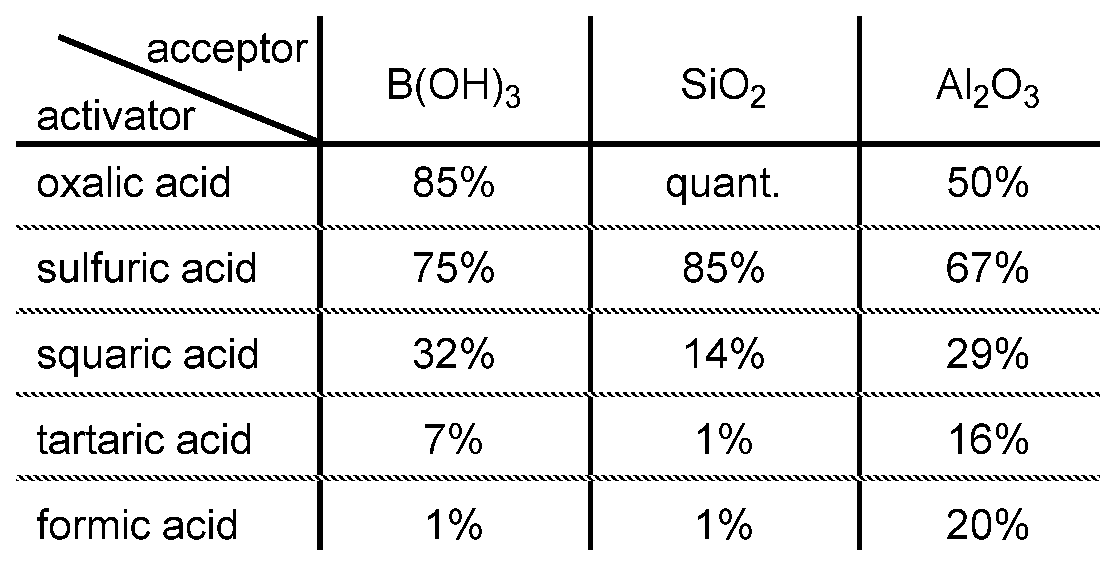 quant, refers to a yield of greater than or equal to 99%
[00103] Following determination of the best performing activators and fluoride acceptors, their uses in preparing a fluorochemical was investigated.
quant, refers to a yield of greater than or equal to 99%
[00103] Following determination of the best performing activators and fluoride acceptors, their uses in preparing a fluorochemical was investigated.
Boron-fluorine bond formation
[00104] The boron-fluorine bond plays a significant part in organic synthesis (see figure 3), i.e. as coupling partners (Molander salts), Lewis acids (BF3), non-coordinating anions (BF4- for a large number of complexes or ionic liquids) or even as reagents for C-F bond forming reactions (AgBF4, Balz-Schiemann reaction). To date, these species rely either directly or indirectly on the hydrofluoric acid supply chain.
[00105] The solubility of calcium salts using several activators was tested to promote the fluorination of boric acid to the tetrafluoroborate anion (table 2). Oxalic acid was found to achieve the highest yields under the reaction conditions surpassing sulfuric acid and hydrochloric acid in NMR yield (figure 4).
Table 2 solubilities iti water

 activator
(2.1 equiv) HBF4

[00106] The in situ formed fluoroboric acid solution can be filtered to remove the calcium precipitate and used directly for further reactions. Addition of a potassium salt and cooling the solution led to precipitation of potassium tetrafluoroborate which could be isolated in 69% from CaF2 (figure 5a). Alternatively, its use in the Balz-Schiemann reaction was demonstrated in the synthesis of 2-fluorobiphenyl (figure 5b). Therein, the fluoroboric acid solution was treated with sodium nitrite and 2-aminobiphenyl at 0 °C to precipitate the respective diazonium salt. Drying the salt and heat-promoted decomposition afforded the desired fluoroarene in 42% yield from 2-aminobiphenyl.
[00107] Moving beyond boric acid as activator, the use of boronic acids, such as 4- fluorophenyl-B(OH)2, as fluoride acceptor was investigated. An unexpected product was formed containing only one fluorine bond that was identified as potassium fluorooxalateborate. At elevated temperature, both the fluoroxoalateborate as well as the trifluoroborate were observed (figure 6).
Silicon-fluorine bond formation
[00108] While silicon-fluorine bonds themselves do not play a large role in organic synthesis, with the exception of the nucleophilic fluorinating reagent tetrabutylammonium difluorotriphenylsilicate (TBAT), their pH-dependant liability makes them ideal precursors to form fluorinating agents of everyday use such as KF, CsF, tetra-n-butylammonium fluoride (TBAF) and others. When investigating the formation of silicon fluorides in water with different activators, sulfuric acid afforded the highest yield, followed by oxalic acid. Following optimisation of concentration and stoichiometry, the conversion could be increased up to 99% as determined by 19F-NMR using oxalic acid as activator.
[00109] After filtration, alkaline hydrolysis successfully released the fluoride back into solution with the concomitant formation of silica. It was found that direct hydrolysis was also feasible. The resulting suspension of aqueous KF and insoluble silica was further filtered and dried to afford a source of potassium fluoride in yields ranging between 74 and 92% and a purity between 75% and 95% (table 3). Alternatively, direct evaporation of water led to a mixture of KF and silica which could also be used directly for several applications.

[00110] The formed KF can be used as fluorinating agent for various reactions such as the synthesis of aryl fluorides using the Halex-reaction which was chosen as model reaction
(figure 7). Due to its requirement for rigorously dry conditions, the KF was heated with methanol, toluene and sulfolane to remove residual water. The subsequent Halex reaction afforded the product in a good yield 76% (NMR yield).
[00111] In addition to the conversion to KF, other fluorinating agents are also readily accessible via the hexafluorosilicate route. When cesium hydroxide was used for basic hydrolysis, cesium fluoride was obtained. Due to its lower lattice energy and higher solubility, cesium fluoride is often a preferred fluorine source especially for aryl fluorides.
[00112] Similarly, the highly versatile fluoride TBAF could be prepared upon reacting in situ formed F^SiFe with a tetrabutylammonium hydroxide solution. Filtration and concentration gave a viscous liquid which could be purified by crystallisation as an alcohol complex (e.g., TBAF*4tBuOH). Alternatively, the TBAF-containing mixture could be used to prepare TBAT, another common non-hydroscopic fluoride source (figure 8).
[00113] Fluorine bonds could also be forged with organic silicon species as demonstrated with triphenylsilyl chloride (figure 9). The corresponding triphenylsilyl fluoride is the other component of the reagent TBAT which can therefore be prepared with both fluorides stemming directly from fluorspar.
Other inorganic fluoride sources and generality of reaction conditions
[00114] Apart from fluorspar, MgF2 and BaF2 can also be used. Fluorapatite is also a competent fluoride source (see figure 10).
[00115] Various reaction conditions were also investigated (see figure 10).
Synthetic procedures and analysis
Potassium fluoride KFcaF2
[00116] Fluorspar (acid grade 97%, 623.0 mg, 8.0 mmol, 0.6 equiv), silica gel (300.0 mg, 4.9 mmol, 0.37 equiv) and oxalic acid (628.6 mg, 7.0 mmol, 0.52 equiv) were weighed into a 50 mL Conical Sterile Polypropylene Centrifuge Tube. A stir bar and water (1.5 mL) were added and the mixture was heated under stirring in a sand bath at 70 °C for 15 h. The resulting suspension was cooled to ambient temperature, diluted with water (10 mL) and filtered with a Buchner funnel into a 50 mL PP tube. The solid and reaction tube were washed with water (2x 5 mL).
[00117] Subsequently, the filtrate was equipped with a stir bar and KOH was added portionwise over 5 min (750.0 mg total, 13.4 mmol, 1.0 equiv). After the addition is complete, the tube
was heated in a sand bath at 70 °C for 6 h. The resulting suspension was filtered using a Buchner funnel to separate insoluble silica from the solution and washed with water (2 x 5 mL). The filtrate was concentrated under reduced pressure (50 mbar, 60 °C), then methanol was added (30 mL) and the suspension was concentrated to dryness. The solid was transferred into a glass vial and further dried under vacuum while being heated with a heatgun to provide a white solid (637.7 mg, 82%, 776.6 mg theory). An aliquot of the solid was dissolved in H2O and the purity determined by NMR using an internal standard (NaOTf) to be 97% resulting in a purity corrected yield of 80%.
[00118] Performing the initial reaction at ambient temperature (23 °C) afforded a yield of 74% KF in a 90% purity resulting in a purity corrected yield of 67%.
[00119] The reaction on a 10 g scale of acid grade fluorspar (97%) afforded 11.3 g KF in a 93% purity resulting in a purity corrected yield of 85%.
Tetrabutylammonium fluoride - tert-butylalcohol complex

[00120] Fluorspar (acid grade 97%, 500.0 mg, 6.4 mmol, 1.0 equiv), silica gel (180.0 mg, 3.0 mmol, 0.47 equiv) and oxalic acid (634.2 mg, 7.0 mmol, 1.1 equiv) were weighed into a 15 mL PP tube. A stir bar and water (2.0 mL) were added and the mixture was heated under stirring in a sand bath at 70 °C for 17 h. The resulting suspension was cooled to ambient temperature, diluted with water (10 mL) and filtered with a Buchner funnel into a 50 mL PP tube. The resulting solid and reaction tube were washed with water (2x 5 mL).
[00121] Subsequently, the filtrate was equipped with a stir bar and solution of TBAOH hydrate (1M in methanol, 14.1 mL, 14.1 mmol, 2.2 equiv) was added. After the addition is complete, the tube was heated in a sand bath at 70 °C for 6 h. The mixture was concentrated at reduced pressure (150 mbar, 40 °C) to an approximate volume of 20 mL. Acetonitrile (50 mL) was added and the resulting suspension was filtered through celite and concentrated at reduced pressure to afford a light orange liquid that was used directly for the next step. Analysis by 19F NMR revealed a yield of 42% of TBAF based on an internal standard (4-Fluoroanisole).
[00122] The crude TBAF mixture (purity 84% by NMR, 1.02 g, 3.3 mmol) was mixed with t- butanol (70 mL) and hexane (30 mL) and the solution was concentrated under reduced
pressure to afford a white precipitate. Pentane (30 mL) and t-butanol (5 mL) were added and the ensuing solution was cooled to 4 °C over 15 h. The formed crystals were collected as long needles affording the desired complex in 66% yield (1.2 g).
T etrabutylammonium difluorotriphenylsilicated V)

[00123] Fluorotriphenylsilane (278.4 mg, 1.0 mmol, 1.0 equiv) was dissolved in dichloromethane (1.0 mL), 50.0 mg MgSCU and a solution of crude TBAF mixture (prepared directly from fluorspar as described above, purity 84% by NMR, 0.322 g, 1.03 equiv) in THF (1.0 mL). The suspension was filtered and concentrated under reduced pressure. The residue was treated with ethyl acetate (15 mL) and the suspension was heated to reflux until the solution became clear. The solution was allowed to cool to ambient temperature and before further cooling to -20 °C over 15 h, the crystals were collected to afford the desired compound (344.7 mg, 73%).
[00124] 1H NMR (400 MHz, CD3CN) 5 7.96 - 7.89 (m, 2H), 7.22 - 7.16 (m, 3H), 7.09 - 6.97 (m, 5H), 6.95 - 6.85 (m, 5H), 3.11 - 2.98 (m, 8H), 1.66 - 1.48 (m, 8H), 1.41 - 1.25 (m, 8H), 0.96 (t, J = 7.3 Hz, 12H).
Aqueous hexafluorosilicic acid solution
[00125] Fluorspar (acid grade 97%, 500 mg, 6.4 mmol, 2.1 equiv), silica gel (180 mg, 3.0 mmol, 1.0 equiv) and oxalic acid (634.2 mg, 7.0 mmol, 2.35 equiv) were weighed into a 50 mL Conical Sterile Polypropylene Centrifuge Tube. A stir bar and water (2 mL) were added and the mixture was heated in a sand bath to 70 °C for 15 h. The resulting suspension was cooled to ambient temperature and filtered with a Buchner funnel into a 50 mL PP tube. The solid and reaction tube were washed with water (2x 16 mL) to give a filtrate containing a fluorosilicate anions. Aliquot analysis by 19F NMR using NaOTf as internal standard revealed a yield of 99%.
[00126] Performing the initial reaction at ambient temperature (23 °C) afforded a yield of 82% determined by 19F NMR using NaOTf as internal standard.
[00127] Performing the initial reaction at ambient temperature (23 °C) and using celite instead of silica gel afforded a yield of 20% determined by 19F NMR using NaOTf as internal standard.
[00128] Performing the initial reaction at ambient temperature (23 °C) and using sea sand instead of silica gel afforded a yield of 2% determined by 19F NMR using NaOTf as internal standard.
Fluorotriphenylsilane
From chlorotriphenylsilane:

[00129] Fluorspar (acid grade 97%, 39.7 mg, 0.5 mmol, 0.6 equiv), chlorotriphenylsilane (250 mg, 0.85 mmol, 1 equiv), and oxalic acid (45.8 mg, 0.5 mmol, 0.6 equiv) were weighed into a 15 mL PP tube. A stir bar and water (4 mL) were added and the mixture was heated in a sand bath to 60 °C for 15 h. The resulting suspension was cooled to ambient temperature and extracted with dichloromethane (2 x 2 mL). The combined organic phases were dried over MgSC and the crude mixture was analysed by NMR showing a 48% yield of the desired product based on the internal standard (NaOTf).
From bis(triphenylsilyl) oxalate:
[00130] Fluorspar (acid grade 97%, 33.0 mg, 0.42 mmol, 1.1 equiv) and bis(triphenylsilyl) oxalate (233.1 mg, 0.38 mmol, 1 equiv) were weighed into a 15 mL PP tube. A stir bar and water (4 mL) were added and the mixture was heated in a sand bath to 60 °C for 15 h. The resulting suspension was cooled to ambient temperature and extracted with dichloromethane (2 x 2 mL). The combined organic phases were dried over MgSC and the crude mixture was analysed by NMR showing a 32% yield of the desired product based on the internal standard (NaOTf).
Aqueous tetrafluoroboric acid solution
From Boric acid:
 [00131] Fluorspar (acid grade 97%, 10.0 g, 128.1 mmol, 2.3 equiv), boric acid (3.4 mg, 55.7 mmol, 1.0 equiv) and oxalic acid (10.0 g, 111.4 mmol, 2.0 equiv) were weighed into a 50 mL Conical Sterile Polypropylene Centrifuge Tube. A stir bar and water (20 mL) were added and the mixture was heated in a sand bath to 60 °C for 22 h. The resulting suspension was cooled to ambient temperature and filtered with a Buchner funnel and washed with water (2 x 5 mL) to give a solution of aqueous tetrafluoroboric acid. Aliquot analysis by 19F NMR using NaOTf as internal standard revealed a yield of >95%.
[00132] Performing the initial reaction at ambient temperature (23 °C) for 16h afforded a yield of 94% as determined by 19F NMR using NaOTf as internal standard.
[00133] The reaction using a 1 :1 mixture of water and ethanol at 80 °C for 16 h afforded a yield of 66% as determined by 19F NMR using NaOTf as internal standard.
[00134] The reaction in methanol at 60 °C for 16 h afforded a yield of 8% as determined by 19F NMR using NaOTf as internal standard.
From Boron oxide:
[00135] Fluorspar (acid grade 97%, 312.3 mg, 4.0 mmol, 4.0 equiv), boron oxide (69.6 mg, 1.0 mmol, 1.0 equiv) and oxalic acid (360.2 mg, 4.0 mmol, 4.0 equiv) were weighed into a 15 mL Conical Sterile Polypropylene Centrifuge Tube. A stir bar and water (2 mL) were added and the mixture was heated in a sand bath to 60 °C for 17 h. The resulting suspension was cooled to ambient temperature and filtered with a Buchner funnel and washed with water (2 x 5 mL) to give a solution of aqueous tetrafluoroboric acid solution. Aliquot analysis by 19F NMR using NaOTf as internal standard revealed a yield of >95%.
From Bis(oxalate) boric acid:
[00136] Fluorspar (acid grade 97%, 30.0 mg, 0.38 mmol, 2.0 equiv) and bis(oxalate) boric acid (36.1 mg, 0.19 mmol, 1.0 equiv) were weighed into a 15 mL Conical Sterile Polypropylene Centrifuge Tube. A stir bar and water (3 mL) were added and the mixture was heated in a sand bath to 80 °C for 17 h. The resulting suspension was cooled to ambient temperature, filtered with a Buchner funnel and washed with water (2 x 5 mL) to give a solution of aqueous tetrafluoroboric acid. Aliquot analysis by 19F NMR using NaOTf as internal standard revealed a yield of 77%.
From a boronic acid:
[00137] Fluorspar (acid grade 97%, 30.0 mg, 0.38 mmol, 1.0 equiv), 4-fluorophenyl-B(OH)2 acid (107.7 mg, 2.0 mmol, 2.0 equiv), oxalic acid (103.9.0 mg, 1.2 mmol, 3.0 equiv) and potassium carbonate (53.2, 0.38 mmol, 1 equiv) were weighed into a 7 mL glass vial. A stir bar and water (3 mL) were added and the mixture was heated in a sand bath to 70 °C for 12 h. The resulting suspension was cooled to ambient temperature and the supernatant was analysed by 19F NMR using NaOTf as internal standard. The yield of fluorine in solution was determined to be 86% spread over species such as tetrafluoroborate and the trifluoroborate ion.
Potassium tetrafluoroborate
From Boric acid:
K® fe F-B-F i F
[00138] Fluorspar (acid grade 97%, 1.2 g, 15.3 mmol, 2.0 equiv), boric acid (475.2 mg, 7.7 mmol, 1.0 equiv) and oxalic acid (1.45 g, 16.1 mmol, 2.1 equiv) were weighed into a 15 mL Conical Sterile Polypropylene Centrifuge Tube. A stir bar and water (2 mL) were added and the mixture was heated in a sand bath to 70 °C for 15 h. The resulting suspension was cooled to ambient temperature and filtered with a Buchner funnel into a 15 mL PP tube. The solid and reaction tube were washed with methanol (2x 5 mL). The filtrate was concentrated under reduced pressure to a volume of 1 mL and an aqueous solution of K2HPO4 (1 .0 g, 5.75 mmol, 0.75 equiv) in 1 mL of H2O was added. The resulting precipitate was collected by filtration, washed with cold water (1 mL) and dried in an oven (80 °C) then under high vacuum to give the title compound as white crystalline solid (664.2 mg, 69%).
[00139] 19F NMR (377 MHz, D2O) 5 -150.1 , -150.2.
From Potassium tetraborate tetrahydrate:
[00140] Fluorspar (acid grade 97%, 168.0 mg, 2.2 mmol, 8.8 equiv), Potassium tetraborate tetrahydrate (74.7 mg, 0.24 mmol, 1.0 equiv), oxalic acid (154.1 mg, 1.7 mmol, 7.0 equiv) and potassium oxalate hydrate (45.1 mg, 0.24 mmol, 1 equiv) were weighed into a 15 mL Conical Sterile Polypropylene Centrifuge Tube. A stir bar and water (7.5 mL) were added and the mixture was heated in a sand bath to 50 °C for 60 h. The suspension was filtrated hot and concentrated under reduced pressure to a volume of approx. 2 mL. The mixture was cooled
in an ice bath for 1 h, then filtered to afford the title compound after drying as white solid (28.3 mg, 21%).
1-fluoro-2,4-dinitrobenzene

[00141] In a 10 mL Schlenk flask, KFcaF2 (62.5 mg, 80% purity, 0.86 mmol, 2.0 equiv) was stirred in MeOH (0.2 mL) for 1 min before sulfolane (100.0 mg) and toluene (2.5 mL) were added. The Schlenk flask is equipped with a Distilling link according to Claisen and placed in a sand bath at 150 °C for 1 h. The Schlenk was cooled to ambient temperature, flushed with N2 and 1-chloro-2,4-dinitrobenzene (87.1 mg, 0.43 mmol, 1.0 equiv) and anhydrous DMSO (1 mL) were added and the mixture was stirred in an 80 °C sand bath for 30 min. Addition of an internal standard and NMR analysis of an aliquot showed 98% conversion and 76% yield of the desired product as well as 17% of 2,4-dinitrophenolderivative.
3,5-dichloro-2,4,6-trifluorobenzonitrile

[00142] In a 7 mL glass vial, KFcaF2 (130.7 mg, 93% purity, 2.25 mmol, 4.5 equiv = 1.5 equiv/F) was stirred open to air in methanol (2 mL) in a sand bath heated to 180 °C for 15 min. Another 2 mL of methanol was added and stirring was continued for 15 min. To the dried KF was added pentachlorobenzonitrile (137.7 mg, 0.5 mmol) and a stock solution of sulfolane (2.5 mL containing 2.74 mg of TMAC (5 mol%) and 6.61 mg 18-crown-6 (5 mol%). The vial was sealed with a screw cap and heated at 170 °C for 15 h. After cooling, water (3 mL) was added and the mixture was extracted with ether (3 x 3 mL). The combined organic phases were dried over MgSCU and concentrated. Purification by column chromatography (pentane:ether 0 to 20%) afforded the desired product (73.3 mg, 65%) as colourless oil.
[00143] 19F NMR (377 MHz, CDCI3) 6 -98.68 (t, J = 5.7 Hz), -104.13 (d, = 5.7 Hz).
2,6-difluorobenzonitrile

[00144] In a 7 mL glass vial, KFcaF2 (87.1 mg, 93% purity, 2.25 mmol, 3.0 equiv = 1.5 equiv/F) was stirred open to air in methanol (2 mL) in a sand bath heated to 180 °C for 15 min. Another 2 mL of methanol was added and stirring was continued for 15 min. To the dried KF was added 2,6-dichlorobenzonitrile (86.0 mg, 0.5 mmol) and a stock solution of sulfolane (2.5 mL containing 2.74 mg of TMAC (5 mol%) and 6.61 mg 18-crown-6 (5 mol%). The vial was sealed with a screw cap and heated at 180 °C for 60 h. After cooling, water (3 mL) was added and the mixture was extracted with ether (3 x 3 mL). The combined organic phases were dried over MgSCU and concentrated. Purification by column chromatography (pentane:ether 0 to 20%) afforded the desired product (39.1 mg, 56%) as colourless oil.
[00145] 1H NMR (400 MHz, CDCh) 6 7.61 (tt, J = 8.6, 6.3 Hz, 1 H), 7.10 - 7.03 (m, 2H); 19F NMR (377 MHz, CDCh) 6 -103.46 - -103.55 (m).
[1 ,1 '-biphenyll-2-diazonium tetrafluoroborate

[00146] In a 50 mL round-bottom flask, [1 ,1'-biphenyl]-2-amine (423.1 mg, 2.5 mmol, 1.0 equiv) was suspended with tetrafluoroboric acid solution (1.5 mL, 2.9 equiv based on the amount of CaF2) and cooled to 0 °C in an ice bath. An aqueous solution of (340.0 mg, 4.9 mmol, 2.0 equiv) in 0.5 mL was added dropwise over 2 min. The reaction was stirred at 0 °C for 30 minutes before being filtered and washed with cold water (0.5 mL), EtOH (0.5 mL) and Et20 (1.5 mL). The resulting residue was dried with high vacuum for 10 minutes to give the title compound (481.0 mg, 72%) which was stored in the freezer. The compound was used as such for the next step.
2-fluoro-1 ,T-biphenyl

[00147] Under an air atmosphere, a 7mL-vial was charged with aryldiazonium tetrafluoroborate (134.0 mg, 0.5 mmol) and solvent (2 mL hexane). The mixture was heated to 80 °C for 2 h after which time, the lid was unscrewed and white smoke emerged the vial. Water was added (4 drops using a Pasteur pipette) and after further stirring for 5 min at ambient temperature, the mixture was concentrated under reduced pressure. The residue was purified by column chromatography on silica using pentane as eluent to afford the title compound as a white crystalline solid (49.9 mg, 58%).
[00148] 1H NMR (400 MHz, CDCI3) 6 7.58 - 7.53 (m, 2H), 7.48 - 7.42 (m, 3H), 7.40 - 7.35 (m, 1 H), 7.32 (dddd, J = 8.1 , 7.4, 5.0, 1.9 Hz, 1 H), 7.21 (td, J = 7.5, 1.3 Hz, 1 H), 7.16 (ddd, J = 10.8, 8.2, 1.3 Hz, 1 H).
[00149] 19F NMR (377 MHz, CDC ) 6 -118.07 - -118.16 (m).
Part B
[00150] Fluoride capture from acid grade fluorspar (AGF) with B(OH)s was found to be highly effective in the presence of H2OX when the reaction was carried out in water for 15 h at 50 °C (Fig. 11a). The [B-F] products were identified by 19F and 11B nuclear magnetic resonance (NMR) spectroscopy in D2O (Fig. 11 b). By 19F NMR, HBF4 (quartet, 5 = 150.3 ppm, 1 B-F = 1.1 Hz) and HBF3OH (quartet, 5 = -145.3 ppm, 1 JB-F = 10.7 Hz) were identified as major products. Additionally, a broad singlet (5 = 152.3 ppm) characteristic of difluoro(oxalate)borate species HOxBF2was observed in trace amount (<1 %). Notably, H2OX afforded a higher yield (96%) of [B-F] products than tartaric acid (2%), sulfuric acid (69%) or hydrochloric acid (60%) under these reaction conditions (Fig. 11a). An investigation on fluorspar activation with a range of Bronsted acids gave insight on the interplay between acidity, denticity and solubility of the Ca2+ salt by-product. For monoacids (2 equiv. versus CaF2), it was noted that there was a correlation between acidity and fluoride release in the pKa value range between 4.2 to -0.5. Multifunctional activators (1 equiv. versus CaF2) were also investigated. Organic acids leading to five-membered Ca2+ chelates stood out with H2OX (p/<a = 1.3 and 4.1) being the most effective activator followed by croconic acid (p/<a = 0.8 and 2.2) and squaric acid (p/<a = 1.5 and 3.4). Oxalic acid dihydrate (H2OX 2H2O) which is more cost effective than H2OX gave the [B-F] products HBF4 and HBF3OH with efficacy similar to H2OX (total yield of 98%) upon
treatment of AGF with B(OH)s at 50 °C for 15 h (Table 4). Subsequent studies were therefore performed with H2OX 2H2O.
Table 4 Replacement of anhydrous oxalic acid for oxalic acid dihydrate for B-F product formation
Entry Oxalic acid HBF4 HBF3OH

1 anhydrous 81 16 <1%
2 dihydrate 82 16 <1%
[00151] H2OX 2H2O was found to be a suitable activator for AGF when combined with silica (SiO2) in water at 50 °C for 15 h, with fluoride release as [Si-F] products (total 97%). The formation of F^SiFe (broad singlet, 5 = -129.6 ppm), which in water exists in equilibrium with H2SiFs(OH) (broad singlet, 5 = -128.8 ppm), was evidenced by 19F NMR spectroscopy of the reaction mixture. Two triplets were also observed (5 = -124.5 ppm and -135.9 ppm, 2JF-F = 8.9 Hz) and assigned to H20xSiF4 (supported by 29Si NMR spectroscopy).
[00152] Subsequent studies focused on the synthesis of commonly used fluorinating reagents from these [Si-F] products (Fig. 11c). For this purpose, AGF (1.1 equiv) was reacted with H2OX 2H2O (1 equiv) and SiO2 (0.4 equiv) in water at 50 °C for 15 h. The reaction mixture was filtered and treated with KOH. The insoluble by-product of this filtration was unambiguously characterized as CaOx H2O by powder X-ray diffraction (PXRD) (Fig. 12). Neutralization with KOH (2 equiv) led to the formation of K2SiFe (Fig. 13), whilst treatment with excess KOH (6 equiv) afforded KFAGF (85% yield, calculated from AGF). Alternatively, treatment of the filtered reaction mixture with tetramethylammonium hydroxide (6 equiv) afforded tetramethylammonium fluoride hydrate which was converted to tetramethylammonium tert- amyl alcohol fluoride (Me4NF AmOH) (88% yield), a fluorinating reagent well documented for nucleophilic aromatic fluorination (SNAr). This strategy also enabled the preparation of tetrabutylammonium fluoride hydrate, which was converted to the bench stable reagent tetrabutylammonium tetra (tert- butyl alcohol) fluoride [Bu4NF ('BuOH)4] (71% yield calculated from AGF).
[00153] Mechanistic investigations by 19F NMR in D2O established whether HF is formed upon dissolution of CaF2 with H2OX (Fig. 14). In the absence of fluorophilic Lewis acid, HF is observed (singlet, 5 = -166.0 ppm), and an equilibrium is established with the amount of HF plateauing after 3 h at approximately 10% (Fig. 11d). In the presence of either B(OH)sor SiO2, the equilibrium is displaced via the precipitation of highly insoluble CaOx and immediate HF capture by the Lewis acid. Under these conditions, the singlet diagnostic of HF was not detected by 19F NMR during the entire course of the reaction. As anticipated, the reaction of
AGF with fluorophilic Lewis acid in the absence of H2OX resulted in no fluoride release. These data highlight how Bronsted and Lewis acid cooperativity allows for Fluorspar activation under mild conditions, prevents HF from building up, and enables access to commonly used fluorinating reagents for synthesis, directly from fluorspar.
[00154] With an effective strategy to convert AGF into HBF4 (aqueous), KF, Me4NF AmOH and nBu4NF ^BuOH)4, it was investigated whether these AGF-derived reagents react as expected, with the synthesis of industrially valuable fluoroarenes and a focus on those not accessible via mechanochemical activation of AGF using a phosphate salt. For Balz- Schiemann chemistry, a two-step procedure followed the preparation of HBF4 (aqueous); addition of terf-butyl nitrite to a solution of aryl amine and aqueous HBF4 led to the precipitation of the corresponding aryl diazonium tetrafluoroborate salt which was isolated and subsequently heated to liberate the desired fluoroarene (Fig. 15a). The protocol was validated firstly with 4-bromoaniline, AGF-derived HBF4 (HBF4AGF) (1.1 equiv) and terf-butyl nitrite (2 equiv). Heating the resulting diazonium salt at 90 °C in PhCI gave 4-bromofluorobenzene in 98% yield (as measured by 19F NMR spectroscopy), a key intermediate featured in the synthesis of the antidepressant citalopram. This chemistry was subsequently applied to prepare multiple fluoroarenes commonly used as building blocks in the synthesis of various organo-fluorine containing drugs in up to 87% yield (dediazotization yield). Examples include the precursors of Lipitor (cholesterol-lowering), norfloxacin (antibiotic), raltegravir (HIV), eravacycline (antibiotic), rosuvastatin (cardiovascular disease), flurbiprofen (antiinflammatory), flunarizine (vertigo), and ezetimibe (cholesterol-lowering drug).
[00155] The methodology was also suitable for the preparation of diverse fluoropyridines (4,8 and 13) that are building blocks for drugs such as MK2 inhibitors (autoimmune diseases), vericiguat (heart failure), and agrochemicals including the herbicide clodinafop. Next, AGF-derived KF (KFAGF) (90% purity) was found to achieve high yielding fluorination of chloroarene substrates using Me4NCI (5 mol%) in DMSO as solvent. It was noted that the performance of KFAGF was comparable to commercial KF (see Table 5).
Table 5. Performance of KFACF and KFM
Entry KF source ArF (%)
1 KFC commercial 95%
2 KFAGF this work 90%
3 KFM this work 92%
[00156] The method was applied to the synthesis of 1-fluoro-2,4-dinitrobenzene (14),
2-chloro-1-fluoro-4-nitrobenzene (15), 2-fluoro-5-nitrobenzonitrile (16) and 3-chloro-4-
fluorobenzonitrile (17). Aromatic fluorodenitration using AGF-derived Me4NF AmOH proceeded at 70 °C in DMSO to access 2,6-difluorobenzonitrile (18), 4-fluoronitrobenzene (19) and 2-fluorobenzonitrile (20) in high yield. The successful cooperative activation of AGF in water and its application to the synthesis of fluoroarenes encouraged an investigation on the reactivity of lower grade metallurgical fluorspar (metspar, ~ 85% CaF2). Metspar yielded the [B-F] products HBF4 and HBF3OH with an overall yield of 83%, upon activation with B(OH)s and H2OX 2H2O at 50 °C for 15 hours. The reaction of metsparwith H2OX 2H2O and SiO2 also enabled the preparation of metspar-derived KF (KFM) (53% yield, calculated from metspar). Fluoroarenes 1 , 14 and 16 were prepared in good yield using HBF4M or KFM despite the reduced purity of metspar.
[00157] While specific embodiments of the invention have been described herein for the purpose of reference and illustration, various modifications will be apparent to a person skilled in the art without departing from the scope of the invention as defined by the appended claims.
Claims
1. A process for the preparation of a fluorochemical, the process comprising the step of: a) mixing together an inorganic fluoride source, an activator and a fluoride acceptor, wherein the activator is an organic compound having a pKa of -4 to 4.2 in water, and a water solubility of greater than 0.05 mol/L; and the fluoride acceptor is a hydroxide, an oxide, an alkoxide, a halide or a pseudohalide of B, Si, Ge, Al, P, Sb, Ti, S or Sn.
2. The process of claim 1 , wherein the inorganic fluoride source is an ionic compound comprising M2+ and F; wherein M2+ is an alkaline earth metal cation (i.e., a group II metal cation).
3. The process of claim 2, wherein M2+ is Mg2+, Ca2+, Sr2+ or Ba2+.
4. The process of any one of claims 2 or 3, wherein the activator is an M2+-sequestering agent.
5. The process of claim 4, wherein the M2+-sequestering agent comprises one or more M2+-coordinating groups.
6. The process of claim 4, wherein the M2+-sequestering agent comprises two or more M2+-coordinating groups and the M2+-sequestering agent forms a 5-, 6- or 7-membered chelate with M2+.
7. The process of any one of the preceding claims, wherein the activator has a pKa of -3 to 2 in water.
8. The process of any one of the preceding claims, wherein the activator is a monocarboxylic acid, a di-carboxylic acid, a tetra-carboxylic acid, a dione-dihydroxy compound comprising 3-5 carbon atoms, a nitrogen-containing SOs-Lewis base adduct, or an oxygencontaining SOs-Lewis base adduct.
9. The process of any one of the preceding claims, wherein the activator has a water solubility of greater than 0.15 mol/L.
10. The process of any one of the preceding claims, wherein the activator has a water solubility of greater than 0.19 mol/L.
11. The process of any one of the preceding claims, wherein the activator is selected from any one of the following compounds 1-56:

 or a salt thereof.
12. The process of any one of the preceding claims, wherein the activator is selected from any one of the following compounds 1, 2, 12, 24, 28, 51 , 53 or 56:
 or a salt thereof.
13. The process of any one of the preceding claims, wherein the activator is compound
24 (i.e. , oxalic acid):

24 or a salt thereof.
14. The process of any one of the preceding claims, wherein the inorganic fluoride source is CaF2, MgF2, BaF2, SrF2 or Cas PC hF.
15. The process of any one of the preceding claims, wherein the inorganic fluoride source is CaF2 or Ca5(PO4)3F.
16. The process of any one of the preceding claims, wherein the fluoride acceptor is: a hydroxide of B, Si, Ge, Al, Sb, Ti; an oxide of B, Si, Ge, Al, P, Sb, Ti; an alkoxide of B, Si, Ge, Al, Sb, Ti; or a halide or pseudohalide of B, Si, S, Ge, Al, Sb, Ti, Sn.
17. The process of any one of the preceding claims, wherein the fluoride acceptor is B(OH)3 B(OH)2R, B(OH)R2, R3SiX, R2SiX2, RSiX3, SiX4, RSO2X (wherein each X is independently Cl, Br or OH; and wherein each R is independently (1-4C)alkyl, aryl or heteroaryl, wherein any aryl or heteroaryl is optionally substituted with one or more methyl, ethyl, halo or hydroxide groups), (BOH)3O3, H2B4O7, B2O3, SiO2, Ge02, AhO3, P2O5, Sb2Os, TiO2, Ti2O3, TiO, SnO2, Sb2O3, SbCk or SbCI3.
18. The process of any one of the preceding claims, wherein the fluoride acceptor is B(OH)3, B(OH)2R, R3SiCI, SiCl4, RSO2CI (wherein each R is independently (1 -2C)alkyl, phenyl or tolyl, any of which are optionally substituted with one or more halo groups), (BOH)3O3, H2B4O7, B2O3, SiO2, Ge02, Al2O3, Sb2Os or SbCU.
19. The process of any one of the preceding claims, wherein the fluoride acceptor is selected from B(OH)s, 4-fluorophenyl-B(OH)2, B2O3, SiC>2, PhsSiCI, SiCk, P-TOISO2CI, GeC>2 or AI2O3.
20. The process of any one of the preceding claims, wherein the fluoride acceptor is B(OH)3.
21 . The process of any one of the preceding claims, wherein step a) is conducted in the presence of a solvent (e.g., an organic solvent).
22. The process of claim 21 , wherein the solvent comprises water (e.g., H2O or D2O), methanol and/or ethanol.
23. The process of any one of the preceding claims, wherein step a) is conducted at a temperature of 20 °C to 90 °C.
24. The process of any one of the preceding claims, wherein the ratio of equivalents of inorganic fluoride source : activator : fluoride acceptor is from 1 : 1 : 4 to 4 : 4 : 1.
25. A fluorochemical obtained, directly obtained or obtainable by the process of any one of the preceding claims.
Applications Claiming Priority (2)
| Application Number | Priority Date | Filing Date | Title |
|---|---|---|---|
| GB202308942 | 2023-06-15 | ||
| GB2308942.8 | 2023-06-15 |
Publications (1)
| Publication Number | Publication Date |
|---|---|
| WO2024256833A1 true WO2024256833A1 (en) | 2024-12-19 |
Family
ID=87571453
Family Applications (1)
| Application Number | Title | Priority Date | Filing Date |
|---|---|---|---|
| PCT/GB2024/051525 Ceased WO2024256833A1 (en) | 2023-06-15 | 2024-06-14 | Fluorochemical preparation |
Country Status (1)
| Country | Link |
|---|---|
| WO (1) | WO2024256833A1 (en) |
Citations (1)
| Publication number | Priority date | Publication date | Assignee | Title |
|---|---|---|---|---|
| WO2011155666A1 (en) * | 2010-06-11 | 2011-12-15 | Kcc Corporation | Method of continuously producing tetrafluorosilane by using various fluorinated materials, amorphous silica and sulfuric acid |
-
2024
- 2024-06-14 WO PCT/GB2024/051525 patent/WO2024256833A1/en not_active Ceased
Patent Citations (1)
| Publication number | Priority date | Publication date | Assignee | Title |
|---|---|---|---|---|
| WO2011155666A1 (en) * | 2010-06-11 | 2011-12-15 | Kcc Corporation | Method of continuously producing tetrafluorosilane by using various fluorinated materials, amorphous silica and sulfuric acid |
Non-Patent Citations (2)
| Title |
|---|
| HE JINGUI ET AL: "Study on the coordination properties of [CeFx]4-xand [BFy]3-yin sulfuric acid medium by complexometric potentiometric t", JOURNAL OF FLUORINE CHEMISTRY, ELSEVIER, NL, vol. 156, 20 September 2013 (2013-09-20), pages 106 - 111, XP028786017, ISSN: 0022-1139, DOI: 10.1016/J.JFLUCHEM.2013.09.007 * |
| SPRENGER JAN A P ET AL: "Convenient synthesis of perfluoroalkyltrifluoroborates", JOURNAL OF FLUORINE CHEMISTRY, ELSEVIER, NL, vol. 206, 7 December 2017 (2017-12-07), pages 54 - 60, XP085337468, ISSN: 0022-1139, DOI: 10.1016/J.JFLUCHEM.2017.12.004 * |
Similar Documents
| Publication | Publication Date | Title |
|---|---|---|
| JP5600876B2 (en) | Process for producing 4-fluoro-1,3-dioxolan-2-one | |
| US20090036718A1 (en) | Use of a composition of an ionic nature as a substitution reagent, a composition constituting a fluorination reagent and a method using same | |
| US20090287025A1 (en) | Fluorinating agent and method for producing fluorine-containing compound using the same | |
| CN109311786B (en) | Process for aromatic fluorination | |
| WO2001081274A1 (en) | Process for producing substituted aromatic compound | |
| US6215025B1 (en) | Method for purifying tetrakis (fluoroaryl) borate/magnesium halide, tetrakis (fluoroaryl) borate/ether complex and process for preparing the same, and process for preparing tetrakis (fluoroaryl) borate derivative | |
| JP2019147741A (en) | Imidazolium salt and manufacturing method therefor | |
| JPH02218630A (en) | Preparation of halofluorobenzene | |
| CN112638878B (en) | Process for preparing Ala-b | |
| JP5021745B2 (en) | Method for producing fluoromethyl 2,2,2-trifluoro-1- (trifluoromethyl) ethyl ether | |
| JPH0667861B2 (en) | Method for hydroxylating phenol | |
| JP4612219B2 (en) | Process for producing substituted aromatic compounds | |
| US7034181B1 (en) | Method for producing o-chloromethyl benzoic acid chlorides | |
| WO2013081034A1 (en) | Halogenation catalyst and method for producing same | |
| JPWO2018186460A1 (en) | Method for purifying trifluoromethylpyridines | |
| JP4674029B2 (en) | Method for producing o-chloromethylbenzoyl chloride | |
| JP2017002002A (en) | Fluorine-containing organic compound and manufacturing method of biaryl compound by the same and grignard reagent | |
| CN118811827B (en) | Preparation method of boric acid | |
| JP2003221360A (en) | Method for producing 2-fluoro-2-methylpropionic acids | |
| CN110003064B (en) | Preparation method of p-methylsulfonyl benzaldehyde | |
| JP7381912B2 (en) | Method for producing fluorine-containing aromatic compound | |
| WO2022038631A1 (en) | Quaternary ammonium fluoride salts for fluorination reactions | |
| AU2020283130B2 (en) | Processes for the preparation of halogenated dihydroxybenzene compounds | |
| GB2482525A (en) | A process for the production of acyloxymethyldioxanylacetic derivatives | |
| EP1201658B1 (en) | N-Fluorotriazinium fluorinating agents |
Legal Events
| Date | Code | Title | Description |
|---|---|---|---|
| 121 | Ep: the epo has been informed by wipo that ep was designated in this application |
Ref document number: 24735286 Country of ref document: EP Kind code of ref document: A1 |
|
| NENP | Non-entry into the national phase |
Ref country code: DE |