WO2024256777A1 - Complexes d'iridium utilisés comme photosensibilisateurs - Google Patents
Complexes d'iridium utilisés comme photosensibilisateurs Download PDFInfo
- Publication number
- WO2024256777A1 WO2024256777A1 PCT/FR2024/050760 FR2024050760W WO2024256777A1 WO 2024256777 A1 WO2024256777 A1 WO 2024256777A1 FR 2024050760 W FR2024050760 W FR 2024050760W WO 2024256777 A1 WO2024256777 A1 WO 2024256777A1
- Authority
- WO
- WIPO (PCT)
- Prior art keywords
- group
- compound
- halogen atom
- hydrogen atom
- independently selected
- Prior art date
- Legal status (The legal status is an assumption and is not a legal conclusion. Google has not performed a legal analysis and makes no representation as to the accuracy of the status listed.)
- Ceased
Links
Classifications
-
- C—CHEMISTRY; METALLURGY
- C09—DYES; PAINTS; POLISHES; NATURAL RESINS; ADHESIVES; COMPOSITIONS NOT OTHERWISE PROVIDED FOR; APPLICATIONS OF MATERIALS NOT OTHERWISE PROVIDED FOR
- C09K—MATERIALS FOR MISCELLANEOUS APPLICATIONS, NOT PROVIDED FOR ELSEWHERE
- C09K11/00—Luminescent materials, e.g. electroluminescent or chemiluminescent
- C09K11/06—Luminescent materials, e.g. electroluminescent or chemiluminescent containing organic luminescent materials
-
- C—CHEMISTRY; METALLURGY
- C07—ORGANIC CHEMISTRY
- C07F—ACYCLIC, CARBOCYCLIC OR HETEROCYCLIC COMPOUNDS CONTAINING ELEMENTS OTHER THAN CARBON, HYDROGEN, HALOGEN, OXYGEN, NITROGEN, SULFUR, SELENIUM OR TELLURIUM
- C07F15/00—Compounds containing elements of Groups 8, 9, 10 or 18 of the Periodic Table
- C07F15/0006—Compounds containing elements of Groups 8, 9, 10 or 18 of the Periodic Table compounds of the platinum group
- C07F15/0033—Iridium compounds
Definitions
- DESCRIPTION IRIDIUM COMPLEXES AS PHOTOSENSITIZERS The present invention relates to novel compounds, their preparation process and their use as a medicament, for example in the treatment of cancer or in the treatment of antibiotic-resistant diseases.
- Photodynamic therapy exploits photo-activatable compounds for therapeutic use against cancer and age-related macular degeneration (AMD).
- PDT consists of treating a patient with a molecule called a photosensitizer.
- This photosensitizer can be administered topically, for example by means of a cream to be applied to the skin. Alternatively, this photosensitizer can be administered by means of a tablet or by injection.
- the principle of PDT is that the photosensitizer must accumulate preferentially at the level of the area to be treated until reaching a determined concentration peak. Once this concentration peak is reached, the curative treatment is carried out by light irradiation of said area.
- the photosensitizers used must ideally be safe in the absence of light, and on the contrary, have a toxicity that must be activated under light irradiation.
- the operation of PDT is based on the fact that, when subjected to a certain wavelength, the photosensitizers become excited molecules that transmit their energy to the oxygen molecules present in the tumor to be treated. The excited oxygen produces singlet oxygen and/or reactive oxygen species (ROS), which cause the death of cancer cells.
- ROS reactive oxygen species
- Photodynamic therapy thus has the advantage of constituting a non-invasive and selective technique for treating cancerous tumors, by making it possible to treat only the desired area. It is therefore desirable to have photosensitizers that can be used to implement this technique.
- Iridium(III) complexes (hereinafter referred to as Ir(III)) have been proposed as photosensitizers due to their interesting photophysical properties, such as photostability.
- Four phosphorescent cationic cyclometallated iridium(III) complexes containing a benzimidazole group were designed and synthesized, Wang FX, Chen MH, Lin YN, et al.
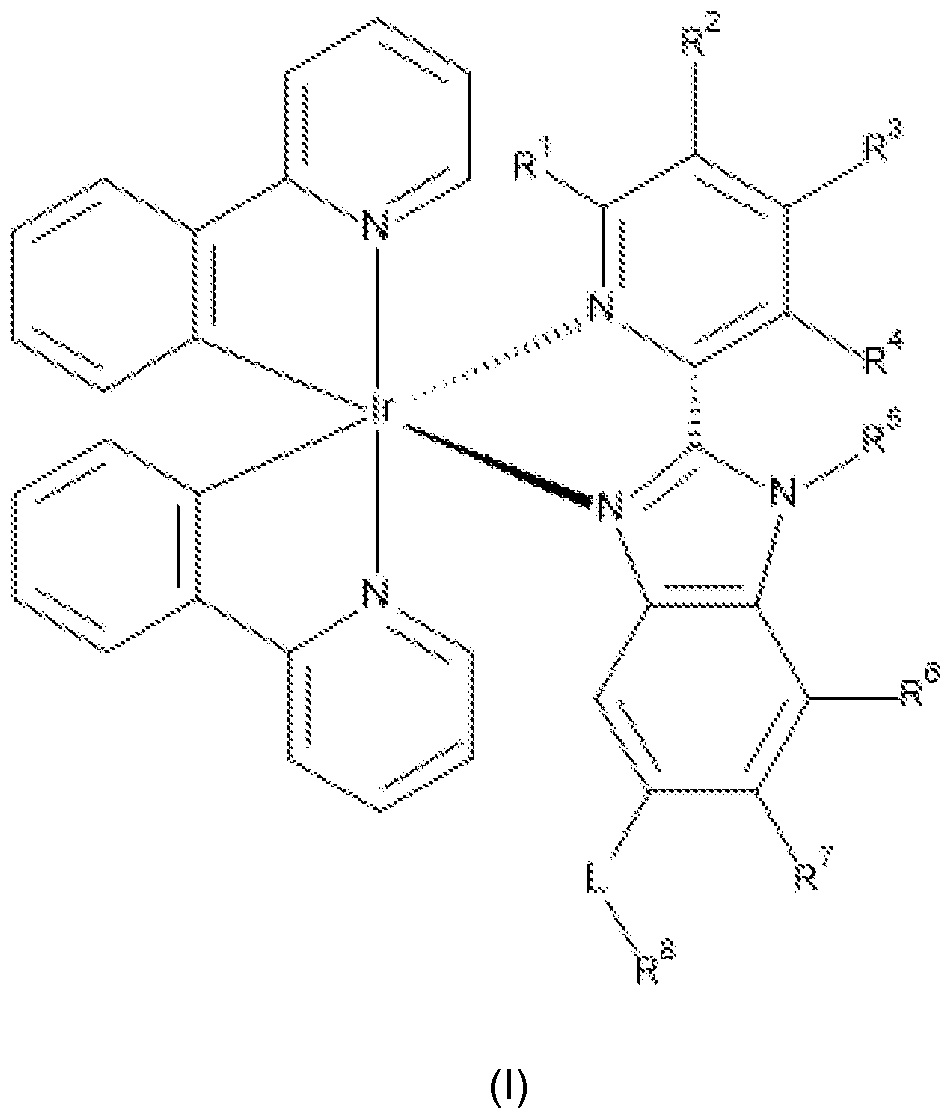
- the present invention relates to compounds of general formula (I): or salt thereof, in which formula: - R 1 , R 2 , R 3 and R 4 are independently selected from one another as being a hydrogen atom or a halogen atom; - R 5 is selected from being a hydrogen atom, a halogen atom, a C1-C6-alkyl group, a C1-C6-hydroxyalkyl group, a C1-C6-alkoxy group, a C2-C6-alkenyl group, a C2-C6-alkynyl group or a polyethylene glycol (PEG) group of the following formula: in which n is an integer ranging from 1 to 4; - L is chosen to be a single bond or linking group chosen from: - R 6 and R 7 are independently selected from one another as being a hydrogen atom, a halogen atom, a C1-C6-alkyl group, a C1-C6-hydroxyalkyl group, a C
- the present invention also relates to compounds of general formula (I): or salt of these compounds, formula in which: - R 1 , R 2 , R 3 and R 4 are independently selected from one another as being a hydrogen atom or a halogen atom; - R 5 is selected from being a hydrogen atom, a halogen atom, a C1-C6-alkyl group, a C1-C6-hydroxyalkyl group, a C1-C6-alkoxy group, a C2-C6-alkenyl group, a C2-C6-alkynyl group or a polyethylene glycol (PEG) group of the following formula: in which n is an integer ranging from 1 to 4; - L is chosen to be a single bond or linking group chosen from: ; ; And - R 6 and R 7 are independently chosen from each other as being a hydrogen atom, a halogen atom, a C 1 -C 6 -alkyl group, a C 1 -C
- - C1-C6-alkyl group means a saturated, linear or branched hydrocarbon chain comprising from 1 to 6 carbon atoms, such as for example a methyl, ethyl, isopropyl, tert-butyl, pentyl group
- - C1-C6-hydroxyalkyl group means a HO-(C1-C6-alkyl) group
- - C1-C6-alkoxy group means a –O-(C1-C6-alkyl) group, such as for example the methoxy group or the ethoxy group
- C2-C6-alkenyl group a linear or branched hydrocarbon chain, comprising at least one unsaturation and comprising from 2 to 6 carbon atoms, such as for example an ethenyl (vinyl), propenyl group, - By C2-C6-alkynyl group, a linear or branched hydrocarbon chain comprising from 1 to 6 carbon atoms,
- the subject of the present invention is a compound of formula (I) as defined above, in which the following characteristics are chosen alone or in combination: - at least one substituent chosen from R 1 , R 2 , R 3 and R 4 is a halogen atom. More preferably, R 2 is a halogen atom.
- R 2 is a halogen atom and R 1 , R 3 and R 4 are hydrogen atoms; - R 1 , R 2 , R 3 and R 4 are hydrogen atoms; - R 5 is a C1-C6-alkyl group, preferably C1-C4-alkyl, more preferably a butyl group; - R 6 and R 7 are hydrogen atoms; - L is a single bond; - L is a single bond and R 8 is a C1-C6-alkyl group, preferably a methyl group; and/or - L is a single bond and R 8 is the compound of formula (II).
- the compounds of the invention can be prepared by any method known to those skilled in the art.
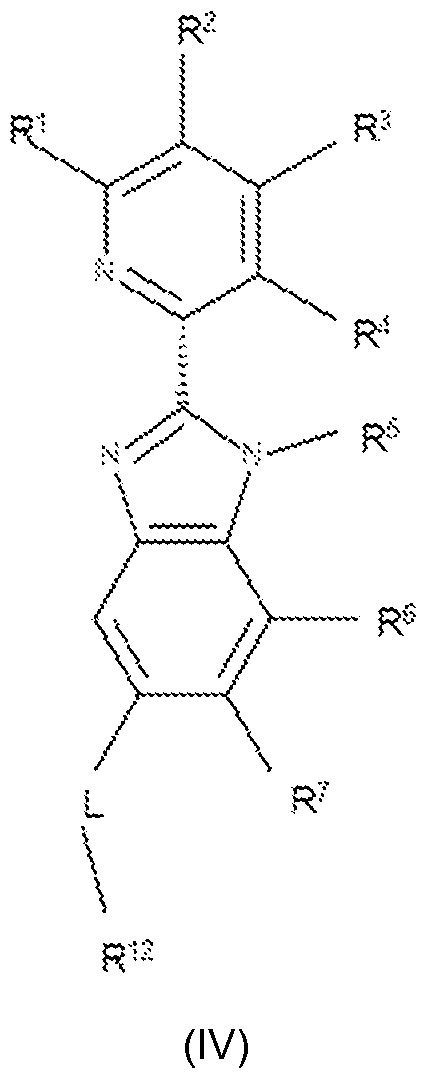
- the invention also relates to a process for preparing the compounds of formula (I) according to the invention, comprising the following steps: - Suspending a compound of formula (III) in a mixture of CH2Cl2/MeOH (1:1), - Addition of a compound of formula (IV) in which o R 1 , R 2 , R 3 , R 4 , R 5 , R 6 , and R 7 are as defined above, o L is chosen to be a single bond or linking group chosen from: R o o ; o R 9 and R 10 are independently selected from each other as being a hydrogen atom or a C1-C6-alkoxy group, preferably a methoxy group, o R 12 and R 13 are independently selected from each other as being a hydrogen atom, a halogen atom, a C1-C6-alkyl group, a C1-C6-hydroxyalkyl group, a C1-C6-alkoxy group, a C2-C6-alken
- the compounds according to the invention can be used as a medicament, in particular in the treatment of cancer.
- the compounds according to the invention can in particular be used in the treatment of cancer by dynamic phototherapy.
- the compounds according to the invention can be used in the treatment of antibiotic-resistant diseases.
- the present invention also relates to a compound of general formula (I): or a salt thereof, in which formula: - R 1 , R 2 , R 3 and R 4 are independently selected from one another as being a hydrogen atom or a halogen atom; - R 5 is selected from being a hydrogen atom, a halogen atom, a C1-C6-alkyl group, a C1-C6-hydroxyalkyl group, a C1-C6-alkoxy group, a C2-C6 -alkenyl group, a C2-C6-alkynyl group or a polyethylene glycol (PEG) group of the following formula : in which n is an integer ranging from 1 to 4; -
- the present invention also relates to a compound of general formula (I): or a salt thereof, in which formula: - R 1 , R 2 , R 3 and R 4 are independently selected from one another as being a hydrogen atom or a halogen atom; - R 5 is selected from being a hydrogen atom, a halogen atom, a C1-C6-alkyl group, a C1-C6-hydroxyalkyl group, a C1-C6-alkoxy group, a C2-C6-alkenyl group, a C2-C6-alkynyl group or a polyethylene glycol (PEG) group of the following formula: in which n is an integer ranging from 1 to 4; - L is chosen to be a single bond or linking group chosen from: ; - R 6 and R 7 are independently selected from one another as being a hydrogen atom, a halogen atom, a C1-C6-alkyl group, a C1-C6-hydroxyal
- R 2 is a halogen atom. More preferably, R 2 is a halogen atom.
- R 1 , R 3 and R 4 are hydrogen atoms;
- - R 1 , R 2 , R 3 and R 4 are hydrogen atoms;
- - R 5 is a C1-C6-alkyl group, preferably C1-C4-alkyl, more preferably a butyl group;
- - R 6 and R 7 are hydrogen atoms;
- - L is a single bond; - L is a single bond and R 8 is a C1-C6-alkyl group, preferably a methyl group; and/or - L is a single bond and R 8 is the compound of formula (II).
- the compounds according to the invention can be used as sensitizers in the treatment of cancer by photodynamic therapy. These compounds have a high quantum yield of singlet oxygen generation. These compounds also have better cytotoxicity than known iridium-based complexes. These compounds can also be used as a contrast agent for luminescence microscopy imaging.
- the present invention is illustrated by the following examples in which: - [Fig. 1] represents pictures of cells of cancer lines and of the compound IrL 1 according to the invention obtained by confocal microscopy, after 2 h, 4 h or 24 h in the dark at 37 °C, - [Fig.
- Absorption spectra were recorded on a Cary 300 UV ⁇ visible spectrophotometer (Varian) and emission spectra (in solution and at 77 K) were recorded on a Fluoromax 4® (Horiba) or FLS-1000® (Edinburgh Instruments) equipped with automatic filters to remove harmonic bands. Quartz cuvettes with a 1 cm path length were used. Lifetimes were measured using an LP900 spectrometer with a flashlamp-pumped Q-switched Nd:Yag laser operating at 355 nm and a photomultiplier (PMT) detector, or with a picosecond laser diode operating at 410 nm and using time-correlated single photon counting (TCSPC, PicoHarp 300) detection.
- TCSPC time-correlated single photon counting
- Singlet oxygen quantum yield calculation an FLS-1000® (Edinburgh Instruments) equipped with automatic filters to remove harmonic bands with an 870-1650 nm InGaAs detector cooled to -20°C with a Peltier.
- the flask was sealed with a rubber stopper and the mixture was heated at 60 °C overnight. The color of the mixture rapidly changed from yellow to orange. At room temperature, to this orange solution was added 30 mL of ethyl acetate and the organic phase was extracted three times with water and washed with brine. The organic phase was dried over MgSO4 and the product was isolated as a light orange translucent solid (2.2 g, 88%). The product was used without further purification.
- FIG. 1 shows the pictures obtained after 2 h, 4 h or 24 h with the IrL 1 monomer, for cells alone (left column), for the IrL 1 monomer compound alone (middle column) and for cells and the IrL 1 monomer compound simultaneously (right column).
- FIG. 2 shows the pictures obtained after 2 h, 4 h or 24 h with the Ir2L 2 dimer, for cells alone (left column), for the Ir2L 2 dimer compound alone (middle column) and for cells and the Ir2L 2 dimer compound simultaneously (right column).
- the compounds according to the invention are found to be localized in the cytoplasm of cancer cells.
- In vitro cytotoxicity tests Cell proliferation tests were carried out in 96-well culture plates for each of the following complexes: IrL 1 monomer, H monomer, F monomer and Cl monomer. The cells were cultured for 4 h and 24 h before treatment with increasing concentration of monomer in complete medium.
- MTT assay 3-(4,5-dimethylthiazol-2-yl)-2,5-diphenyltetrazolium bromide assay
- the concentrations of monomer H, monomer F and monomer Cl required to inhibit cell growth by 50% were found to be less than 17 nmol.L -1 at 10 J.cm -2 , for the A549 cell line, and less than 12 nmol.L -1 at 10 J.cm -2 , for the HeLa cell line, making these compounds particularly effective candidates for use in the treatment of cancer by photodynamic therapy.
- the HT29 cell line is very sensitive and has not been tested with the monomer H, monomer F and monomer Cl complexes.
Landscapes
- Chemical & Material Sciences (AREA)
- Organic Chemistry (AREA)
- Engineering & Computer Science (AREA)
- Materials Engineering (AREA)
- Pharmaceuticals Containing Other Organic And Inorganic Compounds (AREA)
Abstract
Description


Claims




Priority Applications (1)
| Application Number | Priority Date | Filing Date | Title |
|---|---|---|---|
| EP24738016.5A EP4724543A1 (fr) | 2023-06-12 | 2024-06-11 | Complexes d'iridium utilisés comme photosensibilisateurs |
Applications Claiming Priority (2)
| Application Number | Priority Date | Filing Date | Title |
|---|---|---|---|
| FRFR2305900 | 2023-06-12 | ||
| FR2305900A FR3149607A1 (fr) | 2023-06-12 | 2023-06-12 | Complexes d’iridium utilises comme photosensibilisateurs |
Publications (1)
| Publication Number | Publication Date |
|---|---|
| WO2024256777A1 true WO2024256777A1 (fr) | 2024-12-19 |
Family
ID=87801431
Family Applications (1)
| Application Number | Title | Priority Date | Filing Date |
|---|---|---|---|
| PCT/FR2024/050760 Ceased WO2024256777A1 (fr) | 2023-06-12 | 2024-06-11 | Complexes d'iridium utilisés comme photosensibilisateurs |
Country Status (3)
| Country | Link |
|---|---|
| EP (1) | EP4724543A1 (fr) |
| FR (1) | FR3149607A1 (fr) |
| WO (1) | WO2024256777A1 (fr) |
-
2023
- 2023-06-12 FR FR2305900A patent/FR3149607A1/fr active Pending
-
2024
- 2024-06-11 EP EP24738016.5A patent/EP4724543A1/fr active Pending
- 2024-06-11 WO PCT/FR2024/050760 patent/WO2024256777A1/fr not_active Ceased
Non-Patent Citations (4)
| Title |
|---|
| REDRADO MARTA ET AL: "Tunable Emissive Ir(III) Benzimidazole-quinoline Hybrids as Promising Theranostic Lead Compounds", vol. 17, no. 18, 13 July 2022 (2022-07-13), DE, XP093114289, ISSN: 1860-7179, Retrieved from the Internet <URL:https://onlinelibrary.wiley.com/doi/full-xml/10.1002/cmdc.202200244> DOI: 10.1002/cmdc.202200244 * |
| SUNESH CHOZHIDAKATH DAMODHARAN ET AL: "Constructive Effects of Long Alkyl Chains on the Electroluminescent Properties of Cationic Iridium Complex-Based Light-Emitting Electrochemical Cells", APPLIED MATERIALS & INTERFACES, vol. 6, no. 20, 3 October 2014 (2014-10-03), US, pages 17416 - 17425, XP093114276, ISSN: 1944-8244, DOI: 10.1021/am5058426 * |
| WANG FXCHEN MHLIN YN ET AL.: "Dual Functions of Cyclometalated Iridium(III) Complexes: Anti-Metastasis and Lysosome-Damaged Photodynamic Therapy", ACS APPL MATER INTERFACES., vol. 9, no. 49, 2017, pages 42471 - 42481, XP093114265, DOI: 10.1021/acsami.7b10258 |
| ZHI XIUJUAN ET AL: "Organic Light-Emitting Diodes Based on a Solution-Processable Benzimidazole-Functionalised Cationic Iridium Complex", vol. 69, no. 8, 4 April 2016 (2016-04-04), AU, pages 890, XP093114273, ISSN: 0004-9425, Retrieved from the Internet <URL:https://www.publish.csiro.au/ch/pdf/CH16051> DOI: 10.1071/CH16051 * |
Also Published As
| Publication number | Publication date |
|---|---|
| FR3149607A1 (fr) | 2024-12-13 |
| EP4724543A1 (fr) | 2026-04-15 |
Similar Documents
| Publication | Publication Date | Title |
|---|---|---|
| Zhou et al. | Enhancing the ROS generation ability of a rhodamine-decorated iridium (iii) complex by ligand regulation for endoplasmic reticulum-targeted photodynamic therapy | |
| EP2854948B1 (fr) | Composés de thiophène photodynamiques à base de métal et leur utilisation | |
| Çakır et al. | Synthesis and photophysicochemical properties of novel water soluble phthalocyanines | |
| ME03725B (fr) | Dérivé de chlorine utile dans la thérapie et le diagnostic photodynamiques | |
| CN111171060B (zh) | 含吡啶的氟硼二吡咯及其季铵盐类光敏剂与制备方法和用途 | |
| WO2016178191A1 (fr) | Dérivés carboxamide de porphyrines halogénées, à savoir chlorines et bactériochlorines, de faible poids moléculaire, et leurs applications | |
| CN111662333A (zh) | 一类双三联吡啶铱(ⅲ)配合物及其合成方法 | |
| Kushwaha et al. | Cancer phototherapy by CO releasing terpyridine-based Re (I) tricarbonyl complexes via ROS generation and NADH oxidation | |
| CN117126156A (zh) | 一种苯并硒二唑衍生物及其制备方法和应用 | |
| Köse | A novel diaxially silicon phthalocyanine sensitizer for the generation of high efficiency singlet oxygen in photochemical and sono-photochemical studies | |
| CN113929699B (zh) | 一类psma靶向的内过氧化物体系及应用 | |
| CN117701025B (zh) | 尼罗蓝-parp抑制剂染料及其合成方法与应用 | |
| Pereira et al. | Novel fluorinated ring-fused chlorins as promising PDT agents against melanoma and esophagus cancer | |
| Das et al. | Synthesis, characterization, photophysical and electrochemical properties, and biomolecular interaction of 2, 2′-biquinoline based phototoxic Ru (II)/Ir (II) complexes | |
| CN107955392A (zh) | 一类具有长寿命三重激发态的近红外氨基菁染料及其制备方法 | |
| Sayala et al. | Photocytotoxic kinetically stable ruthenium (II)-N, N-donor polypyridyl complexes of oxalate with anticancer activity against HepG2 liver cancer cells | |
| CN115322205B (zh) | 一类近红外二区荧光染料及制备方法与抗肿瘤应用 | |
| Servos et al. | Functionalization of a Ru (ii) polypyridine complex with an aldehyde group as a synthetic precursor for photodynamic therapy | |
| EP4724543A1 (fr) | Complexes d'iridium utilisés comme photosensibilisateurs | |
| CN118812600A (zh) | 具有线粒体靶向且光动力活性的bodipy纳米光敏剂及其制备方法与应用 | |
| CN102134244A (zh) | 一种医用光敏剂及其制备方法 | |
| RU2670087C1 (ru) | Фотосенсибилизатор для лечения рака предстательной железы и способ его получения | |
| FR2812637A1 (fr) | Nouveaux composes derives de dihydroporphyrine et leurs applications | |
| US20220315539A1 (en) | Phenazine derivative and use thereof for the treatment of cancer | |
| US20220409727A1 (en) | Metal Complexes Bearing Bisstyryl-Bipyridine Ligand and Their Use as Photosensitizer Agent in One and Two-Photon Photodynamic Therapy |
Legal Events
| Date | Code | Title | Description |
|---|---|---|---|
| 121 | Ep: the epo has been informed by wipo that ep was designated in this application |
Ref document number: 24738016 Country of ref document: EP Kind code of ref document: A1 |
|
| ENP | Entry into the national phase |
Ref document number: 2024738016 Country of ref document: EP Effective date: 20260112 |
|
| WWE | Wipo information: entry into national phase |
Ref document number: 2024738016 Country of ref document: EP |
|
| NENP | Non-entry into the national phase |
Ref country code: DE |
|
| ENP | Entry into the national phase |
Ref document number: 2024738016 Country of ref document: EP Effective date: 20260112 |
|
| ENP | Entry into the national phase |
Ref document number: 2024738016 Country of ref document: EP Effective date: 20260112 |
|
| ENP | Entry into the national phase |
Ref document number: 2024738016 Country of ref document: EP Effective date: 20260112 |
|
| ENP | Entry into the national phase |
Ref document number: 2024738016 Country of ref document: EP Effective date: 20260112 |
|
| WWP | Wipo information: published in national office |
Ref document number: 2024738016 Country of ref document: EP |