WO2024252975A1 - 同軸コネクタおよび同軸コネクタの接続構造 - Google Patents
同軸コネクタおよび同軸コネクタの接続構造 Download PDFInfo
- Publication number
- WO2024252975A1 WO2024252975A1 PCT/JP2024/019463 JP2024019463W WO2024252975A1 WO 2024252975 A1 WO2024252975 A1 WO 2024252975A1 JP 2024019463 W JP2024019463 W JP 2024019463W WO 2024252975 A1 WO2024252975 A1 WO 2024252975A1
- Authority
- WO
- WIPO (PCT)
- Prior art keywords
- coaxial connector
- mating
- inner conductor
- tube portion
- interference avoidance
- Prior art date
- Legal status (The legal status is an assumption and is not a legal conclusion. Google has not performed a legal analysis and makes no representation as to the accuracy of the status listed.)
- Ceased
Links
Images





Classifications
-
- H—ELECTRICITY
- H01—ELECTRIC ELEMENTS
- H01R—ELECTRICALLY-CONDUCTIVE CONNECTIONS; STRUCTURAL ASSOCIATIONS OF A PLURALITY OF MUTUALLY-INSULATED ELECTRICAL CONNECTING ELEMENTS; COUPLING DEVICES; CURRENT COLLECTORS
- H01R24/00—Two-part coupling devices, or either of their cooperating parts, characterised by their overall structure
- H01R24/38—Two-part coupling devices, or either of their cooperating parts, characterised by their overall structure having concentrically or coaxially arranged contacts
Definitions
- This disclosure relates to a coaxial connector and a connection structure for the coaxial connector.
- Patent Document 1 discloses a coaxial connector assembly having a first coaxial connector, a second coaxial connector, and a third coaxial connector. Patent Document 1 discloses that a floating structure capable of relative movement in the axial and radial directions is formed between the first coaxial connector and the second coaxial connector, and between the second coaxial connector and the third coaxial connector.
- the present disclosure therefore aims to make it difficult for a coaxial connector to interfere with a mating coaxial connector even if the coaxial connector is tilted relative to the central axis of the mating coaxial connector.
- the coaxial connector of the present disclosure is a coaxial connector that is connected to a mating coaxial connector, and includes an inner conductor and an outer conductor that surrounds the outer periphery of the inner conductor, at least one of the inner conductor and the outer conductor has a tubular portion to which a mating terminal of the mating coaxial connector is connected, the tubular portion is connected to the mating terminal with the mating terminal disposed on the inner or outer periphery of the tubular portion, and the portion of the tip periphery of the tubular portion that faces the mating terminal has an interference avoidance surface that is inclined away from the mating terminal as it approaches the tip of the tubular portion.
- the coaxial connector is less likely to interfere with the mating coaxial connector.
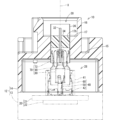
- FIG. 1 is a perspective view showing a device including a coaxial connector and a coaxial connector connection structure according to an embodiment.
- FIG. 2 is a cross-sectional view taken along line II-II of FIG.
- FIG. 3 is a perspective view showing a connection structure of a coaxial connector.
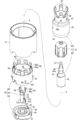
- FIG. 4 is an exploded perspective view showing the same connection structure.
- FIG. 5 is an enlarged cross-sectional view of FIG.
- FIG. 6 is a perspective view showing the tip of a coaxial connector.
- FIG. 7 is a cross-sectional view showing a connection structure of a coaxial connector that is connected at an angle.
- FIG. 8 is a partial cross-sectional view of FIG.
- FIG. 9 is a cross-sectional view of another portion of FIG.
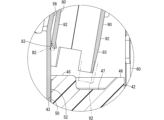
- FIG. 10 is a partial cross-sectional view showing an interference avoidance surface according to a modified example.
- the coaxial connector disclosed herein is as follows:
- a coaxial connector to be connected to a mating coaxial connector comprising an inner conductor and an outer conductor surrounding the outer periphery of the inner conductor, at least one of the inner conductor and the outer conductor having a tubular portion to which a mating terminal of the mating coaxial connector is connected, the tubular portion is connected to the mating terminal with the mating terminal disposed on the inner or outer periphery of the tubular portion, and a portion of the tip periphery of the tubular portion facing the mating terminal has an interference avoidance surface that is inclined away from the mating terminal as it approaches the tip of the tubular portion.
- the interference avoidance surface may extend in a ring shape along the periphery of the tip of the tubular portion.
- the coaxial connector is unlikely to interfere with the mating coaxial connector no matter in which direction it is tilted relative to the central axis of the mating coaxial connector.
- the interference avoidance surface may guide the elastic piece of the mating terminal at the tip edge of the tubular portion.
- the elastic piece is guided by the interference avoidance surface and can move smoothly to the inner or outer circumference of the cylindrical portion.
- the interference avoidance surface may be formed on one of the inner and outer circumferential sides of the tubular portion, and the surface on the other of the inner and outer circumferential sides of the tubular portion may be formed in a shape in which a portion of the same diameter is continuous along the central axis of the tubular portion.
- the end of the tube can be chamfered to easily form an interference-avoiding surface.
- the interference avoidance surface may be formed on one of the inner and outer circumferential sides of the cylindrical portion, and the other of the inner and outer circumferential sides of the cylindrical portion may be formed in a shape that is inclined in the same direction as the inclination of the interference avoidance surface.
- the end of the tube can be bent to easily form an interference avoidance surface.
- a slit may be formed on the peripheral edge of the tip of the cylindrical portion to separate the interference avoidance surface.
- the width of the slit may be smaller than the width of the elastic piece of the mating terminal.
- the inner peripheral portion of the tip periphery of the inner conductor tube will be more likely to interfere with the mating terminal. If an inner interference avoidance surface is formed on the inner peripheral portion of the tip periphery of the inner conductor tube as an interference avoidance surface, the inner peripheral portion of the tip periphery of the inner conductor tube will be less likely to interfere with the mating terminal even if the inner conductor is significantly tilted relative to the mating terminal.
- a coaxial connector according to any one of (1) to (8), wherein the outer conductor includes an outer conductor tube portion as the tube portion, the outer conductor tube portion is inserted into the mating terminal, and an outer interference avoidance surface is formed on the outer peripheral portion of the tip periphery of the outer conductor tube portion as the interference avoidance surface.
- connection structure of the coaxial connector disclosed herein is as follows:
- a coaxial connector connection structure comprising a coaxial connector according to any one of (1) to (9) and the mating coaxial connector, the mating coaxial connector having a mating inner conductor and a mating outer conductor surrounding the outer periphery of the mating inner conductor, the mating inner conductor having an inner elastic piece that elastically contacts the inner conductor, and the mating outer conductor having an outer elastic piece that elastically contacts the outer conductor.
- the mating inner conductor has an inner elastic piece that elastically contacts the inner conductor
- the mating outer conductor has an outer elastic piece that elastically contacts the outer conductor, so that by elastically deforming the inner elastic piece and the outer elastic piece, the coaxial connector can be connected to the mating coaxial connector even if the coaxial connector is tilted relative to the mating coaxial connector.
- the interference avoidance surface makes it difficult for the coaxial connector to interfere with the mating coaxial connector.
- the mating coaxial connector may have a mating dielectric located between the base end of the mating inner conductor and the base end of the mating outer conductor, and the mating dielectric may have an annular recess facing the coaxial connector.
- Fig. 1 is a perspective view showing a device 10 including a coaxial connector 70 and a coaxial connector connection structure 28.
- Fig. 2 is a cross-sectional view taken along line II-II in Fig. 1.
- the device 10 is, for example, a camera device.
- the camera device is, for example, a device mounted on a vehicle.
- the device 10 does not have to be a camera device.
- the device 10 comprises a case 12, an electrical component 20, and a coaxial connector for external connection 30.
- the electrical component 20 is housed inside the case 12.
- the coaxial connector for external connection 30 is a connector for connecting the electrical component 20 to an external electrical component.
- the coaxial connector for external connection 30 is a connector to which a cable connected to an external electrical component is connected.
- the case 12 comprises a first case 13 and a second case 14.
- the first case 13 and the second case 14 are formed, for example, from resin.
- the first case 13 and the second case 14 are combined to form the rectangular box-shaped case 12 that houses the electrical components 20. If the device 10 is a camera device, it is assumed that the first case 13 has a lens or window for capturing images, and the second case 14 has a coaxial connector 30 for external connection.
- a retaining tube portion 16 protrudes from the bottom 15 of the case 12.
- the retaining tube portion 16 is cylindrical and protrudes outward from the center of the bottom 15.
- the inner opening of the retaining tube portion 16 opens into the second case 14, and the outer opening of the retaining tube portion 16 opens to the outside of the second case 14.
- a retaining partition portion 17 is formed in the middle of the retaining tube portion 16 in the direction along the central axis X.
- the retaining partition portion 17 is formed in the middle of the retaining tube portion 16 in the direction along the central axis X, near the inner opening.
- the retaining partition portion 17 separates the space of the retaining tube portion 16 on the inner opening side from the space of the outer opening side.
- a retaining hole 17h is formed in the retaining partition portion 17, and the external connection coaxial connector 30 is inserted and held in the retaining hole 17h.
- the coaxial connector 30 for external connection comprises an inner conductor 32 for external connection, a dielectric 34 for external connection, and an outer conductor 36 for external connection.
- the external connection inner conductor 32 is formed in a long, thin rod shape and is made of a conductive material such as metal.
- the external connection inner conductor 32 is an example of a pin-shaped opposing inner conductor that is inserted and connected to the inner conductor 80 described below.
- the external connection dielectric 34 is formed of an insulator such as resin, and surrounds the external connection inner conductor 32.
- the external connection outer conductor 36 is formed of a conductive material such as metal.
- the external connection outer conductor 36 is formed in a cylindrical shape that surrounds the external connection dielectric 34.
- the external connection outer conductor 36 is an example of an opposing outer conductor to which the outer conductor 90 is connected.
- the electrical component 20 is, for example, a mounting board on which electronic components are mounted.
- the electrical component 20 is assumed to be a circuit board 21 and an image sensor 22 mounted on the circuit board 21.
- the image sensor 22 faces an image capturing lens or window in the first case 13, and captures the outside scenery by rotating the lens or window.
- the side of the first case 13 to which the image sensor 22 faces may be referred to as the front side, and the opposite side, the second case 14 side, may be referred to as the rear side.
- a coaxial connector connection structure 28 is incorporated into the device 10.
- the coaxial connector connection structure 28 is a connection structure between the board coaxial connector 40 and the coaxial connector 70.
- the coaxial connector for the board 40 is provided on the surface of the circuit board 21 opposite the imaging element 22.
- the coaxial connector for the board 40 is fixed to the circuit board 21.
- the coaxial connector for the board 40 is an example of a mating coaxial connector that is connected to the coaxial connector 70.
- the coaxial connector 40 for circuit boards comprises a mating inner conductor 50 and a mating outer conductor 60 that surrounds the outer periphery of the mating inner conductor 50.
- the coaxial connector 40 for circuit boards may further comprise a mating dielectric 42 located between the mating inner conductor 50 and the mating outer conductor 60.
- the mating dielectric 42 surrounds the mating inner conductor 50.
- the mating dielectric 42 is made of an insulator.
- the mating outer conductor 60 surrounds the mating dielectric 42.
- the base end of the mating inner conductor 50 and the base end of the mating outer conductor 60 are fixed to the circuit board 21 by soldering or the like.
- the mating inner conductor 50 and the mating outer conductor 60 are electrically connected to the circuit of the circuit board 21 and are fixed in a state protruding from the circuit board 21.
- the board coaxial connector 40 protrudes from the circuit board 21 toward the external connection coaxial connector 30.
- a coaxial connector 70 is connected to the coaxial connector for board 40.
- the coaxial connector 70 includes an inner conductor 80, an outer conductor 90 surrounding the outer periphery of the inner conductor 80, and a dielectric 72 located between the inner conductor 80 and the outer conductor 90.
- the dielectric 72 surrounds the periphery of the inner conductor 80.
- the dielectric 72 is composed of an insulator.
- the outer conductor 90 surrounds the periphery of the dielectric 72.
- the coaxial connector 70 is connected to the coaxial connector for board 40 with the mating inner conductor 50 inserted and connected to the inner conductor 80 and the outer conductor 90 inserted and connected to the mating outer conductor 60.
- the coaxial connector 70 further protrudes from the coaxial connector for board 40 toward the coaxial connector for external connection 30.
- the coaxial connector 70 relays and connects the coaxial connector for board 40 and the coaxial connector for external connection 30.
- the coaxial connector 70 is connected to the coaxial connector for board 40 and the coaxial connector for external connection 30 in a manner that allows it to change its position.
- the coaxial connector 70 may be understood as a relay coaxial connector.
- the coaxial connector 30 for external connection is provided on the second case 14 side, i.e., the rear side of the case 12. Inside the case 12, a coaxial connector 70 is connected to the coaxial connector 30 for external connection.
- an external cable is connected to the coaxial connector 30 for external connection, an external electrical component to which the cable is connected is electrically connected to the electrical component 20 inside the case 12.
- the circuit board 21 is supported at a fixed position within the case 12.
- the position of the board coaxial connector 40 relative to the external connection coaxial connector 30 is set to a fixed position.
- the position of the board coaxial connector 40 relative to the external connection coaxial connector 30 may deviate from the designed position.
- the insertion amount of the coaxial connector 70 into the coaxial connector for board 40 can be adjusted within a range in which the mating inner conductor 50 and the inner conductor 80 can maintain electrical contact, and the mating outer conductor 60 and the outer conductor 90 can maintain electrical contact.
- the coaxial connector 70 can be inserted and connected in a tilted state relative to the coaxial connector for board 40 and the coaxial connector for external connection 30.
- the distance change can be absorbed by adjusting the insertion amount of the coaxial connector 70 into the coaxial connector for board 40.
- the tilt of the coaxial connector 70 relative to the coaxial connector for board 40 and the coaxial connector for external connection 30 absorbs the positional shift.
- a part of the peripheral tip of the outer conductor 90 on the circuit board 21 side may approach the mating outer conductor 60 and interfere with the mating outer conductor 60.
- a part of the peripheral tip of the inner conductor 80 on the circuit board 21 side may approach the mating inner conductor 50 and interfere with the mating inner conductor 50.
- the inclination of the coaxial connector 70 relative to the coaxial connector 40 for the board is greatest when, within the tolerance range, the coaxial connector 70 is closest to the coaxial connector 40 for the board and the coaxial connector 30 for external connection is most displaced from the position coaxially facing the coaxial connector 40 for the board.
- the inclination of the coaxial connector 70 relative to the coaxial connector 40 for the board is at its greatest, there is a strong demand to avoid interference of the coaxial connector 70 with the coaxial connector 40 for the board.
- the inner conductor 80 and the outer conductor 90 are designed to ensure a reliable connection and to obtain the desired communication performance, taking into account the relative positional relationship of the coaxial connectors 40, 70, which may vary within the tolerance range. For this reason, it may be difficult to avoid the above-mentioned interference by shortening the protruding length of the tip periphery of the inner conductor 80 and the outer conductor 90.
- Fig. 3 is a perspective view showing the coaxial connector connection structure 28.
- Fig. 4 is an exploded perspective view showing the same connection structure.
- Fig. 5 is an enlarged cross-sectional view of Fig. 3.
- Fig. 6 is a perspective view showing the tip of the coaxial connector 70. In Fig. 6, the elastic pieces 56, 66 are partially shown.
- the coaxial connector for circuit board 40 includes the mating inner conductor 50 , the mating outer conductor 60 , and the mating dielectric 42 .
- the mating inner conductor 50 is an elongated conductive member.
- the mating inner conductor 50 is formed by pressing a metal plate.
- the first inner conductor may also be formed by cutting a metal material.
- the mating inner conductor 50 includes a mating inner conductor tube portion 52 and an inner elastic piece 56.
- the mating inner conductor tube portion 52 is formed in a tubular shape, more specifically, in a cylindrical shape.
- the base end of the mating inner conductor 50 is accommodated and held in the mating dielectric 42.
- the tip is the end to which the coaxial connector 70 is connected, and the base end is the end opposite the tip, in this case the end facing the circuit board 21.
- a positioning piece 53 is formed so as to protrude outward from a circumferential portion at the base end of the mating inner conductor tube portion 52.
- the positioning piece 53 is a plate-shaped portion that follows the central axis of the mating inner conductor tube portion 52, and in this embodiment is a rectangular plate-shaped portion.
- the positioning piece 53 is configured with two overlapping plate-shaped portions.
- the mating inner conductor tube portion 52 is formed by pressing the plate-shaped portions into a tube.
- a plate-shaped portion protrudes outward from each of two adjacent edges at the joint of the tube, and the positioning piece 53 is formed by the overlap of the two plate-shaped portions.
- a retaining projection 53p that hooks onto the bottom of the positioning groove 44 of the opposing dielectric 42 is formed on the protruding end 53e of the positioning piece 53.
- the retaining projection 53p is formed in a shape that hooks onto the bottom of the positioning groove 44 so that the opposing inner conductor tube portion 52 is less likely to slip out toward the tip side of the opposing dielectric 42.
- the retaining projection 53p is formed in a triangular plate shape.
- the edge of the retaining projection 53p on the tip side of the opposing inner conductor tube portion 52 is more inclined with respect to the central axis X than the edge of the retaining projection 53p on the base side of the opposing inner conductor tube portion 52.
- the positioning piece 53 and the retaining projection 53p may be omitted.
- the mating inner conductor tube portion 52 may be formed with a locking piece 52a that hooks onto the inner peripheral surface of the mating dielectric 42 when pressed into the mating dielectric 42.
- a protruding piece 52b that extends along the main surface of the circuit board 21 and is used for soldering may be provided at the base end of the mating inner conductor tube portion 52.
- An inner elastic piece 56 protrudes from the tip of the mating inner conductor tube portion 52.
- multiple (three in this example) inner elastic pieces 56 extend from the tip of the mating inner conductor tube portion 52 at intervals in the circumferential direction.
- the multiple inner elastic pieces 56 are positioned at equal intervals around the central axis X of the mating inner conductor tube portion 52.
- the inner elastic piece 56 includes an inclined portion 56a that inclines outward from the tip of the mating inner conductor tube portion 52, and a curved portion 56b that is connected to the tip of the inclined portion 56a and has an outwardly convex curved shape.
- the inclined portions 56a elastically deform inward, while the outward apex of the curved portions 56b is elastically pressed against the inner circumferential surface of the inner conductor 80.
- the inner elastic pieces 56 elastically contact the inner conductor 80, and the mating inner conductor 50 is kept electrically connected to the inner conductor 80.
- the number of elastic pieces may be two or four or more.
- the opposing dielectric 42 is formed into a disk shape from resin or the like.
- the maximum thickness dimension of the opposing dielectric 42 is smaller than the length dimension of the opposing inner conductor tube portion 52.
- the opposing dielectric 42 is, for example, a molded resin part.
- an insertion hole 43 is formed into which the base end of the opposing inner conductor 50, more specifically, the base end of the opposing inner conductor tube portion 52, is inserted.
- a positioning groove 44 is formed into which a positioning piece 53 is fitted. The positioning groove 44 is recessed from a portion of the circumference of the insertion hole 43 toward the outer periphery and is formed as a groove extending along the central axis X.
- the mating inner conductor tube portion 52 is inserted into the insertion hole 43, so that the mating inner conductor 50 is inserted and held in the mating dielectric 42.
- the mating inner conductor tube portion 52 is press-fitted and held in the insertion hole 43.
- the above press-fit structure makes it easier to hold the mating inner conductor firmly against the mating dielectric.
- the mating inner conductor 50 is a pressed metal plate product, a positioning piece 53 is fitted into the positioning groove 44 to increase the holding strength. The inner surface of the positioning groove 44 clamps the positioning piece 53, making it easier for the mating dielectric 42 to hold the mating inner conductor 50 firmly.
- the anti-slip projection 53p of the positioning piece 53 hooks into the bottom of the positioning groove 44, making it difficult for the mating inner conductor 50 to slip out of the mating dielectric 42, and the mating inner conductor 50 is held more firmly in place.
- a retaining annular protrusion 45 that protrudes annularly toward the tip of the mating inner conductor 50 is formed in the portion of the mating dielectric 42 that surrounds the insertion hole 43.
- the retaining annular protrusion 45 holds the mating inner conductor tube portion 52, so that the mating inner conductor 50 is held more firmly and the mating inner conductor 50 is less likely to tilt relative to the mating dielectric 42.
- the outer peripheral surface of the mating dielectric 42 is formed in a short cylindrical shape that can be inserted into the inner peripheral portion of the mating outer conductor 60.
- An outer peripheral portion of the mating dielectric 42 on the mating outer conductor 60 side is formed with an outer peripheral annular protrusion 46 that protrudes in an annular shape toward the tip side of the mating inner conductor 50.
- the outer peripheral surface of the mating dielectric 42 is formed wide in the direction of the central axis X by the outer peripheral annular protrusion 46. Therefore, the outer peripheral surface of the mating dielectric 42 can face the inner peripheral surface of the mating outer conductor 60 over a wide area.
- the portion of the mating dielectric 42 that faces the coaxial connector 70 has an annular recess 47 that is recessed between the retaining annular protrusion 45 on the inner circumference of the mating dielectric 42 and the outer peripheral annular protrusion 46 on the outer circumference.
- the mating outer conductor 60 is made of a conductive material such as metal, and surrounds the mating dielectric 42. Therefore, the mating dielectric 42 is a cylindrical member interposed between the mating inner conductor 50 and the mating outer conductor 60.
- the mating outer conductor 60 is formed, for example, by pressing a metal plate.
- the mating outer conductor 60 includes a mating outer conductor tube portion 62 and an outer elastic piece 66 that protrudes from the tip of the mating outer conductor tube portion 62.
- the opposing outer conductor tube portion 62 is formed in a tubular shape, more specifically, a cylindrical shape, inside which the opposing dielectric 42 can be placed.
- the opposing dielectric 42 is housed and held in the base end portion of the opposing outer conductor tube portion 62.
- the opposing outer conductor tube portion 62 may be formed with a locking piece 62a that hooks onto the outer peripheral surface of the opposing dielectric 42 when the opposing dielectric 42 is pressed in.
- An outer elastic piece 66 protrudes from the tip of the mating outer conductor tube portion 62.
- multiple (eight in this embodiment) outer elastic pieces 66 extend from the tip of the mating outer conductor tube portion 62 at intervals in the circumferential direction.
- the multiple outer elastic pieces 66 are positioned at equal intervals around the central axis X of the mating outer conductor tube portion 62.
- the outer elastic piece 66 includes an inclined portion 66a that slopes inward from the tip of the mating outer conductor tube portion 62, and a curved portion 66b that is connected to the tip of the inclined portion 66a and has an inwardly convex curved shape.
- the inclined portions 66a elastically deform outward, while the inward apex of the curved portions 66b is elastically pressed against the outer peripheral surface of the outer conductor 90.
- the outer elastic pieces 66 elastically contact the outer conductor 90, and the mating outer conductor 60 is kept electrically connected to the outer conductor 90.
- the number of elastic pieces may be seven or less, or nine or more.
- the length dimension of the mating outer conductor tube portion 62 is greater than the thickness dimension of the mating dielectric 42. In this embodiment, the length dimension of the mating outer conductor tube portion 62 is greater than the length dimension of the mating inner conductor 50.
- the base end of the outer elastic piece 66 is located farther away from the mating dielectric 42 than the base end of the inner elastic piece 56. Furthermore, the tip of the outer elastic piece 66 is located farther away from the mating dielectric 42 than the tip of the inner elastic piece 56.
- the curved portions 56b, 66b can contact the inner conductor 80 or the outer conductor 90 at the same position in the central axis X.
- the coaxial connector 40 for the board may be surrounded by a cylindrical connector holder 41.
- the connector holder 41 is a member formed of resin or the like, and serves to surround the coaxial connector 40 for the board from all sides and prevent it from coming into contact with other members.
- the coaxial connector 70 comprises the inner conductor 80 , the outer conductor 90 , and the dielectric 72 .
- the inner conductor 80 is an elongated conductive member.
- the inner conductor 80 is formed by pressing a metal plate. More specifically, the inner conductor 80 includes an inner conductor tube portion 82 and an inner conductor extension tube portion 86.
- the inner conductor tube portion 82 is formed in a tubular shape, more specifically, in a cylindrical shape.
- the open end of the inner conductor tube portion 82 faces the side of the coaxial connector for board 40.
- the inner conductor tube portion 82 is the portion that is connected to the mating inner conductor 50.
- the inner conductor tube portion 82 is a long, thin tube extending along the central axis X.
- the inner diameter of the inner conductor tube portion 82 is smaller than the outer diameter of an imaginary circle connecting the tops of the multiple inner elastic pieces 56.
- the multiple inner elastic pieces 56 can elastically contact the inner peripheral surface of the inner conductor tube portion 82 while elastically deforming inward.
- the inner conductor tube portion 82 is longer than the inner elastic piece 56.
- the apex of the curved portion 56b of the inner elastic piece 56 can contact any position on the inner surface of the inner conductor tube portion 82, thereby connecting the mating inner conductor 50 and the inner conductor 80. This makes it possible to accommodate misalignment between the mating inner conductor 50 and the inner conductor 80 in the direction of the central axis X.
- the inner conductor extension tube portion 86 is located on the opposite side of the inner conductor tube portion 82 from the coaxial connector for circuit board 40. In this embodiment, the inner conductor extension tube portion 86 is thinner than the inner conductor tube portion 82.
- the inner conductor extension tube portion 86 is connected to the inner conductor tube portion 82 via a tapered portion 81.
- the tapered portion 81 is a tapered portion that gradually becomes thinner from the inner conductor tube portion 82 toward the inner conductor extension tube portion 86.
- the inner conductor extension tube portion may be connected to the inner conductor tube portion via a step portion.
- the inner conductor extension tube portion 86 may have an elastic piece 87 that protrudes toward the tip side.
- the elastic piece 87 is configured to be elastically deformable in the inward and outward directions.
- the inner conductor for external connection 32 is inserted between the two elastic pieces 87 from the tip side of the two elastic pieces 87.
- the inner conductor for external connection 32 is sandwiched between the two elastic pieces 87, and the inner conductor 80 is connected to the inner conductor for external connection 32.
- the inner conductor extension tube portion 86 may be formed with a partial locking piece 86a that can be locked to the dielectric 72.
- the dielectric 72 is made of resin or the like.
- the dielectric 72 is, for example, a molded resin part.
- the dielectric 72 is formed in a tubular shape capable of accommodating at least a portion of the inner conductor 80.
- the dielectric 72 is formed in a cylindrical shape.
- the inner conductor extension tubular portion 86 is accommodated within the dielectric 72.
- the internal space of the inner conductor extension tubular portion 86 is large enough to hold the base end of the inner conductor extension tubular portion 86 in a pressed-in state and to allow elastic deformation of the elastic piece 87 in the inward and outward directions.
- the dielectric 72 can be positioned relative to the inner conductor 80 by contacting one end of the dielectric 72 with the tapered portion 81.
- the inner conductor tube portion 82 extends further toward the coaxial connector for circuit board 40 than the dielectric 72.
- the outer conductor 90 is disposed on the outer periphery of the dielectric 72.
- the outer conductor 90 is formed from a conductive material such as metal, and surrounds the dielectric 72.
- the outer conductor 90 is formed, for example, by pressing a metal plate.
- the outer conductor 90 comprises an outer conductor tube portion 92 and an outer conductor extension tube portion 96.
- the outer conductor tube portion 92 is formed in a tubular shape, more specifically, in a cylindrical shape.
- the open end of the outer conductor tube portion 92 faces the coaxial connector for board 40 side.
- the outer conductor tube portion 92 is the portion that is connected to the mating outer conductor 60.
- the outer conductor tube portion 92 is positioned on the outer periphery of the inner conductor tube portion 82 with a gap therebetween.
- the outer diameter of the outer conductor tube portion 92 is larger than the outer diameter of an imaginary circle connecting the tops of the multiple outer elastic pieces 66.
- the multiple outer elastic pieces 66 can elastically contact the outer periphery of the outer conductor tube portion 92 while elastically deforming outward.
- the outer conductor tube portion 92 is longer than the outer elastic piece 66.
- the top of the curved portion 66b of the outer elastic piece 66 can come into contact with any position on the outer peripheral surface of the outer conductor tube portion 92, thereby connecting the mating outer conductor 60 and the outer conductor 90. This makes it possible to accommodate misalignment between the mating outer conductor 60 and the outer conductor 90 in the direction of the central axis X.
- the outer conductor extension tube portion 96 is located on the opposite side of the outer conductor tube portion 92 from the coaxial connector for board 40. In this embodiment, the outer conductor extension tube portion 96 is thinner than the outer conductor tube portion 92.
- the outer conductor extension tube portion 96 is connected to the outer conductor tube portion 92 via a tapered portion 91.
- the tapered portion 91 is a tapered portion that gradually becomes thinner from the outer conductor tube portion 92 toward the outer conductor extension tube portion 96.
- the outer conductor extension tube portion may be connected to the outer conductor tube portion via a step portion.
- the outer conductor extension tube portion 96 may have an elastic piece 97 that protrudes toward the tip side.
- the elastic piece 97 is configured to be elastically deformable in the inward and outward directions.
- the external connection outer conductor 36 is fitted onto the outer periphery of the multiple elastic pieces 97 from the tip side of the multiple elastic pieces 97.
- the multiple elastic pieces 97 are elastically pressed against the inner peripheral surface of the external connection outer conductor 36, thereby connecting the outer conductor 90 to the external connection outer conductor 36.
- the outer conductor extension tube portion 96 may be formed with a partial locking piece 96a that can be locked to the dielectric 72.
- At least one of the inner conductor 80 and the outer conductor 90 has a cylindrical portion 82, 92 to which a mating terminal of the coaxial connector for board 40 is connected.
- the mating inner conductor 50 of the coaxial connector for board 40 is an example of a mating terminal
- the mating outer conductor 60 is also an example of a mating terminal.
- the inner conductor 80 has an inner conductor tube portion 82 as a tube portion.
- the inner conductor tube portion 82 is connected to the mating inner conductor 50 as a mating terminal, with the mating inner conductor 50 being disposed on the inner circumference side of the inner conductor tube portion 82.
- the outer conductor 90 has an outer conductor tube portion 92 as a tube portion.
- the outer conductor tube portion 92 is connected to the mating outer conductor 60 as a mating terminal, with the mating outer conductor 60 being disposed on the outer periphery of the outer conductor tube portion 92.
- the portion of the tip periphery of the tubular portion 82, 92 that faces the mating terminal, the mating inner conductor 50 or the mating outer conductor 60, has an interference avoidance surface 83, 93.
- the interference avoidance surface 83, 93 is formed as a surface that slopes away from the mating terminal, the mating inner conductor 50 or the mating outer conductor 60, as it approaches the tip side of the tubular portion 82, 92.
- the following description focuses on the interference avoidance surface 83 of the inner conductor tube portion 82.
- the inner conductor tube portion 82 is located closer to the mating inner conductor 50 than to the mating outer conductor 60. Therefore, when the coaxial connector 70 is tilted relative to the coaxial connector for circuit board 40, the tip edge of the inner conductor tube portion 82 is more likely to come into contact with the mating inner conductor 50 than with the mating outer conductor 60.
- the interference avoidance surface 83 is therefore formed on the inner peripheral portion of the tip periphery of the inner conductor tube portion 82 that faces the inner elastic piece 56. Furthermore, the interference avoidance surface 83 is formed on a surface that slopes away from the inner elastic piece 56 as it approaches the tip side of the inner conductor tube portion 82. In other words, the interference avoidance surface 83 is formed so as to slope outward as it approaches the tip side of the inner conductor tube portion 82.
- the interference avoidance surface 83 may also be referred to as an inner interference avoidance surface 83.
- the interference avoidance surface 83 preferably extends in an annular shape along the periphery of the tip of the inner conductor tube portion 82. In this case, interference between the inner conductor tube portion 82 and the mating inner conductor 50 can be easily avoided even if the inner conductor tube portion 82 is tilted in any direction relative to the mating inner conductor 50.
- the interference avoidance surface 83 may have a recess 83a formed therein that does not reach the base end of the interference avoidance surface 83.
- the recess 83a that does not reach the base end of the interference avoidance surface 83 does not negate the continuity of the interference avoidance surface 83 that extends in an annular shape along the tip periphery of the inner conductor tube portion 82.
- the interference avoidance surface 83 may be formed with a slit 83b to facilitate processing.
- the slit 83b (see FIG. 6) has a width S1 that is smaller than the width W1 of the inner elastic piece 56, and does not negate the continuity of the interference avoidance surface 83 that extends in a ring shape along the tip periphery of the inner conductor tube portion 82.
- the interference avoidance surface 83 extend in a ring shape along the tip periphery of the inner conductor tube portion 82.
- the interference avoidance surface may be formed at a partial location on the tip periphery of the inner conductor tube portion 82 that may interfere with the mating inner conductor due to the inclination.
- the interference avoidance surface 83 is preferably formed at a position that guides the inner elastic piece 56 on the peripheral tip edge of the inner conductor tube portion 82.
- the interference avoidance surface 83 is formed at the same position as the inner elastic piece around the central axis X.
- the interference avoidance surface 83 extends in an overall ring shape along the periphery of the tip of the inner conductor tube portion 82, the interference avoidance surface 83 can guide the inner elastic piece 56 regardless of the connection position of the coaxial connector 70 and the coaxial connector for circuit board 40 around the central axis X.
- the interference avoidance surface 83 may be a surface formed on the inner circumference of the tip periphery of the inner conductor tube portion 82, and the method of formation is not important.
- the interference avoidance surface 83 may be formed by cutting the inner circumference of the tip periphery of the inner conductor tube portion 82, rolling the tip periphery of the inner conductor tube portion 82 so that it becomes thinner toward the tip, pressing and bending the tip periphery of the inner conductor tube portion 82, or a combination of these processes.
- the interference avoidance surface 83 is formed by pressing and bending the peripheral tip edge of the inner conductor tube portion 82. In this case, both the inner and outer peripheral surfaces of the peripheral tip edge of the inner conductor tube portion 82 are bent in the same direction. As a result, the outer peripheral surface portion of the inner conductor tube portion 82 opposite the interference avoidance surface 83 is formed into a shape that is inclined along the outer peripheral side of the interference avoidance surface 83.
- the interference avoidance surface 83 is formed by pressing and bending the peripheral edge of the tip of the inner conductor tube portion 82, the interference avoidance surface 83 can be easily bent significantly.
- the outer conductor tube portion 92 is located between the mating inner conductor 50 and the mating outer conductor 60, closer to the mating outer conductor 60 than to the mating inner conductor 50. Therefore, when the coaxial connector 70 is tilted relative to the coaxial connector for circuit board 40, the tip edge of the outer conductor tube portion 92 is more likely to come into contact with the mating outer conductor 60 than with the mating inner conductor 50.
- the interference avoidance surface 93 is therefore formed on the outer peripheral portion of the tip periphery of the outer conductor tube portion 92 that faces the outer elastic piece 66. Furthermore, the interference avoidance surface 93 is formed on a surface that slopes away from the outer elastic piece 66 as it approaches the tip side of the outer conductor tube portion 92. In other words, the interference avoidance surface 93 is formed so as to slope inward as it approaches the tip side of the outer conductor tube portion 92.
- the interference avoidance surface 93 may also be referred to as an outer interference avoidance surface 93.
- the interference avoidance surface 93 preferably extends in a ring shape along the periphery of the tip of the outer conductor tube portion 92. In this case, interference between the outer conductor tube portion 92 and the mating outer conductor 60 can be easily avoided even if the outer conductor tube portion 92 is tilted in any direction relative to the mating outer conductor 60.
- the interference avoidance surface 93 may have recesses 93a, 93b formed thereon that do not reach the base end of the interference avoidance surface 93.
- the recesses 93a, 93b that do not reach the base end of the interference avoidance surface 93 do not negate the continuity of the interference avoidance surface 93 that extends in an annular shape along the tip periphery of the outer conductor tube portion 92.
- the interference avoidance surface 93 extend in a ring shape along the tip periphery of the outer conductor tube portion 92.
- the interference avoidance surface may be formed at a partial location on the tip periphery of the outer conductor tube portion 92 that may interfere with the mating outer conductor due to the inclination.
- the interference avoidance surface 93 is preferably formed at a position that guides the outer elastic piece 66 on the tip periphery of the outer conductor tube portion 92.
- the interference avoidance surface 93 is formed at the same position as the outer elastic piece around the central axis X.
- the interference avoidance surface 93 extends in a ring shape along the periphery of the tip of the outer conductor tube portion 92, the interference avoidance surface 93 can guide the outer elastic piece 66 regardless of the connection position of the coaxial connector 70 and the coaxial connector for circuit board 40 around the central axis X.
- the interference avoidance surface 93 may be a surface formed on the outer periphery of the tip periphery of the outer conductor tube portion 92, and the method of formation is not limited.
- the interference avoidance surface 93 may be formed by cutting the outer periphery of the tip periphery of the outer conductor tube portion 92, rolling the tip periphery of the outer conductor tube portion 92 so that it becomes thinner toward the tip, or bending the tip periphery of the outer conductor tube portion 92 by pressing (e.g., drawing).
- the interference avoidance surface 83 is formed by cutting the outer periphery of the tip periphery of the outer conductor tube portion 92.
- the process of cutting the outer periphery of the tip periphery of the outer conductor tube portion 92 to form the interference avoidance surface 93 may be a process called chamfering.
- the inner peripheral portion of the outer conductor tube portion 92 on the side opposite to the interference avoidance surface 93 is formed into a shape in which a portion of the same diameter is continuous along the central axis X of the outer conductor tube portion 92.
- the inner peripheral surface of the outer conductor tube portion 92 retains the initial shape that was obtained when the outer conductor tube portion 92 was processed into a circular shape.
- the inner periphery of the outer conductor tube portion 92 on the side opposite the interference avoidance surface 93 is formed in a shape in which the same diameter portion is continuous along the central axis X, the distance between the outer conductor tube portion 92 and the central axis X is easily maintained constant. This makes it possible to reduce the change in distance between the inner and outer conductors, making it easier to maintain good communication performance in the coaxial connector connection structure 28.
- the inclination of the interference avoidance surface 83 relative to the central axis X is greater than the inclination of the interference avoidance surface 93 relative to the central axis X.
- the length of the interference avoidance surface 83 in the direction along the central axis X is shorter than the length of the interference avoidance surface 93 in the direction along the central axis X.
- the tip edges of the tube sections 82 and 92 are each formed with an appropriate interference-avoiding shape.
- the inclination of the interference avoidance surfaces 83, 93 relative to the central axis X and the length in the direction along the central axis X should be set to a value that can avoid interference between the two coaxial connectors 40, 70, taking into account the maximum inclination angle of the coaxial connector 70 relative to the coaxial connector for circuit board 40 that can occur within the tolerance range.
- the multiple inner elastic pieces 56 come into contact with the interference avoidance surface 83 of the inner conductor tube portion 82, and as a result, the multiple inner elastic pieces 56 are displaced inward and smoothly guided to the inner peripheral surface at the rear of the inner conductor tube portion 82 (see arrow P1 in FIG. 5).
- the multiple outer elastic pieces 66 come into contact with the interference avoidance surface 93 of the outer conductor tube portion 92, and as a result, the multiple outer elastic pieces 66 are displaced outward and smoothly guided to the outer peripheral surface at the rear of the outer conductor tube portion 92 (see arrow P2 in FIG. 5).
- the central axis X of the coaxial connector 40 for the board coincides with the central axis X of the coaxial connector 70, and the distance between the coaxial connector 40 for the board and the coaxial connector 70 is kept at a specified design distance (see Figure 5).
- Figure 7 is a cross-sectional view of the connection structure 28 when the coaxial connector 70 is closest to the coaxial connector 40 for the board, and the coaxial connector 30 for external connection is most displaced from the position coaxially facing the coaxial connector 40 for the board, within the tolerance range.
- Figures 8 and 9 are partial cross-sectional views of Figure 7.
- the distance L2 of the coaxial connector 70 relative to the coaxial connector 40 for the board is smaller than the initial design distance L1 by a distance L3. Also, the central axis Xa of the coaxial connector 70 is spaced a distance L4 from the central axis X of the coaxial connector 40 for the board.
- part of the peripheral tip of the inner conductor 80 on the circuit board 21 side approaches the mating inner conductor 50. Also, part of the peripheral tip of the outer conductor 90 on the circuit board 21 side approaches the mating outer conductor 60. For this reason, if the peripheral tips of the inner conductor tube portion 82 and the outer conductor tube portion 92 remain in their initial shapes without interference avoidance surfaces, they may come into contact with the outer conductor 90 or the inner conductor 80, respectively (see parts B1 and B2 indicated by two-dot chain lines in Figures 8 and 9).
- interference avoidance surfaces 83, 93 are formed on the inner conductor tube portion 82 and the outer conductor tube portion 92, respectively, so that the tip edges of the inner conductor tube portion 82 and the outer conductor tube portion 92 are effectively prevented from coming into contact with the outer conductor 90 or the inner conductor 80.
- the inner conductor tube portion 82 may approach the mating dielectric 42.
- the tip edge of the inner conductor tube portion 82 may enter the annular recess 47 of the mating dielectric 42. This also avoids interference between the inner conductor tube portion 82 and the mating dielectric 42.
- the inner conductor tube portion 182 and the outer conductor tube portion 192 may be formed as in the modified example shown in FIG. 10. That is, the inner conductor tube portion 182 and the outer conductor tube portion 192 each have a slit 183a, 193a formed along the central axis X. At least one slit 183a, 193a may be provided for each of the inner conductor tube portion 182 and the outer conductor tube portion 192.
- a plurality of slits 183a, 193a may be provided for each of the inner conductor tube portion 182 and the outer conductor tube portion 192, and in this case, a plurality of slits may be provided at equal intervals in the circumferential direction.
- the number, width, and length of the slits 183a, 193a may be set to a degree that does not cause deformation of the inner conductor tube portion 182 and the outer conductor tube portion 192 when connected.
- the tip edge of the inner conductor tube portion 182 is widened toward the outer periphery by widening the slit 183a.
- the inner periphery of the portion widened toward the outer periphery serves as the interference avoidance surface 183, which corresponds to the interference avoidance surface 83.
- the outer conductor tube portion 192 has its tip edge narrowed toward the inner circumference by narrowing the slit 193a.
- the outer circumference of the portion narrowed toward the inner circumference serves as the interference avoidance surface 193, which corresponds to the interference avoidance surface 93.
- the slits 183a, 193a can be used to widen the tip periphery of the inner conductor tube portion 182 and the outer conductor tube portion 192 toward the outer circumference or narrow it toward the inner circumference, making it easier to incline the interference avoidance surfaces 183, 193 at a large angle and over a wide range, and as a result, it is easier to set a large amount of avoidance for interference avoidance.
- the widths S1, S2 of the slits 183a, 193a are smaller than the width W1 of the inner elastic piece 56 and the width W3 of the outer elastic piece 66. This allows the inner elastic piece 56 and the outer elastic piece 66 to move smoothly over the inner surface of the inner conductor tube portion 182 or the outer surface of the outer conductor tube portion 192 without entering the slits 183a, 193a.
- the portion of the tip periphery of the tubular portions 82, 92 that faces the mating terminal, the mating inner conductor 50 or the mating outer conductor 60, is inclined away from the mating inner conductor 50 or the mating outer conductor 60 toward the tip side of the tubular portions 82, 92. Therefore, even if the tip periphery of the tubular portions 82, 92 approaches the mating inner conductor 50 or the mating outer conductor 60, contact with the mating inner conductor 50 or the mating outer conductor 60 is suppressed. As a result, even if the coaxial connector 70 is inclined with respect to the central axis X of the coaxial connector for board 40, the coaxial connector 70 is unlikely to interfere with the coaxial connector for board 40.
- the interference avoidance surfaces 83, 93 extend in an annular shape along the tip periphery of the tubular portions 82, 92, the coaxial connector 70 is unlikely to interfere with the coaxial connector for circuit board 40, regardless of the direction in which the coaxial connector 70 is tilted relative to the central axis X of the coaxial connector for circuit board 40.
- the interference avoidance surfaces 83, 93 are formed at a position on the tip periphery of the tubular portions 82, 92 that guides the inner elastic piece 56 or the outer elastic piece 66, the inner elastic piece 56 or the outer elastic piece 66 can be guided by the interference avoidance surfaces 83, 93 and move smoothly to the inner or outer periphery of the tubular portions 82, 92.
- the interference avoidance surface 93 can be easily formed by chamfering the end of the outer conductor tube portion 92, etc.
- the interference avoidance surface 83 can be easily formed, for example, by bending the end of the inner conductor tube portion 82.
- slits 83b, 183a, 193a are formed on the tip periphery of the inner conductor tube portion 82, 182 or the outer conductor tube portion 192, dividing the interference avoidance surface 83, 183, 193, it is easy to form the divided interference avoidance surface 83, 183, 193 over the entire tip periphery of the inner conductor tube portion 82, 182 or the outer conductor tube portion 192.
- the widths S1 and S of the slits 83b, 183a and 193a are smaller than the width W1 of the inner elastic piece 56 or the width W2 of the outer elastic piece 66, the inner elastic piece 56 or the outer elastic piece 66 will not fit into the slits 83b, 183a and 193a, but will be smoothly guided to the inner circumference of the inner conductor tube portion 82 and 182 or the outer circumference of the outer conductor tube portion 192.
- an inner interference avoidance surface 83 is formed on the inner peripheral portion of the tip periphery of the inner conductor tube portion 82, so even if the inner conductor 80 is significantly tilted relative to the mating inner conductor 50, the inner peripheral portion of the tip periphery of the inner conductor tube portion 82 is unlikely to interfere with the mating inner conductor 50.
- an external interference avoidance surface 93 is formed on the outer peripheral portion of the tip periphery of the outer conductor tube portion 92, so even if the outer conductor 90 is significantly tilted relative to the mating outer conductor 60, the outer peripheral portion of the tip periphery of the outer conductor tube portion 92 is unlikely to interfere with the mating outer conductor 60.
- the mating inner conductor 50 has an inner elastic piece 56
- the mating outer conductor 60 has an outer elastic piece 66. Therefore, by elastically deforming the inner elastic piece 56 and the outer elastic piece 66, the coaxial connector 70 can be connected to the coaxial connector 40 for the board, even if the coaxial connector 70 is tilted relative to the coaxial connector 40 for the board. In this case, even if the coaxial connector 70 is tilted relative to the coaxial connector 40 for the board, the interference avoidance surfaces 83, 93 make it difficult for the coaxial connector 70 to interfere with the coaxial connector 40 for the board.
- the mating dielectric 42 has an annular recess 47, even if the coaxial connector 70 is connected to the coaxial connector for circuit board 40 in an inclined state, the outer conductor tube portion 92 is unlikely to interfere with the mating dielectric 42.
- the thickness of the inner and outer periphery of the mating dielectric 42 is ensured, so that the mating outer conductor 60 and the mating inner conductor 50 are firmly held against the mating dielectric 42.
Landscapes
- Coupling Device And Connection With Printed Circuit (AREA)
Priority Applications (1)
| Application Number | Priority Date | Filing Date | Title |
|---|---|---|---|
| CN202480037083.3A CN121464544A (zh) | 2023-06-07 | 2024-05-28 | 同轴连接器及同轴连接器的连接结构 |
Applications Claiming Priority (2)
| Application Number | Priority Date | Filing Date | Title |
|---|---|---|---|
| JP2023-093722 | 2023-06-07 | ||
| JP2023093722A JP2024175751A (ja) | 2023-06-07 | 2023-06-07 | 同軸コネクタおよび同軸コネクタの接続構造 |
Publications (1)
| Publication Number | Publication Date |
|---|---|
| WO2024252975A1 true WO2024252975A1 (ja) | 2024-12-12 |
Family
ID=93795986
Family Applications (1)
| Application Number | Title | Priority Date | Filing Date |
|---|---|---|---|
| PCT/JP2024/019463 Ceased WO2024252975A1 (ja) | 2023-06-07 | 2024-05-28 | 同軸コネクタおよび同軸コネクタの接続構造 |
Country Status (3)
| Country | Link |
|---|---|
| JP (1) | JP2024175751A (https=) |
| CN (1) | CN121464544A (https=) |
| WO (1) | WO2024252975A1 (https=) |
Citations (4)
| Publication number | Priority date | Publication date | Assignee | Title |
|---|---|---|---|---|
| CN103367979A (zh) * | 2012-04-05 | 2013-10-23 | 株式会社起家来人 | 连接器组件 |
| JP2021077601A (ja) * | 2019-11-13 | 2021-05-20 | 株式会社オートネットワーク技術研究所 | コネクタ装置 |
| JP2021174639A (ja) * | 2020-04-23 | 2021-11-01 | 株式会社オートネットワーク技術研究所 | コネクタ装置 |
| WO2022079981A1 (ja) * | 2020-10-13 | 2022-04-21 | 株式会社オートネットワーク技術研究所 | ケース構成部材 |
-
2023
- 2023-06-07 JP JP2023093722A patent/JP2024175751A/ja active Pending
-
2024
- 2024-05-28 CN CN202480037083.3A patent/CN121464544A/zh active Pending
- 2024-05-28 WO PCT/JP2024/019463 patent/WO2024252975A1/ja not_active Ceased
Patent Citations (4)
| Publication number | Priority date | Publication date | Assignee | Title |
|---|---|---|---|---|
| CN103367979A (zh) * | 2012-04-05 | 2013-10-23 | 株式会社起家来人 | 连接器组件 |
| JP2021077601A (ja) * | 2019-11-13 | 2021-05-20 | 株式会社オートネットワーク技術研究所 | コネクタ装置 |
| JP2021174639A (ja) * | 2020-04-23 | 2021-11-01 | 株式会社オートネットワーク技術研究所 | コネクタ装置 |
| WO2022079981A1 (ja) * | 2020-10-13 | 2022-04-21 | 株式会社オートネットワーク技術研究所 | ケース構成部材 |
Also Published As
| Publication number | Publication date |
|---|---|
| JP2024175751A (ja) | 2024-12-19 |
| CN121464544A (zh) | 2026-02-03 |
Similar Documents
| Publication | Publication Date | Title |
|---|---|---|
| WO2024024452A1 (ja) | コネクタ | |
| US20230063034A1 (en) | Electronic component | |
| US11303076B2 (en) | Coaxial electrical connector | |
| WO2024252975A1 (ja) | 同軸コネクタおよび同軸コネクタの接続構造 | |
| US20260024936A1 (en) | Connector | |
| JP7779205B2 (ja) | 同軸コネクタ | |
| WO2024253006A1 (ja) | 同軸コネクタの接続構造 | |
| WO2024252978A1 (ja) | 同軸コネクタの接続構造 | |
| WO2025009390A1 (ja) | コネクタ | |
| JP7783573B2 (ja) | 端子金具 | |
| WO2025009360A1 (ja) | コネクタ | |
| WO2025009389A1 (ja) | コネクタ | |
| WO2025009369A1 (ja) | コネクタ | |
| WO2024241859A1 (ja) | 筒端子、同軸コネクタ及び筒端子の固定構造 | |
| WO2025225193A1 (ja) | 中継コネクタ、実装コネクタ及びコネクタアセンブリ | |
| CN120917631A (zh) | 同轴连接器 | |
| CN119234361A (zh) | 同轴连接器 | |
| WO2024232241A1 (ja) | 端子および同軸コネクタ | |
| WO2024237083A1 (ja) | 同軸コネクタ | |
| JP2000100523A (ja) | シールドコネクタ |
Legal Events
| Date | Code | Title | Description |
|---|---|---|---|
| 121 | Ep: the epo has been informed by wipo that ep was designated in this application |
Ref document number: 24819207 Country of ref document: EP Kind code of ref document: A1 |
|
| NENP | Non-entry into the national phase |
Ref country code: DE |