WO2024252876A1 - 判定装置、判定方法、及びプログラム - Google Patents
判定装置、判定方法、及びプログラム Download PDFInfo
- Publication number
- WO2024252876A1 WO2024252876A1 PCT/JP2024/017987 JP2024017987W WO2024252876A1 WO 2024252876 A1 WO2024252876 A1 WO 2024252876A1 JP 2024017987 W JP2024017987 W JP 2024017987W WO 2024252876 A1 WO2024252876 A1 WO 2024252876A1
- Authority
- WO
- WIPO (PCT)
- Prior art keywords
- location information
- terminal
- information
- base station
- determination device
- Prior art date
- Legal status (The legal status is an assumption and is not a legal conclusion. Google has not performed a legal analysis and makes no representation as to the accuracy of the status listed.)
- Ceased
Links
Images




Classifications
-
- G—PHYSICS
- G06—COMPUTING OR CALCULATING; COUNTING
- G06F—ELECTRIC DIGITAL DATA PROCESSING
- G06F21/00—Security arrangements for protecting computers, components thereof, programs or data against unauthorised activity
- G06F21/30—Authentication, i.e. establishing the identity or authorisation of security principals
- G06F21/31—User authentication
- G06F21/34—User authentication involving the use of external additional devices, e.g. dongles or smart cards
-
- H—ELECTRICITY
- H04—ELECTRIC COMMUNICATION TECHNIQUE
- H04W—WIRELESS COMMUNICATION NETWORKS
- H04W12/00—Security arrangements; Authentication; Protecting privacy or anonymity
- H04W12/10—Integrity
- H04W12/104—Location integrity, e.g. secure geotagging
-
- H—ELECTRICITY
- H04—ELECTRIC COMMUNICATION TECHNIQUE
- H04W—WIRELESS COMMUNICATION NETWORKS
- H04W12/00—Security arrangements; Authentication; Protecting privacy or anonymity
- H04W12/12—Detection or prevention of fraud
-
- H—ELECTRICITY
- H04—ELECTRIC COMMUNICATION TECHNIQUE
- H04W—WIRELESS COMMUNICATION NETWORKS
- H04W12/00—Security arrangements; Authentication; Protecting privacy or anonymity
- H04W12/60—Context-dependent security
- H04W12/63—Location-dependent; Proximity-dependent
-
- H—ELECTRICITY
- H04—ELECTRIC COMMUNICATION TECHNIQUE
- H04W—WIRELESS COMMUNICATION NETWORKS
- H04W12/00—Security arrangements; Authentication; Protecting privacy or anonymity
- H04W12/60—Context-dependent security
- H04W12/65—Environment-dependent, e.g. using captured environmental data
-
- G—PHYSICS
- G06—COMPUTING OR CALCULATING; COUNTING
- G06F—ELECTRIC DIGITAL DATA PROCESSING
- G06F2221/00—Indexing scheme relating to security arrangements for protecting computers, components thereof, programs or data against unauthorised activity
- G06F2221/21—Indexing scheme relating to G06F21/00 and subgroups addressing additional information or applications relating to security arrangements for protecting computers, components thereof, programs or data against unauthorised activity
- G06F2221/2111—Location-sensitive, e.g. geographical location, GPS
Definitions
- the present invention relates to technology for determining the validity of location information.
- GPS Global Positioning System
- Patent Document 1 describes a technology that uses GPS technology to guide pedestrians.
- location information acquired by devices can be tampered with. If a device's location information is tampered with and the tampering cannot be detected, various problems can arise.
- the present invention was made in consideration of the above points, and aims to provide a technology for determining the validity of a terminal's location information.
- a determination device for determining the validity of terminal location information, which is location information of a terminal, comprising: an information acquisition unit that acquires the terminal location information from the terminal; and a determination unit that determines whether or not the terminal location information is valid by comparing the terminal location information with comparison target location information that is location information about an object to be compared.
- the disclosed technology provides a technique for determining the validity of a terminal's location information.
- FIG. 1 is a diagram illustrating an example of the overall configuration of a communication system.
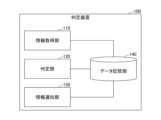
- FIG. 1 illustrates an example of the configuration of a determination device 100.
- FIG. 2 is a sequence diagram for explaining the operation of the communication system.
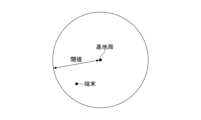
- 11 is a diagram for explaining an example of determining the validity of terminal location information;
- FIG. 11 is a diagram for explaining an example of determining the validity of terminal location information;
- FIG. 11 is a diagram for explaining an example of determining the validity of terminal location information;
- FIG. FIG. 2 illustrates an example of a hardware configuration of the apparatus.
- GPS technology is widely used to grasp location information, but location information may be tampered with. Examples of cases in which problems may arise due to tampering with location information are shown below.
- Example 1 A game that allows users to enjoy various monsters and benefits by walking is provided by an application on a device.
- This application uses GPS technology to capture the user's location information. In this case, if the location information is tampered with, the user can receive various points even though they have not actually walked.
- Example 2 Credit card fraud is on the rise. If the location information of the credit card user's device could be captured as the user's location information, it would be possible to increase the reliability of identity verification and reduce fraudulent use. However, if the device's location information is tampered with, there is a possibility that credit cards could be fraudulently used.
- Example 3 During disasters such as earthquakes, location information collection by terminals is important from the perspective of rescue support. On the other hand, during disasters, there is a possibility that false information will be spread on social networking services (SNS).
- SNS social networking services
- a determination device 100 which will be described later, compares location information acquired by a GPS in a terminal with other location information (comparison location information) to check whether the location information has been changed or tampered with. This makes it possible to grasp "location information that is highly likely not to have been tampered with.”
- the location information of a base station (an example of a comparison object) communicating with the terminal can be used.
- the determination device 100 can determine whether the terminal's location information acquired from the terminal indicates a location within the range where radio waves from the terminal can reach the base station. For example, if the terminal's location information indicates a location where radio waves should not reach, it can be determined that the terminal's location information has been tampered with.
- a terminal user uses a credit card in a specific location (e.g. a location where credit cards are used on a daily basis, if registered in advance), it may be determined that there is a high possibility that the user is attempting to use the credit card legitimately.
- a specific location e.g. a location where credit cards are used on a daily basis, if registered in advance
- FIG. 1 An example of the overall configuration of a communication system according to the present embodiment is shown in Fig. 1. As shown in Fig. 1, this communication system has a determination device 100, an information management device 200, and a service device 300, which are connected to a network 400. Furthermore, a fixed base station 20 is provided in each area, and wireless communication is performed between a terminal 10 and the base station 20. One base station 20 and one terminal 10 are shown in Fig. 1.
- the network 400 includes a core network (which may also be called a carrier network) of a mobile operator, and the base station 20 is connected to the core network. Communication between the base station 20 and the terminal 10 is performed using a wireless access technology such as 3G, 4G, 5G, or 6G.
- a wireless access technology such as 3G, 4G, 5G, or 6G.
- the determination device 100 uses the technology of the present invention to determine whether the location information of the terminal 10 is valid.
- the information management device 200 holds the location information of base stations.
- the service device 300 is a device that executes processing related to preventing fraudulent use of credit cards.
- the terminal 10 is, for example, a mobile terminal such as a smartphone.
- the terminal 10 may also be a vehicle such as an automobile.
- the terminal 10 has a function for wireless communication and a function for acquiring its own location information (for example, a GPS function).
- a GPS function for example, a GPS function.
- it is assumed that the terminal 10 is a terminal 10 of a user who uses a credit card.
- the terminal 10 acquires its own location information using a GPS function.
- the terminal 10 acquires the location information at all times (for example, periodically).
- the location information acquired by the terminal 10 is called terminal location information.
- the terminal 10 acquires base station specific information from the base station 20.
- the terminal 10 acquires the base station specific information constantly (for example, periodically).
- the base station specific information is, for example, both a Tracking Area Code (TAC) and a Cell-ID.
- the base station specific information may be either the TAC or the Cell-ID.
- the base station specific information may be information different from both the TAC and the Cell-ID. In this embodiment, it is assumed that the location information of the base station 20 can be acquired by the base station specific information.
- the terminal 10 acquires its own terminal information, for example, from its own storage device.
- the acquired terminal information is, for example, an International Mobile Equipment Identifier (IMEI) and a "Mobile Country Code (MCC) + Mobile Network Code (MNC)", or any one of these two.
- IMEI International Mobile Equipment Identifier
- MCC Mobile Country Code
- MNC Mobile Network Code
- the terminal information may be information other than these.
- the terminal information may be an ID or password of a user of the terminal 10.
- the terminal 10 transmits the information acquired in S101 to S103 (terminal location information, base station specific information, terminal information) to the determination device 100.
- the information acquisition unit 110 in the determination device 100 receives (acquires) the information transmitted from the terminal 10 (terminal location information, base station specific information, terminal information), and stores the acquired information in the data storage unit 140.
- the information acquisition unit 110 of the determination device 100 reads out the base station specific information acquired in S104 from the data storage unit 140, and transmits the base station specific information to the information management device 200, thereby requesting location information (base station location information) for the base station 20.
- the information management device 200 receives the base station specific information.
- the information management device 200 In S106, the information management device 200 generates (or acquires) base station position information (e.g., latitude, longitude) based on the base station specific information received in S105, and returns the generated base station position information to the determination device 100 as a response to the request in S105.
- the information acquisition unit 110 of the determination device 100 acquires the base station position information and stores it in the data storage unit 140.
- the information notification unit 130 of the determination device 100 notifies the service device 300 that authentication is being performed using location information on the user (person to be authenticated) of the terminal 10.
- This notification includes information capable of identifying the terminal 10, such as terminal information.
- the service device 300 holds, for example, in its own storage device, any one, any multiple, or all of the following for each credit card user: "address, coordinate information of any registered location, blacklist, whitelist.”
- blacklist is, for example, a list of locations (places) where credit card fraudulent use is suspected.
- whitelist is, for example, a list of locations (places) where credit cards are expected to be used legitimately.
- the service device 300 acquires from the storage device one or more or all of the following information for the user (person to be authenticated) of the terminal 10: "address, coordinate information of any registered location, blacklist, whitelist” and transmits the acquired information (hereinafter referred to as "designated location information") to the determination device 100.
- the information acquisition unit 110 of the determination device 100 acquires the specified location information and stores it in the data storage unit 140.
- the determination unit 120 compares the terminal location information acquired in S104 with the base station location information acquired in S106 to determine whether the terminal location information is valid (whether the terminal location information has not been tampered with). A specific example of the determination method will be described later.
- the determination unit 120 has determined that the terminal location information acquired in S104 has not been tampered with.
- the determination unit 120 compares the terminal location information with the specified location information to determine whether the location of the terminal 10 is appropriate as a location for using a credit card. For example, the determination unit 120 verifies that the terminal location information does not correspond to a location included in a blacklist. Also, for example, the determination unit 120 verifies that the terminal location information corresponds to a location included in a whitelist.
- the determination unit 120 determines that the location of the terminal 10 is a valid location for using a credit card, it generates authentication information indicating this. Also, for example, if the determination unit 120 determines that the location of the terminal 10 is not a valid location for using a credit card (e.g., it is on the blacklist), it generates authentication information indicating this (e.g., information indicating that the credit card cannot be used).
- the determination unit 120 may generate authentication information indicating that the credit card cannot be used without comparing the terminal location information with the specified location information.
- the information notification unit 130 of the determination device 100 notifies the terminal 10 of the authentication information generated in S109 (S110), and also notifies the service device 300 (S111).
- Example of a process for determining the validity of terminal location information A description will be given of an example of a process for determining the validity of terminal location information by the determining unit 120.
- the terminal location information is coordinate information (point position) such as latitude and longitude.
- the information acquisition unit 110 acquires coordinate information (point position) such as latitude and longitude as position information of the base station 20 (base station position information) from the information management device 200 .
- the determination unit 120 calculates the distance (Euclidean distance) between the location indicated by the base station location information and the location indicated by the terminal location information, and if the calculated distance is less than or equal to a threshold, it determines that the terminal location information is valid (not tampered with), and if the calculated distance is greater than the threshold, it determines that the terminal location information is invalid (has been tampered with).
- the threshold value may be a predetermined value common to multiple base stations, or may be a value predetermined for each base station.
- Figure 4 shows an example of a case in which it is determined that no tampering has occurred in Example 1.
- the information management device 200 holds the latest information on the communication area of each base station in addition to the location information of each base station.
- the "communication area" of a certain base station is an area within which information transmitted from the terminal 10 can reach that base station wirelessly.
- the information acquisition unit 110 acquires information on the communication area of the base station 20 from the information management device 200 as location information about the base station 20 (base station location information).
- the determination unit 120 determines whether the position of the terminal 10 indicated by the terminal position information is within the communication area indicated by the base station position information. If the position of the terminal 10 is within the communication area, the determination unit 120 determines that the terminal position information is valid (has not been tampered with), and if the position of the terminal 10 is not within the communication area, the determination unit 120 determines that the terminal position information is invalid (has been tampered with).
- Figure 5 shows an example of what would happen if it was determined that no tampering had occurred.
- Example 3 There is a case where the terminal 10 performs communication by simultaneously using a plurality of carriers (i.e., a plurality of cells) by carrier aggregation. In this case, a plurality of pieces of base station specific information (here, cell IDs) are transmitted from the terminal 10 to the determination device 100.
- a plurality of carriers i.e., a plurality of cells
- a plurality of pieces of base station specific information here, cell IDs
- the determination device 100 receives cell ID_1 and cell ID_2 from the terminal 10.
- the location of the carrier transmission source of cell ID_1 is different from the location of the carrier transmission source of cell ID_2.
- the information acquisition unit 110 of the determination device 100 transmits cell ID_1 and cell ID_2 to the information management device 200, thereby acquiring base station position information corresponding to cell ID_1 (position 1) and base station position information corresponding to cell ID_2 (position 2).
- the base station position information here indicates the position of the antenna that is the source of the radio waves.
- the antenna is referred to as the base station.
- the determination unit 120 calculates the distance (referred to as distance 1) between position 1 and the position indicated by the terminal position information, and also calculates the distance (referred to as distance 2) between position 2 and the position indicated by the terminal position information.
- threshold corresponding to cell ID_1 is threshold 1
- threshold corresponding to cell ID_2 is threshold 2.
- Threshold 1 and threshold 2 may be the same or different.
- the determination unit 120 determines that the terminal location information is valid (not tampered with) if "distance 1 ⁇ threshold 1 and distance 2 ⁇ threshold 2" are satisfied, and determines that the terminal location information is invalid (has been tampered with) if "distance 1 ⁇ threshold 1 and distance 2 ⁇ threshold 2" are not satisfied.
- Figure 6 shows an example of a case where it is determined that no tampering has been performed in Example 3.
- the terminal 10 transmits the base station specific information acquired from the base station 20 to the determination device 100 via the base station 20.
- the determination unit 120 of the determination device 100 acquires the base station specific information transmitted from the terminal 10, it compares the information of the base station 20 that is the sender of the base station specific information (the sender in the network 400) with the acquired base station specific information, and if they do not match (for example, if the TAC or cell ID is different), it can determine that the base station specific information has been tampered with.
- the information acquisition unit 110 of the determination device 100 is assumed to be able to obtain information on the transmission route of information transmitted from the terminal 10 when acquiring the information.
- the transmission route of the information may be the transmission route of the information itself, or the transmission route of the control plane signal for transmitting the information.
- the information acquisition unit 110 of the determination device 100 acquires information transmitted from the terminal 10, it acquires information indicating that the information or the control plane signal passed through "node A and node B" as the transmission route of the information.
- the determination unit 120 of the determination device 100 determines that the signal cannot pass through node A (e.g., an Access and Mobility Management Function (AMF) in an area far from the area indicated by the base station specific information) to transmit the acquired information, it can determine that the acquired base station specific information has been tampered with.
- node A e.g., an Access and Mobility Management Function (AMF) in an area far from the area indicated by the base station specific information
- AMF Access and Mobility Management Function
- the base station 20, etc. may utilize blockchain technology to provide the base station specific information in a form that cannot be altered.
- the object to be compared with the terminal location information is the base station location information, but the object to be compared with the terminal location information is not limited to the base station location information. Any object that is fixed (not moving) may be used as the object to be compared with the terminal location information. An example of an object to be compared with other than the base station location information will be described below.
- the location information of a landline telephone assigned the 0ABJ number can be used as a comparison target.
- This landline telephone may be a landline telephone installed at home or at work, or it may be a public telephone.
- the determination unit 120 of the determination device 100 can obtain the 0ABJ number associated with the terminal information.
- the 0ABJ number may be obtained from the data storage unit 140 of the determination device 100, or may be obtained from the service device 300.
- the determination unit 120 can obtain location information of the fixed telephone to which the 0ABJ number is assigned (referred to as telephone location information).
- the telephone location information may be obtained from the data storage unit 140 of the determination device 100, or may be obtained from the service device 300.
- the terminal 10 transmits the terminal location information and the terminal information
- the information acquisition unit 110 of the determination device 100 acquires the terminal location information and the terminal information transmitted from the terminal 10.
- the determination unit 120 of the determination device 100 obtains the 0ABJ number (the telephone number of the landline telephone) corresponding to the terminal information, and connects to the landline telephone using the 0ABJ number (i.e., makes a call to the landline telephone).
- the determination unit 120 transmits authentication information (such as an authentication code) to the landline telephone.
- authentication information such as an authentication code
- the determination unit 120 receives the authentication information from the fixed-line telephone and checks whether it matches the authentication information it sent. In this case, it is assumed that it matches, and the determination unit 120 determines that the user of the terminal 10 is in a location where a fixed-line telephone is installed.
- the determination unit 120 acquires the location information of the landline telephone (telephone location information) and calculates the distance (Euclidean distance) between the location indicated by the telephone location information and the location indicated by the terminal location information. For example, if the calculated distance is equal to or less than a threshold, the determination unit 120 determines that the terminal location information is valid (not tampered with), and if the calculated distance is greater than the threshold, the determination unit 120 determines that the terminal location information is invalid (has been tampered with).
- any of the devices described in this embodiment can be realized by, for example, causing a computer to execute a program.
- the device can be realized by using hardware resources such as a CPU (Central Processing Unit) and memory built into the computer to execute a program corresponding to the processing performed by the device.
- the program can be recorded on a computer-readable recording medium (such as portable memory) and then stored or distributed.
- the program can also be provided via a network such as the Internet or email.
- FIG. 7 is a diagram showing an example of the hardware configuration of the computer.
- the computer in FIG. 7 has a drive device 1000, an auxiliary storage device 1002, a memory device 1003, a CPU 1004, an interface device 1005, a display device 1006, an input device 1007, an output device 1008, etc., all of which are interconnected via a bus B.
- the program that realizes the processing on the computer is provided by a recording medium 1001, such as a CD-ROM (Compact Disc Read Only Memory) or a memory card.
- a recording medium 1001 such as a CD-ROM (Compact Disc Read Only Memory) or a memory card.
- the recording medium 1001 storing the program is set in the drive device 1000, the program is installed from the recording medium 1001 via the drive device 1000 into the auxiliary storage device 1002.
- the program does not necessarily have to be installed from the recording medium 1001, but may be downloaded from another computer via a network.
- the auxiliary storage device 1002 stores the installed program as well as necessary files, data, etc.
- the memory device 1003 When an instruction to start a program is received, the memory device 1003 reads out and stores the program from the auxiliary storage device 1002.
- the CPU 1004 realizes the functions related to the device in accordance with the program stored in the memory device 1003.
- the interface device 1005 is used as an interface for connecting to a network, etc.
- the display device 1006 displays a GUI (Graphical User Interface) based on a program, etc.
- the input device 1007 is composed of a keyboard and mouse, buttons, a touch panel, etc., and is used to input various operational instructions.
- the output device 1008 outputs the results of calculations.
- the technique according to the present embodiment makes it possible to determine the validity of the location information of a terminal.
- a determination device for determining the validity of terminal location information which is terminal location information, comprising: an information acquisition unit that acquires the terminal location information from the terminal; a determination unit that determines whether or not the terminal location information is valid by comparing the terminal location information with comparison target location information that is location information about an object to be compared.
- the comparison object is a base station connected to the terminal, and the comparison object location information is location information of the base station or a communication area of the base station.
- the determination device determines that the terminal location information is valid when a distance between the location indicated by the terminal location information and the location indicated by the comparison target location information is smaller than a threshold value.
- the determination unit determines that the terminal location information is valid when the location indicated by the terminal location information is within the communication area.
- the comparison object is a landline telephone, and the comparison object location information is location information of the landline telephone.
- a non-transitory storage medium storing a program for causing a computer to function as each unit in the determination device according to any one of claims 1 to 5.
- REFERENCE SIGNS LIST 10 Terminal 20 Base station 100 Determination device 110 Information acquisition unit 120 Determination unit 130 Information notification unit 140 Data storage unit 200 Information management device 300 Service device 400 Network 1000 Drive device 1001 Recording medium 1002 Auxiliary storage device 1003 Memory device 1004 CPU 1005 Interface device 1006 Display device 1007 Input device 1008 Output device
Landscapes
- Engineering & Computer Science (AREA)
- Computer Security & Cryptography (AREA)
- Computer Networks & Wireless Communication (AREA)
- Signal Processing (AREA)
- Theoretical Computer Science (AREA)
- Software Systems (AREA)
- Computer Hardware Design (AREA)
- Physics & Mathematics (AREA)
- General Engineering & Computer Science (AREA)
- General Physics & Mathematics (AREA)
- Environmental & Geological Engineering (AREA)
- Mobile Radio Communication Systems (AREA)
- Telephonic Communication Services (AREA)
Abstract
Description
前記端末から前記端末位置情報を取得する情報取得部と、
前記端末位置情報と、比較対象物についての位置情報である比較対象位置情報とを比較することにより、前記端末位置情報が正当であるか否かを判定する判定部と
を備える判定装置が提供される。
まず、本実施の形態に係る技術についての課題を説明する。前述したように、位置情報の把握のためにGPS技術が広く使用されているが、位置情報は改ざんされる可能性がある。位置情報の改ざんにより問題が生じるケースの例を以下に示す。
利用者が歩くことを通じて様々なモンスターや特典を享受できる仕組みのゲームが、端末のアプリにより提供されている。本アプリでは、利用者の位置情報を、GPS技術を用いて捕捉している。このケースにおいて、位置情報が改ざんされてしまうと、本来は歩いていないのにもかかわらず様々なポイントを受け取れてしまう。
クレジットカードの不正利用が増加している。クレジットカード利用者の端末の位置情報を、利用者の位置情報として捕捉することができれば、本人性の確認の信頼度が高まり不正利用を低減できると考えられる。しかし、端末の位置情報が改ざんされてしまうと、クレジットカードの不正利用がなされる可能性がある。
地震等の災害時には、端末による位置情報収集は救助支援の観点からも重要となる。一方で、災害時にはSNS(Social Networking Service)におけるデマ情報の流布等がなされる可能性がある。
まず、本実施の形態に係る技術の概要を説明する。本実施の形態では、後述する判定装置100が、端末においてGPSで取得された位置情報と、当該位置情報とは別の位置情報(比較対象位置情報)とを比較することで、当該位置情報の変更や改ざんがされていないかの確認を行う。それにより、「改ざんされていない可能性が高い位置情報」を把握することができる。
図1に、本実施の形態における通信システムの全体構成例を示す。図1に示すように、本通信システムは、判定装置100、情報管理装置200、及びサービス装置300を有し、これらがネットワーク400に接続されている。また、各エリアに、固定の基地局20が備えられており、端末10と基地局20との間で無線通信が行われる。図1には、1つの基地局20と、1つの端末10が示されている。
図2に、判定装置100の構成例を示す。図2に示すように、判定装置100は、情報取得部110、判定部120、情報通知部130、及びデータ記憶部140を備える。各部の動作は、以下の通信システムの動作において説明される。
次に、図3のシーケンス図の手順に沿って、通信システムの動作例を説明する。図3に示す例において、端末10は、基地局20のエリアに在圏しているものとする。
S101において、端末10は、GPS機能を用いて自身の位置情報を取得する。端末10による位置情報の取得は、常時(例えば定期的に)行われる。端末10が取得した自身の位置情報を端末位置情報と呼ぶ。
S102において、端末10は、基地局20から基地局固有情報を取得する。端末10による基地局固有情報の取得は、常時(例えば定期的に)行われる。基地局固有情報は、例えば、TAC(Tracking Area Code)とCell-IDの両方である。基地局固有情報がTACとCell-IDのうちのいずれかであってもよい。基地局固有情報は、TACとCell-IDのいずれとも異なる情報であってもよい。本実施の形態では、基地局固有情報により、基地局20の位置情報を取得可能であるとする。
S103において、端末10は、自身の端末情報を、例えば自身の記憶装置から取得する。取得する端末情報は、例えば、IMEI(International Mobile Equipment Identifier)と、「MCC(Mobile Country Code)+MNC(Mobile Network Code)」との2つ、又は、これら2つのうちのいずれか1つである。端末情報は、これら以外の情報であってもよい。例えば、端末情報が、端末10の利用者のIDあるいはパスワードであってもよい。
S104において、端末10は、S101~S103において取得した情報(端末位置情報、基地局固有情報、端末情報)を判定装置100に送信する。判定装置100における情報取得部110は、端末10から送信された情報(端末位置情報、基地局固有情報、端末情報)を受信(取得)し、取得した情報をデータ記憶部140に格納する。
S105において、判定装置100の情報取得部110は、S104で取得した基地局固有情報をデータ記憶部140から読み出し、当該基地局固有情報を情報管理装置200に送信することにより、基地局20についての位置情報(基地局位置情報)を要求する。情報管理装置200は、当該基地局固有情報を受信する。
S106において、情報管理装置200は、S105で受信した基地局固有情報に基づいて、基地局位置情報(例えば、緯度,経度)を生成(又は取得)し、生成した基地局位置情報を、S105の要求に対する応答として、判定装置100に返す。判定装置100の情報取得部110は、基地局位置情報を取得し、これをデータ記憶部140に格納する。
S107において、判定装置100の情報通知部130は、サービス装置300に対して、端末10の利用者(認証対象者)についての位置情報を用いた認証を行っていることを通知する。この通知には、端末情報等の端末10を識別することが可能な情報が含まれる。
サービス装置300は、例えば、クレジットカードの各利用者についての、「住所、登録した任意の場所の座標情報、ブラックリスト、ホワイトリスト」のうちのいずれか1つ又はいずれか複数又は全部を、自身の記憶装置に保持している。ここで、ブラックリストとは、例えば、クレジットカードの不正利用が疑われる位置(場所)のリストである。ホワイトリストとは、例えば、クレジットカードが正当に利用されることが想定される位置(場所)のリストである。
S109において、判定部120は、S104で取得した端末位置情報と、S106で取得した基地局位置情報とを比較することにより、端末位置情報が正当なものか否か(端末位置情報が改ざんされていないかどうか)を判定する。判定方法の具体例は後述する。
判定装置100の情報通知部130は、S109で生成した認証情報を端末10へ通知する(S110)とともに、サービス装置300へ通知する(S111)。
判定部120による端末位置情報の正当性判定の処理例を説明する。ここでは、端末位置情報は、緯度・経度等の座標情報(点の位置)であるとする。
情報取得部110は、情報管理装置200から、基地局20の位置情報(基地局位置情報)として、緯度・経度等の座標情報(点の位置)を取得する。
情報管理装置200は、各基地局の位置情報に加えて、各基地局の通信エリアの最新の情報を保持しているとする。ある基地局の「通信エリア」とは、端末10から送信した情報が無線でその基地局に届く範囲のエリアであるものとする。
端末10が、キャリアアグリゲーションにより、複数のキャリア(つまり複数のセル)を同時に用いて通信を行う場合がある。この場合、端末10から判定装置100に対して複数の基地局固有情報(ここではセルIDとする)が送信される。
基地局固有情報が、端末10において改ざんされている可能性があるが、判定装置100において改ざんを検知することが可能である。
これまでに説明した例では、端末位置情報と比較する対象を、基地局位置情報としたが、端末位置情報と比較する対象は、基地局位置情報に限定されない。端末位置情報と比較する対象として、固定されている物(移動しない物)であればどのような物を使用してもよい。基地局位置情報以外の比較対象の一例を以下に説明する。
本実施の形態で説明したいずれの装置(端末10、基地局20、判定装置100、情報管理装置200、サービス装置300)も、例えば、コンピュータにプログラムを実行させることにより実現できる。
以上説明したとおり、本実施の形態に係る技術により、端末の位置情報の正当性を判定することが可能となる。
(付記項1)
端末の位置情報である端末位置情報の正当性を判定するための判定装置であって、
前記端末から前記端末位置情報を取得する情報取得部と、
前記端末位置情報と、比較対象物についての位置情報である比較対象位置情報とを比較することにより、前記端末位置情報が正当であるか否かを判定する判定部と
を備える判定装置。
(付記項2)
前記比較対象物は、前記端末と接続される基地局であり、前記比較対象位置情報は、前記基地局の位置情報、又は、前記基地局の通信エリアである
付記項1に記載の判定装置。
(付記項3)
前記端末位置情報により示される位置と前記比較対象位置情報により示される位置との距離が、閾値よりも小さい場合に、前記判定部は、前記端末位置情報を正当であると判定する
付記項2に記載の判定装置。
(付記項4)
前記端末位置情報により示される位置が前記通信エリア内に存在する場合に、前記判定部は、前記端末位置情報を正当であると判定する
付記項2に記載の判定装置。
(付記項5)
前記比較対象物は、固定電話機であり、前記比較対象位置情報は、前記固定電話機の位置情報である
付記項1に記載の判定装置。
(付記項6)
端末の位置情報である端末位置情報の正当性を判定するための判定装置が実行する判定方法であって、
前記端末から前記端末位置情報を取得する情報取得ステップと、
前記端末位置情報と、比較対象物についての位置情報である比較対象位置情報とを比較することにより、前記端末位置情報が正当であるか否かを判定する判定ステップと
を備える判定方法。
(付記項7)
コンピュータを、付記項1ないし5のうちいずれか1項に記載の判定装置における各部として機能させるためのプログラムを記憶した非一時的記憶媒体。
20 基地局
100 判定装置
110 情報取得部
120 判定部
130 情報通知部
140 データ記憶部
200 情報管理装置
300 サービス装置
400 ネットワーク
1000 ドライブ装置
1001 記録媒体
1002 補助記憶装置
1003 メモリ装置
1004 CPU
1005 インタフェース装置
1006 表示装置
1007 入力装置
1008 出力装置
Claims (7)
- 端末の位置情報である端末位置情報の正当性を判定するための判定装置であって、
前記端末から前記端末位置情報を取得する情報取得部と、
前記端末位置情報と、比較対象物についての位置情報である比較対象位置情報とを比較することにより、前記端末位置情報が正当であるか否かを判定する判定部と
を備える判定装置。 - 前記比較対象物は、前記端末と接続される基地局であり、前記比較対象位置情報は、前記基地局の位置情報、又は、前記基地局の通信エリアである
請求項1に記載の判定装置。 - 前記端末位置情報により示される位置と前記比較対象位置情報により示される位置との距離が、閾値よりも小さい場合に、前記判定部は、前記端末位置情報を正当であると判定する
請求項2に記載の判定装置。 - 前記端末位置情報により示される位置が前記通信エリア内に存在する場合に、前記判定部は、前記端末位置情報を正当であると判定する
請求項2に記載の判定装置。 - 前記比較対象物は、固定電話機であり、前記比較対象位置情報は、前記固定電話機の位置情報である
請求項1に記載の判定装置。 - 端末の位置情報である端末位置情報の正当性を判定するための判定装置が実行する判定方法であって、
前記端末から前記端末位置情報を取得する情報取得ステップと、
前記端末位置情報と、比較対象物についての位置情報である比較対象位置情報とを比較することにより、前記端末位置情報が正当であるか否かを判定する判定ステップと
を備える判定方法。 - コンピュータを、請求項1ないし5のうちいずれか1項に記載の判定装置における各部として機能させるためのプログラム。
Priority Applications (2)
| Application Number | Priority Date | Filing Date | Title |
|---|---|---|---|
| EP24819113.2A EP4727189A1 (en) | 2023-06-07 | 2024-05-15 | Determination device, determination method, and program |
| US19/407,253 US20260122499A1 (en) | 2023-06-07 | 2025-12-03 | Check device, check method, and program |
Applications Claiming Priority (2)
| Application Number | Priority Date | Filing Date | Title |
|---|---|---|---|
| JP2023093866A JP7640188B2 (ja) | 2023-06-07 | 2023-06-07 | 判定装置、判定方法、及びプログラム |
| JP2023-093866 | 2023-06-07 |
Related Child Applications (1)
| Application Number | Title | Priority Date | Filing Date |
|---|---|---|---|
| US19/407,253 Continuation US20260122499A1 (en) | 2023-06-07 | 2025-12-03 | Check device, check method, and program |
Publications (1)
| Publication Number | Publication Date |
|---|---|
| WO2024252876A1 true WO2024252876A1 (ja) | 2024-12-12 |
Family
ID=93795398
Family Applications (1)
| Application Number | Title | Priority Date | Filing Date |
|---|---|---|---|
| PCT/JP2024/017987 Ceased WO2024252876A1 (ja) | 2023-06-07 | 2024-05-15 | 判定装置、判定方法、及びプログラム |
Country Status (4)
| Country | Link |
|---|---|
| US (1) | US20260122499A1 (ja) |
| EP (1) | EP4727189A1 (ja) |
| JP (1) | JP7640188B2 (ja) |
| WO (1) | WO2024252876A1 (ja) |
Citations (6)
| Publication number | Priority date | Publication date | Assignee | Title |
|---|---|---|---|---|
| JP2000028391A (ja) | 1998-07-08 | 2000-01-28 | Nippon Telegr & Teleph Corp <Ntt> | 歩行者情報提供システム |
| WO2011040401A1 (ja) * | 2009-09-30 | 2011-04-07 | 楽天株式会社 | クレジットカード不正防止システム |
| US20120052881A1 (en) * | 2005-04-26 | 2012-03-01 | Guy Heffez | Method and system for monitoring electronic purchases and cash-withdrawals |
| WO2019229941A1 (ja) * | 2018-05-31 | 2019-12-05 | 株式会社Nttドコモ | 通信制御装置及び端末装置 |
| WO2021100345A1 (ja) * | 2019-11-19 | 2021-05-27 | 株式会社Nttドコモ | オーソリゼーション装置 |
| JP2023093866A (ja) | 2021-12-23 | 2023-07-05 | 東洋インキScホールディングス株式会社 | 光電変換材料、フォトダイオード及びイメージセンサー |
-
2023
- 2023-06-07 JP JP2023093866A patent/JP7640188B2/ja active Active
-
2024
- 2024-05-15 EP EP24819113.2A patent/EP4727189A1/en active Pending
- 2024-05-15 WO PCT/JP2024/017987 patent/WO2024252876A1/ja not_active Ceased
-
2025
- 2025-12-03 US US19/407,253 patent/US20260122499A1/en active Pending
Patent Citations (6)
| Publication number | Priority date | Publication date | Assignee | Title |
|---|---|---|---|---|
| JP2000028391A (ja) | 1998-07-08 | 2000-01-28 | Nippon Telegr & Teleph Corp <Ntt> | 歩行者情報提供システム |
| US20120052881A1 (en) * | 2005-04-26 | 2012-03-01 | Guy Heffez | Method and system for monitoring electronic purchases and cash-withdrawals |
| WO2011040401A1 (ja) * | 2009-09-30 | 2011-04-07 | 楽天株式会社 | クレジットカード不正防止システム |
| WO2019229941A1 (ja) * | 2018-05-31 | 2019-12-05 | 株式会社Nttドコモ | 通信制御装置及び端末装置 |
| WO2021100345A1 (ja) * | 2019-11-19 | 2021-05-27 | 株式会社Nttドコモ | オーソリゼーション装置 |
| JP2023093866A (ja) | 2021-12-23 | 2023-07-05 | 東洋インキScホールディングス株式会社 | 光電変換材料、フォトダイオード及びイメージセンサー |
Also Published As
| Publication number | Publication date |
|---|---|
| EP4727189A1 (en) | 2026-04-15 |
| JP7640188B2 (ja) | 2025-03-05 |
| JP2024175829A (ja) | 2024-12-19 |
| US20260122499A1 (en) | 2026-04-30 |
Similar Documents
| Publication | Publication Date | Title |
|---|---|---|
| US11002822B2 (en) | Service enhancements using near field communication | |
| US9571965B2 (en) | Verified check-in | |
| KR101490132B1 (ko) | 신용 카드 사기를 추적하는 방법 | |
| US8471699B2 (en) | Method for monitoring the safety of travelers | |
| US10757102B2 (en) | Methods, apparatus, and systems for identity authentication | |
| TWI441535B (zh) | 使用地理信號特徵群集實現端到端訊息推播之方法 | |
| US9225700B1 (en) | Proximity-based authentication | |
| US20110077021A1 (en) | Providing a last-seen mobile unit location to a location based service | |
| US20130109351A1 (en) | Authentication system, authentication method and authentication server | |
| US10869195B2 (en) | Network assisted validation of secure connection to cellular infrastructure | |
| EP1762113A1 (en) | Method of providing alarm service upon movement out of safety zone | |
| KR20160131572A (ko) | 이동 통신 시스템에서 결제 관련 정보 인증 방법 및 장치 | |
| WO2019134589A1 (zh) | 伪基站定位方法、终端及计算机可读存储介质 | |
| CN103167403A (zh) | 电子渠道业务的认证方法及系统 | |
| CN113784277A (zh) | 用于存储位置信息的系统、方法和装置 | |
| CN111988784A (zh) | 一种信息处理方法、终端设备及存储介质 | |
| KR20090112359A (ko) | 위치 기반 서비스 제공 시스템 및 방법 | |
| JP7640188B2 (ja) | 判定装置、判定方法、及びプログラム | |
| US20260046618A1 (en) | Method of authenticating a user terminal | |
| US12452827B2 (en) | Learning apparatus, determination system, learning method, and non-transitory computer readable medium | |
| CN115941303A (zh) | 身份信息校验方法、装置、设备及存储介质 | |
| KR20230044737A (ko) | 비상 대피 관리 방법 및 장치 | |
| KR20050019694A (ko) | 가입자 식별자 및 휴대 단말을 이용한 위치 정보 제공시스템 및 방법 | |
| KR101910737B1 (ko) | 사용자 단말기의 위치에 따른 통신 품질 확인을 위한 시스템 및 그 제어방법 | |
| CN113472895B (zh) | 用于提供服务入口的系统、方法以及存储介质 |
Legal Events
| Date | Code | Title | Description |
|---|---|---|---|
| 121 | Ep: the epo has been informed by wipo that ep was designated in this application |
Ref document number: 24819113 Country of ref document: EP Kind code of ref document: A1 |
|
| WWE | Wipo information: entry into national phase |
Ref document number: 2024819113 Country of ref document: EP |
|
| NENP | Non-entry into the national phase |
Ref country code: DE |
|
| ENP | Entry into the national phase |
Ref document number: 2024819113 Country of ref document: EP Effective date: 20260107 |
|
| ENP | Entry into the national phase |
Ref document number: 2024819113 Country of ref document: EP Effective date: 20260107 |
|
| ENP | Entry into the national phase |
Ref document number: 2024819113 Country of ref document: EP Effective date: 20260107 |
|
| ENP | Entry into the national phase |
Ref document number: 2024819113 Country of ref document: EP Effective date: 20260107 |
|
| ENP | Entry into the national phase |
Ref document number: 2024819113 Country of ref document: EP Effective date: 20260107 |
|
| WWP | Wipo information: published in national office |
Ref document number: 2024819113 Country of ref document: EP |