WO2024252858A1 - 制御装置、制御方法および非一時的記憶媒体 - Google Patents
制御装置、制御方法および非一時的記憶媒体 Download PDFInfo
- Publication number
- WO2024252858A1 WO2024252858A1 PCT/JP2024/017727 JP2024017727W WO2024252858A1 WO 2024252858 A1 WO2024252858 A1 WO 2024252858A1 JP 2024017727 W JP2024017727 W JP 2024017727W WO 2024252858 A1 WO2024252858 A1 WO 2024252858A1
- Authority
- WO
- WIPO (PCT)
- Prior art keywords
- physical property
- candidate
- dimensional vector
- low
- value
- Prior art date
- Legal status (The legal status is an assumption and is not a legal conclusion. Google has not performed a legal analysis and makes no representation as to the accuracy of the status listed.)
- Ceased
Links
Images










Classifications
-
- G—PHYSICS
- G06—COMPUTING OR CALCULATING; COUNTING
- G06F—ELECTRIC DIGITAL DATA PROCESSING
- G06F18/00—Pattern recognition
- G06F18/20—Analysing
- G06F18/21—Design or setup of recognition systems or techniques; Extraction of features in feature space; Blind source separation
- G06F18/213—Feature extraction, e.g. by transforming the feature space; Summarisation; Mappings, e.g. subspace methods
- G06F18/2132—Feature extraction, e.g. by transforming the feature space; Summarisation; Mappings, e.g. subspace methods based on discrimination criteria, e.g. discriminant analysis
-
- G—PHYSICS
- G16—INFORMATION AND COMMUNICATION TECHNOLOGY [ICT] SPECIALLY ADAPTED FOR SPECIFIC APPLICATION FIELDS
- G16C—COMPUTATIONAL CHEMISTRY; CHEMOINFORMATICS; COMPUTATIONAL MATERIALS SCIENCE
- G16C20/00—Chemoinformatics, i.e. ICT specially adapted for the handling of physicochemical or structural data of chemical particles, elements, compounds or mixtures
- G16C20/30—Prediction of properties of chemical compounds, compositions or mixtures
-
- G—PHYSICS
- G16—INFORMATION AND COMMUNICATION TECHNOLOGY [ICT] SPECIALLY ADAPTED FOR SPECIFIC APPLICATION FIELDS
- G16C—COMPUTATIONAL CHEMISTRY; CHEMOINFORMATICS; COMPUTATIONAL MATERIALS SCIENCE
- G16C20/00—Chemoinformatics, i.e. ICT specially adapted for the handling of physicochemical or structural data of chemical particles, elements, compounds or mixtures
- G16C20/70—Machine learning, data mining or chemometrics
Definitions
- This embodiment relates to a control device, a control method, and a non-transitory storage medium.
- MI materials informatics
- a new substance discovery method in which at least one of the physical validity, chemical stability, and ease of synthesis of at least one candidate substance is verified, and the candidate substance for which verification has been completed from among the at least one candidate substance is determined to be a new substance.
- the above-mentioned conventional techniques merely verify at least one of the physical validity, chemical stability, and ease of synthesis of at least one candidate substance, and determine the candidate substance for which verification has been completed from among the at least one candidate substance as a new substance, and therefore do not necessarily enable efficient material discovery.
- this disclosure proposes a control device, a control method, and a non-transitory storage medium that can enable efficient material exploration.
- a control device includes a generation unit that generates a low-dimensional vector by reducing the dimension of a high-dimensional vector, which is a high-dimensional numerical vector corresponding to a material included in a dataset that is a set of data of a material and a physical property value corresponding to the physical property of the material, based on the high-dimensional vector, and a prediction unit that predicts a candidate physical property value, which is a physical property value corresponding to the physical property of the candidate material, from the low-dimensional vector corresponding to a candidate material that is a candidate material exhibiting physical properties corresponding to a target value, which is a physical property value set as a target, using a physical property prediction model trained to predict the physical property value from the low-dimensional vector, and the generation unit generates the low-dimensional vector corresponding to a material included in an updated dataset in which the candidate material has been added to the dataset when the candidate physical property value is not within a predetermined range from the target value.
- FIG. 1 is a diagram illustrating an example of the configuration of a material exploration and manufacturing system according to the present disclosure.
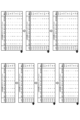
- FIG. 2 is a diagram illustrating an example of a physical property database according to an embodiment of the present disclosure.
- FIG. 1 illustrates an example of a search space database according to an embodiment of the present disclosure.
- FIG. 13 is a diagram illustrating the behavior of a physical property database during execution according to an embodiment of the present disclosure.
- FIG. 1 illustrates the run-time behavior of a search space database according to an embodiment of the present disclosure.
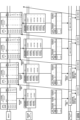
- FIG. 13 is a diagram showing communication operations among a physical property database, a search space setting module, a physical property prediction model, and a material manufacturing apparatus.
- FIG. 1 illustrates an example of a prediction of physical properties according to an embodiment of the present disclosure.
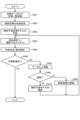
- FIG. 1 is a flowchart showing an example of a processing procedure performed by a material exploration and manufacturing system.
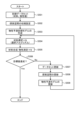
- 1 is a flowchart showing an example of a processing procedure performed by a material exploration and manufacturing system.
- 1 is a flowchart showing an example of a processing procedure performed by a material exploration and manufacturing system.
- FIG. 1 is a diagram illustrating an example of the configuration of a material exploration and manufacturing system.
- FIG. 1 is a diagram showing an example of the configuration of a material manufacturing apparatus.
- FIG. 1 is a diagram showing an example of the configuration of a material manufacturing apparatus.
- FIG. 1 is a diagram showing an example of the configuration of a material manufacturing apparatus.
- FIG. 1 shows the molecular weight distribution of 1,200 organic molecules having a cyclic structure.
- FIG. 1 shows the molecular weight distribution of 1,200 organic molecules having a cyclic structure.
- FIG. 1 shows melting point data for 1200 organic molecules with cyclic structures.
- FIG. 1 shows the results of a search for molecules that optimize (maximize) the melting point.
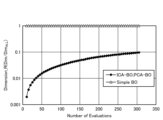
- FIG. 13 is a diagram showing a transition in the dimension of a search space.
- FIG. 2 is a hardware configuration diagram illustrating an example of a computer that realizes the functions of an information processing device according to the present disclosure.
- the search space was set by arbitrarily selecting variables from chemical space, which resulted in many unexplored regions, making it difficult to discover new materials efficiently.
- Feature selection involves combinations of exponential order (2 to the power of N when there are N feature variables), making it difficult to find suitable combinations for material exploration.
- variable selection using data seeks to select variables that minimize the prediction error of the prediction model, but this requires a large amount of data.
- synthesis and measurement are costly, so it is difficult to obtain sufficient data in advance for variable selection.
- the search space is generally a high-dimensional chemical space, and search methods such as Bayesian optimization do not work well.
- control device 20 In response to this, the control device 20 according to the present disclosure generates a low-dimensional vector by reducing the dimension of the high-dimensional vector based on a high-dimensional vector, which is a high-dimensional numerical vector corresponding to a material included in a dataset, which is data of a pair of a material and a physical property value corresponding to the physical property of the material.
- a high-dimensional vector which is a high-dimensional numerical vector corresponding to a material included in a dataset, which is data of a pair of a material and a physical property value corresponding to the physical property of the material.
- control device 20 predicts a candidate physical property value, which is a physical property value corresponding to the physical property of a candidate material, from a low-dimensional vector corresponding to a candidate material, which is a candidate material exhibiting a physical property corresponding to a target value, which is a physical property value set as a target, using a physical property prediction model trained to predict a physical property value from a low-dimensional vector.
- the control device 20 if the candidate physical property value is not within a predetermined range from the target value, the control device 20 generates a low-dimensional vector corresponding to a material included in an updated dataset in which the candidate material has been added to the dataset.
- control device 20 can provide a material exploration system that performs material exploration dramatically more efficiently in terms of time and cost by setting a necessary and sufficient low-dimensional search space by using kurtosis information in a chemical space expressed in high dimensions. Therefore, the control device 20 can perform efficient material exploration.
- FIG. 1 is a diagram showing an example of the configuration of the material exploration and manufacturing system of the present disclosure.
- the material exploration and manufacturing system 1 includes a material manufacturing apparatus 10, a control device 20, and an external storage device 50.
- the material manufacturing apparatus 10 and the control device 20 are connected to each other via a predetermined communication network (a control network N in FIG. 1) so as to be able to communicate with each other by wire or wirelessly.
- the control device 20 and the material manufacturing apparatus 10 can exchange information with each other through the control network N.
- the control network N may be a dedicated network capable of communicating wirelessly or via wire, a local area network, the Internet, or a wide area network called a cloud.
- the material manufacturing apparatus 10 has a synthesis device 11 that synthesizes materials, an analysis device 12 that identifies the synthesized materials, and a measurement device 13 that evaluates physical properties.
- Each component (device) of the material manufacturing apparatus 10, such as the synthesis device 11, analysis device 12, and measurement device 13, can transfer materials to each other, and the configuration will be described later.
- the external storage device 50 is a server device that holds information used for processing in the material exploration and manufacturing system 1. For example, the external storage device 50 provides information to the control device 20.
- the control device 20 includes a control interface 21 for controlling the material manufacturing device 10, a physical property database 22 (physical property DB in FIG. 1) for storing physical property data, a physical property prediction model 24 for predicting physical properties, a search space database 25 (search space DB in FIG.
- search agent 26 for storing search space data
- storage unit 201 HDD, SSD, ROM, etc.
- search agent 26 which is a computer program
- control unit 202 a processor (CPU, GPU, GPGPU, neural network accelerator, or a combination of multiple of these, etc.) for reading and processing the search agent 26 from the storage unit 201
- user interface keyboard
- the control device 20 includes an operation unit 203 consisting of a keyboard, mouse, touch panel, microphone (voice input), camera (image input such as face) or the like, and a display unit 204 (display, etc.) that displays the processing results of the control unit 202, etc.
- the material manufacturing apparatus 10 may be configured with hardware or software.
- the search agent 26 includes a search space setting module, which is a program that calculates search space data and stores the search space data in the search space database 25 (search space DB in FIG. 1).
- the control device 20 may include a feasibility database (not shown) that holds whether synthesis and/or measurement have been performed, and a feasibility model (not shown) that predicts whether synthesis and/or measurement can be performed.
- the control unit 202 executes each process using information received from an external device via the control network N.
- the control unit 202 also executes each process using information stored in the storage unit 201.
- the control unit 202 controls the material manufacturing apparatus 10 by transmitting information to the material manufacturing apparatus 10 via the control network N.
- the control unit 202 executes processes corresponding to the functions of the exploration agent 26.
- the control unit 202 executes processes related to the selection of synthesis materials.
- the control unit 202 executes processes related to the production of materials.
- the control unit 202 instructs the material production device 10 to synthesize materials, thereby causing the material production device 10 to execute processes for producing materials.
- the control unit 202 executes processing corresponding to the functions of the search space setting module.
- the control unit 202 calculates search space data and stores the search space data in the search space database 25 (search space DB in FIG. 1).
- the control unit 202 generates search basis vectors as the search space data and stores information about the search basis vectors in the search space database 25 (search space DB in FIG. 1).
- the search basis vectors are orthogonal bases in the search space.
- the search basis vectors have a magnitude of 1 and refer to a set of vectors that are orthogonal to each other.
- the control unit 202 is a controller, and is realized by, for example, a CPU (Central Processing Unit), an MPU (Micro Processing Unit), an ASIC (Application Specific Integrated Circuit), an FPGA (Field Programmable Gate Array), etc., by executing various programs stored in a storage device inside the information processing device 100 using a storage area such as a RAM as a working area.
- the control unit 202 has an acquisition unit 211, a generation unit 212, and a prediction unit 213.
- the acquisition unit 211 acquires an initial dataset, which is a pair of data between a material and a physical property value corresponding to the physical properties of the material.
- the acquisition unit 211 refers to the physical property database 22 and acquires the initial dataset from the physical property database 22.
- the acquisition unit 211 acquires an initial dataset, which is a pair of data between a chemical space vector (hereinafter, sometimes referred to as a "high-dimensional vector”), which is a high-dimensional numerical vector corresponding to a material, and a physical property value corresponding to the physical properties of the material.
- a chemical space vector hereinafter, sometimes referred to as a "high-dimensional vector”
- the acquisition unit 211 also acquires a target value, which is a physical property value set as a target. Specifically, the acquisition unit 211 may accept an input of a target value from a user via the operation unit 203. When the acquisition unit 211 accepts an input of a target value from a user, it acquires the target value input by the user.
- the generation unit 212 When the acquisition unit 211 acquires an initial dataset and a target value, the generation unit 212 generates a search space vector that reduces the dimension of the chemical space vector based on the chemical space vector included in the initial dataset. Specifically, the generation unit 212 generates a search basis vector that is a basis vector corresponding to a low-dimensional vector that reduces the dimension of the chemical space vector based on the chemical space vector included in the initial dataset. Furthermore, the generation unit 212 generates a search space vector that is a low-dimensional vector represented by the search basis vector based on the chemical space vector and the generated search basis vector.
- a search space vector is a numerical vector derived from a chemical space vector by feature selection or feature extraction; like the chemical space vector, it represents a material and is generally lower dimensional than the chemical space vector.
- Feature selection refers to generating a search space vector with a lower dimension than the chemical space vector by selecting one or more variables (elements of the chemical space vector) from the numerical vectors (group of feature variables) that make up the chemical space vector.
- Feature extraction refers to generating a search space vector with a lower dimension than the chemical space vector by using variables (elements of the chemical space vector) calculated by calculation from the feature variables (elements of the chemical space vector) that make up the chemical space vector.
- the generating unit 212 generates a search space vector, which is a numerical vector derived from the chemical space vector by feature selection. More specifically, the generating unit 212 selects a component (hereinafter, sometimes referred to as a "variable") x that satisfies the following formulas (1) and (2) in the distribution of materials corresponding to each component of the chemical space vector included in the initial dataset acquired by the acquiring unit 211, and generates a search space vector having the selected variable x as a component.
- a component hereinafter, sometimes referred to as a "variable”
- ⁇ is a threshold value, which takes a value approximately equal to the variance value.
- x selected is an arbitrary variable that has already been selected.
- ⁇ is a threshold value, which takes a sufficiently small value.
- Kurt(x) is a fourth-order cumulant that indicates the characteristics of the distribution, and is defined by the following formula (3) using the expected value E(x) of x.
- the generating unit 212 also generates a search space vector, which is a numerical vector derived from the chemical space vector by feature extraction. More specifically, the generating unit 212 selects a variable x' that satisfies the following formulas (5) and (6) for a variable x' included in a converted chemical space vector X' obtained by performing a matrix operation A on a chemical space vector X included in the initial data set acquired by the acquiring unit 211, and generates a search space vector having the selected variable x' as a component.
- a search space vector which is a numerical vector derived from the chemical space vector by feature extraction. More specifically, the generating unit 212 selects a variable x' that satisfies the following formulas (5) and (6) for a variable x' included in a converted chemical space vector X' obtained by performing a matrix operation A on a chemical space vector X included in the initial data set acquired by the acquiring unit 211, and generates a search space vector having the selected variable x' as
- x'selected is an arbitrary variable that has been selected
- ⁇ ' is a threshold value that is sufficiently small.
- ICA Independent Component Analysis
- the number of independent components k can be any number that is equal to or less than the chemical space dimension m, but in this embodiment, the principal component contribution ratios calculated by principal component analysis (PCA) were added up from the largest, and the number of components that exceeded 0.9 was used.
- PCA principal component analysis
- the generating unit 212 generates a low-dimensional vector (corresponding to a "search space vector”) by reducing the dimension of a high-dimensional vector based on a high-dimensional vector (corresponding to a "chemical space vector”), which is a high-dimensional numerical vector corresponding to a material included in a data set, which is a set of data of a material and a physical property value corresponding to the physical property of the material.
- the generating unit 212 generates a basis vector (corresponding to a "search basis vector") corresponding to a low-dimensional vector by reducing the dimension of the high-dimensional vector based on the high-dimensional vector, and generates a search space vector, which is a low-dimensional vector represented by the basis vector, based on the high-dimensional vector and the generated search basis vector. Specifically, the generating unit 212 selects, from among the components of the high-dimensional vector, a component corresponding to a distribution that is an outlier in the distribution of materials corresponding to each component of the high-dimensional vector, and generates a low-dimensional vector having the selected component as a component.
- a basis vector corresponding to a "search basis vector”
- the generating unit 212 selects, from among the components of the converted high-dimensional vector obtained by performing a predetermined matrix operation on the high-dimensional vector, a component corresponding to a distribution that is an outlier in the distribution of materials corresponding to each component of the converted high-dimensional vector, and generates a low-dimensional vector having the selected component as a component.
- the generation unit 212 selects mutually independent components from among the components of the converted high-dimensional vector obtained by performing a matrix operation related to independent component analysis as a predetermined matrix operation, and generates a low-dimensional vector having the selected components as its constituent elements.
- the generation unit 212 evaluates a distribution that has outliers using a fourth-order cumulant.
- the generation unit 212 evaluates the correlation between components that correspond to a distribution that has outliers using a fourth-order cumulant.
- the generation unit 212 when the generation unit 212 generates a search basis vector, it stores information about the search basis vector in the search space database 25. Specifically, the generation unit 212 stores information in which search space identification information, which is identification information for identifying the search space, and information about the generated search basis vector are associated with each other in the search space database 25. In addition, when the generation unit 212 generates a search space vector, it stores information about the search space vector in the search space database 25. Specifically, the generation unit 212 stores information in which search space identification information, which is identification information for identifying the search space, and information about the generated search space vector and material identification information that identifies the material corresponding to the chemical space vector from which the search space vector was generated are associated with each other in the search space database 25.
- the generation unit 212 stores information about components (low-dimensional representation of molecules) that map the chemical space vector onto a low-dimensional space represented by the search basis vector as information about the search space vector in the search space database 25.
- the generation unit 212 stores in the search space database 25 a low-dimensional representation consisting of coefficients for each search base vector as information about the search space vector.
- the generating unit 212 also generates a physical property prediction model trained to predict physical property values from low-dimensional vectors.
- the generating unit 212 generates a physical property prediction model trained to predict physical property values from search space vectors.
- the generating unit 212 refers to the search space database 25 to acquire the search space vectors stored in the search space database 25 and the material identification information linked to the search space vectors.
- the generating unit 212 also refers to the physical property database 22 to acquire the physical property values of the material corresponding to the acquired material identification information.
- the generating unit 212 acquires learning data which is data of pairs of search space vectors and physical property values. When the generating unit 212 acquires the learning data, it generates a physical property prediction model which is a machine learning model trained to output information on the physical property values as output information when information on the search space vectors is input as input information to the machine learning model.
- the prediction unit 213 predicts candidate physical property values, which are physical property values corresponding to the properties of the candidate materials, from the low-dimensional vectors corresponding to the candidate materials, which are candidates for materials that exhibit physical properties corresponding to the target values, which are physical property values set as targets, using a physical property prediction model that has been trained to predict physical property values from low-dimensional vectors.
- the generation unit 212 generates search space vectors corresponding to the candidate materials (e.g., 1,000 materials stored in the physical property database 22), which are candidates for materials that exhibit physical properties corresponding to the target values, which are physical property values set as targets.
- the prediction unit 213 predicts candidate physical property values, which are physical property values of the candidate materials, from the search space vectors corresponding to the candidate materials generated by the generation unit 212, using the physical property prediction model generated by the generation unit 212. Specifically, the prediction unit 213 inputs information about the search space vectors corresponding to the candidate materials into the physical property prediction model, and obtains information about the candidate physical property values output from the physical property prediction model as a prediction result. The prediction unit 213 predicts candidate physical property values corresponding to all of the candidate materials from the search space vectors corresponding to all of the candidate materials, using the physical property prediction model.
- the prediction unit 213 predicts the candidate property values corresponding to all the candidate materials, it determines the priority of the candidate materials based on the predicted candidate property values. Specifically, the prediction unit 213 compares the candidate property values corresponding to all the candidate materials with the target value, and assigns a higher priority to the candidate materials having candidate property values closer to the target value. When the prediction unit 213 determines the priority of the candidate materials, it selects a predetermined number of candidate materials in order of the determined priority.
- the control unit 202 instructs the material manufacturing device 10 to synthesize and measure the candidate materials selected by the prediction unit 213 via the control interface 21.
- the material manufacturing device 10 synthesizes the candidate materials and measures the physical property values of the candidate materials. When the material manufacturing device 10 measures the physical property values of the candidate materials, it transmits information on the measured physical property values of the candidate materials (hereinafter, sometimes referred to as candidate property values) to the control device 20 via the control interface 21.
- the generation unit 212 acquires information on the candidate physical property value from the material manufacturing apparatus 10. When the generation unit 212 acquires information on the candidate physical property value, it compares the candidate physical property value with the target value and determines whether the candidate physical property value is a value within a predetermined range from the target value. When the generation unit 212 determines that the candidate physical property value is a value within a predetermined range from the target value, it determines that the target material has been obtained and ends the process. On the other hand, when the generation unit 212 determines that the candidate physical property value is not a value within the predetermined range from the target value, it adds the physical property data of the candidate material to the physical property database 22 and updates the physical property database 22.
- the acquisition unit 211 refers to the updated physical property database 22 and acquires a second data set from the updated physical property database 22.
- the acquisition unit 211 acquires a second data set, which is data of pairs of chemical space vectors and physical property values, from the updated physical property database 22.
- the generation unit 212 generates a new search basis vector based on the chemical space vector included in the second data set, and generates a search space vector represented by the generated search basis vector.
- the generation unit 212 updates the physical property database 22, it acquires a new data set from the updated physical property database 22, generates a new search basis vector based on the chemical space vector included in the new data set, and generates a search space vector represented by the generated search basis vector. In this way, when the generation unit 212 updates the physical property database 22, it generates a low-dimensional vector (corresponding to a "search space vector") corresponding to a material included in the updated data set in which the candidate material has been added to the data set, if the candidate physical property value is not within a predetermined range from the target value.
- the generation unit 212 When the generation unit 212 generates a new search space vector, it stores information about the new search space vector in the search space database 25. The generation unit 212 adds information about the new search space vector to the search space database 25 and updates the search space database 25. The generation unit 212 also refers to the updated search space database 25 to acquire the search space vector stored in the updated search space database 25 and the material identification information linked to the search space vector. The generation unit 212 also refers to the physical property database 22 to acquire the physical property values of the material corresponding to the acquired material identification information. The generation unit 212 acquires second learning data which is data of pairs of search space vectors and physical property values. When the generation unit 212 acquires the second learning data, it generates an updated physical property prediction model which is a machine learning model trained to output information about the physical property values as output information when information about the search space vector is input as input information to the machine learning model.
- the generation unit 212 also generates a search space vector corresponding to the candidate materials (e.g., 1001 materials stored in the updated physical property database 22) that are candidates for materials that exhibit physical properties corresponding to the target value.
- the prediction unit 213 predicts the candidate physical property values, which are the physical property values of the candidate materials, from the search space vectors corresponding to the candidate materials generated by the generation unit 212, using the second physical property prediction model generated by the generation unit 212.
- the prediction unit 213 predicts the candidate physical property values corresponding to each of all the candidate materials, it determines the priority of the candidate materials based on the predicted candidate physical property values.
- the prediction unit 213 determines the priority of the candidate materials, it selects a predetermined number of candidate materials in descending order of the determined priority.
- the generating unit 212 acquires information on the candidate physical property value from the material manufacturing apparatus 10. When the generating unit 212 acquires information on the candidate physical property value, it compares the candidate physical property value with the target value and determines whether the candidate physical property value is a value within a predetermined range from the target value. When the generating unit 212 determines that the candidate physical property value is a value within the predetermined range from the target value, it determines that the target material has been obtained and ends the process. On the other hand, when the generating unit 212 determines that the candidate physical property value is not a value within the predetermined range from the target value, it adds the physical property data of the candidate material to the physical property database 22 and updates the physical property database 22. The generating unit 212 repeats the above process until it determines that the candidate physical property value is a value within the predetermined range from the target value.
- the physical property prediction model 24 may be stored in the same memory unit 201 as the physical property database 22 (physical property DB in FIG. 1) and the search space database 25 (search space DB in FIG. 1), or in a different storage device.
- the search agent 26 may also be stored in the same memory unit 201 as the physical property database 22 (physical property DB in FIG. 1) and the search space database 25 (search space DB in FIG. 1), or in a different storage device.
- a part of the memory unit 201 may be configured as a device separate from the control device 20 (e.g., external storage device 50, etc.) and connected via a network interface (not shown) connected to the control network N.
- the memory unit 201 and another storage device e.g., external storage device 50, etc.
- data communication may be performed between the control interface 21 and the control network N, and between the control network N and the synthesis device 11, the analysis device 12, or the measurement device 13, via a communication control device or communication infrastructure such as a router or switch.
- the exploration agent 26 may realize its functions as a computer program, or may realize its functions by hardware as a dedicated processor (not shown) and operate in cooperation with the processor or as part of the processor.
- the physical property prediction model 24 is configured to be updated by re-learning.
- the physical property prediction model 24 may be a machine learning model realized by a machine learning algorithm such as Gaussian process regression, a neural network, or SVM (Support Vector Machine).
- the storage unit 201 further stores a software program that executes a machine learning algorithm (not shown), and the control unit 202 processes this program to read the property prediction model 24 from the storage unit 201 and update the property prediction model 24 using machine learning data (not shown).
- the control unit 202 copies the property prediction model 24 in the middle of being updated to the property prediction model update area 24' and generates an updated model of the property prediction model 24.
- an updated physical property prediction model can be generated based on the physical property prediction model 24. That is, the control unit 202 copies the physical property prediction model 24, which is the machine learning model read from the storage unit 201, to the physical property prediction model update area 24' using a software program that executes a machine learning algorithm, and applies machine learning data to this copy, thereby producing an updated machine learning model. By writing the produced updated machine learning model back into the storage unit 201 as the physical property prediction model 24, the updated machine learning model can be continuously used as the physical property prediction model 24.
- the control device 20 can perform a process for manufacturing the property prediction model 24, which is an updated machine learning model.
- an updated search space database can be generated based on the search space database 25.
- the search space update area 25' in the storage unit 201 is used.
- the control unit 202 can generate an updated search space database by copying the search space database read from the storage unit 201 to the search space update area 25' using a software program that executes an algorithm for updating the search space database and storing it in the search space database 25, and applying the update of the search space database to this copy.
- the generated updated search space database can be written again to the storage unit 201 as the search space database 25, so that the updated search space database can be used continuously as the search space database 25.
- control device 20 can perform processing to generate the search space database 25, which is an updated search space database.
- the display unit 204 can display data structures such as those illustrated in Figures 3 to 6 in response to input from the operation unit 203.
- control unit 202 can give instructions to start, stop, or modify the processing shown in Figures 8 to 10 in response to input from the operation unit 203.
- the synthesis apparatus 11 has a mixing/reaction vessel, a reagent/solvent storage, and a product separation function inside, or these functions are not provided.
- the synthesis device 11 is connected to an external device having a controller 20, and these components can exchange contents with each other.
- the synthesis device 11 also mixes reagents and solvents, synthesizes candidate materials,
- the synthesis device 11 also uses a detection unit (a detection circuit or a detection software program that runs on a processor; the same applies below) to determine whether these operations have been successful, and is reported (transmitted) to the control device 20.
- a detection unit a detection circuit or a detection software program that runs on a processor; the same applies below
- the analysis device 12 receives the product synthesized by the synthesis device 11 and determines whether the product matches the candidate material. In response, the analysis device 12 generates an analysis result.
- the analysis device 12 also has a detection unit that determines whether the analysis was successful (generates a success determination result), and transmits the analysis result and the success determination result to the control device 20.
- the measuring device 13 receives the material that has been synthesized by the synthesizing device 11 and that the analyzing device 12 has determined to match the candidate material, and measures the physical properties of the material. As a result, the measuring device 13 generates a measurement result.
- the measuring device 13 is equipped with a detection unit that determines whether the measurement of the physical properties was successful (generates a success determination result), and transmits the measurement result and the success determination result to the control device 20.
- the material manufacturing apparatus 10 may have internal software with a property evaluation function for evaluating physical properties, or may be connected to and used with an external device that has this function. In this case, the material manufacturing apparatus 10 executes a material simulation in response to a command from the control device 20. The material manufacturing apparatus 10 determines whether the material synthesis was successful (generates a success determination result) and transmits the success determination result and the material synthesis result to the control device 20.
- the material manufacturing apparatus 10 may be configured as either hardware or software. There may be multiple material manufacturing apparatuses 10, and they may be connected via a specified network such as the Internet, but this will be described later.
- the physical property prediction model 24 is a regression model that predicts physical property values from search space vectors using physical property values stored in the physical property database 22 and search space vectors stored in the search space database 25.
- the regression model may be one that returns only a predicted value for a material, or one that returns a predicted value and the variance of the predicted value.
- the exploration agent 26 determines the priority of candidate materials based on the predicted values obtained from the physical property prediction model 24 and/or the values obtained from the feasibility model 25, selects the next candidate material to be synthesized and measured according to this priority, and synthesizes and measures the selected candidate material. Synthesis and measurement are performed by issuing a command from the exploration agent 26 to the material manufacturing equipment 10 via the control interface 21.
- the control device 20 receives "whether execution was successful" (feasibility data) and "measured values” (physical property data) reported from the material manufacturing equipment 10 via the control interface 21, and updates the physical property database 22 and the physical property prediction model 24, respectively.
- the exploration agent 26 may be on the same computer device as the control interface 21, or on a different computer device.
- FIG. 2 is a diagram showing an example of a physical property database according to an embodiment of the present disclosure.
- the database DB1 shown in FIG. 2 corresponds to the physical property database 22.
- the database DB1 stores information about chemical space vectors.
- a material organic molecule, inorganic material, organic-inorganic hybrid material, biopolymer, polymer, etc.
- a chemical space vector is generally multidimensional and is composed of a molecular descriptor, a molecular fingerprint, an elemental composition ratio, a process condition value, etc.
- the database DB1 includes items such as "ID”, "molecule ID”, “descriptor”, "physical property value", and "material attribute”.
- the database DB1 which is a physical property database, includes two or more materials to be synthesized.
- ID indicates identification information for identifying data.
- Molecule ID indicates identification information for identifying a molecule.
- Descriptor indicates a descriptor. In the example of Figure 2, "LabuteASA”, “Chi0v”, “Chi0n”, “Chi0”, “Kappa1”, etc. are used as descriptors, but Figure 2 is merely an example and any “descriptor” can be used.
- the “descriptor” item stores data (values) that numerically represent the chemical characteristics, etc., of the corresponding molecule.
- the "physical property value” indicates the physical property value of the molecule.
- Heat Capacity is used as the physical property value, but FIG. 2 is merely an example, and any “physical property value” can be used.
- the “physical property value” may be a physical property value related to various properties such as mechanical properties, thermal properties, electrical properties, magnetic properties, optical properties, electrochemical properties, medicinal properties, toxicity, antibody reaction, interaction with cells, interaction with internal organs, intracellular transportability, in vivo transportability, adsorption, solubility, etc.
- the "physical property value” item stores data (values) related to the properties possessed by the molecule. When the measurement of the molecule is successful, the value of the "physical property value” item is updated to the measured physical property value. For example, the control device 20 updates the value of the "physical property value” based on the measurement result.
- the data structure for the "physical property value” shown in Figure 2 is merely an example, and the data structure may be in the form of a list, for example.
- the data structure may be in the form of ID: 1, physical property: ⁇ "HeatCapacity”: P1, "solubility”: P2, ... ⁇ .
- the "material attribute” indicates the material attribute of the molecule (material).
- the “material attribute” may be various material attributes such as low molecules, dyes, polymers, fluorescent/identifiable isotope labels, self-organizing materials/structures, biomaterials (saccharides, peptides, polypeptides, amino acids, proteins, fatty compounds, DNA (Deoxyribonucleic Acid), etc.), organic thin films (vapor deposition, coating process), inorganic materials (solid phase method, co-precipitation method, melt quenching method, sol-gel method, etc.), nanoparticles, metal complexes, inorganic thin films (ALD (Atomic layer deposition), sputtering, etc.), synthetic materials based on synthetic biology techniques (material synthesis using genetic recombination and bacteria), functional materials with crystal structures, nanostructures,
- the data structure for "material attributes” shown in FIG. 2 is merely an example, and the data structure may be in the form of a list, for example.
- the data structure may be in the form of ID: 1, attribute: ⁇ low molecule, dye, ... ⁇ .
- the information (material property information) stored in database DB1 which is an example of the property database 22, is structured to include at least two items, and one of the at least two items is a material attribute item.
- database DB1 may store various types of information depending on the purpose, not limited to the above.
- database DB1 stores information indicating molecules (materials) that have been successfully synthesized in the past.
- Database DB1 may store flags (values) indicating molecules (materials) that have been successfully synthesized in the past in association with the molecule IDs.
- Database DB1 may exclude molecules that have been successfully synthesized in the past.
- FIG. 3 is a diagram showing an example of the search space database 25 according to an embodiment of the present disclosure.
- Database DB2 shown in FIG. 3 corresponds to the search space database 25.
- database DB2 stores information about search basis vectors.
- Database DB2 is a collection of multiple homogeneous data tables that are updated each time the search basis vectors are updated, as shown in FIG. 7 described below.
- database DB2 includes items such as "Search Space #6", “Search Basis Vector #1”, “Search Basis Vector #2”, “Search Basis Vector #3”, “Search Basis Vector #4”, “Search Basis Vector #5", “Search Basis Vector #6”, “Search Basis Vector #7”, “C1”, “C2”, “C3”, “C4", “C5", “C6”, ..., “C2048”.
- Search Space #6 indicates identification information for identifying the updated search space.
- "Search Space #6" indicates that the search space is an updated search space obtained by repeating the update five times from the initially set search space #1.
- "Search Basis Vector #1”, “Search Basis Vector #2”, “Search Basis Vector #3”, “Search Basis Vector #4”, “Search Basis Vector #5", “Search Basis Vector #6", and “Search Basis Vector #7” indicate identification information for identifying each of the seven search basis vectors in search space #6 identified by "Search Space #6".
- “C1”, “C2”, “C3”, “C4", "C5", “C6", ..., "C2048” indicate identification information for identifying each component constituting the search basis vector.
- each value of “C1”, “C2”, “C3”, “C4", “C5", “C6”, ..., “C2048” indicates the ratio of components on the chemical space constituting the search basis vector.
- the search basis vector is composed of 2048 components.
- the values of "C1”, “C2”, “C3”, “C4", “C5", “C6", ..., “C2048” indicate the proportions of each of the 2048 components "BIT1” to "BIT2048" of the chemical space vector shown in Figure 4 that make up the search basis vector.
- the data of the data records contained in the physical property database 22 and the search space database 25 may be configured to maintain a reference link so that they can be accessed from each other.
- the agent software may perform merge and filter operations between these two databases via relational database management software, allowing integrated access to the data of any data record.
- the term database is intended to include multiple data tables of the same type, and when the specification contains a statement suggesting a data table, this may mean a table managed in a database, and when the term table is included in a description of a database, this is intended to suggest a database as a higher-level concept.
- FIG. 4 is a diagram showing the behavior of the physical property database during execution according to an embodiment of the present disclosure.
- FIG. 4 shows a simplified database of the physical property database described in FIG. 2.
- the generation unit 212 determines that the candidate physical property value is not within a predetermined range from the target value, it adds the physical property data of the candidate material to the physical property database 22 and updates the physical property database 22.
- FIG. 5 is a diagram showing the behavior of the search space database during execution according to an embodiment of the present disclosure.
- the generating unit 212 updates the physical property database 22, it acquires a new data set from the updated physical property database 22 and generates new search basis vectors based on the chemical space vectors included in the new data set.
- the generating unit 212 generates new search basis vectors, it stores information about the new search basis vectors in the search space database 25.
- the generating unit 212 adds information about the new search basis vectors to the search space database 25 and updates the search space database 25.
- FIG. 6 is a diagram showing the communication operations of the physical property database, search space setting module, physical property prediction model, and material manufacturing device.
- the acquisition unit 211 refers to the physical property database 22 to acquire an initial data set, which is data pairs of chemical space vectors #1 to #5 corresponding to molecules 1 to 5, respectively, and melting point values (an example of physical property values) corresponding to molecules 1 to 5, respectively.
- the acquisition unit 211 also acquires a target value, which is the melting point value set as a target.
- the generating unit 212 also executes the functions of a search space setting module. Specifically, the generating unit 212 generates search basis vectors #1 to #3 by reducing the dimensions of the chemical space vectors #1 to #5 based on the chemical space vectors #1 to #5 included in the initial data set acquired by the acquiring unit 211. Furthermore, when the generating unit 212 generates the search basis vectors #1 to #3, it stores information about the search basis vectors #1 to #3 in the search space database 25.
- the generation unit 212 also maps the chemical space vectors corresponding to each of the molecules 1 to 5 onto a low-dimensional space represented by the search basis vectors #1 to #3 (low-dimensional representation of the molecule.
- the above-mentioned search space vectors correspond to the vectors generated by mapping the chemical space vectors corresponding to each of the molecules 1 to 5 onto the low-dimensional space represented by the search basis vectors #1 to #3.
- the generation unit 212 also acquires first learning data, which is a set of data of the low-dimensional representation of each of the molecules 1 to 5 and the melting point values corresponding to each of the molecules 1 to 5.
- the generation unit 212 generates a property prediction model #1, which is a machine learning model trained to output information on the melting point values corresponding to each of the low-dimensional representations of the molecules 1 to 5 as output information when the low-dimensional representations of each of the molecules 1 to 5 are input to the machine learning model as input information.
- a property prediction model #1 which is a machine learning model trained to output information on the melting point values corresponding to each of the low-dimensional representations of the molecules 1 to 5 as output information when the low-dimensional representations of each of the molecules 1 to 5 are input to the machine learning model as input information.
- the generation unit 212 also generates low-dimensional representations using search basis vectors corresponding to each of the candidate materials, which are candidates for materials that exhibit physical properties corresponding to the melting point value set as the target.
- the prediction unit 213 predicts the melting point value of each of the candidate materials from each of the low-dimensional representations using the search basis vectors corresponding to each of the candidate materials using the physical property prediction model #1.
- the prediction unit 213 determines the priority of the candidate materials based on the melting point value of each of the candidate materials. When the prediction unit 213 determines the priority of the candidate materials, it selects the candidate material #1 with the highest determined priority.
- the control unit 202 instructs the material manufacturing device 10 to synthesize and measure the candidate material #1 selected by the prediction unit 213 via the control interface 21.
- the material manufacturing device 10 synthesizes the candidate material #1 and measures the melting point value of the candidate material #1.
- the material manufacturing device 10 measures the melting point value of the candidate material #1, it transmits information about the measured melting point value of the candidate material #1 to the control device 20 via the control interface 21.
- the generation unit 212 obtains information on the melting point value of candidate material #1 from the material manufacturing apparatus 10. In FIG. 6, the generation unit 212 determines that the melting point value of candidate material #1 is not within a predetermined range from the target value, and therefore adds the physical property data of candidate material #1 (data corresponding to molecule 6) to the physical property database 22 and updates the physical property database 22.
- the acquisition unit 211 refers to the updated physical property database 22 to acquire a second data set, which is a set of data of chemical space vectors #1 to #6 corresponding to molecules 1 to 6, respectively, and melting point values corresponding to molecules 1 to 6, respectively.
- the acquisition unit 211 also acquires a target value, which is the melting point value set as a target.
- the generation unit 212 also generates search basis vectors #1 to #4 for reducing the dimensions of the chemical space vectors #1 to #6 based on the chemical space vectors #1 to #6 included in the second data set acquired by the acquisition unit 211, and generates a low-dimensional representation consisting of coefficients for each of the search basis vectors #1 to #4.
- the generation unit 212 When the generation unit 212 generates the search basis vectors #1 to #4, it also stores information about the search basis vectors #1 to #4 in the search space database 25.
- the generation unit 212 also acquires second learning data, which is a set of data of the low-dimensional representation of each of molecules 1 to 6 and the melting point values corresponding to each of molecules 1 to 6.
- the generation unit 212 generates property prediction model #2, which is a machine learning model trained to output information about the melting point values corresponding to each of the low-dimensional representations of molecules 1 to 6 as output information, when information about the low-dimensional representations of each of molecules 1 to 6 is input to the machine learning model as input information.
- the generation unit 212 also generates low-dimensional representations using search basis vectors corresponding to each of the candidate materials, which are candidates for materials that exhibit physical properties corresponding to the melting point value set as the target.
- the prediction unit 213 predicts the melting point value of each of the candidate materials from each of the low-dimensional representations using the search basis vectors corresponding to each of the candidate materials using the physical property prediction model #2.
- the prediction unit 213 determines the priority of the candidate materials based on the melting point value of each of the candidate materials. When the prediction unit 213 determines the priority of the candidate materials, it selects the candidate material #2 with the highest determined priority.
- the control unit 202 instructs the material manufacturing device 10 to synthesize and measure the candidate material #2 selected by the prediction unit 213 via the control interface 21.
- the material manufacturing device 10 synthesizes the candidate material #2 and measures the melting point value of the candidate material #2.
- the material manufacturing device 10 measures the melting point value of the candidate material #2, it transmits information about the measured melting point value of the candidate material #2 to the control device 20 via the control interface 21.
- the generation unit 212 obtains information on the melting point value of candidate material #2 from the material manufacturing apparatus 10. In FIG. 6, the generation unit 212 determines that the melting point value of candidate material #2 is not within a predetermined range from the target value, and therefore adds the physical property data of candidate material #2 (data corresponding to molecule 7) to the physical property database 22 and updates the physical property database 22.
- the acquisition unit 211 refers to the updated physical property database 22 to acquire a third data set, which is a set of data of chemical space vectors #1 to #7 corresponding to molecules 1 to 7, respectively, and melting point values corresponding to molecules 1 to 7, respectively.
- the acquisition unit 211 also acquires a target value, which is the melting point value set as a target.
- the generation unit 212 also generates search basis vectors #1 to #5 for reducing the dimensions of the chemical space vectors #1 to #7 based on the chemical space vectors #1 to #7 included in the third data set acquired by the acquisition unit 211, and generates a low-dimensional representation consisting of coefficients for each of the search basis vectors #1 to #5.
- the generation unit 212 When the generation unit 212 generates the search basis vectors #1 to #5, it also stores information about the search basis vectors #1 to #5 in the search space database 25.
- the generation unit 212 also acquires third learning data, which is a set of data of the low-dimensional representation of each of molecules 1 to 7 and the melting point values corresponding to each of molecules 1 to 7.
- the generation unit 212 generates property prediction model #3, which is a machine learning model trained to output information about the melting point values corresponding to each of the low-dimensional representations of molecules 1 to 7 as output information, when information about the low-dimensional representations of each of molecules 1 to 7 is input to the machine learning model as input information.
- the generation unit 212 also generates low-dimensional representations using search basis vectors corresponding to each of the candidate materials, which are candidates for materials that exhibit physical properties corresponding to the melting point value set as the target.
- the prediction unit 213 predicts the melting point value of each of the candidate materials from each of the low-dimensional representations using the search basis vectors corresponding to each of the candidate materials using the physical property prediction model #3.
- the prediction unit 213 determines the priority of the candidate materials based on the melting point value of each of the candidate materials. When the prediction unit 213 determines the priority of the candidate materials, it selects the candidate material #3 with the highest determined priority.
- the control unit 202 instructs the material manufacturing device 10 to synthesize and measure the candidate material #3 selected by the prediction unit 213 via the control interface 21.
- the material manufacturing device 10 synthesizes the candidate material #3 and measures the melting point value of the candidate material #3.
- the material manufacturing device 10 measures the melting point value of the candidate material #3, it transmits information about the measured melting point value of the candidate material #3 to the control device 20 via the control interface 21.
- the generation unit 212 obtains information on the melting point value of candidate material #3 from the material manufacturing apparatus 10. In FIG. 6, the generation unit 212 determines that the melting point value of candidate material #3 is not within a predetermined range from the target value, and therefore adds the physical property data of candidate material #3 (data corresponding to molecule 8) to the physical property database 22 and updates the physical property database 22.
- the generation unit 212 repeats the above process until it is determined that the candidate property value is within a predetermined range from the target value.
- FIG. 7 is a diagram showing an example of a physical property prediction according to an embodiment of the present disclosure.
- the generator 212 uses a learning algorithm to train and update the physical property prediction model 24 using data pairs of physical property values stored in the physical property database 22 and low-dimensional expressions based on search basis vectors stored in the search space database 25 as learning data.
- the generator 212 generates the physical property prediction model 24, which is a machine learning model trained to output the physical property values included in the learning data as output information from the machine learning model when the low-dimensional expressions based on the search basis vectors included in the learning data are input as input information to the machine learning model.
- the learning of the physical property prediction model 24 by the control device 20 is so-called supervised learning, and a detailed description will be omitted, but as long as the physical property prediction model 24 can be learned, the control device 20 may learn the physical property prediction model 24 by any process.
- FIG. 8 is a flowchart showing an example of a processing procedure by the material exploration and manufacturing system.
- the acquisition unit 211 acquires an initial data set, which is a set of data of a material and a physical property value corresponding to the physical property of the material (step S301).
- the generation unit 212 sets a search space (step S302). Specifically, the generation unit 212 generates search basis vectors that have a reduced dimension compared to the chemical space vectors, based on the chemical space vectors included in the initial data set acquired by the acquisition unit 211. Furthermore, the generation unit 212 generates a low-dimensional representation using the search basis vectors, based on the chemical space vectors included in the initial data set and the generated search basis vectors.
- the generation unit 212 When the generation unit 212 has set the search space, it generates a physical property prediction model 24 (step S303).
- the prediction unit 213 uses the physical property prediction model 24 to predict the physical property values of each candidate material from each low-dimensional representation using the search basis vector corresponding to each candidate material.
- the prediction unit 213 determines the priority of the candidate materials based on the prediction results. In FIG. 8, the prediction unit 213 selects the candidate material with the highest priority (step S304).
- the material manufacturing apparatus 10 synthesizes the candidate materials selected by the prediction unit 213 and measures the physical property values of the candidate materials (step S305).
- the generation unit 212 acquires information on the candidate physical property value from the material manufacturing apparatus 10. When the generation unit 212 acquires information on the candidate physical property value, it compares the candidate physical property value with the target value and determines whether the candidate physical property value is a value within a predetermined range from the target value (step S306). When the generation unit 212 determines that the candidate physical property value is a value within a predetermined range from the target value (step S306; Yes), it determines that the target material has been obtained and ends the process.
- step S306 determines that the candidate physical property value is not a value within the predetermined range from the target value (step S306; No)
- the generation unit 212 updates the physical property database 22, it generates a new search basis vector.
- the generation unit 212 adds information about the new search basis vector to the search space database 25 and updates the search space database 25 (step S308).
- the generation unit 212 generates a new low-dimensional representation using the new search basis vector based on the chemical space vector and the new search basis vector.
- the generation unit 212 updates the search space database 25, it updates the physical property prediction model (step S309). Specifically, the generation unit 212 generates an updated physical property prediction model, which is a machine learning model trained to output information related to physical property values as output information, when a low-dimensional representation based on the search basis vectors stored in the updated search space database 25 is input as input information to the machine learning model.
- an updated physical property prediction model which is a machine learning model trained to output information related to physical property values as output information, when a low-dimensional representation based on the search basis vectors stored in the updated search space database 25 is input as input information to the machine learning model.
- FIG. 9 is a flowchart showing an example of a processing procedure by the material exploration and manufacturing system. Steps S401 to S407 shown in FIG. 9 are the same as steps S301 to S307 shown in FIG. 8, so a description thereof will be omitted.
- the generation unit 212 determines the frequency with which the property prediction model 24 is updated and the frequency with which the search space database 25 is updated (step S408). In FIG. 9, the generation unit 212 determines that the update frequency of the property prediction model 24 is to be 90% of the update frequency of the property prediction model 24 in FIG. 8. The generation unit 212 also determines that the update frequency of the search space database 25 is to be 10% of the update frequency of the search space database 25 in FIG. 8. The generation unit 212 also updates the search space database 25 at a frequency that is 10% of the update frequency of the search space database 25 in FIG. 8 (step S409). The generation unit 212 also updates the property prediction model 24 at a frequency that is 90% of the update frequency of the property prediction model 24 in FIG. 8 (step S410).
- FIG. 10 is a flowchart showing an example of the processing procedure by the material exploration and manufacturing system. Steps S501-503 and 506-509 shown in FIG. 10 are the same as steps S301-303 and 306-309 shown in FIG. 8, so their description is omitted.
- the generation unit 212 performs batch processing to select and synthesize multiple materials at once.
- the prediction unit 213 selects N (N is a natural number equal to or greater than 2) candidate materials in descending order of priority (step S504).
- the material manufacturing apparatus 10 synthesizes each of the N candidate materials selected by the prediction unit 213, and measures the physical property values of each of the N candidate materials (step S505).
- the material exploration and manufacturing system 1 can execute any process using the various information described above. In this respect, an embodiment different from the embodiment described above will be described below.
- a material synthesis list is sent to the synthesis device 11 via the control interface 21, and synthesis is instructed according to the list.
- the synthesis device 11 reads out ⁇ molecule ID (, synthesis path ID) ⁇ in accordance with the priority of the list.
- the synthesis device 11 acquires a reaction step from the synthesis path ID table using the synthesis path ID as a key, and performs synthesis processing.
- the synthesized material is automatically provided to the analytical device 12 to confirm whether the synthesis was successful, and control is performed to instruct the analytical device 12 to perform an analysis to confirm whether the synthesized material has been successfully used to synthesize a molecular ID.
- the analysis device 12 judges that the synthesis is successful, it notifies the synthesis device 11 of "synthesis success.” Otherwise, it notifies the synthesis device 11 of "synthesis failure.”
- the synthesis device 11 notifies the control interface 21 of the success or failure of the synthesis.
- the "success or failure notification” differs depending on the notification received during the synthesis process: (6-1) If compositing is not possible, the compositing ends abnormally, or the compositing fails, a “compositing failure” message is sent. (6-2) If the synthesis is successful, send "successful synthesis.”
- the synthesis device 11 If there is a material in the list for which synthesis has not yet been attempted, the synthesis device 11 reads the next ⁇ molecule ID (, synthesis path ID) ⁇ and repeats from (3). (8) In parallel with the processing of the synthesis device 11, if the result is "synthesis failure", the exploration agent 26 determines that synthesis is not possible and selects a new candidate material.
- the discovery agent 26 receives the IDs of the successfully synthesized molecules. (12) Identify the ID of the successfully synthesized molecule, specify the physical properties to be measured, and issue an instruction to the synthesis device 11 via the control interface 21 to measure the successfully synthesized material. (13) Upon receiving the instruction, the synthesis device 11 automatically controls itself to provide the synthesis material identified by the specified molecular ID to the measurement device 13, and instructs the measurement device 13 to start measuring the specified physical properties of the provided material.
- the measuring device 13 If the measuring device 13 is unable to perform the measurement, it notifies the synthesis device 11 of “measurement not possible,” and if the measurement ends normally, it notifies the synthesis device 11 of “measurement completed” and the measurement result. Upon receiving the notification, the synthesis device 11 transmits the measurement result via the control interface 21. (15) If the measurement result is “measurable”, the exploration agent 26 determines that synthesis is not possible and selects a new candidate material.
- the exploration agent 26 further determines whether the target value has been achieved, and if the target value has been achieved, it determines that the synthesis has been successful and ends the process. If the target value has not been achieved, it generates a low-dimensional vector corresponding to the materials included in the updated dataset in which the candidate material has been added to the dataset. Next, the exploration agent 26 updates the search space database 25.
- the synthesis phase and the measurement phase are separated, and the exploration agent 26 issues instructions to the synthesis agent for each phase, but after the exploration agent 26 issues an instruction to synthesize, the synthesis device 11 may automatically "instruct measurement” for the measurement process after "notifying the analysis result" of the synthesis process. Also, in the above example, the control interface 21 converts information, but the synthesis device 11 may convert information.
- the synthesis device 11 receives information, data, and instructions via the control interface 21, and the synthesis device 11 transmits the information, data, and instructions to the analysis device 12 or the measurement device 13, and the synthesis device 11 receives result information from the analysis device 12 or the measurement device 13.
- the analysis device 12 or the measurement device 13 may exchange data directly with the control interface 21 without the synthesis device 11 being the intermediary.
- the exploration agent 26 (or equivalent computer software or hardware) may be able to directly control the analysis device 12 or the measurement device 13 via the control interface 21.
- the functions of the exploration agent 26 may be possessed by a computer such as the control device 200 shown in FIG. 11.
- FIG. 11 is a diagram showing an example of the configuration of a material exploration and manufacturing system.
- the control interface 21 may be a computer device equipped with a communication interface (such as the control device 200 in FIG. 11), or may be a wired or wireless communication device.
- the control device 200 functions as the control device 20.
- the control device 20 communicates with other configurations via a network N1 such as the Internet (cloud), or a network N2 such as a private cloud including virtualization technology and VPN (Virtual Private Network) technology.
- a network N1 such as the Internet (cloud), or a network N2 such as a private cloud including virtualization technology and VPN (Virtual Private Network) technology.
- the control device 20 communicates with the material manufacturing device 10, the database DB, and the like via the control device 200.
- the database DB may be on a computer device connected to the synthesis device 11 via a network, or may operate on a computer device on the cloud, or on a device integrated with the synthesis device 11.
- the database DB may include the same database as the physical property database 22 (physical property DB in FIG. 1) or the search space database 25 (search space DB in FIG. 1).
- the database DB may be on separate storage devices, such as the physical property database 22 (physical property DB in FIG. 1) and the search space database 25 (search space DB in FIG. 1), or may be integrated into one storage device as one database DB, or may be on a virtual storage device.
- the control interface 21 may also have a function of accessing a database and may perform processing related to the material synthesis list performed by the synthesis device 11 in the synthesis phase.
- the synthesis device 11, the analysis device 12, and the measurement device 13 may be a system with the same control system in a single housing, or may be independent in separate housings.
- Figs. 12 to 14 are diagrams showing an example of the configuration of the material manufacturing apparatus. Note that in the following, the material manufacturing apparatuses will be described as 10A, 10B, and 10C depending on the aspect of the material moving mechanism, but other than the configuration related to the material moving mechanism, they are the same as the material manufacturing apparatus 10. Also, regarding the material manufacturing apparatus 10, the description of the same points as those described above will be omitted as appropriate.
- the material manufacturing apparatus 10A shown in FIG. 12 has a material movement path 14 as a material movement mechanism.
- the synthesis apparatus 11 has a drive device 111 that drives the material movement path 14, a processor 112 that controls the drive device 111 and executes synthesis processing, and a communication interface 113 for communicating with other apparatuses.
- the analysis apparatus 12 has a drive device 121 that drives the material movement path 14, a processor 122 that controls the drive device 121 and executes analysis processing, and a communication interface 123 for communicating with other apparatuses.
- the measurement apparatus 13 has a drive device 131 that drives the material movement path 14, a processor 132 that controls the drive device 131 and executes measurement processing, and a communication interface 133 for communicating with other apparatuses.
- the material MT shown in FIG. 12 can be moved between the synthesis device 11, the analysis device 12, and the measurement device 13 according to the operation of the material movement path 14.
- the material manufacturing apparatus 10B shown in FIG. 13 has a robot arm 15 as a material moving mechanism.
- the synthesis apparatus 11 has a drive device 111 that drives the robot arm 15, a processor 112 that controls the drive device 111 and executes synthesis processing, and a communication interface 113 for communicating with other apparatuses.
- the analysis apparatus 12 has a processor 122 that executes analysis processing, and a communication interface 123 for communicating with other apparatuses.
- the measurement apparatus 13 has a processor 132 that executes measurement processing, and a communication interface 133 for communicating with other apparatuses.
- the robot arm 15 shown in FIG. 13 is driven by the drive device 111 of the synthesis apparatus 11.
- the material MT shown in FIG. 13 can move between the synthesis apparatus 11, the analysis apparatus 12, and the measurement apparatus 13 according to the operation of the robot arm 15.
- the material manufacturing apparatus 10C shown in FIG. 14 has a flow path formed by a syringe pump 16 and a tube 17 as a material moving mechanism.
- the synthesis apparatus 11 has a drive device 111 that drives the syringe pump 16, a processor 112 that controls the drive device 111 and executes the synthesis process, and a communication interface 113 for communicating with other apparatuses.
- the analysis apparatus 12 has a processor 122 that executes the analysis process and a communication interface 123 for communicating with other apparatuses.
- the measurement apparatus 13 has a processor 132 that executes the measurement process and a communication interface 133 for communicating with other apparatuses.
- the syringe pump 16 shown in FIG. 14 is driven by the drive device 111 of the synthesis apparatus 11.
- the synthesized material (sample as a solution) MT shown in FIG. 14 can move between the synthesis apparatus 11, the analysis apparatus 12, and the measurement apparatus 13 through a flow path formed by a tube 17 according to the operation of the syring
- the material manufacturing apparatus 10 may have any type of material movement mechanism as long as the material can be moved between devices.
- the material manufacturing apparatus 10 executes the process of manufacturing materials.
- the material manufacturing apparatus 10 executes the process of manufacturing materials in response to operations by a user of the material manufacturing apparatus 10, etc.
- the material manufacturing apparatus 10 executes the process of manufacturing materials in response to instructions from an external device.
- the material manufacturing apparatus 10 executes the process of manufacturing materials in response to instructions from the control device 20.
- the material synthesized by the synthesis device 11 is automatically moved to the measurement device 13, and the measurement device 13 performs a process of measuring the specified physical property values of the moved material.
- the measurement device 13 transmits the physical property measurement process results generated by the measurement process to another device.
- the material manufacturing apparatus 10 (the measurement device 13) transmits the physical property measurement process results to other devices such as the control device 20, control device 200, etc.
- a materials search was carried out to find a material that gives the maximum melting point, using melting point data (see Figure 16) of 1,200 organic small molecules with a cyclic structure and a molecular weight of 135 or less (see Figure 15).
- Figure 15 shows the molecular weight distribution of 1,200 organic molecules with a cyclic structure.
- Figure 16 shows the melting point data of 1,200 organic molecules with a cyclic structure.
- As the chemical space 2,000 types of descriptors from Dragon7 were used (2,000-dimensional chemical space).
- the experimental equipment was realized using software. A molecular structure from the data set was received as input from the control system, and the physical property values that were the measurement results were returned to the control system.
- Bayesian Optimization In the comparative example, an existing method, Bayesian optimization, will be described.
- Bayesian optimization a statistical model that uses existing data, chemical space as an argument, and gives predicted physical property values (average, variance) is estimated.
- Gaussian Process Regression is used as the statistical model.
- this statistical model For a candidate material whose physical property values have not been evaluated, this statistical model is used to calculate predicted physical property values (average ⁇ , variance ⁇ 2), and an acquisition function calculated from both the average value ⁇ and the variance value ⁇ 2 is used to determine the material whose physical property values will be evaluated next.
- UCB Upper Confidence Bound
- LCB Lower Confidence Bound
- ICA independent component analysis
- Figure 17 shows the results of searching for molecules that optimize (maximize) the melting point.
- Figure 17 shows the search results for a comparative example, a modified example, and an embodiment.
- the vertical axis of the graph shown in Figure 17 is the difference from the maximum melting point (°C), and the horizontal axis is the number of evaluations (number of molecules evaluated).
- Figure 17 shows the comparison results (average of 10 runs) of the existing Bayesian optimization (Simple BO) as a comparative example, Bayesian optimization (PCA-BO) in which a search space is set based on feature extraction by principal component analysis as a modified example, and Bayesian estimation (ICA-BO) in which a search space is set based on feature extraction by independent component analysis using fourth-order cumulants as an embodiment.
- ICA-BO and PCA-BO searched for the molecule that gave the maximum value after 80 and 140 evaluations, respectively, while Simple BO did not find it even after more than 300 evaluations.
- Fig. 18 shows the transition of the dimension of the search space.
- Fig. 18 shows the transition of the dimension of the search space (ratio when the dimension of the chemical space is 1) with respect to the number of horizontal axis evaluations in the comparative example, modified example, and example. As shown in Fig. 17, in the example, the maximum value was reached after 80 evaluations, and the dimension of the search space at that time was 0.02 (40 dimensions in real terms) in ratio to the dimension of the chemical space (2000 dimensions).
- stratified sampling (variable extraction based on clusters) can also be used as a feature extraction method.
- the control device 20 includes the generating unit 212 and the predicting unit 213.
- the generating unit 212 generates a low-dimensional vector by reducing the dimension of a high-dimensional vector based on a high-dimensional vector that is a high-dimensional numerical vector corresponding to a material included in a dataset that is a set of data of a material and a physical property value corresponding to the physical property of the material.
- the predicting unit 213 predicts a candidate physical property value that is a physical property value corresponding to the physical property of a candidate material from a low-dimensional vector that is a candidate material that exhibits physical properties corresponding to a target value that is a physical property value set as a target, using a physical property prediction model that has been trained to predict a physical property value from a low-dimensional vector. If the candidate physical property value is not a value within a predetermined range from the target value, the generating unit 212 generates a low-dimensional vector corresponding to a material included in an updated dataset in which the candidate material has been added to the dataset.
- control device 20 This allows the control device 20 to perform efficient material searches.
- the generating unit 212 also selects, from among the components of the high-dimensional vector, a component that corresponds to an outlier distribution in the distribution of materials corresponding to each component of the high-dimensional vector, and generates a low-dimensional vector whose constituent elements are the selected components.
- control device 20 This allows the control device 20 to perform efficient material searches.
- the generation unit 212 also evaluates the distribution of outliers using fourth-order cumulants.
- control device 20 This allows the control device 20 to perform efficient material searches.
- the generating unit 212 also selects, from among the components of the converted high-dimensional vector obtained by performing a predetermined matrix operation on the high-dimensional vector, components that correspond to an outlier distribution in the distribution of materials that correspond to each component of the converted high-dimensional vector, and generates a low-dimensional vector whose constituent elements are the selected components.
- control device 20 This allows the control device 20 to perform efficient material searches.
- the generation unit 212 also evaluates the correlation between components corresponding to distributions with outliers using fourth-order cumulants.
- control device 20 This allows the control device 20 to perform efficient material searches.
- the generation unit also selects mutually independent components from among the components of the converted high-dimensional vector obtained by performing a matrix operation related to independent component analysis as a predetermined matrix operation, and generates a low-dimensional vector whose components are the selected components.
- control device 20 This allows the control device 20 to perform efficient material searches.
- each component of each device shown in the figure is a functional concept, and does not necessarily have to be physically configured as shown in the figure.
- the specific form of distribution and integration of each device is not limited to that shown in the figure, and all or part of them can be functionally or physically distributed and integrated in any unit depending on various loads, usage conditions, etc.
- FIG. 19 is a hardware configuration diagram showing an example of a computer that realizes the functions of the control device 20 according to the present disclosure.
- the computer 1000 has a CPU 1100, a RAM 1200, a ROM (Read Only Memory) 1300, a HDD (Hard Disk Drive) 1400, a communication interface 1500, and an input/output interface 1600. Each part of the computer 1000 is connected by a bus 1050.
- the CPU 1100 operates based on the programs stored in the ROM 1300 or the HDD 1400 and controls each component. For example, the CPU 1100 loads the programs stored in the ROM 1300 or the HDD 1400 into the RAM 1200 and executes processes corresponding to the various programs.
- the ROM 1300 stores boot programs such as the Basic Input Output System (BIOS) that is executed by the CPU 1100 when the computer 1000 starts up, as well as programs that depend on the hardware of the computer 1000.
- BIOS Basic Input Output System
- HDD 1400 is a non-transient computer-readable recording medium that non-temporarily records programs executed by CPU 1100 and data used by such programs. Specifically, HDD 1400 is a non-transient recording medium that records the programs related to the present disclosure, which are an example of program data 1450.
- the communication interface 1500 is an interface for connecting the computer 1000 to an external network 1550 (e.g., the Internet).
- the CPU 1100 receives data from other devices and transmits data generated by the CPU 1100 to other devices via the communication interface 1500.
- the input/output interface 1600 is an interface for connecting the input/output device 1650 and the computer 1000.
- the CPU 1100 receives data from an input device such as a keyboard or a mouse via the input/output interface 1600.
- the CPU 1100 also transmits data to an output device such as a display, a speaker, or a printer via the input/output interface 1600.
- the input/output interface 1600 may also function as a media interface that reads programs and the like recorded on a specific recording medium.
- Examples of media include optical recording media such as DVDs (Digital Versatile Discs) and PDs (Phase change rewritable Disks), magneto-optical recording media such as MOs (Magneto-Optical Disks), tape media, magnetic recording media, and semiconductor memories.
- optical recording media such as DVDs (Digital Versatile Discs) and PDs (Phase change rewritable Disks)
- magneto-optical recording media such as MOs (Magneto-Optical Disks)
- tape media magnetic recording media
- magnetic recording media and semiconductor memories.
- the CPU 1100 of the computer 1000 executes a program loaded onto the RAM 1200 to reproduce the functions of the control unit 202, etc.
- the HDD 1400 stores the program related to the present disclosure and various data.
- the CPU 1100 reads and executes the program data 1450 from the HDD 1400, but as another example, the CPU 1100 may obtain these programs from other devices via the external network 1550.
- the present technology can also be configured as follows.
- a generation unit that generates a low-dimensional vector by reducing the dimension of a high-dimensional vector based on a high-dimensional vector that is a high-dimensional numerical vector corresponding to the material included in a data set that is a pair of data of a material and a physical property value corresponding to the physical property of the material; a prediction unit that predicts, from the low-dimensional vector corresponding to a candidate material that is a candidate for a material exhibiting physical properties corresponding to a target value that is a physical property value set as a target, a candidate physical property value that is a physical property value corresponding to the candidate material, using a physical property prediction model trained to predict the physical property value from the low-dimensional vector; Equipped with The generation unit is a control device that generates the low-dimensional vector corresponding to a material included in an updated dataset in which the candidate material is added to the dataset, if the candidate property value is not within a predetermined range from the target value.
- the generation unit is Selecting a component corresponding to an outlier distribution in the distribution of materials corresponding to each component of the high-dimensional vector from among the components of the high-dimensional vector, and generating the low-dimensional vector having the selected component as a constituent element.
- the generation unit is The distribution of the outliers is evaluated using a fourth-order cumulant.
- the generation unit is From among the components of a converted high-dimensional vector obtained by performing a predetermined matrix operation on the high-dimensional vector, a component corresponding to a distribution that is an outlier in a distribution of materials corresponding to each component of the converted high-dimensional vector is selected, and the low-dimensional vector having the selected components as its constituent elements is generated.
- the control device according to (1) or (2).
- the generation unit is A correlation between components corresponding to the distributions taking the outliers is evaluated using a fourth-order cumulant.
- the generation unit is As the predetermined matrix operation, components independent of each other are selected from among the components of the converted high-dimensional vector obtained by performing a matrix operation related to an independent component analysis, and the low-dimensional vector is generated having the selected components as components.
- generating a low-dimensional vector by reducing the dimension of a high-dimensional vector based on a high-dimensional vector that is a high-dimensional numerical vector corresponding to the material included in a data set that is a pair of data of a material and a physical property value corresponding to a physical property of the material; predicting a candidate physical property value, which is a physical property value corresponding to a physical property of a candidate material, from the low-dimensional vector corresponding to the candidate material, which is a candidate for a material exhibiting physical properties corresponding to a target value, which is a physical property value set as a target, using a physical property prediction model trained to predict the physical property value from the low-dimensional vector; and if the candidate property value is not within a predetermined range from the target value, generating the low-dimensional vector corresponding to a material included in an updated dataset in which the candidate material has been added to the dataset.
- (8) generating a low-dimensional vector by reducing the dimension of a high-dimensional vector based on a high-dimensional vector that is a high-dimensional numerical vector corresponding to the material included in a data set that is a pair of data of a material and a physical property value corresponding to a physical property of the material; predicting a candidate physical property value, which is a physical property value corresponding to a physical property of a candidate material, from the low-dimensional vector corresponding to the candidate material, which is a candidate for a material exhibiting physical properties corresponding to a target value, which is a physical property value set as a target, using a physical property prediction model trained to predict the physical property value from the low-dimensional vector; and if the candidate property value is not within a predetermined range from the target value, generating the low-dimensional vector corresponding to the materials included in the updated dataset in which the candidate material has been added to the dataset.
- Material exploration and manufacturing system (information processing system) REFERENCE SIGNS LIST 10 Material manufacturing equipment 11 Synthesis equipment 12 Analysis equipment 13 Measurement equipment 20 Control equipment 21 Control interface 22 Physical property database 23 Effectiveness database 24 Physical property prediction model 24' Physical property prediction model update area 25 Search space database 26 Search space setting module 27 Search space update area 202 Control unit 211 Acquisition unit 212 Generation unit 213 Prediction unit 203 Operation unit 204 Display unit N Control network
Landscapes
- Engineering & Computer Science (AREA)
- Theoretical Computer Science (AREA)
- Computer Vision & Pattern Recognition (AREA)
- Data Mining & Analysis (AREA)
- Life Sciences & Earth Sciences (AREA)
- Bioinformatics & Cheminformatics (AREA)
- Bioinformatics & Computational Biology (AREA)
- Computing Systems (AREA)
- Chemical & Material Sciences (AREA)
- Artificial Intelligence (AREA)
- Crystallography & Structural Chemistry (AREA)
- Evolutionary Computation (AREA)
- General Physics & Mathematics (AREA)
- Evolutionary Biology (AREA)
- General Engineering & Computer Science (AREA)
- Physics & Mathematics (AREA)
- Health & Medical Sciences (AREA)
- Databases & Information Systems (AREA)
- General Health & Medical Sciences (AREA)
- Medical Informatics (AREA)
- Software Systems (AREA)
- Management, Administration, Business Operations System, And Electronic Commerce (AREA)
- Information Retrieval, Db Structures And Fs Structures Therefor (AREA)
Priority Applications (2)
| Application Number | Priority Date | Filing Date | Title |
|---|---|---|---|
| CN202480037726.4A CN121263790A (zh) | 2023-06-07 | 2024-05-14 | 控制装置、控制方法和非暂时性存储介质 |
| JP2025526012A JPWO2024252858A1 (enExample) | 2023-06-07 | 2024-05-14 |
Applications Claiming Priority (2)
| Application Number | Priority Date | Filing Date | Title |
|---|---|---|---|
| JP2023094439 | 2023-06-07 | ||
| JP2023-094439 | 2023-06-07 |
Publications (1)
| Publication Number | Publication Date |
|---|---|
| WO2024252858A1 true WO2024252858A1 (ja) | 2024-12-12 |
Family
ID=93795295
Family Applications (1)
| Application Number | Title | Priority Date | Filing Date |
|---|---|---|---|
| PCT/JP2024/017727 Ceased WO2024252858A1 (ja) | 2023-06-07 | 2024-05-14 | 制御装置、制御方法および非一時的記憶媒体 |
Country Status (3)
| Country | Link |
|---|---|
| JP (1) | JPWO2024252858A1 (enExample) |
| CN (1) | CN121263790A (enExample) |
| WO (1) | WO2024252858A1 (enExample) |
Citations (4)
| Publication number | Priority date | Publication date | Assignee | Title |
|---|---|---|---|---|
| JP2009113717A (ja) * | 2007-11-08 | 2009-05-28 | Fuji Heavy Ind Ltd | 状態推定システム |
| JP2021039534A (ja) * | 2019-09-03 | 2021-03-11 | 株式会社日立製作所 | 材料特性予測装置および材料特性予測方法 |
| JP2021174403A (ja) * | 2020-04-28 | 2021-11-01 | 株式会社日立製作所 | 材料の特性値を推定するシステム |
| WO2023058519A1 (ja) * | 2021-10-04 | 2023-04-13 | 株式会社レゾナック | 組成探索方法 |
-
2024
- 2024-05-14 JP JP2025526012A patent/JPWO2024252858A1/ja active Pending
- 2024-05-14 WO PCT/JP2024/017727 patent/WO2024252858A1/ja not_active Ceased
- 2024-05-14 CN CN202480037726.4A patent/CN121263790A/zh active Pending
Patent Citations (4)
| Publication number | Priority date | Publication date | Assignee | Title |
|---|---|---|---|---|
| JP2009113717A (ja) * | 2007-11-08 | 2009-05-28 | Fuji Heavy Ind Ltd | 状態推定システム |
| JP2021039534A (ja) * | 2019-09-03 | 2021-03-11 | 株式会社日立製作所 | 材料特性予測装置および材料特性予測方法 |
| JP2021174403A (ja) * | 2020-04-28 | 2021-11-01 | 株式会社日立製作所 | 材料の特性値を推定するシステム |
| WO2023058519A1 (ja) * | 2021-10-04 | 2023-04-13 | 株式会社レゾナック | 組成探索方法 |
Also Published As
| Publication number | Publication date |
|---|---|
| CN121263790A (zh) | 2026-01-02 |
| JPWO2024252858A1 (enExample) | 2024-12-12 |
Similar Documents
| Publication | Publication Date | Title |
|---|---|---|
| US11256995B1 (en) | System and method for prediction of protein-ligand bioactivity using point-cloud machine learning | |
| Nguyen et al. | Mathematical deep learning for pose and binding affinity prediction and ranking in D3R Grand Challenges | |
| Tang et al. | A self-attention based message passing neural network for predicting molecular lipophilicity and aqueous solubility | |
| Su et al. | Biological network exploration with Cytoscape 3 | |
| Yeang et al. | Physical network models | |
| Xiong et al. | Multi-instance learning of graph neural networks for aqueous p K a prediction | |
| CN114207729B (zh) | 材料特性预测系统以及材料特性预测方法 | |
| WO2020186109A2 (en) | Systems and methods for determining molecular structures with molecular-orbital-based features | |
| Cinaglia et al. | Network alignment and motif discovery in dynamic networks | |
| EP4428866A1 (en) | Synthesis material selection method, material production method, synthesis material selection data structure, and production method | |
| Medina‐Franco | Interrogating novel areas of chemical space for drug discovery using chemoinformatics | |
| Chen et al. | Multiple classifier integration for the prediction of protein structural classes | |
| Städler et al. | Molecular heterogeneity at the network level: high-dimensional testing, clustering and a TCGA case study | |
| Lin et al. | Diversifying chemical libraries with generative topographic mapping | |
| Osadchy et al. | How deep learning tools can help protein engineers find good sequences | |
| Protopopov et al. | The freedom space–a new set of commercially available molecules for hit discovery | |
| CN114171126A (zh) | 分子训练集的构建方法、训练方法及相关装置 | |
| Harihar et al. | Importance of inter-residue contacts for understanding protein folding and unfolding rates, remote homology, and drug design | |
| Kaushal et al. | Analyzing and visualizing expression data with Spotfire | |
| CN121263790A (zh) | 控制装置、控制方法和非暂时性存储介质 | |
| Cannataro et al. | Data management of protein interaction networks | |
| US20240321402A1 (en) | Generating molecules accounting for reaction conditions and reaction products | |
| Thinius | High throughput tight binding calculation of electronic HOMO–LUMO gaps and its prediction for natural compounds | |
| EP4690215A2 (en) | Graph edit distance determination in drug-like chemical spaces | |
| Hu et al. | Analyzing networks with VisANT |
Legal Events
| Date | Code | Title | Description |
|---|---|---|---|
| 121 | Ep: the epo has been informed by wipo that ep was designated in this application |
Ref document number: 24819095 Country of ref document: EP Kind code of ref document: A1 |
|
| ENP | Entry into the national phase |
Ref document number: 2025526012 Country of ref document: JP Kind code of ref document: A |
|
| WWE | Wipo information: entry into national phase |
Ref document number: 2025526012 Country of ref document: JP |
|
| NENP | Non-entry into the national phase |
Ref country code: DE |