WO2024248136A1 - 共重合体、撥水剤用重合体、撥水膜形成用組成物、樹脂膜及びレジストパターンの形成方法 - Google Patents
共重合体、撥水剤用重合体、撥水膜形成用組成物、樹脂膜及びレジストパターンの形成方法 Download PDFInfo
- Publication number
- WO2024248136A1 WO2024248136A1 PCT/JP2024/020046 JP2024020046W WO2024248136A1 WO 2024248136 A1 WO2024248136 A1 WO 2024248136A1 JP 2024020046 W JP2024020046 W JP 2024020046W WO 2024248136 A1 WO2024248136 A1 WO 2024248136A1
- Authority
- WO
- WIPO (PCT)
- Prior art keywords
- group
- repeating unit
- general formula
- compound represented
- unit represented
- Prior art date
- Legal status (The legal status is an assumption and is not a legal conclusion. Google has not performed a legal analysis and makes no representation as to the accuracy of the status listed.)
- Ceased
Links
Classifications
-
- G—PHYSICS
- G03—PHOTOGRAPHY; CINEMATOGRAPHY; ANALOGOUS TECHNIQUES USING WAVES OTHER THAN OPTICAL WAVES; ELECTROGRAPHY; HOLOGRAPHY
- G03F—PHOTOMECHANICAL PRODUCTION OF TEXTURED OR PATTERNED SURFACES, e.g. FOR PRINTING, FOR PROCESSING OF SEMICONDUCTOR DEVICES; MATERIALS THEREFOR; ORIGINALS THEREFOR; APPARATUS SPECIALLY ADAPTED THEREFOR
- G03F7/00—Photomechanical, e.g. photolithographic, production of textured or patterned surfaces, e.g. printing surfaces; Materials therefor, e.g. comprising photoresists; Apparatus specially adapted therefor
- G03F7/20—Exposure; Apparatus therefor
- G03F7/2041—Exposure; Apparatus therefor in the presence of a fluid, e.g. immersion; using fluid cooling means
-
- C—CHEMISTRY; METALLURGY
- C07—ORGANIC CHEMISTRY
- C07C—ACYCLIC OR CARBOCYCLIC COMPOUNDS
- C07C31/00—Saturated compounds having hydroxy or O-metal groups bound to acyclic carbon atoms
- C07C31/34—Halogenated alcohols
- C07C31/42—Polyhydroxylic acyclic alcohols
-
- C—CHEMISTRY; METALLURGY
- C07—ORGANIC CHEMISTRY
- C07C—ACYCLIC OR CARBOCYCLIC COMPOUNDS
- C07C67/00—Preparation of carboxylic acid esters
- C07C67/08—Preparation of carboxylic acid esters by reacting carboxylic acids or symmetrical anhydrides with the hydroxy or O-metal group of organic compounds
-
- C—CHEMISTRY; METALLURGY
- C07—ORGANIC CHEMISTRY
- C07C—ACYCLIC OR CARBOCYCLIC COMPOUNDS
- C07C69/00—Esters of carboxylic acids; Esters of carbonic or haloformic acids
- C07C69/62—Halogen-containing esters
- C07C69/65—Halogen-containing esters of unsaturated acids
- C07C69/653—Acrylic acid esters; Methacrylic acid esters; Haloacrylic acid esters; Halomethacrylic acid esters
-
- C—CHEMISTRY; METALLURGY
- C08—ORGANIC MACROMOLECULAR COMPOUNDS; THEIR PREPARATION OR CHEMICAL WORKING-UP; COMPOSITIONS BASED THEREON
- C08F—MACROMOLECULAR COMPOUNDS OBTAINED BY REACTIONS ONLY INVOLVING CARBON-TO-CARBON UNSATURATED BONDS
- C08F220/00—Copolymers of compounds having one or more unsaturated aliphatic radicals, each having only one carbon-to-carbon double bond, and only one being terminated by only one carboxyl radical or a salt, anhydride ester, amide, imide or nitrile thereof
- C08F220/02—Monocarboxylic acids having less than ten carbon atoms; Derivatives thereof
-
- C—CHEMISTRY; METALLURGY
- C08—ORGANIC MACROMOLECULAR COMPOUNDS; THEIR PREPARATION OR CHEMICAL WORKING-UP; COMPOSITIONS BASED THEREON
- C08F—MACROMOLECULAR COMPOUNDS OBTAINED BY REACTIONS ONLY INVOLVING CARBON-TO-CARBON UNSATURATED BONDS
- C08F220/00—Copolymers of compounds having one or more unsaturated aliphatic radicals, each having only one carbon-to-carbon double bond, and only one being terminated by only one carboxyl radical or a salt, anhydride ester, amide, imide or nitrile thereof
- C08F220/02—Monocarboxylic acids having less than ten carbon atoms; Derivatives thereof
- C08F220/10—Esters
- C08F220/22—Esters containing halogen
-
- C—CHEMISTRY; METALLURGY
- C08—ORGANIC MACROMOLECULAR COMPOUNDS; THEIR PREPARATION OR CHEMICAL WORKING-UP; COMPOSITIONS BASED THEREON
- C08F—MACROMOLECULAR COMPOUNDS OBTAINED BY REACTIONS ONLY INVOLVING CARBON-TO-CARBON UNSATURATED BONDS
- C08F220/00—Copolymers of compounds having one or more unsaturated aliphatic radicals, each having only one carbon-to-carbon double bond, and only one being terminated by only one carboxyl radical or a salt, anhydride ester, amide, imide or nitrile thereof
- C08F220/02—Monocarboxylic acids having less than ten carbon atoms; Derivatives thereof
- C08F220/10—Esters
- C08F220/38—Esters containing sulfur
-
- G—PHYSICS
- G03—PHOTOGRAPHY; CINEMATOGRAPHY; ANALOGOUS TECHNIQUES USING WAVES OTHER THAN OPTICAL WAVES; ELECTROGRAPHY; HOLOGRAPHY
- G03F—PHOTOMECHANICAL PRODUCTION OF TEXTURED OR PATTERNED SURFACES, e.g. FOR PRINTING, FOR PROCESSING OF SEMICONDUCTOR DEVICES; MATERIALS THEREFOR; ORIGINALS THEREFOR; APPARATUS SPECIALLY ADAPTED THEREFOR
- G03F7/00—Photomechanical, e.g. photolithographic, production of textured or patterned surfaces, e.g. printing surfaces; Materials therefor, e.g. comprising photoresists; Apparatus specially adapted therefor
- G03F7/004—Photosensitive materials
-
- G—PHYSICS
- G03—PHOTOGRAPHY; CINEMATOGRAPHY; ANALOGOUS TECHNIQUES USING WAVES OTHER THAN OPTICAL WAVES; ELECTROGRAPHY; HOLOGRAPHY
- G03F—PHOTOMECHANICAL PRODUCTION OF TEXTURED OR PATTERNED SURFACES, e.g. FOR PRINTING, FOR PROCESSING OF SEMICONDUCTOR DEVICES; MATERIALS THEREFOR; ORIGINALS THEREFOR; APPARATUS SPECIALLY ADAPTED THEREFOR
- G03F7/00—Photomechanical, e.g. photolithographic, production of textured or patterned surfaces, e.g. printing surfaces; Materials therefor, e.g. comprising photoresists; Apparatus specially adapted therefor
- G03F7/004—Photosensitive materials
- G03F7/0046—Photosensitive materials with perfluoro compounds, e.g. for dry lithography
-
- G—PHYSICS
- G03—PHOTOGRAPHY; CINEMATOGRAPHY; ANALOGOUS TECHNIQUES USING WAVES OTHER THAN OPTICAL WAVES; ELECTROGRAPHY; HOLOGRAPHY
- G03F—PHOTOMECHANICAL PRODUCTION OF TEXTURED OR PATTERNED SURFACES, e.g. FOR PRINTING, FOR PROCESSING OF SEMICONDUCTOR DEVICES; MATERIALS THEREFOR; ORIGINALS THEREFOR; APPARATUS SPECIALLY ADAPTED THEREFOR
- G03F7/00—Photomechanical, e.g. photolithographic, production of textured or patterned surfaces, e.g. printing surfaces; Materials therefor, e.g. comprising photoresists; Apparatus specially adapted therefor
- G03F7/004—Photosensitive materials
- G03F7/038—Macromolecular compounds which are rendered insoluble or differentially wettable
-
- G—PHYSICS
- G03—PHOTOGRAPHY; CINEMATOGRAPHY; ANALOGOUS TECHNIQUES USING WAVES OTHER THAN OPTICAL WAVES; ELECTROGRAPHY; HOLOGRAPHY
- G03F—PHOTOMECHANICAL PRODUCTION OF TEXTURED OR PATTERNED SURFACES, e.g. FOR PRINTING, FOR PROCESSING OF SEMICONDUCTOR DEVICES; MATERIALS THEREFOR; ORIGINALS THEREFOR; APPARATUS SPECIALLY ADAPTED THEREFOR
- G03F7/00—Photomechanical, e.g. photolithographic, production of textured or patterned surfaces, e.g. printing surfaces; Materials therefor, e.g. comprising photoresists; Apparatus specially adapted therefor
- G03F7/004—Photosensitive materials
- G03F7/039—Macromolecular compounds which are photodegradable, e.g. positive electron resists
-
- G—PHYSICS
- G03—PHOTOGRAPHY; CINEMATOGRAPHY; ANALOGOUS TECHNIQUES USING WAVES OTHER THAN OPTICAL WAVES; ELECTROGRAPHY; HOLOGRAPHY
- G03F—PHOTOMECHANICAL PRODUCTION OF TEXTURED OR PATTERNED SURFACES, e.g. FOR PRINTING, FOR PROCESSING OF SEMICONDUCTOR DEVICES; MATERIALS THEREFOR; ORIGINALS THEREFOR; APPARATUS SPECIALLY ADAPTED THEREFOR
- G03F7/00—Photomechanical, e.g. photolithographic, production of textured or patterned surfaces, e.g. printing surfaces; Materials therefor, e.g. comprising photoresists; Apparatus specially adapted therefor
- G03F7/004—Photosensitive materials
- G03F7/039—Macromolecular compounds which are photodegradable, e.g. positive electron resists
- G03F7/0392—Macromolecular compounds which are photodegradable, e.g. positive electron resists the macromolecular compound being present in a chemically amplified positive photoresist composition
- G03F7/0397—Macromolecular compounds which are photodegradable, e.g. positive electron resists the macromolecular compound being present in a chemically amplified positive photoresist composition the macromolecular compound having an alicyclic moiety in a side chain
-
- G—PHYSICS
- G03—PHOTOGRAPHY; CINEMATOGRAPHY; ANALOGOUS TECHNIQUES USING WAVES OTHER THAN OPTICAL WAVES; ELECTROGRAPHY; HOLOGRAPHY
- G03F—PHOTOMECHANICAL PRODUCTION OF TEXTURED OR PATTERNED SURFACES, e.g. FOR PRINTING, FOR PROCESSING OF SEMICONDUCTOR DEVICES; MATERIALS THEREFOR; ORIGINALS THEREFOR; APPARATUS SPECIALLY ADAPTED THEREFOR
- G03F7/00—Photomechanical, e.g. photolithographic, production of textured or patterned surfaces, e.g. printing surfaces; Materials therefor, e.g. comprising photoresists; Apparatus specially adapted therefor
- G03F7/004—Photosensitive materials
- G03F7/09—Photosensitive materials characterised by structural details, e.g. supports, auxiliary layers
- G03F7/091—Photosensitive materials characterised by structural details, e.g. supports, auxiliary layers characterised by antireflection means or light filtering or absorbing means, e.g. anti-halation, contrast enhancement
-
- G—PHYSICS
- G03—PHOTOGRAPHY; CINEMATOGRAPHY; ANALOGOUS TECHNIQUES USING WAVES OTHER THAN OPTICAL WAVES; ELECTROGRAPHY; HOLOGRAPHY
- G03F—PHOTOMECHANICAL PRODUCTION OF TEXTURED OR PATTERNED SURFACES, e.g. FOR PRINTING, FOR PROCESSING OF SEMICONDUCTOR DEVICES; MATERIALS THEREFOR; ORIGINALS THEREFOR; APPARATUS SPECIALLY ADAPTED THEREFOR
- G03F7/00—Photomechanical, e.g. photolithographic, production of textured or patterned surfaces, e.g. printing surfaces; Materials therefor, e.g. comprising photoresists; Apparatus specially adapted therefor
- G03F7/004—Photosensitive materials
- G03F7/09—Photosensitive materials characterised by structural details, e.g. supports, auxiliary layers
- G03F7/11—Photosensitive materials characterised by structural details, e.g. supports, auxiliary layers having cover layers or intermediate layers, e.g. subbing layers
-
- G—PHYSICS
- G03—PHOTOGRAPHY; CINEMATOGRAPHY; ANALOGOUS TECHNIQUES USING WAVES OTHER THAN OPTICAL WAVES; ELECTROGRAPHY; HOLOGRAPHY
- G03F—PHOTOMECHANICAL PRODUCTION OF TEXTURED OR PATTERNED SURFACES, e.g. FOR PRINTING, FOR PROCESSING OF SEMICONDUCTOR DEVICES; MATERIALS THEREFOR; ORIGINALS THEREFOR; APPARATUS SPECIALLY ADAPTED THEREFOR
- G03F7/00—Photomechanical, e.g. photolithographic, production of textured or patterned surfaces, e.g. printing surfaces; Materials therefor, e.g. comprising photoresists; Apparatus specially adapted therefor
- G03F7/20—Exposure; Apparatus therefor
Definitions
- This disclosure relates to copolymers, polymers for water repellents, compositions for forming water repellent films, and methods for forming resin films and resist patterns.
- liquid immersion lithography In the field of microfabrication, typified by the manufacture of integrated circuit elements, lithography techniques capable of microfabrication are required to achieve higher integration levels.
- lithography technique liquid immersion lithography is known.
- an exposure process is performed by filling the space between a lens of an exposure device and a substrate such as a silicon wafer with an immersion liquid.
- the angle of incidence of the exposure light passing through the lens and incident on the substrate can be made smaller than when the space between the lens of the exposure tool and the substrate is filled with air, and therefore the numerical aperture of the lens can be made larger, leading to improved resolution (see Non-Patent Document 1).
- a resist film is formed on the surface of a substrate, and the space between the resist film and the lens of an exposure device is filled with an immersion liquid, and then an exposure process is performed.
- water pure water
- the immersion liquid may penetrate into the resist film, resulting in defective pattern formation.
- various components may seep out from the resist film into the immersion liquid, resulting in defective pattern formation.
- liquid droplets may remain on the substrate after immersion exposure, which may result in pattern defects.
- an upper layer film is formed on the resist film in order to prevent such pattern formation defects.
- Patent Documents 1 and 2 describe methods for forming such an upper layer film using a composition containing a fluorine-containing resin having a predetermined structure. Also, as described in Patent Documents 1 and 2, a fluorine-containing resin is added to a resist film, and instead of forming an upper layer film, a topcoat-less resist film is formed, and a pattern is formed by immersion exposure.
- the immersion liquid When performing high speed exposure using an exposure apparatus, if the hysteresis (advancing contact angle-receding contact angle) of the upper layer film or the topcoatless resist film with respect to the immersion liquid is high or if the sliding angle is high, the immersion liquid will not drain well during exposure, making it likely to cause defective pattern formation.
- the upper layer film and topcoatless resist film formed using the fluorine-containing resin described in Patent Documents 1 and 2 have room for improvement in terms of hysteresis and sliding angle with respect to the immersion liquid.
- the present disclosure has been made to solve the above problems, and aims to provide a polymer that can form a resin film that has low hysteresis with respect to the immersion liquid in immersion exposure and a low sliding angle.
- the present disclosure (1) is a copolymer having a repeating unit represented by the following general formula (1) and a repeating unit derived from a compound having a polymerizable carbon-carbon double bond.
- R 1 is a hydrogen atom, a fluorine atom, a chlorine atom, or a linear alkyl group having 1 to 10 carbon atoms or a branched alkyl group having 3 to 10 carbon atoms. A part or all of the hydrogen atoms bonded to carbon atoms in the alkyl group may be substituted with fluorine atoms.
- R2 is a single bond, an alkylene group which may have a linear, branched or cyclic structure, an aromatic ring, an ester, a carbonyl, an ether, an amide, an amine, or a composite substituent thereof, some of which may be fluorinated and/or chlorinated.
- X is a hydroxyl group, an alkoxy group, or a hydrogen atom.
- Disclosure (2) is a copolymer according to disclosure (1), in which the repeating unit represented by general formula (1) contains a repeating unit represented by the following general formula (2):
- the present disclosure (3) is a copolymer according to the present disclosure (2), in which the repeating unit represented by the general formula (2) includes a repeating unit represented by the following general formula (2-1):
- the present disclosure (4) is a copolymer according to the present disclosure (1), in which the repeating unit represented by the general formula (1) contains a repeating unit represented by the following general formula (3):
- the present disclosure (5) is a copolymer according to the present disclosure (4), in which the repeating unit represented by the general formula (3) includes a repeating unit represented by the following general formula (3-1):
- the present disclosure (6) is a copolymer according to any one of the present disclosures (1) to (5), in which the repeating unit derived from the compound having a polymerizable carbon-carbon double bond includes a repeating unit represented by the following general formula (4):
- R A is a hydrogen atom, a fluorine atom, a chlorine atom, or a linear alkyl group having 1 to 10 carbon atoms or a branched alkyl group having 3 to 10 carbon atoms. A part or all of the hydrogen atoms bonded to carbon atoms in the alkyl group may be substituted with fluorine atoms.
- Y A is a monovalent organic group.
- the present disclosure (7) is a copolymer according to the present disclosure (6), in which the repeating unit represented by the general formula (4) contains a repeating unit that does not have a fluorine atom.
- the present disclosure (8) relates to a compound represented by the general formula (4), which is a repeating unit selected from the group consisting of methyl methacrylate, ethyl methacrylate, n-propyl methacrylate, isopropyl methacrylate, n-butyl methacrylate, isobutyl methacrylate, t-butyl methacrylate, pentyl methacrylate, methyl acrylate, ethyl acrylate, n-propyl acrylate, isopropyl acrylate, n-butyl acrylate, isobutyl acrylate, t-butyl acrylate, pentyl acrylate, a compound represented by the following formula (4'-1), a compound represented by the following formula (4'-2), a compound represented by the following formula (4'-3), a compound represented by the following formula (4'-4), a compound represented by the following formula (4'-5),
- the present disclosure (9) is a polymer for use in a water repellent agent, which contains a repeating unit represented by the following general formula (1):
- R 1 is a hydrogen atom, a fluorine atom, a chlorine atom, or a linear alkyl group having 1 to 10 carbon atoms or a branched alkyl group having 3 to 10 carbon atoms. A part or all of the hydrogen atoms bonded to carbon atoms in the alkyl group may be substituted with fluorine atoms.
- R2 is a single bond, an alkylene group which may have a linear, branched or cyclic structure, an aromatic ring, an ester, a carbonyl, an ether, an amide, an amine, or a composite substituent thereof, some of which may be fluorinated and/or chlorinated.
- X is a hydroxyl group, an alkoxy group, or a hydrogen atom.
- the present disclosure (10) is a polymer for a water repellent according to the present disclosure (9), in which the repeating unit represented by the general formula (1) contains a repeating unit represented by the following general formula (2):
- the present disclosure (11) is a polymer for a water repellent according to the present disclosure (10), in which the repeating unit represented by the general formula (2) contains a repeating unit represented by the following general formula (2-1):
- the present disclosure (12) is a polymer for a water repellent according to the present disclosure (9), in which the repeating unit represented by the general formula (1) contains a repeating unit represented by the following general formula (3):
- the present disclosure (13) is a polymer for a water repellent according to the present disclosure (12), in which the repeating unit represented by the general formula (3) includes a repeating unit represented by the following general formula (3-1):
- composition for forming a water-repellent film of the present disclosure (14) contains a copolymer described in any one of the present disclosures (1) to (8) or a polymer for use as a water repellent described in any one of the present disclosures (9) to (13).
- the water-repellent film-forming composition of the present disclosure is the water-repellent film-forming composition of the present disclosure (14), which contains two or more types of the copolymer described in any one of the present disclosures (1) to (8) or the polymer for water repellent agent described in any one of the present disclosures (9) to (13).
- the water-repellent film-forming composition of the present disclosure (16) is the water-repellent film-forming composition described in the present disclosure (14) which further contains an acid generator.
- the resin film of the present disclosure (17) includes a coating of the water-repellent film-forming composition described in the present disclosure (14).
- the resin film of the present disclosure (18) is the resin film described in the present disclosure (17) that is used for immersion exposure.
- the method for forming a resist pattern of the present disclosure (19) includes a film-forming step of applying the water-repellent film-forming composition described in the present disclosure (14) to the surface of a substrate or an underlayer film to form a resin film, and an immersion exposure step of irradiating and exposing the resin film with electromagnetic waves or high-energy rays having a wavelength of 300 nm or less while the resin film is in direct contact with water.
- the copolymer according to the first embodiment of the present disclosure is a copolymer having a repeating unit represented by the following general formula (1) and a repeating unit derived from a compound having a polymerizable carbon-carbon double bond.
- R 1 is a hydrogen atom, a fluorine atom, a chlorine atom, or a linear alkyl group having 1 to 10 carbon atoms or a branched alkyl group having 3 to 10 carbon atoms. A part or all of the hydrogen atoms bonded to carbon atoms in the alkyl group may be substituted with fluorine atoms.
- R2 is a single bond, an alkylene group which may have a linear, branched or cyclic structure, an aromatic ring, an ester, a carbonyl, an ether, an amide, an amine, or a composite substituent thereof, some of which may be fluorinated and/or chlorinated.
- X is a hydroxyl group, an alkoxy group, or a hydrogen atom.
- the copolymer according to the first embodiment of the present disclosure is used to form an upper layer film when performing immersion exposure, or a topcoat-less resist film.
- An upper layer film or a topcoat-less resist film formed using the copolymer according to the first embodiment of the present disclosure has low hysteresis with respect to the immersion liquid and a low sliding angle. This improves the drainage of the immersion liquid during exposure, resulting in good pattern formation.
- the repeating unit represented by the general formula (1) has a monochlorodifluoromethyl group (--CF 2 Cl).
- the repeating units contained in conventional polymers for forming upper layer films and topcoatless resist films have a trifluoromethyl group (-CF 3 ).
- the monochlorodifluoromethyl group (--CF 2 Cl) is more easily decomposed than the trifluoromethyl group (--CF 3 ).
- Waste liquid generated when forming an upper layer film or a topcoat-less resist film using the copolymer according to the first embodiment of the present disclosure contains a resin containing a monochlorodifluoromethyl group (-CF 2 Cl). The resin contained in such waste liquid is easily decomposed, making the waste liquid easy to treat.
- Examples of the alkyl group exemplified by R 1 include a methyl group, an ethyl group, a 1-propyl group, and propyl groups such as a 1-propyl group.
- Examples of the alkylene group exemplified by R2 include a methylene group, an ethylene group, a propylene group such as a 1,3-propylene group or a 1,2-propylene group, a tetramethylene group, a pentamethylene group, a hexamethylene group, a heptamethylene group, an octamethylene group, a nonamethylene group, a decamethylene group, an undecamethylene group, a dodecamethylene group, a tridecamethylene group, a tetradecamethylene group, a pentadecamethylene group, a hexadecamethylene group, a heptadecamethylene group, an octadecamethylene group, a nonadecamethylene group, an insalen group, a 1-methyl-1,3-propylene group, a 2-methyl-1,3-propylene group, a 2-methyl-1,2-propylene group, a 1-methyl-1,4-butylene
- the ether exemplified by R2 is a structure represented by (-O-).
- the amine exemplified by R2 has a structure represented by (-NB-) (B represents a hydrogen atom or a monovalent organic group).
- the repeating unit represented by the general formula (1) may contain a repeating unit represented by the following general formula (2):
- the terminal of the side chain is a hydroxyl group, so that the copolymer can have properties such as water repellency, adhesion, and alkali solubility.
- repeating unit represented by the general formula (2) is the repeating unit represented by the following general formula (2-1).
- the repeating unit represented by the general formula (1) may also contain a repeating unit represented by the following general formula (3):
- the end of the side chain is a hydrogen group, so the copolymer can have properties such as water repellency and water resistance.
- repeating unit represented by the general formula (3) is the repeating unit represented by the following general formula (3-1).
- the repeating unit derived from a compound having a polymerizable carbon-carbon double bond means a repeating unit derived from a compound having a polymerizable carbon-carbon double bond that does not include the repeating unit shown in general formula (1).
- the repeating unit derived from a compound having a polymerizable carbon-carbon double bond may include, for example, a repeating unit represented by the following general formula (4):
- R A represents a hydrogen atom, a fluorine atom, a chlorine atom, or a linear alkyl group having 1 to 10 carbon atoms or a branched alkyl group having 3 to 10 carbon atoms. A part or all of the hydrogen atoms bonded to carbon atoms in the alkyl group may be substituted with fluorine atoms.
- Y A is a monovalent organic group.
- Examples of the alkyl group exemplified by R A include a methyl group, an ethyl group, and propyl groups such as a 1-propyl group and a 2-propyl group.
- Examples of the monovalent organic group exemplified by Y A include an alkyl group having 1 to 30 carbon atoms, which may have a linear, branched or cyclic structure, an alkenyl group having 2 to 30 carbon atoms, an alkynyl group having 2 to 30 carbon atoms, a phenyl group having 6 to 30 carbon atoms, and a naphthyl group, which may have a hydrogen atom substituted with a fluorine atom, an oxygen atom or a nitrogen atom, and may contain a hydroxyl group, an ester, a lactone, a carbonyl, an ether, an amide, an amine, or a composite substituent thereof.
- the repeating unit represented by the general formula (4) is a repeating unit that does not contain a fluorine atom.
- the repeating unit represented by the general formula (4) may be a repeating unit represented by the following general formula (4a):
- the copolymer according to the first embodiment of the present disclosure contains a repeating unit represented by the following general formula (4a), it can have properties such as water repellency, water resistance, elimination of acid-dissociable groups by acid generated by exposure, and alkali solubility associated therewith.
- R3 is a single bond, an alkylene group which may have a linear, branched or cyclic structure, an aromatic ring, an ester, a carbonyl, an ether, an amide, an amine, or a composite substituent thereof, a part of which may be fluorinated and/or chlorinated.
- L is an acid-dissociable group.
- alkylene group examples include methylene, ethylene, 1,3-propylene, 1,2-propylene and other propylene groups, tetramethylene, pentamethylene, hexamethylene, heptamethylene, octamethylene, nonamethylene, decamethylene, undecamethylene, dodecamethylene, tridecamethylene, tetradecamethylene, pentadecamethylene, hexadecamethylene, heptadecamethylene, octadecamethylene, nonadecamethylene, isarene, 1-methyl-1,3-propylene, 2-methyl-1,3-propylene, 2-methyl-1,2-propylene, 1-methyl-1,4-butylene, 2-methyl-1,4- Examples of such groups include saturated chain hydrocarbon groups such as butylene, methylidene, ethylidene, propylidene, and 2-propylidene groups; monocyclic hydrocarbon ring groups such as cycloalkylene groups having 3 to 10 carbon atoms, such as
- aromatic ring examples include an o-phenylene group, an m-phenylene group, and a p-phenylene group.
- Examples of the acid dissociable group include a tert-butyl group, a tert-amyl group, a 1,1-dimethylpropyl group, a 1-ethyl-1-methylpropyl group, a 1,1-dimethylbutyl group, an allyl group, a 1-pyrenylmethyl group, a 5-dibenzosuberyl group, a triphenylmethyl group, a 1-ethyl-1-methylbutyl group, a 1,1-diethylpropyl group, a 1,1-dimethyl-1-phenylmethyl group, a 1-methyl-1-ethyl-1-phenylmethyl group, a 1,1-diethyl-1-phenylmethyl group, a 1-methylcyclohexyl group, a 1-ethylcyclohexyl group, a 1-methylcyclopentyl group, a 1-ethylcyclopentyl group, a adamantyl group, 1-iso
- the repeating unit represented by the general formula (4) is methyl methacrylate, ethyl methacrylate, n-propyl methacrylate, isopropyl methacrylate, n-butyl methacrylate, isobutyl methacrylate, t-butyl methacrylate, pentyl methacrylate, methyl acrylate, ethyl acrylate, n-propyl acrylate, isopropyl acrylate, n-butyl acrylate, isobutyl acrylate, t-butyl acrylate, pentyl acrylate, a compound represented by the following formula (4'-1), a compound represented by the following formula (4'-2), a compound represented by the following formula (4'-3), a compound represented by the following formula (4'-4), a compound represented by the following formula (4'-5), a compound represented by the following formula (4'-6), a compound represented by the following formula (4'-7), a compound represented by the following formula
- repeating unit represented by the general formula (4) is preferably a repeating unit represented by the following chemical formula:
- the repeating unit derived from a compound having a polymerizable carbon-carbon double bond may include, for example, a repeating unit represented by the following general formula (5).
- a repeating unit represented by the following general formula (5) When the copolymer according to the first embodiment of the present disclosure contains a repeating unit represented by the following general formula (5), it can have properties such as alkali solubility, and is therefore suitable for use as an upper layer film of a resist used in an immersion lithography process.
- R4 is a single bond, an alkylene group which may have a linear, branched or cyclic structure, an aromatic ring, an ester, a carbonyl, an ether, an amide, an amine, or a composite substituent thereof, a part of which may be fluorinated and/or chlorinated.
- Examples of the alkylene group exemplified by R4 include a methylene group, an ethylene group, a propylene group such as a 1,3-propylene group or a 1,2-propylene group, a tetramethylene group, a pentamethylene group, a hexamethylene group, a heptamethylene group, an octamethylene group, a nonamethylene group, a decamethylene group, an undecamethylene group, a dodecamethylene group, a tridecamethylene group, a tetradecamethylene group, a pentadecamethylene group, a hexadecamethylene group, a heptadecamethylene group, an octadecamethylene group, a nonadecamethylene group, an insalen group, a 1-methyl-1,3-propylene group, a 2-methyl-1,3-propylene group, a 2-methyl-1,2-propylene group, a 1-methyl-1,4-butylene
- Examples of the aromatic ring exemplified by R4 include an o-phenylene group, an m-phenylene group, and a p-phenylene group.
- the repeating unit derived from a compound having a polymerizable carbon-carbon double bond may contain an acid-decomposable group.
- the acid-decomposable groups are decomposed to generate an acid in the resin film, which can improve the solubility of the exposed portion of the resin film in an alkaline developer during development.
- the copolymer according to the first embodiment of the present disclosure may be composed of a repeating unit represented by the above general formula (1) and a repeating unit derived from a compound having a polymerizable carbon-carbon double bond, and the repeating unit represented by the general formula (1) may be of one type or of multiple types, and the repeating unit derived from a compound having a polymerizable carbon-carbon double bond may be of one type or of multiple types.
- R 1 may be the same in each repeating unit or may be different in each repeating unit.
- R 2 and X When the copolymer according to the first embodiment of the present disclosure contains a plurality of types of repeating units represented by the above general formula (4), R A may be the same in each repeating unit or may be different in each repeating unit. The same applies to Y A.
- R A When the copolymer according to the first embodiment of the present disclosure contains multiple types of repeating units represented by the above general formula (4a), R A may be the same in each repeating unit or may be different in each repeating unit. The same applies to R 3 and L.
- R4 may be the same in each repeating unit or may be different in each repeating unit.
- R 1 may be the same in each repeating unit or may be different in each repeating unit.
- the copolymer according to the first embodiment of the present disclosure may contain repeating units other than the repeating units described above, so long as it contains the repeating unit represented by the above general formula (1) and a repeating unit derived from a compound having a polymerizable carbon-carbon double bond.
- the proportion of repeating units represented by the general formula (1) may be 22 mol% or more and 99 mol% or less, 30 mol% or more and 95 mol% or less, or even 40 mol% or more and 90 mol% or less.
- the weight-average molecular weight of the copolymer according to the first embodiment of the present disclosure may be 5,000 to 20,000, or may be 7,000 to 12,000.
- the weight-average molecular weight of the polymer refers to a value measured by gel permeation chromatography (GPC) under the following conditions:
- the method for producing a copolymer according to the first embodiment of the present disclosure includes a fluorine-containing polymerizable monomer preparation step, a compound having a polymerizable carbon-carbon double bond preparation step, and a polymerization step.
- R2 is a single bond, an alkylene group which may have a linear, branched or cyclic structure, an aromatic ring, an ester, a carbonyl, an ether, an amide, an amine, or a composite substituent thereof, a part of which may be fluorinated and/or chlorinated.
- X is a hydroxyl group, an alkoxy group, or a hydrogen atom.
- the compound represented by the general formula (6) is reacted with at least one selected from the group consisting of acid halides, acid anhydrides, esters, and carboxylic acids.
- Examples of the acid halides include methacrylic acid chloride, methacrylic acid bromide, methacrylic acid fluoride, acrylic acid chloride, acrylic acid bromide, acrylic acid fluoride, etc.
- Examples of the acid anhydrides include methacrylic acid anhydride, acrylic acid anhydride, etc.
- esters examples include methyl methacrylate, ethyl methacrylate, methyl acrylate, butyl acrylate, n-propyl acrylate, iso-propyl acrylate, n-butyl acrylate, iso-butyl acrylate, sec-butyl acrylate, tert-butyl acrylate, n-propyl methacrylate, iso-propyl methacrylate, n-butyl methacrylate, iso-butyl methacrylate, sec-butyl methacrylate, tert-butyl methacrylate, etc.
- carboxylic acids examples include methacrylic acid, acrylic acid, etc.
- reaction conditions are preferably 0 to 130°C for 0.5 to 10 hours.
- the product after this reaction can be separated and purified by conventional methods, such as concentration, distillation, extraction, recrystallization, filtration, column chromatography, etc., or a combination of two or more methods can be used.
- the fluorine-containing polymerizable monomer represented by the general formula (7) is a compound that becomes the repeating unit represented by the general formula (1) of the copolymer according to the first embodiment of the present disclosure.
- R 1 is a hydrogen atom, a fluorine atom, a chlorine atom, or a linear alkyl group having 1 to 10 carbon atoms or a branched alkyl group having 3 to 10 carbon atoms, and some or all of the hydrogen atoms bonded to carbon atoms in the alkyl group may be substituted with fluorine atoms.
- R2 is a single bond, an alkylene group which may have a linear, branched or cyclic structure, an aromatic ring, an ester, a carbonyl, an ether, an amide, an amine, or a composite substituent thereof, a portion of which may be fluorinated and/or chlorinated, and X is a hydroxyl group, an alkoxy group, or a hydrogen atom.
- the compound having a polymerizable carbon-carbon double bond means a compound having a polymerizable carbon-carbon double bond other than the fluorine-containing polymerizable monomer represented by the general formula (7).
- R A represents a hydrogen atom, a fluorine atom, a chlorine atom, or a linear alkyl group having 1 to 10 carbon atoms or a branched alkyl group having 3 to 10 carbon atoms. A part or all of the hydrogen atoms bonded to carbon atoms in the alkyl group may be substituted with fluorine atoms.
- Y A is a monovalent organic group.
- the compound represented by the general formula (8) is preferably a compound having no fluorine atom, and specifically, methyl methacrylate, ethyl methacrylate, n-propyl methacrylate, isopropyl methacrylate, n-butyl methacrylate, isobutyl methacrylate, t-butyl methacrylate, pentyl methacrylate, methyl acrylate, ethyl acrylate, n-propyl acrylate, isopropyl acrylate, n-butyl acrylate, isobutyl acrylate, t-butyl acrylate, pentyl acrylate, a compound represented by the following formula (4'-1), a compound represented by the following formula (4'-2), Examples of the compound represented by the formula (4'-3), the compound represented by the formula (4'-4), the compound represented by the formula (4'-5), the compound represented by the formula (4'-6), the compound represented by the formula (4'-7), the compound
- the fluorine-containing polymerizable monomer represented by the general formula (7) is polymerized with the compound having a polymerizable carbon-carbon double bond.
- the polymerization reaction in the polymerization is not particularly limited, and may be a radical polymerization reaction, an ionic polymerization reaction, a coordination anionic polymerization reaction, a living anionic polymerization reaction, or a cationic polymerization reaction. Among these, a radical polymerization reaction is preferable.
- the polymerization reaction is a radical polymerization reaction
- the polymerization initiator is not particularly limited as long as it causes a polymerization reaction, but an azo compound, a peroxide compound, or a redox compound can be used.
- azo compounds include azobisisobutyronitrile.
- peroxide compounds include t-butyl peroxypivalate, di-t-butyl peroxide, i-butyryl peroxide, lauroyl peroxide, succinic acid peroxide, dicinnamyl peroxide, di-n-propyl peroxydicarbonate, t-butyl peroxyallyl monocarbonate, benzoyl peroxide, hydrogen peroxide, and ammonium persulfate.
- Examples of redox compounds are used in combination with an oxidizing agent and a reducing agent, with examples of oxidizing agents including hydrogen peroxide, persulfates, and cumene hydroperoxide, and examples of reducing agents including iron (II) ion salts, copper (I) ion salts, ammonia, and triethylamine.
- oxidizing agents including hydrogen peroxide, persulfates, and cumene hydroperoxide
- examples of reducing agents including iron (II) ion salts, copper (I) ion salts, ammonia, and triethylamine.
- a polymerization solvent may be used.
- the polymerization solvent is not particularly limited as long as it does not inhibit the radical polymerization reaction, and may be an organic solvent or water.
- the organic solvent include hydrocarbon solvents, ester solvents, ketone solvents, alcohol solvents, ether solvents, cyclic ether solvents, fluorocarbon solvents, and aromatic solvents. These solvents may be used alone or in combination of two or more.
- the ester solvent include acetic acid and n-butyl acetate.
- Examples of the ketone solvent include acetone and methyl isobutyl ketone.
- the hydrocarbon solvent include toluene and cyclohexane.
- the alcohol-based solvent include methanol, isopropyl alcohol, and ethylene glycol monomethyl ether.
- a molecular weight regulator such as mercaptan may be used in the radical polymerization reaction.
- the reaction temperature in the radical polymerization reaction varies depending on the radical polymerization initiator or the type of radical polymerization initiator, but is preferably 20°C or higher and 200°C or lower, and more preferably 30°C or higher and 140°C or lower.
- a known method can be used to remove the organic solvent or water, which is the medium, from the solution or dispersion containing the synthesized copolymer.
- Specific examples include reprecipitation, filtration, and distillation by heating under reduced pressure.
- the copolymer according to the first embodiment of the present disclosure can be produced.
- the polymer for water repellent according to the second embodiment of the present disclosure will be described.
- the polymer for a water repellent according to the second embodiment of the present disclosure is a polymer for a water repellent including a repeating unit represented by the following general formula (1).
- R 1 is a hydrogen atom, a fluorine atom, a chlorine atom, or a linear alkyl group having 1 to 10 carbon atoms or a branched alkyl group having 3 to 10 carbon atoms. A part or all of the hydrogen atoms bonded to carbon atoms in the alkyl group may be substituted with fluorine atoms.
- R2 is a single bond, an alkylene group which may have a linear, branched or cyclic structure, an aromatic ring, an ester, a carbonyl, an ether, an amide, an amine, or a composite substituent thereof, some of which may be fluorinated and/or chlorinated.
- X is a hydroxyl group, an alkoxy group, or a hydrogen atom.
- the resin film formed using the polymer for water repellent according to the second embodiment of the present disclosure has high water repellency.
- the polymer for water repellent according to the second embodiment of the present disclosure is suitable for use as a water repellent.
- the repeating unit represented by the general formula (1) has a chlorodifluoromethyl group (--CF 2 Cl).
- the repeating units contained in conventional polymers for forming upper layer films and topcoatless resist films have a trifluoromethyl group (-CF 3 ).
- a chlorodifluoromethyl group (--CF 2 Cl) is more easily decomposed than a trifluoromethyl group (--CF 3 ). Therefore, the resin film formed using the polymer for water repellent according to the second embodiment of the present disclosure is more easily decomposed than the resin film formed using the conventional polymer, and therefore the energy required for decomposing the resin film can be reduced.
- Examples of the alkyl group exemplified by R 1 include a methyl group, an ethyl group, and propyl groups such as a 1-propyl group and a 2-propyl group.
- Examples of the alkylene group exemplified by R2 include a methylene group, an ethylene group, a propylene group such as a 1,3-propylene group or a 1,2-propylene group, a tetramethylene group, a pentamethylene group, a hexamethylene group, a heptamethylene group, an octamethylene group, a nonamethylene group, a decamethylene group, an undecamethylene group, a dodecamethylene group, a tridecamethylene group, a tetradecamethylene group, a pentadecamethylene group, a hexadecamethylene group, a heptadecamethylene group, an octadecamethylene group, a nonadecamethylene group, an insalen group, a 1-methyl-1,3-propylene group, a 2-methyl-1,3-propylene group, a 2-methyl-1,2-propylene group, a 1-methyl-1,4-butylene
- the ether exemplified by R2 is a structure represented by (-O-).
- the amine exemplified by R2 has a structure represented by (-NB-) (B represents a hydrogen atom or a monovalent organic group).
- the repeating unit represented by the general formula (1) may contain a repeating unit represented by the following general formula (2):
- the end of the side chain is a hydroxyl group, so that the polymer can be used as a water repellent agent that has properties such as water repellency, adhesion, and alkali solubility.
- repeating unit represented by the general formula (2) is the repeating unit represented by the following general formula (2-1).
- the repeating unit represented by the general formula (1) may also contain a repeating unit represented by the following general formula (3):
- the end of the side chain is a hydrogen group, so the polymer can be used as a water repellent agent that has properties such as water repellency and water resistance.
- repeating unit represented by the general formula (3) is the repeating unit represented by the following general formula (3-1).
- the polymer for water repellent according to the second embodiment of the present disclosure may be composed of only one type of repeating unit represented by the above general formula (1), or may be composed of multiple types of repeating units represented by the above general formula (1).
- the polymer for a water repellent according to the second embodiment of the present disclosure may contain a repeating unit other than the repeating unit represented by the above general formula (1).
- the proportion of the repeating units represented by the general formula (1) may be 22 mol % or more and 99 mol % or less, or may be 30 mol % or more and 95 mol % or less, or further may be 40 mol % or more and 90 mol % or less.
- repeating units other than the repeating units represented by the above general formula (1) include repeating units derived from compounds having a polymerizable carbon-carbon double bond other than the repeating units represented by the above general formula (1).
- An example of such a repeating unit derived from a compound having a polymerizable carbon-carbon double bond is a repeating unit represented by the following general formula (4).
- R A represents a hydrogen atom, a fluorine atom, a chlorine atom, or a linear alkyl group having 1 to 10 carbon atoms or a branched alkyl group having 3 to 10 carbon atoms. A part or all of the hydrogen atoms bonded to carbon atoms in the alkyl group may be substituted with fluorine atoms.
- Y A is a monovalent organic group.
- Examples of the alkyl group exemplified by R A include a methyl group, an ethyl group, and propyl groups such as a 1-propyl group and a 2-propyl group.
- Examples of the monovalent organic group exemplified by Y A include an alkyl group having 1 to 30 carbon atoms, which may have a linear, branched or cyclic structure, an alkenyl group having 2 to 30 carbon atoms, an alkynyl group having 2 to 30 carbon atoms, a phenyl group having 6 to 30 carbon atoms, and a naphthyl group, which may have a hydrogen atom substituted with a fluorine atom, an oxygen atom or a nitrogen atom, and may contain a hydroxyl group, an ester, a lactone, a carbonyl, an ether, an amide, an amine, or a composite substituent thereof.
- the repeating unit represented by the general formula (4) is a repeating unit that does not contain a fluorine atom.
- the repeating unit represented by the general formula (4) may be a repeating unit represented by the following general formula (4a):
- the polymer for water repellent according to the second embodiment of the present disclosure contains a repeating unit represented by the following general formula (4a)
- the polymer can have properties such as water repellency, water resistance, elimination of acid-dissociable groups by acid generated by exposure, and alkali solubility associated therewith.
- R3 is a single bond, an alkylene group which may have a linear, branched or cyclic structure, an aromatic ring, an ester, a carbonyl, an ether, an amide, an amine, or a composite substituent thereof, a part of which may be fluorinated and/or chlorinated.
- L is an acid-dissociable group.
- alkylene group examples include methylene, ethylene, 1,3-propylene, 1,2-propylene and other propylene groups, tetramethylene, pentamethylene, hexamethylene, heptamethylene, octamethylene, nonamethylene, decamethylene, undecamethylene, dodecamethylene, tridecamethylene, tetradecamethylene, pentadecamethylene, hexadecamethylene, heptadecamethylene, octadecamethylene, nonadecamethylene, isarene, 1-methyl-1,3-propylene, 2-methyl-1,3-propylene, 2-methyl-1,2-propylene, 1-methyl-1,4-butylene, 2-methyl-1,4- Examples of such groups include saturated chain hydrocarbon groups such as butylene, methylidene, ethylidene, propylidene, and 2-propylidene groups; monocyclic hydrocarbon ring groups such as cycloalkylene groups having 3 to 10 carbon atoms, such as
- aromatic ring examples include an o-phenylene group, an m-phenylene group, and a p-phenylene group.
- Examples of the acid dissociable group include a tert-butyl group, a tert-amyl group, a 1,1-dimethylpropyl group, a 1-ethyl-1-methylpropyl group, a 1,1-dimethylbutyl group, an allyl group, a 1-pyrenylmethyl group, a 5-dibenzosuberyl group, a triphenylmethyl group, a 1-ethyl-1-methylbutyl group, a 1,1-diethylpropyl group, a 1,1-dimethyl-1-phenylmethyl group, a 1-methyl-1-ethyl-1-phenylmethyl group, a 1,1-diethyl-1-phenylmethyl group, a 1-methylcyclohexyl group, a 1-ethylcyclohexyl group, a 1-methylcyclopentyl group, a 1-ethylcyclopentyl group, a adamantyl group, 1-iso
- the repeating unit represented by the general formula (4) is methyl methacrylate, ethyl methacrylate, n-propyl methacrylate, isopropyl methacrylate, n-butyl methacrylate, isobutyl methacrylate, t-butyl methacrylate, pentyl methacrylate, methyl acrylate, ethyl acrylate, n-propyl acrylate, isopropyl acrylate, n-butyl acrylate, isobutyl acrylate, t-butyl acrylate, pentyl acrylate, a compound represented by the following formula (4'-1), a compound represented by the following formula (4'-2), a compound represented by the following formula (4'-3), a compound represented by the following formula (4'-4), a compound represented by the following formula (4'-5), a compound represented by the following formula (4'-6), a compound represented by the following formula (4'-7), a compound represented by the following formula
- repeating unit represented by the general formula (4) is preferably a repeating unit represented by the following chemical formula:
- the repeating unit derived from a compound having a polymerizable carbon-carbon double bond may include, for example, a repeating unit represented by the following general formula (5).
- a repeating unit represented by the following general formula (5) When the polymer for a water repellent according to the second embodiment of the present disclosure contains a repeating unit represented by the following general formula (5), it can have properties such as alkali solubility.
- R4 is a single bond, an alkylene group which may have a linear, branched or cyclic structure, an aromatic ring, an ester, a carbonyl, an ether, an amide, an amine, or a composite substituent thereof, a part of which may be fluorinated and/or chlorinated.
- Examples of the alkylene group exemplified by R4 include a methylene group, an ethylene group, a propylene group such as a 1,3-propylene group or a 1,2-propylene group, a tetramethylene group, a pentamethylene group, a hexamethylene group, a heptamethylene group, an octamethylene group, a nonamethylene group, a decamethylene group, an undecamethylene group, a dodecamethylene group, a tridecamethylene group, a tetradecamethylene group, a pentadecamethylene group, a hexadecamethylene group, a heptadecamethylene group, an octadecamethylene group, a nonadecamethylene group, an insalen group, a 1-methyl-1,3-propylene group, a 2-methyl-1,3-propylene group, a 2-methyl-1,2-propylene group, a 1-methyl-1,4-butylene
- Examples of the aromatic ring exemplified by R4 include an o-phenylene group, an m-phenylene group, and a p-phenylene group.
- the repeating unit derived from a compound having a polymerizable carbon-carbon double bond may contain an acid-decomposable group.
- a polymer for water repellent is used to form a resin film on a substrate and the resin film is exposed to high energy rays such as electromagnetic waves or electron beams having a wavelength of 300 nm or less, the acid-decomposable groups are decomposed to generate an acid in the resin film. This acid can improve the solubility of the resin film in an alkaline developer in the exposed area during development.
- R 1 When the polymer for water repellent according to the second embodiment of the present disclosure contains a plurality of kinds of repeating units represented by the above general formula (1), R 1 may be the same in each repeating unit or may be different in each repeating unit. The same applies to R 2 and X.
- R A When the polymer for a water repellent according to the second embodiment of the present disclosure contains a plurality of kinds of repeating units represented by the above general formula (4), R A may be the same in each repeating unit or may be different in each repeating unit. The same applies to Y A.
- R A When the polymer for water repellent according to the second embodiment of the present disclosure contains a plurality of repeating units represented by the general formula (4a), R A may be the same in each repeating unit or may be different in each repeating unit.
- R 4 may be the same in each repeating unit or may be different in each repeating unit.
- R 1 may be the same in each repeating unit or may be different in each repeating unit.
- the weight-average molecular weight of the polymer for water repellent according to the second embodiment of the present disclosure may be 5,000 to 20,000, or may be 7,000 to 12,000.
- the weight-average molecular weight of the polymer refers to a value measured by gel permeation chromatography (GPC) under the following conditions.
- the method for producing a polymer for a water repellent according to the second embodiment of the present disclosure includes a fluorine-containing polymerizable monomer preparation step and a polymerization step.
- a fluorine-containing polymerizable monomer preparation step In the method for producing a polymer for a water repellent according to the second embodiment of the present disclosure, first, a compound represented by the following general formula (6) is prepared.
- R2 is a single bond, an alkylene group which may have a linear, branched or cyclic structure, an aromatic ring, an ester, a carbonyl, an ether, an amide, an amine, or a composite substituent thereof, a part of which may be fluorinated and/or chlorinated.
- X is a hydroxyl group, an alkoxy group, or a hydrogen atom.
- the compound represented by the general formula (6) is reacted with at least one selected from the group consisting of acid halides, acid anhydrides, esters, and carboxylic acids.
- Examples of the acid halides include methacrylic acid chloride, methacrylic acid bromide, methacrylic acid fluoride, acrylic acid chloride, acrylic acid bromide, acrylic acid fluoride, etc.
- Examples of the acid anhydrides include methacrylic acid anhydride, acrylic acid anhydride, etc.
- esters examples include methyl methacrylate, ethyl methacrylate, methyl acrylate, butyl acrylate, n-propyl acrylate, iso-propyl acrylate, n-butyl acrylate, iso-butyl acrylate, sec-butyl acrylate, tert-butyl acrylate, n-propyl methacrylate, iso-propyl methacrylate, n-butyl methacrylate, iso-butyl methacrylate, sec-butyl methacrylate, tert-butyl methacrylate, etc.
- carboxylic acids examples include methacrylic acid, acrylic acid, etc.
- reaction conditions are preferably 0 to 130°C and 0.5 to 10 hours.
- the product after this reaction can be separated and purified by conventional methods, such as concentration, distillation, extraction, recrystallization, filtration, column chromatography, etc., or a combination of two or more methods can be used.
- the fluorine-containing polymerizable monomer represented by the general formula (7) is a compound that becomes the repeating unit represented by the general formula (1) of the polymer for water repellent according to the second embodiment of the present disclosure.
- R 1 is a hydrogen atom, a fluorine atom, a chlorine atom, or a linear alkyl group having 1 to 10 carbon atoms or a branched alkyl group having 3 to 10 carbon atoms, and some or all of the hydrogen atoms bonded to carbon atoms in the alkyl group may be substituted with fluorine atoms.
- R2 is a single bond, an alkylene group which may have a linear, branched or cyclic structure, an aromatic ring, an ester, a carbonyl, an ether, an amide, an amine, or a composite substituent thereof, a portion of which may be fluorinated and/or chlorinated, and X is a hydroxyl group, an alkoxy group, or a hydrogen atom.
- the fluorine-containing polymerizable monomer represented by the above general formula (7) is polymerized.
- the polymerization may be carried out together with a monomer other than the fluorine-containing polymerizable monomer represented by the general formula (7).
- the polymerization reaction in the polymerization is not particularly limited, and may be a radical polymerization reaction, an ionic polymerization reaction, a coordination anionic polymerization reaction, a living anionic polymerization reaction, or a cationic polymerization reaction. Among these, a radical polymerization reaction is preferable.
- the polymerization reaction is a radical polymerization reaction
- the polymerization initiator is not particularly limited as long as it causes a polymerization reaction, but an azo compound, a peroxide compound, or a redox compound can be used.
- azo compounds include azobisisobutyronitrile.
- peroxide compounds include t-butyl peroxypivalate, di-t-butyl peroxide, i-butyryl peroxide, lauroyl peroxide, succinic acid peroxide, dicinnamyl peroxide, di-n-propyl peroxydicarbonate, t-butyl peroxyallyl monocarbonate, benzoyl peroxide, hydrogen peroxide, and ammonium persulfate.
- Examples of redox compounds are used in combination with an oxidizing agent and a reducing agent, with examples of oxidizing agents including hydrogen peroxide, persulfates, and cumene hydroperoxide, and examples of reducing agents including iron (II) ion salts, copper (I) ion salts, ammonia, and triethylamine.
- oxidizing agents including hydrogen peroxide, persulfates, and cumene hydroperoxide
- examples of reducing agents including iron (II) ion salts, copper (I) ion salts, ammonia, and triethylamine.
- a polymerization solvent may be used.
- the polymerization solvent is not particularly limited as long as it does not inhibit the radical polymerization reaction, and may be an organic solvent or water.
- the organic solvent include hydrocarbon solvents, ester solvents, ketone solvents, alcohol solvents, ether solvents, cyclic ether solvents, fluorocarbon solvents, and aromatic solvents. These solvents may be used alone or in combination of two or more.
- the ester solvent include acetic acid and n-butyl acetate.
- Examples of the ketone solvent include acetone and methyl isobutyl ketone.
- the hydrocarbon solvent include toluene and cyclohexane.
- the alcohol-based solvent include methanol, isopropyl alcohol, and ethylene glycol monomethyl ether.
- a molecular weight regulator such as mercaptan may be used in the radical polymerization reaction.
- the reaction temperature in the radical polymerization reaction varies depending on the radical polymerization initiator or the type of radical polymerization initiator, but is preferably 20°C or higher and 200°C or lower, and more preferably 30°C or higher and 140°C or lower.
- a known method can be used to remove the organic solvent or water, which is the medium, from the solution or dispersion containing the synthesized polymer.
- Specific examples include reprecipitation, filtration, and distillation by heating under reduced pressure.
- the polymer for water repellent according to the second embodiment of the present disclosure can be produced.
- a water-repellent film-forming composition according to a third embodiment of the present disclosure contains the copolymer according to the first embodiment or the polymer for water repellent according to the second embodiment.
- the water-repellent film-forming composition according to the third embodiment of the present disclosure may contain two or more types of the copolymer according to the first embodiment or the polymer for water repellent according to the second embodiment.
- the water-repellent film-forming composition according to the third embodiment of the present disclosure can be used to form a resin film having water repellency (water-repellent film).
- other components such as a solvent may be added to the water-repellent film-forming composition according to the third embodiment of the present disclosure, and the water-repellent film-forming composition may be applied to a substrate, and cured or dried to form a coating film.
- the resin film including the coating of the water-repellent film-forming composition according to the third embodiment of the present disclosure is also the resin film of the present disclosure.
- the water-repellent film-forming composition according to the third embodiment of the present disclosure can be used as a component of a topcoat-less resist film or an upper layer film that protects a resist film.
- the water-repellent film formed using the composition for forming a water-repellent film according to the third embodiment of the present disclosure can be used not only for the above-mentioned applications, but also for plastics, waterproofing materials for housing, water-repellent coatings for electronic devices such as smartphones, partitions for biosensors, microchannels, automotive glass, and the like.
- the following provides a detailed description of the use of the water-repellent film-forming composition according to the third embodiment of the present disclosure as a component of a topcoat-less resist film or an upper layer film that protects the resist film.
- the water-repellent film-forming composition according to the third embodiment of the present disclosure may contain an acid generator and a solvent.
- the water-repellent film-forming composition according to the third embodiment of the present disclosure may contain a solvent.
- the topcoat-less resist film formed using the water-repellent film-forming composition according to the third embodiment of the present disclosure may be either a negative type or a positive type.
- the substrate on which the topcoat-less resist film is formed is not particularly limited, and examples thereof include a silicon substrate, a germanium substrate, a silicon carbide (SiC) substrate, a gallium nitride (GaN) substrate, a compound semiconductor substrate, an insulating substrate, etc.
- the substrate may have an anti-reflection film formed thereon.
- the water-repellent film-forming composition according to the third embodiment of the present disclosure may be applied onto a resist film (underlayer film).
- the water-repellent film-forming composition according to the third embodiment of the present disclosure may be applied to a substrate to form a topcoat-less resist film. After that, the topcoat-less resist film may be subjected to exposure or immersion exposure.
- the water-repellent film-forming composition according to the third embodiment of the present disclosure may be applied onto a resist film to form an upper layer film. After that, the upper layer film may be subjected to exposure or immersion exposure.
- a resin film containing a coating of the water-repellent film-forming composition according to the third embodiment of the present disclosure is a resin film that has low hysteresis with respect to the immersion liquid in immersion lithography and a low sliding angle, and is therefore preferably used for immersion lithography.
- the water-repellent film-forming composition according to the third embodiment of the present disclosure may contain an acid generator and a solvent in addition to the copolymer according to the first embodiment or the polymer for water repellent according to the second embodiment.
- the acid generator examples include onium salt-based acid generators such as iodonium salts and sulfonium salts, oxime sulfonate-based acid generators, diazomethane-based acid generators such as bisalkyl or bisaryl sulfonyl diazomethanes and poly(bissulfonyl) diazomethanes, nitrobenzyl sulfonate-based acid generators, iminosulfonate-based acid generators, and disulfone-based acid generators.
- onium salt-based acid generators such as iodonium salts and sulfonium salts
- oxime sulfonate-based acid generators such as bisalkyl or bisaryl sulfonyl diazomethanes and poly(bissulfonyl) diazomethanes
- nitrobenzyl sulfonate-based acid generators iminosulfonate-based acid generators
- onium salt acid generators include diphenyliodonium trifluoromethanesulfonate or nonafluorobutanesulfonate, bis(4-tert-butylphenyl)iodonium trifluoromethanesulfonate or nonafluorobutanesulfonate, triphenylsulfonium trifluoromethanesulfonate, its heptafluoropropanesulfonate or its nonafluorobutanesulfonate, tri(4-methylphenyl)sulfonium trifluoromethanesulfonate, its heptafluoropropanesulfonate or its nonafluorobutanesulfonate, dimethyl(4-hydroxynaphthyl)sulfonium trifluoromethanesulfonate, its heptafluoropropanesulfonate or its nonafluorobutanesulfonate, mono
- onium salts in which the anion portion of these onium salts is replaced with methanesulfonate, n-propanesulfonate, n-butanesulfonate, or n-octanesulfonate can also be used.
- oxime sulfonate acid generators include ⁇ -(p-toluenesulfonyloxyimino)-benzyl cyanide, ⁇ -(p-chlorobenzenesulfonyloxyimino)-benzyl cyanide, ⁇ -(4-nitrobenzenesulfonyloxyimino)-benzyl cyanide, ⁇ -(4-nitro-2-trifluoromethylbenzenesulfonyloxyimino)-benzyl cyanide, ⁇ -(benzenesulfonyloxyimino)-4-chlorobenzyl cyanide, ⁇ -(benzenesulfonyloxyimino)-2,4-dichlorobenzyl cyanide, ⁇ -(benzenesulfonyloxyimino)-2,6-dichlorobenzyl cyanide, ⁇ -(benzenesulfonyloxyimino)-2
- diazomethane acid generators such as bisalkyl or bisarylsulfonyl diazomethanes and poly(bissulfonyl) diazomethanes
- specific examples of bisalkyl or bisarylsulfonyl diazomethanes include bis(isopropylsulfonyl) diazomethane, bis(p-toluenesulfonyl) diazomethane, bis(1,1-dimethylethylsulfonyl) diazomethane, bis(cyclohexylsulfonyl) diazomethane, bis(2,4-dimethylphenylsulfonyl) diazomethane, etc.
- Examples of the solvent include methanol, ethanol, 1-propanol, isopropanol, n-propanol, 1-butanol, 2-butanol, 2-methyl-2-propanol, 1-pentanol, 2-pentanol, 3-pentanol, n-hexanol, cyclohexanol, 2-methyl-2-butanol, 3-methyl-2-butanol, 2-methyl-1-butanol, 3-methyl-1-butanol, 2-methyl-1-pentanol, 2-methyl-2-pentanol, and 2-methyl-3-pentanol.
- the water-repellent film-forming composition according to the third embodiment of the present disclosure may contain a basic compound.
- the basic compound include monoalkylamines such as n-hexylamine, n-heptylamine, n-octylamine, n-nonylamine, and n-decylamine; dialkylamines such as diethylamine, di-n-propylamine, di-n-heptylamine, di-n-octylamine, and dicyclohexylamine; trimethylamine, triethylamine, tri-n-propylamine, tri-n-butylamine, tri-n-hexylamine, tri-n-pentylamine, tri-n-heptylamine, tri-n-octylamine, and tri-n-noniamine.
- trialkylamines such as diethanolamine, triethanolamine, diisopropanolamine, triisopropanolamine, di-n-octanolamine, tri-n-octanolamine, piperidine, piperazine, 1,5-diazabicyclo[4.3.0]-5-nonene, 1,8-diazabicyclo[5.4.0]-7-undecene, hexamethylenetetramine, 1,4-diazabicyclo[2.2.2]octane, and the like.
- the water-repellent film-forming composition according to the third embodiment of the present disclosure may contain a base resin other than the copolymer according to the first embodiment or the polymer for water repellent according to the second embodiment, or a weak acid photoacid generator (weak acid PAG).
- a weak acid photoacid generator weak acid PAG
- base resins examples include resins containing the structure shown in the chemical formula below.
- R 1 B is a hydrogen atom, a fluorine atom, a methyl group, or a trifluoromethyl group.
- Z 1 B is a single bond, a phenylene group, a naphthylene group, or (main chain) -C( ⁇ O)-O-Z'-, and Z' is an alkanediyl group having 1 to 10 carbon atoms which may contain a hydroxy group, an ether bond, an ester bond, or a lactone ring, or a phenylene group or a naphthylene group.
- X 1 B is an acid labile group.
- Y 1 B is a hydrogen atom, or a polar group containing at least one structure selected from a hydroxy group, a cyano group, a carbonyl group, a carboxyl group, an ether bond, an ester bond, a sulfonate ester bond, a carbonate bond, a lactone ring, a sultone ring, and a carboxylic anhydride (-C( ⁇ O)-O-C( ⁇ O)-).
- the alkanediyl group may be linear, branched, or cyclic, and specific examples include a methylene group, an ethane-1,1-diyl group, an ethane-1,2-diyl group, a propane-1,2-diyl group, a propane-2,2-diyl group, a propane-1,3-diyl group, a 2-methylpropane-1,3-diyl group, a butane-1,3-diyl group, a butane-2,3-diyl group, a butane-1,4-diyl group, a pentane-1,3-diyl group, a pentane-1,4-diyl group, a 2,2-dimethylpropane-1,3-diyl group, a pentane-1,5-diyl group, a hexane-1,6-diyl group, a cyclopentane
- Z 1 B in formula (a) examples include, but are not limited to, those shown below:
- R 1 B and X 1 B are the same as defined above.
- the acid labile group represented by XB is not particularly limited, but examples thereof include a tertiary alkyl group having 4 to 20 carbon atoms, a trialkylsilyl group in which each alkyl group has 1 to 6 carbon atoms, and an oxoalkyl group having 4 to 20 carbon atoms.
- the acid labile group is preferably one represented by the following general formula (xa), (xb) or (xc).
- R X is a monovalent hydrocarbon group having 1 to 10 carbon atoms which may contain a heteroatom.
- k is 1 or 2.
- the dashed lines represent bonds.
- R 1 B is a hydrogen atom, a fluorine atom, a methyl group, or a trifluoromethyl group.
- R 1 B is a hydrogen atom, a fluorine atom, a methyl group, or a trifluoromethyl group.
- the water-repellent film-forming composition according to the third embodiment of the present disclosure may contain one type of structure or two or more types of structures among the above structures as a base resin.
- the base resin contains two or more of the above structures, R B , X B , Y B , Z B and R X in each structure may be the same or different.
- a photodecomposable base that is exposed to light and generates a weak acid can also be used.
- the photodecomposable base include onium salt compounds that decompose upon exposure to light, such as sulfonium salt compounds represented by the following formula (9-1) and iodonium salt compounds represented by the following formula (9-2).
- R 5 to R 9 each independently represent a hydrogen atom, an alkyl group, an alkoxy group, a hydroxyl group, or a halogen atom.
- E - and Q - are each independently OH - , R ⁇ -COO - , R ⁇ -SO 3 - , or an anion represented by the following formula (9-3), in which R ⁇ is an alkyl group, an aryl group, or an aralkyl group.
- R 10 is a linear or branched alkyl group having 1 to 12 carbon atoms in which some or all of the hydrogen atoms may be substituted with fluorine atoms, or a linear or branched alkoxy group having 1 to 12 carbon atoms.
- u is an integer of 0 to 2.
- weak acid PAGs include the following compounds:
- the topcoat-less resist film can be formed through a process of preparing a water-repellent film-forming composition, a film-forming process in which the water-repellent film-forming composition is applied to a substrate to form a film, an exposure process in which the film is exposed to electromagnetic waves or high-energy rays with a wavelength of 300 nm or less through a photomask to transfer the pattern of the photomask to the film, and a development process in which the film is developed using a developer to obtain a pattern.
- the composition for forming a water-repellent film according to the third embodiment of the present disclosure when used to form an upper layer film, the composition for forming a water-repellent film according to the third embodiment of the present disclosure preferably contains a solvent in addition to the copolymer according to the first embodiment or the polymer for water repellent according to the second embodiment.
- the solvent include the same as the examples of the solvent used to form the above-mentioned topcoat-less resist film.
- the upper layer film can be formed by a method including a process of preparing a water-repellent film-forming composition, a film-forming process of applying the water-repellent film-forming composition onto a resist film to form an upper layer film, an exposure process of irradiating and exposing the upper layer film and the resist film with electromagnetic waves or high-energy rays having a wavelength of 300 nm or less through a photomask to transfer the pattern of the photomask to the resist film, and a development process of removing the upper layer film using a developer and developing the resist film to obtain a pattern.
- the method for forming a resist pattern according to the fourth embodiment of the present disclosure includes a film-forming step of applying the water-repellent film-forming composition according to the third embodiment of the present disclosure onto the surface of a substrate or an underlayer film to form a resin film, and an immersion exposure step of irradiating and exposing the resin film with electromagnetic waves or high-energy rays having a wavelength of 300 nm or less while the surface of the resin film is in direct contact with water.
- a development step may be performed in which used material is removed using a developer and development is performed.
- an exposure process is performed by filling the space between the lens of an exposure device and a substrate with an immersion liquid.
- the space between the lens of the exposure tool and the substrate is filled with immersion liquid, the angle of incidence of the exposure light passing through the lens and incident on the substrate can be made smaller than when the space between the lens of the exposure tool and the substrate is filled with air, which allows the numerical aperture of the lens to be made larger and improves the resolution.
- the infiltration of the immersion liquid into the resist film (underlayer film) may cause resist pattern formation defects.
- the seepage of various components from the resist film (underlayer film) into the immersion liquid may cause resist pattern formation defects.
- pattern defects may occur.
- an upper layer film is formed on the resist film (underlayer film) in order to prevent such pattern formation defects.
- a topcoat-less resist film having high water repellency is formed directly on a substrate.
- the resin film including the coating of the water-repellent film-forming composition according to the third embodiment of the present disclosure has low hysteresis with respect to the immersion liquid in immersion exposure and a low sliding angle. Therefore, in the method for forming a resist pattern according to the fourth embodiment of the present disclosure, which uses the composition for forming a water-repellent film according to the third embodiment of the present disclosure, pattern formation defects are less likely to occur. Each step will be described below.
- the water-repellent film-forming composition according to the third embodiment of the present disclosure is applied to the surface of a substrate or an underlayer film (resist film) to form a resin film.
- the water-repellent film-forming composition according to the third embodiment is applied to the surface of a substrate, the water-repellent film-forming composition becomes a topcoat-less resist film.
- the composition for forming a water-repellent film according to the third embodiment is applied to the surface of an underlayer film (resist film), the composition for forming a water-repellent film becomes an upper layer film.
- the resin film may be subjected to a heat treatment.
- the substrate is not particularly limited, and examples thereof include a silicon wafer, a compound semiconductor substrate, an insulating substrate, etc.
- the substrate may have an anti-reflection film formed thereon.
- the underlayer film may be a conventionally known resist film.
- the method for applying the water-repellent film-forming composition is not particularly limited, but it can be applied by a conventional method such as a spin coater or a bar coater.
- the thickness of the resin film to be formed is not particularly limited, but it is preferable that it be 5 to 500 nm.
- ⁇ Immersion Exposure Process> With water being placed in direct contact with the surface of the resin film, the resin film is exposed to electromagnetic waves or high-energy rays having a wavelength of 300 nm or less. As a result, the resin film that becomes the topcoat-less resist film or the underlayer film (resist film) is exposed to light. After the immersion exposure, a baking treatment may be performed.
- a developing process is performed using a developer, which is an alkaline solution (positive pattern formation) or an organic solvent (negative pattern formation) as the developer to remove the used material and form a resist pattern.
- a developer which is an alkaline solution (positive pattern formation) or an organic solvent (negative pattern formation) as the developer to remove the used material and form a resist pattern.
- Positive pattern formation is a method of forming a pattern by using an alkaline solution as a developer to dissolve and wash away only the exposed areas.
- the developer can be an aqueous tetramethylammonium hydroxide solution having a concentration of 0.1% by mass or more and 10% by mass or less as an alkaline aqueous solution.
- alkaline developers include alkaline aqueous solutions containing sodium hydroxide, potassium hydroxide, sodium carbonate, sodium silicate, sodium metasilicate, ammonia, ethylamine, n-propylamine, diethylamine, di-n-propylamine, triethylamine, methyldiethylamine, dimethylethanolamine, triethanolamine, tetramethylammonium hydroxide, tetraethylammonium hydroxide, pyrrole, piperidine, choline, 1,8-diazabicyclo-[5.4.0]-7-undecene, 1,5-diazabicyclo-[4.3.0]-5-nonane, etc.
- the developer used is not particularly limited as long as it can remove the desired used material using a predetermined development method, and typical examples include aqueous alkaline solutions using inorganic alkali, primary amines, secondary amines, tertiary amines, quaternary ammonium salts, and mixtures of these.
- water-soluble organic solvents such as alcohols such as methanol and ethanol, and surfactants can also be added in appropriate amounts to these developers.
- the development method may be a known method such as immersion boron, paddle method, spray method, etc., and the development time may be 0.1 minutes or more and 3 minutes or less, and is preferably 0.5 minutes or more and 2 minutes or less.
- Negative pattern formation is a method of forming a pattern by using an organic solvent as a developer to dissolve and wash away only the unexposed areas.
- the developer may contain butyl acetate as an organic solvent.
- organic solvents include 2-octanone, 2-nonanone, 2-heptanone, 3-heptanone, 4-heptanone, 2-hexanone, 3-hexanone, diisobutyl ketone, methylcyclohexanone, acetophenone, methylacetophenone, propyl acetate, butyl acetate, isobutyl acetate, pentyl acetate, butenyl acetate, isopentyl acetate, propyl formate, butyl formate, isobutyl formate, pentyl formate, isopentyl formate, methyl valerate, methyl pentenoate, methyl crotonate, ethyl crotonate, propionate, Examples of such compounds include methyl lactate, ethyl propionate, ethyl 3-ethoxypropionate, methyl lactate, ethyl lactate, propyl lactate, butyl lactate
- the developer used is not particularly limited as long as it can remove used materials using a specified development method, and these developers can also contain water-soluble organic solvents, such as alcohols such as methanol and ethanol, and surfactants in appropriate amounts.
- water-soluble organic solvents such as alcohols such as methanol and ethanol, and surfactants in appropriate amounts.
- the development method may be a known method such as immersion boron, paddle method, spray method, etc., and the development time may be 0.1 minutes or more and 3 minutes or less, and is preferably 0.5 minutes or more and 2 minutes or less.
- a resist pattern can be formed.
- the waste liquid generated in the development step contains a resin containing a monochlorodifluoromethyl group ( --CF.sub.2Cl ) derived from the repeating unit represented by the general formula (1).
- the resin contained in such waste liquid is easily decomposed, making the waste liquid easy to treat.
- Diisobutyl ketone IPE Butyl methacrylate: BMA Tetramethylammonium hydroxide: TMAH Propylene glycol monomethyl ether acetate: PGMEA Methyl ethyl ketone: MEK
- MA-4FHB-OH A compound represented by the following chemical formula
- i-4FHK-OH A compound represented by the following chemical formula:
- MA-BTHB-OH A compound represented by the following chemical formula
- HFIP-M A compound represented by the following chemical formula:
- the weight average molecular weight (Mw) of the resin composition described below was measured as follows.
- GPC gel permeation chromatography
- a refractive index difference detector was used as the detector.
- Tetrahydrofuran (ultra-dehydrated grade, 551 g) and sodium borohydride (32.5 g, 857 mmol) were added to a 1 L three-necked eggplant flask, dispersed, and cooled by immersing in an ice bath. The above-mentioned concentrated solution 1 was then added dropwise over 30 minutes, and the reaction was stopped after 1.5 hours with hydrochloric acid. The reaction solution was extracted with IPE (551 g) and washed once with ion-exchanged water.
- the washed IPE solution was concentrated with an evaporator under conditions of a bath temperature of 42°C and 20 hPa while replacing the solvent with toluene, to obtain concentrated solution 2 (215 g) containing i-4FHK-OH.
- the concentrated solution 2 methanesulfonic acid (5.97 g, 62.1 mmol), and Nonflex MBP (Seiko Chemical Co., Ltd., 0.96 g) were added to a 1 L three-necked eggplant flask and mixed, and methacrylic anhydride (hereinafter referred to as MAAH, Tokyo Chemical Industry Co., Ltd., 105 g, 683 mmol) was added dropwise under a bath temperature of 38 ° C.
- MAAH methacrylic anhydride
- the organic layer obtained by separation was washed once with 200 g of saturated aqueous sodium bicarbonate and twice with 200 g of distilled water, after which the organic layer was distilled under reduced pressure (vacuum degree 0.6 kPa, oil bath 50-100°C) to obtain 86 g of 4FIP-M.
- the yield was 80%, and the GC purity was >99%.
- the reaction is shown below.
- Example 1-1 Synthesis of Copolymer 1-1
- MEK (75.6 g) was added to a 300 mL three-neck flask and the internal temperature was raised to 80 ° C. Then, a mixture of MA-4FHB-OH (8.2 g, 25 mmol), BMA (10.7 g, 75 mmol) and MEK (18.9 g) was added dropwise over 30 minutes, and the mixture was stirred at an internal temperature of 80 ° C. for 5 hours. The temperature was returned to room temperature, MEK was distilled off under reduced pressure to obtain a 50 wt % solution, and MeOH (20 g) was added.
- Example 1-2 and 1-3 Synthesis of Copolymer 1-2 and Copolymer 1-3
- Copolymers 1-2 and 1-3 according to Examples 1-2 and 1-3 were synthesized in the same manner as in Example 1-1, except that the ratio (molar ratio) of MA-4FHB-OH and BMA used was changed as shown in Table 1.
- Example 1-4 Synthesis of Copolymer 1-4
- MEK (83.3 g) was added to a 300 mL three-neck flask and the internal temperature was raised to 80 ° C.
- Example 1-5 and 1-6 Synthesis of Copolymers 1-5 and 1-6
- Copolymers 1-5 and 1-6 according to Examples 1-5 and 1-6 were synthesized in the same manner as in Example 1-4, except that the ratio (molar ratio) of MA-4FHB-OH and 1-methylcyclopentyl methacrylate used was changed as shown in Table 1.
- Example 1-7 Synthesis of Copolymer 1-7
- MEK 87.5 g was added to a 300 mL three-neck flask and the internal temperature was raised to 80° C. Then, a mixture of MA-4FHB-OH (8.2 g, 25 mmol), 1-ethylcyclopentyl methacrylate (13.7 g, 75 mmol) and MEK (21.9 g) was added dropwise over 30 minutes, and the mixture was stirred at an internal temperature of 80° C. for 5 hours. The temperature was returned to room temperature, MEK was distilled off under reduced pressure to obtain a 50 wt % solution, and MeOH (20 g) was added.
- copolymer 1-7 according to Example 1-7 was synthesized.
- Example 1-10 Synthesis of Copolymer 1-10
- MEK (103.1 g) was added to a 300 mL three-neck flask and the internal temperature was raised to 80 ° C. Then, a mixture of MA-4FHB-OH (8.2 g, 25 mmol), 2-methyl-2-adamantyl methacrylate (17.5 g, 75 mmol) and MEK (25.8 g) was added dropwise over 30 minutes, and the mixture was stirred at an internal temperature of 80 ° C. for 5 hours. The temperature was returned to room temperature, MEK was distilled off under reduced pressure to obtain a 50 wt % solution, and MeOH (20 g) was added.
- copolymer 1-10 according to Example 1-10 was synthesized.
- Example 1-11 and 1-12 Synthesis of Copolymers 1-11 and 1-12] Copolymers 1-11 and 1-12 according to Examples 1-11 and 1-12 were synthesized in the same manner as in Example 1-10, except that the ratio (molar ratio) of MA-4FHB-OH and 2-methyl-2-adamantyl methacrylate used was changed as shown in Table 1.
- Example 1-13 Synthesis of Copolymer 1-13
- MEK (104.0 g) was added to a 300 mL three-neck flask and the internal temperature was raised to 80 ° C. Then, a mixture of MA-4FHB-OH (8.2 g, 25 mmol), 2-ethyl-2-adamantyl methacrylate (17.8 g, 75 mmol) and MEK (26.8 g) was added dropwise over 30 minutes, and the mixture was stirred at an internal temperature of 80 ° C. for 5 hours. The temperature was returned to room temperature, MEK was distilled off under reduced pressure to obtain a 50 wt % solution, and MeOH (20 g) was added.
- copolymer 1-13 according to Example 1-13 was synthesized.
- Example 1-16 Synthesis of Copolymer 1-16
- MEK 58.6 g
- MA-4FHB-OH 8.2 g, 25 mmol
- methacrylic acid 6.5 g, 75 mmol
- MEK 14.7 g
- copolymer 1-16 according to Example 1-16 was synthesized.
- Comparative Examples 1-2 and 1-3 Synthesis of Comparative Copolymers 1-2 and 1-3
- Comparative copolymers 1-2 and 1-3 according to Comparative Example 1-2 and Comparative Example 1-3 were synthesized in the same manner as in Comparative Example 1-1, except that the ratio (molar ratio) of MA-BTHB-OH and BMA used was changed as shown in Table 1.
- Comparative Examples 1-5 and 1-6 Synthesis of Comparative Copolymers 1-5 and 1-6
- Comparative copolymers 1-5 and 1-6 according to Comparative Examples 1-5 and 1-6 were synthesized in the same manner as in Comparative Example 1-4, except that the ratio (molar ratio) of MA-BTHB-OH and 1-methylcyclopentyl methacrylate used was changed as shown in Table 1.
- Comparative copolymers 1-8 and 1-9 Synthesis of Comparative Copolymers 1-8 and 1-9] Comparative copolymers 1-8 and 1-9 according to Comparative Examples 1-8 and 1-9 were synthesized in the same manner as in Comparative Example 1-7, except that the ratio (molar ratio) of MA-BTHB-OH and 1-ethylcyclopentyl methacrylate used was changed as shown in Table 1.
- Comparative copolymers 1-11 and 1-12 Synthesis of Comparative Copolymers 1-11 and 1-12
- Comparative copolymers 1-11 and 1-12 according to Comparative Examples 1-11 and 1-12 were synthesized in the same manner as in Comparative Example 1-10, except that the ratio (molar ratio) of MA-BTHB-OH and 2-methyl-2-adamantyl methacrylate used was changed as shown in Table 1.
- Comparative copolymers 1-14 and 1-15 Synthesis of Comparative Copolymers 1-14 and 1-15] Comparative copolymers 1-14 and 1-15 according to Comparative Examples 1-14 and 1-15 were synthesized in the same manner as in Comparative Example 1-13, except that the ratio (molar ratio) of MA-BTHB-OH and 2-ethyl-2-adamantyl methacrylate used was changed as shown in Table 1.
- Comparative copolymers 1-17 and 1-18 Synthesis of Comparative Copolymers 1-17 and 1-18] Comparative copolymers 1-17 and 1-18 according to Comparative Examples 1-17 and 1-18 were synthesized in the same manner as in Comparative Example 1-16, except that the ratio (molar ratio) of MA-BTHB-OH and methacrylic acid used was changed as shown in Table 1.
- Example 2-1 Synthesis of Copolymer 2-1
- MEK 69.6 g
- 4FIP-M 6.7 g, 25 mmol
- BMA 10.7 g, 75 mmol
- Example 2-2 and 2-3 Synthesis of Copolymer 2-2 and Copolymer 2-3
- Copolymers 2-2 and 2-3 according to Examples 2-2 and 2-3 were synthesized in the same manner as in Example 2-1, except that the ratio (molar ratio) of 4FIP-M and BMA used was changed as shown in Table 2.
- Example 2-4 Synthesis of copolymer 2-4
- MEK (73.2 g) was added to a 300 mL three-neck flask and the internal temperature was raised to 80 ° C. Then, a mixture of 4FIP-M (6.7 g, 25 mmol), 1-methylcyclopentyl methacrylate (12.6 g, 75 mmol) and MEK (19.3 g) was added dropwise over 30 minutes, and the mixture was stirred at an internal temperature of 80 ° C. for 5 hours. The temperature was returned to room temperature, MEK was distilled off under reduced pressure to obtain a 50 wt % solution, and MeOH (20 g) was added.
- Example 2-5 and 2-6 Synthesis of Copolymers 2-5 and 2-6
- Copolymers 2-5 and 2-6 according to Examples 2-5 and 2-6 were synthesized in the same manner as in Example 2-4, except that the ratio (molar ratio) of 4FIP-M and 1-methylcyclopentyl methacrylate used was changed as shown in Table 2.
- Example 2-7 Synthesis of copolymer 2-7
- MEK 81.6 g was added to a 300 mL three-neck flask and the internal temperature was raised to 80 ° C. Then, a mixture of 4FIP-M (6.7 g, 25 mmol), 1-ethylcyclopentyl methacrylate (13.7 g, 75 mmol) and MEK (20.4 g) was added dropwise over 30 minutes, and the mixture was stirred at an internal temperature of 80 ° C. for 5 hours. The temperature was returned to room temperature, MEK was distilled off under reduced pressure to obtain a 50 wt % solution, and MeOH (20 g) was added.
- copolymer 2-7 according to Example 2-7 was synthesized.
- Example 2-8 and 2-9 Synthesis of Copolymers 2-8 and 2-9
- Copolymers 2-8 and 2-9 according to Examples 2-8 and 2-9 were synthesized in the same manner as in Example 2-7, except that the ratio (molar ratio) of 4FIP-M and 1-ethylcyclopentyl methacrylate used was changed as shown in Table 2.
- Example 2-10 Synthesis of copolymer 2-10
- MEK (92.8 g) was added to a 300 mL three-neck flask and the internal temperature was raised to 80 ° C. Then, a mixture of 4FIP-M (6.7 g, 25 mmol), 2-methyl-2-adamantyl methacrylate (17.5 g, 75 mmol) and MEK (24.2 g) was added dropwise over 30 minutes, and the mixture was stirred at an internal temperature of 80 ° C. for 5 hours. The temperature was returned to room temperature, MEK was distilled off under reduced pressure to obtain a 50 wt % solution, and MeOH (20 g) was added.
- copolymer 2-10 according to Example 2-10 was synthesized.
- Example 2-11 and 2-12 Synthesis of Copolymers 2-11 and 2-12
- Copolymers 2-11 and 2-12 according to Examples 2-11 and 2-12 were synthesized in the same manner as in Example 2-10, except that the ratio (molar ratio) of 4FIP-M and 2-methyl-2-adamantyl methacrylate used was changed as shown in Table 2.
- Example 2-13 Synthesis of copolymer 2-13
- MEK (101.6 g) was added to a 300 mL three-neck flask and the internal temperature was raised to 80 ° C. Then, a mixture of 4FIP-M (6.7 g, 25 mmol), 2-ethyl-2-adamantyl methacrylate (17.8 g, 75 mmol) and MEK (25.4 g) was added dropwise over 30 minutes, and the mixture was stirred at an internal temperature of 80 ° C. for 5 hours. The temperature was returned to room temperature, MEK was distilled off under reduced pressure to obtain a 50 wt % solution, and MeOH (20 g) was added.
- copolymer 2-13 according to Example 2-13 was synthesized.
- Example 2-16 Synthesis of Copolymer 2-16
- MEK 52.7 g was added to a 300 mL three-neck flask and the internal temperature was raised to 80 ° C. Then, a mixture of 4FIP-M (6.7 g, 25 mmol), methacrylic acid (6.5 g, 75 mmol) and MEK (13.2 g) was added dropwise over 30 minutes, and the mixture was stirred at an internal temperature of 80 ° C. for 5 hours. The temperature was returned to room temperature, MEK was distilled off under reduced pressure to obtain a 50 wt % solution, and MeOH (20 g) was added.
- copolymer 2-16 according to Example 2-16 was synthesized.
- Comparative Examples 2-2 and 2-3 Synthesis of Comparative Copolymers 2-2 and 2-3
- Comparative copolymers 2-2 and 2-3 according to Comparative Example 2-2 and Comparative Example 2-3 were synthesized in the same manner as in Comparative Example 2-1, except that the ratio (molar ratio) of HFIP-M and BMA used was changed as shown in Table 2.
- Comparative Examples 2-5 and 2-6 Synthesis of Comparative Copolymers 2-5 and 2-6
- Comparative copolymers 2-5 and 2-6 according to Comparative Example 2-5 and Comparative Example 2-6 were synthesized in the same manner as in Comparative Example 2-4, except that the ratio (molar ratio) of HFIP-M and 1-methylcyclopentyl methacrylate used was changed as shown in Table 2.
- Comparative Examples 2-8 and 2-9 Synthesis of Comparative Copolymers 2-8 and 2-9
- Comparative copolymers 2-8 and 2-9 according to Comparative Examples 2-8 and 2-9 were synthesized in the same manner as in Comparative Example 2-7, except that the ratio (molar ratio) of HFIP-M and 1-ethylcyclopentyl methacrylate used was changed as shown in Table 2.
- Comparative Examples 2-11 and 2-12 Synthesis of Comparative Copolymers 2-11 and 2-12
- Comparative copolymers 2-11 and 2-12 according to Comparative Examples 2-11 and 2-12 were synthesized in the same manner as in Comparative Example 2-10, except that the ratio (molar ratio) of HFIP-M and 2-methyl-2-adamantyl methacrylate used was changed as shown in Table 2.
- Comparative Examples 2-14 and 2-15 Synthesis of Comparative Copolymers 2-14 and 2-15
- Comparative copolymers 2-14 and 2-15 according to Comparative Example 2-14 and Comparative Example 2-15 were synthesized in the same manner as in Comparative Example 2-13, except that the ratio (molar ratio) of HFIP-M and 2-ethyl-2-adamantyl methacrylate used was changed as shown in Table 2.
- Comparative Examples 2-17 and 2-18 Synthesis of Comparative Copolymers 2-17 and 2-18
- Comparative copolymers 2-17 and 2-18 according to Comparative Example 2-17 and Comparative Example 2-18 were synthesized in the same manner as in Comparative Example 2-16, except that the ratio (molar ratio) of HFIP-M and methacrylic acid used was changed as shown in Table 2.
- Water repellency evaluation A composition was prepared by adding 1 g of each copolymer to PGMEA (3 g). The prepared composition was then applied to a 4-inch silicon substrate using a spinner and dried for 3 minutes on a hot plate heated to 80° C. to form a film having a thickness of 2 to 3 ⁇ m. Note that this film thickness is the thickness of the film for evaluating water repellency, and a film thicker than the actual topcoat-less resist film or upper layer film was formed.
- copolymers 3-1 to 3-5 according to Examples 3-1 to 3-5 had lower hysteresis and lower sliding angle than comparative copolymers 3-1 to 3-5 according to Comparative Examples 3-1 to 3-5.
- the copolymers according to each example are useful as films formed when performing immersion exposure.
- the films formed using copolymers 1-1 to 1-18 exhibited solubility in an alkaline developer equivalent to that of the films formed using comparative copolymers 1-1 to 1-18.
Landscapes
- Physics & Mathematics (AREA)
- Chemical & Material Sciences (AREA)
- General Physics & Mathematics (AREA)
- Organic Chemistry (AREA)
- Spectroscopy & Molecular Physics (AREA)
- Health & Medical Sciences (AREA)
- Chemical Kinetics & Catalysis (AREA)
- Medicinal Chemistry (AREA)
- Polymers & Plastics (AREA)
- Engineering & Computer Science (AREA)
- Structural Engineering (AREA)
- Architecture (AREA)
- Addition Polymer Or Copolymer, Post-Treatments, Or Chemical Modifications (AREA)
Abstract
Description
このようなリソグラフィ技術として、液浸露光(リキッドイマージョンリソグラフィ)が知られている。
液浸露光とは、露光装置のレンズとシリコンウェハ等の基材との間に液浸用液体を満たして露光処理を行うものである。
露光装置のレンズと基材との間を液浸用液体で満たすと、露光装置のレンズと基材との間が空気で満たされている場合よりも、レンズを通って基材に入射する露光光の入射角を小さくすることができる。そのため、レンズの開口数(numerical aperture)を大きくすることができ、解像度を向上させることができる(非特許文献1参照)。
なお、液浸用液体としては一般的に水(純水)が用いられる。
レジスト膜と液浸用液体とが触れると、レジスト膜へ液浸用液体が侵入することに起因しパターン形成不良が発生する場合がある。また、レジスト膜から液浸用液体に各種成分が浸みだすことに起因しパターン形成不良が発生する場合がある。さらに、液浸露光後の基材の上に液滴が残留することがあり、これによりパターン欠陥となる場合がある。
液浸露光を行う場合、このようなパターン形成不良等を防ぐための上層膜を、レジスト膜の上に形成することが行われている。
特許文献1及び2には、所定の構造を有する含フッ素樹脂を含む組成物を用いてこのような上層膜を形成する方法が記載されている。
また、特許文献1及び2に記載されたような含フッ素樹脂をレジスト膜に加え、上層膜を形成せず、トップコートレスレジスト膜を形成し、液浸露光によりパターン形成することも行われている。
特許文献1及び2に記載の含フッ素樹脂を用いて形成された上層膜やトップコートレスレジスト膜は、液浸用液体に対するヒステリシスや転落角に関して改善の余地があった。
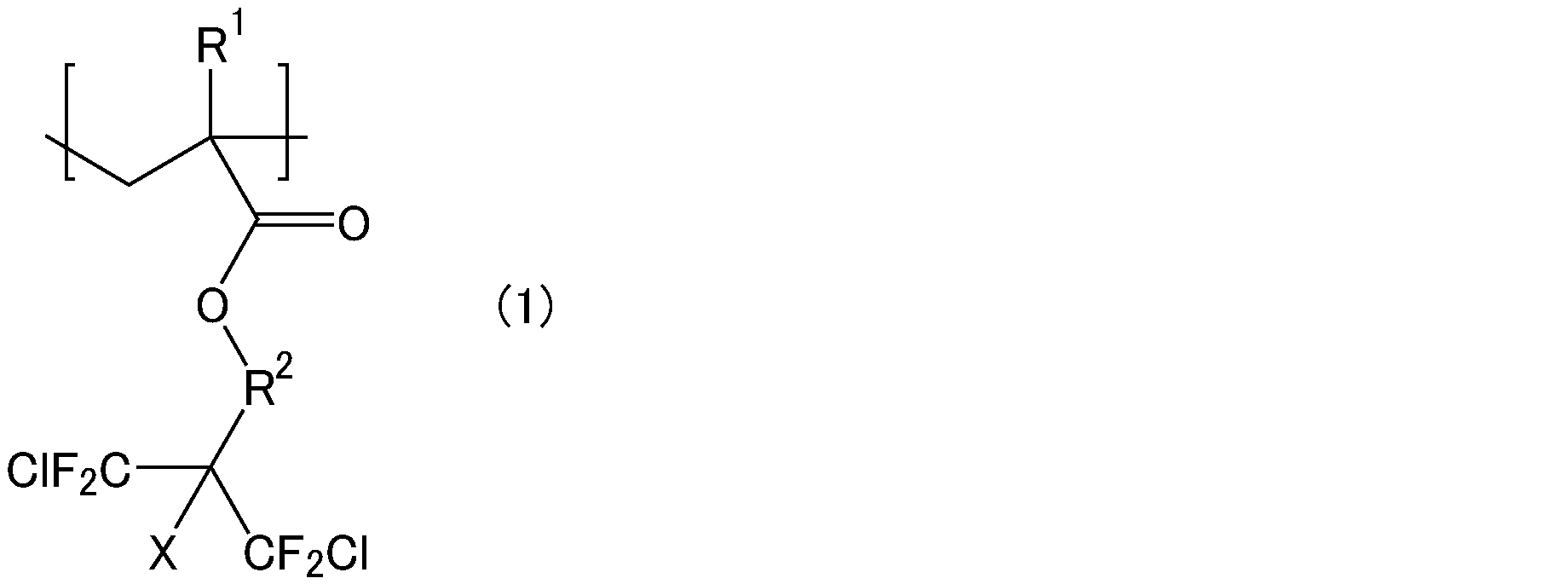
R2は単結合、直鎖、分岐または環状構造を有しても良いアルキレン基、芳香環、エステル、カルボニル、エーテル、アミド、アミン、またはそれらの複合置換基であって、その一部がフッ素化及び/又は塩素化されても良い。
Xは水酸基、アルコキシ基、または水素原子である。)


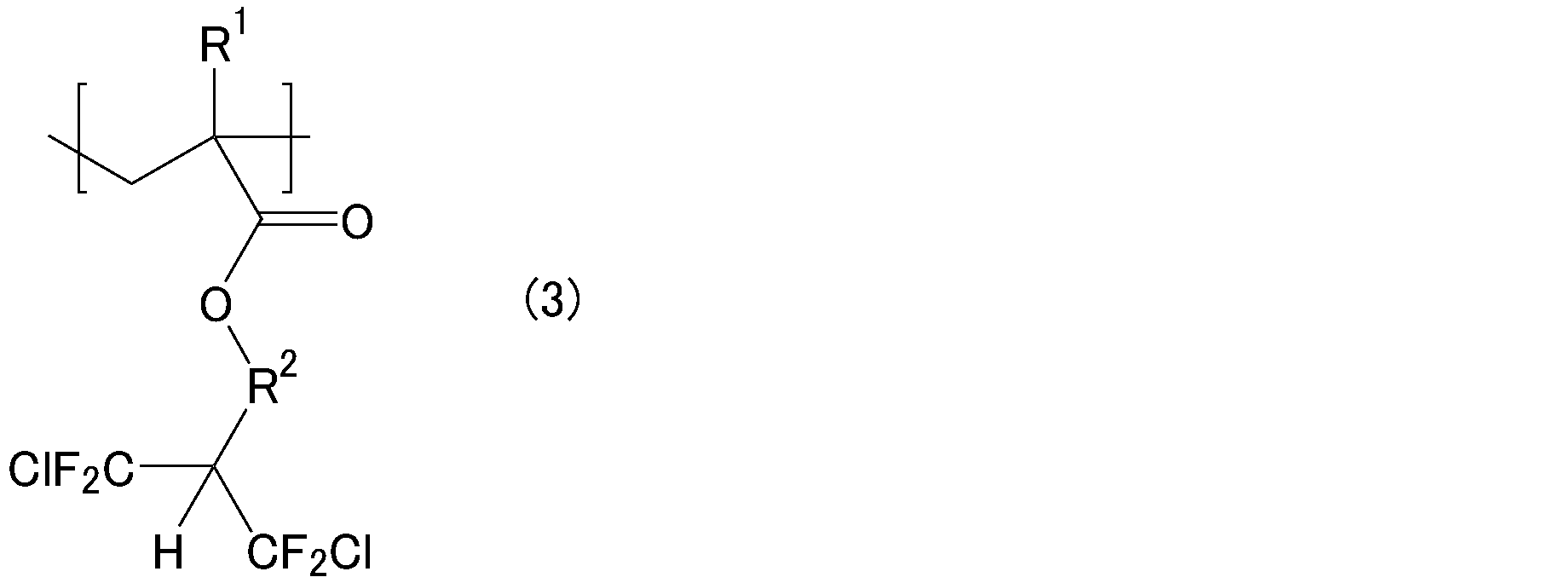
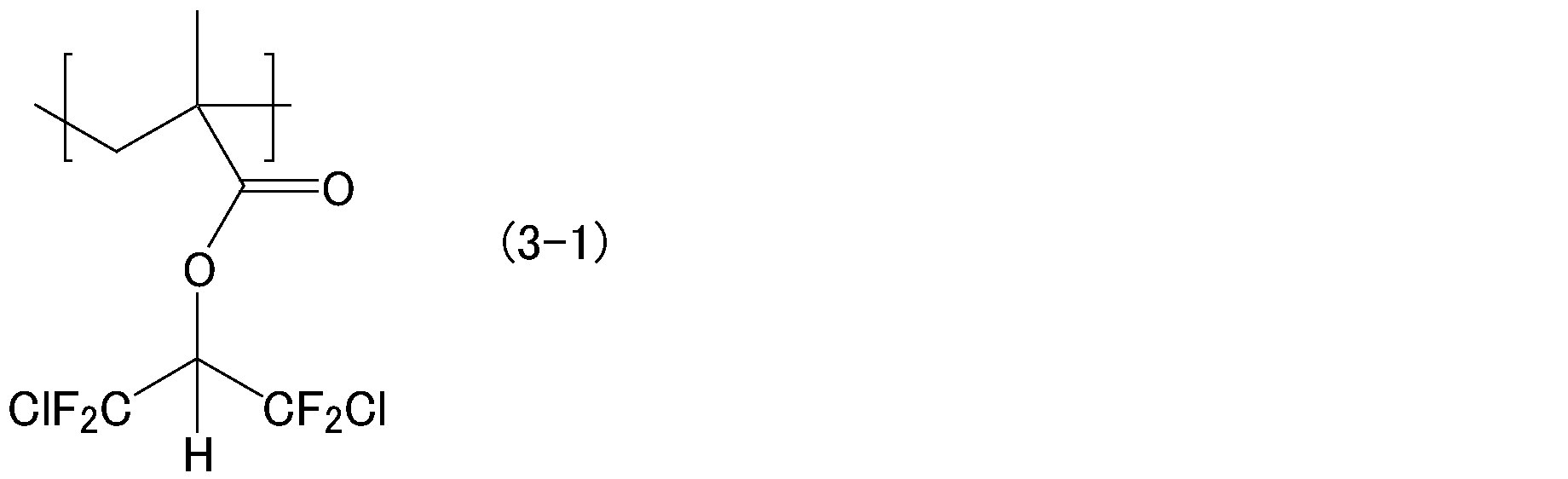
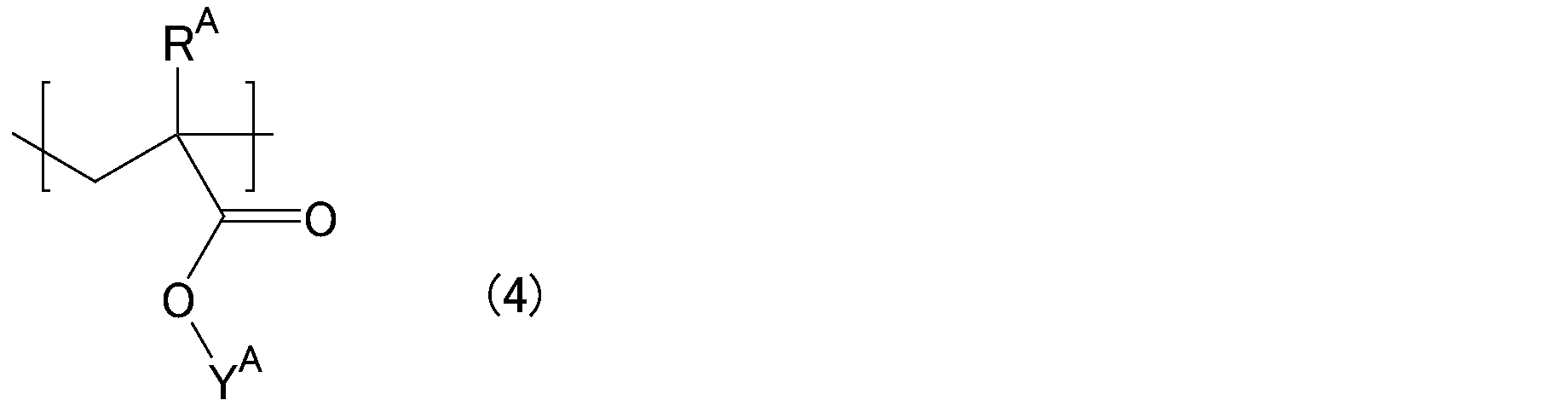
YAは一価の有機基である。)

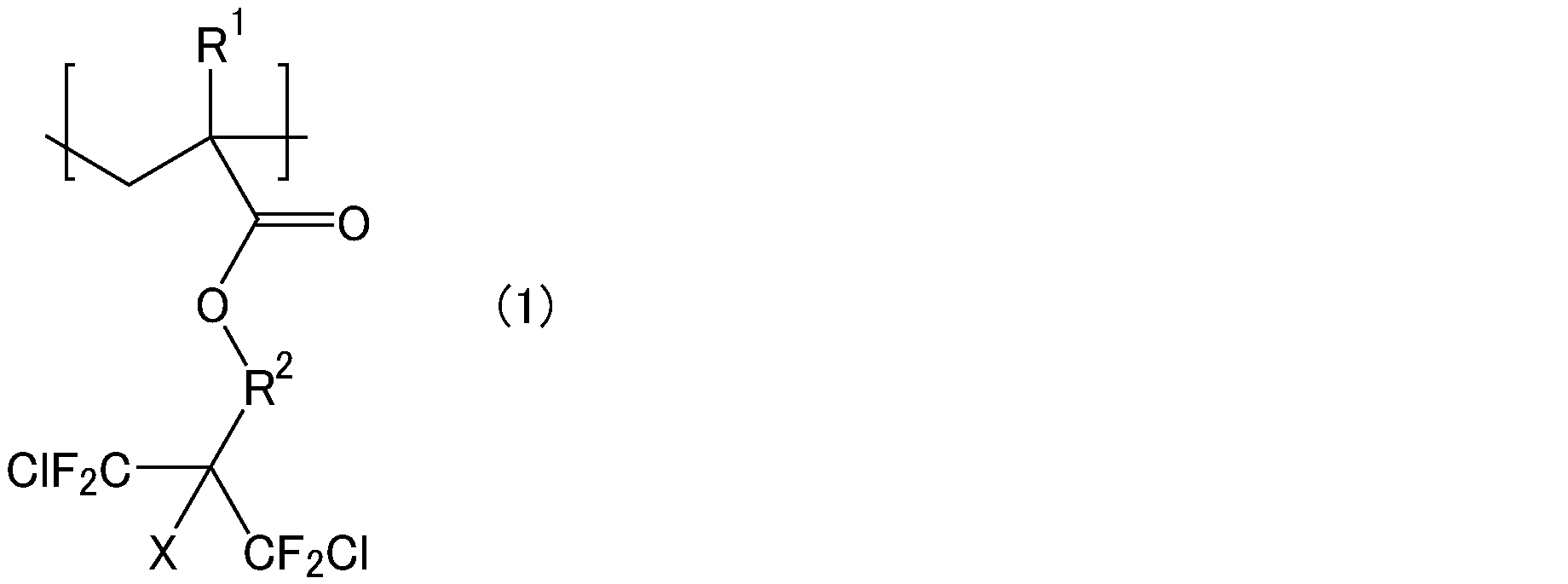
R2は単結合、直鎖、分岐または環状構造を有しても良いアルキレン基、芳香環、エステル、カルボニル、エーテル、アミド、アミン、またはそれらの複合置換基であって、その一部がフッ素化及び/又は塩素化されても良い。
Xは水酸基、アルコキシ基、または水素原子である。)


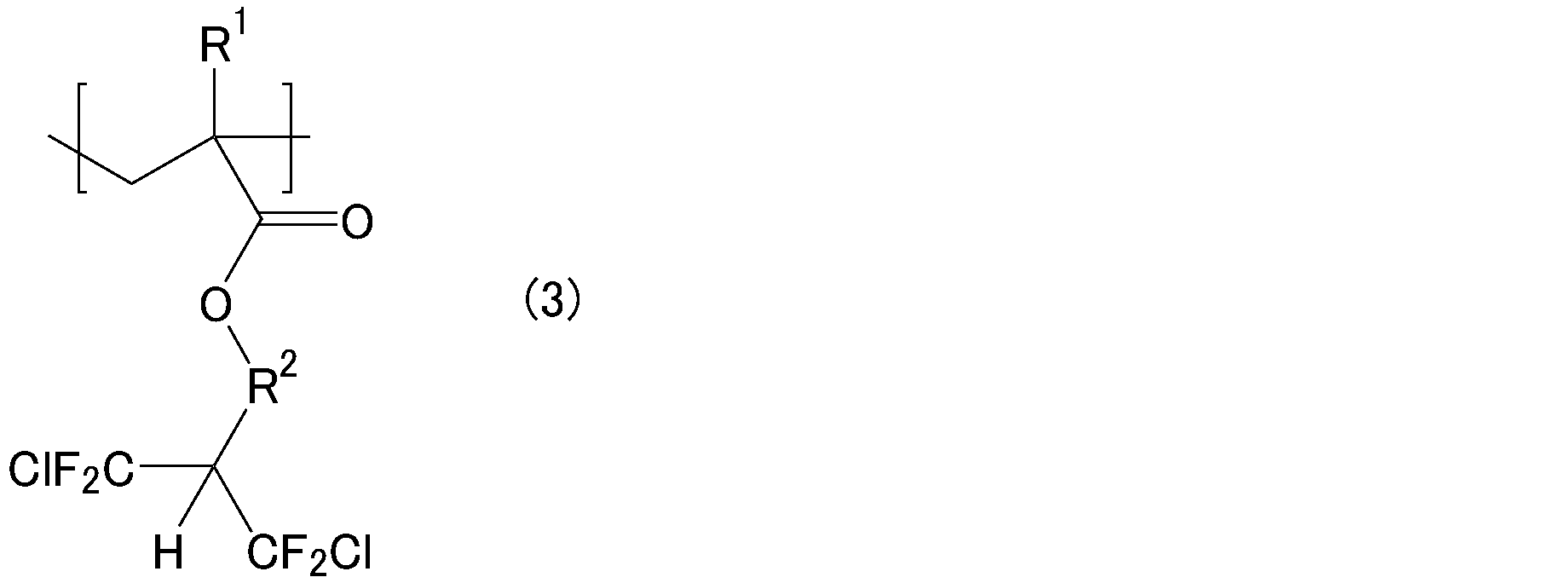
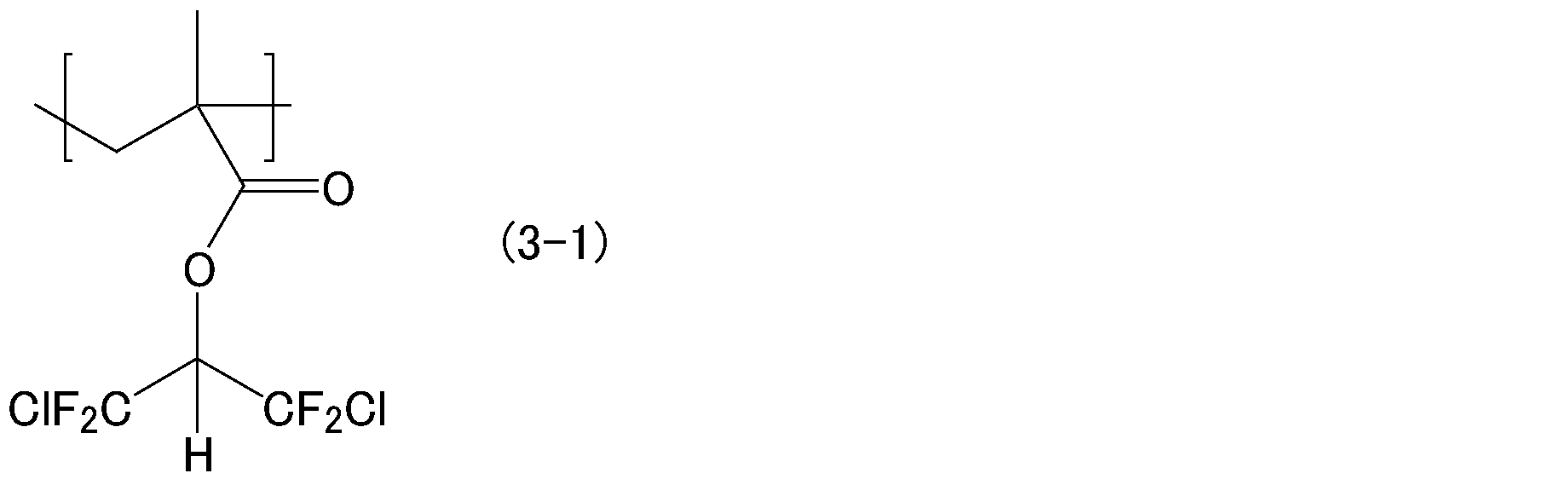
本開示の第1実施形態に係る共重合体について説明する。
本開示の第1実施形態に係る共重合体は、下記一般式(1)で示される繰り返し単位と、重合性炭素-炭素二重結合を有する化合物由来の繰り返し単位とを有する共重合体である。
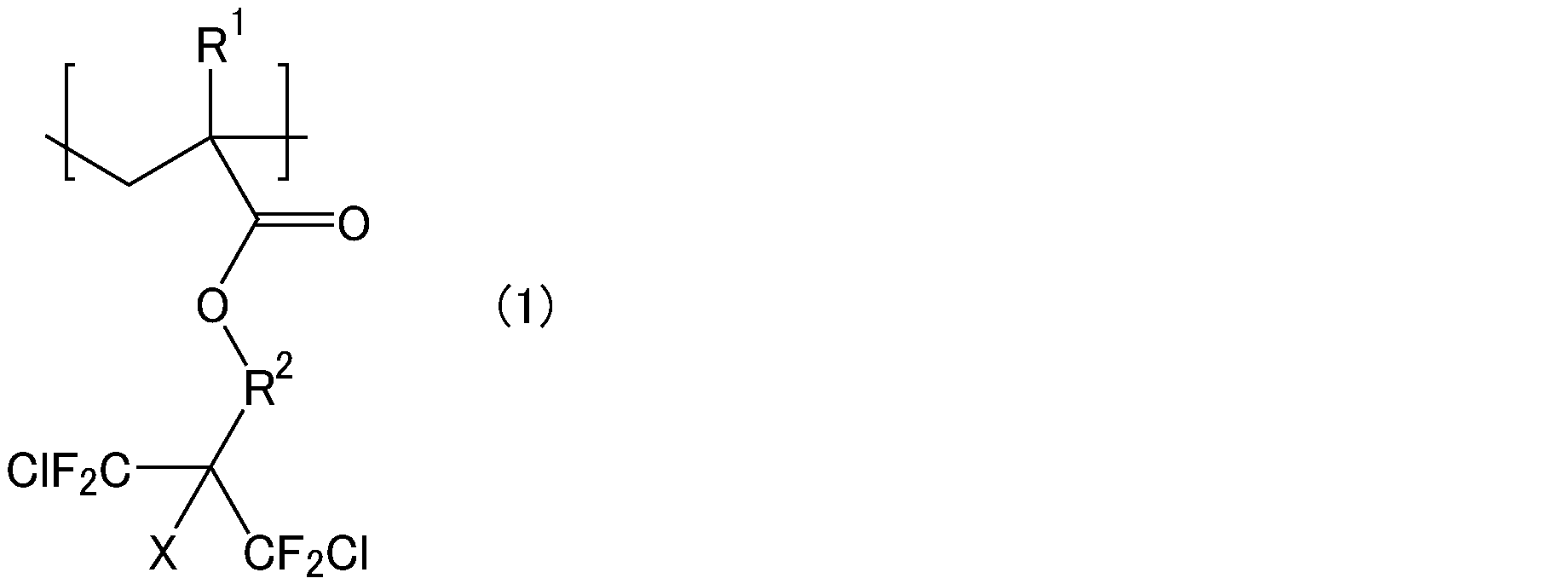
R2は単結合、直鎖、分岐または環状構造を有しても良いアルキレン基、芳香環、エステル、カルボニル、エーテル、アミド、アミン、またはそれらの複合置換基であって、その一部がフッ素化及び/又は塩素化されても良い。
Xは水酸基、アルコキシ基、または水素原子である。)
本開示の第1実施形態に係る共重合体を用いて形成された上層膜やトップコートレスレジスト膜は、液浸用液体に対するヒステリシスが低く、かつ、転落角が低くなる。
そのため、露光時に液浸用液体の液切れが良好になり、パターン形成が良好になる。
上層膜やトップコートレスレジスト膜を形成するための従来の重合体に含まれる繰り返し単位は、トリフルオロメチル基(-CF3)を有する。
モノクロロジフルオロメチル基(-CF2Cl)は、トリフルオロメチル基(-CF3)と比較し、分解されやすい。
本開示の第1実施形態に係る共重合体を用いて上層膜やトップコートレスレジスト膜を形成する際に生じる廃液には、モノクロロジフルオロメチル基(-CF2Cl)を含む樹脂が含まれる。
このような廃液に含まれる樹脂は分解されやすいので、廃液処理が容易になる。
R2で例示されたエーテルは、(-O-)で表される構造である。
R2で例示されたアミンは、(-NB-)で表される構造である(Bは水素原子又は1価有機基を表す)。


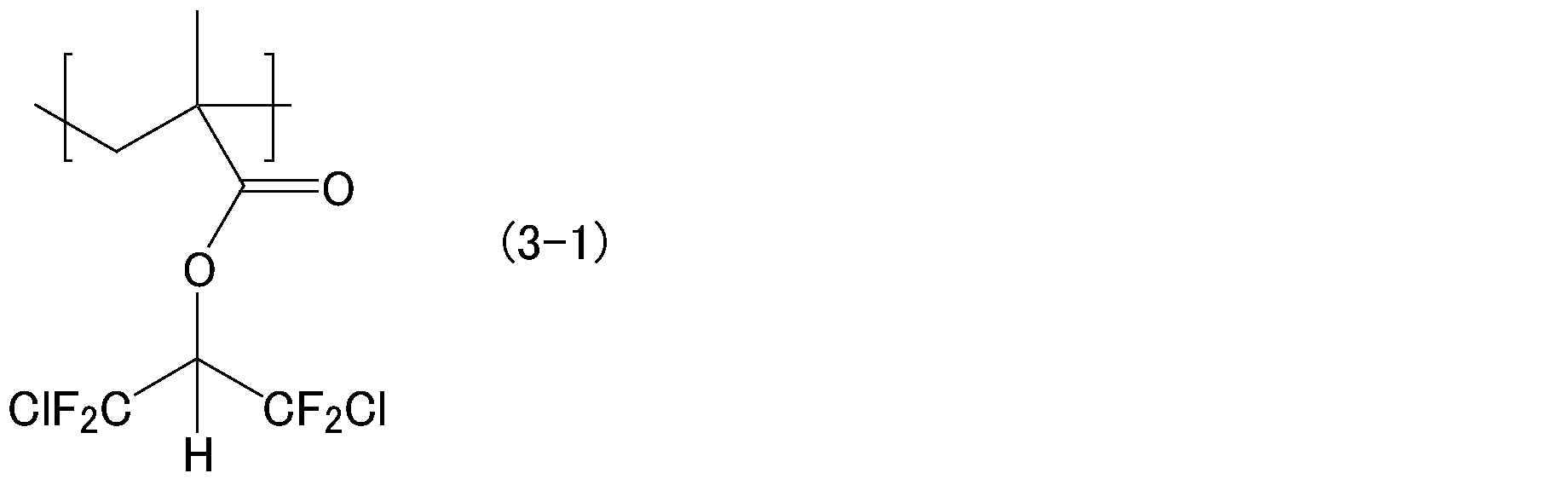

YAは一価の有機基である。)
本開示の第1実施形態に係る共重合体が、下記一般式(4a)で示される繰り返し単位を含む場合、撥水性、耐水性、露光により発生した酸による酸解離性基の脱離、それに伴うアルカリ溶解性等の特性を有しうる。

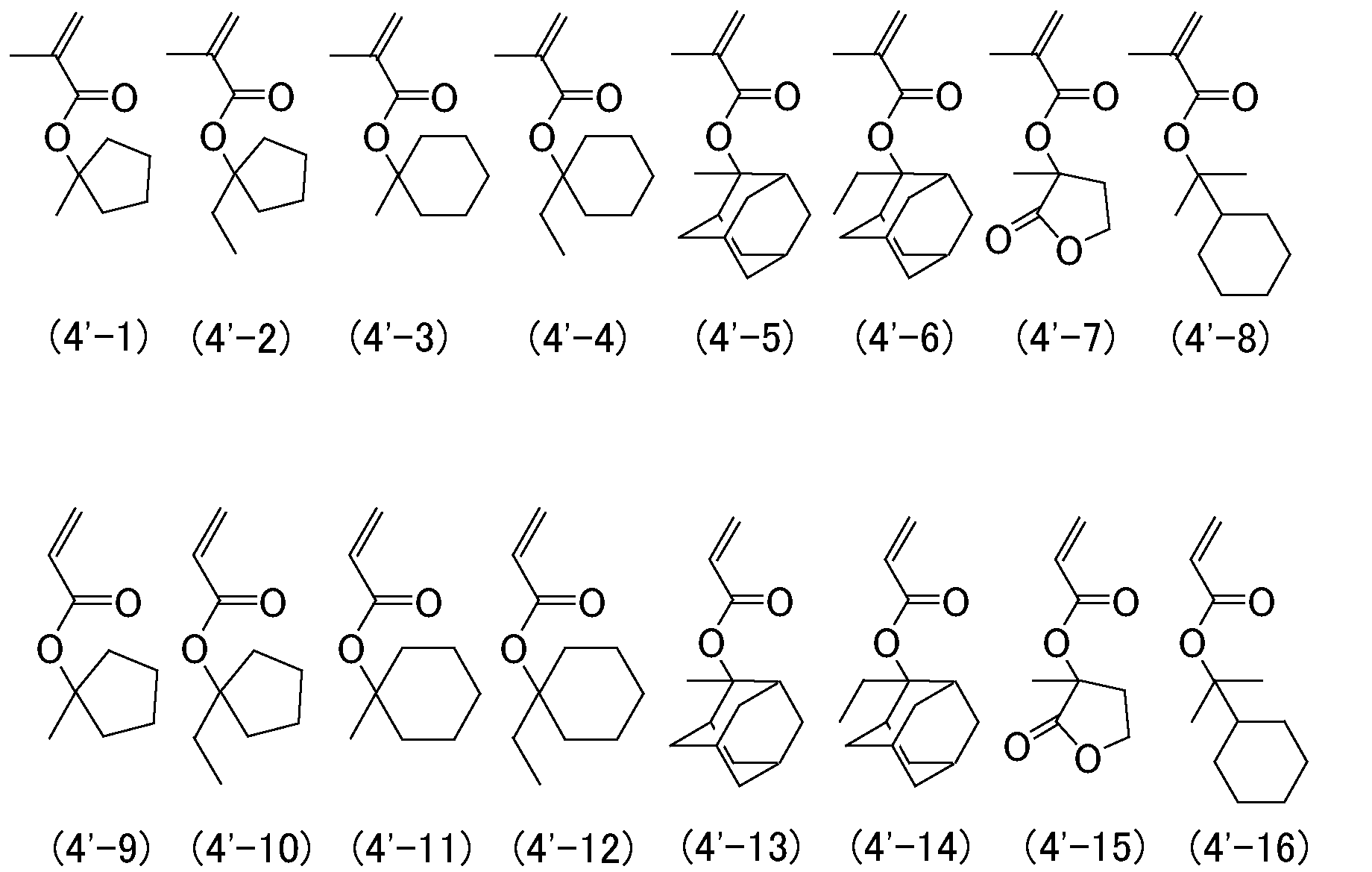

本開示の第1実施形態に係る共重合体が、下記一般式(5)で示される繰り返し単位を含む場合、アルカリ溶解性等の特性を有しうるので、液浸露光プロセスで使用されるレジストの上層膜用途に適している。

このような共重合体を用いて基板に樹脂膜を形成し、当該樹脂膜に波長300nm以下の電磁波または電子線等の高エネルギー線を露光すると、酸分解性基が分解し樹脂膜中で酸が発生する。この酸により、現像における露光部の樹脂膜のアルカリ現像液への溶解性を向上させることができる。
本開示の第1実施形態に係る共重合体に、上記一般式(4)で示される繰り返し単位が複数種類含まれる場合、RAは、各繰り返し単位において同じであってもよく、各繰り返し単位において異なっていてもよい。YAも同様である。
本開示の第1実施形態に係る共重合体に、上記一般式(4a)で示される繰り返し単位が複数種類含まれる場合、RAは、各繰り返し単位において同じであってもよく、各繰り返し単位において異なっていてもよい。R3及びLも同様である。
本開示の第1実施形態に係る共重合体に、上記一般式(5)で示される繰り返し単位が複数種類含まれる場合、R4は、各繰り返し単位において同じであってもよく、各繰り返し単位において異なっていてもよい。
また、本開示の第1実施形態に係る共重合体に、上記一般式(1)で示される繰り返し単位及び上記一般式(2)で示される繰り返し単位の内2つ以上の繰り返し単位が含まれる場合、R1は、各繰り返し単位において同じであってもよく、各繰り返し単位において異なっていてもよい。
装置:東ソー社製、HLC-8320GPC
重合性単量体分析用カラム:東ソー社製、TSKgelシリーズ(G2500HXL、G2000HXL、G1000HXL、G1000HXLの順に直列に接続)
重合体分析用カラム:東ソー社製、TSKgelシリーズ(G2500HXL、G2000HXL、G1000HXL、G1000HXLの順に直列に接続)
温度プログラム:40℃(保持)
流速:1mL/分
検出器:示差屈折検出器(RI)
溶離液:テトラヒドロフラン(THF)
基準物質:ポリスチレン標準液
本開示の第1実施形態に係る共重合体の製造方法は、含フッ素重合性単量体準備工程と、重合性炭素-炭素二重結合を有する化合物準備工程と、重合工程とを含む。
本開示の第1実施形態に係る共重合体の製造方法では、まず、下記一般式(6)に示す化合物を準備する。

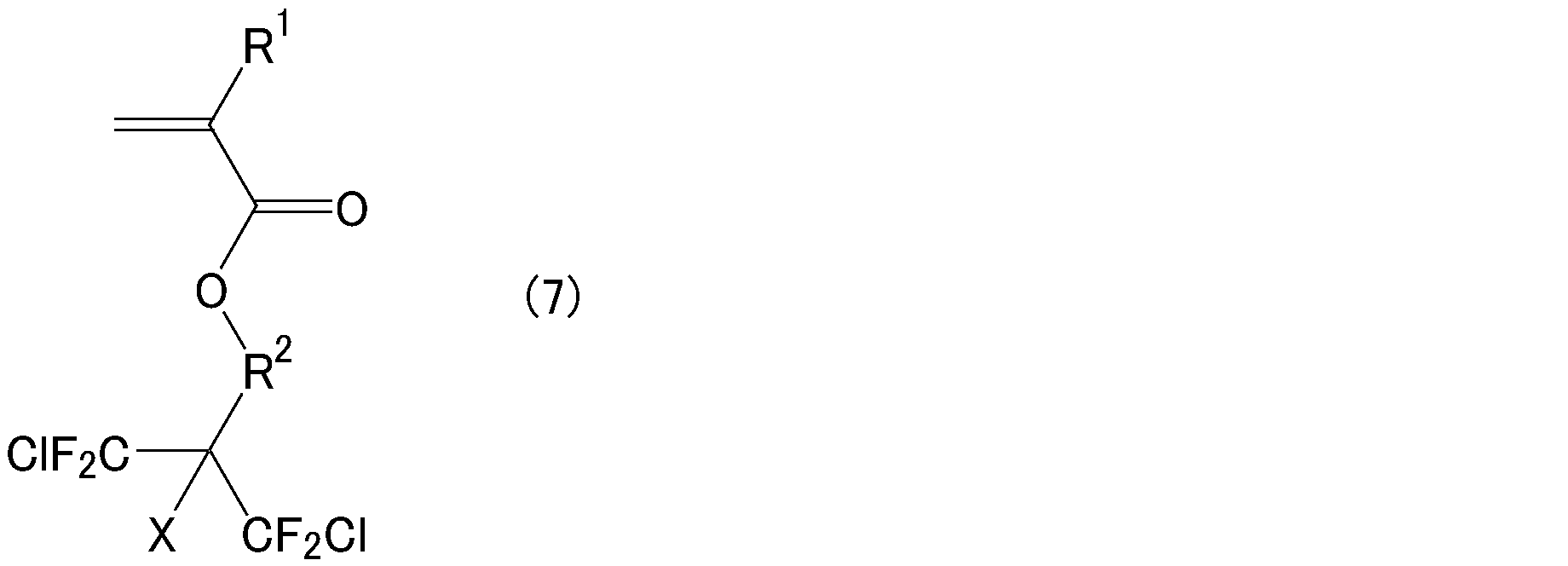
R2は単結合、直鎖、分岐または環状構造を有しても良いアルキレン基、芳香環、エステル、カルボニル、エーテル、アミド、アミン、またはそれらの複合置換基であって、その一部がフッ素化および/または塩素化されても良く、Xは水酸基、アルコキシ基、または水素原子である。)
次に、重合性炭素-炭素二重結合を有する化合物を準備する。なお、重合性炭素-炭素二重結合を有する化合物とは、前記一般式(7)で示される含フッ素重合性単量体以外の重合性炭素-炭素二重結合を有する化合物のことを意味する。

YAは一価の有機基である。)

次に、前記一般式(7)で表される含フッ素重合性単量体と、前記重合性炭素-炭素二重結合を有する化合物とを重合する。
当該重合における重合反応は、特に限定されず、ラジカル重合反応、イオン重合反応、配位アニオン重合反応、リビングアニオン重合反応、カチオン重合反応であってもよい。これらの中では、ラジカル重合反応であることが好ましい。
重合反応がラジカル重合反応である場合、重合開始剤としては、重合反応が起こればよく特に限定されるものではないが、アゾ系化合物、過酸化物系化合物、レドックス系化合物を用いることができる。
重合溶剤としては、ラジカル重合反応を阻害しないものであれば特に限定されず、有機溶剤であってもよく、水であってもよい。有機溶剤としては、炭化水素系溶剤、エステル系溶剤、ケトン系溶剤、アルコール系溶剤、エーテル系溶剤、環状エーテル系溶剤、フロン系溶剤、芳香族系溶剤等を上げることができる。これらの溶剤は1種のみを用いてもよく、2種類以上を併用してもよい。
エステル系溶剤としては、酢酸、酢酸n-ブチル等を例示することができる。
ケトン系溶剤としては、アセトン、メチルイソブチルケトン等を例示することができる。
炭化水素系溶剤としては、トルエン、シクロヘキサン等を例示することができる。
アルコール系溶剤としては、メタノール、イソプロピルアルコール、エチレングリコールモノメチルエーテルを例示することができる。
本開示の第2実施形態に係る撥水剤用重合体について説明する。
本開示の第2実施形態に係る撥水剤用重合体は、下記一般式(1)で示される繰り返し単位を含む撥水剤用重合体である。

R2は単結合、直鎖、分岐または環状構造を有しても良いアルキレン基、芳香環、エステル、カルボニル、エーテル、アミド、アミン、またはそれらの複合置換基であって、その一部がフッ素化及び/又は塩素化されても良い。
Xは水酸基、アルコキシ基、または水素原子である。)
上層膜やトップコートレスレジスト膜を形成するための従来の重合体に含まれる繰り返し単位は、トリフルオロメチル基(-CF3)を有する。
クロロジフルオロメチル基(-CF2Cl)は、トリフルオロメチル基(-CF3)と比較し、分解されやすい。
そのため、本開示の第2実施形態に係る撥水剤用重合体を用いて形成された樹脂膜は、従来の重合体を用いて形成された樹脂膜よりも分解されやすい。そのため、当該樹脂膜を分解処理する際に必要なエネルギーを低減することができる。
R2で例示されたエーテルは、(-O-)で表される構造である。
R2で例示されたアミンは、(-NB-)で表される構造である(Bは水素原子又は1価有機基を表す)。
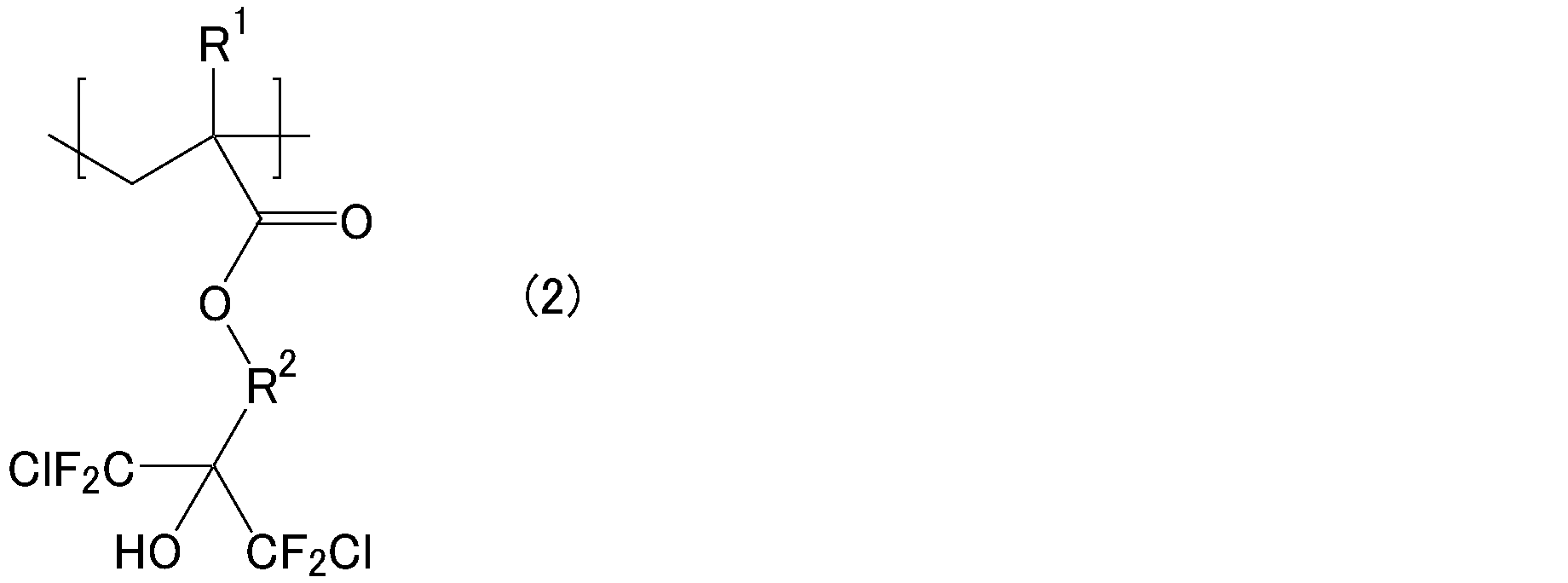
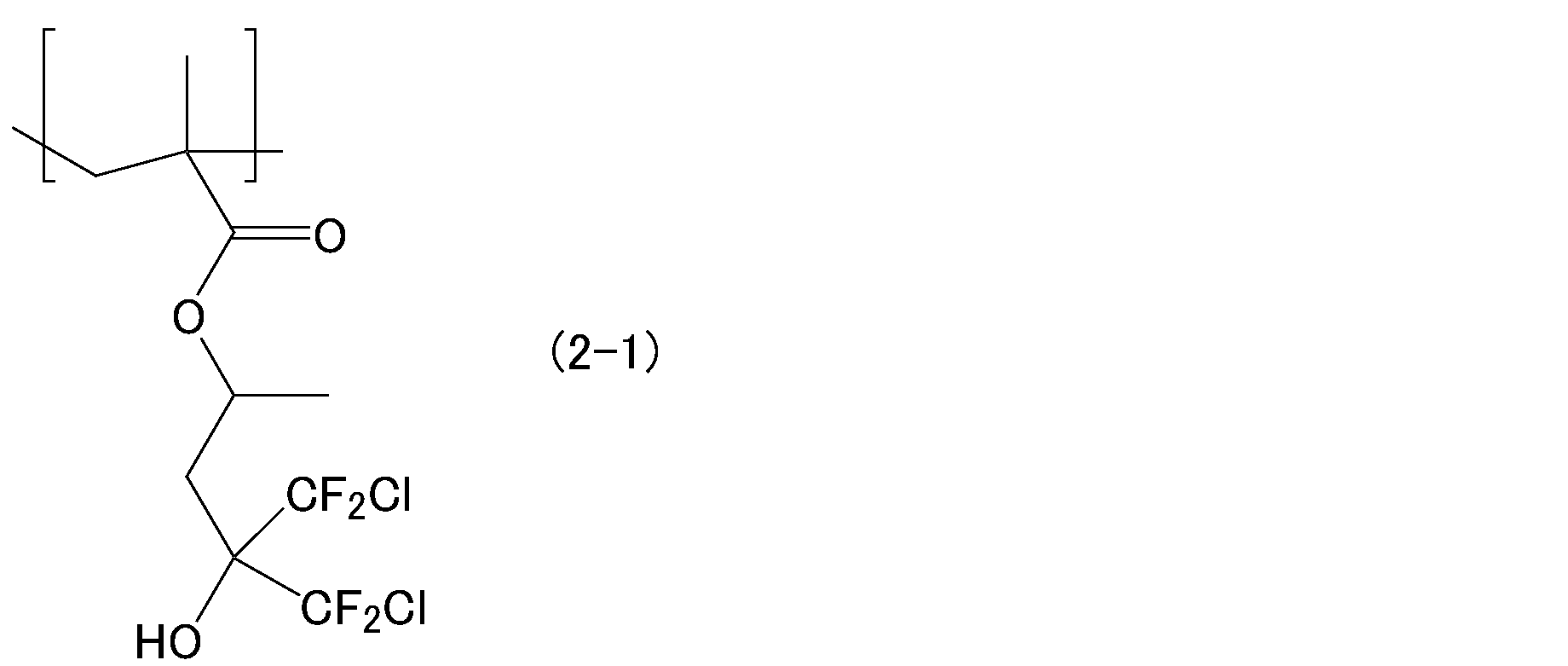

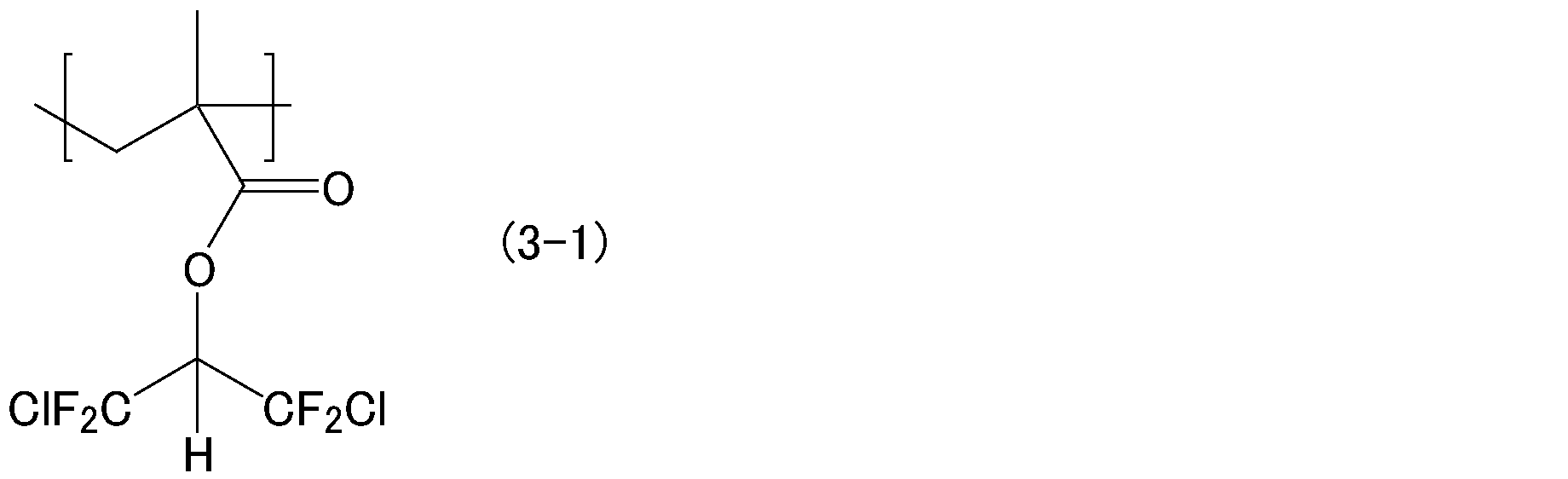
この場合、全ての繰り返し単位を100mоl%とした際に、前記一般式(1)で示される繰り返し単位の割合は、22mol%以上、99mol%以下であってもよく、30mol%以上、95mol%以下であってもよく、さらには、40mol%以上、90mol%以下であってもよい。
このような、重合性炭素-炭素二重結合を有する化合物由来の繰り返し単位としては、例えば、下記一般式(4)で示される繰り返し単位が挙げられる。
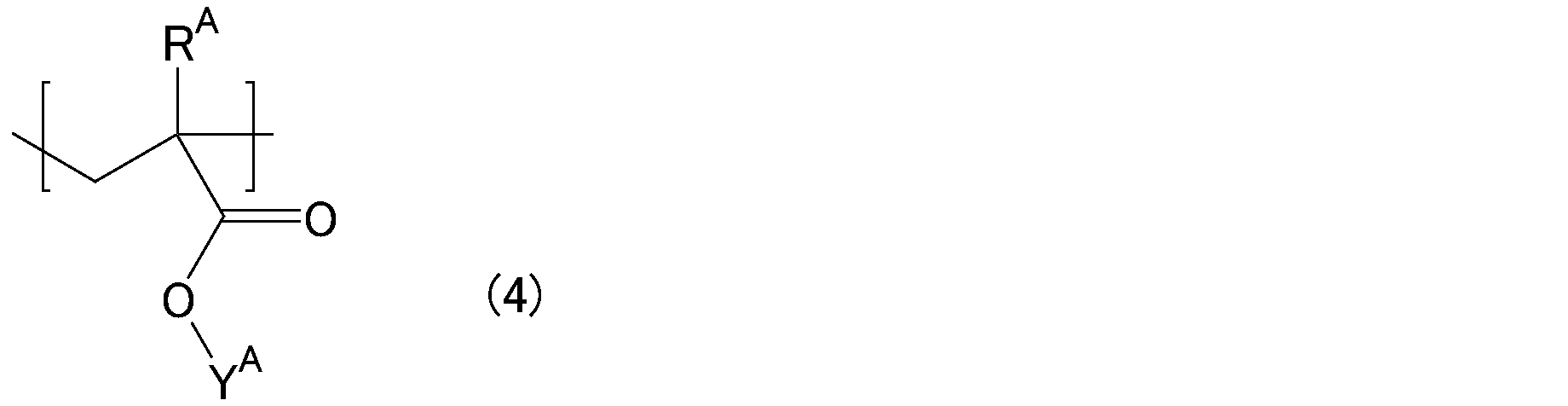
YAは一価の有機基である。)
本開示の第2実施形態に係る撥水剤用重合体が、下記一般式(4a)で示される繰り返し単位を含む場合、撥水性、耐水性、露光により発生した酸による酸解離性基の脱離、それに伴うアルカリ溶解性等の特性を有しうる。

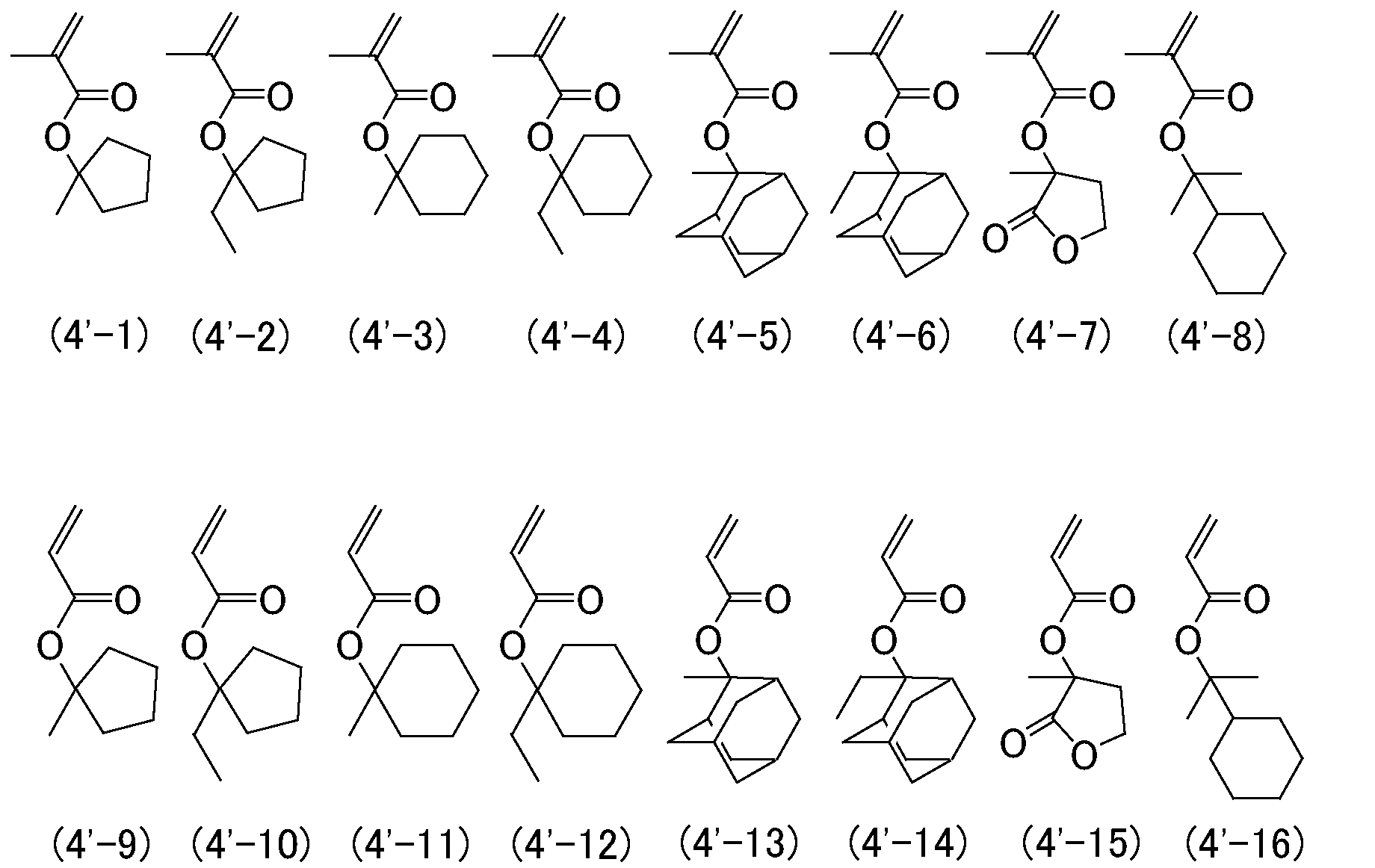
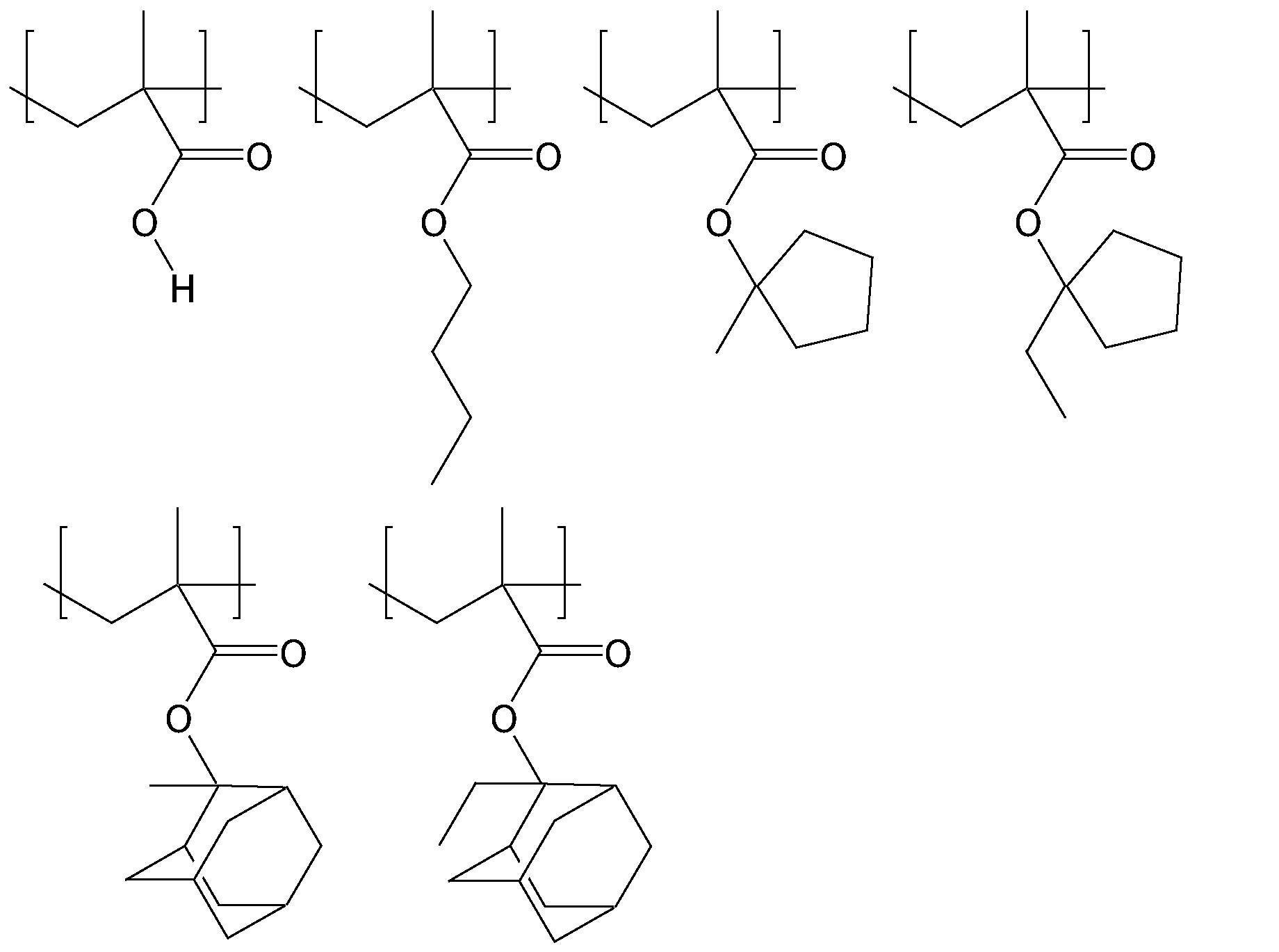
本開示の第2実施形態に係る撥水剤用重合体が、下記一般式(5)で示される繰り返し単位を含む場合、アルカリ溶解性等の特性を有しうる。
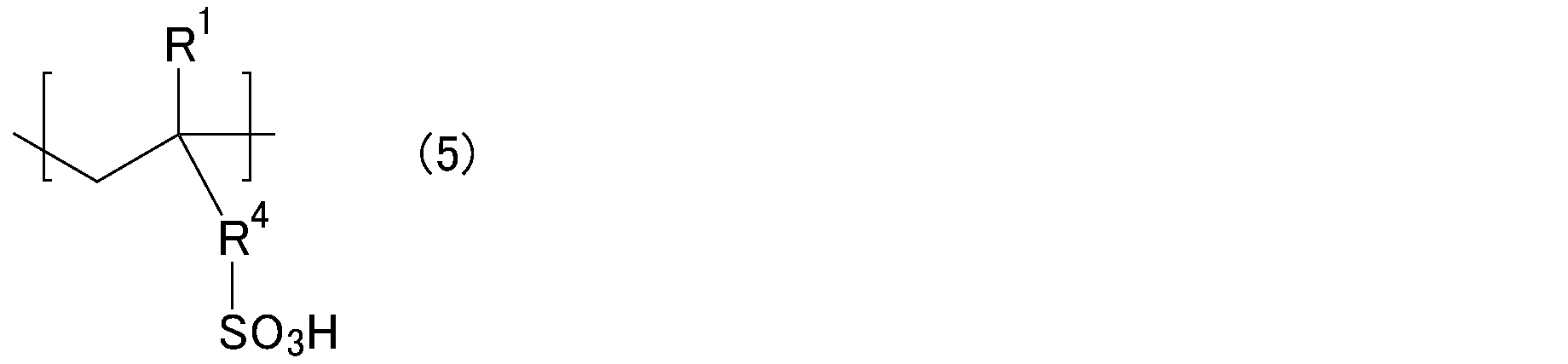
このような撥水剤用重合体を用いて基板に樹脂膜を形成し、当該樹脂膜に波長300nm以下の電磁波または電子線等の高エネルギー線を露光すると、酸分解性基が分解し樹脂膜中で酸が発生する。この酸により、現像における露光部の樹脂膜のアルカリ現像液への溶解性を向上させることができる。
本開示の第2実施形態に係る撥水剤用重合体に、上記一般式(4)で示される繰り返し単位が複数種類含まれる場合、RAは、各繰り返し単位において同じであってもよく、各繰り返し単位において異なっていてもよい。YAも同様である。
本開示の第2実施形態に係る撥水剤用重合体に、上記一般式(4a)で示される繰り返し単位が複数種類含まれる場合、RAは、各繰り返し単位において同じであってもよく、各繰り返し単位において異なっていてもよい。R3及びLも同様である。
本開示の第2実施形態に係る撥水剤用重合体に、上記一般式(5)で示される繰り返し単位が複数種類含まれる場合、R4は、各繰り返し単位において同じであってもよく、各繰り返し単位において異なっていてもよい。
また、本開示の第2実施形態に係る撥水剤用重合体に、上記一般式(1)で示される繰り返し単位及び上記一般式(2)で示される繰り返し単位の内2つ以上の繰り返し単位が含まれる場合、R1は、各繰り返し単位において同じであってもよく、各繰り返し単位において異なっていてもよい。
装置:東ソー社製、HLC-8320GPC
重合性単量体分析用カラム:東ソー社製、TSKgelシリーズ(G2500HXL、G2000HXL、G1000HXL、G1000HXLの順に直列に接続)
重合体分析用カラム:東ソー社製、TSKgelシリーズ(G2500HXL、G2000HXL、G1000HXL、G1000HXLの順に直列に接続)
温度プログラム:40℃(保持)
流速:1mL/分
検出器:示差屈折検出器(RI)
溶離液:テトラヒドロフラン(THF)
基準物質:ポリスチレン標準液
本開示の第2実施形態に係る撥水剤用重合体の製造方法は、含フッ素重合性単量体準備工程と、重合工程とを含む。
<含フッ素重合性単量体準備工程>
本開示の第2実施形態に係る撥水剤用重合体の製造方法では、まず、下記一般式(6)に示す化合物を準備する。
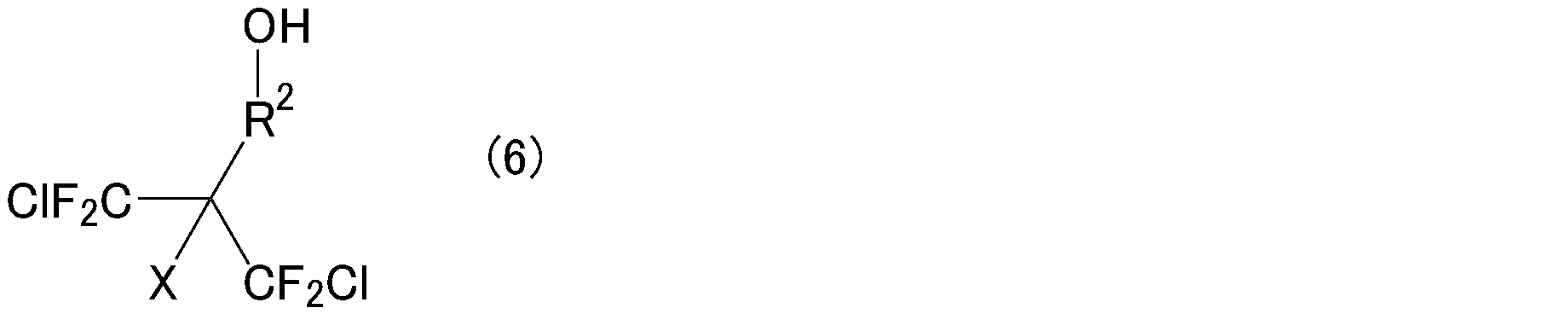
Xは水酸基、アルコキシ基、または水素原子である。)
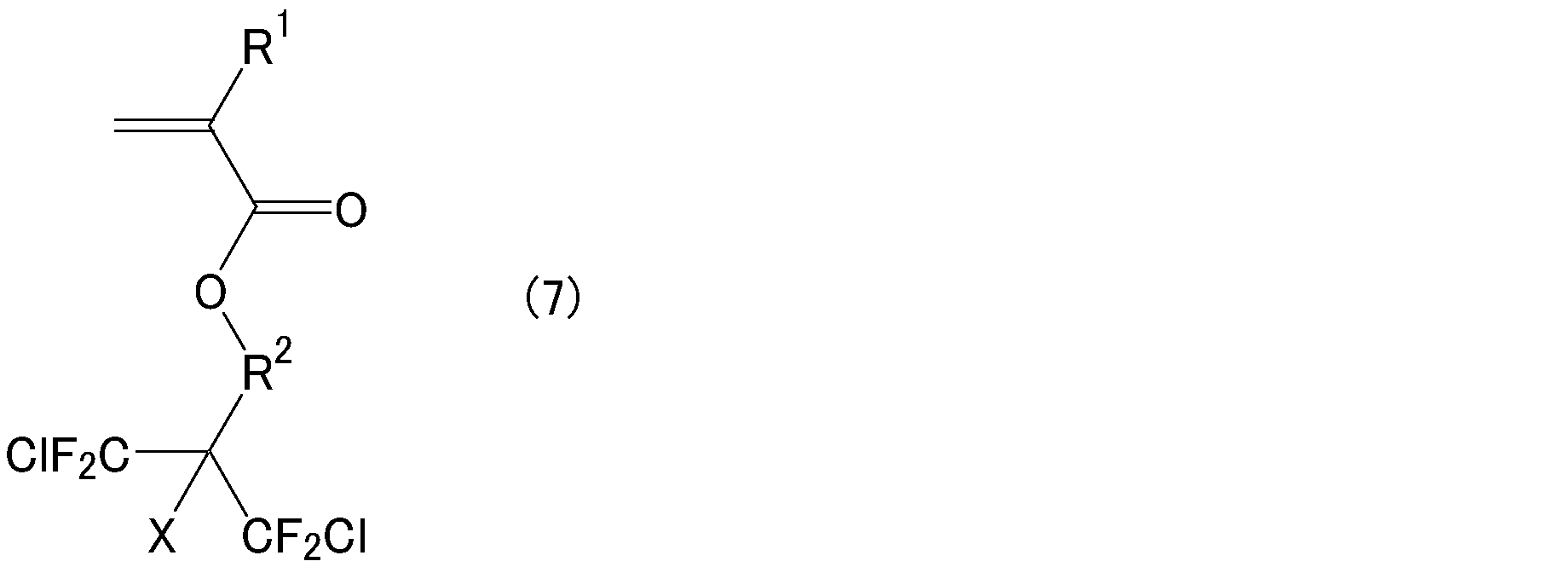
R2は単結合、直鎖、分岐または環状構造を有しても良いアルキレン基、芳香環、エステル、カルボニル、エーテル、アミド、アミン、またはそれらの複合置換基であって、その一部がフッ素化および/または塩素化されても良く、Xは水酸基、アルコキシ基、または水素原子である。)
次に、前記一般式(7)で表される含フッ素重合性単量体を重合する。
なおこの際、前記一般式(7)で表される含フッ素重合性単量体以外の単量体と共に重合を行ってもよい。
当該重合における重合反応は、特に限定されず、ラジカル重合反応、イオン重合反応、配位アニオン重合反応、リビングアニオン重合反応、カチオン重合反応であってもよい。これらの中では、ラジカル重合反応であることが好ましい。
重合反応がラジカル重合反応である場合、重合開始剤としては、重合反応が起こればよく特に限定されるものではないが、アゾ系化合物、過酸化物系化合物、レドックス系化合物を用いることができる。
重合溶剤としては、ラジカル重合反応を阻害しないものであれば特に限定されず、有機溶剤であってもよく、水であってもよい。有機溶剤としては、炭化水素系溶剤、エステル系溶剤、ケトン系溶剤、アルコール系溶剤、エーテル系溶剤、環状エーテル系溶剤、フロン系溶剤、芳香族系溶剤等を上げることができる。これらの溶剤は1種のみを用いてもよく、2種類以上を併用してもよい。
エステル系溶剤としては、酢酸、酢酸n-ブチル等を例示することができる。
ケトン系溶剤としては、アセトン、メチルイソブチルケトン等を例示することができる。
炭化水素系溶剤としては、トルエン、シクロヘキサン等を例示することができる。
アルコール系溶剤としては、メタノール、イソプロピルアルコール、エチレングリコールモノメチルエーテルを例示することができる。
次に、本開示の第3実施形態に係る撥水膜形成用組成物について説明する。
本開示の第3実施形態に係る撥水膜形成用組成物は、上記第1実施形態に係る共重合体又は上記第2実施形態に係る撥水剤用重合体を含む。
本開示の第3実施形態に係る撥水膜形成用組成物は、上記第1実施形態に係る共重合体又は上記第2実施形態に係る撥水剤用重合体を2種類以上含んでいてもよい。
例えば、本開示の第3実施形態に係る撥水膜形成用組成物に溶剤等のその他の成分を加え、当該撥水膜形成用組成物を基板に塗布し、硬化や乾燥させることにより塗膜としてもよい。
なお、本開示の第3実施形態に係る撥水膜形成用組成物の塗膜を含む樹脂膜は、本開示の樹脂膜でもある。
また、本開示の第3実施形態に係る撥水膜形成用組成物を用いて形成する撥水膜は、上記用途だけでなく、プラスチック、住宅用の防水材、スマートフォンなど電子機器の撥水コート、バイオセンサなどの隔壁、マイクロ流路、自動車用ガラス等に用いることができる。
本開示の第3実施形態に係る撥水膜形成用組成物を用いて上層膜を形成する場合、本開示の第3実施形態に係る撥水膜形成用組成物は、溶剤を含んでいてもよい。
トップコートレスレジスト膜を形成する基板としては、特に限定されず、シリコン基板、ゲルマニウム基板、シリコンカーバイド(SiC)基板、ガリウムナイトライド(GaN)基板、化合物半導体基板、絶縁性基板等が挙げられる。前記基板は、反射防止膜が形成されたものであってもよい。
また、上層膜を形成する場合には、本開示の第3実施形態に係る撥水膜形成用組成物は、レジスト膜(下層膜)上に塗布されてもよい。
また、本開示の第3実施形態に係る撥水膜形成用組成物を、上層膜を形成するために用いる場合、本開示の第3実施形態に係る撥水膜形成用組成物をレジスト膜上に塗布し、上層膜を形成してもよい。その後、上層膜に露光又は液浸露光を行ってもよい。
上記のように、本開示の第3実施形態に係る撥水膜形成用組成物を用いて、トップコートレスレジスト膜を形成する場合、本開示の第3実施形態に係る撥水膜形成用組成物は、上記第1実施形態に係る共重合体又は上記第2実施形態に係る撥水剤用重合体に加え、酸発生剤及び溶剤を含んでいてもよい。
塩基性化合物の例としては、n-ヘキシルアミン、n-ヘプチルアミン、n-オクチルアミン、n-ノニルアミン、n-デシルアミン等のモノアルキルアミン;ジエチルアミン、ジ-n-プロピルアミン、ジ-n-ヘプチルアミン、ジ-n-オクチルアミン、ジシクロヘキシルアミン等のジアルキルアミン;トリメチルアミン、トリエチルアミン、トリ-n-プロピルアミン、トリ-n-ブチルアミン、トリ-n-ヘキシルアミン、トリ-n-ペンチルアミン、トリ-n-ヘプチルアミン、トリ-n-オクチルアミン、トリ-n-ノニルアミン、トリ-n-デカニルアミン、トリ-n-ドデシルアミン等のトリアルキルアミン;ジエタノールアミン、トリエタノールアミン、ジイソプロパノールアミン、トリイソプロパノールアミン、ジ-n-オクタノールアミン、トリ-n-オクタノールアミン等のアルキルアルコールアミン、ピペリジン、ピペラジン、1,5-ジアザビシクロ[4.3.0]-5-ノネン、1,8-ジアザビシクロ[5.4.0]-7-ウンデセン、ヘキサメチレンテトラミン、1,4-ジアザビシクロ[2.2.2]オクタン等が挙げられる。


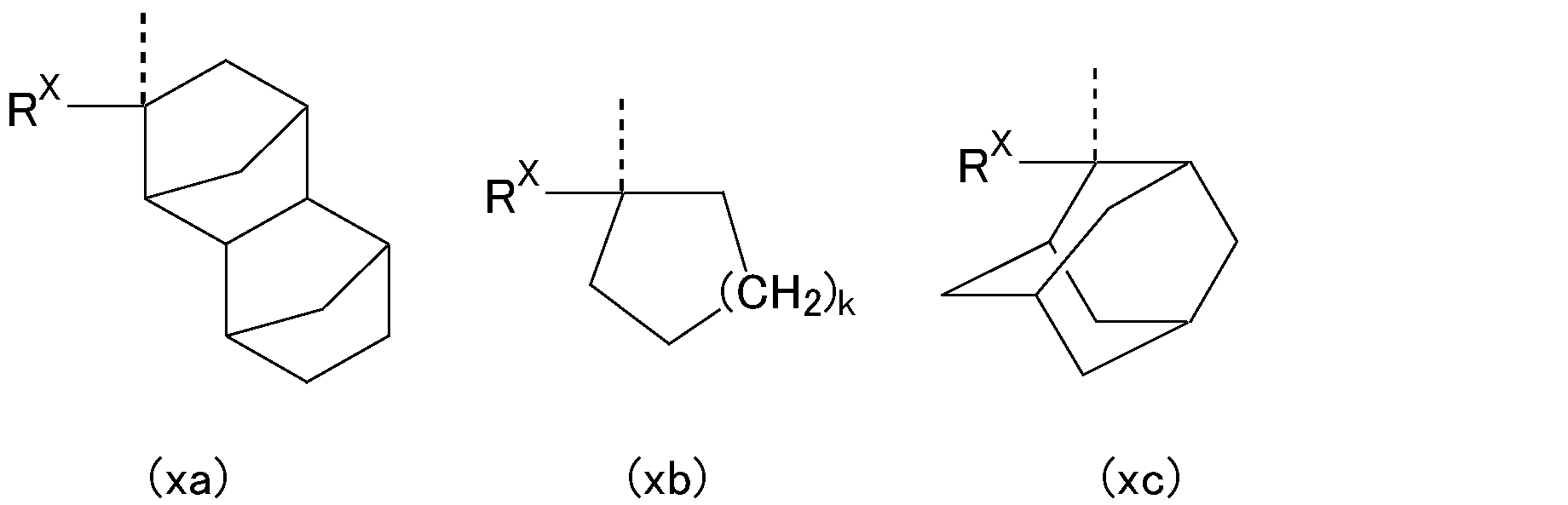
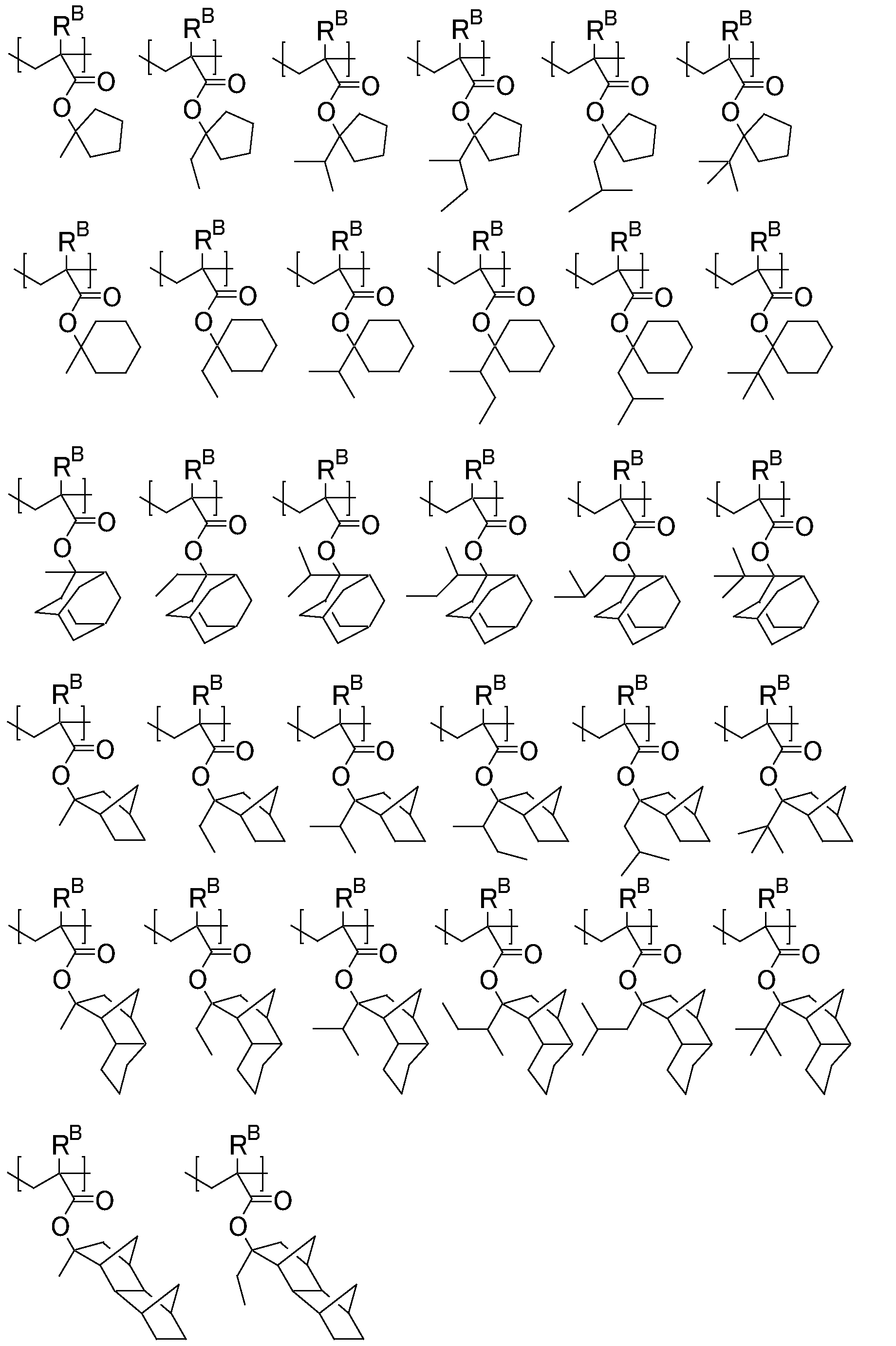
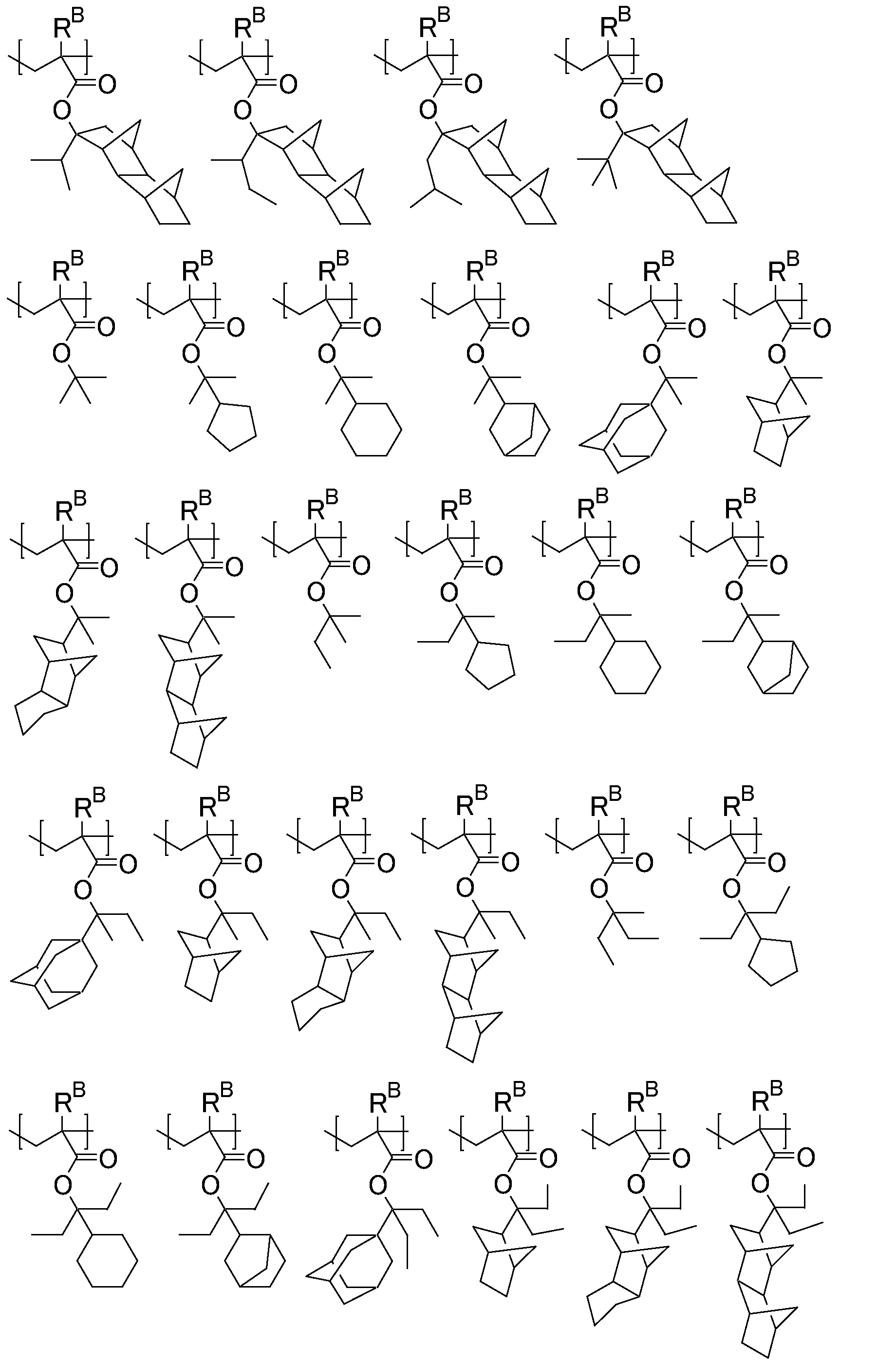
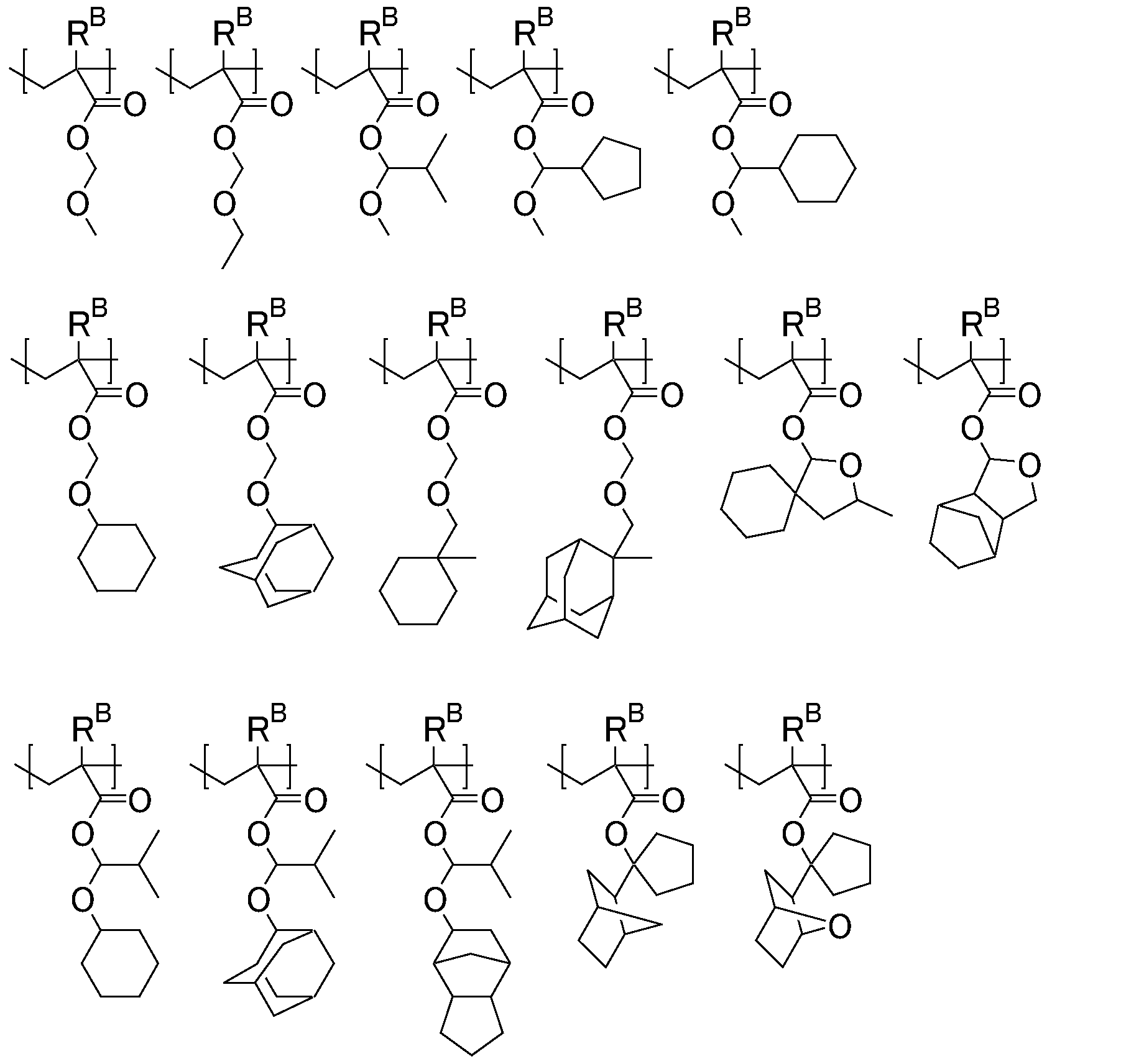


ベース樹脂が2種以上の上記構造を含む場合、各構造において、RB、XB、YB、ZB、RXは、同じであってもよく、異なっていてもよい。
光崩壊性塩基としては、例えば、露光により分解するオニウム塩化合物等が挙げられる。オニウム塩化合物としては、例えば、下記式(9-1)で表されるスルホニウム塩化合物、下記式(9-2)で表されるヨードニウム塩化合物等が挙げられる。
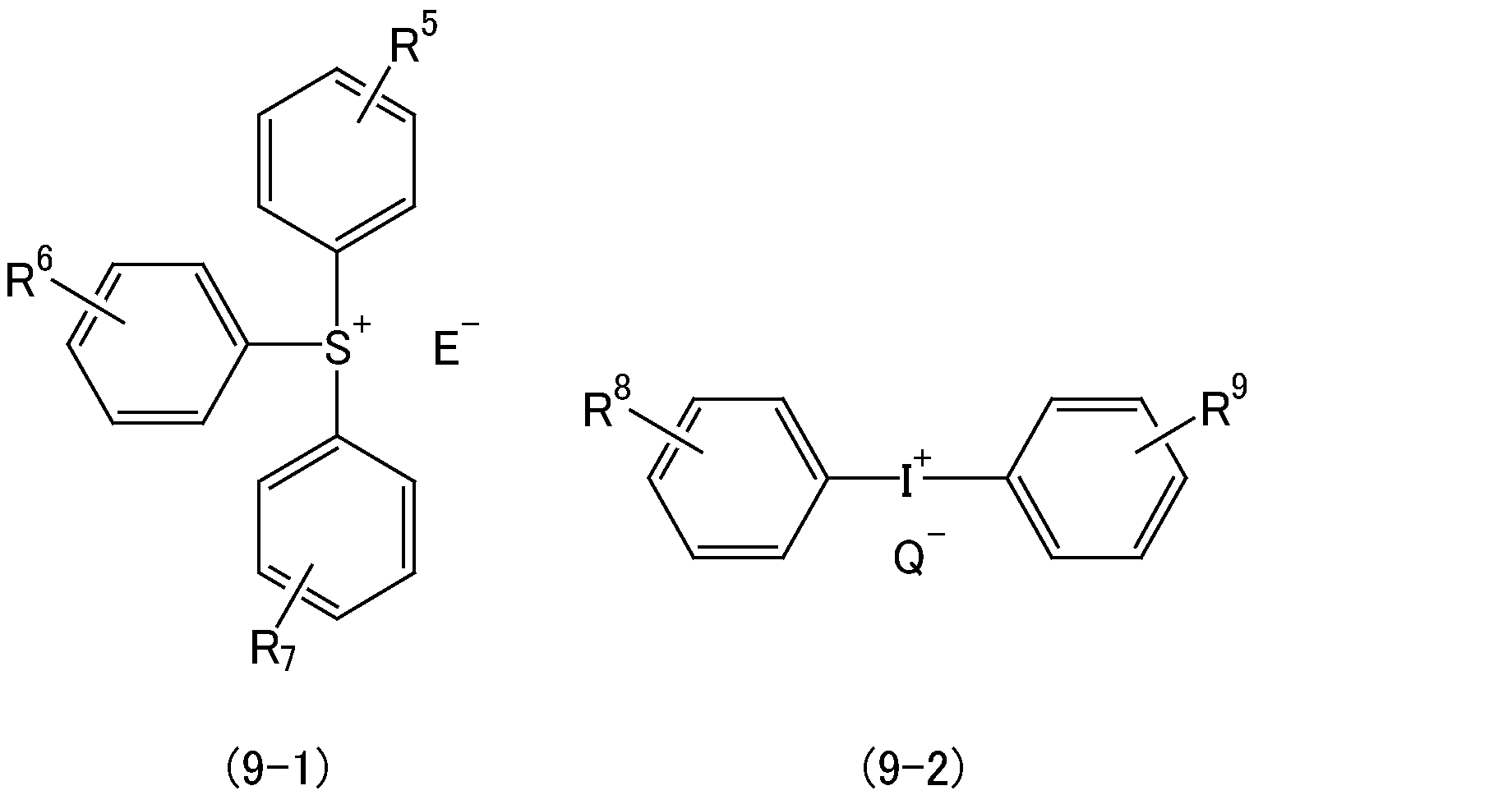
E-及びQ-は、それぞれ独立して、OH-、Rβ-COO-、Rβ-SO3 -又は下記式(9-3)で表されるアニオンである。但し、Rβは、アルキル基、アリール基、又は、アラルキル基である。)
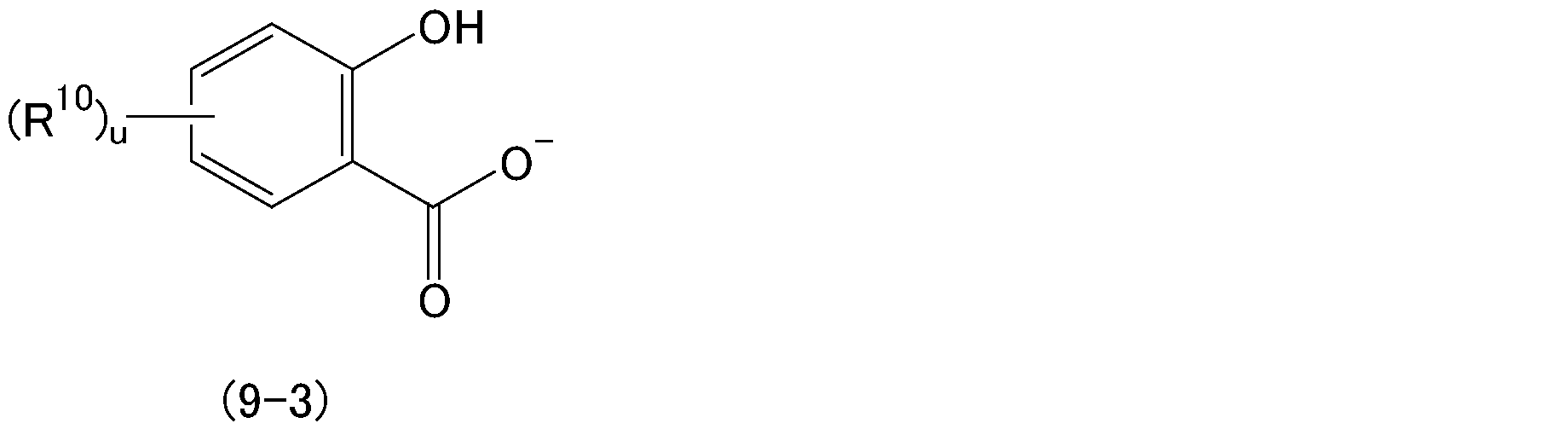

上記のように、本開示の第3実施形態に係る撥水膜形成用組成物を用いて、上層膜を形成する場合、本開示の第3実施形態に係る撥水膜形成用組成物は、上記第1実施形態に係る共重合体又は上記第2実施形態に係る撥水剤用重合体に加え、溶剤を含むことが好ましい。
当該溶剤の例としては、上記トップコートレスレジスト膜を形成するために用いる溶剤の例と、同じものが挙げられる。
次に、本開示の第4実施形態に係るレジストパターンの形成方法について説明する。
本開示の第4実施形態に係るレジストパターンの形成方法は、上記本開示の第3実施形態に係る撥水膜形成用組成物を基板または下層膜の表面に塗布し、樹脂膜を形成する製膜工程と、前記樹脂膜の表面に水を直接的に接触介在させた状態で、前記樹脂膜に波長300nm以下の電磁波または高エネルギー線を照射して露光させる液浸露光工程を含む。
なお、本開示の第4実施形態に係るレジストパターンの形成方法では、液浸露光工程後に、現像液を用いて用済物質を除去し、現像を行う現像工程を行ってもよい。
露光装置のレンズと基板との間を液浸用液体で満たすと、露光装置のレンズと基板との間が空気で満たされている場合よりも、レンズを通って基板に入射する露光光の入射角を小さくすることができる。そのため、レンズの開口数(numerical aperture)を大きくすることができ、解像度を向上させることができる。
また、従来の開口数を有するレンズを用いた露光においても、深度焦点を拡大することが可能であり、安定した歩留が確保できる。
液浸露光を行う場合、このようなパターン形成不良等を防ぐための上層膜を、レジスト膜(下層膜)の上に形成することが行われている。
また、撥水性が高いトップコートレスレジスト膜を基板に直接形成することが行われている。
上記の通り本開示の第3実施形態に係る撥水膜形成用組成物の塗膜を含む樹脂膜は、液浸露光における液浸用液体に対するヒステリシスが低く、かつ、転落角が低い。
そのため、本開示の第3実施形態に係る撥水膜形成用組成物を用いる本開示の第4実施形態に係るレジストパターンの形成方法では、パターン形成不良が生じにくい。
以下、各工程について説明する。
製膜工程では、上記本開示の第3実施形態に係る撥水膜形成用組成物を基板または下層膜(レジスト膜)の表面に塗布し、樹脂膜を形成する。
第3実施形態に係る撥水膜形成用組成物を基板の表面に塗布する場合、当該撥水膜形成用組成物はトップコートレスレジスト膜となる。
第3実施形態に係る撥水膜形成用組成物を下層膜(レジスト膜)の表面に塗布する場合、当該撥水膜形成用組成物は上層膜となる。
樹脂膜を形成後、樹脂膜を加熱処理してもよい。
下層膜としては、従来公知のレジスト膜が挙げられる。
前記樹脂膜の表面に水を直接的に接触介在させた状態で、前記樹脂膜に波長300nm以下の電磁波または高エネルギー線を照射して露光させる。
これにより、トップコートレスレジスト膜となる樹脂膜、又は、下層膜(レジスト膜)が感光する。
なお、液浸露光を行った後、ベーク処理を行ってもよい。
液浸露光工程、現像液を用いて現像処理する。現像とはアルカリ性の溶液(ポジ型パターン形成)または有機溶剤(ネガ型パターン形成)を現像液として用いて、用済物質を除去し、レジストパターンを形成することである。
ポジ型パターン形成とはアルカリ性の溶液を現像液として用いて、露光部のみ溶解、洗浄除去することでパターンを形成することである。
通常、現像液にはアルカリ性水溶液としての濃度0.1質量%以上、10質量%以下のテトラメチルアンモニウムヒドロキシド水溶液を使用することができる。
現像法としては、浸漬硼、パドル法、スプレー法等の公知の方法を用いることができ、現像時間は0.1分以上、3分以下としてもよい。また、好ましくは0.5分以上、2分以下である。
ネガ型パターン形成とは有機溶剤を現像液として用いて、未露光部のみ溶解、洗浄除去することでパターンを形成することである。
通常、現像液には有機溶剤としての酢酸ブチルを使用することができる。
現像法としては、浸漬硼、パドル法、スプレー法等の公知の方法を用いることができ、現像時間は0.1分以上、3分以下としてもよい。また、好ましくは0.5分以上、2分以下である。
このような廃液に含まれる樹脂は分解されやすいので、廃液処理が容易になる。
メタクリル酸ブチル:BMA
水酸化テトラメチルアンモニウム:TMAH
プロピレングリコールモノメチルエーテルアセテート:PGMEA
メチルエチルケトン:MEK

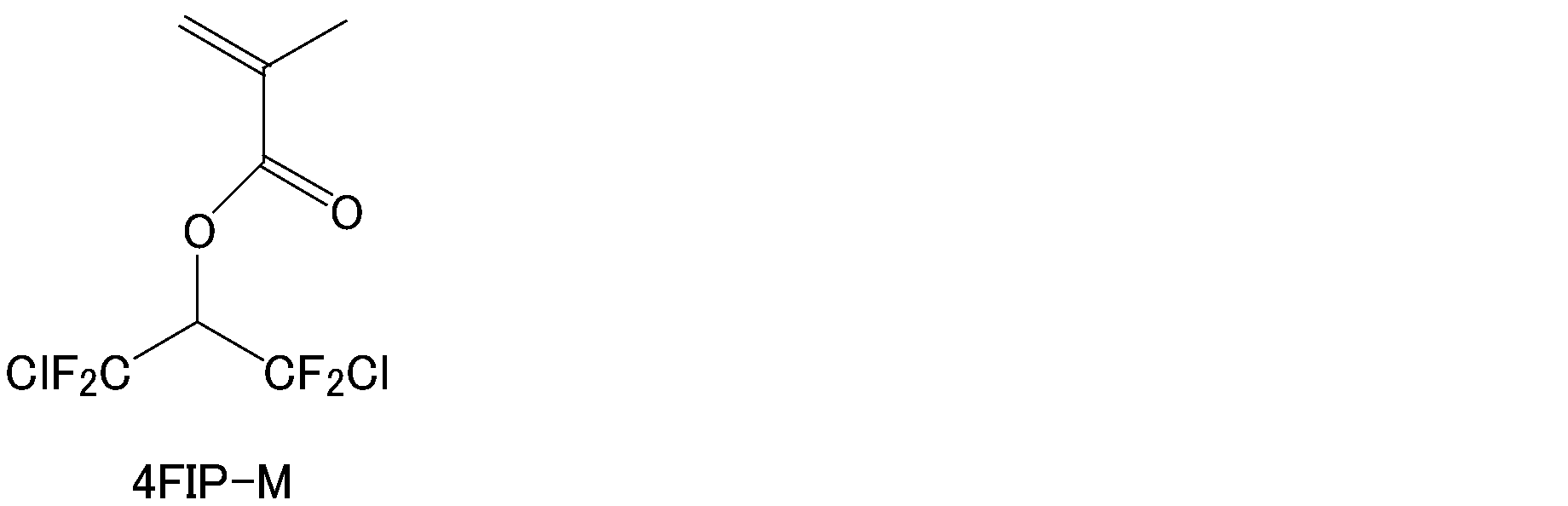
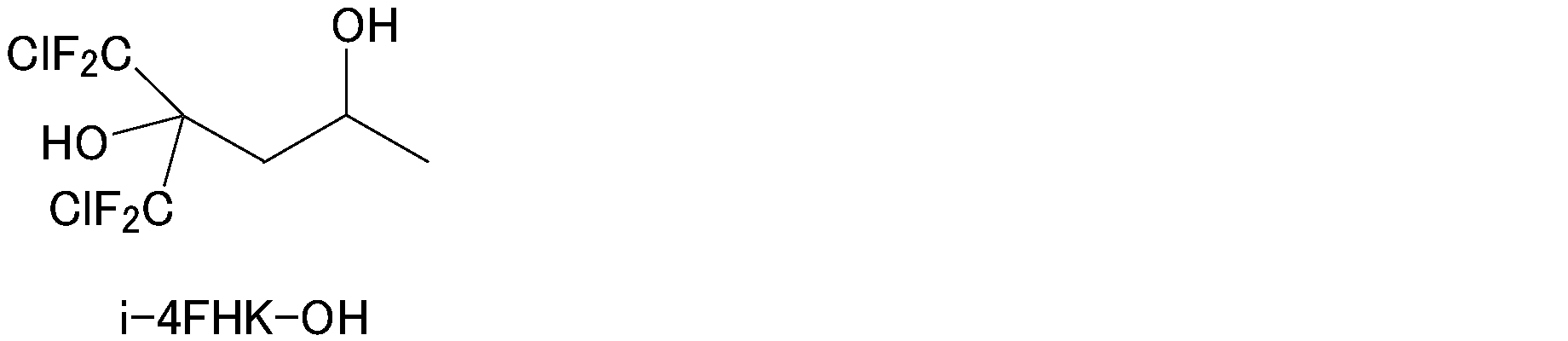


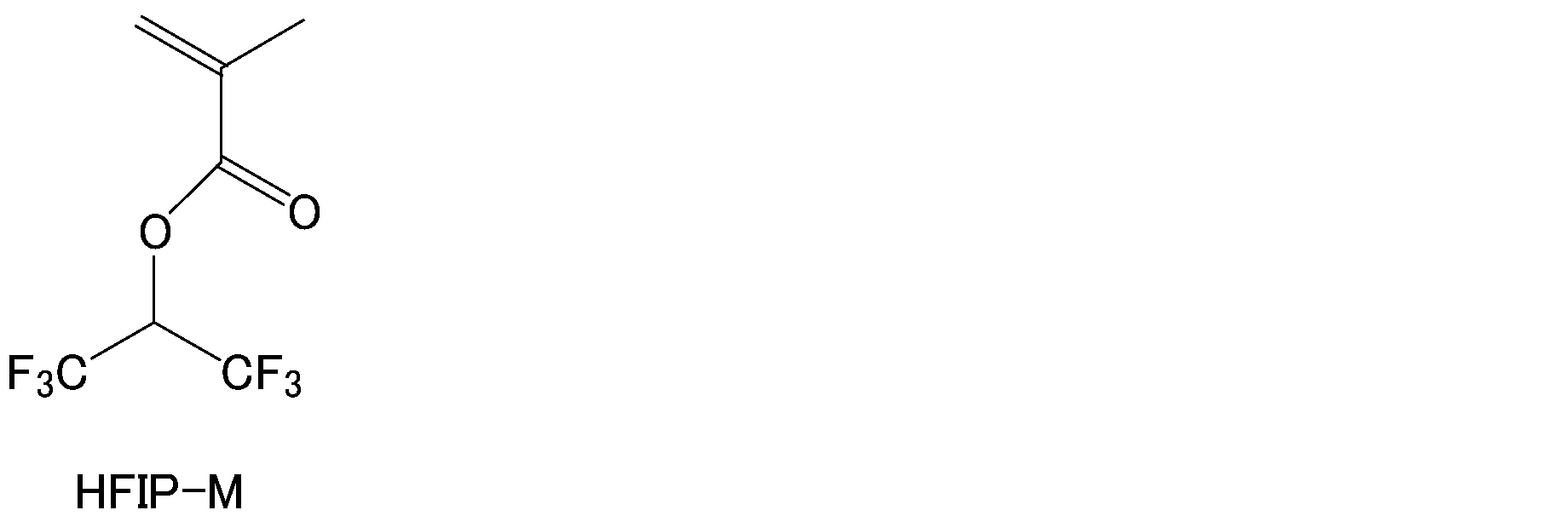
共鳴周波数400MHzの核磁気共鳴装置(以下、NMR、日本電子株式会社製、機器名JNM-ECA400)を使用し、19F-NMR、1H-NMRを測定した。
重合体における繰り返し組成の組成は、NMRによる1H-NMR及び19F-NMRの測定値により決定した。
後述の樹脂組成物等の重量平均分子量(Mw)を下記の通り測定した。重合体の数平均分子量Mnと分子量分散(数平均分子量Mnと質量平均分子量Mwの比=Mw/Mn)は、高速ゲルパーミエーションクロマトグラフィ(以下、GPCと呼ぶことがある。東ソー株式会社製、形式HLC-8320GPC)を使用し、東ソー株式会社製ALPHA-MカラムとALPHA-2500カラムを1本ずつ直列に繋ぎ、展開溶媒としてテトラヒドロフランを用いて測定した。検出器には、屈折率差測定検出器を用いた。
1L三口ナスフラスコに、濃硫酸(0.31g、3.16mmol)、アセトン(307g、5.28mol)1,3-ジクロロテトラフルオロアセトン(Synquest Laboratories社製、210g、1.06mol)、を加え、終夜30℃で撹拌した。反応液をバス温30℃、100hPaの条件下、エバポレーターで濃縮し、得られた濃縮液にイオン交換水を加えて洗浄した。その後、エバポレーターで濃縮して濃縮液1(245g)を得た。
1L三口ナスフラスコに、テトラヒドロフラン(超脱水グレード、551g)、水素化ホウ素ナトリウム(32.5g、857mmol)を加えて分散させ、氷浴に浸けて冷却した。その後、上記濃縮液1を30分かけて滴下し、1.5時間後に塩酸水で反応を停止した。反応液をIPE(551g)で抽出し、イオン交換水洗浄を1回実施した。洗浄したIPE溶液をトルエンで溶媒置換しながらバス温42℃、20hPaの条件下、エバポレーターで濃縮してi-4FHK-OHを含む濃縮液2(215g)を得た。
1L三口ナスフラスコに、上記濃縮液2、メタンスルホン酸(5.97g、62.1mmol)、ノンフレックスMBP(精工化学社製、0.96g)を加え混合し、バス温38℃の条件下、メタクリル酸無水物(以下、MAAHと記載する、東京化成品試薬、105g、683mmol)を滴下した。その後、バス温47℃で1.5時間、バス温57℃で3時間撹拌し、反応を停止した。反応液をIPE(322g)で抽出し、水酸化ナトリウム水洗浄、イオン交換水洗浄を各1回実施した。その後、2-メトキシフェノチアジンを少量加えて、バス温42℃、20hPaの条件下、エバポレーターで濃縮した。得られた濃縮液を0.2kPa、内温125~136℃で蒸留し、MA-4FHB-OH(123g、収率36%(3工程収率)、GC純度>99%)を得た。以下に本反応を示す。

NMRの結果を以下に示す。
1H-NMR(CDCl3、基準物質:TMS):6.36ppm(s,1H)、6.18ppm(m,1H)、5.65ppm(quin,J=1.6Hz,1H)、5.22ppm(m,1H)、2.43ppm(dd,J=4.8Hz,0.8Hz,2H)、1.95ppm(m,3H)、1.46ppm(d,J=6.4Hz,3H)
19F-NMR(CDCl3、基準物質:C6F6):-60.1ppm(q,15.2Hz,2F)、-79.6ppm(m,2F)
1L三口ナスフラスコに、水素化ホウ素ナトリウム(22.8g、603mmol)、IPE(300g)を加え氷浴に浸けて冷却した。その後1,3-ジクロロテトラフルオロアセトン(Synquest Laboratories社製、100g、503mmol)をゆっくりと滴下後、室温にして17時間攪拌した。氷浴に浸けて冷却した後、塩酸水200gで反応を停止させた。その後分液して得られた有機層を常圧蒸留(オイルバス120~150℃)することで4FIPのIPE溶液129gを得た。純度は64wt%、収率82%であった。以下に本反応を示す。

NMRの結果を以下に示す。4FIPのみの結果を示す。
1H-NMR(CDCl3、基準物質:TMS):4.42ppm(m,1H)
19F-NMR(CDCl3、基準物質:C6F6):-58.7ppm(m,2F)、-63.4ppm(m,2F)

NMRの結果を以下に示す。
1H-NMR(CDCl3、基準物質:TMS):6.36ppm(m,1H)、5.89ppm(m,1H)、5.84ppm(m,1H)、2.03ppm(m,3H)
19F-NMR(CDCl3、基準物質:C6F6):-58.5ppm(m,2F)、-60.1ppm(m,2F)
300mL三口フラスコにMEK(75.6g)を加え内温80℃に昇温した。その後MA-4FHB-OH(8.2g、25mmol)とBMA(10.7g、75mmol)とMEK(18.9g)の混合液を30分かけて滴下して、内温80℃で5時間攪拌した。室温に戻して、MEKを減圧留去して50wt%溶液とした後、MeOH(20g)を加えた。その後得られた溶液をヘプタン(200g)に滴下して再沈殿、ろ過を行い、得られたポリマーを減圧乾燥して白色粉末を14.2g得た。以上の工程を経て、実施例1-1に係る共重合体1-1を合成した。
使用するMA-4FHB-OHと、BMAとの割合(モル割合)を表1に示すように変更した以外は実施例1-1と同様にして、実施例1-2及び実施例1-3に係る共重合体1-2及び共重合体1-3を合成した。
[実施例1-4:共重合体1-4の合成]
300mL三口フラスコにMEK(83.3g)を加え内温80℃に昇温した。その後MA-4FHB-OH(8.2g、25mmol)とメタクリル酸1-メチルシクロペンチル(12.6g、75mmol)とMEK(20.8g)の混合液を30分かけて滴下して、内温80℃で5時間攪拌した。室温に戻して、MEKを減圧留去して50wt%溶液とした後、MeOH(20g)を加えた。その後得られた溶液をヘプタン(200g)に滴下して再沈殿、ろ過を行い、得られたポリマーを減圧乾燥して白色粉末を16.0g得た。以上の工程を経て、実施例1-4に係る共重合体1-4を合成した。
使用するMA-4FHB-OHと、メタクリル酸1-メチルシクロペンチルとの割合(モル割合)を表1に示すように変更した以外は実施例1-4と同様にして、実施例1-5及び実施例1-6に係る共重合体1-5及び共重合体1-6を合成した。
300mL三口フラスコにMEK(87.5g)を加え内温80℃に昇温した。その後MA-4FHB-OH(8.2g、25mmol)とメタクリル酸1-エチルシクロペンチル(13.7g、75mmol)とMEK(21.9g)の混合液を30分かけて滴下して、内温80℃で5時間攪拌した。室温に戻して、MEKを減圧留去して50wt%溶液とした後、MeOH(20g)を加えた。その後得られた溶液をヘプタン(200g)に滴下して再沈殿、ろ過を行い、得られたポリマーを減圧乾燥して白色粉末を17.3g得た。以上の工程を経て、実施例1-7に係る共重合体1-7を合成した。
使用するMA-4FHB-OHと、メタクリル酸1-エチルシクロペンチルとの割合(モル割合)を表1に示すように変更した以外は実施例1-7と同様にして、実施例1-8及び実施例1-9に係る共重合体1-8及び共重合体1-9を合成した。
300mL三口フラスコにMEK(103.1g)を加え内温80℃に昇温した。その後MA-4FHB-OH(8.2g、25mmol)とメタクリル酸2-メチル-2-アダマンチル(17.5g、75mmol)とMEK(25.8g)の混合液を30分かけて滴下して、内温80℃で5時間攪拌した。室温に戻して、MEKを減圧留去して50wt%溶液とした後、MeOH(20g)を加えた。その後得られた溶液をヘプタン(200g)に滴下して再沈殿、ろ過を行い、得られたポリマーを減圧乾燥して白色粉末を19.3g得た。以上の工程を経て、実施例1-10に係る共重合体1-10を合成した。
使用するMA-4FHB-OHと、メタクリル酸2-メチル-2-アダマンチルとの割合(モル割合)を表1に示すように変更した以外は実施例1-10と同様にして、実施例1-11及び実施例1-12に係る共重合体1-11及び共重合体1-12を合成した。
300mL三口フラスコにMEK(104.0g)を加え内温80℃に昇温した。その後MA-4FHB-OH(8.2g、25mmol)とメタクリル酸2-エチル-2-アダマンチル(17.8g、75mmol)とMEK(26.8g)の混合液を30分かけて滴下して、内温80℃で5時間攪拌した。室温に戻して、MEKを減圧留去して50wt%溶液とした後、MeOH(20g)を加えた。その後得られた溶液をヘプタン(200g)に滴下して再沈殿、ろ過を行い、得られたポリマーを減圧乾燥して白色粉末を19.8g得た。以上の工程を経て、実施例1-13に係る共重合体1-13を合成した。
使用するMA-4FHB-OHと、メタクリル酸2-エチル-2-アダマンチルとの割合(モル割合)を表1に示すように変更した以外は実施例1-13と同様にして、実施例1-14及び実施例1-15に係る共重合体1-14及び共重合体1-15を合成した。
300mL三口フラスコにMEK(58.6g)を加え内温80℃に昇温した。その後MA-4FHB-OH(8.2g、25mmol)とメタクリル酸(6.5g、75mmol)とMEK(14.7g)の混合液を30分かけて滴下して、内温80℃で5時間攪拌した。室温に戻して、MEKを減圧留去して50wt%溶液とした後、MeOH(20g)を加えた。その後得られた溶液をヘプタン(200g)に滴下して再沈殿、ろ過を行い、得られたポリマーを減圧乾燥して白色粉末を8.8g得た。以上の工程を経て、実施例1-16に係る共重合体1-16を合成した。
使用するMA-4FHB-OHと、メタクリル酸との割合(モル割合)を表1に示すように変更した以外は実施例1-16と同様にして、実施例1-17及び実施例1-18に係る共重合体1-17及び共重合体1-18を合成した。
300mL三口フラスコにMEK(72.4g)を加え内温80℃に昇温した。その後MA-BTHB-OH(7.4g、25mmol)とBMA(10.7g、75mmol)とMEK(18.1g)の混合液を30分かけて滴下して、内温80℃で5時間攪拌した。室温に戻して、MEKを減圧留去して50wt%溶液とした後、MeOH(200g)を加えた。その後得られた溶液をヘプタン(20g)に滴下して再沈殿、ろ過を行い、得られたポリマーを減圧乾燥して白色粉末を13.2g得た。以上の工程を経て、比較例1-1に係る比較共重合体1-1を合成した。
使用するMA-BTHB-OHと、BMAとの割合(モル割合)を表1に示すように変更した以外は比較例1-1と同様にして、比較1-2及び比較例1-3に係る比較共重合体1-2及び比較共重合体1-3を合成した。
300mL三口フラスコにMEK(80.1g)を加え内温80℃に昇温した。その後MA-BTHB-OH(7.4g、25mmol)とメタクリル酸1-メチルシクロペンチル(12.6g、75mmol)とMEK(20.0g)の混合液を30分かけて滴下して、内温80℃で5時間攪拌した。室温に戻して、MEKを減圧留去して50wt%溶液とした後、MeOH(20g)を加えた。その後得られた溶液をヘプタン(200g)に滴下して再沈殿、ろ過を行い、得られたポリマーを減圧乾燥して白色粉末を15.9g得た。以上の工程を経て、比較例1-4に係る比較共重合体1-4を合成した。
使用するMA-BTHB-OHと、メタクリル酸1-メチルシクロペンチルとの割合(モル割合)を表1に示すように変更した以外は比較例1-4と同様にして、比較例1-5及び比較例1-6に係る比較共重合体1-5及び比較共重合体1-6を合成した。
300mL三口フラスコにMEK(84.4g)を加え内温80℃に昇温した。その後MA-BTHB-OH(7.4g、25mmol)とメタクリル酸1-エチルシクロペンチル(13.7g、75mmol)とMEK(21.1g)の混合液を30分かけて滴下して、内温80℃で5時間攪拌した。室温に戻して、MEKを減圧留去して50wt%溶液とした後、MeOH(20g)を加えた。その後得られた溶液をヘプタン(200g)に滴下して再沈殿、ろ過を行い、得られたポリマーを減圧乾燥して白色粉末を17.2g得た。以上の工程を経て、比較例1-7に係る比較共重合体1-7を合成した。
使用するMA-BTHB-OHと、メタクリル酸1-エチルシクロペンチルとの割合(モル割合)を表1に示すように変更した以外は比較例1-7と同様にして、比較例1-8及び比較例1-9に係る比較共重合体1-8及び比較共重合体1-9を合成した。
300mL三口フラスコにMEK(99.9g)を加え内温80℃に昇温した。その後MA-BTHB-OH(7.4g、25mmol)とメタクリル酸2-メチル-2-アダマンチル(16.8g、75mmol)とMEK(25.0g)の混合液を30分かけて滴下して、内温80℃で5時間攪拌した。室温に戻して、MEKを減圧留去して50wt%溶液とした後、MeOH(20g)を加えた。その後得られた溶液をヘプタン(200g)に滴下して再沈殿、ろ過を行い、得られたポリマーを減圧乾燥して白色粉末を19.2g得た。以上の工程を経て、比較例1-10に係る比較共重合体1-10を合成した。
使用するMA-BTHB-OHと、メタクリル酸2-メチル-2-アダマンチルとの割合(モル割合)を表1に示すように変更した以外は比較例1-10と同様にして、比較例1-11及び比較例1-12に係る比較共重合体1-11及び比較共重合体1-12を合成した。
300mL三口フラスコにMEK(95.6g)を加え内温80℃に昇温した。その後MA-BTHB-OH(7.4g、25mmol)とメタクリル酸2-エチル-2-アダマンチル(17.8g、75mmol)とMEK(26.0g)の混合液を30分かけて滴下して、内温80℃で5時間攪拌した。室温に戻して、MEKを減圧留去して50wt%溶液とした後、MeOH(20g)を加えた。その後得られた溶液をヘプタン(200g)に滴下して再沈殿、ろ過を行い、得られたポリマーを減圧乾燥して白色粉末を19.5g得た。以上の工程を経て、比較例1-13に係る比較共重合体1-13を合成した。
使用するMA-BTHB-OHと、メタクリル酸2-エチル-2-アダマンチルとの割合(モル割合)を表1に示すように変更した以外は比較例1-13と同様にして、比較例1-14及び比較例1-15に係る比較共重合体1-14及び比較共重合体1-15を合成した。
300mL三口フラスコにMEK(55.4g)を加え内温80℃に昇温した。その後MA-BTHB-OH(7.4g、25mmol)とメタクリル酸(6.5g、75mmol)とMEK(13.9g)の混合液を30分かけて滴下して、内温80℃で5時間攪拌した。室温に戻して、MEKを減圧留去して50wt%溶液とした後、MeOH(20g)を加えた。その後得られた溶液をヘプタン(200g)に滴下して再沈殿、ろ過を行い、得られたポリマーを減圧乾燥して白色粉末を7.5g得た。以上の工程を経て、比較例1-16に係る比較共重合体1-16を合成した。
使用するMA-BTHB-OHと、メタクリル酸との割合(モル割合)を表1に示すように変更した以外は比較例1-16と同様にして、比較例1-17及び比較例1-18に係る比較共重合体1-17及び比較共重合体1-18を合成した。
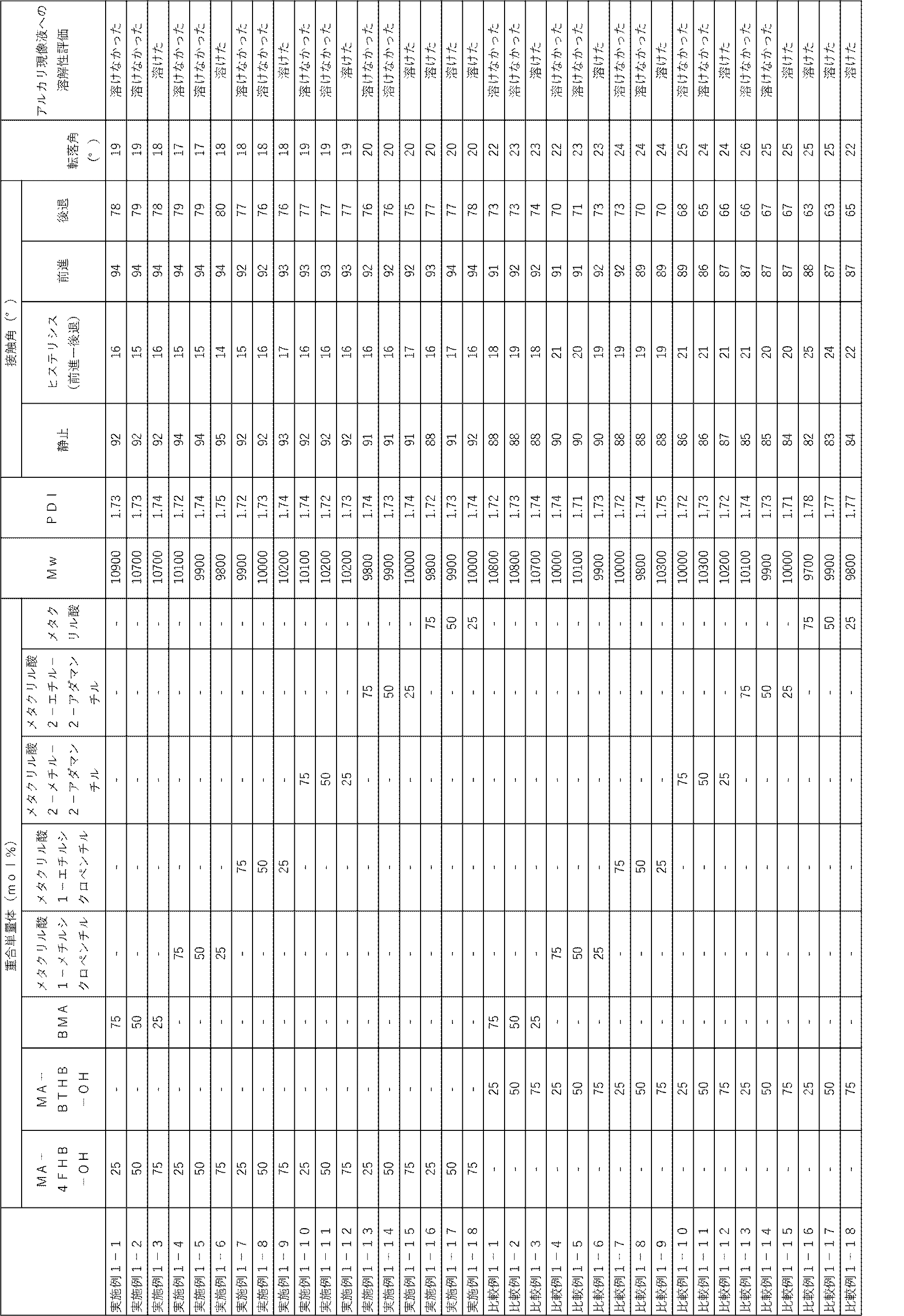
300mL三口フラスコにMEK(69.6g)を加え内温80℃に昇温した。その後4FIP-M(6.7g、25mmol)とBMA(10.7g、75mmol)の混合液を30分かけて滴下して、内温80℃で5時間攪拌した。室温に戻して、MEKを減圧留去して50wt%溶液とした後、MeOH(20g)を加えた。その後得られた溶液をヘプタン(200g)に滴下して再沈殿、ろ過を行い、得られたポリマーを減圧乾燥して白色粉末を12.2g得た。以上の工程を経て、実施例2-1に係る共重合体2-1を合成した。
使用する4FIP-Mと、BMAとの割合(モル割合)を表2に示すように変更した以外は実施例2-1と同様にして、実施例2-2及び実施例2-3に係る共重合体2-2及び共重合体2-3を合成した。
300mL三口フラスコにMEK(73.2g)を加え内温80℃に昇温した。その後4FIP-M(6.7g、25mmol)とメタクリル酸1-メチルシクロペンチル(12.6g、75mmol)とMEK(19.3g)の混合液を30分かけて滴下して、内温80℃で5時間攪拌した。室温に戻して、MEKを減圧留去して50wt%溶液とした後、MeOH(20g)を加えた。その後得られた溶液をヘプタン(200g)に滴下して再沈殿、ろ過を行い、得られたポリマーを減圧乾燥して白色粉末を14.1g得た。以上の工程を経て、実施例2-4に係る共重合体2-4を合成した。
使用する4FIP-Mと、メタクリル酸1-メチルシクロペンチルとの割合(モル割合)を表2に示すように変更した以外は実施例2-4と同様にして、実施例2-5及び実施例2-6に係る共重合体2-5及び共重合体2-6を合成した。
300mL三口フラスコにMEK(81.6g)を加え内温80℃に昇温した。その後4FIP-M(6.7g、25mmol)とメタクリル酸1-エチルシクロペンチル(13.7g、75mmol)とMEK(20.4g)の混合液を30分かけて滴下して、内温80℃で5時間攪拌した。室温に戻して、MEKを減圧留去して50wt%溶液とした後、MeOH(20g)を加えた。その後得られた溶液をヘプタン(200g)に滴下して再沈殿、ろ過を行い、得られたポリマーを減圧乾燥して白色粉末を15.1g得た。以上の工程を経て、実施例2-7に係る共重合体2-7を合成した。
使用する4FIP-Mと、メタクリル酸1-エチルシクロペンチルとの割合(モル割合)を表2に示すように変更した以外は実施例2-7と同様にして、実施例2-8及び実施例2-9に係る共重合体2-8及び共重合体2-9を合成した。
300mL三口フラスコにMEK(92.8g)を加え内温80℃に昇温した。その後4FIP-M(6.7g、25mmol)とメタクリル酸2-メチル-2-アダマンチル(17.5g、75mmol)とMEK(24.2g)の混合液を30分かけて滴下して、内温80℃で5時間攪拌した。室温に戻して、MEKを減圧留去して50wt%溶液とした後、MeOH(20g)を加えた。その後得られた溶液をヘプタン(200g)に滴下して再沈殿、ろ過を行い、得られたポリマーを減圧乾燥して白色粉末を18.3g得た。以上の工程を経て、実施例2-10に係る共重合体2-10を合成した。
使用する4FIP-Mと、メタクリル酸2-メチル-2-アダマンチルとの割合(モル割合)を表2に示すように変更した以外は実施例2-10と同様にして、実施例2-11及び実施例2-12に係る共重合体2-11及び共重合体2-12を合成した。
300mL三口フラスコにMEK(101.6g)を加え内温80℃に昇温した。その後4FIP-M(6.7g、25mmol)とメタクリル酸2-エチル-2-アダマンチル(17.8g、75mmol)とMEK(25.4g)の混合液を30分かけて滴下して、内温80℃で5時間攪拌した。室温に戻して、MEKを減圧留去して50wt%溶液とした後、MeOH(20g)を加えた。その後得られた溶液をヘプタン(200g)に滴下して再沈殿、ろ過を行い、得られたポリマーを減圧乾燥して白色粉末を17.8g得た。以上の工程を経て、実施例2-13に係る共重合体2-13を合成した。
使用する4FIP-Mと、メタクリル酸2-エチル-2-アダマンチルとの割合(モル割合)を表2に示すように変更した以外は実施例2-13と同様にして、実施例2-14及び実施例2-15に係る共重合体2-14及び共重合体2-15を合成した。
300mL三口フラスコにMEK(52.7g)を加え内温80℃に昇温した。その後4FIP-M(6.7g、25mmol)とメタクリル酸(6.5g、75mmol)とMEK(13.2g)の混合液を30分かけて滴下して、内温80℃で5時間攪拌した。室温に戻して、MEKを減圧留去して50wt%溶液とした後、MeOH(20g)を加えた。その後得られた溶液をヘプタン(200g)に滴下して再沈殿、ろ過を行い、得られたポリマーを減圧乾燥して白色粉末を8.8g得た。以上の工程を経て、実施例2-16に係る共重合体2-16を合成した。
使用する4FIP-Mと、メタクリル酸との割合(モル割合)を表2に示すように変更した以外は実施例2-16と同様にして、実施例2-17及び実施例2-18に係る共重合体2-17及び共重合体2-18を合成した。
300mL三口フラスコにMEK(66.3g)を加え内温80℃に昇温した。その後HFIP-M(5.9g、25mmol)とBMA(10.7g、75mmol)の混合液を30分かけて滴下して、内温80で5時間攪拌した。室温に戻して、MEKを減圧留去して50wt%溶液とした後、MeOH(20g)を加えた。その後得られた溶液をヘプタン(200g)に滴下して再沈殿、ろ過を行い、得られたポリマーを減圧乾燥して白色粉末を12.0g得た。以上の工程を経て、比較例2-1に係る比較共重合体2-1を合成した。
使用するHFIP-Mと、BMAとの割合(モル割合)を表2に示すように変更した以外は比較例2-1と同様にして、比較例2-2及び比較例2-3に係る比較共重合体2-2及び比較共重合体2-3を合成した。
300mL三口フラスコにMEK(76.8g)を加え内温80℃に昇温した。その後HFIP-M(5.9g、25mmol)とメタクリル酸1-メチルシクロペンチル(12.6g、75mmol)とMEK(18.5g)の混合液を30分かけて滴下して、内温80℃で5時間攪拌した。室温に戻して、MEKを減圧留去して50wt%溶液とした後、MeOH(20g)を加えた。その後得られた溶液をヘプタン(200g)に滴下して再沈殿、ろ過を行い、得られたポリマーを減圧乾燥して白色粉末を14.9g得た。以上の工程を経て、比較例2-4に係る比較共重合体2-4を合成した。
使用するHFIP-Mと、メタクリル酸1-メチルシクロペンチルとの割合(モル割合)を表2に示すように変更した以外は比較例2-4と同様にして、比較例2-5及び比較例2-6に係る比較共重合体2-5及び比較共重合体2-6を合成した。
300mL三口フラスコにMEK(80.8g)を加え内温80℃に昇温した。その後HFIP-M(5.9g、25mmol)とメタクリル酸1-エチルシクロペンチル(13.7g、75mmol)とMEK(19.6g)の混合液を30分かけて滴下して、内温80℃で5時間攪拌した。室温に戻して、MEKを減圧留去して50wt%溶液とした後、MeOH(20g)を加えた。その後得られた溶液をヘプタン(200g)に滴下して再沈殿、ろ過を行い、得られたポリマーを減圧乾燥して白色粉末を17.1g得た。以上の工程を経て、比較例2-7に係る比較共重合体2-7を合成した。
使用するHFIP-Mと、メタクリル酸1-エチルシクロペンチルとの割合(モル割合)を表2に示すように変更した以外は比較例2-7と同様にして、比較例2-8及び比較例2-9に係る比較共重合体2-8及び比較共重合体2-9を合成した。
300mL三口フラスコにMEK(96.8g)を加え内温80℃に昇温した。その後HFIP-M(5.9g、25mmol)とメタクリル酸2-メチル-2-アダマンチル(16.8g、75mmol)とMEK(22.7g)の混合液を30分かけて滴下して、内温80℃で5時間攪拌した。室温に戻して、MEKを減圧留去して50wt%溶液とした後、MeOH(20g)を加えた。その後得られた溶液をヘプタン(200g)に滴下して再沈殿、ろ過を行い、得られたポリマーを減圧乾燥して白色粉末を19.0g得た。以上の工程を経て、比較例2-10に係る比較共重合体2-10を合成した。
使用するHFIP-Mと、メタクリル酸2-メチル-2-アダマンチルとの割合(モル割合)を表2に示すように変更した以外は比較例2-10と同様にして、比較例2-11及び比較例2-12に係る比較共重合体2-11及び比較共重合体2-12を合成した。
300mL三口フラスコにMEK(100.8g)を加え内温80℃に昇温した。その後HFIP-M(5.9g、25mmol)とメタクリル酸2-エチル-2-アダマンチル(17.8g、75mmol)とMEK(23.7g)の混合液を30分かけて滴下して、内温80℃で5時間攪拌した。室温に戻して、MEKを減圧留去して50wt%溶液とした後、MeOH(20g)を加えた。その後得られた溶液をヘプタン(200g)に滴下して再沈殿、ろ過を行い、得られたポリマーを減圧乾燥して白色粉末を19.2g得た。以上の工程を経て、比較例2-13に係る比較共重合体2-13を合成した。
使用するHFIP-Mと、メタクリル酸2-エチル-2-アダマンチルとの割合(モル割合)を表2に示すように変更した以外は比較例2-13と同様にして、比較例2-14及び比較例2-15に係る比較共重合体2-14及び比較共重合体2-15を合成した。
300mL三口フラスコにMEK(49.4g)を加え内温80℃に昇温した。その後HFIP-M(5.9g、25mmol)とメタクリル酸(6.5g、75mmol)とMEK(12.4g)の混合液を30分かけて滴下して、内温80℃で5時間攪拌した。室温に戻して、MEKを減圧留去して50wt%溶液とした後、MeOH(20g)を加えた。その後得られた溶液をヘプタン(200g)に滴下して再沈殿、ろ過を行い、得られたポリマーを減圧乾燥して白色粉末を6.2g得た。以上の工程を経て、比較例2-16に係る比較共重合体2-16を合成した。
使用するHFIP-Mと、メタクリル酸との割合(モル割合)を表2に示すように変更した以外は比較例2-16と同様にして、比較例2-17及び比較例2-18に係る比較共重合体2-17及び比較共重合体2-18を合成した。
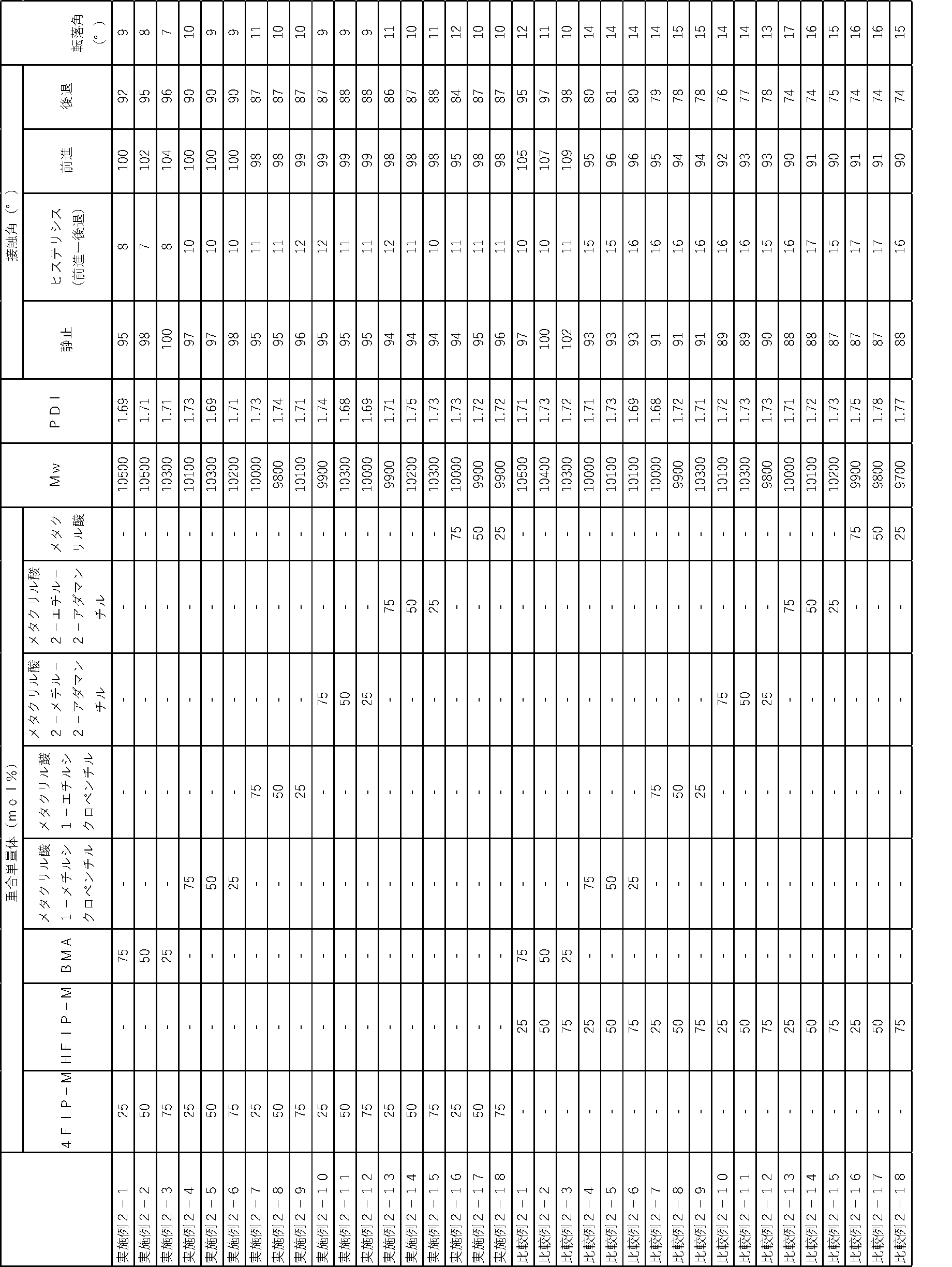
300mL三口フラスコにMEK(96.4g)を加え内温80℃に昇温した。その後MA-4FHB-OH(6.6g、20mmol)と4FIP-M(10.8g、40mmol)とメタクリル酸1-メチルシクロペンチル(6.7g、40mmol)とMEK(24.1g)の混合液を30分かけて滴下して、内温80℃で5時間攪拌した。室温に戻して、MEKを減圧留去して50wt%溶液とした後、MeOH(20g)を加えた。その後得られた溶液をヘプタン(200g)に滴下して再沈殿、ろ過を行い、得られたポリマーを減圧乾燥して白色粉末を20.1g得た。以上の工程を経て、実施例3-1に係る共重合体3-1を合成した。
300mL三口フラスコにMEK(99.7g)を加え内温80℃に昇温した。その後MA-4FHB-OH(6.6g、20mmol)と4FIP-M(10.8g、40mmol)とメタクリル酸1-エチルシクロペンチル(7.3g、40mmol)とMEK(24.7g)の混合液を30分かけて滴下して、内温80℃で5時間攪拌した。室温に戻して、MEKを減圧留去して50wt%溶液とした後、MeOH(20g)を加えた。その後得られた溶液をヘプタン(200g)に滴下して再沈殿、ろ過を行い、得られたポリマーを減圧乾燥して白色粉末を22.1g得た。以上の工程を経て、実施例3-2に係る共重合体3-2を合成した。
300mL三口フラスコにMEK(106.9g)を加え内温80℃に昇温した。その後MA-4FHB-OH(6.6g、20mmol)と4FIP-M(10.8g、40mmol)とメタクリル酸2-メチル-2-アダマンチル(9.4g、40mmol)とMEK(26.7g)の混合液を30分かけて滴下して、内温80℃で5時間攪拌した。室温に戻して、MEKを減圧留去して50wt%溶液とした後、MeOH(20g)を加えた。その後得られた溶液をヘプタン(200g)に滴下して再沈殿、ろ過を行い、得られたポリマーを減圧乾燥して白色粉末を23.3g得た。以上の工程を経て、実施例3-3に係る共重合体3-3を合成した。
300mL三口フラスコにMEK(109.7g)を加え内温80℃に昇温した。その後MA-4FHB-OH(6.6g、20mmol)と4FIP-M(10.8g、40mmol)とメタクリル酸2-エチル-2-アダマンチル(9.9g、40mmol)とMEK(27.3g)の混合液を30分かけて滴下して、内温80℃で5時間攪拌した。室温に戻して、MEKを減圧留去して50wt%溶液とした後、MeOH(20g)を加えた。その後得られた溶液をヘプタン(200g)に滴下して再沈殿、ろ過を行い、得られたポリマーを減圧乾燥して白色粉末を24.8g得た。以上の工程を経て、実施例3-4に係る共重合体3-4を合成した。
300mL三口フラスコにMEK(83.1g)を加え内温80℃に昇温した。その後MA-4FHB-OH(6.6g、20mmol)と4FIP-M(10.8g、40mmol)とメタクリル酸(3.4g、40mmol)とMEK(20.8g)の混合液を30分かけて滴下して、内温80℃で5時間攪拌した。室温に戻して、MEKを減圧留去して50wt%溶液とした後、MeOH(20g)を加えた。その後得られた溶液をヘプタン(200g)に滴下して再沈殿、ろ過を行い、得られたポリマーを減圧乾燥して白色粉末を17.5g得た。以上の工程を経て、実施例3-5に係る共重合体3-5を合成した。
300mL三口フラスコにMEK(96.4g)を加え内温80℃に昇温した。その後MA-BTHB-OH(5.9g、20mmol)とHFIP-M(9.4g、40mmol)とメタクリル酸1-メチルシクロペンチル(6.7g、40mmol)とMEK(22.0g)の混合液を30分かけて滴下して、内温80℃で5時間攪拌した。室温に戻して、MEKを減圧留去して50wt%溶液とした後、MeOH(20g)を加えた。その後得られた溶液をヘプタン(200g)に滴下して再沈殿、ろ過を行い、得られたポリマーを減圧乾燥して白色粉末を16.1g得た。以上の工程を経て、比較例3-1に係る比較共重合体3-1を合成した。
300mL三口フラスコにMEK(90.4g)を加え内温80℃に昇温した。その後MA-BTHB-OH(5.9g、20mmol)とHFIP-M(9.4g、40mmol)とメタクリル酸1-エチルシクロペンチル(7.3g、40mmol)とMEK(22.6g)の混合液を30分かけて滴下して、内温80℃で5時間攪拌した。室温に戻して、MEKを減圧留去して50wt%溶液とした後、MeOH(20g)を加えた。その後得られた溶液をヘプタン(200g)に滴下して再沈殿、ろ過を行い、得られたポリマーを減圧乾燥して白色粉末を16.4g得た。以上の工程を経て、比較例3-2に係る比較共重合体3-2を合成した。
300mL三口フラスコにMEK(98.7g)を加え内温80℃に昇温した。その後MA-BTHB-OH(5.9g、20mmol)とHFIP-M(9.4g、40mmol)とメタクリル酸2-メチル-2-アダマンチル(9.4g、40mmol)とMEK(24.7g)の混合液を30分かけて滴下して、内温80℃で5時間攪拌した。室温に戻して、MEKを減圧留去して50wt%溶液とした後、MeOH(20g)を加えた。その後得られた溶液をヘプタン(200g)に滴下して再沈殿、ろ過を行い、得られたポリマーを減圧乾燥して白色粉末を18.0g得た。以上の工程を経て、比較例3-3に係る比較共重合体3-3を合成した。
300mL三口フラスコにMEK(100.9g)を加え内温80℃に昇温した。その後MA-BTHB-OH(5.9g、20mmol)とHFIP-M(9.4g、40mmol)とメタクリル酸2-エチル-2-アダマンチル(9.9g、40mmol)とMEK(25.2g)の混合液を30分かけて滴下して、内温80℃で5時間攪拌した。室温に戻して、MEKを減圧留去して50wt%溶液とした後、MeOH(20g)を加えた。その後得られた溶液をヘプタン(200g)に滴下して再沈殿、ろ過を行い、得られたポリマーを減圧乾燥して白色粉末を18.9g得た。以上の工程を経て、比較例3-4に係る比較共重合体3-4を合成した。
300mL三口フラスコにMEK(75.2g)を加え内温80℃に昇温した。その後MA-BTHB-OH(5.9g、20mmol)とHFIP-M(9.4g、40mmol)とメタクリル酸(3.4g、40mmol)とMEK(18.8g)の混合液を30分かけて滴下して、内温80℃で5時間攪拌した。室温に戻して、MEKを減圧留去して50wt%溶液とした後、MeOH(20g)を加えた。その後得られた溶液をヘプタン(200g)に滴下して再沈殿、ろ過を行い、得られたポリマーを減圧乾燥して白色粉末を14.5g得た。以上の工程を経て、比較例3-5に係る比較共重合体3-5を合成した。
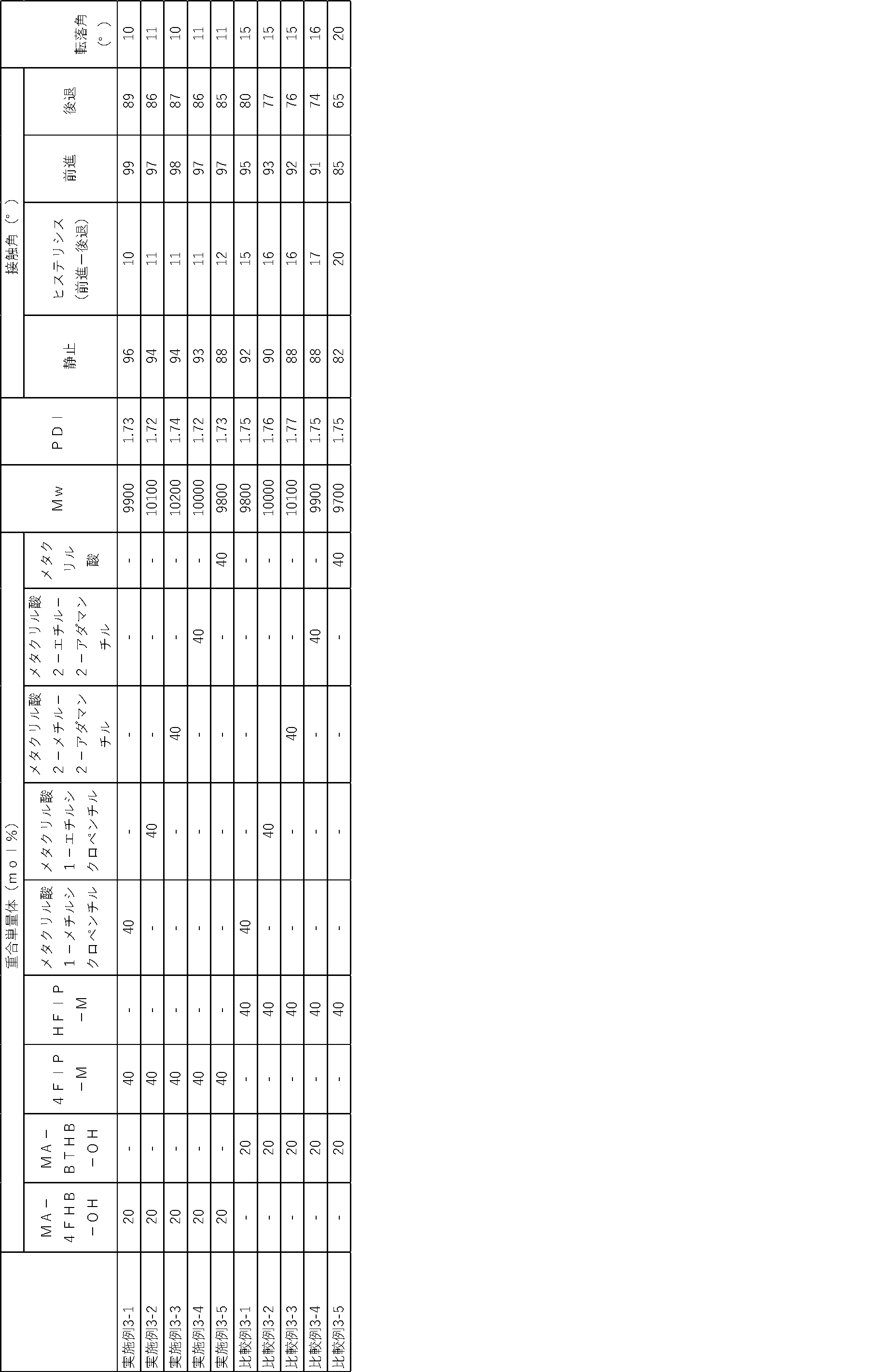
各共重合体1gをPGMEA(3g)へ添加して組成物を調製した。その後4インチシリコン基板上に調製した組成物をスピナーにより塗布して80℃に加熱したホットプレート上で3分間乾燥させ、膜厚2~3μmの膜を形成した。なお、当該膜厚は、撥水性を評価するための膜の厚さであり、実際にトップコートレスレジスト膜や上層膜よりも厚い膜を形成している。
シリコン基板上の膜に対して、水滴を載せ、接触角計(協和界面科学株式会社製)を用い、液滴法で静止接触角を測定した。本明細書において静止接触角とは、水滴を膜面に載せて着滴したとき、膜面とのなす角度を言う。結果を表1、2及び3に示す。
シリコン基板上の膜に対して、水滴を載せ、接触角計(協和界面科学株式会社製)を用い、拡張収縮法でヒステリシス(動的前進角-動的後退角)を測定した。本明細書において動的後退角とは、水滴をニードル等で吸引し、水滴が収縮するときの接触角のことを言い、動的前進角とは、水滴をニードル等で吐出し、水滴が拡張するときの接触角のことを言い、ヒステリシスは動的接触角と動的後退角の差を言う。結果を表1、2及び3に示す。
シリコン基板上の膜に対して、水滴(50μL)を載せ、接触角計(協和界面科学株式会社製)を用い、転落角の測定を行った。転落角とはシリコン基板の角度を傾けていき、水滴が移動したときの角度を言う。結果を表1、2及び3に示す。
また、表2に示すように、実施例2-1~実施例2-18に係る共重合体2-1~共重合体2-18は、比較例2-1~比較例2-18に係る比較共重合体2-1~比較共重合体2-18よりもヒステリシスが低く、転落角が低いことが判明した。
また、表3に示すように、実施例3-1~実施例3-5に係る共重合体3-1~共重合体3-5は、比較例3-1~比較例3-5に係る比較共重合体3-1~比較共重合体3-5よりもヒステリシスが低く、転落角が低いことが判明した。
共重合体1-1~共重合体1-18及び比較共重合体1-1~比較共重合体1-18(1g)を、それぞれPGMEA(3g)へ添加して組成物を調製した。その後4インチシリコン基板上に調製した組成物をスピナーにより塗布して80℃に加熱したホットプレート上で3分間乾燥させ、膜厚3μmの膜を形成した。その後2.38wt%の水酸化テトラメチルアンモニウム(TMAH)水溶液に1分間浸漬し、シリコン基板上の膜がTMAH水溶液に溶解するか否かを観察した。結果を表1に示す。
Claims (19)
- 下記一般式(1)で示される繰り返し単位と、重合性炭素-炭素二重結合を有する化合物由来の繰り返し単位とを有する共重合体。

R2は単結合、直鎖、分岐または環状構造を有しても良いアルキレン基、芳香環、エステル、カルボニル、エーテル、アミド、アミン、またはそれらの複合置換基であって、その一部がフッ素化及び/又は塩素化されても良い。
Xは水酸基、アルコキシ基、または水素原子である。) - 前記一般式(1)で示される繰り返し単位は、下記一般式(2)で示される繰り返し単位を含む請求項1に記載の共重合体。
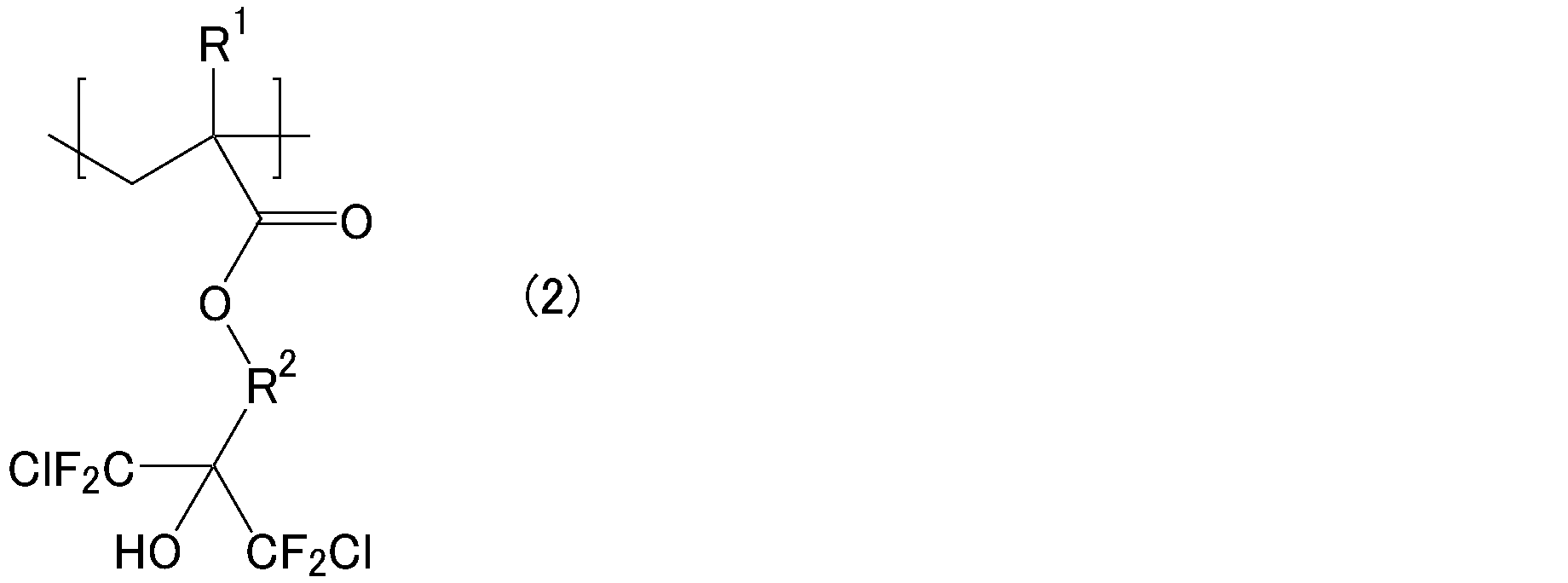
- 前記一般式(2)で示される繰り返し単位は、下記一般式(2-1)で示される繰り返し単位を含む請求項2に記載の共重合体。
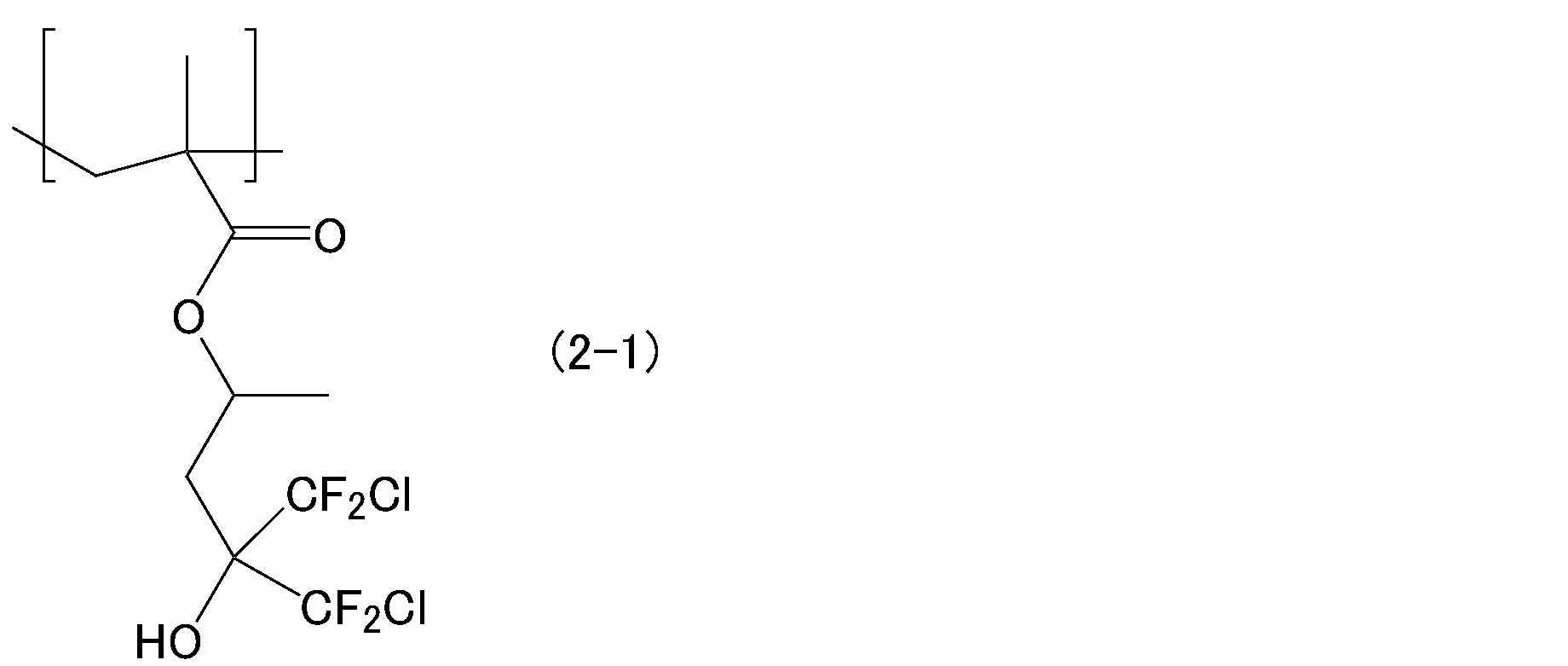
- 前記一般式(1)で示される繰り返し単位は、下記一般式(3)で示される繰り返し単位を含む請求項1に記載の共重合体。
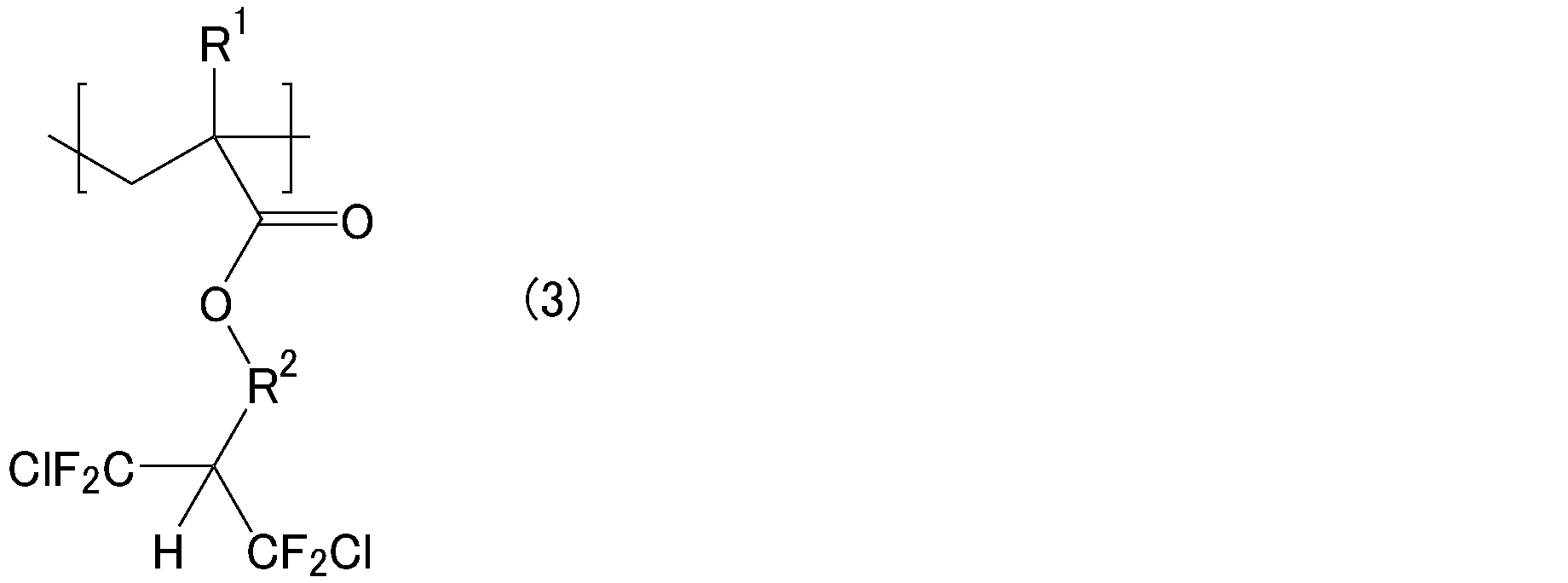
- 前記一般式(3)で示される繰り返し単位は、下記一般式(3-1)で示される繰り返し単位を含む請求項4に記載の共重合体。
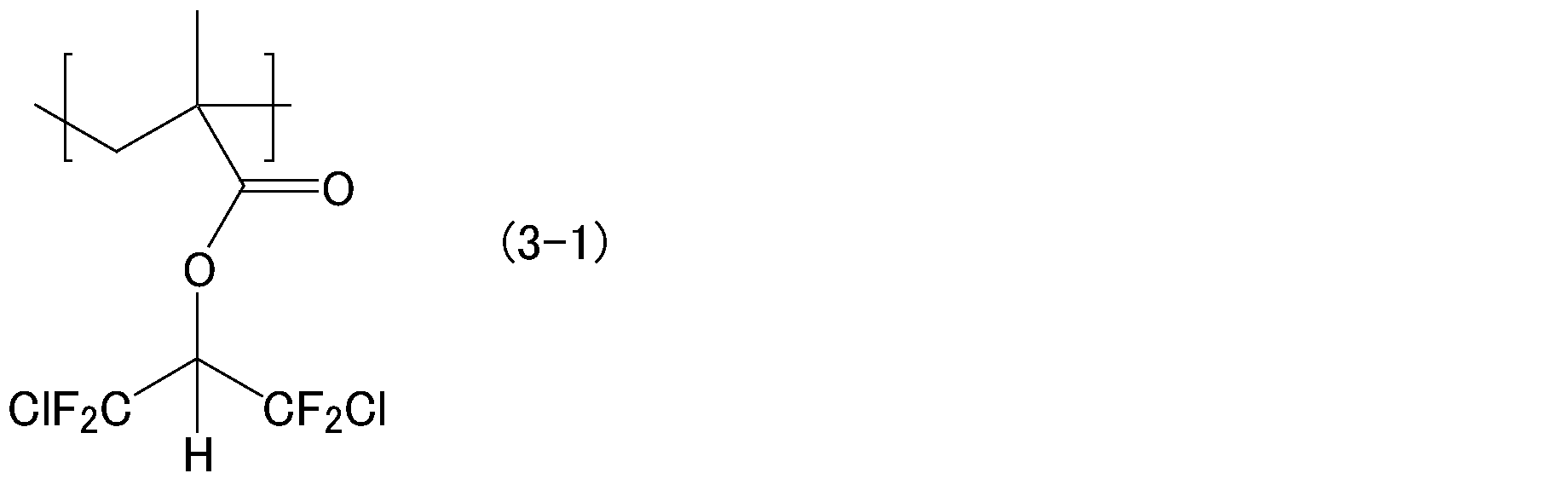
- 前記重合性炭素-炭素二重結合を有する化合物由来の繰り返し単位は、下記一般式(4)で示される繰り返し単位を含む請求項1に記載の共重合体。

YAは一価の有機基である。) - 前記一般式(4)で示される繰り返し単位は、フッ素原子を有しない繰り返し単位を含む請求項6に記載の共重合体。
- 前記一般式(4)で示される繰り返し単位は、メタクリル酸メチル、メタクリル酸エチル、メタクリル酸n-プロピル、メタクリル酸イソプロピル、メタクリル酸n-ブチル、メタクリル酸イソブチル、メタクリル酸t-ブチル、メタクリル酸ペンチル、アクリル酸メチル、アクリル酸エチル、アクリル酸n-プロピル、アクリル酸イソプロピル、アクリル酸n-ブチル、アクリル酸イソブチル、アクリル酸t-ブチル、アクリル酸ペンチル、下記式(4´-1)で示される化合物、下記式(4´-2)で示される化合物、下記式(4´-3)で示される化合物、下記式(4´-4)で示される化合物、下記式(4´-5)で示される化合物、下記式(4´-6)で示される化合物、下記式(4´-7)で示される化合物、下記式(4´-8)で示される化合物、下記式(4´-9)で示される化合物、下記式(4´-10)で示される化合物、下記式(4´-11)で示される化合物、下記式(4´-12)で示される化合物、下記式(4´-13)で示される化合物、下記式(4´-14)で示される化合物、下記式(4´-15)で示される化合物及び下記式(4´-16)で示される化合物からなる群から選択される少なくとも1種の重合性炭素-炭素二重結合を有する化合物に由来する繰り返し単位を含む請求項6に記載の共重合体。

- 下記一般式(1)で示される繰り返し単位を含む撥水剤用重合体。
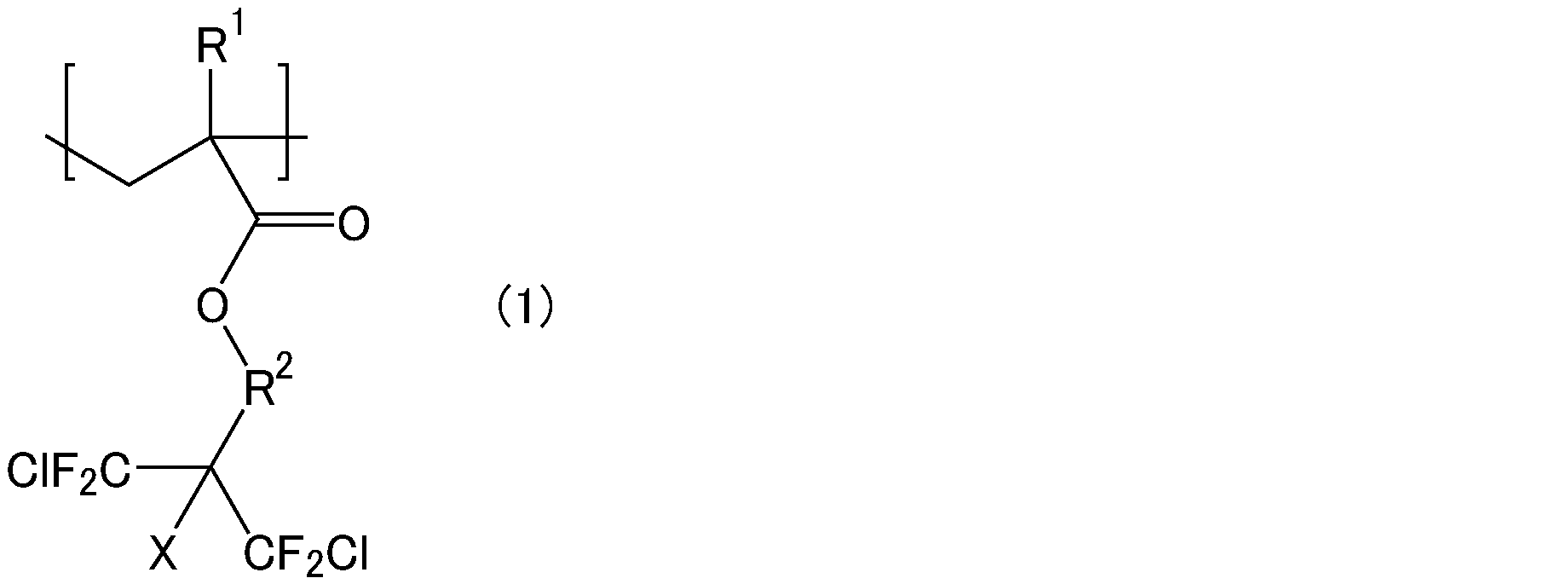
R2は単結合、直鎖、分岐または環状構造を有しても良いアルキレン基、芳香環、エステル、カルボニル、エーテル、アミド、アミン、またはそれらの複合置換基であって、その一部がフッ素化及び/又は塩素化されても良い。
Xは水酸基、アルコキシ基、または水素原子である。) - 前記一般式(1)で示される繰り返し単位は、下記一般式(2)で示される繰り返し単位を含む請求項9に記載の撥水剤用重合体。
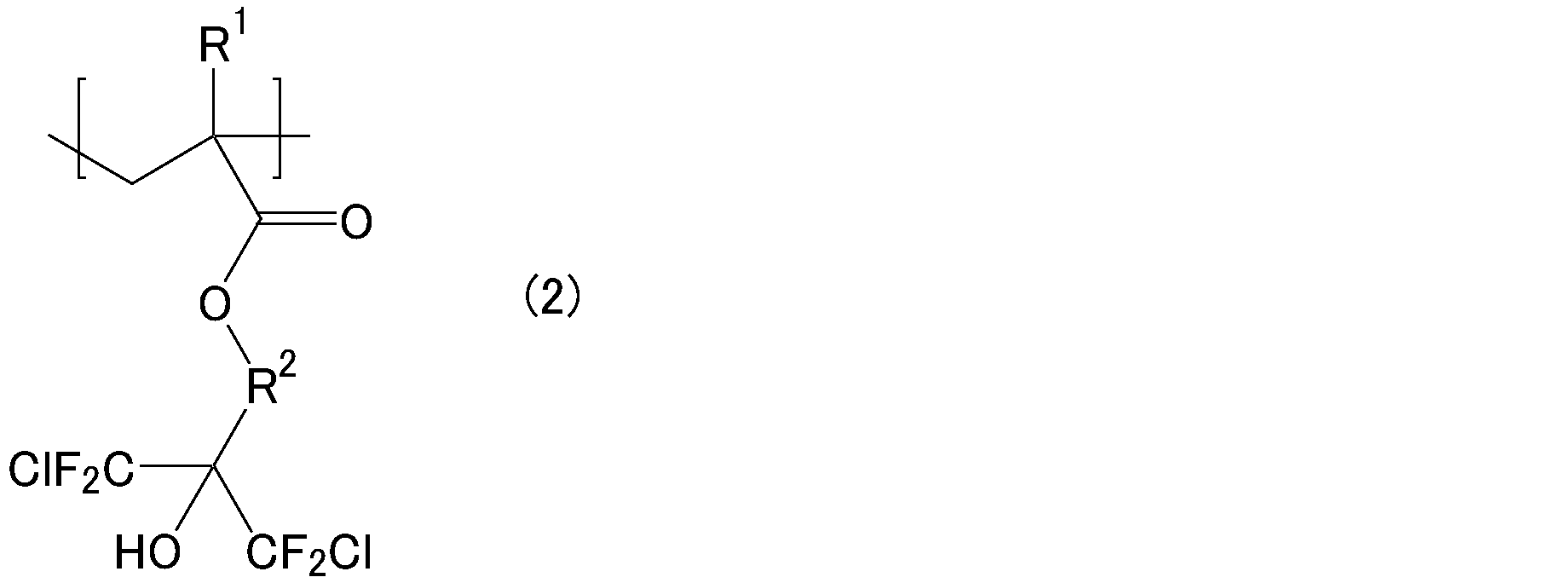
- 前記一般式(2)で示される繰り返し単位は、下記一般式(2-1)で示される繰り返し単位を含む請求項10に記載の撥水剤用重合体。
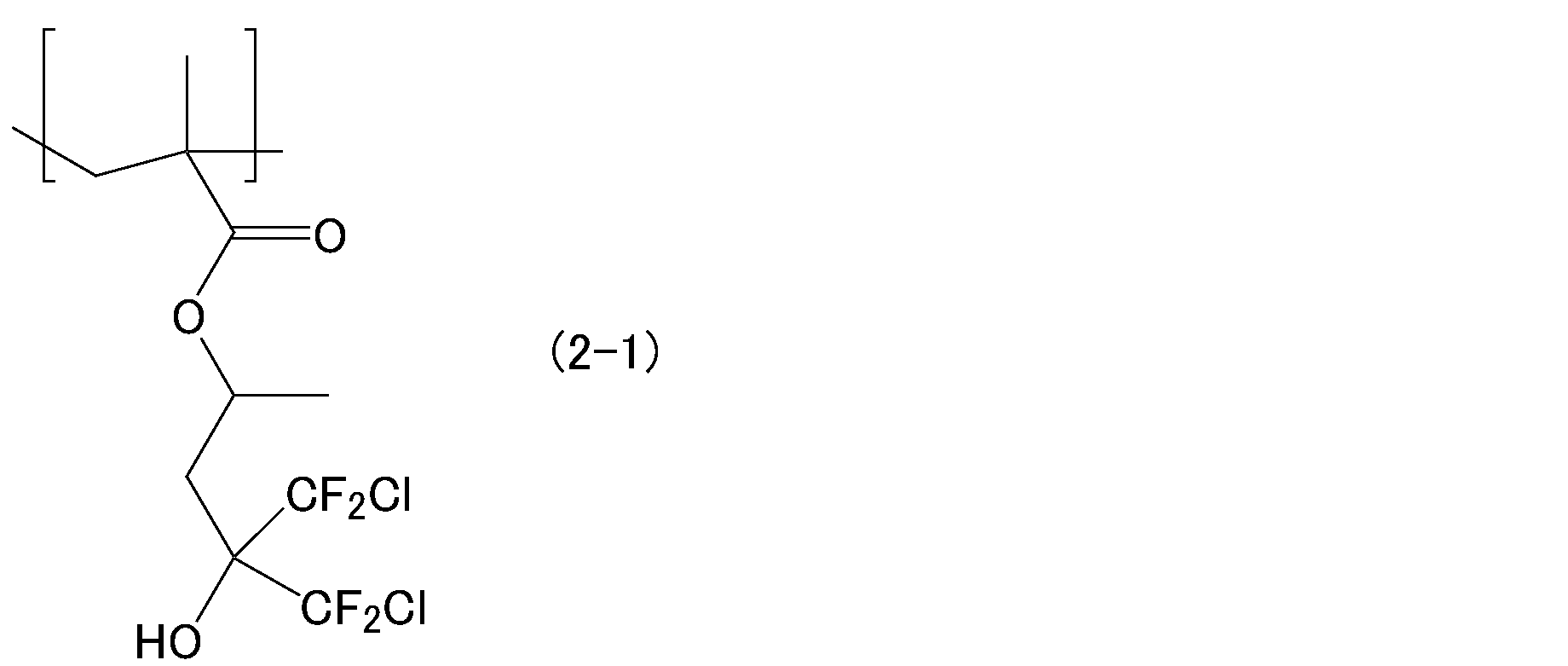
- 前記一般式(1)で示される繰り返し単位は、下記一般式(3)で示される繰り返し単位を含む請求項9に記載の撥水剤用重合体。
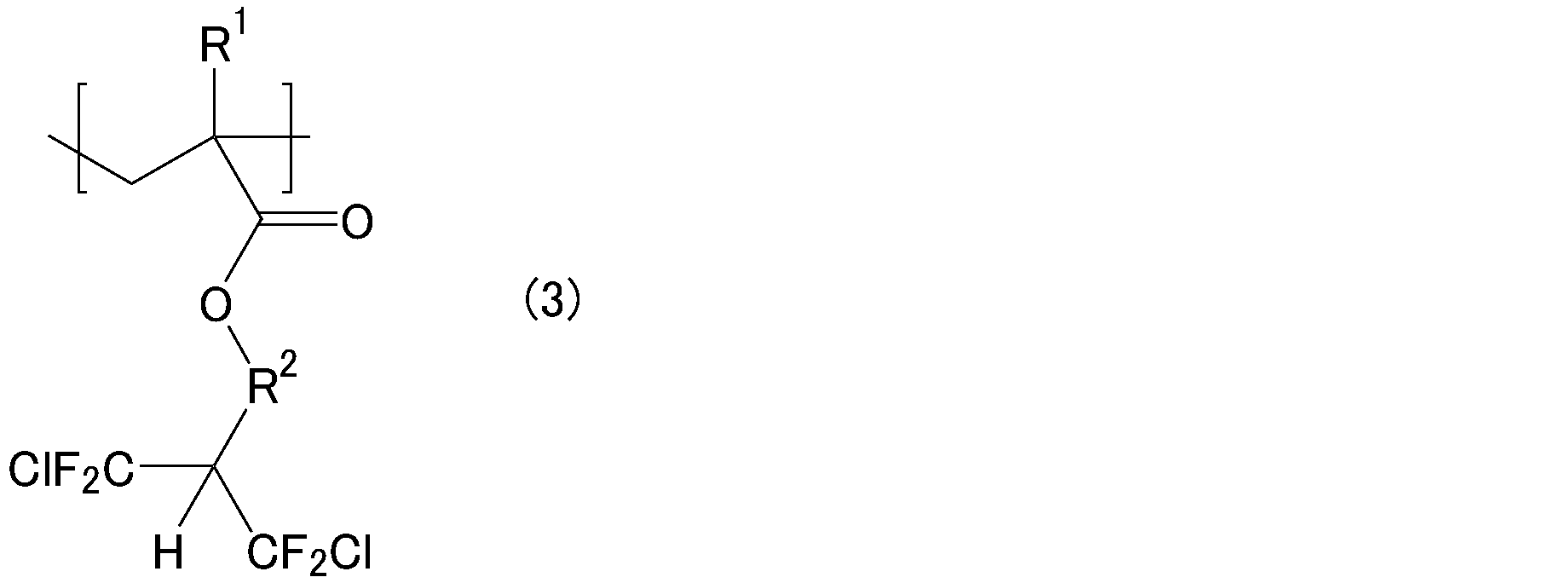
- 前記一般式(3)で示される繰り返し単位は、下記一般式(3-1)で示される繰り返し単位を含む請求項12に記載の撥水剤用重合体。
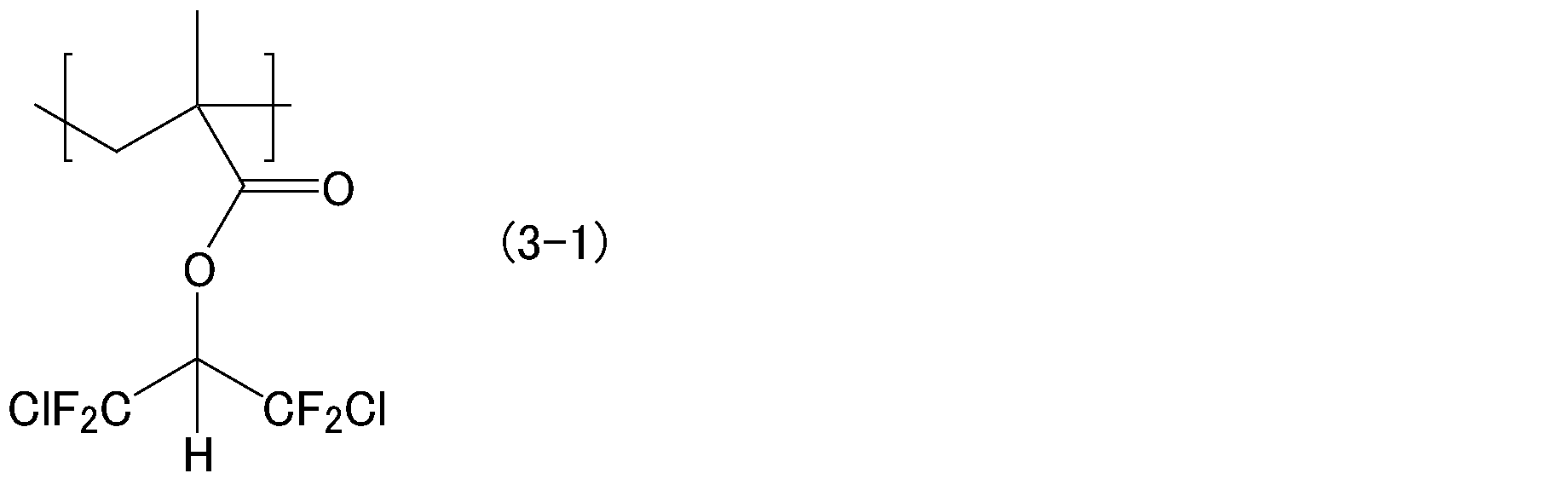
- 請求項1~8のいずれかに記載の共重合体又は請求項9~13のいずれかに記載の撥水剤用重合体を含む、撥水膜形成用組成物。
- 請求項1~8のいずれかに記載の共重合体又は請求項9~13のいずれかに記載の撥水剤用重合体を2種類以上含む、請求項14に記載の撥水膜形成用組成物。
- さらに酸発生剤を含む、請求項14に記載の撥水膜形成用組成物。
- 請求項14に記載の撥水膜形成用組成物の塗膜を含む樹脂膜。
- 液浸露光に用いられる、請求項17に記載の樹脂膜。
- 請求項14に記載の撥水膜形成用組成物を基板または下層膜の表面に塗布し、樹脂膜を形成する製膜工程と、
前記樹脂膜の表面に水を直接的に接触介在させた状態で、前記樹脂膜に波長300nm以下の電磁波または高エネルギー線を照射して露光させる液浸露光工程を含む、
レジストパターンの形成方法。
Priority Applications (4)
| Application Number | Priority Date | Filing Date | Title |
|---|---|---|---|
| EP24815616.8A EP4714990A1 (en) | 2023-05-31 | 2024-05-31 | Copolymer, polymer for water-repellent agent, composition for forming water-repellent film, resin film, and method for forming resist pattern |
| KR1020257043737A KR20260017439A (ko) | 2023-05-31 | 2024-05-31 | 공중합체, 발수제용 중합체, 발수막 형성용 조성물, 수지막 및 레지스트 패턴의 형성 방법 |
| JP2025524910A JPWO2024248136A1 (ja) | 2023-05-31 | 2024-05-31 | |
| CN202480035241.1A CN121532439A (zh) | 2023-05-31 | 2024-05-31 | 共聚物、拒水剂用聚合物、拒水膜形成用组合物、树脂膜及抗蚀图案的形成方法 |
Applications Claiming Priority (4)
| Application Number | Priority Date | Filing Date | Title |
|---|---|---|---|
| JP2023090233 | 2023-05-31 | ||
| JP2023-090233 | 2023-05-31 | ||
| JP2024006975 | 2024-01-19 | ||
| JP2024-006975 | 2024-01-19 |
Publications (1)
| Publication Number | Publication Date |
|---|---|
| WO2024248136A1 true WO2024248136A1 (ja) | 2024-12-05 |
Family
ID=93657651
Family Applications (1)
| Application Number | Title | Priority Date | Filing Date |
|---|---|---|---|
| PCT/JP2024/020046 Ceased WO2024248136A1 (ja) | 2023-05-31 | 2024-05-31 | 共重合体、撥水剤用重合体、撥水膜形成用組成物、樹脂膜及びレジストパターンの形成方法 |
Country Status (6)
| Country | Link |
|---|---|
| EP (1) | EP4714990A1 (ja) |
| JP (1) | JPWO2024248136A1 (ja) |
| KR (1) | KR20260017439A (ja) |
| CN (1) | CN121532439A (ja) |
| TW (1) | TW202506768A (ja) |
| WO (1) | WO2024248136A1 (ja) |
Cited By (1)
| Publication number | Priority date | Publication date | Assignee | Title |
|---|---|---|---|---|
| WO2025225697A1 (ja) * | 2024-04-25 | 2025-10-30 | セントラル硝子株式会社 | 化合物、該化合物に由来する単位を有する重合体、該重合体を含む感光性樹脂組成物、該感光性樹脂組成物からなる接着剤、該感光性樹脂組成物を硬化させて得られる硬化物、該硬化物を備える電子装置 |
Citations (5)
| Publication number | Priority date | Publication date | Assignee | Title |
|---|---|---|---|---|
| JPS50143888A (ja) * | 1974-05-10 | 1975-11-19 | ||
| JPH0412333A (ja) * | 1990-05-02 | 1992-01-16 | Nippon Telegr & Teleph Corp <Ntt> | 機能性プラスチック光導波路 |
| JPH09235322A (ja) * | 1996-02-27 | 1997-09-09 | Nippon Telegr & Teleph Corp <Ntt> | 光学材料及びそれを用いた光導波路 |
| JP2008065098A (ja) | 2006-09-08 | 2008-03-21 | Jsr Corp | 感放射線性樹脂組成物及びそれを用いたレジストパターン形成方法 |
| JP2022092439A (ja) | 2020-12-10 | 2022-06-22 | セントラル硝子株式会社 | 含フッ素重合体 |
-
2024
- 2024-05-31 TW TW113120357A patent/TW202506768A/zh unknown
- 2024-05-31 WO PCT/JP2024/020046 patent/WO2024248136A1/ja not_active Ceased
- 2024-05-31 CN CN202480035241.1A patent/CN121532439A/zh active Pending
- 2024-05-31 KR KR1020257043737A patent/KR20260017439A/ko active Pending
- 2024-05-31 EP EP24815616.8A patent/EP4714990A1/en active Pending
- 2024-05-31 JP JP2025524910A patent/JPWO2024248136A1/ja active Pending
Patent Citations (5)
| Publication number | Priority date | Publication date | Assignee | Title |
|---|---|---|---|---|
| JPS50143888A (ja) * | 1974-05-10 | 1975-11-19 | ||
| JPH0412333A (ja) * | 1990-05-02 | 1992-01-16 | Nippon Telegr & Teleph Corp <Ntt> | 機能性プラスチック光導波路 |
| JPH09235322A (ja) * | 1996-02-27 | 1997-09-09 | Nippon Telegr & Teleph Corp <Ntt> | 光学材料及びそれを用いた光導波路 |
| JP2008065098A (ja) | 2006-09-08 | 2008-03-21 | Jsr Corp | 感放射線性樹脂組成物及びそれを用いたレジストパターン形成方法 |
| JP2022092439A (ja) | 2020-12-10 | 2022-06-22 | セントラル硝子株式会社 | 含フッ素重合体 |
Non-Patent Citations (3)
| Title |
|---|
| "Advances in Patterning Materials for 193 nm Immersion Lithography", CHEM. REV., vol. 110, 2010, pages 321 - 360 |
| ALLEN G. PITTMAN, DENNIS L. SHARP, BARBARA A. LUDWIG: "Polymers Derived from Fluoroketones. 2. Wetting Properties of Fluoroalkyl Acrylates and Methacrylates", JOURNAL OF POLYMER SCIENCE: PART A-1, POLYMER CHEMISTRY, WILEY, US, vol. 6, no. 6, 1 June 1968 (1968-06-01), US , pages 1729 - 1750, XP009173537, ISSN: 0449-296X, DOI: 10.1002/pol.1968.150060630 * |
| MOORE LEONARD ORO: "New synthesis for a highly halogenated styrene", JOURNAL OF CHEMICAL AND ENGINEERING DATA., AMERICAN CHEMICAL SOCIETY., US, vol. 15, no. 4, 1 October 1970 (1970-10-01), US , pages 589 - 590, XP093245264, ISSN: 0021-9568, DOI: 10.1021/je60047a001 * |
Cited By (1)
| Publication number | Priority date | Publication date | Assignee | Title |
|---|---|---|---|---|
| WO2025225697A1 (ja) * | 2024-04-25 | 2025-10-30 | セントラル硝子株式会社 | 化合物、該化合物に由来する単位を有する重合体、該重合体を含む感光性樹脂組成物、該感光性樹脂組成物からなる接着剤、該感光性樹脂組成物を硬化させて得られる硬化物、該硬化物を備える電子装置 |
Also Published As
| Publication number | Publication date |
|---|---|
| CN121532439A (zh) | 2026-02-13 |
| EP4714990A1 (en) | 2026-03-25 |
| TW202506768A (zh) | 2025-02-16 |
| KR20260017439A (ko) | 2026-02-05 |
| JPWO2024248136A1 (ja) | 2024-12-05 |
Similar Documents
| Publication | Publication Date | Title |
|---|---|---|
| KR101947956B1 (ko) | 레지스트 조성물, 레지스트 패턴 형성 방법, 화합물 및 고분자 화합물 | |
| US8367297B2 (en) | Resist composition, method of forming resist pattern, novel compound and acid generator | |
| US8686098B2 (en) | Fluorine-containing compound, fluorine-containing polymer compound, resist composition, top coat composition and pattern formation method | |
| US8541157B2 (en) | Resist composition, method of forming resist pattern, compound and acid generator including the same | |
| US8278022B2 (en) | Positive resist composition and method of forming resist pattern | |
| US8367299B2 (en) | Resist composition, method of forming resist pattern, compound and acid generator | |
| KR101430058B1 (ko) | 함불소 술폰산염 수지, 레지스트 조성물, 패턴 형성 방법, 중합성 함불소 술폰산염, 중합성 함불소 술폰산 및 중합성 함불소 술폰산오늄염의 제조 방법 | |
| KR101334859B1 (ko) | 액침 레지스트용 발수성 첨가제, 발수성 첨가제 함유 레지스트 조성물 및 패턴 형성 방법 | |
| KR101899787B1 (ko) | 염, 포토레지스트 조성물 및 포토레지스트 패턴의 제조방법 | |
| US8088553B2 (en) | Positive resist composition, method of forming resist pattern, and polymeric compound | |
| US20090011199A1 (en) | Fluorine-Containing Compound, Fluorine-Containing Polymer, Negative-Type Resist Composition, and Patterning Process Using Same | |
| US20080227942A1 (en) | Hydroxyphenyl acrylate monomers and polymers | |
| US20090274976A1 (en) | Negative resist composition for immersion exposure and method of forming resist pattern | |
| KR101762442B1 (ko) | 포지티브형 레지스트 조성물 및 레지스트 패턴 형성 방법 | |
| US20060057489A1 (en) | Lactone compounds, lactone-containing monomers, their polymers, resist compositions using same, and processes for forming patterns using same | |
| WO2024248136A1 (ja) | 共重合体、撥水剤用重合体、撥水膜形成用組成物、樹脂膜及びレジストパターンの形成方法 | |
| US8367296B2 (en) | Positive resist composition, method of forming resist pattern, and polymeric compound | |
| WO2024248135A1 (ja) | 含フッ素重合体、含フッ素樹脂膜形成用組成物、含フッ素樹脂膜、レジストパターン形成用組成物、レジストパターンの形成方法、レジスト上層膜形成用組成物、含フッ素重合体の分解方法、含フッ素重合性単量体、化合物及び含フッ素重合性単量体の製造方法 | |
| US8232040B2 (en) | Positive resist composition and method of forming resist pattern | |
| US20080311515A1 (en) | Positive resist composition and method of forming resist pattern |
Legal Events
| Date | Code | Title | Description |
|---|---|---|---|
| 121 | Ep: the epo has been informed by wipo that ep was designated in this application |
Ref document number: 24815616 Country of ref document: EP Kind code of ref document: A1 |
|
| ENP | Entry into the national phase |
Ref document number: 2025524910 Country of ref document: JP Kind code of ref document: A |
|
| WWE | Wipo information: entry into national phase |
Ref document number: 2024815616 Country of ref document: EP |
|
| ENP | Entry into the national phase |
Ref document number: 1020257043737 Country of ref document: KR Free format text: ST27 STATUS EVENT CODE: A-0-1-A10-A15-NAP-PA0105 (AS PROVIDED BY THE NATIONAL OFFICE) |
|
| NENP | Non-entry into the national phase |
Ref country code: DE |
|
| ENP | Entry into the national phase |
Ref document number: 2024815616 Country of ref document: EP Effective date: 20251218 |
|
| ENP | Entry into the national phase |
Ref document number: 2024815616 Country of ref document: EP Effective date: 20251218 |
|
| ENP | Entry into the national phase |
Ref document number: 2024815616 Country of ref document: EP Effective date: 20251218 |
|
| ENP | Entry into the national phase |
Ref document number: 2024815616 Country of ref document: EP Effective date: 20251218 |
|
| ENP | Entry into the national phase |
Ref document number: 2024815616 Country of ref document: EP Effective date: 20251218 |
|
| WWP | Wipo information: published in national office |
Ref document number: 2024815616 Country of ref document: EP |