WO2024247983A1 - 組成物 - Google Patents
組成物 Download PDFInfo
- Publication number
- WO2024247983A1 WO2024247983A1 PCT/JP2024/019485 JP2024019485W WO2024247983A1 WO 2024247983 A1 WO2024247983 A1 WO 2024247983A1 JP 2024019485 W JP2024019485 W JP 2024019485W WO 2024247983 A1 WO2024247983 A1 WO 2024247983A1
- Authority
- WO
- WIPO (PCT)
- Prior art keywords
- group
- formula
- compound
- carbon atoms
- composition
- Prior art date
- Legal status (The legal status is an assumption and is not a legal conclusion. Google has not performed a legal analysis and makes no representation as to the accuracy of the status listed.)
- Ceased
Links
Classifications
-
- C—CHEMISTRY; METALLURGY
- C07—ORGANIC CHEMISTRY
- C07B—GENERAL METHODS OF ORGANIC CHEMISTRY; APPARATUS THEREFOR
- C07B61/00—Other general methods
-
- C—CHEMISTRY; METALLURGY
- C07—ORGANIC CHEMISTRY
- C07C—ACYCLIC OR CARBOCYCLIC COMPOUNDS
- C07C231/00—Preparation of carboxylic acid amides
- C07C231/22—Separation; Purification; Stabilisation; Use of additives
-
- C—CHEMISTRY; METALLURGY
- C07—ORGANIC CHEMISTRY
- C07C—ACYCLIC OR CARBOCYCLIC COMPOUNDS
- C07C237/00—Carboxylic acid amides, the carbon skeleton of the acid part being further substituted by amino groups
- C07C237/28—Carboxylic acid amides, the carbon skeleton of the acid part being further substituted by amino groups having the carbon atom of at least one of the carboxamide groups bound to a carbon atom of a non-condensed six-membered aromatic ring of the carbon skeleton
- C07C237/40—Carboxylic acid amides, the carbon skeleton of the acid part being further substituted by amino groups having the carbon atom of at least one of the carboxamide groups bound to a carbon atom of a non-condensed six-membered aromatic ring of the carbon skeleton having the nitrogen atom of the carboxamide group bound to a carbon atom of a six-membered aromatic ring
-
- C—CHEMISTRY; METALLURGY
- C07—ORGANIC CHEMISTRY
- C07C—ACYCLIC OR CARBOCYCLIC COMPOUNDS
- C07C53/00—Saturated compounds having only one carboxyl group bound to an acyclic carbon atom or hydrogen
- C07C53/02—Formic acid
-
- C—CHEMISTRY; METALLURGY
- C07—ORGANIC CHEMISTRY
- C07C—ACYCLIC OR CARBOCYCLIC COMPOUNDS
- C07C53/00—Saturated compounds having only one carboxyl group bound to an acyclic carbon atom or hydrogen
- C07C53/08—Acetic acid
-
- C—CHEMISTRY; METALLURGY
- C07—ORGANIC CHEMISTRY
- C07C—ACYCLIC OR CARBOCYCLIC COMPOUNDS
- C07C53/00—Saturated compounds having only one carboxyl group bound to an acyclic carbon atom or hydrogen
- C07C53/122—Propionic acid
-
- C—CHEMISTRY; METALLURGY
- C07—ORGANIC CHEMISTRY
- C07C—ACYCLIC OR CARBOCYCLIC COMPOUNDS
- C07C55/00—Saturated compounds having more than one carboxyl group bound to acyclic carbon atoms
- C07C55/02—Dicarboxylic acids
- C07C55/06—Oxalic acid
-
- C—CHEMISTRY; METALLURGY
- C08—ORGANIC MACROMOLECULAR COMPOUNDS; THEIR PREPARATION OR CHEMICAL WORKING-UP; COMPOSITIONS BASED THEREON
- C08G—MACROMOLECULAR COMPOUNDS OBTAINED OTHERWISE THAN BY REACTIONS ONLY INVOLVING UNSATURATED CARBON-TO-CARBON BONDS
- C08G73/00—Macromolecular compounds obtained by reactions forming a linkage containing nitrogen with or without oxygen or carbon in the main chain of the macromolecule, not provided for in groups C08G12/00 - C08G71/00
- C08G73/06—Polycondensates having nitrogen-containing heterocyclic rings in the main chain of the macromolecule
- C08G73/10—Polyimides; Polyester-imides; Polyamide-imides; Polyamide acids or similar polyimide precursors
Definitions
- the present invention relates to a composition.
- Diamine compounds are important as raw materials for heat-resistant polymers such as polyimides and polyamides.
- diamine compounds having a residue derived from bis(amino-hydroxyphenyl)hexafluoropropane and a phenolic hydroxyl group have been used (Patent Document 1).
- Patent Documents 2 and 3 In order to easily produce this diamine compound, a method of reacting nitrobenzoyl chloride with diaminophenol and reducing it has been investigated.
- the diamine compounds described in Patent Documents 1 to 3 have the problem that it is difficult to control the particle shape. It has been found that controlling the particle shape of diamine compounds is important for ensuring uniform reaction during polymer production.
- the present invention therefore aims to provide a composition with controlled particle shape.
- the particle shape of the composition can be controlled by using a diamine compound and a compound having a specific chemical structure, and thus completed the present invention.
- R1 and R3 each independently represent a divalent organic group having 2 to 12 carbon atoms
- R2 represents a trivalent to hexavalent organic group having 2 to 25 carbon atoms
- m represents an integer from 1 to 4.
- R4 represents a divalent to tetravalent organic group having 1 to 6 carbon atoms
- a represents an integer from 1 to 3
- R5 and R7 each independently represent a divalent organic group having 2 to 12 carbon atoms
- R6 represents a trivalent to hexavalent organic group having 2 to 25 carbon atoms
- n represents an integer from 1 to 4.
- R 8 and R 12 each independently represent a divalent to tetravalent organic group having 1 to 6 carbon atoms
- b and c each independently represent an integer from 1 to 3
- R 9 and R 11 each independently represent a divalent organic group having 2 to 12 carbon atoms
- R 10 represents a trivalent to hexavalent organic group having 2 to 25 carbon atoms
- o represents an integer from 1 to 4.
- R 13 and R 14 each independently represent a monovalent organic group having 0 to 6 carbon atoms and having any one of a halogen atom, a hydroxyl group, a nitro group, a cyano group, an acetyl group, a carboxyl group, an ester group, an amide group, an imide group, and a urea group; and d and e each independently represent an integer in the range of 0 to 3.
- R 16 represents a divalent to tetravalent organic group having 1 to 6 carbon atoms, and g represents an integer of 1 to 3.
- [5] The composition according to any one of [1] to [4], wherein the compound represented by formula (3) is a compound represented by formula (11).
- R 17 and R 18 each independently represent a divalent to tetravalent organic group having 1 to 6 carbon atoms, and h and i each independently represent an integer from 1 to 3.
- [6] The composition according to any one of [1] to [5], wherein the content of the compound (B) is 0.001 parts by weight or more and 1.000 parts by weight or less relative to 100 parts by weight of the composition.
- the organic acid includes at least one selected from the group consisting of formic acid, acetic acid, propionic acid, malic acid, oxalic acid and citric acid.
- the present invention makes it possible to provide a composition with controlled particle shape.
- composition of the present invention contains a diamine compound (A) represented by formula (1).
- R1 and R3 each independently represent a divalent organic group having 2 to 12 carbon atoms, R2 represents a trivalent to hexavalent organic group having 2 to 25 carbon atoms, and m represents an integer from 1 to 4.
- R 1 and R 3 are preferably a structure represented by formula (9).
- R 15 represents a monovalent organic group having 0 to 6 carbon atoms and having any one of a halogen atom, a hydroxyl group, a nitro group, a cyano group, an acetyl group, a carboxyl group, an ester group, an amide group, an imide group, and a urea group, and f represents an integer in the range of 0 to 3.
- f is preferably 0.
- R 2 —(OH) m in the formula (1) is preferably a structure represented by the formula (4).
- R 13 and R 14 each independently represent a monovalent organic group having 0 to 6 carbon atoms and having any one of a halogen atom, a hydroxyl group, a nitro group, a cyano group, an acetyl group, a carboxyl group, an ester group, an amide group, an imide group, and a urea group; and d and e each independently represent an integer in the range of 0 to 3.
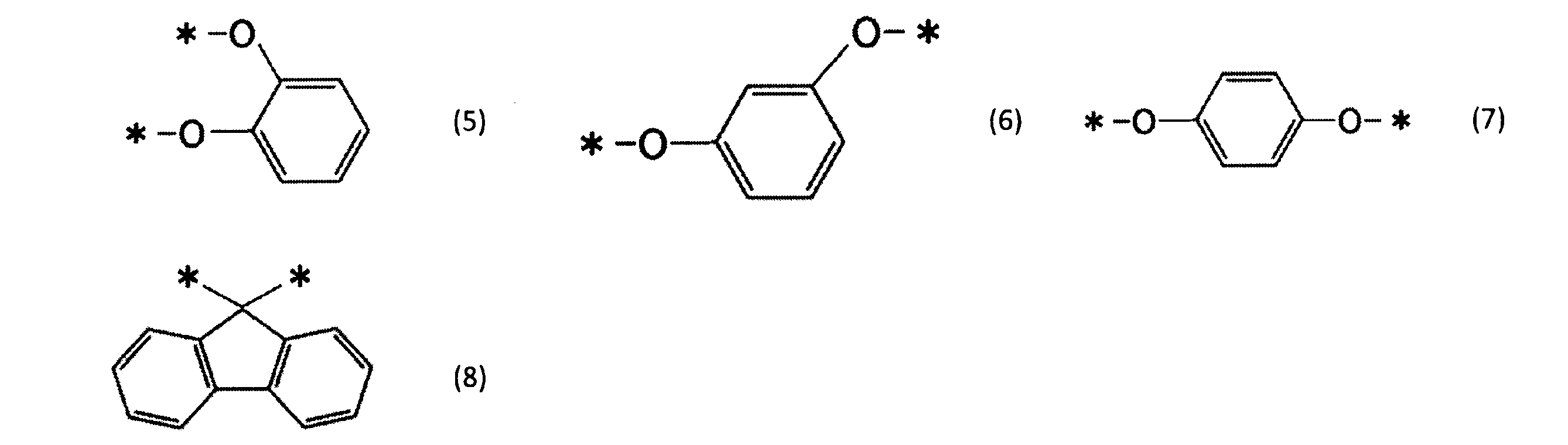
- A is preferably —CH 2 -, -C(CH 3 ) 2 -, -C(CH 3 )(CF 3 )-, -C(CF 3 ) 2 -, -C(CH 3 )[CH 2 CH(CH 3 ) 2 ]- or a divalent group represented by any one of formulas (5) to (8);
- R 13 and R 14 each independently represent a monovalent organic group having 0 to 6 carbon atoms and having any one of a halogen atom, a hydroxyl group, a nitro
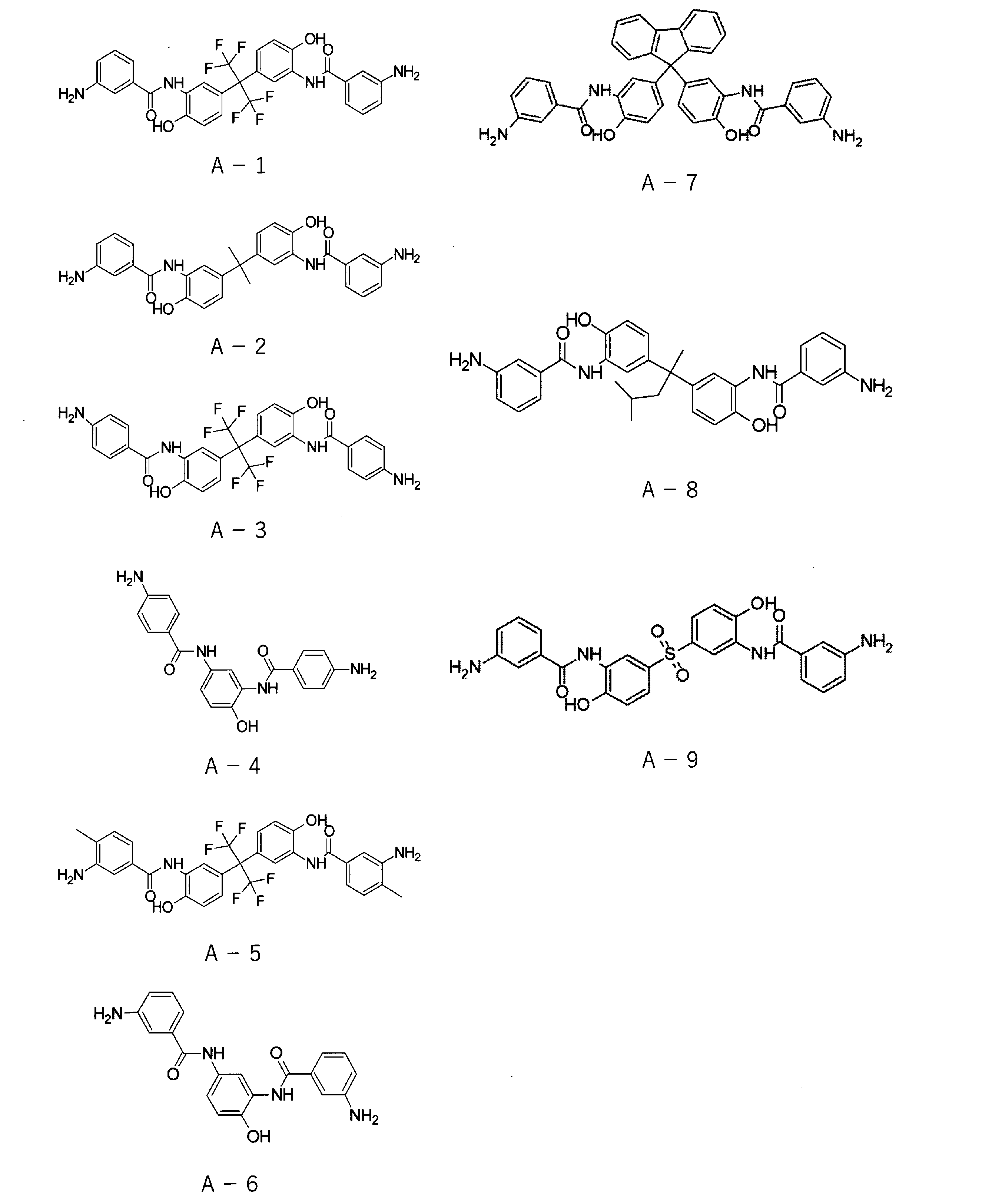
- diamine compound (A) represented by formula (1) examples include the compounds shown below.
- the diamine compound (A) represented by formula (1) in the present invention is synthesized by a known method. For example, a method in which a hydroxydiamino compound is reacted with a nitrocarboxylic acid or a nitrocarboxylic acid chloride, and then the resulting dinitro compound is reduced can be mentioned.
- composition of the present invention contains the compound (B).
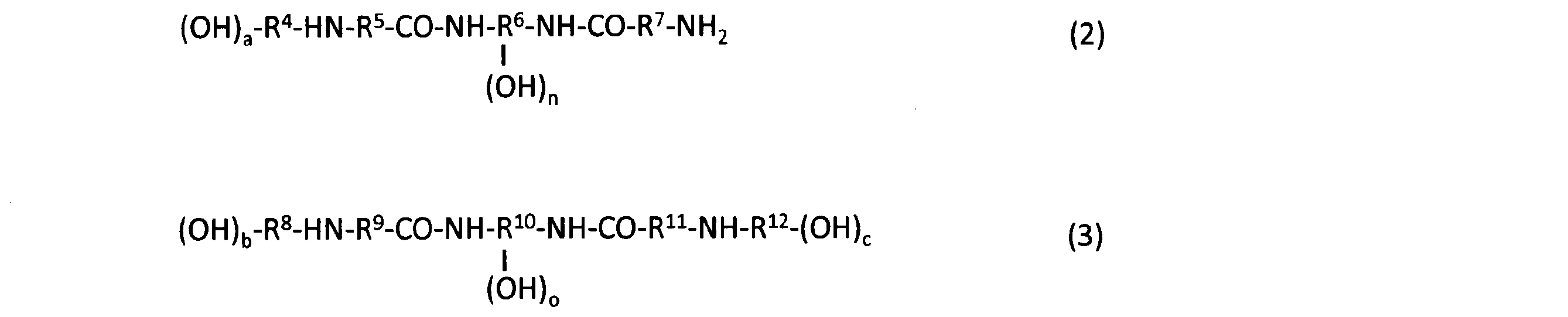
- the compound (B) contains a compound represented by formula (2) and/or a compound (B) represented by the following formula (3):
- the particle shape of the composition of the present invention can be controlled.
- R4 represents a divalent to tetravalent organic group having 1 to 6 carbon atoms
- a represents an integer from 1 to 3
- R5 and R7 each independently represent a divalent organic group having 2 to 12 carbon atoms
- R6 represents a trivalent to hexavalent organic group having 2 to 25 carbon atoms
- n represents an integer from 1 to 4.
- R 8 and R 12 each independently represent a divalent to tetravalent organic group having 1 to 6 carbon atoms
- b and c each independently represent an integer from 1 to 3
- R 9 and R 11 each independently represent a divalent organic group having 2 to 12 carbon atoms
- R 10 represents a trivalent to hexavalent organic group having 2 to 25 carbon atoms
- o represents an integer from 1 to 4.
- R 6 —(OH) n in the formula (2) and R 10 —(OH) o in the formula (3) are preferably a structure represented by formula (4).
- a in the formula (4) is preferably -CH2- ,
- R 5 and R 7 in the formula (2), and R 9 and R 11 in the formula (3) are preferably structures represented by formula (9).
- R 15 represents a monovalent organic group having 0 to 6 carbon atoms and having any one of a halogen atom, a hydroxyl group, a nitro group, a cyano group, an acetyl group, a carboxyl group, an ester group, an amide group, an imide group, and a urea group, and f represents an integer in the range of 0 to 3.
- f is preferably 0.
- the compound represented by formula (2) is preferably a compound represented by formula (10).
- the composition may contain two or more compounds represented by formula (10) that have different structures.
- R 16 represents a divalent to tetravalent organic group having 1 to 6 carbon atoms, and g represents an integer of 1 to 3.
- R 16 is preferably a methylene group, an ethylene group, a propylene group, a butylene group, or a butenylene group, and more preferably a butylene group or a butenylene group.
- g is preferably 1.
- the compound represented by formula (3) is preferably a compound represented by formula (11).
- the composition may contain two or more compounds represented by formula (11) that have different structures.
- R 17 and R 18 each independently represent a divalent to tetravalent organic group having 1 to 6 carbon atoms, and h and i each independently represent an integer from 1 to 3.
- R 17 and R 18 are preferably a methylene group, an ethylene group, a propylene group, a butylene group, or a butenylene group, and more preferably a butylene group or a butenylene group.
- the content of compound (B) is preferably 0.001 parts by weight or more, and more preferably 0.010 parts by weight or more, per 100 parts by weight of the composition, from the viewpoint of controlling the particle shape. From the same viewpoint, the content is preferably 1.000 parts by weight or less, and more preferably 0.500 parts by weight or less, per 100 parts by weight of the composition.
- the diamine compound represented by the formula (1) is dissolved in a solvent, and an epoxy compound or an ether compound corresponding to R4 is added dropwise. Then, the mixture is heated and stirred at 20°C to 80°C, reacted for 4 hours to 12 hours, and then concentrated and purified to obtain the compound.
- the compound represented by the above formula (3) can be synthesized in the same manner as the compound represented by the formula (2). That is, the diamine compound represented by the formula (1) is dissolved in a solvent, and an epoxy compound or an ether compound corresponding to R8 and R12 is dropped into the solvent. The resulting mixture is then heated and stirred to react, and concentrated and purified to obtain the compound.
- the composition of the present invention preferably contains an organic acid from the viewpoint of controlling the particle shape.
- the organic acid refers to a compound containing a carboxyl group and having a molecular weight of 300 or less, such as formic acid, acetic acid, propionic acid, malic acid, oxalic acid, and citric acid.
- the organic acid preferably contains at least one selected from the group consisting of formic acid, acetic acid, propionic acid, malic acid, oxalic acid, and citric acid, and more preferably contains at least one selected from the group consisting of acetic acid, formic acid, and oxalic acid.
- the content of the organic acid is preferably 0.2 ⁇ 10 ⁇ 4 parts by weight or more, and more preferably 1.0 ⁇ 10 ⁇ 4 parts by weight or more, relative to 100 parts by weight of the composition from the viewpoint of controlling the particle shape, and from the same viewpoint, is preferably 100.0 ⁇ 10 ⁇ 4 parts by weight or less, and more preferably 10.0 ⁇ 10 ⁇ 4 parts by weight or less, relative to 100 parts by weight of the composition.
- compositions of the present invention can be used as monomers in the polymerization of polymers.
- the polymer is not particularly limited as long as it uses a diamine compound as a monomer, and can be used as a monomer for polyimide, polybenzoxazole, precursors thereof, or copolymers thereof.
- the composition in the case of producing a polyimide, can be reacted with a predetermined acid anhydride.
- the reaction conditions can be any known method, for example, heat treatment at an appropriate temperature and time to allow the addition reaction to proceed.
- the heat treatment time is preferably 1 hour to 12 hours.
- One example is heat treatment at 60°C for 4 hours.
- the heat treatment temperature is preferably 40°C or higher and 100°C or lower.
- LC/UV-MS analysis was performed using an HPLC device LC-30A (Shimadzu Corporation), a mass spectrometer Q Exactive (Thermo Fisher Scientific), an ODS (octadecylsilyl) column, a column temperature of 45°C, a mobile phase of 10 mM ammonium acetate aqueous solution and acetonitrile gradient conditions, a flow rate of 0.3 mL/min, an injection volume of 3 ⁇ L, ionization by ESI (electrospray ionization), MS detection by negative ion detection, measurement mode m/z 100-1200, and a detection wavelength of 254 nm.
- the content was calculated from the area percentage of each separated peak.
- the peak area percentage indicates the ratio when the total area value of each separated peak is set to 100.
- D0 the maximum particle size at which the cumulative particle size is 0%
- D10 the particle size at which the cumulative particle size is 10%
- D90 the particle size at which the cumulative particle size is 90%
- D100 the particle size at which the cumulative particle size is 100%
- the criteria for particle size measurement are A, B, C, D, and E in order of best results.
- Synthesis Example 1 Synthesis of diamine compound A-1 18.3 g (0.05 mol) of bis(3-amino-4-hydroxyphenyl)hexafluoropropane was dissolved in 100 ml of acetone and 17.4 g (0.30 mol) of propylene oxide, and cooled to -15°C. A solution of 20.4 g (0.11 mol) of 3-nitrobenzoyl chloride dissolved in 100 ml of acetone was added dropwise to the solution. After the completion of the dropwise addition, the solution was reacted at -15°C for 4 hours, and then the solution was returned to room temperature.
- the solution was concentrated with a rotary evaporator, and the obtained solid was recrystallized with a solution of tetrahydrofuran and ethanol.
- the solid collected by recrystallization was dissolved in 100 ml of ethanol and 300 ml of tetrahydrofuran, and 2 g of 5% palladium-carbon was added and stirred vigorously. Hydrogen was introduced into the solution using a balloon, and the reduction reaction was carried out at room temperature. After about 2 hours, it was confirmed that the balloon was not deflated any more, and the reaction was terminated. After the reaction was completed, the catalyst palladium compound was removed by filtration, and the mixture was concentrated by a rotary evaporator to obtain diamine compound A-1.
- Synthesis Example 2 Synthesis of diamine compound A-2 The same procedure as in Synthesis Example 1 was carried out except that 18.3 g (0.05 mol) of bis(3-amino-4-hydroxyphenyl)hexafluoropropane was replaced with 12.9 g (0.05 mol) of bis(3-amino-4-hydroxyphenyl)propane, to obtain diamine compound A-2.
- Synthesis Example 3 Synthesis of diamine compound A-3 The same procedure as in Synthesis Example 1 was repeated except that 20.4 g (0.11 mol) of 3-nitrobenzoyl chloride was changed to 20.4 g (0.11 mol) of 4-nitrobenzoyl chloride, to obtain diamine compound A-3.
- Synthesis Example 4 Synthesis of diamine compound A-4 Diamine compound A-4 was obtained by carrying out the same procedure as in Synthesis Example 3, except that 18.3 g (0.05 mol) of bis(3-amino-4-hydroxyphenyl)hexafluoropropane was replaced with 6.2 g (0.05 mol) of 2,4-diaminophenol.
- Synthesis Example 5 Synthesis of diamine compound A-5 The same procedure as in Synthesis Example 1 was repeated except that 20.4 g (0.11 mol) of 3-nitrobenzoyl chloride was changed to 22.0 g (0.11 mol) of 3-nitro-4-methylbenzoyl chloride, to obtain diamine compound A-3.
- Synthesis Example 6 Synthesis of diamine compound A-6 The same procedure as in Synthesis Example 1 was repeated except that 18.3 g (0.05 mol) of bis(3-amino-4-hydroxyphenyl)hexafluoropropane was replaced with 6.2 g (0.05 mol) of 2,4-diaminophenol, to obtain diamine compound A-6.
- Synthesis Example 8 Synthesis of diamine compound A-8 The same procedure as in Synthesis Example 1 was carried out except that 18.3 g (0.05 mol) of bis(3-amino-4-hydroxyphenyl)hexafluoropropane in Synthesis Example 1 was changed to 15.0 g (0.05 mol) of 2,2-bis(3-amino-4-hydroxyphenyl)-4-methylpentane, to obtain diamine compound A-8.
- Synthesis Example 9 Synthesis of diamine compound A-9 The same procedure as in Synthesis Example 1 was carried out except that 18.3 g (0.05 mol) of bis(3-amino-4-hydroxyphenyl)hexafluoropropane was replaced with 14.0 g (0.05 mol) of bis(3-amino-4-hydroxyphenyl)sulfone, to obtain diamine compound A-9.
- Synthesis Example 10 Synthesis of Compound B-1 12.1 g (0.02 mol) of the diamine compound A-1 obtained in Synthesis Example 1 was dissolved in 80 mL of toluene and 1.4 g (0.02 mol) of tetrahydrofuran, and 0.1 mg of acetic acid was added, followed by stirring under a nitrogen atmosphere at 60° C. for 8 hours. After that, 100 mL of pure water was added, and the aqueous phase and the oil phase were separated using a separatory funnel. The obtained oil layer was concentrated using a rotary evaporator, and the obtained solid was recrystallized in a methanol solution and filtered to obtain a solid compound B-1.
- Synthesis Example 11 Synthesis of Compound B-2 Compound B-2 was obtained by carrying out the same procedure as in Synthesis Example 10, except that the amount of tetrahydrofuran was changed to 2.8 g (0.04 mol).
- Synthesis Example 12 Synthesis of Compound B-3 Compound B-3 was obtained by the same procedure as in Synthesis Example 10, except that 1.4 g (0.02 mol) of tetrahydrofuran in Synthesis Example 10 was changed to 1.2 g (0.02 mol) of propylene oxide and the stirring temperature was changed to 30° C.
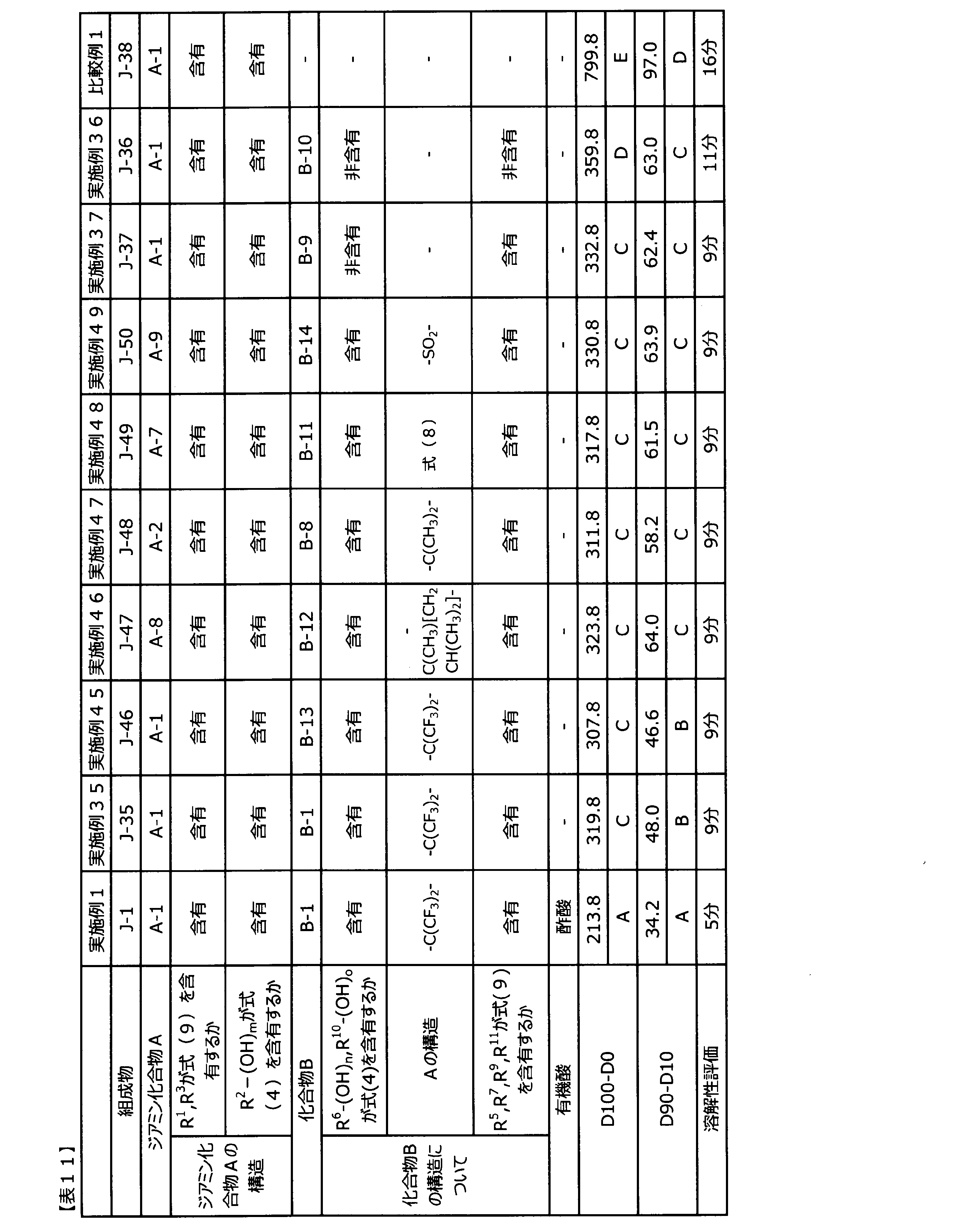
- Example 1 Composition J-1 was subjected to particle size analysis and solubility evaluation. As a result of the particle size analysis, D100-D0 was rated A (213.8 ⁇ m), and D90-D10 was rated A (34.2 ⁇ m). In addition, the solubility evaluation showed that the composition dissolved in 5 minutes.
- Composition (J-38) was subjected to particle size analysis and solubility evaluation in the same manner as J-1.
- D100-D0 was rated E (799.8 ⁇ m) and D90-D10 was rated D (97.0 ⁇ m).
- solubility evaluation showed that the composition dissolved in 16 minutes.
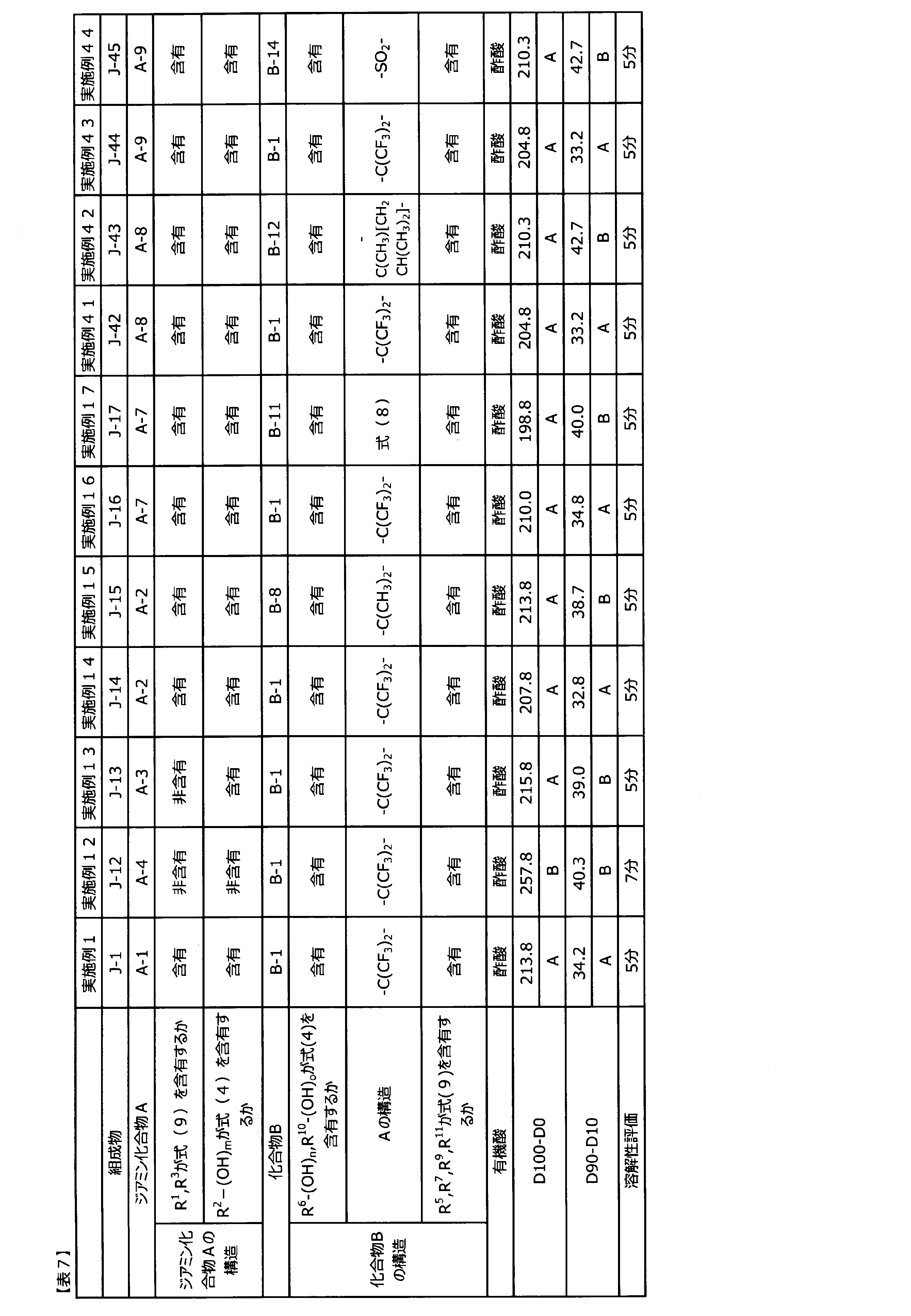
- Example 3 in which the residues of R 16 , R 17 , and R 18 are propylene groups is more effective than Example 4 in which the residues are cyclohexyl groups, and Examples 1 and 39 in which the residues are butylene and butenylene groups are more effective.
- Example 1 in which the numbers g, h, and i are 1 is more effective than Example 5 in which the numbers g, h, and i are 2.
- Examples 1 and 2 containing the structures of formula (10) and formula (11) are more effective than Examples 8 and 9 which do not contain the structures of formula (10) and formula (11).
- Example 8 containing formula (4) is more effective than Example 9 in which R 6 -(OH) n and R 10 -(OH) O do not contain the structure of formula (4).
- Example 1 containing formula (9) is more effective than Example 6 in which R 5 , R 7 , R 9 and R 11 do not contain formula (9).
- Example 1 in which A is -C(CF 3 ) 2 - is more effective than Examples 38, 40, 8 and 11 in which A is -C(CH 3 )[CH 2 CH(CH 3 ) 2 ] - , -SO 2 -, -C(CH 3 ) 2 - and formula (8).
- Example 1 in which the number f is 0 is more effective than Example 7 in which the number f is 1.
- Example 13 in which R 2 -(OH) m in diamine compound A contains formula (4), is more effective than Example 12, in which R 2 -(OH) m does not contain formula (4).
- Example 1 Example 14, Example 16, Example 41, and Example 44, in which R 1 and R 3 in diamine compound A contain formula ( 9 ), are more effective than Example 13 , in which R 1 and R 3 in diamine compound A do not contain formula (9).
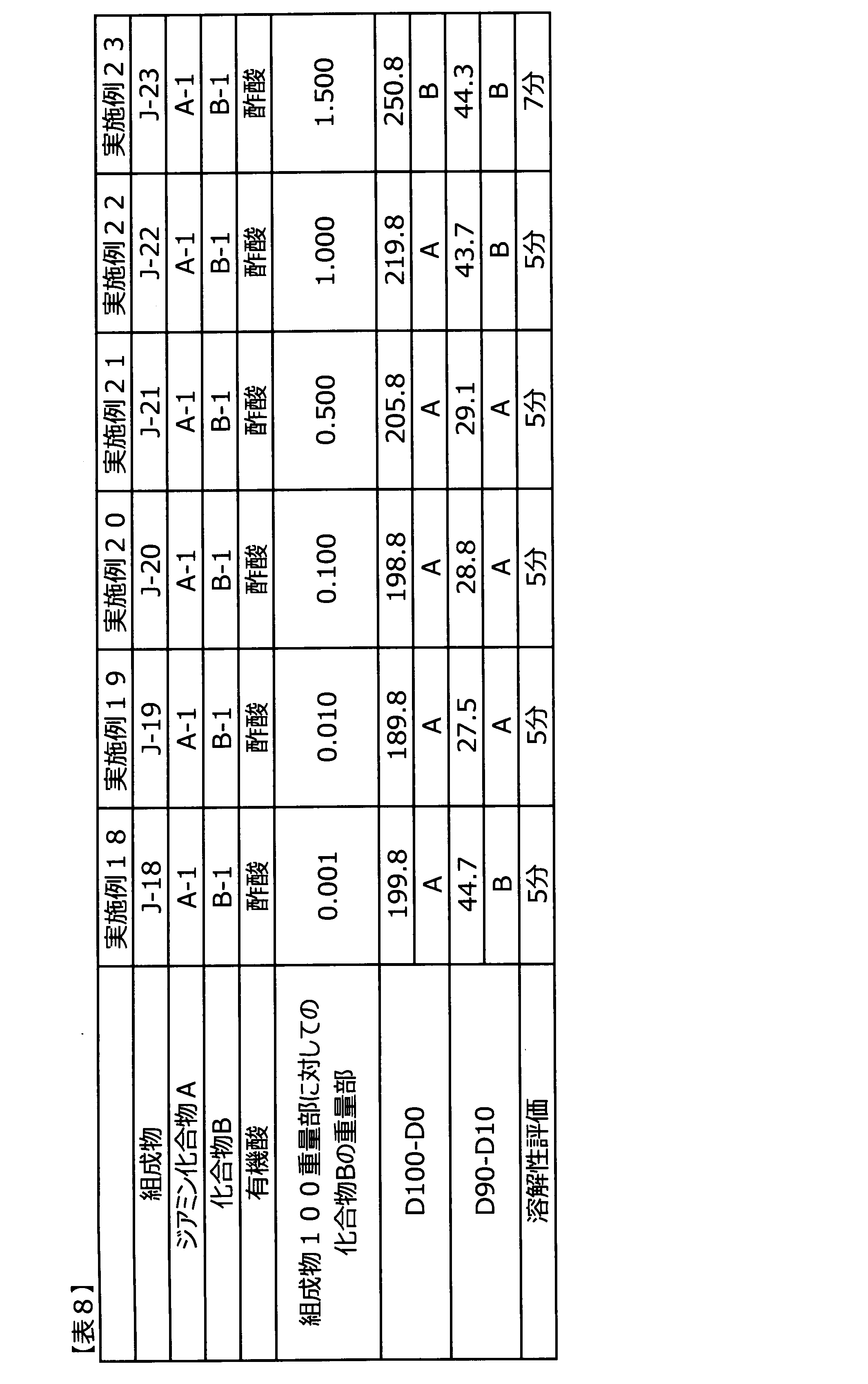
- Table 8 explains the effect of the content of compound B in the composition. Compared to Example 23, which has 1.500 parts by weight of compound B per 100 parts by weight of the composition, Examples 18 and 22, in which the parts by weight of compound B is 0.001 and 1.000, are more effective, and Examples 19 to 21, in which the parts by weight of compound B is 0.010, 0.100, and 0.500, are more effective.
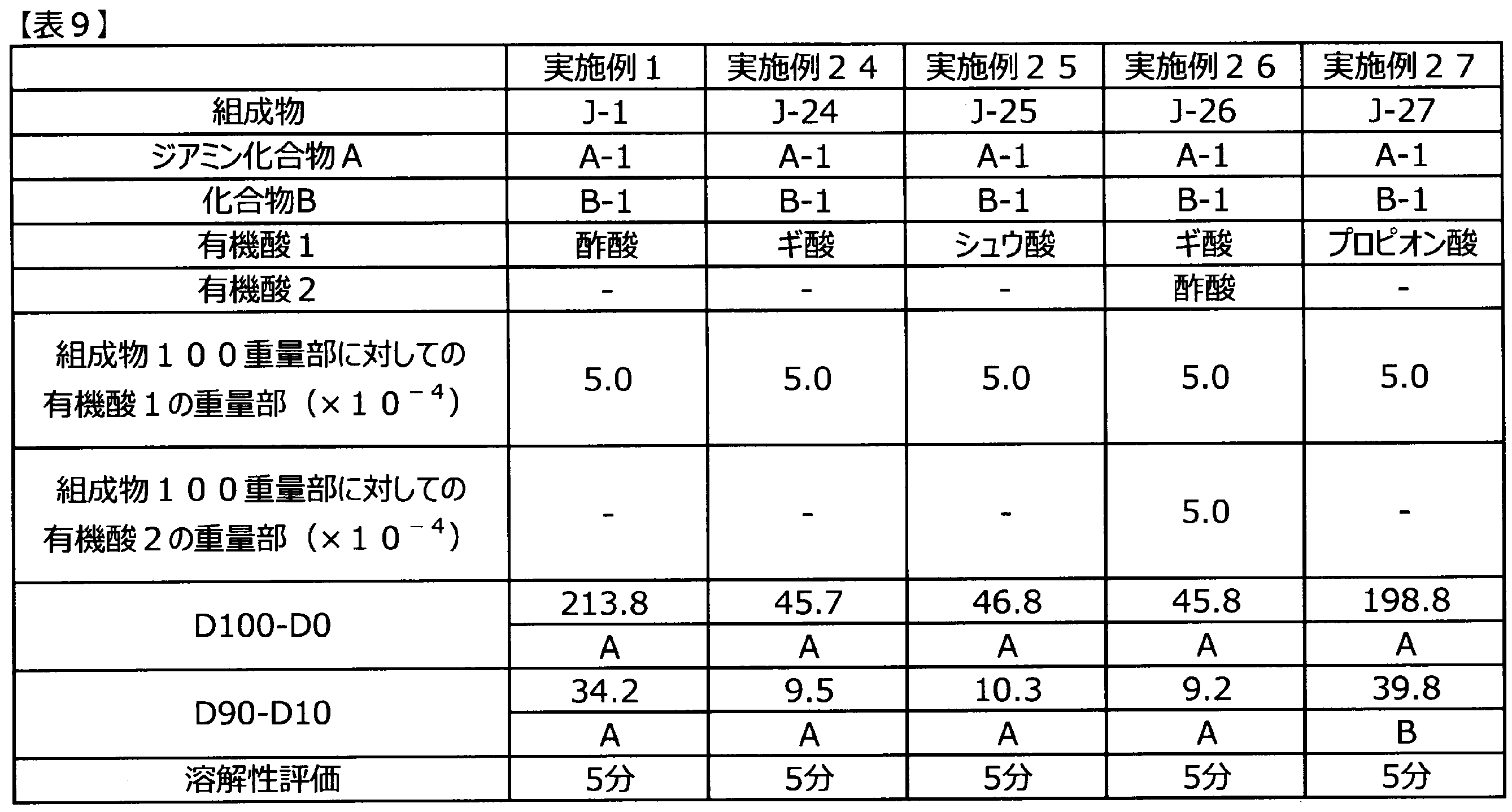
- Table 9 explains the effects of the type of organic acid in the composition. Examples 1, 24, 25, and 26, in which the organic acid is acetic acid, formic acid, or oxalic acid, are more effective than Example 27, in which the organic acid is propionic acid.
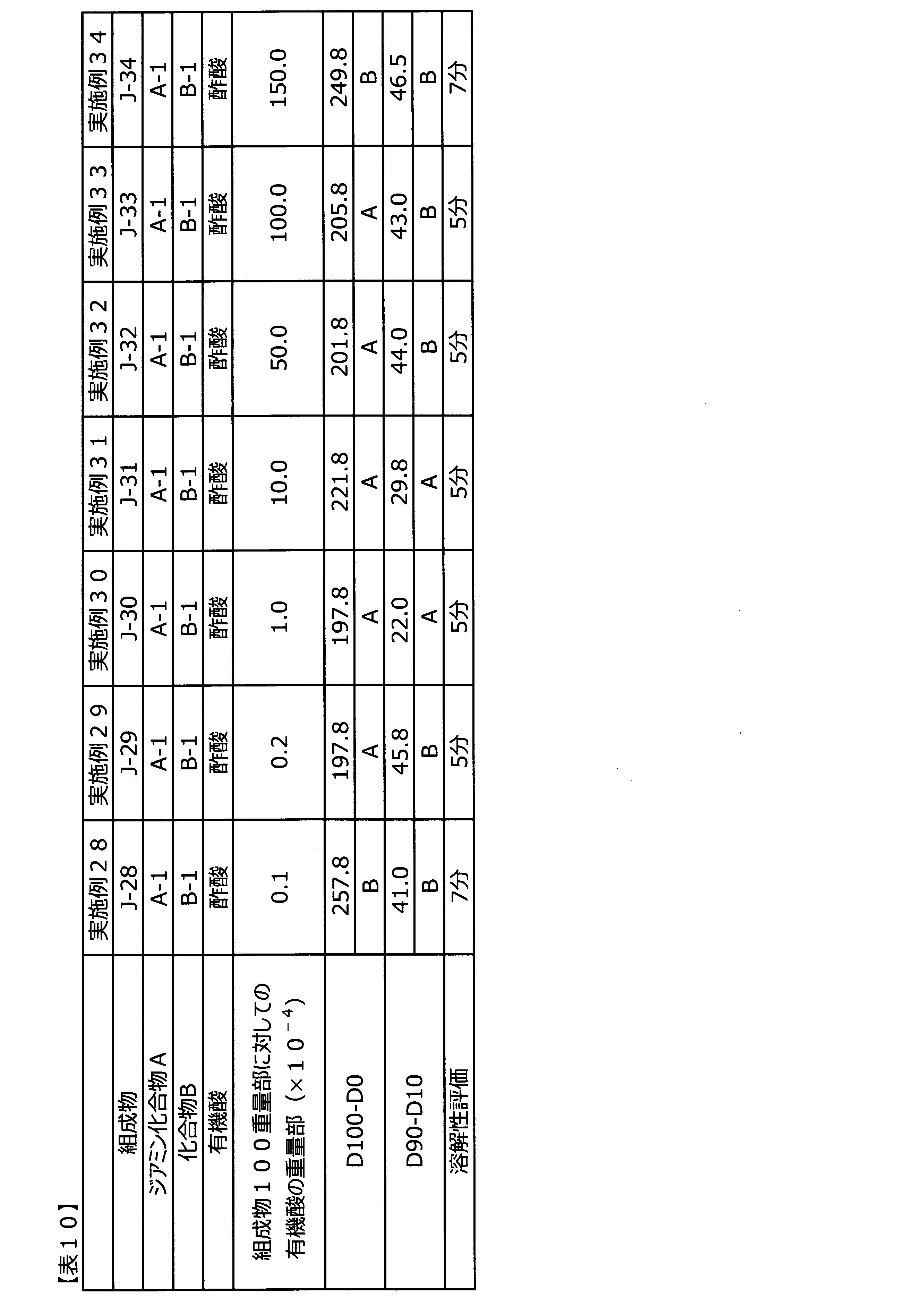
- Table 10 explains the effect of the content of organic acid in the composition.
- Examples 29 and 33 in which the parts by weight of organic acid per 100 parts by weight of the composition is 0.2 ⁇ 10 ⁇ 4 and 100.0 ⁇ 10 ⁇ 4, are more effective than Examples 28 and 34, in which the parts by weight of organic acid per 100 parts by weight of the composition is 0.1 ⁇ 10 ⁇ 4 and 150.0 ⁇ 10 ⁇ 4 , respectively, and Examples 30 and 31, in which the parts by weight of organic acid per 100 parts by weight of the composition is 1.0 ⁇ 10 ⁇ 4 and 10.0 ⁇ 10 ⁇ 4 , are more effective.
- Example 1 containing an organic acid is more effective than Example 35 not containing an organic acid.
- Example 37 containing formula (9) is more effective than Example 36 in which R 5 , R 7 , R 9 , and R 11 in compound B do not contain formula (9).
- Examples 35 and 45 in which A has the structure -C(CF 3 ) 2 - are more effective than Examples 46, 49, 47, and 48 in which A has the structure -C(CH 3 ) [ CH 2 CH(CH 3 ) 2 ]-, -SO 2 -, -C(CH 3 ) 2 -, and formula (8).
- composition of the present invention can be suitably used as a monomer in polymerizing a polymer.
Landscapes
- Chemical & Material Sciences (AREA)
- Organic Chemistry (AREA)
- Health & Medical Sciences (AREA)
- Chemical Kinetics & Catalysis (AREA)
- Medicinal Chemistry (AREA)
- Polymers & Plastics (AREA)
- Organic Low-Molecular-Weight Compounds And Preparation Thereof (AREA)
Abstract
Description
[1]少なくとも式(1)で表されるジアミン化合物(A)、および化合物(B)を含有する組成物であって、前記化合物(B)が、式(2)で表される化合物および/または式(3)で表される化合物を含む組成物。

式(2)中、R4は、炭素数1~6個を有する2~4価の有機基を示し、aは、1から3までの整数を示し、R5およびR7は、それぞれ独立に、炭素数2~12個を有する2価の有機基を示し、R6は、炭素数2~25個を有する3~6価の有機基を示し、nは、1から4までの整数を示す。
式(3)中、R8およびR12は、それぞれ独立に、炭素数1~6個を有する2~4価の有機基を示し、bおよびcは、それぞれ独立に、1から3までの整数を示し、R9およびR11は、それぞれ独立に、炭素数2~12個を有する2価の有機基を示し、R10は、炭素数2~25個を有する3~6価の有機基、oは1から4までの整数を示す。)
[2]前記式(2)中のR6-(OH)nおよび前記式(3)中のR10-(OH)Oが、式(4)に表される構造である[1]に記載の組成物

[3]前記式(2)中のR5およびR7、ならびに前記式(3)中のR9およびR11が、式(9)に表される構造である、[1]または[2]に記載の組成物。

[4]前記式(2)で表される化合物が、式(10)で表される化合物である、[1]~[3]のいずれかに記載の組成物。

[5]前記式(3)で表される化合物が、式(11)で表される化合物である、[1]~[4]のいずれかに記載の組成物。

[6]前記組成物100重量部に対して、前記化合物(B)の含有量が0.001重量部以上、1.000重量部以下である、[1]~[5]のいずれかに記載の組成物。
[7]さらに、有機酸を含む[1]~[6]のいずれかに記載の組成物。
[8]前記有機酸が、ギ酸、酢酸、プロピオン酸、リンゴ酸、シュウ酸およびクエン酸からなる群より選択される少なくとも1種類を含む、[7]に記載の組成物。
[9]前記組成物100重量部に対して、前記有機酸の含有量が0.2×10⁻⁴重量部以上、100.0×10⁻⁴重量部以下である、[7]または[8]のいずれかに記載の組成物。
本発明の組成物は、式(1)で表されるジアミン化合物(A)を含有する。

前記R1およびR3は、より本発明の効果を奏するために、式(9)で表される構造が好ましい。

前記式(9)のfは0が好ましい。

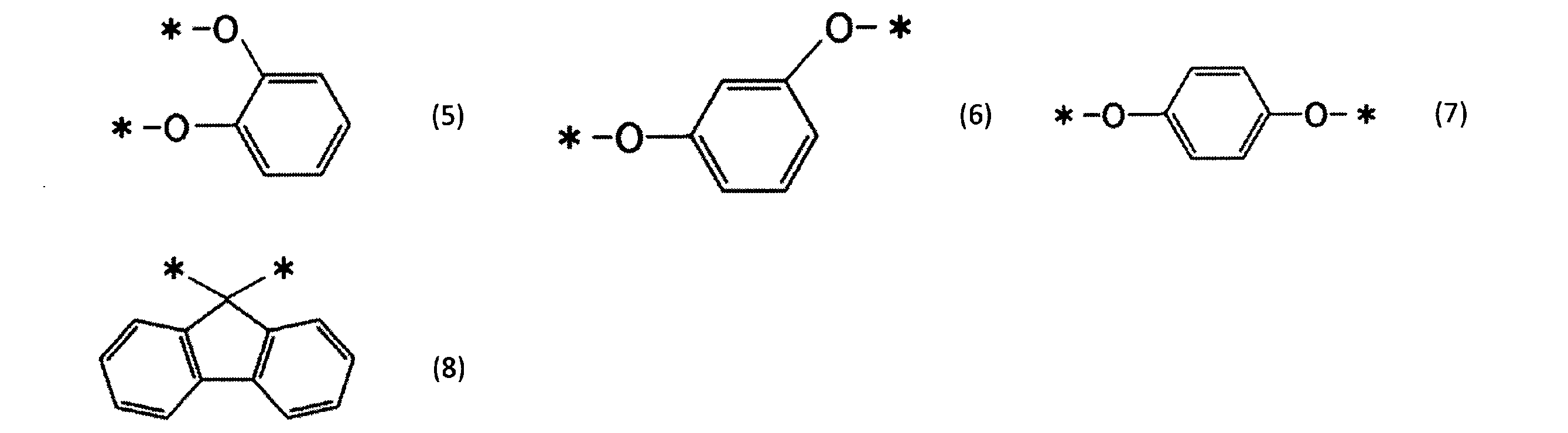
前記式(4)のAは、好ましくは-CH2-、-C(CH3)2-、-C(CH3)(CF3)-、-C(CF3)2-、-C(CH3)[CH2CH(CH3)2]-もしくは、式(8)が好ましい。また、dおよびeは、0が好ましい。

本発明における式(1)で表されるジアミン化合物(A)は、公知の方法により合成される。
例えば、ヒドロキシジアミノ化合物とニトロカルボン酸やニトロカルボン酸クロリドを反応させた後に、得られたジニトロ化合物を還元させる方法が挙げられる。
本発明の組成物は、化合物(B)を含有する。
前記化合物(B)は、式(2)で表される化合物および/または下記式(3)で表される化合物(B)を含有する。組成物が、化合物(B)を含有することにより、本発明の組成物の粒形を制御することができる。
前記式(2)中のR6-(OH)nおよび前記式(3)中のR10-(OH)oは、粒形をより制御する観点から、式(4)で表される構造が好ましい。

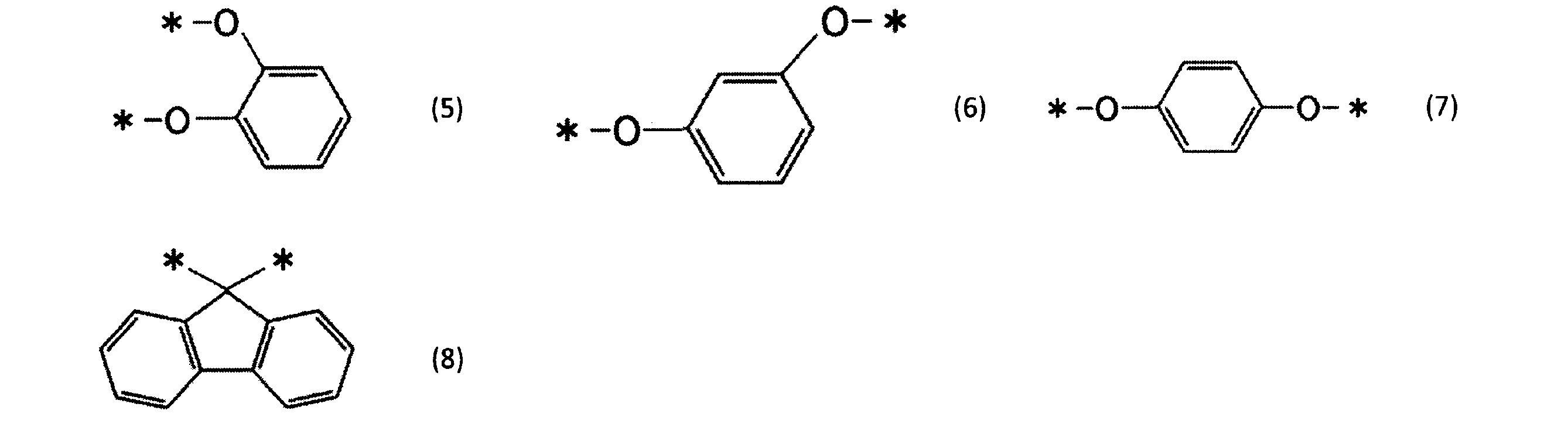
前記式(4)のAは、好ましくは-CH2-、-C(CH3)2-、-C(CH3)(CF3)-、-C(CF3)2-、-C(CH3)[CH2CH(CH3)2]-もしくは式(8)であり、-C(CF3)2-がより好ましい。dおよびeは、0が好ましい。

前記式(9)のfは0が好ましい。

前記R16としてはメチレン基、エチレン基、プロピレン基、ブチレン基、ブテニレン基であることが好ましく、ブチレン基またはブテニレン基であることがより好ましい。gは1であることが好ましい。

前記R17およびR18としてはメチレン基、エチレン基、プロピレン基、ブチレン基、ブテニレン基であることが好ましく、ブチレン基またはブテニレン基であることがより好ましい。hおよびiは1であることが好ましい。
本発明の化合物(B)の合成方法について説明する。
本発明の組成物は、粒形を制御する観点から、有機酸が含まれていることが好ましい。ここで有機酸とは、ギ酸、酢酸、プロピオン酸、リンゴ酸、シュウ酸、クエン酸などのカルボキシ基を含有する分子量300以下の化合物を指す。有機酸としては、ギ酸、酢酸、プロピオン酸、リンゴ酸、シュウ酸およびクエン酸からなる群より選択される少なくとも1種類を含むことが好ましく、酢酸、ギ酸およびシュウ酸からなる群より選択される少なくとも1種が含まれていることがより好ましい。
本発明の組成物はポリマーを重合する際のモノマーとして使用できる。
ポリマーとしては、ジアミン化合物をモノマーとして使用するものであれば、特に制限はなく、ポリイミド、ポリベンゾオキサゾール、これらの前駆体や、それらの共重合体のモノマーとして使用することができる。
例えば、ポリイミドを製造する場合では、前記組成物と所定の酸無水物と反応させることで得ることができる。反応させる条件は、公知の方法を使用でき、例えば適当な温度と時間で加熱処理して付加反応を進行させればよい。この加熱処理時間は1時間~12時間実施することが好ましい。一例としては、60℃で4時間加熱処理する例が挙げられる。加熱処理温度としては、40℃以上100℃以下が好ましい。
各合成例にて得られた組成物10mgを、10mLメスフラスコに秤量後、テトラヒドロフラン2mLを添加して溶解させたのちに、アセトニトリルで定容したものを試料溶液とした。
各合成例にて得られた組成物1gに超純水30mLを加えて1時間振とうした。その後、メンブレンフィルター(孔径:0.22μm)および固相抽出カートリッジで処理した液について、イオンクロマトグラフィー装置ICS-6000(Thermo Fisher Scientific製)を用いて、分離カラムはIonPac AS11-HC-4μm、カラムサイズは2mmφ×250mm、溶離液を水酸化カリウムのグラジエント条件、試料注入量を100μL、検出器を電気伝導度計として、イオンの分析を実施した。有機酸を同一条件でイオン分析し検量線を作成することで、各含有量を算出した。
各合成例で得られた試料をビーカーにとり、分散媒として0.5重量%ヘキサメタリン酸ナトリウム水溶液を加え、超音波を印加させて攪拌した。その後レーザー回折式粒度分布測定装置SALD-3100(島津製作所(株)製)を用いて、屈折率を1.70-0.2i、測定吸光度範囲を0.010以上0.200以下、測定範囲を0.05μm以上3000.00μm以下として、粒度分布測定を実施した。
D100-D0の数値および、D90-D10の数値を算出した。これらの値が小さいほど、粒形バラつきが制御できていることを示しており、以下判断基準で評価した。
B : 225.0μmより大きく295.0μm以下
C : 295.0μmより大きく340.0μm以下
D : 340.0μmより大きく400.0μm以下
E : 400.0μmより大きい
粒度測定の判断基準(D90-D10) A,B,C,Dの順で良好である。
B : 38.0μmより大きく50.0μm以下
C : 50.0μmより大きく70.0μm以下
D : 70.0μmより大きい。
100mL丸底フラスコにNMP(N-メチル-2-ピロリドン)を45g投入し、40℃で攪拌しながら、各合成例で得られた試料5.0gを添加した。添加後に、固形物が完全に溶解するまで目視で確認し、添加後から完全溶解したまでの時間を記録した。完全溶解までの時間が短いほど良好である。
ビス(3-アミノ-4-ヒドロキシフェニル)ヘキサフルオロプロパン18.3g(0.05モル)をアセトン100ml、プロピレンオキシド17.4g(0.30モル)に溶解させ、-15℃に冷却した。ここに3-ニトロベンゾイルクロリド20.4g(0.11モル)をアセトン100mlに溶解させた溶液を滴下した。滴下終了後、-15℃で4時間反応させ、その後室温に戻した。溶液をロータリーエバポレーターで濃縮し、得られた固体をテトラヒドロフランとエタノールの溶液で再結晶した。再結晶して集めた固体をエタノール100mlとテトラヒドロフラン300mlに溶解させて、5%パラジウム-炭素を2g加えて、激しく攪拌させた。ここに水素を風船で導入して、還元反応を室温で行った。約2時間後、風船がこれ以上しぼまないことを確認して反応を終了させた。反応終了後、ろ過して触媒であるパラジウム化合物を除き、ロータリーエバポレーターで濃縮し、ジアミン化合物A-1を得た。
合成例1のビス(3-アミノ-4-ヒドロキシフェニル)ヘキサフルオロプロパン18.3g(0.05モル)を、ビス(3-アミノ-4-ヒドロキシフェニル)プロパン12.9g(0.05モル)に変更する以外は合成例1同様の作業を行い、ジアミン化合物A-2を得た。
合成例1の3-ニトロベンゾイルクロリド20.4g(0.11モル)を4-ニトロベンゾイルクロリド20.4g(0.11モル)に変更する以外は合成例1同様の作業を行い、ジアミン化合物A-3を得た。
合成例3のビス(3-アミノ-4-ヒドロキシフェニル)ヘキサフルオロプロパン18.3g(0.05モル)を2,4-ジアミノフェノール6.2g(0.05モル)に変更する以外は合成例3同様の作業を行い、ジアミン化合物A-4を得た。
合成例1の3-ニトロベンゾイルクロリド20.4g(0.11モル)を3-ニトロ-4-メチルベンゾイルクロリド22.0g(0.11モル)に変更する以外は合成例1同様の作業を行い、ジアミン化合物A-3を得た。
合成例1のビス(3-アミノ-4-ヒドロキシフェニル)ヘキサフルオロプロパン18.3g(0.05モル)を、2,4-ジアミノフェノール6.2g(0.05モル)に変更する以外は合成例1同様の作業を行い、ジアミン化合物A-6を得た。
合成例1のビス(3-アミノ-4-ヒドロキシフェニル)ヘキサフルオロプロパン18.3g(0.05モル)を、9,9‘-ビス(3-アミノ-4-ヒドロキシフェニル)フルオレン19.0g(0.05モル)に変更する以外は合成例1同様の作業を行い、ジアミン化合物A-7を得た。
合成例1のビス(3-アミノ-4-ヒドロキシフェニル)ヘキサフルオロプロパン18.3g(0.05モル)を、2,2-ビス(3-アミノ-4-ヒドロキシフェニル)-4-メチルペンタン15.0g(0.05モル)に変更する以外は合成例1同様の作業を行い、ジアミン化合物A-8を得た。
合成例1のビス(3-アミノ-4-ヒドロキシフェニル)ヘキサフルオロプロパン18.3g(0.05モル)を、ビス(3-アミノ-4-ヒドロキシフェニル)スルホン14.0g(0.05モル)に変更する以外は合成例1同様の作業を行い、ジアミン化合物A-9を得た。
合成例1で得たジアミン化合物A-1を12.1g(0.02モル)をトルエン80mL、テトラヒドロフラン1.4g(0.02モル)に溶解させ、酢酸0.1mgを加えた後で、60℃8時間窒素雰囲気下で攪拌した。その後純水を100mL加えた後、分液ロートで水相と油相を分離した。得られた油層をロータリーエバポレーターで濃縮し、得られた固体をメタノール溶液で再結晶して、ろ過することで固体の化合物B-1を得た。
合成例10のテトラヒドロフランの量を、2.8g(0.04モル)に変更する以外は、合成例10同様の作業を行い、化合物B-2を得た。
合成例10のテトラヒドロフラン1.4g(0.02モル)を、プロピレンオキシド1.2g(0.02モル)に変更し、攪拌時の温度を30℃に変更する以外は、合成例10同様の作業を行い、化合物B-3を得た。
合成例10のテトラヒドロフラン1.4g(0.02モル)を、シクロヘキセンオキシド2.0g(0.02モル)に変更する以外は、合成例10同様の作業を行い、化合物B-4を得た。
合成例10のテトラヒドロフラン1.4g(0.02モル)を、3-ヒドロキシテトラヒドロフラン1.8g(0.02モル)に変更する以外は、合成例10同様の作業を行い、化合物B-5を得た。
合成例10のジアミン化合物A-1 12.1g(0.02モル)を、ジアミン化合物A-3 12.3g(0.02モル)に変更する以外は、合成例10同様の作業を行い、化合物B-6を得た。
合成例10のジアミン化合物A-1 12.1g(0.02モル)を、ジアミン化合物A-5 12.7g(0.02モル)に変更する以外は、合成例10同様の作業を行い、化合物B-7を得た。
合成例10のジアミン化合物A-1 12.1g(0.02モル)を、ジアミン化合物A-2 9.9g(0.02モル)に変更する以外は、合成例10同様の作業を行い、化合物B-8を得た。
合成例10のジアミン化合物A-1 12.1g(0.02モル)を、ジアミン化合物A-6 7.2g(0.02モル)に変更する以外は、合成例10同様の作業を行い、化合物B-9を得た。
合成例10のジアミン化合物A-1 12.1g(0.02モル)を、ジアミン化合物A-4 7.2g(0.02モル)に変更する以外は、合成例10同様の作業を行い、化合物B-10を得た。
合成例10のジアミン化合物A-1 12.1g(0.02モル)を、ジアミン化合物A-7 12.4g(0.02モル)に変更する以外は、合成例10同様の作業を行い、化合物B-11を得た。
合成例10のジアミン化合物A-1 12.1g(0.02モル)を、ジアミン化合物A-8 11.0g(0.02モル)に変更する以外は、合成例10同様の作業を行い、化合物B-12を得た。
合成例10のテトラヒドロフラン1.4g(0.02モル)を、2,5-ジヒドロフラン1.4g(0.02モル)に変更する以外は、合成例10同様の作業を行い、化合物B-13を得た。
合成例10のジアミン化合物A-1 12.1g(0.02モル)を、ジアミン化合物A-9 10.4g(0.02モル)に変更する以外は、合成例10同様の作業を行い、化合物B-14を得た。

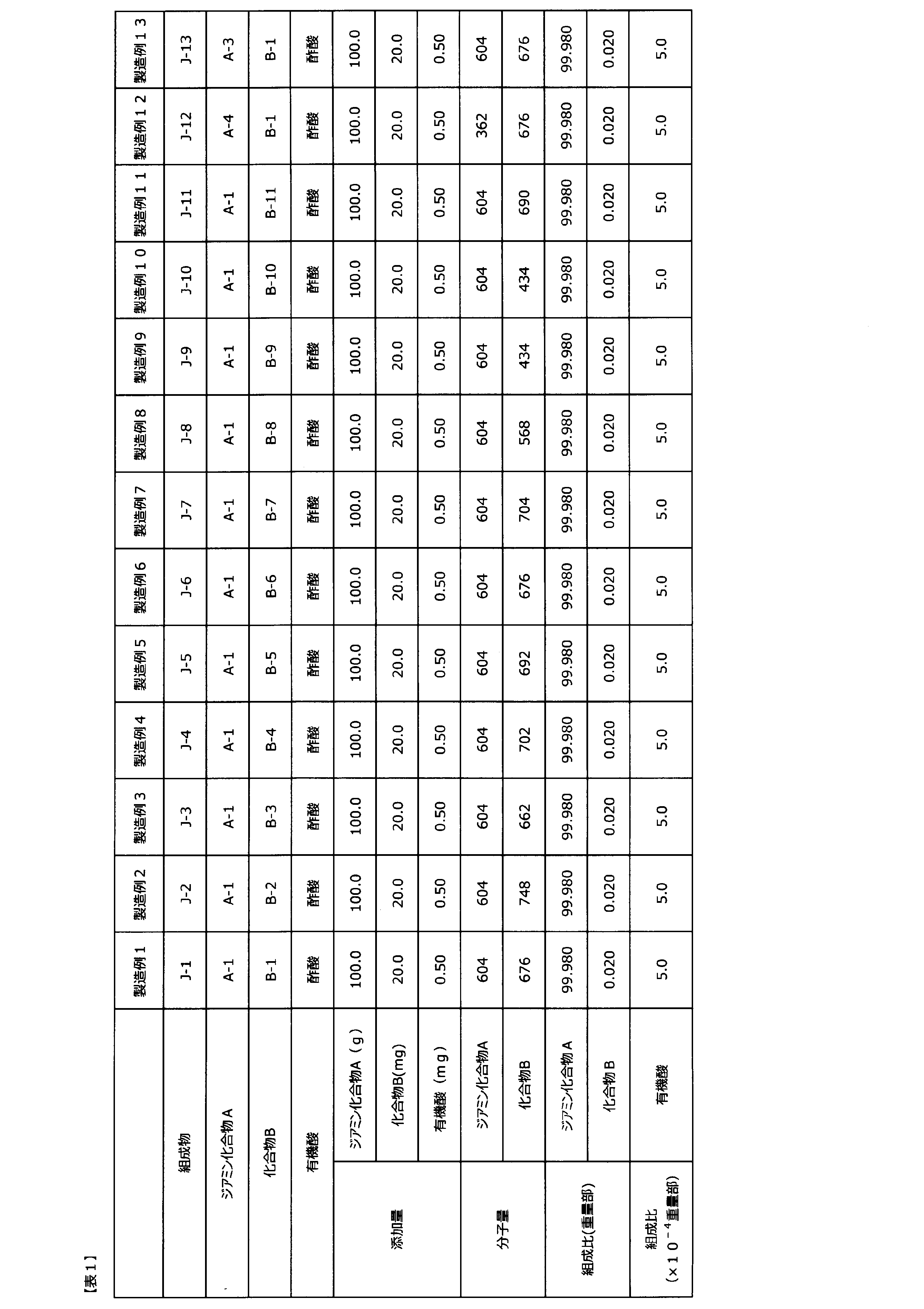
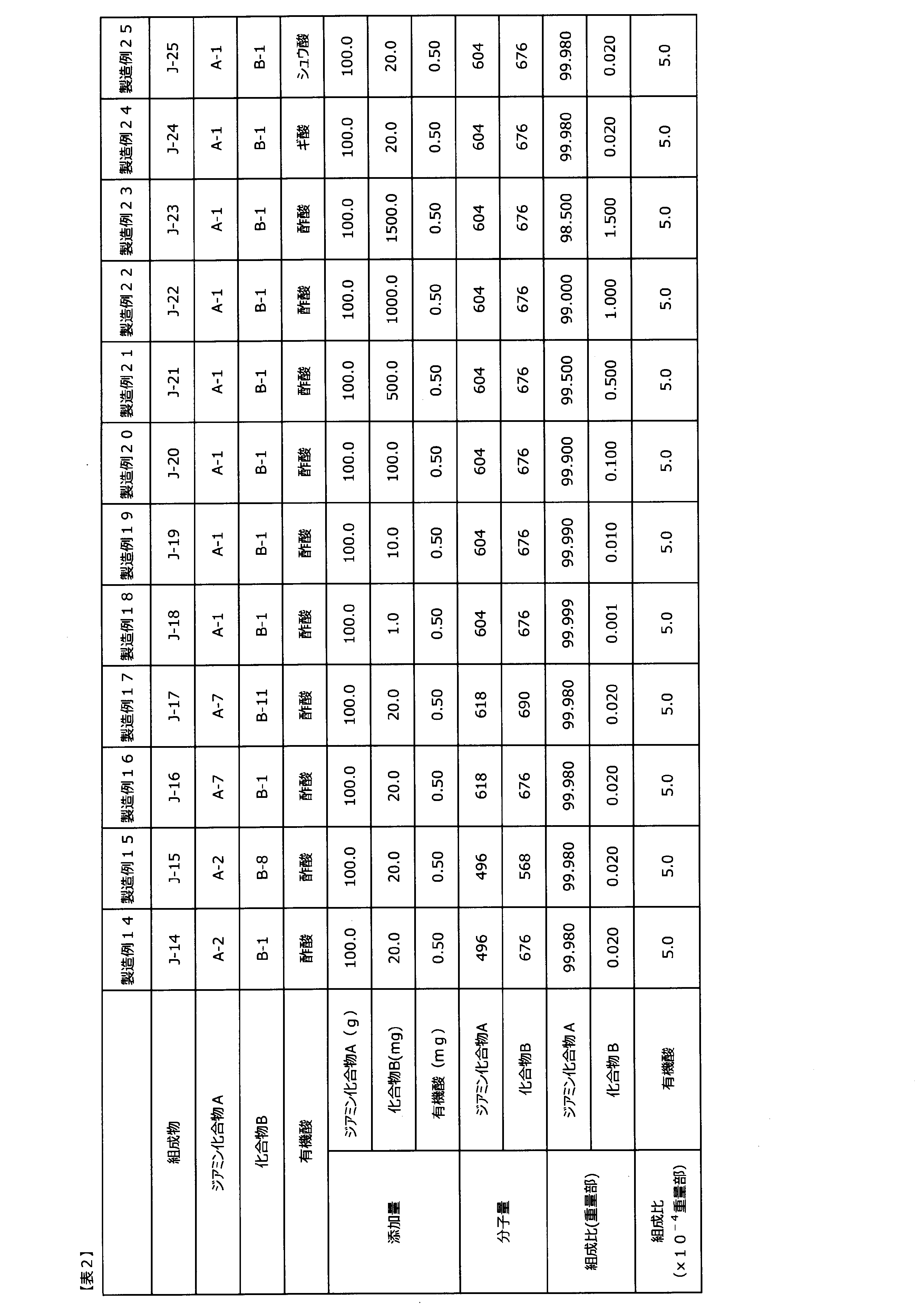
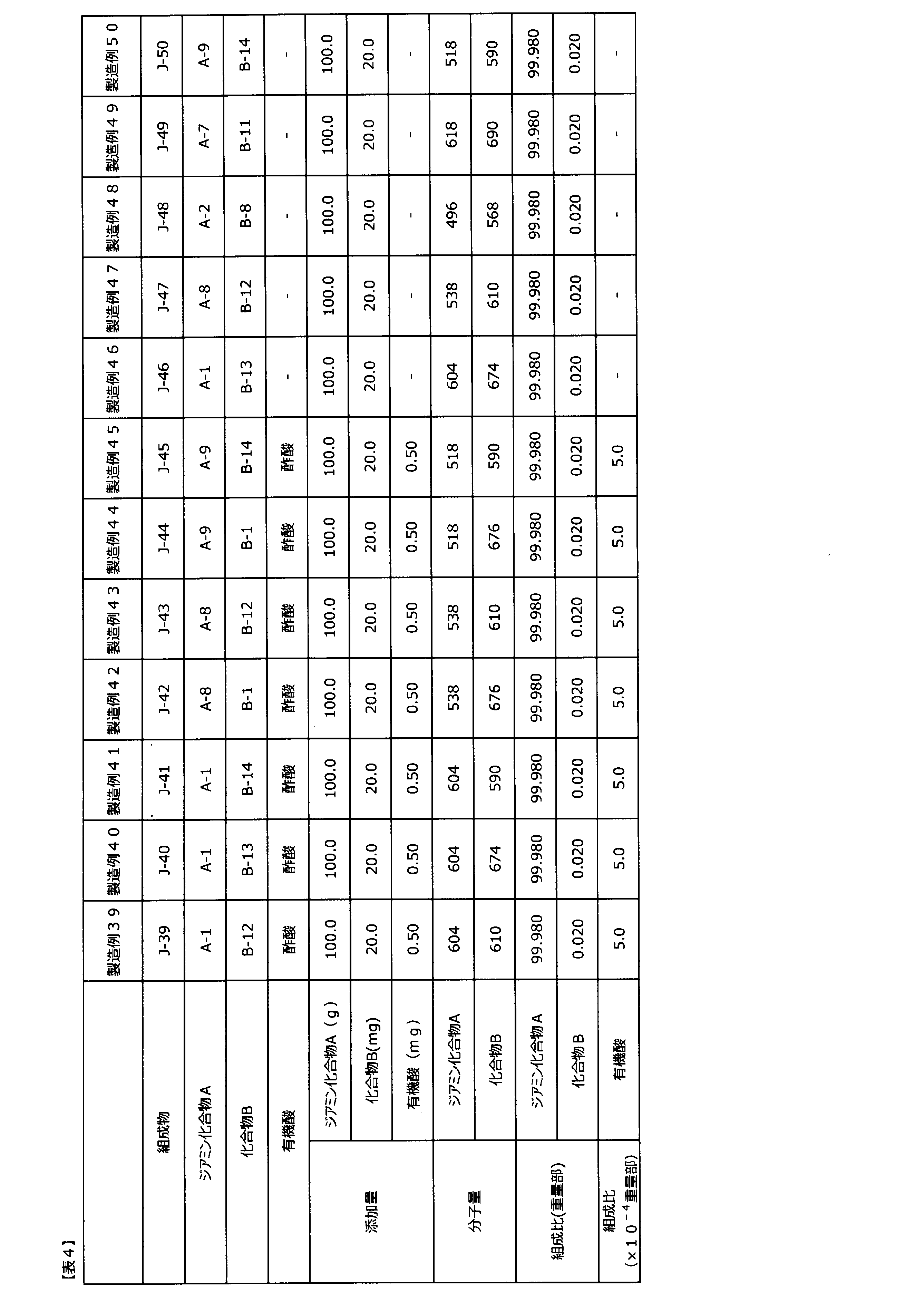
ジアミン化合物A-1を100.0g、化合物B-1を20.0mg、酢酸を0.50mg、メタノールに添加して、再結晶させた。ろ過して得た組成物J-1について、LC/UV-MS分析を行ったところ、分子量604のジアミン化合物A-1と、分子量676である化合物B-1を検出し、B-1は組成物全体100重量部に対して0.02重量部検出した。また、イオンクロマトグラフィーの結果、酢酸イオンを組成物全体100重量部に対して、5.0×10-4重量部検出した。
ジアミン化合物(A-1)~(A-4)、(A-7)~(A-9)と、化合物(B-1)~化合物(B-14)、有機酸を表1~表4のように添加して、再結晶およびろ過することで組成物(J-2)~(J-50)を作成した。前述の通りLC/UV-MS分析評価を行い、検出した化合物の分子量と、算出した含有量を表1~表4に示す。
組成物J-1について粒度分析および溶解性評価を実施した。粒度分析の結果、D100-D0はA評価(213.8μm)、D90-D10はA評価(34.2μm)、であった。また、溶解性評価の結果は5分で溶解した。
組成物(J-2)~(J-37)、(J-39)~(J-50)についても、J-1同様に粒度分析および溶解性評価を前述の通り実施した。評価結果を表5~表11に示す。
組成物(J-38)について、J-1同様に粒度分析及び溶解性評価を前述の通り実施した。粒度分析の結果、D100-D0はE評価(799.8μm)、D90-D10はD評価(97.0μm)であった。また、溶解性評価の結果は16分で溶解した。



Claims (9)
- 少なくとも式(1)で表されるジアミン化合物(A)、および化合物(B)を含有する組成物であって、
前記化合物(B)が、式(2)で表される化合物および/または式(3)で表される化合物を含む組成物。

式(2)中、R4は、炭素数1~6個を有する2~4価の有機基を示し、aは、1から3までの整数を示し、R5およびR7は、それぞれ独立に、炭素数2~12個を有する2価の有機基を示し、R6は、炭素数2~25個を有する3~6価の有機基を示し、nは、1から4までの整数を示す。
式(3)中、R8およびR12は、それぞれ独立に、炭素数1~6個を有する2~4価の有機基を示し、bおよびcは、それぞれ独立に、1から3までの整数を示し、R9およびR11は、それぞれ独立に、炭素数2~12個を有する2価の有機基を示し、R10は、炭素数2~25個を有する3~6価の有機基、oは1から4までの整数を示す。) - 前記式(2)中のR6-(OH)nおよび前記式(3)中のR10-(OH)Oが、式(4)で表される構造である、請求項1に記載の組成物。


- 前記式(2)中のR5およびR7、ならびに前記式(3)中のR9およびR11が、式(9)で表される構造である、請求項1または2に記載の組成物。

- 前記式(2)で表される化合物が、式(10)で表される化合物である、請求項1または2に記載の組成物。

- 前記式(3)で表される化合物が、式(11)で表される化合物である、請求項1または2に記載の組成物。

- 前記組成物100重量部に対して、前記化合物(B)の含有量が0.001重量部以上、1.000重量部以下である、請求項1または2に記載の組成物。
- さらに有機酸を含む、請求項1または2に記載の組成物。
- 前記有機酸が、ギ酸、酢酸、プロピオン酸、リンゴ酸、シュウ酸およびクエン酸からなる群より選択される少なくとも1種類を含む、請求項7に記載の組成物。
- 前記組成物100重量部に対して、前記有機酸の含有量が0.2×10⁻⁴重量部以上、100.0×10⁻⁴重量部以下である、請求項7に記載の組成物。
Priority Applications (3)
| Application Number | Priority Date | Filing Date | Title |
|---|---|---|---|
| KR1020257038376A KR20260019452A (ko) | 2023-06-02 | 2024-05-28 | 조성물 |
| CN202480031976.7A CN121100149A (zh) | 2023-06-02 | 2024-05-28 | 组合物 |
| JP2024532723A JPWO2024247983A1 (ja) | 2023-06-02 | 2024-05-28 |
Applications Claiming Priority (2)
| Application Number | Priority Date | Filing Date | Title |
|---|---|---|---|
| JP2023-091357 | 2023-06-02 | ||
| JP2023091357 | 2023-06-02 |
Publications (1)
| Publication Number | Publication Date |
|---|---|
| WO2024247983A1 true WO2024247983A1 (ja) | 2024-12-05 |
Family
ID=93658038
Family Applications (1)
| Application Number | Title | Priority Date | Filing Date |
|---|---|---|---|
| PCT/JP2024/019485 Ceased WO2024247983A1 (ja) | 2023-06-02 | 2024-05-28 | 組成物 |
Country Status (5)
| Country | Link |
|---|---|
| JP (1) | JPWO2024247983A1 (ja) |
| KR (1) | KR20260019452A (ja) |
| CN (1) | CN121100149A (ja) |
| TW (1) | TW202506631A (ja) |
| WO (1) | WO2024247983A1 (ja) |
Citations (3)
| Publication number | Priority date | Publication date | Assignee | Title |
|---|---|---|---|---|
| JP2014224855A (ja) * | 2013-05-15 | 2014-12-04 | 日立化成株式会社 | 感光性樹脂組成物、パターン硬化膜の製造方法、及び、該パターン硬化膜を有する半導体装置 |
| WO2017018290A1 (ja) * | 2015-07-24 | 2017-02-02 | 住友ベークライト株式会社 | 感光性樹脂組成物、硬化膜、保護膜、絶縁膜および電子装置 |
| WO2017057281A1 (ja) * | 2015-09-30 | 2017-04-06 | 東レ株式会社 | ネガ型感光性樹脂組成物、硬化膜、硬化膜を具備する素子及び表示装置、並びにその製造方法 |
Family Cites Families (3)
| Publication number | Priority date | Publication date | Assignee | Title |
|---|---|---|---|---|
| JPH11199577A (ja) | 1998-01-12 | 1999-07-27 | Tosoh Corp | 水酸基含有環状エーテル化合物の製造方法 |
| JP6202492B2 (ja) | 2012-08-03 | 2017-09-27 | 東レ・ファインケミカル株式会社 | ジニトロ化合物の製造方法 |
| JP2016117688A (ja) | 2014-12-22 | 2016-06-30 | 東レ・ファインケミカル株式会社 | ジアミン化合物の製造方法 |
-
2024
- 2024-05-28 CN CN202480031976.7A patent/CN121100149A/zh active Pending
- 2024-05-28 WO PCT/JP2024/019485 patent/WO2024247983A1/ja not_active Ceased
- 2024-05-28 KR KR1020257038376A patent/KR20260019452A/ko active Pending
- 2024-05-28 JP JP2024532723A patent/JPWO2024247983A1/ja active Pending
- 2024-05-29 TW TW113119795A patent/TW202506631A/zh unknown
Patent Citations (3)
| Publication number | Priority date | Publication date | Assignee | Title |
|---|---|---|---|---|
| JP2014224855A (ja) * | 2013-05-15 | 2014-12-04 | 日立化成株式会社 | 感光性樹脂組成物、パターン硬化膜の製造方法、及び、該パターン硬化膜を有する半導体装置 |
| WO2017018290A1 (ja) * | 2015-07-24 | 2017-02-02 | 住友ベークライト株式会社 | 感光性樹脂組成物、硬化膜、保護膜、絶縁膜および電子装置 |
| WO2017057281A1 (ja) * | 2015-09-30 | 2017-04-06 | 東レ株式会社 | ネガ型感光性樹脂組成物、硬化膜、硬化膜を具備する素子及び表示装置、並びにその製造方法 |
Also Published As
| Publication number | Publication date |
|---|---|
| JPWO2024247983A1 (ja) | 2024-12-05 |
| KR20260019452A (ko) | 2026-02-10 |
| TW202506631A (zh) | 2025-02-16 |
| CN121100149A (zh) | 2025-12-09 |
Similar Documents
| Publication | Publication Date | Title |
|---|---|---|
| CN110606951B (zh) | 一种半芳香型聚酰亚胺、其制备方法、用途和包含其的气体分离膜 | |
| Tong et al. | Preparation of fluorinated polyimides with bulky structure and their gas separation performance correlated with microstructure | |
| CN108530304B (zh) | 含甲苯基及非共平面结构的芳香二胺、聚酰亚胺及其制备方法 | |
| RU2468040C2 (ru) | Сополимер полиимид-полибензоксазол, способ его получения и газоразделительная мембрана, включающая этот сополимер | |
| KR101466918B1 (ko) | 가교구조를 갖는 열전환 폴리(벤즈옥사졸-이미드) 공중합체를 포함하는 배연가스 분리용 막 및 그 제조방법 | |
| US10046284B2 (en) | Compatibilized immiscible polymer blends and molecular sieve membranes thereof | |
| Wang et al. | De‐carboxylation of cross‐linkable triptycene‐based polyimides for CO2 separation | |
| Ahmadizadegan | Synthesis and gas transport properties of novel functional polyimide/ZnO nanocomposite thin film membranes | |
| Govindaraj et al. | Synthesis and characterization of polyimide/polyhedral oligomeric silsesquioxane nanocomposites containing quinolyl moiety | |
| Dinari et al. | Synthesis, structural characterization and properties of novel functional poly (ether imide)/titania nanocomposite thin films | |
| Wu et al. | Synthesis and characterization of novel star-branched polyimides derived from 2, 2-bis [4-(2, 4-diaminophenoxy) phenyl] hexafluoropropane | |
| US10188992B2 (en) | Polybenzimidazoles and methods of making and using thereof | |
| JP6322487B2 (ja) | 炭素触媒およびその製造方法 | |
| WO2011129769A1 (en) | Polyimide membranes and their preparation | |
| Xu et al. | Synthesis of polyimides containing Tröger's base and triphenylmethane moieties with a tunable fractional free volume for CO2 separation | |
| Chen et al. | Synthesis, characterization and properties of polyimides with spirobisbenzoxazole scaffold structure | |
| JP7024548B2 (ja) | マレイミド樹脂の製造方法 | |
| KR101552517B1 (ko) | 가교구조를 갖는 열전환 폴리(벤즈옥사졸-이미드)공중합체, 이를 포함하는 기체분리막 및 그 제조방법 | |
| Pashayev et al. | CO2‐Responsive Copolymers for Membrane Applications, Synthesis, and Performance Evaluation | |
| Hu | Novel fluorescent porous hyperbranched aromatic polyamide containing 1, 3, 5‐triphenylbenzene moieties: Synthesis and characterization | |
| Dinari et al. | Preparation, characterization and gas separation properties of nanocomposite materials based on novel silane functionalizing polyimide bearing pendent naphthyl units and ZnO nanoparticles | |
| Tao et al. | Synthesis of fluorinated polybenzoxazoles with low dielectric constants | |
| Yin et al. | Synthesis and gas permeation properties of star-like poly (ethylene oxide) s using hyperbranched polyimide as central core | |
| Guo et al. | New fluorinated xanthene-containing polybenzoxazoles with low dielectric constants | |
| KR20260019452A (ko) | 조성물 |
Legal Events
| Date | Code | Title | Description |
|---|---|---|---|
| WWE | Wipo information: entry into national phase |
Ref document number: 2024532723 Country of ref document: JP |
|
| 121 | Ep: the epo has been informed by wipo that ep was designated in this application |
Ref document number: 24815466 Country of ref document: EP Kind code of ref document: A1 |
|
| WWE | Wipo information: entry into national phase |
Ref document number: 202547130520 Country of ref document: IN |
|
| NENP | Non-entry into the national phase |
Ref country code: DE |
|
| 122 | Ep: pct application non-entry in european phase |
Ref document number: 24815466 Country of ref document: EP Kind code of ref document: A1 |