WO2024247657A1 - 積層光学フィルム用接着剤組成物および積層光学フィルム - Google Patents
積層光学フィルム用接着剤組成物および積層光学フィルム Download PDFInfo
- Publication number
- WO2024247657A1 WO2024247657A1 PCT/JP2024/017391 JP2024017391W WO2024247657A1 WO 2024247657 A1 WO2024247657 A1 WO 2024247657A1 JP 2024017391 W JP2024017391 W JP 2024017391W WO 2024247657 A1 WO2024247657 A1 WO 2024247657A1
- Authority
- WO
- WIPO (PCT)
- Prior art keywords
- meth
- acrylate
- laminated optical
- adhesive composition
- optical films
- Prior art date
- Legal status (The legal status is an assumption and is not a legal conclusion. Google has not performed a legal analysis and makes no representation as to the accuracy of the status listed.)
- Ceased
Links
Images
Classifications
-
- C—CHEMISTRY; METALLURGY
- C08—ORGANIC MACROMOLECULAR COMPOUNDS; THEIR PREPARATION OR CHEMICAL WORKING-UP; COMPOSITIONS BASED THEREON
- C08F—MACROMOLECULAR COMPOUNDS OBTAINED BY REACTIONS ONLY INVOLVING CARBON-TO-CARBON UNSATURATED BONDS
- C08F2/00—Processes of polymerisation
- C08F2/46—Polymerisation initiated by wave energy or particle radiation
- C08F2/48—Polymerisation initiated by wave energy or particle radiation by ultraviolet or visible light
- C08F2/50—Polymerisation initiated by wave energy or particle radiation by ultraviolet or visible light with sensitising agents
-
- C—CHEMISTRY; METALLURGY
- C08—ORGANIC MACROMOLECULAR COMPOUNDS; THEIR PREPARATION OR CHEMICAL WORKING-UP; COMPOSITIONS BASED THEREON
- C08F—MACROMOLECULAR COMPOUNDS OBTAINED BY REACTIONS ONLY INVOLVING CARBON-TO-CARBON UNSATURATED BONDS
- C08F220/00—Copolymers of compounds having one or more unsaturated aliphatic radicals, each having only one carbon-to-carbon double bond, and only one being terminated by only one carboxyl radical or a salt, anhydride ester, amide, imide or nitrile thereof
- C08F220/02—Monocarboxylic acids having less than ten carbon atoms; Derivatives thereof
- C08F220/10—Esters
- C08F220/20—Esters of polyhydric alcohols or phenols, e.g. 2-hydroxyethyl (meth)acrylate or glycerol mono-(meth)acrylate
-
- C—CHEMISTRY; METALLURGY
- C08—ORGANIC MACROMOLECULAR COMPOUNDS; THEIR PREPARATION OR CHEMICAL WORKING-UP; COMPOSITIONS BASED THEREON
- C08F—MACROMOLECULAR COMPOUNDS OBTAINED BY REACTIONS ONLY INVOLVING CARBON-TO-CARBON UNSATURATED BONDS
- C08F220/00—Copolymers of compounds having one or more unsaturated aliphatic radicals, each having only one carbon-to-carbon double bond, and only one being terminated by only one carboxyl radical or a salt, anhydride ester, amide, imide or nitrile thereof
- C08F220/02—Monocarboxylic acids having less than ten carbon atoms; Derivatives thereof
- C08F220/10—Esters
- C08F220/26—Esters containing oxygen in addition to the carboxy oxygen
- C08F220/30—Esters containing oxygen in addition to the carboxy oxygen containing aromatic rings in the alcohol moiety
- C08F220/301—Esters containing oxygen in addition to the carboxy oxygen containing aromatic rings in the alcohol moiety and one oxygen in the alcohol moiety
-
- C—CHEMISTRY; METALLURGY
- C08—ORGANIC MACROMOLECULAR COMPOUNDS; THEIR PREPARATION OR CHEMICAL WORKING-UP; COMPOSITIONS BASED THEREON
- C08F—MACROMOLECULAR COMPOUNDS OBTAINED BY REACTIONS ONLY INVOLVING CARBON-TO-CARBON UNSATURATED BONDS
- C08F220/00—Copolymers of compounds having one or more unsaturated aliphatic radicals, each having only one carbon-to-carbon double bond, and only one being terminated by only one carboxyl radical or a salt, anhydride ester, amide, imide or nitrile thereof
- C08F220/02—Monocarboxylic acids having less than ten carbon atoms; Derivatives thereof
- C08F220/52—Amides or imides
- C08F220/54—Amides, e.g. N,N-dimethylacrylamide or N-isopropylacrylamide
- C08F220/56—Acrylamide; Methacrylamide
-
- C—CHEMISTRY; METALLURGY
- C08—ORGANIC MACROMOLECULAR COMPOUNDS; THEIR PREPARATION OR CHEMICAL WORKING-UP; COMPOSITIONS BASED THEREON
- C08F—MACROMOLECULAR COMPOUNDS OBTAINED BY REACTIONS ONLY INVOLVING CARBON-TO-CARBON UNSATURATED BONDS
- C08F220/00—Copolymers of compounds having one or more unsaturated aliphatic radicals, each having only one carbon-to-carbon double bond, and only one being terminated by only one carboxyl radical or a salt, anhydride ester, amide, imide or nitrile thereof
- C08F220/02—Monocarboxylic acids having less than ten carbon atoms; Derivatives thereof
- C08F220/52—Amides or imides
- C08F220/54—Amides, e.g. N,N-dimethylacrylamide or N-isopropylacrylamide
- C08F220/58—Amides, e.g. N,N-dimethylacrylamide or N-isopropylacrylamide containing oxygen in addition to the carbonamido oxygen, e.g. N-methylolacrylamide, N-(meth)acryloylmorpholine
-
- C—CHEMISTRY; METALLURGY
- C08—ORGANIC MACROMOLECULAR COMPOUNDS; THEIR PREPARATION OR CHEMICAL WORKING-UP; COMPOSITIONS BASED THEREON
- C08F—MACROMOLECULAR COMPOUNDS OBTAINED BY REACTIONS ONLY INVOLVING CARBON-TO-CARBON UNSATURATED BONDS
- C08F230/00—Copolymers of compounds having one or more unsaturated aliphatic radicals, each having only one carbon-to-carbon double bond, and containing phosphorus, selenium, tellurium or a metal
- C08F230/04—Copolymers of compounds having one or more unsaturated aliphatic radicals, each having only one carbon-to-carbon double bond, and containing phosphorus, selenium, tellurium or a metal containing a metal
- C08F230/06—Copolymers of compounds having one or more unsaturated aliphatic radicals, each having only one carbon-to-carbon double bond, and containing phosphorus, selenium, tellurium or a metal containing a metal containing boron
-
- C—CHEMISTRY; METALLURGY
- C08—ORGANIC MACROMOLECULAR COMPOUNDS; THEIR PREPARATION OR CHEMICAL WORKING-UP; COMPOSITIONS BASED THEREON
- C08K—Use of inorganic or non-macromolecular organic substances as compounding ingredients
- C08K3/00—Use of inorganic substances as compounding ingredients
- C08K3/18—Oxygen-containing compounds, e.g. metal carbonyls
- C08K3/20—Oxides; Hydroxides
- C08K3/22—Oxides; Hydroxides of metals
-
- C—CHEMISTRY; METALLURGY
- C08—ORGANIC MACROMOLECULAR COMPOUNDS; THEIR PREPARATION OR CHEMICAL WORKING-UP; COMPOSITIONS BASED THEREON
- C08K—Use of inorganic or non-macromolecular organic substances as compounding ingredients
- C08K5/00—Use of organic ingredients
- C08K5/16—Nitrogen-containing compounds
- C08K5/34—Heterocyclic compounds having nitrogen in the ring
- C08K5/3467—Heterocyclic compounds having nitrogen in the ring having more than two nitrogen atoms in the ring
- C08K5/3477—Six-membered rings
- C08K5/3492—Triazines
- C08K5/34924—Triazines containing cyanurate groups; Tautomers thereof
-
- C—CHEMISTRY; METALLURGY
- C08—ORGANIC MACROMOLECULAR COMPOUNDS; THEIR PREPARATION OR CHEMICAL WORKING-UP; COMPOSITIONS BASED THEREON
- C08L—COMPOSITIONS OF MACROMOLECULAR COMPOUNDS
- C08L83/00—Compositions of macromolecular compounds obtained by reactions forming in the main chain of the macromolecule a linkage containing silicon with or without sulfur, nitrogen, oxygen or carbon only; Compositions of derivatives of such polymers
- C08L83/04—Polysiloxanes
-
- C—CHEMISTRY; METALLURGY
- C09—DYES; PAINTS; POLISHES; NATURAL RESINS; ADHESIVES; COMPOSITIONS NOT OTHERWISE PROVIDED FOR; APPLICATIONS OF MATERIALS NOT OTHERWISE PROVIDED FOR
- C09J—ADHESIVES; NON-MECHANICAL ASPECTS OF ADHESIVE PROCESSES IN GENERAL; ADHESIVE PROCESSES NOT PROVIDED FOR ELSEWHERE; USE OF MATERIALS AS ADHESIVES
- C09J11/00—Features of adhesives not provided for in group C09J9/00, e.g. additives
- C09J11/02—Non-macromolecular additives
- C09J11/04—Non-macromolecular additives inorganic
-
- C—CHEMISTRY; METALLURGY
- C09—DYES; PAINTS; POLISHES; NATURAL RESINS; ADHESIVES; COMPOSITIONS NOT OTHERWISE PROVIDED FOR; APPLICATIONS OF MATERIALS NOT OTHERWISE PROVIDED FOR
- C09J—ADHESIVES; NON-MECHANICAL ASPECTS OF ADHESIVE PROCESSES IN GENERAL; ADHESIVE PROCESSES NOT PROVIDED FOR ELSEWHERE; USE OF MATERIALS AS ADHESIVES
- C09J11/00—Features of adhesives not provided for in group C09J9/00, e.g. additives
- C09J11/02—Non-macromolecular additives
- C09J11/06—Non-macromolecular additives organic
-
- C—CHEMISTRY; METALLURGY
- C09—DYES; PAINTS; POLISHES; NATURAL RESINS; ADHESIVES; COMPOSITIONS NOT OTHERWISE PROVIDED FOR; APPLICATIONS OF MATERIALS NOT OTHERWISE PROVIDED FOR
- C09J—ADHESIVES; NON-MECHANICAL ASPECTS OF ADHESIVE PROCESSES IN GENERAL; ADHESIVE PROCESSES NOT PROVIDED FOR ELSEWHERE; USE OF MATERIALS AS ADHESIVES
- C09J11/00—Features of adhesives not provided for in group C09J9/00, e.g. additives
- C09J11/08—Macromolecular additives
-
- C—CHEMISTRY; METALLURGY
- C09—DYES; PAINTS; POLISHES; NATURAL RESINS; ADHESIVES; COMPOSITIONS NOT OTHERWISE PROVIDED FOR; APPLICATIONS OF MATERIALS NOT OTHERWISE PROVIDED FOR
- C09J—ADHESIVES; NON-MECHANICAL ASPECTS OF ADHESIVE PROCESSES IN GENERAL; ADHESIVE PROCESSES NOT PROVIDED FOR ELSEWHERE; USE OF MATERIALS AS ADHESIVES
- C09J4/00—Adhesives based on organic non-macromolecular compounds having at least one polymerisable carbon-to-carbon unsaturated bond ; adhesives, based on monomers of macromolecular compounds of groups C09J183/00 - C09J183/16
-
- C—CHEMISTRY; METALLURGY
- C09—DYES; PAINTS; POLISHES; NATURAL RESINS; ADHESIVES; COMPOSITIONS NOT OTHERWISE PROVIDED FOR; APPLICATIONS OF MATERIALS NOT OTHERWISE PROVIDED FOR
- C09J—ADHESIVES; NON-MECHANICAL ASPECTS OF ADHESIVE PROCESSES IN GENERAL; ADHESIVE PROCESSES NOT PROVIDED FOR ELSEWHERE; USE OF MATERIALS AS ADHESIVES
- C09J7/00—Adhesives in the form of films or foils
- C09J7/30—Adhesives in the form of films or foils characterised by the adhesive composition
- C09J7/38—Pressure-sensitive adhesives [PSA]
- C09J7/381—Pressure-sensitive adhesives [PSA] based on macromolecular compounds obtained by reactions involving only carbon-to-carbon unsaturated bonds
- C09J7/385—Acrylic polymers
-
- C—CHEMISTRY; METALLURGY
- C09—DYES; PAINTS; POLISHES; NATURAL RESINS; ADHESIVES; COMPOSITIONS NOT OTHERWISE PROVIDED FOR; APPLICATIONS OF MATERIALS NOT OTHERWISE PROVIDED FOR
- C09J—ADHESIVES; NON-MECHANICAL ASPECTS OF ADHESIVE PROCESSES IN GENERAL; ADHESIVE PROCESSES NOT PROVIDED FOR ELSEWHERE; USE OF MATERIALS AS ADHESIVES
- C09J2301/00—Additional features of adhesives in the form of films or foils
- C09J2301/40—Additional features of adhesives in the form of films or foils characterized by the presence of essential components
- C09J2301/416—Additional features of adhesives in the form of films or foils characterized by the presence of essential components use of irradiation
Definitions
- the present invention relates to an adhesive composition for laminated optical films for bonding at least two optical films, and to a laminated optical film.
- the laminated optical film can form image displays such as liquid crystal displays (LCDs), organic electroluminescence displays, CRTs, and PDPs.
- an image display device In order to improve poor visibility caused by external light reflection and background glare on the display screen of an image display device, an image display device is known in which a circular polarizing plate is arranged on the viewing side of the display panel.
- Patent Document 1 describes a polarizing plate composite comprising, in this order, a linear polarizing plate, a 1/2 wavelength layer, a first adhesive layer formed by curing an active energy ray-curable adhesive, and a 1/4 wavelength layer, in which the angle between the fast axis of the 1/2 wavelength layer and the transmission axis of the linear polarizing plate is 10° or more and 20° or less, and the absolute value of the difference between the refractive index of the first adhesive layer at a wavelength of 589 nm and the refractive index of the 1/2 wavelength layer in the fast axis direction at a wavelength of 589 nm is less than 0.05.
- Patent Document 2 describes a polarizing plate with a phase difference layer, which includes a polarizer, a first phase difference layer, and a second phase difference layer in this order, the polarizer and the first phase difference layer are bonded together via a first adhesive layer, the first phase difference layer and the second phase difference layer are bonded together via a second adhesive layer, the thicknesses of the first phase difference layer and the second phase difference layer are 5 ⁇ m or less, the average refractive index of the second adhesive layer is 1.55 or more, and the difference between the average refractive index of the second adhesive layer and the average refractive index of the first phase difference layer and the second phase difference layer is less than 0.08.
- Patent Document 3 describes an active energy ray-curable resin composition that contains metal oxide nanoparticles (A), phenoxybenzyl (meth)acrylates (B), and a bifunctional (meth)acrylate having a (poly)alkylene glycol structure (C), with the aim of providing an active energy ray-curable resin composition and a cured product that balance the various properties required for optical sheets and the like used in optical applications.
- A metal oxide nanoparticles
- B phenoxybenzyl
- C bifunctional (meth)acrylate having a (poly)alkylene glycol structure
- Patent Documents 1 and 2 above have room for further improvement when it comes to stably improving the refractive index of the interlayer adhesive of a laminated film.
- the technique described in Patent Document 3 above relates to an active energy ray-curable resin composition for producing a lens sheet, and is not intended for use in bonding at least two optical films.
- the adhesive composition for laminated optical films is applied to the optical film with a fairly thin film thickness, when metal oxide particles are contained, it is required that the liquid stability is excellent.
- the technique described in Patent Document 3 above does not consider such an issue, much less describes or suggests a means for solving the issue.
- the present invention was developed in consideration of the above-mentioned circumstances, and aims to provide an adhesive composition for laminated optical films that improves the refractive index when used as an adhesive layer and has excellent liquid stability due to the stable dispersion of metal oxide particles.
- the present invention aims to provide a laminated optical film having an adhesive layer that is a cured layer of an adhesive composition for laminated optical films, the adhesive layer having a high refractive index.
- the present invention relates to an adhesive composition for laminated optical films (1) for bonding at least two optical films, which contains a curable component, a (meth)acrylate containing an aromatic ring skeleton, metal oxide particles, and a leveling agent, and is characterized in that the leveling agent contains at least one selected from the group consisting of an isocyanurate compound and a polysiloxane compound.
- an adhesive composition for laminated optical films (2) when the total amount of the composition is taken as 100 mass %, it is preferable to use an adhesive composition for laminated optical films (2) in which the content of the isocyanurate compound is 0.05 to 10 mass %.
- an adhesive composition for laminated optical films (3) in which the content of the polysiloxane compound is 0.05 to 2.0 mass %.
- the adhesive composition for laminated optical films (4) when the total amount of the composition is taken as 100 mass%, the adhesive composition for laminated optical films (4) is preferred, in which the content of the metal oxide particles is 10 to 50 mass%.
- the content of the (meth)acrylate containing an aromatic ring skeleton is preferably 30 to 70 mass %.
- the adhesive composition for laminated optical films (6) is preferred in which the (meth)acrylate containing an aromatic ring skeleton contains at least one selected from the group consisting of (meth)acrylates having a polycyclic aromatic ring skeleton and (meth)acrylates having two or more aromatic rings.
- the adhesive composition for laminated optical films (7) is preferably one in which the (meth)acrylate containing an aromatic ring structure is phenoxybenzyl (meth)acrylate.
- adhesive composition for laminated optical films (1) to (7) preferred is adhesive composition for laminated optical films (8) which further contains a hydroxyl group-containing monomer.
- any one of the adhesive compositions for laminated optical films (1) to (8) a compound represented by the following general formula (1): (wherein X is a reactive group, Y is an alkylene group having 1 to 12 carbon atoms which may have a branched chain, or a phenylene group which may have a substituent, and R 1 and R 2 each independently represent a hydrogen atom, an aliphatic hydrocarbon group which may have a substituent, an aryl group, or a heterocyclic group) is preferred.
- an adhesive composition for laminated optical films (10) in which the content of the compound represented by the general formula (1) is 0.1 to 10 mass %.
- adhesive composition for laminated optical films (11) having a viscosity of 100 [mPa ⁇ s] or less at 25°C.
- the present invention also relates to a laminated optical film (12) in which at least a first optical film and a second optical film are laminated via an adhesive layer, the adhesive layer being a cured product layer of any one of the adhesive compositions (1) to (11) for laminated optical films.
- the adhesive composition for laminated optical films according to the present invention contains a curable component, a (meth)acrylate containing an aromatic ring skeleton, and metal oxide particles, and therefore when formed into an adhesive layer, the refractive index can be improved.
- the metal oxide particles in the composition are difficult to disperse stably, and as a result, there is a concern that the liquid stability may deteriorate, particularly during storage or when applied to an optical film.
- the adhesive composition for laminated optical films according to the present invention contains a specific leveling agent, specifically at least one selected from the group consisting of an isocyanurate compound and a polysiloxane compound, and therefore the metal oxide particles are stably dispersed, resulting in excellent liquid stability of the adhesive composition for laminated optical films.
- a specific leveling agent specifically at least one selected from the group consisting of an isocyanurate compound and a polysiloxane compound
- the metal oxide particles are stably dispersed, resulting in excellent liquid stability of the adhesive composition for laminated optical films.
- the adhesive composition for laminated optical films when the adhesive composition for laminated optical films is applied to an optical film, defects occurring in a part of the coating film on the optical film (so-called "repellency during application") can be suppressed, and air bubbles can be suppressed when two optical films are bonded together via the adhesive composition for laminated optical films.
- the viscosity of the composition can be kept low due to the stable dispersion of the
- the adhesive composition for laminated optical films according to the present invention contains a curable component, a (meth)acrylate containing an aromatic ring structure, metal oxide particles, and a leveling agent.
- the adhesive composition for laminated optical films according to the present invention contains at least one compound selected from the group consisting of isocyanurate compounds and polysiloxane compounds, which allows metal oxide particles to be stably dispersed in the composition. As a result, the viscosity can be kept low despite the inclusion of metal oxide particles. From the standpoint of thinning the adhesive layer and laminated optical film by thinly applying the adhesive composition for laminated optical films onto an optical film, it is preferable for the viscosity of the composition at 25°C to be 100 [mPa ⁇ s] or less, and more preferably 60 [mPa ⁇ s] or less.
- the adhesive composition for laminated optical films according to the present invention contains at least one selected from the group consisting of an isocyanurate compound and a polysiloxane compound as a leveling agent.
- the metal oxide particles are stably dispersed, and the adhesive composition for laminated optical films has excellent liquid stability.
- metal oxide particles and at least one selected from the group consisting of an isocyanurate compound and a polysiloxane compound in the composition it is possible to suppress the generation of repelling and bubbles during coating on the optical film.
- the adhesive composition for laminated optical films according to the present invention contains both an isocyanurate compound and a polysiloxane compound.
- the blending amount thereof is preferably 0.1 to 4 mass%, more preferably 0.1 to 2 mass%, when the total amount of the composition is taken as 100 mass%.
- the blending amount is preferably 0.1 to 14 mass%, and more preferably 0.1 to 7 mass%, when the total amount of the composition is taken as 100 mass%.
- the isocyanurate compound is a compound containing an isocyanurate ring structure formed by a trimerization reaction of an isocyanate.
- the reactive group of the modified isocyanurate compound includes a polymerizable functional group, specifically, for example, a radically polymerizable functional group having an ethylenic double bond such as a (meth)acryloyl group, a vinyl group, or an allyl group, an epoxy group such as a glycidyl group, an oxetane group, a vinyl ether group, a cyclic ether group, a cyclic thioether group, or a lactone group, and the like.
- a polymerizable functional group specifically, for example, a radically polymerizable functional group having an ethylenic double bond such as a (meth)acryloyl group, a vinyl group, or an allyl group, an epoxy group such as a glycidyl group, an oxetane group, a vinyl ether group, a cyclic ether group, a cyclic thioether group, or a lactone
- a modified isocyanurate compound having a double bond as a reactive group is preferred, and a modified isocyanurate compound having a (meth)acryloyl group is more preferred.
- the amount of the isocyanurate compound in the adhesive composition for laminated optical films is preferably 0.05 to 2% by mass, and more preferably 0.05 to 1% by mass, when the total amount of the composition is taken as 100% by mass.
- the isocyanurate compound not only contributes to stabilizing the dispersion of metal oxide particles in the composition, but also has the effect of reducing the cure shrinkage rate when, for example, an adhesive layer is formed. Therefore, when an isocyanurate compound is blended as a crosslinking agent in the adhesive composition for laminated optical films according to the present invention, it is preferable that the blending amount of the isocyanurate compound is as large as possible, and specifically, when the total amount in the composition is taken as 100 mass%, it is preferably 0.05 to 10 mass%, and more preferably 0.05 to 5 mass%.
- the polysiloxane compound is a compound having a polysiloxane skeleton such as polydimethylsiloxane.
- the reactive group of the modified polysiloxane compound includes a polymerizable functional group, specifically, for example, a radically polymerizable functional group having an ethylenic double bond such as a (meth)acryloyl group, a vinyl group, or an allyl group, an epoxy group such as a glycidyl group, an oxetane group, a vinyl ether group, a cyclic ether group, a cyclic thioether group, or a lactone group, and the like.
- a polymerizable functional group specifically, for example, a radically polymerizable functional group having an ethylenic double bond such as a (meth)acryloyl group, a vinyl group, or an allyl group, an epoxy group such as a glycidyl group, an oxetane group, a vinyl ether group, a cyclic ether group, a cyclic thioether group, or a lac
- a modified polysiloxane compound having a double bond as a reactive group is preferred, and a modified polysiloxane compound having a (meth)acryloyl group is more preferred.
- the amount of the polysiloxane compound in the adhesive composition for laminated optical films is preferably 0.05 to 2% by mass, and more preferably 0.05 to 1% by mass, when the total amount of the composition is taken as 100% by mass.
- the adhesive composition for laminated optical film according to the present invention contains metal oxide particles.
- metal oxide particles include silicon oxide, zirconium oxide, titanium oxide, zinc oxide, antimony pentoxide, tin oxide, aluminum oxide, indium oxide, indium tin oxide, ferric oxide, cerium oxide, yttrium oxide, manganese oxide, holmium oxide, copper oxide, bismuth oxide, cobalt oxide, tricobalt tetraoxide, triferric oxide, magnesium oxide, lanthanum oxide, praseodymium oxide, neodymium oxide, samarium oxide, eurobium oxide, gadolinium oxide, terbium oxide, dysprosium oxide, erbium oxide, thulium oxide, ytterbium oxide, lutetium oxide, scandium oxide, tantalum pentoxide, niobium pentoxide, iridium oxide, rhodium oxide, ruthenium oxide, and composite oxides obtained
- the metal oxide particles used in the present invention may be composed of only the metal oxides listed above, or may contain other components, but it is preferable that the metal oxides account for the largest proportion by weight of the components in the particles.
- the shape of the metal oxide particles may be any shape, such as a sphere, an elliptical sphere, a cube, a rectangular parallelepiped, or a pyramid.
- the metal oxide particles may be surface-treated by a method known to those skilled in the art.
- the average particle size of the metal oxide particles used is preferably 1 to 150 nm, and more preferably 1 to 50 nm.
- the average particle size of the metal oxide particles can be calculated by magnifying and observing with a transmission electron microscope (TEM), a field emission transmission electron microscope (FE-TEM), a field emission scanning electron microscope (FE-SEM), or the like, randomly selecting, for example, 1,000 particles, measuring their maximum length, and calculating the arithmetic mean.
- TEM transmission electron microscope
- FE-TEM field emission transmission electron microscope
- FE-SEM field emission scanning electron microscope
- the average particle size of the metal oxide particles blended in the adhesive composition can also be calculated by dynamic light scattering or laser diffraction.
- the average particle size means the particle size at 50% of the cumulative value in the particle size distribution determined by the laser diffraction/scattering method.
- the amount of metal oxide particles used is preferably 10 to 50% by mass, and more preferably 15 to 40% by mass, when the total amount of the composition is taken as 100% by mass.
- the adhesive composition for laminated optical films according to the present invention contains a (meth)acrylate containing an aromatic ring skeleton together with metal oxide particles, and therefore the refractive index of the adhesive layer is improved. From the viewpoint of more stably increasing the refractive index of the adhesive layer, in the present invention, it is preferable to use, as the (meth)acrylate containing an aromatic ring skeleton, one containing at least one selected from the group consisting of (meth)acrylates having a polycyclic aromatic ring skeleton and (meth)acrylates having two or more aromatic rings.
- Examples of the (meth)acrylate containing an aromatic ring skeleton include benzyl (meth)acrylate, phenoxyethyl (meth)acrylate, phenoxydiethylene glycol (meth)acrylate, 2-hydroxy-3-phenoxypropyl (meth)acrylate, 1-naphthalenemethyl (meth)acrylate, phenoxybenzyl (meth)acrylate, ethylene oxide modified orthophenylphenol (meth)acrylate, and a reaction product of 9,9-bis[4-(2-hydroxyethoxy)phenyl]fluorene and (meth)acrylic acid.
- Phenoxybenzyl (meth)acrylate is represented by the following formula (A):
- X is a single bond forming a part of an adjacent bonding group, or a structure having 1 to 5 repeating ethylene oxide, propylene oxide, butylene oxide or styrene oxide structures.
- R represents a hydrogen atom or a methyl group.
- the adhesive composition for laminated optical films according to the present invention is a compound having a structure represented by the following formula (A-1): It is preferable that the phenoxybenzyl (meth)acrylate contains an o- or m-substituted phenoxybenzyl (meth)acrylate represented by the following formula:
- the amount of (meth)acrylate containing an aromatic ring skeleton, particularly phenoxybenzyl (meth)acrylate, used is 30 to 70% by mass when the total amount of the composition is taken as 100% by mass.
- the adhesive composition for laminated optical films according to the present invention contains a curable component.
- the curable component is preferably an active energy ray curable component.
- the active energy ray curable component can be classified into a radical polymerization curable component and a cationic polymerization curable component.
- active energy rays in the wavelength range of 10 nm to less than 380 nm are referred to as ultraviolet rays
- active energy rays in the wavelength range of 380 nm to 800 nm are referred to as visible light.
- the adhesive composition for laminated optical films according to the present invention may contain a monofunctional radical polymerizable compound as a curable component.
- a monofunctional radical polymerizable compound examples include various (meth)acrylic acid derivatives having a (meth)acryloyloxy group.
- (meth)acrylic acid (C1-20) alkyl esters such as methyl (meth)acrylate, ethyl (meth)acrylate, n-propyl (meth)acrylate, isopropyl (meth)acrylate, 2-methyl-2-nitropropyl (meth)acrylate, n-butyl (meth)acrylate, isobutyl (meth)acrylate, s-butyl (meth)acrylate, t-butyl (meth)acrylate, n-pentyl (meth)acrylate, t-pentyl (meth)acrylate, 3-pentyl (meth)acrylate, 2,2-dimethylbutyl (meth)acrylate, n-hexyl (meth)acrylate, cetyl (meth)acrylate, n-octyl (meth)acrylate, 2-ethylhexyl (meth)acrylate, 4-methyl-2-propylpentyl
- the (meth)acrylic acid derivatives include, for example, cycloalkyl (meth)acrylates such as cyclohexyl (meth)acrylate and cyclopentyl (meth)acrylate; aralkyl (meth)acrylates such as benzyl (meth)acrylate; 2-isobornyl (meth)acrylate, 2-norbornylmethyl (meth)acrylate, 5-norbornen-2-yl-methyl (meth)acrylate, 3-methyl-2-norbornylmethyl (meth)acrylate, dicyclopentenyl (meth)acrylate, dicyclopentenyloxy (meth)acrylate, and the like.
- cycloalkyl (meth)acrylates such as cyclohexyl (meth)acrylate and cyclopentyl (meth)acrylate
- aralkyl (meth)acrylates such as benzyl (meth)acrylate
- suitable methacrylates include polycyclic (meth)acrylates such as diethyl (meth)acrylate and dicyclopentanyl (meth)acrylate; alkoxy or phenoxy group-containing (meth)acrylates such as 2-methoxyethyl (meth)acrylate, 2-ethoxyethyl (meth)acrylate, 2-methoxymethoxyethyl (meth)acrylate, 3-methoxybutyl (meth)acrylate, ethyl carbitol (meth)acrylate, phenoxyethyl (meth)acrylate, and alkylphenoxy polyethylene glycol (meth)acrylate; and the like.
- dicyclopentenyloxyethyl acrylate and phenoxyethyl acrylate are preferred because of their excellent adhesion to various protective films.
- the (meth)acrylic acid derivatives include hydroxyalkyl (meth)acrylates such as 2-hydroxyethyl (meth)acrylate, 2-hydroxypropyl (meth)acrylate, 3-hydroxypropyl (meth)acrylate, 2-hydroxybutyl (meth)acrylate, 4-hydroxybutyl (meth)acrylate, 6-hydroxyhexyl (meth)acrylate, 8-hydroxyoctyl (meth)acrylate, 10-hydroxydecyl (meth)acrylate, and 12-hydroxylauryl (meth)acrylate.
- hydroxyalkyl (meth)acrylates such as 2-hydroxyethyl (meth)acrylate, 2-hydroxypropyl (meth)acrylate, 3-hydroxypropyl (meth)acrylate, 2-hydroxybutyl (meth)acrylate, 4-hydroxybutyl (meth)acrylate, 6-hydroxyhexyl (meth)acrylate, 8-hydroxyoctyl (meth)acrylate, 10-hydroxydecyl (meth)acryl
- (meth)acrylate hydroxyl group-containing (meth)acrylates such as [4-(hydroxymethyl)cyclohexyl]methyl acrylate, cyclohexanedimethanol mono(meth)acrylate, and 2-hydroxy-3-phenoxypropyl (meth)acrylate; epoxy group-containing (meth)acrylates such as glycidyl (meth)acrylate and 4-hydroxybutyl (meth)acrylate glycidyl ether; 2,2,2-trifluoroethyl (meth)acrylate, 2,2,2-trifluoroethylethyl (meth)acrylate, and 2,2,2-trifluoroethylethyl (meth)acrylate; Halogen-containing (meth)acrylates such as acrylates, tetrafluoropropyl (meth)acrylate, hexafluoropropyl (meth)acrylate, octafluoropentyl (meth)acrylate, heptadeca
- the adhesive strength of the adhesive layer is further improved, which is preferable.
- the blending amount of the hydroxyl-containing (meth)acrylate is preferably 1 to 30% by mass, and more preferably 3 to 20% by mass, when the total amount of the composition is taken as 100% by mass.
- examples of monofunctional radically polymerizable compounds include carboxyl group-containing monomers such as (meth)acrylic acid, carboxyethyl acrylate, carboxypentyl acrylate, itaconic acid, maleic acid, fumaric acid, crotonic acid, and isocrotonic acid.
- Examples of monofunctional radically polymerizable compounds include lactam-based vinyl monomers such as N-vinylpyrrolidone, N-vinyl- ⁇ -caprolactam, and methylvinylpyrrolidone; and vinyl monomers having nitrogen-containing heterocycles such as vinylpyridine, vinylpiperidone, vinylpyrimidine, vinylpiperazine, vinylpyrazine, vinylpyrrole, vinylimidazole, vinyloxazole, and vinylmorpholine.
- lactam-based vinyl monomers such as N-vinylpyrrolidone, N-vinyl- ⁇ -caprolactam, and methylvinylpyrrolidone
- vinyl monomers having nitrogen-containing heterocycles such as vinylpyridine, vinylpiperidone, vinylpyrimidine, vinylpiperazine, vinylpyrazine, vinylpyrrole, vinylimidazole, vinyloxazole, and vinylmorpholine.
- a radical polymerizable compound having an active methylene group can be used as the monofunctional radical polymerizable compound.
- the radical polymerizable compound having an active methylene group is a compound having an active double bond group such as a (meth)acrylic group at the end or in the molecule, and also having an active methylene group.
- the active methylene group include an acetoacetyl group, an alkoxymalonyl group, and a cyanoacetyl group. It is preferable that the active methylene group is an acetoacetyl group.
- radical polymerizable compounds having an active methylene group include acetoacetoxyalkyl (meth)acrylates such as 2-acetoacetoxyethyl (meth)acrylate, 2-acetoacetoxypropyl (meth)acrylate, and 2-acetoacetoxy-1-methylethyl (meth)acrylate; 2-ethoxymalonyloxyethyl (meth)acrylate, 2-cyanoacetoxyethyl (meth)acrylate, N-(2-cyanoacetoxyethyl)acrylamide, N-(2-propionylacetoxybutyl)acrylamide, N-(4-acetoacetoxymethylbenzyl)acrylamide, and N-(2-acetoacetylaminoethyl)acrylamide.
- the radical polymerizable compound having an active methylene group is preferably an acetoacetoxyalkyl (meth)acrylate.
- the adhesive composition for laminated optical films according to the present invention can also contain a bifunctional or higher polyfunctional radical polymerizable compound as a curable component.
- the polyfunctional radical polymerizable compound include polyfunctional (meth)acrylamide derivatives such as N,N'-methylenebis(meth)acrylamide, tripropylene glycol di(meth)acrylate, tetraethylene glycol di(meth)acrylate, 1,6-hexanediol di(meth)acrylate, 1,9-nonanediol di(meth)acrylate, 1,10-decanediol diacrylate, 2-ethyl-2-butylpropanediol di(meth)acrylate, bisphenol A di(meth)acrylate, bisphenol A ethylene oxide adduct di(meth)acrylate, bisphenol A propylene oxide adduct di(meth)acrylate, bisphenol A diglycidyl ether ...
- esters of (meth)acrylic acid and polyhydric alcohols such as ethyl acrylate, neopentyl glycol di(meth)acrylate, tricyclodecane dimethanol di(meth)acrylate, cyclic trimethylolpropane formal (meth)acrylate, dioxane glycol di(meth)acrylate, trimethylolpropane tri(meth)acrylate, pentaerythritol tri(meth)acrylate, pentaerythritol tetra(meth)acrylate, dipentaerythritol penta(meth)acrylate, dipentaerythritol hexa(meth)acrylate, and EO-modified diglycerin tetra(meth)acrylate; and 9,9-bis[4-(2-(meth)acryloyloxyethoxy)phenyl]fluorene.
- Specific examples include Aronix M-220 (manufactured by Toagosei Co., Ltd.), Light Acrylate 1,9ND-A (manufactured by Kyoeisha Chemical Co., Ltd.), Light Acrylate DGE-4A (manufactured by Kyoeisha Chemical Co., Ltd.), Light Acrylate DCP-A (manufactured by Kyoeisha Chemical Co., Ltd.), SR-531 (manufactured by Sartomer Co., Ltd.), and CD-536 (manufactured by Sartomer Co., Ltd.).
- epoxy (meth)acrylates various epoxy (meth)acrylates, urethane (meth)acrylates, polyester (meth)acrylates, and various (meth)acrylate monomers may be used as needed.
- polyfunctional (meth)acrylamide derivatives have a high polymerization rate and excellent productivity, and also have excellent crosslinking properties when the adhesive composition is cured, so they are preferably contained in the adhesive composition.
- the optical film when a polarizer and a transparent protective film are used as the optical film, it is preferable to use a monofunctional radically polymerizable compound and a polyfunctional radically polymerizable compound in combination, from the viewpoint of achieving both adhesion to the polarizer and various transparent protective films and optical durability in harsh environments.
- the amount of the monofunctional radically polymerizable compound in the adhesive composition is preferably 10 to 95% by mass, and more preferably 30 to 80% by mass, when the total amount of the composition is taken as 100% by mass.
- the amount of the polyfunctional radically polymerizable compound in the adhesive composition is preferably 0.5 to 60% by mass, and more preferably 1 to 40% by mass, when the total amount of the composition is taken as 100% by mass.
- the adhesive composition for laminated optical films according to the present invention comprises a compound represented by the following general formula (1):
- the adhesive composition for laminated optical films according to the present invention contains a compound represented by the general formula ( 1 ) together with metal oxide particles, the cure shrinkage rate of the adhesive layer is reduced.
- the stress applied to each optical film can be reduced, and therefore the durability of the laminated optical film can be improved, which is preferable.
- Examples of the aliphatic hydrocarbon group include a linear or branched alkyl group having 1 to 20 carbon atoms which may have a substituent, a cyclic alkyl group having 3 to 20 carbon atoms which may have a substituent, and an alkenyl group having 2 to 20 carbon atoms.
- Examples of the aryl group include a phenyl group having 6 to 20 carbon atoms which may have a substituent, and a naphthyl group having 10 to 20 carbon atoms which may have a substituent.
- Examples of the heterocyclic group include a 5- or 6-membered ring group which contains at least one hetero atom and may have a substituent. These may be linked together to form a ring.
- R 1 and R 2 are preferably a hydrogen atom or a linear or branched alkyl group having 1 to 3 carbon atoms, and most preferably a hydrogen atom.
- X in the compound represented by general formula (1) is a reactive group, which is a functional group that can react with the curable component that constitutes the cured material layer, particularly the adhesive layer, and examples of such groups include a hydroxyl group, an amino group, an aldehyde group, a carboxyl group, a vinyl group, a (meth)acrylic group, a styryl group, a (meth)acrylamide group, a vinyl ether group, an epoxy group, an oxetane group, an ⁇ , ⁇ -unsaturated carbonyl group, a mercapto group, and a halogen group.
- the reactive group X is preferably at least one reactive group selected from the group consisting of vinyl group, (meth)acrylic group, styryl group, (meth)acrylamide group, vinyl ether group, epoxy group, oxetane group and mercapto group, and when the cured product layer, particularly the adhesive layer, is radically polymerizable, the reactive group X is preferably at least one reactive group selected from the group consisting of (meth)acrylic group, styryl group and (meth)acrylamide group, and when the compound represented by general formula (1) has a (meth)acrylamide group, it is more preferable because it has high reactivity and increases the copolymerization rate with the curable component in the cured product layer, particularly the adhesive layer.
- the reactive group X preferably has at least one functional group selected from a hydroxyl group, an amino group, an aldehyde, a carboxyl group, a vinyl ether group, an epoxy group, an oxetane group, and a mercapto group.
- the reactive group X has an epoxy group
- the reactive group X has a vinyl ether group
- Preferred specific examples of the compound represented by formula (1) include the following compounds (1a) to (1d), in which R3 in formulas (1a) and (1b) is a hydrogen atom or a methyl group.
- esters of (meth)acrylates and boric acid such as esters of hydroxyethylacrylamide and boric acid, esters of methylol acrylamide and boric acid, esters of hydroxyethyl acrylate and boric acid, and esters of hydroxybutyl acrylate and boric acid.
- the amount of the compound represented by general formula (1) used is preferably 0.1 to 10 mass %, and more preferably 0.3 to 5 mass %, when the total amount of the composition is taken as 100 mass %.
- the adhesive composition for laminated optical films according to the present invention can be used as an active energy ray-curable adhesive composition when the curable component is used as an active energy ray-curable component.
- the active energy ray-curable adhesive composition does not need to contain a photopolymerization initiator, but when ultraviolet light or visible light is used as the active energy ray, it is preferable for the active energy ray-curable adhesive composition to contain a photopolymerization initiator.
- the photopolymerization initiator is appropriately selected depending on the active energy ray.
- a photopolymerization initiator that is cleaved by ultraviolet or visible light is used.
- the photopolymerization initiator include benzophenone-based compounds such as benzil, benzophenone, benzoylbenzoic acid, and 3,3'-dimethyl-4-methoxybenzophenone; aromatic ketone compounds such as 4-(2-hydroxyethoxy)phenyl(2-hydroxy-2-propyl)ketone, ⁇ -hydroxy- ⁇ , ⁇ '-dimethylacetophenone, 2-methyl-2-hydroxypropiophenone, and ⁇ -hydroxycyclohexylphenylketone; acetophenone-based compounds such as methoxyacetophenone, 2,2-dimethoxy-2-phenylacetophenone, 2,2-diethoxyacetophenone, and 2-methyl-1-[4-(methylthio)-phenyl]-2-morpholinopropane
- benzoin ether compounds such as benzoin butyl ether and anisoin methyl ether
- aromatic ketal compounds such as benzyl dimethyl ketal
- aromatic sulfonyl chloride compounds such as 2-naphthalenesulfonyl chloride
- photoactive oxime compounds such as 1-phenone-1,1-propanedione-2-(o-ethoxycarbonyl)oxime
- thioxanthone compounds such as thioxanthone, 2-chlorothioxanthone, 2-methylthioxanthone, 2,4-dimethylthioxanthone, isopropylthioxanthone, 2,4-dichlorothioxanthone, 2,4-diethylthioxanthone, 2,4-diisopropylthioxanthone, and dodecylthioxanthone
- camphorquinone such as benzoin butyl ether and anisoin
- the amount of the photopolymerization initiator is preferably 0.5 to 5% by mass, and more preferably 1 to 4% by mass, when the total amount of the composition is taken as 100% by mass.
- an active energy ray-curable adhesive composition As a visible light-curable type, it is preferable to use a photopolymerization initiator that is highly sensitive to light of 380 nm or more. Photopolymerization initiators that are highly sensitive to light of 380 nm or more will be described later.
- the photopolymerization initiator may be a compound represented by the following general formula (3): (wherein R 7 and R 8 are -H, -CH 2 CH 3 , -iPr or Cl, and R 7 and R 8 may be the same or different) is used alone, or it is preferable to use a compound represented by general formula (3) in combination with a photopolymerization initiator highly sensitive to light of 380 nm or more, which will be described later. When a compound represented by general formula (3) is used, the adhesiveness is superior to that when a photopolymerization initiator highly sensitive to light of 380 nm or more is used alone.
- diethylthioxanthone in which R 7 and R 8 are -CH 2 CH 3, is particularly preferable.
- the amount of the compound represented by general formula (3) in the active energy ray-curable adhesive composition is preferably 0.1 to 5 mass%, and more preferably 0.3 to 3 mass%, when the total amount of the composition is taken as 100 mass%.
- polymerization initiator aid examples include triethylamine, diethylamine, N-methyldiethanolamine, ethanolamine, 4-dimethylaminobenzoic acid, methyl 4-dimethylaminobenzoate, ethyl 4-dimethylaminobenzoate, and isoamyl 4-dimethylaminobenzoate, with ethyl 4-dimethylaminobenzoate being particularly preferable.
- the amount added is preferably 0.1 to 2% by mass, and more preferably 0.3 to 1% by mass, when the total amount of the composition is taken as 100% by mass.
- a known photopolymerization initiator can be used in combination. Since the optical functional layer and the base film having UV absorbing ability do not transmit light of 380 nm or less, it is preferable to use a photopolymerization initiator that is highly sensitive to light of 380 nm or more.
- examples include 2-methyl-1-(4-methylthiophenyl)-2-morpholinopropan-1-one, 2-benzyl-2-dimethylamino-1-(4-morpholinophenyl)-butanone-1, 2-(dimethylamino)-2-[(4-methylphenyl)methyl]-1-[4-(4-morpholinyl)phenyl]-1-butanone, 2,4,6-trimethylbenzoyl-diphenyl-phosphine oxide, bis(2,4,6-trimethylbenzoyl)-phenylphosphine oxide, bis( ⁇ 5-2,4-cyclopentadiene-1-yl)-bis(2,6-difluoro-3-(1H-pyrrol-1-yl)-phenyl)titanium, and the like.
- the adhesive composition for laminated optical films contains an acrylic oligomer obtained by polymerizing a (meth)acrylic monomer.
- an acrylic oligomer in the adhesive composition for laminated optical films it is possible to reduce the cure shrinkage when the composition is irradiated with active energy rays and cured, and to reduce the interfacial stress between the adhesive layer and the optical film. As a result, it is possible to suppress a decrease in adhesion between the adhesive layer and the optical film.
- the adhesive composition for laminated optical films has a low viscosity, and therefore it is preferable that the acrylic oligomer obtained by polymerizing a (meth)acrylic monomer also has a low viscosity.
- the acrylic oligomer that has a low viscosity and can prevent the adhesive layer from shrinking on cure it is preferable that it has a weight average molecular weight (Mw) of 15,000 or less, more preferably 10,000 or less, and particularly preferably 5,000 or less.
- the weight average molecular weight (Mw) of the acrylic oligomer is preferably 500 or more, more preferably 1,000 or more, and particularly preferably 1,500 or more.
- (meth)acrylic monomers constituting acrylic oligomers include methyl (meth)acrylate, ethyl (meth)acrylate, n-propyl (meth)acrylate, isopropyl (meth)acrylate, 2-methyl-2-nitropropyl (meth)acrylate, n-butyl (meth)acrylate, isobutyl (meth)acrylate, S-butyl (meth)acrylate, t-butyl (meth)acrylate, n-pentyl (meth)acrylate, t-pentyl (meth)acrylate, 3-pentyl (meth)acrylate, 2,2-dimethylbutyl (meth)acrylate, n-hexyl (meth)acrylate, cetyl (meth)acrylate, (meth)acrylic acid (C1-20) alkyl esters such as (meth)acrylic acid (C1-20) alkyl esters, such as n-octyl (
- acrylic oligomer (E) examples include “ARUFON” manufactured by Toagosei Co., Ltd., “Actflow” manufactured by Soken Chemical & Engineering Co., Ltd., and "JONCRYL” manufactured by BASF Japan Ltd.
- the amount of acrylic oligomer in the adhesive composition for laminated optical films is preferably 3 to 40 mass %, and more preferably 5 to 20 mass %.
- the adhesive composition for laminated optical films according to the present invention may contain a silane coupling agent.
- silane coupling agents include active energy ray-curable compounds such as vinyltrichlorosilane, vinyltrimethoxysilane, vinyltriethoxysilane, 2-(3,4-epoxycyclohexyl)ethyltrimethoxysilane, 3-glycidoxypropyltrimethoxysilane, 3-glycidoxypropylmethyldiethoxysilane, 3-glycidoxypropyltriethoxysilane, p-styryltrimethoxysilane, 3-methacryloxypropylmethyldimethoxysilane, 3-methacryloxypropyltrimethoxysilane, 3-methacryloxypropylmethyldiethoxysilane, 3-methacryloxypropyltriethoxysilane, and 3-acryloxypropyltrimethoxysilane.
- silane coupling agents other than those mentioned above that are not curable by active energy rays include 3-ureidopropyltriethoxysilane, 3-chloropropyltrimethoxysilane, 3-mercaptopropylmethyldimethoxysilane, 3-mercaptopropyltrimethoxysilane, bis(triethoxysilylpropyl)tetrasulfide, 3-isocyanatopropyltriethoxysilane, and imidazole silane.
- the adhesive composition for laminated optical films according to the present invention may be a cationic polymerization curable adhesive composition.
- the curable components (cationic polymerizable compounds) used in the cationic polymerization curable adhesive composition are classified into monofunctional cationic polymerizable compounds having one cationic polymerizable functional group in the molecule and polyfunctional cationic polymerizable compounds having two or more cationic polymerizable functional groups in the molecule. Since the liquid viscosity of the monofunctional cationic polymerizable compounds is relatively low, the liquid viscosity can be reduced by including them in the cationic polymerization curable adhesive composition.
- the monofunctional cationic polymerizable compounds often have functional groups that exhibit various functions, and by including them in the cationic polymerization curable adhesive composition, various functions can be exhibited in the cationic polymerization curable adhesive composition and/or the cured product of the cationic polymerization curable adhesive composition.
- the polyfunctional cationic polymerizable compounds can three-dimensionally crosslink the cured product of the cationic polymerization curable resin composition, so it is preferable to include them in the cationic polymerization curable adhesive composition.
- the ratio of monofunctional cationic polymerizable compound to polyfunctional cationic polymerizable compound is preferably 10% by mass to 1000% by mass of polyfunctional cationic polymerizable compound with respect to 100% by mass of monofunctional cationic polymerizable compound.
- the cationic polymerizable functional group may be an epoxy group, an oxetanyl group, or a vinyl ether group.
- the compound having an epoxy group may be an aliphatic epoxy compound, an alicyclic epoxy compound, or an aromatic epoxy compound.
- the cationic polymerizable resin composition of the present invention is particularly preferably one containing an alicyclic epoxy compound because of its excellent curability and adhesiveness.
- Examples of the alicyclic epoxy compound include 3,4-epoxycyclohexylmethyl-3,4-epoxycyclohexanecarboxylate, caprolactone-modified products, trimethylcaprolactone-modified products, and valerolactone-modified products of 3,4-epoxycyclohexylmethyl-3,4-epoxycyclohexanecarboxylate.
- Specific examples include Celloxide 2021, Celloxide 2021A, Celloxide 2021P, Celloxide 2081, Celloxide 2083, and Celloxide 2085 (all manufactured by Daicel Chemical Industries, Ltd.), and Cyracure UVR-61 No.
- Examples of compounds having an oxetanyl group include 3-ethyl-3-hydroxymethyloxetane, 1,4-bis[(3-ethyl-3-oxetanyl)methoxymethyl]benzene, 3-ethyl-3-(phenoxymethyl)oxetane, di[(3-ethyl-3-ox Examples of such a compound include 3-ethyl-3-(2-ethylhexyloxymethyl)oxetane, phenol novolak oxetane, and the like.
- ARON OXETANE OXT-101, ARON OXETANE OXT-121, ARON OXETANE OXT-211, ARON OXETANE OXT-221, ARON OXETANE OXT-212 (all manufactured by Toagosei Co., Ltd.) and the like are commercially available.
- Compounds having a vinyl ether group are preferably contained since they have the effect of improving the curing properties of the cationically polymerizable adhesive composition and reducing the liquid viscosity of the composition.
- Examples of compounds having an ether group include 2-hydroxyethyl vinyl ether, diethylene glycol monovinyl ether, 4-hydroxybutyl vinyl ether, diethylene glycol monovinyl ether, triethylene glycol divinyl ether, cyclohexane dimethanol divinyl ether, cyclohexane dimethanol monovinyl ether, tricyclodecane vinyl ether, cyclohexyl vinyl ether, methoxyethyl vinyl ether, ethoxyethyl vinyl ether, and pentaerythritol tetravinyl ether.
- the cationic polymerization curable adhesive composition contains at least one compound selected from the compounds having an epoxy group, the compounds having an oxetanyl group, and the compounds having a vinyl ether group described above as a curable component, and since all of these cure by cationic polymerization, a photocationic polymerization initiator is blended.
- This photocationic polymerization initiator generates cationic species or Lewis acids when exposed to active energy rays such as visible light, ultraviolet light, X-rays, and electron beams, and starts the polymerization reaction of the epoxy group or oxetanyl group.
- a photoacid generator described below is preferably used as the photocationic polymerization initiator.
- the cationic polymerizable adhesive composition when used as a visible light curable composition, it is preferable to use a photocationic polymerization initiator that is particularly sensitive to light of 380 nm or more.
- photocationic polymerization initiators are generally compounds that exhibit maximum absorption in the vicinity of 300 nm or shorter wavelength range, by blending a photosensitizer that exhibits maximum absorption in a longer wavelength range, specifically light of wavelengths longer than 380 nm, it is possible to promote the generation of cationic species or acid from the photocationic polymerization initiator by reacting to light of wavelengths in this vicinity.
- photosensitizers include anthracene compounds, pyrene compounds, carbonyl compounds, organic sulfur compounds, persulfides, redox compounds, azo and diazo compounds, halogen compounds, photoreducible dyes, etc., and these may be used in combination of two or more types.
- anthracene compounds are preferable because they have excellent photosensitizing effects, and specific examples include Anthracure UVS-1331 and Anthracure UVS-1221 (manufactured by Kawasaki Chemical Industries, Ltd.).
- the content of the photosensitizer is preferably 0.1% to 5% by mass, and more preferably 0.5% to 3% by mass.
- the adhesive composition for laminated optical films may contain a photoacid generator.
- the photoacid generator can be represented by the following general formula (4).
- L + represents any onium cation
- X- represents a counter anion selected from the group consisting of PF66- , SbF6- , AsF6- , SbCl6- , BiCl5- , SnCl6- , ClO4- , a dithiocarbamate anion, and SCN-.
- the counter anion X ⁇ in the general formula (4) is not particularly limited in principle, but is preferably a non-nucleophilic anion.
- the counter anion X ⁇ is a non-nucleophilic anion, nucleophilic reactions are unlikely to occur in the cations coexisting in the molecule or in various materials used in combination, and as a result, it is possible to improve the stability over time of the photoacid generator represented by the general formula (4) itself and the composition using it.
- the non-nucleophilic anion here refers to an anion that has a low ability to cause a nucleophilic reaction.
- Examples of such anions include PF 6 ⁇ , SbF 6 ⁇ , AsF 6 ⁇ , SbCl 6 ⁇ , BiCl 5 ⁇ , SnCl 6 ⁇ , ClO 4 ⁇ , B(C 6 H 5 ) 4 ⁇ , dithiocarbamate anion, SCN ⁇ and the like.
- the laminated optical film according to the present invention is a laminated optical film in which at least a first optical film and a second optical film are laminated via an adhesive layer, and the adhesive layer is a cured layer of the adhesive composition for laminated optical films described above.
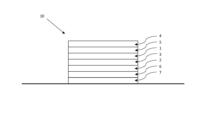
- FIG. 1 shows an example of a laminated optical film having a cured product layer of the adhesive composition for laminated optical films according to the present invention as an adhesive layer.
- a first optical film 1 and a second optical film 2 are laminated via an adhesive layer 3, which is a cured product layer of the adhesive composition for laminated optical films according to the present invention.
- the adhesive composition for laminated optical films according to the present invention has a high refractive index due to stable dispersion of metal oxide particles.
- the refractive index difference between the first optical film 1 and the adhesive layer 3 can be reduced, and similarly, the refractive index difference between the second optical film 2 and the adhesive layer 3 can be reduced, so that interference unevenness in the laminated optical film can be suppressed and visibility can be improved.
- the laminated optical film according to the present invention may be a laminated optical film in which at least a first optical film and a second optical film are laminated via an adhesive layer which is a cured layer of the adhesive composition for laminated optical films according to the present invention, and may further include any optical film.
- the laminated optical film 10 shown in FIG. 1 includes a polarizer 5 on the first optical film 1 (on the viewing side) and further includes a transparent protective film 4. Note that an adhesive layer is usually provided between the first optical film 1 and the polarizer 5, and between the polarizer 5 and the transparent protective film 4 (omitted in FIG.
- the laminated optical film 10 shown in FIG. 1 also includes an organic light-emitting diode layer 7 below the second optical film (on the display device side) via a pressure-sensitive adhesive layer 6.
- the adhesive composition for laminated optical films according to the present invention contains metal oxide particles, but further contains at least one compound selected from the group consisting of isocyanurate compounds and polysiloxane compounds, which allows the metal oxide particles to be stably dispersed, thereby making it possible to keep the viscosity of the composition low. This allows the adhesive composition for laminated optical films to be applied thinly onto the optical film, making it possible to reduce the thickness of the adhesive layer.
- the thickness of the adhesive layer provided in the laminated optical film according to the present invention is preferably 0.1 to 5 ⁇ m, and more preferably 0.3 to 3 ⁇ m.
- examples of the first optical film and the second optical film that constitute the laminated optical film include a polarizer, a transparent protective film, and a retardation film.
- the polarizer is not particularly limited, and various polarizers can be used.
- polarizers include hydrophilic polymer films such as polyvinyl alcohol films, partially formalized polyvinyl alcohol films, and partially saponified ethylene-vinyl acetate copolymer films, which have been subjected to uniaxial stretching after iodine has been adsorbed thereon.
- the thickness of the polarizer can be, for example, 3 to 20 ⁇ m.
- a thin polarizer having a thickness of 3 ⁇ m or more and 15 ⁇ m or less as the polarizer.
- the thickness is 12 ⁇ m or less, and even more preferable that the thickness is 10 ⁇ m or less, and especially preferable that the thickness is 8 ⁇ m or less.
- Such a thin polarizer has little thickness unevenness, excellent visibility, and also has excellent durability against thermal shock due to little dimensional change.
- a polarizer obtained by dyeing a polyvinyl alcohol-based film with iodine and stretching it uniaxially can be produced, for example, by dyeing the polyvinyl alcohol by immersing it in an aqueous solution of iodine and stretching it to 3 to 7 times its original length.
- the solution may contain boric acid, zinc sulfate, zinc chloride, etc., or it may be immersed in an aqueous solution of potassium iodide, etc.
- the polyvinyl alcohol-based film may be immersed in water and washed before dyeing.
- Stretching may be performed after dyeing with iodine, or it may be stretched while dyeing, or it may be dyed with iodine after stretching. Stretching may be performed in an aqueous solution of boric acid, potassium iodide, etc., or in a water bath.
- the polarizer preferably contains boric acid from the viewpoints of stretching stability and humidification reliability. Furthermore, the boric acid content in the polarizer is preferably 22% by mass or less, and more preferably 20% by mass or less, based on the total amount of the polarizer, from the viewpoints of suppressing the occurrence of through cracks. From the viewpoints of stretching stability and humidification reliability, the boric acid content in the polarizer is preferably 10% by mass or more, and more preferably 12% by mass or more, based on the total amount of the polarizer.
- thin polarizers include: Patent No. 4751486 specification, Patent No. 4751481 specification, Patent No. 4815544 specification, Patent No. 5048120 specification, International Publication No. 2014/077599, International Publication No. WO 2014/077636, or thin polarizers obtained by the manufacturing methods described therein.
- the thin polarizer is preferably obtained by a manufacturing method including a step of stretching in a boric acid aqueous solution as described in Patent Nos. 4751486, 4751481, and 4815544, among which a step of stretching in a laminate and a step of dyeing, because it can be stretched at a high magnification and the polarization performance can be improved.
- a manufacturing method including a step of supplementary air stretching before stretching in a boric acid aqueous solution as described in Patent Nos. 4751481 and 4815544.
- These thin polarizers can be obtained by a manufacturing method including a step of stretching a polyvinyl alcohol resin (hereinafter also referred to as PVA-based resin) layer and a resin substrate for stretching in a laminate and a step of dyeing.
- PVA-based resin polyvinyl alcohol resin
- thermoplastic resin excellent in transparency, mechanical strength, thermal stability, moisture blocking property, isotropy, etc.
- thermoplastic resins include cellulose resins such as triacetyl cellulose-based resin films, polyester resins, polyethersulfone resins, polysulfone resins, polycarbonate resins, polyamide resins, polyimide resins, polyolefin resins, (meth)acrylic resins, cyclic polyolefin resins (norbornene-based resins), polyarylate resins, polystyrene resins, polyvinyl alcohol resins, and mixtures thereof.
- the transparent protective film may contain one or more suitable additives.
- additives include ultraviolet absorbers, antioxidants, lubricants, plasticizers, release agents, coloring inhibitors, flame retardants, nucleating agents, antistatic agents, pigments, colorants, etc.
- the content of the above thermoplastic resin in the transparent protective film is preferably 50 to 100% by weight, more preferably 50 to 99% by weight, even more preferably 60 to 98% by weight, and particularly preferably 70 to 97% by weight. If the content of the thermoplastic resin in the transparent protective film is 50% by weight or less, the inherent high transparency of the thermoplastic resin may not be fully exhibited.
- the transparent protective film one having excellent transparency, mechanical strength, thermal stability, moisture blocking properties, isotropy, etc. is preferred, and one having a moisture permeability of 150 g/ m2 /24 h or less is more preferred, one having a moisture permeability of 140 g/ m2 /24 h or less is particularly preferred, and one having a moisture permeability of 120 g/ m2 /24 h or less is even more preferred.
- Functional layers such as a hard coat layer, an anti-reflection layer, an anti-sticking layer, a diffusion layer, or an anti-glare layer can be provided on the surface of the transparent protective film to which the polarizer is not attached.
- the above-mentioned functional layers such as the hard coat layer, the anti-reflection layer, the anti-sticking layer, the diffusion layer, and the anti-glare layer can be provided on the transparent protective film itself, or can be provided separately from the transparent protective film.
- the thickness of the transparent protective film can be determined as appropriate, but is generally about 1 to 500 ⁇ m in terms of strength, ease of handling, thinness, etc., with 1 to 300 ⁇ m being preferred, and 5 to 200 ⁇ m being even more preferred. Furthermore, 10 to 200 ⁇ m is more preferred, with 20 to 80 ⁇ m being more preferred.
- a retardation film having a front retardation of 40 nm or more and/or a thickness retardation of 80 nm or more can be used as the transparent protective film.
- the front retardation is usually controlled to be in the range of 40 to 200 nm
- the thickness retardation is usually controlled to be in the range of 80 to 300 nm.
- the retardation film also functions as the transparent protective film, making it possible to achieve a thinner film.
- phase difference films examples include birefringent films made by uniaxially or biaxially stretching polymer materials, oriented films of liquid crystal polymers, and films in which an oriented layer of liquid crystal polymer is supported by a film. There are no particular restrictions on the thickness of the phase difference film, but it is generally around 1 to 150 ⁇ m.
- the retardation film may be any of the following formulas (1) to (3): 0.70 ⁇ Re[450]/Re[550] ⁇ 0.97...(1) 1.5 ⁇ 10 -3 ⁇ n ⁇ 6 ⁇ 10 -3 ...(2) 1.13 ⁇ NZ ⁇ 1.50...(3) (wherein Re[450] and Re[550] are in-plane retardation values of the retardation film measured with light having wavelengths of 450 nm and 550 nm at 23° C., respectively; ⁇ n is in-plane birefringence, which is nx-ny, where nx and ny are the refractive indices in the slow axis direction and fast axis direction of the retardation film, respectively; and NZ is the ratio of nx-nz, which is the thickness direction birefringence, to nx-ny, which is the in-plane birefringence, where nz is the refractive index in the thickness direction of the retardation film.)
- a reverse wavelength dispersion type retardation film that satis
- the laminated optical film according to the present invention may be provided with a retardation layer.
- the retardation layer may be a single layer or multiple layers, and the retardation layer may also serve as a protective layer for the polarizer.
- a liquid crystal compound is preferably used to form the retardation layer, and a solvent containing the liquid crystal compound can be applied using, for example, a wire bar, a gap coater, a comma coater, a gravure coater, a slot die, or the like.
- the applied liquid crystal solution may be dried naturally or by heating. It is preferable that the liquid crystal solution is applied at a concentration lower than the isotropic phase-liquid crystal phase transition concentration, i.e., in an isotropic phase state. In this case, stable alignment can be achieved by a method such as rubbing treatment or photoalignment.
- the laminated optical film according to the present invention can be produced, for example, by the following production method.
- a method for producing a laminated optical film in which at least a first optical film and a second optical film are laminated via an adhesive layer comprising the steps of: applying an adhesive composition for laminated optical films to one or both of a bonding surface of the first optical film and a bonding surface of the second optical film; bonding the first optical film and the second optical film together; and bonding the first optical film and the second optical film via the adhesive layer formed by irradiating the first optical film side or the second optical film side with active energy rays to cure at least the adhesive composition for laminated optical films, the adhesive composition for laminated optical films comprising a curable component, phenoxybenzyl (meth)acrylate, metal oxide particles and a leveling agent, and the leveling agent comprising at least one selected from the group consisting of an isocyanurate compound and a polysiloxane compound.
- the method for coating the adhesive composition for laminated optical films on one or both of the bonding surface of the first optical film and the bonding surface of the second optical film is appropriately selected depending on the viscosity of the composition and the desired thickness, and examples include a reverse coater, a gravure coater (direct, reverse or offset), a bar reverse coater, a roll coater, a die coater, a bar coater, a rod coater, etc.
- the first optical film and/or the second optical film may be subjected to a surface modification treatment before the coating step.
- a surface modification treatment on the polarizer.
- Examples of surface modification treatments include corona treatment, plasma treatment, and itro treatment, with corona treatment being particularly preferable.
- Corona treatment generates reactive functional groups such as carbonyl groups and amino groups on the polarizer surface, improving adhesion to the adhesive layer.
- the ashing effect removes foreign matter from the surface and reduces surface irregularities, making it possible to create a laminated optical film with excellent appearance characteristics.
- the first optical film and the second optical film are bonded together using a roll laminator or the like via the adhesive composition for laminated optical films applied as described above (bonding process).
- active energy rays (electron beams, ultraviolet rays, visible light, etc.) are irradiated to cure the adhesive composition for laminated optical films to form an adhesive layer.
- the active energy rays (electron beams, ultraviolet rays, visible light, etc.) can be irradiated from any appropriate direction.
- the acceleration voltage of the electron beam irradiation is preferably 5 kV to 300 kV, more preferably 10 kV to 250 kV. If the acceleration voltage is less than 5 kV, the electron beam may not reach the adhesive, resulting in insufficient curing, and if the acceleration voltage exceeds 300 kV, the penetration force through the sample may be too strong, resulting in damage to the first optical film and the second optical film.
- the irradiation dose is 5 to 100 kGy, more preferably 10 to 75 kGy.
- the adhesive may not be cured sufficiently, and if it exceeds 100 kGy, the first optical film and the second optical film may be damaged, resulting in a decrease in mechanical strength and yellowing, and the specified optical characteristics may not be obtained.
- Electron beam irradiation is usually performed in an inert gas, but may be performed in air or with a small amount of oxygen introduced if necessary.
- appropriate oxygen introduction can be used to intentionally cause oxygen inhibition on the surfaces of the first and second optical films that are first hit by the electron beam, preventing damage to the first and second optical films and allowing the electron beam to be efficiently irradiated only to the adhesive.
- the active energy rays those including visible light in the wavelength range of 380 nm to 450 nm, and in particular active energy rays with the greatest irradiation amount of visible light in the wavelength range of 380 nm to 450 nm.
- a transparent protective film ultraviolet-opaque transparent protective film
- ultraviolet absorption ability When using ultraviolet rays and visible light, and a transparent protective film (ultraviolet-opaque transparent protective film) with ultraviolet absorption ability is used as the optical film, light with a wavelength shorter than approximately 380 nm is absorbed, so that light with a wavelength shorter than 380 nm does not reach the curable resin composition and does not contribute to the polymerization reaction.
- the ratio of the integrated illuminance in the wavelength range of 380 to 440 nm to the integrated illuminance in the wavelength range of 250 to 370 nm is preferably 100:0 to 100:50, more preferably 100:0 to 100:40.
- the active energy ray is preferably a gallium-encapsulated metal halide lamp or an LED light source that emits light in the wavelength range of 380 to 440 nm.
- a light source containing ultraviolet rays and visible light such as a low pressure mercury lamp, a medium pressure mercury lamp, a high pressure mercury lamp, an ultra-high pressure mercury lamp, an incandescent lamp, a xenon lamp, a halogen lamp, a carbon arc lamp, a metal halide lamp, a fluorescent lamp, a tungsten lamp, a gallium lamp, an excimer laser, or sunlight can be used, and a bandpass filter can be used to block ultraviolet rays with a wavelength shorter than 380 nm.
- the line speed depends on the curing time of the adhesive composition for laminated optical films, but is preferably 1 to 500 m/min, more preferably 5 to 300 m/min, and even more preferably 10 to 100 m/min. If the line speed is too slow, productivity will be poor, or the damage to the first optical film and the second optical film will be too great, making it impossible to produce a laminated optical film that can withstand durability tests and the like. If the line speed is too high, the adhesive composition for laminated optical films will not cure sufficiently, and the desired adhesion may not be obtained.
- the laminated optical film according to the present invention may also be provided with an adhesive layer for bonding to other components such as a liquid crystal cell.
- an adhesive layer for bonding to other components such as a liquid crystal cell.
- the adhesive that forms the adhesive layer there are no particular limitations on the adhesive that forms the adhesive layer, but it is possible to appropriately select and use an adhesive that uses, as its base polymer, an acrylic polymer, a silicone polymer, polyester, polyurethane, polyamide, polyether, a fluorine-based polymer, or a rubber-based polymer.
- an adhesive that has excellent optical transparency, such as an acrylic adhesive and exhibits adhesive properties such as appropriate wettability, cohesion, and adhesion, and has excellent weather resistance and heat resistance.
- the adhesive layer can be provided on one or both sides of the laminated optical film of the present invention as a superimposed layer of different compositions or types.
- the adhesive layers on the front and back of the laminated optical film of the present invention can be of different compositions, types, thicknesses, etc.
- the thickness of the adhesive layer can be appropriately determined depending on the intended use, adhesive strength, etc., and is generally 1 to 500 ⁇ m, preferably 1 to 200 ⁇ m, and particularly preferably 1 to 100 ⁇ m.
- a separator is temporarily attached to cover the exposed surface of the adhesive layer to prevent contamination until it is put into practical use. This prevents contact with the adhesive layer during normal handling.
- any suitable thin material such as plastic film, rubber sheet, paper, cloth, nonwoven fabric, net, foam sheet, metal foil, or laminates thereof, coated as necessary with a suitable release agent such as silicone, long-chain alkyl, fluorine, or molybdenum sulfide, may be used in accordance with conventional methods.
- the laminated optical film according to the present invention can be preferably used in the formation of various devices such as liquid crystal display devices.
- the formation of liquid crystal display devices can be carried out in a conventional manner. That is, liquid crystal display devices are generally formed by appropriately assembling components such as a liquid crystal cell, a polarizing film or a laminated optical film, and, if necessary, a lighting system, and incorporating a driving circuit, but in the present invention, there are no particular limitations other than the use of the polarizing film or laminated optical film according to the present invention, and the formation can be carried out in a conventional manner.
- the liquid crystal cell any type can be used, such as TN type, STN type, ⁇ type, etc.
- suitable liquid crystal display devices such as those in which an optical laminate is disposed on one or both sides of a liquid crystal cell, or those in which a backlight or reflector is used in the lighting system.
- the optical laminate according to the present invention can be disposed on one or both sides of a liquid crystal cell.
- optical laminates When optical laminates are disposed on both sides, they may be the same or different.
- suitable components such as a diffuser plate, anti-glare layer, anti-reflection film, protective plate, prism array, lens array sheet, light diffuser plate, backlight, etc. can be disposed in one or more layers in suitable positions.
- Metal oxide particle/zirconia dispersion 1 a phenoxybenzyl acrylate dispersion of zirconium oxide having an average particle size of 100 nm (particle concentration: 50% by weight)
- Zirconia Dispersion 2 Phenoxybenzyl acrylate dispersion of zirconium oxide having an average particle size of 20 nm (particle concentration 50% by weight)
- Zirconia Dispersion 3 Phenoxybenzyl acrylate dispersion of zirconium oxide having an average particle size of 8 nm (particle concentration 50% by weight)
- Zirconia Dispersion 4 Phenoxydiethylene glycol acrylate dispersion of zirconium oxide having an average particle size of 8 nm (particle concentration 50% by weight)
- Zirconia Dispersion 5 Phenoxyethyl acrylate dispersion of zirconium oxide having an average particle size of 8 nm (particle concentration 50% by weight) Titan
- Phenoxyethyl acrylate Trade name "Light Acrylate PO-A", manufactured by Kyoeisha Chemical Co., Ltd.
- Curable component Compound represented by general formula (1) (3-methacrylamide phenylboronic acid): Trade name "MAPBA”, manufactured by Junsei Chemical Co., Ltd.
- Leveling agent a leveling agent containing a modified isocyanurate compound having a (meth)acryloyl group and a modified polysiloxane compound having a (meth)acryloyl group
- BYK UV-3505" trade name "BYK UV-3505"
- Acrylic oligomer obtained by polymerizing (meth)acrylic monomers trade name "ARUFON UP-1190", manufactured by Toagosei Co., Ltd.
- Photopolymerization initiator 1 bis(2,4,6-trimethylbenzoyl)phenylphosphine oxide: trade name "Omnirad 819", manufactured by IGM Resins B.
- Photopolymerization initiator 2 (1-hydroxycyclohexyl phenyl ketone): trade name "Omnirad 184", manufactured by IGM Resins B.V.
- Photopolymerization initiator 3 (diethylthioxanthone): trade name "KAYACURE DETX-S”, manufactured by Nippon Kayaku Co., Ltd.
- the above zirconia dispersions 1 to 5 and titania dispersion 1 were produced by the following methods.
- the zirconia dispersion A contained zirconium oxide/dispersant A/POB-A in a weight ratio of 50/2.5/47.5.
- Zirconia Dispersion 2 which is a monomer dispersion of zirconium oxide.
- This Zirconia Dispersion A contains zirconium oxide/Dispersant A/POB-A in a weight ratio of 50/2.5/47.5.
- Zirconia Dispersion A which is a monomer dispersion of zirconium oxide.
- This Zirconia Dispersion 3 contains zirconium oxide/Dispersant A/POB-A in a weight ratio of 50/2.5/47.5.
- zirconia dispersion 4 which is a monomer dispersion of zirconium oxide.
- This zirconia dispersion A contains zirconium oxide/dispersant A/P2H-A in a weight ratio of 50/2.5/47.5.
- Zirconia Dispersion 5 which is a monomer dispersion of zirconium oxide.
- This Zirconia Dispersion A contains zirconium oxide/Dispersant A/PO-A in a weight ratio of 50/2.5/47.5.
- zirconia dispersion A which is a monomer dispersion of zirconium oxide.
- This zirconia dispersion A contains zirconium oxide/dispersant A/POB-A in a weight ratio of 30/1.5/68.5.
- a laminate having a 9 ⁇ m-thick PVA layer formed on an amorphous PET substrate was subjected to auxiliary air stretching at a stretching temperature of 130° C. to produce a stretched laminate, the stretched laminate was then dyed to produce a colored laminate, and the colored laminate was further stretched integrally with the amorphous PET substrate by stretching in boric acid water at a stretching temperature of 65° C. to a total stretch ratio of 5.94 times to produce an optical film laminate including a 5 ⁇ m-thick PVA layer.
- the PVA molecules of the PVA layer formed on the amorphous PET substrate were highly oriented, and an optical film laminate including a 5 ⁇ m-thick PVA layer was obtained, which constitutes a thin polarizer in which iodine adsorbed by dyeing was highly oriented in one direction as a polyiodine ion complex.
- TAC Triacetyl cellulose
- a photopolymerizable liquid crystal compound exhibiting a nematic liquid crystal phase (BASF's "Paliocolor LC242") was dissolved in cyclopentanone to prepare a solution with a solid content of 30% by weight.
- a leveling agent and a polymerization initiator (manufactured by IGM Resins, "BYK-360") were added to prepare a liquid crystal composition solution.
- the amounts of the components were 0.01 parts by weight and 3 parts by weight, respectively.
- a biaxially stretched norbornene-based film (ZEON Corporation's "ZEONORFILM", thickness: 33 ⁇ m, front retardation: 135 nm) was used as a substrate, and the above liquid crystal composition was applied onto the substrate with a bar coater so that the phase difference was ⁇ /2, and the liquid crystal was aligned by heating at 100° C. for 3 minutes. After cooling to room temperature, the substrate was irradiated with ultraviolet light with an integrated light quantity of 400 mJ/cm 2 in a nitrogen atmosphere for photocuring, to obtain a laminate provided with a homogeneously aligned liquid crystal layer.
- a biaxially stretched norbornene-based film (ZEON Corporation's "ZEONORFILM", thickness: 33 ⁇ m, front retardation: 135 nm) was used as a substrate, and the above liquid crystal composition was applied to the substrate with a bar coater so that the phase difference was ⁇ /4, and the liquid crystal was aligned by heating at 100° C. for 3 minutes. After cooling to room temperature, the substrate was irradiated with ultraviolet light with an integrated light quantity of 400 mJ/cm 2 in a nitrogen atmosphere for photocuring, to obtain a laminate provided with a homogeneously aligned liquid crystal layer.
- MCD coater manufactured by Fuji Kikai Co., Ltd.
- active energy rays were irradiated from the TAC film side using a visible light irradiation device (Light HAMMER10 Mark III manufactured by Heraeus, bulb: V bulb, peak illuminance: 1600 mW/cm 2 , cumulative irradiation amount 1000/mJ/cm 2 , illuminance and cumulative irradiation amount of active energy rays are Power Puck 2 (manufactured by EIT, UVV measured value)) to cure the adhesive composition for laminated optical films, thereby producing a polarized film (1) in which an amorphous PET substrate, a polarizer, and a TAC film were laminated via a cured layer of the adhesive composition for laminated optical films.
- the thickness of the cured layer of the adhesive composition for laminated optical films was 1 ⁇ m.
- the amorphous PET substrate of the polarizing film (1) was peeled off, and the polarizer surface of the peeled surface was subjected to a corona treatment using a corona treatment machine at a treatment density of 50 W ⁇ min/m 2.
- the adhesive composition for laminated optical films according to Reference Example 2 was applied to the polarizer that had been subjected to the corona treatment using an MCD coater (manufactured by Fuji Machine Co., Ltd.) (cell shape: honeycomb, gravure roll line count: 700 rolls/inch, rotation speed 140%/to line speed), and the homogeneously aligned liquid crystal layer surface of the ⁇ /2 retardation film that had been subjected to the corona treatment using the same corona treatment machine at a treatment density of 50 W ⁇ min/m 2 was laminated to the slow layer axis of the ⁇ /2 retardation film by a roll machine so that the slow layer axis of the ⁇ /2 retardation film was in a 15° relationship with the transmission axis of the polarizer (the line speed of lamination was 15 m/min).
- MCD coater manufactured by Fuji Machine Co., Ltd.
- active energy rays were irradiated from the ⁇ /2 retardation film side using a visible light irradiation device (Light HAMMER10 Mark III manufactured by Heraeus, bulb: V bulb, peak illuminance: 1600 mW/cm 2 , cumulative irradiation amount 1000/mJ/cm 2 , illuminance and cumulative irradiation amount of active energy rays are Power Puck 2 (manufactured by EIT, UVV measured value)) to cure the adhesive composition for laminated optical films, thereby producing a polarized film (2) in which the ⁇ /2 retardation film, polarizer, and TAC film were laminated via the cured layer of the adhesive composition for laminated optical films.
- the thickness of the cured layer of the adhesive composition for laminated optical films was 1 ⁇ m.
- the adhesive composition for laminated optical films according to Examples 1 to 8, Comparative Examples 1 to 2, and Reference Examples 1 to 2, which are formulated as described in Tables 1 and 2, was applied to the corona-treated ⁇ /2 retardation film surface using an MCD coater (manufactured by Fuji Machine Co., Ltd.) (cell shape: honeycomb, gravure roll line count: 700 rolls/inch, rotation speed 140%/to line speed), and the homogeneously aligned liquid crystal layer surface of the ⁇ /4 retardation film that was subjected to a corona treatment at a treatment density of 50 W ⁇ min/m 2 using the same corona treatment machine was laminated to the ⁇ /2 retardation film surface using a roll machine so that the slow layer axis of the ⁇ /4 retardation film was in a 75° relationship with the transmission axis of the polarizer (the line speed for lamination was 15 m/min).
- MCD coater manufactured by Fuji Machine Co., Ltd.
- active energy rays were irradiated from the ⁇ /4 retardation film side using a visible light irradiation device (Light HAMMER10 Mark III manufactured by Heraeus, bulb: V bulb, peak illuminance: 1600 mW/cm 2 , cumulative exposure dose 1000/mJ/cm 2 , the illuminance and cumulative exposure dose of active energy rays were Power Puck 2 (manufactured by EIT, UVV measured values)) to cure the adhesive compositions for laminated optical films according to Examples 1 to 8, Comparative Examples 1 to 2, and Reference Examples 1 to 2, thereby producing laminated optical films in which the ⁇ /4 retardation film surface, the ⁇ /2 retardation film, the polarizer, and the TAC film were laminated via the cured layer of the adhesive composition for laminated optical films.
- the thickness of the cured layer of the adhesive composition for laminated optical films was 1 ⁇ m.
- Viscosity of adhesive composition for laminated optical film The viscosity of the adhesive compositions for laminated optical films according to Examples 1 to 8, Comparative Examples 1 to 2 and Reference Examples 1 to 2 was measured using an E-type viscometer TVE22LT manufactured by Toki Sangyo Co., Ltd.
- a cycloolefin polymer film (COP film) was coated with the adhesive composition for laminated optical films according to Examples 1 to 8, Comparative Examples 1 to 2, and Reference Examples 1 to 2 (thickness 100 ⁇ m), and the same COP film was attached to the coated surface, and the above-mentioned visible light was irradiated using an active energy ray irradiation device to obtain a cured layer (single film) of the adhesive composition for laminated optical films according to Examples 1 to 8, Comparative Examples 1 to 2, and Reference Examples 1 to 2.
- the in-plane refractive index and the thickness direction refractive index of the obtained cured layer were measured using a prism coupler SPA-4000 (manufactured by Cylon Technology), and the average value of these was taken as the average refractive index of the adhesive layer.
- the measurement temperature was 23° C., and the measurement wavelength was 594 nm.
- Adhesive was applied to the optical film using a gravure roll according to the procedure described in the above laminated optical film manufacturing example, and the adhesive-coated surface was visually inspected 5 seconds later. A rating of 0 was given if the adhesive was applied to the entire surface of the optical film, and an X was given if the adhesive was repelled from the optical film surface and the optical film surface was visible in some places.
- the refractive index is improved in the cured product layer (adhesive layer) of the adhesive composition for laminated optical films according to Comparative Examples 1 and 2 and Examples 1 to 8, which contain metal oxide particles, compared with the cured product layer (adhesive layer) of the adhesive composition for laminated optical films according to Reference Examples 1 and 2, which does not contain metal oxide particles.
- the adhesive composition for laminated optical films according to Comparative Examples 1 and 2 caused precipitation due to the metal oxide particles not being stably dispersed, and the liquid stability was deteriorated.
- repelling occurred during coating, and a large number of air bubbles were generated when the optical films were bonded together.
Landscapes
- Chemical & Material Sciences (AREA)
- Organic Chemistry (AREA)
- Chemical Kinetics & Catalysis (AREA)
- Health & Medical Sciences (AREA)
- Medicinal Chemistry (AREA)
- Polymers & Plastics (AREA)
- Inorganic Chemistry (AREA)
- Adhesives Or Adhesive Processes (AREA)
- Adhesive Tapes (AREA)
- Laminated Bodies (AREA)
Abstract
少なくとも2枚の光学フィルムを接着させるための積層光学フィルム用接着剤組成物であって、硬化性成分、芳香環骨格を含有する(メタ)アクリレート、金属酸化物粒子およびレベリング剤を含有し、レベリング剤が、イソシアヌレート化合物およびポリシロキサン化合物からなる群より選択される少なくとも1種を含有するものである積層光学フィルム用接着剤組成物。
Description
本発明は、少なくとも2枚の光学フィルムを接着させるための積層光学フィルム用接着剤組成物および積層光学フィルムに関する。当該積層光学フィルムは液晶表示装置(LCD)、有機EL表示装置、CRT、PDPなどの画像表示装置を形成し得る。
画像表示装置の表示画面における外光反射や背景の映り込みなどによる視認性不良を改善するために、表示パネルの視認側に円偏光板が配置された画像表示装置が知られている。
例えば、下記特許文献1では、直線偏光板と、1/2波長層と、活性エネルギー線硬化型接着剤を硬化させてなる第1接着層と、1/4波長層とをこの順に備え、1/2波長層の進相軸と、直線偏光板の透過軸とのなす角度が10°以上20°以下であり、第1接着層の波長589nmでの屈折率と、1/2波長層の波長589nmでの進相軸方向の屈折率との差の絶対値が0.05未満である偏光板複合体が記載されている。
また、下記特許文献2では、偏光子と第1位相差層と第2位相差層とをこの順に備え、偏光子と第1位相差層とが第1接着剤層を介して貼り合わされ、第1位相差層と第2位相差層とが第2接着剤層を介して貼り合わされ、第1位相差層および第2位相差層の厚みが5μm以下であり、第2接着剤層の平均屈折率は、1.55以上であるとともに、第1位相差層の平均屈折率との差、および第2位相差層の平均屈折率との差が0.08未満である位相差層付偏光板が記載されている。
ところで、下記特許文献3では、光学用途に用いられる光学シートなどに必要とされる種々の特性のバランスが図られた活性エネルギー線硬化型樹脂組成物および硬化物を提供することを目的として、金属酸化物ナノ粒子(A)、フェノキシベンジル(メタ)アクリレート類(B)および(ポリ)アルキレングリコール構造を有する二官能(メタ)アクリレート(C)を含有することを特徴とする活性エネルギー線硬化型樹脂組成物が記載されている。
本発明者が鋭意検討した結果、上記特許文献1および2に記載の技術では、積層フィルムの層間接着剤の屈折率を安定的に向上させる場合に、さらなる改良の余地があることが判明した。なお、上記特許文献3に記載の技術はレンズシートを製造するための活性エネルギー線硬化型樹脂組成物に関するものであり、そもそも少なくとも2枚の光学フィルムを接着させる用途を想定したものではない。加えて、積層光学フィルム用接着剤組成物は、光学フィルムに対し、かなり薄い膜厚で塗工されるため、金属酸化物粒子を含有する場合に、その液安定性に優れることが要求されるが、上記特許文献3に記載の技術ではそのような課題について検討されておらず、ましてやその課題解決の手段について記載も示唆もない。
本発明は上記実情に鑑みて開発されたものであり、接着剤層としたときの屈折率が向上するとともに、金属酸化物粒子が安定に分散することに起因して、液安定性に優れた積層光学フィルム用接着剤組成物を提供することを目的とする。
さらには、積層光学フィルム用接着剤組成物の硬化物層を接着剤層として備える積層光学フィルムであって、屈折率が高い接着剤層を備える積層光学フィルムを提供することを目的とする。
上記課題は下記構成により解決し得る。即ち本発明は、少なくとも2枚の光学フィルムを接着させるための積層光学フィルム用接着剤組成物であって、硬化性成分、芳香環骨格を含有する(メタ)アクリレート、金属酸化物粒子およびレベリング剤を含有し、前記レベリング剤が、イソシアヌレート化合物およびポリシロキサン化合物からなる群より選択される少なくとも1種を含有するものであることを特徴とする積層光学フィルム用接着剤組成物(1)に関する。
上記積層光学フィルム用接着剤組成物(1)において、組成物中の全量を100質量%としたとき、前記イソシアヌレート化合物の含有量が0.05~10質量%である積層光学フィルム用接着剤組成物(2)が好ましい。
上記積層光学フィルム用接着剤組成物(1)において、組成物中の全量を100質量%としたとき、前記ポリシロキサン化合物の含有量が0.05~2.0質量%である積層光学フィルム用接着剤組成物(3)が好ましい。
上記積層光学フィルム用接着剤組成物(1)~(3)いずれかにおいて、組成物中の全量を100質量%としたとき、前記金属酸化物粒子の含有量が10~50質量%である積層光学フィルム用接着剤組成物(4)が好ましい。
上記積層光学フィルム用接着剤組成物(1)~(4)いずれかにおいて、組成物中の全量を100質量%としたとき、前記芳香環骨格を含有する(メタ)アクリレートの含有量が30~70質量%である積層光学フィルム用接着剤組成物(5)が好ましい。
上記積層光学フィルム用接着剤組成物(1)~(5)いずれかにおいて、前記芳香環骨格を含有する(メタ)アクリレートが、多環式芳香環骨格を有する(メタ)アクリレートおよび2個以上の芳香環を有する(メタ)アクリレートからなる群より選択される少なくとも1種を含有するものである積層光学フィルム用接着剤組成物(6)が好ましい。
上記積層光学フィルム用接着剤組成物(1)~(6)いずれかにおいて、前記芳香環骨格を含有する(メタ)アクリレートが、フェノキシベンジル(メタ)アクリレートである積層光学フィルム用接着剤組成物(7)が好ましい。
上記積層光学フィルム用接着剤組成物(1)~(7)いずれかにおいて、さらに水酸基含有モノマーを含有する積層光学フィルム用接着剤組成物(8)が好ましい。
上記積層光学フィルム用接着剤組成物(1)~(8)いずれかにおいて、さらに下記一般式(1):

で表される化合物(ただし、Xは反応性基であり、Yは分岐鎖を有してもよい炭素数1~12のアルキレン基、または置換基を有してもよいフェニレン基であり、R1およびR2はそれぞれ独立に、水素原子、置換基を有してもよい、脂肪族炭化水素基、アリール基、またはヘテロ環基を表す)を含有する積層光学フィルム用接着剤組成物(9)が好ましい。
上記積層光学フィルム用接着剤組成物(9)において、組成物中の全量を100質量%としたとき、前記一般式(1)で表される化合物の含有量が0.1~10質量%である積層光学フィルム用接着剤組成物(10)が好ましい。
上記積層光学フィルム用接着剤組成物(1)~(10)いずれかにおいて、25℃における粘度が100[mPa・s]以下である積層光学フィルム用接着剤組成物(11)が好ましい。
また本発明は、接着剤層を介して、少なくとも第1光学フィルムおよび第2光学フィルムが積層された積層光学フィルムであって、前記接着剤層が上記積層光学フィルム用接着剤組成物(1)~(11)いずれかの硬化物層であることを特徴とする積層光学フィルム(12)に関する。
本発明に係る積層光学フィルム用接着剤組成物は、硬化性成分、芳香環骨格を含有する(メタ)アクリレート、および金属酸化物粒子を含有するため、接着剤層としたとき、屈折率を向上させることができる。ただし、組成物中の金属酸化物粒子は安定に分散し難く、その結果、特に保存中や光学フィルムに塗工する際の液安定性が悪化することが懸念される。しかしながら、本発明に係る積層光学フィルム用接着剤組成物は、特定のレベリング剤、具体的にはイソシアヌレート化合物およびポリシロキサン化合物からなる群より選択される少なくとも1種を含有するため、金属酸化物粒子が安定に分散することに起因して、積層光学フィルム用接着剤組成物の液安定性に優れる。加えて、積層光学フィルム用接着剤組成物を光学フィルムに塗工した際、光学フィルム上で塗工膜の一部に欠陥が生ずること(所謂「塗工時のハジキ」)を抑制し、積層光学フィルム用接着剤組成物を介して2枚の光学フィルムを貼り合わせた際に気泡が発生することを抑制することができる。さらに、金属酸化物粒子が安定に分散することに起因して、組成物の粘度を低く抑えることができる。このため、積層光学フィルム用接着剤組成物を光学フィルム上に薄く塗工できるため、接着剤層および積層光学フィルムの薄膜化に有効である。
本発明に係る積層光学フィルム用接着剤組成物は、硬化性成分、芳香環骨格を含有する(メタ)アクリレート、金属酸化物粒子およびレベリング剤を含有する。
本発明に係る積層光学フィルム用接着剤組成物は、組成物中にイソシアヌレート化合物およびポリシロキサン化合物からなる群より選択される少なくとも1種を含有することにより、金属酸化物粒子が安定に分散する。このため、金属酸化物粒子を含有するにもかかわらず、粘度を低く抑えることができる。積層光学フィルム用接着剤組成物を光学フィルム上に薄く塗工し、接着剤層および積層光学フィルムの薄型化を図る見地から、25℃における組成物の粘度を100[mPa・s]以下にすることが好ましく、60[mPa・s]以下にすることがより好ましい。
<レベリング剤>
本発明に係る積層光学フィルム用接着剤組成物は、レベリング剤として、イソシアヌレート化合物およびポリシロキサン化合物からなる群より選択される少なくとも1種を含有する。組成物中にイソシアヌレート化合物およびポリシロキサン化合物からなる群より選択される少なくとも1種を含有することにより、金属酸化物粒子が安定に分散することに起因して、積層光学フィルム用接着剤組成物の液安定性に優れる。さらに、組成物中に金属酸化物粒子とイソシアヌレート化合物およびポリシロキサン化合物からなる群より選択される少なくとも1種とを含有することにより、光学フィルム上での塗工時のハジキおよび気泡の発生を抑制することができる。上記効果をより高める見地から、本発明に係る積層光学フィルム用接着剤組成物は、イソシアヌレート化合物およびポリシロキサン化合物の両方を含有することが好ましい。積層光学フィルム用接着剤組成物中、イソシアヌレート化合物およびポリシロキサン化合物の両方を含有する場合、その配合量は、組成物中の全量を100質量%としたとき、0.1~4質量%であることが好ましく、0.1~2質量%であることがより好ましい。なお、後述のとおり、イソシアヌレート化合物を架橋剤としても配合する場合、積層光学フィルム用接着剤組成物中、イソシアヌレート化合物およびポリシロキサン化合物の両方を含有する場合、その配合量は、組成物中の全量を100質量%としたとき、0.1~14質量%であることが好ましく、0.1~7質量%であることがより好ましい。
本発明に係る積層光学フィルム用接着剤組成物は、レベリング剤として、イソシアヌレート化合物およびポリシロキサン化合物からなる群より選択される少なくとも1種を含有する。組成物中にイソシアヌレート化合物およびポリシロキサン化合物からなる群より選択される少なくとも1種を含有することにより、金属酸化物粒子が安定に分散することに起因して、積層光学フィルム用接着剤組成物の液安定性に優れる。さらに、組成物中に金属酸化物粒子とイソシアヌレート化合物およびポリシロキサン化合物からなる群より選択される少なくとも1種とを含有することにより、光学フィルム上での塗工時のハジキおよび気泡の発生を抑制することができる。上記効果をより高める見地から、本発明に係る積層光学フィルム用接着剤組成物は、イソシアヌレート化合物およびポリシロキサン化合物の両方を含有することが好ましい。積層光学フィルム用接着剤組成物中、イソシアヌレート化合物およびポリシロキサン化合物の両方を含有する場合、その配合量は、組成物中の全量を100質量%としたとき、0.1~4質量%であることが好ましく、0.1~2質量%であることがより好ましい。なお、後述のとおり、イソシアヌレート化合物を架橋剤としても配合する場合、積層光学フィルム用接着剤組成物中、イソシアヌレート化合物およびポリシロキサン化合物の両方を含有する場合、その配合量は、組成物中の全量を100質量%としたとき、0.1~14質量%であることが好ましく、0.1~7質量%であることがより好ましい。
<イソシアヌレート化合物>
イソシアヌレート化合物は、イソシアネートの三量化反応により形成されたイソシアヌレート環構造を含有する化合物である。本発明では特に、反応性基を有する変性イソシアヌレート化合物を使用することが好ましい。変性イソシアヌレート化合物が有する反応性基としては、重合性官能基が挙げられ、具体的には例えば(メタ)アクリロイル基、ビニル基、アリル基などのエチレン性二重結合を有するラジカル重合性官能基、グリシジル基などのエポキシ基、オキセタン基、ビニルエーテル基、環状エーテル基、環状チオエーテル基、ラクトン基などのカチオン重合性官能基などが挙げられる。積層光学フィルム用接着剤組成物中での反応性の観点から、反応性基として二重結合を有する変性イソシアヌレート化合物が好ましく、より好ましくは(メタ)アクリルロイル基を有する変性イソシアヌレート化合物である。積層光学フィルム用接着剤組成物中でのイソシアヌレート化合物の配合量は、組成物中の全量を100質量%としたとき、0.05~2質量%であることが好ましく、0.05~1質量%であることがより好ましい。
イソシアヌレート化合物は、イソシアネートの三量化反応により形成されたイソシアヌレート環構造を含有する化合物である。本発明では特に、反応性基を有する変性イソシアヌレート化合物を使用することが好ましい。変性イソシアヌレート化合物が有する反応性基としては、重合性官能基が挙げられ、具体的には例えば(メタ)アクリロイル基、ビニル基、アリル基などのエチレン性二重結合を有するラジカル重合性官能基、グリシジル基などのエポキシ基、オキセタン基、ビニルエーテル基、環状エーテル基、環状チオエーテル基、ラクトン基などのカチオン重合性官能基などが挙げられる。積層光学フィルム用接着剤組成物中での反応性の観点から、反応性基として二重結合を有する変性イソシアヌレート化合物が好ましく、より好ましくは(メタ)アクリルロイル基を有する変性イソシアヌレート化合物である。積層光学フィルム用接着剤組成物中でのイソシアヌレート化合物の配合量は、組成物中の全量を100質量%としたとき、0.05~2質量%であることが好ましく、0.05~1質量%であることがより好ましい。
なお、イソシアヌレート化合物は、組成物中での金属酸化物粒子の分散の安定化に寄与するだけでなく、例えば接着剤層としたときの硬化収縮率を低減する効果も奏する。したがって、本発明に係る積層光学フィルム用接着剤組成物中にイソシアヌレート化合物を架橋剤として配合する場合、イソシアヌレート化合物の配合量はより多い方がこの好ましく、具体的には組成物中の全量を100質量%としたとき、0.05~10質量%であることが好ましく、0.05~5質量%であることがより好ましい。
<ポリシロキサン化合物>
ポリシロキサン化合物は、ポリジメチルシロキサンなどのポリシロキサン骨格を有する化合物である。本発明では特に、反応性基を有する変性ポリシロキサン化合物を使用することが好ましい。変性ポリシロキサン化合物が有する反応性基としては、重合性官能基が挙げられ、具体的には例えば(メタ)アクリロイル基、ビニル基、アリル基などのエチレン性二重結合を有するラジカル重合性官能基、グリシジル基などのエポキシ基、オキセタン基、ビニルエーテル基、環状エーテル基、環状チオエーテル基、ラクトン基などのカチオン重合性官能基などが挙げられる。積層光学フィルム用接着剤組成物中での反応性の観点から、反応性基として二重結合を有する変性ポリシロキサン化合物が好ましく、より好ましくは(メタ)アクリルロイル基を有する変性ポリシロキサン化合物である。積層光学フィルム用接着剤組成物中でのポリシロキサン化合物の配合量は、組成物中の全量を100質量%としたとき、0.05~2質量%であることが好ましく、0.05~1質量%であることがより好ましい。
ポリシロキサン化合物は、ポリジメチルシロキサンなどのポリシロキサン骨格を有する化合物である。本発明では特に、反応性基を有する変性ポリシロキサン化合物を使用することが好ましい。変性ポリシロキサン化合物が有する反応性基としては、重合性官能基が挙げられ、具体的には例えば(メタ)アクリロイル基、ビニル基、アリル基などのエチレン性二重結合を有するラジカル重合性官能基、グリシジル基などのエポキシ基、オキセタン基、ビニルエーテル基、環状エーテル基、環状チオエーテル基、ラクトン基などのカチオン重合性官能基などが挙げられる。積層光学フィルム用接着剤組成物中での反応性の観点から、反応性基として二重結合を有する変性ポリシロキサン化合物が好ましく、より好ましくは(メタ)アクリルロイル基を有する変性ポリシロキサン化合物である。積層光学フィルム用接着剤組成物中でのポリシロキサン化合物の配合量は、組成物中の全量を100質量%としたとき、0.05~2質量%であることが好ましく、0.05~1質量%であることがより好ましい。
<金属酸化物粒子>
本発明に係る積層光学フィルム用接着剤組成物は金属酸化物粒子を含有する。金属酸化物粒子としては、例えば酸化ケイ素、酸化ジルコニウム、酸化チタン、酸化亜鉛、五酸化アンチモン、酸化スズ、酸化アルミニウム、酸化インジウム、インジウムスズ酸化物、酸化第二鉄、酸化セリウム、酸化イットリウム、酸化マンガン、酸化ホロミウム、酸化銅、酸化ビスマス、酸化コバルト、四三酸化コバルト、四三酸化鉄、酸化マグネシウム、酸化ランタン、酸化プラセオジム、酸化ネオジム、酸化サマリウム、酸化ユウロビウム、酸化ガドリニウム、酸化テルビウム、酸化ジスプロシウム、酸化エルビウム、酸化ツリウム、酸化イッテルビウム、酸化ルテチウム、酸化スカンジウム、五酸化タンタル、五酸化ニオブ、酸化イリジウム、酸化ロジウム、酸化ルテニウムおよびこれらを結合させた複合酸化物などが挙げられる。これらの中でも、酸化ジルコニウムおよび酸化チタンが好ましく、酸化ジルコニウムが特に好ましい。なお、本発明で使用する金属酸化物粒子は、上記で挙げた金属酸化物のみで構成されてもよく、あるいはその他の成分を含んでもよいが、粒子中の成分として金属酸化物が最大重量を占めることが好ましい。金属酸化物粒子の形状は、球状、楕円球状、立方体状、直方体状あるいはピラミッド形状など任意の形状を取り得る。なお本発明においては、金属酸化物粒子として、当業者に公知の手法により表面処理したものを使用してもよい。
本発明に係る積層光学フィルム用接着剤組成物は金属酸化物粒子を含有する。金属酸化物粒子としては、例えば酸化ケイ素、酸化ジルコニウム、酸化チタン、酸化亜鉛、五酸化アンチモン、酸化スズ、酸化アルミニウム、酸化インジウム、インジウムスズ酸化物、酸化第二鉄、酸化セリウム、酸化イットリウム、酸化マンガン、酸化ホロミウム、酸化銅、酸化ビスマス、酸化コバルト、四三酸化コバルト、四三酸化鉄、酸化マグネシウム、酸化ランタン、酸化プラセオジム、酸化ネオジム、酸化サマリウム、酸化ユウロビウム、酸化ガドリニウム、酸化テルビウム、酸化ジスプロシウム、酸化エルビウム、酸化ツリウム、酸化イッテルビウム、酸化ルテチウム、酸化スカンジウム、五酸化タンタル、五酸化ニオブ、酸化イリジウム、酸化ロジウム、酸化ルテニウムおよびこれらを結合させた複合酸化物などが挙げられる。これらの中でも、酸化ジルコニウムおよび酸化チタンが好ましく、酸化ジルコニウムが特に好ましい。なお、本発明で使用する金属酸化物粒子は、上記で挙げた金属酸化物のみで構成されてもよく、あるいはその他の成分を含んでもよいが、粒子中の成分として金属酸化物が最大重量を占めることが好ましい。金属酸化物粒子の形状は、球状、楕円球状、立方体状、直方体状あるいはピラミッド形状など任意の形状を取り得る。なお本発明においては、金属酸化物粒子として、当業者に公知の手法により表面処理したものを使用してもよい。
接着剤組成物中の金属酸化物粒子の安定性向上と、接着剤層の屈折率向上との見地から、使用する金属酸化物粒子の平均粒子径は、1~150nmであることが好ましく、1~50nmであることがより好ましい。本発明において金属酸化物粒子の平均粒子径は、透過型電子顕微鏡(TEM)、電界放射型透過電子顕微鏡(FE-TEM)および電界放射型走査電子顕微鏡(FE-SEM)などを使用して拡大観察し、無作為に例えば1000個の粒子を選択し、その最大長さを測定し、その算術平均を求めることにより算出可能である。
接着剤組成物中に配合する金属酸化物粒子の平均粒子径は、動的光散乱法やレーザー回折法によっても算出可能である。動的光散乱法やレーザー回折法によって算出する場合、平均粒子径は、レーザー回折・散乱法によって求めた粒度分布における積算値50%での粒径を意味する。
接着剤組成物中の金属酸化物粒子の安定性向上と、接着剤層の屈折率向上との見地から、使用する金属酸化物粒子の配合量は、組成物中の全量を100質量%としたとき、10~50質量%であることが好ましく、15~40質量%であることがより好ましい。
<芳香環骨格を含有する(メタ)アクリレート>
本発明に係る積層光学フィルム用接着剤組成物は、金属酸化物粒子と共に芳香環骨格を含有する(メタ)アクリレートを含有するため、接着剤層の屈折率が向上する。接着剤層の屈折率をより安定的に高める見地から、本発明においては、芳香環骨格を含有する(メタ)アクリレートとして、多環式芳香環骨格を有する(メタ)アクリレートおよび2個以上の芳香環を有する(メタ)アクリレートからなる群より選択される少なくとも1種を含有するものを使用することが好ましい。芳香環骨格を含有する(メタ)アクリレートとしては、例えば、ベンジル(メタ)アクリレート、フェノキシエチル(メタ)アクリレート、フェノキシジエチレングリコール(メタ)アクリレート、2-ヒドロキシ-3-フェノキシプロピル(メタ)アクリレート、1-ナフタレンメチル(メタ)アクリレート、フェノキシベンジル(メタ)アクリレート、エチレンオキサイド変性オルトフェニルフェノール(メタ)アクリレート、9,9-ビス[4-(2-ヒドロキシエトキシ)フェニル]フルオレンと(メタ)アクリル酸との反応物などが挙げられる。これらの中でも、フェノキシベンジル(メタ)アクリレートおよびフェノキシエチル(メタ)アクリレートを使用することがより好ましく、フェノキシベンジル(メタ)アクリレートを使用することが特に好ましい。フェノキシベンジル(メタ)アクリレートは下記式(A):
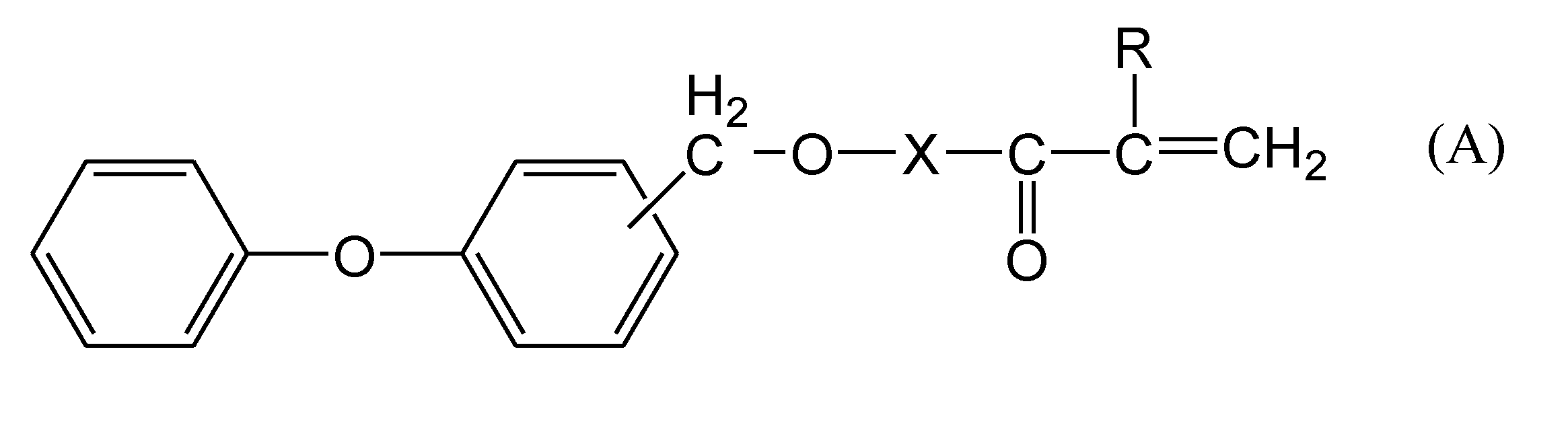
で表される構造を有する化合物である。上記式(A)中、Xは隣接する結合基の一部をなす単結合であるか、あるいはエチレンオキサイド、プロピレンオキサイド、ブチレンオキサイドまたはスチレンオキサイド構造を繰り返し1~5個有する構造を表す。Rは水素原子またはメチル基を表す。本発明に係る積層光学フィルム用接着剤組成物は、下記式(A-1):
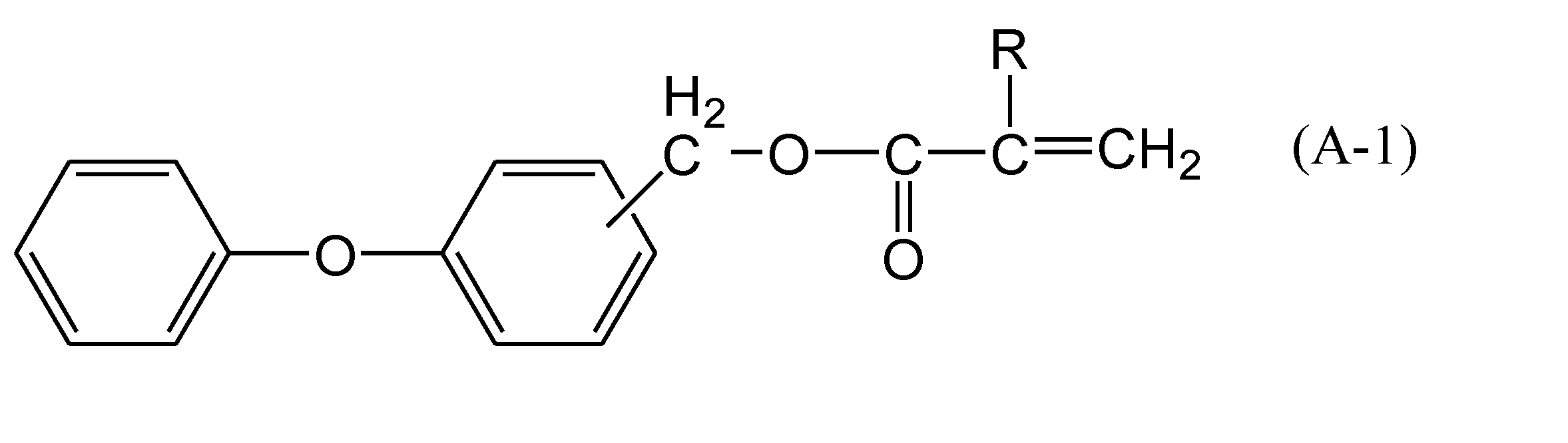
で表されるo位またはm位置換体であるフェノキシベンジル(メタ)アクリレートを含有することが好ましい。
本発明に係る積層光学フィルム用接着剤組成物は、金属酸化物粒子と共に芳香環骨格を含有する(メタ)アクリレートを含有するため、接着剤層の屈折率が向上する。接着剤層の屈折率をより安定的に高める見地から、本発明においては、芳香環骨格を含有する(メタ)アクリレートとして、多環式芳香環骨格を有する(メタ)アクリレートおよび2個以上の芳香環を有する(メタ)アクリレートからなる群より選択される少なくとも1種を含有するものを使用することが好ましい。芳香環骨格を含有する(メタ)アクリレートとしては、例えば、ベンジル(メタ)アクリレート、フェノキシエチル(メタ)アクリレート、フェノキシジエチレングリコール(メタ)アクリレート、2-ヒドロキシ-3-フェノキシプロピル(メタ)アクリレート、1-ナフタレンメチル(メタ)アクリレート、フェノキシベンジル(メタ)アクリレート、エチレンオキサイド変性オルトフェニルフェノール(メタ)アクリレート、9,9-ビス[4-(2-ヒドロキシエトキシ)フェニル]フルオレンと(メタ)アクリル酸との反応物などが挙げられる。これらの中でも、フェノキシベンジル(メタ)アクリレートおよびフェノキシエチル(メタ)アクリレートを使用することがより好ましく、フェノキシベンジル(メタ)アクリレートを使用することが特に好ましい。フェノキシベンジル(メタ)アクリレートは下記式(A):
接着剤層の屈折率向上の見地から、使用する芳香環骨格を含有する(メタ)アクリレート、特にはフェノキシベンジル(メタ)アクリレートの配合量は、組成物中の全量を100質量%としたとき、30~70質量%であることが好ましい。
<硬化性成分>
本発明に係る積層光学フィルム用接着剤組成物は硬化性成分を含有する。本発明において硬化性成分は、活性エネルギー線硬化性の硬化性成分であることが好ましい。活性エネルギー線硬化性の硬化性成分としては、ラジカル重合硬化性の硬化性成分とカチオン重合硬化性の硬化性成分に区分出来る。本発明において、波長範囲10nm~380nm未満の活性エネルギー線を紫外線、波長範囲380nm~800nmの活性エネルギー線を可視光線として表記する。
本発明に係る積層光学フィルム用接着剤組成物は硬化性成分を含有する。本発明において硬化性成分は、活性エネルギー線硬化性の硬化性成分であることが好ましい。活性エネルギー線硬化性の硬化性成分としては、ラジカル重合硬化性の硬化性成分とカチオン重合硬化性の硬化性成分に区分出来る。本発明において、波長範囲10nm~380nm未満の活性エネルギー線を紫外線、波長範囲380nm~800nmの活性エネルギー線を可視光線として表記する。
本発明に係る積層光学フィルム用接着剤組成物は、硬化性成分として単官能ラジカル重合性化合物を含有してもよい。単官能ラジカル重合性化合物としては、例えば、(メタ)アクリロイルオキシ基を有する各種の(メタ)アクリル酸誘導体が挙げられる。具体的には、例えば、メチル(メタ)アクリレート、エチル(メタ)アクリレート、n-プロピル(メタ)アクリレート、イソプロピル(メタ)アクリレート、2-メチル-2-ニトロプロピル(メタ)アクリレート、n-ブチル(メタ)アクリレート、イソブチル(メタ)アクリレート、s-ブチル(メタ)アクリレート、t-ブチル(メタ)アクリレート、n-ペンチル(メタ)アクリレート、t-ペンチル(メタ)アクリレート、3-ペンチル(メタ)アクリレート、2,2-ジメチルブチル(メタ)アクリレート、n-ヘキシル(メタ)アクリレート、セチル(メタ)アクリレート、n-オクチル(メタ)アクリレート、2-エチルヘキシル(メタ)アクリレート、4-メチル-2-プロピルペンチル(メタ)アクリレート、n-オクタデシル(メタ)アクリレートなどの(メタ)アクリル酸(炭素数1-20)アルキルエステル類が挙げられる。
また、前記(メタ)アクリル酸誘導体としては、例えば、シクロヘキシル(メタ)アクリレート、シクロペンチル(メタ)アクリレートなどのシクロアルキル(メタ)アクリレート;ベンジル(メタ)アクリレートなどのアラルキル(メタ)アクリレート;2-イソボルニル(メタ)アクリレート、2-ノルボルニルメチル(メタ)アクリレート、5-ノルボルネン-2-イル-メチル(メタ)アクリレート、3-メチル-2-ノルボルニルメチル(メタ)アクリレート、ジシクロペンテニル(メタ)アクリレ-ト、ジシクロペンテニルオキシエチル(メタ)アクリレ-ト、ジシクロペンタニル(メタ)アクリレ-ト、などの多環式(メタ)アクリレート;2-メトキシエチル(メタ)アクリレート、2-エトキシエチル(メタ)アクリレート、2-メトキシメトキシエチル(メタ)アクリレート、3-メトキシブチル(メタ)アクリレート、エチルカルビトール(メタ)アクリレート、フェノキシエチル(メタ)アクリレート、アルキルフェノキシポリエチレングリコール(メタ)アクリレートなどのアルコキシ基またはフェノキシ基含有(メタ)アクリレート;などが挙げられる。これらのなかでも各種保護フィルムとの接着性に優れることから、ジシクロペンテニルオキシエチルアクリレ-ト、フェノキシエチルアクリレートが好ましい。
また、前記(メタ)アクリル酸誘導体としては、2-ヒドロキシエチル(メタ)アクリレート、2-ヒドロキシプロピル(メタ)アクリレート、3-ヒドロキシプロピル(メタ)アクリレート、2-ヒドロキシブチル(メタ)アクリレート、4-ヒドロキシブチル(メタ)アクリレート、6-ヒドロキシヘキシル(メタ)アクリレート、8-ヒドロキシオクチル(メタ)アクリレート、10-ヒドロキシデシル(メタ)アクリレート、12-ヒドロキシラウリル(メタ)アクリレートなどのヒドロキシアルキル(メタ)アクリレートや、[4-(ヒドロキシメチル)シクロヘキシル]メチルアクリレート、シクロヘキサンジメタノールモノ(メタ)アクリレート、2-ヒドロキシ-3-フェノキシプロピル(メタ)アクリレートなどの水酸基含有(メタ)アクリレート;グリシジル(メタ)アクリレート、4-ヒドロキシブチル(メタ)アクリレートグリシジルエーテルなどのエポキシ基含有(メタ)アクリレート;2,2,2-トリフルオロエチル(メタ)アクリレート、2,2,2-トリフルオロエチルエチル(メタ)アクリレート、テトラフルオロプロピル(メタ)アクリレート、ヘキサフルオロプロピル(メタ)アクリレート、オクタフルオロペンチル(メタ)アクリレート、ヘプタデカフルオロデシル(メタ)アクリレート、3-クロロ-2-ヒドロキシプロピル(メタ)アクリレートなどのハロゲン含有(メタ)アクリレート;ジメチルアミノエチル(メタ)アクリレートなどのアルキルアミノアルキル(メタ)アクリレート;3-オキセタニルメチル(メタ)アクリレート、3-メチルーオキセタニルメチル(メタ)アクリレート、3-エチルーオキセタニルメチル(メタ)アクリレート、3-ブチルーオキセタニルメチル(メタ)アクリレート、3-ヘキシルーオキセタニルメチル(メタ)アクリレートなどのオキセタン基含有(メタ)アクリレート;テトラヒドロフルフリル(メタ)アクリレート、ブチロラクトン(メタ)アクリレート、などの複素環を有する(メタ)アクリレートや、ヒドロキシピバリン酸ネオペンチルグリコール(メタ)アクリル酸付加物、p-フェニルフェノール(メタ)アクリレートなどが挙げられる。これらのなかでも、2-ヒドロキシ-3-フェノキシプロピルアクリレートは各種保護フィルムとの接着性に優れるため好ましい。
本発明に係る積層光学フィルム用接着剤組成物が、金属酸化物粒子および一般式(1)で表される化合物に加えて水酸基含有(メタ)アクリレートを含有する場合、接着剤層の接着力がさらに向上するため好ましい。 接着剤層の接着力向上との見地から、水酸基含有(メタ)アクリレートの配合量は、組成物中の全量を100質量%としたとき、1~30質量%であることが好ましく、3~20質量%であることがより好ましい。
また、単官能ラジカル重合性化合物としては、(メタ)アクリル酸、カルボキシエチルアクリレート、カルボキシペンチルアクリレート、イタコン酸、マレイン酸、フマル酸、クロトン酸、イソクロトン酸などのカルボキシル基含有モノマーが挙げられる。
また、単官能ラジカル重合性化合物としては、例えば、N-ビニルピロリドン、N-ビニル-ε-カプロラクタム、メチルビニルピロリドンなどのラクタム系ビニルモノマー;ビニルピリジン、ビニルピペリドン、ビニルピリミジン、ビニルピペラジン、ビニルピラジン、ビニルピロール、ビニルイミダゾール、ビニルオキサゾール、ビニルモルホリンなどの窒素含有複素環を有するビニル系モノマーなどが挙げられる。
また、単官能ラジカル重合性化合物としては、活性メチレン基を有するラジカル重合性化合物を用いることができる。活性メチレン基を有するラジカル重合性化合物は、末端または分子中に(メタ)アクリル基などの活性二重結合基を有し、かつ活性メチレン基を有する化合物である。活性メチレン基としては、例えばアセトアセチル基、アルコキシマロニル基、またはシアノアセチル基などが挙げられる。前記活性メチレン基がアセトアセチル基であることが好ましい。活性メチレン基を有するラジカル重合性化合物の具体例としては、例えば2-アセトアセトキシエチル(メタ)アクリレート、2-アセトアセトキシプロピル(メタ)アクリレート、2-アセトアセトキシ-1-メチルエチル(メタ)アクリレートなどのアセトアセトキシアルキル(メタ)アクリレート;2-エトキシマロニルオキシエチル(メタ)アクリレート、2-シアノアセトキシエチル(メタ)アクリレート、N-(2-シアノアセトキシエチル)アクリルアミド、N-(2-プロピオニルアセトキシブチル)アクリルアミド、N-(4-アセトアセトキシメチルベンジル)アクリルアミド、N-(2-アセトアセチルアミノエチル)アクリルアミドなどが挙げられる。活性メチレン基を有するラジカル重合性化合物は、アセトアセトキシアルキル(メタ)アクリレートであることが好ましい。
また、本発明に係る積層光学フィルム用接着剤組成物は、硬化性成分として、二官能以上の多官能ラジカル重合性化合物を配合することができる。多官能ラジカル重合性化合物としては、例えば、多官能(メタ)アクリルアミド誘導体であるN,N‘-メチレンビス(メタ)アクリルアミド、トリプロピレングリコールジ(メタ)アクリレート、テトラエチレングリコールジ(メタ)アクリレート、1,6-ヘキサンジオールジ(メタ)アクリレート、1,9-ノナンジオールジ(メタ)アクリレート、1,10-デカンジオールジアクリレート、2-エチル-2-ブチルプロパンジオールジ(メタ)アクリレート、ビスフェノールAジ(メタ)アクリレート、ビスフェノールAエチレンオキサイド付加物ジ(メタ)アクリレート、ビスフェノールAプロピレンオキサイド付加物ジ(メタ)アクリレート、ビスフェノールAジグリシジルエーテルジ(メタ)アクリレート、ネオぺンチルグリコールジ(メタ)アクリレート、トリシクロデカンジメタノールジ(メタ)アクリート、環状トリメチロールプロパンフォルマル(メタ)アクリレート、ジオキサングリコールジ(メタ)アクリレート、トリメチロールプロパントリ(メタ)アクリレート、ペンタエリスリトールトリ(メタ)アクリレート、ペンタエリスリトールテトラ(メタ)アクリレート、ジペンタエリスリトールペンタ(メタ)アクリレート、ジペンタエリスリトールヘキサ(メタ)アクリレート、EO変性ジグリセリンテトラ(メタ)アクリレートなどの(メタ)アクリル酸と多価アルコールとのエステル化物、9,9-ビス[4-(2-(メタ)アクリロイルオキシエトキシ)フェニル]フルオレンがあげられる。具体例としては、アロニックスM-220(東亞合成社製)、ライトアクリレート1,9ND-A(共栄社化学社製)、ライトアクリレートDGE-4A(共栄社化学社製)、ライトアクリレートDCP-A(共栄社化学社製)、SR-531(Sartomer社製)、CD-536(Sartomer社製)などが好ましい。また必要に応じて、各種のエポキシ(メタ)アクリレート、ウレタン(メタ)アクリレート、ポリエステル(メタ)アクリレートや、各種の(メタ)アクリレート系モノマーなどが挙げられる。なお、多官能(メタ)アクリルアミド誘導体は、重合速度が速く生産性に優れる上、接着剤組成物を硬化物とした場合の架橋性に優れるため、接着剤組成物に含有させることが好ましい。
例えば光学フィルムとして偏光子および透明保護フィルムを使用する場合、ラジカル重合性化合物は、偏光子や各種透明保護フィルムとの接着性と、過酷な環境下における光学耐久性を両立させる観点から、単官能ラジカル重合性化合物と多官能ラジカル重合性化合物を併用することが好ましい。接着剤組成物中の単官能ラジカル重合性化合物の配合量は、組成物中の全量を100質量%としたとき、10~95質量%であることが好ましく30~80質量%であることがより好ましい。接着剤組成物中の多官能ラジカル重合性化合物の配合量は、組成物中の全量を100質量%としたとき、0.5~60質量%であることが好ましく、1~40質量%であることがより好ましい。
<その他の成分>
本発明に係る積層光学フィルム用接着剤組成物は、金属酸化物粒子と共に下記一般式(1):

で表される化合物(ただし、Xは反応性基であり、Yは分岐鎖を有してもよい炭素数1~12のアルキレン基、または置換基を有してもよいフェニレン基であり、R1およびR2はそれぞれ独立に、水素原子、置換基を有してもよい、脂肪族炭化水素基、アリール基、またはヘテロ環基を表す)を含有する場合、接着剤層の接着力がさらに向上するため好ましい。加えて、本発明に係る積層光学フィルム用接着剤組成物が金属酸化物粒子と共に上記一般式(1)で表される化合物を含有する場合、接着剤層の硬化収縮率が低くなる。このため、積層光学フィルムとしたときに、各光学フィルムに加わる応力が低減できるため、積層光学フィルムの耐久性向上が期待できるため好ましい。
本発明に係る積層光学フィルム用接着剤組成物は、金属酸化物粒子と共に下記一般式(1):
前記脂肪族炭化水素基としては、炭素数1~20の置換基を有してもよい直鎖または分岐のアルキル基、炭素数3~20の置換基を有してもよい環状アルキル基、炭素数2~20のアルケニル基が挙げられ、アリール基としては、炭素数6~20の置換基を有してもよいフェニル基、炭素数10~20の置換基を有してもよいナフチル基などが挙げられ、ヘテロ環基としては例えば、少なくとも一つのヘテロ原子を含む、置換基を有してもよい5員環または6員環の基が挙げられる。これらは互いに連結して環を形成してもよい。一般式(1)中、R1およびR2として好ましくは、水素原子、炭素数1~3の直鎖または分岐のアルキル基であり、最も好ましくは、水素原子である。
一般式(1)で表される化合物が有するXは反応性基であって、硬化物層、特には接着剤層を構成する硬化性成分と反応し得る官能基であり、例えば、ヒドロキシル基、アミノ基、アルデヒド基、カルボキシル基、ビニル基、(メタ)アクリル基、スチリル基、(メタ)アクリルアミド基、ビニルエーテル基、エポキシ基、オキセタン基、α,β-不飽和カルボニル基、メルカプト基、ハロゲン基などが挙げられる。硬化物層、特には接着剤層を構成する硬化性樹脂組成物が活性エネルギー線硬化性である場合、反応性基Xは、ビニル基、(メタ)アクリル基、スチリル基、(メタ)アクリルアミド基、ビニルエーテル基、エポキシ基、オキセタン基およびメルカプト基からなる群より選択される少なくとも1種の反応性基であることが好ましく、硬化物層、特には接着剤層を構成する硬化性樹脂組成物がラジカル重合性である場合、反応性基Xは、(メタ)アクリル基、スチリル基および(メタ)アクリルアミド基からなる群より選択される少なくとも1種の反応性基であることが好ましく、一般式(1)で表される化合物が(メタ)アクリルアミド基を有する場合、反応性が高く、硬化物層、特には接着剤層中の硬化性成分との共重合率が高まるためより好ましい。また、(メタ)アクリルアミド基の極性が高く、接着性に優れるため本発明の効果を効率的に得られるという点からも好ましい。硬化物層、特には接着剤層を構成する硬化性樹脂組成物がカチオン重合性である場合、反応性基Xは、ヒドロキシル基、アミノ基、アルデヒド、カルボキシル基、ビニルエーテル基、エポキシ基、オキセタン基、メルカプト基から選ばれる少なくとも1つの官能基を有することが好ましく、特にエポキシ基を有する場合、得られる硬化物層、特には接着剤層と被着体との密着性に優れるため好ましく、ビニルエーテル基を有する場合、硬化性樹脂組成物の硬化性が優れるため好ましい。
一般式(1)で表される化合物の好ましい具体例としては、以下の化合物(1a)~(1d)が挙げられる。なお、一般式(1a)および(1b)中のR3は水素原子またはメチル基である。
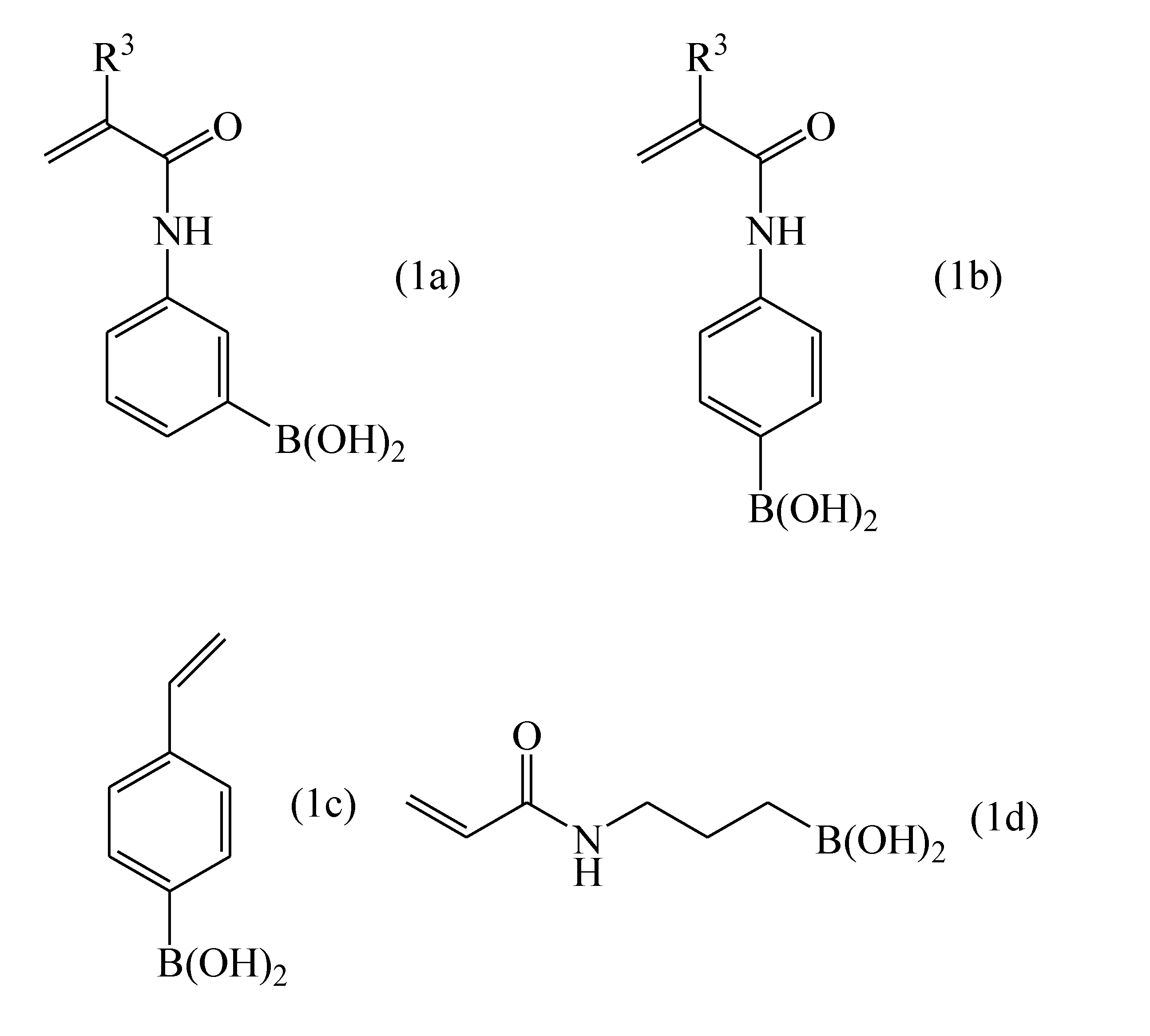
一般式(1)で表される化合物としては、前記例示した化合物以外にも、ヒドロキシエチルアクリルアミドとホウ酸のエステル、メチロールアクリルアミドとホウ酸のエステル、ヒドロキシエチルアクリレートとホウ酸のエステル、およびヒドロキシブチルアクリレートとホウ酸のエステルなど、(メタ)アクリレートとホウ酸とのエステルを例示可能である。
接着剤層の接着力向上との見地から、使用する一般式(1)で表される化合物の配合量は、組成物中の全量を100質量%としたとき、0.1~10質量%であることが好ましく、0.3~5質量%であることがより好ましい。
本発明に係る積層光学フィルム用接着剤組成物は、硬化性成分を活性エネルギー線硬化性成分として用いる場合には活性エネルギー線硬化性接着剤組成物として用いることができる。前記活性エネルギー線硬化性接着剤組成物は、活性エネルギー線に電子線などを用いる場合には、当該活性エネルギー線硬化性接着剤組成物は光重合開始剤を含有することは必要ではないが、活性エネルギー線に紫外線または可視光線を用いる場合には、光重合開始剤を含有するのが好ましい。
光重合開始剤は、活性エネルギー線によって適宜に選択される。紫外線または可視光線により硬化させる場合には紫外線または可視光線開裂の光重合開始剤が用いられる。前記光重合開始剤としては、例えば、ベンジル、ベンゾフェノン、ベンゾイル安息香酸、3,3’-ジメチル-4-メトキシベンゾフェノンなどのベンゾフェノン系化合物;4-(2-ヒドロキシエトキシ)フェニル(2-ヒドロキシ-2-プロピル)ケトン、α-ヒドロキシ-α,α’-ジメチルアセトフェノン、2-メチル-2-ヒドロキシプロピオフェノン、α-ヒドロキシシクロヘキシルフェニルケトンなどの芳香族ケトン化合物;メトキシアセトフェノン、2,2-ジメトキシ-2-フェニルアセトフエノン、2,2-ジエトキシアセトフェノン、2-メチル-1-[4-(メチルチオ)-フェニル]-2-モルホリノプロパン-1などのアセトフェノン系化合物;べンゾインメチルエーテル、べンゾインエチルエーテル、ベンゾインイソプロピルエーテル、べンゾインブチルエーテル、アニソインメチルエーテルなどのベンゾインエーテル系化合物;ベンジルジメチルケタールなどの芳香族ケタール系化合物;2-ナフタレンスルホニルクロリドなどの芳香族スルホニルクロリド系化合物;1-フェノン-1,1-プロパンジオン-2-(o-エトキシカルボニル)オキシムなどの光活性オキシム系化合物;チオキサンソン、2-クロロチオキサンソン、2-メチルチオキサンソン、2,4-ジメチルチオキサンソン、イソプロピルチオキサンソン、2,4-ジクロロチオキサンソン、2,4-ジエチルチオキサンソン、2,4-ジイソプロピルチオキサンソン、ドデシルチオキサントンなどのチオキサンソン系化合物;カンファーキノン;ハロゲン化ケトン;アシルホスフィノキシド;アシルホスフォナートなどがあげられる。
前記光重合開始剤の配合量は、組成物中の全量を100質量%としたとき、0.5~5質量%含有するものであることが好ましく、1~4質量%含有するものであることがより好ましい。
また、活性エネルギー線硬化性接着剤組成物を可視光線硬化型で用いる場合には、特に380nm以上の光に対して高感度な光重合開始剤を用いることが好ましい。380nm以上の光に対して高感度な光重合開始剤については後述する。
前記光重合開始剤としては、下記一般式(3)で表される化合物;
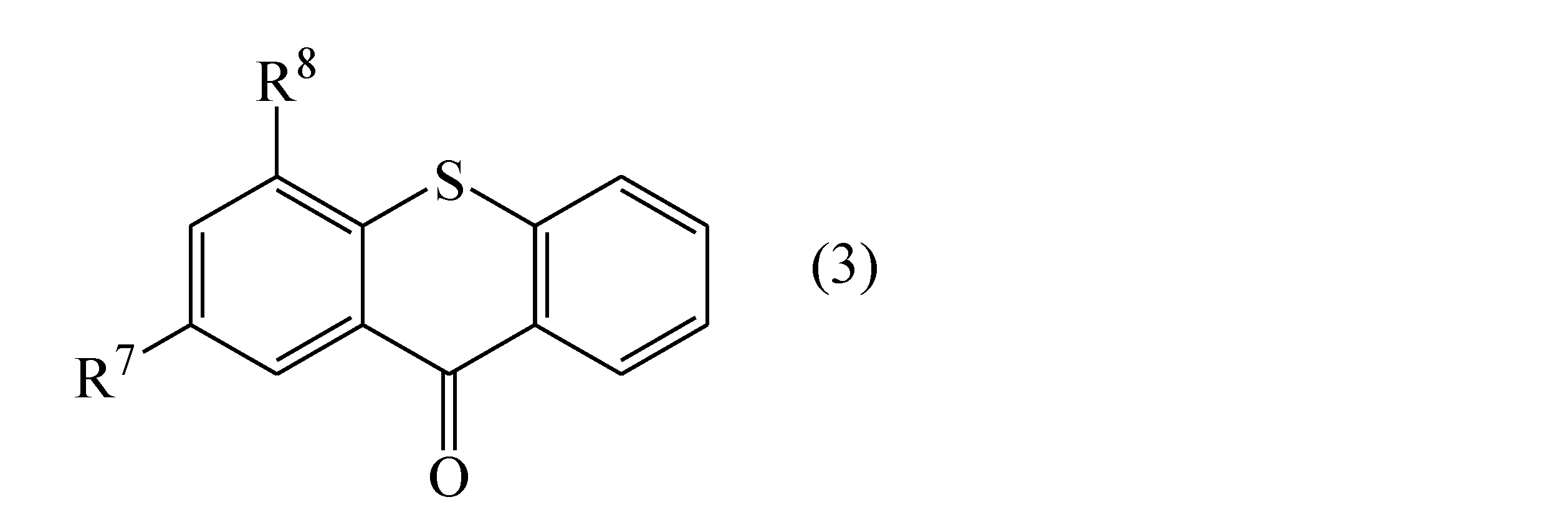
(式中、R7およびR8は-H、-CH2CH3、-iPrまたはClを示し、R7およびR8は同一または異なっても良い)を単独で使用するか、あるいは一般式(3)で表される化合物と後述する380nm以上の光に対して高感度な光重合開始剤とを併用することが好ましい。一般式(3)で表される化合物を使用した場合、380nm以上の光に対して高感度な光重合開始剤を単独で使用した場合に比べて接着性に優れる。一般式(3)で表される化合物の中でも、R7およびR8が-CH2CH3であるジエチルチオキサントンが特に好ましい。活性エネルギー線硬化性接着剤組成物中の一般式(3)で表される化合物の配合量は、組成物中の全量を100質量%としたとき、0.1~5質量%であることが好ましく、0.3~3質量%であることがより好ましい。
また、必要に応じて重合開始助剤を添加することが好ましい。重合開始助剤としては、トリエチルアミン、ジエチルアミン、N-メチルジエタノールアミン、エタノールアミン、4-ジメチルアミノ安息香酸、4-ジメチルアミノ安息香酸メチル、4-ジメチルアミノ安息香酸エチル、4-ジメチルアミノ安息香酸イソアミルなどが挙げられ、4-ジメチルアミノ安息香酸エチルが特に好ましい。重合開始助剤を使用する場合、その添加量は、組成物中の全量を100質量%としたとき、0.1~2質量%であることが好ましく、0.3~1質量%であることがより好ましい。
また、必要に応じて公知の光重合開始剤を併用することができる。UV吸収能を有する光学機能層および基材フィルムは、380nm以下の光を透過しないため、光重合開始剤としては、380nm以上の光に対して高感度な光重合開始剤を使用することが好ましい。具体的には、2-メチル-1-(4-メチルチオフェニル)-2-モルフォリノプロパン-1-オン、2-ベンジル-2-ジメチルアミノ-1-(4-モルフォリノフェニル)-ブタノン-1、2-(ジメチルアミノ)-2-[(4-メチルフェニル)メチル]-1-[4-(4-モルホリニル)フェニル]-1-ブタノン、2,4,6-トリメチルベンゾイル-ジフェニル-フォスフィンオキサイド、ビス(2,4,6-トリメチルベンゾイル)-フェニルフォスフィンオキサイド、ビス(η5-2,4-シクロペンタジエン-1-イル)-ビス(2,6-ジフルオロ-3-(1H-ピロール-1-イル)-フェニル)チタニウムなどが挙げられる。
本発明においては、積層光学フィルム用接着剤組成物が(メタ)アクリルモノマーを重合してなるアクリル系オリゴマーを含有することが好ましい。積層光学フィルム用接着剤組成物中にアクリル系オリゴマーを含有することで、該組成物に活性エネルギー線を照射・硬化させる際の硬化収縮を低減し、接着剤層と光学フィルムとの界面応力を低減することができる。その結果、接着剤層と光学フィルムとの密着性の低下を抑制することができる。
積層光学フィルム用接着剤組成物は、塗工時の作業性や均一性を考慮した場合、低粘度であることが好ましいため、(メタ)アクリルモノマーを重合してなるアクリル系オリゴマーも低粘度であることが好ましい。低粘度であって、かつ接着剤層の硬化収縮を防止できるアクリル系オリゴマーとしては、重量平均分子量(Mw)が15000以下のものが好ましく、10000以下のものがより好ましく、5000以下のものが特に好ましい。一方、硬化物層(接着剤層)の硬化収縮を十分に抑制するためには、アクリル系オリゴマーの重量平均分子量(Mw)が500以上であることが好ましく、1000以上であることがより好ましく、1500以上であることが特に好ましい。アクリル系オリゴマーを構成する(メタ)アクリルモノマーとしては、具体的には例えば、メチル(メタ)アクリレート、エチル(メタ)アクリレート、n-プロピル(メタ)アクリレート、イソプロピル(メタ)アクリレート、2-メチル-2-ニトロプロピル(メタ)アクリレート、n-ブチル(メタ)アクリレート、イソブチル(メタ)アクリレート、S-ブチル(メタ)アクリレート、t-ブチル(メタ)アクリレート、n-ペンチル(メタ)アクリレート、t-ペンチル(メタ)アクリレート、3-ペンチル(メタ)アクリレート、2,2-ジメチルブチル(メタ)アクリレート、n-ヘキシル(メタ)アクリレート、セチル(メタ)アクリレート、n-オクチル(メタ)アクリレート、2-エチルヘキシル(メタ)アクリレート、4-メチル-2-プロピルペンチル(メタ)アクリレート、N-オクタデシル(メタ)アクリレートなどの(メタ)アクリル酸(炭素数1-20)アルキルエステル類、さらに、例えば、シクロアルキル(メタ)アクリレート(例えば、シクロヘキシル(メタ)アクリレート、シクロペンチル(メタ)アクリレートなど)、アラルキル(メタ)アクリレート(例えば、ベンジル(メタ)アクリレートなど)、多環式(メタ)アクリレート(例えば、2-イソボルニル(メタ)アクリレート、2-ノルボルニルメチル(メタ)アクリレート、5-ノルボルネン-2-イル-メチル(メタ)アクリレート、3-メチル-2-ノルボルニルメチル(メタ)アクリレートなど)、ヒドロキシル基含有(メタ)アクリル酸エステル類(例えば、ヒドロキシエチル(メタ)アクリレート、2-ヒドロキシプロピル(メタ)アクリレート、2,3-ジヒドロキシプロピルメチル-ブチル(メタ)メタクリレートなど)、アルコキシ基またはフェノキシ基含有(メタ)アクリル酸エステル類(2-メトキシエチル(メタ)アクリレート、2-エトキシエチル(メタ)アクリレート、2-メトキシメトキシエチル(メタ)アクリレート、3-メトキシブチル(メタ)アクリレート、エチルカルビトール(メタ)アクリレート、フェノキシエチル(メタ)アクリレートなど)、エポキシ基含有(メタ)アクリル酸エステル類(例えば、グリシジル(メタ)アクリレートなど)、ハロゲン含有(メタ)アクリル酸エステル類(例えば、2,2,2-トリフルオロエチル(メタ)アクリレート、2,2,2-トリフルオロエチルエチル(メタ)アクリレート、テトラフルオロプロピル(メタ)アクリレート、ヘキサフルオロプロピル(メタ)アクリレート、オクタフルオロペンチル(メタ)アクリレート、ヘプタデカフルオロデシル(メタ)アクリレートなど)、アルキルアミノアルキル(メタ)アクリレート(例えば、ジメチルアミノエチル(メタ)アクリレートなど)などが挙げられる。これら(メタ)アクリレートは、単独使用または2種類以上併用することができる。アクリル系オリゴマー(E)の具体例としては、東亞合成社製「ARUFON」、綜研化学社製「アクトフロー」、BASFジャパン社製「JONCRYL」などが挙げられる。
積層光学フィルム用接着剤組成物中のアクリル系オリゴマーの配合量は、3~40質量%であることが好ましく、5~20質量%であることがより好ましい。
本発明に係る積層光学フィルム用接着剤組成物は、シランカップリング剤を含有してもよい。シランカップリング剤の具体例としては、活性エネルギー線硬化性の化合物としてビニルトリクロルシラン、ビニルトリメトキシシラン、ビニルトリエトキシシラン、2-(3,4エポキシシクロヘキシル)エチルトリメトキシシラン、3-グリシドキシプロピルトリメトキシシラン、3-グリシドキシプロピルメチルジエトキシシラン、3-グリシドキシプロピルトリエトキシシラン、p-スチリルトリメトキシシラン、3-メタクリロキシプロピルメチルジメトキシシラン、3-メタクリロキシプロピルトリメトキシシラン、3-メタクリロキシプロピルメチルジエトキシシラン、3-メタクリロキシプロピルトリエトキシシラン、3-アクリロキシプロピルトリメトキシシランなどが挙げられる。
好ましくは、2-(3,4エポキシシクロヘキシル)エチルトリメトキシシラン、3-グリシドキシプロピルトリメトキシシラン、3-グリシドキシプロピルメチルジエトキシシラン、3-グリシドキシプロピルトリエトキシシランである。
上記以外の活性エネルギー線硬化性ではないシランカップリング剤の具体例としては、3-ウレイドプロピルトリエトキシシラン、3-クロロプロピルトリメトキシシラン、3-メルカプトプロピルメチルジメトキシシラン、3-メルカプトプロピルトリメトキシシラン、ビス(トリエトキシシリルプロピル)テトラスルフィド、3-イソシアネートプロピルトリエトキシシラン、イミダゾールシランなどが挙げられる。
本発明に係る積層光学フィルム用接着剤組成物は、カチオン重合硬化性接着剤組成物であってもよい。カチオン重合硬化性接着剤組成物に使用される硬化性成分(カチオン重合性化合物)としては、分子内にカチオン重合性官能基を1つ有する単官能カチオン重合性化合物と、分子内にカチオン重合性官能基を2つ以上有する多官能カチオン重合性化合物とに分類される。単官能カチオン重合性化合物は比較的液粘度が低いため、カチオン重合硬化性接着剤組成物に含有させることで液粘度を低下させることができる。また、単官能カチオン重合性化合物は各種機能を発現させる官能基を有している場合が多く、カチオン重合硬化性接着剤組成物に含有させることで、カチオン重合硬化性接着剤組成物及び/又はカチオン重合硬化性接着剤組成物の硬化物に各種機能を発現させることができる。多官能カチオン重合性化合物は、カチオン重合硬化性樹脂組成物の硬化物を3次元架橋させることができるため、カチオン重合硬化性接着剤組成物に含有させることが好ましい。単官能カチオン重合性化合物と多官能カチオン重合性化合物の比は、単官能カチオン重合性化合物100質量%に対して、多官能カチオン重合性化合物を10質量%から1000質量%の範囲で混合することが好ましい。カチオン重合性官能基としては、エポキシ基やオキセタニル基、ビニルエーテル基が挙げられる。エポキシ基を有する化合物としては、脂肪族エポキシ化合物、脂環式エポキシ化合物、芳香族エポキシ化合物が挙げられ、本発明のカチオン重合性樹脂組成物としては、硬化性や接着性に優れることから、脂環式エポキシ化合物を含有することが特に好ましい。脂環式エポキシ化合物としては、3,4-エポキシシクロヘキシルメチル-3,4-エポキシシクロヘキサンカルボキシレート、3,4-エポキシシクロヘキシルメチル-3,4-エポキシシクロヘキサンカルボキシレートのカプロラクトン変性物やトリメチルカプロラクトン変性物やバレロラクトン変性物などが挙げられ、具体的には、セロキサイド2021、セロキサイド2021A、セロキサイド2021P、セロキサイド2081、セロキサイド2083、セロキサイド2085(以上、ダイセル化学工業(株製)、サイラキュアUVR-6105、サイラキュアUVR-6107、サイラキュア30、R-6110(以上、ダウ・ケミカル日本(株)製)などが挙げられる。オキセタニル基を有する化合物は、カチオン重合性接着剤組成物の硬化性を改善したり、該組成物の液粘度を低下させる効果があるため、含有させることが好ましい。オキセタニル基を有する化合物としては、3-エチル-3-ヒドロキシメチルオキセタン、1,4-ビス[(3-エチル-3-オキセタニル)メトキシメチル]ベンゼン、3-エチル-3-(フェノキシメチル)オキセタン、ジ[(3-エチル-3-オキセタニル)メチル]エーテル、3-エチル-3-(2-エチルヘキシロキシメチル)オキセタン、フェノールノボラックオキセタンなどが挙げられ、アロンオキセタンOXT-101、アロンオキセタンOXT-121、アロンオキセタンOXT-211、アロンオキセタンOXT-221、アロンオキセタンOXT-212(以上、東亞合成社製)などが市販されている。ビニルエーテル基を有する化合物は、カチオン重合性接着剤組成物の硬化性を改善したり、該組成物の液粘度を低下させる効果があるため、含有させることが好ましい。ビニルエーテル基を有する化合物としては、2-ヒドロキシエチルビニルエーテル、ジエチレングリコールモノビニルエーテル、4-ヒドロキシブチルビニルエーテル、ジエチレングリコールものビニルエーテル、トリエチレングリコールジビニルエーテル、シクロヘキサンジメタノールジビニルエーテル、シクロヘキサンジメタノールモノビニルエーテル、トリシクロデカンビニルエーテル、シクロヘキシルビニルエーテル、メトキシエチルビニルエーテル、エトキシエチルビニルエーテル、ペンタエリスリトール型テトラビニルエーテルなどが挙げられる。
カチオン重合硬化性接着剤組成物は、硬化性成分として以上説明したエポキシ基を有する化合物、オキセタニル基を有する化合物、ビニルエーテル基を有する化合物から選ばれる少なくとも1つの化合物を含有し、これらはいずれもカチオン重合により硬化するものであることから、光カチオン重合開始剤が配合される。この光カチオン重合開始剤は、可視光線、紫外線、X線、電子線などの活性エネルギー線の照射によって、カチオン種又はルイス酸を発生し、エポキシ基やオキセタニル基の重合反応を開始する。光カチオン重合開始剤としては、後述の光酸発生剤が好適に使用される。またカチオン重合性接着剤組成物を可視光線硬化性で用いる場合には、特に380nm以上の光に対して高感度な光カチオン重合開始剤を用いることが好ましいが、光カチオン重合開始剤は一般に、300nm付近またはそれより短い波長域に極大吸収を示す化合物であるため、それより長い波長域、具体的には380nmより長い波長の光に極大吸収を示す光増感剤を配合することで、この付近の波長の光に感応し、光カチオン重合開始剤からのカチオン種または酸の発生を促進させることができる。光増感剤としては、例えば、アントラセン化合物、ピレン化合物、カルボニル化合物、有機硫黄化合物、過硫化物、レドックス系化合物、アゾおよびジアゾ化合物、ハロゲン化合物、光還元性色素などが挙げられ、これらは、2種類以上を混合して使用してもよい。特にアントラセン化合物は、光増感効果に優れるため好ましく、具体的にはアントラキュアUVS-1331、アントラキュアUVS-1221(川崎化成社製)が挙げられる。光増感剤の含有量は、0.1質量%~5質量%であることが好ましく、0.5質量%~3質量%であることがより好ましい。
本発明においては、積層光学フィルム用接着剤組成物が、光酸発生剤を含有してもよい。積層光学フィルム用接着剤組成物が光酸発生剤を含有する場合、光酸発生剤を含有しない場合に比べて、接着剤層の耐水性および耐久性を飛躍的に向上することができる。光酸発生剤は、下記一般式(4)で表すことができる。

次に、一般式(4)中のカウンターアニオンX-について説明する。
一般式(4)中のカウンターアニオンX-は原理的に特に限定されるものではないが、非求核性アニオンが好ましい。カウンターアニオンX-が非求核性アニオンの場合、分子内に共存するカチオンや併用される各種材料における求核反応が起こりにくいため、結果として一般式(4)で表記される光酸発生剤自身やそれを用いた組成物の経時安定性を向上させることが可能である。ここでいう非求核性アニオンとは、求核反応を起こす能力が低いアニオンを指す。このようなアニオンとしては、PF6
-、SbF6
-、AsF6
-、SbCl6
-、BiCl5
-、SnCl6
-、ClO4
-、B(C6H5)4
-、ジチオカルバメートアニオン、SCN-などが挙げられる。
具体的には、「サイラキュアーUVI-6992」、「サイラキュアーUVI-6974」(以上、ダウ・ケミカル日本株式会社製)、「アデカオプトマーSP150」、「アデカオプトマーSP152」、「アデカオプトマーSP170」、「アデカオプトマーSP172」(以上、株式会社ADEKA製)、「Omnicat250」(IGM Resins B.V.社製)、「CI-5102」、「CI-2855」(以上、日本曹達社製)、「サンエイドSI-60L」、「サンエイドSI-80L」、「サンエイドSI-100L」、「サンエイドSI-110L」、「サンエイドSI-180L」(以上、三新化学社製)、「IK-1」、「CPI-100P」、「CPI-101A」、「CPI-110P」、「CPI-200K」、「CPI-210S」、「CPI-310B」、「CPI-410B」、「CPI-410S」(以上、サンアプロ株式会社製)、「WPI-069」、「WPI-113」、「WPI-116」、「WPI-041」、「WPI-044」、「WPI-054」、「WPI-055」、「WPAG-281」、「WPAG-567」、「WPAG-596」(以上、富士フイルム和光純薬社製)が本発明の光酸発生剤の好ましい具体例として挙げられる。
本発明に係る積層光学フィルムは、接着剤層を介して、少なくとも第1光学フィルムおよび第2光学フィルムが積層された積層光学フィルムであって、接着剤層が前記記載の積層光学フィルム用接着剤組成物の硬化物層である。
図1に、本発明に係る積層光学フィルム用接着剤組成物の硬化物層を接着剤層として備える積層光学フィルムの一例を示す。図1に示す積層光学フィルム10は、第1光学フィルム1および第2光学フィルム2が、本発明に係る積層光学フィルム用接着剤組成物の硬化物層である接着剤層3を介して積層されている。本発明に係る積層光学フィルム用接着剤組成物は、金属酸化物粒子が安定に分散していることに起因して、その硬化物層の屈折率が高い。このため、第1光学フィルム1および第2光学フィルム2として、例えば位相差フィルム、好ましくは液晶系の位相差フィルムを使用した場合、第1光学フィルム1と接着剤層3との屈折率差を小さくすることができ、同様に、第2光学フィルム2と接着剤層3との屈折率差を小さくすることができるため、積層光学フィルムでの干渉ムラを抑制し、視認性を向上することができる。
本発明に係る積層光学フィルムは、本発明に係る積層光学フィルム用接着剤組成物の硬化物層である接着剤層を介して、少なくとも第1光学フィルムおよび第2光学フィルムが積層された積層光学フィルムであればよく、さらに任意の光学フィルムなどを備えていてもよい。図1に示す積層光学フィルム10は、第1光学フィルム1の上(視認側)に、偏光子5を備え、さらに透明保護フィルム4を備える。なお、第1光学フィルム1と偏光子5との間、偏光子5と透明保護フィルム4との間には通常、接着剤層を備えるが(図1では省略)、これらの接着剤層は、本発明に係る積層光学フィルム用接着剤組成物の硬化物層である接着剤層3と同じでもよく、当業者に公知の積層光学フィルム用接着剤組成物の硬化物層であってもよい。また、図1に示す積層光学フィルム10は、第2光学フィルムの下(表示装置側)に、粘着剤層6を介して有機発光ダイオード層7を備える。
本発明に係る積層光学フィルム用接着剤組成物は、金属酸化物粒子を含有するが、さらにイソシアヌレート化合物およびポリシロキサン化合物からなる群より選択される少なくとも1種を含有することにより、金属酸化物粒子が安定に分散することに起因して、組成物の粘度を低く抑えることができる。このため、積層光学フィルム用接着剤組成物を光学フィルム上に薄く塗工できるため、接着剤層の厚みを薄くすることができる。本発明に係る積層光学フィルムが備える接着剤層の厚みは、0.1~5μmであることが好ましく、0.3~3μmであることがより好ましい。
本発明において積層光学フィルムを構成する第1光学フィルムおよび第2光学フィルムとして、偏光子、透明保護フィルム、位相差フィルムなどが挙げられる。
本発明において、偏光子は特に制限されず、各種のものを使用できる。偏光子としては、例えば、ポリビニルアルコール系フィルム、部分ホルマール化ポリビニルアルコール系フィルム、エチレン・酢酸ビニル共重合体系部分ケン化フィルムなどの親水性高分子フィルムに、ヨウ素を吸着させて一軸延伸したものなどが挙げられる。偏光子の厚みとしては例えば3~20μmが挙げられる。
ただし、本発明においては高温高湿下の過酷な環境における加湿信頼性向上の観点から、偏光子として厚みが3μm以上、15μm以下の薄型偏光子を用いることが好ましい。特に12μm以下であるのが好ましく、さらには10μm以下、特には8μm以下であるのが好ましい。このような薄型偏光子は、厚みムラが少なく、視認性が優れており、また寸法変化が少ないため熱衝撃に対する耐久性に優れる。
ポリビニルアルコール系フィルムをヨウ素で染色し一軸延伸した偏光子は、例えば、ポリビニルアルコールをヨウ素の水溶液に浸漬することによって染色し、元長の3~7倍に延伸することで作製することができる。必要に応じてホウ酸や硫酸亜鉛、塩化亜鉛などを含んでいても良いし、ヨウ化カリウムなどの水溶液に浸漬することもできる。さらに必要に応じて染色前にポリビニルアルコール系フィルムを水に浸漬して水洗してもよい。ポリビニルアルコール系フィルムを水洗することでポリビニルアルコール系フィルム表面の汚れやブロッキング防止剤を洗浄することができるほかに、ポリビニルアルコール系フィルムを膨潤させることで染色のムラなどの不均一を防止する効果もある。延伸はヨウ素で染色した後に行っても良いし、染色しながら延伸しても良いし、また延伸してからヨウ素で染色しても良い。ホウ酸やヨウ化カリウムなどの水溶液や水浴中でも延伸することができる。
偏光子はホウ酸を含有していることが延伸安定性や加湿信頼性の点から好ましい。また、偏光子に含まれるホウ酸含有量は、貫通クラックの発生抑制の観点から、偏光子全量に対して22質量%以下であるのが好ましく、20質量%以下であるのがさらに好ましい。延伸安定性や加湿信頼性の観点から、偏光子全量に対するホウ酸含有量は10質量%以上であることが好ましく、さらには12質量%以上であることが好ましい。
薄型の偏光子としては、代表的には、
特許第4751486号明細書、
特許第4751481号明細書、
特許第4815544号明細書、
特許第5048120号明細書、
国際公開第2014/077599号パンフレット、
国際公開第2014/077636号パンフレット、
などに記載されている薄型偏光子またはこれらに記載の製造方法から得られる薄型偏光子を挙げることができる。
特許第4751486号明細書、
特許第4751481号明細書、
特許第4815544号明細書、
特許第5048120号明細書、
国際公開第2014/077599号パンフレット、
国際公開第2014/077636号パンフレット、
などに記載されている薄型偏光子またはこれらに記載の製造方法から得られる薄型偏光子を挙げることができる。
前記薄型偏光子としては、積層体の状態で延伸する工程と染色する工程を含む製法の中でも、高倍率に延伸できて偏光性能を向上させることのできる点で、特許第4751486号明細書、特許第4751481号明細書、特許4815544号明細書に記載のあるようなホウ酸水溶液中で延伸する工程を含む製法で得られるものが好ましく、特に特許第4751481号明細書、特許4815544号明細書に記載のあるホウ酸水溶液中で延伸する前に補助的に空中延伸する工程を含む製法により得られるものが好ましい。これら薄型偏光子は、ポリビニルアルコール系樹脂(以下、PVA系樹脂ともいう)層と延伸用樹脂基材を積層体の状態で延伸する工程と染色する工程を含む製法による得ることができる。この製法であれば、PVA系樹脂層が薄くても、延伸用樹脂基材に支持されていることにより延伸による破断などの不具合なく延伸することが可能となる。
透明保護フィルムを構成する材料としては、例えば透明性、機械的強度、熱安定性、水分遮断性、等方性などに優れる熱可塑性樹脂が用いられる。このような熱可塑性樹脂の具体例としては、トリアセチルセルロース系樹脂フィルムなどのセルロース樹脂、ポリエステル樹脂、ポリエーテルスルホン樹脂、ポリスルホン樹脂、ポリカーボネート樹脂、ポリアミド樹脂、ポリイミド樹脂、ポリオレフィン樹脂、(メタ)アクリル樹脂、環状ポリオレフィン樹脂(ノルボルネン系樹脂)、ポリアリレート樹脂、ポリスチレン樹脂、ポリビニルアルコール樹脂、およびこれらの混合物が挙げられる。透明保護フィルム中には任意の適切な添加剤が1種類以上含まれていてもよい。添加剤としては、例えば、紫外線吸収剤、酸化防止剤、滑剤、可塑剤、離型剤、着色防止剤、難燃剤、核剤、帯電防止剤、顔料、着色剤などが挙げられる。透明保護フィルム中の上記熱可塑性樹脂の含有量は、好ましくは50~100重量%、より好ましくは50~99重量%、さらに好ましくは60~98重量%、特に好ましくは70~97重量%である。透明保護フィルム中の上記熱可塑性樹脂の含有量が50重量%以下の場合、熱可塑性樹脂が本来有する高透明性などが十分に発現できないおそれがある。
また透明保護フィルムを形成する材料としては、透明性、機械的強度、熱安定性、水分遮断性、等方性などに優れるものが好ましく、特に透湿度が150g/m2/24h以下であるものがより好ましく、140g/m2/24h以下のものが特に好ましく、120g/m2/24h以下のものさらに好ましい。
透明保護フィルムの偏光子を接着させない面には、ハードコート層、反射防止層、スティッキング防止層、拡散層ないしアンチグレア層などの機能層を設けることができる。なお、上記ハードコート層、反射防止層、スティッキング防止層、拡散層やアンチグレア層などの機能層は、透明保護フィルムそのものに設けることができるほか、別途、透明保護フィルムとは別体のものとして設けることもできる。
透明保護フィルムの厚みは、適宜に決定しうるが、一般には強度や取扱性などの作業性、薄層性などの点より1~500μm程度であり、1~300μmが好ましく、5~200μmがより好ましい。さらには10~200μmが好ましく、20~80μmが好ましい。
前記透明保護フィルムとして、正面位相差が40nm以上および/または、厚み方向位相差が80nm以上の位相差を有する位相差フィルムを用いることができる。正面位相差は、通常、40~200nmの範囲に、厚み方向位相差は、通常、80~300nmの範囲に制御される。透明保護フィルムとして位相差フィルムを用いる場合には、当該位相差フィルムが透明保護フィルムとしても機能するため、薄型化を図ることができる。
位相差フィルムとしては、高分子素材を一軸または二軸延伸処理してなる複屈折性フィルム、液晶ポリマーの配向フィルム、液晶ポリマーの配向層をフィルムにて支持したものなどがあげられる。位相差フィルムの厚さも特に制限されないが、1~150μm程度が一般的である。
位相差フィルムとしては、下記式(1)ないし(3):
0.70<Re[450]/Re[550]<0.97・・・(1)
1.5×10⁻³<Δn<6×10⁻³・・・(2)
1.13<NZ<1.50・・・(3)
(式中、Re[450]およびRe[550]は、それぞれ、23℃における波長450nmおよび550nmの光で測定した位相差フィルムの面内の位相差値であり、Δnは位相差フィルムの遅相軸方向、進相軸方向の屈折率を、それぞれnx、nyとしたときのnx-nyである面内複屈折であり、NZはnzを位相差フィルムの厚み方向の屈折率としたときの、厚み方向複屈折であるnx-nzと面内複屈折であるnx-nyとの比である)を満足する逆波長分散型の位相差フィルムを用いてもよい。
本発明に係る積層光学フィルムにおいては位相差層が設けられてもよい。位相差層は単層であっても複数層であってもよく、位相差層が偏光子の保護層を兼ねてもよい。
位相差層の形成には液晶性化合物が好ましく用いられ 該液晶性化合物を含む溶媒を、例えばワイヤーバー、ギャップコーター、コンマコーター、グラビアコーター、スロットダイなどを使用して塗布することができる。この際、塗布された液晶性溶液は、自然乾燥させてもよいし、加熱乾燥させてもよい。なお、液晶性溶液は、等方相-液晶相転移濃度よりも低い濃度、即ち、等方相状態で塗工することが好ましい。この場合、ラビング処理や光配向などの方法により安定的に配向させることができる。
本発明に係る積層光学フィルムは、例えば以下の製造方法により製造可能である。
接着剤層を介して、少なくとも第1光学フィルムおよび第2光学フィルムが積層された積層光学フィルムの製造方法であって、前記第1光学フィルムの貼合面および前記第2光学フィルムの貼合面の一方または両方に積層光学フィルム用接着剤組成物を塗工する塗工工程と、前記第1光学フィルムおよび前記第2光学フィルムを貼り合わせる貼合工程と、前記第1光学フィルム面側または前記第2光学フィルム面側から活性エネルギー線を照射して、少なくとも前記積層光学フィルム用接着剤組成物を硬化させることにより形成された前記接着剤層を介して、前記第1光学フィルムおよび前記第2光学フィルムを接着させる接着工程とを含み、前記積層光学フィルム用接着剤組成物が、硬化性成分、フェノキシベンジル(メタ)アクリレート、金属酸化物粒子およびレベリング剤を含有し、前記レベリング剤が、イソシアヌレート化合物およびポリシロキサン化合物からなる群より選択される少なくとも1種を含有するものであることを特徴とする積層光学フィルムの製造方法。
接着剤層を介して、少なくとも第1光学フィルムおよび第2光学フィルムが積層された積層光学フィルムの製造方法であって、前記第1光学フィルムの貼合面および前記第2光学フィルムの貼合面の一方または両方に積層光学フィルム用接着剤組成物を塗工する塗工工程と、前記第1光学フィルムおよび前記第2光学フィルムを貼り合わせる貼合工程と、前記第1光学フィルム面側または前記第2光学フィルム面側から活性エネルギー線を照射して、少なくとも前記積層光学フィルム用接着剤組成物を硬化させることにより形成された前記接着剤層を介して、前記第1光学フィルムおよび前記第2光学フィルムを接着させる接着工程とを含み、前記積層光学フィルム用接着剤組成物が、硬化性成分、フェノキシベンジル(メタ)アクリレート、金属酸化物粒子およびレベリング剤を含有し、前記レベリング剤が、イソシアヌレート化合物およびポリシロキサン化合物からなる群より選択される少なくとも1種を含有するものであることを特徴とする積層光学フィルムの製造方法。
上記塗工工程において、第1光学フィルムの貼合面および第2光学フィルムの貼合面の一方または両方に積層光学フィルム用接着剤組成物を塗工する方法としては、組成物の粘度や目的とする厚みによって適宜選択され、例えば、リバースコーター、グラビアコーター(ダイレクト,リバースやオフセット)、バーリバースコーター、ロールコーター、ダイコーター、バーコーター、ロッドコーターなどが挙げられる。
なお第1光学フィルムおよび/または第2光学フィルムは、塗工工程前に表面改質処理を行ってもよい。特に光学フィルムとして偏光子を使用する場合、偏光子は表面改質処理を行うことが好ましい。表面改質処理としては、コロナ処理、プラズマ処理、イトロ処理などの処理が挙げられ、特にコロナ処理であることが好ましい。コロナ処理を行うことで偏光子表面にカルボニル基やアミノ基などの反応性官能基が生成し、接着剤層との密着性が向上する。また、アッシング効果により表面の異物が除去されたり、表面の凹凸が軽減されたりして、外観特性に優れる積層光学フィルムを作成することができる。
上記のように塗工した積層光学フィルム用接着剤組成物を介して、第1光学フィルムと第2光学フィルムとをロールラミネーターなどを使用して貼り合わせる(貼合工程)。
第1光学フィルムと第2光学フィルムとを貼り合わせた後に、活性エネルギー線(電子線、紫外線、可視光線など)を照射し、積層光学フィルム用接着剤組成物を硬化して接着剤層を形成する。活性エネルギー線(電子線、紫外線、可視光線など)の照射方向は、任意の適切な方向から照射することができる。
電子線を照射する場合の照射条件は、上記積層光学フィルム用接着剤組成物を硬化し得る条件であれば、任意の適切な条件を採用できる。例えば、電子線照射は、加速電圧が好ましくは5kV~300kVであり、さらに好ましくは10kV~250kVである。加速電圧が5kV未満の場合、電子線が接着剤まで届かず硬化不足となるおそれがあり、加速電圧が300kVを超えると、試料を通る浸透力が強すぎて、第1光学フィルムおよび第2光学フィルムにダメージを与えるおそれがある。照射線量としては、5~100kGy、さらに好ましくは10~75kGyである。照射線量が5kGy未満の場合は、接着剤が硬化不足となり、100kGyを超えると、第1光学フィルムおよび第2光学フィルムにダメージを与え、機械的強度の低下や黄変を生じ、所定の光学特性を得ることができない。
電子線照射は、通常、不活性ガス中で照射を行うが、必要であれば大気中や酸素を少し導入した条件で行ってもよい。第1光学フィルムおよび第2光学フィルムの材料によるが、酸素を適宜導入することによって、最初に電子線があたる第1光学フィルムおよび第2光学フィルム面にあえて酸素阻害を生じさせ、第1光学フィルムおよび第2光学フィルムへのダメージを防ぐことができ、接着剤にのみ効率的に電子線を照射させることができる。
本発明に係る積層光学フィルムを製造する場合、活性エネルギー線として、波長範囲380nm~450nmの可視光線を含むもの、特には波長範囲380nm~450nmの可視光線の照射量が最も多い活性エネルギー線を使用することが好ましい。紫外線、可視光線を使用する場合であって、光学フィルムとして紫外線吸収能を付与した透明保護フィルム(紫外線不透過型透明保護フィルム)を使用する場合、およそ380nmより短波長の光を吸収するため、380nmより短波長の光は硬化性樹脂組成物に到達せず、その重合反応に寄与しない。さらに、第1光学フィルムおよび第2光学フィルムによって吸収された380nmより短波長の光は熱に変換され、第1光学フィルムまたは第2光学フィルム自体が発熱し、積層光学フィルムのカール・シワなど不良の原因となる。そのため、本発明において紫外線、可視光線を採用する場合、活性エネルギー線発生装置として380nmより短波長の光を発光しない装置を使用することが好ましく、より具体的には、波長範囲380~440nmの積算照度と波長範囲250~370nmの積算照度との比が100:0~100:50であることが好ましく、100:0~100:40であることがより好ましい。本発明に係る積層光学フィルムを製造する場合、活性エネルギー線としては、ガリウム封入メタルハライドランプ、波長範囲380~440nmを発光するLED光源が好ましい。あるいは、低圧水銀灯、中圧水銀灯、高圧水銀灯、超高圧水銀灯、白熱電球、キセノンランプ、ハロゲンランプ、カーボンアーク灯、メタルハライドランプ、蛍光灯、タングステンランプ、ガリウムランプ、エキシマレーザーまたは太陽光などの紫外線と可視光線を含む光源を使用することができ、バンドパスフィルターを用いて380nmより短波長の紫外線を遮断して用いることもできる。第1光学フィルムおよび第2光学フィルムの間の接着剤層の接着性能を高めつつ、積層光学フィルムのカールを防止するためには、ガリウム封入メタルハライドランプを使用し、かつ380nmより短波長の光を遮断可能なバンドパスフィルターを介して得られた活性エネルギー線、またはLED光源を使用して得られる波長405nmの活性エネルギー線を使用することが好ましい。
本発明に係る積層光学フィルムを連続ラインで製造する場合、ライン速度は、積層光学フィルム用接着剤組成物の硬化時間によるが、好ましくは1~500m/min、より好ましくは5~300m/min、さらに好ましくは10~100m/minである。ライン速度が小さすぎる場合は、生産性が乏しい、あるいは第1光学フィルムおよび第2光学フィルムへのダメージが大きすぎ、耐久性試験などに耐え得る積層光学フィルムが作製できない。ライン速度が大きすぎる場合は、積層光学フィルム用接着剤組成物の硬化が不十分となり、目的とする接着性が得られない場合がある。
本発明に係る積層光学フィルムには、液晶セルなどの他部材と接着するための粘着層を設けることもできる。粘着層を形成する粘着剤は特に制限されないが、例えばアクリル系重合体、シリコーン系ポリマー、ポリエステル、ポリウレタン、ポリアミド、ポリエーテル、フッ素系やゴム系などのポリマーをベースポリマーとするものを適宜に選択して用いることができる。特に、アクリル系粘着剤の如く光学的透明性に優れ、適度な濡れ性と凝集性と接着性の粘着特性を示して、耐候性や耐熱性などに優れるものが好ましく用いうる。
粘着層は、異なる組成または種類などのものの重畳層として本発明に係る積層光学フィルムの片面または両面に設けることもできる。また両面に設ける場合に、本発明に係る積層光学フィルムの表裏において異なる組成や種類や厚みなどの粘着層とすることもできる。粘着層の厚みは、使用目的や接着力などに応じて適宜に決定でき、一般には1~500μmであり、1~200μmが好ましく、特に1~100μmが好ましい。
粘着層の露出面に対しては、実用に供するまでの間、その汚染防止などを目的にセパレータが仮着されてカバーされる。これにより、通例の取扱状態で粘着層に接触することを防止できる。セパレータとしては、上記厚み条件を除き、例えばプラスチックフィルム、ゴムシート、紙、布、不織布、ネット、発泡シートや金属箔、それらのラミネート体などの適宜な薄葉体を、必要に応じシリコーン系や長鎖アルキル系、フッ素系や硫化モリブデンなどの適宜な剥離剤でコート処理したものなどの、従来に準じた適宜なものを用いうる。
本発明に係る積層光学フィルムは液晶表示装置などの各種装置の形成などに好ましく用いることができる。液晶表示装置の形成は、従来に準じて行いうる。すなわち液晶表示装置は一般に、液晶セルと偏光フィルムまたは積層光学フィルム、および必要に応じての照明システムなどの構成部品を適宜に組立てて駆動回路を組込むことなどにより形成されるが、本発明においては本発明による偏光フィルムまたは積層光学フィルムを用いる点を除いて特に限定はなく、従来に準じうる。液晶セルについても、例えばTN型やSTN型、π型などの任意なタイプのものを用いうる。
液晶セルの片側または両側に光学積層体を配置した液晶表示装置や、照明システムにバックライトあるいは反射板を用いたものなどの適宜な液晶表示装置を形成することができる。その場合、本発明による光学積層体は液晶セルの片側または両側に設置することができる。両側に光学積層体を設ける場合、それらは同じものであってもよいし、異なるものであってもよい。さらに、液晶表示装置の形成に際しては、例えば拡散板、アンチグレア層、反射防止膜、保護板、プリズムアレイ、レンズアレイシート、光拡散板、バックライトなどの適宜な部品を適宜な位置に1層または2層以上配置することができる。
以下に、本発明の実施例を記載するが、本発明の実施形態はこれらに限定されない。
(積層光学フィルム用接着剤組成物の調整)
表1および表2に記載の配合表に従い、以下に示す各成分を混合して50℃で1時間撹拌し、実施例1~8、比較例1~2および参考例1~2で使用する積層光学フィルム用接着剤組成物を得た。表中の数値は組成物全量を100質量%としたときの重量%を示す。
表1および表2に記載の配合表に従い、以下に示す各成分を混合して50℃で1時間撹拌し、実施例1~8、比較例1~2および参考例1~2で使用する積層光学フィルム用接着剤組成物を得た。表中の数値は組成物全量を100質量%としたときの重量%を示す。
積層光学フィルム用接着剤組成物を構成する各材料を以下に示す。
(i)金属酸化物粒子
・ジルコニア分散体1:平均粒子径100nmの酸化ジルコニウムのフェノキシベンジルアクリレート分散液(粒子濃度50重量%)
・ジルコニア分散体2:平均粒子径20nmの酸化ジルコニウムのフェノキシベンジルアクリレート分散液(粒子濃度50重量%)
・ジルコニア分散体3:平均粒子径8nmの酸化ジルコニウムのフェノキシベンジルアクリレート分散液(粒子濃度50重量%)
・ジルコニア分散体4:平均粒子径8nmの酸化ジルコニウムのフェノキシジエチレングリコールアクリレート分散液(粒子濃度50重量%)
・ジルコニア分散体5:平均粒子径8nmの酸化ジルコニウムのフェノキシエチルアクリレート分散液(粒子濃度50重量%)
・チタニア分散体1:平均粒子径20nmの酸化チタニウムのフェノキシベンジルアクリレート分散液(粒子濃度30重量%)
(ii)芳香環骨格を含有する(メタ)アクリレート
・フェノキシベンジルアクリレート:商品名「ライトアクリレートPOB-A」、共栄社化学社製
・フェノキシエチルアクリレート:商品名「ライトアクリレートPO-A」、共栄社化学社製
(iii)硬化性成分
・一般式(1)で表される化合物(3-メタクリルアミドフェニルボロン酸):商品名「MAPBA」、純正化学社製
・水酸基含有(メタ)アクリレート(4-ヒドロキシブチルアクリレート):商品名「4HBA」、三菱ケミカル社製
・アクリロイルモルフォリン:商品名「ACMO」、KJケミカルズ社製
・多官能ラジカル重合性化合物(トリプロピレングリコールジアクリレート):商品名「アロニックスM-220」、東亞合成社製
(iv)レベリング剤((メタ)アクリルロイル基を有する変性イソシアヌレート化合物および(メタ)アクリルロイル基を有する変性ポリシロキサン化合物を含有するレベリング剤):商品名「BYK UV-3505」、BYK社製
(v)(メタ)アクリルモノマーを重合してなるアクリル系オリゴマー:商品名「ARUFON UP-1190」、東亞合成社製
(vi)光重合開始剤
・光重合開始剤1(ビス(2,4,6-トリメチルベンゾイル)フェニルホスフィンオキシド):商品名「Omnirad 819」、IGM Resins B.V.社製
・光重合開始剤2(1-ヒドロキシシクロヘキシルフェニルケトン):商品名「Omnirad 184」、IGM Resins B.V.社製
・光重合開始剤3(ジエチルチオキサントン):商品名「KAYACURE DETX-S」、日本化薬社製))
なお、上記ジルコニア分散体1~ジルコニア分散体5およびチタニア分散体1は以下の方法により製造した。
(分散剤Aの合成)
トリスチレン化フェノール415g(1モル)および水酸化カリウム1g(0.018モル)をオートクレーブに仕込み、均一に混合した。この反応系が130℃の条件で、該反応系にエチレンオキシド(EO)352g(8モル)を滴下した。エチレンオキシドの滴下終了後、引き続き130℃において圧力を0.1MPaに維持して1時間熟成させ、トリスチレン化フェノールのEO8モル付加物を得た。
トリスチレン化フェノール415g(1モル)および水酸化カリウム1g(0.018モル)をオートクレーブに仕込み、均一に混合した。この反応系が130℃の条件で、該反応系にエチレンオキシド(EO)352g(8モル)を滴下した。エチレンオキシドの滴下終了後、引き続き130℃において圧力を0.1MPaに維持して1時間熟成させ、トリスチレン化フェノールのEO8モル付加物を得た。
上記トリスチレン化フェノールEO8モル付加物767g(1モル)およびモノクロロ酢酸ナトリウム152g(1.3モル)を反応器に入れ、均一になるように撹拌した。次いで、反応系が60℃の条件で水酸化ナトリウム52gを添加した後、80℃に昇温させ、3時間熟成させた。熟成後、50℃まで冷却し、同温度で98%硫酸117g(1.2モル)を滴下することにより、白色懸濁溶液を得た。この白色懸濁溶液を蒸留水で洗浄し、溶媒を減圧留去して分散剤Aを得た。
(ジルコニア分散体1の調製)
酸化ジルコニウムの水分散液(シグマ-アルドリッチ製、平均粒径100nm、酸化ジルコニウム固形分濃度:10%)を限外濾過膜を用いて濃縮し、得られた濃縮分散液に得られた濾液量と等量のメタノールを投入して、分散液の濃縮とメタノールによる希釈を連続的に且つ同時に並行して行うことによって、分散液中の酸化ジルコニウム粒子濃度を10重量%に維持しつつ、分散液の分散媒を水からメタノールに置換し、酸化ジルコニウム粒子濃度10重量%を得た。得られた酸化ジルコニウムのメタノール分散液100部に対し、分散剤A0.5部と、m-フェノキシベンジルアクリレート(共栄社化学製、商品名「ライトアクリレートPOB-A」;以下、「POB-A」と表記する。)9.5部とを加えて混合した。次いで、ロータリーエバポレータを用いて溶媒を減圧除去することにより、酸化ジルコニウムのモノマー分散体であるジルコニア分散体1を得た。このジルコニア分散体Aは、酸化ジルコニウム/分散剤A/POB-Aを、50/2.5/47.5の重量比で含有する。
酸化ジルコニウムの水分散液(シグマ-アルドリッチ製、平均粒径100nm、酸化ジルコニウム固形分濃度:10%)を限外濾過膜を用いて濃縮し、得られた濃縮分散液に得られた濾液量と等量のメタノールを投入して、分散液の濃縮とメタノールによる希釈を連続的に且つ同時に並行して行うことによって、分散液中の酸化ジルコニウム粒子濃度を10重量%に維持しつつ、分散液の分散媒を水からメタノールに置換し、酸化ジルコニウム粒子濃度10重量%を得た。得られた酸化ジルコニウムのメタノール分散液100部に対し、分散剤A0.5部と、m-フェノキシベンジルアクリレート(共栄社化学製、商品名「ライトアクリレートPOB-A」;以下、「POB-A」と表記する。)9.5部とを加えて混合した。次いで、ロータリーエバポレータを用いて溶媒を減圧除去することにより、酸化ジルコニウムのモノマー分散体であるジルコニア分散体1を得た。このジルコニア分散体Aは、酸化ジルコニウム/分散剤A/POB-Aを、50/2.5/47.5の重量比で含有する。
(ジルコニア分散体2の調製)
酸化ジルコニウムのメチルエチルケトン分散液(日産化学工業製、グレード名「OZ-S40K-AC」、動的光散乱法に基づく平均粒子径(D50):20nm、酸化ジルコニウム固形分濃度:30%)100部に対し、分散剤A1.5部と、m-フェノキシベンジルアクリレート(共栄社化学製、商品名「ライトアクリレートPOB-A」;以下、「POB-A」と表記する。)28.5部とを加えて混合した。次いで、ロータリーエバポレータを用いて溶媒を減圧除去することにより、酸化ジルコニウムのモノマー分散体であるジルコニア分散体2を得た。このジルコニア分散体Aは、酸化ジルコニウム/分散剤A/POB-Aを、50/2.5/47.5の重量比で含有する。
酸化ジルコニウムのメチルエチルケトン分散液(日産化学工業製、グレード名「OZ-S40K-AC」、動的光散乱法に基づく平均粒子径(D50):20nm、酸化ジルコニウム固形分濃度:30%)100部に対し、分散剤A1.5部と、m-フェノキシベンジルアクリレート(共栄社化学製、商品名「ライトアクリレートPOB-A」;以下、「POB-A」と表記する。)28.5部とを加えて混合した。次いで、ロータリーエバポレータを用いて溶媒を減圧除去することにより、酸化ジルコニウムのモノマー分散体であるジルコニア分散体2を得た。このジルコニア分散体Aは、酸化ジルコニウム/分散剤A/POB-Aを、50/2.5/47.5の重量比で含有する。
(ジルコニア分散体3の調製)
酸化ジルコニウムのメタノール分散液(堺化学工業製、グレード名「SZR-CM」、動的光散乱法に基づく平均粒子径(D50):8nm、酸化ジルコニウム固形分濃度:30%)100部に対し、分散剤A1.5部と、m-フェノキシベンジルアクリレート(共栄社化学製、商品名「ライトアクリレートPOB-A」;以下、「POB-A」と表記する。)28.5部とを加えて混合した。次いで、ロータリーエバポレータを用いて溶媒を減圧除去することにより、酸化ジルコニウムのモノマー分散体であるジルコニア分散体Aを得た。このジルコニア分散体3は、酸化ジルコニウム/分散剤A/POB-Aを、50/2.5/47.5の重量比で含有する。
酸化ジルコニウムのメタノール分散液(堺化学工業製、グレード名「SZR-CM」、動的光散乱法に基づく平均粒子径(D50):8nm、酸化ジルコニウム固形分濃度:30%)100部に対し、分散剤A1.5部と、m-フェノキシベンジルアクリレート(共栄社化学製、商品名「ライトアクリレートPOB-A」;以下、「POB-A」と表記する。)28.5部とを加えて混合した。次いで、ロータリーエバポレータを用いて溶媒を減圧除去することにより、酸化ジルコニウムのモノマー分散体であるジルコニア分散体Aを得た。このジルコニア分散体3は、酸化ジルコニウム/分散剤A/POB-Aを、50/2.5/47.5の重量比で含有する。
(ジルコニア分散体4の調製)
酸化ジルコニウムのメタノール分散液(堺化学工業製、グレード名「SZR-CM」、動的光散乱法に基づく平均粒子径(D50):8nm、酸化ジルコニウム固形分濃度:30%)100部に対し、分散剤A1.5部と、フェノキシジエチレングリコールアクリレート(共栄社化学製、商品名「ライトアクリレートP2H-A」;以下、「P2H-A」と表記する。)28.5部とを加えて混合した。次いで、ロータリーエバポレータを用いて溶媒を減圧除去することにより、酸化ジルコニウムのモノマー分散体であるジルコニア分散体4を得た。このジルコニア分散体Aは、酸化ジルコニウム/分散剤A/P2H-Aを、50/2.5/47.5の重量比で含有する。
酸化ジルコニウムのメタノール分散液(堺化学工業製、グレード名「SZR-CM」、動的光散乱法に基づく平均粒子径(D50):8nm、酸化ジルコニウム固形分濃度:30%)100部に対し、分散剤A1.5部と、フェノキシジエチレングリコールアクリレート(共栄社化学製、商品名「ライトアクリレートP2H-A」;以下、「P2H-A」と表記する。)28.5部とを加えて混合した。次いで、ロータリーエバポレータを用いて溶媒を減圧除去することにより、酸化ジルコニウムのモノマー分散体であるジルコニア分散体4を得た。このジルコニア分散体Aは、酸化ジルコニウム/分散剤A/P2H-Aを、50/2.5/47.5の重量比で含有する。
(ジルコニア分散体5の調製)
酸化ジルコニウムのメタノール分散液(堺化学工業製、グレード名「SZR-CM」、動的光散乱法に基づく平均粒子径(D50):8nm、酸化ジルコニウム固形分濃度:30%)100部に対し、分散剤A1.5部と、フェノキシエチルアクリレート(共栄社化学製、商品名「ライトアクリレートPO-A」;以下、「PO-A」と表記する。)28.5部とを加えて混合した。次いで、ロータリーエバポレータを用いて溶媒を減圧除去することにより、酸化ジルコニウムのモノマー分散体であるジルコニア分散体5を得た。このジルコニア分散体Aは、酸化ジルコニウム/分散剤A/PO-Aを、50/2.5/47.5の重量比で含有する。
酸化ジルコニウムのメタノール分散液(堺化学工業製、グレード名「SZR-CM」、動的光散乱法に基づく平均粒子径(D50):8nm、酸化ジルコニウム固形分濃度:30%)100部に対し、分散剤A1.5部と、フェノキシエチルアクリレート(共栄社化学製、商品名「ライトアクリレートPO-A」;以下、「PO-A」と表記する。)28.5部とを加えて混合した。次いで、ロータリーエバポレータを用いて溶媒を減圧除去することにより、酸化ジルコニウムのモノマー分散体であるジルコニア分散体5を得た。このジルコニア分散体Aは、酸化ジルコニウム/分散剤A/PO-Aを、50/2.5/47.5の重量比で含有する。
(チタニア分散体1の調製)
酸化チタニウムのメタノール分散液(日産化学工業製、グレード名「OT-RA305M7-20」、動的光散乱法に基づく平均粒子径(D50):20nm、酸化チタニウム固形分濃度:30%)100部に対し、分散剤A1.5部と、m-フェノキシベンジルアクリレート(共栄社化学製、商品名「ライトアクリレートPOB-A」;以下、「POB-A」と表記する。)68.5部とを加えて混合した。次いで、ロータリーエバポレータを用いて溶媒を減圧除去することにより、酸化ジルコニウムのモノマー分散体であるジルコニア分散体Aを得た。このジルコニア分散体Aは、酸化ジルコニウム/分散剤A/POB-Aを、30/1.5/68.5の重量比で含有する。
酸化チタニウムのメタノール分散液(日産化学工業製、グレード名「OT-RA305M7-20」、動的光散乱法に基づく平均粒子径(D50):20nm、酸化チタニウム固形分濃度:30%)100部に対し、分散剤A1.5部と、m-フェノキシベンジルアクリレート(共栄社化学製、商品名「ライトアクリレートPOB-A」;以下、「POB-A」と表記する。)68.5部とを加えて混合した。次いで、ロータリーエバポレータを用いて溶媒を減圧除去することにより、酸化ジルコニウムのモノマー分散体であるジルコニア分散体Aを得た。このジルコニア分散体Aは、酸化ジルコニウム/分散剤A/POB-Aを、30/1.5/68.5の重量比で含有する。
以下に積層光学フィルムを構成する各材料を以下に示す。
<偏光子の製造>
非晶性PET基材に9μm厚のPVA層が製膜された積層体を延伸温度130℃の空中補助延伸によって延伸積層体を生成し、次に、延伸積層体を染色によって着色積層体を生成し、さらに着色積層体を延伸温度65度のホウ酸水中延伸によって総延伸倍率が5.94倍になるように非晶性PET基材と一体に延伸された5μm厚のPVA層を含む光学フィルム積層体を生成した。このような2段延伸によって非晶性PET基材に製膜されたPVA層のPVA分子が高次に配向され、染色によって吸着されたヨウ素がポリヨウ素イオン錯体として一方向に高次に配向された薄型偏光子を構成する、厚さ5μmのPVA層を含む光学フィルム積層体を得た。
非晶性PET基材に9μm厚のPVA層が製膜された積層体を延伸温度130℃の空中補助延伸によって延伸積層体を生成し、次に、延伸積層体を染色によって着色積層体を生成し、さらに着色積層体を延伸温度65度のホウ酸水中延伸によって総延伸倍率が5.94倍になるように非晶性PET基材と一体に延伸された5μm厚のPVA層を含む光学フィルム積層体を生成した。このような2段延伸によって非晶性PET基材に製膜されたPVA層のPVA分子が高次に配向され、染色によって吸着されたヨウ素がポリヨウ素イオン錯体として一方向に高次に配向された薄型偏光子を構成する、厚さ5μmのPVA層を含む光学フィルム積層体を得た。
<透明保護フィルム>
「TAC」;トリアセチルセルロース(TAC)フィルム(商品名「TJ25UL」、厚み25μm、富士フイルム社製)
「TAC」;トリアセチルセルロース(TAC)フィルム(商品名「TJ25UL」、厚み25μm、富士フイルム社製)
<光重合性液晶組成物>
ネマチック液晶相を示す光重合性液晶化合物(BASF製「Paliocolor LC242」)をシクロペンタノンに溶解して、固形分濃度30重量%の溶液を調製した。この溶液に、界面活性剤(ビック・ケミー製「BYK-360」)および光重合開始剤(IGM Resins製「Omnirad907」)を添加して、液晶組成物溶液を調製した。レベリング剤および重合開始剤の添加量は、光重合性液晶化合物100重量部に対して、それぞれ、0.01重量部および3重量部とした。
ネマチック液晶相を示す光重合性液晶化合物(BASF製「Paliocolor LC242」)をシクロペンタノンに溶解して、固形分濃度30重量%の溶液を調製した。この溶液に、界面活性剤(ビック・ケミー製「BYK-360」)および光重合開始剤(IGM Resins製「Omnirad907」)を添加して、液晶組成物溶液を調製した。レベリング剤および重合開始剤の添加量は、光重合性液晶化合物100重量部に対して、それぞれ、0.01重量部および3重量部とした。
<λ/2位相差フィルム>
二軸延伸ノルボルネン系フィルム(日本ゼオン製「ゼオノアフィルム」、厚み:33μm、正面レターデーション:135nm)を基材として、基材上に上記の液晶組成物を位相差がλ/2となるようにバーコーターにより塗布し、100℃で3分間加熱して液晶を配向させた。室温に冷却した後、窒素雰囲気下で、積算光量400mJ/cm2の紫外線を照射して光硬化を行いホモジニアス配向液晶層が設けられた積層体を得た。
二軸延伸ノルボルネン系フィルム(日本ゼオン製「ゼオノアフィルム」、厚み:33μm、正面レターデーション:135nm)を基材として、基材上に上記の液晶組成物を位相差がλ/2となるようにバーコーターにより塗布し、100℃で3分間加熱して液晶を配向させた。室温に冷却した後、窒素雰囲気下で、積算光量400mJ/cm2の紫外線を照射して光硬化を行いホモジニアス配向液晶層が設けられた積層体を得た。
<λ/4位相差フィルム>
二軸延伸ノルボルネン系フィルム(日本ゼオン製「ゼオノアフィルム」、厚み:33μm、正面レターデーション:135nm)を基材として、基材上に上記の液晶組成物を位相差がλ/4となるようにバーコーターにより塗布し、100℃で3分間加熱して液晶を配向させた。室温に冷却した後、窒素雰囲気下で、積算光量400mJ/cm2の紫外線を照射して光硬化を行いホモジニアス配向液晶層が設けられた積層体を得た。
二軸延伸ノルボルネン系フィルム(日本ゼオン製「ゼオノアフィルム」、厚み:33μm、正面レターデーション:135nm)を基材として、基材上に上記の液晶組成物を位相差がλ/4となるようにバーコーターにより塗布し、100℃で3分間加熱して液晶を配向させた。室温に冷却した後、窒素雰囲気下で、積算光量400mJ/cm2の紫外線を照射して光硬化を行いホモジニアス配向液晶層が設けられた積層体を得た。
<偏光フィルム(1)>
MCDコーター(富士機械社製)(セル形状:ハニカム、グラビアロール線数:700本/inch、回転速度140%/対ライン速)を用いて、コロナ処理機を用いて処理密度50W・min/m2のコロナ処理を行った上記偏光子のPVA層の表面のコロナ処理面に参考例2に係る積層光学フィルム用接着剤組成物を塗工し、同コロナ処理機を用いて処理密度50W・min/m2のコロナ処理を行ったTACフィルムのコロナ処理面と、ロール機で貼り合わせた(貼り合わせのライン速度は15m/min)。その後、TACフィルム側から、可視光線照射装置(ヘレウス社製Light HAMMER10 Mark III、バルブ:Vバルブ、ピーク照度:1600mW/cm2、積算照射量1000/mJ/cm2、活性エネルギー線の照度と積算照射量は、Power Puck 2(EIT社製、UVVの測定値))により活性エネルギー線を照射して積層光学フィルム用接着剤組成物を硬化させることにより、積層光学フィルム用接着剤組成物の硬化層を介して、非晶性PET基材と偏光子とTACフィルムとが積層された偏光フィルム(1)を製造した。積層光学フィルム用接着剤組成物の硬化物層の厚みは1μmであった。
MCDコーター(富士機械社製)(セル形状:ハニカム、グラビアロール線数:700本/inch、回転速度140%/対ライン速)を用いて、コロナ処理機を用いて処理密度50W・min/m2のコロナ処理を行った上記偏光子のPVA層の表面のコロナ処理面に参考例2に係る積層光学フィルム用接着剤組成物を塗工し、同コロナ処理機を用いて処理密度50W・min/m2のコロナ処理を行ったTACフィルムのコロナ処理面と、ロール機で貼り合わせた(貼り合わせのライン速度は15m/min)。その後、TACフィルム側から、可視光線照射装置(ヘレウス社製Light HAMMER10 Mark III、バルブ:Vバルブ、ピーク照度:1600mW/cm2、積算照射量1000/mJ/cm2、活性エネルギー線の照度と積算照射量は、Power Puck 2(EIT社製、UVVの測定値))により活性エネルギー線を照射して積層光学フィルム用接着剤組成物を硬化させることにより、積層光学フィルム用接着剤組成物の硬化層を介して、非晶性PET基材と偏光子とTACフィルムとが積層された偏光フィルム(1)を製造した。積層光学フィルム用接着剤組成物の硬化物層の厚みは1μmであった。
<偏光フィルム(2)>
次いで、偏光フィルム(1)の非晶性PET基材を剥離し、その剥離面の偏光子面にコロナ処理機を用いて処理密度50W・min/m2のコロナ処理を行った。MCDコーター(富士機械社製)(セル形状:ハニカム、グラビアロール線数:700本/inch、回転速度140%/対ライン速)を用いてコロナ処理が付されている偏光子に参考例2に係る積層光学フィルム用接着剤組成物を塗工し、同コロナ処理機を用いて処理密度50W・min/m2のコロナ処理を行ったλ/2位相差フィルムのホモジニアス配向液晶層面と、ロール機でλ/2位相差フィルムの遅層軸が偏光子の透過軸と15°の関係になるように貼り合わせた(貼り合わせのライン速度は15m/min)。その後、λ/2位相差フィルム側から、可視光線照射装置(ヘレウス社製Light HAMMER10 Mark III、バルブ:Vバルブ、ピーク照度:1600mW/cm2、積算照射量1000/mJ/cm2、活性エネルギー線の照度と積算照射量は、Power Puck 2(EIT社製、UVVの測定値))により活性エネルギー線を照射して積層光学フィルム用接着剤組成物を硬化させることにより、積層光学フィルム用接着剤組成物の硬化層を介して、λ/2位相差フィルムと偏光子とTACフィルムとが積層された偏光フィルム(2)を製造した。積層光学フィルム用接着剤組成物の硬化物層の厚みは1μmであった。
次いで、偏光フィルム(1)の非晶性PET基材を剥離し、その剥離面の偏光子面にコロナ処理機を用いて処理密度50W・min/m2のコロナ処理を行った。MCDコーター(富士機械社製)(セル形状:ハニカム、グラビアロール線数:700本/inch、回転速度140%/対ライン速)を用いてコロナ処理が付されている偏光子に参考例2に係る積層光学フィルム用接着剤組成物を塗工し、同コロナ処理機を用いて処理密度50W・min/m2のコロナ処理を行ったλ/2位相差フィルムのホモジニアス配向液晶層面と、ロール機でλ/2位相差フィルムの遅層軸が偏光子の透過軸と15°の関係になるように貼り合わせた(貼り合わせのライン速度は15m/min)。その後、λ/2位相差フィルム側から、可視光線照射装置(ヘレウス社製Light HAMMER10 Mark III、バルブ:Vバルブ、ピーク照度:1600mW/cm2、積算照射量1000/mJ/cm2、活性エネルギー線の照度と積算照射量は、Power Puck 2(EIT社製、UVVの測定値))により活性エネルギー線を照射して積層光学フィルム用接着剤組成物を硬化させることにより、積層光学フィルム用接着剤組成物の硬化層を介して、λ/2位相差フィルムと偏光子とTACフィルムとが積層された偏光フィルム(2)を製造した。積層光学フィルム用接着剤組成物の硬化物層の厚みは1μmであった。
(積層光学フィルムの製造例)
偏光フィルム(2)の二軸延伸ノルボルネン系フィルムを剥離し、その剥離面のλ/2位相差フィルム面にコロナ処理機を用いて処理密度50W・min/m2のコロナ処理を行った。 MCDコーター(富士機械社製)(セル形状:ハニカム、グラビアロール線数:700本/inch、回転速度140%/対ライン速)を用いて、コロナ処理が付されているλ/2位相差フィルム面に、表1および表2に記載の配合である実施例1~8、比較例1~2および参考例1~2に係る積層光学フィルム用接着剤組成物を塗工し、同コロナ処理機を用いて処理密度50W・min/m2のコロナ処理を行ったλ/4位相差フィルムのホモジニアス配向液晶層面と、ロール機でλ/4位相差フィルムの遅層軸が偏光子の透過軸と75°の関係になるようにλ/2位相差フィルム面と貼り合わせた(貼り合わせのライン速度は15m/min)。その後、λ/4位相差フィルム側から、可視光線照射装置(ヘレウス社製Light HAMMER10 Mark III、バルブ:Vバルブ、ピーク照度:1600mW/cm2、積算照射量1000/mJ/cm2、活性エネルギー線の照度と積算照射量は、Power Puck 2(EIT社製、UVVの測定値))により活性エネルギー線を照射して、実施例1~8、比較例1~2および参考例1~2に係る積層光学フィルム用接着剤組成物を硬化させることにより、積層光学フィルム用接着剤組成物の硬化層を介して、λ/4位相差フィルム面とλ/2位相差フィルムと偏光子とTACフィルムが積層された積層光学フィルムを製造した。積層光学フィルム用接着剤組成物の硬化物層の厚みは1μmであった。
偏光フィルム(2)の二軸延伸ノルボルネン系フィルムを剥離し、その剥離面のλ/2位相差フィルム面にコロナ処理機を用いて処理密度50W・min/m2のコロナ処理を行った。 MCDコーター(富士機械社製)(セル形状:ハニカム、グラビアロール線数:700本/inch、回転速度140%/対ライン速)を用いて、コロナ処理が付されているλ/2位相差フィルム面に、表1および表2に記載の配合である実施例1~8、比較例1~2および参考例1~2に係る積層光学フィルム用接着剤組成物を塗工し、同コロナ処理機を用いて処理密度50W・min/m2のコロナ処理を行ったλ/4位相差フィルムのホモジニアス配向液晶層面と、ロール機でλ/4位相差フィルムの遅層軸が偏光子の透過軸と75°の関係になるようにλ/2位相差フィルム面と貼り合わせた(貼り合わせのライン速度は15m/min)。その後、λ/4位相差フィルム側から、可視光線照射装置(ヘレウス社製Light HAMMER10 Mark III、バルブ:Vバルブ、ピーク照度:1600mW/cm2、積算照射量1000/mJ/cm2、活性エネルギー線の照度と積算照射量は、Power Puck 2(EIT社製、UVVの測定値))により活性エネルギー線を照射して、実施例1~8、比較例1~2および参考例1~2に係る積層光学フィルム用接着剤組成物を硬化させることにより、積層光学フィルム用接着剤組成物の硬化層を介して、λ/4位相差フィルム面とλ/2位相差フィルムと偏光子とTACフィルムが積層された積層光学フィルムを製造した。積層光学フィルム用接着剤組成物の硬化物層の厚みは1μmであった。
各評価方法の詳細は以下のとおりである。
<積層光学フィルム用接着剤組成物の粘度>
実施例1~8、比較例1~2および参考例1~2に係る積層光学フィルム用接着剤組成物の粘度は、粘度は東機産業社製のE型粘度計TVE22LTを使用して測定した。
実施例1~8、比較例1~2および参考例1~2に係る積層光学フィルム用接着剤組成物の粘度は、粘度は東機産業社製のE型粘度計TVE22LTを使用して測定した。
<積層光学フィルム用接着剤組成物の液安定性>
実施例1~8、比較例1~2および参考例1~2に係る積層光学フィルム用接着剤組成物をフラスコに100g採取し、水を0.5gを加えマグネチックスターラーと攪拌子により5分攪拌した。温度23±2℃、相対湿度50±10%RHの暗室に24時間静置したのちに、目視で液を確認し、沈殿や相分離をしていないものを〇とした。
実施例1~8、比較例1~2および参考例1~2に係る積層光学フィルム用接着剤組成物をフラスコに100g採取し、水を0.5gを加えマグネチックスターラーと攪拌子により5分攪拌した。温度23±2℃、相対湿度50±10%RHの暗室に24時間静置したのちに、目視で液を確認し、沈殿や相分離をしていないものを〇とした。
<接着剤層の屈折率測定>
シクロオレフィン系ポリマーフィルム(COPフィルム)に、実施例1~8、比較例1~2および参考例1~2に係る積層光学フィルム用接着剤組成物を塗工し(厚み100μm)、塗工面に同じCOPフィルムを貼り合わせて、活性エネルギー線照射装置により上記可視光線を照射して、実施例1~8、比較例1~2および参考例1~2に係る積層光学フィルム用接着剤組成物の硬化物層(単体膜)を得た。得られた硬化物層をプリズムカプラーSPA-4000(サイロンテクノロジー製)を用いて、面内の屈折率、厚さ方向の屈折率をそれぞれ測定し、これら平均値を接着剤層の平均屈折率とした。測定温度は23℃、測定波長は594nmとした。
シクロオレフィン系ポリマーフィルム(COPフィルム)に、実施例1~8、比較例1~2および参考例1~2に係る積層光学フィルム用接着剤組成物を塗工し(厚み100μm)、塗工面に同じCOPフィルムを貼り合わせて、活性エネルギー線照射装置により上記可視光線を照射して、実施例1~8、比較例1~2および参考例1~2に係る積層光学フィルム用接着剤組成物の硬化物層(単体膜)を得た。得られた硬化物層をプリズムカプラーSPA-4000(サイロンテクノロジー製)を用いて、面内の屈折率、厚さ方向の屈折率をそれぞれ測定し、これら平均値を接着剤層の平均屈折率とした。測定温度は23℃、測定波長は594nmとした。
<塗工時のハジキ発生の有無>
上記積層光学フィルムの製造例に記載の手順でグラビアロールを用いて光学フィルムに接着剤塗工し5秒経過の接着剤塗工面を目視確認し、接着剤が光学フィルムの全面に塗られている場合を〇とし、光学フィルム面から接着剤がはじかれて光学フィルム表面が見えている箇所がある場合を×とした。
上記積層光学フィルムの製造例に記載の手順でグラビアロールを用いて光学フィルムに接着剤塗工し5秒経過の接着剤塗工面を目視確認し、接着剤が光学フィルムの全面に塗られている場合を〇とし、光学フィルム面から接着剤がはじかれて光学フィルム表面が見えている箇所がある場合を×とした。
<光学フィルムを貼り合わせた際の気泡発生の有無>
光学フィルムを光学顕微鏡観察により500mm×500mmの範囲で長辺20μm以上の気泡数をカウントした。気泡数が0から2個までを〇とし、3個から5個までを△とし、6個を超える場合を×とし、10個を超える場合を多発とした。
光学フィルムを光学顕微鏡観察により500mm×500mmの範囲で長辺20μm以上の気泡数をカウントした。気泡数が0から2個までを〇とし、3個から5個までを△とし、6個を超える場合を×とし、10個を超える場合を多発とした。
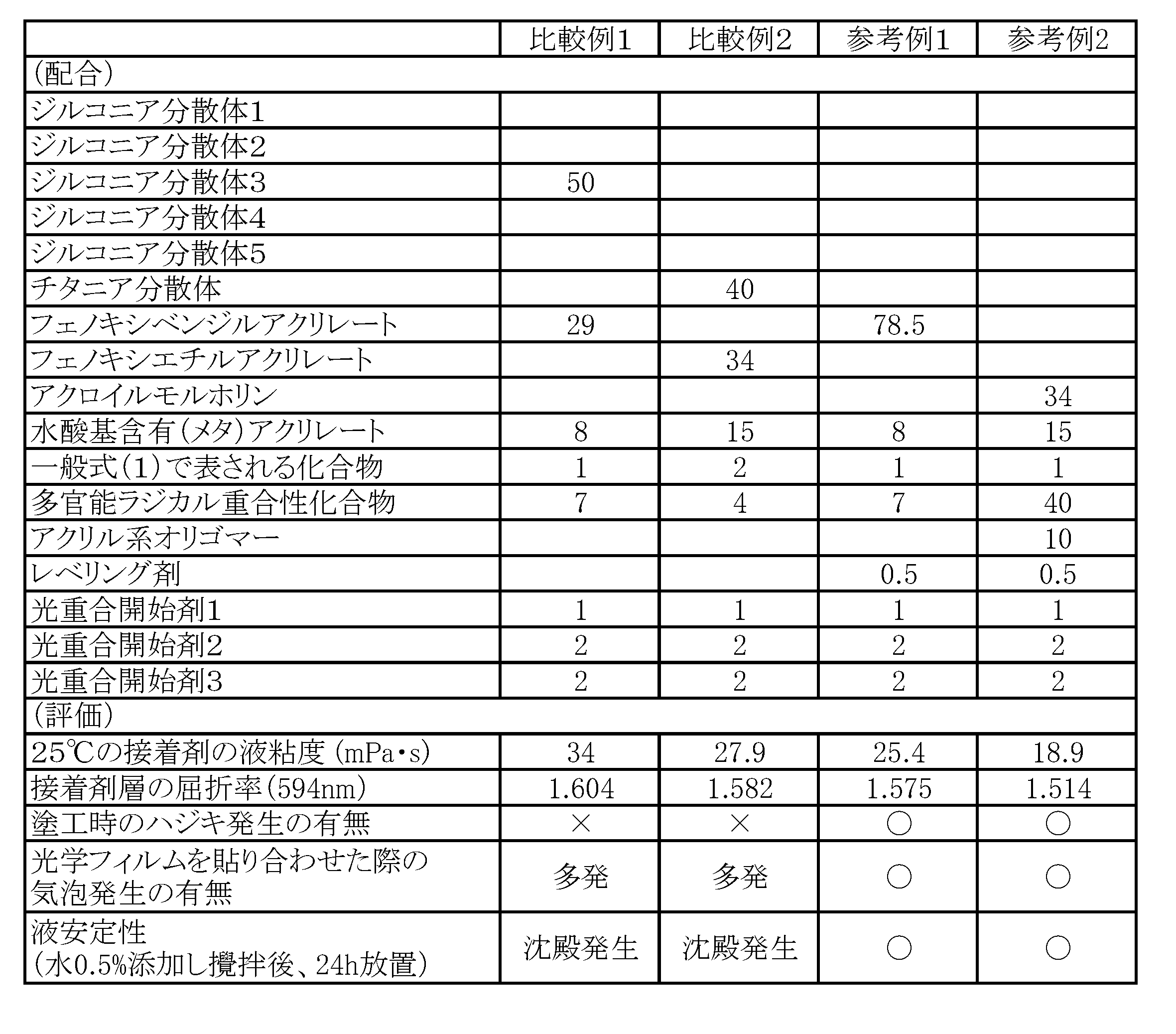
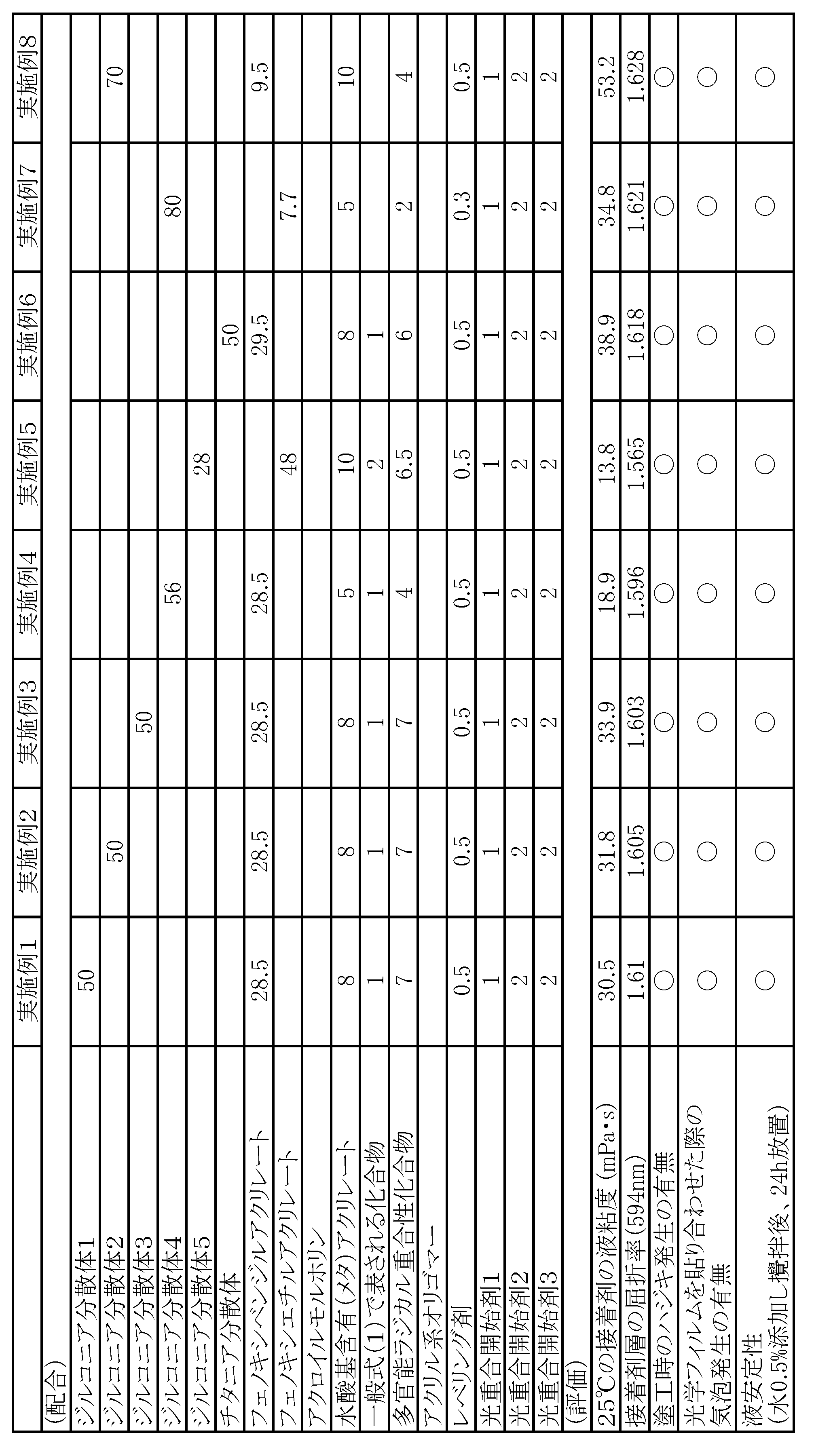
金属酸化物粒子を配合しない参考例1~2に係る積層光学フィルム用接着剤組成物の硬化物層(接着剤層)に比して、金属酸化物粒子を配合した比較例1~2および実施例1~8に係る積層光学フィルム用接着剤組成物の硬化物層では屈折率が向上することがわかる。ただし、比較例1~2に係る積層光学フィルム用接着剤組成物は、金属酸化物粒子が安定に分散しないことに起因して沈殿が発生し、液安定性が悪化した。また、液安定性悪化に伴い、塗工時にハジキが発生するとともに、光学フィルムを貼り合わせた際に気泡が多数発生した。
Claims (12)
- 少なくとも2枚の光学フィルムを接着させるための積層光学フィルム用接着剤組成物であって、
硬化性成分、芳香環骨格を含有する(メタ)アクリレート、金属酸化物粒子およびレベリング剤を含有し、
前記レベリング剤が、イソシアヌレート化合物およびポリシロキサン化合物からなる群より選択される少なくとも1種を含有するものであることを特徴とする積層光学フィルム用接着剤組成物。 - 組成物中の全量を100質量%としたとき、前記イソシアヌレート化合物の含有量が0.05~10質量%である請求項1または2に記載の積層光学フィルム用接着剤組成物。
- 組成物中の全量を100質量%としたとき、前記ポリシロキサン化合物の含有量が0.05~2.0質量%である請求項1または2に記載の積層光学フィルム用接着剤組成物。
- 組成物中の全量を100質量%としたとき、前記金属酸化物粒子の含有量が10~50質量%である請求項1~3いずれかに記載の積層光学フィルム用接着剤組成物。
- 組成物中の全量を100質量%としたとき、前記芳香環骨格を含有する(メタ)アクリレートの含有量が30~70質量%である請求項1~4いずれかに記載の積層光学フィルム用接着剤組成物。
- 前記芳香環骨格を含有する(メタ)アクリレートが、多環式芳香環骨格を有する(メタ)アクリレートおよび2個以上の芳香環を有する(メタ)アクリレートからなる群より選択される少なくとも1種を含有するものである請求項1~5いずれかに記載の積層光学フィルム用接着剤組成物。
- 前記芳香環骨格を含有する(メタ)アクリレートが、フェノキシベンジル(メタ)アクリレートである請求項1~6いずれかに記載の積層光学フィルム用接着剤組成物。
- さらに水酸基含有モノマーを含有する請求項1~7いずれかに記載の積層光学フィルム用接着剤組成物。
- さらに下記一般式(1):
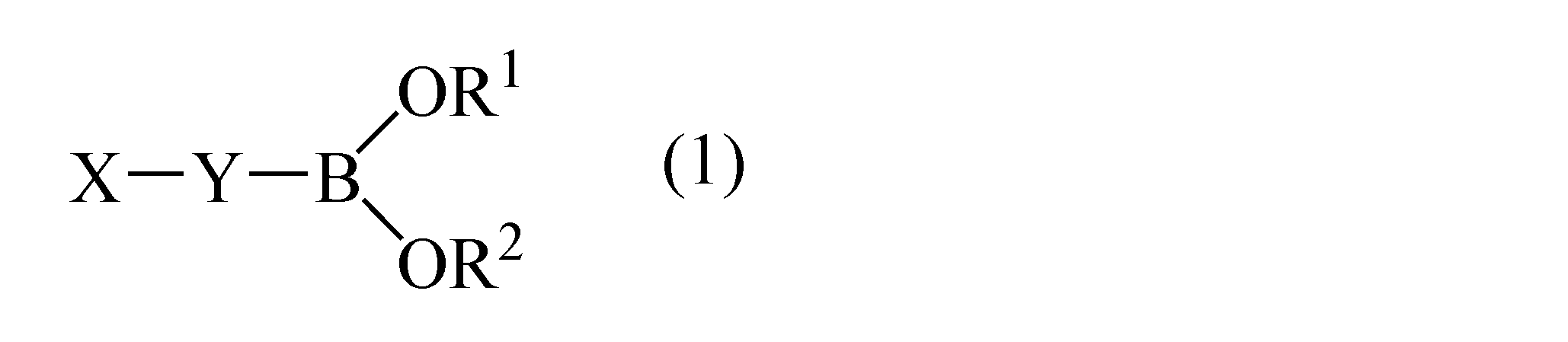
- 組成物中の全量を100質量%としたとき、前記一般式(1)で表される化合物の含有量が0.1~10質量%である請求項6に記載の積層光学フィルム用接着剤組成物。
- 25℃における粘度が100[mPa・s]以下である請求項1~10いずれかに記載の積層光学フィルム用接着剤組成物。
- 接着剤層を介して、少なくとも第1光学フィルムおよび第2光学フィルムが積層された積層光学フィルムであって、
前記接着剤層が請求項1~11いずれかに記載の積層光学フィルム用接着剤組成物の硬化物層であることを特徴とする積層光学フィルム。
Priority Applications (2)
| Application Number | Priority Date | Filing Date | Title |
|---|---|---|---|
| KR1020257037411A KR20260018024A (ko) | 2023-06-02 | 2024-05-10 | 적층 광학 필름용 접착제 조성물 및 적층 광학 필름 |
| CN202480035301.XA CN121195035A (zh) | 2023-06-02 | 2024-05-10 | 层叠光学膜用粘接剂组合物及层叠光学膜 |
Applications Claiming Priority (2)
| Application Number | Priority Date | Filing Date | Title |
|---|---|---|---|
| JP2023-091591 | 2023-06-02 | ||
| JP2023091591A JP7859764B2 (ja) | 2023-06-02 | 2023-06-02 | 積層光学フィルム用接着剤組成物および積層光学フィルム |
Publications (1)
| Publication Number | Publication Date |
|---|---|
| WO2024247657A1 true WO2024247657A1 (ja) | 2024-12-05 |
Family
ID=93657274
Family Applications (1)
| Application Number | Title | Priority Date | Filing Date |
|---|---|---|---|
| PCT/JP2024/017391 Ceased WO2024247657A1 (ja) | 2023-06-02 | 2024-05-10 | 積層光学フィルム用接着剤組成物および積層光学フィルム |
Country Status (5)
| Country | Link |
|---|---|
| JP (2) | JP7859764B2 (ja) |
| KR (1) | KR20260018024A (ja) |
| CN (1) | CN121195035A (ja) |
| TW (1) | TW202506932A (ja) |
| WO (1) | WO2024247657A1 (ja) |
Citations (3)
| Publication number | Priority date | Publication date | Assignee | Title |
|---|---|---|---|---|
| JP2017128688A (ja) * | 2016-01-22 | 2017-07-27 | 共栄社化学株式会社 | 活性エネルギー線硬化型樹脂組成物、その硬化物及びレンズシート |
| JP2017160313A (ja) * | 2016-03-09 | 2017-09-14 | 日東電工株式会社 | 硬化性樹脂組成物、偏光フィルムおよびその製造方法、光学フィルムならびに画像表示装置 |
| JP2020160408A (ja) * | 2019-03-28 | 2020-10-01 | 日東電工株式会社 | 偏光フィルムの製造方法 |
Family Cites Families (2)
| Publication number | Priority date | Publication date | Assignee | Title |
|---|---|---|---|---|
| JP2018017996A (ja) | 2016-07-29 | 2018-02-01 | 日東電工株式会社 | 位相差層付偏光板および有機el表示装置 |
| JP2020052365A (ja) | 2018-09-28 | 2020-04-02 | 住友化学株式会社 | 偏光板複合体、及び画像表示装置 |
-
2023
- 2023-06-02 JP JP2023091591A patent/JP7859764B2/ja active Active
-
2024
- 2024-05-10 CN CN202480035301.XA patent/CN121195035A/zh active Pending
- 2024-05-10 WO PCT/JP2024/017391 patent/WO2024247657A1/ja not_active Ceased
- 2024-05-10 KR KR1020257037411A patent/KR20260018024A/ko active Pending
- 2024-05-16 TW TW113118114A patent/TW202506932A/zh unknown
-
2025
- 2025-12-08 JP JP2025238916A patent/JP2026026396A/ja active Pending
Patent Citations (3)
| Publication number | Priority date | Publication date | Assignee | Title |
|---|---|---|---|---|
| JP2017128688A (ja) * | 2016-01-22 | 2017-07-27 | 共栄社化学株式会社 | 活性エネルギー線硬化型樹脂組成物、その硬化物及びレンズシート |
| JP2017160313A (ja) * | 2016-03-09 | 2017-09-14 | 日東電工株式会社 | 硬化性樹脂組成物、偏光フィルムおよびその製造方法、光学フィルムならびに画像表示装置 |
| JP2020160408A (ja) * | 2019-03-28 | 2020-10-01 | 日東電工株式会社 | 偏光フィルムの製造方法 |
Non-Patent Citations (1)
| Title |
|---|
| ANONYMOUS: "BYK-UV 3505", BYK, 1 July 2020 (2020-07-01), XP093244630, Retrieved from the Internet <URL:https://www.byk.com/ja/products/additive-guide/byk-uv-3505> * |
Also Published As
| Publication number | Publication date |
|---|---|
| TW202506932A (zh) | 2025-02-16 |
| JP7859764B2 (ja) | 2026-05-15 |
| JP2024173272A (ja) | 2024-12-12 |
| JP2026026396A (ja) | 2026-02-16 |
| KR20260018024A (ko) | 2026-02-06 |
| CN121195035A (zh) | 2025-12-23 |
Similar Documents
| Publication | Publication Date | Title |
|---|---|---|
| JP2024083675A (ja) | 積層光学フィルムおよび画像表示装置 | |
| JP7315357B2 (ja) | 偏光フィルムの製造方法 | |
| KR20260010673A (ko) | 적층 광학 필름의 제조 방법 | |
| JP7214397B2 (ja) | 偏光子、偏光フィルム、光学フィルム、ならびに画像表示装置 | |
| KR102909325B1 (ko) | 편광 필름의 제조 방법 | |
| JP7859764B2 (ja) | 積層光学フィルム用接着剤組成物および積層光学フィルム | |
| KR102669735B1 (ko) | 편광자, 편광 필름, 광학 필름, 그리고 화상 표시 장치 | |
| WO2024247658A1 (ja) | 積層光学フィルム用接着剤組成物および積層光学フィルム | |
| WO2024247659A1 (ja) | 積層光学フィルムおよび積層光学フィルムの製造方法 | |
| WO2024247660A1 (ja) | 積層光学フィルムの製造方法 | |
| JP2026059299A (ja) | 光学積層体および光学積層体の製造方法 | |
| WO2024247412A1 (ja) | 偏光フィルムおよびその製造方法 | |
| WO2024127733A1 (ja) | 硬化性組成物、偏光フィルム、光学フィルムおよび画像表示装置 | |
| WO2024127722A1 (ja) | 硬化性樹脂組成物、偏光フィルム、積層光学フィルムおよび画像表示装置 | |
| TW202436412A (zh) | 硬化性樹脂組成物、偏光薄膜、積層光學薄膜及影像顯示裝置 | |
| WO2020039899A1 (ja) | 偏光子、偏光フィルム、光学フィルム、ならびに画像表示装置 |
Legal Events
| Date | Code | Title | Description |
|---|---|---|---|
| 121 | Ep: the epo has been informed by wipo that ep was designated in this application |
Ref document number: 24815141 Country of ref document: EP Kind code of ref document: A1 |
|
| NENP | Non-entry into the national phase |
Ref country code: DE |
|
| 122 | Ep: pct application non-entry in european phase |
Ref document number: 24815141 Country of ref document: EP Kind code of ref document: A1 |