WO2024232295A1 - アルミニウム合金中のSi,Fe,Cuの低減又は除去方法 - Google Patents
アルミニウム合金中のSi,Fe,Cuの低減又は除去方法 Download PDFInfo
- Publication number
- WO2024232295A1 WO2024232295A1 PCT/JP2024/016393 JP2024016393W WO2024232295A1 WO 2024232295 A1 WO2024232295 A1 WO 2024232295A1 JP 2024016393 W JP2024016393 W JP 2024016393W WO 2024232295 A1 WO2024232295 A1 WO 2024232295A1
- Authority
- WO
- WIPO (PCT)
- Prior art keywords
- temperature
- aluminum alloy
- molten
- maintaining
- reducing
- Prior art date
- Legal status (The legal status is an assumption and is not a legal conclusion. Google has not performed a legal analysis and makes no representation as to the accuracy of the status listed.)
- Ceased
Links
Images





Classifications
-
- C—CHEMISTRY; METALLURGY
- C22—METALLURGY; FERROUS OR NON-FERROUS ALLOYS; TREATMENT OF ALLOYS OR NON-FERROUS METALS
- C22B—PRODUCTION AND REFINING OF METALS; PRETREATMENT OF RAW MATERIALS
- C22B21/00—Obtaining aluminium
- C22B21/06—Obtaining aluminium refining
-
- C—CHEMISTRY; METALLURGY
- C22—METALLURGY; FERROUS OR NON-FERROUS ALLOYS; TREATMENT OF ALLOYS OR NON-FERROUS METALS
- C22B—PRODUCTION AND REFINING OF METALS; PRETREATMENT OF RAW MATERIALS
- C22B9/00—General processes of refining or remelting of metals; Apparatus for electroslag or arc remelting of metals
- C22B9/16—Remelting metals
-
- Y—GENERAL TAGGING OF NEW TECHNOLOGICAL DEVELOPMENTS; GENERAL TAGGING OF CROSS-SECTIONAL TECHNOLOGIES SPANNING OVER SEVERAL SECTIONS OF THE IPC; TECHNICAL SUBJECTS COVERED BY FORMER USPC CROSS-REFERENCE ART COLLECTIONS [XRACs] AND DIGESTS
- Y02—TECHNOLOGIES OR APPLICATIONS FOR MITIGATION OR ADAPTATION AGAINST CLIMATE CHANGE
- Y02P—CLIMATE CHANGE MITIGATION TECHNOLOGIES IN THE PRODUCTION OR PROCESSING OF GOODS
- Y02P10/00—Technologies related to metal processing
- Y02P10/20—Recycling
Definitions
- the present invention relates to a method for reducing or removing alloy elements required for recycling aluminum materials.
- Various alloying elements are added to aluminum alloys depending on the application, such as wrought material or cast material.
- a relatively large amount of Si is added to the casting material because it provides good fluidity during casting, a small thermal expansion coefficient, and improved wear resistance.
- the ADC12 (JIS H 5302) alloy used as a die casting alloy is specified to have a Si content of 9.6 to 12.0%.
- Cu has the effect of improving strength, and is specified to be 1.5 to 3.5%.
- the Fe component is an element that is likely to be mixed into molten metal during recycling of scrap, it has the effect of suppressing seizure onto a mold, and therefore the Fe content in the ADC12 alloy is specified to be 1.3% or less.
- cast materials have a relatively wide tolerance for added elements and have a high recycling rate.
- wrought materials have a narrow tolerance range for alloying elements, which is one of the reasons why recycling of scrap materials has not improved.
- Patent Document 1 describes a method for reducing the iron content of an aluminum alloy by adding manganese to the molten metal and thereby crystallizing and removing Fe as an Al-Fe-Mn-Si intermetallic compound.
- this method of separating intermetallic compounds relies on induced current differences moving through a non-uniform magnetic field, which is not practical.
- Non-Patent Document 1 proposes a molten salt electrolysis method in which aluminum scrap is used as the anode in molten salt and electrolysis is performed while still in a solid state, in which only Al migrates to the cathode, but this is not necessarily practical.
- the present invention aims to provide a method for reducing or removing Si in aluminum alloys, and also makes it possible to reduce or remove Fe and Cu components.
- the method for reducing or removing Si in an aluminum alloy according to the present invention is characterized by the steps of: maintaining the aluminum alloy at a melting temperature at which the aluminum alloy and Sn are molten; lowering the melting temperature, maintaining the temperature at a Si crystallization temperature at which solid Si crystallizes while maintaining the molten state of Sn and Al, and separating the solid Si; and further lowering the temperature and maintaining the temperature at the solid Al crystallization temperature at which Al crystallizes but Sn is in a molten state, thereby separating and recovering solid Al.
- the present invention focuses on this point and shows that when an aluminum alloy and Sn are heated and held at 873K or higher, both Al and Si melt, but when the molten metal temperature is lowered to around 873K, Si crystallizes and can be separated as solid Si, and when the molten metal temperature is further lowered to around 573K, Al crystallizes and can be separated and recovered as solid Al, which can be recycled. Moreover, Sn can be reused repeatedly.
- the present invention is characterized in that it can also reduce Fe after removing Si from an aluminum alloy, and includes a step of holding the aluminum alloy at a melting temperature at which the aluminum alloy and Sn are melted, a step of lowering the melting temperature and, while maintaining a molten state of Sn, Al, and Fe, holding the temperature at a Si crystallization temperature at which solid Si and/or Al 3 Fe crystallize, and separating the solid Si, and further lowering the temperature to crystallize and separate Al and/or Al 3 Fe while maintaining Fe molten in the molten Sn.
- a method for reducing or removing Fe contained in the aluminum alloy can include a step of maintaining the aluminum alloy at a melting temperature at which the aluminum alloy and Sn are molten, and a step of lowering the melting temperature to crystallize and separate Al and/or Al 3 Fe while maintaining Fe in the molten Sn.
- the present invention can also reduce Cu after removing Si from an aluminum alloy, and is characterized by comprising a step of holding the aluminum alloy at a melting temperature at which the aluminum alloy and Sn are molten, a step of lowering the melting temperature, and while maintaining a molten state of Sn, Al, and Cu, holding the temperature at a Si crystallization temperature at which solid Si and/or Al 2 Cu crystallize, and separating the solid Si, and further lowering the temperature to crystallize and separate Al and/or Al 2 Cu while maintaining Cu in a molten Sn state.
- a method for reducing or removing Cu contained in the aluminum alloy can include a step of maintaining the aluminum alloy at a melting temperature at which the aluminum alloy and Sn are melted, and a step of lowering the melting temperature to crystallize and separate Al and/or Al 2 Cu while maintaining Cu in the molten Sn.
- the present invention utilizes the difference in solubility between Si and Al in molten Sn to separate and recover solid Al after separation of solid Si, and since Sn can be reused repeatedly, it is possible to reduce or remove Si from aluminum scrap material, improving recyclability. Moreover, Fe and Cu can also be reduced.
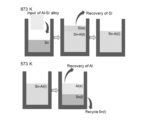
- FIG. 1 shows an explanatory diagram of a process for removing Si from an aluminum alloy using molten Sn.
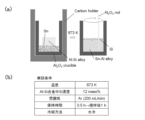
- (a) shows the experimental furnace and (b) shows the experimental conditions when an Al-Si alloy was used.
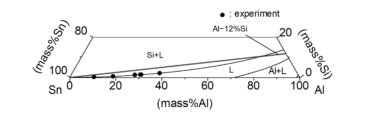
- the phase diagram of Sn, Al, and Si and the experimental values are shown.
- the liquidus projection diagram of the Al-Si-Sn system is shown.
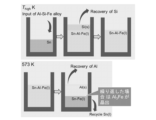
- FIG. 6 shows an enlarged view of a portion of FIG. 1 shows an explanatory diagram of the Fe removal process.
- (a) shows the experimental furnace and (b) shows the experimental conditions when an Al-Fe alloy was used.
- 1 shows a graph plotting experimental values of the amount of dissolved Al and the Fe concentration in the Sn bath. 1 shows an explanatory diagram of the Cu removal process.
- the melting temperature at which the aluminum alloy and Sn melt is a temperature exceeding 873 K, for example, a heating temperature of about 1000 K.
- the molten Sn shown in Fig. 1 about 50 mass% of Al melts at about 873 K, but almost no Si melts, and the temperature can reach the crystallization temperature of solid Si, and when the temperature is lowered to about 573 K, almost no Al melts, but Al crystallizes and separates, and the temperature can reach the Al crystallization temperature.
- the present invention utilizes this phenomenon.
- This process is illustrated diagrammatically in FIG. (1)
- Sn and an Al-Si alloy (scrap material) are put into a furnace and heated to a temperature exceeding 873 K, for example, about 1000 K, and held there, the entire material becomes molten.
- the molten metal is gradually cooled and held at 873K, whereupon solid Si crystallizes out and is separated and recovered.
- the remainder becomes a molten metal of Sn and Al.
- solid Al crystallizes out, which is separated and recovered.
- the remaining molten Sn can be repeatedly used in the aluminum scrap recycling process.
- FIG. 3(a) Sn and an Al--Si alloy are placed in an Al 2 O 3 furnace and heated. A carbon holder was used for heat retention. The mixture was heated to a temperature 10 to 200 K higher than 873 K, and dissolved by stirring with an Al 2 O 3 rod. The mixture was then held at 873K with stirring. The Al--Si alloy used contained 12 mass % of Si, and the treatment was carried out in an Ar gas atmosphere as shown in FIG. 3(b).
- FIG. 4 shows a phase diagram of Sn, Al and Si, in which the experimental values of the amount of dissolved Al are plotted.
- FIG. 4 shows a phase diagram of Sn, Al and Si, in which the experimental values of the amount of dissolved Al are plotted.
- FIG. 5 shows a phase line projection diagram of the Al-Si-Sn system
- FIG. 6 shows the range in which Si crystallizes and Al dissolves in the molten Sn.
- Non-Patent Document 4 Next, from the phase diagrams at 800° C. and 1000° C. shown in Non-Patent Document 4, it is found that when cooled to the eutectic point of Al and Al 3 Fe (1.8 mass % Fe) or below, Al crystallizes preferentially.
- the Fe reduction or removal process based on this is shown in FIG. After Si is crystallized at 873K, Al and Fe are dissolved in the molten Sn when the Fe content is 1.8 mass% or less. Then, when cooled to 573K, Fe remains in the molten Sn because the solubility of Fe in solid Al is very low. When this process is repeated, the Fe concentration in the molten Sn increases, but it crystallizes out as an Al 3 Fe compound. This makes it possible to remove Fe. In addition, scrap material with a low Si content can be directly held at 573K to remove Fe from the Al.
- FIG. 8(a) Sn and an Al-- Fe alloy are placed in an Al.sub.2O.sub.3 furnace and heated. A carbon holder was used for heat retention. The mixture was heated to a temperature 10 to 200 K higher than 1273 K, and dissolved by stirring with an Al 2 O 3 rod. The mixture was then held at 873K with stirring. The Al--Fe alloy used was one containing 10 mass % Fe, and the treatment was carried out in an Ar gas atmosphere as shown in FIG. 8(b).
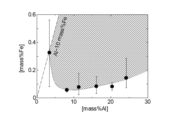
- FIG. 9 plots the experimental values of the amount of dissolved Al and the Fe concentration in the Sn bath.
- the Fe concentration can be reduced when the Al content is higher than the initial concentration when the Al-10 mass% Fe alloy shown by the dashed line is introduced into the Sn bath and the Fe concentration is equal to or higher than the solubility, that is, under the conditions of the shaded region in FIG.
- Non-Patent Document 5 the phase diagram described in Non-Patent Document 5 can be used as a reference for the range in which Cu remains in the molten Sn and Al precipitates.
- the Cu removal process based on this is shown in FIG.
- the temperature of the molten Sn is 573K
- Al crystallizes out, but Cu dissolves in the molten Sn.
- This process is repeated, and when the Cu concentration in the molten Sn reaches 3.8 msec % or more, it crystallizes out as an Al 2 Cu compound.
- the molten metal temperature may be maintained at 573K, and Cu may be left on the Sn side to remove Cu from Al.
- Molten Sn can be used to remove impurities such as Si, Fe, and Cu from aluminum alloys, making it possible to recycle aluminum scrap containing impurities into aluminum products with low impurity tolerance levels.
Landscapes
- Engineering & Computer Science (AREA)
- Chemical & Material Sciences (AREA)
- Manufacturing & Machinery (AREA)
- Materials Engineering (AREA)
- Mechanical Engineering (AREA)
- Metallurgy (AREA)
- Organic Chemistry (AREA)
- Manufacture And Refinement Of Metals (AREA)
Priority Applications (6)
| Application Number | Priority Date | Filing Date | Title |
|---|---|---|---|
| CN202480031321.XA CN121285645A (zh) | 2023-05-10 | 2024-04-26 | 铝合金中的Si、Fe、Cu的降低或除去方法 |
| KR1020257036610A KR20260002825A (ko) | 2023-05-10 | 2024-04-26 | 알루미늄 합금 중의 Si, Fe, Cu의 저감 또는 제거 방법 |
| JP2025519398A JPWO2024232295A1 (https=) | 2023-05-10 | 2024-04-26 | |
| AU2024268107A AU2024268107A1 (en) | 2023-05-10 | 2024-04-26 | METHOD FOR REDUCING OR REMOVING Si, Fe, AND Cu IN ALUMINUM ALLOY |
| EP24803408.4A EP4711481A1 (en) | 2023-05-10 | 2024-04-26 | Method for reducing or removing si, fe, and cu in aluminum alloy |
| US19/374,538 US20260055483A1 (en) | 2023-05-10 | 2025-10-30 | Method For Reducing Or Eliminating Si, Fe, And Cu In Aluminum Alloys |
Applications Claiming Priority (2)
| Application Number | Priority Date | Filing Date | Title |
|---|---|---|---|
| JP2023077600 | 2023-05-10 | ||
| JP2023-077600 | 2023-05-10 |
Related Child Applications (1)
| Application Number | Title | Priority Date | Filing Date |
|---|---|---|---|
| US19/374,538 Continuation US20260055483A1 (en) | 2023-05-10 | 2025-10-30 | Method For Reducing Or Eliminating Si, Fe, And Cu In Aluminum Alloys |
Publications (1)
| Publication Number | Publication Date |
|---|---|
| WO2024232295A1 true WO2024232295A1 (ja) | 2024-11-14 |
Family
ID=93429946
Family Applications (1)
| Application Number | Title | Priority Date | Filing Date |
|---|---|---|---|
| PCT/JP2024/016393 Ceased WO2024232295A1 (ja) | 2023-05-10 | 2024-04-26 | アルミニウム合金中のSi,Fe,Cuの低減又は除去方法 |
Country Status (7)
| Country | Link |
|---|---|
| US (1) | US20260055483A1 (https=) |
| EP (1) | EP4711481A1 (https=) |
| JP (1) | JPWO2024232295A1 (https=) |
| KR (1) | KR20260002825A (https=) |
| CN (1) | CN121285645A (https=) |
| AU (1) | AU2024268107A1 (https=) |
| WO (1) | WO2024232295A1 (https=) |
Citations (5)
| Publication number | Priority date | Publication date | Assignee | Title |
|---|---|---|---|---|
| US2198673A (en) * | 1938-07-11 | 1940-04-30 | Israel Jacob Foundaminsky | Process for the manufacture of aluminum |
| US20090084225A1 (en) * | 2005-11-22 | 2009-04-02 | Carbontech, Llc | Methods of recovering and purifying secondary aluminum |
| US20100024602A1 (en) * | 2006-06-28 | 2010-02-04 | Aleris Switzwerland Gmbh | Crystallisation method for the purification of a molten metal, in particular recycled aluminium |
| JP2014234930A (ja) | 2013-05-30 | 2014-12-15 | カルソニックカンセイ株式会社 | 熱交換器およびその製造方法 |
| CN115555133A (zh) * | 2022-10-10 | 2023-01-03 | 王传东 | 一种逆阻式高压静电分类提取废旧电路板金属的装置 |
Family Cites Families (1)
| Publication number | Priority date | Publication date | Assignee | Title |
|---|---|---|---|---|
| JPS60234930A (ja) | 1984-05-07 | 1985-11-21 | Toyota Motor Corp | アルミニウム合金の鉄分低減方法 |
-
2024
- 2024-04-26 JP JP2025519398A patent/JPWO2024232295A1/ja active Pending
- 2024-04-26 CN CN202480031321.XA patent/CN121285645A/zh active Pending
- 2024-04-26 AU AU2024268107A patent/AU2024268107A1/en active Pending
- 2024-04-26 EP EP24803408.4A patent/EP4711481A1/en active Pending
- 2024-04-26 KR KR1020257036610A patent/KR20260002825A/ko active Pending
- 2024-04-26 WO PCT/JP2024/016393 patent/WO2024232295A1/ja not_active Ceased
-
2025
- 2025-10-30 US US19/374,538 patent/US20260055483A1/en active Pending
Patent Citations (5)
| Publication number | Priority date | Publication date | Assignee | Title |
|---|---|---|---|---|
| US2198673A (en) * | 1938-07-11 | 1940-04-30 | Israel Jacob Foundaminsky | Process for the manufacture of aluminum |
| US20090084225A1 (en) * | 2005-11-22 | 2009-04-02 | Carbontech, Llc | Methods of recovering and purifying secondary aluminum |
| US20100024602A1 (en) * | 2006-06-28 | 2010-02-04 | Aleris Switzwerland Gmbh | Crystallisation method for the purification of a molten metal, in particular recycled aluminium |
| JP2014234930A (ja) | 2013-05-30 | 2014-12-15 | カルソニックカンセイ株式会社 | 熱交換器およびその製造方法 |
| CN115555133A (zh) * | 2022-10-10 | 2023-01-03 | 王传东 | 一种逆阻式高压静电分类提取废旧电路板金属的装置 |
Non-Patent Citations (5)
| Title |
|---|
| "Development of New Sustainable Recycling Technology for Aluminum", 26 April 2022, TOHOKU UNIVERSITY |
| A. J. MCALISTERD. J. KAHAN, BULLETIN OF ALLOY PHASE DIAGRAM, vol. 4, 1983, pages 410 |
| C. P. WANGM. S. WANGY. L. DENGJ. B. ZHANGS. Y. YANGY. X. HUANGX. J. LIU, JOURNAL OF PHASE EQUILIBRIA AND DIFFUSIONS, vol. 43, 2022, pages 51 - 57 |
| H. R. KOTADIAE. DOERNBERGJ. B. PATELZ. FANR. SCHMID-FETZER, METALLURGICAL AND MATERIALS TRANSACTIONS A, vol. 40A, 2009, pages 2202 - 2211 |
| R. W. OLESINSKIG. J. ABBASCHIAN, BULLETIN OF ALLOY PHASE DIAGRAM, vol. 5, 1984, pages 273 |
Also Published As
| Publication number | Publication date |
|---|---|
| JPWO2024232295A1 (https=) | 2024-11-14 |
| EP4711481A1 (en) | 2026-03-18 |
| AU2024268107A1 (en) | 2025-11-13 |
| CN121285645A (zh) | 2026-01-06 |
| US20260055483A1 (en) | 2026-02-26 |
| KR20260002825A (ko) | 2026-01-06 |
Similar Documents
| Publication | Publication Date | Title |
|---|---|---|
| US20150132179A1 (en) | Master alloy for casting a modified copper alloy and casting method using the same | |
| WO2007147962A3 (fr) | Procede de recyclage de scrap en alliage d'aluminium provenant de l'industrie aeronautique | |
| CN106381408B (zh) | 一种钾冰晶石熔盐中铝热还原制备铝钪中间合金的方法 | |
| JP2016514212A5 (https=) | ||
| JPS6139385B2 (https=) | ||
| JPS5912731B2 (ja) | アルミニウム又はアルミニウム合金の精製法 | |
| US2464610A (en) | Method for producing aluminumsilicon alloys | |
| WO2024232295A1 (ja) | アルミニウム合金中のSi,Fe,Cuの低減又は除去方法 | |
| CN109097614B (zh) | 一种细化镁合金晶粒尺寸的方法 | |
| JP7423495B2 (ja) | 不純物除去方法 | |
| JP2636162B2 (ja) | アルミニウム合金材の脱鉄法 | |
| US4297132A (en) | Electroslag remelting method and flux composition | |
| US6733566B1 (en) | Petroleum coke melt cover for aluminum and magnesium alloys | |
| JP2926280B2 (ja) | 稀土類−鉄合金の製造方法 | |
| CN108559891A (zh) | 铝、锌、镁、钪系统的变形铝合金及其制造方法 | |
| KR101591645B1 (ko) | Al-Si-Ti-Mg 합금 잉곳 및 그 제조방법 | |
| Szymczak et al. | Hypoeutectic silumin to pressure die casting with vanadium and tungsten | |
| JP7742620B1 (ja) | アルミニウム合金中の添加成分又は/及び不純物の低減又は除去方法 | |
| RU2191836C2 (ru) | Способ получения слитков | |
| CN116623050B (zh) | 一种微合金化高耐蚀Mg-Sn-Ge合金材料及其制备方法 | |
| Sotome et al. | Application of fractional crystallization for refining of molten aluminum scrap | |
| JP2025024407A (ja) | 精製アルミニウム合金の製造方法 | |
| CN101245419A (zh) | 改善重熔再生铸造铝合金性能的方法 | |
| JP2019077895A (ja) | Al合金の再生方法 | |
| JP2025049972A (ja) | 不純物除去方法、及びアルミニウム系合金材の製造方法 |
Legal Events
| Date | Code | Title | Description |
|---|---|---|---|
| 121 | Ep: the epo has been informed by wipo that ep was designated in this application |
Ref document number: 24803408 Country of ref document: EP Kind code of ref document: A1 |
|
| ENP | Entry into the national phase |
Ref document number: 2025519398 Country of ref document: JP Kind code of ref document: A |
|
| WWE | Wipo information: entry into national phase |
Ref document number: 2025519398 Country of ref document: JP |
|
| WWE | Wipo information: entry into national phase |
Ref document number: AU2024268107 Country of ref document: AU |
|
| ENP | Entry into the national phase |
Ref document number: 2024268107 Country of ref document: AU Date of ref document: 20240426 Kind code of ref document: A |
|
| WWE | Wipo information: entry into national phase |
Ref document number: 202547121737 Country of ref document: IN |
|
| WWE | Wipo information: entry into national phase |
Ref document number: 2024803408 Country of ref document: EP |
|
| NENP | Non-entry into the national phase |
Ref country code: DE |
|
| ENP | Entry into the national phase |
Ref document number: 2024803408 Country of ref document: EP Effective date: 20251210 |
|
| ENP | Entry into the national phase |
Ref document number: 2024803408 Country of ref document: EP Effective date: 20251210 |
|
| ENP | Entry into the national phase |
Ref document number: 2024803408 Country of ref document: EP Effective date: 20251210 |
|
| ENP | Entry into the national phase |
Ref document number: 2024803408 Country of ref document: EP Effective date: 20251210 |
|
| ENP | Entry into the national phase |
Ref document number: 2024803408 Country of ref document: EP Effective date: 20251210 |
|
| ENP | Entry into the national phase |
Ref document number: 2024803408 Country of ref document: EP Effective date: 20251210 |
|
| ENP | Entry into the national phase |
Ref document number: 2024803408 Country of ref document: EP Effective date: 20251210 |
|
| ENP | Entry into the national phase |
Ref document number: 2024803408 Country of ref document: EP Effective date: 20251210 |
|
| ENP | Entry into the national phase |
Ref document number: 2024803408 Country of ref document: EP Effective date: 20251210 |
|
| WWP | Wipo information: published in national office |
Ref document number: 2024803408 Country of ref document: EP |