WO2024228397A1 - 皮膚内部計測装置 - Google Patents
皮膚内部計測装置 Download PDFInfo
- Publication number
- WO2024228397A1 WO2024228397A1 PCT/JP2024/016863 JP2024016863W WO2024228397A1 WO 2024228397 A1 WO2024228397 A1 WO 2024228397A1 JP 2024016863 W JP2024016863 W JP 2024016863W WO 2024228397 A1 WO2024228397 A1 WO 2024228397A1
- Authority
- WO
- WIPO (PCT)
- Prior art keywords
- concentration
- skin
- current
- layer
- electrodes
- Prior art date
- Legal status (The legal status is an assumption and is not a legal conclusion. Google has not performed a legal analysis and makes no representation as to the accuracy of the status listed.)
- Ceased
Links
Images















Classifications
-
- A—HUMAN NECESSITIES
- A61—MEDICAL OR VETERINARY SCIENCE; HYGIENE
- A61B—DIAGNOSIS; SURGERY; IDENTIFICATION
- A61B5/00—Measuring for diagnostic purposes; Identification of persons
-
- A—HUMAN NECESSITIES
- A61—MEDICAL OR VETERINARY SCIENCE; HYGIENE
- A61B—DIAGNOSIS; SURGERY; IDENTIFICATION
- A61B5/00—Measuring for diagnostic purposes; Identification of persons
- A61B5/05—Detecting, measuring or recording for diagnosis by means of electric currents or magnetic fields; Measuring using microwaves or radio waves
- A61B5/053—Measuring electrical impedance or conductance of a portion of the body
- A61B5/0531—Measuring skin impedance
-
- G—PHYSICS
- G01—MEASURING; TESTING
- G01N—INVESTIGATING OR ANALYSING MATERIALS BY DETERMINING THEIR CHEMICAL OR PHYSICAL PROPERTIES
- G01N27/00—Investigating or analysing materials by the use of electric, electrochemical, or magnetic means
- G01N27/02—Investigating or analysing materials by the use of electric, electrochemical, or magnetic means by investigating impedance
Definitions
- the present invention relates to an internal skin measurement device.
- This application claims priority based on Japanese Patent Application No. 2023-076258, filed on May 2, 2023, the contents of which are incorporated herein by reference.
- the skin is composed of three layers: the epidermis, which is about 0.12 to 0.2 mm thick; the dermis, which is about 1.8 mm thick; and subcutaneous tissue (adipose tissue).
- the epidermis which is about 0.12 to 0.2 mm thick
- the dermis which is about 1.8 mm thick
- subcutaneous tissue asdipose tissue.
- sensors and other devices that are as simple and minimally invasive as possible, such as flat sensors that can be simply attached to the surface of the skin, to visualize the distribution of electrolyte and blood protein concentrations in specific layers of the skin.
- hypothyroidism caused by stress or other factors leads to an imbalance between hyaluronic acid and hyaluronidase (an enzyme that breaks down hyaluronic acid), resulting in excess hyaluronic acid in the dermis layer and causing edema, creating a demand for technology to measure the condition inside the skin.
- hyaluronic acid an enzyme that breaks down hyaluronic acid
- hyaluronidase an enzyme that breaks down hyaluronic acid
- necrosis In addition, in the medical field, skin flap surgery using vascular anastomosis is performed for skin tissue grafts in cases of severe burns, etc., but necrosis often occurs due to the difficulty of vascular anastomosis. In order to prevent necrosis, there is a demand for technology to measure the distribution of electrolyte concentrations and blood protein concentrations in specific layers of the skin, such as the epidermis, dermis, and subcutaneous tissue.
- Methods for measuring inside the skin include near-infrared cameras, optical coherence tomography, SHG light (second harmonic generation light), and photo-ultrasound, but these technologies are designed to visualize and measure the shape, and are not capable of visualizing and measuring the distribution of electrolyte concentrations or blood protein concentrations within specific layers of the skin.
- Patent Document 1 discloses a method for determining the sodium ion content of the skin using bioimpedance spectroscopy, in which a current is applied to the skin of a subject at a predetermined frequency, the voltage across the skin caused by the current is measured, and the measured voltage is used to determine the resistance across the skin of the subject at the predetermined frequency, and the measured voltage is used to determine the amount of skin sodium ions.
- Patent Document 2 describes a bioelectrical impedance measurement method for measuring bioelectrical impedance related to information inside the organism from electrical signals measured by attaching electrode pads to the surface of the organism in order to simply and accurately measure information on tissue layers in the depth direction just below the surface of the organism (fat layer, muscle layer, bone tissue layer, etc.).
- the present invention proposes the following means.
- the skin internal measurement device is a current/voltage application/measurement unit having a sensor with a plurality of electrodes that can be placed on the skin at intervals; a concentration distribution measuring unit for measuring at least one of an electrolyte concentration distribution and a blood protein concentration distribution in a specific layer inside the skin,
- the concentration distribution measurement unit detects at least one of the following features, which are information about a specific layer inside the skin and are obtained based on the current, potential difference, and/or phase fluctuation amount measured by the current/voltage application measurement unit: (1) A feature based on the variation between the impedance Z1(f) between a distant electrode where the electric field penetrates a specific skin layer and the impedance Z2(f) between a near electrode where the electric field does not penetrate the specific skin layer but penetrates only the upper layer, (2) A feature based on the amount of change in the potential difference and phase between the far and near electrodes when a square wave current is applied, or a feature based on the amount of change in
- Aspect 2 of the present invention is the skin internal measurement device of aspect 1,
- the concentration calculation unit further
- the system may have a calibration curve comparison unit that calculates the concentration of an electrolyte or blood protein, etc. based on (a) a calibration curve of a distribution function based on electrolyte concentration and relaxation time that has been prepared in advance, and a distribution function based on the relaxation time that has been estimated from the feature amount, or (b) a calibration curve of electrolyte concentration and power spectral density drop that has been prepared in advance, and a power spectral density drop that has been estimated from the feature amount.
- Aspect 3 of the present invention is the skin internal measurement device of aspect 2
- the concentration calculation unit may include a calibration curve comparison unit that calculates the concentration of an electrolyte, blood protein, or the like based on a calibration curve of a distribution function based on an electrolyte concentration and a relaxation time that is created in advance, and a distribution function based on the relaxation time that is estimated from the feature amount.
- Aspect 4 of the present invention is the skin internal measurement device of aspect 2,
- the concentration calculation unit may include a calibration curve comparison unit that calculates the concentration of an electrolyte, blood protein, or the like based on a calibration curve of electrolyte concentration and power spectral density drop that is created in advance and the power spectral density drop that is estimated from the feature amount.
- Aspect 5 of the present invention is the skin internal measurement device of aspect 1,
- the concentration distribution measuring unit includes: a skin specific layer separation unit that performs a predetermined process on the current or potential difference measured by the current/voltage application measurement unit based on a threshold value of the inter-electrode distance;
- the electric property distribution calculation unit may calculate at least one of a conductivity distribution, a permittivity distribution, and a phase distribution based on the current or the potential difference after the predetermined processing.
- a feature quantity carrying information on a specific layer inside the skin obtained based on a current, a potential difference, and/or a phase fluctuation amount measured by a current/voltage application measurement unit having a sensor including a plurality of electrodes arranged on the skin at intervals from each other, the feature quantity being at least one of the following: (1) A feature based on the variation between the impedance Z1(f) between a distant electrode where the electric field penetrates a specific skin layer and the impedance Z2(f) between a near electrode where the electric field does not penetrate the specific skin layer but penetrates only the upper layer, (2) A feature based on the amount of change in the potential difference and phase between the far and near electrodes when a square wave current is applied, or a feature based on the amount of change in the current and phase between the far and near electrodes when a square wave voltage is applied, or (3) performing
- a seventh aspect of the present invention is the measurement method according to the sixth aspect,
- the calculation using the feature quantity may be based on: (a) a calibration curve of a distribution function based on electrolyte concentration and relaxation time, which is prepared prior to the calculation of the electrolyte or blood protein concentration, and a distribution function based on relaxation time, which is estimated from the feature quantity; or (b) a calibration curve of electrolyte concentration and power spectral density drop, which is prepared prior to the calculation of the electrolyte or blood protein concentration, and a power spectral density drop, which is estimated from the feature quantity.
- the above aspect of the present invention provides an internal skin measurement device that can separate specific layers of the skin based on the measured impedance and grasp the condition inside the skin.
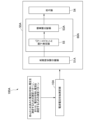
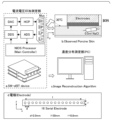
- FIG. 1 is a schematic diagram of an internal skin measuring device according to a first embodiment.
- FIG. FIG. 2 is a schematic diagram of a current/voltage application measuring section in FIG. 1 .
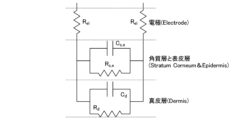
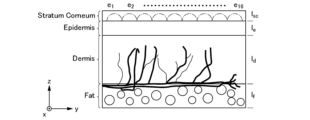
- FIG. 2 shows the configuration of the electrodes and skin when the electrodes are in contact with the skin.
- 4 is an equivalent circuit of the electrodes and skin in FIG. 3.
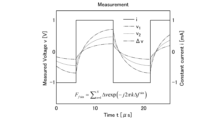
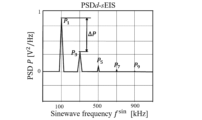
- FIG. 11 is a schematic diagram of an internal skin measuring device according to a second embodiment. 1 shows an example of a square wave applied current i(t), a measured potential difference v1 between the distant electrodes, a measured potential difference v2 between the near electrodes, and a difference ⁇ v between v1 and v2. 1 is an example of a calculated power spectral density (PSD) drop.
- PSD power spectral density
- FIG. 1 is an example of a calibration curve of power spectral density drop ⁇ P obtained by changing the concentration c of an aqueous sodium chloride solution.
- FIG. 13 is a schematic diagram of an internal skin measuring device according to a third embodiment.
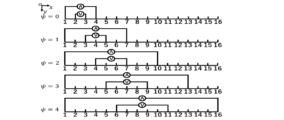
- FIG. 14 is a schematic diagram of a current/voltage application measuring section in FIG. 13 . This is the measurement pattern for the four-terminal quasi-adjacent method.
- FIG. 1 is a diagram for explaining processing using spatial voltage threshold (SVT). 1 is an example of an image reconstruction showing sodium ion concentration distribution.
- FIG. 1 is a schematic diagram of each specific layer of the skin used in the electromagnetic simulation.
- 1A to 1C are diagrams for explaining the sensor arrangement, skin structure, and skin equivalent circuit used in the electromagnetic simulation of Example 1.
- Example 1 shows the frequency dependence of electrical conductivity ⁇ and relative dielectric constant ⁇ in each specific skin layer used under the electromagnetic simulation conditions of Example 1.
- FIG. 13 is a diagram showing the change in estimated distribution function ⁇ (ln ⁇ ) when the electrode diameter ⁇ and the inter-electrode distance d in Example 1 are changed.
- FIG. 13 is a diagram showing an outline of an experimental apparatus according to a second embodiment. 13 shows a comparison result between the Cole-Cole plot and the equivalent circuit fitting, which are the experimental results of Example 2.
- FIG. 1 shows the calculation results of the skin specific layer separation area in an experiment using the pig skin tissue of Example 2.
- FIG. 13 is a schematic diagram of an internal skin measuring device used in Example 4.
- FIG. 13 is a diagram showing the relationship between the measurement pattern m and the normalized compensation voltage ⁇ v*> when the threshold value d ⁇ in the fourth embodiment is used as a parameter.
- FIG. 13 shows experimental results of a reconstructed image of sodium ion concentration distribution when the threshold value d ⁇ and the concentration of an aqueous sodium chloride solution are used as parameters in Example 4.
- FIG. 13 is a diagram showing the configuration of the electrodes and the skin when the electrodes are in contact with the skin in individual measurement using a skip injection pattern in Example 5.
- 13 shows a measurement pattern of the quasi-adjacent method in individual measurement using a skip injection pattern in Example 5.
- 13 is a graph showing the distribution of relaxation time (DRT) analysis of individual measurement data using the skip injection pattern in Example 5.
- 1 is a graph showing the relationship between ⁇ > and the sodium ion concentration in the dermis layer. This is a comparison of the spatially averaged conductivity distribution ⁇ * ⁇ > obtained by electromagnetic simulation and experiment.
- 13 shows the evaluation results of the threshold value d ⁇ by electromagnetic simulation and experiment.
- the skin internal measurement device 100 includes a current/voltage application measurement unit 10 and a concentration distribution measurement unit 50.
- the concentration distribution measurement unit 50 includes a skin specific layer separation unit 51, a distribution function estimation unit 52, a calibration curve comparison unit 53, and an output unit 54.
- the concentration distribution measurement unit 50 of the internal skin measurement device 100 includes, for example, a central processing unit (CPU), a read only memory (ROM), a random access memory (RAM), and a hard disk drive (HDD)/solid state drive (SSD).
- the specific skin layer separation unit 51, the distribution function estimation unit 52, the calibration curve comparison unit 53, and the output unit 54 are realized by the CPU executing a predetermined program.
- the program may be acquired via a recording medium or via a network.
- a dedicated hardware configuration may be used to realize the configuration of the internal skin measurement device 100.
- the concentration distribution measurement units 50A and 50B described later may also have the same configuration as the concentration distribution measurement unit 50. Each unit is described below.
- the current/voltage application measurement unit 10 includes a sensor 20 and a control unit 30.
- the sensor 20 includes a plurality of electrodes 21 (the number of electrodes Q is shown as 4 as an example) that can be placed on the skin at intervals from each other, and a support 25 that holds the electrodes 21.
- the current/voltage application measurement unit 10 has the sensor 20, and applies a predetermined current or potential difference between the electrodes 21 while the electrodes 21 of the sensor 20 are in contact with the skin of the subject, and measures the potential difference or current.
- the potential difference refers to the difference in voltage between two electrodes.
- the potential difference is measured based on a predetermined current application/voltage measurement pattern (a pattern in which two electrodes are selected in sequence from a large number of electrodes, a current is applied, and the potential difference is measured in sequence). At this time, it is desirable to also measure the phase (the time lag between the applied current and the measured potential difference).
- a potential difference the current is measured based on a predetermined voltage application current measurement pattern (a pattern in which two electrodes are selected from a large number of electrodes in sequence, a potential difference is applied, and the current is measured in sequence). At this time, it is preferable to also measure the phase (the time lag between the applied potential difference and the measured current).
- the number Q of the electrodes 21 is, for example, 3 or more.
- the number Q of the electrodes 21 is preferably 8 or more.
- the number Q of the electrodes 21 is preferably 32 or less.
- the number Q of the electrodes 21 may be 16 or less.
- the arrangement position of the electrodes 21 is not particularly limited.
- the electrodes may be arranged linearly, or may be arranged two-dimensionally or three-dimensionally.
- the electrodes 21 are electrically connected to the control unit 30.
- the material or shape of the electrodes 21 there are no particular limitations on the material or shape of the electrodes 21 as long as they can apply a current or potential difference to the skin of the person being measured.
- materials for the electrodes 21 include metals such as Au, Ag, Cu, and stainless steel, conductive polymers, fibers whose surfaces are coated with metals, and fibers whose surfaces are coated with conductive polymers.
- the arrangement of the electrodes 21 may be determined using an electromagnetic simulation based on the size of the electrodes 21 and the distance between the electrodes 21, and using a skin model in a specific skin layer consisting of the stratum corneum, epidermis, and dermis. For example, if the shape of the electrodes in a plane perpendicular to the direction of current application is circular, this is the diameter, but if the shape of the electrodes 21 is rectangular or polygonal, for example, this may be the equivalent circle diameter.
- the size of the electrodes 21 and the distance between the electrodes 21 affect the discrimination of different specific skin layers consisting of the stratum corneum, epidermis (excluding the stratum corneum), dermis, and fat layer. Optimizing the electrode diameter and distance affects the current density only in the specific skin layer of interest, which contains significant distributions of electrolyte and blood protein concentrations.
- the size (circle equivalent diameter) of the electrode 21 is, for example, 0.2 mm to 2.0 mm. More preferably, it is 0.4 mm to 1.2 mm. If the size of the electrode 21 is 0.2 mm to 2.0 mm, the electrolyte concentration and blood protein concentration distribution (e.g., sodium ion concentration distribution) in a specific layer of the skin can be visualized and measured more accurately.
- concentration distribution is used as a term to express one-dimensional space-time, two-dimensional space-time, three-dimensional space-time, four-dimensional space-time (e.g., three-dimensional space and time), etc., and no particular distinction is made between concentration and concentration distribution in terms of terminology.
- the distance between the electrodes 21 is, for example, 0.5 mm to 3.0 mm. More preferably, it is 1.8 mm to 2.6 mm. If the distance between the electrodes 21 is 0.5 mm to 3.0 mm, the electrolyte concentration and blood protein concentration distribution (e.g., sodium ion concentration distribution) in a specific layer of the skin can be visualized and measured more accurately.
- the distance between the electrodes 21 is the center-to-center distance of the electrodes 21.
- the center of the electrodes 21 may be, for example, the center of the smallest encompassing circle that contains the electrodes 21 in a plane perpendicular to the direction of current application.
- the method of electrically connecting the electrode 21 and the control unit 30 is not particularly limited.
- the electrode 21 and the control unit 30 may be connected by a lead wire.
- the support 25 there are no particular limitations on the support 25, so long as it is capable of holding the electrode 21. It is preferable that the support 25 be capable of deforming to conform to the surface shape of the skin of the person being measured. By deforming to conform to the surface shape of the skin, the adhesion between the electrode 21 and the person being measured is improved, and it is possible to more accurately apply a current or potential difference and measure the potential difference or current.
- a preferable material for the support 25 is, for example, a dielectric material such as an elastomer.
- An example of the support 25 is a printed circuit board. There are no particular limitations on the shape of the support 25, but examples include a sheet-like shape and a plate-like shape.
- the control unit 30 includes, for example, a multiplexer for switching between a current application electrode (or a voltage application electrode for applying a potential difference) that applies a current and a voltage measurement electrode (or a current measurement electrode for measuring a current) that measures a potential difference, and an impedance analyzer for performing voltage measurement (or current measurement) and phase measurement.
- the impedance analyzer is a component that changes the applied frequency and amplitude to measure impedance, that is, the ratio of the measured potential difference (applied potential difference) to the applied current (measured current), and its phase.
- the control unit 30 executes a predetermined program in, for example, a CPU, and controls the multiplexer and the impedance analyzer to perform impedance measurement (measurement of the ratio of the potential difference to the current, and its phase).
- the control unit 30 may be controlled only within the current/voltage application measurement unit 10 to perform impedance measurement, or the control unit 30 may be controlled according to a program executed in the concentration distribution measurement unit 50 to perform impedance measurement.
- the result of the impedance measurement is sent to the concentration distribution measurement unit 50.
- the data may be sent from the control unit 30 to the concentration distribution measurement unit 50 via a wire, or may be sent to the concentration distribution measurement unit 50 via other transmission means.
- the control unit 30 applies a current between each electrode 21 and measures the potential difference based on a predetermined current application voltage measurement pattern (a pattern of which electrodes the current is applied between and which electrodes the potential difference is measured between). Alternatively, the control unit 30 applies a potential difference between each electrode 21 and measures the current based on a predetermined voltage application current measurement pattern. The control unit 30 measures the current and phase, or the potential difference and phase, using two or more electrode pairs with different distances between the electrodes in the sensor 20. When applying a current or a potential difference, there is no particular limitation as to which electrodes 21 the current (potential difference) is applied between and between which electrodes the potential difference (current) is measured.
- the number M of current application voltage measurement patterns differs in each current application voltage measurement pattern, and the applied current value and its application frequency are preferably, for example, 1.0 mA or less and AC in the 1 Hz to 1,000 MHz band, taking into account the effect on the living body and the simplicity of the device.
- the concentration distribution measurement unit 50 performs differential processing on the potential difference or current measured by the current/voltage application measurement unit 10 to measure (visualize measurement) at least one of the electrolyte concentration distribution in a specific layer inside the skin and the blood protein concentration distribution.
- electrolytes include sodium ions, potassium ions, magnesium ions, calcium ions, and chloride ions.
- blood proteins include albumin, ⁇ globulin, ⁇ globulin, ⁇ globulin, and fibrinogen.
- the concentration distribution measurement unit 50 includes a specific skin layer separation unit 51, a concentration calculation unit 60, and an output unit 54.
- the concentration calculation unit 60 includes a distribution function estimation unit 52 and a calibration curve comparison unit 53. Each unit is described below.
- the skin specific layer separation unit 51 calculates differential data by performing differential processing on the potential difference and phase or the current and phase measured by the current/voltage application measurement unit 10.
- the distribution function estimation unit 51 performs differential processing of the two measured impedances to calculate the target impedance, which is differential data that is the impedance in a specific layer of the skin.
- the differential data is sent to the distribution function estimation unit 52.
- the specific skin layer is the stratum corneum, the epidermis, the dermis, the adipose tissue layer, etc.
- the two impedance measurements are impedances at different distances between the electrodes 21.
- One is the impedance measured when the center line of the electric field between the electrodes 21 passes through a specific skin layer of interest (a specific target skin layer), and the other is the impedance measured when the center line of the electric field between the electrodes 21 passes through a specific target skin layer of interest (a specific target skin layer).
- the impedance is measured through the specific skin layer excluding the specific skin layer.
- the distance between the electrodes 21 can be appropriately set depending on the specific skin layer of interest.
- FIG. 3 is a diagram showing the configuration of the electrodes and the skin when the electrodes are in contact with each other.
- FIG. 4 is the equivalent circuit of FIG. 3 created by assuming a six-parameter equivalent circuit with the contact resistance of the electrode 21 and the specific skin layer (stratum corneum, epidermis layer (excluding the stratum corneum), dermis layer, and fat layer) as a pair of RC.
- the electric field center line (EFCL) between the electrodes 21 is depicted nonlinearly in a simulated manner.
- the capacitance component of the stratum corneum and the epidermis layer is Cs ,e
- the resistance component of the stratum corneum and the epidermis layer is Rs ,e
- the capacitance component of the dermis layer is Cd
- the resistance component of the dermis layer is Rd .
- the diameter ⁇ of the electrodes 21 and the optimal inter-electrode distance d allow the EFCL to easily pass through the target specific skin layer, so that electrical information of the target specific skin layer can be obtained in more detail.
- Electrical information of the specific skin layer can be obtained by applying a current or voltage between each electrode 21 of the sensor 10, measuring the voltage or current, and calculating the impedance from these values.
- the thickness of each specific layer is represented, for example, by the stratum corneum hs, the epidermis layer (excluding the stratum corneum) he, the dermis layer hd, and the fat layer ha.
- the rightmost electrode of electrodes 1 to 3 (e 1 , e 2 , and e 3 ) is set as a ground electrode.
- a constant current of an AC frequency f is applied to the leftmost electrode and the center electrode, and the potential difference between the leftmost electrode and the ground electrode (between the distant electrodes) and between the center electrode and the ground electrode (between the near electrodes) is measured.
- the target impedance ⁇ Z(f) containing information on the dermis layer is the difference between the impedance Z 1 (f) between the distant electrodes where the EFCL penetrates the dermis layer, and the impedance Z 2 (f) between the near electrodes where the EFCL penetrates only the stratum corneum and epidermis layer.
- This ⁇ Z(f) removes the parasitic components of Z 1 (f) and Z 2 (f), so that the impedance of the specific skin layer can be extracted with high accuracy.
- (f) is a function of the applied frequency.
- the concentration calculation unit 60 uses the target impedance ⁇ Z(f), which is the difference data, to calculate at least one of the conductivity, dielectric constant, and phase that are correlated with the electrolyte concentration and blood protein concentration in the specific layer.
- the concentration calculation unit 60 may include a distribution function estimation unit 52 that estimates a distribution function ⁇ (ln ⁇ ) from the target impedance, and a calibration curve comparison unit that calculates at least one of the electrolyte concentration and blood protein concentration from the estimated distribution function ⁇ (ln ⁇ ) estimated by the distribution function estimation unit 52.
- the distribution function estimation unit 52 estimates the distribution function ⁇ (ln ⁇ ) from the target impedance ⁇ Z(f) which is the difference data.
- the target impedance ⁇ Z(f) may be directly analyzed to estimate the specific applied frequency f (or the relaxation time ⁇ which is the reciprocal of f) which strongly reacts to the electrolyte concentration and blood protein concentration in the specific layer
- the specific applied frequency f (or the relaxation time ⁇ which is the reciprocal of f) which strongly reacts to the electrolyte concentration and blood protein concentration in the specific layer can be easily obtained by estimating using the distribution function ⁇ (ln ⁇ ).
- the method of estimating the distribution function by the distribution function estimation unit 52 will be described below.
- the estimated distribution function is sent to the calibration curve comparison unit 53.
- the impedance Z(f) measured on the skin surface when a constant current of an applied frequency f is applied (superscripts are omitted, but Z(f) corresponds to Z 1 (f) or Z 2 (f) in formula (1)) is expressed by the following formula (2) using the relaxation time ⁇ in the specific layer of the skin, the infinite high frequency resistance R ⁇ , and the distribution function ⁇ (ln ⁇ ).
- j is an imaginary unit
- ln indicates the logarithm of the base e.
- the problem of finding the distribution function ⁇ (ln ⁇ ) when Z(f) is known from this formula (2) is called a mathematical ill-posed inverse problem, and many algorithms have been developed, and known algorithms can be used.
- the impedance used in the above and subsequent formulae may be the impedance equivalent to Z 1 (f) or Z 2 (f) in formula (1), or may be the target impedance ⁇ Z(f). That is, an ill-posed inverse problem may be solved from ⁇ Z(f) to estimate the distribution function ⁇ (ln ⁇ ), or an ill-posed inverse problem may be solved from Z 1 (f) and Z 2 (f) to estimate the distribution functions ⁇ 1 (ln ⁇ ) and ⁇ 2 (ln ⁇ ) corresponding to Z 1 (f) and Z 2 (f), respectively, and then they may be subtracted.
- the distribution function ⁇ (ln ⁇ ) is expressed by the following formula (3) using M (1 ⁇ m ⁇ M) known basis functions gm(ln ⁇ ) and M (1 ⁇ m ⁇ M) unknown fitting parameters ⁇ m.
- the fitting parameters ⁇ m are parameters that adjust the amplitude of the m-th basis function gm and have M elements.
- M which represents the number of fitting parameters and the number of basis functions, is not particularly limited, but is, for example, a number from 10 to 100.
- Estimating the aforementioned distribution function ⁇ (ln ⁇ ) means finding the unknown fitting parameters ⁇ m by solving an ill-posed inverse problem.
- the basis function gm(ln ⁇ ) can be expressed using a radial basis function such as a Gaussian basis function with the relaxation time ⁇ as a function, for example, as shown in the following formula (4).
- ⁇ is a variable
- ln ⁇ m indicates the center value of the m-th Gaussian basis function
- ⁇ 2 indicates the variance value.
- equation (4) When equation (4) is substituted into equation (3) and then substituted into equation (2), the impedance Z(f) of equation (2) is expressed by the following equation (6) from the unknown fitting parameter ⁇ m and the known basis function gm(ln ⁇ ).
- this impedance is decomposed into a real component Zre and an imaginary component Zim
- the real component Zre and the imaginary component Zim are expressed by the following equations (7) and (8).
- a fitting parameter vector ⁇ expressed as a column vector having M elements may be used as shown in the following equation (5), where T in equation (5) indicates transposition.
- the integral of the above real component Z re is represented as A re
- the integral of the imaginary component Z im is represented as A im
- the real component is represented by the following formula (11)
- the imaginary component is represented by the following formula (12).
- ridge regression linear regression with L2 regularization
- ⁇ is a regularization parameter (hyperparameter) ( ⁇ >0).
- and the subscript 2 are L2 norms, the superscript 2 is a square, and 1 ⁇ R F is a column vector with 1 as an element.
- the optimal fitting parameter vector ⁇ * can be found by the following formula (14) using L( ⁇ ).
- the estimated distribution function ⁇ (ln ⁇ ) is obtained by substituting ⁇ * into formula (3).
- the ⁇ above this ⁇ indicates the estimated distribution function obtained by the optimal fitting parameter vector ⁇ * .
- the relaxation times ⁇ on the horizontal axis of the three peaks of this estimated distribution function ⁇ (ln ⁇ ) correspond to the electrolyte concentration and blood protein concentration in each specific layer of the skin, for example, the third peak corresponds strongly to the electrolyte concentration in the dermis layer, and the first peak corresponds strongly to the blood protein concentration in the dermis layer.
- the diameter ⁇ of the electrode 21 and the optimal inter-electrode distance d affect which layer in a specific skin layer is desired to be visualized and measured, and the relaxation time ⁇ of the peak position affects which type of electrolyte concentration and blood protein concentration is desired to be visualized and measured.
- the calibration curve comparison unit 53 calculates at least one of the electrolyte concentration and the blood protein concentration from the estimated distribution function ⁇ (ln ⁇ ) estimated by the distribution function estimation unit 52. Specifically, the content of the target component and the estimated distribution function ⁇ (ln ⁇ ) corresponding to the content of the target component are obtained in advance, and a calibration curve is created. The concentration of the target component (electrolyte, blood protein, etc.) is calculated from the created calibration curve and the estimated distribution function ⁇ (ln ⁇ ) estimated by the distribution function estimation unit 52.
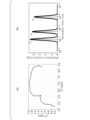
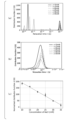
- FIG. 8(a) is an example of a distribution function estimated from the impedance measured by injecting a known aqueous sodium chloride solution with a different concentration c into a dermis layer simulating a living body, and setting the electrodes so that the dermis layer is highly sensitive.
- FIG. 8(b) is a result of enlarging the rightmost peak where a change occurred. In this example, it can be seen that the intensity of the peak decreases when the concentration of the aqueous sodium chloride solution in the dermis layer (the third peak) is increased from 10 mM to 30 mM (theoretically, when sodium ions increase proportionally).
- FIG. 8(b) is an example of a distribution function estimated from the impedance measured by injecting a known aqueous sodium chloride solution with a different concentration c into a dermis layer simulating a living body, and setting the electrodes so that the dermis layer is highly sensitive.
- FIG. 8(b) is a
- FIG. 8(c) shows the result of creating a calibration curve from the peak top value of the estimated distribution function ⁇ in FIG. 8(b) and the known aqueous sodium chloride concentration.
- the electrolyte concentration and blood protein concentration of the specific skin layer can be detected from the estimated distribution function ⁇ , and the concentration distribution of the target component can be obtained.
- the electrolyte concentration and blood protein concentration in the specific skin layer to be obtained differ from the known aqueous solution concentration when the degree of ionization or dissociation is not 1, so this calibration curve may be corrected using the degree of ionization or dissociation.
- the dermis layer in the specific skin layer is taken as an example, but the calibration curve can be created in the same way in other specific skin layers.
- the output unit 54 outputs at least one of the electrolyte concentration and the blood protein concentration sent from the calibration curve comparison unit 53.
- the output destination may be a display unit such as a liquid crystal display, or a storage device such as a HDD.
- the specific skin layer separation unit 51 calculates the difference data by performing difference processing on the potential difference and phase or current and phase measured by the current/voltage application measurement unit 10, and the distribution function estimation unit 52 estimates the distribution function ⁇ (ln ⁇ ) from the difference data, but the present invention is not limited to this.
- the distribution function estimation unit 52 may estimate multiple distribution functions ⁇ (ln ⁇ ) based on the potential difference or current measured, and the specific skin layer separation unit 51 may obtain a difference estimation function by performing difference processing on the estimated multiple distribution functions (e.g., two distribution functions).
- an internal skin measuring device 100A according to a second embodiment of the present invention will be described with reference to FIG.
- the same components as those in the first embodiment are denoted by the same reference numerals, and their description will be omitted, with only the differences being described.
- the internal skin measurement device 100A includes a current/voltage application measurement unit 10A and a concentration distribution measurement unit 50.
- the concentration distribution measurement unit 50A includes a specific skin layer separation unit 51A, a concentration calculation unit 60A, and an output unit 54.
- a current/voltage application/measurement unit 10A of the second embodiment has the same configuration as the current/voltage application/measurement unit 10 of the first embodiment.
- the control unit 30 applies a square wave current or a square wave voltage to the electrodes in contact with the skin and measures the potential difference or current.
- the rightmost electrode of electrodes 1 to 3 (e 1 , e 2 , and e 3 ) is set as a ground electrode, a constant current of AC frequency f is applied to the leftmost electrode and the center electrode, and the voltage between the leftmost electrode and the ground electrode (distant electrode, interelectrode distance 2d) and between the center electrode and the ground electrode (near electrode, interelectrode distance 1d) is measured.
- the rectangular wave application current i(t) may generate a rectangular wave directly or may be generated using a Fourier series, which can be expressed, for example, by the following formula (15).
- fsw in formula (15) indicates the frequency of the rectangular wave application current to be generated
- (2m-1) is the harmonic order
- m is a natural number
- M is the maximum number of harmonics
- the advantage of using a rectangular wave is that it is efficient in measurement, because one rectangular wave contains sine waves and cosine waves with many frequencies. That is, this is why a rectangular wave can be generated using a Fourier series (sine waves and cosine waves with many frequencies). Each specific skin layer has different frequency response characteristics.
- the epidermis layer (excluding the stratum corneum) can be observed at 0 Hz to 10 Hz, the dermis layer at 10 Hz to 1 kHz, and the adipose tissue at 100 Hz to 10 kHz. Since the square wave contains various frequency components, it is easy to grasp the state of each specific skin layer.
- the concentration distribution measurement unit 50A measures (visualizes) at least one of the electrolyte concentration distribution and blood protein concentration distribution in a specific layer inside the skin by performing differential processing on the potential difference and phase or current and phase measured by the current/voltage application measurement unit 10A.
- the concentration distribution measurement unit 50A comprises a specific skin layer separation unit 51A, a power spectrum drop calculation unit 55, a calibration curve comparison unit 53A, and an output unit 54. Each unit will be described below.
- the skin specific layer separation unit 51A calculates differential data by performing differential processing on the potential difference and phase or the current and phase measured by the current/voltage application measurement unit 10A.
- v2 between the near electrodes is mainly influenced by the stratum corneum admittance Ys and the epidermis layer admittance Ye
- v2 between the far electrodes It is assumed that v1 at inter-electrode distance 2d) is mainly influenced by stratum corneum admittance Ys, epidermis layer admittance Ye, and dermis layer admittance Yd.
- the specific skin layer separation unit 51A calculates the voltage drop ⁇ v, which is the subtraction of v1 and v2, as differential data.
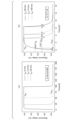
- Figure 10 shows an example of the rectangular wave applied current i(t), the measured voltage v1 between the distant electrodes, the measured voltage v2 between the near electrodes, and the difference ⁇ v between v1 and v2 in the rectangular wave applied current and potential difference measurement.
- the horizontal axis of Figure 10 is time ( ⁇ s), and the vertical axis is potential difference (V).
- the calculated voltage drop ⁇ V which is the differential data, is sent to the concentration calculation unit 60A.
- the concentration calculation unit 60A uses the difference data to calculate at least one of the conductivity, the dielectric constant, and the phase that are correlated with the electrolyte concentration and the blood protein concentration in the specific layer.
- the concentration calculation unit 60A includes a power spectrum drop calculation unit 55 that calculates the power spectrum drop ⁇ P from the difference data, and a calibration curve comparison unit 53A that calculates at least one of the electrolyte concentration and the blood protein concentration from the power spectrum drop ⁇ P calculated by the power spectrum drop calculation unit 55.
- the power spectrum drop calculation unit 55 calculates the power spectrum drop ⁇ P from the difference data.
- a Fourier transform is applied to the difference ⁇ v(t) between the measured voltage v1(t) between the far electrodes and the measured voltage v2(t) between the near electrodes, the following equation (16) is obtained.
- the power spectral density (PSD) at the harmonic order is given by the following equation (17), where N is the number of voltage samples, and the PSD is a function of the harmonic order (2m-1).
- Fig. 11 shows an example of the power spectral density (PSD) drop calculated by the power spectral drop calculation unit 55.
- the horizontal axis is frequency (kHz), and the vertical axis is power spectral density ( V2 /Hz).
- the difference between the first and third harmonic signals is ⁇ P.
- ⁇ P is determined by the magnitude of the harmonic order P of the fast Fourier transform (FFT), and the magnitude depends on the electrolyte concentration distribution and blood protein concentration distribution in the specific skin layer.
- FFT fast Fourier transform
- the calibration curve comparison unit 53A calculates at least one of the electrolyte and blood protein concentration in the specific skin layer based on the power spectrum density drop ⁇ P sent from the power spectrum drop calculation unit 55.
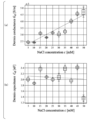
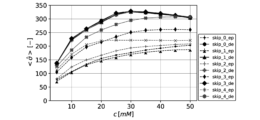
- FIG. 12 shows an example of the relationship between the electrolyte concentration c (sodium chloride concentration in FIG. 12) and the power spectrum density drop ⁇ P.
- the horizontal axis of FIG. 12 is the electrolyte concentration (mM), and the vertical axis is the power spectrum density drop ⁇ P [-].
- FIG. 12 there is a high correlation between the electrolyte concentration c and the power spectrum density drop ⁇ P, so by creating a calibration curve in advance as in the first embodiment, the electrolyte concentration in the specific skin layer can be calculated.
- the conductivity of the dermis layer is analyzed using power spectral density at different frequencies Pfsin, since the stratum corneum is permeable to high frequency injections and the dermis layer is low frequency.
- Pfsin power spectral density at different frequencies
- an internal skin measuring device 100B according to a third embodiment of the present invention will be described with reference to FIG.
- the same components as those in the first and second embodiments are denoted by the same reference numerals, and their description will be omitted, with only the differences being described.
- the internal skin measurement device 100B includes a current/voltage application measurement unit 10B and a concentration distribution measurement unit 50.
- the concentration distribution measurement unit 50B includes a specific skin layer separation unit 51B, an electrical property distribution calculation unit 56, and an output unit 54.
- the current/voltage application measurement unit 10B includes a sensor 20B and a control unit 30B.
- the sensor 20B includes a plurality of electrodes 21 (number of electrodes Q) that can be arranged on the skin at intervals.
- the current/voltage application measurement unit 10B applies a predetermined current or potential difference between the electrodes 21 while the electrodes 21 of the sensor 20B are in contact with the skin of the subject, and measures the potential difference or current.
- the potential difference is measured based on a predetermined current application voltage measurement pattern (a pattern in which two electrodes are selected in sequence from a large number of electrodes, a current is applied, and a potential difference is measured in sequence). At this time, it is preferable to also measure the phase (the time lag between the applied current and the measured potential difference).
- a predetermined current application voltage measurement pattern a pattern in which two electrodes are selected in sequence from a large number of electrodes, a potential difference is applied, and a current is measured in sequence. At this time, it is preferable to also measure the phase (the time lag between the applied potential difference and the measured current).
- the number Q of the electrodes 21 is preferably 8 or more.
- the number Q of the electrodes 21 is more preferably 16 or more.
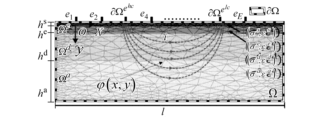
- FIG. 14 shows an example in which multiple electrodes 21 are arranged in a line.
- Multiple electrodes 21 may be arranged in a line on the upper surface of the skin, or may be arranged two-dimensionally.
- a two-dimensional region of a semicircle in the skin depth direction with the length between the leftmost electrode (e1 in the example of FIG. 14) and the rightmost electrode (eE in the example of FIG. 14) of the electrodes 21 as the diameter, is set as the image target region (Region of Interest), and a two-dimensional image of the specific skin layer can be obtained.
- the image target region (Region of Interest)
- a three-dimensional region of a hemisphere in the skin depth direction is set as the image target region (Region of Interest), and a three-dimensional image of the specific skin layer can be obtained.
- the physical quantities of these images are one or more of the conductivity distribution, the dielectric constant distribution, and the phase distribution in the specific skin layer.
- the control unit 30B includes, for example, a multiplexer for switching between a current application electrode (or a voltage application electrode for applying a potential difference) that applies a current and a voltage measurement electrode (or a current measurement electrode for measuring a current) that measures a potential difference, and an impedance analyzer for performing voltage measurement (or current measurement) and phase measurement.
- the impedance analyzer is a component that changes the applied frequency and amplitude to measure impedance, that is, the ratio of the measured potential difference (applied potential difference) to the applied current (measured current), and its phase.
- the control unit 30B executes a predetermined program in, for example, a CPU, and controls the multiplexer and the impedance analyzer to perform impedance measurement (measurement of the ratio of the potential difference to the current, and its phase).
- the control unit 30B may be controlled only within the current/voltage application measurement unit 10B to perform impedance measurement, or the control unit 30B may be controlled according to a program executed in the concentration distribution measurement unit 50B to perform impedance measurement.
- the result of the impedance measurement is sent to the concentration distribution measurement unit 50B.
- the signal may be sent from the control unit 30B to the concentration distribution measuring unit 50B via a wire, or may be sent directly to the concentration distribution measuring unit 50B.
- the control unit 30B applies a current between each electrode 21 and measures the potential difference based on a predetermined current application voltage measurement pattern (a pattern of which electrodes the current is applied between and which electrodes the potential difference is measured between).
- the control unit 30A applies a potential difference between each electrode 21 and measures the current based on a predetermined voltage application current measurement pattern.
- a current or a potential difference there is no particular limitation as to which electrodes 21 the current (potential difference) is applied between and between which electrodes the potential difference (current) is measured.
- the control unit 30B measures the current and phase or the potential difference and phase using two or more electrode pairs with different inter-electrode distances in the sensor 20. Examples of measurement methods include the two-terminal method, the three-terminal method, the four-terminal method, and the four-terminal quasi-adjacent method.
- Figure 15 shows the measurement pattern of the four-terminal quasi-adjacent method when the number of electrodes 21 is 16.
- measurements are performed so that at least one of the pair of electrodes 21 that apply current (current application electrode pair) and the pair of electrodes 21 that measure the potential difference (potential difference measurement electrode pair) are adjacent to each other.
- the number of electrodes Q since the number of electrodes Q is 16, there are a total of 16 ways to select one electrode (current selection electrode) of the current application electrode pair.
- one of the potential difference measurement electrode pairs adjacent to this selected current selection electrode is similarly selected as the adjacent electrode (potential difference selection electrode).
- This potential difference selection electrode is not changed until the current selection electrode is changed.
- the potential difference is measured by the potential difference measurement electrode pair (e.g., the second electrode and the third electrode) adjacent to the current application electrode pair, excluding the current application electrode pair (e.g., the first electrode and the fourth electrode).
- the other electrode of the current application electrode pair is shifted by one (for example, from the fourth electrode toward the sixteenth electrode), and the position of the other electrode of the adjacent potential difference measurement electrode pair is also changed to a position adjacent to the other electrode of the current application electrode pair.
- This is then shifted to the electrode immediately before the electrode selected by one of the electrodes of the current application electrode pair, and measurement is performed. Therefore, there are 13 measurement patterns for one current selection electrode. Therefore, in the four-terminal quasi-adjacent method, the number of measurements (measurement patterns) M is 208 in total.
- a square wave current or the like may be applied as in the second embodiment.
- the skin specific layer separation unit 51B performs differential processing on the potential difference and phase or the current and phase measured by the current/voltage application measurement unit 10B to calculate differential data.
- the penetration depth of the current in the skin specific layer is , is related to the distance d v between the measurement electrodes, and in order to visualize the concentration distribution in a specific skin layer, the penetration depth of the current to the specific skin layer is essential. If the distance d v between the measurement electrodes is too narrow, In this case, the current flows linearly from one electrode to the other, making it difficult to obtain impedance information of a specific skin layer located at a deep position.
- the skin specific layer separation unit 51B performs a predetermined process based on the spatial voltage threshold d ⁇ (SVT) to obtain the concentration of a target component (electrolyte, blood protein, etc.) in the target skin specific layer.
- the potential difference (or current) carrying information on the distribution is amplified, and the potential difference (or current) carrying information on the unintended skin specific layer is reduced.
- the spatial voltage threshold is a threshold based on the distance between the electrodes. and is a function of the distance between the electrodes.
- the skin specific layer separation unit 51B uses a spatial voltage threshold value d ⁇ to perform a predetermined process on the current or potential difference, and obtains the difference data.
- the processed current or potential difference is sent to the electrical property distribution calculation unit 56.
- FIG. 16 is a diagram for explaining processing using a spatial voltage threshold (SVT).
- FIG. 16(a) shows the state of potential difference measurement
- FIG. 16(b) shows the potential difference after processing based on the threshold d ⁇ .
- the distance d v m between the potential difference measurement electrodes in FIG. 16 affects the measurement depth.
- m in d v m means the measurement number.
- the spatial voltage threshold (SVT) d ⁇ can be appropriately set according to the target specific skin layer. For example, when data of the dermis layer is acquired, the measurement depth is set to be the stratum corneum and the epidermis layer when d v m ⁇ d ⁇ .
- d ⁇ is, for example, 1 to 6 mm.
- the spatial voltage threshold (SVT) can be set by investigating the effect of the electrolyte concentration in the target specific skin layer in advance.
- the potential difference v * m after processing based on the spatial voltage threshold is determined, for example, from the average value of v 1 to m in order to reduce the effect of the high resistance of the stratum corneum in the measurement.
- v ⁇ m is the time average of the potential difference expressed by the following formula (18).
- the potential difference (compensated potential difference) v * m after processing with the spatial voltage threshold is expressed by the following formula (19).
- m ⁇ 1, 2, ..., 208 ⁇ is the measurement number.
- the low potential electrode e lp m is organized by integer division and modulus division as shown in the following formula (21).
- the distance d v m (mm) of the electrode voltage is determined from the distance between e hp m and e lp m as shown in the following formula (22).
- the electrical property distribution calculation unit 56 calculates at least one of the electrical conductivity distribution, the dielectric constant distribution, and the phase distribution based on the post-treatment current or the potential difference sent from the skin specific layer separation unit 51 B. The calculated electrical property distribution is sent to the output unit 54.
- FIG. 17 shows an example of image reconstruction.
- the sodium ion concentration distribution image of the skin region ⁇ is reconstructed based on the electrical conductivity distribution ⁇ expressed by the following formula (23), and in this example, the sodium ion concentration distribution of the dermis layer within the dotted line is emphasized by a predetermined process based on the spatial voltage threshold d ⁇ (SVT).
- r n in formula (23) is expressed by the following formula (24), and is a row vector representing the spatial position of the nth (1 ⁇ n ⁇ N) mesh element when the skin region ⁇ is divided into N mesh elements.
- the Jacobian matrix J of the skin region ⁇ is expressed by the following formula (25).
- m is the measurement pattern (1 ⁇ m ⁇ M)
- M is the total number of measurement patterns
- n is the spatial position (mesh element) (1 ⁇ n ⁇ N)
- N is the total number of meshes of the spatial resolution
- T is defined as the transposition matrix.
- the Jacobian matrix J mn of the nth mesh element in the mth measurement pattern can be defined by the second term of the following formula (26), and can be defined as the rate of change of the measured potential difference vm in the mth (1 ⁇ m ⁇ M) measurement pattern when the conductivity ⁇ n of the nth (1 ⁇ n ⁇ N) mesh element changes (expressed by partial differential symbol), and J is the coefficient of the conductivity distribution ⁇ and the measured potential difference v.
- J can be calculated, for example, by the third term of formula (26).
- ⁇ (I k ) in formula (26) is the potential of the n-th mesh element affected by the current I injected between the k electrodes
- ⁇ (I l ) is the potential of the n-th mesh element when the current I is hypothetically injected between the l electrodes
- ⁇ is the Nabla partial differential operator
- the integral symbol indicates the integral of the entire skin region ⁇ .
- Equation (27) The electrical conductivity distribution of the skin layer is calculated using the Gauss-Newton method (Equation (27) below).
- R in Equation (27) is a regularization matrix
- ⁇ is a relaxation coefficient scalar automatically determined by the L-curve method (Hansen and O'Leary 1993).
- ⁇ v in Equation (27) is expressed by Equation (28) below.
- ⁇ vm in Equation (28) is the normalized measurement voltage under the skin boundary shape ⁇ , and is expressed by Equation (29) below.
- vm(0) is the initial measurement voltage
- vm(c) is the inclusion voltage based on the target component concentration c.
- the electrical property distribution calculation unit 56 sends the electrical property distribution of the target component obtained above to the output unit 54.
- the electrical property distribution calculation unit 56 may further perform boundary processing on the calculated electrical property distribution.
- boundary processing will be described below.
- Fig. 18 is a schematic diagram of each specific skin layer used in the electromagnetic simulation.
- hs is the thickness of the stratum corneum
- he is the thickness of the epidermis layer (excluding the stratum corneum)
- hd is the thickness of the dermis layer
- ha is the thickness of the adipose tissue layer
- ⁇ e indicates the target area of the epidermis layer
- ⁇ d indicates the target area of the dermis layer
- ⁇ a indicates the target area of the adipose tissue layer
- ⁇ s indicates the conductivity of the stratum corneum
- ⁇ s indicates the relative dielectric constant of the stratum corneum.
- ⁇ e indicates the conductivity of the epidermis layer, and ⁇ e indicates the relative dielectric constant of the epidermis layer.
- ⁇ d indicates the conductivity of the dermis layer, and ⁇ e indicates the relative dielectric constant of the dermis layer.
- ⁇ a indicates the conductivity of the adipose tissue layer, and ⁇ a indicates the relative dielectric constant of the adipose tissue layer.
- ⁇ (x,y) is the electric potential at the coordinates (x,y).
- the physical relationship between the conductivity distribution and the boundary voltage in the target region ⁇ is governed by a partial differential equation derived from Maxwell's equation in the following equation (30).
- a current I is applied through electrodes e k (e 1 , e 2 , ..., e E in Fig. 18) on the skin surface ⁇
- the potential ⁇ in the target region ⁇ is solved from equation (31).
- the electrical property distribution can be calculated more accurately by performing calculations based on the Neumann boundary conditions in the following equations (32) to (33).
- n represents the outer unit normal vector
- ⁇ ek represents the electrode boundary
- dS represents the corresponding infinitesimal area element of the electrode boundary.
- the internal skin measuring devices 100, 100A, and 100B according to the present embodiment have been described above.
- the technical scope of the present invention is not limited to the above-described embodiment, and various modifications can be made without departing from the spirit of the present invention.
- the components in the above-described embodiments may be replaced with well-known components, and the above-described modified examples may be combined as appropriate.
- FIG. 19(a) shows the sensor used in the two electromagnetic simulations, and four non-invasive electrodes were placed on the skin surface.
- FIG. 19(b) shows the configuration of each specific skin layer, which is composed of the stratum corneum, epidermis layer, dermis layer, and fat layer. The thickness of each layer is represented by the stratum corneum hs, epidermis layer he, dermis layer hd, and fat layer ha.
- the thickness of the dermis layer was changed, and the thickness of each skin layer except the dermis layer was fixed, specifically, the stratum corneum hs was 0.05 mm, the epidermis layer he was 0.45 mm, and the fat layer ha was 5 mm.
- FIG. 19( c ) shows an equivalent circuit of a specific skin layer simplified by the two-terminal method.
- a current flows through the specific skin layer present between each noninvasive electrode, influenced by the size of the electrical equivalent circuit of the combination of the capacitance component C s,e of the stratum corneum and epidermis layer, the resistance component R s,e of the stratum corneum and epidermis layer, the capacitance component C d of the dermis layer, and the resistance component R d of the dermis layer.
- Electromagnetic simulation (estimated distribution function ⁇ (ln ⁇ ) when the ratio r and the interelectrode distance d change)
- Figure 20 shows the frequency dependence of the known electrical conductivity ⁇ and the known relative permittivity ⁇ in each specific skin layer used in the electromagnetic simulation conditions.
- the vertical axis of Fig. 20(a) represents electrical conductivity (S/cm)
- the horizontal axis of Fig. 20(a) represents the frequency of applied current (Hz)
- the vertical axis of Fig. 20(b) represents the relative dielectric constant (-)
- the horizontal axis of Fig. 20(b) represents the frequency of applied current (Hz).
- Fig. 21(a) shows a Nyquist plot obtained from the electromagnetic simulation results of impedance
- Fig. 21(b) shows the estimated distribution function ⁇ (ln ⁇ ) at a specific relaxation time ⁇ , which is the output result of the distribution function estimation unit 52 of the present invention.
- FIG. 22(a) shows the estimated distribution function ⁇ (ln ⁇ ) at ⁇ 1
- the horizontal axis shows the interelectrode distance d
- the vertical axis of FIG. 22(b) shows the estimated distribution function ⁇ (ln ⁇ ) at ⁇ 2
- Example 2 Next, to experimentally verify the first embodiment using the measurement parameters (ratio r and inter-electrode distance d) of the first embodiment optimized in Example 1, an experiment for a skin specific layer separation means was carried out using pig skin tissue (with fat layer and muscle attached) that has mechanical and electrical properties almost similar to those of human skin.
- Figure 23 shows an outline of the experimental apparatus.
- Figure 23 is composed of a sensor, a 4-channel multiplexer, an impedance analyzer (IM 3570, Hioki E.E. Corporation, Tokyo, Japan) as a data acquisition system, and a personal computer for indication and post-processing.
- IM 3570 impedance analyzer
- the sensor used was a printed circuit board (PCB) with dimensions of 25 mm x 35 mm x 1.6 mm, on which four non-invasive electrodes were arranged in a 1 x 4 arrangement.
- the non-invasive electrodes were made of stainless steel and had a diameter of 1 mm, a center-to-center distance between adjacent electrodes of 1 mm, and a thickness of 1 mm from the printed circuit board.
- the two-terminal method was used as the impedance measurement method, and the relationship between the measurement number and each non-invasive electrode is shown in Table 1.
- the column Hc in Table 1 indicates the electrode number for high current application
- the column Hp indicates the electrode number for high potential measurement
- the column Lc indicates the electrode number for low current application
- the column Lp indicates the electrode number for low potential measurement.
- the current flows from the high current application electrode (Hc) through the pig skin tissue and reaches the low current application electrode (Lc), which also includes the ground.
- Electrode numbers e 1 (abbreviated as 1 in the table), e 2 (abbreviated as 2), and e 3 (abbreviated as 3) functioned as the Hc and Hp non-invasive electrodes, and electrode number e 4 (abbreviated as 4) always functioned as the Lp and Lc (ground) electrodes.
- a total of three measurements are obtained by the measurements in Table 1.
- the pig skin tissue sample was composed of the stratum corneum, epidermis, dermis, fat layer, and muscle layer, and the temperature was adjusted until it reached an appropriate temperature ( ⁇ 35°C).
- an appropriate temperature ⁇ 35°C.
- four sodium chloride (NaCl) aqueous solutions with different concentrations (20 mM, 30 mM, 35 mM, and 40 mM) were prepared and injected into the pig's dermis layer.
- FIG. 24(a) shows the results of a Nyquist plot in which the concentration of the sodium chloride aqueous solution is used as a parameter (y-axis) and the applied current frequency is swept, with the real part (x-axis) and imaginary part (z-axis) of the impedance.
- FIG. 24(b) shows a comparison between the experimental results (solid line) and an equivalent circuit fitting (dotted line) based on an EEC (electrical equivalent circuit). As shown in FIG. 24(b), the experimental results and the fitting of the equivalent circuit were in good agreement. It was also confirmed that the resistance value Z re calculated from the x-axis value indicating the minimum value of the y-axis of the Nyquist plot increased with an increase in the sodium chloride aqueous solution concentration c.
- FIG. 25(a) shows the relationship between the relaxation time ⁇ and the estimated distribution function ⁇ (ln ⁇ ) when the concentration of the sodium chloride aqueous solution is used as a parameter in the calculation results of the skin specific layer separation part of the first embodiment in an experiment using pig skin tissue. From this figure, several peak values were confirmed. These peak values correspond to the distribution functions for each skin specific layer.
- the vertical axis of FIG. 25(b) is the estimated distribution function ⁇ (ln ⁇ ) ( ⁇ ), and the horizontal axis is the relaxation time ⁇ (s).
- the local maximum value of the estimated distribution function ⁇ (ln ⁇ ) calculated using the skin specific layer separation unit 51 of the first embodiment indicates the characteristics of each layer of the skin specific layer.
- the electrical characteristics of the dermis layer were measured by determining the difference between the adjacent counter electrode and the distant counter electrode to separate it from the other epidermis layers.
- the peaks were well distinguished, but in other relaxation time regions, the peaks were irregular. From FIG. 25(a), it was found that in the high relaxation time region, the distribution function gives information related to the concentration of sodium ions injected into the dermis layer. Therefore, the analysis was carried out by focusing on the high relaxation time region where useful information of the dermis layer can be obtained.
- the horizontal axis of FIG. 25(b) is the sodium chloride aqueous solution concentration, and the vertical axis is the estimated distribution function ⁇ (ln ⁇ ). From this figure, it was found that the amplitude becomes smaller as the concentration becomes higher in this region.
- the sodium ion concentration of the dermis layer for example, can be measured by the skin internal measurement device according to this embodiment, and the state of edema, the state of necrosis of cells and blood vessels, and the state of chronic kidney disease can be detected.
- Example 3 To experimentally demonstrate the second embodiment, the electrolyte concentration in the dermis layer of pig skin was measured under conditions varying from 5 mmol/L to 50 mmol/L (mimicking a patient with chronic kidney disease (CKD)).
- CKD chronic kidney disease
- Figure 26 shows the configuration of the experimental device used in Example 3.
- An FPGA Xilinx Zynq-SoC
- ADG1404 three-channel analog multiplexer
- Electrode e1 was set as a low current application electrode and a low voltage measurement electrode, and electrode e2 was switched to a high voltage measurement electrode and electrode e3 was switched to a high current application electrode for measurement.
- An analog-digital converter LTC2145 was used to acquire a high-speed data signal with a data resolution of 14 bits and a sampling rate of 125 MS/s. The measured potential difference v was transferred to the power spectrum drop calculation unit.
- Example 3 the conductivity of the dermis layer was analyzed in the time and frequency domains based on the potential difference v measured from two pairs of two-electrode methods (potential difference measurement between e2-e1 and current application between e3-e1).
- the time domain analysis includes the maximum measured potential difference vmax and charging time due to the resistive and capacitive properties of the dermis layer, while the frequency domain analysis includes the power spectral density at the harmonic components. To ensure the reproducibility of the measurements, 10 measurements were taken and the average was calculated.
- the current magnitude i was 1.0 mA
- the duty cycle ⁇ was 50%
- the applied current frequency f was 1 kHz to 200 kHz.
- Pig skin tissue was cut into a size of 2 x 4 cm, and 0.5 mL of sodium chloride solution (NaCl + H 2 O) was injected directly into the dermis layer.
- the sodium chloride solution was prepared by dissolving NaCl powder in 50 mL of distilled water according to the following formula (34).
- the dermis layer was treated with 10 different sodium chloride aqueous solutions with concentrations of 5, 10, 15, 20, 25, 30, 35, 40, 45, and 50 [mmoL/L].
- m NaCl in formula (34) is the mass of NaCl powder
- V is the amount of distilled water
- Mr is the relative molecular weight of NaCl, which is 58.44 [g/mol]. It was confirmed that the injected NaCl was uniformly distributed in the dermis layer and did not diffuse into the stratum corneum, epidermis, or fat layer.
- Figure 27 shows the measurement results of the measured potential difference v due to the difference in applied current frequency fsw when a sodium chloride aqueous solution of concentration c of 10 mmol/L is injected into the dermis layer.
- the horizontal axis of Figure 27(a) shows the elapsed time ( ⁇ s), and the vertical axis shows the measured potential difference v (V).
- FIG. 28(a) shows the time domain results, with the horizontal axis being time ( ⁇ s) and the vertical axis being the measured potential difference v. From this time domain result, information on the maximum measured voltage vmax and the time constant ⁇ can be obtained. The time constant is an important parameter for calculating the intracellular capacitance, extracellular resistance, and intracellular resistance of the dermis layer. From FIG. 28(a), it can be seen that the maximum measured voltage vmax is linearly correlated with c, since it decreases with an increase in c.
- FIG. 28(b) shows the frequency domain, providing information about the power spectral density of the harmonic orders.
- Figure 29 shows the conductance and capacitance of the dermis layer based on a time constant analysis of the sodium chloride aqueous solution concentration.
- the vertical axis of Figure 29(a) shows the conductance of the dermis layer (S/m), and the horizontal axis shows the sodium chloride aqueous solution concentration (mM).
- the vertical axis of Figure 29(b) shows the capacitance of the dermis layer (nF), and the horizontal axis shows the sodium chloride aqueous solution concentration.
- the vertical axis of FIG. 30 shows the normalized power spectral density drop, and the horizontal axis shows the concentration of the NaCl aqueous solution injected into the dermis layer.
- the coefficient of determination R 2 was greater than 0.90.
- the coefficient of determination decreased for applied current frequencies f greater than 100 kHz.
- the power spectral density drop ⁇ P was calculated based on the following formula (35). Meanwhile, from the calculation, ⁇ P was calculated based on the following formula (36).
- k is a calibration coefficient.
- the harmonic orders from the square wave applied current contain valuable information that was extracted to represent the conductivity, permittivity, and phase of the dermis layer.
- Table 2 shows the results of the time constant analysis to determine the electrical properties of the dermis layer. The results of the time constant analysis showed that the sodium ion concentration c is directly related to the dermis conductance Gd, and that Gd increases as c increases.
- FIG. 32 shows the configuration of the intradermal measurement device used in Example 4.
- the intradermal measurement device generates a square wave signal and manages the measurement signal.
- a Howland current supplies a constant current i over a wide range of frequencies.
- Electrode switching was performed by a 16-channel analog multiplexer ADG 1406.
- a dual simultaneous analog/digital converter LTC2145 was used for high-speed data acquisition.
- a four-terminal quasi-adjacent method using 16 electrodes was used in Example 4.
- the measured voltage v_m was transferred to a concentration distribution measuring unit 50 (computer).
- the sampling time ⁇ t was controlled to avoid oversampling and to keep the number of potential difference samples N constant at 2048. By keeping N at a constant value, the speed of the FFT processing can be maintained.
- a sodium chloride solution was injected into the dermis layer.
- Pig skin was cut into a size of 10 x 40 mm, and 0.5 ml of sodium chloride solution was injected directly into the dermis layer.
- the sodium chloride concentrations were 5, 10, 15, 20, 25, 30, 35, 40, 45, and 50 mM. There were five skin samples for each condition, and each sample was measured five times to ensure the reproducibility and accuracy of the measurements.
- Fig. 33 shows the pattern change of the normalized compensation voltage ⁇ v*> when the threshold d ⁇ is changed. A significant change in the pattern cut off by the threshold d ⁇ was confirmed. The larger the threshold d ⁇ , the higher the normalized compensation voltage ⁇ v*> became.
- Figure 34 shows the experimental results of reconstructed images of sodium ion concentration distribution when the threshold value d ⁇ and the concentration of the sodium chloride aqueous solution are changed.
- the threshold value d ⁇ 0 mm
- the reconstructed image of sodium ion concentration distribution c had artifacts in the stratum corneum and epidermis regions. c in the epidermis layer was still dominant.
- the image of the c distribution was highlighted in the region of interest ROI (area surrounded by a rectangle in each figure) in the dermis layer, improving the accuracy of quantification.
- Example 5 In order to experimentally demonstrate the effect of combining the third embodiment with another embodiment (here, the first embodiment), a predetermined process was performed based on a threshold value based on the distance between the electrodes, and the potential difference or current carrying information on the concentration distribution of target components (electrolytes, blood proteins, etc.) in the specific skin layer of interest was amplified.
- the Skip method employed a planar sensor array with 16 electrodes and a quasi-adjacent injection pattern for extraction of sodium ion concentration in the dermal layer. Each impedance measurement utilizes four electrodes: high current (Hc), high potential (Hp), low potential (Lp), and low current (Lc).
- the integration of the threshold-based Skip method with DRT provides a promising approach to extract sodium ion concentration in the dermis layer while improving image quality and depth resolution.
- Figure 39 shows a comparison of the spatially averaged conductivity distribution ⁇ * ⁇ > obtained by electromagnetic simulation and experiment.
- Figure 39(a) shows the results when d ⁇ is 0 mm
- Figure 39(b) shows the results when d ⁇ is 2 mm
- Figure 39(c) shows the results when d ⁇ is 4 mm
- Figure 39(d) shows the results when d ⁇ is 8 mm.
- the horizontal axis of each figure is the concentration of the sodium chloride solution (mM)
- the vertical axis is the spatially averaged conductivity distribution ⁇ * ⁇ >.
- ⁇ represents the ⁇ * ⁇ > of the skin region
- ⁇ d represents the ⁇ * ⁇ > of the ROI region.
- the subscripts exp and sim represent the experimental values and electromagnetic simulation values, respectively.
- Figure 40 shows the evaluation results of threshold d ⁇ based on electromagnetic simulation and experiment.
- the upper diagram of Figure 40(a) shows the relationship between the coefficient of determination of the electromagnetic simulation and the threshold
- the lower diagram of Figure 40(a) shows the relationship between the normalized sensitivity S of the electromagnetic simulation and the threshold
- the upper diagram of Figure 40(b) shows the relationship between the coefficient of determination obtained from the experiment and the threshold
- the lower diagram of Figure 40(b) shows the relationship between the normalized sensitivity S obtained from the experiment and the threshold. From these results, it was found that the optimal threshold (threshold distance) was 2 mm.
Landscapes
- Health & Medical Sciences (AREA)
- Life Sciences & Earth Sciences (AREA)
- General Health & Medical Sciences (AREA)
- Pathology (AREA)
- Physics & Mathematics (AREA)
- Molecular Biology (AREA)
- Public Health (AREA)
- Chemical & Material Sciences (AREA)
- Engineering & Computer Science (AREA)
- Biomedical Technology (AREA)
- Heart & Thoracic Surgery (AREA)
- Medical Informatics (AREA)
- Veterinary Medicine (AREA)
- Surgery (AREA)
- Animal Behavior & Ethology (AREA)
- Biophysics (AREA)
- Dermatology (AREA)
- Nuclear Medicine, Radiotherapy & Molecular Imaging (AREA)
- Radiology & Medical Imaging (AREA)
- Chemical Kinetics & Catalysis (AREA)
- Electrochemistry (AREA)
- Analytical Chemistry (AREA)
- Biochemistry (AREA)
- General Physics & Mathematics (AREA)
- Immunology (AREA)
- Measurement And Recording Of Electrical Phenomena And Electrical Characteristics Of The Living Body (AREA)
Priority Applications (1)
| Application Number | Priority Date | Filing Date | Title |
|---|---|---|---|
| JP2025518162A JPWO2024228397A1 (https=) | 2023-05-02 | 2024-05-02 |
Applications Claiming Priority (2)
| Application Number | Priority Date | Filing Date | Title |
|---|---|---|---|
| JP2023-076258 | 2023-05-02 | ||
| JP2023076258 | 2023-05-02 |
Publications (1)
| Publication Number | Publication Date |
|---|---|
| WO2024228397A1 true WO2024228397A1 (ja) | 2024-11-07 |
Family
ID=93333035
Family Applications (1)
| Application Number | Title | Priority Date | Filing Date |
|---|---|---|---|
| PCT/JP2024/016863 Ceased WO2024228397A1 (ja) | 2023-05-02 | 2024-05-02 | 皮膚内部計測装置 |
Country Status (2)
| Country | Link |
|---|---|
| JP (1) | JPWO2024228397A1 (https=) |
| WO (1) | WO2024228397A1 (https=) |
Cited By (2)
| Publication number | Priority date | Publication date | Assignee | Title |
|---|---|---|---|---|
| CN119322278A (zh) * | 2024-09-30 | 2025-01-17 | 西安交通大学 | 一种锂电池的荷电状态确定方法、装置和设备 |
| CN120938395A (zh) * | 2025-09-02 | 2025-11-14 | 浙江大学 | 一种基于生物电阻抗的创面愈合进程监测方法及系统 |
Citations (4)
| Publication number | Priority date | Publication date | Assignee | Title |
|---|---|---|---|---|
| JP2007097625A (ja) * | 2005-09-30 | 2007-04-19 | Amica:Kk | 皮膚状態評価装置及び皮膚状態評価プログラム並びに同プログラムを記憶したコンピュータ読み取り可能な記憶媒体 |
| JP2011524213A (ja) * | 2008-06-18 | 2011-09-01 | ソリアニス・ホールディング・アーゲー | 皮膚に対する皮膚処理剤の影響を特性描写するための方法および装置 |
| US20160249836A1 (en) * | 2012-07-16 | 2016-09-01 | Sandeep Gulati | Sample optical pathlength control using a noninvasive analyzer apparatus and method of use thereof |
| WO2022217304A1 (en) * | 2021-04-13 | 2022-10-20 | WearOptimo Pty Ltd | Fluid status monitoring |
-
2024
- 2024-05-02 JP JP2025518162A patent/JPWO2024228397A1/ja active Pending
- 2024-05-02 WO PCT/JP2024/016863 patent/WO2024228397A1/ja not_active Ceased
Patent Citations (4)
| Publication number | Priority date | Publication date | Assignee | Title |
|---|---|---|---|---|
| JP2007097625A (ja) * | 2005-09-30 | 2007-04-19 | Amica:Kk | 皮膚状態評価装置及び皮膚状態評価プログラム並びに同プログラムを記憶したコンピュータ読み取り可能な記憶媒体 |
| JP2011524213A (ja) * | 2008-06-18 | 2011-09-01 | ソリアニス・ホールディング・アーゲー | 皮膚に対する皮膚処理剤の影響を特性描写するための方法および装置 |
| US20160249836A1 (en) * | 2012-07-16 | 2016-09-01 | Sandeep Gulati | Sample optical pathlength control using a noninvasive analyzer apparatus and method of use thereof |
| WO2022217304A1 (en) * | 2021-04-13 | 2022-10-20 | WearOptimo Pty Ltd | Fluid status monitoring |
Cited By (3)
| Publication number | Priority date | Publication date | Assignee | Title |
|---|---|---|---|---|
| CN119322278A (zh) * | 2024-09-30 | 2025-01-17 | 西安交通大学 | 一种锂电池的荷电状态确定方法、装置和设备 |
| CN119322278B (zh) * | 2024-09-30 | 2025-10-31 | 西安交通大学 | 一种锂电池的荷电状态确定方法、装置和设备 |
| CN120938395A (zh) * | 2025-09-02 | 2025-11-14 | 浙江大学 | 一种基于生物电阻抗的创面愈合进程监测方法及系统 |
Also Published As
| Publication number | Publication date |
|---|---|
| JPWO2024228397A1 (https=) | 2024-11-07 |
Similar Documents
| Publication | Publication Date | Title |
|---|---|---|
| AU2008241356B2 (en) | Monitoring system and probe | |
| Bera et al. | Electrical impedance spectroscopy (EIS)-based evaluation of biological tissue phantoms to study multifrequency electrical impedance tomography (Mf-EIT) systems | |
| Bera | Bioelectrical impedance methods for noninvasive health monitoring: a review | |
| AU2012351988B2 (en) | Devices, systems and methods for determining the relative spatial change in subsurface resistivities across frequencies in tissue | |
| MacLeod et al. | Recent progress in inverse problems in electrocardiology | |
| WO2024228397A1 (ja) | 皮膚内部計測装置 | |
| JP4378607B2 (ja) | 測定装置 | |
| US20060085048A1 (en) | Algorithms for an active electrode, bioimpedance-based tissue discrimination system | |
| US20120323134A1 (en) | Method and system for determining a location of nerve tissue in three-dimensional space | |
| CA2863041A1 (en) | Tissue mass indicator determination | |
| Karki et al. | Evaluation of a multi-electrode bioimpedance spectroscopy tensor probe to detect the anisotropic conductivity spectra of biological tissues | |
| Bera et al. | A multifrequency electrical impedance tomography (EIT) system for biomedical imaging | |
| Luo et al. | Electrical characterization of basal cell carcinoma using a handheld electrical impedance dermography device | |
| Rifai et al. | Quantification of dermis sodium concentration in skin layers by power spectral density drop of square-wave electrical impedance spectroscopy (PSDd-sEIS) | |
| Dudzinski et al. | Spiral concentric two electrode sensor fabricated by direct writing for skin impedance measurements | |
| Li et al. | Tissue coefficient of bioimpedance spectrometry as an index to discriminate different tissues in vivo | |
| Shishavan et al. | Electrodermal activity monitoring with flexible dry electrodes and AC measurement | |
| Guo et al. | EIT probe based intraoperative tissue inspection for minimally invasive surgery | |
| Irsyadi et al. | Sodium-ion concentration imaging within dermis layer by planar electrical impedance tomography implementing gamma-Jacobian matrix (γJ-pEIT) | |
| Mothi et al. | Development of Electrical Impedance Tomography for Breast Phantom Monitoring | |
| Lovasz et al. | Data-Driven Conductivity Mapping for Tissue Margin Estimation with a Multi-Electrode Sensor Array | |
| AlDisi et al. | Modelingof the Effect of Skin Temperature on Hydration Assessment | |
| Zhang | Electrical Impedance Based Spectroscopy and Tomography Techniques for Obesity and Heart Diseases | |
| Aprihapsari et al. | Multi-Channel Trans-Admittance Imaging for Anomaly Detection | |
| Mendolia | Master thesis: Electrical impedance tomography for external wound monitoring: measurements, signal processing and image reconstruction |
Legal Events
| Date | Code | Title | Description |
|---|---|---|---|
| 121 | Ep: the epo has been informed by wipo that ep was designated in this application |
Ref document number: 24800128 Country of ref document: EP Kind code of ref document: A1 |
|
| ENP | Entry into the national phase |
Ref document number: 2025518162 Country of ref document: JP Kind code of ref document: A |
|
| WWE | Wipo information: entry into national phase |
Ref document number: 2025518162 Country of ref document: JP |
|
| NENP | Non-entry into the national phase |
Ref country code: DE |