WO2024225317A1 - 架橋物、ハイドロゲルおよびその製造方法、成形体、ならびに、フィルムおよびその製造方法 - Google Patents
架橋物、ハイドロゲルおよびその製造方法、成形体、ならびに、フィルムおよびその製造方法 Download PDFInfo
- Publication number
- WO2024225317A1 WO2024225317A1 PCT/JP2024/016076 JP2024016076W WO2024225317A1 WO 2024225317 A1 WO2024225317 A1 WO 2024225317A1 JP 2024016076 W JP2024016076 W JP 2024016076W WO 2024225317 A1 WO2024225317 A1 WO 2024225317A1
- Authority
- WO
- WIPO (PCT)
- Prior art keywords
- hydrogel
- molecular weight
- kda
- peo
- crosslinked product
- Prior art date
- Legal status (The legal status is an assumption and is not a legal conclusion. Google has not performed a legal analysis and makes no representation as to the accuracy of the status listed.)
- Ceased
Links
Images






Classifications
-
- C—CHEMISTRY; METALLURGY
- C08—ORGANIC MACROMOLECULAR COMPOUNDS; THEIR PREPARATION OR CHEMICAL WORKING-UP; COMPOSITIONS BASED THEREON
- C08F—MACROMOLECULAR COMPOUNDS OBTAINED BY REACTIONS ONLY INVOLVING CARBON-TO-CARBON UNSATURATED BONDS
- C08F8/00—Chemical modification by after-treatment
-
- C—CHEMISTRY; METALLURGY
- C08—ORGANIC MACROMOLECULAR COMPOUNDS; THEIR PREPARATION OR CHEMICAL WORKING-UP; COMPOSITIONS BASED THEREON
- C08J—WORKING-UP; GENERAL PROCESSES OF COMPOUNDING; AFTER-TREATMENT NOT COVERED BY SUBCLASSES C08B, C08C, C08F, C08G or C08H
- C08J3/00—Processes of treating or compounding macromolecular substances
- C08J3/02—Making solutions, dispersions, lattices or gels by other methods than by solution, emulsion or suspension polymerisation techniques
- C08J3/03—Making solutions, dispersions, lattices or gels by other methods than by solution, emulsion or suspension polymerisation techniques in aqueous media
- C08J3/075—Macromolecular gels
-
- C—CHEMISTRY; METALLURGY
- C08—ORGANIC MACROMOLECULAR COMPOUNDS; THEIR PREPARATION OR CHEMICAL WORKING-UP; COMPOSITIONS BASED THEREON
- C08J—WORKING-UP; GENERAL PROCESSES OF COMPOUNDING; AFTER-TREATMENT NOT COVERED BY SUBCLASSES C08B, C08C, C08F, C08G or C08H
- C08J3/00—Processes of treating or compounding macromolecular substances
- C08J3/24—Crosslinking, e.g. vulcanising, of macromolecules
-
- C—CHEMISTRY; METALLURGY
- C08—ORGANIC MACROMOLECULAR COMPOUNDS; THEIR PREPARATION OR CHEMICAL WORKING-UP; COMPOSITIONS BASED THEREON
- C08J—WORKING-UP; GENERAL PROCESSES OF COMPOUNDING; AFTER-TREATMENT NOT COVERED BY SUBCLASSES C08B, C08C, C08F, C08G or C08H
- C08J5/00—Manufacture of articles or shaped materials containing macromolecular substances
- C08J5/18—Manufacture of films or sheets
-
- C—CHEMISTRY; METALLURGY
- C08—ORGANIC MACROMOLECULAR COMPOUNDS; THEIR PREPARATION OR CHEMICAL WORKING-UP; COMPOSITIONS BASED THEREON
- C08K—Use of inorganic or non-macromolecular organic substances as compounding ingredients
- C08K5/00—Use of organic ingredients
- C08K5/04—Oxygen-containing compounds
- C08K5/13—Phenols; Phenolates
- C08K5/134—Phenols containing ester groups
-
- C—CHEMISTRY; METALLURGY
- C08—ORGANIC MACROMOLECULAR COMPOUNDS; THEIR PREPARATION OR CHEMICAL WORKING-UP; COMPOSITIONS BASED THEREON
- C08L—COMPOSITIONS OF MACROMOLECULAR COMPOUNDS
- C08L101/00—Compositions of unspecified macromolecular compounds
- C08L101/12—Compositions of unspecified macromolecular compounds characterised by physical features, e.g. anisotropy, viscosity or electrical conductivity
-
- C—CHEMISTRY; METALLURGY
- C08—ORGANIC MACROMOLECULAR COMPOUNDS; THEIR PREPARATION OR CHEMICAL WORKING-UP; COMPOSITIONS BASED THEREON
- C08L—COMPOSITIONS OF MACROMOLECULAR COMPOUNDS
- C08L29/00—Compositions of homopolymers or copolymers of compounds having one or more unsaturated aliphatic radicals, each having only one carbon-to-carbon double bond, and at least one being terminated by an alcohol, ether, aldehydo, ketonic, acetal or ketal radical; Compositions of hydrolysed polymers of esters of unsaturated alcohols with saturated carboxylic acids; Compositions of derivatives of such polymers
- C08L29/02—Homopolymers or copolymers of unsaturated alcohols
- C08L29/04—Polyvinyl alcohol; Partially hydrolysed homopolymers or copolymers of esters of unsaturated alcohols with saturated carboxylic acids
-
- C—CHEMISTRY; METALLURGY
- C08—ORGANIC MACROMOLECULAR COMPOUNDS; THEIR PREPARATION OR CHEMICAL WORKING-UP; COMPOSITIONS BASED THEREON
- C08L—COMPOSITIONS OF MACROMOLECULAR COMPOUNDS
- C08L71/00—Compositions of polyethers obtained by reactions forming an ether link in the main chain; Compositions of derivatives of such polymers
- C08L71/02—Polyalkylene oxides
Definitions
- the present invention relates to a crosslinked product.
- the present invention also relates to a hydrogel containing the crosslinked product and a method for producing the same.
- the present invention also relates to a molded product containing the crosslinked product.
- the present invention also relates to a film containing the crosslinked product and a method for producing the same.
- Hydrogels are soft materials that contain a large amount of water inside a three-dimensional network structure obtained by cross-linking hydrophilic polymer chains. Due to their excellent biocompatibility, water absorption, self-repairing properties, and extensibility (stretchability), hydrogels are widely used in agriculture, food, tissue engineering, and biomedicine. For example, hydrogels have been put to practical use as wound dressings and hemostatic materials, and are also widely used in drug delivery.
- Non-Patent Document 1 In recent years, smart materials with self-repairing and shape-memory capabilities that can be used in a wide range of applications, such as molecular actuators and paints, have been attracting attention. Hydrogels have also been attracting attention as such smart materials (for example, Non-Patent Document 1).
- TA tannic acid
- PEG polyethylene glycol
- Non-Patent Documents 2 and 3 aim to use a supramolecule consisting of TA and low molecular weight PEG as an adhesive, and do not consider self-repairing or shape-memory capabilities, as they are used in a highly fluid state and cannot be molded.
- the present invention aims to provide a crosslinked product of a high molecular weight polymer and tannic acid that can be easily synthesized, molded into any shape, and used to form a material with extensibility, self-repairing properties, and shape memory properties.
- the present invention also aims to provide a hydrogel, molded body, and film that contain the crosslinked product of a high molecular weight polymer and tannic acid, as well as methods for producing these.
- the present invention also aims to provide a plant life extension agent that can extend the life of plants.
- the present invention relates to the following inventions.
- ⁇ 1> A crosslinked product in which a high molecular weight polymer is crosslinked with tannic acid, the high molecular weight polymer having a structural unit including a group G capable of forming a hydrogen bond with tannic acid, and having a weight average molecular weight of 50 kDa or more.
- ⁇ 2> The crosslinked product according to ⁇ 1>, wherein a molar ratio of tannic acid to the structural units is 0.02 to 0.1.
- ⁇ 3> The crosslinked product according to ⁇ 1> or ⁇ 2>, wherein the high molecular weight polymer is one or more selected from the group consisting of polyalkylene oxide, polyalkylene oxide copolymer, polyvinyl alcohol, and polyvinyl alcohol copolymer.
- a hydrogel comprising the crosslinked product according to any one of ⁇ 1> to ⁇ 3> and water.
- ⁇ 5> The hydrogel described in ⁇ 4> above, having a maximum tensile stress of 0.05 MPa or more.
- ⁇ 6> The hydrogel described in ⁇ 4> or ⁇ 5> above, having a breaking elongation of 500% or more.
- ⁇ 7> The hydrogel according to any one of ⁇ 4> to ⁇ 6>, having a swelling ratio of 100% to 120%.
- ⁇ 8> The hydrogel described in any one of ⁇ 4> to ⁇ 7> above, which has a maximum bending stress of 10 MPa or more when dried at 40°C for 8 days.
- ⁇ 9> The hydrogel described in any one of ⁇ 4> to ⁇ 8>, which has a self-repairing ability upon heating when dried at 40°C for 8 days.
- ⁇ 10> The hydrogel according to any one of ⁇ 4> to ⁇ 9>, which has a shape-memory ability when dried at 40°C for 8 days.
- ⁇ 11> A molded article comprising the crosslinked product according to any one of ⁇ 1> to ⁇ 3>.
- a method for producing a hydrogel comprising: a gelling step of mixing an aqueous solution containing a high molecular weight polymer with an aqueous solution containing tannic acid to obtain a crosslinked product-containing solution containing a crosslinked product formed by crosslinking the high molecular weight polymer with tannic acid; and a gel recovery step of recovering a hydrogel containing the crosslinked product from the crosslinked product-containing solution, wherein the high molecular weight polymer used has a constitutional unit including a group G capable of forming a hydrogen bond with tannic acid and has a weight average molecular weight of 50 kDa or more.
- a method for producing a film comprising: a gelling step of mixing an aqueous solution containing a high molecular weight polymer with an aqueous solution containing tannic acid to obtain a crosslinked product-containing solution containing a crosslinked product formed by crosslinking the high molecular weight polymer with tannic acid; a liquid recovery step of separating the crosslinked product-containing solution into a hydrogel containing the crosslinked product and a liquid component, and then recovering the liquid component; and a film formation step of drying the liquid component to obtain a film, wherein the high molecular weight polymer used is a polymer having a constitutional unit including a group G capable of forming a hydrogen bond with tannic acid and having a weight average molecular weight of 50 kDa or more.
- a plant life-extending agent comprising the hydrogel according to any one of ⁇ 4> to ⁇ 10>.
- ⁇ 16> A method for prolonging the life of a plant by using the hydrogel according to any one of ⁇ 4> to ⁇ 10>.
- the present invention provides a crosslinked product of a high molecular weight polymer and tannic acid that can be easily synthesized, molded into any shape, and used to form a material with extensibility, self-repairing properties, and shape memory properties. It also provides a hydrogel, molded body, and film that contain the crosslinked product of a high molecular weight polymer and tannic acid, as well as methods for producing these.
- the present invention also aims to provide a plant life extension agent that can extend the life of plants.
- FIG. 1 is a photograph showing the results of observing the morphology of a solution obtained by mixing TA with PEG/PEO of various molecular weights in water.
- FIG. 1 shows the results of measuring the viscoelasticity of a TA/PEG gel and a TA/PEO hydrogel.
- FIG. 1 shows the relationship between TA concentration and turbidity.
- FIG. 1 is a graph showing the relationship between PEG/PEO concentration and turbidity.
- FIG. 1 is a graph showing the results of measuring the turbidity of an aqueous TA solution and an aqueous PEO solution after mixing and leaving the solution to stand at room temperature or at 80° C.
- FIG. 1 is a photograph showing the results of observing the morphology of a solution obtained by mixing TA with PEG/PEO of various molecular weights in water.
- FIG. 1 shows the results of measuring the viscoelasticity of a TA/PEG gel and a TA/PEO hydrogel.
- 1 is a diagram showing the results of measuring the turbidity of mixed solutions of an aqueous TA solution, an aqueous PEO solution, and various hydrogen bond inhibitors.
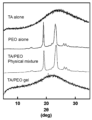
- 1 shows the results of powder X-ray diffraction measurement of TA/PEO hydrogel.
- 1 shows the results of 1 H-NMR measurement of TA/PEO hydrogel.
- 1 shows photographs of samples at each step in the preparation of a hydrogel molded body. These are the results of tensile tests on a PEO 500 kDa hydrogel molded body (TaPeO Gel) and a control gel.
- the present invention relates to a crosslinked product in which a high molecular weight polymer is crosslinked with tannic acid, the high molecular weight polymer having a constituent unit including a group G capable of forming a hydrogen bond with tannic acid and having a weight average molecular weight of 50 kDa or more (hereinafter, this may be referred to as the "crosslinked product of the present invention").
- the inventors have surprisingly discovered that by crosslinking a high molecular weight polymer having a specific weight average molecular weight or more with tannic acid, a material with completely different properties can be obtained from the viscous bodies obtained by crosslinking low molecular weight polyethylene glycol (PEG) with tannic acid (TA) that have been reported up to now. Furthermore, they have discovered that hydrogels containing crosslinked products of high molecular weight polymers crosslinked with tannic acid and their dried products have a variety of functions, such as self-repairing ability and shape memory ability. The present invention was made based on these findings.
- the high molecular weight polymer constituting the crosslinked product of the present invention is a polymer having a structural unit (hereinafter, sometimes referred to as "structural unit (A)") containing a group G (hereinafter, sometimes simply referred to as "group G”) capable of forming a hydrogen bond with tannic acid, and is usually a water-soluble polymer.
- structural unit (A) structural unit containing a group G (hereinafter, sometimes simply referred to as "group G”) capable of forming a hydrogen bond with tannic acid, and is usually a water-soluble polymer.
- the group G is not particularly limited as long as it is a group capable of forming a hydrogen bond with tannic acid, but examples of groups capable of forming a hydrogen bond with a hydroxyl group of tannic acid include groups having an oxygen atom such as an ether group or a carbonyl group, and groups having a nitrogen atom such as an amino group. Examples of groups capable of forming a hydrogen bond with an ether group or a carbonyl group of tannic acid include a hydroxyl group.
- the structural unit (A) of the high molecular weight polymer may contain one or more of these groups G.
- Examples of the structural unit (A) include those represented by the following formulas (1) to (3):
- R 1 represents an alkylene group, preferably having 1 to 6 carbon atoms, and more preferably having 2 to 3 carbon atoms, and X is -O- or -NH 2 -.
- R2 is a hydrogen atom or an alkyl group, preferably a hydrogen atom or a methyl group.
- R3 is a hydrogen atom or an alkyl group, preferably a hydrogen atom or a methyl group.
- R4 is a hydrogen atom or an alkyl group, preferably a hydrogen atom or a methyl group
- Y is OH, OR40OH ( R40 is an alkylene group or an oxyalkylene group ), or NR41R42 ( R41 and R42 are each independently a hydrogen atom or an alkyl group).
- the structural unit (A) is preferably represented by the following formula (4) and/or the following formula (5).
- the structural unit represented by the following formula (4) is capable of forming a hydrogen bond between the ether bond in the structural unit and the hydroxyl group of tannic acid.
- the structural unit represented by the following formula (5) is capable of forming a hydrogen bond between the hydroxyl group in the structural unit and the ether group (oxygen atom) of tannic acid.
- R 1 represents an alkylene group, preferably having 1 to 5 carbon atoms, and more preferably having 2 to 3 carbon atoms.
- the high molecular weight polymer only needs to contain the structural unit (A), and may be a homopolymer, a copolymer containing multiple structural units (A), or a copolymer containing units other than structural units (A); however, if the amount of structural unit (A) is too small, it is considered that the polymer will not react well with tannic acid. Therefore, the proportion of structural unit (A) in the total structural units in the high molecular weight polymer is preferably 50 mol% or more, and may be 60 mol% or more, 70 mol% or more, 80 mol% or more, 90 mol% or more, etc.
- high molecular weight polymers include polyalkylene oxides such as polyethylene oxide and polypropylene oxide, polyalkylene oxide copolymers, polyvinyl alcohol, and polyvinyl alcohol copolymers.
- the high molecular weight polymer is preferably one or more selected from the group consisting of polyethylene oxide (PEO), polyethylene oxide copolymers, polyvinyl alcohol (PVA), and polyvinyl alcohol copolymers.
- the weight-average molecular weight of the high molecular weight polymer constituting the crosslinked product of the present invention is 50 kDa or more.
- the weight-average molecular weight of the high molecular weight polymer is preferably 100 kDa or more, and more preferably 500 kDa or more.
- the weight average molecular weight of the high molecular weight polymer is preferably 50 kDa to 5000 kDa, 100 kDa to 5000 kDa, 500 kDa to 5000 kDa, 500 kDa to 4000 kDa, 500 kDa to 2000 kDa, or 500 kDa to 1000 kDa.
- the weight-average molecular weight of a high molecular weight polymer is the weight-average molecular weight calculated in terms of polyethylene oxide by gel permeation chromatography (GPC) using polyethylene oxide as a standard sample, and is sometimes simply referred to as "molecular weight.”
- Tannic acid is a type of natural polyphenol, a compound in which 19 gallic acids are bound to a central glucose, and which contains a catechol group and a pyrogallol group. Tannic acid is the most abundant natural compound after cellulose, semicellulose, and lignin, and is easy to obtain and inexpensive. Tannic acid is also approved as a food additive by the U.S. Food and Drug Administration (FDA), is highly soluble in water, and is a safe and environmentally friendly material.
- FDA U.S. Food and Drug Administration
- the molar ratio of tannic acid to the structural unit (A) in the high molecular weight polymer is preferably 0.02 to 0.1, and more preferably 0.03 to 0.06.
- the crosslinked product of the present invention can be a component of a hydrogel or a molded product. Below, the hydrogel or molded product containing the crosslinked product of the present invention will be described.
- the present invention relates to a hydrogel containing the above-mentioned crosslinked product of the present invention and water (hereinafter, may be referred to as "hydrogel of the present invention").
- the hydrogel of the present invention typically has a water content of 15% by mass or more.
- the water content can be calculated from the mass difference before and after drying when the hydrogel of the present invention is dried to a constant weight at 120°C and the mass before drying, and is the percentage obtained by dividing the "mass difference before and after drying of the hydrogel of the present invention at 120°C" by the "mass of the gel before drying.”
- the water content of the hydrogel of the present invention may be 15% to 30% by mass, or 18% to 25% by mass, etc.
- the hydrogel of the present invention is a rubber-like elastic gel in which the storage modulus (G') is greater than the loss modulus (G") at 25°C and 0.1 Hz to 100 Hz, and which exhibits strong elastic properties.
- This rubber-like elastic gel is obtained by forming a hydrogel containing water and a crosslinked product obtained by crosslinking a high molecular weight polymer with a weight average molecular weight of 50 kDa or more with tannic acid. Note that a gel of a low molecular weight polymer and tannic acid has a higher loss modulus (G") than the storage modulus (G'), and exhibits strong viscous properties, and their behavior is completely different.
- the hydrogel of the present invention can achieve a maximum tensile stress of 0.05 MPa or more, and is stronger than general agarose gels and gelatin gels.
- the maximum tensile stress of the hydrogel of the present invention is preferably 0.07 MPa or more, more preferably 0.10 MPa or more, and even more preferably 0.12 MPa or more.
- the maximum tensile stress of the hydrogel of the present invention can be 0.05 MPa to 0.5 MPa, 0.07 MPa to 0.40 MPa, 0.10 MPa to 0.30 MPa, or 0.12 MPa to 0.25 MPa.
- the hydrogel of the present invention has excellent extensibility and can achieve a breaking elongation of 500% or more.
- the breaking elongation of the hydrogel of the present invention is preferably 600% or more, and more preferably 700% or more.
- breaking elongation of the hydrogel of the present invention there is no particular upper limit to the breaking elongation of the hydrogel of the present invention, but for example, the breaking elongation of the hydrogel of the present invention can be 500% to 2000%, 600% to 1800%, or 700% to 1500%.
- the maximum tensile stress and breaking elongation (breaking strain) of the hydrogel of the present invention can be calculated from the stress-strain curve measured by a tensile test using a 10 mm x 30 mm x 2 mm test piece of the hydrogel of the present invention, as described later in the Examples.
- the hydrogel of the present invention can achieve a maximum bending stress of 10 MPa or more when dried at 40°C for 8 days, and having such a maximum bending stress, it has strength even when dried, which is preferable.
- the maximum bending stress when dried at 40°C for 8 days is preferably 15 MPa or more, and more preferably 18 MPa or more. This maximum bending stress can be calculated from the stress-strain curve measured by a three-point bending test using a 10 mm x 30 mm x 2 mm hydrogel of the present invention as a test piece, as described later in the Examples.
- the hydrogel of the present invention exhibits excellent swelling resistance.
- the swelling rate is close to 100%, which indicates that the hydrogel of the present invention is unlikely to swell, and the swelling rate when immersed in water for 48 hours is about 100% to 120% or 105% to 115%.
- the swelling rate can be calculated from the mass before and after immersion in water for 48 hours, and is the percentage obtained by dividing the "mass of the gel after immersion in water for 48 hours" by the "mass of the gel before immersion.”
- the hydrogel of the present invention has adhesive properties. When the hydrogel of the present invention is brought into contact with a cut or wound of its own and left to stand for about 24 hours, it can restore the shape and physical properties it had before the wound or cut occurred.
- the hydrogel of the present invention has a self-repairing ability when dried at 40°C for 8 days. That is, when the cut surfaces of the hydrogel of the present invention dried at 40°C for 8 days are heated and then brought into contact with each other, the cut surfaces adhere to each other and the shape and physical properties can be restored to the same state as before cutting.
- the hydrogel of the present invention is dried at 40°C for 8 days, cut at any position, and heated by contacting the cut surfaces with hot water (water at about 90°C to 110°C), and then the cut surfaces are brought into contact with each other and adhered to each other to obtain a self-repairing product.
- the maximum bending stress of this self-repairing product is 70% or more or 80% or more of the maximum bending stress of the dried product before cutting.
- the hydrogel of the present invention has shape memory ability when dried at 40°C for 8 days.
- Shape memory ability is a property that allows the hydrogel to memorize the deformed shape by heating to a specified temperature and deforming it into any shape, and then cooling it, and by heating the deformed product again, it can be restored to its pre-deformed shape.
- the hydrogel of the present invention is dried at 40°C for 8 days and then immersed in hot water, it becomes flexible and can be deformed into any shape, and by leaving it at room temperature in the deformed state, it can memorize the deformation. When it is then immersed in hot water again, it can be restored from the deformed state to its pre-deformed shape.
- the hydrogel of the present invention can be converted into a lightweight, tough, plastic-like material by drying.
- the dried hydrogel i.e., the dried product of the hydrogel of the present invention
- the water content of the dried hydrogel is lower than that of the hydrogel of the present invention, for example, the water content is 5% by mass or less.
- Dried hydrogels have excellent toughness and can achieve a maximum bending stress of 10 MPa or more.
- the maximum bending stress of dried hydrogels is preferably 15 MPa or more, and more preferably 18 MPa or more.
- the maximum bending stress of the dry hydrogel can be 10 MPa to 60 MPa, 15 MPa to 50 MPa, or 18 MPa to 35 MPa.
- the extensibility of the dried hydrogel is smaller than that of the hydrogel of the present invention, and the breaking strain (%) in the bending test is about 2 to 10%.
- Dried hydrogel has an excellent self-repairing ability, whereby a damaged or cut part will heal when the damaged or cut parts are heated and then brought into contact with each other.
- a damaged or cut part will heal when the damaged or cut parts are heated and then brought into contact with each other.
- the cut surfaces will adhere to each other, and the shape and physical properties can be restored to the same as before the damage or cut occurred.
- the maximum bending stress can be restored to more than 70% or 80% of the maximum bending stress before the cut.
- Dried hydrogels have excellent shape memory capabilities. In other words, by immersing dried hydrogels in boiling water and deforming them into any shape, and then leaving them at room temperature, the deformation can be memorized. If the hydrogels are then immersed in boiling water again, they can be restored from their deformed state to their original shape.
- the dried hydrogel can be re-swelled to form the hydrogel of the present invention by immersing it in water.
- the hydrogel can be restored to the mechanical properties before drying in about one day in water at room temperature, or in about 1 to 5 hours in water at 30° C. to 50° C.
- the molded article of the present invention is a molded article containing the crosslinked product of the present invention, and is the hydrogel of the present invention itself, the dried hydrogel of the present invention itself, or the hydrogel of the present invention or its dried product used as a part of the constituent material of the molded article.
- the shape of the molded article of the present invention is not particularly limited, and it can be in the form of a film, a plate, a particle, or various components, depending on the application.
- the molded article of the present invention can have functionality due to the hydrogel of the present invention, its dried product, the high molecular weight polymers that compose them, and tannic acid.
- functionality such as toughness, high extensibility, adhesive ability, anti-swelling ability, self-repairing ability, shape memory ability, sustained release ability, UV blocking ability, anti-inflammatory action, antibacterial action, antiviral action, and biocompatibility
- the molded article of the present invention can be used as a tough material, a highly extensible material, an adhesive material, an anti-swelling material, a self-repairing material, a shape memory material, a sustained release carrier, a UV blocking material, an anti-inflammatory material, an antibacterial material, an antiviral material, a biocompatible material, and the like.
- it can be used as molecular actuators; paints; household goods such as eyeglass frames and sunglasses lenses; cosmetics; toiletries; and medical materials such as tissue adhesives, hemostatic materials, wound dressings, and drug carriers.
- An example of the molded article of the present invention is a film.
- the thickness of the film is not particularly limited, but is, for example, 0.1 ⁇ m to 0.5 ⁇ m.
- the film can be used as a highly extensible film, taking advantage of its high extensibility.
- the film can be a film containing the crosslinked product of the present invention and having a breaking elongation of 500% or more. This film can achieve a breaking elongation of 1000% or more, or 1500% or more.
- Such a highly extensible film can be produced by utilizing a supernatant liquid separated during the production of the hydrogel of the present invention, as described below.
- the method for producing the hydrogel of the present invention is not particularly limited, but it is preferable to use a production method having a gelling step of mixing an aqueous solution containing a high molecular weight polymer with an aqueous solution containing tannic acid to obtain a crosslinked product-containing solution containing a crosslinked product formed by crosslinking the high molecular weight polymer with tannic acid, and a gel recovery step of recovering a hydrogel containing the crosslinked product from the crosslinked product-containing solution.
- a hydrogel production method By using such a hydrogel production method, the hydrogel of the present invention can be easily obtained without performing complicated operations such as purification.
- the gelation process is a process in which an aqueous solution containing a high molecular weight polymer is mixed with an aqueous solution containing tannic acid to obtain a crosslinked product-containing solution containing a crosslinked product in which the high molecular weight polymer is crosslinked with tannic acid.
- a polymer having a structural unit (structural unit (A)) containing a group G capable of forming a hydrogen bond with a hydroxyl group and a weight average molecular weight of 50 kDa or more is used.
- the high molecular weight polymer used in the gelation process is similar to the high molecular weight polymer constituting the crosslinked product of the present invention, and its structure, molecular weight, and preferred examples thereof are as explained in the crosslinked product of the present invention.
- the group G in the high molecular weight polymer and tannic acid form hydrogen bonds, the high molecular weight polymer is crosslinked, and the crosslinked product precipitates as a solid. Therefore, the solution containing the crosslinked product obtained in the gelation process is a heterogeneous solution in which the crosslinked product precipitates.
- the concentration of the high molecular weight polymer in the aqueous solution containing the high molecular weight polymer used in the gelation process is preferably 5 g/L or more. Therefore, the high molecular weight polymer is preferably a polymer that dissolves at least 5 g in 1 L of water at 25°C. Taking into consideration reactivity, amount of waste liquid, etc., the concentration of the high molecular weight polymer may be 10 g/L to 100 g/L or 20 g/L to 50 g/L, etc.
- the concentration of tannic acid in the aqueous solution containing tannic acid is preferably 5 g/L or more. Taking into consideration reactivity and the amount of waste liquid, the concentration of tannic acid may be 50 g/L to 150 g/L or 80 g/L to 120 g/L, etc.
- the mixing ratio of the aqueous solution containing the high molecular weight polymer and the aqueous solution containing tannic acid is not particularly limited, but it is preferable to mix so that tannic acid is 0.045 mol or more per 1 mol of the structural unit (A) in the high molecular weight polymer, and more preferably 0.047 mol or more or 0.050 mol or more.
- the upper limit can be 0.7 mol or less, 0.3 mol or less, 0.1 mol or less, etc., of tannic acid per 1 mol of the structural unit (A) in the high molecular weight polymer.
- the mixing ratio of the aqueous solution containing the high molecular weight polymer to the aqueous solution containing tannic acid can be 0.045 mol to 0.7 mol, 0.047 mol to 0.3 mol, 0.050 mol to 0.1 mol, etc., of tannic acid per 1 mol of structural unit (A) in the high molecular weight polymer.
- the order of mixing is not particularly limited, and the aqueous solution containing the high molecular weight polymer may be supplied to the reaction apparatus after the aqueous solution containing tannic acid is supplied and mixed, or the aqueous solution containing the high molecular weight polymer may be supplied to the reaction apparatus after the aqueous solution containing tannic acid is supplied and mixed, or the aqueous solution containing the high molecular weight polymer and the aqueous solution containing tannic acid may be supplied to the reaction apparatus in parallel and mixed. Furthermore, mixing of the aqueous solution containing the high molecular weight polymer and the aqueous solution containing tannic acid is usually performed with stirring.
- the mixing temperature is too high, the formation of hydrogen bonds is inhibited, so a temperature of 10°C to 60°C is preferable, 15°C to 45°C is more preferable, and a temperature of about room temperature of 20°C to 30°C is even more preferable.
- a temperature of 10°C to 60°C is preferable, 15°C to 45°C is more preferable, and a temperature of about room temperature of 20°C to 30°C is even more preferable.
- the gel recovery step is a step of recovering a hydrogel containing the crosslinked product from the crosslinked product-containing solution obtained in the gelation step.
- the method of recovering the hydrogel from the crosslinked product-containing solution is not particularly limited, and the hydrogel, which is a solid product, can be recovered by using a method capable of separating solids from liquid components, such as decantation, filtration, or centrifugation.
- the recovered hydrogel may be used as is, or may be further molded into a desired shape by compression molding or other molding methods.
- the recovered hydrogel or a molded product thereof may be dried by a known method until it reaches the desired water content. There are no particular limitations on the drying method, and any method such as natural drying, heat drying, or freeze drying may be used.
- the liquid component separated from the solids in the gel recovery process usually contains residual crosslinks. Therefore, it is preferable to use the liquid component separated from the solids in the gel recovery process to manufacture films and the like.
- the liquid component to manufacture films and the like there are almost no waste components other than water, making this an environmentally friendly (eco-friendly) manufacturing method. Furthermore, by reusing the water, zero-wasted manufacturing is also possible.
- the method for producing a film that utilizes the liquid component separated from the solids in the gel recovery process specifically includes a gelation process in which an aqueous solution containing a high molecular weight polymer is mixed with an aqueous solution containing tannic acid to obtain a crosslinked product-containing solution containing a crosslinked product formed by crosslinking the high molecular weight polymer with tannic acid, a liquid recovery process in which the crosslinked product-containing solution is separated into a hydrogel containing the crosslinked product and a liquid component, and then the liquid component is recovered, and a film formation process in which the liquid component is formed into a film to obtain a film.
- the gelling step is the same as the gelling step in the above-mentioned method for producing a hydrogel of the present invention.
- the liquid recovery step corresponds to the gel recovery step in the method for producing a hydrogel of the present invention, and is a step of separating the solid matter from the liquid component by decantation, filtration, centrifugation, or the like, and then recovering the liquid component.
- This liquid component contains crosslinked materials with a low degree of crosslinking. Decantation is one of the preferred methods, since it is easy to remove crosslinked materials with a low degree of crosslinking from solid matter and leave them in the supernatant liquid.
- the film-forming step is a step in which the liquid components recovered in the liquid recovery step are formed into a film to obtain a film.
- the liquid components can be placed in an appropriate mold and dried to obtain a film.
- the drying conditions There are no particular limitations on the drying conditions as long as the water in the liquid components can be removed, but in order to obtain a highly extensible film, it is preferable to dry at 40°C or higher and then adjust the humidity at 15 to 35°C.
- the present invention also relates to a plant life-extending agent containing the hydrogel of the present invention (hereinafter, may be referred to as the "plant life-extending agent of the present invention").
- the plant life-extending agent of the present invention By using the hydrogel of the present invention, the plant can be made to last longer, can be kept fresh for a long period of time, and can be prevented from wilting.
- the plant life extension agent of the present invention can be used, and when growing plants in soil or solid medium, the plant life extension agent of the present invention can be mixed into soil or solid medium, or placed on top of soil or solid medium.
- the plant life extension agent of the present invention can be added to water or culture solution. The cut parts of cut flowers during transport can also be brought into contact with the plant life extension agent of the present invention.
- the size (maximum length) of the hydrogel of the present invention in a dried state can be 5 cm or less, 3 cm or less, or 1.5 cm or less, and is preferably, for example, about 0.1 cm to 5 cm, about 0.3 cm to 3 cm, or about 0.5 cm to 1.5 cm.
- the amount of the plant life extension agent of the present invention used can be set appropriately depending on the method of use, etc.
- the amount of the plant life extension agent of the present invention used can be 1 g to 30 g, 3 g to 20 g, 3.5 g to 15 g, etc. per 100 g of soil, medium, water or culture solution.
- the plant on which the plant life extension agent of the present invention is used may be not only the plant body, but also parts of the plant, such as organs or tissues.
- Plant organs or tissues include flowers, leaves, stems, roots, branches, bulbs, etc.
- the plant life extension agent of the present invention can be applied to crops, trees, lawns, potted flowers, cut flowers, cut leaves, branches, etc.
- Target plants include, but are not limited to, vegetables such as parsley, osmanthus, spinach, komatsuna, mizuna, mibuna, asparagus, swiss cabbage, lettuce, thyme, sage, Italian parsley, rosemary, oregano, lemon balm, chives, lavender, salad burnet, lamb's ear, rocket, dandelion, nasturtium, basil, arugula, watercress, mulukhiyah, celery, kale, green onion, cabbage, Chinese cabbage, chrysanthemum, lettuce, lettuce, lettuce, butterbur, turnip, bok choy, mitsuba, Japanese parsley, Brussels sprouts, broccoli, cauliflower, myoga, radish, carrot, burdock, radish, turnip, sweet potato, potato, yam, yam, taro, Japanese yam, Japanese yam, etc.; citrus fruits, apples, pears, grapes, blueberries, etc.
- -Fruits such as berries, persimmons, strawberries, pineapples, cherries, lychees, pomegranates, loquats, bananas, melons, mangoes, papayas, kiwi fruit, cherimoya, avocados, guavas, plantains, plums, peaches, passion fruit, apricots, breadfruit, jackfruit, pawpaws, durians, feijoas, dragon fruit, star fruit, rambutan, jujubes, bell peppers, paprika, shishito peppers, cucumbers, eggplants, tomatoes, cherry tomatoes, pumpkins, bitter melons, okra, sweet corn, edamame, snow peas, green beans, broad beans, etc.; fungi; cut flowers such as gerberas, carnations, roses, hydrangeas, sweet peas, baby's breath, chrysanthemums, lilies, stocks, statice,
- PEO Polyethylene oxide
- PEG Sigma Aldrich Polyethylene glycol
- PEG 2000 kDa
- PEG Polyethylene glycol
- PEG 4000 kDa
- Fujifilm Wako Pure Chemicals Tannic acid Fujifilm Wako Pure Chemicals Guanidine hydrochloride: Nacalai Tesque Borax: Kenei
- Urea Fujifilm Wako Pure Chemicals Polyvinyl alcohol (PVA) (22 kDa): Fujifilm Wako Pure Chemicals Polyvinyl alcohol (PVA) (66 kDa): Fujifilm Wako Pure Chemicals Coomasie Brilliant Blue R-250 (CBBR-250): Nacalai Tesque Gelatin: Nitta Gelatin Agarose: Nippon Gene 30 w/v% Acrylamide/Bis Mixed Solution (37.5:1): Wako Chemical USA Ammonium persulfate (APS): Tokyo Chemical Industry Co., Ltd.
- N,N,N',N'-Tetramethylethylenediamine Nacalai Tesque Co., Ltd.
- MilliQ water pure water with a resistivity of 18.3 M ⁇ cm or higher produced using the MilliQ (registered trademark) ultrapure water production system (Millipore) was used as the solvent.
- polyethylene glycol and polyethylene oxide are generally classified as “polyethylene glycol” with low molecular weight of 20 kDa or less, and “polyethylene oxide” with higher molecular weight.
- polyethylene glycol and polyethylene oxide those with the name “polyethylene glycol” are described as “polyethylene glycol” even if they are high molecular weight, but below, those with a molecular weight of 20 kDa or less will be described as “PEG”, those with a molecular weight of 40 kDa or more will be described as “PEO”, and polyethylene glycol and polyethylene oxide will be collectively described as "PEG-PEO”. Tannic acid will be described as "TA”.
- Example 1 Effect of PEG/PEO molecular weight (1) TA was dissolved in water to prepare a 100 mg/mL TA aqueous solution. PEG-PEO of various molecular weights (0.4 kDa, 0.6 kDa, 1.6 kDa, 10 kDa, 20 kDa, 40 kDa, 100 kDa, 200 kDa, 500 kDa, 1000 kDa, 2000 kDa) were dissolved in water to prepare 25 mg/mL aqueous solutions of each PEG-PEO.
- PEG-PEO of various molecular weights 0.4 kDa, 0.6 kDa, 1.6 kDa, 10 kDa, 20 kDa, 40 kDa, 100 kDa, 200 kDa, 500 kDa, 1000 kDa, 2000 kDa
- Figure 1 shows the results of mixing TA and PEG-PEO of various molecular weights in water and observing the morphology of the solution.
- Example 2 Evaluation of viscoelasticity of hydrogel PEG with a molecular weight of 10 kDa was selected as the PEG that forms a viscous gel, and PEO with a molecular weight of 500 kDa was selected as the PEO that forms an elastic gel. A gel was prepared, and the viscoelasticity of the gel was evaluated using a rheometer.
- Example 2-1 Preparation of hydrogel PEG-PEO aqueous solution (25 mg/mL) of each molecular weight was mixed with TA aqueous solution (100 mg/mL) at 2:1 (v/v).
- TA aqueous solution 100 mg/mL
- the mixture was centrifuged, and the precipitated gel was used in the experiment.
- PEO 500 kDa the precipitated lump gel generated by mixing the PEO aqueous solution and the TA aqueous solution was collected and used for the measurement.
- Example 2-2 Evaluation of Viscoelasticity The viscoelasticity of the TA/PEG gel and the TA/PEO hydrogel was measured using an MCR-101 rheometer manufactured by Anton Paar Japan under the following conditions: Parallel plate diameter: 25 mm, fixed strain: 15.8% (10 kDa), 4.0% (500 kDa), measurement temperature: 25°C.
- Figure 2 shows the results of measuring the viscoelasticity of the TA/PEG gel and TA/PEO hydrogel.
- the loss modulus (G) exceeded the storage modulus (G'), indicating strong viscous properties.
- the storage modulus was higher, suggesting strong elastic properties. The reason for this is thought to be that the higher the molecular weight of PEO, the longer the molecular chains are and the more they are entangled, which is thought to result in a stronger ability to return to the original state when an external force is applied, i.e., a stronger elasticity.
- FIG. 3 shows the relationship between TA concentration and turbidity (average value of three experiments). As shown in FIG. 3, in the case of PEO 500 kDa, the turbidity increased significantly at a TA concentration of 4 mg/mL or more.
- Figure 4 shows the relationship between PEG-PEO concentration and turbidity (average value of three experiments). As shown in FIG. 4, for PEO 500 kDa, the turbidity increased significantly at a PEO concentration of 4 mg/mL or more.
- Example 5-1 Effect of temperature on turbidity of TA/PEO mixed solution TA or 500 kDa PEO was dissolved in water to prepare a 5 mg/mL TA aqueous solution or a 5 mg/mL 500 kDa PEO aqueous solution. 0.4 mL of the above TA aqueous solution and 500 kDa PEO aqueous solution were added to 1.2 mL of water and mixed by vortexing. The above mixed solution was incubated at room temperature or 80°C for 24 hours, and then the absorbance at 600 nm was measured.
- Example 5-2 Effect of hydrogen bond inhibitor on turbidity of TA/PEO mixture
- TA or 500 kDa PEO was dissolved in water to prepare a 5 mg/mL TA aqueous solution or a 5 mg/mL 500 kDa PEO aqueous solution.
- 0.4 mL of the TA aqueous solution was added to 1.2 mL of water, and either guanidine hydrochloride (50 mg), borax (50 mg) or urea (1 g) was added.
- 0.4 mL of the 500 kDa PEO aqueous solution was added and mixed by vortexing. The mixture was incubated at room temperature for 24 hours, and the absorbance at 600 nm was measured.
- Figure 5 shows the results of measuring the turbidity after mixing an aqueous TA solution and an aqueous PEO solution, leaving them at room temperature or 80°C (mean ⁇ SE of three experiments, * (asterisk) indicates p ⁇ 0.05 compared to room temperature).
- Figure 6 shows the results of measuring the turbidity of a mixture of an aqueous TA solution, an aqueous PEO solution, and various hydrogen bond inhibitors (mean ⁇ SE of three experiments, * indicates p ⁇ 0.05 compared to the control). As shown in Figure 5, when left at 80°C where hydrogen bonds are broken, the turbidity decreased compared to room temperature.
- Example 6 Evaluation of hydrogel structure (Experimental Example 6-1): Preparation of hydrogel A 500 kDa PEO aqueous solution (25 mg/mL) and a TA aqueous solution (100 mg/mL) were mixed at a ratio of 2:1 (v/v). The precipitated hydrogel formed by mixing was dried under reduced pressure and used for the following evaluation.
- Example 6-2 Powder X-ray diffraction A sample obtained by preparing a mixed solution of TA and 500 kDa PEO was dried under reduced pressure and then powder X-ray diffraction was measured. Powder X-ray diffraction was performed using a Rigaku horizontal sample multipurpose X-ray diffractometer (Ultima IV) with the sample fixed in a glass cell. The measurement conditions were as follows: X-ray source: Cu-K ⁇ ray (1.542 ⁇ ), tube voltage: 40 kV, tube current: 20 mA, scanning speed: 10°/min, diffraction angle: 5 to 35°, slit: 1/2-open-open
- Figure 7 shows the results of powder X-ray diffraction measurements of the TA/PEO hydrogel. While the physical mixture of TA and PEO showed peaks similar to those of PEO alone, the TA/PEO hydrogel showed a halo pattern, suggesting that it has an amorphous structure. This suggests that by forming a hydrogel, TA/PEO loses the crystallinity derived from PEO and becomes amorphous.
- Example 6-3 Fourier transform infrared spectroscopy (FT-IR) The sample obtained by preparing the mixed solution of TA and 500 kDa PEO was dried under reduced pressure, and then measured by the ATR method using a PerkinElmer Fourier transform infrared spectrophotometer (Frontier MIR/NIR). The measurement conditions were as follows: Number of scans: 32, Resolution: 4
- the FT-IR measurement results of the TA/PEO hydrogel are shown in Figure 8.
- the C-O-C stretching vibration band derived from PEG at around 1090 cm -1 was shifted to the lower wavenumber side.
- the peak derived from the hydroxyl group of TA at around 3000-3500 cm -1 was also shifted to the lower wavenumber side, suggesting that the oxygen of the ether of PEO and the hydroxyl group of TA were hydrogen-bonded in the gel.
- the ratio of the hydroxyl group of TA to the ether group of PEO was calculated from the integral value of the peak of the hydroxyl group proton of TA at around 9 to 10 ppm and the ethylene proton of PEO at around 3.5 ppm, and the stoichiometric ratio (molar ratio) of the hydroxyl group of TA to the ether of PEO was 1:1.
- the 1H -NMR of the obtained samples was measured in the same manner, except that PEG-PEO with different molecular weights was used instead of 500 kDa.
- PEG-PEO with different molecular weights was used instead of 500 kDa.
- the molar ratio of hydroxyl groups of TA to ethylene groups of PEG was about 3:1, but this decreased with increasing PEG molecular weight, and in the case of PEG-PEO with molecular weights of 6 kDa to 4000 kDa, the molar ratio of ethylene groups of PEG to hydroxyl groups of TA was 1:1.
- Example 8 Evaluation of hydrogel molded body (Experimental Example 8-1): Preparation of hydrogel molded body
- Figure 10 shows photographs of samples at each step in the preparation of hydrogel molded body.
- 100 mg/mL TA aqueous solution was added to 25 mg/mL PEO aqueous solutions of various molecular weights (500 kDa, 1000 kDa, 2000 kDa, 4000 kDa) in a volume ratio of 1:2, and stirred, resulting in the formation of hydrogel precipitates.
- the supernatant was removed from the solution containing the hydrogel by decantation to obtain the hydrogel ( Figure 10 (A)).
- the hydrogel was sandwiched between glass plates or stainless steel plates for 5 minutes or 30 minutes, respectively, and compressed to 2 mm to be molded ( Figure 10 (B)).
- the molded product was dried at 40° C. for 5 hours using an AS ONE constant temperature dryer (OF-300B) to remove excess water, and then cut into a predetermined size to obtain a hydrogel molded product (hydrogel molded product before drying) (FIG. 10(C)).
- the hydrogel obtained by mixing TA/PEO could be compressed and molded into a plate.
- the color changed from cream to brown, and a highly uniform gel exhibiting permeability was obtained.
- Example 8-2 Preparation of control gel and preparation of gelatin gel
- a gelatin solution 500 mg/mL was prepared by adding water to gelatin and heating at 80° C. for 3 hours. The gelatin solution was poured into a mold and allowed to stand overnight at 4° C. to obtain a gelatin gel with a thickness of 2 mm.
- agarose gel Water was added to agarose and heated in a microwave oven to prepare an agarose solution (25 mg/mL). The agarose solution was poured into a mold and allowed to stand at room temperature to obtain an agarose gel.
- Preparation of acrylamide gel Water was added to 30 w/v% acrylamide/bis mixed solution to adjust the final concentration of acrylamide to 100 mg/mL, and then 10% APS (final concentration: 0.05 v/v%) and TEMED (final concentration: 0.1 v/v%) were added and stirred. The mixture was then poured into a mold and allowed to stand at room temperature for 30 minutes or more to obtain an acrylamide gel with a thickness of 2 mm.
- Example 8-3 Tensile Test of Hydrogel Molded Body The stress-strain measurement in the tensile test was performed at room temperature using an A&D tabletop tensile compression tester (MCT-2150, 500N load cell). In the case of the control gel being rectangular, the gel broke at the fixed position, so a dumbbell-shaped sample was used. In the other tensile tests, a rectangular (10 mm x 30 mm) sample (2 mm thick) was used. The PEO 1000 kDa to 4000 kDa hydrogel molded bodies were directly set in the clamp of the tester.
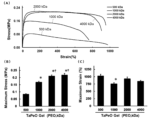
- Figure 11 shows the results of the tensile test of a PEO 500 kDa hydrogel molded body (TaPeO Gel) and a control gel.
- Figure 11 (A) shows the stress-strain curve of the tensile test
- Figure 11 (B) shows the maximum stress of the tensile test of each gel (mean ⁇ S.E. of 10 experiments, * indicates p ⁇ 0.05 compared to acrylamide gel, ⁇ (dagger) indicates p ⁇ 0.05 compared to agarose gel, and ⁇ (double dagger) indicates p ⁇ 0.05 compared to gelatin gel)
- Figure 11 (C) shows the strain of the tensile test of each gel (mean ⁇ S.E.
- the PEO 500 kDa hydrogel molded body exhibited a maximum tensile stress of approximately 0.135 MPa and a breaking strain of 817%, both of which were higher than those of any of the control gels. In other words, it was suggested that the hydrogel molded body was a tough and highly elastic gel.
- Figure 12 shows the results of tensile tests on hydrogel molded bodies with PEO of 500 kDa to 4000 kDa.
- Figure 12(A) shows the stress-strain curves of the tensile tests
- Figure 12(B) shows the maximum stress of each molded body in the tensile tests (mean ⁇ SE of 7 to 10 experiments, * indicates p ⁇ 0.05 compared to the PEO 500 kDa hydrogel molded body, ⁇ indicates p ⁇ 0.05 compared to the PEO 1000 kDa hydrogel molded body)
- Figure 12(C) shows the strain of each molded body in the tensile tests (mean ⁇ SE of 7 to 10 experiments, * indicates p ⁇ 0.05 compared to the PEO 500 kDa hydrogel molded body).
- Example 8-4 Adhesion of hydrogel molded body
- an undyed hydrogel molded body (PEO 500 kDa) and a hydrogel molded body (PEO 500 kDa) dyed blue with Commercial Brilliant Blue R-250 (CBBR-250) were used to evaluate the adhesion of the cut surface.
- an undyed hydrogel molded body and a dyed hydrogel molded body each having a size of 10 x 30 mm were cut in half at the center.
- the cut surfaces of the undyed hydrogel molded body and the dyed hydrogel molded body were brought into contact with each other and left to stand at room temperature for 24 hours. Thereafter, a tensile test was performed and evaluated in the same manner as the above tensile test.
- Figure 13 shows the results of tensile tests of the hydrogel molded bodies before the adhesion test (before cutting) and after the adhesion test.
- Figure 13 (A) shows the stress-strain curve of the tensile test
- Figure 13 (B) shows the maximum stress of the tensile test for each molded body
- Figure 13 (C) shows the strain of the tensile test for each molded body.
- the hydrogel molded bodies PEO 500 kDa
- the hydrogel molded bodies were bonded simply by contacting the cut surfaces, and the bonded hydrogel molded bodies were stretched using a tensile tester, and were stretched to the measurement limit of the tester without breaking.
- the maximum tensile stress and breaking strain of the hydrogel molded bodies after adhesion were equivalent to those of the uncut ones, suggesting that the hydrogel molded bodies (PEO 500 kDa) have excellent adhesive properties.
- the reason why the hydrogel molded body (PEO 500 kDa) showed adhesiveness is thought to be that although the bonds between TA and PEO at the cut surface were broken when the gel was cut, hydrogen bonds between TA and PEO were reformed due to adhesion. Since such adhesion was weak on the uncut surface, it is inferred that this adhesive ability is selective for the cut surface.
- Figure 14 shows photographs of the hydrogel molded body before and after immersion in water. As shown in Figure 14, no change in the shape of the molded body was observed even after 48 hours. In addition, the swelling ratio of the hydrogel molded body (500 kDa PEO) was low at 105% and 107% after 24 hours and 48 hours, respectively, suggesting that it hardly swells at all.
- Example 8-7 Cytotoxicity of TA/PEO hydrogel HeLa cells, which are human cervical cancer cells, were cultured in 10% (v/v) FBS-containing DMEM high glucose medium (200 U/mL penicillin, 0.2 mg/mL streptomycin) at 37°C under 5% CO2 concentration. The semi-confluent cells were detached from the dish by the trypsin-EDTA method and centrifuged at 3000 rpm for 3 minutes, after which the supernatant was removed and the resulting pellet was suspended in 10% (v/v) FBS-containing DMEM medium and used for subculture or seeding.
- 10% (v/v) FBS-containing DMEM high glucose medium 200 U/mL penicillin, 0.2 mg/mL streptomycin
- HBSS HBSS (2 mL) containing 10 v/v% WST-8 was added and incubated at 37°C for 30 minutes, and the absorbance was measured using a Biotek microplate spectrophotometer (Epoch) (measurement wavelength: 450 nm, reference wavelength: 655 nm).
- Epoch Biotek microplate spectrophotometer
- Example 9 Evaluation of dried hydrogel molded body (Experimental Example 9-1): Preparation of dried hydrogel molded body A hydrogel molded body (hydrogel molded body before drying) prepared in the same manner as in Experimental Example 8-1 was dried at 40°C for about 8 days to obtain a dried hydrogel molded body.
- FIG. 15 is a photograph of the obtained dried hydrogel molded body. As shown in FIG. 15, the transparency of the hydrogel molded body (500 kDa PEO) increased by drying. Furthermore, the dried hydrogel molded body was a plastic-like material that was lightweight and had excellent toughness.
- Example 9-3 Three-point bending test A three-point bending test was performed using a dried hydrogel molded body to evaluate the deformability. The stress-strain measurement in the three-point bending test was performed at room temperature using an A&D benchtop tensile compression tester (MCT-2150, 500N load cell). The sample used was a specimen (thickness 2 mm) cut to 10 x 30 mm. The pressing speed was 100 mm/min. The maximum stress indicates the maximum stress until breakage. The breaking strain indicates the strain at breakage. The stress and strain were defined by the following formula.
- Figure 16 shows the results of a three-point bending test of dried hydrogel molded bodies of PEO 500 kDa to 4000 kDa.
- Figure 16(A) shows the stress-strain curve of the three-point bending test
- Figure 16(B) shows the maximum stress of each molded body in the three-point bending test (average value ⁇ S.E. of 5 to 10 experiments, * indicates p ⁇ 0.05 compared to the dried hydrogel molded body of PEO 500 kDa, ⁇ indicates p ⁇ 0.05 compared to the dried hydrogel molded body of PEO 1000 kDa)
- Figure 16(C) shows the strain of each molded body in the three-point bending test (average value ⁇ S.E.
- ⁇ indicates p ⁇ 0.05 compared to the dried hydrogel molded body of PEO 4000 kDa).
- the maximum bending stress and breaking strain of the dried hydrogel molded body 500 kDa PEO were approximately 18 MPa and 2.4%, respectively.
- the maximum stress of the dried hydrogel molded body tended to increase with increasing PEO molecular weight.
- the breaking strain was not significantly affected by the PEO molecular weight and was within the range of ⁇ 2%.
- Example 9-4 Adhesion of dried hydrogel molded body The cross section of a broken sample of dried hydrogel molded body (500 kDa PEO) was immersed in boiling water for 30 seconds, and then the cross section was brought into contact with the water and allowed to stand at room temperature for 24 hours. Thereafter, visual evaluation, a load test, and a three-point bending test were performed.
- Example 9-7 Shape memory ability of dried hydrogel molded bodies First, a hydrogel molded body of 500 kDa PEO was prepared, cut out, and then dried for 8 days in a plate shape (I-shaped) or folded (L-shaped or U-shaped) to obtain dried hydrogel molded bodies molded into each shape. Next, each molded body was immersed in room temperature water or boiling water for 30 seconds, and the "I-shaped” sample was made into an "L-shaped” shape, and the "L-shaped” or “U-shaped” sample was flattened out to an "I-shaped” shape, and the shape was fixed by leaving it to stand for 60 seconds. After that, the shape change was observed by immersing it again in boiling water for 60 seconds.
- Figure 17 shows the evaluation of shape memory ability.
- the "I-shaped”, “L-shaped” and “U-shaped” molded bodies were immersed in boiling water for 30 seconds and stress was applied, they could be deformed into “L-shaped”, “I-shaped” and “I-shaped”, respectively.
- the dried hydrogel molded body 500 kDa PEO
- the deformed gel was left to stand for 60 seconds to fix its shape, and when it was immersed in boiling water again, the shape gradually changed and returned to its original shape. This suggests that the dried hydrogel molded body (500 kDa PEO) has shape memory ability.
- Example 9-8 Swelling ratio of dried hydrogel molded body A dried hydrogel molded body (500 kDa PEO) was immersed in water to reswell. The dried hydrogel molded body did not change in shape even after immersion in water for 24 hours or 48 hours, but in both cases it showed a swelling ratio of about 130%. The water content of the gel after swelling calculated from this value was about 20%, which agreed well with the water content of the hydrogel molded body (500 kDa PEO) before drying.
- Example 9-9 Tensile test of reswelled gel A dried hydrogel molded body (500 kDa PEO) was immersed in water for 24 hours. Next, it was dried at 40°C for 1 to 5 hours using an AS ONE constant temperature dryer (OF-300B) or left to stand at room temperature for 24 hours, and then a tensile test was carried out under the same conditions as in Experimental Example 8-3.
- OF-300B AS ONE constant temperature dryer
- Figure 18 shows the results of the tensile test of the reswelled gels.
- Figure 18(A) shows the stress-strain curve of the tensile test
- Figure 18(B) shows the maximum stress of the tensile test of each gel (mean value ⁇ S.E. of 6 to 10 experiments)
- Figure 18(C) shows the strain of the tensile test of each gel (mean value ⁇ S.E. of 6 to 10 experiments, * indicates p ⁇ 0.05 compared to the control (before drying)).
- the hydrogel molded body becomes hard like plastic when dried, but when swollen with water, it showed the same maximum tensile stress as the hydrogel molded body before drying.
- the breaking strain was also equal to or greater than that of the molded body before drying, suggesting that the hydrogel molded body can be transformed into a rubber-like elastic gel by reswelling even after drying.
- the reason for this is thought to be that water penetrates sufficiently into the gel due to long-term immersion in water, and as a result, the reversibility of the hydrogen bonds between TA and PEO is restored.
- the detailed reason why the breaking strain was slightly improved compared to the hydrogel molded body before drying is unknown, but the hydrogel molded body before drying was obtained by immediately molding and drying a non-uniform gel obtained by mixing a TA solution and a PEO solution, so it is possible that the hydrogen bonds were non-uniform and the PEO chains were distorted.
- Example 10 Evaluation of TA/PEO film (Experimental Example 10-1): Preparation of TA/high molecular weight PEO film When 100 mg/mL of TA aqueous solution was added to 25 mg/mL of various molecular weight PEO (500 kDa, 1000 kDa, 2000 kDa) aqueous solutions at a volume ratio of 1:2 and stirred, hydrogel precipitate was generated. The supernatant was removed from the solution containing the hydrogel by decantation, and the hydrogel and the supernatant were separated.
- various molecular weight PEO 500 kDa, 1000 kDa, 2000 kDa
- TaPeO Film 100 mL of the supernatant was poured into a mold and dried at 40°C and 60% for 4 days using a Tokyo Rikakikai thermohygrostat (KCL-2000W). The dried film was cut out, and then left to stand at 25°C and 70% for 1 day to reabsorb moisture, and this was used as a TA/high molecular weight PEO film (TaPeO Film).
- Figure 19 shows photographs of the TA/high molecular weight PEO film before and after drying.
- the supernatant which was a white suspension, formed a film by drying. Although the film was brittle immediately after drying, it became extensible when re-absorbed moisture.
- Figure 20 shows the relationship between the molecular weight of PEO and the thickness of the TA/high molecular weight PEO film (mean value ⁇ S.E. of 5 to 10 experiments, * indicates p ⁇ 0.05 compared to TaPeO Film (PEO 500 kDa)). The thickness of the TA/high molecular weight PEO film decreased with increasing PEO molecular weight.
- Example 10-2 Tensile test of TA/PEO film Stress-strain measurements in the tensile test of the TA/PEO film were performed at room temperature using an A&D benchtop tensile compression tester (MCT-2150, 500N load cell). The sample used was a TA/PEO film cut to a size of 10 x 40 mm. The maximum stress indicates the maximum stress until breakage. The elongation (strain) (%) is the value expressed as a percentage, obtained by dividing the distance displacement between the two clamps when the film is deformed by the distance before deformation. The tensile speed was 50 mm/min.
- Figure 21 shows the stress-strain curves of the tensile tests of TA/PEO films. As shown in Figure 21, all of the TA/ultra-high molecular weight PEO films using PEO of 500 to 2000 kDa stretched to the measurement limit.
- Figure 22 is a photograph showing a test (left at room temperature for 5 days) of a gerbera placed in a container of water with hydrogel and one placed in a container of water without hydrogel.
- Figure 23 is a close-up photograph of the flower of a gerbera placed in a container of water with hydrogel and one placed in a container of water without hydrogel, both left at room temperature for 5 days. As shown in Figures 22 and 23, the condition of the flowers with hydrogel is better after 5 days compared to the flowers without hydrogel, and they are longer-lived.
- Figure 24 is a photograph showing a gerbera planted in a container with water containing hydrogel and a gerbera planted in a container with water to which tannic acid has been added. As shown in Figure 24, it can be seen that adding tannic acid to the water makes the gerbera plant more likely to wither.
- Figure 25 is a photograph showing the growth of parsley 45 and 100 days after hydrogel was added. As shown in Figure 25, the plants that used hydrogel lived longer than those that did not.
- the crosslinked material of the present invention and hydrogels containing it can be used as smart materials or medical materials by taking advantage of their functionality, such as self-repairing and shape-memory properties, making them industrially useful.
- the crosslinked material of the present invention and hydrogels containing it can be used to prolong the life of plants, making them useful in the fields of agriculture and horticulture.
Landscapes
- Chemical & Material Sciences (AREA)
- Health & Medical Sciences (AREA)
- Chemical Kinetics & Catalysis (AREA)
- Medicinal Chemistry (AREA)
- Polymers & Plastics (AREA)
- Organic Chemistry (AREA)
- Engineering & Computer Science (AREA)
- Manufacturing & Machinery (AREA)
- Dispersion Chemistry (AREA)
- Materials Engineering (AREA)
- General Chemical & Material Sciences (AREA)
- Processes Of Treating Macromolecular Substances (AREA)
Priority Applications (1)
| Application Number | Priority Date | Filing Date | Title |
|---|---|---|---|
| JP2025516847A JPWO2024225317A1 (https=) | 2023-04-26 | 2024-04-24 |
Applications Claiming Priority (2)
| Application Number | Priority Date | Filing Date | Title |
|---|---|---|---|
| JP2023072043 | 2023-04-26 | ||
| JP2023-072043 | 2023-04-26 |
Publications (1)
| Publication Number | Publication Date |
|---|---|
| WO2024225317A1 true WO2024225317A1 (ja) | 2024-10-31 |
Family
ID=93256543
Family Applications (1)
| Application Number | Title | Priority Date | Filing Date |
|---|---|---|---|
| PCT/JP2024/016076 Ceased WO2024225317A1 (ja) | 2023-04-26 | 2024-04-24 | 架橋物、ハイドロゲルおよびその製造方法、成形体、ならびに、フィルムおよびその製造方法 |
Country Status (2)
| Country | Link |
|---|---|
| JP (1) | JPWO2024225317A1 (https=) |
| WO (1) | WO2024225317A1 (https=) |
Cited By (1)
| Publication number | Priority date | Publication date | Assignee | Title |
|---|---|---|---|---|
| CN120718300A (zh) * | 2025-08-19 | 2025-09-30 | 烟台佳合塑胶科技有限公司 | 一种高强度可降解自愈合水凝胶及其制备方法 |
Citations (2)
| Publication number | Priority date | Publication date | Assignee | Title |
|---|---|---|---|---|
| JP2021014533A (ja) * | 2019-07-12 | 2021-02-12 | パナソニックIpマネジメント株式会社 | フィルム及びフィルムの製造方法 |
| JP2021536523A (ja) * | 2018-09-07 | 2021-12-27 | ハイドロ−ケベック | ケイ素またはケイ素−グラファイト複合材電極のためのポリマー結合剤、および電気化学セルにおけるそれらの使用 |
-
2024
- 2024-04-24 WO PCT/JP2024/016076 patent/WO2024225317A1/ja not_active Ceased
- 2024-04-24 JP JP2025516847A patent/JPWO2024225317A1/ja active Pending
Patent Citations (2)
| Publication number | Priority date | Publication date | Assignee | Title |
|---|---|---|---|---|
| JP2021536523A (ja) * | 2018-09-07 | 2021-12-27 | ハイドロ−ケベック | ケイ素またはケイ素−グラファイト複合材電極のためのポリマー結合剤、および電気化学セルにおけるそれらの使用 |
| JP2021014533A (ja) * | 2019-07-12 | 2021-02-12 | パナソニックIpマネジメント株式会社 | フィルム及びフィルムの製造方法 |
Cited By (1)
| Publication number | Priority date | Publication date | Assignee | Title |
|---|---|---|---|---|
| CN120718300A (zh) * | 2025-08-19 | 2025-09-30 | 烟台佳合塑胶科技有限公司 | 一种高强度可降解自愈合水凝胶及其制备方法 |
Also Published As
| Publication number | Publication date |
|---|---|
| JPWO2024225317A1 (https=) | 2024-10-31 |
Similar Documents
| Publication | Publication Date | Title |
|---|---|---|
| Deng et al. | Bacterial cellulose reinforced chitosan-based hydrogel with highly efficient self-healing and enhanced antibacterial activity for wound healing | |
| Cai et al. | Effect of starch film containing thyme essential oil microcapsules on physicochemical activity of mango | |
| Song et al. | Chitosan-based multifunctional flexible hemostatic bio-hydrogel | |
| Xie et al. | Bioinspired wet adhesive carboxymethyl cellulose-based hydrogel with rapid shape adaptability and antioxidant activity for diabetic wound repair | |
| Kim et al. | Injectable, self-healable and adhesive hydrogels using oxidized Succinoglycan/chitosan for pH-responsive drug delivery | |
| Almeida et al. | Crosslinked bacterial cellulose hydrogels for biomedical applications | |
| Thanyacharoen et al. | Development of a gallic acid-loaded chitosan and polyvinyl alcohol hydrogel composite: Release characteristics and antioxidant activity | |
| Zhang et al. | Chitosan/polyethylene glycol diacrylate films as potential wound dressing material | |
| Lin et al. | Blood compatibility of novel poly (γ-glutamic acid)/polyvinyl alcohol hydrogels | |
| Croisier et al. | Chitosan-based biomaterials for tissue engineering | |
| Gupta et al. | Preparation and characterization of in-situ crosslinked pectin–gelatin hydrogels | |
| Münster et al. | Biocompatible dialdehyde cellulose/poly (vinyl alcohol) hydrogels with tunable properties | |
| Qi et al. | Investigation of Salecan/poly (vinyl alcohol) hydrogels prepared by freeze/thaw method | |
| Su et al. | Designing a castor oil-based polyurethane as bioadhesive | |
| Senna et al. | Edible coating for shelf-life extension of fresh banana fruit based on gamma irradiated plasticized poly (vinyl alcohol)/carboxymethyl cellulose/tannin composites | |
| Chen et al. | Mussel-inspired double cross-linked hydrogels with desirable mechanical properties, strong tissue-adhesiveness, self-healing properties and antibacterial properties | |
| Kamoun et al. | Thermo-and pH-sensitive hydrogel membranes composed of poly (N-isopropylacrylamide)-hyaluronan for biomedical applications: Influence of hyaluronan incorporation on the membrane properties | |
| Zhou et al. | Photopolymerized water-soluble chitosan-based hydrogel as potential use in tissue engineering | |
| Dai et al. | Highly stretchable, self-adhesive, and biocompatible cellulose/chitosan based double network hydrogel for wound dressing | |
| Suneetha et al. | Cell/tissue adhesive, self‐healable, biocompatible, hemostasis, and antibacterial hydrogel dressings for wound healing applications | |
| WO2024225317A1 (ja) | 架橋物、ハイドロゲルおよびその製造方法、成形体、ならびに、フィルムおよびその製造方法 | |
| Li et al. | Photocrosslinkable tissue adhesive based on dextran | |
| Aaliya et al. | Synthesis, characterization, and in-vivo application of non-thermal plasma-modified talipot starch-Aloe vera gel biocomposite films for enhancing the shelf life of guava fruits | |
| Liu et al. | Biocompatible dual network bovine serum albumin-loaded hydrogel-accelerates wound healing | |
| Liu et al. | Anti-inflammatory dressing based on hyaluronic acid and hydroxyethyl starch for wound healing |
Legal Events
| Date | Code | Title | Description |
|---|---|---|---|
| 121 | Ep: the epo has been informed by wipo that ep was designated in this application |
Ref document number: 24797063 Country of ref document: EP Kind code of ref document: A1 |
|
| DPE1 | Request for preliminary examination filed after expiration of 19th month from priority date (pct application filed from 20040101) | ||
| ENP | Entry into the national phase |
Ref document number: 2025516847 Country of ref document: JP Kind code of ref document: A |
|
| WWE | Wipo information: entry into national phase |
Ref document number: 2025516847 Country of ref document: JP |
|
| NENP | Non-entry into the national phase |
Ref country code: DE |
|
| 122 | Ep: pct application non-entry in european phase |
Ref document number: 24797063 Country of ref document: EP Kind code of ref document: A1 |