WO2024225058A1 - 推定装置 - Google Patents
推定装置 Download PDFInfo
- Publication number
- WO2024225058A1 WO2024225058A1 PCT/JP2024/014666 JP2024014666W WO2024225058A1 WO 2024225058 A1 WO2024225058 A1 WO 2024225058A1 JP 2024014666 W JP2024014666 W JP 2024014666W WO 2024225058 A1 WO2024225058 A1 WO 2024225058A1
- Authority
- WO
- WIPO (PCT)
- Prior art keywords
- history
- immunity
- type
- period
- weather
- Prior art date
- Legal status (The legal status is an assumption and is not a legal conclusion. Google has not performed a legal analysis and makes no representation as to the accuracy of the status listed.)
- Ceased
Links
Images




Classifications
-
- G—PHYSICS
- G16—INFORMATION AND COMMUNICATION TECHNOLOGY [ICT] SPECIALLY ADAPTED FOR SPECIFIC APPLICATION FIELDS
- G16H—HEALTHCARE INFORMATICS, i.e. INFORMATION AND COMMUNICATION TECHNOLOGY [ICT] SPECIALLY ADAPTED FOR THE HANDLING OR PROCESSING OF MEDICAL OR HEALTHCARE DATA
- G16H50/00—ICT specially adapted for medical diagnosis, medical simulation or medical data mining; ICT specially adapted for detecting, monitoring or modelling epidemics or pandemics
- G16H50/30—ICT specially adapted for medical diagnosis, medical simulation or medical data mining; ICT specially adapted for detecting, monitoring or modelling epidemics or pandemics for calculating health indices; for individual health risk assessment
Definitions
- This disclosure relates to an estimation device.
- Patent Document 1 Technology for managing health using a life log that records a user's daily life is known (see, for example, Patent Document 1 and Patent Document 2). Meanwhile, there are also attempts to use machine learning to build a predictive model that can forecast a user's immune status (see, for example, Patent Document 3).
- Patent Documents 1 to 3 discloses any estimation of immunity indicators based on log data such as a user's life log.
- the present disclosure aims to provide an estimation device that can accurately estimate an immunity index based on log data such as a user's life log.
- An estimation device includes an acquisition unit that acquires at least one of a life log in which a history of one or more specific actions that affect a change in a user's immunity is recorded, and a weather log in which a history of one or more weather elements in a location where the user was present that affect a change in the user's immunity is recorded, and an estimation unit that estimates an immunity index that is an index of immunity over a predetermined period from a time point to be estimated based on at least one of the history of the one or more specific actions recorded in the life log and the history of the one or more weather elements recorded in the weather log, and the estimation unit estimates an immunity index that is an index of immunity over a predetermined period from a time point to be estimated based on one of the one or more specific actions.
- the immunity index is estimated based on at least one of the history of the specific behavior of the one type at a first time point preceding the estimation target time point by a first expression period corresponding to the specific behavior of the one type, and the history of the weather element of the one or more types of weather elements at a second time point preceding the estimation target time point by a second expression period corresponding to the specific weather element of the one type, the first expression period being the period from the time the user performed the specific behavior of the one type to the time the immunity index caused by the specific behavior of the one type is expressed, and the second expression period being the period from the time the user was in a place having the weather element of the one type to the time the immunity index caused by the weather element is expressed.
- immunity trends can be accurately estimated based on log data such as a user's life log.
- FIG. 1 is a diagram illustrating an example of a configuration of an information providing system according to an embodiment of the present disclosure.
- FIG. 1 is an explanatory diagram of immunity trends.
- FIG. 2 is a diagram illustrating an example of an electrical configuration of a user device.
- FIG. 2 is a diagram illustrating an example of an electrical configuration of the immunity trend information providing device.
- FIG. 10 is a diagram illustrating an example of learning data used for learning an estimation model.
- FIG. 11 is a matrix diagram showing an example of an analysis result of sample data.
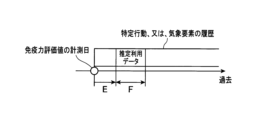
- FIG. 13 is a diagram showing an example of data from the history of a specific behavior that is used to estimate an immunity trend.
- FIG. 1 is a conceptual diagram of machine learning for different groups of training data.
- FIG. 11 is an explanatory diagram of clustering of learning data.
- FIG. 1 is a diagram illustrating an example of an operation of the information providing system.
- Embodiment FIG. 1 is a diagram illustrating an example of a configuration of an information providing system 1 according to an embodiment of the present disclosure.
- the information providing system 1 estimates an immunity trend D2A of a user U based on a life log D1 of the user U, and provides immunity trend information D2 including the estimated immunity trend D2A to the user U.
- the immunity trend D2A is an example of an "immunity index" in the present disclosure.
- the information providing system 1 of the present embodiment also uses a weather log D3 in which weather information D3A is recorded to estimate the immunity trend D2A.
- a form in which the information providing system 1 provides a service through a network A will be described.
- the life log D1 is data that records the actions of the user U in his/her daily life.
- the life log D1 includes information that makes it possible to identify a behavioral history indicating when, what actions the user U performed, and for how long.
- the life log D1 records the actions performed by the user U in association with the date and time.
- the actions recorded in the life log D1 are actions that affect the immunity trend D2A.
- they include actions classified as lifestyle habits. Examples of such actions include sleeping, walking, exercising, going out, returning home, commuting, eating, drinking, bathing, and smoking.
- “Actions classified as lifestyle habits" are hereinafter referred to as "specific actions.”
- specific actions are recorded in association with the date and time.
- the life log D1 also records user U's location information in association with date and time. This record makes it possible to determine information such as when, where, and for how long user U was there. Based on this record and the location information of user U's home and any other location, the following information can also be determined: at-home time length, which is the length of time user U was at home; out-of-home time length, which is the length of time user U stayed at any location other than his/her home; the length of time and distance taken to travel from a first location to a second location; and home time, which is the time when user U returned home.
- at-home time length which is the length of time user U was at home
- out-of-home time length which is the length of time user U stayed at any location other than his/her home
- home time which is the time when user U returned home.
- FIG. 2 is an explanatory diagram of the immunity trend D2A.
- the immunity trend D2A means the tendency of changes in the immunity of the user U from the estimated time B to the specified period T.
- the immunity trend D2A is shown in three categories, “upward trend,” “downward trend,” and “flat trend,” as shown in FIG. 2.
- Upward trend means the tendency of immunity to increase from the estimated time B to the specified period T.
- Downward trend means the tendency of immunity to decrease from the estimated time B to the specified period T.
- flat trend means the tendency of immunity to remain almost unchanged from the estimated time B to the specified period T.
- the unit of the specified period T may be any appropriate unit such as hours, days, weeks, or months.
- the length of the specified period T may be any appropriate length such as one period unit or two or more period units. That is, the length of the specified period T may be, for example, "1 day,” “2 days,” “1 week,” “2 weeks,” “1 month,” “2 months,” or any other period length.
- the estimated target time B refers to the time for which the immunity trend D2A is estimated.
- the estimated target time B may be the estimated execution time itself, such as the "current time” or “today” of the estimated execution time when immunity trend estimation is performed in the information provision system 1.
- the estimated target time B may also be any time in the future based on the estimated execution time, such as "one week later" or "one month later” from the estimated execution time.
- the information provision system 1 estimates the immunity trend D2A from the estimated target time B to any predetermined period T based on the estimated target time B.
- the estimated target time B is the estimated execution time or any time in the future from the estimated execution time.
- the information provision system 1 will estimate the immunity trend D2A from "today” to "next day” based on the estimated execution time "today”.
- weather information D3A is information about weather elements at the location where user U is located that affect immunity trend D2A.
- Weather elements are elements that represent weather conditions and phenomena. Examples of weather elements that affect immunity trend D2A include temperature, humidity, air pressure, wind speed, sunshine, cloud cover, precipitation, snowfall, snow accumulation, and weather.
- humidity and temperature are known to be environmental factors that favor the proliferation of viruses that cause infectious diseases. Therefore, humidity and temperature are presumed to affect immunity trend D2A.
- meteorological information D3A is recorded in association with date and time. Therefore, information such as when the user U was in an environment with what weather elements, and for how long, in other words, the history of the weather elements in the location where the user U was, can be identified from the weather log D3. The frequency and timing at which the meteorological information D3A is recorded in the weather log D3 are appropriate.
- the life log D1 and the weather log D3 may be recorded together as a single log data.
- the information providing system 1 of this embodiment includes a user device 2, an immunity trend information providing device 4, and a weather information providing device 6.
- the user device 2, the immunity trend information providing device 4, and the weather information providing device 6 are each devices that access a network A such as the Internet and communicate via the network A.
- the immunity trend information providing device 4 is an example of an "estimation device" in this disclosure. Note that although only one user device 2 is shown in FIG. 1, there may be multiple user devices 2.
- FIG. 3 is a diagram showing an example of the electrical configuration of the user device 2.
- the user device 2 is a portable electronic device that sequentially records a life log D1 and a weather log D3, and transmits the life log D1 and the weather log D3 to the immunity trend information providing device 4 via the network A.
- Specific forms of the user device 2 include, for example, a mobile phone, a smartphone, and a wearable device.
- the user device 2 includes a first communication device 20, a first storage device 22, a first control device 24, a measuring device 26, an operating device 27, and a display device 28, each of which is connected to a bus 29 and transmits and receives signals via the bus 29.
- the first communication device 20 is hardware that accesses network A and includes a transmission circuit and a reception circuit.
- the first storage device 22 is a recording medium that can be read by the first control device 24.
- the first storage device 22 includes, for example, a non-volatile memory and a volatile memory.
- the non-volatile memory is, for example, a ROM (Read Only Memory), an EPROM (Erasable Programmable Read Only Memory), or an EEPROM (Electrically Erasable Programmable Read Only Memory).
- the volatile memory is, for example, a RAM (Random Access Memory).
- the first control device 24 includes one or more processors, such as a CPU (Central Processing Unit). Some of the functions of the first control device 24 may be achieved by using circuits such as a DSP (Digital Signal Processor), an ASIC (Application Specific Integrated Circuit), a PLD (Programmable Logic Device), and an FPGA (Field Programmable Gate Array) instead of or in conjunction with the CPU.
- processors such as a CPU (Central Processing Unit).
- DSP Digital Signal Processor
- ASIC Application Specific Integrated Circuit
- PLD Programmable Logic Device
- FPGA Field Programmable Gate Array
- the operation device 27 accepts operations from the user U.
- the display device 28 displays various information.
- the measuring device 26 measures the behavior of the user U.
- the measuring device 26 has one or more sensors required for measurement.
- the measuring device 26 of this embodiment includes at least a first sensor for measuring the walking and movement of the user U, a second sensor for measuring sleep, and a third sensor for measuring location information.
- the first sensor is, for example, an acceleration sensor.
- the second sensor is, for example, a pulse wave sensor and a heart rate sensor.
- the third sensor is a device that receives a signal including location information indicating the location of the user device 2. Examples of signals including location information include GNSS signals, radio waves emitted by base stations included in a mobile communication network, and beacon signals. "GNSS" is an abbreviation for Global Navigation Satellite System.
- the measuring device 26 may also include other sensors for measuring or recognizing any state, such as a fourth sensor for recognizing images or videos, a fifth sensor for recognizing voice or external sounds, and a sixth sensor for recognizing the use of the user device 2 by the user U and the history of such use.
- sensors for measuring or recognizing any state such as a fourth sensor for recognizing images or videos, a fifth sensor for recognizing voice or external sounds, and a sixth sensor for recognizing the use of the user device 2 by the user U and the history of such use.
- the first storage device 22 stores the above-mentioned life log D1, weather log D3, and first program PR1.
- the first program PR1 is a program for controlling the user device 2.
- the first control device 24 functions as a measurement control unit 240, a weather information acquisition control unit 242, a life log recording control unit 244, and a weather log recording control unit 246.
- the measurement control unit 240 is a functional unit that controls the measurement device 26 to sequentially acquire measurement values from the measurement device 26 and identifies at least the above-mentioned specific behavior among the behaviors of the user U based on the measurement values.
- the measurement control unit 240 also sequentially acquires position information based on the measurement values. The timing and frequency at which the measurement control unit 240 acquires the measurement values are appropriate.
- the weather information acquisition control unit 242 is a functional unit that acquires weather information D3A for the position indicated by the position information based on the position information included in the measurement value of the measuring device 26.
- the weather information acquisition control unit 242 acquires weather information D3A from the weather information providing device 6 through network A by controlling the first communication device 20.
- the weather information providing device 6 is a network node that provides a service of distributing weather information D3A through network A.
- the measuring device 26 may include a seventh sensor that measures the weather, and the weather information acquisition control unit 242 may acquire weather information D3A from the seventh sensor.
- the seventh sensor is, for example, a temperature sensor and a humidity sensor.
- the life log recording control unit 244 is a functional unit that records the specific actions and location information identified by the measurement control unit 240 in association with the date and time.
- the weather log recording control unit 246 is a functional unit that records the weather information D3A acquired by the weather information acquisition control unit 242 in the weather log D3 in association with the date and time.
- FIG. 4 is a diagram showing an example of the electrical configuration of the immunity trend information providing device 4.
- the immunity trend information providing device 4 comprises a second communication device 40, a second storage device 42, and a second control device 44, each of which is connected to a bus 46 and transmits and receives signals between them via the bus 46.
- the second communication device 40 is hardware that accesses network A and includes a transmission circuit and a reception circuit.
- the second storage device 42 is a recording medium that can be read by the second control device 44.
- the second storage device 42 includes, for example, a non-volatile memory and a volatile memory.
- the non-volatile memory is, for example, a ROM, an EPROM, or an EEPROM.
- the volatile memory is, for example, a RAM.
- the second control device 44 includes one or more processors, such as a CPU. Some of the functions of the second control device 44 may be achieved by using circuits such as a DSP, ASIC, PLD, and FPGA in place of or in combination with the CPU.
- the second storage device 42 stores the second program PR2 and user information D4.
- User information D4 is information about user U, and includes attribute information and information that can be used to identify lifestyle habits. Attribute information includes, for example, information such as age, gender, address, and family composition. Information that can be used to identify lifestyle habits includes, for example, location information of the home and any other location. Home location information is an example of information used to identify going out. Location information of any location is an example of information used to identify movement to any location and the length of stay at any location.
- the second program PR2 is a program for controlling the immunity trend information providing device 4.
- the second control device 44 functions as a data acquisition control unit 440, an estimation unit 442, and a providing unit 444. These functions are described in detail below.
- the data acquisition control unit 440 is an example of an "acquisition unit" in this disclosure.
- the data acquisition control unit 440 controls the second communication device 40 to acquire the life log D1 and the weather log D3 from the user device 2 via the network A.
- the estimation unit 442 estimates the immunity trend D2A based on the life log D1.
- the estimation unit 442 estimates the immunity trend D2A based on the weather log D3 and the type of lifestyle habits of the user U in addition to the life log D1. Details of the estimation unit 442 will be described later.
- the providing unit 444 controls the second communication device 40 to transmit immunity trend information D2, including the estimated result of the immunity trend D2A, to the user device 2 via the network A.
- the estimation unit 442 estimates the immunity trend D2A using artificial intelligence.
- the estimation unit 442 has an estimation model 442A, which is a trained model constructed in advance by machine learning, as one form of an estimation means for the immunity trend D2A.
- An appropriate method is used for the machine learning.
- a classical linear model SVM (Support Vector Machine), XGBoost (eXtreme Gradient Boosting), LightGBM (Light Gradient Boosting Machine), etc. may be used for the machine learning.
- deep learning such as DNN (Deep Neural Network) may be used for the machine learning.
- the estimation model 442A is a machine learning model that receives as input at least one of the history of one or more specific actions obtained from the user U's life log D1 and the history of one or more weather elements obtained from the weather log D3, and outputs the immunity trend D2A of the user U.
- the above-mentioned attribute information contained in the user information D4 may also be additionally input to the estimation model 442A.
- An example of the estimation model 442A is a machine learning model that receives as input the history of one or more specific actions and the history of one or more weather elements, and outputs the immunity trend D2A of the user U.
- FIG. 5 is a diagram showing an example of the learning data D5 used to learn the estimation model 442A.
- the learning data D5 is a data set for learning the relationship between at least one of the explanatory variables, the history of one or more specific actions, and the history of one or more weather elements, and the immunity trend D2A, which is the objective variable.
- the learning data D5 may additionally use the above-mentioned attribute information included in the user information D4 as an explanatory variable.
- the learning data D5 in the illustrated example includes, as explanatory variables, the learning history of one or more specific actions and the learning history of one or more weather elements. Specifically, as information related to the explanatory variables, it includes learning specific action history information D5A and learning weather element history information D5B.
- the learning data D5 in the illustrated example includes a learning immunity evaluation value D5C as information related to the objective variable.
- Specific behavior history information D5A is information related to the history of specific behaviors performed by user U.
- Specific behavior history information D5A includes information that identifies what type of specific behavior user U performed, when, and for how long. That is, specific behavior history information D5A includes information such as the type of specific behavior, the duration of the specific behavior, and the date and time. Note that in the specific behavior history information D5A of this embodiment, types of specific behavior include sleeping, walking, exercising, going out, and returning home.
- Weather element history information D5B is information about the history of weather elements that user U has been exposed to.
- Weather element history information D5B includes information that specifies what weather element user U was in, when, and for how long.
- Weather element history information D5B includes information such as the type of weather element, the state or measurement value of the weather element, the length of stay, and the date and time.
- the weather element history information D5B includes two types of weather elements: humidity and temperature.
- the immunity evaluation value D5C is an evaluation value that makes it possible to identify an immunity index (in this embodiment, immunity trend D2A) that has actually occurred in the user U due to the history of each type of specific behavior identified by the specific behavior history information D5A and the history of various types of weather elements identified by the weather element history information D5B.
- the immunity evaluation value D5C may be, for example, the actual measured values of various indices used in the quantitative evaluation of immunity, approximate values obtained by fitting the actual measured values, and interpolated values of the actual measured values.
- the immunity evaluation value D5C may also be the actually occurred immunity trend D2A itself.
- the inventors collected sample data including specific behavior history information D5A, weather element history information D5B, and daily immunity from a large number of subjects, and by analyzing the sample data, obtained the following first and second findings.
- the first manifestation period E1 from when the subject performs a specific behavior to when a change in the immunity index (immunity trend D2A in this embodiment) caused by the specific behavior appears differs for each type of specific behavior.
- the first manifestation period E1 is the period from when the user U performs a specific behavior of a certain type to when a change in the immunity index caused by the specific behavior of the certain type appears.
- the second manifestation period E2 from when the subject is in an environment with a weather element to when a change in the immunity index caused by the weather element appears differs for each type of weather element.
- the second manifestation period E2 is the period from when the user U is in a place having a certain type of weather element to when a change in the immunity index caused by the certain type of weather element appears.
- the first manifestation period E1 and the second manifestation period E2 may be referred to as the "manifestation period E" without distinction.
- the change in the immunity index (in this embodiment, the immunity trend D2A) is correlated with a statistical value related to a specific behavior (hereinafter referred to as the "first statistical value").
- the degree to which the change in the immunity index is clearly apparent (hereinafter referred to as the "conspicuousness") is affected by the length of the period (statistical period) used to calculate the first statistical value.
- the length of the period during which the conspicuity of the change in the immunity index is maximized differs depending on the type of specific behavior.
- the change in the immunity index is correlated with a statistical value related to a meteorological element (hereinafter referred to as the "second statistical value").
- the conspicuity of the change in the immunity index is affected by the length of the period (statistical period) used to calculate the second statistical value.
- the length of the period during which the conspicuity of the change in the immunity index is maximized differs depending on the type of meteorological element.
- the statistical value refers to, for example, an average value or a standard deviation.
- the length of the period used to calculate the first statistical value is referred to as the first adopted period length F1
- the length of the period used to calculate the second statistical value is referred to as the second adopted period length F2.
- the first employment period length F1 and the second employment period length F2 may be referred to as the employment period length F without distinction.
- the first adoption period length F1 is a statistical period in which the visibility of changes in the immunity index to the statistical value of one type of specific behavior (first statistical value) is maximized.
- the second adoption period length F2 is a statistical period in which the visibility of changes in the immunity index to the statistical value of one type of weather element (second statistical value) is maximized.
- FIG. 6 is a matrix diagram showing an example of the analysis results of sample data.
- the sample data to be analyzed is data including specific behavior history information D5A and daily immunity evaluation values D5C.
- the specific behavior history information D5A includes appropriate information on the specific behaviors described above.
- the immunity evaluation values D5C include appropriate index values used for quantitative evaluation of immunity. Examples of immunity evaluation values D5C include IgA concentration, its secretion rate or secretion amount, a quantification index value of immunoglobulins in the blood, and a quantification index value of immune cells.
- the inventor analyzed the sample data by calculating an evaluation value of the correlation between the daily specific behaviors identified by the specific behavior history information D5A, the duration of adoption F used to calculate the statistical values of the specific behaviors, and the immunity evaluation value D5C. Note that a publicly known or well-known appropriate method is used to evaluate the correlation.
- the matrix diagram shown in Figure 6 shows the relevance evaluation value for each combination of the chronological ranking of the immunity evaluation value D5C and the length of adoption period F.
- the vertical axis corresponds to the chronological ranking of the immunity evaluation value D5C
- the horizontal axis corresponds to the length of adoption period F.
- the chronological ranking indicates the ranking within the chronological order of the immunity evaluation value D5C for each day used in the relevance evaluation.
- the starting date for the chronological ranking and the length of adoption period F is the oldest day in the history.
- "1 day later" on the vertical axis means the day after the oldest day
- "1 day” on the horizontal axis means the oldest day.
- the inventors perform the analysis shown in FIG. 6 for various specific behaviors such as sleep, walking, and exercise, and various types of meteorological elements such as humidity and temperature, to determine the onset period E and adoption period length F for each type of specific behavior and meteorological element.
- the specific behavior history information D5A uses data for a period length corresponding to the adoption period length F at a time going back by the onset period E corresponding to the type of specific behavior from the measurement date of the data on which the immunity evaluation value D5C is based, as shown in FIG. 7.
- the weather element history information D5B uses data for a period length corresponding to the adoption period length F at a time going back by the onset period E corresponding to the type of weather element from the measurement date of the data on which the immunity evaluation value D5C is based, as shown in FIG. 7.
- the specific behavior history information D5A and the weather element history information D5B use data for the adoption period length F preceding the base point, which is set as a base point at a time going back by the onset period E from the measurement date of the data on which the immunity evaluation value D5C is based.
- the learning data D5 includes a learning immunity evaluation value D5C, which is an evaluation value of the immunity index.
- the learning data D5 also includes at least one of specific behavior history information D5A, which is a learning history of a specific type of behavior, and weather element history information D5B, which is a learning history of a weather element.
- the specific behavior history information D5A includes a history of the specific type of behavior at a third time point that precedes the actual measurement date of the immunity index by the expression period E (first expression period E1) corresponding to the specific type of behavior.
- the history of the specific type of behavior at the third time point includes a history of the specific type of behavior in a third adoption period length that precedes the third time point.
- the third adoption period length is a statistical period in which the visibility of the change in the immunity index to the statistical value of the specific type of behavior is maximized.
- the third adoption period length may be the first adoption period length F1.
- the weather element history information D5B includes a history of a type of weather element at a fourth time point that precedes the actual measurement date of the immunity index by an expression period E (second expression period) corresponding to the type of weather element.
- the history of a type of specific behavior at the fourth time point includes a history of a type of weather element in a fourth adoption period length that precedes the fourth time point.
- the fourth adoption period length is a statistical period in which the visibility of changes in the immunity index to the statistical value of a type of weather element is maximized.
- the fourth adoption period length may be the second adoption period length F2.
- an estimation model 442A by machine learning using this learning data D5, a trained model is obtained that estimates with high accuracy the relationship between the history of a specific behavior and the history of meteorological elements and the immunity trend D2A.
- FIG. 8 is a conceptual diagram of group-based machine learning of the learning data D5
- FIG. 9 is an explanatory diagram of clustering of the learning data D5.
- the learning data D5 is divided into one or more groups G based on the similarity of the lifestyle habits of the subjects from which the learning data D5 is derived.
- the learning data D5 is machine-learned for each group G.
- the grouping is performed, for example, by the following process. First, at least three or more feature quantities that indicate the lifestyle habits of the subjects are compressed to two dimensions using an appropriate dimensionality reduction algorithm, thereby converting the distribution of the lifestyle habits of each subject into a two-dimensional distribution on a two-dimensional plane, as shown in FIG. 9.
- the subjects are divided into groups with similar lifestyle habits, and the learning data D5 is classified into one or more groups G based on the grouping results.
- t-SNE Spochastic Neighbor Embedding
- K-means method is used as the clustering method.
- a large amount of learning data D5 is classified into two groups, group G1 and group G2, by the above-mentioned grouping.
- Group G1 is a group of learning data D5 obtained from subjects who are relatively active.
- Group G2 is a group of learning data D5 obtained from subjects who do not belong to group G1.
- features indicative of the subject's lifestyle include, for example, length of sleep, number of steps, walking speed, walking time length, exercise time length, time at home, time outside, number of places visited while outside, and time home.
- the learning data D5 for group G1 will contain a relatively large amount of data obtained from subjects who have exercise habits, and conversely, the learning data D5 for group G2 will contain a large amount of data from subjects who have poor exercise habits.
- exercising is thought to lead to an increase in IgA concentration.
- exercising is thought to lead to fatigue and a decrease in IgA concentration.
- the estimation model 442A is constructed by machine learning of the learning data D5 for each group G1 and group G2. Therefore, for example, in response to input of a specific behavior related to exercise of a certain user U, an immunity trend D2A is accurately output depending on whether the user U is a relatively active person.
- the estimation unit 442 includes an estimation model 442A for each of one or more groups G, and estimates the immunity trend D2A using the estimation model 442A corresponding to the lifestyle type of the user U.
- the lifestyle type indicates the group G in which the lifestyle of the user U is similar, that is, indicates a classification based on the similarity of the lifestyle of the user U, and the estimation unit 442 identifies the lifestyle type based on the user information D4. Note that the estimation unit 442 may use the life log D1 instead of the user information D4 to identify the lifestyle type.
- FIG. 10 is a diagram showing an example of the operation of the information providing system 1. Note that here, the operation is described when the immunity trend information providing device 4 estimates the immunity trend D2A based on the life log D1, the weather log D3, and the type of lifestyle habits of the user U.
- the life log D1 and weather log D3 are recorded sequentially in the user device 2 and stored in the first storage device 22 (step Sa1).
- the user U wants to know the immunity trend D2A
- he or she performs a predetermined operation on the user device 2.
- the user device 2 transmits an estimation request requesting an estimation of the immunity trend D2A to the immunity trend information providing device 4 (step Sa2).
- the immunity trend information providing device 4 receives an estimation request from the user device 2 (step Sb1), the data acquisition control unit 440 acquires the user U's life log D1 and weather log D3 (step Sb2), and the estimation unit 442 acquires the user U's user information D4 from the second storage device 42 (step Sb3).
- the estimation unit 442 identifies the type of lifestyle habits of user U by determining which of groups G1 and G2 the user U belongs to based on the lifestyle habits of user U indicated by the user information D4 (step Sb4). As mentioned above, the estimation unit 442 may use the life log D1 instead of the user information D4 to identify the type of lifestyle habits.
- the estimation unit 442 also extracts a history of a specific behavior of one type from the life log D1, and also extracts a history of a weather element of one type obtained from the weather log D3 (step Sb5).
- the estimation unit 442 extracts a history of the specific behavior of one type at a first time point preceding the estimation target time point B "today" by an expression period E (first expression period E1) corresponding to the type of the specific behavior of one type.
- the estimation unit 442 extracts a history of the specific behavior of one type in an employment period length F (first employment period length F1) preceding the first time point from the history of the specific behavior of one type at the first time point.
- step Sb5 the estimation unit 442 extracts a history of a weather element of one type at a second time point preceding the estimation target time point B "today" by an expression period E (second expression period E2) corresponding to the type of the weather element of one type.
- the estimation unit 442 extracts a history of a type of specific behavior during an adoption period F (a second adoption period F2) preceding the second time point from the history of a type of weather element at the second time point.
- the estimation unit 442 inputs the history of each type of specific behavior and the history of each type of weather element into an estimation model 442A corresponding to the type of lifestyle habit, and obtains an estimation result of the immunity trend D2A from the estimation model 442A (step Sb6).
- the estimating unit 442 may identify the lifestyle habits that are the basis for estimating the immunity trend D2A. For example, if a "downward trend" is estimated as the immunity trend D2A, the estimating unit 442 identifies the lifestyle habits that contributed to the "downward trend". For example, interpretation tool methods such as LIME (Local Interpretable Model-agnostic Explanations) and SHAP (Shapley Additive explanations) may be used to identify the lifestyle habits.
- interpretation tool methods such as LIME (Local Interpretable Model-agnostic Explanations) and SHAP (Shapley Additive explanations) may be used to identify the lifestyle habits.
- the user device 2 When the user device 2 receives the immunity trend information D2 (step Sb8), it presents the immunity trend D2A to the user U by displaying it (step Sb9). This display allows the user U to know the immunity trend D2A.
- the immunity trend information providing device 4 of this embodiment includes a data acquisition control unit 440 that acquires a life log D1 in which the history of one or more types of specific behavior that affect changes in immunity of a user U is recorded, and an estimation unit 442 that estimates an immunity trend D2A, which is a trend of changes in immunity over a predetermined period T from an estimation target time point B, based on the history of one type of specific behavior.
- This estimation unit 442 estimates the immunity trend D2A based on the history of one type of specific behavior at a first time point that precedes the estimation target time point B by a first manifestation period E1.
- the manifestation period E differs depending on the type of specific behavior.
- the estimation of the immunity trend D2A reflects the expression period E during which one type of specific behavior contributes to the formation of the immunity trend D2A, so that the immunity trend D2A can be accurately estimated based on the history of one type of specific behavior.
- the estimation unit 442 estimates the immunity trend D2A based on the history of one type of specific behavior for an adoption period F (first adoption period F1) preceding the first time point.
- the first adoption period F1 is a statistical period in which the visibility of changes in the immunity trend D2A relative to the statistical value of one type of specific behavior is maximized.
- the history for the period during which the visibility of changes in the immunity trend D2A is highest is used to estimate the immunity trend D2A, so the immunity trend D2A can be estimated more accurately.
- the data acquisition control unit 440 acquires a weather log D3, which is a history of weather elements at the location where the user U was, and in which one or more types of weather elements that affect the change in the user U's immunity are recorded.
- the estimation unit 442 estimates the immunity trend D2A based on the history of one type of specific behavior recorded in the life log D1 and the history of one type of weather element recorded in the weather log D3.
- the estimation unit 442 estimates the immunity trend D2A based on the history of one type of specific behavior at a first time point that precedes the estimation target time point B by the expression period E (first expression period E1) corresponding to the one type of specific behavior, and the history of one type of weather element at a second time point that precedes the estimation target time point B by the expression period E (second expression period E2) corresponding to the one type of weather element.
- the immunity trend D2A is estimated using the history of one type of weather element in addition to one type of specific behavior, and also reflects the occurrence period E of the one type of weather element. Therefore, the immunity trend D2A can be estimated more accurately.
- the estimation unit 442 estimates the immunity trend D2A based on the history of one type of specific behavior for an adoption period length F (first adoption period length F1) preceding the first time point, and the history of one type of meteorological element for an adoption period length F (second adoption period length F2) preceding the second time point.
- the second adoption period length F2 is a statistical period in which the visibility of changes in the immunity trend D2A with respect to the statistical value of one type of meteorological element is maximized.
- the history of meteorological elements is used to estimate the immunity trend D2A, and the period E during which the meteorological elements are expressed is also reflected.
- the history for the period during which the manifestation is highest is used to estimate the immunity trend D2A, so that the immunity trend D2A can be estimated more accurately.
- the estimation unit 442 may use attribute information of the user U in addition to either one of the history of a specific behavior and the history of weather elements to estimate the immunity trend D2A.
- the immunity trend D2A is estimated based on the attributes of the user U.
- the estimation unit 442 estimates the immunity trend D2A based on the history of specific behaviors, the history of meteorological elements, and the type of lifestyle habits of the user.
- This configuration allows the immunity trend D2A to be accurately estimated according to the user's lifestyle type.
- the estimation unit 442 has an estimation model 442A that learns the relationship between the history of one or more types of specific behaviors and the history of one or more types of weather elements and the immunity trend by machine learning of the learning data D5.
- the learning data D5 also includes an immunity evaluation value D5C, specific behavior history information D5A that is a learning history of a specific behavior of one type, and weather element history information D5B that is a learning history of a weather element of one type.
- the specific behavior history information D5A includes the history of the specific behavior of one type at a third time point that precedes the actual measurement date of the immunity index by the expression period E (first expression period) corresponding to the specific behavior of the one type.
- the history of the specific behavior of one type at the third time point includes the history of the specific behavior of one type in a third adoption period that precedes the third time point.
- the third adoption period is a statistical period in which the visibility of the change in the immunity index to the statistical value of the specific behavior of one type is maximized.
- the weather element history information D5B includes the history of a type of weather element at a fourth time point that precedes the actual measurement date of the immunity index by an expression period E (second expression period) corresponding to the type of weather element.
- the history of a type of specific behavior at the fourth time point includes the history of a type of weather element in a fourth adoption period length that precedes the fourth time point.
- the fourth adoption period length is a statistical period in which the visibility of changes in the immunity index to the statistical value of a type of weather element is maximized.
- attribute information included in user information D4 may be additionally used in learning data D5.
- the estimation model 442A is a model that is machine-learned to determine the relationship between the history of one or more specific behaviors and the history of one or more weather elements, and the immunity trend D2A, for each group of learning data D5 obtained from subjects with similar lifestyles.
- This configuration provides an estimation model 442A that can accurately estimate the immunity trend D2A according to the user's lifestyle type.
- the immunity trend D2A which is a tendency of immunity change
- the immunity index may be any suitable index, such as the steepness of the rise and fall of immunity, the level of immunity relative to the average immunity of the user U, and the absolute value of immunity.
- the "steepness of the rise and fall of immunity” is evaluated, for example, based on the magnitude of the inclination of the arrow illustrated in FIG. 2.
- the "level of immunity relative to the average immunity of the user U” is evaluated, for example, based on a comparison between the level of immunity shown in the bar graph illustrated in FIG. 2 and the average value of the bar graph for any past period, or based on the difference between the two.
- the "absolute value of immunity” is evaluated, for example, based on the height of the bar graph itself illustrated in FIG. 2.
- the estimation unit 442 of the immunity trend information providing device 4 estimates the immunity trend D2A, which is an example of an immunity index, based on both the life log D1 in which the history of one or more specific actions is recorded, and the weather log D3 in which the history of one or more weather elements is recorded.
- the estimation unit 442 may estimate the immunity index based on at least one of the life log D1 in which the history of one or more specific actions is recorded, and the weather log D3 in which the history of one or more weather elements is recorded.
- the estimation model 442A is exemplified as a machine learning model that has machine-learned the relationship between the immunity index and both the history of one or more specific behaviors and the history of one or more weather elements.
- the estimation model 442A may be a machine learning model that has machine-learned the relationship between the immunity index and at least one of the history of one or more specific behaviors and the history of one or more weather elements.
- the learning data D5 is classified into two groups G1 and G2 by clustering based on lifestyle habits, and machine learning of the estimation model 442A is performed for each of the groups G1 and G2. However, it is sufficient that the learning data D5 is classified into at least one group G.
- the number of groups G in the learning data D5 may be one without clustering the learning data D5. Even if the number of groups G is one, an estimation model 442A corresponding to various lifestyle habits indicated in at least one of the history of a specific behavior and the history of weather elements can be obtained, so that the immunity index of the user U can be estimated regardless of the lifestyle of the user U. Note that in this case, since the type of lifestyle habit of the user U does not need to be identified, the estimation unit 442 does not need to execute step Sb4 in FIG. 10.
- the estimation unit 442 may be provided with one estimation model 442A that has learned the relationship between at least one of the history of one or more specific actions and the history of one or more weather elements for each group G and the immunity trend D2A.
- the user device 2 may be provided with the estimation unit 442 of the immunity trend information providing device 4, and the user device 2 may estimate the immunity index using the estimation unit 442.
- ROM and RAM are exemplified as the first storage device 22 and the second storage device 42, but the first storage device 22 and the second storage device 42 may be a flexible disk, a magneto-optical disk (e.g., a compact disk, a digital versatile disk, a Blu-ray (registered trademark) disk), a smart card, a flash memory device (e.g., a card, a stick, a key drive), a CD-ROM (Compact Disc-ROM), a register, a removable disk, a hard disk, a floppy (registered trademark) disk, a magnetic strip, a database, a server, or any other suitable storage medium.
- a magneto-optical disk e.g., a compact disk, a digital versatile disk, a Blu-ray (registered trademark) disk
- a smart card e.g., a flash memory device (e.g., a card, a stick, a key drive), a CD-ROM (Compact
- the information, signals, etc. described may be represented using any of a variety of different technologies.
- data, instructions, commands, information, signals, bits, symbols, chips, etc. that may be referred to throughout the above description may be represented by voltages, currents, electromagnetic waves, magnetic fields or magnetic particles, optical fields or photons, or any combination thereof.
- the input and output information, etc. may be stored in a specific location (e.g., memory) or may be managed using a management table.
- the input and output information, etc. may be overwritten, updated, or added to.
- the output information, etc. may be deleted.
- the input information, etc. may be transmitted to another device.
- the determination may be made based on a value represented by one bit (0 or 1), a Boolean value (true or false), or a comparison of numerical values (e.g., a comparison with a predetermined value).
- each function illustrated in one or more figures referenced in the embodiments is realized by any combination of at least one of hardware and software.
- the method of realizing each functional block is not particularly limited. That is, each functional block may be realized using one device that is physically or logically coupled, or may be realized using two or more devices that are physically or logically separated and connected directly or indirectly (e.g., using wires, wirelessly, etc.).
- a functional block may be realized by combining software with the one device or the multiple devices.
- the programs exemplified in the above embodiments should be broadly construed to mean instructions, instruction sets, code, code segments, program code, programs, subprograms, software modules, applications, software applications, software packages, routines, subroutines, objects, executable files, threads of execution, procedures, functions, etc., regardless of whether they are called software, firmware, middleware, microcode, hardware description language, or by other names.
- Software, instructions, information, etc. may also be transmitted and received via a transmission medium.
- a transmission medium For example, if the software is transmitted from a website, server, or other remote source using at least one of wired technologies (such as coaxial cable, fiber optic cable, twisted pair, Digital Subscriber Line (DSL), etc.) and wireless technologies (such as infrared, microwave, etc.), then at least one of these wired and wireless technologies is included within the definition of a transmission medium.
- wired technologies such as coaxial cable, fiber optic cable, twisted pair, Digital Subscriber Line (DSL), etc.
- wireless technologies such as infrared, microwave, etc.
- the information, parameters, etc. described in this disclosure may be expressed using absolute values, may be expressed using relative values from a predetermined value, or may be expressed using other corresponding information.
- connection and “coupled” or any variation thereof refer to any direct or indirect connection or coupling between two or more elements, and may include the presence of one or more intermediate elements between two elements that are “connected” or “coupled” to each other.
- the coupling or connection between elements may be physical, logical, or a combination thereof.
- “connected” may be read as "access”.
- two elements may be considered to be “connected” or “coupled” to each other using at least one of one or more wires, cables, and printed electrical connections, as well as electromagnetic energy having wavelengths in the radio frequency range, microwave range, and light (both visible and invisible) range, as some non-limiting and non-exhaustive examples.
- the term “based on” does not mean “based only on,” unless otherwise specified. In other words, the term “based on” means both “based only on” and “based at least on.”
- determining may encompass a wide variety of actions.
- Determining and “determining” may include, for example, judging, calculating, computing, processing, deriving, investigating, looking up, search, inquiry (e.g., searching in a table, database, or other data structure), ascertaining something as “determining” or “determining,” and the like.
- judgment and “decision” may include regarding receiving (e.g., receiving information), transmitting (e.g., sending information), input, output, and accessing (e.g., accessing data in memory) as having been “judgment” or “decision”.
- judgment and “decision” may include regarding resolving, selecting, choosing, establishing, comparing, etc. as having been “judgment” or “decision”. In other words, “judgment” and “decision” may include regarding some action as having been “judgment” or “decision”. Additionally, “judgment (decision)” may be interpreted as “assuming,” “expecting,” “considering,” etc.
- 1...information providing system 2...user device, 4...immunity trend information providing device, 440...data acquisition control unit, 442...estimation unit, 442A...estimation model, 444...providing unit, A...network, B...estimation target time point, D1...life log, D2...immunity trend information, D2A...immunity trend, D3...weather log, D3A...weather information, D4...user information, D5...learning data, D5A...specific behavior history information, D5B...weather element history information, D5C...immunity evaluation value, E...onset period, F...adoption period length, T...predetermined period, U...user.
Landscapes
- Health & Medical Sciences (AREA)
- Engineering & Computer Science (AREA)
- Medical Informatics (AREA)
- Public Health (AREA)
- Biomedical Technology (AREA)
- Data Mining & Analysis (AREA)
- Databases & Information Systems (AREA)
- Pathology (AREA)
- Epidemiology (AREA)
- General Health & Medical Sciences (AREA)
- Primary Health Care (AREA)
- Management, Administration, Business Operations System, And Electronic Commerce (AREA)
Priority Applications (1)
| Application Number | Priority Date | Filing Date | Title |
|---|---|---|---|
| JP2025516713A JPWO2024225058A1 (https=) | 2023-04-27 | 2024-04-11 |
Applications Claiming Priority (2)
| Application Number | Priority Date | Filing Date | Title |
|---|---|---|---|
| JP2023-073320 | 2023-04-27 | ||
| JP2023073320 | 2023-04-27 |
Publications (1)
| Publication Number | Publication Date |
|---|---|
| WO2024225058A1 true WO2024225058A1 (ja) | 2024-10-31 |
Family
ID=93256458
Family Applications (1)
| Application Number | Title | Priority Date | Filing Date |
|---|---|---|---|
| PCT/JP2024/014666 Ceased WO2024225058A1 (ja) | 2023-04-27 | 2024-04-11 | 推定装置 |
Country Status (2)
| Country | Link |
|---|---|
| JP (1) | JPWO2024225058A1 (https=) |
| WO (1) | WO2024225058A1 (https=) |
Citations (5)
| Publication number | Priority date | Publication date | Assignee | Title |
|---|---|---|---|---|
| JP2013140523A (ja) * | 2012-01-05 | 2013-07-18 | Seiko Epson Corp | 空調環境調整システム、プログラム、記録媒体及び空調環境調整方法 |
| JP2022135143A (ja) * | 2021-03-04 | 2022-09-15 | 株式会社Jvcケンウッド | 情報処理装置、プログラム及び情報処理方法 |
| JP2022148394A (ja) * | 2021-03-24 | 2022-10-06 | 株式会社Nttドコモ | 感染リスク推定装置 |
| JP2022184104A (ja) * | 2021-05-31 | 2022-12-13 | 大塚製薬株式会社 | 生活者の健康状態を把握、健康予測モデルでの生活者の健康維持、増進をサポートする方法及び情報提供方法 |
| WO2023223418A1 (ja) * | 2022-05-17 | 2023-11-23 | Edgewater株式会社 | 免疫状態予測提供システム、免疫状態データ予測方法及びプログラム |
-
2024
- 2024-04-11 JP JP2025516713A patent/JPWO2024225058A1/ja active Pending
- 2024-04-11 WO PCT/JP2024/014666 patent/WO2024225058A1/ja not_active Ceased
Patent Citations (5)
| Publication number | Priority date | Publication date | Assignee | Title |
|---|---|---|---|---|
| JP2013140523A (ja) * | 2012-01-05 | 2013-07-18 | Seiko Epson Corp | 空調環境調整システム、プログラム、記録媒体及び空調環境調整方法 |
| JP2022135143A (ja) * | 2021-03-04 | 2022-09-15 | 株式会社Jvcケンウッド | 情報処理装置、プログラム及び情報処理方法 |
| JP2022148394A (ja) * | 2021-03-24 | 2022-10-06 | 株式会社Nttドコモ | 感染リスク推定装置 |
| JP2022184104A (ja) * | 2021-05-31 | 2022-12-13 | 大塚製薬株式会社 | 生活者の健康状態を把握、健康予測モデルでの生活者の健康維持、増進をサポートする方法及び情報提供方法 |
| WO2023223418A1 (ja) * | 2022-05-17 | 2023-11-23 | Edgewater株式会社 | 免疫状態予測提供システム、免疫状態データ予測方法及びプログラム |
Also Published As
| Publication number | Publication date |
|---|---|
| JPWO2024225058A1 (https=) | 2024-10-31 |
Similar Documents
| Publication | Publication Date | Title |
|---|---|---|
| Bashar et al. | Performance of machine learning algorithms in predicting the pavement international roughness index | |
| US12433511B2 (en) | Systems, methods, and devices for biophysical modeling and response prediction | |
| US11664108B2 (en) | Systems, methods, and devices for biophysical modeling and response prediction | |
| CN104090919B (zh) | 推荐广告的方法及广告推荐服务器 | |
| WO2017010317A1 (ja) | 表示制御装置、表示制御方法、及び、プログラム | |
| CN114707041B (zh) | 消息推荐方法、装置、计算机可读介质及电子设备 | |
| KR20160043777A (ko) | 질환 발병 예측 방법 및 그 장치 | |
| Ma et al. | Multiscale permutation entropy based on natural visibility graph and its application to rolling bearing fault diagnosis | |
| CN111382346A (zh) | 用于推荐内容的方法及系统 | |
| CN114297478B (zh) | 一种页面推荐方法、装置、设备以及存储介质 | |
| Chakraverty et al. | Iot based weather and location aware recommender system | |
| CN116861076A (zh) | 基于用户流行度偏好的序列推荐方法及装置 | |
| CN113688323B (zh) | 构建意图触发策略以及意图识别的方法和装置 | |
| Mansouri et al. | A hybrid machine learning approach for early mortality prediction of ICU patients | |
| WO2024225058A1 (ja) | 推定装置 | |
| CN109993312B (zh) | 一种设备及其信息处理方法、计算机存储介质 | |
| CN119379391B (zh) | 一种基于传感器的产品推荐方法、系统、设备及介质 | |
| CN113706212A (zh) | 基于预测模型的住房估价方法、装置、设备及存储介质 | |
| Liao et al. | Location prediction through activity purpose: integrating temporal and sequential models | |
| CN118296237A (zh) | 兴趣点的预测方法、装置、电子设备、计算机可读存储介质及计算机程序产品 | |
| CN114723084B (zh) | 新颖性物品召回模型的生成方法、召回方法及装置和系统 | |
| CN116883181A (zh) | 基于用户画像的金融服务推送方法、存储介质及服务器 | |
| Durica et al. | Towards multimodal representation learning in paediatric kidney disease | |
| Martínez-Hernández et al. | Changepoint detection on daily home activity pattern: a sliced Poisson process method | |
| CN115238954A (zh) | 一种人口综合预测方法及系统 |
Legal Events
| Date | Code | Title | Description |
|---|---|---|---|
| 121 | Ep: the epo has been informed by wipo that ep was designated in this application |
Ref document number: 24796814 Country of ref document: EP Kind code of ref document: A1 |
|
| ENP | Entry into the national phase |
Ref document number: 2025516713 Country of ref document: JP Kind code of ref document: A |
|
| WWE | Wipo information: entry into national phase |
Ref document number: 2025516713 Country of ref document: JP |
|
| NENP | Non-entry into the national phase |
Ref country code: DE |