WO2024224910A1 - 学習モデル生成方法、提示方法、評価方法、および生成方法 - Google Patents
学習モデル生成方法、提示方法、評価方法、および生成方法 Download PDFInfo
- Publication number
- WO2024224910A1 WO2024224910A1 PCT/JP2024/011697 JP2024011697W WO2024224910A1 WO 2024224910 A1 WO2024224910 A1 WO 2024224910A1 JP 2024011697 W JP2024011697 W JP 2024011697W WO 2024224910 A1 WO2024224910 A1 WO 2024224910A1
- Authority
- WO
- WIPO (PCT)
- Prior art keywords
- components
- information
- content
- component
- learning model
- Prior art date
- Legal status (The legal status is an assumption and is not a legal conclusion. Google has not performed a legal analysis and makes no representation as to the accuracy of the status listed.)
- Ceased
Links
Images











Classifications
-
- G—PHYSICS
- G06—COMPUTING OR CALCULATING; COUNTING
- G06N—COMPUTING ARRANGEMENTS BASED ON SPECIFIC COMPUTATIONAL MODELS
- G06N20/00—Machine learning
-
- G—PHYSICS
- G06—COMPUTING OR CALCULATING; COUNTING
- G06F—ELECTRIC DIGITAL DATA PROCESSING
- G06F16/00—Information retrieval; Database structures therefor; File system structures therefor
- G06F16/90—Details of database functions independent of the retrieved data types
- G06F16/907—Retrieval characterised by using metadata, e.g. metadata not derived from the content or metadata generated manually
- G06F16/908—Retrieval characterised by using metadata, e.g. metadata not derived from the content or metadata generated manually using metadata automatically derived from the content
-
- G—PHYSICS
- G06—COMPUTING OR CALCULATING; COUNTING
- G06N—COMPUTING ARRANGEMENTS BASED ON SPECIFIC COMPUTATIONAL MODELS
- G06N3/00—Computing arrangements based on biological models
- G06N3/02—Neural networks
- G06N3/04—Architecture, e.g. interconnection topology
- G06N3/045—Combinations of networks
-
- G—PHYSICS
- G06—COMPUTING OR CALCULATING; COUNTING
- G06N—COMPUTING ARRANGEMENTS BASED ON SPECIFIC COMPUTATIONAL MODELS
- G06N3/00—Computing arrangements based on biological models
- G06N3/02—Neural networks
- G06N3/04—Architecture, e.g. interconnection topology
- G06N3/045—Combinations of networks
- G06N3/0455—Auto-encoder networks; Encoder-decoder networks
-
- G—PHYSICS
- G06—COMPUTING OR CALCULATING; COUNTING
- G06N—COMPUTING ARRANGEMENTS BASED ON SPECIFIC COMPUTATIONAL MODELS
- G06N3/00—Computing arrangements based on biological models
- G06N3/02—Neural networks
- G06N3/04—Architecture, e.g. interconnection topology
- G06N3/0464—Convolutional networks [CNN, ConvNet]
-
- G—PHYSICS
- G06—COMPUTING OR CALCULATING; COUNTING
- G06N—COMPUTING ARRANGEMENTS BASED ON SPECIFIC COMPUTATIONAL MODELS
- G06N3/00—Computing arrangements based on biological models
- G06N3/02—Neural networks
- G06N3/04—Architecture, e.g. interconnection topology
- G06N3/0475—Generative networks
-
- G—PHYSICS
- G06—COMPUTING OR CALCULATING; COUNTING
- G06N—COMPUTING ARRANGEMENTS BASED ON SPECIFIC COMPUTATIONAL MODELS
- G06N3/00—Computing arrangements based on biological models
- G06N3/02—Neural networks
- G06N3/08—Learning methods
-
- G—PHYSICS
- G06—COMPUTING OR CALCULATING; COUNTING
- G06N—COMPUTING ARRANGEMENTS BASED ON SPECIFIC COMPUTATIONAL MODELS
- G06N3/00—Computing arrangements based on biological models
- G06N3/02—Neural networks
- G06N3/08—Learning methods
- G06N3/088—Non-supervised learning, e.g. competitive learning
-
- G—PHYSICS
- G06—COMPUTING OR CALCULATING; COUNTING
- G06N—COMPUTING ARRANGEMENTS BASED ON SPECIFIC COMPUTATIONAL MODELS
- G06N3/00—Computing arrangements based on biological models
- G06N3/02—Neural networks
- G06N3/08—Learning methods
- G06N3/0895—Weakly supervised learning, e.g. semi-supervised or self-supervised learning
-
- G—PHYSICS
- G06—COMPUTING OR CALCULATING; COUNTING
- G06N—COMPUTING ARRANGEMENTS BASED ON SPECIFIC COMPUTATIONAL MODELS
- G06N3/00—Computing arrangements based on biological models
- G06N3/02—Neural networks
- G06N3/08—Learning methods
- G06N3/09—Supervised learning
-
- G—PHYSICS
- G06—COMPUTING OR CALCULATING; COUNTING
- G06N—COMPUTING ARRANGEMENTS BASED ON SPECIFIC COMPUTATIONAL MODELS
- G06N3/00—Computing arrangements based on biological models
- G06N3/02—Neural networks
- G06N3/08—Learning methods
- G06N3/094—Adversarial learning
-
- G—PHYSICS
- G06—COMPUTING OR CALCULATING; COUNTING
- G06N—COMPUTING ARRANGEMENTS BASED ON SPECIFIC COMPUTATIONAL MODELS
- G06N3/00—Computing arrangements based on biological models
- G06N3/02—Neural networks
- G06N3/08—Learning methods
- G06N3/096—Transfer learning
-
- G—PHYSICS
- G06—COMPUTING OR CALCULATING; COUNTING
- G06N—COMPUTING ARRANGEMENTS BASED ON SPECIFIC COMPUTATIONAL MODELS
- G06N5/00—Computing arrangements using knowledge-based models
- G06N5/02—Knowledge representation; Symbolic representation
- G06N5/022—Knowledge engineering; Knowledge acquisition
Definitions
- This disclosure relates to a learning model generation method, a presentation method, an evaluation method, and a generation method, and in particular to a learning model generation method, a presentation method, an evaluation method, and a generation method that enable the provision of more creative content.
- Patent Document 1 discloses a method for determining the similarity distance between a source document and a target document using a language model, and outputting information related to the target document based on the similarity distance.
- Patent Document 2 discloses a data generation method for generating new data and label information for the new data by inputting a prompt, which serves as an input sentence, into a language model and generating natural language.
- Patent Documents 1 and 2 can only be applied to text, and are limited to automatically generating sentences.
- the learning model generation method of the first aspect of the present disclosure is a learning model generation method that acquires a plurality of components that respectively constitute a plurality of different pieces of content, and generates a learning model that outputs an index value that indicates the relevance of a first component to a second component among the plurality of components.
- the presentation method according to the second aspect of the present disclosure is a presentation method in which a presentation device having a learning model that has learned an index value indicating the relevance of a first component to a second component among a plurality of components that make up each of a plurality of different pieces of content inputs a target content to be evaluated, and presents relevance information based on the relevance between the components based on the index value for each of the plurality of components that make up the target content.
- the evaluation method according to the third aspect of the present disclosure is an evaluation method in which an evaluation device having a learning model that has learned an index value indicating the relevance of a first component to a second component among a plurality of components that make up each of a plurality of different pieces of content inputs a target content to be evaluated or a combination of a plurality of the components, and evaluates relevance information based on the relevance between the components based on the index value for each of the plurality of components that make up the target content or the combination.
- the generation method according to the fourth aspect of the present disclosure is a generation method in which a generation device having a learning model that has learned an index value indicating the relevance of a first component to a second component among a plurality of components that make up each of a plurality of different pieces of content inputs a plurality of the components for generating new content or a portion thereof, and generates the new content or a portion thereof based on the index value for each of the plurality of the input components.
- a plurality of components constituting each of a plurality of different pieces of content are acquired, and a learning model is generated that outputs an index value indicating the relevance of a first component to a second component among the plurality of components.
- a presentation device has a learning model that has learned index values indicating the relevance of a first component to a second component among a plurality of components that make up each of a plurality of different pieces of content.
- a target content to be evaluated is input, and relevance information based on the relevance between the components is presented based on the index values for each of the plurality of components that make up the target content.
- an evaluation device having a learning model that has learned an index value indicating the relevance of a first component to a second component among a plurality of components that make up each of a plurality of different pieces of content
- a target content to be evaluated or a combination of a plurality of the components is input, and relevance information based on the relevance between the components is evaluated based on the index value for each of the plurality of components that make up the target content or the combination.
- a generation device having a learning model that has learned an index value indicating the relevance of a first component to a second component among a plurality of components that make up each of a plurality of different pieces of content
- a plurality of the components for generating new content or a portion thereof are input, and the new content or a portion thereof is generated based on the index value for each of the input plurality of the components.
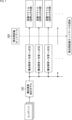
- FIG. 1 is a diagram illustrating an overview of a technique according to the present disclosure.
- FIG. 1 is a diagram showing examples of content and components.
- FIG. 1 is a diagram showing examples of content and components.
- FIG. 2 is a diagram showing an example of an inclusion relationship of content.
- FIG. 1 is a diagram showing examples of content and components.
- FIG. 1 is a diagram showing examples of content and components.
- FIG. 13 is a diagram showing a configuration for realizing generation of a concept distance network. 13 is a flowchart illustrating weighting of properties for each component element.
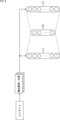
- FIG. 13 is a diagram illustrating learning of a concept distance network.
- FIG. 13 is a diagram showing a first example of weighting for components.
- FIG. 13 is a diagram showing a second example of weighting for components.
- FIG. 13 is a diagram showing a third example of weighting for components.
- FIG. 1 is a diagram illustrating an example of a learning model that performs unsupervised learning.
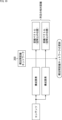
- 2 is a block diagram illustrating an example of a functional configuration of the presentation device.
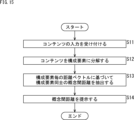
- FIG. 10 is a flowchart illustrating an operation of the presentation device.
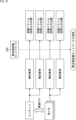
- FIG. 2 is a block diagram showing an example of a functional configuration of an evaluation device. 10 is a flowchart illustrating an operation of the evaluation device.
- FIG. 2 is a block diagram illustrating an example of a functional configuration of a generating device.
- 13 is a flowchart illustrating an operation of the generating device.
- FIG. 1 is a diagram illustrating a use case of the technology disclosed herein.
- FIG. 1 is a diagram illustrating a use case of the technology disclosed herein.
- FIG. 1 is a diagram illustrating a use case of the technology disclosed herein.
- FIG. 2 is a block diagram showing an example of the hardware configuration of
- learning model L1 which takes multiple different pieces of content and the multiple components that make up each piece of content as input and outputs index values that indicate the associations between the components based on weighting the n-dimensional properties of each component, the provision of higher-dimensional content is realized.
- the output index values for each component are made comparable as distance vectors that represent spatial positions.
- the plurality of components constituting each of the plurality of different contents includes two or more pieces of content composition information of different dimensions constituting the content, as described below.
- the dimensions of the content composition information can also be referred to as the types of the content composition information, which will be described later.
- the content configuration information may be two or more pieces of information constituting any one of time change-related information, person-related information, style information, body movement pattern information, and target-related information, or may include at least any of these pieces of information.
- the multiple components may further include two or more pieces of content configuration information of the same dimension.
- the two or more pieces of content configuration information of the same dimension may include words or sentences.
- Character is a person who appears in a story or a figurine with a human-like quality that is expressed in two or three dimensions.
- “Characters” can include humans, animals, robots, and anthropomorphized tangible or intangible phenomena.
- Figure 2 shows an example of a character and its components.
- components are the subject of inter-concept distance measurement for evaluating content.
- content components that simply generate combinations of attributes, but the technology disclosed herein is characterized by applying inter-concept distance to these components.
- FIG. 2 shows examples of characters that can be handled as content in the technology disclosed herein, and components that can be extracted from the characters through learning.
- the components shown in Figure 2 are extracted by the system breaking down the final creation (character) (automatic annotation is performed).
- the components shown in Figure 2 are also extracted by learning from the setting information and modeling information at the character production stage, which are linked to the final creation.
- examples of characters which are one type of content, include “characters in a story,” “objects of user interaction,” and “two-dimensional paintings/animations, three-dimensional sculptures/animations.”
- Examples of components include “personality information,” “status information,” “attribute information,” “skill information,” and “role information.”
- “personality information” includes the personality types, shortcomings, and behavioral tendencies of the characters in a story.
- “Status information” includes the age and gender of the characters in a story.
- “Attribute information” includes the hometown and organization of the characters in a story.
- “Skill information” includes the occupations and special skills of the characters in a story.
- “Role information” includes the motivations and goals of the characters in a story.
- the “user interaction target” in this case would be an automatic inquiry response system that can converse with the user.
- audio information includes voiceprints of the voice that responds to the user, speech habits, tone and manner of speech (rules for consistency), etc.
- components of the "user's interaction target” may further include some or all of the components of the "characters in the story” described above.
- the content is "2D painting/animation, 3D modeling/animation," examples of components include “body shape information,” “texture information,” “clothing and decoration information,” “2D/3D modeling information,” “body movement information,” “tone and manner information,” and “audio information.”
- body type information includes information that determines the drawing and movement of the base body, including skeletal information of a character expressed in two-dimensional or three-dimensional animation.
- Body movement information particularly includes the unique movement patterns and movement habits of the character.
- a “story” refers to a series of expressions in which the actions of people and events progress over time.
- a “story” can include anything from a “script,” which includes the structure and production instructions, to the final expression, such as a "novel,””animation,” or "film.”
- Figure 3 shows an example of a story and its components.
- FIG. 3 shows a story as a type of content that can be handled by the technology disclosed herein, and an example of components that can be extracted from the story through learning.
- the components shown in Figure 3 are extracted by the system breaking down the final creation (story) (automatic annotation is performed).
- the components shown in Figure 3 are also extracted by learning from the setting information and modeling information at the story production stage, which are linked to the final creation.
- Examples of stories, which are one type of content include “scripts,” “novels,” “animation works,” and “video works.”
- “Animation works” can include commercials (commercial messages) and animated films.
- “Video works” can include commercials, dramas, plays, movies, etc.
- examples of components include “character information,” “information on the relationships between characters,” “information on the chronological changes in characters and their relationships,” “plot framework information,” “scene setting information (for each scene),” “scene information,” “direction information,” “emotional transition design information,” and “genre information.”
- character information refers to the characters who appear in the story.
- Plot skeleton information includes information on the chronology of act components and events.
- Scene setting information (for each scene) includes information on the location, geographical conditions, spatial setting, weather, time, etc.
- Scene information includes chronological information on the scene, character actions, dialogue, depictions, etc.
- Direction information includes information on the design of emotional changes, information on instructions for characters, and information on instructions for musical and visual expressions.
- emotional transition design information includes information on the transitions in the emotional states of characters and the audience.
- Gene information includes information on the typological structure of the story.
- the technology disclosed herein is characterized in that it handles time-series change information as a component of a "script,” and that it handles abstract skeletal information and direction information, such as plot skeletal information and emotional transition design information, rather than the final written expression.
- style information may include information about the writing style specific to the author.
- components of a “novel” may further include some or all of the components of a "script” described above.
- Examples of components include “visualization information for the components of the script,” “music and camerawork design information,” “video material information related to the scene,” “storyboard information,” and “tone and manner information.”
- “scene-related video material information” includes 3D model information of the location.
- “Tone and manner information” includes information about the style of the animation work.
- components of an “animation work” may further include the components of "2D painting/animation, 3D modeling/animation” in Figure 2, and some or all of the components of the "script” mentioned above.
- the content is a "video work”
- examples of components include “actor information,” “music and camerawork design information,” and “filmed video information.”
- components of a "visual work” may further include some or all of the components of the "script" described above.
- each piece of content created as a story may have multiple inclusion relationships.
- an "animation work” as a story may include a "script” as a story and a "two-dimensional animation” ( Figure 2) as a character.
- a "script” as a story may include multiple “characters” ( Figure 2) as characters.
- Creativity related to physicality refers to expression and creation based on human physicality, such as dance and theater.
- Figure 5 shows an example of physical creation and its components.
- FIG. 5 shows examples of physical creations that can be handled as content in the technology disclosed herein, and examples of components that can be extracted from the physical creations through learning.
- the components shown in Figure 5 are extracted using sensing technology such as motion capture based on the actual expressions of the performer or actor.
- the components shown in Figure 5 are also extracted by learning the input of information that describes the components, such as choreography instruction information and expression composition information, by linking them to the final expression.
- Figure 5 gives "dance,” “theater,” and “cooking” as examples of creative work that involves physicality, which is one type of content.
- examples of components include “static skeletal state information”, “dynamic skeletal state information”, “meta definition information of movement”, “information on facial expressions”, “relative information to music”, and “tone and manner information”.
- static skeletal state information includes static skeletal position information in each scene of the choreography.
- dynamic skeletal state information includes dynamic skeletal movement information between each scene of the choreography.
- Meta definition information of movement includes information that is not dependent on expression, such as movement transition instructions based on the choreography name.
- Information regarding facial expressions includes information regarding facial expressions expressed by the face or physicality.
- Relative information with music includes expression information relating to the relationship of each piece of information to the music.
- Teone and manner information includes information regarding the style of the dance, and information regarding the unique personality of the performer or work.
- examples of components include “script information”, “layout and movement information”, “environmental information”, “static skeleton state information”, “dynamic skeleton state information”, and “meta definition information of movements”.
- “arrangement and movement information” includes information about the arrangement of people and props on stage, and movement lines when moving.
- “Environmental information” includes information that specifies the relationship between the actor and the environment, such as the arrangement of props and stage equipment, and direction.
- “Skeletal static state information,” “skeletal dynamic state information,” and “movement meta-definition information” include information that specifies the actor's choreography, just as when the content is "dance.”
- ingredient information includes information about combinations of ingredients and seasonings.
- Processdure information includes information about cooking procedures (so-called recipes).
- Cosmetic action information includes information specifying actions such as how to cut, grill, and boil.
- the technology disclosed herein is characterized by its ability to handle components of expression and creativity in the real world through sensing in the real world.
- Example 4 Information about the recipient
- Most creations are not created simply for the purpose of creating the creation itself, but are created with a specific intended recipient (hereafter also referred to as the target) in mind, in order to achieve the following purpose for that target. Specifically, creations are created to be presented to a recipient and to satisfy the recipient. Creations are also created to convey a certain message to a recipient, using the creation itself as a medium to convey the message.
- Figure 6 shows an example of a recipient and information about that recipient.
- FIG. 6 shows examples of recipients of content that may be handled by the technology disclosed herein and information related to those recipients.
- the information on recipients shown in Figure 6 is linked to any content by obtaining information on the degree to which existing content has been accepted by each recipient segment.
- the information on recipients shown in Figure 6 is linked to assumptions made in the content creation stage based on proposals, etc., and is used to evaluate the degree to which the content has achieved its purpose for the recipients.
- CM/movie user examples of information about the recipient include “segment information,” “preference information,” “behavioral information,” and “value information.”
- “segment information” includes the user's year of birth, age, sex, region, occupation, income, family composition, etc.
- Preference information includes information about the user's favorite actors, music, movies, and other content.
- Behavioral information includes the user's hobbies, holiday behavior trends, purchasing tendencies, etc.
- “Value information” includes information that is used as a deciding factor in the user's behavior and content selection.
- information about the recipient can also be one of the components of the content presented to the recipient. Furthermore, information about the recipient can be an indicator for evaluating the appropriateness of the inter-concept distance.
- FIG. 7 is a diagram showing a configuration for realizing generation of a learning model (conceptual distance network).
- the generation of a learning model is achieved by a first step performed by a component extraction model 100 and a second step performed by a concept distance network 200.
- the component extraction model 100 decomposes the content or its components into n-dimensional property-weighted components based on their features.
- the inter-concept distance network 200 determines the weighting of the distance vector that defines the position in the distance space for each of the components decomposed by the component extraction model 100. This causes the inter-concept distance network 200 to be updated (learned). The distance vectors of each component are added together based on the analysis results of multiple contents.
- the concept distance network 200 is a learning model in the technology disclosed herein, and outputs a distance vector for each component as an index value indicating the association between the components.
- the distance vector (index value) for each component is a value based on weighting in accordance with the fact that multiple components make up one piece of content.
- the distance vector (index value) may be further weighted in accordance with evaluation information for the content.
- the evaluation information for the content may be information that represents the receiver's evaluation, including viewing the content, or may be information that is input in association with the content.
- the evaluation information for the content may be input after the learning model (inter-concept distance network 200) is generated, and the learning model may update the distance vector (index value) based on the input.
- the distance between elements is calculated without distinction not only between elements of the same type (e.g., plot and plot), but also between elements of different types (e.g., plot and character).
- the weighting of the properties of each content component is performed by the component extraction model 100.
- the extraction of the components and the weighting of the properties may be performed based on an existing trained model (the component extraction model 100), by analyzing the feature amount, and automatically adding annotations.
- step S1 the component extraction model 100 accepts content input.
- the component extraction model 100 accepts input of video information and audio information directly from a video work such as a completed movie.
- step S2 the component extraction model 100 performs preprocessing on the input content.
- the input content is subjected to processing to extract unit information, which is a spatially and temporally meaningful chunk, using recognition techniques such as object recognition and scene recognition. For example, people, lines, and scenes are extracted as unit information.
- step S3 the component extraction model 100 breaks down the preprocessed content into components based on the features of the elements that make up the content.
- the features are recognized and calculated based on an appropriate existing learning model (component extraction model 100). For example, as components, actors and characters are obtained from people, scene information and plot information are obtained from events, and emotional transition information is obtained from tone changes.
- step S4 the component extraction model 100 assigns an n-dimensional weighting to each of the acquired components, indicating the properties of each component.
- the component extraction model 100 assigns a distance vector to each component as a weighting indicating its spatial position. That is, a component whose nature is expressed by n-dimensional weighting is given a relative distance to other components. For example, a weighting may be assigned as a distance vector to determine the position of each component as being a certain degree of closeness based on the fact that the components are included in the same content. Types of weighting will be described later.
- the extraction of components and the weighting of properties are based on an existing trained model, and their features may be analyzed and automatically annotated.
- the extraction of components and the weighting of properties may be performed when the content is input, based on each component that makes up the content and the annotation information associated with the component.
- the component extraction model 100 may be re-trained based on the annotation information.
- the inter-concept distance network 200 is trained using components obtained by breaking down a certain content and each of which is weighted by a property.
- the input to the input layer L1 is the components that make up a certain piece of content, or the properties of those components.
- the input to the output layer L2 is the other components that make up a certain piece of content, or the properties of those components. Input to the input layer L1 and the output layer L2 is then performed for multiple pieces of content (specifically, the components that make up that content).
- the hidden layer LH in this learning is the inter-concept distance network 200, which determines the distance vectors for each property of the component.
- weighting when weighting distance, weighting may be increased so that components that are close in time, such as components included in a particular scene in a certain piece of content, are combined with a higher probability.
- Figure 10 shows a first example of weighting for components.
- components that make up the same content are weighted so that these components are at a specified relative distance (or within a specified range of relative distance).
- combinations of frequently occurring elements can be evaluated as basic combinations, such as a love story between a man and a woman. Also, combinations of frequently occurring elements can be evaluated as common combinations.
- combinations with a relative distance greater than the specified distance can be evaluated as unusual and novel, such as a story about a historical Chinese general's exploits set in modern-day Tokyo, or a comedy themed around ancient Roman baths and modern-day Japanese baths. Also, combinations with a relative distance greater than the specified distance can be evaluated as combinations that are so far apart that they would be difficult to put together.
- FIG. 11 shows a second example of weighting for components.
- the components that make up a particular piece of content are weighted so that these components are at a more appropriate relative distance.
- the content is a commercial work, it is assumed that the content is of a certain level of quality, and therefore the relative distance between the components that make up the content is considered appropriate.
- market response information such as sales information and viewer rating information, may be added to the weighting.
- the inter-concept distance network 200 is optimized for a specific user, the relative distances between the components that make up the content specified by that user are evaluated as appropriate, making it possible to evaluate the inter-concept distances according to the user's intentions.
- Figure 12 shows a third example of weighting for components.
- information about the recipient may be associated with a certain piece of content.
- Information about the recipient may include, for example, target user information at the planning stage, sales information by customer after the content is released, viewer rating information, etc.
- the components of the content and their combinations may be weighted based on information about the recipient.
- the information about the recipient may be one or more pieces of information. This makes it possible to evaluate that a combination of certain components (for example, a romantic plot and a school scene) is appropriate for information about recipients in their 20s, but is not effective for information about recipients in their 70s.
- the learning of the concept distance network 200 may be realized by unsupervised learning (reinforcement learning).
- Figure 13 shows an example of a learning model that performs unsupervised learning.
- the learning model 250 shown in FIG. 13 performs unsupervised learning using Perceptual Data(t), Action(t-1), and Reward(t-1) as inputs and Action(t) and State Value(t) as outputs.
- Action is any content (a combination of components of any nature) generated by the learning model 250.
- Reward is the amount of compensation and is an evaluation of the content generated in the learning model 250.
- Reward can include, for example, the reaction of users who watch the content, and an evaluation by the user who generates the learning model 250.
- Perceptual Data is environmental information, and may be content prerequisites, user segment demographics, etc.
- the preconditions for the content include the genre of the content and basic information.
- the learning model 250 searches for combinations of some of the components within the preconditions. In this case, the perceptual data is generally immutable.
- the State Value is a value used to evaluate each state in unsupervised learning. The larger the State Value, the more likely the expected combination of components is output.
- This configuration makes it possible to realize learning of the concept distance network 200.
- unsupervised learning a method using a general adversarial network (GAN) or the like may be applied. Also, starting from a learning model generated by supervised learning, unsupervised learning may be performed on the learning model.
- GAN general adversarial network
- the above-mentioned inter-concept distance network makes it possible to measure the inter-concept distance between the components that make up the content created by the user, thereby making it possible to provide more creative content.
- FIG. 14 is a block diagram illustrating an example of a functional configuration of the presentation device.
- the presentation device 310 shown in FIG. 14 estimates the inter-concept distance between the components that make up the target content to be evaluated based on the inter-concept distance network 200, and presents it to the user.
- the presentation device 310 includes a component extraction unit 311, a concept distance extraction unit 312, and a presentation unit 313.
- the component extraction unit 311 accepts input of target content and extracts the components that make up the target content by breaking down the target content into its components.
- the inter-concept distance extraction unit 312 extracts (estimates) the inter-concept distance between components as relevance information based on the relevance between the components that make up the target content, based on the index values (distance vectors) for each component learned by the inter-concept distance network 200.
- the presentation unit 313 presents the inter-concept distance between the components extracted by the inter-concept distance extraction unit 312.
- step S11 the component extraction unit 311 accepts input of content created by the user.
- step S12 the component extraction unit 311 breaks down the input content into components.
- step S13 the inter-concept distance extraction unit 312 extracts the inter-concept distance between the components based on the distance vector for each component.
- step S14 the presentation unit 313 presents the inter-concept distance.
- the inter-concept distance between the components can be expressed spatially, for example, as the degree distribution of each node constituting the network (hereinafter referred to as the network distribution).
- the presenting section 313 may present the multiple components.
- multiple components that are at the inter-concept distance to be presented may be presented simultaneously, or may be presented one by one in sequence, for example, in response to user interaction.
- these multiple components may be presented in a priority order based on other indicators (for example, the closeness of the distance to other components, the appropriateness of the inter-concept distance, etc.).
- the presenting section 313 may further present the relative relationship between the inter-concept distances between the components and a predetermined criterion.
- the specified criterion may be a value (e.g., average value or median value) based on the inter-concept distance of other content in the genre to which the target content belongs (e.g., novels, movies, music, etc., or a specific subgenre thereof).
- the specified criterion may also be a value (distance or range) specified by the user who created the content or the client to whom the content is delivered, or a value based on the target to which the target content is presented.
- the user can visually determine whether a certain inter-concept distance is maintained for the entire content.
- the network distribution, its variance, and its relative relationship to a specified standard may be quantitatively presented as a specific score.
- the presenting section 313 may present a particular component in an emphasized manner according to the relative relationship between the inter-concept distance between the components and a predetermined criterion.
- components whose inter-node distance is longer (farther) than a certain level, or components whose inter-node distance is shorter (closer) than a certain level, relative to a specified criterion are highlighted.
- the highlighted components may be used as a GUI (Graphical User Interface) to present other candidate components to replace the component in question, based on operational instructions from the user.
- GUI Graphic User Interface
- the presenting unit 313 may present an evaluation result indicating whether or not the target content satisfies the evaluation criterion based on the relative relationship between the inter-concept distance between the components and the predetermined criterion.
- the evaluation result may be presented as, for example, two-dimensional or three-dimensional graph information.
- a candidate component that can replace one of the components that make up the target content may be presented depending on the evaluation result. At this time, it may also be presented whether or not the evaluation result can be improved by modifying any of the components.
- the breadth of the network distribution of each piece of content and the distance between components may be presented so that they can be compared.
- the above-mentioned predetermined criteria may also be presented.
- creators can objectively evaluate the quality of the content they have produced. Creators can also check the extent to which their work meets the client's needs during the production stage and make corrections before delivery.
- the party ordering the creator can objectively evaluate the standard of the deliverables and objectively compare and evaluate multiple deliverables.
- the party ordering the creator can also give objective and specific instructions regarding corrections to the creator.
- Such content evaluation results can be presented as comparative evaluation results for the recipients (targets) of the content.
- the comparative evaluation results may be presented from the viewpoint of whether the network distribution of the content satisfies a predetermined standard for the expected target.
- the network distribution trend of the target content being evaluated may be presented, showing which target has the highest affinity.
- creators can create content taking into account the anticipated reactions of their recipients.
- creators can estimate the effects of a project in advance at the planning stage and evaluate the appropriate target for the content.
- FIG. 16 is a block diagram illustrating an example of a functional configuration of the evaluation device.
- the evaluation device 330 shown in FIG. 16 evaluates the inter-concept distance between components that make up the target content to be evaluated, or between components that make up a combination of multiple components, based on the inter-concept distance network 200.
- the evaluation device 330 includes a component extraction unit 331, a concept distance extraction unit 332, and an evaluation unit 333.
- the component extraction unit 331 accepts input of a target content or a combination of multiple components, and extracts the components that make up the target content or combination by breaking down the target content or combination into its components.
- the inter-concept distance extraction unit 332 extracts the inter-concept distance between components as association information based on the association between the components, based on the index value (distance vector) for each component learned by the inter-concept distance network 200.
- the evaluation unit 333 evaluates the inter-concept distance between the components extracted by the inter-concept distance extraction unit 332.
- step S31 the component extraction unit 331 accepts input of content or a combination of components created by the user.
- step S32 the component extraction unit 331 breaks down the input content or combination into components.
- step S33 the inter-concept distance extraction unit 332 extracts the inter-concept distance between the components based on the distance vector for each component.
- step S34 the evaluation unit 333 evaluates the inter-concept distance (its appropriateness).
- the evaluation unit 333 can present, as an evaluation result of the inter-concept distance, whether or not the inter-concept distance satisfies appropriateness. For example, whether or not the inter-concept distance is an appropriate distance (not too far or not too close) is presented. At this time, a criterion to be compared (for example, a predetermined criterion as described above) may be indicated by the user.
- the evaluation unit 333 may present suggested information for satisfying the appropriateness. For example, based on the result of comparison with the standard to be compared, an alternative component may be presented to bring the inappropriate component to an appropriate level.
- a plurality of alternative components may be presented and selected by the user. At this time, a plurality of alternative components may be presented simultaneously, or may be presented one by one in sequence according to, for example, an interaction with the user.
- these multiple alternative components may be presented in a priority order according to other indices (for example, the closeness of the distance to other components or the appropriateness of the inter-concept distance).
- the alternative components may be concrete expressions or abstract guidelines such as the genre or nature of the component.
- a user can interactively create and modify content with an AI (Artificial Intelligence) system configured as the evaluation device 330 described above.
- AI Artificial Intelligence
- a user or an AI system can present suggested modifications to the display of the network distribution or combinations of specific components, and repeat this process to interactively advance the creation in real time.
- the dialogue can be text, audio, or even non-verbal, directly presenting diagrams or images.
- the AI system may present other components that are at an appropriate distance from the component presented by the user. In this case, only one other component may be presented, or multiple other components may be presented as described above.
- users can not only receive evaluations and suggested revisions for their content, but also interactively try out different combinations of components, allowing them to collaborate with the AI system and effectively advance production.
- AI participatory creation support In a situation where multiple users are collaboratively creating content, the AI system may act as one user and collaborate with other users to create the content through interactions.
- the AI system may also make the following suggestions in response to a component suggestion by the user: - Indicating whether the inter-concept distance between components is appropriate/inappropriate - Presenting other components that correspond to the component in question and have an appropriate inter-concept distance - Presenting alternatives to achieve a more appropriate inter-concept distance for the combination of components - Proposing changes to the criteria to be assumed, and proposing candidate criteria to be assumed
- AI participatory creative support is not limited to content collaborative production, but can also be applied to planning meetings, brainstorming, and other situations.
- other components, alternatives, candidate criteria, etc. may be presented in single quantities, or multiple quantities may be presented as described above.
- FIG. 18 is a block diagram illustrating an example of a functional configuration of the generating device.
- the generating device 350 shown in FIG. 18 generates new content or a part of it based on the inter-concept distance network 200.
- the generating device 350 includes a content generating unit 351.
- the content generation unit 351 accepts input of one or more components for generating new content or a part thereof, and generates the new content or a part thereof based on the index value (distance vector) for each component learned by the inter-concept distance network 200.
- step S51 the content generation unit 351 accepts input of components prepared by the user.
- step S52 the content generation unit 351 generates content or a part of it based on the distance vector for each component.
- the AI system configured as the above-mentioned generating device 350 can generate combinations of components and parts of content (hereinafter referred to as modules) as combinations of these components based on instructions from a user.
- the user may present (input) one or more starting components, genre information, recipient information, and other general directions to the AI system in advance.
- the AI system may also generate modules without user instructions.
- the AI system can generate modules by repeatedly modifying the product through unsupervised learning that rewards interaction with the user.
- the AI system can generate a product based on the user's instructions, which is similar to the final product envisioned by the user.
- the user may present one or more starting components, a rough direction such as genre information and audience information, and production information (e.g., a proposal, plot, script, etc.) prior to the generation by the AI system.
- the AI system may modify the product by unsupervised learning that rewards interaction with the user.
- Pre-production can also be used to self-check the creative intent, or show this to the intended target audience to measure effectiveness.
- the product may be the final product, rather than a pre-production product.
- feedback on the pre-production may be taken into account when generating the final product.
- the AI system may additionally learn (re-learn) the user's selection result.
- the AI system becomes optimized for the user as the user uses the AI system.
- FIG. 20 is a diagram illustrating creative support by creators, which is a first use case of the technology disclosed herein.
- the users who create content may be amateur creators, UGC (User Generated Contents) producers, professional creators, artists, ideation by multiple people, etc.
- UGC User Generated Contents
- a creator's creation is realized through the steps of "idea,” “material preparation/research,” “trial combination/rough draft production/collaboration,” “revision (trial and error),” “completion,” and “dissemination/posting/delivery.”
- the evaluation device disclosed herein can present the appropriateness of the materials (components) being prepared and present candidate materials and interview subjects. This allows the user to broaden their ideas during the preparation stage.
- the generation device of the present disclosure can generate content based on materials. This allows users to use the products generated by the system as samples to serve as the basis for their own creations, or to combine these intermediate products.
- the evaluation device disclosed herein can present the appropriateness of the created content from the perspective of the components, and can present candidate corrections (alternative combinations of components). This allows the user to obtain advice from such a system and refine the content that will become the final product.
- FIG. 21 is a diagram illustrating a second use case of the technology according to the present disclosure, which is an evaluation of the production stage of a plan/creative (product).
- users who plan and create creative works include amateur creators, UGC producers, professional creators, product planning departments, production management departments, etc.
- planning and creative production is achieved through the following processes: "Planning and specification determination,” “Production order,” “Production,” “Initial delivery/Completion of first version,” “Evaluation/revision instructions,” and “Final version delivery/Completion of final version.”
- the generation device disclosed herein can generate pre-production. This allows the production client to check rough drafts at the planning stage and self-check the intention of the plan.
- the evaluation device disclosed herein can measure the effectiveness in advance, taking into account information about the recipient. This allows the production client to make a rough estimate of the commercial effect of the plan itself and the creative at the planning stage.
- the generation device of the present disclosure can generate pre-production. This allows the production client to present a rough image to the creator, allowing for more accurate orders.
- the evaluation device disclosed herein can evaluate whether the production meets the conditions and standards of the production specifications, and can present suggested revisions if the conditions and standards are not met. This allows creators to self-check before delivery whether production is proceeding at a level that meets the plan and specifications.
- the evaluation device disclosed herein can evaluate content, quantitatively compare and evaluate multiple pieces of content, and measure effectiveness based on content. This allows the production orderer to evaluate the quality of delivered products and quantitatively compare multiple products.
- FIG. 22 is a diagram illustrating a third use case of the technology according to the present disclosure, which is an evaluation of the production stage of a plan/creative (product).
- the users who create plans and creative works are the business development department, the human resources department, matching service providers, etc.
- the evaluation device disclosed herein can evaluate the appropriateness of combinations between companies/organizations or team combinations, and can suggest other combination candidates. This allows users to improve the combinations between companies/organizations by receiving advice from such a system.
- Example of computer hardware configuration The above-mentioned series of processes can be executed by hardware or software.
- the program constituting the software is installed from a program recording medium into a computer incorporated in dedicated hardware, or into a general-purpose personal computer, etc.
- FIG. 23 is a block diagram showing an example of the hardware configuration of a computer that executes the above-mentioned series of processes by a program.
- the device that generates the inter-concept distance network, the presentation device 310, the evaluation device 330, and the generation device 350 are each configured, for example, by a PC having a configuration similar to that shown in FIG. 23.
- the CPU Central Processing Unit
- ROM Read Only Memory
- RAM Random Access Memory
- an input/output interface 505 Connected to the input/output interface 505 are an input unit 506 consisting of a keyboard, mouse, etc., and an output unit 507 consisting of a display, speakers, etc. Also connected to the input/output interface 505 are a storage unit 508 consisting of a hard disk or non-volatile memory, a communication unit 509 consisting of a network interface, etc., and a drive 510 that drives removable media 511.
- the CPU 501 loads a program stored in the storage unit 508 into the RAM 503 via the input/output interface 505 and the bus 504, and executes the program, thereby performing the above-mentioned series of processes.
- the programs executed by the CPU 501 are provided, for example, by being recorded on removable media 511, or via a wired or wireless transmission medium such as a local area network, the Internet, or digital broadcasting, and are installed in the storage unit 508.
- the program executed by the computer may be a program in which processing is performed chronologically in the order described in this specification, or a program in which processing is performed in parallel or at the required timing, such as when called.
- a system refers to a collection of multiple components (devices, modules (parts), etc.), regardless of whether all the components are in the same housing. Therefore, multiple devices housed in separate housings and connected via a network, and a single device in which multiple modules are housed in a single housing, are both systems.
- an embodiment of the present disclosure can be configured as cloud computing, in which a single function is shared and processed collaboratively by multiple devices over a network.
- each step described in the above flowchart can be executed by a single device, or can be shared and executed by multiple devices.
- a single step includes multiple processes
- the processes included in that single step can be executed by a single device, or can be shared and executed by multiple devices.
- the technology according to the present disclosure can have the following configuration.
- (1) Acquire a plurality of components constituting each of a plurality of different contents, generating a learning model that outputs an index value indicating a relevance of a first component to a second component among the plurality of components.
- (2) The learning model generation method according to (1), wherein the plurality of components include two or more content components of different dimensions that constitute the content.
- (3) The learning model generation method according to (2), wherein the content components are two or more pieces of information constituting any one of time change related information, person related information, style information, body movement pattern information, and target related information.
- the learning model generation method according to (2) wherein the content components include at least one of time change related information, person related information, style information, body movement pattern information, and target related information.
- the index value is a value weighted according to the content constituted by the first component and the second component.
- the index value is a value that is further weighted according to evaluation information for the content.
- a presentation device having a learning model that learns an index value indicating a relevance of a first component to a second component among a plurality of components that respectively configure a plurality of different contents, Enter the target content to be evaluated, a presentation method for presenting association information based on associations between the constituent elements on the basis of the index values for each of the plurality of constituent elements constituting the target content.
- the presentation method according to (9), wherein the inter-concept distance between the components is presented spatially.
- the presentation method according to (10) further comprising presenting a relative relationship between the inter-concept distance between the components and a predetermined criterion.
Landscapes
- Engineering & Computer Science (AREA)
- Theoretical Computer Science (AREA)
- Physics & Mathematics (AREA)
- General Engineering & Computer Science (AREA)
- Software Systems (AREA)
- Data Mining & Analysis (AREA)
- General Physics & Mathematics (AREA)
- Mathematical Physics (AREA)
- Computing Systems (AREA)
- Artificial Intelligence (AREA)
- Evolutionary Computation (AREA)
- Computational Linguistics (AREA)
- Molecular Biology (AREA)
- Biophysics (AREA)
- Biomedical Technology (AREA)
- General Health & Medical Sciences (AREA)
- Health & Medical Sciences (AREA)
- Life Sciences & Earth Sciences (AREA)
- Databases & Information Systems (AREA)
- Library & Information Science (AREA)
- Computer Vision & Pattern Recognition (AREA)
- Medical Informatics (AREA)
- Information Retrieval, Db Structures And Fs Structures Therefor (AREA)
- Management, Administration, Business Operations System, And Electronic Commerce (AREA)
Priority Applications (3)
| Application Number | Priority Date | Filing Date | Title |
|---|---|---|---|
| JP2025516619A JPWO2024224910A1 (https=) | 2023-04-28 | 2024-03-25 | |
| EP24796668.2A EP4703982A1 (en) | 2023-04-28 | 2024-03-25 | Learning model generation method, presentation method, evaluation method, and generation method |
| CN202480027101.XA CN121002520A (zh) | 2023-04-28 | 2024-03-25 | 学习模型生成方法、呈现方法、评估方法和生成方法 |
Applications Claiming Priority (2)
| Application Number | Priority Date | Filing Date | Title |
|---|---|---|---|
| JP2023-073976 | 2023-04-28 | ||
| JP2023073976 | 2023-04-28 |
Publications (1)
| Publication Number | Publication Date |
|---|---|
| WO2024224910A1 true WO2024224910A1 (ja) | 2024-10-31 |
Family
ID=93256208
Family Applications (1)
| Application Number | Title | Priority Date | Filing Date |
|---|---|---|---|
| PCT/JP2024/011697 Ceased WO2024224910A1 (ja) | 2023-04-28 | 2024-03-25 | 学習モデル生成方法、提示方法、評価方法、および生成方法 |
Country Status (4)
| Country | Link |
|---|---|
| EP (1) | EP4703982A1 (https=) |
| JP (1) | JPWO2024224910A1 (https=) |
| CN (1) | CN121002520A (https=) |
| WO (1) | WO2024224910A1 (https=) |
Cited By (1)
| Publication number | Priority date | Publication date | Assignee | Title |
|---|---|---|---|---|
| TWI922392B (zh) | 2025-08-12 | 2026-04-11 | 國立雲林科技大學 | 多維人工智慧協作企劃生成系統 |
Citations (6)
| Publication number | Priority date | Publication date | Assignee | Title |
|---|---|---|---|---|
| JP2021140483A (ja) * | 2020-03-05 | 2021-09-16 | 富士フイルムビジネスイノベーション株式会社 | 類似度評価装置及び類似度評価プログラム並びにこれらを用いたテキスト自動生成装置 |
| WO2021193021A1 (ja) * | 2020-03-27 | 2021-09-30 | テルモ株式会社 | プログラム、情報処理方法、情報処理装置及びモデル生成方法 |
| JP2023018624A (ja) | 2021-07-27 | 2023-02-08 | ネイバー コーポレーション | 言語モデルを利用したデータ生成方法、コンピュータ装置、およびコンピュータプログラム |
| JP2023019734A (ja) * | 2021-07-29 | 2023-02-09 | 富士フイルム株式会社 | 学習装置、方法およびプログラム、並びに情報処理装置、方法およびプログラム |
| JP2023026279A (ja) | 2021-08-13 | 2023-02-24 | アバナード ホールディングス エルエルシー | 自然言語処理およびレコメンデーション生成のためのマルチモデル手法 |
| CN115942005A (zh) * | 2022-12-23 | 2023-04-07 | 北京有竹居网络技术有限公司 | 用于生成解说视频的方法、装置、设备和存储介质 |
-
2024
- 2024-03-25 JP JP2025516619A patent/JPWO2024224910A1/ja active Pending
- 2024-03-25 EP EP24796668.2A patent/EP4703982A1/en active Pending
- 2024-03-25 WO PCT/JP2024/011697 patent/WO2024224910A1/ja not_active Ceased
- 2024-03-25 CN CN202480027101.XA patent/CN121002520A/zh active Pending
Patent Citations (6)
| Publication number | Priority date | Publication date | Assignee | Title |
|---|---|---|---|---|
| JP2021140483A (ja) * | 2020-03-05 | 2021-09-16 | 富士フイルムビジネスイノベーション株式会社 | 類似度評価装置及び類似度評価プログラム並びにこれらを用いたテキスト自動生成装置 |
| WO2021193021A1 (ja) * | 2020-03-27 | 2021-09-30 | テルモ株式会社 | プログラム、情報処理方法、情報処理装置及びモデル生成方法 |
| JP2023018624A (ja) | 2021-07-27 | 2023-02-08 | ネイバー コーポレーション | 言語モデルを利用したデータ生成方法、コンピュータ装置、およびコンピュータプログラム |
| JP2023019734A (ja) * | 2021-07-29 | 2023-02-09 | 富士フイルム株式会社 | 学習装置、方法およびプログラム、並びに情報処理装置、方法およびプログラム |
| JP2023026279A (ja) | 2021-08-13 | 2023-02-24 | アバナード ホールディングス エルエルシー | 自然言語処理およびレコメンデーション生成のためのマルチモデル手法 |
| CN115942005A (zh) * | 2022-12-23 | 2023-04-07 | 北京有竹居网络技术有限公司 | 用于生成解说视频的方法、装置、设备和存储介质 |
Cited By (1)
| Publication number | Priority date | Publication date | Assignee | Title |
|---|---|---|---|---|
| TWI922392B (zh) | 2025-08-12 | 2026-04-11 | 國立雲林科技大學 | 多維人工智慧協作企劃生成系統 |
Also Published As
| Publication number | Publication date |
|---|---|
| JPWO2024224910A1 (https=) | 2024-10-31 |
| CN121002520A (zh) | 2025-11-21 |
| EP4703982A1 (en) | 2026-03-04 |
Similar Documents
| Publication | Publication Date | Title |
|---|---|---|
| André et al. | WebPersona: a lifelike presentation agent for the World-Wide Web | |
| CN119621948B (zh) | 一种基于aigc的创作内容生成方法、系统、介质及程序产品 | |
| Harwood et al. | Design fiction diegetic prototyping: a research framework for visualizing service innovations | |
| WO2022155316A1 (en) | Survey system with mixed response medium | |
| Atasoy et al. | STORYPLY: designing for user experiences using storycraft | |
| Herman et al. | In the eye of the beholder: A viewer-defined conception of online visual creativity | |
| Yuan | Making virtual celebrity: Platformization and intermediation in digital cultural production | |
| Danchenko | The AI-teration method and the role of AI in architectural design | |
| Murdoch | Agent-oriented modelling in the production of 3D character animation | |
| Bertoni et al. | Using 3D CAD models for value visualization: an approach with SIEMENS NX HD3D Visual Reporting | |
| Mandal et al. | Gen Zs and millennials’ orientation towards AI tools: an index approach | |
| Thorogood et al. | A framework for computer-assisted sound design systems supported by modelling affective and perceptual properties of soundscape | |
| WO2024224910A1 (ja) | 学習モデル生成方法、提示方法、評価方法、および生成方法 | |
| Narayan et al. | Artificial imagination: Industry attitudes on the impact of AI on the visual effects process | |
| Rohrbacher et al. | VTubing and Its Potential for the Streaming and Design Community: An Austrian Perspective | |
| Sonlu et al. | Emotional expression as a means of communicating virtual human personalities | |
| Sari | AI, Aesthetics and Profit in Commercialization of Arts: Revisiting Adorno’s Paradox | |
| Moutinho et al. | Innovative research methodologies in management | |
| Ilona | Unreal Engine 5 as an interactive tool for architects in combination with VR Project integrations: Contentions vs Consumers' perception | |
| Ngatiah et al. | Algorithmic Creativity: A Systematic Review of AI and Artistic Expression in the Digital African Landscape | |
| Chen | Intelligent matching algorithm of musical characters based on fuzzy logic | |
| Hauck et al. | Cultural Heritage Markup Language | |
| CN120373266B (zh) | 基于大模型生成包含结构化的图的文章的方法和装置 | |
| Zhou | Illuminating virtual reality creative practice: Three case studies in the context of Australian art museums | |
| Meehan | Digital museum objects and digital ecologies |
Legal Events
| Date | Code | Title | Description |
|---|---|---|---|
| 121 | Ep: the epo has been informed by wipo that ep was designated in this application |
Ref document number: 24796668 Country of ref document: EP Kind code of ref document: A1 |
|
| ENP | Entry into the national phase |
Ref document number: 2025516619 Country of ref document: JP Kind code of ref document: A |
|
| WWE | Wipo information: entry into national phase |
Ref document number: 2025516619 Country of ref document: JP |
|
| WWE | Wipo information: entry into national phase |
Ref document number: 2024796668 Country of ref document: EP |
|
| NENP | Non-entry into the national phase |
Ref country code: DE |
|
| ENP | Entry into the national phase |
Ref document number: 2024796668 Country of ref document: EP Effective date: 20251128 |
|
| ENP | Entry into the national phase |
Ref document number: 2024796668 Country of ref document: EP Effective date: 20251128 |
|
| ENP | Entry into the national phase |
Ref document number: 2024796668 Country of ref document: EP Effective date: 20251128 |
|
| ENP | Entry into the national phase |
Ref document number: 2024796668 Country of ref document: EP Effective date: 20251128 |
|
| ENP | Entry into the national phase |
Ref document number: 2024796668 Country of ref document: EP Effective date: 20251128 |
|
| ENP | Entry into the national phase |
Ref document number: 2024796668 Country of ref document: EP Effective date: 20251128 |
|
| ENP | Entry into the national phase |
Ref document number: 2024796668 Country of ref document: EP Effective date: 20251128 |
|
| ENP | Entry into the national phase |
Ref document number: 2024796668 Country of ref document: EP Effective date: 20251128 |
|
| ENP | Entry into the national phase |
Ref document number: 2024796668 Country of ref document: EP Effective date: 20251128 |
|
| WWP | Wipo information: published in national office |
Ref document number: 2024796668 Country of ref document: EP |