WO2024214632A1 - ホスホニウム基を有するカチオン性ポリマーおよびこれを含むポリマー粒子または医薬組成物 - Google Patents
ホスホニウム基を有するカチオン性ポリマーおよびこれを含むポリマー粒子または医薬組成物 Download PDFInfo
- Publication number
- WO2024214632A1 WO2024214632A1 PCT/JP2024/013965 JP2024013965W WO2024214632A1 WO 2024214632 A1 WO2024214632 A1 WO 2024214632A1 JP 2024013965 W JP2024013965 W JP 2024013965W WO 2024214632 A1 WO2024214632 A1 WO 2024214632A1
- Authority
- WO
- WIPO (PCT)
- Prior art keywords
- cationic
- group
- mrna
- phosphonium
- peg
- Prior art date
- Legal status (The legal status is an assumption and is not a legal conclusion. Google has not performed a legal analysis and makes no representation as to the accuracy of the status listed.)
- Ceased
Links
Images


Classifications
-
- A—HUMAN NECESSITIES
- A61—MEDICAL OR VETERINARY SCIENCE; HYGIENE
- A61K—PREPARATIONS FOR MEDICAL, DENTAL OR TOILETRY PURPOSES
- A61K31/00—Medicinal preparations containing organic active ingredients
- A61K31/70—Carbohydrates; Sugars; Derivatives thereof
- A61K31/7088—Compounds having three or more nucleosides or nucleotides
-
- A—HUMAN NECESSITIES
- A61—MEDICAL OR VETERINARY SCIENCE; HYGIENE
- A61K—PREPARATIONS FOR MEDICAL, DENTAL OR TOILETRY PURPOSES
- A61K31/00—Medicinal preparations containing organic active ingredients
- A61K31/70—Carbohydrates; Sugars; Derivatives thereof
- A61K31/7088—Compounds having three or more nucleosides or nucleotides
- A61K31/7105—Natural ribonucleic acids, i.e. containing only riboses attached to adenine, guanine, cytosine or uracil and having 3'-5' phosphodiester links
-
- A—HUMAN NECESSITIES
- A61—MEDICAL OR VETERINARY SCIENCE; HYGIENE
- A61K—PREPARATIONS FOR MEDICAL, DENTAL OR TOILETRY PURPOSES
- A61K31/00—Medicinal preparations containing organic active ingredients
- A61K31/70—Carbohydrates; Sugars; Derivatives thereof
- A61K31/7088—Compounds having three or more nucleosides or nucleotides
- A61K31/711—Natural deoxyribonucleic acids, i.e. containing only 2'-deoxyriboses attached to adenine, guanine, cytosine or thymine and having 3'-5' phosphodiester links
-
- A—HUMAN NECESSITIES
- A61—MEDICAL OR VETERINARY SCIENCE; HYGIENE
- A61K—PREPARATIONS FOR MEDICAL, DENTAL OR TOILETRY PURPOSES
- A61K31/00—Medicinal preparations containing organic active ingredients
- A61K31/70—Carbohydrates; Sugars; Derivatives thereof
- A61K31/7088—Compounds having three or more nucleosides or nucleotides
- A61K31/713—Double-stranded nucleic acids or oligonucleotides
-
- A—HUMAN NECESSITIES
- A61—MEDICAL OR VETERINARY SCIENCE; HYGIENE
- A61K—PREPARATIONS FOR MEDICAL, DENTAL OR TOILETRY PURPOSES
- A61K38/00—Medicinal preparations containing peptides
- A61K38/02—Peptides of undefined number of amino acids; Derivatives thereof
-
- A—HUMAN NECESSITIES
- A61—MEDICAL OR VETERINARY SCIENCE; HYGIENE
- A61K—PREPARATIONS FOR MEDICAL, DENTAL OR TOILETRY PURPOSES
- A61K47/00—Medicinal preparations characterised by the non-active ingredients used, e.g. carriers or inert additives; Targeting or modifying agents chemically bound to the active ingredient
- A61K47/30—Macromolecular organic or inorganic compounds, e.g. inorganic polyphosphates
- A61K47/34—Macromolecular compounds obtained otherwise than by reactions only involving carbon-to-carbon unsaturated bonds, e.g. polyesters, polyamino acids, polysiloxanes, polyphosphazines, copolymers of polyalkylene glycol or poloxamers
-
- A—HUMAN NECESSITIES
- A61—MEDICAL OR VETERINARY SCIENCE; HYGIENE
- A61K—PREPARATIONS FOR MEDICAL, DENTAL OR TOILETRY PURPOSES
- A61K47/00—Medicinal preparations characterised by the non-active ingredients used, e.g. carriers or inert additives; Targeting or modifying agents chemically bound to the active ingredient
- A61K47/30—Macromolecular organic or inorganic compounds, e.g. inorganic polyphosphates
- A61K47/42—Proteins; Polypeptides; Degradation products thereof; Derivatives thereof, e.g. albumin, gelatin or zein
-
- A—HUMAN NECESSITIES
- A61—MEDICAL OR VETERINARY SCIENCE; HYGIENE
- A61K—PREPARATIONS FOR MEDICAL, DENTAL OR TOILETRY PURPOSES
- A61K9/00—Medicinal preparations characterised by special physical form
- A61K9/10—Dispersions; Emulsions
- A61K9/107—Emulsions ; Emulsion preconcentrates; Micelles
-
- A—HUMAN NECESSITIES
- A61—MEDICAL OR VETERINARY SCIENCE; HYGIENE
- A61K—PREPARATIONS FOR MEDICAL, DENTAL OR TOILETRY PURPOSES
- A61K9/00—Medicinal preparations characterised by special physical form
- A61K9/14—Particulate form, e.g. powders, Processes for size reducing of pure drugs or the resulting products, Pure drug nanoparticles
- A61K9/16—Agglomerates; Granulates; Microbeadlets ; Microspheres; Pellets; Solid products obtained by spray drying, spray freeze drying, spray congealing,(multiple) emulsion solvent evaporation or extraction
-
- A—HUMAN NECESSITIES
- A61—MEDICAL OR VETERINARY SCIENCE; HYGIENE
- A61P—SPECIFIC THERAPEUTIC ACTIVITY OF CHEMICAL COMPOUNDS OR MEDICINAL PREPARATIONS
- A61P43/00—Drugs for specific purposes, not provided for in groups A61P1/00-A61P41/00
-
- C—CHEMISTRY; METALLURGY
- C08—ORGANIC MACROMOLECULAR COMPOUNDS; THEIR PREPARATION OR CHEMICAL WORKING-UP; COMPOSITIONS BASED THEREON
- C08G—MACROMOLECULAR COMPOUNDS OBTAINED OTHERWISE THAN BY REACTIONS ONLY INVOLVING UNSATURATED CARBON-TO-CARBON BONDS
- C08G69/00—Macromolecular compounds obtained by reactions forming a carboxylic amide link in the main chain of the macromolecule
- C08G69/02—Polyamides derived from amino-carboxylic acids or from polyamines and polycarboxylic acids
- C08G69/08—Polyamides derived from amino-carboxylic acids or from polyamines and polycarboxylic acids derived from amino-carboxylic acids
- C08G69/10—Alpha-amino-carboxylic acids
-
- C—CHEMISTRY; METALLURGY
- C08—ORGANIC MACROMOLECULAR COMPOUNDS; THEIR PREPARATION OR CHEMICAL WORKING-UP; COMPOSITIONS BASED THEREON
- C08G—MACROMOLECULAR COMPOUNDS OBTAINED OTHERWISE THAN BY REACTIONS ONLY INVOLVING UNSATURATED CARBON-TO-CARBON BONDS
- C08G69/00—Macromolecular compounds obtained by reactions forming a carboxylic amide link in the main chain of the macromolecule
- C08G69/40—Polyamides containing oxygen in the form of ether groups
-
- C—CHEMISTRY; METALLURGY
- C08—ORGANIC MACROMOLECULAR COMPOUNDS; THEIR PREPARATION OR CHEMICAL WORKING-UP; COMPOSITIONS BASED THEREON
- C08G—MACROMOLECULAR COMPOUNDS OBTAINED OTHERWISE THAN BY REACTIONS ONLY INVOLVING UNSATURATED CARBON-TO-CARBON BONDS
- C08G69/00—Macromolecular compounds obtained by reactions forming a carboxylic amide link in the main chain of the macromolecule
- C08G69/48—Polymers modified by chemical after-treatment
-
- C—CHEMISTRY; METALLURGY
- C08—ORGANIC MACROMOLECULAR COMPOUNDS; THEIR PREPARATION OR CHEMICAL WORKING-UP; COMPOSITIONS BASED THEREON
- C08G—MACROMOLECULAR COMPOUNDS OBTAINED OTHERWISE THAN BY REACTIONS ONLY INVOLVING UNSATURATED CARBON-TO-CARBON BONDS
- C08G81/00—Macromolecular compounds obtained by interreacting polymers in the absence of monomers, e.g. block polymers
-
- C—CHEMISTRY; METALLURGY
- C08—ORGANIC MACROMOLECULAR COMPOUNDS; THEIR PREPARATION OR CHEMICAL WORKING-UP; COMPOSITIONS BASED THEREON
- C08L—COMPOSITIONS OF MACROMOLECULAR COMPOUNDS
- C08L101/00—Compositions of unspecified macromolecular compounds
- C08L101/02—Compositions of unspecified macromolecular compounds characterised by the presence of specified groups, e.g. terminal or pendant functional groups
Definitions
- the present invention relates to a cationic polymer having a phosphonium group (e.g., a cationic block copolymer or a cationic polyamino acid), and a polymer particle or a pharmaceutical composition containing the cationic polymer.
- a cationic polymer having a phosphonium group e.g., a cationic block copolymer or a cationic polyamino acid
- a polymer particle or a pharmaceutical composition containing the cationic polymer e.g., a cationic block copolymer or a cationic polyamino acid
- nucleic acid medicines such as antisense nucleic acids and siRNA
- gene medicines consisting of nucleic acids that code for therapeutic protein genes such as plasmid DNA and mRNA
- genome editing technology using sgRNA (single guide RNA) and Cas9 nuclease.
- protein medicines such as antibodies, hormones, and enzymes.
- Patent Document 1 discloses that a cationic block copolymer containing a cationic polymer segment and a hydrophilic polymer segment and a nucleic acid form a micellar PIC (PIC micelle).
- the micelles may be destroyed by anionic substances in the body, or degrading enzymes may enter the micelles and degrade anionic drugs.
- the main object of the present invention is to provide a carrier that can improve the structural stability of polymer particles such as micelles and/or the stability of substances encapsulated in the polymer particles.
- a cationic block copolymer according to an embodiment of the present invention has a cationic polymer segment having a phosphonium group in a side chain and a hydrophilic polymer segment.
- the phosphonium group may be a phosphonium group having an octanol/water partition coefficient of -1 or more, when measured as a phosphonium cation obtained by introducing the phosphonium group into the 5-position carbon of N-methylpentanamide.
- the number of the phosphonium groups in the cationic polymer segment may be 5 or more.
- the cationic polymer segment may be composed of a cationic polyamino acid containing a phosphonium group-containing amino acid residue having a phosphonium group in a side chain.
- the ratio of the number of the phosphonium group-containing amino acid residues to the degree of polymerization of the cationic polyamino acid may be 5% or more.
- the hydrophilic polymer segment may be composed of poly(ethylene glycol), polysaccharide, poly(vinylpyrrolidone), poly(vinyl alcohol), poly(acrylamide), poly(acrylic acid), poly(methacrylamide), poly(methacrylic acid), poly(methacrylic acid ester), poly(acrylic acid ester), polyamino acid, poly(malic acid), or a derivative thereof.
- the cationic polyamino acid according to an embodiment of the present invention comprises a phosphonium group-containing amino acid residue having a phosphonium group in the side chain.
- the phosphonium group may be a phosphonium group having an octanol/water partition coefficient of -1 or more, when measured as a phosphonium cation obtained by introducing the phosphonium group into the 5-carbon of N-methylpentanamide.
- the ratio of the number of the phosphonium group-containing amino acid residues to the degree of polymerization of the cationic polyamino acid according to [7] or [8] above may be 5% or more.
- the degree of polymerization of the cationic polyamino acid according to any one of [7] to [9] above may be 5 or more and 150 or less.
- a polymer particle according to an embodiment of the present invention comprises a cationic block copolymer according to any one of [1] to [6] above and/or a cationic polyamino acid according to any one of [7] to [10] above.
- the polymer particles according to [11] above may be micelles or vesicles.
- the polymer particles according to the above [11] or [12] may further comprise a drug.
- the drug may be at least one selected from a nucleic acid and a protein.
- a pharmaceutical composition according to an embodiment of the present invention comprises the cationic block copolymer according to any one of [1] to [6] above and/or the cationic polyamino acid according to any one of [7] to [10] above, and a drug.
- a cationic polymer having a phosphonium group as the cationic group as a DDS carrier, it is possible to improve the structural stability of the polymer particles and/or the stability of the substance encapsulated in the polymer particles.
- FIG. 1A shows the CLogP of phosphonium cations or ammonium cations in which various phosphonium groups or amino groups have been introduced at the 5-carbon position of N-methylpentanamide.
- FIG. 1B shows the CLogP of phosphonium cations in which various phosphonium groups are introduced at the 5-carbon position of N-methylpentanamide.
- Figure 2 shows the fluorescence spectrum and FRET ratio of mRNA-encapsulating micelles doubly labeled with Cy3/Cy5 when excited at 520 nm.
- FIG. 3 shows the results of evaluating the FBS resistance of mRNA-encapsulating micelles.
- FIG. 4 shows the results of evaluating intracellular protein expression in mRNA-encapsulated micelles.
- FIG. 5 shows the results of evaluating the blood retention of mRNA-encapsulated micelles.
- FIG. 6 shows the results of stability evaluation 1 of ASO-encapsulated micelles.
- FIG. 7 shows the results of stability evaluation 2 of ASO-encapsulated micelles.
- FIG. 8 shows fluorescence observation images of U87 cells in an evaluation of the cellular uptake of cRGD-modified mRNA-encapsulating micelles.
- FIG. 9 shows the analysis results of the fluorescence intensity in the fluorescence observation images obtained in the evaluation of the cellular uptake of cRGD-modified mRNA-encapsulating micelles.
- FIG. 10 shows the results of evaluating intracellular protein expression in cRGD-modified mRNA-encapsulating micelles.
- FIG. 11 shows the results of evaluating the blood retention of cRGD-modified mRNA-encapsulating micelles.
- Figure 12 shows the results of in vivo expression evaluation of mRNA-encapsulated micelles.
- FIG. 13 shows the results of evaluating the stability of mRNA-encapsulating micelles.
- FIG. 14 shows the titration curves of PEG-PLL, PEG-PLL(TPP), and PEG-PAsp(DET(TPP)).
- FIG. 15 shows fluorescence images of cells incubated with Cy5-labeled mRNA-encapsulating micelles prepared using various cationic polymers.
- FIG. 16(a) shows the fluorescence intensity derived from Cy5 in cells incubated with Cy5-labeled mRNA-encapsulated micelles prepared using various cationic polymers
- FIG. 16(b) shows the Pearson's coefficient values calculated to evaluate the colocalization of mRNA and lysosomes in the above cells.
- FIG. 17 shows the results of evaluating intracellular protein expression in Fab′-modified mRNA-encapsulating micelles.
- Figure 18 shows the results of in vivo expression evaluation of Fab'-modified mRNA-encapsulated micelles.
- a cationic polymer having a phosphonium group in a side chain is provided.
- conventional DDS carriers cationic polymers having an amino group as a cationic group have been used, but the cationic polymer according to the embodiment of the present invention has a phosphonium group as a cationic group.
- the reason for obtaining such an effect is that, although it does not limit the present invention, the presence of a phosphonium group strengthens intermolecular interactions such as electrostatic interactions and hydrophobic interactions.
- the term "cationic polymer” includes those in the form of salts.
- reference to a “cationic polymer” includes, unless clearly incompatible, pharmacologically acceptable salts of the cationic polymer, such as hydrochloride, hydrobromide, maleate, mesylate, phosphate, sulfate, tartrate, acetate, lactate, etc., even if not explicitly stated.
- the cationic polymer is a cationic block copolymer having a cationic polymer segment having a phosphonium group in a side chain and a hydrophilic polymer segment.
- the hydrophilic polymer segment has a higher hydrophilicity than the cationic polymer segment.
- the hydrophilicity of the hydrophilic polymer segment is preferably higher than that of the cationic polymer segment to such an extent that the cationic block copolymer can aggregate in an aqueous solution such as water, PBS, blood, etc.
- the cationic polymer does not have two or more polymer segments with different hydrophilicity to the extent that they can form micelles, and is composed only of cationic polymer segments having phosphonium groups in their side chains. Therefore, the cationic polymer of the second embodiment typically does not form micelles by itself in water.
- the cationic polymer of the second embodiment is also called a homopolycation.
- the cationic polymer of the first embodiment is a cationic block copolymer having a cationic polymer segment having a phosphonium group in a side chain and a hydrophilic polymer segment, and is typically a diblock copolymer represented by the formula: A-L-B (wherein A represents a hydrophilic polymer segment, B represents a cationic polymer segment, and L represents a linking portion between the hydrophilic polymer segment and the cationic polymer segment, and represents a single bond or any suitable linking group).
- the phosphonium group in the cationic polymer segment is typically a quaternary phosphonium group.
- the phosphonium group one that can increase the hydrophobicity of the cationic polymer segment can be appropriately used.
- the phosphonium group ([P + ]) one that gives a polyamino acid having a higher hydrophobicity than the original polylysine when the side chain (-(CH 2 ) 4 -NH 2 ) of polylysine is changed to a 4-phosphonium butyl group (-(CH 2 ) 4 -[P + ]) can be used.
- the phosphonium group contained in the cationic polymer segment is represented, for example, by the following formula (i):
- the cationic polymer segment can have one or more types of phosphonium groups.
- R 1 , R 2 , and R 3 each independently represent an optionally substituted linear or branched alkyl group having 1 to 12 carbon atoms, an optionally substituted cycloalkyl group having 3 to 12 carbon atoms, an optionally substituted cycloalkylalkyl group having 3 to 12 carbon atoms, or an optionally substituted aromatic hydrocarbon group having 6 to 27 carbon atoms, and * represents a bond.
- the linear or branched alkyl group having 1 to 12 carbon atoms is preferably a linear or branched alkyl group having 1 to 6 carbon atoms, more preferably a linear or branched alkyl group having 1 to 3 carbon atoms.
- the cycloalkyl group having 3 to 12 carbon atoms is preferably a cycloalkyl group having 3 to 8 carbon atoms, more preferably a cycloalkyl group having 3 to 6 carbon atoms.
- the cycloalkylalkyl group having 3 to 12 carbon atoms is preferably a linear or branched alkyl group having 1 to 3 carbon atoms substituted with a cycloalkyl group having 3 to 8 carbon atoms, more preferably a methyl group or an ethyl group substituted with a cycloalkyl group having 3 to 6 carbon atoms, for example, a cyclohexylmethyl group, a cyclohexylethyl group, etc.
- the aromatic hydrocarbon group having 6 to 27 carbon atoms is, for example, an aryl group or an aralkyl group, for example, a phenyl group, a naphthyl group, a benzyl group, and a phenethyl group are preferable, and a phenyl group or a benzyl group is more preferable.
- examples of the substituent include C1-6 alkoxy groups (e.g., methoxy and ethoxy groups), aryloxy groups (e.g., phenyloxy and tolyloxy groups), aryl C1-3 oxy groups, hydroxyl groups, C1-6 haloalkyl groups (e.g., trifluoromethyl groups), and halogen atoms (e.g., chlorine and fluorine).
- examples of the substituent include C1-3 alkyl groups in addition to the above.
- At least one of R 1 , R 2 , and R 3 represents an aryl group or an aralkyl group which may be substituted.
- the cationic polymer segment has a phosphonium group containing an aromatic ring, so that the polymer particle structure can be stabilized by ⁇ - ⁇ stacking interaction.
- aryl groups or aralkyl groups are preferably phenyl groups or benzyl groups which may be substituted.
- two or three of R 1 , R 2 , and R 3 are aryl groups or aralkyl groups, they may be the same group or different groups.
- the phosphonium group may be a phosphonium group having an octanol/ water partition coefficient of ⁇ 1 or more when measured (calculated ) as a phosphonium cation obtained by introducing the phosphonium group into the carbon at the 5-position of N-methylpentanamide (CH 3 NHCOCH 2 CH 2 CH 2 CH 3 ). More specifically, the phosphonium group may be a phosphonium group that, when introduced into the carbon at the 5-position of N-methylpentanamide, forms a phosphonium cation having an octanol/water partition coefficient of, for example, ⁇ 1 or more, preferably ⁇ 0.5 or more, more preferably 0 or more.
- the octanol/water partition coefficient of the phosphonium cation may be, for example, 1 or more and 8 or less, or, for example, 3 or more and 7 or less.
- the octanol/water partition coefficient is a predicted value (CLogP) calculated from the structure of a compound using the software "ChemDraw.”
- Figures 1A and 1B show the CLogP of phosphonium cations or ammonium cations in which various phosphonium groups or amino groups are introduced at the 5-carbon of N-methylpentanamide.
- the phosphonium group may be bonded directly to the main chain or via a linking group.
- the linking group is not particularly limited as long as the effects of the present invention can be obtained.
- the linking group may be, for example, a C1-C6 linear or branched alkylene group, an amide bond (-NHCO-), an ester bond (-COO-), an ether bond (-O-), an environmentally responsive bond (disulfide bond, boronic acid ester, etc.), a secondary or tertiary amino group, a carbonyl group, or any combination thereof.
- linking group examples include "-alkylene group-amide bond-alkylene group-", “-alkylene group-ester bond-alkylene group-", “-alkylene group-amide bond-alkylene group-secondary amino group-alkylene group-amide bond-alkylene group-”, and the like.
- the length of the linking group (the number of atoms connecting the main chain atom and the phosphorus atom of the phosphonium group at the shortest distance) may be, for example, 1 to 30, 1 to 25, 1 to 20, 3 to 18, or 5 to 15.
- the phosphonium group is introduced into the side chain of the polymer by a reaction utilizing a reactive site (amino group, carboxyl group, hydroxyl group, thiol group, amide bond, ester bond, etc.) present in the side chain, and the cationic polymer obtained in this manner may have a larger CLogP than the polymer before the introduction.
- a reactive site amino group, carboxyl group, hydroxyl group, thiol group, amide bond, ester bond, etc.
- the cationic polymer segment may have a cationic group other than a phosphonium group in the side chain, for example, a primary to tertiary amino group or a guanidino group.
- the charge amount per molecule of the cationic block copolymer at physiological pH (7.4) may vary depending on the charge amount of the anionic substance to be delivered, and may be, for example, +5 or more and +150 or less, preferably +10 or more and +125 or less, and more preferably +15 or more and +100 or less.
- the cationic polymer segment has a cationic group having a pKa of, for example, 5 or more and less than 7.4, preferably 5.5 to 7.2, and more preferably 6 to 7.
- a cationic group is in a deprotonated state in a physiological pH environment, and therefore does not exhibit cytotoxicity, and can be protonated in the acidic environment in the endosome.
- a cationic polymer segment containing multiple such cationic groups can form a cationic polymer having a pKa of, for example, 5 or more and less than 7.4, preferably 5.5 to 7.2, and more preferably 6 to 7, and can form a polymer particle that can suitably escape from an endosome by the proton sponge effect.
- the number of cationic groups having the above pKa possessed by the cationic polymer segment can be, for example, 5 to 200, or, for example, 10 to 100, and may be 15 or more, 20 or more, or 30 or more.
- the cationic polymer segment may have only one cationic group having the above pKa in one side chain, or may have two or more.
- the cationic polymer segment may have one or more cationic groups having the above pKa and one or more phosphonium groups in one side chain.
- the ratio (C:N) of the carbon atom in the linking group connecting the main chain and the phosphonium group to the nitrogen atom contained in the cationic group having the above pKa may be, for example, 1:1 to 50:1, or, for example, 2:1 to 25:1.
- the ratio of the number of cationic groups having the above pKa to the degree of polymerization of the cationic polymer segment may be, for example, 10% to 300%, or, for example, 20% to 150%.
- the ratio of the number of cationic groups having the above pKa to the number of phosphonium groups in the cationic polymer segment (the former:the latter) may be, for example, 1:100 to 100:1, or, for example, 1:50 to 50:1.
- the pKa of the cationic polymer segment may be measured, for example, by acid-base titration.
- the pKa of the cationic group present in the side chain of the cationic polymer segment may vary depending on the chain length of the cationic polymer segment, the structure of the hydrophilic polymer segment, the structure from the main chain to the cationic group, etc., but the cationic group capable of exhibiting the above pKa may be a secondary amino group or a tertiary amino group.
- Specific examples of the group containing a cationic group capable of exhibiting the above pKa include the following groups and groups represented by the formulae (v) to (viii) described below.
- the number of phosphonium groups in the cationic polymer segment is not limited as long as the effects of the present invention are obtained, and may be, for example, 5 or more.
- the number of phosphonium groups in the cationic polymer segment may be preferably 5 or more and 150 or less, more preferably 10 or more and 125 or less, and even more preferably 15 or more and 100 or less.
- cationic polymer constituting the cationic polymer segment one that can have a phosphonium group in the side chain can be appropriately selected and used, and examples of such polymers that can be used include polyamino acids, polysaccharides, acrylic polymers, amide polymers, and vinyl polymers.
- a cationic polymer having a phosphonium group in the side chain can be obtained by synthesizing a polymer using a phosphonium group-containing monomer, synthesizing a polymer having a functional group such as an amino group (preferably a primary amino group), a carboxyl group, a hydroxyl group, or a thiol group in the side chain, and introducing a phosphonium group into the side chain by a reaction using the functional group.
- the degree of polymerization of the cationic polymer can be, for example, 5 to 150, 10 to 125, or 15 to 100.
- the cationic polymer segment is preferably composed of a cationic polyamino acid because of its high biocompatibility and ease of synthesis.
- the cationic polyamino acid includes a phosphonium group-containing amino acid residue having a phosphonium group in the side chain.
- the number of phosphonium groups in the phosphonium group-containing amino acid residue is not particularly limited and may be, for example, 1.
- the phosphonium group is typically linked to a carbon in the main chain via a linking group.
- the linking group is as described above.
- the phosphonium group can be introduced, for example, into an amino acid residue having a reactive site in the side chain by a reaction utilizing the reactive site.
- the CLogP of the phosphonium group-containing amino acid thus obtained can be equal to or greater than the CLogP of the amino acid before introduction, and is, for example, 1 or more, 1.5 or more, 2 to 10, or 3 to 8 greater than the CLogP of the amino acid before introduction.
- the CLogP of the phosphonium group-containing amino acid thus obtained is 1 or more, 1.5 or more, 2 to 10, or 3 to 8 greater than the CLogP of lysine.
- the phosphonium group-containing amino acid residue is a derivative residue of a carboxyl group-containing amino acid such as aspartic acid, glutamic acid, etc., or a derivative residue of an amino group-containing amino acid such as lysine, ornithine, etc.
- Specific examples of the phosphonium group-containing amino acid residue are shown in the following formulae (ii) to (iv).
- R 4a and R 4b each independently represent a methylene group or an ethylene group
- R 5a and R 5b each independently represent -O-, -NH-, or -NH-(CH 2 ) p0 -[NH-(CH 2 ) q0 -] r0 NHCO-
- p0, q0, and r0 each independently represent an integer of 1 to 5
- R 6a , R 6b , and R 6c each independently represent an optionally substituted linear or branched alkylene group having 1 to 8 carbon atoms
- R 7 represents an optionally substituted linear or branched alkylene group having 1 to 6 carbon atoms
- [P + ] represents a phosphonium group.
- R 5a and R 5b are each independently preferably 2 or 3, more preferably 2. Additionally, r0 is preferably an integer of 1 to 3. In one embodiment, R 5a and R 5b may each independently be -NH-(CH 2 ) 2 -NH-(CH 2 ) 2 -NHCO-.
- R 6a , R 6b , and R 6c are each independently preferably an optionally substituted linear or branched alkylene group having 1 to 6 carbon atoms, and more preferably an optionally substituted linear or branched alkylene group having 2 to 5 carbon atoms.
- R7 is preferably a linear or branched alkylene group having 2 to 5 carbon atoms which may be substituted, more preferably a linear alkylene group having 3 to 4 carbon atoms which may be substituted, and even more preferably an n-butylene group.
- examples of the substituent when substituted include the same groups as the substituent when the alkyl group R 1 , R 2 , or R 3 in formula (i) is substituted.
- [P + ] is preferably a phosphonium group of the formula (i).
- the cationic polyamino acid may contain amino acid residues that do not contain phosphonium groups, so long as the effects of the present invention can be obtained.
- amino acid residues that do not contain phosphonium groups include amino acid residues that have cationic groups other than phosphonium groups in their side chains (hereinafter sometimes referred to as "other cationic amino acid residues"), nonionic amino acid residues that do not have ionic groups in their side chains, and anionic amino acid residues that have anionic groups in their side chains.
- cationic amino acid residues include lysine residues, homolysine residues, ornithine residues, arginine residues, homoarginine residues, and histidine residues.
- cationic amino acid residues have multiple amino groups and can increase the protonation rate in the acidic environment within the endosome, and therefore can contribute to endosomal escape by the proton sponge effect.
- p1 to p4 and q1 to q6 are each, independently of one another, preferably 2 or 3, and more preferably 2.
- r1 and r2 are each, independently of one another, preferably an integer of 1 to 3.
- formula (v) is -NH-(CH 2 ) 2 -NH-(CH 2 ) 2 -NH 2 .
- nonionic amino acid residues include hydrophobic amino acid residues having a hydrophobic side chain.
- hydrophobic amino acid residues include nonpolar natural amino acid residues such as leucine, isoleucine, phenylalanine, methionine, and tryptophan, and amino acid derivative residues in which a hydrophobic group has been introduced into the side chain of a natural amino acid.
- Preferred examples of the hydrophobic group to be introduced include saturated or unsaturated linear or branched aliphatic hydrocarbon groups having 6 to 27 carbon atoms, aromatic hydrocarbon groups having 6 to 27 carbon atoms, and sterol residues.
- hydrophobic amino acid residues include residues of aspartic acid derivatives (e.g., 1-benzyl aspartate, 4-benzyl aspartate), glutamic acid derivatives (e.g., 1-benzyl glutamate, 5-benzyl glutamate), and lysine derivatives (N 6 -carbobenzyloxy-L-lysine).
- anionic amino acid residues include aspartic acid residues, glutamic acid residues, and the like.
- Cationic polyamino acids can contain one or more types of amino acid residues, each of which is a phosphonium group-containing amino acid residue, other cationic amino acid residues, anionic amino acid residues, or nonionic amino acid residues.
- the number of phosphonium group-containing amino acid residues contained in the cationic polyamino acid is, for example, 5 or more, preferably 10 or more, more preferably 15 or more, and for example, 150 or less, preferably 125 or less, more preferably 100 or less.
- the degree of polymerization of the cationic polyamino acid is, for example, 5 to 150, 10 to 125, or 15 to 100.
- the amount of charge derived from the side chain of the cationic polyamino acid at physiological pH (7.4) is, for example, +5 to +150, preferably +10 to +125, and more preferably +15 to +100.
- hydrophilic polymer segment is composed of a hydrophilic polymer having a higher hydrophilicity than the cationic polymer segment.
- hydrophilic polymers include poly(ethylene glycol), polysaccharides, poly(vinylpyrrolidone), poly(vinyl alcohol), poly(acrylamide), poly(acrylic acid), poly(methacrylamide), poly(methacrylic acid), poly(methacrylic acid ester), poly(acrylic acid ester), polyamino acids (e.g., polyaspartic acid, polyglutamic acid, polyserine, etc.), poly(malic acid), or derivatives thereof.
- nonionic polymers are preferred, and poly(ethylene glycol) is more preferred. Terminally reactive polyethylene glycols of various molecular weights having various functional groups at the terminals are commercially available and can be easily obtained.
- the number average molecular weight of the hydrophilic polymer is, for example, 1 ⁇ 10 3 to 1 ⁇ 10 5 , preferably 5 ⁇ 10 3 to 8 ⁇ 10 4 , and more preferably 1 ⁇ 10 4 to 5 ⁇ 10 4 .
- the hydrophilic polymer segment may have a target binding site bound thereto.
- the target binding site is a site that can recognize and specifically bind to target cells, target tissues, etc., such as tumor cells, neovascular cells, inflammatory cells, and cells surrounding these.
- target binding sites include antibodies or functional fragments thereof, hormones, cytokines, growth factors, and their receptors, and ligands such as sugar chains.
- the cationic block copolymer in one embodiment of the present invention is represented by the following formula (I) or (II).
- R 4a , R 4b , R 5a , R 5b , R 6a , R 6b , R 6c , and R 7 are as defined in relation to formulas (ii)-(iv);
- R 8a and R 8b each independently represent a hydrogen atom or an optionally substituted linear or branched alkyl group having 1 to 12 carbon atoms;
- R 9 represents a hydrogen atom, an optionally substituted linear or branched alkyl group having 1 to 12 carbon atoms, or an optionally substituted linear or branched alkylcarbonyl group having 1 to 24 carbon atoms;
- R 10 represents an optionally substituted linear or branched alkylene group having 1 to 6 carbon atoms;
- R 11 represents a hydroxyl group, an oxybenzyl group, an -O-R 11a group
- examples of the straight-chain or branched alkyl group having 1 to 12 carbon atoms defined by R 8a , R 8b , R 9 , R 11a , and R 11b include a methyl group, an ethyl group, an n-propyl group, an isopropyl group, an n-butyl group, a sec-butyl group, a tert-butyl group, an n-hexyl group, a decyl group, and an undecyl group.
- the linear or branched alkyl moiety having 1 to 12 carbon atoms in the linear or branched alkylcarbonyl group having 1 to 24 carbon atoms defined by R9 can be exemplified by the above-mentioned examples.
- Examples of the alkyl moiety having 13 or more carbon atoms include a tridecyl group, a tetradecyl group, a pentadecyl group, a nonadecyl group, a docosanyl group, and a tetracosyl group.
- R 10 is preferably a linear or branched alkylene group having 2 to 5 carbon atoms which may be substituted, more preferably a linear alkylene group having 3 to 4 carbon atoms which may be substituted, and even more preferably an n-butylene group.
- examples of the substituent when substituted include the same groups as the substituent when the alkyl group R 1 , R 2 , or R 3 is substituted.
- a group containing a target binding site may be introduced into R 8a and R 8b .
- the target binding site may be appropriately selected depending on the purpose.
- Specific examples of the target binding site include folic acid, hyaluronic acid, sugars (e.g., glucose, galactose, mannose, lactose), oligopeptides (e.g., RGD motifs such as cRGD, NGR motifs), monoclonal antibodies (e.g., bevacizumab, trastuzumab, infliximab, rituximab) or functional fragments thereof.
- the target binding site may be introduced directly or via any suitable linking group into R 8a and R 8b .
- the target binding site is introduced into R 8a and R 8b via a linking group containing a short-chain polyalkylene glycol and/or an alkylene group having 1 to 6 carbon atoms.
- the polyalkylene glycol is an alkylene glycol having 2 or 3 carbon atoms, preferably polyethylene glycol, and the degree of polymerization is, for example, 1 to 10, preferably 2 to 7.
- R 14a and R 14b are preferably a group represented by formula (v), more preferably -NH-(CH 2 ) 2 -NH-(CH 2 ) 2 -NH 2 .
- [P + ] is preferably a phosphonium group of the formula (i).
- L 1 and L 2 are each a linking moiety between the polyethylene glycol segment and the polyamino acid segment, and may be any suitable linking group.
- the linking group represented by L 1 is, for example, a linking group selected from -NH-, -O-, -OL 1a -NH-, -CO-, -CH 2 -, and -OL 1a -SL 1a -NH- (wherein each L 1a is independently an alkylene group having 1 to 6 carbon atoms).
- the linking group represented by L 2 is, for example, a linking group selected from --OCO-L 2a --CO-- and --NHCO-L 2a --CO-- (wherein L 2a is an alkylene group having 1 to 6 carbon atoms).
- k represents the number of repeating units of ethylene glycol (or oxyethylene). k is preferably an integer between 30 and 2,000, more preferably between 40 and 1,500, and even more preferably between 50 and 1,000.
- n is preferably an integer of 10 to 125, more preferably an integer of 15 to 100, for example, 30 to 100, or for example, 40 to 100.
- m is, for example, 5 to 150, preferably 10 to 125, more preferably 15 to 100.
- m/(m+n) ⁇ 100 is preferably 10, more preferably 15 or more, even more preferably 20 or more, and even more preferably 25 or more.
- (n1+n2)/(m+n) ⁇ 100 can be, for example, 5 to 60, 10 to 50, or 15 to 40.
- (n1+n2)/(m+n) ⁇ 100 is within this range, a cationic block copolymer with excellent endosomal escape ability can be obtained.
- the amino acid residues whose repeat numbers are m1, m2, m3, n1, n2, or n3 may each have the same structure or different structures.
- the cationic block copolymer may have two or more types of phosphonium group-containing amino acid residues.
- the cationic block copolymer can be prepared by any suitable synthesis method.
- a phosphonium group can also be introduced by introducing a polyalkylene polyamine into the side chain by ester amide exchange reaction, and reacting the resulting amino group at the end of the side chain with a phosphonium group-containing compound.
- diethylenetriamine (DET) can be introduced into the side chain of the polyamino acid to generate an Asp(DET) residue or a Glu(DET) residue, and the amino group at the end of the side chain of these residues can be reacted with a phosphonium group-containing carboxylic acid compound to introduce a phosphonium group.
- a block copolymer having a group containing a target binding site introduced therein can be prepared, for example, by preparing a block copolymer having a functional group A at R 8a , preparing a compound having a target binding site and a functional group B, and reacting the functional group A with the functional group B.
- the reaction between the functional group A and the functional group B can be carried out by click chemistry, for example, the reaction between an azide and an alkyne.
- the block copolymer according to the embodiment of the present invention is not limited to the embodiment shown in formula (I) and formula (II).
- the block copolymer according to the embodiment of the present invention may have a structure containing one or more other phosphonium group-containing amino acid residues as the phosphonium group-containing amino acid residue in formula (I) and formula (II). In such a structure, the total number of phosphonium group-containing amino acid residues can be m.
- the block copolymer according to the embodiment of the present invention may contain one or more other cationic amino acid residues in formula (I) and formula (II). In this case, the total number of cationic amino acid residues can be n.
- the block copolymer according to the embodiment of the present invention may contain one or more hydrophobic amino acid residues in formula (I) and formula (II).
- the content ratio of hydrophobic amino acid residues can be 20% or less, 10% or less, 5% or less, or 2% or less of the total number of amino acid residues.
- the cationic polymer of the second embodiment is a so-called homopolycation that does not have two or more polymer segments with different hydrophilicities that are capable of forming micelles, and is composed only of cationic polymer segments having phosphonium groups in their side chains.
- the cationic polymer segment constituting the cationic polymer of the second embodiment can be described in the same manner as the cationic polymer segment that is one of the block components of the cationic block copolymer described in A-1.
- the cationic polymer in the second embodiment is, for example, the cationic polyamino acid described in A-1.
- the N-terminus and C-terminus of the cationic polyamino acid may each be optionally modified within the range in which the effects of the present invention can be obtained.
- the N-terminus and C-terminus may each be, for example, the same groups as R 9 in the above formula (I) and R 11 in the above formula (II).
- the cationic polyamino acid can be represented by the following formula (III): (Wherein, R 4a , R 4b , R 5a , R 5b , R 6a , R 6b , R 6c , R 7 , R 9 , R 10 , R 13a , R 13b , R 14a , R 14b , [P + ], ml, m2, m3, n1, n2 and n3 are as defined in relation to formula (iv) and (I) or (II); R 12 represents a hydroxyl group, an oxybenzyl group, an -O-R 12a group, or an -NH-R 12b group, where R 12a and R 12b each independently represent an optionally substituted linear or branched alkyl group having 1 to 12 carbon atoms.
- Examples of the linear or branched alkyl group having 1 to 12 carbon atoms defined by R 12a and R 12b include a methyl group, an ethyl group, an n-propyl group, an isopropyl group, an n-butyl group, a sec-butyl group, a tert-butyl group, an n-hexyl group, a decyl group, and an undecyl group, etc.
- examples of the substituent include the same groups as the substituents when the alkyl group R 1 , R 2 , or R 3 is substituted.
- polymer particle comprising the cationic polymer described in Section A, more specifically, a polymer particle comprising the cationic block copolymer described in Section A-1 and/or the cationic polyamino acid (hereinafter also referred to as homopolycation) described in Section A-2.
- the polymer particle may further comprise a drug.
- the drug may be encapsulated in the polymer particle.
- drugs Any appropriate drug can be used as the drug depending on the purpose.
- drugs include nucleic acids, proteins (antibodies, hormones, enzymes, etc.), other physiologically active substances, fluorescent dyes, contrast agents, etc.
- anionic drugs e.g., nucleic acids
- anionic drugs that have a negative charge at physiological pH are preferably used.
- Nucleic acid refers to poly- or oligonucleotides whose basic units are nucleotides consisting of purine or pyrimidine bases, pentose, and phosphate, and examples thereof include oligo- or poly-double-stranded RNA, oligo- or poly-double-stranded DNA, oligo- or poly-single-stranded DNA, and oligo- or poly-single-stranded RNA. Examples also include oligo- or poly-double-stranded nucleic acids and oligo- or poly-single-stranded nucleic acids in which RNA and DNA are mixed in one strand.
- the nucleotides contained in the nucleic acid may be natural or chemically modified non-natural, and may also have molecules such as amino groups, thiol groups, and fluorescent compounds added to them.
- the base length of the nucleic acid (in the case of a double-stranded nucleic acid, the base length of the portion forming the double strand) is not particularly limited, and may be a relatively short-chain nucleic acid of less than 100 bases, for example, 10 to 80 bases, and preferably about 15 to 50 bases, or a relatively long-chain nucleic acid of 100 bases or more, preferably 100 to 20,000 bases, and more preferably about 200 to 10,000 bases.
- nucleic acids examples include plasmid DNA, donor DNA, mRNA, sgRNA, crRNA, siRNA, micro RNA, shRNA, antisense nucleic acid, decoy nucleic acid, aptamer, ribozyme, etc.
- Nucleic acids can be used alone or in combination of two or more types.
- the polymer particles are micelles containing the cationic block copolymer described in A-1.
- the cationic block copolymer is typically aggregated with the hydrophilic polymer segments facing outward and the cationic polymer segments facing inward.
- the drug is preferably an anionic drug.
- Anionic drugs can be stably held within the micelle by electrostatic interactions with the cationic polymer segments that are aligned toward the inside of the micelle.
- the particle size of the micelles can be, for example, 10 nm to 500 nm, preferably 20 nm to 300 nm.
- the micelles can be prepared by any suitable method.
- the micelles can be obtained by adding the cationic block copolymer to an aqueous solution, which may be buffered as necessary, and stirring the mixture.
- the micelles encapsulating a drug can be obtained by mixing the cationic block copolymer and a drug in an aqueous solution, which may be buffered as necessary.
- the ratio (C/A) of the molar concentration (C) of the cationic groups in the cationic block copolymer that are protonated in the aqueous solution to the molar concentration (A) of the anionic groups in the anionic drug is, for example, 1 or more and 10 or less, preferably 1.2 or more and 7 or less, and more preferably 1.5 or more and 5 or less.
- the micelles can have target binding sites, if desired.
- the number of target binding sites per micelle can be, for example, one or more, and can range from 1 to 100.
- the target binding sites can be, for example, introduced at the ends of hydrophilic polymer segments of the cationic block copolymer, making them exposed on the outer surface of the micelle.
- Introduction of the target binding site into the cationic block copolymer can be carried out before the formation of the micelle.
- a cationic block copolymer having a target binding site introduced at the end of a hydrophilic polymer segment is prepared, and the cationic block copolymer having the target binding site introduced is used to form a micelle.
- a cationic block copolymer having a target binding site introduced and a cationic block copolymer having no target binding site introduced may be used in combination. By using these in combination, the number of target binding sites per micelle can be suitably adjusted.
- the blending ratio of the cationic block copolymer having a target binding site introduced and the cationic block copolymer having no target binding site introduced can be appropriately set according to the purpose, and can be, for example, 1:99 to 100:0, preferably 5:95 to 95:5.
- the target binding site can be introduced into the cationic block copolymer after the formation of the micelle.
- a cationic block copolymer having a functional group C at the end of the hydrophilic polymer segment is prepared, and after forming a micelle using the cationic block copolymer, a compound having a target binding site and a functional group D is brought into contact with the micelle to react the functional group C with the functional group D.
- a cationic block copolymer having a functional group C and a cationic block copolymer not having the functional group C may be used in combination.
- the polymer particles are vesicles (also called PICsomes) containing the cationic block copolymers described in A-1 or the homopolycations described in A-2.
- Vesicles are hollow structures formed by a closed bilayer membrane.
- Vesicles are hollow microparticles formed by, for example, PIC of the cationic block copolymer described in section A-1 and a homopolyanion. Specifically, in an aqueous medium, a PIC layer is formed between the cationic polymer segment of the cationic block copolymer and the homopolyanion, and a hydrophilic polymer segment is disposed so as to cover the PIC layer, thereby forming a vesicle.
- homopolyanions that can be used include polyaspartic acid and polyglutamic acid.
- the vesicle is a hollow microparticle formed by PIC of the homopolycation and anionic block copolymer described in section A-2.
- the anionic block copolymer contains an anionic polymer segment and a hydrophilic polymer segment.
- a layer of PIC is formed between the anionic polymer segment of the anionic block copolymer and the homopolycation, and a hydrophilic polymer segment is arranged so as to cover the layer of PIC, thereby forming a vesicle.
- the anionic block copolymer a polyethylene glycol-polyaspartic acid block copolymer, a polyethylene glycol-polyglutamic acid block copolymer, etc. can be used.
- the particle size of the vesicle can be, for example, 10 nm to 500 nm, preferably 20 nm to 300 nm.
- the vesicles can be prepared by any suitable method.
- the vesicles can be obtained by adding the above combination of polymer components to an aqueous solution, which is buffered as necessary, and stirring the mixture.
- the vesicles containing a drug can be obtained by mixing the above combination of polymer components and a drug in an aqueous solution, which is buffered as necessary, and the drug can be encapsulated in the vesicles.
- the ratio (C/A) of the molar concentration (C) of the cationic groups in the polymer components that are protonated in the aqueous solution to the molar concentration (A) of the anionic groups is, for example, 0.6 to 1.4, preferably 0.8 to 1.2, and more preferably 0.95 to 1.05.
- the vesicle may have a target binding site, if necessary.
- the number of target binding sites per vesicle may be, for example, one or more, and may range from 1 to 100.
- the target binding site may be introduced, for example, at the end of a hydrophilic polymer segment of a block copolymer, such that it can be exposed on the outer surface of the vesicle. The introduction of the target binding site into the block copolymer is as described above.
- the polymer particles are complexes (PIC) of homopolycations and anionic drugs as described in A-2.
- the particle size of the complex can be, for example, 10 nm to 500 nm, preferably 20 nm to 300 nm.
- the complex can be prepared by any suitable method.
- the complex can be obtained by mixing the homopolycation and the anionic drug in an aqueous solution, which is buffered as necessary.
- the ratio (C/A) of the molar concentration (C) of the cationic groups in the homopolycation that are protonated in the aqueous solution to the molar concentration (A) of the anionic groups in the anionic drug is, for example, 1 or more and 10 or less, preferably 1.2 or more and 7 or less, and more preferably 1.5 or more and 5 or less.
- composition comprising a cationic polymer as described in Section A, more specifically a cationic block copolymer as described in Section A-1 and/or a homopolycation as described in Section A-2, and a drug.
- the pharmaceutical composition may further comprise an additional polymer component (e.g., an anionic block copolymer, a homopolyanion) for forming the polymer particles as described in Section B.
- the additional polymer component and the drug are as described in Section B.
- the dosage form of the pharmaceutical composition may be any dosage form depending on the purpose, for example, subcutaneous injection, intravenous injection, intramuscular injection, intraperitoneal injection, intracerebral injection, etc.
- Additives such as isotonicity agents, buffers, stabilizers, pH adjusters, etc. are appropriately blended into the pharmaceutical composition depending on the dosage form.
- PEG-poly(L-lysine) a block copolymer having a polyethylene glycol segment and a polylysine segment
- PEG-PLL a synthesis method similar to that of the block copolymer described in the examples of WO2013/162041
- PEG-poly(L-lysine) may be referred to as PEG-PLL.
- the mass of the polyethylene glycol (PEG) constituting PEG-PLL was 12 kDa, and the degree of polymerization of polylysine was 68.
- TPP triphenylphosphonium
- the TPP introduction rate (m/(m+n) x 100) was 26%, 45%, 75%, and 97%.
- the TPP introduction rate can correspond to the ratio of the number of phosphonium group-containing amino acid residues to the degree of polymerization of the cationic polyamino acid.
- the polymer solution (PEG-PLL or PEG-PLL (TPP)) and the mRNA solution (50 ng/ ⁇ L) were mixed in a volume ratio of 1:2 under a vortex so that the molar ratio (C:P) of the cationic functional group (C) of the polymer to the phosphate group (P) of the mRNA was 3:1, and the mixture was allowed to stand on ice for 10 minutes.
- C:P molar ratio
- C cationic functional group
- P phosphate group
- mRNA micelles encapsulating mRNA
- the particle size and polydispersity index (PDI) of the obtained mRNA-encapsulated micelles were measured by dynamic light scattering (DLS). DLS measurements were performed using a Zetasizer Nano ZS90 (Malvern Instruments Ltd., Worcestershire, UK) at 25°C and a detection angle of 90°. The results are shown in Table 1.
- PEG-PLL can produce small-sized mRNA-encapsulated PIC micelles with a narrow particle size distribution.
- PEG-PLL (TPP) can produce small-sized micelles even for long-chain mRNA, for which it is difficult to form small-sized micelles using PEG-PLL.
- FRET ratio Cy5 (680 nm) fluorescence intensity / (Cy3 (570 nm) fluorescence intensity + Cy5 (680 nm) fluorescence intensity)
- RNA-to-cDNA Kit Applied Biosystems, Foster City, CA, USA
- Quantitative PCR was performed using Applied Biosystems 7500 Fast Real-Time PCR System (Applied Biosystems, Foster City, CA, USA).
- TaqMan assay was used for PCR, and the following primer and probe set was used for the target (EGFP).
- the FBS resistance of mRNA-encapsulated micelles increases depending on the TPP introduction rate.
- TPP PEG-PLL
- TPP introduction rate 26%, 45%, 75%, or 97%
- PEG-PLL and Gluc mRNA intracellular protein expression of mRNA-encapsulating micelles prepared in the same manner as in Test Example 4 was evaluated in vitro. Specifically, the procedure is as follows. HuH-7 cells were cultured in RPMI-1640 (Sigma-Aldrich) containing 10% FBS and 1% penicillin/streptomycin (Sigma-Aldrich, St. Louis, MO, USA) or Dulbecco's modified Eagle medium (DMEM, Sigma-Aldrich).
- HuH-7 cells were seeded in a 96-well plate at 10,000 cells/well and incubated for 2 days, after which mRNA-encapsulated micelles or free mRNA was added to the wells at 400 ng mRNA/well.
- the medium was collected 24 and 48 hours after the addition, and the amount of luminescence in the medium was measured using a Renilla Luciferase Assay system (Promega) and a GloMax 96 Microplate Luminometer.
- the results are shown in Figure 4 (in Figure 4, the left column shows the amount of luminescence (RLU) in the medium 24 hours after the addition of mRNA, and the right column shows the amount of luminescence (RLU) in the medium 48 hours after the addition of mRNA).
- mRNA-encapsulated micelles showed higher protein expression than mRNA alone (free mRNA), and the amount of protein expression increased in a TPP introduction rate-dependent manner in the case of mRNA-encapsulated micelles.
- TPP PEG-PLL
- Fluc mRNA PEG-PLL
- the mRNA-encapsulated micelles dissolved in 10 mM HEPES solution containing 150 mM NaCl were intravenously administered to BALB/c mice (female, 7 weeks old, Charles River Laboratories Japan Inc., Kanagawa, Japan) (20 ⁇ g mRNA/mouse).
- the mRNA-encapsulated micelles prepared using PEG-PLL showed significantly higher blood retention than the mRNA-encapsulated micelles prepared using PEG-PLL.
- ASOs antisense nucleic acids
- Alexa647-mouse MALAT1 ASO (5'- GGGTC AGCTGCCAATGCTAG -3') (SEQ ID NO: 4)
- LNA locked nucleic acid
- ASO and polymer PEG-PLL or PEG-PLL (TPP) with a TPP introduction rate of 97%) were each dissolved in 10 mM HEPES buffer (pH 7.3).
- the polymer solution (PEG-PLL or PEG-PLL (TPP)) and ASO solution (50 ng/ ⁇ L) were mixed in a volume ratio of 1:2 under a vortex so that the molar ratio (C:P) of the cationic functional group of the polymer to the phosphate group of the ASO was 3:1, and the mixture was allowed to stand for 10 minutes.
- C:P molar ratio
- micelles encapsulating ASO ASO-encapsulating micelles
- the particle size and polydispersity index (PDI) of the resulting ASO-encapsulated micelles were measured by dynamic light scattering (DLS). DLS measurements were performed using a Zetasizer Nano ZS (Malvern Instruments Ltd., Worcestershire, UK) at 25°C and a detection angle of 173°. The results are shown in Table 2.
- Table 2 shows that whether PEG-PLL or PEG-PLL(TPP) is used, small-sized PIC micelles with a narrow particle size distribution can be obtained. It can also be seen that PEG-PLL(TPP) produces PIC micelles that are smaller in size and have a narrower particle size distribution than PEG-PLL.
- Test Example 10 Stability Evaluation 1 of ASO-Encapsulated Micelles
- the stability of the ASO-encapsulating micelles prepared in Test Example 9 under high salt concentrations was evaluated as follows. The ASO-encapsulated micelles were added to 10 mM HEPES (pH 7.3) containing 0 M or 2 M NaCl so that the final ASO concentration was 34.8 ng/ ⁇ L, and incubated at 37° C. for 15 minutes. The particle size distribution of the ASO-encapsulated micelles was then measured by DLS. The results are shown in FIG.
- micellar structure of ASO-encapsulated micelles prepared using PEG-PLL collapsed, whereas the micellar structure of ASO-encapsulated micelles prepared using PEG-PLL(TPP) was maintained.
- Test Example 11 Stability evaluation 2 of ASO-encapsulated micelles
- the polyanion resistance of the ASO-encapsulating micelles prepared in Test Example 9 was evaluated as follows.
- the ASO-encapsulated micelles were mixed with dextran sulfate having a molecular weight of 5000 (Wako Pure Chemical Industrial Ltd., Osaka, Japan) so that the S/P ratio ([molar concentration of sulfate group in dextran sulfate]/[molar concentration of phosphate group in ASO]) was 2 (final ASO concentration was 34.8 ng/ ⁇ L) and incubated at 37° C. for 15 minutes.
- the particle size distribution of the ASO-encapsulated micelles was then measured by DLS. The results are shown in FIG. 7 together with the measurement results of a sample incubated in the same manner in the absence of dextran sulfate.
- micellar structure of ASO-encapsulated micelles prepared using PEG-PLL collapsed, whereas the micellar structure was maintained in ASO-encapsulated micelles prepared using PEG-PLL (TPP).
- PEG-PLL PEG-PLL
- TPP Triphenylphosphonium
- N3-PEG-PLL PEG molecular weight 12 kDa, lysine polymerization degree 70
- DMT-MM 4-(4,6-dimethyl-1,3,5-triazin-2-yl)-4-methylmorpholinium chloride n-hydrate
- DMT-MM 4-(Carboxybutyl)triphenylphosphonium bromide
- N3-PEG-PLL (20 mg) and 4-(Carboxybutyl)triphenylphosphonium Bromide (43.7 mg) were dissolved in 50 mM NaHCO 3 /MeOH (3 ml/9 ml), and DMT-MM (90 mg) was added every 2 hours for a total of three times, and the mixture was allowed to react overnight at 4°C. After the reaction, the mixture was dialyzed (MWCO: 6-8 kDa) against distilled water to remove unreacted materials. The solution after dialysis was freeze-dried to obtain white powder N3-PEG-PLL (TPP). The TPP introduction rate in the obtained N3-PEG-PLL (TPP) was 90%.
- cRGD-PEG4-DBCO was synthesized. 6 mg of Cyclo RGDfK (ChemScene, Monmouth Junction, NJ, USA) and 1.3 mg of DBCO-PEG4-NHS (Broadpharm, San Diego, CA, USA) were mixed in 1.5 mL of DMSO and reacted overnight at room temperature. Then, 6 mL of distilled water was added and the mixture was reacted for 24 hours. Finally, N3-PEG-PLL (TPP) (20 mg) and DMSO (2.4 mL) were added to the cRGD-PEG4-DBCO solution (4 mL) obtained as described above, and the mixture was allowed to react at room temperature overnight.
- TPP N3-PEG-PLL
- DMSO 2.4 mL
- the mixture was dialyzed (MWCO: 6-8 kDa) against distilled water to remove unreacted materials.
- the dialyzed solution was freeze-dried to obtain cRGD-PEG-PLL (TPP) as a white powder.
- the polymer mixture (cRGD-PEG-PLL(TPP)/PEG-PLL(TPP)) and the mRNA solution (50 ng/ ⁇ L) were mixed in a volume ratio of 1:2 under a vortex so that the molar ratio of the cationic functional group of the polymer mixture to the phosphate group of the mRNA was 3:1, and the mixture was allowed to stand on ice for 10 minutes.
- the particle size and polydispersity index (PDI) of the resulting cRGD-modified mRNA-encapsulating micelles (cRGD modification rate ([cRGD-PEG-PLL(TPP)]/([cRGD-PEG-PLL(TPP)]+[PEG-PLL(TPP)]) ⁇ 100): 0, 10, 25, 50, 100%) were measured by dynamic light scattering (DLS). DLS measurements were performed using a Zetasizer Nano ZS90 (Malvern Instruments Ltd., Worcestershire, UK) at 25° C. and a detection angle of 90°. The results are shown in Table 3.
- Table 3 shows that micelles can be formed using cRGD-modified cationic block copolymers.
- cRGD modification rate e.g., cRGD modification rate > 50%.
- U87 cells were cultured in Dulbecco's modified Eagle's medium (DMEM, Sigma-Aldrich) containing 10% FBS and 1% penicillin/streptomycin (Sigma-Aldrich, St. Louis, MO, USA). U87 cells were seeded in an 8-well cover glass chamber (IWAKI AGC Techno Glass Co. Ltd., Shizuoka, Japan), and after 24 hours of incubation, Cy5-labeled mRNA-encapsulated micelles (cRGD modification rate: 0, 10, 25, 50%) were added to 300 ng mRNA/well.
- DMEM Dulbecco's modified Eagle's medium
- FBS penicillin/streptomycin
- cRGD modification rate 10%, 25%, 50%
- cRGD modification rate 0%
- mRNA-encapsulated micelles with cRGD modification rates of 10% and 25% showed increased cellular uptake compared to mRNA-encapsulated micelles with a cRGD modification rate of 50%.
- cRGD-modified mRNA-encapsulated micelles can decrease with increasing cRGD modification rate (for example, the stability of cRGD-modified mRNA-encapsulated micelles in 50% FBS is 0%>10%>25%>50% (cRGD modification rate)), the above results are considered to indicate the effect of increased uptake due to cRGD modification and decreased micelle stability due to increased cRGD modification rate.
- mRNA-encapsulated micelles with a cRGD modification rate of 10% showed higher Fluc expression than mRNA-encapsulated micelles with a cRGD modification rate of 0%.
- Test Example 16 Evaluation of blood retention of mRNA-encapsulated micelles
- the cRGD-modified FLuc mRNA-encapsulated micelles (cRGD modification rate: 10%) prepared in Test Example 13 were dissolved in 10 mM HEPES solution containing 150 mM NaCl, and intravenously administered to BALB/c mice (female, 7 weeks old; Charles River Laboratories Japan Inc., Kanagawa, Japan) (20 ⁇ g mRNA/mouse). 2 ⁇ L of blood was collected from the tail vein 5, 10, 15, 30, and 60 minutes after administration, and added to RLT buffer (Qiagen, Hilden, Germany) containing 1% 2-mercaptoethanol.
- RLT buffer Qiagen, Hilden, Germany
- RNA was purified using RNeasy Mini Preparation Kit (Qiagen) and reverse transcribed into single-stranded cDNA using High Capacity RNA-to-cDNA Kit (Applied Biosystems, Foster City, CA, USA). Quantitative PCR was performed using Applied Biosystems 7500 Fast Real-Time PCR System (Applied Biosystems, Foster City, CA, USA). The results are shown in FIG. 11 together with the evaluation of blood retention of mRNA-encapsulating micelles formed using PEG-PLL (TPP) or PEG-PLL with a TPP introduction rate of 97% in Test Example 8.
- TPP PEG-PLL
- the cRGD-modified mRNA-encapsulating micelles (indicated by "C” in the figure) and non-cRGD-modified mRNA-encapsulating micelles (indicated by “B” in the figure) formed using cationic block copolymers having TPP in the side chains (PEG-PLL (TPP), cRGD-PEG-PLL (TPP)) have significantly improved blood retention compared to the mRNA-encapsulating micelles (indicated by "A” in the figure) formed using PEG-PLL.
- the cRGD-modified mRNA-encapsulating micelles have slightly inferior blood retention compared to the non-cRGD-modified mRNA-encapsulating micelles. This is thought to be due to the rapid tissue migration of micelles due to the cRGD modification and the reduced stability of micelles due to the cRGD modification.
- Fluc mRNA-encapsulated micelles As the Fluc mRNA-encapsulated micelles, Fluc mRNA-encapsulated micelles (cRGD modification rate: 0%) formed by PEG-PLL (97% TPP) with a TPP introduction rate of 97% and Fluc mRNA-encapsulated micelles (cRGD modification rate: 0%) formed by PEG-PLL were used. Tumors were sampled 24 hours after administration. Four equivalent amounts of Cell Culture Lysis Reagent (Promega, Madison, WI, USA) were added to the tumor weight, and the beads were crushed to obtain tumor lysates. The amount of FLuc luminescence in the tumor lysate was measured using a Luciferase Assay System (Promega) and a GloMax 96 Microplate Luminometer (Promega). The results are shown in FIG.
- Fluc mRNA-encapsulated micelles formed with PEG-PLL (97% TPP) resulted in higher Fluc expression in the tumor than Fluc mRNA-encapsulated micelles formed with PEG-PLL.
- mRNA-encapsulated micelles were prepared using Cy3/Cy5 double-labeled Fluc mRNA and various PEG-PLL (TPP) or PEG-PLL with different TPP introduction rates. The presence or absence of mRNA release from the micelles was evaluated using FRET that occurs when Cy3/Cy5-labeled mRNA is in close proximity (e.g., encapsulated in a micelle).
- DSS Dextran sodium sulfate
- the mRNA-encapsulated micelles prepared using PEG-PLL showed higher resistance to polyanions than the mRNA-encapsulated micelles prepared using PEG-PLL.
- the mass of PEG constituting PEG-PAsp(DET) was 12 kDa, and the degree of polymerization of PAsp(DET) was 68.
- PEG-PAsp(DET) (20 mg) and 4-(Carboxybutyl)triphenylphosphonium bromide (2 equivalent moles relative to the side chain primary amine) were dissolved in 50 mM NaHCO 3 /MeOH (3 ml/9 ml), and DMT-MM (90 mg) was added every 2 hours for a total of three times, and the mixture was reacted at 4° C. for 6 hours.
- both PEG-PLL and PEG-PLL(TPP) showed inflection points at pH>7, with PEG-PLL(TPP) showing a more obvious inflection point.
- PEG-PLL(TPP) shows a more obvious inflection point.
- the titration curve of PEG-PAsp(DET(TPP)) also showed an inflection point at acidic pH, with an estimated pKa value of 5.919.
- the secondary amines in the side chains of PEG-PAsp(DET(TPP)) can contribute to the buffering capacity at acidic pH. Since the pH of endosomes changes from about 7 to about 5.5 during maturation, it is speculated that polymers with pKa values within this pH range can promote escape from endosomes by ionization.
- Cy5-labeled mRNA-encapsulating micelles were prepared in the same manner as above using each polymer and Cy5-labeled mRNA prepared using Label IT Cy5 Labeling Kit (Mirus Bio LLC., Madison, WI). B16F10 cells were seeded in an 8-well chamber (IWAKI AGC Techno Glass Co. Ltd., Shizuoka, Japan) at 12,500 cells/ well and incubated for 24 hours at 37°C under 5% CO2 using RPMI-1640 containing 10% FBS and 1% penicillin/streptomycin.
- Cy5-labeled mRNA-encapsulated micelles were then added to each well at 300 ng Fluc mRNA/well and incubated for 4 hours. The cells were then washed three times with D-PBS. Cell nuclei and lysosomes were stained with Hoechst 33342 (Dojindo Laboratories, Kumamoto, Japan) and LysoTracker TM Green DND-26 (Thermo Fisher Scientific, Waltham, MA, USA), respectively. Stained cells were observed using an LSM 880 (Carl Zeiss, Germany). The excitation wavelengths were 405 nm for Hoechst 33342, 488 nm for LysoTracker, and 633 nm for Cy5. The observed images are shown in FIG.
- FIG. 16(a) data in the figure show the mean ⁇ S.D. for 15 cells.
- Pearson's coefficient value was calculated for each cell using ImageJ software. The results are shown in FIG. 16(b) (data in the figure show the mean ⁇ s.e.m. for 20 cells). Significance tests were performed by one-way ANOVA and Bonferroni post-hoc test.
- the mRNA-encapsulated micelles prepared using PEG-PLL(TPP) and the mRNA-encapsulated micelles prepared using PEG-PAsp(DET(TPP)) showed a higher amount of mRNA uptake into the cells than the mRNA-encapsulated micelles prepared using PEG-PLL, and as shown in Figure 16(b), the mRNA-encapsulated micelles prepared using PEG-PAsp(DET(TPP)) showed a reduced co-localization of mRNA with late endosomes/lysosomes.
- TPP PEG-PLL
- DET PEG-PAsp
- mRNA Fluc mRNA was purchased from Trilink Biotechnologies (San Diego, CA, USA). NanoLuc (Nluc) mRNA was prepared by in vitro transcription using Nluc plasmid (Promega, Madison, WI, USA) as a template. mMESSAGE mMACHINE T7 Ultra Kit (Ambion, Invitrogen, Carlsbad, CA, USA) was used for in vitro transcription, and RNeasy Mini Kit (Qiagen, Hilden, Germany) was used for mRNA purification.
- Fab'-PEG4-DBCO Fab' was prepared by fragmenting the antibody InVivoMAb anti-mouse CD71 (Bio X Cell, Lebanon, NH) against transferrin receptor 1 (TfR1). The Fc portion of the antibody was digested with pepsin in 200 mM acetate buffer (pH 4.4) at 37 degrees for 24 hours to obtain (Fab') 2 . The buffer was replaced with 10 mM phosphate buffer (PB) (pH 7.4) containing 500 mM NaCl by ultrafiltration (MWCO: 30 kDa), and (Fab') 2 was purified by size exclusion chromatography (SEC).
- PB mM phosphate buffer
- SEC size exclusion chromatography
- Fab' was prepared by reducing (Fab') 2.
- (Fab') 2 (1 mg/mL) was incubated with 0.2 mM tris(2-carboxyethyl)phosphine hydrochloride (TCEP) in 10 mM PB containing 500 mM NaCl at room temperature for 2 hours.
- TCEP tris(2-carboxyethyl)phosphine hydrochloride
- mRNA-encapsulated micelles mRNA (Fluc mRNA or NLuc mRNA) and polymer (Azide-PEG-PAsp (DET (TPP)) or Azide-PEG-PLL (TPP)) were each dissolved in 10 mM HEPES buffer (pH 7.3).
- the PEG mass of Azide-PEG-PLL (TPP) was 12 kDa, the degree of polymerization was 68, and the TPP introduction rate was 100%.
- the polymer solution (Azide-PEG-PAsp (DET (TPP)) or Azide-PEG-PLL (TPP)) and the mRNA solution (50 ng/ ⁇ L) were mixed in a volume ratio of 1:2 under a vortex mixer so that the molar ratio of the cationic groups of the polymer to the phosphate groups of the mRNA was 3:1, and the mixture was allowed to stand on ice for 10 minutes.
- the particle size and polydispersity index (PDI) of the obtained Fluc mRNA-encapsulated micelles were measured by dynamic light scattering (DLS). DLS measurements were performed using a Zetasizer Nano ZS90 (Malvern Instruments Ltd., Worcestershire, UK) at 25°C and a detection angle of 90°. The results are shown in Table 4.
- Fab' Modification to the Surface of mRNA-Encapsulating Micelle 0.05, 0.1, or 0.2 equivalents of Fab'-PEG4-DBCO were added to the azide groups on the surface of the mRNA-encapsulating micelles prepared in 4 above, and incubated at 4°C for 1 hour.
- the particle size and polydispersity index (PDI) of the Fab'-modified Fluc mRNA-encapsulating micelles obtained as described above were measured by dynamic light scattering (DLS) using a Zetasizer Nano ZS90 (Malvern Instruments Ltd., Worcestershire, UK) at 25°C and a detection angle of 90°.
- the number of Fab' bonds per micelle was measured by fluorescence correlation spectroscopy (FCS).
- B16F10 cells were cultured in RPMI-1640 (Sigma-Aldrich) containing 10% FBS and 1% penicillin/streptomycin (Sigma-Aldrich, St. Louis, MO, USA). B16F10 cells are TfR1-positive cells. Specifically, B16F10 cells were seeded (15,000 cells/well) in a 96-well plate, and after 24 hours of incubation, the Fab'-modified NLuc mRNA-encapsulating micelles prepared in Test Example 20 were added to the plate at 165 ng mRNA/well.
- Test Example 22 Evaluation of in vivo protein expression of Fab′-modified mRNA-encapsulating micelles
- 0.05 eq of the Fab'-modified NLuc mRNA-encapsulated micelles and non-Fab'-modified NLuc mRNA-encapsulated micelles prepared in Test Example 20 were added to a 10 mM HEPES solution containing 150 mM NaCl, and the solution was intravenously administered to a BALB/c mouse (female, 7 weeks old; Charles River Laboratories Japan Inc., Kanagawa, Japan) (10 ⁇ g Nluc mRNA/mouse). 24 hours after administration, organs (brain, liver, spleen, kidney, lung, heart) were collected.
- DET(TPP)/m was delivered to the brain in vivo and was able to express NLuc in the brain, and the expression level was superior in DET(TPP)/m modified with Fab' of anti-TfR1 antibody.
- the cationic polymer of the present invention can be suitably used as a DDS carrier for anionic drugs such as nucleic acids and proteins.
Landscapes
- Health & Medical Sciences (AREA)
- Chemical & Material Sciences (AREA)
- Life Sciences & Earth Sciences (AREA)
- Medicinal Chemistry (AREA)
- Pharmacology & Pharmacy (AREA)
- Veterinary Medicine (AREA)
- Public Health (AREA)
- General Health & Medical Sciences (AREA)
- Animal Behavior & Ethology (AREA)
- Epidemiology (AREA)
- Chemical Kinetics & Catalysis (AREA)
- Organic Chemistry (AREA)
- Polymers & Plastics (AREA)
- Bioinformatics & Cheminformatics (AREA)
- Engineering & Computer Science (AREA)
- Molecular Biology (AREA)
- Proteomics, Peptides & Aminoacids (AREA)
- Biochemistry (AREA)
- General Chemical & Material Sciences (AREA)
- Inorganic Chemistry (AREA)
- Immunology (AREA)
- Nuclear Medicine, Radiotherapy & Molecular Imaging (AREA)
- Dispersion Chemistry (AREA)
- Medicinal Preparation (AREA)
- Pharmaceuticals Containing Other Organic And Inorganic Compounds (AREA)
Abstract
本発明は、側鎖にホスホニウム基を有するカチオン性ポリマーセグメントと、親水性ポリマーセグメントと、を有する、カチオン性ブロックコポリマー;側鎖にホスホニウム基を有するホスホニウム基含有アミノ酸残基を含む、カチオン性ポリアミノ酸;上記カチオン性ブロックコポリマーおよび/または上記カチオン性ポリアミノ酸を含む、ポリマー粒子;および、上記カチオン性ブロックコポリマーおよび/または上記カチオン性ポリアミノ酸と、薬剤と、を含む、医薬組成物;を提供する。
Description
本発明は、ホスホニウム基を有するカチオン性ポリマー(例えば、カチオン性ブロックコポリマーまたはカチオン性ポリアミノ酸)、および、当該カチオン性ポリマーを含むポリマー粒子または医薬組成物に関する。
近年、アンチセンス核酸、siRNA等の核酸医薬、プラスミドDNA、mRNA等の治療用タンパク質の遺伝子をコードした核酸からなる遺伝子医薬、さらには、sgRNA(single guide RNA)とCas9ヌクレアーゼとを用いたゲノム編集技術等が急速に発展している。また、抗体、ホルモン、酵素等のタンパク質医薬についても、関心が高まっている。
アニオン性薬剤を目的の細胞、組織等に送達するための薬剤送達システム(DDS)用キャリアとしては、静電相互作用を駆動力としてアニオン性薬剤と複合体(ポリイオンコンプレックス:PIC)を形成可能なカチオン性ポリマーが提案されている。例えば、特許文献1には、カチオン性ポリマーセグメントと親水性ポリマーセグメントとを含むカチオン性ブロックコポリマーと核酸とが、ミセル状のPIC(PICミセル)を形成することが開示されている。
しかしながら、従来技術で得られるPICミセルにおいては、生体内アニオン性物質によってミセルが崩壊する場合や分解酵素がミセル内部に侵入してアニオン性薬剤を分解する場合がある。
本発明の主たる目的は、ミセル等のポリマー粒子の構造安定性および/またはポリマー粒子に内包された物質の安定性を向上できるキャリアを提供することにある。
[1]本発明の実施形態によるカチオン性ブロックコポリマーは、側鎖にホスホニウム基を有するカチオン性ポリマーセグメントと、親水性ポリマーセグメントと、を有する。
[2]上記[1]に記載のカチオン性ブロックコポリマーにおいて、上記ホスホニウム基が、N-メチルペンタンアミドの5位の炭素に導入して得られるホスホニウムカチオンとして測定した場合に、-1以上のオクタノール/水分配係数を有するホスホニウム基であり得る。
[3]上記[1]または[2]に記載のカチオン性ブロックコポリマーにおいて、上記カチオン性ポリマーセグメントが有する上記ホスホニウム基の数が、5以上であり得る。
[4]上記[1]から[3]のいずれかに記載のカチオン性ブロックコポリマーにおいて、上記カチオン性ポリマーセグメントが、側鎖にホスホニウム基を有するホスホニウム基含有アミノ酸残基を含むカチオン性ポリアミノ酸で構成され得る。
[5]上記[4]に記載のカチオン性ブロックコポリマーにおいて、上記カチオン性ポリアミノ酸の重合度に対する上記ホスホニウム基含有アミノ酸残基数の割合が、5%以上であり得る。
[6]上記[1]から[5]のいずれかに記載のカチオン性ブロックコポリマーにおいて、上記親水性ポリマーセグメントが、ポリ(エチレングリコール)、ポリサッカライド、ポリ(ビニルピロリドン)、ポリ(ビニルアルコール)、ポリ(アクリルアミド)、ポリ(アクリル酸)、ポリ(メタクリルアミド)、ポリ(メタクリル酸)、ポリ(メタクリル酸エステル)、ポリ(アクリル酸エステル)、ポリアミノ酸、ポリ(リンゴ酸)、またはこれらの誘導体で構成され得る。
[7]本発明の実施形態によるカチオン性ポリアミノ酸は、側鎖にホスホニウム基を有するホスホニウム基含有アミノ酸残基を含む。
[8]上記[7]に記載のカチオン性ポリアミノ酸において、上記ホスホニウム基が、N-メチルペンタンアミドの5位の炭素に導入して得られるホスホニウムカチオンとして測定した場合に、-1以上のオクタノール/水分配係数を有するホスホニウム基であり得る。
[9]上記[7]または[8]に記載のカチオン性ポリアミノ酸の重合度に対する上記ホスホニウム基含有アミノ酸残基数の割合が、5%以上であり得る。
[10]上記[7]から[9]のいずれかに記載のカチオン性ポリアミノ酸の重合度が5以上150以下であり得る。
[11]本発明の実施形態によるポリマー粒子は、上記[1]から[6]のいずれかに記載のカチオン性ブロックコポリマーおよび/または上記[7]から[10]のいずれかに記載のカチオン性ポリアミノ酸を含む。
[12]上記[11]に記載のポリマー粒子は、ミセルまたはベシクルであり得る。
[13]上記[11]または[12]に記載のポリマー粒子は、薬剤をさらに含み得る。
[14]上記[13]に記載のポリマー粒子において、上記薬剤が、核酸およびタンパク質から選択される少なくとも一種であり得る。
[15]本発明の実施形態による医薬組成物は、上記[1]から[6]のいずれかに記載のカチオン性ブロックコポリマーおよび/または上記[7]から[10]のいずれかに記載の上記カチオン性ポリアミノ酸と、薬剤と、を含む。
[2]上記[1]に記載のカチオン性ブロックコポリマーにおいて、上記ホスホニウム基が、N-メチルペンタンアミドの5位の炭素に導入して得られるホスホニウムカチオンとして測定した場合に、-1以上のオクタノール/水分配係数を有するホスホニウム基であり得る。
[3]上記[1]または[2]に記載のカチオン性ブロックコポリマーにおいて、上記カチオン性ポリマーセグメントが有する上記ホスホニウム基の数が、5以上であり得る。
[4]上記[1]から[3]のいずれかに記載のカチオン性ブロックコポリマーにおいて、上記カチオン性ポリマーセグメントが、側鎖にホスホニウム基を有するホスホニウム基含有アミノ酸残基を含むカチオン性ポリアミノ酸で構成され得る。
[5]上記[4]に記載のカチオン性ブロックコポリマーにおいて、上記カチオン性ポリアミノ酸の重合度に対する上記ホスホニウム基含有アミノ酸残基数の割合が、5%以上であり得る。
[6]上記[1]から[5]のいずれかに記載のカチオン性ブロックコポリマーにおいて、上記親水性ポリマーセグメントが、ポリ(エチレングリコール)、ポリサッカライド、ポリ(ビニルピロリドン)、ポリ(ビニルアルコール)、ポリ(アクリルアミド)、ポリ(アクリル酸)、ポリ(メタクリルアミド)、ポリ(メタクリル酸)、ポリ(メタクリル酸エステル)、ポリ(アクリル酸エステル)、ポリアミノ酸、ポリ(リンゴ酸)、またはこれらの誘導体で構成され得る。
[7]本発明の実施形態によるカチオン性ポリアミノ酸は、側鎖にホスホニウム基を有するホスホニウム基含有アミノ酸残基を含む。
[8]上記[7]に記載のカチオン性ポリアミノ酸において、上記ホスホニウム基が、N-メチルペンタンアミドの5位の炭素に導入して得られるホスホニウムカチオンとして測定した場合に、-1以上のオクタノール/水分配係数を有するホスホニウム基であり得る。
[9]上記[7]または[8]に記載のカチオン性ポリアミノ酸の重合度に対する上記ホスホニウム基含有アミノ酸残基数の割合が、5%以上であり得る。
[10]上記[7]から[9]のいずれかに記載のカチオン性ポリアミノ酸の重合度が5以上150以下であり得る。
[11]本発明の実施形態によるポリマー粒子は、上記[1]から[6]のいずれかに記載のカチオン性ブロックコポリマーおよび/または上記[7]から[10]のいずれかに記載のカチオン性ポリアミノ酸を含む。
[12]上記[11]に記載のポリマー粒子は、ミセルまたはベシクルであり得る。
[13]上記[11]または[12]に記載のポリマー粒子は、薬剤をさらに含み得る。
[14]上記[13]に記載のポリマー粒子において、上記薬剤が、核酸およびタンパク質から選択される少なくとも一種であり得る。
[15]本発明の実施形態による医薬組成物は、上記[1]から[6]のいずれかに記載のカチオン性ブロックコポリマーおよび/または上記[7]から[10]のいずれかに記載の上記カチオン性ポリアミノ酸と、薬剤と、を含む。
本発明によれば、カチオン性基としてホスホニウム基を有するカチオン性ポリマーをDDSキャリアとして用いることにより、ポリマー粒子の構造安定性および/またはポリマー粒子に内包された物質の安定性を向上することができる。
以下、本発明の好ましい実施形態について説明するが、本発明はこれらの実施形態には限定されない。各実施形態は、文脈からそのような理解が明らかに不適切である場合を除いて適宜組み合わせることができる。また、本明細書中で、数値範囲を表す「~」は、その上限および下限の数値を含む。
A.カチオン性ポリマー
本発明の1つの局面によれば、側鎖にホスホニウム基を有するカチオン性ポリマーが提供される。従来のDDSキャリアにおいては、カチオン性基としてアミノ基を有するカチオン性ポリマーが用いられてきたが、本発明の実施形態によるカチオン性ポリマーは、カチオン性基としてホスホニウム基を有する。これにより、構造安定性に優れたポリマー粒子を形成することができるとともに、ポリマー粒子中に内包された物質を安定に保持することができる。このような効果が得られる理由としては、本発明を何ら限定するものではないが、ホスホニウム基を有することにより、静電相互作用、疎水性相互作用等の分子間相互作用が強化されることが挙げられる。
本発明の1つの局面によれば、側鎖にホスホニウム基を有するカチオン性ポリマーが提供される。従来のDDSキャリアにおいては、カチオン性基としてアミノ基を有するカチオン性ポリマーが用いられてきたが、本発明の実施形態によるカチオン性ポリマーは、カチオン性基としてホスホニウム基を有する。これにより、構造安定性に優れたポリマー粒子を形成することができるとともに、ポリマー粒子中に内包された物質を安定に保持することができる。このような効果が得られる理由としては、本発明を何ら限定するものではないが、ホスホニウム基を有することにより、静電相互作用、疎水性相互作用等の分子間相互作用が強化されることが挙げられる。
本発明の実施形態において、「カチオン性ポリマー」は、塩の形態にあるものを含む。よって、本明細書において、「カチオン性ポリマー」との言及は、それが明らかに不適合である場合を除き、明示されていない場合にも、カチオン性ポリマーの薬理学的に許容される塩、例えば、塩酸塩、臭化水素酸塩、マレイン酸塩、メシル酸塩、リン酸塩、硫酸塩、酒石酸塩、酢酸塩、乳酸塩等、を含む。
本発明の第1の実施形態において、カチオン性ポリマーは、側鎖にホスホニウム基を有するカチオン性ポリマーセグメントと、親水性ポリマーセグメントと、を有する、カチオン性ブロックコポリマーである。第1の実施形態のカチオン性ポリマー(カチオン性ブロックコポリマー)において、親水性ポリマーセグメントは、カチオン性ポリマーセグメントよりも高い親水性度を有する。親水性ポリマーセグメントの親水性度は、好ましくは、水、PBS、血液等の水溶液中においてカチオン性ブロックコポリマーが親水性ポリマーセグメントを外側に向けるとともにカチオン性ポリマーセグメントを内側に向けた状態で凝集してミセルを形成し得る程度にカチオン性ポリマーセグメントよりも高い。
本発明の第2の実施形態において、カチオン性ポリマーは、ミセルを形成し得るほど親水性度の異なる2つ以上のポリマーセグメントを有さず、側鎖にホスホニウム基を有するカチオン性ポリマーセグメントのみから構成される。よって、第2の実施形態のカチオン性ポリマーは、代表的には、水中において単独でミセルを形成しない。第2の実施形態のカチオン性ポリマーは、ホモポリカチオンとも称される。
本発明の第2の実施形態において、カチオン性ポリマーは、ミセルを形成し得るほど親水性度の異なる2つ以上のポリマーセグメントを有さず、側鎖にホスホニウム基を有するカチオン性ポリマーセグメントのみから構成される。よって、第2の実施形態のカチオン性ポリマーは、代表的には、水中において単独でミセルを形成しない。第2の実施形態のカチオン性ポリマーは、ホモポリカチオンとも称される。
A-1.第1の実施形態
第1の実施形態のカチオン性ポリマーは、側鎖にホスホニウム基を有するカチオン性ポリマーセグメントと、親水性ポリマーセグメントと、を有するカチオン性ブロックコポリマーであり、代表的には、式:A-L-B(式中、Aは親水性ポリマーセグメントを表し、Bはカチオン性ポリマーセグメントを表し、Lは、親水性ポリマーセグメントとカチオン性ポリマーセグメントとの連結部分であり、単結合または任意な適切な連結基を表す。)で表されるジブロック体である。
第1の実施形態のカチオン性ポリマーは、側鎖にホスホニウム基を有するカチオン性ポリマーセグメントと、親水性ポリマーセグメントと、を有するカチオン性ブロックコポリマーであり、代表的には、式:A-L-B(式中、Aは親水性ポリマーセグメントを表し、Bはカチオン性ポリマーセグメントを表し、Lは、親水性ポリマーセグメントとカチオン性ポリマーセグメントとの連結部分であり、単結合または任意な適切な連結基を表す。)で表されるジブロック体である。
A-1-1.カチオン性ポリマーセグメント
カチオン性ポリマーセグメントが有するホスホニウム基は、代表的には4級ホスホニウム基である。当該ホスホニウム基としては、カチオン性ポリマーセグメントの疎水性度を高めることができるものが適宜用いられ得る。例えば、ホスホニウム基([P+])としては、ポリリシンの側鎖(-(CH2)4-NH2)を4-ホスホニウムブチル基(-(CH2)4-[P+])に変えた場合に元のポリリシンよりも高い疎水性度を有するポリアミノ酸を与えるものを用いることができる。
カチオン性ポリマーセグメントが有するホスホニウム基は、代表的には4級ホスホニウム基である。当該ホスホニウム基としては、カチオン性ポリマーセグメントの疎水性度を高めることができるものが適宜用いられ得る。例えば、ホスホニウム基([P+])としては、ポリリシンの側鎖(-(CH2)4-NH2)を4-ホスホニウムブチル基(-(CH2)4-[P+])に変えた場合に元のポリリシンよりも高い疎水性度を有するポリアミノ酸を与えるものを用いることができる。
カチオン性ポリマーセグメントが有するホスホニウム基は、例えば下記式(i)で表される。カチオン性ポリマーセグメントは、一種または二種以上のホスホニウム基を有することができる。

(式中、R1、R2、およびR3はそれぞれ独立して、置換されていてもよい直鎖または分岐の炭素数1~12のアルキル基、置換されていてもよい炭素数3~12のシクロアルキル基、置換されていてもよい炭素数3~12のシクロアルキルアルキル基、または置換されていてもよい炭素数6~27の芳香族炭化水素基を表し、*は結合手を表す。)
上記R1、R2、およびR3に関して、直鎖または分岐の炭素数1~12のアルキル基は、好ましくは直鎖または分岐の炭素数1~6のアルキル基、より好ましくは直鎖または分岐の炭素数1~3のアルキル基である。炭素数3~12のシクロアルキル基は、好ましくは炭素数3~8のシクロアルキル基、より好ましくは炭素数3~6のシクロアルキル基である。炭素数3~12のシクロアルキルアルキル基は、好ましくは炭素数3~8のシクロアルキル基で置換された直鎖または分岐の炭素数1~3のアルキル基であり、より好ましくは炭素数3~6のシクロアルキル基で置換されたメチル基またはエチル基であり、例えば、シクロヘキシルメチル基、シクロヘキシルエチル基等を例示できる。炭素数6~27の芳香族炭化水素基は、例えばアリール基またはアラルキル基であり、フェニル基、ナフチル基、ベンジル基、フェネチル基を好ましく例示することができ、フェニル基またはベンジル基がより好ましい。
上記直鎖もしくは分岐アルキル基、シクロアルキル基、またはシクロアルキルアルキル基が置換されている場合の置換基としては、C1-6アルコキシ基(例えば、メトキシ基、エトキシ基)、アリールオキシ基(例えば、フェニルオキシ基、トリルオキシ基)、アリールC1-3オキシ基、ヒドロキシル基、C1-6ハロアルキル基(例えば、トリフルオロメチル基)、ハロゲン原子(例えば、塩素およびフッ素)等を挙げることができる。上記芳香族炭化水素基の芳香環が置換されている場合の置換基としては、これらに加えてC1-3アルキル基を挙げることができる。芳香環に導入される置換基の数は制限されず、芳香環は、例えばそれぞれ独立して選択される1~3の置換基で置換され得る。また、置換基の位置関係も制限されず、置換基は、オルト位、メタ位、パラ位の任意の位置に導入され得る。なお、C1-6のような記載は、炭素数1~6を意味する。
1つの実施形態において、R1、R2、およびR3の少なくとも1つがそれぞれ置換されていてもよいアリール基またはアラルキル基を表す。カチオン性ポリマーセグメントが芳香環を含むホスホニウム基を有することにより、π-πスタッキング相互作用によるポリマー粒子の構造安定化効果を得ることができる。これらのアリール基またはアラルキル基は、好ましくはそれぞれ置換されていてもよいフェニル基またはベンジル基である。R1、R2、およびR3の2つまたは3つがアリール基またはアラルキル基である場合、これらは互いに同じ基であってもよく、異なる基であってもよい。
1つの実施形態において、上記ホスホニウム基は、N-メチルペンタンアミド(CH3NHCOCH2CH2CH2CH3)の5位の炭素に導入して得られるホスホニウムカチオンとして測定(算出)した場合に、-1以上のオクタノール/水分配係数を有するホスホニウム基であり得る。より具体的には、上記ホスホニウム基としては、N-メチルペンタンアミドの5位の炭素に導入されることにより、例えば-1以上、好ましくは-0.5以上、より好ましくは0以上のオクタノール/水分配係数を有するホスホニウムカチオンを形成するホスホニウム基が用いられ得る。当該ホスホニウムカチオンのオクタノール/水分配係数は、例えば1以上8以下であってよく、また例えば3以上7以下であってよい。カチオン性ポリマーセグメントがこのようなホスホニウム基を有することにより、カチオン性ブロックコポリマー間の疎水性相互作用が増大して、構造安定性に優れたポリマー粒子が形成され得る。本明細書中、上記オクタノール/水分配係数としては、ソフトウェア「ChemDraw」を用いて化合物の構造から算出される予測値(CLogP)を用いる。図1Aおよび1Bに、N-メチルペンタンアミドの5位の炭素に種々のホスホニウム基またはアミノ基が導入されたホスホニウムカチオンまたはアンモニウムカチオンのCLogPを示す。
ホスホニウム基は、主鎖に直接結合していてもよく、連結基を介して結合していてもよい。連結基は、本発明の効果が得られる限りにおいて特に制限されない。連結基は、例えば、C1-C6直鎖または分岐アルキレン基、アミド結合(-NHCO-)、エステル結合(-COO-)、エーテル結合(-O-)、環境応答性の結合(ジスルフィド結合、ボロン酸エステル等)、2級または3級アミノ基、カルボニル基、およびこれらの任意の組み合わせであってよい。連結基の具体例としては、「-アルキレン基-アミド結合-アルキレン基-」、「-アルキレン基-エステル結合-アルキレン基-」、「-アルキレン基-アミド結合-アルキレン基-2級アミノ基-アルキレン基-アミド結合-アルキレン基-」等が挙げられる。連結基の長さ(主鎖の原子とホスホニウム基のリン原子との間を最短でつなぐ原子数)は、例えば1~30、1~25、1~20、3~18、または5~15であり得る。1つの実施形態において、ホスホニウム基はポリマー側鎖に存在する反応点(アミノ基、カルボキシル基、ヒドロキシル基、チオール基、アミド結合、エステル結合等)を利用した反応によって当該側鎖に導入され、このようにして得られたカチオン性ポリマーは、導入前のポリマーよりも大きいCLogPを有し得る。
カチオン性ポリマーセグメントは、側鎖にホスホニウム基以外のカチオン性基、例えば、1級~3級アミノ基、グアニジノ基、を有していてもよい。生理的pH(7.4)におけるカチオン性ブロックコポリマー1分子当たりの電荷量は、送達対象のアニオン性物質の電荷量等によって変化し得るが、例えば+5以上+150以下、好ましくは+10以上+125以下、より好ましくは+15以上+100以下であり得る。
1つの実施形態において、カチオン性ポリマーセグメントは、例えばpKaが5以上7.4未満、好ましくは5.5~7.2、より好ましくは6~7であるカチオン性基を有する。このようなカチオン性基は、生理的pH環境では脱プロトン化状態であることから細胞毒性を示さず、エンドソーム内酸性環境下でプロトン化し得る。よって、このようなカチオン性基を複数含むカチオン性ポリマーセグメントは、例えば5以上7.4未満、好ましくは5.5~7.2、より好ましくは6~7のpKaを有するカチオン性ポリマーを形成することができ、プロトンスポンジ効果によって好適にエンドソームを脱出可能なポリマー粒子を形成し得る。カチオン性ポリマーセグメントが有する上記pKaを有するカチオン性基の数は、例えば5~200、また例えば10~100であり得、15以上、20以上、または30以上であってよい。カチオン性ポリマーセグメントは1つの側鎖に上記pKaを有するカチオン性基を1つのみ有していてもよく、2つ以上有していてもよい。例えば、カチオン性ポリマーセグメントは1つの側鎖に1つまたは2つ以上の上記pKaを有するカチオン性基および1つまたは2つ以上のホスホニウム基を有することができる。このとき、主鎖とホスホニウム基とを連結する連結基における炭素原子と上記pKaを有するカチオン性基に含まれる窒素原子の比率(C:N)は、例えば1:1~50:1、また例えば2:1~25:1であり得る。カチオン性ポリマーセグメントの重合度に対する上記pKaを有するカチオン性基の数の割合は、例えば10%~300%、また例えば20%~150%であり得る。また、カチオン性ポリマーセグメントにおける上記pKaを有するカチオン性基の数とホスホニウム基の数との比率(前者:後者)は例えば1:100~100:1、また例えば1:50~50:1であり得る。カチオン性ポリマーセグメントのpKaは、例えば酸塩基滴定法で測定することができる。
カチオン性ポリマーセグメントの側鎖に存在するカチオン性基のpKaは、カチオン性ポリマーセグメントの鎖長、親水性ポリマーセグメントの構造、主鎖からカチオン性基までの構造等によって変化し得るが、上記pKaを示し得るカチオン性基は、2級アミノ基または3級アミノ基であり得る。上記pKaを示し得るカチオン性基を含む基の具体例としては、以下の基や後述の式(v)~(viii)で表される基等が挙げられる。
カチオン性ポリマーセグメントが有するホスホニウム基の数は、本発明の効果が得られる限りにおいて制限されず、例えば5以上である。カチオン性ポリマーセグメントが有するホスホニウム基の数は、好ましくは5以上150以下、より好ましくは10以上125以下、さらに好ましくは15以上100以下であってよい。カチオン性ブロックコポリマー1分子当たりの側鎖に存在するカチオン性基の総数に対するホスホニウム基の数の割合は、例えば5%以上、好ましくは10%以上、より好ましくは15%以上、さらに好ましくは20%以上であり、さらにより好ましくは25%以上であり、例えば100%以下、80%以下、または60%以下であり得る。
カチオン性ポリマーセグメントを構成するカチオン性ポリマーとしては、側鎖にホスホニウム基を有し得るものを適宜選択して用いることができ、例えば、ポリアミノ酸、多糖、アクリル系ポリマー、アミド系ポリマー、ビニル系ポリマー等を用いることができる。ホスホニウム基含有モノマーを用いてポリマー合成を行うこと、側鎖にアミノ基(好ましくは1級アミノ基)、カルボキシル基、ヒドロキシル基、チオール基等の官能基を有するポリマーを合成し、当該官能基を用いた反応によってホスホニウム基を側鎖に導入すること等により、側鎖にホスホニウム基を有するカチオン性ポリマーを得ることができる。カチオン性ポリマーの重合度は、例えば5~150、10~125、または15~100であり得る。生体適合性が高く、また、合成が容易であることから、カチオン性ポリマーセグメントは、好ましくはカチオン性ポリアミノ酸で構成される。
上記カチオン性ポリアミノ酸は、側鎖にホスホニウム基を有するホスホニウム基含有アミノ酸残基を含む。ホスホニウム基含有アミノ酸残基が有するホスホニウム基の数は、特に制限されず、例えば1であってよい。ホスホニウム基含有アミノ酸残基において、ホスホニウム基は、代表的には、主鎖の炭素に連結基を介して連結されている。連結基としては、上述のとおりである。ホスホニウム基は、例えば、側鎖に反応点を有するアミノ酸残基に対して、当該反応点を利用した反応によって導入され得る。また、このようにして得られるホスホニウム基含有アミノ酸のCLogPは、導入前のアミノ酸のCLogP以上であり得、例えば導入前のアミノ酸のCLogPより1以上、1.5以上、2~10、または3~8大きい。また例えば、このようにして得られるホスホニウム基含有アミノ酸のCLogPは、リシンのCLogPより1以上、1.5以上、2~10、または3~8大きい。
1つの実施形態において、ホスホニウム基含有アミノ酸残基は、アスパラギン酸、グルタミン酸等のカルボキシル基含有アミノ酸の誘導体残基、リシン、オルニチン等のアミノ基含有アミノ酸の誘導体残基である。ホスホニウム基含有アミノ酸残基の具体例を以下の式(ii)~(iv)に示す。

(式中、
R4aおよびR4bは、相互に独立して、メチレン基またはエチレン基を表し、
R5aおよびR5bは、相互に独立して、-O-、-NH-、または-NH-(CH2)p0-〔NH-(CH2)q0-〕r0NHCO-(ただし、p0、q0、およびr0は、相互に独立して、1~5の整数である)を表し、
R6a、R6b、およびR6cは、相互に独立して、置換されていてもよい炭素数1~8の直鎖または分岐アルキレン基を表し、
R7は、置換されていてもよい炭素数1~6の直鎖または分岐アルキレン基を表し、
[P+]は、ホスホニウム基を表す。)
R4aおよびR4bは、相互に独立して、メチレン基またはエチレン基を表し、
R5aおよびR5bは、相互に独立して、-O-、-NH-、または-NH-(CH2)p0-〔NH-(CH2)q0-〕r0NHCO-(ただし、p0、q0、およびr0は、相互に独立して、1~5の整数である)を表し、
R6a、R6b、およびR6cは、相互に独立して、置換されていてもよい炭素数1~8の直鎖または分岐アルキレン基を表し、
R7は、置換されていてもよい炭素数1~6の直鎖または分岐アルキレン基を表し、
[P+]は、ホスホニウム基を表す。)
R5aおよびR5bに関して規定するp0およびq0は、相互に独立して、好ましくは2または3であり、より好ましくは2である。また、r0は、好ましくは1~3の整数である。1つの実施形態において、R5aおよびR5bは、相互に独立して、-NH-(CH2)2-NH-(CH2)2-NHCO-であり得る。
R6a、R6b、およびR6cは、相互に独立して、好ましくは置換されていてもよい炭素数1~6の直鎖または分岐アルキレン基であり、より好ましくは置換されていてもよい炭素数2~5の直鎖または分岐アルキレン基である。
R7は、好ましくは置換されていてもよい炭素数2~5の直鎖または分岐アルキレン基であり、より好ましくは置換されていてもよい炭素数3~4の直鎖アルキレン基であり、さらに好ましくはn-ブチレン基である。
R6a、R6b、R6c、およびR7に関して、置換された場合の置換基としては、式(i)においてアルキル基であるR1、R2、またはR3が置換された場合の置換基と同様の基が例示できる。
[P+]は、好ましくは式(i)で表されるホスホニウム基である。
カチオン性ポリアミノ酸は、本発明の効果が得られる限りにおいて、ホスホニウム基非含有アミノ酸残基を含むことができる。ホスホニウム基非含有アミノ酸残基としては、側鎖にホスホニウム基以外のカチオン性基を有するアミノ酸残基(以下、「その他のカチオン性アミノ酸残基」と称する場合がある)、側鎖にイオン性基を有さない非イオン性アミノ酸残基、側鎖にアニオン性基を有するアニオン性アミノ酸残基が挙げられる。
その他のカチオン性アミノ酸残基としては、リシン残基、ホモリシン残基、オルニチン残基、アルギニン残基、ホモアルギニン残基、およびヒスチジン残基等が挙げられる。また、アスパラギン酸のα-カルボキシル基(-C(O)OH)もしくはβ-カルボキシル基またはグルタミン酸のα-カルボキシル基もしくはγ-カルボキシル基の-OH部が下記式(v)~(viii)のいずれかの基、好ましくは下記式(v)の基で置換されたカチオン性アミノ酸残基を用いることができる。これらのカチオン性アミノ酸残基はアミノ基を複数有し、エンドソーム内酸性環境においてプロトン化率が上昇し得ることから、プロトンスポンジ効果によってエンドソーム脱出に寄与し得る。
-NH-(CH2)p1-〔NH-(CH2)q1-〕r1NH2 (v);
-NH-(CH2)p2-N〔-(CH2)q2-NH2〕2 (vi);
-NH-(CH2)p3-N{〔-(CH2)q3-NH2〕〔-(CH2)q4-NH-〕r2H} (vii);および
-NH-(CH2)p4-N{-(CH2)q5-N〔-(CH2)q6-NH2〕2}2 (viii)
(式(v)~(viii)において、p1~p4、q1~q6、およびr1~r2は、それぞれ相互に独立して、1~5の整数である。)
-NH-(CH2)p1-〔NH-(CH2)q1-〕r1NH2 (v);
-NH-(CH2)p2-N〔-(CH2)q2-NH2〕2 (vi);
-NH-(CH2)p3-N{〔-(CH2)q3-NH2〕〔-(CH2)q4-NH-〕r2H} (vii);および
-NH-(CH2)p4-N{-(CH2)q5-N〔-(CH2)q6-NH2〕2}2 (viii)
(式(v)~(viii)において、p1~p4、q1~q6、およびr1~r2は、それぞれ相互に独立して、1~5の整数である。)
上記式(v)~(viii)において、p1~p4およびq1~q6は、それぞれ相互に独立して、好ましくは2または3であり、より好ましくは2である。また、r1~r2は、それぞれ相互に独立して、好ましくは1~3の整数である。1つの実施形態において、式(v)は-NH-(CH2)2-NH-(CH2)2-NH2である。
非イオン性アミノ酸残基としては、疎水性側鎖を有する疎水性アミノ酸残基が挙げられる。疎水性アミノ酸残基としては、例えば、ロイシン、イソロイシン、フェニルアラニン、メチオニン、トリプトファン等の非極性天然アミノ酸残基や、天然アミノ酸の側鎖に疎水性基が導入されたアミノ酸誘導体残基が挙げられる。導入される疎水性基としては、炭素数6~27の飽和もしくは不飽和の直鎖または分枝状の脂肪族炭化水素基、炭素数6~27の芳香族炭化水素基あるいはステロール残基が好ましく例示され得る。このような疎水性アミノ酸残基の具体例としては、アスパラギン酸誘導体(例えば、アスパラギン酸1-ベンジル、アスパラギン酸4-ベンジル)、グルタミン酸誘導体(例えば、グルタミン酸1-ベンジル、グルタミン酸5-ベンジル)、リシン誘導体(N6-カルボベンジルオキシ-L-リシン)等の残基が挙げられる。アニオン性アミノ酸残基としては、アスパラギン酸残基、グルタミン酸残基等が挙げられる。
カチオン性ポリアミノ酸は、ホスホニウム基含有アミノ酸残基、その他のカチオン性アミノ酸残基、アニオン性アミノ酸残基、または非イオン性アミノ酸残基として、それぞれ、1種または2種以上のアミノ酸残基を含むことができる。
カチオン性ポリアミノ酸におけるホスホニウム基含有アミノ酸残基の含有割合(含有割合(%)=カチオン性ポリアミノ酸におけるホスホニウム基含有アミノ酸残基数/カチオン性ポリアミノ酸の重合度×100)は、例えば5%以上、好ましくは10%以上、より好ましくは15%以上、さらに好ましくは20%以上であり、さらにより好ましくは25%以上であり、例えば100%以下である。カチオン性ポリアミノ酸に含まれるホスホニウム基含有アミノ酸残基数は、例えば5以上、好ましくは10以上、より好ましくは15以上であり、例えば150以下、好ましくは125以下、より好ましくは100以下である。
カチオン性ポリアミノ酸におけるカチオン性アミノ酸残基の含有割合、すなわち、カチオン性ポリアミノ酸におけるホスホニウム基含有アミノ酸残基およびその他のカチオン性アミノ酸残基の合計含有割合(合計含有割合(%)=カチオン性ポリアミノ酸におけるホスホニウム基含有アミノ酸残基およびその他のカチオン性アミノ酸残基の総数/カチオン性ポリアミノ酸の重合度×100)は、例えば80%以上、90%以上、95%以上、または98%以上であり、上限は100%であってよい。
カチオン性ポリアミノ酸の重合度は、例えば5以上150以下、10以上125以下、または15以上100以下である。カチオン性ポリアミノ酸の生理的pH(7.4)における側鎖由来の電荷量は、例えば+5以上+150以下、好ましくは+10以上+125以下、より好ましくは+15以上+100以下である。
A-1-2.親水性ポリマーセグメント
親水性ポリマーセグメントは、カチオン性ポリマーセグメントよりも高い親水性度を有する親水性ポリマーによって構成される。親水性ポリマーの具体例としては、ポリ(エチレングリコール)、ポリサッカライド、ポリ(ビニルピロリドン)、ポリ(ビニルアルコール)、ポリ(アクリルアミド)、ポリ(アクリル酸)、ポリ(メタクリルアミド)、ポリ(メタクリル酸)、ポリ(メタクリル酸エステル)、ポリ(アクリル酸エステル)、ポリアミノ酸(例えば、ポリアスパラギン酸、ポリグルタミン酸、ポリセリン等)、ポリ(リンゴ酸)、またはこれらの誘導体が挙げられる。これらのなかでも、非イオン性のポリマーが好ましく、ポリ(エチレングリコール)がより好ましい。末端に種々の官能基を有する種々の分子量の末端反応性ポリエチレングリコールが市販されており、容易に入手することができる。
親水性ポリマーセグメントは、カチオン性ポリマーセグメントよりも高い親水性度を有する親水性ポリマーによって構成される。親水性ポリマーの具体例としては、ポリ(エチレングリコール)、ポリサッカライド、ポリ(ビニルピロリドン)、ポリ(ビニルアルコール)、ポリ(アクリルアミド)、ポリ(アクリル酸)、ポリ(メタクリルアミド)、ポリ(メタクリル酸)、ポリ(メタクリル酸エステル)、ポリ(アクリル酸エステル)、ポリアミノ酸(例えば、ポリアスパラギン酸、ポリグルタミン酸、ポリセリン等)、ポリ(リンゴ酸)、またはこれらの誘導体が挙げられる。これらのなかでも、非イオン性のポリマーが好ましく、ポリ(エチレングリコール)がより好ましい。末端に種々の官能基を有する種々の分子量の末端反応性ポリエチレングリコールが市販されており、容易に入手することができる。
親水性ポリマーの数平均分子量は、例えば1×10³~1×10⁵であり、好ましくは5×10³~8×10⁴であり、より好ましくは1×10⁴~5×10⁴である。
親水性ポリマーセグメントには、標的結合部位が結合していてもよい。標的結合部位とは、腫瘍細胞、新生血管細胞、炎症細胞、およびそれらの周辺細胞等の標的細胞、標的組織等を認識し、特異的に結合し得る部位である。標的結合部位としては、抗体またはその機能的断片、ホルモン、サイトカイン、成長因子、およびこれらのレセプター、糖鎖等のリガンドを用いることができる。
A-1-3.カチオン性ブロックコポリマーの具体例
本発明の1つの実施形態におけるカチオン性ブロックコポリマーは、下記式(I)または(II)で表される。
(式中、
R4a、R4b、R5a、R5b、R6a、R6b、R6c、およびR7については、式(ii)~(iv)に関して規定したとおりであり、
R8aおよびR8bは、相互に独立して、水素原子あるいは置換されていてもよい炭素数1~12の直鎖または分枝状のアルキル基を表し、
R9は、水素原子、置換されていてもよい直鎖または分枝の炭素数1~12のアルキル基あるいは置換されていてもよい直鎖または分枝の炭素数1~24のアルキルカルボニル基を表し、
R10は、置換されていてもよい炭素数1~6の直鎖または分岐アルキレン基を表し、
R11は、水酸基、オキシベンジル基、-O-R11a基または-NH-R11b基を表し、ここでR11aおよびR11bは相互に独立して、置換されていてもよい直鎖または分枝の炭素数1~12アルキル基を表し、
R13aおよびR13bは、相互に独立して、メチレン基またはエチレン基を表し、
R14aおよびR14bは、相互に独立して、上記式(v)~(viii)から選択される基を表し、
[P+]は、ホスホニウム基を表し、
L1およびL2は、連結基であり、
kは、20~20,000の整数であり、
m1、m2、m3、n1、n2、およびn3は、相互に独立して、0以上の整数であり、
m1+m2+m3=m、n1+n2+n3=nとしたとき、mおよびnは、5≦m/(m+n)×100≦100の関係および5≦m+n≦150の関係を満たす整数であり、ただし、nは、0であってよく、
各アミノ酸残基はランダムに存在することができる。)
本発明の1つの実施形態におけるカチオン性ブロックコポリマーは、下記式(I)または(II)で表される。
R4a、R4b、R5a、R5b、R6a、R6b、R6c、およびR7については、式(ii)~(iv)に関して規定したとおりであり、
R8aおよびR8bは、相互に独立して、水素原子あるいは置換されていてもよい炭素数1~12の直鎖または分枝状のアルキル基を表し、
R9は、水素原子、置換されていてもよい直鎖または分枝の炭素数1~12のアルキル基あるいは置換されていてもよい直鎖または分枝の炭素数1~24のアルキルカルボニル基を表し、
R10は、置換されていてもよい炭素数1~6の直鎖または分岐アルキレン基を表し、
R11は、水酸基、オキシベンジル基、-O-R11a基または-NH-R11b基を表し、ここでR11aおよびR11bは相互に独立して、置換されていてもよい直鎖または分枝の炭素数1~12アルキル基を表し、
R13aおよびR13bは、相互に独立して、メチレン基またはエチレン基を表し、
R14aおよびR14bは、相互に独立して、上記式(v)~(viii)から選択される基を表し、
[P+]は、ホスホニウム基を表し、
L1およびL2は、連結基であり、
kは、20~20,000の整数であり、
m1、m2、m3、n1、n2、およびn3は、相互に独立して、0以上の整数であり、
m1+m2+m3=m、n1+n2+n3=nとしたとき、mおよびnは、5≦m/(m+n)×100≦100の関係および5≦m+n≦150の関係を満たす整数であり、ただし、nは、0であってよく、
各アミノ酸残基はランダムに存在することができる。)
上記式(I)または(II)において、R8a、R8b、R9、R11a、およびR11bで定義する、炭素数1~12の直鎖または分枝状のアルキル基としては、例えば、メチル基、エチル基、n-プロピル基、イソプロピル基、n-ブチル基、sec-ブチル基、tert-ブチル基、n-ヘキシル基、デシル基、およびウンデシル基等を挙げることができる。
R9で定義する、炭素数1~24の直鎖または分枝状のアルキルカルボニル基の内の炭素数1~12の直鎖または分枝状のアルキル部分は上述した例示を参考にできる。炭素数13以上のアルキル部分は、例えば、トリデシル基、テトラデシル基、ペンタデシル基、ノナデシル基、ドコサニル基およびテトラコシル基等を挙げることができる。
R10は、好ましくは置換されていてもよい炭素数2~5の直鎖または分岐アルキレン基であり、より好ましくは置換されていてもよい炭素数3~4の直鎖アルキレン基であり、さらに好ましくはn-ブチレン基である。
R8a、R8b、R9、R10、R11a、およびR11bに関して、置換された場合の置換基としては、アルキル基であるR1、R2、またはR3が置換された場合の置換基と同様の基が例示できる。また、R8aおよびR8bには、標的結合部位を含む基が導入されていてもよい。
標的結合部位は、目的に応じて適切に選択され得る。標的結合部位の具体例としては、葉酸、ヒアルロン酸、糖(例えば、グルコース、ガラクトース、マンノース、ラクトース)、オリゴペプチド(例えば、cRGD等のRGDモチーフ、NGRモチーフ)、モノクローナル抗体(例えば、ベバシズマブ、トラスツズマブ、インフリキシマブ、リツキシマブ)またはその機能的断片等が挙げられる。標的結合部位は、直接または任意の適切な連結基を介してR8aおよびR8bに導入され得る。1つの実施形態において、標的結合部位は、短鎖のポリアルキレングリコールおよび/または炭素数1~6のアルキレン基を含む連結基を介してR8aおよびR8bに導入される。ポリアルキレングリコールは、炭素数2または3のアルキレングリコール、好ましくはポリエチレングリコールであり、その重合度は、例えば1~10、好ましくは2~7である。
R14aおよびR14bは、好ましくは式(v)で表される基であり、より好ましくは-NH-(CH2)2-NH-(CH2)2-NH2である。
[P+]は、好ましくは式(i)で表されるホスホニウム基である。
L1およびL2はそれぞれ、ポリエチレングリコールセグメントとポリアミノ酸セグメントとの連結部分であり、任意な適切な連結基であってよい。
L1で表される連結基は、例えば、-NH-、-O-、-O-L1a-NH-、-CO-、-CH2-、および-O-L1a-S-L1a-NH-(ここで、L1aはそれぞれ独立して炭素数1~6のアルキレン基である)から選ばれる連結基である。
L2で表される連結基は、例えば、-OCO-L2a-CO-、および-NHCO-L2a-CO-(ただし、L2aは炭素数1~6のアルキレン基である)から選ばれる連結基である。
L1で表される連結基は、例えば、-NH-、-O-、-O-L1a-NH-、-CO-、-CH2-、および-O-L1a-S-L1a-NH-(ここで、L1aはそれぞれ独立して炭素数1~6のアルキレン基である)から選ばれる連結基である。
L2で表される連結基は、例えば、-OCO-L2a-CO-、および-NHCO-L2a-CO-(ただし、L2aは炭素数1~6のアルキレン基である)から選ばれる連結基である。
kは、エチレングリコール(またはオキシエチレン)の繰り返し数を表す。kは、好ましくは30~2,000、より好ましくは40~1,500、さらに好ましくは50~1,000の整数である。
mとnの和は、好ましくは10~125、より好ましくは15~100の整数であり、例えば30~100、また例えば40~100であってよい。mは、例えば5~150、好ましくは10~125、より好ましくは15~100である。
m/(m+n)×100は、好ましくは10、より好ましくは15以上、さらに好ましくは20以上であり、さらにより好ましくは25以上である。
(n1+n2)/(m+n)×100は、例えば5~60、10~50、または15~40であり得る。(n1+n2)/(m+n)×100が当該範囲内であると、優れたエンドソーム脱出能を有するカチオン性ブロックコポリマーが得られ得る。
式(I)および(II)中、繰り返し数がm1、m2、m3、n1、n2、またはn3で表されるアミノ酸残基はそれぞれ、同じ構造を有していてもよく、異なる構造を有していてもよい。例えば、カチオン性ブロックコポリマーは、2種以上のホスホニウム基含有アミノ酸残基を有していてもよい。
A-1-4.作製方法
上記カチオン性ブロックコポリマーは、任意の適切な合成方法によって作製され得る。例えば、m1=m2=n1=n2=0である式(I)ブロックコポリマーは、R8aを付与できる開始剤を用いてアニオンリビング重合を行うことによりポリエチレングリコールを合成すること;当該ポリエチレングリコールの成長末端側にアミノ基を導入すること;当該成長末端からNCA-Lys(TFA)等のアミノ基が保護されたリシン誘導体を重合させてポリリシン誘導体を合成すること;ポリリシン誘導体を脱保護してアミノ基を露出させること;および、当該露出したアミノ基とホスホニウム基含有カルボン酸化合物のカルボキシル基とを反応させて、アミド結合によりホスホニウム基をポリリシンの側鎖に導入すること;によって作製され得る。
上記カチオン性ブロックコポリマーは、任意の適切な合成方法によって作製され得る。例えば、m1=m2=n1=n2=0である式(I)ブロックコポリマーは、R8aを付与できる開始剤を用いてアニオンリビング重合を行うことによりポリエチレングリコールを合成すること;当該ポリエチレングリコールの成長末端側にアミノ基を導入すること;当該成長末端からNCA-Lys(TFA)等のアミノ基が保護されたリシン誘導体を重合させてポリリシン誘導体を合成すること;ポリリシン誘導体を脱保護してアミノ基を露出させること;および、当該露出したアミノ基とホスホニウム基含有カルボン酸化合物のカルボキシル基とを反応させて、アミド結合によりホスホニウム基をポリリシンの側鎖に導入すること;によって作製され得る。
また例えば、m3=n3=0である上記カチオン性ブロックコポリマーは、R8aを付与できる開始剤を用いてアニオンリビング重合を行うことによりポリエチレングリコールを合成すること;当該ポリエチレングリコールの成長末端側にアミノ基等の官能基を導入すること;当該成長末端からβ-ベンジル-L-アスパルテート、γ-ベンジル-L-グルタメート等のエステル化によりカルボキシル基が保護されたアミノ酸のN-カルボン酸無水物を重合させてポリアミノ酸を合成すること;および、当該ポリアミノ酸とホスホニウム基含有アミン化合物を用いて、エステルアミド交換反応によりホスホニウム基をポリアミノ酸の側鎖に導入すること;によって作製され得る。また、上記ポリアミノ酸の合成後、エステルアミド交換反応によりポリアルキレンポリアミンを側鎖に導入し、これにより生じた側鎖末端のアミノ基とホスホニウム基含有化合物とを反応させることでホスホニウム基を導入することもできる。具体例としては、diethylenetriamine(DET)を上記ポリアミノ酸の側鎖に導入してAsp(DET)残基またはGlu(DET)残基を生成させ、これらの残基の側鎖末端のアミノ基とホスホニウム基含有カルボン酸化合物とを反応させることでホスホニウム基を導入することができる。このとき、β-ベンジル-L-アスパルテートとγ-ベンジル-L-グルタメートとを併用してポリアミノ酸を形成すると、その後のエステルアミド交換反応がβ-ベンジル-L-アスパルテートに対して優先的に生じる。その結果、γ-ベンジル-L-グルタメート由来のアミノ酸残基を疎水性アミノ酸残基として含むブロックコポリマーが得られ得る。
標的結合部位を含む基が導入されたブロックコポリマーは、例えば、R8aに官能基Aを有するブロックコポリマーを準備すること;標的結合部位と官能基Bとを有する化合物を準備すること;および、官能基Aと官能基Bとを反応させること;によって作製され得る。官能基Aと官能基Bとの反応は、クリックケミストリーによって行われてよく、例えば、アジドとアルキンとの反応が挙げられる。
言うまでもないが、本発明の実施形態によるブロックコポリマーは、式(I)および式(II)に示す実施形態に限定されない。例えば、本発明の実施形態によるブロックコポリマーは、式(I)および式(II)において、ホスホニウム基含有アミノ酸残基として、一種または二種以上の他のホスホニウム基含有アミノ酸残基を含む構造であり得る。このような構造においては、ホスホニウム基含有アミノ酸残基の合計数をmとすることができる。また、本発明の実施形態によるブロックコポリマーは、式(I)および式(II)において、一種類または二種以上の他のカチオン性アミノ酸残基を含んでいてもよい。この場合、カチオン性アミノ酸残基の合計数をnとすることができる。さらにまた、本発明の実施形態によるブロックコポリマーは、式(I)および式(II)において、一種類または二種以上の疎水性アミノ酸残基を含んでいてもよい。この場合、疎水性アミノ酸残基の含有割合は、全アミノ酸残基数の20%以下、10%以下、5%以下、または2%以下であり得る。
A-2.第2の実施形態
第2の実施形態のカチオン性ポリマーは、ミセルを形成し得るほど親水性度の異なる2つ以上のポリマーセグメントを有さず、側鎖にホスホニウム基を有するカチオン性ポリマーセグメントのみから構成される、いわゆるホモポリカチオンである。
第2の実施形態のカチオン性ポリマーは、ミセルを形成し得るほど親水性度の異なる2つ以上のポリマーセグメントを有さず、側鎖にホスホニウム基を有するカチオン性ポリマーセグメントのみから構成される、いわゆるホモポリカチオンである。
第2の実施形態のカチオン性ポリマーを構成するカチオン性ポリマーセグメントとしては、A-1項に記載のカチオン性ブロックコポリマーの一方のブロック成分であるカチオン性ポリマーセグメントと同様の説明を適用することができる。第2の実施形態におけるカチオン性ポリマーは、例えば、A-1項に記載のカチオン性ポリアミノ酸である。カチオン性ポリアミノ酸のN末端およびC末端はそれぞれ、本発明の効果が得られる範囲で任意に改変されていてよい。N末端およびC末端はそれぞれ、例えば、上記式(I)のR9および式(II)のR11と同様の基であり得る。
1つの実施形態において、上記カチオン性ポリアミノ酸は、下記式(III)で表され得る。
(式中、
R4a、R4b、R5a、R5b、R6a、R6b、R6c、R7、R9、R10、R13a、R13b、R14a、R14b、[P+]、m1、m2、m3、n1、n2、およびn3については、式(iv)および(I)または(II)に関して規定したとおりであり、
R12は、水酸基、オキシベンジル基、-O-R12a基または-NH-R12b基を表し、ここでR12aおよびR12bは相互に独立して、置換されていてもよい直鎖または分枝の炭素数1~12アルキル基を表す。)
R4a、R4b、R5a、R5b、R6a、R6b、R6c、R7、R9、R10、R13a、R13b、R14a、R14b、[P+]、m1、m2、m3、n1、n2、およびn3については、式(iv)および(I)または(II)に関して規定したとおりであり、
R12は、水酸基、オキシベンジル基、-O-R12a基または-NH-R12b基を表し、ここでR12aおよびR12bは相互に独立して、置換されていてもよい直鎖または分枝の炭素数1~12アルキル基を表す。)
R12aおよびR12bで定義する、炭素数1~12の直鎖または分枝状のアルキル基としては、例えば、メチル基、エチル基、n-プロピル基、イソプロピル基、n-ブチル基、sec-ブチル基、tert-ブチル基、n-ヘキシル基、デシル基、およびウンデシル基等を挙げることができる。R12aおよびR12bが置換された場合の置換基としては、アルキル基であるR1、R2、またはR3が置換された場合の置換基と同様の基が例示できる。
B.ポリマー粒子
本発明の別の局面によれば、A項に記載のカチオン性ポリマーを含むポリマー粒子、より具体的には、A-1項に記載のカチオン性ブロックコポリマーおよび/またはA-2項に記載のカチオン性ポリアミノ酸(以下、ホモポリカチオンとも称する)を含むポリマー粒子が提供される。ポリマー粒子は、薬剤をさらに含んでいてもよい。薬剤は、ポリマー粒子に内包され得る。
本発明の別の局面によれば、A項に記載のカチオン性ポリマーを含むポリマー粒子、より具体的には、A-1項に記載のカチオン性ブロックコポリマーおよび/またはA-2項に記載のカチオン性ポリアミノ酸(以下、ホモポリカチオンとも称する)を含むポリマー粒子が提供される。ポリマー粒子は、薬剤をさらに含んでいてもよい。薬剤は、ポリマー粒子に内包され得る。
B-1.薬剤
薬剤としては、目的に応じて任意の適切な薬剤を用いることができる。薬剤としては、例えば、核酸、タンパク質(抗体、ホルモン、酵素等)、その他の生理活性物質、蛍光色素、造影剤等が挙げられる。ポリマー粒子の形成において、カチオン性ポリマーとの間の静電的相互作用を利用する観点から、生理的pHで負電荷を有するアニオン性の薬剤(例えば、核酸)が好ましく用いられる。
薬剤としては、目的に応じて任意の適切な薬剤を用いることができる。薬剤としては、例えば、核酸、タンパク質(抗体、ホルモン、酵素等)、その他の生理活性物質、蛍光色素、造影剤等が挙げられる。ポリマー粒子の形成において、カチオン性ポリマーとの間の静電的相互作用を利用する観点から、生理的pHで負電荷を有するアニオン性の薬剤(例えば、核酸)が好ましく用いられる。
核酸は、プリンまたはピリミジン塩基、ペントース、リン酸からなるヌクレオチドを基本単位とするポリもしくはオリゴヌクレオチドを意味し、オリゴもしくはポリ二本鎖RNA、オリゴもしくはポリ二本鎖DNA、オリゴもしくはポリ一本鎖DNAおよびオリゴもしくはポリ一本鎖RNAを例示することができる。また、1つの鎖にRNAとDNAが混在したオリゴもしくはポリ二本鎖核酸、オリゴもしくはポリ一本鎖核酸も例示に含まれる。当該核酸に含有されるヌクレオチドは天然型であっても、化学修飾された非天然型のものであっても良く、また、これらにアミノ基、チオール基、蛍光化合物等の分子が付加されたものであっても良い。
核酸の塩基長(二本鎖核酸の場合は、二本鎖を形成している部分の塩基長)は特に限定されず、100塩基未満、例えば10塩基~80塩基、好ましくは15塩基~50塩基程度の比較的短鎖の核酸であってもよく、あるいは、100塩基以上、好ましくは100塩基~20,000塩基、より好ましくは200塩基~10,000塩基程度の比較的長鎖の核酸であってもよい。
核酸としては、その機能または作用を考慮すると、プラスミドDNA、ドナーDNA、mRNA、sgRNA、crRNA、siRNA、micro RNA、shRNA、アンチセンス核酸、デコイ核酸、アプタマー、リボザイム等を挙げることができる。核酸は、単独で、または、2種以上を組み合わせて用いることができる。
B-2.ミセル
1つの実施形態において、ポリマー粒子は、A-1項に記載のカチオン性ブロックコポリマーを含むミセルである。当該ミセルにおいて、カチオン性ブロックコポリマーは、代表的には、親水性ポリマーセグメントを外側に向けるとともにカチオン性ポリマーセグメントを内側に向けた状態で凝集している。
1つの実施形態において、ポリマー粒子は、A-1項に記載のカチオン性ブロックコポリマーを含むミセルである。当該ミセルにおいて、カチオン性ブロックコポリマーは、代表的には、親水性ポリマーセグメントを外側に向けるとともにカチオン性ポリマーセグメントを内側に向けた状態で凝集している。
ミセルが薬剤を含む場合、当該薬剤は好ましくはアニオン性の薬剤である。アニオン性の薬剤は、ミセルの内側に向いて配列しているカチオン性ポリマーセグメントとの静電的相互作用により、ミセル内に安定に保持され得る。
ミセルの粒子径は、例えば10nm~500nm、好ましくは20nm~300nmであり得る。
ミセルは、任意の適切な方法で調製することができる。例えば、ミセルは、必要により緩衝化された水溶液中に上記カチオン性ブロックコポリマーを添加し、撹拌することによって得ることができる。薬剤を内包するミセルは、必要により緩衝化された水溶液中で上記カチオン性ブロックコポリマーと薬剤とを混合することによって得ることができる。このとき、カチオン性ブロックコポリマーが有するカチオン性基であって、上記水溶液中でプロトン化するカチオン性基のモル濃度(C)とアニオン性の薬剤が有するアニオン性基のモル濃度(A)との比(C/A)は、例えば1以上10以下であり、好ましくは1.2以上7以下であり、より好ましくは1.5以上5以下である。
ミセルは、必要に応じて、標的結合部位を有することができる。ミセルあたりの標的結合部位の数は、例えば1以上であり、1~100であってよい。標的結合部位は、例えば、カチオン性ブロックコポリマーの親水性ポリマーセグメントの端部に導入され、これにより、ミセルの外表面に露出可能とされている。
標的結合部位のカチオン性ブロックコポリマーへの導入は、ミセルの形成前に行われ得る。この場合、親水性ポリマーセグメントの端部に標的結合部位が導入されたカチオン性ブロックコポリマーを作製し、標的結合部位が導入されたカチオン性ブロックコポリマーを用いてミセルを形成する。標的結合部位が導入されたカチオン性ブロックコポリマーと導入されていないカチオン性ブロックコポリマーとを併用してもよい。これらを併用することにより、ミセルあたりの標的結合部位の数を好適に調整することができる。標的結合部位が導入されたカチオン性ブロックコポリマーと導入されていないカチオン性ブロックコポリマーとの配合比(前者:後者、モル基準)は、目的に応じて適切に設定でき、例えば1:99~100:0、好ましくは5:95~95:5であり得る。
あるいは、標的結合部位のカチオン性ブロックコポリマーへの導入は、ミセルの形成後に行われ得る。この場合、親水性ポリマーセグメントの端部に官能基Cを有するカチオン性ブロックコポリマーを作製し、当該カチオン性ブロックコポリマーを用いてミセルを形成した後に、標的結合部位と官能基Dとを有する化合物をミセルに接触させて、官能基Cと官能基Dとを反応させる。官能基Cを有するカチオン性ブロックコポリマーと有さないカチオン性ブロックコポリマーとを併用してもよい。ミセルの形成後に標的結合部位を導入することにより、標的結合部位がミセルの形成に影響することを回避できる。よって、嵩高い標的結合部位を用いる場合であっても、粒子径が小さいミセルを簡便に得ることができる。
B-3.ベシクル
別の実施形態において、ポリマー粒子は、A-1項に記載のカチオン性ブロックコポリマーまたはA-2項に記載のホモポリカチオンを含むベシクル(PICsomeとも称される)である。ベシクルは、閉じた二分子膜によって構成される中空構造体である。
別の実施形態において、ポリマー粒子は、A-1項に記載のカチオン性ブロックコポリマーまたはA-2項に記載のホモポリカチオンを含むベシクル(PICsomeとも称される)である。ベシクルは、閉じた二分子膜によって構成される中空構造体である。
ベシクルは、例えば、A-1項に記載のカチオン性ブロックコポリマーとホモポリアニオンとのPICによって形成される中空の微粒子である。具体的には、水性媒体中、カチオン性ブロックコポリマーのカチオン性ポリマーセグメントとホモポリアニオンとの間でPICの層が形成されるとともに、当該PICの層を覆うように親水性ポリマーセグメントが配置されることによりベシクルが形成される。ホモポリアニオンとしては、例えば、ポリアスパラギン酸、ポリグルタミン酸等を用いることができる。
また例えば、ベシクルは、A-2項に記載のホモポリカチオンとアニオン性ブロックコポリマーとのPICによって形成される中空の微粒子である。アニオン性ブロックコポリマーは、アニオン性ポリマーセグメントと親水性ポリマーセグメントとを含む。水性媒体中、アニオン性ブロックコポリマーのアニオン性ポリマーセグメントとホモポリカチオンとの間でPICの層が形成されるとともに、当該PICの層を覆うように親水性ポリマーセグメントが配置されることによりベシクルが形成される。アニオン性ブロックコポリマーとしては、ポリエチレングリコール-ポリアスパラギン酸ブロックコポリマー、ポリエチレングリコール-ポリグルタミン酸ブロックコポリマー等を用いることができる。
ベシクルの粒子径は、例えば10nm~500nm、好ましくは20nm~300nmであり得る。
ベシクルは、任意の適切な方法で調製することができる。例えば、ベシクルは、必要により緩衝化された水溶液中に上記組み合わせのポリマー成分を添加し、撹拌することによって得ることができる。薬剤を含むベシクルは、必要により緩衝化された水溶液中で上記組み合わせのポリマー成分と薬剤とを混合することによって得ることができ、薬剤はベシクルに内包され得る。このとき、ポリマー成分中のカチオン性基であって、上記水溶液中でプロトン化するカチオン性基のモル濃度(C)とアニオン性基のモル濃度(A)との比(C/A)は、例えば0.6以上1.4以下であり、好ましくは0.8以上1.2以下であり、より好ましくは0.95以上1.05以下である。
ベシクルは、必要に応じて、標的結合部位を有することができる。ベシクルあたりの標的結合部位の数は、例えば1以上であり、1~100であってよい。標的結合部位は、例えば、ブロックコポリマーの親水性ポリマーセグメントの端部に導入され、これにより、ベシクルの外表面に露出可能とされている。標的結合部位のブロックコポリマーへの導入については、上述のとおりである。
B-4.複合体
別の実施形態において、ポリマー粒子は、A-2項に記載のホモポリカチオンとアニオン性の薬剤との複合体(PIC)である。
別の実施形態において、ポリマー粒子は、A-2項に記載のホモポリカチオンとアニオン性の薬剤との複合体(PIC)である。
複合体の粒子径は、例えば10nm~500nm、好ましくは20nm~300nmであり得る。
複合体は、任意の適切な方法で調製することができる。例えば、複合体は、必要により緩衝化された水溶液中に上記ホモポリカチオンとアニオン性の薬剤を混合することによって得ることができる。このとき、ホモポリカチオンが有するカチオン性基であって、上記水溶液中でプロトン化するカチオン性基のモル濃度(C)とアニオン性の薬剤が有するアニオン性基のモル濃度(A)との比(C/A)は、例えば1以上10以下であり、好ましくは1.2以上7以下であり、より好ましくは1.5以上5以下である。
C.医薬組成物
本発明の別の局面によれば、A項に記載のカチオン性ポリマー、より具体的には、A-1項に記載のカチオン性ブロックコポリマーおよび/またはA-2項に記載のホモポリカチオンと、薬剤と、を含む、医薬組成物が提供される。医薬組成物は、B項に記載のポリマー粒子を形成するための追加のポリマー成分(例えば、アニオン性ブロックコポリマー、ホモポリアニオン)をさらに含んでいてもよい。追加のポリマー成分および薬剤については、B項において記載したとおりである。
本発明の別の局面によれば、A項に記載のカチオン性ポリマー、より具体的には、A-1項に記載のカチオン性ブロックコポリマーおよび/またはA-2項に記載のホモポリカチオンと、薬剤と、を含む、医薬組成物が提供される。医薬組成物は、B項に記載のポリマー粒子を形成するための追加のポリマー成分(例えば、アニオン性ブロックコポリマー、ホモポリアニオン)をさらに含んでいてもよい。追加のポリマー成分および薬剤については、B項において記載したとおりである。
医薬組成物の剤形は、目的に応じて任意の剤形であってよく、例えば、皮下注射剤、静脈内注射剤、筋肉内注射剤、腹腔内注射剤、脳内注射剤等の注射剤である。医薬組成物には、剤形に応じて、等張化剤、緩衝剤、安定化剤、pH調整剤等の添加物が適宜配合される。
医薬組成物は、液剤であってもよく、乾燥品であってもよい。液剤の医薬組成物は、水性媒体を含み、好ましくは、当該水性媒体中で、上記ポリマー成分と薬剤とがポリマー粒子を形成している。一方、乾燥品の医薬組成物を生理食塩水等の溶解用溶液で溶解することにより、得られた溶液中で上記ポリマー成分と薬剤とがポリマー粒子を形成することができる。
以下、実施例により本発明を具体的に説明するが、本発明はこれら実施例になんら限定されるものではない。
[試験例1:PEG-poly(L-lysine)の合成]
WO2013/162041の実施例に記載されるブロックコポリマーの合成方法と同様の合成方法によって、ポリエチレングリコールセグメントとポリリシンセグメントとを有するブロックコポリマーであるPEG-poly(L-lysine)を合成した(以下、PEG-poly(L-lysine)をPEG-PLLと称する場合がある)。PEG-PLLを構成するポリエチレングリコール(PEG)の質量は12kDaであり、ポリリシンの重合度は68であった。
WO2013/162041の実施例に記載されるブロックコポリマーの合成方法と同様の合成方法によって、ポリエチレングリコールセグメントとポリリシンセグメントとを有するブロックコポリマーであるPEG-poly(L-lysine)を合成した(以下、PEG-poly(L-lysine)をPEG-PLLと称する場合がある)。PEG-PLLを構成するポリエチレングリコール(PEG)の質量は12kDaであり、ポリリシンの重合度は68であった。
[試験例2:PEG-poly(L-lysine)側鎖へのTPP導入]
PEG-PLL側鎖へのtriphenylphosphonium(TPP)の導入は、上記PEG-PLL、4-(4,6-dimethoxy-1,3,5-triazin-2-yl)-4-methylmorpholinium chloride n-hydrate (DMT-MM, Wako Pure Chemical Industrial Ltd.,Osaka,Japan)、4-(Carboxybutyl)triphenylphosphonium Bromide (Tokyo Chemical Industry Co., Ltd.,Tokyo,Japan)を用いて行った。PEG-PLL(20mg)と、4-(Carboxybutyl)triphenylphosphonium Bromide(8.7mg,14.6mg,29.1mg,43.7mg)を50mM NaHCO3/MeOH(3ml/9ml)に溶解後、DMT-MM(90mg)を2時間ごとに計3回添加し、4℃下で終夜反応させた。反応後、蒸留水に対する透析(MWCO:6-8kDa)を行い、未反応物を除去した。透析後の溶液を凍結乾燥することで、白色粉末として、種々のTPP導入率のPEG-PLL(TPP)を得た。得られたPEG-PLL(TPP)の構造を下記に示す。式中、m+n=68であり、各アミノ酸残基はランダムに位置する。
PEG-PLL側鎖へのTPP導入率は、1H-NMRスペクトル[D2O at 80℃,δ=3.4-3.6ppm(4H:-CH2-CH2-O-),δ=7.6-8.0ppm(15H:Ph3P-)]から算出した。その結果、TPP導入率(m/(m+n)×100)は、26%、45%、75%、および97%であった。なお、PEG-PLL(TPP)に関して、TPP導入率は、カチオン性ポリアミノ酸の重合度に対するホスホニウム基含有アミノ酸残基数の割合に対応し得る。
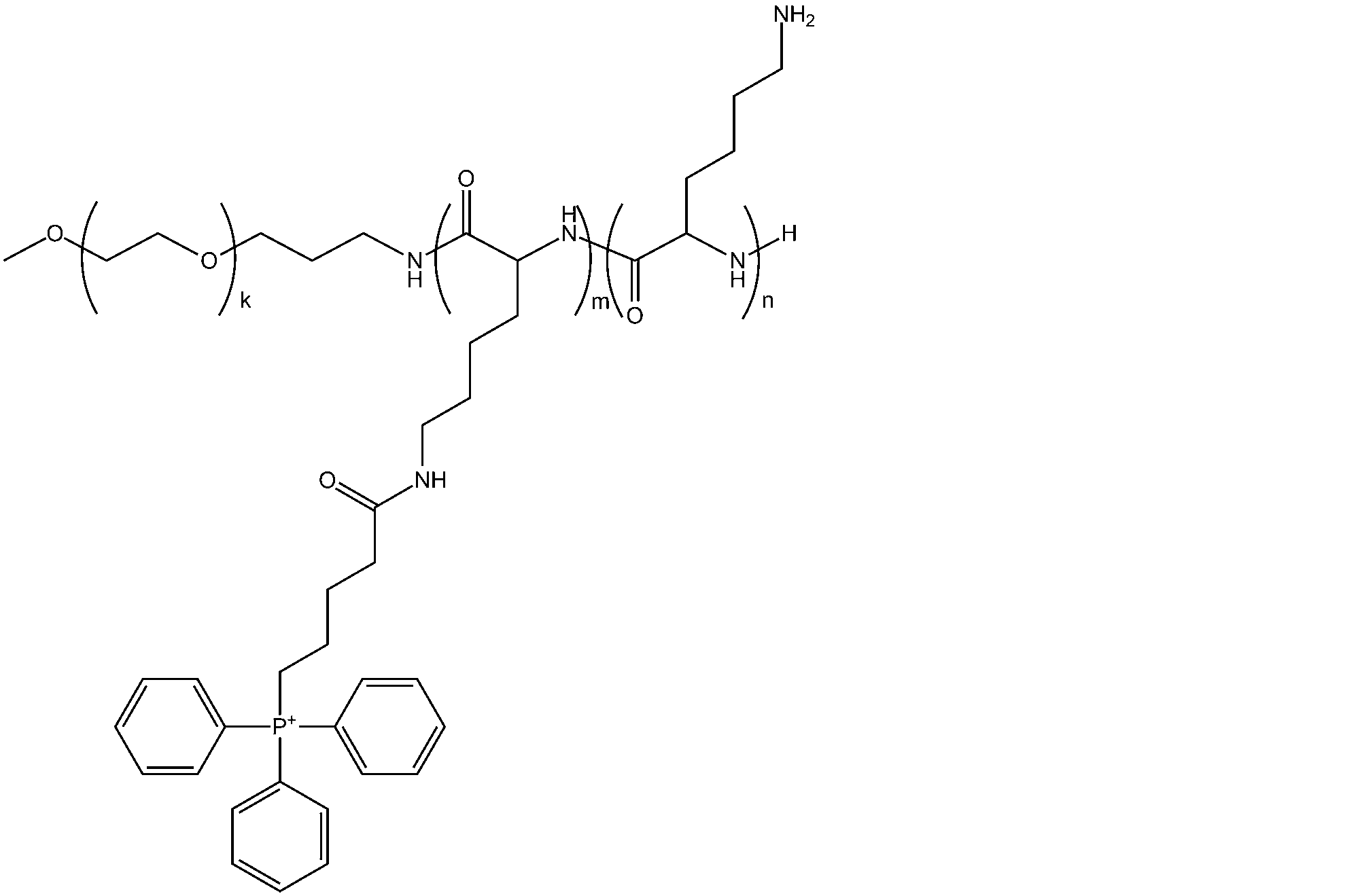
PEG-PLL側鎖へのtriphenylphosphonium(TPP)の導入は、上記PEG-PLL、4-(4,6-dimethoxy-1,3,5-triazin-2-yl)-4-methylmorpholinium chloride n-hydrate (DMT-MM, Wako Pure Chemical Industrial Ltd.,Osaka,Japan)、4-(Carboxybutyl)triphenylphosphonium Bromide (Tokyo Chemical Industry Co., Ltd.,Tokyo,Japan)を用いて行った。PEG-PLL(20mg)と、4-(Carboxybutyl)triphenylphosphonium Bromide(8.7mg,14.6mg,29.1mg,43.7mg)を50mM NaHCO3/MeOH(3ml/9ml)に溶解後、DMT-MM(90mg)を2時間ごとに計3回添加し、4℃下で終夜反応させた。反応後、蒸留水に対する透析(MWCO:6-8kDa)を行い、未反応物を除去した。透析後の溶液を凍結乾燥することで、白色粉末として、種々のTPP導入率のPEG-PLL(TPP)を得た。得られたPEG-PLL(TPP)の構造を下記に示す。式中、m+n=68であり、各アミノ酸残基はランダムに位置する。
PEG-PLL側鎖へのTPP導入率は、1H-NMRスペクトル[D2O at 80℃,δ=3.4-3.6ppm(4H:-CH2-CH2-O-),δ=7.6-8.0ppm(15H:Ph3P-)]から算出した。その結果、TPP導入率(m/(m+n)×100)は、26%、45%、75%、および97%であった。なお、PEG-PLL(TPP)に関して、TPP導入率は、カチオン性ポリアミノ酸の重合度に対するホスホニウム基含有アミノ酸残基数の割合に対応し得る。
[試験例3:mRNAの調製]
EGFP mRNAおよびFluc mRNAは、Trilink Biotechnologies(San Diego,CA,USA)より購入した。
GLuc mRNAについては、GLucのcoding sequenceと120bpのpoly A/Tが挿入されたpSP73 vector(Promega,Madison,WI,USA)をテンプレートとしてin vitro転写することにより調製した。In vitro転写にはmMESSAGE mMACHINE T7 Ultra Kit(Ambion,Invitrogen,Carlsbad,CA,USA)を使用し、mRNA精製にはRNeasy Mini Kit(Qiagen,Hilden,Germany)を使用した。
VEE-GFP mRNAは、T7-VEE-GFP plasmid(Addgene #58977,Watertown,MA)をin vitro転写することで調製した。
EGFP mRNAおよびFluc mRNAは、Trilink Biotechnologies(San Diego,CA,USA)より購入した。
GLuc mRNAについては、GLucのcoding sequenceと120bpのpoly A/Tが挿入されたpSP73 vector(Promega,Madison,WI,USA)をテンプレートとしてin vitro転写することにより調製した。In vitro転写にはmMESSAGE mMACHINE T7 Ultra Kit(Ambion,Invitrogen,Carlsbad,CA,USA)を使用し、mRNA精製にはRNeasy Mini Kit(Qiagen,Hilden,Germany)を使用した。
VEE-GFP mRNAは、T7-VEE-GFP plasmid(Addgene #58977,Watertown,MA)をin vitro転写することで調製した。
[試験例4:mRNA内包ミセルの調製]
塩基長の異なる3種のmRNA(EGFP mRNA、FLuc mRNA、またはVEE-GFP mRNA)とポリマー(PEG-PLLまたはPEG-PLL(TPP))をそれぞれ10mM HEPESバッファー(pH7.3)に溶解した。ポリマーのカチオン性官能基(C)とmRNAのリン酸基(P)とのモル比(C:P)が3:1となるように、ポリマー溶液(PEG-PLLまたはPEG-PLL(TPP))とmRNA溶液(50ng/μL)をボルテックス下で1:2のボリューム比で混合し、氷上で10分間静置した。これにより、mRNAを内包するミセル(mRNA内包ミセル)を得た。
得られたmRNA内包ミセルの粒子径および多分散度(PDI)を動的光散乱法(DLS)で測定した。DLS測定には、Zetasizer Nano ZS90(Malvern Instruments Ltd.,Worcestershire,UK)を使用し、25℃、90°の検出角度で測定した。結果を表1に示す。
塩基長の異なる3種のmRNA(EGFP mRNA、FLuc mRNA、またはVEE-GFP mRNA)とポリマー(PEG-PLLまたはPEG-PLL(TPP))をそれぞれ10mM HEPESバッファー(pH7.3)に溶解した。ポリマーのカチオン性官能基(C)とmRNAのリン酸基(P)とのモル比(C:P)が3:1となるように、ポリマー溶液(PEG-PLLまたはPEG-PLL(TPP))とmRNA溶液(50ng/μL)をボルテックス下で1:2のボリューム比で混合し、氷上で10分間静置した。これにより、mRNAを内包するミセル(mRNA内包ミセル)を得た。
得られたmRNA内包ミセルの粒子径および多分散度(PDI)を動的光散乱法(DLS)で測定した。DLS測定には、Zetasizer Nano ZS90(Malvern Instruments Ltd.,Worcestershire,UK)を使用し、25℃、90°の検出角度で測定した。結果を表1に示す。
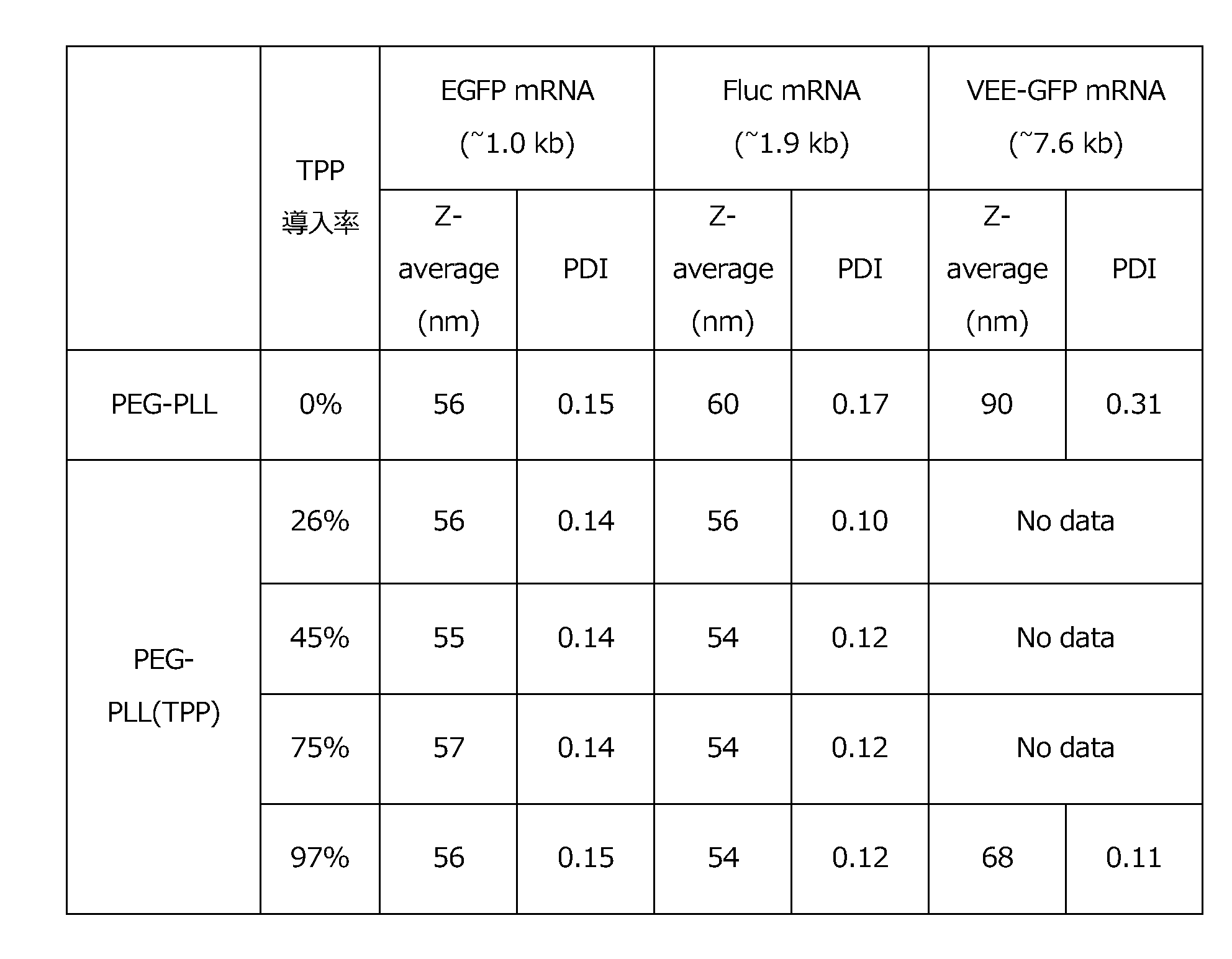
表1から、PEG-PLL(TPP)によれば、小サイズで粒子径分布の狭いmRNA内包PICミセルが得られることがわかる。また、PEG-PLLでは小サイズのミセル形成が困難とされている長鎖mRNAに対しても、PEG-PLL(TPP)によれば小サイズのミセル化が可能と考えられる。
[試験例5:mRNA内包ミセルコアの凝集度評価]
Label IT Tracker Intracellular Nucleic Acid Localization Kit(Mirus Bio LLC.,Madison,WI)によりFLuc mRNAをCy3/Cy5でダブル標識した。試験例4と同様にして、標識mRNA溶液とポリマー溶液(PEG-PLLまたはPEG-PLL(TPP))をボルテックス下で混合することで、mRNA内包ミセルを調製した。SPARK(Tecan Group Ltd.,Zurich,Switzerland)を用いて、520nmで励起した際の蛍光スペクトル(550-700nm)を測定した。mRNAの凝集度の指標として、Cy3/Cy5ペアによるFRET ratioを以下の計算式で算出した。得られたFRET ratioを図2に示す。
FRET ratio=Cy5(680nm)蛍光強度/(Cy3(570nm)蛍光強度+Cy5(680nm)蛍光強度)
Label IT Tracker Intracellular Nucleic Acid Localization Kit(Mirus Bio LLC.,Madison,WI)によりFLuc mRNAをCy3/Cy5でダブル標識した。試験例4と同様にして、標識mRNA溶液とポリマー溶液(PEG-PLLまたはPEG-PLL(TPP))をボルテックス下で混合することで、mRNA内包ミセルを調製した。SPARK(Tecan Group Ltd.,Zurich,Switzerland)を用いて、520nmで励起した際の蛍光スペクトル(550-700nm)を測定した。mRNAの凝集度の指標として、Cy3/Cy5ペアによるFRET ratioを以下の計算式で算出した。得られたFRET ratioを図2に示す。
FRET ratio=Cy5(680nm)蛍光強度/(Cy3(570nm)蛍光強度+Cy5(680nm)蛍光強度)
上記評価において、FRET ratioが高いことはミセルコアにおけるmRNAの凝集度が高いことを意味する。よって、図2によれば、TPPの導入により、mRNA内包ミセルのコア凝集度が増大していることがわかる。このような現象は、ポリマーとmRNAとの相互作用および/またはポリマー同士の相互作用が強化されたことに起因すると推測される。
[試験例6:mRNA内包ミセルのFBS耐性評価]
ウシ胎児血清(FBS)と共にインキュベーションされたmRNA内包ミセルからmRNAを抽出し、逆転写および定量PCRを行うことによりインタクトなmRNA量を定量して、mRNA内包ミセルのFBS耐性を評価した(n=3)。具体的には、以下のとおりである。
TPP導入率が26%、45%、75%、もしくは97%のPEG-PLL(TPP)またはPEG-PLLとEGFP mRNAとを用い、試験例4と同様の方法でmRNA内包ミセルを調製した。FBS(GE healthcare,Chicago,IL,USA)とダルベッコリン酸緩衝生理食塩水(D-PBS,Wako Pure Chemical Industrial Ltd.)で調製した50%FBS溶液中で、mRNA内包ミセル(最終mRNA濃度1.67ng/μL)を37℃下で15分間インキュベーションした。RNeasy Mini Preparation Kit(Qiagen,Hilden,Germany)を用いてmRNAを精製し、High Capacity RNA-to-cDNA Kit(Applied Biosystems,Foster City,CA,USA)により一本鎖cDNAへ逆転写した。Applied Biosystems 7500 Fast Real-Time PCR System(Applied Biosystems,Foster City,CA,USA)を用いて、定量PCRを実施した。PCRにはTaqMan assayを使用し、ターゲット(EGFP)に対して以下のprimerおよびprobeセットを用いた。定量PCRの結果から算出されたインタクトなmRNAの残存率(FBS含有D-PBS中でインキュベーションしなかったこと以外は同様の処理を行ったコントロールを基準とする残存率)を図3に示す。
・Forward:GAACCGCATCGAGCTGAA(配列番号:1)
・Reverse:TGCTTGTCGGCCATGATATAG(配列番号:2)
・Probe:ATCGACTTCAAGGAGGACGGCAAC(配列番号:3)
ウシ胎児血清(FBS)と共にインキュベーションされたmRNA内包ミセルからmRNAを抽出し、逆転写および定量PCRを行うことによりインタクトなmRNA量を定量して、mRNA内包ミセルのFBS耐性を評価した(n=3)。具体的には、以下のとおりである。
TPP導入率が26%、45%、75%、もしくは97%のPEG-PLL(TPP)またはPEG-PLLとEGFP mRNAとを用い、試験例4と同様の方法でmRNA内包ミセルを調製した。FBS(GE healthcare,Chicago,IL,USA)とダルベッコリン酸緩衝生理食塩水(D-PBS,Wako Pure Chemical Industrial Ltd.)で調製した50%FBS溶液中で、mRNA内包ミセル(最終mRNA濃度1.67ng/μL)を37℃下で15分間インキュベーションした。RNeasy Mini Preparation Kit(Qiagen,Hilden,Germany)を用いてmRNAを精製し、High Capacity RNA-to-cDNA Kit(Applied Biosystems,Foster City,CA,USA)により一本鎖cDNAへ逆転写した。Applied Biosystems 7500 Fast Real-Time PCR System(Applied Biosystems,Foster City,CA,USA)を用いて、定量PCRを実施した。PCRにはTaqMan assayを使用し、ターゲット(EGFP)に対して以下のprimerおよびprobeセットを用いた。定量PCRの結果から算出されたインタクトなmRNAの残存率(FBS含有D-PBS中でインキュベーションしなかったこと以外は同様の処理を行ったコントロールを基準とする残存率)を図3に示す。
・Forward:GAACCGCATCGAGCTGAA(配列番号:1)
・Reverse:TGCTTGTCGGCCATGATATAG(配列番号:2)
・Probe:ATCGACTTCAAGGAGGACGGCAAC(配列番号:3)
図3によれば、TPP導入率依存的にmRNA内包ミセルのFBS耐性が高くなることがわかる。
[試験例7:mRNA内包ミセルの細胞内タンパク質発現評価]
TPP導入率が26%、45%、75%、もしくは97%のPEG-PLL(TPP)またはPEG-PLLとGluc mRNAとを用い、試験例4と同様の方法で調製したmRNA内包ミセルの細胞内タンパク質発現をin vitroで評価した。具体的には、以下のとおりである。
10%FBSと1%ペニシリン/ストレプトマイシン(Sigma-Aldrich,St. Louis,MO,USA)を含有したRPMI-1640(Sigma-Aldrich)、またはダルベッコ改変イーグル培地(DMEM,Sigma-Aldrich)中でHuH-7細胞を培養した。96-well plateにHuH-7細胞を10000cells/wellで播種して2日間インキュベーション後、mRNA内包ミセルまたはFree mRNAを400ng mRNA/wellとなるように添加した。添加から24時間後および48時間後に培地を回収し、Renilla Luciferase Assay system(Promega)とGloMax 96 Microplate Luminometerで培地中の発光量を測定した。結果を図4に示す(図4中、左側のカラムがmRNA添加から24時間後の培地の発光量(RLU)であり、右側のカラムがmRNA添加から48時間後の培地の発光量(RLU)を示す)。
TPP導入率が26%、45%、75%、もしくは97%のPEG-PLL(TPP)またはPEG-PLLとGluc mRNAとを用い、試験例4と同様の方法で調製したmRNA内包ミセルの細胞内タンパク質発現をin vitroで評価した。具体的には、以下のとおりである。
10%FBSと1%ペニシリン/ストレプトマイシン(Sigma-Aldrich,St. Louis,MO,USA)を含有したRPMI-1640(Sigma-Aldrich)、またはダルベッコ改変イーグル培地(DMEM,Sigma-Aldrich)中でHuH-7細胞を培養した。96-well plateにHuH-7細胞を10000cells/wellで播種して2日間インキュベーション後、mRNA内包ミセルまたはFree mRNAを400ng mRNA/wellとなるように添加した。添加から24時間後および48時間後に培地を回収し、Renilla Luciferase Assay system(Promega)とGloMax 96 Microplate Luminometerで培地中の発光量を測定した。結果を図4に示す(図4中、左側のカラムがmRNA添加から24時間後の培地の発光量(RLU)であり、右側のカラムがmRNA添加から48時間後の培地の発光量(RLU)を示す)。
図4に示されるとおり、mRNA内包ミセルはmRNA単体(Free mRNA)よりも高いタンパク質発現を示し、mRNA内包ミセルに関しては、TPP導入率依存的にタンパク質発現量が増加した。
[試験例8:mRNA内包ミセルの血中滞留性評価]
TPP導入率が97%のPEG-PLL(TPP)またはPEG-PLLとFluc mRNAとを用い、試験例4と同様の方法で調製したmRNA内包ミセルをマウスにiv投与し、その血中滞留性を評価した(n=4)。具体的には、以下のとおりである。
150mM NaClを含有する10mM HEPES溶液に溶解したmRNA内包ミセルをBALB/cマウス(雌,7週齢,Charles River Laboratories Japan Inc.,Kanagawa,Japan)に静脈内投与した(20μg mRNA/mouse)。投与して5、10、15、30、または60分後に尾静脈から血液2μLを採取し、1% 2-メルカプトエタノールを含有するRLT buffer(Qiagen,Hilden,Germany)に添加した。RNeasy Mini Preparation Kit(Qiagen)を用いてRNAを精製し、High Capacity RNA-to-cDNA Kit(Applied Biosystems,Foster City,CA,USA)により一本鎖cDNAへ逆転写した。Applied Biosystems 7500 Fast Real-Time PCR System(Applied Biosystems,Foster City,CA,USA)を用いて、定量PCRを実施した。結果を図5に示す。
TPP導入率が97%のPEG-PLL(TPP)またはPEG-PLLとFluc mRNAとを用い、試験例4と同様の方法で調製したmRNA内包ミセルをマウスにiv投与し、その血中滞留性を評価した(n=4)。具体的には、以下のとおりである。
150mM NaClを含有する10mM HEPES溶液に溶解したmRNA内包ミセルをBALB/cマウス(雌,7週齢,Charles River Laboratories Japan Inc.,Kanagawa,Japan)に静脈内投与した(20μg mRNA/mouse)。投与して5、10、15、30、または60分後に尾静脈から血液2μLを採取し、1% 2-メルカプトエタノールを含有するRLT buffer(Qiagen,Hilden,Germany)に添加した。RNeasy Mini Preparation Kit(Qiagen)を用いてRNAを精製し、High Capacity RNA-to-cDNA Kit(Applied Biosystems,Foster City,CA,USA)により一本鎖cDNAへ逆転写した。Applied Biosystems 7500 Fast Real-Time PCR System(Applied Biosystems,Foster City,CA,USA)を用いて、定量PCRを実施した。結果を図5に示す。
図5に示されるとおり、PEG-PLL(TPP)を用いて調製したmRNA内包ミセルは、PEG-PLLを用いて調製したmRNA内包ミセルに比べて有意に高い血中滞留性を示した。
[試験例9:ASO内包ミセル調製]
アンチセンス核酸(ASO)として、GeneDesign, Inc.(Osaka,Japan)で受託合成された以下のものを使用した。
Alexa647-mouse MALAT1 ASO (5′-GGGTCAGCTGCCAATGCTAG-3′) (配列番号:4)
(下線部分はLocked nucleic acid(LNA),3’末端にAlexa647修飾)
ASOとポリマー(PEG-PLLまたはTPP導入率が97%のPEG-PLL(TPP))をそれぞれ10mM HEPESバッファー(pH7.3)に溶解した。ポリマーのカチオン性官能基とASOのリン酸基とのモル比(C:P)が3:1となるように、ポリマー溶液(PEG-PLLまたはPEG-PLL(TPP))とASO溶液(50ng/μL)とをボルテックス下で1:2のボリューム比で混合し、10分間静置した。これにより、ASOを内包するミセル(ASO内包ミセル)を得た。
得られたASO内包ミセルの粒子径および多分散度(PDI)を動的光散乱法(DLS)で測定した。DLS測定には、Zetasizer Nano ZS (Malvern Instruments Ltd.,Worcestershire,UK)を使用し、25℃、173°の検出角度で測定した。結果を表2に示す。
アンチセンス核酸(ASO)として、GeneDesign, Inc.(Osaka,Japan)で受託合成された以下のものを使用した。
Alexa647-mouse MALAT1 ASO (5′-GGGTCAGCTGCCAATGCTAG-3′) (配列番号:4)
(下線部分はLocked nucleic acid(LNA),3’末端にAlexa647修飾)
ASOとポリマー(PEG-PLLまたはTPP導入率が97%のPEG-PLL(TPP))をそれぞれ10mM HEPESバッファー(pH7.3)に溶解した。ポリマーのカチオン性官能基とASOのリン酸基とのモル比(C:P)が3:1となるように、ポリマー溶液(PEG-PLLまたはPEG-PLL(TPP))とASO溶液(50ng/μL)とをボルテックス下で1:2のボリューム比で混合し、10分間静置した。これにより、ASOを内包するミセル(ASO内包ミセル)を得た。
得られたASO内包ミセルの粒子径および多分散度(PDI)を動的光散乱法(DLS)で測定した。DLS測定には、Zetasizer Nano ZS (Malvern Instruments Ltd.,Worcestershire,UK)を使用し、25℃、173°の検出角度で測定した。結果を表2に示す。

表2から、PEG-PLLおよびPEG-PLL(TPP)のいずれを用いた場合であっても、小サイズで粒子径分布の狭いPICミセルが得られることがわかる。また、PEG-PLL(TPP)によれば、PEG-PLLに比べてより小サイズで粒子径分布の狭いPICミセルが得られることがわかる。
[試験例10:ASO内包ミセルの安定性評価1]
試験例9で調製したASO内包ミセルの高塩濃度下での安定性を次のようにして評価した。
0Mまたは2M NaClを含有した10mM HEPES(pH7.3)にASO内包ミセルを最終ASO濃度34.8ng/μLとなるように添加し、15分間37℃下でインキュベートした。その後、DLSによりASO内包ミセルの粒子径分布を測定した。結果を図6に示す。
試験例9で調製したASO内包ミセルの高塩濃度下での安定性を次のようにして評価した。
0Mまたは2M NaClを含有した10mM HEPES(pH7.3)にASO内包ミセルを最終ASO濃度34.8ng/μLとなるように添加し、15分間37℃下でインキュベートした。その後、DLSによりASO内包ミセルの粒子径分布を測定した。結果を図6に示す。
図6に示されるとおり、静電相互作用が抑制される高イオン強度下において、PEG-PLLを用いて調製されたASO内包ミセルではミセル構造が崩壊したのに対し、PEG-PLL(TPP)を用いて調製されたASO内包ミセルではミセル構造が維持された。
[試験例11:ASO内包ミセルの安定性評価2]
試験例9で調製したASO内包ミセルのポリアニオン耐性を次のようにして評価した。
ASO内包ミセルを分子量5000のデキストラン硫酸塩(Wako Pure Chemical Industrial Ltd.,Osaka,Japan)とS/P比([デキストラン硫酸塩の硫酸基モル濃度]/[ASOのリン酸基モル濃度])が2となるように混合し(最終ASO濃度は34.8ng/μL)、15分間37℃下でインキュベートした。その後、DLSによりASO内包ミセルの粒子径分布を測定した。結果をデキストラン硫酸塩非存在下で同様にインキュベートしたサンプルの測定結果と併せて図7に示す。
試験例9で調製したASO内包ミセルのポリアニオン耐性を次のようにして評価した。
ASO内包ミセルを分子量5000のデキストラン硫酸塩(Wako Pure Chemical Industrial Ltd.,Osaka,Japan)とS/P比([デキストラン硫酸塩の硫酸基モル濃度]/[ASOのリン酸基モル濃度])が2となるように混合し(最終ASO濃度は34.8ng/μL)、15分間37℃下でインキュベートした。その後、DLSによりASO内包ミセルの粒子径分布を測定した。結果をデキストラン硫酸塩非存在下で同様にインキュベートしたサンプルの測定結果と併せて図7に示す。
図7に示されるとおり、高濃度のポリアニオン存在下において、PEG-PLLを用いて調製されたASO内包ミセルではミセル構造が崩壊したのに対し、PEG-PLL(TPP)を用いて調製されたASO内包ミセルではミセル構造が維持された。生体内には様々なポリアニオンが存在し、PICの安定性に影響し得るところ、PEG-PLL(TPP)を用いて調製されたPICミセルは生体内でのポリアニオン耐性に優れると考えられる。
[試験例12:PEG-PLL(TPP)ポリマーへのcRGD修飾]
Azide-PEG-poly(L-lysine)(以下、「N3-PEG-PLL」と称する)側鎖へtriphenylphosphonium(TPP)導入を行った。反応は、N3-PEG-PLL(PEG分子量12-kDa,lysine重合度70)、4-(4,6-dimethoxy-1,3,5-triazin-2-yl)-4-methylmorpholinium chloride n-hydrate(DMT-MM,Wako Pure Chemical Industrial Ltd.,Osaka,Japan)、4-(Carboxybutyl)triphenylphosphonium Bromide(Tokyo Chemical Industry Co., Ltd.,Tokyo,Japan)を用いて行った。N3-PEG-PLL(20mg)と、4-(Carboxybutyl)triphenylphosphonium Bromide(43.7mg)を50mM NaHCO3/MeOH(3ml/9ml)に溶解後、DMT-MM(90mg)を2時間ごとに計3回添加し、4℃下で終夜反応させた。反応後、蒸留水に対する透析(MWCO:6-8kDa)を行い、未反応物を除去した。透析後の溶液を凍結乾燥することで、白色粉末のN3-PEG-PLL(TPP)を得た。得られたN3-PEG-PLL(TPP)におけるTPP導入率は、90%であった。
次に、cRGD-PEG4-DBCOの合成を行った。6mgのCyclo RGDfK(ChemScene,Monmouth Junction,NJ,USA)と1.3mgのDBCO-PEG4-NHS(Broadpharm,San Diego,CA,USA)をDMSO1.5mL中で混合し、室温で終夜反応させた。その後、蒸留水6mLを添加し、24時間反応させた。
最後に、上記のようにして得られたcRGD-PEG4-DBCO溶液(4mL)にN3-PEG-PLL(TPP)(20mg)とDMSO(2.4mL)を添加し、室温で終夜反応させた。反応後、蒸留水に対する透析(MWCO:6-8kDa)を行い、未反応物を除去した。透析後の溶液を凍結乾燥することで、白色粉末のcRGD-PEG-PLL(TPP)を得た。
Azide-PEG-poly(L-lysine)(以下、「N3-PEG-PLL」と称する)側鎖へtriphenylphosphonium(TPP)導入を行った。反応は、N3-PEG-PLL(PEG分子量12-kDa,lysine重合度70)、4-(4,6-dimethoxy-1,3,5-triazin-2-yl)-4-methylmorpholinium chloride n-hydrate(DMT-MM,Wako Pure Chemical Industrial Ltd.,Osaka,Japan)、4-(Carboxybutyl)triphenylphosphonium Bromide(Tokyo Chemical Industry Co., Ltd.,Tokyo,Japan)を用いて行った。N3-PEG-PLL(20mg)と、4-(Carboxybutyl)triphenylphosphonium Bromide(43.7mg)を50mM NaHCO3/MeOH(3ml/9ml)に溶解後、DMT-MM(90mg)を2時間ごとに計3回添加し、4℃下で終夜反応させた。反応後、蒸留水に対する透析(MWCO:6-8kDa)を行い、未反応物を除去した。透析後の溶液を凍結乾燥することで、白色粉末のN3-PEG-PLL(TPP)を得た。得られたN3-PEG-PLL(TPP)におけるTPP導入率は、90%であった。
次に、cRGD-PEG4-DBCOの合成を行った。6mgのCyclo RGDfK(ChemScene,Monmouth Junction,NJ,USA)と1.3mgのDBCO-PEG4-NHS(Broadpharm,San Diego,CA,USA)をDMSO1.5mL中で混合し、室温で終夜反応させた。その後、蒸留水6mLを添加し、24時間反応させた。
最後に、上記のようにして得られたcRGD-PEG4-DBCO溶液(4mL)にN3-PEG-PLL(TPP)(20mg)とDMSO(2.4mL)を添加し、室温で終夜反応させた。反応後、蒸留水に対する透析(MWCO:6-8kDa)を行い、未反応物を除去した。透析後の溶液を凍結乾燥することで、白色粉末のcRGD-PEG-PLL(TPP)を得た。
[試験例13:cRGD修飾mRNA内包ミセル調製]
FLuc mRNAとポリマー(cRGD-PEG-PLL(TPP),PEG-PLL(TPP),いずれもTPP導入率は90%であり、以下の試験例14~17においても同様である)をそれぞれ10mM HEPESバッファー(pH7.3)に溶解した。ポリマーについては、cRGD-PEG-PLL(TPP)とPEG-PLL(TPP)のモル比がそれぞれ0:100,10:90,25:75,50:50,100:0となるように混合溶液を調製した。ポリマー混合溶液のカチオン性官能基とmRNAのリン酸基のモル比が3:1となるように、ポリマー混合溶液(cRGD-PEG-PLL(TPP)/PEG-PLL(TPP))とmRNA溶液(50ng/μL)をボルテックス下で1:2のボリューム比で混合し、氷上で10分間静置した。得られたcRGD修飾mRNA内包ミセル(cRGD修飾率([cRGD-PEG-PLL(TPP)]/([cRGD-PEG-PLL(TPP)]+[PEG-PLL(TPP)])×100):0,10,25,50,100%)の粒子径および多分散度(PDI)を動的光散乱法(DLS)で測定した。DLS測定には、Zetasizer Nano ZS90(Malvern Instruments Ltd.,Worcestershire,UK)を使用し、25℃、90°の検出角度で測定した。結果を表3に示す。
FLuc mRNAとポリマー(cRGD-PEG-PLL(TPP),PEG-PLL(TPP),いずれもTPP導入率は90%であり、以下の試験例14~17においても同様である)をそれぞれ10mM HEPESバッファー(pH7.3)に溶解した。ポリマーについては、cRGD-PEG-PLL(TPP)とPEG-PLL(TPP)のモル比がそれぞれ0:100,10:90,25:75,50:50,100:0となるように混合溶液を調製した。ポリマー混合溶液のカチオン性官能基とmRNAのリン酸基のモル比が3:1となるように、ポリマー混合溶液(cRGD-PEG-PLL(TPP)/PEG-PLL(TPP))とmRNA溶液(50ng/μL)をボルテックス下で1:2のボリューム比で混合し、氷上で10分間静置した。得られたcRGD修飾mRNA内包ミセル(cRGD修飾率([cRGD-PEG-PLL(TPP)]/([cRGD-PEG-PLL(TPP)]+[PEG-PLL(TPP)])×100):0,10,25,50,100%)の粒子径および多分散度(PDI)を動的光散乱法(DLS)で測定した。DLS測定には、Zetasizer Nano ZS90(Malvern Instruments Ltd.,Worcestershire,UK)を使用し、25℃、90°の検出角度で測定した。結果を表3に示す。

表3からcRGD修飾カチオン性ブロックコポリマーを用いてミセルを形成できることがわかる。また、cRGD修飾率の上昇(例えば、cRGD修飾率>50%)に伴って、PDIが増大する傾向がみられた。
[試験例14:cRGD修飾mRNA内包ミセルの細胞取り込み評価]
Label IT Tracker Intracellular Nucleic Acid Localization Kit(Mirus Bio LLC.,Madison,WI)によりFLuc mRNAをCy5標識した。上記の方法と同様に、Cy5標識mRNA溶液とポリマー混合溶液(cRGD-PEG-PLL(TPP)/PEG-PLL(TPP))をボルテックス下で混合することで、Cy5標識mRNA内包ミセル(cRGD修飾率:0,10,25,50%)を調製した。
細胞としては、cRGDの標的であるintegrinαvβ3陽性であるU87細胞を用いた。U87細胞の培養は、10%FBSと1%penicillin/streptomycin(Sigma-Aldrich,St.Louis,MO,USA)を含有したDulbecco’s modified Eagle’s medium(DMEM,Sigma-Aldrich)中で行った。8wellのcover glass chamber(IWAKI AGC Techno Glass Co.Ltd.,Shizuoka,Japan)にU87細胞を播種し、24時間インキュベーション後にCy5標識mRNA内包ミセル(cRGD修飾率:0,10,25,50%)を300ng mRNA/wellとなるように添加した。3時間後に培地を除去しPBSで3回wash後、Hoechst 33342(Dojindo Laboratories,Kumamoto,Japan)で細胞核を染色した。細胞の観察はLeica DMi8(Leica Microsystems)を用いて行い、画像の定量解析はImageJソフトウェアを用いた。蛍光観察画像を図8に示し、蛍光強度の解析結果を図9に示す。
Label IT Tracker Intracellular Nucleic Acid Localization Kit(Mirus Bio LLC.,Madison,WI)によりFLuc mRNAをCy5標識した。上記の方法と同様に、Cy5標識mRNA溶液とポリマー混合溶液(cRGD-PEG-PLL(TPP)/PEG-PLL(TPP))をボルテックス下で混合することで、Cy5標識mRNA内包ミセル(cRGD修飾率:0,10,25,50%)を調製した。
細胞としては、cRGDの標的であるintegrinαvβ3陽性であるU87細胞を用いた。U87細胞の培養は、10%FBSと1%penicillin/streptomycin(Sigma-Aldrich,St.Louis,MO,USA)を含有したDulbecco’s modified Eagle’s medium(DMEM,Sigma-Aldrich)中で行った。8wellのcover glass chamber(IWAKI AGC Techno Glass Co.Ltd.,Shizuoka,Japan)にU87細胞を播種し、24時間インキュベーション後にCy5標識mRNA内包ミセル(cRGD修飾率:0,10,25,50%)を300ng mRNA/wellとなるように添加した。3時間後に培地を除去しPBSで3回wash後、Hoechst 33342(Dojindo Laboratories,Kumamoto,Japan)で細胞核を染色した。細胞の観察はLeica DMi8(Leica Microsystems)を用いて行い、画像の定量解析はImageJソフトウェアを用いた。蛍光観察画像を図8に示し、蛍光強度の解析結果を図9に示す。
図8および図9に示されるとおり、cRGD修飾mRNA内包ミセル(cRGD修飾率:10%、25%、50%)を用いると、非cRGD修飾mRNA内包ミセル(cRGD修飾率:0%)を用いた場合よりも細胞取り込みが増加した。また、cRGD修飾率が10%および25%のmRNA内包ミセルは、cRGD修飾率が50%のmRNA内包ミセルよりも細胞取り込みが増加していた。cRGD修飾mRNA内包ミセルの安定性は、cRGD修飾率が増大すると低下し得る(例えば、50%FBS中におけるcRGD修飾mRNA内包ミセルの安定性は、0%>10%>25%>50%(cRGD修飾率)である)ことから、上記結果は、cRGD修飾による取り込み増加およびcRGD修飾率の増大によるミセルの安定性の低下の影響を示すと考えられる。
[試験例15:cRGD修飾mRNA内包ミセルの細胞内タンパク質発現評価]
96-well plateにU87細胞を播種(15000cells/well)し、24時間インキュベーション後に試験例13で調製したcRGD修飾mRNA内包ミセル(cRGD修飾率:0,10%)を267ng mRNA/wellとなるように添加した。添加して24時間後に培地を除去し、Cell Culture Lysis Reagent(Promega, Madison,WI,USA)で細胞を溶解した。細胞溶解液中のFLuc発光量をLuciferase Assay System (Promega)とGloMax 96 Microplate Luminometer(Promega)で測定した。結果を図10に示す(n=5,mean±s.e.m)。
96-well plateにU87細胞を播種(15000cells/well)し、24時間インキュベーション後に試験例13で調製したcRGD修飾mRNA内包ミセル(cRGD修飾率:0,10%)を267ng mRNA/wellとなるように添加した。添加して24時間後に培地を除去し、Cell Culture Lysis Reagent(Promega, Madison,WI,USA)で細胞を溶解した。細胞溶解液中のFLuc発光量をLuciferase Assay System (Promega)とGloMax 96 Microplate Luminometer(Promega)で測定した。結果を図10に示す(n=5,mean±s.e.m)。
図10に示されるとおり、cRGD修飾率10%のmRNA内包ミセルは、cRGD修飾率0%のmRNA内包ミセルよりも高いFluc発現を示した。
[試験例16:mRNA内包ミセルの血中滞留性評価]
試験例13で調製したcRGD修飾FLuc mRNA内包ミセル(cRGD修飾率:10%)を150mM NaClを含有する10mM HEPES溶液に溶解し、BALB/cマウス(female,7weeks old;Charles River Laboratories Japan Inc.,Kanagawa,Japan)に静脈内投与した(20μg mRNA/mouse)。投与して5、10、15、30、60分後に尾静脈から血液2μLを採取し、1% 2-mercaptoethanolを含有するRLT buffer(Qiagen,Hilden,Germany)に添加した。RNeasy Mini Preparation Kit(Qiagen)を用いてRNAを精製し、High Capacity RNA-to-cDNA Kit(Applied Biosystems,Foster City,CA,USA)により一本鎖cDNAへ逆転写した。Applied Biosystems 7500 Fast Real-Time PCR System(Applied Biosystems,Foster City,CA,USA)を用いて、定量PCRを実施した。結果を、試験例8におけるTPP導入率97%のPEG-PLL(TPP)またはPEG-PLLを用いて形成したmRNA内包ミセルの血中滞留性評価と併せて図11に示す。
試験例13で調製したcRGD修飾FLuc mRNA内包ミセル(cRGD修飾率:10%)を150mM NaClを含有する10mM HEPES溶液に溶解し、BALB/cマウス(female,7weeks old;Charles River Laboratories Japan Inc.,Kanagawa,Japan)に静脈内投与した(20μg mRNA/mouse)。投与して5、10、15、30、60分後に尾静脈から血液2μLを採取し、1% 2-mercaptoethanolを含有するRLT buffer(Qiagen,Hilden,Germany)に添加した。RNeasy Mini Preparation Kit(Qiagen)を用いてRNAを精製し、High Capacity RNA-to-cDNA Kit(Applied Biosystems,Foster City,CA,USA)により一本鎖cDNAへ逆転写した。Applied Biosystems 7500 Fast Real-Time PCR System(Applied Biosystems,Foster City,CA,USA)を用いて、定量PCRを実施した。結果を、試験例8におけるTPP導入率97%のPEG-PLL(TPP)またはPEG-PLLを用いて形成したmRNA内包ミセルの血中滞留性評価と併せて図11に示す。
図11に示されるとおり、側鎖にTPPを有するカチオン性ブロックコポリマー(PEG-PLL(TPP)、cRGD-PEG-PLL(TPP))を用いて形成されたcRGD修飾mRNA内包ミセル(図中、「C」で示される)および非cRGD修飾mRNA内包ミセル(図中、「B」で示される)は、PEG-PLLを用いて形成されたmRNA内包ミセル(図中、「A」で示される)よりも血中滞留性が顕著に向上されている。一方、cRGD修飾mRNA内包ミセルは非cRGD修飾mRNA内包ミセルよりも血中滞留性がわずかに劣っている。これは、cRGD修飾によるミセルの素早い組織移行、cRGD修飾によるミセルの安定性低下等の影響と考えられる。
[試験例17:mRNA内包ミセルのin vivo発現評価]
BALB/c-nudeマウス(female,7weeks old;Charles River Laboratories Japan Inc., Kanagawa, Japan)にU87細胞(5×10⁶cells/mouse)を皮下移植した。3-4週間後、担癌マウス(腫瘍サイズ:400mm3程度)にFluc mRNA内包ミセルを静脈内投与した(20μg mRNA/mouse)。Fluc mRNA内包ミセルとしては、TPP導入率が97%であるPEG-PLL(97%TPP)によって形成したFLuc mRNA内包ミセル(cRGD修飾率:0%)およびPEG-PLLで形成したFluc mRNA内包ミセル(cRGD修飾率:0%)を用いた。投与して24時間後に腫瘍を採材した。腫瘍の重量に対し4等量のCell Culture Lysis Reagent (Promega,Madison,WI,USA)を添加し、ビーズ破砕することで、腫瘍溶解物(lysate)を得た。腫瘍溶解物中のFLuc発光量をLuciferase Assay System(Promega)とGloMax 96 Microplate Luminometer(Promega)で測定した。結果を図12に示す。
BALB/c-nudeマウス(female,7weeks old;Charles River Laboratories Japan Inc., Kanagawa, Japan)にU87細胞(5×10⁶cells/mouse)を皮下移植した。3-4週間後、担癌マウス(腫瘍サイズ:400mm3程度)にFluc mRNA内包ミセルを静脈内投与した(20μg mRNA/mouse)。Fluc mRNA内包ミセルとしては、TPP導入率が97%であるPEG-PLL(97%TPP)によって形成したFLuc mRNA内包ミセル(cRGD修飾率:0%)およびPEG-PLLで形成したFluc mRNA内包ミセル(cRGD修飾率:0%)を用いた。投与して24時間後に腫瘍を採材した。腫瘍の重量に対し4等量のCell Culture Lysis Reagent (Promega,Madison,WI,USA)を添加し、ビーズ破砕することで、腫瘍溶解物(lysate)を得た。腫瘍溶解物中のFLuc発光量をLuciferase Assay System(Promega)とGloMax 96 Microplate Luminometer(Promega)で測定した。結果を図12に示す。
図12に示されるとおり、PEG-PLL(97%TPP)によって形成したFLuc mRNA内包ミセルによれば、PEG-PLLで形成したFluc mRNA内包ミセルよりも高い腫瘍中でのFluc発現が得られた。
[試験例18:mRNA内包ミセルの安定性評価]
mRNA内包ミセルのポリアニオン耐性を次のようにして評価した。
Cy3/Cy5でダブル標識したFluc mRNAとTPP導入率が異なる種々のPEG-PLL(TPP)またはPEG-PLLとを用いてmRNA内包ミセルを調製した。Cy3/Cy5標識mRNAが近接した状態(例えばミセルに内包された状態)で起きるFRETを指標に、ミセルからのmRNA放出の有無を評価した。平均分子量5kDaのデキストラン硫酸ナトリウム(DSS)をポリアニオンのモデルとして、mRNA内包ミセル溶液に添加した(最終mRNA濃度:1.67ng/μL)。この際、mRNAのリン酸基に対し、DSS由来の硫酸イオンが0、1、2、または3等量のモル比となるようにDSSを添加した。37度下で15分間インキュベーション後、SPARK(Tecan Group Ltd.,Zurich,Switzerland)を用いて、520nmで励起した際のCy3とCy5の蛍光強度(それぞれ570,680nm)を測定した。その後、以下の計算式でFRET ratioを算出した。結果を図13に示す。
FRET ratio=[Cy5(680nm)蛍光強度]/[Cy3(570nm)蛍光強度+Cy5(680nm)蛍光強度]
mRNA内包ミセルのポリアニオン耐性を次のようにして評価した。
Cy3/Cy5でダブル標識したFluc mRNAとTPP導入率が異なる種々のPEG-PLL(TPP)またはPEG-PLLとを用いてmRNA内包ミセルを調製した。Cy3/Cy5標識mRNAが近接した状態(例えばミセルに内包された状態)で起きるFRETを指標に、ミセルからのmRNA放出の有無を評価した。平均分子量5kDaのデキストラン硫酸ナトリウム(DSS)をポリアニオンのモデルとして、mRNA内包ミセル溶液に添加した(最終mRNA濃度:1.67ng/μL)。この際、mRNAのリン酸基に対し、DSS由来の硫酸イオンが0、1、2、または3等量のモル比となるようにDSSを添加した。37度下で15分間インキュベーション後、SPARK(Tecan Group Ltd.,Zurich,Switzerland)を用いて、520nmで励起した際のCy3とCy5の蛍光強度(それぞれ570,680nm)を測定した。その後、以下の計算式でFRET ratioを算出した。結果を図13に示す。
FRET ratio=[Cy5(680nm)蛍光強度]/[Cy3(570nm)蛍光強度+Cy5(680nm)蛍光強度]
図13に示されるとおり、PEG-PLL(TPP)を用いて調製されたmRNA内包ミセルは、PEG-PLLを用いて調製されたmRNA内包ミセルよりもポリアニオンに対して高い耐性を示した。
[試験例19:PEG-PAsp(DET(TPP))ポリマーの合成]
PEG-b-poly{N-[N-(2-aminoethyl)-2-aminoethyl]aspartamide}(PEG-PAsp(DET))、4-(4,6-dimethoxy-1,3,5-triazin-2-yl)-4-methylmorpholinium chloride n-hydrate(DMT-MM,Wako Pure Chemical Industrial Ltd.,Osaka,Japan)、4-(Carboxybutyl)triphenylphosphonium Bromide(Tokyo Chemical Industry Co., Ltd.,Tokyo,Japan)を用いて、下記スキームでPEG-PAsp(DET)の側鎖にtriphenylphosphonium(TPP)を導入した。PEG-PAsp(DET)を構成するPEGの質量は12kDaであり、PAsp(DET)重合度は68であった。
具体的には、PEG-PAsp(DET)(20mg)と、4-(Carboxybutyl)triphenylphosphonium Bromide(側鎖第1級アミンに対し2等量mol)とを、50mM NaHCO3/MeOH(3ml/9ml)に溶解後、DMT-MM(90mg)を2時間ごとに計3回添加し、4℃下で6時間反応させた。反応後、蒸留水とメタノールに対する透析(MWCO:12-14kDa)を行い、未反応物を除去した。7日後に溶液を凍結乾燥することで、白色粉末のPEG-PAsp(DET(TPP))を得た。
側鎖へのTPP導入率は1H-NMRスペクトル[D2O at 80℃,δ=3.4-3.6ppm(4H:-CH2-CH2-O-),δ=7.6-8.0ppm(15H:Ph3P-)]から算出し、側鎖導入率が100%であることを確認した。
PEG-b-poly{N-[N-(2-aminoethyl)-2-aminoethyl]aspartamide}(PEG-PAsp(DET))、4-(4,6-dimethoxy-1,3,5-triazin-2-yl)-4-methylmorpholinium chloride n-hydrate(DMT-MM,Wako Pure Chemical Industrial Ltd.,Osaka,Japan)、4-(Carboxybutyl)triphenylphosphonium Bromide(Tokyo Chemical Industry Co., Ltd.,Tokyo,Japan)を用いて、下記スキームでPEG-PAsp(DET)の側鎖にtriphenylphosphonium(TPP)を導入した。PEG-PAsp(DET)を構成するPEGの質量は12kDaであり、PAsp(DET)重合度は68であった。
側鎖へのTPP導入率は1H-NMRスペクトル[D2O at 80℃,δ=3.4-3.6ppm(4H:-CH2-CH2-O-),δ=7.6-8.0ppm(15H:Ph3P-)]から算出し、側鎖導入率が100%であることを確認した。
HCl溶液中の各ポリマー(PEG-PLL、PEG-PLL(TPP)、およびPEG-PAsp(DET(TPP)))にNaOH溶液を添加して滴定実験を行うことにより、種々のpHにおけるイオン化性を評価した。各ポリマーのPEGの質量は12kDaであり、ポリアミノ酸セグメントの重合度は68であり、PEG-PLL(TPP)およびPAsp(DET(TPP))におけるTPPの側鎖導入率は100%であった。結果を図14に示す。
図14に示されるとおり、PEG-PLLおよびPEG-PLL(TPP)はいずれもpH>7で屈曲点を示し、PEG-PLL(TPP)の方がより明らかな屈曲点を示した。このことから、ポリマー側鎖における一級アミンはアルカリ性pHで緩衝効果を発揮することができ、TPPの導入によって当該緩衝能が変化し得ると推測される。また、PEG-PAsp(DET(TPP))の滴定曲線は、酸性pHで変曲点を示し、推定pKa値は5.919であった。このことから、PEG-PAsp(DET(TPP))の側鎖における第二級アミンは、酸性pHでの緩衝能に寄与し得ると推測される。エンドソームのpHは成熟中に約7から約5.5に変化することから、このようなpH範囲内のpKa値を有するポリマーは、イオン化によってエンドソームからの脱出を促進し得ると推測される。
上記と同様のポリマー(PEG-PLL、PEG-PLL(TPP)、またはPEG-PAsp(DET(TPP)))に関して、エンドソーム脱出能を評価した。具体的には、各ポリマーとLabel IT Cy5 Labeling Kit(Mirus Bio LLC., Madison,WI)を用いて調製したCy5標識mRNAとを用いて、上記と同様にしてCy5標識mRNA内包ミセルを調製した。B16F10細胞を8ウェルチャンバー(IWAKI AGC Techno Glass Co. Ltd.,Shizuoka,Japan)に12500cells/ウェルとなるように播種し、10%FBSおよび1%ペニシリン/ストレプトマイシン含有RPMI-1640を用いて5%CO2下で37°Cで24時間インキュベートした。次いで、Cy5標識mRNA内包ミセルを300ngFluc mRNA/ウェルとなるように各ウェルに添加し、4時間インキュベートした。その後、細胞をD-PBSで3回洗浄した。細胞核およびリソソームを、それぞれHoechst 33342(Dojindo Laboratories,Kumamoto,Japan)およびLysoTrackerTM Green DND-26(Thermo Fisher Scientific,Waltham,MA,USA)で染色した。染色した細胞は、LSM 880(Carl Zeiss, Germany)を用いて観察した。励起波長は、Hoechst 33342で405nm、LysoTrackerで488nm、Cy5で633nmであった。観察画像を図15に示すとともに(図中、青:核(Hoechst 33342)、緑:後期エンド/リソソーム(LysoTracker)、赤:Cy5標識mRNA)、観察画像におけるCy5由来の蛍光強度を図16(a)に示す(図のデータは、15個の細胞についての平均±S.D.を示す)。また、mRNAとリソソームの共局在を評価するために、ImageJソフトウェアを使用して各細胞に関してピアソンの係数値(Pearson’s coefficient value)を計算した。結果を図16(b)に示す(図のデータは、20個の細胞についての平均±s.e.mを示す)。有意差検定は、one-way ANOVAおよびBonferroni事後検定によって行った。
図15に示されるとおり、PEG-PAsp(DET(TPP))を用いて調製したmRNA内包ミセルを用いた場合において、細胞質中で多くのCy5シグナル(結果としてCy5標識mRNAの存在)が観察された。また、図16(a)に示されるとおり、PEG-PLL(TPP)を用いて調製したmRNA内包ミセルおよびPEG-PAsp(DET(TPP))を用いて調製したmRNA内包ミセルによれば、PEG-PLLを用いて調製したmRNA内包ミセルよりもmRNAの細胞取り込み量が多く、図16(b)に示されるとおり、PEG-PAsp(DET(TPP))を用いて調製したmRNA内包ミセルでは、mRNAの後期エンド/リソソームとの共局在の減少が確認された。このことから、PEG-PLL(TPP)およびPEG-PAsp(DET(TPP))を用いて調製したmRNA内包ミセルはいずれも細胞取り込み性が向上されており、さらに、PEG-PAsp(DET(TPP))を用いて調製したmRNA内包ミセルはエンドソーム脱出能がより向上されていることがわかる。このような優れたエンドソーム脱出能は側鎖における第二級アミンのプロトン化に起因すると推測される。また、PEG-PLL(TPP)を用いて調製したmRNA内包ミセルおよびPEG-PAsp(DET(TPP))を用いて調製したmRNA内包ミセルの細胞取り込み量の増大効果は、TPP導入によりミセルの安定性が向上したためと考えられる。
[試験例20:Fab’修飾mRNA内包ミセルの調製]
1.ポリマーの調製
アジド基末端PEGを有するPEG-PAsp(DET)を用いたこと以外は試験例19と同様の方法でAzide-PEG-PAsp(DET(TPP))を得た。Azide-PEG-PAsp(DET(TPP))を構成するPEGの質量は12kDa、PAsp(DET(TPP))の重合度は68、TPPの側鎖導入率は100%であった。
1.ポリマーの調製
アジド基末端PEGを有するPEG-PAsp(DET)を用いたこと以外は試験例19と同様の方法でAzide-PEG-PAsp(DET(TPP))を得た。Azide-PEG-PAsp(DET(TPP))を構成するPEGの質量は12kDa、PAsp(DET(TPP))の重合度は68、TPPの側鎖導入率は100%であった。
2.mRNAの調製
Fluc mRNAはTrilink Biotechnologies(San Diego,CA,USA)より購入した。NanoLuc(Nluc)mRNAについては、Nluc plasmid(Promega,Madison,WI,USA)をテンプレートとしてin vitro転写することにより調製した。In vitro転写にはmMESSAGE mMACHINE T7 Ultra Kit(Ambion,Invitrogen,Carlsbad,CA,USA)を使用し、mRNA精製にはRNeasy Mini Kit(Qiagen,Hilden,Germany)を使用した。
Fluc mRNAはTrilink Biotechnologies(San Diego,CA,USA)より購入した。NanoLuc(Nluc)mRNAについては、Nluc plasmid(Promega,Madison,WI,USA)をテンプレートとしてin vitro転写することにより調製した。In vitro転写にはmMESSAGE mMACHINE T7 Ultra Kit(Ambion,Invitrogen,Carlsbad,CA,USA)を使用し、mRNA精製にはRNeasy Mini Kit(Qiagen,Hilden,Germany)を使用した。
3.Fab’-PEG4-DBCO調製
transferrin receptor 1(TfR1)に対する抗体InVivoMAb anti-mouse CD71(Bio X Cell,Lebanon,NH)を断片化することでFab’の調製を行った。抗体のFc部分を200mM acetate buffer(pH4.4)中24時間37度下でpepsin消化することで(Fab’)2を得た。限外濾過(MWCO:30kDa)によりbufferを500mM NaClを含有する10mM phosphate buffer(PB)(pH7.4)に置換し、size exclusion chromatography (SEC)により(Fab’)2を精製した。SECはExtrema 4500 Model(JASCO,Tokyo,Japan)を用いて行った(column:Superdex 200 Increase10/300gl;eluent:10 mM PB(500mM NaCl),pH7.4;室温;流速:0.5mL/min;detector:UV220nm)。
次に(Fab’)2を還元することでFab’を調製した。500mM NaClを含有する10mM PB中で(Fab’)2(1mg/mL)を0.2mMのtris(2-carboxyethyl)phosphine hydrochloride(TCEP)と室温で2時間インキュベーションした。続いて(Fab’)2に対し5等量のDBCO-PEG4-NHS(Broadpharm,San Diego,CA,USA)を添加し、室温で2時間インキュベーションした。その後、限外濾過(MWCO:30kDa)によりbufferを500mM NaClを含有する10mM PB(pH7.4)に置換し、SECによりFab’-PEG4-DBCOを取得した。
transferrin receptor 1(TfR1)に対する抗体InVivoMAb anti-mouse CD71(Bio X Cell,Lebanon,NH)を断片化することでFab’の調製を行った。抗体のFc部分を200mM acetate buffer(pH4.4)中24時間37度下でpepsin消化することで(Fab’)2を得た。限外濾過(MWCO:30kDa)によりbufferを500mM NaClを含有する10mM phosphate buffer(PB)(pH7.4)に置換し、size exclusion chromatography (SEC)により(Fab’)2を精製した。SECはExtrema 4500 Model(JASCO,Tokyo,Japan)を用いて行った(column:Superdex 200 Increase10/300gl;eluent:10 mM PB(500mM NaCl),pH7.4;室温;流速:0.5mL/min;detector:UV220nm)。
次に(Fab’)2を還元することでFab’を調製した。500mM NaClを含有する10mM PB中で(Fab’)2(1mg/mL)を0.2mMのtris(2-carboxyethyl)phosphine hydrochloride(TCEP)と室温で2時間インキュベーションした。続いて(Fab’)2に対し5等量のDBCO-PEG4-NHS(Broadpharm,San Diego,CA,USA)を添加し、室温で2時間インキュベーションした。その後、限外濾過(MWCO:30kDa)によりbufferを500mM NaClを含有する10mM PB(pH7.4)に置換し、SECによりFab’-PEG4-DBCOを取得した。
4.mRNA内包ミセルの調製
mRNA(Fluc mRNAまたはNLuc mRNA)およびポリマー(Azide-PEG-PAsp(DET(TPP))またはAzide-PEG-PLL(TPP))をそれぞれ10mM HEPESバッファー(pH7.3)に溶解した。Azide-PEG-PLL(TPP)のPEG質量は12kDaであり、重合度は68であり、TPP導入率は100%であった。
ポリマーのカチオン性基とmRNAのリン酸基のモル比が3:1となるように、ポリマー溶液(Azide-PEG-PAsp(DET(TPP))またはAzide-PEG-PLL(TPP))とmRNA溶液(50ng/μL)とをボルテックス下で1:2のボリューム比で混合し、氷上で10分間静置した。これにより、表面にAzide基が配置されたmRNA内包ミセルを調製した。
上記で得られたFluc mRNA内包ミセルの粒子径および多分散度(PDI)を動的光散乱法(DLS)で測定した。DLS測定には、Zetasizer Nano ZS90(Malvern Instruments Ltd.,Worcestershire,UK)を使用し、25℃、90°の検出角度で測定した。結果を表4に示す。
mRNA(Fluc mRNAまたはNLuc mRNA)およびポリマー(Azide-PEG-PAsp(DET(TPP))またはAzide-PEG-PLL(TPP))をそれぞれ10mM HEPESバッファー(pH7.3)に溶解した。Azide-PEG-PLL(TPP)のPEG質量は12kDaであり、重合度は68であり、TPP導入率は100%であった。
ポリマーのカチオン性基とmRNAのリン酸基のモル比が3:1となるように、ポリマー溶液(Azide-PEG-PAsp(DET(TPP))またはAzide-PEG-PLL(TPP))とmRNA溶液(50ng/μL)とをボルテックス下で1:2のボリューム比で混合し、氷上で10分間静置した。これにより、表面にAzide基が配置されたmRNA内包ミセルを調製した。
上記で得られたFluc mRNA内包ミセルの粒子径および多分散度(PDI)を動的光散乱法(DLS)で測定した。DLS測定には、Zetasizer Nano ZS90(Malvern Instruments Ltd.,Worcestershire,UK)を使用し、25℃、90°の検出角度で測定した。結果を表4に示す。
5.mRNA内包ミセル表面へのFab’修飾
上記4.で調製したmRNA内包ミセル表面のAzide基に対し、0.05、0.1、または0.2等量のFab’-PEG4-DBCOを添加し、4℃で1時間インキュベーションした。
上記のようにして得られたFab’修飾Fluc mRNA内包ミセルの粒子径および多分散度(PDI)を動的光散乱法(DLS)で測定した。DLS測定には、Zetasizer Nano ZS90 (Malvern Instruments Ltd., Worcestershire, UK)を使用し、25 ℃、90°の検出角度で測定した。
また、ミセル当たりのFab’結合数を蛍光相関分光法(FCS)によって測定した。具体的には、(Fab’)2に4等量モルのsulfo-cy3-NHS esterを添加し、一晩インキュベーションした。限外濾過(MWCO:30kDa)により未反応のcy3を除去し、上記と同様の方法でFab’への還元およびPEG4-DBCOの修飾を行うことで、cy3標識Fab’-PEG4-DBCOを得た。cy3標識Fab’-PEG4-DBCOを用いたこと以外は上記と同様にしてFab’修飾Fluc mRNA内包ミセルを調製し、FCS測定によりCy3由来の各種パラメータ(拡散時間、count per molecule(CPM))を評価した。FCS測定にはLSM 780(Carl Zeiss, Germany)を使用し、蛍光励起波長として543nmを使用した。Fab’修飾Fluc mRNA内包ミセル(Fab’-mRNA/PM)におけるミセル当たりのFab’結合数は以下の数式で算出した。
ミセル当たりのFab’結合数=[CPM of Fab’-mRNA/PM] / [CPM of free Fab’-PEG4-DBCO]
結果を表4に示す。
上記4.で調製したmRNA内包ミセル表面のAzide基に対し、0.05、0.1、または0.2等量のFab’-PEG4-DBCOを添加し、4℃で1時間インキュベーションした。
上記のようにして得られたFab’修飾Fluc mRNA内包ミセルの粒子径および多分散度(PDI)を動的光散乱法(DLS)で測定した。DLS測定には、Zetasizer Nano ZS90 (Malvern Instruments Ltd., Worcestershire, UK)を使用し、25 ℃、90°の検出角度で測定した。
また、ミセル当たりのFab’結合数を蛍光相関分光法(FCS)によって測定した。具体的には、(Fab’)2に4等量モルのsulfo-cy3-NHS esterを添加し、一晩インキュベーションした。限外濾過(MWCO:30kDa)により未反応のcy3を除去し、上記と同様の方法でFab’への還元およびPEG4-DBCOの修飾を行うことで、cy3標識Fab’-PEG4-DBCOを得た。cy3標識Fab’-PEG4-DBCOを用いたこと以外は上記と同様にしてFab’修飾Fluc mRNA内包ミセルを調製し、FCS測定によりCy3由来の各種パラメータ(拡散時間、count per molecule(CPM))を評価した。FCS測定にはLSM 780(Carl Zeiss, Germany)を使用し、蛍光励起波長として543nmを使用した。Fab’修飾Fluc mRNA内包ミセル(Fab’-mRNA/PM)におけるミセル当たりのFab’結合数は以下の数式で算出した。
ミセル当たりのFab’結合数=[CPM of Fab’-mRNA/PM] / [CPM of free Fab’-PEG4-DBCO]
結果を表4に示す。

[試験例21:Fab’修飾mRNA内包ミセルの細胞内タンパク質発現評価]
10%FBSと1%penicillin/streptomycin(Sigma-Aldrich,St.Louis,MO,USA)を含有したRPMI-1640(Sigma-Aldrich)中でB16F10細胞の培養を行った。B16F10細胞は、TfR1陽性細胞である。具体的には、96-well plateにB16F10細胞を播種(15000cells/well)し、24時間インキュベーション後に試験例20で調製したFab’修飾NLuc mRNA内包ミセルを165ng mRNA/wellとなるように添加した。添加して24時間後に培地を除去し、Cell Culture Lysis Reagent(Promega,Madison,WI,USA)で細胞を溶解した。細胞溶解液中の発光量をNano-Glo Luciferase Assay System(Promega)およびGloMax 96 Microplate Luminometer(Promega)で測定した。結果を図17に示す。
10%FBSと1%penicillin/streptomycin(Sigma-Aldrich,St.Louis,MO,USA)を含有したRPMI-1640(Sigma-Aldrich)中でB16F10細胞の培養を行った。B16F10細胞は、TfR1陽性細胞である。具体的には、96-well plateにB16F10細胞を播種(15000cells/well)し、24時間インキュベーション後に試験例20で調製したFab’修飾NLuc mRNA内包ミセルを165ng mRNA/wellとなるように添加した。添加して24時間後に培地を除去し、Cell Culture Lysis Reagent(Promega,Madison,WI,USA)で細胞を溶解した。細胞溶解液中の発光量をNano-Glo Luciferase Assay System(Promega)およびGloMax 96 Microplate Luminometer(Promega)で測定した。結果を図17に示す。
図17に示されるとおり、DET(TPP)/mおよびPLL(TPP)/mはいずれも、Fab’修飾量の増大に伴ってNlucの発現量が増大し、DET(TPP)/mはPLL(TPP)/mよりも高い増大率を示した。このような結果は、Fab’修飾されることでミセルの細胞内への取り込み量または取り込み速度が向上されたこと、DET(TPP)/mが優れたエンドソーム脱出能を発揮したこと等に依ると推測され得る。
[試験例22:Fab’修飾mRNA内包ミセルのin vivoタンパク質発現評価]
試験例20で調製した0.05eqのFab’修飾NLuc mRNA内包ミセルおよびFab’修飾していないNLuc mRNA内包ミセルを150mM NaClを含有する10mM HEPES溶液に添加し、BALB/cマウス(female,7weeks old;Charles River Laboratories Japan Inc.,Kanagawa,Japan)に静脈内投与した(10μg Nluc mRNA/mouse)。投与して24時間後に臓器(脳、肝臓、脾臓、腎臓、肺、心臓)を採材した。各臓器の重量に対し4等量のCell Culture Lysis Reagent(Promega,Madison,WI,USA)を添加し、ビーズ破砕することで、臓器lysateを得た。各臓器lysate中のNluc発光量をNano-Glo Luciferase Assay System(Promega)とGloMax 96 Microplate Luminometer(Promega)で測定した。結果を図18に示す。
試験例20で調製した0.05eqのFab’修飾NLuc mRNA内包ミセルおよびFab’修飾していないNLuc mRNA内包ミセルを150mM NaClを含有する10mM HEPES溶液に添加し、BALB/cマウス(female,7weeks old;Charles River Laboratories Japan Inc.,Kanagawa,Japan)に静脈内投与した(10μg Nluc mRNA/mouse)。投与して24時間後に臓器(脳、肝臓、脾臓、腎臓、肺、心臓)を採材した。各臓器の重量に対し4等量のCell Culture Lysis Reagent(Promega,Madison,WI,USA)を添加し、ビーズ破砕することで、臓器lysateを得た。各臓器lysate中のNluc発光量をNano-Glo Luciferase Assay System(Promega)とGloMax 96 Microplate Luminometer(Promega)で測定した。結果を図18に示す。
図18に示されるとおり、DET(TPP)/mは、in vivoで脳に送達されて、脳内でNLucを発現することができ、その発現量は抗TfR1抗体のFab’で修飾されたDET(TPP)/mの方が優れていた。
本発明のカチオン性ポリマーは、核酸、タンパク質等のアニオン性薬剤のDDSキャリアとして好適に用いられ得る。
Claims (15)
- 側鎖にホスホニウム基を有するカチオン性ポリマーセグメントと、親水性ポリマーセグメントと、を有する、カチオン性ブロックコポリマー。
- 前記ホスホニウム基が、N-メチルペンタンアミドの5位の炭素に導入して得られるホスホニウムカチオンとして測定した場合に、-1以上のオクタノール/水分配係数を有するホスホニウム基である、請求項1に記載のカチオン性ブロックコポリマー。
- 前記カチオン性ポリマーセグメントが有する前記ホスホニウム基の数が、5以上である、請求項1に記載のカチオン性ブロックコポリマー。
- 前記カチオン性ポリマーセグメントが、側鎖にホスホニウム基を有するホスホニウム基含有アミノ酸残基を含むカチオン性ポリアミノ酸で構成されている、請求項1に記載のカチオン性ブロックコポリマー。
- 前記カチオン性ポリアミノ酸の重合度に対する前記ホスホニウム基含有アミノ酸残基数の割合が、5%以上である、請求項4に記載のカチオン性ブロックコポリマー。
- 前記親水性ポリマーセグメントが、ポリ(エチレングリコール)、ポリサッカライド、ポリ(ビニルピロリドン)、ポリ(ビニルアルコール)、ポリ(アクリルアミド)、ポリ(アクリル酸)、ポリ(メタクリルアミド)、ポリ(メタクリル酸)、ポリ(メタクリル酸エステル)、ポリ(アクリル酸エステル)、ポリアミノ酸、ポリ(リンゴ酸)、またはこれらの誘導体で構成されている、請求項1に記載のカチオン性ブロックコポリマー。
- 側鎖にホスホニウム基を有するホスホニウム基含有アミノ酸残基を含む、カチオン性ポリアミノ酸。
- 前記ホスホニウム基が、N-メチルペンタンアミドの5位の炭素に導入して得られるホスホニウムカチオンとして測定した場合に、-1以上のオクタノール/水分配係数を有するホスホニウム基である、請求項7に記載のカチオン性ポリアミノ酸。
- 重合度に対する前記ホスホニウム基含有アミノ酸残基数の割合が、5%以上である、請求項7に記載のカチオン性ポリアミノ酸。
- 重合度が5以上150以下である、請求項7に記載のカチオン性ポリアミノ酸。
- 請求項1から6のいずれかに記載のカチオン性ブロックコポリマーおよび/または請求項7から10のいずれかに記載のカチオン性ポリアミノ酸を含む、ポリマー粒子。
- ミセルまたはベシクルである、請求項11に記載のポリマー粒子。
- 薬剤をさらに含む、請求項11に記載のポリマー粒子。
- 前記薬剤が、核酸およびタンパク質から選択される少なくとも一種である、請求項13に記載のポリマー粒子。
- 請求項1から6のいずれかに記載のカチオン性ブロックコポリマーおよび/または請求項7から10のいずれかに記載のカチオン性ポリアミノ酸と、薬剤と、を含む、医薬組成物。
Applications Claiming Priority (4)
| Application Number | Priority Date | Filing Date | Title |
|---|---|---|---|
| JP2023066279 | 2023-04-14 | ||
| JP2023-066279 | 2023-04-14 | ||
| JP2024004164A JP2024152597A (ja) | 2023-04-14 | 2024-01-15 | ホスホニウム基を有するカチオン性ポリマーおよびこれを含むポリマー粒子または医薬組成物 |
| JP2024-004164 | 2024-01-15 |
Publications (1)
| Publication Number | Publication Date |
|---|---|
| WO2024214632A1 true WO2024214632A1 (ja) | 2024-10-17 |
Family
ID=93059201
Family Applications (1)
| Application Number | Title | Priority Date | Filing Date |
|---|---|---|---|
| PCT/JP2024/013965 Ceased WO2024214632A1 (ja) | 2023-04-14 | 2024-04-04 | ホスホニウム基を有するカチオン性ポリマーおよびこれを含むポリマー粒子または医薬組成物 |
Country Status (1)
| Country | Link |
|---|---|
| WO (1) | WO2024214632A1 (ja) |
Citations (4)
| Publication number | Priority date | Publication date | Assignee | Title |
|---|---|---|---|---|
| JP2011173802A (ja) * | 2010-02-23 | 2011-09-08 | Nano Career Kk | 短鎖のカチオン性ポリアミノ酸およびその使用 |
| JP2012122075A (ja) * | 1999-04-20 | 2012-06-28 | Univ Of British Columbia | カチオン性peg脂質および使用方法 |
| CN107674210A (zh) * | 2017-09-21 | 2018-02-09 | 浙江大学 | 三苯基膦‑壳聚糖硬脂酸嫁接物载药胶束及制备与应用 |
| WO2022191107A1 (ja) * | 2021-03-10 | 2022-09-15 | Agc株式会社 | 含ハロゲン部位を有するポリマーおよび該ポリマーを用いた医薬組成物 |
-
2024
- 2024-04-04 WO PCT/JP2024/013965 patent/WO2024214632A1/ja not_active Ceased
Patent Citations (4)
| Publication number | Priority date | Publication date | Assignee | Title |
|---|---|---|---|---|
| JP2012122075A (ja) * | 1999-04-20 | 2012-06-28 | Univ Of British Columbia | カチオン性peg脂質および使用方法 |
| JP2011173802A (ja) * | 2010-02-23 | 2011-09-08 | Nano Career Kk | 短鎖のカチオン性ポリアミノ酸およびその使用 |
| CN107674210A (zh) * | 2017-09-21 | 2018-02-09 | 浙江大学 | 三苯基膦‑壳聚糖硬脂酸嫁接物载药胶束及制备与应用 |
| WO2022191107A1 (ja) * | 2021-03-10 | 2022-09-15 | Agc株式会社 | 含ハロゲン部位を有するポリマーおよび該ポリマーを用いた医薬組成物 |
Similar Documents
| Publication | Publication Date | Title |
|---|---|---|
| US8153110B2 (en) | Environment-responding siRNA carrier using disulfide-cross-linked polymeric micelle | |
| JP5436779B2 (ja) | 遺伝子送達用の生分解性架橋カチオン性マルチブロックコポリマーおよびそれを製造する方法 | |
| Kim et al. | Comparison between arginine conjugated PAMAM dendrimers with structural diversity for gene delivery systems | |
| CN104093768B (zh) | 导入有苯基硼酸基的嵌段共聚物及其使用 | |
| Johnson et al. | HPMA-oligolysine copolymers for gene delivery: optimization of peptide length and polymer molecular weight | |
| ES2453317T3 (es) | Poliaminoácido catiónico de cadena corta y uso del mismo | |
| EA036400B1 (ru) | Композиции для введения рнк в клетки | |
| Kano et al. | Grafting of poly (ethylene glycol) to poly-lysine augments its lifetime in blood circulation and accumulation in tumors without loss of the ability to associate with siRNA | |
| Wang et al. | Double click-functionalized siRNA polyplexes for gene silencing in epidermal growth factor receptor-positive tumor cells | |
| US20160106673A1 (en) | Amphiphilic block copolymers for nucleic acid delivery | |
| Elsabahy et al. | RETRACTED: Delivery of Nucleic Acids through the Controlled Disassembly of Multifunctional Nanocomplexes | |
| Vlasova et al. | Synthesis of ionizable lipopolymers using split-Ugi reaction for pulmonary delivery of various size RNAs and gene editing | |
| Luo et al. | Artificial peptides for antitumoral siRNA delivery | |
| WO2020067142A1 (en) | Amphiphilic poly(amino acid), block copolymer using the amphiphilic poly(amino acid), and complex including the amphiphilic poly(amino acid) or the block copolymer and nucleic acid | |
| Aldawsari et al. | Enhanced gene expression in tumors after intravenous administration of arginine-, lysine-and leucine-bearing polyethylenimine polyplex | |
| CN115151278A (zh) | 用于核酸疗法的靶向肿瘤的多肽纳米颗粒递送系统 | |
| US20250312466A1 (en) | Nucleic acid closing polymeric micelle | |
| JP2024152597A (ja) | ホスホニウム基を有するカチオン性ポリマーおよびこれを含むポリマー粒子または医薬組成物 | |
| WO2024190929A1 (ja) | タンパク質送達用pH応答性担体 | |
| Koyama et al. | Effect of cholesteryl side chain and complexing with cholic acid on gene transfection by cationic poly (ethylene glycol) derivatives | |
| CN117940484A (zh) | 星形pAsp-低聚胺衍生物 | |
| US20040086481A1 (en) | Cationic polymer-nucleic acid complexes and methods of making them | |
| Wu et al. | Galactosylated 2‐hydroxypropyl methacrylamide‐s‐3‐guanidinopropyl methacrylamide copolymer as a small hairpin RNA carrier for inhibiting human telomerase reverse transcriptase expression | |
| Patel | Development of Amino Acid-Modified Drug Delivery Systems for RNA Delivery in Cancer Therapeutics | |
| CA3225129A1 (en) | Non-covalent shielding polymers |
Legal Events
| Date | Code | Title | Description |
|---|---|---|---|
| 121 | Ep: the epo has been informed by wipo that ep was designated in this application |
Ref document number: 24788657 Country of ref document: EP Kind code of ref document: A1 |
|
| NENP | Non-entry into the national phase |
Ref country code: DE |
|
| 122 | Ep: pct application non-entry in european phase |
Ref document number: 24788657 Country of ref document: EP Kind code of ref document: A1 |