WO2024214530A1 - 樹脂組成物、プリプレグ、樹脂フィルム、金属張積層板、プリント配線板、半導体パッケージ、及びアセナフチレンホモポリマ - Google Patents
樹脂組成物、プリプレグ、樹脂フィルム、金属張積層板、プリント配線板、半導体パッケージ、及びアセナフチレンホモポリマ Download PDFInfo
- Publication number
- WO2024214530A1 WO2024214530A1 PCT/JP2024/011892 JP2024011892W WO2024214530A1 WO 2024214530 A1 WO2024214530 A1 WO 2024214530A1 JP 2024011892 W JP2024011892 W JP 2024011892W WO 2024214530 A1 WO2024214530 A1 WO 2024214530A1
- Authority
- WO
- WIPO (PCT)
- Prior art keywords
- resin composition
- acenaphthylene
- vinylbenzyl
- mass
- compound
- Prior art date
- Legal status (The legal status is an assumption and is not a legal conclusion. Google has not performed a legal analysis and makes no representation as to the accuracy of the status listed.)
- Ceased
Links
Images
Classifications
-
- B—PERFORMING OPERATIONS; TRANSPORTING
- B32—LAYERED PRODUCTS
- B32B—LAYERED PRODUCTS, i.e. PRODUCTS BUILT-UP OF STRATA OF FLAT OR NON-FLAT, e.g. CELLULAR OR HONEYCOMB, FORM
- B32B15/00—Layered products comprising a layer of metal
- B32B15/04—Layered products comprising a layer of metal comprising metal as the main or only constituent of a layer, which is next to another layer of the same or of a different material
-
- B—PERFORMING OPERATIONS; TRANSPORTING
- B32—LAYERED PRODUCTS
- B32B—LAYERED PRODUCTS, i.e. PRODUCTS BUILT-UP OF STRATA OF FLAT OR NON-FLAT, e.g. CELLULAR OR HONEYCOMB, FORM
- B32B15/00—Layered products comprising a layer of metal
- B32B15/04—Layered products comprising a layer of metal comprising metal as the main or only constituent of a layer, which is next to another layer of the same or of a different material
- B32B15/08—Layered products comprising a layer of metal comprising metal as the main or only constituent of a layer, which is next to another layer of the same or of a different material of synthetic resin
-
- B—PERFORMING OPERATIONS; TRANSPORTING
- B32—LAYERED PRODUCTS
- B32B—LAYERED PRODUCTS, i.e. PRODUCTS BUILT-UP OF STRATA OF FLAT OR NON-FLAT, e.g. CELLULAR OR HONEYCOMB, FORM
- B32B27/00—Layered products comprising a layer of synthetic resin
-
- C—CHEMISTRY; METALLURGY
- C08—ORGANIC MACROMOLECULAR COMPOUNDS; THEIR PREPARATION OR CHEMICAL WORKING-UP; COMPOSITIONS BASED THEREON
- C08F—MACROMOLECULAR COMPOUNDS OBTAINED BY REACTIONS ONLY INVOLVING CARBON-TO-CARBON UNSATURATED BONDS
- C08F32/00—Homopolymers and copolymers of cyclic compounds having no unsaturated aliphatic radicals in a side chain, and having one or more carbon-to-carbon double bonds in a carbocyclic ring system
- C08F32/08—Homopolymers and copolymers of cyclic compounds having no unsaturated aliphatic radicals in a side chain, and having one or more carbon-to-carbon double bonds in a carbocyclic ring system having two condensed rings
-
- C—CHEMISTRY; METALLURGY
- C08—ORGANIC MACROMOLECULAR COMPOUNDS; THEIR PREPARATION OR CHEMICAL WORKING-UP; COMPOSITIONS BASED THEREON
- C08J—WORKING-UP; GENERAL PROCESSES OF COMPOUNDING; AFTER-TREATMENT NOT COVERED BY SUBCLASSES C08B, C08C, C08F, C08G or C08H
- C08J5/00—Manufacture of articles or shaped materials containing macromolecular substances
- C08J5/18—Manufacture of films or sheets
-
- C—CHEMISTRY; METALLURGY
- C08—ORGANIC MACROMOLECULAR COMPOUNDS; THEIR PREPARATION OR CHEMICAL WORKING-UP; COMPOSITIONS BASED THEREON
- C08J—WORKING-UP; GENERAL PROCESSES OF COMPOUNDING; AFTER-TREATMENT NOT COVERED BY SUBCLASSES C08B, C08C, C08F, C08G or C08H
- C08J5/00—Manufacture of articles or shaped materials containing macromolecular substances
- C08J5/24—Impregnating materials with prepolymers which can be polymerised in situ, e.g. manufacture of prepregs
-
- C—CHEMISTRY; METALLURGY
- C08—ORGANIC MACROMOLECULAR COMPOUNDS; THEIR PREPARATION OR CHEMICAL WORKING-UP; COMPOSITIONS BASED THEREON
- C08L—COMPOSITIONS OF MACROMOLECULAR COMPOUNDS
- C08L101/00—Compositions of unspecified macromolecular compounds
-
- C—CHEMISTRY; METALLURGY
- C08—ORGANIC MACROMOLECULAR COMPOUNDS; THEIR PREPARATION OR CHEMICAL WORKING-UP; COMPOSITIONS BASED THEREON
- C08L—COMPOSITIONS OF MACROMOLECULAR COMPOUNDS
- C08L25/00—Compositions of, homopolymers or copolymers of compounds having one or more unsaturated aliphatic radicals, each having only one carbon-to-carbon double bond, and at least one being terminated by an aromatic carbocyclic ring; Compositions of derivatives of such polymers
-
- C—CHEMISTRY; METALLURGY
- C08—ORGANIC MACROMOLECULAR COMPOUNDS; THEIR PREPARATION OR CHEMICAL WORKING-UP; COMPOSITIONS BASED THEREON
- C08L—COMPOSITIONS OF MACROMOLECULAR COMPOUNDS
- C08L45/00—Compositions of homopolymers or copolymers of compounds having no unsaturated aliphatic radicals in side chain, and having one or more carbon-to-carbon double bonds in a carbocyclic or in a heterocyclic ring system; Compositions of derivatives of such polymers
-
- H—ELECTRICITY
- H05—ELECTRIC TECHNIQUES NOT OTHERWISE PROVIDED FOR
- H05K—PRINTED CIRCUITS; CASINGS OR CONSTRUCTIONAL DETAILS OF ELECTRIC APPARATUS; MANUFACTURE OF ASSEMBLAGES OF ELECTRICAL COMPONENTS
- H05K1/00—Printed circuits
- H05K1/02—Details
- H05K1/03—Use of materials for the substrate
-
- H—ELECTRICITY
- H05—ELECTRIC TECHNIQUES NOT OTHERWISE PROVIDED FOR
- H05K—PRINTED CIRCUITS; CASINGS OR CONSTRUCTIONAL DETAILS OF ELECTRIC APPARATUS; MANUFACTURE OF ASSEMBLAGES OF ELECTRICAL COMPONENTS
- H05K1/00—Printed circuits
- H05K1/02—Details
- H05K1/03—Use of materials for the substrate
- H05K1/0313—Organic insulating material
-
- H—ELECTRICITY
- H10—SEMICONDUCTOR DEVICES; ELECTRIC SOLID-STATE DEVICES NOT OTHERWISE PROVIDED FOR
- H10W—GENERIC PACKAGES, INTERCONNECTIONS, CONNECTORS OR OTHER CONSTRUCTIONAL DETAILS OF DEVICES COVERED BY CLASS H10
- H10W74/00—Encapsulations, e.g. protective coatings
- H10W74/10—Encapsulations, e.g. protective coatings characterised by their shape or disposition
-
- H—ELECTRICITY
- H10—SEMICONDUCTOR DEVICES; ELECTRIC SOLID-STATE DEVICES NOT OTHERWISE PROVIDED FOR
- H10W—GENERIC PACKAGES, INTERCONNECTIONS, CONNECTORS OR OTHER CONSTRUCTIONAL DETAILS OF DEVICES COVERED BY CLASS H10
- H10W74/00—Encapsulations, e.g. protective coatings
- H10W74/40—Encapsulations, e.g. protective coatings characterised by their materials
-
- H—ELECTRICITY
- H10—SEMICONDUCTOR DEVICES; ELECTRIC SOLID-STATE DEVICES NOT OTHERWISE PROVIDED FOR
- H10W—GENERIC PACKAGES, INTERCONNECTIONS, CONNECTORS OR OTHER CONSTRUCTIONAL DETAILS OF DEVICES COVERED BY CLASS H10
- H10W74/00—Encapsulations, e.g. protective coatings
- H10W74/40—Encapsulations, e.g. protective coatings characterised by their materials
- H10W74/47—Encapsulations, e.g. protective coatings characterised by their materials comprising organic materials, e.g. plastics or resins
Definitions
- the present disclosure relates to resin compositions, prepregs, resin films, metal-clad laminates, printed wiring boards, semiconductor packages, and acenaphthylene homopolymers.
- Metal-clad laminates such as copper-clad laminates, prepregs that can be used with metal-clad laminates, and semiconductor packages that use metal-clad laminates are used in a variety of electronic devices, such as smartphones and other portable communication devices, personal computers, industrial computers, servers, large servers, routers, and mobile base stations. They are also used in electronic devices installed in home appliances and automobiles. In particular, with the spread of 5G, there is an increasing demand for electronic communication devices to process huge amounts of data at high speeds.
- circuit board materials with low transmission loss in the high frequency range are required, and materials with low dielectric constants and low dielectric tangents are in demand.
- substrate materials are also required to be flame retardant, and the use of phosphorus-based flame retardants in resin compositions is being considered (for example, Patent Document 1).
- the present disclosure aims to provide a resin composition for providing products with excellent dielectric properties and flame retardancy, which is a low-sublimation resin composition, and a prepreg, resin film, metal-clad laminate, printed wiring board, and semiconductor package using the same, as well as an acenaphthylene homopolymer.
- One embodiment relates to a resin composition containing (A) a thermosetting resin and (B) an acenaphthylene polymer having a number average molecular weight of 1,000 or more.
- Another embodiment relates to a prepreg formed using the resin composition.
- Another embodiment relates to a resin film formed using the resin composition.
- Another embodiment relates to a metal-clad laminate comprising a cured product of the resin composition and a metal foil.
- Another embodiment relates to a metal-clad laminate formed using the prepreg and a metal foil.
- Another embodiment relates to a printed wiring board comprising a cured product of the resin composition.
- Another embodiment relates to a semiconductor package including the printed wiring board and a semiconductor element.
- Another embodiment relates to acenaphthylene homopolymers having a number average molecular weight of 1,000 or greater.
- the present disclosure provides a resin composition for providing products with excellent dielectric properties and flame retardancy, which is a low-sublimation resin composition, a prepreg, a resin film, a metal-clad laminate, a printed wiring board, and a semiconductor package using this resin composition, and an acenaphthylene homopolymer.
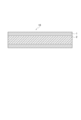
- FIG. 1 is a schematic diagram illustrating an example of a metal-clad laminate according to an embodiment.
- a numerical range indicated using “to” indicates a range including the numerical values described before and after “to” as the minimum and maximum values, respectively.
- the upper limit or lower limit of a certain numerical range may be replaced with the upper limit or lower limit of another numerical range.
- the upper limit or lower limit of a numerical range described in the present disclosure may be replaced with a value shown in an example.
- each component may contain one or more corresponding substances.
- the content of each component in the resin composition means the total amount of the plurality of substances present in the resin composition, unless otherwise specified.
- the weight average molecular weight (Mw) and number average molecular weight (Mn) are measured according to the following measurement method.
- the weight average molecular weight and number average molecular weight are calculated by gel permeation chromatography (GPC) using a calibration curve using standard polystyrene.
- the calibration curve is approximated by a third-order equation using standard polystyrene: TSKstandard POLYSTYRENE (Type: A-2500, A-5000, F-20, F-80) (product name, manufactured by Tosoh Corporation).
- TSKstandard POLYSTYRENE Type: A-2500, A-5000, F-20, F-80
- the GPC conditions are as follows:
- HCV-8320GPC High-speed GPC apparatus
- Detector Ultraviolet absorption detector
- UV-8320 product name, Tosoh Corporation
- Guard column TSKgel guardcolumn Super (HZ)-M+
- column TSKgel SuperMultipore HZ-M (2 columns)
- reference column TSKgel SuperH-RC (2 columns) (all product names of Tosoh Corporation)
- Column size 4.6 x 20 mm (guard column), 4.6 x 150 mm (column), 6.0 x 150 mm (reference column)
- Eluent tetrahydrofuran Sample concentration: 10 mg/1 mL Injection volume: 20 ⁇ L or 2 ⁇ L Flow rate: 0.35mL/min Measurement temperature: 40°C
- the resin composition according to one embodiment of the present disclosure contains (A) a thermosetting resin and (B) an acenaphthylene polymer having a number average molecular weight of 1,000 or more.
- the "(A) thermosetting resin” may be referred to as the "(A) component.”
- the "(B) acenaphthylene polymer having a number average molecular weight of 1,000 or more” may be referred to as the "(B) acenaphthylene polymer” or the "(B) component.”
- this resin composition By using this resin composition, it is possible to provide products with excellent dielectric properties and high flame retardancy. In addition, this resin composition has low sublimation properties and is unlikely to cause contamination of equipment such as drying ovens. Without being bound by theory, the reason for this is presumed to be as follows. Acenaphthylene has a skeleton with low polarity, which can enable good dielectric properties. The inventors have also found that acenaphthylene has excellent flame retardancy. This is presumed to be because the skeleton of acenaphthylene is a polycyclic aromatic, which means that the heat of combustion is small.
- acenaphthylene has high sublimation properties and can cause contamination of equipment such as drying ovens by sublimating when heated. It is presumed that by using an acenaphthylene polymer with a number average molecular weight of 1,000 or more obtained by polymerizing acenaphthylene in a resin composition, it is possible to achieve good dielectric properties, high flame retardancy, and low sublimation properties.
- thermosetting resin (A) is not particularly limited, and examples thereof include epoxy resins, maleimide compounds, phenolic resins, modified polyphenylene ether resins, polyimide resins, cyanate resins, isocyanate resins, benzoxazine resins, oxetane resins, amino resins, Examples of the resin include unsaturated polyester resin, allyl resin, dicyclopentadiene resin, silicone resin, triazine resin, melamine resin, and compounds having a vinylbenzyl group.
- the thermosetting resin may be used in the presence of a polymerization initiator, etc., as necessary.
- the compound having a vinylbenzyl group and the maleimide compound described below may be a monomer, an oligomer, a prepolymer, etc. can also be used as the (A) thermosetting resin.
- the component (A) one type may be used alone, or two or more types may be used in combination.
- the epoxy resin preferably has two or more epoxy groups in one molecule.
- epoxy resins include glycidyl ether type epoxy resins, glycidyl amine type epoxy resins, and glycidyl ester type epoxy resins.
- the epoxy resins can be further classified into bisphenol type epoxy resins, alicyclic epoxy resins, aliphatic chain epoxy resins, novolac type epoxy resins, stilbene type epoxy resins, naphthalene skeleton-containing epoxy resins, biphenyl type epoxy resins, xylylene type epoxy resins, dihydroanthracene type epoxy resins, etc.
- bisphenol type epoxy resins include bisphenol A type epoxy resins, bisphenol F type epoxy resins, bisphenol S type epoxy resins, etc.
- alicyclic epoxy resins include dicyclopentadiene type epoxy resins, etc.
- novolac type epoxy resins examples include phenol novolac type epoxy resins, cresol novolac type epoxy resins, bisphenol A novolac type epoxy resins, bisphenol F novolac type epoxy resins, phenol aralkyl novolac type epoxy resins, biphenyl aralkyl novolac type epoxy resins, etc.
- naphthalene skeleton-containing epoxy resins include naphthol novolac type epoxy resins, naphthol aralkyl type epoxy resins, etc.
- the epoxy resins may be used alone or in combination of two or more.
- the maleimide compound may be a compound having one or more N-substituted maleimide groups and a derivative thereof.
- the maleimide compound may be at least one selected from the group consisting of a compound having two or more N-substituted maleimide groups and a derivative thereof.
- Examples of compounds having one or more N-substituted maleimide groups include aromatic maleimide compounds, aromatic bismaleimide compounds, aromatic polymaleimide compounds, and aliphatic maleimide compounds.
- aromatic maleimide compounds refers to compounds having an N-substituted maleimide group directly bonded to an aromatic ring.
- aromatic bismaleimide compounds refers to compounds having two N-substituted maleimide groups directly bonded to an aromatic ring.
- aromatic polymaleimide compounds refers to compounds having three or more N-substituted maleimide groups directly bonded to an aromatic ring.
- aliphatic maleimide compounds refers to compounds having an N-substituted maleimide group directly bonded to an aliphatic hydrocarbon.
- compounds having one or more N-substituted maleimide groups include N,N'-ethylene bismaleimide, N,N'-hexamethylene bismaleimide, N,N'-(1,3-phenylene) bismaleimide, N,N'-[1,3-(2-methylphenylene)] bismaleimide, N,N'-[1,3-(4-methylphenylene)] bismaleimide, N,N'-(1,4-phenylene) bismaleimide, bis(4-maleimidophenyl)methane, and bis(3-methyl-4-maleimide).
- An example of a derivative of a compound having one or more N-substituted maleimide groups is an aminomaleimide compound that contains a structural unit derived from the compound having one or more N-substituted maleimide groups described above and a structural unit derived from a diamine compound.
- An example of a structural unit derived from a compound having one or more N-substituted maleimide groups contained in an aminomaleimide compound is a structural unit formed by a Michael addition reaction of at least one N-substituted maleimide group among the N-substituted maleimide groups contained in a compound having one or more N-substituted maleimide groups with an amino group contained in a diamine compound.
- the structural unit derived from a compound having one or more N-substituted maleimide groups contained in the aminomaleimide compound may be of one type alone or of two or more types.
- An example of a structural unit derived from a diamine compound contained in an aminomaleimide compound is a structural unit formed by a Michael addition reaction between one or both of two amino groups contained in a diamine compound and an N-substituted maleimide group contained in a compound having one or more N-substituted maleimide groups.
- the structural unit derived from the diamine compound contained in the aminomaleimide compound may be of one type alone or may be of two or more types.
- Diamine compounds include, for example, 4,4'-diaminodiphenylmethane, 3,3'-dimethyl-4,4'-diaminodiphenylmethane, 3,3'-diethyl-4,4'-diaminodiphenylmethane, 4,4'-diaminodiphenyl ether, 4,4'-diaminodiphenyl sulfone, 3,3'-diaminodiphenyl sulfone, 4,4'-diaminodiphenyl ketone, 4,4'-diaminobiphenyl, 3,3'-dimethyl-4,4 '-Diaminobiphenyl, 2,2'-dimethyl-4,4'-diaminobiphenyl, 3,3'-dihydroxybenzidine, 2,2-bis(3-amino-4-hydroxyphenyl)propane, 3,3'-dimethyl-5,5'-diethyl-4,4'-di
- the maleimide compounds may be used alone or in combination of two or more.
- a compound having a vinylbenzyl group (hereinafter, sometimes referred to as a "vinylbenzyl compound”) can have one or more vinylbenzyl groups, and may have two or more vinylbenzyl groups. By having one or more vinylbenzyl groups in one molecule, the vinylbenzyl compound can obtain a cured product by promoting the reaction of the vinylbenzyl group within a molecule or between molecules using heating or the like.
- the vinylbenzyl compounds may be used alone or in combination of two or more.
- the vinylbenzyl compound may be any of a monomer, an oligomer, and a prepolymer, and the resin composition may contain a combination of two or more of these.
- the oligomer may be a compound with a low degree of polymerization in which two or more of this monomer are polymerized.
- the prepolymer may be one in which one or more vinylbenzyl groups are introduced into the resin skeleton, and may be a monomer, oligomer, or a polymer of a combination thereof having one or more vinylbenzyl groups. Both the oligomer and the prepolymer preferably contain a certain amount of unreacted vinylbenzyl groups, and are in a state in which a curing reaction can be initiated by heating, etc.
- the number of vinylbenzyl groups in the monomer of the vinylbenzyl compound may be 1 or more or 2 or more, for example, 2 to 4 or 2 to 3.
- the number of vinylbenzyl groups in the molecule may be one or more, but it is preferable that the monomer structural unit contains one or more vinylbenzyl groups, and the monomer structural unit may contain 2 to 4 or 2 to 3 vinylbenzyl groups.
- the vinylbenzyl group may be any of o-vinylbenzyl, m-vinylbenzyl, and p-vinylbenzyl groups.
- the two or more vinylbenzyl groups may be the same or different isomers. From the viewpoint of dielectric properties, it is preferable that at least one p-vinylbenzyl group is contained in one molecule of the vinylbenzyl compound.
- the p-vinylbenzyl group may be 10 to 100% by mass, 20 to 80% by mass, 30 to 70% by mass, or 40 to 60% by mass relative to the total mass of all vinylbenzyl groups.
- the vinylbenzyl compound may be, for example, a compound having one or more vinylbenzyl groups directly bonded to a carbon atom.
- the vinylbenzyl compound may be, for example, a compound containing an aromatic hydrocarbon structure.
- the vinylbenzyl compound may be, for example, a compound having one or more vinylbenzyl groups directly bonded to a carbon atom and containing an aromatic hydrocarbon structure.
- the vinylbenzyl compound is preferably a hydrocarbon compound, and may be, for example, a hydrocarbon compound in which the structure other than the vinylbenzyl group is a non-aromatic hydrocarbon structure such as a chain hydrocarbon structure or an alicyclic hydrocarbon structure, or an aromatic hydrocarbon structure.
- a hydrocarbon compound in which the structure other than the vinylbenzyl group is an aromatic hydrocarbon structure is preferred.
- the aromatic hydrocarbon structure may be a monocyclic or polycyclic aromatic ring, a condensed ring of two or more aromatic rings, a condensed ring of an aromatic ring and a non-aromatic ring, or the like.
- the aromatic hydrocarbon structure include an indene ring, an indane ring, a phenanthrene ring, an acenaphthylene ring, and a fluorene ring.
- the indene ring, the indane ring, the phenanthrene ring, the acenaphthylene ring, and the fluorene ring may be substituted or unsubstituted.
- the vinylbenzyl compound is a compound having an indene ring, for example, a hydrocarbon compound having an indene ring. It is also preferable that the vinylbenzyl group is directly bonded to a carbon atom on the ring of an aromatic hydrocarbon structure.
- the vinylbenzyl compound as a monomer may be a compound containing an aromatic hydrocarbon structure.
- the vinylbenzyl compound as a monomer is preferably a hydrocarbon compound.
- the vinylbenzyl compound as a monomer may be a hydrocarbon compound containing an aromatic hydrocarbon structure.
- the aromatic hydrocarbon structure is preferably, for example, an indene ring, an indane ring, a phenanthrene ring, an acenaphthylene ring, a fluorene ring, or the like, or a combination thereof, more preferably an indene ring, a fluorene ring, or a combination thereof, and even more preferably an indene ring.
- the vinylbenzyl compound may be a monomer having one or more vinylbenzyl groups and one indene ring in one molecule.
- the vinylbenzyl compound may be a monomer that is a hydrocarbon compound having one or more vinylbenzyl groups and one indene ring in one molecule.
- a vinylbenzyl compound is a monomer having an indene ring and one or more vinylbenzyl groups bonded to the 1st, 2nd, or 3rd position of the indene ring.
- the vinylbenzyl compound may be, for example, a compound having an indene ring, one or more vinylbenzyl groups bonded to the 1st, 2nd, or 3rd position of the indene ring, and further having a substituent other than the vinylbenzyl group that is directly bonded to a carbon atom of the indene ring.
- the vinylbenzyl compound may be, for example, a compound having an indene ring, one or more vinylbenzyl groups bonded to the 1st, 2nd, or 3rd position of the indene ring, and having no substituent other than the vinylbenzyl group.
- vinylbenzyl compounds include monomers represented by the following general formula (1):
- n is 1, 2, or 3, but may be 2 or 3.
- the mixture of monomers represented by general formula (1) may contain multiple types of monomers with different n.
- n is preferably 2 to 3 on average, and more preferably 2.0 to 2.5.
- the vinylbenzyl group may be directly bonded to any of the carbon atoms at the 1st, 2nd, and 3rd positions of the indene ring, but the 1st position or a combination of the 1st and 3rd positions is preferred.
- One or two vinylbenzyl groups may be bonded to each position.
- the vinylbenzyl group may be bonded to a combination of the 1st, 1', and 3rd positions of the indene ring, or a combination of the 1st and 1' positions of the indene ring.
- the methylene group of the vinylbenzyl group may be in any of the o, m, and p positions, but is preferably in the m or p position.
- the polymer When the polymer is obtained using two or more types of monomers, it may be a mixture of the o, m, and p forms. In this case, a combination of the m and p forms is preferred, and the mass ratio of the m to p forms is preferably 40:60 to 60:40.
- the vinylbenzyl compound is a compound that is specified by its molecular structure, regardless of the synthesis method described below.
- a method for synthesizing a monomer from a vinylbenzyl compound includes, for example, reacting a base compound having a desired structure, such as indene or fluorene, with styrene having a halogenated methyl group in the presence of a basic compound.
- a base compound having a desired structure such as indene or fluorene
- styrene having a halogenated methyl group include o-chloromethylstyrene, m-chloromethylstyrene, and p-chloromethylstyrene, and these may be used alone or in a mixture of two or more.
- basic compounds include alkali metal hydroxides and alkali metal alkoxides.
- phase transfer catalyst may be used in the above reaction.
- the phase transfer catalyst include tetra-n-butylammonium bromide.
- the reaction may be carried out by solution polymerization.
- the reaction may be carried out, for example, under heating and stirring.
- a polymerization inhibitor may be added to the reaction system.
- the obtained product may be purified, if necessary, by known methods such as concentration, reprecipitation, and washing.
- the resulting monomer may be a single compound or a monomer mixture of two or more compounds.
- a compound is synthesized in which a vinylbenzyl group is directly bonded to at least one carbon atom at the 1st, 2nd, and 3rd positions of the indene ring, but the monomer mixture may contain two or more isomeric vinylbenzyl compounds with different bonding sites.
- a compound can be obtained in which a vinylbenzyl group is directly bonded to at least two carbon atoms at the 1st, 2nd, and 3rd positions of the indene ring.
- the monomer mixture may contain two or more vinylbenzyl compounds with different numbers of bonds and bonding sites of vinylbenzyl groups to the indene ring.
- the molecular weight is not particularly limited, but from the viewpoint of moldability and handling, it is preferably 200 to 800, more preferably 250 to 750, and even more preferably 300 to 700.
- the molecular weight is the weight average molecular weight (Mw) in the case of a mixture of multiple compounds.
- the vinylbenzyl compound as a prepolymer may be a compound containing an aromatic hydrocarbon structure.
- the vinylbenzyl compound as a prepolymer is preferably a hydrocarbon compound.
- the vinylbenzyl compound as a prepolymer may be a hydrocarbon compound containing an aromatic hydrocarbon structure.
- the aromatic hydrocarbon structure is preferably, for example, an indene ring, an indane ring, a phenanthrene ring, an acenaphthylene ring, a fluorene ring, or a combination thereof, more preferably an indene ring, a fluorene ring, or a combination thereof, and even more preferably an indene ring.
- the vinylbenzyl compound may be a prepolymer containing a structural unit having one or more vinylbenzyl groups and one indene ring.
- the vinylbenzyl compound may be a prepolymer that is a hydrocarbon compound containing a structural unit having one or more vinylbenzyl groups and one indene ring.
- the prepolymer can be obtained by polymerizing a monomer.
- the vinylbenzyl group may be introduced from the monomer.
- a monomer having one or more vinylbenzyl groups may be used, and a monomer having two or more vinylbenzyl groups is preferably used.
- the polymerization may not be completed completely, but may be stopped when a certain amount of vinylbenzyl groups derived from the monomer remain.
- the polymerization may be stopped when the viscosity of the polymerization reaction system of the curable prepolymer reaches a certain level.
- an oligomer may be used together with or instead of the monomer.
- the monomer of the vinylbenzyl compound described above may be used in the polymerization of the prepolymer, and an oligomer of this monomer may be used.
- the weight average molecular weight (Mw) may be, for example, 5,000 to 50,000, or 10,000 to 30,000, from the viewpoint of the fluidity of the resin composition.
- the polymerization of the vinylbenzyl compound is preferably carried out by radical polymerization so that polar components are not generated in the reaction product. Radical polymerization can be carried out using a radical polymerization initiator.
- the polymerization can be carried out by solution polymerization, and the polymerization solvent is not particularly limited. For example, one or a combination of two or more organic solvents used in the resin composition described later may be used as the polymerization solvent.
- the radical polymerization initiator may be a thermal radical polymerization initiator or a photoradical polymerization initiator, but a thermal radical polymerization initiator is preferred.
- the radical polymerization initiator is not particularly limited, and examples include azo-based polymerization initiators and organic peroxide-based polymerization initiators.
- azo polymerization initiators examples include 2,2'-azobis(isobutyronitrile), 2,2'-azobis(2-methylpropanenitrile), 2,2'-azobis(2-methylbutyronitrile), 2,2'-azobis(4-methoxy-2,4-dimethylvaleronitrile), 2,2'-azobis(2-methylpropionate)dimethyl, 1,1'-azobis(methylcyclohexylcarboxylate), 2,2'-azobis[N-(2-propenyl)-2-methylpropionamide], 2,2'-azobis(N-butyl-2-methylpropionamide), 4,4'-azobis(3,3,4,4,5,5,6,6,7,7,8,8,8-tridecafluorooctyl 4-cyanopentanoate), 1,1'-azobis(cyclohexane-1-carbonitrile), and the like.
- organic peroxide polymerization initiators include dicumyl peroxide, dibenzoyl peroxide, 2-butanone peroxide, tert-butyl perbenzoate, di-tert-butyl peroxide, 2,5-dimethyl-2,5-di(t-butylperoxy)hexane, bis(tert-butylperoxyisopropyl)benzene, and tert-butyl hydroperoxide.
- an azo-based polymerization initiator is preferable.
- the azo-based polymerization initiator it is preferable for the azo-based polymerization initiator to be a compound that does not contain heteroatoms other than the two nitrogen atoms (N) of the azo group.
- N nitrogen atoms
- R1 and R2 are each independently a hydrogen atom or a monovalent functional group, and at least one of R1 and R2 is a monovalent functional group.
- R1 and R2 may be the same or different from each other.
- the monovalent functional group is preferably a hydrocarbon group, and may be a saturated or unsaturated hydrocarbon group, or may be an aliphatic hydrocarbon group or an aromatic hydrocarbon group.
- the monovalent functional group is preferably a saturated or unsaturated aliphatic hydrocarbon group, and is preferably an alkyl group.
- the alkyl group may be either a chain alkyl group or a cyclic alkyl group.
- the chain alkyl group may be a straight-chain alkyl group or a branched alkyl group.
- the cyclic alkyl group may have a substituent bonded to a carbon atom on the ring.
- the alkyl group may be, for example, an alkyl group having 1 to 10 carbon atoms, 3 to 8 carbon atoms, or 4 to 8 carbon atoms.
- Examples of the alkyl group include a methyl group, an ethyl group, an n-propyl group, an isopropyl group, an n-butyl group, an isobutyl group, a sec-butyl group, a tert-butyl group, an n-pentyl group, an isopentyl group, a neopentyl group, an n-hexyl group, an isohexyl group, a cyclohexyl group, a methylcyclohexyl group, a cyclohexylmethyl group, a heptyl group, an octyl group, an isooctyl group, a 2-ethylhexyl group, a nonyl group, a de
- compounds represented by general formula (2) include 2,2'-azobis(2,4,4-trimethylpentane) and 2,2'-azobis(2,4-dimethylvaleronitrile).
- the radical polymerization initiator may be used alone or in combination of two or more kinds.
- the amount of the radical polymerization initiator used may be appropriately selected depending on the desired degree of polymerization of the prepolymer.
- the amount of the radical polymerization initiator used may be 0.05 to 5 parts by mass, 0.1 to 4 parts by mass, or 0.5 to 2 parts by mass, based on 100 parts by mass of the vinylbenzyl compound in the polymerization system.
- the vinylbenzyl compound as a prepolymer may be a homopolymer or a copolymer of the vinylbenzyl compound.
- the copolymer may be a copolymer of two or more kinds of vinylbenzyl compounds, or a copolymer of the vinylbenzyl compound and another monomer. In the case of a copolymer, it may be a random copolymer, a block copolymer, etc.
- the oligomer of the vinylbenzyl compound may be a polymer with a low degree of polymerization of the above-mentioned monomer.
- the amount of the (A) component may be 10% by mass or more, 20% by mass or more, or 30% by mass or more, based on the solid content of the resin composition.
- the amount of the (A) component may be 70% by mass or less, 60% by mass or less, 50% by mass or less, 40% by mass or less, or 30% by mass or less, based on the solid content of the resin composition.
- the amount of the (A) component may be, for example, 10 to 70% by mass, 10 to 60% by mass, 20 to 50% by mass, 30 to 40% by mass, 10 to 20% by mass, 20 to 30% by mass, or 30 to 40% by mass, based on the solid content of the resin composition.
- solid content of a resin composition refers to the components in the resin composition other than volatile substances such as water and the solvent described below. Solid content is the component that remains without volatilizing when the resin composition is dried, and also includes those that are liquid, syrup-like, or waxy at room temperature around 25°C, and does not necessarily mean that they are solid.
- the amount of the (A) component may be 50% by mass or more, 60% by mass or more, or 70% by mass or more based on the total amount of the (A) component and the (B) component ((B) an acenaphthylene polymer having a number average molecular weight of 1,000 or more) described below.
- the amount of the (A) component may be 99% by mass or less, 95% by mass or less, or 90% by mass or less based on the total amount of the (A) component and the (B) component.
- the amount of the (A) component may be, for example, 50 to 99% by mass, 60 to 95% by mass, or 70 to 90% by mass based on the total amount of the (A) component and the (B) component.
- the acenaphthylene polymer may have structural units derived from acenaphthylene.
- the structural units derived from acenaphthylene may be substituted or unsubstituted.
- the acenaphthylene polymer preferably has a structural unit containing an acenaphthene structure represented by the following formula (3).
- * is a bonding site with other structural units.
- the acenaphthene structure may have no substituents or may have one or more substituents.
- the substituents include alkyl groups, and the alkyl groups may be, for example, either chain alkyl groups or cyclic alkyl groups.
- the alkyl groups may be, for example, alkyl groups having 1 to 10 carbon atoms or 1 to 4 carbon atoms, and examples of the alkyl groups include methyl groups, ethyl groups, propyl groups, and butyl groups.
- the acenaphthylene polymer may be a homopolymer or a copolymer of acenaphthylene.
- the copolymer may be a copolymer of two or more monomers selected from the group consisting of substituted or unsubstituted acenaphthylene, or a copolymer of acenaphthylene and another monomer. In the case of a copolymer, it may be a random copolymer, a block copolymer, etc.
- the (B) acenaphthylene polymer may contain, for example, 50% by mass or more, 70% by mass or more, 90% by mass or more, or 95% by mass or more of structural units derived from acenaphthylene.
- the (B) acenaphthylene polymer may contain, for example, 50% by mass or more, 70% by mass or more, 90% by mass or more, or 95% by mass or more of structural units represented by formula (3).
- the (B) acenaphthylene polymer is preferably a homopolymer of acenaphthylene.
- the (B) acenaphthylene polymer may be a homopolymer of unsubstituted acenaphthylene.
- the number average molecular weight (Mn) of the (B) acenaphthylene polymer is preferably 1,000 or more in order to easily obtain low sublimation properties.
- the number average molecular weight (Mn) of the (B) acenaphthylene polymer is more preferably 2,000 or more, even more preferably 5,000 or more, and even more preferably 20,000 or more.
- the number average molecular weight (Mn) of the (B) acenaphthylene polymer may be 100,000 or less, or 50,000 or less.
- the number average molecular weight (Mn) of the (B) acenaphthylene polymer may be, for example, 1,000 to 100,000, 2,000 to 100,000, 5,000 to 50,0000, or 20.00 to 50,000.
- the weight average molecular weight (Mw) of the (B) acenaphthylene polymer is preferably 2,000 or more, more preferably 5,000 or more, and even more preferably 10,000 or more.
- the weight average molecular weight (Mw) of the (B) acenaphthylene polymer may be 1,000,000 or less, or 500,000 or less.
- the weight average molecular weight (Mw) of the (B) acenaphthylene polymer may be, for example, 2,000 to 1,000,000, 5,000 to 1,000,000, or 10,000 to 500,000.
- (B) Acenaphthylene polymer can be obtained, for example, by polymerizing acenaphthylene and, if necessary, other monomers.
- the polymerization can be carried out, for example, by radical polymerization.
- the radical polymerization can be carried out using a radical polymerization initiator.
- the polymerization can be carried out by solution polymerization, and the polymerization solvent is not particularly limited. For example, one or a combination of two or more organic solvents used in the resin composition described later may be used as the polymerization solvent.
- the radical polymerization initiator is not particularly limited, and examples thereof include azo-based polymerization initiators, organic peroxide-based polymerization initiators, etc.
- the initiator may be appropriately selected from azo-based polymerization initiators, organic peroxide-based polymerization initiators, etc. exemplified in the description of the method for obtaining a vinylbenzyl compound as a prepolymer.
- a polymerization solution obtained by adding a radical polymerization initiator and a polymerization solvent to the acenaphthylene monomer and, if necessary, other monomers can be heated under a nitrogen atmosphere to obtain (B) acenaphthylene polymer.
- the amount of the radical polymerization initiator may be, for example, 0.1 to 10 parts by mass relative to 100 parts by mass of the monomer, and may be, for example, about 5 parts by mass.
- the amount of the polymerization solvent may be an amount such that the total amount of the monomer and polymerization initiator in the polymerization solution is 5 to 80% by mass, and may be, for example, an amount such that the total amount of the monomer and polymerization initiator in the polymerization solution is about 30% by mass.
- the heating temperature may be, for example, 50 to 150°C, and may be, for example, about 110°C.
- the heating time may be, for example, 1 to 50 hours, and may be, for example, about 15 hours.
- the acenaphthylene polymer (B) may be used alone or in combination of two or more kinds.
- the content of the (B) component may be 0.1% by mass or more, 1% by mass or more, or 5% by mass or more, based on the solid content of the resin composition.
- the content of the (B) component may be 40% by mass or less, 30% by mass or less, 20% by mass or less, or 10% by mass or less, based on the solid content of the resin composition.
- the content of the (B) component may be, for example, 0.1 to 40% by mass, 1 to 30% by mass, 1 to 20, or 5 to 10% by mass, based on the solid content of the resin composition.
- the amount of the (B) component may be 1 mass% or more, 5 mass% or more, or 10 mass% or more, based on the total amount of the (A) component and the (B) component.
- the amount of the (B) component may be 50 mass% or less, 40 mass% or less, or 30 mass% or less, based on the total amount of the (A) component and the (B) component.
- the amount of the (B) component may be, for example, 1 to 50 mass%, 5 to 40 mass%, or 10 to 30 mass% based on the total amount of the (A) component and the (B) component.
- the resin composition may contain components other than the above-mentioned components, if necessary.
- other components include flame retardants, inorganic fillers, solvents, polymerization initiators, elastomers, resins other than the above-mentioned components, antioxidants, heat stabilizers, antistatic agents, ultraviolet absorbers, pigments, colorants, and lubricants.
- the resin composition may contain a flame retardant.
- a flame retardant There are no particular limitations on the flame retardant, but for example, a phosphorus-based flame retardant can be used.
- Phosphorus-based flame retardants include, for example, aromatic phosphate ester compounds such as triphenyl phosphate, tricresyl phosphate, trixylenyl phosphate, cresyl diphenyl phosphate, cresyl di-2,6-xylenyl phosphate, resorcinol bis(diphenyl phosphate), 1,3-phenylene bis(di-2,6-xylenyl phosphate), bisphenol A-bis(diphenyl phosphate), and 1,3-phenylene bis(diphenyl phosphate); phosphonate esters such as divinyl phenylphosphonate, diallyl phenylphosphonate, and bis(1-butenyl) phenylphosphonate; diphenyl phosphinic acid esters such as phenyl diphenylphosphinate and methyl diphenylphosphinate; phosphazene compounds such as bis(2-allyl
- the flame retardants may be used alone or in combination of two or more.
- the flame retardant may be, for example, 0.1 to 30 mass %, 1 to 20 mass %, 1 to 10 mass %, 10 to 20 mass %, or 20 to 30 mass % relative to the solid content of the resin composition.
- the resin composition may contain an inorganic filler.
- the inorganic filler include silica (SiO 2 ), alumina (Al 2 O 3 ), titanium oxide, barium titanate, strontium titanate, potassium titanate, calcium titanate, aluminum carbonate, magnesium hydroxide, aluminum hydroxide, aluminum silicate, calcium carbonate, calcium silicate, magnesium silicate, silicon nitride, boron nitride, aluminum borate, silicon carbide, mica, beryllia, clay, and talc. From the viewpoint of dielectric properties, silica is preferred.
- the shape and size of the inorganic filler are not particularly limited.
- the average particle diameter of the inorganic filler may be, for example, 0.01 to 20 ⁇ m, or 0.1 to 10 ⁇ m.
- the average particle diameter of the inorganic filler is the particle diameter at the point corresponding to an accumulated value of 50% in the volume-based particle distribution measured by the laser diffraction scattering method.
- the inorganic fillers may be used alone or in combination of two or more.
- the amount of the inorganic filler relative to the solid content of the resin composition may be, for example, 10 to 80 vol. %, 20 to 70 vol. %, or 30 to 60 vol. %.
- the amount of the inorganic filler relative to the solid content of the resin composition may be, for example, 30 to 90 mass %, 40 to 90 mass %, or 50 to 80 mass %.
- the resin composition may further contain a polymerization initiator to promote curing of the (A) thermosetting resin.
- a radical polymerization initiator can be used as the polymerization initiator.
- the radical polymerization initiator may be a thermal radical polymerization initiator or a photoradical polymerization initiator, but a thermal radical polymerization initiator is preferred.
- the radical polymerization initiator is not particularly limited, and examples thereof include an azo-based polymerization initiator and an organic peroxide-based polymerization initiator. Specifically, the initiator may be appropriately selected from the azo-based polymerization initiator and the organic peroxide-based polymerization initiator exemplified in the description of the method for obtaining a vinylbenzyl compound as a prepolymer.
- the polymerization initiator may be used alone or in combination of two or more kinds.
- the amount of the polymerization initiator used may be appropriately adjusted, and may be, for example, 0.01 to 5 parts by mass, 0.1 to 4 parts by mass, or 0.5 to 2 parts by mass relative to 100 parts by mass of the thermosetting resin (A).
- elastomers examples include styrene-based elastomers, olefin-based elastomers, urethane-based elastomers, polyester-based elastomers, polyamide-based elastomers, acrylic-based elastomers, and silicone-based elastomers. Elastomers may be used alone or in combination of two or more types.
- the resin composition may be a solvent-free resin composition or may contain a solvent.
- the resin composition may contain a liquid compound as a thermosetting resin and be a solvent-free resin composition, or may contain a thermosetting resin and a solvent.
- the solvent can adjust the viscosity of the resin composition to further improve the coatability.
- An organic solvent is preferable as the solvent.
- organic solvents examples include alcohol-based solvents such as ethanol, propanol, butanol, methyl cellosolve, ethylene glycol monobutyl ether, and propylene glycol monomethyl ether; ketone-based solvents such as acetone, methyl ethyl ketone, methyl isobutyl ketone, and cyclohexanone; ether-based solvents such as tetrahydrofuran; aromatic hydrocarbon-based solvents such as toluene, xylene, and mesitylene; nitrogen-containing solvents such as dimethylformamide, dimethylacetamide, and N-methylpyrrolidone; sulfur-containing solvents such as dimethylsulfoxide; and ester-based solvents such as ⁇ -butyrolactone.
- the organic solvents may be used alone or in combination of two or more.
- the solid content of the resin composition may be, for example, 10 to 90 mass%, 30 to 80 mass%, or 40 to 75 mass% relative to the total mass of the resin composition.
- the method for producing the resin composition is not particularly limited.
- the resin composition according to one embodiment is not limited by the production method, and its features are as described in the present disclosure.
- (A) thermosetting resin and (B) acenaphthylene polymer can be mixed with optional components added as necessary to obtain a resin composition. More specifically, for example, (A) thermosetting resin and (B) acenaphthylene polymer can be dissolved or dispersed in a solvent, and if necessary, a flame retardant, an inorganic filler, etc. can be added and mixed to obtain a resin composition.
- the conditions such as the mixing order, temperature, and time of each component are not particularly limited, and may be appropriately adjusted according to the type of raw material, production scale, production equipment, etc.
- the dielectric constant (Dk) of the cured product of the resin composition at 25° C. and 10 GHz is preferably 4.0 or less, more preferably 3.5 or less, and even more preferably 3.4 or less.
- the cured product of the resin composition may have a relative dielectric constant (Dk) at 25° C. and 10 GHz of 2.3 to 4.0, preferably 2.3 to 3.5, or 2.4 to 3.4.
- the dielectric loss tangent (Df) of the cured product of the resin composition at 25° C. and 10 GHz is preferably 0.0020 or less, more preferably 0.0015 or less, and even more preferably 0.0013 or less.
- the dielectric loss tangent (Df) of the cured product of the resin composition at 25° C. and 10 GHz may be 0.0001 to 0.0020, and preferably 0.00050 to 0.0015, or 0.00050 to 0.0013.
- the dielectric constant (Dk) and dielectric loss tangent (Df) at 25°C and 10 GHz are measured at 25°C in the 10 GHz band in accordance with the SPDR method (split post dielectric resonator).
- the measurement device may be Agilent Technologies' "PNA Network Analyzer N5227A" (product name).
- the sample used to measure the dielectric constant (Dk) and dielectric loss tangent (Df) of the cured resin composition is one that has been cured to the C-stage state according to JIS K 6800 (1985).
- a prepreg formed using a resin composition can be provided.
- This prepreg can be formed, for example, using a resin composition and a fiber base material.
- the resin composition the above-mentioned resin composition can be used. Details of the resin composition are as described above.
- the prepreg may contain the above-mentioned resin composition or a semi-cured product of the above-mentioned resin composition.
- one index of a semi-cured product is the B-stage state according to JIS K 6800 (1985).
- the prepreg may contain, for example, a resin composition or a semi-cured product of the resin composition and a fiber substrate such as a sheet-shaped fiber substrate.
- the resin composition may be in an uncured state, but the resin composition may be in a partially or entirely semi-cured state.
- a molded product such as a laminate can be assembled using this prepreg, and cured by heat treatment or the like to obtain a cured product.
- the prepreg can be obtained, for example, by coating a fiber substrate with a resin composition and drying it.
- the prepreg can be obtained by impregnating and coating a fiber substrate with a resin composition and drying the fiber substrate impregnated with the resin composition.
- the drying is preferably performed at a temperature at which volatile components such as a solvent that may be contained in the resin composition are removed or higher, and may be performed at a temperature at which the thermosetting resin contained in the resin composition is semi-cured or higher depending on the application.
- the drying is preferably adjusted so that the thermosetting resin contained in the resin composition is not completely cured.
- the drying temperature may be, for example, 80 to 200°C
- the drying time may be, for example, 1 to 30 minutes depending on the drying temperature, the drying device, the scale, etc.
- (B) acenaphthylene polymer has low sublimation properties, and when the above-mentioned resin composition containing (B) acenaphthylene polymer is used, there is a tendency for furnace contamination to be less likely to occur.
- the fibrous substrate may be any of woven, knitted, and nonwoven fabrics.
- the fibrous substrate may be provided in the form of chopped strand mat, roving, and the like.
- the material of the fibers may be either inorganic or organic.
- inorganic fibers include glass fibers and carbon fibers.
- glass fibers include E glass, NE glass, D glass, S glass, and Q glass.
- organic fibers include polyimide, polyester, and tetrafluoroethylene.
- the fiber substrate may be one of these fibers alone or two or more of these fibers in combination. From the viewpoints of dielectric properties and heat resistance, the material of the fiber substrate is preferably inorganic fiber, and more preferably glass fiber.
- the fiber base material may be appropriately selected depending on the application of the prepreg, but a sheet-like fiber base material is preferred.
- the sheet-like fiber base material may be, for example, any of various sheet-like fiber base materials used in known laminates for electrical insulating materials.
- the thickness of the sheet-like fiber substrate is not particularly limited, but is preferably, for example, 0.02 to 0.5 mm. Here, the thickness is measured at five points at equal distances over the entire surface of the sheet-like fiber substrate, and the arithmetic average value of the five points is taken as the thickness.
- a resin film formed using the resin composition can be provided.
- the resin film can be produced using the resin composition. Details of the resin composition are as described above.
- the resin film may contain the above-mentioned resin composition or a semi-cured product of the above-mentioned resin composition.
- the resin composition may be in an uncured state, but the resin composition may be in a partially or entirely semi-cured state.
- the resin film can be cured by heat treatment or the like to obtain a cured product.
- the resin film can be obtained, for example, by applying a resin composition to a substrate and drying it. The drying can be performed, for example, in the same manner as in the above-mentioned method for producing a prepreg. After drying the resin film on the substrate, a product may be provided as a combination of the resin film and the substrate.
- a resin film can be provided to form an insulating layer or the like on the substrate in electronic devices or the like.
- the resin film may be peeled off from the substrate to provide the resin film as a product.
- the substrate to be coated may be either an inorganic substrate or an organic substrate, including glass substrates, metal substrates such as metal foils and metal plates, plastic substrates such as plastic plates and plastic films, and paper substrates. It may also be a fiber substrate as described above for the prepreg. A substrate with a release layer formed on its surface may also be used so that the resin film can be peeled off from the substrate.
- a metal-clad laminate including a cured resin composition and a metal foil can be provided.
- the metal-clad laminate may be, for example, a metal-clad laminate including a cured prepreg and a metal foil.
- a metal-clad laminate formed by using a prepreg and a metal foil can be provided.
- the metal-clad laminate may be, for example, a metal-clad laminate including a cured prepreg and a metal foil. The details of the resin composition and the prepreg are as described above.
- the metal-clad laminate preferably includes a resin cured product layer containing a resin cured product and a metal foil disposed on at least one surface of the resin cured product layer.
- the resin cured product layer includes the cured product of the resin composition described above, but may be the cured product of the prepreg described above.
- a metal foil is disposed on at least one surface of the cured product of the prepreg, and more preferably, a metal foil is disposed on both surfaces of the cured product of the prepreg.
- the metal-clad laminate may be manufactured by disposing a metal foil on at least one surface of a sheet-like prepreg, or may be manufactured by laminating two or more sheet-like prepregs and disposing a metal foil on at least one surface of the outermost surface of the laminate.
- the metal-clad laminate may be manufactured by laminating two or more sheet-like prepregs and disposing a metal foil on both surfaces of the laminate.
- Figure 1 shows a schematic cross-sectional view of a metal-clad laminate 10 that includes multiple cured prepregs 2 and metal foil 1 as a specific example of a metal-clad laminate.
- two or more sheet-like prepregs are laminated to obtain a laminate.
- the two or more sheet-like prepregs may be identical to each other, or some or all of them may be different.
- at least one of the two or more sheet-like prepregs may be obtained using a resin composition according to one embodiment.
- a metal foil is placed on at least one surface of this laminate.
- the laminate with the metal foil disposed thereon is heated and pressurized. This advances the curing reaction of the sheet-like prepreg, and a cured prepreg can be obtained.
- adjacent sheet-like prepregs can be fixed to each other.
- the heating and pressurizing conditions are not particularly limited, but may be, for example, a temperature of 100 to 300°C, a time of 10 to 300 minutes, and a pressure of 1.5 to 5 MPa.
- reheating may be performed to further advance the curing of the prepreg. In this case, the reheating temperature may be 100 to 300°C.
- a method for applying pressure for example, an autoclave molding machine, a multi-stage press machine, a multi-stage vacuum press machine, a continuous molding machine, etc. can be used.
- (B) Acenaphthylene polymer has low sublimation properties, and when the above-mentioned resin composition containing (B) acenaphthylene polymer is used, it tends not to cause contamination inside the furnace.
- the metal of the metal foil is not particularly limited, and examples include copper, nickel, aluminum, gold, silver, platinum, molybdenum, ruthenium, tungsten, iron, titanium, chromium, and alloys containing two or more of these metal elements. Industrially, it is preferable to use the single metals copper, nickel, and aluminum. By using copper as the metal foil, it is possible to provide a copper-clad laminate.
- the dielectric properties of the assembled metal-clad laminate after the metal foil has been removed are preferably as follows. Note that the metal-clad laminate after the metal foil has been removed is also simply referred to as the "metal foil removed" product.
- the metal foil removed product preferably has a dielectric constant (Dk) of 4.0 or less at 25° C. and 10 GHz, more preferably 3.5 or less, and even more preferably 3.4 or less.
- the metal foil removed product may have a relative dielectric constant (Dk) at 25° C. and 10 GHz of 2.3 to 4.0, preferably 2.3 to 3.5, or 2.4 to 3.4.
- the dielectric loss tangent (Df) of the metal foil removed product at 25° C. and 10 GHz is preferably 0.0020 or less, more preferably 0.0015 or less, and even more preferably 0.0013 or less.
- the dielectric loss tangent (Df) of the metal foil removed product at 25° C. and 10 GHz is preferably smaller, and there is no particular restriction on the lower limit, but may be, for example, 0.0001 or more, or 0.00050 or more, taking into consideration the balance with other physical properties.
- the metal foil removed product may have a dielectric loss tangent (Df) at 25° C. and 10 GHz of 0.0001 to 0.0020, preferably 0.00050 to 0.0015, or 0.00050 to 0.0013.
- the dielectric constant (Dk) and dielectric loss tangent (Df) of the product from which the metal foil has been removed may be measured in accordance with the measurement of the dielectric constant (Dk) and dielectric loss tangent (Df) of the cured product of the resin composition described above.
- the samples used to measure the dielectric constant (Dk) and dielectric loss tangent (Df) of the metal foil removed product are prepared by immersing the metal-clad laminate in an etching solution to remove the metal foil, and then cutting out 60 mm and 100 mm evaluation boards from the test pieces from which the metal foil was removed. In the case of copper-clad laminate, a 10% by mass solution of ammonium persulfate is used as the etching solution.
- a printed wiring board including a cured product of the resin composition can be provided. Details of the resin composition are as described above.
- the cured product of the resin composition can be produced using the resin composition, prepreg, resin film, metal-clad laminate, or a combination of these.
- a printed wiring board can be provided by forming wiring on a cured product of a prepreg using a known method.
- a printed wiring board can be provided by forming wiring using a known method using a metal-clad laminate. A printed wiring board that combines these examples may also be used. Details of the prepreg, resin film, and metal-clad laminate are as described above.
- the printed wiring board may be either a single-layer printed wiring board or a multi-layer printed wiring board.
- a semiconductor package including a printed wiring board and a semiconductor element can be provided. More specifically, a semiconductor package including a printed wiring board including a cured product of a resin composition and a semiconductor element can be provided. Details of the resin composition are as described above. Details of the cured product of the resin composition and the printed wiring board are also as described above.
- the semiconductor package can be manufactured, for example, by mounting a semiconductor element, a memory, or the like on a printed wiring board by a known method.
- the cured product of the resin composition may be used as an insulating material, a sealing material, or the like of the semiconductor package.
- acenaphthylene homopolymer having a number average molecular weight of 1,000 or more it is possible to provide an acenaphthylene homopolymer (hereinafter, sometimes simply referred to as "acenaphthylene homopolymer") having a number average molecular weight of 1,000 or more.
- the acenaphthylene homopolymer can have a structural unit derived from acenaphthylene.
- the structural unit derived from acenaphthylene may be substituted or unsubstituted.
- An acenaphthylene homopolymer is a homopolymer of acenaphthylene, more specifically, a homopolymer of substituted or unsubstituted acenaphthylene.
- the acenaphthylene homopolymer may be, for example, a homopolymer of unsubstituted acenaphthylene.
- the acenaphthylene homopolymer can have a structure having a structural unit containing an acenaphthene structure, as shown in the following formula (4).
- n is an integer in the range that results in a number average molecular weight of 1,000 or more.
- the acenaphthene structure may have no substituents or may have one or more substituents.
- substituents include alkyl groups, and the alkyl groups may be, for example, either chain alkyl groups or cyclic alkyl groups.
- the alkyl groups may be, for example, alkyl groups having 1 to 10 carbon atoms or 1 to 4 carbon atoms, and examples of the alkyl groups include methyl groups, ethyl groups, propyl groups, and butyl groups.
- the number average molecular weight (Mn) of the acenaphthylene homopolymer is preferably 1,000 or more from the viewpoint of easily achieving low sublimation properties.
- the number average molecular weight (Mn) of the acenaphthylene homopolymer is more preferably 2,000 or more, and even more preferably 5,000 or more.
- the number average molecular weight (Mn) of the acenaphthylene homopolymer may be 100,000 or less, or 50,000 or less.
- the number average molecular weight (Mn) of the acenaphthylene homopolymer may be, for example, 1,000 to 100,000, 2,000 to 100,000, or 5,000 to 50,0000.
- the weight average molecular weight (Mw) of the acenaphthylene homopolymer is preferably 2,000 or more, more preferably 5,000 or more, and even more preferably 10,000 or more.
- the weight average molecular weight (Mw) of the acenaphthylene homopolymer may be 1,000,000 or less, or 500,000 or less.
- the weight average molecular weight (Mw) of the acenaphthylene homopolymer may be, for example, 2,000 to 1,000,000, 5,000 to 1,000,000, or 10,000 to 500,000.
- An example of a method for producing an acenaphthylene homopolymer is the method described above as (B) the method for producing an acenaphthylene polymer, in which acenaphthylene is used as a monomer for homopolymerization.
- thermosetting resin a thermosetting resin
- B an acenaphthylene polymer having a number average molecular weight of 1,000 or more.
- thermosetting resin a thermosetting resin
- B an acenaphthylene polymer having a number average molecular weight of 1,000 or more.
- thermosetting resin (A) contains a compound having a vinylbenzyl group.
- ⁇ 4> A prepreg formed using the resin composition according to any one of ⁇ 1> to ⁇ 3>.
- ⁇ 5> A resin film formed using the resin composition according to any one of ⁇ 1> to ⁇ 3>.
- ⁇ 6> A metal-clad laminate comprising a cured product of the resin composition according to any one of ⁇ 1> to ⁇ 3> and a metal foil.
- ⁇ 7> A metal-clad laminate formed using the prepreg according to ⁇ 4> and a metal foil.
- ⁇ 8> A printed wiring board comprising a cured product of the resin composition according to any one of ⁇ 1> to ⁇ 3>.
- ⁇ 9> A semiconductor package comprising the printed wiring board according to ⁇ 8> and a semiconductor element.
- ⁇ 10> An acenaphthylene homopolymer having a number average molecular weight of 1,000 or more.
- Aqueous solution of basic compound an aqueous solution of sodium hydroxide with a concentration of 48% by mass, manufactured by Kanto Chemical Co., Ltd.
- the obtained vinylbenzyl compound was confirmed by 1 H-NMR analysis to have a structure having a vinylbenzyl group directly bonded to the carbon atom at the 1-position, 3-position, or a combination thereof of indene represented by the following formula (5). Furthermore, GPC analysis revealed that the vinylbenzyl compound was a mixture of one having two vinylbenzyl groups introduced therein and one having three vinylbenzyl groups introduced therein. When three vinylbenzyl groups were introduced into the vinylbenzyl compound, it was confirmed that the vinylbenzyl compound had two vinylbenzyl groups directly bonded to the carbon atom at the 1-position of the indene ring and one vinylbenzyl group directly bonded to the carbon atom at the 3-position. The weight average molecular weight (Mw) of the vinylbenzyl compound was 500. The weight average molecular weight was measured by the following method.
- Method for measuring weight average molecular weight The weight average molecular weight was calculated by gel permeation chromatography (GPC) from a calibration curve using standard polystyrene. The calibration curve was approximated by a third order equation using standard polystyrene: TSKstandard POLYSTYRENE (Type: A-2500, A-5000, F-20, F-80) (manufactured by Tosoh Corporation, trade name). The measurement conditions for GPC are shown below.
- HLC-8320GPC Tosoh Corporation, product name
- Detector Ultraviolet absorption detector UV-8320 (Tosoh Corporation, product name)
- Eluent tetrahydrofuran Sample concentration: 10 mg/1 mL Injection volume: 20 ⁇ L or 2 ⁇ L Flow rate: 0.35mL/min Measurement temperature: 40°C
- acenaphthylene polymers Y1 and Y2 Five parts by mass of an azo-based polymerization initiator (2,2'-azobis(2,4,4-trimethylpentane)) was added to 100 parts by mass of the solid content of unsubstituted acenaphthylene monomer, and the solution was diluted with toluene to a solid content of 30% by mass. The solution was heated at 110°C for 15 hours in a nitrogen atmosphere to produce acenaphthylene polymer Y1, which is a homopolymer of acenaphthylene.
- an azo-based polymerization initiator (2,2'-azobis(2,4,4-trimethylpentane)
- the number average molecular weight (Mn) of the resulting acenaphthylene polymer Y1 was 5,300, and the weight average molecular weight (Mw) was 18,000.
- Mn number average molecular weight
- Mw weight average molecular weight
- Acenaphthylene polymer Y2 was produced in the same manner as in the production method of acenaphthylene polymer Y1, except that the amount of azo-based polymerization initiator added per 100 parts by mass of the solid content of unsubstituted acenaphthylene monomer was changed to 1 part by mass.
- the number average molecular weight (Mn) of the obtained acenaphthylene polymer Y2 was 28,000, and the weight average molecular weight (Mw) was 140,000.
- the number average molecular weight (Mn) and weight average molecular weight (Mw) were calculated by gel permeation chromatography (GPC) using a calibration curve using standard polystyrene.
- the calibration curve was approximated by a third-order equation using standard polystyrene: TSKstandard POLYSTYRENE (Type: A-2500, A-5000, F-20, F-80) (product name, manufactured by Tosoh Corporation).
- the GPC measurement conditions were as described above.
- the acenaphthylene monomer was evaluated as having sublimability, with a Td5 of 140° C.
- the acenaphthylene polymer Y1 was evaluated as having no sublimability, with a Td5 of 380° C.
- the double-sided copper-clad laminate obtained as described above was subjected to a flammability test.
- the double-sided copper-clad laminate was immersed in a 10 mass % solution of ammonium persulfate (manufactured by Mitsubishi Gas Chemical Company, Inc.) as a copper etching solution to remove the copper foil, and a 13 mm x 125 mm evaluation board was cut out from the board from which the copper foil had been removed.
- acenaphthylene polymer Y1 was determined to have no sublimation properties. Also, as shown in Table 1, in the flame retardancy evaluation, Examples 1 to 3 in which acenaphthylene polymer Y1 or Y2 was used all showed a lower average burning time ratio compared to the corresponding comparative example, and the average burning time was shorter than the average burning time of the corresponding comparative example, indicating good flame retardancy. Also, Examples 1 to 3 showed good dielectric properties.
Landscapes
- Chemical & Material Sciences (AREA)
- Polymers & Plastics (AREA)
- Health & Medical Sciences (AREA)
- Chemical Kinetics & Catalysis (AREA)
- Medicinal Chemistry (AREA)
- Organic Chemistry (AREA)
- Engineering & Computer Science (AREA)
- Materials Engineering (AREA)
- Manufacturing & Machinery (AREA)
- Microelectronics & Electronic Packaging (AREA)
- Addition Polymer Or Copolymer, Post-Treatments, Or Chemical Modifications (AREA)
- Reinforced Plastic Materials (AREA)
- Laminated Bodies (AREA)
Priority Applications (3)
| Application Number | Priority Date | Filing Date | Title |
|---|---|---|---|
| CN202480002234.1A CN119110829A (zh) | 2023-04-10 | 2024-03-26 | 树脂组合物、预浸料、树脂膜、覆金属层叠板、印刷配线板、半导体封装体及苊均聚物 |
| JP2025513871A JPWO2024214530A1 (https=) | 2023-04-10 | 2024-03-26 | |
| KR1020257032195A KR20250170041A (ko) | 2023-04-10 | 2024-03-26 | 수지 조성물, 프리프레그, 수지 필름, 금속 피복 적층판, 프린트 배선판, 반도체 패키지 및 아세나프틸렌 호머폴리머 |
Applications Claiming Priority (2)
| Application Number | Priority Date | Filing Date | Title |
|---|---|---|---|
| JP2023-063536 | 2023-04-10 | ||
| JP2023063536 | 2023-04-10 |
Publications (1)
| Publication Number | Publication Date |
|---|---|
| WO2024214530A1 true WO2024214530A1 (ja) | 2024-10-17 |
Family
ID=93059048
Family Applications (1)
| Application Number | Title | Priority Date | Filing Date |
|---|---|---|---|
| PCT/JP2024/011892 Ceased WO2024214530A1 (ja) | 2023-04-10 | 2024-03-26 | 樹脂組成物、プリプレグ、樹脂フィルム、金属張積層板、プリント配線板、半導体パッケージ、及びアセナフチレンホモポリマ |
Country Status (5)
| Country | Link |
|---|---|
| JP (1) | JPWO2024214530A1 (https=) |
| KR (1) | KR20250170041A (https=) |
| CN (1) | CN119110829A (https=) |
| TW (1) | TW202502951A (https=) |
| WO (1) | WO2024214530A1 (https=) |
Citations (5)
| Publication number | Priority date | Publication date | Assignee | Title |
|---|---|---|---|---|
| JPH03166204A (ja) * | 1989-11-24 | 1991-07-18 | Idemitsu Kosan Co Ltd | スチレン系共重合体およびその製造方法 |
| JP2002020454A (ja) * | 2000-07-12 | 2002-01-23 | Jsr Corp | 熱硬化性樹脂組成物、その硬化物およびその硬化物を含む回路基板 |
| JP2005516382A (ja) * | 2002-01-15 | 2005-06-02 | ハネウェル・インターナショナル・インコーポレーテッド | 有機組成物 |
| JP2005314556A (ja) * | 2004-04-28 | 2005-11-10 | Nippon Kayaku Co Ltd | ポリ(ビニルベンジル)エーテル化合物およびその製造方法 |
| WO2021251052A1 (ja) * | 2020-06-09 | 2021-12-16 | Dic株式会社 | 硬化性樹脂、硬化性樹脂組成物、及び、硬化物 |
Family Cites Families (1)
| Publication number | Priority date | Publication date | Assignee | Title |
|---|---|---|---|---|
| JP2004315725A (ja) | 2003-04-18 | 2004-11-11 | Hitachi Chem Co Ltd | プリプレグ,金属張積層板および印刷配線板の製造方法 |
-
2024
- 2024-03-26 CN CN202480002234.1A patent/CN119110829A/zh active Pending
- 2024-03-26 WO PCT/JP2024/011892 patent/WO2024214530A1/ja not_active Ceased
- 2024-03-26 KR KR1020257032195A patent/KR20250170041A/ko active Pending
- 2024-03-26 JP JP2025513871A patent/JPWO2024214530A1/ja active Pending
- 2024-03-29 TW TW113111989A patent/TW202502951A/zh unknown
Patent Citations (5)
| Publication number | Priority date | Publication date | Assignee | Title |
|---|---|---|---|---|
| JPH03166204A (ja) * | 1989-11-24 | 1991-07-18 | Idemitsu Kosan Co Ltd | スチレン系共重合体およびその製造方法 |
| JP2002020454A (ja) * | 2000-07-12 | 2002-01-23 | Jsr Corp | 熱硬化性樹脂組成物、その硬化物およびその硬化物を含む回路基板 |
| JP2005516382A (ja) * | 2002-01-15 | 2005-06-02 | ハネウェル・インターナショナル・インコーポレーテッド | 有機組成物 |
| JP2005314556A (ja) * | 2004-04-28 | 2005-11-10 | Nippon Kayaku Co Ltd | ポリ(ビニルベンジル)エーテル化合物およびその製造方法 |
| WO2021251052A1 (ja) * | 2020-06-09 | 2021-12-16 | Dic株式会社 | 硬化性樹脂、硬化性樹脂組成物、及び、硬化物 |
Also Published As
| Publication number | Publication date |
|---|---|
| TW202502951A (zh) | 2025-01-16 |
| JPWO2024214530A1 (https=) | 2024-10-17 |
| KR20250170041A (ko) | 2025-12-04 |
| CN119110829A (zh) | 2024-12-10 |
Similar Documents
| Publication | Publication Date | Title |
|---|---|---|
| KR102466876B1 (ko) | 수지 조성물, 프리프레그, 적층판 및 다층 프린트 배선판 | |
| JP2024053355A (ja) | 樹脂組成物、プリプレグ、積層板、樹脂フィルム、プリント配線板、及び半導体パッケージ | |
| KR20250009960A (ko) | 수지 조성물, 프리프레그, 적층판, 수지 필름, 프린트 배선판 및 반도체 패키지 | |
| KR20260016961A (ko) | 화합물, 수지 조성물, 프리프레그, 수지 필름, 금속 피복 적층판, 프린트 배선판 및 반도체 패키지 | |
| JP2025035201A (ja) | 化合物、樹脂、硬化性組成物、プリプレグ、樹脂フィルム、金属張積層板、プリント配線板、及び半導体パッケージ | |
| WO2024242134A1 (ja) | 樹脂組成物、プリプレグ、樹脂フィルム、金属張積層板、プリント配線板、及び半導体パッケージ | |
| KR20250110826A (ko) | 수지 조성물, 수지 필름, 프리프레그, 적층판, 프린트 배선판 및 반도체 패키지 | |
| JP2025018158A (ja) | 樹脂組成物、プリプレグ、樹脂フィルム、金属張積層板、プリント配線板、及び半導体パッケージ | |
| JP2025126594A (ja) | 硬化性組成物、プリプレグ、金属張積層板、プリント配線板、及び半導体パッケージ | |
| WO2024214530A1 (ja) | 樹脂組成物、プリプレグ、樹脂フィルム、金属張積層板、プリント配線板、半導体パッケージ、及びアセナフチレンホモポリマ | |
| JP2024084377A (ja) | 樹脂組成物、プリプレグ、積層板、樹脂フィルム、プリント配線板、及び半導体パッケージ | |
| WO2025262918A1 (ja) | アリールアルキル変性インデン組成物、硬化性樹脂材料、プリプレグ、樹脂フィルム、金属張積層板、プリント配線板、及び半導体パッケージ | |
| WO2026058337A1 (ja) | 樹脂組成物、プリプレグ、樹脂フィルム、金属張積層板、プリント配線板、及び半導体パッケージ | |
| WO2025243951A1 (ja) | 硬化性組成物、プリプレグ、樹脂フィルム、金属張積層板、プリント配線板、半導体パッケージ及びアセナフチレンポリマ | |
| WO2026058835A1 (ja) | 硬化性樹脂材料、プリプレグ、樹脂フィルム、金属張積層板、プリント配線板、及び半導体パッケージ | |
| JP2025081958A (ja) | プリプレグ用硬化性組成物、プリプレグ、金属張積層板、プリント配線板、及び半導体パッケージ | |
| WO2025263396A1 (ja) | アリールアルキル化インデン組成物の製造方法、硬化性樹脂材料、プリプレグ、樹脂フィルム、金属張積層板、プリント配線板、及び半導体パッケージ | |
| WO2025089252A1 (ja) | 樹脂組成物、プリプレグ、樹脂フィルム、金属張積層板、プリント配線板、及び半導体パッケージ | |
| CN121175346A (zh) | 芳烷基改性茚组合物、固化性树脂材料、预浸料、树脂膜、覆金属层叠板、印刷线路板和半导体封装体 | |
| WO2025105440A1 (ja) | 硬化性組成物、プリプレグ、金属張積層板、プリント配線板、半導体パッケージ、及び成型品 | |
| WO2024225262A1 (ja) | 多官能ビニルベンジル化合物、樹脂組成物、プリプレグ、樹脂フィルム、金属張積層板、プリント配線板、及び半導体パッケージ | |
| KR20260008086A (ko) | 수지 조성물, 수지 필름, 프리프레그, 적층판, 프린트 배선판 및 반도체 패키지 | |
| CN118742612A (zh) | 树脂组合物、预浸料、层叠板、树脂膜、印刷布线板和半导体封装体 | |
| CN121195027A (zh) | 树脂组合物、树脂膜、预浸料、层叠板、印刷线路板及半导体封装体 | |
| WO2025089302A1 (ja) | 樹脂組成物、プリプレグ、積層板、樹脂フィルム、プリント配線板及び半導体パッケージ |
Legal Events
| Date | Code | Title | Description |
|---|---|---|---|
| WWE | Wipo information: entry into national phase |
Ref document number: 202480002234.1 Country of ref document: CN |
|
| 121 | Ep: the epo has been informed by wipo that ep was designated in this application |
Ref document number: 24788558 Country of ref document: EP Kind code of ref document: A1 |
|
| ENP | Entry into the national phase |
Ref document number: 2025513871 Country of ref document: JP Kind code of ref document: A |
|
| WWE | Wipo information: entry into national phase |
Ref document number: 2025513871 Country of ref document: JP |
|
| ENP | Entry into the national phase |
Ref document number: 1020257032195 Country of ref document: KR Free format text: ST27 STATUS EVENT CODE: A-0-1-A10-A15-NAP-PA0105 (AS PROVIDED BY THE NATIONAL OFFICE) |
|
| WWE | Wipo information: entry into national phase |
Ref document number: KR1020257032195 Country of ref document: KR |
|
| NENP | Non-entry into the national phase |
Ref country code: DE |
|
| 122 | Ep: pct application non-entry in european phase |
Ref document number: 24788558 Country of ref document: EP Kind code of ref document: A1 |